


Abstract
The article derives sufficient conditions under which the normalized Rabotnov function becomes q-close-to-convex relative to specific starlike functions on the open unit disk. To enhance the impact of our results, we include some consequences derived from the main theorems, along with graphical illustrations. The starlikeness of the Rabotnov function with respect to different aspects also falls within the scope of this study.
Keywords:
analytic function theory; univalent function classes; starlike and convex subclasses; close-to-convex families; normalized rabotnov function MSC:
30C45; 33C10; 30C20; 30C75
1. Introduction and Preliminaries
Set stands for the family of analytic functions in . A function belongs to the class if it obeys the normalizations and . Any can be represented as:
The subclass of contains exactly those functions univalent in . A function is termed starlike relative to provided that is a domain exhibiting starlikeness around . In a parallel manner, a function is referred to as convex when happens to be a convex domain. The notation S* is used for the collection of all starlike functions, while C stands for the collection of all convex functions. For , the classes S*(α) and denote the subsets of S whose members are, respectively, starlike and convex functions of order .
The notion of normalized q-starlike functions originally appeared in the work of Ismail et al. [1] on q-calculus, where they employed the q-difference operator . Given an , the operator takes the form
Observing the configuration of Equation (2), one readily notices that
The q-difference operator allows us to define the class of q-starlike functions and the class of q-close-to-convex functions as follows:
We say that lies in the q-starlike family whenever the following condition holds:
A function belongs to , the q-close-to-convex class, whenever it is possible to find a function such that the condition below holds:
It should be noted that, in the limit , the class defined in (4) reduces to the classical close-to-convex class associated with the starlike function h. For , the familiar classes , , and comprise functions that satisfy the following, respectively:
for all . We begin by summarizing certain fundamental aspects of quantum calculus (referred to as q-calculus), presenting the main definitions and ideas that support the development in this work. For a function whose domain lies in a subset of , Jackson’s q-derivatives are respectively defined by
Special functions carry considerable weight in mathematical physics and other related fields. These functions, while lacking a universal formal definition, are widely recognized and named within the mathematical community. The category of special functions typically includes elementary functions, especially trigonometric functions, which are often considered foundational. The development of the theory of special functions saw significant progress in the 19th century through the contributions of mathematicians such as Gauss, Jacobi, and Klein. It is their remarkable properties that have allowed these functions to be utilized for centuries. As an illustration, trigonometric functions have found application for more than a millennium, notably in the domain of astronomical calculations. Beginning in the early 1900s, mathematical research progressively shifted toward areas such as topological structures, algebraic systems, the theory of differential equations, and real and functional analysis, as well as investigations involving special functions. A significant contribution to this area is the monograph by G.N. Watson [2], which continues to serve as a fundamental reference, particularly regarding the asymptotic behavior of Bessel functions. The extensive use of hypergeometric and Bessel functions across probability theory and mathematical physics is largely due to their versatility and strong analytical properties. Because of their wide applicability, the Hungarian mathematician Paul Turán once suggested that the term “special functions” is somewhat misleading, proposing instead the more appropriate label “useful functions.”
The Mittag-Leffler (ML) function, a prominent special function, is widely used to solve fractional-order integral equations, as its deep ties to fractional calculus and its effectiveness in solving complex problems across many applications have made it an object of intense investigation in modern times. Thanks to the ML-function and its diverse generalizations, scientists in recent decades have effectively solved a wide variety of challenges arising in physics, engineering, chemistry, biology, and other applied areas. This widespread applicability has greatly increased its prominence within the scientific community. As a result, these functions have become the subject of extensive research, with many scholars exploring them from a rigorous mathematical standpoint [3]. An extension of the basic Mittag-Leffler function is given by the two-parameter ML-function , for is as follows:
A function based on the ML-function was introduced in 1949 by Yuriy Nicholaevich Rabotnov, a Russian researcher celebrated for his extensive work in solid mechanics. The Rabotnov function is defined as a power series involving the gamma function [4]:
This series clearly converges for any argument. It becomes the usual exponential when . One connection between and can be expressed as follows:
In the realm of function theory, functions including hypergeometric, Bessel, and Mittag-Leffler types occupy an essential place. A prominent illustration of their significance is their role in the proof of the classical Bieberbach conjecture, achieved through the work of L. de Branges’s surprising deployment of hypergeometric functions which sparked considerable interest in generalized, Kummer, and Gauss hypergeometric functions, specifically regarding their geometric properties, as well as various other related functions. While the geometric features of these functions are fascinating on their own, they have demonstrated their usefulness in solving a wide variety of additional issues arising in function theory. In recent years, the geometric properties and applications of the ML-function and its related forms have attracted significant scholarly interest. Given that the Rabotnov function can be expressed as a combination of ML-functions, it is natural to explore recent advances concerning the geometric characteristics of ML-functions. Liu et al. [5] and Bansal [6] examined certain geometric aspects of that type of function, while Raducanu [7] focused on their partial sums. Noreen et al. [8] conducted extensive investigations into their geometric behavior, with further refinements and improvements later contributed by Das and Mehrez [9]. Additionally, Srivastava et al. [10] explored a generalized version involving a three-parameter ML-function. Recently, the geometric properties of the Rabotnov functions were explored in [11,12]. Frasin [13] investigated the partial sums of a generalized form of the Rabotnov function. Particular subclasses of bi-univalent functions that involve this function were investigated by Amourah et al. [14]. In a separate study, Deniz and Kazımoğlu [15] analyzed Hardy spaces by means of a distinct methodology founded upon the Rabotnov function. Very recently, Raza et. al. [16] discussed the geometric properties and hardy spaces of the Rabotnov function. Geometric properties have become a highly active and popular area of research in recent times. For the sake of our analysis, we consider the Rabotnov function normalized as follows:
Here, we define some particular cases of the normalized Rabotnov function.
The q-close-to-convexity connected to the q-hypergeometric function began in [17]. Later, Srivastava et al. [18], and Raza et al. [19], extended it to q-ML-functions. Later, Din et al. [20] extended the analysis to q-Bessel–Wright functions, whereas Noreen et al. [21] performed an analogous study for the q-Bessel–Struve function. Inspired by these findings, in this work, we investigated the q-close-to-convexity of the Rabotnov function with respect to particular starlike functions.
Close-to-convex functions generalize convex ones. While every convex function is univalent, close-to-convexity relative to a starlike function—without requiring convexity or starlikeness—still ensures univalence and other geometric traits. This provides a practical criterion for proving univalence. Many special functions (e.g., Bessel, Struve, hypergeometric) may not be starlike or convex, yet can be close-to-convex to some starlike function, offering a sufficient condition for univalence. This approach also helps derive inclusion relations among analytic function classes.
From an analytic viewpoint, a function is called close-to-convex with respect to a starlike function k if it satisfies . It is classical that is both starlike and convex, whereas is starlike but not convex. Consequently, taking as either or makes reduce to and , respectively, thereby significantly simplifying coefficient-related calculations for .
Next, assume that is univalent in .We call convex in the direction of the imaginary axis provided that every vertical line (that is, any line parallel to the imaginary axis) intersects the image region in a set that is either empty or connected. The following key lemmas serve as the foundation for the principal findings presented herein.
Lemma 1
([18]). Suppose a sequence of real numbers is given. Define
Assume that either
or
Then
belongs to with respect to
Lemma 2
([17]). Given a real sequence , set
Assume that for all odd indices (), the subsequence satisfies one of the following two monotonicity conditions:
(Condition A)
(Condition B)
Then
with respect to
Lemma 3
([22]). Assume and that the sequences and are non-increasing. Then () falls within the class .
Lemma 4
([23]). Assume and with , and fix . Set . For , put
Then the statements below are true:
- (i)
- holds exactly when
- (ii)
- holds exactly when
- (iii)
- holds provided .
In the above, for any , the quantity stands for the unique root in of the equation
One notes that originally appeared in the work of Koumandos and Ruscheweyh [24]. The present study makes extensive use of the special case .
Lemma 5
([23]). Assume and , with and for all k. For , the following conditions hold:
(If any denominator or equals zero, the corresponding inequality is automatically satisfied.)
Then the polynomial is starlike of order .
In the limiting case , the function remains starlike of the same order, provided (6) holds for all together with the additional requirement for :
Lemma 6
([23]). Let and satisfy , and fix . Suppose is a non negative decreasing sequence with satisfying, for ,
Then, for every ,
2. Results
Theorem 1.
Let , , and with the inequality
Consequently, the normalized Rabotnov function turns out to be q-close-to-convex on the open unit disk with respect to
Proof.
Take, for instance, the function
This expression admits the alternative form
where
To prove that the normalized Rabotnov function is q-close-to-convex, we consider
thereby
Note that and for all . Furthermore, Lemma 2 yields
Our next goal is to prove that
From this, it follows that
which is equivalent to
To verify the inequality (11), we use the recurrence of Gamma function.
Thus,
By using (11) and (12), it becomes
Since, and
Hence,
So, the R.H.S is bounded below:
Given , we have , which yields . Therefore,
So, the inequality (13) reduces to
Therefore,
which completes the proof. □
Corollary 1.
Let , and with the inequality
Corollary 2.
Consequently, the normalized Rabotnov function satisfies the q-close-to-convexity condition within the open unit disk relative to the function
Corollary 3.
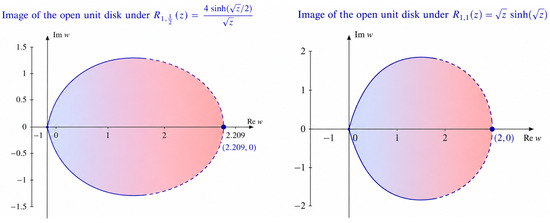
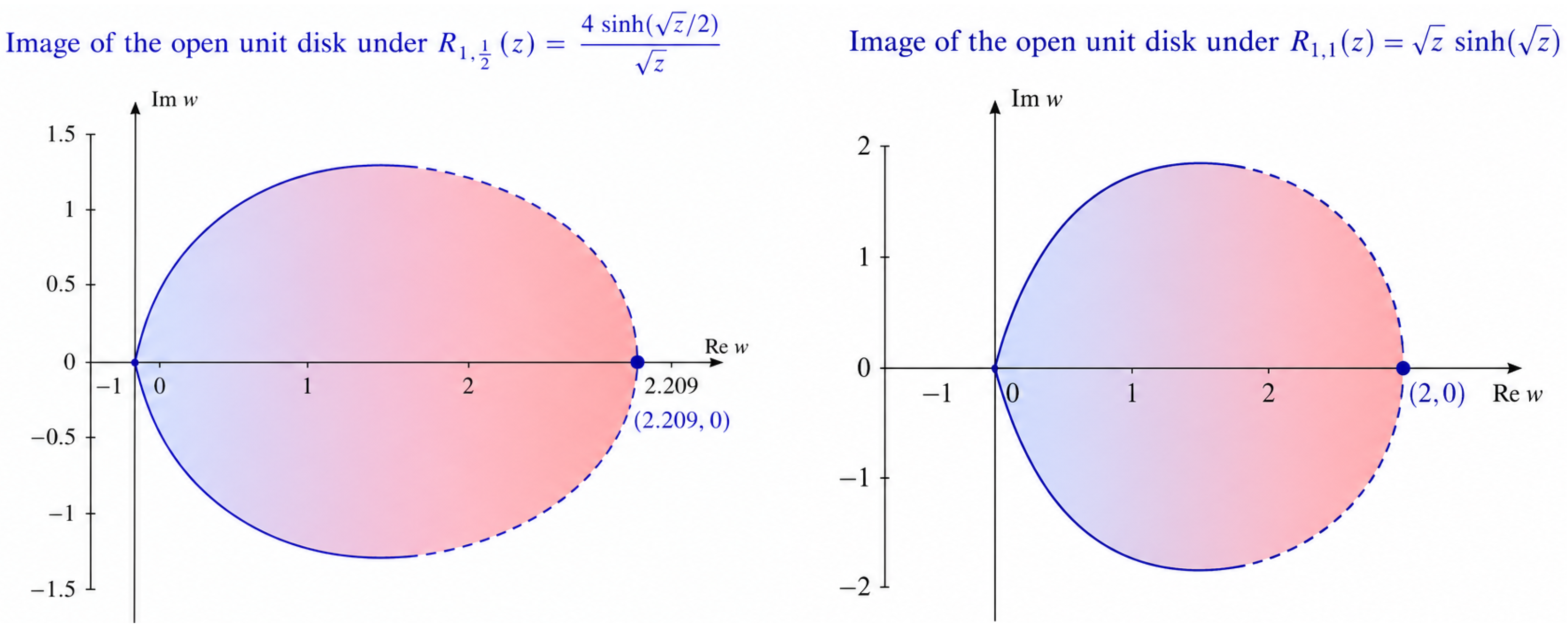
Figure 1.
The image of over open unit disc. The image of over open unit disc.
Corollary 4.
Let , and with the inequality
Then the function proves to be q-close-to-convex when taken with respect to
Corollary 5.
Let , with
As a specific instance of the Rabotnov function, (see Figure 1) proves to be q-close-to-convex with respect to
Theorem 2.
Let , , and with the inequality
Then in the open unit disk with respect to
Proof.
Take the function
Another way to write this expression is
where
To prove that , we construct
so that
It is easy to verify that , and that for every positive integer . Moreover, Lemma 2 yields the following:
We now turn to proving that
which is the same as
To verify the (20) inequality, let since, Then The following property is used
Since and ⇒ Thus,
Now, Equation (20) becomes
which completes the proof. □
Corollary 6.
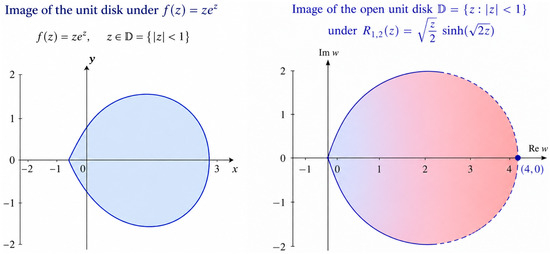
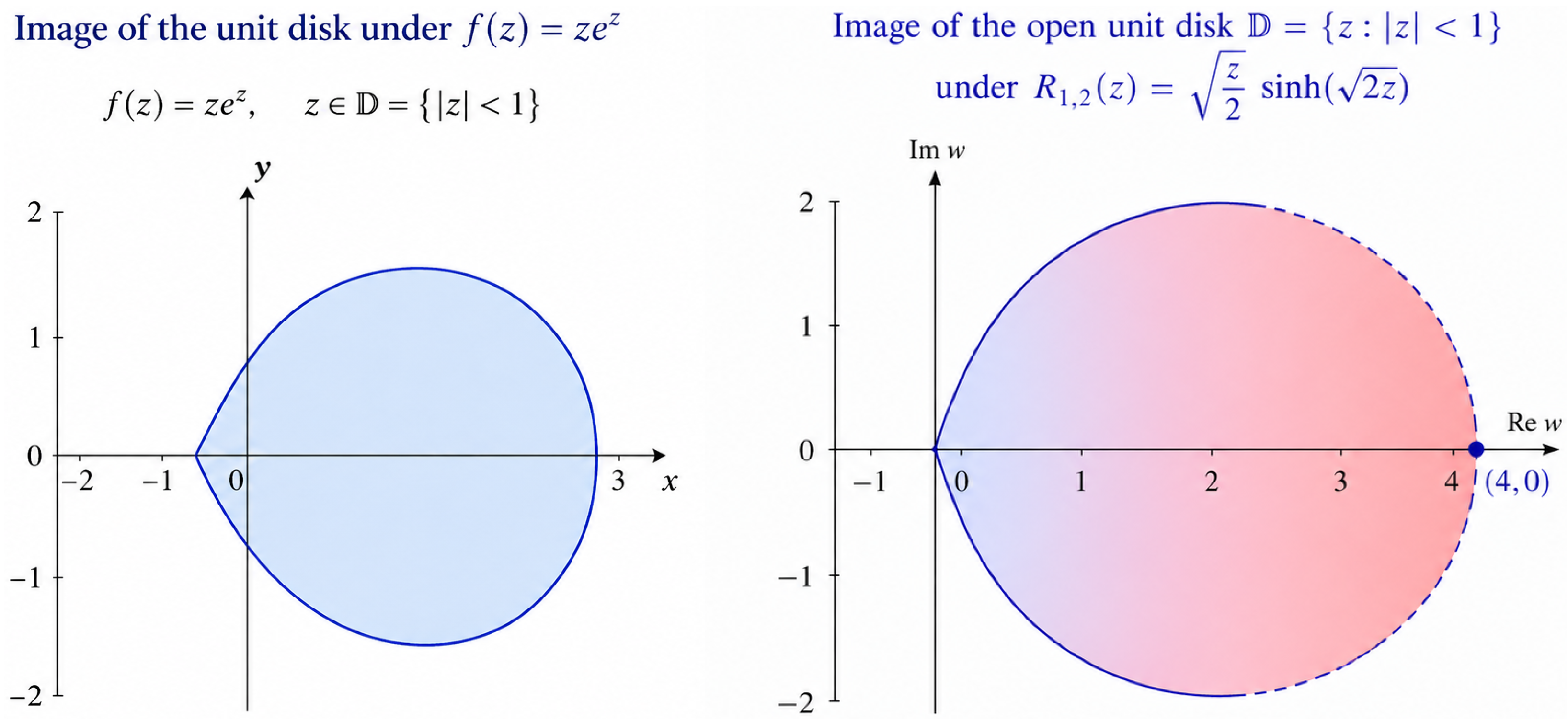
Figure 2.
The image of over open unit disc. The image of over open unit disc.
Corollary 7.
Let , , and with the inequality
Then the function in the open unit disc with respect to
Corollary 8.
Corollary 9.
Let , , with the inequality
Then the function in the open unit disc with respect to
Theorem 3.
Assume and satisfy
Under these conditions, the function is a member of the class S*.
Proof.
To show that , it suffices to verify that the both sequences and are non-increasing. For this, assume
Substituting the expression for , we obtain
This implies that
For , this yields
which is equivalent to
Now take,
Substituting for , we have
For , this becomes
Simplifying, we obtain
which leads to
Hence, by Lemma 3, is starlike in . □
Theorem 4.
Let , , , , and . If and , then the normalized Rabotnov function is starlike of order
Proof.
Consider that
provides and
The relation between and is
To conclude the proof, it is adequate to verify that the sequence satisfies the conditions (6) and (7) stated in Lemma 5. Using the above relation and straightforward computations, we find
where
Expression (25) is positive for under the prescribed conditions. However, condition (8) must also be verified.
Now, consider
Clearly,
where
The results indicate that the above expression is positive for under the specified conditions, which completes the proof. □
Theorem 5.
Let , , , and . Suppose and satisfy the following conditions:
and
whenever and . Under these conditions, turns out to be convex in the direction of the imaginary axis.
Proof.
To establish the result, it is enough to verify that is typically real and that the coefficients of are real. Define
Here,
To achieve the result, the Rabotnov function’s coefficients must satisfy Lemma 6’s conditions. Consider that
Hence, positivity reduces to the numerator above being positive.
Next, consider the second condition. For , we compute
where we define
Since is increasing on , the factor is controlled when and . Therefore, for , , and and the sequence satisfies Lemma 6.
Applying the minimum principle for harmonic functions under yields
and
By the Schwarz reflection principle,
Hence, is typically real. □
3. Conclusions
The present paper has developed sufficient conditions for the q-close-to-convexity property of the normalized Rabotnov function in relation to specific starlike function classes defined on the open unit disk. Several consequences arising from the main results have also been presented, along with illustrative figures to highlight their significance. Furthermore, the starlikeness properties of the Rabotnov function have been investigated from different perspectives, enriching the overall geometric analysis of the function. It is anticipated that the present findings will encourage further investigation into the q-close-to-convexity of additional functions, the q-generalized Dini function, and various others.
Author Contributions
Conceptualization, M.U.D., S.N., Z.W., A.M.; Formal Analysis, S.N., M.U.D., M.I., A.M.; Methodology, All Authors; Funding Acquisition, A.M.; writing original draft, S.N., M.U.D., A.M.; Writing review and editing, S.N., M.U.D., M.I., Z.W., A.M. All authors read and agreed to the published version of the manuscript.
Funding
The work is supported by the Guangdong University of Technology, Guangzhou, China (Grant Number: 263113991).
Data Availability Statement
The original contributions presented in this study are included in the article. Further inquiries can be directed to the corresponding author.
Conflicts of Interest
The authors declare no conflicts of interest.
References
- Ismail, M.E.H.; Merkes, E.; Styer, D. A generalization of starlike functions. Complex Var. Theory Appl. Int. J. 1990, 14, 77–84. [Google Scholar] [CrossRef] [Scilit]
- Watson, G.N. A Treatise on the Theory of Bessel Functions, 2nd ed.; Cambridge University Press: Cambridge, UK; London, UK; New York, NY, USA, 1944. [Google Scholar]
- Gorenflo, R.; Kilbas, A.A.; Mainardi, F.; Rogosin, S. Mittag-Leffler Functions. In Theory and Applications; Springer Monographs in Mathematics; Springer: Berlin/Heidelberg, Germany, 2020. [Google Scholar]
- Rabotnov, Y.N. Equilibrium of an elastic medium with after effect. Prikl. Matem. Mekh. (PMM) 1948, 12, 81–91. [Google Scholar] [CrossRef] [Scilit]
- Liu, D.; Din, M.U.; Raza, M.; Malik, S.N.; Tang, H. Convexity, Starlikeness, and Prestarlikeness of Wright Functions. Mathematics 2022, 10, 3858. [Google Scholar] [CrossRef] [Scilit]
- Bansal, D.; Prajapat, J.K. Certain geometric properties of the Mittag-Leffler functions. Complex Var. Elliptic Equ. 2016, 61, 338–350. [Google Scholar] [CrossRef] [Scilit]
- Raducanu, D. On partial sums of the normalized Mittag-Leffler functions. An. St. Univ. Ovidius Constanta 2017, 25, 123–133. [Google Scholar] [CrossRef] [Scilit]
- Noreen, S.; Raza, M.; Liu, J.-L.; Arif, M. Geometric properties of the normalized Mittag–Leffler functions. Symmetry 2019, 11, 45. [Google Scholar] [CrossRef] [Scilit]
- Das, S.; Mehrez, K. On geometric properties of the Mittag-Leffler and Wright functions. J. Korean Math. Soc. 2021, 58, 949–965. [Google Scholar]
- Srivastava, H.M.; Kumar, A.; Das, S.; Mehrez, K. Geometric properties of a certain class of Mittag-Leffler-type functions. Fractal Fract. 2022, 6, 54. [Google Scholar] [CrossRef] [Scilit]
- Eker, S.S.; Ece, S. Geometric properties of the normalized Rabotnov function. Hacet. J. Math. Stat. 2022, 51, 1248–1259. [Google Scholar] [CrossRef] [Scilit]
- Eker, S.S.; Seker, B.; Ece, S. On the normalized Rabotnov function associated with certain subclasses of analytic functions. Probl. Anal. Issues Anal. 2023, 12, 97–106. [Google Scholar]
- Frasin, B.A. Partial sums of generalized Rabotnov function. Bol. Soc. Mat. Mex. 2023, 29, 65. [Google Scholar] [CrossRef] [Scilit]
- Amourah, A.; Aldawish, I.; Alhindi, K.R.; Frasin, B.A. An application of Rabotnov functions on certain subclasses of bi-univalent functions. Axioms 2022, 11, 680. [Google Scholar] [CrossRef] [Scilit]
- Deniz, E.; Kazimoglu, S. Hardy space of Rabotnov function, 5th International conference on mathematics. In Proceedings of the an Istanbul Meeting for World Mathematicians, Istanbul, Turkey, 1–3 December 2021. [Google Scholar]
- Raza, M.; Breaz, D.; Mushtaq, S.; Cotirla, L.I.; Tawfiq, F.M.O.; Rapeanu, E. Geometric Properties and Hardy Spaces of Rabotnov Fractional Exponential Functions. Fractal Fract. 2024, 8, 5. [Google Scholar] [CrossRef] [Scilit]
- Raghavendar, K.; Swaminathan, A. Close-to-convexity of basic hypergeometric functions using their Taylor coefficients. J. Math. Appl. 2012, 35, 111–125. [Google Scholar] [CrossRef] [Scilit]
- Srivastava, H.M.; Bansal, D. Close-to-convexity of a certain family of q-Mittag-Leffler functions. J. Nonlinear Var. Anal. 2017, 1, 61–69. [Google Scholar]
- Raza, M.; Din, M.U. Close-to-Convexity of q-Mittag-Leffler functions. Comptes Rendus Acad. Bulg. Sci. 2018, 12, 1581–1591. [Google Scholar]
- Din, M.U.; Raza, M.; Xin, Q.; Yalcin, S.; Malik, S.N. Close-to-convexity of q-Bessel-Wright functions. Mathematics 2022, 10, 3322. [Google Scholar] [CrossRef] [Scilit]
- Noreen, S.; Mondal, S.R.; Din, M.U.; Mushtaq, S.; Wei, Z.; Murtaza, A. Applications of q-Bessel-Struve Functions on Univalent Functions. Mathematics 2025, 13, 2150. [Google Scholar] [CrossRef] [Scilit]
- Fejer, L. Untersuchungen uber Potenzreihen mit mehrfach monotoner Koeffizientenfolge. Acta Litt. Sci. 1936, 8, 89–115. [Google Scholar]
- Sangal, P.; Swaminathan, A. Starlikeness of Gaussian Hypergeometric functions using positivity techniques. Bull. Malays. Math. Sci. Soc. 2018, 41, 507–521. [Google Scholar] [CrossRef] [Scilit]
- Koumandos, S.; Ruscheweyh, S. On a Conjecture for Trigonometric Sums and Starlike Functions. J. Approx. Theory. 2007, 149, 42–58. [Google Scholar] [CrossRef] [Scilit]
Disclaimer/Publisher’s Note: The statements, opinions and data contained in all publications are solely those of the individual author(s) and contributor(s) and not of MDPI and/or the editor(s). MDPI and/or the editor(s) disclaim responsibility for any injury to people or property resulting from any ideas, methods, instructions or products referred to in the content. |
© 2026 by the authors. Licensee MDPI, Basel, Switzerland. This article is an open access article distributed under the terms and conditions of the Creative Commons Attribution (CC BY) license.