


Abstract
In social network-based group decision-making, achieving consensus often entails costs, leading to an inherent trade-off between cost and consensus. To address this issue, we propose a dual-semantic, multi-objective consensus optimization model that simultaneously minimizes cost and maximizes consensus. The resulting Pareto set offers decision makers (DMs) multiple trade-off solutions between cost and consensus. Specifically, we first develop a 2-tuple trust propagation model that incorporates path knowledge and path length to improve the completeness and accuracy of indirect trust inference. Building on this foundation, we adaptively adjust DM weights by combining trust relationships with dynamic incentive weights. This design balances individual influence and adjustment willingness throughout the consensus-reaching process. Finally, we formulate a multi-objective decision optimization model. This model integrates minimum cost and maximum consensus to generate a modified decision matrix for efficiently aggregating group opinions. A multi-physician collaboration case in a medical diagnostic decision-support system validates the effectiveness of the proposed method.
Keywords:
2-tuple trust propagation operator; minimum cost consensus model; dynamic weight; max consensus MSC:
90B50
1. Introduction
As society advances, real-world decision-making problems are becoming increasingly complex, often exceeding the capacity of any single decision-maker (DM) to address them adequately on the basis of individual knowledge and experience alone. Group decision-making (GDM) facilitates consensus among multiple DMs, integrates expertise from different domains, and enables a comprehensive evaluation of alternatives to identify the optimal solution [1,2,3,4]. In GDM processes, DMs are not fully independent; rather, they are embedded in social relationships, such as working relationships and trust ties. The GDM problem under a social network context is referred to as the Social Network GDM (SNGDM) problem. Trust relationships are widely used to characterize social relations among DMs and are frequently employed to address key issues in GDM, such as weight allocation, consensus formation, and the reconciliation of diverse preferences [5,6,7,8,9,10].
In many real-world settings, DMs often do not possess direct trust relationships because they may be unfamiliar with one another. This circumstance has motivated the development of various trust propagation operators for estimating indirect trust [11,12,13]. Wu et al. [14] proposed a dual trust propagation operator based on the assumption that trust decays whereas distrust increases during propagation. To better capture the trust propagation process, a range of refined operators have subsequently been developed from different perspectives. Liu et al. [15] proposed a trust propagation method that explicitly considers expert knowledge coverage. Tan et al. [16] investigated the issue of long-distance trust propagation and examined the effect of trust chain length on propagation efficiency. Ambiguous self-expression and the difficulty of estimating trust in precise numerical or fuzzy terms have motivated the use of linguistic trust relationships in recent studies [11,17,18,19,20]. Yuan et al. [18] modeled trust decay during propagation by proposing a tuple-based operator with discount factors for indirect trust estimation. Zhou et al. [20] presented a distributed linguistic trust propagation and aggregation operator, which further refined the semantic propagation of linguistic trust relations. However, most existing 2-tuple linguistic propagation operators (i) focus primarily on trust and do not explicitly model distrust, and (ii) fail to jointly account for path knowledge coverage/quality and length-induced trust decay. To address these limitations, we propose a dual-semantic 2-tuple trust/distrust propagation and multipath aggregation framework that integrates path knowledge and path length, thereby providing a more robust basis for subsequent consensus optimization.
Decision-maker weight is a critical factor affecting the final decision outcome. The influence of DMs is often reflected in their network positions and role characteristics. In SNGDM, trust relationships provide an important basis for weight assignment. Ji et al. [9] incorporated network structure into trust propagation and developed a weight adjustment method by exploiting community structure. Du et al. [21] calculated DM trust scores from the trust-relationship matrix to quantify DM importance. Liu et al. [22] presented a comprehensive weight determination method based on maximum consensus, in which subgroup weights are derived by combining three trust indicators: trust score, similarity, and degree centrality. Yuan et al. [18] determined expert weights by synthesizing their trust relationships and opinion differences. Most existing studies determine DM weights before feedback-based opinion adjustment, although consensus reaching is inherently dynamic. Therefore, it is more reasonable to iteratively optimize weights while accounting for behavioral changes and opinion quality [23]. Li et al. [24] mitigated the adverse effect of low-cooperation DMs on decision quality through a dynamic penalty mechanism. However, the existing literature relies predominantly on penalties to discipline uncooperative DMs, whereas relatively few studies adopt reward-based weighting to actively encourage revisions and reduce potential non-cooperation [25,26,27]. Evidence also suggests that incentive mechanisms may be more effective than punitive measures for experts who are reluctant to revise their views [28]. Accordingly, this paper introduces a weight-incentive mechanism that dynamically adjusts expert weights according to the extent of their opinion revisions.
The minimum cost consensus model (MCCM) is a mathematical framework designed to achieve consensus among DMs while minimizing the total adjustment cost required to align their initial opinions. Owing to its advantages in optimal resource allocation and decision-making efficiency, MCCM has attracted considerable attention in management and systems science. Lu et al. [29] constructed a robust optimization-based minimum cost model to address the uncertainty in the unit adjustment cost of DMs. Teng et al. [30] developed a social network-driven least-cost consensus framework that incorporates DMs’ personal attributes and group attitudes/behaviors and recommends adjustments based on their willingness to revise. With the growing adoption of multi-objective optimization in decision analysis, MCCM has also been integrated into multi-objective formulations to accommodate diverse GDM settings. For example, Wu et al. [31] proposed feedback mechanisms based on multi-objective optimization for different consensus-reaching scenarios thereby enhancing adaptability. Shen et al. [32] developed a multi-objective large scale GDM consensus model that considers minimum cost and maximum fairness, thereby improving the process from a fairness perspective. However, many existing multi-objective consensus models focus on efficiency-driven feedback. As a result, they often overlook DMs’ acceptance of adjustment suggestions and underutilize trust relationships in guiding opinion revision.
To address incomplete trust representation, insufficient cooperative motivation, and consensus cost control in SNGDM, this paper proposes a comprehensive consensus framework. The framework improves decision-making accuracy and efficiency by optimizing trust propagation paths, introducing a dynamic incentive adjustment mechanism, and formulating a multi-objective optimization model. The main contributions are summarized as follows:
- We introduce a two-tuple linguistic trust propagation operator. Unlike existing two-tuple linguistic trust propagation methods that mainly focus on trust, the proposed two-tuple linguistic trust/distrust propagation operator explicitly propagates distrust semantics and thus provides a more comprehensive trust representation. In addition, rather than relying on a single selected path, we propose a multipath composite-weight trust aggregation operator that jointly considers trust attenuation and knowledge defects across propagation paths. This multipath weighting strategy improves the rationality of trust propagation.
- We propose a dynamic weight adjustment mechanism with incentive rewards. Existing studies often determine DM weights before opinion adjustment and mainly rely on penalty mechanisms to regulate low cooperation. By contrast, the proposed mechanism combines trust-score-based weights and incentive weights, and adaptively balances the two by maximizing the consensus index between the collective decision matrix and individual decision matrices. In this way, DM influence is quantified through trust-network information while beneficial revisions are rewarded, thereby reducing potential uncooperative behavior and enhancing DMs’ willingness to participate.
- We construct a multi-objective optimization model to minimize cost and maximize consensus. Traditional MCCM-type models mainly emphasize cost efficiency and may underutilize trust information when guiding revisions. Accordingly, the proposed model simultaneously minimizes adjustment cost and maximizes consensus, while embedding trust relationships into the feedback regulation mechanism to better reflect DMs’ willingness to revise their initial opinions. The resulting strategy achieves an effective balance between decision cost and the attained consensus level, providing a more reasonable and efficient solution for GDM.
The remainder of the paper is structured as follows: Section 2 briefly reviews the relevant theoretical knowledge. Section 3 describes a framework for group consensus decision-making, which includes the trust propagation and aggregation operators and the group consensus optimization model considering the objectives of minimum cost and maximum consensus. Section 4 illustrates the feasibility of our approach through numerical experiments. Section 5 shows analysis and comparison of our methods and others. The paper concludes in Section 6.
2. Preliminaries
In this section, we review the relevant theoretical knowledge, including two-tuple linguistic term sets and numerical scale, social networks, and the MCCM, concepts that are useful for understanding the research in the rest of the paper.
2.1. Two-Tuple Linguistic Term Sets and Extended Transformation Model
Helping DMs better articulate information, the two-tuple linguistic model is employed as a formal framework for expressing trust and opinions related to decision-making. Typically, DMs express their evaluative information based on a pre-given set of linguistic terms.
Let be a symmetric linguistic term set with odd cardinality , with . The term denotes the neutral (mid) linguistic assessment, and .
In response to the need for a linguistic terminology computation in decision-making, Herrera and Martínez [33] proposed the two-tuple linguistic model. This approach expresses linguistic evaluative information using , where denotes a linguistic evaluation level in a predefined set , denotes the deviation of the DM’s evaluative information in comparison to , and .
Definition 1
(Two-tuple linguistic and inverse functions). Let be the result of a symbolic aggregation. The extended 2-tuple linguistic transformation is defined as:
The inverse transformation is with
Proposition 1.
For any , Equation (1) yields a unique pair . Moreover, and are mutually inverse, and , because when . Hence the representation is information-preserving.
Proof of Proposition 1
(Relation to the classical two-tuple model). Define the index shift and the translated numerical value . Let with . Then the above extended mapping on is equivalent to applying the classical Herrera–Martínez two-tuple transformation on to (and using ). Therefore, the proposed model is a symmetric-domain extension of the original one. □
2.2. Social Network Analysis
Social network analysis is utilized to analyze the relationships of members in social entities such as individuals or organizations [34] and can be considered an important theoretical tool to study trust relationships between DMs in social network GDM [5,35].
Definition 2
(Trust function, from Victor et al. [36]). The trust and distrust relationship of the can be represented by a tuple
where and denote trust degree and distrust degree from the DMs to in a social network, and .
Definition 3
(Trust score, from Victor et al. [36]). Assuming that there is a trust relationship
between DMs and , it follows that the trust scores associated with the trust function between DMs and are
2.3. Minimum Cost Consensus Model (MCCM)
In multi-party decision-making scenarios (e.g., organizational management and policy making), traditional consensus-building methods often overlook the economic and time costs associated with coordinating participants’ opinions, which can lead to inefficient decisions and resource waste. As decision-making environments become increasingly complex, DMs require theoretical tools that balance multi-party interests while optimizing cost inputs. Ben-Arieh and Easton [37] introduced the consensus cost and MCCM frameworks, which minimize the cost of modifying DMs’ opinions via a linear function, offering a useful perspective for addressing the “high-cost consensus” dilemma in real-world GDM. In the soft-consensus setting, Ben-Arieh et al. [38] proposed a least-cost consensus model that incorporates a tolerance threshold:
Definition 4
(MCCM, from Ben-Arieh, Easton and Evans [38]). Assume that in a GDM process, a coordinator organizes DMs to reach consensus on a particular issue. The DM set is , is the initial opinion of the DM , is the adjusted opinion of the DM , is the unit-adjusted cost of the DM , and is the upper limit for how far each DM’s opinion can differ from the collective opinion. In soft consensus models, the adjusted opinion need not coincide precisely with the collective opinion, provided the discrepancy remains within an acceptable tolerance limit.
Zhang et al. [39] extended this framework by assigning individualized weights to DMs, reflecting their distinct influence levels. Their approach leveraged the weighted average (WA) operator for opinion aggregation, formalizing a new MCCM, where is the aggregated consensus opinion, and is the DM weights:
3. Social Network GDM and Resolution Method
In social network-based GDM, to obtain a consensus ranking of candidate solutions, we propose a group-optimized consensus method that jointly pursues two objectives: minimizing consensus cost and maximizing DM consensus. Figure 1 illustrates the workflow of the proposed group consensus decision-making framework. The framework comprises two core modules:
Figure 1.
Group consensus decision-making framework.
- (1)
- Two-tuple linguistic trust relationships and trust network completion: This module addresses missing trust relationships among DMs using a two-tuple linguistic trust propagation operator. Trust paths are identified and aggregated while accounting for knowledge degree and path length, thereby completing the trust network. Details are provided in Section 3.1.
- (2)
- Dynamic weight determination and multi-objective consensus optimization: Initial weights are derived from trust scores, and DMs are classified into high- and low-consensus groups according to their consensus degree. Low-consensus DMs are guided to revise their opinions by referencing trusted high-consensus DMs, with an incentive mechanism that rewards opinion modifications. We introduce a dynamic weight adjustment model to optimize weight allocation, with the goals of maximizing consensus and minimizing adjustment costs. Additional constraints are imposed to prevent weight manipulation via excessive adjustments. Finally, the multi-objective optimization model yields the final DM weights and the Pareto-optimal solution set, enabling systematic ranking of alternatives. A comprehensive description of the methodological implementation is provided in Section 3.2.
3.1. Two-Tuple Linguistic Trust/Distrust Propagation and Aggregation Operators
First, this section extends the traditional single-valued two-tuple linguistic trust relationship to a dual-dimensional representation that simultaneously models trust and distrust for two-tuples; based on this extension, we propose a two-tuple linguistic trust/distrust propagation operator. We then develop a multi-path two-tuple linguistic trust aggregation operator that accounts for path knowledge degree and path length.
3.1.1. Two-Tuple Linguistic Trust/Distrust Propagation Operator
In complex real-world settings, many DMs may lack prior familiarity and can assess the reliability of others’ opinions only through linguistic expressions exchanged during the decision-making process. Such opinion differences naturally stem from heterogeneous professional preferences and intellectual backgrounds, leading DMs to agree with certain aspects of others’ viewpoints while disagreeing with others. However, existing studies that rely on two-tuple linguistic trust relationships do not capture the intertwined nature of trust and distrust. Therefore, we introduce a two-tuple linguistic trust/distrust relationship.
Definition 5
(Two-tuple linguistic trust/distrust relationship). Let be the set of linguistic terms, where to denotes the degree of distrust and it is decreasing, and to denotes the degree of trust and it is increasing, then given a set of DMs , who provide the trust relationship in linguistic variables for other DMs according to linguistic terms set . Then the two-tuple linguistic trust relationship of DM for is:
where and are two-tuple linguistic values representing trust and distrust on , respectively, , ; .
Since two-tuple linguistic representations cannot be directly used in numerical computations, we map them to real numbers using the numerical scale defined in Definition 1. Moreover, because both and in the trust function lie in [0, 1], we prepend a negative sign when converting the two-tuple linguistic distrust component to a real value to distinguish its direction from trust within a unified numerical axis. The conversion is defined as follows:
Trust propagation operators can model how trust propagates along trust paths. Trust propagation operators developed under the framework of triangular norms (t-norms) are well established. Wu, Chiclana, Fujita and Herrera-Viedma [14] proposed a dual trust propagation operator using the Einstein product and Einstein sum as the t-norm and t-conorm, respectively. For any , the Einstein product and Einstein sum are defined as This operator has been proven to be an effective way to propagate trust relationships [9,40,41].
Definition 6
(Two-tuple linguistic trust propagation operator). There are two-tuple linguistic trust relationships and , which are from the DMs to and to (k,t, h ∈ {1,2, …, m}, k ≠ t ≠ h). The two-tuple linguistic trust relationship can be acquired by the following linguistic trust propagation operator, which is defined as follows:
In practical decision-making, a trust propagation chain may involve more than three experts. Based on Definition 6, is extended to trust paths with multiple mediators.
Definition 7.
Let be a collection of two-tuple linguistic trust relationships, where . The 2-tuple linguistic trust/distrust propagation operator for the trust path with multiple mediators is defined as follows:
Example 1.
Let be a linguistic term set with a symmetric and uniform scale. Suppose the two-tuple linguistic trust/distrust relationships from to and from to are and , respectively. Using Equation (10), we derive the missing relationship from to . Then, by Equation (8), we obtain and . Applying the two-tuple linguistic trust/distrust propagation operator yields .
The propagated relationship via exhibits lower trust (and higher distrust) than the direct components and , aligning with the typical trust-decay tendency along longer paths. Moreover, the trust/distrust semantics are coherently transferred from and to . According to Definitions 5–7 and the numerical transformation in Equations (8) and (9), the proposed two-tuple linguistic trust/distrust propagation operator satisfies several basic mathematical properties. The corresponding statements and proofs are provided in Appendix A.
3.1.2. Multipath Composite Weight Trust Aggregation Operator
In trust networks, trust relationships between DMs are often propagated through multiple indirect paths. Many studies focus on the shortest indirect path to minimize trust decay during propagation. However, although the shortest path reduces trust attenuation, it may exhibit a lower perfect knowledge degree(PKD), implying greater uncertainty when DMs assign a trust function due to limited information available along that path [15,42,43]. The final trust value is derived by aggregating all paths through a weighted average [18]. Therefore, a comprehensive evaluation should account for both the knowledge degree and the length of each path. Accordingly, we propose a multipath composite-weight trust aggregation operator that simultaneously considers knowledge deficit and trust decay across different propagation paths.
Trust assessments elicited from DMs often involve substantial uncertainty because their cognitive information about other DMs is limited. Victor et al. [36] refer to a trust function specified under such uncertainty as a trust function with knowledge deficit. Tian et al. [44] propose that a trust function has perfect knowledge when , whereas all other trust functions are knowledge deficient. Motivated by the concepts of perfect knowledge degree in Tian et al. [44], we introduce the degree of perfect knowledge as follows:
Definition 8
(PKD). Let be the 2-tuple linguistic trust function, the perfect knowledge degree is the mapping of the 2-tuple linguistic trust function, which associates a value in with each 2-tuple linguistic trust function , then the of the 2-tuple linguistic trust function is
where . If and only if , then , the 2-tuple linguistic trust function has the trust state of complete knowledge; otherwise, exhibits trust uncertainty.
The concept of is designed to measure the overall perfect knowledge degree of TF through the trust path in the trust propagation process [44].
Definition 9
(APKD). Let be a trust path between DMs, and be a trust function representing the trust relationship of the DM to . is a mapping on trust paths set, assigns a value in with each trust path as follows:
Liu et al. [15] employed a linear penalty to penalize the trust decay associated with the length of the indirect path. This method is not sensitive enough to extreme points (e.g., very short or very long paths) and is prone to distortion. Instead of the original divisor method in Liu’s method, we use an exponential decay model to represent the trust decay in the trust transfer process. The exponential decay model is characterized by rapid decline, which is closer to the psychological model of “the longer the chain, the less trustworthy” in real trust transmission.
The exponential discount is consistent with a multiplicative trust-decay principle: if each additional hop attenuates the fidelity of transmitted trust information by a constant ratio , then a path of length yields an overall discount , which is equivalent to . This “constant proportional decay per hop” assumption naturally leads to the exponential form and avoids the non-positivity/truncation issue that may arise in linear decay when becomes large.
Definition 10
(Multipath composite weight trust aggregation operator). Let be the set of trust paths, and be the set of trust relationships obtained through the two-tuple linguistic trust propagation operator , related to the set of indirectly connected paths that link two unconnected DMs. The final trust relationship between DMs is
where is the weight coefficient associated with path . Let denote the length of path , and is used to depict the information loss of the indirect path of length . denote the overall perfect knowledge degree of the path in the trust propagation process. The path weight is computed as
Note. When a direct trust relationship exists, it should be treated as direct evidence and is not generated by . Therefore, all candidate paths satisfy . In practice, we restrict indirect trust inference to the six-degree bound, so that .
Examples of how to get a complete trust matrix using the trust propagation and aggregation operators presented above will be given below.
Example 2.
DMs express their two-tuple linguistic trust relationships, the incomplete two-tuple linguistic trust relationship matrix is shown below, and Figure 2 shows the resulting trust network. As shown in Figure 2, there are two paths from to , which are , . Their 2-tuple linguistic trust relationships are, respectively: , , , , . In path , the of two trust functions are 0.76 and 0.58, and we get the total perfect knowledge degree . The length of path is = 2, so the computation shows that . In path , the total perfect knowledge degree and the length of path is , so the computation shows that . Path is shorter in length but has lower knowledge degree, while Path possesses higher knowledge degree but is longer in length. Combining the trust propagation information from both paths yields a more reasonable outcome. After calculating the weights of all paths, normalization yields: , . Through Equations (10) and (9), we calculate and .
Figure 2.
Trust network.
3.2. Group Consensus Optimization Model Considering Minimum Cost and Maximum Consensus Objectives
Determining DM weights and effectively reconciling divergent opinions to achieve group consensus in GDM are complex tasks and constitute two core challenges. In this section, we develop a group consensus optimization model that simultaneously considers the objectives of minimum cost and maximum consensus. The proposed model yields the DM weights and the final collective decision matrix.
3.2.1. Components of the DM’s Weights
Conventional consensus models frequently employ static, predetermined DM weights throughout the consensus-reaching process. This absence of a dynamic, iterative consensus-updating mechanism limits their ability to cope with the evolving complexity of decision-making contexts. This section introduces the components of dynamic DM weights.
The trust score of a DM is first selected as the initial weight of the DM, and then the consensus measurement is performed:
In this study, the individual decision matrix for DM , where denotes DM ’s two-tuple linguistic trust assessment of alternative attribute . The consensus degree of DM is determined in the following way:
Then the group consensus degree is
where is the weight of the DM and denotes the collective decision matrix and is given by the following equation:
If , the group has reached a sufficiently high consensus level; otherwise, DMs who fail to meet the consensus requirement must modify their decision matrices to improve group consensus. To account for each DM’s willingness to modify, we (i) recommend to each low-consensus DM the opinion of the most trusted DM in the high-consensus group and (ii) dynamically adjust weights according to each DM’s modification degree, awarding corresponding weight incentives. The final DM weight is defined as a linear combination of the trust score and the incentive weight. The computation of the trust score and incentive weight is introduced next.
(1) The weight vector generated from trust score matrix:
It is known that is the computed trust score matrix of DMs, where denotes the trust score of DM to DM . denotes the combined trust score of the other DMs to DM , which can be calculated by the following equation:
(2) The incentive weights vector generated by the degree of modification of the decision matrix:
It is known that is the initial individual decision matrix of DM , and is the modified decision matrix of DM . The incentive weights of DM can be calculated by the following equation:
In summary, the total weight of DMs can be calculated using the following formula, where g is the weighting coefficient obtained from model (24):
3.2.2. Group Consensus Optimization Model Construction Considering Minimum Cost and Maximum Consensus Objectives
The proposed group consensus optimization model, which considers the dual objectives of minimum cost and maximum consensus, further extends the traditional MCCM by incorporating social network analysis. The key difference is that opinion adjustment is guided toward the decision directions of high-trust and high-consensus DMs identified via social network analysis, whereas the dynamic weight adjustment mechanism—with weight incentives—enhances DMs’ willingness to adjust and suppresses potential uncooperative behavior. The inclusion of a maximum-consensus objective also mitigates a limitation of the traditional MCCM, which may overemphasize minimum cost and allow unconstrained opinion modifications.
Conventional minimum-cost consensus models typically prioritize efficiency over individual preferences, thereby neglecting DMs’ willingness to modify their opinions. However, in practice, divergent views often reflect legitimate differences in professional perspectives rather than absolute right-or-wrong positions. A tolerance threshold is introduced to ensure that all opinion adjustments remain within acceptable bounds for each DM. We implement a dynamic classification scheme in which DMs are categorized into high- and low-consensus groups based on the median consensus level. For low-consensus DMs, our model recommends adjustment directions derived from the most trusted individuals in the high-consensus group. By respecting each decision maker’s professional judgment, gradual consensus is achieved through the combined use of tolerance boundaries and trust-guided mechanisms. Following the traditional MCCM, the basic model structure is defined as follows:
Model (22) is formulated to minimize the consensus-reaching cost. Constraints (22a) and (22b) specify the adjustment opinions and the adjustment direction for low-consensus DMs, respectively. Constraints (22c) clarifies how to calculate the collective consensus decision matrix. Constraint (22d) sets the DMs’ tolerance level for limiting opinion modifications. Constraint (22e) defines the parameters used in opinion adjustment.
In the model (23), the weight of the DM is very important and will affect the achievement of group consensus. To achieve equitable weight allocation, we formulate a consensus-driven optimization model that determines the optimal weighting coefficients by maximizing alignment between individual and collective judgments, which is derived from Liu’s model [22]. Liu et al. propose a maximum-consensus model that generates subgroup comprehensive weights by combining multiple reliable indicators. Because consensus reaching is inherently a dynamic communication and adjustment process, whereas Liu’s model relies entirely on static indicators, we incorporate a dynamic weight indicator, namely the incentive weight.
In Model (23), constraints (23a), (23b), (23c), and (23d) detail the sources and calculation formulas for DMs’ weights. Constraint (23e) specifies how to compute the collective decision matrix. Constraint (23f) and (23g) are used to compute the consensus degree and the group consensus degree, respectively.
We present the following group consensus optimization model (24) that considers the objectives of minimizing consensus cost and maximizing consensus. It is a combination of Models (22) and (23).
In Model (24), the objective functions aims to minimize the cost of reaching consensus while maximizing the consensus of DMs’ opinions. Constrains (24a)–(24k) have the same interpretations as those in Model (22) and (23). denotes the initial individual decision matrix of DM , and denotes the adjusted individual decision matrix. is the collective decision matrix. is the unit cost of opinion adjustment, and is the degree of opinion adjustment. is the individual decision matrix of the high-consensus DM most trusted by . and denote DM ’s trust score and incentive weight, respectively. and denote DM ’s composite weight and normalized composite weight, respectively. is the consensus degree of DM , and is the median level of DM consensus. is the group consensus degree, and is its threshold. is the tolerance level of DM .
The decision variables in Model (24) include and , which are obtained by solving the system specified in Model (24).
Remark 1.
The fusion parameter in (21) and constraints (24c)–(24f) serves as a convex-combination coefficient that balances trust-based influence and incentive-based responsiveness in the final weights. When , the model reduces to pure trust-based weighting; the influence structure is fixed by trust scores and becomes independent of . In this case, consensus evolution is governed only by the trust-guided adjustment-direction constraints and the tolerance-bounded opinion changes controlled by , without feedback from revisions to weights. When , the model reduces to pure incentive-based weighting, such that decision makers who revise more obtain larger influence; this may accelerate agreement but can also increase the risk of weight concentration. This risk is mitigated by the tolerance constraint (24h) and the bounded adjustment domain (24i), which restrict admissible revisions. Overall, provides a principled control parameter that interpolates between stable trust-determined aggregation and adaptive incentive-driven reweighting, yielding two interpretable boundary regimes.
In summary, the proposed multi-objective consensus optimization model balances cost and consensus while regulating opinion adjustments in a principled manner. First, by minimizing adjustment cost, the model yields a cost-efficient modified decision matrix and avoids resource waste caused by excessive adjustments. Second, by maximizing decision consensus, it promotes convergence among group members, thereby enhancing the acceptability and quality of decision outcomes. In addition, the model dynamically adjusts DM weights using trust scores and incentive weights, which enhances DMs’ incentives to participate. This multi-dimensional design enables the decision-making process to accommodate individual preferences while meeting the requirements of group consensus, providing an innovative solution for GDM.
3.2.3. Group Consensus Optimization Model Solution Methods Considering Minimum Cost and Maximum Consensus Objectives
Multi-objective optimization models are designed to balance multiple conflicting objectives simultaneously, which lies at the core of complex decision-making. To address this challenge, researchers have developed several well-established computational approaches, including genetic algorithms, dynamic programming, simulated annealing, and particle swarm optimization. Each technique exhibits distinct strengths (e.g., genetic algorithms for exploring large, complex search spaces and dynamic programming for decomposable problems). NSGA-II has been shown to offer notable advantages for multi-objective optimization, including reduced computational complexity, an elitist strategy, and no need to specify sharing parameters [32,45]. Accordingly, NSGA-II is adopted in this study to ensure solution reliability while maintaining high computational efficiency during optimization. The specific steps are provided Algorithm 1.
| Algorithm 1: Consensus Reaching Process with NSGA-II |
| begin Inputs: ; ; ; • Genetic algorithm parameters: ; ; ; ; . ; . Otherwise, go to the last step; is the median level of DM’s consensus. Classify DMs into: ; . Step 4: : , . ; . Step 5: Define: ; for trust–incentive fusion; . Define two objectives: ; . Apply constraints (1–11) in the model (24); Step 6: . do Evaluate all individuals and compute objective values. Perform non-dominated sorting to obtain Pareto fronts. Compute crowding distance for each individual. Selection: ) using: • lower Pareto rank, • larger crowding distance. Crossover: For each pair of parents: • ; • . Mutation: . individuals. end for Step 7: , evaluation criteria. The supplier with the highest score is selected as the optimal choice. , final collective decision matrix and alternative scores. end |
The overall complexity is , where comes from individual evaluations, and comes from non-dominated ranking (with the population size and the generations).
4. Numerical Experiment
This section details the implementation steps of the proposed group consensus optimization model, which aims to minimize cost while maximizing consensus. The effectiveness of the model is demonstrated through a case study of multi-physician collaborative diagnosis in a medical assistance system. In this process, DMs evaluate all alternatives and input the evaluation results into the model, thereby automatically generating a set of Pareto-optimal solutions and ultimately supporting a more targeted decision outcome.
In this co-diagnosis case, four treatment alternatives are discussed and evaluated by six chief physicians, acting as DMs . The optimal option is then selected with respect to four criteria: efficacy, side effects, patient acceptability, and treatment cost. The criterion weights are . The DMs provide 2-tuple linguistic evaluations in the form of linguistic decision relations, where and . The DMs also provide pairwise 2-tuple linguistic trust relationships, where and . Table 1 presents the incomplete 2-tuple linguistic trust matrix. The tolerance levels for model-induced opinion modifications are . We assume a unit cost of 1 for each DM’s opinion revision.
Table 1.
Incomplete 2-tuple linguistic trust matrix.
We apply the group consensus optimization method proposed in Section 3 to solve this illustrative problem. First, Equations (10) and (14) are used to complete the incomplete trust relationship matrix. Table 1, Table 2 and Table 3 represent incomplete 2-tuple linguistic trust matrix, complete trust matrix, and complete 2-tuple linguistic trust matrix, respectively. present the incomplete 2-tuple linguistic trust matrix, the completed trust matrix, and the completed 2-tuple linguistic trust matrix, respectively. Next, the computed group consensus degree is . Because this value is strictly lower than the predefined consensus threshold , the feedback regulation mechanism is activated. The detailed computational procedures for trust propagation and weight derivation are provided in Algorithm, and are omitted here for brevity. By solving the multi-objective optimization Model (24), we obtain the Pareto-optimal solution set shown in Figure 3, which visualizes the trade-off between decision cost and consensus level. In addition, Table 4 reports five representative solutions (–) selected from the Pareto frontier. These alternatives provide flexibility for DMs. For example, achieves the highest consensus (0.7918) at a higher cost, whereas minimizes the cost (2.2685) while maintaining a moderate consensus degree. DMs can therefore select the most appropriate adjustment scheme given their specific cost and consensus requirements.
Table 2.
Complete trust matrix.
Table 3.
Complete 2-tuple linguistic trust matrix.
Figure 3.
Pareto solution set of multi-objective problem.
Table 4.
The set of Pareto-optimal solutions to the problem.
5. Sensitivity and Comparative Analyses
To evaluate the superiority and practicality of the proposed consensus model, we performed sensitivity and comparative analyses.
5.1. Robust Multipath Trust Propagation: Extreme-Case Robustness and Structural Comparison with Existing 2-Tuple Operators
This subsection examines the robustness of the proposed multipath aggregation against extreme settings of path knowledge quality and its interaction with path length. In Equation (15), each indirect path is assigned an unnormalized score and a normalized weight . Consequently, for any two candidate paths , which provides a closed-form characterization of the trade-off between knowledge reliability (, computed by the PKD product in Definition 9) and length-induced decay.
Extreme PKD regimes. When (severe knowledge defect), and thus ; knowledge-deficient paths are automatically down-weighted and contribute negligibly to the aggregated trust in Equation (14). In contrast, when , the weighting rule reduces to a near length-only scheme , indicating that PKD mainly serves as a reliability gate rather than the primary driver when all paths are knowledge-sufficient.
Interaction with path length. For long paths with high knowledge quality ( large, ), the exponential term still strongly suppresses their contribution, so long-range evidence cannot dominate the aggregation. However, among paths with the same length, PKD becomes decisive: if two paths share the same but one has and the other has , then the latter receives an almost zero weight regardless of whether the common length is short or long. Therefore, PKD consistently filters out unreliable evidence, while length decay controls the influence of distant evidence.
Overall, the multiplicative structure in Equation (15) ensures that (i) paths with severe knowledge defects are nearly ignored, (ii) sufficiently reliable paths are compared fairly, and (iii) long indirect chains remain auxiliary unless their knowledge reliability is sufficiently superior to offset length-induced decay, thereby supporting the robustness and practical interpretability of the proposed aggregation mechanism.
To further clarify the technical novelty of the proposed mechanism, we connect the above extreme-case robustness analysis to a structured comparison of representative trust propagation operators in social network group decision making. Specifically, Equation (15) assigns each indirect path a weight that factorizes into knowledge reliability (APKD, derived from the PKD product in Definition 9) and length-induced decay . This multiplicative design provides a closed-form robustness characterization under extreme PKD regimes. It also offers a principled explanation of why our multipath propagation differs from existing 2-tuple-based approaches. Specifically, prior studies often rely on single shortest-path selection or other heuristic path-choice rules (e.g., selecting the shortest chain or the maximum indirect trust), whereas our operator performs explicit multipath fusion with weights that simultaneously penalize distant evidence and filter out knowledge-deficient evidence. Table 5 summarizes these structural differences along four dimensions—trust information format, distrust semantics, path utilization/fusion strategy, and path-weighting factors—thereby situating the robustness findings within a broader operator-level comparison.
Table 5.
Comparison with other 2-tuple linguistic trust propagation operators.
As shown in Table 5, existing operators differ primarily in how they select and utilize paths and whether distrust is explicitly modeled. In particular, shortest-path strategies (e.g., Zhou) prioritize minimizing information loss but may discard corroborating evidence, whereas max-selection rules (e.g., Xing) can be sensitive to outliers. Multipath schemes (e.g., Yuan) improve coverage but often weight paths using trust magnitude alone. In contrast, our multipath operator weights each path by jointly accounting for knowledge reliability (APKD/PKD) and length decay, which is precisely the robustness mechanism established in Equation (15): unreliable paths vanish as , and overly long chains remain auxiliary due to . This unified design makes the aggregation both robust under extreme settings and structurally distinguishable from prior 2-tuple propagation rules.
5.2. Sensitivity Analysis
5.2.1. Sensitivity Analysis of Unit Cost
This section presents a simulation study examining how unit costs influence consensus formation. Starting from a baseline unit cost of 1 for all DMs, we gradually increase the unit cost and measure the total expenditure required to maintain comparable consensus levels. As shown in Figure 4, the results illustrate how consensus responds to different unit-cost settings. The results indicate an inverse relationship between unit costs and consensus attainment: achieving a higher group consensus degree is easier when the unit cost is low, whereas the barriers to agreement become markedly higher when costs are high. This pattern may be attributed to the fact that elevated unit costs reduce DMs’ propensity (or capacity) to adjust their opinions, since each modification entails a larger financial outlay. Overall, the results demonstrate that cost considerations can materially shape consensus dynamics in GDM contexts.
Figure 4.
The Pareto solution set under different unit costs.
5.2.2. Sensitivity Analysis of
To assess how the linear fusion of trust-driven and incentive-driven weighting influences the multi-objective trade-off, we fix and rerun the Algorithm, overlaying the resulting Pareto fronts on the cost–consensus plane. The Pareto fronts in Figure 5 almost completely coincide for , indicating strong piecewise robustness and structural stability of the cost–consensus trade-off under moderate changes in . By contrast, the extreme setting yields a visibly shifted Pareto set, deviating in the medium-cost region and expanding the feasible coverage at the low-cost end, implying that single-mechanism dominance alters the feasible region and improvement pattern. These results suggest maintaining within a non-extreme interval to ensure stable multi-objective trade-off performance.
Figure 5.
Sensitivity of the Pareto front to the weighting coefficient .
5.2.3. Sensitivity Analysis of
We examine the robustness of the proposed framework with respect to the expert tolerance parameter , which bounds each low-consensus DM’s admissible relative modification in the tolerance constraint. Specifically, we rerun the Algorithm under and with all other settings fixed, and assess both the feasibility/diversity of the non-dominated set and the resulting cost–consensus trade-off. As shown in Figure 6a, a clear feasibility threshold is observed. When , no feasible non-dominated solutions are obtained, indicating that overly stringent tolerance bounds collapse the feasible region under the prescribed consensus requirement. Once , the number of feasible non-dominated solutions increases sharply and then remains stable, suggesting limited marginal gains in feasible diversity from further relaxation. Consistently, Figure 6b shows that the Pareto fronts for almost overlap over the main region, particularly for moderate costs (approximately ). This implies that, conditional on feasibility, moderate variations in do not materially change the intrinsic cost–consensus trade-off. The influence of is mainly confined to mild shifts at the frontier endpoints (i.e., feasible coverage at the extremes) rather than a global translation of the Pareto set. Compared with many existing consensus studies that discuss tolerance primarily as a constraint parameter, our results explicitly characterize its feasibility threshold and its localized effect on the Pareto boundary. Overall, acts primarily as a feasibility regularizer controlling admissible adjustment magnitude and, consequently, the existence and coverage of feasible non-dominated solutions.
Figure 6.
Expert-tolerance sensitivity.
5.3. Comparison and Analysis of MCCM
5.3.1. Comparison with Traditional MCCM
The comparative results are summarized in Figure 7, with Cost and Consensus as the two optimization objectives and the Group Consensus Degree (GCD) subject to the feasibility criterion GCD > 0.9. As illustrated in Figure 7a, the solutions generated by the proposed model form a distinct Pareto front in the Cost–Consensus plane, demonstrating a clear trade-off: higher consensus is attained at the expense of increased cost. The front also reveals diminishing marginal gains at higher cost levels, suggesting that further consensus improvements become increasingly costly.
Figure 7.
Comparison with MCCM.
In contrast, the MCCM baseline yields a representative solution situated below the Pareto frontier, indicating inferior Pareto efficiency; that is, for a given cost it achieves lower consensus, and for a given consensus it would incur higher cost. Figure 7b further elucidates the coupling among Consensus, Cost, and GCD under the feasibility constraint. The proposed model consistently maintains GCD above 0.9 while supplying a continuous set of feasible non-dominated solutions. Within this set, GCD generally rises with consensus, though often at elevated cost.
Collectively, these findings indicate that the proposed model reliably satisfies the group-consensus requirement and affords greater flexibility in selecting operating points that balance cost and consensus. It thus outperforms the MCCM baseline in terms of feasible-region coverage and Pareto optimality.
5.3.2. Comparison with Other MCCM
Existing research has made substantial progress in integrating trust relationships and tolerance mechanisms into Minimum Cost Consensus Models (MCCMs). As summarized in Table 6, the models of Yuan et al. [18] and Wang et al. [47] incorporate trust information but do not explicitly model DMs’ tolerance degree. Yuan’s approach attains a high consensus level by promoting harmony degree; however, in the absence of tolerance constraints, it requires large opinion adjustments and incurs a high adjustment cost . By contrast, Wang’s model introduces asymmetric adjustment costs under acceptable tolerance constraints and achieves a critical consensus level with markedly lower cost , indicating improved efficiency. Nevertheless, these trust-based MCCMs largely employ trust to determine DM weights and focus on minimizing economic costs during feedback adjustment. As a result, they do not fully exploit the dynamic, guiding role of trust in consensus formation, nor do they provide individualized adjustment strategies. Prior studies suggest that enforcing “hard consensus” can trigger psychological resistance, which may paradoxically increase consensus costs; trust relationships can moderate this effect in practical settings.
Table 6.
Compared with other MCCM.
In parallel, incorporating psychological acceptance thresholds—allowing opinion updates within tolerance ranges—has become another important route to consensus. Representative tolerance-based mechanisms include those proposed by Guo et al. [48] and Liu et al. [49]. Guo’s model achieves the highest consensus level (0.9875) but at an extremely high cost (10.8050), suggesting that overemphasizing individual tolerance may undermine efficiency. Liu’s model substantially reduces cost (0.1448) through trust constraints and variable cost mechanisms, but yields a comparatively lower consensus level (0.9175), reflecting an inherent trade-off. Building on this line of work, the proposed model embeds tolerance within a multi-objective optimization framework. Tolerance is treated not only as a constraint but also as an integral component of a dynamic weight adjustment scheme that balances incentive weights induced by opinion shifts with trust-based composite weights, thereby enabling more flexible and efficient negotiation between individual willingness to compromise and collective consensus objectives.
Overall, existing models emphasize different aspects: trust-based MCCMs may be efficient (e.g., Wang) or achieve high coordination at substantial cost (e.g., Yuan); tolerance-driven feedback models may attain high consensus but incur high cost when they lack trust-based, personalized guidance (e.g., Guo); and models incorporating both trust and tolerance typically provide a more balanced cost–consensus trade-off (e.g., Liu). Our approach further integrates trust relationships and tolerance levels within a multi-objective optimization framework and yields trade-off solutions along the Pareto frontier. Specifically, it identifies (i) the minimum-cost solution that satisfies the consensus threshold (cost = 2.2685; consensus level = 0.9001) and (ii) the maximum-consensus solution attainable under current conditions (cost = 5.8985; consensus level = 0.9244). This dual capability—combining trust-oriented recommendation, dynamic weight adjustment, and explicit cost–consensus multi-objective optimization—provides more flexible and information-rich decision support while exhibiting robust performance (consistent solution ranking and optimality).
5.4. Comparing and Analyzing Different Weighting Methods
In this section, a multi-objective optimization approach will be introduced for the first time in the DM weight calculation framework. This approach dynamically and comprehensively considers both the social influence and psychological factors of DMs to assign appropriate weights. As shown in Table 7, existing weight determination methods are well-established, including approaches based on decision matrix similarity and social network analysis. However, different weighting methods yield varying consensus results, highlighting the importance of designing context-specific and problem-oriented weight determination strategies.
Table 7.
Some typical methods to determine the weights of DMs.
This section presents a comparative evaluation of four distinct weight determination approaches for DMs, as illustrated in Figure 8. The experimental analysis focuses on assessing their respective performance in operational decision contexts, particularly examining how each method differentially allocates influence weights across participants. The investigated methodologies include: Trust Score and Incentive Weight-Based Method, Trust Score-Based Method, Degree Centrality Index-Based Method, and Similarity-Based Method. This comparative analysis highlights the strengths and limitations of each approach in capturing DMs’ influence, adaptability, and alignment with collective consensus.
Figure 8.
Comparison of different weight determination methods.
The approach based on trust scores and incentive weights (Figure 8a) effectively captures the dual attributes of a DM: their trustworthiness within the social network and their responsiveness to incentive-driven adjustments. This method assigns weights by integrating trust scores with incentive weights, rewarding DMs who align their decisions more closely with the collective consensus. By contrast, the trust-score-based approach (Figure 8b) considers only the DM’s credibility within the network, without accounting for how well their decisions align with the collective outcome. While effective in identifying highly trusted individuals, this method may not accurately reflect a DM’s decision-making quality or adaptability. The similarity-based approach (Figure 8c) focuses on the similarity between a DM’s individual decision matrix and the collective decision matrix, emphasizing decision consensus within the group. This method provides a more precise measure of decision stability and mitigates potential biases associated with trust scores. However, it overlooks the influence of DMs within the trust network in the context of social network GDM. Additionally, the degree-centrality-based method (Figure 8d) highlights the structural influence of DMs in the network, prioritizing those with extensive connections. While suitable for identifying key DMs with high connectivity, this approach may not fully account for the accuracy or reliability of their decisions. Considering these analyses, the approach that integrates trust scores and incentive weights achieves a balanced consideration of both social trust and decision consensus. This makes it particularly well-suited for complex GDM scenarios where both social relationships and decision characteristics must be taken into account.
6. Conclusions
In networked group decision making (GDM), the core methodological difficulty is to develop a consensus mechanism that is mathematically well-posed, robust to uncertainty and heterogeneity, and computationally tractable. To address this, we propose a multi-objective optimized consensus model that explicitly balances minimum adjustment cost and maximum consensus. The key contributions of this study are as follows:
- We propose a two-tuple linguistic trust propagation operator that remedies a limitation of existing linguistic trust propagation operators which do not support the propagation of complete trust information items. In our setting, both trust and distrust values are propagated in a unified manner, enabling a consistent treatment of distrust semantics rather than omitting them. In addition, we develop a multi-path weighted trust aggregation operator whose path weights combine the perfect knowledge degree (PKD/APKD) and path length. This design integrates path complexity, knowledge coverage, and propagation effectiveness into a single weighting rule, thereby improving the rationality and accuracy of trust propagation from an operator-structure perspective.
- To address the shortcomings of static-weight consensus models, we develop a dynamic weight adjustment mechanism. This mechanism updates DM weights by integrating trust scores and incentive weights, which provides an explicit and adaptive rule for redistributing influence as decision-making conditions evolve. By jointly reflecting decision-making capability and credibility, the mechanism yields a more principled (and thus more defensible) weighting process and improves the adaptivity of the consensus procedure through an incentive-driven formulation.
- The proposed model achieves decision optimization by simultaneously minimizing adjustment costs and maximizing decision consensus. On one hand, it incorporates trust relationships into the feedback regulation mechanism, preventing the adjustment process from being purely cost-driven while disregarding DMs’ willingness to adjust. On the other hand, it ensures that modifications to DMs’ decision matrices remain economically optimal while fostering group consensus. As a result, the model provides an explicit bi-objective structure for the cost–consensus trade-off and offers a unified optimization formulation for consensus formation.
Despite its advancements, this study has certain limitations that warrant further theoretical development. A key direction is the effective integration of dynamic (time-varying) trust relationships into the feedback mechanism of GDM, so that the model can capture evolving credibility and interaction effects more realistically. Furthermore, extending the trust propagation operator to accommodate dynamic trust relations remains a promising avenue to enhance the practicality, flexibility, and responsiveness of trust-aware GDM frameworks in evolving social network environments.
Author Contributions
Conceptualization, S.Z. and X.J.; methodology, S.Z. and X.J.; software, X.J.; validation, X.J. and W.L.; resources, W.L.; data curation, X.J.; writing—original draft preparation, X.J.; writing—review and editing, S.Z.; project administration, S.Z.; funding acquisition, S.Z. All authors have read and agreed to the published version of the manuscript.
Funding
This research was funded by the National Natural Science Foundation of China, grant number 72472043 and 72131006. The APC was funded by Shuping Zhao.
Data Availability Statement
The raw data supporting the conclusions of this article will be made available by the authors on request.
Acknowledgments
The authors are grateful to the senior editor, associate editor, and the anonymous reviewers whose comments have improved this paper considerably.
Conflicts of Interest
The authors declare no conflicts of interest.
Appendix A
Proposition A1
(Commutativity). Given any two-tuple linguistic trust relationships, and , then .
Proof of Proposition A1.
From Equations (9) and (10) we have
where , , , . □
Proposition A2
(Associativity). Given any three two-tuple linguistic trust relationships: , and , then .
Proof of Proposition A2.
From Equations (9) and (10) we have
where , , , , , . □
Proposition A3
(Monotonic Decreasing). Given any two two-tuple linguistic trust relationships: and . Then , if , , and .
Proof of Proposition A3.
From Equation (10) we have , where , , , . is decreasing in each argument (thus is also decreasing). Assuming that , we have (since ), and then . Similarly, if , we also have . That means , so we have .
is decreasing in each argument (thus is also decreasing). Assuming that (equivalently ), we have , and then, since is decreasing, . Similarly, if (equivalently ), we also have . That means . Therefore, because the propagated distrust component in Equation (10) is , we obtain , i.e., the distrust intensity (in ) will not decrease after propagation.
In summary, we have . □
Proposition A4
(Boundedness of the propagated trust/distrust values after two-tuple linguistic transformation). Let and be two-tuple linguistic trust functions. In the numerical scale, define , , and define the distrust intensities after sign conversion as , where . Let be the propagated numerical trust function obtained by the two-tuple linguistic trust/distrust propagation operator in Equation (10). Moreover, for any finite trust path in Definition 7, repeated application of Equation (10) preserves this bounded interval. Hence every propagated trust/distrust pair remains well-defined in .
Proof of Proposition A4.
By Definition 5 and Equations (8) and (9), each two-tuple linguistic trust/distrust relationship is first transformed into a numerical trust function. Because the trust component belongs to the trust side of the linguistic term set, its inverse transformation satisfies and therefore Similarly, the distrust component belongs to the distrust side of the linguistic term set, so After introducing the minus sign in Equation (9), we obtain Hence both transformed components lie in . Next, by Equation (10), the propagated trust component is computed by the Einstein product, and the propagated distrust component is computed by the Einstein sum. For any , both the Einstein product and the Einstein sum map into . Therefore, For a trust path with multiple mediators, Definition 7 applies Equation (10) recursively. Since each single propagation step maps into itself, an induction on the path length shows that every intermediate propagated pair and the final propagated pair remain in . Thus, the proposed operator is bounded for any finite propagation path. □
Proposition A5
(Long-chain propagation behavior after two-tuple linguistic transformation). Consider a trust path where each edge relationship is first expressed as a two-tuple linguistic trust/distrust relationship and then transformed by Equations (8) and (9) into a numerical trust function Let denote the propagated numerical trust function after successive applications of Equation (10). Then:
- (1) The sequence is monotone non-increasing and bounded below by ; hence it converges.
- (2) The sequence is monotone non-decreasing and bounded above by ; hence it converges.
- (3) In the homogeneous case where all transformed trust values are equal to a constant and all transformed distrust values are equal to a constant , the limits satisfy
- (4) Therefore, repeated propagation along a long chain is stable in the sense that it cannot generate oscillation.
Proof of Proposition A5.
Each edge in the chain is first converted from its two-tuple linguistic form into a numerical trust function through Equations (8) and (9). By Proposition A4, every transformed pair lies in , and so does every propagated pair produced by Equation (10).
- (1) By Equation (10), the trust component is updated through the Einstein product: For any , the Einstein product satisfies Hence so is monotone non-increasing. Since , it is bounded below by . Therefore, converges.
- (2) By Equation (10), the distrust component is updated through the Einstein sum: For any , the Einstein sum satisfies Hence so is monotone non-decreasing. Since , it is bounded above by . Therefore, converges.
- (3) In the homogeneous case, assume that every transformed trust value equals . Then Because , the sequence strictly decreases whenever . Let By continuity of the Einstein product, The only solution in is . Hence, Similarly, if every transformed distrust value equals , then The sequence strictly increases whenever . Let By continuity of the Einstein sum, The only solution in is . Hence,
- (4) Since is monotone non-increasing and bounded, while is monotone non-decreasing and bounded, neither sequence can oscillate. Therefore, repeated propagation along a long chain is stable in a non-oscillatory sense. □
Proposition A6.
If the DM fully trusts , and has a trust relationship with , then has a trust relationship with .
Proof of Proposition A6.
Let and denote the two-tuple linguistic trust relationship of the DM to and to , respectively, which are transformed into numerical trust functions by Equation (8) as and . Then, the two-tuple linguistic trust propagation operator is computed as follows:
Clearly, the DM can establish a full trust relationship with . □
Proposition A7.
If the DM fully distrusts , and has a trust relationship with , then the DM distrusts .
Proof of Proposition A7.
Let and denote the two-tuple linguistic trust relationship of the DM to and the DM to , respectively, which are transformed into numerical trust functions by Equation (8) as and . Then, the two-tuple linguistic trust propagation operator is computed as follows:
Clearly, the DM can establish a full distrust relationship with . □
Proposition A8.
Assuming that the DM has a complete trust relationship with and that the DM also has a complete distrust relationship with , we can obtain the result that the DM completely distrusts .
Proof of Proposition A8.
Let and denote the two-tuple linguistic trust relationship of the DM to and the DM to , respectively, which are transformed into numerical trust functions by Equation (8) as and . Then, the two-tuple linguistic trust propagation operator is computed as
Clearly, the DM can establish a full distrust relationship with . □
Proposition A9.
Assuming that the DM has a complete trust relationship with and the DM has a trust relationship with , we can get the result that the DM has the same trust relationship with as has with .
Proof of Proposition A9.
Let and denote the two-tuple linguistic trust relationship of the DM to and the DM to respectively. Then, the two-tuple linguistic trust propagation operator is computed as follows:
We can get the result that the DM has the same trust relationship to as has to . □
Proposition A10.
Assuming that the DM has a complete distrust relationship with and that the DM has a trust relationship with , we can obtain the result that the DM completely distrusts .
Proof of Proposition A10.
Let and denote the two-tuple linguistic trust relationship of the DM to and the DM to respectively. Then, the two-tuple linguistic trust propagation operator is computed as follows:
This implies that the DM has a complete distrust relationship with . In this case, any value of trust will cause to be completely ignored by , and then this distrust will propagate to the complete trust chain. Similarly, when there is a complete distrust relationship, we can get the result that the DM completely distrust relationship . □
Appendix B
Appendix B.1. Notation and Standing Assumptions
Let be the set of DMs. For each , let be the initial individual decision matrix and be the adjusted decision matrix. Let denote the collective decision matrix aggregated from with the final normalized weights satisfying and . The adjustment variables are denoted by . The tolerance parameter for DM is .
We consider Model (24), a bi-objective group consensus optimization problem that simultaneously (i) minimizes the total adjustment cost and (ii) maximizes the group consensus degree . The optimization is subject to constraints (24a)–(24i), which specify the opinion-adjustment rule and its direction toward trusted high-consensus reference opinions (24a) and(24b), the construction and normalization of the final DM weights (24c)–(24f), the aggregation of the collective decision matrix (24g), the per-DM tolerance requirement governed by (24h), and the admissible domains of adjustment-related variables (24i). In particular, feasibility with respect to individual willingness to modify is ensured by enforcing the tolerance inequality in constraint (24h), while the two objective functions are those defined in Model (24).
We adopt the following standard assumptions:
Assumption A1
(Bounded decision domain). Each entry of every decision matrix lies in a bounded interval . In the manuscript, this follows from the finite two-tuple linguistic term set and bounded deviation range; hence all converted numerical values are bounded.
Assumption A2
(Bounded adjustment variables). For each , with finite bounds (e.g., for convex-combination updates).
Assumption A3
(Effective feasibility regime). The tolerance vector and the prescribed consensus threshold are selected from an effective operating regime in which at least one admissible adjustment profile satisfies constraints (24a)–(24i). Equivalently, the tolerance bounds must permit sufficient opinion movement for some feasible decision adjustments to attain the required consensus threshold while keeping the composite weights well-defined and normalized.
Remark A1
(Interpretation of feasibility conditions). The feasibility of Model (24) is jointly governed by four elements: the bounded decision domain, the admissible range of the adjustment variables, the tolerance levels , and the prescribed group-consensus threshold . The first two ensure that the search space is bounded, the tolerance levels determine the maximum admissible opinion movement, and the threshold specifies the minimum agreement level that must be attained. Therefore, overly small tolerance parameters or an excessively demanding consensus threshold may cause the feasible set to become empty. This interpretation is consistent with the sensitivity analysis in Section 5.2.3, where no feasible non-dominated solutions are obtained for very small , whereas feasibility emerges once exceeds a critical level.
Appendix B.2. Feasibility of Model (24)
Lemma A1.
Threshold-dependent feasibility of Model (24). Under Assumptions A1 and A2, the feasible set of Model (24) is non-empty if there exists at least one admissible adjustment profile and one admissible fusion coefficient such that:
- (i) the adjusted decision matrices satisfy the tolerance restriction in constraint (24h);
- (ii) the resulting composite weights satisfy the nonnegativity and normalization requirements in constraints (24c)–(24f);
- (iii) the induced group consensus degree satisfies the prescribed threshold in Model (24).
Proof of Lemma A1.
The statement follows directly from the definition of the feasible set. If there exists at least one admissible pair consisting of an adjustment profile and a fusion coefficient that simultaneously satisfies constraints (24a)–(24i), then this pair belongs to . Hence . The lemma clarifies that feasibility is threshold-dependent and is jointly controlled by the tolerance bounds, the admissible adjustment domain, and the weight-normalization constraints. □
Appendix B.3. Compactness and Continuity
Lemma A2
(Compactness of the feasible set). Under Assumptions A1–A3 and the explicit bound constraints in Model (24), the feasible set is contained in a compact subset of a Euclidean space.
Proof of Lemma A2.
All decision variables are defined on bounded intervals: (i) each entry of is bounded by Assumption A1; (ii) each is bounded by Assumption A2; (iii) The fusion coefficient satisfies (see constraint (24i)); and (iv) lies in the probability simplex , which is closed and bounded. The constraints of Model (24) are equalities/inequalities formed by continuous algebraic operations and distances; hence is closed in the ambient bounded box. A closed subset of a bounded set in is compact. □
Lemma A3
(Continuity and boundedness of objectives). The objective functions and in Model (24) are continuous on , and are bounded on .
Proof of Lemma A3.
The cost objective is computed from sums of absolute differences between matrices, multiplied by bounded unit costs; absolute value, addition, and scalar multiplication are continuous operations. The consensus objective is computed from the average absolute deviation between individual matrices and the collective matrix , then mapped by , which is continuous wherever is continuous in its arguments. Since is a weighted linear combination of matrices, it is continuous in and . Therefore, both objectives are continuous on . Boundedness follows from compactness of (Lemma A2) and continuity. □
Appendix B.4. Existence of Pareto-Optimal Solutions
Theorem A1
(Existence of Pareto-optimal solutions). Under Assumptions A1–A3, and provided that the feasible set characterized in Lemma A1 is non-empty, Model (24) admits at least one Pareto-optimal solution. Equivalently, the Pareto set and the Pareto front of Model (24) are non-empty.
Proof of Theorem A1.
By Lemma A1, the feasible set is non-empty. By Lemma A2, is compact. By Lemma A3, both objective functions are continuous on . Consider the weighted-sum scalarization Since the scalarized objective is continuous on a compact feasible set, Weierstrass’ theorem guarantees the existence of a global minimizer . Any global minimizer of a strictly positive weighted-sum scalarization is Pareto-optimal for the original bi-objective problem. Therefore, Model (24) admits at least one Pareto-optimal solution. □
Remark A2
(Conflict of objectives). In consensus-reaching, increasing adjustment magnitude tends to increase agreement but also increases cost, creating an intrinsic trade-off. This is the practical reason why the Pareto front is non-trivial.
Appendix B.5. Structural Properties (Convexity/Piecewise Linearity/Nonconvexity)
Proposition A11
(Convexity and piecewise linearity of the cost objective). The adjustment-cost objective in Model (24) is convex and piecewise linear with respect to the adjustment variables .
Proof of Proposition A11.
By constraints (24a) and (24b), each adjusted decision matrix is an affine function of . The cost objective is constructed as a finite nonnegative weighted sum of entrywise absolute deviations between and . Since the absolute value of an affine function is convex and piecewise linear, and finite nonnegative weighted sums preserve these properties, the cost objective is convex and piecewise linear in . □
Proposition A12
(The consensus objective is generally nonconcave and the overall model is nonconvex). The consensus-related objective in Model (24) is, in general, nonconcave with respect to . Consequently, Model (24) is generally nonconvex.
Proof of Proposition A12.
In Model (24), the consensus objective is defined through entrywise absolute deviations between the adjusted individual matrices and the collective matrix (see Obj2 and constraint (24h)). While such absolute-deviation terms are piecewise linear in the matrix arguments, the mapping from to the objective value is not simply affine. Indeed, the collective matrix is obtained by aggregating individual matrices with the final normalized weights (constraint (24g)), and these weights are produced by a trust–incentive fusion involving followed by normalization (constraints (24c)–(24f) and Equation (21)). The normalization step introduces a ratio-type nonlinearity, and the subsequent aggregation couples the weights and decision matrices. This composition yields a consensus objective that is generally nonconcave in , and thus the feasible bi-objective problem is generally nonconvex. □
Appendix C. Stability and Convergence of the Dynamic Weight Adjustment Mechanism
This appendix provides a theoretical validation of the stability of the dynamic weight adjustment mechanism and clarifies sufficient conditions under which the composite weights converge to a stable configuration. The analysis is consistent with Model (24): the opinion adjustment is governed by (24a) and (24b), the composite-weight construction and normalization are specified by (24c)–(24f), the collective matrix aggregation is defined by (24g), and feasibility is controlled by the tolerance constraint (24h) and the bounded domain restrictions (24i).
Appendix C.1. Iterative Update Induced by Repeatedly Solving Model (24)
Although Model (24) is solved in a one-shot manner for any given round, a practical consensus-reaching implementation may repeatedly solve Model (24) across rounds indexed by . In such a process, each round produces a feasible solution satisfying constraints (24a)–(24i), and the updated decisions are used to define the next-round incentives and reference information. The key theoretical question is whether the induced sequence is stable and convergent.
In Model (24), the composite weight of DM is obtained by fusing a trust-based score with an incentive-based term (generated from the admissible revision magnitude), and then normalizing the composite vector by (24f). Hence the weight update can be written in the normalized form This representation directly reflects the fusion and normalization requirements in (24c)–(24f).
Appendix C.2. Well-Posedness and Boundedness
Lemma A4
(Simplex boundedness). Under the normalization constraint (24f), for every round , the weight vector satisfies . Consequently, is bounded (e.g., and ), and the weights cannot diverge across rounds.
Proof of Lemma A4.
Constraint (24f) enforces the unit-sum normalization, while the composite-weight construction and feasibility constraints (24c)–(24e) ensure nonnegativity of each component. Therefore for all , which implies boundedness. □
Lemma A5
(Feasible-domain boundedness of revisions). The tolerance constraint (24h) together with the bounded domain restrictions (24i) ensures that the admissible opinion revisions remain bounded across rounds, and the associated incentive terms computed from revision magnitudes are bounded as well.
Proof of Lemma A5.
By Appendix B (Lemma A2), the feasible set defined by (24h) and (24i) is compact; hence is bounded. Since incentives are computed from admissible revision magnitudes, is bounded. □
Appendix C.3. A Lipschitz Structure for the Induced Weight Update
To formalize convergence, we analyze the sensitivity of the normalized fusion map. Denote
Assumption A4
(Strictly positive trust baseline). There exists such that for all .
Assumption A5
(Lipschitz incentive response). There exists a constant such that .This assumption is consistent with the fact that incentives are constructed from revision magnitudes, while admissible revisions are bounded and tolerance-controlled by (24h)–(24i).
Lemma A6
(Normalization is Lipschitz on a positive cone). Let and assume and for some . Then .
Proof of Lemma A6.
Using , apply triangle inequality and the lower bounds on denominators to bound the difference by a constant multiple of . □
Appendix C.4. Convergence of to a Stable Configuration
We now provide a sufficient condition ensuring that the induced weight sequence converges.
Proposition A13
(Sufficient condition for convergence of composite weights). Suppose Assumptions A4 and A5 hold, and there exists such that for all (consistent with in (24i) and excluding the degenerate boundary ). Then there exists such that for all , and Moreover, if the outer-loop revisions are progressively stabilized (a standard outcome under tolerance-controlled updates), i.e., there exists such that for all sufficiently large k, then is a Cauchy sequence in and hence converges to a stable configuration .
Proof of Proposition A13.
By Assumption A4 and ,
Hence Lemma A6 applies to and , yielding
The second inequality follows because is fixed and only varies across rounds. Applying Assumption A5 gives the stated bound in terms of . If the revision increments are geometrically decaying for large , then , so is Cauchy and convergent. □
Appendix C.5. Non-Degeneracy and Well-Posed Normalization (Parameter Bounds Implied by Pareto Solutions)
It is worth noting that although constraint (24i) allows the fusion coefficient , in our solution framework is not chosen arbitrarily. Instead, is treated as a decision variable in Model (24) and is determined from the Pareto-optimal set generated by a multi-objective non-dominated genetic algorithm under the trade-off between “minimum cost” and “maximum consensus.” Consequently, the extreme boundary —which corresponds to a degenerate fusion that fully relies on incentive weights and effectively removes the trust baseline—does not arise in the Pareto-feasible/efficient solutions retained in this study. On the one hand, as , the composite weights become overly sensitive to the incentive term, and in near-zero (or zero) modification regimes the resulting composite vector may exhibit weakened normalizability. On the other hand, such an extreme fusion provides no advantage in the cost–consensus bi-objective sense and therefore fails to be non-dominated. Accordingly, for the computed Pareto front, it is reasonable to assume that there exists a constant such that all retained non-dominated solutions satisfy , which ensures that the normalization denominator remains bounded away from zero and the normalization remains well-posed.
From a purely theoretical perspective, if one treats as a boundary case, then may occur when the incentive vector becomes identically zero (e.g., no admissible modification), making the normalization in constraint (24f) ill-defined. Since the Pareto-based solution mechanism naturally excludes in practice, this degeneracy is only a boundary remark and does not affect the validity of the proposed model or algorithm. In this sense, our stability analysis is consistently established over the effective solution domain characterized by .
References
- Wu, J.; Dai, L.; Chiclana, F.; Fujita, H.; Herrera-Viedma, E. A minimum adjustment cost feedback mechanism based consensus model for group decision making under social network with distributed linguistic trust. Inf. Fusion 2018, 41, 232–242. [Google Scholar] [CrossRef] [Scilit]
- Gai, T.; Cao, M.; Cao, Q.; Wu, J.; Yu, G.; Zhou, M. A joint feedback strategy for consensus in large-scale group decision making under social network. Comput. Ind. Eng. 2020, 147, 106626. [Google Scholar] [CrossRef] [Scilit]
- Xu, X.; Hou, Y.; He, J.; Zhang, Z. A two-stage similarity clustering-based large group decision-making method with incomplete probabilistic linguistic evaluation information. Soft Comput. 2020, 24, 16869–16883. [Google Scholar] [CrossRef] [Scilit]
- Shen, Y.; Ma, X.; Zhan, J. A two-stage adaptive consensus reaching model by virtue of three-way clustering for large-scale group decision making. Inf. Sci. 2023, 649, 119658. [Google Scholar] [CrossRef] [Scilit]
- Gao, P.; Huang, J.; Xu, Y. A k-core decomposition-based opinion leaders identifying method and clustering-based consensus model for large-scale group decision making. Comput. Ind. Eng. 2020, 150, 106842. [Google Scholar] [CrossRef] [Scilit]
- Li, Y.; Kou, G.; Li, G.; Wang, H. Multi-attribute group decision making with opinion dynamics based on social trust network. Inf. Fusion 2021, 75, 102–115. [Google Scholar] [CrossRef] [Scilit]
- Liu, P.; Li, Y.; Wang, P. Social Trust-Driven Consensus Reaching Model for Multiattribute Group Decision Making: Exploring Social Trust Network Completeness. IEEE Trans. Fuzzy Syst. 2023, 31, 3040–3054. [Google Scholar] [CrossRef] [Scilit]
- Xing, Y.; Wu, J.; Chiclana, F.; Yu, G.; Cao, M.; Herrera-Viedma, E. A bargaining game based feedback mechanism to support consensus in dynamic social network group decision making. Inf. Fusion 2023, 93, 363–382. [Google Scholar] [CrossRef] [Scilit]
- Ji, F.; Wu, J.; Chiclana, F.; Sun, Q.; Liang, C.; Herrera-Viedma, E. Decayed trust propagation method in multiple overlapping communities for improving consensus under social network group decision making. IEEE Trans. Fuzzy Syst. 2024, 32, 4401–4412. [Google Scholar] [CrossRef] [Scilit]
- Xing, Y.; Wu, J.; Chiclana, F.; Liang, C.; Yager, R.R. An Incentive Mechanism-Based Minimum Adjustment Consensus Model Under Dynamic Trust Relationship. IEEE Trans. Cybern. 2024, 54, 3666–3678. [Google Scholar] [CrossRef] [Scilit]
- Gao, H.; Ju, Y.; Zeng, X.-J.; Zhang, W. Satisfaction-driven consensus model for social network MCGDM with incomplete information under probabilistic linguistic trust. Comput. Ind. Eng. 2021, 154, 107099. [Google Scholar] [CrossRef] [Scilit]
- Mandal, P.; Samanta, S.; Pal, M.; Ranadive, A.S.C. Social network trust relationship environment based advanced ovarian cancer treatment decision-making model: An approach based on linguistic information with experts’ multiple confidence levels. Expert Syst. Appl. 2023, 229, 120407. [Google Scholar] [CrossRef] [Scilit]
- Sun, J.; Gong, Z.; Zhang, D.; Xu, Y.; Wei, G. A robust ordinal regression feedback consensus model with dynamic trust propagation in social network group decision-making. Inf. Fusion 2023, 100, 101952. [Google Scholar] [CrossRef] [Scilit]
- Wu, J.; Chiclana, F.; Fujita, H.; Herrera-Viedma, E. A visual interaction consensus model for social network group decision making with trust propagation. Knowl.-Based Syst. 2017, 122, 39–50. [Google Scholar] [CrossRef] [Scilit]
- Liu, Y.; Liang, C.; Chiclana, F.; Wu, J. A knowledge coverage-based trust propagation for recommendation mechanism in social network group decision making. Appl. Soft Comput. 2021, 101, 107005. [Google Scholar] [CrossRef] [Scilit]
- Tan, X.; Zhu, J.; Palomares, I.; Liu, X. On consensus reaching process based on social network analysis in uncertain linguistic group decision making: Exploring limited trust propagation and preference modification attitudes. Inf. Fusion 2022, 78, 180–198. [Google Scholar] [CrossRef] [Scilit]
- Wu, J.; Zhao, Z.; Sun, Q.; Fujita, H. A maximum self-esteem degree based feedback mechanism for group consensus reaching with the distributed linguistic trust propagation in social network. Inf. Fusion 2021, 67, 80–93. [Google Scholar] [CrossRef] [Scilit]
- Yuan, Y.; Cheng, D.; Zhou, Z.; Cheng, F. A minimum adjustment cost consensus framework considering harmony degrees and trust propagation for social network group decision making. IEEE Trans. Syst. Man Cybern. Syst. 2022, 53, 1453–1465. [Google Scholar] [CrossRef] [Scilit]
- Zhou, M.; Zheng, Y.-Q.; Chen, Y.-W.; Cheng, B.-Y.; Herrera-Viedma, E.; Wu, J. A large-scale group consensus reaching approach considering self-confidence with two-tuple linguistic trust/distrust relationship and its application in life cycle sustainability assessment. Inf. Fusion 2023, 94, 181–199. [Google Scholar] [CrossRef] [Scilit]
- Zhou, X.; Li, S.; Wei, C. Distribution Linguistic Trust Propagation and Aggregation Based on Numerical Scale and Archimedean t−norm. Int. J. Fuzzy Syst. 2024, 26, 1519–1536. [Google Scholar] [CrossRef] [Scilit]
- Du, Z.-j.; Yu, S.-m.; Luo, H.-y.; Lin, X.-d. Consensus convergence in large-group social network environment: Coordination between trust relationship and opinion similarity. Knowl.-Based Syst. 2021, 217, 106828. [Google Scholar] [CrossRef] [Scilit]
- Liu, P.; Zhang, K.; Wang, P.; Wang, F. A clustering- and maximum consensus-based model for social network large-scale group decision making with linguistic distribution. Inf. Sci. 2022, 602, 269–297. [Google Scholar] [CrossRef] [Scilit]
- Yang, X.; Xu, Z.; Xu, J. Large-scale group Delphi method with heterogeneous decision information and dynamic weights. Expert Syst. Appl. 2023, 213, 118782. [Google Scholar] [CrossRef] [Scilit]
- Li, X.; Liao, H.; Wen, Z. A consensus model to manage the non-cooperative behaviors of individuals in uncertain group decision making problems during the COVID-19 outbreak. Appl. Soft Comput. 2021, 99, 106879. [Google Scholar] [CrossRef] [Scilit]
- Shang, C.; Zhang, R.; Zhu, X. An adaptive consensus model in large-scale group decision making with noncooperative and compromising behaviors. Appl. Soft Comput. 2023, 149, 110944. [Google Scholar] [CrossRef] [Scilit]
- Sun, Q.; Chiclana, F.; Wu, J.; Liu, Y.; Liang, C.; Herrera-Viedma, E. Weight Penalty Mechanism for Noncooperative Behavior in Large-Scale Group Decision Making With Unbalanced Linguistic Term Sets. IEEE Trans. Fuzzy Syst. 2023, 31, 3507–3521. [Google Scholar] [CrossRef] [Scilit]
- You, X.; Hou, F. Multi-objective programming consensus model based on evolutionary game analysis in group decision making. Inf. Fusion 2023, 93, 132–149. [Google Scholar] [CrossRef] [Scilit]
- Lang, N.; Wang, L.; Zha, Q. Network game in group decision making: Managing consensus with incentive and interaction interventions. Eur. J. Oper. Res. 2025, 329, 950–965. [Google Scholar] [CrossRef] [Scilit]
- Lu, Y.; Xu, Y.; Herrera-Viedma, E.; Han, Y. Consensus of large-scale group decision making in social network: The minimum cost model based on robust optimization. Inf. Sci. 2021, 547, 910–930. [Google Scholar] [CrossRef] [Scilit]
- Teng, F.; Liu, X.; Liu, P. Enhanced minimum cost consensus model for interval type-2 fuzzy social network group decision making focusing on individual attributes and group attitude. Comput. Ind. Eng. 2024, 197, 110493. [Google Scholar] [CrossRef] [Scilit]
- Wu, P.; Li, F.; Zhao, J.; Zhou, L.; Martínez, L. Consensus reaching process with multiobjective optimization for large-scale group decision making with cooperative game. IEEE Trans. Fuzzy Syst. 2022, 31, 293–306. [Google Scholar] [CrossRef] [Scilit]
- Shen, Y.; Ma, X.; Xu, Z.; Deveci, M.; Zhan, J. A minimum cost and maximum fairness-driven multi-objective optimization consensus model for large-scale group decision-making. Fuzzy Sets Syst. 2025, 500, 109198. [Google Scholar] [CrossRef] [Scilit]
- Herrera, F.; Martínez, L. A 2-tuple fuzzy linguistic representation model for computing with words. IEEE Trans. Fuzzy Syst. 2000, 8, 746–752. [Google Scholar] [CrossRef] [Scilit]
- Wasserman, S.; Faust, K. Social Network Analysis: Methods and Applications; Cambridge University Press: Cambridge, UK, 1994. [Google Scholar]
- Ji, F.; Wu, J.; Chiclana, F.; Wang, S.; Fujita, H.; Herrera-Viedma, E. The Overlapping Community-Driven Feedback Mechanism to Support Consensus in Social Network Group Decision Making. IEEE Trans. Fuzzy Syst. 2023, 31, 3025–3039. [Google Scholar] [CrossRef] [Scilit]
- Victor, P.; Cornelis, C.; De Cock, M.; Da Silva, P.P. Gradual trust and distrust in recommender systems. Fuzzy Sets Syst. 2009, 160, 1367–1382. [Google Scholar] [CrossRef] [Scilit]
- Ben-Arieh, D.; Easton, T. Multi-criteria group consensus under linear cost opinion elasticity. Decis. Support Syst. 2007, 43, 713–721. [Google Scholar] [CrossRef] [Scilit]
- Ben-Arieh, D.; Easton, T.; Evans, B. Minimum cost consensus with quadratic cost functions. IEEE Trans. Syst. Man Cybern.-Part A Syst. Hum. 2008, 39, 210–217. [Google Scholar] [CrossRef] [Scilit]
- Zhang, G.; Dong, Y.; Xu, Y.; Li, H. Minimum-cost consensus models under aggregation operators. IEEE Trans. Syst. Man Cybern.-Part A Syst. Hum. 2011, 41, 1253–1261. [Google Scholar] [CrossRef] [Scilit]
- Feng, Y.; Dang, Y.; Wang, J.; Du, J.; Chiclana, F. Minimum cost consensus-based social network group decision making with altruism-fairness preferences and ordered trust propagation. IEEE Trans. Syst. Man Cybern. Syst. 2024, 54, 7605–7618. [Google Scholar] [CrossRef] [Scilit]
- Gai, T.; Chiclana, F.; Jin, W.; Zhou, M.; Wu, J. A transformation method of non-cooperative to cooperative behavior by trust propagation in social network group decision making. IEEE Trans. Fuzzy Syst. 2025, 33, 2238–2250. [Google Scholar] [CrossRef] [Scilit]
- Wu, J.; Chang, J.; Cao, Q.; Liang, C. A trust propagation and collaborative filtering based method for incomplete information in social network group decision making with type-2 linguistic trust. Comput. Ind. Eng. 2019, 127, 853–864. [Google Scholar] [CrossRef] [Scilit]
- Wu, J.; Xiong, R.; Chiclana, F. Uninorm trust propagation and aggregation methods for group decision making in social network with four tuple information. Knowl.-Based Syst. 2016, 96, 29–39. [Google Scholar] [CrossRef] [Scilit]
- Tian, Z.-p.; Nie, R.-x.; Wang, J.-q.; Zhang, H.-y. A two-fold feedback mechanism to support consensus-reaching in social network group decision-making. Knowl.-Based Syst. 2018, 162, 74–91. [Google Scholar] [CrossRef] [Scilit]
- Deb, K.; Pratap, A.; Agarwal, S.; Meyarivan, T. A fast and elitist multiobjective genetic algorithm: NSGA-II. IEEE Trans. Evol. Comput. 2002, 6, 182–197. [Google Scholar] [CrossRef] [Scilit]
- Xing, Y.; Wang, S.; Dong, Y.; Liu, Y.; Wu, J. The trust incentive mechanism by trust propagation to optimize consensus in social network group decision making. Expert Syst. Appl. 2024, 257, 125111. [Google Scholar] [CrossRef] [Scilit]
- Wang, J.; Ju, Y.; Dong, P.; Li, X.; Liang, Y. Interaction behavior-driven consensus model in an asymmetric costs context for group decision making in dynamic social networks. Comput. Ind. Eng. 2025, 211, 111638. [Google Scholar] [CrossRef] [Scilit]
- Guo, W.; Gong, Z.; Zhang, W.-G.; Xu, Y. Minimum cost consensus modeling under dynamic feedback regulation mechanism considering consensus principle and tolerance level. Eur. J. Oper. Res. 2023, 306, 1279–1295. [Google Scholar] [CrossRef] [Scilit]
- Liu, X.; Shan, Y.; Xu, Y.; Wang, X. Minimum cost consensus modeling considering opinion-based variable cost and trust-based tolerance constraints. IEEE Trans. Comput. Soc. Syst. 2025, 12, 3023–3036. [Google Scholar]
- Zhang, C.; Su, W.; Zeng, S.; Balezentis, T.; Herrera-Viedma, E. A Two-stage subgroup Decision-making method for processing Large-scale information. Expert Syst. Appl. 2021, 171, 114586. [Google Scholar] [CrossRef] [Scilit]
- Li, Y.; Kou, G.; Li, G.; Peng, Y. Consensus reaching process in large-scale group decision making based on bounded confidence and social network. Eur. J. Oper. Res. 2022, 303, 790–802. [Google Scholar] [CrossRef] [Scilit]
- Tang, M.; Liao, H.; Xu, J.; Streimikiene, D.; Zheng, X. Adaptive consensus reaching process with hybrid strategies for large-scale group decision making. Eur. J. Oper. Res. 2020, 282, 957–971. [Google Scholar] [CrossRef] [Scilit]
- Liu, P.; Li, Y.; Wang, P. Opinion Dynamics and Minimum Adjustment-Driven Consensus Model for Multi-Criteria Large-Scale Group Decision Making Under a Novel Social Trust Propagation Mechanism. IEEE Trans. Fuzzy Syst. 2023, 31, 307–321. [Google Scholar] [CrossRef] [Scilit]
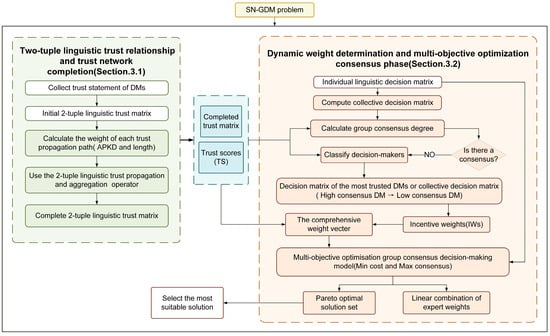
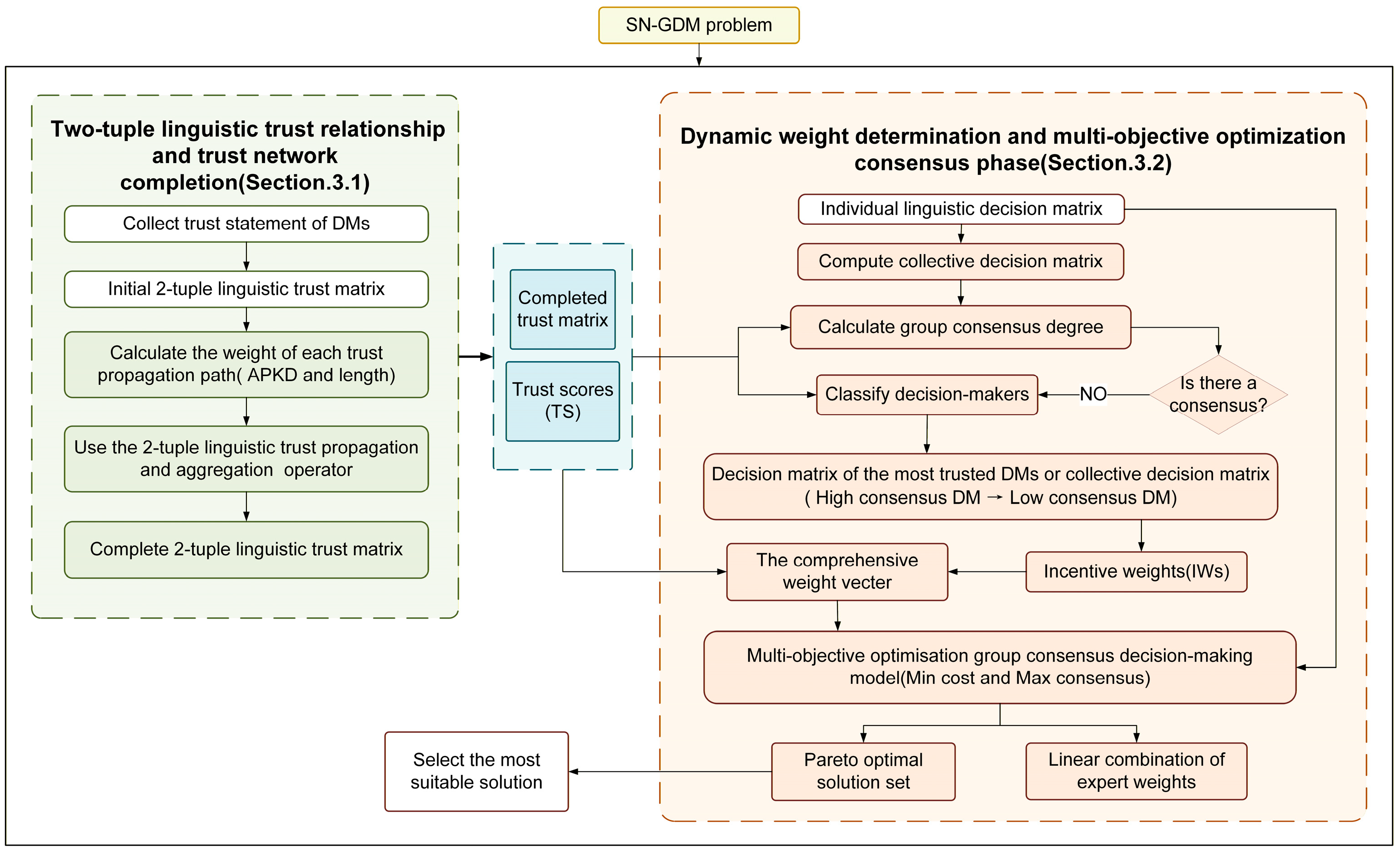
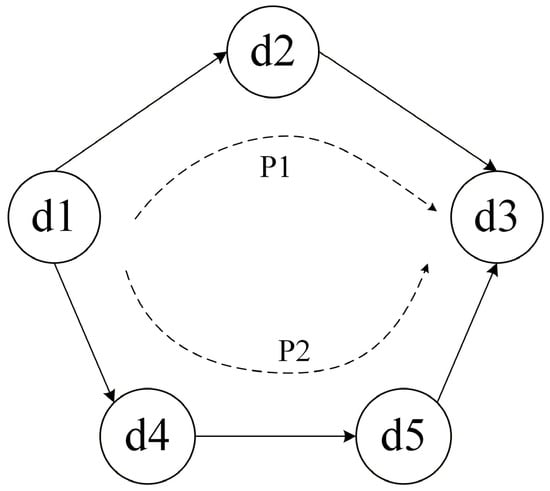
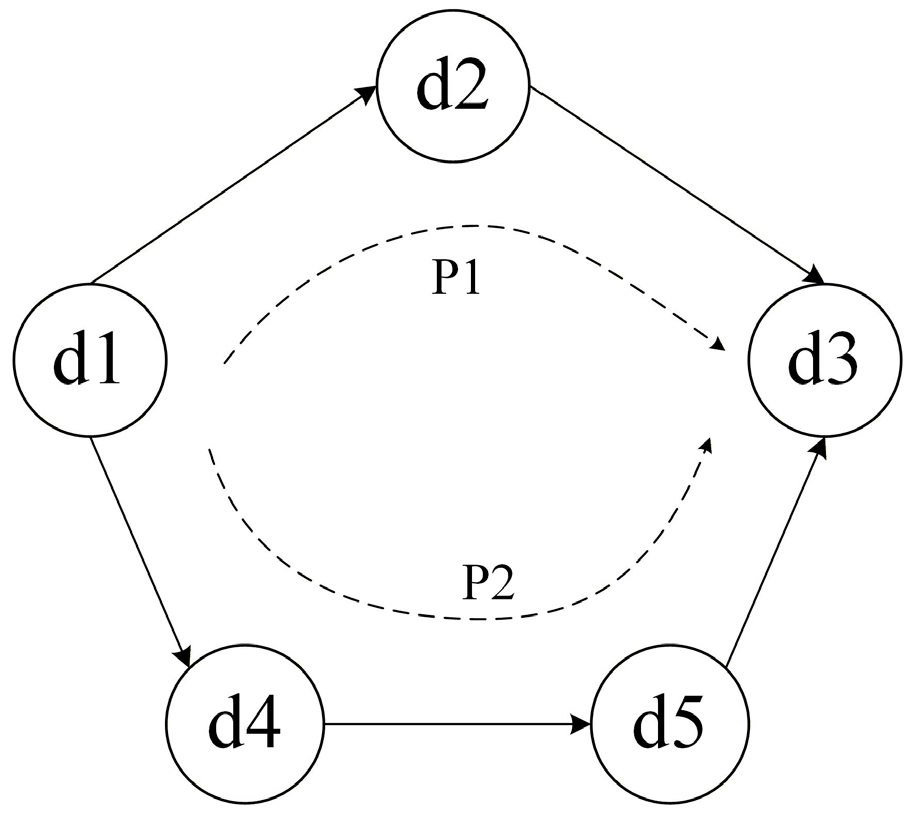
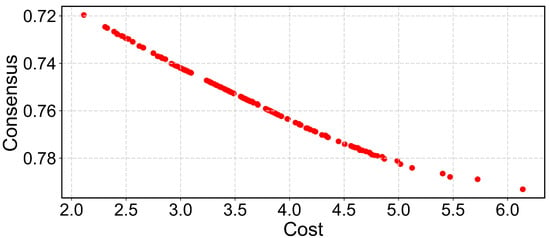
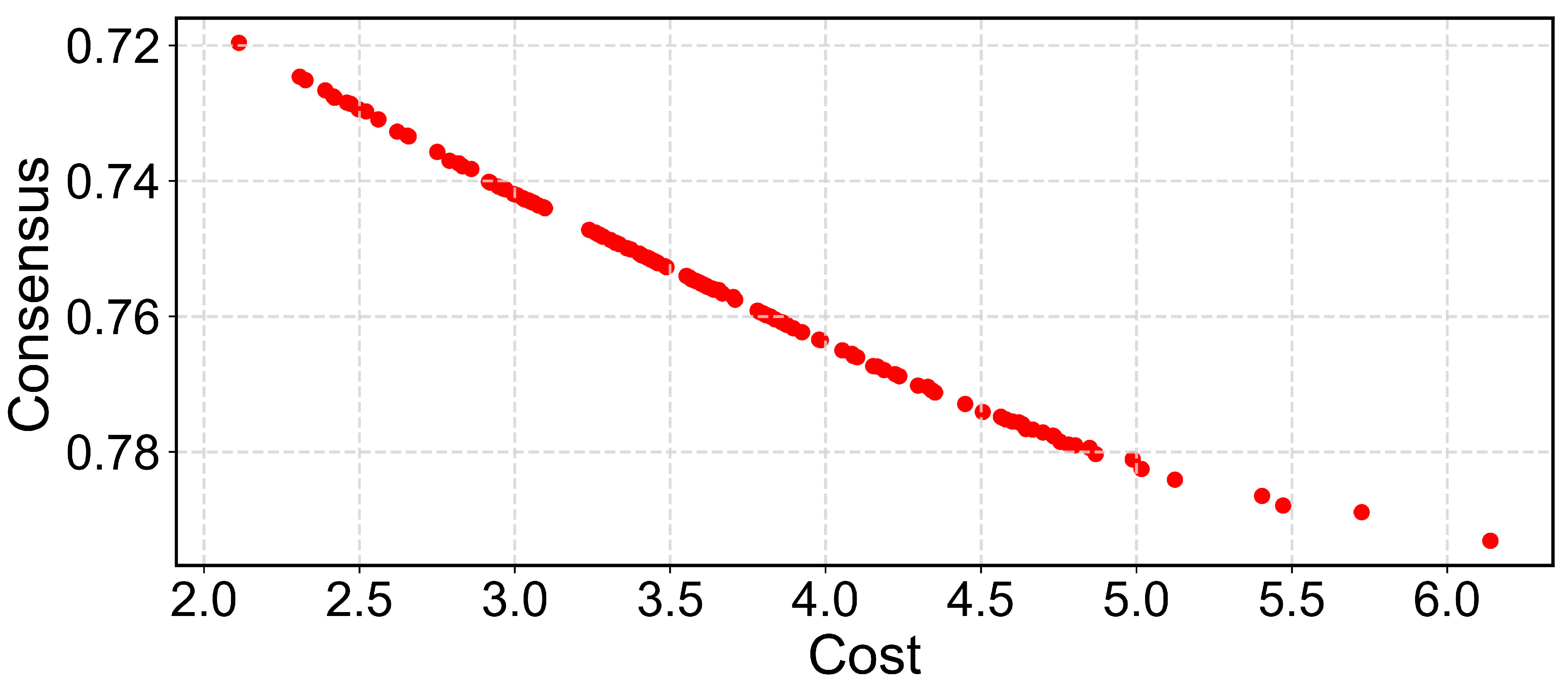
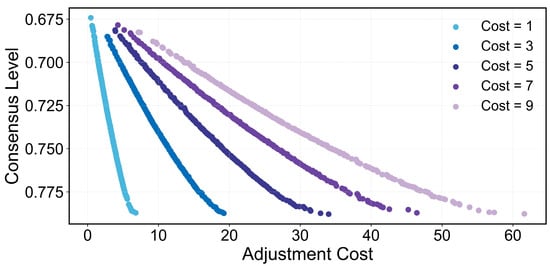
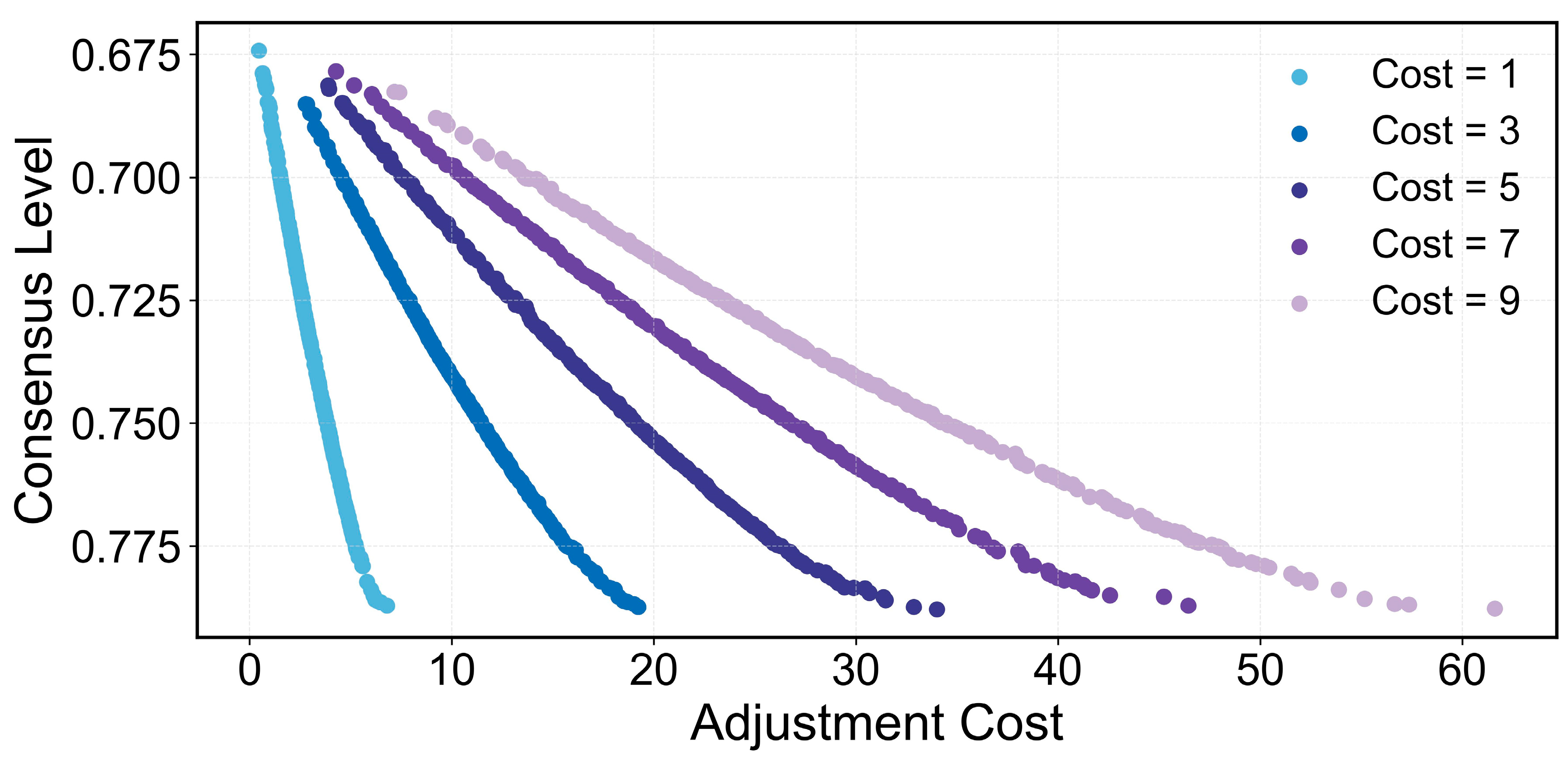
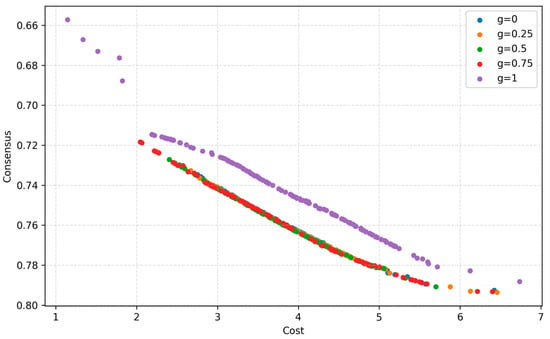
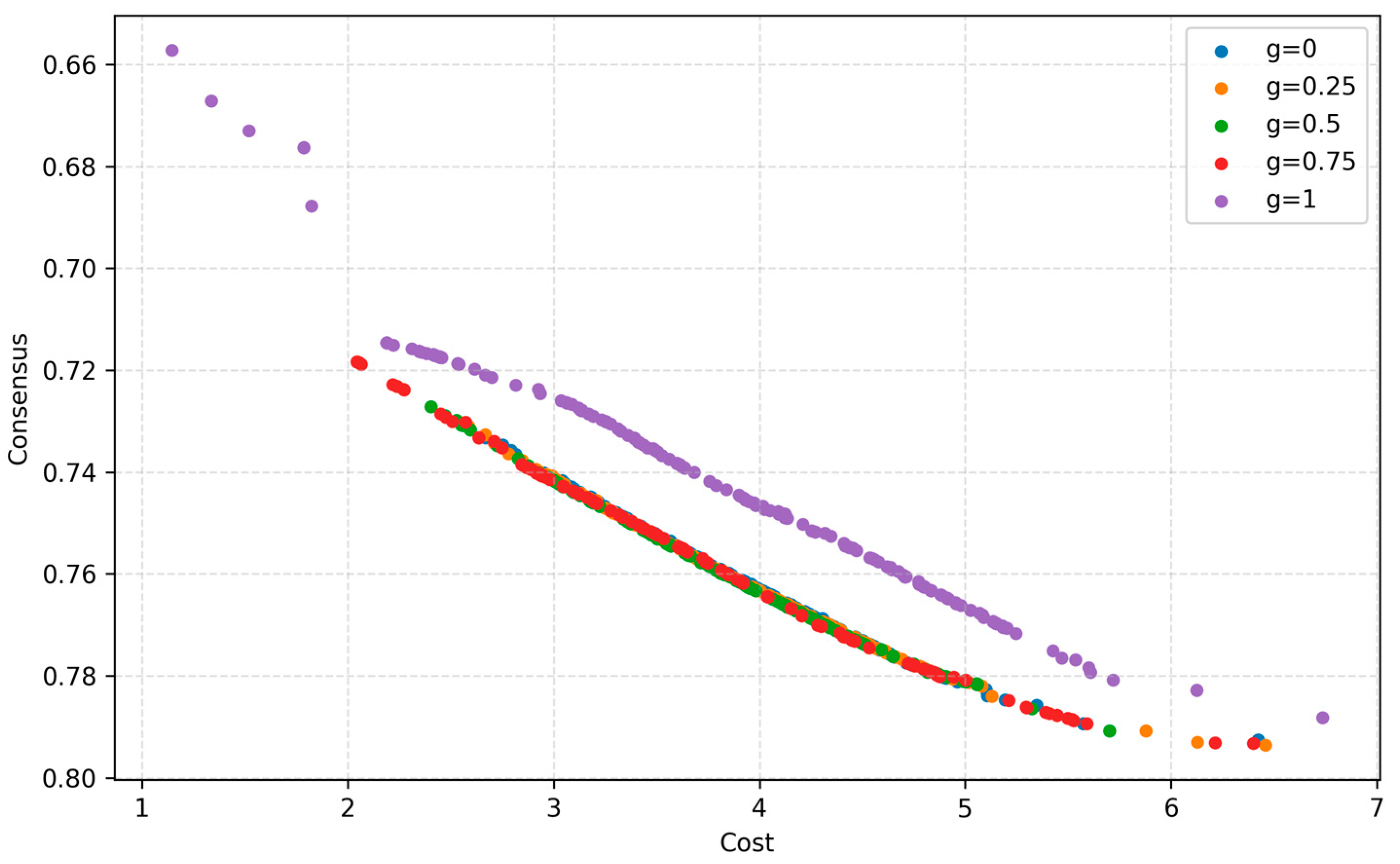
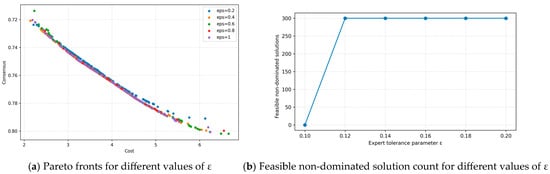
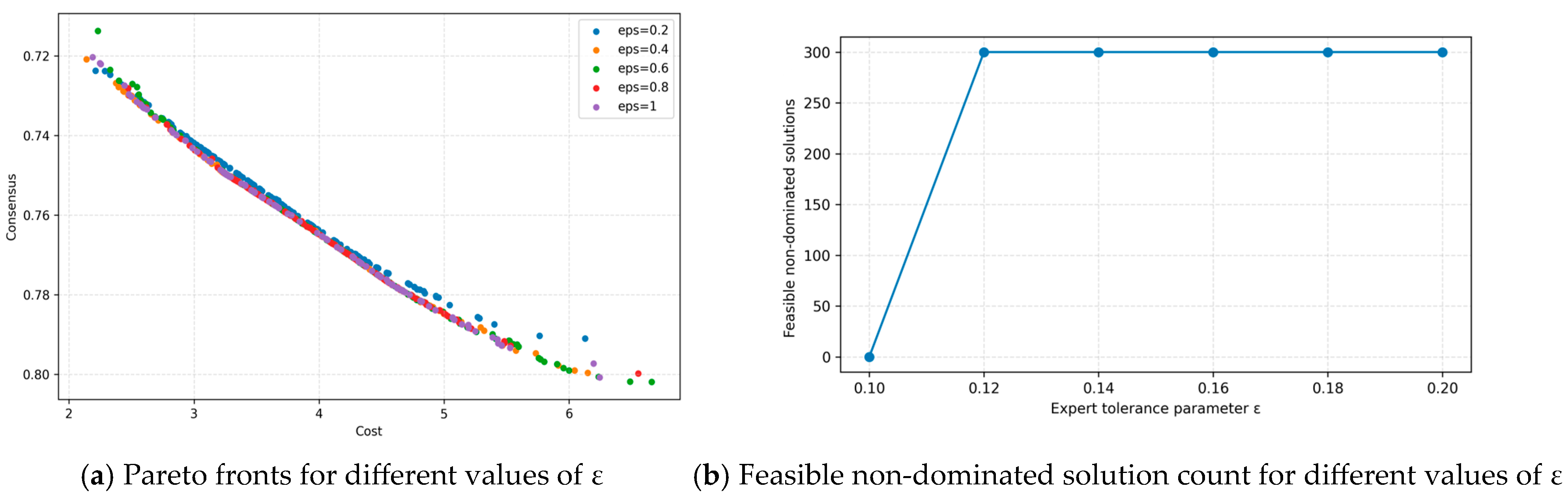
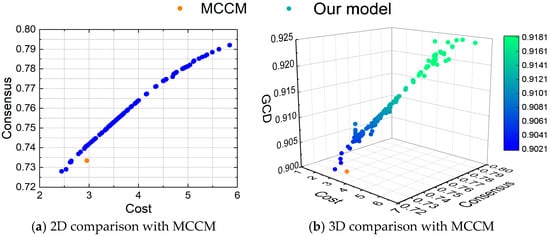
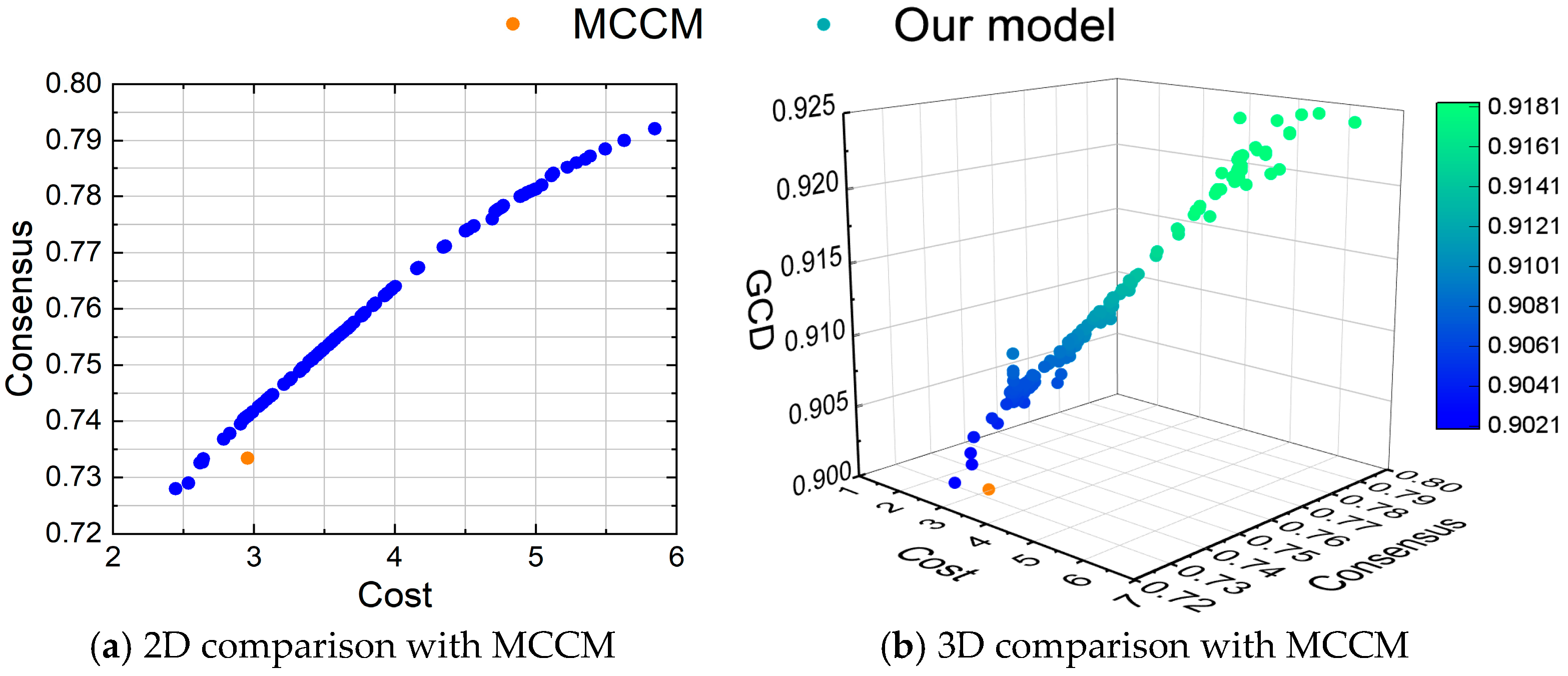
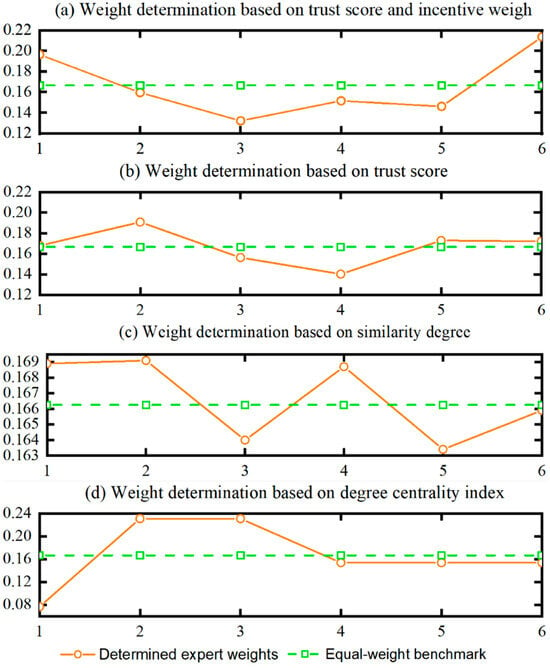
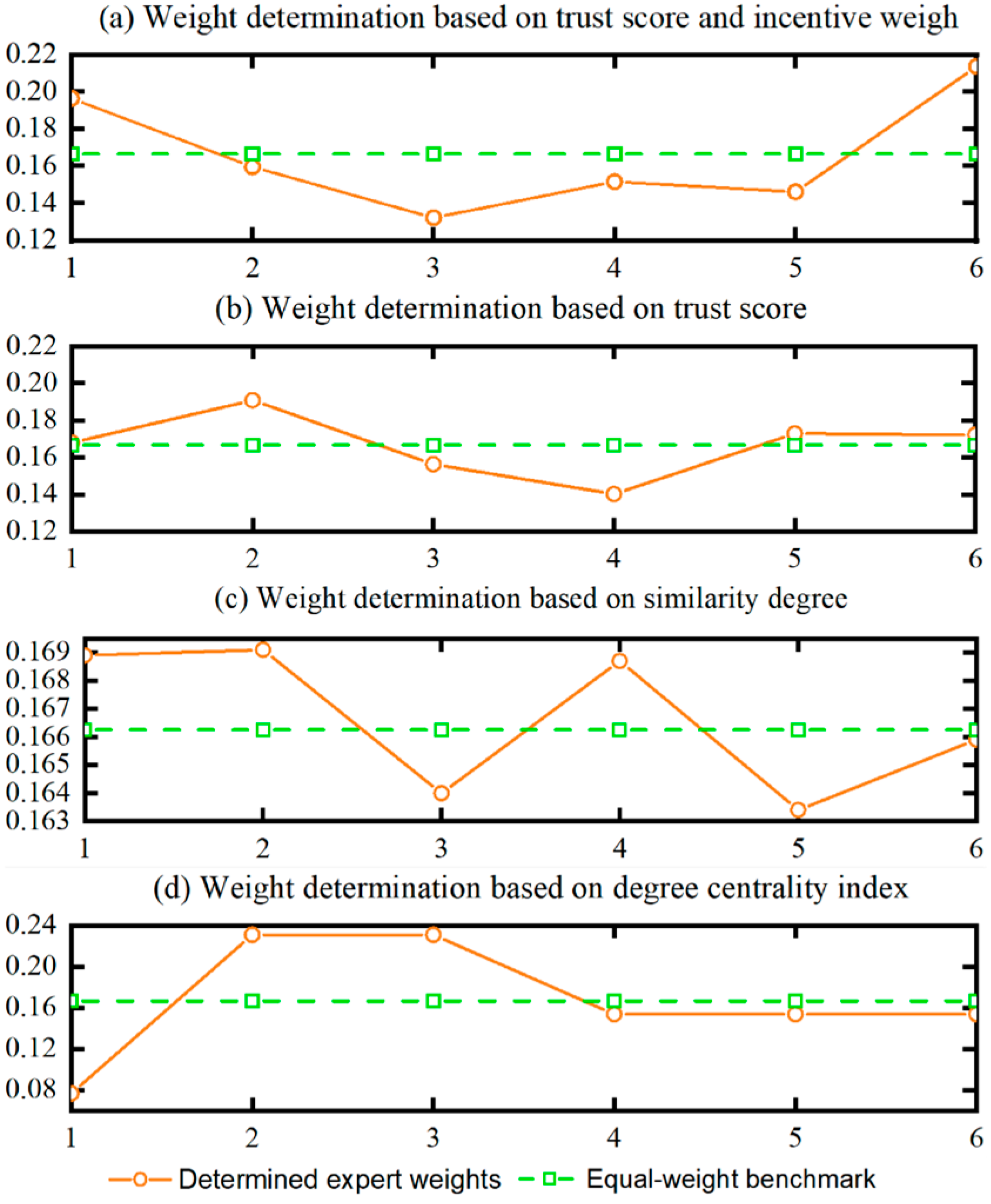

Disclaimer/Publisher’s Note: The statements, opinions and data contained in all publications are solely those of the individual author(s) and contributor(s) and not of MDPI and/or the editor(s). MDPI and/or the editor(s) disclaim responsibility for any injury to people or property resulting from any ideas, methods, instructions or products referred to in the content. |
© 2026 by the authors. Licensee MDPI, Basel, Switzerland. This article is an open access article distributed under the terms and conditions of the Creative Commons Attribution (CC BY) license.