


Abstract
This paper investigates the equivalent integral equations (EIEs) of two impulsive right-sided Riemann–Liouville fractional-order systems (IRRFOSs). The limit properties of one IRRFOS are employed to establish the linear additivity of impulsive effects. A computational approach based on fractional calculus for piecewise functions is then employed to construct the EIE corresponding to a single impulse. With the aid of this linear additivity, the EIE of the considered IRRFOS is obtained, and through the relationship between the two IRRFOSs, the EIE of the other IRRFOS is further derived. The results indicate that the solutions of both EIEs consist of linear combinations of and containing an arbitrary constant, which implies the non-uniqueness of solutions to the two IRRFOSs. Finally, the computational procedure for deriving the EIEs of the two IRRFOSs is presented, and the non-uniqueness of solutions is illustrated through two numerical examples.
Keywords:
impulsive fractional differential equations; non-uniqueness of solutions; initial value problems; equivalent integral equations; right-sided Riemann–Liouville derivative MSC:
26A33; 34A08; 34A37; 34A12
1. Introduction
Fractional differential equations are often used to describe systems with memory properties [1], while impulsive effects are introduced to model abrupt changes occurring at certain moments [2]. Impulsive fractional differential equations combine these two features and provide an effective mathematical model for processes involving both memory effects and instantaneous perturbations.
In recent years, impulsive fractional differential equations have been extensively studied, and several hundred of papers have appeared on impulsive left-sided fractional-order systems (ILFOS) in the Web of Science. The equivalent integral equation (EIE) of ILFOS plays an important role in the analysis of various system properties, including approximate controllability [3,4], the existence of solutions [5,6,7,8,9,10,11,12,13,14,15,16], numerical solutions [17,18,19], oscillatory behavior [20,21], solvability [22], stability [23,24,25], asymptotic behavior [26], periodic motions [27], non-uniqueness of solutions [28,29,30], etc. However, misunderstandings in handling the left-sided fractional calculus for piecewise functions led to the appearance of three incorrect EIEs for the same ILFOS in the literature, while the correct formulation was reported in [28].
Furthermore, similar misunderstandings in dealing with the right-sided fractional calculus for piecewise functions also occurred in the investigation of solution properties of impulsive right-sided fractional-order systems (IRFrOS) [31,32,33,34], which resulted in inappropriate EIEs.
Therefore, a computational approach for handling the right-sided fractional calculus of piecewise functions is introduced and employed to reexamine the EIEs of two impulsive right-sided Riemann–Liouville fractional-order systems (IRRFOSs):
and
where () and represent the right Riemann–Liouville fractional derivative and integral, respectively, , and (here ).
In the sequel, attention is focused on the EIE of (1), and by employing relation (3) together with this EIE, the EIE of (2) is analyzed. To find the EIE’s structure of (1), we first consider two limit cases of (1):
and
In particular,
Remark 1.
Section 2 provides several definitions and properties related to fractional calculus. In Section 3, a fractional-calculus-based computation for piecewise functions is employed to construct the EIE of (1) corresponding to a single impulse. By incorporating the linear additivity of impulsive effects, the EIE of (1) is then obtained, and relation (3) is further utilized to derive the EIE of (2). Section 4 presents two numerical examples to illustrate the computational procedure of the EIEs and the non-uniqueness of solutions for the two IRRFOSs.
2. Preliminaries
This section summarizes several fundamental definitions and results of fractional calculus drawn from the monographs [1,35].
Definition 1
([1,35]). Let (). The right-sided Riemann–Liouville fractional integral () is defined by
where Γ is the gamma function.
Definition 2
([1,35]). The right-sided Riemann–Liouville fractional derivative ( and ) is defined by
Lemma 1.
([1] (p. 76)). Let and and , then
Based on the definition of right-sided fractional calculus, a new computational approach is developed for evaluating the right-sided fractional derivatives and integrals of piecewise functions.
Lemma 2.
3. The Equivalent Integral Equations of (1) and (2)
This section is devoted to the derivation of the EIEs for systems (1) and (2). We first employ Lemma 2 to construct the EIE corresponding to system (1) with an impulsive effect, which clarifies how each impulsive effect is represented. By combining this representation with the linear additivity of impulsive effects, the EIE for system (1) is then obtained. Finally, the EIE for system (2) is deduced by applying the relation (3) to the EIE of (1).
For the simplicity of some formulas, in the whole paper, let of all integrals and
3.1. The EIE for (1) of a Single Impulse
To clarify how an impulsive effect is reflected in the EIE of system (1), we first consider a special case of (1) involving a single impulse, given by
We first examine the EIE of (14) under the assumption that . Because satisfies on by Lemma 1, we construct a piecewise function
which can satisfy all condition of (14).
Next, we compute the right-sided fractional derivative of two piecewise functions
and
which show that two piecewise functions satisfy on the interval and , respectively. Then, we use the two piecewise functions and Lemma 2 to construct another piecewise function
By using (11) and (12), we can compute for and , which means that (18) satisfies all condition for (14) with .
Both (15) and (18) satisfy the conditions for (14) with . Under the condition , the EIE of (14) is obtained as follows:
It is worth noting that system (14) satisfies the following limit property:
Thus, the limit taken in system (14) is not recovered by Equation (19). For satisfying (20), we rewrite (19) to obtain the EIE of (14)
3.2. The Equivalent Integral Equations of (1) and (2)
This subsection is devoted to two main results on the equivalent integral equations of systems (1) and (2).
To formulate the main results rigorously, we introduce the following functional spaces adapted to impulsive right-sided fractional-order systems. For , define
Theorem 1.
Suppose that λ is an arbitrary real and satisfies for any .
Proof of Theorem 1.
‘Necessity’. By analogy with (15), we construct a piecewise function
which satisfies all conditions of (1) to be the special case of the EIE of (1) by (21). The impulsive effects in (1) exhibit linear additivity (see Remark 1). Therefore, by combining the special case (23) and (21) with this linear additivity, the solution of (1) is derived:
Furthermore, (24) needs to satisfy (3) to obtain , then (24) is (22).
Theorem 2.
Suppose that λ is an arbitrary real and satisfies for any .
Proof of Theorem 2.
Remark 3.
Remark 4.
The present EIEs are consistent with the limiting cases of impulsive right-sided fractional-order systems, which are not explicitly considered in some existing formulations.
4. Applications
Two numerical examples are presented to illustrate the derivation of the EIEs and the non-uniqueness of solutions for two IRRFOSs.
Example. Consider two IRRFOSs
and
By Theorems 1 and 2, the EIEs of (34) and (35) are, respectively, given by
and
where is an arbitrary real and
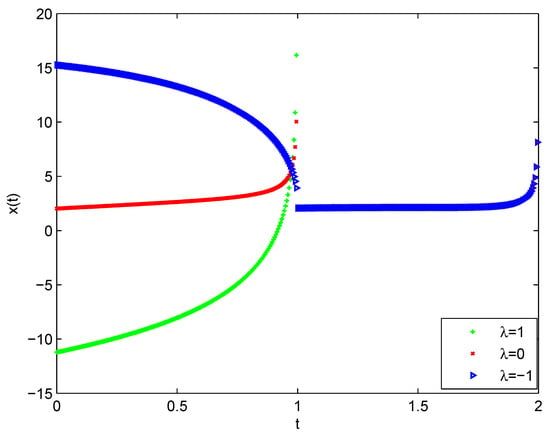
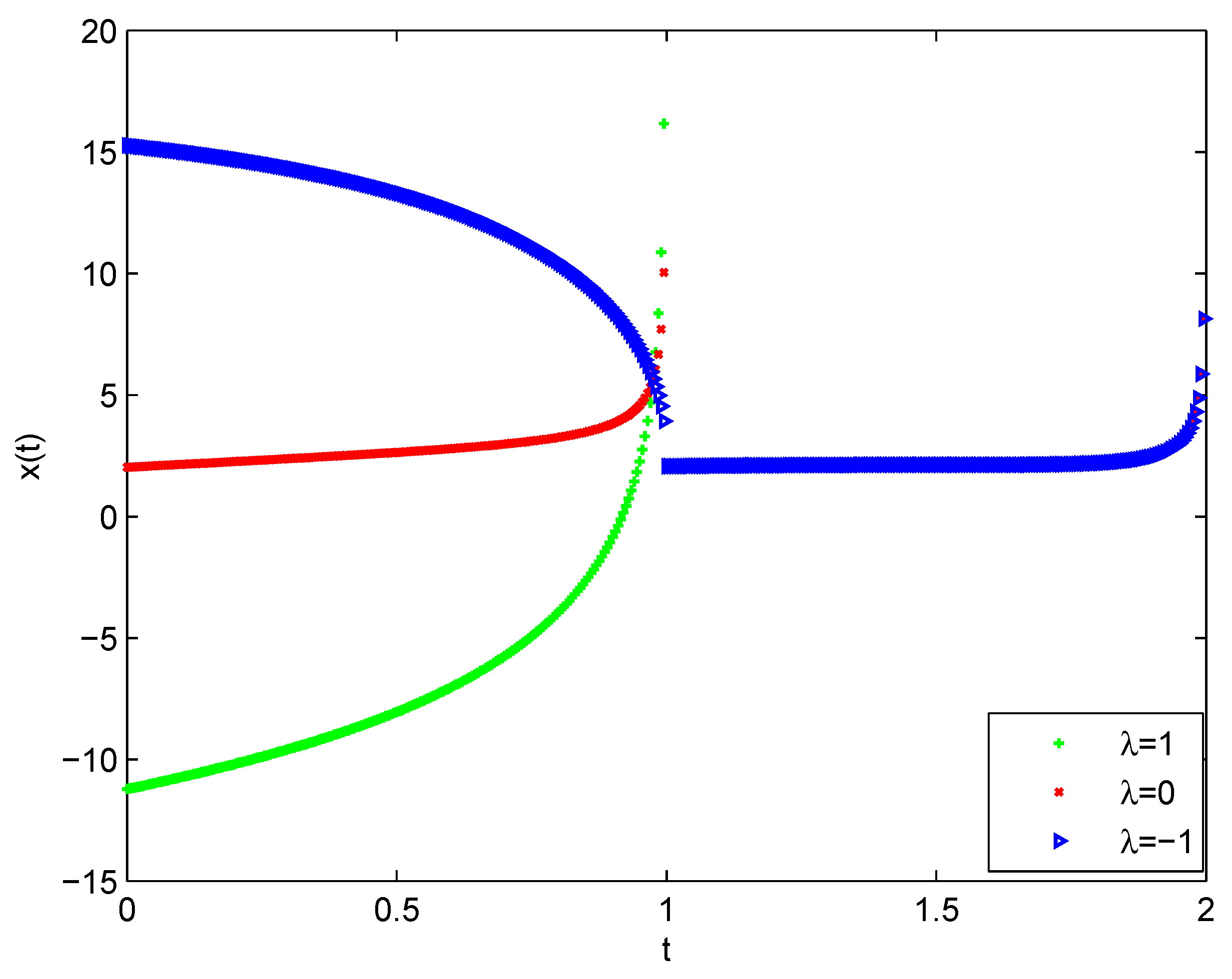
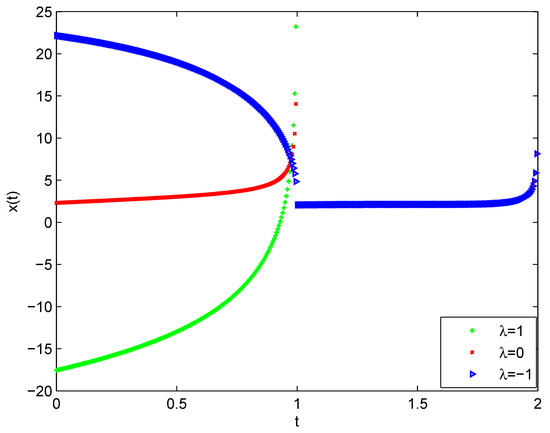
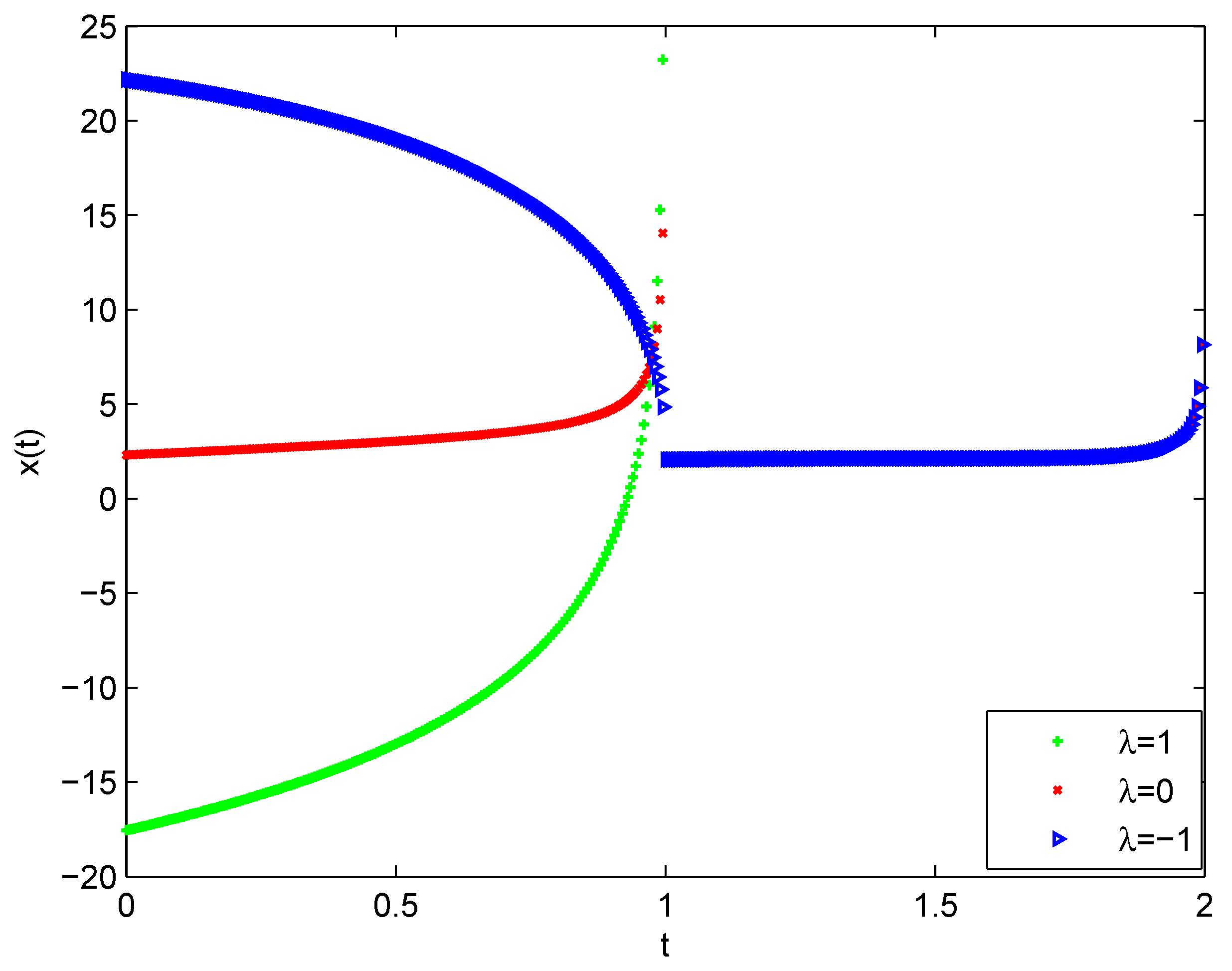
Applying (25) and (26), the right-sided fractional derivatives and integrals of (36) and (37) can be computed, which verify that they satisfy the conditions of (34) and (35), respectively. Because is an arbitrary real number in both (36) and (37), the solutions of (34) and (35) are not unique. Numerical simulations are used to illustrate the non-uniqueness of the solutions of (34) and (35) in Figure 1 and Figure 2 by plotting three solution curves corresponding to (36) and (37) with , respectively.
Figure 1.
Three solution trajectories of (34).
Figure 2.
Three solution trajectories of (35).
It can be observed that the solution trajectories coincide away from the impulsive instant, while distinct solution branches emerge at the impulsive point . Different values of lead to different jump magnitudes in the integral representation, resulting in visibly separated trajectories after the impulse. This numerical behavior clearly reflects the presence of the arbitrary constant in the equivalent integral equations and provides a concrete illustration of solution non-uniqueness.
5. Conclusions
This paper is concerned with the equivalent integral equations (EIEs) of two impulsive right-sided Riemann–Liouville fractional-order systems (IRRFOSs). A computational method for fractional calculus of the piecewise function is used to construct the EIE of (1) corresponding to a single impulse, which, together with the linear additivity of the impulsive effects, is employed to derive the EIE of (1). The EIE of (1), together with relation (3), is then used to derive the EIE of (2). The results show that the EIEs of (1) and (2) consist of linear combinations of and containing an arbitrary constant , which implies the non-uniqueness of solutions to (1) and (2). The approach developed in this work is not restricted to the two systems considered here. In particular, the present methodology provides a natural framework for deriving equivalent integral equations for non-instantaneous right-sided impulsive Riemann–Liouville fractional-order systems. Extensions to impulsive systems involving nonlinear terms still require further analysis and will be investigated in future work.
Author Contributions
Conceptualization, X.L. and X.Z.; methodology, X.L.; software, X.L.; validation, X.L., Q.Z. and X.Z.; formal analysis, X.L.; investigation, X.L.; resources, X.Z.; data curation, X.L.; writing—original draft preparation, X.L.; writing—review and editing, X.Z. and Q.Z.; visualization, X.L.; supervision, X.Z.; project administration, X.Z.; funding acquisition, X.Z. All authors have read and agreed to the published version of the manuscript.
Funding
This research was funded by the Natural Science Foundation of Chongqing, grant number CSTB2022NSCQ-MSX1133.
Data Availability Statement
No new data were created or analyzed in this study. Data sharing is not applicable to this article.
Conflicts of Interest
The authors declare no conflicts of interest.
References
- Kilbas, A.A.; Srivastava, H.M.; Trujillo, J.J. Theory and Applications of Fractional Differential Equations; Elsevier: Amsterdam, The Netherlands, 2006. [Google Scholar]
- Lakshmikantham, V.; Bainov, D.D.; Simeonov, P.S. Theory of Impulsive Differential Equations; World Scientific: Singapore, 1989. [Google Scholar]
- Ding, Y.H.; Li, Y.X. Finite-approximate controllability of impulsive ψ-Caputo fractional evolution equations with nonlocal conditions. Fract. Calc. Appl. Anal. 2023, 26, 1326–1358. [Google Scholar] [CrossRef] [Scilit]
- Raja, M.M.; Vijayakumar, V.; Veluvolu, K.C. An analysis on approximate controllability results for impulsive fractional differential equations of order 1 < r < 2 with infinite delay using sequence method. Math. Methods Appl. Sci. 2024, 47, 336–351. [Google Scholar]
- Shah, K.; Abdalla, B.; Abdeljawad, T.; Gul, R. Analysis of multipoint impulsive problem of fractional-order differential equations. Bound. Value Probl. 2023, 2023, 1. [Google Scholar] [CrossRef] [Scilit]
- Kavitha, V.; Arjunan, M.M.; Baleanu, D.; Grayna, J. Weighted pseudo almost automorphic functions with applications to impulsive fractional integro-differential equation. An. Ştiinţ. Univ. Ovidius Constanţa Ser. Mat. 2023, 31, 143–166. [Google Scholar] [CrossRef] [Scilit]
- Benyoub, M.; Abbas, M.I. Addressing impulsive fractional integro-differential equations with Caputo–Fabrizio via monotone iterative technique in Banach spaces. Filomat 2023, 37, 4761–4770. [Google Scholar] [CrossRef] [Scilit]
- Kucche, K.D.; Kharade, J.P. Analysis of impulsive ϕ-Hilfer fractional differential equations. Mediterr. J. Math. 2020, 17, 163. [Google Scholar] [CrossRef] [Scilit]
- Gou, H.D.; Li, Y.X. The method of lower and upper solutions for impulsive fractional evolution equations in Banach spaces. J. Korean Math. Soc. 2020, 57, 61–88. [Google Scholar]
- Agarwal, R.; Hristova, S.; O’Regan, D. Exact solutions of linear Riemann–Liouville fractional differential equations with impulses. Rocky Mt. J. Math. 2020, 50, 779–791. [Google Scholar] [CrossRef] [Scilit]
- Kucche, K.D.; Kharade, J.P.; Sousa, J.V.D.C. On the nonlinear impulsive Ψ-Hilfer fractional differential equations. Math. Model. Anal. 2020, 25, 642–660. [Google Scholar] [CrossRef] [Scilit]
- Heidarkhani, S.; Salari, A. Nontrivial solutions for impulsive fractional differential systems through variational methods. Math. Methods Appl. Sci. 2020, 43, 6529–6541. [Google Scholar] [CrossRef] [Scilit]
- You, J.; Sun, S.R. On impulsive coupled hybrid fractional differential systems in Banach algebras. J. Appl. Math. Comput. 2020, 62, 189–205. [Google Scholar] [CrossRef] [Scilit]
- Ravichandran, C.; Logeswari, K.; Panda, S.K.; Nisar, K.S. On new approach of fractional derivative by Mittag–Leffler kernel to neutral integro-differential systems with impulsive conditions. Chaos Solitons Fractals 2020, 139, 110012. [Google Scholar] [CrossRef] [Scilit]
- Min, D.D.; Chen, F.Q. Existence of solutions for a fractional advection–dispersion equation with impulsive effects via variational approach. J. Appl. Anal. Comput. 2020, 10, 1005–1023. [Google Scholar] [CrossRef] [Scilit] [PubMed]
- Zhou, J.W.; Deng, Y.M.; Wang, Y.N. Variational approach to p-Laplacian fractional differential equations with instantaneous and non-instantaneous impulses. Appl. Math. Lett. 2020, 104, 106251. [Google Scholar] [CrossRef] [Scilit]
- Postavaru, O. Generalized fractional-order hybrid of block-pulse functions and Bernoulli polynomials approach for solving fractional delay differential equations. Soft Comput. 2023, 27, 737–749. [Google Scholar] [CrossRef] [Scilit]
- Cao, J.Y.; Chen, L.Z.; Wang, Z.Q. A block-by-block method for the impulsive fractional ordinary differential equations. J. Appl. Anal. Comput. 2020, 10, 853–874. [Google Scholar] [CrossRef] [Scilit] [PubMed]
- Gou, H.D.; Li, Y.X. A study on impulsive Hilfer fractional evolution equations with nonlocal conditions. Int. J. Nonlinear Sci. Numer. Simul. 2020, 21, 205–218. [Google Scholar] [CrossRef] [Scilit]
- Feng, L.M.; Han, Z.L. Oscillation behavior of solution of impulsive fractional differential equation. J. Appl. Anal. Comput. 2020, 10, 223–233. [Google Scholar] [CrossRef] [Scilit]
- Feng, L.M.; Sun, Y.B.; Han, Z.L. Philos-type oscillation criteria for impulsive fractional differential equations. J. Appl. Math. Comput. 2020, 62, 361–376. [Google Scholar] [CrossRef] [Scilit]
- Xu, M.R.; Sun, S.R.; Han, Z.L. Solvability for impulsive fractional Langevin equation. J. Appl. Anal. Comput. 2020, 10, 486–494. [Google Scholar] [CrossRef] [Scilit]
- Ghaemi, M.B.; Mottaghi, F.; Saadati, R. α-Confluent-hyper-geometric stability of ξ-Hilfer impulsive nonlinear fractional Volterra integro-differential equation. Bound. Value Probl. 2023, 2023, 4. [Google Scholar] [CrossRef] [Scilit]
- Liu, J.K.; Xu, W. An averaging result for impulsive fractional neutral stochastic differential equations. Appl. Math. Lett. 2021, 114, 106892. [Google Scholar] [CrossRef] [Scilit]
- Zada, A.; Ali, S.; Li, T.X. Analysis of a new class of impulsive implicit sequential fractional differential equations. Int. J. Nonlinear Sci. Numer. Simul. 2020, 21, 571–587. [Google Scholar] [CrossRef] [Scilit]
- Cheng, L.J.; Hu, L.Y.; Ren, Y. Perturbed impulsive neutral stochastic functional differential equations. Qual. Theory Dyn. Syst. 2021, 20, 27. [Google Scholar] [CrossRef] [Scilit]
- Zhang, T.W.; Xiong, L.L. Periodic motion for impulsive fractional functional differential equations with piecewise Caputo derivative. Appl. Math. Lett. 2020, 101, 106251. [Google Scholar] [CrossRef] [Scilit]
- Zhang, X.; Liu, Z.; Yang, S.; Peng, Z.; He, Y.; Wei, L. The right equivalent integral equation of impulsive Caputo fractional-order system of order ϵ ∈ (1, 2). Fractal Fract. 2023, 7, 37. [Google Scholar] [CrossRef] [Scilit]
- Zhang, X.; Liu, Z.; Peng, Z.; He, Y.; Yang, S. Impulsive fractional partial differential system and its correct equivalent integral equation. Math. Methods Appl. Sci. 2024, 47, 6574–6589. [Google Scholar] [CrossRef] [Scilit]
- Zhang, X. A new method for converting impulsive Riemann–Liouville fractional order system into the integral equation. J. Appl. Math. Comput. 2025, 71, 765–782. [Google Scholar] [CrossRef] [Scilit]
- Zhou, J.; Wang, Y.; Li, Y. Existence of solutions for a class of fractional Hamiltonian systems with impulsive effects. Fract. Differ. Calc. 2018, 8, 233–253. [Google Scholar]
- Zhang, W.; Liu, W. Variational approach to fractional Dirichlet problem with instantaneous and non-instantaneous impulses. Appl. Math. Lett. 2019, 99, 106196. [Google Scholar] [CrossRef] [Scilit]
- Alharbi, A.; Guefaifia, R.; Boulaaras, S. A new proof of the existence of nonzero weak solutions of impulsive fractional boundary value problems. Mathematics 2020, 8, 856. [Google Scholar] [CrossRef] [Scilit]
- Min, D.; Chen, F. Variational methods to the p-Laplacian type nonlinear fractional order impulsive differential equations with Sturm–Liouville boundary value problem. Fract. Calc. Appl. Anal. 2021, 24, 1069–1093. [Google Scholar] [CrossRef] [Scilit]
- Baleanu, D.; Diethelm, K.; Scalas, E.; Trujillo, J.J. Fractional Calculus Models and Numerical Methods, Series on Complexity, Nonlinearity and Chaos; World Scientific: Singapore, 2012. [Google Scholar]
Disclaimer/Publisher’s Note: The statements, opinions and data contained in all publications are solely those of the individual author(s) and contributor(s) and not of MDPI and/or the editor(s). MDPI and/or the editor(s) disclaim responsibility for any injury to people or property resulting from any ideas, methods, instructions or products referred to in the content. |
© 2026 by the authors. Licensee MDPI, Basel, Switzerland. This article is an open access article distributed under the terms and conditions of the Creative Commons Attribution (CC BY) license.