


Next Issue
Volume 15, February
Previous Issue
Volume 14, December


Axioms, Volume 15, Issue 1 (January 2026) – 82 articles
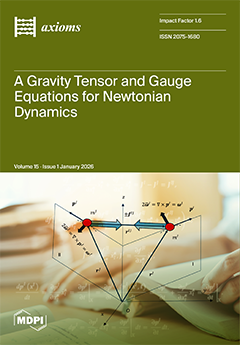
Cover Story (view full-size image):

Masses mI and mJ, identified by position vectors rI and rJ, move along their orbits with momenta pI and pJ and interact via the gravitational force fIJ. The curl vectors ωI and ωJ of the momenta are related to their angular velocities ω̃I and ω̃J about their curvature centres of their orbits.

Using the law of energy conservation, gauge equations for Newton’s law of gravitation are developed. These equations reveal that the gravitational force fIJ and the curl pI of the momentum in Newton’s gravity play analogous to the electric field E and magnetic B in electromagnetism. This formulation demonstrates that Newton’s gravity to be governed by gauge theory, addressing the long-standing view that “Newton’s gravitation is an exception of Yang–Mills gauge theory”. The developed framework provides a new approach for analyzing dynamic interactions in gravity fields. View this paper

  • Issues are regarded as officially published after their release is announced to the table of contents alert mailing list.
  • You may sign up for e-mail alerts to receive table of contents of newly released issues.
  • PDF is the official format for papers published in both, html and pdf forms. To view the papers in pdf format, click on the "PDF Full-text" link, and use the free Adobe Reader to open them.

Order results
Result details
Section
Select all
Export citation of selected articles as:
18 pages, 485 KB  
Article
Cyclic Large Contractions in Metric and Normed Spaces Under Eventual Perturbations
by Manuel De la Sen
Axioms 2026, 15(1), 82; https://doi.org/10.3390/axioms15010082 - 22 Jan 2026
Viewed by 111
Abstract
Some properties on large contractions in metric spaces are proven. In particular, such contractions are proven to be asymptotically regular. In addition, if the metric space is complete, then the sequences that they generate are bounded, Cauchy, and convergent to a unique fixed [...] Read more.
Some properties on large contractions in metric spaces are proven. In particular, such contractions are proven to be asymptotically regular. In addition, if the metric space is complete, then the sequences that they generate are bounded, Cauchy, and convergent to a unique fixed point. Also, cyclic large contractions are an area of focus. It is proven that, if subsets of the cyclic disposal are nonempty closed and they intersect, all the sequences are bounded and Cauchy, and they converge to a unique fixed point located in the intersection of such subsets if the metric space is complete. If the subsets have a pair-wise empty intersection, then the boundedness of such sequences is proven without the need to assume the boundedness of the subsets in the cyclic disposal. The convergence of the sequences to a unique limit cycle of best proximity points, with one per subset in the cyclic disposal, is proven provided that the metric space is complete and that one of such subsets is boundedly compact with a singleton best proximity set. For that property to hold, it is not assumed that the remaining best proximity points are necessarily singletons. It has also been proven that all the subsequences contained within each of the subsets are Cauchy and they converge to a unique best proximity point, even if the corresponding best proximity sets is not a singleton. Furthermore, the hypothesis that one of the best proximity sets between adjacent subsets is a singleton can be weakened for any particular cyclic large contraction. Later on, eventual perturbations of the cyclic large self-mappings in normed spaces are discussed. If the norm of the perturbation additive operator is small enough, it is proven that the perturbed cyclic self-mapping maintains the property of being a cyclic large contraction associated with the unperturbed nominal cyclic large contraction. The maximum upper-bound of the perturbed operator ensures that such a property is given in an explicit manner. Full article
18 pages, 338 KB  
Article
The Modularity of an Abelian Variety
by Jae-Hyun Yang
Axioms 2026, 15(1), 81; https://doi.org/10.3390/axioms15010081 - 22 Jan 2026
Viewed by 115
Abstract
We introduce the concept of the modularity of an abelian variety defined over the rational number field extending the modularity of an elliptic curve. We discuss the modularity of an abelian variety over Q. We conjecture that a simple abelian variety over [...] Read more.
We introduce the concept of the modularity of an abelian variety defined over the rational number field extending the modularity of an elliptic curve. We discuss the modularity of an abelian variety over Q. We conjecture that a simple abelian variety over Q is modular. Full article
(This article belongs to the Special Issue Elliptic Curves, Modular Forms, L-Functions and Applications)
30 pages, 389 KB  
Article
Nijenhuis Operators on 2D Pre-Lie Algebras and 3D Associative Algebras
by Xiaoguang Zou, Xiang Gao, Chuangchuang Kang and Jiafeng Lü
Axioms 2026, 15(1), 80; https://doi.org/10.3390/axioms15010080 - 22 Jan 2026
Viewed by 115
Abstract
In this paper, we describe all Nijenhuis operators on 2-dimensional complex pre-Lie algebras and 3-dimensional complex associative algebras. As an application, using these operators, we obtain solutions to the classical Yang-Baxter equation on the corresponding sub-adjacent Lie algebras. Full article
(This article belongs to the Special Issue New Perspectives in Lie Algebras, 2nd Edition)
31 pages, 388 KB  
Article
Truncating and Shifting Weights for Max-Plus Automata
by Jelena Matejić, Miroslav Ćirić, Jelena Ignjatović and Ivana Micić
Axioms 2026, 15(1), 79; https://doi.org/10.3390/axioms15010079 - 22 Jan 2026
Viewed by 103
Abstract
In this paper, for any real number λ, we transform the complete max-plus semiring R into a commutative, complete, additively idempotent semiring Rλ, called the lower λ-truncation of R. It is obtained by removing from R [...] Read more.
In this paper, for any real number λ, we transform the complete max-plus semiring R into a commutative, complete, additively idempotent semiring Rλ, called the lower λ-truncation of R. It is obtained by removing from R all real numbers smaller than λ, inheriting the addition operation, shifting the original products by −λ, and appropriately modifying the residuum operation. The purpose of lower truncations is to transfer the iterative procedures for computing the greatest presimulations and prebisimulations between max-plus automata, in cases where they cannot be completed in a finite number of iterations over R, to Rλ, where they could terminate in a finite number of iterations. For instance, we prove that this necessarily happens when working with max-plus automata with integer weights. We also show how presimulations and prebisimulations computed over Rλ can be transformed into presimulations and prebisimulations between the original automata over R. Although they do not play a significant role from the standpoint of computing presimulations and prebisimulations, for theoretical reasons we also introduce two types of upper truncations of the complete max-plus semiring R. Full article
12 pages, 806 KB  
Article
Adaptive Pinning Synchronization of Switching Networks with Arbitrary Topologies
by Isaac Leonel López-García and Juan Gonzalo Barajas-Ramírez
Axioms 2026, 15(1), 78; https://doi.org/10.3390/axioms15010078 - 21 Jan 2026
Viewed by 84
Abstract
We propose a novel design approach for pinning control of a dynamical network that achieves synchronization despite switching between arbitrary topologies. Unlike existing approaches, we consider weighted, directed, and even unconnected topologies as admissible connections that can be switched instantly. We present a [...] Read more.
We propose a novel design approach for pinning control of a dynamical network that achieves synchronization despite switching between arbitrary topologies. Unlike existing approaches, we consider weighted, directed, and even unconnected topologies as admissible connections that can be switched instantly. We present a selection algorithm that uses the current topology to identify a suitable set of nodes for control. Additionally, we consider a fixed pinning strategy to activate the required controllers to achieve synchronization, with their gains computed via adaptation laws based only on the neighbors of each pinned node. We derive sufficient conditions for the emergence of a stable synchronous state using common Lyapunov function theory and illustrate their efficacy through numerical simulations of networks that can switch instantaneously between arbitrary topologies. Full article
Show Figures

Figure 1

25 pages, 333 KB  
Article
Modus Tollens in the Setting of Discrete Uninorms
by Isabel Aguiló, Pilar Fuster-Parra and Juan Vicente Riera
Axioms 2026, 15(1), 77; https://doi.org/10.3390/axioms15010077 - 21 Jan 2026
Viewed by 116
Abstract
This study focuses on the Modus Tollens (MT) property induced by discrete uninorms. Specifically, we identify the set of necessary and sufficient criteria for a discrete implication function to comply with this logical property. This rule of inference is studied by using discrete [...] Read more.
This study focuses on the Modus Tollens (MT) property induced by discrete uninorms. Specifically, we identify the set of necessary and sufficient criteria for a discrete implication function to comply with this logical property. This rule of inference is studied by using discrete residual implication functions derived from uninorms of two of the most important families of these discrete operators (Umin, idempotents), exploring which properties these operators must satisfy, as well as providing some characterizations of the Modus Tollens in this domain of definition. Our findings contribute to a deeper understanding of reasoning mechanisms in fuzzy logic, particularly in discrete settings. Full article
(This article belongs to the Special Issue Advances in Fuzzy Logic with Applications)
Show Figures

Figure 1

22 pages, 1690 KB  
Article
The 3-Path Connectivity of Dragonfly Networks
by Guanlin He and Zengxian Tian
Axioms 2026, 15(1), 76; https://doi.org/10.3390/axioms15010076 - 21 Jan 2026
Viewed by 91
Abstract
Dragonfly networks D(n,h) are a class of interconnection topologies widely used for large-scale high-performance computing (HPC) systems. In such networks, path connectivity serves as a fundamental metric for evaluating fault tolerance and operational reliability. Let G be a [...] Read more.
Dragonfly networks D(n,h) are a class of interconnection topologies widely used for large-scale high-performance computing (HPC) systems. In such networks, path connectivity serves as a fundamental metric for evaluating fault tolerance and operational reliability. Let G be a connected simple graph with vertex set V(G). Let Ω be a subset of V(G) with cardinality at least two. A path containing all vertices of Ω is said to be an Ω-path of G. Two paths (T1 and T2) of G are internally disjoint if V(T1)V(T2)=Ω and E(T1)E(T2)=. For an integer with 2, the -path connectivity π(G) is defined as π(G)=min{πG(Ω)|ΩV(G)and|Ω|=}, where πG(Ω) represents the maximum number of internally disjoint Ω-paths. This paper focuses on resolving the exact value of 3-path connectivity of dragonfly networks, π3(D(n,h)), defined as the maximum number of internally disjoint paths among any three distinct vertices in D(n,h). For D(n,h) with n5 and h2, the exact 3-path connectivity is π3(D(n,h))=3h+2n4 if hn2, and π3(D(n,h))=3n+2h24 if hn1. Full article
(This article belongs to the Section Mathematical Analysis)
Show Figures

Figure 1

9 pages, 260 KB  
Article
On the Theorem of Univalence on the Boundary
by Mihai Cristea
Axioms 2026, 15(1), 75; https://doi.org/10.3390/axioms15010075 - 21 Jan 2026
Viewed by 100
Abstract
We give several generalizations of a known theorem from complex analysis, namely the univalence on the boundary theorem. Starting from a purely topological result (Theorems 1 and 11), we obtain univalence conditions for Sobolev mappings. Full article
(This article belongs to the Section Mathematical Analysis)
15 pages, 280 KB  
Article
Locally Nearly Uniformly Convex Points in Orlicz Spaces Equipped with the Luxemburg Norm
by Yunan Cui, Xiaoxia Wang and Yaoming Niu
Axioms 2026, 15(1), 74; https://doi.org/10.3390/axioms15010074 - 20 Jan 2026
Viewed by 101
Abstract
This research explores two novel geometric concepts—nearly convex points and locally nearly uniformly convex points within the frameworks of Banach spaces and Orlicz spaces equipped with the Luxemburg norm. First, we establish the general characterization criteria for nearly convex points in Banach spaces. [...] Read more.
This research explores two novel geometric concepts—nearly convex points and locally nearly uniformly convex points within the frameworks of Banach spaces and Orlicz spaces equipped with the Luxemburg norm. First, we establish the general characterization criteria for nearly convex points in Banach spaces. Then, we analyze the intrinsic connection between locally nearly uniformly convex points and nearly extreme points in Banach spaces. Additionally, we provide comprehensive characterizations of locally nearly uniformly convex points in both Orlicz function spaces and Orlicz sequence spaces under the Luxemburg norm. These findings enrich the geometric theory system of Banach and Orlicz spaces, offering new theoretical support for related research directions. Full article
17 pages, 299 KB  
Article
Poisson Stable Solutions and Their Exponential Attractiveness for Difference Equations
by Huasong Xiao, Junfei Cao and Bing He
Axioms 2026, 15(1), 73; https://doi.org/10.3390/axioms15010073 - 20 Jan 2026
Viewed by 68
Abstract
We consider the Poisson stable solutions and their exponential attractiveness for the linear difference equation z(n+1)=Az(n)+g(n) and semi-linear difference equation [...] Read more.
We consider the Poisson stable solutions and their exponential attractiveness for the linear difference equation z(n+1)=Az(n)+g(n) and semi-linear difference equation z(n+1)=Az(n)+G(n,z(n)). Via Shcherbakov’s comparability principle, we show that if the forcing g (respectively, G) has some Poisson stable property, there is precisely one bounded solution that shares the same recurrence character as g(respectively, G) under appropriate assumptions. Moreover, the unique Poisson stable solution exponentially attracts every other solution. Full article
(This article belongs to the Section Mathematical Analysis)
Show Figures

Figure 1

25 pages, 5189 KB  
Article
Color Image Storage and Retrieval via Sliding Mode Control of Quaternion-Valued Neural Networks
by Lixian Qu, Zili Jiang and Leqin Wu
Axioms 2026, 15(1), 72; https://doi.org/10.3390/axioms15010072 - 20 Jan 2026
Viewed by 116
Abstract
This paper investigates the global polynomial synchronization (GPS) problem for quaternion-valued neural networks (QVNNs) featuring proportional delay, parameter uncertainty, and external disturbance. A combined approach of sliding mode control (SMC) and a non-separation strategy is adopted to achieve this goal. First, an integral-type [...] Read more.
This paper investigates the global polynomial synchronization (GPS) problem for quaternion-valued neural networks (QVNNs) featuring proportional delay, parameter uncertainty, and external disturbance. A combined approach of sliding mode control (SMC) and a non-separation strategy is adopted to achieve this goal. First, an integral-type sliding surface is designed for the system. Then, by constructing a delay-free Lyapunov functional and leveraging the properties of the quaternion vector norm and inequality techniques, sufficient conditions are derived to achieve GPS for the sliding mode dynamics. Furthermore, both a SMC law and an adaptive SMC law are designed, with a reachability analysis confirming that the system trajectories reach the predefined sliding surface in finite time. Finally, numerical examples with graphical analysis are provided to verify the obtained results, along with their application in color image pattern storage and retrieval. Full article
(This article belongs to the Special Issue Complex Networks and Dynamical Systems)
Show Figures

Figure 1

32 pages, 1735 KB  
Article
Assessment-Driven Judgment Aggregation Within a Group of Peers
by Konrad Kułakowski and Jacek Szybowski
Axioms 2026, 15(1), 71; https://doi.org/10.3390/axioms15010071 - 20 Jan 2026
Viewed by 136
Abstract
Group decision-making sometimes involves evaluating the decision-makers themselves, e.g., selecting the best expert or assigning rewards within a team. In such cases, all participants should be involved, but their influence should reflect their competence or contribution. This article proposes two new opinion aggregation [...] Read more.
Group decision-making sometimes involves evaluating the decision-makers themselves, e.g., selecting the best expert or assigning rewards within a team. In such cases, all participants should be involved, but their influence should reflect their competence or contribution. This article proposes two new opinion aggregation models in which a person’s assessment weight depends on their ranking, preventing low-performing members from exerting the same influence and promoting respected experts. The proposed aggregation methods uphold the principle of distributive justice by ensuring that individual contributions are proportional to the rewards they receive. In addition to formulating new methods for aggregating results, we presented several of their formal properties and indicated practical ways to calculate the results. For one of the methods, which is more challenging to compute, we conducted a Monte Carlo experiment demonstrating the practical feasibility of computing the aggregated weight vector. Full article
Show Figures

Figure 1

17 pages, 290 KB  
Article
Inequality on Three Intervals for Higher-Order Convex Functions
by Josip Pečarić, Jinyan Miao and Ðilda Pečarić
Axioms 2026, 15(1), 70; https://doi.org/10.3390/axioms15010070 - 20 Jan 2026
Viewed by 104
Abstract
In this article, an inequality on three intervals for convex functions is extended to inequalities on three intervals for higher-order convex functions. Some corollaries and applications are mentioned. Full article
19 pages, 310 KB  
Article
A Novel Multidimensional Refinement of the Half-Discrete Hardy–Hilbert Inequality with a Parameterized Kernel and a Partial Sum Term
by Xianyong Huang and Bicheng Yang
Axioms 2026, 15(1), 69; https://doi.org/10.3390/axioms15010069 - 20 Jan 2026
Viewed by 175
Abstract
This paper introduces a novel multidimensional half-discrete Hardy–Hilbert-type inequality that simultaneously addresses several key extensions in the literature. The inequality incorporates a general parameterized kernel involving a scalar term and the β-norm of a vector, and replaces the traditional discrete coefficient with [...] Read more.
This paper introduces a novel multidimensional half-discrete Hardy–Hilbert-type inequality that simultaneously addresses several key extensions in the literature. The inequality incorporates a general parameterized kernel involving a scalar term and the β-norm of a vector, and replaces the traditional discrete coefficient with a partial sum. Under suitable parameter conditions, the resulting inequality is sharper and preserves the optimal constant factor. The proof employs a systematic combination of weight-function techniques, parameter introduction, real-analysis methods, and the Euler–Maclaurin summation formula. Equivalent characterizations of the best possible constant are provided, and several meaningful corollaries are deduced, thereby unifying and generalizing a series of earlier inequalities. Full article
20 pages, 326 KB  
Article
On the Categories of LF-Ideals, LF-Grills, and LF-Topological Spaces
by Ahmed A. Ramadan and Anwar J. Fawakhreh
Axioms 2026, 15(1), 68; https://doi.org/10.3390/axioms15010068 - 19 Jan 2026
Viewed by 127
Abstract
This paper is devoted to the study of the interrelationships among LF-grills, LF-ideals, LF-neighborhoods, LF-topologies, and LF-co-topologies. We establish a categorical framework that demonstrates the interconnections among these concepts. In addition, we investigate categorical connections from LF-ideal [...] Read more.
This paper is devoted to the study of the interrelationships among LF-grills, LF-ideals, LF-neighborhoods, LF-topologies, and LF-co-topologies. We establish a categorical framework that demonstrates the interconnections among these concepts. In addition, we investigate categorical connections from LF-ideal spaces to LF-topological spaces and from LF-grill spaces to LF-topological spaces using concrete functors, confirming the existence of Galois correspondences between these spaces. Finally, the practical relevance of the theoretical framework is illustrated through applications in information systems and medical diagnosis. Full article
9 pages, 505 KB  
Article
On the Qualitative Behaviors of Solutions of the Sunflower-Type Equation with Multiple Constant Delays
by Sultan Erdur
Axioms 2026, 15(1), 67; https://doi.org/10.3390/axioms15010067 - 18 Jan 2026
Viewed by 184
Abstract
This paper investigates several qualitative behaviors of the solutions for a class of second-order nonlinear delay differential equations (DDEs) characterized by multiple constant delays. Applying the Lyapunov–Krasovskii (LK) approach, together with LaSalle’s Invariance Principle, we derive new conditions for stability when [...] Read more.
This paper investigates several qualitative behaviors of the solutions for a class of second-order nonlinear delay differential equations (DDEs) characterized by multiple constant delays. Applying the Lyapunov–Krasovskii (LK) approach, together with LaSalle’s Invariance Principle, we derive new conditions for stability when p(t,x,y)0 and boundedness and integrability whenever p(t,x,y) is non-zero. The results obtained generalize some existing theorems in the literature to the case of multiple delay configurations, accommodating a wider class of sunflower-type equations. Full article
(This article belongs to the Section Mathematical Analysis)
Show Figures

Figure 1

5 pages, 174 KB  
Editorial
Differential Geometry and Its Application, 3rd Edition
by Mića S. Stanković
Axioms 2026, 15(1), 66; https://doi.org/10.3390/axioms15010066 - 18 Jan 2026
Viewed by 174
Abstract
In this Editorial, we introduce the Special Issue of Axioms entitled “Differential Geometry and Its Application, 3rd Edition [...] Full article
(This article belongs to the Special Issue Differential Geometry and Its Application, 3rd Edition)
16 pages, 350 KB  
Article
Iterative Integro-Differential Techniques Based on Green’s Function for Two-Point Boundary-Value Problems of Ordinary Differential Equations
by Juan I. Ramos
Axioms 2026, 15(1), 65; https://doi.org/10.3390/axioms15010065 - 17 Jan 2026
Viewed by 188
Abstract
Several iterative integro-differential formulations for two-point, second- and third-order, nonlinear, boundary-value problems of ordinary differential equations based on Green’s functions and the method of variation of parameters are presented. It is shown that the generalized or dual Lagrange multiplier method (GVIM) previously developed [...] Read more.
Several iterative integro-differential formulations for two-point, second- and third-order, nonlinear, boundary-value problems of ordinary differential equations based on Green’s functions and the method of variation of parameters are presented. It is shown that the generalized or dual Lagrange multiplier method (GVIM) previously developed for the iterative solution of nonlinear, boundary-value problems of ordinary differential equations that makes use of modified functionals and two Lagrange multipliers, is nothing but an iterative Green’s function formulation that does not require Lagrange multipliers at all. It is also shown that the two Lagrange multipliers of GVIM are associated with the left and right Green’s functions. The convergence of iterative methods based on both the Green function and the method of variation of parameters is proven for nonlinear functions that depend on the dependent variable and is illustrated by means of two examples. Several new iterative integro-differential formulations based on Green’s functions that use a multiplicative function for convergence acceleration are also presented. Full article
(This article belongs to the Section Mathematical Analysis)
Show Figures

Figure 1

12 pages, 390 KB  
Article
Numerical Solution of Fractional Third-Order Nonlinear Emden–Fowler Delay Differential Equations via Chebyshev Polynomials
by Mashael M. AlBaidani
Axioms 2026, 15(1), 64; https://doi.org/10.3390/axioms15010064 - 17 Jan 2026
Viewed by 180
Abstract
In the current study, we used Chebyshev’s Pseudospectral Method (CPM), a novel numerical technique, to solve nonlinear third-order Emden–Fowler delay differential (EF-DD) equations numerically. Fractional derivatives are defined by the Caputo operator. These kinds of equations are transformed to the linear or nonlinear [...] Read more.
In the current study, we used Chebyshev’s Pseudospectral Method (CPM), a novel numerical technique, to solve nonlinear third-order Emden–Fowler delay differential (EF-DD) equations numerically. Fractional derivatives are defined by the Caputo operator. These kinds of equations are transformed to the linear or nonlinear algebraic equations by the proposed approach. The numerical outcomes demonstrate the precision and efficiency of the suggested approach. The error analysis shows that the current method is more accurate than any other numerical method currently available. The computational analysis fully confirms the compatibility of the suggested strategy, as demonstrated by a few numerical examples. We present the outcome of the offered method in tables form, which confirms the appropriateness at each point. Additionally, the outcomes of the offered method at various non-integer orders are investigated, demonstrating that the result approaches closer to the accurate solution as a value approaches from non-integer order to an integer order. Additionally, the current study proves some helpful theorems about the convergence and error analysis related to the aforementioned technique. A suggested algorithm can effectively be used to solve other physical issues. Full article
(This article belongs to the Special Issue Advances in Differential Equations and Its Applications)
Show Figures

Figure 1

12 pages, 260 KB  
Article
The Sneddon ℛ-Transform and Its Inverse over Lebesgue Spaces
by Hari Mohan Srivastava, Emilio R. Negrín and Jeetendrasingh Maan
Axioms 2026, 15(1), 63; https://doi.org/10.3390/axioms15010063 - 16 Jan 2026
Viewed by 185
Abstract
We study the Sneddon R-transform and its inverse in the setting of Lebesgue spaces. Generated by the mixed trigonometric kernel xcos(xt)+hsin(xt), the R-transform acts as a unifying operator [...] Read more.
We study the Sneddon R-transform and its inverse in the setting of Lebesgue spaces. Generated by the mixed trigonometric kernel xcos(xt)+hsin(xt), the R-transform acts as a unifying operator for sine- and cosine-type integral transforms. Boundedness, continuity, and weighted Lp-estimates are established in an appropriate Banach space framework, together with Parseval–Goldstein type identities. Initial and final value theorems are derived for generalized functions in Zemanian-type spaces, yielding precise asymptotic behaviour at the origin and at infinity. A finite-interval theory is also developed, leading to polynomial growth estimates and final value theorems for the finite R-transform. Full article
3 pages, 127 KB  
Editorial
Advances in Statistical Simulation and Computing
by Francisco Novoa-Muñoz and Bernardo M. Lagos-Álvarez
Axioms 2026, 15(1), 62; https://doi.org/10.3390/axioms15010062 - 16 Jan 2026
Viewed by 145
Abstract
In this Editorial, we are pleased to introduce the Special Issue of the journal Axioms entitled “Advances in Statistical Simulation and Computing” [...] Full article
(This article belongs to the Special Issue Advances in Statistical Simulation and Computing)
18 pages, 2195 KB  
Article
On the Expansion of Legendre Polynomials in Bicomplex Space and Coupling with Fractional Operators
by Ahmed Bakhet, Shahid Hussain, Mohra Zayed and Aya M. Mourad
Axioms 2026, 15(1), 61; https://doi.org/10.3390/axioms15010061 - 15 Jan 2026
Viewed by 130
Abstract
In this paper, we introduce a novel version of the Legendre polynomials in the bicomplex system. We investigate the essential properties of the Legendre polynomial, focusing on its bicomplex structure, generating functions, orthogonality, and recurrence relations. We present a solution to the Legendre [...] Read more.
In this paper, we introduce a novel version of the Legendre polynomials in the bicomplex system. We investigate the essential properties of the Legendre polynomial, focusing on its bicomplex structure, generating functions, orthogonality, and recurrence relations. We present a solution to the Legendre differential equation in bicomplex space. Additionally, we discuss both theoretical and practical contributions, especially in bicomplex Riemann Liouville fractional calculus. We numerically study the construction of bicomplex Legendre polynomials, orthogonality, spectral projection, coefficient decay, and spectral convergence in bicomplex space. The findings contribute to a deeper insight into bicomplex functions, paving the way for further developments in science and mathematical analysis, and providing a foundation for future research on special functions and fractional operators within the bicomplex setting. Full article
(This article belongs to the Special Issue Special Functions and Related Topics, 2nd Edition)
Show Figures

Figure 1

11 pages, 269 KB  
Article
Shadows of Varieties Embedded in Projective Spaces
by Edoardo Ballico
Axioms 2026, 15(1), 60; https://doi.org/10.3390/axioms15010060 - 15 Jan 2026
Viewed by 129
Abstract
When two varieties X, X embedded in a projective space have the same image, i.e., the same shadow, are they projected from the same points? We prove that two general points of projections are sufficient to identify X. For one [...] Read more.
When two varieties X, X embedded in a projective space have the same image, i.e., the same shadow, are they projected from the same points? We prove that two general points of projections are sufficient to identify X. For one point of projection, there are many very different shadows with very different degrees. We give the geometric properties of some of them. These shadows are birational to the variety in which they are a shadow. We compute the minimum degree of all such shadows. For most smooth varieties XPr, r3, it is the integer deg(X)1. Full article
15 pages, 851 KB  
Article
Partially Observed Two-Phase Point Processes
by Olivier Jacquet, Walguen Oscar and Jean Vaillant
Axioms 2026, 15(1), 59; https://doi.org/10.3390/axioms15010059 - 15 Jan 2026
Viewed by 200
Abstract
In this paper, a two-phase spatio-temporal point process (STPP) defined on a countable metric space and characterized by a conditional intensity function is introduced. In the first phase, the process is memoryless, generating completely random point patterns. In the second phase, the location [...] Read more.
In this paper, a two-phase spatio-temporal point process (STPP) defined on a countable metric space and characterized by a conditional intensity function is introduced. In the first phase, the process is memoryless, generating completely random point patterns. In the second phase, the location and occurrence time of each event depend on the spatial configuration of previous events, thereby inducing spatio-temporal correlation. Theoretical results that characterize the distributional properties of the process are established, enabling both efficient numerical simulation and Bayesian inference. A statistical inference framework is developed, for the setting in which the STPP is observed at discrete calendar dates while the spatial locations of events are recorded, their exact occurrence times are unobserved, i.e., interval-censored. This partial observation scheme commonly arises in ecological and epidemiological applications, such as the monitoring of plant disease or insect pest spread across a spatial grid over time. The methodology is illustrated through an analysis of the spatio-temporal spread of sugarcane yellow leaf virus (SCYLV) in an initially disease-free sugarcane plot in Guadeloupe, FrenchWest Indies. Full article
(This article belongs to the Special Issue Probability Theory and Stochastic Processes: Theory and Applications)
Show Figures

Figure 1

23 pages, 350 KB  
Article
Application of Stochastic Elements in the Universality of the Periodic Zeta-Function: The Case of Short Intervals
by Marius Grigaliūnas, Antanas Laurinčikas and Darius Šiaučiūnas
Axioms 2026, 15(1), 58; https://doi.org/10.3390/axioms15010058 - 14 Jan 2026
Viewed by 138
Abstract
Let a={am:mN} be a multiplicative periodic sequence of complex numbers. In this paper, we consider the approximation of analytic functions defined in the strip [...] Read more.
Let a={am:mN} be a multiplicative periodic sequence of complex numbers. In this paper, we consider the approximation of analytic functions defined in the strip {s=σ+it:1/2<σ<1} by shifts ζ(s+iτ;a) of the zeta-function defined, for σ>1, by ζ(s;a)=m=1amms and by analytic continuation elsewhere. Using stochastic techniques, we obtain that the set of the above shifts approximating a given analytic function has a positive lower density (or density with at most countably many exceptions) in the interval [T,T+V] with T23/70VT1/2 as T. The proofs are based on a limit theorem with an explicitly given limit probability measure in the space of analytic functions. Full article
(This article belongs to the Special Issue Stochastic Modeling and Optimization Techniques)
16 pages, 415 KB  
Article
Investigations of Compactness-Type Attributes in Interval Metric Spaces
by Rukhsar Khatun, Maryam G. Alshehri, Md Sadikur Rahman and Asoke Kumar Bhunia
Axioms 2026, 15(1), 57; https://doi.org/10.3390/axioms15010057 - 13 Jan 2026
Viewed by 144
Abstract
Discovering the compactness properties in generalized-type metric spaces opens up a fascinating area of research. The present study tries to develop a theoretical framework for compactness with key properties in the recently developed interval metric space. This work begins with explaining the covers [...] Read more.
Discovering the compactness properties in generalized-type metric spaces opens up a fascinating area of research. The present study tries to develop a theoretical framework for compactness with key properties in the recently developed interval metric space. This work begins with explaining the covers and open covers to define compact interval metric spaces and their main features. Next, a similar definition of compactness using the finite intersection property is introduced. Then, the famous Heine–Borel theorem for compactness is extended in the case of interval metric spaces. Also, the concepts of sequential-type compactness and Bolzano–Weierstrass (BW)-type compactness for interval metric spaces are introduced with their equivalency relationship. Finally, the notion of total boundedness in interval metric spaces and its connection with compactness is introduced, providing new insights into these mathematical concepts. Full article
Show Figures

Figure 1

31 pages, 13946 KB  
Article
The XLindley Survival Model Under Generalized Progressively Censored Data: Theory, Inference, and Applications
by Ahmed Elshahhat and Refah Alotaibi
Axioms 2026, 15(1), 56; https://doi.org/10.3390/axioms15010056 - 13 Jan 2026
Viewed by 130
Abstract
This paper introduces a novel extension of the classical Lindley distribution, termed the X-Lindley model, obtained by a specific mixture of exponential and Lindley distributions, thereby substantially enriching the distributional flexibility. To enhance its inferential scope, a comprehensive reliability analysis is developed under [...] Read more.
This paper introduces a novel extension of the classical Lindley distribution, termed the X-Lindley model, obtained by a specific mixture of exponential and Lindley distributions, thereby substantially enriching the distributional flexibility. To enhance its inferential scope, a comprehensive reliability analysis is developed under a generalized progressive hybrid censoring scheme, which unifies and extends several traditional censoring mechanisms and allows practitioners to accommodate stringent experimental and cost constraints commonly encountered in reliability and life-testing studies. Within this unified censoring framework, likelihood-based estimation procedures for the model parameters and key reliability characteristics are derived. Fisher information is obtained, enabling the establishment of asymptotic properties of the frequentist estimators, including consistency and normality. A Bayesian inferential paradigm using Markov chain Monte Carlo techniques is proposed by assigning a conjugate gamma prior to the model parameter under the squared error loss, yielding point estimates, highest posterior density credible intervals, and posterior reliability summaries with enhanced interpretability. Extensive Monte Carlo simulations, conducted under a broad range of censoring configurations and assessed using four precision-based performance criteria, demonstrate the stability and efficiency of the proposed estimators. The results reveal low bias, reduced mean squared error, and shorter interval lengths for the XLindley parameter estimates, while maintaining accurate coverage probabilities. The practical relevance of the proposed methodology is further illustrated through two real-life data applications from engineering and physical sciences, where the XLindley model provides a markedly improved fit and more realistic reliability assessment. By integrating an innovative lifetime model with a highly flexible censoring strategy and a dual frequentist–Bayesian inferential framework, this study offers a substantive contribution to modern survival theory. Full article
(This article belongs to the Special Issue Recent Applications of Statistical and Mathematical Models)
Show Figures

Figure 1

16 pages, 327 KB  
Article
Left-Symmetric Algebras Arising from Modified DNA Insertion Operations
by Chen Yuan, Zhixiang Wu and Jing Wang
Axioms 2026, 15(1), 55; https://doi.org/10.3390/axioms15010055 - 12 Jan 2026
Viewed by 186
Abstract
DNA recombination is a fundamental biological process that encodes genetic information for organism development and function. In this study, we construct left-symmetric algebras arising from DNA insertion operations. That is, we define a modified insertion operation by weighting the simplified insertion. It generalizes [...] Read more.
DNA recombination is a fundamental biological process that encodes genetic information for organism development and function. In this study, we construct left-symmetric algebras arising from DNA insertion operations. That is, we define a modified insertion operation by weighting the simplified insertion. It generalizes the left-symmetric algebra constructed from the simplified DNA insertion operation. We prove that the algebra F(R) (over a field F of characteristic 0, with R being an infinite free semigroup generated by DNA nucleotides {A,G,C,T}) forms a left-symmetric algebra if and only if the function f satisfies a certain multiplicative condition for all positive integers m, n, and p. A key example of such a function is f(m,n)=exp{g(m,n)}, where g(m,n)=k·mn, and k is a fixed positive number, which effectively models length-dependent DNA insertion dynamics. This work contributes an algebraic framework that may be useful for quantitative modeling of DNA recombination processes. Full article
(This article belongs to the Section Algebra and Number Theory)
Show Figures

Figure 1

13 pages, 275 KB  
Article
On the Structure and Homological Regularity of the q-Heisenberg Algebra
by Yabiao Wang and Gulshadam Yunus
Axioms 2026, 15(1), 54; https://doi.org/10.3390/axioms15010054 - 12 Jan 2026
Viewed by 144
Abstract
The q-Heisenberg algebra hn(q) is a significant class of solvable polynomial algebras, and it unifies the canonical commutation relations of Heisenberg algebras and the deformation theory of quantum groups. In this paper, we employ Gröbner-Shirshov basis theory and [...] Read more.
The q-Heisenberg algebra hn(q) is a significant class of solvable polynomial algebras, and it unifies the canonical commutation relations of Heisenberg algebras and the deformation theory of quantum groups. In this paper, we employ Gröbner-Shirshov basis theory and PBW (Poincare´-Birkhoff-Witt) basis techniques to systematically investigate hn(q). Our main results establish that: hn(q) possesses an iterated skew-polynomial algebra structure, and it satisfies the important homological regularity properties of being Auslander regular, Artin-Schelter regular, and Cohen-Macaulay. These findings provide deep insights into the algebraic structure of hn(q), while simultaneously bridging the gap between noncommutative algebra and quantum representation theory. Furthermore, our constructive approach yields computable methods for studying modules over hn(q), opening new avenues for further research in deformation quantization and quantum algebra. Full article
12 pages, 272 KB  
Article
Upper Semicontinuous Representations of Semiorders as Interval Orders
by Gianni Bosi, Gabriele Sbaiz and Magalì Zuanon
Axioms 2026, 15(1), 53; https://doi.org/10.3390/axioms15010053 - 10 Jan 2026
Viewed by 189
Abstract
We characterize the upper semicontinuous representability of a semiorder ≺ as an interval order (namely, by a pair (u,v) of upper semicontinuous real-valued functions) on a topological space with a countable basis of open sets, where one of the [...] Read more.
We characterize the upper semicontinuous representability of a semiorder ≺ as an interval order (namely, by a pair (u,v) of upper semicontinuous real-valued functions) on a topological space with a countable basis of open sets, where one of the representing functions is a one-way utility for the characteristic weak order 0 associated with the semiorder. Such a description generalizes the upper semicontinuous threshold representation. To this end, we introduce a suitable upper semicontinuity condition concerning a semiorder, namely strict upper semicontinuity. We further characterize the mere existence of an upper semicontinuous one-way utility for this characteristic weak order, with a view to the identification of maximal elements on compact metric spaces. Full article
(This article belongs to the Special Issue Advances in Classical and Applied Mathematics, 2nd Edition)
Previous Issue
Next Issue
Back to TopTop