1. Introduction
In 1892, Segre first introduced the notion of bicomplex numbers as an extension of the classical complex number system. They can be represented as ordered pairs of complex numbers and naturally define a four-dimensional vector space over the reals. Due to their structure, bicomplex numbers have significant applications in various fields, including digital signal processing, quantum mechanics, Dirac theory, and electromagnetism [
1]. Over the past few years, numerous studies have laid the groundwork for bicomplex functions, with particular emphasis on the idempotent representation that enables operations to be carried out term by term [
2,
3,
4,
5].
Special functions are integral to bicomplex analysis, and extending classical functions to bicomplex variables has proven particularly fruitful, as exemplified by the binomial theorem, Gauss multiplication theorem, and Legendre duplication formula. Among the most prominent special functions are the Gamma and Beta functions, the Pochhammer symbol, and hypergeometric functions, which have played a central role in mathematical analysis and theoretical physics. Their utility spans a wide spectrum of applications, ranging from quantum mechanics and differential equations to number theory and mathematical statistics [
4,
6,
7]. As bicomplex numbers emerged as a natural extension of the complex system to a four-dimensional setting, it became necessary to recast these functions in the bicomplex domain. This extension goes beyond preserving the core properties of special functions; it also facilitates the discovery of new recurrence relations and broader analytical representations, creating opportunities for pioneering applications in quantum mechanics, wave theory, and advanced computation.
Research on Legendre polynomials has maintained a prominent position in mathematical physics and applied mathematics due to their crucial role in solving differential equations with spherical symmetry [
8,
9]. They naturally arise in areas such as potential theory, quantum mechanics, and electromagnetism, where they offer elegant and efficient representations of physical phenomena. Their key properties, including orthogonality, recurrence relations, and generating functions make them indispensable tools in both theoretical studies and practical applications. Recent research has further broadened their scope through generalizations and higher-dimensional analysis, reinforcing their connections with fractional calculus and other special functions.
Consequently, extending Legendre polynomials to the bicomplex space is more than a purely formal generalization, but necessary analytical method enabling the orthogonal decomposition of bicomplex-valued fields, bicomplex differential equations and deriving new solutions for hypergeometric structures. Using idempotent decomposition provides an effective mechanism for handling two interacting complex components, makes bicomplex Legendre polynomials valuable for applications ranging the analysis of bicomplex harmonic, biharmonic functions to the formulation of hypercomplex signal transforms and fractional calculus expansions.
Coloma [
10] developed fractional bicomplex calculus based on the Riemann Liouville derivative. Integrating classical functions. Although fractional operators were initially met with skepticism, they have gradually gained acceptance, as differential equations involving them have demonstrated strong capabilities in modeling real-world phenomena. This framework has since been applied in fields such as ecology, diffusion dynamics, control engineering, signal processing, and the analysis of biological and viscoelastic materials [
11,
12].
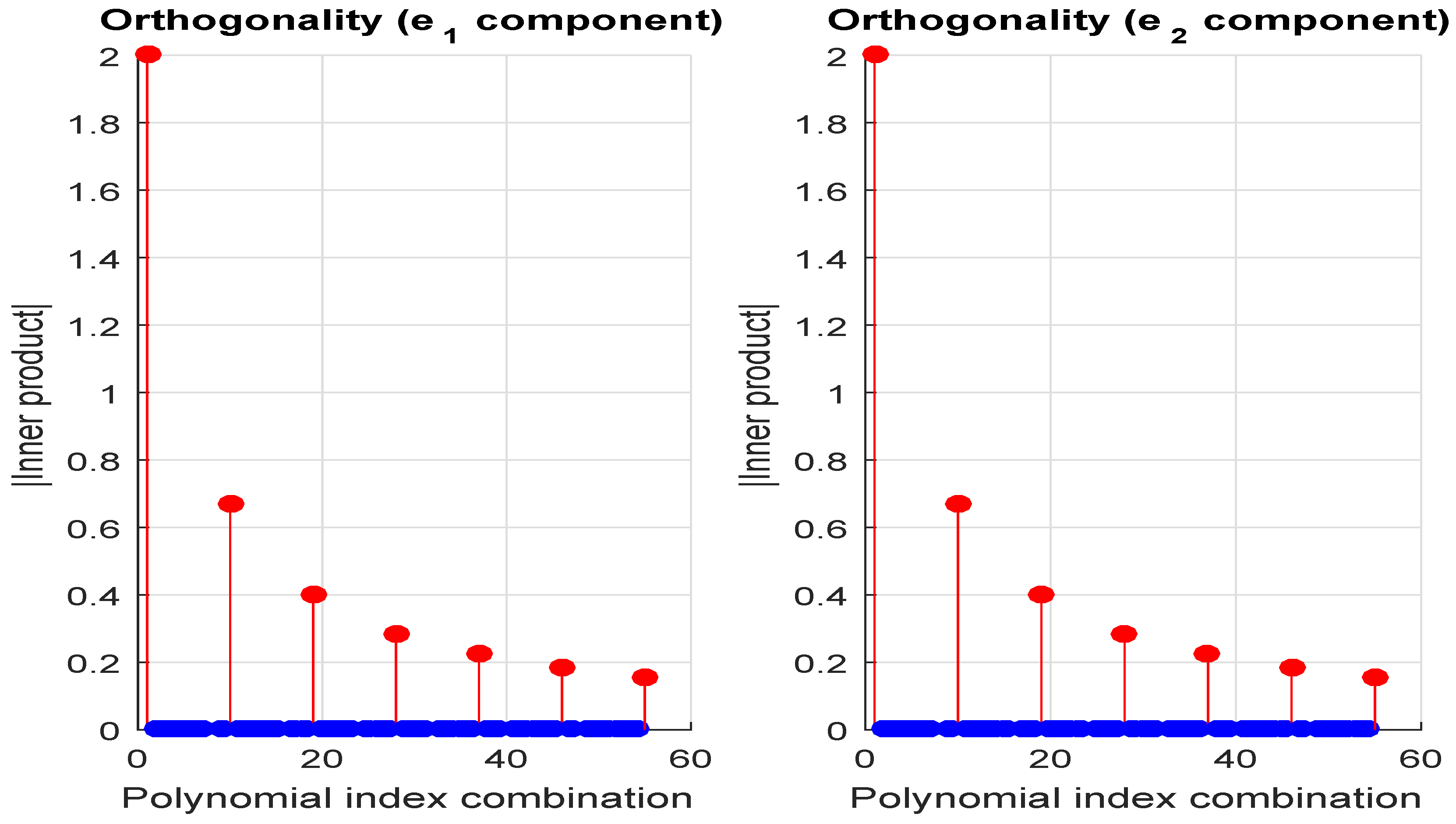
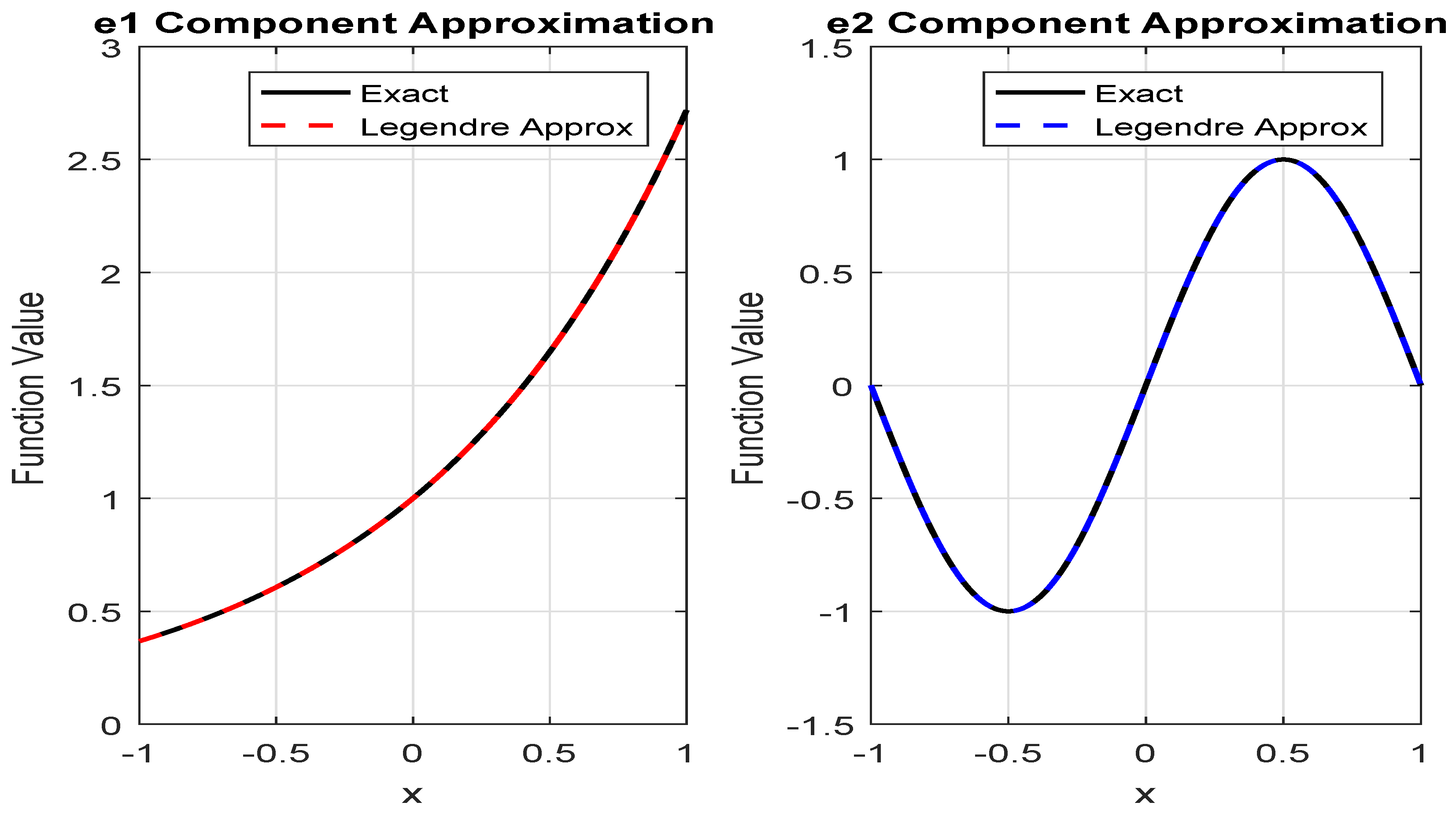
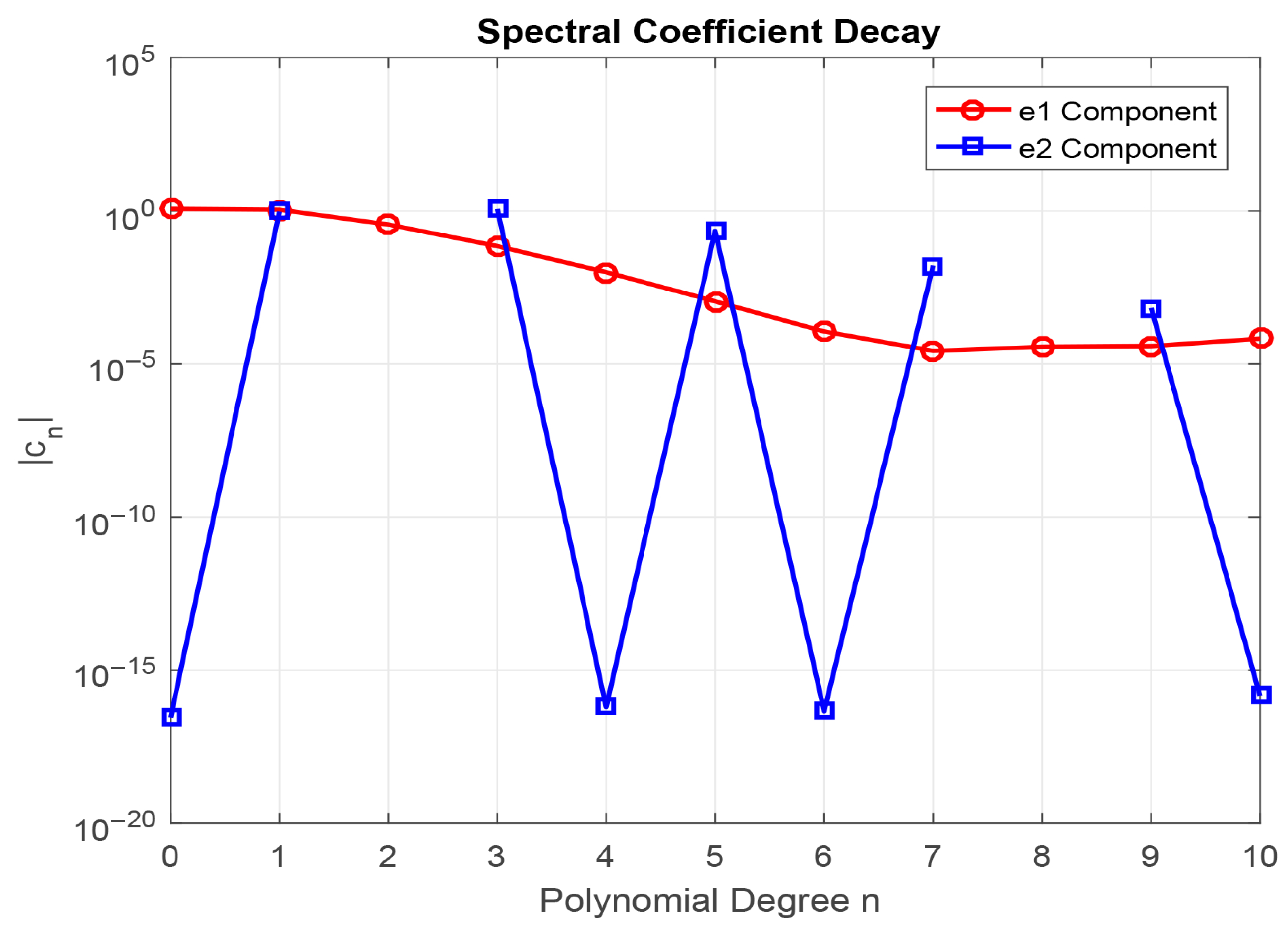
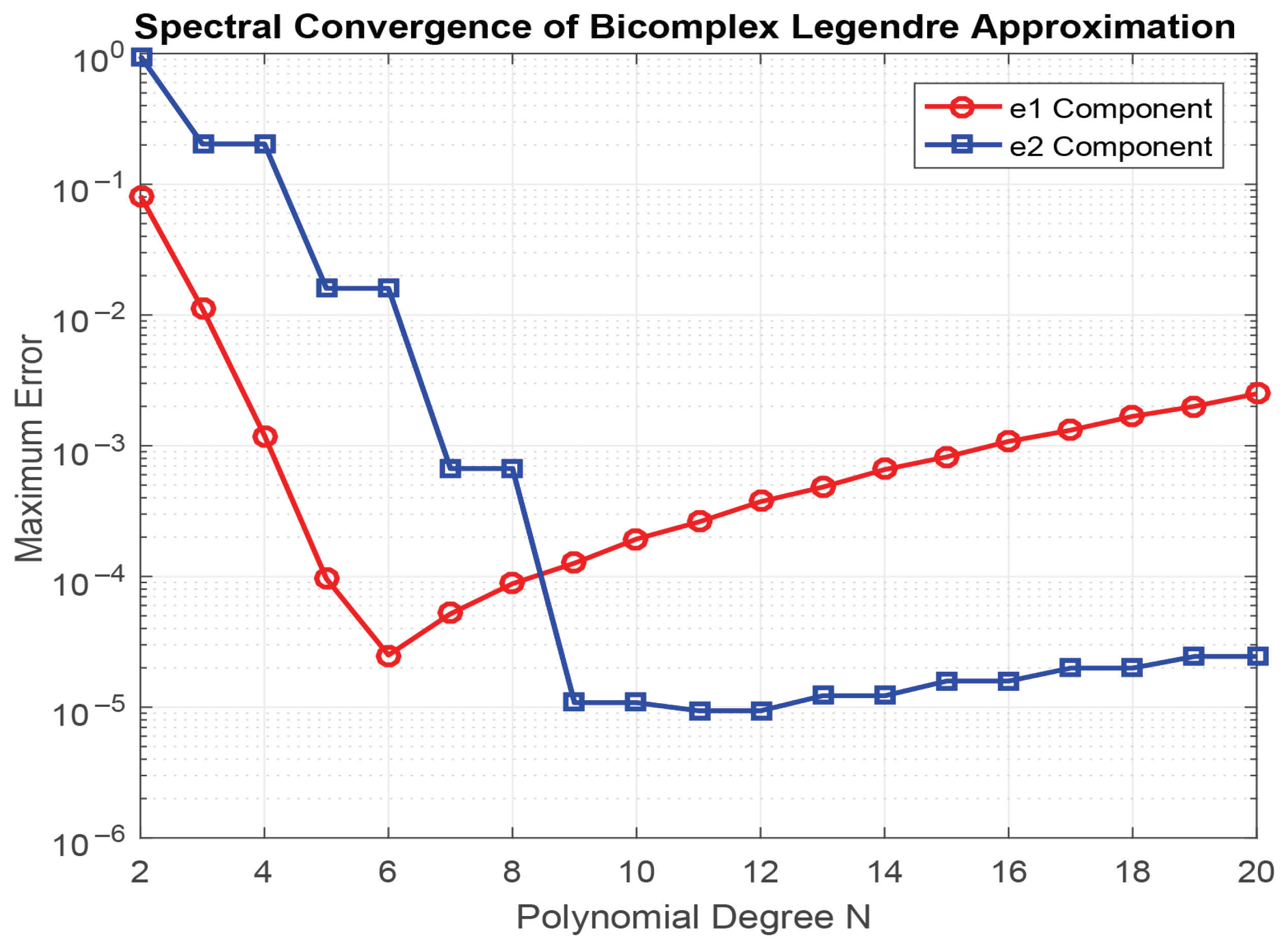
In this work, we present new results in the bicomplex space by extending and analyzing the Legendre polynomials. To provide a rigorous theoretical foundation, we establish several fundamental theorems and introduce key concepts associated with these functions. The study further investigates important properties, including the solution of the bicomplex Legendre differential equation, generating functions, orthogonality, recurrence relations, and special representations. Moreover, we broaden the framework by incorporating the fractional Riemann Liouville derivative and integral into the four-dimensional bicomplex setting for Legendre polynomials. In addition, we present a numerical study of the Legendre polynomial in bicomplex space and explain its construction and orthogonality verification. We focus on spectral projection and coefficient decay using bicomplex-valued test functions, highlighting their role in efficiently representing bicomplex functions, assessing numerical accuracy and ensuring rapid convergence in bicomplex systems.
This paper aims to present new findings relating to Legendre polynomials in bicomplex space, focusing on fractional calculus and numerical analysis. This highlights the importance of bicomplex numbers in advancing mathematical theory and multidimensional applications.
The organization of this paper is as follows: we display the main concepts and features of bicomplex numbers in
Section 2. In
Section 3, we present a new version of the Legendre polynomial in bicomplex space. In
Section 4, we introduce the fractional Riemann Liouville operator in the setting of bicomplex analysis. In
Section 5, we present numerical investigations of bicomplex Legendre polynomials. The last
Section 6 provides concluding remarks and outlines potential directions for future research.
3. Bicomplex Legendre Polynomials
In this section, we explore the expansion of legendre polynomials in the space of bicomplex numbers and present some fundamental concepts Pertaining to these functions. We investigate several properties of these functions, including their generating functions, orthogonality and representations involving recurrence relations and special relations.
Definition 1. then the bicomplex first legendre polynomials are given by At this stage, we clarify the methodological framework adopted throughout the paper. All subsequent results and proofs are derived by systematically employing the idempotent decomposition of bicomplex numbers. This technique reduces bicomplex-valued operators and identities to their componentwise counterparts, which naturally leads to proofs that formally resemble those of the classical Legendre polynomials. This resemblance is intrinsic to the bicomplex setting and reflects a deliberate and standard methodological choice rather than a mere repetition of known arguments. For completeness and transparency, we present full proofs of all results to explicitly demonstrate how the classical theory is consistently extended to the bicomplex domain.
Theorem 1. then the independent form of the bicomplex first Legendre polynomials is given by Proof. By using Equation (
14) and idempotent representations, we obtain
Thus, the proof is verified. □
Theorem 2. then, another form of the bicomplex first Legendre polynomials using generating function can be written aswhere is defined in Equation (13). Proof. From the generating function Equation (
21), we have
Using the generalized binomial series,
Using properties of bicomplex Pochhammer symbol by putting
and
,
putting
,
and
, then
The proof has been completed. □
Theorem 3. Let where , then bicomplex Legendre polynomial satisfies the different equation The equation is a linear differential equation of second order with two linearly independent solutions. The first is a solution regular on the interval , and this solution is known as the Legendre polynomial ; the second solution is typically irregular at .
Proof. The expression of the bicomplex Legendre polynomials is obtained via the bicomplex hypergeometric function, as shown in Equation (
16).
Equation (
16) is a solution of a another equation
By putting
, and
, we have
Using the chain rules, we obtain
Consequently, we have established the desired result
□
Corollary 1. We can find some special cases from Equation (14) when we put - (i)
- (ii)
- (iii)
- (iv)
Example 1. Evaluating the bicomplex value by substituting into Equation (14) for h = 3. Solution: When we put in Equation (14), we get Then we consider the cases and in Equation (19) Theorem 4. , then we get Proof. Putting
in Equation (
14), we get
We know that
The proof has been completed. □
Theorem 5. then the generating function for bicomplex first Legendre polynomials are given by Proof. By applying idempotent units
,
, we have
From the binomial series expansion, we get
Using (i)–(iv) from Corollary (1), we obtain that
□
Theorem 6. Proof. To prove (i), we use the generating function Equation (
21), we differentiate both sides with respect to
Equating the coefficients of
From this, we obtain the desired relation
Now, we verify (ii) by considering the generating function Equation (
21), we differentiate both sides with respect to
to obtain
Equating the coefficients of
, we get
Thus, we arrive at the required relation. □
Theorem 7. Bicomplex legendre polynomials satisfy the orthogonality theoremwhere Proof. and
are bicomplex Legendre polynomials which satisfy Equation (
17)
and
By multiplying Equation (
25) by
and Equation (
26) by
, then subtracting the two equations, we obtain
We can write the last equation as
By integrating from
to 1, we get
So, we get the first case when
To prove the second case when
, we square both sides of Equation (
21),
By integrating from
to 1, we have
By applying the orthogonality theorem and integrating the left side
Equating the coefficients of
, then
as required. □
6. Conclusions
Our paper advances the theory of bicomplex Legendre polynomials by extending classical foundations into the bicomplex domain and incorporating modern analytic methodologies. By examining their expansion formulas and orthogonality properties, we establish a coherent framework that facilitates further theoretical exploration and practical applications.
Furthermore, this paper underscores the central role of bicomplex analysis, special functions, and fractional calculus, providing fresh perspectives and powerful tools for research. In doing so, it strengthens the theoretical framework, fosters innovation, and broadens applications across the mathematical sciences. A compelling direction for future research is the development of a novel finite element method for systems of coupled fractional differential equations [
14,
15,
16]. By utilizing the bicomplex Legendre polynomials introduced in this work as spatial basis functions, one can formulate a unified bicomplex-valued weak form for such systems. The key challenges involve deriving the Caputo fractional derivatives [
17] of these polynomials and assembling the resulting bicomplex linear system [
18], which benefits from the established orthogonality properties. Success in this endeavor would provide a powerful computational tool for problems in fractional viscoelasticity [
19] and diffusion, where coupled phenomena are prevalent. Future work can extend this framework to higher-dimensional bicomplex systems, alternative orthogonal polynomials, bicomplex PDEs, adaptive spectral methods, and rigorous error analysis to enhance computational efficiency and theoretical understanding.