Article

Numerical Solution of Fractional Third-Order Nonlinear Emden–Fowler Delay Differential Equations via Chebyshev Polynomials


by
Mashael M. AlBaidani
Department of Mathematics, College of Science and Humanities, Prince Sattam Bin Abdulaziz University, Al Kharj 11942, Saudi Arabia
Axioms 2026, 15(1), 64; https://doi.org/10.3390/axioms15010064
Submission received: 26 December 2025 / Revised: 12 January 2026 / Accepted: 15 January 2026 / Published: 17 January 2026
(This article belongs to the Special Issue Advances in Differential Equations and Its Applications)

Abstract

In the current study, we used Chebyshev’s Pseudospectral Method (CPM), a novel numerical technique, to solve nonlinear third-order Emden–Fowler delay differential (EF-DD) equations numerically. Fractional derivatives are defined by the Caputo operator. These kinds of equations are transformed to the linear or nonlinear algebraic equations by the proposed approach. The numerical outcomes demonstrate the precision and efficiency of the suggested approach. The error analysis shows that the current method is more accurate than any other numerical method currently available. The computational analysis fully confirms the compatibility of the suggested strategy, as demonstrated by a few numerical examples. We present the outcome of the offered method in tables form, which confirms the appropriateness at each point. Additionally, the outcomes of the offered method at various non-integer orders are investigated, demonstrating that the result approaches closer to the accurate solution as a value approaches from non-integer order to an integer order. Additionally, the current study proves some helpful theorems about the convergence and error analysis related to the aforementioned technique. A suggested algorithm can effectively be used to solve other physical issues.

1. Introduction

Fractional differential equations (FDEs) provide a detailed expression for the fractional calculus, which is a widely used tool in many branches of science and engineering. Many analytical and numerical techniques, along with their applications to challenging fractional calculus issues, have been proposed in recent years by a number of scholars. Undoubtedly, numerous scholars have demonstrated that fractional operators are effective at defining sophisticated memory and a range of concepts that may be used in traditional differential calculus or other conventional mathematical frameworks. Leibnitz recognized a fraction in a derivative. Furthermore, it was demonstrated that fractional calculus is far more suitable than classical calculus to simulate real-world problems. The idea of fractional calculus represents the truth of nature in the most exquisite and well-organized way. Fractional calculus was once thought to be as a fascinating and unimaginable area of theory that was only occasionally employed. Many pioneers have derived and put forward the various ideas. The concept was clearly grasped due to several definitions that were mentioned in [1,2,3]. Fractional calculus has increasingly gained prominence in applied science. Many studies have now shown that it is capable of solving a variety of issues, particularly in the area of engineering and science. It is indisputable that the legitimacy of the power of fractional operators has demonstrated that it is proper to describe the local instability of objects in time or space, which plays a crucial role in the majority of circumstances but cannot be undervalued by conventional mathematical techniques.
Due to its vast applications across numerous scientific fields, FDEs are becoming a popular area of study, such as Chaos theory [4], Signal processing [5], biological population models [6], fluid and continuum mechanics [7], and many more. The main benefit of employing FDEs is that they are nonlocal. The integer-order differential operator is nonlocal, as is well established [8]. This indicates that a system’s next state depends on all of its previous instances as well as its current form. Therefore, the necessity to clarify the concepts of equilibrium, stability states, and temporal development at the long time limit leads to the significance of studying fractional equations. For finding exact solutions, FDEs appear to be significantly more challenging than their integer-order counterparts. Therefore, great focus has been placed on creating active numerical and analytical techniques to investigate approximations of solutions for this class of problems. These include the Fractional Transform Method (FTM) [9], Nonstandard Difference Method (NDM) [10], Operational Tau Method (OTM) [11], Iterated Galerkin Method (IGM) [12], Adams Bashforth–Moulton method (ABMM) [13], Spline Collocation Method (SCM) [14], Predictor Corrector (PC) [15], Shifted Chebyshev Polynomial Method (SCPM) [16], Reproducing Kernel Hilbert Space (RKHSM) [17] and Galerkin Method (GM) [18].
One of the oldest and most significant equations is the delay differential (DD) equation. Due to its several uses in numerous biological models and scientific domains like communication system models, economic system models, engineering system models, and transport and propagation models, the DD equation has recently drawn a lot of attention [19,20,21]. The solution to the DD equations has always attracted scholars’ interest, leading them to employ a variety of numerical and analytical methods. The DD equation was resolved by Brunner et al. [22] using a discontinuous Galerkin numerical technique. While Wang [23] demonstrated the solution of DD equations using the Legendre wavelet, Hsiao and Wu [24] used the Haar wavelet to solve DD equations. The Adomian decomposition method was used by Adomian and Rach [25] to solve the DD equation. Using the homotopy perturbation approach, Shakeri and Dehghan [26] discovered the solutions to DD initial value problems. Using the singularly perturbed DD equations, Erdogan et al. [27] constructed the finite difference technique on a layer-adapted mesh. Emden-differential Fowler’s equation is among them. It can be used in a wide range of scientific domains.
Recently, numerous researchers have shown great interest in wavelet theory [28,29,30]. One well-known family of orthogonal polynomials with numerous applications on the interval [−1, 1] is the Chebyshev polynomials [31]. H.M.Ahmed implemented Shifted Chebyshev polynomials of the first kind for deriving approximate solutions of renowned Lane–Emden-type equations [32]. Ampol Duangpan et al. used a modified finite integration method along with Chebyshev polynomial expansion for addressing nonlinear Burger equations with shock waves in one dimension [33]. Similarly, Rabia Savaş et al. extend Connor and Savas results to a higher dimension, which is helpful in the convergence analysis of spectral methods in function spaces [34]. To the best of our knowledge, these polynomials have not been significantly employed for the solution of fractional EF-DD equations. In this study, we use CPM to solve fractional EF-DD equations. We use the suggested approach and compare the outcomes with an alternative method. The general form of the above equation is stated as
t k d m d t m t k d n d t n w + j ( t ) h ( w ) = 0 , k > 0
where k is a real positive number. This equation, which Wazwaz [35] presented, interprets a number of fascinating events. Emden–Fowler (EF) equations were first discussed by Fowler as a solution to an astronomical problem [36]. Fowler [37] goes on to examine the specific scenarios of the phenomenon and how it can be transformed into a simpler form. The other properties of this equation, such as stability, boundary value problem, asymptotic growth, oscillation, continuity, and boundedness, were investigated by Wong [38] in 1975. According to Domoshnitsky et al. [39], the asymptotic nature of solutions is caused by the EF equations. Aslanov [40] extracted exact solutions to the EF equation of the first class. To study the generalized EF equation, Berkovich used the autonomization technique [41]. By utilizing Lie and Noether symmetries, Freire et al. solved the fourth-order Emden–Fowler problem [42]. The Emden–Fowler equation can be numerically solved by using the improved Adomian decomposition technique and the optimum perturbation iteration process [43,44].
The work is structured as follows: The prefaces of the fractional derivatives are covered in Section 2. The fundamental concept of the applied approach is explained in Section 3. The convergence analysis of the proposed method is discussed in Section 4. Section 5 discusses the solutions obtained when the technique is used for various examples of the time-fractional EF equation, along with the behavior and aspects of the obtained data in terms of plots for fractional order. The remarks on results obtained are mentioned at the end.

2. Preliminaries

Here, we present certain basic definitions associated with fractional calculus.
Definition 1.
The Abel–Riemann (AR) fractional derivative is [45,46]
D γ w ( t ) = d j d t j w ( t ) , γ = j , 1 Γ ( j γ ) d j d t j 0 t w ( τ ) ( t τ ) γ j + 1 d τ , j 1 < γ < j ,
with j Z + , γ R + .
Definition 2.
The non-integer AR integral operator is given as [45,46]
J γ w ( t ) = 1 Γ ( γ ) 0 t ( t τ ) γ 1 w ( τ ) d τ , t > 0 , γ > 0 ,
with given properties
J γ t j = Γ ( j + 1 ) Γ ( j + γ + 1 ) t j + τ , D γ t j = Γ ( j + 1 ) Γ ( j γ + 1 ) t j t .
Definition 3.
A real function w ( t ) , t > 0 , is regarded as belonging to the space C μ , ( μ ) if a real number q > μ exists, such that w ( t ) = t n w 1 ( t ) —where w 1 ( t ) C [ 0 , + ) —is considered to be in the space C μ j if and only if w j C μ , j N .
Definition 4.
The Caputo fractional derivative is defined as [47]
D γ w ( t ) = 1 Γ ( j γ ) 0 t ( t τ ) j γ 1 j w ( τ ) τ j d τ , j 1 < γ j , t > 0 .
The derivative’s order is γ > 0 . The smallest integer greater than γ is j N , and w C 1 j .
For Caputo derivative, we may have
D γ C = 0 , w h e r e C i s a c o n s t a n t f u n c t i o n .
D γ t δ = 0 f o r δ N 0 a n d δ < γ Γ ( δ + 1 ) Γ ( δ + 1 γ ) t δ γ f o r δ N 0 a n d δ γ
where N 0 = 1 , 2 , and the ceiling function γ represents the lowest integer greater than or equal to γ. Recall that for γ N , the Caputo operator is equivalent to the normal differential operator of integer order. Similar to differentiation having integer-order, fractional differentiation is a linear:
D γ ( ϕ w ( t ) + μ ρ ( t ) ) = ϕ D γ w ( t ) + μ D γ ρ ( t ) ,
Here ϕ and μ are constants.

3. General Methodology of CPM

Recurrence equations are used to illustrate the definition and use of Chebyshev polynomials, which are specified on the [ 1 , 1 ] domain [48].
F n + 1 ( t ) = 2 t F n ( t ) F n 1 ( t ) , n = 1 , 2 ,
where
F 0 ( t ) = 1 , F 1 ( t ) = t .
The Chebyshev polynomial analytical form having degree n is stated as [48]
F n ( t ) = n 2 q = 0 n / 2 ( 1 ) q ( n q 1 ) ! q ! ( n 2 q ) ! ( 2 t ) n 2 q
Chebyshev’s shifted polynomials are characterized as F ^ n ( t ) , which are explained in a manner similar to Chebyshev polynomials F n ( t ) by relation, in order to employ Chebyshev polynomials in the [ 0 , 1 ] interval.
F ^ n ( t ) = F n ( 2 t 1 ) .
And the algorithm for recurrence is as follows:
F ^ n + 1 ( t ) = 2 ( 2 t 1 ) F n ^ ( t ) F ^ n 1 ( t ) , n = 1 , 2 ,
where
F ^ 0 ( t ) = 1 , F ^ 1 ( t ) = 2 t 1 .
The orthogonality condition is [49]
0 1 F ^ n ( t ) F ^ m ( t ) t ( 1 t ) d t = 0 m n , π 2 m = n 0 , π m = n = 0 .
By using the renowned relation,
F ^ n ( t ) = F 2 n ( t ) ,
and Equation (9), the analytical form of shifted Chebyshev polynomials with order n can be obtained as
F n ^ ( t ) = q = 0 n ( 1 ) q 2 2 n 2 q n ( 2 n q 1 ) ! q ! ( 2 n 2 q ) ! ( t ) n 2 q .
A function w ( t ) L 2 [ 0 , 1 ] is expressed in the form of Chebyshev shifted polynomials.
w ( t ) = n = 1 c n F ^ n ( t ) .
Here, the coefficients ( c n ; n = 1 , 2 , ) are expressed as
c 0 = 1 π 0 1 g ( t ) F ^ 0 ( t ) t ( 1 t ) d t a n d c n = 2 π 0 1 g ( t ) F ^ n ( t ) t ( 1 t ) d t
Chebyshev shifted polynomials’ initial (m+1)-terms are regarded as
w m ( t ) = n = 0 m c n F ^ n ( t ) .

4. Error and Convergence Analysis

4.1. Chebyshev Truncation Theorem [50]

Given the function w(.) as in (15), let ( w m ( . ) ; m = 0 , 1 , ) be given by
w m ( t ) = k = 0 m c k F ^ k ( t ) , t [ 1 , 1 ] , m { 0 , 1 , } .
Then, for all m { 0 , 1 , } , we have
E F ( m ) = sup { | w ( t ) w m ( t ) | ; t [ 1 , 1 ] } k = m + 1 | c k | .

4.2. Theorem

Suppose γ > 0 and that w ( t ) is approximated by the shifted Chebyshev polynomials as in Equation (17). So
D γ ( w m ( t ) ) = j = γ m q = 0 j γ c j b j , q γ t j q γ ,
where b j , q γ is stated as
b j , q γ = ( 1 ) q 2 2 j 2 q j ( 2 j q 1 ) ! ( j q ) ! q ! ( 2 j 2 q ) ! Γ ( j q + 1 γ ) .
Proof. 
As Caputo differentiation is linear, we have
D γ ( F m ( t ) ) = j = 0 m c j D γ ( F j ^ ( t ) )
Now, to calculate D γ ( F j ^ ( t ) ) , using Equations (5) and (6) in (14),
D γ ( F j ^ ( t ) ) = q = 0 j ( 1 ) q 2 2 j 2 q j ( 2 j q 1 ) ! q ! ( 2 j 2 q ) ! D γ ( t ) j q , j = γ , γ + 1 , m .
Since F j ^ ( t ) is a polynomial of degree j, we get
D γ ( F j ^ ( t ) ) = 0 f o r a l l j = 0 , 1 , 2 , , γ 1 , γ > 0 .
The below outcome is achieved by combining (22)–(24):
D γ ( w m ( t ) ) = j = γ m q = 0 j γ c j ( 1 ) q 2 2 j 2 q j ( 2 j q 1 ) ! ( j q ) ! q ! ( 2 j 2 q ) ! Γ ( j q + 1 γ ) t j q γ = j = γ m q = 0 j γ c j b j , q γ t j 2 q γ
which is the desired result. □

5. Applications

Example 1.
Let us assume a third-order nonlinear EF-DD equation with an exponential function as follows:
d γ d t γ w ( t 1 ) + 1 t d 2 d t 2 w ( t 1 ) + e w ( t ) = 12 6 t + t e 1 + t + t 3 , 2 < γ 3 w ( 0 ) = 1 , w ( 0 ) = 1 , w ( 0 ) = 0
with the exact solution w ( t ) = 1 + t + t 3 .
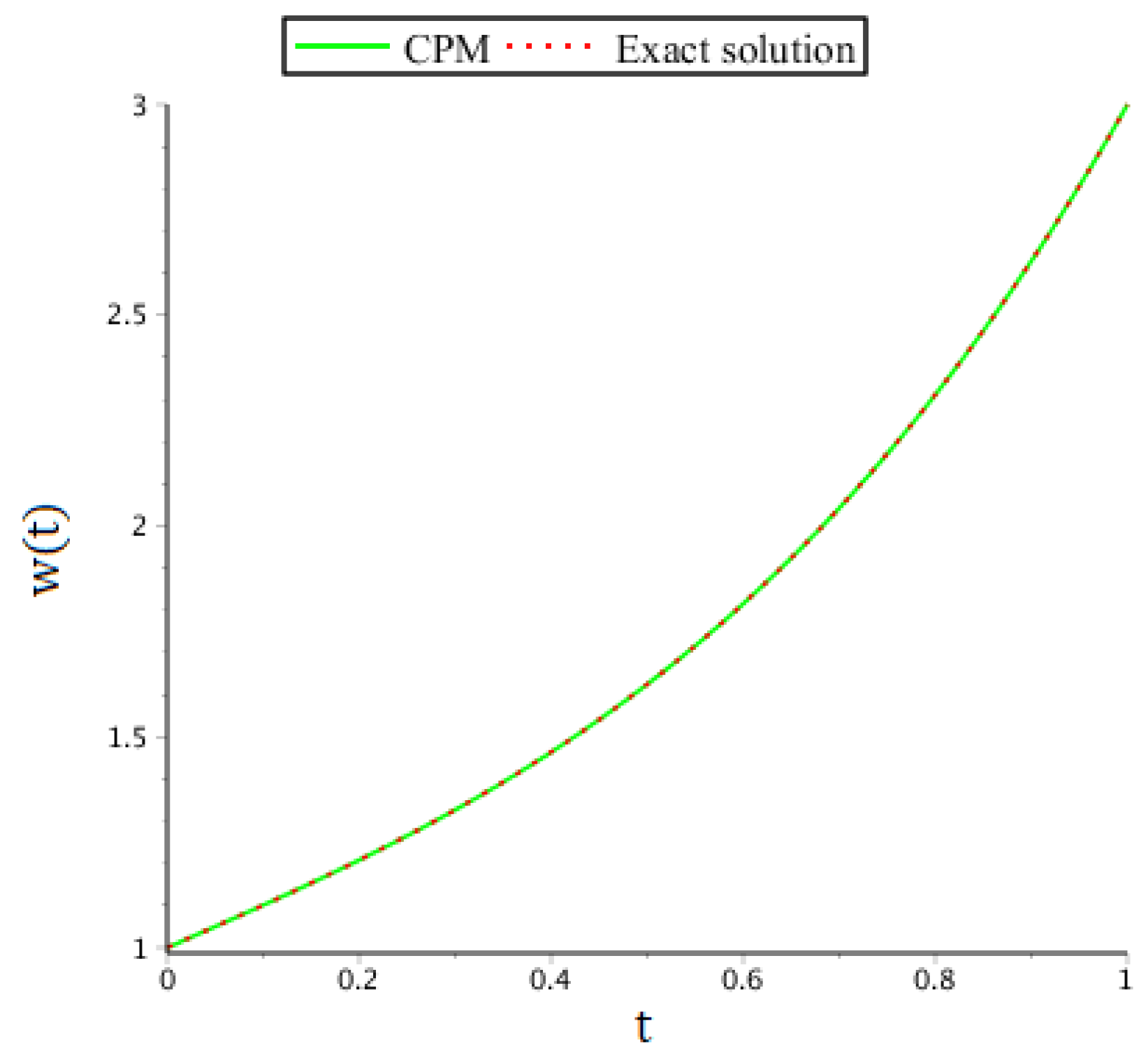
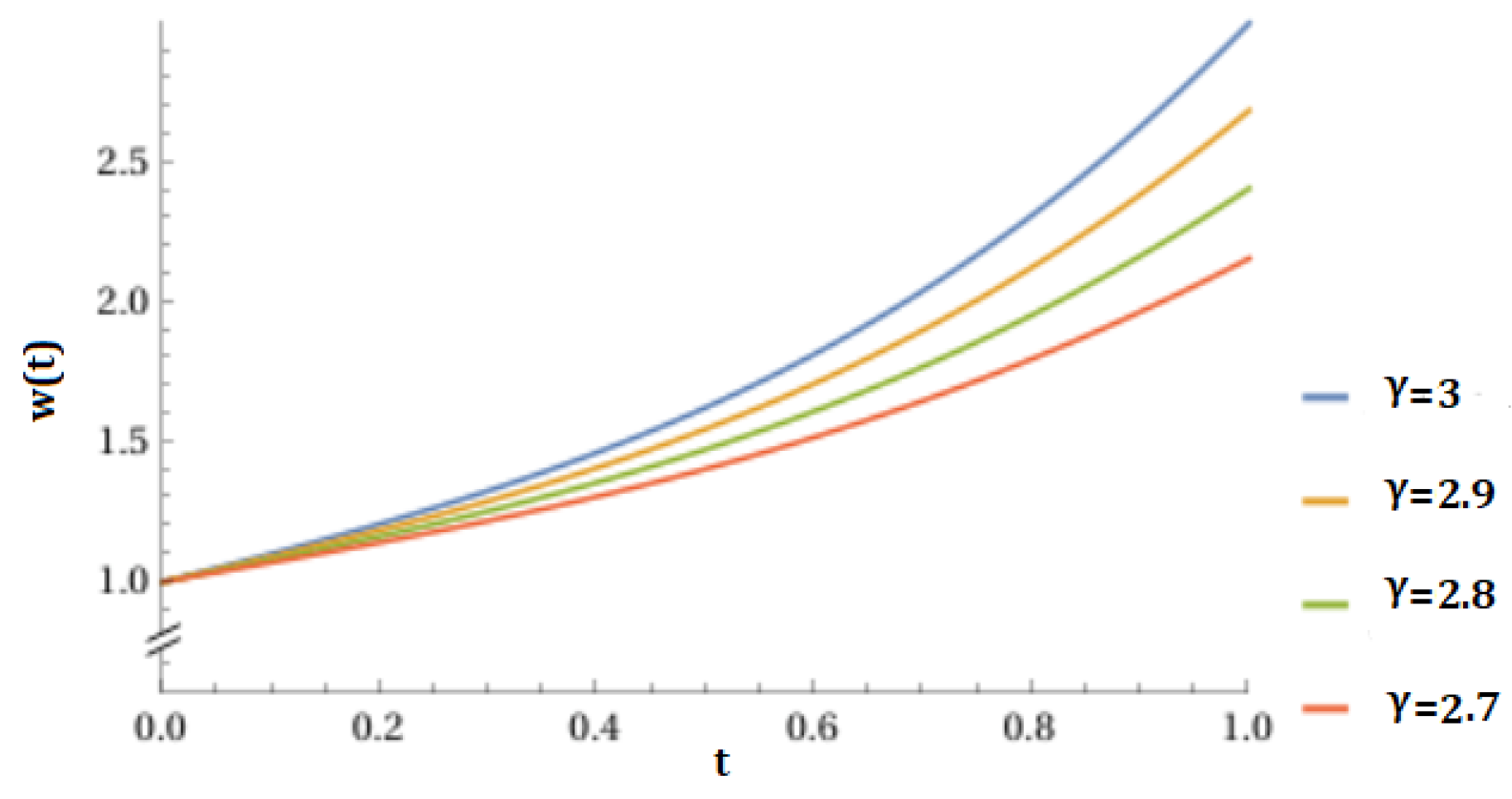
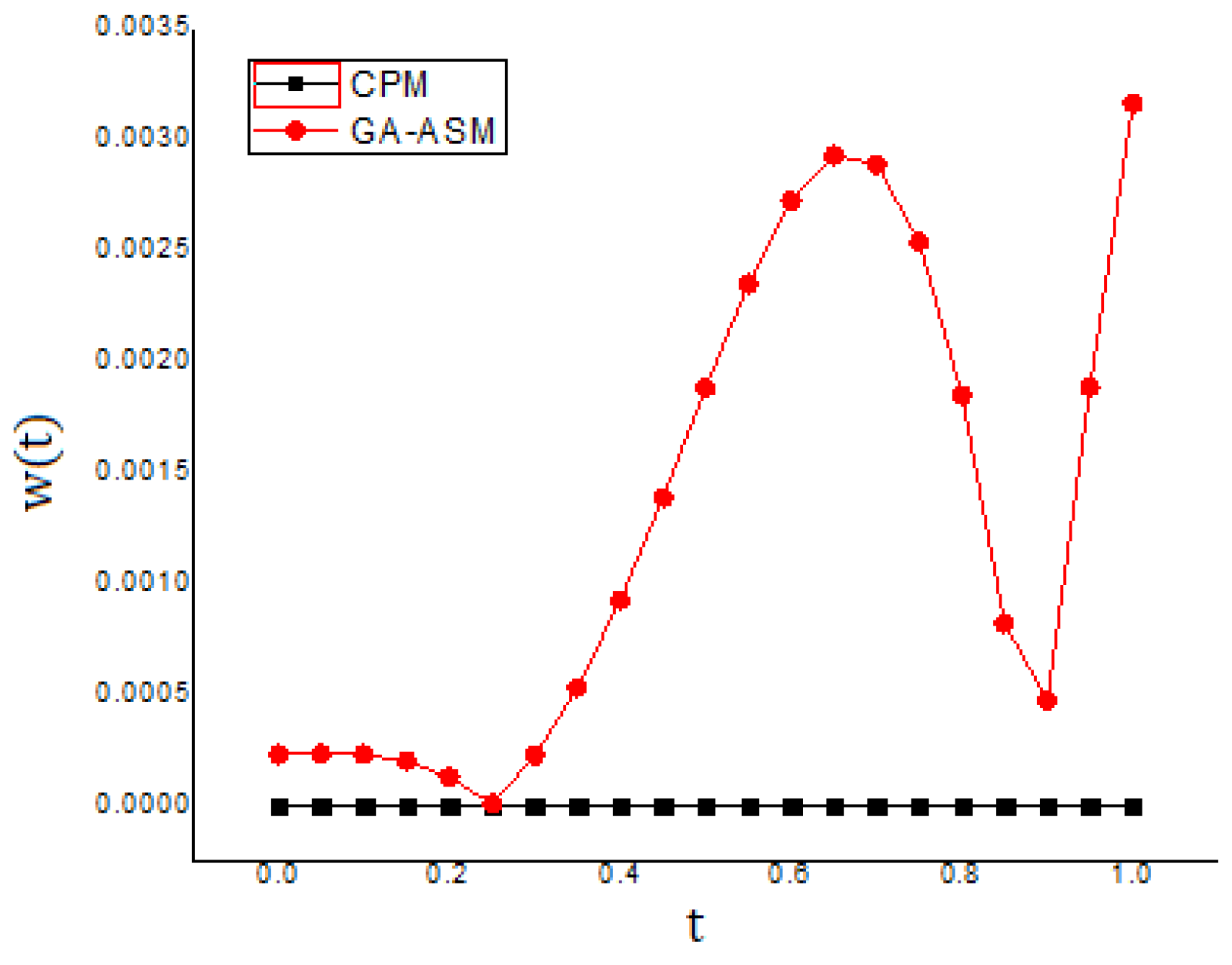
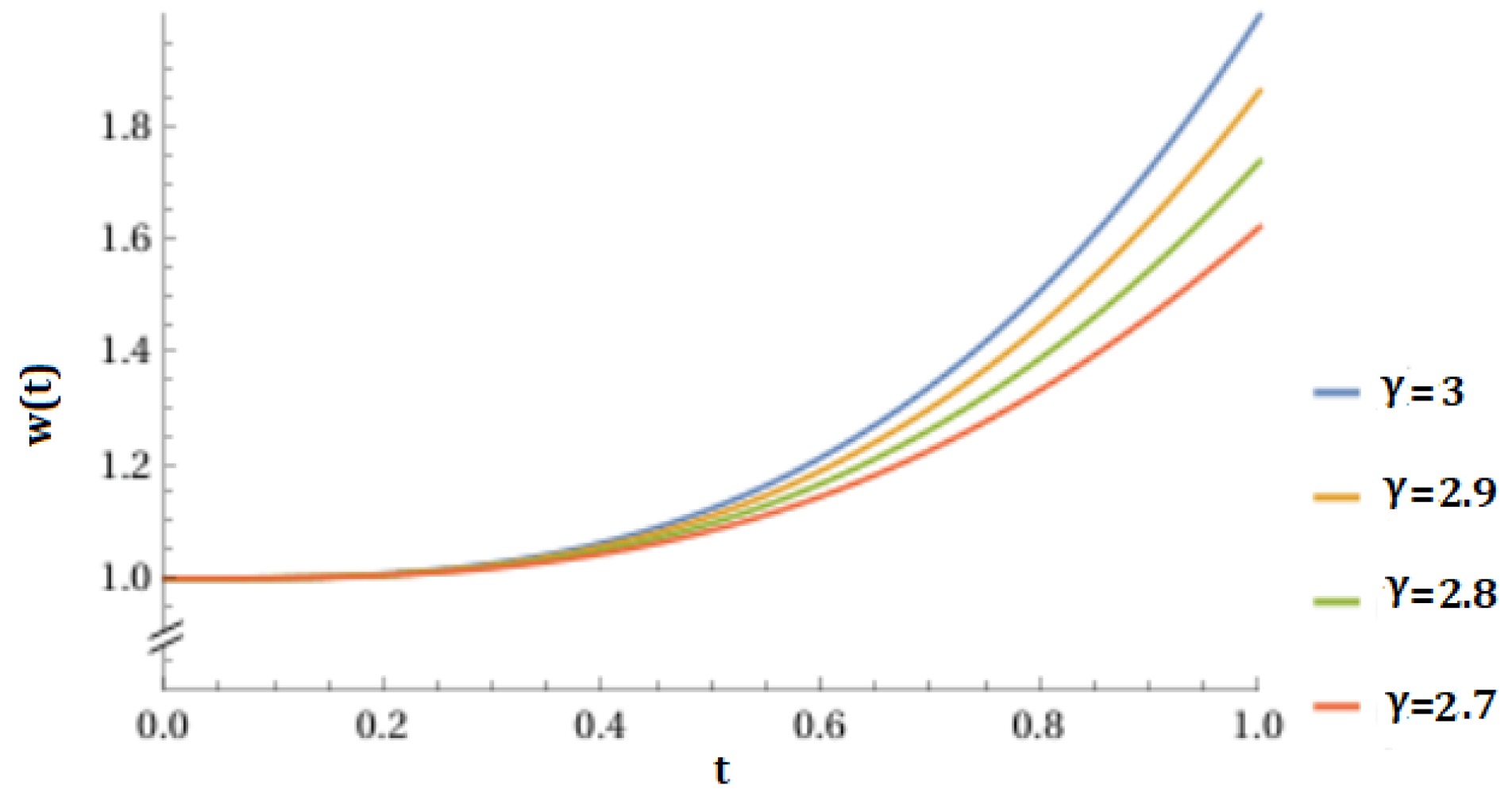
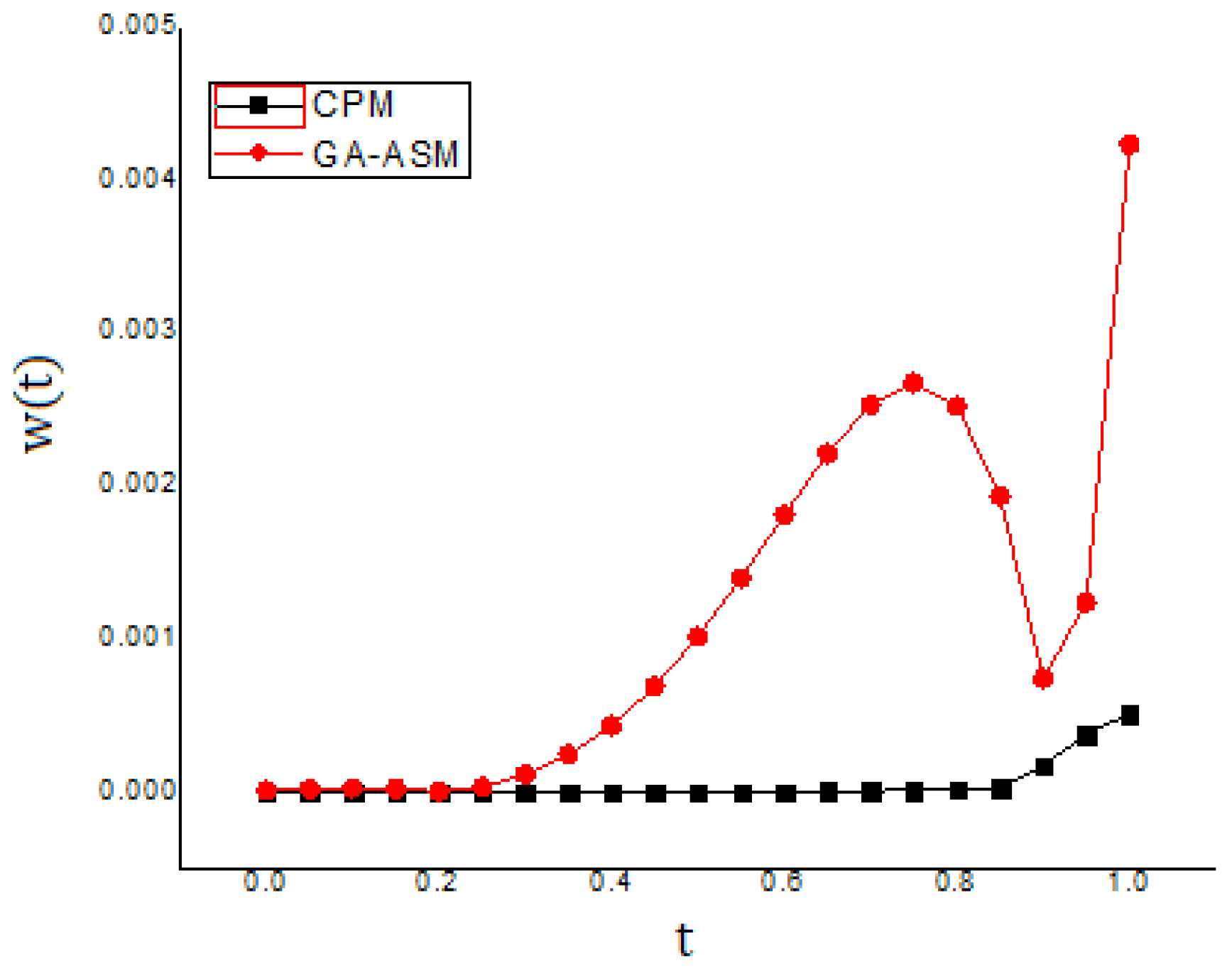
Table 1 provides the precise solution along with the CPM approximations and absolute error. Between the precise and approximative results, the absolute errors are measured. The table’s error analysis reveals that the applied method has higher accuracy. The absolute error comparison between the proposed technique and the results from the genetic algorithm (GA) and active-set method (ASM) at m = 6 is shown in Table 2. These tables show that the current approach offers a reliable approximation solution for the specified issues. In reality, the results shown in these tables confirm the efficacy of the recommended approach. Similarly, Figure 1 shows the behavior of both the exact solution and our approach solution for the case when γ = 1 , while Figure 2 shows the proposed technique solution plot at various γ orders. Also, Figure 3 demonstrates the graphical behavior of absolute error for the applied method and those obtained by GA-ASM. The absolute error demonstrates that the CPM solution approaches the problem’s exact solution more quickly.
Example 2.
Let us assume a third-order nonlinear EF-DD equation as follows:
d γ d t γ w ( t 1 ) + 4 t d 2 d t 2 w ( t 1 ) + 2 t d d t w ( t 1 ) + t w 2 = t 7 + 2 t 4 + t + 30 36 t + 6 t 2 , 2 < γ 3 w ( 0 ) = 1 , w ( 0 ) = 0 , w ( 0 ) = 0
with the exact solution w ( t ) = 1 + t 3 .
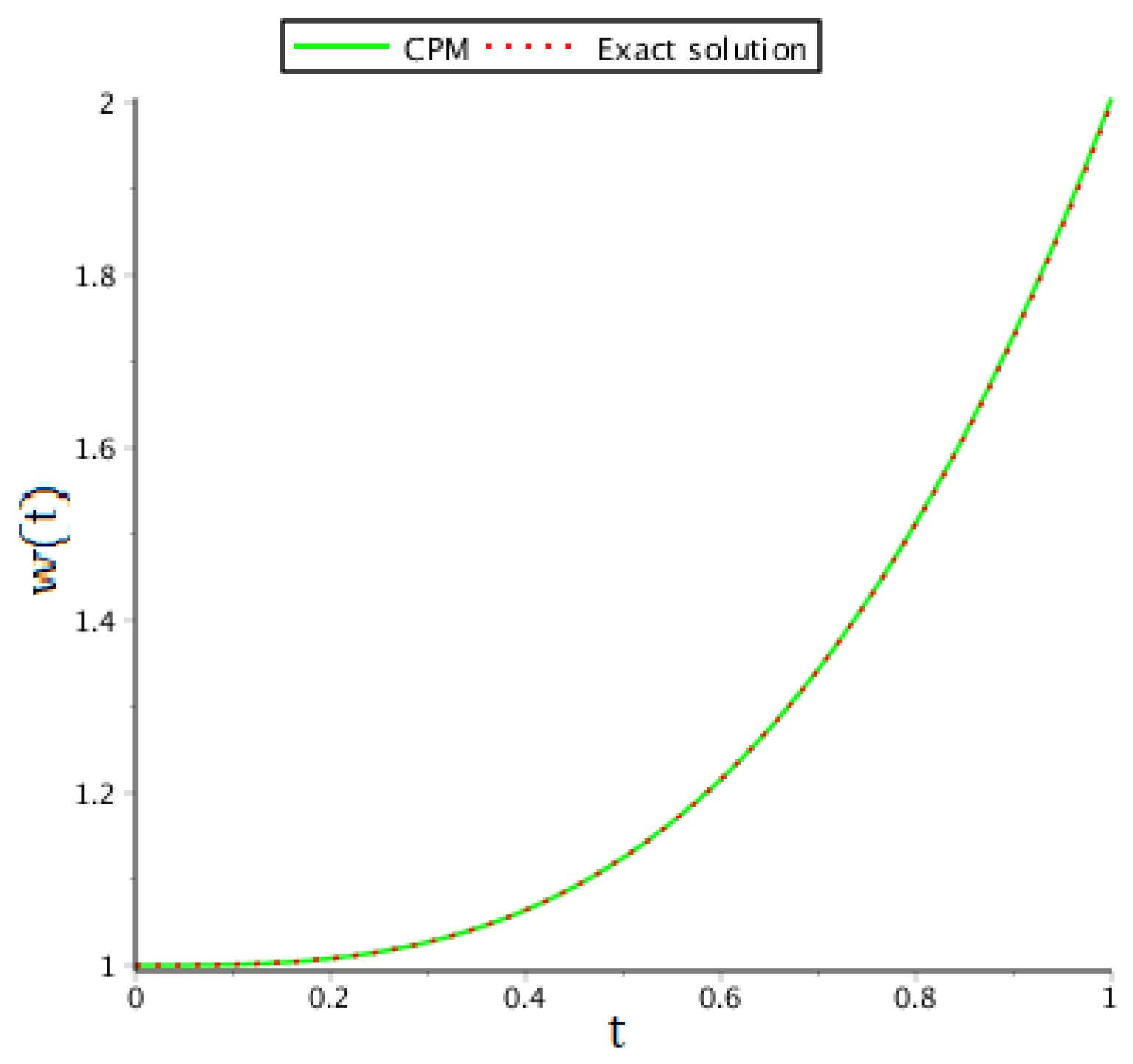
Table 3 provides the precise solution as well as CPM approximations and absolute error. Between the precise and approximative results, the absolute errors are measured. The table’s error analysis reveals that the applied method has higher accuracy. The absolute error comparison between the proposed technique and the results from the genetic algorithm (GA) and active-set method (ASM) at m = 6 is shown in Table 4. Similarly, Figure 4 shows the behavior of the precise and our approach solution of this case when γ = 1 , while Figure 5 shows the applied technique solution plot at numerous fractional orders. Also, Figure 6 demonstrates the graphical behavior of absolute error for the applied method and and those obtained by GA-ASM. The absolute error demonstrates that the CPM solution approaches the problem’s exact solution more quickly.

6. Conclusions

In this work, we have made a detailed effort to use the Chebyshev pseudospectral approach to determine the numerical solution of the fractional third-order Emden–Fowler delay differential equations. The numerical approach was carried out in a very simple and efficient way. Another aspect of interest is the precision of the numbers. We found that the current technique had the highest level of accuracy during numerical simulations. The suggested method’s low computing rates, minimal CPU usage, and ease of implementation are its main advantages. Additionally, the current approach has the capacity to transform the provided problem into a set of mathematical equations that may be quickly resolved with the aid of MAPLE 2015 software. The researchers can expand this technique to several additional fractional systems of ordinary and partial differential equations on the basis of the current work. Based on the benefits of the existing operator, it will therefore be highly valuable to add more operators in the future, such as Caputo–Fabrizio, and Atangana–Baleanu derivatives. We expect that this method will be used in the future to tackle more fractional differential problems in scientific domains in a fast and effective way. This effort is beneficial and will open up new scientific and engineering possibilities.

Funding

This study is funded by Prince Sattam bin Abdulaziz University under project number PSAU/2025/01/36439.

Data Availability Statement

The numerical data is used to support the findings of this study that are included within the article.

Acknowledgments

The authors extend their appreciation to Prince Sattam bin Abdulaziz University for funding this research work through the project number PSAU/2025/01/36439.

Conflicts of Interest

The author declare no conflicts of interest.

References

  1. Caputo, M. Elasticita e Dissipazione; Zanichelli: Bologna, Italy, 1969. [Google Scholar]
  2. Kilbas, A.A.; Srivastava, H.M.; Trujillo, J.J. Theory and Applications of Fractional Differential Equations; Elsevier: Amsterdam, The Netherlands, 2006. [Google Scholar]
  3. Liouville, J. Memoire surquelques questions de geometrieet de mecanique, et sur un nouveau genre de calcul pour resoudreces questions. J. Ecole. Polytech. 1832, 13, 1–69. [Google Scholar]
  4. Baleanu, D.; Wu, G.C.; Zeng, S.D. Chaos analysis and asymptotic stability of generalized Caputo fractional differential equations. Chaos Solitons Fractals 2017, 102, 99–105. [Google Scholar] [CrossRef]
  5. Cruz-Duarte, J.M.; Garcia, J.R.; Correa-Cely, C.R.; Perez, A.G.; Avina-Cervantes, J.G. A closed form expression for the Gaussian-based Caputo-Fabrizio fractional derivative for signal processing applications. Commun. Nonlinear Sci. Numer. Simul. 2018, 61, 138–148. [Google Scholar] [CrossRef]
  6. Singh, B.K. A novel approach for numeric study of 2D biological population model. Cogent Math. 2016, 3, 1261527. [Google Scholar] [CrossRef]
  7. Drapaka, C.S.; Sivaloganathan, S. A fractional model of continuum mechanics. J. Elast. 2012, 107, 105–123. [Google Scholar] [CrossRef]
  8. Kumar, S.; Tripathi, M.P.; Singh, O.P. A fractional model of Harry Dym equation and its approximate solution. Ain Shams Eng. J. 2013, 4, 111–115. [Google Scholar] [CrossRef]
  9. Nazari, D.; Shahmorad, S. Application of the fractional differential transform method to fractional-order integrodifferential equations with nonlocal boundary conditions. J. Comput. Appl. Math. 2010, 234, 883–891. [Google Scholar] [CrossRef]
  10. Diethelm, K.; Ford, N.J.; Freed, A.D. Detailed error analysis for a fractional adams method. Numer. Algorithms 2004, 36, 31–52. [Google Scholar] [CrossRef]
  11. Karimi Vanani, S.; Aminataei, A. Operational Tau approximation for a general class of fractional integrodifferential equations. Comput. Appl. Math. 2011, 30, 655–674. [Google Scholar] [CrossRef]
  12. Volk, W. The iterated galerkin method for linear integro-differential equations. J. Comput. Appl. Math. 1988, 21, 63–74. [Google Scholar] [CrossRef]
  13. Diethelm, K.; Ford, N.J. Analysis of fractional differential equations. J. Math. Anal. Appl. 2002, 265, 229–248. [Google Scholar] [CrossRef]
  14. Peedas, A.; Tamme, E. Spline collocation method for integro-differential equations with weakly singular kernels. J. Comput. Appl. Math. 2006, 197, 253–269. [Google Scholar] [CrossRef]
  15. Mekkaoui, T.; Atangana, A.; Araz, S.I. Predictor-corrector for non-linear differential and integral equation with fractal-fractional operators. Eng. Comput. 2021, 37, 2359–2368. [Google Scholar] [CrossRef]
  16. Farhood, A.K. The solution of nonlinear fractional integrodifferential equations by using shifted Chebyshev polynomials method and Adomian decomposition method. Int. J. Educ. Sci. Res. 2015, 5, 37–50. [Google Scholar]
  17. Bushnaq, S.; Momani, S.; Zhou, Y. A reproducing Kernel Hilbert space method for solving integro-differential equations of fractional order. J. Optim. Theory Appl. 2012, 156, 96–105. [Google Scholar] [CrossRef]
  18. Subasi, M.; Araz, S.I.; Gungor, H. On the numerical solution of two dimensional Schrodinger equation. Int. J. Math. Res. 2017, 6, 1–12. [Google Scholar] [CrossRef]
  19. Zhao, T. Global periodic-solutions for a differential delay system modeling a microbial population in the chemostat. J. Math. Anal. Appl. 1995, 193, 329–352. [Google Scholar] [CrossRef]
  20. Li, W.; Chen, B.; Meng, C.; Fang, W.; Xiao, Y.; Li, X.; Hu, Z.; Xu, Y.; Tong, L.; Wang, H.; et al. Ultrafast all-optical graphene modulator. Nano Lett. 2014, 14, 955–959. [Google Scholar] [CrossRef]
  21. Niculescu, S.I. Delay Effects On Stability: A Robust Control Approach; Springer Science & Business Media: Berlin/Heidelberg, Germany, 2001; Volume 269. [Google Scholar]
  22. Brunner, H.; Huang, Q.; Xie, H. Discontinuous Galerkin methods for delay differential equations of pantograph type. SIAM J. Numer. Anal. 2010, 48, 1944–1967. [Google Scholar] [CrossRef]
  23. Wang, X.T. Numerical solution of time-varying systems with a stretch by general Legendre wavelets. Appl. Math. Comput. 2008, 198, 613–620. [Google Scholar] [CrossRef]
  24. Hsiao, C.H.; Wu, S.P. Numerical solution of timevarying functional differential equations via Haar wavelets. Appl. Math. Comput. 2007, 188, 1049–1058. [Google Scholar] [CrossRef]
  25. Adomian, G.; Rach, R. A nonlinear differential delay equation. J. Math. Anal. Appl. 1983, 91, 301–304. [Google Scholar] [CrossRef]
  26. Shakeri, F.; Dehghan, M. Solution of delay differential equations via a homotopy perturbation method. Math. Comput. Model. 2008, 48, 486–498. [Google Scholar] [CrossRef]
  27. Erdogan, F.; Sakar, M.G.; Saldir, O. A finite difference method on layer-adapted mesh for singularly perturbed delay differential equations. Appl. Math. Nonlinear Sci. 2020, 5, 425–436. [Google Scholar] [CrossRef]
  28. Babolian, E.; Fattahzadeh, F. Numerical solution of differential equations by using Chebyshev wavelet operational matrix of integration. Appl. Math. Comput. 2007, 188, 417–426. [Google Scholar] [CrossRef]
  29. Mursaleen, M.A. Quadratic function preserving wavelet type Baskakov operators for enhanced function approximation. Comput. Appl. Math. 2025, 44, 395. [Google Scholar] [CrossRef]
  30. Maleknejad, K.; Mirzaee, F. Using rationalized Haar wavelet for solving linear integral equations. Appl. Math. Comput. 2005, 160, 579–587. [Google Scholar] [CrossRef]
  31. Mason, J.C.; Handscomb, D.C. Chebyshev Polynomials; Chapman and Hall/CRC: Boca Raton, FL, USA, 2002. [Google Scholar]
  32. Ahmed, H.M. Numerical solutions for singular Lane-Emden equations using shifted Chebyshev polynomials of the first kind. Contemp. Math. 2023, 4, 132–149. [Google Scholar] [CrossRef]
  33. Duangpan, A.; Boonklurb, R. Modified Finite Integration Method Using Chebyshev Polynomial Expansion for Solving One-Dimensional Nonlinear Burgers’ Equations with Shock Wave. Thai J. Math. 2021, 63–73. Available online: https://www.researchgate.net/profile/Ampol-Duangpan/publication/386219695_Modified_Finite_Integration_Method_Using_Chebyshev_Polynomial_Expansion_for_Solving_One-Dimensional_Nonlinear_Burgers’_Equations_with_Shock_Wave/links/6749431f876bd177782c51c0/Modified-Finite-Integration-Method-Using-Chebyshev-Polynomial-Expansion-for-Solving-One-Dimensional-Nonlinear-Burgers-Equations-with-Shock-Wave.pdf (accessed on 14 January 2026).
  34. Savaş, R.; Patterson, R.F. Multidimensional sliding window pringsheim convergence for measurable functions. Rend. Circ. Mat. Palermo Ser. 2024, 73, 689–698. [Google Scholar] [CrossRef]
  35. Veeresha, P.; Ilhan, E.; Baskonus, H.M. Fractional approach for analysis of the model describing wind-influenced projectile motion. Phys. Scr. 2021, 96, 075209. [Google Scholar] [CrossRef]
  36. Wazwaz, A.M.; Rach, R.; Duan, J.S. Solving new fourth order Emden-Fowler type equations by the Adomian Decomposition method. Int. J. Comput. Methods Eng. Sci. Mech. 2015, 16, 121–131. [Google Scholar] [CrossRef]
  37. Fowler, R.H. The form near infinity of real continuous solutions of a certain differential equation of the second order. Q. J. Math. 1914, 45, 289–350. [Google Scholar]
  38. Fowler, R.H. Emden’s and similar differential equations. Mon. Not. R. Astron. Soc. 1930, 91, 63–92. [Google Scholar] [CrossRef]
  39. Wong, J.S.W. On the generalized Emden-Fowler equation. SIAM Rev. 1975, 17, 339–360. [Google Scholar] [CrossRef]
  40. Domoshnitsky, A.; Koplatadze, R. On asymptotic behavior of solutions of generalized Emden-Fowler differential equations with delay argument. Abstr. Appl. Anal. 2014, 2014, 168425. [Google Scholar] [CrossRef]
  41. Aslanov, A. An elegant exact solutions for the Emden-Fowler equations of the first kind. Math. Methods Appl. Sci. 2016, 39, 1039–1042. [Google Scholar] [CrossRef]
  42. Berkovich, L.M. The generalized Emden-Fowler equation. Symmetry Nonlinear Math. Phys. 1997, 1, 155–163. [Google Scholar]
  43. Bildik, N.; Deniz, S. A new technique for solving singular IVPs of Emden-Fowler type. arXiv 2016, arXiv:1604.05344v1. [Google Scholar] [CrossRef]
  44. Freire, I.L.; da Silva, P.L.; Torrisi, M. Lie and Noether symmetries for a class of fourth-order Emden–Fowler equations. J. Phys. A Math. Theor. 2013, 46, 245206. [Google Scholar] [CrossRef]
  45. AlBaidani, M.M. Analytical Insight into Some Fractional Nonlinear Dynamical Systems Involving the Caputo Fractional Derivative Operator. Fractal Fract. 2025, 9, 320. [Google Scholar] [CrossRef]
  46. Neamaty, A.; Agheli, B.; Darzi, R. Applications of homotopy perturbation method and Elzaki transform for solving nonlinear partial differential equations of fractional order. J. Nonlinear Evol. Equ. Appl. 2016, 2015, 91–104. [Google Scholar]
  47. Podlubny, I. Fractional differential equations, to methods of their solution and some of their applications. In Fractional Differential Equations: An Introduction to Fractional Derivatives; Elsevier: Amsterdam, The Netherlands, 1998; p. 340. [Google Scholar]
  48. Sweilam, N.H.; Khader, M. A Chebyshev pseudo-spectral method for solving fractional-order integro-differential equations. ANZIAM J. 2010, 51, 464–475. [Google Scholar] [CrossRef]
  49. Chihara, T.S. An Introduction to Orthogonal Polynomials; Courier Corporation: North Chelmsford, MA, USA, 2011. [Google Scholar]
  50. Khader, M.M. On the numerical solutions for the fractional diffusion equation. Commun. Nonlinear Sci. Numer. Simul. 2011, 16, 2535–2542. [Google Scholar] [CrossRef]
Figure 1. Plot illustrating the precise and CPM solution of example 1 .
Axioms 15 00064 g001
Figure 2. The suggested method graph for solving example 1 at various fractional orders.
Axioms 15 00064 g002
Figure 3. Our approach and the GA-ASM error graph for example 1 .
Axioms 15 00064 g003
Figure 4. Example 2 solution graph for precise solution and CPM solution.
Axioms 15 00064 g004
Figure 5. The suggested method graph for solving example 2 at various fractional orders.
Axioms 15 00064 g005
Figure 6. Our approach and the GA-ASM error graph for example 2 .
Axioms 15 00064 g006
Table 1. The exact and CPM solution behavior using an absolute error for example 1 .
φ ExactCPMCPM Error
0 1.0000000000 0.9999999998 2.0000000000 × 10 10
0.05 1.0501250000 1.0501249920 8.0000000000 × 10 9
0.10 1.1010000000 1.1009999380 6.2000000000 × 10 8
0.15 1.1533750000 1.1533747740 2.2600000000 × 10 7
0.20 1.2080000000 1.2079994210 5.7900000000 × 10 7
0.25 1.2656250000 1.2656237820 1.2180000000 × 10 6
0.30 1.3270000000 1.3269977390 2.2610000000 × 10 6
0.35 1.3928750000 1.3928711450 3.8550000000 × 10 6
0.40 1.4640000000 1.4639938300 6.1700000000 × 10 6
0.45 1.5411250000 1.5411155900 9.4100000000 × 10 6
0.50 1.6250000000 1.6249861930 1.3807000000 × 10 5
0.55 1.7163750000 1.7163553640 1.9636000000 × 10 5
0.60 1.8160000000 1.8159727940 2.7206000000 × 10 5
0.65 1.9246250000 1.9245881270 3.6873000000 × 10 5
0.70 2.0430000000 2.0429509600 4.9040000000 × 10 5
0.75 2.1718750000 2.1718108390 6.4161000000 × 10 5
0.80 2.3120000000 2.3119172590 8.2741000000 × 10 5
0.85 2.4641250000 2.4640196520 1.0534800000 × 10 4
0.90 2.6290000000 2.6288673890 1.3261100000 × 10 4
0.95 2.8073750000 2.8072097710 1.6522900000 × 10 4
1.0 3.0000000000 2.9997960330 2.0396700000 × 10 4
Table 2. Comparison of the base of absolute error between the proposed method and GA-ASM for example 1 .
φ GA-ASMCPM
0 2.291613 × 10 4 2.0000000000 × 10 10
0.05 2.347211 × 10 4 8.0000000000 × 10 9
0.10 2.300602 × 10 4 6.2000000000 × 10 8
0.15 2.004064 × 10 4 2.2600000000 × 10 7
0.20 1.273485 × 10 4 5.7900000000 × 10 7
0.25 8.813729 × 10 6 1.2180000000 × 10 6
0.30 2.252260 × 10 4 2.2610000000 × 10 6
0.35 5.316061 × 10 4 3.8550000000 × 10 6
0.40 9.252507 × 10 4 6.1700000000 × 10 6
0.45 1.387048 × 10 3 9.4100000000 × 10 6
0.50 1.879521 × 10 3 1.3807000000 × 10 5
0.55 2.347561 × 10 3 1.9636000000 × 10 5
0.60 2.722078 × 10 3 2.7206000000 × 10 5
0.65 2.926483 × 10 3 3.6873000000 × 10 5
0.70 2.885735 × 10 3 4.9040000000 × 10 5
0.75 2.537774 × 10 3 6.4161000000 × 10 5
0.80 1.847204 × 10 3 8.2741000000 × 10 5
0.85 8.212322 × 10 4 1.0534800000 × 10 4
0.90 4.721265 × 10 4 1.3261100000 × 10 4
0.95 1.883638 × 10 3 1.6522900000 × 10 4
1.0 3.160417 × 10 3 2.0396700000 × 10 4
Table 3. Exact and CPM solution behavior using an absolute error for example 2 .
φ ExactCPMCPM Error
0 1.0000000000 1.0000000000 0.0000000000
0.05 1.0001250000 1.0001245180 4.8200000000 × 10 7
0.10 1.0010000000 1.0009961460 3.8540000000 × 10 6
0.15 1.0033750000 1.0033619920 1.3008000000 × 10 5
0.20 1.0080000000 1.0079691640 3.0836000000 × 10 5
0.25 1.0156250000 1.0155647750 6.0225000000 × 10 5
0.30 1.0270000000 1.0268959310 1.0406900000 × 10 4
0.35 1.0428750000 1.0427097410 1.6525900000 × 10 4
0.40 1.0640000000 1.0637533150 2.4668500000 × 10 4
0.45 1.0911250000 1.0907737640 3.5123600000 × 10 4
0.50 1.1250000000 1.1245181940 4.8180600000 × 10 4
0.55 1.1663750000 1.1657337150 6.4128500000 × 10 4
0.60 1.2160000000 1.2151674380 8.3256200000 × 10 4
0.65 1.2746250000 1.2735664700 1.0585300000 × 10 3
0.70 1.3430000000 1.3416779220 1.3220780000 × 10 3
0.75 1.4218750000 1.4202489020 1.6260980000 × 10 3
0.80 1.5120000000 1.5100265190 1.9734810000 × 10 3
0.85 1.6141250000 1.6117578830 2.3671170000 × 10 3
0.90 1.7290000000 1.7261901030 2.8098970000 × 10 3
0.95 1.8573750000 1.8540702870 3.3047130000 × 10 3
1.0 2.0000000000 1.9961455450 3.8544550000 × 10 3
Table 4. Comparison of the base of absolute error between the proposed method and GA-ASM for example 2 .
φ GA-ASMCPM
0 1.212101 × 10 5 0.0000000000
0.05 2.112830 × 10 5 4.8200000000 × 10 7
0.10 2.693406 × 10 5 3.8540000000 × 10 6
0.15 2.454778 × 10 5 1.3008000000 × 10 5
0.20 6.670848 × 10 6 3.0836000000 × 10 5
0.25 3.633505 × 10 5 6.0225000000 × 10 5
0.30 1.160012 × 10 4 1.0406900000 × 10 4
0.35 2.446627 × 10 4 1.6525900000 × 10 4
0.40 4.336027 × 10 4 2.4668500000 × 10 4
0.45 6.903829 × 10 4 3.5123600000 × 10 4
0.50 1.015419 × 10 3 4.8180600000 × 10 4
0.55 1.397990 × 10 3 6.4128500000 × 10 4
0.60 1.812016 × 10 3 8.3256200000 × 10 4
0.65 2.212044 × 10 3 1.0585300000 × 10 3
0.70 2.529940 × 10 3 1.3220780000 × 10 3
0.75 2.672747 × 10 3 1.6260980000 × 10 3
0.80 2.521980 × 10 3 1.9734810000 × 10 3
0.85 1.934293 × 10 3 2.3671170000 × 10 3
0.90 7.429666 × 10 4 2.8098970000 × 10 3
0.95 1.240925 × 10 3 3.3047130000 × 10 3
1.0 4.229373 × 10 3 3.8544550000 × 10 3
Disclaimer/Publisher’s Note: The statements, opinions and data contained in all publications are solely those of the individual author(s) and contributor(s) and not of MDPI and/or the editor(s). MDPI and/or the editor(s) disclaim responsibility for any injury to people or property resulting from any ideas, methods, instructions or products referred to in the content.