Article

Modus Tollens in the Setting of Discrete Uninorms

by
Isabel Aguiló
1,2,3,
Pilar Fuster-Parra
1,2,3 and
Juan Vicente Riera
1,2,3,*
1
Soft Computing, Image Processing and Aggregation (SCOPIA) Research Group, Department of Mathematics and Computer Science, University of the Balearic Islands, 07122 Palma, Spain
2
Health Research Institute of the Balearic Islands (IdISBa), 07120 Palma, Spain
3
Artificial Intelligence Research Institute of the Balearic Islands (IAIB), 07122 Palma, Spain
*
Author to whom correspondence should be addressed.
Axioms 2026, 15(1), 77; https://doi.org/10.3390/axioms15010077

Submission received: 4 December 2025 / Revised: 13 January 2026 / Accepted: 16 January 2026 / Published: 21 January 2026
(This article belongs to the Special Issue Advances in Fuzzy Logic with Applications)

Abstract

This study focuses on the Modus Tollens (MT) property induced by discrete uninorms. Specifically, we identify the set of necessary and sufficient criteria for a discrete implication function to comply with this logical property. This rule of inference is studied by using discrete residual implication functions derived from uninorms of two of the most important families of these discrete operators ( U min , idempotents), exploring which properties these operators must satisfy, as well as providing some characterizations of the Modus Tollens in this domain of definition. Our findings contribute to a deeper understanding of reasoning mechanisms in fuzzy logic, particularly in discrete settings.

1. Introduction

Fuzzy logic, since its inception by Zadeh in 1965 [1], has become a fundamental tool in modeling imprecise reasoning. Unlike classical binary logic, where statements are true or false, fuzzy logic allows propositions to take on a continuum of truth values in the unit interval [2]. This enables a more faithful representation of the kind of reasoning often employed by humans, particularly in domains where information is incomplete, uncertain, vague, or linguistically expressed.
In many artificial intelligence applications, such as expert systems, control systems, data fusion, and decision-making under uncertainty, fuzzy logic provides a formal framework that allows the capture and manipulation of approximate information. The strength of fuzzy logic lies not only in its ability to handle gradation but also in its flexibility in generalizing classical logical concepts such as implication, conjunction, disjunction, and negation [3,4,5,6,7].
A central focus in fuzzy logic is the adaptation of classical inference rules to the fuzzy setting [8,9,10,11,12]. Among these, the rule of Modus Tollens (which in classical logic states that from A B and ¬ B , one may infer ¬ A ) has drawn considerable attention. In classical logic, this property holds universally as a tautology. However, in fuzzy logic, this inference rule is not necessarily valid for all combinations of fuzzy operators. Its fuzzy analogue is generally studied in terms of a functional inequality involving different operators. This inequality, known as the fuzzy Modus Tollens condition, is written as
T ( N ( B ) , I ( A , B ) ) N ( A ) ,
where T is a triangular norm, I is a fuzzy implication function, and N is a fuzzy negation operator [13,14].
This formulation captures the spirit of Modus Tollens in fuzzy logic, with truth degrees reflecting the gradual nature of inference [2]. Researchers have proposed generalizing t-norms and t-conorms through the notion of uninorms, studying this functional inequality for different families of this class of operators [15,16].
However, many real-world applications require discrete representations. In fields such as decision theory, knowledge-based systems, and qualitative reasoning, information is often given on ordinal scales rather than precise numerical values. For example, an expert can rate a risk as ‘low’,‘medium’, or ‘high’, corresponding to a finite chain of degrees of truth. Such discrete structures, commonly referred to as finite chains (e.g., L n = { 0 , 1 , , n } ), are widely used to model linguistic variables and are well-suited for practical implementations [17].
Analogous to the continuous case, in this discrete setting, the different classical operators (t-norms, t-conorms, uninorms, negation functions, implication functions, etc.) and certain inference rules have been studied, giving rise to analogous results or adaptations appropriate to the discrete environment [18,19,20,21,22,23,24]. Following this approach, in this paper, we investigate the U-Modus Tollens using discrete conjunctive uninorms (instead of discrete t-norms), discrete negations, and discrete implication functions:
U ( N ( y ) , I ( x , y ) ) N ( x ) for all x , y L n .
This inference rule is studied for residual implication functions derived from the two main families of discrete uninorms ( U min and idempotents ( U i d e )). Moreover, we investigate what properties these operators should satisfy, and we provide some characterizations of the U-Modus Tollens in this domain.
The structure of this article is organized as follows. In Section 2, the basic notions required of discrete uninorms and discrete implication functions that will be used in the paper are introduced for easy reading of the paper. In Section 3, the U-Modus Tollens is initially studied with respect to a discrete uninorm and a discrete implication. In particular, U-Modus Tollens is characterized by implication functions derived from discrete uninorms of U min and U i d e . Finally, the last section presents the conclusions of the work, along with some possible directions for future research.

2. Preliminaries

We present several established definitions and results that provide the essential background for the topic at hand.
We assume that the reader has a basic understanding of the basic notions of discrete operators (t-norms, t-conorms, implications, uninorms, negations). For further details on these concepts, we refer the reader to the relevant literature (please see references [19,25,26]).
For any positive integer n, we consider the finite chain with n + 1 elements, denoted by L n = { 0 , 1 , 2 , , n } . We shall also make use of interval notation interchangeably; that is, L n = [ 0 , n ] . Moreover, for any e L n , we write [ 0 , e ] and [ e , n ] to refer to the corresponding subsets of L n , namely { x L n 0 x e } and { x L n e x n } , respectively.
Definition 1
([18,19]). A discrete uninorm, or simply a uninorm on L n , is a mapping U : L n 2 L n that fulfills the following properties: associativity, commutativity, and non-decreasingness with respect to each argument. Additionally, there exists an element e L n , referred to as the neutral element, such that U ( e , x ) = x for every x L n .
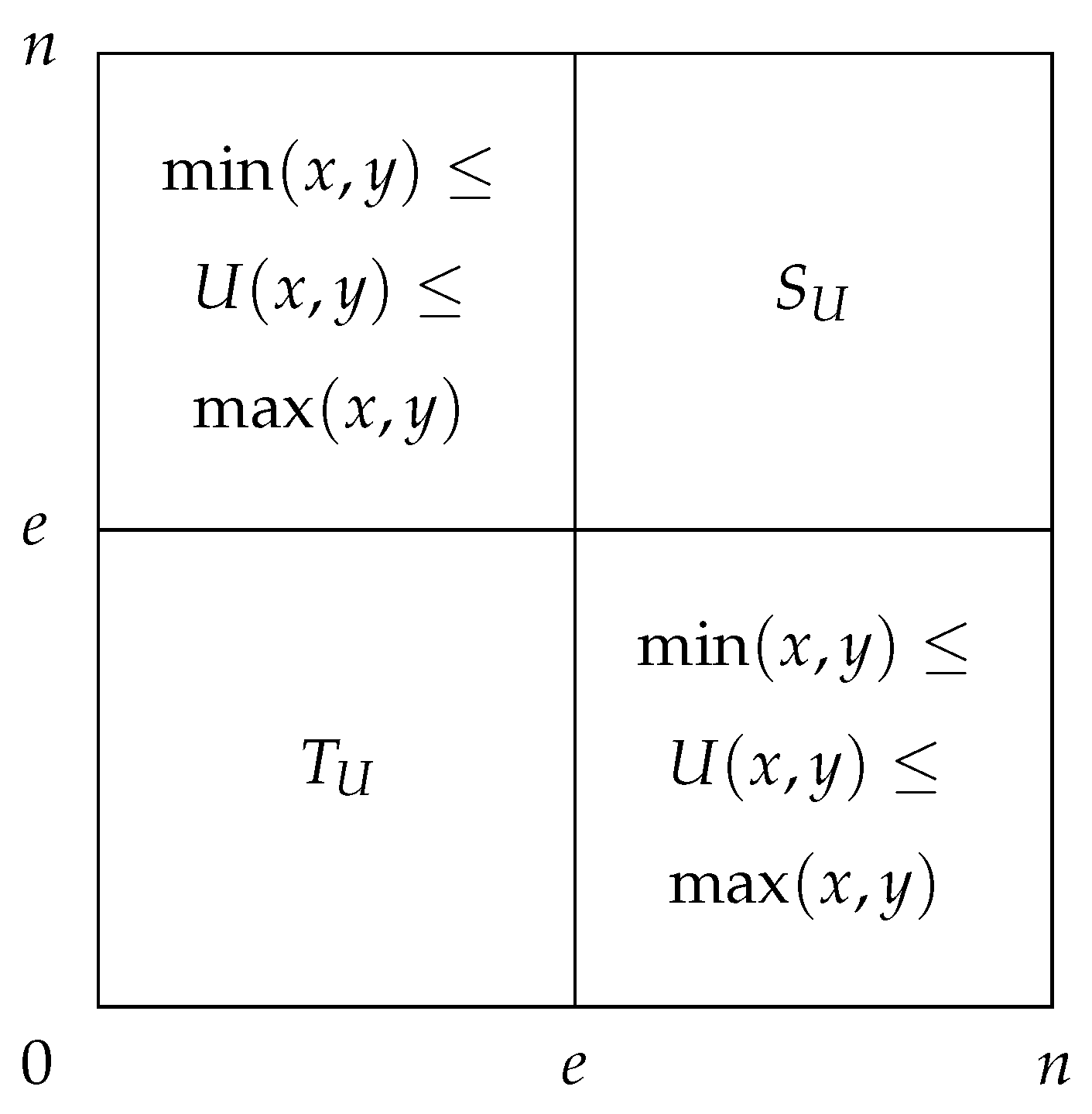
For a better understanding of the previous definition, see Figure 1.
These classes of operators extend both discrete t-norms and discrete t-conorms and are usually denoted as U T U , e , S U [18,19]. Moreover, for any uninorm U defined on L n , it holds that U ( 0 , n ) { 0 , n } . More precisely, if U ( n , 0 ) = 0 , the operation U is referred to as a discrete conjunctive uninorm, whereas if U ( n , 0 ) = n , it is called a discrete disjunctive uninorm.
In this work, we utilize the family of discrete uninorms in U min and the family of discrete idempotent uninorms ( U i d e , those satisfying U ( x , x ) = x for all x L n ). These two families have been characterized as follows [19]:
Theorem 1
([19]). Let U be a binary operation on L n that has a neutral element e with 0 < e < n . Then, U belongs to the class of discrete uninorms in U min if it is defined as follows:
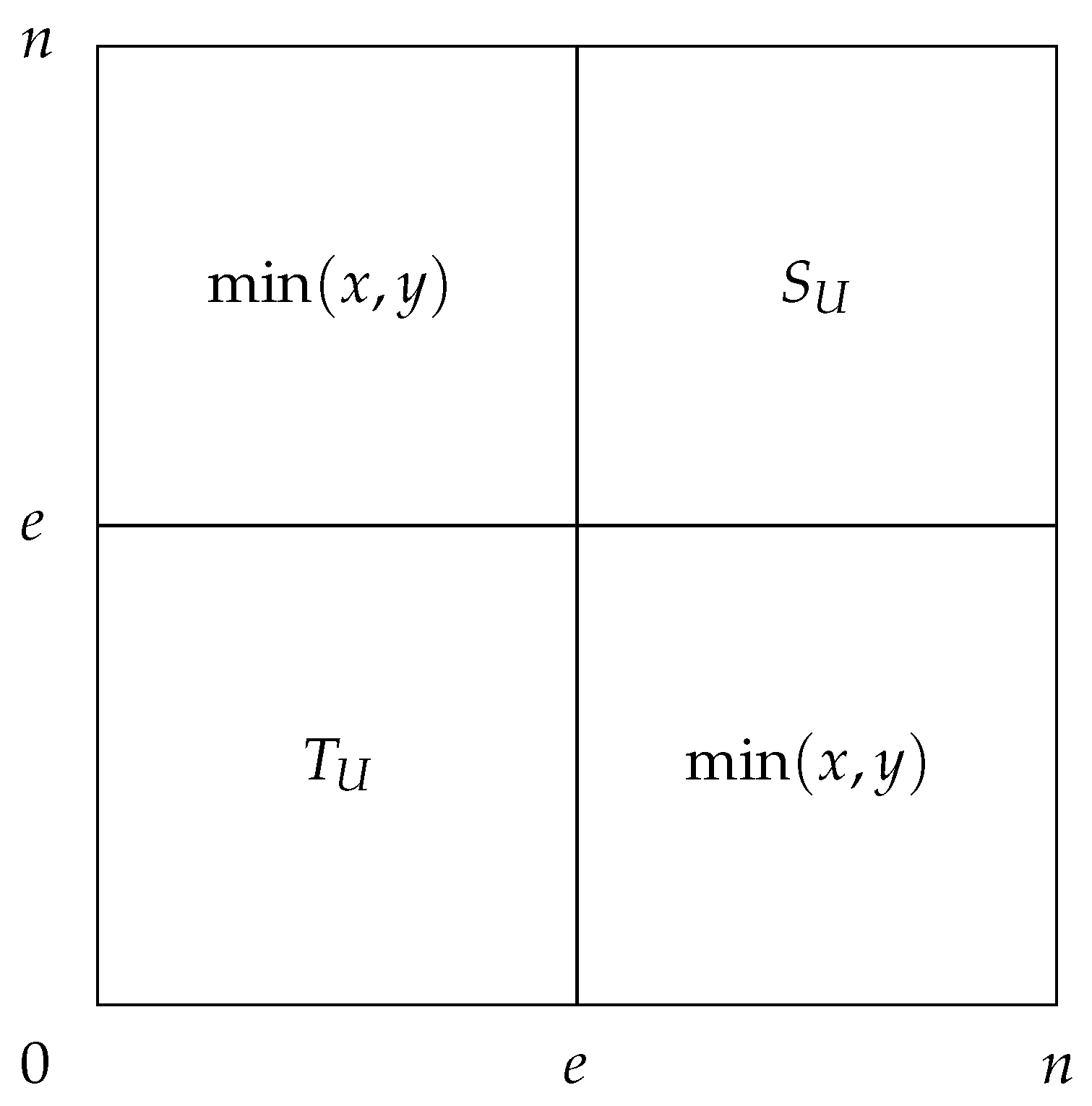
U ( x , y ) = T U ( x , y ) if x , y [ 0 , e ] , S U ( x , y ) if x , y [ e , n ] , min ( x , y ) in all other cases ,
where T U operates as a discrete t-norm restricted to the closed interval [ 0 , e ] , and S U acts as a discrete t-conorm applied to the closed interval [ e , n ] L n . This class of uninorms is usually denoted by U T U , e , S U min .
Previous Figure 2 gives the graphical representation of the uninorm described in Theorem 1.
Theorem 2
([19]). A mapping U : L n × L n L n , having a neutral element e such that 0 < e < n , belongs to the class of discrete idempotent uninorms U i d e if and only if there exists a non-increasing function g : [ 0 , e ] [ e , n ] satisfying g ( e ) = e , for which the following holds:
U ( x , y ) = min ( x , y ) if y g ¯ ( x ) and x g ¯ ( 0 ) , max ( x , y ) otherwise ,
where g ¯ represents the unique symmetric extension of g that maintains symmetry relative to the main diagonal and is explicitly defined as:
g ¯ ( x ) = g ( x ) if x e , max { z [ 0 , e ] g ( z ) x } if e x g ( 0 ) , 0 if x > g ( 0 ) .
This class of operators is usually denoted by U < g , e > i d e .
The next example illustrates the construction process of a discrete idempotent uninorm according to the previous theorem.
Example 1.
Let us consider the finite chain L 6 = { 0 , 1 , 2 , 3 , 4 , 5 , 6 } . Suppose that e = 3 . Let
g ( x ) = 5 , if x 1 , 4 , if x = 2 , 3 , if x = 3 .
In these conditions,
g ¯ ( x ) = g ( x ) , if x 3 , 2 , if x = 4 , 1 , if x = 5 , 0 , if x = 6 .
In these conditions, U < g , 3 > i d e ,
U ( x , y ) = min ( x , y ) , if y g ¯ ( x ) and x 5 , max ( x , y ) , otherwise .
Axioms 15 00077 i001We have highlighted in bold the values at which the discrete idempotent uninorm takes the maximum value.
Next, we recall the concept of the discrete implication function.
Definition 2
([20]). A mapping I : L n × L n L n is called a discrete fuzzy implication, or simply a discrete implication, whenever the requirements stated below are satisfied:
(I1) 
I ( x , z ) I ( y , z ) with x y , and z L n .
(I2) 
I ( x , y ) I ( x , z ) with y z , and x L n .
(I3) 
I ( 0 , 0 ) = I ( n , n ) = n , and I ( n , 0 ) = 0 .
It should be noted that, according to the definition, we can deduce that I ( 0 , x ) = n and I ( x , n ) = n for every x L n . However, the cases I ( x , 0 ) and I ( n , x ) can not be explicitly determined by these conditions.
Two notable properties of discrete implication functions that we will use in this work are
  • Neutral element property
    I ( n , y ) = y for any y L n . ( N P )
  • Identity element property
    I ( x , x ) = n for any x L n . ( I P )
Definition 3.
A negation on a finite chain L n is a function N : L n L n that is decreasing and satisfies the boundary conditions N ( 0 ) = n and N ( n ) = 0 . Such a negation is called a strong negation whenever the negation on L n is involutive, which implies N ( N ( x ) ) = x applies to any x L n .
Note that there is a unique strong negation on L n , whose expression is given by N ( x ) = n x [26].
Definition 4.
Let I be a fuzzy discrete implication function defined on L n . The function N I , given by N I ( x ) = I ( x , 0 ) for every x L n , is a negation on L n referred to as the natural negation associated with I.
We now recall the definition of residual implication induced by discrete uninorms and introduce some key results related to it.
Definition 5
([25]). Let U : L n 2 L n be a discrete uninorm. The residual operator associated with U, denoted by I U : L n 2 L n , can be defined as follows:
I U ( x , y ) = max { z L n U ( x , z ) y } .
Proposition 1
([25]). Let U : L n 2 L n be a discrete uninorm. The associated residual operator I U is a fuzzy discrete implication if and only if U is conjunctive, that is, whenever U ( n , 0 ) = 0 .
The result below characterizes the general structure of residual implications relative to uninorms of the family in U min .
Proposition 2
([25]). Let U T U , e , S U min be a discrete uninorm belonging to the class U min , having e L n { 0 , n } as its neutral element. It follows that the associated residual operator I U remains a discrete fuzzy implication, defined by:
I U ( x , y ) = n if 0 x < e and x y , I T U ( x , y ) if 0 x e and x > y , y if y < e < x , e 1 if e y < x , I S U ( x , y ) if e x n , e y n , and x y .
The general structure of residual implications relative to uninorms in U i d e is given below.
Proposition 3
([18]). Let U 0 g 0 , e 0 ide be a discrete idempotent uninorm having e 0 L n { 0 , n } as its neutral element, and suppose that g 0 ( 0 ) = n . It follows that the residual operator I U 0 associated with U 0 defines a discrete fuzzy implication, and it is given by
I U 0 ( x , y ) = max ( g ¯ 0 ( x ) , y ) if x y , min ( g ¯ 0 ( x ) , y ) if x > y .
Alternatively, this discrete implication function can be expressed as
I U 0 ( x , y ) = g 0 ( x ) if x < e 0 and x y < g 0 ( x ) , g ¯ 0 ( x ) if x > e 0 and g ¯ 0 ( x ) y < x , y otherwise .
Here, g ¯ 0 denotes the unique symmetric extension of g 0 with respect to the main diagonal.
Definition 6
([26]). A mapping f : L n L n is called a smooth mapping if, for every x L n with x 1 , the absolute difference between consecutive values is at most one, that is, | f ( x ) f ( x 1 ) | 1 .
Definition 7
([26]). A mapping F : L n 2 L n is referred to as a smooth mapping if, for every fixed x L n , the function F ( x , ) is smooth, and similarly, for every fixed y L n , the function F ( , y ) is smooth. In other words, both the vertical and horizontal sections of F must satisfy the smoothness condition.
Note that in this case the smoothness property, which is in fact the well-known 1-Lipschitz property (for more details see, Proposition 7.3.3 in [26]).

3. Modus Tollens Derived from Discrete Uninorms

This section focuses on the investigation of the U-Modus Tollens condition in a discrete setting; that is, all operators that we consider throughout the paper are defined on the finite chain L n .
Definition 8.
Let I be a discrete implication, U a discrete uninorm, and N a negation, all defined on the finite chain L n . The pair (I,N) fulfills the U-Modus Tollens property if the next condition holds:
U ( N ( y ) , I ( x , y ) ) N ( x ) for all x , y L n .
The next result shows that a necessary condition for a discrete uninorm U to meet the requirements of the U-Modus Tollens rule in the discrete framework can be obtained.
Proposition 4.
Let I be a discrete implication and N a negation defined on the finite chain L n such that ( I , N ) fulfills the U-Modus Tollens. It follows that the discrete uninorm U is required to be conjunctive.
Proof. 
Let us take x = n , y = 0 L n ; as the pair ( I , N ) is said to fulfill the U-Modus Tollens rule, we have
U ( N ( 0 ) , I ( n , 0 ) ) = U ( n , 0 ) N ( n ) = 0 ,
so U ( n , 0 ) = 0 and U has to be conjunctive. □
As a consequence of this result, only conjunctive discrete uninorms would be considered when considering the U-Modus Tollens condition.
The following example shows the behavior of the U-Modus Tollens property for a particular negation on a finite chain.
Example 2.
Let us consider U a discrete conjunctive uninorm on L n and the following negation:
N k ( x ) = n if x [ 0 , k ] 0 if x L n [ 0 , k ]
with k [ 0 , n 1 ] .
For each x [ 0 , k ] , the U-Modus Tollens principle is verified for every y L n because N k ( x ) = n , and we always have U ( N k ( y ) , I ( x , y ) ) n .
When x L n [ 0 , k ] , let us differentiate the following two cases:
1. 
Consider y [ 0 , k ] , so
(a) 
If y = 0 , we need N I ( x ) N k ( x ) for all x L n [ 0 , k ] in order to verify the U-Modus Tollens.
(b) 
When y ( 0 , k ] ,
U ( N k ( y ) , I ( x , y ) ) U ( N k ( y ) , I ( k + 1 , k ) ) ,
In this case, we need I ( k + 1 , k ) = 0 because N ( x ) = 0 in order to ensure the U-Modus Tollens.
2. 
Consider y L n [ 0 , k ] , so
U ( N k ( y ) , I ( x , y ) ) = U ( 0 , I ( x , y ) ) U ( 0 , n ) = 0 ,
the U-Modus Tollens is always guaranteed.
Observe that in case k = 0 , N 0 corresponds to the smallest negation on a finite chain L n . In case k = n 1 , N n 1 corresponds to the greatest negation on L n .
We can now derive the following general result concerning the U-Modus Tollens rule for the discrete framework.
Proposition 5.
Let U be a conjunctive discrete uninorm, I U its residual discrete implication, and N a negation on the finite chain L n . Then, a discrete implication I verify the U-Modus Tollens condition related to the pair ( U , N ) is equivalent to the condition
I ( x , y ) I U ( N ( y ) , N ( x ) ) ,
for every x , y L n = { 0 , 1 , 2 , , n } .
Proof. 
According to Definition 5, we have I U ( N ( y ) , N ( x ) ) = max { z L n U ( N ( y ) , z ) N ( x ) } , therefore
U ( N ( y ) , I ( x , y ) ) N ( x ) I ( x , y ) I U ( N ( y ) , N ( x ) ) .
The fact that the pair ( I , N ) satisfies the U-Modus Tollens property entails several structural consequences for the discrete uninorm and the associated negation.
Proposition 6.
Let U be a conjunctive discrete uninorm defined on L n with neutral element e. Assume that the pair ( I , N ) satisfies the U-Modus Tollens property. Then the following conditions hold:
(i)   
For every y L n = { 0 , 1 , 2 , , n } , U N ( y ) , I ( n , y ) = 0 .
(ii)  
The inequality N I ( x ) N ( x ) holds for any element x L n . Moreover, the condition N I ( x ) e entails that N ( x ) = n .
(iii) 
Let α N = max { x L n N ( x ) e } , then:
(a) 
The equality α N = 0 entails that N ( x ) < e for every x > 0 .
(b) 
The inequality α N > 0 entails that I ( n , y ) = 0 for every y α N .
(iv) 
The validity of condition (NP), or alternatively of condition (IP) together with the requirement N ( x ) < n for every x > 0 , entails that α N = 0 .
Proof. 
Each statement will be proved separately.
(i)  
Since U ( N ( y ) , I ( n , y ) ) N ( n ) = 0 , it follows directly that U ( N ( y ) , I ( n , y ) ) = 0 .
(ii) 
According to the monotonicity of the uninorm U, we have N I ( x ) N ( x ) . Now, for any x L n in such a way that N I ( x ) e , we necessarily have I ( x , 0 ) e , so
n = U ( N ( 0 ) , e ) U ( N ( 0 ) , I ( x , 0 ) ) N ( x ) n ,
which implies N ( x ) = n .
(iii)
Define α N = max { x L n N ( x ) e } .
(a)
If α N = 0 , then N ( x ) < e whenever x > 0 .
(b)
Suppose α N > 0 . For any y α N , we get
0 = N ( n ) U ( N ( y ) , I ( n , y ) ) U ( e , I ( n , y ) ) = I ( n , y ) ,
which implies I ( n , y ) = 0 for all y α N .
(iv)
Let us assume (NP) is satisfied. If α N > 0 , then from Item (iii)(b) it follows that I ( n , y ) = 0 for all y α N . However, under condition (NP), we know I ( n , y ) = y , which implies y = 0 . Thus, α N = 0 , leading to a contradiction.
Now, assume that (IP) holds and N ( x ) < n for every x > 0 . Suppose that α N > 0 , meaning there exists some x > 0 such that N ( x ) e . Then,
N ( x ) U ( N ( x ) , n ) = U ( N ( x ) , I ( x , x ) ) U ( e , n ) = n ,
which contradicts the assumption that N ( x ) < n . Hence, N ( x ) < e whenever x > 0 , and it follows that α N = 0 .
When α N = 0 , we obtain the following result.
Proposition 7.
Let U T U , e , S U min be a discrete uninorm belonging to the family of U min with neutral element e L n { 0 , n } . Suppose that α N = 0 . It follows that the pair ( I , N ) satisfies the U-Modus Tollens property, which is equivalent to the following condition:
U ( N ( y ) , I ( x , y ) ) N ( x ) whenever y < x .
Proof. 
It is enough to verify that whenever x y , the U-Modus Tollens condition holds.
(a)
In case I ( x , y ) > e , it follows:
U ( N ( y ) , I ( x , y ) ) U ( N ( x ) , I ( x , y ) ) = min { N ( x ) , I ( x , y ) } = N ( x ) ,
since U ( N ( x ) , I ( x , y ) ) U ( N ( x ) , e ) = N ( x ) , and the uninorm behaves conjunctively in this case.
(b)
In case I ( x , y ) e , hence:
U ( N ( y ) , I ( x , y ) ) U ( N ( x ) , I ( x , y ) ) = 1 T ( N ( x ) , I ( x , y ) )
min { N ( x ) , I ( x , y ) } N ( x ) .
1 Observe that as α N = 0 , this yields N ( x ) < e (see Proposition 6), and we are in the case I ( x , y ) e .
Now, we consider the case where the implication I satisfies the neutral element property ( N P ) .
Proposition 8.
Let I be a discrete implication satisfying the N P property, N a negation on L n , and U a discrete conjunctive uninorm whose neutral element is e L n { 0 , n } . Whenever the pair ( I , N ) fulfills the U-Modus Tollens condition, then the following statements hold:
(i)   
U ( N ( y ) , y ) = 0 for every y L n .
(ii)  
N ( x ) = 0 for every x e , and N ( x ) < e whenever x > 0 .
(iii) 
U ( N ( y ) , I ( e , y ) ) = 0 whenever y L n .
(iv) 
Provided that N is a strictly decreasing mapping on L n { 0 , e } , it follows that I ( x , y ) < e holds for every pair ( x , y ) with y < x < e .
Proof. 
(i)  
Since U ( N ( y ) , I ( n , y ) ) N ( n ) = 0 , it follows that U ( N ( y ) , y ) 0 for every y L n . Hence, U ( N ( y ) , y ) = 0 .
(ii) 
Given that property (NP) holds, Proposition 6 (iv) implies α N = 0 . Then, from Proposition 6 (iii.a), we conclude N ( x ) < e whenever x > 0 . Moreover, evaluating the condition at y = e , we obtain N ( e ) = U ( N ( e ) , e ) 0 , so N ( e ) = 0 . Since N is decreasing, it follows that N ( x ) = 0 for all x e .
(iii)
Assuming that the pair ( I , N ) fulfills the U-Modus Tollens condition relative to U, we have:
U ( N ( y ) , I ( e , y ) ) N ( e ) = 0 ,
which implies U ( N ( y ) , I ( e , y ) ) = 0 for every y L n .
(iv)
Suppose, for contradiction, that there exist x , y for which y < x < e and I ( x , y ) > e . Observe that y > 0 , since if y = 0 , then I ( x , 0 ) = N I ( x ) N ( x ) < e , which contradicts I ( x , y ) > e . From part (ii), we know N ( y ) < e , and because N exhibits a strict monotonic decrease over ( 0 , e ) , we obtain:
U ( N ( y ) , I ( x , y ) ) min { N ( y ) , I ( x , y ) } = N ( y ) > N ( x ) ,
which contradicts the assumption that the U-Modus Tollens holds. Therefore, it must be that I ( x , y ) < e whenever y < x < e .
What follows gives a description of the essential features of those discrete uninorms in U min for which the U-Modus Tollens holds, under the assumptions that N is strictly decreasing in ( 0 , e ) and I satisfies the ( N P ) property.
Theorem 3.
Let I be a discrete implication function satisfying ( N P ) , and let U = T U , e , S U min be a discrete uninorm in the class U min , with neutral element e L n { 0 , n } . Assume also that N is a negation on L n that is strictly decreasing on the interval ( 0 , e ) . It follows that the pair ( I , N ) satisfies the U-Modus Tollens property, which is equivalent to the fulfillment of the following conditions:
(i)   
U ( N ( y ) , I ( e , y ) ) = 0 whenever y L n .
(ii)  
N ( x ) = 0 for every x e , and N ( x ) < e whenever x > 0 .
(iii) 
I ( x , y ) < e for every y < x < e .
(iv) 
The functions I and N fulfill the Modus Tollens property in relation to T U for all y < x e , taking into account the modified implication I : [ 0 , e ] × [ 0 , e ] [ 0 , e ] and the adjusted negation N : [ 0 , e ] [ 0 , e ] are defined by
I ( x , y ) = e if x y , I ( x , y ) if y < x ,
N ( x ) = N ( x ) if x > 0 , e if x = 0 .
Proof. 
Suppose that the pair ( I , N ) verifies the U-Modus Tollens property; by (i), (ii), and (iii) of Proposition 8, we obtain (i), (ii), and (iii) of this proposition. Now, let us see that (iv) is also satisfied.
  • In case y = 0 , we have
    T U ( N ( 0 ) , I ( x , 0 ) ) = T U ( e , I ( x , 0 ) ) = I ( x , 0 ) = N I ( x ) 2 N ( x ) = 3 N ( x ) .
    2 by Proposition 6 (ii).
    3 because 0 = y < x .
  • In case y > 0 , observe that y < e ; we have
    T U ( N ( y ) , I ( x , y ) ) = T U ( N ( y ) , I ( x , y ) ) = U ( N ( y ) , I ( x , y ) ) N ( x ) = N ( x ) ,
    because the final inequality is ensured by the U-Modus Tollens requirement fulfilled by I and N.
As I verifies (NP), we obtain α N = 0 , and therefore, by Proposition 7, it remains to check that I and N verify the U-Modus Tollens whenever y < x and the constraints (i), (ii), (iii), and (iv) hold.
We distinguish the following separate cases:
  • In case y = 0 , then
    U ( N ( y ) , I ( x , y ) ) = U ( n , I ( x , 0 ) ) = U ( n , N I ( x ) ) = N I ( x ) N ( x ) .
  • In case 0 < y < x < e , then
    U ( N ( y ) , I ( x , y ) ) = T U ( N ( y ) , I ( x , y ) ) = T U ( N ( y ) , I ( x , y ) ) N ( x ) = N ( x )
    where the ultimate inequality holds by condition (iv).
  • In case x e , then I ( x , y ) I ( e , y ) , and therefore,
    U ( N ( y ) , I ( x , y ) ) U ( N ( y ) , I ( e , y ) ) = 0 N ( x )
    in this expression, the last inequality follows from the Condition (i) of this proposition.
Next, we provide an illustrative example of the previous result.
Example 3.
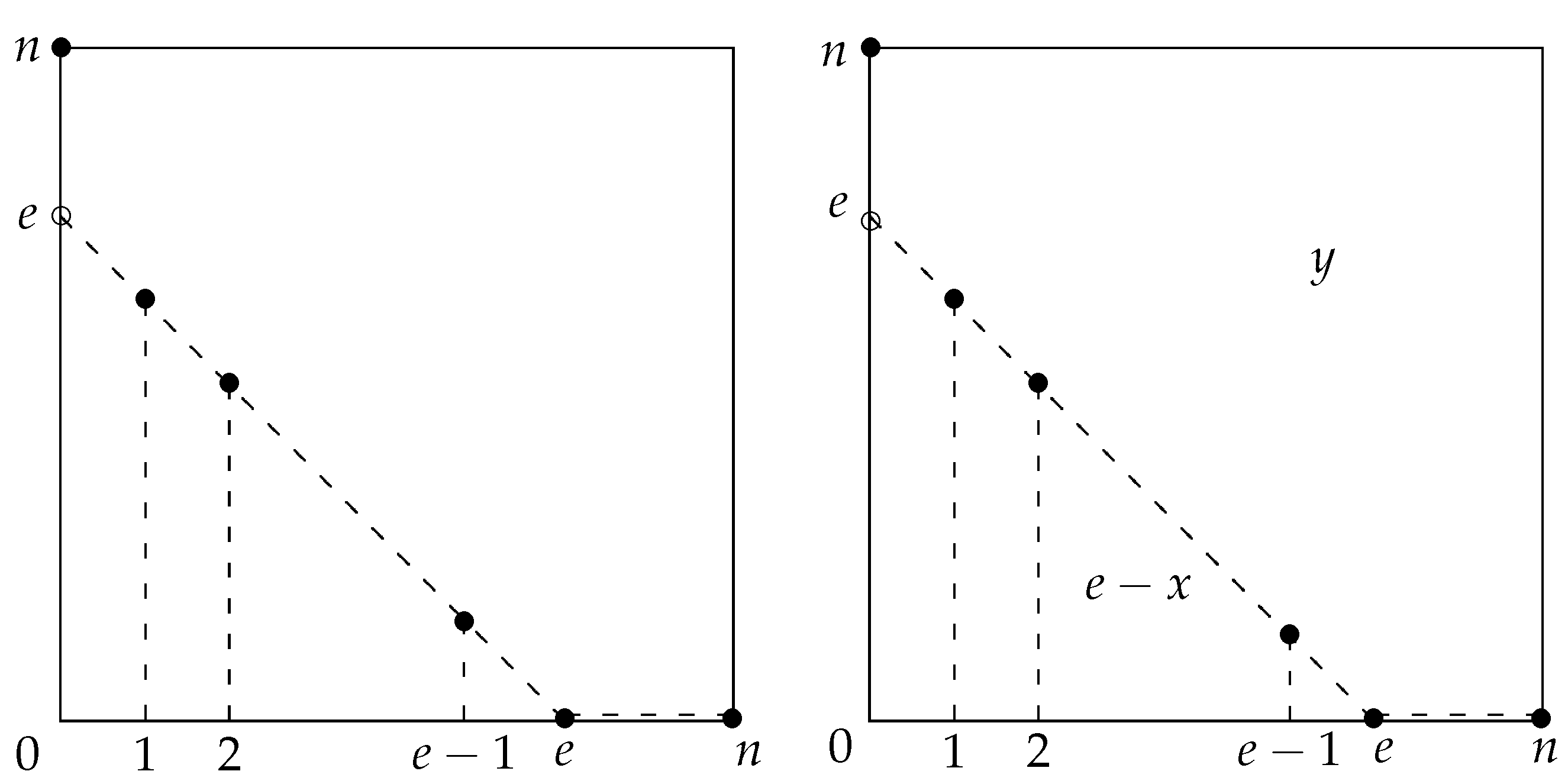
Let us consider a discrete uninorm U = ( T U , e , S U ) min belonging to the class U min , where T U = T Ł Łis the ukasiewicz t-norm, and S U is an arbitrary t-conorm. Define the negation N e as follows:
N e ( x ) = n if x = 0 , e x if 0 < x < e , 0 if x e .
Additionally, consider the fuzzy implication I U described by the expression:
I U ( x , y ) = n if x = 0 or y = n , max ( e x , y ) if 0 x e and 0 y e , y otherwise .
A direct verification shows that the given operators meet all the specified requirements stated in Theorem 3. Consequently, the pair ( I U , N e ) satisfies the U-Modus Tollens property (see Figure 3).
In what follows, we focus on RU-implications generated by discrete uninorms belonging to the class U min , specifically those of the form U 0 T U 0 , e 0 , S U 0 min , where e 0 L n { 0 , n } is the neutral element, T U 0 is a t-norm on [ 0 , e 0 ] , and S U 0 is a t-conorm on [ e 0 , n ] . It is worth highlighting that RU-implications associated with such uninorms exhibit the structure described in Equation (7).

3.1. Modus Tollens in the Context of Discrete RU-Implications Induced by Discrete Uninorms in U m i n

In this section, it is important to remember the characterization of the residual operator I U 0 associated with a uninorm U 0 given in the Preliminaries section (see Equation (7)).
For this type of RU-implication, it is once again observed that the U-Modus Tollens property holds exclusively in the case that the associated negation N satisfies α N = 0 , which necessarily results in those negations that are non-smooth. In addition, for these RU-implications, the results presented below hold.
Proposition 9.
Let I U 0 be a discrete implication derived from the discrete uninorm U 0 T U 0 , e 0 , S U 0 min , and let N be a negation on L n . Consider also U T U , e , S U a discrete conjunctive uninorm. If the pair ( I U 0 , N ) satisfies the U-Modus Tollens property, then the following statements hold:
(i)   
U ( N ( y ) , y ) = 0 for every y e 0 1 .
(ii)  
U ( N ( y ) , n ) = N ( y ) for every y < e 0 .
(iii) 
α N = 0 ; that is, N ( x ) < e for every x > 0 .
(iv) 
In case e e 0 , then N ( x ) = 0 for every x e .
(v)  
In case e 0 < e , and if T U is a smooth t-norm with U ( e 0 , e 0 ) = e 0 , then it holds that N ( x ) < e 0 for all x > 0 , and in particular N ( x ) = 0 for every x e 0 .
Proof. 
(i)  
As ( I U 0 , N ) fulfills the U-Modus Tollens condition, we have
U ( N ( y ) , I U 0 ( x , y ) ) N ( x )
for all y L n . Now, putting x = n and considering Equation (7), we achieve U ( N ( y ) , I U 0 ( x , y ) ) = U ( N ( y ) , y ) = 0 for all y < e 0 .
(ii) 
For any x < e 0 , we have I U 0 ( x , x ) = n considering Equation (7); therefore, taking x = y ,
U ( N ( y ) , I U 0 ( y , y ) ) = U ( N ( y ) , n ) N ( y ) ,
and on the other side, U ( N ( y ) , n ) N ( y ) is always satisfied.
(iii)
It follows directly from Proposition 6.
(iv)
Taking y = e in Property (i) of this proposition, it follows that U ( N ( e ) , e ) = N ( e ) = 0 , and as N is decreasing, we have N ( x ) = 0 for all x e .
(v) 
Let us examine that N ( x ) < e 0 for all 0 < x < e 0 . Since T U is smooth and e 0 is an idempotent element, considering that N ( x ) e 0 with 0 < x < e 0 , then
U ( e 0 , x ) = T U ( e 0 , x ) = 4 min ( e 0 , x ) = x for all 0 < x e 0
4 by the smoothness of T U .
And by property (i) of this Proposition,
0 = U ( N ( x ) , x ) U ( e 0 , x ) = x
which is a contradiction to the hypotheses. Therefore, we obtain N ( x ) < e 0 for all x > 0 . Now, let us prove that N ( e 0 ) = 0 . As we have N ( e 0 ) < e 0 , then
0 = U ( N ( e 0 ) , e 0 ) = N ( e 0 )
For the purpose of characterizing the solutions in this setting, we consider three distinct cases, taking into account the relationship between the neutral elements e and e 0 . We first address the simplest case, where e = e 0 .
Theorem 4.
Let I U 0 be the RU-implication associated with the discrete uninorm U 0 T U 0 , e 0 , S U 0 min , let N be a negation on a finite chain, and let U T U , e , S U be a discrete conjunctive uninorm with e = e 0 as its neutral element. Consequently, the pair ( I U 0 , N ) satisfies the U-Modus Tollens property is equivalent to the fulfillment of the following condition:
(i)   
U ( N ( y ) , y ) = 0 and U ( N ( y ) , n ) = N ( y ) for all y e 1 .
(ii)  
N ( x ) < e for every x > 0 , and N ( x ) = 0 for all x e .
(iii) 
The residual implication I T U 0 , together with the modified negation N defined in Equation (12), satisfies the Modus Tollens property in relation to the t-norm T U , for all y < x .
Proof. 
(⇒) Items (i) and (ii) are obtained from Proposition 9. Property (iii) follows the same proof that the one in Theorem 3, considering that in this case, I T 0 just is the same that I in Equation (11).
(⇐) Now, let us suppose that conditions (i), (ii), and (iii) are satisfied, and we will prove the U-Modus Tollens:
U ( N ( y ) , I U 0 ( x , y ) ) N ( x )
(i) If y e , then by (iv) in Proposition 9, we have N ( y ) = 0 and the U-Modus Tollens is satisfied. (ii) In case y < e and x y , we obtain that I U 0 ( x , y ) = n , so
U ( N ( y ) , I U 0 ( x , y ) ) = U ( N ( y ) , n ) = 5 N ( y ) N ( x )
5 by (ii) of Proposition 9.
(iii) Now, considering y < e and y < x . We consider two cases:
(1) x > e , then we have
U ( N ( y ) , I U 0 ( x , y ) ) = U ( N ( y ) , y ) = 0 N ( x ) .
And (2) x e , then considering (iv) in Theorem 3 and Equation (7)
U ( N ( y ) , I U 0 ( x , y ) ) = U ( N ( y ) , I T U 0 ( x , y ) ) = T U ( N ( y ) , I T U 0 ( x , y ) ) 6 N ( x ) N ( x )
6 by (iii) of this theorem. □
Remark 1.
Note that the t-conorms S 0 and S U do not contribute to fulfilling the U-Modus Tollens.
The next example illustrates Theorem 4.
Example 4.
Let us consider the finite chain L 4 = { 0 , 1 , 2 , 3 , 4 } and the uninorm U 0 Ł , 3 , max min on L 4 whose expression is
U 0 ( x , y ) y = 0 y = 1 y = 2 y = 3 y = 4 x = 0 0 0 0 0 0 x = 1 0 0 0 1 1 x = 2 0 0 1 2 2 x = 3 0 1 2 3 3 x = 4 0 1 2 3 4
Now consider the conjunctive uninorm U on L 4 whose expression is
U ( x , y ) y = 0 y = 1 y = 2 y = 3 y = 4 x = 0 0 0 0 0 0 x = 1 0 0 0 1 1 x = 2 0 0 1 2 2 x = 3 0 1 2 3 4 x = 4 0 1 2 4 4
Let N be the negation on L 4 defined as
N ( x ) = 0 , if x 3 , 1 , if x = 2 , 2 , if x 1 .
According to Equation (12), the expression of the adjusted negation N on [ 0 , 3 ] is
N ( x ) = 0 , if x = 3 , 1 , if x = 2 , 2 , if x = 1 3 , if x = 0 .
It can be easily verified that U ( N ( y ) , y ) = 0 and U ( N ( y ) , 4 ) = N ( y ) for all y 2 . Therefore, Condition (i) of Theorem 4 is satisfied. By construction, the function N satisfies the conditions of item (ii). It can be seen that N ( x ) < 3 for every x > 0 , and that N ( x ) = 0 for all x 3 . Finally, by construction, the function N satisfies the conditions of item (ii). It can be seen that N ( x ) < 3 for every x > 0 , and that N ( x ) = 0 for all x 3 . The pair ( I T 0 , N ) verifies Modus Tollens with respect to the t-norm T U , for all y < x by Proposition 12 of [22].
Based on the previous reasoning and according to Theorem 4, the pair ( I U 0 , N ) satisfies the U-Modus Tollens property.
Theorem 5.
Let I U 0 be the RU-implication derived from the discrete uninorm U 0 T U 0 , e 0 , S U 0 min , let N be a negation on L n , and let U T U , e , S U be a discrete conjunctive uninorm with neutral element e, such that e < e 0 . Assume that U 0 is defined as follows:
U 0 ( x , y ) = e · T U 0 x , y if x , y [ 0 , e ] , e + ( e 0 e ) · T U 0 x , y if x , y [ e , e 0 ] , e + ( n e ) · S U 0 x , y if x , y [ e 0 , n ] , min ( x , y ) otherwise ,
where T U 0 and T U 0 are discrete t-norms defined on [ 0 , e ] and [ e , e 0 ] , respectively. Then, the pair ( I U 0 , N ) satisfies the U-Modus Tollens property if and only if the following conditions are satisfied:
(i)   
U ( N ( y ) , y ) = 0 for all y e , and U ( N ( y ) , n ) = N ( y ) for all y < e .
(ii)  
N ( x ) < e for every x > 0 , and N ( x ) = 0 for all x e .
(iii) 
The implication I T U 0 , derived from the t-norm T U 0 , and the negation N defined by Equation (12), verifies the Modus Tollens property with respect to the t-norm T U whenever y < x .
Proof. 
Following Equation (13), we obtain U 0 ( e , e ) = e , and for all y < x < e , we have, by Equation (7),
I U 0 = I T 0 ( x , y )
and the result can be established analogously to the proof of Theorem 4. □
Remark 2.
Note that the expression of U 0 given by Equation (13) is not a strong condition. Indeed, if we consider a smooth t-norm T U 0 on [ 0 , e 0 ] and we suppose that U 0 ( e , e ) = e , we known T U 0 is an ordinal sum of Łukasiewicz t-norms [26].
Theorem 6.
Let I U 0 be the RU-implication derived from the discrete uninorm U 0 T U 0 , e 0 , S U 0 m i n , N a negation on L n , and U T U , e , S U a discrete conjunctive uninorm with neutral element e and e 0 < e . Suppose that the restriction of U to the domain [ 0 , e ] 2 is defined as
U ( x , y ) = T U ( x , y ) if x , y [ 0 , e 0 ] , T U ( x , y ) if x , y [ e 0 , e ] , min ( x , y ) if o t h e r w i s e .
Then I U 0 and N verify the U-Modus Tollens condition precisely when the following properties are satisfied:
(i)   
U ( N ( y ) , y ) = 0 for all y e 0 and U ( N ( y ) , n ) = N ( y ) whenever y < e 0 .
(ii)  
N ( x ) < e 0 for all x > 0 and N ( x ) = 0 for all x e 0 .
(iii) 
I T U 0 and N fulfill the Modus Tollens relative to the t-norm T U for every y < x , where I T 0 denotes the residual implication associated with the t-norm T 0 and N is given by
N ( x ) = n if x = 0 N ( x ) if o t h e r w i s e .
Proof. 
Property (ii) follows directly from Property (v) in Proposition 9, while (i) and (iii) follow the proof in a similar way to the theorems before. □

3.2. On Modus Tollens for RU-Implications Generated by Discrete Idempotent Uninorms

In this section, we consider RU-implications derived from discrete idempotents uninorms, i.e., uninorms U 0 < g , e 0 > i d e with neutral element e 0 [ 0 , n ] such that g ( 0 ) = n . Let us remember that in the discrete case, the general structure of the RU-implications derived from idempotent uninorms is given by Proposition 3.
Initially, we will see what happens when we consider the residual implication of a discrete idempotent uninorm U 0 g 0 , e 0 ide such that its symmetric extension is a negation on L n .
Proposition 10.
Let U 0 g 0 , e 0 ide be a discrete idempotent uninorm with neutral element e 0 L n { 0 , n } , and assume that its symmetric extension g ¯ defines a negation on L n . Let I U 0 be the residual discrete implication associated with U 0 . Consider also U, a discrete conjunctive uninorm with neutral element e, and let I U denote its corresponding residual implication. Then, the following statements are equivalent:
(i)   
Let us denote N 0 = g ¯ . The pair ( I U 0 , N 0 ) satisfies U-Modus Tollens.
(ii)  
I U 0 ( x , y ) I U ( N 0 ( y ) , N 0 ( x ) ) whenever x , y L n .
Proof. 
Let us see that conditions (i) and (ii) are equivalent.
Let us suppose that the pair ( I U 0 , N 0 ) satisfies U-Modus Tollens, so
U ( N 0 ( y ) , I U 0 ( x , y ) ) N 0 ( x ) whenever x L n
equivalently,
U ( g ¯ ( y ) , I U 0 ( x , y ) ) g ¯ ( x ) for all x L n
but
U ( g ¯ ( y ) , I U 0 ( x , y ) ) g ¯ ( x ) I U 0 ( x , y ) I U ( g ¯ ( y ) , g ¯ ( x ) ) x , y L n .
In the following, we consider the case of chains with an odd number of elements, such as L 2 e 0 = { 0 , 1 , , e 0 , , 2 e 0 } . Note that in this case, the element e 0 is the central point of this finite chain. For instance, if we consider the linguistic chain L 4 = { very bad ,   bad ,   regular ,   good ,   very good } (which corresponds to the odd finite chain L 4 = { 0 , 1 , 2 , 3 , 4 } ), the linguistic term “regular” acts as an uncertainty element, i.e., for a uninorm acting on an odd-valued chain, the uninorm on the “regular” value does not get a clear decision.
Lemma 1.
Let U 0 g 0 , e 0 ide be a discrete idempotent uninorm with neutral element e 0 defined on the odd finite chain L 2 e 0 = { 0 , 1 , , e 0 , , 2 e 0 } , under the condition that N 0 ( x ) = g ¯ ( x ) is the unique strong negation on L 2 e 0 . Let I U 0 be its residual fuzzy implication. Then,
I U 0 ( x , y ) = I U 0 ( N 0 ( y ) , N 0 ( x ) )
for all x , y L 2 e 0 .
Proof. 
Let us remember that
I U 0 ( x , y ) = max ( g ¯ ( x ) , y ) if x y min ( g ¯ ( x ) , y ) if x > y .
In case x y ,
I U 0 ( N 0 ( y ) , N 0 ( x ) ) = max ( N 0 ( N 0 ( y ) ) , N 0 ( x ) ) = max ( y , N 0 ( x ) ) = max ( N 0 ( x ) , y ) = I U 0 ( x , y ) .
In case x > y ,
I U 0 ( N 0 ( y ) , N 0 ( x ) ) = min ( N 0 ( N 0 ( y ) ) , N 0 ( x ) ) = min ( y , N 0 ( x ) ) = min ( N 0 ( x ) , y ) = I U 0 ( x , y ) .
An extended result of Proposition 10 can be obtained when considering a finite odd chain L 2 e 0 .
Proposition 11.
Let L 2 e 0 be an odd finite chain, N 0 ( x ) = 2 e 0 x the strong negation on L 2 e 0 , U 0 < g , e 0 > i d e a discrete idempotent uninorm with neutral element e 0 L 2 e 0 and g ( x ) = 2 e 0 x and let I U 0 denote its residual implication. Let U be a discrete conjunctive uninorm with neutral element e L 2 e 0 , and let I U be its corresponding residual implication. Then, the following statements are equivalent:
(i)   
The pair ( I U 0 , N 0 ) satisfies U-Modus Tollens.
(ii)  
I U 0 ( x , y ) I U ( N 0 ( y ) , N 0 ( x ) ) for all x , y L n
(iii) 
U ( x , y ) U 0 ( x , y ) for all x , y L n .
Proof. 
First, note that N 0 = g ¯ . The equivalence between statement (i) and condition (ii) follows directly from Proposition 10. We need to prove the equivalence between statements (ii) and (iii). By Lemma 1, we have that for all x , y L n
I U 0 ( x , y ) = I U 0 ( N 0 ( y ) , N 0 ( x ) ) .
Considering Lemma 1 and Condition (ii), we have
I U 0 ( x , y ) = I U 0 ( N 0 ( y ) , N 0 ( x ) ) I U ( N 0 ( N 0 ( x ) ) , N 0 ( N 0 ( y ) ) ) = I U ( x , y ) ,
for all x , y L 2 e 0 .
Therefore,
I U 0 ( x , y ) I U ( x , y ) ,
for all x , y L 2 e 0 ,
y ( 1 ) I U 0 ( x , U 0 ( x , y ) ) I U ( x , U 0 ( x , y ) ) .
(1) By Definition of I U 0 ( x , y ) = max { z L 2 e 0 U 0 ( x , z ) y } with x , y L 2 e 0 , in this case, I U 0 ( x , U 0 ( x , y ) ) = max { z L 2 e 0 U 0 ( x , z ) U 0 ( x , y ) } with x , y L 2 e 0 ; therefore,
y I U ( x , U 0 ( x , y ) ) ,
equivalently,
U ( x , y ) U 0 ( x , y ) for all x , y L 2 e 0 .
The result obtained in Proposition 11 is not true when the negation N 0 is not a strong negation on L n , as the following example shows.
Example 5.
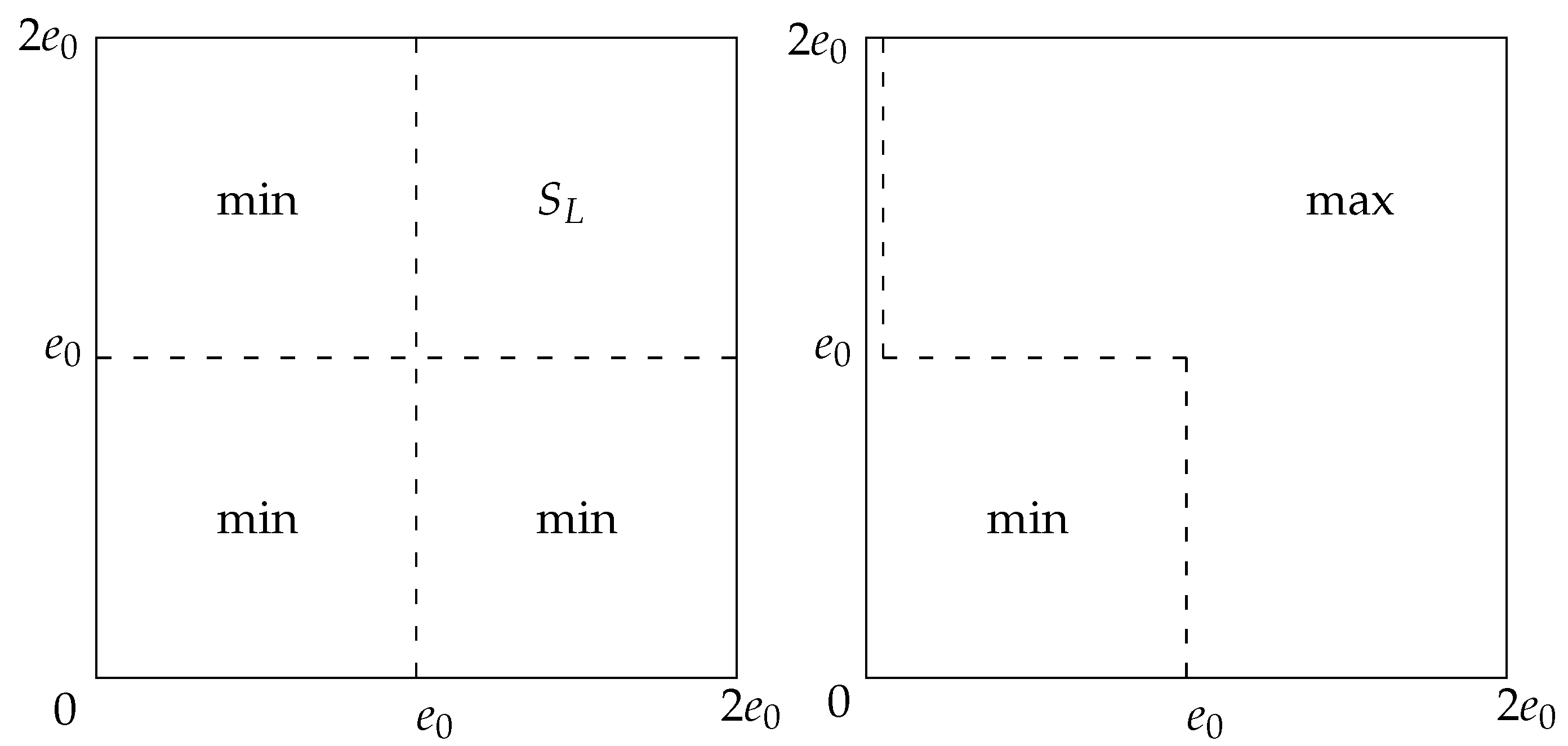
Let L 2 e 0 = { 0 , 1 , , e 0 , , 2 e 0 } be an odd finite chain. Let us consider U T U , e 0 , S Ł m i n and U 0 < g , e 0 > i d e be a discrete idempotent uninorm with e 0 L 2 e 0 , where
g ( x ) = 2 e 0 if x = 0 , e 0 if x ( 0 , e 0 ] .
an its extension,
g ¯ ( x ) = g ( x ) if x e 0 , max { z [ 0 , e 0 ] g ( z ) x } if e 0 x g ( 0 ) = 2 e 0 ,
is a negation function with fixed point e 0 . We can see the structures of uninorms U T U , e 0 , S Ł m i n and U 0 < g , e 0 > i d e in Figure 4.
Let us consider the points x = e 0 + 1 and y = e 0 + 1 . Then, we have
U ( e 0 + 1 , e 0 + 1 ) = S L ( e 0 + 1 , e 0 + 1 ) = min ( e 0 + 2 , 2 e 0 ) > U 0 ( e 0 + 1 , e 0 + 1 ) = max ( e 0 + 1 , e 0 + 1 ) = e 0 + 1 .
Theorem 7.
Let U 0 g , e 0 i d e be a discrete idempotent uninorm with neutral element e 0 L n such that g ¯ is a negation on L n . Let N be a negation having e 0 as its fixed point, and let U be a discrete uninorm whose neutral element coincides with e = e 0 . Then, the pair ( I U 0 , N ) satisfies the U-Modus Tollens property if and only if the following conditions are fulfilled:
(i)   
g ¯ ( x ) N ( x ) whenever x L n .
(ii)  
U ( N ( x ) , g ( x ) ) = N ( x ) whenever x e 0 .
(iii) 
U ( N ( x ) , x ) = N ( x ) whenever x e 0 .
(iv) 
U ( N ( y ) , y ) N ( x ) whenever y g ( x ) e 0 x .
Proof. 
Suppose that the pair ( I U 0 , N ) fulfills the U-Modus Tollens. Then,
U ( N ( y ) , I U 0 ( x , y ) ) N ( x ) whenever x , y L n
Let us see that conditions (i)–(iv) are verified.
(i)  
Taking y = e 0 , we achieve,
U ( N ( e 0 ) , I U 0 ( x , e 0 ) ) N ( x ) .
If x e 0 ,
U ( N ( e 0 ) , I U 0 ( x , e 0 ) ) = U ( e 0 , max ( g ¯ ( x ) , e 0 ) ) = max ( g ¯ ( x ) , e 0 ) = 7 g ¯ ( x ) N ( x )
7 if x e 0 then g ¯ ( x ) g ¯ ( e 0 ) = e 0 .
therefore,
g ¯ ( x ) N ( x ) .
Similarly, the case x > e 0 can be obtained as before.
(ii) 
Considering x = y in Equation (10) and bearing in mind that x e 0 , we obtain
U ( N ( x ) , I U 0 ( x , x ) ) = U ( N ( x ) , max ( g ( x ) , x ) ) = U ( N ( x ) , g ( x ) ) N ( x )
max ( g ( x ) , x ) ) we have that N ( x ) , g ( x ) e 0 , and considering (i) then
U ( N ( x ) , g ( x ) ) max ( N ( x ) , g ( x ) ) ) = N ( x )
(iii)
The proof is similar to item (ii), taking into account that for x e 0 , we have U ( N ( x ) , x ) N ( x ) .
(iv)
Now, let us suppose y g ¯ ( x ) e 0 x ; therefore, as y e 0 , we obtain y g ¯ ( x ) e 0 g ¯ ( y ) , and by Equation (10)
U ( N ( y ) , I U 0 ( x , y ) ) = U ( N ( y ) , min ( g ¯ ( x ) , y ) ) = U ( N ( y ) , y ) N ( x ) .
On the other hand, assume that conditions (i)–(iv) are verified, and we will demonstrate that the pair ( I U 0 , N ) satisfies the U-Modus Tollens property by analyzing several cases separately:
  • Case 1. Let us suppose x y g ¯ ( x ) . Then, we obtain N ( y ) N ( x ) with x e 0 , then
    U ( N ( y ) , I U 0 ( x , y ) ) = U ( N ( y ) , max ( g ¯ ( x ) , y ) ) = U ( N ( y ) , g ¯ ( x ) ) U ( N ( x ) , g ¯ ( x ) ) = N ( x )
    since the ultimate equality holds by virtue of Assumption (ii) of this proposition.
  • Case 2. Let us suppose x , g ¯ ( x ) y . Accordingly, we have that N ( y ) N ( x ) with y e 0 , then
    U ( N ( y ) , I U 0 ( x , y ) ) = U ( N ( y ) , max ( g ¯ ( x ) , y ) ) = U ( N ( y ) , y ) = N ( y ) N ( x )
    as the last equality is a consequence of Assumption (iii) of this proposition.
  • Case 3. We consider now g ¯ ( x ) y < x . In this situation, it follows that x e 0 and g ¯ ( x ) N ( x ) N ( e 0 ) = e 0 x , where the first inequality comes from item (i) of this proposition, and N ( y ) N ( g ¯ ( x ) . Therefore,
    U ( N ( y ) , I U 0 ( x , y ) ) = U ( N ( y ) , min ( g ¯ ( x ) , y ) ) = U ( N ( y ) , y ) N ( x )
    since the last step is justified by condition (iv) of this proposition.
  • Case 4. We consider x , g ¯ ( x ) > y , finally. In this situation, it follows that y < e 0 N ( y ) , N ( y ) N ( x ) , and N ( y ) N ( x ¯ ) . Now, we take into account two possibilities:
    (a)
    Let us suppose x e 0 ; in this situation, it follows that N ( x ) e 0 and y < g ¯ ( x ) g ( e 0 ) . Considering condition (iv) of this proposition with x = e 0 , we obtain U ( N ( y ) , y ) e 0 N ( x ) Therefore,
    U ( N ( y ) , I U 0 ( x , y ) ) = U ( N ( y ) , min ( g ¯ ( x ) , y ) ) = U ( N ( y ) , y ) N ( x ) .
    (b)
    When x > e 0 , we proceed as in the case before.
Note that in Theorem 7, uninorm U is any discrete uninorm, and N is any negation on L n with fixed element e 0 . The following result shows two particular cases.
Proposition 12.
Let U 0 g , e 0 i d e be a discrete idempotent uninorm with neutral element e 0 L n { 0 , n } , and assume that its symmetric extension g ¯ defines a negation on L n . Let N be another negation on L n whose fixed point is also e 0 , and let U be a discrete uninorm with neutral element e = e 0 .
If U T U , e 0 , S U min belongs to the class U min and the underlying t-conorm is S U = max , then the pair ( I U 0 , N ) satisfies the U-Modus Tollens property if and only if the inequality g ¯ ( x ) N ( x ) holds for every x L n .
Proof. 
Let us suppose that the pair ( I U 0 , N ) verifies the U-Modus Tollens. We have
U ( N ( y ) , I U 0 ( x , y ) ) N ( x ) for all x , y L n
By Theorem 7, we achieve g ¯ ( x ) N ( x ) for every x L n through condition (i).
Reciprocally, if g ¯ ( x ) N ( x ) for all x L n , only Conditions (ii)–(iv) in Theorem 7 must be proven.
In case x e 0 , observe N ( x ) e 0 and g ( x ) e 0 ; therefore,
U ( N ( x ) , g ( x ) ) = max ( N ( x ) , g ( x ) ) = N ( x ) ,
and therefore condition (ii) of Theorem 7 holds.
Alternatively, in the case x e 0 , observe N ( x ) e 0 ; therefore,
U ( N ( x ) , x ) = min ( N ( x ) , x ) = N ( x ) ,
and therefore condition (iii) of Theorem 7 is satisfied.
Whenever y g ¯ ( x ) e 0 x , it follows that N ( x ) e 0 N ( g ( x ) ) N ( y ) , and we assume g ¯ ( x ) N ( x ) for all x L n ; therefore,
U ( N ( y ) , y ) = min ( N ( y ) , y ) = y g ¯ ( x ) N ( x )
and therefore, as conditions (i)–(iv) of Theorem 7 hold, the U-Modus Tollens is satisfied. □
In the particular case that the chain L n has an odd number of elements with e 0 being the neutral element that is located in such a way that it divides the chain into two parts with the same number of elements, i.e., e 0 is the central element of the chain, we can obtain the following result.
Proposition 13.
Let L n = L 2 e 0 be an odd finite chain, and let U 0 g , e 0 i d e be a discrete idempotent uninorm with neutral element e 0 L n , such that its symmetric extension g ¯ defines a negation on L n . Now consider U h , e 0 i d e to be another discrete idempotent uninorm with the same neutral element e = e 0 , and suppose that the symmetric extension h ¯ corresponds to the unique strong negation on L n . Then, the residual implication I U 0 together with the negation N = h ¯ satisfies the U-Modus Tollens property if and only if the inequality g ¯ ( x ) N ( x ) holds for every x L n .
Proof. 
Similar to Proposition 12 let us suppose that I U 0 and N fulfills the U-Modus Tollens property relative to U, we have
U ( N ( y ) , I U 0 ( x , y ) ) N ( x ) for every x , y L n
by Theorem 7 we obtain g ¯ ( x ) N ( x ) for all x L n through condition (i).
Reciprocally, if g ¯ ( x ) N ( x ) for all x L n we only have to see that the properties (ii) to (iv) in Theorem 7 hold. As N is strong and U is idempotent, it is achieved that U ( N ( x ) , x ) = min ( N ( x ) , x ) and therefore conditions (iii) and (iv) in Theorem 7 hold. On the other hand, whenever x e 0 we have g ( x ) , N ( x ) e 0 , so
U ( N ( x ) , g ( x ) ) = max ( N ( x ) , g ( x ) ) = N ( x ) .
Condition (ii) in Theorem 7 is also guaranteed. □
Another interesting case is the one of RU-implications constructed from idempotent uninorms of the form U 0 g , e 0 i d e , where e 0 L n is the neutral element, g ( 0 ) = n , and the symmetric extension g ¯ satisfies g ¯ ( n ) = α > 0 for some α L n { 0 , n } . In the following, we analyze two cases: the one where g ¯ ( n ) > e and the one where g ¯ ( n ) > e , where e L n is the neutral element of uninorm U. Note that in both cases g ¯ ( n ) e 0 = g ( e 0 ) due to the decrease in g ¯ .
Theorem 8.
Let U 0 g , e 0 i d e be a discrete idempotent uninorm with neutral element e 0 L n { 0 , n } , such that g ( 0 ) = n and the symmetric extension g ¯ satisfies g ¯ ( n ) = α > 0 . Let N be a negation on L n , and let U be a discrete uninorm with neutral element e, where e α e 0 . Then, the pair ( I U 0 , N ) satisfies the U-Modus Tollens property if and only if the following conditions are met:
(i)   
U ( N ( y ) , y ) = 0 for every y e .
(ii)  
N ( x ) < e for every x > 0 , and N ( x ) = 0 for every x e .
(iii) 
U ( N ( x ) , n ) = N ( x ) for every x e .
Proof. 
Assume that the pair ( I U 0 , N ) fulfills the U-Modus Tollens property, and let us prove properties (i) to (iii).
(i)  
For all y g ¯ ( n ) = α and e α , we have I U 0 ( n , y ) = min ( g ¯ ( n ) , y ) = y , and considering x = n
U ( N ( y ) , I U 0 ( n , y ) ) = U ( N ( y ) , y ) N ( n ) = 0 ,
and therefore, U ( N ( y ) , I U 0 ( n , y ) ) = 0 for all y e .
(ii) 
Considering x = e α in condition (i), we have 0 = U ( N ( e ) , e ) = N ( e ) and therefore N(x) = 0 for all x e because of the decreasingness of N. The case N ( x ) < e for all x > 0 is derived from Proposition 9 because I U 0 ( n , y ) 0 for all y > 0 .
(iii)
Taking x = y < α e 0
U ( N ( x ) , I U 0 ( x , x ) ) = U ( N ( x ) , max ( g ( x ) , x ) ) = U ( N ( x ) , n ) N ( x ) ,
where the last equality holds due to the fact that g ( x ) = n for every x < α , as a consequence of the symmetry of g. Furthermore, since any uninorm U satisfies U ( N ( x ) , n ) N ( x ) , it follows that the equality is achieved for all x = e α . Conversely, assume that conditions (i) to (iii) are satisfied. We will now show that the pair ( I U 0 , N ) fulfills the U-Modus Tollens property related to U.
Case y e . Then by item (ii), N ( y ) = 0 and the U-Modus Tollens holds. Now, as U belongs to the class of conjunctive uninorms,
U ( N ( y ) , I U 0 ( x , y ) ) = U ( 0 , max ( g ¯ ( x ) , y ) ) U ( 0 , n ) = 0 N ( x ) .
Case y < e α . Two cases are considered:
(1)
If x y then U ( N ( y ) , I U 0 ( x , y ) ) = U ( N ( y ) , n ) = N ( y ) N ( x ) .
(2)
If x > y then U ( N ( y ) , I U 0 ( x , y ) ) = U ( N ( y ) , y ) = 0 N ( x ) .
Example 6.
Let U 0 g , e 0 i d e be a discrete idempotent uninorm with neutral element e 0 L n { 0 , n } , such that g ( 0 ) = n and its symmetric extension satisfies g ¯ ( n ) = α > 0 . Now take any value e α , and define the uninorm U T Ł , e , S U min . Consider also the following negation on a finite chain
N e ( x ) = n if x = 0 , e x if x ( 0 , e ) 0 otherwise .
Then, U and N e verify all conditions in Theorem 8, and therefore, the pair ( I U 0 , N e ) verifies the U-Modus Tollens.
Now, we consider the case 0 < g ¯ ( n ) = α < e . We restrict the case to e = e 0 even under such restriction we obtain a characterization subjected to five conditions.
Theorem 9.
Let U 0 g , e 0 i d e be a discrete idempotent uninorm with neutral element e 0 L n { 0 , n } , such that g ( 0 ) = n , and the symmetric extension g ¯ satisfies g ¯ ( n ) = α > 0 .
Let N be a negation on a finite chain, and let U be a discrete uninorm whose neutral element is e = e 0 . Then, the pair ( I U 0 , N ) satisfies the U-Modus Tollens property if and only if the following conditions are met:
(i)   
U ( N ( y ) , y ) = 0 for every y α .
(ii)  
N ( x ) < e 0 for every x > 0 .
(iii) 
U ( N ( x ) , g ( x ) ) = N ( x ) for every x e 0 .
(iv) 
U ( N ( y ) , g ¯ ( x ) ) = N ( x ) for every x such that α g ¯ ( x ) y < x .
(v) 
U ( N ( y ) , y ) N ( x ) for every x such that g ( x ) y , and also for every y < x with α y g ( x ) e 0 x .
Proof. 
Assume that I U 0 and N satisfy the U-Modus Tollens property relative to the uninorm U. We now proceed to prove that conditions (i) through (v) hold.
(i)  
Taking x = n we have,
U ( N ( y ) , I U 0 ( n , y ) ) = U ( N ( y ) , min ( g ¯ ( n ) , y ) ) = U ( N ( y ) , min ( α , y ) ) = U ( N ( y ) , y ) N ( n ) = 0 , therefore U ( N ( y ) , y ) = 0 for every y α .
(ii) 
This conclusion is derived directly from Proposition 6 ((iii) (a)) because I U 0 ( n , y ) = min ( g ¯ ( n ) , y ) = min ( α , y ) 0 for every y > 0 .
(iii)
Taking x = y , we obtain,
U ( N ( x ) , I U 0 ( x , x ) ) = U ( N ( x ) , max ( g ¯ ( x ) , x ) ) = U ( N ( x ) , ( g ¯ ( x ) ) N ( x ) ,
for all x L n .
But in the case x e 0 , it is verified that g ¯ ( x ) e 0 , and then,
U ( N ( x ) , g ¯ ( x ) ) U ( N ( x ) , e 0 ) = N ( x ) .
(iv)
In case α g ¯ ( x ) y < x ,
U ( N ( y ) , I U 0 ( x , y ) ) = U ( N ( y ) , min ( ( g ¯ ( x ) , y ) ) = U ( N ( y ) , g ¯ ( x ) ) N ( x ) .
(v) 
If x , g ( x ) y
U ( N ( y ) , I U 0 ( x , y ) ) = U ( N ( y ) , max ( g ( x ) , y ) ) = U ( N ( y ) , y ) N ( x )
for all x , y L n .
If y < x and α y g ( x ) e 0 x then,
U ( N ( y ) , I U 0 ( x , y ) ) = U ( N ( y ) , min ( g ( x ) , y ) ) = U ( N ( y ) , y ) N ( x ) .
Reciprocally, let us assume that conditions (i) to (v) hold, and let us see that the pair ( I U 0 , N ) satisfies U-Modus Tollens considering some cases.
(i) Whenever x y g ( x ) , then N ( y ) N ( x ) and x e 0 . Therefore,
U ( N ( y ) , I U 0 ( x , y ) ) = U ( N ( y ) , g ( x ) ) U ( N ( x ) , g ( x ) ) = N ( x )
where the last equality follows by Property (iii) of this theorem.
(ii) If x , g ( x ) y , then by property (v) we obtain,
U ( N ( y ) , I U 0 ( x , y ) ) = U ( N ( y ) , y ) N ( x ) .
(iii) In case α g ( x ) y < x , we get
U ( N ( y ) , I U 0 ( x , y ) ) = U ( N ( y ) , g ( x ) ) N ( x )
by property (iv).
(iv) In case x , g ( x ) > y , then U ( N ( y ) , I U 0 ( x , y ) ) = U ( N ( y ) , y ) , and we differentiate two possibilities:
(iv.1) Case y α : considering property (i), we achieve U ( N ( y ) , y ) = 0 N ( x ) .
(iv.2) Case y > α : therefore, U ( N ( y ) , y ) N ( x ) due to property (v). □

4. Conclusions

In this paper, we have explored the logical principles of Modus Tollens (MT) within the framework of discrete uninorms. Our study has provided a detailed analysis of the conditions under which discrete implication functions satisfy this fundamental inference rule.
One of the key findings is the characterization of U-conditional discrete implications, which establish a connection between residual discrete implications, discrete negations, and discrete conjunctive uninorms. The necessary and sufficient conditions derived in this work ensure that discrete uninorm-based implications adhere to logical consistency in inference processes. Moreover, it is studied through the use of discrete residual implication functions derived from uninorms belonging to two of the most important families of these discrete operators ( U min and U i d e ). The work explores the properties these operators must satisfy and provides some characterizations of Modus Tollens within this domain of definition. Additionally, we have analyzed the impact of different neutral elements in discrete uninorm structures and their role in defining valid discrete implication functions.
Our research contributes to the understanding of logical reasoning in discrete fuzzy systems, particularly in contexts where traditional continuous approaches may not be applicable. The results obtained provide a solid foundation for further studies in fuzzy logic, artificial intelligence, and mathematical logic.
As future research, we will investigate the Modus Ponens-Tollens property, that is, under what conditions Modus Ponens and Modus Tollens are verified at the same time in this discrete setting.

Author Contributions

Conceptualization, methodology, and formal analysis, I.A., P.F.-P. and J.V.R.; writing—original draft, review and editing, I.A., P.F.-P. and J.V.R. All authors have read and agreed to the published version of the manuscript.

Funding

P. Fuster-Parra is partially supported by the project Ministerio de Ciencia, Innovación y Universidades with the project PID2022-139248NB-I00 funded by MCIN/AEI/10.13039/501100011033 and “ERDF A way of making Europe”.

Informed Consent Statement

Not applicable.

Data Availability Statement

The research reported in this article did not involve the use of any data.

Conflicts of Interest

The authors state that they have no financial or personal relationships that could have inappropriately affected or influenced the content of this article.

Abbreviations

The following abbreviations are used in this manuscript:
L n = { 0 , 1 , 2 , , n } Finite chain
NNegation on the finite chain L n
IDiscrete fuzzy implication function
ŁŁukasiewicz t-norm on L n
S L Łukasiewicz t-conorm on L n
UDiscrete uninorm
U min Family of uninorms whose expression is given by Equation (1)
U T , e , S min An uninorm of the family U min
U i d e Family of idempotent uninorms whose expression is given by Equation (2)
U g , e i d e An uninorm of the family U i d e
T ( N ( y ) , I ( x , y ) ) N ( x ) for all x , y L n Modus Tollens condition
U ( N ( y ) , I ( x , y ) ) N ( x ) for all x , y L n U-Modus Tollens condition

References

  1. Zadeh, L. Fuzzy Sets. Inf. Control 1965, 8, 338–353. [Google Scholar] [CrossRef]
  2. Hájek, P. Metamathematics of Fuzzy Logic; Kluwer Academic Publishers: Alphen aan den Rijn, The Netherlands, 2008. [Google Scholar] [CrossRef]
  3. Baczynski, M.; Jayaram, B. Fuzzy Implications from Fuzzy Logic Operations. In Fuzzy Implications; Studies in Fuzziness and Soft Computing; Springer: Berlin/Heidelberg, Germany, 2008; Volume 231. [Google Scholar] [CrossRef]
  4. Beliakov, G.; Pradera, A.; Calvo, T. Aggregation Functions: A Guide for Practitioners; Studies in Fuzziness and Soft Computing; Springer: Berlin/Heidelberg, Germany, 2010. [Google Scholar] [CrossRef]
  5. Calvo, T.; Mayor, G.; Mesiar, R. Aggregation Operators; Studies in Fuzziness and Soft Computing; Springer: Berlin/Heidelberg, Germany, 2002. [Google Scholar] [CrossRef]
  6. Grabisch, M.; Marichal, J.L.; Mesiar, R.; Pap, E. Aggregation Functions; Encyclopedia of Mathematics and its Applications; Cambridge University Press: Cambridge, UK, 2009. [Google Scholar] [CrossRef]
  7. Mas, M.; Monserrat, M.; Torrens, J.; Trillas, E. A survey on fuzzy implication functions. IEEE Trans. Fuzzy Syst. 2007, 15, 1107–1121. [Google Scholar] [CrossRef]
  8. Trillas, E.; Mas, M.; Monserrat, M.; Torrens, J. On the representation of fuzzy rules. Int. J. Approx. Reason. 2008, 48, 583–597. [Google Scholar] [CrossRef][Green Version]
  9. Mei, J.; Xiaohong, Z. Pseudo-Quasi Overlap Functions and Related Fuzzy Inference Methods. Axioms 2023, 12, 217. [Google Scholar] [CrossRef]
  10. Minxia, L.; Wenling, L.; Hongyan, S. The Relationship between Fuzzy Reasoning Methods Based on Intuitionistic Fuzzy Sets and Interval-Valued Fuzzy Sets. Axioms 2022, 11, 419. [Google Scholar] [CrossRef]
  11. Cao, J.; Zhou, T.; Zhi, S.; Lam, S.; Ren, G.; Zhang, Y.; Wang, Y.; Dong, Y.; Cai, J. Fuzzy inference system with interpretable fuzzy rules: Advancing explainable artificial intelligence for disease diagnosis—A comprehensive review. Inf. Sci. 2024, 662, 120212. [Google Scholar] [CrossRef]
  12. Madrid, N.; Ojeda-Aciego, M. The f-index of inclusion as optimal adjoint pair for fuzzy modus ponens. Fuzzy Sets Syst. 2023, 466, 108474. [Google Scholar] [CrossRef]
  13. Kawaguchi, M.F.; Ohno, T.; Tachibana, H.; Miyakoshi, M.; Da-Te, T. Modus ponens and modus tollens under the compositional rule of inference with triangular norms. In Proceedings of the IEEE 5th International Fuzzy Systems Conference, New Orleans, LA, USA, 11 September 1996; Volume 2, pp. 912–917. [Google Scholar] [CrossRef]
  14. Trillas, E.; Alsina, C.; Pradera, A. On MPT-implication functions for Fuzzy Logic. Rev. Real Acad. Cienc. Ser. A Mat. 2004, 98, 259–271. [Google Scholar]
  15. Aguiló, I.; Riera, J.V.; Suñer, J.; Torrens, J. Modus Tollens with respect to uninorms: U-Modus Tollens. Int. J. Approx. Reason. 2020, 127, 54–69. [Google Scholar] [CrossRef]
  16. Mas, M.; Monreal, J.; Monserrat, M.; Riera, J.V.; Torrens, J. Modus Tollens on Fuzzy Implication Functions Derived from Uninorms. In Fuzzy Logic and Information Fusion; Studies in Fuzziness and Soft Computing; Springer: Berlin/Heidelberg, Germany, 2016; Volume 339. [Google Scholar] [CrossRef]
  17. Morente-Molinera, J.; Pérez, I.; Ureña, M.; Herrera-Viedma, E. On multi-granular fuzzy linguistic modeling in group decision making problems: A systematic review and future trends. Knowl.-Based Syst. 2015, 74, 49–60. [Google Scholar] [CrossRef]
  18. Baets, B.D.; Fodor, J.; Ruiz-Aguilera, D.; Torrens, J. Idempotent uninorms on finite ordinal scales. Int. J. Uncertain. Fuzziness Knowl.-Based Syst. 2009, 17, 1–14. [Google Scholar] [CrossRef]
  19. Mas, M.; Mayor, G.; Torrens, J. t-Operators and uninorms on a finite totally ordered sets. Int. J. Intell. Syst. 1999, 14, 909–922. [Google Scholar] [CrossRef]
  20. Mas, M.; Monserrat, M.; Torrens, J. S-implications and R-implications on a finite chain. Kybernetika 2004, 40, 3–20. [Google Scholar]
  21. Mas, M.; Monserrat, M.; Torrens, J. On two types of discrete implications. Int. J. Approx. Reason. 2005, 40, 262–279. [Google Scholar] [CrossRef][Green Version]
  22. Mas, M.; Monserrat, M.; Torrens, J. Modus ponens and modus tollens in discrete implications. Int. J. Approx. Reason. 2008, 49, 422–435. [Google Scholar] [CrossRef]
  23. Ruiz, D.; Torrens, J. A characterization of discrete uninorms having smooth underlying operators. Fuzzy Sets Syst. 2015, 359, 44–58. [Google Scholar] [CrossRef]
  24. Munar, M.; Couceiro, M.; Massanet, S.; Ruiz-Aguilera, D. A survey on the enumeration of classes of logical connectives and aggregation functions defined on a finite chain, with new results. Fuzzy Sets Syst. 2024, 490, 109023. [Google Scholar] [CrossRef]
  25. Mas, M.; Mayor, G.; Monserrat, M.; Torrens, J. Residual Implications from Discrete Uninorms. A Characterization. In Enric Trillas: A Passion for Fuzzy Sets; Magdalena, L., Verdegay, J., Esteva, F., Eds.; Studies in Fuzziness and Soft Computing; Springer: Cham, Switzerland, 2015; pp. 27–40. [Google Scholar] [CrossRef]
  26. Mayor, G.; Torrens, J. 7—Triangular norms on discrete settings. In Logical, Algebraic, Analytic, and Probabilistic Aspects of Triangular Norms; Klement, E.P., Mesiar, R., Eds.; Elsevier Science: Amsterdam, The Netherlands, 2005; pp. 189–230. [Google Scholar] [CrossRef]
Figure 1. General structure of a discrete uninorm U T U , e , S U on L n , where T U and S U are, respectively, the underlying t-norm and t-conorm.
Axioms 15 00077 g001
Figure 2. General structure of a discrete uninorm U T U , e , S U min in U min .
Axioms 15 00077 g002
Figure 3. Graphical representation of the fuzzy negation N e (left) and the fuzzy implication I U (right). It can be seen in the representation that the negation function N e is strictly decreasing on ( 0 , e ) and that the discrete implication I U function satisfies (NP).
Axioms 15 00077 g003
Figure 4. Structures of the uninorms U min , e 0 , S Ł m i n (left) and and U 0 < g , e 0 > i d e (right). Note that in the case of the uninorm U, the underlying t-norm is the minimum t-norm and the underlying t-conorm is the Łukasiewicz t-conorm.
Axioms 15 00077 g004
Disclaimer/Publisher’s Note: The statements, opinions and data contained in all publications are solely those of the individual author(s) and contributor(s) and not of MDPI and/or the editor(s). MDPI and/or the editor(s) disclaim responsibility for any injury to people or property resulting from any ideas, methods, instructions or products referred to in the content.