Article

Investigations of Compactness-Type Attributes in Interval Metric Spaces

by
Rukhsar Khatun
1,
Maryam G. Alshehri
2,
Md Sadikur Rahman
3,* and
Asoke Kumar Bhunia
1
1
Department of Mathematics, The University of Burdwan, Golapbag, Burdwan 713104, West Bengal, India
2
Department of Mathematics, Faculty of Science, University of Tabuk, P.O. Box 741, Tabuk 71491, Saudi Arabia
3
Department of Mathematics, Khalisani Mahavidyalaya, Khalisani, Hooghly 712138, West Bengal, India
*
Author to whom correspondence should be addressed.
Axioms 2026, 15(1), 57; https://doi.org/10.3390/axioms15010057
Submission received: 4 November 2025 / Revised: 28 December 2025 / Accepted: 8 January 2026 / Published: 13 January 2026

Abstract

Discovering the compactness properties in generalized-type metric spaces opens up a fascinating area of research. The present study tries to develop a theoretical framework for compactness with key properties in the recently developed interval metric space. This work begins with explaining the covers and open covers to define compact interval metric spaces and their main features. Next, a similar definition of compactness using the finite intersection property is introduced. Then, the famous Heine–Borel theorem for compactness is extended in the case of interval metric spaces. Also, the concepts of sequential-type compactness and Bolzano–Weierstrass (BW)-type compactness for interval metric spaces are introduced with their equivalency relationship. Finally, the notion of total boundedness in interval metric spaces and its connection with compactness is introduced, providing new insights into these mathematical concepts.

1. Introduction

The distance function is an important tool for studying many real-world problems. Standard metrics are used to calculate distances in crisp environments, whereas imprecise metrics are utilized to tackle uncertain situations. Various methodologies, including stochastic, fuzzy, and interval techniques have been studied by several researchers to address imprecise metrics. Compactness properties are one of the most significant aspects in a metric space or topological space. Several scholars have conducted a number of studies on some topological properties in the area of uncertain spaces, viz., fuzzy/statistical metric spaces. As an overview of the literature, significant and related works are provided here. A compactness condition for a collection of probability measures on Banach spaces was provided by Kawabe [1]. Beg and Ali [2] defined relatively compact probabilistic metric spaces in terms of the Hausdorff distance. Alvarez-Manilla et al. [3] examined the one-to-one correspondence between stably compact and compact ordered Hausdorff spaces with respect to probabilistic metrics. Morsi [4] proved compactness of the strong uniformity of a Menger space, which is a special type of probabilistic metric space. Mbarki et al. [5] proved that all separable probabilistic metric spaces have a compatible pre-compact probabilistic metric. Several researchers, viz., Lowen and Lowen [6], Román-Flores [7], Tirado [8], Huang and Wu [9], Sabri [10], Wali [11], Baydar and Telci [12], Alharbi and Kilicman [13], and Samanta [14], focused on the areas of compact fuzzy metric spaces.
On the other hand, the interval analysis technique is a strong mathematical tool to tackle the uncertainty in diverse real-world situations. Researchers such as Moore [15], Ishibuchi and Tanaka [16], and Moore et al. [17] have made significant improvements to interval analysis, including interval mathematics and interval order relations. However, very few works have been conducted on interval metric spaces. Trindade et al. [18] introduced the notion of interval metrics. Bhunia and Samanta [19] provided an alternative concept of interval metrics. However, both the definitions fail to satisfy the non-negativity criteria of distance. Afravi et al. [20] modified the idea of interval metrics to fulfil the non-negativity criteria, although this definition has other drawbacks. Khatun et al. [21] provided a precise definition of the interval metric by modifying the existing definitions. Previous researchers have provided definitions and some applications of interval metric spaces, but the compactness properties remain unresolved.
This paper discusses some properties of compact interval metric spaces. The motivation, importance of the paper, and the literature review are depicted in this section. Also, a notation section related to the work is given in Section 2. Section 3 is divided into two subsections. Some initial ideas of interval mathematics, such as order relations of intervals, Moore distance, Hukuhara difference, and the gH-order relation, etc., are presented more rigorously in the first subsection of Section 3. In the second subsection, all the preliminary concepts regarding interval metrics, such as the definition of interval metrics, topological and completeness properties of interval metrics, and the concept of product interval metrics, etc., are pointed out with several relevant examples. In Section 4, the main results of the compactness attributes of interval metrics are given; initially, the concepts of covers and i-open covers are provided to define compact interval metric spaces, along with some key features. Thereafter, an equivalent formulation of compactness is defined in terms of the finite intersection property. Also, the Heine–Borel theorem is established on the interval metric space of closed intervals. Then, the concepts of sequential compactness and Bolzano–Weierstrass compactness and their equivalence with compactness are proved. Finally, the total boundedness of interval metric spaces and its relation with compactness is provided.

2. Notation and Preliminaries of Interval Metric Space

In this section, firstly, the descriptions of all the necessary notations used in throughout the paper are presented below:
NotationsDescription
Set of real numbers
Set of natural numbers
n Set of n-tuples of real numbers
K c Set of all closed intervals in
K c # Set of all intervals [ α L , α U ] such that α L 0
K c + Set of all intervals [ α L , α U ] such that α L > 0
g H gH-order relation
D I = d L , d U Interval metric
D I * Product interval metric
D M Moore distance
B D I x 0 , r ¯ i-open ball centred at x 0 with radius r ¯
δ U ( G ) Diameter of a set G with respect to the metric d U
δ I ( G ) Diameter of a set G  with respect to the interval metric D I

3. Preliminaries on Interval Mathematics and Interval Metric

3.1. Order Relations of Intervals and Moore Distance

The closed interval A ˜ = α L , α U can be represented in centre-radius form A ˜ = α c , α r , where α c = α U + α L 2 & α r = α U α L 2 . The set of all compact intervals of is denoted by K c , i.e., K c = α L , α U : α L , α U   and   α L α U . The Hukuhara difference (Stefanini and Bede [22]) and Hukuhara division are provided in Definition 1.
Definition 1. 
(Hukuhara difference) (Stefanini and Bede [22])
  A ˜ Θ g H B ˜ = α L , α U Θ g H β L , β U = min α L β L , α U β U , max α L β L , α U β U ,
where  A ˜ = α L , α U and  B ˜ = β L , β U K c .
Definition 2. 
The gH-order relation between two intervals  A ˜ = α L , α U  and   B ˜ = β L , β U  is as follows: 
A ˜ g H B ˜   iff   A ˜ Θ g H B ˜ K c # ,
A ˜ > g H B ˜   iff   A ˜ g H B ˜   and   A ˜ B ˜ ,
where   K c # = [ α L , α U ] : α L 0 .
Definition 3. 
(Ishibuchi and Tanaka [16])
Ishibuchi and Tanaka [16] defined the interval order relation between two intervals A ˜ = α L , α U  and  B ˜ = β L , β U  as follows: 
A ˜ L U B ˜   iff   α L β L   and   α U β U ,
A ˜ < L U B ˜   iff   A ˜ L U B ˜   and   A ˜ B ˜ .
Proposition 1. 
The order relations  L U  and  g H  between two intervals are equivalent.
Definition 4. 
The Moore distance (Moore [15]) between two intervals is a mapping D M : K c × K c  defined by 
  D M ( A ˜ , B ˜ ) = max | α L β L | , | α U β U |   w h e r e   A ˜ = α L , α U & B ˜ = β L , β U K c .
Definition 5. 
Let   A ˜ = α L , α U K c .  Then, the module/norm of the interval   A ˜  is defined by   A ˜ M = D M ( A ˜ , 0 ) = max α L , α U .

3.2. Interval Metrics and Completeness Properties

Khatun et al. [21] defined interval metrics as follows:
Definition 6. 
Let   X  be a non-empty set. Then, the interval-valued function   D I : X × X K c  is said to be an interval metric if it satisfies the following properties:
(i)
D I ( x , y ) K c # ,   x , y X  and  D I ( x , y ) = [ 0 , 0 ]   i f f   x = y .
(ii)
D I ( x , y ) = D I ( y , x ) ,   x , y X .
(iii)
D I ( x , z ) + D I ( z , y ) g H D I ( x , y ) ,     x , y , z X .
Then, the pair   ( X , D I )  is called an interval metric space.
The triangle inequality in an interval metric space, defined using gH-order relations, acts as a basic rule that keeps the geometry consistent. Its main purpose is to make sure that the usual triangle inequality holds for both the lower and upper bounds of an interval metric. This works due to the monotonic nature of the gH-order, which ensures that taking an indirect route through another point is never shorter than going directly, no matter how you measure it. In this way, a single interval-based rule captures the idea of two traditional metrics, keeping the familiar sense of distance while extending it to deal with uncertainty.
Example 1. 
Let   ( X , d )  be a real metric space and   c L , c U K c + ,  where   K c + = [ a L , a U ] : a L > 0 .  Define an interval valued function   D I : X × X K c  by   D I ( x , y ) = c L , c U d ( x , y ) ,  i.e.,   c L , c U d ( x , y )  is the product of a real metric with a positive interval. Then,   D I  is an interval metric on   X .
Proposition 2. 
Let   X  be a non-empty set and   D I : X × X K c  be an interval-valued function of the form   D I ( x , y ) = d L ( x , y ) , d U ( x , y ) ,   f o r   x , y X .  Then,   ( X , D I )  is an interval metric space iff   ( X , d L )  and   ( X , d U )  are real metric spaces.
Proof. 
First of all, let   ( X , D I )  be an interval metric space. Then,   D I  satisfies all the properties of Definition 6. Thus, from Definition 6, we obtain
(i)
D I ( x , y ) K c # ,   x , y X .
d L ( x , y ) , d U ( x , y ) K c #
d L ( x , y ) 0   and   d U ( x , y ) 0   d U ( x , y ) d L ( x , y ) .
Again, D I ( x , y ) = [ 0 , 0 ]   iff   x = y
d L ( x , y ) , d U ( x , y ) = 0 , 0 iff x = y
d L ( x , y ) = 0   iff   x = y   &   d U ( x , y ) = 0   iff   x = y .
Therefore, we obtain the following conditions: 
d L ( x , y ) 0   ,   x , y X   &   d L ( x , y ) = 0   iff   x = y , d U ( x , y ) 0 ,   x , y X   &   d U ( x , y ) = 0 iff x = y
(ii)
D I ( x , y ) = D I ( y , x ) , x , y X .
i . e . ,   d L ( x , y ) , d U ( x , y ) = d L ( y , x ) , d U ( y , x ) ,   x , y X
d L ( x , y ) = d L ( y , x ) ,   x , y X .
and
d U ( x , y ) = d U ( y , x ) ,   x , y X
(iii)
D I ( x , z ) + D I ( z , y ) g H D I ( x , y ) , x , y , z X .
Then, D I ( x , z ) + D I ( z , y ) Θ g H D I ( x , y ) K c #
d L ( x , z ) + d L ( z , y ) d L ( x , y ) 0   and   d U ( x , z ) + d U ( z , y ) d U ( x , y ) 0  
d L ( x , y ) d L ( x , z ) + d L ( z , y ) , x , y , z X
And
d U ( x , y ) d U ( x , z ) + d U ( z , y ) , x , y , z X
Hence, from Conditions (1)–(3), it can be concluded that both d L  and d U  are metrics on X .  Conversely, let ( X , d L )  and ( X , d U )  be metric spaces.
(i)
Then, d L ( x , y ) 0  and d U ( x , y ) 0 , x , y X .
d L ( x , y ) , d U ( x , y ) K c #  , x , y X .
D I ( x , y ) K c # ,   x , y X .
Again, d L ( x , y ) = 0   iff   x = y   and   d U ( x , y ) = 0   iff   x = y
d L ( x , y ) , d U ( x , y ) = 0 , 0   iff   x = y
i . e . ,   D I ( x , y ) = [ 0 , 0 ]   iff   x = y .
(ii)
The symmetry property of d L   &   d U  results in
d L ( x , y ) = d L ( y , x )   &   d U ( x , y ) = d U ( y , x ) ,   x , y X .
Hence, d L ( x , y ) , d U ( x , y ) = d L ( y , x ) , d U ( y , x ) ,   x , y X
i . e . ,   D I ( x , y ) = D I ( y , x ) ,   x , y X .
(iii)
The triangle inequality of d L   &   d U  results in
d L ( x , y ) d L ( x , z ) + d L ( z , y )   &   d U ( x , y ) d U ( x , z ) + d U ( z , y ) , x , y , z X
d L ( x , z ) + d L ( z , y ) d L ( x , y ) 0   &   d U ( x , z ) + d U ( z , t ) d U ( x , y ) 0 , x , y , z X
D I ( x , z ) + D I ( z , y ) Θ g H D I ( x , y ) K c # ,   x , y , z X
D I ( x , z ) + D I ( z , y ) g H D I ( x , y ) , x , y , z X .
Therefore, according to Definition 6, D I  is an interval metric on X .  □
Definition 7. 
Let us suppose   X , D I  as an interval metric space and   P  be a subset of   X .  Then,   P  is said to be bounded with respect to   D I  if for each   d D I ,   k d > 0  such that   d ( u , v ) k d , u , v P .
Proposition 3. 
Let us suppose   X , d L , d U  as an interval metric space. Then,   X , d L , d U  is a bounded interval metric space iff   X , d U  is a bounded metric space.
Proof . 
Let X , d L , d U  be a bounded interval metric space.
Then, for each d D I ,   k d > 0  such that d ( u , v ) k d , u , v X .
In particular, for d = d L  and d = d U ,  we can find k L > 0  and k U > 0  , respectively, such that 
d L ( u , v ) k L , u , v X
d U ( u , v ) k U , u , v X .
This shows that X , d L  and X , d U  are bounded metric spaces.
Hence, if X , d L , d U  is a bounded interval metric space then X , d L  and X , d U  both are bounded metric spaces.
Again, let X , d U  be a bounded metric space. Then, k > 0  such that 
d U ( u , v ) k , u , v X .
Now, for each d D I ,   d L ( u , v ) d ( u , v ) d U ( u , v ) , u , v X   d ( u , v ) d U ( u , v ) k , u , v X   X , d L , d U   is   an   bounded   interval   metric   space .
So, if X , d U  is a bounded metric space, then X , d L , d U  is a bounded interval metric space. □
Definition 8. 
Let   X , D I  be an interval metric space where   D I ( x , y ) = d L ( x , y ) , d U ( x , y )  for   x , y X .  Let   x 0 X  and   r ¯ = r L , r U K c + ,  where   K c + = [ a L , a U ] : a L > 0 .  Then, the i-open ball centred at   x 0  with radius   r ¯  is denoted by   B D I x 0 , r ¯  and is defined by   B D I x 0 , r ¯ = B d L x 0 , r L B d U x 0 , r U ,  where   B d L x 0 , r L  and   B d U x 0 , r U  are open balls centred at   x 0  with radii   r L  and   r U , respectively, with respect to the metrics   d L   a n d   d U , respectively.
Theorem 1. 
(i-Topology)
Let   X , d L , d U  be an interval metric space and the collection of all i-open sets be denoted by   τ i . Then,   τ i  is a topology on   X .
Proof. 
The proof is straightforward. So, we omit the proof.
The topology of the collection of all i-open sets is named as the i-topology induced by the interval metric D I . □
Theorem 2. 
(Characterization of i-Topology)
Let   X , d L , d U  be an interval metric space with i-topology   τ i . Also, let   τ L a n d τ U  be the topologies induced by the metrics   d L a n d d U , respectively. Then,   τ L τ U τ i τ U .
Proof. 
First, we prove τ L τ U τ i .
Let S τ L τ U  and x S .  This implies S τ L  and S τ U . Then, there exist r 1 > 0  and r 2 > 0  such that B d L ( x , r 1 ) S  and B d U ( x , r 2 ) S .
Case I: If r 1 r 2 ,  then r ¯ = r 1 , r 2 K c + .
Now, B D I ( x , r ¯ ) = B d L ( x , r 1 ) B d U ( x , r 2 ) S .
Case II: If r 1 > r 2 ,  then r ¯ = r 2 , r 1 K c + .
Now, r 2 < r 1 B d L ( x , r 2 ) B d L ( x , r 1 ) S .
B D I ( x , r ¯ ) = B d L ( x , r 2 ) B d U ( x , r 1 ) S .
Thus, from the two earlier mentioned cases, we can conclude that S τ i .
Hence, the first inequality is proved.
Secondly, we prove τ i τ U .  Let A τ i  and x A .  Then, there exists r ¯ = r L , r U K c +  such that
B D I ( x , r ¯ ) A B d L ( x , r L ) B d U ( x , r U ) A .
Now, B d U ( x , r L ) B d L ( x , r L )  and B d U ( x , r L ) B d U ( x , r U ) .
Therefore, B d U ( x , r L ) B d L ( x , r L ) B d U ( x , r U ) A .
This implies A τ U .  Hence, τ i τ U .  □
Note 1. 
τ i τ L τ U , in general. This can be shown by Example 2.
Example 2. 
Let   , D I = d L , d U  be an interval metric space where
d L x , y = | x y | 1 + | x y |   a n d   d U x , y = 0 ,   i f   x = y 1 ,   i f   x y   f o r   a l l   x , y .
Let   x .  Now, we shall show that   x τ i .
Let   r ¯ = 1 4 , 1 2 K c + .
Thus,   B D I x , r ¯ = B d L x , 1 4 B d U x , 1 2 .
Now,
B d L x , 1 4 = y : | y x | 1 + | y x | < 1 4                     = y : | y x | < 1 3 = x 1 3 , x + 1 3 .
and   B d U x , 1 2 = x .
Therefore,   B D I x , r ¯ = x x  and hence,   x τ i .
Clearly,   τ U  is a discrete topology and hence,   x τ U  However,   τ L  is not a discrete topology and hence,   x τ L .  Therefore,   x τ L τ U .
Note 2. 
In Theorem 2, if   τ U τ L ,  then   τ i = τ L τ U = τ U .
From Theorem 2, we have the obvious consequences presented in Propositions 4 and 5.
Proposition 4. 
Let   X , D I  be an interval metric space where   D I ( x , y ) = d L ( x , y ) , d U ( x , y )  for   x , y X  and   G X .  If   G  is open with respect to   d L  and   d U , then   G  is an i-open set.
Proposition 5. 
Let   X , D I  be an interval metric space where   D I ( x , y ) = d L ( x , y ) , d U ( x , y )  for   x , y X  and   G X .  If   G  is an i-open set then   G  is open with respect to   d U .
Definition 9. 
A subset   F  of an interval metric space   X , D I  is called an i-closed set if   X \ F  is an i-open set in   X .
Proposition 6. 
Let   X , D I  be an interval metric space where   D I ( x , y ) = d L ( x , y ) , d U ( x , y )  for   x , y X  and   F X .  If   F  is closed with respect to   d L  and   d U , then   F  is an i-closed set.
Proof. 
Let F  be closed with respect to d L  and d U .  Then, X \ F  is open with respect to d L  and d U .  Then, X \ F  is an i-open set and F  is an i-closed set. □
Proposition 7. 
Let   X , D I  be an interval metric space where   D I ( x , y ) = d L ( x , y ) , d U ( x , y )  for   x , y X  and   F X .  If   F  is an i-closed set, then   F  is closed with respect to   d U .
Proof. 
Let F  be i-closed. Then, X \ F  is an i-open set.
Now, from Proposition 5, we have X \ F  open with respect to the metric d U .
Therefore, F  is closed with respect to d U .  □
Definition 10. 
A sequence   { x n }  in an interval metric space   X , D I  is said to i-converge to a point   x X  if for each   ε ¯ = ε L , ε U K c + ,     n 0  such that   D I ( x n , x ) < g H ε L , ε U ,     n n 0 .
Proposition 8. 
Let   X , D I  be an interval metric space where   D I ( x , y ) = d L ( x , y ) , d U ( x , y )  for   x , y X  and   { x n }  be a sequence in   X .  Then,   { x n }  is i-convergent to   x X  iff   { x n }  is convergent to   x  with respect to metrics   d L  and   d U .
Proof. 
Let { x n }  be i-convergent to x X .
Let ε > 0  be given. Then, ε 3 , ε 2 K c +  and so   n 0  such that 
D I ( x n , x ) < L U ε 3 , ε 2 ,     n n 0 .
Here, two cases may arise:
Case I: d L ( x n , x ) < ε 3 ,     n n 0   and   d U ( x n , x ) ε 2 ,     n n 0
Case II: d L ( x n , x ) ε 3 ,     n n 0   and   d U ( x n , x ) < ε 2 ,     n n 0
In either case, we have 
d L ( x n , x ) < ε ,     n n 0   and   d U ( x n , x ) < ε ,     n n 0 .
Hence, { x n }  converges to x  with respect to d L  and d U .
Conversely, let { x n }  be convergent to x  with respect to the metrics d L  and d U .
Let ε ¯ = ε L , ε U K c + .
Now, for ε L > 0 ,     n 1  such that d L ( x n , x ) < ε L ,     n n 1 .
Also, for ε U > 0 ,     n 2  such that d U ( x n , x ) < ε U ,     n n 2 .
Let n 0 = max n 1 , n 2 .
  d L ( x n , x ) < ε L ,     n n 0   and   d U ( x n , x ) < ε U ,     n n 0
D I ( x n , x ) < L U ε L , ε U ,     n n 0
Hence, { x n }  is i-convergent to x X .  □
Note 3. 
It should be noted that if   { x n }  converges to   x X  with respect to   d L  it may not imply that   { x n }  is i-convergent to   x X .  This can be shown by Example 3.
Example 3. 
Consider the interval metric space   , D I = d L , d U  where 
d L x , y = | x y | 1 + | x y |   a n d   d U x , y = 0 ,   i f   x = y 1 ,   i f   x y   f o r   a l l   x , y .
Now, the sequence   x n = 1 n  converges to   0  in    with respect to   d L .
Let   ε ¯ = 1 3 , 1 2 K c + .  We shall now show that   1 n  does not i-converge to   0 .
Here,   d L 1 n , 0 = 1 n 0 1 + 1 n 0 < 1 3 ,     n 3  and   d U 1 n , 0 = 1 > 1 2 ,     n
d L 1 n , 0 , d U 1 n , 0 < g H 1 3 , 1 2 ,     n
D I 1 n , 0 < g H ε ¯ ,     n 1 n  does not converge to   0  with respect to   D I .
Definition 11. 
A sequence   { x n }  in an interval metric space   X , D I  is said to be an i-Cauchy sequence if for each   ε ¯ = ε L , ε U K c + ,     n 0  such that   D I ( x n , x m ) < g H ε L , ε U ,     n , m n 0 .
Definition 12. 
An interval metric space   X , D I  is said to be complete if every i-Cauchy sequence in   X  i-converges to some point of   X .
Example 4. 
The interval metric space   K c , D I  defined by 
D I X , Y = c L , c U D M X , Y ,   X , Y K c ,
where   D M  is the Moore distance on   K c  and   c L , c U  is an interval with   c L > 0  is complete. Here,   c L , c U D M X , Y  denotes the product of a positive interval and a real metric.
Example 5. 
The following applications are complete interval metrics on   K c n :
(i)
D I 1 ( ) = D M ( ) ,   D M 2 ( )
(ii)
D I 2 ( ) = D M ( ) ,   D M 1 ( )
(iii)
D I 3 ( ) = D M 2 ( ) ,   D M 1 ( ) ,
where  D M 1 , D M 2   and   D M  are metrics on   K c n  given by   D M 1 ( X , Y ) = i = 1 n | x i L y i L | + | x i U y i U | ,   D M 2 ( X , Y ) = i = 1 n | x i L y i L | 2 + | x i U y i U | 2 1 / 2  and   D M ( X , Y ) = max 1 i n | x i L y i L | , | x i U y i U | ,
X = x i L , x i U : i = 1 , 2 , , n & Y = y i L , y i U : i = 1 , 2 , , n K c n .
Definition 13. 
(Product Interval Metric Space)
Let   X , D I 1  and   Y , D I 2  be two interval metric spaces with   D I 1 x 1 , x 2 = d L 1 x 1 , x 2 , d U 1 x 1 , x 2 ,   x 1 , x 2 X  and   D I 2 y 1 , y 2 = d L 2 y 1 , y 2 , d U 2 y 1 , y 2 ,   y 1 , y 2 Y .  The product space   X × Y  is equipped with the product interval metric   D I ,  where 
D I x 1 , y 1 , x 2 , y 2 = d L x 1 , y 1 , x 2 , y 2 , d U x 1 , y 1 , x 2 , y 2 ,
x 1 , y 1 , x 2 , y 2 X × Y
d L x 1 , y 1 , x 2 , y 2 = max d L 1 x 1 , x 2 , d L 2 y 1 , y 2 ,
d U x 1 , y 1 , x 2 , y 2 = max d U 1 x 1 , x 2 , d U 2 y 1 , y 2 .
Proposition 9. 
A subset   U  of   X × Y , D I  is i-open iff for each   u , v U ,  there exist   r ¯ , s ¯ K c +  such that   B D I 1 u , r ¯ × B D I 2 v , s ¯ U .
Proof. 
The proof is straightforward. So, we omit the proof. □
Theorem 3. 
Let   X , D I 1  and   Y , D I 2  be two interval metric spaces and   X × Y  be equipped with the product interval metric   D I .  Then, a sequence   x n , y n  in   X × Y  i-converges to a point   x , y  in   X × Y , D I  iff   x n i x  in   X , D I 1  and   y n i y  in   Y , D I 2 .

4. Main Results

This section presents the concepts of open covers and compactness results with different characteristics for interval metric spaces.
Definition 14. 
Let   X , D I  be an interval metric space. A family of subsets   U j : j I  is called an i-open cover of   X  if each   U j  is i-open and   X = j U j .
Definition 15. 
Let   X , D I  be an interval metric space and   A X .  A family of subsets   U j : j I  is called an i-open cover of   A  if each   U j  is i-open and   A j U j .
Example 6. 
Consider the interval metric space   K c , D I  defined by   D I X , Y = c L , c U D M X , Y ,   X , Y K c ,  where   D M  is the Moore distance on   K c  and   c L , c U K c + .
The family   y L , y U K c : y L ( n 2 , n 1 )   &   y U ( n + 1 , n + 2 ) ,   n = 0 , ± 1 , ± 2 ,  of open Type-2 intervals is an i-open cover for   K c .
However, the family   y L , y U K c : y L ( n 1 2 , n 1 3 )   &   y U ( n + 1 3 , n + 1 2 ) ,   n = 0 , ± 1 , ± 2 ,  fails to cover   K c .
Definition 16. 
An interval metric space   X , D I  is called compact if every i-open cover of   X  has a finite subcover.
Example 7. 
The interval metric space   K c , D I  is not compact because the family of open cover   y L , y U K c : y L ( n 2 , n 1 )   &   y U ( n + 1 , n + 2 ) ,   n = 0 , ± 1 , ± 2 ,  has no finite subcover.
Example 8. 
Let   X  be a finite set and   D I x , y = c L , c U d x , y ,   x , y X ,  where   d  is discrete metric on   X  and   c L , c U K c + .  Then,   X , D I  is a compact interval metric space. If in the above example,   X  is infinite; therefore,   X , D I  is not a compact interval metric space.
Theorem 4. 
An interval metric space   X , D I  is compact iff for every collection of i-closed sets   F α : α Λ  in   X  possessing finite intersection property,   α Λ F α ϕ .
Proof. 
Let X , D I  be a compact interval metric space and F = F α : α Λ  be a collection of i-closed sets of X  having finite intersection property. If possible, let α Λ F α = ϕ .  Then, X = X \ α Λ F α = α Λ X \ F α .  So, X \ F α : α Λ  is an i-open cover for X .  So there exists a finite subset Λ 0  of Λ  such that X = α Λ 0 X \ F α = X \ α Λ 0 F α  and so α Λ 0 F α = ϕ ,  which contradicts the finite intersection property of the collection F .  Conversely, let G α : α Λ  be an i-open cover of X .  Then, α Λ X \ G α = X \ α Λ G α = ϕ .  Since X \ G α : α Λ  is a collection of i-closed sets with α Λ X \ G α = ϕ ,  by hypothesis, it cannot have a finite intersection property. Thus, there exists a finite subset Λ 0  of Λ  such that α Λ 0 X \ G α = ϕ X \ α Λ 0 G α = ϕ X = α Λ 0 G α .  Therefore, X , D I  is compact. □
Theorem 5. 
Every i-closed subset of a compact interval metric space is compact.
Proof. 
Let Y  be an i-closed subset of a compact interval metric space X , D I  and let U = U α : α Λ  be an i-open cover of Y .  Then, U α : α Λ X \ Y  is an i-open cover of X .  Since X  is compact, there exists a finite subset  Λ 0  of Λ  such that X = α Λ 0 U α X \ Y .  Then, U α : α Λ 0  covers Y  and is a finite subcover of U  for Y .  So Y  is compact. □
Theorem 6. 
A compact subset of an interval metric space   X , D I  is i-closed and bounded.
Proof. 
Let A  be a compact subset of an interval metric space X , D I .  Let x 0 A , r L ( a ) = d L x 0 , a , and r U ( a ) = d U x 0 , a ,  for each a A . Then, r ¯ ( a ) = r L ( a ) , r U ( a ) K c + .  Therefore, the collection B D I a , 1 2 r ¯ ( a ) : a A  is an i-open cover of A  and so there exists a finite subset  a 1 , a 2 , , a n  of A  such that A i = 1 n B D I a i , 1 2 r ¯ ( a i ) .  Let r L = min r L ( a 1 ) , r L ( a 2 ) , , r L ( a n )  and r U = min r U ( a 1 ) , r U ( a 2 ) , , r U ( a n ) .  Then, r ¯ = r L , r U K c + .  Now, we show that B D I x 0 , 1 2 r ¯ A = ϕ .
If possible, let x B D I x 0 , 1 2 r ¯ A .  Then, x A i = 1 n B D I a i , 1 2 r ¯ ( a i )   x B D I a i , 1 2 r ¯ ( a i ) ,  for some a i a 1 , a 2 , , a n .
Then, x B d L a i , 1 2 r L ( a i )  and x B d U a i , 1 2 r U ( a i ) .
Now, d L a i , x 0 d L a i , x + d L x , x 0
d L x , x 0 d L a i , x 0 d L a i , x   > r L ( a i ) 1 2 r L ( a i ) = 1 2 r L ( a i ) 1 2 r L
x B d L x 0 , 1 2 r L   x B D I x 0 , 1 2 r ¯ .
Therefore, B D I x 0 , 1 2 r ¯ A = ϕ   x  is not an i-limit point of A .
Hence, A  is an i-closed subset of X .
Now, we show that A  is bounded subset of X .
Let x X  be fixed. Then, by the Archimedean property, for all y X ,     n  such that n > d L x , y  and for this, n ,     m  such that m n > d U x , y .
Therefore, y B d L x , n  and y B d U x , m n   y B D I x , n , m n .
Then, B D I x , n , m n : n , m   and   x X  is an i-open cover for X  and hence, for A .  Since A  is compact, this cover has a finite subcover B D I x , n i , m i n i : i = 1 , 2 , , k  for A .  Therefore A i = 1 k B D I x , n i , m i n i .
Let n L = max n 1 , n 2 , , n k  and n U = max n 1 , n 2 , , n k .  Then, n L , n U K c +  and [ n i , m i n i ] g H n L , n U ,  for each i = 1 , 2 , , k .
Therefore, B D I x , n i , m i n i B D I x , n L , n U ,  for each i = 1 , 2 , , k .
Hence, A B D I x , n L , n U A  is bounded. □
Definition 17. 
An interval metric space   X , D I  is said to be sequentially compact if every sequence in   X  has an i-convergent subsequence.
Definition 18. 
An interval metric space   X , D I  is said to be Frechet compact or Bolzano–Weierstrass compact if every infinite subset of   X  has an i-limit point in   X .
Theorem 7. 
For an interval metric space   X , D I ,  the following statements are equivalent:
(I) 
X  is sequentially compact.
(II) 
X  is Bolzano–Weierstrass compact.
Proof. 
First of all, we shall show that Statement (I) implies Statement (II).
Let X , D I  be a sequentially compact interval metric space and A  be an infinite subset of X .  Let { x n }  be a sequence of distinct points in A . Then, by sequential compactness of X , D I ,   { x n }  has an i-convergent subsequence, say { x n k }  in X .  Let lim k x n k = x X .  We now show that x A I .  Let ε L , ε U K c + .  Then, there exists n 0  such that
D I x n k , x < g H ε L 2 , ε U 2 ,     k n 0
d L x n k , x < ε L   and   d U x n k , x < ε U ,     k n 0
x n k B d L x , ε L   and   x n k B d U x , ε U ,     k n 0
x n k B D I x , ε L , ε U ,     k n 0 .
Therefore, x n k B D I x , ε L , ε U A \ { x } ,     k n 0   x  is an i-limit point of A .
Hence, X , D I  is Bolzano–Weierstrass compact.
Now, we shall show that Statement (II) implies Statement (I).
Let X , D I  be a Bolzano–Weierstrass compact interval metric space and { x n }  be a sequence in X , D I .  If the range of { x n }  is finite, then it obviously has an i-convergent subsequence. So, let range A  of { x n }  be infinite. Then, by the hypothesis, it has an i-limit point, say x X .  Now, B D I x , 1 2 , 1 A \ { x } ϕ .  So, we may choose x k 1 B D I x , 1 2 , 1 A \ { x } .  Again, B D I x , 1 3 , 1 2 A \ { x } ϕ .  So, choose k 2  with k 2 > k 1  such that x k 2 B D I x , 1 3 , 1 2 A \ { x } .  Proceeding in this way, we obtain a subsequence x k n : k 1 < k 2 <  of { x n }  such that x k n B D I x , 1 n + 1 , 1 n A \ { x }   D I x k n , x < g H 1 n + 1 , 1 n ,     n .  Therefore, x k n  is i-convergent to x X .  Hence, X , D I  is sequentially compact. □
Theorem 8. 
Let   X , D I  be a compact interval metric space. Then,   X , D I  is Bolzano–Weierstrass compact.
Proof. 
Let X , D I  be a compact interval metric space and A  be an infinite subset of X .  If possible, let A  not have an i-limit point in X .  So, for each x X ,  there exists an open ball, B D I x , r ¯  , such that B D I x , r ¯ A \ { x } = ϕ .  Now, B D I x , r ¯ : x X  is an open cover for X .  So, by the compactness of X ,  there exists a finite subcover B D I x i , r ¯ i : i = 1 , 2 , , n  of B D I x , r ¯ : x X  for X .  Therefore, X = i = 1 n B D I x i , r ¯ i .  Now, A X = i = 1 n B D I x i , r ¯ i .  Since, B D I x i , r ¯ i A \ { x i } = ϕ ,  for i = 1 , 2 , , n ,   A  contains at most a finite number of elements, which contradicts that A  is an infinite subset of X .  So A  has an i-limit point in X .  Hence, X , D I  is BW compact. □
Theorem 9. 
Every compact interval metric space is sequentially compact.
Proof. 
The proof of this theorem can easily be performed from Theorems 7 and 8. □
Theorem 10. 
Every compact interval metric space is complete.
Proof. 
Let X , D I  be a compact interval metric space and { x n }  be an i-Cauchy sequence in X , D I .  Since X , D I  is compact, it is sequentially compact. So, there exists a subsequence, say x n k  of x n  which is i-convergent to x X  (say). Let ε L , ε U K c + .  Then, by the i-Cauchyness of x n ,     n 1  such that D I x m , x n < g H ε L 2 , ε U 2 ,     n , m n 1 .  Again, since lim k x n k = x ,     n 2  such that D I x n k , x < g H ε L 2 , ε U 2 ,     k n 2 .
Now, for all k max n 1 , n 2 ,
D I x k , x g H D I x k , x n k + D I x n k , x   < g H ε L 2 , ε U 2 + ε L 2 , ε U 2 = ε L , ε U .
So, { x n }  is i-convergent to x X  and so X , D I  is complete. □
Remark 1. 
The converse of the above theorem is not true, i.e., every complete interval metric space need not necessarily be compact. This can be shown by the following example.
Example 9. 
The interval metric space   K c , D I  is defined by   D I X , Y = c L , c U D M X , Y ,   X , Y K c ,  where   D M  is the Moore distance on   K c  and   c L , c U K c +  is complete but not compact.
Theorem 11. 
The Cartesian product of two compact interval metric spaces is compact.
Proof. 
Let X , D I 1  and Y , D I 2  be two compact interval metric spaces and the product space X × Y  be equipped with the product interval metric D I .  Let x n , y n  be a sequence in X × Y .  Since X , D I 1 , is compact, by Theorem 9, it is sequentially compact and so the sequence x n  in X , D I 1  has an i-convergent subsequence, say x n k  that i-converges to x X  in X , D I 1 .  Similarly, since Y , D I 2  is compact, the sequence y n  in Y , D I 2  has an i-convergent subsequence y n k  that i-converges to y Y  in Y , D I 2 .  Therefore, from Theorem 3, x n k , y n k  i-converges to x , y  in X × Y , D I .  Hence, X × Y , D I  is sequentially compact and so it is compact. □
Theorem 12. 
The final Cartesian product of many compact interval metric spaces is compact.
Proof. 
Proof follows from Theorem 11. □
Remark 2. 
(On Infinite Products).  Theorem 12 shows that compactness is preserved under finite products; however, this property fails for infinite products under the standard product interval metric. The Tychonoff theorem guarantees compactness in the product topology, but the topology induced by the product interval metric on an infinite product can be strictly finer. A counterexample can be constructed by considering an infinite sequence of compact interval metric spaces and showing that the sequence of “spreading” intervals in the product space has no convergent subsequence, violating sequential compactness.
Theorem 13. 
Let us consider the interval metric space   K c , D I  defined by   D I X , Y = c L , c U D M X , Y ,   X , Y K c ,  where   D M  is the Moore distance on   K c  and   c L , c U K c + .  The closed Type-2 interval   J = [ y L , y U ] : y L [ a , b ] , y U [ c , d ]  is a compact subset of   K c , D I .
Proof. 
If possible, let J  not be compact. Then, there exists an i-open cover U α : α Λ ,   Λ   being   index   set  of J  which does not have a finite subcover for J .
Now we bisect [ a , b ]  and [ c , d ] .  Then, U α : α Λ  does not admit a finite subcover for one of the sets
[ y L , y U ] : y L a , a + b 2 , y U c , c + d 2 o r [ y L , y U ] : y L a , a + b 2 , y U c + d 2 , d o r [ y L , y U ] : y L a + b 2 , b , y U c , c + d 2 o r [ y L , y U ] : y L a + b 2 , b , y U c + d 2 , d .
We denote that set as J 1 .  Also, let J 1 = [ y L , y U ] : y L [ a 1 , b 1 ] , y U [ c 1 , d 1 ] ,  where a a 1   a 1 = a   or   a 1 = a + b 2  and c c 1   c 1 = c   or   c 1 = c + d 2 .  Also, the length of [ a 1 , b 1 ] = b 1 a 1 = b a 2  and the length of [ c 1 , d 1 ] = d 1 c 1 = d c 2 .
We repeat the process by replacing J  with J 1 .  Then, we obtain a subinterval J 2 = [ y L , y U ] : y L [ a 2 , b 2 ] , y U [ c 2 , d 2 ] .  Proceeding in this way, we obtain a sequence { J k } ,  where J k = [ y L , y U ] : y L [ a k , b k ] , y U [ c k , d k ]  with the following properties:
(i)
U α : α Λ  does not admit a finite subcover for J k ,   k .
(ii)
The length of [ a k , b k ] = b a 2 k  and length of [ c k , d k ] = d c 2 k .
(iii)
a a 1 a 2 a k  and c c 1 c 2 c k .
Then, { a k }  and { c k }  are increasing sequences of real numbers and are bounded above by b  and d , respectively. Hence { a k }  and { c k }  are both convergent to their least upper bound. Let lim k a k = x L = sup k { a k }  and lim k c k = x U = sup k { c k } .  Then, x L [ a , b ]  and x U [ c , d ] .  Also, b k x L  and d k x U  as k .
Now, x L [ a , b ] ,   x U [ c , d ] [ x L , x U ] J .
Since U α : α Λ  is an open cover for J ,  there exists α 0 Λ  such that [ x L , x U ] U α 0 .  With U α 0  being an open set, there exists ε L , ε U K c +  such that
B D M [ x L , x U ] , ε L , ε U U α 0 .
 Let ε = min ε L c L , ε U c U .  Since a k x L  and b k x L ,  there exist k 1 , k 2  such that  a k x L ε , x L + ε ,   k k 1  and b k x L ε , x L + ε ,   k k 2 .
Let k 3 = max k 1 , k 2 .  Then, [ a k , b k ] x L ε , x L + ε ,   k k 3 .
Similarly, [ c k , d k ] x U ε , x U + ε ,   k k 4 .
Let k 0 = max k 3 , k 4 .  Then, for all k k 0 ,
J k B D M [ x L , x U ] , ε L , ε U U α 0 .
Hence, for all k k 0 ,   U α 0  is a finite subcover of U α : α Λ  for J k .  This contradicts our assumption. Hence, J  is a compact subset of K c , D I .  □
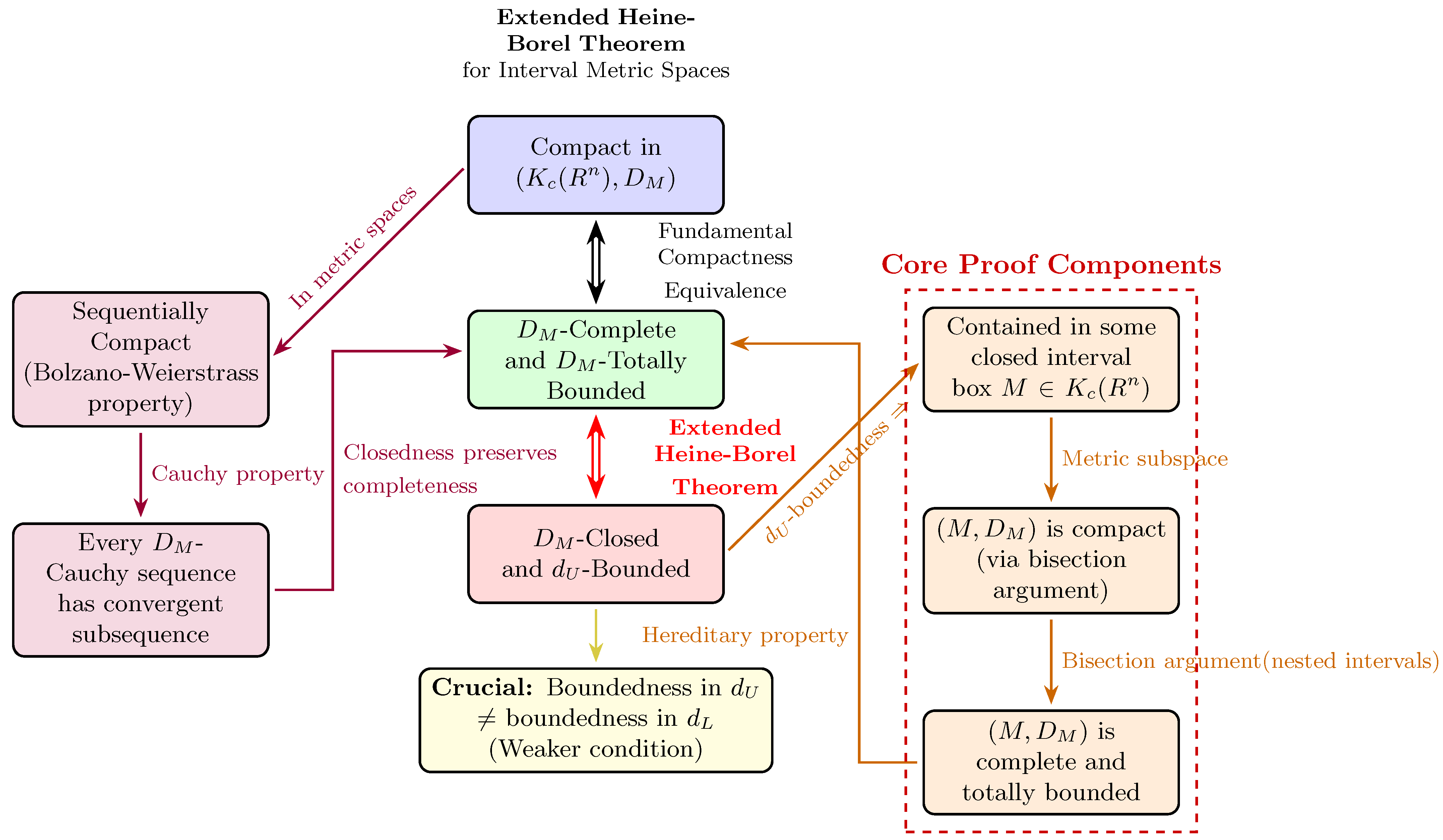
The schematic diagram (Figure 1) given below provides a visual roadmap of the logical dependencies in the Extended Heine–Borel theorem proof. It highlights how the classical compactness characterization extends to the interval-valued setting. The core argument relies on embedding the set in a compact interval box and applying a bisection method.
Theorem 14. 
(Extended Heine–Borel Theorem) Every i-closed and bounded subset of   K c , D I  is compact.
Proof. 
Let G  be an i-closed and bounded subset of K c , D I .
Then, from Proposition 3, G  is bounded with respect to the upper bound metric d U .  Therefore, δ U ( G )  is finite, where δ U ( G )  is the diameter of G  with respect to d U .  Then, there exists k U > 0  such that
δ U ( G ) k U .
Since, D I X , Y = c L , c U D M X , Y ,   X , Y K c ,  where D M  is the Moore distance on K c  and c L , c U K c + ,   δ U ( G ) k U   sup c U D M ( X , Y ) : X , Y G k U
c U D M ( X , Y ) k U ,   X , Y G
max x L y L , x U y U k U c U ,     X = x L , x U , Y = y L , y U G .
Let X 0 = x 0 L , x 0 U G  be fixed. Then, we have
max x 0 L y L , x 0 U y U k ,   Y = y L , y U G ,  where k = k U c U
x 0 L y L k   and   x 0 U y U k ,   Y = y L , y U G
y L x 0 L k , x 0 L + k   and   y U x 0 U k , x 0 U + k ,   Y = y L , y U G .
Therefore, G y L , y U : y L x 0 L k , x 0 L + k , y U x 0 U k , x 0 U + k .
Now, from Theorem 13, y L , y U : y L x 0 L k , x 0 L + k , y U x 0 U k , x 0 U + k  is compact subset of K c , D I .  Since G  is a i-closed subset of a compact set, G  is compact. □
Example 10. 
Consider the interval metric space   K c n , D I  defined by   D I X , Y = c L , c U D M ( X , Y ) ,
where   D M ( X , Y ) = max 1 i n | x i L y i L | , | x i U y i U | ,   X = x i L , x i U : i = 1 , 2 , , n ,
Y = y i L , y i U : i = 1 , 2 , , n K c n .  The Cartesian product   J 1 × J 2 × × J n  of n-closed Type-2 intervals with   J i = [ y i L , y i U ] : y i L [ a i , b i ] , y i U [ c i , d i ] ,   i = 1 , 2 , , n  is a compact subset of   K c n , D I .
Theorem 15. 
Every i-closed and bounded subset of   K c n , D I  is compact.
Proof. 
Proof follows from Theorem 13. □
Definition 19. 
Subset   Y  in an interval metric space   X , D I  is said to be totally bounded if, for every   r ¯ K c + ,  there exists a finite subset   G r ¯  of   Y  such that   Y a G r ¯ B D I a , r ¯ ,  i.e., for each   r ¯ K c + ,   Y  is covered by a finite number of i-open balls, each with centre in   Y  and radius   r ¯ .
Definition 20. 
Let   X , D I  be an interval metric space and   Y X .  A subset   A  of   Y  is said to be an   ε ¯  -net in   Y   ε ¯ K c +  if for each   y Y ,  there exists   x A  such that   y B D I x , ε ¯ .
Remark 3. 
Y  is totally bounded if and only if for each   ε ¯ K c + ,  there is a finite   ε ¯  -net in   Y .
Remark 4. 
In a non-compact interval metric space, there is an i-closed set which is not totally bounded. This can be proved using Example 11.
Example 11. 
Take the complete interval metric space   K c , D I ,  which is defined in Example 4.  Consider the set in   K c , D I ,   F = 0 , a : a 0 .
It is easy to show that   F = 0 , a : a 0  is an i-closed set by proving that   K c \ F  is i-open. However, for   ε ¯ = 0.5 , 0.5 , any finite collection can only cover intervals up to some maximum finite length, but   F  contains intervals of arbitrarily large length. Thus, no finite   ε ¯  -net exists and hence,   F  is not totally bounded.
Theorem 16. 
The following statements are equivalent in an interval metric space   X , D I .
(I) 
For each   ε ¯ K c + ,  there is a finite   ε ¯  -net in   Y .
(II) 
For each   ε ¯ K c + ,  there are finitely many subsets   A 1 , A 2 , , A n  of   X  such that   Y i = 1 n A i  and   δ L A i , δ U A i < g H ε ¯ ,  for each   i = 1 , 2 , , n .
Proof. 
First of all, we shall show that Statement (I) implies Statement (II).
Let ε ¯ K c +  be given and A = x 1 , x 2 , , x n  be a finite ε ¯ 3  -net in Y .  Then, for each y Y ,  there exists x i A  such that y B D I x i , ε ¯ 3 .  Let A i = B D I x i , ε ¯ 3 = B d L x i , ε L 3 B d U x i , ε U 3 .  and u , v A i .  Then, u , v B d L x i , ε L 3  and u , v B d U x i , ε U 3 .
Now, d L u , v d L u , x i + d L x i , v < ε L 3 + ε L 3 = 2 ε L 3 ,     u , v A i
sup u , v A i d L u , v 2 ε L 3 < ε L δ L A i < ε L .
Similarly, δ U A i < ε U .
Therefore, δ L A i , δ U A i < g H ε L , ε U .
Hence, A i = B D I x i , ε ¯ 3 : i = 1 , 2 , , n  is a finite collection of sets such that Y i = 1 n A i  and δ L A i , δ U A i < g H ε ¯ ,  for each i = 1 , 2 , , n .
Now, we shall show that Statement (II) implies Statement (I).
Let, for each ε ¯ K c + ,  there be finitely many subsets A 1 , A 2 , , A n  of X  such that Y i = 1 n A i  and δ L A i , δ U A i < g H ε ¯ ,  for each i = 1 , 2 , , n .  Now, let choose a i A i Y ,  for i = 1 , 2 , , n .
Let y Y .  Then, y A i ,  for some i { 1 , 2 , , n } .  Then, d L a i , y δ L A i < ε L  and d U a i , y < ε U   y B d L a i , ε L B d U a i , ε U = B D I a i , ε L , ε U .  Then, clearly, a 1 , a 2 , , a n  is a finite ε ¯  -net in Y .
Theorem 17. 
In an interval metric space   X , D I ,  if a subset   A  of   X  is compact, then it is totally bounded.
Proof. 
Let A  be a compact set. Then, for every ε ¯ K c + ,   B D I a , ε ¯ : a A  is an open cover of A  and so by compactness of A ,  there is a finite subset a 1 , a 2 , , a n  of A  such that A i = 1 n B D I a i , ε ¯  and so A  is totally bounded. □
Theorem 18. 
In an interval metric space   X , D I ,  if a subset   A  of   X  is totally bounded, then it is bounded.
Proof. 
Let A  be totally bounded. Let ε ¯ = 1 , 2 .  Then, there exists finitely many points a 1 , a 2 , , a n  in A  such that A i = 1 n B D I a i , 1 , 2 .
Let r L = max 1 i , j n d L a i , a j  and r U = max 1 i , j n d U a i , a j .  Then, r L r U .  Let x , y A .
Then, there exists i , j 1 , 2 , , n  such that x B D I a i , 1 , 2  and y B D I a j , 1 , 2 .
Now, d L x , y d L x , a i + d L a i , a j + d L a j , y 1 + r L + 1 = 2 + r L
δ L A 2 + r L .
Similarly, δ U A 4 + r U .
Therefore, δ L A , δ U A g H 2 + r L , 4 + r U .  Since δ I A δ L A , δ U A  and δ L A , δ U A  are bounded, A  is bounded with respect to D I .  □
Remark 5. 
In an interval metric space, there is a bounded set which is not totally bounded. This can be proved using Example 12.
Example 12. 
Let   , d  be discrete a discrete metric space, and define the following interval metric:
D I x , y = 1 , 2 d x , y , w h e r e   d x , y = 0 , i f x = y 1 , i f x y
Since, for all   x , y ,   D I x , y = 1 , 2 d x , y g H 1 , 2 , the diameter   δ I = 1 , 2  is finite.
Hence,    is bounded.
Now, we show that    is not totally bounded.
Take   ε ¯ = 0.5 , 0.5 . For any finite set   F = a 1 , a 2 , a 3 , , a m ,  pick   b \ F .
For each   a i ,
D I b , a i = 1 , 2 d b , a i = 1 , 2 > g H 0.5 , 0.5 .
Thus,   b i = 1 n B D I a i , ε ¯ .
Thus, no finite   ε ¯  -net exists and hence,    is not totally bounded.
Theorem 19. 
Let   X , D I  be an interval metric space. If   X , D I  is i-complete and totally bounded, then it is compact.
Sketch of Proof. 
Let x n  be a sequence in X , D I . Since X , D I  is totally bounded, by the standard diagonal argument used in metric spaces (which holds for X , D I  as it relies on the finite cover property, not the specific metric form), x n  has a Cauchy subsequence x n k . Again, since X , D I  is complete, this Cauchy subsequence i-converges to a point in X , D I . Therefore, X , D I  is sequentially compact and hence, by Theorems 7–9, X , D I  is compact. □

5. Conclusions

In this paper, various aspects of compact interval metric spaces are discussed. Initially, the concepts of covers and open covers are provided to define the compact interval metric spaces along with some important properties. The finite intersection property is then used to formulate an alternative definition of compactness. In addition, the Heine–Borel theorem is extended on the interval metric space of closed intervals. Then, the ideas of sequential compactness and Bolzano–Weierstrass compactness are given and their equivalence to compactness is proved. Finally, the total boundedness of interval metric spaces and its connection with compactness are provided.
The introduction of compactness features of interval metric spaces opens up several opportunities for further research. In this sense, one may apply the results to derive the relation between continuity, uniform continuity, and the compactness of interval metric spaces. Finally, this work’s approaches may also be used for Type-2 interval uncertainty (Rahman et al. [23,24]) and Semi-Type-2 interval uncertainty (Khatun et al. [25]).

Author Contributions

Conceptualization: M.S.R., A.K.B. and M.G.A.; Formal Analysis: R.K. and M.S.R.; Methodology: R.K. and M.G.A.; Investigation: R.K. and M.G.A.; Writing—original draft: R.K. and M.S.R.; Validation: M.G.A., M.S.R. and A.K.B.; Writing—review and editing: R.K., M.G.A., M.S.R. and A.K.B.; Supervision: M.G.A., M.S.R. and A.K.B.; Funding acquisition: M.G.A. All authors have read and agreed to the published version of the manuscript.

Funding

This research received no external funding.

Data Availability Statement

Data are contained within the article.

Acknowledgments

We would like to express our sincere thanks to the Editor-in-Chief of the journal for his affirmative comments and suggestions in order to improve the manuscript. Further, the first author would like to acknowledge the UGC (India) for providing the senior research fellowship (F.No. 16-6(DEC. 2018)/2019(NET/CSIR) and UGC-Ref. No. 1136/(CSIR-UGC NET DEC. 2018)) to carry out this research work.

Conflicts of Interest

The authors declare no conflicts of interest.

References

  1. Kawabe, J. On the compactness criterion for probability measures on Banach spaces. Proc. Jpn. Acad. Ser. A Math. Sci. 1985, 61, 337–340. [Google Scholar] [CrossRef]
  2. Beg, I.; Ali, R. Some Properties of The Hausdorff Distance in Probabilistic Metric Spaces. Demonstr. Math. 1996, 29, 243–250. [Google Scholar] [CrossRef]
  3. Alvarez-Manilla, M.; Jung, A.; Keimel, K. The probabilistic powerdomain for stably compact spaces. Theor. Comput. Sci. 2004, 328, 221–244. [Google Scholar] [CrossRef][Green Version]
  4. Morsi, N.N. Compact probabilistic metrics on bounded closed intervals of distribution functions. Fuzzy Sets Syst. 2005, 149, 433–453. [Google Scholar] [CrossRef]
  5. Mbarki, A.; Ouahab, A.; Naciri, R. On compactness of probabilistic metric space. Appl. Math. Sci. 2014, 8, 1703–1710. [Google Scholar] [CrossRef]
  6. Lowen, E.; Lowen, R. On measures of compactness in fuzzy topological spaces. J. Math. Anal. Appl. 1988, 131, 329–340. [Google Scholar] [CrossRef]
  7. Román-Flores, H. The compactness of E (X). Appl. Math. Lett. 1998, 11, 13–17. [Google Scholar] [CrossRef]
  8. Tirado, P. On compactness and G-completeness in fuzzy metric spaces. Iran. J. Fuzzy Syst. 2012, 9, 151–158. [Google Scholar]
  9. Huang, H.; Wu, C. Characterizations of compact sets in fuzzy set spaces with Lp metric. Fuzzy Sets Syst. 2018, 330, 16–40. [Google Scholar] [CrossRef]
  10. Sabri, R.I. Compactness property of fuzzy soft metric space and fuzzy soft continuous function. Iraqi J. Sci. 2021, 62, 3031–3038. [Google Scholar] [CrossRef]
  11. Wali, H.M. Compactness of Hausdorff fuzzy metric spaces. Int. J. Appl. Math 2021, 51, 17–24. [Google Scholar]
  12. Baydar, G.; Telci, M. On completeness and compactness in fuzzy metric spaces. J. Anal. 2023, 31, 747–758. [Google Scholar]
  13. Alharbi, A.A.; Kilicman, A. On Generalized Compactness in Fuzzy Bitopological Spaces. Eur. J. Pur. Appl. Math. 2024, 17, 30–41. [Google Scholar] [CrossRef]
  14. Samanta, U. Completeness and compactness in type-2 fuzzy metric spaces. TWMS J. Appl. Eng. Math. 2025, 15, 1397–1406. [Google Scholar]
  15. Moore, R.E. Interval Analysis; Prentice-Hall: Englewood Cliffs, NJ, USA, 1966; Volume 4. [Google Scholar]
  16. Ishibuchi, H.; Tanaka, H. Multiobjective programming in optimization of the interval objective function. Eur. J. Oper. Res. 1990, 48, 219–225. [Google Scholar] [CrossRef]
  17. Moore, R.E.; Kearfott, R.B.; Cloud, M.J. Introduction to Interval Analysis; Society for Industrial and Applied Mathematics: Philadelphia, PA, USA, 2009. [Google Scholar]
  18. Trindade, R.M.P.; Bedregal, B.R.C.; Neto, A.D.D.; Acioly, B.M. An interval metric. In New Advanced Technologies; IntechOpen: Rijeka, Croatia, 2010. [Google Scholar]
  19. Bhunia, A.K.; Samanta, S.S. A study of interval metric and its application in multi-objective optimization with interval objectives. Comput. Ind. Eng. 2014, 74, 169–178. [Google Scholar] [CrossRef]
  20. Afravi, M.; Kreinovich, V.; Dumrongpokaphoan, T. Metric spaces under interval uncertainty: Towards an adequate definition. In Proceedings of the Mexican International Conference on Artificial Intelligence, Cancun, Mexico, 23–29 October 2016; Springer International Publishing: Cham, Switzerland, 2016; pp. 219–227. [Google Scholar]
  21. Khatun, R.; Rahman, M.S.; Banerjee, A.K.; Bhunia, A.K. On some theoretical developments of interval metric space. Yugosl. J. Oper. Res. 2024, 34, 381–404. [Google Scholar] [CrossRef]
  22. Stefanini, L.; Bede, B. Generalized Hukuhara differentiability of interval-valued functions and interval differential equations. Nonlinear Anal. Theory Methods Appl. 2009, 71, 1311–1328. [Google Scholar] [CrossRef]
  23. Rahman, M.S.; Shaikh, A.A.; Bhunia, A.K. On the space of Type-2 interval with limit, continuity and differentiability of Type-2 interval-valued functions. arXiv 2019, arXiv:1907.00644. [Google Scholar] [CrossRef]
  24. Rahman, M.S.; Shaikh, A.A.; Bhunia, A.K. On Type-2 interval with interval mathematics and order relations: Its applications in inventory control. Int. J. Syst. Sci. Oper. Logist. 2021, 8, 283–295. [Google Scholar] [CrossRef]
  25. Khatun, R.; Aljeddani, S.; Alghamdi, S.; Rahman, M.S.; Bhunia, A.K. Developments of Semi-Type-2 Interval Approach with Mathematics and Order Relation: A New Uncertainty Tackling Technique. Axioms 2025, 14, 754. [Google Scholar] [CrossRef]
Figure 1. Schematic diagram of compactness characterization in interval metric spaces.
Axioms 15 00057 g001
Disclaimer/Publisher’s Note: The statements, opinions and data contained in all publications are solely those of the individual author(s) and contributor(s) and not of MDPI and/or the editor(s). MDPI and/or the editor(s) disclaim responsibility for any injury to people or property resulting from any ideas, methods, instructions or products referred to in the content.