


Abstract
By the cyclic structure of the affine plane AG(2,q), q≡7 mod 12, a mixed partition into a set of Möbius–Kantor configurations and a one-point set is provided. This generalizes a 2006 result of L. Berardi and T. Masini, who partitioned the affine plane of order 7 into a set of Möbius–Kantor configurations and a one-point set.
MSC:
51E20; 51E21
1. Introduction
Finite geometry is a fundamental concept of combinatorics, playing a crucial role in several mathematical contexts and having numerous applications in various fields, including coding theory, computer science and cryptography, particularly in the design of cryptographic protocols and algorithms. A problem in finite geometry that has been widely investigated is the possibility of partitioning the affine or projective space into objects that have the same geometric properties cf. [1,2,3,4,5,6,7]. For arithmetical reasons, sometimes it is not possible to partition a given geometry uniformly, although a uniform partition may be possible if one or more objects of a given kind are removed. We shall call such a non-uniform partition a mixed partition of a geometry, cf. [8,9,10,11,12,13]. Let p be prime and q = ph, h ≥ 1. Then, denotes the finite field of order q. A vector plane over will be denoted as V(2,q). The affine plane over the field , denoted as AG(2,), shortly, AG(2,q), is an incidence geometry of which the elements are the additive cosets of the vector subspaces of V(2,q). The incidence is symmetrized set-theoretic containment. As such, a point of AG(2,q) is represented by a unique vector of V(2,q), and a line is represented by a unique coset of a 1-dimensional vector subspace. Finite affine planes cannot be cyclic because they do not have the same number of lines and points. However, if we choose a single point (say ∞) from an affine plane, together with all the lines through that point, we can define a collineation σ such that the cyclic group generated by σ fixes ∞ and acts regularly on the set of the remaining points and on the set of remaining lines, cf. [14,15,16]. A Möbius–Kantor configuration 83 is a configuration consisting of eight points and eight lines with three points on each line and three lines on each point. It is not possible to draw points and lines having this pattern of incidences in the Euclidean plane. But it is possible in the complex plane. In AG(2,q), it is well-known that a Möbius–Kantor configuration 83 occurs for q≡0, 1 (mod 3), cf. [17]. Regarding 4, the smallest order q with q≡1 mod 3, in [18], the authors proved that AG(2,4) contains a partition into two Möbius–Kantor configurations 83. Taking into account 7, the second order q with q≡1 mod 3, in a 2006 paper, L. Berardi and T. Masini, cf. [19], showed by incidence properties that the affine plane AG(2,7) allows a mixed partition into one point ∞ and 6 Möbius–Kantor configurations 83. In this paper, through the cyclic structure of the affine plane AG(2,q), q≡7 mod 12, a mixed partition into a set of Möbius–Kantor configurations and a one-point set is provided. As usual, here a quadrilateral consists of four points in general positions, i.e., no three collinear. The remainder of this paper is structured as follows. Section 2 introduces the methodology used for the cyclic representation of the affine plane AG(2,q). Section 3 presents our findings, synthesizing key insights. Section 4 shows the construction in AG(2,7) with relevant figures and tables. Section 5, by our findings, derives a mixed partition in AG(2,19). In Section 6, we draw a discussion and put forward future research.
2. The Cyclic Representation of AG(2,q)
In this section, we describe the cyclic structure of the affine plane of order q. Let us consider a primitive polynomial of degree two in , p(x) = ax2 + bx + c, q odd. The elements are roots of p(x), and then they are primitive elements of . Since the element is a non-square element of , we can identify any point (x,y) of AG(2,q) with the element z = x + yr of with r2 = s in the quadratic extension of . Let α = α1 + α2r denote a primitive element of . The map σ: z–>αz is the linear collineation of AG(2,q) because
The cyclic group generated by σ, has order q2 − 1, fixes the point , and is sharply transitive on the points of AG(2,q) distinct from . If we choose the point as base point, then any point can be obtained uniquely as , with . Since the points of AG(2,q) can be represented by the set , any point can be identified with the exponent and so with the elements of the additive cyclic group . Therefore, the set of points of AG(2,q) is
z’ = x’ + y’r = σ(z) = αz = (α1 + α2r)·(x + yr) = (α1x + α2ys) + (α1y + α2x)r.
The lines not containing the point of the plane are found by selecting any line; for example, by choosing the line , and by adding 1 to each point of the preceding line, beginning with 0 and using addition modulo . Any line ℓ not containing the point is an affine difference set of relative to the subgroup of , i.e., the set of differences contains each element of exactly once but no element of . The remaining q+1 lines of AG(2,q) containing the point are obtained tacking as base line, , the union of with the unique subgroup of order q−1, , of . The remaining q lines containing the point of the plane are found by adding 1 to each point, different from , of the preceding line, beginning with , and using addition modulo. Therefore, the lines of AG(2,q) are of two types, according to whether the line contains the point or not:
- The line , noncontaining the point with , is the setwhere , , are q integers modulo , with , that belong to an affine difference set of order q, i.e., the differences , , are such that .
- The line , containing the point with , is the seti.e., the other q−1 points, different from , are the points , with .
3. The Construction of the Mixed Partition of AG(2,q), q≡7 Mod 12
In this section, we partition the affine plane of order q into a set of Möbius–Kantor configurations and a one-point set. We prove the following
Theorem 1.
Any affine plane AG(2,q) with q≡7 mod 12, admits a partition into a set of Möbius- Kantor configurations 83 plus a set consisting only of one point.
Proof.
Let us suppose that q≡7 mod 12. The cosets of the unique subgroup of order 4, , of , define a partition of AG(2,q)− in quadrilaterals where . We find that there is at least one quadrilateral
which is mutually inscribed and circumscribed with . Thus, the union is a Möbius–Kantor configuration 83, cf. [20].
Taking into account , , we obtain the required partition. □
In the next sections, we present two examples. The first one shows that the Berardi–Masini mixed partition of AG(2,7) is cyclic, while the second one is focused on the role the cyclic structure of AG(2,19) plays in the construction developed in Theorem 1.
4. The Mixed Partition of AG(2,7)
Now, by explicitly constructing the cyclic structure of AG(2,7), we prove
Theorem 2.
Any affine plane AG(2,7) admits a partition into a set of Möbius–Kantor configurations 83 plus a set consisting only of one point.
Proof.
Let us consider a primitive polynomial of degree two with minimal weight, i.e., the minimal number of nonzero coefficients, among all primitives of that degree over in , p(x) = x2 + x + 3, cf. [21]. The element is a root of p(x) and then it is a primitive element of . Thus, the matrix induces a cycle on the set of points (x,y) ≠ (0,0) of AG(2,7). If we choose the point (1,0) as base point, then by continuing in this way and by denoting the points represented by simply by , the points of AG(2,7) can be identified with and the elements of the additive cyclic group , the integers modulo 48, as shown in Table 1. Actually, to write the table, it is not necessary to calculate all the values. It is sufficient to calculate only the first 8 values and see how the point (1,0) is transformed by In this case Thus, the next eight points are obtained from the previous ones by multiplying them by 3 modulo 7.
Table 1.
The cyclic structure of the points of AG(2,7).
Select any line, for example, we choose the line ℓ0:= x = 1, which contains the 7-set of points written in Table 2.
Table 2.
The starting line.
The remaining lines not containing the point of the plane are found by adding 1 to each point of the preceding line beginning with ℓ0 and using addition modulo 48.
The 48 lines not containing the point of AG(2,7) consist of the points in the rows of Table 3.
Table 3.
The lines not containing the point of AG(2,7).
The lines containing the point of the plane are found by tacking the cosets of the unique subgroup of order 6 of written in Table 4.
Table 4.
The lines containing the point of AG(2,7).
The cosets of the unique subgroup of order 8 of define a partition in 6 conics of the set of points of AG(2,7)− written in Table 5.
Table 5.
The partition of AG(2,7)− into 6 conics.
The orbits of the points, different from , under the unique subgroup of order 4 of define a partition into 12 quadrilaterals written in Table 6.
Table 6.
The partition of AG(2,7)− into 12 quadrilaterals.
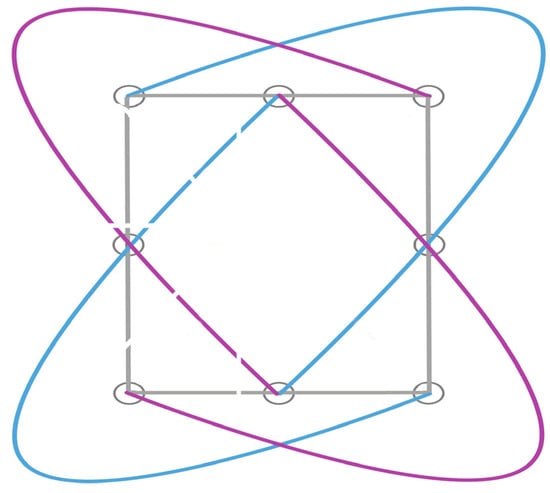
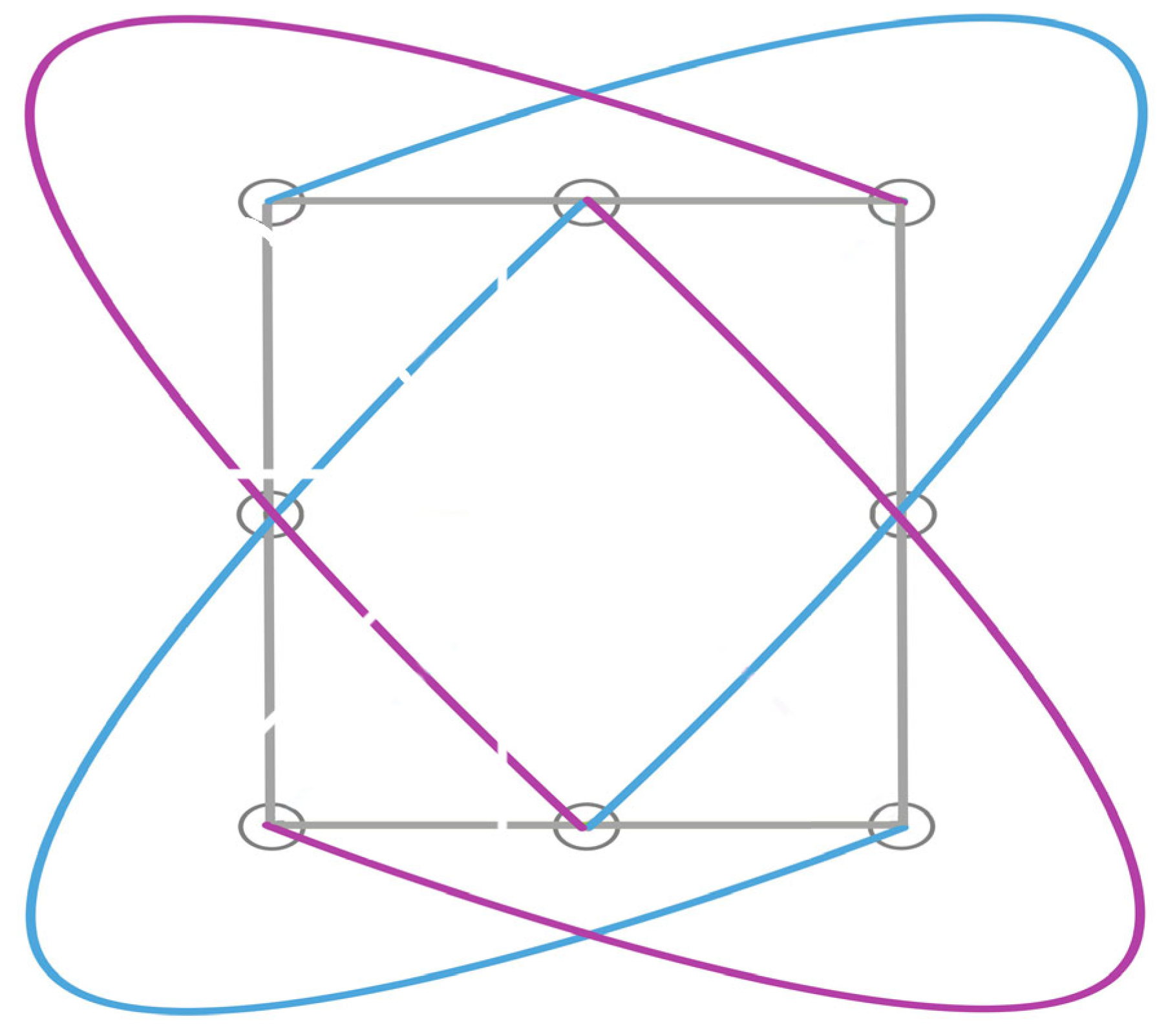
Let us take into account C0. The first quadrilateral Ci, i = 1,2,…,11, such that C0 and Ci are simultaneously inscribed and circumscribed, as shown in Figure 1, is C3.
Figure 1.
Two quadrilaterals simultaneously inscribed and circumscribed.
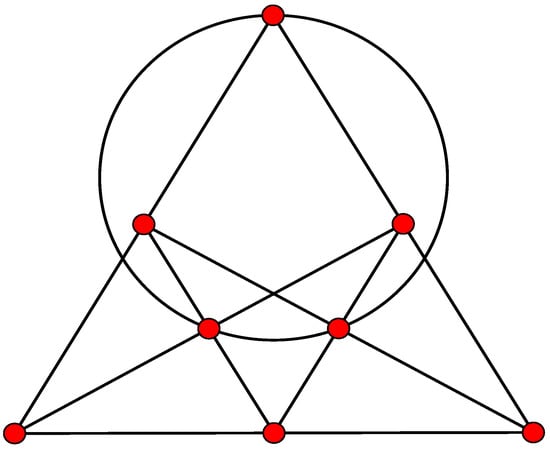
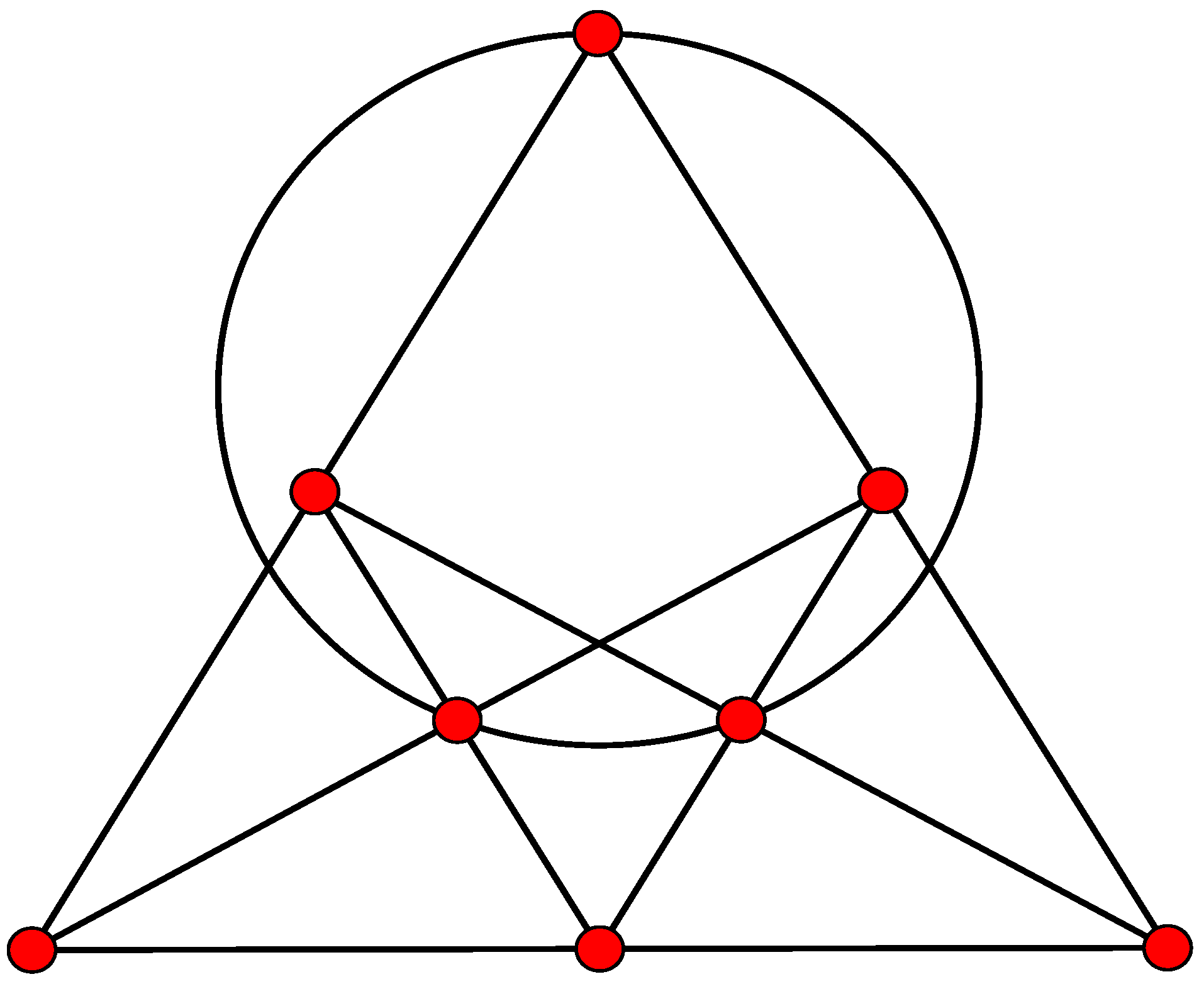
Thus, the union C0∪C3 is the classical representation of the Möbius–Kantor configuration (83), cf. [20]. In Figure 2 below, from MathWorld, is the Möbius–Kantor configuration (83).
Figure 2.
The Möbius–Kantor configuration (83).
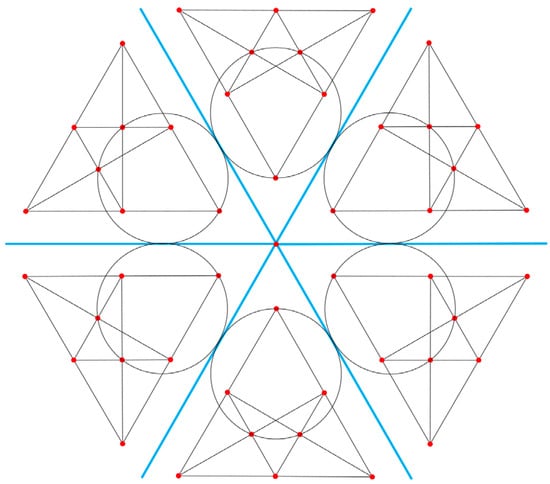
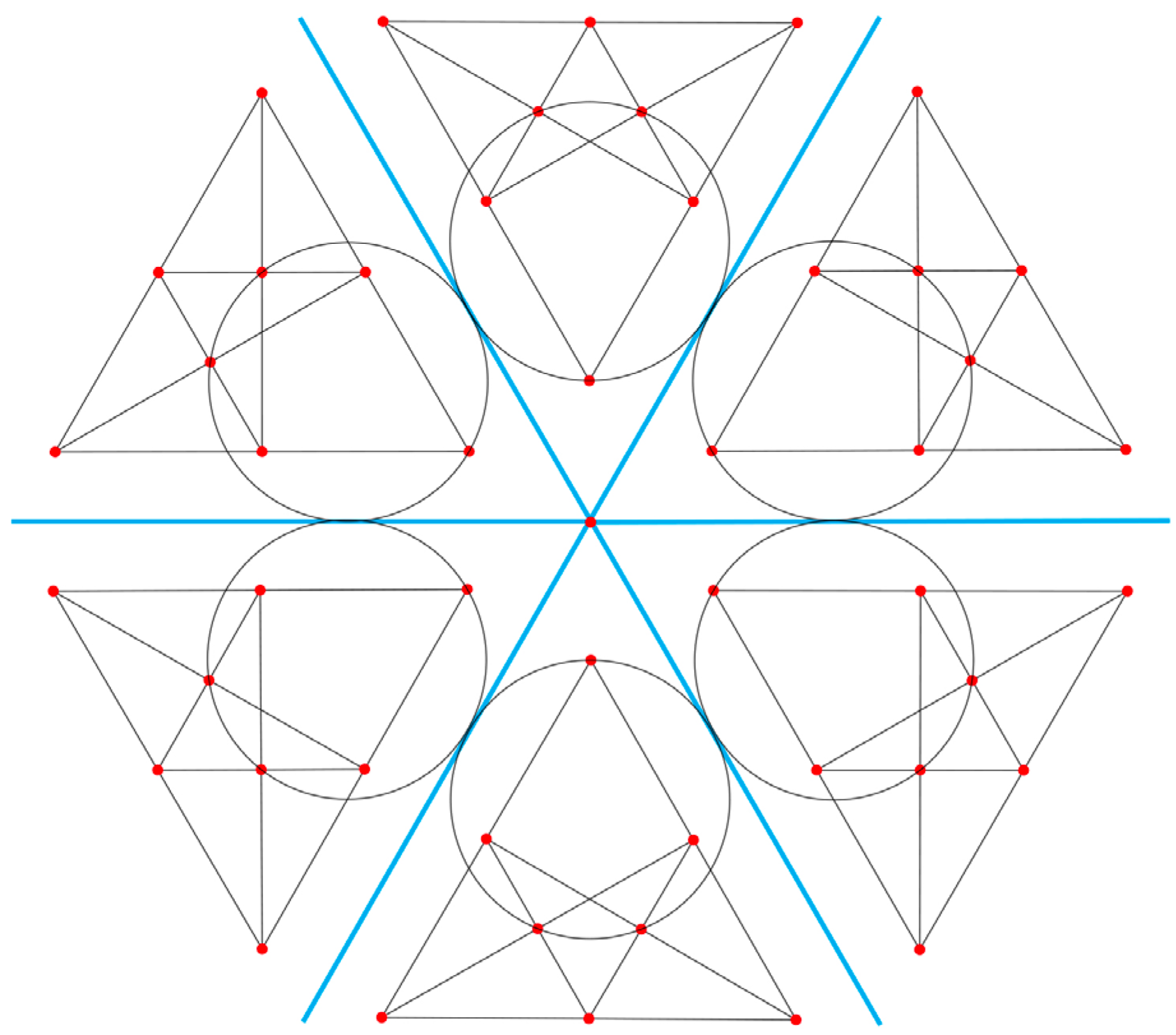
Finally, we prove the cyclic partition of AG(2,7). Since , we have that , , , , and . Therefore, we obtain the cyclic partition of AG(2,7), shown in Figure 3, cf. [9]. □
Figure 3.
The cyclic partition of AG(2,7).
5. The Mixed Partition of AG(2,19)
Now, by explicitly constructing the cyclic structure of AG(2,19), we prove
Theorem 3.
Any affine plane AG(2,19) admits a partition into a set of Möbius–Kantor configurations 83 plus a set consisting only of one point.
Proof.
Let us consider a primitive polynomial of degree two with minimal weight, i.e., the minimal number of nonzero coefficients, among all primitives of that degree over in , p(x) = x2 + x + 2, cf. [21]. It is a simple exercise to verify that the element is a root of p(x) and then a primitive element of . Thus, the matrix induces a cycle on the set of points (x,y) ≠ (0,0) of AG(2,19). If we choose the point (1,0) as a base point, then by continuing in this way and by denoting the points represented by simply by , the points of AG(2,19) can be identified with and the elements of the additive cyclic group , the integers modulo 360, as shown in Table A1. Actually, to write the table, it is not necessary to calculate all the values. It is sufficient to calculate only the first 20 values and see how the point (1,0) is transformed by In this case, Thus, the next twenty points are obtained from the previous ones by multiplying them by 2 modulo 19. To enhance the readability of the paper, the cyclic structure of the points of AG(2,19) is placed as Table A1 in Appendix A.
Select any line, for example, we choose the line ℓ0 := x = 1, which contains the 19-set of points written in Table 7.
Table 7.
The starting line.
The remaining lines not containing the point of the plane are found by adding 1 to each point of the preceding line beginning with ℓ0 and using addition modulo 360.
The 360 lines not containing the point of AG(2,19) consist of the points in the rows of Table A2.
The lines containing the point of the plane are found by tacking the cosets of the unique subgroup of order 18 of written in Table A3.
The orbits of the points, different from , under the unique subgroup of order 20 of define a partition in 18 conics of the set of points of AG(2,19)− written in Table A4.
The orbits of the points, different from , under the unique subgroup of order 4 of define a partition in 4-arcs written in Table A5.
Let us take into account C0. The first quadrilateral Ci, i = 1, 2,…, 11, such that C0 and Ci are simultaneously inscribed and circumscribed, is C9. Thus, the union C0∪C9 is the classical representation of the Möbius–Kantor configuration (83), cf. [20]. Finally, we prove the cyclic partition of AG(2,19). Since , we have that
Therefore, we obtain the cyclic partition of AG(2,19). □
6. Discussion
This work presents a comprehensive study of the problem, initially proposed in [19], of partitioning the affine plane of order q, q≡7 mod 12, into one point ∞ and Möbius–Kantor configurations 83. Focusing on the cyclic structure, we establish a complete mathematical construction. We provide two concrete examples demonstrating its effectiveness. For further research, we consider the order q, q≡1 mod 12, in which the orbits of the points, different from , under the unique subgroup of order 4 of do not define a 4-arc partition, but a 4 collinear points partition, and, therefore, the proposed construction does not work and other ideas are needed.
Funding
This research received no external funding.
Institutional Review Board Statement
Not applicable.
Informed Consent Statement
Not applicable.
Data Availability Statement
The original contributions presented in this study are included in the article. Further inquiries can be directed to the author.
Acknowledgments
The author sincerely thanks the anonymous referees for their valuable feedback, which greatly enhanced the presentation of this paper. Additionally, thanks go to GNSAGA of the Italian INDAM because the research was performed within the activity of this National Group.
Conflicts of Interest
The author declares no conflicts of interest.
Appendix A
Table A1.
The cyclic structure of the points of AG(2,19).
Table A2.
The 360 lines not containing the point of AG(2,19).
Table A3.
The lines containing the point of AG(2,19).
Appendix B
Table A4.
The partition of AG(2,19)− in conics.
Table A5.
The partition of AG(2,19)− in 4-arcs.
References
- Brown, J.M.N. Partitioning the complement of a simplex in PG(e,qd+1) into copies of PG(d,q). J. Geom. 1988, 33, 11–16. [Google Scholar] [CrossRef] [Scilit]
- Batten, L. Decompositions of finite projective planes. J. Contrib. 2002, 1, 149–159. Available online: https://hdl.handle.net/10536/DRO/DU:30001820 (accessed on 28 July 2025).
- Pardo, M.G.A. Daisy structure in Desarguesian projective planes. J. Aust. Math. Soc. 2003, 74, 145–154. [Google Scholar] [CrossRef] [Scilit]
- Ebert, G.L. Partitioning projective geometries into caps. Canad. J. Math. 1985, 37, 1163–1175. [Google Scholar] [CrossRef] [Scilit]
- Mathon, R.; Street, A.P. Partitioning sets of triples into two small planes. Des. Codes Cryptogr. 2002, 27, 119–130. [Google Scholar] [CrossRef] [Scilit]
- Hazzazi, M.M.M. On Decompositions of Finite Projective Planes and Their Applications. Ph.D. Thesis, University of Sussex, Brighton, UK, 2019. Available online: https://hdl.handle.net/10779/uos.23468093.v1 (accessed on 28 July 2025).
- Hawtin, D.R. Transitive (q − 1)-fold packings of PGn(q). Discrete Math. 2025, 348, 114330. [Google Scholar] [CrossRef] [Scilit]
- Baker, R.D.; Bonisoli, A.; Cossidente, A.; Ebert, G.L. Mixed partitions of PG(5,q). Discrete Math. 1999, 208–209, 23–29. [Google Scholar] [CrossRef] [Scilit]
- Cossidente, A. Mixed partitions of PG(3,q). J. Geom. 2000, 68, 48–57. [Google Scholar] [CrossRef] [Scilit]
- Mellinger, K.E. Mixed partitions of PG(3,q2). Finite Fields Their Appl. 2004, 10, 626–635. [Google Scholar] [CrossRef] [Scilit]
- Mathon, R.; Street, A.P. Mixed partitions of sets of triples into small planes. Discret. Math. 2004, 284, 209–215. [Google Scholar] [CrossRef] [Scilit]
- Mellinger, K.E. Classical mixed partitions. Discrete Math. 2004, 283, 267–271. [Google Scholar] [CrossRef]
- Ebert, G.L.; Mellinger, K.E. Mixed partitions and related designs. Des. Codes Cryptogr. 2007, 44, 15–23. [Google Scholar] [CrossRef] [Scilit]
- Bose, R.C. An Affine Analogue of Singer’s Theorem. J. Indian Math. Soc. 1942, 6, 1–15. [Google Scholar]
- Giordano, V. Arcs in cyclic affine planes. Innov. Incid. Geom. 2009, 6–7, 203–209. Available online: https://msp.org/iig/2008/6-1/iig-v6-n1-p13-s.pdf (accessed on 28 July 2025).
- Korchmáros, G.; Sonnino, A. On arcs sharing the maximum number of points with ovals in cyclic affine planes of odd order. J. Combin. Designs 2010, 18, 25–47. [Google Scholar] [CrossRef] [Scilit]
- Hirschfeld, J.W.P. Projective Geometries over Finite Fields, 2nd ed.; Oxford University Press: Oxford, UK, 1998. [Google Scholar] [CrossRef] [Scilit]
- Innamorati, S.; Tondini, D. The yin-yang structure of the affine plane of order four. ARS Comb. 2013, 110, 193–197. Available online: https://combinatorialpress.com/article/ars/Volume%20110/volume-110-paper-19.pdf (accessed on 28 July 2025).
- Berardi, L.; Masini, T. Möbius-Kantor configurations in the affine plane of order 7. J. Geom. 2007, 86, 11–20. [Google Scholar] [CrossRef] [Scilit]
- Coxeter, H.S.M. Self-dual configurations and regular graphs. Bull. Am. Math. Soc. 1950, 56, 413–455. Available online: https://www.ams.org/journals/bull/1950-56-05/S0002-9904-1950-09407-5/ (accessed on 28 July 2025). [CrossRef] [Scilit]
- Hansen, T.; Mullen, G.L. Primitive Polynomials Over Finite Fields. Math. Comput. 1992, 59, 639–643. [Google Scholar] [CrossRef]

Disclaimer/Publisher’s Note: The statements, opinions and data contained in all publications are solely those of the individual author(s) and contributor(s) and not of MDPI and/or the editor(s). MDPI and/or the editor(s) disclaim responsibility for any injury to people or property resulting from any ideas, methods, instructions or products referred to in the content. |
© 2025 by the author. Licensee MDPI, Basel, Switzerland. This article is an open access article distributed under the terms and conditions of the Creative Commons Attribution (CC BY) license (https://creativecommons.org/licenses/by/4.0/).