


Abstract
An independent set in a graph comprises vertices that are not adjacent to one another, whereas a clique consists of vertices where all pairs are adjacent. For a given graph G, let the following notations be defined: the number of vertices in G is n, the cardinality of a maximum independent set in G is , the size of the largest clique in G is , the cardinality of the intersection of all maximum independent sets in G is , and the number of maximum independent sets in G is . As the main finding of this article, we present an upper bound on the number of maximum independent sets as follows: . As an application of our findings, we explore a series of inequalities that connects the number of longest increasing subsequences with the number of longest decreasing subsequences in a given sequence of integers.
Keywords:
independent set; clique; core; corona; permutation graph; longest increasing subsequence; longest decreasing subsequence MSC:
05C30; 05C69
1. Introduction
Throughout this research, let G be a simple graph, i.e., a finite, undirected, loopless graph without multiple edges. The vertex set is denoted as and the edge set is denoted as .
For the graph G, we denote the following: -the number of vertices in G; -the number of edges in G; -the set of neighbors of vertex ; -the set of neighbors of ; and -the closed neighborhood of A. A set S of vertices is independent if no two vertices from S are adjacent, and an independent set of maximum size is a maximum independent set of G. The independence number of G, denoted as , represents the cardinality of a maximum independent set of G. A clique is a subset of vertices such that every two distinct vertices in the clique are adjacent. The clique number of G, denoted as , represents the cardinality of the maximum clique in G. Let denote the family of all maximum independent sets of G, and , the set of all maximum cliques. is the intersection of all maximum independent sets in G, is the cardinality of the intersection of all maximum independent sets, corona(G) is the union of all maximum independent sets, and is the cardinality of the union of all maximum independent sets. A matching in a graph is a set of edges such that no two edges share a common vertex. A maximum matching is a matching that contains the largest possible number of edges, where is the size of the maximum matching in a graph (the matching number).
If , then G is called a König–Egerváry graph [1,2,3].
Theorem 1
([4]). If G is a connected graph with , then
The following is a generalization of Theorem 1.
Theorem 2.
Let G be a graph with . Then
Proof.
Let be the connected components of G. Clearly,
Assume that for some . Hence, , in accordance with Theorem 1. Therefore, and .
If for every , then , which contradicts the condition . It follows from this that there exists , such that , and consequently, by Theorem 1. Thus, as claimed,
□
Theorem 3
([5]). For every graph G, it is true that
Theorem 4
([5]). If G is a König–Egerváry graph, then
If is any set of vertices in G, then denotes the subgraph of G spanned by U.
The notation refers to the subgraph . If is a singleton, we write instead of .
Here, denotes a complete graph with n vertices, denotes a cycle with n vertices, and the union of two disjoint graphs G and H is denoted , where and . The notation represents the union of k copies of disjoint graphs isomorphic to G.
The corona of two graphs and , denoted [6], is defined as the graph obtained by taking one copy of and copies of , with an edge connecting each vertex to every vertex in the i-th copy of .
A permutation graph is defined as a graph whose vertices represent the elements of a permutation, with edges representing pairs of elements that are reversed by the permutation [7]. If is a permutation of the numbers from 1 to n, the corresponding permutation graph has n vertices, . An edge exists between two vertices for any indices i and j such that and . Thus, two indices i and j define an edge in the permutation graph precisely when they form an inversion in the permutation. Consequently, the longest increasing subsequence in the sequence of numbers represented by the permutation corresponds to a maximum independent set in G, while the longest decreasing subsequence corresponds to a maximum clique in G.
A comparability graph is an undirected graph that connects pairs of elements that are comparable in a partial order [8,9]. For any strict partially ordered set , the comparability graph of is defined such that the vertices are the elements of S and an edge exists between a pair of elements if .
Erdős and Moser raised the problem of determining the maximum number of cliques in a graph G of order n and identifying the graphs that achieve this maximum [10]. Moon and Moser established an upper bound for maximum number of cliques [11]. Recall that an independent set in a graph corresponds to a clique in its complement graph and vice versa.
The problem of finding the number of maximum independent sets of various types of graphs has been extensively studied in [12,13,14,15,16,17,18,19,20,21,22,23,24,25,26]. The main finding of this article is the upper bound on the number of maximum independent sets using various graph invariants, including the number of vertices n, the independence number , the clique number , and , which denotes the cardinality of the intersection of all maximum independent sets. It reads as follows:
For example, if G is a triangle-free graph, i.e., , the above inequality is specialized as
On the other hand, by incorporating the corona parameter into our inequalities for triangle-free graphs, we obtain the following:
2. Upper Bounds
In this section, we need the following characterization of maximum independent sets in a graph due to Berge.
Theorem 5
([27]). An independent set S belongs to Ω if and only if every independent set A of G, disjoint from S, can be matched into S.
2.1. The Main Lemma
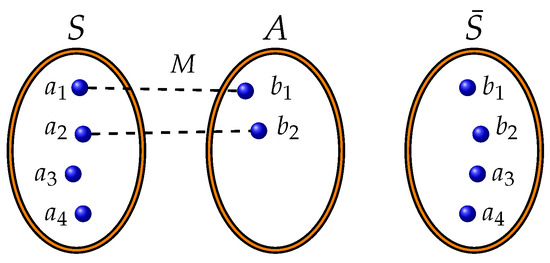
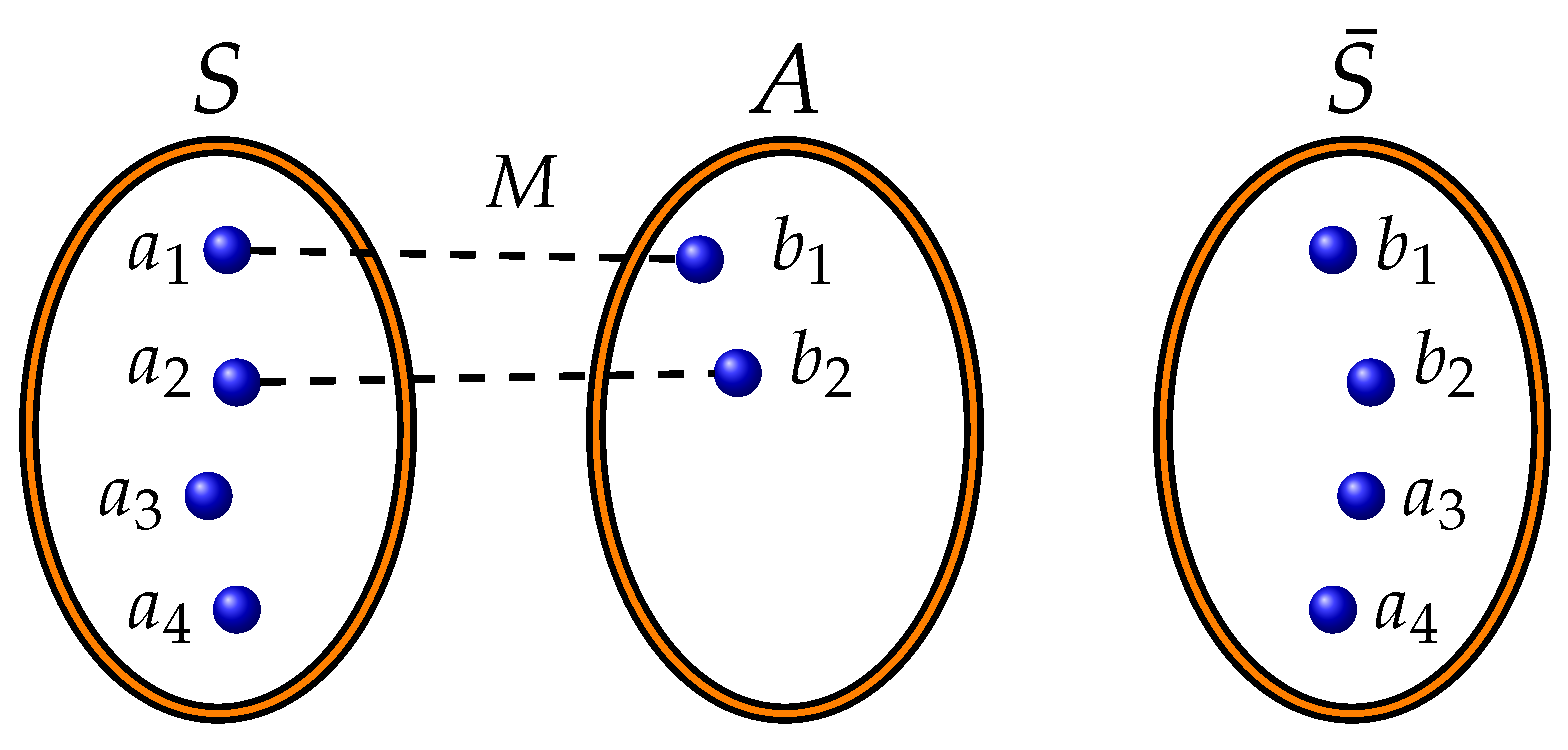
Let G be a graph. Suppose is a maximum independent set in G, and let be an independent set in G () disjoint from S, i.e., . By Theorem 5, there exists a matching M from A to S:
Now, we can generate a new set of cardinality by replacing k vertices in S with vertices from A, i.e.,
and we have .
Lemma 1.
Let G be a graph. Supposing , we can generate all maximum independent sets with the help of the independent sets disjoint from S. Moreover, we cannot generate more than one maximum independent set using an independent set disjoint from S.
Proof.
Let A be an independent set disjointed from S.
- First, we will prove that we can generate every maximum independent set using an independent set A. There are two options:
- (a)
- If the graph contains at least two maximum independent sets and , let . Then, A is independent and . By Berge’s Theorem [27], there exists a matching ) and .
- (b)
- If the graph contains only one maximum independent set S, we can generate S with the help of the empty set.
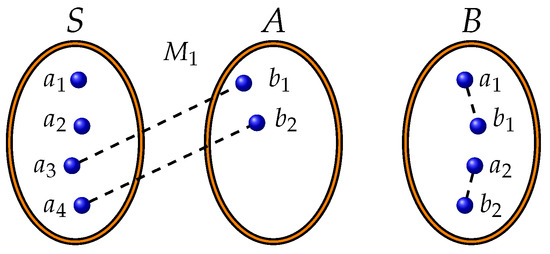
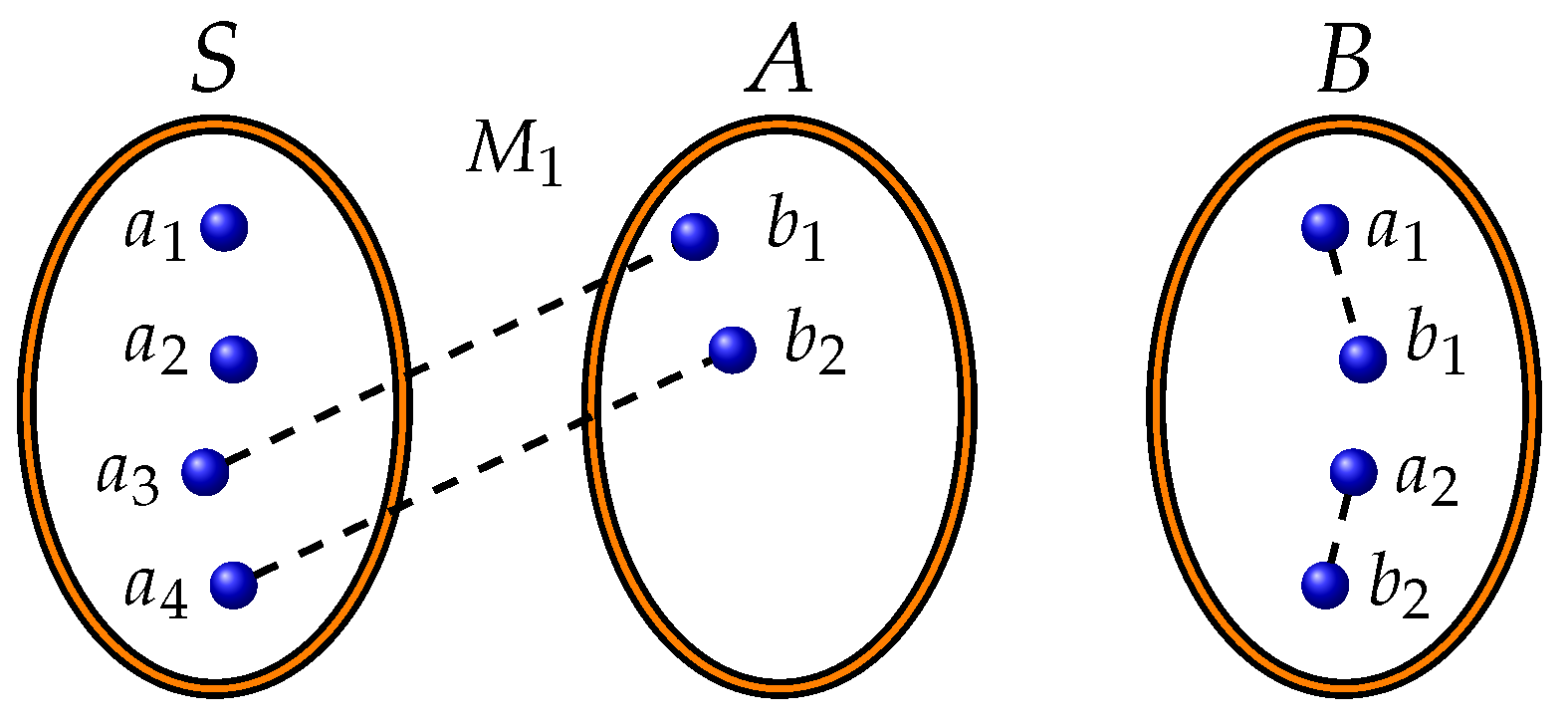
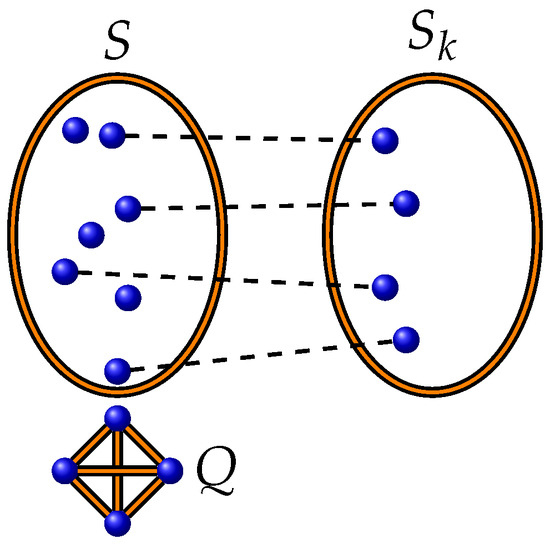
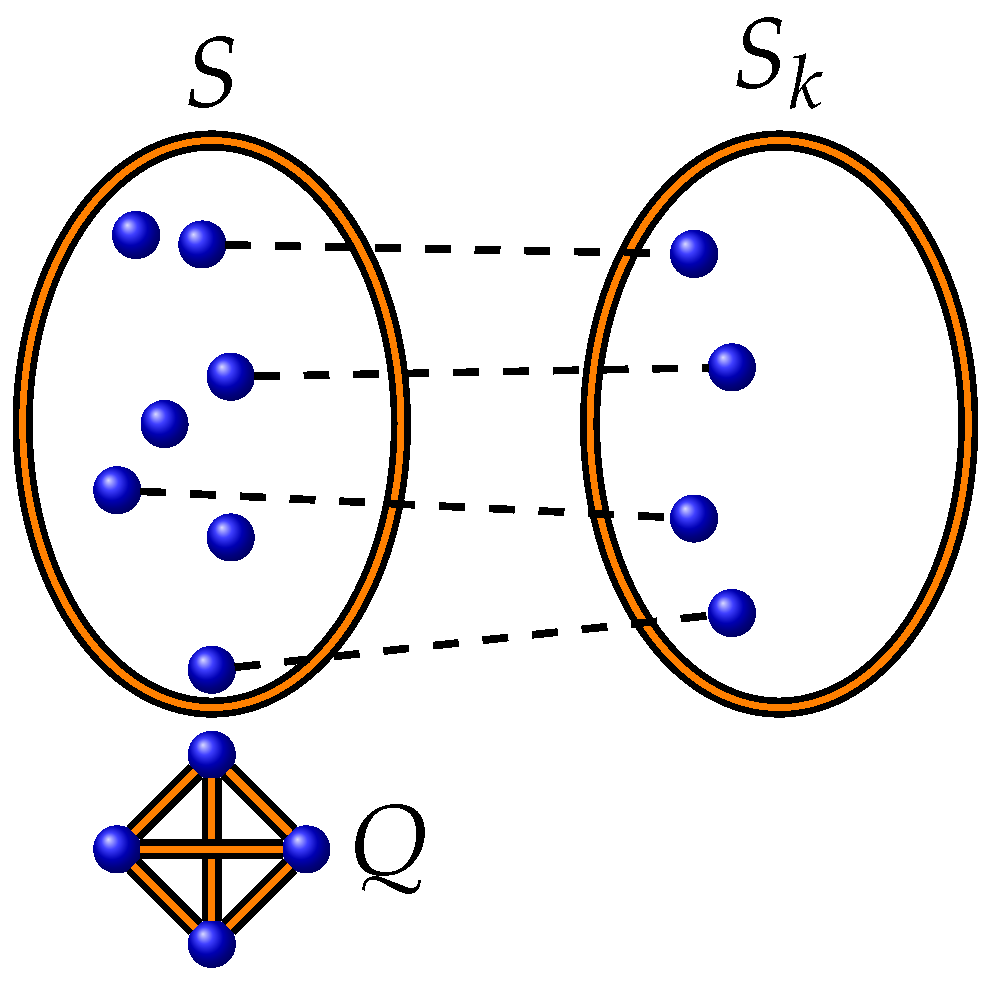
- Now, let us prove that we cannot generate more than one maximum independent set using an independent set A.Letbe an independent set, which implies (see Figure 1).Figure 1. where M is a matching from A to S.Letbe a matching different from M, such that for some value of j, we haveThus, a new setis not independent since there is an edge (see Figure 2).Figure 2. where is a matching from A to S.
This completes the proof. □
2.2. Upper Bounds for
2.2.1. An Upper Bound for If Every Maximum Independent Set Has a Nonempty Intersection with Every Maximum Clique
Theorem 6.
Let G be a graph such that for every and every , we have Then,
Proof.
Note that the set consists of exactly one element, denoted .
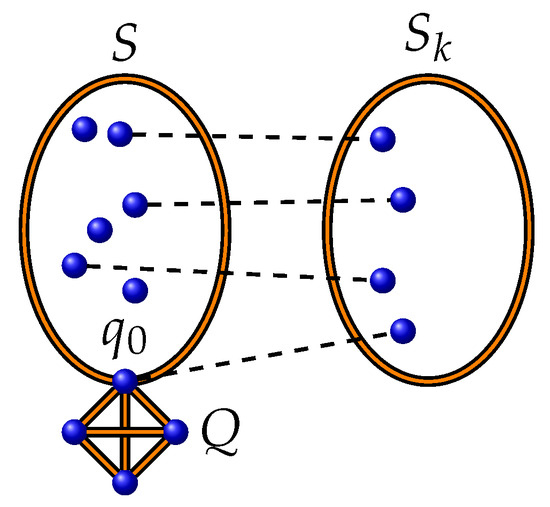
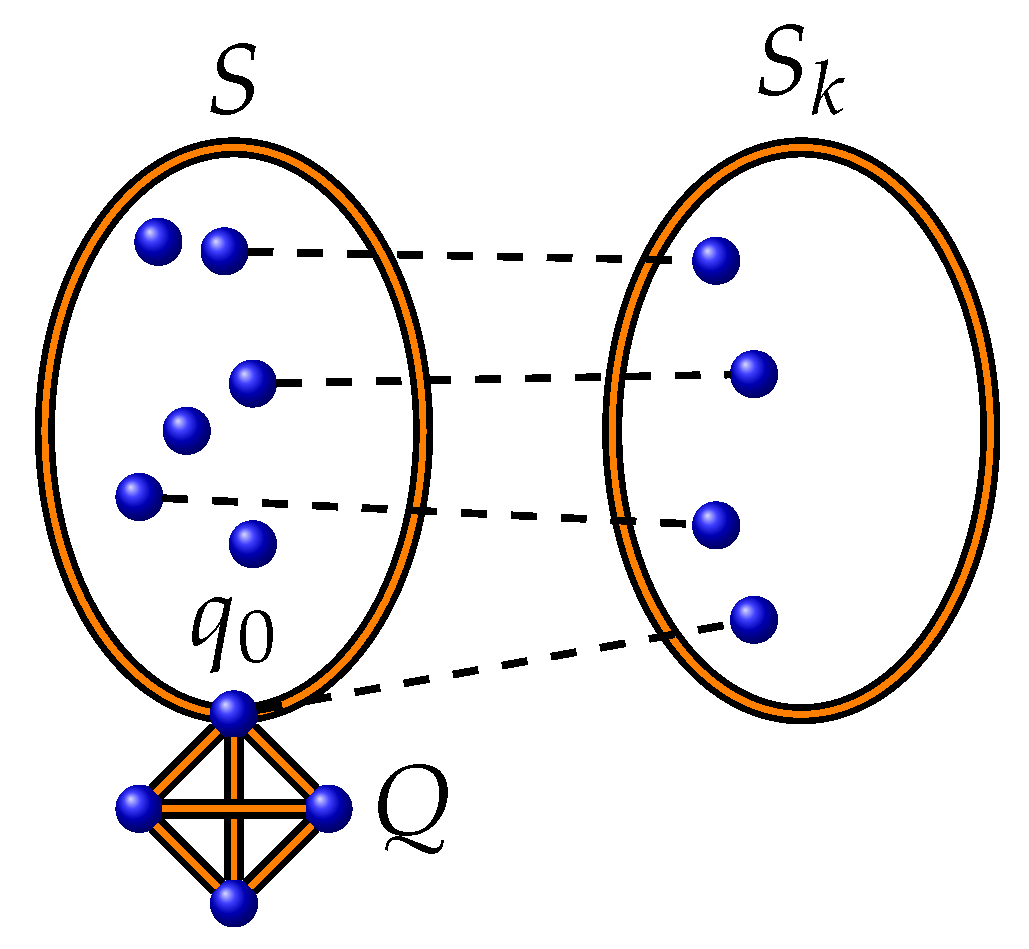
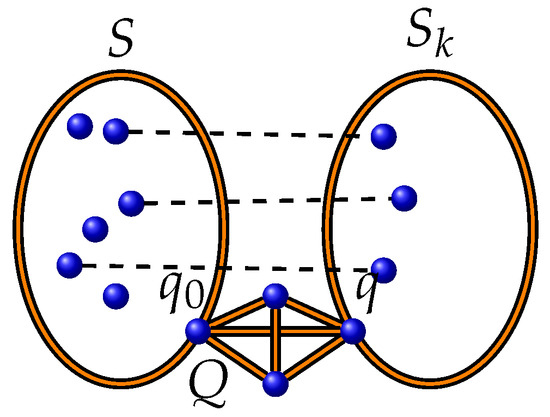
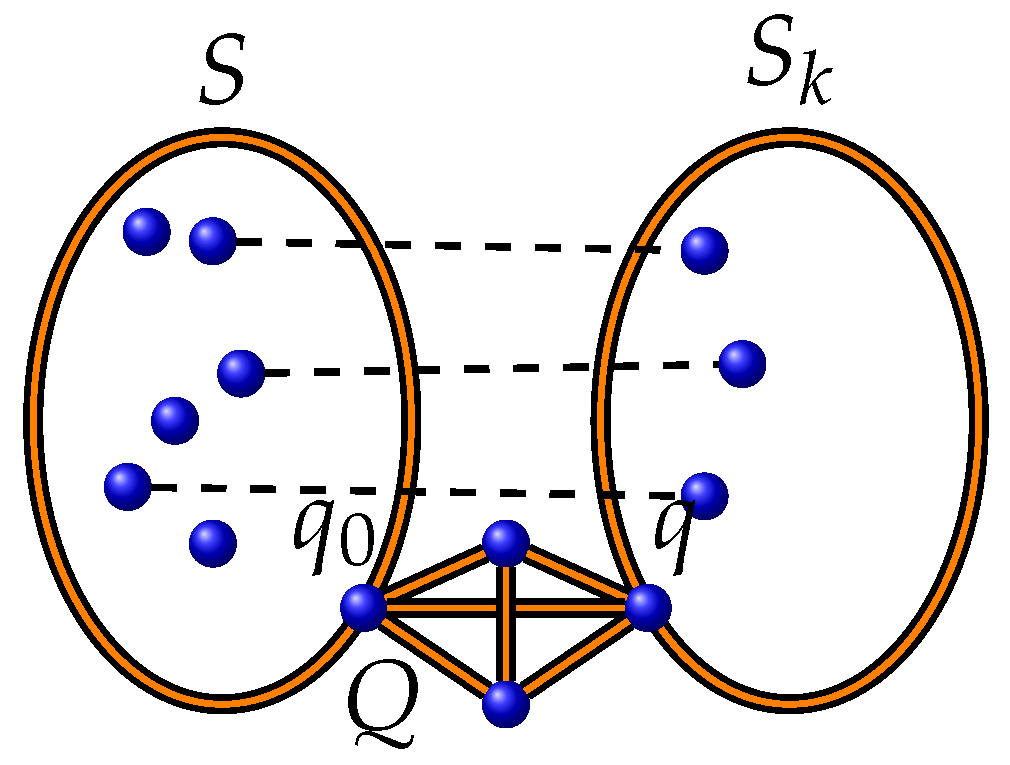
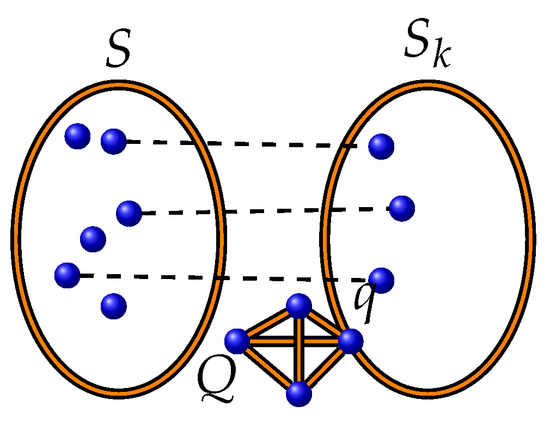
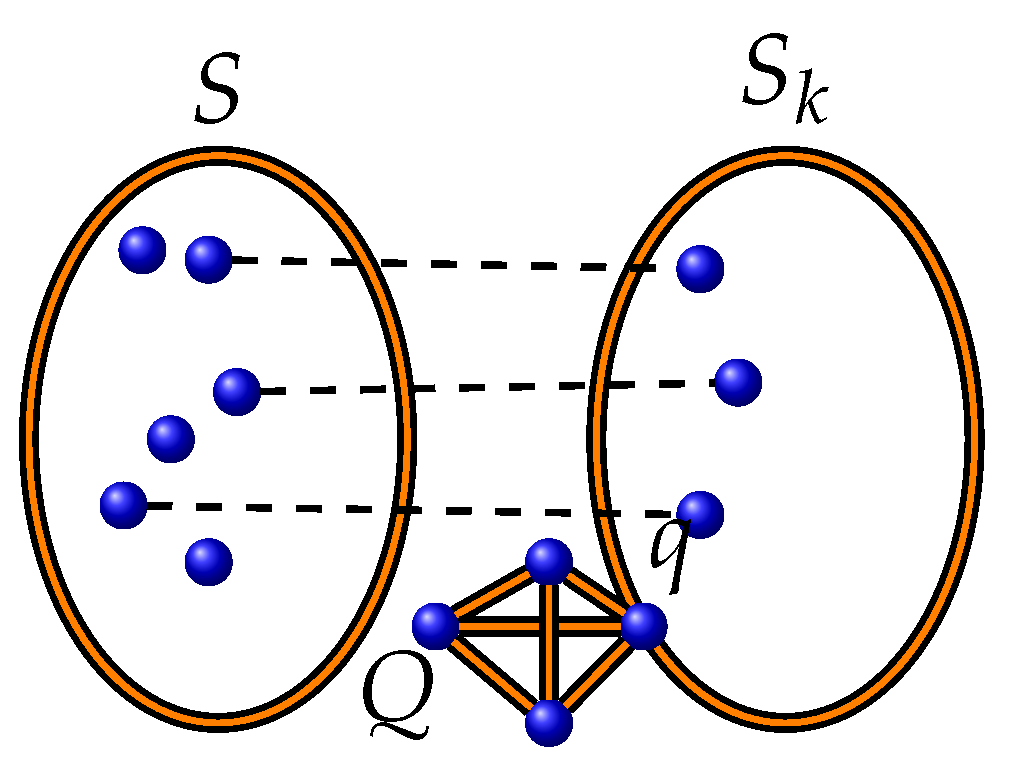
By Lemma 1, we can construct a new maximum independent set using any independent set that satisfies the conditions of Lemma 1. The number of suitable vertices to generate different independent sets is less than or equal to (since we can use only one vertex from the maximum clique), resulting in no more than maximum independent sets. There are two cases to form the set :
- 1.
- (see Figure 3). In this case, , and we have at mostmaximum independent sets. Note that if , the upper limit of the summation must be .Figure 3. and .
- 2.
- (see Figure 4). In this case, , and we can use vertices (except ) instead of q from the maximum clique Q. Thus, we have at mostmaximum independent sets. If , then the upper limit of the summation is equal to .Figure 4. and .
Example 1.
In the case where , we have a complete graph with , where , , and .
Example 2.
In the case where G is a graph with the number of edges , we have the independence number , the clique number , and the number of maximum independent sets . Moreover,
Example 3.
A CIS graph is a graph in which every maximal independent set and every maximal clique intersect [28] (CIS stands for “Cliques Intersect Stable Sets”). Note that the CIS graph satisfies the conditions of Theorem 6.
2.2.2. An Upper Bound for , When There Exist a Maximum Independent Set and a Maximum Clique That Have an Empty Intersection
Theorem 7.
Let G be a graph in which there exist a maximum independent set and a maximum clique such that Then,
Proof.
Note that in this case, G cannot be a complete graph, which implies that . By Lemma 1, we can construct a new maximum independent set based on any independent set that satisfies the conditions of Lemma 1. The number of suitable vertices available to generate different independent sets is at most , and there are at most maximum independent sets. Two cases arise for forming the set :
- 1.
- . In this case (see Figure 5), there are at mostmaximum independent sets that do not intersect with Q.Figure 5. and .
- 2.
- . In this situation (see Figure 6), it is possible to generate independent set using all vertices from Q. Thus, we have at mostmaximum independent sets.Figure 6. and .
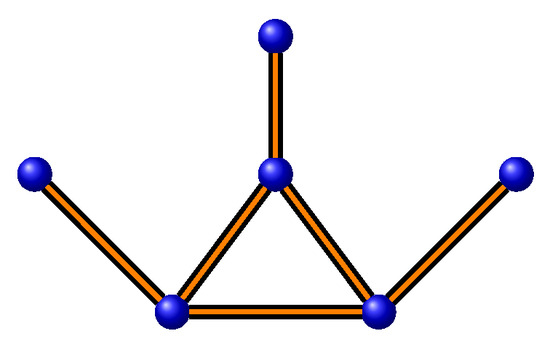
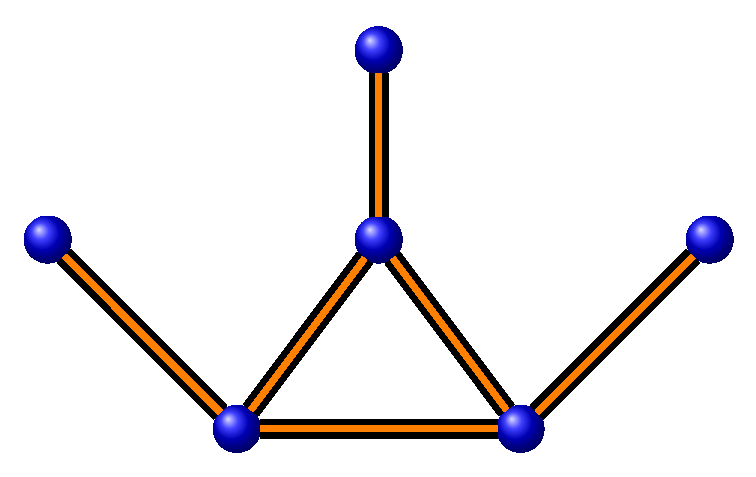
Example 4.
Figure 7.
The corona graph.
Example 5.
Inequality 3 reaches an equality for all graphs of type . Here, we have , , , and , with .
Thus, we conclude that .
2.2.3. Comparison of the Two Upper Bounds
Proof.
- 1.
- Let , that is, the graph consists of isolated vertices, and , , , and , as detailed in Example 2. In this case,Hence, .
- 2.
- In the case where , we have a complete graph with . As detailed in Example 1, andHence, .
- 3.
- Thus, calculating occurs as follows:The last inequality follows from the facts that and .
This completes the proof. □
Corollary 1.
Proof.
Clearly, Theorems 6–8 imply that the inequality
holds for every graph. It immediately follows from the above inequality that
Indeed, if , then the first term of is equal to 0, and the second term is the sum of all the binomial coefficients. □
Corollary 2.
If G is a triangle-free graph, then
Proof.
In fact, by the definition of a triangle-free graph, . Then, substituting 2 for in (5), we obtain the desired result. □
The results obtained in Corollaries 3 and 4 allow an estimation of the total number of maximum independent sets using and allow for a more accurate estimation of . Theorems 6 and 7 provide two bounds on the number of maximum independent sets of a graph. Notably, the family H of all simple graphs can be decomposed into two disjoint subfamilies and , where satisfies the conditions of Theorem 6, and satisfies the conditions of Theorem 7: and . Thus, we can estimate based on inequality (2), resulting in a weaker bound (Theorem 8) compared to inequality (3).
2.3. Upper Bounds for Using
Let G be a graph in which is not an empty set. We ask whether it is possible to use this additional information to improve the accuracy of the upper bound of . To address this, we define a new graph and investigate the relationships between and , respectively.
Theorem 9.
The cardinality of an independent set A in G such that is less than or equal to ; in other words,
Proof.
If , then . As a result, is also an independent set in G with Since defines the size of a maximum independent set in G, it follows that , as claimed. □
Corollary 3.
.
Proof.
By Theorem 9, we have . The equality is achieved for all , since for every , we have . Thus, and . Consequently, is the maximum independent set in . □
Corollary 4.
.
Proof.
By Corollary 3, if , then . On the other hand, if , then is independent in G. Hence, , according to Corollary 3.
All in all, the set of all maximum independent sets in is formed by removing the from each set in , as required. □
Corollary 5.
Let G be a graph such that for every and every we have . Then,
Proof.
First, note that the number of vertices in a maximum clique is at least Indeed, may share only one vertex with and may contain all vertices from . Thus,
□
Corollary 6.
Let G be a graph in which there exist and such that . Then,
Proof.
First, note that the number of vertices in a maximum clique is at least . Indeed, does not intersect with and may contain vertices from . Thus,
□
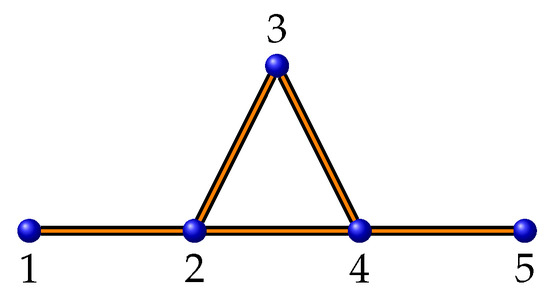
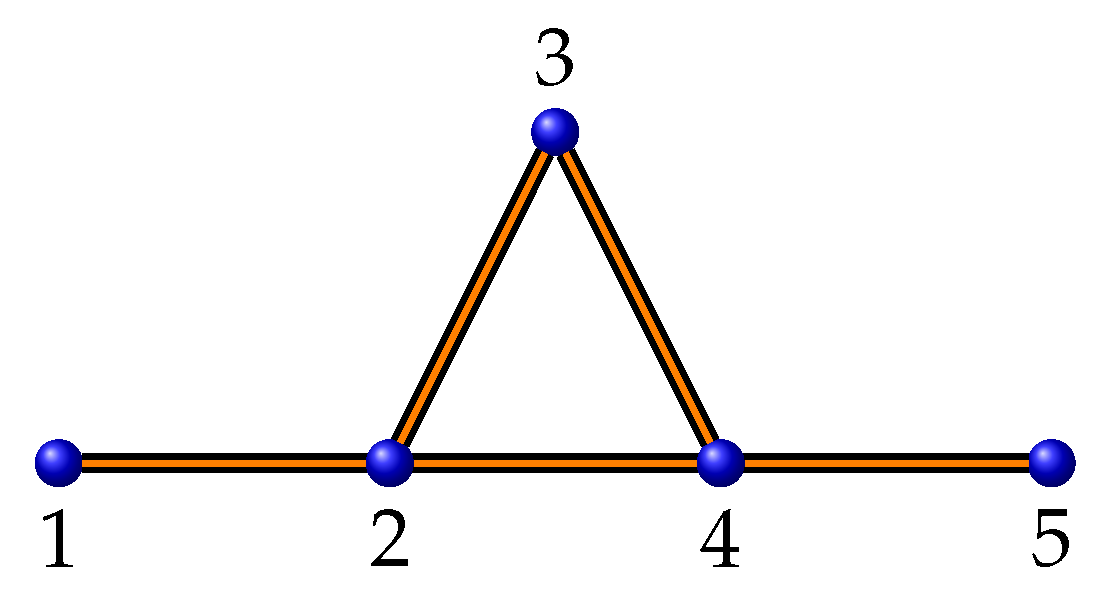
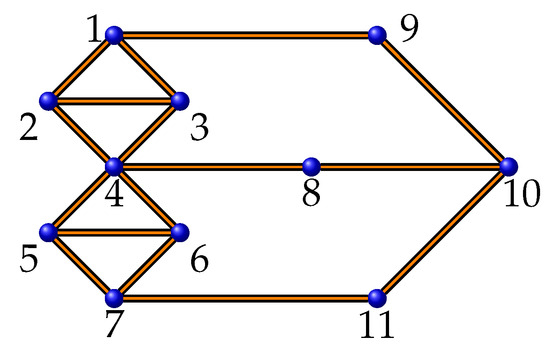
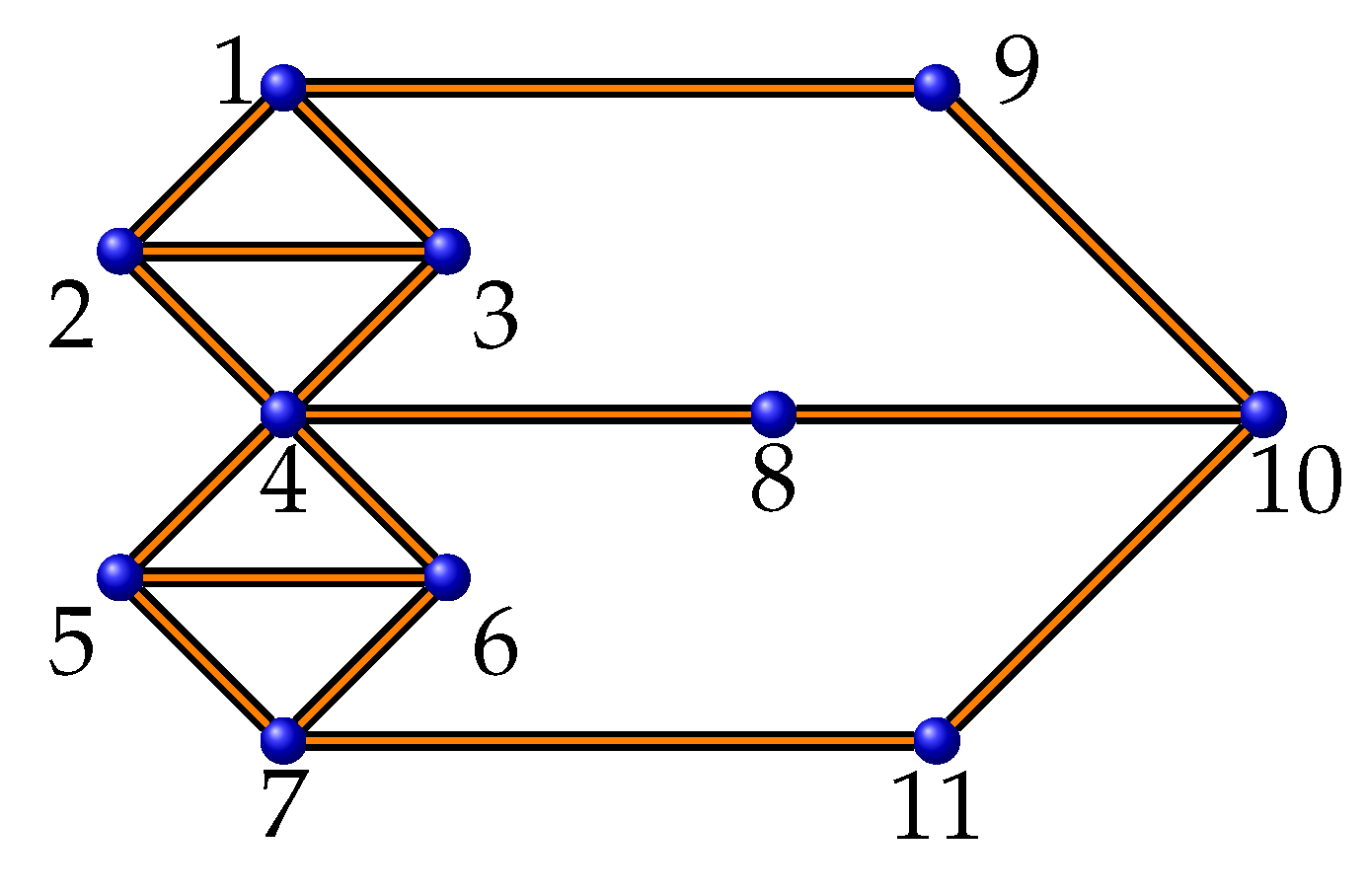
Example 6.
Consider a graph that satisfies the conditions of Corollary 5 and where (see Figure 8). Here, we have , . Thus, , leading to
Figure 8.
.
2.3.1. An Upper Bound for , Using , When Every Maximum Independent Set Has a Nonempty Intersection with Every Maximum Clique
Theorem 10.
Let G be a graph such that for every and every , we have Then,
Proof.
First, by Theorem 6, Corollary 3, and Corollaries 4 and 5, we have
Indeed, if , then the first term of the inequality is equal to 0, the second term is the sum of all the binomial coefficients, and we obtain the desired result. □
Example 7.
Inequality (6) reaches an equality when there exists a unique maximum independent set [12]. Specifically, when , we have and . Therefore,
Example 8.
Let G be a graph with a nonempty such that for all and all , (see Figure 9). Here, we have , , and
According to Corollary 1, we have , leading to the following:
Now, let us evaluate using the . Since , in accordance to Theorem 10, we obtain the following:
Figure 9.
A graph with the nonempty .
Thus, utilizing the of the graph provides a better estimate for .
2.3.2. An Upper Bound for , Using , When There Exist a Maximum Independent Set and a Maximum Clique That Have an Empty Intersection
Theorem 11.
Let G be a graph in which there exists a maximum independent set and a maximum clique such that Then,
Proof.
First, by Theorem 7 and Corollaries 3, 4 and 6, we have
Indeed, if , then the first term of the inequality is equal to 0, the second term is the sum of all the binomial coefficients, and we obtain the desired result. □
2.3.3. Comparison of the Two Upper Bounds Using
Proof.
□
Corollary 7.
Proof.
Clearly, Theorems 10–12 imply that the inequality
holds for any graph. It immediately follows from the above inequality that inequality (11) holds. Indeed, if , then the first term of is equal to 0, and the second term is the sum of all the binomial coefficients. □
The results from Corollary 7 enable an estimation of the total number of maximum independent sets using and allow for a more accurate estimation of . Theorems 10 and 11 provide two bounds on the number of maximum independent sets of a graph. Notably, the family H of all simple graphs can be decomposed into two disjoint subfamilies and , where satisfies the conditions of Theorem 10, and satisfies the conditions of Theorem 11: and . Thus, we can estimate based on inequality (6), resulting in a weaker bound (Theorem 12) compared to inequality (8).
Corollary 8.
If G is a triangle-free graph, then
Proof.
In fact, by the definition of a triangle-free graph, . Then, using as a weaker estimate and substituting 2 for in inequality (11), we obtain the desired result. □
Lemma 2.
If G is a König–Egerváry graph with , then
Proof.
In accordance with Theorem 1, we have
Therefore,
Now, given the fact, that , we have
from which it follows that , as claimed. □
Corollary 9.
If G is a bipartite graph with , then
Proof.
According to a well-known result of König [29] and Egerváry [30], every bipartite graph is König–Egerváry, i.e., . Hence, if , then . Moreover, each bipartite graph is triangle-free. Thus, the proof follows from Corollary 8 and Lemma 2. □
2.4. Upper Bounds for Using
Let G be a graph. We ask once more whether it is possible to improve the accuracy of the upper bound of . To address this we define a new graph
and investigate the relationships between and , respectively.
Lemma 3.
.
Proof.
Let , then because consists of the union of all ; hence, . Let , then because graph includes all S values belonging to G. It follows from this that . □
Corollary 10.
.
Proof.
The first three equalities follow directly from Lemma 3. The fourth inequality is true, because is an induced subgraph of G. □
Corollary 11.
Let G be a triangle-free graph, then
Proof.
First, if G is triangle-free, then is triangle-free as well, i.e., In accordance with Corollaries 8 and 10, for graph , we obtain the following:
- Case 1: . In accordance with Theorem 3, is true for every graph. Hence, in this instance, and
- Case 2: , i.e., . Then,Therefore, , because
□
Corollary 12.
If G is a bipartite graph, then
Proof.
According to a well-known result of König [29] and Egerváry [30], every bipartite graph is König–Egerváry. Moreover, every bipartite graph is triangle-free. Thus, the proof follows from Corollary 11 and Theorem 4. □
3. Comparisons
We are now in a position to compare our results with the corresponding inequalities presented in [21,23,31,32].
3.1. Comparison with the Bounds Due to Zito [31], and Mohr and Rauthenbah [21]
Mohr and Rauthenbah showed that Zito’s [31] bound for trees [21] can be written in the form , if . Generalizing this result, Mohr and Rauthenbah proved that the number of maximum independent sets of a tree of order n and independence number is at most if , and if [21].
Now, let us compare the above findings with our bounds:
3.2. Comparison with the Bounds Due to Mohr and Rauthenbah [23]
Clearly, if , then
Hence, in accordance with [23], can be can be bounded as follows:
Claim 1.
Let . Bound (11) is preferable in comparison with when and .
Proof.
First, if and , then
Then, by Corollary 7, if and then
□
Claim 2.
Let G be a triangle-free graph with . Bound (13) is preferable in comparison with when .
Proof.
According to Corollary 11,
as claimed. □
Corollary 13
([4]). If G is a connected graph with , then
Claim 3.
Let G be a bipartite graph with , then the bound (13) is preferable in comparison with .
Proof.
Every bipartite graph is König–Egerváry, i.e., . Hence, if , then . Moreover, each bipartite graph is triangle-free. According to Corollary 13, . Consequently, . Thus, by Corollary 12, we obtain
□
3.3. Comparison with the Bounds Due to Jarden [33], and Deniz, Levit and Mandrescu [32]
Jarden [33] proved that for every König–Egerváry graph, the inequality holds, which is stronger than , as shown in [32], because for every König–Egerváry graph, while for every graph. The inequality coincides with the result obtained in Corollary 12 for bipartite graphs. On the other hand, Corollary 11 proves an even stronger inequality for triangle-free graphs.
4. An Application: Upper Bounds on the Numbers of Longest Increasing Subsequences and Longest Decreasing Subsequences
Consider the sequence of different real numbers, and define the partial order of pairs as follows: if and . This partial order induces a comparability graph G. The complement graph is defined by reverse order: if and . Consequently, both G and its complement are comparability graphs, indicating that G is a permutation graph. Thus, we can view a sequence of different real numbers as a permutation graph, where its longest increasing subsequence corresponds to a maximum independent set in G, and its longest decreasing subsequence corresponds to a maximum clique in G. In particular, an increasing subsequence can share at most one element with a decreasing subsequence.
For a sequence of different real numbers , we denote the following: S-the longest increasing subsequence; Q-the longest decreasing subsequence; -the length of the longest increasing subsequence; -the number of all longest increasing subsequences; the length of the longest decreasing subsequence; and -the number of all longest decreasing subsequences.
Corollary 14.
Let be a sequence of different real numbers. Then, we have the following:
Proof.
From Corollary 1, it immediately follows that
Thus, inequality (16) holds. □
Corollary 15.
Let be a sequence of different real numbers. Then,
Proof.
From Corollary 14, we also have the following:
Now, let us multiply (16) and (18):
According to [34], the necessary and sufficient conditions for the existence of a sequence of length containing a longest increasing subsequence of length and a longest decreasing subsequence of length are given by the following:
Therefore, we have
Thus, inequality (17) holds. □
Corollary 16.
Let be a sequence of different real numbers. Then,
Example 9.
Consider a sequence, where every longest increasing subsequence intersects every longest decreasing subsequence. Let
Example 10.
Consider a sequence, where there exist a longest increasing subsequence B and a longest decreasing subsequence C such that . Let
5. Conclusions
The present work provides new upper bounds on the number of maximum independent sets in several classes of graphs and identifies structural features that influence these values. The obtained results suggest a number of directions for further investigation.
A natural first step is to refine our upper bounds by incorporating additional graph invariants. In particular, parameters such as the matching number, and, potentially, others of a similar nature are expected to yield sharper estimates. Another promising direction is the study of specific graph families, such as comparability graphs, permutation graphs, etc. Their structural properties appear well fitted for deriving more accurate estimates for the number of maximum independent sets, and may lead to exact results in certain subclasses.
We also propose Conjecture 1 on the number of longest increasing and decreasing subsequences in a sequence of distinct real numbers. The conjecture asserts that
In view of this conjecture, the estimates for the products and , obtained in (17) and (20), naturally invite further refinement.
Overall, the results established here indicate that the interaction between the extremal subsequence structure and the underlying graph-theoretic representations remains rich and far from fully understood. Further progress on the questions outlined above is likely to contribute substantially to the theory of extremal combinatorics on graphs and sequences.
Author Contributions
Conceptualization, V.E.L.; Formal analysis, V.E.L. and E.J.I. Original draft preparation, E.J.I.; Review and editing, V.E.L. and E.J.I. All authors have read and agreed to the published version of the manuscript.
Funding
This research received no external funding.
Data Availability Statement
No new data were created or analyzed in this study. Data sharing is not applicable to this article.
Acknowledgments
We thank the reviewers for their careful reading and valuable remarks. Their feedback enhanced the presentation and prompted us to obtain sharper bounds. We especially appreciate the reviewer who suggested comparing our results with those known in the literature.
Conflicts of Interest
The authors declare no conflict of interest.
References
- Gavril, F. Testing for equality between maximum matching and minimum node covering. Inf. Process. Lett. 1977, 6, 199–202. [Google Scholar] [CrossRef] [Scilit]
- Deming, R.W. Independence numbers of graphs-an extension of the König-Egerváry theorem. Discret. Math. 1979, 27, 23–33. [Google Scholar] [CrossRef] [Scilit]
- Sterboul, F. A characterization of the graphs in which the transversal number equals the matching number. J. Comb. Theory Ser. B 1979, 27, 228–229. [Google Scholar] [CrossRef] [Scilit]
- Boros, E.; Golumbic, M.C.; Levit, V.E. On the number of vertices belonging to all maximum stable sets of a graph. Discret. Appl. Math. 2002, 124, 17–25. [Google Scholar] [CrossRef] [Scilit]
- Levit, V.E.; Mandrescu, E. A set and collection lemma. Electron. J. Comb. 2014, 21, 1–40. [Google Scholar] [CrossRef] [Scilit] [PubMed]
- Frucht, R.; Harary, F. On the corona of two graphs. Aequationes Math. 1970, 4, 322–325. [Google Scholar] [CrossRef] [Scilit]
- Harary, F. Graph Theory; Addison-Wesley: Reading, MA, USA, 1994. [Google Scholar]
- Gilmore, P.C.; Hoffman, A.J. A characterization of comparability graphs and of interval graphs. Can. J. Math. 2010, 16, 539–548. [Google Scholar] [CrossRef] [Scilit]
- Golumbic, M.C. Containment orders—A lifelong journey. AKCE Int. J. Graphs Comb. 2024, 24, 209–217. [Google Scholar] [CrossRef] [Scilit]
- Erdős, P.; Moser, L. Problem 11. Can. Math. Bull. 1959, 2, 43. [Google Scholar]
- Moon, J.W.; Moser, L. On cliques in graphs. Isr. J. Math. 1965, 3, 23–28. [Google Scholar] [CrossRef] [Scilit]
- Hopkins, G.; Staton, W. Graphs with unique maximum independent sets. Discret. Math. 1985, 57, 245–251. [Google Scholar] [CrossRef] [Scilit]
- Hedman, B. The maximum number of cliques in dense graphs. Discret. Math. 1985, 54, 161–166. [Google Scholar] [CrossRef] [Scilit]
- Liu, J. Maximal and Maximum Independent Sets in Graphs. Ph.D. Dissertation, Department of Mathematics and Statistics, Western Michigan University, Kalamazoo, MI, USA, 1992. [Google Scholar]
- Jou, M.J.; Chang, G.J. Survey on counting maximal independent sets. In Proceedings of the Second Asian Mathematical Conference, Ratchasima, Thailand, 17–20 October 1995. [Google Scholar]
- Jou, M.J. Counting Independent Sets. Ph.D Dissertation, Department of Applied Mathematics, National Chiao Tung University, Taiwan, China, 1996. [Google Scholar]
- Jou, M.J.; Chang, G.J. Algorithmic aspects of counting independent sets. Ars Comb. 2002, 65, 265–277. [Google Scholar]
- Sagan, B.E.; Vatter, V.R. Maximal and maximum independent sets in graphs with at most r cycles. J. Graph Theory 2006, 53, 283–314. [Google Scholar] [CrossRef] [Scilit]
- Derikvand, T.; Oboudi, M.R. On the number of maximum independent sets of graphs. Trans. Comb. 2014, 3, 29–36. [Google Scholar]
- Zhao, Y. Extremal regular graphs: Independent sets and graph homomorphisms. Am. Math. Mon. 2017, 124, 827–843. [Google Scholar] [CrossRef] [Scilit]
- Mohr, E.; Rautenbach, D. On the maximum number of maximum independent sets. Graphs Comb. 2018, 34, 1729–1740. [Google Scholar] [CrossRef] [Scilit]
- Shan, L.; Li, H.; Zhang, Z. Independence number and the number of maximum independent sets in pseudofractal scale-free web and Sierpiński gasket. Theor. Comput. Sci. 2018, 720, 47–54. [Google Scholar] [CrossRef] [Scilit]
- Mohr, E.; Rautenbach, D. On the maximum number of maximum independent sets in connected graphs. J. Graph Theory 2021, 96, 510–521. [Google Scholar] [CrossRef] [Scilit]
- Jou, M.J.; Chang, G.J. The number of maximum independent sets in graphs. Taiwan. J. Math. 2000, 4, 685–695. [Google Scholar] [CrossRef] [Scilit]
- Sun, W.; Li, S. On the maximum number of maximum independent sets of bipartite graphs. Mediterr. J. Math. 2024, 21, 128. [Google Scholar] [CrossRef] [Scilit]
- Han, M.; Herlihy, S.; Kuenzel, K.; Martin, D.; Schmidt, R. The number of independent sets in bipartite graphs and benzenoids. Aequationes Math. 2025, 99, 1175–1195. [Google Scholar] [CrossRef] [Scilit]
- Berge, C. Some common properties for regularizable graphs, edge-critical graphs, and B-graphs. Ann. Discret. Math. 1982, 12, 31–44. [Google Scholar]
- Grillet, P.A. Maximal chains and antichains. Fundam. Math. 1969, 65, 15–167. [Google Scholar] [CrossRef] [Scilit]
- König, D. Graphen und matrizen. Mat. Lapok 1931, 38, 116–119. [Google Scholar]
- Egerváry, E. On combinatorial properties of matrices. Mat. Lapok 1931, 38, 16–28. [Google Scholar]
- Zito, J. The structure and maximum number of maximum independent sets in trees. J. Graph Theory 1991, 15, 207–221. [Google Scholar] [CrossRef] [Scilit]
- Deniz, Z.; Levit, V.E.; Mandrescu, E. On graphs admitting two disjoint maximum independent sets. Art Discret. Appl. Math. 2023, 6, ♯P1.01. [Google Scholar] [CrossRef] [Scilit]
- Jarden, A. The maximum cardinality of a hereditary König–Egerváry set-system. Adv. Appl. Discret. Math. 2017, 18, 437–444. [Google Scholar]
- Itskovich, E.J.; Levit, V.E. What do a longest increasing subsequence and a longest decreasing subsequence know about each other? Algorithms 2019, 12, 237. [Google Scholar] [CrossRef] [Scilit]
Disclaimer/Publisher’s Note: The statements, opinions and data contained in all publications are solely those of the individual author(s) and contributor(s) and not of MDPI and/or the editor(s). MDPI and/or the editor(s) disclaim responsibility for any injury to people or property resulting from any ideas, methods, instructions or products referred to in the content. |
© 2025 by the authors. Licensee MDPI, Basel, Switzerland. This article is an open access article distributed under the terms and conditions of the Creative Commons Attribution (CC BY) license (https://creativecommons.org/licenses/by/4.0/).