Two-Dimensional Coupling-Enhanced Cubic Hyperchaotic Map with Exponential Parameters: Construction, Analysis, and Application in Hierarchical Significance-Aware Multi-Image Encryption

 ,
,  , , , , , and
Abstract
1. Introduction
- We construct a new hyperchaotic map called 2D-CCHM-EP. By incorporating exponential terms to accelerate trajectory divergence and strengthen state interdependence, the map achieves robust hyperchaotic behavior.
- We rigorously demonstrate that the 2D-CCHM-EP exhibits strict local expansiveness across its entire parameter space, a key theoretical finding that guarantees the effective suppression of periodic windows. Comprehensive dynamical analyses validate its superior chaotic performance and randomness compared with several recent maps.
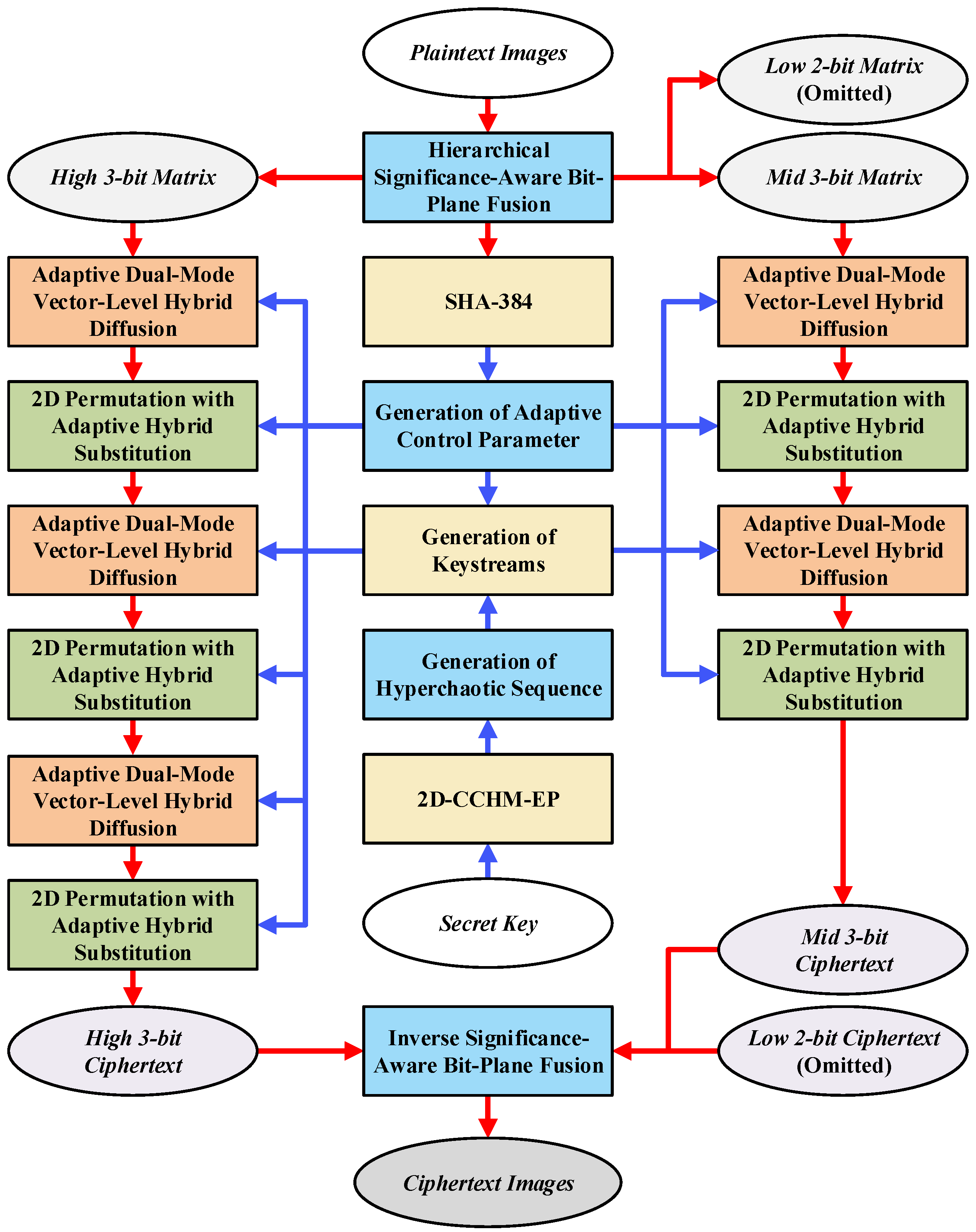
- We develop a hierarchical significance-aware multi-image encryption algorithm based on the 2D-CCHM-EP (MIEA-CPHS). This algorithm introduces a novel strategy that decomposes images into high-, medium-, and low-significance layers, applying differentiated encryption rounds to optimally balance security and speed.
- The algorithm integrates an SHA-384-based adaptive parameter mechanism with high-performance vector-level operations. This mechanism dynamically generates a 48-bit control parameter from the fused data, ensuring extreme plaintext sensitivity (NPCR , UACI ) and enabling data-integrity verification.
- Extensive experiments confirm that the MIEA-CPHS achieves an outstanding balance between high security and efficiency, yielding an average encryption throughput of 87.6152 Mbps, significantly outperforming recent benchmarks and making it highly suitable for modern high-throughput applications.
2. Construction and Dynamical Analysis of 2D-CCHM-EP
2.1. Construction of 2D-CCHM-EP
- Exponential Repulsion Mechanism: The linear coefficients in the original map are replaced by exponential modulators and . As verified later in Equation (4), these terms ensure that the eigenvalues of the Jacobian at the origin are and . For , we have . This theoretically guarantees that the fixed point acts as a strong unstable repeller regardless of parameter fluctuations, solving the weak divergence issue found in some polynomial-based maps such as the original 2D Cubic map.
- Full State Coupling: A linear coupling term is introduced into the equation for . In the original 2D Cubic map, the decoupling of from results in a sparse Jacobian matrix, making the system vulnerable to parameter-driven degradation and reducing the statistical independence between dimensions. Our modification ensures a fully dense Jacobian (Equation (3)), enforcing bidirectional state dependence to mitigate these degradation phenomena.
- Scaling for Strict Local Expansiveness (): The coefficient is not an arbitrary choice but a theoretically derived bound. As demonstrated in Section 2.2.2, this specific scaling ensures that even in the worst-case scenario (, ), the smaller eigenvalue remains strictly above unity (). Without this scaling, the system could violate the strict expansion condition, leading to periodic windows.
2.2. Dynamical Analysis
2.2.1. Fixed Points and Stability Analysis
2.2.2. Jacobian Matrix and Local Expansiveness Analysis
2.3. Numerical Verification of Dynamical Behaviors
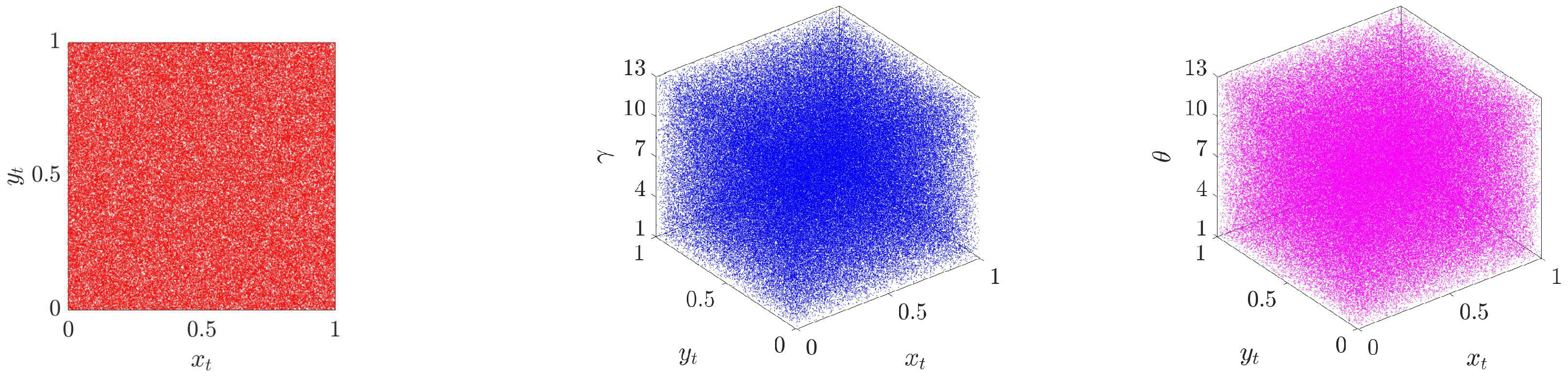
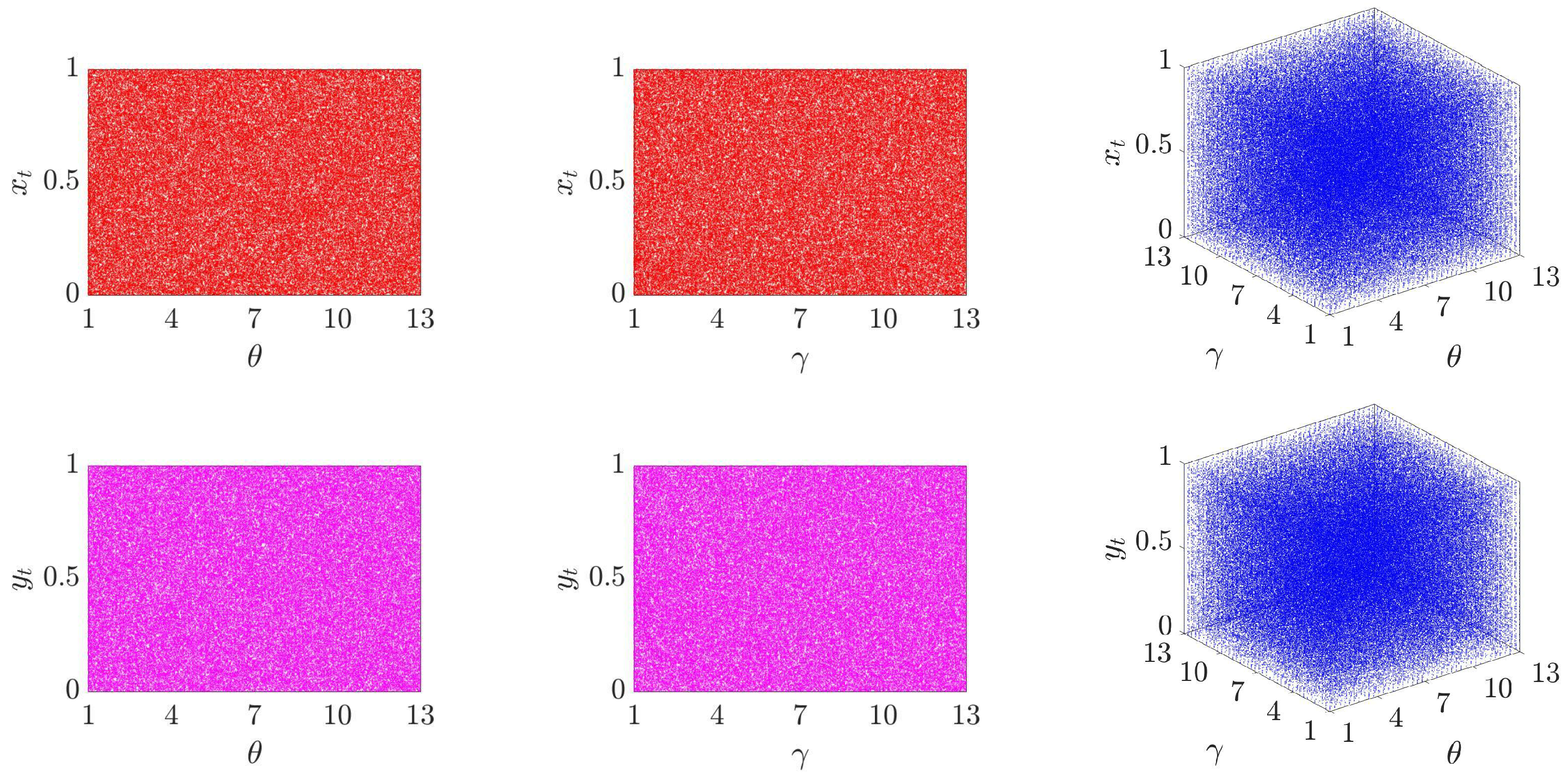
2.3.1. Trajectory Analysis
2.3.2. Bifurcation Diagram
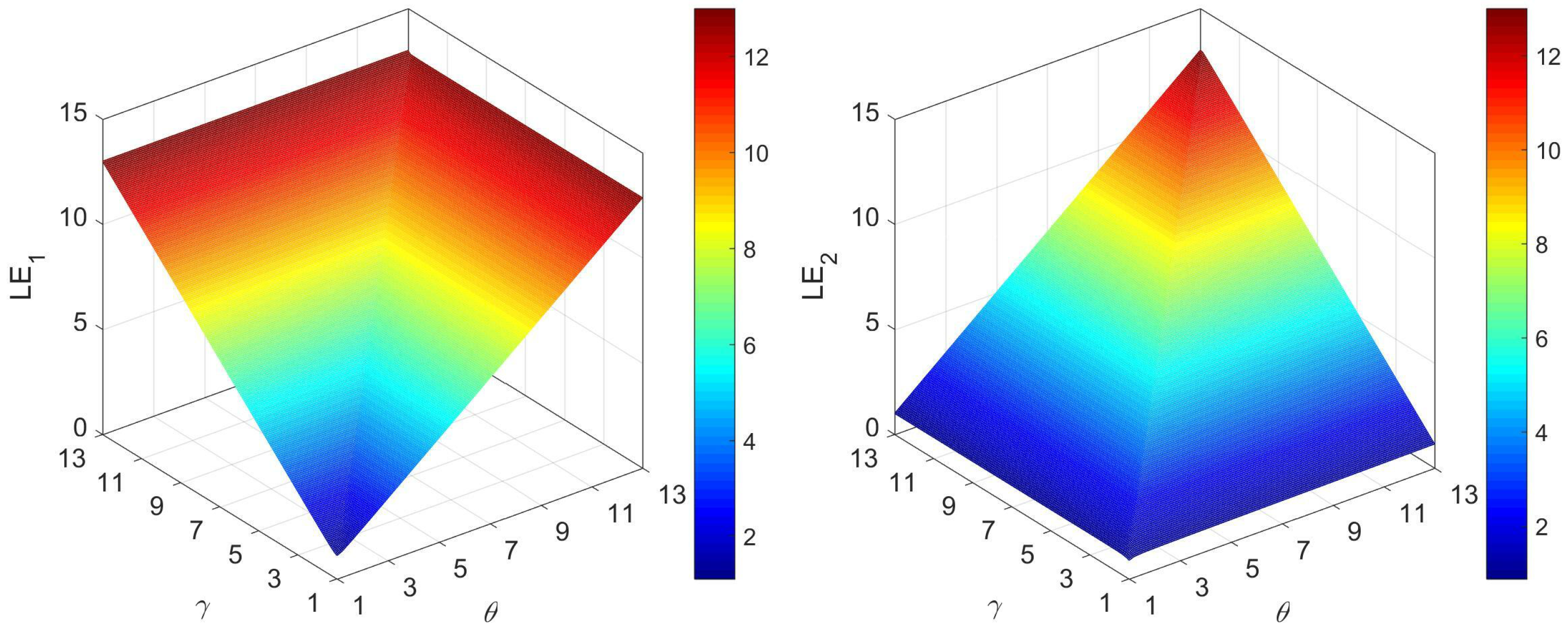
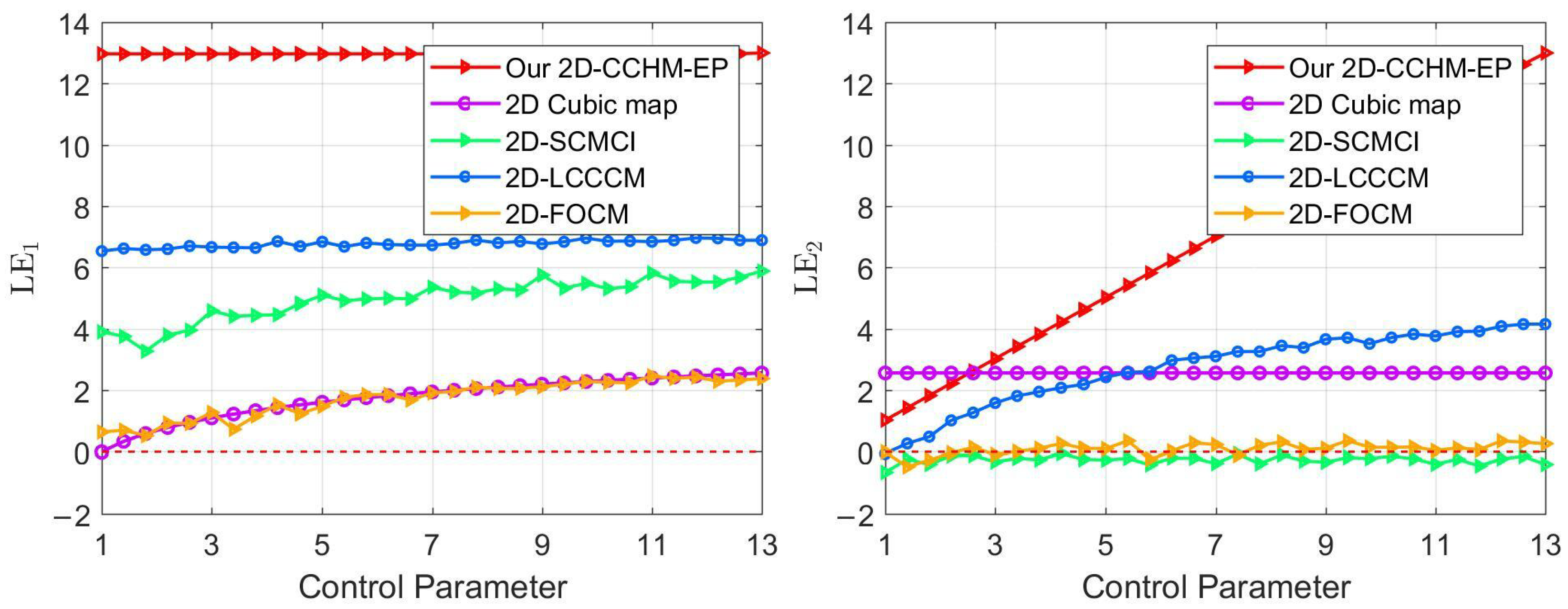
2.3.3. Lyapunov Exponents
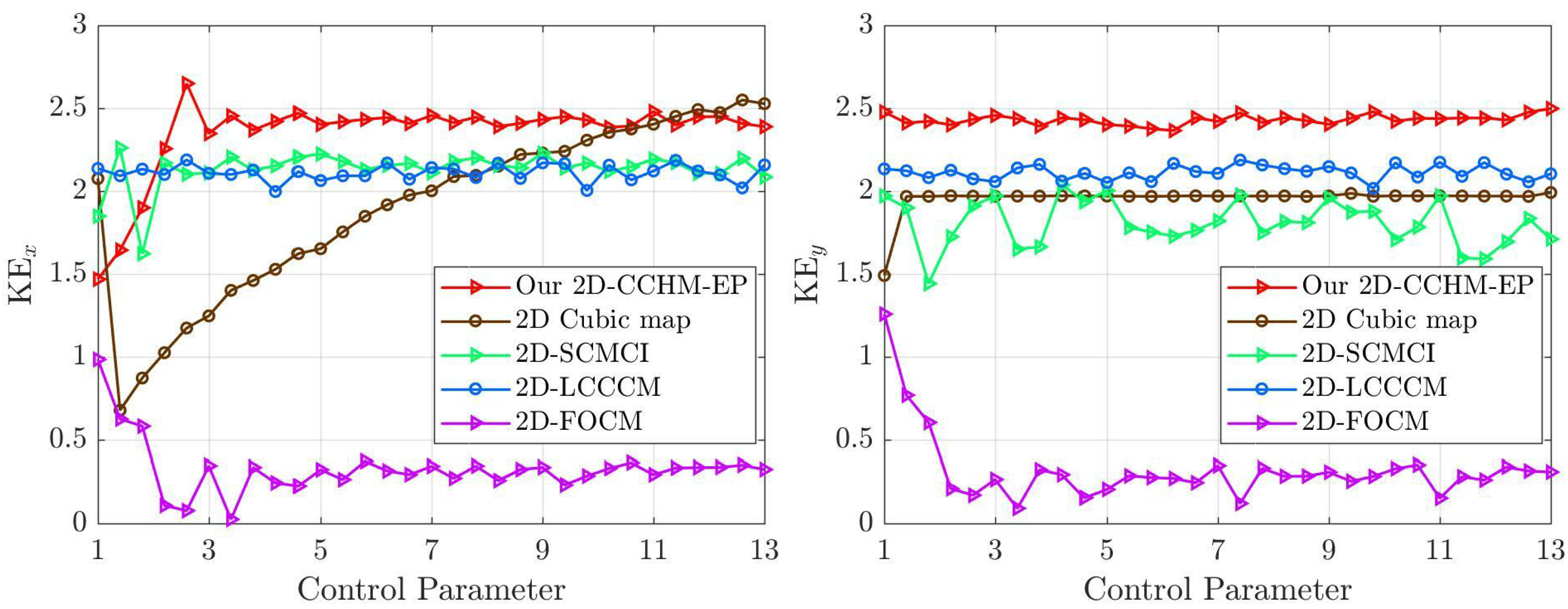
2.3.4. Kolmogorov–Sinai Entropy
2.4. Randomness Test
3. Proposed MIEA-CPHS
3.1. Generation of Hyperchaotic Sequence
- Step 1 (Length Determination): For the 3D image tensor of size , we compute the effective fused dimensions as and . The total number of required hyperchaotic samples iswhere the additional 1024 samples are reserved to enhance plaintext sensitivity in later encryption stages.
- Step 2 (Raw Sequence Generation): Using the first eight components of as initial parameters, we alternately iterate the two instances of the 2D-CCHM-EP and concatenate their state outputs in the order at each iteration. This yields a raw hyperchaotic sequence .
- Step 3 (Key-Controlled Transient Removal): The first samples of are discarded, where is the last component of , yielding the truncated sequence
- Step 4 (Sequence Extraction): From , the first samples are extracted to form the hyperchaotic sequencewhich is used in the subsequent hierarchical significance-aware bit-plane fusion stage. The full sequence is reserved for the keystream generation in Section 3.4.
3.2. Hierarchical Significance-Aware Bit-Plane Fusion
- High-Significance Layer (Three Rounds): This layer (bits 8–6) encapsulates over 94% of the total visual energy and possesses extremely strong spatial correlations. A single encryption round is mathematically insufficient to thoroughly disrupt these patterns. Therefore, three rounds are strictly necessary to guarantee the security of the most critical visual data against statistical attacks.
- Mid-Significance Layer (Two Rounds): Containing intermediate textural details, this layer represents a transition zone. Two rounds serve as an optimal equilibrium point, providing a safety margin superior to a single round without the computational cost of the full three-round process.
- Low-Significance Layer (One Round): These bits (2–1) statistically resemble random noise with negligible correlation. Applying multiple rounds here yields diminishing returns in security while tripling the computational overhead. Thus, a single round is sufficient to maximize throughput without compromising overall visual security.
| Algorithm 1 Hierarchical Significance-Aware Bit-Plane Fusion in MIEA-CPHS. |
|
3.3. Generation of Adaptive Control Parameter
- Step 1 (Multi-Tier XOR Fusion): Perform element-wise XOR across the three significance-aware matrices:
- Step 2 (Cryptographic Hashing): Compute the SHA-384 hash digest of , resulting in a 48-byte vector:This digest is transmitted to the receiver for parameter reconstruction and integrity checking.
- Step 3 (Block-Wise Product Computation): Partition into eight consecutive 6-byte blocks. For the i-th block (), compute the product of its bytes:
- Step 4 (Modular Accumulation): Accumulate all block products modulo to obtain the final 48-bit adaptive control parameter:
3.4. Generation of Keystreams
- Step 1 (Hash-Controlled Sequence Trimming): Let be the adaptive control parameter from Section 3.3. Compute a hash-derived discard offset:The pre-generated hyperchaotic sequence (from Section 3.1) is then trimmed to retain the segmentwhere and are the fused dimensions defined in Section 3.2.
- Step 2 (Permutation Keystreams for High-Significance Layer): Denote and . The first permutation keystream for the high-significance layer is extracted asThe second and third permutation keystreams are derived via modular multiplication:These three keystreams control the three rounds of 2D permutation within the “2D Permutation with Adaptive Hybrid Substitution” stage: drives the first round, the second, and the third, ensuring dynamic and non-repeating spatial shuffling.
- Step 3 (Permutation Keystreams for Medium-Significance Layer): The medium-significance layer employs two permutation keystreams:These control the first and second rounds of 2D permutation for the medium-significance fused matrix, respectively.
- Step 4 (Permutation Keystream for Low-Significance Layer): The low-significance layer uses a single permutation keystream:which drives the sole round of 2D permutation for this layer.
- Step 5 (Substitution Keystreams for High-Significance Layer): The first block of samples from is scaled under modulus :with auxiliary matrices generated via modular multiplication:Each is reshaped into an matrix and applied in a distinct round of hybrid diffusion and hybrid substitution: in round 1, in round 2, and in round 3.
- Step 6 (Substitution Keystreams for Medium-Significance Layer): The second block yieldsThese matrices are used in the first and second rounds of hybrid diffusion and hybrid substitution for the medium-significance layer, respectively.
- Step 7 (Substitution Keystream for Low-Significance Layer): The third block is scaled under modulus :and reshaped into an matrix that drives the single round of hybrid diffusion and hybrid substitution for the low-significance component.
3.5. Adaptive Dual-Mode Vector-Level Hybrid Diffusion
| Algorithm 2 Adaptive Dual-Mode Vector-Level Hybrid Diffusion in MIEA-CPHS. |
|
- Round 1: , ,
- Round 2: , ,
- Round 3: , .
3.6. 2D Permutation with Adaptive Hybrid Substitution
- 2D Permutation: The input matrix is shuffled row-wise and column-wise using sorted indices derived from the permutation vector .
- Segmented Modular Addition: The permuted matrix undergoes a three-segment horizontal (column-wise) modular addition, where segment boundaries are dynamically determined by .
- Adaptive Dual-Mode Substitution: Depending on , the result is either combined with via modular addition or bitwise XOR, enabling a dual-mode, key-driven substitution mechanism.
- For the high-significance layer, the r-th permutation and substitution round () uses permutation keystream , substitution matrix , and control parameter .
- For the medium-significance layer, the r-th round () uses , , and .
- For the low-significance layer, a single round is performed using , , and .
| Algorithm 3 2D Permutation with Adaptive Dual-Mode Substitution in MIEA-CPHS. |
|
3.7. Brief Overview of the Decryption Process
4. Experiments and Analyses
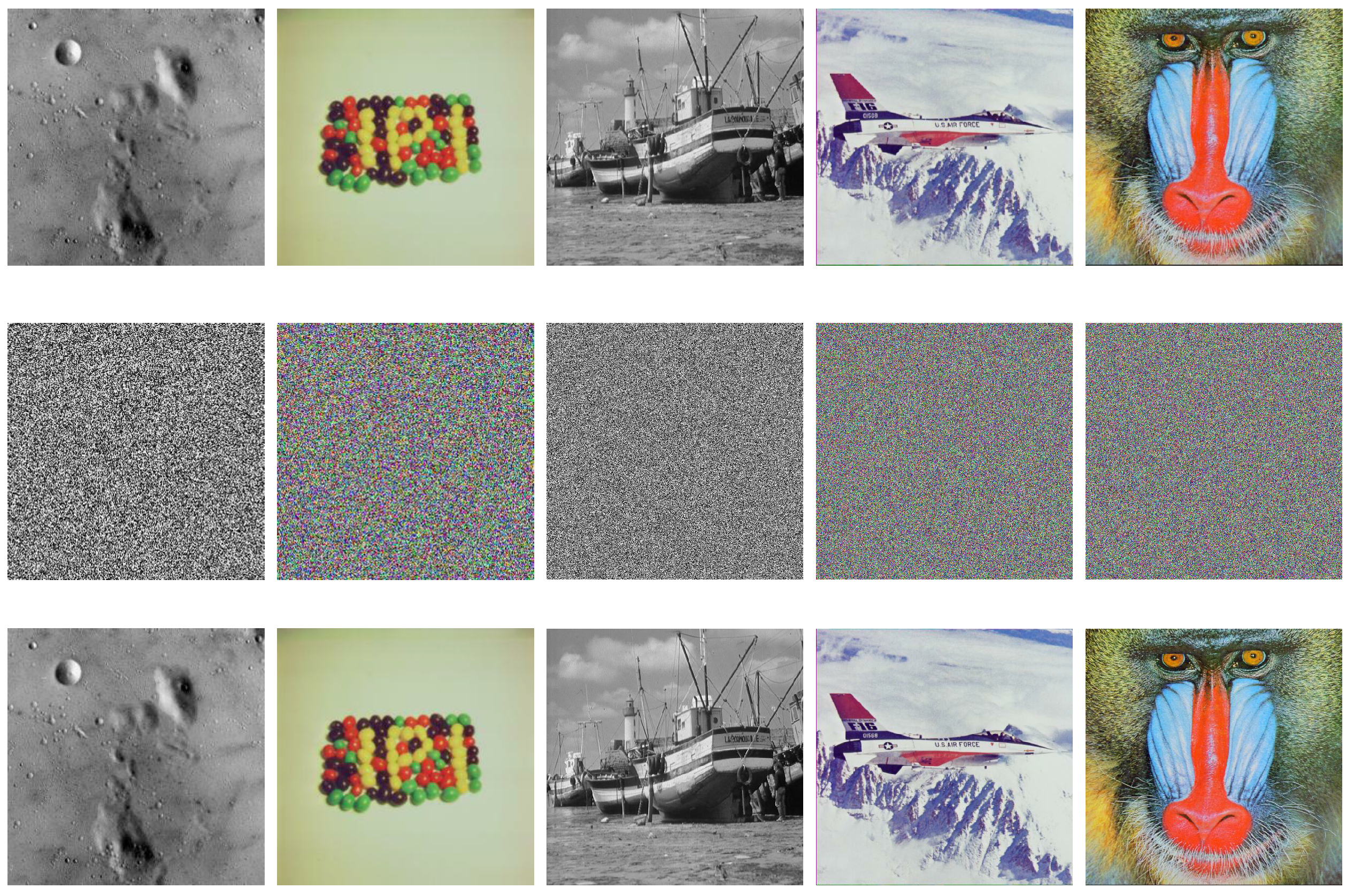
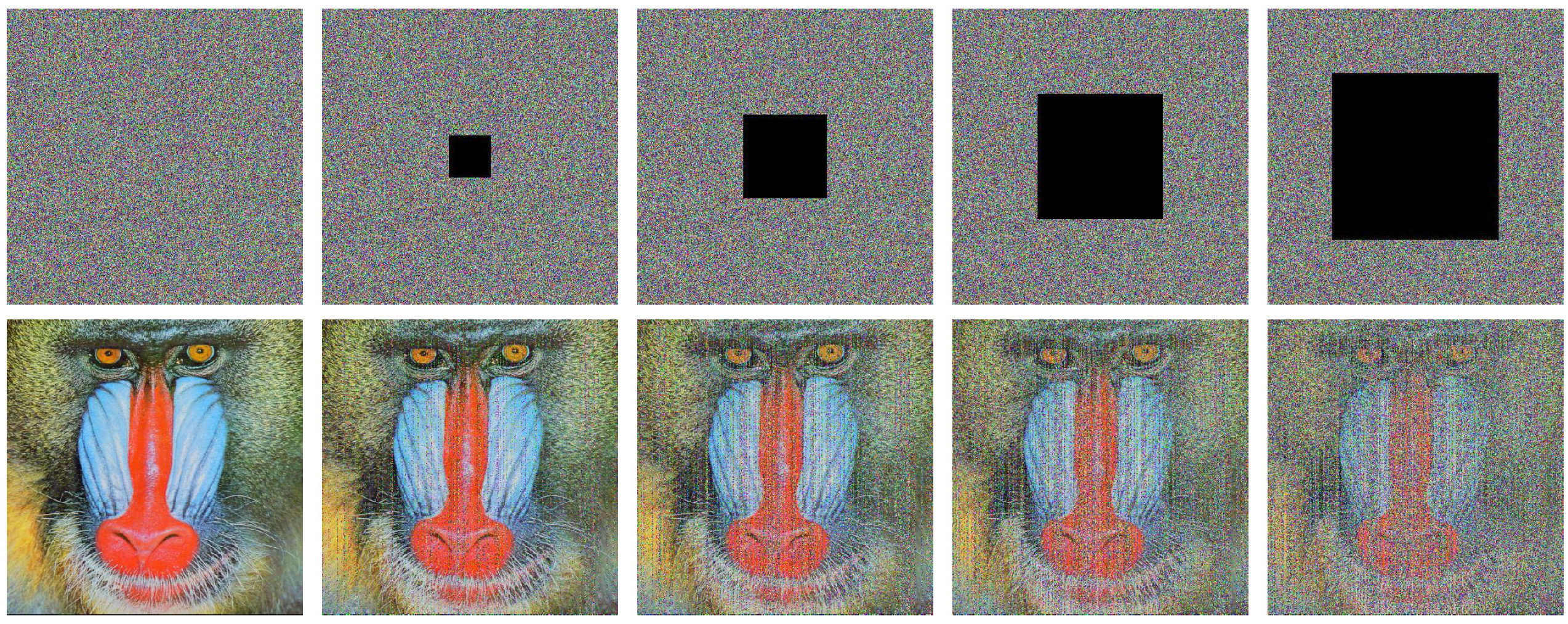
4.1. Visual Analysis
4.2. Key Space
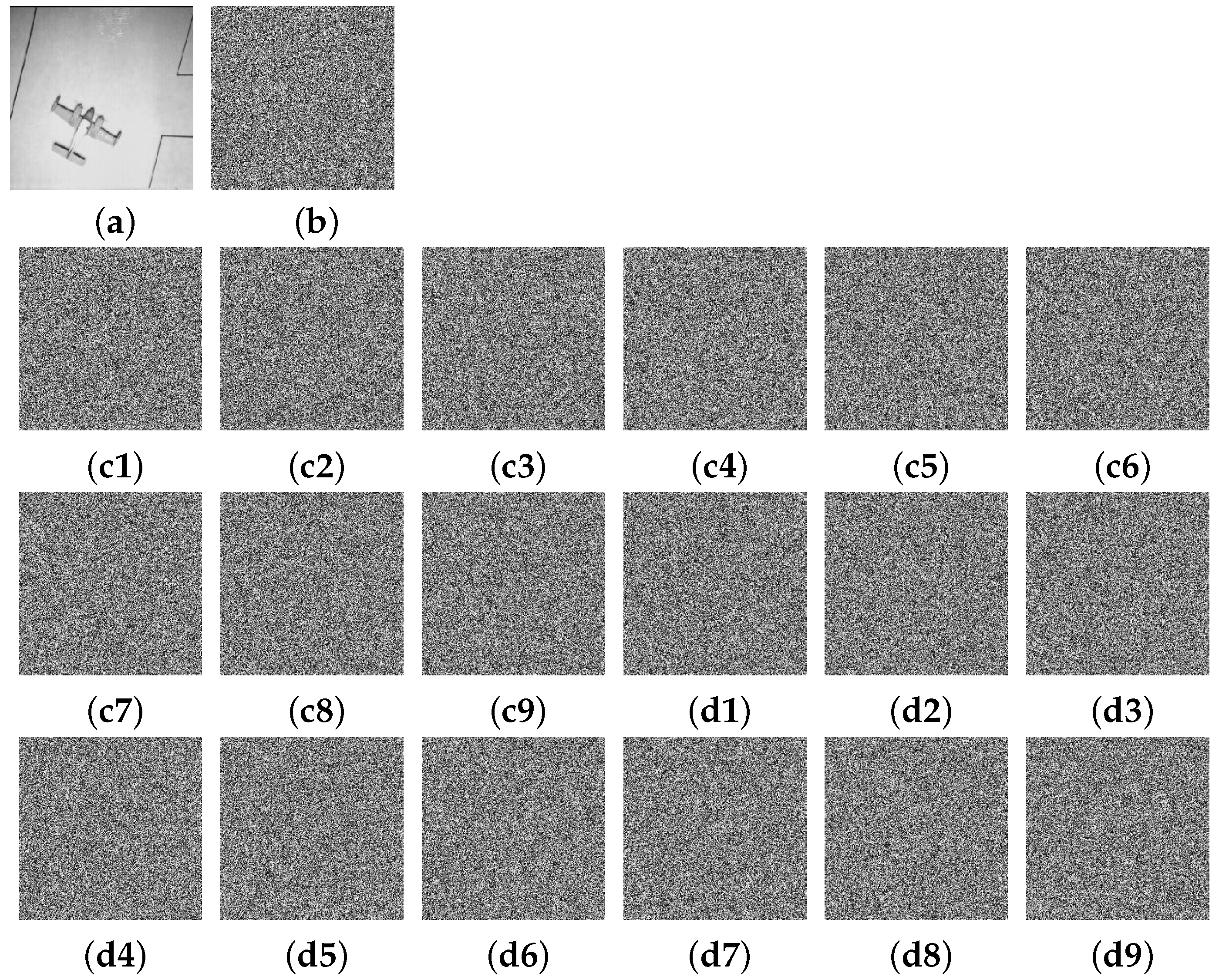
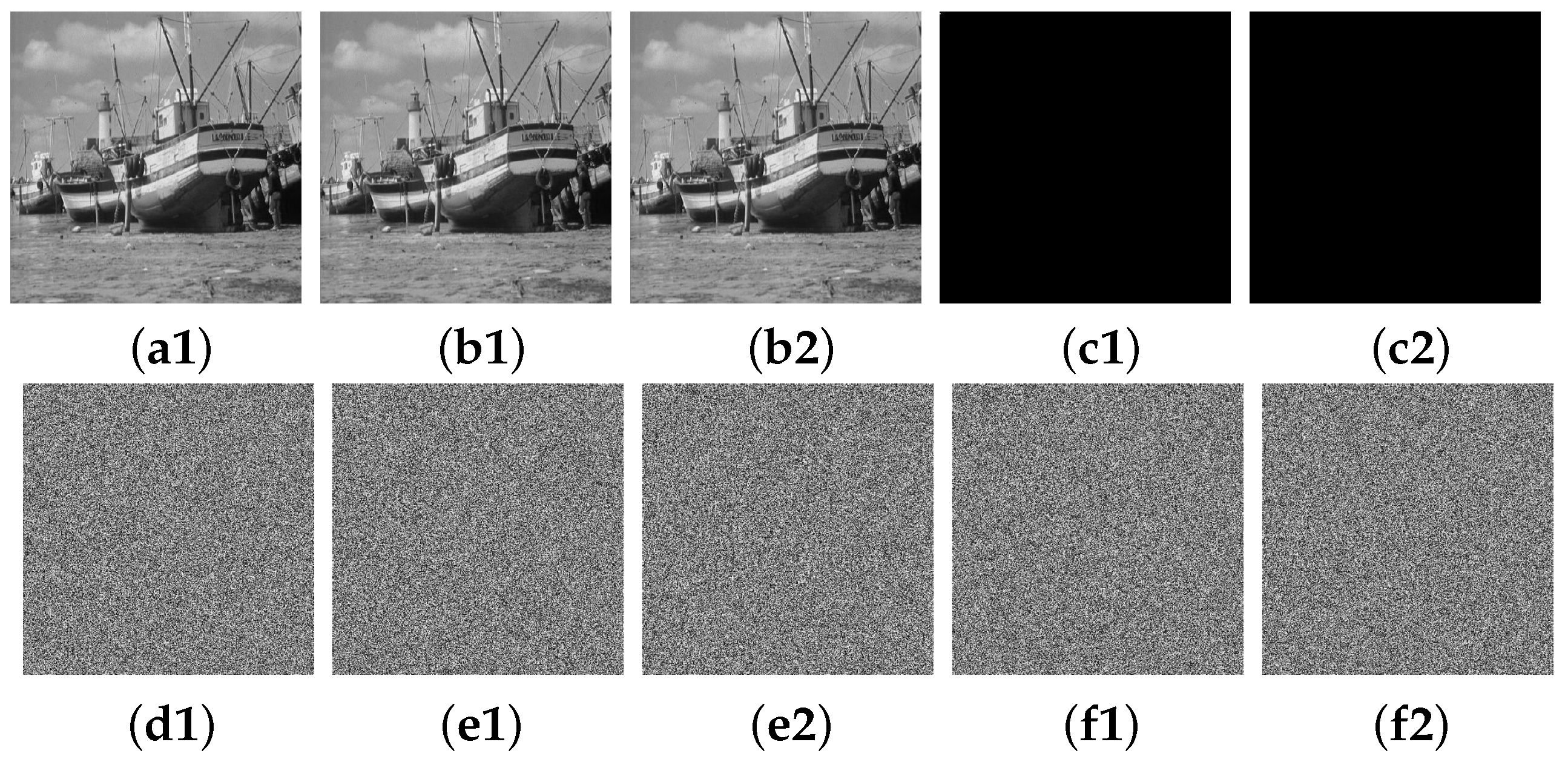
4.3. Key Sensitivity
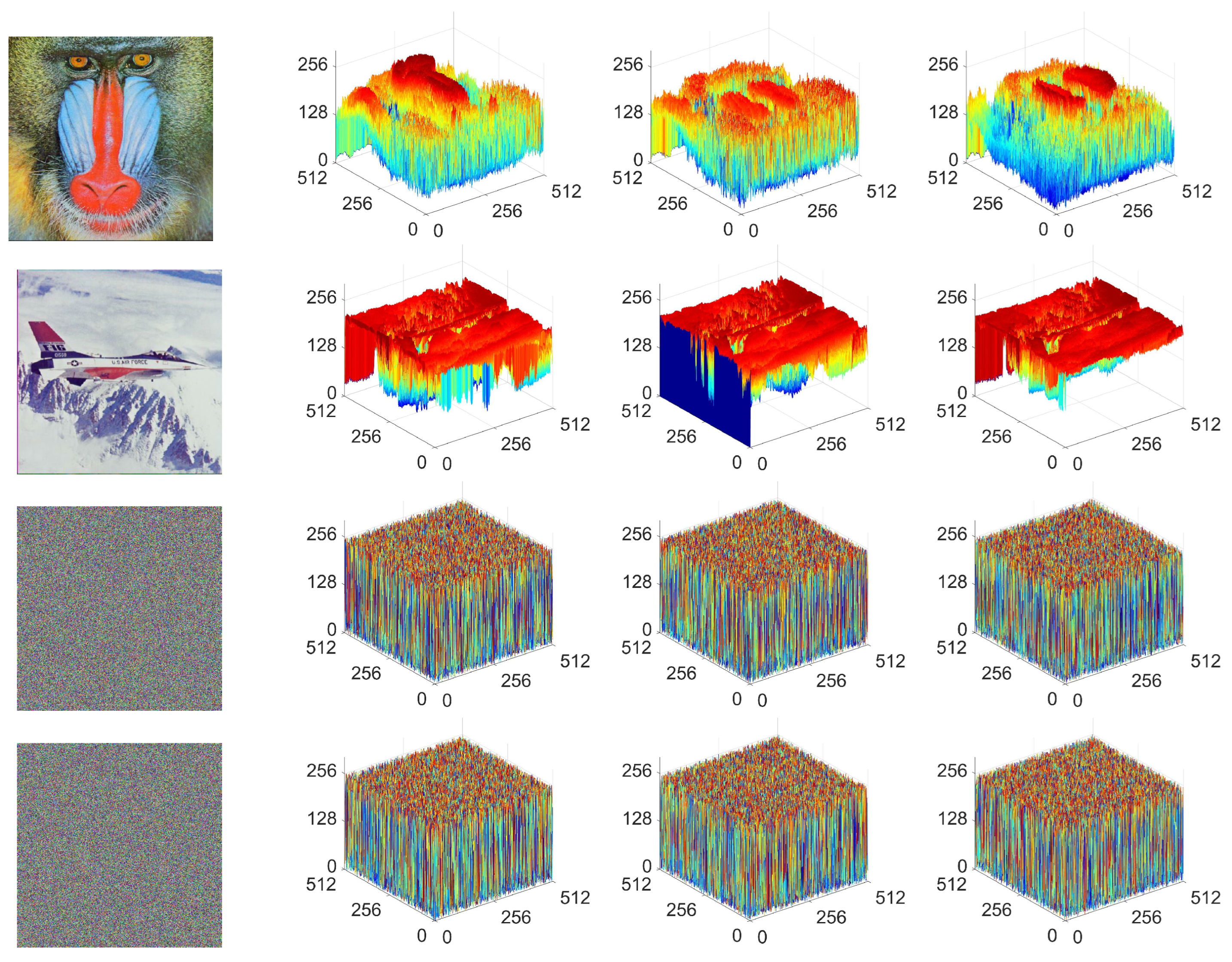
4.4. Pixel Distribution
4.5. Shannon Entropy
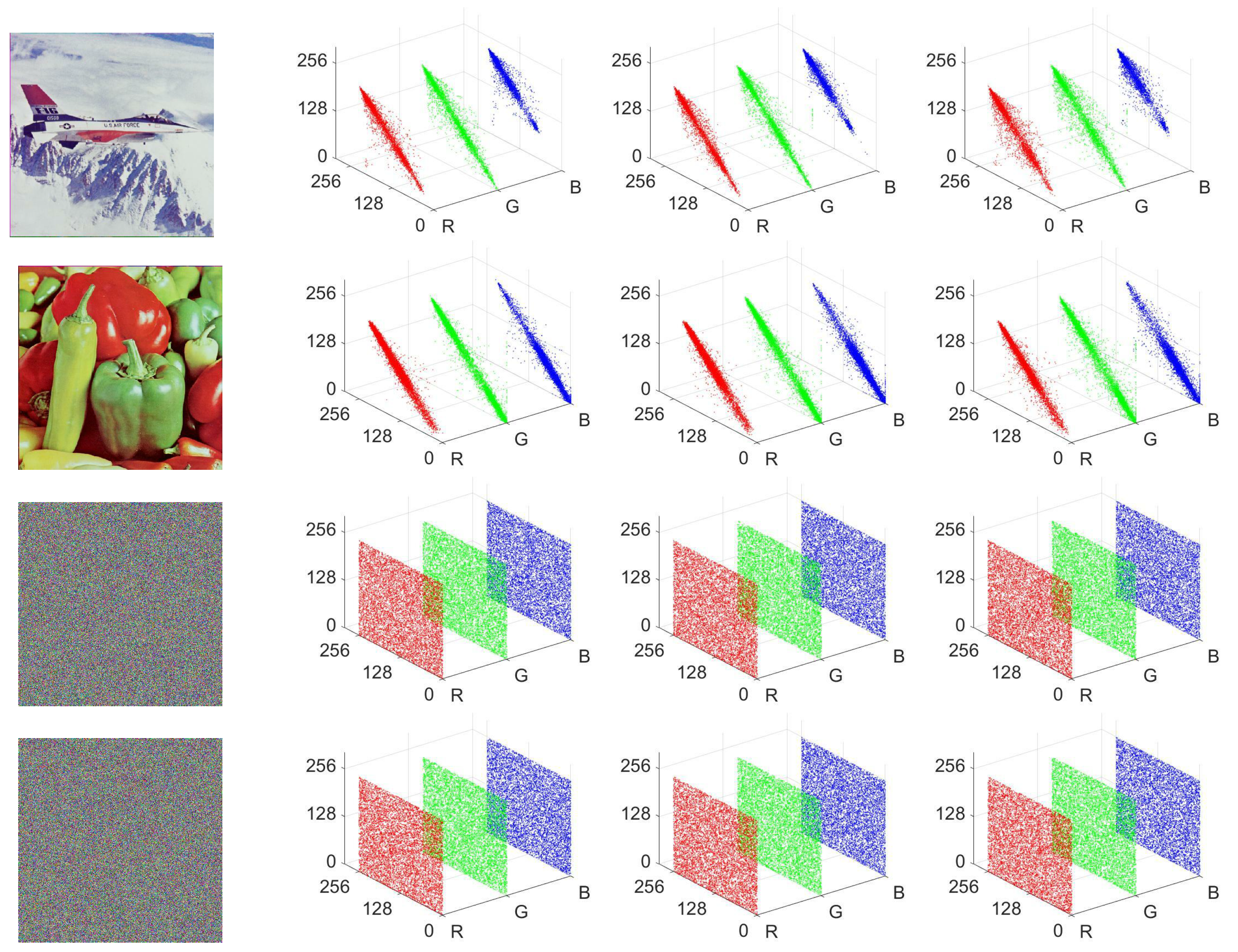
4.6. Pixel Correlation
4.7. Differential Attacks
- For : , UACI interval: .
- For : , UACI interval: .
- For : , UACI interval: .

| Size | Image | [63] | [64] | [65] | MIEA-CPHS |
|---|---|---|---|---|---|
| 5.1.09 | 99.5938 | 99.6140 | 99.5865 | 99.5932 | |
| 5.1.10 | 99.5910 | 99.6246 | 99.6124 | 99.6094 | |
| 5.1.11 | 99.6353 | 99.6094 | 99.6155 | 99.6140 | |
| 5.1.12 | 99.6078 | 99.6155 | 99.6063 | 99.5942 | |
| 5.1.13 | 99.5986 | 99.6058 | 99.6094 | 99.6109 | |
| 5.2.08 | 99.6124 | 99.6151 | 99.5895 | 99.6155 | |
| 7.1.01 | 99.6128 | 99.5945 | 99.6231 | 99.6048 | |
| 7.1.03 | 99.6158 | 99.6025 | 99.6067 | 99.6181 | |
| 7.1.05 | 99.6086 | 99.5907 | 99.6174 | 99.6044 | |
| 7.1.07 | 99.6120 | 99.6018 | 99.6304 | 99.6185 | |
| 5.3.01 | 99.6023 | 99.6170 | 99.6082 | 99.6199 | |
| 5.3.02 | 99.6170 | 99.6197 | 99.6046 | 99.6109 | |
| Avg | 99.6090 | 99.6092 | 99.6092 | 99.6095 | |
| Std. Dev. | 0.0119 | 0.0103 | 0.0124 | 0.0089 |
| Size | Image | [63] | [64] | [65] | MIEA-CPHS |
|---|---|---|---|---|---|
| 5.1.09 | 33.5381 | 33.4780 | 33.4424 | 33.3952 | |
| 5.1.10 | 33.4521 | 33.4174 | 33.4631 | 33.5140 | |
| 5.1.11 | 33.5348 | 33.4891 | 33.4394 | 33.5188 | |
| 5.1.12 | 33.4535 | 33.5213 | 33.4703 | 33.4355 | |
| 5.1.13 | 33.4640 | 33.5093 | 33.5157 | 33.4553 | |
| 5.2.08 | 33.4030 | 33.3891 | 33.5789 | 33.4364 | |
| 7.1.01 | 33.4582 | 33.4022 | 33.4053 | 33.4781 | |
| 7.1.03 | 33.5914 | 33.5162 | 33.5168 | 33.5263 | |
| 7.1.05 | 33.4521 | 33.5354 | 33.5248 | 33.4606 | |
| 7.1.07 | 33.5259 | 33.4824 | 33.4218 | 33.4499 | |
| 5.3.01 | 33.4238 | 33.4994 | 33.3963 | 33.4352 | |
| 5.3.02 | 33.4290 | 33.3923 | 33.4247 | 33.4589 | |
| Avg | 33.4772 | 33.4693 | 33.4666 | 33.4637 | |
| Std. Dev. | 0.0568 | 0.0539 | 0.0562 | 0.0393 |
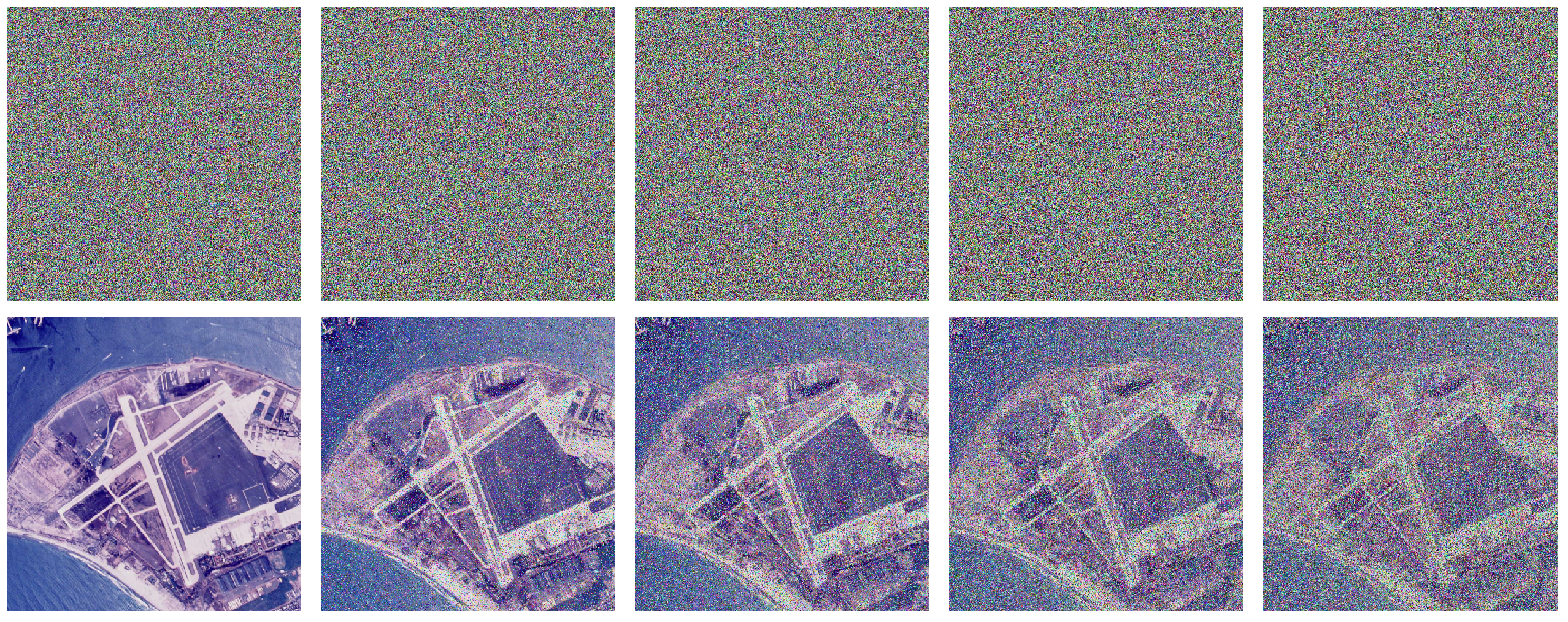
4.8. Robustness Analysis
4.9. Resistance to Common Attack Models
- Every distinct chosen plaintext yields a unique hash digest, resulting in a unique control parameter .
- This drives the MIEA-CPHS to generate a specific set of permutation and substitution keystreams exclusive to .
- Due to the collision resistance and avalanche effect of SHA-384, even a single-bit difference between the chosen plaintext and the target plaintext results in . Consequently, the keystreams derived from the chosen input are mathematically uncorrelated with those used for the target, rendering the analysis of chosen plaintexts useless for cracking the target ciphertext.
- To decrypt a chosen ciphertext , the receiver (or oracle) must use the accompanying to reconstruct .
- The resulting decryption keystreams are valid only for that specific pair.
- Any information gained from this decryption cannot be generalized to other ciphertexts, as the underlying dynamic parameter changes with every hash value. Thus, the static secret key remains protected.
4.10. Efficiency Analysis
5. Conclusions
Author Contributions
Funding
Data Availability Statement
Conflicts of Interest
References
- Toktas, F.; Erkan, U.; Yetgin, Z. Cross-channel color image encryption through 2D hyperchaotic hybrid map of optimization test functions. Expert Syst. Appl. 2024, 249, 123583. [Google Scholar] [CrossRef]
- Zhou, A.; Yang, C.; Yi, C.; Fan, H. New μ-Synchronization Criteria for Nonlinear Drive–Response Complex Networks with Uncertain Inner Couplings and Variable Delays of Unknown Bounds. Axioms 2025, 14, 161. [Google Scholar] [CrossRef]
- Feng, W.; Zhang, K.; Zhang, J.; Zhao, X.; Chen, Y.; Cai, B.; Zhu, Z.; Wen, H.; Ye, C. Integrating Fractional-Order Hopfield Neural Network with Differentiated Encryption: Achieving High-Performance Privacy Protection for Medical Images. Fractal Fract. 2025, 9, 426. [Google Scholar] [CrossRef]
- Rasouli, M.; Zare, A.; Yaghoubi, H.; Alizadehsani, R. Designing a Secure Mechanism for Image Transferring System Based on Uncertain Fractional Order Chaotic Systems and NLFPID Sliding Mode Controller. Axioms 2023, 12, 828. [Google Scholar] [CrossRef]
- Lai, Q.; Hua, H. Secure medical image encryption scheme for Healthcare IoT using novel hyperchaotic map and DNA cubes. Expert Syst. Appl. 2025, 264, 125854. [Google Scholar] [CrossRef]
- Romero-Arellano, A.; Moya-Albor, E.; Brieva, J.; Cruz-Aceves, I.; Avina-Cervantes, J.G.; Hernandez-Gonzalez, M.A.; Lopez-Montero, L.M. Image Encryption and Decryption System through a Hybrid Approach Using the Jigsaw Transform and Langton’s Ant Applied to Retinal Fundus Images. Axioms 2021, 10, 215. [Google Scholar] [CrossRef]
- Yu, F.; Zhang, S.; Su, D.; Wu, Y.; Gracia, Y.M.; Yin, H. Dynamic analysis and implementation of FPGA for a new 4D fractional-order memristive Hopfield neural network. Fractal Fract. 2025, 9, 115. [Google Scholar] [CrossRef]
- Li, Y.; Li, C.; Li, Y.; Moroz, I.; Yang, Y. A joint image encryption based on a memristive Rulkov neuron with controllable multistability and compressive sensing. Chaos Solitons Fractals 2024, 182, 114800. [Google Scholar] [CrossRef]
- Yu, F.; Gracia, Y.M.; Guo, R.; Ying, Z.; Xu, J.; Yao, W.; Jin, J.; Lin, H. Dynamic Analysis and Application of 6D Multistable Memristive Chaotic System with Wide Range of Hyperchaotic States. Axioms 2025, 14, 638. [Google Scholar] [CrossRef]
- Liu, L.; Wang, J. A cluster of 1D quadratic chaotic map and its applications in image encryption. Math. Comput. Simul. 2023, 204, 89–114. [Google Scholar] [CrossRef]
- Al-Barakati, A.A.; Mesdoui, F.; Bekiros, S.; Kaçar, S.; Jahanshahi, H. A variable-order fractional memristor neural network: Secure image encryption and synchronization via a smooth and robust control approach. Chaos Solitons Fractals 2024, 186, 115135. [Google Scholar] [CrossRef]
- Jackson, J.; Perumal, R. A robust image encryption technique based on an improved fractional order chaotic map. Nonlinear Dyn. 2025, 113, 7277–7296. [Google Scholar] [CrossRef]
- An, D.; Hao, D.; Zhao, R.; Zhang, S.; Lu, J.; Zhang, Y. Visually semantic-preserving and people-oriented color image encryption based on cross-plane thumbnail preservation. Expert Syst. Appl. 2023, 233, 120931. [Google Scholar] [CrossRef]
- Deng, Q.; Wang, C.; Yang, G.; Luo, D. Discrete Memristive Delay Feedback Rulkov Neuron Model: Chaotic Dynamics, Hardware Implementation, and Application in Secure Communication. IEEE Internet Things J. 2025, 12, 25559–25567. [Google Scholar] [CrossRef]
- Ma, X.; Wang, Z.; Wang, C. An image encryption algorithm based on tabu search and hyperchaos. Int. J. Bifurc. Chaos 2024, 34, 2450170. [Google Scholar] [CrossRef]
- Deng, Q.; Wang, C.; Sun, Y.; Deng, Z.; Yang, G. Memristive Tabu Learning Neuron Generated Multi-Wing Attractor with FPGA Implementation and Application in Encryption. IEEE Trans. Circuits Syst. I Regul. Pap. 2025, 72, 300–311. [Google Scholar] [CrossRef]
- Jin, B.; Fan, L.; Zhang, B.; Lei, R.; Liu, L. Image encryption hiding algorithm based on digital time-varying delay chaos model and compression sensing technique. iScience 2024, 27, 110717. [Google Scholar] [CrossRef]
- Deng, Q.; Wang, C.; Sun, Y.; Yang, G. Discrete Memristive Conservative Chaotic Map: Dynamics, Hardware Implementation, and Application in Secure Communication. IEEE Trans. Cybern. 2025, 55, 3926–3934. [Google Scholar] [CrossRef]
- Tang, J.; Zhang, Z.; Huang, T. Two-Dimensional Cosine–Sine Interleaved Chaotic System for Secure Communication. IEEE Trans. Circuits Syst. II Express Briefs 2024, 71, 2479–2483. [Google Scholar] [CrossRef]
- Lai, Q.; Liu, Y. A family of image encryption schemes based on hyperchaotic system and cellular automata neighborhood. Sci. China Technol. Sci. 2025, 68, 1320401. [Google Scholar] [CrossRef]
- Sajid, M.; Chaudhary, H.; Kaushik, S. Chaos Controllability in Non-Identical Complex Fractional Order Chaotic Systems via Active Complex Synchronization Technique. Axioms 2023, 12, 530. [Google Scholar] [CrossRef]
- Li, Y.M.; Deng, Y.; Jiang, M.; Wei, D. Fast Encryption Algorithm Based on Chaotic System and Cyclic Shift in Integer Wavelet Domain. Fractal Fract. 2024, 8, 75. [Google Scholar] [CrossRef]
- Chen, Y.; Huang, H.; Tang, C.; Wei, W. A novel adaptive image privacy protection method based on Latin square. Nonlinear Dyn. 2024, 112, 10485–10508. [Google Scholar] [CrossRef]
- Fedoseev, P.; Pesterev, D.; Rozhkov, V.; Rybin, V.; Butusov, D. Chaotic Encryption Algorithm Based on Gingerbreadman Map with Adaptive Symmetry. Chaos Theory Appl. 2024, 7, 31–41. [Google Scholar] [CrossRef]
- Hosbas, M.Z.; Emin, B.; Kaçar, F. True random number generator design with a fractional order sprott b chaotic system. ADBA Comput. Sci. 2025, 2, 50–55. [Google Scholar] [CrossRef]
- Kaya, Y.; Aydin, Z.G. A Chaos-Based Encryption Scheme for Secure Medical X-ray Images. Comput. Electron. Med. 2025, 2, 53–59. [Google Scholar] [CrossRef]
- Dhall, S.; Yadav, K. Cryptanalysis of substitution-permutation network based image encryption schemes: A systematic review. Nonlinear Dyn. 2024, 112, 14719–14744. [Google Scholar] [CrossRef]
- Zhang, C.; Chen, J.; Chen, D. Cryptanalysis of an Image Encryption Algorithm Based on a 2D Hyperchaotic Map. Entropy 2022, 24, 1551. [Google Scholar] [CrossRef] [PubMed]
- You, K.; Chen, P.; Li, C. Cryptanalyzing an Image Encryption Algorithm Underpinned by 3D-BCNN. IEEE Multimed. 2024, 31, 17–24. [Google Scholar] [CrossRef]
- Chen, L.; Li, C.; Li, C. Security Measurement of a Medical Image Communication Scheme based on Chaos and DNA. J. Vis. Commun. Image Represent. 2022, 83, 103424. [Google Scholar] [CrossRef]
- Feng, W.; Qin, Z.; Zhang, J.; Ahmad, M. Cryptanalysis and Improvement of the Image Encryption Scheme Based on Feistel Network and Dynamic DNA Encoding. IEEE Access 2021, 9, 145459–145470. [Google Scholar] [CrossRef]
- Feng, W.; He, Y.; Li, H.; Li, C. Cryptanalysis and improvement of the image encryption scheme based on 2D logistic-adjusted-sine map. IEEE Access 2019, 7, 12584–12597. [Google Scholar] [CrossRef]
- Tuli, R.; Soneji, H.N.; Churi, P. PixAdapt: A novel approach to adaptive image encryption. Chaos Solitons Fractals 2022, 164, 112628. [Google Scholar] [CrossRef]
- Wang, X.; Liu, H. Cross-plane multi-image encryption using chaos and blurred pixels. Chaos Solitons Fractals 2022, 164, 112586. [Google Scholar] [CrossRef]
- Sun, J. 2D-SCMCI Hyperchaotic Map for Image Encryption Algorithm. IEEE Access 2021, 9, 59313–59327. [Google Scholar] [CrossRef]
- Nan, S.; Feng, X.; Wu, Y.; Zhang, H. Remote sensing image compression and encryption based on block compressive sensing and 2D-LCCCM. Nonlinear Dyn. 2022, 108, 2705–2729. [Google Scholar] [CrossRef]
- Zhu, L.; Jiang, D.; Ni, J.; Wang, X.; Rong, X.; Ahmad, M.; Chen, Y. A stable meaningful image encryption scheme using the newly-designed 2D discrete fractional-order chaotic map and Bayesian compressive sensing. Signal Process. 2022, 195, 108489. [Google Scholar] [CrossRef]
- Hua, Z.; Chen, Y.; Bao, H.; Zhou, Y. Two-Dimensional Parametric Polynomial Chaotic System. IEEE Trans. Syst. Man, Cybern. Syst. 2022, 52, 4402–4414. [Google Scholar] [CrossRef]
- Lai, Q.; Hu, G.; Erkan, U.; Toktas, A. A novel pixel-split image encryption scheme based on 2D Salomon map. Expert Syst. Appl. 2023, 213, 118845. [Google Scholar] [CrossRef]
- Hua, Z.; Zhu, Z.; Yi, S.; Zhang, Z.; Huang, H. Cross-plane colour image encryption using a two-dimensional logistic tent modular map. Inf. Sci. 2021, 546, 1063–1083. [Google Scholar] [CrossRef]
- Li, B.; Sun, K.; Wang, H.; Liu, W. An internal perturbation method to counteract the dynamical degradation of digital chaotic maps and its application. Nonlinear Dyn. 2024, 112, 9603–9615. [Google Scholar] [CrossRef]
- El-Den, B.M.; Aldosary, S.; Khaled, H.; Hassan, T.M.; Raslan, W. Leveraging Finite-Precision Errors in Chaotic Systems for Enhanced Image Encryption. IEEE Access 2024, 12, 176057–176069. [Google Scholar] [CrossRef]
- Nardo, L.G.; Nepomuceno, E.G.; Arias-Garcia, J.; Butusov, D.N. Image encryption using finite-precision error. Chaos Solitons Fractals 2019, 123, 69–78. [Google Scholar] [CrossRef]
- Dinu, A.; Frunzete, M. The Lorenz chaotic system, statistical independence and sampling frequency. In Proceedings of the 2021 International Symposium on Signals, Circuits and Systems (ISSCS), Iasi, Romania, 15–16 July 2021; pp. 1–4. [Google Scholar] [CrossRef]
- Macovei, C.; Vaduva, A.; Vlad, A.; Zamfir, M. A mean test on the autocorrelation function of a chaotic signal aiming to support the statistical independence sampling distance. In Proceedings of the 2019 International Symposium on Signals, Circuits and Systems (ISSCS), Iasi, Romania, 11–12 July 2019; pp. 1–4. [Google Scholar] [CrossRef]
- Karimov, T.; Mikhailov, A.; Rybin, V.; Sheptunova, V.; Babkin, I.; Butusov, D. Attack-Resistant Chaotic Communication System in Non-ideal Physical Channel. Chaos Fractals 2025, 2, 28–37. [Google Scholar] [CrossRef]
- Özkaynak, F. Brief review on application of nonlinear dynamics in image encryption. Nonlinear Dyn. 2018, 92, 305–313. [Google Scholar] [CrossRef]
- Liu, H.; Teng, L.; Zhang, Y.; Si, R.; Liu, P. Mutil-medical image encryption by a new spatiotemporal chaos model and DNA new computing for information security. Expert Systems with Applications 2024, 235, 121090. [Google Scholar] [CrossRef]
- Erkan, U.; Toktas, A.; Lai, Q. Design of two dimensional hyperchaotic system through optimization benchmark function. Chaos Solitons Fractals 2023, 167, 113032. [Google Scholar] [CrossRef]
- Grassberger, P.; Procaccia, I. Estimation of the Kolmogorov entropy from a chaotic signal. Phys. Rev. A 1983, 28, 2591. [Google Scholar] [CrossRef]
- SaberiKamarposhti, M.; Ghorbani, A.; Yadollahi, M. A comprehensive survey on image encryption: Taxonomy, challenges, and future directions. Chaos Solitons Fractals 2024, 178, 114361. [Google Scholar] [CrossRef]
- Yu, F.; He, S.; Yao, W.; Cai, S.; Xu, Q. Bursting Firings in Memristive Hopfield Neural Network with Image Encryption and Hardware Implementation. IEEE Trans. -Comput.-Aided Des. Integr. Circuits Syst. 2025, 44, 4564–4576. [Google Scholar] [CrossRef]
- Verma, V.; Kumar, S. Quantum image encryption algorithm based on 3D-BNM chaotic map. Nonlinear Dyn. 2025, 113, 3829–3855. [Google Scholar] [CrossRef]
- Alvarez, G.; Li, S. Some basic cryptographic requirements for chaos-based cryptosystems. Int. J. Bifurc. Chaos 2006, 16, 2129–2151. [Google Scholar] [CrossRef]
- Yu, F.; Wang, X.; Guo, R.; Ying, Z.; Cai, S.; Jin, J. Dynamical analysis, hardware implementation, and image encryption application of new 4D discrete hyperchaotic maps based on parallel and cascade memristors. Integration 2025, 104, 102475. [Google Scholar] [CrossRef]
- Li, H.; Li, T.; Feng, W.; Zhang, J.; Zhang, J.; Gan, L.; Li, C. A novel image encryption scheme based on non-adjacent parallelable permutation and dynamic DNA-level two-way diffusion. J. Inf. Secur. Appl. 2021, 61, 102844. [Google Scholar] [CrossRef]
- Zhang, B.; Liu, L. Chaos-Based Image Encryption: Review, Application, and Challenges. Mathematics 2023, 11, 2585. [Google Scholar] [CrossRef]
- Yu, F.; He, T.; He, S.; Tan, B.; Shi, C.; Lin, H. Influence of Memristive Activated Gradient on Chaotic Dynamics in Discrete Neural Networks. Int. J. Bifurc. Chaos 2025, 35, 2550146. [Google Scholar] [CrossRef]
- He, S.; Yu, F.; Guo, R.; Zheng, M.; Tang, T.; Jin, J.; Wang, C. Dynamic Analysis and FPGA Implementation of a Fractional-Order Memristive Hopfield Neural Network with Hidden Chaotic Dual-Wing Attractors. Fractal Fract. 2025, 9, 561. [Google Scholar] [CrossRef]
- Yu, F.; Kong, X.; Yao, W.; Zhang, J.; Cai, S.; Lin, H.; Jin, J. Dynamics analysis, synchronization and FPGA implementation of multiscroll Hopfield neural networks with non-polynomial memristor. Chaos Solitons Fractals 2024, 179, 114440. [Google Scholar] [CrossRef]
- Li, C.; Shen, X.; Liu, S. Cryptanalyzing an Image Encryption Algorithm Underpinned by 2-D Lag-Complex Logistic Map. IEEE Multimed. 2024, 31, 99–109. [Google Scholar] [CrossRef]
- Wu, Y.; Noonan, J.P.; Agaian, S. NPCR and UACI randomness tests for image encryption. Cyber J. Multidiscip. J. Sci. Technol. J. Sel. Areas Telecommun. (JSAT) 2011, 1, 31–38. [Google Scholar]
- Zarei Zefreh, E. PSDCLS: Parallel simultaneous diffusion–confusion image cryptosystem based on Latin square. J. Inf. Secur. Appl. 2024, 83, 103785. [Google Scholar] [CrossRef]
- Qian, K.; Xiao, Y.; Wei, Y.; Liu, D.; Wang, Q.; Feng, W. A robust memristor-enhanced polynomial hyper-chaotic map and its multi-channel image encryption application. Micromachines 2023, 14, 2090. [Google Scholar] [CrossRef] [PubMed]
- Li, H.; Yu, S.; Feng, W.; Chen, Y.; Zhang, J.; Qin, Z.; Zhu, Z.; Wozniak, M. Exploiting Dynamic Vector-Level Operations and a 2D-Enhanced Logistic Modular Map for Efficient Chaotic Image Encryption. Entropy 2023, 25, 1147. [Google Scholar] [CrossRef]
- Feng, W.; Zhao, X.; Zhang, J.; Qin, Z.; Zhang, J.; He, Y. Image Encryption Algorithm Based on Plane-Level Image Filtering and Discrete Logarithmic Transform. Mathematics 2022, 10, 2751. [Google Scholar] [CrossRef]


| Name | Definition | Control Parameters |
|---|---|---|
| 2D Cubic map [38] | ||
| Our 2D-CCHM-EP | ||
| 2D-SCMCI [35] | ||
| 2D-LCCCM [36] | ||
| 2D-FOCM [37] |
| Name | Invariable | Variable | ||
|---|---|---|---|---|
| 2D-CCHM-EP | 12.9726 | 7.0274 | ||
| 2D Cubic map [38] | a | 1.7660 | 2.5649 | |
| 2D-SCMCI [35] | a | 4.9351 | −0.2636 | |
| 2D-LCCCM [36] | 6.7709 | 2.7685 | ||
| 2D-FOCM [37] | 1.6439 | 0.0458 |
| Name | Invariable | Variable | ||
|---|---|---|---|---|
| 2D-CCHM-EP | 2.3503 | 2.4310 | ||
| 2D Cubic map [38] | a | 1.9094 | 1.9557 | |
| 2D-SCMCI [35] | a | 2.1325 | 1.8067 | |
| 2D-LCCCM [36] | 2.1116 | 2.1129 | ||
| 2D-FOCM [37] | 0.3282 | 0.3214 |
| Test Item | p-Value | Pass Ratio | Result (R = Random) | |
|---|---|---|---|---|
| Freq. Bit | 0.684742 | 0.504134 | 20/20 | R |
| Freq. Block | 0.976444 | 0.186752 | 20/20 | R |
| Run | 0.280215 | 0.968449 | 20/20 | R |
| Longest Run | 0.273609 | 0.759439 | 20/20 | R |
| Bin. Mat. Rank | 0.638293 | 0.822162 | 20/20 | R |
| DFT | 0.699927 | 0.956091 | 20/20 | R |
| Non-Overlapping Temp. | 0.176719 | 0.661149 | 20/20 | R |
| Overlapping Temp. | 0.892654 | 0.574118 | 20/20 | R |
| Univ. Stat. | 0.942278 | 0.737329 | 20/20 | R |
| Linear Complexity | 0.445562 | 0.212496 | 20/20 | R |
| Serial 1 | 0.729394 | 0.655986 | 20/20 | R |
| Serial 2 | 0.610851 | 0.622832 | 20/20 | R |
| Appr. Entropy | 0.880750 | 0.693010 | 20/20 | R |
| Cumu. Sums Forward | 0.728022 | 0.424428 | 20/20 | R |
| Cumu. Sums Reverse | 0.926945 | 0.724265 | 20/20 | R |
| Random Excur. () | 0.830732 | 0.175877 | 20/20 | R |
| Random Excur. () | 0.542486 | 0.542967 | 20/20 | R |
| Random Excur. Var. () | 0.933815 | 0.630282 | 20/20 | R |
| Random Excur. Var. () | 0.454816 | 0.582257 | 20/20 | R |
| Size | Image | Value | Passed or Not |
|---|---|---|---|
| 5.1.12 | 228.0547 | Yes | |
| 5.1.13 | 256.9844 | Yes | |
| 5.1.14 | 247.1563 | Yes | |
| 7.1.03 | 238.6699 | Yes | |
| 7.1.04 | 245.9668 | Yes | |
| 7.1.05 | 261.4297 | Yes | |
| 5.3.01 | 267.5874 | Yes | |
| 5.3.02 | 229.7222 | Yes | |
| 7.2.01 | 210.9365 | Yes |
| Size | Image | Plaintext | Ciphertext |
|---|---|---|---|
| 5.2.08 | 7.2010 | 7.9994 | |
| 7.1.01 | 6.0274 | 7.9993 | |
| 7.1.04 | 6.1074 | 7.9993 | |
| 7.1.07 | 5.9916 | 7.9994 | |
| 7.1.10 | 5.9088 | 7.9994 | |
| 5.3.01 | 7.5237 | 7.9999 | |
| 5.3.02 | 6.8303 | 7.9999 | |
| 7.2.01 | 5.6415 | 7.9998 | |
| Avg. | 6.4040 | 7.9996 |
| Size | Name | Original Image | Encrypted Image | ||||
|---|---|---|---|---|---|---|---|
| Horizontal | Vertical | Diagonal | Horizontal | Vertical | Diagonal | ||
| 5.1.10 | 0.8613 | 0.9051 | 0.8215 | −0.0014 | −0.0015 | −0.0004 | |
| 5.1.12 | 0.9753 | 0.9519 | 0.9384 | 0.0015 | −0.0014 | 0.0015 | |
| 5.1.14 | 0.8933 | 0.9474 | 0.8496 | −0.0008 | 0.0008 | 0.0005 | |
| 5.2.08 | 0.9026 | 0.9367 | 0.8754 | −0.0011 | 0.0015 | 0.0007 | |
| 7.1.01 | 0.9200 | 0.9621 | 0.9048 | 0.0010 | 0.0002 | 0.0003 | |
| 7.1.04 | 0.9668 | 0.9768 | 0.9554 | 0.0006 | −0.0001 | −0.0012 | |
| 5.3.01 | 0.9818 | 0.9761 | 0.9672 | 0.0011 | 0.0005 | −0.0012 | |
| 5.3.02 | 0.9036 | 0.9133 | 0.8637 | −0.0002 | −0.0001 | −0.0014 | |
| 7.2.01 | 0.9509 | 0.9641 | 0.9424 | 0.0015 | −0.0002 | −0.0007 | |
Disclaimer/Publisher’s Note: The statements, opinions and data contained in all publications are solely those of the individual author(s) and contributor(s) and not of MDPI and/or the editor(s). MDPI and/or the editor(s) disclaim responsibility for any injury to people or property resulting from any ideas, methods, instructions or products referred to in the content. |
© 2025 by the authors. Licensee MDPI, Basel, Switzerland. This article is an open access article distributed under the terms and conditions of the Creative Commons Attribution (CC BY) license (https://creativecommons.org/licenses/by/4.0/).
Share and Cite
Feng, W.; Tang, Z.; Zhao, X.; Qin, Z.; Chen, Y.; Cai, B.; Zhu, Z.; Qian, K.; Wen, H. Two-Dimensional Coupling-Enhanced Cubic Hyperchaotic Map with Exponential Parameters: Construction, Analysis, and Application in Hierarchical Significance-Aware Multi-Image Encryption. Axioms 2025, 14, 901. https://doi.org/10.3390/axioms14120901
Feng W, Tang Z, Zhao X, Qin Z, Chen Y, Cai B, Zhu Z, Qian K, Wen H. Two-Dimensional Coupling-Enhanced Cubic Hyperchaotic Map with Exponential Parameters: Construction, Analysis, and Application in Hierarchical Significance-Aware Multi-Image Encryption. Axioms. 2025; 14(12):901. https://doi.org/10.3390/axioms14120901
Chicago/Turabian StyleFeng, Wei, Zixian Tang, Xiangyu Zhao, Zhentao Qin, Yao Chen, Bo Cai, Zhengguo Zhu, Kun Qian, and Heping Wen. 2025. "Two-Dimensional Coupling-Enhanced Cubic Hyperchaotic Map with Exponential Parameters: Construction, Analysis, and Application in Hierarchical Significance-Aware Multi-Image Encryption" Axioms 14, no. 12: 901. https://doi.org/10.3390/axioms14120901
APA StyleFeng, W., Tang, Z., Zhao, X., Qin, Z., Chen, Y., Cai, B., Zhu, Z., Qian, K., & Wen, H. (2025). Two-Dimensional Coupling-Enhanced Cubic Hyperchaotic Map with Exponential Parameters: Construction, Analysis, and Application in Hierarchical Significance-Aware Multi-Image Encryption. Axioms, 14(12), 901. https://doi.org/10.3390/axioms14120901