


Abstract
In this paper, hidden dynamical behaviors in a novel fractional-order hyperchaotic system without an equilibrium point are investigated. It is found that the chaotic system exhibits various hidden behaviors for different parameters, such as the hyperchaotic attractor, the chaotic attractor and the limit cycle. The behaviors are demonstrated via phase portraits and time evolution curves. Moreover, generalized synchronization of the systems is discussed, which can be realized by designing suitable controllers. Numerical simulations are carried out to verify the effectiveness of this synchronization scheme. By analyzing the synchronization performance, it is inferred that the lower the derivative order is, the less time is required to reach synchronization.
1. Introduction
Fractional calculus has a history of more than 300 years. It has become a powerful mathematical tool for the study of image processing, signal analysis, automatic process control, biological engineering and other disciplines in recent decades because of the development of computer technology that can solve large numbers of calculus calculations [1,2,3]. Moreover, this includes fractional-order chaotic systems, which can give clearer physical meanings and more accurate descriptions of physical phenomena [4,5]. Therefore, fractional-order chaotic systems have been proposed and explored, such as: the fractional-order Lorenz system [6], the fractional-order Chen system [7], the fractional-order Rössler system [8], and the fractional-order Lü system [9]. In addition, Gao et al. proposed novel autonomous fractional chaotic systems with modified projective synchronization [10]. Rahman et al. analyzed the dynamic behavior of a type of fractional-order system and found that the system can evolve from a periodic state into chaos and hyperchaos with increasing order q [11]. Stability, depending on a small parameter of the fractional-order nonlinear system, was analyzed, and practical stability was depicted by Makhlouf et al. [12].
Recently, many scholars have been interested in chaotic systems without equilibrium points. The chaotic system has no equilibrium point, but it can still exhibit complex dynamical behaviors; this is called hidden dynamics. Some systems, especially those without an equilibrium point, have been found to have attractors, which are defined as hidden attractors. This is a new type of attractor discovered and reported in 2011. Since then, the characteristics and applications of hidden attractors have garnered widespread attention. Ji’E et al. investigated hidden attractors and multistability in an asymmetric novel system based on memristors and revealed some rare characteristics, including hidden multi-scroll attractors and the coexistence of different attractors [13]. Natiq et al. discussed hidden attractors in a novel type of system with complex multistability [14]. Lorentz-like systems were analyzed by Leonov and Cang, and hidden attractors were found for certain parameters in their proposed system of convective fluid motion [15]. A novel chaotic system was analyzed and hidden attractors with a four-wing feature were found by Vaidyanathan et al. [16], which are relatively rare. The coexistence of different hidden attractors in a novel chaotic system within a Hamiltonian conservative chaotic system was studied [17].
Additionally, hidden attractors of fractional-order systems have been investigated and some results have been achieved. For example, sundry hidden attractors were found in a fractional-order hyperchaotic system without equilibrium [18]. A hyperchaotic hidden attractor in a new non-equilibrium fractional hyperchaotic system was detected [19]. A novel fractional-order hyperchaotic system with a simple structure and hidden multistability was discussed [20]. A novel 4D hyperchaotic system with no equilibrium but with extremely high multistability was analyzed and hidden attractors were discovered [21]. A new 4-D fractional-order chaotic system without equilibrium was proposed and complex hidden dynamical behaviors were found [22]. A novel non-equilibrium multistable chaotic system was presented and many rare phenomena were observed, such as the coexistence of four attractors, very long transient chaotic states, rare burst-oscillation schemes and hyperchaos [23].
Existing results suggest that hidden attractors in integer order systems and fractional-order systems have been researched extensively, and are used in many fields. However, as is known, the hidden dynamics of chaotic systems can cause devastating disasters under small perturbations in addition to their regular application. To avoid these disasters, hidden attractors should be explored further.
Recently, as an important phenomenon, synchronization and its control have become a hot topic. A variety of synchronization methods for fractional-order systems have been proposed, including: adaptive synchronization [24], projection synchronization [25], lag synchronization [26], exponential synchronization [27], active control [28], sliding-mode control [29], robust observers [30], etc. With further research, synchronization between fractional-order systems is being applied in more fields. For instance, a novel fractional-order hyperchaotic system was investigated and synchronization of the systems was analyzed by Jin-Man and Fang-Qi [31]. The synchronization of chaotic systems along with their control and circuit implementation have been discussed [32]. The synchronous behavior of fractional-order chaotic systems has been studied using linear feedback control [33]. Finite-time synchronization has also been discussed [34].
The empirical formulas of some complex systems often take the form of power-law functions, but the corresponding mechanical constitutive relationship does not meet any standard “gradient” law, such as the Darcy law, Fourier heat conduction or Fick diffusion. These processes have obvious properties of memory, heredity and path dependence. The classical integer derivative needs to construct a nonlinear equation to describe above problems by introducing some artificial empirical parameters and assumptions that are inconsistent with the actual situation, and sometimes even to construct new models. The fractional differential operator has become one of the most important tools for the mathematical modeling of complex physical processes, because of its ability to succinctly and accurately describe physical processes with historical memory and spatial global correlation. Based on the statement mentioned above, a generalized synchronization scheme for a fractional hyperchaotic system is proposed with active controllers and linear feedback controllers in this paper (Section 1). The other parts of this paper are arranged as follows. In Section 2, a fractional-order hyperchaotic system with hidden attractors is presented and its hidden dynamics are discussed in detail. In Section 3, a generalized synchronization scheme is proposed and its synchronization performance is analyzed for different fractional orders q. Section 4 gives some conclusions.
2. Dynamic Analysis of Fractional-Order Hyperchaotic System with Non-Equilibrium
2.1. System Description
A fractional-order hyperchaotic system with no equilibrium is considered in this section. It is quoted from an autonomous hyperchaotic system by Wei et al. [35]. The autonomous hyperchaotic system is shown as:
with the system parameters and the state variables .
As a branch of calculus, fractional calculus is applied in many fields. Additionally, fractional Brownian motion is closely related to the definition of fractional calculus. Therefore, as the basis of fractal dynamics, the fractional operator has developed rapidly and has been applied in various fields. To further investigate the dynamics of a chaotic system, corresponding fractional-order system-to-system approach (1) in line with the Caputo definition is constructed and represented as:
2.2. Dynamics of Non-Equilibrium Fractional-Order Hyperchaotic System
Obviously, system (2) has no equilibrium point for any non-zero value of , , , and . Namely, if system (2) shows an attractor, it must be a hidden attractor. In this section, the dynamics of system (2) are investigated by changing the system parameter. In the following simulations, the initial value is chosen as and the fractional order is . To compare the dynamics of the fractional-order system (2) with that of the corresponding integer-order system, similar system parameters are chosen to those in [35]. Thus, some system parameters are taken as and with changing.
2.2.1. Hyperchaotic Attractor
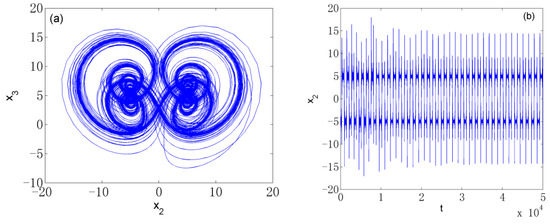
With the time evolution curve of and phase portrait are given in Figure 1. To distinguish the nature of the attractor, the Lyapunov exponents of system (2) are calculated as LE1 = 3.0352, LE2 = 0.0320, LE3 = −0.0294 and LE4 = −14.52, which suggest that system (2) displays a hyperchaotic attractor with the system parameters and . This means that system (2) is a hyperchaotic system.
Figure 1.
Hyperchaotic attractor of system (2) when . (a) Phase portrait; (b) time evolution curve.
2.2.2. Chaotic Attractor
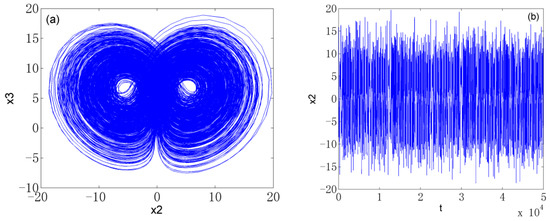
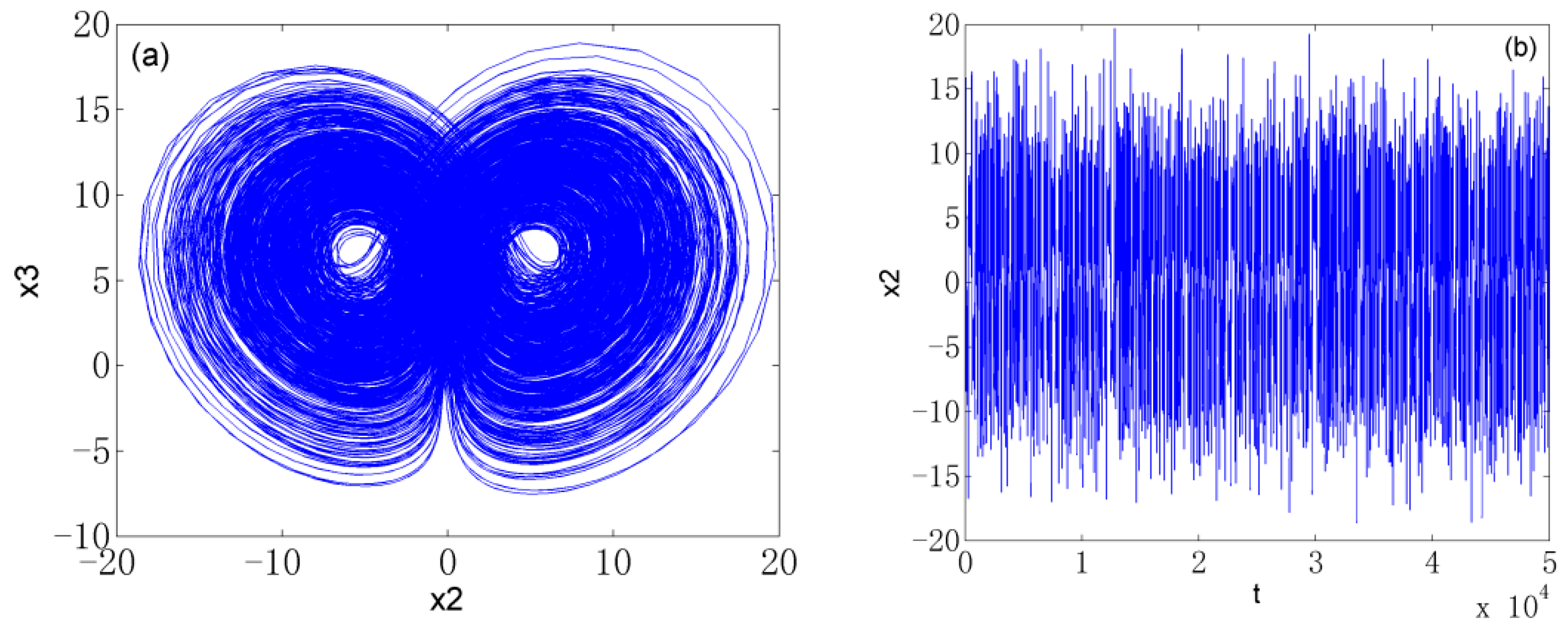
For the time evolution curve of and phase portrait are plotted in Figure 2, and suggest that system (2) appears to be a chaotic attractor.
Figure 2.
Chaotic attractor of system (2) when . (a) Phase portrait; (b) time evolution curve.
2.2.3. Limit Cycle
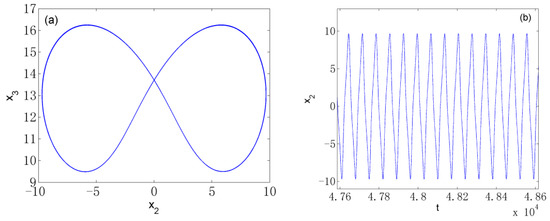
For the phase portrait and time evolution curve of system (2) are calculated and displayed in Figure 3, from which we can know that system (2) displays periodic behavior.
Figure 3.
Periodic attractor of system (2) when . (a) Phase portrait; (b) time evolution curve.
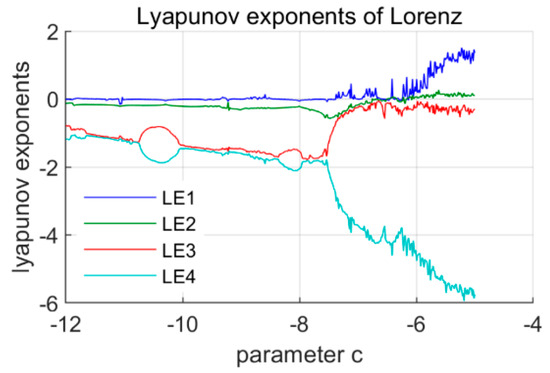
From Figure 1, Figure 2 and Figure 3, it can be seen that if and are fixed, and changing can make system (2) show different hidden attractors. Furthermore, the Lyapunov exponent spectra of system (2) are calculated and depicted in Figure 4, which verifies the result of Figure 1, Figure 2 and Figure 3.
Figure 4.
Lyapunov exponent spectra of system(2) vs. parameter c.
3. Generalized Synchronization of Fractional-Order System
3.1. Generalized Synchronization Scheme
Suppose that
where the drive system is a function with as variable. is the fractional order with . is fractional-order derivative.
Correspondingly, the response system is generally depicted as:
where represents the controller to be designed, and is a function with as a variable.
The error system between (3) and (4) can be obtained as follows:
where is a vector and is an matrix. Using fractional-order derivation on (5), we can obtain the corresponding error system:
with
to be designed. and are the active controller and linear feedback part, respectively. They are defined as:
here is a constant matrix. Putting Equations (7) and (8) into Equation (6), it can be seen that:
It can be seen from Equation (9) that when , the error system will converge to zero. As a result, systems (4) and (3) can be synchronized.
3.2. Generalized Synchronization Simulation
Two cases, generalized dislocation synchronization and generalized linear synchronization, are utilized to certify the usefulness of the proposed synchronization scheme.
For and the drive system can be written as:
The corresponding response system can be described as:
To realize the generalized synchronization of systems (11) and (10), suitable controllers should be designed according to characteristics of the considered system. In this section, take generalized dislocation synchronization and generalized linear synchronization into account. Let
Then, the designed controller is expressed as
Case 1.
Generalized dislocated synchronization.
Since the dimension of the drive system (10) is 4, for a 4-dimensional matrix, there are 4! − 1 = 23 matrices with exactly one non-zero number in each column and each row. Let
Then, the errors can be calculated from Formula (6).
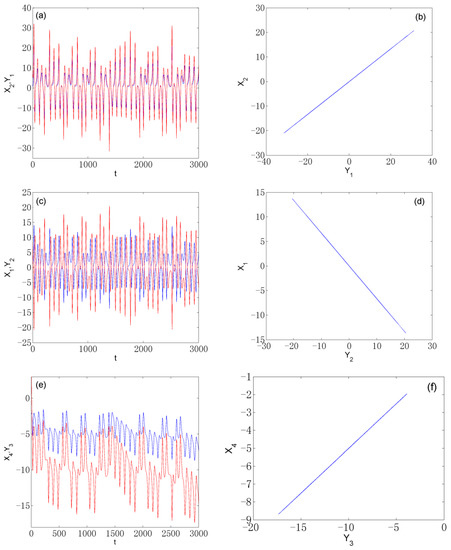
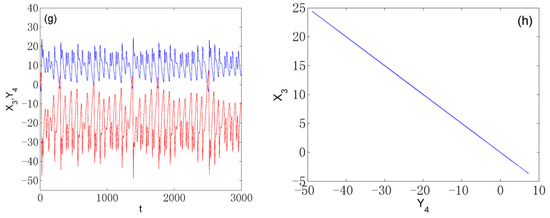
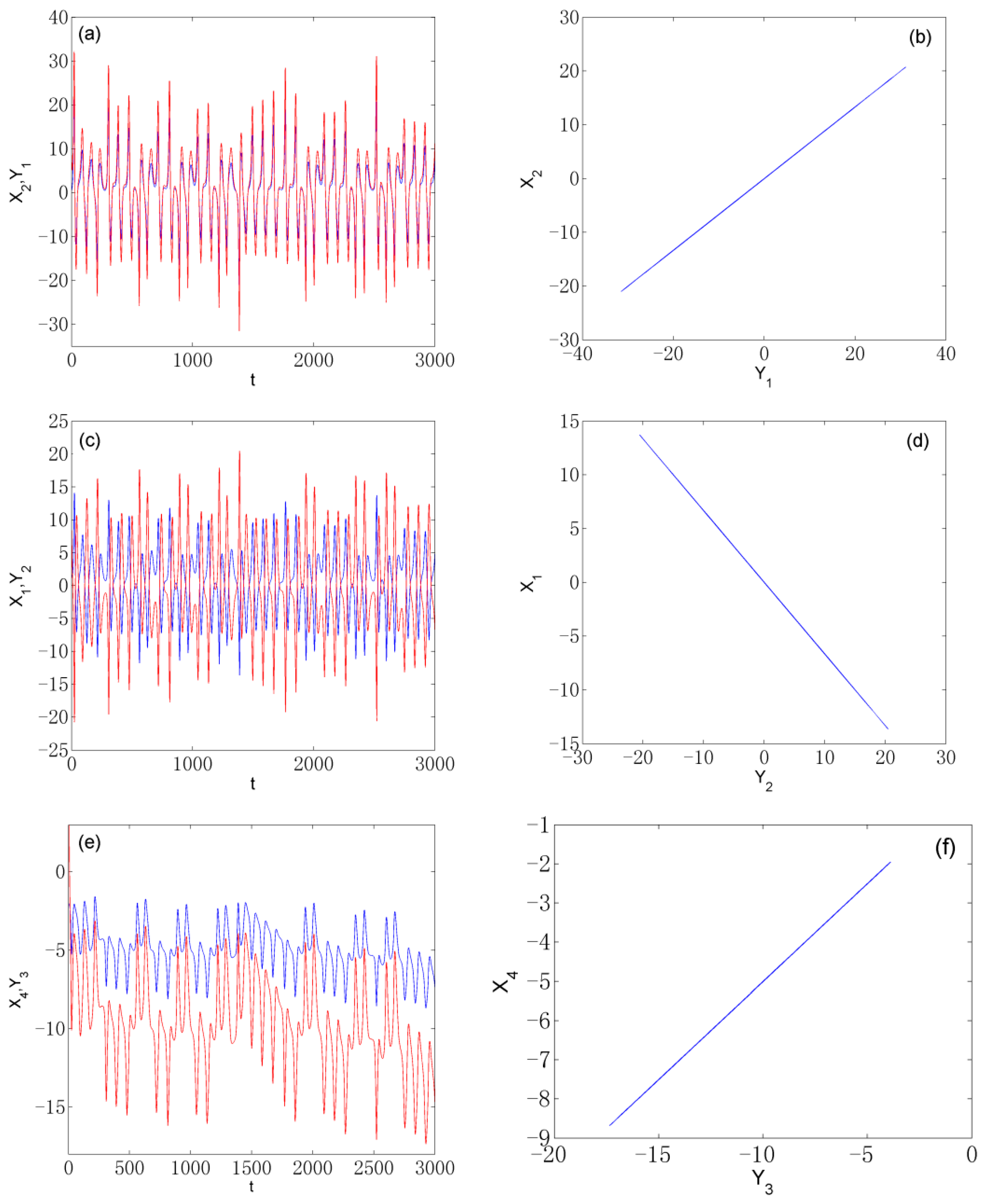
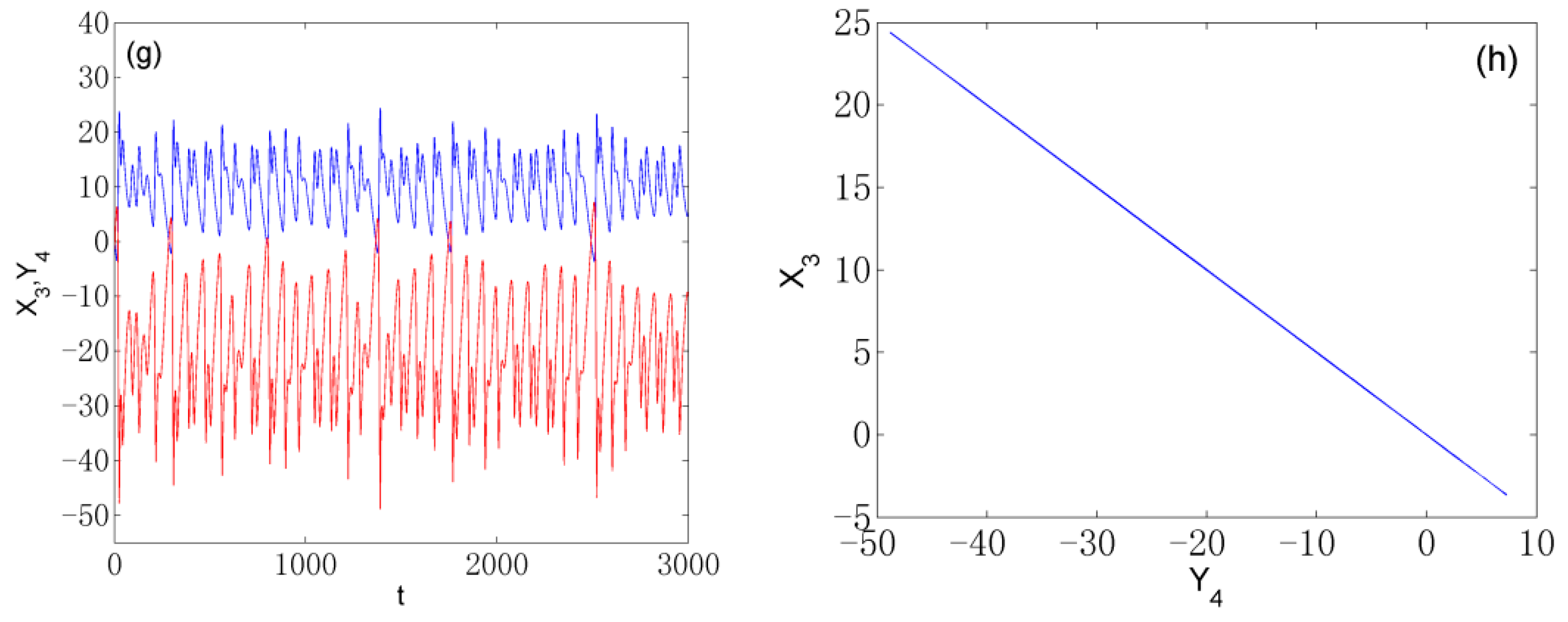
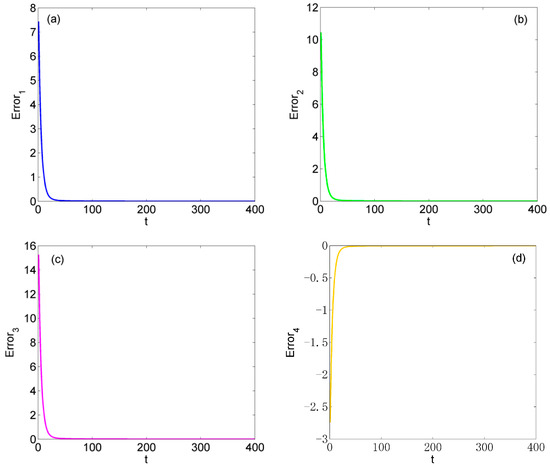
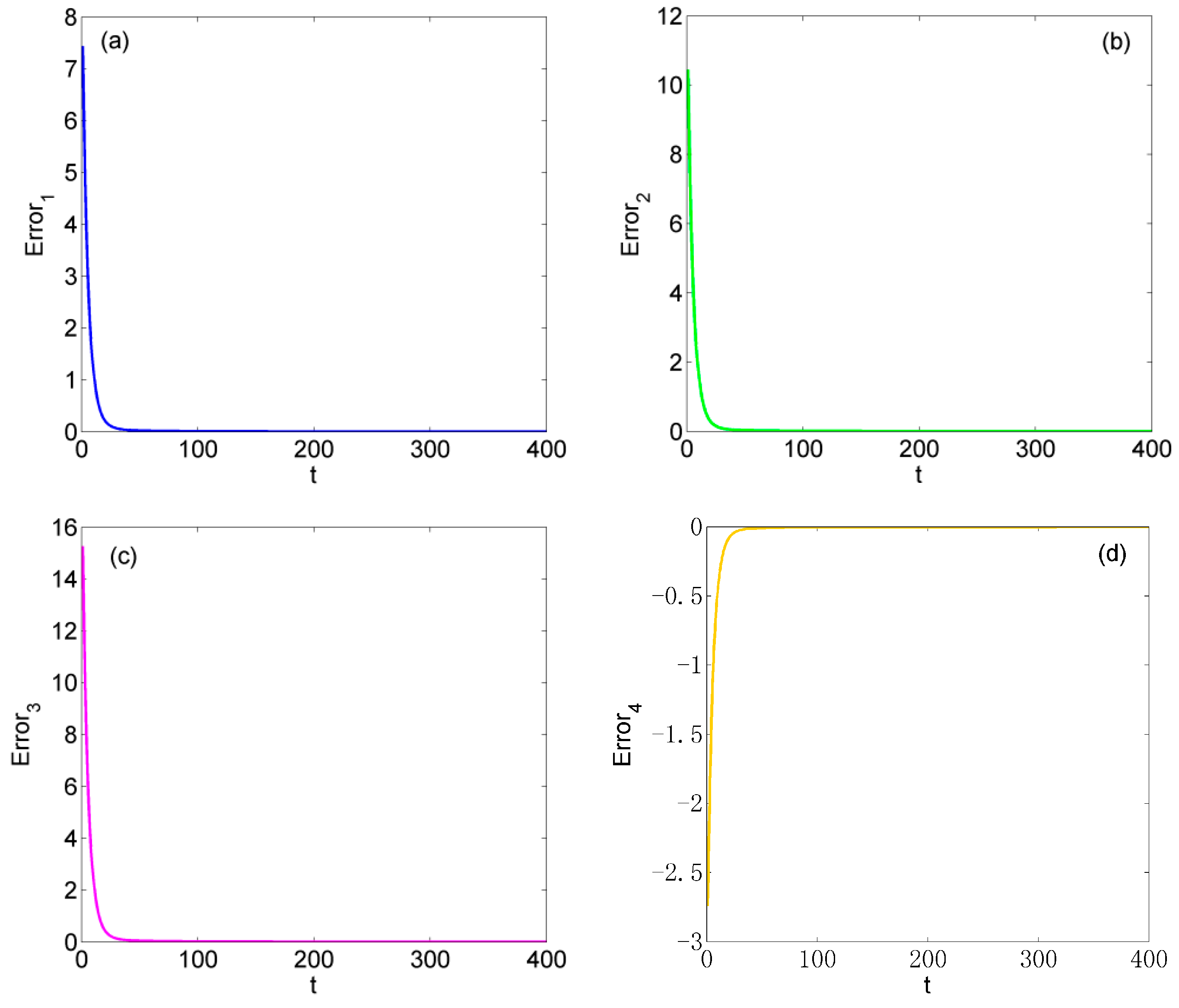
Choose q = 0.8; the time series diagram and synchronization plots of generalized dislocation synchronization are drawn in Figure 5. Figure 5a,c,e,g are time series plots, in which blue and red lines represent the drive system (10) and the corresponding response system (11), respectively. Figure 5b,d,f,h are the synchronization plots. From Figure 5, it can be observed that , , and can synchronize and respectively. Figure 6 depicts the evolution of the error curves of system (15), which verifies the result in Figure 5.
Figure 5.
Time series diagram and synchronization plots of generalized dislocation synchronization. (a,c,e,g) Time series diagrams. (b,d,f,h) The synchronization plots. In (a), the blue line is X2 and the red line is Y1. In (c), the blue line and the red line means. X1 and Y2, respectively. In (e), the blue line and the red line means X4 and Y3, respectively. In (g), the blue line and the red line means X3 and Y4, respectively.
Figure 6.
Evolution of error curves of system (15). (a) The blue line means Error1; (b) The green line denotes Error2; (c)The pink line is Error3; (d) The yellow line is Error4.
Case 2.
Generalized linear synchronization.
Obviously, the 4-dimensional matrix selected in the generalized dislocation synchronization is a special matrix, so the generalized dislocation synchronization is only a special case. When the 4-dimensional matrix is a real matrix, it is a common case of this scheme, namely, generalized linear synchronization.
Therefore, we take the following real matrix as an example.
Choose q = 0.8; then, the errors can be computed from Formula (6).
Given
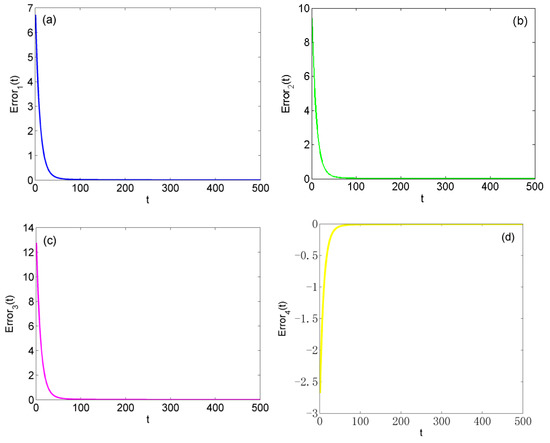
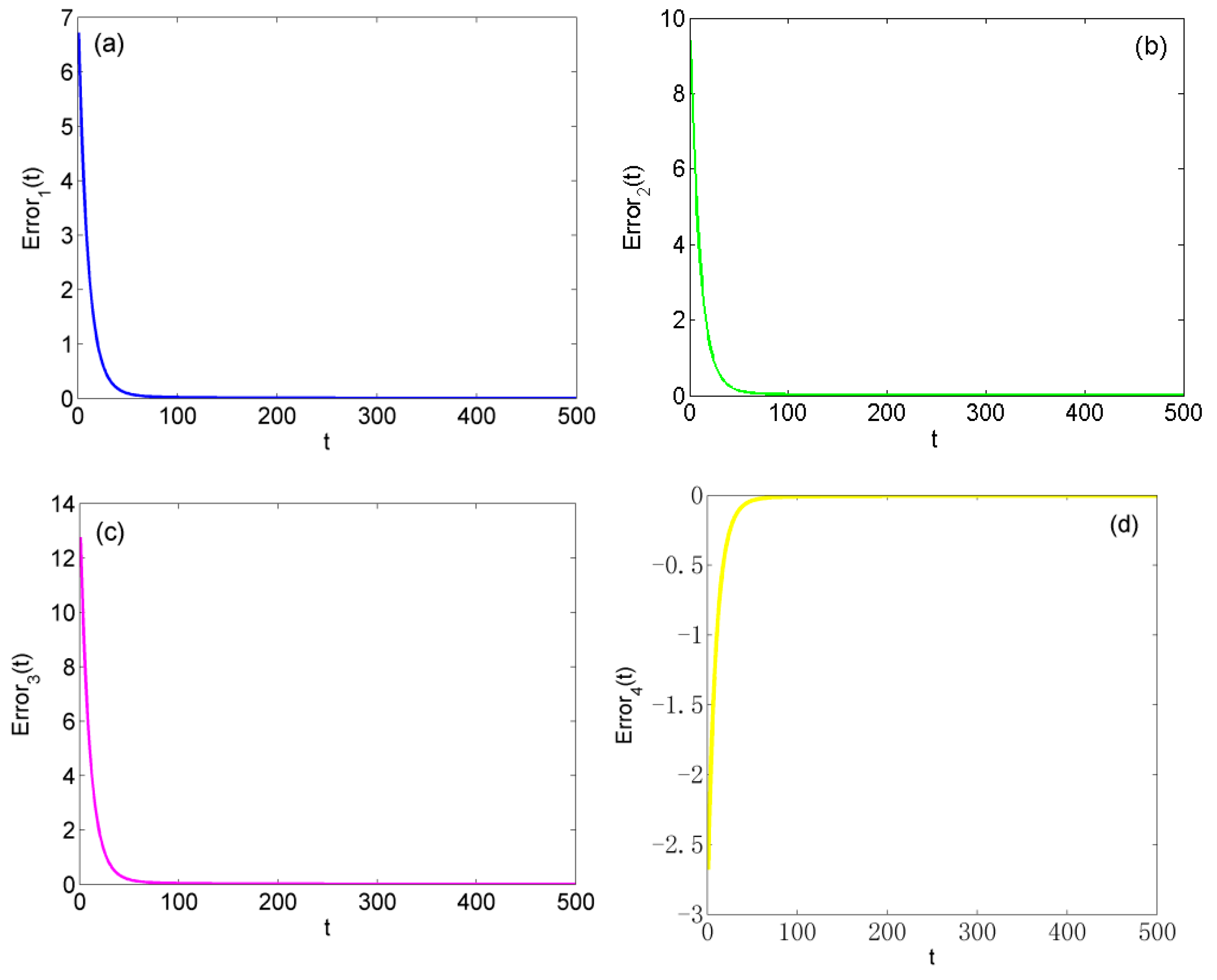
the error plots of the generalized linear synchronization are given in Figure 7, which presents the synchronization error time of and , respectively.
Figure 7.
Error plots: (a) ; (b) ; (c) ; (d) .
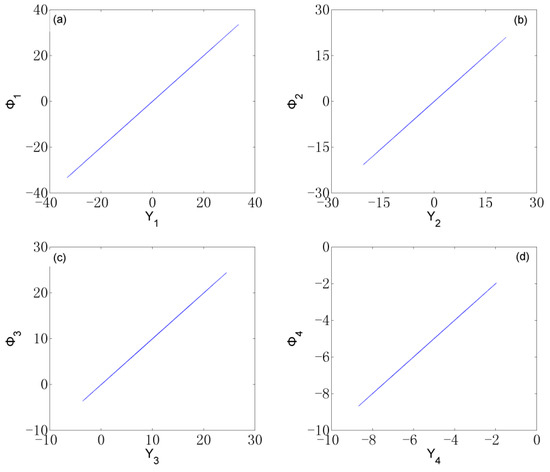
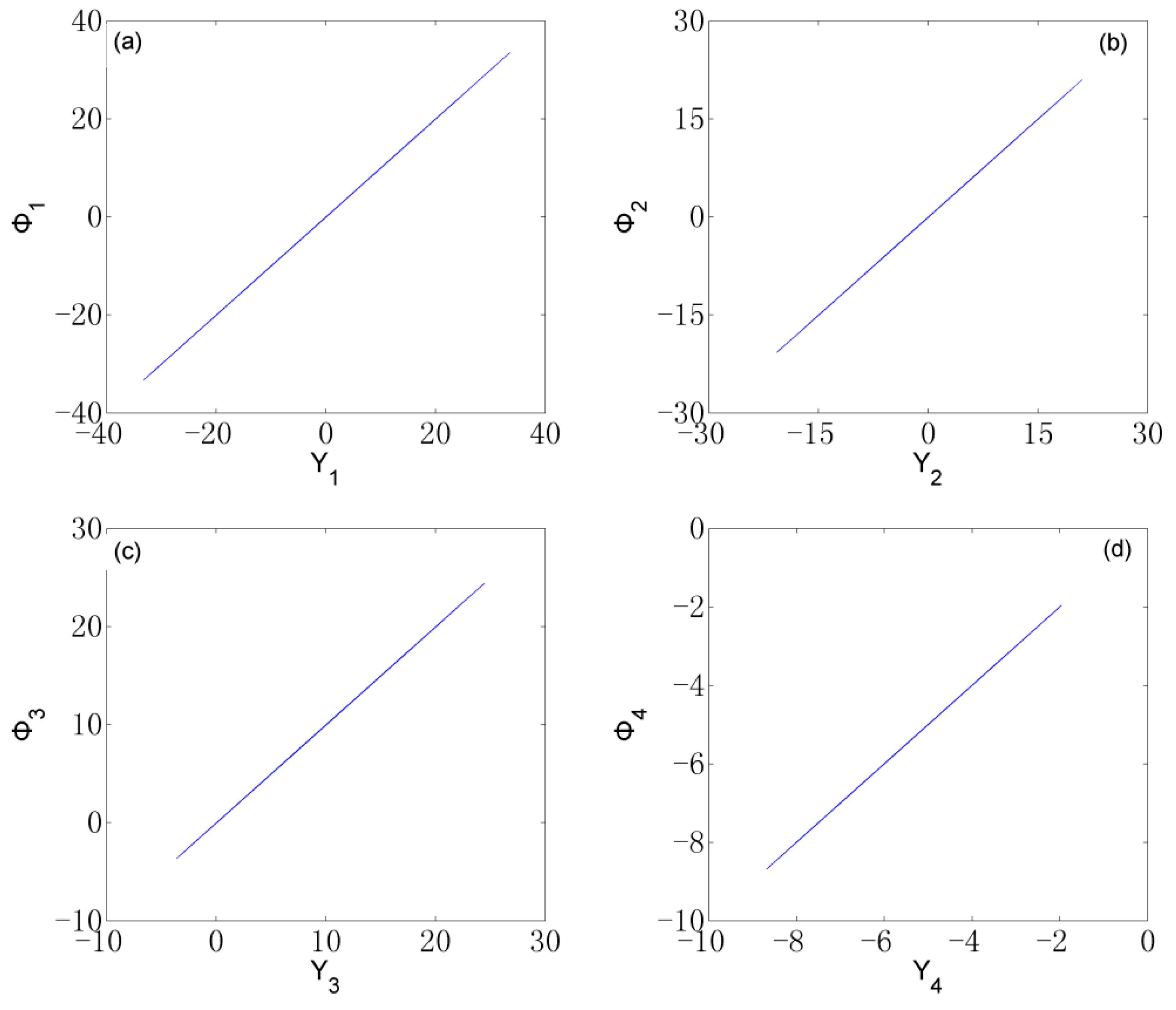
The synchronization of generalized linear synchronizations are calculated and depicted (see Figure 8). This means that generalized synchronization between systems (11) and (10) can be achieved. Thus far, the correctness of two fractional-order hyperchaotic generalized synchronization schemes has been verified.
Figure 8.
Synchronization plots of the generalized linear synchronization. (a) and ; (b) and ; (c) and ; (d) and .
3.3. Performance Analysis of Generalized Synchronization
Taking generalized linear synchronization as an example, the error is described as:
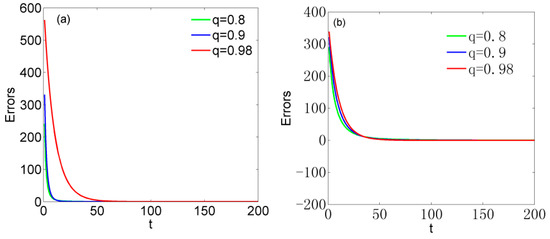
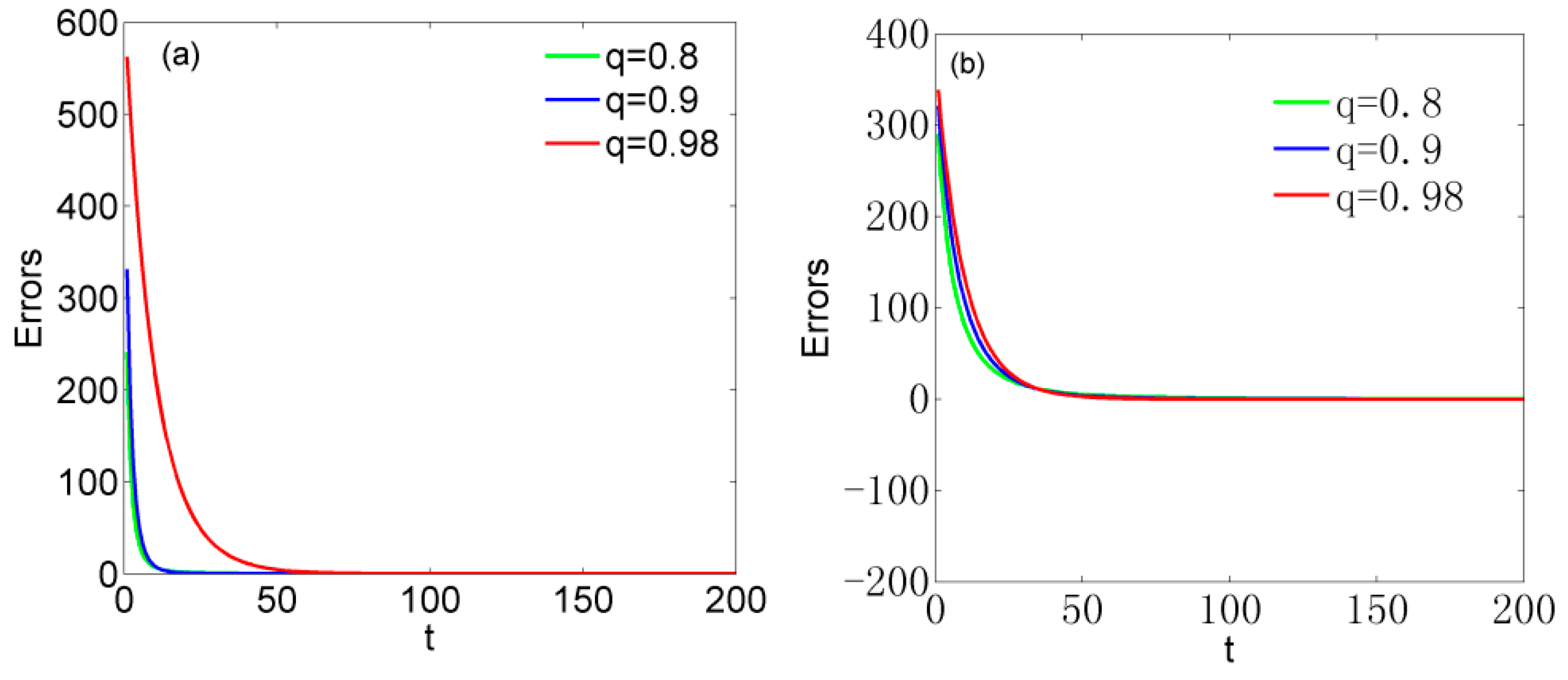
and are selected as initial values of the drive system and response system, respectively. When we fix and is chosen as 0.8, 0.9 and 0.98, respectively, the synchronization time for Cases 1 and 2 are displayed in Figure 9a,b, respectively. Figure 9 means that the time to realize synchronization becomes less as order decreases.
Figure 9.
Effect of on the synchronization time. (a) Synchronization time for different in Case 1; (b) synchronization time for different in Case 2.
4. Conclusions
In this paper, considering the universality of fractional-order systems and their characteristics along with their applications, a fractional-order hyperchaotic system is introduced. By solving the system, one finds that the addressed system has no equilibrium point. The hidden attractors and generalized synchronization of the addressed system are investigated. Via theoretical analysis and numerical simulations, the main results are obtained as follows:
(1) Different hidden attractors are revealed with changing parameters, such as hyperchaotic attractors, chaotic attractors and periodic orbits.
(2) A generalized synchronization scheme is proposed by designing a controller consisting of active and linear feedback parts. This method is simple and easy to implement.
(3) The effect of order on the converging speed of the error system is studied via numerical simulations. It is found that for smaller order , less time is needed to realize the generalized synchronization of the addressed systems.
On the basis of the above work, our future research will consider the following aspects:
(1) The relationship between the type of discussed system and fractional Fourier transformation, as opposed to fractional calculus.
(2) The application of hyperchaotic characteristics and synchronization dynamics in information encryption.
Author Contributions
Conceptualization, M.X.; methodology, L.X. and X.S.; software, L.X. and X.S.; formal analysis, L.X.; investigation, L.X. and X.S.; resources, M.X.; writing—original draft preparation, L.X. and X.S.; writing—review and editing, L.X. and X.S.; visualization, M.X.; supervision, X.S.; project administration, L.X. and X.S.; funding acquisition, L.X. and X.S. All authors have read and agreed to the published version of the manuscript.
Funding
This research was funded by [National Natural Science Foundation of China] grant number [11872327 and 51777180], [Natural Science Research Project of Jiangsu Colleges and Universities] grant number [20KJA190001].
Data Availability Statement
Data is contained within the article.
Acknowledgments
Thanks to anonymous reviewers for their constructive comments and their effort in reviewing our manuscript.
Conflicts of Interest
The authors declare no conflict of interest.
References
- Xu, Y.; Sun, K.; He, S.; Zhang, L. Dynamics of a fractional-order simplified unified system based on the Adomian decomposition method. Eur. Phys. J. Plus 2016, 131, 186. [Google Scholar] [CrossRef] [Scilit]
- Lan, R.; He, J.; Wang, S. Integrated chaotic systems for image encryption. Signal Process 2018, 147, 133–145. [Google Scholar] [CrossRef] [Scilit]
- Sun, J.; Li, C.; Lu, T.; Akgul, A.; Min, F. A memristive chaotic system with hypermultistability and its application in image encryption. IEEE Access 2020, 8, f89–f98. [Google Scholar] [CrossRef] [Scilit]
- Ma, C.; Mou, J.; Yang, F.; Yan, H. A fractional-order hopfield neural network chaotic system and its circuit realization. Eur. Phys. J. Plus 2020, 135, 100. [Google Scholar] [CrossRef] [Scilit]
- Hashemi, M.S.; Inc, M.; Yusuf, A. On three-dimensional variable order time fractional chaotic system with nonsingular kernel. Chaos Solitons Fractals 2020, 133, 109628. [Google Scholar] [CrossRef] [Scilit]
- Grigorenko, I.; Grigorenko, E. Chaotic dynamics of the fractional Lorenz system. Phys. Rev. Lett. 2003, 91, 34101. [Google Scholar] [CrossRef] [Scilit]
- Cafagna, D.; Grassi, G. Bifurcation and chaos in the fractional-order Chen system via a time-domain approach. Int. J. Bifurc. Chaos 2008, 18, 1845–1863. [Google Scholar] [CrossRef] [Scilit]
- Cafagna, D.; Grassi, G. Hyperchaos in the fractional-order Rössler system with lowest-order. Int. J. Bifurc. Chaos 2009, 19, 339–347. [Google Scholar] [CrossRef] [Scilit]
- Deng, W.H.; Li, C.P. Chaos synchronization of the fractional Lü system. Phys. A 2005, 353, 61–72. [Google Scholar] [CrossRef] [Scilit]
- Gao, Y.; Liang, C.; Wu, Q.; Yuan, H. A new fractional-order hyperchaotic system and its modified projective synchronization. Chaos Solitons Fractals Interdiscip. J. Nonlinear Sci. Nonequilibrium Complex Phenom. 2015, 76, 190–204. [Google Scholar] [CrossRef] [Scilit]
- Rahman, Z.A.S.A.; Jasim, B.H.; Al-Yasir, Y.I.A.; Hu, Y.F.; Abd-Alhameed, R.A.; Alhasnawi, B.N. A new fractional-order chaotic system with its analysis, synchronization, and circuit realization for secure communication applications. Mathematics 2021, 9, 2593. [Google Scholar] [CrossRef] [Scilit]
- Makhlouf, A.B. Partial practical stability for fractional-order nonlinear systems. Math. Methods Appl. Sci. 2022, 45, 5135–5148. [Google Scholar] [CrossRef] [Scilit]
- Ji’E, M.; Yan, D.; Wang, L.; Duan, S. Hidden attractor and multistability in a novel memristor-based system without symmetry. Int. J. Bifurc. Chaos 2021, 31, 2150168. [Google Scholar] [CrossRef] [Scilit]
- Natiq, H.; Said, M.R.M.; Ariffin, M.R.K.; He, S.; Rondoni, L.; Banerjee, S. Self-excited and hidden attractors in a novel chaotic system with complicated multistability. Eur. Phys. J. Plus 2018, 133, 557. [Google Scholar] [CrossRef] [Scilit]
- Leonov, G.A.; Kuznetsov, N.V.; Mokaev, T.N. Homoclinic orbits, and self-excited and hidden attractors in a lorenz-like system describing convective fluid motion. Eur. Phys. J. Spec. Top. 2015, 224, 1421–1458. [Google Scholar] [CrossRef] [Scilit]
- Vaidyanathan, S.; Sambas, A.; Azar, A.T.; Rana, K.; Kumar, V. A new 5-d hyperchaotic four-wing system with multistability and hidden attractor, its backstepping control, and circuit simulation. Backstepping Control. Nonlinear Dyn. Syst. 2021, Chapter 6, 115–138. [Google Scholar]
- Jia, H.; Shi, W.; Wang, L.; Qi, G. Energy analysis of sprott-a system and generation of a new hamiltonian conservative chaotic system with coexisting hidden attractors. Chaos Solitons Fractals 2020, 133, 109635. [Google Scholar] [CrossRef] [Scilit]
- Wang, Z.; Liu, J.; Zhang, F.; Leng, S. Hidden chaotic attractors and synchronization for a new fractional-order chaotic system. J. Comput. Nonlinear Dyn. 2019, 14, 081010. [Google Scholar] [CrossRef] [Scilit]
- Sprott, J.C. A proposed standard for the publication of new chaotic systems. Int. J. Bifurc. Chaos 2011, 21, 2391. [Google Scholar] [CrossRef] [Scilit]
- Cafagna, D.; Grassi, G. Fractional-order systems without equilibria: The first example of hyperchaos and its application to synchronization. Chin. Phys. B 2015, 24, 224–232. [Google Scholar] [CrossRef] [Scilit]
- Zhang, S.; Zeng, Y.; Li, Z.; Wang, M.; Le, X. Generating one to four-wing hidden attractors in a novel 4d no-equilibrium chaotic system with extreme multistability. Chaos 2018, 28, 013113. [Google Scholar] [CrossRef] [Scilit]
- Zhou, P.; Huang, K. A new 4-D non-equilibrium fractional-order chaotic system and its circuit implementation. Commun. Nonlinear Sci. Numer. Simul. 2014, 19, 2005–2011. [Google Scholar] [CrossRef] [Scilit]
- Liu, L.; Du, C.; Zhang, X.; Li, J.; Shi, S. Dynamics and entropy analysis for a new 4-d hyperchaotic system with coexisting hidden attractors. Entropy 2019, 21, 287. [Google Scholar] [CrossRef] [Scilit]
- Zhou, P.; Bai, R.J. The adaptive synchronization of fractional-order chaotic system with fractional-order (1 < q < 2) via linear parameter update law. Nonlinear Dyn. 2015, 80, 753–765. [Google Scholar]
- Agrawal, S.K.; Das, S. Projective synchronization between different fractional-order hyperchaotic systems with uncertain parameters using proposed modified adaptive projective synchronization technique. Math. Methods Appl. Sci. 2014, 37, 1232–1239. [Google Scholar] [CrossRef] [Scilit]
- Mahmoud, G.M.; Mahmoud, E.E. Lag synchronization of hyperchaotic complex nonlinear systems. Nonlinear Dyn. 2012, 67, 1613–1622. [Google Scholar] [CrossRef] [Scilit]
- Yadav, V.K.; Shukla, V.K.; Das, S. Exponential synchronization of fractional-order complex chaotic systems and its application. Chaos Solitons Fractals 2021, 147, 110937. [Google Scholar] [CrossRef] [Scilit]
- Bhalekar, S.; Daftardar-Gejji, V. Synchronization of different fractional order chaotic systems using active control. Commun. Nonlinear Sci. Numer. Simul. 2013, 15, 3536–3546. [Google Scholar] [CrossRef] [Scilit]
- Taheri, M.; Zhang, C.; Berardehi, Z.R.; Chen, Y.; Roohi, M. No-chatter model-free sliding mode control for synchronization of chaotic fractional-order systems with application in image encryption. Multimed. Tools Appl. 2022, 81, 24167–24197. [Google Scholar] [CrossRef] [Scilit]
- Gammoudi, I.E.; Feki, M. Synchronization of integer order and fractional order Chua’s systems using robust observer. Commun. Nonlinear Sci. Numer. Simul. 2013, 18, 625–638. [Google Scholar] [CrossRef] [Scilit]
- Jin-Man, H.; Fang-Qi, C. A new fractional order hyperchaotic rabinovich system and its dynamical behaviors. Int. J. Non-Linear Mech. 2017, 95, 73–81. [Google Scholar]
- El-Sayed, A.; Nour, H.M.; Elsaid, A.; Matouk, A.E.; Elsonbaty, A. Dynamical behaviors, circuit realization, chaos control and synchronization of a new fractional order hyperchaotic system. Appl. Math. Model. 2016, 40, 3516–3534. [Google Scholar] [CrossRef] [Scilit]
- Li, K.; Cao, J.; He, J.M. Hidden hyperchaotic attractors in a new 4d fractional order system and its synchronization. Chaos 2020, 30, 033129. [Google Scholar] [CrossRef] [Scilit] [PubMed]
- Zheng, G.C.; Liu, C.X.; Yan, W. Dynamic analysis and finite time synchronization of a fractional-order chaotic system with hidden attractors. Acta Phys. Sin.-Chin. Ed. 2018, 67, 050502. [Google Scholar] [CrossRef] [Scilit]
- Wei, Z.C.; Wang, R.R.; Liu, A.P. A new finding of the existence of hidden hyperchaotic attractors with no equilibria. Math. Comput. Simul. 2014, 100, 13–23. [Google Scholar] [CrossRef] [Scilit]
Disclaimer/Publisher’s Note: The statements, opinions and data contained in all publications are solely those of the individual author(s) and contributor(s) and not of MDPI and/or the editor(s). MDPI and/or the editor(s) disclaim responsibility for any injury to people or property resulting from any ideas, methods, instructions or products referred to in the content. |
© 2022 by the authors. Licensee MDPI, Basel, Switzerland. This article is an open access article distributed under the terms and conditions of the Creative Commons Attribution (CC BY) license (https://creativecommons.org/licenses/by/4.0/).