


Abstract
We construct the blending-type modified Bernstein–Durrmeyer operators and investigate their approximation properties. First, we derive the Voronovskaya-type asymptotic theorem for this type of operator. Then, the local and global approximation theorems are obtained by using the classical modulus of continuity and K-functional. Finally, we derive the rate of convergence for functions with a derivative of bounded variation. The results show that the new operators have good approximation properties.
Keywords:
modified Bernstein–Durrmeyer operators; Voronovskaya-type theorem; local approximation; global approximation; K-functional; modulus of smoothness; bounded variation MSC:
41A25; 41A35; 41A36; 26D20
1. Introduction
In [1], S. N. Bernstein constructed positive and linear operators (named after him) as Bernstein operators to prove the famous Weierstrass approximation theorem. The Bernstein operators attached to ℑ: (the space of continuous functions on S endowed with the max-norm ) with were defined by
where , , . Later, many generalizations and modifications of these kinds of operators (1) have been constructed and considered, we refer the readers to these papers (see -Bernstein operators [2], generalized Bernstein operators [3,4], blending-type Bernstein operators [5,6,7], Durrmeyer-type Bernstein operators [8], genuine-type Bernstein operators [9,10], and so on).
In [11], F. Usta constructed a new modification of Bernstein operators attached to ℑ: by means of the second-order central moments of the Bernstein operators (1) as:
where
In [12], Y. S. Wu et al. defined q-generalization of operators (2). In [13], Q. B. Cai et al. developed a Beta-type modification of operators (2). Recently, many generalizations and modifications of operators (2) were introduced and studied, we refer the readers to the articles [14,15]. Motivated by the above works, for , we present the blending-type modified Bernstein–Durrmeyer operators involving a strictly positive function and as follows:
where , and Beta function , .
If we take , then we obtain the operators defined in [13]. If we take , then we obtain the operators defined in [14].
In the rest part of the paper, we investigate the approximation properties of the operators . In Section 2, we yield the calculation formulas for the moment and central moment related to the operators . In Section 3, we yield an asymptotic formula for operators (3). In Section 4 and Section 5, we establish the local and global approximation theorems by using the classical modulus of continuity and K–functional. In Section 6, we derive the rate of convergence for functions with a derivative of bounded variation. In Section 7, we make the concluding remarks on our works. We show the advantage of the operators by some numerical experiments.
2. Auxiliary Lemmas
In this section, we establish several lemmas to prove our main approximation properties for operators (3). Let , be the test functions, which play a key role in the study of the approximation properties of the positive linear operators.
Lemma 1.
([12], Lemma 1 and Lemma 2, q = 1) Let , , and . Then, the following relations hold:
By using direct calculation, we obtain the following three lemmas.
Lemma 2.
Let , , and , . We conclude
Lemma 3.
Let , , and . We conclude
Lemma 4.
For and , we conclude
Lemma 5.
Let , and fix . Then, holds uniformly on S.
Proof.
Note that , , as hold uniformly on S. Applying the classic Korovkin Theorem in [16], it follows that holds uniformly on S. □
Lemma 6.
Let , , and fix . Then, we have .
Proof.
Using the definition of the operators and taking Lemma 2 into account, it follows
□
3. Voronovskaya-Type Asymptotic Theorem
In this section, we establish the following Voronovskaya-type asymptotic theorem for the operators .
Theorem 1.
Let , and . If exists at a point , then the following relation holds:
Proof.
By using Taylor’s expansion formula for the function ℑ, we get
where
Using L’Hospital’s Rule, we have
Thus, Then, we obtain the following equality by applying the new operators to both sides of (4),
Multiplying (5) by and taking the limit as , we obtain
By Lemma 4, we write
Applying the Cauchy–Buniakowsky–Schwarz inequality to the last term of (6), we have
Meanwhile, it is known from Lemma 4 that the term is bounded as . On the other hand, is continuous at and . Hence, by Lemma 5, we can deduce that
4. Local Approximation
In this section, we study the local approximation properties for the newly defined operators in terms of the modulus of continuity, Peetre’s K-functional, the Steklov mean function and the elements of Lipschitz function class. For , the classical modulus and the second-order modulus of ℑ are defined respectively by:
The Peetre’s K-functional is given by
It is known from [16] that
where is a constant depending only on ℑ.
For and , the Steklov mean function is defined by
From direct calculation, we have (i) .
(ii) and .
In [17], Lenze introduced the following Lipschitz-type maximal function of order for a function as
In [18], M. A. Özarslan and H. Aktuğlu defined the following Lipschitz-type space involving two parameters as
where and is a positive constant depending at most on and .
Now, we prove the following theorems on the local approximation properties of operators (3).
Theorem 2.
Let , , , and . We have
Proof.
By using the property of , we derive
Combining the linearity and the monotonicity of operators (3), we have
Choosing , we get the desired result. □
Theorem 3.
Let , , , and . We have
Proof.
For any , we have
Applying the operators on both sides of the above equality, we can write
By using the property of , we derive
Then, we have
It follows that
Hence, by using the Cauchy–Buniakowsky–Schwarz inequality, we have
Now, choosing , we get the desired inequality. □
Theorem 4.
Let , , , and . Then, there exists a constant such that for any
where .
Proof.
For any and , we construct the auxiliary operators as follows:
Then, we can easily check that
For any and , by using Taylor’s expansion formula, we have
Applying the operators on both sides of the above equality, we can write
Therefore, we have
On the other hand,
This means that
In view of (12) and Lemma 6, we obtain
Taking the infimum on the right-hand side over all and combining inequality (10), we have
Then, the proof of Theorem 4 is completed. □
Theorem 5.
Let , , , and . Then, we have
Proof.
For , using the definition of the Steklov mean, we obtain
Using property (i) of the Steklov mean and Lemma 6, we obtain
It follows from Taylor’s expansion formula that
Again using property (i) of the Steklov mean and Lemma 6, we get
Hence, we have
Choosing , the proof of Theorem 5 is completed. □
Theorem 6.
Let . If , then we have
Proof.
We first deal with the case . We obtain
Using the fact that and the Cauchy–Buniakowsky–Schwarz inequality, we have
Thus, the inequality is obtained for . Next, we prove the inequality for the case . Applying the Hölder’s inequality with and , we get
Hence, the desired result is obtained. □
Theorem 7.
Let and . Then, for all , we have
5. Global Approximation
In this section, we yield a theorem on the global approximation properties of operators (3) by using the weighted first- and second-order modulus of smoothness. Let us define the space of functions , where means that is differentiable and is absolutely continuous on every closed interval . Let and . The weighted K-functional is defined by
The weighted first- and second-order modulus of smoothness are defined by
and
where and ℓ above are admissible step-weight functions defined on S. By [19], there exists a constant , such that
Our next result is the following theorem.
Theorem 8.
Let , , , and . Then
where , , and is a constant.
Proof.
Again, considering the auxiliary operators defined at (12) and for , applying the operators on both sides of the inequality mentioned above, we have
Since is concave function on S, taking , with and , we have
On the other hand, we observe that
Applying the definition of in this section, we find
Further, for , since the operators are uniformly bounded, using the above inequality, we have
Taking infimum over all , we get
As for the last part above, we find
Combining (19) with the above results, we complete the proof of Theorem 8. □
6. Rate of Convergence
The goal of this section is to study the convergence rate of for functions with a derivative of bounded variation on S. Let denote the class of absolutely continuous functions defined on , whose derivatives have bounded variation on . It is well known that the functions possess a representation:
where is a function with bounded variation on . An integral representation of the operators can be given as follows:
where the kernel .
Lemma 7.
For a sufficiently large λ and a fixed , we have
- (a)
- (b)
- .
Proof.
We prove (a) as follows.
By Lemma 3, we have
The proof of (b) is similar to that of (a). We omit the details. □
Theorem 9.
Let . Then, for every and sufficiently large λ, the following inequality
holds, where is the total variation of on and is defined by
Proof.
Since , by (20), for each , we get
Therefore, we have
Now, let
Thus, our task is to estimate the terms and .
From the definition of , we write
Since the inequality holds for any , applying the integration by parts with putting , we obtain
By considering , we yield
Therefore,
Again, applying integration by parts to , together with Lemma 7, we have
By the substitution of the values , we get
7. Conclusions
In our paper, we construct the blending-type modified Bernstein–Durrmeyer operators involving the strictly positive function and the positive parameter . We derive many approximation properties of this type of operator. We first establish a Voronovskaya-type asymptotic theorem of them. Then, we establish the local and global approximation theorems by using the classical modulus of continuity and K-functional. Finally, we derive the convergence rate of the approximation for functions with a derivative of bounded variation.
We remark that our results are rather general. For instance, one can get the error estimates from our results for different existing Bernstein–Durrmeyer–type operators, such as operators given in [14,15], by selecting different parameters and . Moreover, we can obtain the new operators, which provide better approximations for different target functions. In general, different target functions need different parameters. The choices of the parameters show the flexibility of the operators . In fact, for a given target function ℑ, we can choose appropriate parameters to obtain a smaller error of the approximation by . This feature will be of great interest to practical applications. We illustrate this feature by some numerical experiments.
Example 1.
Let , , , and .
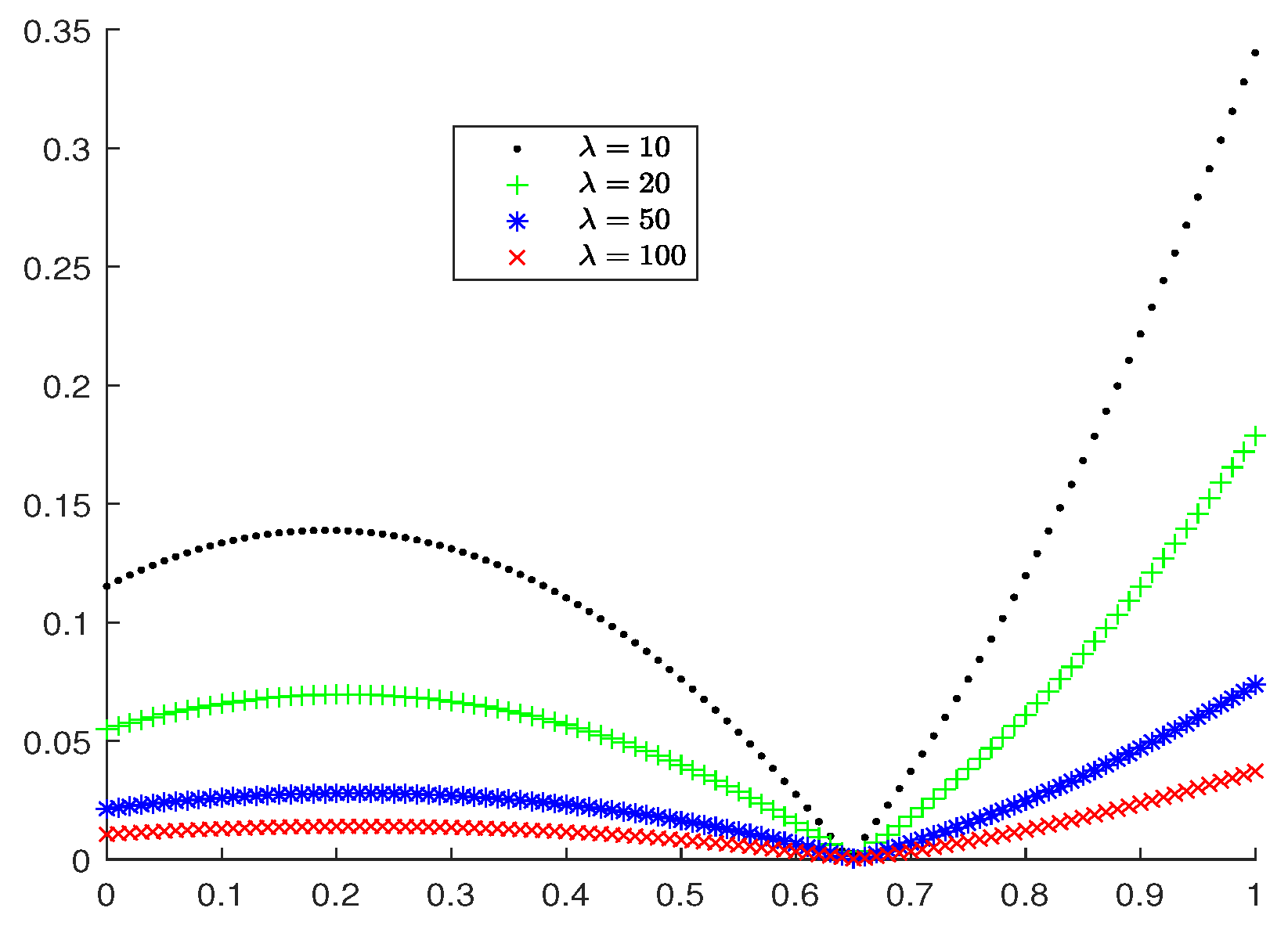
Figure 1 shows the convergence of the operators to the target function while we choose different parameters . The larger the , the smaller of the error of the approximation by . Combining with Figure 2, when , the error of the approximation becomes smaller and smaller with the increase of variable . When , contrary to what happens.
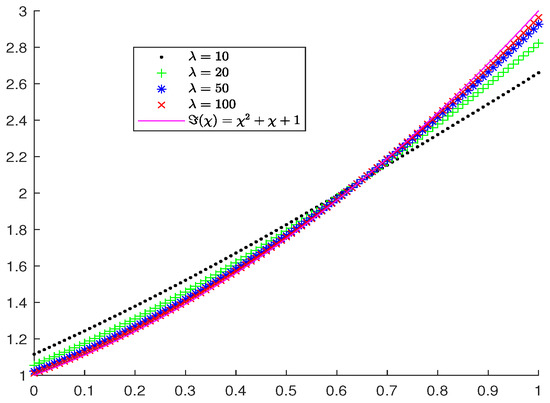
Figure 1.
The operators and the target function .
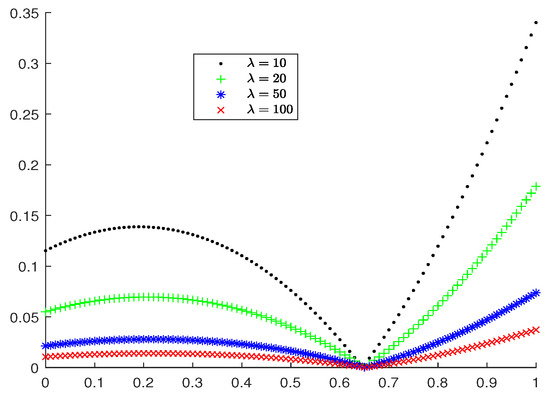
Figure 2.
Error of approximation .
It is known that if we take in operators (3), then we get the modified Bernstein–Durrmeyer-type operators , which is defined in [14]. In the following example, we show that operators (3) with some different parameters provide better approximations than the operators .
Example 2.
Let , , , and .
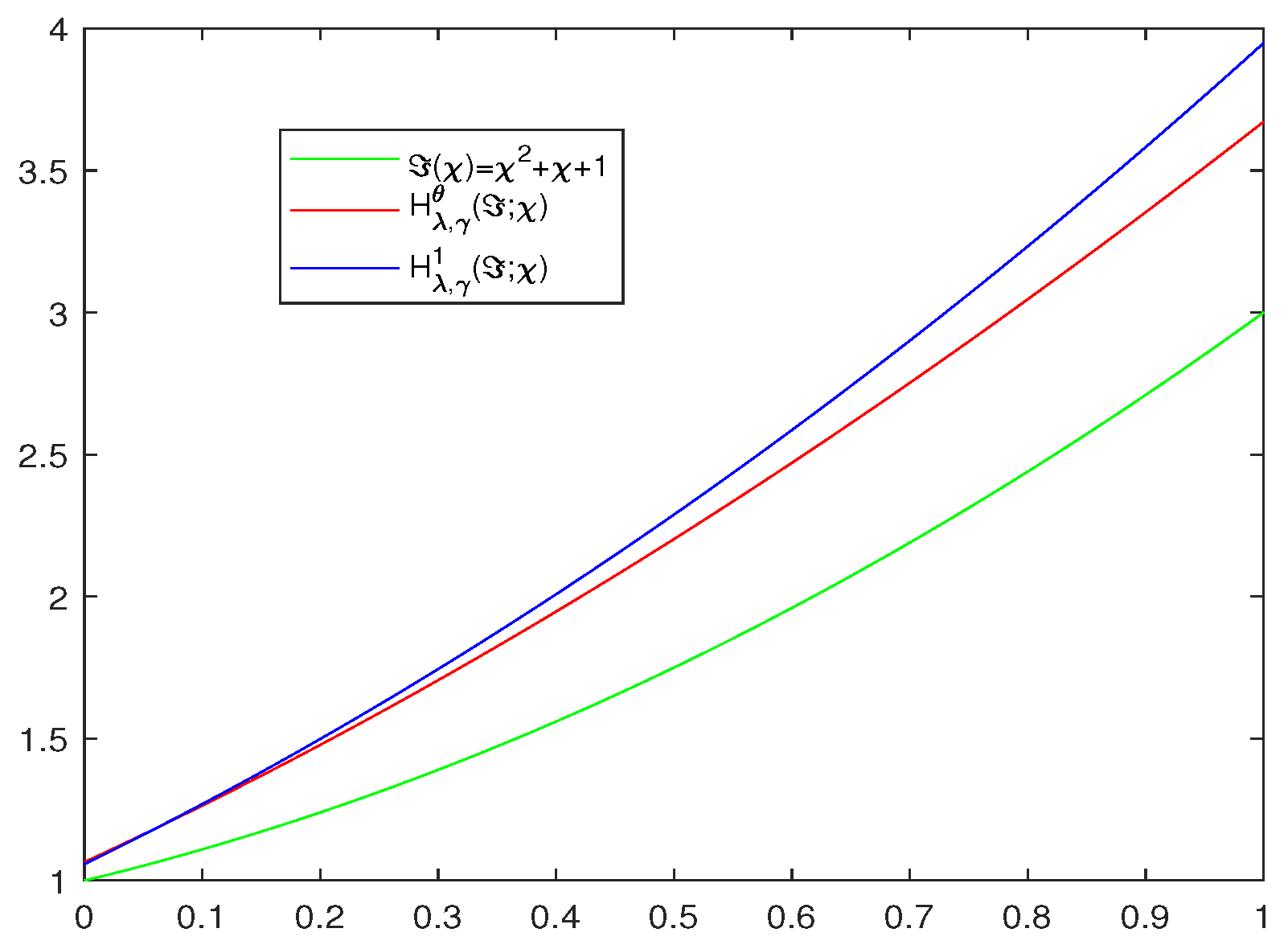
From Figure 3, we can see that, for the target function (green), the operator (red) gives a better approximation to than the modified Bernstein–Durrmeyer type operator (blue).
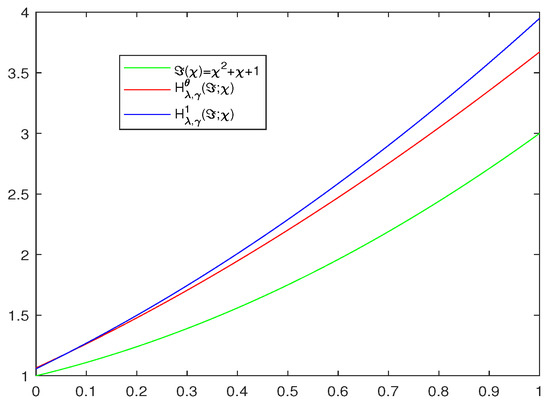
Figure 3.
The target function (green), the operator (red), the modified Bernstein–Durrmeyer type operator (blue).
Author Contributions
Writing–original draft, Y.-J.L., W.-T.C., W.-H.Z., P.-X.Y. All authors have read and agreed to the published version of the manuscript.
Funding
This research is supported by the National Natural Science Foundation of China (Grant No. 11626031), the Key Natural Science Research Project in Universities of Anhui Province (Grant No. KJ2021A0648 and KJ2019A0572), the Philosophy and Social Sciences General Planning Project of Anhui Province of China (Grant No. AHSKYG2017D153), and the Natural Science Foundation of Anhui Province of China (Grant No. 1908085QA29).
Institutional Review Board Statement
Not applicable.
Informed Consent Statement
Not applicable.
Data Availability Statement
Not applicable.
Acknowledgments
The authors would like to thank the referees and the editor for their useful suggestions, which helped us improve the paper.
Conflicts of Interest
The authors declare no conflict of interest.
References
- Bernstein, S.N. Proof of the theorem of Weierstrass based on the calculus of probabilities. Commun. Soc. Math. Kharkow 1913, 2, 1–2. [Google Scholar]
- Cai, Q.B.; Lian, B.Y.; Zhou, G.R. Approximation properties of λ-Bernstein operators. J. Inequal. Appl. 2018, 2018, 61. [Google Scholar] [CrossRef] [PubMed]
- Chen, X.Y.; Tan, J.Q.; Liu, Z.; Xie, J. Approximation of functions by a new family of generalized Bernstein operators. J. Math. Anal. Appl. 2017, 450, 244–261. [Google Scholar] [CrossRef]
- Kajla, A.; Mursaleen, M.; Acar, T. Durrmeyer-type generalization of parametric Bernstein operators. Symmetry 2020, 12, 1141. [Google Scholar] [CrossRef]
- Acu, A.M.; Kajla, A. Blending type approximation by modified Bernstein operators. Adv. Oper. Theory 2022, 7, 9. [Google Scholar] [CrossRef]
- Baxhaku, B.; Kajla, A. Blending type approximation by bivariate generalized Bernstein type operators. Quaest. Math. 2020, 43, 1449–1465. [Google Scholar] [CrossRef]
- Kajla, A.; Mohiuddine, S.A.; Alotaibi, A. Blending-type approximation by Lupaş–Durrmeyer-type operators involving Pólya distribution. Math. Methods Appl. Sci. 2021, 44, 9407–9418. [Google Scholar] [CrossRef]
- Kajla, A.; Mohiuddine, S.A.; Alotaibi, A. Durrmeyer-type generalization of μ-Bernstein operators. Filomat 2022, 36, 349–360. [Google Scholar] [CrossRef]
- Acat, T.; Acu, A.M.; Manav, N. Approximation of functions by genuine Bernstein-Durrmeyer type operators. J. Math. Inequal. 2018, 12, 975–987. [Google Scholar] [CrossRef]
- Cai, Q.B.; Ülkü, D.K.; Çekim, B. Approxiamtion properties for the genuine modified Bernstein-Durrmeyer-Stancu operators. Appl. Math. J. Chin. Univ. 2020, 35, 468–478. [Google Scholar] [CrossRef]
- Usta, F. On new modification of Bernstein operators: Theory and applications. Iran. J. Sci. Technol. Trans. A Sci. 2020, 44, 1119–1124. [Google Scholar] [CrossRef]
- Wu, Y.S.; Cheng, W.T.; Chen, F.L.; Zhou, Y.H. Approximation theorem for new modification of q-Bernstein operators on (0, 1). J. Funct. Spaces 2020, 2020, 6694032. [Google Scholar] [CrossRef]
- Cai, Q.B.; Sofalıoǧlu, M.; Kanat, K.; Çekim, B. Some approximation results for the new modification of Bernstein-Beta operators. AIMS Math. 2022, 7, 1831–1844. [Google Scholar] [CrossRef]
- Kajla, A.; Miclǎuş, D. Modified Bernstein-Durrmeyer type operators. Mathematics 2022, 10, 1876. [Google Scholar] [CrossRef]
- Sofalıoǧlu, M.; Kanat, K.; Çekim, B. Parametric generalization of the modified Bernstein operators. Filomat 2022, 63, 1699–1709. [Google Scholar] [CrossRef]
- DeVore, R.A.; Lorentz, G.G. Constructive Approximation; Springer: Berlin/Heidelberg, Germany, 1993. [Google Scholar]
- Lenze, B. On Lipschitz type maximal functions and their smoothness spaces. Indag. Math. (Proc.) 1988, 90, 53–63. [Google Scholar] [CrossRef]
- Özarslan, M.A.; Aktuğlu, H. Local approximation for certain King-type operator. Filomat 2013, 27, 173–181. [Google Scholar] [CrossRef]
- Ditzion, D.; Totik, V. Moduli of Smoothness; Springer: New York, NY, USA, 1987. [Google Scholar]
Disclaimer/Publisher’s Note: The statements, opinions and data contained in all publications are solely those of the individual author(s) and contributor(s) and not of MDPI and/or the editor(s). MDPI and/or the editor(s) disclaim responsibility for any injury to people or property resulting from any ideas, methods, instructions or products referred to in the content. |
© 2022 by the authors. Licensee MDPI, Basel, Switzerland. This article is an open access article distributed under the terms and conditions of the Creative Commons Attribution (CC BY) license (https://creativecommons.org/licenses/by/4.0/).