


Abstract
In this paper, we define uniformities and proximities as relators and show the equivalences of these definitions with classical ones. For this, we summarize the essential properties of relators, using their theory from earlier works of Á. Száz. Moreover, we prove implications between important topological properties of relators and disprove others. Finally, we add an analogous definition for uniformly and proximally filtered properties.
1. Introduction
At the beginning of the 20. century some mathematicians tried to define abstract topological structures. The most relevant results are Poincaré 1895, Fréchet 1906, Hausdorff 1914, and Kuratowski 1922.
Uniform spaces in terms of relations were introduced by Weil in 1937 [1].
Proximities were first investigated by Riesz in 1909 [2], Effremovič and Smirnov in 1952 [3,4].
After the works of Davis, Pervin, and Nakano [5,6,7] in 1987, Száz [8] introduces the notion of relator and relator space in the following way.
Definition 1.
A nonvoid family of relations on a nonvoid set X is called a relator on X, and the ordered pair is called a relator space.
In the last decades, a few authors investigated the interpretation of well-known topological properties in terms of relators. In 2016, relators defined in terms of proximity spaces were introduced in [9].
For more details, see, for instance, ref. [10], but for the readers’ convenience, we summarize the necessary notions and notations.
Remark 1.
With the usual notations,is a relator on X means that
whereis the power set of X, and.
If R is a relation on X,, and, then the sets
are called the images of x and A under R, respectively.
2. Preliminary Concepts
Definition 2.
If R and S are relations on X, then the composition of R and S can be defined, such thatfor all.
Moreover, let, and, for all. Finally, we say that R is
- reflexive if ,
- symmetric if ,
- transitive if .
Lemma 1.
If R is a relation on X, and , then
Proof.
therefore
Using this, with required objects, we have that
□
Definition 3.
If is a relator on X, then the relators
and
are called the uniform and the proximal refinements of , respectively. For more details, see [10].
Moreover, for all , we define
Remark 2.
* and # are really refinements as we defined in [10], that is they are self-increasing in the sense that
or equivalently they are expansive, increasing and idempotent, in the sense that
and
for all and relators on X.
Moreover, # is *-dominating, *-invariant, *-absorbing and *-compatible, that is
For all the mapping of relators on X is increasing.
Finally, * and # are inversion-compatible, that is for all relators on X
And we have that for all relators on X
The following example shows, that the analog assertion is not true for #.
Example 1.
Let , and
is an elementwise reflexive and symmetric relator on X. Now, , since however
Note, that  .
.Riesz or Efremovič proximity and strong inclusion are interdefinable. We will use the inverse relation of strong inclusion. For details, see, for instance, refs. [10,11].
Definition 4.
If is a relator on X, then for any we write:
The relation is called the proximal interiors induced by on X.
Theorem 1.
is a #–increasing set-valued function for relators on X in the sense that
for any two relators and on X.
Moreover, it follows that Int is increasing and if is a relator on X, then is the largest relator on X such that
3. A New Form of Generalized Proximities
Definition 5.
Let is a relator on X, and is a refinement for relators on X. We define the followings.
- is □-reflexive, if ;
- is □-symmetric, if ;
- is □-transitive, if ;
- is □-fine, if .
For instance, we say that is uniformly-symmetric or proximally-transitive instead of *-symmetric or #-transitive, respectively.
Following Weil, we say that the relator on X, is a generalized uniformity/generalized proximity on X, and the ordered pair is a generalized uniform space/generalized proximal space if it is
- uniformly/proximally reflexive;
- uniformly/proximally symmetric;
- uniformly/proximally transitive;
- uniformly/proximally fine.
Definition 6.
If the binary relation Int on the powerset of a non-empty set X satisfies the following axioms for arbitrary , then we say that it is a generalized set-proximity on X.
- P1
- ;
- P2
- ;
- P3
- ;
- P4
- ;
- P5
- and .
Moreover, if it also satisfies
- P6
- ;
then we say that Int is a set-proximity on X.
P4 is missing from axioms of strong inclusions in [11]. The following example shows that all of the other axioms do not imply P4.
Example 2.
Assume that X has at least 3 elements, and let
In contrast, an Int generated by an additive relation has P4 property. The relation is named additive, if . Moreover, a relation generates Int by rule .
Proposition 1.
If is a relator on X, and
then
- 1.
- ;
- 2.
- satisfies P4 and P5;
- 3.
- If P4 and P5 hold for , then ;
- 4.
- is proximally reflexive iff is P1;
- 5.
- is proximally symmetric iff is P2;
- 6.
- if is proximally transitive, then is P3;
Proof.
- 1.
- At first, let and . If or , then for an arbitrary obviously .If and , then there exists an such that , that is . By using the definition of , we have that, for some .Now, we have , which impliesFor the converse inclusion let . For any , and then . Since we have , that is , which implies
- 2.
- and for all R relations on X, therefore P5 is true for .Moreover, if is a relator on X, , and , then there exists an such that . In this case, , that is P4 is also true for .
- 3.
- At first, note that if P5 holds, then , therefore , that is is a relator on X.If , then . Now, follows . Note, that holds only if or .Conversely, if , then there exists such that . Such an R is equal to for some . In the case of and , we have that , and , and then P4 follows that .In the case of or , it is quite obvious that if P4 and P5 hold for , then and for all .
- 4.
- We note that is proximally reflexive iff R is a reflexive relation for all .If , then by using the reflexivity of and the definition of , we have that for some .Conversely, for all and , implies . P1 follows .
- 5.
- . If is proximally symmetric, then there exists such that . Lemma 1 follows .Conversely, if and , then , therefore since P2 and there exists such that . By using Lemma 1 there exists such that , proving that .
- 6.
- . If is proximally transitive, then there exists such that . With , we have that . Moreover , and it follows that .
□
Some papers write instead of our . With this definition, the converse implication of 6 follows, but because of the definition of uniformities, we need this one. Otherwise, in the proof of the following Theorem, we will see that with some other assumption, the converse implication of 6 is true with our notions.
Remark 3.
Note, that with the above notations
Theorem 2.
Let be a relator on X.
- 1.
- is a bijection of the set of all proximally fine relators on X onto the set of d and e relations on the powerset of X.
- 2.
- is a bijection of the set of generalized proximities on X onto the set of generalized set-proximities on X.
Proof.
Since Proposition 1, we need to prove only that if is a generalized set-proximity, and is proximally fine, then is proximally transitive. For this, let be arbitrary. Then for any we have that , therefore since c there exists such that and . That is, there exist such that and . Now
and , that is .
Really, since P1 is proximally reflexive, therefore we have that . Now, for an arbitrary , , if and if , that is because of is proximally fine.
Moreover, it is easy to see that if , then
otherwise if , then
□
4. A New Form of Proximities
Definition 7.
Let be a family of sets, or equivalently for some set X. We call
the filtered family of sets generated by .
Moreover, we say that is filtered if .
Finally, if R is a relation on for some set X, then we say that R is a filtered relation if
Remark 4.
Since Φ is a refinement for relators on X, we write instead of , if is a relator on X. Note also that is filtered iff .
Moreover, note that Φ is an inversion compatible refinement for relators on X, that is, if is a relator on X, then .
Finally, if is finite, then .
Lemma 2.
If is a relator on X, then , .
Proof.
It is easy to see, that
Moreover, if , then there exists an finite such that . and implies that . □
Proposition 2.
If is a relator on X, then the following assertions are equivalent.
- 1.
- ;
- 1.
- there exists an relator on X, such that .
Proof.
We need only to prove the (2)⇒(1) implication. For this, we note that if (2) is true then
□
In contrast to Example 1, the following lemma shows that if is a filtered relator on X, then .
Lemma 3.
If is a relator on X, then .
Proof.
By definition of # if , then for all , there exists an such that . For such an , there exists with , and . Now, for we have that
We get that for all there exists a such that , that is . □
Lemma 4.
If R is a filtered relation on X with P2 property, and is finite, then
Proof.
Since P2 property of R we have that
Of course, J is nonempty and finite, therefore . Moreover, it is also quite obvious, that
Now, P2 property of R proves the Lemma. □
Proposition 3.
If is a proximally symmetric relator on X, and
then the following assertions are equivalent.
- 1.
- ;
- P6
- ;
- 2.
- is a filtered relation;
- 3.
- 4.
- there exists an relator on X, such that .
Proof. (1)⇒P6: Since has the P4 property, hence .
P6⇒(2): If P6 holds for and , then by using again the P4 property of we have that . Now, we can prove the implication by induction.
(2)⇒(3): Let be an arbitrary nonempty and finite subset of , and let be arbitrary. We need to prove that there exists an such that .
For this, let be nonempty and finite such that .
If there exists , then such an x we have that for all , and hence for all , therefore for all .
If , then for all .
Otherwise, if , then with
we have that J is nonempty finite for all and is nonempty and finite and
Since is a filtered relation, and all is a nonempty and finite subset of , it is clear that for all . By using Lemma 4 we have that
for all . Therefore,
P4 property of follows that
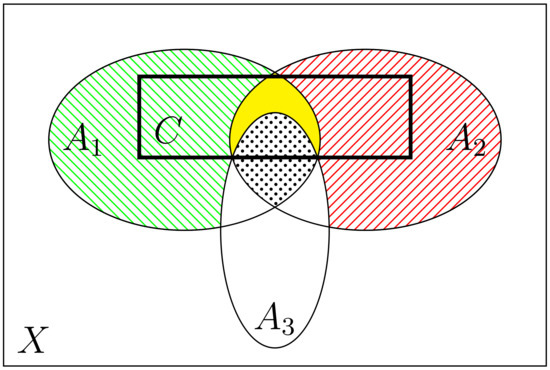
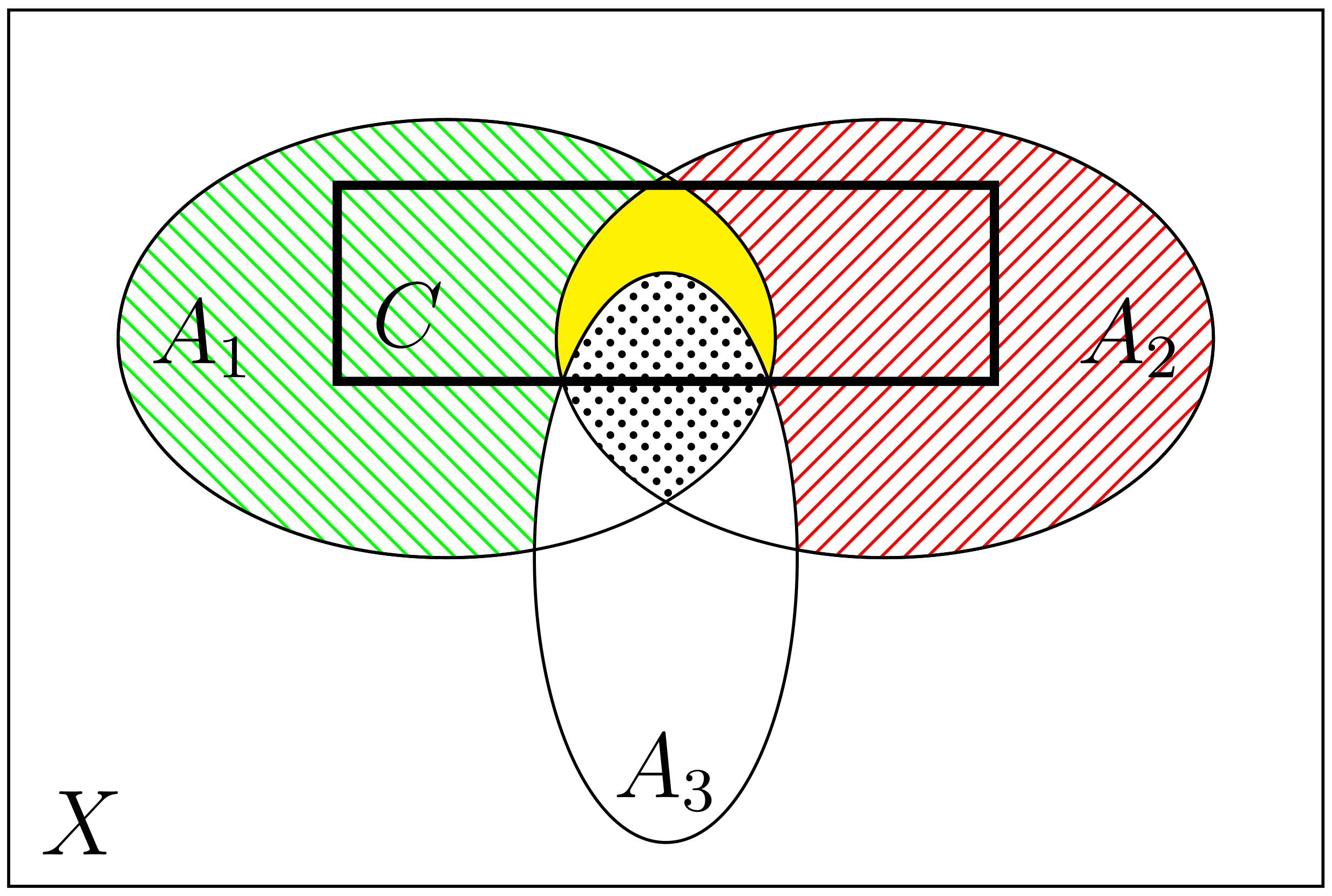
Figure 1.
A Venn diagram.
The striped, dotted, and filled partitions are for .
(3)⇒(4): It is quite obvious since assertion (1) of Proposition 1.
(4)⇒(1): If , then and , therefore and for some . and , that is . □
Int is the inverse of strong inclusion of Riesz and Efremovič proximities if it satisfies P1–P6.
Unfortunately, Int is a filtered relation on X, is neither sufficient nor necessary for P6 property of Int without P4 is assumed. For instance, if X is a nonvoid set, then is a filtered relation, but not P6. On the other hand, is not a filtered relation, but P6.
Because of the above Proposition, we define the uniformly and proximally filtered properties of a relator by the following.
Definition 8.
If □ is a refinement for relators on X, then we say that the relator on X is □-filtered if there exists an relator on X such that .
We use the uniformly filtered and proximally filtered notions instead of *-filtered and #-filtered.
Note, that by Proposition 2 we have that is a uniformly filtered relator on X iff which can be found in definition of uniformities by Weil.
Example 3.
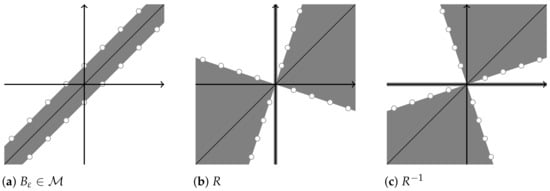
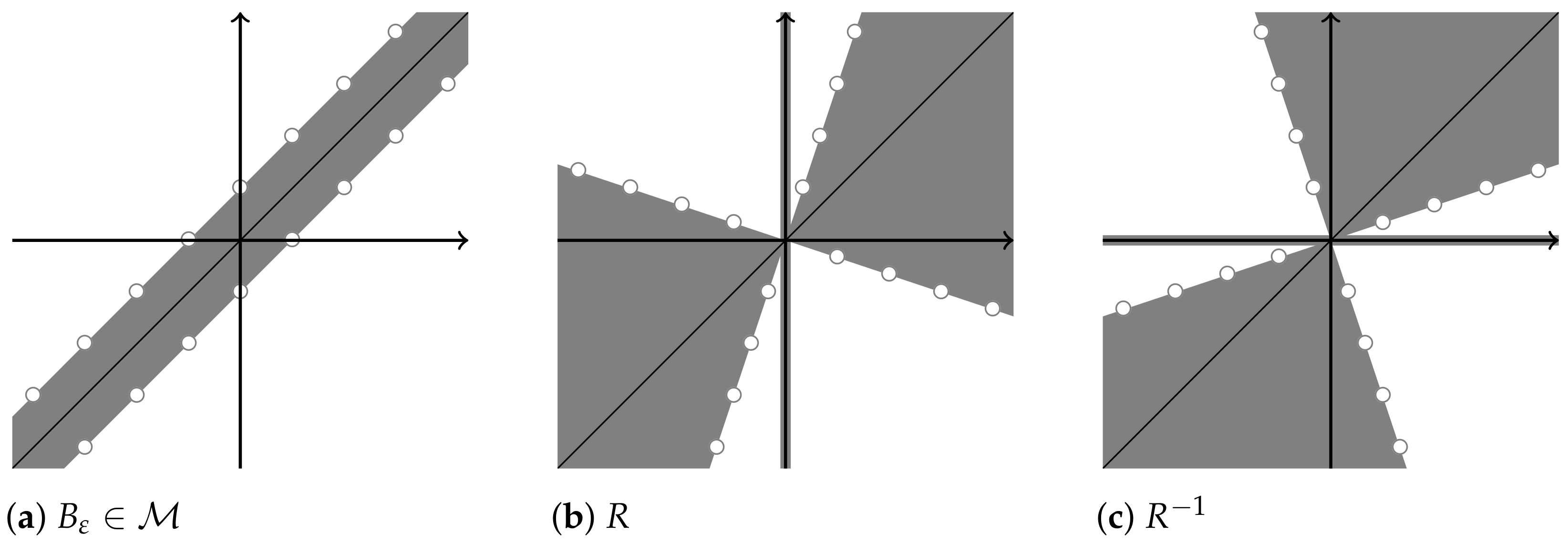
In general, is only a sufficient but not necessary condition of proximally filtered property of . Namely, let be the set of reals, and where for all (see Figure 2a). Then is elementwise reflexive, elementwise symmetric, (proximally) filtered, and .
Figure 2.
Relations on .
Moreover, let be a relation on . Now, , therefore (see Figure 2b,c).
Really, if is bounded and , then , with . In all other cases .
We have that , but because if , then for all . Therefore , however is proximally filtered because .
Definition 9.
If the generalized uniformity/generalized proximity on X is also
- uniformly/proximally filtered,
then we say that is a uniformity/proximity on X, and is a uniform space/proximal space.
Propositions 1 and 3 give the following.
Theorem 3.
If is a relator on X, then is a bijection of the set of proximities on X onto the set of set-proximities on X.
Proof.
Since Proposition 3, the range of the restriction of the bijection in Theorem 2 (2) to the set of proximities on X is the set of set-proximities on X. □
Funding
The APC was funded by the journal Axioms.
Conflicts of Interest
The author declares no conflict of interest.
References
- Weil, A. Sur les Espaces a Structure Uniforme at sur la Topologie Générale; Actualités Sci. Ind. 551; Herman and Cie: Paris, France, 1937. [Google Scholar]
- Riesz, F. Stetigkeit und abstrakte Mengenlehre. Rom. Math. Kongr. 1909, 4, 18–24. [Google Scholar]
- Efremovič, V.A. The geometry of proximity. Mat. Sb. 1952, 73, 189–200. [Google Scholar]
- Smirnov, Y.M. On proximity spaces. Mat. Sb. 1952, 73, 543–574. [Google Scholar]
- Davis, A.S. Indexed systems of neighborhoods for general topological spaces. Amer. Math. Mon. 1961, 68, 886–893. [Google Scholar] [CrossRef] [Scilit]
- Nakano, H.; Nakano, K. Connector theory. Pac. J. Math. 1975, 56, 195–213. [Google Scholar] [CrossRef] [Scilit]
- Pervin, W.J. Quasi-uniformization of topological spaces. Math. Ann. 1962, 147, 316–317. [Google Scholar] [CrossRef] [Scilit]
- Száz, Á. Basic tools and mild continuities in relator spaces. Acta Math. Hungar. 1987, 50, 177–201. [Google Scholar] [CrossRef] [Scilit]
- Peters, J.F. Proximal relator spaces. Filomat 2016, 30, 469–472. [Google Scholar] [CrossRef] [Scilit]
- Pataki, G.; Száz, Á. A unified treatment of well-chainedness and connectedness properties. Acta Math. Acad. Paedagog. Nyházi. (N.S.) 2003, 19, 101–166. [Google Scholar]
- Di Concilio, A. Proximity: A powerful tool in extension theory, function spaces, hyperspaces, boolean algebras and point-free geometry. Beyond Topol. 2009, 486, 89–112. [Google Scholar]
Publisher’s Note: MDPI stays neutral with regard to jurisdictional claims in published maps and institutional affiliations. |
© 2021 by the author. Licensee MDPI, Basel, Switzerland. This article is an open access article distributed under the terms and conditions of the Creative Commons Attribution (CC BY) license (https://creativecommons.org/licenses/by/4.0/).