


Abstract
High-purity quartz (HPQ) is an essential material for photovoltaic, semiconductor, optical fiber, and advanced glass industries. However, natural quartz commonly contains gangue minerals, inclusions, and lattice impurities, and therefore requires deep purification. Owing to its ability to dissolve impurity-bearing components, acid leaching is widely adopted for quartz purification. This review critically summarizes recent advances in the mechanisms and enhancement strategies of acid purification of quartz sand. The partitioning characteristics of impurities in quartz are discussed; fundamental mechanisms of acid leaching are then reviewed. Particular attention is given to the differences between non-HF acid systems and HF-containing systems. Process enhancement strategies, including mechanical activation, thermal pretreatment, pressure leaching, and ultrasound-assisted leaching, are critically discussed. These strategies improve impurity accessibility, accelerate mass transfer, and improve reaction kinetics. This review provides guidance for the design of efficient, selective, and sustainable acid purification for HPQ production.
1. Introduction
Quartz is widely distributed across igneous, metamorphic, and sedimentary environments. Owing to its physical, chemical, thermal and piezoelectric characteristics, quartz has found extensive applications across various manufacturing and high-tech industries. However, natural quartz typically contains impurities that limit its direct use in high-technology, and therefore requires deep purification to achieve the exceptionally high purity required for advanced utilization [1,2].
The purity of quartz is expressed in terms of SiO2 content. Although no universal definition has been established, a widely accepted classification defines high-purity quartz (HPQ) in the range of 3N–5N, corresponding to SiO2 content of 99.9–99.999 wt.%. Taking 4N8 HPQ as an example, it requires the total concentration of twelve impurity elements (Al, Fe, Na, K, Li, Ca, B, Mn, Mg, Cu, Ni, and Cr) to be below 20 ppm, with alkali metals (K, Na, Li) individually below 1 ppm [3,4]. This stringent requirement is essential for applications in optical fibers, semiconductor manufacturing, high-temperature lamp tubes, quartz crucibles, etc. [5].
The physicochemical properties of quartz deposits are governed by complex geological processes, resulting in considerable regional variations in quartz abundance, mineral assemblages, and impurity concentrations. Normally, quartz deposits contain minerals, such as hematite, rutile, calcite, mica, and feldspar [6]. During geological formation, inclusions enriching metallic impurities, gaseous species, and aqueous components may be incorporated by quartz crystals, hence increase the impurity content considerably [7]. The distribution, occurrence, and speciation of impurities are strongly controlled by the geological history of the deposit, which ultimately determines the purification potential of a quartz resource.
Acid leaching plays a significant role in quartz purification, which can selectively dissolve impurities while largely preserving the quartz matrix [4]. Numerous academic studies and industrial practices have demonstrated the applicability of acid leaching to HPQ production [1,4,8,9,10]. As a result, it has become increasingly feasible to produce 4N8 and higher-grade HPQ from quartz resources that were previously difficult to upgrade.
The growing demand for HPQ in photovoltaic and semiconductor industries, coupled with increasing environmental regulations, has accelerated research into green and efficient leaching technologies. Classifying the fundamental mechanisms, developing effective acid systems, and implementing enhancement strategies to overcome kinetic limitations, are essential to convert the empirical practiced HPQ purification toward mechanism-guided flowsheet design.
This concise review summarizes the fundamental mechanisms, acid systems, and process enhancement strategies involved in acid purification of quartz, with particular attention to the reactions governing impurity release, the selection of acid systems for impurity removal, and approaches for improving purification efficiency. Based on the available literature, this review also outlines key considerations for developing more efficient and sustainable purification processes, while highlighting current knowledge gaps and areas requiring further investigation to support the development of the HPQ industry.
2. Partitioning Characteristics of Impurity in Quartz
2.1. Occurrence States of Impurities
Natural quartz predominantly exists as α-quartz [11]. The crystal structure is built upon silicon-oxygen tetrahedra, where each silicon atom is coordinated by four oxygen atoms, and adjacent tetrahedra share oxygen corners to form a three-dimensional framework. The lattice parameters are a = b = 4.916 Å and c = 5.405 Å, with a Si-O-Si bond angle of approximately 144° [12].
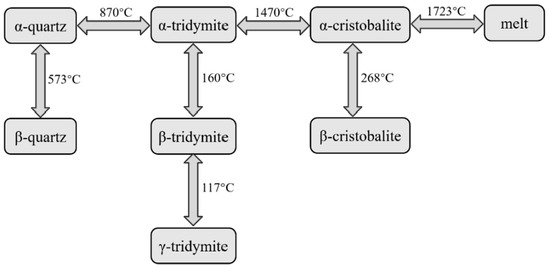
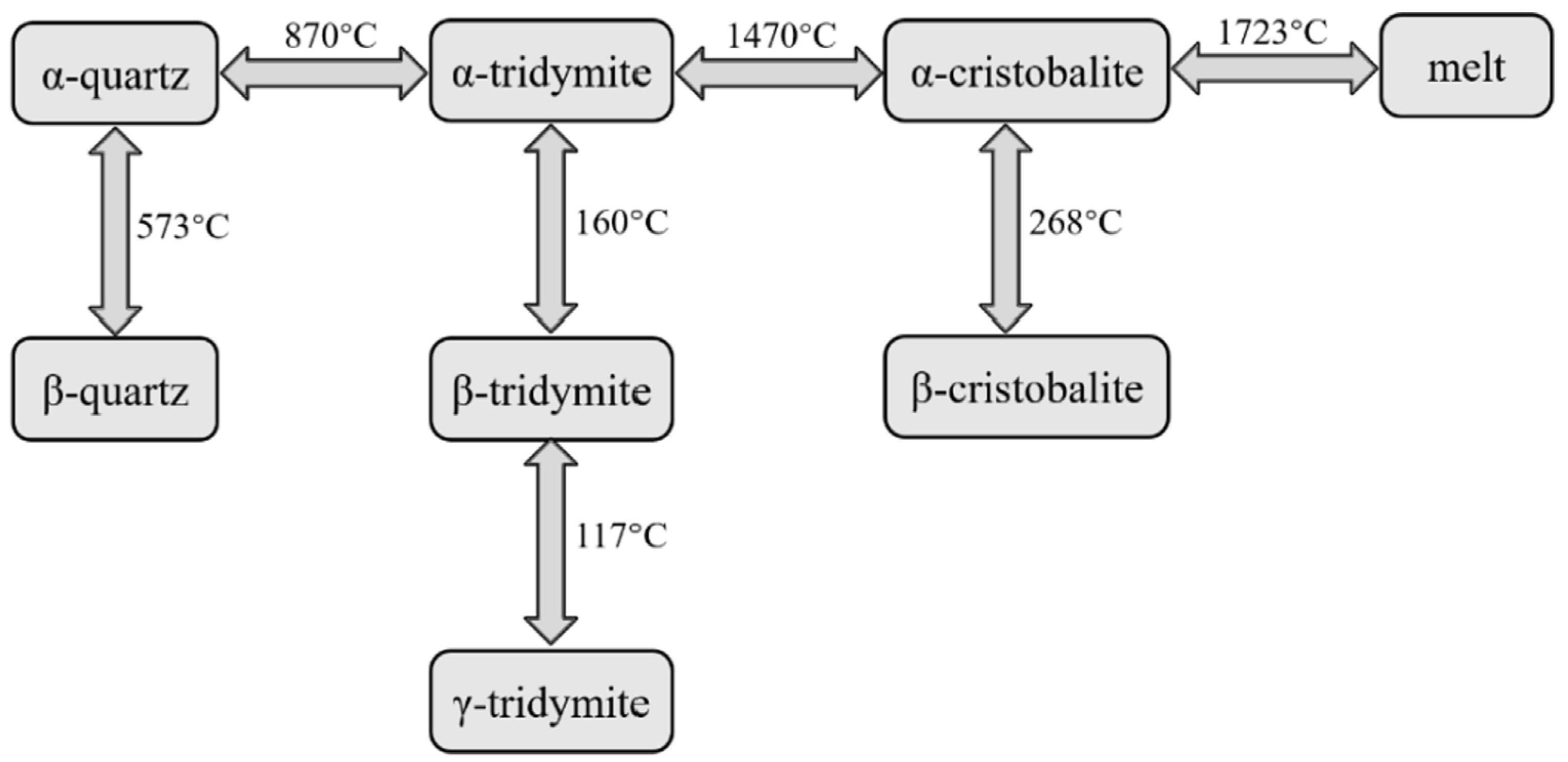
Depending on temperature and pressure, quartz exhibits several polymorphs (Figure 1). At 573 °C, α-quartz transforms into β-quartz through a displacive mechanism, where the Si-O bonds undergo bending without being broken. This transition is accompanied by a modest volume expansion of approximately 0.8% [13]. In contrast, the formation of other polymorphs, such as tridymite, cristobalite, coesite, and stishovite, occurs through reconstructive transformations, in which chemical bonds must be broken and re-formed, requiring considerable latent heat [14]. Among these transformations, the β-quartz to α-tridymite transition is particularly important because it can generate a volume expansion of up to 16%. This pronounced structural expansion is often utilized in high-temperature pretreatment processes to enhance quartz purification [14,15,16].
Figure 1.
Phase transition of quartz [11].
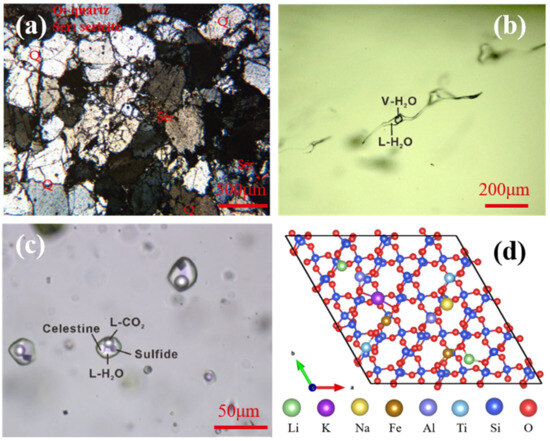
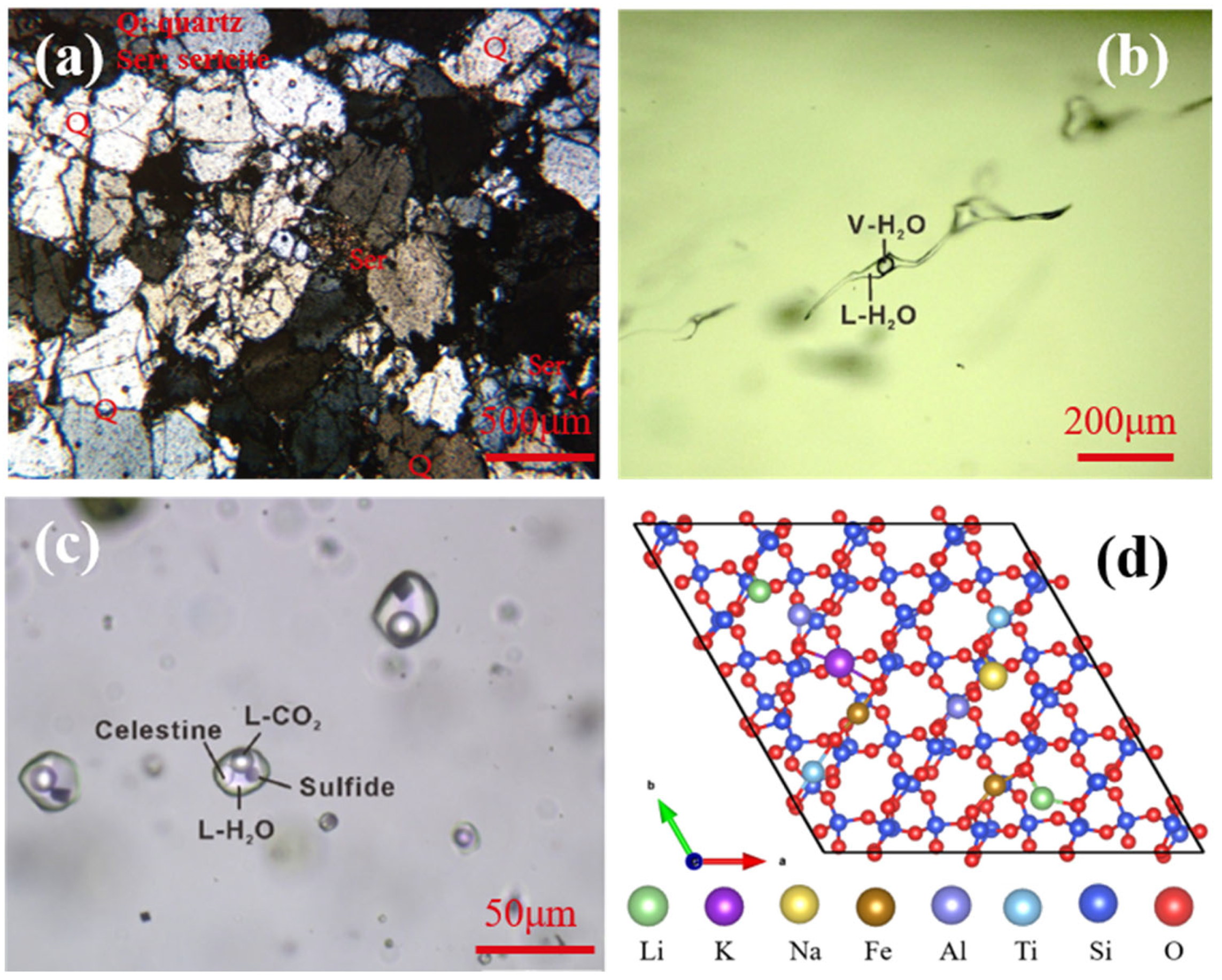
The purification of quartz is primarily controlled by the partitioning characteristics of impurities, which are generally classified as gangue minerals, inclusions, and lattice impurities (Figure 2). Gangue minerals are not incorporated into the quartz crystal during its formation. They normally occur on particle surfaces or as intergrown mineral phases. These impurities, such as mica, feldspar, chlorite, magnetite, hematite, and clay minerals, are generally readily liberated during comminution [17]. Hence, gangue minerals can be effectively removed through physical separation methods such as magnetic separation, flotation, and photoelectric color sorting [1].
Figure 2.
Gangue minerals (a), inclusions (b,c) and lattice impurities (d) in quartz [4,9,10].
Inclusions are foreign materials trapped inside quartz crystals during crystal growth. They are generally classified as solid mineral inclusions, melt inclusions, and fluid inclusions [18]. Mineral inclusions commonly comprise mica and hematite, with their specific assemblage reflecting the mineralisation environment. Melt inclusions are small silicate droplets captured during crystal growth [19]. Fluid inclusions are the most widespread type and usually contain H2O, H2S, CO2, CH4, hydrocarbons, and dissolved salts, with diameters typically smaller than 50 μm [13,20]. As these trapped fluids cool, minerals such as halite, potassium salts, and some silicates may precipitate, introducing alkali and alkaline earth elements such as Na, K, and Ca. These elements can become major contamination sources in HPQ products [21,22]. Because inclusions are enclosed within the quartz matrix, they are difficult to remove directly. Nevertheless, they can be eliminated through thermal pre-treatment, which induces internal pressure build-up and subsequent bursting of inclusions, creating microcracks that allow acid penetration during leaching [23].
Lattice impurities are elements that either replace Si4+ in the quartz crystal structure or occupy interstitial sites within the lattice. Typical substituting elements include Al3+, Fe3+, Ti4+, Ge4+, P5+, and B3+, while common interstitial ions include Li+, Na+, K+, and H+ [24,25]. Among these, aluminum is the most common lattice impurity. Its substitution for Si4+ creates a charge imbalance, which is usually compensated by alkali ions or hydrogen located in interstitial channels parallel to the c-axis. Lattice impurities can be incorporated through several mechanisms, including simple substitution, silanol-group substitution, coupled substitution, and interstitial charge-compensated substitution [26,27]. Although these impurities usually occur at very low concentrations, often at the ppm or sub-ppm level, they are among the most difficult impurities to remove because they are structurally bound within the quartz lattice. Their elimination normally requires intensive treatments to disrupt the silica network and release the substituting cations [7].
2.2. Characterization of Impurity Occurrence
Accurate characterization of impurity occurrence is a prerequisite for understanding purification behavior and selecting appropriate purification strategies. Analytical methods can be divided into surface or micro-area analysis and bulk analysis. For surface and micro-area analysis, electron probe microanalysis (EPMA) is useful for compositional mapping, although it is less suitable for detecting trace impurities at ultra-low concentrations. Laser ablation inductively coupled plasma mass spectrometry (LA-ICP-MS) can measure impurities at the ppm level [28], while focused ion beam scanning electron microscopy (FIB-SEM) enables detailed observation of particle size and morphology from the micrometer to nanometer scale [29]. For bulk analysis, inductively coupled plasma mass spectrometry (ICP-MS), usually performed after complete sample digestion, can determine total trace element concentrations down to the ng/g level [30]. Electron paramagnetic resonance (EPR) spectroscopy is particularly useful for identifying the speciation of lattice impurities, such as Ge-related defects [31]. Emerging techniques, including total reflection X-ray fluorescence (TXRF), which is widely used in the semiconductor industry, are also being increasingly applied to trace metal analysis because of their very low detection limits and low sample consumption [30]. In addition, recent advances in deep learning-based image analysis, especially semantic segmentation using HRNet, have enabled automated quantification of fluid inclusions in HPQ microscopic images, achieving an intersection-over-union score of 81.75% [32]. Together, these techniques provide a more complete understanding of impurity type, distribution, and concentration, thereby supporting quartz resource evaluation and the selection of purification strategies.
3. Mechanisms of Acid Purification of Quartz
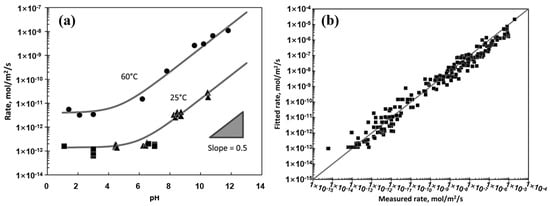
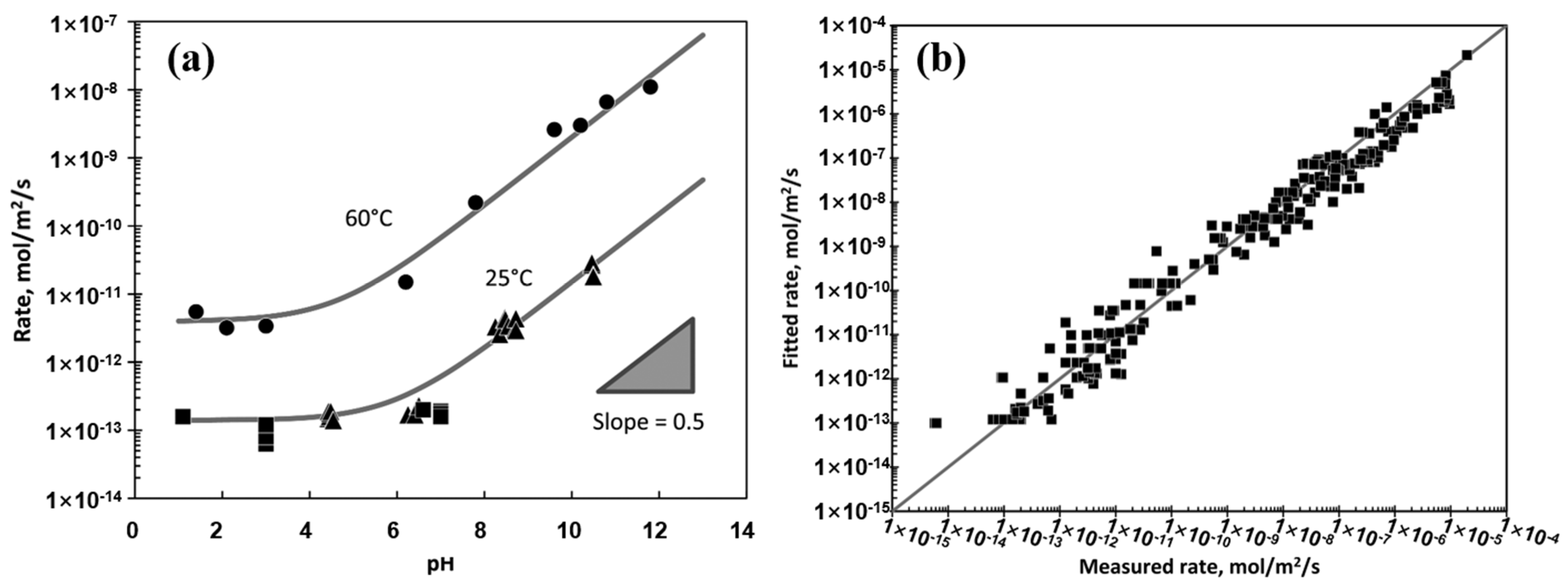
The acid purification of quartz involves complex chemical reactions. This section focuses on the fundamental physicochemical processes governing quartz dissolution and impurity release. Although quartz is highly resistant to chemical attack, its interaction with acidic solutions follows surface-controlled dissolution pathways governed by surface chemistry, bond strength, and structural defects (Figure 3). In aqueous systems, quartz dissolution occurs mainly at the surface rather than through direct degradation of the bulk crystal lattice. Kinetic study showed that the dissolution rate depends on solution chemistry and the surface state of quartz, and cannot be fully explained by simple stoichiometric or diffusion-controlled models [33]. Instead, dissolution generally proceeds through hydration and protonation of surface siloxane bonds (Si-O-Si), followed by the formation of silanol groups (Si-OH) and the gradual release of silicon-bearing species into solution [34].
Figure 3.
Quartz dissolution rate as a function of pH (a) and comparison between fitted dissolution rates and measured data from 285 dissolution experiments (b) [35].
Direct evidence for surface-controlled quartz dissolution has been provided by atomic force microscopy (AFM) and other surface-sensitive techniques. These studies show that dissolution tends to begin at high-energy sites such as steps, kinks, and dislocation outcrops, whereas atomically flat terraces are much less reactive [36,37]. As a result, quartz dissolution is controlled not only by the total surface area, but also by the density and distribution of these reactive sites, in which local bond strain makes Si-O bond breakage easier. For quartz purification, this mechanism helps explain why acid leaching is effective in removing surface contamination and loosely bound impurity components while leaving the main quartz framework largely intact. This also highlights that acids mainly dissolve and remove chemically accessible impurities located at or near quartz surface.
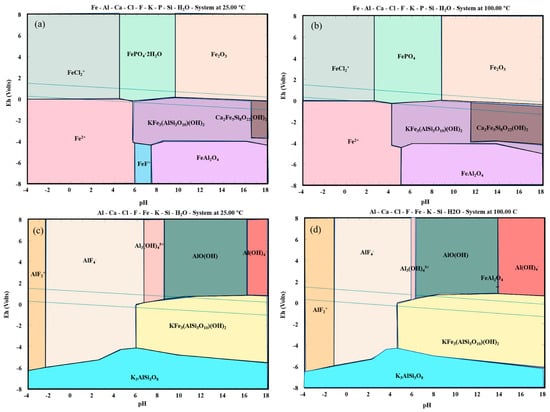
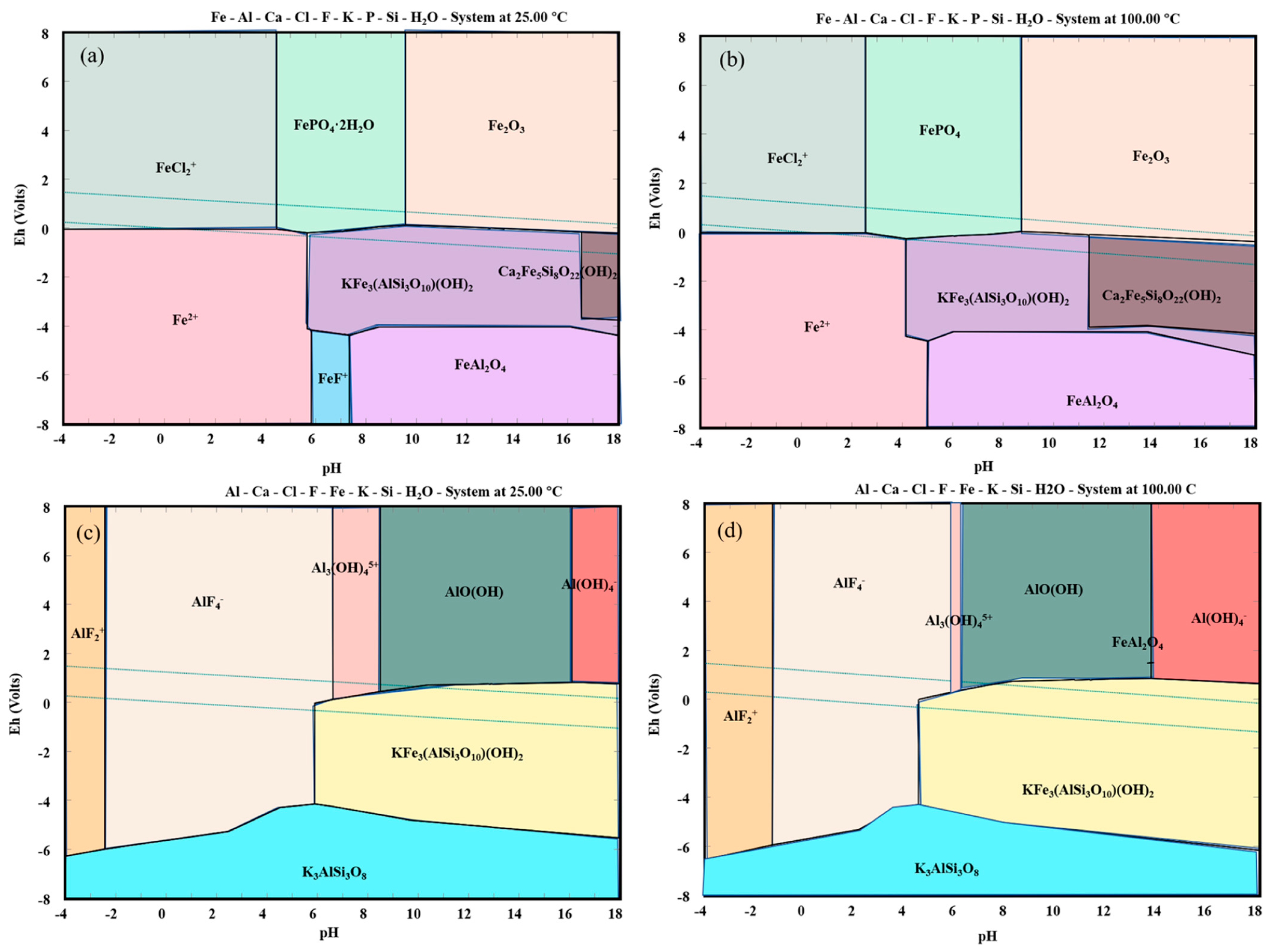
Impurity dissolution during acid leaching depends strongly on the bonding characteristics and acid species [24,38,39,40,41,42]. In general, acids mainly react with exposed surface atoms. As SiO4 tetrahedra polymerize into chain, layered, or framework silicate structures, impurity-bearing species might be shielded by the Si-O-Si network. Disrupting these structures requires higher reaction energy or a framework-attacking reagent such as HF. Figure 4 compares the potential-pH stability fields of impurity-bearing species in different acid systems, identifying the pH-potential regions in which these species are thermodynamically favored to remain stable, dissolve, or form soluble complexes. In the Fe-Al-Ca-Cl-F-K-P-Si-H2O system, fluoride ions can destabilize silicate minerals by forming soluble complexes, such as SiF62− and FeF2, together with volatile SiF4. These reactions shift the dissolution equilibrium toward impurity release. In contrast, HCl is less effective, particularly at lower temperatures. The Al-Ca-Cl-F-Fe-K-Si-H2O system further shows the synergistic role of mixed acids, such as H3PO4-HCl-HF, in which different acid components contribute to pH buffering, metal oxide dissolution, and silicate framework breakdown.
Figure 4.
Potential–pH diagrams of different solution systems at 100 °C: (a) Fe-Al-Ca-Cl-F-K-P-Si-H2O; (b) Ti-Ca-Cl-F-Fe-Mn-P-Si-H2O; (c) Al-Ca-Cl-F-Fe-K-Si-H2O; and (d) Mn-Ca-Cl-F-Fe-P-Si-Ti-H2O [39].
Iron and aluminum impurities are representatives of how impurity occurrences affect acid leaching behavior. In many quartz deposits, iron occurs as oxide or hydroxide coatings on particle surfaces, or as mineral inclusions such as hematite and goethite. These phases can be readily dissolved in acidic solutions through proton-promoted breakage of Fe–O bonds, followed by the complexation of Fe3+ or Fe2+ in solution [40]. Aluminum, in contrast, commonly substitutes for Si within the crystal lattice, forming Al-O-Si bonds [41]. Because Al is structurally incorporated into the quartz framework, it is difficult to remove without disrupting the Si-O network.
The removal of impurities is kinetically heterogeneous. Even within a single quartz grain, dissolution rates may vary from one region to another due to differences in crystallographic orientation and local defects, such as dislocations and vacancies [43]. Time-resolved dissolution experiments have shown that quartz often dissolves rapidly at the beginning of leaching, followed by a clear decrease in dissolution rate even when the solution chemistry remains unchanged [44,45,46]. AFM studies suggest that this behavior stems from the early consumption of highly reactive defect sites, after which less reactive flat terraces dominate the long-term dissolution process [45].
4. Acid Systems in Quartz Purification
Building on these fundamental mechanisms, this section compares the impurity-removal characteristics and applicability of different acid systems used in quartz purification. Acid systems play a significant role in quartz purification by determining the dissolution pathway and extent of impurities. Based on the chemical characteristics, acid systems can be broadly classified into non-HF acid systems, including mineral acids and organic acids, and HF-containing acid systems.
4.1. Non-HF Acid Systems
Non-hydrofluoric acids, such as hydrochloric, sulfuric, nitric, and organic acids, are widely used in quartz purification. These acids are particularly effective for removing surface-bound impurities, but are less effective for impurities incorporated into the quartz structure. Among these acids, hydrochloric and sulfuric acids are especially effective for dissolving iron oxides through protonation of metal-oxygen bonds [40]. The oxidizing ability of nitric acid promotes the dissolution of impurity phases when combined with other acids [47].
Organic acids, particularly oxalic and citric acids, are often used as selective chelating agents in quartz purification. Their effectiveness is mainly attributed to the formation of ferric–oxalate complexes, such as [Fe(C2O4)3]3−, which keep dissolved iron in solution and drive further dissolution of iron-bearing phases [9]. In addition, the formation of stable complexes allows dissolution of iron oxides under relatively mild conditions. This makes it particularly effective for dispersed impurities or those located along grain boundaries [48]. Citric acid works in a similar way, using its multiple carboxylate groups to complex metal ions and promote impurity dissolution [1].
For impurities that are more difficult to remove, sequential leaching strategies using different acids have been developed. In a typical two-stage process, an inorganic acid is first used to remove surface impurities, followed by an organic acid stage to chelate residual metal ions [49]. Among these systems, the combination of hydrochloric acid and oxalic acid has demonstrated particularly high effectiveness. HCl promotes rapid acid penetration and initial dissolution of metal oxides, while oxalic acid complexes the released metal ions, prevents re-precipitation, and improves overall impurity removal [50]. Phosphoric acid has also been used in mixed-acid systems as a buffering agent, helping to maintain acidic conditions suitable for metal oxide dissolution while reducing the risk of gel formation [11].
The major limitation of non-HF acid systems is poor ability to remove lattice impurities. For example, aluminum and titanium often substitute for silicon in the quartz structure. These components are embedded within the covalent framework and are difficult to liberate without aggressive treatment [26,41,51,52]. Previous studies have shown that aluminum removal by non-HF acid leaching typically remains under 30%, regardless of acid concentration or temperature [4,17].
4.2. HF-Containing Acid Systems
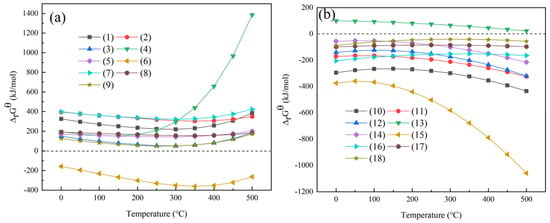
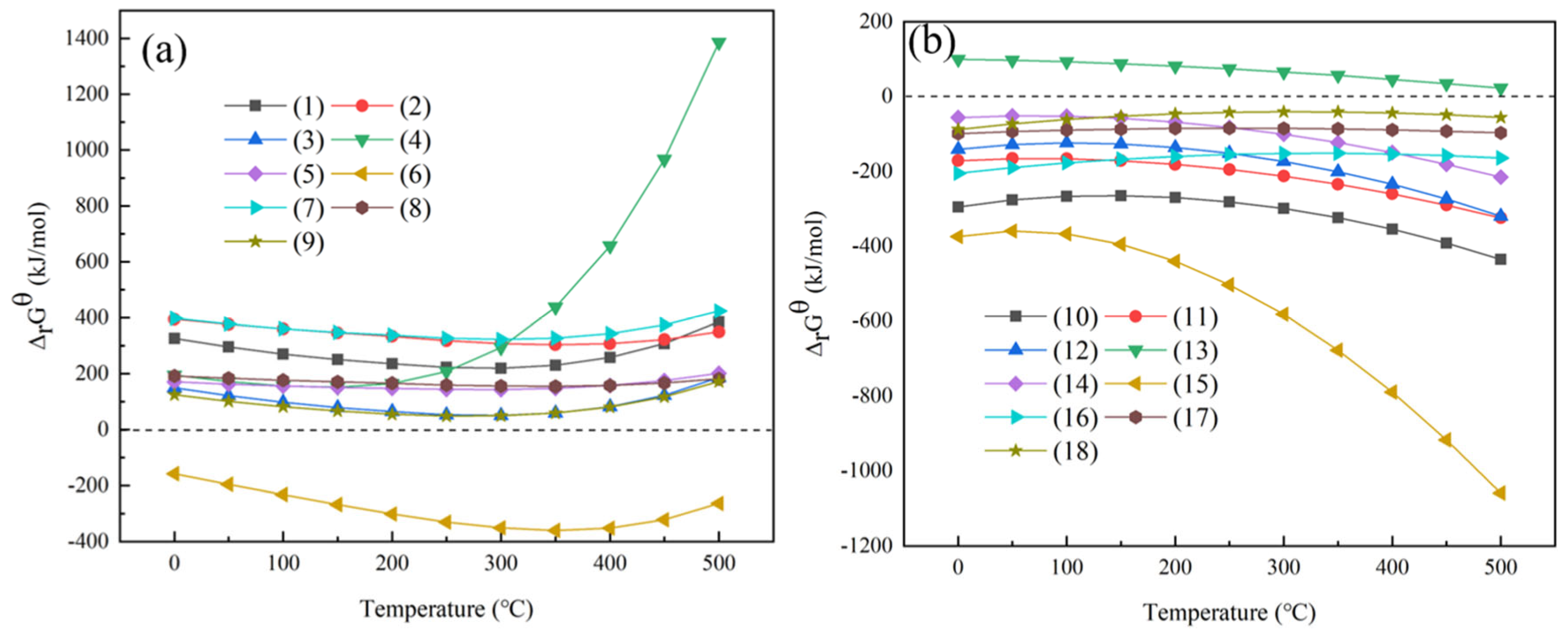
Hydrofluoric acid plays a significant role in quartz purification. Unlike most mineral acids, HF can react directly with the Si–O framework and form strong silicon–fluoride complexes, which can promote controlled dissolution of the quartz lattice (Figure 5). This ability allows HF-containing systems to access impurities that are otherwise difficult to remove, such as lattice-substituted elements and inclusions sealed within quartz grains. HF etching preferentially initiates at defect sites, grain boundaries, and inclusion interfaces [8,35,53].
Figure 5.
Gibbs free energy changes of different reactions at various temperatures using (a) HCl and (b) HF as leaching agents [39].
Studies on pure HF leaching have demonstrated its strong capability for deep impurity removal. For example, research on pegmatitic quartz from the Altay orogenic belt showed that HF-based reagents removed 92.65% of total impurities, yielding quartz with a SiO2 purity of 99.9983% [8]. A statistical modeling investigation based on HF leaching of Algerian quartz sand revealed that acid concentration and particle size were the dominant factors influencing purification performance. Mechanistically, HF dissolves silica through the formation of volatile silicon tetrafluoride, which can subsequently hydrolyze into fluorosilicic acid complexes, thereby enabling controlled dissolution of the quartz surface and continuous removal of surface-associated impurities.
For the reactions shown in Figure 5, more negative ΔG values indicate greater thermodynamic favorability; the comparison therefore helps explain why HF-mediated reactions can promote the transformation or dissolution of some refractory impurity-bearing phases more effective than HCl-mediated reactions. Controlled HF leaching can generate micro-etch pits and increase surface roughness, which helps expose and remove deeply entrapped impurities. However, excessive HF treatment can cause significant silicon loss, thus precise control is essential to balance impurity removal with quartz framework preservation [8,53].
Mixed-acid systems containing HF enable synergistic purification by combining framework activation with impurity dissolution [54]. HF primarily weakens the quartz framework and exposes embedded impurity sites, whereas the accompanying acids dissolve and stabilize the released metal ions through complexation. For example, comparative studies of different leaching systems show that HCl/HF mixtures provide the highest overall purification efficiency, removing more than 80% of aluminum and potassium, about 60% of iron and sodium, and approximately 65% of total impurities, which is more effective than either acid used alone [55]. In these systems, HF first activates the quartz framework and exposes impurity sites, after which rapid metal complexation helps prevent re-adsorption and secondary precipitation. The superior performance of HCl/HF lies in HF’s ability to attack the silica surface and liberate structurally bound impurities, while HCl promotes dissolution of metal oxides and subsequent aqueous complexation. Oxidizing acids, such as nitric acid, may facilitate the removal of redox-sensitive impurities by oxidizing Fe2+ and promoting its subsequent dissolution, while also reducing surface passivation [56]. Rong et al. have also demonstrated that reduced HF concentration, combined with elevated temperature and pressure, can achieve deep purification while minimizing environmental impact, with removal rates of aluminum and calcium exceeding 96% and 99%, respectively [56]. A comparison between fluorine-free and low-fluorine leaching showed that HF is essential for removing lattice-bound aluminum, as fluoride ions can complex with aluminum while dissolving silica and creating pathways for deeper impurity removal [57]. Despite its high purification efficiency, the use of HF also generates acidic fluoride-containing wastewater and imposes higher requirements on equipment corrosion resistance and process safety. For wastewater with relatively high fluoride concentrations, calcium-based precipitation is widely used to convert dissolved fluoride into CaF2, whereas adsorption, membrane separation, ion exchange, and electrochemical processes can be employed for further fluoride removal depending on wastewater characteristics [58,59]. From a resource-recovery perspective, induced crystallization provides a promising alternative to conventional precipitation because fluoride can be recovered as relatively high-purity CaF2 instead of being discharged as fluoride-rich sludge [59,60,61]. A pilot-scale study on acidic fluoride-containing wastewater demonstrated that induced crystallization reduced fluoride concentrations from 800–3000 mg/L to 20–30 mg/L while recovering 45%–63% of the fluoride as CaF2 with a purity exceeding 90% [60]. Therefore, future HF-containing quartz purification processes should integrate fluoride removal, resource recovery, and water/reagent recycling to reduce their environmental burden.
Overall, the relative performance of different acid systems is governed not simply by acid strength, but by the occurrence state and chemical reactivity of the target impurities. HCl and H2SO4 are mainly effective for accessible metal oxides and surface-associated impurities through proton-promoted dissolution, whereas HNO3 additionally provides an oxidizing environment that facilitates the removal of redox-sensitive impurities. Oxalic acid shows particular selectivity toward Fe-bearing impurities because of its strong complexation with dissolved Fe species. However, these non-HF acids have limited access to impurities structurally enclosed within the quartz framework. HF therefore generally achieves deeper purification because fluoride species can attack Si-O bonds, expose embedded impurities, and complex released metal ions, although this advantage is accompanied by quartz loss and greater environmental concerns. Mixed-acid systems can outperform individual acids by combining these complementary functions; for example, in HCl/HF systems, HF opens the silica framework while HCl promotes the dissolution and stabilization of exposed metal impurities. Therefore, acid-system selection should be based on impurity occurrence and the required purification depth rather than on removal efficiency alone.
5. Strategies for Process Enhancement
The efficiency of acid leaching is often constrained by slow dissolution kinetics, limited mass transfer, and the uneven distribution of impurities within quartz particles. Process enhancement strategies that improve impurity accessibility, accelerate mass transport, and promote selective dissolution through external energy input or structural activation have been widely investigated.
5.1. Mechanical Activation Coupled with Acid Leaching
Mechanical activation, usually achieved by high-energy milling, is an effective strategy to improve quartz purification. During milling, defects, dislocations, and microcracks are generated, while fresh surfaces and impurity-rich regions are exposed. These changes weaken the bonding between impurities and the quartz and increase surface reactivity [46,62,63].
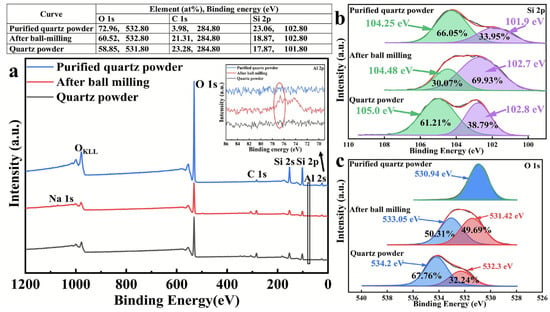
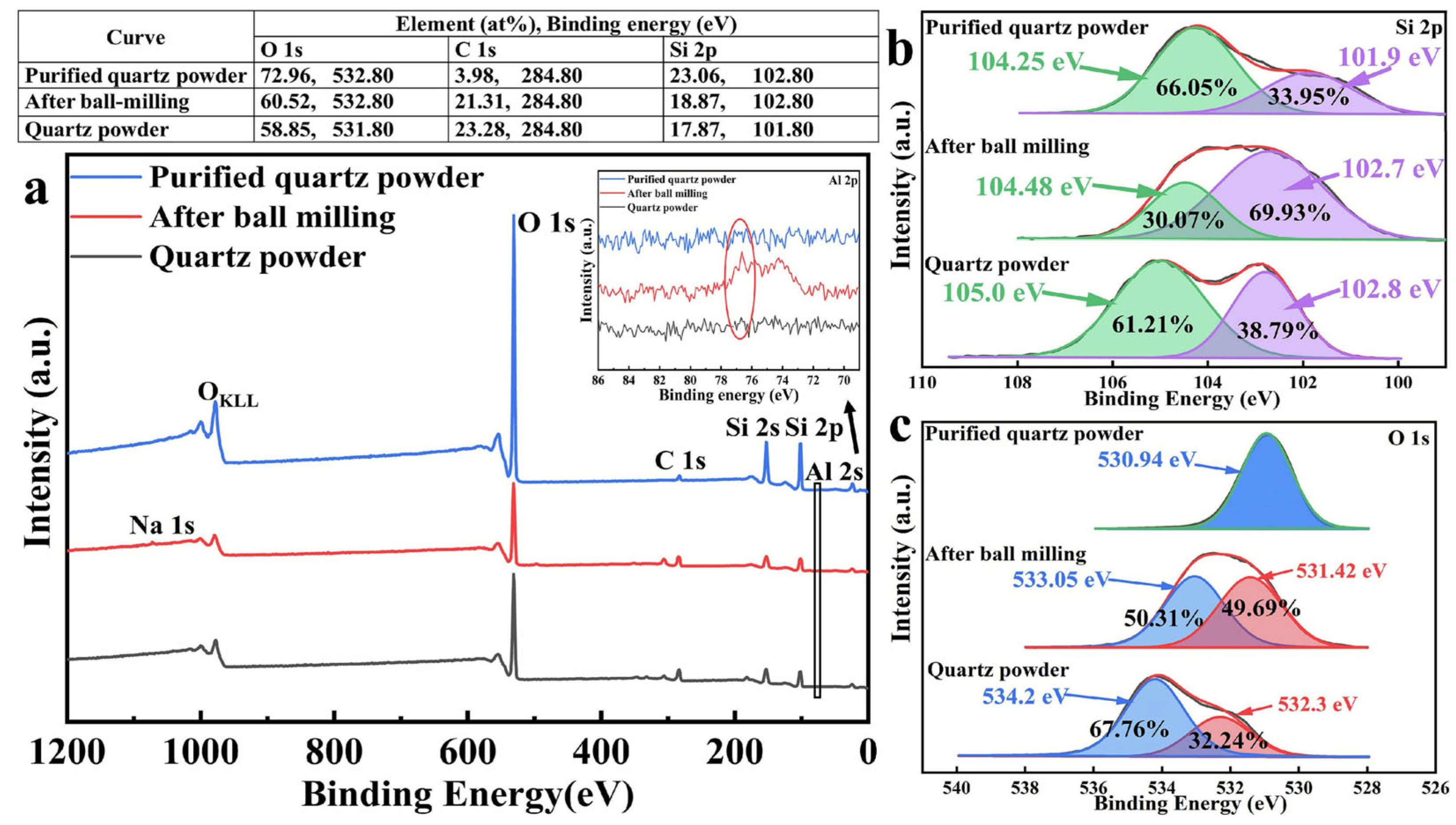
Fu et al. [63] reported that mechanical activation markedly reduced the median particle size from 33.42 μm to 1.85 μm and increased the specific surface area by 143 times. Milling fractured internal inclusions and exposed previously entrapped impurities. XPS analysis subsequently revealed impurity-related peaks on the particle surfaces after milling (Figure 6) [63]. The mechanically enhanced acid treatment achieved a total impurity removal efficiency of 98.1%, and produced quartz with a purity of 99.994 wt.%.
Figure 6.
XPS spectra of quartz powder at different stages: (a) survey spectrum, (b) Si 2p, and (c) O 1 s [63].
Mechanical activation has been frequently used for fluorine-free acid leaching of low-grade quartz. According to Xie et al. [64], milling introduced lattice distortion and expansion without changing the quartz phase. Rietveld refinement showed that the unit cell volume increased from 112.830 Å3 to 112.988 Å3, indicating that mechanical activation elongated chemical bonds and weakened stability. This was further supported by XPS analysis, which showed lower binding energies for Si 2p, O 1s, Al 2p, and Fe 2p after activation, confirming reduced bond strength and enhanced impurity reactivity. As a result, the total impurity removal efficiency was 97.76%, which is comparable to HF-containing acid leaching.
A kinetic analysis showed that aluminum and iron removal were controlled by internal diffusion through the product layer. Mechanical activation contributed to lower the activation energies for aluminum and iron removal from 13.34 kJ/mol to 7.30 kJ/mol and from 14.08 kJ/mol to 11.62 kJ/mol, respectively [64]. These reductions enabled efficient impurity removal under mild conditions.
Meanwhile, intensive mechanical activation can generate large amounts of amorphous silica and fine particles, leading to undesired quartz dissolution and reduced leaching selectivity during leaching. Thus, mechanical activation should be carefully controlled to balance among impurity removal, quartz loss and acid consumption.
5.2. Thermal Pretreatment Coupled with Acid Leaching
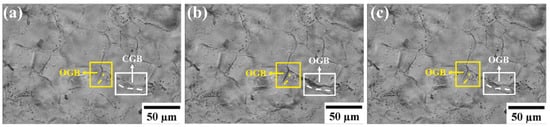
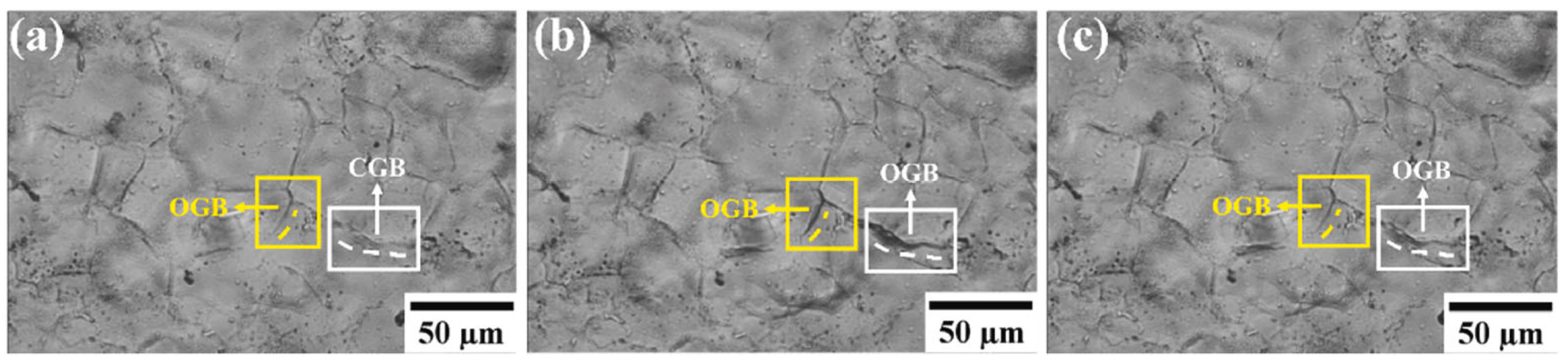
Thermal pretreatment is commonly used to improve acid leaching by creating structural changes that make impurities more accessible. When quartz is heated to around 900 °C, it passes through the α–β transition at 573 °C, which causes volume expansion and promotes microcrack formation [50,62]. Subsequent water quenching further widens and deepens these cracks, exposing entrapped impurities and creating channels for acid penetration (Figure 7). Meanwhile, calcination at higher temperatures, such as 1200 °C, may form cristobalite and reduce acid accessibility. The treatment sequence is also important. Crushing quartz into sand before calcination generally achieves better results than calcining bulk ore, because smaller particles with larger surface areas allow more uniform thermal stress distribution and more extensive crack propagation [50,65].
Figure 7.
Evolution of grain boundaries during heating and cooling: (a) grain boundaries at room temperature; (b) grain boundaries at 523 K; and (c) grain boundaries after cooling from 523 K to room temperature [50].
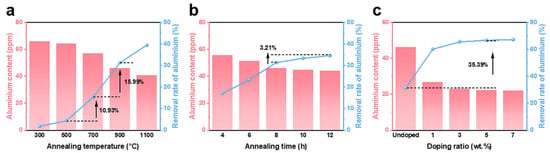
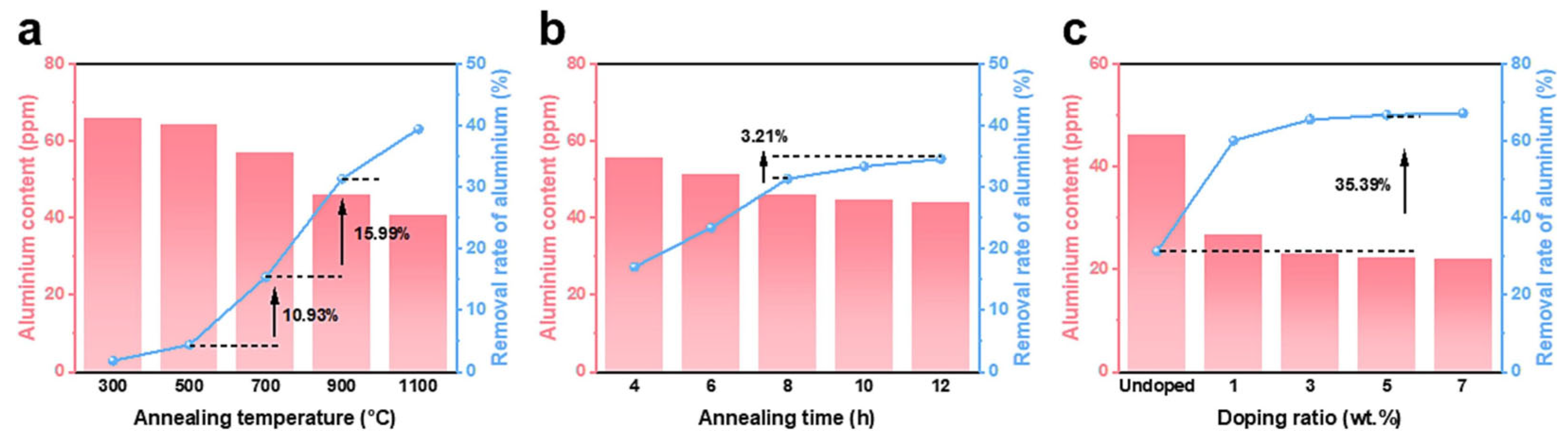
Beyond creating physical cracks, thermal treatment can also activate impurity components by promoting migration from the quartz lattice to the particle surface. During high-temperature roasting, lattice impurities such as Al3+ gain energy to diffuse through the crystal structure. This migration is especially favored during the α-β quartz transition, as the expanded β-quartz structure provides more space for ion movement. Rapid quenching can then retain these migrated impurities near the surface, rendering them more accessible to acid leaching (Figure 8) [66].
Figure 8.
Influence of (a) temperature, (b) time, and (c) NH4Cl content on the removal rate of Al [66].
For mineral impurities such as muscovite and kaolinite, thermal treatment can induce dehydroxylation and structural collapse, transforming them into amorphous or metastable phases that are more susceptible to acid dissolution [67,68]. A comparative study conducted by Tian et al. [67] demonstrated that direct HCl leaching achieved only limited aluminum removal, whilst roasting at 900 °C can transform kaolinite into more acid-soluble phases, promoting subsequent HCl leaching to remove over 85% of aluminum [67]. Similarly, a muscovite removal efficiency above 98% has been achieved using hydrochloric acid and ammonium chloride without hydrofluoric acid [68].
The effectiveness of thermal pretreatment is also strongly influenced by the morphology of inclusions. Quartz containing linearly distributed inclusions can achieve more than 90% removal of both aluminum and iron, whereas planar inclusions are more difficult to remove, with aluminum removal only 37%–41%. Zhang et al. attributed the low removal efficiency to the enclosed microstructure, which restricts acid penetration [69].
Combining thermal treatment with pressure leaching can obtain synergistic effects. Large quantities of impurities are concentrated along grain boundaries of quartz. Under conventional leaching conditions, acid can only access boundaries that are already connected to the particle surface. Hot-pressure acid leaching, typically at around 1.5 MPa, helps convert closed grain boundaries into open channels. Once formed, these channels can be stabilized by acid-induced structural damage, preventing closure during subsequent cooling. As a result, iron content can be reduced from 2056 μg/g to 4.7 μg/g, representing an order-of-magnitude improvement over atmospheric leaching [50]. Chemical additives can further enhance thermal pretreatment. For example, Na2CO3 can lower the temperature required for the cristobalite phase transition, promoting lattice reorganization at moderate conditions [70]. Similarly, ammonium sulfate roasting can convert insoluble iron oxides into water-soluble salts, achieving iron removal over 90% even without acid leaching [71].
5.3. Ultrasound-Assisted Acid Leaching
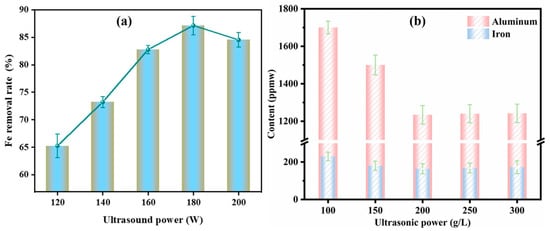
Ultrasonic treatment has been widely studied as an enhancement method for acid purification of quartz. Studies show that ultrasound can considerably accelerate impurity removal by improving acid penetration and mass transfer through cavitation effects [72,73,74,75]. During ultrasonic treatment, cavitation bubbles form, grow, and collapse near the quartz particle surface, generating shock waves, microjets, and local turbulence. These effects continuously disturb and deteriorate the particle surface, produce cracks, and remove impurities (Figure 9).
Figure 9.
Effect of ultrasonic power on (a) Fe removal rate [72] and (b) simultaneous removal of Fe and Al [73].
Yang et al. conducted a quantitative kinetic study of ultrasound-assisted leaching [74]. Results show that, under both conventional and ultrasonic conditions, the leaching process is controlled by internal diffusion through the product layer. The apparent activation energy for ultrasound-assisted leaching was calculated to be 27.72 kJ/mol, which is 7.28 kJ/mol higher than that of conventional leaching, indicating that ultrasound mainly enhances the diffusion-controlled stage. Notably, ultrasound-assisted leaching removed 74% of iron within only 40 min, which was approximately one-twelfth of the processing time required by conventional stirring.
By reducing acid consumption and energy demand, ultrasonic treatment also allows the acid purification of quartz to proceed under mild conditions. For example, aluminum removal from 37.1 ppm to 17.4 ppm was achieved by using only 1.0% HCl and 0.5% oxalic acid at 80 °C with 360 W ultrasonic power for 60 min, or at 30 °C for 90 min. By contrast, conventional stirring at 80 °C required 300 min to reach comparable efficiency [75].
The representative acid-leaching systems and enhancement strategies discussed above are comparatively summarized in Table 1 in terms of operating conditions, target impurities, purification performance, dominant mechanisms, advantages and limitations, and scale-up considerations. Importantly, the achievable HPQ grade is determined by the residual concentrations of all critical impurities rather than by the removal efficiency of a single element. Therefore, high removal of readily accessible impurities does not necessarily guarantee the target purity when lattice-bound or interstitial impurities remain above the required limits. From a scale-up perspective, non-HF acid systems generally involve simpler corrosion control and waste management, whereas HF-containing systems achieve deeper purification but require more stringent equipment, safety, and fluoride-effluent management. Among the enhancement strategies, mechanical activation is relatively easy to integrate into existing process flowsheets, while thermal, pressure-assisted, and ultrasound-assisted treatments require additional energy input or specialized equipment. Because published cost data vary substantially with feedstock characteristics, operating conditions, and production scale, direct numerical cost comparison is currently unreliable, highlighting the need for standardized techno-economic assessment under comparable conditions.
Table 1.
Comparative summary of representative acid-leaching systems and enhancement strategies for high-purity quartz purification.
6. Conclusions and Perspectives
Acid leaching remains one of the most frequently used technologies for quartz purification and HPQ production. Its efficiency is determined by the partitioning characteristics of impurities, acid systems and process conditions. Gangue minerals and surface-bound impurities are relatively easy to remove through physical separation and normal acid leaching, whereas inclusions and lattice impurities require intensive strategies to activate and expose impurities. Therefore, understanding impurity partitioning is essential for selecting appropriate acid systems and purification routes.
Non-HF acids, including hydrochloric, sulfuric, nitric, oxalic, and citric acids, offer the advantages of relatively low environmental risk and good selectivity toward accessible metal impurities. However, these acid systems have limited ability to remove lattice impurities. Because fluoride ions can disrupt the silica framework, HF-containing systems enable deeper impurity removal. Nevertheless, excessive HF use can cause silica loss, equipment corrosion, and environmental concerns. Future acid-system design should therefore focus on low-fluoride and non-fluoride mixed-acid systems that balance purification efficiency with environmental compatibility.
Process enhancement strategies provide effective ways to overcome kinetic and mass-transfer limitations. Mechanical activation introduces defects, microcracks, and fresh surfaces, thereby increasing impurity accessibility. Thermal pretreatment promotes phase transformation, microcrack formation, inclusion bursting, and impurity migration. Ultrasound-assisted leaching further accelerates mass transfer through cavitation effects, enabling impurity removal under mild acid concentrations. These methods are especially useful for low-grade quartz resources and for impurities entrapped in inclusions or along grain boundaries.
Despite significant progress, challenges remain. Future research should prioritize several specific directions. Impurity-specific purification strategies should be developed by establishing clearer relationships between the occurrence states of refractory impurities, particularly Al, Ti, and B, and their responses to different acid systems and pretreatment methods. Low-fluoride and non-fluoride mixed-acid systems should be further optimized by simultaneously considering impurity removal efficiency, quartz loss, reagent consumption, and the treatment or recycling of fluoride-containing wastewater. Enhancement strategies such as mechanical activation, thermal pretreatment, pressure leaching, and ultrasound-assisted leaching should be evaluated beyond the laboratory scale through long-term stability tests and quantitative assessments of energy consumption, acid consumption, equipment compatibility, scalability, and economic feasibility. Integrating mineralogical characterization with thermodynamic and kinetic analysis will ultimately enable the development of resource-specific, mechanism-guided purification flowsheets for scalable HPQ production.
Author Contributions
Conceptualization, W.L. and C.Z.; methodology, W.L.; formal analysis, J.Y.; data curation, F.P. and F.Z.; writ-ing—original draft preparation, W.L.; writing—review and editing, Z.S.; visualization, C.Z.; supervision, Z.S.; pro-ject administration, J.Y. and Z.S.; funding acquisition, Z.S. All authors have read and agreed to the published version of the manuscript.
Funding
This work was funded by the Henan Provincial Science and Technology Major Project (241100320100), National Natural Science Foundation of China (No. 52474314), Natural Science Foundation of Hunan Province (2025JJ20051), National Key Research and Development Program of China (2024YFC2910105), Science and Tech-nology Project of Henan Yudi Technology Group Co., Ltd., (JTZDKY2025008), Fundamental Research Funds for the Central Universities of Central South University (2025ZZTS0010).
Data Availability Statement
No new data were created or analyzed in this study. Data sharing is not applicable to this article.
Acknowledgments
This work was supported by the Henan Provincial Science and Technology Major Project (241100320100), National Natural Science Foundation of China (No. 52474314), Natural Science Foundation of Hunan Province (2025JJ20051), National Key Research and Development Program of China (2024YFC2910105), Science and Technology Project of Henan Yudi Technology Group Co., Ltd., (JTZDKY2025008), Fundamental Research Funds for the Central Universities of Central South University (2025ZZTS0010). We are grateful for their support.
Conflicts of Interest
Wei Liu, Chi Zhang, Jiyun Yu and Feng Zhang received funding support from Henan Yudi Science and Technology Group Co., Ltd. The funding sponsors had no role in the design of the study; in the collection, analyses, or interpretation of data; in the writing of the manuscript, and in the decision to publish the results.
References
- Zhang, R.; Tang, C.; Ni, W.; Yuan, J.; Zhou, Y.; Liu, X. Research Status and Challenges of High-Purity Quartz Processing Technology from a Mineralogical Perspective in China. Minerals 2023, 13, 1505. [Google Scholar] [CrossRef] [Scilit]
- Prasetyo, A.B.; Handayani, M.; Sulistiyono, E.; Firdiyono, F.; Febriana, E.; Mayangsari, W.; Wahyuningsih, S.; Pramono, E.; Maksum, A.; Riastuti, R.; et al. Fabrication of high purity silica precipitates from quartz sand toward photovoltaic application. J. Ceram. Process. Res. 2023, 24, 103–110. [Google Scholar] [CrossRef]
- Zhang, Y.; Pan, J.; Xia, F.; Zhao, H.-B.; Xu, Z.; Liu, G.; Zhong, F.; Zhang, X.; Liu, Y.; Du, G.; et al. Textures and chemical compositions of muscovite and quartz: Implications for granite-hosted high-purity quartz mineralization and exploration in South China. Ore Geol. Rev. 2023, 161, 105635. [Google Scholar] [CrossRef] [Scilit]
- Liu, M.; Wang, G.; Zhao, F.; Li, W.; Zhu, G.; Liang, G.; Jian, W.; Liao, L.; Lv, G. Advances in purification technologies and applications of high-purity quartz resources. Prog. Nat. Sci. Mater. Int. 2025, 35, 51–64. [Google Scholar] [CrossRef] [Scilit]
- Vatalis, K.I.; Charalambides, G.; Benetis, N.P. Market of High Purity Quartz Innovative Applications. Procedia Econ. Financ. 2015, 24, 734–742. [Google Scholar] [CrossRef] [Scilit]
- Du, X.; Liang, C.; Hou, D.; Sun, Z.; Zheng, S. Scrubbing and Inhibiting Coagulation Effect on the Purification of Natural Powder Quartz. Minerals 2019, 9, 140. [Google Scholar] [CrossRef] [Scilit]
- Müller, A.; Wanvik, J.E.; Ihlen, P.M. Petrological and Chemical Characterisation of High-Purity Quartz Deposits with Examples from Norway. In Quartz: Deposits, Mineralogy and Analytics; Götze, J., Möckel, R., Eds.; Springer: Berlin/Heidelberg, Germany, 2012; pp. 71–118. [Google Scholar] [CrossRef] [Scilit]
- Ma, Y.; Li, J.; Wu, Z.; Tan, X.; Zhang, H.; Zhang, X.; Yi, Y. Extraction and purification of a high purity quartz in the Altay orogenic belt and its potential evaluation. Miner. Eng. 2025, 228, 109347. [Google Scholar] [CrossRef] [Scilit]
- Huang, Y.; Sun, L.; Du, Y.; Liu, J.; Yang, X. A potential 4N8-Grade raw material for high-purity quartz from quartzite ore in the Hengshan region, central-southern China: A geochemical-mineralogical study and purification. Solid Earth Sci. 2025, 10, 100276. [Google Scholar] [CrossRef] [Scilit]
- Wei, J.; Liu, H.; Li, X.; Fan, X.; Zhang, C.; Gan, M.; Liu, W.; Ji, Z.; Sun, Z. Key methods and innovations in purification of 4N8 grade high-purity quartz. Results Eng. 2026, 30, 110553. [Google Scholar] [CrossRef] [Scilit]
- Pan, X.; Li, S.; Li, Y.; Guo, P.; Zhao, X.; Cai, Y. Resource, characteristic, purification and application of quartz: A review. Miner. Eng. 2022, 183, 107600. [Google Scholar] [CrossRef] [Scilit]
- Luo, H.; Shi, Z.M.; Wang, H.; Wang, W. The microstructure, phase transformation and sinterability of desert sand. Mater. Today Commun. 2023, 35, 105685. [Google Scholar] [CrossRef] [Scilit]
- Periyasamy, M.; Sain, S.; Mukhopadhyay, S.; Kar, A. An Investigation into the Influence of α-β Quartz Phase Transition on Banded Iron Ore Comminution. JOM 2022, 74, 222–233. [Google Scholar] [CrossRef] [Scilit]
- Zhang, H.; Guo, S.; Wu, J.; Wu, D.; Wei, K.; Ma, W. Effect of quartz crystal structure transformations on the removal of iron impurities. Hydrometallurgy 2021, 204, 105715. [Google Scholar] [CrossRef] [Scilit]
- Ackermann, R.J.; Sorrell, C.A. Thermal expansion and the high-low transformation in quartz. I. High-temperature X-ray studies. J. Appl. Crystallogr. 1974, 7, 461–467. [Google Scholar] [CrossRef] [Scilit]
- Dal Martello, E.; Tranell, G.; Ostrovski, O.; Zhang, G.; Raaness, O.; Larsen, R.B.; Tang, K.; Koshy, P. Trace Elements in the Si Furnace. Part I: Behavior of Impurities in Quartz During Reduction. Metall. Mater. Trans. B 2013, 44, 233–243. [Google Scholar] [CrossRef] [Scilit]
- Prasad, A.D.; Thangavel, S.; Rastogi, L.; Soni, D.; Dash, K.; Kumar, S.J. Development of a certified reference material (CRM) for seven trace elements (Al, Ca, Fe, K, Mg, Na and Ti) in high purity quartz. Microchem. J. 2022, 172, 106926. [Google Scholar] [CrossRef] [Scilit]
- Xia, M.; Sun, C.; Yang, X.; Chen, J. Assessment of Gold-Bearing Quartz Vein as a Potential High-Purity Quartz Resource: Evidence from Mineralogy, Geochemistry, and Technological Purification. Minerals 2023, 13, 261. [Google Scholar] [CrossRef] [Scilit]
- Frezzotti, M.-L. Silicate-melt inclusions in magmatic rocks: Applications to petrology. Lithos 2001, 55, 273–299. [Google Scholar] [CrossRef] [Scilit]
- Li, X.; Zheng, G.; Hu, Z.; Yu, Z.; Ji, Y.; Peng, L.; Yang, D.; Yu, X. Effects of fluid inclusions in quartz sand on fused silica crucible. J. Non-Cryst. Solids 2025, 666, 123701. [Google Scholar] [CrossRef] [Scilit]
- Guo, S.; Ai, G.; Zhao, J.; Yang, S.; Wei, K.; Ma, W. Removal of hydroxyl impurities in vein quartz by vacuum roasting. Vacuum 2024, 222, 113049. [Google Scholar] [CrossRef] [Scilit]
- Kendrick, M.A.; Burnard, P. Noble Gases and Halogens in Fluid Inclusions: A Journey Through the Earth’s Crust. In The Noble Gases as Geochemical Tracer; Burnard, P., Ed.; Springer: Berlin/Heidelberg, Germany, 2013; pp. 319–369. [Google Scholar] [CrossRef] [Scilit]
- Wang, S.; Yu, D.; Ma, C.; Wei, F.; Zhang, H. A New Insight into the Influence of Fluid Inclusions in High-Purity Quartz Sand on the Bubble Defects in Quartz Glass: A Case Study from Vein Quartz in the Dabie Mountain. Minerals 2024, 14, 794. [Google Scholar] [CrossRef] [Scilit]
- Götze, J. Chemistry, textures and physical properties of quartz—Geological interpretation and technical application. Mineral. Mag. 2009, 73, 645–671. [Google Scholar] [CrossRef] [Scilit]
- Watt, G.R.; Wright, P.; Galloway, S.; McLean, C. Cathodoluminescence and trace element zoning in quartz phenocrysts and xenocrysts. Geochim. Cosmochim. Acta 1997, 61, 4337–4348. [Google Scholar] [CrossRef] [Scilit]
- Götze, J.; Pan, Y.; Müller, A. Mineralogy and mineral chemistry of quartz: A review. Mineral. Mag. 2021, 85, 639–664. [Google Scholar] [CrossRef] [Scilit]
- Qi, D.; Zijie, R.; Yuhan, S.; Yuhao, H.; Peiyu, L.; Hang, Y. Purification of different-sized quartz crystals in granitc pegmatite. Miner. Eng. 2024, 216, 108856. [Google Scholar] [CrossRef] [Scilit]
- Dong, X.; Xiong, Y.; Wang, N.; Song, Z.; Yang, J.; Qiu, X.; Zhu, L. Determination of trace elements in high-purity quartz samples by ICP-OES and ICP-MS: A normal-pressure digestion pretreatment method for eliminating unfavorable substrate Si. Anal. Chim. Acta 2020, 1110, 11–18. [Google Scholar] [CrossRef] [Scilit]
- Olbert, M.; Nedela, V.; Jirak, J.; Hudec, J. Size and shape analysis of micro- to nano-particles of quartz powders using advanced electron microscopy and laser diffraction methods. Powder Technol. 2024, 433, 119250. [Google Scholar] [CrossRef] [Scilit]
- Remya Devi, P.S.; Chavan, T.A.; Ghosh, M.; Swain, K.K. Total reflection X-ray fluorescence analysis of high purity quartz: A bottom-up approach of uncertainty evaluation. Spectrochim. Acta Part B At. Spectrosc. 2021, 178, 106127. [Google Scholar] [CrossRef] [Scilit]
- Mashkovtsev, R.I.; Botis, S.M.; Lin, J.; Deevsalar, R.; Long Cheung, L.K.; Wiens, E.; Tunc, A.; Chen, N.; Chernikov, R.; Pan, Y. Discovery of Ge2+ in quartz: Evidence from EPR/XAS experiments and DFT calculations, and implications for Ge/Si systematics. Geochim. Cosmochim. Acta 2025, 393, 290–303. [Google Scholar] [CrossRef] [Scilit]
- Fan, T.; Ren, Z.; Zhang, Q.; Liu, Z.; Liu, H.; Lv, G. Deep learning-enabled semantic segmentation for high-accuracy fluid inclusions quantification in high-purity quartz. Miner. Eng. 2025, 232, 109569. [Google Scholar] [CrossRef] [Scilit]
- Rimstidt, J.D.; Barnes, H.L. The kinetics of silica-water reactions. Geochim. Cosmochim. Acta 1980, 44, 1683–1699. [Google Scholar] [CrossRef] [Scilit]
- Dove, P.M. The dissolution kinetics of quartz in aqueous mixed cation solutions. Geochim. Cosmochim. Acta 1999, 63, 3715–3727. [Google Scholar] [CrossRef] [Scilit]
- Crundwell, F.K. On the Mechanism of the Dissolution of Quartz and Silica in Aqueous Solutions. ACS Omega 2017, 2, 1116–1127. [Google Scholar] [CrossRef] [Scilit]
- Dove, P.M.; Crerar, D.A. Kinetics of quartz dissolution in electrolyte solutions using a hydrothermal mixed flow reactor. Geochim. Cosmochim. Acta 1990, 54, 955–969. [Google Scholar] [CrossRef] [Scilit]
- Teng, H.H.; Dove, P.M.; De Yoreo, J.J. Kinetics of calcite growth: Surface processes and relationships to macroscopic rate laws. Geochim. Cosmochim. Acta 2000, 64, 2255–2266. [Google Scholar] [CrossRef] [Scilit]
- Müller, A.; Ihlen, P.M.; Wanvik, J.E.; Flem, B. High-purity quartz mineralisation in kyanite quartzites, Norway. Miner. Depos. 2007, 42, 523–535. [Google Scholar] [CrossRef] [Scilit]
- Long, H.; Xu, X.; Li, S.; Zhu, D.; Pan, J.; Guo, Z. Utilization of High-Silicon Iron Ore Tailings for 4N8 High-Purity Quartz Powder Production via Two-Stage Acid Leaching. Inorg. Chem. 2025, 64, 3805–3823. [Google Scholar] [CrossRef] [Scilit]
- Stumm, W.; Morgan, J.J. Aquatic Chemistry: Chemical Equilibria and Rates in Natural Waters, 3rd ed.; Wiley & Sones: Hoboken, NJ, USA, 1995. [Google Scholar]
- Perny, B.; Eberhardt, P.; Ramseyer, K.; Mullis, J.; Pankrath, R. Microdistribution of Al, Li, and Na in α quartz: Possible causes and correlation with short-lived cathodoluminescence. Am. Mineral. 1992, 77, 534–544. [Google Scholar] [CrossRef]
- Brantley, S.L.; Kubicki, J.D.; White, A.F. Kinetics of Water-Rock Interaction; Springer: New York, NY, USA, 2008. [Google Scholar] [CrossRef] [Scilit]
- Hochella, M.F. Atomic structure, microtopography, composition, and reactivity of mineral surfaces. Rev. Mineral. Geochem. 1990, 23, 87–132. [Google Scholar] [CrossRef] [Scilit]
- White, A.F.; Brantley, S.L. The effect of time on the weathering of silicate minerals: Why do weathering rates differ in the laboratory and field? Chem. Geol. 2003, 202, 479–506. [Google Scholar] [CrossRef] [Scilit]
- Liittge, A.; Arvidson, R.S. The Mineral-Water Interface. In Kinetics of Water-Rock Interaction; Brantley, S.L., Kubicki, J.D., White, A.F., Eds.; Springer: New York, NY, USA, 2008; pp. 73–107. [Google Scholar] [CrossRef] [Scilit]
- Baláž, P. Mechanochemistry in Nanoscience and Minerals Engineering; Springer: Berlin/Heidelberg, Germany, 2008. [Google Scholar] [CrossRef] [Scilit]
- Lin, M.; Lei, S.; Pei, Z.; Liu, Y.; Xia, Z.; Xie, F. Application of hydrometallurgy techniques in quartz processing and purification: A review. Metall. Res. Technol. 2018, 115, 303. [Google Scholar] [CrossRef] [Scilit]
- Vegliò, F.; Passariello, B.; Abbruzzese, C. Iron Removal Process for High-Purity Silica Sands Production by Oxalic Acid Leaching. Ind. Eng. Chem. Res. 1999, 38, 4443–4448. [Google Scholar] [CrossRef] [Scilit]
- Long, H.; Zhu, D.; Pan, J.; Li, S.; Yang, C.; Guo, Z. Advanced Processing Techniques and Impurity Management for High-Purity Quartz in Diverse Industrial Applications. Minerals 2024, 14, 571. [Google Scholar] [CrossRef] [Scilit]
- Ai, G.; Guo, S.; Zhao, J.; Deng, X.; Wei, K.; Ma, W. Hot-pressure acid leaching changes grain boundaries to deeply remove impurities in quartz sand. J. Mater. Res. Technol. 2024, 30, 3705–3713. [Google Scholar] [CrossRef] [Scilit]
- Weil, J.A. A Review of the EPR Spectroscopy of the Point Defects in α-Quartz: The Decade 1982–1992. In The Physics and Chemistry of SiO2 and the Si-SiO2 Interface 2; Helms, C.R., Deal, B.E., Eds.; Springer: Boston, MA, USA, 1993; pp. 131–144. [Google Scholar] [CrossRef] [Scilit]
- Crundwell, F.K. The mechanism of dissolution of minerals in acidic and alkaline solutions: Part I—A new theory of non-oxidation dissolution. Hydrometallurgy 2014, 149, 252–264. [Google Scholar] [CrossRef] [Scilit]
- Kefaifi, A.; Sahraoui, T.; Kheloufi, A.; Bobocioiu, E. Optimization of Quartz Sand Leaching Process Using Design Experiments Method (DOE). Silicon 2019, 11, 1481–1488. [Google Scholar] [CrossRef] [Scilit]
- Zou, P.; Yu, Z.; Peng, L.; Ji, Y.; Yang, D.; Yu, X. Iron Leaching from Vein Quartz Using Perchloric Acid: A Comprehensive Study on Dynamics and Thermodynamics. JOM 2026, 78, 932–940. [Google Scholar] [CrossRef] [Scilit]
- Lee, K.Y.; Yoon, Y.Y.; Jeong, S.B.; Chae, Y.B.; Ko, K.S. Acid leaching purification and neutron activation analysis of high purity silicas. J. Radioanal. Nucl. Chem. 2009, 282, 629–633. [Google Scholar] [CrossRef] [Scilit]
- Rong, K.; Luo, D.; Deng, J.; Sun, S.; Song, S.; Jiang, B.; Yu, Z.; Zhao, K. An environmentally friendly strategy for the preparation of high-purity quartz using combined collector reverse flotation coupled with acid-leaching technology. Miner. Eng. 2025, 227, 109274. [Google Scholar] [CrossRef] [Scilit]
- Li, Y.; Pan, X.; Li, S.; Zhao, X.; Guo, P.; He, T. Innovative technology for preparation of high-purity silica from vein quartz ore through S-HGMS coupling acid leaching process. Process Saf. Environ. Prot. 2023, 177, 1103–1115. [Google Scholar] [CrossRef] [Scilit]
- Sun, Y.; Zhang, C.; Ma, J.; Sun, W.; Shah, K.J. Review of fluoride removal technology from wastewater environment. Desalin. Water Treat. 2023, 299, 90–101. [Google Scholar] [CrossRef] [Scilit]
- Du, C.; Li, Z. Bibliometric analysis and systematic review of fluoride-containing wastewater treatment: Development, hotspots and future perspectives. J. Environ. Manag. 2024, 370, 122564. [Google Scholar] [CrossRef] [Scilit]
- Hu, R.; Tian, Z.; Fan, Z.; Huang, T.; Wen, G. Pilot test on acidic fluoride-containing wastewater treatment in the photovoltaic industry through induced crystallization with a focus on calcium fluoride recovery. Sep. Purif. Technol. 2024, 341, 126879. [Google Scholar] [CrossRef] [Scilit]
- Fu, B.; Kong, N.; Ren, L.-F.; Shao, J. A review of the hydrofluoric acid life cycle: From production, utilization to wastewater discharge, treatment and valorization. Sep. Purif. Technol. 2026, 382, 135737. [Google Scholar] [CrossRef] [Scilit]
- Zhong, T.; Yu, W.; Shen, C.; Wu, X. Research on Preparation and Characterisation of High-purity Silica Sands by Purification of Quartz Vein Ore from Dabie Mountain. Silicon 2022, 14, 4723–4729. [Google Scholar] [CrossRef] [Scilit]
- Fu, H.; Jiang, X.; Chen, X.; Hu, Z.; Sun, J.; Zhou, Z.; Wang, L.; Ban, B.; Chen, J. Comprehensive XRD study of enhancing Al removal rate by microstructure refinement and phase transformation in quartz powder purification process. Miner. Eng. 2026, 237, 110033. [Google Scholar] [CrossRef] [Scilit]
- Gui, Y.; Zhu, X.; Fu, H.; Jiang, X.; Sun, J.; Wang, L.; Ban, B.; Chen, J. Preparation of Silica Powder from Low-Grade Quartz by Mechanical Activation Acid Leaching and Its Mechanism. Silicon 2025, 17, 835–849. [Google Scholar] [CrossRef] [Scilit]
- Xie, Y.; Xia, M.; Yang, X.; Khan, I.; Hou, Z. Research on 4N8 High-Purity Quartz Purification Technology Prepared Using Vein Quartz from Pakistan. Minerals 2024, 14, 1049. [Google Scholar] [CrossRef] [Scilit]
- Gui, Y.; Chen, X.; Zhu, X.; Fu, H.; Jiang, X.; Sun, J.; Wang, L.; Ban, B.; Chen, J. Quartz lattice Al impurity Removal: A simple annealing − leaching process and analysis. Mater. Lett. 2025, 391, 138478. [Google Scholar] [CrossRef] [Scilit]
- Tian, Y.; Wang, R.; Wu, D. Study on Vein Impurity Removal from Quartz Ore by Hydrochloric Acid Leaching and Subsequent Chlorination Roasting. Silicon 2026, 18, 1635–1647. [Google Scholar] [CrossRef] [Scilit]
- Pei, Z.; Lin, M.; Meng, Y.; Qiu, H.; Zhang, X.; Lei, S.; Li, Y.; Gerson, A.R. Efficient Separation of Trace Muscovite within the Surface/Interface of Quartz Grains from a Hydrothermal Deposit by Oxidizing Calcination and Catalytic Pressure Leaching. Min. Metall. Explor. 2019, 36, 313–325. [Google Scholar] [CrossRef] [Scilit]
- Zhang, X.; Gong, P.; Zhang, Y.; Li, Y.; Zhou, G.; Yuan, F.; Li, C.; Sun, Z. Influence of inclusions with different morphological characteristic on the deep purification of vein quartz. Miner. Eng. 2025, 234, 109709. [Google Scholar] [CrossRef] [Scilit]
- Li, Y.; Ma, Q.; Xia, Z.; Li, W.; Lei, S. Influences of Na2CO3 roasting and H3PO4 hot-pressure leaching on the purification of vein quartz to achieve high-purity quartz. Hydrometallurgy 2023, 218, 106065. [Google Scholar] [CrossRef] [Scilit]
- Li, B.; Zhang, G.; Zhao, J.; Zou, Y.; Reng, L.; Yang, S.; Wei, K.; Ma, W. Phase transformation and removal mechanism of iron impurities in vein quartz during ammonium sulfate roasting. J. Clean. Prod. 2025, 530, 146818. [Google Scholar] [CrossRef] [Scilit]
- Jiao, L.; Huang, Y.; Zhang, Y.; Li, S.; Liu, Y.; Wei, G.; Wei, L. Preparation of High-Purity Quartz by Roasting-Water Quenching and Ultrasound-Assisted Acid Leaching Process. Minerals 2025, 15, 1028. [Google Scholar] [CrossRef] [Scilit]
- Qu, J.; Chen, Z.; Wu, D.; Ma, W.; Ye, S.; Chen, X.; Hu, Y. Study on the Purification of Low-Grade Silicon Ore Via Conventional Roasting Combined with Ultrasonic External Field Enhanced Leaching. Silicon 2025, 17, 3197–3211. [Google Scholar] [CrossRef] [Scilit]
- Yang, C.; Li, S. Kinetics of iron removal from quartz under ultrasound-assisted leaching. High Temp. Mater. Processes 2020, 39, 395–404. [Google Scholar] [CrossRef] [Scilit]
- Li, J.; Li, X.; Shen, Q.; Zhang, Z.; Du, F. Further Purification of Industrial Quartz by Much Milder Conditions and a Harmless Method. Environ. Sci. Technol. 2010, 44, 7673–7677. [Google Scholar] [CrossRef] [Scilit]

Disclaimer/Publisher’s Note: The statements, opinions and data contained in all publications are solely those of the individual author(s) and contributor(s) and not of MDPI and/or the editor(s). MDPI and/or the editor(s) disclaim responsibility for any injury to people or property resulting from any ideas, methods, instructions or products referred to in the content. |
© 2026 by the authors. Licensee MDPI, Basel, Switzerland. This article is an open access article distributed under the terms and conditions of the Creative Commons Attribution (CC BY) license.