


Abstract
The Duanfengshan deposit, located in the Mufushan area of the middle Jiangnan Orogen, is a large-scale pegmatite-type Nb-Ta deposit. Previous studies have explored the genetic linkage between regional magmatic evolution and Nb-Ta mineralization; however, the specific roles played by magmatic and hydrothermal processes in rare-metal mineralization remain poorly constrained. Focusing on the newly discovered No. 124 dyke with Li-Nb-Ta mineralization, this study systematically divides it into four internal zones, including the graphic texture zone (GT), coarse-grained albite zone (CGA), fine-grained albite zone (FGA), and lepidolite–quartz core (LQ). Monazite U-Pb age of 134.6 ± 1.1 Ma precisely constrains the emplacement age of the dyke to the Early Cretaceous. Coltan in the CGA and FGA exhibit primary homogeneous or oscillatory zoning and are identified as columbite–(Mn), whereas those in the LQ display patchy texture or Ta-enriched overgrowth rims. Mica compositions exhibit continuous evolutionary trends from GT to LQ, with progressive decreases in K/Rb and K/Cs ratios and synchronous increases in F, Li, Cs, Rb, and Ta contents. Such compositional variations drive the transformation of mica species from muscovite, via Li–phengite and zinnwaldite (Li–muscovite), to metasomatic lepidolite. Integrated magmatic–hydrothermal evolution controls overall Li-Nb-Ta mineralization of Dyke No. 124. Early Nb-Ta-Li pre-enrichment within GT and CGA zones is dominated by magmatic fractional crystallization. Mica-based Li-Cs-Rb Rayleigh fractionation evidence demonstrates that the FGA may represent a transitional stage governed by volatile-rich, fluid-unsaturated melts. Massive albite crystallization elevates melt ASI values, lowers coltan solubility, and thus induces extensive Nb-Ta mineral precipitation. Subsequent metasomatism by Ta-Li-F-rich hydrothermal fluids further causes prominent secondary Li and Ta enrichment. Compared with the global typical LCT pegmatites, Dyke No. 124 possesses highly evolved magmatic differentiation. Zone-specific mica geochemical signatures are well coupled with Nb-Ta and Li mineralization, highlighting the favorable integrated Li-Nb-Ta mineralization potential of the dyke. This study improves regional Li-Nb-Ta mineralization theories and supplies reliable geological constraints for further rare-metal prospecting in the Duanfengshan area.
1. Introduction
Rare metals such as Li, Nb, and Ta have become crucial strategic mineral resources due to their role as key supporting materials in advanced technology, high-end manufacturing, and renewable energy fields [1,2,3]. Pegmatite-type rare-metal deposits are the primary occurrence and mining source of these elements and have long been the core focus of geological research on rare-metal mineralization mechanisms [4,5,6]. Previous studies have confirmed that the magma of rare-metal pegmatites is essentially peraluminous silicate melts enriched in rare metals and volatiles (H2O, F, B) [7,8,9,10]. During the evolution of the pegmatite system, magmatic and hydrothermal processes are widely regarded as key factors that jointly control the intensity of rare-metal enrichment and govern the metallogenic process [11,12]. However, during the fractional crystallization process, the migration, enrichment, and precipitation behaviors of rare-metal elements, the evolutionary characteristics of rare-metal minerals, and the secondary migration mechanisms of late-stage rare-metal elements still lack systematic and in-depth analysis.
Mufushan complex (MFSC) is a crucial rare-metal ore concentration area in central China, where numerous large-scale granitic pegmatite-type rare-metal deposits are developed [13,14,15,16]. Among them, the Duanfengshan deposit within the region is the only large-scale Nb-Ta deposit in the northern margin. The mining area is extensively distributed with biotite monzogranite, two-mica monzogranite, and more than 260 pegmatite dykes. Previous scholars have conducted a series of studies on this deposit and achieved the following key understandings: (1) all the rare-metal pegmatites in the region belong to LCT-type pegmatites. Their parental rocks are S-type granites formed by the partial melting of the Lengjiaxi Group, with magmatic source areas all being crustal materials [17]. The ore-bearing parent rocks are the two-mica granite widely exposed in the southwest margin [18]. (2) Fractional crystallization is the dominant factor driving the Nb-Ta mineralization in the region, whereas the extensively developed late-stage hydrothermal alteration has an insignificant contribution to mineralization [19,20]. (3) The emplacement age of biotite granite in the region is 142.6 Ma, the formation age of two-mica granite ranges from 140.4 Ma to 138.8 Ma, and the formation age of rare-metal pegmatites is between 142.4 Ma and 131 Ma [20,21,22].
Dating minerals such as zircon and mica in pegmatites often faces the challenge of their diverse origins and complicated evolutionary histories. This makes it difficult for their U-Pb and Ar-Ar isotopic systems to remain closed, potentially leading to deviations in dating results [23]. As the primary carrier minerals of Nb and Ta, columbite–tantalum (coltan) can directly record the mineralization age of rare metals in pegmatites through U-Pb dating [24,25,26], but this mineral is often isotopically reset by late-stage hydrothermal metasomatism. Compared with zircon and coltan, monazite has high Th and U contents, negligible common Pb, and a higher closure temperature for U-Pb diffusion in highly evolved magmatic–hydrothermal systems, which allows it to accurately reconstruct magmatic evolution and clarify the key geological processes controlling rare-metal enrichment [27,28,29,30]. Meanwhile, minerals such as mica and coltan not only preserve direct records of rare-metal mineralization but also reflect the element re-enrichment processes induced by magmatic–hydrothermal fluids [12,31,32,33]. As the main carrier minerals of Li, Nb, and Ta in pegmatites, they have become effective indicator minerals for studying rare-metal mineralization mechanisms and evaluating mineralization potential.
This study focuses on the newly discovered Li-Nb-Ta mineralized No. 124 pegmatite in the Duanfengshan deposit. Based on detailed lithofacies zoning division, we conducted mineralogical and major-trace element geochemical analyses of mica and coltan from each internal zone, combined with monazite U-Pb dating. The objectives are to clarify the mineralization age, trace the compositional variation characteristics of rare-metal minerals and magmatic evolution processes, evaluate the mineralization potential through comparisons, improve the comprehensive mineralization theory of Nb-Ta-Li in rare-metal pegmatites of the Duanfengshan deposit, and provide insights for further regional prospecting work.
2. Regional Geological Setting
The MFSC is located at the junction of Hunan, Hubei, and Jiangxi Provinces, China. Tectonically, it lies within the Mufushan–Jiuling tectono-magmatic belt in the middle segment of the Jiangnan uplift zone, a tectonic boundary zone between the Yangtze Block and the Cathaysia Block (Figure 1a). Stratigraphic sequences in the region range from the Neoproterozoic Qingbaikouan Lengjiaxi Group to the Quaternary: the Neoproterozoic Qingbaikouan Lengjiaxi Group consists of metamorphic fine-grained sandstone, sandy slate, and silty slate; the Paleozoic Nanhua System is composed of quartz sandstone and glacial diamictic sandy mudstone; the Sinian System is dominated by carbonate rocks and siliceous rocks; the Cambrian System mainly comprises limestone and shale; the Ordovician System is characterized by limestone; the Silurian System consists predominantly of siltstone; and the Cenozoic Cretaceous System is dominated by glutenite. Extensive faults trending NE, NNE, and NW are well-developed in the region (Figure 1b), with the late Yanshanian NNE-trending structures superimposed on the EW-trending and NW-trending structures, resulting in large-scale uplifts and depressions accompanied by the emplacement of intermediate-acidic magmatic rocks, and the intense faulting and frequent acidic magmatism have provided rare metals and endogenic metallic ore sources for widespread mineralization in the region [34,35].
Figure 1.
The tectonic location of Mufushan rare-metal ore concentration area (a) and geological and mineral resources map of Mufushan rare-metal ore concentrated area (b) (modified from [13]).
Magmatic activity in the study area initiated as early as the Neoproterozoic, peaked in the Late Jurassic, and persisted until the end of the Early Cretaceous. Multiple magmatic episodes formed large-scale composite granite batholiths within the MFSC, with an exposed area exceeding 2360 km2. Among these, Neoproterozoic granite bodies are mainly concentrated in the southwest corner of the MFSC (5.5 km2), lithologically dominated by biotite granodiorite and biotite tonalite. Late Jurassic Mesozoic granite bodies constitute the MFSC’s main part, including granodiorite, biotite monzogranite, and two-mica monzogranite, among which two-mica granite is the most extensively exposed intrusive rock in the region. Early Cretaceous Mesozoic granite bodies are primarily distributed in areas such as Wulizhen, western Tongcheng County, Panshi, and Banjiang-Dongta Township, with lithologies mainly consisting of fine-grained granodiorite and muscovite monzogranite. Pegmatite dykes are predominantly developed within the MFSC and along the contact zones between the country rocks and the intrusive bodies (Figure 1b). Some of these pegmatites are enriched in elements such as Li, Nb, Ta, and Be, forming pegmatite-type rare-metal orebodies.
The regional distribution of rare-metal deposits generally follows the pattern of “Nb-Ta in the north, Be in the east, Li-Be-Nb-Ta in the south, Nb-Ta-Li in the central part, and no significant mineralization in the west” (Figure 1b) [13,34]. Magmatic evolution is relatively high in the north, represented by the Duanfengshan large-scale Nb-Ta deposit; relatively low in the east, where a series of Be mineralization spots (e.g., Maiguo Be ore spot) occur; and the highest in the south, typified by large-scale Nb-Ta-Li deposits such as Renli, Chuanziyuan, and Huangbaishan. The central part has moderate magmatic evolution, dominated by Nb-Ta-Li mineralization (e.g., Huangnidong and Sanchaguo ore spots). The distribution characteristics of rare-metal mineralization to a certain extent reflect the trend of multistage magmatic differentiation and evolution: from northeast to southwest, the type of rare-metal mineralization evolves from single Be mineralization to comprehensive Be-Nb-Ta-Li-Cs mineralization. Corresponding to this, the age of magmatic rocks becomes younger, and the degree of magmatic differentiation and evolution gradually increases [13,36].
3. Deposit Geology
The Duanfengshan deposit is a high-grade pegmatite-type rare-metal deposit enriched in Nb and Ta, with average grades of 0.0112%–0.0117% for Nb2O5 and 0.0033%–0.0084% for Ta2O5 [37]. The dominant strata exposed in the district belong to the Xiaomuping Formation of the Qingbaikou System Lengjiaxi Group, whose protoliths (shale and argillaceous sandstone) were transformed into slate and metamorphic siltstone via regional metamorphism (Figure 2). Subjected to multiple tectono-magmatic events, the strata experienced contact thermal metamorphism, forming two-mica schist with local occurrence of thermal metamorphic minerals such as garnet, sillimanite, staurolite, and andalusite [38]. The district is structurally dominated by NE-trending faults formed during the Yanshanian, which controlled the emplacement of granite bodies and the formation of pegmatite dykes. These faults were later overprinted by a late NNE-trending torsional fault system, damaging the pre-existing pegmatite-type Nb-Ta deposit. Magmatic rocks in the district consist of two intrusive phases, both showing intrusive contact with the Lengjiaxi Group country rocks [39,40]: the first phase is biotite monzogranite, distributed in the eastern district, with primary flow structures and gneissic structures at the rock margin, and its attitude is basically consistent with the contact surface; the second phase is medium-fine-grained two-mica monzogranite, located in the western district, with biotite-bearing pegmatite dykes developed inside the rock mass.
Figure 2.
Simplified geological map of the Duanfengshan deposit (modified after [39]).
Pegmatites are widely developed in the deposit, with more than 260 occurrences. They are mainly hosted in the two-mica schist of the Lengjiaxi Group, occurring predominantly as irregular dykes, lenses, or bands with significant variations in scale—length ranging from several meters to over 1000 m and width from a few centimeters to more than 100 m. Based on the distance from the two-mica monzogranite, dyke scale, mineralization intensity, and type, the pegmatites are subdivided into four horizontal zones (Figure 2) [19,38].
(I) Yutoupo Zone: Located in the central part of the deposit, adjacent to the two-mica monzogranite, with a width of 1.5–2.7 km. The dykes are generally large-scale (500–1000 m long and 1–100 m wide), dominated by microcline-albite pegmatite, with minor graphic-textured microcline pegmatite, containing minor biotite and tourmaline, and showing weak Nb-Ta mineralization. (II) Baichongwu Zone: 2–4.5 km away from the two-mica monzogranite, with a width of ~2 km. The dykes are relatively large (300–1000 m long and 1–30 m wide), also of microcline-albite type, primarily with graphic texture followed by coarse-grained texture, and only local areas exhibit good Nb-Ta-Be mineralization. (III) Jiangjialong Zone: Approximately 4.2–5.7 km from the two-mica monzogranite, with a width of 0.5–1 km. The dykes are relatively large (20–800 m long and 0.5–15 m wide), dominated by albite pegmatite with minor microcline-albite pegmatite. Nb-Ta mineralization is well-developed, and all dykes here can form ore bodies. (IV) Tieshujian Zone: Situated in the northeastern corner of the deposit, 4.2–6 km from the two-mica monzogranite. The pegmatite dykes are small-scale (20–300 m long and 0.1–0.8 m wide), consisting entirely of albite pegmatite with intense alteration. Nb-Ta mineralization is excellent, making it one of the mineralization zones in the district.
4. Internal Zoning Characteristics of the Pegmatite Dyke
Through detailed exploration work in recent years, two Li-Nb-Ta mineralized pegmatite dykes (Dykes No. 124 and No. 328) have been discovered in the Yutoupo Zone (Figure 2). Based on the main mineral assemblages and textural characteristics, these two dykes are subdivided into four internal zones, namely the graphic texture zone (GT), coarse-grained albite zone (CGA), fine-grained albite zone (FGA), and lepidolite–quartz core (LQ).
Both Li-Nb-Ta mineralized pegmatite dykes are hosted in the schist of the Lengjiaxi Group, approximately 2 km away from the two-mica monzogranite in the west. Genetically classified as microcline-albite pegmatites, they intrude obliquely across the schistosity of the Lengjiaxi Group with local swelling and contraction features. Dyke No. 124 outcrops with a length of 318 m and a width of 8–17 m, striking 140° and dipping 81°, while Dyke No. 328 extends 760 m in length and 6–20 m in width on the surface, with a strike of 150° and a dip of 63°. From the outer to the inner part, both dykes exhibit consistent internal zoning: GT, CGA, FGA, and LQ. The zoning characteristics of Dyke No. 124 investigated in this study are as follows.
GT: Located at the outermost margin with a stable outcrop width of 2–5 m, the rock is pale flesh-red with locally distributed grayish–white patches and extensively developed graphic texture (Figure 3a), dominated by microcline (~55 vol%), quartz (~35 vol%), and muscovite (~7 vol%), with minor apatite and zircon as accessory minerals (Figure 3e,i). No rare-metal mineralization has been identified from field and petrographic observations. This zone also represents the least evolved segment of the entire pegmatite vein.
Figure 3.
Hand specimen, microscopic, and BSE images of the four internal zones in the Dyke No. 124. (a) Graphic structure zone; (b) coarse-grained albite zone; (c) fine-grained albite zone; (d) lepidolite–quartz core; (e) graphic structure; (f) albite and mica within the coarse-grained albite zone; (g) Widespread saccharoidal albite with straight-edged siderophyllite; (h) altered lepidolite in the lepidolite–quartz core and sericite at the margin; (i) euhedral, homogeneous flaky muscovite in the graphic structure; (j) euhedral muscovite associated with garnet, albite and quartz in the coarse-grained albite zone; (k) sharp contact between homogeneous euhedral muscovite and zinnwaldite with bright rims in the fine-grained albite zone; (l) anhedral altered lepidolite and residual Li–muscovite in the lepidolite zone. Ab: albite; Grt: garnet; Mcc: microcline; Ms: muscovite; Qz: quartz; Lpd: lepidolite; Zwd: zinnwaldite; Li-Ms: Li muscovite; Ap: apatite; Ct: coltan.
CGA: Grayish-white in color, it is composed of albite (~45 vol%), quartz (~28 vol%), muscovite (~10 vol%), and microcline (~15 vol%). Accessory minerals consist of garnet, monazite, and apatite (Figure 3b,j). Albite crystals can reach up to 0.4 m in diameter, and local muscovite aggregates are less than 2 cm across. This zone exhibits transitional contact with the GT zone. Slight Nb-Ta mineralization initiates in the CGA, and microscopic features indicate that Nb-Ta minerals are closely intergrown with muscovite and albite (Figure 3b,f).
FGA: This zone is characterized by widespread albitization. It is dominated by albite (>80%), quartz (~15 vol%), muscovite (~5 vol%), and garnet, with minor tourmaline (Figure 3c,g). Albite occurs mainly as saccharoidal aggregates, which are distinctly different in grain size from the albite in the CGA. As the main Nb-Ta mineralized zone of Dyke No. 124, it hosts abundant coltan (Figure 3k). This zone occurs in rhythmic alternation with the CGA, and each individual layer has a width of less than 1 m.
LQ: Occurring at the central part, it is the main Li-mineralized zone, composed predominantly of quartz (~50 vol%) and lepidolite (~35 vol%), with minor albite (~10 vol%) and elbaite (~2 vol%). The purple lepidolite occurs as flaky aggregates, hosted in the fractures at the margin of albite and quartz core, and is exposed continuously in small bands along the fractures of quartz blocks (Figure 3d,h).
5. Sample Collection and Analytical Methods
5.1. Sample Collection
Based on the internal zonation characteristics and outcrop distribution, fresh outcrop samples were systematically collected from the GT, CGA, FGA, and LQ of the Dyke No. 124, with structural fractures and strongly weathered areas deliberately avoided. Subsequently, electron probe microanalysis (EPMA) and laser ablation inductively coupled plasma mass spectrometry (LA-ICP-MS) were employed to conduct major and trace element analyses on mica group minerals and coltan in representative samples. Meanwhile, in situ U-Pb isotopic dating was carried out on monazite grains exclusively separated from the CGA.
5.2. Analytical Methods
Laser Raman spectroscopic analyses were performed at the Laboratory of Ore-Forming Simulation, Institute of Mineral Resources, Chinese Academy of Geological Sciences. The analytical instrument used was a JY Horiba LabRAM Odyssey confocal laser Raman microscope manufactured by Horiba Corporation (Kyoto, Japan). The laser wavelength was set at 532 nm, with a scanning time of 10–20 s and a laser power of 48.4 mW. The minimum spot size of the laser beam was approximately 1 μm, and the spectral resolution ranged from 1 to 2 cm−1. The spectral scanning range was set from 100 to 1200 cm−1. An Olympus 50× objective lens (Olympus Corporation, Hachioji, Tokyo, Japan) was used for observation, and all analyses were conducted on double-sided polished thin sections.
Major element analysis and backscattered electron (BSE) imaging of mica group minerals and coltan were conducted using a JEOL JXA-8100 EPMA (JEOL Ltd., Tokyo, Japan) at the State Key Laboratory of Geological Processes and Mineral Resources, China University of Geosciences (Wuhan). The analytical conditions were set as follows: accelerating voltage of 15 kV, beam current of 20 nA, and beam spot diameter of 5 μm or 2 μm. National standard reference materials (National Research Center for Geoanalysis, Beijing, China), including natural minerals and synthetic metal oxides, were used for calibration: olivine (Si), almandine (Fe), olivine (Mg), diopside (Ca), jadeite (Na), sanidine (K), rubidium titanyl phosphate (Rb), fluorite (F), sodalite (Cl), metallic niobium (Nb), metallic tantalum (Ta), metallic tungsten (W), cassiterite (Sn), metallic uranium (U), rhodonite (Mn), and rutile (Ti). The peak counting time was 10 s for Si, Al, Fe, Mg, Ca, Na, K, Rb, F, Cl, Nb, Ta, W, Sn, and U, and 20 s for Mn and Ti. The background counting time for both high-energy and low-energy positions was half of the peak counting time. All analytical data were corrected for matrix effects using the ZAF correction method.
In situ trace element analysis of mica group minerals was carried out at the State Key Laboratory of Geological Processes and Mineral Resources, China University of Geosciences (Wuhan). The analytical system consisted of a RESOlution S-155 LA system (Applied Spectra, Inc., West Sacramento, CA, USA) coupled with a Thermo iCAP Qc ICP-MS (Thermo Fisher Scientific, Waltham, MA, USA). The operating parameters were set as follows: laser spot diameter of 32 μm, ablation frequency of 10 Hz. High-purity helium (Newrad Special Gas Co., Ltd., Wuhan, Hubei, China) was used as the carrier gas, which was mixed with high-purity argon and a small amount of nitrogen prior to introduction into the mass spectrometer. Each analysis lasted 40 s, with a 20 s background acquisition period. During in situ analyses, magmatic and hydrothermal micas were discriminated based on their internal textural features and compositional variations revealed by backscattered electron (BSE) imaging (Figure 3i–l; detailed discrimination criteria are presented in Section 6.2). Only homogeneous mica domains were selected for laser ablation to eliminate interference from mineral inclusions and other impurities. Trace element quantification was performed using SiO2 concentrations measured by EPMA at adjacent analysis spots as the internal standard. Multiple international reference glasses, including NIST SRM 612 (NIST, Gaithersburg, MD, USA), BHVO-2G, BCR-2G, and BIR-1G (USGS, Reston, VA, USA), were adopted for calibration via the multi-external standard single-internal standard method. Offline signal processing, background and sample signal extraction, time-dependent sensitivity drift correction, and elemental concentration calculation were all completed using the ICPMSDataCal (Version 10.0) software embedded in Excel [41].
Monazite U-Pb geochronological analysis was performed at the CIC-ESMR Laboratory, China University of Geosciences (Wuhan). The analytical setup consisted of a 193 nm LA system (NWR 193 HE, New Wave Research, Bozeman, MT, USA) coupled with an Agilent 7900 quadrupole ICP-MS (Agilent Technologies, Santa Clara, CA, USA). For single spot analysis, a 30 s gas background measurement was conducted first, followed by a 40 s data acquisition period for the samples. The operating parameters were set as follows: laser spot diameter of 16 μm, ablation frequency of 3 Hz, and energy density of approximately 2 J/cm2. Laser ablation was carried out in a helium atmosphere, and the sample aerosols were mixed with argon prior to introduction into the ICP-MS. In the experiment, the RW-1 standard (Evje-Iveland, Norway) was used as the primary reference material for calibrating the 207Pb/235U and 206Pb/238U ratios, while the Bananeira standard (Minas Gerais, Brazil) served for age control. Offline data processing, including background and analytical signal selection, integration, time drift correction, as well as quantitative calibration for trace element analysis and U-Pb dating, was performed using the Excel-based ICPMSDataCal software [41].
6. Results
6.1. Monazite U-Pb Dating
The CGA displays a characteristic pegmatitic mineral assemblage and hosts the onset of Nb-Ta mineralization. Coltan and monazite crystallized synchronously from an identi-cal magmatic melt, thereby simultaneously recording the emplacement timing of the main pegmatite magma and the corresponding mineralization age. All monazite grains selected for U-Pb dating were exclusively collected from the CGA, with a total of ten grains analyzed in this zone. These monazites are euhedral-subhedral, with diameters ranging from 100 to 200 μm. BSE images reveal homogeneous compositions without fluid alteration (Figure 4a), exhibiting distinct internal textures characteristic of magmatic origin [42]. For analysis, fracture and inclusion-bearing areas were intentionally avoided, and the detailed results are presented in Appendix A. The analyzed monazite grains have high Th contents (131,529–223,372 ppm), relatively low U (559–1503 ppm) and Pb (710–11,720 ppm) contents, with Th/U ratios of 143.28–235.39. Ten analytical spots on ten monazite grains plot on or near the concordia line (Figure 4b,c), with an average concordance of 93%. The obtained weighted mean 206Pb/238U age is 134.6 ± 1.1 Ma (2σ, MSWD = 1.7).
Figure 4.
Representative BSE images (a), U-Pb age concordia diagram (b), and weighted mean age plot (c) of monazite from the Dyke No. 124.
6.2. Chemical Compositions of Mica Group Minerals
Major and trace element analyses were conducted on mica group minerals from the four internal zones (GT, CGA, FGA, and LQ) of the Dyke No. 124, with a total of 59 analytical spots. Detailed data are presented in Appendix B.
The major-element geochemical compositions of mica from the GT and CGA show obvious similarities. For mica from the GT, the contents of SiO2, F, Al2O3, K2O, and FeO range from 46.02 to 47.00 wt%, 0.51 to 1.45 wt%, 31.93 to 33.54 wt%, 9.92 to 10.60 wt%, and 2.42 to 3.37 wt%, respectively; for mica from the CGA, the corresponding contents are 44.95 to 46.62 wt%, 1.00 to 2.29 wt%, 31.14 to 33.83 wt%, 10.41 to 10.73 wt%, and 2.11 to 3.57 wt%. Compared with GT and CGA, mica from the FGA exhibits higher contents of SiO2 (46.07–48.18 wt%), F (3.56–4.95 wt%), and FeO (2.93–4.33 wt%), but lower contents of Al2O3 (24.86–29.22 wt%) and K2O (9.73–10.12 wt%). Mica from the LQ has the highest SiO2 (50.75–55.26 wt%) and F (4.91–7.63 wt%) contents, the lowest Al2O3 (21.64–27.73 wt%) and FeO (0–0.13 wt%) contents, while K2O shows little variation (10.45–10.87 wt%).
The variation trends of trace elements in mica are consistent with those of major elements. Mica from the GT and CGA has the lowest contents of Li, Rb, Nb, and Ta, along with the highest K/Rb ratios. For GT mica, the values are 3073.46–4895.16 ppm (Li), 1322.55–3311.75 ppm (Rb), 87.18–271.06 ppm (Nb), 8.39–151.00 ppm (Ta), and 25.48–66.41 (K/Rb). For CGA mica, the corresponding values are 3512.47–6009.19 ppm (Li), 2190.89–2939.03 ppm (Rb), 109.04–158.83 ppm (Nb), 16.26–56.26 ppm (Ta), and 29.74–39.88 (K/Rb). FGA mica exhibits moderate contents of Li (9592.75–17,257.09 ppm), Rb (4497.78–6741.10 ppm), Cs (1105.88–1646.27 ppm), Nb (41.67–91.69 ppm), and Ta (33.39–189.03 ppm), with a K/Rb ratio of 12.37–18.15. Mica from the LQ has the highest contents of Li (16,373.00–31,252.91 ppm), Rb (6204.85–8531.61 ppm), Nb (6.02–178.21 ppm), Ta (217.17–750.05 ppm), and Cs (4116.72–6272.05 ppm), as well as the lowest K/Rb ratio (10.57–14.48).
Overall, FGA and LQ show higher degrees of evolution than GT and CGA, with higher contents of rare metals and characteristics of Li-F enrichment. The Li2O content of mica can be directly measured by LA-ICP-MS or estimated via EPMA using empirical equations reflecting the crystallochemical relationship between Li and other major elements in mica [38]. Given that the Li content was accurately determined by LA-ICP-MS, the calculated Li2OLA contents in GT, CGA, FGA, and LQ are 0.66–1.05 wt%, 0.76–1.29 wt%, 2.07–3.72 wt%, and 3.52–6.73 wt%, respectively. These data plot into the muscovite, Li phengite, Li muscovite, zinnwaldite, and lepidolite fields on the mica classification diagram (Figure 5a).
Figure 5.
Mica classification diagram ((a); modified from [43]) and Al vs. Si + Li compositional diagram (b), Dyke No. 124.
6.3. Major Element Composition of Coltan
In rare-metal pegmatites, tantalates and niobates belonging to the columbite supergroup have been identified. These minerals are chemically similar to common coltan but differ in crystal space group and may belong to the wolframite or ixiolite structural types. Micro-Raman spectroscopy was used in this study to further verify and confirm their crystal structures. As shown in Figure 6, distinct Raman peaks are observed at 872 cm−1, 390 cm−1, and 133 cm−1. These peaks are consistent with the standard spectra of tantalite and manganocolumbite in the RRUFF database, and can be clearly distinguished from those of wolframite-like phases at 685 cm−1 and 208 cm−1. Therefore, combined with major-element compositions, Raman spectroscopic analysis indicates that the columbite supergroup minerals investigated in this study belong to the coltan group.
Figure 6.
Laser Raman spectra of coltan in this study vs. typical spectra of the columbite supergroup (RRUFF IDs: R050348, R040083, R040044, R070495).
In Dyke No. 124, the GT is a relatively lowly differentiated zone with no coltan observed, whereas coltan is developed in the CGA, FGA, and LQ (Figure 7a). The major element compositions of coltan from these three zones are presented in Appendix C. In the Ta/(Nb + Ta) (Ta#) vs. Mn/(Fe + Mn) (Mn#) diagram, coltan exhibits a systematic increase in Ta# from the columbite–(Fe) field to the tantalite–(Mn) field (Figure 7b), a typical feature of coltan crystallized from an evolving pegmatitic melt. It should be noted that the classification of coltan into columbite–(Fe), columbite–(Mn), and tantalite–(Mn) in this study is tentatively proposed based on compositional characteristics, in accordance with the classification diagram for columbite-group minerals established by previous work [44,45]. Coltan with the lowest degree of evolution occurs in the CGA, showing narrow ranges of Ta# (0.16–0.20) and Mn# (0.39–0.53). Coltan in the FGA has relatively higher Ta# (0.07–0.29) and Mn# (0.61–0.83), while that in the LQ displays the highest evolutionary degree, with the highest Ta# (0.39–0.63) and Mn# (0.78–0.93).
Figure 7.
Ternary classification diagram showing the compositions and solid solution among the (Nb, Ta, W, Sn)-oxide minerals ((a); [44]), and coltan classification ((b); [45]) for the Dyke No. 124.
7. Discussion
7.1. Chronology and Genetic Constraints of Rare-Metal Pegmatites
During the Late Jurassic–Early Cretaceous, mafic magmas derived from the lithospheric mantle ascended and intruded into the Mufushan area. Partial melting of the Li-rich Lengjiaxi Group strata induced multiple episodes of large-scale granitic magmatism, which provided a crucial material basis for regional rare-metal pegmatite mineralization [46,47]. Regional magmatic activity commenced at 158 Ma and persisted until 125 Ma, accompanied by rare-metal mineralization of varying intensities, leading to the formation of widely distributed rare-metal deposits [13,34]. In terms of emplacement sequence, the MFSC exhibits a lithological assemblage of granodiorite/biotite quartz monzonite, biotite granite, two-mica granite, and muscovite granite (Figure 1). The formation ages of these three major granitic units are 154–140 Ma (biotite granite), 146–132 Ma (two-mica granite), and 138–125 Ma (muscovite granite). Their corresponding three-stage magmatic activities are coupled with the regional three-stage rare-metal mineralization (Figure 8), collectively forming well-known deposits such as Maiguo, Renli, Duanfengshan, Chuanziyuan, and Huangbaishan [48,49,50].
Figure 8.
Age distribution of magmatic activity and rare-metal mineralization during the Yanshanian period in the Mufushan area (modified after [49,50]). The numbers 1–11 correspond to data from various studies: 1—Regional Geological Report of Tongcheng County [51]; 2—1/250,000 Yueyang City Sheet [52]; 3—[53]; 4—[54]; 5—[55]; 6—[13]; 7—[56]; 8—[49]; 9—[57]; 10—[35]; 11—[48]; 12—[58]; 13—[59]; 14—[50]; 15—[20]; 16—[21].
Previous detailed geological surveys in the Duanfengshan area have revealed that only biotite granite and two-mica granite are exposed, whereas muscovite granite is absent in the field. Zircon and monazite geochronology constrain their emplacement ages to 142.6 Ma and 140.4–138.8 Ma, respectively [20]. However, the reported mineralization duration of regional rare-metal pegmatites spans up to 11 Ma (142–131 Ma). This significant chronological discrepancy can be attributed to disparate geochronological approaches, involving zircon U-Pb, coltan U-Pb, and mica Ar-Ar isotopic dating. Granitic pegmatitic magmas in the MFSC are generally enriched in U [60,61], and highly evolved zircons often undergo metamictization due to high-U anomalies, disturbing the U-Pb system and reducing the reliability of age data [62]. Mica Ar-Ar isotopic systems possess relatively low closure temperatures, rendering them susceptible to isotopic resetting and alteration during late tectono-thermal events and fluid interactions, and thereby cannot faithfully record primary magmatic crystallization ages. In contrast, monazite is an ideal mineral for isotopic dating in highly evolved magmatic–hydrothermal systems because of its high Th and U contents, negligible common Pb, and high closure temperature for U-Pb diffusion [27,28,29,30]. Accordingly, homogeneous-textured monazite grains from Dyke No. 124 were selected for isotopic dating in this study. These monazites have moderate U contents (559–1503 ppm), indicating no disturbance by late-stage fluid activities. Additionally, microanalytical techniques can effectively avoid inclusion-bearing and fractured areas during analysis, further ensuring the accuracy of the dating results. The obtained age of 134.6 Ma aligns closely with two LA-ICP-MS coltan U-Pb ages of 136.6 ± 0.9 Ma and 136.2 ± 0.4 Ma reported by Li et al. (2021) [21], reliably recording the formation time of Dyke No. 124.
The genetic relationship between pegmatites and their source granites is usually reflected in (1) the spatial coexistence of pegmatites and granites, (2) similar formation ages and geochemical characteristics of granites and pegmatites, (3) mineralization zoning and gradually elevated magmatic differentiation from granites to pegmatites at regional and deposit scales. Although muscovite granite may occur at depth in the study area [20], it is worth emphasizing that large-scale rare-metal mineralization in the Mufushan area is exclusively derived from two-mica granite differentiation, while all known muscovite granite-related mineral occurrences are restricted to minor ore occurrences [49]. Our geochronological results are broadly consistent with those of regional two-mica granites, yet marginally younger (Figure 8). Furthermore, the pegmatite magmatic differentiation degree rises progressively with increasing distance away from the two-mica granite (Figure 2). Accordingly, multiple lines of evidence demonstrate that two-mica granite serves as the parental pluton for rare-metal pegmatites in the Duanfengshan deposit.
7.2. Magmatic–Hydrothermal Evolution
Mica and coltan are highly sensitive to variations in magmatic–hydrothermal fluid compositions and crystallization conditions, and are thus widely used to trace magmatic–hydrothermal evolution and rare-metal mineralization processes [25,63,64]. With progressive magmatic differentiation, Ta# and Mn# of coltan, as well as Li, F, Rb, Cs, and Nb concentrations in mica, gradually increase, whereas K/Rb, K/Cs, and Nb/Ta ratios decrease [64,65,66,67]. Additionally, enrichment of Li and F promotes the development of zoning textures in mica [68]. Mica compositions from Dyke No. 124 display strong compositional continuity: from the GT to the LQ, K/Rb and K/Cs ratios decrease systematically, while Li, Rb, Ta, and F contents increase consistently (Figure 9). This indicates that mica from different internal zones formed during a continuous evolutionary process. Synchronous enrichment of Li and F drives the compositional and mineralogical evolution of mica from early muscovite, through Li–phengite and zinnwaldite (Li–muscovite), to late-stage lepidolite [45,63]. Nevertheless, mica types and textural features differ among the internal zones. In the GT and CGA, muscovite occurs as relatively coarse-grained flakes with homogeneous compositions and lacks obvious internal zoning in BSE images, together with early inclusions of garnet and apatite (Figure 3i–j). In the FGA, zinnwaldite forms slightly finer flakes with euhedral to subhedral crystal shapes and exhibits straight contacts with coexisting feldspar and quartz. Distinct magmatic oscillatory zoning is visible under BSE imaging (Figure 3g,k), showing sharp, well-defined straight boundaries separating bright rim domains from mineral cores. This texture is consistent with magmatic zoned muscovite documented in the Shiziling granite and Karibib pegmatite, where rims are mildly enriched in F and Li relative to cores [69]. In contrast, LQ micas also develop Li-rich bright rims that correspond to lepidolite in BSE images. These grains exhibit anhedral, irregular morphologies and form jagged or lamellar aggregates penetrating coexisting quartz and albite. Moreover, the rims of these micas commonly intergrow with fine-grained sericite disseminated across the rock matrix (Figure 3h,l). Zinnwaldite in the FGA zone records typical geochemical signatures of magmatic fractional differentiation, with smooth and continuous progressive enrichment of Li, Rb, Ta, and Cs from core to rim. In marked contrast, a sharp geochemical discontinuity separates the bright lepidolite rims from dark cores in the LQ zone; elemental contents surge abruptly with no transitional compositional gradients across this boundary (Figure 10). The rims of LQ micas exhibit drastic elevation in fluid–mobile elements (Li, Rb, Cs) and the high-field-strength element Ta. Such discontinuous elemental jumps cannot be produced by ordinary magmatic fractional crystallization, and instead represent a hallmark feature of rapid fluid–rock interaction and selective element enrichment driven by late-stage Li- and F-rich hydrothermal fluids. Furthermore, the late-stage fluid environment enriched in H2O and F is highly favorable for the crystallization of lepidolite [70]. This indicates that the lepidolite in the LQ was likely formed in a late-stage hydrothermal metasomatic environment.
Figure 9.
Composition variations in mica-group minerals from the Dyke No. 124. (a) K/Rb vs. Cs; (b) K/Rb vs. Rb; (c) Ta/Nb vs. Ta; (d) K/Rb vs. Nb; (e) K/Rb vs. Ta; (f) Ta vs. Nb; (g) K/Rb vs. Li; (h) K/Cs vs. Cs; (i) F vs. Li.
Figure 10.
Profiles showing Li, Cs, and Ta contents of mica minerals in FGA and LQ. Mineral abbreviations are consistent with Figure 3.
Coltan from different internal zones exhibits corresponding genetic differences consistent with those of mica. Lahti et al. (1987) [71] described three types of zoning in coltan: progressive, oscillatory, and patchy, based on examples from the Erajärvi pegmatites in southern Finland. Similar zoning characteristics are also observed in coltan from Dyke No. 124. The GT experienced relatively weak magmatic differentiation and contains no coltan. Coltan in the CGA and FGA occurs mainly within or along the interstices of albite and mica as euhedral to subhedral prismatic crystals (Figure 11a,d). BSE images reveal that these grains display either homogeneous or oscillatory zoning textures (Figure 11a–f). Oscillatory zoning represents the most common growth pattern and typically reflects a balance between the rate of element incorporation onto crystal faces and the rate of element diffusion in the mineralizing environment [72]. Individual growth zones are generally thin and parallel to the crystal margins, recording local compositional fluctuations in the fluid and indicating crystallization under near-equilibrium magmatic conditions. In contrast, coltan in the LQ is dominated by complex patchy zoning. It occurs as anhedral, irregular grains at the margins or interstices of lepidolite (Figure 11g). Patchy coltan in the LQ displays overgrowths on primary coltan rims or bright vein-like intergrowths (Figure 11h–i). Chemically, CGA-to-FGA coltan shows continuous Ta# and Mn# evolution driven by fractional crystallization, while coltan in the LQ is characterized by a sharp rise in Ta# with little change in Mn#, consistent with the Ta variation trend in muscovite (Figure 10). These textural and compositional features of coltan also collectively indicate that Dyke No. 124 underwent intense fluid metasomatism during the late LQ stage.
Figure 11.
BSE images of coltan from the Dyke No. 124. (a) Coltan intergrown with beryl, albite, and mica in the CGA; (b) columnar zoned coltan with rhythmic banding in the CGA; (c) homogeneous coltan in the CGA; (d) long-columnar coltan intergrown with fine-grained albite in the FGA; (e) long-columnar coltan; (f) columnar zoned coltan with rhythmic banding in the FGA; (g) coltan occurring in the interstices between mica and albite in the LQ; (h,i) complex porphyritic coltan in the LQ. Ms: muscovite; Ab: albite; Brl: beryl; Ct: coltan; Clb–(Mn): columbite–(Mn); Ttl–(Mn): tantalite–(Mn).
Using the mica Rayleigh fractionation model proposed by Hulsbosch et al. (2014) [73], we quantitatively analyzed K, Rb, Cs, and Li in Dyke No. 124 to constrain the magmatic–hydrothermal evolution. The least evolved biotite monzogranite from regional continuously differentiated units was employed as the initial alkali metal composition for simulation (Table 1). Bulk distribution coefficients were calculated from crystal-melt partition coefficients and modal proportions of the biotite monzogranite, assuming constant Rayleigh fractionation (invariant bulk partition coefficients and mineral modes) and negligible influence of accessory minerals (apatite, zircon, coltan) due to their low K, Rb, and Cs partition coefficients. Our linear regression equations for log(K/Rb)-log(Rb) and log(K/Cs)-log(Cs) are consistent with the model-derived theoretical curves (Figure 12a,b; Appendix D), which are critical for validating model reliability. Simulation results (Figure 12c,d) demonstrate that as fractional crystallization progresses, K/Cs ratios in muscovite gradually decrease, while Rb, Cs, and Li contents increase, with peak values observed in the LQ. Notably, Rb, Cs, and Li in the LQ deviate markedly from the theoretical Rayleigh fractionation trend, indicating a shift in the dominant mechanism from magmatic fractional crystallization to hydrothermal metasomatism. This interpretation is supported by our mineralogical and geochemical observations of mica and coltan. In the FGA, Rb and Cs contents agree well with model predictions, whereas Li concentrations slightly exceed the modeled trend. Given that Rb and Cs are more readily enriched in hydrothermal fluids than Li [74,75], this pattern confirms that magmatic crystallization was still the dominant process in the FGA, consistent with the occurrence of homogeneous and oscillatory-zoned coltan in this zone.
Figure 12.
Logarithmic correlations (a,b) between K/Rb–Rb and K/Cs–Cs, and Rayleigh fractionation modeling curves (c,d) for Rb–Cs and K/Cs–Li of muscovite from different zones of the pegmatite.
The ultra-enrichment of Li in the FGA exhibits non-Rayleigh fractionation behavior, which is not a random geochemical anomaly. Li enrichment in the muscovite series is largely controlled by isomorphic substitutions in the interlayer (A-site) and octahedral (B-site) positions [76,77]. Although Dyke No.124 follows these substitution mechanisms, the muscovite–lepidolite series lacks strict compositional continuity. In Figure 5b, three distinct substitution mechanisms operated during mica evolution: Al4Si☐−1 in the GT and CGA, Li3Al−1☐−2 (with the highest Li substitution efficiency) in the FGA, and finally Si2LiAl−3. The Si2LiAl−3 substitution reflects a late hydrothermal Li enrichment mechanism. The evolutionary trajectory of Dyke No. 124 suggests that the FGA underwent nearly extreme fractional crystallization (F ≈ 99%), a degree uncommon in sole magmatic differentiation processes (Figure 12c,d) [9,11,78]. Given that Dyke No. 124 records a complete magmatic–hydrothermal evolutionary process, a plausible inference is that the FGA crystallized from fluid-undersaturated melts during the magmatic–hydrothermal transition stage. This is because Li possesses a much higher substitution potential than Rb in the muscovite lattice under volatile-rich, transitional magmatic–hydrothermal conditions. Particularly in the F-rich environment (FGA: 3.56–4.95 wt%), F preferentially occupies hydroxyl sites in mica, alleviating lattice charge imbalance caused by Li+ substituting for K+ and thus greatly enhancing the Li-retention capacity of muscovite [43,45]. Furthermore, extensive albitization developed in the FGA, alongside the strongest Nb-Ta mineralization of Dyke No. 124 (Figure 3c). Recent studies have widely demonstrated that such pegmatitic albitization originates from post-magmatic melt metasomatism rather than pure magmatic crystallization or hydrothermal filling [79,80]. Euhedral morphologies and regular zoning patterns of coltan verify its magmatic melt origin (Figure 11d–f). Notably, the system features high volatile contents yet lacks clear petrographic evidence of early fluid exsolution, which is consistent with the melt-dominated transitional regime summarized by previous works [80]. Elevated Ta, Li, and Rb concentrations in late metasomatic mica and coltan indicate gradual fluid saturation and exsolution within the system, followed by prominent crystal-fluid interaction (Figure 9).
Table 1.
Parameters applied to Rayleigh fractionation modeling.
7.3. Nb-Ta-Li Mineralization and Potential
Composition and microstructure of mica and coltan reveal that both magmatic fractional crystallization and crystal-fluid interaction jointly govern the formation and evolution of Dyke No. 124. Fractional crystallization progressively concentrates rare metals (e.g., Nb, Ta, and Li) and fluxing components (e.g., F, Cl, and H2O) in residual melts [89]. Ta, Nb, and Li contents in mica from the GT and CGA zones gradually increase during this process, reaching local saturation and precipitation in the CGA as the temperature continuously decreases. Progressive fractional crystallization drives systematic compositional evolution of magmatic coltan from columbite–(Fe) to columbite–(Mn) (Figure 7b), a pattern well-documented in rare-metal pegmatites worldwide [90]. Mica fractionation coupled with Li and F enrichment in evolved melts further enhances Nb-Ta fractionation (Figure 11f). In addition, elevated volatile abundances such as fluorine reduce melt viscosity and solidus temperature [91,92], facilitate mineral crystallization, and promote early rare-metal (e.g., Li, Nb, Ta) pre-enrichment during magmatic differentiation.
Rayleigh fractionation of mica and structural characteristics of coltan indicate that melt-dominated crystallization under fluid-unsaturated conditions prevailed during the magmatic–hydrothermal transitional FGA stage. Experimental studies demonstrate that columbite has lower solubility than tantalite in peraluminous melts, where low temperatures and high aluminum saturation index [ASI = molar ratio Al/(Na + K)] values promote coltan (particularly columbite) crystallization [90,91,93,94]. In the FGA, Ta and Li contents in mica continued to rise, whereas Nb contents dropped abruptly (Figure 11d). This phenomenon is likely related to Nb saturation in the magma: the widespread crystallization of fine-grained albite removed Na from the melt and elevated the ASI value, which significantly reduced the solubility of Ta and Nb and further triggered the precipitation of abundant columbite–(Mn). This is consistent with the higher abundance of coltan in the FGA than in the GT and CGA. Since columbite–(Mn) preferentially incorporates Nb over Ta (Nb2O5/Ta2O5 ≈ 4), it resulted in strong Nb depletion in the melt while leaving Ta relatively enriched in the residual magma.
Mica records a further decrease in Nb and a continuous increase in Ta and Li (Figure 11c–f). Although columbite–(Mn) and even tantalite–(Mn) formed in the LQ, the controlling factors for Nb and Ta evolution differed from FGA. Nb depletion resulted from near-complete consumption by earlier coltan crystallization, driving the residual magma toward Ta dominance. The patchy zoning of coltan and the sharp increase in Ta# in the LQ indicate late-stage Ta-rich fluid metasomatism. In hydrothermal systems, Ta is generally less soluble than Nb, making large-scale Ta enrichment difficult. However, the high F content of late-stage fluids promoted Ta mobility by forming stable complexes such as TaF3(OH)3- and TaF50 [93,95], enabling significant Ta enrichment. Compared with euhedral and regular mica in the GT, CGA, and FGA zones, the Li- and Ta-enriched rims of mica in the LQ zone show obvious hydrothermal alteration and modification. Their Li and Ta contents are notably higher than those concentrated via magmatic fractional crystallization. Combined with the occurrence of late Ta-rich overgrowth rims (Figure 11g–i), this suggests that hydrothermal fluid alteration serves as the dominant mechanism controlling Li and Ta mineralization of Dyke No. 124. Accordingly, late-stage fluid metasomatism not only remodels the geochemical compositions of rare-metal minerals but also further enhances the metallogenic potential of the pegmatite [63,96].
Li concentration in mica is a key indicator for evaluating the intensity of rare-metal mineralization. Maneta and Baker (2019) [97] proposed that muscovite with Li contents exceeding 500 ppm can be regarded as a significant marker for the presence of Li-bearing minerals. To assess the differentiation degree and mineralization potential of Dyke No. 124, we compared its mica chemical compositions with those from typical global rare-metal deposits, including Renli, Rush Lake, Bernic Lake, and Tanco (Figure 13a,b). Mica from the FGA and LQ zones of Dyke No. 124 plots into Li-mineralized pegmatites corresponding to lepidolite and zinnwaldite (Figure 13c,d), respectively. In contrast, mica from the GT and CGA zones—with relatively low differentiation degrees—falls into Nb-Ta-mineralized pegmatites [64,98]. Although the overall differentiation degree of Dyke No. 124 is significantly lower than that of the highly evolved Tanco deposit, it is similar to deposits such as Renli and RL and exhibits a more continuous and complete evolutionary trend. Furthermore, other rare-metal pegmatites within the Duanfengshan deposit display identical mineralization grading to Dyke No. 124. Taken together, favorable metallo-genic potential is not exclusive to Dyke No. 124; all mineralized pegmatites at the Du-anfengshan deposit share promising Li–Nb–Ta mineralization potential.
Figure 13.
Comparisons of K/Rb vs. Li and Cs for the muscovite–Li muscovite–lepidolite series between the Dyke No. 124 and the Renli, Rush Lake (RL), Bernic Lake (BL), and Tanco deposits ((a,b); [98]), and the classification of the No. 124 lepidolite-bearing pegmatite in mineralized pegmatites ((c,d); [99]). Data for rare-metal pegmatite (Duanfengshan) are from Zheng et al., 2025 [100].
8. Conclusions
- (1)
- The monazite U-Pb age is 134.6 ± 1.1 Ma, indicating that the Dyke No. 124 formed in the Early Cretaceous. This mineralization age is slightly younger than the emplacement age of the regional two-mica granite. Combined with the regional evolutionary and distribution regularity of pegmatites, the two-mica granite is inferred to be the ore-forming parent rock.
- (2)
- The complete magmatic–hydrothermal evolution of Dyke No. 124 governs its comprehensive Li-Nb-Ta mineralization. (i) GT and CGA are dominated by magmatic fractional crystallization, where the continuous crystallization of major minerals (e.g., feldspar, quartz) enables the synchronous pre-enrichment of Nb, Ta, and Li in the residual melt, forming homogeneous/oscillatory zoned columbite–(Mn), and euhedral homogeneous muscovite, Li–phengite. (ii) The magmatic–hydrothermal transition FGA phase is characterized by extensive albitization, which notably modifies the melt’s ASI. This drives the massive crystallization of oscillatory zoned columbite–(Mn) (main Nb-Ta mineralization), while the volatile-rich nature of the melt facilitates Li ultra-enrichment in mica, culminating in zinnwaldite crystallization; (iii) The late stage entails intense metasomatism by F-Li-Ta-rich hydrothermal fluids: F enhances Ta and Li mobility through the formation of stable complexes, inducing the overgrowth of tantalite–(Mn) on early-formed columbite–(Mn) and the metasomatic genesis of lepidolite, ultimately achieving substantial secondary enrichment of Ta and Li.
- (3)
- Compared with the global typical rare-metal deposits, the dyke no. 124 has a high degree of magmatic differentiation. Mica from different internal zones corresponds to Nb-Ta, and Li mineralized pegmatite categories, respectively, endowing the dyke with comprehensive mineralization potential for Nb, Ta, and Li and significant rare-metal mineralization value.
Author Contributions
Writing—original draft preparation, J.Y. and H.Z. (Hao Zhang); writing—review and editing, H.Z. (Hao Zhang) and J.L.; sample collection, H.Z. (Hangchuan Zhang), Z.C. and C.S.; software and data processing, W.Z., Z.Z. and Q.L.; funding acquisition, D.S. and P.L. All authors have read and agreed to the published version of the manuscript.
Funding
This work was financially supported by the department budget project of Hubei Bureau of Geology (KJ2026-04), the National Natural Science Foundation of China (U2444204 and 42472111), and the China Geological Survey Project (DD202602109208).
Data Availability Statement
The original contributions presented in this study are included in the article. Further inquiries can be directed to the corresponding author.
Conflicts of Interest
The authors declare no conflicts of interest.
Appendix A. U-Pb Dating Results of Monazite in the Dykes No. 124
| Measuring Point Number | Element Content/ppm | Isotope Ratio | Age/Ma | |||||||||
| U | Th | Pb | Th/U | 206Pb/238U | ±2σ | 207Pb/235U | ±2σ | 206Pb/238U | ±2σ | 207Pb/235U | ±2σ | |
| 124D-1 | 1204 | 207,101 | 3286 | 171.96 | 0.02064 | 0.00059 | 0.16515 | 0.00879 | 131.7 | 1.9 | 155.2 | 3.8 |
| 124D-2 | 1115 | 168,799 | 9102 | 151.39 | 0.02113 | 0.00056 | 0.15441 | 0.00616 | 134.8 | 1.8 | 145.8 | 2.7 |
| 124D-3 | 1101 | 163,818 | 8948 | 148.79 | 0.02099 | 0.00049 | 0.14548 | 0.00613 | 133.9 | 1.5 | 137.9 | 2.7 |
| 124D-4 | 1060 | 161,123 | 7042 | 152.00 | 0.02140 | 0.00059 | 0.14805 | 0.00690 | 136.5 | 1.9 | 140.2 | 3.1 |
| 124D-5 | 1503 | 223,372 | 11,590 | 148.64 | 0.02124 | 0.00052 | 0.14693 | 0.00565 | 135.5 | 1.6 | 139.2 | 2.5 |
| 124D-6 | 1083 | 166,695 | 6854 | 153.92 | 0.02118 | 0.00047 | 0.14779 | 0.00603 | 135.1 | 1.5 | 140.0 | 2.7 |
| 124D-7 | 1149 | 166,200 | 10,226 | 144.66 | 0.02088 | 0.00049 | 0.14461 | 0.00578 | 133.2 | 1.5 | 137.1 | 2.6 |
| 124D-8 | 1274 | 182,526 | 11,720 | 143.28 | 0.02090 | 0.00049 | 0.14353 | 0.00554 | 133.4 | 1.5 | 136.2 | 2.5 |
| 124D-9 | 1079 | 160,795 | 7969 | 148.98 | 0.02145 | 0.00044 | 0.17106 | 0.00932 | 136.8 | 1.4 | 160.3 | 4.0 |
| 124D-10 | 559 | 131,529 | 710 | 235.39 | 0.02092 | 0.00080 | 0.29923 | 0.02760 | 133.5 | 2.5 | 265.8 | 10.8 |
Appendix B. Major and Trace Element Analytical Results of Mica from Each Internal Zone of the Dykes No. 124
| Type | Graphic Texture Zone (GT) | |||||||||||||||
| Number | GT-1 | GT-2 | GT-3 | GT-4 | GT-5 | GT-6 | GT-7 | GT-8 | GT-9 | GT-10 | GT-11 | GT-12 | GT-13 | GT-14 | GT-15 | Mean |
| Na2O (wt%) | 0.17 | 0.20 | 0.19 | 0.24 | 0.20 | 0.21 | 0.24 | 0.24 | 0.17 | 0.24 | 0.30 | 0.39 | 0.10 | 0.43 | 0.51 | 0.25 |
| SiO2 | 46.02 | 46.21 | 46.32 | 46.19 | 46.92 | 46.61 | 46.73 | 46.87 | 46.12 | 47.00 | 46.56 | 46.76 | 46.61 | 46.89 | 46.19 | 46.53 |
| Al2O3 | 33.54 | 32.88 | 32.92 | 32.39 | 32.33 | 32.09 | 32.01 | 32.26 | 32.25 | 32.72 | 33.26 | 32.57 | 31.93 | 32.54 | 32.53 | 32.55 |
| K2O | 10.49 | 10.35 | 10.60 | 10.19 | 10.33 | 10.17 | 10.16 | 9.95 | 10.21 | 10.17 | 10.59 | 10.44 | 10.46 | 9.92 | 10.09 | 10.27 |
| TiO2 | 0.15 | 0.22 | 0.20 | 0.27 | 0.27 | 0.62 | 0.47 | 0.32 | 0.35 | 0.24 | 0.23 | 0.26 | 0.01 | 0.11 | 0.11 | 0.25 |
| P2O5 | 0.01 | 0.02 | 0.00 | 0.03 | 0.00 | 0.00 | 0.02 | 0.01 | 0.01 | 0.02 | 0.02 | 0.02 | 0.00 | 0.00 | 0.02 | 0.01 |
| FeO | 2.81 | 2.61 | 2.76 | 2.42 | 3.17 | 2.88 | 2.88 | 2.98 | 2.94 | 2.80 | 2.54 | 3.37 | 3.18 | 2.76 | 3.11 | 2.88 |
| MnO | 0.38 | 0.58 | 0.53 | 0.63 | 0.43 | 0.56 | 0.51 | 0.53 | 0.66 | 0.75 | 0.27 | 0.51 | 0.74 | 0.76 | 0.62 | 0.56 |
| Cr2O3 | 0.05 | 0.12 | 0.00 | 0.14 | 0.09 | 0.30 | 0.30 | 0.47 | 0.31 | 0.07 | 0.11 | 0.00 | 0.01 | 0.09 | 0.07 | 0.14 |
| F | 1.16 | 1.22 | 1.43 | 1.29 | 1.15 | 1.23 | 1.07 | 1.37 | 0.99 | 0.89 | 0.51 | 1.40 | 0.96 | 1.38 | 1.45 | 1.17 |
| MgO | 0.39 | 0.31 | 0.35 | 0.31 | 0.32 | 0.29 | 0.36 | 0.39 | 0.30 | 0.35 | 0.35 | 0.37 | 0.18 | 0.25 | 0.26 | 0.32 |
| Total | 95.17 | 94.72 | 95.29 | 94.11 | 95.21 | 94.95 | 94.77 | 95.38 | 94.31 | 95.24 | 94.75 | 96.09 | 94.17 | 95.12 | 94.94 | 94.95 |
| Li2OLA | 0.96 | 0.94 | 0.92 | 1.04 | 1.02 | 1.05 | 0.89 | 0.90 | 0.72 | 0.82 | 0.66 | 0.85 | 0.99 | 0.89 | 0.73 | 0.89 |
| Mg-Li (apfu) | −0.44 | −0.45 | −0.43 | −0.51 | −0.49 | −0.51 | −0.41 | −0.41 | −0.33 | −0.37 | −0.29 | −0.38 | −0.50 | −0.43 | −0.35 | −0.42 |
| Fe + Mn + Ti-AlVI (apfu) | −3.13 | −3.11 | −3.08 | −3.09 | −2.99 | −2.94 | −2.99 | −3.02 | −3.02 | −3.05 | −3.20 | −2.96 | −2.99 | −3.08 | −3.05 | −3.05 |
| Li (ppm) | 4441 | 4386 | 4268 | 4832 | 4734 | 4895 | 4141 | 4171 | 3330 | 3806 | 3073 | 3940 | 4591 | 4128 | 3408 | 4143 |
| 2σ | 134 | 133 | 131 | 141 | 145 | 117 | 116 | 97 | 101 | 96 | 67 | 108 | 29 | 109 | 86 | 107 |
| Be | 18.39 | 20.42 | 19.35 | 23.77 | 22.64 | 18.95 | 20.49 | 16.12 | 19.16 | 17.11 | 19.51 | 17.55 | 19.34 | 17.72 | 17.90 | 19.23 |
| 2σ | 1.25 | 1.00 | 1.16 | 1.29 | 1.48 | 1.20 | 1.18 | 0.99 | 1.37 | 1.13 | 0.92 | 1.00 | 0.98 | 1.14 | 1.12 | 1.15 |
| B | 44.84 | 69.30 | 40.51 | 38.60 | 41.22 | 46.94 | 36.09 | 29.28 | 30.12 | 29.90 | 28.62 | 28.42 | 27.65 | 27.25 | 27.41 | 36.41 |
| 2σ | 2.50 | 2.59 | 2.44 | 2.29 | 1.92 | 2.78 | 2.00 | 2.18 | 2.01 | 1.94 | 2.04 | 1.86 | 1.76 | 1.82 | 1.82 | 2.13 |
| Zn | 464.5 | 500.2 | 419.4 | 477.2 | 441.8 | 514.8 | 466.9 | 401.1 | 342.1 | 356.2 | 321.0 | 392.7 | 427.5 | 392.4 | 362.5 | 418.7 |
| 2σ | 18.1 | 19.5 | 16.5 | 17.3 | 20.6 | 15.6 | 15.0 | 21.7 | 22.0 | 19.5 | 19.5 | 16.1 | 15.0 | 16.3 | 15.4 | 17.9 |
| Ga | 110.1 | 76.0 | 108.2 | 112.4 | 104.6 | 93.6 | 114.3 | 117.9 | 113.6 | 109.4 | 115.1 | 114.0 | 108.0 | 111.1 | 114.0 | 108.2 |
| 2σ | 2.90 | 2.21 | 3.11 | 2.90 | 3.07 | 3.46 | 3.06 | 2.86 | 2.61 | 2.72 | 2.85 | 2.81 | 3.08 | 2.60 | 2.49 | 2.85 |
| Rb | 2933 | 2975 | 1943 | 1924 | 2957 | 3312 | 1978 | 1444 | 1347 | 1336 | 1323 | 1432 | 1698 | 1442 | 1436 | 1965 |
| 2σ | 71.39 | 73.41 | 48.62 | 49.42 | 81.42 | 53.11 | 46.32 | 31.90 | 30.04 | 28.56 | 29.23 | 31.80 | 11.38 | 31.86 | 30.23 | 43.25 |
| Nb | 239.3 | 115.0 | 236.9 | 238.7 | 271.1 | 205.9 | 153.2 | 99.7 | 93.8 | 92.3 | 93.8 | 96.5 | 96.0 | 97.6 | 87.2 | 147.8 |
| 2σ | 6.51 | 2.88 | 7.10 | 6.85 | 9.29 | 12.91 | 6.78 | 2.72 | 2.52 | 2.38 | 3.00 | 2.46 | 2.40 | 2.41 | 2.46 | 4.85 |
| Ta | 36.63 | 151.00 | 84.28 | 61.84 | 59.82 | 61.74 | 23.78 | 9.79 | 8.66 | 8.86 | 8.88 | 9.26 | 13.65 | 9.44 | 8.39 | 37.07 |
| 2σ | 1.08 | 4.09 | 2.47 | 1.68 | 2.09 | 1.66 | 1.92 | 0.29 | 0.28 | 0.26 | 0.24 | 0.27 | 0.31 | 0.24 | 0.25 | 1.14 |
| Cs | 414.5 | 780.1 | 250.8 | 165.7 | 494.1 | 435.9 | 249.1 | 84.9 | 80.4 | 65.6 | 64.0 | 70.3 | 695.1 | 123.7 | 70.2 | 269.6 |
| 2σ | 10.67 | 20.26 | 7.81 | 3.25 | 15.80 | 145.63 | 13.64 | 1.74 | 1.90 | 1.43 | 1.32 | 1.12 | 56.64 | 1.45 | 3.12 | 19.05 |
| Sn | 229.7 | 228.2 | 149.1 | 150.3 | 237.5 | 286.0 | 160.1 | 130.8 | 104.1 | 118.9 | 109.8 | 120.2 | 130.4 | 124.0 | 105.0 | 158.9 |
| 2σ | 5.47 | 5.91 | 3.83 | 3.72 | 6.89 | 4.41 | 3.35 | 2.93 | 2.56 | 2.65 | 2.16 | 3.47 | 1.86 | 3.07 | 2.74 | 3.67 |
| K/Rb | 29.68 | 28.87 | 45.28 | 43.97 | 28.99 | 25.48 | 42.61 | 57.17 | 62.89 | 63.20 | 66.41 | 60.50 | 51.10 | 57.04 | 58.29 | 48.10 |
| K/Cs | 210.0 | 110.1 | 350.7 | 510.4 | 173.5 | 193.6 | 338.4 | 972.6 | 1054 | 1286 | 1373 | 1233 | 124.9 | 665.2 | 1193 | 652.5 |
| Ta/Nb | 0.15 | 1.31 | 0.36 | 0.26 | 0.22 | 0.30 | 0.16 | 0.10 | 0.09 | 0.10 | 0.09 | 0.10 | 0.14 | 0.10 | 0.10 | 0.24 |
| A result of 0.00 represents the instrument’s detection limit, not the absence of the element. | ||||||||||||||||
| Type | Coarse-Grained Albite Zone (CGA) | |||||||||||||||
| Number | CGA-1 | CGA-2 | CGA-3 | CGA-4 | CGA-5 | CGA-6 | CGA-7 | CGA-8 | CGA-9 | CGA-10 | CGA-11 | CGA-12 | CGA-13 | CGA-14 | CGA-15 | Mean |
| Na2O (wt%) | 0.32 | 0.35 | 0.26 | 0.20 | 0.23 | 0.18 | 0.25 | 0.23 | 0.14 | 0.19 | 0.18 | 0.22 | 0.24 | 0.23 | 0.21 | 0.23 |
| SiO2 | 46.32 | 45.88 | 45.04 | 45.99 | 45.42 | 46.62 | 45.96 | 45.63 | 45.09 | 44.95 | 45.90 | 46.34 | 46.44 | 45.22 | 45.41 | 45.75 |
| Al2O3 | 31.75 | 32.40 | 32.57 | 32.00 | 32.68 | 32.48 | 32.16 | 33.83 | 31.14 | 31.74 | 31.29 | 32.68 | 32.72 | 32.25 | 32.73 | 32.29 |
| K2O | 10.58 | 10.46 | 10.53 | 10.56 | 10.53 | 10.45 | 10.64 | 10.54 | 10.48 | 10.68 | 10.73 | 10.65 | 10.64 | 10.52 | 10.41 | 10.56 |
| TiO2 | 0.11 | 0.13 | 0.10 | 0.13 | 0.12 | 0.08 | 0.09 | 0.12 | 0.12 | 0.13 | 0.14 | 0.14 | 0.15 | 0.12 | 0.15 | 0.12 |
| P2O5 | 0.01 | 0.01 | 0.03 | 0.00 | 0.03 | 0.05 | 0.00 | 0.02 | 0.01 | 0.00 | 0.00 | 0.02 | 0.02 | 0.00 | 0.00 | 0.01 |
| FeO | 2.83 | 2.98 | 3.07 | 3.15 | 2.58 | 3.06 | 2.89 | 2.11 | 3.30 | 3.57 | 3.05 | 2.60 | 2.95 | 3.20 | 3.09 | 2.96 |
| MnO | 0.52 | 0.66 | 0.76 | 0.82 | 0.67 | 0.80 | 0.58 | 0.64 | 1.02 | 1.15 | 0.69 | 0.72 | 0.82 | 0.66 | 0.77 | 0.75 |
| Cr2O3 | 0.00 | 0.04 | 0.09 | 0.10 | 0.00 | 0.00 | 0.00 | 0.00 | 0.10 | 0.00 | 0.00 | 0.01 | 0.14 | 0.00 | 0.00 | 0.03 |
| F | 1.63 | 1.74 | 2.04 | 1.71 | 1.69 | 1.93 | 1.63 | 1.00 | 2.15 | 2.29 | 1.94 | 1.65 | 1.99 | 2.14 | 1.78 | 1.82 |
| MgO | 0.24 | 0.31 | 0.30 | 0.15 | 0.17 | 0.26 | 0.25 | 0.12 | 0.22 | 0.25 | 0.17 | 0.11 | 0.14 | 0.23 | 0.19 | 0.21 |
| CaO | 0.00 | 0.00 | 0.02 | 0.00 | 0.00 | 0.00 | 0.00 | 0.01 | 0.00 | 0.00 | 0.00 | 0.00 | 0.00 | 0.02 | 0.00 | 0.00 |
| Total | 94.31 | 94.97 | 94.80 | 94.80 | 94.11 | 95.91 | 94.44 | 94.25 | 93.76 | 94.95 | 94.09 | 95.13 | 96.25 | 94.57 | 94.73 | 94.74 |
| Li2OLA | 1.01 | 0.99 | 0.92 | 1.04 | 0.85 | 0.90 | 0.85 | 1.27 | 1.17 | 1.29 | 1.08 | 1.05 | 0.76 | 0.91 | 0.87 | 1.00 |
| Mg-Li (apfu) | −0.51 | −0.48 | −0.45 | −0.54 | −0.44 | −0.43 | −0.42 | −0.67 | −0.61 | −0.66 | −0.56 | −0.55 | −0.38 | −0.46 | −0.44 | −0.51 |
| Fe + Mn + Ti-AlVI (apfu) | −3.03 | −3.00 | −3.00 | −2.95 | −3.12 | −3.01 | −3.06 | −3.20 | −2.84 | −2.76 | −2.94 | −3.08 | −3.04 | −2.99 | −3.02 | −3.00 |
| Li (ppm) | 4700 | 4614 | 4273 | 4810 | 3969 | 4176 | 3964 | 5906 | 5417 | 6009 | 5033 | 4884 | 3512 | 4234 | 4056 | 4637 |
| 2σ | 133 | 134 | 119 | 132 | 158 | 90 | 100 | 168 | 179 | 145 | 143 | 108 | 87 | 103 | 104 | 127 |
| Be | 17.85 | 16.39 | 20.00 | 19.78 | 23.15 | 21.87 | 18.11 | 14.05 | 15.48 | 14.81 | 13.74 | 17.24 | 14.36 | 15.18 | 16.56 | 17.24 |
| 2σ | 1.06 | 1.36 | 1.36 | 1.05 | 1.07 | 1.22 | 1.19 | 0.79 | 0.96 | 0.94 | 0.84 | 0.96 | 1.06 | 0.99 | 1.15 | 1.07 |
| B | 37.54 | 35.83 | 35.66 | 36.36 | 42.51 | 44.63 | 50.00 | 35.79 | 48.02 | 33.19 | 38.55 | 29.76 | 33.28 | 33.12 | 38.30 | 38.17 |
| 2σ | 2.04 | 2.30 | 2.23 | 1.90 | 2.18 | 2.00 | 2.16 | 1.80 | 2.24 | 1.91 | 2.00 | 2.16 | 1.92 | 2.06 | 1.93 | 2.05 |
| Zn | 539.1 | 509.5 | 497.4 | 530.1 | 458.2 | 464.3 | 451.7 | 600.3 | 574.3 | 600.1 | 533.5 | 532.2 | 437.3 | 508.2 | 448.3 | 512.3 |
| 2σ | 26.6 | 33.9 | 24.2 | 30.4 | 31.9 | 36.5 | 40.3 | 43.2 | 30.8 | 35.6 | 26.7 | 31.4 | 41.3 | 55.4 | 36.6 | 35.0 |
| Ga | 111.0 | 122.0 | 112.7 | 118.5 | 92.8 | 108.2 | 106.7 | 101.9 | 108.8 | 105.0 | 116.7 | 117.9 | 124.0 | 121.9 | 125.5 | 112.9 |
| 2σ | 2.60 | 2.98 | 2.85 | 2.97 | 2.77 | 3.13 | 2.62 | 2.45 | 2.59 | 2.68 | 2.77 | 3.09 | 2.76 | 2.65 | 2.90 | 2.79 |
| Rb | 2554 | 2594 | 2532 | 2652 | 2191 | 2355 | 2321 | 2939 | 2493 | 2338 | 2265 | 2689 | 2440 | 2369 | 2353 | 2472 |
| 2σ | 66.83 | 64.51 | 62.08 | 70.35 | 59.22 | 61.19 | 62.24 | 99.67 | 91.02 | 50.18 | 51.26 | 56.98 | 49.91 | 52.07 | 49.74 | 63.15 |
| Nb | 139.6 | 150.7 | 144.7 | 144.1 | 126.1 | 109.0 | 120.2 | 152.8 | 143.2 | 154.1 | 158.8 | 146.5 | 148.0 | 131.2 | 156.6 | 141.7 |
| 2σ | 4.02 | 3.93 | 4.00 | 3.54 | 3.85 | 3.24 | 3.79 | 3.51 | 3.58 | 4.29 | 3.87 | 3.61 | 4.05 | 3.36 | 4.08 | 3.78 |
| Ta | 33.79 | 29.56 | 29.80 | 31.46 | 36.97 | 36.92 | 30.14 | 55.27 | 56.26 | 25.88 | 23.11 | 26.44 | 18.85 | 16.26 | 21.06 | 31.45 |
| 2σ | 1.34 | 0.93 | 1.05 | 1.53 | 1.33 | 1.28 | 1.35 | 2.73 | 3.78 | 0.60 | 0.65 | 0.75 | 0.63 | 0.46 | 0.57 | 1.26 |
| Cs | 309.9 | 280.0 | 311.7 | 300.3 | 272.5 | 423.9 | 235.5 | 501.7 | 389.8 | 254.6 | 259.0 | 511.7 | 246.7 | 241.9 | 274.3 | 320.9 |
| 2σ | 5.99 | 6.55 | 5.79 | 8.05 | 5.82 | 13.20 | 10.30 | 29.22 | 32.04 | 4.74 | 6.19 | 11.74 | 5.20 | 5.09 | 5.43 | 10.36 |
| Sn | 258.2 | 243.9 | 215.1 | 240.0 | 170.6 | 230.7 | 252.3 | 302.4 | 222.1 | 200.7 | 154.2 | 180.7 | 152.2 | 124.9 | 146.4 | 206.3 |
| 2σ | 8.28 | 6.66 | 5.34 | 8.43 | 5.31 | 6.85 | 6.54 | 10.86 | 9.30 | 3.94 | 4.25 | 4.55 | 3.36 | 3.02 | 3.38 | 6.00 |
| K/Rb | 34.37 | 33.45 | 34.51 | 33.03 | 39.88 | 36.82 | 38.04 | 29.74 | 34.86 | 37.90 | 39.30 | 32.84 | 36.19 | 36.82 | 36.72 | 35.63 |
| K/Cs | 283.3 | 309.9 | 280.3 | 291.7 | 320.7 | 204.6 | 374.9 | 174.2 | 223.0 | 348.1 | 343.7 | 172.6 | 357.9 | 360.7 | 315.0 | 290.7 |
| Ta/Nb | 0.24 | 0.20 | 0.21 | 0.22 | 0.29 | 0.34 | 0.25 | 0.36 | 0.39 | 0.17 | 0.15 | 0.18 | 0.13 | 0.12 | 0.13 | 0.23 |
| A result of 0.00 represents the instrument’s detection limit, not the absence of the element. | ||||||||||||||||
| Type | Fine-Grained Albite Zone (FGA) | |||||||||||||||
| Number | FGA-1 | FGA-2 | FGA-3 | FGA-4 | FGA-5 | FGA-6 | FGA-7 | FGA-8 | FGA-9 | FGA-10 | FGA-11 | FGA-12 | FGA-13 | FGA-14 | FGA-15 | Mean |
| Na2O (wt%) | 0.10 | 0.13 | 0.29 | 0.06 | 0.15 | 0.18 | 0.15 | 0.10 | 0.11 | 0.10 | 0.10 | 0.13 | 0.14 | 0.07 | 0.16 | 0.13 |
| SiO2 | 47.78 | 46.84 | 47.82 | 47.18 | 47.53 | 47.72 | 47.03 | 48.18 | 46.10 | 47.84 | 46.22 | 46.38 | 46.07 | 46.75 | 47.64 | 47.14 |
| Al2O3 | 27.40 | 27.75 | 27.46 | 27.48 | 26.70 | 26.60 | 28.68 | 27.73 | 28.17 | 26.13 | 29.22 | 28.10 | 27.85 | 26.81 | 24.86 | 27.40 |
| K2O | 9.91 | 10.01 | 9.94 | 10.12 | 9.97 | 9.86 | 10.05 | 10.08 | 9.73 | 9.80 | 9.98 | 10.02 | 9.98 | 9.84 | 10.05 | 9.95 |
| TiO2 | 0.00 | 0.00 | 0.00 | 0.00 | 0.04 | 0.00 | 0.01 | 0.00 | 0.00 | 0.00 | 0.00 | 0.00 | 0.00 | 0.00 | 0.01 | 0.00 |
| P2O5 | 0.03 | 0.00 | 0.02 | 0.00 | 0.00 | 0.00 | 0.00 | 0.02 | 0.03 | 0.00 | 0.00 | 0.04 | 0.00 | 0.03 | 0.00 | 0.01 |
| FeO | 3.45 | 4.33 | 3.25 | 3.95 | 3.24 | 3.44 | 3.33 | 3.67 | 3.13 | 3.45 | 3.01 | 2.93 | 3.71 | 3.07 | 3.99 | 3.46 |
| MnO | 1.74 | 1.54 | 1.48 | 1.98 | 1.94 | 1.68 | 1.52 | 1.85 | 1.66 | 1.87 | 1.81 | 1.77 | 1.39 | 1.57 | 1.74 | 1.70 |
| Cr2O3 | 0.01 | 0.01 | 0.01 | 0.04 | 0.00 | 0.02 | 0.00 | 0.00 | 0.05 | 0.00 | 0.02 | 0.11 | 0.00 | 0.15 | 0.00 | 0.03 |
| F | 4.43 | 3.56 | 3.90 | 4.45 | 4.52 | 4.73 | 4.58 | 4.04 | 4.30 | 4.95 | 4.35 | 4.64 | 3.60 | 3.90 | 4.54 | 4.30 |
| MgO | 0.21 | 0.14 | 0.20 | 0.16 | 0.26 | 0.28 | 0.29 | 0.29 | 0.30 | 0.32 | 0.25 | 0.22 | 0.26 | 0.29 | 0.34 | 0.25 |
| CaO | 0.00 | 0.00 | 0.02 | 0.00 | 0.00 | 0.00 | 0.00 | 0.00 | 0.00 | 0.00 | 0.01 | 0.00 | 0.00 | 0.01 | 0.02 | 0.00 |
| Total | 95.07 | 94.31 | 94.40 | 95.42 | 94.34 | 94.51 | 95.64 | 95.93 | 93.56 | 94.47 | 94.97 | 94.34 | 92.98 | 92.47 | 93.35 | 94.38 |
| Li2OLA | 2.66 | 3.10 | 2.48 | 2.81 | 3.28 | 3.37 | 2.31 | 2.06 | 2.27 | 3.71 | 2.62 | 3.02 | 3.55 | 3.04 | 3.44 | 2.92 |
| Mg-Li (apfu) | −1.43 | −1.68 | −1.33 | −1.52 | −1.76 | −1.80 | −1.22 | −1.08 | −1.21 | −1.98 | −1.40 | −1.63 | −1.92 | −1.65 | −1.86 | −1.56 |
| Fe + Mn + Ti-AlVI (apfu) | −2.38 | −2.22 | −2.47 | −2.24 | −2.25 | −2.25 | −2.52 | −2.41 | −2.53 | −2.16 | −2.52 | −2.43 | −2.28 | −2.39 | −2.04 | −2.34 |
| Li (ppm) | 12,362 | 14,393 | 11,539 | 13,047 | 15,244 | 15,655 | 10,732 | 9593 | 10,546 | 17,257 | 12,192 | 14,043 | 16,495 | 14,120 | 15,988 | 13,547 |
| 2σ | 227 | 398 | 228 | 350 | 390 | 422 | 421 | 548 | 322 | 425 | 265 | 303 | 576 | 702 | 410 | 399 |
| Be | 9.38 | 9.13 | 9.93 | 8.76 | 5.89 | 11.03 | 7.53 | 12.88 | 12.90 | 9.95 | 12.02 | 10.93 | 10.36 | 8.72 | 10.72 | 10.01 |
| 2σ | 0.54 | 0.71 | 0.67 | 0.57 | 0.50 | 0.59 | 0.63 | 0.77 | 0.95 | 0.84 | 0.87 | 0.77 | 0.78 | 0.71 | 0.83 | 0.71 |
| B | 21.60 | 14.94 | 16.30 | 19.18 | 10.16 | 10.56 | 20.63 | 27.13 | 25.67 | 13.77 | 15.10 | 14.22 | 16.38 | 15.69 | 10.41 | 16.78 |
| 2σ | 1.56 | 1.68 | 1.53 | 1.50 | 1.27 | 1.09 | 1.64 | 1.55 | 1.53 | 1.21 | 1.53 | 1.51 | 1.33 | 1.47 | 1.38 | 1.45 |
| Zn | 829.5 | 894.6 | 860.0 | 899.6 | 970.8 | 998.3 | 861.8 | 785.8 | 841.8 | 1049.7 | 894.3 | 997.9 | 1094.4 | 958.5 | 1082.7 | 934.6 |
| 2σ | 1.1 | 1.2 | 1.1 | 1.3 | 1.0 | 1.1 | 1.4 | 1.1 | 1.4 | 1.6 | 1.2 | 1.0 | 1.4 | 1.0 | 36.6 | 3.6 |
| Ga | 65.2 | 53.4 | 69.6 | 58.4 | 46.6 | 46.9 | 78.3 | 83.1 | 80.1 | 47.0 | 76.5 | 56.6 | 46.4 | 42.9 | 45.9 | 59.8 |
| 2σ | 2.20 | 1.74 | 2.18 | 1.59 | 1.32 | 1.60 | 1.81 | 1.35 | 2.28 | 1.50 | 2.19 | 1.92 | 1.18 | 1.97 | 1.49 | 1.75 |
| Rb | 4990 | 5030 | 5811 | 4871 | 5055 | 5335 | 6011 | 5776 | 5889 | 5033 | 6620 | 5519 | 5097 | 4498 | 6741 | 5485 |
| 2σ | 82.2 | 112.5 | 102.6 | 102.1 | 108.6 | 108.8 | 154.1 | 187.7 | 175.8 | 106.1 | 182.3 | 152.5 | 113.9 | 196.9 | 148.9 | 135.7 |
| Nb | 79.3 | 91.7 | 66.9 | 83.3 | 80.6 | 77.2 | 70.1 | 69.7 | 64.9 | 87.7 | 65.3 | 76.8 | 81.3 | 75.8 | 41.7 | 74.1 |
| 2σ | 1.92 | 2.58 | 1.87 | 2.12 | 2.06 | 1.96 | 2.74 | 2.07 | 1.70 | 2.55 | 1.12 | 1.58 | 2.35 | 3.48 | 1.31 | 2.09 |
| Ta | 163.6 | 189.0 | 162.6 | 173.3 | 177.6 | 172.6 | 163.5 | 124.4 | 177.9 | 159.6 | 122.2 | 83.8 | 67.0 | 75.6 | 33.4 | 136.4 |
| 2σ | 3.01 | 5.22 | 4.92 | 4.91 | 4.94 | 4.45 | 9.01 | 8.83 | 6.09 | 4.47 | 1.20 | 3.18 | 2.06 | 3.14 | 1.42 | 4.45 |
| Cs | 1347 | 1302 | 1106 | 1204 | 1341 | 1646 | 1464 | 1423 | 1390 | 1376 | 1313 | 1236 | 1525 | 1297 | 1191 | 1344 |
| 2σ | 105.7 | 144.3 | 117.9 | 146.9 | 174.0 | 155.9 | 216.5 | 258.7 | 193.8 | 152.6 | 194.3 | 217.0 | 163.3 | 269.9 | 245.9 | 183.8 |
| Sn | 314.3 | 268.5 | 366.2 | 296.8 | 213.5 | 189.0 | 456.4 | 427.5 | 404.7 | 258.2 | 422.7 | 295.2 | 230.9 | 200.4 | 267.5 | 307.5 |
| 2σ | 9.05 | 6.65 | 8.87 | 6.98 | 3.60 | 5.34 | 9.26 | 11.36 | 10.51 | 6.88 | 11.93 | 11.02 | 5.48 | 8.79 | 5.89 | 8.11 |
| K/Rb | 16.49 | 16.52 | 14.20 | 17.24 | 16.37 | 15.33 | 13.87 | 14.47 | 13.70 | 16.16 | 12.50 | 15.06 | 16.24 | 18.15 | 12.37 | 15.24 |
| K/Cs | 61.1 | 63.8 | 74.6 | 69.8 | 61.7 | 49.7 | 57.0 | 58.8 | 58.0 | 59.1 | 63.1 | 67.3 | 54.3 | 63.0 | 70.0 | 62.1 |
| Ta/Nb | 2.06 | 2.06 | 2.43 | 2.08 | 2.20 | 2.24 | 2.33 | 1.78 | 2.74 | 1.82 | 1.87 | 1.09 | 0.82 | 1.00 | 0.80 | 1.82 |
| A result of 0.00 represents the instrument’s detection limit, not the absence of the element. | ||||||||||||||||
| Type | Lepidolite–Quartz Core (LA) | ||||||||||||||
| Number | LA-1 | LA-2 | LA-3 | LA-4 | LA-5 | LA-6 | LA-7 | LA-8 | LA-9 | LA-10 | LA-11 | LA-12 | LA-13 | LA-14 | Mean |
| Na2O (wt%) | 0.07 | 0.06 | 0.17 | 0.25 | 0.24 | 0.06 | 0.14 | 0.08 | 0.09 | 0.18 | 0.09 | 0.08 | 0.08 | 0.10 | 0.12 |
| SiO2 | 52.91 | 53.02 | 52.86 | 51.31 | 51.26 | 50.83 | 51.20 | 50.95 | 55.18 | 50.75 | 55.26 | 52.20 | 54.72 | 52.44 | 52.49 |
| Al2O3 | 23.56 | 22.11 | 24.89 | 24.36 | 25.10 | 25.65 | 25.68 | 27.73 | 21.64 | 26.63 | 22.62 | 26.60 | 22.42 | 25.91 | 24.63 |
| K2O | 10.68 | 10.65 | 10.83 | 10.62 | 10.76 | 10.69 | 10.71 | 10.82 | 10.87 | 10.84 | 10.73 | 10.63 | 10.45 | 10.76 | 10.72 |
| TiO2 | 0.00 | 0.00 | 0.00 | 0.00 | 0.00 | 0.00 | 0.00 | 0.00 | 0.00 | 0.00 | 0.00 | 0.00 | 0.00 | 0.00 | 0.00 |
| P2O5 | 0.04 | 0.02 | 0.03 | 0.09 | 0.05 | 0.02 | 0.00 | 0.00 | 0.03 | 0.00 | 0.05 | 0.00 | 0.00 | 0.00 | 0.02 |
| FeO | 0.00 | 0.12 | 0.00 | 0.02 | 0.01 | 0.03 | 0.00 | 0.00 | 0.00 | 0.13 | 0.00 | 0.00 | 0.02 | 0.10 | 0.03 |
| MnO | 0.15 | 0.06 | 0.00 | 0.04 | 0.15 | 0.10 | 0.18 | 0.05 | 0.00 | 0.00 | 0.23 | 0.05 | 0.11 | 0.13 | 0.09 |
| Cr2O3 | 0.00 | 0.12 | 0.00 | 0.04 | 0.00 | 0.04 | 0.00 | 0.00 | 0.00 | 0.00 | 0.00 | 0.00 | 0.03 | 0.06 | 0.02 |
| F | 7.63 | 5.69 | 6.30 | 4.94 | 4.91 | 5.40 | 5.24 | 5.63 | 6.57 | 6.96 | 6.97 | 5.37 | 6.55 | 5.12 | 5.95 |
| MgO | 0.00 | 0.00 | 0.00 | 0.00 | 0.00 | 0.00 | 0.00 | 0.00 | 0.03 | 0.00 | 0.00 | 0.00 | 0.00 | 0.00 | 0.00 |
| CaO | 0.01 | 0.00 | 0.00 | 0.00 | 0.01 | 0.00 | 0.00 | 0.00 | 0.00 | 0.00 | 0.00 | 0.01 | 0.01 | 0.00 | 0.00 |
| Total | 95.04 | 91.85 | 95.09 | 91.68 | 92.49 | 92.81 | 93.14 | 95.26 | 94.40 | 95.48 | 95.93 | 94.93 | 94.40 | 94.63 | 94.08 |
| Li2OLA | 3.93 | 4.13 | 3.52 | 3.56 | 3.92 | 3.61 | 3.80 | 3.69 | 6.73 | 6.67 | 6.40 | 3.96 | 5.67 | 4.39 | 4.57 |
| Mg-Li (apfu) | −2.04 | −2.17 | −1.87 | −1.89 | −2.08 | −1.94 | −2.02 | −1.94 | −3.51 | −3.49 | −3.32 | −2.11 | −3.00 | −2.33 | −2.41 |
| Fe + Mn + Ti-AlVI (apfu) | −2.92 | −3.10 | −3.23 | −3.24 | −3.16 | −3.12 | −3.08 | −3.23 | −2.49 | −2.67 | −2.55 | −3.05 | −2.65 | −2.93 | −2.96 |
| Li (ppm) | 18,236 | 19,199 | 16,373 | 16,526 | 18,195 | 16,775 | 17,648 | 17,139 | 31,253 | 30,975 | 29,731 | 18,402 | 26,342 | 20,388 | 21,227 |
| 2σ | 156 | 130 | 212 | 125 | 184 | 138 | 114 | 206 | 664 | 273 | 423 | 151 | 335 | 110 | 230 |
| Be | 30.57 | 20.94 | 28.03 | 27.65 | 27.03 | 26.92 | 26.93 | 26.34 | 7.10 | 8.40 | 12.94 | 27.38 | 12.01 | 23.19 | 21.82 |
| 2σ | 1.81 | 1.35 | 1.63 | 1.51 | 1.74 | 1.34 | 1.74 | 1.73 | 1.41 | 1.33 | 1.13 | 1.74 | 1.15 | 1.29 | 1.49 |
| B | 252 | 195 | 285 | 287 | 287 | 246 | 287 | 286 | 139 | 145 | 211 | 624 | 171 | 469 | 277 |
| 2σ | 5.03 | 4.10 | 10.98 | 5.71 | 5.89 | 4.94 | 6.28 | 5.57 | 6.15 | 6.41 | 7.68 | 9.74 | 5.21 | 7.88 | 6.54 |
| Zn | 4.1 | 7.1 | 5.5 | 0.0 | 7.6 | 4.7 | 5.8 | 7.3 | 3.5 | 0.0 | 2.9 | 0.0 | 8.2 | 2.7 | 4.2 |
| 2σ | 1.1 | 1.2 | 1.1 | 1.3 | 1.0 | 1.1 | 1.4 | 1.1 | 1.4 | 1.6 | 1.2 | 1.0 | 1.4 | 1.0 | 1.2 |
| Ga | 186.8 | 130.8 | 208.8 | 202.0 | 68.5 | 199.8 | 193.5 | 201.9 | 34.3 | 39.3 | 61.0 | 208.2 | 75.6 | 171.3 | 141.5 |
| 2σ | 2.66 | 2.50 | 5.79 | 2.32 | 1.03 | 3.06 | 2.82 | 2.50 | 1.51 | 1.08 | 2.16 | 2.76 | 2.35 | 2.38 | 2.50 |
| Rb | 6633 | 6550 | 6205 | 6384 | 6716 | 6431 | 6467 | 6498 | 8532 | 8052 | 7815 | 6686 | 7780 | 6744 | 6964 |
| 2σ | 49.9 | 39.8 | 50.5 | 40.1 | 39.1 | 31.6 | 35.4 | 44.4 | 176.5 | 58.7 | 111.3 | 34.1 | 59.1 | 32.1 | 57.3 |
| Nb | 22.8 | 18.2 | 15.3 | 22.7 | 6.0 | 15.6 | 18.6 | 19.2 | 15.8 | 22.1 | 19.5 | 17.1 | 20.5 | 14.7 | 17.7 |
| 2σ | 0.50 | 0.43 | 0.48 | 0.53 | 0.23 | 0.32 | 0.52 | 0.36 | 0.60 | 1.95 | 0.56 | 0.42 | 0.52 | 0.47 | 0.56 |
| Ta | 417.7 | 363.8 | 237.0 | 381.3 | 217.2 | 231.0 | 293.5 | 287.6 | 393.8 | 640.3 | 537.4 | 363.5 | 750.1 | 304.4 | 387.0 |
| 2σ | 4.00 | 2.64 | 3.73 | 2.85 | 4.63 | 1.69 | 3.70 | 4.23 | 10.69 | 7.97 | 6.56 | 4.57 | 15.19 | 3.79 | 5.45 |
| Cs | 4740 | 4737 | 4117 | 4203 | 4601 | 4415 | 4415 | 4486 | 5791 | 6249 | 6168 | 4271 | 6272 | 4582 | 4932 |
| 2σ | 37.7 | 35.5 | 41.7 | 30.3 | 31.2 | 27.1 | 22.7 | 42.0 | 126.7 | 41.5 | 87.0 | 25.5 | 408.2 | 28.2 | 70.4 |
| Sn | 293.2 | 160.3 | 212.0 | 242.3 | 202.5 | 211.5 | 221.1 | 235.5 | 56.7 | 87.9 | 105.3 | 265.8 | 156.1 | 203.1 | 189.5 |
| 2σ | 3.54 | 2.48 | 8.63 | 2.96 | 2.38 | 2.61 | 3.11 | 2.98 | 2.14 | 2.42 | 2.32 | 3.38 | 3.56 | 2.98 | 3.25 |
| K/Rb | 13.36 | 13.49 | 14.48 | 13.81 | 13.29 | 13.80 | 13.74 | 13.82 | 10.57 | 11.17 | 11.39 | 13.19 | 11.14 | 13.24 | 12.89 |
| K/Cs | 18.7 | 18.7 | 21.8 | 21.0 | 19.4 | 20.1 | 20.1 | 20.0 | 15.6 | 14.4 | 14.4 | 20.6 | 13.8 | 19.5 | 18.4 |
| Ta/Nb | 18.29 | 19.96 | 15.52 | 16.79 | 36.08 | 14.77 | 15.75 | 14.98 | 25.00 | 28.95 | 27.60 | 21.23 | 36.56 | 20.66 | 22.29 |
| A result of 0.00 represents the instrument’s detection limit, not the absence of the element. | |||||||||||||||
Appendix C. Major Element Analytical Results of Coltan from Each Internal Zone of the Dykes No. 124
| Type | Coarse-Grained Albite Zone (CGA) | ||||||||||
| Number | CGA-1 | CGA-2 | CGA-3 | CGA-4 | CGA-5 | CGA-6 | CGA-7 | CGA-8 | CGA-9 | CGA-10 | CGA-11 |
| Ta2O5 (wt%) | 19.76 | 19.91 | 23.05 | 18.89 | 23.28 | 22.54 | 23.57 | 21.63 | 21.89 | 20.31 | 20.17 |
| Nb2O5 | 56.42 | 57.18 | 56.03 | 58.35 | 56.71 | 57.69 | 56.27 | 58.72 | 57.04 | 56.58 | 58.05 |
| SnO2 | 0.58 | 0.60 | 0.57 | 0.62 | 0.59 | 0.61 | 0.58 | 0.63 | 0.60 | 0.59 | 0.62 |
| WO3 | 1.85 | 1.82 | 1.87 | 1.79 | 1.83 | 1.80 | 1.86 | 1.78 | 1.81 | 1.84 | 1.79 |
| TiO2 | 1.07 | 1.10 | 1.05 | 1.13 | 1.09 | 1.11 | 1.06 | 1.14 | 1.10 | 1.08 | 1.12 |
| FeO | 11.23 | 10.95 | 10.68 | 10.41 | 10.15 | 9.89 | 9.63 | 9.37 | 9.11 | 8.85 | 8.59 |
| MnO | 7.09 | 7.34 | 7.59 | 7.84 | 8.09 | 8.34 | 8.59 | 8.84 | 9.09 | 9.34 | 9.59 |
| Total | 98.00 | 98.90 | 101 | 99.03 | 102 | 102 | 102 | 102 | 101 | 98.59 | 99.93 |
| Fe (apfu) | 0.59 | 0.57 | 0.55 | 0.53 | 0.52 | 0.50 | 0.49 | 0.47 | 0.47 | 0.46 | 0.44 |
| Mn | 0.37 | 0.38 | 0.39 | 0.41 | 0.42 | 0.43 | 0.44 | 0.45 | 0.47 | 0.49 | 0.50 |
| Ca | 0.00 | 0.00 | 0.00 | 0.00 | 0.00 | 0.00 | 0.00 | 0.00 | 0.00 | 0.00 | 0.00 |
| Nb | 1.59 | 1.60 | 1.55 | 1.62 | 1.56 | 1.57 | 1.55 | 1.59 | 1.58 | 1.59 | 1.60 |
| Ta | 0.34 | 0.33 | 0.38 | 0.32 | 0.38 | 0.37 | 0.39 | 0.35 | 0.36 | 0.34 | 0.34 |
| Ti | 0.05 | 0.05 | 0.05 | 0.05 | 0.05 | 0.05 | 0.05 | 0.05 | 0.05 | 0.05 | 0.05 |
| Sn | 0.01 | 0.01 | 0.01 | 0.02 | 0.01 | 0.01 | 0.01 | 0.02 | 0.01 | 0.01 | 0.02 |
| W | 0.03 | 0.03 | 0.03 | 0.03 | 0.03 | 0.03 | 0.03 | 0.03 | 0.03 | 0.03 | 0.03 |
| U | 0.00 | 0.00 | 0.00 | 0.00 | 0.00 | 0.00 | 0.00 | 0.00 | 0.00 | 0.00 | 0.00 |
| Mn/(Mn + Fe) | 0.39 | 0.40 | 0.42 | 0.43 | 0.45 | 0.46 | 0.47 | 0.49 | 0.50 | 0.52 | 0.53 |
| Ta/(Ta + Nb) | 0.17 | 0.17 | 0.20 | 0.16 | 0.20 | 0.19 | 0.20 | 0.18 | 0.19 | 0.18 | 0.17 |
| A result of 0.00 represents the instrument’s detection limit, not the absence of the element. | |||||||||||
| Type | Fine-Grained Albite Zone (FGA) | |||||||||||||
| Number | FGA-1 | FGA-2 | FGA-3 | FGA-4 | FGA-5 | FGA-6 | FGA-7 | FGA-8 | FGA-9 | FGA-10 | FGA-11 | FGA-12 | FGA-13 | FGA-14 |
| Ta2O5 (wt%) | 24.76 | 31.49 | 25.13 | 21.16 | 8.13 | 27.47 | 9.38 | 30.62 | 32.07 | 21.74 | 8.11 | 11.96 | 31.20 | 22.48 |
| Nb2O5 | 55.32 | 48.51 | 54.39 | 57.66 | 68.73 | 51.46 | 69.14 | 48.67 | 47.85 | 56.70 | 69.14 | 66.65 | 49.33 | 56.96 |
| SnO2 | 0.09 | 0.00 | 0.00 | 0.00 | 0.00 | 0.04 | 0.00 | 0.00 | 0.00 | 0.00 | 0.00 | 0.04 | 0.02 | 0.00 |
| WO3 | 0.21 | 0.17 | 0.00 | 0.00 | 0.14 | 0.00 | 0.15 | 0.00 | 0.14 | 0.13 | 0.36 | 0.00 | 0.00 | 0.14 |
| TiO2 | 0.48 | 0.61 | 0.50 | 0.41 | 0.79 | 0.57 | 0.54 | 0.58 | 0.60 | 0.65 | 1.01 | 0.30 | 0.49 | 0.91 |
| FeO | 3.35 | 3.39 | 3.64 | 5.61 | 6.95 | 4.86 | 7.69 | 6.75 | 4.27 | 6.81 | 8.06 | 5.75 | 3.28 | 7.66 |
| MnO | 16.19 | 15.25 | 15.88 | 14.14 | 14.24 | 15.48 | 13.61 | 12.82 | 14.64 | 12.42 | 12.46 | 14.76 | 14.81 | 11.86 |
| Total | 100 | 99.43 | 99.55 | 98.97 | 98.98 | 99.87 | 100.50 | 99.44 | 99.58 | 98.45 | 99.14 | 99.46 | 99.13 | 100 |
| Fe (apfu) | 0.17 | 0.18 | 0.19 | 0.29 | 0.34 | 0.26 | 0.37 | 0.36 | 0.23 | 0.36 | 0.39 | 0.28 | 0.18 | 0.39 |
| Mn | 0.85 | 0.83 | 0.84 | 0.74 | 0.71 | 0.83 | 0.67 | 0.70 | 0.80 | 0.66 | 0.62 | 0.74 | 0.81 | 0.62 |
| Ca | 0.00 | 0.00 | 0.00 | 0.00 | 0.00 | 0.00 | 0.00 | 0.00 | 0.00 | 0.00 | 0.00 | 0.00 | 0.00 | 0.00 |
| Nb | 1.55 | 1.41 | 1.54 | 1.62 | 1.82 | 1.47 | 1.81 | 1.42 | 1.40 | 1.60 | 1.83 | 1.79 | 1.44 | 1.58 |
| Ta | 0.42 | 0.55 | 0.43 | 0.36 | 0.13 | 0.47 | 0.15 | 0.54 | 0.56 | 0.37 | 0.13 | 0.19 | 0.55 | 0.38 |
| Ti | 0.02 | 0.03 | 0.02 | 0.02 | 0.03 | 0.03 | 0.02 | 0.03 | 0.03 | 0.03 | 0.04 | 0.01 | 0.02 | 0.04 |
| Sn | 0.00 | 0.00 | 0.00 | 0.00 | 0.00 | 0.00 | 0.00 | 0.00 | 0.00 | 0.00 | 0.00 | 0.00 | 0.00 | 0.00 |
| W | 0.00 | 0.00 | 0.00 | 0.00 | 0.00 | 0.00 | 0.00 | 0.00 | 0.00 | 0.00 | 0.01 | 0.00 | 0.00 | 0.00 |
| U | 0.00 | 0.00 | 0.00 | 0.00 | 0.00 | 0.00 | 0.00 | 0.00 | 0.00 | 0.00 | 0.00 | 0.00 | 0.00 | 0.00 |
| Mn/(Mn + Fe) | 0.83 | 0.82 | 0.82 | 0.72 | 0.67 | 0.76 | 0.64 | 0.66 | 0.78 | 0.65 | 0.61 | 0.72 | 0.82 | 0.61 |
| Ta/(Ta + Nb) | 0.21 | 0.28 | 0.22 | 0.18 | 0.07 | 0.24 | 0.08 | 0.27 | 0.29 | 0.19 | 0.07 | 0.10 | 0.28 | 0.19 |
| A result of 0.00 represents the instrument’s detection limit, not the absence of the element. | ||||||||||||||
| Type | Lepidolite–Quartz Core (LQ) | |||||||||
| Number | LA-1 | LA-2 | LA-3 | LA-4 | LA-5 | LA-6 | LA-7 | LA-8 | LA-9 | LA-10 |
| Ta2O5 (wt%) | 58.00 | 54.75 | 44.42 | 46.56 | 55.17 | 48.89 | 53.15 | 40.45 | 40.21 | 48.23 |
| Nb2O5 | 20.24 | 24.26 | 32.77 | 31.82 | 22.72 | 31.05 | 25.63 | 38.74 | 36.67 | 31.66 |
| SnO2 | 0.32 | 0.18 | 0.45 | 0.25 | 0.38 | 0.22 | 0.50 | 0.30 | 0.27 | 0.40 |
| WO3 | 2.15 | 2.53 | 2.01 | 2.37 | 2.10 | 2.45 | 1.95 | 2.23 | 2.30 | 2.07 |
| TiO2 | 0.85 | 0.63 | 0.92 | 0.76 | 0.88 | 0.69 | 0.98 | 0.82 | 0.79 | 0.90 |
| FeO | 1.62 | 3.71 | 3.35 | 4.58 | 2.95 | 1.18 | 2.15 | 1.27 | 1.85 | 2.12 |
| MnO | 18.17 | 14.07 | 16.48 | 15.66 | 17.80 | 16.52 | 15.07 | 16.29 | 18.91 | 15.72 |
| Total | 101 | 100 | 100 | 102 | 102 | 101 | 99.43 | 100 | 101 | 101 |
| Fe (apfu) | 0.10 | 0.23 | 0.19 | 0.26 | 0.18 | 0.07 | 0.13 | 0.07 | 0.10 | 0.12 |
| Mn | 1.12 | 0.86 | 0.96 | 0.91 | 1.08 | 0.97 | 0.92 | 0.93 | 1.07 | 0.92 |
| Ca | 0.00 | 0.00 | 0.00 | 0.00 | 0.00 | 0.00 | 0.00 | 0.00 | 0.00 | 0.00 |
| Nb | 0.67 | 0.80 | 1.02 | 0.98 | 0.73 | 0.97 | 0.84 | 1.18 | 1.11 | 0.99 |
| Ta | 1.15 | 1.08 | 0.83 | 0.86 | 1.07 | 0.92 | 1.04 | 0.74 | 0.73 | 0.91 |
| Ti | 0.05 | 0.03 | 0.05 | 0.04 | 0.05 | 0.04 | 0.05 | 0.04 | 0.04 | 0.05 |
| Sn | 0.01 | 0.01 | 0.01 | 0.01 | 0.01 | 0.01 | 0.01 | 0.01 | 0.01 | 0.01 |
| W | 0.04 | 0.05 | 0.04 | 0.04 | 0.04 | 0.04 | 0.04 | 0.04 | 0.04 | 0.04 |
| U | 0.00 | 0.00 | 0.00 | 0.00 | 0.00 | 0.00 | 0.00 | 0.00 | 0.00 | 0.00 |
| Mn/(Mn + Fe) | 0.92 | 0.79 | 0.83 | 0.78 | 0.86 | 0.93 | 0.88 | 0.93 | 0.91 | 0.88 |
| Ta/(Ta + Nb) | 0.63 | 0.58 | 0.45 | 0.47 | 0.59 | 0.49 | 0.56 | 0.39 | 0.40 | 0.48 |
| A result of 0.00 represents the instrument’s detection limit, not the absence of the element. | ||||||||||
Appendix D. Modeling Results of Large Ion Lithophile Element Contents in Muscovite Under Different Crystallinities of the Primary Granitic Magma
| Crystallinity | Element (ppm) | Element Ratios | ||||
| F | K | Rb | Li | Cs | K/Rb | K/Cs |
| 0.01 | 94,536.13 | 743.83 | 195.08 | 9.70 | 127.09 | 9747.79 |
| 0.02 | 94,516.94 | 747.46 | 196.95 | 10.28 | 126.45 | 9196.75 |
| 0.03 | 94,497.55 | 751.15 | 198.86 | 10.37 | 125.80 | 9111.32 |
| 0.04 | 94,477.97 | 754.90 | 200.81 | 10.47 | 125.15 | 9025.80 |
| 0.05 | 94,458.19 | 758.70 | 202.80 | 10.57 | 124.50 | 8940.20 |
| 0.06 | 94,438.20 | 762.57 | 204.82 | 10.67 | 123.84 | 8854.52 |
| 0.07 | 94,418.00 | 766.49 | 206.89 | 10.77 | 123.18 | 8768.76 |
| 0.08 | 94,397.59 | 770.48 | 209.01 | 10.87 | 122.52 | 8682.92 |
| 0.09 | 94,376.95 | 774.53 | 211.16 | 10.98 | 121.85 | 8596.99 |
| 0.1 | 94,356.10 | 778.65 | 213.37 | 11.09 | 121.18 | 8510.98 |
| 0.11 | 94,335.02 | 782.84 | 215.62 | 11.20 | 120.50 | 8424.88 |
| 0.12 | 94,313.70 | 787.09 | 217.92 | 11.31 | 119.83 | 8338.69 |
| 0.13 | 94,292.15 | 791.42 | 220.28 | 11.43 | 119.14 | 8252.42 |
| 0.14 | 94,270.35 | 795.83 | 222.68 | 11.54 | 118.46 | 8166.06 |
| 0.15 | 94,248.30 | 800.31 | 225.15 | 11.66 | 117.76 | 8079.60 |
| 0.16 | 94,225.99 | 804.87 | 227.66 | 11.79 | 117.07 | 7993.06 |
| 0.17 | 94,203.42 | 809.51 | 230.24 | 11.91 | 116.37 | 7906.42 |
| 0.18 | 94,180.59 | 814.23 | 232.88 | 12.04 | 115.67 | 7819.69 |
| 0.19 | 94,157.48 | 819.04 | 235.58 | 12.18 | 114.96 | 7732.86 |
| 0.2 | 94,134.09 | 823.94 | 238.35 | 12.31 | 114.25 | 7645.94 |
| 0.21 | 94,110.41 | 828.93 | 241.18 | 12.45 | 113.53 | 7558.92 |
| 0.22 | 94,086.44 | 834.01 | 244.09 | 12.59 | 112.81 | 7471.79 |
| 0.23 | 94,062.16 | 839.19 | 247.07 | 12.74 | 112.09 | 7384.57 |
| 0.24 | 94,037.57 | 844.48 | 250.12 | 12.89 | 111.36 | 7297.25 |
| 0.25 | 94,012.66 | 849.86 | 253.26 | 13.04 | 110.62 | 7209.82 |
| 0.26 | 93,987.43 | 855.36 | 256.47 | 13.20 | 109.88 | 7122.29 |
| 0.27 | 93,961.86 | 860.96 | 259.77 | 13.36 | 109.14 | 7034.65 |
| 0.28 | 93,935.94 | 866.68 | 263.16 | 13.52 | 108.39 | 6946.91 |
| 0.29 | 93,909.67 | 872.52 | 266.65 | 13.69 | 107.63 | 6859.05 |
| 0.3 | 93,883.03 | 878.48 | 270.23 | 13.87 | 106.87 | 6771.08 |
| 0.31 | 93,856.02 | 884.57 | 273.91 | 14.04 | 106.10 | 6683.00 |
| 0.32 | 93,828.62 | 890.79 | 277.69 | 14.23 | 105.33 | 6594.80 |
| 0.33 | 93,800.82 | 897.14 | 281.58 | 14.42 | 104.55 | 6506.49 |
| 0.34 | 93,772.61 | 903.64 | 285.59 | 14.61 | 103.77 | 6418.06 |
| 0.35 | 93,743.98 | 910.29 | 289.72 | 14.81 | 102.98 | 6329.51 |
| 0.36 | 93,714.92 | 917.09 | 293.97 | 15.02 | 102.19 | 6240.83 |
| 0.37 | 93,685.41 | 924.05 | 298.36 | 15.23 | 101.39 | 6152.03 |
| 0.38 | 93,655.43 | 931.17 | 302.88 | 15.45 | 100.58 | 6063.11 |
| 0.39 | 93,624.98 | 938.47 | 307.54 | 15.67 | 99.76 | 5974.05 |
| 0.4 | 93,594.03 | 945.94 | 312.36 | 15.90 | 98.94 | 5884.86 |
| 0.41 | 93,562.58 | 953.61 | 317.33 | 16.14 | 98.11 | 5795.54 |
| 0.42 | 93,530.59 | 961.46 | 322.47 | 16.39 | 97.28 | 5706.09 |
| 0.43 | 93,498.07 | 969.52 | 327.79 | 16.65 | 96.44 | 5616.49 |
| 0.44 | 93,464.97 | 977.80 | 333.29 | 16.91 | 95.59 | 5526.75 |
| 0.45 | 93,431.30 | 986.29 | 338.98 | 17.18 | 94.73 | 5436.87 |
| 0.46 | 93,397.02 | 995.01 | 344.88 | 17.47 | 93.86 | 5346.84 |
| 0.47 | 93,362.11 | 1003.98 | 350.99 | 17.76 | 92.99 | 5256.66 |
| 0.48 | 93,326.55 | 1013.20 | 357.33 | 18.06 | 92.11 | 5166.33 |
| 0.49 | 93,290.31 | 1022.69 | 363.92 | 18.38 | 91.22 | 5075.84 |
| 0.5 | 93,253.37 | 1032.46 | 370.75 | 18.71 | 90.32 | 4985.19 |
| 0.51 | 93,215.70 | 1042.52 | 377.86 | 19.05 | 89.41 | 4894.38 |
| 0.52 | 93,177.26 | 1052.89 | 385.26 | 19.40 | 88.50 | 4803.40 |
| 0.53 | 93,138.04 | 1063.58 | 392.96 | 19.77 | 87.57 | 4712.25 |
| 0.54 | 93,097.99 | 1074.62 | 400.98 | 20.15 | 86.63 | 4620.92 |
| 0.55 | 93,057.07 | 1086.02 | 409.35 | 20.55 | 85.69 | 4529.42 |
| 0.56 | 93,015.26 | 1097.79 | 418.09 | 20.96 | 84.73 | 4437.73 |
| 0.57 | 92,972.50 | 1109.98 | 427.23 | 21.39 | 83.76 | 4345.85 |
| 0.58 | 92,928.75 | 1122.58 | 436.78 | 21.85 | 82.78 | 4253.79 |
| 0.59 | 92,883.98 | 1135.64 | 446.79 | 22.32 | 81.79 | 4161.52 |
| 0.6 | 92,838.12 | 1149.18 | 457.28 | 22.82 | 80.79 | 4069.05 |
| 0.61 | 92,791.12 | 1163.23 | 468.29 | 23.34 | 79.77 | 3976.38 |
| 0.62 | 92,742.93 | 1177.83 | 479.87 | 23.88 | 78.74 | 3883.49 |
| 0.63 | 92,693.48 | 1193.00 | 492.05 | 24.45 | 77.70 | 3790.38 |
| 0.64 | 92,642.70 | 1208.80 | 504.89 | 25.06 | 76.64 | 3697.04 |
| 0.65 | 92,590.51 | 1225.25 | 518.43 | 25.69 | 75.57 | 3603.47 |
| 0.66 | 92,536.85 | 1242.42 | 532.76 | 26.37 | 74.48 | 3509.66 |
| 0.67 | 92,481.62 | 1260.35 | 547.92 | 27.08 | 73.38 | 3415.60 |
| 0.68 | 92,424.72 | 1279.11 | 564.00 | 27.83 | 72.26 | 3321.28 |
| 0.69 | 92,366.05 | 1298.75 | 581.08 | 28.63 | 71.12 | 3226.70 |
| 0.7 | 92,305.50 | 1319.35 | 599.27 | 29.47 | 69.96 | 3131.84 |
| 0.71 | 92,242.93 | 1341.00 | 618.68 | 30.38 | 68.79 | 3036.69 |
| 0.72 | 92,178.21 | 1363.77 | 639.42 | 31.34 | 67.59 | 2941.25 |
| 0.73 | 92,111.19 | 1387.79 | 661.66 | 32.37 | 66.37 | 2845.51 |
| 0.74 | 92,041.69 | 1413.16 | 685.56 | 33.48 | 65.13 | 2749.44 |
| 0.75 | 91,969.52 | 1440.02 | 711.30 | 34.67 | 63.87 | 2653.04 |
| 0.76 | 91,894.47 | 1468.51 | 739.13 | 35.95 | 62.58 | 2556.30 |
| 0.77 | 91,816.28 | 1498.82 | 769.30 | 37.34 | 61.26 | 2459.18 |
| 0.78 | 91,734.69 | 1531.14 | 802.12 | 38.84 | 59.91 | 2361.69 |
| 0.79 | 91,649.38 | 1565.72 | 837.98 | 40.48 | 58.54 | 2263.80 |
| 0.8 | 91,559.99 | 1602.82 | 877.30 | 42.28 | 57.12 | 2165.49 |
| 0.81 | 91,466.11 | 1642.77 | 920.64 | 44.26 | 55.68 | 2066.73 |
| 0.82 | 91,367.26 | 1685.96 | 968.64 | 46.44 | 54.19 | 1967.51 |
| 0.83 | 91,262.87 | 1732.86 | 1022.11 | 48.86 | 52.67 | 1867.79 |
| 0.84 | 91,152.28 | 1784.02 | 1082.05 | 51.57 | 51.09 | 1767.53 |
| 0.85 | 91,034.70 | 1840.16 | 1149.72 | 54.62 | 49.47 | 1666.72 |
| 0.86 | 90,909.17 | 1902.12 | 1226.75 | 58.08 | 47.79 | 1565.29 |
| 0.87 | 90,774.53 | 1971.00 | 1315.26 | 62.04 | 46.06 | 1463.21 |
| 0.88 | 90,629.33 | 2048.20 | 1418.04 | 66.62 | 44.25 | 1360.42 |
| 0.89 | 90,471.75 | 2135.55 | 1538.90 | 71.98 | 42.36 | 1256.86 |
| 0.9 | 90,299.46 | 2235.52 | 1683.13 | 78.35 | 40.39 | 1152.44 |
| 0.91 | 90,109.38 | 2351.48 | 1858.36 | 86.06 | 38.32 | 1047.08 |
| 0.92 | 89,897.36 | 2488.26 | 2075.93 | 95.57 | 36.13 | 940.66 |
| 0.93 | 89,657.60 | 2652.96 | 2353.56 | 107.63 | 33.80 | 833.02 |
| 0.94 | 89,381.61 | 2856.71 | 2720.55 | 123.46 | 31.29 | 724.00 |
| 0.95 | 89,056.28 | 3117.98 | 3229.14 | 145.21 | 28.56 | 613.31 |
| 0.96 | 88,659.71 | 3470.48 | 3982.74 | 177.11 | 25.55 | 500.60 |
| 0.97 | 88,151.06 | 3984.38 | 5219.44 | 228.79 | 22.12 | 385.30 |
| 0.98 | 87,439.11 | 4840.43 | 7641.00 | 328.21 | 18.06 | 266.41 |
| 0.99 | 86,235.31 | 6751.16 | 14,659.47 | 608.23 | 12.77 | 141.78 |
References
- Linnen, R.L.; Van Lichtervelde, M.; Černý, P. Granitic pegmatites as sources of strategic metals. Elements 2012, 8, 275–280. [Google Scholar] [CrossRef] [Scilit]
- Linnen, R.L.; Samson, I.M.; Williams-Jones, A.E.; Chakhmouradian, A.R. Geochemistry of the rare-earth element, Nb, Ta, Hf, and Zr deposits. In Treatise on Geochemistry, 2nd ed.; Elsevier: Amsterdam, The Netherlands, 2013; pp. 543–568. [Google Scholar]
- Wang, D.H. Study on critical mineral resources: Significance of research, determination of types, attributes of resources, progress of prospecting, problems of utilization, and direction of exploitation. Acta Geol. Sin. 2019, 93, 1189–1209, (In Chinese with English abstract). [Google Scholar]
- Li, J.K.; Li, P.; Wang, D.H.; Li, X.J. A review of niobium and tantalum metallogenic regularity in China. Chin. Sci. Bull. 2019, 64, 1545–1566, (In Chinese with English abstract). [Google Scholar] [CrossRef] [Scilit]
- Li, J.K.; Li, P.; Yan, Q.G.; Liu, Q.; Xiong, X. History of granitic pegmatite research in China. Acta Geol. Sin. 2021, 95, 2996–3016, (In Chinese with English abstract). [Google Scholar]
- Li, J.K.; Liu, X.F.; Wang, D.H. The metallogenetic regularity of lithium deposit in China. Acta Geol. Sin. 2014, 88, 2269–2283, (In Chinese with English abstract). [Google Scholar] [CrossRef] [Scilit]
- Černý, P. Rare-element granitic pegmatites. Part I: Anatomy and internal evolution of pegmatite deposits. Geosci. Can. 1991, 18, 49–67. [Google Scholar]
- Webster, J.D.; Thomas, R.; Rhede, D.; Forster, H.J.; Seltmann, R. Melt inclusions in quartz from an evolved peraluminous pegmatite: Geochemical evidence for strong tin enrichment in fluorine-rich and phosphorus-rich residual liquids. Geochim. Cosmochim. Acta 1997, 61, 2589–2604. [Google Scholar] [CrossRef] [Scilit]
- London, D. Reading pegmatites: Part 1—What beryl says. Rocks Miner. 2015, 90, 138–153. [Google Scholar] [CrossRef] [Scilit]
- Thomas, R.; Davidson, P. Water in granite and pegmatite-forming melts. Ore Geol. Rev. 2012, 46, 32–46. [Google Scholar] [CrossRef] [Scilit]
- Ballouard, C.; Poujol, M.; Boulvais, P.; Branquet, Y.; Tartèse, R.; Vigneresse, J.L. Nb-Ta fractionation in peraluminous granites: A marker of the magmatic–hydrothermal transition. Geology 2016, 44, 231–234. [Google Scholar] [CrossRef] [Scilit]
- Kaeter, D.; Barros, R.; Menuge, J.F.; Chew, D.M. The magmatic–hydrothermal transition in rare-element pegmatites from southeast Ireland: LA-ICP-MS chemical mapping of muscovite and columbite–tantalite. Geochim. Cosmochim. Acta 2018, 240, 98–130. [Google Scholar] [CrossRef] [Scilit]
- Li, P.; Li, J.K.; Pei, R.F.; Leng, S.L.; Zhang, X.; Zhou, F.C.; Li, S.M. Multistage magmatic evolution and Cretaceous peak metallogenic epochs of Mufushan composite granite mass: Constrains from geochronological evidence. Earth Sci. 2017, 42, 1684–1696, (In Chinese with English abstract). [Google Scholar]
- Wen, C.H.; Luo, X.Y.; Chen, J.F.; Lin, B.H.; Li, S.M. Relationship between Yanshanian Magmatic activity and rare metal mineralization in Mufushan area of northeast Hunan. Geol. Surv. China 2019, 6, 19–28, (In Chinese with English abstract). [Google Scholar]
- Zhou, F.C.; Liu, X.; Li, J.K.; Huang, Z.B.; Xiao, G.Q.; Li, P.; Zhou, H.X.; Shi, W.K.; Tan, L.M.; Sun, J.N.; et al. Metallogenic characteristics and prospecting direction of Renli super-large rare metal deposit in Hunan Province, China. Geotecton. Metallog. 2019, 43, 77–91, (In Chinese with English abstract). [Google Scholar]
- Li, J.K.; Li, P.; Huang, Z.B.; Zhou, F.C.; Zhang, L.P.; Huang, X.Q. Geological features and formation mechanism of pegmatite-type rare-metal deposits in the Renli ore field, northern Hunan, China-an overview. Earth Sci. Front. 2023, 30, 1–25, (In Chinese with English abstract). [Google Scholar]
- Ren, X.; Zhu, J.; Li, J.L.; Liu, S.X.; Liu, L. Geochemical characteristics of two types of pegmatites in the Duanfengshan area on the northern margin of Mufushan and its metallogenic significance. Resour. Environ. Eng. 2023, 37, 135–147, (In Chinese with English abstract). [Google Scholar]
- Zhang, W.S.; Yin, J.; Huang, Y.H.; Zhong, W.; Zhou, G.N.; Zhao, F. Spatial distribution law of the niobium tantalum pegmatite in Duanfengshan, Tongcheng County, Hubei Province. Mod. Min. 2019, 35, 44–48, (In Chinese with English abstract). [Google Scholar]
- Yang, Z.W.; Li, Y.J.; Zhou, B.; Chen, J.; Leng, S.L.; Lu, Y.X. Genesis of garnet in pegmatites from the northwestern margin of the Mufushan composite granite pluton and its constraints on Nb-Ta mineralization: Comparison from mineralized and unmineralized pegmatites. Bull. Geol. Sci. Technol. 2025, 44, 238–256, (In Chinese with English abstract). [Google Scholar]
- Zhang, L.; Jiang, S.Y.; Romer, R.L.; Zhang, H.X.; Wan, S.L. Characteristics and formation of rare-metal pegmatites and granites in the Duanfengshan-Guanyuan district of the northern Mufushan granite complex in South China. Lithos 2024, 474–475, 107579. [Google Scholar] [CrossRef] [Scilit]
- Li, Y.J.; Wei, J.H.; Zhang, W.S.; Leng, S.L.; Ran, Z.L. Newly discovered microcline pegmatite-type Nb-Ta mineralization on the northwest margin of the Mufushan composite batholith. Bull. Geol. Sci. Technol. 2021, 40, 208–210. (In Chinese) [Google Scholar]
- Zhu, M.M.; Zou, J.L.; Wang, C.; Feng, C.; Fu, H.L.; Zhao, P.; Chen, Y.; Xu, H.J. Mineralogy, geochronology and occurrence state of the Duanfengshan Nb–Ta deposit in Mufushan area. Bull. Geol. Sci. Technol. 2021, 40, 55–69, (In Chinese with English abstract). [Google Scholar]
- Jiang, S.Y.; Zhang, H.X.; Liu, S.Q.; Li, W.T.; Yin, Y.L.; Che, Y.Y.; Su, H.M. The U-Pb isotope dating and tracing using different accessory minerals in pegmatite: Problems and application. Acta Geol. Sin. 2024, 98, 1573–1599, (In Chinese with English abstract). [Google Scholar]
- Anderson, M.O.; Lentz, D.R.; McFarlane, C.R.; Falck, H. A geological, geochemical and textural study of a LCT pegmatite: Implications for the magmatic versus metasomatic origin of Nb-Ta mineralization in the Moose II pegmatite, Northwest Territories, Canada. J. Geosci. 2013, 58, 299–320. [Google Scholar] [CrossRef] [Scilit]
- Yan, Q.H.; Qiu, Z.W.; Wang, H.; Wang, M.; Wei, X.P.; Li, P.; Zhang, R.Q.; Li, C.Y.; Liu, J.P. Age of the Dahongliutan rare metal pegmatite deposit, West Kunlun, Xinjiang (NW China): Constraints from LA-ICP-MS U–Pb dating of columbite-(Fe) and cassiterite. Ore Geol. Rev. 2018, 100, 561–573. [Google Scholar] [CrossRef] [Scilit]
- Zhao, Z.; Yang, X.; Lu, S.; Lu, Y.; Sun, C.; Chen, S.; Zhang, Z.; Bute, S.I.; Zhao, L. Genesis of Late Cretaceous granite and its related Nb–Ta–W mineralization in Shangbao, Nanling Range: Insights from geochemistry of whole-rock and Nb-Ta minerals. Ore Geol. Rev. 2021, 131, 103975. [Google Scholar] [CrossRef] [Scilit]
- Geisler, T.; Schaltegger, U.; Tomaschek, F. Re-equilibration of zircon in aqueous fluids and melts. Elements 2007, 3, 43–50. [Google Scholar] [CrossRef] [Scilit]
- Cherniak, D.J.; Watson, E.B.; Grove, M.; Harrison, T.M. Pb diffusion in monazite: A combined RBS/SIMS study. Geochim. Cosmochim. Acta 2004, 68, 829–840. [Google Scholar] [CrossRef] [Scilit]
- Seydoux-Guillaume, A.; Wirth, R.; Deutsch, A.; Schärer, U. Microstructure of 24–1928 Ma concordant monazites: Implications for geochronology and nuclear waste deposits. Geochim. Cosmochim. Acta 2004, 68, 2517–2527. [Google Scholar] [CrossRef]
- Williams, M.; Jercinovic, M.; Hetherington, C. Microprobe monazite geochronology: Understanding geologic processes by integrating composition and chronology. Annu. Rev. Earth Planet. Sci. 2007, 35, 137–175. [Google Scholar] [CrossRef] [Scilit]
- Mulja, T.; Williams-Jones, A.E.; Martin, R.F.; Wood, S.A. Compositional variation and structural state of columbite-tantalite in rare-element granitic pegmatites of the Preissac-Lacorne batholith, Quebec, Canada. Am. Mineral. 1996, 81, 146–157. [Google Scholar]
- Merino, E.; Villaseca, C.; Orejana, D.; Jeffries, T. Gahnite, chrysoberyl and beryl co-occurrence as accessory minerals in a highly evolved peraluminous pluton: The Belvís de Monroy leucogranite (Cáceres, Spain). Lithos 2013, 179, 137–156. [Google Scholar] [CrossRef] [Scilit]
- Novák, M.; Černý, P.; Uher, P. Extreme variation and apparent reversal of Nb–Ta fractionation in columbite-group minerals from the Scheibengraben beryl-columbite granitic pegmatite, Marsikov, Czech Republic. Eur. J. Mineral. 2003, 15, 565–574. [Google Scholar]
- Liu, X.; Zhou, F.C.; Huang, Z.B.; Li, J.K.; Zhou, H.X.; Xiao, G.Q.; Bao, Y.H.; Li, P.; Tan, L.M.; Shi, W.K.; et al. Discovery of the Renli superlarge pegmatite-type Nb–Ta polymetallic deposit in Pingjiang, Hunan province and its significances. Geotecton. Metallog. 2018, 42, 235–243, (In Chinese with English abstract). [Google Scholar]
- Leng, S.L.; Tan, C.; Huang, J.M.; Zhou, B. Metallogenic law of rare metals in the Mufushan granite area. Resour. Environ. Eng. 2018, 32, 351–357, (In Chinese with English abstract). [Google Scholar]
- Li, P.; Zhang, L.P.; Li, J.K.; Huang, Z.B.; Zhou, F.C.; Jiang, P.F. Metallogenic regularity of rare metal deposits in Mufushan area of Central China, and its application in ore prospecting. Miner. Depos. 2021, 40, 819–841, (In Chinese with English abstract). [Google Scholar]
- Wei, J.Q.; Zhu, D.; Wang, F.; Li, J.; Lu, L.; Pan, S.Y. Mineralogical characteristics and occurrence state of niobium and tantalum in the Duanfengshan Nb–Ta deposit in Hubei Province, China. Acta Mineral. Sin. 2021, 41, 319–326, (In Chinese with English abstract). [Google Scholar] [CrossRef] [Scilit]
- Yin, J.; Zhang, W.S.; Shi, D.Q.; Zhang, W.; Li, J.; Liu, H.L.; Zhang, H.C.; Xue, Z.; Du, S. Mineralogical characteristics of Lithium-bearing pegmatite veins in the Duanfengshan mining area of the Mufushan region and analysis of their prospecting potential. Geol. Bull. China 2026, 1–31, (In Chinese with English abstract). [Google Scholar] [CrossRef]
- Zhang, L.Y.; Zhang, W.S.; Li, G.F. Study on prospecting potential of granite-pegmatite type rare metal deposit (Li–Be–Nb–Ta) in southern Hubei. Resour. Environ. Eng. 2021, 35, 430–435, (In Chinese with English abstract). [Google Scholar]
- Zhang, H.; Li, P.; Zhang, W.; Li, J.; Chen, Z.; Yin, J.; Fang, Y.; Liu, S.; Kang, J.; Zhu, D. Occurrence State and Extraction of Lithium from Jinyinshan Clay-Type Lithium Deposit, Southern Hubei: Novel Blank Roasting-Acid Leaching Processes. Appl. Sci. 2025, 15, 9100. [Google Scholar] [CrossRef] [Scilit]
- Liu, Y.S.; Hu, Z.C.; Zong, K.Q.; Gao, C.G.; Gao, S.; Xu, J.; Chen, H.H. Reappraisement and refinement of zircon U–Pb isotope and trace element analyses by LA-ICP-MS. Chin. Sci. Bull. 2010, 55, 1535–1546. [Google Scholar] [CrossRef] [Scilit]
- Itano, K.; Iizuka, T.; Hoshino, M. REE–Th–U and Nd isotope systematics of monazites in magnetite– and ilmenite–series granitic rocks of the Japan arc: Implications for its use as a tracer of magma evolution and detrital provenance. Chem. Geol. 2018, 484, 69–80. [Google Scholar] [CrossRef] [Scilit]
- Tischendorf, G.; Gottesmann, B.; Forster, H.J.; Trumbull, R.B. On Li-bearing micas: Estimating Li from electron microprobe analyses and an improved diagram for graphical representation. Miner. Mag. 1997, 61, 809–834. [Google Scholar] [CrossRef] [Scilit]
- Xie, L.; Wang, Z.J.; Wang, R.C.; Zhu, J.C.; Che, X.D.; Gao, J.F.; Zhao, X. Mineralogical constraints on the genesis of W–Nb–Ta mineralization in the Laiziling granite (Xianghualing district, south China). Ore Geol. Rev. 2018, 95, 695–712. [Google Scholar] [CrossRef] [Scilit]
- Černý, P.; Ercit, T.S. Some recent advances in the mineralogy and geochemistry of Nb and Ta in rare-element granitic pegmatites. Bull. Mineral. 1985, 108, 499–532. [Google Scholar] [CrossRef] [Scilit]
- Huang, J.Z.; Chen, J.F.; Wen, C.H.; Zhou, H.X.; Li, S.M.; Zhang, L.P.; Huang, Z.B.; Cheng, Y.S.; Cao, C.H.; Liu, J.; et al. The metallogenic model and prospecting potentiality of the pegmatite type Li deposit in northwestern Hunan Province. Acta Geosci. Sin. 2022, 43, 527–541, (In Chinese with English abstract). [Google Scholar]
- Chen, J.F.; Wen, C.H.; Huang, J.Z.; Zhang, J.X.; Wang, C.; Tang, Y.; Lü, Z.H.; Zhou, F.C.; Chen, H.; Cao, C.H.; et al. Characteristics of No. 7 pegmatite vein and pyroxene diorite in Renli rare metal deposit, south margin of Mufushan batholith and its geological implications. Geotecton. Metallog. 2022, 46, 951–967, (In Chinese with English abstract). [Google Scholar]
- Wang, X.F.; Li, P.; Li, J.K.; He, X.M.; Li, P.Y.; Jiang, P.F.; Zhang, W.S.; Yin, J. Metallogenetic epoch and material source of Be-pegmatite differentiated from biotite granite in Mufushan complex. Appl. Geochem. 2024, 167, 105983. [Google Scholar] [CrossRef] [Scilit]
- Jiang, P.F.; Li, P.; Li, J.K.; He, X.M.; Leng, S.L. Zircon U–Pb geochronology and Hf isotopic composition of Be-pegmatites in Maiguo deposit, eastern Mufushan, and their geological implications. Miner. Depos. 2021, 40, 723–739, (In Chinese with English abstract). [Google Scholar]
- Zhang, H.; Li, P.; Li, J.K.; Yuan, L.L.; Jiang, P.F.; Liu, Z.; Yin, J.; Chen, Z. Mineralization Characteristics of the Li-rich Muscovite Granite in the Mufushan Batholith, Central China: Insights into the Rare Metal Mineralization Models of Batholithic Complex. Acta Geol. Sin. (Engl. Ed.) 2026, 100, 137–155. [Google Scholar] [CrossRef] [Scilit]
- Hubei Geological Survey. 1:50000 Regional Geological Survey Report of Tongcheng Area; Hubei Geological Survey: Wuhan, China, 2013; pp. 1–288. (In Chinese)
- Geological Survey Team of Hunan Geological Bureau. 1:250000 Geological Map-Pingjiang; Geological Bureau of Hunan Province: Changsha, China, 1978; pp. 1–87. (In Chinese)
- Ji, W.B.; Lin, W.; Faure, M.; Chen, Y.; Chu, Y.; Xue, Z.H. Origin of the Late Jurassic to Early Cretaceous peraluminous granitoids in the northeastern Hunan province (middle Yangtze region), South China: Geodynamic implications for the Paleo-Pacific subduction. J. Asian Earth Sci. 2017, 141, 174–193. [Google Scholar] [CrossRef] [Scilit]
- Xu, C.; Li, J.K.; Shi, G.H.; Li, P.; Liu, X.; Zhang, L.P. Zircon U–Pb age and Hf isotopic composition of porphyaceous biotite granite in south margin of Mufushan and their geological implications. Miner. Depos. 2019, 38, 1053–1068, (In Chinese with English abstract). [Google Scholar] [CrossRef] [Scilit]
- Wang, L.X.; Ma, C.Q.; Zhang, C.; Zhang, J.Y.; Marks, M.A. Genesis of leucogranite by prolonged fractional crystallization: A case study of the Mufushan complex, South China. Lithos 2014, 206, 147–163. [Google Scholar] [CrossRef] [Scilit]
- Lu, F.; Yu, J.M.; Sun, D.H.; Zhang, Z.K.; Wu, S.Z. LA-ICP-MS zircon U–Pb age of granite in the eastern margin of Mufushan composite pluton and its geological significance. In Proceedings of the 15th National Mineral Deposit Conference, Hangzhou, China, 25 November 2020. (In Chinese) [Google Scholar]
- Li, P.; Li, J.K.; Liu, X.; Li, C.; Huang, Z.B.; Zhou, F.C. Geochronology and source of the rare-metal pegmatite in the Mufushan area of the Jiangnan orogenic belt: A case study of the giant Renli Nb–Ta deposit in Hunan, China. Ore Geol. Rev. 2020, 116, 103237. [Google Scholar] [CrossRef] [Scilit]
- Li, A.B.; Huang, Q.; Feng, C.; Yang, X.H.; Yang, G.G.; Zhao, Z.J.; Dong, X.J.; Zhu, M.M.; Zhang, J.Y. Genesis of Mufushan Pegmatite Deposits Constrained by U–Pb Ages and Trace Elements of Zircon from Complex Granitic Batholith. Earth Sci. 2021, 46, 4517–4532, (In Chinese with English abstract). [Google Scholar]
- Xiong, Y.Q.; Jiang, S.Y.; Wen, C.H.; Yu, H.Y. Granite-pegmatite connection and mineralization age of the giant Renli Ta–Nb deposit in South China: Constraints from U–Th–Pb geochronology of coltan, monazite, and zircon. Lithos 2020, 358–359, 105422. [Google Scholar] [CrossRef] [Scilit]
- Liu, X.; Zhou, F.C.; Li, P.; Li, J.K.; Huang, Z.B.; Shi, W.K.; Huang, X.Q.; Zhang, L.P.; Su, J.N. Geological characteristics and metallogenic age of Renli rare metal orefield in Hunan and its prospecting significance. Miner. Depos. 2019, 38, 771–791, (In Chinese with English abstract). [Google Scholar] [CrossRef] [Scilit]
- Liu, X.; Chen, X.D.; Deng, Z.Q.; Huang, X.Q.; Bao, Y.H.; Qin, J.N.; Xiao, Z.H.; Wang, L.Q.; Ying, X.R. A study of different types of uranium deposits, metallogenic series, metallogenic pedigree and a new prospecting outlook in Hunan Province. Acta Geol. Sin. 2020, 95, 127–148, (In Chinese with English abstract). [Google Scholar]
- Li, Q.L. High-U effect during SIMS zircon U–Pb dating. Bull. Mineral. Petrol. Geochem. 2016, 35, 405–412, (In Chinese with English abstract). [Google Scholar]
- Wang, R.C.; Xie, L.; Zhu, Z.Y.; Hu, H. Micas: Important indicators of granite-pegmatite-related rare-metal mineralization. Acta Petrol. Sin. 2019, 35, 69–75. [Google Scholar] [CrossRef] [Scilit]
- Van Lichtervelde, M.; Grégoire, M.; Linnen, R.L.; Béziat, D.; Salvi, S. Trace element geochemistry by laser ablation ICP-MS of micas associated with Ta mineralization in the Tanco pegmatite, Manitoba, Canada. Contrib. Mineral. Petrol. 2008, 155, 791–806. [Google Scholar]
- Roda, E.; Pesquera, A.; Velasco, F. Micas of the muscovite-lepidolite series from the Fregeneda pegmatites (Salamanca, Spain). Miner. Petrol. 1995, 55, 145–158. [Google Scholar] [CrossRef] [Scilit]
- Wise, M.A. Trace element chemistry of lithium-rich micas from rare-element granitic pegmatites. Miner. Petrol. 1995, 55, 203–215. [Google Scholar] [CrossRef] [Scilit]
- Kile, D.E.; Foord, E.E. Micas from the Pikes Peak Batholith and its cogenetic granitic pegmatites, Colorado; optical properties, composition, and correlation with pegmatite evolution. Can. Mineral. 1988, 36, 463–482. [Google Scholar]
- Li, F.C.; Zhu, J.C.; Rao, B.; Jin, Z.D.; Zhang, L.S. Origin of Li-F-rich granite: Evidence from high P-T experiments. Sci. China Ser. D Earth Sci. 2004, 7, 639–650. [Google Scholar] [CrossRef] [Scilit]
- Liu, Z.; Chen, Z.Y.; Wang, C.H. Mineralogical characteristics and metallogenic mechanism of Shiziling Li–Ta deposit in Northwest Jiangxi. Acta Petrol. Sin. 2023, 39, 2045–2062. [Google Scholar] [CrossRef] [Scilit]
- Selway, J.B.; Breaks, F.W.; Tindle, A.G. A Review of Rare-Element (Li–Cs–Ta) Pegmatite Exploration Techniques for the Superior Province, Canada, and Large Worldwide Tantalum Deposits. Explor. Min. Geol. 2005, 14, 1–30. [Google Scholar] [CrossRef] [Scilit]
- Lahti, S.I. Zoning in columbite–tantalite crystals from the granitic pegmatites of the Erajarve area, southern Finland. Geochim. Cosmochim. Acta 1987, 51, 509–517. [Google Scholar] [CrossRef] [Scilit]
- Apollonov, V.N. Mechanism and grow conditions of rhythmical-building crystals. Dokl. Akad. Nauk. 1999, 364, 94–96. (In Russian) [Google Scholar]
- Hulsbosch, N.; Hertogen, J.; Dewaele, S.; André, L.; Muchez, P. Alkali metal and rare earth element evolution of rock-forming minerals from the Gatumba area pegmatites (Rwanda): Quantitative assessment of crystal-melt fractionation in the regional zonation of pegmatite groups. Geochim. Cosmochim. Acta 2014, 132, 349–374. [Google Scholar] [CrossRef] [Scilit]
- Zajacz, Z.; Halter, W.E.; Pettke, T.; Guillong, M. Determination of fluid/melt partition coefficients by LA-ICPMS analysis of co-existing fluid and silicate melt inclusions: Controls on element partitioning. Geochim. Cosmochim. Acta 2008, 72, 2169–2197. [Google Scholar] [CrossRef] [Scilit]
- Iveson, A.A.; Webster, J.D.; Rowe, M.C.; Neill, O.K. Fluid-melt trace-element partitioning behaviour between evolved melts and aqueous fluids: Experimental constraints on the magmatic-hydrothermal transport of metals. Chem. Geol. 2019, 516, 18–41. [Google Scholar] [CrossRef] [Scilit]
- Roda, E.; Keller, P.; Pesquera, A.; Fontan, F. Micas of the muscovite-lepidolite series from Karibib pegmatites, Namibia. Miner. Mag. 2007, 71, 41–62. [Google Scholar] [CrossRef] [Scilit]
- Neiva, A.M.R. Micas, feldspars and columbite–tantalite minerals from the zoned granitic lepidolite-subtype pegmatite at Namivo, Alto Ligonha, Mozambique. Eur. J. Mineral. 2014, 25, 967–985. [Google Scholar] [CrossRef] [Scilit]
- London, D.; Morgan, G.B. Experimental crystallization of the Macusani Obsidian, with applications to lithium-rich granitic pegmatites. J. Petrol. 2017, 58, 1005–1030. [Google Scholar] [CrossRef] [Scilit]
- Kontak, D.J. Nature and origin of an LCT-suite pegmatite with late-stage sodium enrichment, Brazil Lake, Yarmouth County, Nova Scotia. I. Geological setting and petrology. Can. Mineral. 2006, 44, 563–598. [Google Scholar] [CrossRef] [Scilit]
- Pfister, J.D.; Kontak, D.J.; Groat, L.A. Textural and mineralogical evolution of the little Nahanni pegmatite group (NWT, Canada) with implications for metasomatism, Rare-Metal mineralization, and pegmatite–Wall rock interaction. Can. J. Mineral. Petrol. 2023, 61, 467–505. [Google Scholar] [CrossRef] [Scilit]
- Nash, W.P.; Crecraft, H.R. Partition coefficients for trace elements in silicic magmas. Geochim. Cosmochim. Acta 1985, 49, 2309–2322. [Google Scholar] [CrossRef] [Scilit]
- Pichavant, M.; Kontak, D.J.; Briqueu, L.; Herrera, J.V.; Clark, A.H. The Miocene-Pliocene Macusani volcanics, SE Peru. II. Geochemistry and origin of a felsic peraluminous magma. Contrib. Mineral. Petrol. 1988, 100, 325–338. [Google Scholar] [CrossRef] [Scilit]
- London, D. A Rayleigh model of cesium fractionation in granite-pegmatite systems. Am. Mineral. 2022, 107, 82–91. [Google Scholar] [CrossRef] [Scilit]
- Gao, X.; Michaud, J.A.-S.; Zhou, Z.; Horn, I.; Almeev, R.R.; Weyer, S.; Holtz, F. Trace element (Be, Zn, Ga, Rb, Nb, Cs, Ta, W) partitioning between mica and Li-rich granitic melt: Experimental approach and implications for W mineralization. Geochim. Cosmochim. Acta 2024, 375, 1–18. [Google Scholar] [CrossRef] [Scilit]
- Rollinson, H. Using Geochemical Data: Evolution, Presentation, Interpretation; Longman: London, UK, 1993; pp. 110–111. [Google Scholar]
- Simons, B.; Andersen, J.C.O.; Shail, R.K.; Jenner, F.E. Fractionation of Li, Be, Ga, Nb, Ta, In, Sn, Sb, W and Bi in the peraluminous Early Permian Variscan granites of the Cornubian Batholith: Precursor processes to magmatic-hydrothermal mineralization. Lithos 2017, 278–281, 491–512. [Google Scholar] [CrossRef] [Scilit]
- Icenhower, J.; London, D. Experimental partitioning of Rb, Cs, Sr, and Ba between alkali feldspar and peraluminous melt. Am. Mineral. 1996, 71, 719–734. [Google Scholar] [CrossRef] [Scilit]
- Philpotts, J.A.; Schnetzler, C.C. Phenocryst-matrix partition coefficients for K, Rb, Sr and Ba, with applications to anorthosite and basalt genesis. Geochim. Cosmochim. Acta 1970, 34, 307–322. [Google Scholar] [CrossRef] [Scilit]
- Linnen, R.L.; Cuney, M. Granite-related rare-element deposits and experimental constraints on Ta–Nb–W–Sn–Zr–Hf mineralization. In Rare-Element Geochemistry and Mineral Deposits; Linnen, R.L., Samson, I.M., Eds.; GAC Short Course Notes: Montréal, QC, Canada, 2005; Volume 17, pp. 45–67. [Google Scholar]
- Linnen, R.L.; Keppler, H. Columbite solubility in granitic melts: Consequences for the enrichment and fractionation of Nb and Ta in the Earth’s crust. Contrib. Mineral. Petrol. 1997, 128, 213–227. [Google Scholar] [CrossRef] [Scilit]
- Fiege, A.; Simon, A.; Linsler, S.A.; Bartels, A.; Linnen, R.L. Experimental constraints on the effect of phosphorous and boron on Nb and Ta ore formation. Ore Geol. Rev. 2018, 94, 383–395. [Google Scholar] [CrossRef] [Scilit]
- Jiang, P.F.; Li, P.; Li, J.K.; Shi, G.H.; Chen, Z.Y.; Yuan, L.L. Garnet as an indicator of magmatic evolution and rare-metal mineralization in the granite-pegmatite system: Insights from the Mufushan complex (Southeast China). Geol. Soc. Am. Bull. 2026, 138, 880–898. [Google Scholar]
- Bartels, A.; Holtz, F.; Linnen, R.L. Solubility of manganotantalite and manganocolumbite in pegmatitic melts. Am. Mineral. 2010, 95, 537–544. [Google Scholar] [CrossRef] [Scilit]
- McNeil, A.G.; Linnen, R.L.; Flemming, R.L. Solubility of wodginite, titanowodginite, microlite, pyrochlore, columbite-(Mn) and tantalite-(Mn) in flux-rich haplogranitic melts between 700° and 850 °C and 200 MPa. Lithos 2020, 352–353, 105239. [Google Scholar] [CrossRef] [Scilit]
- Timofeev, A.; Migdisov, A.A.; Williams-Jones, A.E. An experimental study of the solubility and speciation of tantalum in fluoride-bearing aqueous solutions at elevated temperature. Geochim. Cosmochim. Acta 2017, 197, 294–304. [Google Scholar] [CrossRef] [Scilit]
- Yin, R.; Huang, X.L.; Xu, Y.G.; Wang, R.C.; Wang, H.; Yuan, C.; Ma, Q.; Sun, X.M.; Chen, L.L. Mineralogical constraints on the magmatic–hydrothermal evolution of rare-elements deposits in the Bailongshan granitic pegmatites, Xinjiang, NW China. Lithos 2020, 352–353, 105208. [Google Scholar] [CrossRef] [Scilit]
- Maneta, V.; Baker, D.R. The potential of lithium in alkali feldspars, quartz, and muscovite as a geochemical indicator in the exploration for lithium-rich granitic pegmatites: A case study from the spodumene-rich Moblan pegmatite, Quebec, Canada. J. Geochem. Explor. 2019, 205, 106336. [Google Scholar] [CrossRef] [Scilit]
- Černý, P.; Trueman, D.L.; Ziehlke, D.V.; Goad, B.E.; Paul, B.J. The Cat Lake–Winnipeg River and Wekusko Lake pegmatite fields, Manitoba. Man. Mineral Res. Div. Econ. Geol. Rept. 1981, ER80-1, 240. [Google Scholar]
- Li, P.; Li, J.K.; Chen, Z.Y.; Liu, X.; Huang, Z.B.; Zhou, F.C. Compositional evolution of the muscovite of Renli pegmatite-type rare-metal deposit, northeast Hunan, China: Implications for its petrogenesis and mineralization potential. Ore Geol. Rev. 2021, 138, 104380. [Google Scholar] [CrossRef] [Scilit]
- Zheng, S.; Su, J.H.; Wang, J.; Liu, S.J.; Zhao, X.F. Origin and evolution of granitic pegmatite rare metal deposits in the northern Mufushan batholith, South China: Insights from muscovite chemistry. Am. Mineral. 2025, 110, 1702–1718. [Google Scholar] [CrossRef] [Scilit]
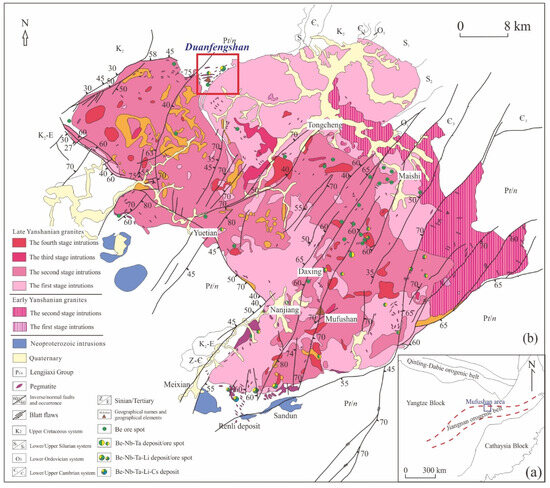
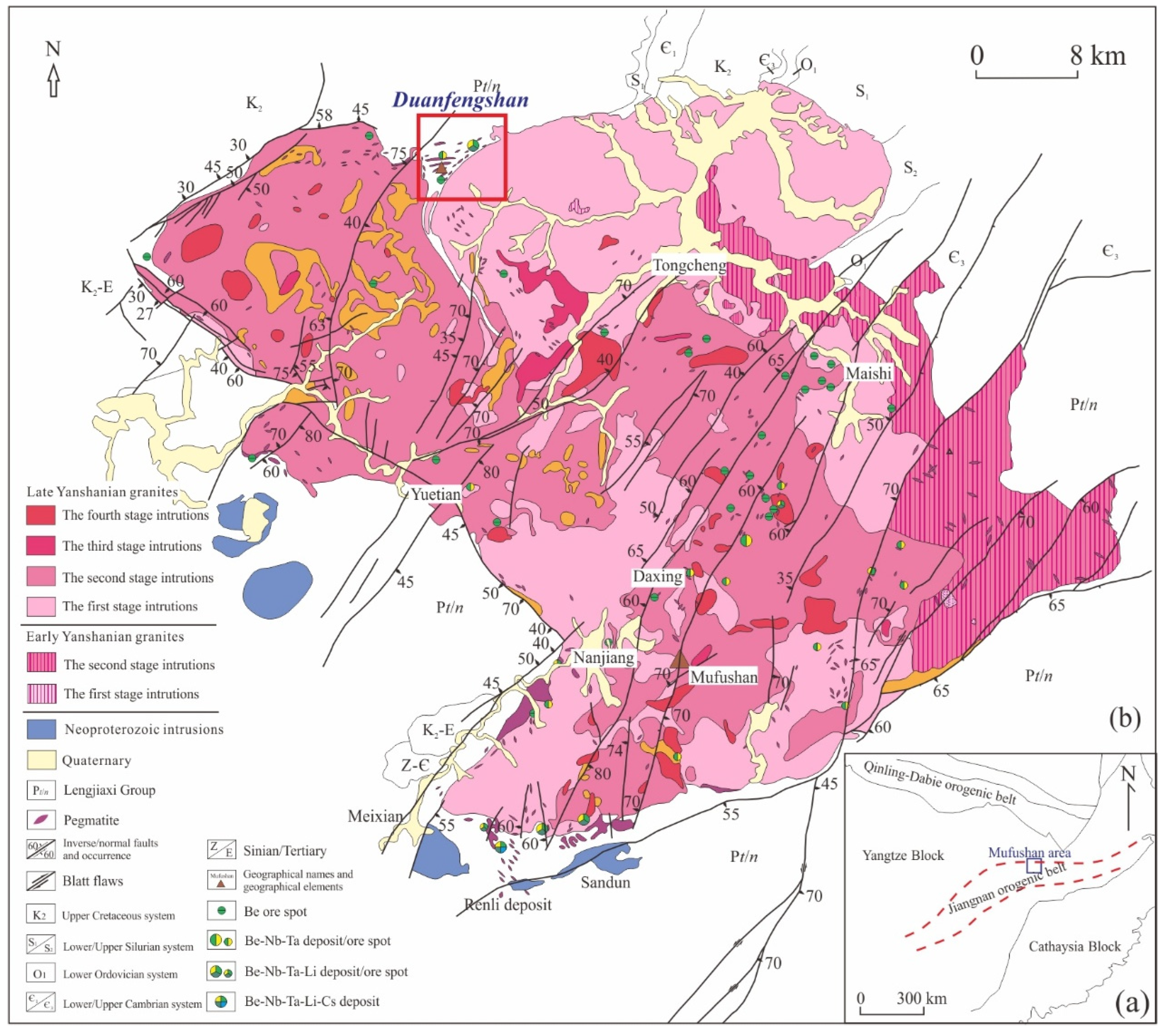
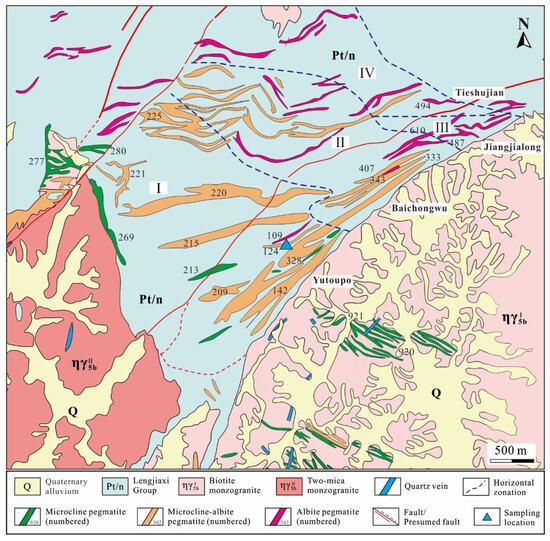
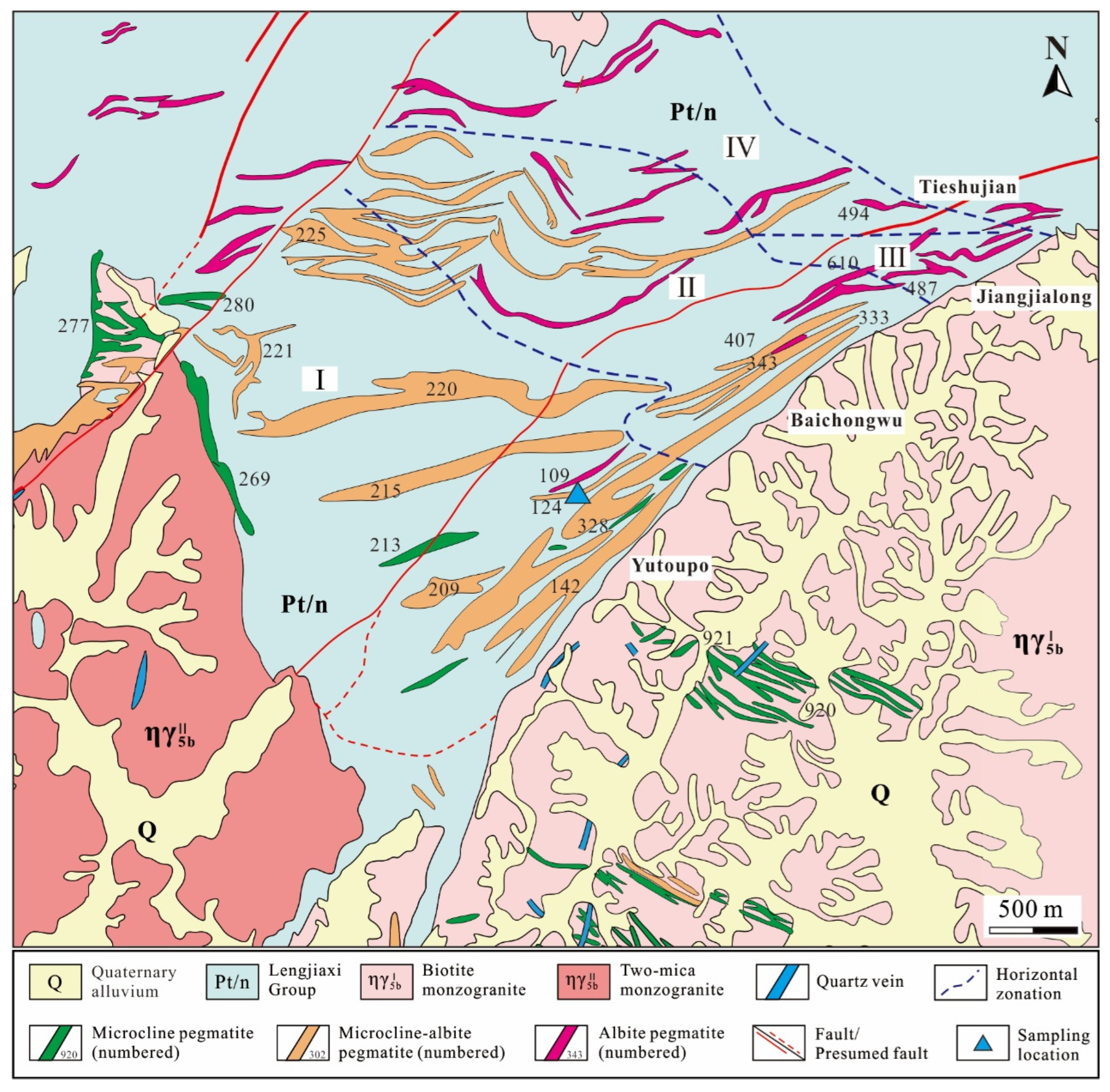
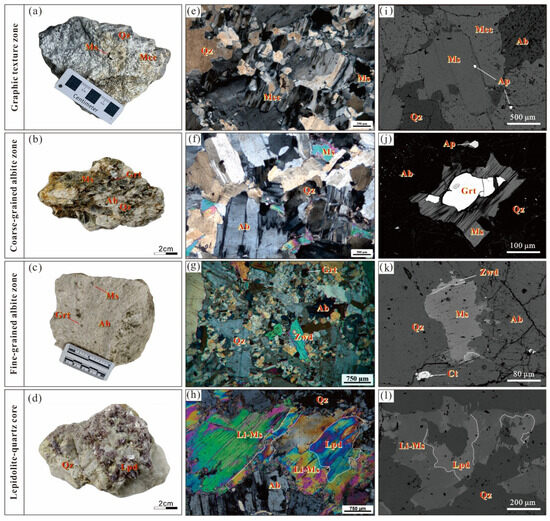
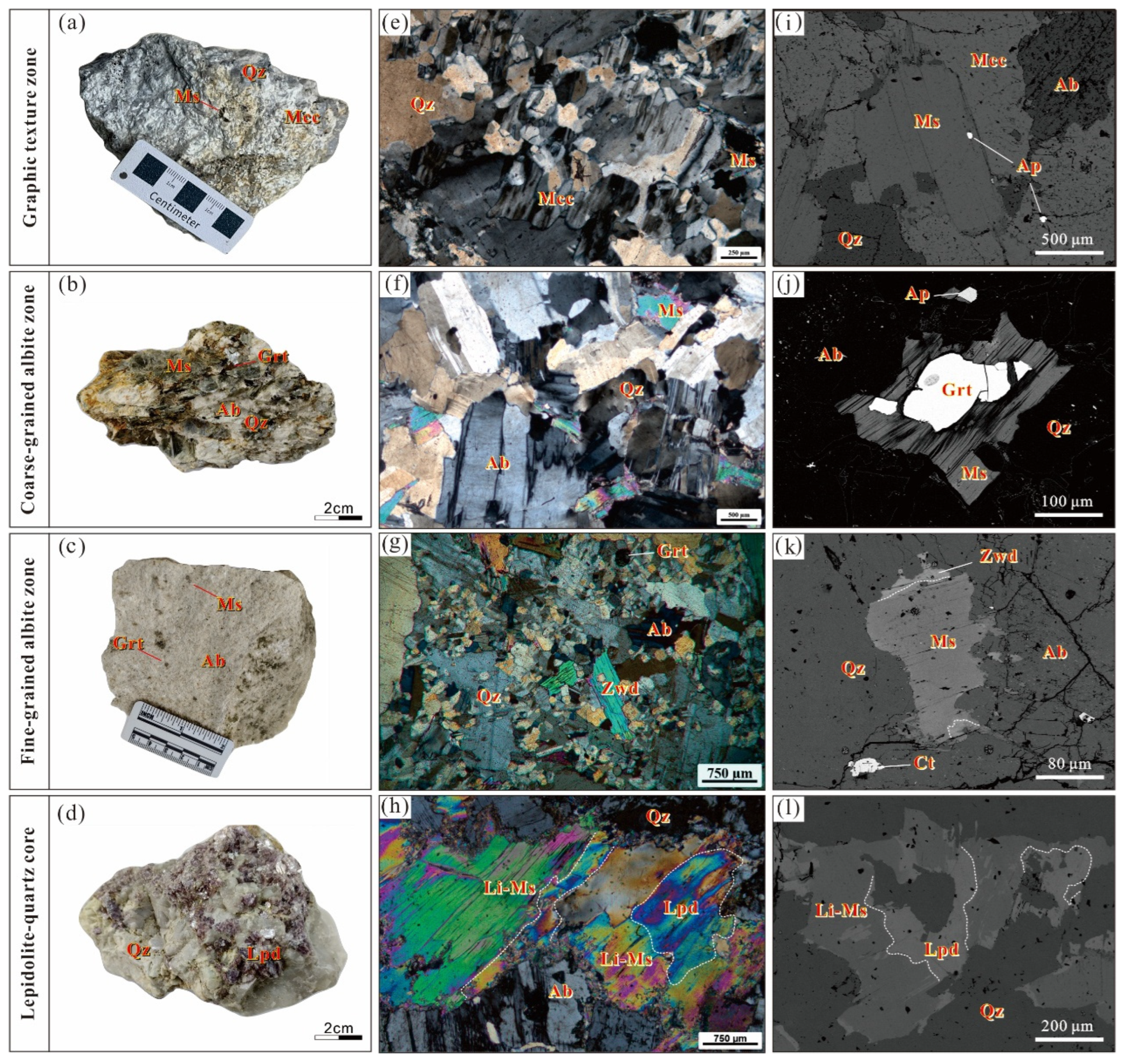
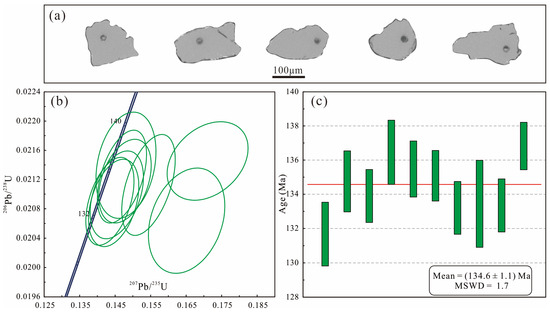
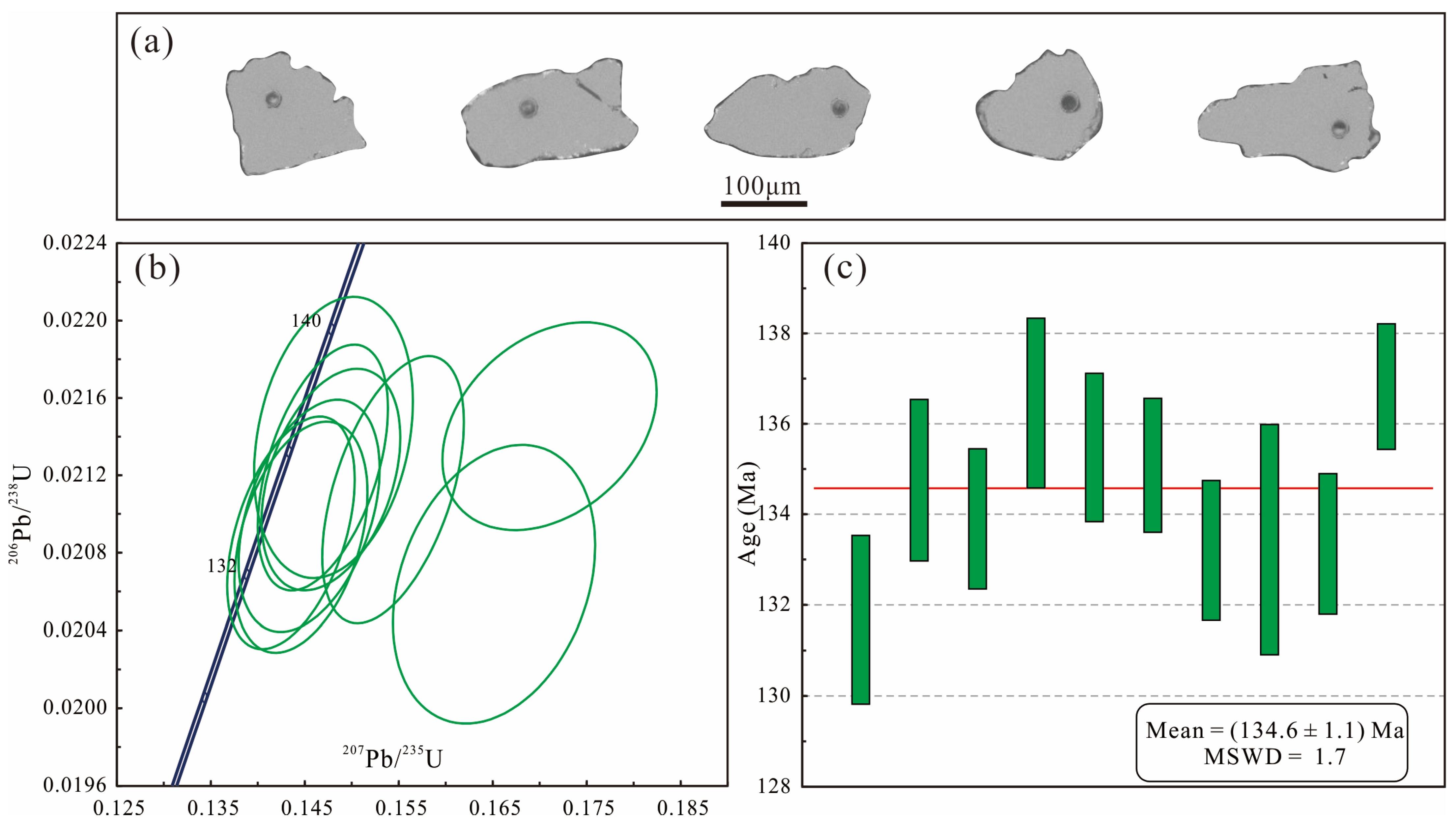
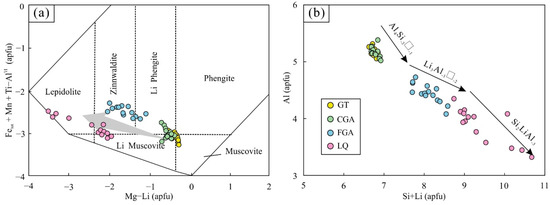
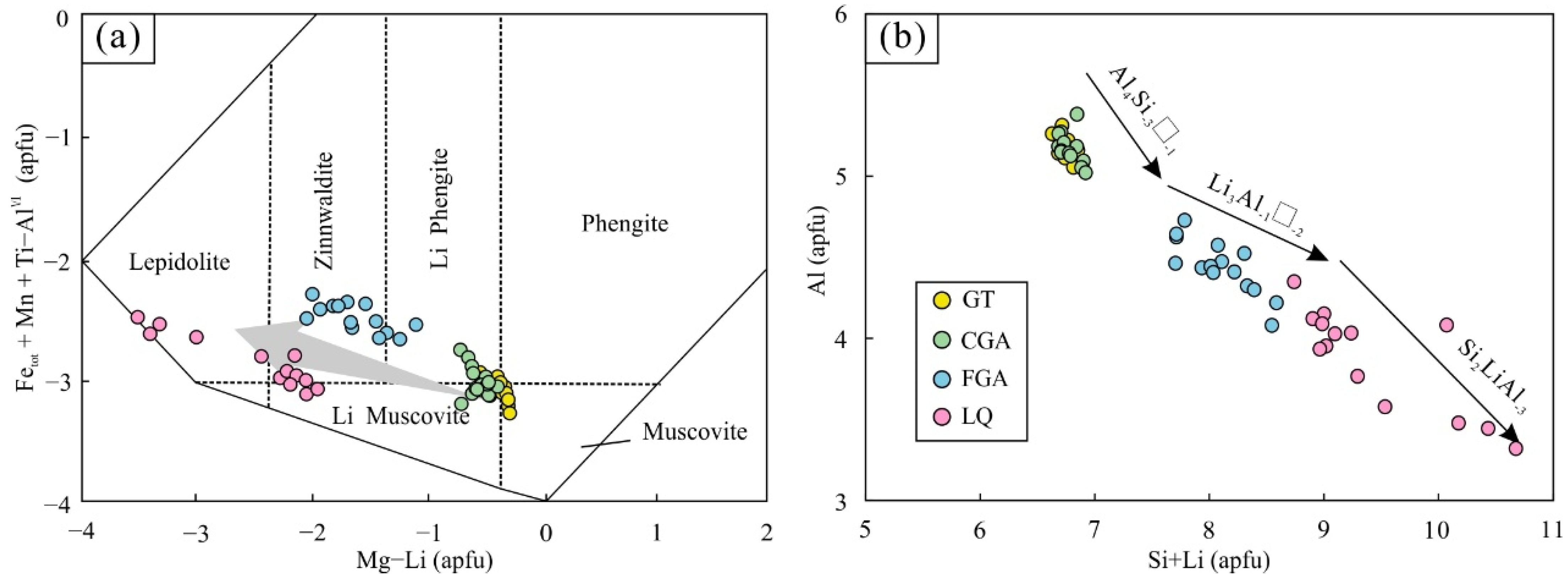
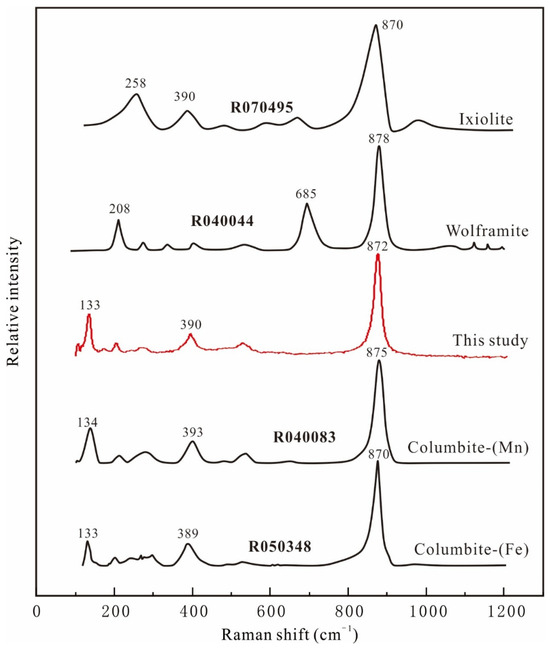
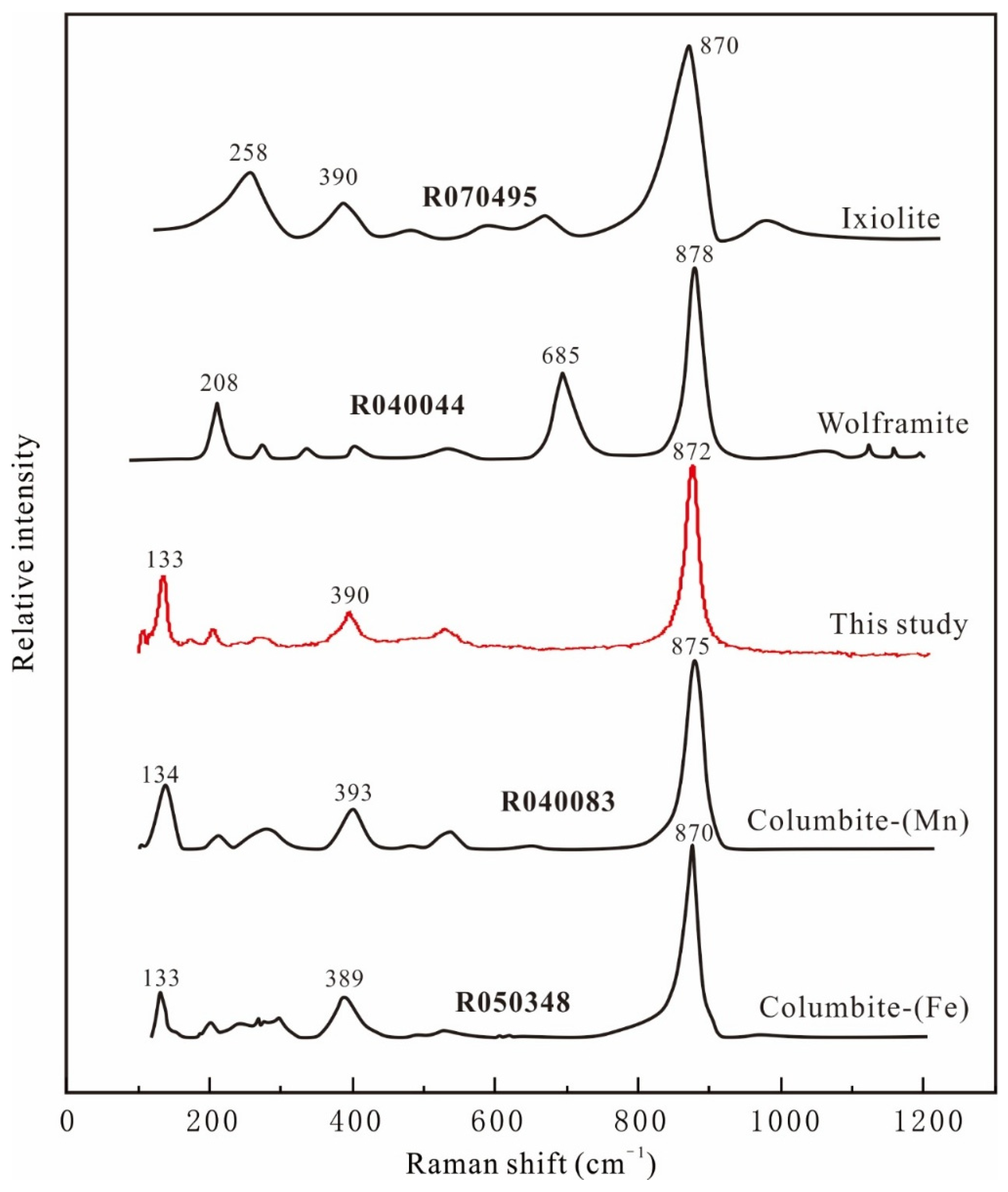
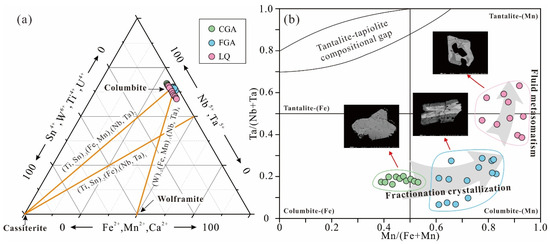
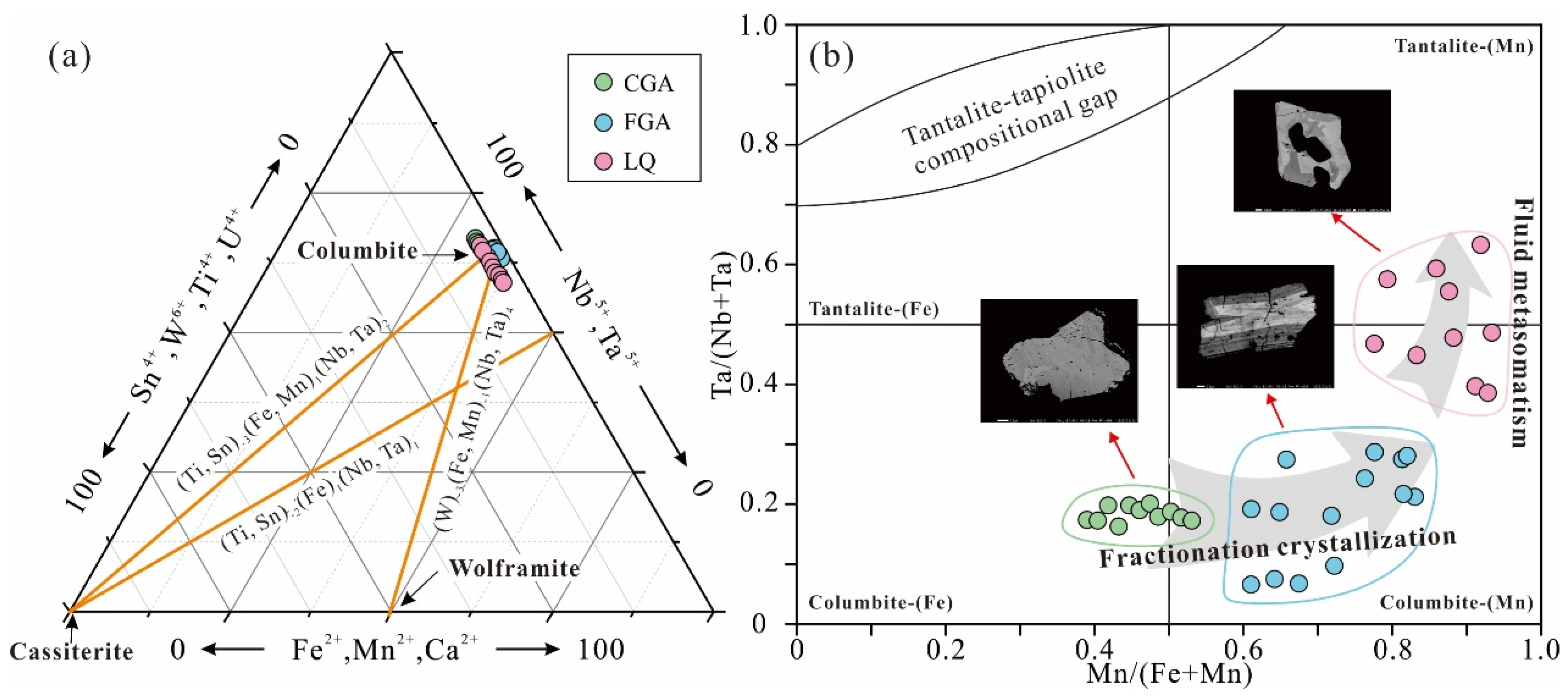
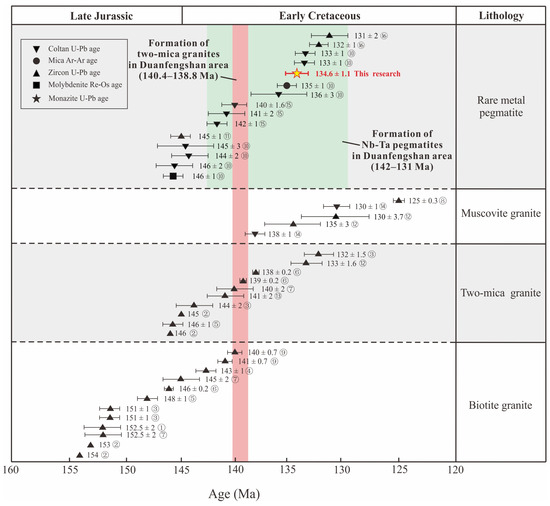
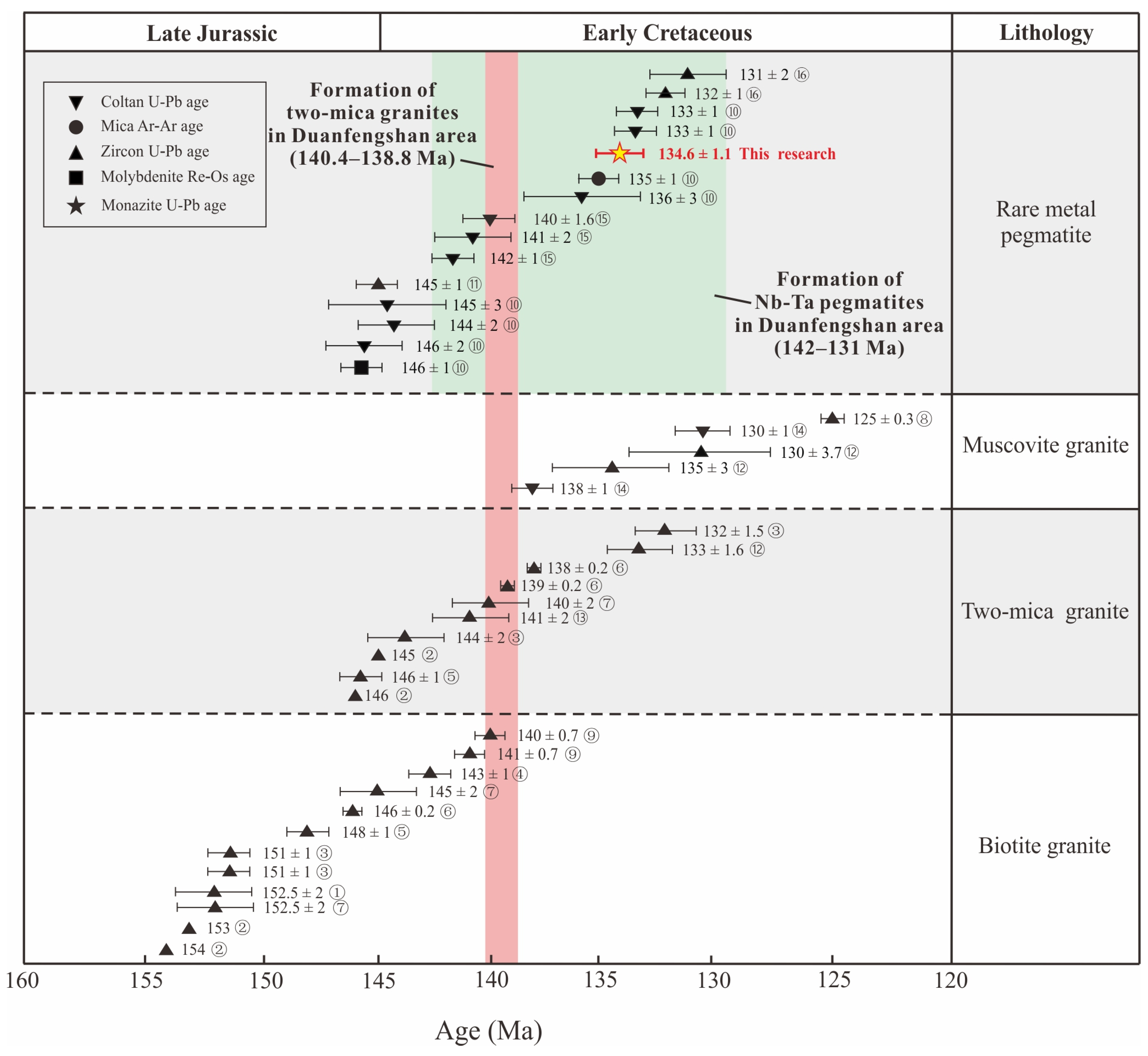
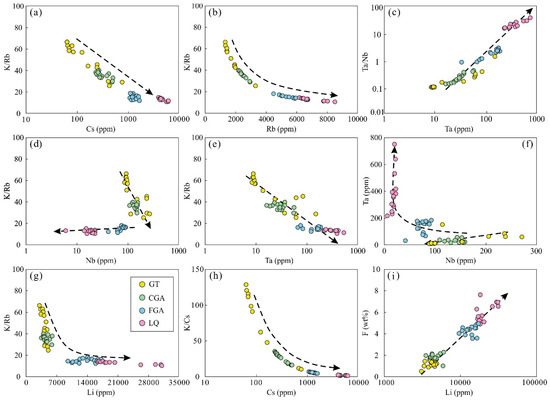
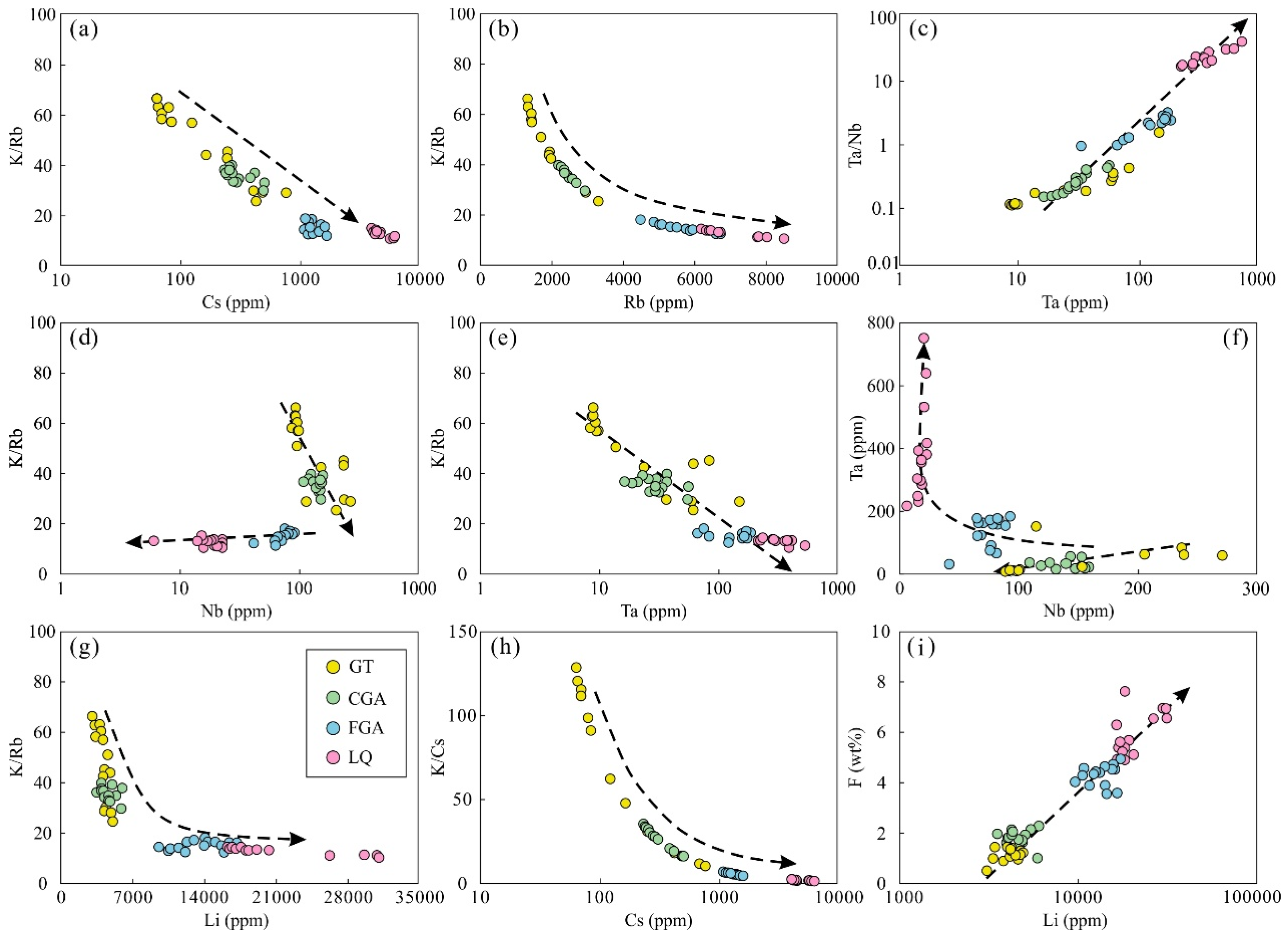
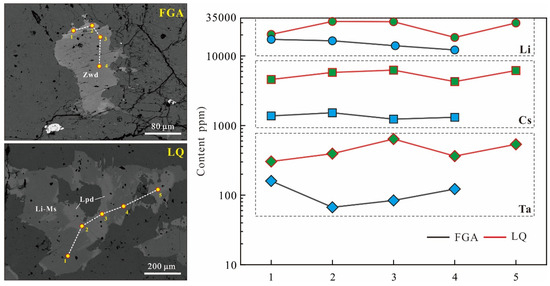
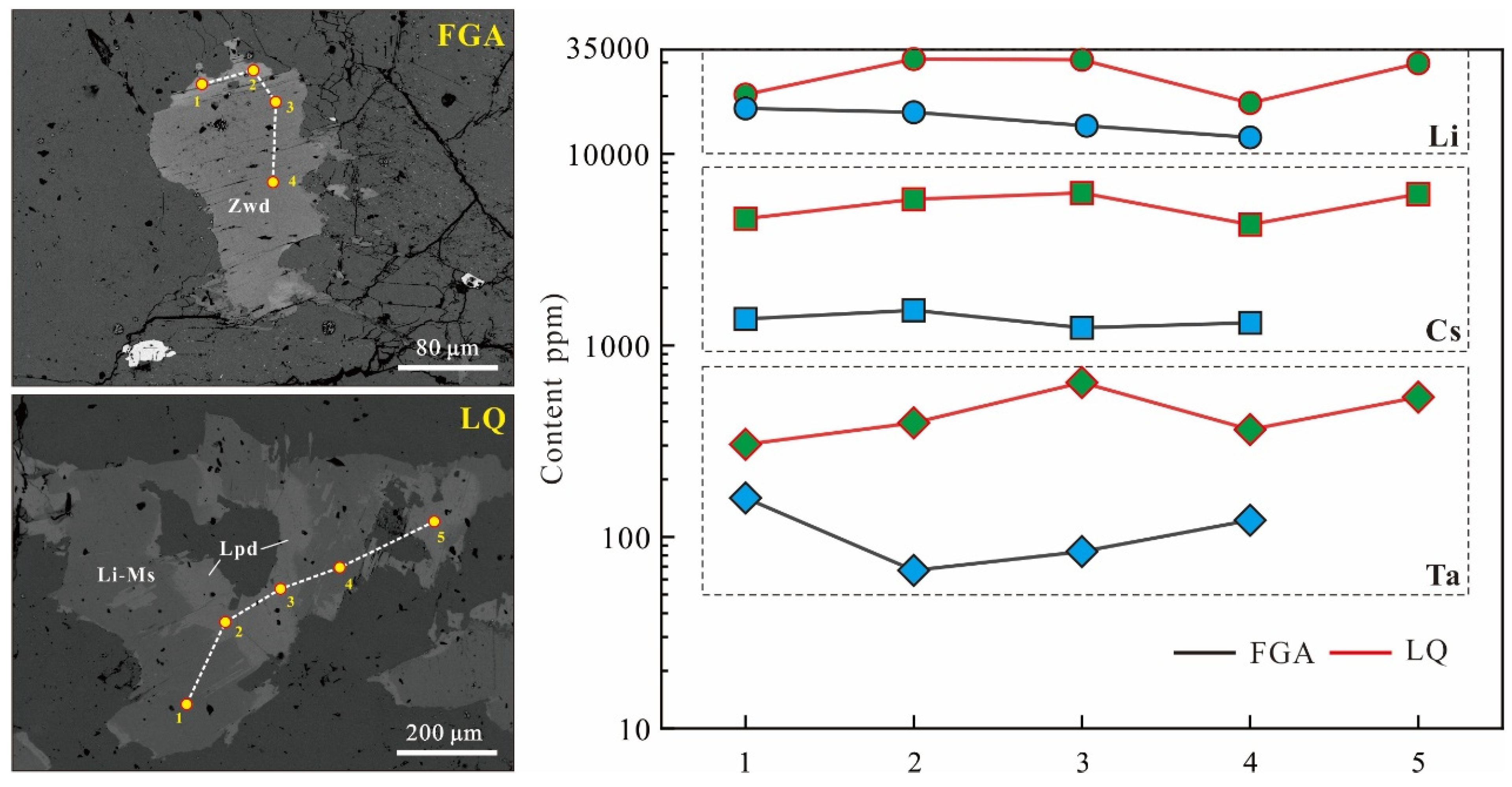
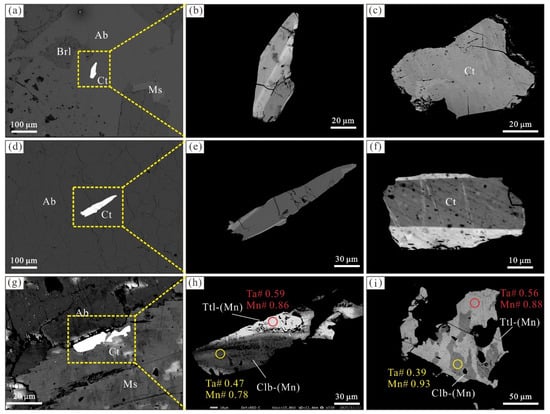
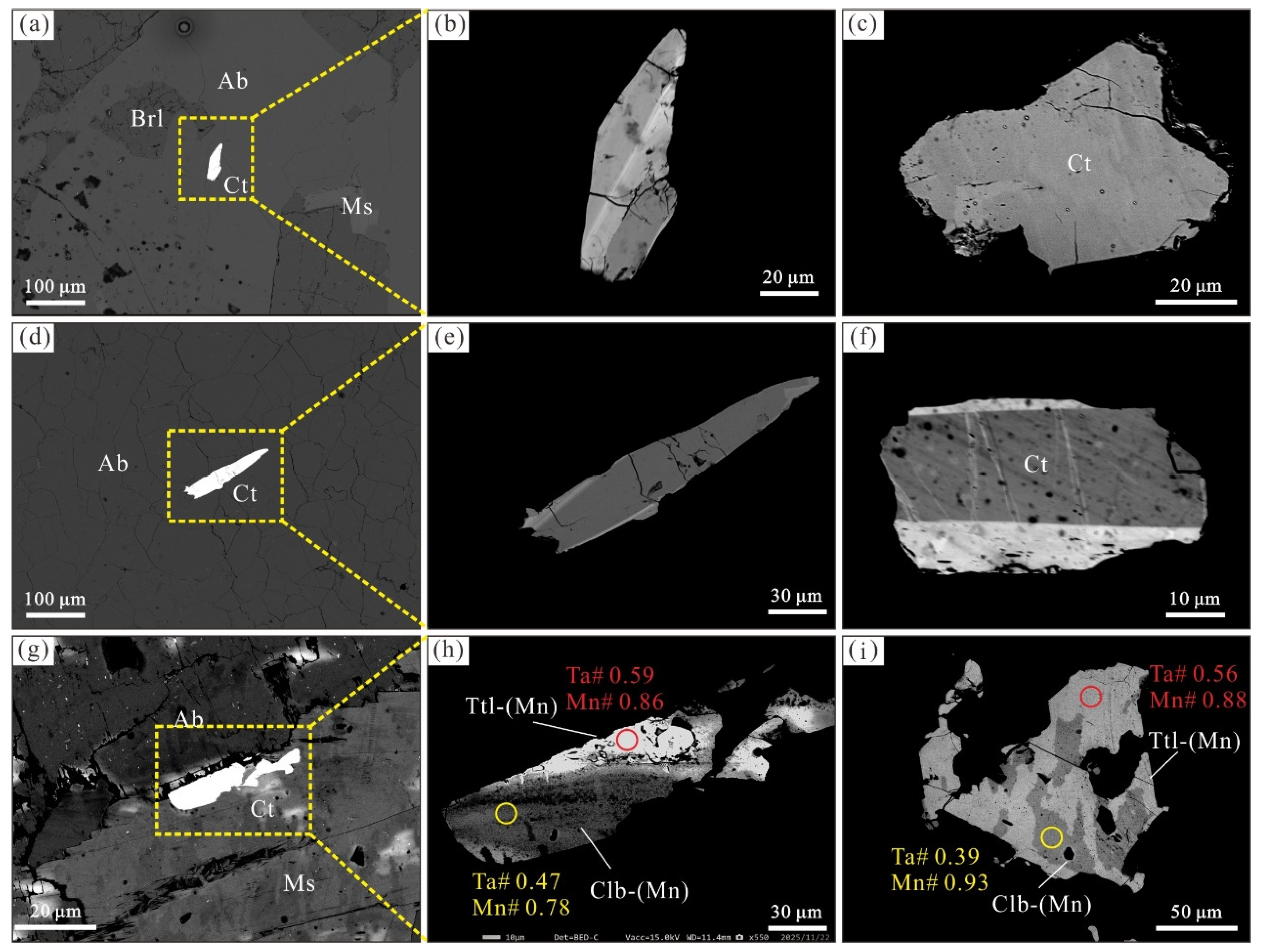
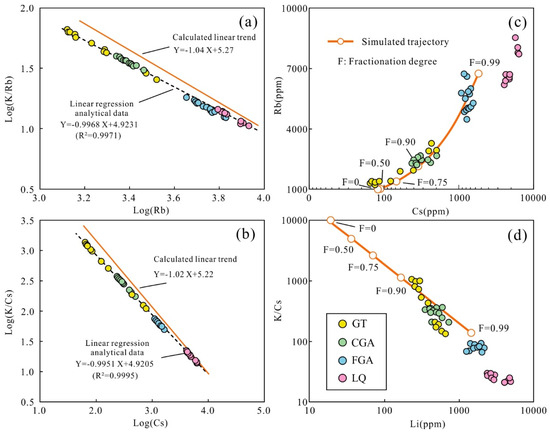
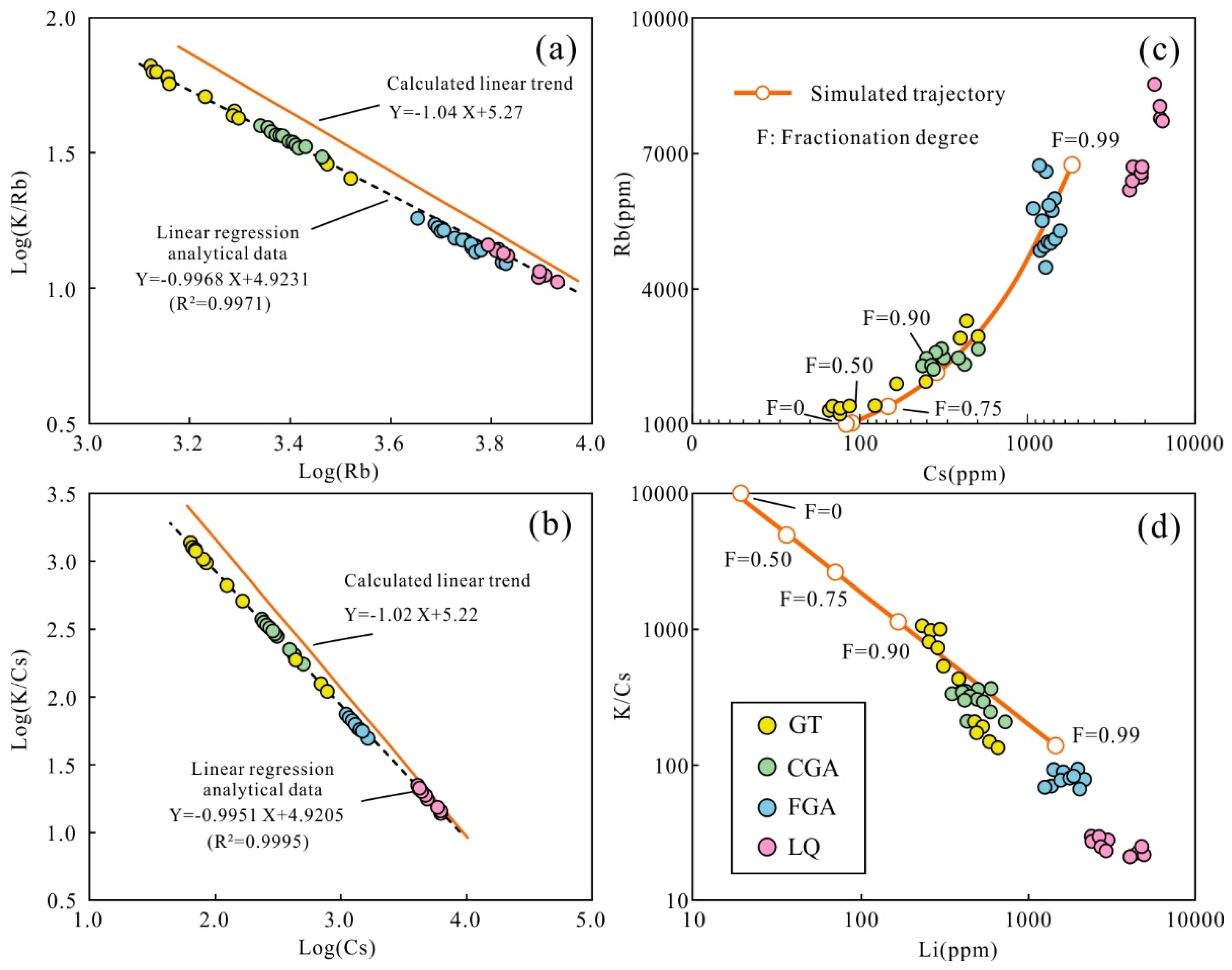
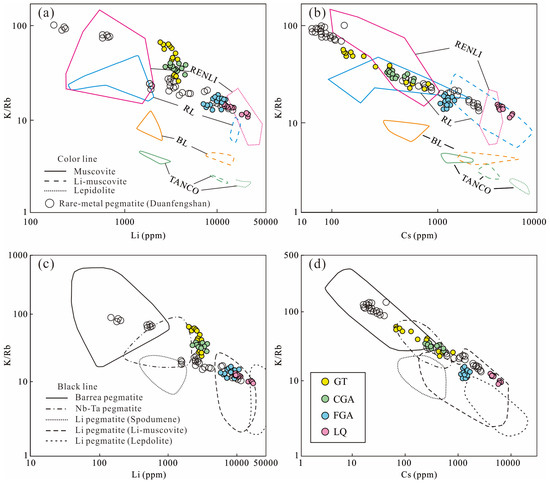
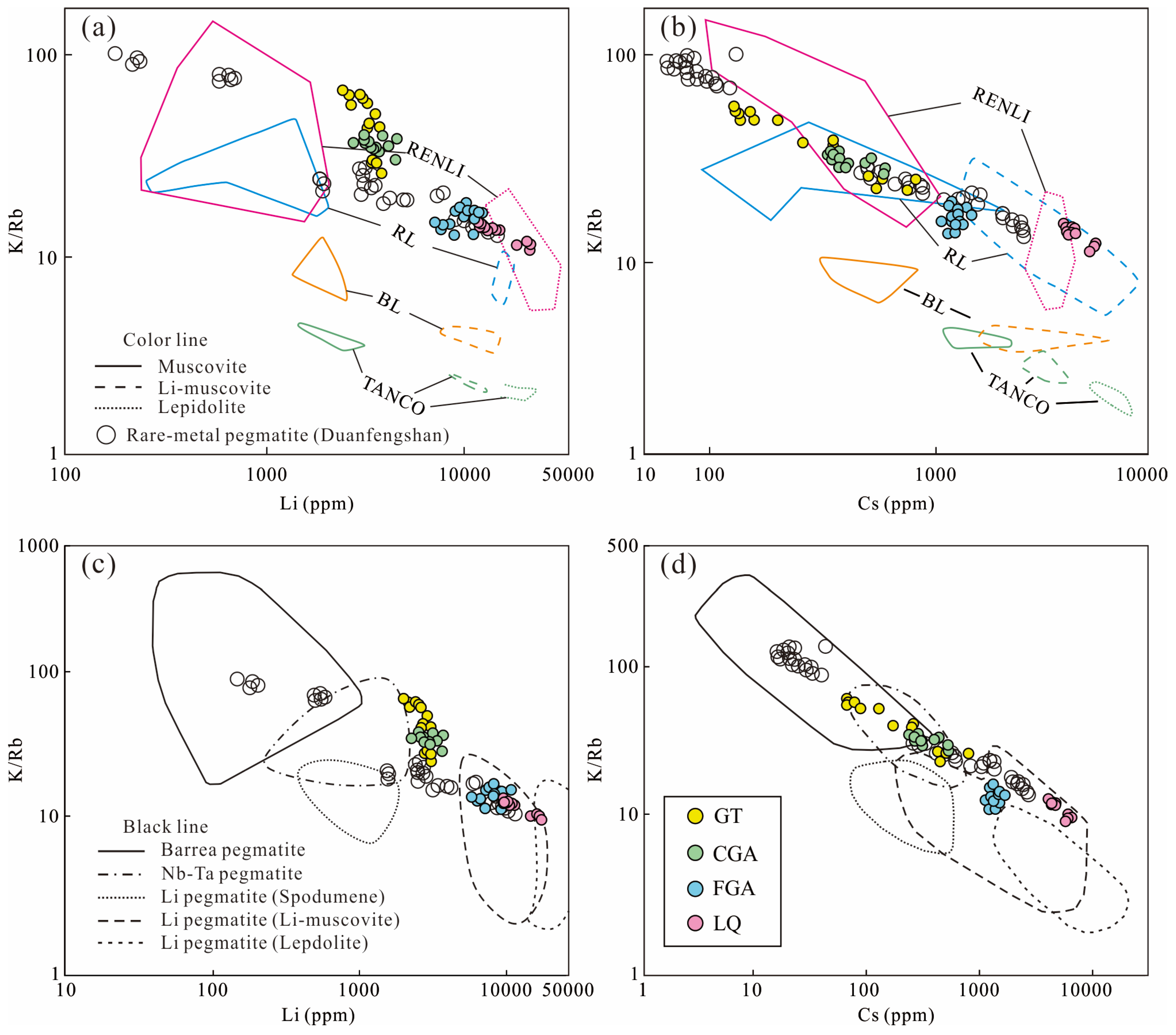
Disclaimer/Publisher’s Note: The statements, opinions and data contained in all publications are solely those of the individual author(s) and contributor(s) and not of MDPI and/or the editor(s). MDPI and/or the editor(s) disclaim responsibility for any injury to people or property resulting from any ideas, methods, instructions or products referred to in the content. |
© 2026 by the authors. Licensee MDPI, Basel, Switzerland. This article is an open access article distributed under the terms and conditions of the Creative Commons Attribution (CC BY) license.