


Abstract
This study investigates the potential of a Falcon Ultra-Fine (UF) concentrator for the recovery of ultrafine scheelite particles from a weathered tailing stockpile of an historical scheelite mine, as it could represent a valuable secondary tungsten resource. The tailings are characterized by a P80 of 17.2 µm, with scheelite grains exhibiting a finer size distribution (P80 = 9.3 µm) and a high liberation degree (82 wt%). A three-stage Falcon concentration circuit was tested under varying operating conditions, including feed tank design, concentration of solids, particle size fraction, G-force and the number of treatment stages. Results showed that separation efficiency is primarily governed by the tank design and the feed particle size distribution, while variations in G-force and concentration of solids produced only minor effects. Hydrocyclone desliming to remove particles finer than 10 µm prior to concentration enhanced the separation selectivity of the Falcon-based concentration flowsheet. However, such pre-treatment of the material will require the implementation of a dedicated process to recover scheelite from the overflow to limit losses. These findings highlight the challenges of effective scheelite separation due to the fineness of these tailings.
1. Introduction
Tungsten (W) is defined as a critical material by the European Union [1] due to its high economic importance and supply risk. This is due to its wide use in industrial, aerospace, and military applications and to the strong dominance of China in the supply chain. Indeed, about 81% of the world’s tungsten was mined in China in 2023 [2]. The primary supply of tungsten within the EU was estimated at 3% in the 2020s, mainly from Spain, Austria and Portugal [1]. One strategy to secure the tungsten supply is to promote reprocessing of tailings, as encouraged by the European Critical Raw Materials Act published in 2024 [3], since historical tailings can contain valuable metals and minerals due to less efficient extraction techniques in the past. Reprocessing the tailings not only allows the production of secondary raw materials but also constitutes an opportunity to reduce the risks related to their storage [4]. The fineness of the tailings is beneficial for the economy of the process, since grinding is often not required, leading to lower energy consumption, but at the same time it impedes the efficiency of the concentration processes. This aspect is critical for tailings produced from tungsten mines since the main tungsten-bearing minerals, i.e., scheelite and wolframite, are generally brittle, leading to the deportment of the W-bearing minerals into the fines during comminution [5].
Enhanced Gravity Separation (EGS) is the most common gravity concentration technique used for recovering tungsten-bearing minerals contained in fine materials [6,7,8,9,10]. Gravity concentration techniques are advantageous over many other techniques, since the upfront capital and operational costs are generally low, and harmful or expensive chemical reagents are not required [7]. One of the most widely used Enhanced Gravity Separators is the Falcon concentrator. The Falcon concentrator consists of a spinning bowl that can be operated at high G-force (up to 650 G), allowing the separation of fine particles of different densities. The feed slurry is introduced at the bottom-center of the bowl and then flows in a thin film upward along the bowl wall due to the combined effect of the bowl angle and centrifugal force [10]. The centrifugal force created with the rotation of the bowl acts as an enhanced gravity field allowing particles to separate based on their differential settling velocities [11]. Three types of Falcon concentrators (SB, UF and C) were developed in order to fit a large variety of mineral processing applications. The Falcon SB (or Semi-Batch) has riffles with fluidization water to avoid compaction and to remove light particles from the concentration zone, allowing high enrichment of the valuable metals in the concentrate. The Falcon SB works in semi-batch mode as the concentrate is collected only during the rinse cycles [12]. The Falcon UF (Ultra-Fine) also works in semi-batch mode; it has no fluidization water and is specifically designed to treat an ultrafine sample with a maximum size of 38 µm, achieving an effective upgrading of particles as fine as 3 µm [13]. The Falcon C (Continuous) works with a continuous feed and is used in applications that require a higher mass yield to concentrate when compared with Falcon SB concentrators [14].
Only a few published studies have been performed on the use of a Falcon concentrator to recover W-bearing minerals contained in ores [6,7,15] or in tailings [9,10,16]. In particular, Foucaud et al. [7] investigated the use of a Falcon concentrator prior to flotation to perform both a pre-concentration stage and the removal of particles finer than 10 µm on a scheelite-skarn ore ground at 150 µm. The ore contained mainly silicates (85 wt%), with an average WO3 grade of 1%. Tests were performed with the Falcon UF and SB. The results showed that the rotary speed has an influence on the separation performance obtained with both Falcon types. The obtained performance was also affected by the pulp density for the Falcon UF, while it was also affected by the fluidization pressure for the Falcon SB. Moreover, a concentrate with a higher WO3 enrichment ratio was produced when fluidization water was used, with a value up to 5 with the Falcon SB compared with an enrichment ratio of about 3 with the Falcon UF, while a slightly higher recovery rate was obtained with the Falcon UF. This difference was explained by the wash water in the fluidized bowl, which induces a fluid drag force acting against the centrifugal force. Das et al. [10] investigated the performance of the fluidized Falcon SB and of the Falcon UF for the recovery of scheelite and for the rejection of calcite contained in gold mine tailings. This tailing is characterized by a P80 of 76 µm. The average WO3 grade is 0.08%, with about 90% of WO3 distributed in the size fractions below 33 µm. In line with Foucaud et al. [7], the fluidized Falcon SB produced a concentrate with a higher WO3 grade, whereas a higher recovery rate was achieved with the Falcon UF. Evaluation of the influence of the particle size indicated that the Falcon SB was more effective in recovering scheelite particles coarser than 33 µm, while the Falcon UF showed higher performance for recovering finer scheelite particles. More specifically, the recovery rates of WO3 contained in the size fractions finer than 8 µm and +8–11 µm were about 30 wt% and 40 wt%, respectively, highlighting a potential for the recovery of ultrafine particles. The study conducted by Das et al. [10] only investigated the effect of the rotation speed, and thus G-force, with values of up to 90 Hz (corresponding to 400 G). Therefore, further investigation is required to assess the influence of higher rotation speeds and additional operating parameters on size-by-size separation performance to better understand the separation limits. The mechanisms involved in a Falcon UF concentrator were explored and described by Dehaine et al. [6]. They showed that mostly ultrafine particles (<5 µm) are rejected at the beginning of operation. This result was attributed to the build-up of the concentrate bed during which only the finest fractions are ejected from the bowl due to differential settling in the flowing film. When the retention zone is full, a selective resuspension stage is followed by a selective erosion stage, in which coarse and low-density particles are suspended and fine and high-density particles are concentrated. Finally, there is a resuspension mechanism that ejects fine and dense particles located in the surface layer of the bed, leading to a decrease in recovery.
This study investigates the potential of the Falcon UF concentrator for recovering ultrafine scheelite particles from historical tailings at a closed French scheelite mine. Bru et al. [16] recently investigated the separation performance of a flowsheet comprising three successive stages of Falcon UF concentration applied to the reprocessing of these tailings with the objective of both recovering residual scheelite and supporting site remediation by removing arsenic-bearing minerals. The feed material exhibited a P80 (i.e., 80% passing size) of 17.2 µm and a WO3 grade of 6990 mg/kg. Scheelite occurred predominantly as ultrafine grains, with a P80 of its grain size distribution (GSD) of 9.3 µm, and more than 80 wt% of scheelite-bearing particles were classified as liberated. Mineral Liberation Analysis (MLA) was performed on all separation products to elucidate the separation mechanisms. Separation results revealed that scheelite recovery was governed by particle size and liberation, with the recovery of more than 50 wt% of liberated particles coarser than 4.8 µm. Arsenic recovery was low, which was attributed to the fact that more than 94 wt% of arsenic was hosted in Hydrous Ferric Oxides (HFOs), coming from sulfide oxidation during weathering of the tailings, with HFOs having a low density, a fine GSD and a moderate liberation degree. Although this study provided valuable insights into the separation mechanisms occurring during Falcon UF concentration, detailed mineralogical characterization was performed for only a single set of operating conditions. There is therefore a need to investigate the influence of key operating parameters on separation performance, both for the whole sample and across specific size fractions. This paper addresses this gap, evaluating the effects of feed tank configuration, concentration of solids, particle size distribution, G-force, and the number of treatment steps on the recovery of scheelite-bearing particles.
2. Materials and Methods
2.1. Tailing Samples
The sample used in this study was collected on a tailing stockpile from a closed scheelite mine in France. The mine exploited a scheelite-rich skarn-type deposit with a sequence of unit operations including milling, shaking tables, flotation and magnetic separation in order to eliminate undesirable minerals (sulfides, arsenopyrites, apatite, and pyrrhotite) from the scheelite concentrate. The tailings had been stored for more than 40 years, resulting in sulfide oxidation due to weathering in the upper part of the stockpiles. The sample used in this study was collected from this weathered horizon.
A dedicated preparation protocol was implemented in order to break the agglomerates contained in the sample. It consisted of performing an attrition at a solid content of 75% (w/w) for 15 min in a 1 L attrition cell followed by high-performance dispersion using Ultra-Turrax® (IKA, Staufen, Germany) at 10,000 tr/min for 5 min. After attrition, characterization of the sample showed that more than 90% of WO3 and arsenic (As) were distributed in the size fraction below 40 µm, representing a mass yield of 70 wt%. The sample after attrition was then wet-sieved, and the fraction passing 40 µm was used for the concentration tests. A pulp splitter was used to produce representative samples for these tests.
2.2. Experimental Setup
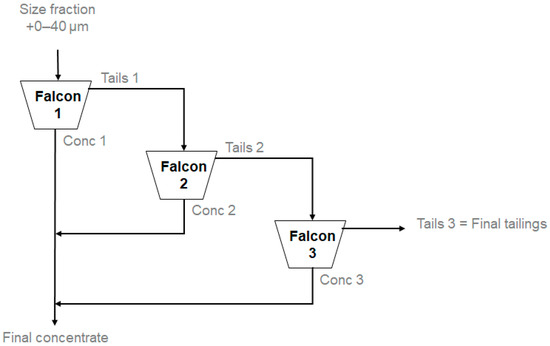
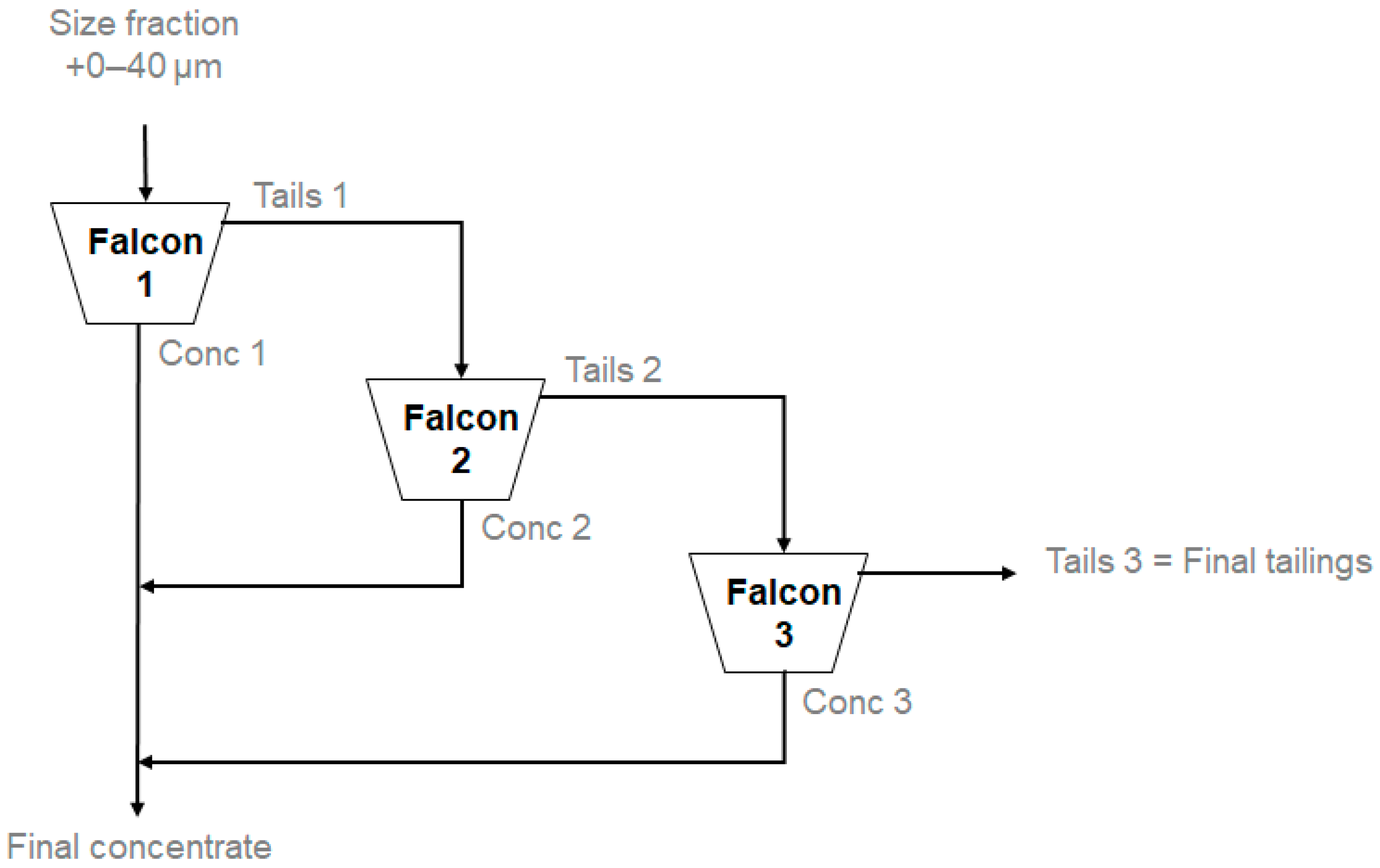
A concentration circuit with 3 Falcon separation steps was assembled following the flowsheet shown in Figure 1. The material was fed to the first Falcon step operated at 300 Gs. The second and third Falcon steps consisted of treating at 500 Gs the tailings from the previous step, i.e., Tails 1 and Tails 2 respectively. The 3 concentrates were collected separately and then mixed to obtain the final concentrate (Figure 1). The Falcon concentrator L40, supplied by Sepro Mineral Systems Corp. (Langley, BC, Canada), was used in this study. This equipment has a bowl diameter of 4” and is specifically designed for laboratory test work. The tests were performed in semi-batch with the UF bowl. The feed to the first Falcon separation step was a slurry prepared from 1.9 kg of dry solids. During testing, the feed slurry was continuously stirred in a baffled tank and pumped at a controlled flowrate close to 0.9 L/min into the Falcon concentrator. The experiments were carried out by varying the feed tank design (conical or flat bottom), the concentration of solids, the particle size distribution, the G-force and the number of Falcon treatment steps in order to investigate the influence of different operating conditions on the separation performance. Each change in operating conditions was applied to the 3 steps of Falcon concentration. Details of the operating conditions for each test are given in Table 1. These operating conditions were defined based on the findings of Das et al. [10], with elevated G-forces chosen to maximize scheelite recovery. The solid content and the number of treatment stages for Test A were set according to the manufacturer’s recommendations (Sepro Mineral Systems Corp., Langley, BC, Canada); the latter being defined so as to achieve a mass yield of approximately 30%.
Figure 1.
Reprocessing flowsheet with 3 steps of Falcon concentration.
Table 1.
Operating conditions of the investigated concentration flowsheets.
2.3. Characterization Method
Mineralogical analysis of the feed sample was performed using SEM-based automated mineralogy (SEM-AM) at the Helmholtz Institute Freiberg for Resource Technology (Freiberg, Germany) on aliquots of the feed material. A single transverse epoxy grain mount, 30 mm in diameter, was prepared to account for gravitational settling [17,18]. The epoxy grain mount was cleaned with ethanol, dried in a vacuum oven overnight at 40 °C, and coated with carbon using a Leica EM MED020 carbon coater (BalTec, Balzers, Liechtenstein). A ThermoFisher Scientific (FEI) MLA 650F instrument (Hillsboro, OR, USA), equipped with two 5030 Bruker X-Flash detectors (Berlin, Germany) was used for the analysis. The SEM-AM method allows for the complete characterization of metalliferous ores and processing products [19]. The measurement firstly relies on image analysis of backscattered electron (BSE) images to segment (i) particles from epoxy and (ii) discrete phases with contrasting BSE intensities. Thereafter, characteristic X-ray spectra are collected from each BSE segment, at predefined step sizes, using energy dispersive spectroscopy (EDS) to identify different phases and quantify phase compositions. The SEM conditions included an accelerating voltage of 25 kV, specimen current of 10 nA and a spot size number of 5.690. Two data acquisition programs, namely, GXMAP (grain-based X-ray mapping) and SPL-GXMAP (sparse phase liberation grain-based X-ray mapping), were utilized for the analyses. For both programs, the field width was 700 μm, and the pixel resolution was 700 (1 μm/pixel). BSE and X-ray calibrations were performed on the copper standard (133 BSE). For the GXMAP program, which was carried out to determine the modal composition, the X-ray step size was 4 μm, and the minimum particle count limit was set to 200,000. For the SPL-GXMAP program, which was carried out to map bright phases over the entire surface of the epoxy mount, the X-ray step size was 2 μm, and the BSE gray-scale search range was 85–255 (sulfides: 95–130 and scheelite: 170). Particle count limits were not set for the SPL-GXMAP program. Note that particle data for scheelite were obtained from the SPL-GXMAP program.
The WO3 content was determined by portable X-ray fluorescence spectroscopy (pXRF) using a NitonTM XL3t (Thermo Scientific, Waltham, MA, USA) portable analyzer. Representative aliquots of each sample were pulverized before analysis. Results were calibrated against in-house standards prepared with the tailings sample. The first standard corresponds to the tailings analyzed by ICP-AES following alkaline fusion with sodium peroxide at 450 °C and final dilution in HCl. The other standards were prepared by mixing this tailings material with pure sand at various dilution ratios. Comparison between pXRF measurements and chemical assay results showed a strong linear correlation, with a regression coefficient of 1.1823 and an R2 value of 0.9974.
Size-by-size analysis performed with pXRF was conducted on fractions obtained after manual sieving at 40 µm and 20 µm.
3. Results and Discussion
3.1. Characterization of the Feed Material
3.1.1. Chemical and Mineralogical Composition
The WO3 content of the feed material was measured to be 6990 mg/kg with pXRF.
The modal composition of the feed material, i.e., the normalized mass distribution of minerals obtained by SEM-AM with the GXMAP program, is presented in Table 2. It is composed of 76.3 wt% of silicate minerals such as quartz, plagioclase feldspar, muscovite, epidote and amphibole. It also contains 14.3% of HFOs, which come from sulfide oxidation during weathering of the tailings [20,21]. HFOs refer to a large variety of amorphous and poorly crystalline Fe-oxides and Fe-oxyhydroxides. Their composition is not clearly established, since it depends on the hydration water; therefore, it was quantified in SEM-AM using the goethite formula. A calculated assay from SEM-AM data is given in Table 3. The elemental W content of scheelite and trace wolframite measured by SEM-AM is 2462 mg/kg, which corresponds to a grade value of 3105 mg/kg WO3. This underestimation of the WO3 grade using SEM-AM compared with the one measured with pXRF (6990 mg/kg WO3) is explained by the limited scheelite grain count (1600) obtained from the GXMAP program. This is supported by a lack of coarse-grained scheelite in the GXMAP dataset (>16 µm sieve size) relative to the more representative SPL-GXMAP dataset (9400 grains). The SPL-GXMAP program was therefore chosen for mineralogical data related to scheelite. Despite this underestimation, the results obtained from the GXMAP program still provide valuable information regarding the overall mineralogical composition of the feed sample.
Table 2.
Modal mineralogy of the studied material, determined by SEM-AM (GXMAP program), and density of the minerals.
Table 3.
Chemical assay of the studied material, calculated from SEM-AM data.
Scheelite has a higher density (6 g·cm−3) than the gangue minerals, with silicate minerals typically ranging from 2.6 to 3.6 g·cm−3, meaning that separation could be possible.
3.1.2. Mineralogical Characterization of Scheelite Particles: Liberation, Mineral Associations and Grain Size Distribution
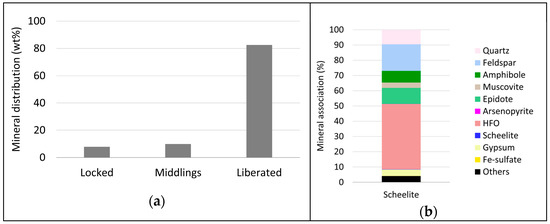
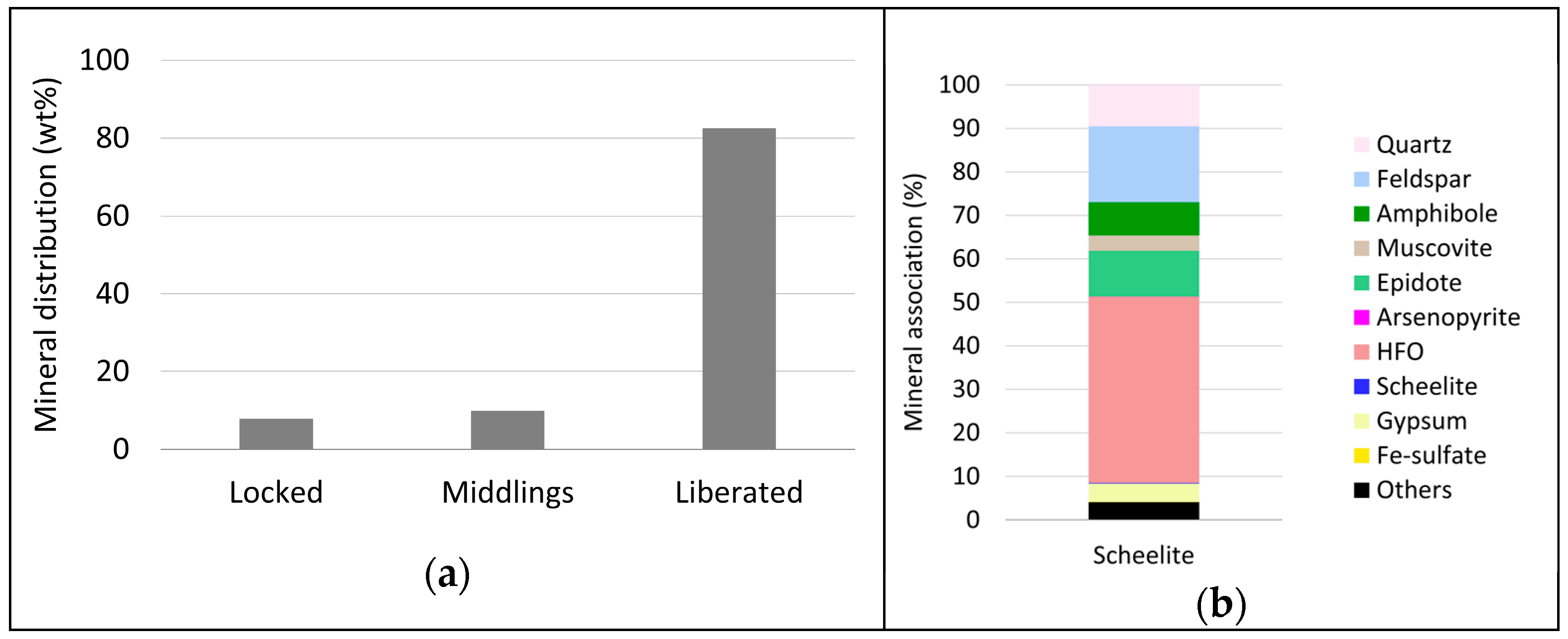
Figure 2 illustrates scheelite liberation by particle composition and its associations. The liberation degree based on particle composition was selected rather than based on free surface, since the separation behavior in a gravity concentration process is governed by the overall composition and density of the particles [22]. Three categories of liberation by particle composition were considered in this study: liberated (scheelite content: 80–100 wt%), middling (scheelite content: 30–80 wt%) and locked (scheelite content < 30 wt%). Figure 2a shows that scheelite-bearing particles have a high liberation degree, with 82 wt% of scheelite corresponding to the liberated class. Scheelite in non-liberated particles is mainly associated with HFOs (43 wt%) and gangue silicates, such as feldspar (17 wt%), quartz (10 wt%) and epidote (11 wt%) (Figure 2b).
Figure 2.
Liberation by particle composition of scheelite-bearing particles and associations obtained by SEM-AM (SPL-GXMAP program). (a) Categories of liberation by particle composition, (b) mineral association data.
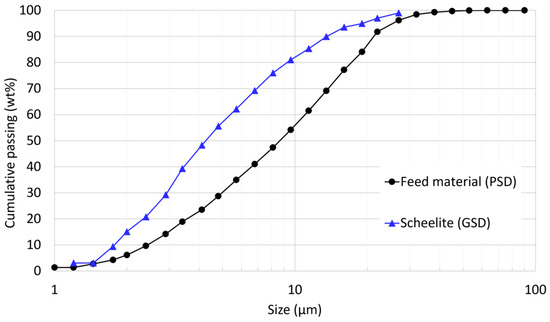
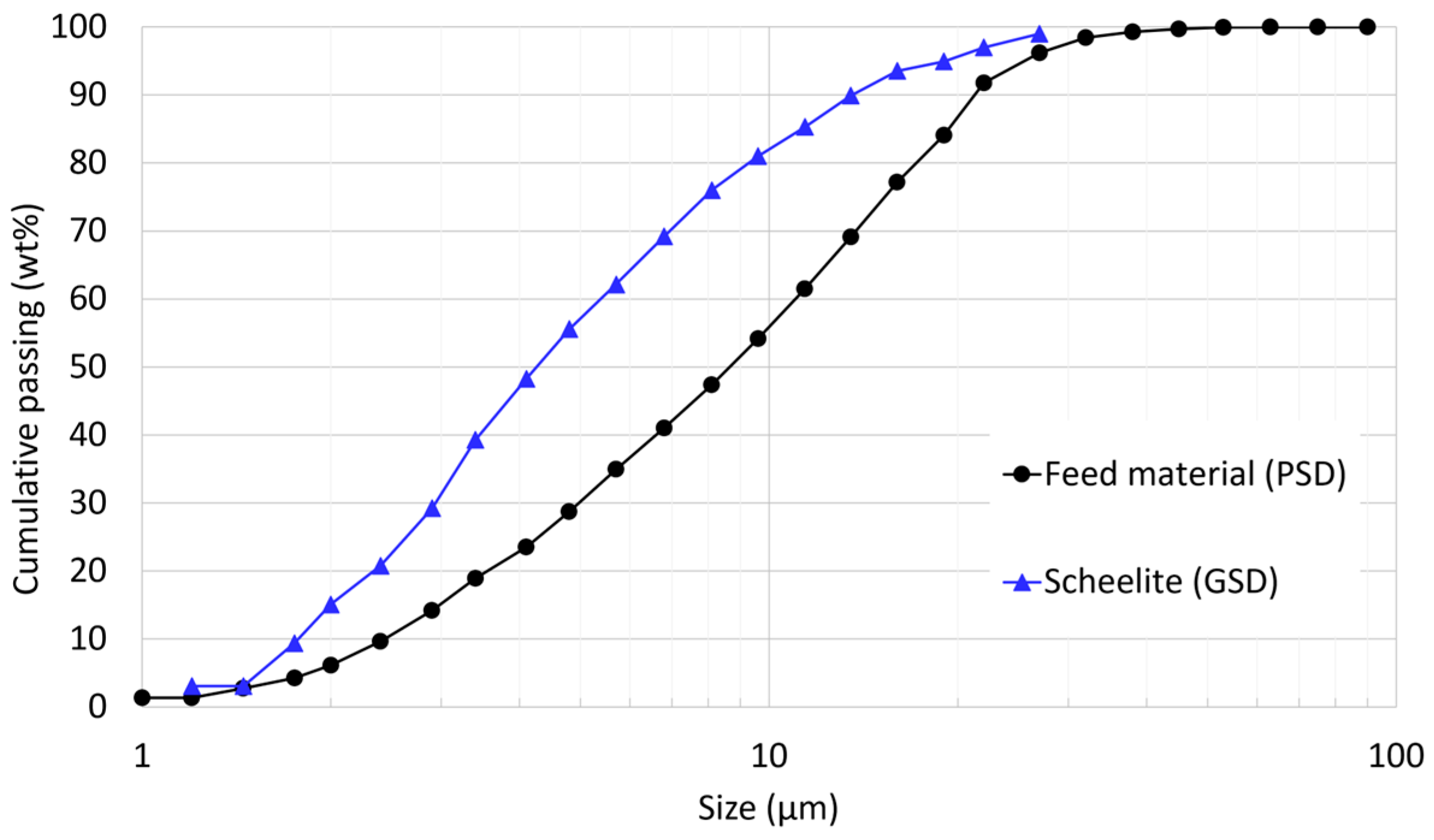
SEM-AM data can be used to estimate the particle size distribution (PSD) of the feed material and the size distribution of the inclusions of scheelite, whether liberated or not. This latter distribution is called the grain size distribution (GSD). Scheelite grains exhibit a very fine size distribution (P80 = 9.3 µm), significantly finer than the PSD of the feed material (P80 = 17.2 µm) (Figure 3). This fine GSD explains the high liberation degree of scheelite particles.
Figure 3.
Particle size distribution (PSD) of the feed material and grain size distribution (GSD) of scheelite, determined by SEM-AM (GXMAP program: feed material, SPL-GXMAP program: scheelite).
3.2. Effect of the Operating Conditions on the Recovery of Scheelite Particles
Results related to the final concentrate produced at the end of the reprocessing flowsheet are provided in Table 4. Test A was performed in duplicate in order to evaluate the experimental variability. The results of the two replicates are reported in Table 5. The relative standard deviations for all performance indicators are low, indicating good reproducibility of the experiments. The standard deviation obtained from these duplicate measurements was used as a representative estimate of the variability across the entire experimental dataset, as no replicates were performed for the other tests. It was therefore taken into account in the comparative analysis of the test results.
Table 4.
Results related to the final concentrate produced at the end of the reprocessing flowsheet (grade measured with pXRF).
Table 5.
Results related to the final concentrate produced at the end of the 2 replicated reprocessing flowsheets (grade measured with pXRF).
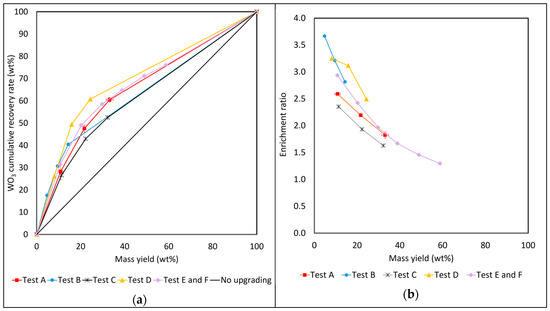
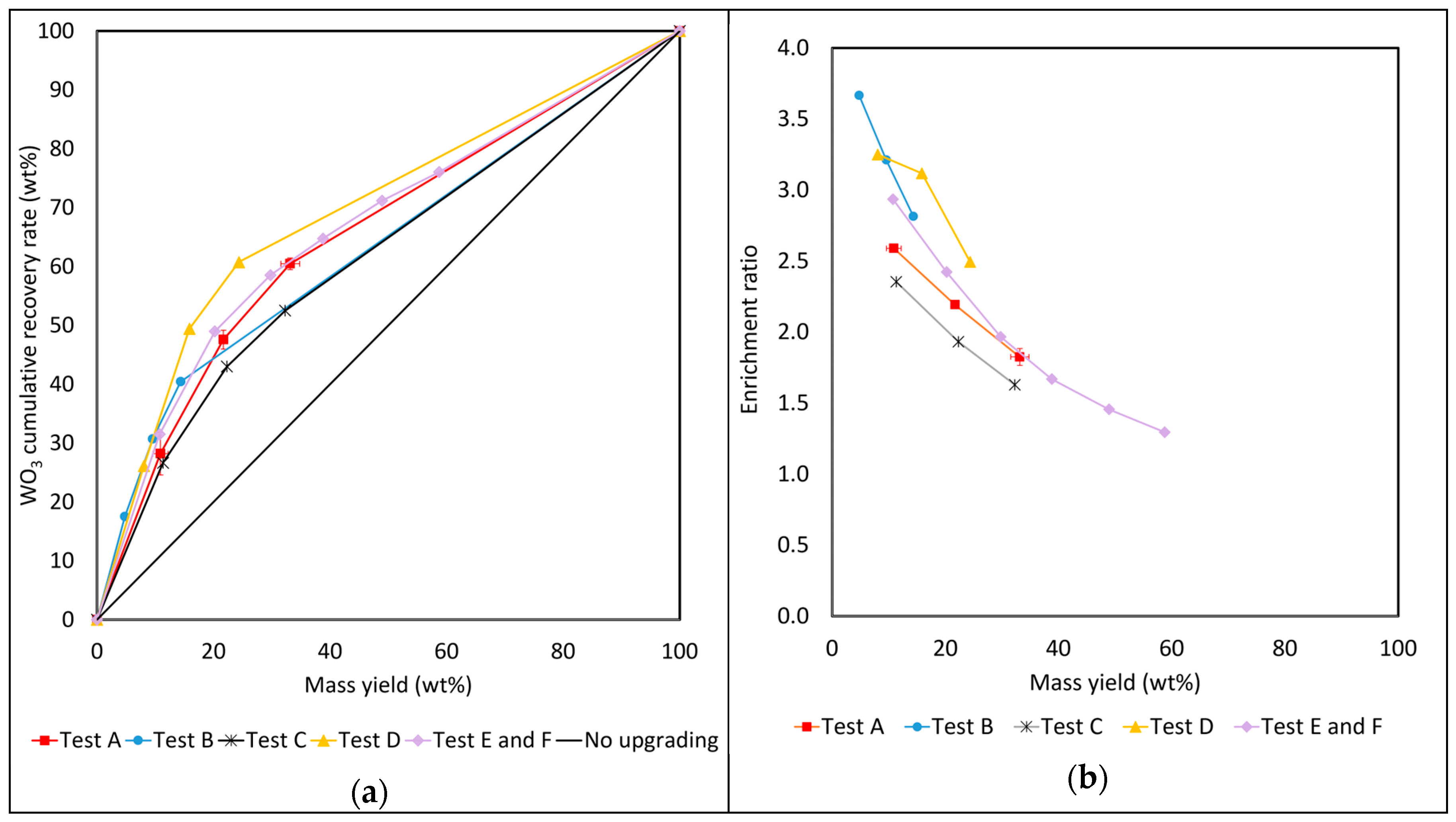
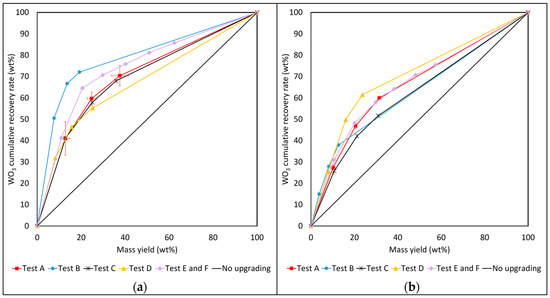
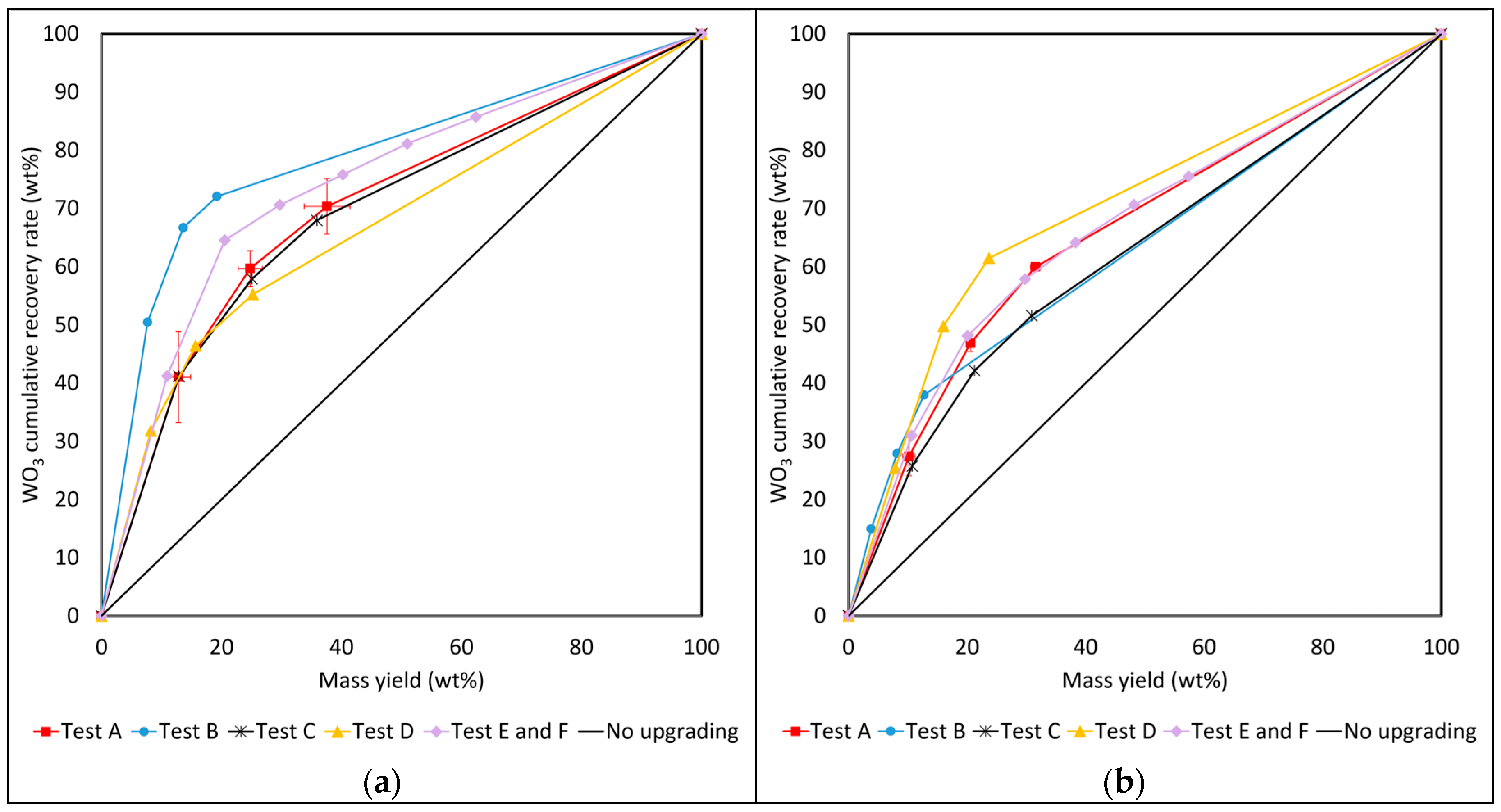
The WO3 cumulative recovery rate after each treatment step was calculated both for the overall sample (Figure 4a) and for the size fractions +20–40 µm (Figure 5a) and +0–20 µm (Figure 5b), with the cumulative recovery rate corresponding to the reconstituted concentrate obtained after each Falcon treatment step. The diagonal line in Figure 4a and Figure 5 represents the outcome of a random separation; it is labeled “No upgrading”, as a random separation yields samples with identical grades, corresponding to the feed grade. Test E and F are presented together due to their similar operating conditions, differing only in the number of treatment steps, with three steps for Test E and six steps for Test F.
Figure 4.
WO3 cumulative recovery and enrichment ratio after each treatment step versus cumulative mass yield. (a) WO3 cumulative recovery, (b) enrichment ratio.
Figure 5.
WO3 cumulative recovery after each treatment step versus cumulative mass yield for two size fractions. (a) For the size fraction +20–40 µm, (b) for the size fraction +0–20 µm.
3.2.1. Effect of Solid Concentration
Two solid concentrations were tested: 8 wt% (Test A) and 16 wt% (Test C). Table 4 shows that increasing the solid concentration has no effect on the mass yield, while the WO3 grade decreased from 14,307 mg/kg to 11,869 mg/kg, leading to a decrease in the WO3 recovery rate with values of 60.5 wt% and 52.5 wt% for solid concentrations of 8 wt% and 16 wt% respectively. The comparison of cumulative recovery of WO3 after each treatment step indicated a similar trend for the +20–40 µm fraction and a lower recovery rate for the +0–20 µm at a solid concentration of 16 wt% (Figure 5), explaining the slight decrease in the overall cumulative recovery of WO3 (Figure 4a). Regarding the enrichment ratio, Figure 4b shows comparable trends at both solid concentrations; however, for a given mass yield, the enrichment ratio is lower at the higher solid concentration (Test C).
This influence of the solid concentration may be linked to the phenomenon of differential settling that governs the separation mechanism within a UF bowl [7]. Indeed, an increase in the solid concentration may induce the settling of light particles due to the interactions of particles with varying densities within the flowing film, leading to a decrease in the selectivity of the separation [7].
3.2.2. Effect of Feed Tank Design
The impact of the feed tank design was assessed by comparing results of a conical-bottomed tank (Test A) with those of a flat-bottomed tank (Test B). The results show that using a flat-bottomed tank resulted in the production of a concentrate with a higher WO3 grade, but this was accompanied by a lower mass yield and, consequently, reduced WO3 recovery (Table 4). The comparison of cumulative recovery of WO3 after each treatment step for the size fractions +20–40 µm and +0–20 µm shows that, for a given mass yield, the flat-bottom tank (Test B) yielded a higher recovery for the +20–40 µm fraction and a similar recovery for the +0–20 µm fraction compared with the conical-bottomed tank (Test A) (Figure 5). However, the mass yield of the +0–20 µm fraction was lower for the flat-bottom tank (Test B), leading to lower overall recovery, as more than 80 wt% of the feed material is finer than 20 µm (Figure 4a). Moreover, for a given mass yield, the enrichment ratio is higher with the flat-bottom tank (Test B) (Figure 4b), highlighting a more efficient separation of the scheelite particles.
This behavior is likely attributable to the tendency for solid to settle in flat-bottom configurations, even under mechanical agitation, as previously reported by [23] and [24]. In particular, [23] demonstrated that settling of solids is due to abrupt changes in flow direction near the center and periphery of flat-bottomed tanks, generating recirculation loops, which promote the accumulation of unsuspended solids in these regions. This phenomenon may lead to a lower and non-uniform solid content in the discharge slurry feed.
3.2.3. Effect of Particle Size Distribution
The results presented in Bru et al. [16] indicated that the Falcon concentrator has a technical size limitation of about 4.8 µm for the recovery of scheelite particles in these tailings, even when they are liberated. Particles finer than this size predominantly end up in the tailing fraction irrespective of their density, which negatively impacts the overall WO3 recovery. This can be explained by the fact that, at such a small size, the centrifugal force generated within the bowl is insufficient to overcome the drag force acting on these particles, thereby impeding their effective retention in the concentrate. To evaluate the impact of a desliming pre-treatment on Falcon concentrator performance, Test D was conducted using an hydrocyclone underflow (UF) as feed material. The PSD of the UF fraction is characterized by a P80 of 32 µm, while that of the material without desliming is 17.2 µm. As shown in Table 4, the implementation of a desliming step as a pre-treatment of the reprocessing flowsheet resulted in an increase in the enrichment ratio (from 1.8 for Test A to 2.6 for Test D) with no effect on the WO3 recovery due to a reduction in mass yield by approximately 30%. Such results are attributed to the improved WO3 recovery rate in the +0–20 µm fraction (Figure 4b), which can be explained by the removal of particles finer than 10 µm and particularly the ones below 4.8 µm, which is the technical size limit for scheelite recovery.
These findings highlight the positive effect of incorporating a desliming step before the Falcon concentration for improving the selectivity of the separation. However, due to the very fine grain size distribution of scheelite in the studied tailings, the hydrocyclone overflow accounts for 58.5 wt% of the total WO3. Implementing a dedicated recovery process on the overflow is therefore essential to prevent significant losses and enhance overall WO3 recovery. Indeed, considering only the underflow fraction in the reprocessing flowsheet results in an overall recovery of just 25.2 wt%.
3.2.4. Effect of G-Force
The influence of G-force on the Falcon concentrator’s performance was investigated by comparing Test A (G-forces of 300 Gs, 500 Gs, 500 Gs) with Test E (G-forces of 650 Gs, 650 Gs, 650 Gs). Comparison of results between Test A and Test E indicated that a higher G-force led to a higher enrichment ratio with an increased rotation speed (Test E) after the first treatment step (Figure 4b), as shown by previous authors [7,10]. The increase in WO3 content with a higher rotation speed could be attributed to the greater centrifugal forces acting on particles, enhancing shear forces between the concentrate bed and the particles present in the flowing film and allowing the heavy scheelite particles to fill the voids created by the erosion of the concentrate bed [6,10]. The beneficial effect of the G-force on the enrichment ratio is, however, less pronounced with each successive treatment step. This result may be explained by the fact that a higher G-force enhances the recovery of the coarse and liberated scheelite particles during the first treatment step. The recovery of the remaining scheelite particles is more challenging, which explains the decrease in the enrichment ratio with the number of treatment steps.
Moreover, increasing the rotation speed had a negligible effect on both the mass yield and the WO3 recovery rate after the three Falcon treatment steps (Figure 4a). This result is different than the one observed by Das et al. [10], who reported a decrease in the mass yield and an increase in the WO3 recovery rate at a higher rotation speed. Actually, when examining the size fraction +20–40 µm (Figure 5a), a trend consistent with the one reported by Das et al. [10] was observed. This effect remained limited for the whole sample since this size fraction accounts for only 16 wt% of the feed material (Figure 3). It seems then that bed erosion induced by the enhanced shear forces associated with a higher G-force mainly affects particles coarser than 20 µm.
3.2.5. Effect of the Number of Falcon Treatment Steps
Three additional Falcon treatment steps were conducted during Test F compared with Test E to assess the impact of the number of the Falcon treatment steps on the WO3 content and recovery rate of the cumulative concentrates. Figure 4a shows an inflection point in cumulative WO3 recovery after the third treatment stage, beyond which the increase in recovery becomes less pronounced, accompanied by a decline in the enrichment ratio and then in the WO3 grade (Figure 4b). After six treatment stages, the WO3 grade of the cumulative concentrate was 10,762 mg/kg for a recovery rate of 76.1 wt%.
3.2.6. Comparative Analysis of Operating Conditions
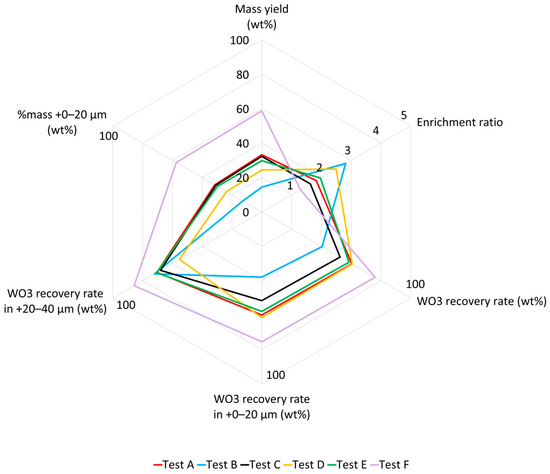
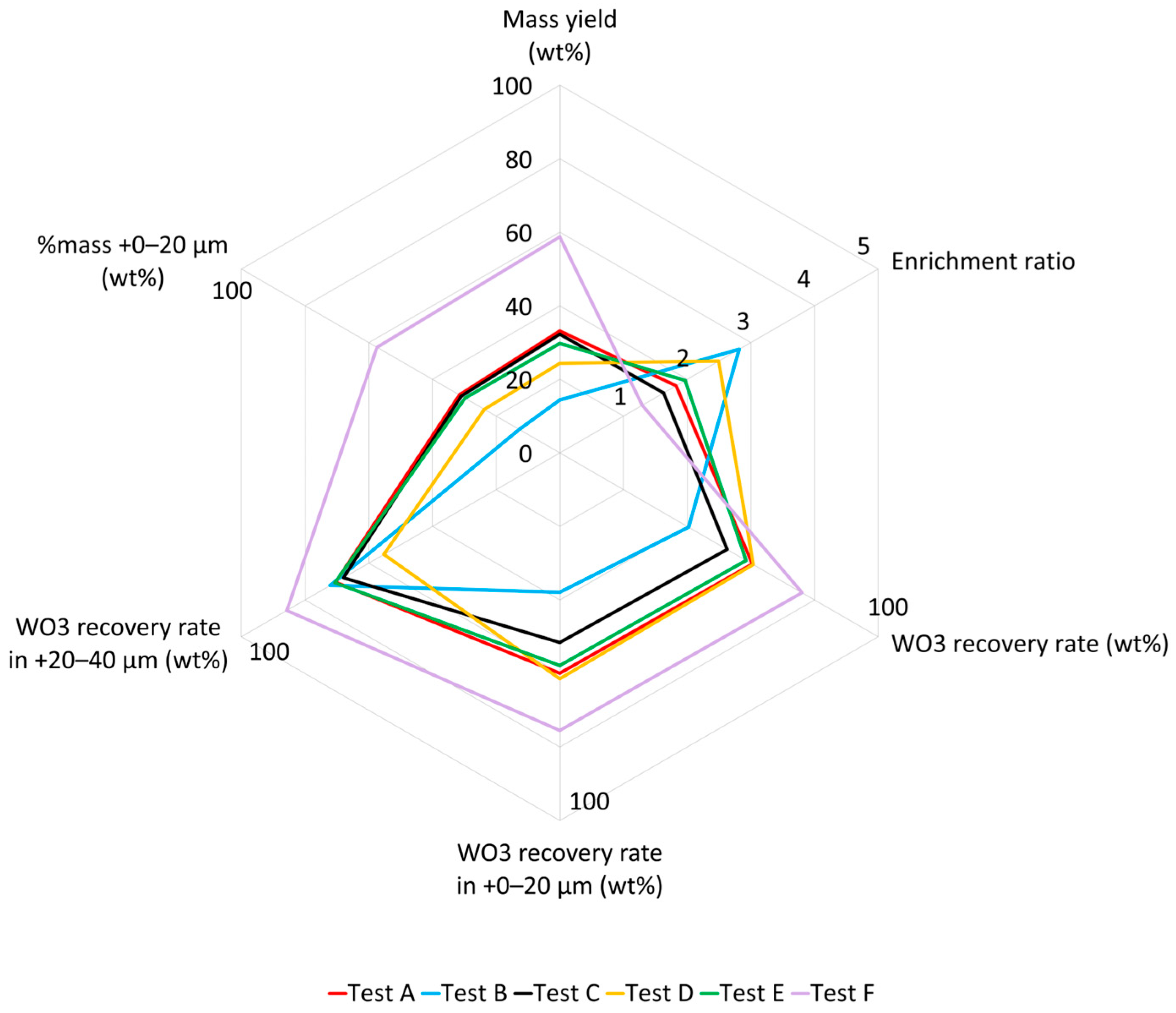
The performance of each investigated concentration flowsheet is summarized in Figure 6. Among the tested operating conditions, Test B yielded the highest enrichment ratio, although this was accompanied by the lowest WO3 recovery rate. Tests A, D, and E exhibited similar WO3 recovery rates, corresponding to the highest values when Test F is excluded, as the latter involved six treatment stages compared with three for the other tests. With respect to size-by-size performance, Test D resulted in the lowest recovery rate of WO3 within the +20–40 µm fraction. This result is likely attributable to the coarser particle size distribution of the feed, leading to a higher proportion of middling particles, which are more difficult to separate.
Figure 6.
Performance assessment of all the investigated concentration flowsheets (details of the operating conditions are given in Table 1).
Figure 6 shows that Tests A, E, and C achieve similar area-based separation efficiencies despite distinct operating conditions—G-forces being 300-500-500 Gs for Tests A and C versus 650-650-650 Gs for Test E and solid concentrations of 8 wt% for Tests A and E versus 16 wt% for Test C. This suggests that these parameters have limited influence on the overall separation performance. Conversely, the marked differences observed between Test A and Test B, which differ in tank design, and between Test A and Test D, which differ in feed particle size distribution, suggest that the feed tank configuration and the particle size distribution of the feed are key factors governing separation efficiency.
4. Conclusions
This study evaluated the feasibility of using a multi-stage Falcon Ultra-Fine (UF) concentration flowsheet to recover ultrafine scheelite from the weathered tailings of an historical scheelite mine. The tailings are characterized by a P80 of 17.2 µm and contain scheelite grains that have a finer size distribution, with a P80 of 9.3 µm, and a high liberation degree (82 wt%). Tests were performed with a three-stage Falcon concentration flowsheet under varied operating conditions, with special attention given to the separation efficiency across two size fractions: +0–20 µm and +20–40 µm. Results showed that the performance of the reprocessing circuit is limited due to the fineness of the tailings and is mainly affected by the particle size distribution of the feed and by the feed tank design, while increases in G-force and in the solid concentration produced only minor effects. In particular, hydrocyclone desliming to remove particles finer than 10 µm prior to reprocessing consistently enhanced separation selectivity, achieving a WO3 recovery rate exceeding 60 wt% with an enrichment ratio of 2.6. The analysis of the WO3 recovery rate for each size fraction revealed that the desliming pre-treatment significantly improved the WO3 recovery in the +0–20 µm fraction, due to the removal of particles below the technical recovery limit of the Falcon UF concentrator, which is close to 5 µm. However, even though adding a desliming step with a hydrocyclone enhanced the separation selectivity, it led to a sharp decrease in the overall WO3 recovery as the overflow of the hydrocyclone (size fraction below 10 µm) contained approximately 58.5 wt% of the total WO3 due to the very fine grain size distribution of the scheelite grains in the tailings. Such pre-treatment of the material will then require the implementation of a dedicated process on the overflow to avoid substantial scheelite losses.
Further work is required to optimize the performance of the reprocessing flowsheet allowing the achievement of both a high scheelite recovery and a good enrichment ratio. This will be addressed by implementing a design-of-experiments methodology, enabling a more systematic investigation of the influence of the operating conditions and of their interactions.
Author Contributions
Conceptualization, K.B. and S.T.; Methodology, K.B. and S.T.; Validation, K.B.; Formal analysis, K.B. and S.T.; Investigation, B.M.G. and M.B.; Writing—original draft, K.B.; Writing—review, K.B. All authors have read and agreed to the published version of the manuscript.
Funding
This study was performed under the project VARTA (“Valorization and remediation of tailings from W-ores”), which has received funding from the French National Research Agency ANR under the grant ANR-21-CE04-0017-02.
Data Availability Statement
The data presented in this study are available on request from the corresponding author due to privacy reasons.
Acknowledgments
The authors want to acknowledge Roland Würkert and Michael Stoll, at the Helmholtz Institute Freiberg for Resource Technology, for sample preparation of the epoxy mounts for SEM-AM.
Conflicts of Interest
The authors declare no conflict of interest.
References
- European Commission. Study on the Critical Raw Materials for the EU 2023: Final Report; European Commission: Brussels, Belgium, 2023. [Google Scholar]
- USGS. Mineral Commodity Summaries 2024; USGS: Reston, VA, USA, 2024.
- European Parliament and Council. Regulation (EU) 2024/1252 of the European Parliament and of the Council of 11 April 2024 Establishing a Framework for Ensuring a Secure and Sustainable Supply of Critical Raw Materials and Amending Regulations (EU) No 168/2013, (EU) 2018/858, (EU) 2018/1724 and (EU) 2019/1020; European Parliament and Council: Brussels, Belgium, 2024. [Google Scholar]
- Schueler, T.A.; Schippers, A.; Goldmann, D. Bioleaching for Metals Removal from Mine Tailings Flotation Fractions. Hydrometallurgy 2024, 225, 106286. [Google Scholar] [CrossRef] [Scilit]
- Kupka, N.; Rudolph, M. Froth Flotation of Scheelite—A Review. Int. J. Min. Sci. Technol. 2018, 28, 373–384. [Google Scholar] [CrossRef] [Scilit]
- Dehaine, Q.; Foucaud, Y.; Kroll-Rabotin, J.-S.; Filippov, L.O. Experimental Investigation into the Kinetics of Falcon UF Concentration: Implications for Fluid Dynamic-Based Modelling. Sep. Purif. Technol. 2019, 215, 590–601. [Google Scholar] [CrossRef] [Scilit]
- Foucaud, Y.; Dehaine, Q.; Filippov, L.O.; Filippova, I.V. Application of Falcon Centrifuge as a Cleaner Alternative for Complex Tungsten Ore Processing. Minerals 2019, 9, 448. [Google Scholar] [CrossRef] [Scilit]
- Mulenshi, J.; Khavari, P.; Chehreh Chelgani, S.; Rosenkranz, J. Characterization and Beneficiation Options for Tungsten Recovery from Yxsjöberg Historical Ore Tailings. Processes 2019, 7, 895. [Google Scholar] [CrossRef] [Scilit]
- Das, S.K.; Kundu, T.; Dash, N.; Angadi, S.I. Separation Behavior of Falcon Concentrator for the Recovery of Ultrafine Scheelite Particles from the Gold Mine Tailings. Sep. Purif. Technol. 2023, 309, 123065. [Google Scholar] [CrossRef] [Scilit]
- Das, S.K.; Tan, J.; Kundu, T.; Rath, S.S.; Angadi, S.I. Performance Evaluation of Falcon Fluidized Bowl and Ultrafine (UF) Bowl Concentrators for the Recovery of Ultrafine Scheelite Particles. Adv. Powder Technol. 2023, 34, 104193. [Google Scholar] [CrossRef] [Scilit]
- Kroll-Rabotin, J.-S.; Bourgeois, F.; Climent, É. Physical Analysis and Modeling of the Falcon Concentrator for Beneficiation of Ultrafine Particles. Int. J. Miner. Process. 2013, 121, 39–50. [Google Scholar] [CrossRef] [Scilit]
- Sepro Minerals Systems Corp. Falcon Semi-Batch (SB) Concentrators; Sepro Minerals Systems Corp.: Langley, BC, Canada, 2023. [Google Scholar]
- Sepro Minerals Systems Corp. Falcon Ultra-Fine (UF) Concentrators; Sepro Minerals Systems Corp.: Langley, BC, Canada, 2023. [Google Scholar]
- Sepro Minerals Systems Corp. Falcon Continuous (C) Concentrators; Sepro Minerals Systems Corp.: Langley, BC, Canada, 2023. [Google Scholar]
- Yue, T.; Han, H.; Hu, Y.; Wei, Z.; Wang, J.; Wang, L.; Sun, W.; Yang, Y.; Sun, L.; Liu, R.; et al. Beneficiation and Purification of Tungsten and Cassiterite Minerals Using Pb–BHA Complexes Flotation and Centrifugal Separation. Minerals 2018, 8, 566. [Google Scholar] [CrossRef] [Scilit]
- Bru, K.; Boucheron, M.; Bourgeois, F.; Guy, B.M.; Touze, S. Combining Mineral Liberation Analysis and Falcon Gravity Separation Testing for Reprocessing an Ultrafine Scheelite Tailings. In Proceedings of the XXX International Mineral Processing Congress, Cape Town, South Africa, 18–22 October 2026. [Google Scholar]
- Coetzee, L.L.; Theron, S.J.; Martin, G.J.; Merwe, J.-D.V.D.; Stanek, T.A. Modern Gold Deportments and Its Application to Industry. Miner. Eng. 2011, 24, 565–575. [Google Scholar] [CrossRef] [Scilit]
- Heinig, T.; Bachmann, K.; Tolosana-Delgado, R.; van den Boogaart, G.; Gutzmer, J. Monitoring Gravitational and Particle Shape Settling Effects on MLA Sampling Preparation. In Proceedings of the IAMG 17th Annual Conference, Freiberg, Germany, 5–13 September 2015. [Google Scholar]
- Schulz, B.; Sandmann, D.; Gilbricht, S. SEM-Based Automated Mineralogy and Its Application in Geo- and Material Sciences. Minerals 2020, 10, 1004. [Google Scholar] [CrossRef] [Scilit]
- Courtin-Nomade, A.; Bril, H.; Beny, J.-M.; Kunz, M.; Tamura, N. Sulfide Oxidation Observed Using Micro-Raman Spectroscopy and Micro-X-Ray Diffraction: The Importance of Water/Rock Ratios and pH Conditions. Am. Mineral. 2010, 95, 582–591. [Google Scholar] [CrossRef] [Scilit]
- Lalinská-Voleková, B.; Majerová, H.; Kautmanová, I.; Brachtýr, O.; Szabóová, D.; Arendt, D.; Brčeková, J.; Šottník, P. Hydrous Ferric Oxides (HFO’s) Precipitated from Contaminated Waters at Several Abandoned Sb Deposits—Interdisciplinary Assessment. Sci. Total Environ. 2022, 821, 153248. [Google Scholar] [CrossRef] [Scilit] [PubMed]
- Semsari Parapari, P.; Parian, M.; Pålsson, B.I.; Rosenkranz, J. Quantitative analysis of ore texture breakage characteristics affected by loading mechanism: Multivariate data analysis of particle texture parameters. Miner. Eng. 2022, 181, 107531. [Google Scholar] [CrossRef] [Scilit]
- Chudacek, M.W. Solids Suspension Behaviour in Profiled Bottom and Flat Bottom Mixing Tanks. Chem. Eng. Sci. 1985, 40, 385–392. [Google Scholar] [CrossRef] [Scilit]
- Shastry, S. Novel Experimental Method for the Determination of the Minimum Agitation Speed for Solids Suspension in Flat-Bottomed Stirred Tank Reactors. Master’s Thesis, New Jersey Institute of Technology, Newark, NJ, USA, 2016. [Google Scholar]

Disclaimer/Publisher’s Note: The statements, opinions and data contained in all publications are solely those of the individual author(s) and contributor(s) and not of MDPI and/or the editor(s). MDPI and/or the editor(s) disclaim responsibility for any injury to people or property resulting from any ideas, methods, instructions or products referred to in the content. |
© 2026 by the authors. Licensee MDPI, Basel, Switzerland. This article is an open access article distributed under the terms and conditions of the Creative Commons Attribution (CC BY) license.