Article

Enhanced Removal of Hexavalent Chromium by Iron-Modified Biochar: Sorption Kinetics and Isotherm Studies


by
Dulith Rajapakshe
1,
Herath Mudiyanselage Ishani P. Kulasekara
2 and
Charalambos Papelis
2,*
1
Civil and Environmental Engineering Department, New Mexico State University, Las Cruces, NM 88003, USA
2
Carlsbad Environmental Monitoring & Research Center, New Mexico State University, Carlsbad, NM 88220, USA
*
Author to whom correspondence should be addressed.
Minerals 2026, 16(7), 746; https://doi.org/10.3390/min16070746
Submission received: 1 June 2026 / Revised: 15 July 2026 / Accepted: 16 July 2026 / Published: 17 July 2026

Abstract

Hexavalent chromium Cr(VI) is a highly toxic and mobile contaminant commonly detected in industrial effluents and groundwater, requiring efficient and scalable treatment strategies. In this study, a commercial unmodified biochar (UB) and an iron-modified biochar (IMB) were evaluated for Cr(VI) removal from aqueous solutions. Iron modification via FeCl3 impregnation and alkaline precipitation (pH 9) increased surface iron content from 0.2% to 3.3%, based on Energy Dispersive X-ray (EDX) analysis and extractable Fe from 0.009% to 0.108% (FerroVer). X-ray Diffraction (XRD) analysis suggested the presence of iron-containing phases and Fourier Transform Infrared (FTIR) analysis indicated the appearance of an Fe-O band at 564 cm−1. BET analysis showed a slight decrease in surface area from 359 to 317 m2 g−1, consistent with partial pore blockage following iron modification. Batch adsorption experiments (pH 2–10; initial Cr(VI) concentration 5–600 mg L−1; adsorbent dosage 2 g L−1) revealed a maximum Langmuir adsorption capacity of 158 mg g−1 for IMB, nearly double that of UB (82 mg g−1), with optimal performance at pH 4–6. At equilibrium, removal efficiencies of ~60% and ~80% were obtained for UB and IMB, respectively (C0 = 100 mg L−1; adsorbent dose = 2 g L−1). Kinetics followed a pseudo-second-order model, with IMB reaching equilibrium within 8 h compared to 50 h for UB. Isotherm analysis is consistent with Langmuir behavior for UB and Freundlich behavior for IMB. The improved adsorption performance of IMB is likely associated with the increased iron content introduced during modification, demonstrating its potential as an effective adsorbent for Cr(VI) removal from water.

1. Introduction

Chromium is an emerging contaminant in aquatic environments that has attracted significant attention over recent decades due to its persistence and toxicity. It has been detected in a large proportion of hazardous waste sites, with approximately two-thirds of sites proposed for inclusion on the U.S. Environmental Protection Agency (EPA) National Priorities List (NPL) reported to contain chromium contamination [1]. In natural systems, chromium primarily exists in two oxidation states: trivalent chromium [Cr(III)] and hexavalent chromium [Cr(VI)]. Cr(VI) is considered to be more toxic than Cr(III) due to its high solubility and mobility and is widely recognized as carcinogenic and mutagenic [2,3]. Although Cr(III) is considered an essential micronutrient, its role remains a matter of ongoing debate, with some studies suggesting potential involvement in carcinogenic processes [3].
Human exposure to chromium occurs predominantly through ingestion of contaminated water and food. Chromium present in water bodies can directly enter the human body via drinking water or indirectly through bioaccumulation in crops such as vegetables and fruits [4]. As the 21st most abundant element in the Earth’s crust, chromium is introduced into aquatic systems through both natural and anthropogenic pathways. Natural sources include the weathering of chromite ore and other chromium-bearing minerals, while major anthropogenic sources include industrial activities such as electroplating, alloy manufacturing, leather tanning, wood preservation, corrosion control [5] and mining operations (e.g., chromite and coal mining) [6,7]. Naturally occurring Cr(VI) concentrations in groundwater have been reported in the range of 0.002–0.700 mg L−1 [5], whereas concentrations in industrial wastewater can reach 0.1–200 mg L−1 [8].
Due to its adverse health effects, the EPA and WHO have established a maximum contaminant level (MCL) for total chromium in drinking water at 0.1 mg L−1 and 0.05 mg L−1, respectively [9,10]. The higher solubility and mobility of Cr(VI) facilitate its transport into subsurface environments, posing a significant risk to groundwater systems. Consequently, effective remediation strategies are required for both contaminated sites and industrial effluents. Depending on site-specific conditions such as contaminant concentration, flow regime, and hydrogeological characteristics, treatment approaches can be implemented either in situ or ex situ [11]. In situ technologies are commonly applied in contaminated aquifers and mining sites, for example through permeable reactive barriers (PRBs), whereas ex situ treatments are typically employed in engineered systems such as reactors in industrial facilities. Therefore, there is a growing need to develop versatile materials suitable for both applications.
Among the available Cr(VI) removal technologies, including chemical precipitation, ion exchange, electrochemical methods, biological treatments, and sorption, sorption has emerged as one of the most promising approaches due to its high efficiency, cost-effectiveness, and operational simplicity. Importantly, adsorption can be readily adapted for both in situ and ex situ applications. Biochar, a carbon-rich material produced via pyrolysis of biomass under oxygen-limited conditions, has gained considerable attention as an adsorbent owing to its low cost, high specific surface area, well-developed pore structure, and abundance of surface functional groups [12]. These properties enable biochar to effectively remove a wide range of contaminants.
Biochar contains various oxygen-containing functional groups (e.g., -COOH, -OH, -C=O) and inorganic mineral components (e.g., Si-O-Si, Al-O domains), which act as active sites for contaminant interactions [12,13]. In one study, organic components were estimated to account for up to 97% of the Cr(VI) adsorption capacity [14]. In particular, oxygen-containing functional groups and π-electron-rich aromatic structures facilitate the reduction of Cr(VI) to Cr(III), followed by immobilization through ion exchange or surface complexation [14,15,16,17]. However, raw biochar typically exhibits a negatively charged surface, which limits its ability to adsorb anionic species such as chromate (CrO42−) and dichromate (Cr2O72−) [18]. As a result, although reduction and complexation mechanisms exist, the overall adsorption capacity and kinetics for Cr(VI) removal remain relatively low.
To overcome these limitations, various physical and chemical modification strategies have been developed to enhance biochar performance. Such modifications can alter functional groups, increase surface area and porosity, and, importantly, change the point of zero charge, pHzpc, thereby improving electrostatic attraction toward negatively charged oxyanions [19]. Whether pHzpc increases or decreases depends on the modification method. For instance, oxidation treatment can increase surface acidity and lower the pHzpc [20], whereas the incorporation of metal oxides often increases the pHzpc by introducing metal-hydroxyl groups [21]. Metal oxide modifications, particularly with iron, manganese, or copper, have been widely employed to enhance oxyanion adsorption capacity [22,23]. Iron is especially favored due to its natural abundance in the Earth’s crust [24]. Iron-based modifications are particularly effective, as iron oxides/hydroxides not only increase adsorption sites but also facilitate redox reactions and electron transfer processes [12]. Iron-modified biochar is commonly prepared using two main approaches: co-pyrolysis of biomass with iron salts/oxides and post-pyrolysis surface deposition of iron species onto pre-produced biochar [24,25]. While co-pyrolysis can effectively incorporate iron into the carbon matrix, it requires high-temperature processing, resulting in greater energy consumption and the potential formation of undesirable gaseous emissions [26,27]. In contrast, post-pyrolysis surface deposition is a simpler and more controllable modification method that enables iron species to be introduced onto the biochar surface under mild reaction conditions. In the present study, FeCl3 was precipitated under alkaline conditions (pH 9) to deposit iron hydroxide/oxide species on the biochar surface. This modification strategy was selected because the resulting iron-containing surface increases the biochar pHzpc and provides amphoteric adsorption sites, thereby improving the adsorption of negatively charged chromate species over a broader pH range [19]. For instance, Fe2(SO4)3-modified biochar has been reported to enhance Cr(VI) removal capacity by up to sevenfold compared to raw biochar [28], while Sun et al. compared biochar and iron oxide-loaded biochar/attapulgite composite, which showed 54 mg g−1 and 107 mg g−1 Langmuir maximum adsorption capacities, respectively [29].
Although iron-modified biochar has been extensively investigated, the relationships between iron oxide mineral formation, the distribution of iron species on the biochar surface, and their influence on surface area, pore structure, adsorption kinetics, equilibrium behavior, and adsorption mechanisms remain insufficiently understood [30]. Elucidating these relationships is essential for optimizing iron-modified biochar for groundwater remediation and permeable reactive barrier applications. Furthermore, most previous studies have evaluated Cr(VI) adsorption under strongly acidic conditions [13,25] which are not representative of typical groundwater or natural water systems. Therefore, assessing adsorption performance under near-neutral pH conditions is critical for evaluating the practical applicability of iron-modified biochar in environmental remediation. Nevertheless, the efficiency of oxyanion removal strongly depends on the iron loading method, as it influences both the iron content and the nature of the iron oxide species formed on the biochar surface [24].
In this work, commercial biochar was chemically modified using ferric chloride (FeCl3) to produce iron oxide/hydroxide-functionalized biochar through a simple and scalable procedure. The modification is expected to enhance surface functionality, increase positive surface charge, and improve the adsorption of negatively charged chromate species. The objectives of this work were to: (i) synthesize and characterize FeCl3-modified biochar; (ii) investigate the effects of key operational parameters, including contact time, pH, initial Cr(VI) concentration, and adsorbent dosage; and (iii) elucidate and compare the adsorption mechanisms of Cr(VI) on raw and modified biochar. In this study, we address these research gaps by reporting results with iron-modified biochar using a simple FeCl3 alkaline precipitation method, conducting comprehensive material characterization, and reporting on batch adsorption experiments to compare the Cr(VI) removal performance of modified and unmodified biochar under environmentally relevant conditions.

2. Materials and Methods

2.1. Iron-Modified Biochar Preparation

Commercial biochar was obtained from Wakefield Biochar (Valdosta, GA, USA). First, 50 g of biochar was washed with deionized water until the water became clear. Then, the biochar was placed in an oven for 24 h at 70 ± 1 °C to dry. After drying, the biochar was sieved to obtain the 300–500 µm fraction. The biochar was kept in a desiccator to avoid water absorption. The product represented the unmodified biochar (UB) used in the experiments. For the iron modification, 20 g of UB was stirred with 200 mL of 0.1 M FeCl3·6H2O (>97%) using a magnetic stirrer by keeping the solid-to-liquid ratio 1:10. The initial mixture was stirred at 60 °C for 2 h to ensure thorough mixing. Then, sodium hydroxide (5 M) was added until the mixture reached a pH of 9. After reaching pH 9, the solution was kept stirring for another 2 h at 60 °C. After 2 h, the biochar was washed with deionized water to wash out any residual ferric chloride solution. Then, the biochar was dried in an oven at 70 ± 1 °C for 12 h to obtain the iron-modified biochar (IMB).

2.2. Biochar Characterization

The following properties of biochar were quantified to interpret and assess the effect of biochar modification on hexavalent chromium sorption capacity: specific surface area, morphology, elemental composition, elemental distribution, and iron percentages. The morphology and elemental chemical composition of unmodified and iron-modified biochar were analyzed using an S-3400N II scanning electron microscope (SEM) equipped with an Energy-Dispersive X-ray spectrometer (EDX) (Hitachi, Tokyo, Japan). The X-ray diffraction of ground unmodified biochar and iron-modified biochar was measured using an X-ray diffractometer (MiniFlex II, PANalytical Empyrean X-Ray Diffractometer, Malvern, Worcestershire, UK) with Cu Kα radiation (wavelength = 1.540 Å). The surface functional groups of unmodified and modified biochar were analyzed using a Thermo Fisher (Waltham, MA, USA) Nicolet iS10 Fourier Transform Infrared Spectrometer (FTIR) equipped with OMNIC software version 8.1.11. Spectra were recorded over the wavenumber range of 4000–400 cm−1. Nitrogen adsorption/desorption isotherms were used to determine the Brunauer–Emmett–Teller (BET) surface area and Barrett–Joyner–Halenda (BJH) pore-size distribution of unmodified and iron-modified biochar using an ASAP 2050 micropore analyzer (Micromeritics, Norcross, GA, USA). The nitrogen adsorption was carried out at 77 K. The zeta potential of the sorbents was measured using a Malvern Zetasizer (Malvern Panalytical, Worcestershire, UK). Suspensions of UB and IMB were initially prepared at a concentration of 0.1 mg mL−1. To evaluate the effect of pH on surface charge, a series of solutions with pH values of 2, 4, 4.5, 5, 5.5, 6, 8, and 10 were prepared using 0.01 M nitric acid (HNO3) and 0.01 M sodium hydroxide (NaOH) to adjust the pH. Each pH condition was tested in replicate using the corresponding biochar suspension.

2.3. Chromium (VI) Sorption Experiments

Two 100 mg L−1 and 1000 mg L−1 dichromate stock solutions were prepared, dissolving analytical grade (99.5%) potassium dichromate (K2Cr2O7) in deionized water. The pH was adjusted in all working solutions and mixtures using 0.1 M HNO3 or 0.1 M NaOH solution.
Kinetic experiments were carried out at a constant pH of 6 with 100 mg L−1 chromium (VI) and a sorbent dose of 2 g L−1 at room temperature. The pH was adjusted to 6 whenever the pH drifted higher during the experiment. For each time interval (0.5, 1, 2, 4, 6, 12, 24 contact hours), a separate experimental setup was maintained to keep the same matrix and the chromate concentration. The effect of pH was studied by varying the pH of the solutions in the range of 2, 4, 6, 8, and 10 while keeping the chromium concentration at 5 mg L−1 and biochar dose at 2 g L−1. The effect of adsorbent dosage was studied in the range of 2 g L−1 to 8 g L−1, while keeping the chromium concentration at 5 mg L−1 and pH 6.
Equilibrium isotherm experiments were conducted using 100 mL beakers with a sample volume of 60 mL. Concentrations of 5, 10, 25, 50, 100, 250, 300, 400, 500, and 600 mg L−1 of Cr(VI) concentrations were used. All the samples were stirred using a magnetic stirrer at 200 rpm.
In all experiments, qe, the amount of chromate adsorbed at equilibrium time, was calculated using Equation (1),
q e = C o C e m × V
where Co is the initial concentration of the Cr(VI) adsorbate (mg L−1), Ce is the equilibrium concentration of adsorbate (mg L−1), m is the mass of the adsorbent (g), and V is the volume of solution (L).

2.4. Kinetic Study

The pseudo-second-order kinetic model and its linearized formula are shown in Equations (2) and (3). The pseudo-second-order equation is derived from the assumption that sorbent capacity and sorbate dosage determine a substance’s sorption rate [31].
q t = k 2 q e 2 t 1 + k 2 q e t
t q t = 1 k 2 q e 2 + t q e
where k2 is a pseudo-second-order rate constant (g mg−1 h−1), and qe and qt represent the amount adsorbed at equilibrium time and time (t) in (mg g−1).

2.5. Isotherm Study

Adsorption isotherms (Langmuir and Freundlich) were applied to the analysis of adsorption characteristics. Equations (4) and (5) show the Langmuir isotherm and the linearized Langmuir isotherm, respectively [32]. The expression for the Langmuir separation factor RL, is given by Equation (6).
q e = q m a x K L C e 1 + K L C e
1 q e = 1 K L q m a x C e + 1 q m a x
R L = 1 1 + K L C o
where qmax is the maximum adsorption capacity (mg g−1) and KL is the Langmuir isotherm constant (L mg−1).
The Freundlich isotherm and its linearized form are shown in Equations (7) and (8) [33].
q e = K f C e 1 n
l o g q e = l o g K f + 1 n l o g C e
Kf is the Freundlich constant, reflecting the adsorption capacity of the adsorbent, and 1/n is the adsorption intensity.

2.6. Analytical Procedures

For chromium determinations, all the experiments were conducted in duplicate by collecting two samples at a time. Results were obtained by calculating mean values. All samples were preserved using trace metal-grade nitric acid (100 μL acid in 10 mL of sample). The samples were then analyzed using ICP-OES (Perkin Elmer Avio 550 Max ICP-OES, PerkinElmer, Shelton, CT, USA) for total chromium concentration. It should be noted that ICP-OES measures total chromium (Cr(VI) + Cr(III)) and does not distinguish between chromium species. Therefore, the concentrations reported in this study represent total chromium rather than Cr(VI) alone.
Iron analysis was performed to determine the iron percentage in UB and IMB. A quantity of 0.1 g of both UB and IMB was placed in a 50 mL beaker. Then, 2 mL of 0.1 M HNO3 was added to the beaker. Both samples were shaken well and allowed to stand for 10 min. Then, 0.2 mL of the solution was removed and added to the reagent vial. The sample was diluted by a factor of 50 to 10 mL total volume. Then, the contents of a FerroVer (HACH, Loveland, CO, USA) iron reagent powder pillow were added to the vial, making a final volume of 10 mL. If iron was present, the solution would turn orange. Another vial was filled with deionized water as a blank solution. After that, the solutions in the vials were analyzed with a 6000 N spectrophotometer (Hach, Loveland, CO, USA) under the FerroVer iron reagent program to obtain the iron concentration.

3. Results and Discussion

3.1. Characterization of Modified Biochar

3.1.1. Mineralogy of UB/IMB and SEM/EDX Results

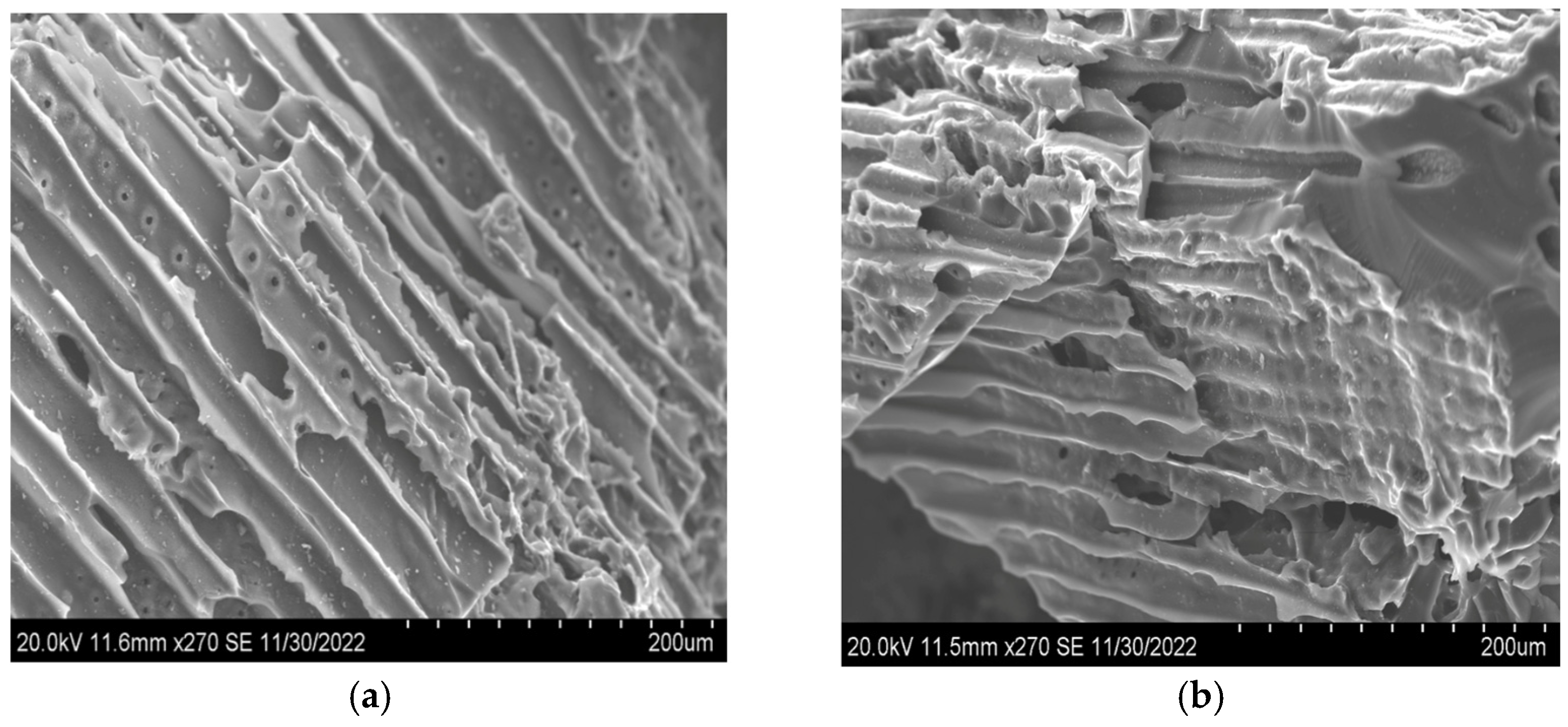
The SEM analysis of UB and IMB showed that both biochars exhibited roughly irregularly shaped microscale aggregates (Figure 1). Part of the pore structure presented in IMB was blocked by iron particles after modification. The coverage of iron on the modified biochar surface was further confirmed by EDX analysis, and the surface iron content of IMB was much higher than that of UB (Table 1). Biochar is a carbon-rich material, and, as expected, carbon is the main component of biochar.

3.1.2. FTIR Spectroscopy

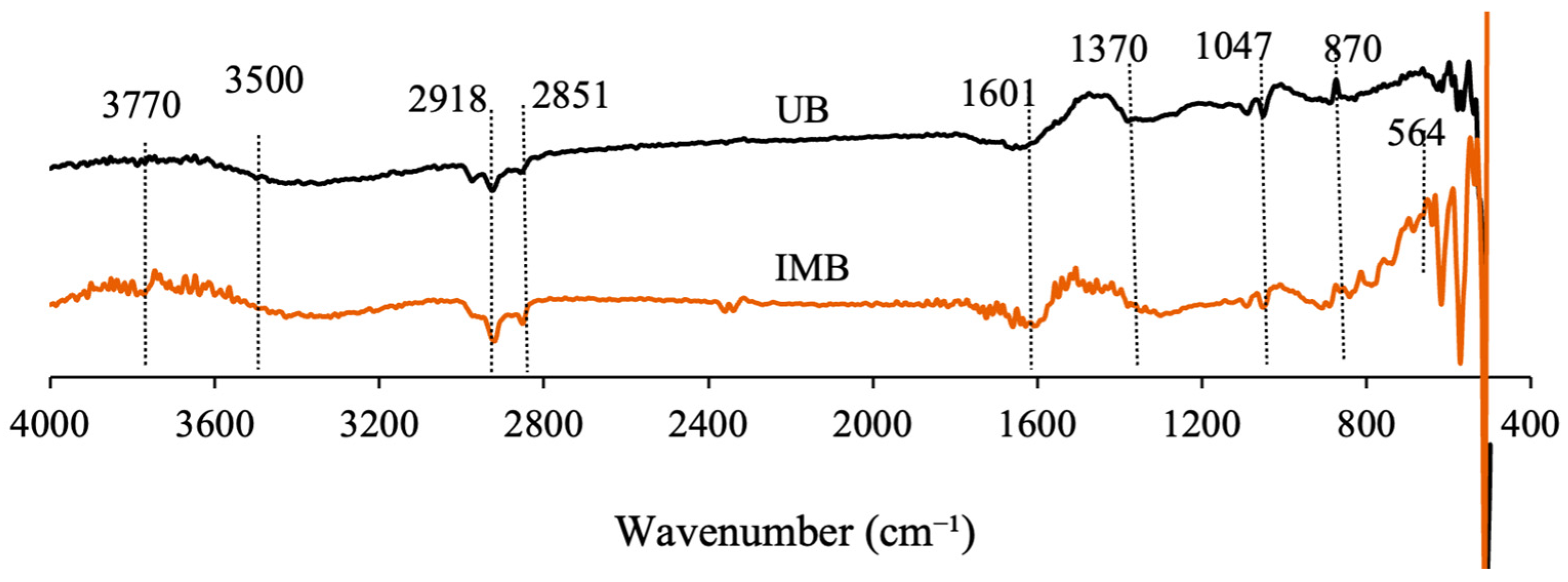
FTIR spectroscopic analysis was conducted in the range of 400–4000 cm−1 to identify the functional groups present on the biochar surface (Figure 2). Changes in the FTIR spectra before and after modification were subsequently used to infer the possible involvement of these functional groups in the hexavalent chromium adsorption process. The peaks at 2918 and 2851 cm−1 can be attributed to alkane C-H stretching [34]. The peaks at 3500–3770 cm−1 indicate hydroxy (O-H) groups [35]. The band at 1601 cm−1 is mainly attributed to aromatic C=C or carbonyl (C=O) groups, while the band at 1370 cm−1 is assigned to O=C- [29,36,37]. A new band appeared in IMB at 564 cm−1, which is attributed to Fe-O [38].

3.1.3. X-Ray Diffraction

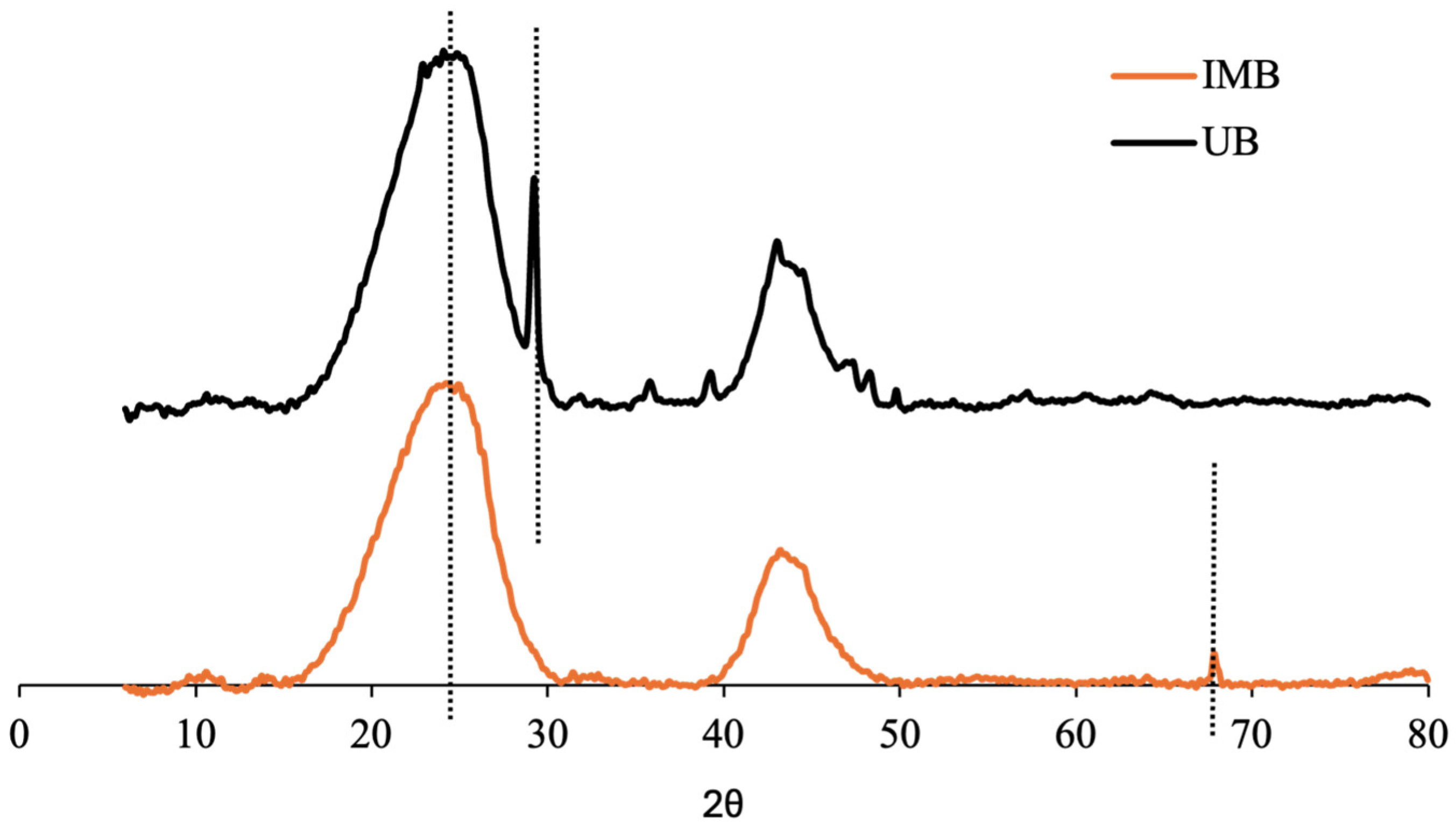
Figure 3 shows the XRD spectra for UB and IMB. An intense, broad peak at 2θ = 25° confirms an amorphous carbon structure with poor crystallinity in the biochar [39]. These types of biochar, known as turbostratic chars, have poor crystal graphite structure. A sharp and small peak at 2θ = 29° is consistent with the presence of SiO2. The spectrum of the iron-modified biochar shows a similar XRD pattern but without the peak at 2θ = 29°. A peak at 2θ = 68° in the iron-modified biochar may be associated with iron-containing phases introduced during modification [39]. The X-ray diffraction spectra of UB and IMB indicate that the biochar matrix is predominantly amorphous, as evidenced by the broad diffraction features. However, the characteristic magnetite peak near 2θ = 35.5° was not observed, suggesting that the precipitated iron species may have existed in poorly crystalline or amorphous forms.

3.1.4. FerroVer Iron Reagent

As summarized in Table 2, UB has 0.009% iron content, and IMB, which was modified with iron, has 0.108% iron content in 0.1 g of both UB and IMB, consistent with the fact that IMB has ten times more iron content compared with UB.

3.1.5. BET Isotherms

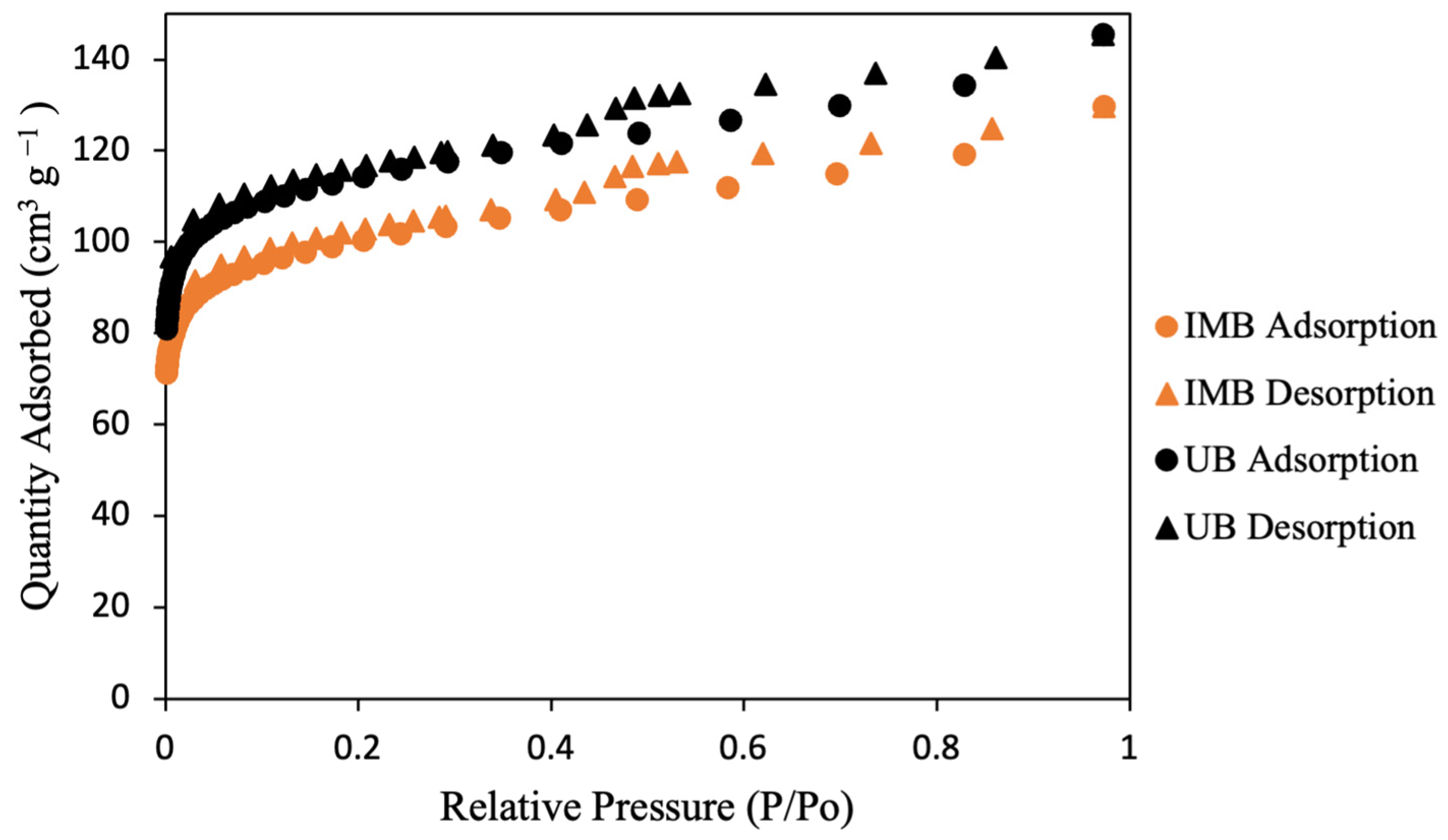
The adsorption–desorption isotherms for N2 gas on UB and IMB are shown in Figure 4. According to IUPAC classifications, these isotherms belong to type IV isotherms with type H4 hysteresis loops. The pore structures leading to H4 type hysteresis loops include narrow slit-like pores, particles with internal voids of irregular shape and broad size distribution, and hollow spheres with walls composed of ordered mesoporous carbon. Compared to UB, IMB has a higher average pore width and a smaller BET surface area (Table 3). The increase in average pore width accompanied by a decrease in BET surface area suggests that iron coating occupies or blocks micropores within the biochar structure. Because micropores contribute significantly to surface area, their blockage reduces the measured BET surface area while shifting the pore size distribution toward larger mesopores. Pore width analysis shows that most of the surface area of both UB and IMB is contributed by mesopores, which have a pore diameter between 2 and 50 nm. Mesoporous structures are advantageous for aqueous adsorption processes because they facilitate diffusion of contaminants into the internal structure of the adsorbent [40,41]. Hence, the reduction in specific surface area observed for IMB relative to UB reflects modification of the pore network rather than deterioration of the adsorption potential. In fact, the incorporation of iron hydroxide introduces chemically active Fe-OH sites that can enhance adsorption through surface complexation mechanisms. The large quantity of nitrogen sorbed at very low relative pressure is indicative of micropores, which have average pore size less than 2 nm. These micropores contribute significantly to the BET surface area of UB. However, some of these micropores may become partially occupied by iron hydroxide particles after modification, explaining the decrease in surface area observed for IMB.

3.2. Chromate Sorption Characteristics

3.2.1. Effect of Time

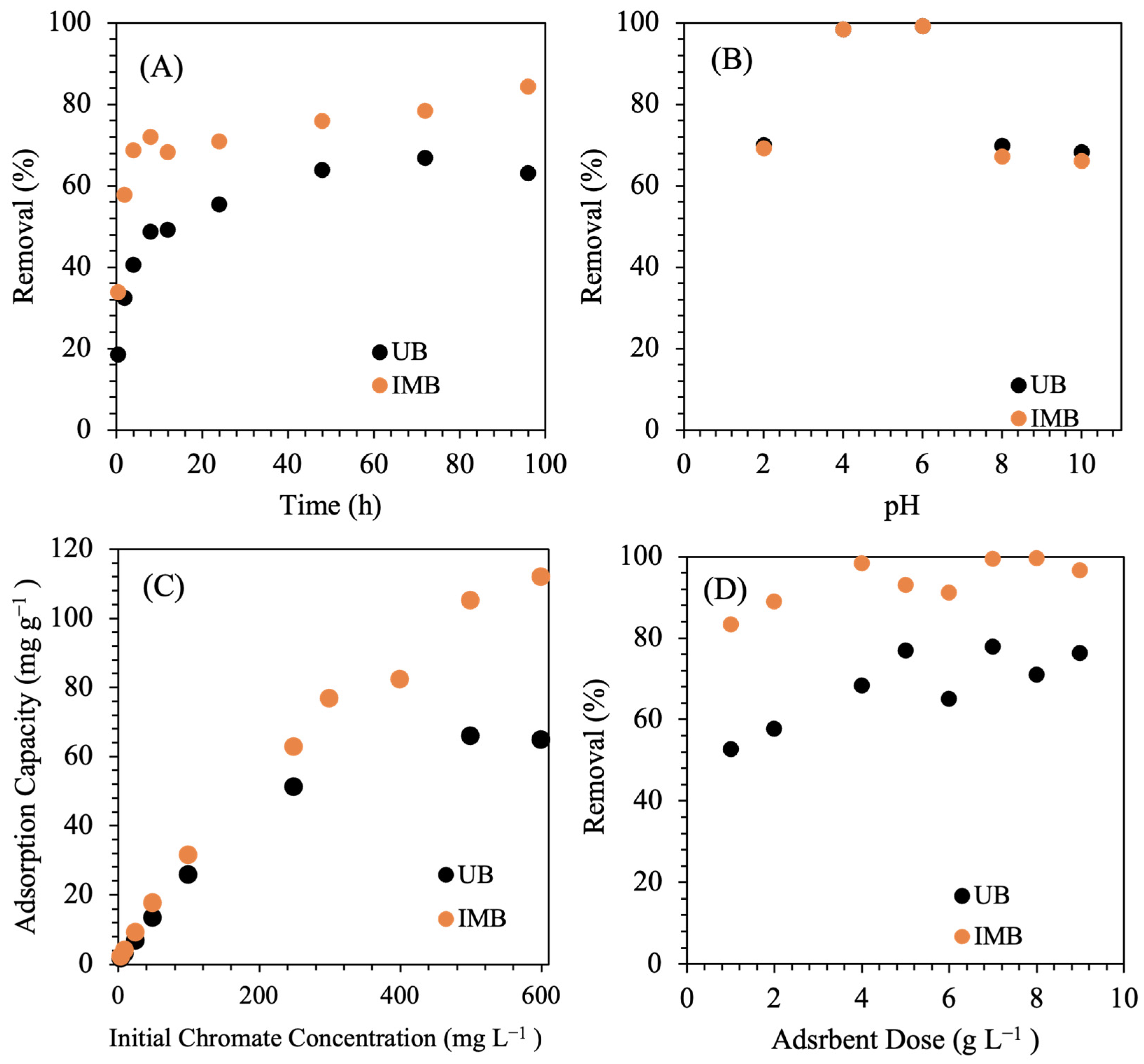
Figure 5A shows the removal efficiency of chromium (C0 = 100 mg L−1; adsorbent dose = 2 g L−1) as a function of contact time for UB and IMB. For both adsorbents, removal efficiency increased with time, although IMB exhibited a much faster uptake compared to UB. A rapid increase in chromate removal was observed within the first two hours for IMB, followed by a gradual approach to equilibrium, whereas UB showed a slower and more continuous increase in removal over time. This difference is likely due to the presence of iron oxide coating on IMB, which provides readily accessible Fe-OH active sites on the external surface. Furthermore, the higher positive charge of IMB may lead to enhanced electrostatic attraction toward chromium species and promote surface interactions, including sorption and possible reduction. In contrast, UB contains more internal adsorption sites, requiring chromate ions to diffuse into the pore structure, which slows the overall adsorption process. The removal efficiency for IMB became nearly constant after approximately 8 h, indicating that equilibrium was reached. UB exhibited slower adsorption kinetics, requiring extended contact time beyond 2 h and approaching equilibrium only after approximately 50 h. At the selected equilibrium time, UB achieved around 60% removal, whereas IMB reached approximately 80%, indicating that a substantial fraction of adsorption occurred within this period. Notably, rapid adsorption was observed with IMB, with substantial removal achieved within 0.5 h, whereas up to 8 h was required by UB to attain a comparable level of chromate uptake. These results highlight the faster adsorption kinetics and higher efficiency on IMB relative to UB. The observed fast stage reflects the large number of available reduction/adsorption sites at the initial stage, whereas the slow stage is probably resulting from sorption/reduction on less easily accessible sites. However, the relative contributions of Cr(VI) adsorption and reduction to Cr(III) could not be distinguished in the present study as chromium concentrations were determined by ICP-OES, which measures total chromium. Therefore, the observed decrease in chromium concentration may reflect a combination of adsorption and reduction processes.

3.2.2. Effect of pH

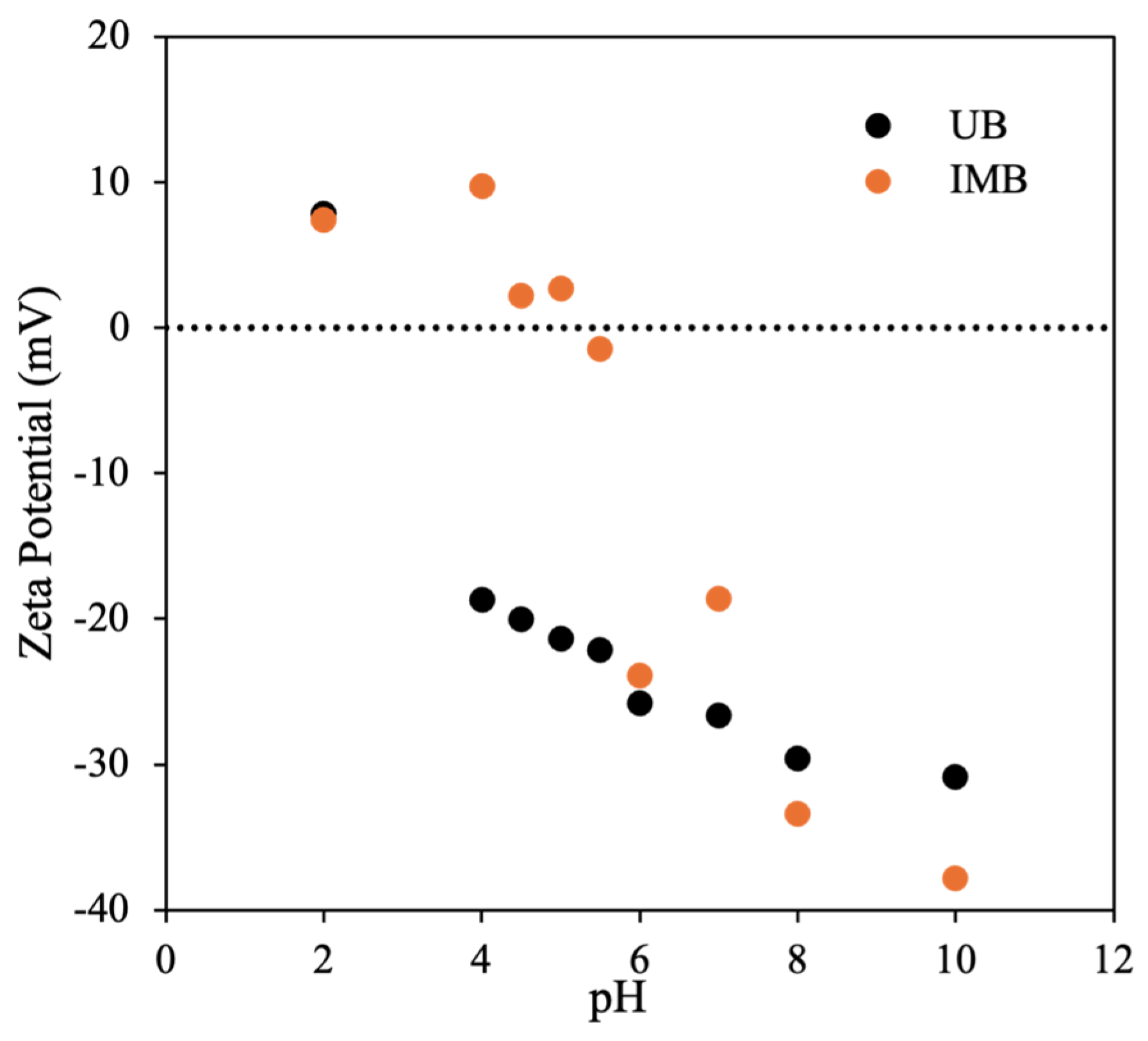
As can be seen in Figure 5B, both UB and IMB showed higher removal at pH 4 and pH 6 (C0 = 5 mg L−1; adsorbent dose = 2 g L−1). The ionic forms of Cr and the pHzpc of the adsorbent are important factors affecting hexavalent chromium removal. Cr(VI) is mainly present in the form of HCrO4 at pH values between 2 and 5, and this negatively charged ion can be easily adsorbed with lower free energy on positively charged surfaces. At pH values between 5 and 8, both HCrO4 and CrO42− exist, and above pH 8, CrO42− dominates [28]. The zeta potential of the modified biochar has significantly shifted towards higher pH in comparison to raw biochar (Figure 6). This suggests that the positive charge increased at the surface of the biochar after iron modification, indicating higher potential of removal efficiency for anionic hexavalent chromium through electrostatic interactions. The pHzpc values of UB and IMB were approximately 3 and 5.5, respectively. These pHzpc values are consistent with previously reported values [28,42]. When the pH is lower compared to the pHzpc of the solid, functional groups such as hydroxyl groups will become positively charged because of protonation. This positive charge helps to attract the oxyanions to the surface [43]. Chromate sorption decreases at pH values above 6; this can be attributed to competition with OH [44]. At pH 2, the reduced removal observed for both adsorbents may be attributed to partial dissolution of the Fe coating on the biochar surface under highly acidic conditions, as suggested in previous studies on Fe-based sorbents [45]. At pH < 2, undissociated H2CrO4 predominates. Hence, even though the adsorbent surface is positively charged, H2CrO4 is not electrostatically attracted to the adsorbent surface, which results in a decrease in adsorption [46]. At pH 4–6, although the UB surface is slightly negatively charged (pHzpc = 3), oxygen-containing functional groups (like -OH or -COOH) are deprotonated and become excellent electron donors, enhancing the reduction of Cr(VI) to Cr(III), and then adsorbing the reduced Cr(III) [47,48]. At pH 4–6, iron-modified biochar is near its zero-charge point or is slightly positively charged, which provides favorable electrostatic attraction for anionic Cr(VI). Simultaneously, iron oxides on the surface act as active sites for reducing Cr(VI) and complexing/exchanging reduced Cr(III) [46]. A pH of 6 was used for kinetic and isotherm experiments, as it is more relevant to conditions at contaminated sites.

3.2.3. Effect of Initial Chromate Concentration

The adsorption capacity of UB and IMB increased with increasing initial Cr(VI) concentration (Figure 5C). This trend occurs because higher initial concentrations provide a stronger driving force for mass transfer between the solution and the adsorbent surface. The driving force increase as concentration rises results in more collisions between the Cr(VI) molecules and the active sites on the surface of the materials [49]. At an adsorbent dosage of 2 g L−1 and equilibrium contact time of 24 h, the qe of UB increased from 1.55 to 64.77 mg g−1 as the initial concentration increased from 5 to 600 mg L−1, approaching a plateau that indicates gradual saturation of available adsorption sites. In contrast, IMB showed significantly higher adsorption capacities, increasing from 2.04 to 111.9 mg g−1, and did not reach a clear adsorption plateau within the range studied. The higher capacity of IMB is attributed to additional active sites introduced by iron hydroxide coating, which enhances chromate adsorption through a surface complexation mechanism.

3.2.4. Effect of Adsorbent Dosage

The effect of adsorbent dosage on Cr(VI) removal was investigated for UB and IMB (Figure 5D). The removal efficiency increased with increasing dosage due to the greater availability of adsorption sites. UB fractional sorption increased from 52.7% at 1 g L−1 to 78% at 5 g L−1, reflecting the increased availability of active adsorption sites at higher dosages. In contrast, the fractional Cr(VI) removal using IMB was 83.3% removal at 1 g L−1, with only slight improvement at higher dosages, indicating an abundance of adsorption sites, even at low dosage. Therefore, the optimal adsorbent dosage was established as 5 g L−1 for UB and 1 g L−1 for IMB. The higher removal efficiency using modified biochar at a lower dosage demonstrates the effectiveness of iron modification in enhancing adsorption performance.

3.2.5. Adsorption Kinetics

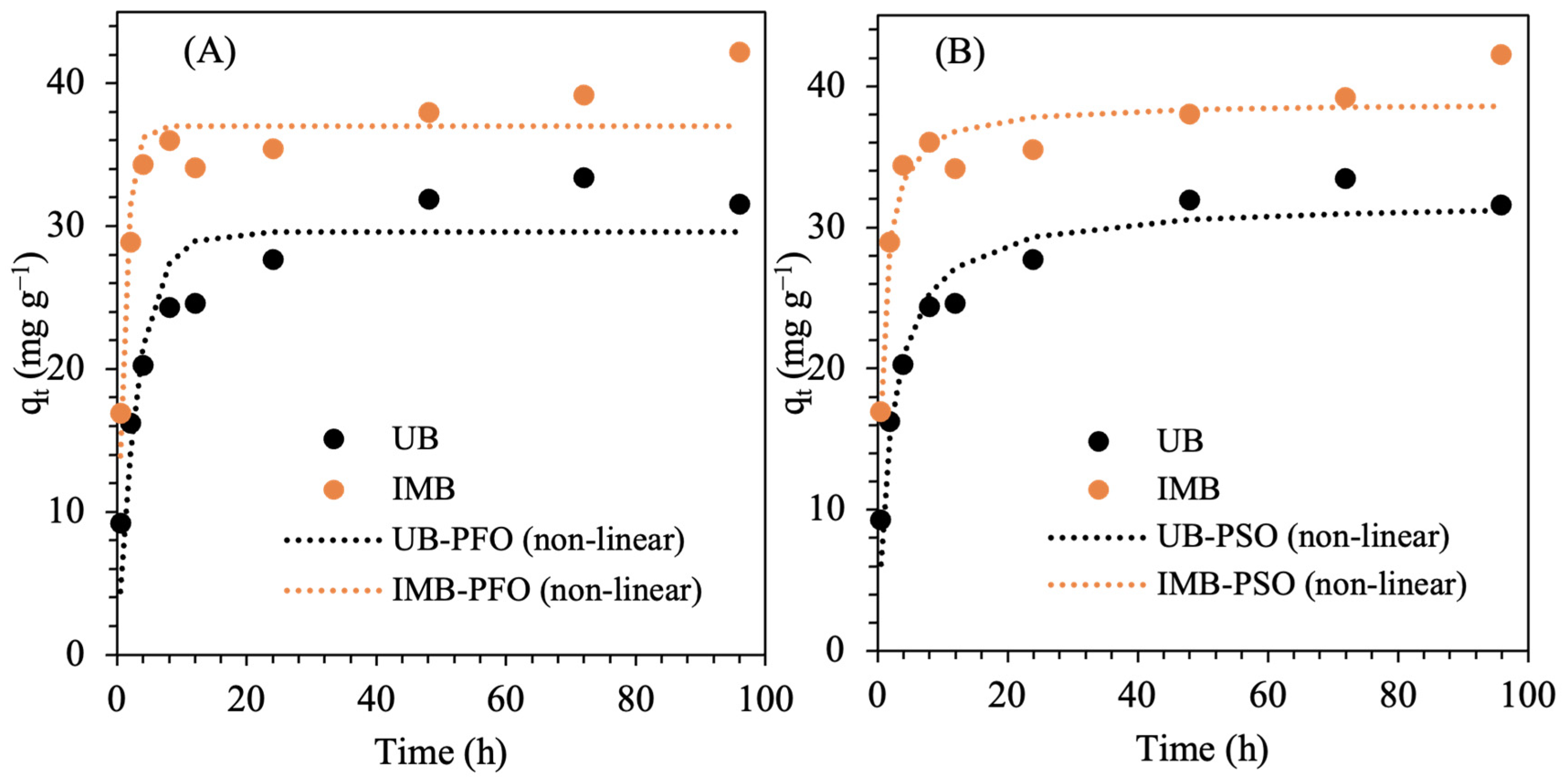
Kinetic studies of adsorption are essential for elucidating the rate of solute removal, the time required to attain equilibrium, and the underlying mechanisms governing the process, such as pore diffusion or surface-controlled reactions [50]. Identification of the rate-limiting step is particularly important, as it enables targeted optimization of adsorption performance through modification of the relevant physical or chemical controlling processes. In this study, pseudo-first-order (PFO) and pseudo-second-order (PSO) kinetic models were applied using nonlinear regression to evaluate the adsorption behavior of Cr(VI) onto UB and IMB. The nonlinear model fits are presented in Figure 7, and the corresponding kinetic parameters are summarized in Table 4.
The nonlinear PFO model exhibited relatively poor agreement with the experimental data yielding lower coefficients of determination (R2 = 0.8347 for UB and 0.8549 for IMB) and higher error functions (RMSE and χ2), compared to PSO. In addition, the calculated equilibrium adsorption capacities deviated considerably from the experimentally determined values.
In contrast, the PSO model using nonlinear regression provided the best overall fit for both sorbents. yielding the highest R2 values (0.9450 for UB and 0.9362 for IMB) along with the lowest RMSE and χ2 values. Furthermore, the equilibrium adsorption capacities derived from the PSO model closely matched the experimental values. The experimentally determined q e values for UB and IMB (32 and 39 mg g−1, respectively) were in good agreement with the PSO-predicted values (31.89 ± 1.12 and 38.87 ± 0.90 mg g−1), indicating that the PSO model adequately describes the adsorption kinetics of both sorbents.
The inadequate performance of the PFO model suggests that simple physisorption governed by weak van der Waals interactions is not the dominant mechanism. Instead, the superior fit of the PSO model suggests that adsorption is primarily controlled by surface-mediated processes such as chemisorption and surface complexation [51]. The PSO model assumes that the adsorption rate is proportional to the square of the number of unoccupied sites and is typically associated with chemisorption involving electron sharing or transfer between adsorbent and adsorbate [31]. In this context, Cr(VI) ions likely interact with oxygen-containing functional groups (e.g., hydroxyl and carboxyl groups) present on the biochar surface [52]. However, the good agreement with the PSO model alone does not provide definitive evidence of a chemisorption mechanism, as kinetic models are primarily empirical descriptions of adsorption behavior.
The Cr(VI) removal by biochar has been reported to involve several possible mechanisms including: (i) electrostatic attraction of negatively charged chromate species (e.g., HCrO4) to protonated surface sites (e.g., -OH2+, -COOH2+), (ii) reduction of Cr(VI) to Cr(III) facilitated by electron-donating functional groups, and (iii) subsequent immobilization of Cr(III) through surface complexation or ion exchange [14,53]. Among these steps, chemisorption is likely the rate-limiting step due to the necessary bond formation and electron transfer, which typically require higher activation energy compared to physical adsorption processes [54,55].
Iron modification substantially increased the PSO rate constant, from 0.015 ± 0.003 g mg−1 h−1 for UB to 0.038 ± 0.007 g mg−1 h−1 for IMB, and improved the adsorption capacity. The enhanced kinetic performance of IMB may be attributed to the increased availability of Fe-OH surface groups, higher positive surface charge, and additional reactive sites introduced by iron modification, which may promote surface interactions with chromium species. These results confirm that iron modification improved both the sorption rate and overall chromium removal performance of the biochar. Although regeneration experiments were not conducted in this study, the reusability and long-term stability of the adsorbent are important factors that warrant further investigation.

3.2.6. Adsorption Isotherms

Fitting experimental equilibrium data to appropriate theoretical models is essential for quantifying adsorption capacity and optimizing adsorbent dosage for practical applications [56]. Isotherm modeling also provides a robust framework for comparing unmodified and modified adsorbents by elucidating changes in adsorption mechanisms, identifying shifts in surface behavior (e.g., transition between isotherm types), and verifying enhancements in maximum adsorption capacity. Furthermore, isotherm parameters enable systematic evaluation of adsorbent performance, facilitating process optimization and cost reduction in large-scale applications [57].
In this study, the equilibrium data were analyzed using the Langmuir and Freundlich isotherm models. The Langmuir model describes monolayer adsorption on a homogeneous surface with a finite number of identical active sites, whereas the Freundlich model accounts for adsorption on heterogeneous surfaces with non-uniform energy distributions [58].
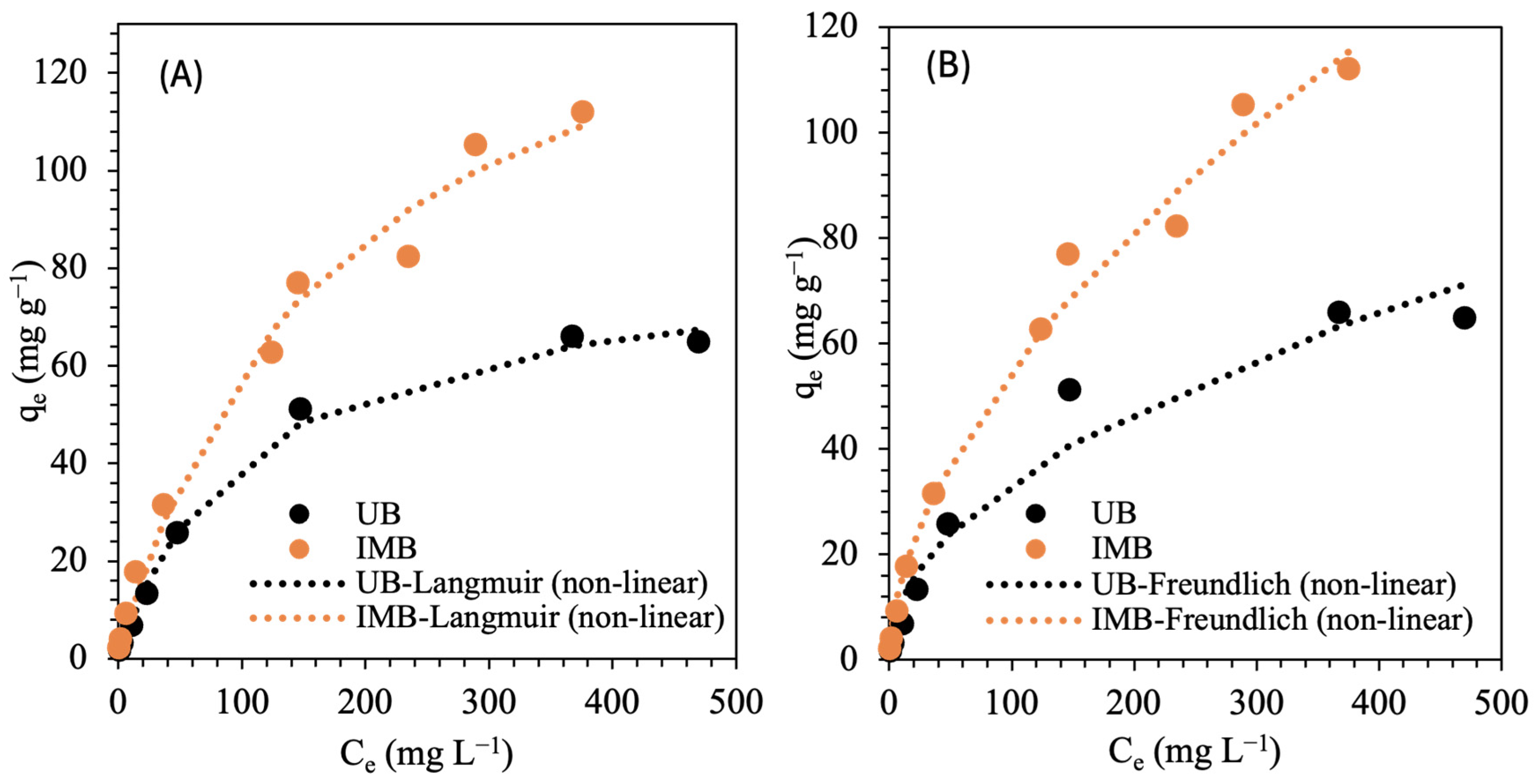
The fitted isotherms (non-linear regression) and corresponding parameters are presented in Figure 8 and Table 5. Overall, the results demonstrate a significant enhancement in Cr(VI) adsorption following biochar modification. For UB, the Langmuir model yielded the best statistical fit (R2 = 0.9955; χ2 = 0.846), consistent with adsorption that predominantly occurs as a monolayer on relatively homogeneous sites. This behavior is consistent with the nature of chromate oxyanions, which typically do not form surface precipitates under the studied conditions and therefore do not promote multilayer adsorption. The dimensionless separation factor (RL) ranged from 0.14 to 0.95 for UB and 0.22 to 0.97 for iron-modified biochar (IMB) over the investigated concentration range (5–600 mg L−1), confirming favorable adsorption behavior (0 < RL < 1) [59]. These values indicate that the adsorption process is thermodynamically favorable and practically feasible across the studied concentration range, supporting the potential applicability of both materials for industrial water treatment.
In contrast, IMB exhibited the best fit with the Freundlich model (R2 = 0.9887; χ2 = 5.02), suggesting adsorption on a heterogeneous surface with possible multilayer interactions. Furthermore, the results are consistent with changes in surface heterogeneity and distribution of adsorption sites following iron modification. The maximum adsorption capacity (qmax) increased substantially from 82 mg g−1 for UB to 158 mg g−1 for IMB, indicating that surface modification significantly enhanced the number and/or accessibility of active sites.
The improved performance of IMB is primarily attributed to the incorporation of iron oxide/hydroxide functional groups, which introduce additional reactive sites and enhance electrostatic attraction toward anionic chromate species (e.g., HCrO4 at pH 6) [25]. In addition to electrostatic interactions, these iron-containing functional groups may facilitate surface complexation and potentially promote redox transformations, which have been reported in previous studies, including the reduction of Cr(VI) to Cr(III), followed by precipitation or immobilization on the adsorbent surface. However, because chromium concentrations were determined using ICP-OES, which measures total chromium and does not distinguish between Cr(VI) and Cr(III), the occurrence of Cr(VI) reduction could not be directly confirmed in the present study. Therefore, these mechanisms should be regarded as possible pathways rather than definitive mechanisms responsible for the enhanced performance of IMB.
The Freundlich constant (1/n) values for both adsorbents were within the range of 0–1 (UB = 0.48; IMB = 0.56), indicating favorable adsorption [60]. Moreover, the increase in Kf from 3.65 (UB) to 4.24 (IMB) further confirms improved adsorption affinity on heterogeneous surfaces. This behavior reflects the contribution of multiple concurrent mechanisms, including electrostatic attraction, ligand exchange, surface complexation, redox reactions, and diffusion-controlled processes. At pH 6, where HCrO4 is the dominant chromium species, these mechanisms are particularly effective due to the enhanced interaction between negatively charged chromate ions and positively charged iron-modified surfaces, as well as the redox activity of iron species.
The maximum Langmuir adsorption capacity of the modified biochar (158.33 mg g−1) compares favorably with previously reported Cr(VI) adsorbents under comparable experimental conditions. For similar initial concentration ranges and solution pH, conventional unmodified biochars typically exhibit Langmuir adsorption capacities in the range of 20–80 mg g−1 [18,29], whereas activated carbons generally fall within 50–200 mg g−1 depending on the extent of surface activation and functionalization [61]. However, direct comparison of Langmuir-derived adsorption capacities across different studies should be approached with caution, as these values are strongly influenced by the selected concentration range, experimental conditions, and model fitting approach [62]. It should be noted that the maximum experimental adsorption capacity observed for IMB was approximately 112 mg g−1, which was lower than the Langmuir-predicted qmax value. This difference reflects the fact that complete saturation of the adsorbent was not attained within the investigated concentration range.
For instance, a previous study conducted with a concentration up to 450 mg L−1 reported a maximum adsorption capacity of 63.1 mg g−1 for distiller grain biochar, which increased to 157.9 mg g−1 following phosphogypsum modification, highlighting the significant role of surface engineering in enhancing adsorption performance. In general, modified biochars incorporating oxygen-containing or metal-based functional groups typically exhibit capacities in the range of 100–200 mg g−1 [18], consistent with the value obtained in the present study.
The enhanced performance observed here positions the modified biochar within the upper range of high-efficiency carbonaceous adsorbents, underscoring the effectiveness of the applied surface modification strategy in increasing the density of reactive sites and promoting surface heterogeneity. Notably, the relatively high adsorption capacity of the unmodified biochar compared to values reported in the literature may be attributed to differences in precursor material, particle size distribution, and pyrolysis conditions, all of which significantly influence surface area, pore structure, and functional group availability.

4. Conclusions

A significant enhancement in the Cr(VI) removal performance of commercial biochar was achieved through iron modification, which altered its physicochemical properties and introduced Fe-OH reactive sites. Quantitative characterization confirmed successful modification, with EDX showing an increase in iron elemental composition from 0.2% to 3.3%, supported by FerroVer measurements, which also showed iron content increase of w/w % (0.009 to 0.108). XRD analysis and FTIR results indicated structural transformation through the introduction of iron oxide into biochar surface. Despite a reduction in BET surface area (from 359 to 317 m2 g−1), the modified biochar exhibited superior adsorption performance, indicating that chemical functionality rather than surface area governs Cr(VI) removal.
Iron modification altered the adsorption behavior, resulting in faster adsorption kinetics and a transition from homogenous adsorption to heterogenous surface adsorption. Improved Cr(VI) removal is attributed to the combined effects of enhanced electrostatic interactions, surface complexation, and possible redox transformation governed by iron-mediated functional groups available in biochar. These findings emphasize that targeted surface engineering can overcome limitations associated with conventional biochar, even when surface area decreases.
Although adsorption isotherm modeling indicated enhanced adsorption capacity, complete sorbent saturation was not achieved within the investigated concentration range, and the estimated maximum adsorption capacity should therefore be regarded as model-derived. Future work should focus on evaluating the performance, regeneration, and long-term stability of iron-modified biochar under environmentally relevant conditions, including lower Cr(VI) concentrations, and competing ions in continuous flow systems representative of groundwater remediation applications.

Author Contributions

Conceptualization, C.P.; methodology, D.R. and C.P.; investigation, D.R., H.M.I.P.K. and C.P.; writing—original draft preparation, D.R.; writing—review and editing, D.R., H.M.I.P.K. and C.P.; supervision, C.P.; project administration, C.P.; funding acquisition, C.P. All authors have read and agreed to the published version of the manuscript.

Funding

This material is based upon work primarily supported by the Engineering Research Center Program of the National Science Foundation under NSF Cooperative Agreement No. EEC-1449501. Any opinions, findings, and conclusions, or recommendations expressed in this material are those of the authors, and do not necessarily reflect those of the NSF.

Data Availability Statement

The data presented in this study are available on request from the corresponding author.

Conflicts of Interest

The authors declare no conflicts of interest.

Abbreviations

The following abbreviations are used in this manuscript:
UBUnmodified biochar
IMBIron-modified biochar
XRDX-ray diffraction
FTIRFourier-transform infrared
SEMScanning electron microscopy

References

  1. ATSDR. Toxicological Profile for Chromium; Agency for Toxic Substances and Disease Registry: Atlanta, GA, USA, 2012.
  2. Hashmi, N.; Yousafzai, A.; Akhter, Y.; Aftab, S.S.; Janan, M.; Kanwal, R.; Tariq, J.A.; Sajjad, N.; Rani, K.; Nawaz, F.; et al. Isolation and Biochemical Characterization of Chrome Resistant Bacteria from Soil Samples of Muslim Bagh Mines. Indo Am. J. Pharm. Sci. 2018, 5, 185–191. [Google Scholar] [CrossRef]
  3. Sawicka, E.; Jurkowska, K.; Piwowar, A. Chromium (III) and chromium (VI) as important players in the induction of genotoxicity-current view. Ann. Agric. Environ. Med. 2021, 28, 1–10. [Google Scholar] [PubMed]
  4. Maldonado-Villegas, M.M.; Gutiérrez-Martínez, P.B.; Ramírez-Hernández, B.C.; Verduzco, J.E.G.D.; Becerril-Espinosa, A.; Ocampo-Alvarez, H.; García-Velasco, J. Chromium Contamination in Chayote (Sechium edule (Jacq.) Sw.): Health Risk Assessment, Producer Perceptions, and Sustainability Perspectives. Sustainability 2025, 17, 3120. [Google Scholar] [CrossRef] [Scilit]
  5. McNeill, L.S.; McLean, J.E.; Parks, J.L.; Edwards, M. Hexavalent chromium review, part 2: Chemistry, occurrence, and treatment. J. Am. Water Works Assoc. 2012, 104, 39–40. [Google Scholar] [CrossRef] [Scilit]
  6. Islam, A.M.T.; Jion, M.M.M.F.; Jannat, J.N.; Varol, M.; Islam, M.A.; Khan, R.; Idris, A.M.; Malafaia, G.; Habib, M.A. Perception and legacy of soil chromium and lead contamination in an operational small-scale coal mining community. Environ. Geochem. Health 2023, 45, 7237–7253. [Google Scholar] [CrossRef] [Scilit] [PubMed]
  7. Das, P.; Das, B.; Dash, P. Chromite mining pollution, environmental impact, toxicity and phytoremediation: A review. Environ. Chem. Lett. 2021, 19, 1369–1381. [Google Scholar]
  8. Owlad, M.K.; Daud, W.A.W.; Baroutian, S. Removal of Hexavalent Chromium-Contaminated Water and Wastewater: A Review. Water Air Soil Pollut. 2009, 200, 59–77. [Google Scholar]
  9. USEPA. Safe Drinking Water Act. Chromium in Drinking Water. 2026. Available online: https://www.epa.gov/sdwa/chromium-drinking-water (accessed on 15 March 2026).
  10. WHO. Guidelines for Drinking-Water Quality: Fourth Edition Incorporating the First and Second Addenda; World Health Organization: Geneva, Switzerland, 2022. [Google Scholar]
  11. Beretta, G.; Mastorgio, A.F.; Pedrali, L.; Saponaro, S.; Sezenna, E. Support Tool for Identifying In Situ Remediation Technology for Sites Contaminated by Hexavalent Chromium. Water 2018, 10, 1344. [Google Scholar] [CrossRef] [Scilit]
  12. Hublikar, L.; Nivedhitha, K.S.; Chikkatti, B.S.; Sajjan, A.M.; Banapurmath, N.R.; Palaniswamy, D.; Beena, T.; Hegde, P.; Mishra, S.K.; Ravulapati, K. Functionalized biochar-metal oxide nanocomposites for the catalytic degradation of recalcitrant pollutants in wastewater treatment. RSC Adv. 2026, 16, 12186–12214. [Google Scholar] [CrossRef] [Scilit] [PubMed]
  13. Nguyen, D.K.; Ly-Tran, Q.B.; Dinh, V.; Duong, B.N.; Nguyen, T.P.T.; Tuyen, P.N.K. Adsorption mechanism of aqueous Cr(vi) by Vietnamese corncob biochar: A spectroscopic study. RSC Adv. 2024, 14, 39205–39218. [Google Scholar] [CrossRef] [Scilit] [PubMed]
  14. Guo, X.L.; Liu, A.J.; Lu, J.; Niu, X.Y.; Jiang, M.; Ma, Y.F.; Liu, X.P.; Li, M.H. Adsorption Mechanism of Hexavalent Chromium on Biochar: Kinetic, Thermodynamic, and Characterization Studies. ACS Omega 2020, 5, 27323–27331. [Google Scholar] [CrossRef] [Scilit] [PubMed]
  15. Mohan, D.; Pittman, C.U.; Bricka, M.; Smith, F.; Yancey, B.; Mohammad, J.; Steele, P.H.; Alexandre-Franco, M.F.; Gómez-Serrano, V.; Gong, H. Sorption of arsenic, cadmium, and lead by chars produced from fast pyrolysis of wood and bark during bio-oil production. J. Colloid Interface Sci. 2007, 310, 57–73. [Google Scholar] [CrossRef] [Scilit] [PubMed]
  16. Lyubchik, S.I.; Lyubchik, A.I.; Galushko, O.L.; Tikhonova, L.P.; Vital, J.; Fonseca, I.M.; Lyubchik, S.B. Kinetics and thermodynamics of the Cr(III) adsorption on the activated carbon from co-mingled wastes. Colloids Surf. A Physicochem. Eng. Asp. 2004, 242, 151–158. [Google Scholar] [CrossRef] [Scilit]
  17. Yoon, S.; Bae, S. Mechanistic study of Cr(VI) reduction by functionalized biochar: Distinct roles of persistent free radicals, ascorbate moieties, and oxygen functional groups. Chem. Eng. J. 2025, 524, 169587. [Google Scholar] [CrossRef] [Scilit]
  18. Lian, G.Q.; Wang, B.; Lee, X.Q.; Li, L.; Liu, T.Z.; Lyu, W.Q. Enhanced removal of hexavalent chromium by engineered biochar composite fabricated from phosphogypsum and distillers grains. Sci. Total Environ. 2019, 697, 134119. [Google Scholar] [CrossRef] [Scilit] [PubMed]
  19. Sen, K.; Mondal, S.; Mondal, N. Surface charge behavior of natural and modified adsorbents: Insights into pHzpc, mechanisms, and methodological perspectives. Next Mater. 2026, 11, 101938. [Google Scholar] [CrossRef] [Scilit]
  20. Al-Degs, Y.; El-Barghouthi, M.I.; El-Sheikh, A.H.; Walker, G.M. Effect of solution pH, ionic strength, and temperature on adsorption behavior of reactive dyes on activated carbon. Dye. Pigment. 2008, 77, 16–23. [Google Scholar] [CrossRef] [Scilit]
  21. Zhang, G.M.; He, H.; Liu, S.Q.; Du, Z.P.; Lv, L.Y.; Sun, L.; Zhang, J.; Liang, J.S. La-Al modified Fe3O4 adsorbent for adsorption performance and mechanism of low P concentration in water. J. Water Process Eng. 2024, 68, 106344. [Google Scholar] [CrossRef] [Scilit]
  22. Kulasekara, H.M.I.P.; Zhang, Y.; Papelis, C. Microbial Enhancement of Selenium Removal in Chemically Modified Zeolite Columns. Water 2023, 15, 1837. [Google Scholar] [CrossRef] [Scilit]
  23. Yang, P.; Wen, K.; Beyer, K.A.; Xu, W.Q.; Wang, Q.; Ma, D.; Wu, J.; Zhu, M.Q. Inhibition of Oxyanions on Redox-driven Transformation of Layered Manganese Oxides. Environ. Sci. Technol. 2021, 55, 3419–3429. [Google Scholar] [CrossRef] [Scilit] [PubMed]
  24. Yang, F.; Jiang, Y.T.; Dai, M.; Hou, X.T.; Peng, C.S. Active biochar-supported iron oxides for Cr(VI) removal from groundwater: Kinetics, stability and the key role of FeO in electron-transfer mechanism. J. Hazard. Mater. 2022, 424, 127542. [Google Scholar] [CrossRef] [Scilit] [PubMed]
  25. Zuo, J.L.; Li, W.J.; Xia, Z.; Zhao, T.T.; Tan, C.; Wang, Y.Y.; Li, J.S.; Vattuone, L.L. Preparation of Modified Biochar and Its Adsorption of Cr(VI) in Aqueous Solution. Coatings 2023, 13, 1884. [Google Scholar] [CrossRef] [Scilit]
  26. Su, J.Z.; Zhang, M.Y.; Xu, W.H.; Xu, W.M.; Liu, C.; Rui, S.; Tuo, Y.F.; He, X.H.; Xiang, P. Preparation and applications of iron/biochar composites in remediation of heavy metal contaminated soils: Current status and further perspectives. Environ. Technol. Innov. 2024, 35, 103671. [Google Scholar] [CrossRef] [Scilit]
  27. Li, X.; Qin, Y.; Jia, Y.; Li, Y.Y.; Zhao, Y.X.; Pan, Y.W.; Sun, J.H. Preparation and application of Fe/biochar (Fe-BC) catalysts in wastewater treatment: A review. Chemosphere 2021, 274, 129766. [Google Scholar] [CrossRef] [Scilit] [PubMed]
  28. Yi, Y.; Wang, X.Y.; Zhang, Y.X.; Ma, J.; Ning, P. Adsorption properties and mechanism of Cr(VI) by Fe2(SO4)3 modified biochar derived from Egeria najas. Colloids Surf. A-Physicochem. Eng. Asp. 2022, 645, 128938. [Google Scholar] [CrossRef] [Scilit]
  29. Sun, S.O.; Zeng, X.; Gao, Y.; Zhang, W.; Zhou, L.A.; Zeng, X.K.; Liu, W.; Jiang, Q.; Jiang, C.B.; Wang, S.X. Iron oxide loaded biochar/attapulgite composites derived camellia oleifera shells as a novel bio-adsorbent for highly efficient removal of Cr(VI). J. Clean. Prod. 2021, 317, 128412. [Google Scholar] [CrossRef] [Scilit]
  30. Dong, Y.Q.; Liang, J.J.; E, Z.Y.; Song, J.Y.; Liu, C.J.; Ding, Z.; Wang, W.; Zhang, W.T. Preparation of biochar/iron mineral composites and their adsorption of methyl orange. RSC Adv. 2024, 14, 33977–33986. [Google Scholar] [CrossRef] [Scilit] [PubMed]
  31. Ho, Y.; McKay, G. Pseudo-second order model for sorption processes. Process Biochem. 1999, 34, 451–465. [Google Scholar] [CrossRef] [Scilit]
  32. Pils, J.; Laird, D. Sorption of tetracycline and chlortetracycline on K- and Ca-saturated soil clays, humic substances, and clay-humic complexes. Environ. Sci. Technol. 2007, 41, 1928–1933. [Google Scholar] [CrossRef] [Scilit] [PubMed]
  33. Li, W.B.; Meng, Z.F.; Wu, Q.; Bai, D.; Xu, S.E.; Liu, Y. Modification mechanism of amphoteric modifier BS–12 on two different clays. Fresenius Environ. Bull. 2016, 25, 3993–4003. [Google Scholar] [CrossRef] [Scilit]
  34. Rizkallah, B.; Galal, M.; Matta, M. Characteristics of Tetracycline Adsorption on Commercial Biochar from Synthetic and Real Wastewater in Batch and Continuous Operations: Study of Removal Mechanisms, Isotherms, Kinetics, Thermodynamics, and Desorption. Sustainability 2023, 15, 8249. [Google Scholar] [CrossRef] [Scilit]
  35. Zou, Y.; Fei, X.; Kong, Q.; Shong, D.; Zhang, Y.; Guo, W.; Wang, Q.; Zhao, C.; Yuanda, D. Pb2+ removal performance by cotton-based and magnetic modified cotton-based biochar prepared from agricultural waste biomass. Desalin. Water Treat. 2020, 207, 246–257. [Google Scholar] [CrossRef] [Scilit]
  36. Zhang, X.; Yuan, X.; Yang, X.; Yang, Z.; Han, L. Two-dimensional correlation infrared spectroscopy reveals the evolution of functional groups governing biochar oxidation resistance. Sci. Rep. 2026, 16, 1565. [Google Scholar] [CrossRef] [Scilit] [PubMed]
  37. Liu, H.; Yao, R.; Yu, M.; Ye, Z.; Lu, Y.; Yu, X.; Tang, J.; Sun, J. Converting Waste into Treasure: Efficient Adsorption of Cr(VI) Using Iron-Modified Rice Straw Biochar. Toxics 2025, 13, 458. [Google Scholar] [CrossRef] [Scilit] [PubMed]
  38. Singh, B.; Fang, Y.; Johnston, C. A Fourier-Transform Infrared Study of Biochar Aging in Soils. Soil Sci. Soc. Am. J. 2016, 80, 613–622. [Google Scholar] [CrossRef] [Scilit] [PubMed]
  39. Peng, Z.; Fan, Z.; Chen, X.; Zhou, X.; Gao, Z.F.; Deng, S.; Wan, S.; Lu, X.; Yan, S.; Wei, H. Fabrication of Nano Iron Oxide-Modified Biochar from Co-Hydrothermal Carbonization of Microalgae and Fe(II) Salt for Efficient Removal of Rhodamine B. Nanomaterials 2022, 12, 2271. [Google Scholar] [CrossRef] [Scilit] [PubMed]
  40. Mohan, D.; Sarswat, A.; Ok, Y.S.; Pittaman, C.U., Jr. Organic and inorganic contaminants removal from water with biochar, a renewable, low cost and sustainable adsorbent—A critical review. Bioresour. Technol. 2014, 160, 191–202. [Google Scholar] [CrossRef] [Scilit] [PubMed]
  41. Tan, X.; Liu, Y.; Zeng, G.; Wang, X.; Hu, X.; Gu, Y.; Yang, Z. Application of biochar for the removal of pollutants from aqueous solutions. Chemosphere 2015, 125, 70–85. [Google Scholar] [CrossRef] [Scilit] [PubMed]
  42. Tan, G.; Moo, Y.; Wang, H.; Junaid, M.; Nan, X. Comparison of biochar- and activated carbon-supported zerovalent iron for the removal of Se(IV) and Se(VI): Influence of pH, ionic strength, and natural organic matter. Environ. Sci. Pollut. Res. 2019, 26, 21609–21618. [Google Scholar] [CrossRef] [Scilit]
  43. Fomina, M.; Gadd, G. Biosorption: Current perspectives on concept, definition and application. Bioresour. Technol. 2014, 160, 3–14. [Google Scholar] [CrossRef] [Scilit] [PubMed]
  44. Dong, X.L.; Ma, L.N.Q.; Li, Y.C. Characteristics and mechanisms of hexavalent chromium removal by biochar from sugar beet tailing. J. Hazard. Mater. 2011, 190, 909–915. [Google Scholar] [CrossRef] [Scilit] [PubMed]
  45. Qian, J.; Zhou, X.; Cai, Q.; Zhao, J.; Huang, X. The Study of Optimal Adsorption Conditions of Phosphate on Fe-Modified Biochar by Response Surface Methodology. Molecules 2023, 28, 2323. [Google Scholar] [CrossRef] [Scilit] [PubMed]
  46. Olchowski, R.; Morlo, K.; Dobrzynska, J.; Dobrowolski, R. Removal of Hexavalent Chromium from Wastewater Originating from Spent Bricks by Modified Biochars Derived from Honeybee Biomass. Molecules 2025, 30, 2421. [Google Scholar] [CrossRef] [Scilit] [PubMed]
  47. Smith, V.; Rivera, J.F.A.; Bello, R.; Rodriquez, A.E.; Elshaer, M.R.; Wodzinki, R.L.; Bashkova, S. The Role of Surface Chemistry and Polyethylenimine Grafting in the Removal of Cr (VI) by Activated Carbons from Cashew Nut Shells. C 2021, 7, 27. [Google Scholar] [CrossRef] [Scilit]
  48. Szczygiel, J.; Dyrek, K.; Kruczała, K.; Bidzinśka, E.; Brożek-Mucha, Z.; Wenda, E.; Wieczorekn, J.; Szymonśka, J. Interactions of Chromium Ions with Starch Granules in an Aqueous Environment. J. Phys. Chem. B 2014, 118, 7100–7107. [Google Scholar] [CrossRef] [Scilit] [PubMed]
  49. Eniola, J.; Kumar, R.; Mohammed, O.A.; Al-Rashidi, A.A.; Barakat, M.A. Synthesis and characterization of CuFe2O4/NiMgAl-LDH composite for the efficient removal of oxytetracycline antibiotic. J. Saudi Chem. Soc. 2020, 24, 139–150. [Google Scholar] [CrossRef] [Scilit]
  50. Al-Harby, N.; Albahly, E.; Mohamed, N. Kinetics, Isotherm and Thermodynamic Studies for Efficient Adsorption of Congo Red Dye from Aqueous Solution onto Novel Cyanoguanidine-Modified Chitosan Adsorbent. Polymers 2021, 13, 4446. [Google Scholar] [CrossRef] [Scilit] [PubMed]
  51. Li, H.; Dong, X.; da Silva, E.B.; de Oliveira, L.M.; Chen, Y.; Ma, L.Q. Mechanisms of metal sorption by biochars: Biochar characteristics and modifications. Chemosphere 2017, 178, 466–478. [Google Scholar] [CrossRef] [Scilit] [PubMed]
  52. Li, Y.; Chen, X.; Liu, L.; Liu, P.; Zhou, Z.; Huhetaoli; Wu, Y.; Lei, T. Characteristics and adsorption of Cr(VI) of biochar pyrolyzed from landfill leachate sludge. J. Anal. Appl. Pyrolysis 2022, 162, 105449. [Google Scholar] [CrossRef] [Scilit]
  53. Singh, S.; Anil, A.G.; Kumar, T.S.S.; Basavaraju, U.; Khasnabis, S.; Nath, B.; Kumar, V.; Subramanian, S.; Singh, J.; Ramamurthy, P. Mechanism and kinetics of Cr(VI) adsorption on biochar derived from Citrobacter freundii under different pyrolysis temperatures. J. Water Process Eng. 2022, 47, 102723. [Google Scholar] [CrossRef] [Scilit]
  54. Kan, C.; Ibe, A.H.; Rivera, K.K.P.; Arazo, R.O.; de Luna, M.D.G. Hexavalent chromium removal from aqueous solution by adsorbents synthesized from groundwater treatment residuals. Sustain. Environ. Res. 2017, 27, 163–171. [Google Scholar] [CrossRef] [Scilit]
  55. Masuku, M.; Nure, J.F.; Atagana, H.I.; Hlongwa, N.; Nkambule, T. Pinecone biochar for the Adsorption of chromium (VI) from wastewater: Kinetics, thermodynamics, and adsorbent regeneration. Environ. Res. 2024, 258, 119423. [Google Scholar] [CrossRef] [Scilit] [PubMed]
  56. Murphy, O.; Vashishtha, M.; Palanisamy, P.; Kumar, K.V. A Review on the Adsorption Isotherms and Design Calculations for the Optimization of Adsorbent Mass and Contact Time. ACS Omega 2023, 8, 17407–17430. [Google Scholar] [CrossRef] [Scilit] [PubMed]
  57. Jeppu, G.; Girish, C.; Prabhu, B.; Mayer, K. Multi-component Adsorption Isotherms: Review and Modeling Studies. Environ. Processes-Int. J. 2023, 10, 38. [Google Scholar] [CrossRef] [Scilit]
  58. Ayub, A.; Raza, Z.; Majeed, M.I.; Tariq, M. Development of sustainable magnetic chitosan biosorbent beads for kinetic remediation of arsenic contaminated water. Int. J. Biol. Macromol. 2020, 163, 603–617. [Google Scholar] [CrossRef] [Scilit] [PubMed]
  59. Pandey, P.; Sharma, S.; Sambi, S. Kinetics and equilibrium study of chromium adsorption on zeoliteNaX. Int. J. Environ. Sci. Technol. 2010, 7, 395–404. [Google Scholar] [CrossRef] [Scilit]
  60. Zhang, Y.; Li, M.; Li, J.; Yang, Y.; Liu, X. Surface modified leaves with high efficiency for the removal of aqueous Cr (VI). Appl. Surf. Sci. 2019, 484, 189–196. [Google Scholar] [CrossRef] [Scilit]
  61. Wang, H.; Wang, W.; Zhou, S.; Gao, X. Adsorption mechanism of Cr(VI) on woody-activated carbons. Heliyon 2023, 9, e13267. [Google Scholar] [CrossRef] [Scilit] [PubMed]
  62. Li, Y.; Li, Q.; Wu, C.; Luo, X.; Yiu, X.; Chen, M. The inappropriate application of the regression Langmuir Qm for adsorption capacity comparison. Sci. Total Environ. 2020, 699, 134222. [Google Scholar] [CrossRef] [Scilit] [PubMed]
Figure 1. SEM images of (a) UB; (b) IMB.
Minerals 16 00746 g001
Figure 2. FTIR spectra for UB and IMB.
Minerals 16 00746 g002
Figure 3. XRD spectra for UB and IMB.
Minerals 16 00746 g003
Figure 4. Nitrogen gas adsorption/desorption isotherms.
Minerals 16 00746 g004
Figure 5. Hexavalent chromium sorption characteristics of UB and IMB. (A) Time vs. Removal (C0 = 100 mg L−1, adsorbent dose = 2 g L−1, pH = 6). (B) pH vs. Removal (C0 = 5 mg L−1; adsorbent dose = 2 g L−1). (C) Initial hexavalent chromium concentration vs. adsorption capacity (adsorbent dose = 2 g L−1, pH = 6). (D) Adsorbent dose vs. removal (C0 = 5 mg L−1; adsorbent dose = 2 g L−1).
Minerals 16 00746 g005
Figure 6. Zeta potentials of UB and IMB.
Minerals 16 00746 g006
Figure 7. Kinetic analysis of Cr(VI) adsorption onto UB and IMB biochar at an initial Cr(VI) concentration of 100 mg L−1, sorbent dose of 2 g L−1, and pH 6. (A) Nonlinear pseudo-first-order and (B) nonlinear pseudo-second-order model fit to qt vs. time (h) data.
Minerals 16 00746 g007
Figure 8. Cr(VI) sorption onto UB and IMB at pH 6 and adsorbent dosage 2 g L−1 in the initial Cr(VI) concentration range 5–600 mg L−1; nonlinear regression fit into (A) Langmuir model, and (B) Freundlich model. Ce is the chromium concentration in the solution at equilibrium, and qe is the adsorption capacity of the adsorbents at equilibrium.
Minerals 16 00746 g008
Table 1. Elemental composition of raw and modified adsorbents.
Biochar TypeCOAlSiKFeCaMg
UB91.96.00.10.90.40.20.90.2
IMB88.75.30.10.80.53.30.70.1
Table 2. Iron content (w/w %) in UB and IMB.
UBIMB
Iron content (w/w %)0.0090.108
Table 3. Summary of specific surface area and porosity parameters of the adsorbents.
Biochar TypeAverage Pore Width (Å)Pore Volume
(cm3 g−1)
BET Surface Area (m2 g−1)Langmuir Surface Area (m2 g−1)
UB26.2670.2356359.072452.651
IMB26.5480.2102316.785394.785
Table 4. Parameters for the pseudo-first- and -second-order models.
Pseudo-First-Order (Non-Linear Fit)
K1 (h−1)qe (mg g−1)R2RMSEχ2
UB0.324 ± 0.08029.59 ± 1.560.83473.077.53
IMB0.945 ± 0.19737.03 ± 1.160.85492.122.13
Pseudo-Second-Order (Non-Linear Fit)
K2 (g mg−1 h−1)qe (mg g−1)R2RMSEχ2
UB0.015 ± 0.00331.89 ± 1.120.94501.772.19
IMB0.038 ± 0.00738.87 ± 0.900.93621.750.74
Table 5. Parameters for isotherm models.
AdsorbentLangmuir (Non-Linear Fit)
qmax (mg g−1)KL (L mg−1)R2RMSEχ2
UB82.220.00960.99551.720.846
IMB158.330.00590.98714.598.875
Freundlich (Non-Linear Fit)
1/nKFR2RMSEχ2
UB0.483.650.95755.3111.01
IMB0.564.240.98874.295.02
Disclaimer/Publisher’s Note: The statements, opinions and data contained in all publications are solely those of the individual author(s) and contributor(s) and not of MDPI and/or the editor(s). MDPI and/or the editor(s) disclaim responsibility for any injury to people or property resulting from any ideas, methods, instructions or products referred to in the content.