


Abstract
The Maoniuping deposit, recognized as the world’s third-largest light rare earth (LREE) deposit, is characterized by exceptional ore-forming conditions and considerable exploration potential. Based on systematic mineralogical investigations of chevkinite, allanite, and bastnäsite, this paper synthesizes the trace elements and rare-earth element (REE) geochemical characteristics of these minerals to elucidate their enrichment mechanisms and metallogenic processes. The results reveal a crystallization sequence of chevkinite → allanite → bastnäsite, accompanied by a progressive decrease in the content of Nb, Ta, Zr, Hf, Sr, and Ba. This trend indicates continuous magmatic–hydrothermal evolution of the ore-forming fluids. REE enrichment exhibits distinct stages: early-stage enrichment of HREE, mid-stage enrichment of Ce, Pr, and Nd, and late-stage dominance of La. For chevkinite (δCe = 0.98–1.11, avg. 1.05; δEu = 0.75–0.87, avg. 0.82) and bastnäsite (δCe = 0.81–1.15, avg. 0.88; δEu = 0.58–0.79, avg. 0.66), the evolution process of the continuous increase in oxygen fugacity within the metallogenic system is recorded. The low-temperature, high-oxygen fugacity environment facilitates the incorporation of LREEs into bastnäsite lattices, enabling the formation of large-scale REE ore bodies at structurally favorable positions. These findings provide direct mineralogical evidence for understanding REE enrichment mechanisms in alkaline magmatic–hydrothermal systems and offer crucial insights for metallogenic process inversion and exploration assessment of analogous REE deposits.
1. Introduction
Rare-earth elements (REEs) are strategic mineral resources, often referred to as “industrial vitamins,” and occupy an irreplaceable strategic position in modern technology, national defense, new energy, and other related fields [1,2,3]. From the perspective of geological formation processes, global rare-earth deposits can be categorized into endogenic and exogenic types. Endogenous deposits serve as the primary source of rare-earth resources and include carbonatite, alkalic, alkalic carbonatite, IOCG, and hydrothermal vein types. In some deposits, carbonatite-type and alkalic-type associations coexist (e.g., Maoniuping, Dalucao, Miaoya, Xishan, and Mountain Pass), both of which represent major mineralization-related rock types. In China, alkalic carbonatite-type rare-earth deposits account for 97.4% of the nation’s total rare-earth resources [4,5,6]. Research indicates that rare-earth minerals commonly occur as pervasive phases throughout the entire process from magma crystallization to hydrothermal evolution [7,8,9,10,11,12]. Their genetic mechanisms directly record the migration, fractionation, and precipitation trends of REEs in ore-forming systems. Therefore, an in-depth analysis of the formation conditions and evolutionary pathways of rare-earth minerals holds critical scientific value for revealing the enrichment mechanisms and mineralization processes of REEs in magmatic–hydrothermal systems.
The Maoniuping deposit, a typical syenite–carbonatite-type ultralarge-scale rare-earth deposit in southwestern China, provides an excellent opportunity to investigate these processes. Research on its mineralization process and REE enrichment mechanisms is of great significance for understanding the migration, fractionation, and precipitation behavior of REEs. Although previous studies have made significant progress in areas such as deposit geology, petrogenesis and metallogenic chronology, lithogeochemistry, and isotopic geochemistry [13,14,15,16,17,18,19,20,21,22,23,24,25,26,27,28,29,30,31,32,33,34,35,36], most existing research has concentrated on single rare-earth minerals. Comparatively few studies have focused on other important rare-earth mineral species, and our understanding of the intrinsic relationship between the formation environment of rare-earth minerals and REE enrichment mechanisms remains inadequate.
To address these scientific questions, this study focused on three major rare-earth minerals (chevkinite, allanite, and bastnäsite) from the Maoniuping deposit. By integrating petrography, electron probe microanalysis (EPMA), laser ablation–inductively coupled plasma–mass spectrometry (LA–ICP–MS) testing, and partial least squares discriminant analysis (PLS-DA) multivariate statistical methods, we conducted a systematic genetic mineralogy investigation of the morphological characteristics, compositional features, and paragenetic assemblage of these three minerals. This integrated approach further elucidates the evolutionary patterns of physicochemical conditions during mineral formation and REE fractionation, thereby providing a scientific basis for the exploration and development of rare-earth resources.
2. Geological Setting and Ore Deposit Geology
Approximately 65 million years ago, the sustained collision between the Indian and Asian continents gave rise to a series of collisional orogenic belts along the eastern margin of the Tibetan Plateau, including the roughly north–south-trending Jinping Mountain orogenic belt [16,17,37,38,39,40,41]. The Mianning–Dechang metallogenic belt, situated along the eastern margin of this orogenic belt, was formed between 40 and 11 Ma. As the Paleozoic Panxi Rift had already closed prior to the Cenozoic, the Mianning–Dechang metallogenic belt developed in a Cenozoic reactivation setting of a collisional orogen rather than a continental rift environment [14,17].
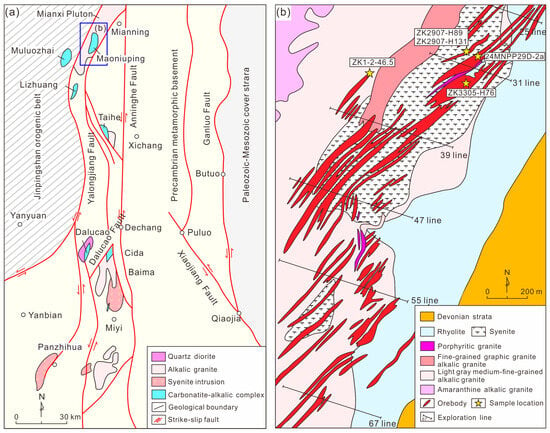
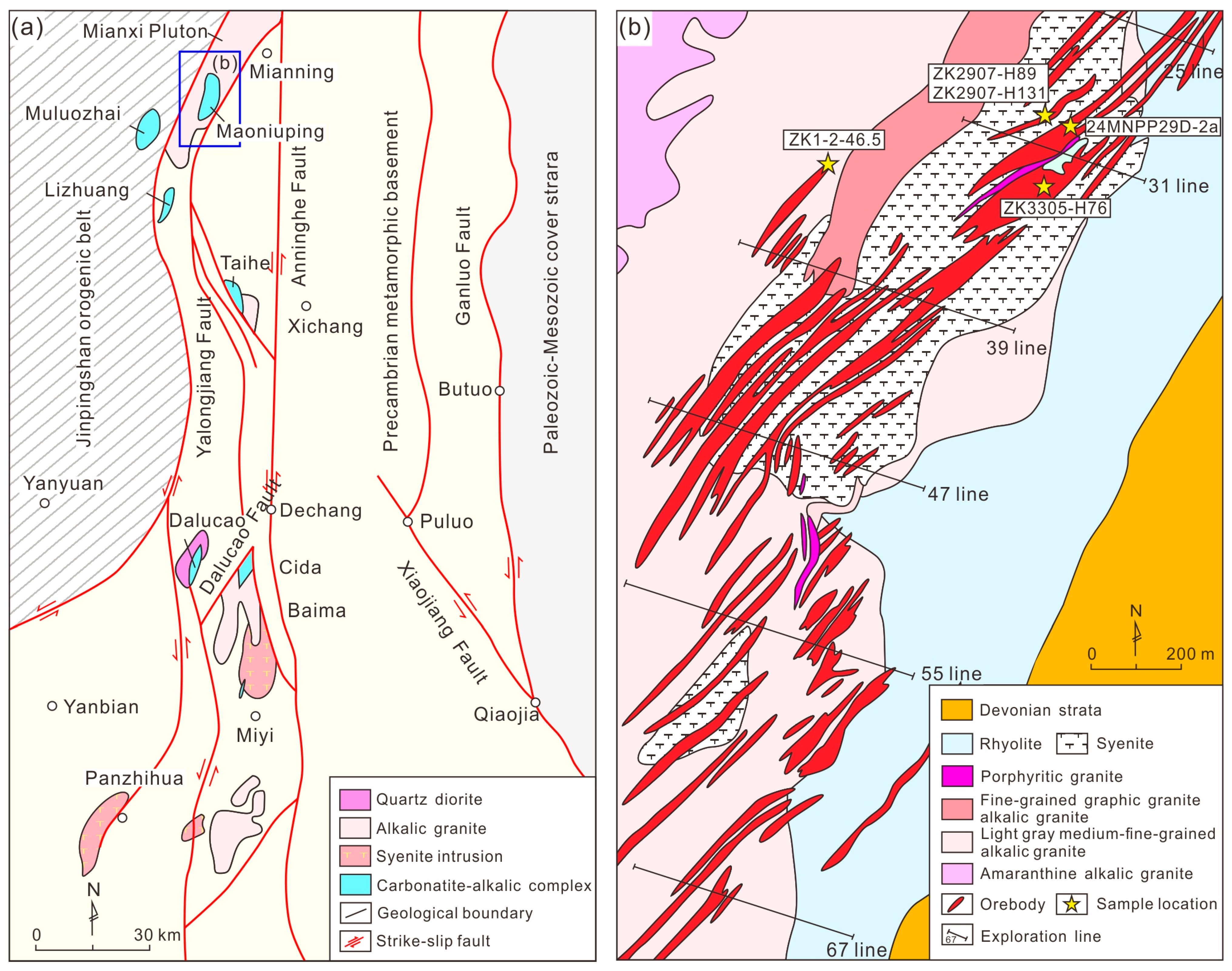
The Maoniuping deposit is located in the northern segment of the Paleozoic Panxi Rift zone, along the western margin of the Kangdian Upland within the Yangtze Platform. It is bounded by the Ganluo–Xiaojiang fault zone to the east and the Qinghe–Chenghai fault zone to the west, lying in the eastern part of the Yanshan period Mianxi pluton (232–110 Ma) [42,43,44,45] (Figure 1a). The rift zone exhibits frequent magmatic activity and diverse rock types. The surrounding rocks consist predominantly of alkali feldspar granite in the west and rhyolite to the east. The syenite–carbonatite complex in the central part, closely associated with rare-earth mineralization, is mainly distributed west of the Anninghe fault. It intrudes into rhyolite and granite and is crosscut by carbonatite veins or rare-earth ore veins [13,21,43,45,46,47,48,49] (Figure 1b).
Figure 1.
(a) Cenozoic carbonate–alkaline complex in western Sichuan and its controlled REE deposit distribution structure (revised from [13]); (b) Regional geological map of Sichuan Mianning Maoniuping area (revised from [13]).
To date, the explored area of the deposit extends approximately 2.65 km in length between exploration lines 19 and 72, with a width of 300–600 m. The ore bodies are strictly controlled by the Haha fault and exhibit an S-shaped distribution along the NNE–NE trend. They are composed of one or more large veins interspersed with numerous parallel fine veins and veinlets [43,44,50] (Figure 1b). Syenite is the most widely distributed rock type within the Maoniuping rare-earth mineralized complex. The economic minerals in the deposit are dominated by bastnäsite [13,47], accompanied by silicate rare-earth minerals such as chevkinite and allanite. Surrounding rock alterations commonly include fenitization, carbonatization, fluoridization, baritization, pyritization, and molybdenization.
3. Sampling and Analytical Methods
3.1. Sample Descriptions
Bastnäsite is the most predominant industrial rare-earth mineral in the Maoniuping deposit. Based on petrographic observations, as well as the mineral occurrence and paragenetic assemblage, it can be classified into four types.
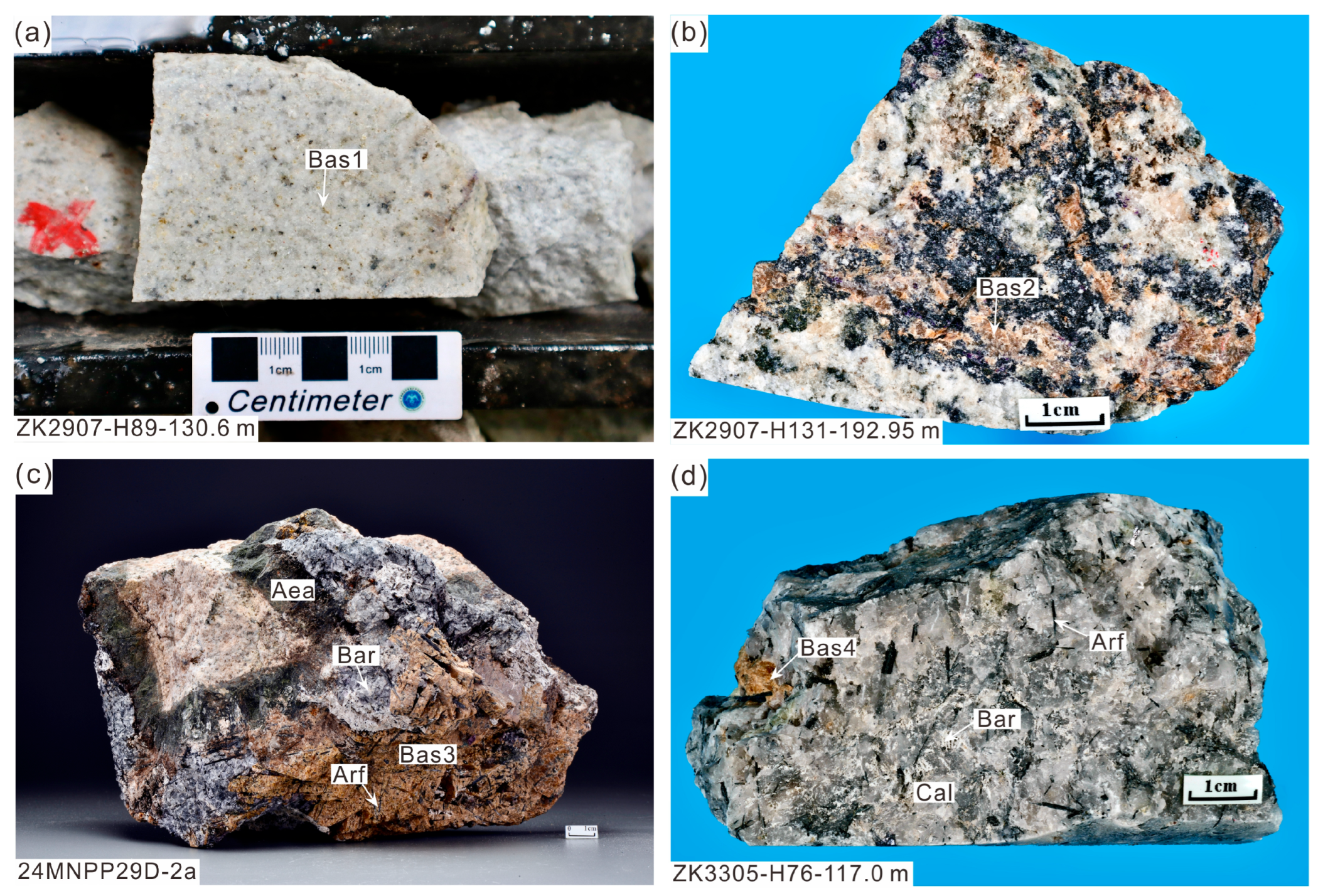
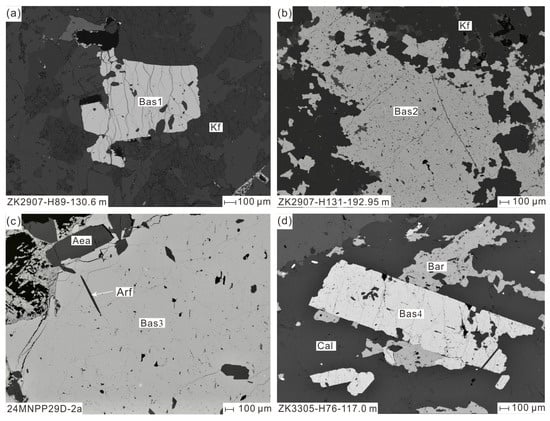
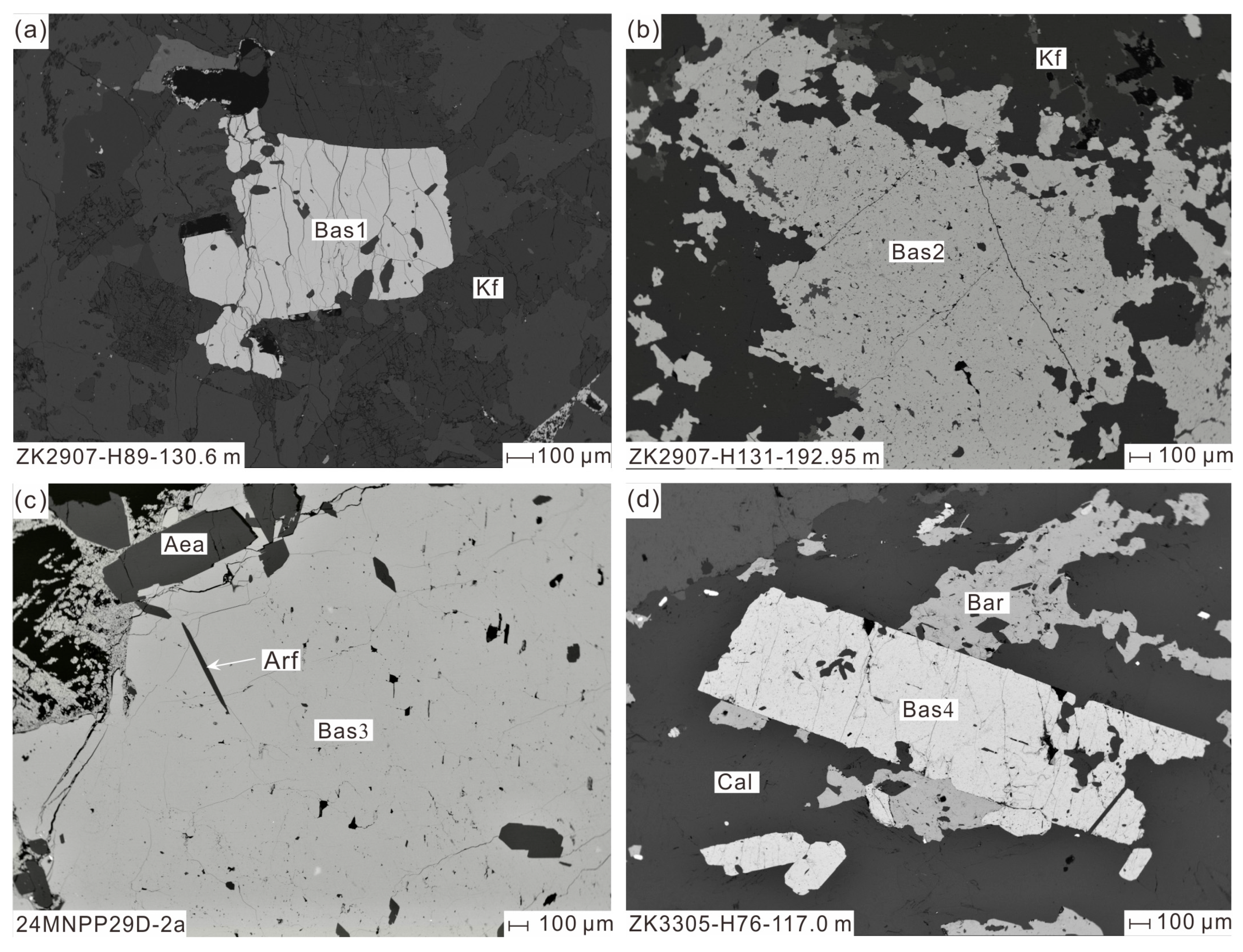
The first type is euhedral bastnäsite (Bas1) hosted in unaltered syenite. The syenite is grayish white, exhibiting a granular texture and massive structure. It is primarily composed of alkali feldspar (70%–80%) with 5%–10% quartz. Alkali mafic minerals are dominated by aegirine, arfvedsonite, and biotite (Figure 2a). Bastnäsite occurs as euhedral crystals embedded within alkali feldspar grains, showing well-developed fissures and grain sizes of approximately 0.8–1.0 mm (Figure 3a).
Figure 2.
Representative hand specimens of rock and ore samples from the Maoniuping deposit in Mianning, Sichuan. (a) Sporadic distribution of bastnäsite (Bas1) can be observed in syenite. (b) Disseminated bastnäsite (Bas2) is visible in neylonization syenite. (c) Pegmatoid bastnäsite (Bas3) coexists with minerals such as barite, aegirine-augite, and arfvedsonite. (d) Medium–coarse-grained bastnäsite (Bas4) is associated with calcite, barite, and arfvedsonite. Mineral assemblages include Bas = bastnäsite, Aea = aegirine-augite, Bar = barite, Cal = calcite, and Arf = arfvedsonite.
Figure 3.
Backscattered electron images of various types of bastnäsite from the Maoniuping deposit in Mianning, Sichuan. (a) Automorphic bastnäsite (Bas1) in syenite; (b) Disseminated bastnäsite (Bas2); (c) Pegmatitic bastnäsite (Bas3); (d) Medium–coarse-grained bastnäsite (Bas4). Mineral assemblages include Bas = bastnäsite, Aea = aegirine-augite, Bar = barite, Cal = calcite, Arf = arfvedsonite, and Kf = potassium feldspar.
The second type is disseminated bastnäsite (Bas2) in syenite, typically associated with fenitization. It appears wax-yellow and exhibits a disseminated pattern, with pyritization observable among the margins (Figure 2b and Figure 3b).
The third type is pegmatitic bastnäsite (Bas3), which forms thick tabular to columnar aggregates with grain sizes reaching several centimeters. The crystal surfaces are covered with abundant euhedral, acicular arfvedsonite, and it coexists with barite and aegirine-augite. Angular syenite fragments are locally enclosed by aegirine-augite bands (Figure 2c). The bastnäsite surface is smooth and lack obvious fissures (Figure 3c).
The fourth type is medium–coarse-grained bastnäsite (Bas4), exhibiting well-developed euhedral crystals with prominent cleavage faces and grain sizes of approximately 1–1.2 cm. It mainly coexists with minerals such as calcite and barite, with baritization observable along the crystal margins (Figure 2d and Figure 3d).
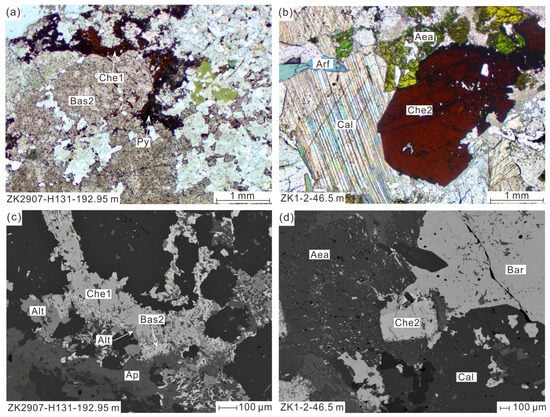
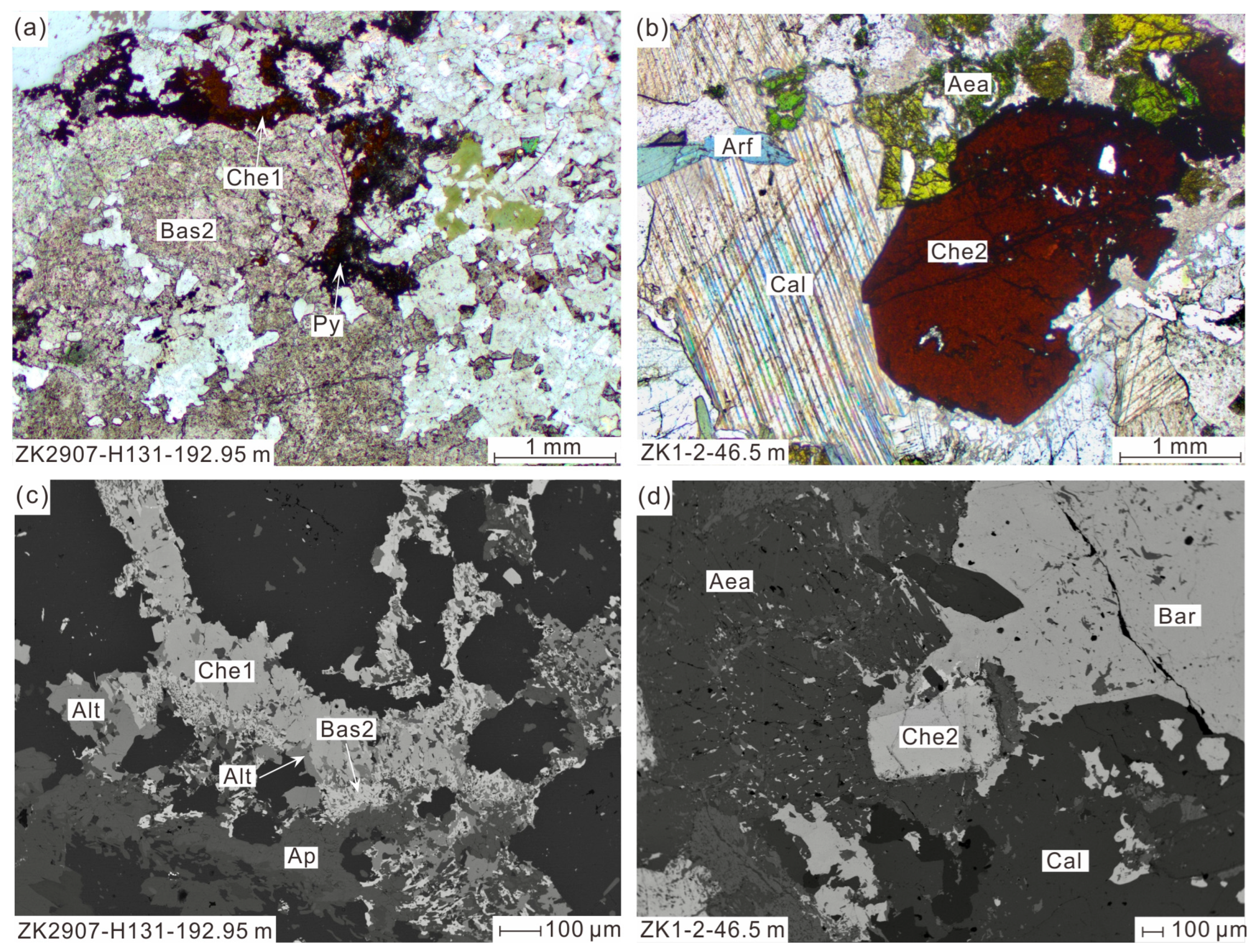
Chevkinite and allanite are two other significant rare earth-rich silicate minerals in the Maoniuping mining area, in addition to bastnäsite. Based on petrographic observations, chevkinite can be categorized into two types according to its occurrence. The first type is disseminated chevkinite (Che1), primarily distributed in syenite. Under an optical microscope, it appears brownish red, exhibits irregular morphology, and often coexists with disseminated bastnäsite, allanite, and other minerals (Figure 4a,c). The second type is euhedral chevkinite (Che2), which occurs near the contact zone between calcite veins and syenite, often with fenitization at its edges. This type displays well-developed crystal form and grain sizes of approximately 0.3–0.5 cm (Figure 4b,d).
Figure 4.
Microscopic characteristics of various types of chevkinite from the Maoniuping deposit in Mianning, Sichuan. (a) Disseminated chevkinite (Che1) coexists with disseminated bastnäsite (Bas2), and pyrite (under plane-polarized light); (b) Automorphic chevkinite coexists with calcite (Che2) (under plane-polarized light); (c) Disseminated chevkinite (Che1) coexists with disseminated bastnäsite (Bas2), allanite, and apatite (in backscattering image); (d) Automorphic chevkinite (Che2) coexists with aegirine-augite and calcite (in backscattering image). Mineral assemblages include Bas = bastnäsite, Che = chevkinite, Alt = allanite, Aea = aegirine-augite, Bar = barite, Cal = calcite, Arf = arfvedsonite, Py = pyrite, and Ap = apatite.
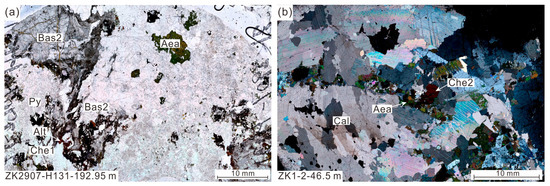
To more comprehensively characterize mineral occurrence, representative thin sections were selected for full-scan microscopic photograph analysis. Figure 5a shows that the syenite serves as the ore-hosting surrounding rock, exhibiting a granular structure. Disseminated bastnäsite (Bas2) is the primary rare-earth mineral, with its grain boundaries extensively distributed in an irregular pattern. Disseminated chevkinite (Che1) occurs as brownish red irregular grains sporadically embedded along the margins of Bas2, closely associated with allanite and pyrite (Figure 4a and Figure 5a). Aegirine-augite occurs in disseminated or massive forms with scattered distribution, collectively exhibiting typical features of the magmatic–hydrothermal transition stage. Figure 5b reveals that the calcite vein dominates, with euhedral chevkinite (Che2) occurring as brownish red euhedral crystals isolated within the calcite vein, displaying clear grain boundaries. Fine-grained aegirine-augite and arfvedsonite are observed along its margins, indicating fenitization alteration characteristics. This reflects the metallogenic features of the late hydrothermal stage, in which rare-earth minerals occur as euhedral crystals and coexisting with calcite veins.
Figure 5.
Representative full-scan microscopic photographs of samples from the Maoniuping deposit in Mianning, Sichuan, (a) Rare-earth minerals are disseminated in the syenite (under plane-polarized light). (b) The automorphic chevkinite (Che2) is distributed at the boundary between calcite veins and syenite, with fenitization developed along the fracture edges (under cross-polarized light). Mineral assemblages include: Bas = bastnäsite, Che = chevkinite, Alt = allanite, Aea = aegirine-augite, Cal = calcite, Py = pyrite.
3.2. Analytical Methods
Major-element analysis of rare-earth minerals was conducted at the Key Laboratory of Metallogeny and Mineral Resource Assessment, Institute of Mineral Resources, Chinese Academy of Geological Sciences. The major-element composition of bastnäsite was obtained using a JEOL JXA-iHP200F Hyper Probe electron probe microanalyzer (EPMA) under 15 kV accelerating voltage, 20 nA beam current, and 3–5 μm beam spot diameter [51].
Trace-element analysis of rare-earth minerals was carried out at the National Research Center for Geoanalysis, Chinese Academy of Geological Sciences (Beijing, China). Laser ablation–inductively coupled plasma–mass spectrometry (LA–ICP–MS) was utilized. The system comprised an Agilent 8900 ICP-MS triple quadrupole mass spectrometer coupled with an NWR 193TM laser (Elemental Scientific Lasers, Bozeman, MT, USA). Laser ablation was performed in spot analysis mode with a beam diameter of 40 μm, a repetition rate of 3 Hz, and a beam energy density of 3 J/cm2. Helium was used as the carrier gas to transport laser-generated aerosols to the ICP–MS, while argon was employed as the makeup gas and mixed via a T-joint before entering the plasma. Each analysis involved approximately 20 s of gas blank signal acquisition and 50 s of sample signal acquisition. NIST SRM 610 and NIST SRM 612 were used as external standards for mass fractionation correction, with the La content determined by electron probe microanalysis serving as the internal standard. Data processing was executed using Iolite 4.0 software.
Partial least squares discriminant analysis (PLS-DA) is a multivariate statistical method that integrates partial least squares regression (PLS) with discriminant analysis. Compared to principal component analysis (PCA), its core aim is to establish the relationship between variables and class labels while maximizing the differences between two or more groups of samples, making it suitable for classification and variable screening in high-dimensional, collinear data. Variable importance in projection (VIP) is a supplementary metric of the PLS-DA model used to quantify the contribution of each variable to the model’s classification performance. Variables with VIP values ≥ 1 are generally regarded as key discriminators that significantly affect classification. The approach entails first using PLS-DA to achieve sample classification and model construction, followed by VIP-based screening to identify core discriminative variables. This method is extensively applied in fields such as geological data analysis.
4. Results
4.1. Major Elements of Chevkinite, Allanite, and Bastnäsite
The major-element composition of chevkinite, allanite, and bastnäsite in the Maoniuping deposit is detailed in Supplementary Table S1.
The major-element composition of chevkinite from different occurrences shows little variation. ΣREE2O3 ranges from 47.61 wt% to 49.95 wt%, La2O3 from 11.04 wt% to 15.02 wt%, TiO2 from 12.84 wt% to 14.89 wt%, SiO2 from 18.65 wt% to 19.29 wt%, CaO from 0.49 wt% to 2.65 wt%, with LREE/HREE ratios between 12.86 and 15.38.
Allanite primarily occurs in disseminated form. ΣREE2O3 ranges from 26.19 wt% to 28.84 wt%, including Ce2O3 from 11.23 wt% to 14.40 wt%. Additionally, the content of other REEs such as La, Nd, and Gd is relatively high. SiO2 ranges from 29.09 wt% to 30.24 wt%, FeO from 16.05 wt% to 20.58 wt%, Al2O3 from 6.99 wt% to 9.89 wt%, CaO from 8.19 wt% to 9.17 wt%, with LREE/HREE ratios between 12.82 and 17.30.
The ΣREE2O3 content of bastnäsite from different occurrences and paragenetic assemblages exhibits minimal variation (73.53–77.96 wt%). The La2O3 content in euhedral bastnäsite (Bas1) and disseminated bastnäsite (Bas2) from syenite is relatively low, ranging from 25.05 wt% to 28.18 wt% (avg. 26.53 wt%) and 15.91 wt% to 32.21 wt% (avg. 22.55 wt%), respectively, while the Nd2O3 content is higher, ranging from 6.78 wt% to 7.89 wt% (avg. 7.35 wt%) and 5.66 wt% to 15.92 wt% (avg. 11.0 wt%), respectively. In contrast, pegmatitic bastnäsite (Bas3) and medium–coarse-grained bastnäsite (Bas4) exhibit higher La2O3 content, ranging from 31.50 wt% to 33.79 wt% (avg. 32.65 wt%) and 31.23 wt% to 34.34 wt% (avg. 33.06 wt%), respectively, while the Nd2O3 content is relatively lower, ranging from 5.67 wt% to 6.50 wt% (avg. 6.04 wt%) and 5.22 wt% to 6.55 wt% (avg. 5.82 wt%), respectively.
4.2. Trace Elements and Rare-Earth Elements of Chevkinite, Allanite, and Bastnäsite
The trace-element composition of chevkinite, allanite, and bastnäsite from the Maoniuping deposit is detailed in Supplementary Table S2.
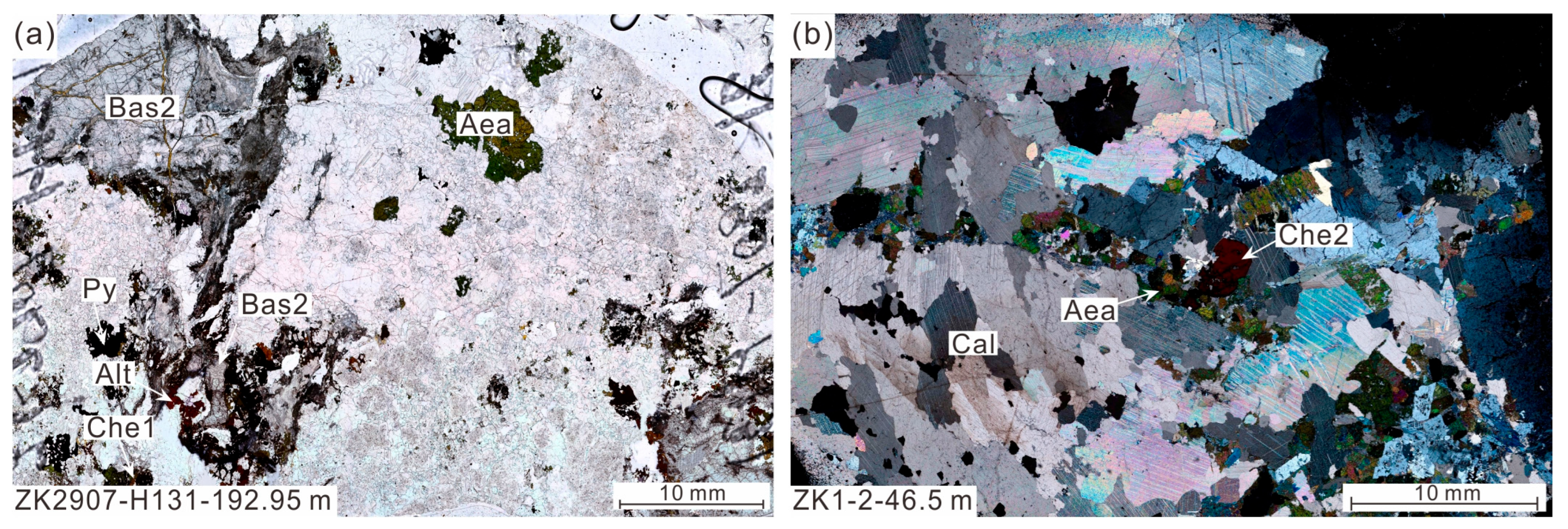
Chevkinite is generally enriched in elements such as Th, U, Nb, and Ta, but depleted in Rb, Ba, Sr, Zr, Hf, and Ti. There is a significant compositional difference between disseminated chevkinite (Che1) and euhedral chevkinite (Che2). Specifically, Che1 exhibits ΣREE (522,050–602,237 ppm), HREE (9348–18,992 ppm), Th (3386–8888 ppm), (La/Yb)N (113–328), δCe (1.04–1.11), and δEu (0.83–0.87). In contrast, Che2 shows ΣREE (441,098–447,820 ppm), HREE (1502–2744 ppm), Th (7079–9598 ppm), (La/Yb)N (421–969), δCe (0.98–1.04), and δEu (0.75–0.80), indicating stronger depletion in HREE and more pronounced light to heavy rare-earth fractionation (Figure 6a,b).
Figure 6.
Geochemical characteristics of chevkinite, allanite, and bastnäsite from the Maoniuping deposit in Mianning, Sichuan. (a) REE distribution patterns and (b) Trace-element spider diagrams for Maoniuping chevkinite; (c) REE distribution patterns and (d) Trace-element spider diagrams for Maoniuping allanite; (e) REE distribution patterns and (f) Trace-element spider diagrams for Maoniuping bastnäsite. The primary mantle- and chondrite-normalized data are from [52].
Allanite primarily occurs in disseminated form. Analytical results reveal ΣREE (188,803–216,245 ppm), (La/Yb)N (1410–4823), δCe (0.97–1.03), and δEu (0.75–0.82), with depletions in Rb (0–17.76 ppm), Ba (0.95–22.10 ppm), Th (835–3009 ppm), U (7.65–21.13 ppm), Nb (3.41–106.77 ppm), and Ta (0–2.93 ppm) (Figure 6c,d).
Bastnäsite is the dominant ore mineral in the deposit. Different occurrences show minor differences in REE distribution patterns and trace-element characteristics. All are strongly depleted in Rb, Ba, Zr, and Hf, but relatively enriched in Th and U. ΣREE (518,502–675,927 ppm), (La/Yb)N (28,291–178,298), δCe (0.81–1.15), and δEu (0.58–0.79) (Figure 6e,f).
4.3. PLS-DA Results of Chevkinite, Allanite, and Bastnäsite
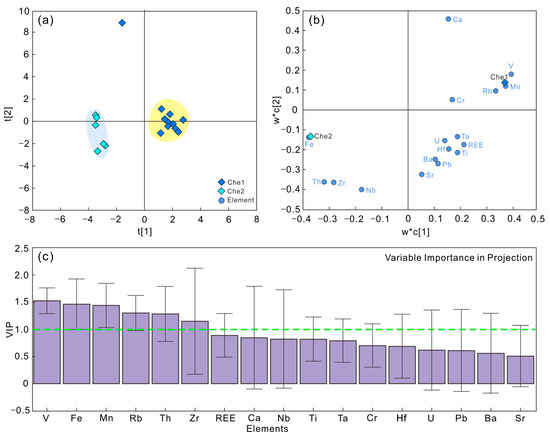
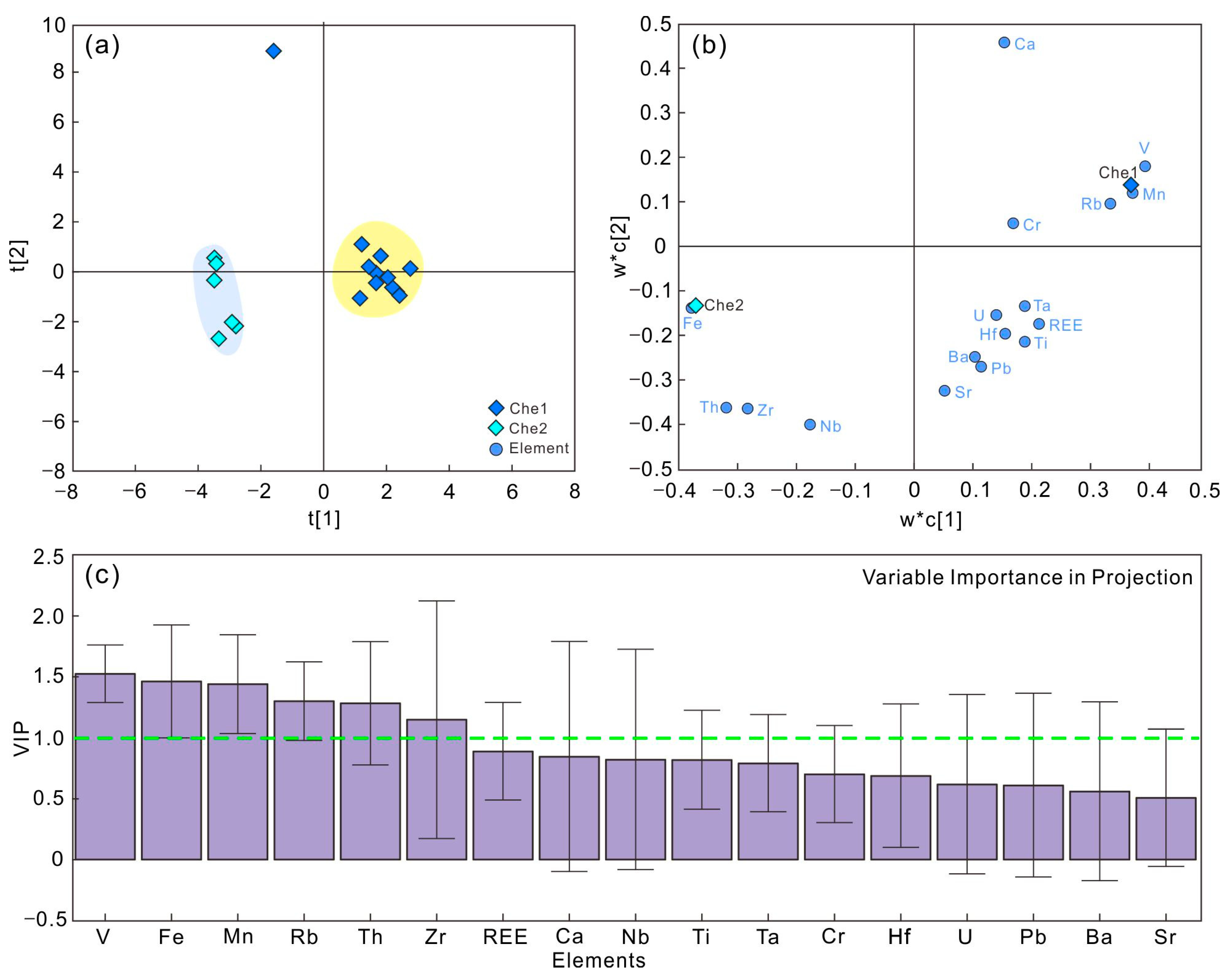
Bivariate plots can only illustrate the interrelationships between two elements. However, the occurrence of elements in rare-earth minerals is more complex. Therefore, this study employed PLS-DA to uncover the associations among multiple elements. The results indicate that this method can effectively distinguish the differences among various minerals types (Figure 7 and Figure 8). The model-fitting results show that the explanatory power of independent variable (R2X = 0.84) and dependent variable (R2Y = 0.98) is both ≥0.8, and the predictive power (Q2 = 0.93, ≥0.5) indicates that the model has no overfitting. The data points for disseminated chevkinite (Che1) are predominantly distributed in the first and fourth quadrants of the score scatterplot, whereas those for euhedral chevkinite (Che2) are concentrated in the second and third quadrants (Figure 7a). Combined with the loading plot, Che1 is enriched in V, Mn, Rb, Cr, and Ca, while Che2 is enriched in Fe, Th, Zr, and Nb (Figure 7b). In the VIP plot, V, Fe, Mn, Rb, Th, and Zr exhibit high scores (Figure 7c), indicating that these are key elements for distinguishing the two types of chevkinite.
Figure 7.
PLS-DA discrimination of different types of chevkinite from the Maoniuping deposit in Mianning, Sichuan. (a) Score scatterplot of component t[1] and t[2] (first and second scores) analysis from different types of chevkinite. The shaded areas are solely intended to highlight the differences between mineral types and have no other meaning; (b) w*c[1] and w*c[2] (first and second loading) plot showing correlations among elements and chevkinite; (c) Variable importance in projection (VIP) scores of selected trace elements to quantify the importance of each element that contributes to the discrimination.
Figure 8.
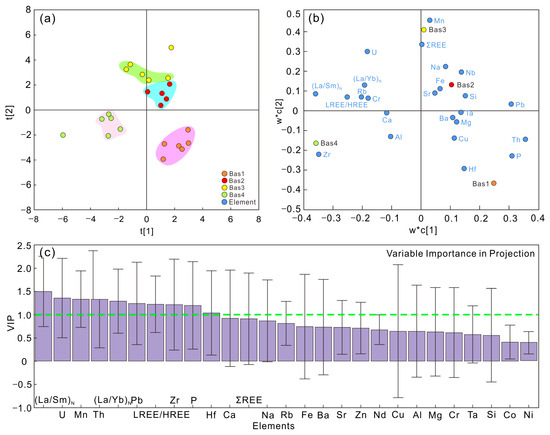
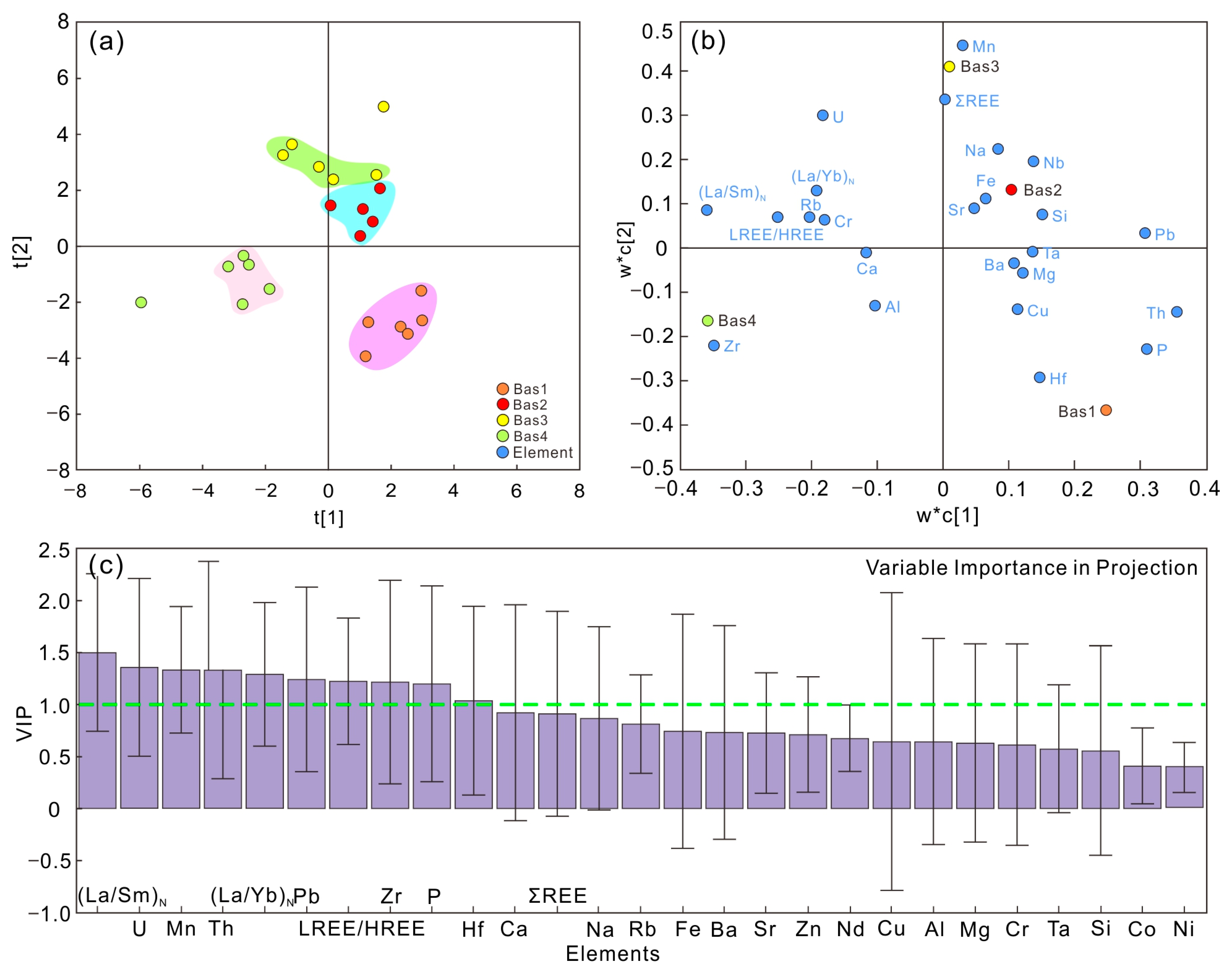
PLS-DA discrimination of different types of bastnäsite from the Maoniuping deposit in Mianning, Sichuan. (a) Score scatterplot of component t[1] and t[2] (first and second scores) analysis from different types of bastnäsite. The shaded areas are solely intended to highlight the differences between mineral types and have no other meaning; (b) w*c[1] and w*c[2] (first and second loading) plot showing correlations among elements and bastnäsite; (c) Variable importance in projection (VIP) scores of selected trace elements to quantify the importance of each element that contributes to the discrimination.
Different types of bastnäsite cannot be effectively distinguished based on REE distribution patterns or trace-element spider diagrams (Figure 6e,f). However, PLS-DA analysis reveals significant compositional differences among them. The model-fitting results show no overfitting, with explanatory power for the independent variable (R2X = 0.84) and dependent variables (R2Y = 0.85) both ≥0.8, and a predictive ability (Q2 = 0.69, ≥0.5) indicating good model validity. In the score plot, euhedral bastnäsite in syenite (Bas1) is situated in the fourth quadrant and shows relative enrichment in Hf, P, and Th. Disseminated bastnäsite (Bas2) is distributed in the first quadrant and enriched in Nb, Fe, and Sr. Pegmatitic bastnäsite (Bas3) spans the first and second quadrants and exhibits relative enrichment in Mn and ΣREE. Medium–coarse-grained bastnäsite (Bas4) is located in the third quadrant and enriched in Zr, Ga, and Al (Figure 8a,b). The VIP plot indicates that (La/Sm)N, U, Mn, Th, (La/Yb)N, Pb, LREE/HREE, Zr, P, and Hf serve as key indicators for distinguishing the four types of bastnäsite (Figure 8c).
5. Discussion
5.1. Generations of Chevkinite and Bastnäsite
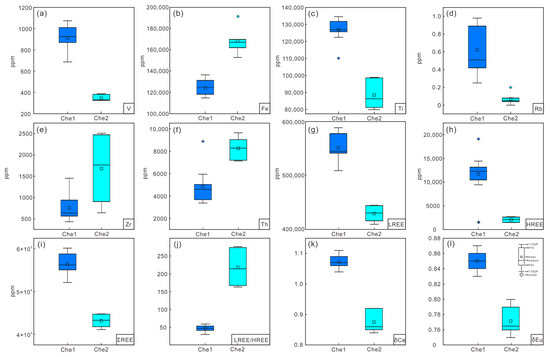
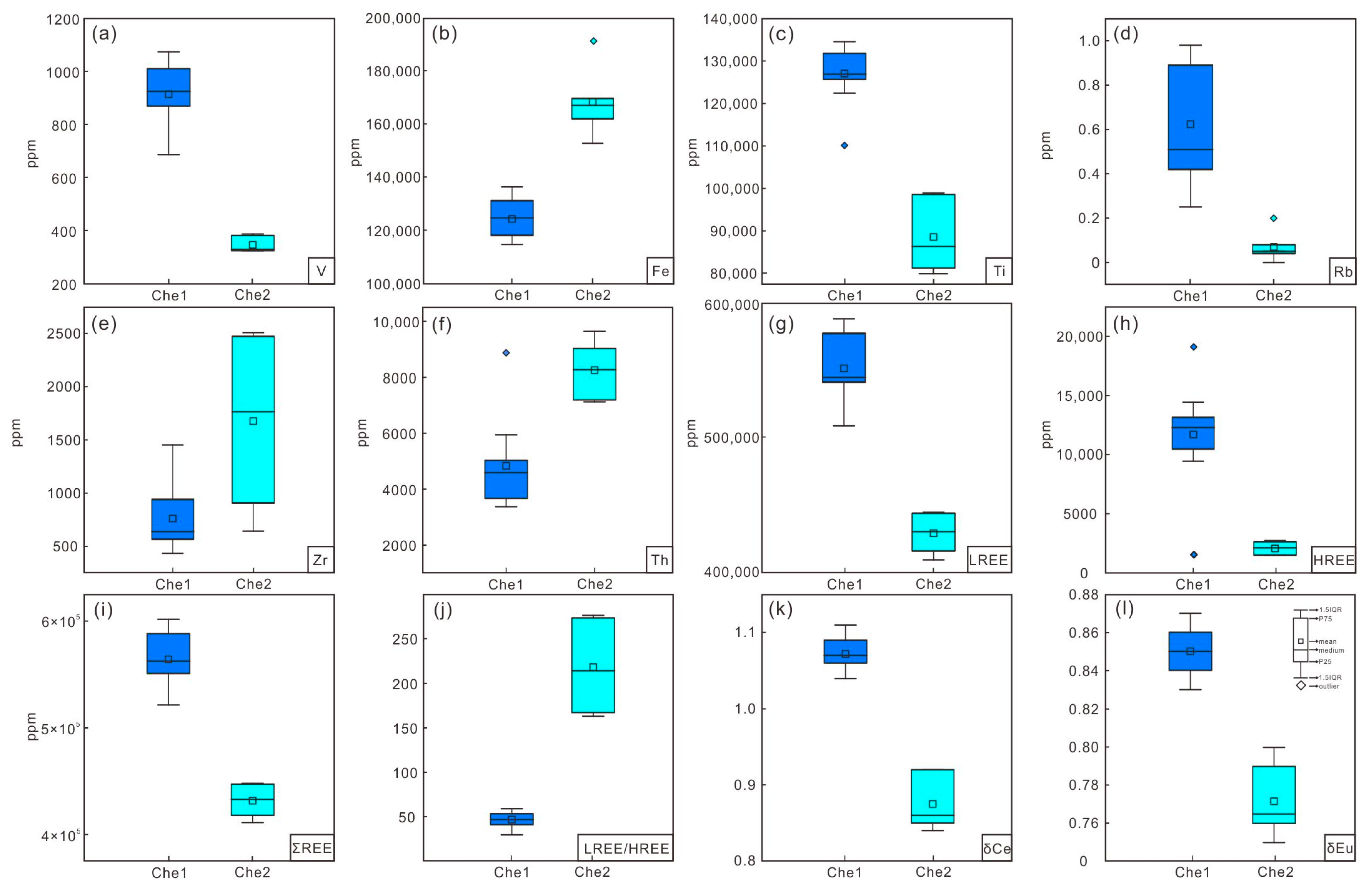
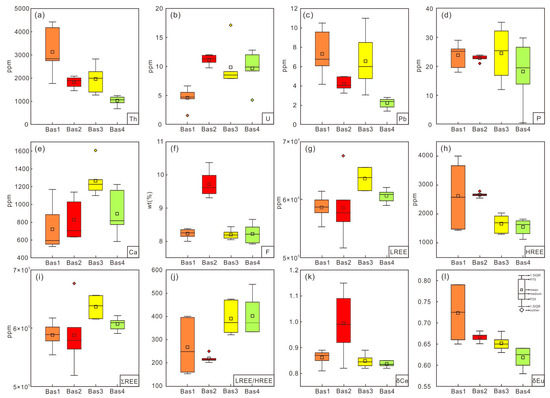
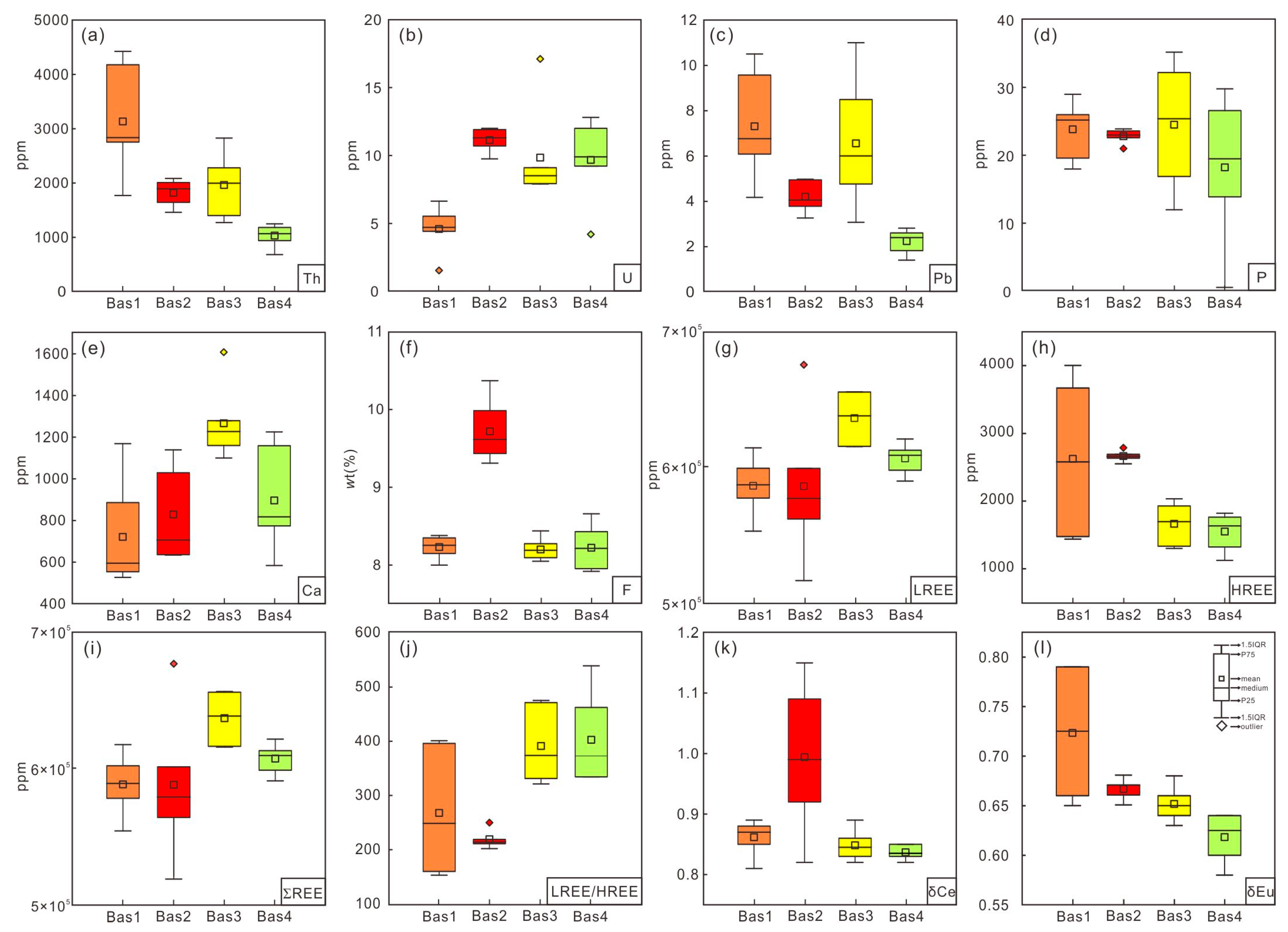
Chevkinite and bastnäsite are common silicate and carbonate rare-earth minerals, respectively, in the Maoniuping deposit [13,47]. Petrographic observations indicate that both types of minerals preserve their primary crystallization characteristics without significant alteration (Figure 3 and Figure 4). PLS-DA analysis reveals that the key elements responsible for compositional differences in the two types of chevkinite are V, Fe, Mn, Rb, Th, and Zr (Figure 7c). For the four types of bastnäsite, the main distinguishing elements include U, Mn, Th, Pb, Zr, P, Hf, LREE, and HREE (Figure 8c). Based on these differences, this section further analyzes the mineralization environment, crystallization processes, and fluid compositional variations using boxplots, providing geochemical evidence for the division of mineralization stages (Figure 9 and Figure 10).
Figure 9.
Box–whisker diagrams of key trace elements in various groups of chevkinite from the Maoniuping deposit in Mianning, Sichuan. (a) V; (b) Fe; (c) Ti; (d) Rb; (e) Zr; (f) Th; (g) LREE; (h) HREE; (i) ΣREE; (j) LREE/HREE; (k) δCe; (l) δEu.
Figure 10.
Box–whisker diagrams of key trace elements in various groups of bastnäsite from the Maoniuping deposit in Mianning, Sichuan. (a) Th; (b) U; (c) Pb; (d) P; (e) Ca; (f) F; (g) LREE; (h) HREE; (i) ΣREE; (j) LREE/HREE; (k) δCe; (l) δEu.
Disseminated chevkinite (Che1) exhibits irregular crystal morphology. Due to relatively rapid crystallization, it readily incorporates elements such as V, Mn, Ti, Rb, and HREE from the surrounding rocks, resulting in their enrichment and relatively low LREE/HREE ratios (Figure 9). It displays weak positive Ce anomalies, low U/Th ratios, and coexists with pyrite, indicating formation under relatively reducing environments. Euhedral chevkinite (Che2) occurs as coarse-grained euhedral crystals at the contact between calcite veins and syenite, accompanied by fenitization (Figure 4b and Figure 5b). During fenitization, elements such as Fe, Zr, and Th from the surrounding rocks were activated and enriched in chevkinite [53]. Its low ΣREE content, weak negative Ce anomalies, negative Eu anomalies, and high U/Th ratios indicate crystallization in a relatively low-temperature, high-oxygen fugacity environment. At this stage, REEs preferentially entered the bastnäsite lattice, reducing the ΣREE content in Che2 and increasing LREE/HREE ratios, further amplifying compositional differences between the two types of chevkinite.
Euhedral bastnäsite (Bas1) in syenite appears as coarse-grained euhedral crystals within alkali feldspar, lacking associated hydrothermal minerals. It is likely formed in a high-temperature magmatic crystallization environment. It has the highest content of Th, Pb, and HREE, relatively low ΣREE, and a weak negative Eu anomaly (Figure 10), consistent with crystallization from a carbonatitic brine–melt [54]. Disseminated bastnäsite (Bas2) is closely intergrown with disseminated chevkinite (Che1), and their composition is highly consistent. Both are characterized by high F content, the lowest LREE/HREE ratios, and a pronounced positive Ce anomaly. Petrographic features indicate the evolution of brine–melt and the interaction process of melt–rock [55]. The migration and enrichment of F− complexed REEs, the stability of Ce3+, the lack of significant differentiation between light and heavy rare earths, and the disseminated ore texture all support this formation environment. Pegmatitic bastnäsite (Bas3) coexists with minerals such as aegirine-augite, barite, and fluorite. It shows markedly increased P, Ca, LREE, ΣREE, and LREE/HREE ratios, while F and HREE content decreases. The Ce anomaly changes from positive to weakly negative. During this stage, in the hydrothermal fluids combines with Ba2+ to form barite, and fluorite precipitation reduces the F− concentration, weakening HREE complexation. The medium–coarse-grained bastnäsite (Bas4) coexists with calcite, representing the late hydrothermal stage. Negative Ce and Eu anomalies become more prominent, and HREE content further declines. in the fluid combines with LREE and Ca to form bastnäsite and calcite, respectively, enhancing HREE depletion. As plagioclase crystallization was largely complete by this stage, the negative Eu anomaly is attributable to decreasing temperature and oxidation of Eu2+ in the fluid.
In summary, the continuous evolution of the composition of two types of chevkinite and four types of bastnäsite indicates that the crystallization sequence may be associated with the evolution of the magma brine–melt from a high-temperature magma state to a medium- to low-temperature hydrothermal state.
5.2. Multistage REE Enrichment Mechanism
Since the three rare-earth minerals were formed under different physicochemical conditions, analyzing their morphological characteristics, paragenetic mineral assemblages, and compositional characteristics is of great indicative value for understanding REE enrichment mechanisms [22,23,56,57]. The core of REE enrichment mechanisms is controlled by the mineral crystallization sequence, the continuous evolution of ore-forming fluid composition, and the gradual change in redox environment, all of which are closely related to the continuous transition from magmatic melt to hydrothermal fluid [54,58].
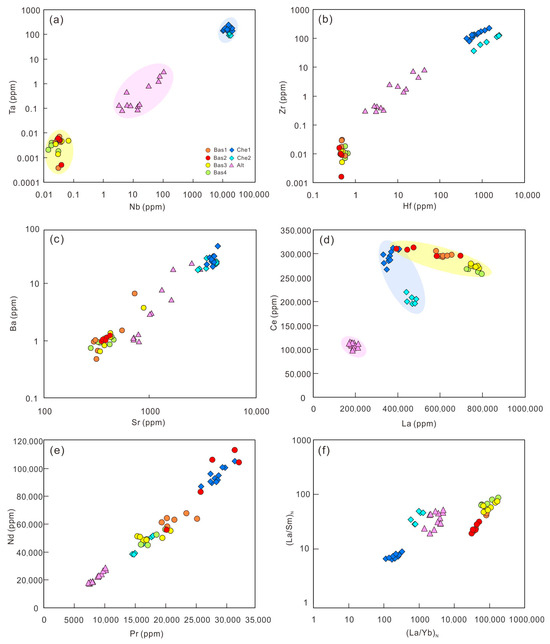
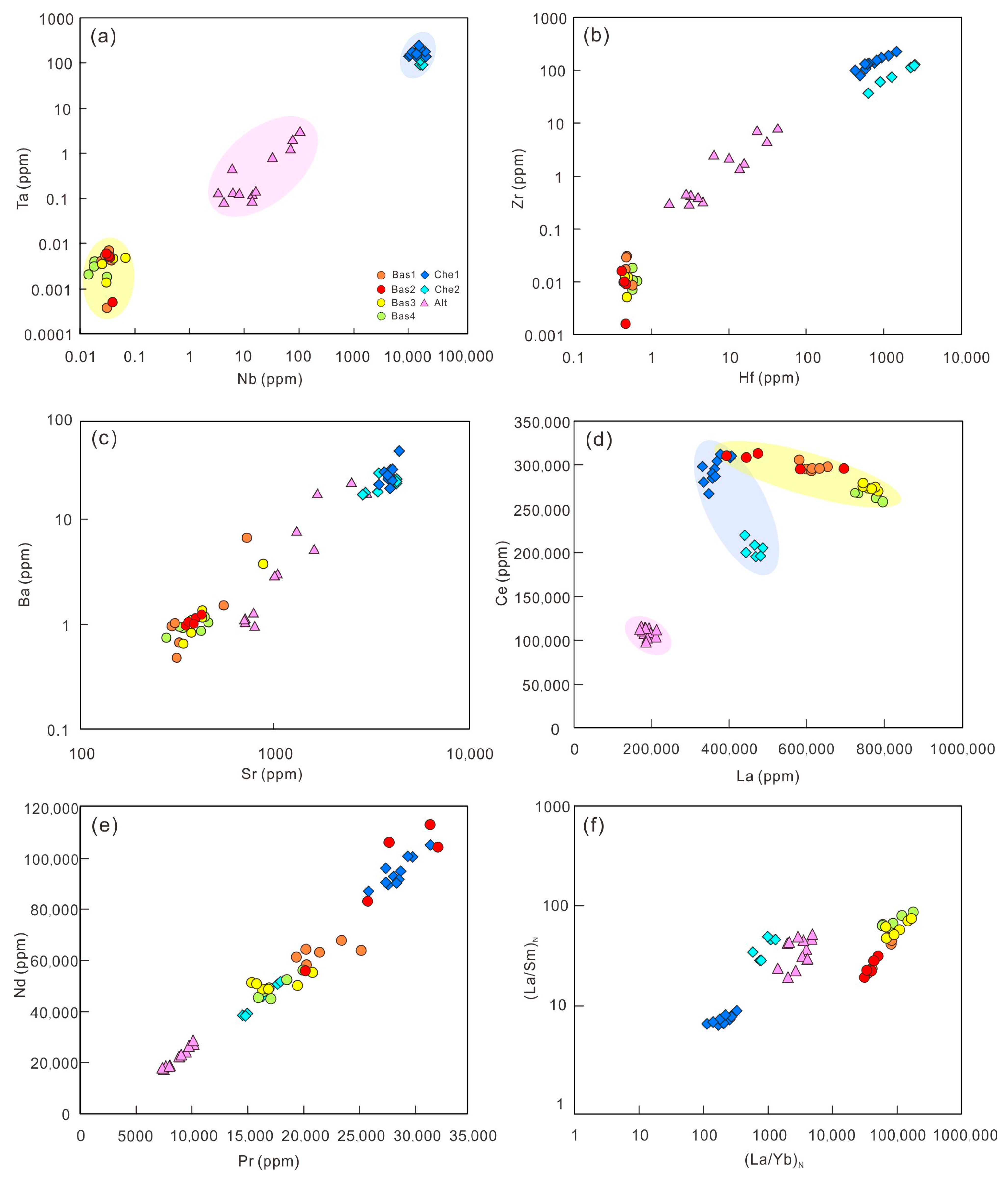
Based on petrography observations of mineral occurrences and paragenetic relationships, the crystallization sequence of the three minerals is chevkinite → allanite → bastnäsite, which is the continuous crystallization product of rare-earth minerals in the magmatic–hydrothermal system. Under early high-temperature conditions, Nb, Ta, Zr, and Hf readily formed stable complexes with Si and Ti, while minerals such as barite and fluorite had not yet extensively crystallized, preventing significant migration of Sr and Ba. As the mineralization environment and fluid properties evolved, Sr and Ba preferentially entered hydrothermal minerals such as calcite, barite, and fluorite, resulting in notably lower concentrations of these elements in subsequently formed bastnäsite. Allanite exhibits transitional trace-element composition between chevkinite and bastnäsite (Figure 11a,c). The continuous evolution of trace elements in these minerals suggests that REE enrichment in the Maoniuping deposit was driven by the progressive evolution of a magmatic magmatic–hydrothermal fluid system.
Figure 11.
Relationships of trace elements in chevkinite, allanite, and bastnäsite from the Maoniuping deposit in Mianning, Sichuan. (a) Nb vs. Ta; (b) Hf vs. Zr; (c) Sr vs. Ba; (d) La vs. Ce; (e) Pr vs. Nd; (f) (La/Yb)N vs. (La/Sm)N. The shaded areas are solely intended to highlight the differences between mineral types and have no other meaning.
Comparative analysis of REE distribution reveals variations in the partitioning of La, Ce, Pr, and Nd within the same mineral species across different stages (Figure 11d,f). In the early magmatic stage, bastnäsite (Bas1) exhibits relatively uniform La, Ce, Pr, and Nd content, with the highest HREE concentrations, but lower ΣREE (Figure 10h,i). This can be attributed to the high-temperature and low-oxygen fugacity environment of the early stage. Under high-temperature conditions, HREEs are more likely to form stable tetrahedral coordination structures with Si and Ti, facilitating their preferential incorporation into the chevkinite lattice [59,60,61].
During the magmatic–hydrothermal transition stage, coexisting chevkinite (Che1), bastnäsite (Bas2), and allanite show significantly elevated Ce, Pr, and Nd content, while the La, (La/Sm)N, and (La/Yb)N ratios remain relatively low (Figure 11d,f). This pattern arises because La preferentially partitions into accessory minerals such as monazite and apatite, reducing its abundance in the three REE minerals. F-rich fluids under intermediate- to high-temperature conditions enhance the solubility of HREEs, leading to lower (La/Sm)N and (La/Yb)N values [62,63,64,65,66]. Additionally, minerals from this stage commonly display positive Ce anomalies (Figure 9k and Figure 10f,k). Petrographic observations of replacement and dissolution textures at mineral margins indicate intense melt–rock interactions between the low-oxygen fugacity, F− rich brine–melt, and the surrounding rock [55] (Figure 4a,c). This process activated, migrated, and enriched REEs such as Pr and Nd from the surrounding rock, which subsequently concentrated in silicate REE minerals and bastnäsite. In the late hydrothermal stage, euhedral chevkinite (Che2) and bastnäsite (Bas3, Bas4) display reduced Ce, Pr, and Nd content, but increased La content compared to transition-stage minerals. This indicates that low-temperature, high-oxygen fugacity conditions favor the incorporation of La into REE mineral lattices.
In conclusion, although the distribution of REEs in minerals varies across different stages, with HREEs enriched in the early stage, Ce, Pr, and Nd in the middle stages, and La in the late stage, the overall elemental variations exhibit continuity. This indicates that these minerals formed within the same evolving magmatic–hydrothermal fluid system, with REEs selectively accumulated under varying physicochemical conditions. The findings also confirm a continuous transition from a high-temperature reducing environment to a low-temperature oxidizing environment in the metallogenic system, providing direct mineralogical evidence for elucidating the enrichment mechanisms of REEs in magmatic–hydrothermal systems.
5.3. Indicative Significance of Mineral Composition Characteristics in the Metallogenic Process
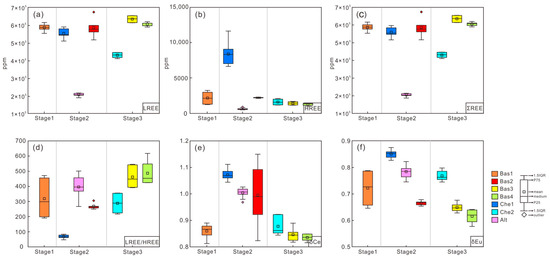
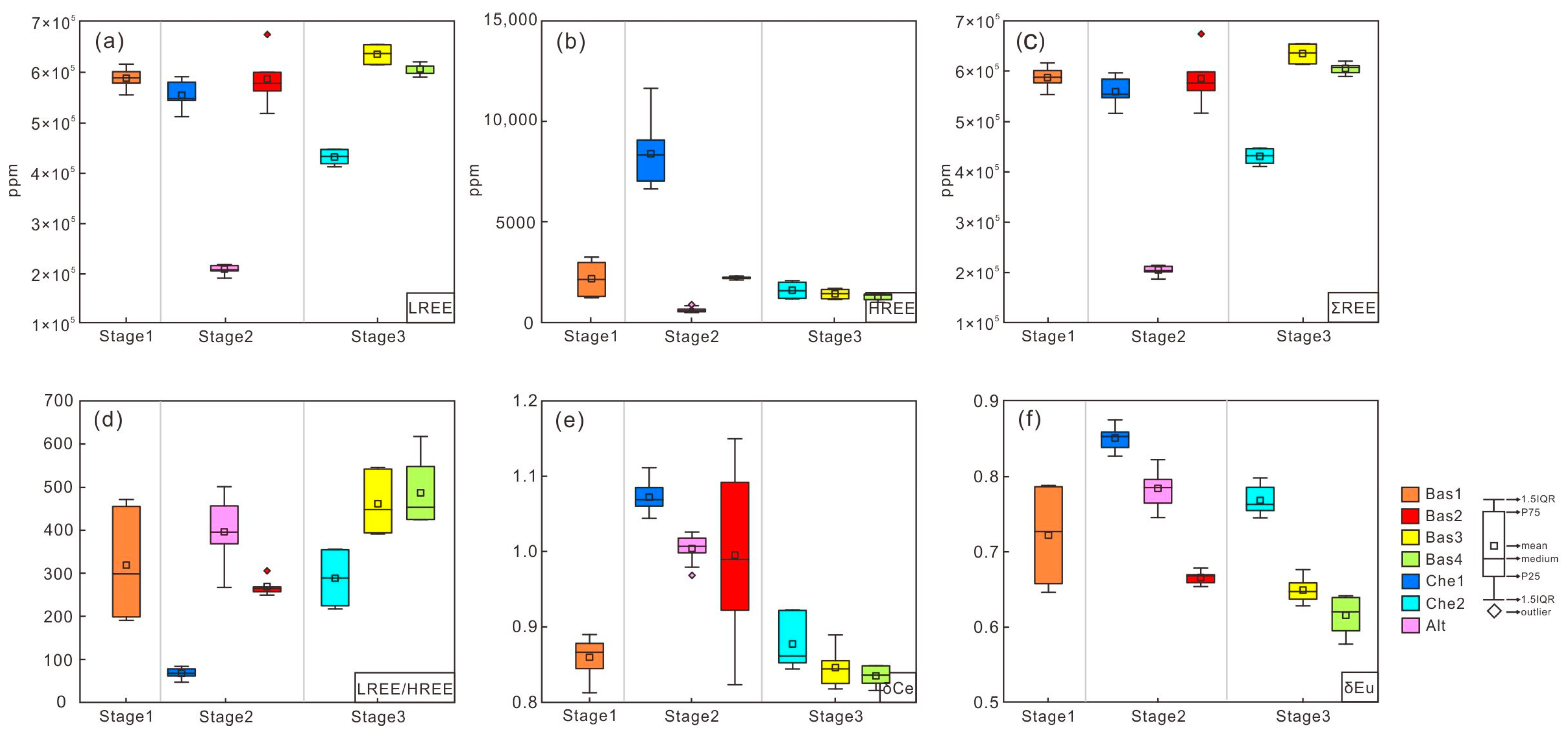
Based on the mineral morphology, composition, and paragenetic variations of chevkinite, allanite, and bastnäsite, it is concluded that the Maoniuping deposit underwent at least three stages of mineralization (Figure 12).
Figure 12.
Box–whisker diagrams of key REEs in various groups of chevkinite and bastnäsite from the Maoniuping deposit in Mianning, Sichuan. (a) LREE; (b) HREE; (c) ΣREE; (d) LREE/HREE; (e) δCe; (f) δEu.
During the early magmatic stage, alkaline magma carrying REEs ascended from the deep Earth, underwent magmatic evolution, and intruded into the shallow crust and surrounding rocks. At this stage, REEs were likely derived directly from the alkaline magma, representing the initial source of REE enrichment. This process formed only a small quantity of rare-earth minerals and REE-bearing apatite without generating high-grade industrial ore bodies. During the magmatic–hydrothermal transition stage, disseminated chevkinite and bastnäsite (Che1, Bas2) are closely associated and coexist, both characterized by high F− content. The F− may have originated from differentiation of the magma melt, representing the secondary evolution of a brine–melt system. Fenitization alteration indicates that melt–rock interactions further enhanced REE enrichment (Figure 4a,c and Figure 5a). Boxplots indicate that chevkinite and bastnäsite from this stage exhibit nearly identical LREE and ΣREE distribution patterns (Figure 12a,c), suggesting no selective enrichment of LREEs in bastnäsite, whereas HREEs clearly preferred chevkinite (Figure 12b). Bastnäsite from this stage has a low LREE/HREE ratio, with significant variations in Ce anomalies (Figure 10j,k). During the hydrothermal stage, the enrichment of LREEs in chevkinite decreased markedly, with more LREEs preferentially entering bastnäsite, while the HREE content of both minerals showed little difference (Figure 12a,b). Chevkinite exhibits a low LREE/HREE ratio and weak positive Ce anomalies, whereas bastnäsite showed an increased LREE content, a further elevated LREE/HREE ratio, and more pronounced negative Ce anomalies.
As variable valence elements, Ce and Eu anomalies can effectively reflect the redox conditions during mineralization [67,68,69]. Chevkinite exhibit weak positive Ce anomalies and weak negative Eu anomalies (δCe = 0.98–1.11, avg. 1.05; δEu = 0.75–0.87, avg. 0.82), indicating formation under relatively low-oxygen fugacity conditions. In contrast, bastnäsite shows overall stronger negative Ce anomalies (δCe = 0.81–1.15, avg. 0.88) and the most pronounced negative Eu anomalies (δEu = 0.58–0.79, avg. 0.66), suggesting a greater tendency to form in hydrothermal environments with higher-oxygen fugacity.
The Maoniuping deposit is situated in the Mianning–Dechang rare-earth mineralization belt (Figure 1a). It is controlled by the Cenozoic collision orogeny and the Anninghe deep fault–Haha fault system, which together from the conduit and host structures for mineralization [40,42]. Mineral geochemical characteristics indicated that the mineralization involved multistage processes, including magmatic, magmatic–hydrothermal transitional, and hydrothermal stages. The mineralization environment evolved from high-temperature and low-oxygen fugacity to low-temperature and high-oxygen fugacity. Under these circumstances, the decomposition of LREE complexes associated with and F− facilitated the formation of Ce4+ and promoted the precipitation of Ce3+. This inhibited the formation of Ce4+ and drove the large-scale crystallization of fluorocarbon cerate. The coupled variations in temperature, pressure, and oxygen fugacity regulated the occurrence, migration, and enrichment of REE, eventually leading to the formation of large-scale rare-earth ore bodies in the fault zone and tectonic contact zone.
6. Conclusions
(1) The mineral paragenetic sequence of chevkinite, allanite, and bastnäsite in the Maoniuping mining area comprehensively records the transition of the overall environment from high-temperature, low-oxygen fugacity conditions to low-temperature, high-oxygen fugacity conditions in the magmatic–hydrothermal system.
(2) Oxygen fugacity plays a significant indicative role in the selective enrichment of REEs. Under low-oxygen fugacity conditions, rare-earth minerals are more prone to enrich Ce, Pr, and Nd, whereas high-oxygen fugacity environments favor the enrichment of La. Under low-temperature, high-oxygen fugacity conditions, LREEs exhibit a clear preference for selective enrichment in bastnäsite, which is more conducive to the formation of large-scale mineralization.
(3) The characteristics of rare-earth mineral composition indicate that the mineralization process of the Maoniuping deposit was propelled by the continuous evolution of a magmatic–hydrothermal fluid system and involved multiple stages of magmatic–hydrothermal activity rather than a single mineralization event. Moreover, it offers direct mineralogical evidence for comprehending the enrichment patterns of REEs in magmatic–hydrothermal systems and reconstructing the mineralization process. Subsequent prospecting predictions should closely focus on areas with complex magmatic activities and hydrothermal alterations.
Supplementary Materials
The following supporting information can be downloaded at https://www.mdpi.com/article/10.3390/min16030257/s1. Table S1: Major-element composition (wt%) of chevkinite, allanite, and bastnäsite from the Maoniuping deposit; Table S2: Trace-element composition (ppm) of chevkinite, allanite, and bastnäsite from the Maoniuping deposit.
Author Contributions
Y.J.: writing—original draft preparation, data curation. W.W.: writing—review and editing. B.H.: writing—review and editing. Z.Z.: editing and funding. R.Z.: software. All authors have read and agreed to the published version of the manuscript.
Funding
This study was funded by the Science and Technology Project of China Rare Earth Group Co., Ltd. (HE2310).
Data Availability Statement
The data presented are original and not inappropriately selected, manipulated, enhanced, or fabricated.
Acknowledgments
Two anonymous reviewers are thanked for their valuable comments and suggestions that improved this paper significantly.
Conflicts of Interest
Wei Wang and Bin He are employed by China Rare Earth (Liangshan) (Group) Co., Ltd. The remaining authors declare that the research was conducted in the absence of any commercial or financial relationships that could be construed as a potential conflict of interest.
References
- Chakhmouradian, A.R.; Wall, F. Rare earth elements: Minerals, mines, magnets (and more). Elements 2012, 8, 333–340. [Google Scholar] [CrossRef] [Scilit]
- Wang, D.H.; Wang, R.J.; Sun, Y.; Li, J.K.; Zhou, Y.Y. A Review of Research Achievements on the Survey of Three Rare (Rare Earth, Rare Metal, and Scattered) Mineral Resources in China. Acta Geol. Sin. 2016, 37, 569–580. [Google Scholar] [CrossRef]
- Balaram, V. Rare earth elements: A review of applications, occurrence, exploration, analysis, recycling, and environmental impact. Geosci. Front. 2019, 10, 1285–1303. [Google Scholar] [CrossRef] [Scilit]
- Mitchell, R.H. Carbonatites and carbonatites and carbonatites. Can. Miner. 2005, 43, 2049–2068. [Google Scholar] [CrossRef] [Scilit]
- Weng, Z.H.; Jowitt, S.M.; Mudd, G.M.; Haque, N. A detailed assessment of global rare earth element resources: Opportunities and challenges. Econ. Geol. 2015, 110, 1925–1952. [Google Scholar] [CrossRef] [Scilit]
- Kynicky, J.; Smith, M.P.; Xu, C. Diversity of rare earth deposits: The key example of China. Elements 2012, 8, 361–367. [Google Scholar] [CrossRef] [Scilit]
- Smith, M.P.; Henderson, P.; Campbell, L.S. Fractionation of the REE during hydrothermal processes: Constraints from the Bayan Obo Fe-REE-Nb deposit, Inner Mongolia, China. Geochim. Cosmochim. Acta 2000, 64, 3141–3160. [Google Scholar] [CrossRef] [Scilit]
- Williams-Jones, A.E.; Samson, I.M.; Olivo, G.R. The genesis of hydrothermal fluorite-REE deposits in the Gallinas Mountains, New Mexico. Econ. Geol. 2000, 95, 327–341. [Google Scholar] [CrossRef] [Scilit]
- Castor, S.B. The Mountain Pass rare-earth carbonatite and associated ultrapotassic rocks, California. Can. Miner. 2008, 46, 779–806. [Google Scholar] [CrossRef] [Scilit]
- Zaitsev, A.N.; Williams, C.T.; Jeffries, T.E.; Strekopytov, S.; Moutte, J.; Ivashchenkova, O.V.; Spratt, J.; Petrov, S.V.; Wall, F.; Seltmann, R.; et al. Rare earth elements in phoscorites and carbonatites of the Devonian Kola Alkaline Province, Russia: Examples from Kovdor, Khibina, Vuoriyarvi and Turiy Mys complexes. Ore Geol. Rev. 2014, 61, 204–225. [Google Scholar] [CrossRef] [Scilit]
- Yang, W.-B.; Niu, H.-C.; Shan, Q.; Sun, W.-D.; Zhang, H.; Li, N.-B.; Jiang, Y.-H.; Yu, X.-Y. Geochemistry of magmatic and hydrothermal zircon from the highly evolved Baerzhe alkaline granite: Implications for Zr–REE–Nb mineralization. Miner. Depos. 2014, 49, 451–470. [Google Scholar] [CrossRef] [Scilit]
- Broom Fendley, S.; Wall, F.; Spiro, B.; Ullmann, C.V. Deducing the source and composition of rare earth mineralising fluids in carbonatites: Insights from isotopic (C, O, 87Sr/86Sr) data from Kangankunde, Malawi. Contrib. Miner. Petrol. 2017, 172, 96. [Google Scholar] [CrossRef] [Scilit] [PubMed]
- Yuan, Z.X.; Shi, Z.M.; Bai, G.; Wu, C.Y.; Chi, R.A.; Li, X.Y. The Maoniuping Rare Earth Ore Deposit, Mianning County, Sichuan Province; Seismological Press: Beijing, China, 1995; pp. 1–150. (In Chinese) [Google Scholar]
- Wang, D.H.; Yang, J.M.; Yan, S.H.; Xu, J.; Chen, Y.C.; Pu, G.P.; Luo, Y.N. A special orogenic-type rare earth element deposit in Maoniuping, Sichuan, China: Geology and geochemistry. Resour. Geol. 2001, 51, 177–188. [Google Scholar] [CrossRef] [Scilit]
- Wang, D.H.; Yang, J.M.; Yan, S.H.; Xu, J.; Chen, Y.C.; Xu, Y. Dynamics of the REE Mineralization in Maoniuping area, Sichuan Province: Isotopic geochemistry of carbonatites. J. Chengdu Univ. Technol. 2002, 5, 539–544. (In Chinese) [Google Scholar]
- Hou, Z.Q.; Pan, G.T.; Wang, A.J.; Mo, X.X.; Tian, S.H.; Sun, X.M.; Ding, L.; Wang, E.Q.; Gao, Y.F.; Xie, Y.L.; et al. Metallogenesis in Tibetan collisional orogenic belt: II Mineralization in late-collisional transformation setting. Miner. Depos. 2006, 25, 521–543. (In Chinese) [Google Scholar]
- Hou, Z.; Cook, N.J. Metallogenesis of the Tibetan collisional orogen: A review and introduction to the special issue. Ore Geol. Rev. 2009, 36, 2–24. [Google Scholar] [CrossRef] [Scilit]
- Hou, Z.; Liu, Y.; Tian, S.; Yang, Z.; Xie, Y. Formation of carbonatite-related giant rare-earth-element deposits by the recycling of marine sediments. Sci. Rep. 2015, 5, 10231. [Google Scholar] [CrossRef] [Scilit]
- Tian, S.; Hou, Z.; Su, A.; Qiu, L.; Mo, X.; Hou, K.; Zhao, Y.; Hu, W.; Yang, Z. The anomalous lithium isotopic signature of Himalayan collisional zone carbonatites in western Sichuan, SW China: Enriched mantle source and petrogenesis. Geochim. Cosmochim. Acta 2015, 159, 42–60. [Google Scholar] [CrossRef] [Scilit]
- Liu, Y.; Hou, Z.; Tian, S.; Zhang, Q.; Zhu, Z.; Liu, J. Zircon U–Pb ages of the Mianning–Dechang syenites, Sichuan Province, southwestern China: Constraints on the giant REE mineralization belt and its regional geological setting. Ore Geol. Rev. 2015, 64, 554–568. [Google Scholar] [CrossRef] [Scilit]
- Liu, Y.; Hou, Z. A synthesis of mineralization styles with an integrated geneticmodel of carbonatite-syenite hosted REE deposits in the Cenozoic Mianning-Dechang REE metallogenic belt, the eastern Tibetan Plateau, southwestern China. J. Asian Earth Sci. 2017, 137, 35–79. [Google Scholar] [CrossRef] [Scilit]
- Liu, Y.; Chakhmouradian, A.R.; Hou, Z.; Song, W.; Kynicky, J. Development of REE mineralization in the giant Maoniuping deposit (Sichuan, China): Insights from mineralogy, fluid inclusions, and trace-element geochemistry. Miner. Depos. 2019, 54, 701–718. [Google Scholar] [CrossRef] [Scilit]
- Guo, D.; Liu, Y. Occurrence and geochemistry of Bastnäsite in carbonatite-related REE deposits, Mianning–Dechang REE belt, Sichuan Province, SW China. Ore Geol. Rev. 2019, 107, 266–282. [Google Scholar] [CrossRef] [Scilit]
- Yuan, Z.X.; Bai, G.; Ding, X.S.; Shi, Z.M.; Li, X.Y. U-Pb isotopic age of Zircon from the Maoniuping alkali granite, Sichuan Province and its geological significance. Miner. Depos. 1993, 2, 189–192+147. (In Chinese) [Google Scholar] [CrossRef]
- Weng, Q.; Yang, W.B.; Niu, H.C.; Li, N.B.; Mitchell, R.H.; Zurevinski, S.; Wu, D. Formation of the Maoniuping giant REE deposit: Constraints from mineralogy and insitu bastnäsite U-Pb geochronology. Am. Miner. 2022, 107, 282–293. [Google Scholar] [CrossRef] [Scilit]
- Weng, Q.; Niu, H.C.; Qu, P.; Li, N.B.; Shan, Q.; Yang, W.B. Controlling factors of prolonged REE mineralization in the Maoniuping REE deposit: Constraints from alkaline granite in the syenite-carbonatite complex. Ore Geol. Rev. 2022, 142, 104705. [Google Scholar] [CrossRef] [Scilit]
- Ling, X.X.; Li, Q.L.; Liu, Y.; Yang, Y.H.; Liu, Y.; Tang, G.Q.; Li, X.H. In situ SIMS Th-Pb dating of Bastnäsite: Constraint on the mineralization time of the Himalayan Mianning-Dechang rare earth element deposits. J. Anal. At. Spectrom. 2016, 31, 1680–1687. [Google Scholar] [CrossRef] [Scilit]
- Yang, Y.H.; Wu, F.Y.; Li, Y.; Yang, J.H.; Xie, L.W.; Liu, Y.; Zhang, Y.B.; Huang, C. In situ U–Pb dating of Bastnäsite by LA-ICP-MS. J. Anal. At. Spectrom. 2014, 29, 1017–1023. [Google Scholar] [CrossRef] [Scilit]
- Hu, W.J.; Tian, S.H.; Wang, S.P.; Chen, L.J.; Su, Y.N.; Yue, L.; Wang, Y.X. Sm-Nd Isochron Age of Carbonatite from the Maoniuping REE deposit, Sichuan Province and Their Geological Implications. Min. Res. Geol. 2012, 26, 237–241. (In Chinese) [Google Scholar]
- Tian, S.H.; Hou, Z.Q.; Yang, Z.S.; Chen, W.; Yang, Z.M.; Yuan, Z.X.; Xie, Y.L.; Fei, H.C.; Yin, S.P.; Liu, Y.C.; et al. Geochronology of REE deposits in Mianning-Dechang REE metallogenic belt: Constraints on duration of hydrothermal activities and tectonic model for Carbonatite-Alkalic complexes in Southwestem Sichuan. Miner. Depos. 2008, 27, 177–187. (In Chinese) [Google Scholar]
- Qin, Z.J.; Qi, Y.Z.; Wen, H.U.; Xu, C. Gcnesis ot Maoiuping REE deposit, Sichuan: Evidenc from incdusions. Acta Petrol. Sin. 2008, 24, 2155–2162. (In Chinese) [Google Scholar]
- Tian, S.H.; Hou, Z.Q.; Yuan, Z.X.; Xie, Y.L.; Fei, H.C.; Yin, S.P.; Yi, S.L.; Yang, Z.M. Mantle source characteristics of magmatic carbonatites from the Himalayan Collision Zone in western Sichuan, SW China: Evidence of Pb-Sr-Nd isotopes. Acta Petrol. Sin. 2006, 22, 669–677. (In Chinese) [Google Scholar]
- Tian, S.H.; Ding, T.P.; Yuan, Z.X. Mantlefuils in the Maoniuping LREE depsit, Sichuan Phovince: Evidence of Pb-Sr-Nd, He-Ar isotopes and REE. Acta Geol. Sin. 2006, 80, 1035–1044. (In Chinese) [Google Scholar]
- Fayyaz, A.; Ali, R.; Waqas, M.; Liaqat, U.; Ahmad, R.; Umar, Z.A.; Baig, M.A. Analysis of Rare Earth Ores Using Laser-Induced Breakdown Spectroscopy and Laser Ablation Time-of-Flight Mass Spectrometry. Minerals 2023, 13, 787. [Google Scholar] [CrossRef] [Scilit]
- Diaz, D.; Fayyaz, A.; Baig, M.A.; Wilson, T.; Hahn, D.W. Laser-induced breakdown spectroscopy for the characterization of certified reference materials containing rare earth elements. Spectrochim. Acta Part B At. Spectrosc. 2026, 237, 107420. [Google Scholar] [CrossRef] [Scilit]
- Xu, C.; Huang, Z.L.; Liu, C.Q.; Qi, L.; Li, W.B.; Guan, T. Indicator of fluorite Sr and Nd isotope to mantle derived ore forming fluids in Maoniuping REE deposit, Sichuan Province, China. Earth. Sci. 2003, 28, 41–46. (In Chinese) [Google Scholar]
- Yin, A.; Harrison, T.M. Geologic evolution of the Himalayan-Tibetan orogen. Annu. Rev. Earth Planet. Sci. 2000, 28, 211–280. [Google Scholar] [CrossRef] [Scilit]
- Zhong, D.L.; Ding, L.; Liu, F.T.; Liu, J.H.; Zhang, J.J.; Ji, J.Q.; Chen, H. The multi-direction layer and frame structure of rock layers in orogenic belt and its control on Cenozoic magmatic activities: An example from Sanjiang and its neighboring area. Sci. China 2001, 30, 1–8. (In Chinese) [Google Scholar]
- Luo, Y.N.; Liu, R.L. The Main Characteristics and Dynamic Significance of the Himalayan Tectonic-Magmatic Activities in the Longmenshan-Jinping Mountain Intracontinental Orogenic Belt; Seismological Press: Beijing, China, 2001; pp. 88–96. (In Chinese) [Google Scholar]
- Mo, X.X.; Zhao, Z.D.; Deng, J.F.; Dong, G.C.; Zhou, S. Response of volcanism to the India-Asia collision. Earth Sci. Front. 2003, 135–148. (In Chinese) [Google Scholar]
- Hou, Z.Q.; Ma, H.W.; Zaw, K.; Zhang, Y.Q.; Wang, M.J.; Wang, Z.; Pan, G.T.; Tang, R. The Himalayan Yulong porphyry copper belt: Product of large-scale strike-slip faulting in eastern Tibet. Econ. Geol. 2003, 98, 125–145. [Google Scholar] [CrossRef] [Scilit]
- Li, X.Y.; He, Q. Geological features of REE mineral zone in Pamzhihua-Xichang region. Acta Geol. Sichuan 2000, 20, 50–56. (In Chinese) [Google Scholar]
- Jiang, M.Q. Geological structural characteristics and ore-controlling significance of the Naotongping rare earth deposit. Geol. Ore Depos. 1992, 351–358. (In Chinese) [Google Scholar]
- Chen, C.D.; Pu, G.P. Geological features and genesis of the Maniuping rare earth elemen deposit, Sichuan. Geol. Exploatiom 1991, 5, 18–23. (In Chinese) [Google Scholar]
- Yang, Z.X.; Anthony, E.W.; Pu, G.P. Gelogical features of Maoniuping REE deposit, Sichuan, China. J. Miner. Petrol. 2000, 28–34. (In Chinese) [Google Scholar] [CrossRef]
- Pu, G.P. Discovery of an alkali pegmatite-carbonatite complex zone in Maoniuping, southwestern Sichuan Province. Geol. Rev. 1988, 34, 26–32. (In Chinese) [Google Scholar]
- Shi, Z.M. The occurrence and partition pattern of the rare earth elements in the Mianning rare-earth mineral deposit, Sichuan. Acta Geol. Sichuan 1992, 12, 131–141. (In Chinese) [Google Scholar]
- Liu, C.Q.; Huang, Z.L.; Xu, C.; Zhang, H.X.; Su, G.L.; Li, H.P.; Qi, L. Geofluids in the Earth’s Mantle and Its Role in Mineralization: A Case Study the Mianning REE Deposit, Sichuan Province, China; Geological Publishing House: Beijing, China, 2004; pp. 1–230. (In Chinese) [Google Scholar]
- Xie, Y.L.; Hou, Z.Q.; Goldfarb, R.; Guo, X.; Wang, L. Rare earth element deposits in China. In Rare Earth and Critical Elements in Ore Deposits; Society of Economic Geologists, Inc.: Littleton, CO, USA, 2016; Volume 18, pp. 115–136. [Google Scholar] [CrossRef] [Scilit]
- Pu, G.P. A discussion on metallogenetic model and prospecting targets for Maoniuping ore deposit of rare-earth elements. Acta Geol. Sichuan 1993, 13, 46–57. (In Chinese) [Google Scholar]
- Paton, C.; Hellstrom, J.; Paul, B.; Woodhead, J.; Hergt, J. Iolite: Freeware for the visualisation and processing of mass spectrometric data. J. Anal. At. Spectrom. 2011, 26, 2508–2518. [Google Scholar] [CrossRef] [Scilit]
- Sun, S.S.; Mcdonough, W.F. Chemical and isotopic systematic of oceanic basalts: Implications for mantle composition and processes. Geol. Soc. Lond. Spec. Publ. 1989, 42, 313–345. [Google Scholar] [CrossRef] [Scilit]
- Shu, X.C.; Liu, Y.; Li, D.L.; Jia, Y.H. Geochemical characteristics and geological significance of fenites in the Mianning-Dechang REE belt, western Sichuan Province. Acta Petrol. Sin. 2019, 35, 1372–1388. [Google Scholar] [CrossRef] [Scilit]
- Liu, Y.; Anenburg, M. Reaction-driven magmatic crystallisation at the Maoniuping carbonatite. Nat. Commun. 2025, 16, 7159. [Google Scholar] [CrossRef] [Scilit]
- Ciazela, J.; Koepke, J.; Dick, H.J.; Botcharnikov, R.; Muszynski, A.; Lazarov, M.; Schuth, S.; Pieterek, B.; Kuhn, T. Sulfide enrichment at an oceanic crust-mantle transition zone: Kane Megamullion (23°N, MAR). Geochim. Cosmochim. Acta 2018, 230, 155–189. [Google Scholar] [CrossRef] [Scilit]
- Shen, J.F.; Yan, G.Y.; Zhang, M.M.; Wang, Z.J.; Xu, K.X.; Meng, W.X. REE enrichment process in the Bayan Obo Fe-REE-Nb deposit: Genetic and mineralogical evidence. Earth Sci. Front. 2023, 30, 370–383. (In Chinese) [Google Scholar] [CrossRef]
- She, H.D.; Fan, H.R.; Yang, K.F.; Li, X.C.; Yang, Z.F.; Wang, Q.W.; Zhang, L.F.; Wang, Z.J. Complex multi-stage mineralization processes in the giant Bayan Obo REE-Nb-Fe deposit, China. Ore Geol. Rev. 2021, 139, 104461. [Google Scholar] [CrossRef] [Scilit]
- Yuan, X.Y.; Zhong, R.C.; Xiong, X.; Gao, J.; Ma, Y.B. Transition from carbonatitic magmas to hydrothermal brines: Continuous dilution or fluid exsolution? Sci. Adv. 2023, 9, Eadh0458. [Google Scholar] [CrossRef] [Scilit]
- Zhang, R.B.; Long, Z.Y. The discovery of chevkinite in Sichuan. J. Chengdu College Geol. 1987, 14, 61–64. (In Chinese) [Google Scholar]
- Yang, Z.; Song, R.; Tao, K.; Zhang, P. Crystal Chemistry of Fe-Rich Chevkinite-(Ce). J. Chin. Rare Earth Soc. 2004, 22, 398–404. (In Chinese) [Google Scholar]
- Yang, G.M.; Pan, Z.L.; Wu, X.L.; Zhao, W.X. A study of Chevkinite occurring in a Rare-earth mineral deposit in northern Xichang, Sichuan province, China. Acta Miner. Sin. 1991, 11, 109–114+193. (In Chinese) [Google Scholar]
- Murata, K.J.; Rose, H.J., Jr.; Carron, M.K. Systematic variation of rare earths in monazite. Geochim. Cosmochim. Acta 1953, 4, 292–300. [Google Scholar] [CrossRef] [Scilit]
- Fleet, M.E.; Liu, X.; Pan, Y. Rare-earth elements in chlorapatite [Ca10(PO4)6Cl2]: Uptake, site preference, and degradation of monoclinic structure. Am. Miner. 2000, 85, 1437–1446. [Google Scholar] [CrossRef] [Scilit]
- Ni, Y.; Hughes, J.M.; Mariano, A.N. Crystal chemistry of the monazite and xenotime structures. Am. Miner. 1995, 80, 21–26. [Google Scholar] [CrossRef] [Scilit]
- Hu, Y.; He, D.S.; Liu, S.; Xie, Z.H.; Chen, F. Occurrence characteristics of rare earth elements in REE-bearing phosphate ore. Acta Miner. Sin. 2020, 40, 101–105. (In Chinese) [Google Scholar]
- Schock, H.H. Distribution of rare-earth and other trace elements in magnetites. Chem. Geol. 1979, 26, 119–133. [Google Scholar] [CrossRef] [Scilit]
- Liu, Y.J. Element Geochemistry; Science Press: Beijing, China, 1984. (In Chinese) [Google Scholar]
- Klinkhammer, G.P.; Elderfield, H.; Edmond, J.M.; Mitra, A. Geochemical implications of rare earth element patterns in hydrothermal fluids from mid-ocean ridges. Geochim. Cosmochim. Acta 1994, 58, 5105–5113. [Google Scholar] [CrossRef] [Scilit]
- Chen, D.Q.; Chen, G. Practical Rare Earth Chemistry; Metallurgical Industry Press: Beijing, China, 1990; pp. 152–158. (In Chinese) [Google Scholar]
Disclaimer/Publisher’s Note: The statements, opinions and data contained in all publications are solely those of the individual author(s) and contributor(s) and not of MDPI and/or the editor(s). MDPI and/or the editor(s) disclaim responsibility for any injury to people or property resulting from any ideas, methods, instructions or products referred to in the content. |
© 2026 by the authors. Licensee MDPI, Basel, Switzerland. This article is an open access article distributed under the terms and conditions of the Creative Commons Attribution (CC BY) license.