


Abstract
The Youjiang Basin is located in the southwestern margin of the South China Block and at the junction between the South China and Indochina Blocks at the eastern end of the Tethyan tectonic domain. The processes responsible for Triassic magmatism in the basin are crucial to understanding the closure of the Paleo-Tethys Ocean. This study presents the geochemistry and zircon U-Pb-Hf isotopes of granites from the Pingxiang area in the southwestern Youjiang Basin. The granites belong to the high-K and peraluminous series with A/CNK ratios of 1.16–1.38. They have high SiO2 and K2O contents and moderate Al2O3 content with moderately fractionated REE patterns (LaN/YbN = 6.35–7.83) and negative Ba, Sr, P and Ti anomalies, consistent with peraluminous A2-type granites. The granites have LA-ICP-MS zircon U-Pb ages of 243–241 Ma, with negative εHf(t) values ranging from −13.22 to −6.52 and TDM2 model ages from 1654 to 2073 Ma. They were formed by partial melting of Paleoproterozoic metasedimentary rocks in an extensional setting. Combined with existing data, we suggest that the 243–241 Ma extensional event is related to the subduction-to-collision transition likely induced by slab breakoff during the closure of the Paleo-Tethys Ocean.
1. Introduction
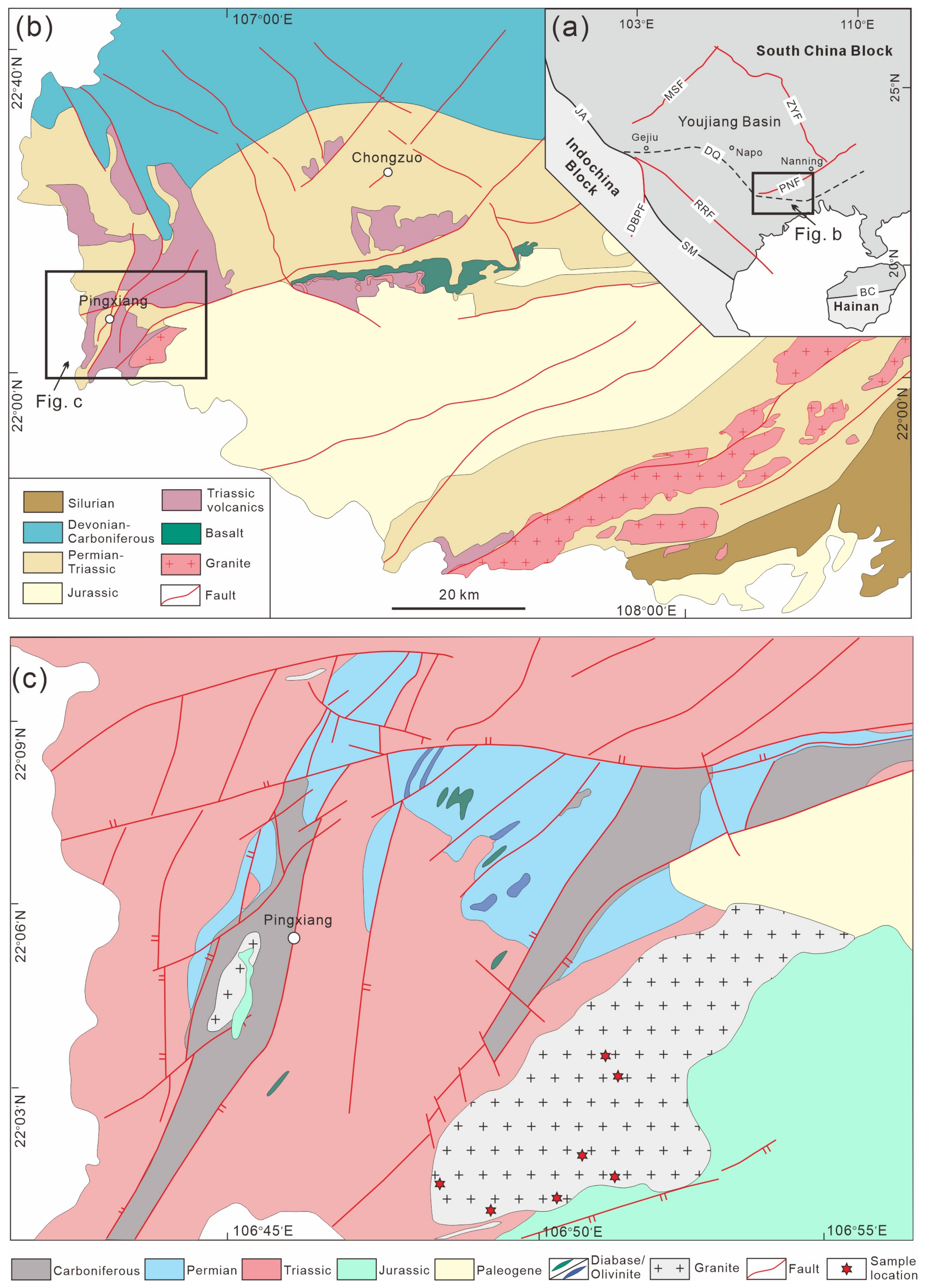
The Yangtze and Cathaysia Blocks collided along the Qinzhou–Hangzhou Suture during the late Mesoproterozoic to early Neoproterozoic [1,2]. Subsequently, rifting along the southwestern margin of the South China Block during the Paleozoic opened the Paleo-Tethys Ocean [3,4]. The final closure of this ocean in the Triassic triggered the Indosinian orogeny, a major Mesozoic tectonothermal event accompanied by terrane accretion and collision [5,6]. This closure is recorded by the Jinshajiang—Ailaoshan and Song Ma suture zones (Figure 1a [7,8,9]), which mark the amalgamation between the South China Block and the Indochina Block [10,11]. The Indosinian orogeny is characterized by Triassic stratigraphic unconformities, large-scale granitic magmatism, fold-thrust belts, and foreland basin development [4,12,13]. Nevertheless, the geodynamic mechanism between the South China and Indochina Blocks remains controversial, particularly the spatiotemporal framework of the subduction and closure of the Paleo-Tethys Ocean. The proposed subduction polarities include southward subduction [14,15], northward subduction [16], and bidirectional subduction [17]. The published closure ages range from the Early–Middle Paleozoic [18] to the Late Paleozoic–Early Mesozoic [4].
Figure 1.
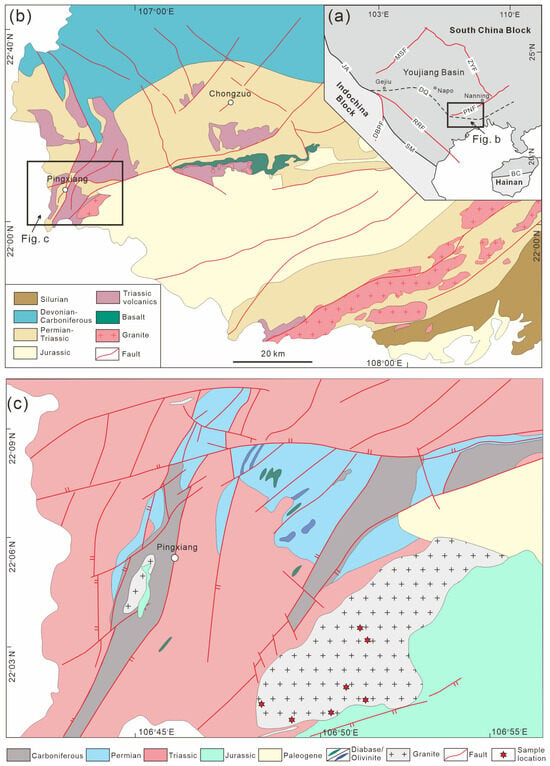
(a) Simplified sketch map of the South China and Indochina Blocks showing the location of the Youjiang Basin (modified after [7]). (b) Simplified geological map of the southern Youjiang Basin and its adjacent areas (modified after [7,8]). (c) Simplified geological map of the Pingxiang area in the southern Youjiang Basin (modified after [9]). JA—Jinshajiang–Ailaoshan suture zone; SM—Song Ma suture zone; BC—Bangxi–Chenxing suture zone; DQ—Dian–Qiong suture zone; DBPF—Dian Bien Phu Fault; RRF—Red River Fault; MSF—Mile–Shizong Fault; ZNF—Ziyun–Nandan Fault; PNF—Pingxiang–Nanning Fault.
The Youjiang Basin, located in the southwestern margin of the South China Block and at the junction between the South China and Indochina Blocks in the eastern end of the Tethyan tectonic domain (Figure 1a), provides a critical opportunity to investigate the collisional amalgamation between the two Blocks, regional magmatic thermal events, and the evolutionary history of the Paleo-Tethys Ocean. Magmatic activity within the basin is dominated by mafic rocks associated with the Middle–Late Permian Emeishan mantle plume, which are mainly distributed in the Bama–Baise–Longlin area and yield ages of 260–250 Ma [19,20]. In contrast, intermediate to felsic magmatism is largely concentrated in the Chongzuo, Pingxiang, and Longzhou areas along the southwestern margin of the basin (Figure 1b) and consists predominantly of peraluminous calc-alkaline intermediate to felsic volcanic rocks, along with minor ultramafic and mafic rocks. These volcanic rocks are mainly hosted in the Middle Triassic Beisi and Banna formations. Numerous studies have focused on these volcanic rocks, but their magmatic source regions and tectonic setting remain controversial, with existing interpretations favoring active continental margin [21], post-collisional [7,22], and volcanic arc [23,24] environments. Compared with the widely developed mafic intrusive rocks and intermediate-felsic volcanic rocks in the Youjiang Basin, systematic investigations of the intermediate to felsic granitoids in this region are still scarce, which hampers the understanding of the tectonic evolution of the Paleo-Tethys Ocean in the southwestern margin of the South China Block. This study focuses on granites from the Pingxiang area in the southern margin of the Youjiang Basin and presents petrological, geochemical, and isotopic geochronological investigations to provide constraints on the subduction and closure processes of the Paleo-Tethys Ocean.
2. Geological Setting and Sample Locations
The Youjiang Basin exhibits a rhomboidal outline, bounded to the northeast by the Ziyun–Nandan Fault, to the southeast by the Pingxiang–Nanning Fault, to the southwest by the Red River Fault, and to the northwest by the Mile–Shizong Fault [25,26,27,28] (Figure 1a). The tectonic evolution of the basin can be divided into three stages: a rift basin stage during late Early Devonian to Late Devonian, a passive continental margin stage from Early Carboniferous to Early Triassic, and a foreland basin stage during the Middle Triassic [25]. The Youjiang Basin is predominantly underlain by Late Paleozoic and Triassic strata, with minor Early Paleozoic and Quaternary strata exposed locally. The intermediate-felsic volcanic rocks in the Chongzuo–Pingxiang–Longzhou area on the southwestern basin margin display geochemical signatures typical of island-arc volcanic rocks formed by subduction processes [24,29], suggesting that the tectonic evolution of the Youjiang Basin was likely governed by the subduction of the Paleo-Tethys Ocean [30].
The Pingxiang area is located in the southwestern margin of the Youjiang Basin. The strata exposed in this area range from the Carboniferous to the Paleogene, among which the Triassic succession is the most extensively developed. (Figure 1c). On the basis of paleontological constraints, contact relationships, and lithological characteristics, the Triassic strata are stratigraphically subdivided into the Lower and Middle series [8]. The Middle Triassic Beisi Formation is composed of limestone, massive intermediate-felsic lavas, and tuff, whereas the Lower Triassic Majiaoling Formation consists predominantly of mudstone and sandstone. The magmatic rocks exposed in the study area include granite, Mesozoic peridotite, and diabase (occurring both as intrusions and dikes) [8] (Figure 1c). These dikes show a directional distribution. The granite plutons occur as NE-trending stocks. They intrude into the Lower Triassic Luolou Group sandstones and shales and are unconformably overlain by the Lower Jurassic Wangmen Formation [8]. Seven representative granite samples from the Pingxiang area were collected (Figure 1c).
3. Analytical Methods
3.1. Sample Preparation and Zircon Cathodoluminescence (CL) Imaging
Sample processing for zircon separation involved crushing, magnetic separation and subsequent heavy liquid separation. Representative zircon grains were hand-picked and mounted on adhesive tape, embedded in epoxy resin, polished to about half their size and photographed under reflected and transmitted light. Zircon structures were studied by CL imaging of zircon grains using a MonoCL4+ instrument mounted on a Quanta 450 FEG scanning electron microscope at the State Key Laboratory of Geological Processes and Mineral Resources, China University of Geosciences (CUG), Wuhan.
3.2. Zircon U-Pb Geochronology
Zircon U-Pb dating and trace element content measurement were conducted by laser ablation–inductively coupled plasma–mass spectrometry (LA–ICP–MS) at Langfang Chengxin Geological Service Co., Ltd., Langfang, China. The laser ablation system was a NewWave UP-213 Nd:YAG solid-state laser (NewWave, Elkridge, MD, USA), and the ICP–MS was an Agilent 7900 quadrupole mass spectrometer (Agilent, Santa Clara, CA, USA). A laser spot size of 30 µm was used, with an energy density of 10 J/cm2 and a repetition rate of 10 Hz. Helium was applied as the carrier gas, and argon was used as the make-up gas; the two gases were mixed via a tee connector before entering the ICP–MS. The NIST SRM 610 glass standard was used to optimize the instrumental conditions to achieve the highest sensitivity, a low oxidation rate, and a stable signal. Each analysis consisted of 20 s of background acquisition, followed by 40 s of sample ablation and 30 s of washout. Data were acquired in the peak-hopping mode, with dwell times of 10 ms for 202Hg and 232Th, 20 ms for 204Pb and 206Pb, 30 ms for 207Pb, 15 ms for 208Pb and 238U, and 6 ms for other elements.
Off-line data reduction, including time-drift correction, isotope ratio calculation, and trace element quantification, was performed using GLITTER 4.0 software (Macquarie University). Zircon standard 91500 was used as the external calibration standard for isotope ratio corrections [31], and zircon standard Plešovice (337 Ma) was analyzed as an unknown to monitor analytical accuracy [32]. The NIST SRM 610 glass standard was used as the external standard for trace element concentration calibration [33]. Concordia diagrams and weighted mean age calculations were prepared using Isoplot 3.0 [34]. The results are listed in Supplementary Table S1.
3.3. Zircon Lu-Hf Isotopic Analysis
In situ zircon Lu-Hf isotopic analyses were carried out using a laser ablation–multi-collector inductively coupled plasma–mass spectrometry (LA–MC-ICP–MS) system at Langfang Chengxin Geological Service Co., Ltd., China. The laser ablation system was a RESOlution SE solid-state laser (Applied Spectra, West Sacramento, CA, USA), and the MC–ICP–MS was a Thermo Scientific Neoma (Thermo Fisher Scientific, Bremen, Germany). The analyses were performed under static mode at low resolution, with a spot size of 38 μm, an energy density of 2.5 J/cm2, and a repetition rate of 8 Hz. Helium was used as the carrier gas within the ablation cell, with nitrogen (N2) added as a sensitivity-enhancing gas.
Each analysis consisted of 20 s of background acquisition, followed by 40 s of sample ablation. Instrumental mass bias was corrected using an exponential law with 179Hf/177Hf = 0.7325. Isobaric interferences of 176Lu and 176Yb on 176Hf were corrected by monitoring 175Lu and 172Yb, respectively, using the recommended 176Lu/175Lu = 0.02655 and 176Yb/172Yb = 0.5887, together with the exponential mass bias correction. Since the 176Lu/177Hf ratios in zircon are typically <0.002, the interference of 176Lu on 176Hf is negligible.
Zircon standard 91500 was used as the external standard for monitoring instrumental stability and mass bias correction and was analyzed twice every five analyses. Zircon standard Plešovice was analyzed as an unknown to monitor the analytical accuracy. The obtained 176Hf/177Hf ratios for the quality control standards are consistent with the recommended values within analytical uncertainty. Off-line data reduction, including interference corrections and mass bias corrections, was performed using ICPMSDataCal 12.0 software [35]. In the in situ zircon Hf isotopic analysis, the initial 176Hf/177Hf ratios and εHf(t) values were calculated using the individual in situ U-Pb age of each analytical spot. All Lu-Hf isotopic data are listed in Supplementary Table S2.
3.4. Whole-Rock Geochemistry
Whole-rock major and trace element analyses were performed at Langfang Chengxin Geological Service Co., Ltd., China. Major element oxides (SiO2, Al2O3, TFe2O3, MgO, CaO, Na2O, K2O, MnO, TiO2, and P2O5) were determined by inductively coupled plasma–optical emission spectrometry (ICP–OES, Agilent 5110, Agilent Technologies, Santa Clara, CA, USA) on solutions prepared from sample digestion or by X-ray fluorescence spectrometry (XRF) on fused glass disks prepared by mixing rock powders with potassium borate or tetraborate. Loss on ignition (LOI) was determined by a gravimetric method after heating the samples at 1000 °C to a constant weight. The analytical procedures followed the Chinese national standard GB/T 14506.28-2010.
Trace elements and rare earth elements were determined by inductively coupled plasma–mass spectrometry (ICP–MS) after two-stage high-pressure digestion using HNO3 and HF. The analytical procedures followed the Chinese national standards GB/T 14506.30-2010 and GB/T 14506.29-2010. All whole-rock major and trace element data are listed in Supplementary Table S3.
4. Results
4.1. Petrography
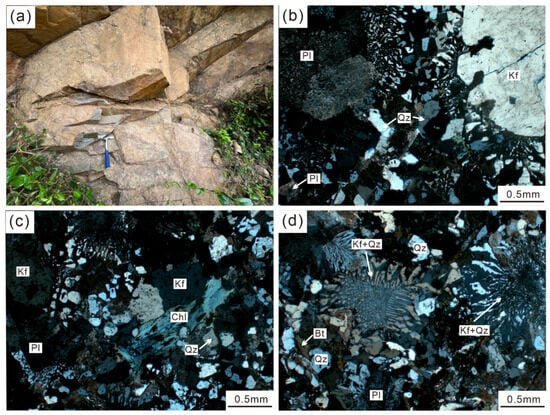
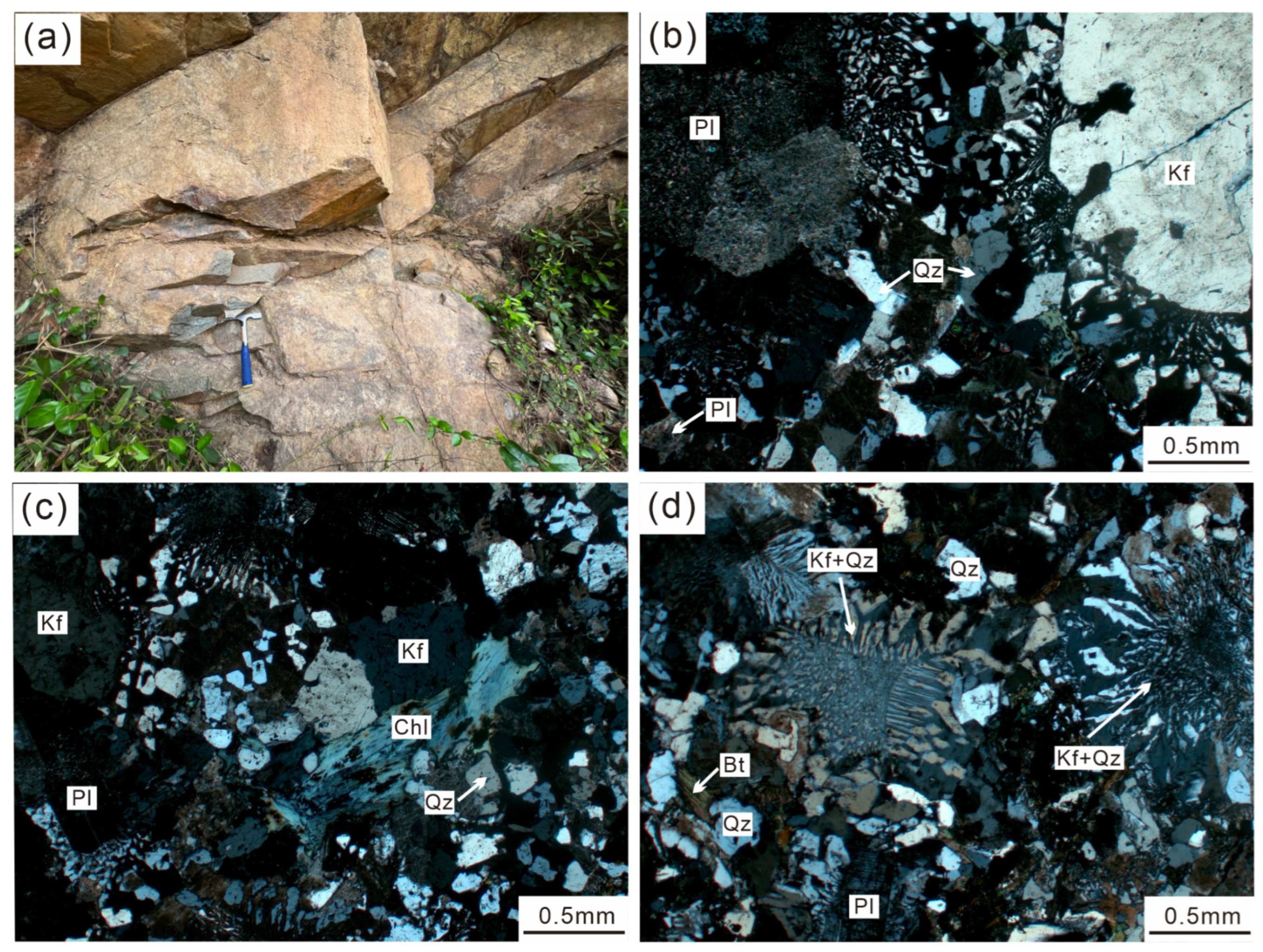
The Pingxiang granite pluton occurs as a stock, and joints are well developed in the rock (Figure 2a). The granites have a porphyraceous texture, with phenocrysts and matrix accounting for 25–35 vol% and 65–75 vol%, respectively (Figure 2b–d). The phenocryst assemblage is mainly composed of K-feldspar (10–15 vol%), with subordinate quartz (5–10 vol%), plagioclase (2–3 vol%), and biotite (1–2 vol%). K-feldspar is subhedral to anhedral and granular, with a grain size of 2–5 mm, displaying minor argillization. Plagioclase occurs as subhedral tabular crystals with a grain size of 3–5 mm and commonly shows sericitization. Quartz occurs as anhedral granular grains with a size of 2–4 mm. Biotite occurs as euhedral to subhedral flakes and is chloritized to various extents, and some have been replaced by chlorite (Figure. 2c). The mineral assemblage of the matrix is consistent with that of the phenocrysts, comprising K-feldspar (25–30 vol%), quartz (25–35 vol%), plagioclase (8–10 vol%), and biotite (2–3 vol%). A typical graphic texture is well developed in the matrix, manifested as vermicular or cuneiform regular intergrowths of K-feldspar and quartz, indicating rapid cooling and crystallization near the cotectic point of the granitic system (Figure 2d). The typical graphic texture, together with the porphyraceous texture and well-developed joints, suggests that the pluton was emplaced at a relatively shallow level and underwent rapid cooling, consistent with its occurrence as a small stock.
Figure 2.
Field aspect (a) and representative photomicrographs (b–d) of the collected granites from the Pingxiang area. Abbreviations, Bt: biotite, Chl: chlorite, Kf: K-feldspar, Pl: plagioclase, Qz: quartz.
4.2. Zircon U-Pb Age Results
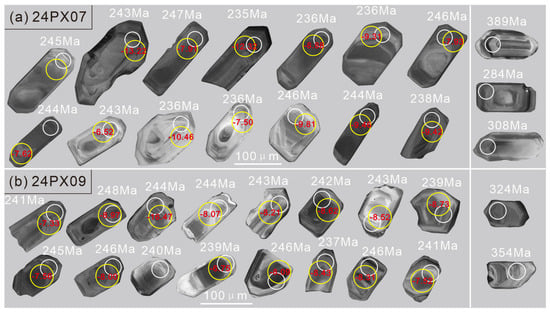
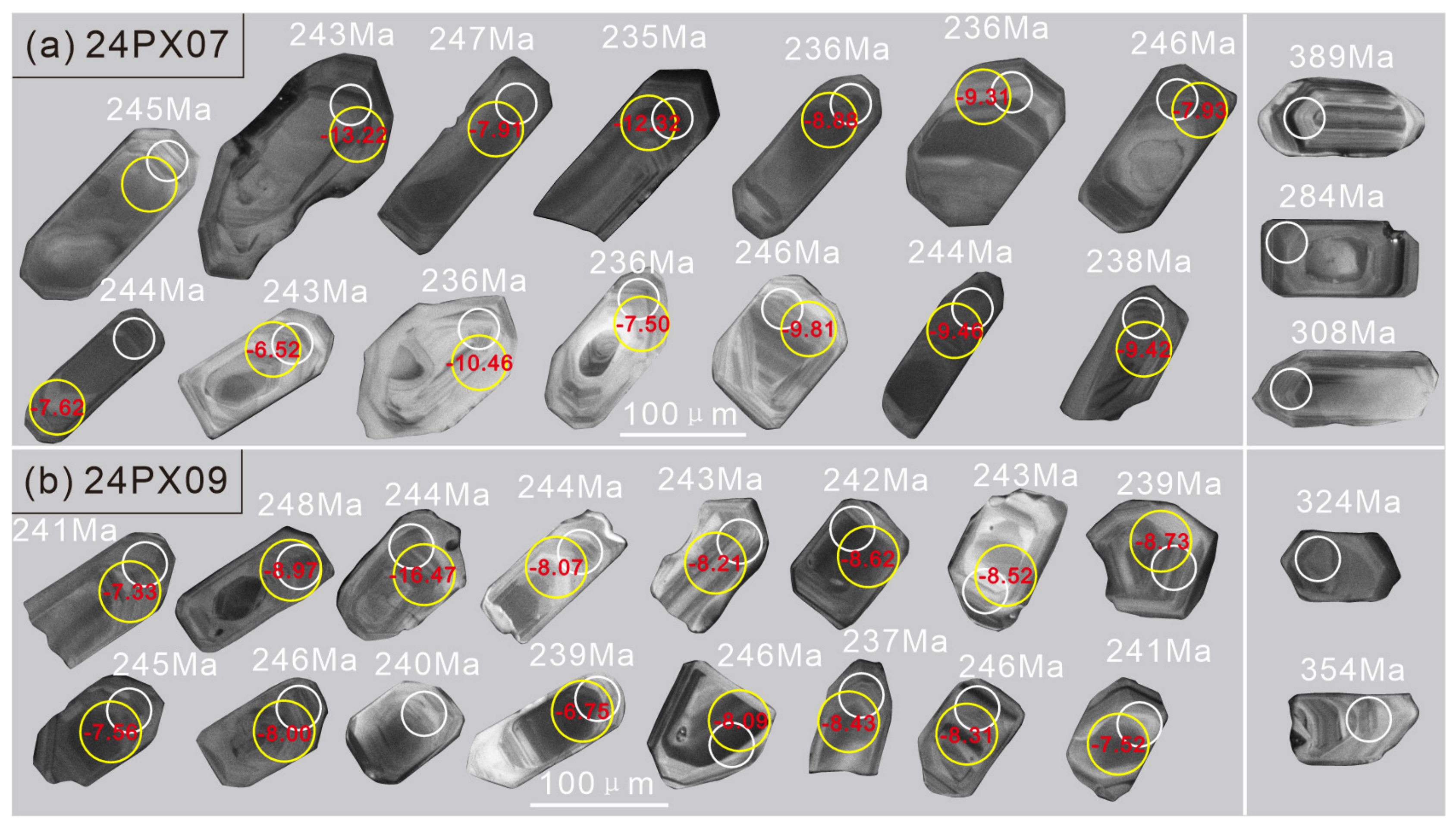
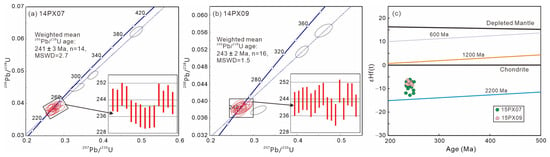
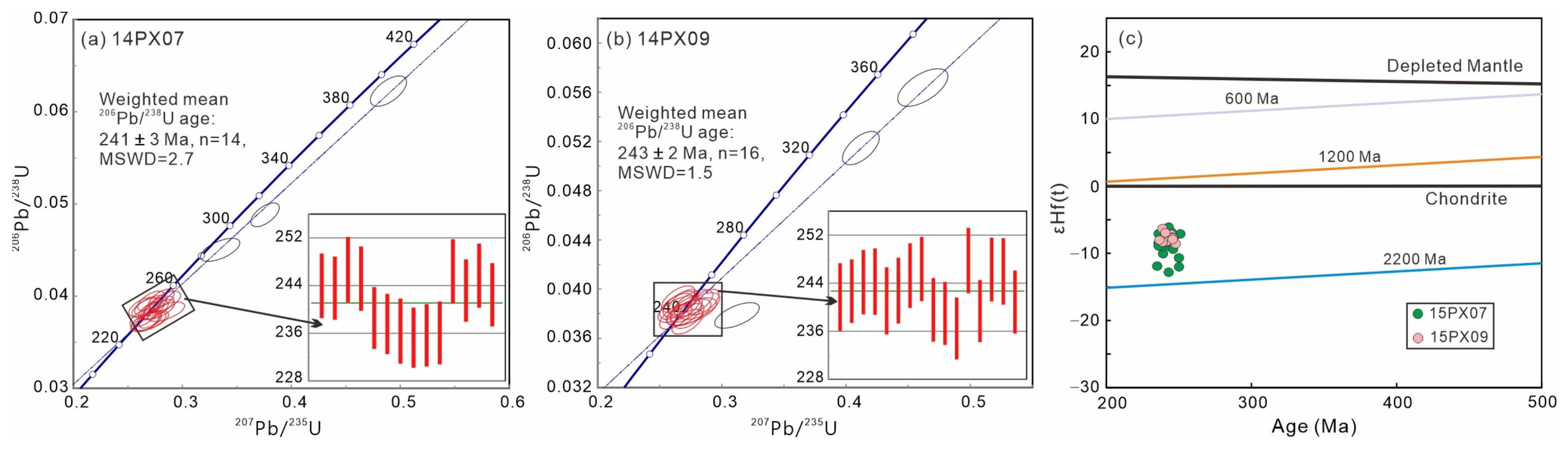
Two representative granite samples (24PX07, 24PX09) from the Pingxiang area were selected for zircon U-Pb dating. Zircon grains separated from these samples are euhedral prismatic and range in length from 80 to 200 μm, with length–width ratios from 1:1 to 3:1 (Figure 3a,b). They have clear oscillatory zoning with high Th/U ratios of 0.19–0.58, typical for magmatic zircon [36]. The samples yielded weighted mean 206Pb/238U ages of 241 ± 3 Ma (24PX07, Figure 4a) and 243 ± 2 Ma (24PX09, Figure 4b). Older inherited zircons with ages of 284–389 Ma were also collected from these samples.
Figure 3.
Cathodoluminescence images of zircon from granites from the Pingxiang area. The values of εHf(t) and U-Pb age are given in the yellow and white circles, respectively.
Figure 4.
LA-ICP-MS zircon U-Pb concordia diagrams and weighted mean 206Pb/238U ages (a,b) and epsilon Hf(t) versus U-Pb age (c) for zircon from the collected granites in the Pingxiang area.
4.3. Zircon Hf Isotopic Results
Thirty-one Lu-Hf isotope analyses were performed on magmatic zircon grains from the granite samples. All zircon grains show negative εHf(t) values ranging from −13.22 to −6.52, with TDM2 model ages from 1654 to 2073 Ma. (Figure 4c). They have present-day 176Hf/177Hf ratios of 0.282266–0.282452 and initial 176Hf/177Hf ratios of 0.282259–0.28244.
4.4. Major and Trace Elements
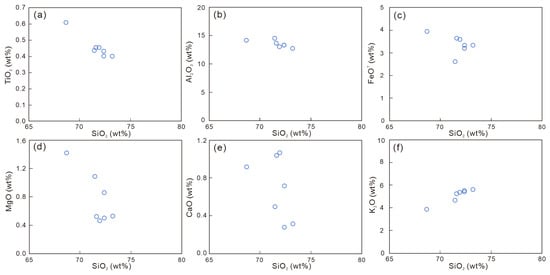
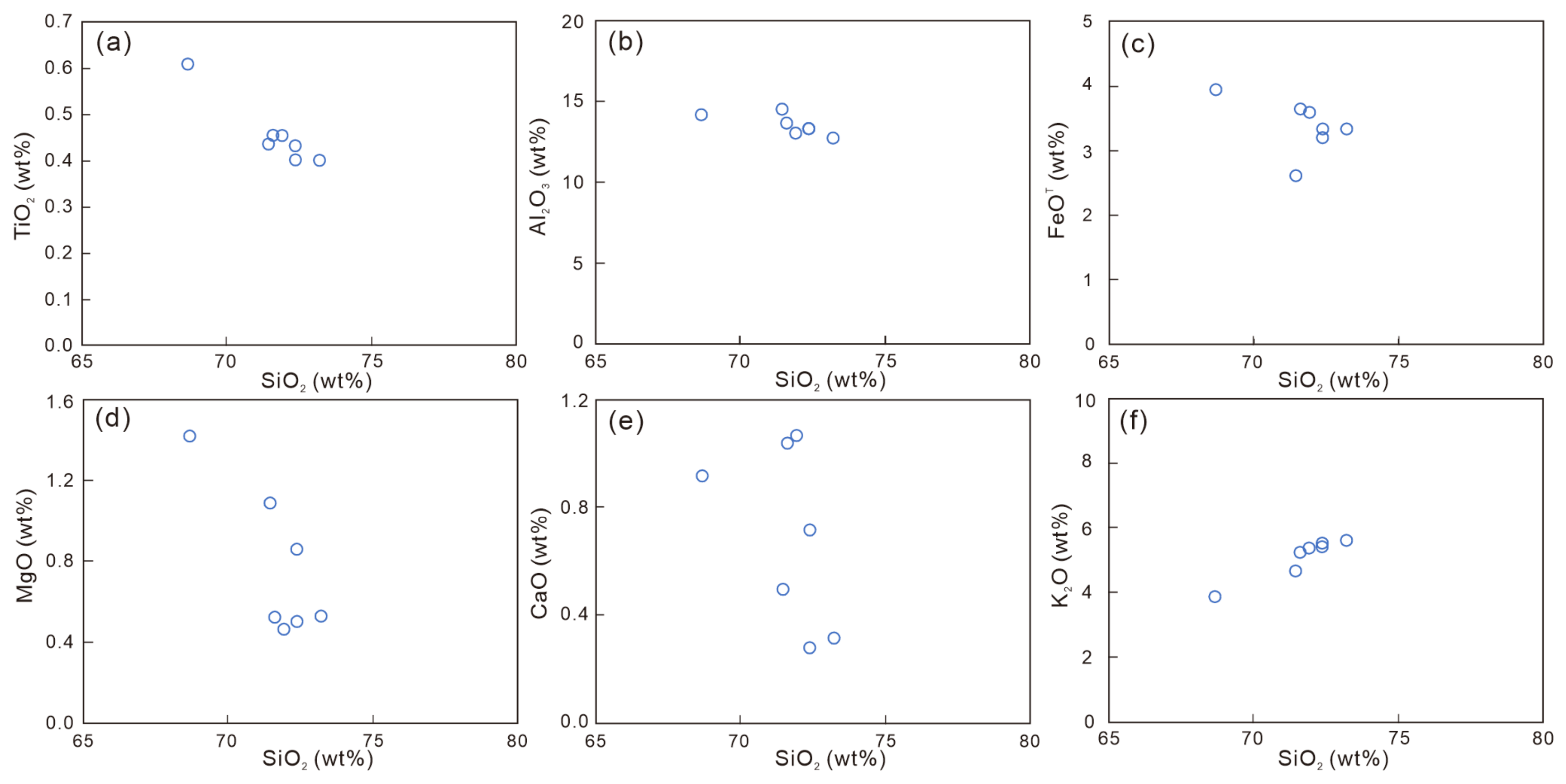
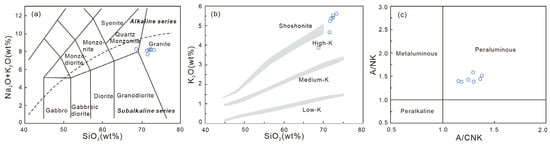
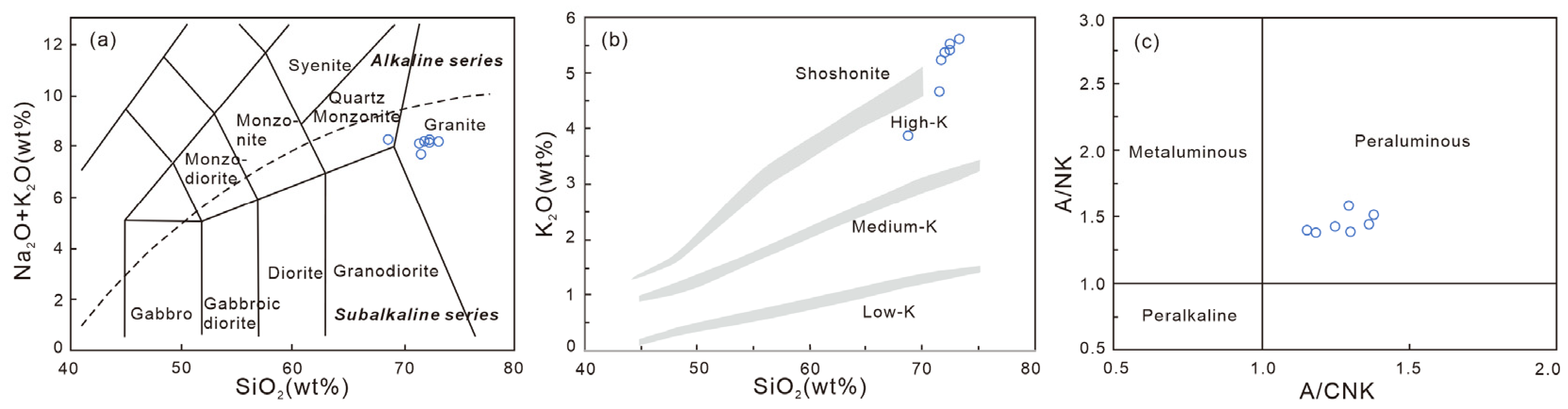
The granites are characterized by high SiO2 (68.68–73.21 wt%) and moderate Al2O3 (12.72–14.17 wt%), Fe2O3T (3.56–4.39 wt%), CaO (0.28–1.06 wt%), MgO (0.46–1.42 wt%) and total alkalis (Na2O + K2O = 7.04–7.57 wt%) contents. In the Harker diagram (Figure 5a–e), TiO2, Al2O3, FeOT, MgO, and CaO show negative correlations with SiO2, whereas K2O exhibits a positive correlation with SiO2 (Figure 5f). In the Na2O + K2O vs. SiO2 diagram, most of them plot in the granite field and belong to the subalkaline series (Figure 6a). They belong to the high-K series (Figure 6b) and peraluminous series (Figure 6c) with A/CNK ratios of 1.16–1.38.
Figure 5.
Selected Harker diagrams for the studied granite samples. (a) SiO2 vs. TiO2; (b) SiO2 vs. Al2O3; (c) SiO2 vs. FeOT; (d) SiO2 vs. MgO; (e) SiO2 vs. CaO; (f) SiO2 vs. K2O.
Figure 6.
Whole-rock major element compositions. (a) Na2O + K2O (wt%) vs. SiO2 (wt%) diagram (after [37]), (b) K2O (wt%) vs. SiO2 (wt%) diagram (after [38]), (c) A/NK (molar Al2O3/(Na2O + K2O)) vs. A/CNK (molar Al2O3/(CaO + Na2O + K2O)) diagram (after [39]).
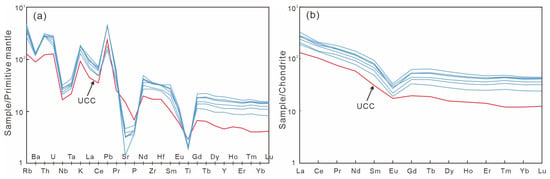
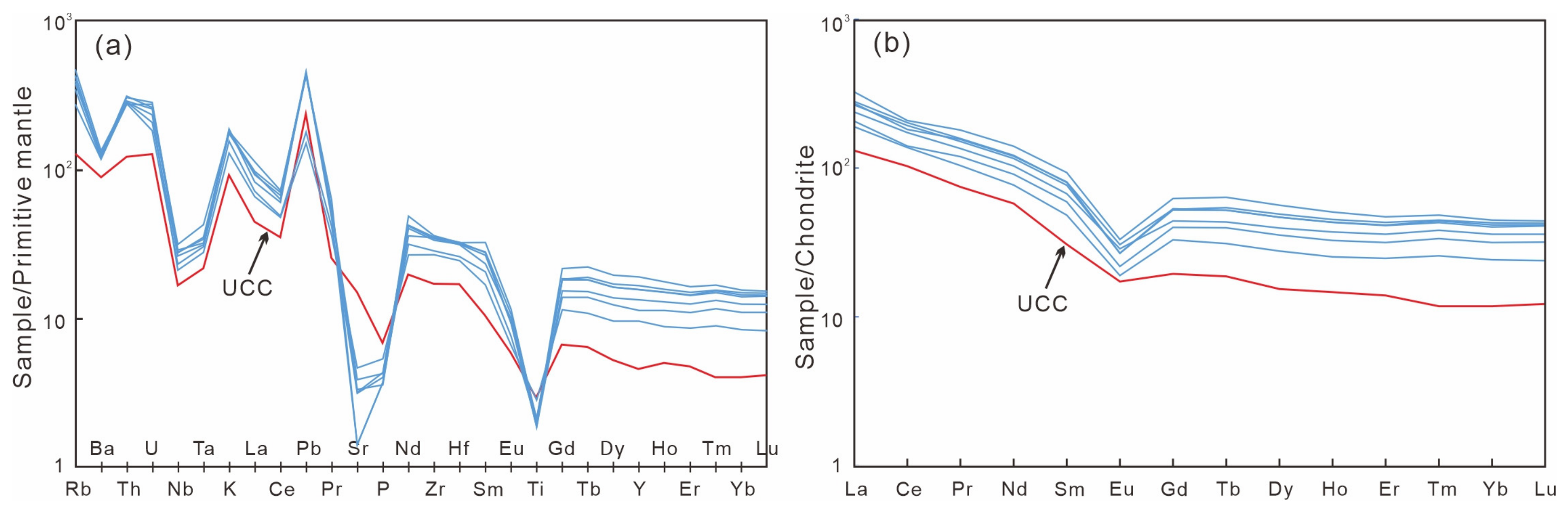
The primitive mantle-normalized multi-element distribution pattern shows that the granites are enriched in Pb, Th, and U and depleted in Nb, Ta, P, and Ti, resulting in distribution patterns similar to the average upper continental crust (Figure 7a). Chondrite-normalized REE distribution patterns show some LREE enrichment (Figure 7b) with (La/Yb)N values of 6.35–7.83 and variable Eu anomalies (Eu/Eu* = 0.41–0.52).
Figure 7.
Whole-rock trace element compositions. Primitive mantle-normalized trace element distribution patterns (a) and chondrite-normalized REE distribution pattern (b) for granites from the Pingxiang area. Normalizing values are from [40]. Values for average upper continental crust (UCC) are from [41].
5. Discussion
5.1. Petrogenesis of the Granites
To ensure that subsequent geochemical discussions reflect primary magmatic signatures rather than secondary overprints, it is necessary to evaluate the impact of alteration. The granites have low loss-on-ignition values (1.17–1.97), suggesting limited post-magmatic alteration. The Ce/Ce* ratio has been widely used to assess whether trace elements migrate in rocks, with a Ce/Ce* ratio < 0.90 or >1.10 indicating a significant migration [42]. Most of the studied samples exhibit Ce/Ce* ratios between 0.90 and 1.10, indicating the trace elements did not migrate significantly. Consequently, most incompatible elements, especially their interelement ratios, are reliable indicators for tracing the origin and evolutionary history of the granites.
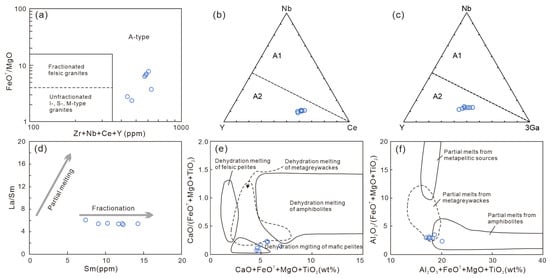
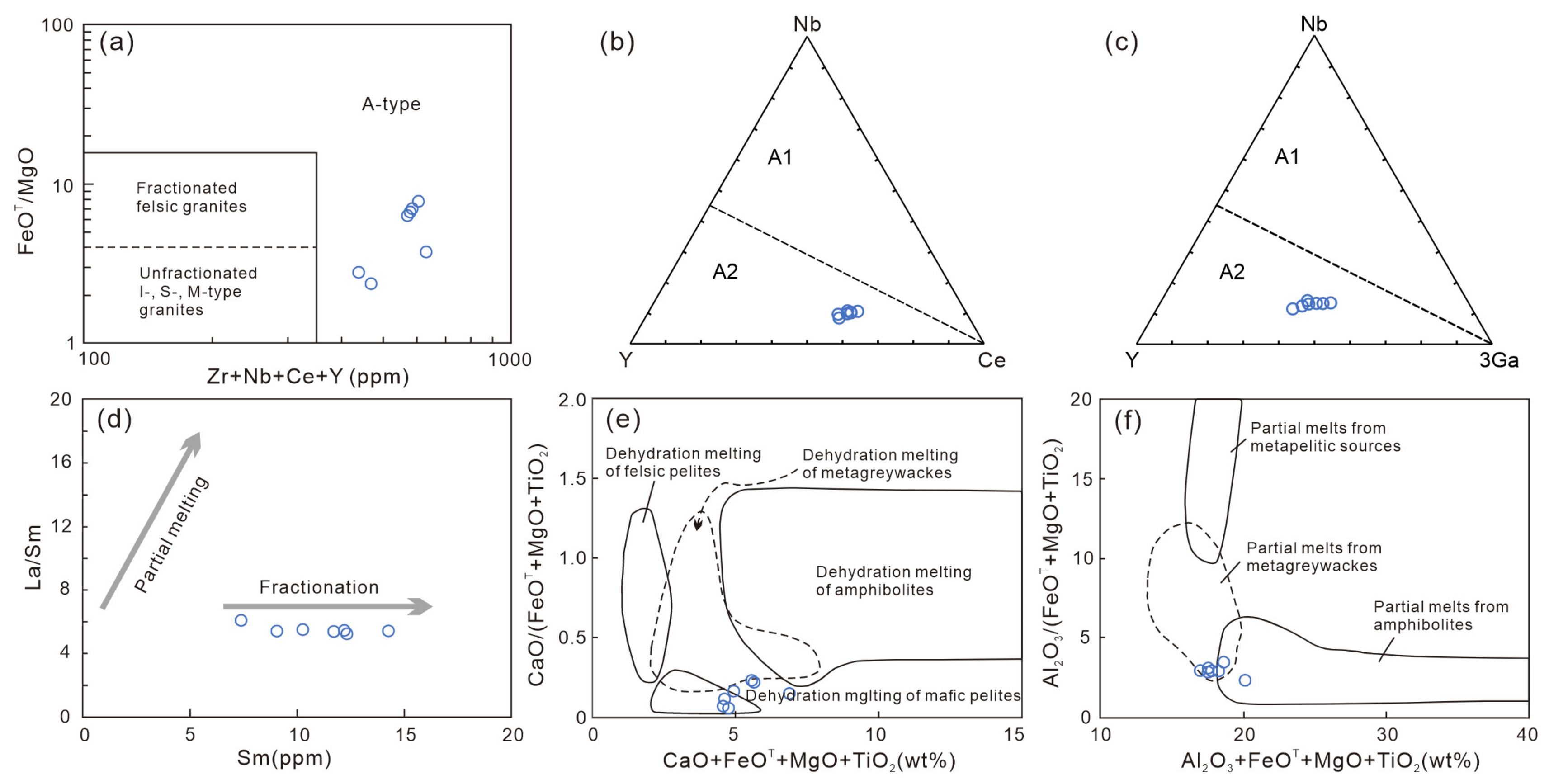
Granitoid rocks are compositionally divided into the genetic I-, S-, M-, and A-types, reflecting the nature of their source [43,44]. The lack of common peraluminous minerals such as muscovite, andalusite, or garnet, coupled with the absence of mafic alkaline minerals like arfvedsonite and riebeckite, indicates that these granites are unlikely to be of typical S-type affinity [45]. The granite samples from the Pingxiang area have high SiO2 (68.68–73.21 wt%) and K2O (3.86–5.60 wt%) and moderate Al2O3 (12.72–14.51 wt%) contents with moderately fractionated REE patterns (LaN/YbN = 6.35–7.83) and negative Ba, Sr, P and Ti anomalies (Figure 7a,b), consistent with geochemical features of A-type granites. They exhibit high FeOT and Zr + Nb + Ce + Y contents and 10,000 × Ga/Al values (>2.6). In the FeOt/MgO vs. (Zr + Nb + Ce + Y) diagram (Figure 8a), the granite samples plot in the A-type field. The zircon saturation temperatures (TZr) for these granites range from 842 °C to 898 °C, indicating minimum estimates of the near-liquidus temperatures, as the TZr calculation assumes that zircon was saturated at the time of crystallization [46,47]. The high Zr contents (298–400 ppm), the presence of magmatic zircon with oscillatory zoning and Th/U ratios > 0.1, and the A-type affinity of the rocks are commonly associated with Zr-saturated melts [46,48]. Therefore, the calculated TZr values can be regarded as indicative of elevated magma thermal conditions. These estimates are higher than those of typical I- and S-type granites (~700–800 °C) [46,49] and are consistent with the high thermal regime characteristic of A-type magmatism. This is in line with lithospheric-extension environments and is likely linked to processes such as magmatic underplating and crustal melting [50]. The occurrence of sporadic diabase intrusions and peridotite in the region [8] suggests that mantle-derived heat through magmatic underplating may have played a critical role in triggering crustal melting. However, the negative εHf(t) (−13.22 to −6.52), together with whole-rock εNd(t) values (–10.9 to –10.2) [51], indicate that the mantle input was predominantly thermal rather than material, with little juvenile mantle material incorporated into the granitic magma. Ferroan granitoids, i.e., Fe-rich and Mg-poor granitoids, which broadly correspond to A-type granites in the compositional sense, can be subdivided into peraluminous, metaluminous, and peralkaline varieties on the basis of ASI values [52]. Therefore, the high A/CNK ratios (1.16–1.38) of the studied samples should be classified as peraluminous A-type granites. This is consistent with documented aluminous (peraluminous) A-type granites from the East Junggar [53], northeastern China [54], and southern China [55], all of which lack typical Al-rich minerals and contain biotite as the dominant mafic phase. Experimental studies show that biotite in peraluminous A-type granites tends to be Al- and Fe-rich [56]. In the absence of Al-rich minerals such as muscovite, cordierite, or garnet, the excess Al2O3 may instead be accommodated in biotite [56,57,58]. A-type granites can form in both post-orogenic and anorogenic environments [49,59,60]. As suggested by [60], A-type granites are subdivided into two groups: A1, derived from mantle sources and emplaced in anorogenic settings, and A2, generated by partial melting of continental or underplated mafic crust in post-collisional or transitional environments. In the Nb-Y-Ce and Nb-Y-3Ga ternary diagrams, the studied granite samples plot in the A2-type field (Figure 8b,c), indicating a post-orogenic tectonic environment.
Figure 8.
Whole-rock major and trace element discrimination diagrams for the studied granites. (a) FeOT/MgO vs. Zr + Nb + Ce + Y (ppm) diagram of [48], (b) Nb-Y-Ce and (c) Nb-Y-3Ga ternary diagrams of [60], (d) La/Sm vs. Sm showing partial melting and fractionation trends, (e) CaO/(FeOT + MgO + TiO2) vs. CaO + FeOT + MgO + TiO2 and (f) Al2O3/(FeOT + MgO + TiO2) vs. Al2O3 + FeOT + MgO + TiO2 diagrams (after [61]).
Granitic melts can result from the melting of meta-igneous or metasedimentary source rocks, fractional crystallization of basaltic magmas or the mixing between the mantle- and crust-derived melts [62,63,64,65,66]. The Pingxiang granites exhibit a horizontal trend in the La/Sm vs. Sm diagram (Figure 8d), suggesting that fractional crystallization was crucial in the formation of these granites. The linear trends in Harker diagrams of major elements (FeOT, MgO, TiO2, and CaO) indicate that fractional crystallization of mafic phases, likely including amphibole and/or pyroxene, played an important role. The studied granite samples have inherited zircon crystals of 284–389 Ma, negative zircon εHf(t) values ranging from −13.22 to −6.52, and TDM2 model ages of 1654 to 2073 Ma (Figure 4c). Whole-rock Sm-Nd isotopic data reveal that the Pingxiang granites exhibit low εNd(t) values (−10.9 to −10.2) with TDM2 model ages of 1.8–1.9 Ga [51]. These isotopic features are inconsistent with a simple fractional crystallization model from basaltic magmas and instead point to a crustal source affinity [41,67]. In the CaO/(FeOT + MgO + TiO2) vs. (CaO + FeOT + MgO + TiO2) and Al2O3/(MgO + FeOT + TiO2) vs. (Al2O3 + FeOT + MgO + TiO2) diagrams (Figure 8e,f), these samples fall within the fields of metagraywacke and mafic pelite sources. Low Rb/Ba (0.21–0.32) coupled with high CaO/Na2O (average of 0.30) ratios of the granite samples support that they were derived primarily from partial melting of a mixed graywacke and pelite source [68,69]. Peraluminous A-type granites have been demonstrated to originate from high-temperature (>850 °C) and low-pressure (≤0.8 GPa) partial melting of metasedimentary sources [54,57]. The TDM2 ages (1.65–2.07 Ga) correspond to Paleoproterozoic crustal residence times, which are consistent with the well-documented Paleoproterozoic basement of the South China Block [70,71]. In summary, we consider Paleoproterozoic metasedimentary rocks in the upper–middle crust of the South China Block as the most plausible source of the Pingxiang granites.
5.2. Tectonic Implication
The Ailaoshan and Song Ma suture zones, together with their adjacent regions, represent the key tectonic boundary between the South China Block and the Indochina Block, recording the closure of the eastern Paleo-Tethys Ocean and the subsequent Indosinian orogeny [4,72,73], and within these zones, well-preserved ophiolites, arc magmatic rocks, and post-collisional granitoids provide critical constraints on the tectonic evolution from oceanic subduction through continental collision to post-orogenic extension.
The ophiolite, which crops out in the Song Ma suture zone, has zircon U-Pb ages of 340–280 Ma [74,75]. Zircon U-Pb ages of diabase, gabbro, and plagiogranite from ophiolites in the Ailaoshan suture zone range from 382 to 362 Ma [76,77]. The Babu ophiolite was identified in the Dian–Qiong suture zone and has zircon U-Pb ages of 272–265 Ma [75,78]. This indicates that the Paleo-Tethys oceanic crust between the South China and Indochina Blocks persisted until the Late Carboniferous. Subsequent subduction of the Paleo-Tethys Ocean resulted in voluminous arc-related magmatism. A series of ca. 251–246 Ma felsic and mafic volcanic rocks with arc-type geochemical affinities has been reported in the southwestern Youjiang Basin [16,24]. In the Junying–Bangxi area of Hainan Island, a ca. 269 Ma OIB-like ultramafic-mafic lava suite has been recognized [79] and is interpreted to have formed in a back-arc basin related to the subduction [80]. This evidence implies the northward subduction of the Paleo-Tethys Ocean beneath the South China Block during the Late Permian to Early Triassic. The ca. 228 Ma dacite from the Beisi Formation in the Youjiang Basin was reported and is considered to show arc-related geochemical signatures [29], which indicates that the northward subduction of the Paleo-Tethys Ocean beneath the South China Block may have lasted until ca. 228 Ma.
The timing of the collision between the South China and Indochina Blocks has long been controversial. The published ages include the Devonian [81,82], Carboniferous [83,84], Late Permian–Early Triassic [85,86] and Early Triassic [3,87,88]. The Song Ma eclogite experienced peak P-T conditions of 24–27 kbar and 650–750 °C with a low thermal gradient of 8 °C/km and recorded a metamorphic age of 230.5 ± 8.2 Ma, which is interpreted to represent the closure age of the Paleo-Tethys Ocean that separated the South China and Indochina Blocks [89]. The studied granites with ages of 243–241 Ma in the Pingxiang area were identified as A2-type, indicating a late-orogenic extensional environment. Large-scale 251–241 Ma volcanic rocks were identified from the Beisi and Banba Formations in the southwestern Youjiang Basin [90,91]. These volcanic rocks are dominated by rhyolites and are considered to exhibit S-type [90] and A-type [91] affinities. Arc-, collision- and extension-related magmatism coexisted at ca. 251–241 Ma in the southwestern Youjiang Basin. It is inferred that a tectonic transition from subduction to extension occurred at ca. 251–241 Ma. However, the geodynamic mechanism responsible for this extension can be related to slab rollback, lithospheric delamination, or slab breakoff. Slab rollback typically generates back-arc extensional basins with widespread basaltic magmatism and a well-defined spatial zonation from the arc to the back-arc region [92]. Such widespread basaltic magmatism is not observed in the study area, and arc-related magmatism is spatially restricted to the southwestern margin of the Youjiang Basin. This does not strongly support a rollback scenario, as rollback would be expected to produce more extensive and compositionally diverse magmatism [92,93,94]. Lithospheric delamination can induce high-temperature crustal melting but would generate widespread extension with substantial mantle input, yielding more radiogenic εHf(t) values [95,96,97]. The consistently negative εHf(t) values (−13.22 to −6.52) and ancient TDM2 model ages (1.65–2.07 Ga) of the Pingxiang granites indicate a dominantly crustal source with limited mantle contribution, which is less consistent with a delamination model. In contrast, the slab breakoff model appears to be the most compatible with the coexistence of arc-, collision- and extension-related magmatism and subsequent HP metamorphism within a narrow time window. As the Paleo-Tethys oceanic slab continued to subduct northward beneath the South China Block, the arrival of the buoyant Indochina continental crust at the trench likely triggered slab breakoff at depth [98,99]. This process would have generated asthenospheric upwelling through the slab window, which provided the high heat flux required for partial melting of the overlying ancient crust to produce the 243–241 Ma A2-type granites in this study, while simultaneously maintaining the thermal and fluid input necessary for arc-related magmatism [16,24,29]. The subsequent sinking of the detached slab facilitated the exhumation of ~230 Ma high-pressure rocks [89], and the upwelling created localized extensional regimes within the convergent setting.
6. Conclusions
(1) The Pingxiang granites in the southwestern Youjiang Basin belong to the high-K and peraluminous series with A/CNK ratios of 1.16–1.38. They have high SiO2 and K2O and moderate Al2O3 contents with moderately fractionated REE patterns (LaN/YbN = 6.35–7.83) and negative Ba, Sr, P and Ti anomalies, consistent with peraluminous A2-type granites.
(2) The granites have LA-ICP-MS zircon U-Pb ages of 243–241 Ma with negative εHf(t) values ranging from −13.22 to −6.52 and TDM2 model ages from 1654 to 2073 Ma. They were formed by partial melting of Paleoproterozoic metasedimentary rocks in an extensional setting.
(3) Combined with existing data, we suggest that the 243–241 Ma extensional event is related to the subduction-to-collision transition likely induced by slab breakoff during the closure of the Paleo-Tethys Ocean.
Supplementary Materials
The following supporting information can be downloaded at: https://www.mdpi.com/article/10.3390/min16090889/s1, Table S1. LA-ICPMS zircon U-Pb data for granites from the Pingxiang area; Table S2. LA-MC-ICPMS zircon Lu-Hf isotopic data for the studied granites; Table S3. Whole-rock compositions of the studied granites.
Author Contributions
Investigation, Z.L., K.D. and J.Y.; Writing—original draft preparation, Z.L.; Writing—review and editing, K.D., J.Y. and Y.W. All authors have read and agreed to the published version of the manuscript.
Funding
This study was funded by grants from the Guangxi Science and Technology Program (AD23026178) and the Guangxi Young Talents Research Funding Program.
Data Availability Statement
The data presented in this study are openly available in Mendeley Data at 10.17632/nns7kv57hs.2, reference number [100].
Acknowledgments
The authors would like to thank the University Engineering Research Center of “Satellite +” Space AI Intelligent Governance of Natural Resources, Guangxi, for providing the necessary research platform and technical support.
Conflicts of Interest
The authors declare no conflicts of interest.
References
- Li, Z.X.; Zhang, L.H.; Powell, C.M. South China in Rodinia: Part of the missing link between Australia-East Antarctica and Laurentia? Geology 1995, 23, 407410. [Google Scholar] [CrossRef] [Scilit]
- Zhao, J.H.; Zhou, M.F.; Yan, D.P.; Zheng, J.P.; Li, J.W. Reappraisal of the ages of Neoproterozoic strata in south China: No connection with the Grenvillian orogeny. Geology 2011, 39, 299–302. [Google Scholar] [CrossRef] [Scilit]
- Lepvrier, C.; Maluski, H.; Tich, V.V.; Leyreloup, A.; Phan, T.T.; Nguyen, V.V. The Early Triassic Indosinian orogeny in Vietnam (Truong Son Belt and Kontum Massif): Implications for the geodynamic evolution of Indochina. Tectonophysics 2004, 393, 87–118. [Google Scholar] [CrossRef] [Scilit]
- Faure, M.; Lepvrier, C.; Nguyen, V.V.; Vu, T.V.; Lin, W.; Chen, Z. The south China block-Indochina collision: Where, when, and how? J. Asian Earth Sci. 2014, 79, 260–274. [Google Scholar] [CrossRef] [Scilit]
- Li, J.H.; Zhao, G.C.; Johnston, S.T.; Dong, S.W.; Zhang, Y.Q.; Xin, Y.J.; Wang, W.B.; Sun, H.S.; Yu, Y.Q. Permo-Triassic structural evolution of the Shiwandashan and Youjiang structural belts, South China. J. Struct. Geol. 2017, 100, 24–44. [Google Scholar] [CrossRef] [Scilit]
- Ma, X.; Wang, X. Re-exploration of Indosinian granites in South China: A case study from the Ziyunshan granitic complex in western Hunan and the Shibanwan complex granites in northeastern Guangxi. Geol. Rev. 2023, 6, 2047–2081, (In Chinese with English abstract). [Google Scholar]
- Gan, C.S.; Wang, Y.J.; Zhang, Y.Z.; Qian, X.; Zhang, A.M. The assembly of the south China and Indochina blocks: Constraints from the Triassic felsic volcanics in the Youjiang basin. Geol. Soc. Am. Bull. 2021, 133, 2097–2112. [Google Scholar] [CrossRef] [Scilit]
- Bureau of Geology and Mineral Resources of Guangxi Zhuang Autonomous Region. Regional Geology of Guangxi Zhuang Autonomous Region; Geological Publishing House: Beijing, China, 1985; pp. 1–853. (In Chinese)
- Regional Geological Survey Team of Guangxi. Geological Map of the Pingxiang Sheet (1:200,000); Bureau of Geology and Mineral Resources of Guangxi Zhuang Autonomous Region: Nanning, China, 1976.
- Wang, X.F.; Metcalfe, I.; Jian, P.; He, L.Q.; Wang, C.S. The Jinshajiang-Ailaoshan suture zone, China: Tectonostratigraphy, age and evolution. J. Asian Earth Sci. 2000, 18, 675–690. [Google Scholar] [CrossRef] [Scilit]
- Zhang, Q.; Wang, C.Y.; Liu, D.; Jian, P.; Qian, Q.; Zhou, G.Q.; Robinson, P.T. A brief review of ophiolites in China. J. Asian Earth Sci. 2008, 32, 308–324. [Google Scholar] [CrossRef] [Scilit]
- Qiu, L.; Yan, D.P.; Yang, W.X.; Wang, J.B.; Tang, X.L.; Ariser, S. Early to Middle Triassic sedimentary records in the Youjiang Basin, South China: Implications for Indosinian orogenesis. J. Asian Earth Sci. 2017, 141, 125–139. [Google Scholar] [CrossRef] [Scilit]
- Yang, W.X.; Yan, D.P.; Qiu, L.; Wells, M.L.; Dong, J.M.; Gao, T.; Zhang, Z.; Mu, H.X.; Wang, X.W.; Wang, F.Y. Formation and forward propagation of the Indosinian foreland fold-thrust belt and Nanpanjiang foreland basin in SW China. Tectonics 2021, 40, e2020TC006552. [Google Scholar] [CrossRef] [Scilit]
- Cai, J.X.; Zhang, K.J. A new model for the Indochina and South China collision during the Late Permian to the Middle Triassic. Tectonophysics 2009, 467, 35–43. [Google Scholar] [CrossRef] [Scilit]
- Liu, J.L.; Tran, M.D.; Tang, Y.; Nguyen, Q.L.; Tran, T.H.; Wu, W.B.; Chen, J.F.; Zhang, Z.C.C.; Zhao, Z.D. Permo-Triassic granitoids in the northern part of the Truong Son belt, NW Vietnam: Geochronology, geochemistry and tectonic implications. Gondwana Res. 2012, 22, 628–644. [Google Scholar] [CrossRef] [Scilit]
- Qin, X.F.; Wang, Z.Q.; Zhang, Y.L.; Pan, L.Z.; Hu, G.; Zhou, F.S. Geochemistry of Permian mafic igneous rocks from the Napo-Qinzhou tectonic belt in southwest Guangxi, Southwest China: Implications for arc-back arc basin magmatic evolution. Acta Geol. Sin.-Engl. 2012, 86, 1182–1199. [Google Scholar] [CrossRef] [Scilit]
- Xu, J.; Xia, X.P.; Cai, K.D.; Lai, C.K.; Liu, X.J.; Yang, Q.; Zhou, M.L.; Ma, P.F.; Zhang, L. Remnants of a Middle Triassic island arc on western margin of South China Block: Evidence for bipolar subduction of the Paleotethyan Ailaoshan Ocean. Lithos 2020, 360, 105447. [Google Scholar] [CrossRef] [Scilit]
- Carter, A.; Clift, P.D. Was the Indosinian orogeny a Triassic mountain building or a thermotectonic reactivation event? C. R. Geosci. 2008, 340, 83–93. [Google Scholar] [CrossRef] [Scilit]
- Fan, W.M.; Zhang, C.H.; Wang, Y.J.; Feng, G.; Peng, T. Geochronology and geochemistry of Permian basalts in western Guangxi Province, Southwest China: Evidence for plume-lithosphere interaction. Lithos 2008, 102, 218–236. [Google Scholar] [CrossRef] [Scilit]
- Li, Z.L.; Liu, X.J.; Xu, J.F.; Kang, Z.Q.; Shi, Y.; Huang, W.L.; Chen, X.F.; Wu, W.N.; Liang, Q.D.; Yao, Y. Geochemical evolution characteristics and regional tectonic significance of mafic rocks from Youjiang Basin. J. Guilin Univ. Technol. 2015, 35, 727–735, (In Chinese with English abstract). [Google Scholar]
- Liang, J.C.; Deng, J.X.; Chen, M.H.; Jiang, B.C.; Zhu, J.J. The Early Triassic intermediate-acid volcanics and its tectonic environment in southwestern Guangxi. Geotecton. ET Metallog. 2001, 25, 141–148, (In Chinese with English abstract). [Google Scholar]
- Wang, Y.; Deng, J.F. The geodynamic significance of petrochemical features of Triassic strongly peraluminous igneous rocks in the southern part of Guangxi province. Geol.-Geochem. 2003, 31, 35–42, (In Chinese with English abstract). [Google Scholar]
- Zhang, K.; Li, J.F.; Cheng, S.B.; Li, K.; Bao, B.; Liu, A.S.; Xia, J. Zircon U-Pb Ages, Hf Isotopes, and Geochemical Characteristics of the Triassic Beisi Formation Volcanic Rocks in Chongzuo, Guangxi: Implications for the Evolution of the Paleo-Tethys Ocean. Acta Geol. Sin. 2026, 47, 613–628, (In Chinese with English abstract). [Google Scholar]
- Qin, X.F.; Wang, Z.Q.; Zhang, Y.L.; Pan, L.Z.; Hu, G.A.; Zhou, F.S. Geochronology and geochemistry of Early Mesozoic acid volcanic rocks from Southwest Guangxi: Constraints on tectonic evolution of the southwestern segment of Qinzhou-Hangzhou joint belt. Acta Geol. Sin. 2011, 27, 794–808, (In Chinese with English abstract). [Google Scholar]
- Du, Y.S.; Huang, H.; Yang, J.H.; Huang, H.W.; Tao, P.; Huang, Z.Q.; Hu, L.S.; Xie, C.X. The basin translation from Late Paleozoic to Triassic of the Youjiang Basin and its tectonic signification. Geol. Rev. 2013, 59, 1–11, (In Chinese with English abstract). [Google Scholar]
- Gan, C.S.; Wang, Y.J.; Zhang, Y.Z.; Liu, H.C.; Zhang, L.M. The identification and implications of the Late Jurassic shoshonitic high-Mg andesite from the Youjiang basin. Acta Geol. Sin. 2016, 32, 3281–3294, (In Chinese with English abstract). [Google Scholar]
- Gan, C.S.; Wang, Y.J.; Barry, T.L.; Zhang, Y.Z.; Qian, X. Late Jurassic high-Mg andesites in the Youjiang Basin and their significance for the southward continuation of the Jiangnan Orogen, South China. Gondwana Res. 2020, 77, 260–273. [Google Scholar] [CrossRef] [Scilit]
- Hu, R.Z.; Fu, S.L.; Huang, Y.; Zhou, M.F.; Fu, S.H.; Zhao, C.H.; Wang, Y.J.; Bi, X.W.; Xiao, J.F. The giant South China Mesozoic low-temperature metallogenic domain: Reviews and a new geodynamic model. J. Asian Earth Sci. 2017, 137, 3–34. [Google Scholar] [CrossRef] [Scilit]
- Li, Z.L.; Liu, X.J.; Xiao, W.J.; Bao, H.Y.; Shi, Y.; Liu, L.; Liao, S.; Qin, X.Z. Geochronology, geochemistry and Hf isotopes of volcanic rocks in Pingxiang area, southwest Guangxi: Implications for the latest stage of Paleo-Tethyan Ocean northward subuction. J. Geomech. 2019, 25, 932–946, (In Chinese with English abstract). [Google Scholar]
- Du, Y.S.; Huang, H.W.; Huang, Z.Q.; Xu, Y.J.; Yang, J.H.; Huang, H. Basin translation from late Palaeozoic to Triassic of Youjiang Basin and its tectonic significance. Geol. Sci. Technol. Inf. 2009, 28, 10–15, (In Chinese with English abstract). [Google Scholar]
- Wiedenbeck, M.; Alle, P.; Corfu, F.; Griffin, W.L.; Meier, M.; Oberli, F.; Von Quadt, A.; Roddick, J.C.; Spiegel, W. Three natural zircon standards for U-Th-Pb, Lu-Hf, trace element and REE analyses. Geostand. Newsl. 1995, 19, 1–23. [Google Scholar] [CrossRef] [Scilit]
- Sláma, J.; Košler, J.; Condon, D.J.; Crowley, J.L.; Gerdes, A.; Hanchar, J.M.; Horstwood, M.S.A.; Morris, G.A.; Nasdala, L.; Norberg, N.; et al. Plešovice zircon—A new natural reference material for U–Pb and Hf isotopic microanalysis. Chem. Geol. 2008, 249, 1–35. [Google Scholar] [CrossRef] [Scilit]
- Pearce, N.J.G.; Perkins, W.T.; Westgate, J.A.; Gorton, M.P.; Jackson, S.E.; Neal, C.R.; Chenery, S.P. A compilation of new and published major and trace element data for NIST SRM 610 and NIST SRM 612 glass reference materials. Geostand. Newsl. 1997, 21, 115–144. [Google Scholar] [CrossRef] [Scilit]
- Ludwig, K.R. Isoplot 3: A geochronological toolkit for Microsoft excel. Berkeley Geochronol. Cent. Spec. Publ. 2003, 4, 70. [Google Scholar]
- Liu, Y.S.; Gao, S.; Hu, Z.C.; Gao, C.G.; Zong, K.Q.; Wang, D.B. Continental and oceanic crust recycling-induced melt-peridotite interactions in the Trans-North China Orogen: U-Pb dating, Hf isotopes and trace elements in zircons of mantle xenoliths. J. Petrol. 2010, 51, 537–571. [Google Scholar] [CrossRef] [Scilit]
- Rubatto, D.; Gebauer, D. Use of Cathodoluminescence for U-Pb Zircon Dating by Ion Microprobe: Some Examples from the Western Alps. In Cathodoluminescence in Geosciences; Pagel, M., Barbin, V., Blanc, P., Ohnenstetter, D., Eds.; Springer: Berlin/Heidelberg, Germany, 2000; pp. 373–400. [Google Scholar]
- Middlemost, E.A. Naming materials in the magma/igneous rock system. Earth Sci. Rev. 1994, 37, 215–224. [Google Scholar] [CrossRef] [Scilit]
- Morrison, G.W. Characteristics and tectonic setting of shoshonite rock association. Lithos 1980, 13, 97–108. [Google Scholar] [CrossRef] [Scilit]
- Maniar, P.D.; Piccoli, P.M. Tectonic discrimination of granitoids. Geol. Soc. Am. Bull. 1989, 101, 635–643. [Google Scholar] [CrossRef] [Scilit]
- Sun, S.S.; McDonough, W.F. Chemical and isotopic systematics of oceanic basalts: Implications for mantle composition and processes. In: Saunders, A.D., Norry, M.J. (Eds.), Magmatism in the Ocean Basins. Geol. Soc. Lond. Spec. Publ. 1989, 42, 528–548. [Google Scholar]
- Rudnick, R.L.; Gao, S. Composition of the continental crust. Treatise Geochem. 2003, 1, 1–64. [Google Scholar] [CrossRef] [Scilit]
- Polat, A.; Hofmann, A.W.; Rosing, M.T. Boninite-like volcanic rocks in the 3.7–3.8 Ga Isua greenstone belt, West Greenland: Geochemical evidence for intraoceanic subduction zone processes in the early Earth. Chem. Geol. 2002, 184, 231–254. [Google Scholar] [CrossRef] [Scilit]
- Chappell, B.W.; White, A.J.R. Two contrasting granite types. Pac. Geol. 1974, 7, 173–174. [Google Scholar]
- Collins, W.J.; Beams, S.D.; White, A.J.R.; Chappell, B.W. Nature and origin of A-type granites with particular reference to southeastern Australia. Contrib. Mineral. Petrol. 1982, 80, 189–200. [Google Scholar] [CrossRef] [Scilit]
- Chappell, B.W.; White, A.J.R. I- and S-type granites in the Lachlan Fold Belt. Earth Environ. Trans. R. Soc. Edinb. 1992, 83, 1–26. [Google Scholar] [CrossRef] [Scilit]
- Miller, C.F.; McDowell, S.M.; Mapes, R.W. Hot and cold granites? Implications of zircon saturation temperatures and preservation of inheritance. Geology 2003, 31, 529–532. [Google Scholar] [CrossRef] [Scilit]
- Watson, E.B.; Harrison, T.M. Zircon saturation revisited: Temperature and composition effects in a variety of crustal magma types. Earth Planet. Sci. Lett. 1983, 64, 295–304. [Google Scholar] [CrossRef] [Scilit]
- Whalen, J.B.; Currie, K.L.; Chappell, B.W. A-type granites: Geochemical characteristics, discrimination and petrogenesis. Contrib. Mineral. Petrol. 1987, 95, 407–419. [Google Scholar] [CrossRef] [Scilit]
- Bonin, B. A-type granites and related rocks: Evolution of a concept, problems and prospects. Lithos 2007, 97, 1–29. [Google Scholar] [CrossRef] [Scilit]
- Wu, F.Y.; Yang, J.H.; Lo, C.H.; Wilde, S.A.; San, D.Y.; Jahn, B.M. The Heilongjiang Group: A Jurassic accretionary complex in the Jiamusi Massif at the Western Pacific margin of northeastern China. Isl. Arc 2007, 16, 156–172. [Google Scholar] [CrossRef] [Scilit]
- Huang, W.M.; Liu, X.J.; Li, Z.L.; Wei, Y.L.; Guo, J.L.; Han, Y.Y.; Zhao, B. Tectonic evolution of the Paleo-Tethys Ocean in southwest Guangxi: Evidence from granites in Pingxiang area, SW China. J. Guilin Univ. Technol. 2022, 42, 281–294, (In Chinese with English abstract). [Google Scholar]
- Frost, B.R.; Frost, C.D. A geochemical classification for feldspathic igneous rocks. J. Petrol. 2008, 49, 1955–1969. [Google Scholar] [CrossRef] [Scilit]
- Su, Y.P.; Tang, H.F.; Liu, C.Q.; Hou, G.S.; Liang, L.L. The determination and a preliminary study of Sujiquan aluminous A-type granites in East Junggar, Xinjiang. Acta Petrol. Mineral. 2006, 25, 175–184, (In Chinese with English abstract). [Google Scholar]
- Wu, F.Y.; Sun, D.Y.; Li, H.M.; Jahn, B.M.; Wilde, S. A-type granites in northeastern China: Age and geochemical constraints on their petrogenesis. Chem. Geol. 2002, 187, 143–173. [Google Scholar] [CrossRef] [Scilit]
- Song, Z.T.; Liu, B.; Hong, W.T. Petrogenesis of early Paleozoic peraluminous A-type granites from southern China. Int. Geol. Rev. 2024, 66, 27. [Google Scholar] [CrossRef] [Scilit]
- Dahlquist, J.A.; Alasino, P.H.; Bello, C. Devonian F-rich peraluminous A-type magmatism in the proto-Andean foreland (Sierras Pampeanas, Argentina): Geochemical constraints and petrogenesis from the western-central region of the Achala batholith. Mineral. Petrol. 2014, 108, 391–417. [Google Scholar] [CrossRef] [Scilit]
- King, P.L.; White, A.J.R.; Chappell, B.W.; Allen, C.M. Characterization and origin of aluminous A-type granites from the Lachlan Fold Belt, southeastern Australia. J. Petrol. 1997, 38, 371–391. [Google Scholar] [CrossRef] [Scilit]
- Li, Y.G.; Yang, G.X.; Wu, H.E.; Si, G.H.; Jin, Z.; Zhang, Y.Z. The determination of Beilekuduke aluminous A-type granites in east Junggar, Xinjiang. Acta Petrol. ET Mineral. 2009, 28, 17–25, (In Chinese with English abstract). [Google Scholar]
- Sylvester, P.J. Post-collisional alkaline granites. J. Geol. 1989, 97, 261–280. [Google Scholar] [CrossRef] [Scilit] [PubMed]
- Eby, G.N. Chemical subdivision of the A-type granitoids: Petrogenetic and tectonic implications. Geology 1992, 20, 641–644. [Google Scholar] [CrossRef] [Scilit]
- Kaygusuz, A.; Siebel, W.; Şen, C.; Satir, M. Petrochemistry and petrology of I-type granitoids in an arc setting: The composite Torul pluton, Eastern Pontides, NE Turkey. Int. J. Earth Sci. 2008, 97, 739–764. [Google Scholar] [CrossRef] [Scilit]
- Chappell, B.W.; White, A.J.R. Two contrasting granite types: 25 years later. Aust. J. Earth Sci. 2001, 48, 489–499. [Google Scholar] [CrossRef] [Scilit]
- Kemp, A.I.S.; Hawkesworth, C.J.; Foster, G.L.; Paterson, B.A.; Woodhead, J.D.; Hergt, J.M.; Gray, C.M.; Whitehouse, M.J. Magmatic and crustal differentiation history of granitic rocks from Hf-O isotopes in zircon. Science 2007, 315, 980–983. [Google Scholar] [CrossRef] [Scilit] [PubMed]
- Clemens, J.D.; Birch, W.D.; Dudley, R.A. S-type ignimbrites with polybaric crystallisation histories: The Tolmie Igneous Complex, Central Victoria, Australia. Contrib. Mineral. Petrol. 2011, 162, 1315–1337. [Google Scholar] [CrossRef] [Scilit]
- Chappell, B.W.; Bryant, C.J.; Wyborn, D. Peraluminous I-type granites. Lithos 2012, 153, 142–153. [Google Scholar] [CrossRef] [Scilit]
- Fodor, R.V.; Johnson, K.G. Origin of Miocene andesite and dacite in the Goldfield Superstition volcanic province, central Arizona: Hybrids of mafic and silicic magma mixing. Geochim. Cosmochim. Acta 2016, 185, 394–417. [Google Scholar] [CrossRef] [Scilit]
- Hong, D.W.; Xie, X.L.; Zhang, J.S. An exploration on the composition, nature and evolution of mid-lower crust in South China based on the Sm-Nd isotopic data of granites. Geol. J. China Univ. 1999, 5, 361–371. [Google Scholar]
- Sylvester, P.J. Post-collisional strongly peraluminous granites. Lithos 1998, 45, 29–44. [Google Scholar] [CrossRef] [Scilit]
- Guo, J.; Wu, K.; Seltmann, R.; Zhang, R.Q.; Ling, M.X.; Li, C.Y.; Sun, W.D. Unraveling the link between mantle upwelling and formation of Sn-bearing granitic rocks in the world-class Dachang tin district, South China. Geol. Soc. Am. Bull. 2022, 134, 1043–1064. [Google Scholar] [CrossRef] [Scilit]
- Zhang, S.B.; Zheng, Y.F.; Wu, Y.B.; Zhao, Z.F.; Gao, S.; Wu, F.Y. Zircon U-Pb age and Hf-O isotope evidence for Paleoproterozoic metamorphic event in South China. Precambrian Res. 2006, 151, 265–288. [Google Scholar] [CrossRef] [Scilit]
- Zhang, S.B.; Zheng, Y.F. Formation and evolution of Precambrian continental lithosphere in South China. Gondwana Res. 2013, 23, 1241–1260. [Google Scholar] [CrossRef] [Scilit]
- Wang, L.; Lin, S.; Xiao, W. Yangtze and Cathaysia blocks of South China: Their separate positions in Gondwana until early Paleozoic juxtaposition. Geology 2023, 51, 723–727. [Google Scholar] [CrossRef] [Scilit]
- Lin, W.; Wang, Y.; Liu, F.; Meng, L.T.; Wu, Q.Y.; Guo, Z.; Wei, W.; Chu, Y.; Li, J.Y.; Wang, Q.C.; et al. Indochina orogenic belt and related geodynamics. Sci. China Earth Sci. 2025, 68, 1691–1715. [Google Scholar] [CrossRef] [Scilit]
- Vuong, N.V.; Hansen, B.T.; Wemmer, K.; Lepvrier, C.; Tich, V.V.; Thang, T.T. U/Pb and Sm/Nd dating on ophiolitic rocks of the Song Ma suture zone (northern Vietnam): Evidence for upper Paleozoic Paleotethyan lithospheric remnants. J. Geodyn. 2013, 69, 140–147. [Google Scholar] [CrossRef] [Scilit]
- Zhang, B.H.; Ding, J.; Zhang, L.K.; Zhang, B.; Chen, M.H. SHRIMP Zircon U-Pb Chronology of the Babu Ophiolite in Southeaster Yunan Province. Acta Geol. Sin. 2013, 87, 1498–1509, (In Chinese with English abstract). [Google Scholar]
- Jian, P.; Liu, D.Y.; Kroner, A.; Zhang, Q.; Wang, Y.Z.; Sun, X.M.; Zhang, W. Devonian to Permian plate tectonic cycle of the Paleo-Tethys Orogen in southwest China (I): Geochemistry of ophiolites arc/back-arc assemblages and within-plate igneous rocks. Lithos 2009, 113, 748–766. [Google Scholar] [CrossRef] [Scilit]
- Jian, P.; Liu, D.Y.; Kroner, A.; Zhang, Q.; Wang, Y.Z.; Sun, X.M.; Zhang, W. Devonian to Permian plate tectonic cycle of the Paleo-Tethys Orogen in southwest China (II): Insights from zircon ages of ophiolites arc/back-arc assemblages and within-plate igneous rocks and generation of the Emeishan CFB province. Lithos 2009, 113, 767–784. [Google Scholar] [CrossRef] [Scilit]
- Liu, H.C.; Peng, T.P.; Guo, X.F. Geochronological and geochemical constraints on the coexistent N-MORB- and SSZ-type ophiolites in babu area (SW China) and tectonic implications. J. Geol. Soc. 2018, 175, 667–678. [Google Scholar] [CrossRef] [Scilit]
- Xu, D.R.; Xia, B.; Li, P.-C.; Chen, G.-H.; Ma, C.; Zhang, Y.-Q. Protolith natures and U-Pb sensitive high mass-resolution ion microprobe (SHRIMP) zircon ages of the metabasites in Hainan Island, South China: Implications for geodynamic evolution since the late Precambrian. Isl. Arc 2007, 16, 575–597. [Google Scholar] [CrossRef] [Scilit]
- Wang, Z.L.; Xu, D.; Wu, C.; Fu, W.; Wang, L.; Wu, J. Discovery of the Late Paleozoic ocean island basalts (OIB) in Hainan Island and their geodynamic implications. Acta Petrol. Sin. 2013, 29, 875–886. [Google Scholar]
- Janvier, P.; Pham, K.; Phuong, T.H. Decouverte d_une faune de Vertebres de type ‘‘sub-chinois’’ dans le Devonien inferieur de la basse River Noire (Song Da), Vietnam. Comptes Rendu Acad. Sci. Paris 1996, 323, 539–546. [Google Scholar]
- Thanh, T.D.; Janvier, P.; Phuong, T.H. Fish suggests continental connections between the Indochina and South China blocks in Middle Devonian time. Geology 1996, 24, 571–574. [Google Scholar] [CrossRef] [Scilit]
- Tri, T.V. Geology of Vietnam (the north part): Explanatory note to the geological map on 1:1000000 scale. In Vietnamese (78 pp in English); Science and Technology Publishing House: Hanoi, Vietnam, 1979; p. 354. [Google Scholar]
- Metcalfe, L. Gondwana dispersion and Asia accretion: An overview. In Gondwana Dispersion and Asia Accretion Final Results Volume for IGCP Project 321; Metcalfe, L., Ed.; Balkema: Rotterdam, The Netherlands, 1999; pp. 9–28. [Google Scholar]
- Lepvrier, C.; Maluski, H.; Nguyen, V.V.; Roques, D.; Axente, V.; Rangin, G. Indosinia NW-trending shear zones within the Truong Son belt (Vietnam). Tectonophysics 1997, 383, 105–127. [Google Scholar] [CrossRef] [Scilit]
- Chung, S.L.; Lan, C.Y.; Lo, C.H. The Indosinian Orogeny and closure of eastern Paleo-Tethys: Amalgamation between the Indochina and South China blocks in the Triassic. Geosea 1998, 98, 17–19. [Google Scholar]
- Carter, A.; Roques, D.; Bristow, C.; Kinny, P. Understanding Mesozoic accretion in Southeast Asia: Significance of Triassic thermotectonism (Indosinian Orogeny) in Vietnam. Geology 2001, 29, 211–214. [Google Scholar] [CrossRef] [Scilit]
- Lepvrier, C.; Van-Vuong, N.; Maluski, H.; Thi, P.T.; Van-Vu, T. Indosinian tectonics in Vietnam. C. R. Geosci. 2008, 340, 94–111. [Google Scholar] [CrossRef] [Scilit]
- Zhang, R.Y.; Lo, C.H.; Chung, S.L.; Grove, M.; Omori, S.; Iizuka, Y.; Liou, J.G.; Tri, T.V. Origin and Tectonic Implication of Ophiolite and Eclogite in the Song Ma Suture Zone between the South China and Indochina Blocks. J. Metamorph. Geol. 2013, 31, 49–62. [Google Scholar] [CrossRef] [Scilit]
- Liu, D.M.; Kang, Z.Q.; Yang, F.; Li, D.X. Geochronology and geochemistry of early Mesozoic rhyolite in Southwestern Guangxi and its geological significance. Geoscience 2021, 35, 981–996, (In Chinese with English abstract). [Google Scholar]
- Dong, K.; Li, Z.Y.; Fei, X.L.; Wang, Y.Q.; Deng, X.H. Geochronological and Geochemical Characterization of Triassic Felsic Volcanics in Youjiang Basin, Southwest China: Implications for Tectonic Evolution of Eastern Tethyan Geodynamics. Minerals 2025, 15, 398. [Google Scholar] [CrossRef] [Scilit]
- Haase, K.M.; Regelous, M.; Beier, C.; Koppers, A.A.P. Slab steepening and rapid mantle wedge replacement during back-arc rifting in the New Hebrides. Nat. Commun. 2024, 15, 6070. [Google Scholar] [CrossRef] [Scilit] [PubMed]
- Wang, H.; Ma, X.; Wilde, S.A.; Lai, Y.; Zhou, Z.; Yan, J. Rapid slab rollback drives Early Cretaceous back-arc extension in NE China: Implication for crustal growth and episodic porphyry mineralization. Geochem. Geophys. Geosyst. 2026, 27, e2025GC012540. [Google Scholar] [CrossRef] [Scilit]
- Liu, H.C.; Wang, Y.J.; Cawood, P.A.; Guo, X.F. Episodic slab rollback and back-arc extension in the Yunnan-Burma region: Insights from Cretaceous Nb-enriched and oceanic-island basalt–like mafic rocks. Geol. Soc. Am. Bull. 2017, 129, 698–714. [Google Scholar] [CrossRef] [Scilit]
- Gao, S.; Rudnick, R.L.; Yuan, H.L.; Liu, X.M.; Liu, Y.S.; Xu, W.L.; Ling, W.L.; Ayers, J.; Wang, X.C.; Wang, Q.H. Recycling lower continental crust in the North China craton. Nature 2004, 432, 892–897. [Google Scholar] [CrossRef] [Scilit] [PubMed]
- Yang, J.H.; Wu, F.Y.; Wilde, S.A.; Belousova, E.; Griffin, W.L. Mesozoic decratonization of the North China block. Geology 2008, 36, 467–470. [Google Scholar] [CrossRef] [Scilit]
- Wang, Q.; Zhao, X.L.; Meng, Y.K.; Yu, S.Y.; Liu, Y.N. Early Devonian Post-collisional Granitic Magmatism in the North Qilian Orogenic Belt, Western China: Insights into Lithospheric Delamination and Orogenic Collapse. Acta Geol. Sin. 2024, 98, 352–367. [Google Scholar] [CrossRef] [Scilit]
- Davies, J.H.; von Blanckenburg, F. Slab breakoff: A model of lithosphere detachment and its test in the magmatism and deformation of collisional orogens. Earth Planet. Sci. Lett. 1995, 129, 85–102. [Google Scholar] [CrossRef] [Scilit]
- von Blanckenburg, F.; Davies, J.H. Slab breakoff: A model for syncollisional magmatism and tectonics in the Alps. Tectonics 1995, 14, 120–131. [Google Scholar] [CrossRef] [Scilit]
- Li, Z.Y. Geochemistry and zircon U-Pb-Hf isotopes of early Mesozoic granites in the Youjiang Basin, SW China: Implications for the tectonic evolution of the eastern Paleo-Tethys domain. Mendeley Data 2026, V2. [Google Scholar] [CrossRef]
Disclaimer/Publisher’s Note: The statements, opinions and data contained in all publications are solely those of the individual author(s) and contributor(s) and not of MDPI and/or the editor(s). MDPI and/or the editor(s) disclaim responsibility for any injury to people or property resulting from any ideas, methods, instructions or products referred to in the content. |
© 2026 by the authors. Licensee MDPI, Basel, Switzerland. This article is an open access article distributed under the terms and conditions of the Creative Commons Attribution (CC BY) license.