


Abstract
The Galinge deposit in East Kunlun, China is a large Fe-polymetallic skarn system with a significant by-product, Co, but the respective roles of magmatism, skarn evolution, and wall rock interaction in Co enrichment remain incompletely understood. We integrate zircon and garnet U–Pb geochronology, zircon Lu–Hf isotopes and trace elements, whole-rock geochemistry, and SEM-EDS and EPMA mineral chemistry. Granodiorite and diorite porphyry yield zircon U–Pb ages of 230.09 ± 0.91 Ma and 229.4 ± 1.3 Ma, respectively, whereas skarn garnet yields 224.4 ± 9.3 Ma, placing intrusion and skarn formation within a Late Triassic magmatic–hydrothermal system. Both suites are metaluminous, LREE-enriched, and Nb–Ta–Ti-depleted; zircon εHf(t) values of −9.4 to −1.8 indicate the predominant reworking of older crustal material with variable input from a more radiogenic component. Strictly screened Ti-in-zircon temperatures and lattice strain Ce anomalies yield median apparent ΔFMQ values of +3.36 for granodiorite and +3.04 for diorite porphyry, indicating comparably oxidized magmatic conditions. The analyzed intrusions contain 2.12–13.4 ppm Co, whereas cobaltite and Co-bearing arsenopyrite contain 32.83–34.14 wt% and 0.38–4.53 wt% Co, respectively. Spatial and paragenetic relations place Co enrichment after magnetite deposition, during an early sulfide-stage hydrothermal sulfarsenide event within the skarn system. We infer that Late Triassic intrusions supplied heat, fluids, and ligands, whereas structural focusing and cooling, coupled with carbonate wall rock reactions and a reduction in carbonaceous or Fe2+-bearing domains, promoted As–S-rich Co precipitation; the leaching of intermediate–mafic wall rocks may have supplemented the Co inventory.
1. Introduction
Cobalt (Co) is a critical metal used in rechargeable batteries, high-temperature alloys, and defense technologies [1,2,3,4,5,6]. Skarn Fe-polymetallic systems can contain the economically important by-product Co together with Fe, Cu, Pb, Zn, W, and Mo [7,8,9,10,11,12,13,14,15,16]. Recent studies of Galinge, Niukutou, Haisi, Tawenchahanxi, and other Chinese skarn systems show that Co fertility reflects the combined effects of the magma composition and redox state, fluid exsolution and focusing, wall rock interaction, and precipitation into Co-rich sulfarsenides and sulfides [7,8,15,16,17,18].
The Galinge deposit is one of the largest Fe-polymetallic skarn systems in the Qimantagh metallogenic belt [14,19,20,21,22,23]. Previous studies established its geological framework, skarn zoning, mineral paragenesis, and Fe–Cu–Pb–Zn mineralization, and recent work documented Co-bearing minerals and additional Late Triassic ages [7,18]. Three linked questions nevertheless remain unresolved: whether the ore-related intrusions crystallized under an oxidized magmatic regime; how Co mineralization is positioned within the skarn paragenesis; and whether the intrusive rock compositions and wall rock relations constrain possible magmatic and intermediate–mafic wall rock contributions to the Co inventory.
These questions are particularly important because the analyzed intrusive rocks contain only modest bulk-rock Co, whereas the ores contain localized cobaltite and Co-rich arsenopyrite.
We therefore integrate zircon and garnet U–Pb geochronology, zircon Lu–Hf isotopes and trace elements, whole-rock geochemistry, and SEM-EDS and EPMA mineral-chemistry data to (1) constrain the timing of intrusion and skarn formation; (2) characterize the magma source, evolution, and zircon-based redox conditions; (3) establish the position and mineral hosts of Co within the skarn paragenesis; and (4) evaluate a metallogenic model in which intrusive heat and fluids, structural focusing, wall rock interaction, and As–S-rich sulfarsenide precipitation jointly control Co enrichment.
2. Regional Geological Setting
The East Kunlun Orogen lies along the northern Tibetan Plateau, between the West Kunlun Orogen to the west and the Qinling Orogen to the east, with the Qaidam Basin to the north and the Bayan Har terrane to the south. It forms an important tectono-magmatic and polymetallic metallogenic belt in the western segment of the Central Orogenic System. From north to south, it is commonly divided into the Qimantagh, Central Kunlun, South Kunlun, and Bayan Har belts. Its evolution involved Precambrian basement formation, Proto-Tethyan oceanic evolution, Paleo-Tethyan subduction and collision, and Mesozoic post-collisional to intracontinental adjustment [24,25,26,27,28].
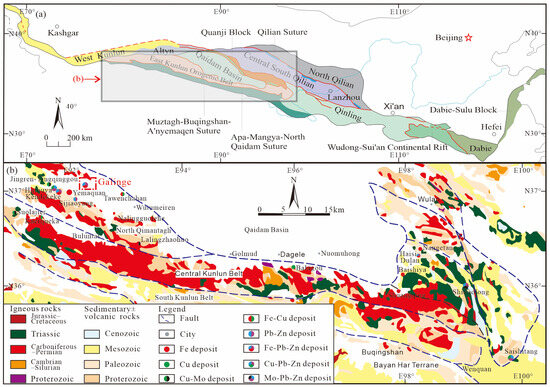
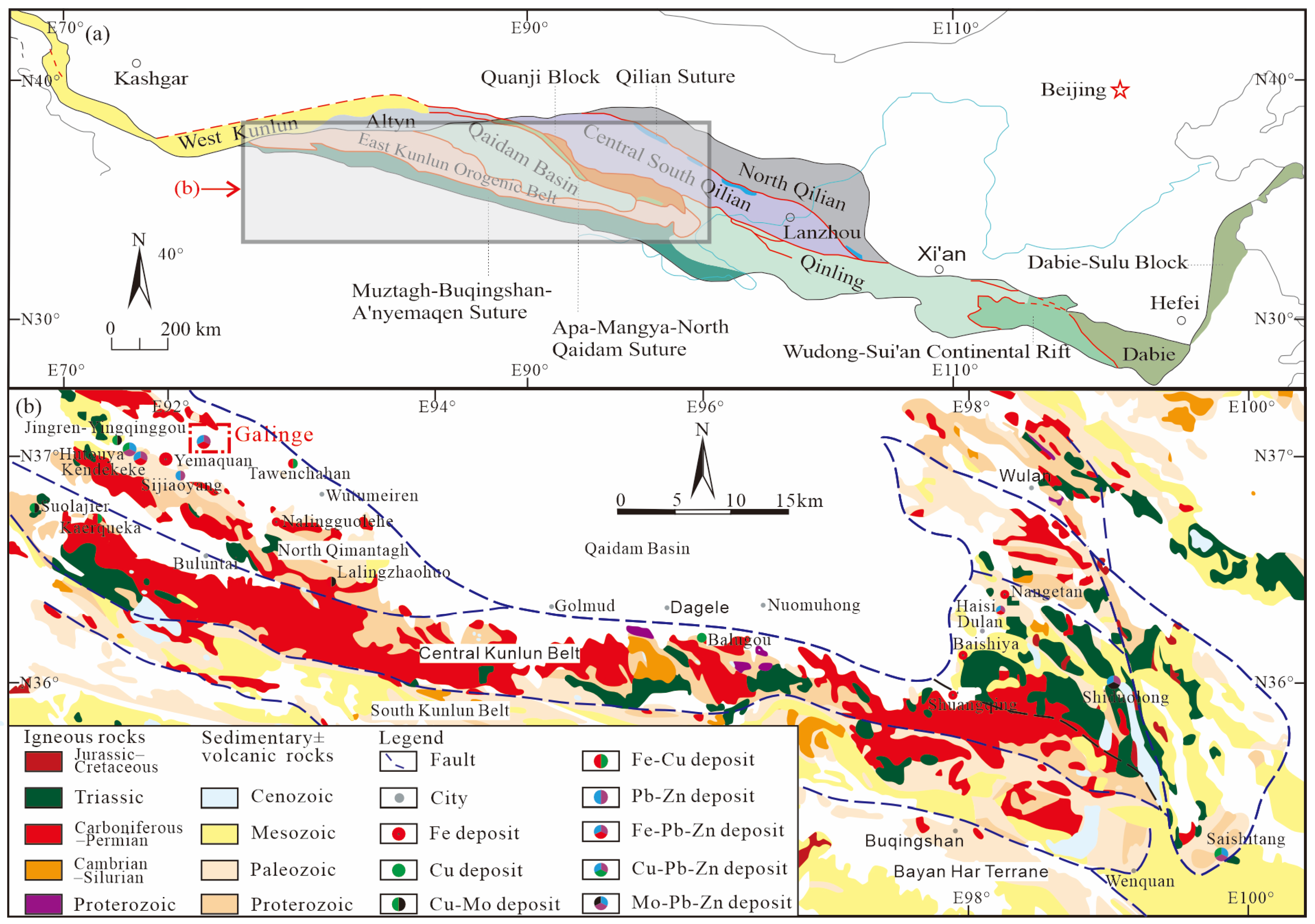
The Qimantagh belt exposes the Paleoproterozoic Jinshuikou Group, the Ordovician–Silurian Qimantagh Group, and Devonian–Triassic volcano-sedimentary successions. Clastic rocks, carbonate rocks, and intermediate–mafic volcanic rocks of the Qimantagh Group host important skarn Fe-polymetallic deposits, including Galinge, Yemaquan, Kendekeke, and Hutouya. Regional magmatism was particularly intense during the Early Paleozoic and Late Permian–Triassic, and Late Triassic intermediate–felsic intrusions are closely associated with Fe–Cu–Pb–Zn and Co by-product mineralization [29,30,31]. The regional tectonic framework and locations of the principal skarn deposits are shown in Figure 1.
Figure 1.
Tectonic setting of the East Kunlun Orogen and distribution of major skarn deposits. (a) Tectonic framework of the East Kunlun Orogen, modified after Li et al. [32]; (b) simplified geological map of East Kunlun showing the principal skarn deposits, modified after Xia et al. [33].
3. Deposit Geology
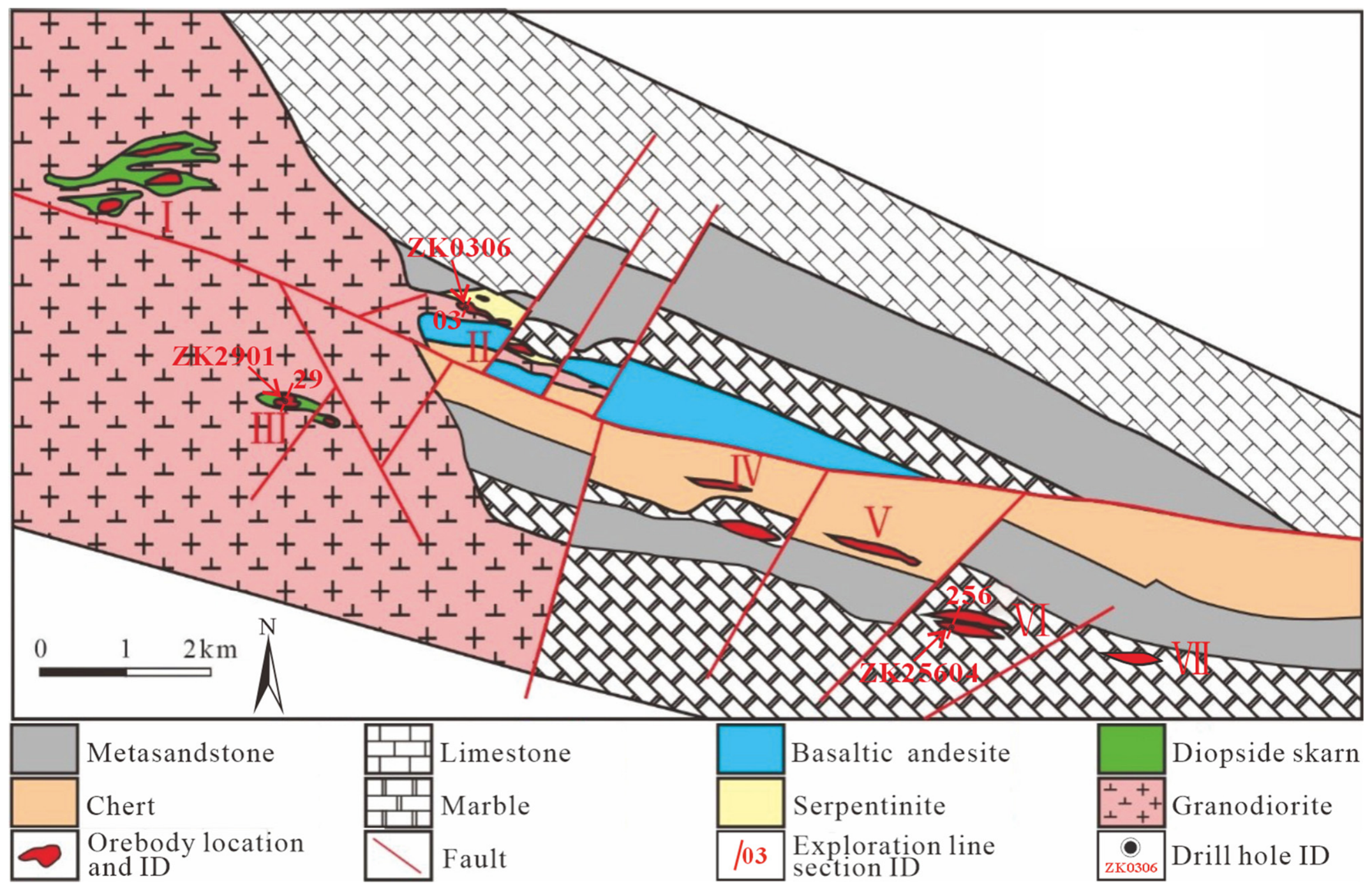
The Galinge mining district is extensively covered by unconsolidated Quaternary sand and gravel, with an average thickness of approximately 200 m; consequently, the bedrock geology is constrained mainly by drilling and geophysical data. The deposit trends NWW and extends for approximately 14 km along strike. Ore bodies occur mainly along contacts between granodioritic–dioritic intrusions and dolomitic marble, carbonate rocks, and intermediate–mafic volcanic rocks of the Qimantagh Group. They are stratiform, lenticular, or vein-like and are jointly controlled by intrusive contacts, NWW-striking faults, and interlayer fracture zones [7,19,20,21,22,23,34,35].
A recent synthesis of exploration records reports 3538 t of contained Co at an average grade of approximately 600 ppm, with Orebody II averaging approximately 1230 ppm Co [15]. These values establish the deposit-scale significance of the associated Co mineralization.
Intrusive rocks in the district include granodiorite, monzogranite, diorite, diorite porphyry, and granite porphyry, which together record multiple shallow-level to subvolcanic intrusive pulses. Dioritic–granodioritic rocks spatially associated with Co-rich mineralization commonly display epidotization, sericitization, potassic alteration, sodic alteration, chloritization, and carbonatization. Diopside–garnet–serpentine skarn and magnetite–pyrrhotite–arsenopyrite–cobaltite assemblages occur along their contacts and in adjacent wall rocks [7,19,20,21,22,23,34,35].
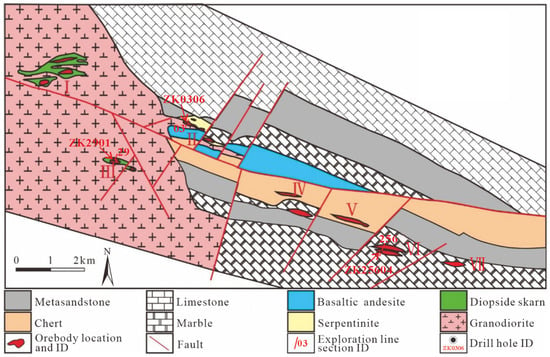
Skarn formation at Galinge progressed from a prograde garnet–diopside stage through retrograde hydrous alteration and magnetite deposition to a sulfide stage containing pyrrhotite, pyrite, chalcopyrite, arsenopyrite, cobaltite, native bismuth, sphalerite, and galena. The Co-bearing ore is concentrated within skarn and sulfide zones along contacts between dioritic–granodioritic intrusions and carbonate or intermediate–mafic rocks of the Qimantagh Group; cobaltite and Co-bearing arsenopyrite postdate the main magnetite stage and belong to the ensuing early sulfide stage [7,14,20,21,22,23,34]. This spatial and paragenetic association places Co enrichment within the late hydrothermal evolution of the skarn system. Intermediate–mafic volcanic rocks and locally serpentine-bearing altered domains in the mineralized contact zones may have acted as reactive substrates and supplementary Co reservoirs. The deposit geology and the principal ore controls are shown in Figure 2.
Figure 2.
Simplified bedrock geological map of the Galinge deposit (modified after Yu et al. [21]).
4. Samples and Analytical Methods
4.1. Sample Selection and Petrography
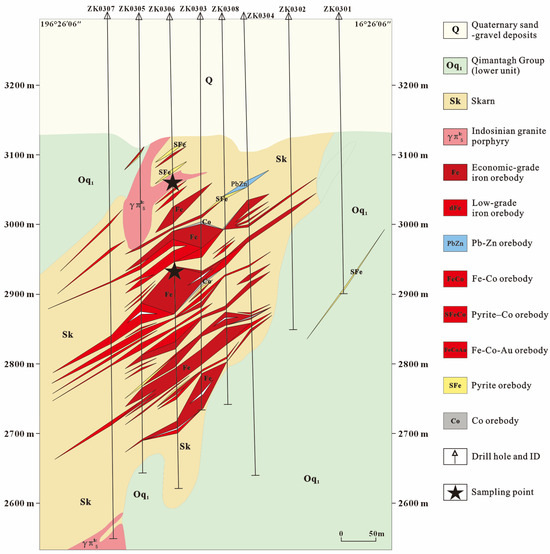
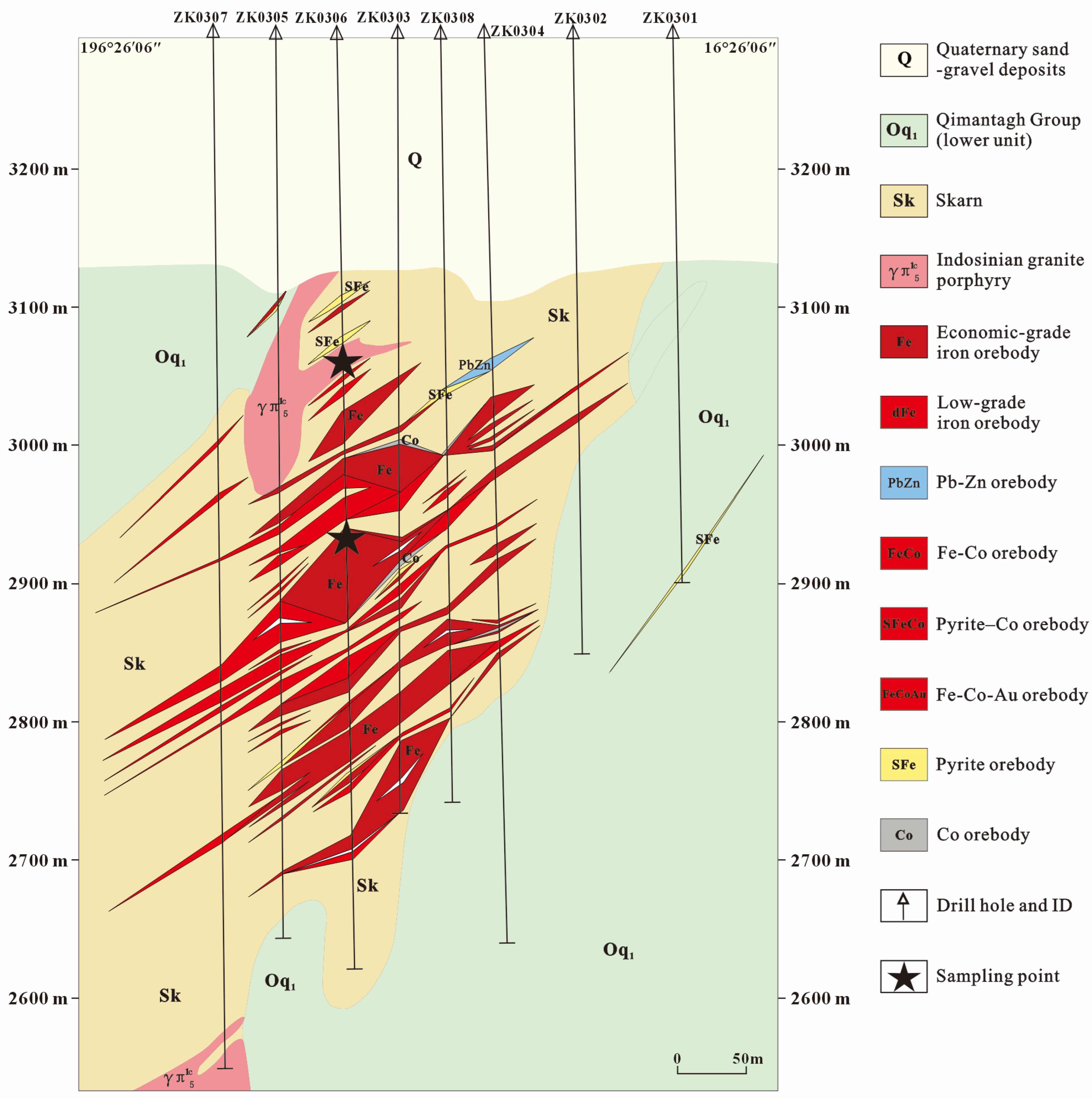
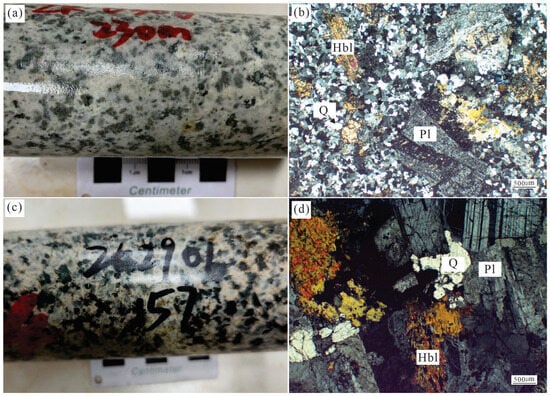
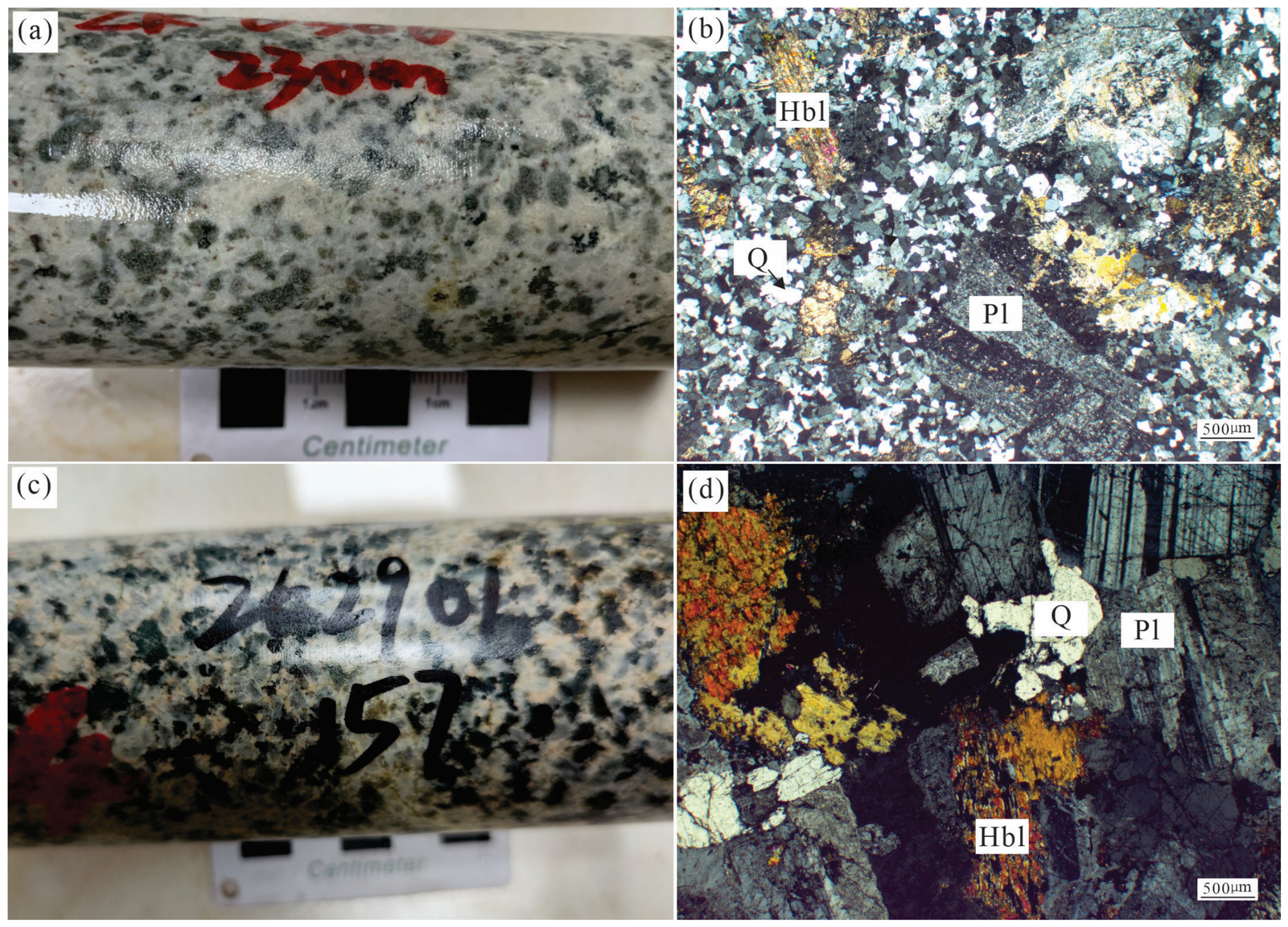
All samples were collected from the drill core. The plan-view locations of the principal sample-bearing drill holes ZK0306, ZK2901, and ZK25604 are marked in Figure 2; the line 03 cross-section locates two representative sampling locations in ZK0306 relative to the intrusions and ore bodies (Figure 3). Five ZK0306-series diorite porphyry samples and four ZK2901-series granodiorite samples were analyzed for whole-rock geochemistry; ZK0306-238 diorite porphyry and ZK2901-1 granodiorite were analyzed for zircon U–Pb, trace element, and Lu–Hf systematics. The remaining analytical samples comprise skarn garnet ZK25604-267 and Co-rich ores from the ZK0306-373 series, ZK0306-374, and ZK26404-317-1. The analyzed intrusive rocks and their petrographic characteristics are illustrated in Figure 4. The diorite porphyry is porphyritic to weakly porphyritic and contains plagioclase and hornblende phenocrysts, whereas the granodiorite has an anhedral–subhedral granular texture dominated by plagioclase, K-feldspar, quartz, and biotite (Figure 4). Reported district-scale modal proportions are approximately 70% plagioclase and 25% hornblende for dioritic rocks and 20%–25% plagioclase, 15%–25% K-feldspar, 15%–20% quartz, and 5%–8% biotite for granodioritic rocks [35]. Weathered surfaces, fracture fillings, and late veins were avoided during sampling. Petrographic observations and loss-on-ignition values were considered when evaluating alteration effects on whole-rock compositions.
Figure 3.
Geological cross-section along exploration line 03 of the Galinge deposit, showing the distribution of intrusions, ore bodies, and drill holes and two representative sampling locations in ZK0306.
Figure 4.
Intrusive rock samples and petrographic characteristics from the Galinge deposit. (a,c) Drill core photographs of ZK0306 diorite porphyry and ZK2901 granodiorite; (b,d) corresponding cross-polarized light photomicrographs. Q, quartz; Pl, plagioclase; Hbl, hornblende.
4.2. Whole-Rock Major, Trace, and Rare Earth Element Analyses
Whole-rock sample preparation was conducted by the Chengxin Geological Service Co., Ltd., Langfang, Hebei Province, China, and major, trace, and rare earth elements were analyzed at Peking University. Major elements were determined by X-ray fluorescence spectrometry (XRF), with analytical precision of <5%. Trace and rare earth elements were measured by inductively coupled plasma mass spectrometry (ICP-MS). Relative errors were generally <5% for concentrations above 10 ppm and <10% for concentrations below 10 ppm. Loss on ignition (LOI) ranged from 1.10 to 5.11 wt%, and some samples exhibited epidotization, sericitization, and carbonatization. Mobile K, Na, Rb, Ba, and Sr were evaluated together with petrography and LOI, whereas source and evolution interpretations emphasize relatively immobile high-field-strength elements, rare earth elements, zircon Hf isotopes, and regional constraints.
4.3. Zircon U–Pb Geochronology and Trace Element Analysis
In situ zircon U–Pb isotope and trace element analyses were performed at the Beijing Zircon Chronology Navigation Technology Co., Ltd. (Beijing, China) using a Neptune multi-collector inductively coupled plasma mass spectrometer coupled to a 193 nm excimer laser ablation system. A 30 μm laser spot was used, with He as the carrier gas and Ar as the make-up gas. Zircon 91500 was used to correct U–Pb isotopic fractionation, NIST SRM 610 served as the external trace element standard, and 29Si was used as the internal standard. Concordia diagrams, concordia ages, and weighted mean 206Pb/238U ages were calculated using Isoplot 3.0. For ZK0306-238, the all-spot weighted-mean 206Pb/238U age was 230.8 ± 1.0 Ma (95% confidence; MSWD = 3.55). Analyses ZK0306-238-001, -005, -008, and -012 had standardized age residuals of approximately 3σ or greater and were excluded from the representative 21-spot population; all 25 analyses were retained in the dataset. For ZK2901-1, analysis ZK2901-1-22 was excluded because of its 73.27% concordance and anomalous 207Pb/206Pb age, and the remaining 24 analyses were used for the representative age. Concordia age uncertainties are reported at 1σ and include decay constant uncertainties, and weighted-mean 206Pb/238U ages are reported at 95% confidence.
4.4. Zircon Lu–Hf Isotopes, Ti-in-Zircon Thermometry, Ce Anomalies, and Apparent Oxygen Fugacity
Zircon Lu–Hf isotope analyses were conducted after U–Pb dating on the same or adjacent domains using a Neptune MC-ICP-MS coupled to a New Wave UP213 laser ablation system. Ten grains from the principal U–Pb age population were selected per sample, targeting intact, oscillatory-zoned domains free of cracks and visible inclusions. εHf(t), one-stage model ages, and two-stage model ages were calculated at the corresponding crystallization ages following established procedures [36,37]. Ti-in-zircon thermometry followed the calibrations and activity considerations in Refs. [38,39,40]. Zircon Ce anomalies were calculated from chondrite-normalized REE patterns using the lattice strain regression described below. The natural logarithms of the normalized Nd, Sm, and Gd–Lu concentrations (Eu excluded) were regressed against the eightfold-coordination lattice strain term, Ce* was interpolated at the Ce3+ radius, and the operational Ce/Ce* proxy was calculated as the measured CeN divided by the interpolated Ce*N [41,42,43]. Analyses with discordant or outlying U–Pb ages, Ti ≥ 100 ppm, La > 0.1 ppm, or |r| < 0.99 for the lattice strain fit were excluded from population statistics. Apparent Ti-in-zircon temperatures were calculated as T(K) = 5080/[6.01 − log10(Ti, ppm)] [38]. Quartz in both suites supports aSiO2 = 1; because aTiO2 is not independently constrained, aTiO2 = 1 was adopted, and the temperatures represent minimum estimates [39,40]. An apparent oxygen fugacity estimate was calculated as log10 fO2 = [ln(Ce/Ce*) + 6.125 − 13,860/T]/[0.1156 ln(10)] [44]. Values were referenced to the fayalite–magnetite–quartz (FMQ) buffer using log10 fO2(FMQ) = −25,096.3/T + 8.735 at the 1-bar reference condition [45], and the offset from the buffer was calculated as ΔFMQ = log10 fO2 − log10 fO2(FMQ). Because the calculation uses chondrite-normalized zircon REE rather than a paired zircon–melt partition coefficient anomaly, and because pressure and aTiO2 are not independently constrained, the reported log10 fO2 and ΔFMQ values are semiquantitative proxies used for internally consistent comparisons between the two zircon populations. The same Ce anomaly–Ti framework was applied consistently to both zircon populations, whereas the co-spatial Ce–U–Ti oxybarometer [46] required co-located measurements not available in this dataset. The screening criteria were applied uniformly to the two original 25-analysis datasets; they changed only which analyses entered the population statistics and did not add or replace analytical measurements. All raw zircon trace element analyses are retained in Supplementary Table S1, together with the screening status and, where applicable, the reason for exclusion of each spot.
4.5. Garnet U–Pb Geochronology
In situ garnet U–Pb analyses were conducted at the Wuhan SampleSolution Analytical Technology Co., Ltd. (Wuhan, China), using a GeoLas HD 193 nm excimer laser ablation system (Coherent, Göttingen, Germany) coupled to an Agilent 7900 inductively coupled plasma mass spectrometer (Agilent Technologies, Tokyo, Japan). Analyses used 80 mJ laser energy, a repetition rate of 5 Hz, and a 44 μm spot diameter. NIST SRM 610 was used for elemental calibration, zircon 91500 for isotope fractionation correction, and Mali garnet as a quality control reference material for isotope ratios. Raw signals were processed using ICPMSDataCal 10.8, and Tera–Wasserburg regressions and age calculations were performed with Isoplot 3.0.
The garnet has low U content and a substantial common Pb component, so the Tera–Wasserburg lower intercept provides the principal crystallization age. The preferred regression uses 26 spots and is reported at 2σ. ZK25604-267-03 and -21 have anomalous Pb isotope compositions, whereas -10 and -20 lack valid 207Pb-corrected ages; these four analyses were excluded based on analytical criteria. All 30 original analyses were retained in the dataset, and the four excluded rows were flagged. For comparison, a regression including all 30 analyses is also reported.
4.6. SEM-EDS and EPMA Analyses
Polished and carbon-coated Co-rich ore samples were examined by backscattered electron imaging and energy-dispersive spectroscopy using a TESCAN scanning electron microscope (Brno, Czech Republic). Analyses were performed under high vacuum at an accelerating voltage of 16 kV, a beam current of 16 nA, and a working distance of 15 mm. A Bruker QUANTAX energy-dispersive spectrometer (Bruker, Billerica, MA, USA) was used for spot analyses and elemental mapping. SEM-EDS data were used only for phase identification and the evaluation of spatial element associations. Quantitative mineral chemistry was determined at the MNR Key Laboratory of Metallogeny and Mineral Assessment, Institute of Mineral Resources, Chinese Academy of Geological Sciences, using a JEOL JXA-iHP200F electron probe microanalyzer (JEOL, Musashino, Japan) equipped with four wavelength-dispersive spectrometers. Operating conditions were a 15 kV accelerating voltage, a 20 nA beam current, and a 1–5 μm beam diameter. Natural minerals, synthetic oxides, and alloy standards were used, and ZAF matrix corrections were applied [47].
4.7. Data Processing and Evaluation
Rock classification, chondrite normalization, and primitive mantle normalization follow Le Maitre et al. [48], Irvine and Baragar [49], Sun and McDonough [50], and McDonough and Sun [51], respectively; tectonic discrimination follows Pearce et al. [52]. Alumina saturation indices are expressed as molar A/CNK = Al2O3/(CaO* + Na2O + K2O) and A/NK = Al2O3/(Na2O + K2O), where CaO* is corrected for apatite, and the fields follow Maniar and Piccoli [53]. Sr/Y–Y and (La/Yb)N–YbN relations are evaluated after Defant and Drummond [54]. Alteration-sensitive elements are evaluated together with petrography and LOI, whereas interpretations of the magma source and evolution emphasize relatively immobile trace elements, REE patterns, and zircon Hf isotopes. Zircon weighted-mean ages are reported at 95% confidence, concordia ages at 1σ, and the garnet lower-intercept age at 2σ. SEM-EDS data support phase identification and element associations, and quantitative mineral Co concentrations are based on EPMA.
5. Results
5.1. Mineralogical Characteristics of Co-Rich Ores
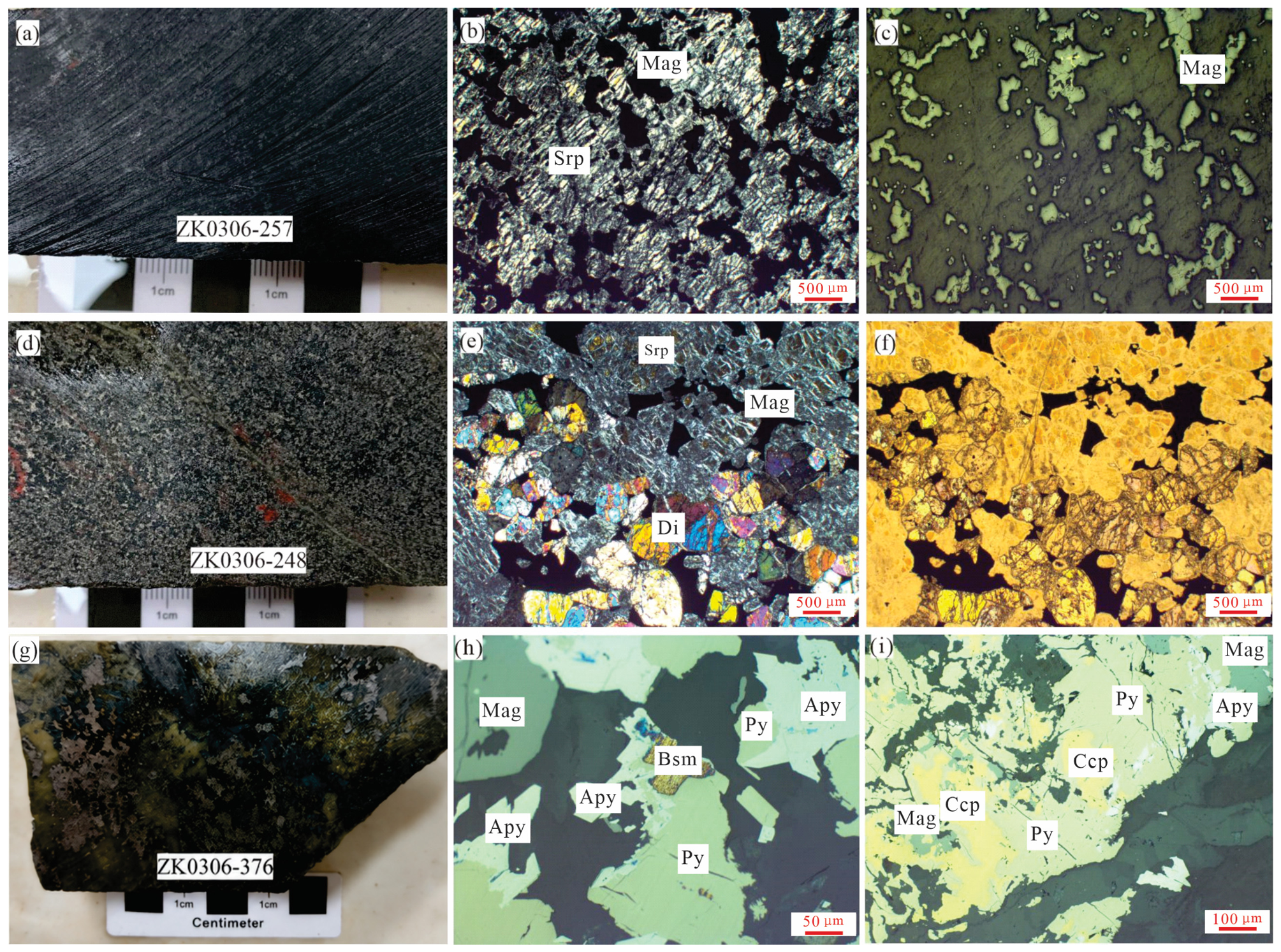
Representative Co-rich ores contain magnetite, pyrrhotite, pyrite, chalcopyrite, arsenopyrite, cobaltite, and native bismuth, with minor sphalerite and galena (Figure 5, Figure 6 and Figure 7). Within the analyzed assemblages, cobaltite and arsenopyrite are the most strongly Co-enriched phases, whereas pyrrhotite, pyrite, and chalcopyrite contain substantially lower Co concentrations (Table 1 and Table 2).
Table 1.
Representative semiquantitative SEM-EDS results for Co-rich ores and associated sulfides from the Galinge deposit.
Table 2.
EPMA Co concentrations, occurrence, and metallogenic significance of the analyzed Co-bearing minerals from the Galinge deposit.
Figure 5.
Drill core photographs, photomicrographs, and backscattered electron images of Co-rich ores from the Galinge deposit. (a–c) Magnetite ore; (d–f) magnetite–pyrrhotite ore; (g–i) sulfide-rich ore. Apy, arsenopyrite; Bsm, native bismuth; Ccp, chalcopyrite; Di, diopside; Mag, magnetite; Py, pyrite; Srp, serpentine.
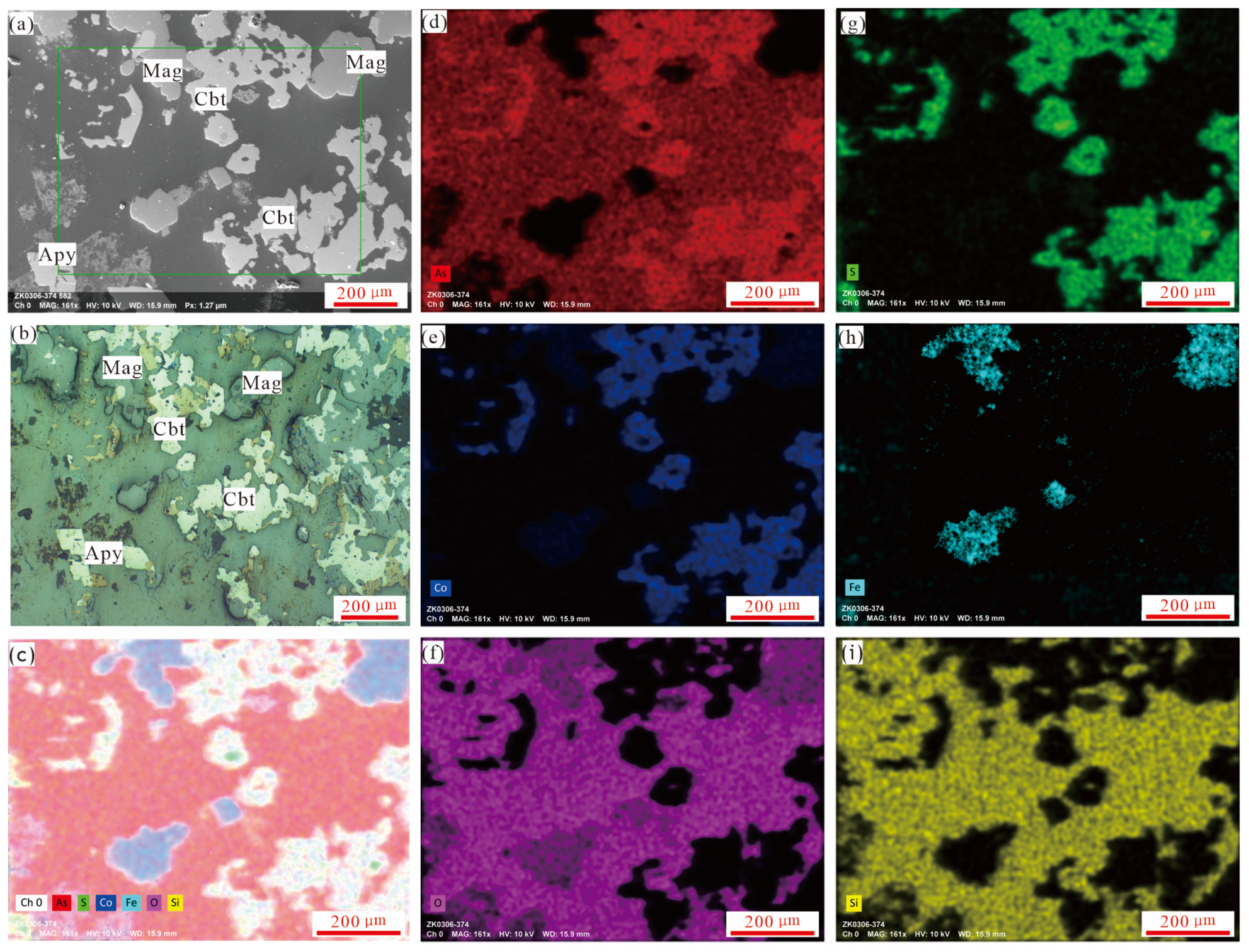
In sample ZK0306-374, cobaltite forms euhedral to subhedral grains approximately 50–200 μm across in an arsenopyrite–magnetite assemblage. Element maps show spatially coincident Co-, As-, and S-rich domains (Figure 6), and EDS spot analyses 1958–1967 distinguish cobaltite, arsenopyrite, magnetite, and fine-grained Bi–Te–Co–As–S intergrowth (Table 1). Because EDS data are semiquantitative, quantitative cobaltite compositions are based on EPMA, which yields 32.83–34.14 wt% Co (Table 2).
The ZK0306-373-series samples contain Fe–As–S, Cu–Fe–S, and Fe–S phases. In the mapped ZK0306-373-1 field, Co is spatially associated with an As-rich domain, whereas EDS spot analyses of the ZK0306-373-2 field identify arsenopyrite, Cu–Fe sulfide, and Fe sulfide (Figure 7; Table 1). Sample ZK26404-317-1 contains Pb-, Zn-, Cu-, and Fe-bearing sulfides but shows no distinct Co enrichment in the analyzed field. This contrast with the As-rich ZK0306 assemblages and highlights the heterogeneous distribution of Co and its preferential association with sulfarsenide-bearing domains.
Figure 6.
SEM-EDS elemental maps of cobaltite in sample ZK0306-374. (a) Backscattered electron image; (b) reflected light image; (c) composite elemental map; (d–i) single-element maps of the same field of view. Co, As, and S show closely coincident spatial distributions. Apy, arsenopyrite; Cbt, cobaltite; Mag, magnetite.
5.2. Zircon and Garnet U–Pb Geochronology
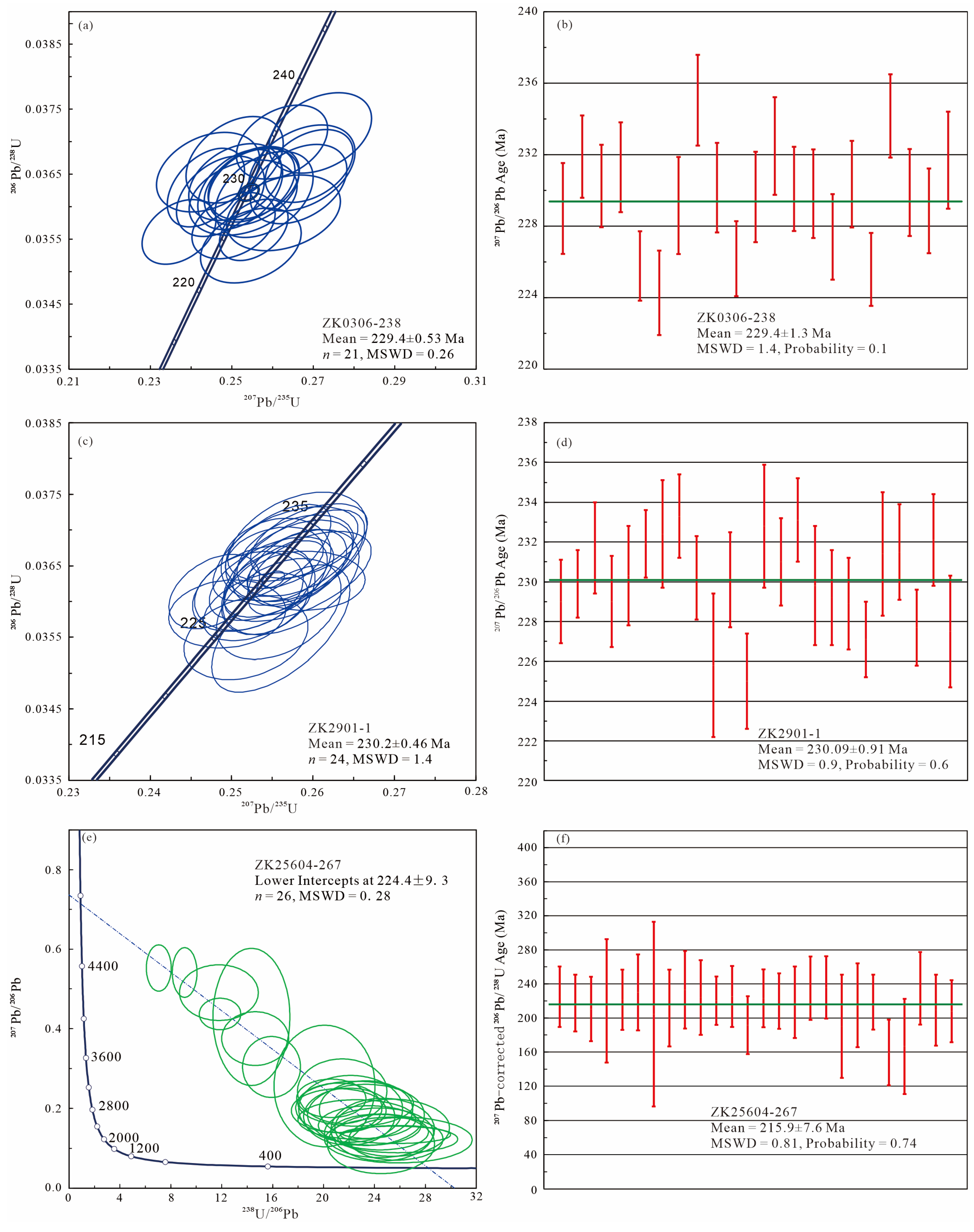
The 25 zircon analyses from ZK0306-238 diorite porphyry yielded 206Pb/238U ages of 224.3–243.7 Ma and Th/U ratios of 0.46–0.75. The all-spot weighted mean of 230.8 ± 1.0 Ma showed excess dispersion (MSWD = 3.55). After excluding ZK0306-238-001, -005, -008, and -012, the remaining 21 analyses yielded a concordia age of 229.4 ± 0.53 Ma (1σ; MSWD of concordance = 0.26; p = 0.61) and a weighted-mean 206Pb/238U age of 229.4 ± 1.3 Ma (95% confidence; MSWD = 1.4; p = 0.10), with the latter being adopted as the crystallization age.
The 25 zircon spots from ZK2901-1 granodiorite yielded 206Pb/238U ages of 225.0–235.8 Ma and Th/U ratios of 0.44–0.76. Spot ZK2901-1-22 yielded only 73.27% concordance and an anomalous 207Pb/206Pb age and was excluded from the representative age calculation. The remaining 24 spots yielded a concordia age of 230.20 ± 0.46 Ma (1σ; MSWD = 1.4; p = 0.23) and a weighted-mean 206Pb/238U age of 230.09 ± 0.91 Ma (95% confidence; MSWD = 0.9; p = 0.6). The latter is adopted as the crystallization age of the ZK2901-1 granodiorite. Together with the ZK0306-238 age, this result establishes the principal ca. 230 Ma intrusive episode at Galinge.
The 26 retained garnet analyses from ZK25604-267 define a Tera–Wasserburg lower-intercept age of 224.4 ± 9.3 Ma (2σ; MSWD = 0.28; n = 26). The age uncertainty mainly reflects the low U content and substantial common Pb component. The all-spot regression yielded 229.6 +9.2/−9.3 Ma (MSWD = 1.01), consistent within uncertainty with the preferred result. The 224.4 ± 9.3 Ma lower intercept is adopted for skarn garnet formation and places garnet growth within the Late Triassic magmatic–hydrothermal system (Figure 8; Table 3 and Table 4).
Table 3.
Zircon U–Pb isotope data for diorite porphyry and granodiorite from the Galinge deposit.
Table 4.
Garnet U–Pb isotope data for sample ZK25604-267.
Figure 7.
SEM-EDS elemental maps of the arsenopyrite–chalcopyrite–Fe sulfide assemblage in ZK0306-373-series samples. (a–g) Single-element maps; (h) composite elemental map; (i) backscattered electron image. Apy, arsenopyrite; Ccp, chalcopyrite; Po, pyrrhotite.
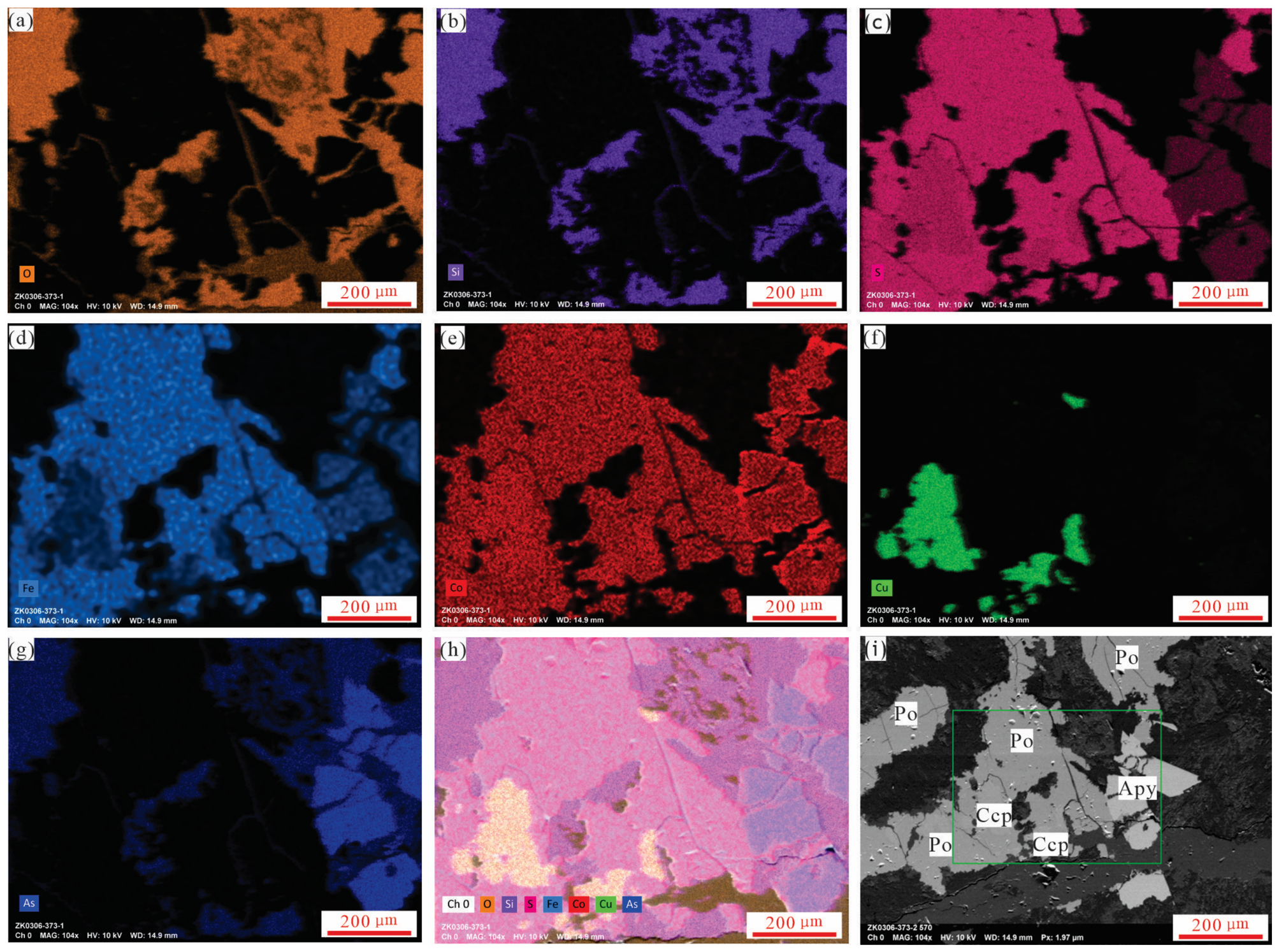
Figure 8.
Geochronological results for intrusive rocks and skarn from the Galinge deposit. (a,b) Zircon U–Pb concordia diagram and weighted-mean 206Pb/238U age for ZK0306-238 diorite porphyry; (c,d) zircon U–Pb concordia diagram and weighted-mean 206Pb/238U age for ZK2901-1 granodiorite; (e,f) Tera–Wasserburg diagram and age distribution for ZK25604-267 garnet.
5.3. Whole-Rock Major Element Geochemistry
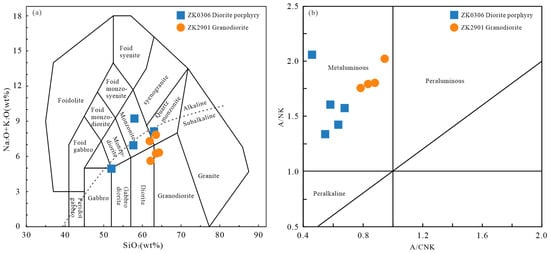
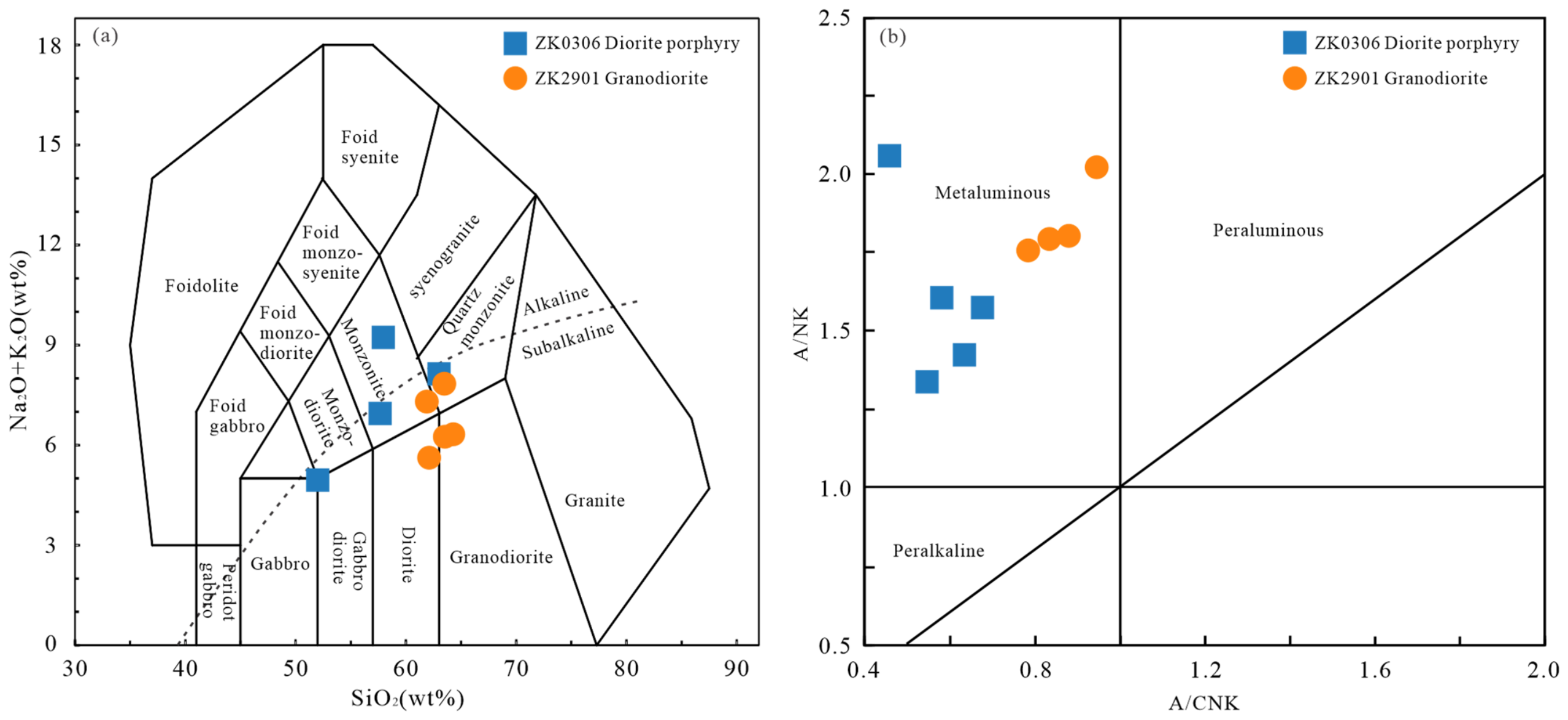
The five ZK0306 diorite porphyries contain 51.92–63.46 wt% SiO2 and the four ZK2901 granodiorites contain 61.79–64.20 wt% SiO2 (Table 5). In the SiO2–(Na2O + K2O) diagram, the samples plot across gabbroic, dioritic, monzonitic, and quartz–monzonitic fields. Both intrusive suites are metaluminous, with A/CNK values of 0.46–0.97 (Figure 9b).
Table 5.
Whole-rock major, trace, and rare earth element data for diorite porphyry and granodiorite from the Galinge deposit.
Figure 9.
Geochemical classification and alumina saturation diagrams for diorite porphyry and granodiorite from the Galinge deposit. (a) SiO2–(Na2O + K2O) classification diagram; field boundaries after Le Maitre et al. [48]. (b) A/CNK–A/NK alumina saturation diagram; fields after Maniar and Piccoli [53].
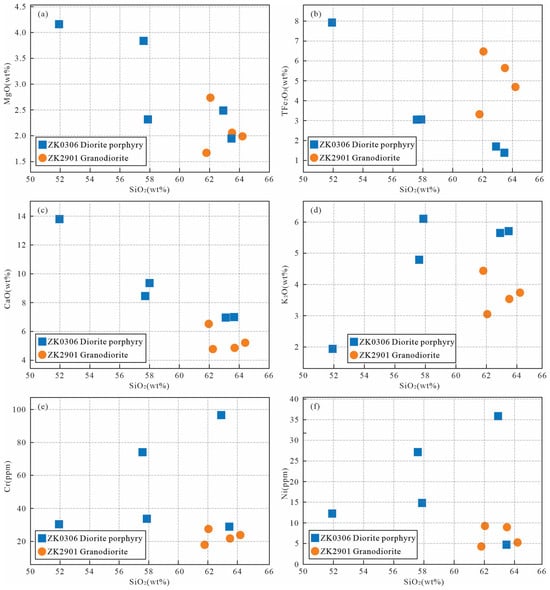
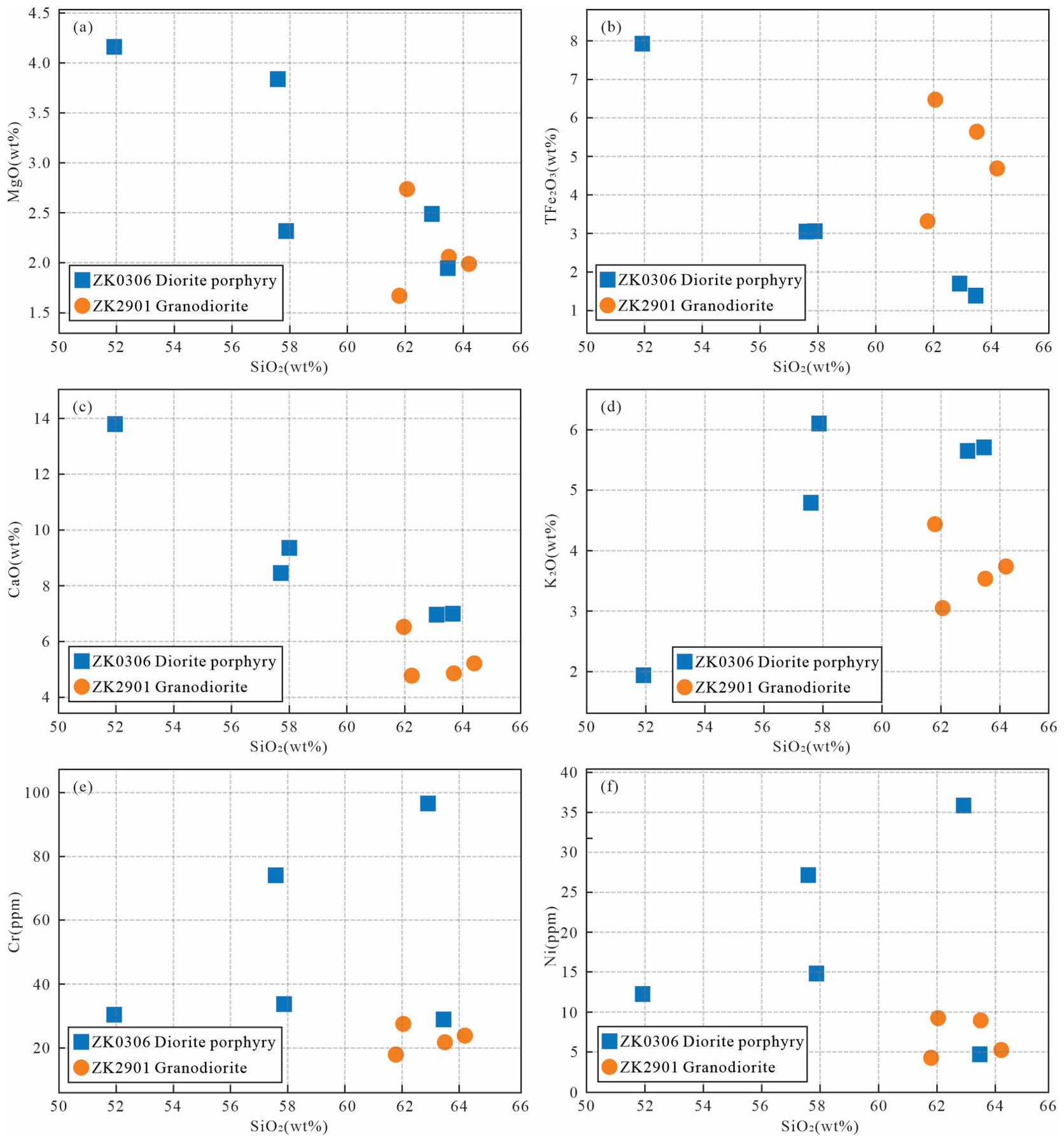
MgO and CaO generally decrease with increasing SiO2, whereas Cr, Ni, TFe2O3, and K2O display appreciable scatter. The broad compositional range partly reflects differences in feldspar and mafic mineral proportions, with additional modification by hydrothermal alteration (LOI = 1.10–5.11 wt%). The Harker trends are therefore interpreted jointly with the REE patterns and zircon isotopic data because the dataset records both primary mineralogical variation and hydrothermal modification (Figure 10).
Figure 10.
Harker variation diagrams for diorite porphyry and granodiorite from the Galinge deposit. (a) SiO2–MgO; (b) SiO2–TFe2O3; (c) SiO2–CaO; (d) SiO2–K2O; (e) SiO2–Cr; (f) SiO2–Ni.
5.4. Whole-Rock Trace Element Geochemistry
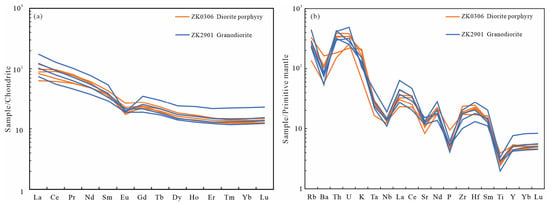
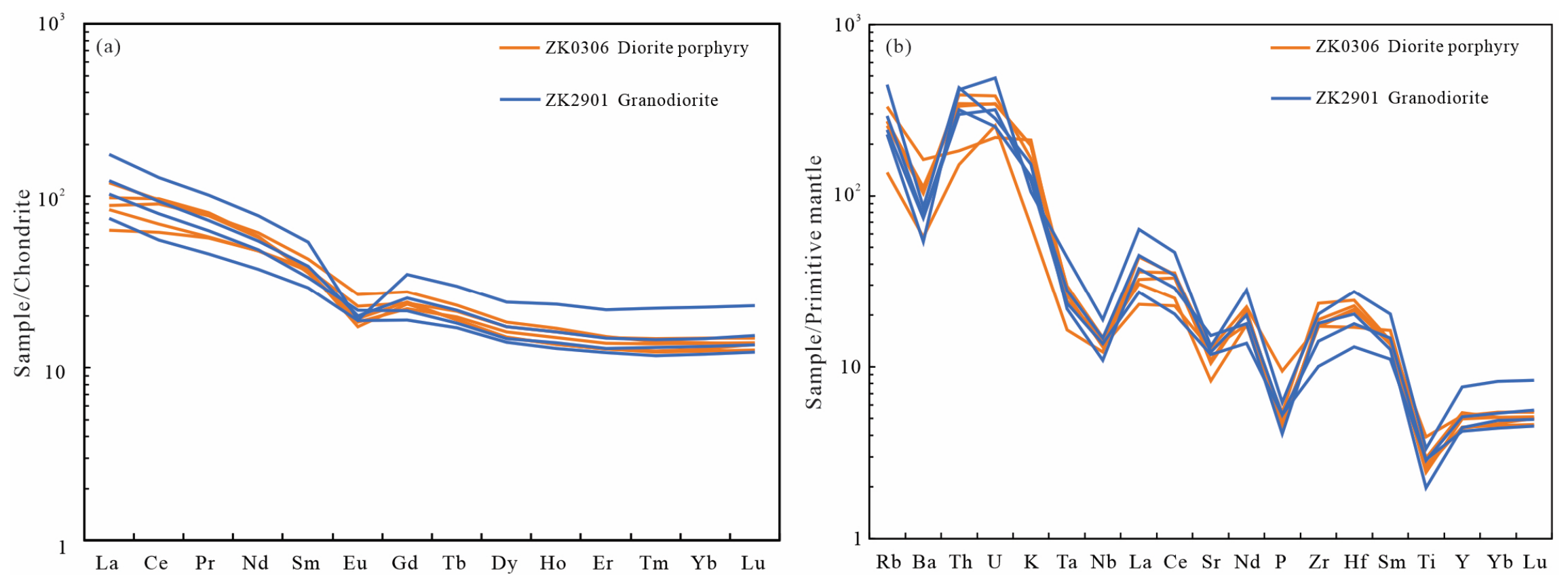
The diorite porphyries have ΣREE content of 101.83–147.19 ppm (mean 126.15 ppm), LREE/HREE ratios of 5.76–8.35, (La/Yb)N values of 4.55–8.61, and δEu values of 0.59–0.77. The granodiorites have ΣREE content of 91.79–197.25 ppm (mean 138.08 ppm), LREE/HREE ratios of 6.02–7.58, (La/Yb)N values of 6.19–8.33, and δEu values of 0.44–0.81. Both suites are enriched in LREEs, have comparatively flat HREE patterns, and display moderate negative Eu anomalies (Figure 11a). Sample ZK2901-295 has relatively high ΣREE, Y, and Yb content, recording internal heterogeneity within the granodiorite suite. These data are reported in Table 5.
Figure 11.
(a) Chondrite-normalized rare earth element patterns and (b) primitive mantle-normalized trace element patterns of diorite porphyry and granodiorite from the Galinge deposit. Normalization values are from Sun and McDonough [50].
The primitive mantle-normalized diagrams show enrichment in Rb, Ba, Th, U, K, and Pb and depletion in Nb, Ta, and Ti in both suites (Figure 11b). The diorite porphyries have Rb/Sr = 0.32–1.21, Th/U = 2.32–3.96, Nb/Ta = 8.61–13.17, and Zr/Hf = 29.67–37.59; the corresponding granodiorite ranges are 0.52–0.88, 3.33–5.94, 7.68–10.30, and 27.29–32.77. The tectonic interpretation integrates Nb–Ta–Ti depletion, REE patterns, zircon Hf isotopes, geochronology, and regional geology [51,52].
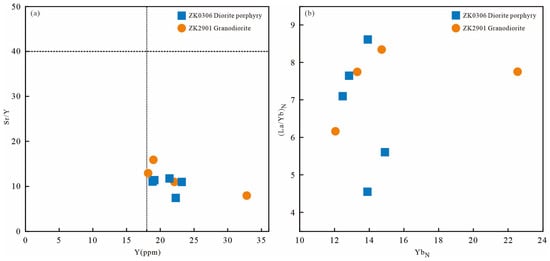
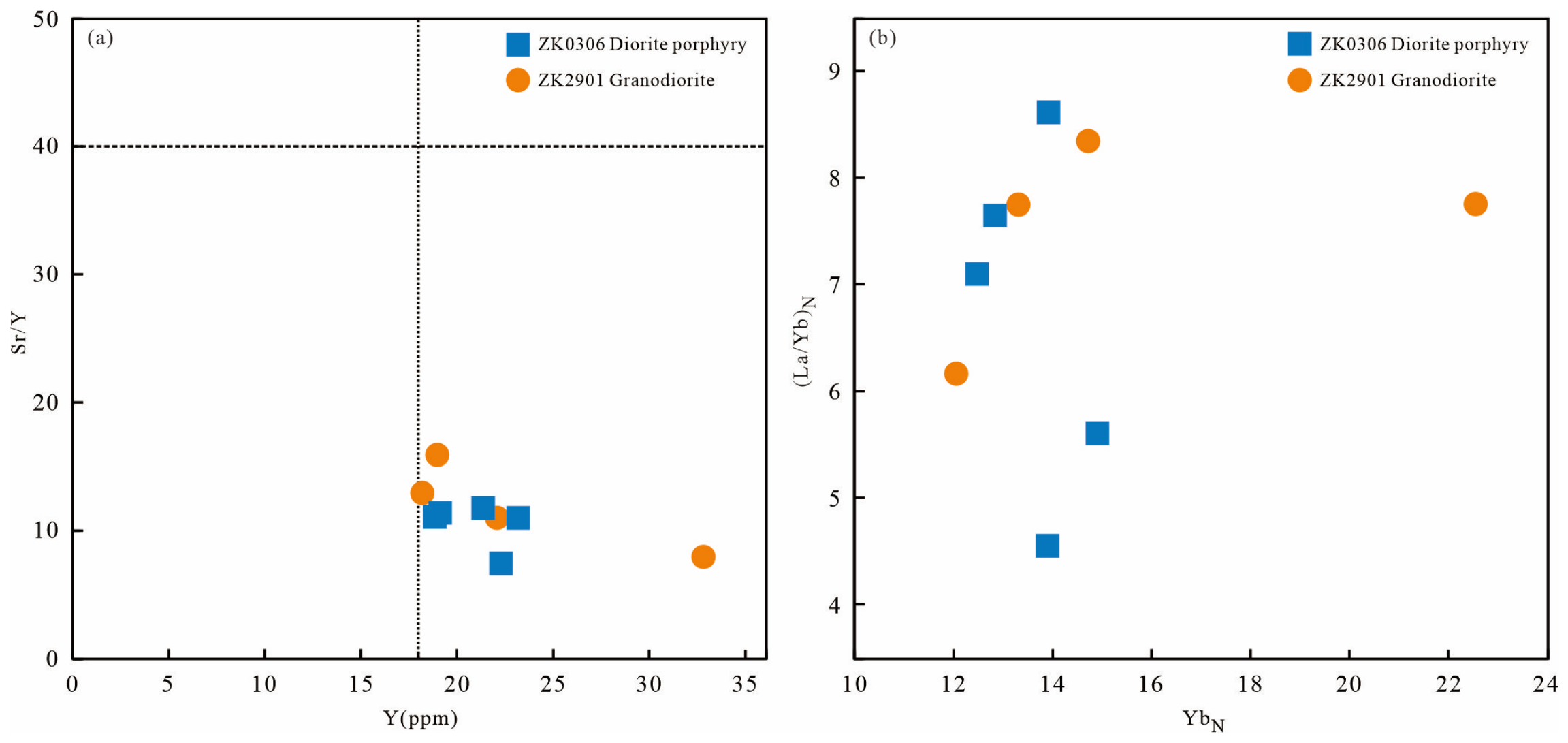
Both suites have Sr/Y = 7.4–15.9, Y = 18.2–32.8 ppm, and Yb = 1.94–3.63 ppm. In the Sr/Y–Y and (La/Yb)N–YbN diagrams, they plot outside the characteristic high-Sr/Y–low-Y field and show no systematic separation between the two lithologies (Figure 12). Together with the comparatively flat HREE patterns, these features indicate limited control by abundant residual garnet during magma generation.
Figure 12.
Sr/Y–Y and (La/Yb)N–YbN discrimination diagrams for diorite porphyry and granodiorite from the Galinge deposit. (a) Sr/Y–Y diagram; dashed lines are shown only as a reference for high-Sr/Y–low-Y characteristics, after Defant and Drummond [54]. (b) (La/Yb)N–YbN diagram; normalization values are from Sun and McDonough [50].
5.5. Zircon Lu–Hf Isotopes
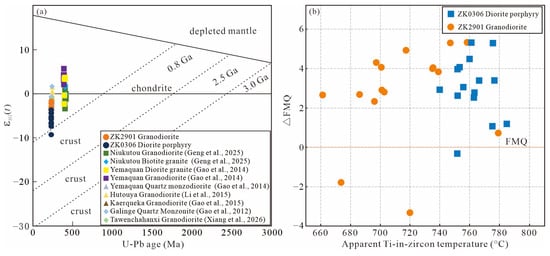
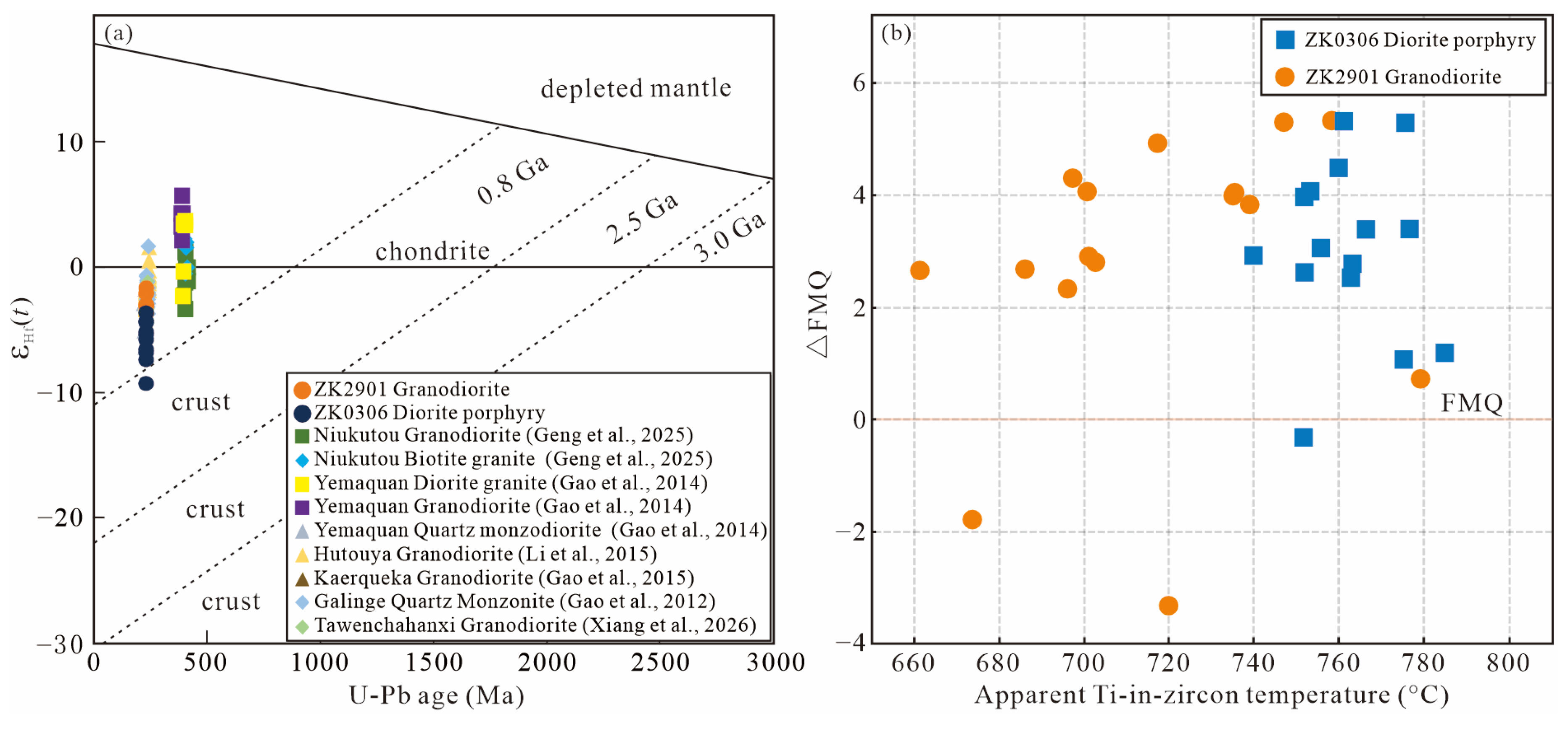
Zircons from ZK0306-238 diorite porphyry have 176Hf/177Hf = 0.282369–0.282527, εHf(t) = −9.4 to −3.7, and TDM2 = 1.50–1.86 Ga. Zircons from ZK2901-1 granodiorite have 176Hf/177Hf = 0.282525–0.282583, εHf(t) = −3.8 to −1.8, and TDM2 = 1.37–1.50 Ga (Table 6). The offset records isotopic heterogeneity between the two ca. 230 Ma magma batches.
The two zircon populations plot within the regional Late Triassic comparison field but occupy largely distinct εHf(t) ranges (Figure 13a). The more negative εHf(t) values and older TDM2 ages of ZK0306-238 record a larger contribution from older crust, whereas the less negative ZK2901-1 values indicate a more radiogenic source component that may reflect greater juvenile input and/or the reworking of a younger crust [17,19,55,56,57,58].
Figure 13.
Zircon Hf isotopic and magmatic redox constraints for intrusions from Galinge and other deposits in the Qimantagh belt. (a) Zircon εHf(t) versus U–Pb age for ore-related intrusions from representative Qimantagh deposits; regional comparison data are from Refs. [17,19,55,56,57,58]. (b) Relationship between apparent Ti-in-zircon temperature and ΔFMQ for granodiorite and diorite porphyry from the Galinge deposit.
5.6. Ti-in-Zircon Thermometry and Apparent Oxygen Fugacity
After age, Ti, La, and lattice fit screening, 16 ZK2901-1 granodiorite analyses yield Ce/Ce* proxy values of 12.7–116.2 (median 80.3; interquartile range [IQR] 72.1–99.7) and minimum apparent Ti-in-zircon temperatures of 661.5–779.2 °C (median 710.3 °C). Their estimated log10 fO2 values range from −19.9 to −10.3, with corresponding apparent ΔFMQ values of −3.32 to +5.31 (median +3.36; IQR +2.56 to +4.11). Fifteen screened ZK0306-238 diorite porphyry analyses yield Ce/Ce* proxy = 22.6–95.0 (median 54.0; IQR 46.2–71.2), minimum apparent temperatures of 739.8–784.9 °C (median 760.5 °C), estimated log10 fO2 values of −16.1 to −9.9, and apparent ΔFMQ values of −0.33 to +5.29 (median +3.04; IQR +2.57 to +4.00) (Figure 13b; Table 7). Fourteen of 16 granodiorite analyses and 14 of 15 diorite porphyry analyses plot above FMQ; 13 and 14 analyses, respectively, are at or above FMQ + 1. The overlapping population medians and interquartile ranges indicate that the two magma batches crystallized under comparably oxidized conditions. Accordingly, the convergence of the screened population medians reflects the application of a common quality control protocol to the existing data, rather than an enlarged analytical dataset. The underlying spot-by-spot trace element concentrations and screening flags are reported in Supplementary Table S1.
Table 6.
Zircon Lu–Hf isotope compositions of diorite porphyry and granodiorite from the Galinge deposit.
Table 7.
Zircon lattice strain Ce anomaly proxies, apparent Ti-in-zircon temperatures, and apparent oxygen fugacity estimates for granodiorite and diorite porphyry from the Galinge deposit.
6. Discussion
6.1. Timing of Intrusion, Skarn Formation, and Mineralization
The ZK2901-1 granodiorite (230.09 ± 0.91 Ma) and ZK0306-238 diorite porphyry (229.4 ± 1.3 Ma) date a ca. 230 Ma magmatic episode. Together with their petrographic and zircon Hf isotopic contrasts, these closely spaced ages support the emplacement of compositionally distinct magma pulses during the same Late Triassic episode. A published garnet U–Pb age of 237.1 ± 0.3 Ma constrains an earlier skarn-forming episode within the Co-bearing hydrothermal system [7]; together with ages of 236.1 ± 1.4 Ma for granodiorite and 227.1 ± 1.7 Ma for intermediate–mafic dikes [18], it shows that magmatic–hydrothermal activity at Galinge was episodic over several million years (Table 8).
Table 8.
Comparison of published and new ages for the Galinge intrusive–skarn system.
The ZK25604-267 garnet lower-intercept age of 224.4 ± 9.3 Ma is interpreted as the age of skarn formation. Its 2σ interval overlaps with the ca. 230 Ma intrusions and the published ca. 227 Ma dikes, whereas the precise 237.1 ± 0.3 Ma garnet age from another part of the deposit records an earlier hydrothermal episode [7,18]. Collectively, the ages define a prolonged Late Triassic intrusive–skarn system. Mineral paragenesis provides the relative sequence within this system: prograde garnet formation was followed by retrograde hydrous alteration and magnetite deposition and then by pyrrhotite–arsenopyrite–cobaltite mineralization.
6.2. Magma Sources, Magmatic Evolution, and Tectonic Setting
Both intrusive suites are metaluminous, LREE-enriched, depleted in Nb–Ta–Ti, and characterized by moderate negative Eu anomalies (Figure 9 and Figure 11). Their low Sr/Y ratios, moderate Y content, and relatively flat HREE patterns argue against magma generation in the presence of abundant residual garnet (Figure 12). The decreases in MgO and CaO with increasing SiO2, together with the Eu anomalies, are consistent with the variable fractionation of plagioclase and mafic minerals. Their overlapping normalized trace element patterns indicate a broadly related regional magmatic system, whereas petrographic and isotopic contrasts distinguish separate magma batches.
Zircon εHf(t) values of −9.4 to −3.7 and TDM2 ages of 1.50–1.86 Ga in the diorite porphyry indicate the strong involvement of an older crust. The granodiorite has less negative εHf(t) values of −3.8 to −1.8 and younger TDM2 ages of 1.37–1.50 Ga, indicating a more radiogenic source component that may reflect greater juvenile input and/or the reworking of a younger crust [59]. Together with the petrographic and compositional differences, the Hf isotope offset supports compositionally distinct magma batches rather than simple closed-system differentiation from a homogeneous parent.
Regional geological and geochronological studies place the ca. 230 Ma Galinge intrusions in the Late Triassic post-collisional evolution of the East Kunlun Orogen [27,28,60,61,62]. Their Nb–Ta–Ti depletion is consistent with inheritance from a subduction-modified crustal source, whereas the regional extensional regime favored crustal melting and repeated magma emplacement. The Galinge intrusive complex therefore records the predominant reworking of older crustal material with a variable, more radiogenic component during episodic Late Triassic magmatism.
6.3. Magmatic Redox State, Fluid Evolution, and Co Transport–Precipitation Mechanisms
The strictly screened Ce anomaly–temperature calculations place the median redox states of both ca. 230 Ma intrusive suites near FMQ + 3: the median apparent ΔFMQ values are +3.36 for the ZK2901-1 granodiorite and +3.04 for the ZK0306-238 diorite porphyry (Figure 13b). Most screened analyses lie above FMQ, indicating broadly oxidized crystallization conditions. In hydrous magmatic systems, such conditions can facilitate the transfer of metals and volatile components into exsolved hydrothermal fluids [41,43,44,63,64]. The overlapping distributions indicate similarly oxidized magma batches, whereas localized Co enrichment depended principally on subsequent fluid focusing, wall rock reaction, and sulfarsenide precipitation.
The analyzed intrusive rocks contain 2.12–13.4 ppm Co and are not anomalously enriched relative to felsic–intermediate igneous rocks [65]. These modest bulk-rock Co concentrations contrast with the high Co concentrations in cobaltite and Co-bearing arsenopyrite, which record efficient hydrothermal redistribution and selective mineral-scale fixation. The intermediate–mafic volcanic wall rocks of the Qimantagh Group, locally associated with Co-bearing skarn zones, are plausible supplementary Co reservoirs that may have been leached by hot, ligand-rich fluids; this remains a source hypothesis because the present dataset lacks wall rock mass balance and source-specific isotopic constraints.
Spatial and paragenetic relations place Co mineralization within the late evolution of the skarn system. Prograde garnet–diopside assemblages were followed by retrograde hydrous alteration and magnetite deposition, whereas cobaltite and Co-bearing arsenopyrite formed during the ensuing early sulfide stage. The contrast between the Co-rich arsenopyrite–cobaltite assemblages in ZK0306 and Co-poor polymetallic sulfides in ZK26404 further links the strongest Co enrichment to As-rich sulfarsenide precipitation rather than to bulk sulfide deposition.
Experimental and thermodynamic studies indicate that Co can be transported as Cl-bearing complexes at moderate to high temperatures, whereas cooling, increasing activity of As and S, and interaction with reduced wall rock domains destabilize these complexes and favor cobaltite and Co-bearing arsenopyrite precipitation [66,67,68,69,70,71]. Published fluid inclusion data from altered Galinge granodiorite define temperature populations of approximately 500–560, 380–460, and 240–360 °C, and Cl-rich amphibole records saline early hydrothermal fluids [20,21]. Cooling and reaction with carbonate wall rocks would have modified the fluid pH and ligand speciation, whereas interaction with carbonaceous, Fe2+-bearing, or serpentine-rich domains could have lowered the fluid redox state; together, these changes favor sulfarsenide saturation, consistent with the close Co–As–S association and the post-magnetite position of the sulfarsenides.
The resulting model involves complementary controls: repeated Late Triassic intrusions supplied heat, fluid, and ligands; NWW-striking structures and intrusive contacts focused fluid flow; the hydrothermal leaching of intermediate–mafic wall rocks may have supplemented the Co inventory; and cooling, reduction, and increasing As–S activity controlled final sulfarsenide precipitation. Co mineralization is therefore best described as a hydrothermal sulfarsenide stage within the multistage Galinge skarn Fe-polymetallic system.
6.4. Regional Comparison and Applicability of the Metallogenic Model
Co-bearing skarn systems across the Qimantagh belt, including Galinge, Niukutou, Haisi, Yemaquan, Kendekeke, Hutouya, and Tawenchahanxi, share Middle–Late Triassic intrusions, carbonate or volcano-sedimentary host rocks, skarn alteration, and polymetallic sulfide mineralization [8,9,10,15,16,17,61,72]. At the scale of China, Galinge can be compared with the Zhuchong and Longqiao deposits in the Middle–Lower Yangtze River Metallogenic Belt and the Baijian Fe–(Co) deposit in the Handan–Xingtai region. These systems share a broad intrusion–carbonate–skarn–magnetite–sulfide architecture but differ in tectonomagmatic age, magma source affinity, physicochemical conditions, and Co-hosting minerals [11,12,73,74,75].
The Zhuchong Fe–Cu–Co deposit is related to ca. 138–139 Ma Yueshan diorite. Its ore-related diorites have Sr/Y = 28–174, (La/Yb)N = 26–40, and zircon εHf(t) = −14.9 to −6.4 and were interpreted as melts derived from a sediment-rich subducted oceanic crust [74]. In contrast, the ca. 230 Ma Galinge intrusions have Sr/Y = 7.4–15.9, (La/Yb)N = 4.55–8.61, and zircon εHf(t) = −9.4 to −1.8, indicating the predominant reworking of an older continental crust with variable input from a more radiogenic component during post-collisional magmatism. A similar skarn architecture therefore developed from temporally and compositionally distinct magmatic systems.
Mineral chemistry estimates for Zhuchong indicate an oxidized magma (mean ΔNNO + 1.9) emplaced at approximately 746 °C and 49 MPa (about 1.9 km depth), with estimated melt H2O of 3.3 ± 0.4 wt% and F, S, and Cl concentrations of approximately 2096, 494, and 945 ppm, respectively [74]. At Galinge, the screened zircon populations yield median apparent ΔFMQ values of +3.36 for granodiorite and +3.04 for diorite porphyry and median minimum Ti-in-zircon temperatures of 710.3 and 760.5 °C, respectively. The ΔNNO value at Zhuchong and apparent ΔFMQ values at Galinge were derived using different proxies, calibrations, and reference buffers and therefore should not be ranked numerically; they independently indicate broadly oxidized magmatic conditions. The pressure, emplacement depth, and primary melt H2O, F, S, and Cl content have not been independently determined at Galinge, so no direct equivalence is inferred.
The deposits also differ in mineral-scale Co fixation. Zhuchong contains approximately 10,000 t Co at an average grade of 0.019%, and Co is hosted predominantly in pyrite (median 2138 ppm), with subordinate pyrrhotite and magnetite; independent grimmite is rare [73]. Co at Longqiao also occurs mainly in pyrite [12], whereas magnetite is an important Co host at Baijian [11,75]. In the analyzed Galinge assemblages, by contrast, Co is concentrated in discrete cobaltite (32.83–34.14 wt% Co) and Co-bearing arsenopyrite (0.38–4.53 wt% Co). These differences show that oxidized intrusion-related systems provide favorable conditions for Co transfer, but temperature, ligand availability, wall rock interaction, and As and reduced-S activity govern whether Co is fixed principally in magnetite, common sulfides, or As-rich sulfarsenides.
Within the Qimantagh belt, the comparison identifies four complementary exploration vectors: (1) Late Triassic dioritic–granodioritic intrusions; (2) intersections of NWW-striking structures, intrusive contacts, and reactive carbonate or intermediate–mafic wall rocks; (3) magnetite–pyrrhotite–arsenopyrite alteration and mineralization; and (4) Co–As ± Cu–Bi anomalies or direct evidence of cobaltite and Co-rich arsenopyrite. At the broader Chinese scale, the contrasting Co hosts at Zhuchong, Longqiao, and Baijian show that trace element screening of pyrite and magnetite should complement searches for discrete Co minerals. The magmatic oxidation state provides a regional screening context, whereas structures, reactive contact zones, and mineral-scale Co distributions provide the strongest proximal indicators.
7. Conclusions
- (1)
- Zircon U–Pb ages of 230.09 ± 0.91 Ma for granodiorite and 229.4 ± 1.3 Ma for diorite porphyry, together with a garnet U–Pb age of 224.4 ± 9.3 Ma, place intrusion and skarn formation within an episodic Late Triassic magmatic–hydrothermal system at Galinge.
- (2)
- Both suites are metaluminous, LREE-enriched, and Nb–Ta–Ti-depleted, and zircon εHf(t) values indicate the predominant reworking of older crustal material with variable input from a more radiogenic component. The median apparent ΔFMQ values of +3.36 and +3.04 indicate comparably oxidized granodioritic and diorite porphyry magmas, respectively.
- (3)
- Co mineralization postdates prograde skarn and magnetite formation and is concentrated in the early sulfide-stage assemblage. Cobaltite contains 32.83–34.14 wt% Co, whereas Co-bearing arsenopyrite contains 0.38–4.53 wt% Co, recording the selective fixation of Co in As-rich sulfarsenides.
- (4)
- The integrated evidence supports a model in which Late Triassic intrusions supplied heat, fluids, and ligands, whereas structures and skarn contacts focused fluid flow and wall rock reactions promoted Co precipitation. Intermediate–mafic wall rocks may have supplemented the Co inventory, and Co mineralization is interpreted as a hydrothermal sulfarsenide stage within the Galinge skarn system.
Supplementary Materials
The following supporting information can be downloaded at https://www.mdpi.com/article/10.3390/min16090861/s1. Table S1: Spot-by-spot zircon trace element compositions and analysis-by-analysis screening for Ti-in-zircon thermometry and Ce anomaly redox calculations.
Author Contributions
Conceptualization, J.Y.; methodology, H.T. and G.Q.; software, G.Q. and Z.W.; validation, H.T. and C.L.; formal analysis, S.B. and C.L.; investigation, Z.W., H.T., G.Q., J.W., and J.L.; resources, J.Y. and C.L.; data curation, Z.W., H.T., J.W., and J.L.; writing—original draft preparation, Z.W.; writing—review and editing, H.T. and G.Q.; supervision, H.T., S.B., and C.L.; project administration, G.Q. and H.T.; funding acquisition, H.T. and J.Y. All authors have read and agreed to the published version of the manuscript.
Funding
This research was funded by the National Key Research and Development Program of China, grant number 2025YFE0213305; the Deployment of Important Mineral Prospecting in Qinghai Province for the 15th Five-Year Plan, grant number 2026022118ky005; and the Geological Survey Project of the China Geological Survey, grant number DD202602110301.
Data Availability Statement
The complete spot-by-spot zircon trace element data and analysis-level screening results are provided in Supplementary Table S1. The remaining data presented in this study are available within the article, and additional raw analytical files are available from the corresponding author upon reasonable request.
Conflicts of Interest
The authors declare no conflicts of interest.
References
- Horn, S.; Gunn, A.G.; Petavratzi, E.; Shaw, R.A.; Eilu, P.; Törmänen, T.; Bjerkgård, T.; Sandstad, J.S.; Jonsson, E.; Kountourelis, S.; et al. Cobalt resources in Europe and the potential for new discoveries. Ore Geol. Rev. 2021, 130, 103915. [Google Scholar] [CrossRef] [Scilit]
- Zhao, J.X.; Li, G.M.; Qin, K.Z.; Tang, D.M. Advances and challenges in the study of cobalt-rich deposits. Chin. Sci. Bull. 2019, 64, 2484–2500. (In Chinese) [Google Scholar]
- Xu, D.R.; Wang, Z.L.; Nie, F.J.; Zou, S.H.; Deng, T.; Li, Z.H. Current status and key scientific issues of cobalt resources in China. Bull. Natl. Nat. Sci. Found. China 2019, 33, 125–132. (In Chinese) [Google Scholar]
- Su, B.X.; Qin, K.Z.; Jiang, S.Y.; Cao, M.J.; Zhang, Z.C.; Zhang, H.L.; Xue, G.Q.; Zhou, T.F.; Mo, J.P. Mineralization regularity, scientific issues, prospecting technology and research prospect of Co–Ni deposits in China. Acta Petrol. Sin. 2023, 39, 968–980. (In Chinese) [Google Scholar] [CrossRef] [Scilit]
- Zhang, L.C.; Zhang, A.K.; Liu, Y.L.; Li, W.; Dong, Z.G.; Gao, B.Y.; Wang, C.L.; Zhu, M.T. Progress and challenges in the study of sedimentary-metasedimentary rock-hosted cobalt deposits. Acta Petrol. Sin. 2023, 39, 981–997. (In Chinese) [Google Scholar] [CrossRef] [Scilit]
- Zhang, H.R.; Hou, Z.Q.; Yang, Z.M.; Song, Y.C.; Liu, Y.C.; Chai, P. Preliminary classification of cobalt deposits and implications for the Tethyan cobalt metallogenic belt. Miner. Depos. 2020, 39, 501–510. (In Chinese) [Google Scholar]
- Liu, T.; Jiang, S.Y.; Cao, S.L.; Wang, W.; Su, H.M.; Yang, D.; Li, H.; He, S.Y. Cobalt enrichment and metallogenic mechanism of the Galinge skarn iron deposit in the Eastern Kunlun metallogenic belt, western China. Ore Geol. Rev. 2024, 170, 106147. [Google Scholar] [CrossRef] [Scilit]
- Che, Y.Y.; Su, H.M.; Liu, T.; Li, H.; He, S.Y. The occurrence and enrichment of cobalt in skarn Pb–Zn deposits: A case study of the Niukutou Co-rich deposit, East Kunlun metallogenic belt, western China. Ore Geol. Rev. 2024, 172, 106210. [Google Scholar] [CrossRef] [Scilit]
- Wang, S.; Li, G.M.; Li, Z.S.; Su, H.M.; Shan, P.F.; Huang, X.S.; Cao, M.J. Occurrence and enrichment characteristics of cobalt in typical skarn deposits of the Qimantagh ore-concentrated area, East Kunlun, Qinghai. Acta Petrol. Sin. 2025, 41, 2648–2665. (In Chinese) [Google Scholar] [CrossRef] [Scilit]
- Su, H.M.; Che, Y.Y.; Liu, T.; Li, H.; Liu, L.; Jin, T.; He, S.Y. Multiple generations of garnet and their genetic significance in the Niukutou cobalt-rich Pb–Zn–(Fe) skarn deposit, East Kunlun orogenic belt, western China. Ore Geol. Rev. 2024, 174, 106308. [Google Scholar] [CrossRef] [Scilit]
- Wen, G.; Li, J.W.; Hofstra, A.H.; Harlov, D.E.; Zhao, X.F.; Lowers, H.A.; Koenig, A.E. Trace element fractionation in magnetite as a function of Fe depletion from ore fluids at the Baijian Fe–(Co) skarn deposit, Eastern China: Implications for Co mineralization in Fe skarns. Am. Mineral. 2024, 109, 1657–1669. [Google Scholar] [CrossRef] [Scilit]
- Zhang, Y.F.; Fan, Y.; Liu, Y.N.; Zhou, T.F.; Ou, B.G. Distribution and enrichment processes of cobalt in the Longqiao iron skarn deposit in Eastern China. Ore Geol. Rev. 2024, 174, 106277. [Google Scholar] [CrossRef] [Scilit]
- Xiong, Y.Y.; Zhou, T.F.; Zhu, Z.C.; Fan, Y.; Li, Z.; Wang, B.; He, B.; Wang, M.Y. Occurrence states and distribution patterns of critical metals in skarn Zn polymetallic deposits: A case study on the Yaojialing deposit in the Middle–Lower Yangtze River Metallogenic Belt. Acta Petrol. Sin. 2025, 41, 2553–2570. (In Chinese) [Google Scholar] [CrossRef] [Scilit]
- Meinert, L.D.; Dipple, G.M.; Nicolescu, S. World skarn deposits. In Economic Geology: One Hundredth Anniversary Volume, 1905–2005; Hedenquist, J.W., Thompson, J.F.H., Goldfarb, R.J., Richards, J.P., Eds.; Society of Economic Geologists, Inc.: Littleton, CO, USA, 2005; pp. 299–336. [Google Scholar] [CrossRef] [Scilit]
- Zhang, R.; Cao, C.; Zhang, Y.; Wang, S.; Zhang, Y.; Yuan, Z.; Dong, B.; Cao, Q.; Zuo, W.; Guo, Z. Advances in distribution pattern and enrichment mechanism of associated cobalt resources in skarn-type deposits. China. Miner. 2025, 15, 913. [Google Scholar] [CrossRef] [Scilit]
- Gao, J.; Zhou, Y.; Wang, T.; Li, Z.; Wang, Y.; Xiao, F.; Wang, Z. Triassic skarn Co mineralization in eastern segment of East Kunlun Orogenic Belt, China: Insights from Haisi Fe–Co deposit. Minerals 2026, 16, 194. [Google Scholar] [CrossRef] [Scilit]
- Xiang, X.; Chen, C.; Lv, X.; Huang, B.; Xu, R.; Liu, H.; Zhang, Z.; Liu, Y. Petrogenesis and geological significance of intrusive rocks in the Tawenchahanxi Iron Deposit, Qimantagh Area, East Kunlun: Constraints from geochronology, petrogeochemistry, and zircon Hf isotopes. Minerals 2026, 16, 242. [Google Scholar] [CrossRef] [Scilit]
- Xiao, X.; Zhang, W.; Yang, D.; Wang, Z.; Li, X.; Sun, J.; Shen, Y.; Qian, Y. Two-period magmatism and mineralisation in the Galinge skarn Fe–Co deposit, East Kunlun, Qinghai: Constraints from geochronology and geochemistry. Acta Geol. Sin. 2026, 100, 429–451. [Google Scholar] [CrossRef] [Scilit]
- Gao, Y.B.; Li, W.Y.; Ma, X.G.; Zhang, Z.W.; Tang, Q.Y. Genesis, geochronology and Hf isotopic compositions of the magmatic rocks in Galinge iron deposit, eastern Kunlun. J. Lanzhou Univ. (Nat. Sci.) 2012, 48, 36–47. (In Chinese) [Google Scholar]
- Yu, M.; Feng, C.Y.; Bao, G.Y.; Liu, H.C.; Zhao, Y.M.; Li, D.X.; Xiao, Y.; Liu, J.N. Skarn mineralogy and alteration zoning of the Galinge iron deposit, Qinghai. Miner. Depos. 2013, 32, 55–76. (In Chinese) [Google Scholar]
- Yu, M.; Feng, C.Y.; Zhu, Y.F.; Mao, J.W.; Zhao, Y.M.; Li, D.X. Multistage amphiboles from the Galinge iron skarn deposit in Qiman Tagh, western China: Evidence of igneous rocks replacement. Mineral. Petrol. 2017, 111, 81–97. [Google Scholar] [CrossRef] [Scilit]
- Li, Y.Z.; Bao, G.Y.; Jia, Q.Z.; Song, Z.B.; Chen, X.Y.; Zhang, Y.L.; Li, J.C.; Kong, H.L.; Quan, S.C. Geochemical characteristics of the Galinge Fe–Pb–Zn polymetallic deposit, Qinghai Province. Miner. Depos. 2012, 31, 573–574. (In Chinese) [Google Scholar]
- Wu, T.X.; Li, H.L. Geological and geochemical characteristics of the Galinge Fe-polymetallic deposit, Qinghai. Bull. Mineral. Petrol. Geochem. 2009, 28, 157–161. (In Chinese) [Google Scholar]
- Jiang, C.F.; Yang, J.S.; Feng, B.G.; Zhu, Z.Z.; Zhao, M.; Chai, Y.W.; Shi, X.D.; Wang, H.D.; Hu, J.Q. Opening–Closing Tectonics of the Kunlun Orogen; Geological Publishing House: Beijing, China, 1992; pp. 1–224. (In Chinese) [Google Scholar]
- Wang, G.C.; Wei, Q.R.; Jia, C.X.; Zhang, K.X.; Li, D.W.; Zhu, Y.H.; Xiang, S.Y. New perspectives on Precambrian geology in the East Kunlun region. Geol. Bull. China 2007, 26, 929–937. (In Chinese) [Google Scholar]
- Mo, X.X.; Luo, Z.H.; Deng, J.F.; Yu, X.H.; Liu, C.D.; Chen, H.W.; Yuan, W.M.; Liu, Y.H. Granites and crustal growth in the East Kunlun Orogenic Belt. Geol. J. China Univ. 2007, 13, 403–414. (In Chinese) [Google Scholar]
- Dong, Y.P.; He, D.F.; Sun, S.S.; Liu, X.M.; Zhou, X.H.; Zhang, F.F.; Yang, Z.; Cheng, B.; Zhao, G.C.; Li, J.H. Subduction and accretionary tectonics of the East Kunlun Orogenic System. Earth-Sci. Rev. 2018, 186, 231–262. [Google Scholar] [CrossRef] [Scilit]
- Zhao, X.; Wei, J.H.; Fu, L.B.; Huizenga, J.M.; Santosh, M.; Chen, J.J.; Wang, D.Z.; Li, A.B. Multi-stage crustal melting from Late Permian back-arc extension through Middle Triassic continental collision to Late Triassic post-collisional extension in the East Kunlun Orogen. Lithos 2020, 360–361, 105446. [Google Scholar] [CrossRef] [Scilit]
- Feng, C.Y.; Wang, S.; Li, G.C.; Ma, S.C.; Li, D.S. Middle to Late Triassic granitoids in the Qimantage area, Qinghai Province, China: Chronology, geochemistry and metallogenic significances. Acta Petrol. Sin. 2012, 28, 665–678. (In Chinese) [Google Scholar]
- Feng, C.Y.; Wang, H.; Qu, H.Y.; Yu, M.; Zhong, S.H. Paleo-Tethyan evolution and large-scale metallogenic characteristics in the East Kunlun Orogenic Belt. Miner. Depos. 2024, 43, 1316–1335. (In Chinese) [Google Scholar]
- Li, W.Y.; Zhang, Z.W.; Wang, Y.L.; Zhang, J.W.; You, M.X.; Zhang, Z.B.; Nangka, O. Proto- and Paleo-Tethyan tectonic transition and metallogenesis of magmatic Cu–Ni–Co sulfide deposits in the East Kunlun. J. Earth Sci. Environ. 2022, 44, 1–19. (In Chinese) [Google Scholar]
- Li, H.; Jiang, S.Y.; Li, S.J.; Su, H.M.; Dong, J.X.; Li, Y.B.; Chen, X.L. Geological characteristics, genetic mechanisms and prospecting indicators of magmatic Ni–Co deposits in the East Kunlun Orogenic Belt. Acta Petrol. Sin. 2023, 39, 1041–1060. (In Chinese) [Google Scholar] [CrossRef] [Scilit]
- Xia, R.; Wang, C.M.; Qing, M.; Deng, J.; Carranza, E.J.M.; Li, W.L.; Guo, X.D.; Ge, L.S.; Yu, W.Q. Molybdenite Re–Os, zircon U–Pb dating and Hf isotopic analysis of the Shuangqing Fe–Pb–Zn–Cu skarn deposit, East Kunlun Mountains, Qinghai Province, China. Ore Geol. Rev. 2015, 66, 114–131. [Google Scholar] [CrossRef] [Scilit]
- Yu, M.; Feng, C.Y.; Liu, H.C.; Zhao, Y.M.; Li, D.X.; Xiao, Y.; Liu, J.N. Mineralogy, element geochemistry and genesis of tourmaline from Galinge skarn deposit, Qinghai Province. Miner. Depos. 2016, 35, 69–84. (In Chinese) [Google Scholar] [CrossRef]
- The First Nonferrous Geological Exploration Institute of Qinghai Province. Detailed Prospecting Report of the Galinge Iron-Rich Deposit in Golmud City, Qinghai Province; Qinghai First Institute of Nonferrous Metals Geology and Exploration: Xining, China, 2021; pp. 1–227. (In Chinese) [Google Scholar]
- Griffin, W.L.; Pearson, N.J.; Belousova, E.A.; Jackson, S.E.; van Achterbergh, E.; O’Reilly, S.Y.; Shee, S.R. The Hf isotope composition of cratonic mantle: LAM–MC–ICPMS analysis of zircon megacrysts in kimberlites. Geochim. Cosmochim. Acta 2000, 64, 133–147. [Google Scholar] [CrossRef] [Scilit]
- Griffin, W.L.; Wang, X.; Jackson, S.E.; Pearson, N.J.; O’Reilly, S.Y.; Xu, X.; Zhou, X. Zircon chemistry and magma mixing, SE China: In-situ analysis of Hf isotopes, Tonglu and Pingtan igneous complexes. Lithos 2002, 61, 237–269. [Google Scholar] [CrossRef] [Scilit]
- Watson, E.B.; Wark, D.A.; Thomas, J.B. Crystallization thermometers for zircon and rutile. Contrib. Mineral. Petrol. 2006, 151, 413–433. [Google Scholar] [CrossRef] [Scilit]
- Ferry, J.M.; Watson, E.B. New thermodynamic models and revised calibrations for the Ti-in-zircon and Zr-in-rutile thermometers. Contrib. Mineral. Petrol. 2007, 154, 429–437. [Google Scholar] [CrossRef] [Scilit]
- Schiller, D.; Finger, F. Application of Ti-in-zircon thermometry to granite studies: Problems and possible solutions. Contrib. Mineral. Petrol. 2019, 174, 51. [Google Scholar] [CrossRef] [Scilit] [PubMed]
- Ballard, J.R.; Palin, M.J.; Campbell, I.H. Relative oxidation states of magmas inferred from Ce(IV)/Ce(III) in zircon: Application to porphyry copper deposits of northern Chile. Contrib. Mineral. Petrol. 2002, 144, 347–364. [Google Scholar] [CrossRef] [Scilit]
- Zhong, S.; Seltmann, R.; Qu, H.; Song, Y. Characterization of the zircon Ce anomaly for estimation of oxidation state of magmas: A revised Ce/Ce* method. Mineral. Petrol. 2019, 113, 755–763. [Google Scholar] [CrossRef] [Scilit]
- Loader, M.A.; Nathwani, C.L.; Wilkinson, J.J.; Armstrong, R.N. Controls on the magnitude of Ce anomalies in zircon. Geochim. Cosmochim. Acta 2022, 328, 242–257. [Google Scholar] [CrossRef] [Scilit]
- Trail, D.; Watson, E.B.; Tailby, N.D. Ce and Eu anomalies in zircon as proxies for the oxidation state of magmas. Geochim. Cosmochim. Acta 2012, 97, 70–87. [Google Scholar] [CrossRef] [Scilit]
- Frost, B.R. Introduction to oxygen fugacity and its petrologic importance. Rev. Mineral. Geochem. 1991, 25, 1–9. [Google Scholar] [CrossRef] [Scilit]
- Loucks, R.R.; Fiorentini, M.L.; Henríquez, G.J. New magmatic oxybarometer using trace elements in zircon. J. Petrol. 2020, 61, egaa034. [Google Scholar] [CrossRef] [Scilit]
- Yang, S.Y.; Jiang, S.Y.; Mao, Q.; Chen, Z.Y.; Rao, C.; Li, X.L.; Li, W.C.; Yang, W.O.; He, P.L.; Li, X. Electron probe microanalysis in geosciences: Analytical procedures and recent advances. At. Spectrosc. 2022, 43, 186–200. [Google Scholar] [CrossRef] [Scilit]
- Le Maitre, R.W.; Streckeisen, A.; Zanettin, B.; Le Bas, M.J.; Bonin, B.; Bateman, P.; Bellieni, G.; Dudek, A.; Efremova, S.; Keller, J.; et al. Igneous Rocks: A Classification and Glossary of Terms, 2nd ed.; Cambridge University Press: Cambridge, UK, 2002. [Google Scholar]
- Irvine, T.N.; Baragar, W.R.A. A guide to the chemical classification of the common volcanic rocks. Can. J. Earth Sci. 1971, 8, 523–548. [Google Scholar] [CrossRef] [Scilit]
- Sun, S.S.; McDonough, W.F. Chemical and isotopic systematics of oceanic basalts: Implications for mantle composition and processes. In Magmatism in the Ocean Basins; Saunders, A.D., Norry, M.J., Eds.; Geological Society: London, UK, 1989; Volume 42, pp. 313–345. [Google Scholar] [CrossRef] [Scilit]
- McDonough, W.F.; Sun, S.S. The composition of the Earth. Chem. Geol. 1995, 120, 223–253. [Google Scholar] [CrossRef] [Scilit]
- Pearce, J.A.; Harris, N.B.W.; Tindle, A.G. Trace element discrimination diagrams for the tectonic interpretation of granitic rocks. J. Petrol. 1984, 25, 956–983. [Google Scholar] [CrossRef] [Scilit]
- Maniar, P.D.; Piccoli, P.M. Tectonic discrimination of granitoids. Geol. Soc. Am. Bull. 1989, 101, 635–643. [Google Scholar] [CrossRef] [Scilit]
- Defant, M.J.; Drummond, M.S. Derivation of some modern arc magmas by melting of young subducted lithosphere. Nature 1990, 347, 662–665. [Google Scholar] [CrossRef] [Scilit]
- Gao, Y.B.; Li, K.; Qian, B.; Li, W.Y.; Li, D.S.; Su, S.S.; Zhang, C.G.; Zhang, D.M.; Wang, S.M. Petrogenesis of Granodiorite and Mafic Microgranular Enclaves in the Ka’erqueka Cu Deposit, East Kunlun: Evidence from Zircon U–Pb Age, Geochemistry and Sr–Nd–Hf Isotopes. Geol. China 2015, 42, 646–662. (In Chinese) [Google Scholar]
- Geng, J.; Wang, Y.W.; Wang, X.Y.; Chen, Y. Geochronology, Source, Petrogenesis and Geodynamic Background of Haixi Magmatic Rocks in the Niukutou Area, Qinghai. Chin. J. Geol. 2025, 60, 165–190. (In Chinese) [Google Scholar]
- Gao, Y.B.; Li, W.Y.; Qian, B.; Li, K.; Li, D.; He, S.; Zhang, Z.; Zhang, J. Geochronology, Geochemistry and Hf Isotopic Characteristics of Granitoid Plutons Related to the Yemaquan Iron Deposit, East Kunlun. Acta Petrol. Sin. 2014, 30, 1647–1665. (In Chinese) [Google Scholar]
- Li, K.; Gao, Y.B.; Qian, B.; He, S.Y.; Liu, Y.L.; Zhang, Z.W.; Zhang, J.W.; Wang, Y.L. Geochronology, Geochemistry and Hf Isotopic Characteristics of Granites in the Hutouya Pb–Zn Polymetallic Ore District, Qimantagh, East Kunlun. Geol. China 2015, 42, 630–645. (In Chinese) [Google Scholar]
- Rudnick, R.L.; Gao, S. Composition of the continental crust. In Treatise on Geochemistry; Holland, H.D., Turekian, K.K., Eds.; Elsevier: Oxford, UK, 2003; Volume 3, pp. 1–64. [Google Scholar] [CrossRef] [Scilit]
- Zhang, J.Y.; Ma, C.Q.; Xiong, F.H.; Liu, B.; Li, J.W.; Pan, Y.M. Early Paleozoic high-Mg diorite–granodiorite in the eastern Kunlun Orogen, western China: Response to continental collision and slab break-off. Lithos 2014, 210–211, 129–146. [Google Scholar] [CrossRef] [Scilit]
- Zhong, S.H.; Li, S.Z.; Feng, C.Y.; Gao, Y.B.; Qu, H.Y.; Seltmann, R.; He, S.Y.; Li, G.Y.; Wang, X.H.; Dolgopolova, A. Geochronology and geochemistry of mineralized and barren intrusive rocks in the Yemaquan polymetallic skarn deposit, northern Qinghai–Tibet Plateau: A zircon perspective. Ore Geol. Rev. 2021, 139, 104560. [Google Scholar] [CrossRef] [Scilit]
- Zhong, S.H.; Li, S.Z.; Feng, C.Y.; Tang, H.J.; Zhang, Y.; He, S.Y. Proto- and Paleo-Tethyan collisional magmatism and porphyry mineralization: A case study from the Qimantag area, East Kunlun. Geol. Bull. China 2025, 44, 511–533. (In Chinese) [Google Scholar]
- Ge, R.F.; Wilde, S.A.; Zhu, W.B.; Wang, X.L. Earth’s early continental crust formed from wet and oxidizing arc magmas. Nature 2023, 623, 334–339. [Google Scholar] [CrossRef] [Scilit] [PubMed]
- Loucks, R.R.; Fiorentini, M.L. Oxidation of magmas during gain and loss of H2O recorded by trace elements in zircon. Earth Planet. Sci. Lett. 2023, 622, 118377. [Google Scholar] [CrossRef] [Scilit]
- Slack, J.F.; Kimball, B.E.; Shedd, K.B.C. Critical Mineral Resources of the United States—Economic and Environmental Geology and Prospects for Future Supply; Schulz, K.J., DeYoung, J.H., Jr., Seal, R.R., II, Bradley, D.C., Eds.; U.S. Geological Survey Professional Paper 1802; U.S. Geological Survey: Reston, VA, USA, 2017; Volume Chapter F, pp. F1–F40. [Google Scholar] [CrossRef] [Scilit]
- Williams-Jones, A.E.; Vasyukova, O.V. Constraints on the genesis of cobalt deposits: Part I. Theoretical considerations. Econ. Geol. 2022, 117, 513–525. [Google Scholar] [CrossRef] [Scilit]
- Brugger, J.; Liu, W.; Etschmann, B.; Mei, Y.; Sherman, D.M.; Testemale, D. A review of the coordination chemistry of hydrothermal systems, or do coordination changes make ore deposits? Chem. Geol. 2016, 447, 219–253. [Google Scholar] [CrossRef] [Scilit]
- Migdisov, A.A.; Zezin, D.; Williams-Jones, A.E. An experimental study of cobalt(II) complexation in Cl- and H2S-bearing hydrothermal solutions. Geochim. Cosmochim. Acta 2011, 75, 4065–4079. [Google Scholar] [CrossRef] [Scilit]
- Jansson, N.F.; Liu, W. Controls on cobalt and nickel distribution in hydrothermal sulphide deposits in Bergslagen, Sweden—Constraints from solubility modelling. GFF 2020, 142, 87–95. [Google Scholar] [CrossRef] [Scilit]
- Kissin, S.A.; Normand, C.; Wood, S.A. Cobalt solubility at elevated temperatures in Co–CoO buffered solutions at fixed pH. Geochim. Cosmochim. Acta 2006, 70, A321. [Google Scholar] [CrossRef] [Scilit]
- Kretschmar, U.; Scott, S.D. Phase relations involving arsenopyrite in the system Fe–As–S and their application. Can. Mineral. 1976, 14, 364–386. [Google Scholar]
- Wang, X.Y.; Zhu, X.Y.; Li, J.D.; Wang, Y.W.; Jiang, B.B.; Wu, J.R.; Huang, X.K.; Zhao, Z.Y. Two-stage magmatisms and their skarn-type mineralization in the Niukutou ore district, Qinghai Province. Acta Petrol. Sin. 2021, 37, 1567–1586. (In Chinese) [Google Scholar] [CrossRef] [Scilit]
- Liang, X.; Wang, F.Y.; Zhang, L.; Zhang, J.W.; Wei, C.S.; Fan, Y.; Guo, X.Z.; Zhou, T.F.; Zhang, J.Q.; Lü, Q.T. Cobalt distribution and enrichment in skarn iron deposits: A case study of the Zhuchong skarn iron deposit, Eastern China. Ore Geol. Rev. 2023, 163, 105778. [Google Scholar] [CrossRef] [Scilit]
- Liang, X.; Wang, F.Y.; Zhang, L.; Zhou, T.F.; Fan, Y.; Guo, X.Z.; Zhang, J.W. Separation of iron and copper in skarn deposits from the Yueshan ore field, eastern China: The control of magma physicochemical conditions. Ore Geol. Rev. 2024, 174, 106316. [Google Scholar] [CrossRef] [Scilit]
- Liang, X.; Wang, F.Y.; Zhang, J.Q.; Zhang, L.; Zhou, T.F.; Fan, Y.; Qin, C.; Zhang, J.W. Enrichment of cobalt at Baijian skarn Fe–Co deposit in the Handan–Xingtai region, North China Craton: Insights from mineral trace elements and pyrite sulfur isotopes. J. Asian Earth Sci. 2024, 273, 106265. [Google Scholar] [CrossRef] [Scilit]

Disclaimer/Publisher’s Note: The statements, opinions and data contained in all publications are solely those of the individual author(s) and contributor(s) and not of MDPI and/or the editor(s). MDPI and/or the editor(s) disclaim responsibility for any injury to people or property resulting from any ideas, methods, instructions or products referred to in the content. |
© 2026 by the authors. Licensee MDPI, Basel, Switzerland. This article is an open access article distributed under the terms and conditions of the Creative Commons Attribution (CC BY) license.