


Abstract
The growing demand for lithium for lithium-ion batteries and energy storage systems has driven the exploitation of natural brines in the “Lithium Triangle” (Chile, Argentina, Bolivia). However, the presence of boron, which is highly soluble and exhibits amphoteric behavior, poses a critical challenge to achieving battery-grade purity standards (<5 ppm). This element interferes with the crystallization and morphology of lithium carbonate (Li2CO3), reduces recovery efficiency, and affects the chemical stability of lithium phases. Due to its molecular characteristics and strong affinity for water, boron is difficult to remove using conventional methods. This work presents a critical review of current technologies for its removal from lithium-rich brines, including ion exchange with functionalized resins, adsorption, liquid–liquid extraction, and electrochemical methods. Their principles, efficiencies (60%–95%), selectivity towards Li+ and Mg2+, sustainability, reusability, and industrial feasibility are analyzed. A comparison shows that ion exchange and adsorption offer high selectivity and reusability, liquid–liquid extraction stands out for its efficiency but has lower sustainability, and electrochemical methods exhibit high sustainability with variable efficiency. The choice of the most suitable technology will depend on the specific composition of the brine and the operating conditions of the plant.
1. Introduction
The growing global demand for lithium as a critical input for energy storage technologies—particularly lithium-ion batteries for electric vehicles and renewable energy grids—has driven the intensive development of processes for its extraction from natural brines. These brines, abundant in the so-called “Lithium Triangle” (Chile, Argentina, and Bolivia), represent one of the world’s main sources of lithium due to their high Li+ concentration and large-scale exploitation through solar evaporation processes and emerging direct lithium extraction (DLE) technologies [1,2,3].
However, the chemical composition of these brines is highly complex, as they contain not only lithium but also a wide range of accompanying cations and anions such as magnesium (Mg2+); calcium (Ca2+); sodium (Na+); potassium (K+); sulphate (SO42−); and boron (B), whose removal poses a persistent technical challenge [1,4]. Boron is found mainly in the form of boric acid (B(OH)3), a weakly acidic and uncharged species that, under alkaline conditions, transforms into borate (B(OH)4−), increasing its solubility and making its separation from the aqueous phase more difficult [5,6]. Boron is a contaminant found not only in lithium-containing brines but also in plants that produce drinking water through seawater desalination, where it also causes significant problems [7]. Because boron is not completely removed during the desalination process, when the permitted limit is exceeded, additional stages are required in the drinking water production process [8,9]. Indeed, due to its presence in desalination processes, boron is also a candidate for recovery for commercial purposes [10].
While the amphoteric behavior and high solubility of boric acid/borate species generally limit the effectiveness of direct precipitation as a stand-alone boron removal technology, evidence from real continental brine processing indicates that, under specific conditions, controlled supersaturation and pH management can induce the precipitation of boron as crystalline borate salts [11]. In that study, a boron-rich stripping solution obtained from a natural brine from the Lithium Triangle (Argentina) was concentrated by evaporation until the boron concentration exceeded the solubility limit of borax (5.8 g B/L at 20 °C), after which cooling crystallization yielded borax (Na2B4O7·2H2O) with up to 99% purity following a drying step. However, the crystallization efficiency remained moderate (54%), and the co-presence of chloride ions initially favored the formation of teepleite (Na2B(OH)4Cl), a non-marketable byproduct, instead of borax, indicating that coexisting anions, not pH alone, exert decisive control over which crystalline borate phase forms.
Thermodynamic speciation calculations performed for the same brine matrix further revealed that boron precipitation in real, multi-ion brines is not an isolated phenomenon: magnesium and calcium were found to co-precipitate with boron as mixed solid phases (e.g., MgB(OH)4Cl, CaB(OH)4Cl) within specific pH windows (approximately pH 8.7–9.9 for magnesium and pH 7.5–8.8 for calcium), as confirmed by X-ray diffraction [11]. These findings indicate that boron precipitation from lithium-rich brines is technically feasible but depends on the interplay between pH, supersaturation degree, and the concentration of coexisting anions and divalent cations rather than on pH adjustment alone, as might be inferred from a simplified solubility perspective.
Boron in aqueous solution does not remain solely as monomeric boric acid (H3BO3) or its mononuclear conjugate base, borate (B(OH)4−). As the total boron concentration increases—as occurs during brine evaporation and concentration processes common to lithium extraction routes—boric acid molecules undergo condensation reactions that produce a range of oligomeric, polynuclear borate species [12]. Spectroscopic and ab initio studies have identified and structurally confirmed several such species, including triborate (B3O3(OH)4−), tetraborate (B4O5(OH)42−), and pentaborate (B5O6(OH)4−) ions, using Raman spectroscopy combined with density functional theory (DFT) calculations and infrared spectroscopy combined with ab initio calculations [12,13].
The relative distribution of these species is governed primarily by the total boron concentration, solution pH, temperature, coexisting cations, and time [12]. As the boron concentration decreases, highly polymerized species progressively hydrolyze into simpler forms such as B(OH)3 and B(OH)4−; conversely, as the concentration increases, these simple species polymerize into higher-order polyborate ions such as B4O5(OH)42− and B5O6(OH)4−. pH also exerts strong control over which species predominates: tetraborate (B4O5(OH)42−) was found to be the dominant species at pH 8.6–9.5 in concentrated borate solutions, whereas at a pH above 10.5, the simple borate ion B(OH)4− was found to predominate, with other polyborate species accounting for less than 5% of the total boron [13].
This behavior has direct relevance to lithium-rich brine processing, where boron is progressively concentrated through solar evaporation. Thermodynamic speciation calculations performed on a real, high-salinity continental brine using the Pitzer model (implemented in PHREEQC, suitable for non-ideal behavior at high ionic strength) confirmed the presence of dinuclear (H5(BO3)2−), trinuclear (H8(BO3)3−, B3O3(OH)4−), and tetranuclear (B4O5(OH)42−) borate species under real brine conditions, alongside mononuclear borate ion pairs with calcium, magnesium, and sodium [11,13].
Because each polyborate species exhibits a distinct charge, size, and hydration behavior from monomeric boric acid or simple borate, their presence can influence the effectiveness of boron removal technologies that rely on specific interaction mechanisms—such as selective ion-exchange resins, chelation-based adsorbents, or size/charge-based membrane rejection—since a technology optimized for monomeric species may underperform once polynuclear borate species become significant. This aspect remains insufficiently addressed in the boron removal literature reviewed in this work, which predominantly reports removal efficiencies without explicitly accounting for the underlying boron speciation state of the treated brine.
The technologies reviewed in this work are typically evaluated and optimized under simplified or moderate-salinity conditions, whereas real lithium-rich brines exhibit a high ionic strength and complex, multi-ion compositions that induce markedly non-ideal solution behavior. Under these conditions, ion activity coefficients deviate substantially from unity, and dilute solution frameworks such as the Debye–Hückel equation are no longer applicable; more robust approaches, such as the Pitzer ion interaction model or the Meissner corresponding state model, are instead required to describe electrolyte behavior at high concentrations [14].
This non-ideality has direct consequences for boron and ion separation processes. In ion-exchange membranes, a high ionic strength alters the Donnan electrical potential at the membrane–solution interface, which governs the exclusion of co-ions and, consequently, membrane permselectivity—an effect that becomes increasingly difficult to predict as the electrolyte concentration rises [14]. Similarly, in nanofiltration membranes, a higher ionic strength—particularly from divalent cations such as Mg2+ or Ca2+—increases scaling propensity through charge shielding, which reduces the electrostatic repulsion between ions and the membrane surface, thereby weakening rejection performance [15]. Consistent with this, molecular dynamics simulations of nanofiltration membranes under high-salinity brine conditions show that water mobility deteriorates more significantly than ion mobility, undermining the selectivity mechanisms that operate effectively in dilute solutions [16].
Importantly, the applicability of these thermodynamic models is itself limited under the extreme ionic strengths typical of naturally evaporating lithium-rich brines. Empirical modeling of real brines from the Puna region (Argentina) demonstrated that the Pitzer model, while broadly used for speciation and solubility calculations, loses predictive accuracy once ionic strength exceeds approximately 6–10 mol/kg—a range regularly reached during the solar evaporation stages common to lithium extraction [17]. Analogous limitations were identified in speciation calculations for boron performed under high-salinity brine conditions using the same modeling framework [11].
A second, related fundamental barrier arises from the evolving speciation of boron itself as the brine concentration increases through evaporation: boron does not remain confined to monomeric boric acid and simple borate but progressively polymerizes into oligomeric polyborate species whose formation is governed by the total boron concentration, pH, temperature, and coexisting ions [12,13]. Because removal technologies are generally designed and optimized around a single dominant boron species, their performance under real, evolving speciation and non-ideal solution conditions remains comparatively underexplored.
Taken together, the non-ideal solution behavior at a high ionic strength and the dynamic evolution of boron speciation constitute two fundamental physicochemical barriers that are seldom addressed jointly in the boron removal literature, which predominantly reports removal efficiencies under fixed, well-characterized feed conditions rather than under the variable, high-salinity, multi-species environment typical of real lithium-rich brines. Addressing this gap—for instance, through speciation-aware process design or model validation under real brine matrices—represents an important direction for future research in this field.
Unlike metallic impurities such as magnesium (Mg2+) or calcium (Ca2+), which can be efficiently removed through chemical precipitation or conventional ion exchange, boron exhibits amphoteric behavior and a strong affinity for water, which limits the effective-ness of traditional technologies [18,19]. Furthermore, its small molecular size and non-ionic form make it difficult to capture using non-functionalized resins, standard membranes, or physical size-exclusion methods [20]. In solar concentration processes, boron also acts as a buffering system that alters the pH and affects the stability of lithium phases such as Li2CO3 and LiOH [20]. Boron presents such a high level of removal difficulty in brines that it is sometimes feasible to extract lithium simultaneously with great efficiency [21].
Boron interferes with the crystallization of lithium carbonate (Li2CO3), altering its morphology and reducing its purity, especially in the presence of flocculants. This effect is critical for achieving battery-grade purity standards, which require lithium purities above 99.5% and boron levels below 5 ppm [22].
At a structural level, boron exhibits a high affinity with lithium, forming stable net-works that hinder its separation in concentrated saline solutions. From an industrial perspective, the presence of boron in concentrations ranging from trace levels to over 200 mg/L, depending on the degree of evaporation and the geology of the salt flat, can significantly affect the crystallization of lithium carbonate (Li2CO3), leading to the formation of low-purity products or undesired crystalline morphologies [23].
Boron interferes with the concentration and purification of lithium, acting as a pH buffer in concentrated brines and affecting the stability of lithium phases, thereby reducing the efficiency of Li2CO3 recovery [6].
In response to this scenario, various technologies have been investigated for the selective removal of boron in complex saline environments. Among the most promising are ion-exchange processes using resins functionalized with NMDG groups [24], liquid–liquid extraction using alcohols such as 2-ethylhexanol [25], electrocoagulation [19], and hybrid methods that mix adsorbing [5] and electrochemical techniques such as adsorption coupled with electrodialysis (AdED) [26]. Likewise, combined processes that enable the simultaneous removal of boron have shown high efficiency and compatibility with real brine conditions [27].
In this context, the present work aims to provide a critical review of the main current technologies for boron removal from lithium-rich brines, analyzing their scientific basis, level of technological maturity, and industrial feasibility. To this end, this study examines key aspects such as the chemistry of boron in concentrated solutions and its impact on the efficiency and purity of recovered lithium, and it compares the performance of different separation approaches based on their efficiency, selectivity, sustainability, and adaptability to real operating conditions.
To provide a comprehensive overview of boron removal technologies from lithium-rich brines, this review was developed based on peer-reviewed scientific publications published primarily between 2015 and 2025. The literature search employed keywords including boron removal, lithium-rich brines, adsorption, ion exchange, solvent extraction, liquid–liquid extraction, electrochemical separation, direct lithium extraction (DLE), and boron selective recovery. The selected studies were analyzed according to their relevance, focusing on process performance, regeneration strategies, operating conditions, and techno-economic or environmental aspects, thereby providing an up-to-date overview of the current state of knowledge.
2. Fundamentals
2.1. Ion Exchange with Functionalized Resins
Bonin et al. [24] indicate that ion exchange is one of the most widely studied technologies for the selective removal of boron from lithium-rich brines, mainly due to its high efficiency in hypersaline environments, its regenerability, and the specificity of the materials used. Its performance relies on the use of resins with active groups such as N-methyl-D-glucamine (NMDG), which exhibit a high affinity for the B(OH)4− anion, pre-dominant under alkaline conditions [24].
The interaction between boron species and N-methyl-D-glucamine (NMDG) is based on the reversible formation of cyclic ester complexes through cis-diol groups, as reported by Guan et al. [28] and Liu et al. [5]. The overall reactions are represented in Equations (1) and (2):
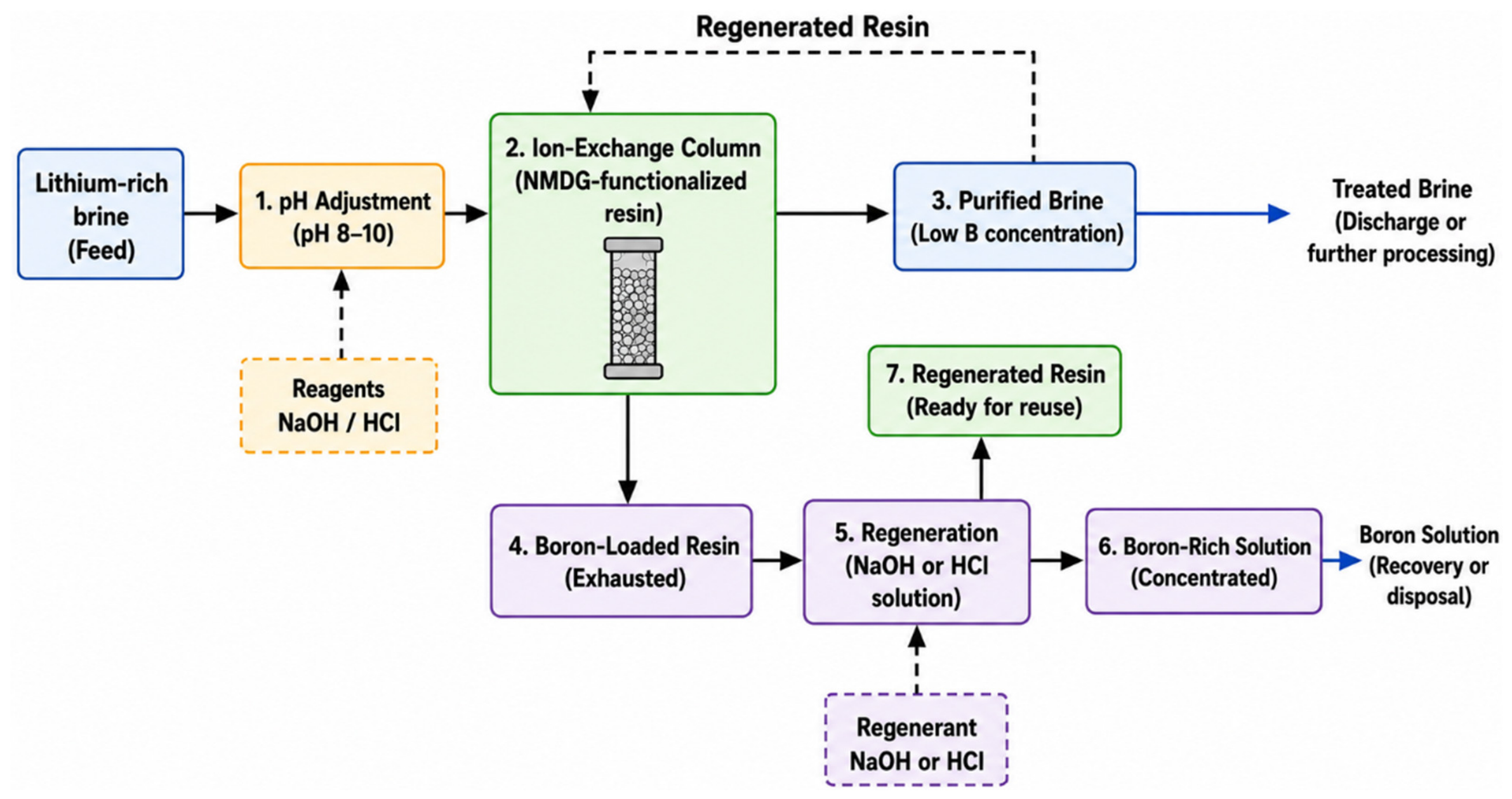
These resins can be regenerated using dilute NaOH or HCl solutions, depending on the regeneration strategy and operating conditions. In alkaline media, NaOH promotes the dissociation of the boron–NMDG cyclic ester complex, whereas dilute HCl protonates the functional groups and facilitates boron desorption, thereby restoring the adsorption capacity of the resin. This reversible adsorption–desorption mechanism enables repeated regeneration cycles while maintaining high boron removal performance. Sun et al. [29] reported that N-methyl-D-glucamine (NMDG)-functionalized magnetic adsorbents retained more than 85% of their initial adsorption capacity after five regeneration cycles, corresponding to a cumulative capacity loss of less than 15%. Likewise, Figueira et al. [30] demonstrated that NMDG-functionalized ion-exchange resins achieved boron recovery values close to 98% during regeneration while maintaining stable adsorption performance throughout repeated adsorption–desorption operations. Overall, commercial NMDG-based boron-selective resins, including Amberlite IRA743 and DIAION CRB, generally maintain boron removal efficiencies above 90% after several regeneration cycles, although the extent of capacity loss depends on the resin chemistry, regeneration conditions, and composition of the treated brine [29,30,31,32]. The overall ion-exchange process for boron removal from lithium-rich brines is schematically illustrated in Figure 1.
Figure 1.
General process flow diagram of boron removal from lithium-rich brines via ion exchange using N-methyl-D-glucamine (NMDG)-functionalized resin.
However, their effectiveness decreases under neutral or acidic pH conditions, where boron is mainly present as boric acid B(OH)3, a neutral species with low reactivity towards the functional groups of the resins [33]. It has also been observed that high boron concentrations can quickly saturate the capacity of the resins, which limits their applicability without pretreatment stages or modular systems [34].
As noted by Parraguez et al. [22], despite these limitations, ion exchange has reached advanced levels of technological maturity (TRL 6–7) and has been validated in pilot studies applied to highly complex brines, including environments in the Andean Altiplano. Its potential integration into direct lithium extraction (DLE) schemes has also been proposed as a sustainable and efficient strategy.
From an industrial perspective, ion exchange is currently the most mature technology for boron removal. Commercial N-methyl-D-glucamine (NMDG)-functionalized resins, such as AmberLite IRA743 and DIAION CRB series, have been widely used in water treatment and industrial boron removal applications because of their high selectivity, regeneration capability, and suitability for continuous operation. Although their application to lithium-rich brines is still expanding, these commercial systems demonstrate the feasibility of large-scale boron removal.
2.2. Adsorption
Adsorption has become an efficient and versatile strategy for boron removal from lithium-rich brines, owing to its high selectivity, regenerability, and compatibility with multicomponent matrices. As noted by Parraguez et al. [35], in aqueous solutions, boron exists either as boric acid (B(OH)3) or in its ionized form (B(OH)4−), depending on the pH. Both species can form reversible bonds with the diol or amine groups present in functionalized adsorbents. This process is based on the formation of an ester-type complex, represented by reactions (3) and (4), as shown below [35]:
where R−(CHOH)2 represents the typical diol group of N-methylglucamine. The five-membered cyclic complexation is favored under slightly alkaline conditions [29]. The formation constant of these complexes ensures a high affinity for boron, even in the presence of competing anions [32,33]. Moreover, some studies suggest that amino groups can establish additional electrostatic interactions with the partial charge of the borate anion, thereby increasing selectivity [36]. Among the most efficient adsorbents are NMG-based resins such as Amberlite IRA743, which achieve capacities of up to 20 mg/g and exhibit removal rates above 90% in synthetic brines. Their regeneration with NaOH or HCl allows for multiple cycles without a significant loss of capacity [32].
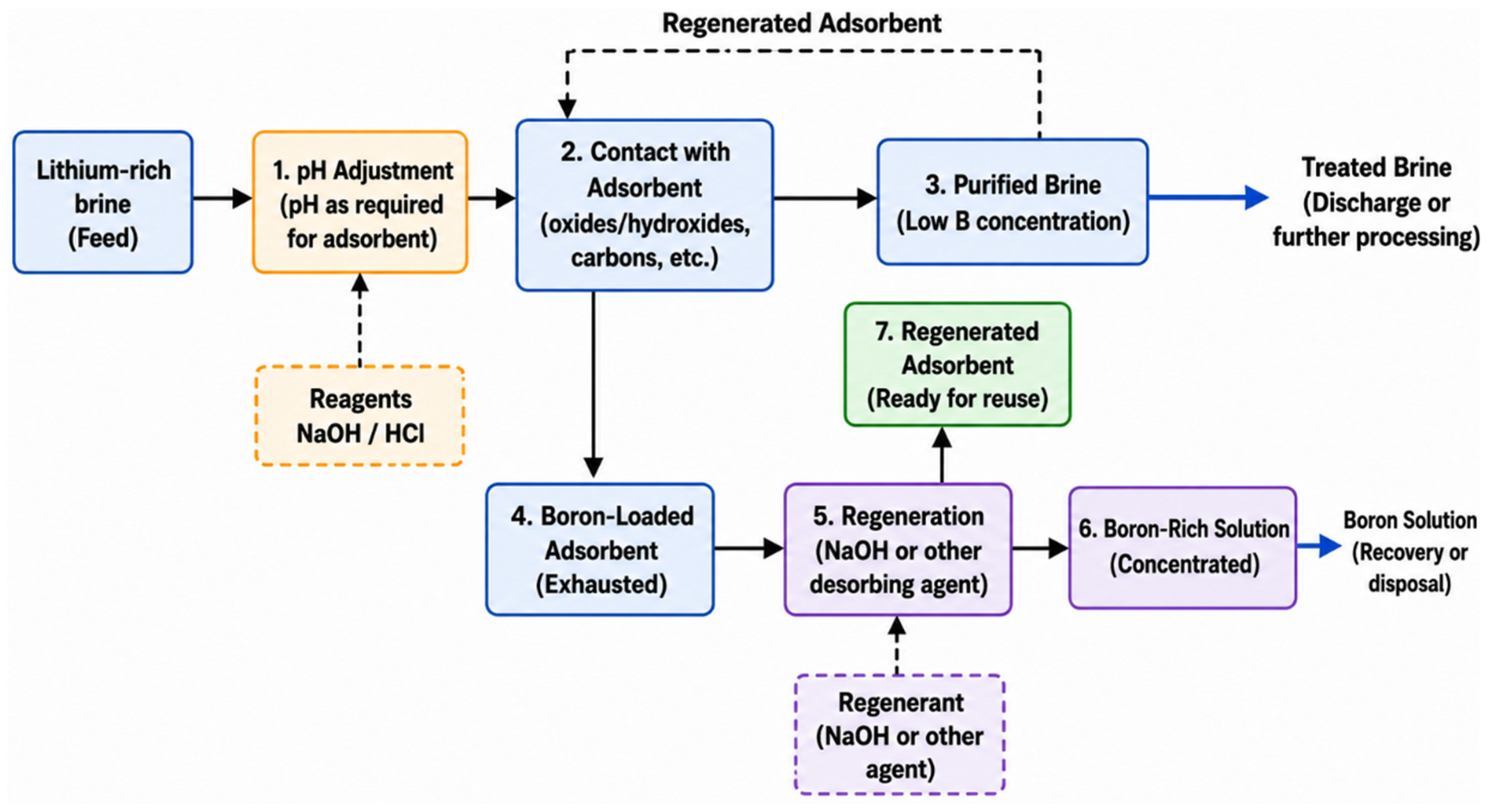
As mentioned by Sun et al. [29], the incorporation of magnetism through NMG-functionalized nanoparticles significantly improves recovery and adsorption kinetics, enabling rapid separation using magnetic fields. These materials retain more than 85% of their efficiency after five cycles. The general adsorption process for boron removal from lithium-rich brines is schematically illustrated in Figure 2.
Figure 2.
Schematic flow diagram of the adsorption process for boron removal from lithium-rich brines.
The kinetic data fit the pseudo-second-order model, while the Langmuir isotherms accurately describe the monomolecular adsorption behavior [37]. On the other hand, ions such as Mg2+ can inhibit the process through competition, although strategies such as pH adjustment, pretreatment, or the use of hybrid materials have mitigated this effect [34,36].
Wu et al. [38] introduce an innovative, highly efficient boron adsorbent created through a simple and economical method, using N-methyl-D-glucamine integrated into modified chitosan beads (CTS-MG). This adsorbent exhibits an outstanding capacity to capture boron, with optimal adsorption occurring within a pH range of 3 to 8, suggesting effective performance across a wide range of pH levels. At a pH of 7, its actual maximum adsorption capacity reaches 20.36 mg/g, surpassing that of most commercial resins specifically engineered for boron separation. Additionally, the most efficient adsorption takes place in the neutral pH range, indicating that no pH adjustments are required for the ex-traction of boron from contaminated water. The kinetics of boron adsorption indicate that the entire process may be completed in merely 3 h. Furthermore, the presence of salts such as NaCl, MgCl2, CaCl2, NaNO3, and Na2SO4 does not negatively impact boron adsorption, showcasing the selectivity of CTS-MG. Moreover, CTS-MG demonstrates remarkable regeneration and reuse potential, underscoring its applicability for boron separation in salt lake environments [38].
According to reports, integrated systems such as adsorption coupled with electrodialysis (AdED) have achieved efficiencies above 95%, reducing reagent consumption and increasing operational stability.
Finally, in the literature, several methods have been used to remove boron from drinking water, and they have potential for application in brine. The main alternatives proposed in the latest research on boron sorbents can be summarized as follows [28]:
- New polymer carriers, like nylon and cellulose, are being explored, as numerous commercial resins made from polystyrene, polyethylene, and polypropylene have shown effectiveness in removing boron.
- Innovative functional groups for sorbents aimed at boron removal, such as pyrocatechol, have been introduced. These sorbents demonstrate high selectivity for boron and can be readily recycled.
- Considering the costs associated with boron removal, various low-cost sorbents have been investigated and applied, including fly ash, industrial byproducts, red mud, and agricultural residues like straw.
- The development of new inorganic sorbents for boron removal, such as layered double hydroxides (LDHs), mesoporous silica, zeolites, and magnetic nanoparticles, has become a key area of research focus.
Despite the promising adsorption capacities reported in the literature, most adsorption technologies for boron removal from lithium-rich brines remain at the laboratory or pilot scale. Future industrial implementation will require further validation under continuous operating conditions, together with long-term regeneration and techno-economic studies.
2.3. Liquid–Liquid Extraction
Liquid–liquid extraction (LLX) has become an effective technique for the selective removal of boron from complex saline matrices, particularly lithium-rich brines. This process is based on the transfer of boron from an aqueous phase to an organic phase through the formation of soluble complexes, typically in the presence of alcohols or organophosphorus extractants [11,39]. Li et al. investigated methods for extracting and mineralizing CO2 to separate B3+, Li+, and Mg2+ from brine in salt lakes, which have a high Mg/Li ratio. The extraction of B3+ was performed using a blend of 2-ethyl-1,3-hexanediol and kerosene, with sodium hydroxide added for the back-extraction of boron. It was observed that the addition of a small amount of FeCl3 significantly improved the efficiency of extraction, as the hydrolysis and hydration of Fe3+ can lower the solution pH and help in creating a salting-out effect. Lithium ions were extracted through a synergistic approach using a combination of tributyl phosphate, ionic liquids, kerosene, and FeCl3, where the ILs enhanced the lithium extraction rate through a cation exchange reaction involving [C4mim+]. The organic phase, containing 30% kerosene, 65% TBP, and 5% ILs, led to a single-stage extraction rate for Li+ of 56%. The extraction efficiencies for B3+ and Li+ were noted to be 98% and 89.1%, respectively [40].
Several studies have employed alcohols to selectively remove boron from lithium brines. Alcohols can exhibit different performances in boron removal, for example, under basic or acidic pH conditions, as well as in the co-extraction of metals. It is important to distinguish the complexity of the alcohols, for instance, between mono-hydroxy alcohols and di-hydroxy alcohols, as well as the effect of the solvents in which they are diluted [41]. At the industrial scale, boron removal is accomplished using monohydric alcohols, which aid in the extraction of boron from brine through a three-stage counter-current extraction technique. This process utilizes an organic solution that contains 2.5 M isodecanol. When operating under specific conditions, the extraction efficiency for boron can reach 99.07%. Furthermore, water serves as a stripping agent to recover the solvent after the extraction process. On the other hand, isooctanol is an organic extractant, and its effectiveness can be greatly improved by adding ethyl chloroacetate as a solubilizing agent. Several factors, such as extraction duration, brine pH, the ratio of organic to aqueous phases (O/A ratio), the number of extraction stages, and ionic strength, are essential in influencing the efficiency of boric acid extraction and stripping. Experimental results showed that a mixture of 50% isooctanol and 20% ethyl chloroacetate, with an O/A ratio of 2, achieved an extraction efficiency of 44% during a single extraction from a boric acid solution containing 1.5 mol/L MgCl2 at a pH of 5.5. By keeping the same composition for the organic phase and altering the O/A ratio to 1, the extraction efficiency rose to 60% in a single extraction from a boric acid solution with 4 mol/L MgCl2 at pH 4.16. Furthermore, when utilizing water as the solvent for re-extraction with an O/A ratio of 1.5, the re-extraction rate of boric acid reached an outstanding 99.6% [42].
As noted by Kiemde et al. [43], a widely used strategy is the esterification reaction of boric acid with long-chain alcohols, such as 2-ethylhexanol, which enables its efficient transfer to the organic phase [43]. Reaction (5) can be expressed as
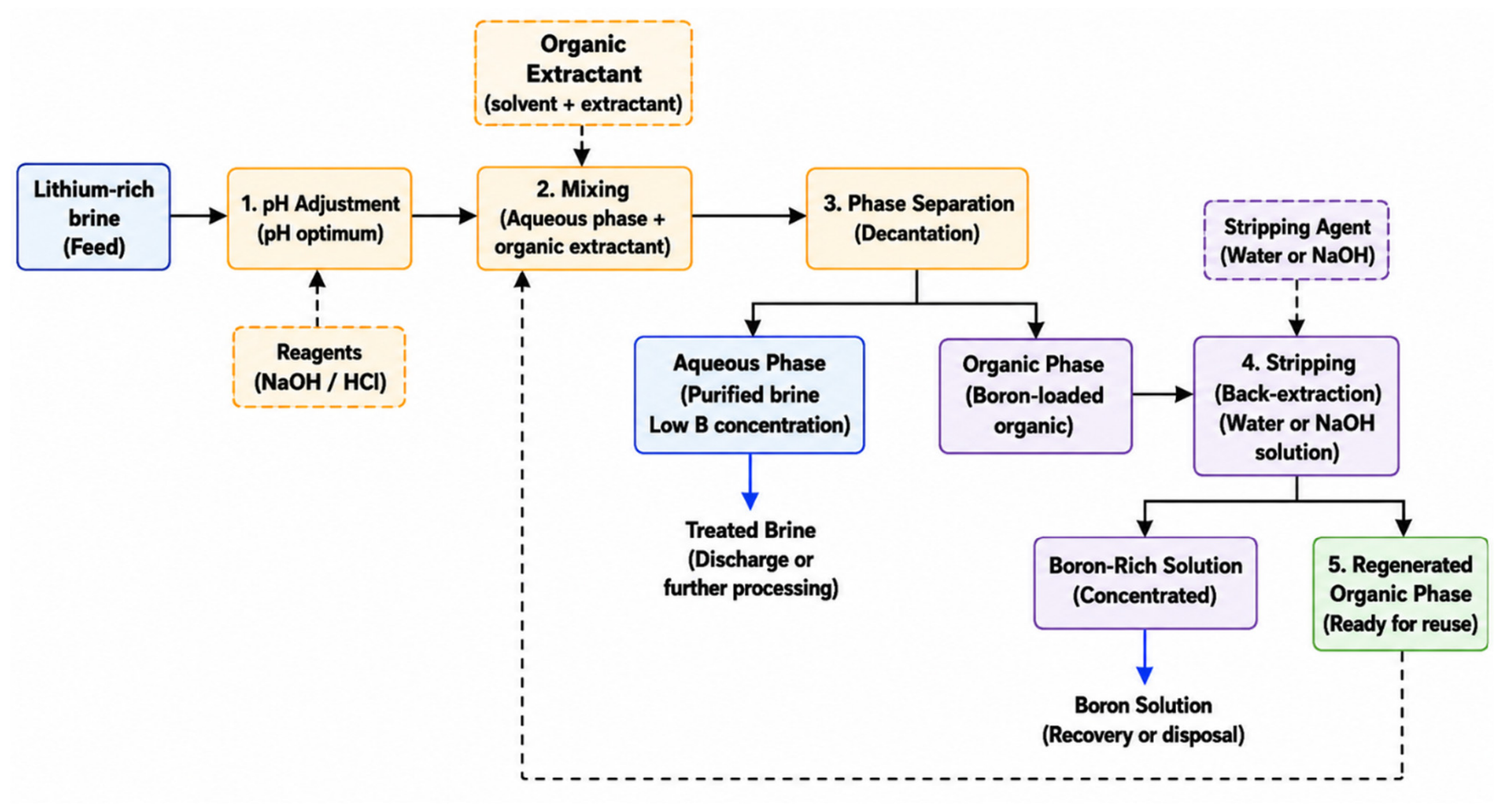
where ROH corresponds to the alcohol present. This mechanism was experimentally validated in the treatment of continental brines, showing efficiencies above 80% when the pH was adjusted to slightly acidic values [44]. The overall liquid–liquid extraction process is schematically illustrated in Figure 3.
Figure 3.
Schematic flow diagram of the liquid–liquid extraction process for boron removal from lithium-rich brines.
In research conducted by Peng et al. [45], the process of extracting boron from salt lake brine using 2,2,4-trimethyl-1,3-pentanediol was comprehensively analyzed. The authors examined various factors influencing boron recovery during the solvent extraction procedure, such as feed pH, the concentrations of both the extractant and H3BO3, the organic-to-brine phase ratio (O/A), and temperature. The findings showed that an increase in feed pH initially improved the rate of boron extraction. However, this enhancement was limited; further increases in feed pH caused the rapid formation of B[OH]4−, which exhibits a lower ability to complex with TMPD, thus reducing the efficiency of boron extraction. Moreover, it was observed that boron recovery increased with elevated concentrations of TMPD and a higher O/A ratio. An experiment examining the salting-out effect indicated that the addition of magnesium chloride had two contrasting effects on boron extraction. In summary, the research achieved a boric acid extraction efficiency of 97.12%, while the stripping efficiency was noted at 88.98% [45].
On the other hand, according to Köse et al. [35], the use of ionic liquids (ILs) and deep eutectic solvents (DESs) has emerged as a more sustainable alternative, offering lower volatility and greater selectivity towards lithium. These compounds enable the simultaneous extraction of boron and magnesium, and their structural tunability provides versatility depending on the ionic profile of the brine. In addition, the incorporation of organo-phosphorus extractants such as TBP (tributyl phosphate) enhances the stability of the organic phase and allows for more efficient regeneration of the system [35]. The TBP–alcohol combination has proven effective in the presence of high concentrations of Li+ and Na+. When the medium is alkaline, boron is present as B(OH)4− and can be extracted by forming ion pairs with tertiary amines or basic ionic liquids, following reaction (6):
This mechanism has been exploited in multistage extractions, significantly increasing efficiency compared with a single-step process [46].
Other studies have highlighted the usefulness of three-phase systems (TLPE), which incorporate an intermediate phase to enhance the selective separation of lithium, magnesium, and boron [47]. This configuration has shown efficiencies of up to 90%, with minimal lithium loss and easy solvent regeneration [27]. The subsequent recovery of boron from the organic phase has been optimized using aqueous streams or thermal regeneration, enabling a cyclic process without significant deterioration of the extractant [24,47].
Following solvent extraction, the loaded organic phase is subjected to a stripping stage to selectively recover boron and regenerate the extractant for subsequent reuse. Depending on the extraction system, boron can be back-extracted using water, dilute NaOH, or dilute mineral acids, which break the boron–extractant complex and transfer boron back into an aqueous phase. For example, Fan et al. [42] reported a 99.6% boric acid stripping efficiency using water at an O/A ratio of 1.5, whereas Almustafa et al. [48] achieved stripping efficiencies close to 100% using 0.1 M NaOH for hydrophobic deep eutectic solvents. Similarly, Peng et al. [45] reported a boron stripping efficiency of 88.98% following an extraction efficiency of 97.12% using 2,2,4-trimethyl-1,3-pentanediol. In systems where lithium is co-extracted, selective stripping conditions or washing stages are applied to preferentially recover boron while minimizing lithium losses, after which the regenerated organic phase is recycled to the extraction circuit [42,45,48].
Parraguez et al. [22] offer a thorough method for designing, modeling, and optimizing a dual-solvent extraction system aimed at selectively extracting magnesium and boron from lithium-rich brines while reducing lithium co-extraction. The system utilizes a com-bination of two extractants to extract boron and magnesium simultaneously. The magnesium extractant is created through the quaternization reaction between triethylamine and 1-bromobutane. The boron extractant is produced by reacting N-methyl-D-glucamine with 1-bromononane. This allows for a clear definition of operating conditions that achieve high extraction efficiencies, 89% for magnesium and 100% for boron, while keeping lithium losses at 13% [22].
On the other hand, Almustafa et al. [48] developed new hydrophobic deep eutectic solvents (DESs) as extractants of boron from aqueous medium. The DESs were prepared by mixing menthol or thymol with 1-decanol or 2-methyl-2,4-pentanediol. It was found that the DES prepared with the monohydric alcohol (1-decanol) had negligible extraction efficiency for boric acid. Conversely, the DES prepared with 2-methyl-2,4-pentanediol showed extraction efficiencies of 90% and 83.2% for the mixtures with thymol and menthol, respectively. The stripping process was straightforward in both instances, achieving efficiencies close to 100% using a 0.1 M NaOH solution [48].
Liquid–liquid extraction is a well-established technology in the hydrometallurgical industry for the separation and purification of metals. However, its specific application for the selective removal of boron from lithium-rich brines remains largely at the laboratory and pilot scales, with limited publicly available information regarding its industrial implementation due to the proprietary nature of commercial lithium production processes. Future industrial deployment will depend on improving extractant stability, minimizing solvent losses, and demonstrating long-term performance under continuous operating conditions.
2.4. Electrochemical Methods
Electrochemical methods have emerged as versatile strategies for boron removal in complex saline systems, particularly in lithium-rich brines. Their appeal lies in the ability to operate without chemical additives, under mild conditions, and with high selectivity. One of the most studied approaches is electrocoagulation, in which the in situ generation of metallic species such as Al(OH)3 promotes boron adsorption through complexation and ion-exchange mechanisms [49].
The electrochemically generated amorphous Al(OH)3 flocs possess a high specific surface area and abundant hydroxyl groups, which promote boron removal through adsorption and the surface complexation of boric acid and borate species rather than through a direct precipitation reaction. Previous studies have shown that this surface complexation mechanism is responsible for the high boron removal efficiency observed during electrocoagulation processes, as shown in Equations (7) and (8) [49,50]:
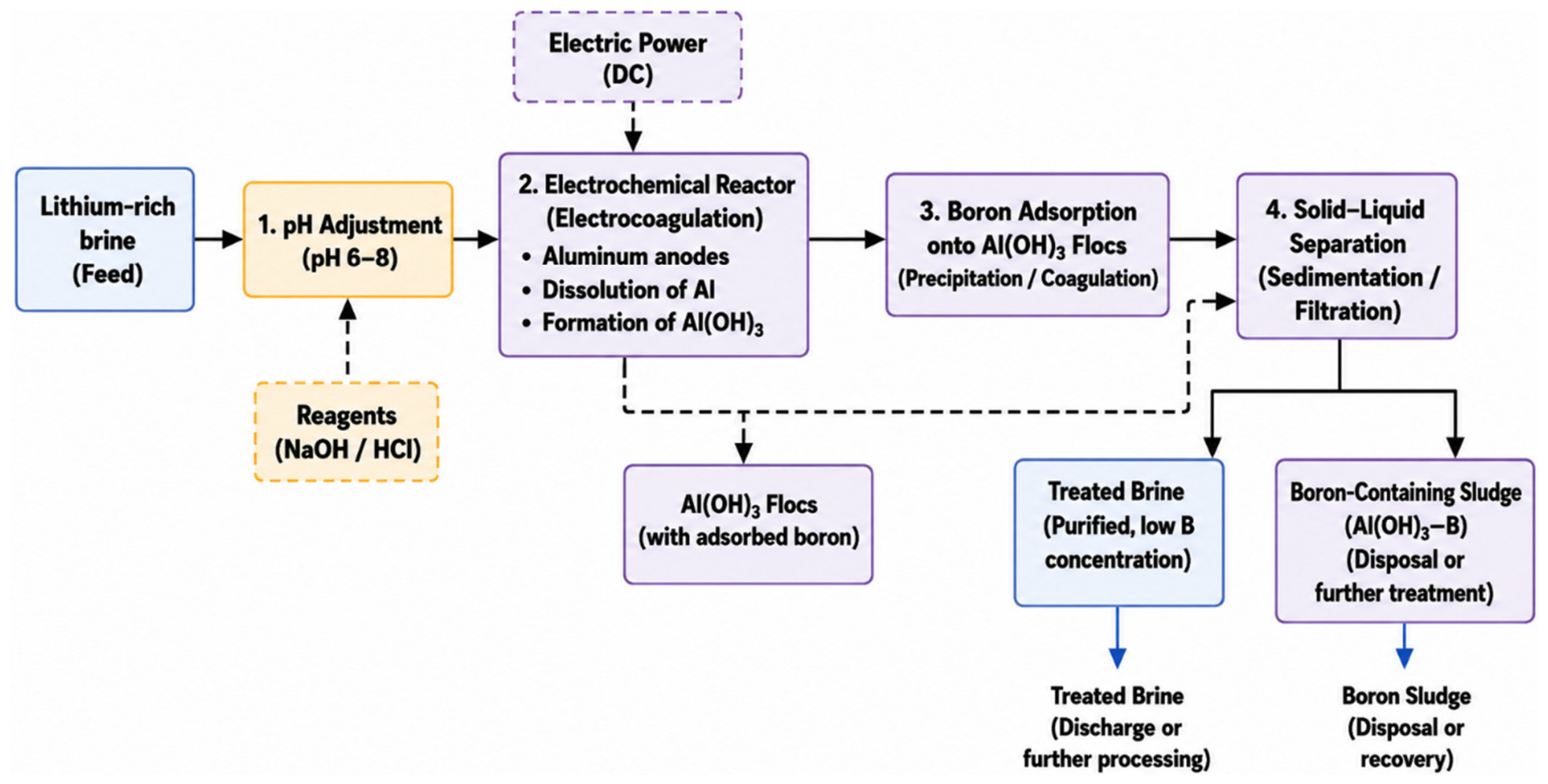
Another promising technique is electrosorption or capacitive deionization, which makes use of functionalized materials with a high affinity for boron. Recent studies have shown that activated carbons doped with amine or alcohol groups achieve effective boron removal in the presence of lithium, without compromising the integrity of the electrolyte [51]. In addition, selectivity can be enhanced by adjusting the operating potential, promoting the migration of borate species over competing cations such as Na+ or Mg2+ [51]. The general electrochemical process for boron removal from lithium-rich brines is schematically illustrated in Figure 4.
Figure 4.
Schematic flow diagram of the electrochemical process for boron removal from lithium-rich brines.
Redox-mediated separation represents another innovative approach, in which redox pairs are used as mediators to facilitate the reversible conversion of boron into electroactive forms. This technology has proven useful in high-salinity systems and has been pro-posed as an intermediate stage prior to lithium concentration. The use of bipolar membranes and electrodialysers with selective compartments has also been explored to enable the simultaneous separation of boron and lithium [52,53].
Regarding the recovery of boron in a reusable form, some studies have suggested the use of H3BO3 washes after the electrochemical process to remove residues from direct lithium extraction materials, indicating an interesting synergy between the two processes. Finally, it has been documented that the level of boron doping in diamond-type electrodes directly influences their anodic oxidation efficiency and, consequently, the stability of borate species under extreme operating conditions [54]. This has implications for the selectivity of the process and its resistance to organic interferences [55]. Taken together, electrochemical methods represent adaptable and selective alternative approaches that could potentially be integrated into other technologies, particularly in schemes for the simultaneous recovery of boron and lithium [56,57,58].
Electrochemical technologies, particularly electrocoagulation, are commercially employed in water and wastewater treatment. Nevertheless, their application to lithium-rich brines remains at an early stage of development, and additional pilot-scale studies are required to evaluate energy consumption, electrode durability, and overall process economics under industrial conditions.
2.5. Membrane-Based Separation (Nanofiltration/Reverse Osmosis)
Nanofiltration (NF) and reverse osmosis (RO) constitute a well-established, pressure-driven membrane technology, historically developed and extensively applied for boron removal in seawater desalination. In this process, boron predominantly exists as neutral boric acid (B(OH)3), whose small size and weak hydration make it markedly more difficult to reject than charged ionic species [59,60]. Because boric acid carries no charge below its pKa of approximately 9.2, the two dominant rejection mechanisms in RO/NF membranes—size exclusion and electrostatic repulsion—are largely ineffective under near-neutral pH; rejection increases substantially once the operating pH exceeds 9, favoring conversion to the negatively charged borate ion B(OH)4− [61].
Molecular-level studies indicate that boron rejection is governed less by simple pore size exclusion than by the competitive adsorption between water and boric acid within the membrane’s nanopores; membranes engineered to preferentially adsorb water create an effective barrier that impedes boric acid permeation without excessively compromising water flux [60]. Building on this principle, recent membrane designs have achieved considerable improvements in boron rejection while maintaining commercially relevant permeability: functionalization of the polyamide active layer with hydrophilic, water-affinic groups has reached boron rejections above 90% under simulated seawater conditions [59], while nanocomposite membranes incorporating carbon-based fillers have achieved 74%–85% rejection, even under low-pressure operation, conditions more representative of brackish or brine-type feedwaters [62].
A large-scale meta-analysis compiling 77 published studies and 534 experimental data points identified membrane type, feed pH, and NaCl rejection as the strongest predictors of boron rejection performance, while membrane surface properties (roughness, contact angle, and surface charge) showed a comparatively minor influence [61].
Beyond direct rejection, NF/RO has also been integrated into hybrid separation schemes. Ion-exchange pretreatment followed by electrodialysis has been used to separate boron from and further concentrate it in seawater RO brines [10,63], while hybrid RO configurations combined with ion-exchange or electrodeionization stages have reported boron removal efficiencies exceeding 90% for geothermal and saline waters [64]. In the specific context of lithium-rich brines, nanofiltration has additionally been explored as a pretreatment step to separate monovalent from divalent cations prior to lithium recovery, illustrating that membrane technology—although historically developed for seawater applications—is increasingly relevant to brine processing more broadly, even where boron-specific rejection data remain limited [64].
Despite these advances, membrane-based boron removal in lithium-rich brine matrices remains comparatively underexplored relative to seawater applications. To date, no dedicated study has quantified boron rejection by NF/RO membranes under real lithium-brine conditions (i.e., high total dissolved solids, elevated Mg2+/Ca2+, and variable pH characteristic of salar brines); the majority of available boron-rejection data originate from seawater or synthetic solutions. Given the strong influence of feed salinity and ionic composition on NF/RO performance observed for other ions in lithium–brine matrices [16], extending boron-specific rejection studies to real or simulated salar brine represents a clear and relevant direction for future research.
3. Operational Parameters
Technologies for boron removal from lithium-rich brines have been developed using a variety of approaches, each with specific advantages and relevant limitations. Among these, adsorption, ion-exchange, liquid–liquid extraction (LLE), and electrochemical methods stand out as the most extensively studied in the recent literature.
Adsorption has been widely reported as an effective method for boron removal, with removal efficiencies exceeding 90% under optimal operating conditions, particularly when using N-methyl-D-glucamine (NMDG)-functionalized resins, which exhibit strong affinity for boron, even in the presence of high lithium and magnesium concentrations [65]. Adsorption capacities of up to 19.3 mg g−1 have been reported under alkaline conditions [66,67]. The optimal operating conditions are typically within a pH range of 8–10, with contact times of 60–120 min at ambient temperature (25–35 °C), allowing efficient regeneration using NaOH or diluted saline solutions [68]. However, boron removal efficiency decreases at near-neutral pH due to the predominance of H3BO3, which reduces the fraction of borate available for capture [6].
Ion exchange is another well-established technology. Efficiencies of 85%–95% have been achieved using specific resins with NMDG functional groups [25]. Recent advances with resins such as XSC-800 or Diaion derivatives have made it possible to reduce the boron content to below 0.5 mg/L in desalinated waters [30]. Its selectivity can be optimized through the design of the polymer matrix, and it offers sustainability advantages, as it does not require hazardous reagents. The optimal conditions include a slightly alkaline pH (7–9) and contact times of 30–60 min. Regeneration is carried out using concentrated saline solutions or mild alkalis, maintaining its capacity for at least five cycles without significant loss [31]. Its main limitation is the operational cost and rapid saturation in highly complex matrices.
Liquid–liquid extraction (LLE) has reported efficiencies of up to 95%–99%, particularly when using extractants such as 2-ethylhexanol, mixtures of alcohols, or low-eutectic systems [46]. Its rapid kinetics and the possibility of simultaneously recovering lithium and boron are notable advantages [69]. However, selectivity towards Li+ and Mg2+ can be affected in multicomponent systems, and the use of organic solvents entails environmental risks and reduced sustainability. Typical parameters include an acidic pH (5–6), temperatures of 40–60 °C, and contact times of 20–30 min, with regeneration depending on the solvent, often achieved through phase inversion or thermal treatment.
Although most studies show that boron extraction is carried out at low pH, in the case of brines that are naturally alkaline, these methods can be costly or inefficient. In this regard, Zhang et al. [70] proposed a system and method for extracting and separating boron from alkaline solutions, specifically from alkaline saline lake brine. Their extraction system uses a mixture of dodecanol (monohydric alcohol), 2-octanol (dihydric alcohol), and salicylic acid ester. Experimental results show that the dihydric alcohol outperforms the monohydric alcohol in extraction efficiency. The concentration of 2-octanol is crucial for optimizing boron extraction, while the salicylic acid ester increases the solubility of the complex and improves fluidity. Under optimized conditions, a three-stage counter-current extraction process can achieve over 95% boron extraction from brine at pH 9.5 and a concentration of 0.02 mol/L, with minimal extraction of other ions, except for sodium. The loaded organic phase can be stripped using a dilute acid solution, and, after pH adjustment and evaporation concentration, it can be used to produce boric acid [70].
Finally, electrochemical methods represent emerging alternatives with a more environmentally sustainable profile, as they can operate without external chemical inputs. Electrocoagulation has demonstrated efficiencies of 80%–95%, depending on the design and conditions, through the formation of metallic hydroxides that capture boron species [44,50]. Redox-mediated separation and capacitive deionization (CDI) have shown potential for integration with direct lithium extraction, promoting hybrid process schemes [49,53]. The optimal parameters include a pH of 6–8, voltages of 10–20 V, currents of 0.1–1 A, and durations of 30–90 min, with regeneration possible through polarity reversal [52]. Its current limitations lie in electrode cost, energy consumption, and material durability, although it represents a promising path towards sustainable treatment schemes. Table 1 summarizes the main mechanisms, advantages, and limitations of each technology, allowing a comparative view of their strengths and weaknesses.
Table 1.
Synthetic comparison of advantages and limitations of boron removal technologies.
4. Economic Evaluation and Industrial Feasibility of Direct Boron Removal Methods in Lithium-Rich Brines
The economic evaluation of direct boron removal processes from lithium-rich brines constitutes an essential parameter for determining their industrial feasibility. The costs associated with initial capital (CAPEX), operation (OPEX), waste management, and the durability of active materials vary widely among technologies, reflecting both the complexity of the equipment and the selectivity of the reagents employed. In general, adsorption- and ion-exchange-based technologies exhibit the lowest investment costs, whereas electrochemical and liquid–liquid extraction methods fall within the higher CAPEX range due to the requirement for specialized reactors and multi-phase separation systems [71,72].
In the case of adsorption, the average CAPEX reported for pilot plants ranges between 250 and 600 USD/m3 of treatment capacity, depending on the adsorbent formulation and system automation level [73]. Materials based on N-methyl-D-glucamine or epoxy-functionalized resins show a service life exceeding 50 regeneration cycles, reducing replacement frequency and, consequently, the operational cost [29]. The OPEX lies be-tween 0.25 and 0.45 USD/m3, mainly associated with the consumption of alkaline and acidic reagents during regeneration [32]. This technological category stands out for its low energy consumption (below 0.5 kWh/m3) and relatively simple waste management, as it does not require organic solvents [74].
Ion exchange presents an intermediate economic behavior. Although the initial CAPEX can exceed 800 USD/m3 due to the need for pressurized columns and continuous regeneration systems, the possibility of semicontinuous operation allows the OPEX to be reduced to 0.35–0.60 USD/m3, with costs dominated by acidic or saline regenerants [75,76]. The durability of commercial resins, such as amine-modified Amberlite or Dowex, reaches 80–120 cycles before exhibiting a significant loss of exchange capacity [77]. Their main drawback lies in the generation of salt-rich residual solutions, whose treatment increases the total cost up to 0.75 USD/m3, particularly in closed systems with a high ionic strength [22].
In contrast, liquid–liquid extraction processes, while effective in terms of selectivity, exhibit considerably higher CAPEX values—around 1500–2000 USD/m3—due to the complexity of the equipment and the need for solvent-resistant materials [74]. Their OPEX, between 0.9 and 1.5 USD/m3, is dominated by the consumption of extractants (TBP, DIBK, and hydroxy-functional alcohols), as well as by the costs of recovery and disposal of residual phases [43]. Despite these costs, some studies report boron recovery factors above 90%, which, in high-value industrial contexts, can partially offset the investment [77].
Electrochemical methods, including electrode ionization and redox-mediated extraction, currently present the highest investment requirements, with an estimated CAPEX between 2000 and 3000 USD/m3, due to the need for selective electrodes, ion-exchange membranes, and electrical control systems [78,79]. Their OPEX is high, ranging from 1.2 to 2.4 USD/m3, mainly due to energy consumption (3–6 kWh/m3) and the periodic replacement of membranes and electrodes [80].
Waste treatment costs vary significantly among methods. Adsorption primarily generates neutralizable alkaline sludges, with a disposal cost below 0.1 USD/m3, while liquid–liquid extraction systems can produce organic residues equivalent to 0.5–0.8 USD/m3 of the treated volume [72]. Electrochemical processes produce a concentrated saline stream, generally reusable in subsequent stages, reducing their effective disposal cost to 0.2 USD/m3 [71].
From the perspective of durability, adsorbent materials and ion-exchange resins are the most stable, with degradation below 10% after 100 use cycles, whereas electrodes and membranes in electrochemical methods must be replaced every 6–12 months, representing about 20% of the annual operating cost [81]. In industrial facilities such as the Salar de Atacama, maintenance and equipment replacement costs can reach 8%–12% of the annual OPEX, defining a relevant comparison threshold with more recent hybrid systems.
Overall, the cost–efficiency relationship suggests that adsorption and ion-exchange processes are currently the most competitive for boron removal in high-concentration brines, with total costs in the range of 0.6–0.9 USD/m3, compared with 1.5–3.0 USD/m3 for electrochemical systems and 2.0–2.5 USD/m3 for liquid–liquid extraction. The optimal technological selection depends on the balance between the required purity, energy availability, and operating conditions, with geothermal or high-temperature brines offering greater potential for energy integration and OPEX reduction [82,83]. A comparative summary of the main economic parameters is presented in Table 2.
Table 2.
Comparison of CAPEX, OPEX, waste disposal, and durability costs for direct boron removal methods in lithium-rich brines.
The CAPEX and OPEX values summarized in Table 2 were compiled from studies conducted under heterogeneous operating conditions, feedstocks, and geographic contexts, and they are presented here for comparative orientation rather than as directly interchangeable figures. Dedicated techno-economic analyses of brine and produced-water treatment confirm that capital and operating costs are highly sensitive to local factors not captured by a single tabulated value. A pilot-scale techno-economic study of reverse osmosis treatment of California produced water—a matrix in which boron is explicitly identified as a design-relevant contaminant—reported itemized OPEX contributions from chemicals, power, waste management, spare parts, and labor that varied independently across process configurations, with labor and power costs governed by local wage and electricity rates rather than by the treatment technology itself [85]. Similarly, a cost–benefit framework for mineral and salt recovery from brine (including boron) explicitly incorporates local electricity prices, reagent dosing and pricing, and labor and maintenance costs as independent inputs to CAPEX and OPEX, noting that these values must be benchmarked against site-specific desalination and chemical plant data rather than treated as universal constants [72]. Consistent with this, a techno-economic optimization framework for lithium- and boron-containing produced water propagates CAPEX and OPEX intensities as probability distributions rather than fixed values, explicitly capturing uncertainty arising from technology choice, energy and chemical consumption, and site-specific installation context [72].
Taken together, this literature indicates that pretreatment requirements and operating costs cannot be assumed constant across brines of different origin and that the values in Table 2 should be interpreted as indicative ranges rather than site-independent benchmarks. A rigorous techno-economic comparison across boron removal technologies would require harmonized cost models that explicitly account for brine-specific pretreatment needs, local utility and labor prices, and reagent costs—an analysis that, to the best of our knowledge, has not yet been performed across the full set of technologies reviewed in this work and represents a relevant direction for future research.
5. Conclusions
A comparative review of boron removal technologies in lithium-rich brines shows that adsorption and ion exchange are the most established and selective methods, offering high reusability and industrial applicability, although limited by loading capacity and the cost of specialized resins. Liquid–liquid extraction achieves efficiencies above 95% under controlled conditions, but its environmental risks and solvent handling costs restrict its scalability. Meanwhile, electrochemical methods stand out for their reduced chemical consumption and potential integration with direct lithium extraction schemes, although they still face challenges related to energy consumption and material durability. Across all approaches, adaptability to the specific chemical conditions of each brine is critical, as these determine the achievable efficiency and selectivity.
Therefore, the selection of the most appropriate boron removal technology should consider not only boron removal efficiency but also the boron concentration, Mg/Li ratio, presence of competing ions, regeneration capability, operational complexity, and requirements of downstream lithium recovery processes. Consequently, no single technology can be considered universally optimal, and the most suitable approach should be selected according to the specific characteristics of the brine and the desired process objectives. Likewise, there is a growing trend towards hybrid processes that combine the robustness of established techniques with the innovation of emerging methods to sustainably achieve battery-grade purity levels (<5 ppm B). Future research should therefore prioritize the development of more selective and environmentally sustainable materials, hybrid treatment processes, long-term regeneration studies, pilot-scale validation, techno-economic assessments, life-cycle analyses, and industrial implementation. In summary, the balanced integration of efficiency, selectivity, sustainability, and industrial scalability represents the most promising pathway to overcoming the boron-related challenges in lithium-rich brines. In this way, the objective outlined in the Introduction is achieved, providing a critical perspective that connects scientific principles, technological maturity, and industrial feasibility.
Author Contributions
Conceptualization, A.N., M.M. and N.G.P.R.; methodology, M.M., W.L. and F.M.G.-M.; formal analysis, J.C., N.T. and E.G.; investigation, M.M., N.G.P.R., M.S. and J.C.; data curation, M.S., W.L. and F.M.G.-M.; writing—original draft preparation, N.T. and A.N.; writing—review and editing, M.M., N.G.P.R., M.S., F.M.G.-M., W.L. and E.G.; supervision, N.T. and J.C.; project administration, E.G., J.C. and F.M.G.-M.; funding acquisition, J.C. and F.M.G.-M. All authors have read and agreed to the published version of the manuscript.
Funding
This research was funded by ANID-Chile through the grants ANID/SERC Chile/CIN250043 and ANID CTI 250019 Innovation Center for Sustainable Energy Transition (SET-Chile). In addition, all results presented in this work are part of the activities conducted under the magister scholarship framework and were financed by the project “Transfer: Expanding horizons in mineral processing engineering”, Cod BIP 40067590-0, funded by the Regional Government of Antofagasta through the Regional Fund for Productivity and Development.
Data Availability Statement
No new data were created or analyzed in this study. Data sharing is not applicable to this article.
Conflicts of Interest
The authors declare no conflicts of interest.
References
- Flexer, V.; Baspineiro, C.F.; Galli, C.I. Lithium recovery from brines: A vital raw material for green energies with a potential environmental impact in its mining and processing. Sci. Total Environ. 2018, 639, 1188–1204. [Google Scholar] [CrossRef] [Scilit] [PubMed]
- Kesler, S.E.; Gruber, P.W.; Medina, P.A.; Keoleian, G.A.; Everson, M.P.; Wallington, T.J. Global lithium resources: Relative importance of pegmatite, brine and other deposits. Ore Geol. Rev. 2012, 48, 55–69. [Google Scholar] [CrossRef] [Scilit]
- Torres, D.; Pérez, K.; Galleguillos Madrid, F.M.; Leiva, W.H.; Gálvez, E.; Salinas-Rodríguez, E.; Gallegos, S.; Jamett, I.; Castillo, J.; Saldana, M.; et al. Salar de Atacama Lithium and Potassium Productive Process. Metals 2024, 14, 1095. [Google Scholar] [CrossRef] [Scilit]
- Saleem, U.; Wilhelms, A.; Sottmann, J.; Knuutila, H.K.; Bandyopadhyay, S. Direct lithium extraction (DLE) methods and their potential in Li-ion battery recycling. Sep. Purif. Technol. 2025, 361, 131315. [Google Scholar] [CrossRef] [Scilit]
- Liu, X.; Xu, C.; Chen, P.; Li, K.; Zhou, Q.; Ye, M.; Zhang, L.; Lu, Y. Advances in Technologies for Boron Removal from Water: A Comprehensive Review. Int. J. Environ. Res. Public Health 2022, 19, 10671. [Google Scholar] [CrossRef] [Scilit] [PubMed]
- Williams, G.D.Z.; Nativ, P.; Vengosh, A. The role of boron in controlling the pH of lithium brines. Sci. Adv. 2025, 11, eadw3268. [Google Scholar] [CrossRef] [Scilit] [PubMed]
- Masindi, V.; Gitari, M.W.; Tutu, H.; Debeer, M. Removal of boron from aqueous solution using magnesite and bentonite clay composite. Desalin. Water Treat. 2016, 57, 8754–8764. [Google Scholar] [CrossRef] [Scilit]
- Fortuny, A.; Coll, M.T.; Sastre, A.M. Boron removal from seawater by supported liquid membranes using Cyphos IL 104 as a carrier. Procedia Eng. 2012, 44, 807–808. [Google Scholar] [CrossRef] [Scilit]
- Fortuny, A.; Coll, M.T.; Sastre, A.M. Use of ionic liquid on boron extraction in chloride media. Sep. Purif. Technol. 2012, 97, 137–141. [Google Scholar] [CrossRef] [Scilit]
- Figueira, M.; Fernández de Labastida, M.; Valderrama, C.; Reig, M. Boron separation and concentration from pre-treated seawater reverse osmosis brines by selective ion-exchange resins and electrodialysis. Chem. Eng. J. Adv. 2025, 24, 100863. [Google Scholar] [CrossRef] [Scilit]
- Kiemde, A.F.; Díaz Nieto, C.H.; Marin, J.; Flexer, V.; Chagnes, A. Direct lithium extraction from natural brines with co-valorization of boron, magnesium and sodium by combining solvent extraction and electrodialysis operations. Sustain. Mater. Technol. 2025, 46, e01749. [Google Scholar] [CrossRef] [Scilit]
- Zhu, F.; Li, L.; Jia, L.; Du, Y.; Wu, Y.; Zhang, Y.; Pan, J.; Zhou, Y.; Li, J. An infrared spectroscopic and Ab initio investigation of aqueous boric acid solutions: Evidence for the structure and transformation of the polyboric acid molecules. J. Mol. Liq. 2024, 408, 125390. [Google Scholar] [CrossRef] [Scilit]
- Zhou, Y.; Fang, C.; Fang, Y.; Zhu, F. Polyborates in aqueous borate solution: A Raman and DFT theory investigation. Spectrochim. Acta-Part A Mol. Biomol. Spectrosc. 2011, 83, 82–87. [Google Scholar] [CrossRef] [Scilit] [PubMed]
- Al-Sakaji, B.A.K.; Husseini, G.A.; Darwish, N.A. Impact of Ionic Strength and Charge Density on Donnan Potential in the NaCl-Cation Exchange Membrane System. Water 2023, 15, 3830. [Google Scholar] [CrossRef] [Scilit]
- Al-Sairfi, H.; Salman, M.A.; Al-Foudari, Y.; Ahmed, M. Modeling the Influence of Ionic Strength on Mineral Solubility in Concentrated Brine Solutions. Processes 2026, 14, 172. [Google Scholar] [CrossRef] [Scilit]
- Zhai, J.; Balogun, A.; Bhattacharjee, S.; Vogler, R.J.; Khare, R.; Malmali, M.; Deonarine, A.; Shen, Y.X. Nanofiltration as pretreatment for lithium recovery from salt lake brine. J. Membr. Sci. 2024, 710, 123150. [Google Scholar] [CrossRef] [Scilit]
- Valdez, S.K.; Orce Schwarz, A.M.; Thames Cantolla, M.I. Empirical models to determine ions concentrations in lithium brines with high ionic strength. Results Eng. 2023, 18, 101145. [Google Scholar] [CrossRef] [Scilit]
- Köse, T.E.; Öztürk, N. Boron removal from aqueous solutions by ion-exchange resin: Column sorption–elution studies. J. Hazard. Mater. 2008, 152, 744–749. [Google Scholar] [CrossRef] [Scilit] [PubMed]
- Ezechi, E.H.; Isa, M.H.; Kutty, S.R.M.; Yaqub, A. Boron removal from produced water using electrocoagulation. Process Saf. Environ. Prot. 2014, 92, 509–514. [Google Scholar] [CrossRef] [Scilit]
- Li, X.; Mo, Y.; Qing, W.; Shao, S.; Tang, C.Y.; Li, J. Membrane-based technologies for lithium recovery from water lithium resources: A review. J. Membr. Sci. 2019, 591, 117317. [Google Scholar] [CrossRef] [Scilit]
- Zhao, R.; Huo, M.; Wei, Q.; Ren, X.; Zhu, Y. A study on the coupling of Li+ and H3BO3 extraction and their mutual promotion mechanism. Desalination 2025, 593, 118221. [Google Scholar] [CrossRef] [Scilit]
- Parraguez, B.; Inestrosa-Izurieta, M.J.; Urzúa, J.I. Purification of lithium brines: Optimizing simultaneous magnesium and boron extraction. Chem. Eng. Res. Des. 2025, 219, 296–305. [Google Scholar] [CrossRef] [Scilit]
- Guo, J.; Yang, Y.; Gao, X.; Yu, J. Boron extraction from lithium-rich brine using mixed alcohols. Hydrometallurgy 2020, 197, 105477. [Google Scholar] [CrossRef] [Scilit]
- Bonin, L.; Deduytsche, D.; Wolthers, M.; Flexer, V.; Rabaey, K. Boron extraction using selective ion-exchange resins enables effective magnesium recovery. Sep. Purif. Technol. 2021, 275, 119177. [Google Scholar] [CrossRef] [Scilit]
- Kiemde, A.F.; Marin, J.; Flexer, V.; Chagnes, A. Liquid–liquid extraction of boron from continental brines by 2-butyl-1-octanol diluted in kerosene. RSC Adv. 2024, 14, 2170–2181. [Google Scholar] [CrossRef] [Scilit] [PubMed]
- Shocron, A.N.; Guyes, E.N.; Rijnaarts, H.H.M.; Biesheuvel, P.M.; Suss, M.E.; Dykstra, J.E. Electrochemical removal of amphoteric ions. Proc. Natl. Acad. Sci. USA 2021, 118, e2108240118. [Google Scholar] [CrossRef] [Scilit] [PubMed]
- Yáñez-Fernández, A.; Inestrosa-Izurieta, M.J.; Urzúa, J.I. Concurrent magnesium and boron extraction from natural lithium brine. Desalination 2021, 517, 115269. [Google Scholar] [CrossRef] [Scilit]
- Guan, Z.; Lv, J.; Bai, P.; Guo, X. Boron removal from aqueous solutions by adsorption—A review. Desalination 2016, 383, 29–37. [Google Scholar] [CrossRef] [Scilit]
- Sun, T.; Li, F.; Zhang, Q.; Geng, X.; Chen, H.; Zhao, Q. Magnetic nano-sorbent functionalized with N-methyl-d-glucamine for boron removal. Water 2022, 14, 1212. [Google Scholar] [CrossRef] [Scilit]
- Figueira, M.; Reig, M.; Fernández de Labastida, M.; Cortina, J.L.; Valderrama, C. Boron recovery from desalination seawater brines by selective ion exchange resins. J. Environ. Manag. 2022, 314, 114984. [Google Scholar] [CrossRef] [Scilit] [PubMed]
- Hussain, A.; Sharma, R.; Minier-Matar, J.; Hirani, Z.; Adham, S. Application of emerging ion exchange resin for boron removal from saline groundwater. J. Water Process Eng. 2019, 32, 100906. [Google Scholar] [CrossRef] [Scilit]
- Imbernón-Mulero, A.; Gallego-Elvira, B.; Martínez-Álvarez, V.; Martin-Gorriz, B.; Molina-del-Toro, R.; Jódar-Conesa, F.J.; Maestre-Valero, J.F. Ion exchange resins to reduce boron in desalinated seawater for irrigation. Agronomy 2022, 12, 1389. [Google Scholar] [CrossRef] [Scilit]
- Yan, C.; Yi, W.; Ma, P.; Deng, X.; Li, F. Removal of boron from refined brine by selective ion exchange resins. J. Hazard. Mater. 2008, 154, 564–571. [Google Scholar] [CrossRef] [Scilit] [PubMed]
- Ting, T.M.; Nasef, M.M.; Aravindan, D.; Rosslan, I.F.N.; Ruslan, N. Selective removal of boron from industrial wastewater containing high ammonia concentration. J. Environ. Chem. Eng. 2021, 9, 104993. [Google Scholar] [CrossRef] [Scilit]
- Parraguez, B.; Parra-Muñoz, N.; Cárdenas-Jirón, G.; Borges-Martínez, M.; Urzúa, J.I. Lithium brine purification via simultaneous extraction using ionic liquids. J. Mol. Liq. 2025, 425, 127193. [Google Scholar] [CrossRef] [Scilit]
- Pan, Y.; Du, J.; Chen, J.; Lian, C.; Lin, S.; Yu, J. Interlayer intercalation of Li/Al-LDHs responsible for high-efficiency boron extraction. Desalination 2022, 539, 115966. [Google Scholar] [CrossRef] [Scilit]
- Wolska, J.; Bryjak, M. Methods for boron removal from aqueous solutions—A review. Desalination 2013, 310, 18–24. [Google Scholar] [CrossRef] [Scilit]
- Wu, Q.; Liu, M.; Wang, X. A novel chitosan-based adsorbent for boron separation. Sep. Purif. Technol. 2019, 211, 162–169. [Google Scholar] [CrossRef] [Scilit]
- Mura, M.; Castillo, I.; Hernández, P.C.; Galleguillos Madrid, F.M.; Salinas-Rodríguez, E.; Castillo, J.; Soliz, Á.; Gálvez, E.; Toro, N. Leaching of copper slags in sulphuric acid and alkaline glycine media. Front. Chem. Eng. 2025, 7, 1613424. [Google Scholar] [CrossRef] [Scilit]
- Li, J.; Zhang, G.; Luo, M.; Li, G.; He, J. Separation and utilization of lithium, magnesium, and boron resources from salt lakes through ionic liquid extraction. Sep. Purif. Technol. 2025, 358, 130444. [Google Scholar] [CrossRef] [Scilit]
- Köse, T.E.; Öztürk, N. Boron removal from aqueous solutions by ion-exchange resin: Batch studies. Desalination 2008, 227, 233–240. [Google Scholar] [CrossRef] [Scilit]
- Fan, Y.; Li, J.; Zhao, P.; Han, J.; Zhu, F. Extraction of boric acid from high-magnesium brine using ionic liquids and alcoholic solvents. J. Mol. Liq. 2025, 432, 127729. [Google Scholar] [CrossRef] [Scilit]
- Kiemde, A.F.; Marin, J.; Flexer, V.; Chagnes, A. Boron extraction by aliphatic mono- and di-hydroxy alcohols from brine. Hydrometallurgy 2024, 225, 106280. [Google Scholar] [CrossRef] [Scilit]
- Yilmaz, A.E.; Boncukcuoğlu, R.; Kocakerim, M.M.; Keskinler, B. Parameters affecting boron removal by electrocoagulation. J. Hazard. Mater. 2005, 125, 160–165. [Google Scholar] [CrossRef] [Scilit] [PubMed]
- Peng, X.; Shi, D.; Zhang, Y.; Zhang, L.; Ji, L.; Li, L. Recovery of boron from unacidified salt lake brine using diol extractant. J. Mol. Liq. 2021, 326, 115301. [Google Scholar] [CrossRef] [Scilit]
- Li, L.; Tian, Z.; Zhang, H.; Feng, Z.; Li, T.; Sun, X. Tailored low-melting solvents for boron and lithium extraction. J. Hazard. Mater. 2025, 496, 139263. [Google Scholar] [CrossRef] [Scilit] [PubMed]
- Cerda, A.; Jara, M.; Yañez, O.; Barrueto, Y.; Jimenez, Y.P. Boron recovery from organic solutions used in brine treatment. Minerals 2024, 14, 265. [Google Scholar] [CrossRef] [Scilit]
- Almustafa, G.; Sulaiman, R.; Kumar, M.; Adeyemi, I.; Arafat, H.A.; AlNashef, I. Boron extraction using hydrophobic deep eutectic solvents. Chem. Eng. J. 2020, 395, 125173. [Google Scholar] [CrossRef] [Scilit]
- Avraham, E.; Noked, M.; Soffer, A.; Aurbach, D. Boron removal by capacitive deionization. Electrochim. Acta 2011, 56, 6312–6317. [Google Scholar] [CrossRef] [Scilit]
- Isa, M.H.; Ezechi, E.H.; Ahmed, Z.; Magram, S.F.; Kutty, S.R.M. Boron removal by electrocoagulation and recovery. Water Res. 2014, 51, 113–123. [Google Scholar] [CrossRef] [Scilit] [PubMed]
- Ezechi, E.H.; Isa, M.H.; Bin Mohamed Kutty, S.R.; Ahmed, Z. Electrochemical removal of boron and recovery. J. Environ. Chem. Eng. 2015, 3, 1962–1973. [Google Scholar] [CrossRef] [Scilit]
- Battistel, A.; Palagonia, M.S.; Brogioli, D.; La Mantia, F.; Trócoli, R. Electrochemical methods for lithium recovery: A review. Adv. Mater. 2020, 32, 1905440. [Google Scholar] [CrossRef] [Scilit] [PubMed]
- Polat, S.; Eral, H.B. Redox-mediated electrochemical separation of boron ions. J. Water Process Eng. 2024, 68, 106481. [Google Scholar] [CrossRef] [Scilit]
- Fudala-Ksiazek, S.; Sobaszek, M.; Luczkiewicz, A.; Pieczynska, A.; Ofiarska, A.; Fiszka-Borzyszkowska, A.; Sawczak, M.; Ficek, M.; Bogdanowicz, R.; Siedlecka, E.M. Influence of boron doping on electrochemical oxidation. Chem. Eng. J. 2018, 334, 1074–1084. [Google Scholar] [CrossRef] [Scilit]
- Li, X.; Zhao, C.; He, J.; Li, Y.; Wang, Y.; Liu, L.; Huang, J.; Li, C.; Wang, D.; Duan, J.; et al. Removal of lithium residues via H3BO3 washing. Electrochim. Acta 2022, 406, 139879. [Google Scholar] [CrossRef] [Scilit]
- Liao, G.; Yu, L.; Xia, Y.; Wang, Z.; Lu, Z.; Mei, J.; Liu, H.; Liu, C. High selectivity electrochemical lithium extraction. Water Res. 2025, 274, 123131. [Google Scholar] [CrossRef] [Scilit] [PubMed]
- Vasconcelos, V.M.; Ribeiro, F.L.; Migliorini, F.L.; Alves, S.A.; Steter, J.R.; Baldan, M.R.; Ferreira, N.G.; Lanza, M.R.V. Electrochemical removal using boron-doped diamond. Electrochim. Acta 2015, 178, 484–493. [Google Scholar] [CrossRef] [Scilit]
- Zhao, X.; Liu, H.; Li, A.; Shen, Y.; Qu, J. Bromate removal by electrochemical reduction. Electrochim. Acta 2012, 62, 181–184. [Google Scholar] [CrossRef] [Scilit]
- Dai, J.; Sun, R.; Bao, S.; Ren, Z.; Yan, W.; Zhou, Y.; Gao, C. Development of high boron removal reverse osmosis membranes based on the preferential adsorption-diffusion mechanism. Desalination 2026, 628, 120080. [Google Scholar] [CrossRef] [Scilit]
- Lyu, Q.; Lin, L.C. Rational design of reverse osmosis membranes for boron removal: A counter-intuitive relationship between boron rejection and pore size. Sep. Purif. Technol. 2024, 331, 125699. [Google Scholar] [CrossRef] [Scilit]
- Sukarno, F.; Chong, J.Y.; Cong, G. Predicting the boron removal of reverse osmosis membranes using machine learning. Desalination 2024, 586, 117854. [Google Scholar] [CrossRef] [Scilit]
- Fajardo-Diaz, J.L.; Takeuchi, K.; Morelos-Gomez, A.; Cruz-Silva, R.; Yamanaka, A.; Tejima, S.; Izu, K.; Saito, S.; Ito, I.; Maeda, J.; et al. Enhancing boron rejection in low-pressure reverse osmosis systems using a cellulose fiber–carbon nanotube nanocomposite polyamide membrane: A study on chemical structure and surface morphology. J. Membr. Sci. 2023, 679, 121691. [Google Scholar] [CrossRef] [Scilit]
- Du, Y.; Cui, M.; Wei, J.; Li, Y.; Liu, Y.; Wang, S.; Ji, Z. Molecular dynamics simulation of polyamide based reverse osmosis for boron removal. Desalination 2026, 625, 119943. [Google Scholar] [CrossRef] [Scilit]
- Goren, A.Y.; Jarma, Y.A.; Kabay, N.; Baba, A.; Okten, H.E. Boron removal from geothermal brine using hybrid reverse Osmosis/Microbial desalination cell system. Sep. Purif. Technol. 2023, 309, 123006. [Google Scholar] [CrossRef] [Scilit]
- Sasaki, K.; Qiu, X.; Miyawaki, J.; Ideta, K.; Takamori, H.; Moriyama, S.; Hirajima, T. Boron-specific resins for borate immobilization. Desalination 2014, 337, 109–116. [Google Scholar] [CrossRef] [Scilit]
- Zhang, L.; Zhang, T.; Lv, S.; Song, S.; Ojeda Galván, H.J.; Quintana, M.; Zhao, Y. Adsorbents for lithium extraction from brines. Desalination 2024, 579, 117480. [Google Scholar] [CrossRef] [Scilit]
- Tiam, A.; Bechara, E.; Watson, M.; Poda, S. Surrogate-Assisted Techno-Economic Optimization to Reduce Saltwater Disposal via Produced-Water Valorization: A Permian Basin Case Study. Water 2026, 18, 739. [Google Scholar] [CrossRef] [Scilit]
- Sun, L.; Huang, J.; Liu, H.; Zhang, Y.; Ye, X.; Zhang, H.; Wu, A.; Wu, Z. Adsorption of boron by biomass aerogels. J. Hazard. Mater. 2018, 358, 10–19. [Google Scholar] [CrossRef] [Scilit] [PubMed]
- Huang, Y.; Lu, H.; Xie, S.; Zhao, C.; Dong, J.; Xu, L.; Qin, Y.; Shi, C.; Peng, X. Solvent extraction of boron from alkaline brine. RSC Adv. 2025, 15, 6342–6356. [Google Scholar] [CrossRef] [Scilit] [PubMed]
- Zhang, L.; Zhang, Y.; Kong, F.; Peng, X.; Li, L. Boron extraction from alkaline brine using synergistic system. Desalin. Water Treat. 2025, 323, 101329. [Google Scholar] [CrossRef] [Scilit]
- Nikkhah, H.; Di Maria, A.; Granata, G.; Beykal, B. Sustainable lithium recovery from geothermal brines. Resour. Conserv. Recycl. 2025, 212, 107980. [Google Scholar] [CrossRef] [Scilit]
- Ojo, O.E.; Oludolapo, O.A. Cost–Benefit and Market Viability Analysis of Metals and Salts Recovery from SWRO Brine Compared with Terrestrial Mining and Traditional Chemical Production Methods. Water 2025, 17, 2855. [Google Scholar] [CrossRef] [Scilit]
- Lou, X.-Y.; Yohai, L.; Boada, R.; Resina-Gallego, M.; Han, D.; Valiente, M. Removal of boron by inorganic adsorbents: A review. Molecules 2024, 29, 59. [Google Scholar] [CrossRef] [Scilit] [PubMed]
- Li, R.; Wang, Y.; Duan, W.; Du, C.; Tian, S.; Ren, Z.; Zhou, Z. Selective extraction of lithium ions from salt lake brines using a tributyl phosphate–sodium tetraphenylboron–phenethyl isobutyrate system. Desalination 2023, 555, 116543. [Google Scholar] [CrossRef] [Scilit]
- Shao, L.; Sheng, C.; Lu, M.; Yang, Y.; Li, P. Boron continuous recovery using simulated moving bed. J. Water Process Eng. 2023, 53, 103875. [Google Scholar] [CrossRef] [Scilit]
- Bochevskaya, Y.; Sargelova, E.; Sharipova, A.; Kilibayeva, S.; Yakhiyayeva, Z. Sorption extraction of lithium from brines. Appl. Sci. 2025, 15, 9248. [Google Scholar] [CrossRef] [Scilit]
- Pan, Y.; Yu, J.; Lin, S. Strategy for synchronous extraction of lithium and boron. Chem. Eng. Sci. 2023, 276, 118757. [Google Scholar] [CrossRef] [Scilit]
- Park, J.; Lee, J.; Shim, I.-T.; Kim, E.; Nam, S.-H.; Koo, J.-W.; Hwang, T.-M. Electrochemical direct lithium extraction: A review. Resources 2025, 14, 27. [Google Scholar] [CrossRef] [Scilit]
- Oladipo, A.A.; Ahmad, M. Energy-efficient ion recovery using membranes. Water 2025, 17, 2456. [Google Scholar] [CrossRef] [Scilit]
- Salazar-Avalos, S.; Soliz, A.; Cáceres, L.; Conejeros, S.; Brito, I.; Galvez, E.; Galleguillos Madrid, F.M. Metal recovery using electrochemical ion pumping. Nanomaterials 2023, 13, 2557. [Google Scholar] [CrossRef] [Scilit] [PubMed]
- Siekierka, A.; Bryjak, M.; Razmjou, A.; Kujawski, W.; Nikoloski, A.N.; Dumée, L.F. Electro-driven materials for lithium recovery. Membranes 2022, 12, 343. [Google Scholar] [CrossRef] [Scilit] [PubMed]
- del Villar, A.; Melgarejo, J.; García-López, M.; Fernández-Aracil, P.; Montano, B. Economic value of elements from desalination brines. Desalination 2023, 560, 116678. [Google Scholar] [CrossRef] [Scilit]
- Cooper, N.J.; Lee, B.; Patel, S.K.; Wang, L.; Westerhoff, P.; Elimelech, M. Viability of lithium recovery from unconventional sources. Desalination 2025, 614, 119156. [Google Scholar] [CrossRef] [Scilit]
- Li, Z.; Yang, Y.; Yu, J. Continuous ion exchange process for lithium recovery. Sep. Purif. Technol. 2023, 326, 124841. [Google Scholar] [CrossRef] [Scilit]
- Edalat, A.; Hoek, E.M.V. Techno-Economic analysis of RO desalination of produced water for beneficial reuse in California. Water 2020, 12, 1850. [Google Scholar] [CrossRef] [Scilit]

Disclaimer/Publisher’s Note: The statements, opinions and data contained in all publications are solely those of the individual author(s) and contributor(s) and not of MDPI and/or the editor(s). MDPI and/or the editor(s) disclaim responsibility for any injury to people or property resulting from any ideas, methods, instructions or products referred to in the content. |
© 2026 by the authors. Licensee MDPI, Basel, Switzerland. This article is an open access article distributed under the terms and conditions of the Creative Commons Attribution (CC BY) license.