Article

Zircon U–Pb and Lu–Hf Signatures for the Gold Porphyry Deposits in the Alta Floresta Gold Province (Amazonian Craton, Brazil): Implications for Regional Exploration


by
Léo Adriano de Oliveira
1,
Natã José de França
1,
Antônio João Paes de Barros
2,
André Campos Rocha Pinto
1,
Guilherme Loriato Potratz
3,
Armando Dias Tavares
4,
Luiz Pinheiro
4,* and
Mauro Cesar Geraldes
3,*
1
Programa de Pós-Graduação em Geociências, Faculdade de Geologia, Universidade do Estado do Rio de Janeiro, Rua São Francisco Xavier, 524 Maracanã, Rio de Janeiro 20550-013, RJ, Brazil
2
Companhia Mato-Grossense de Mineraçã, Avenida Gonçalo Antunes de Barros, 2970 Novo Matogrosso, Cuiabá 78049-908, MT, Brazil
3
Departamento de Mineralogia e Petrologia Ígnea, Faculdade de Geologia, Universidade do Estado do Rio de Janeiro, Rua São Francisco Xavier, 524 Maracanã, Rio de Janeiro 20550-013, RJ, Brazil
4
Instituto de Fisica Armando Dias Tavares, IFADT, Universidade do Estado do Rio de Janeiro, Av. São Francisco Xavier, 524 CEP, Rio de Janeiro 20550-013, RJ, Brazil
*
Authors to whom correspondence should be addressed.
Minerals 2026, 16(8), 789; https://doi.org/10.3390/min16080789
Submission received: 30 June 2026 / Revised: 18 July 2026 / Accepted: 22 July 2026 / Published: 29 July 2026
(This article belongs to the Special Issue Feature Papers in Mineral Exploration Methods and Applications 2025)

Abstract

The present work focuses on investigating U–Pb and Lu–Hf ages of zircon grains obtained from Au mineralized granitic rocks from Alta Floresta Gold Province (AFGP), in the Amazonia craton, Brazil. Also, detrital zircon grains from recent Au-rich sediments were analyzed for U–Pb ages and Lu–Hf isotopic signatures to apply to regional gold exploration in the AFGP to define targets consisting of deep-seated mineralized bodies using isotopic tracers. U–Pb ages of magmatic rocks, obtained from zircon grains, indicate crystallization ages ranging from 1896 Ma to 1825 Ma for rocks associated with gold deposits, and TDM model ages between 2.65 and 1.96 Ga and εHf values between +8.0 and −4.6. U–Pb ages obtained from 89 detrital zircon grains indicate peaks at 2055–1980 Ma, 1889–1985 Ma, 1790–1700 Ma, and 1600–1550 Ma. The first group is related to the basement, represented by the rocks of the Cuiu-Cuiu Complex (TDM 2.0–1.9 Ga and εHf from +8.7 to −1.32). The second group concerns the mineralized magmatic rocks in the AFPG, and the ages range from 18,896 to 1825 Ma, TDM ages ranging from 2.90 to 2.75 Ga, and the εHf values from +15 to −8. The age ranging from 1790 to 1700 is associated with anorogenic magmatism (TDM 2.0–1.9 Ga and εHf from +5.36 to −8.46). The youngest group comprises ages from 1600 to 1550 Ma, probably correlated to the Serra da Providencia suite with TDM of 1,6 to 1,50 Ga and εHf from +5,0 to −10. In this way, it was possible to identify the age range of detrital zircon grains concerning the ages of mineralized granites and characterize the Hf signatures associated with the mineralization processes. In this sense, the zircon grains associated with the magmatic processes responsible for the concentration of noble metals exhibited U–Pb ages and εHf values interpreted as having been generated in magmas originating from a depleted mantle. As suggested in the literature, the magma characteristics reported here are coherent with a hot, hydrous, Fe-rich, high-K calc-alkaline, and subvolcanic emplacement. Based on the model that correlates gold deposits with porphyritic magmatic processes, significant discoveries with world-class volumes may result from better characterization of the deposit types found in the province.

1. Introduction

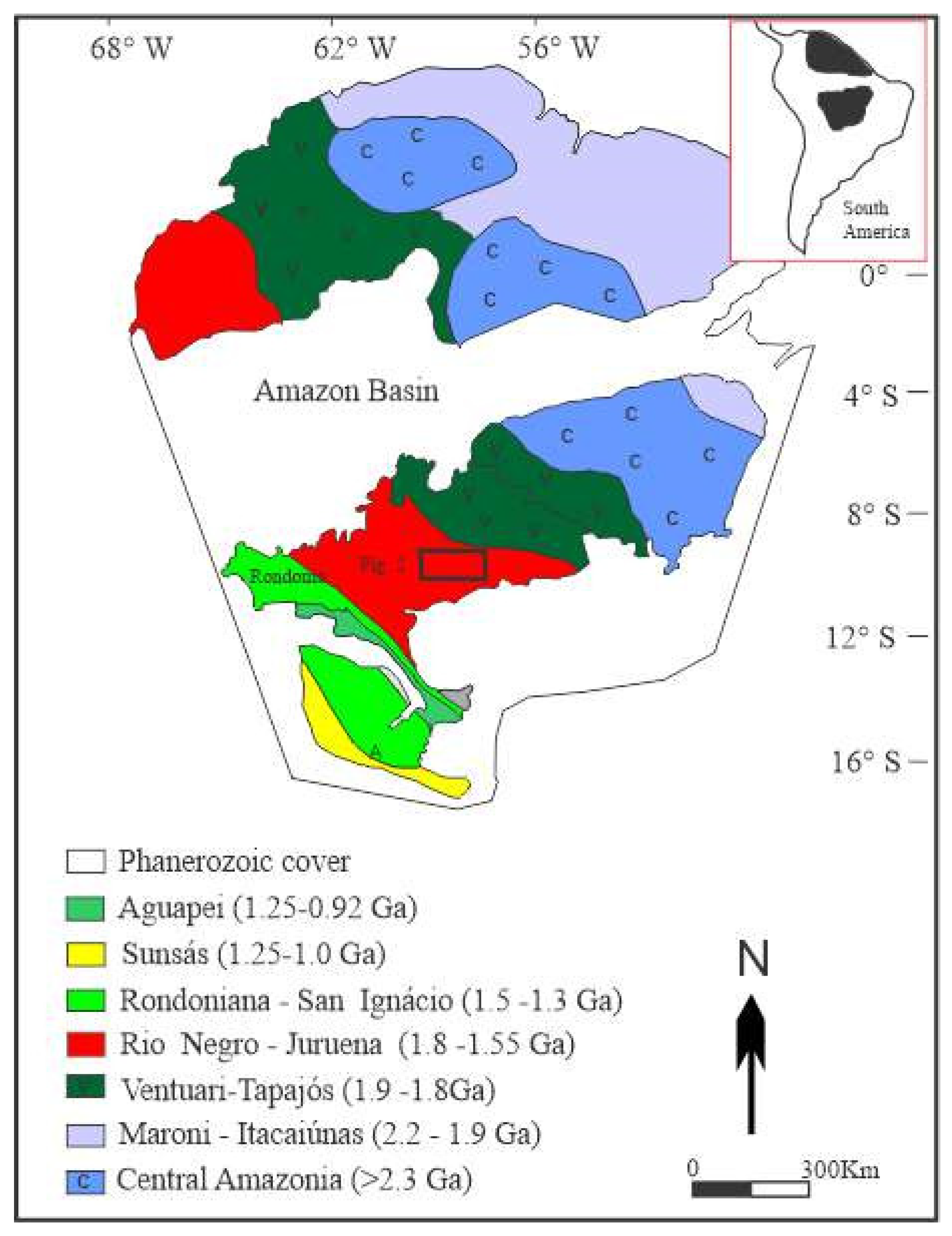
The Alta Floresta Gold Province (AFGP) is located in the Amazonian craton, the largest cratonic unit in South America (Figure 1), comprising orogenic accretional terrains with decreasing ages from NE to SW. The AFGP ore type was initially characterized as deposits associated with deformational processes (related to shear zones) and hydrothermal processes of crustal origin (epithermal deposits) or related to magmatic processes (disseminated in granitic bodies). These genetic models were interpreted as arising from processes that could produce small deposits, thereby limiting investment and interest from the geological community [1,2,3,4,5].
Based on studies that correlated AFGP deposits with orogenic or porphyry-type magmatic processes, there was a shift in interest among geologists responsible for investment decision-making. This move led to investigations of large areas and resulted in the discovery of significant deposits with world-class volumes. Thus, the change in the metallogenetic model for the province led to significant changes in expectations, which were fundamental to the growth of the mineral economy in the state of Mato Grosso.
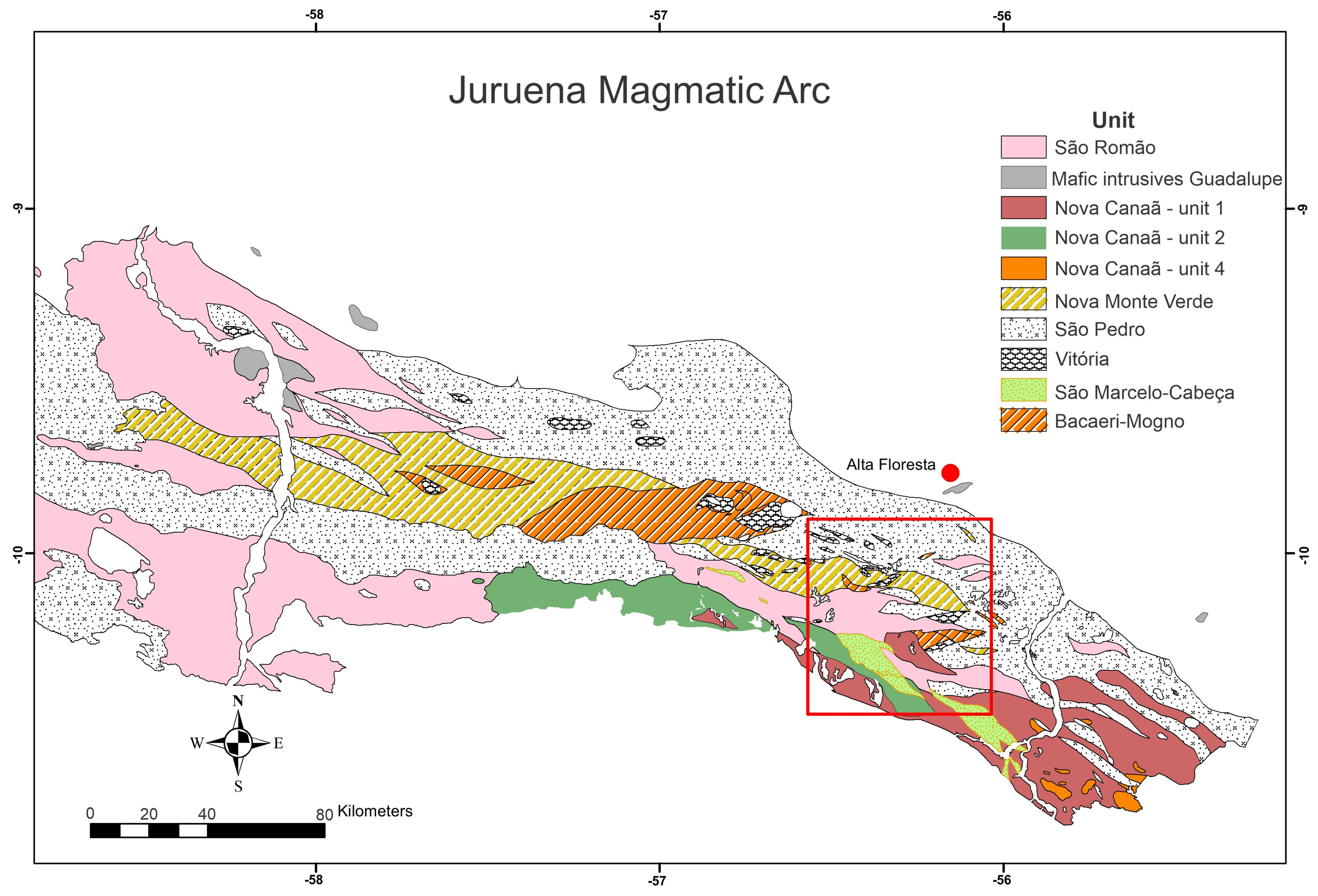
In the southwest of the Amazonian Craton and northwest of the State of Mato Grosso, a strip of rocks with well-marked contacts by faults and regional shear zones that extend for 500 km in a preferential NW direction, called the Juruena Magmatic Arc (JMA), outcrops (Figure 2). The JMA comprises a suite of Paleoproterozoic plutonic and volcanic rocks that outcrop along the boundary between the tectonic provinces defined as Tapajós-Parima (2.03–1.88 Ga) and Rondônia-Juruena (1.80–1.50 Ga). According to [5,6], this arc is overlapped by three large metasedimentary sequences: the Cachimbo Graben to the north, the Caiabis Arc to the south, and the Dardanelos Graben to the southwest. The present work aimed to investigate Au-rich granites (from porphyry Au deposits) and detrital zircon grains (from current river sediments) using their U–Pb ages and Lu–Hf isotopic signatures and to apply this information to regional gold exploration surveys as proposed by [7]. This investigation partially demonstrates that provenance discrimination for exploration effectiveness and predictive targeting must be further developed.
The sediments were sampled in a river basin where Au-rich fluvial sediments and porphyry-type gold deposits have been explored over the last 30 years by small miners and were recently drilled for primary (magmatic rocks) investigation. The results obtained by mass spectrometry on zircon grains for the UPb and Lu–Hf methods aimed to identify the families of crystallization ages and εHf values with the ages of granitic rocks associated with gold mineralization. In this way, it was possible to identify the age groups of detrital zircon grains relative to the ages of mineralized granites and to characterize the Hf signatures of the mineralizing processes.

2. Characteristics of Porphyry Gold Deposits

The Cu-Au porphyry systems exhibit a range of copper metal concentrations, accompanied by gold byproducts, and occasionally, gold-only deposits. Porphyry gold deposits tend to be concentrated in localized belts worldwide [8], such as Maricunga in Chile (Marte and Lobo deposits [9], the Javorie belt in Slovakia (Biely Vrch deposits [10], the Middle Cauca belt in Colombia (La Colosa deposits) [11], and western Anatolia in Turkey [12]. This notable limitation in the global distribution of porphyry gold deposits has been attributed by [10] to a combination of factors, including magma type (hot, hydrous, Fe-rich, high-K calc-alkaline, mantle-derived) and emplacement conditions (subvolcanic emplacement, rapid cooling at low pressure).
Gold mineralization is associated with granites and minor subvolcanic intrusions, typically of dioritic composition, located at very shallow crustal levels (<1 km) and characterized by a network of quartz veins, primarily banded quartz veins [13]. In contrast, copper-rich porphyries are associated with a broader range of intrusive compositions, from diorite or quartz diorite to quartz monzonite [8,14,15]. Typical ore grades range from 0.5 to 1.5% Cu, and mineralization is related to the development of quartz vein stockworks [16]. When considering Cu-rich and Au-rich deposits, we can initially disregard grade variations for each deposit type. But the emplacement depth of copper porphyry systems is more profound than that of gold-only porphyry deposits (<1 km), while copper porphyry deposits (grades of 0.0–1.5 g/t Au) are commonly emplaced at paleodepths exceeding 2 km [10,16].
Ref. [17] found that Sr/Y and V/Sc ratios help assess magma fertility in Au-porphyry deposits. Magmas with high dissolved H2O contents not only promote amphibole production and inhibit plagioclase crystallization, resulting in high Sr/Y, but also cause hornblende to advance in the crystallization sequence relative to titanomagnetite, resulting in high V/Sc. All Au-poor giant porphyry copper deposits plot at Sr/Y ratios > 40 (mostly > 70) and have SiO2 > 60 wt%, while most samples from Au-rich giant porphyry deposits are less siliceous (with 58–68 wt% SiO2), and plot with Sr/Y ± 35 [18] and weak or absent negative Eu anomalies [19,20], which may lead to an adakitic signature. Most mineralized porphyries with high Sr/Y signatures in the Central Andes were emplaced near trench collision areas [21]. However, fertile porphyries are located in the back-arc, lacking these chemical signatures, which appear to be associated with a shallow- to moderately deep-subducting oceanic plate (e.g., Bajo de La Alumbrera and Agua Rica [22,23].
On the other hand, barren rocks associated with arcs exhibit Sr/Y ratios < 35 and SiO2 contents > 55 wt%. For these igneous complexes with Sr/Y ratios greater than 35 and SiO2 contents exceeding 57 wt%, the Cu-fertility has been reported [17,24,25]. Most samples from the Naunauco Group, located close to arc rocks, are sterile suites, except for some samples from the Campana Mahuida and Caicay’en deposits that present Sr/Y ratios slightly higher than 35 [17], particularly in the porphyry-type alteration zones of Charrarruca and Campana Mahuida.

3. Regional Context

The study site is located in the AFGP [26,27] close to the locality of Pista do Cabeça in the municipality of Alta Floresta (Figure 1). This region presents access difficulties due to dense vegetation cover and scattered outcrops, resulting in incomplete descriptions and interpretations at the current stage of knowledge. Although numerous previous studies have examined the evolution of the Paleoproterozoic magmatic arc in the region, doubts persist about its origin and magmatic features. Two hypotheses have emerged; the first is linked to the accretionary processes that formed the Juruena Magmatic Arc [4,6,28,29] or to post-orogenic or even anorogenic extensional processes related to the cratonization of the older Tapajós-Parima Province [5,30,31,32]. This crustal segment of the Amazonian Craton is arranged along a regional WNW-ESE to E-W trend and, according to [4,33], comprises three main domains: Juruena, to the east; Jamari, to the west; and Alto Jauru, in the extreme south.
The Juruena arc (Figure 2) was in turn subdivided into three main domains [34]: (i) Alta Floresta, (ii) Roosevelt, and (iii) Aripuanã. The Alta Floresta terrane comprises gneissic rocks (Cuiú-Cuiú Complex), granitic rocks (Nhandu, Paranaíta, and Juruena suites), and volcanic and volcano-sedimentary rocks (Colíder and São Marcelo-Cabeça suites), all formed between 2000 Ma and 1800 Ma. Part of these rocks possibly represents the basement of the Juruena Arc (2.0 Ga Cuiu-Cuiu Complex).
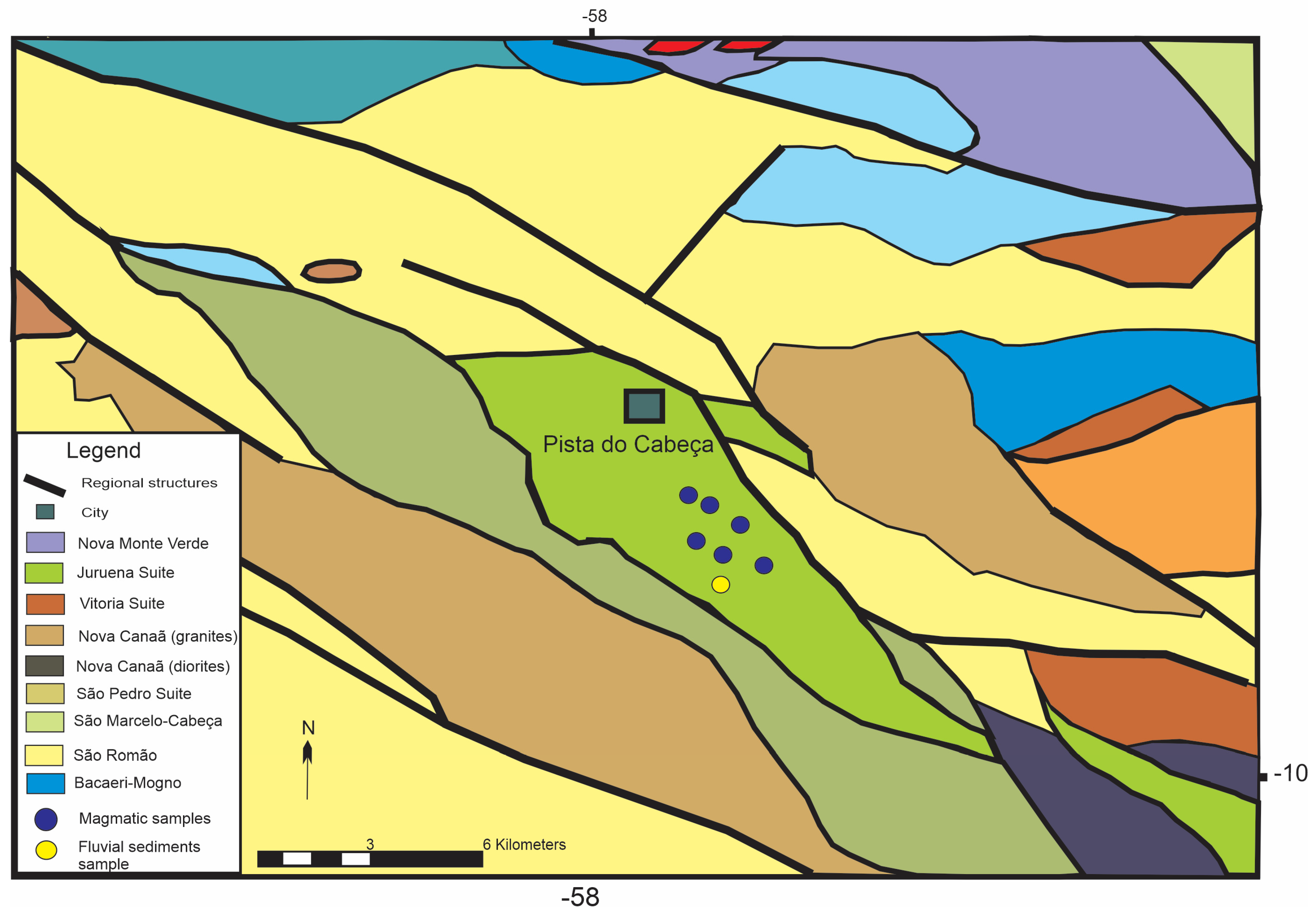
Two distinct crustal domains predominate in the study area, which were informally defined [34] according to the models and used in this work (Figure 3): (i) Deformed Accretionary Domain; (ii) Granite/Volcanic Domain. The first is composed of supracrustal rocks and plutonic bodies that have undergone medium- to high-grade metamorphism and exhibit marked ductile deformation. It occupies the west-southwest part of the area, including the following units: Nova Monte Verde and Bacaeri-Mogno Complexes, São Marcelo/Cabeça Metavolcano-Sedimentary Sequence, São Pedro and São Romão Granitoids, and Vitória Tonalite.
The second constitutes a belt of plutonic and volcanic rocks, little deformed, calc-alkaline and high-potassium, with dioritic to granitic compositions. They can be generically classified as oxidized I-type (Paranaíta, Juruena, and Colíder) and S-type (Nhandu, Flor da Serra, and Matupá). The rocks of both domains constitute the magmatic arc formed during the late and post-collisional phases. The initial-phase lithotypes are represented by remnants of oceanic crust from the Bacaeri-Mogno Complex (Figure 3) and subvolcanic to volcanic rocks from the Paranaíta Suite and Colíder Group, which are genetically related to volcanic calderas in the regions of Nova Santa Helena and Guarantã do Norte, MT.
The Cabeça Deposit is situated in the Alta Floresta Gold Province in the northern part of the state of Mato Grosso and is mapped on the São João da Barra sheets at a scale of 1:250,000 [35]. It is situated in the region of the gold deposits surrounding Alta Floresta, approximately 160 km south of the city.
The main structural features found in the study region are the ductile and brittle-ductile to brittle tectonic-structural domains, developed in a compressional regime acting in two phases, the initial one designated as compressive, which was responsible for the generation of the NE-SW alignment, in a ductile regime, deforming the oldest Bacaeri-Mogno units with an age of >2.2 Ga and the Cuiu-Cuiu Proterozoic Complex with an age of 1.99 Ga [36].
These basement rocks comprise the Bacaeri-Mogno Complex, formed during a phase of oceanic basin convergence and closure that led to subduction and oblique collision with the remnants of the Cuiú-Cuiú arc [30]. This process occurred under more severe pressure (P) and temperature (T) conditions, resulting locally in the transition from amphibolite to granulite facies.
The studied area is located in the Juruena Domain, consisting of felsic plutonic and volcanic rocks of the Andean arc type, with calc-alkaline composition and high potassium, formed between 1860 and 1820 Ma, where gold deposits are found, which are defined in two types: In the volcanic rocks (rhyolites and rhyodacites), where the mineralization is generally disseminated in the rock. The second ore type is defined as quartz-vein stockwork, generally aligned with larger NE structures. The igneous rocks (granites and monzogranites), in turn, are aligned with a main structural control in the NW direction and, less commonly, in other directions, following the NE strike, and are located in zones of hydrothermal alteration. In summary, magmatic rocks associated with metal concentration may be related to the accretionary terrains that formed the Juruena Magmatic Arc, or they may be related to post-orogeny extensional processes described in the works of [4,37,38], or related to the Cuiu-Cuiu magmatic arc [29]. The present work focused on this divergence by applying U–Pb and Lu–Hf geochronology.

4. Methodology

Geochronological analysis was performed using the U–Pb and Lu–Hf methods on zircon grains by LA-MC-ICPMS (Laser Ablation—Ion Coupled Plasma—Mass Spectrometer), model Neptune Plus (Thermo Fisher Scientific, Waltham, MA, USA) and a laser excimer ArF de 193 nm (Photon Machines). The zircon grains were imaged using a Scanning Electron Microscope (SEM) to select the best grains for the analytical procedures.
The LA-ICP-MS (laser ablation inductively coupled plasma mass spectrometer), a mass spectrometer that couples ionization with plasma via laser ablation, uses a laser beam with a diameter of 30 to 50 micrometers (for spot analyses) to volatilize the sample surface. Polished sections and thin sections 100 micrometers thick can be analyzed without chemical pretreatment.

4.1. U-Pb Geochronology

The popularity of ICPMS has also led to the development of improved procedures for Lu and Hf, optimized for the plasma source [39,40], to the extent that individual zircon grains containing as little as 25 ng of Hf can now be analyzed. In the in situ method, material is volatilized from a minimum area of 40–50 microns in diameter on a zircon grain exposed by a pulsed UV laser. Ablation at a rate of 0.5–1.0 μM s−1 results in a resulting analysis volume is up to 100 times greater than that of an equivalent SIMS analysis involving 10 to 50 ng of Hf [40]. The high plasma temperature results in less molecular interference than in the SIMS spectra; however, substantial corrections to 176Hf measurements are still required due to the presence of the interfering isotopes 176Yb and 176Lu. Easy sample preparation and rapid analytical capability are the main advantages of LA-ICP-MS compared to conventional methods.
U–Pb isotopes in zircon. Zircon analysis procedures were performed at the Multi-user Environmental Laboratory (MultiLab) at UERJ, using a Laser Ablation Inductively Coupled Plasma Mass Spectrometer (LA-ICP-MS) equipped with an Element-2 spectrometer. The data acquisition sequence on the equipment was as follows: (1) blank reading; (2) GJ-1 standard reading; (3) sequential reading of nine unknown grains; (4) 91,500 standard reading; (5) GJ-1 standard reading; (6) blank reading. Ablation of the grain surfaces was performed using laser pulses with a 30 μm diameter, and the vaporized material was transported in Ar (0.80 L/min) and He (0.55 L/min) for analysis using 700 cycles of 1′1″ each. The analyses included measurements of 204Pb, 206Pb, 207Pb, 208Pb, 232Th, and 238U masses. Hg is a common contaminant in He and Ar gases, and the 204Hg mass interferes with the 204Pb mass counts. Therefore, the 202Hg mass count was used to correct this isobaric interference.

4.2. Lu–Hf Isotopes in Zircon

The Lu–Hf isotope system can be used to trace the history of crust-mantle differentiation on Earth because Lu is fractionated relative to Hf during magma generation. Thus, the approximate initial chondritic Lu/Hf ratio for the Earth has been progressively modified over time by episodes of partial melting of the upper mantle that, following the generation of basaltic magmas, have depleted the residual mantle in Hf (the more incompatible of the two elements) and correspondingly enriched the generated crust [41]. Over time, the Hf isotopic composition of the depleted mantle (Lu/Hf > chondrites) and enriched crust (Lu/Hf < chondrites) diverges from that of any remaining unfractionated material (Lu/Hf = chondrites). Thus, samples with 176Hf/177Hf higher than that of chondrites at time t have positive εHf values, while those with 176Hf/177 Hf lower than that of chondrites have negative εHf.
Hf TDM ages are interpreted to estimate crustal residence in terms of crustal model ages (TDMcr) when calculated by projecting initial 176Hf/177Hf values of a zircon onto a depleted mantle growth curve with a mean crustal 176Lu/177Hf ratio = 0.015 [42]. The crustal TDM is calculated by projecting a point on the diagram onto the DM curve using a mean continental crustal 176Lu/177Hf slope of 0.015.
Thus, the Hf isotopic composition of a zircon can be used as a marker of the geochemical origin of a host rock in the same way as whole-rock Nd isotopes. Hf is a more sensitive tracer than Nd because the Lu/HF ratio in the depleted mantle is approximately twice that of Sm/Nd relative to the unfractionated material [43]. Furthermore, zircon’s resistance to weathering, transport, and sedimentation means that the same isotopic techniques can be applied to extract data on the origins of detrital zircon grains in sedimentary and metasedimentary rocks.
Lu–Hf isotopic data were also determined for individual zircon grains using a Neptune multi-collector inductively coupled plasma mass spectrometer (MC-ICP-MS), with a detector array of 9 Faraday cups attached to a Photon-Machines excimer laser ablation microsampling system. Analytical procedures includes the Hf standard, GJ-01 and 91.500, reported in that paper, yielded 176Hf/177Hf = 0.28216 ± 0.00002 (2 SD; n = 208, ∼± 0.7 ɛHf units) and 176Hf/177Hf = 0.28216 ± 0.00002 (2 SD; n = 208, ∼± 0.7 ɛHf units), respectively [41].

5. Results

5.1. Petrography

Macroscopically, the rocks studied here (collected from boreholes) exhibit dark gray to pinkish coloration. Thin section observations show that the alteration minerals include K-feldspar + quartz + magnetite ± biotite ± epidote ± titanite. Hydrothermal K-feldspar partially replaces plagioclase crystals and commonly forms neoformed rims. In addition, K-feldspar replaces matrix minerals and forms patches, typically coexisting with magnetite, comminuted biotite, quartz, and epidote. Aggregates of biotite and magnetite commonly replace the old mafic minerals. The average hydrothermal magnetite content is related to biotite, which is relatively more abundant in the most enriched part of the sampled borehole. At the same time, k-feldspar increases during the crystallization process, eventually causing the complete obliteration of the original rock texture.
The observed alteration halo characterizes hydrothermal alteration, primarily manifested as stockwork veins of varying intensities. The veins can vary in width, ranging from centimeters to millimeters, and are characterized by a whitish appearance. The hydrothermal alteration consists of potassic, carbonate, sericitic, and propylitic minerals. Potassic alteration is weak to moderate and pervasive. It consists of biotite, which occurs: (i) disseminated; (ii) in clusters; (iii) surrounding magnetite crystals (with associated sphene), and (iv) replacing mafic minerals. Epidote-carbonate alteration is observed locally and occurs widely, overlying the potassic alteration. Epidote replaces primary biotite, while rare carbonate forms patches in the groundmass and replaces plagioclase phenocrysts.
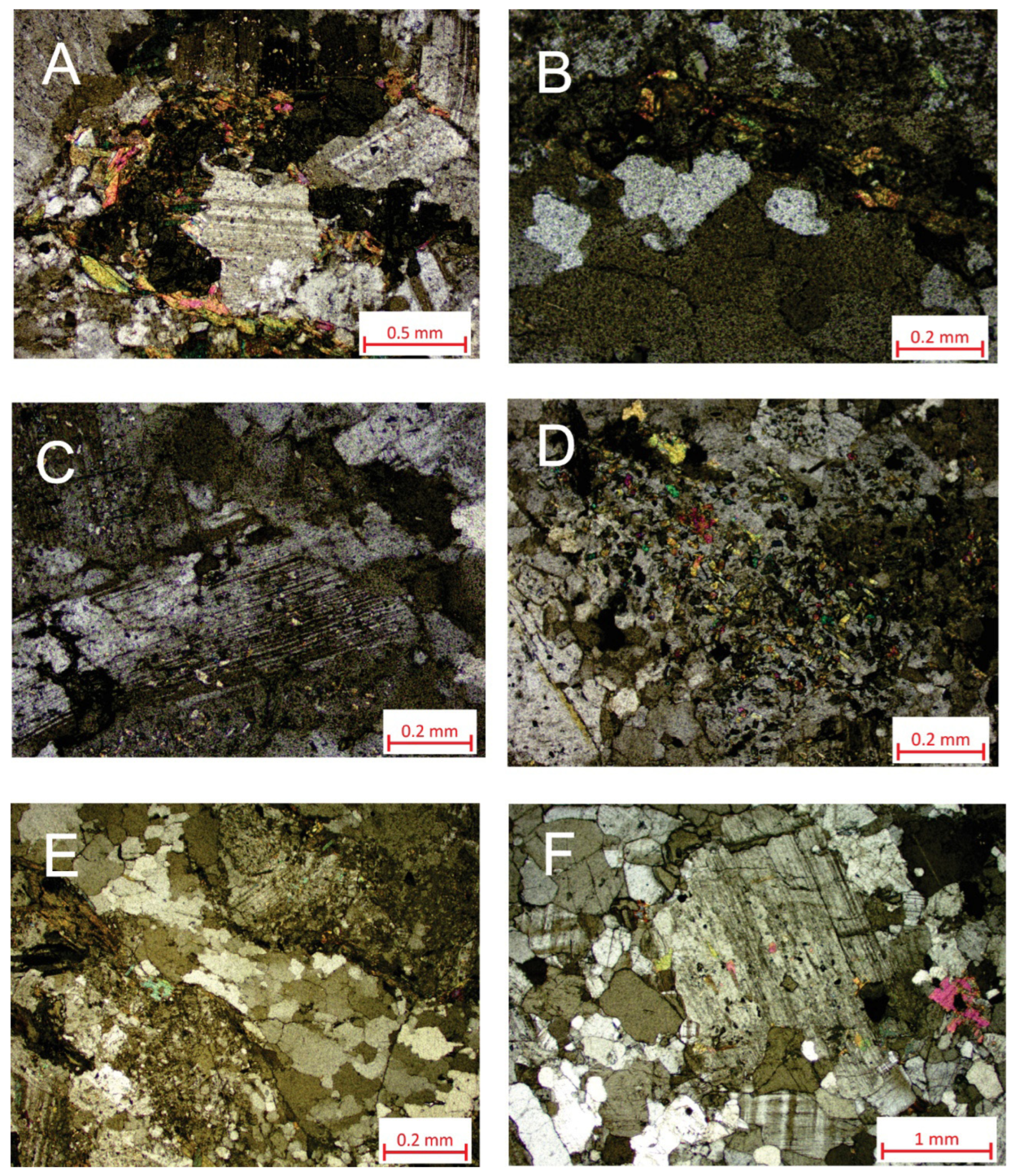
In addition to the potassic and epidote-carbonate alteration, intense sericitic alteration is recognized, affecting the mineralized bodies with sericite that partially replaces plagioclase and quartz crystals (Figure 4A). Two subtypes of mineral paragenesis are recognized: (a) one is composed of quartz and subordinate epidote and biotite (Figure 4B) exhibiting a well-developed sericitic halo (Figure 4C); and (b) is formed by quartz, sericite, epidote, and subordinate magnetite and scarce pyrite. Sericitization (Figure 4D) is more intense in contact with quartz veins (Figure 4E), where the mineralized body is changed by alteration to quartz-sericite-rutile (Figure 4F) and scarce grains of epidote and magnetite.

5.2. U–Pb and Lu–Hf in Zircon from the Granitic Ore

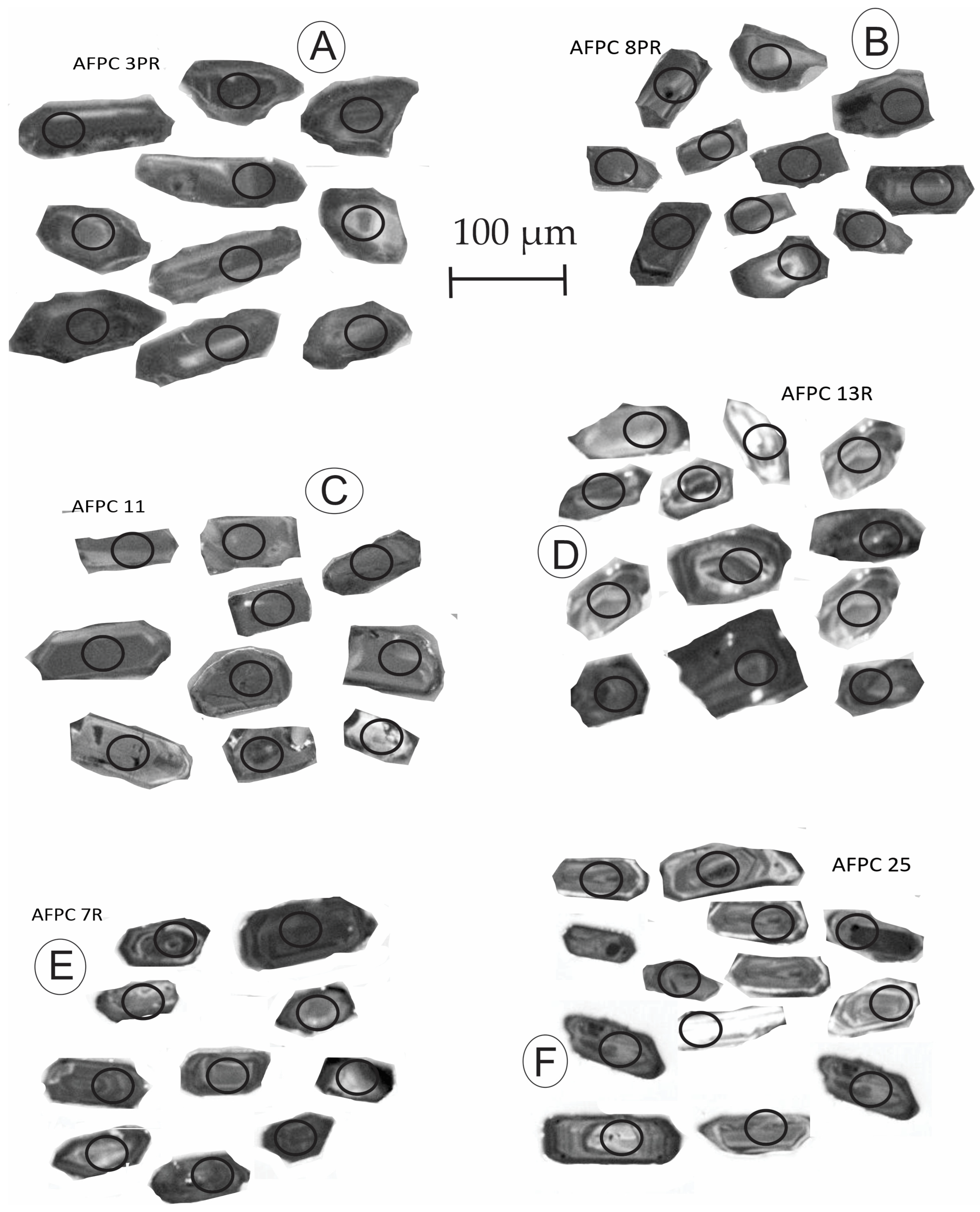
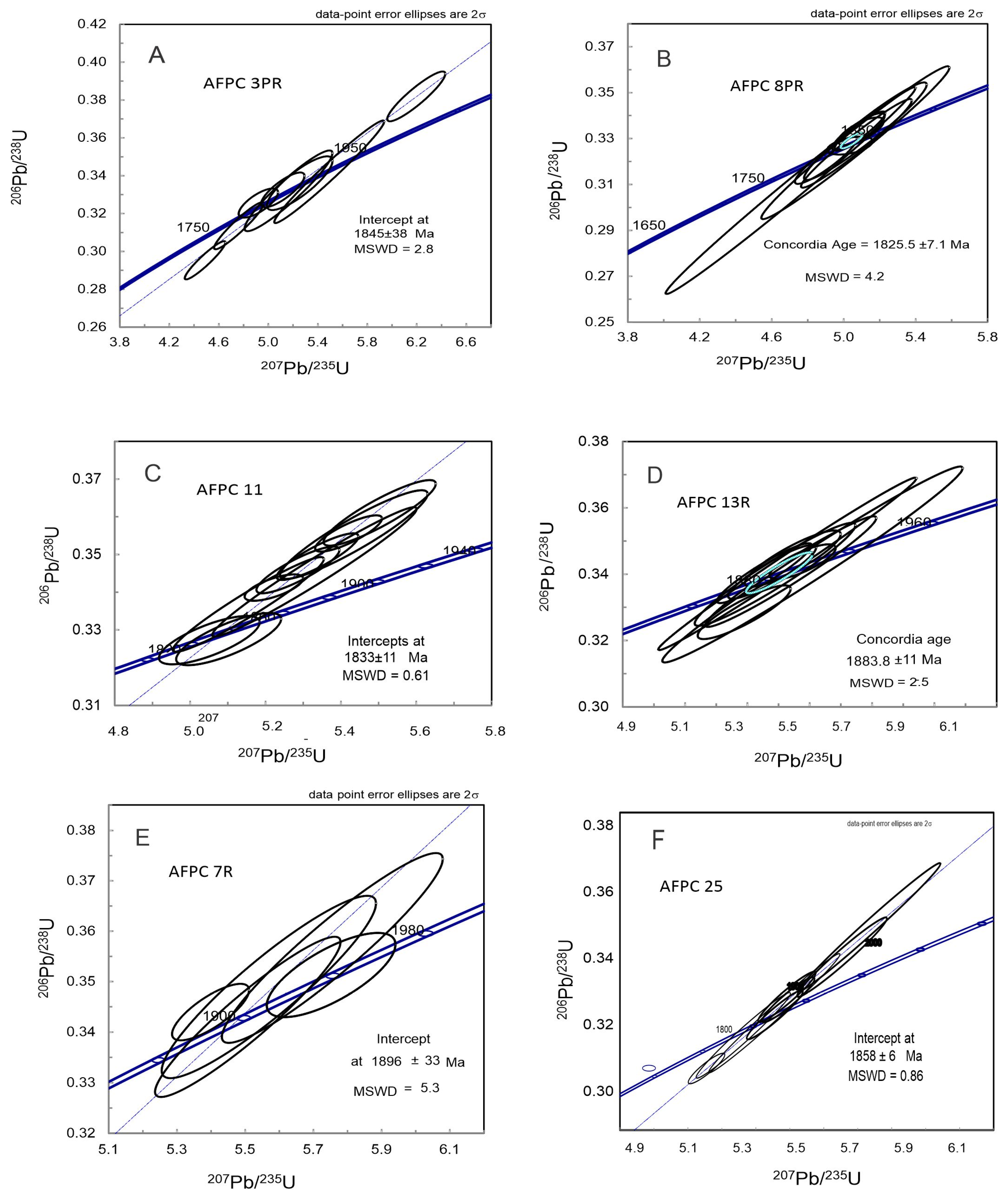
The U–Pb age results (Table S1 Supplementary Materials) were obtained in six magmatic samples collected in mineralized zones of drill cores. The six samples correspond to granitic to granodioritic rocks that provide zircon grains (Figure 5A). The zircon grains in sample AFPC-03PR are colorless, brownish, and pinkish with fracture domains. The grains are euhedral to subhedral and exhibit near-prismatic morphology, with lengths ranging from 200 to 500 µm. The results indicated the upper intercept in the concordia diagram with an age of 1845 ± 38 Ma (Figure 6A). The AFPC-8PR sample has homogeneous grains, whereas the others show oscillatory zoning (Figure 5B), resulting in an age of 1825 ± 7 Ma (Figure 6B). The third sample (AFPC-11) provided an age of 1833 ± 11 Ma (Figure 6C). Zircon samples from the AFPC-11 sample are pinkish to brownish or colorless and range from euhedral to subhedral grains with near-spherical or prismatic morphology with lengths of 100–500 µ (Figure 5C). The euhedral to subhedral grains from sample AFPC-13R show near-prismatic morphology with lengths of 200–600 µm. Most grains show clear oscillatory zoning, mainly concentrated in the grain boundaries (Figure 5D). Sample results for AFPC-13R yielded an age of 1883 ± 27 Ma (Figure 6D). The zircon grains from sample AFPC-7R exhibit magmatic textures, characterized by concentric zoning (Figure 5E), and yield an age of 1896 ± 33 Ma (Figure 6E). Eleven magmatic zircon grains (Figure 5F) from sample AFPC-25 define a concordia cluster with an age of 1.858 ± 6 Ma (Figure 6F).
The upper-intercept U–Pb ages yield MSWD values of 2.8 (sample AFPC 3PR, Figure 6A), 4.2 (sample AFPC 8PR, Figure 6B), 0.61 (sample AFPC 11, Figure 6C), 2.5 (sample AFPC 13R, Figure 6D), 5.3 (sample AFPC 7R, Figure 6E), and 0.86 (sample AFPC 25, Figure 6F). The MSWD values are relatively high due to the use of a 2-sigma-based error calculation. This more rigorous approach yields more reliable age values.
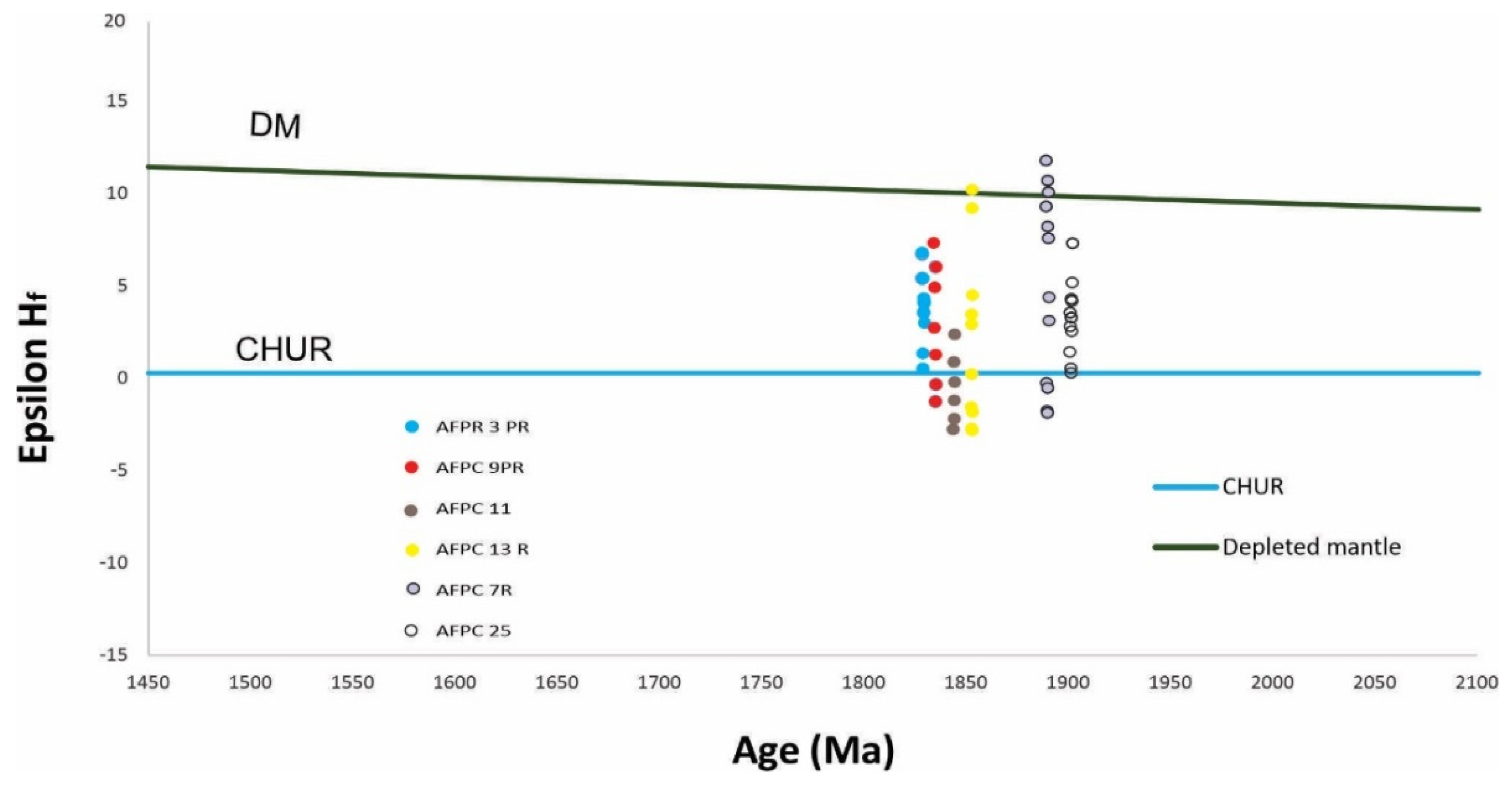
Lu–Hf analyses were performed on the zircon grains used to obtain the U–Pb ages and petrogenetic parameter εHf (Table S2, Supplementary Materials). The zircon grains from the magmatic rocks yielded TDM model ages between 1.90 and 2.75 Ga and εHf values between +7.16 and −4.64 (Figure 7).
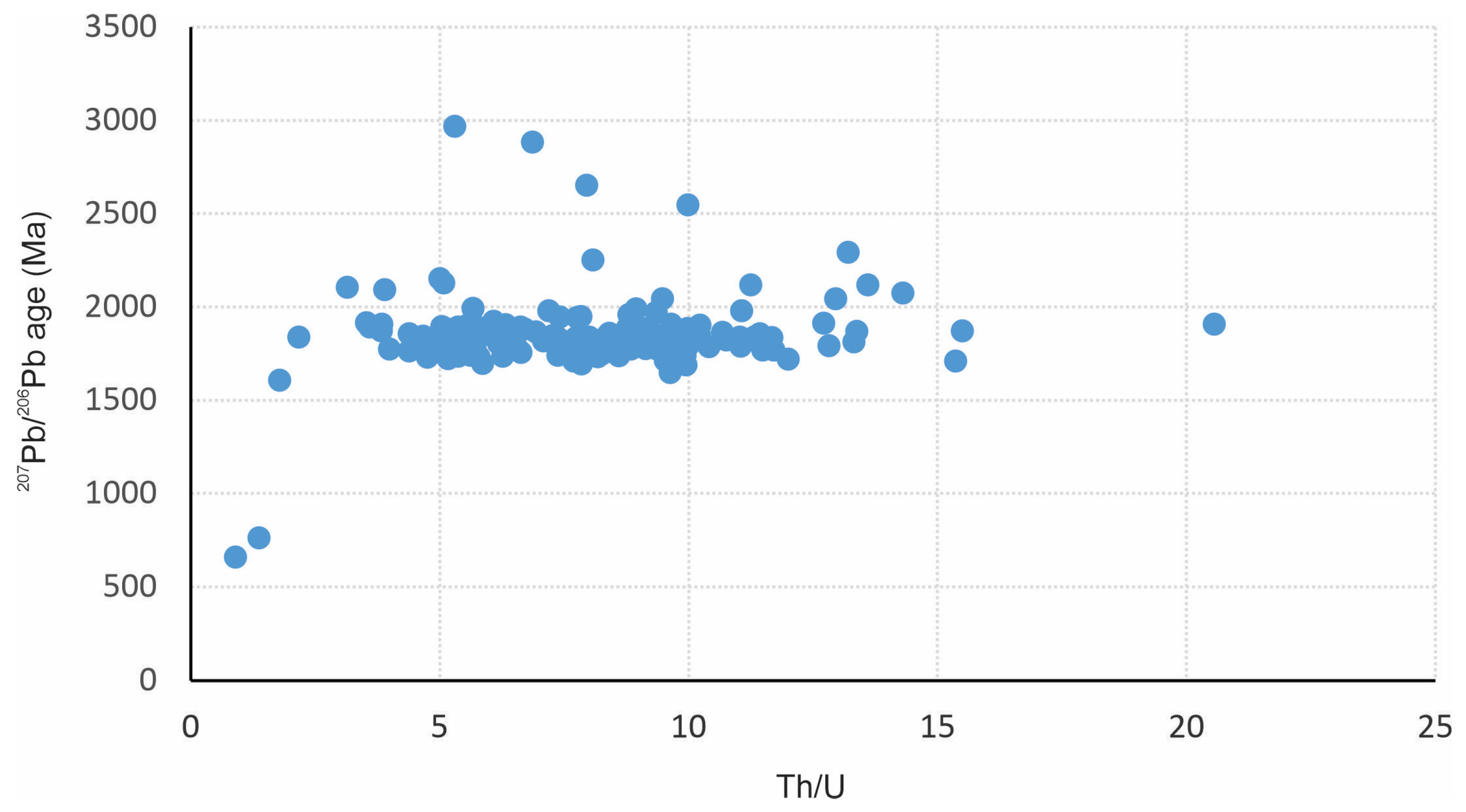
The Th/U ratio versus 207Pb-206Pb age diagram (Figure 8) shows a pattern characteristic of magmatic rocks, with Th/U values ranging from 20 to 1.3.

5.3. U–Pb and Lu–Hf Ages of Detrital Zircon Grains from Fluvial Sediments

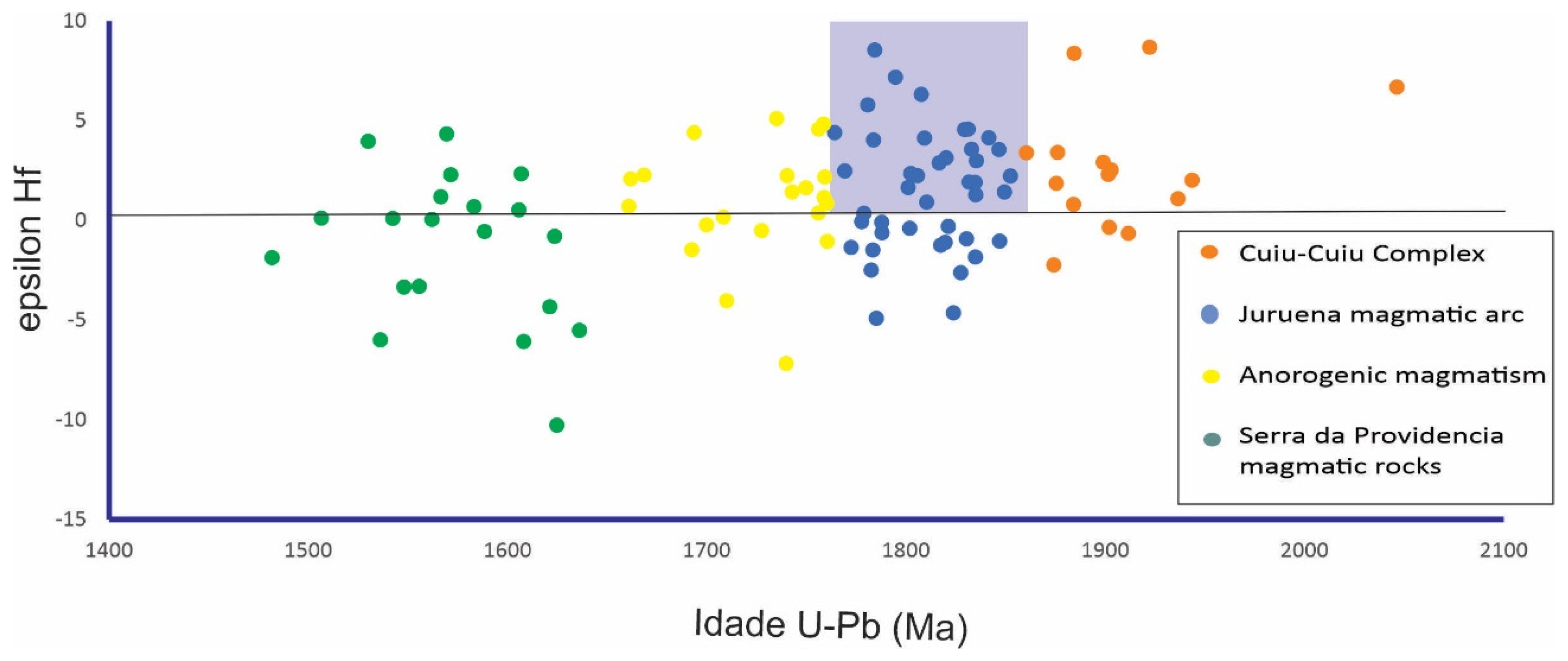
The 89 ages obtained from detrital zircon grains (Tables S3 and S4 Supplementary Materials) indicate age peaks at 2055–1980 Ma, 1889–1985 Ma, 1790–1700 Ma, and 1600–1550 Ma (Figure 8). The first group is related to the basement, represented by the rocks of the Cuiu-Cuiu Complex with TDM 2.0–1.9 Ga and εHf = +8.7 (Figure 9). The second group concerns the mineralized magmatic rocks in the study region, and the ages range from 1896 to 1825 Ma; TDM ages range from 2.90 to 2.75 Ga, and the εHf values range from +10.21 to −5.43. The peak ages ranging from 1790 to 1700 Ma are associated with anorogenic magmatism and present TDM 2.0–1.9 Ga and εHf values from +5.36 to −8.46. The younger group comprises ages from 1600 to 1550 Ma and is correlated to the Serra da Providencia suite, with TDM 1.6–1.50 Ga and εHf values from +5.00 to −10.00 [44].

5.4. Zircon Grain Textures

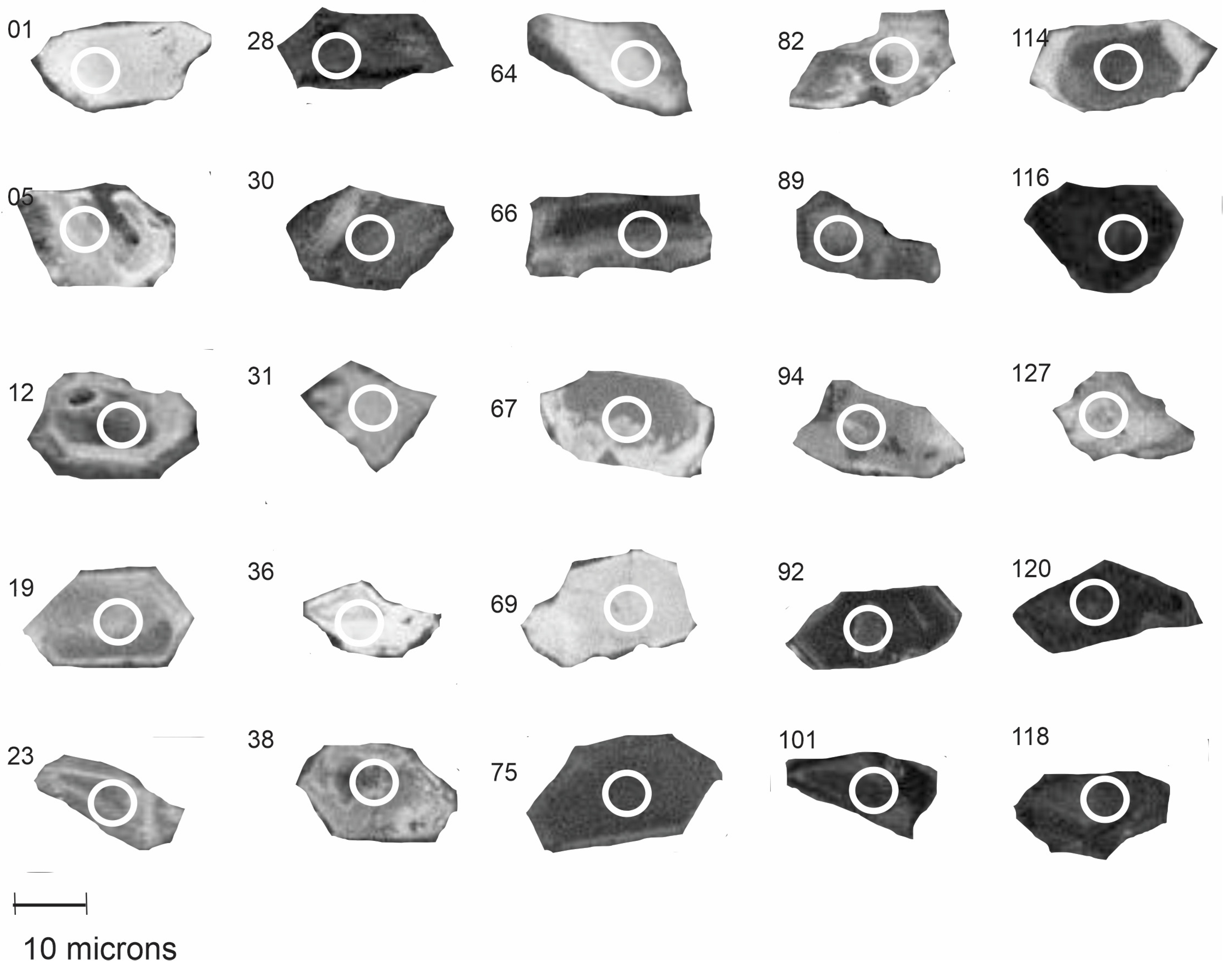
In the case studied here, the oscillatory textural and chemical zoning of zircon is interpreted to be attributed to rapid magma cooling during crystal growth, which enables the development of complex banding. The observed pattern in zircon grains is expected to increase with the cooling rate and decrease with increasing crystallization depth. As suggested by [45], the texture of zircon crystal cores observed in CL images can be used to assess magma fertility for porphyry-type deposits (Figure 10). In this way, fertile suites exhibit bimodal zircon CL images with cores showing weak zones. In contrast, infertile suites typically exhibit zoned zircon CL textures, with strong oscillatory zonation [46].
Cathodoluminescence textures cannot alone demonstrate metal deposition, but the fertile zircon grains are interpreted as having grown in magmas responsible for porphyry-type mineralization and present weak oscillatory zonation, which matches that of detrital zircon grains. The observed features are correlated to continental arc environments, where porphyry deposits are genetically linked to magmas that result from an initial melting in the metasomatized mantle wedge. These magmas stop at the base of the crust, where they subsequently undergo melting-assimilation-storage-homogenization, assimilation-fractional crystallization, and recharge processes [47,48]. These processes are interpreted here as the factors responsible for the formation of zircon grain textures. The magma may also have a hydrated, oxidized character with an intermediate composition and a calc-alkaline signature, as expected in fertile magmas for porphyry deposits [49,50], which are oxidizing and inhibit the removal of metals until they are diluted in the final exsolved hydrothermal fluids [51,52].

6. Discussion

6.1. Hafnium Signatures in Detrital Zircon Grains

The U–Pb ages of detrital zircon grains in this study range from 1884 Ma to 1860 Ma for rocks associated with gold deposits. The 89 ages obtained from detrital zircon grains indicate age groups of 1980 Ma, 1880 Ma, 1790 Ma, and 1590 Ma (Table 1). The first group is related to the basement, represented by rocks of the Cuiu-Cuiu orogen (2.0–1.9 Ga [53]. Only the second group concerns mineralized magmatic rocks in the study region. The ages of 1790 and 1590 Ma are associated with anorogenic magmatism or a younger magmatic arc, as discussed by [54].
Zircon grains from the oldest rocks (U–Pb ages from 2.055 to 1.989 Ma) indicated TDM model ages between 2.00 and 1.90 Ga (and εHf from +8.7 to −1.32). The younger rock groups with anorogenic characteristics indicate εHf values between −8.7 and +2.0. Comparatively low values for positive εHf can generally be interpreted as indicative of crustal contamination processes and/or the presence of inherited zircon. In contrast, those with higher values (for positive εHf) are interpreted as magmas derived from the mantle. The large variation in the εHf value implies heterogeneity in the magmatic source(s), possibly related to variable mantle melting depths or mixing processes with older crust. The results of Hf isotopes in zircon, here applied to the study of sedimentary rocks, suggest that zircon grains derived from mantle-derived igneous rocks provide important information on the magmatic evolution of rocks forming porphyry-type deposits that originated from fractionated mantle reservoirs. The study reported here provides insight into the development of fractionation processes that produce comagmatic hydrothermal solutions originating in the depleted mantle (characterized by a high Lu/Hf ratio), thereby identifying a detectable source for magmatic rocks that generate porphyry deposits (a summary of the U–Pb and Lu–Hf results here reported is presented in Table 1.

6.2. Lu–Hf Isotopic Mineralization Signature

Among the broadly contemporary studies of intrusive suites that followed the work of [42], those with zircons of comparatively low positive εHf values have generally been interpreted as indicating crustal contamination processes and/or the presence of zircon xenocrysts, whereas those with higher (positive εHf) values have been interpreted as uncontaminated, mantle-derived magmas. Refs. [55,56,57] demonstrated that within a single volcanic sequence, significant variations in εHf can occur, implying heterogeneous sources resulting from mixing with magmatic sources, possibly related to varying melting depths. Ref. [55] considered this trend to reflect gradual changes in magma sources from initially depleted mantle to increasingly enriched (crustal) sources.
The use of Hf isotopes in zircons has been made possible by the development of improved analytical methods and is likely to continue. In addition to its value as a geochemical tracer, the resistance of zircon to Hf exchange with the external rock environment allows Hf isotope studies to make a fundamental contribution to understanding the mechanisms driving U–Pb age discordance in zircon, because Hf composition provides a means to discriminate between discordance generated by recrystallization (unaltered Hf) as opposed to a younger rim addition (exotic Hf added). For the same reason, Hf isotopes can indicate whether and when complete resets in U–Pb isotopes in zircon may have occurred and thus greatly aid in the interpretation of the ages of zircon grains in high-grade metamorphic rocks derived from the lower crust and mantle. Advances in understanding the behavior of zircon in natural systems are likely to come from U–Pb and Lu–Hf isotope studies, integrated with trace element, microstructural, and other spectroscopic data [58].

6.3. Mineralized U–Pb Zircon Signature

The magmatic rocks studied here have crystallization ages between 1889 and 1825 Ma and were generated in orogenic environments cutting a Paleoproterozoic crust (2.0 Ga, Cuiu-Cuiu Complex) in this portion of the Amazonian Craton. These rocks yielded εHf values of up to +8, but not all rocks from the region analyzed here exhibited such highly depleted Hf signatures; instead, some rocks presented εHf values close to zero and are interpreted as representing relatively spatially depleted mantle sources that coexisted spatially and temporally with more highly depleted mantle sources, likely in a continental magmatic arc environment.
In the case under study, the hydrothermal solutions that generate porphyry deposits are predominantly formed in magmatic arc environments under moderately extensional stress conditions via oblique-to-contractional sliding [1,59]. However, there is an empirical relationship between contractional settings, characterized by crustal thickening, surface uplift, and rapid exhumation, and large porphyry gold deposits [60,61]. Crustal thickness influences several important magmatic processes, including the duration of magmatic activity, crystallization phases, sulfide saturation time, and porphyry emplacement depth [21,62,63]. Residual mineralogy shows that molten magmas are equilibrated under low-pressure conditions, indicative of shallow depths. Thus, these magma reservoirs (<~30 km depth) cool more rapidly than those in the thick crust, which results in shorter periods of magmatic-hydrothermal activity in the upper crust, reducing the porphyry ore potential [64,65,66].

7. Conclusions

The present study aimed to investigate detrital zircon grains from current river networks using their U–Pb ages and Lu–Hf isotopic signatures to apply them to regional gold exploration research. The results obtained by mass spectrometry of zircon grains were processed to identify families of crystallization ages and εHf values, and to correlate them with the ages of granitic rocks associated with porphyry gold mineralization. In this way, it was possible to identify the U–Pb age ranges of detrital zircon grains and to characterize the Hf signatures of the mineralization processes.
The importance of the Lu–Hf isotope system in zircon lies in its use as both a geochemical marker and a geochronometer. Studies combining both the U–Pb and Lu–Hf isotope systems are arguably the most powerful, as they allow accurate determination of zircon age and yield petrogenetic information from the initial Hf ratio. The challenge of dealing with complex zircon populations involving multiple ages and periods of isotopic disturbance can be addressed by a variety of strategies, such as the use of in situ analytical techniques, CL and BSE imaging, and single-grain abrasion methods, all of which can help to detect individual ages and thus improve the understanding of U–Pb age. The great advantage of using Hf isotopes in zircons is that they can be used to trace the origins of rocks and the evolution of the Earth’s crust and mantle through time.
The Alta Floresta Gold Province (AFGP) was initially characterized by gold deposits associated with deformational processes (related to shear zones) and hydrothermal processes of crustal origin (epithermal deposits) or related to magmatic processes (disseminated in granitic bodies).
Pioneering research here, reported on Hf in zircon, applied to the study of igneous rocks, and demonstrated that zircon grains from mantle-derived rocks provide excellent details of the evolution of fractionated reservoirs through time. The depleted mantle (high Lu/HF ratio) was a regionally detectable source for magmatic rocks as old as ca. 2.0 Ga, so that rocks of this age analyzed from the Cuiu-Cuiu Province have εHf values of up to +5.7. However, zircon grains possibly associated with magmatic processes (1.88–1.86 Ga) responsible for the concentration of noble metals presented εHf values between +8 and −2 and were interpreted as representing depleted mantle. The presence of such mantle reservoirs can serve as a tool for mineral prospecting in the region, as evidenced by positive εHf values in granites intruding the Paleoproterozoic rocks of the Alta Floresta Gold Province. Based on studies that correlate deposits with orogenic or porphyritic magmatic processes, discoveries of significant deposits with world-class volumes may result from a revision of the metallogenetic model for the province.

Supplementary Materials

The following supporting information can be downloaded at: https://www.mdpi.com/article/10.3390/min16080789/s1, Table S1: U-Pb magmatic zircon results; Table S2: U-Pb results for detrital zircon results; Table S3: Lu-Hf results (Granitic rocks); Table S4: Lu-Hf results (detritic zircon).

Author Contributions

Conceptualization, L.A.d.O. and N.J.d.F.; Methodology, A.J.P.d.B. and G.L.P.; Software, A.C.R.P. and A.D.T.; Formal Analysis, A.C.R.P., G.L.P. and L.P.; Investigation, L.A.d.O. and N.J.d.F.; Data Curation, N.J.d.F., G.L.P. and A.D.T.; Writing—Original Draft, L.A.d.O.; Writing—review & editing, A.J.P.d.B. and M.C.G.; Project administration, A.D.T. and M.C.G.; Funding acquisition, A.J.P.d.B., A.D.T. and M.C.G. All authors have read and agreed to the published version of the manuscript.

Funding

This research received no external funding.

Data Availability Statement

Data are contained within the article and Supplementary Materials.

Acknowledgments

The authors would like to thank the Matogrossense Geological Survey (METAMAT) for its invaluable logistical support during the fieldwork for geological mapping and isotopic analyses, which were essential to this work. We also thank the Multi-User Laboratory of Environment and Materials (MultiLab UERJ) for performing the U–Pb and Lu–Hf geochronological dating and for all other technical support involved in this process. Finally, we would like to thank the Geological Sample Processing Laboratory (LGPA UERJ) for concentrating the heavy minerals, an essential step for applying the geochronological methods used in this study, and D. Lopes for CL images.

Conflicts of Interest

Paes de Barros Metamat is an employee of Companhia Mato-Grossense de Mineração. The paper reflects the views of the scientists and not the company.

References

  1. Juliani, C.; Rye, R.O.; Nunes, C.M.D.; Silva, R.H.C.; Monteiro, L.V.S.; Neutman, R.; Alcover Neto, A.; Bettencourt, J.S.; Snee, L.W. Paleoproterozoic high-sulfidation mineralization in the Tapajós Gold Province, Amazonian craton, Brazil: Geology, mineralogy, alunite argon age, and stable isotopes constraints. Chem. Geol. 2005, 215, 95–125. [Google Scholar] [CrossRef] [Scilit]
  2. Leite, J.A.; Hartmann, L.A.; Siqueira, A.J. As razões Au/Ag dos depósitos de Au da Mina São Vicente e do Filão do Paraíba: Implicações Genéticas. In Proceedings of the Simpósio de Geologia do Centro-Oeste, Cuiabá, Brazil, 26–31 October 1997. [Google Scholar]
  3. Leite, J.A.D.; Souza, M.Z.A.; Saes, G.S.; Macambira, M.J.B.; Xavier, R.P.; Siqueira, A.J.; Batata, M.E.F.; Oliveira, F.A.; Silva, J.G., Jr.; Quadros, A.P. Caracterização do Depósito Polimetálico (Zn, Pb, Ag, Cu-Au) de Aripuanã, Mato Grosso. In Caracterização de Depósitos Minerais em Distritos Mineiros da Amazônia; Departamento Nacional de Produção Mineral (DNPM): Brasília, Brazil, 2005; pp. 601–686. [Google Scholar]
  4. Santos, J.O.S.; Van Breemen, O.B.; Groves, D.I.; Hartmann, L.A.; Almeida, M.E.; Mcnaughton, N.J.; Fletcher, I.R. Timing and evolution of multiple Paleoproterozoic magmatic arcs in the Tapajós Domain, Amazon Craton: Constraints from SHRIMP and TIMS zircon, baddeleyite and titanite U–Pb geochronology. Precambrian Res. 2004, 131, 73–109. [Google Scholar] [CrossRef] [Scilit]
  5. Tassinari, C.C.G.; Macambira, M.J.B. Geocronológica provinces of the Amazonian Craton. Episodes 1999, 22, 174–182. [Google Scholar] [CrossRef] [Scilit]
  6. Santos, J.O.S.; Hartman, L.A.; Gaudette, H.E.; Groves, D.I.; Mcnaughton, N.; Fletcher, I.R.A. New Understanding of the Provinces of the Amazon Craton Based on Integration of Field Mapping and U-Pb and Sm-Nd geochronology. Gondwana Res. 2000, 3, 453–488. [Google Scholar] [CrossRef] [Scilit]
  7. Lu, Y.-J.; Loucks, R.R.; Fiorentini, M.; Campbell McCuaig, T.; Evans, N.J.; Yang, Z.-M.; Hou, Z.-Q.; Kirkland, C.; Parra-Avila, L.A.; Kobussen, A. Zircon compositions as a pathfinder for porphyry Cu ± Mo ± Au deposits. In Tectonics and Metallogeny of the Tethyan Orogenic Belt; Society of Economic Geologists: Littleton, CO, USA, 2016. [Google Scholar]
  8. Sillitoe, R.H. Gold-rich porphyry deposits: Descriptive and genetic models and their role in exploration and discovery. Rev. Econ. Geol. 2000, 13, 315–345. [Google Scholar] [CrossRef] [Scilit]
  9. Vila, T.; Sillitoe, R.H. Gold-rich porphyry systems in the Maricunga belt, northern Chile. Econ. Geol. 1991, 86, 1238–1260. [Google Scholar] [CrossRef] [Scilit]
  10. Kodera, P.; Kozak, J.; Brcekova, J.; Chovan, M.; Lexa, L.; Janosik, M.; Biron, A.; Uhlik, P.; Bakos, F. Distribution and composition of gold in porphyry gold systems: Example from the Biely Vrch deposit, Slovakia. Miner. Depos. 2018, 53, 1193–1212. [Google Scholar] [CrossRef] [Scilit]
  11. Lodder, C.; Padilla, R.; Shaw, R.; Garzon, T.; Palacios, E.; Jahoda, R. Discovery History of the La Colosa Gold Porphyry Deposit, Cajamarca, Colombia; Society of Economic Geologists: Littleton, CO, USA, 2010; pp. 9–28. [Google Scholar]
  12. Baker, T.; Bickford, D.; Juras, S.; Lewis, P.; Oztas, Y.; Tukac, A.; Rabayrol, F.; Miskovic, A.; Friedman, R.; Creaser, R.; et al. The Geology of the Kisladag Porphyry Gold Deposit, Turkey; Society of Economic Geologists: Littleton, CO, USA, 2016. [Google Scholar]
  13. Muntean, J.L.; Einaudi, M.T. Porphyry gold deposits of the Refugio district, Maricunga belt, northern Chile. Econ. Geol. 2000, 95, 1445–1472. [Google Scholar] [CrossRef] [Scilit]
  14. Maydagán, L. El Prospecto de Cu-(Au-Mo) Altar (31290 LS, 70280 LO). Ph.D Thesis, Universidad Nacional del Sur, Bahía Blanca, Argentina, 2012; p. 340. [Google Scholar]
  15. Maydagan, L.; Franchini, M.; Chiaradia, M.; Bouhier, V.; Di Giuseppe, N.; Rey, R.; Dimieri, L. Petrogenesis of Quebrada de la Mina and altar north porphyries (Cordillera of San Juan, Argentina): Crustal assimilation and metallogenic implications. Geosci. Front. 2017, 8, 1135–1159. [Google Scholar] [CrossRef] [Scilit]
  16. Sillitoe, R.H. Porphyry copper systems. Econ. Geol. 2010, 105, 3–41. [Google Scholar] [CrossRef] [Scilit]
  17. Loucks, R.R. Distinctive composition of copper-ore-forming arc magmas. Aust. J. Earth Sci. 2014, 61, 5–16. [Google Scholar] [CrossRef] [Scilit]
  18. Sillitoe, R.H.; Cooper, C.; Sale, M.; Soechting, W.; Echavarria, D.; Gallardo, J.L. Discovery and geology of the Esquel low-sulfidation epithermal gold deposit, Patagonia, Argentina. Soc. Econ. Geol. 2002, 9, 227–240. [Google Scholar]
  19. Murakami, H.; Seo, J.H.; Heinrich, C.A. The relation between Cu/Au ratio and formation depth of porphyry-style Cu–Au±Mo deposits. Miner. Depos. 2010, 45, 11–21. [Google Scholar]
  20. Chiaradia, M.; Ulianov, A.; Kouzmanov, K.; Beate, B. Why are large porphyry Cu deposits like high-Sr/Y magmas? Sci. Rep. 2012, 2, 685. [Google Scholar] [CrossRef] [Scilit] [PubMed]
  21. Kay, S.M.; Mpodozis, C.; Coira, B. Neogene magmatism, tectonism, and mineral deposits of the central Andes (22° S to 33° S latitude). In Geology and Ore Deposits of the Central Andes; Skinner, B.J., Ed.; Society of Economic Geologists: Littleton, CO, USA, 1999; pp. 27–59. [Google Scholar]
  22. Richards, J.P.; Kerrich, R. Special paper: Adakite-like rocks: Their diverse origins and questionable role in metallogenesis. Econ. Geol. 2007, 102, 537–576. [Google Scholar] [CrossRef] [Scilit]
  23. Maydagan, L.; Franchini, M.; Chiaradia, M.; Dilles, J.; Rey, R. The altar porphyry Cu-(Au-Mo) deposit (Argentina): A complex magmatic-hydrothermal system with evidence of recharge processes. Econ. Geol. 2014, 109, 621–641. [Google Scholar] [CrossRef] [Scilit]
  24. Maydagán, L.; Franchini, M.; Rusk, B.; Lentz, D.R.; McFarlane, C.; Impiccini, A.; Rey, R. Porphyry to epithermal transition in the Altar Cu-(Au-Mo) deposit, Argentina, studied by Cathodoluminescence, LA-ICP-MS, and fluid inclusion analysis. Econ. Geol. 2015, 110, 889e923. [Google Scholar]
  25. Stern, C.R.; Skewes, M.A.; Arévalo, A. Magmatic evolution of the giant El Teniente Cu-Mo deposit, Central Chile. J. Petrol. 2010, 52, 1591–1617. [Google Scholar] [CrossRef] [Scilit]
  26. de Barros, A.J.P. Contribuição à Geologia e ao Controle das Mineralizações Auríferas da Região de Peixoto de Azevedo. Master’s Thesis, Instituto de Geociências, Universidade de São Paulo, São Paulo, Brazil, 1994; p. 161. [Google Scholar]
  27. de Barros, M.A.S.; de Barros, A.J.P.; Santos, J.O.S.; Rocha, M.L.B.P. Extension of Tapajós domains to the Alta Floresta Gold Province: Evidence from U-Pb zircon ages of the Nhandu Intrusive Suite at 1962 and 1967 Ma. In Proceedings of the Simpósio de Geologia da Amazônia, Pará, Brazil, 27 September–1 October 2015. [Google Scholar]
  28. Souza, J.O.; Frasca, A.A.S.; Oliveira, C.C. Geologia e Recursos Minerais da Folha Alta Floresta (Relatório Integrado); CPRM: Brasília, Brazil, 2005. [Google Scholar]
  29. Duarte, T.B. Metalogenia das Províncias Minerais do Brasil: Província Aurífera Juruena-Teles Pires-Aripuanã; Geologia e Recursos da Ilha Porto Escondido (SC.21-V-C-III): Estado do Mato Grosso; CPRM: Goiânia, Brazil, 2015. [Google Scholar]
  30. Vasquez, M.L.; Ricci, P.S.F.; Klein, E.L. Granitóides pós-colisionais da porção leste da Província Tapajós. In Contribuições à Geologia da Amazonia; Sociedade Brasileira de Geologia: Belém, Brazil, 2022; p. 167. [Google Scholar]
  31. Cordani, U.G.; Teixeira, W. Prterpzoic Accretionary Belts in the Amazonian; Geological Society of America: Boulder, CO, USA, 2007. [Google Scholar] [CrossRef] [Scilit]
  32. de Barros, M.A.S.; Chemale, F., Jr.; Nardi, L.V.S.; Lima, E.F. Paleoproterozoic bimodal post-collisional magmatism in the southwestern Amazonian Craton, Mato Grosso, Brazil: Geochemistry and isotopic evidence. J. S. Am. Earth Sci. 2009, 27, 11–23. [Google Scholar] [CrossRef] [Scilit]
  33. da Silva, M.G.; Abram, M.B. Projeto Metalogenia da Província Aurífera Juruena-Teles Pires, Mato Grosso; CPRM: Goiânia, Brazil, 2008; p. 212. [Google Scholar]
  34. Scandolara, J.E.; Rizzotto, G.J.; De Amorim, J.L.; Bahia, R.B.C.; Quadros, M.L.; da Silva, C.R. Geological Map of Rondônia 1:1,000,000; Companhia de Pesquisa de Recursos Minerais: Porto Velho, Brazil, 1997. [Google Scholar]
  35. de Oliveira, C.C. Programa de Levantamentos Geológicos Básicos do Brasil—PLGB. Folha SD. 22-Z-C-VI—Itaguaru. Esc. 1:100.000. Brasília: MME/CPRM, 1997. 107p. OLIVEIRA, C.C. de; ALBUQUERQUE, M. CAVALCANTI. Programa de Levantamentos Geológicos Básicos do Brasil (PLGB). Projeto Província Mineral de Alta Floresta (PROMIN Alta Floresta). Geologia e Recursos Minerais da Folha Alta Floresta-SC. 21-Z-X-C. Brasília: CPRM. 2003. Available online: https://rigeo.sgb.gov.br/items/04056e8c-9898-4aad-9642-bd89c1e9bc05 (accessed on 30 June 2026).
  36. Tassinari, C.C.G.; Cordani, U.G.; Nutman, A.P.; Van Sommus, W.R.; Bettencourt, J.S. Geochronological systematics on Basement Rocks from the Rio Negro-Juruena Province (Amazonian craton) and tectonic implications. Inter. Geol. Rev. 1996, 38, 161–175. [Google Scholar] [CrossRef] [Scilit]
  37. Souza, J.O. 2004 Programa Levantamentos Geológicos Básicos do Brasil—PLGB. Geologia e Recursos Minerais da Província Mineral de Alta Floresta. Relatório Integrado. Folhas SC.21-V-D, Rio São João da Barra; SC.21-X-C—Alta Floresta; SC.21-Z-A—Ilha 24 de Maio, SC.21-Z-B—Vila Guarita; Estados de Mato Grosso e do Pará. Escala 1:250.000/Organizada [por] João Olímpio Souza, Antônio Augusto Soares Frasca [e] Cipriano Cavalcante de Oliveira.—Brasília: CPRM—Serviço Geológico do Brasil/DEPAT/DICART/DIEDIG. 2004. Available online: https://rigeo.sgb.gov.br/items/b8a9a48b-bd39-4995-b750-ee2a23d5c927 (accessed on 30 June 2026).
  38. CPRM (2011) Levantamentos Basicos do Brasil, Ministerio de Minas e Energia, DNPM. Projeto Radan Brasil. Folha SC.21-Juruena. Rio de Janeiro: Radambrasil, 1999, p. 117-164 (Levantamento de Recursos Naturais, 20). Available online: https://portals.iucn.org/library/node/20029 (accessed on 30 June 2026).
  39. Halliday, A.N.; Lee, D.C.; Christensen, J.N.; Walder, A.J.; Freedman, P.A.; Jones, C.E.; Hall, C.M.; Yi, W.; Teagle, D. Recent Development in inductivelly Coupled Plasma magnet Sector mass spectrometry. Int. J. Mass Spectrom. Ion Process. 1995, 146, 21–33. [Google Scholar] [CrossRef] [Scilit]
  40. Blichert-Toft, J.; Albarède, F. The Lu-Hf isotope geochemistry of chondrites and the evolution of the mantle-crust system. Earth Planet. Sci. Lett. 1997, 148, 243–258. [Google Scholar] [CrossRef] [Scilit]
  41. Griffin, W.L.; Pearson, N.J.; Belousova, E.; Jackson, S.E.; van Achterbergh, E.; O’Reilly, S.Y.; Shee, S.R. The Hf isotope composition of cratonic mantle: LAM-MC-ICPMS analysis of zircon megacrysts in kimberlites. Geochim. Cosmochim. Acta 2000, 64, 133–147. [Google Scholar] [CrossRef] [Scilit]
  42. Patchett, P.J. Importance of the Lu-Hf isotopic system in studies of planetary chronology and chemical evolution. Geochim. Cosmochim. Acta 1983, 47, 81–91. [Google Scholar] [CrossRef] [Scilit]
  43. Patchett, P.J.; Tatsumoto, M. Hafnium isotope variations in oceanic basalts. Geophys. Res. Lett. 1980, 7, 1077–1080. [Google Scholar] [CrossRef] [Scilit]
  44. Patchett, P.J.; Tatsumoto, M. Lu-Hf total-rock isochron for the eucrite meteorites. Nature 1980, 288, 571–574. [Google Scholar] [CrossRef] [Scilit]
  45. Hofmann, A.E.; Baker, M.B.; Eiler, J.M. Sub-micron-scale trace-element distributions in natural zircons of known provenance: Implications for Ti-in-zircon thermometry. Contrib. Mineral. Petrol. 2014, 168, 1057. [Google Scholar] [CrossRef] [Scilit]
  46. Heaman, L.M.; Bowins, R.; Crocket, J. The chemical composition of igneous zircon suites: Implications for geochemical tracer studies. Geochim. Cosmochim. Acta 1990, 54, 1597–1607. [Google Scholar] [CrossRef] [Scilit]
  47. Chiaradia, M.; Merino, D.; Spikings, R. Rapid transition to long-lived deep crustal magmatic maturation and the formation of giant porphyry-related mineralization (Yanacocha, Peru). Earth Planet. Sci. Lett. 2009, 288, 505–515. [Google Scholar] [CrossRef] [Scilit]
  48. Hildreth, W.; Moorbath, S. Crustal contributions to arc magmatism in the Andes of Central Chile. Contrib. Mineral. Petrol. 1988, 98, 455–489. [Google Scholar] [CrossRef] [Scilit]
  49. Cunningham, C.G.; Zappettini, E.O.; Vivallo, S.W.; Celada, C.M.; Quispe, J.; Singer, D.A.; Briskey, J.A.; Sutphin, D.M.; Gajardo, M.M.; Diaz, A.; et al. Quantitative Mineral Resource Assessment of Copper, Molybdenum, Gold, and Silver in Undiscovered Porphyry Copper Deposits in the Andes Mountains of South America; U.S. Geological Survey: Reston, Virginia, 2008; p. 282. [Google Scholar]
  50. Lee, C.T.A.; Lee, T.C.; Wu, C.T. Modeling the compositional evolution of recharging, evacuating, and fractionating (REFC) magma chambers: Implications for differentiation of arc magmas. Geochem. Cosmochim. Acta 2014, 143, 8–22. [Google Scholar] [CrossRef] [Scilit]
  51. Billa, M.; Cassard, D.; Lips, A.L.W.; Bouchot, V.; Tourlière, B.; Stein, G.; Guillou-Frottier, L. Predicting gold-rich epithermal and porphyry systems in the Central Andes with a continental-scale metallogenic GIS. Ore Geol. Rev. 2004, 25, 39–67. [Google Scholar] [CrossRef] [Scilit]
  52. Candela, P.A. Controls on ore metal ratios in granite-related ore systems: An experimental and computational approach. Trans. R. Soc. Edinb. Earth Sci. 1992, 83, 317–326. [Google Scholar] [CrossRef] [Scilit]
  53. Neder, R.D.; Leite, J.; Van Schmus, R. The expedito massive sulfide deposit, Mato Grosso. Rev. Bras. Geociências 2000, 30, 222–225. [Google Scholar] [CrossRef] [Scilit]
  54. de Barros, A.J.P. Granitos da região de Peixoto de Azevedo—Novo Mundo e Suas Mineralizações Auríferas Relacionadas—Província Aurífera Alta Floresta (MT). Ph.D. Thesis, Instituto de Geociências, Universidade Estadual de Campinas, Campinas, Brazil, 2007; p. 154. [Google Scholar]
  55. Smith, P.E.; Tatsumoto, M.; Farquhar, R.M. Zircon Lu-Hf systematics and the evolution of the Archean crust in the southern Superior Province, Canada. Contrib. Miner. Pet. 1987, 97, 93–104. [Google Scholar] [CrossRef] [Scilit]
  56. Corfu, F.; Noble, S.R. Genesis of the southern Abitibi greenstone belt, Superior Province, Canada: Evidence from zircon Hf isotope analyses using a single filament technique. Geochim. Cosmochim. Acta 1992, 56, 2081–2097. [Google Scholar] [CrossRef] [Scilit]
  57. Corfu, F.; Stott, G.M. Age and petrogenesis of two late Archean magmatic suites, northwestern Superior Province, Canada: Zircon U-Pb and Lu-Hf isotopic relations. J. Pet. 1993, 34, 817–838. [Google Scholar] [CrossRef] [Scilit]
  58. Almeida, B.S.; Geraldes, M.C.; Sommer, C.A.; Corrales, F.; de Barros, A.J.P. The Colider and Roosevelt olcanic rocks (sw amazonian craton): Geochemistry and sm-nd isotope characteristics of a silicic large igneous province. Acta Geochim. 2021, 40, 1023–1049. [Google Scholar] [CrossRef] [Scilit]
  59. Lacerda Filho, J.V.; Abreu Filho, W.; Valente, C.R.; Oliveira, C.C.; Albuquerque, M.C. Geologia e Recursos Minerais do Estado de Mato Grosso: Texto dos Mapas Geológicos e de Recursos Minerais do Estado de Mato Grosso; CPRM/SICME-MT: Cuiabá, Brazil, 2004; p. 235. [Google Scholar]
  60. Tosdal, R.M.; Richards, J.P. Magmatic and structural controls on the development of porphyry Cu ± Mo ± Au deposits. Rev. Econ. Geol. 2001, 14, 157–181. [Google Scholar] [CrossRef] [Scilit]
  61. Sillitoe, R.H.; Perelló, J. Andean copper province: Tectonomagmatic settings, deposit types, Metallogeny, exploration, and discovery. In Economic Geology One Hundredth Anniversary; Hedenquist, J.W., Thompson, J.F.H., Goldfarb, R., Richards, J., Eds.; Society of Economic Geologists, Inc.: Littleton, CO, USA, 2005; pp. 845–890. [Google Scholar]
  62. Halter, W.; Bain, N.; Becker, K.; Heinrich, C.A.; Landtwing, M.; von Quadt, A.; Clark, A.H.; Sasso, A.M.; Bissig, T.; Tosdal, R.M. From andesitic volcanism to the formation of a porphyry Cu-Au mineralizing magma chamber: The Farallon Negro Volcanic Complex, northwestern Argentina. J. Volcanol. Geoth. Res. 2004, 136, 1–30. [Google Scholar] [CrossRef] [Scilit]
  63. Park, J.W.; Campbell, I.H.; Chiaradia, M.; Hao, H.; Lee, C.T. Crustal magmatic controls on the formation of porphyry copper deposits. Nat. Rev. Earth Environ. 2021, 2, 542–557. [Google Scholar] [CrossRef] [Scilit]
  64. Annen, C.; Blundy, J.D.; Sparks, R.S.J. The genesis of intermediate and silicic magmas in deep crustal hot zones. J. Pet. 2006, 47, 505–539. [Google Scholar] [CrossRef] [Scilit]
  65. Chiaradia, M. Gold endowments of porphyry deposits are controlled by precipitation efficiency. Nat. Commun. 2020, 11, 248. [Google Scholar] [CrossRef] [Scilit] [PubMed]
  66. D’Annunzio, M.C.; Strazzere, L.; Rubinstein, N.; Cocola, M.A.; Pivetta, C.P.; Geraldes, M.C. The Charrarruca porphyry-type alteration zone: New evidence of mineralizing Late Cretaceous-Eocene magmatism in the Southern Central Andes of Argentina. J. S. Am. Earth Sci. 2023, 125, 104298. [Google Scholar] [CrossRef] [Scilit]
Figure 1. The Amazonian craton and location map of the study area defining a set of Paleoproterozoic plutonic and volcanic rocks outcropping along the boundary between the tectonic orogenic belts defined as Tapajós-Parima (2.03–1.88 Ga) and Rondônia-Juruena (1.80–1.50 Ga). The area shown in Figure 2 is highlighted on the map (black rectangle).
Minerals 16 00789 g001
Figure 2. Simplified geological map of the Juruena Magmatic Arc, including the location of the Pista do Cabeça area (red rectangle). The area shown in Figure 3 is highlighted on the map (red rectangle).
Minerals 16 00789 g002
Figure 3. Geological map of the study area produced during this investigation. The Pista do Cabeça deposit occurs in association with magmatic rocks in porphyry-type deposits (blue circles). The yellow circle is located at the fluvial sediments sampling site. Blue circles show magmatic rock sampling sites.
Minerals 16 00789 g003
Figure 4. Petrography of hydrothermal alteration. (A) Propylitic alteration is moderate to intense and composed of sericite + epidote + quartz; (B) potassic alteration (+ albite + sphene + magnetite) that occurs as mineral replacement. (C) Plagioclase is partially replaced by carbonate, epidote, sericite, and magnetite (D), and subordinate muscovite. Amphibole is entirely replaced by carbonate, epidote, sericite, opaque mineral, and sphene. Biotite is entirely replaced by epidote, with sphene present in smaller proportions. Rare interstitial mosaics with quartz veins (E) with secondary quartz are recognized interstitially. (F) Plagioclase is sericitized.
Minerals 16 00789 g004
Figure 5. Cathodoluminescence (CL) images of representative zircon grains from the six mineralized granitic rock samples analyzed in this study: (A) AFPC-3PR, (B) AFPC-8PR, (C) AFPC-11, (D) AFPC-13R, (E) AFPC-7R, and (F) AFPC-25.
Minerals 16 00789 g005
Figure 6. U–Pb concordia diagrams for zircon grains from the six mineralized granitic rock samples analyzed in this study: (A) AFPC-3PR, (B) AFPC-8PR, (C) AFPC-11, (D) AFPC-13R, (E) AFPC-7R, and (F) AFPC-25. Ellipses represent individual LA-ICP-MS analyses plotted at the 2σ confidence level. The calculated crystallization ages correspond to 1845 ± 38 Ma (AFPC-3PR), 1825 ± 7 Ma (AFPC-8PR), 1833 ± 11 Ma (AFPC-11), 1883 ± 27 Ma (AFPC-13R), 1896 ± 33 Ma (AFPC-7R), and 1858 ± 6 Ma (AFPC-25). The concordia plots indicate Paleoproterozoic crystallization ages consistent with the timing of magmatism associated with the gold-bearing porphyry systems of the Alta Floresta Gold Province.
Minerals 16 00789 g006
Figure 7. Lu–Hf isotopic diagram of the magmatic zircon grains.
Minerals 16 00789 g007
Figure 8. Th/U ratio versus 207Pb/206Pb age for zircon grains analyzed in this study. The x-axis represents the 207Pb/206Pb age, expressed in Ma, whereas the y-axis represents the dimensionless Th/U ratio. Each blue circle corresponds to an individual zircon analysis. The observed distribution is consistent with a predominantly magmatic origin of the analyzed zircon grains.
Minerals 16 00789 g008
Figure 9. Lu–Hf isotope results for the detrital zircon grains studied in this investigation. The purple area highlights the juvenile Hf epsilon values associated with the Juruena Magmatic Arc. (Table S4 Supplementary Materials).
Minerals 16 00789 g009
Figure 10. Cathodoluminescence images of detrital zircon grains of U–Pb age between 1896 and 1825 Ma with positive Hafnium values present strong zoning, indicating rapid cooling and precipitation of hydrothermal fluids responsible for the deposition of precious metals. Circles define the crater for U–Pb analysis. Comparatively low values for positive εHf (Figure 9) were generally interpreted as indicating crustal contamination processes and/or the presence of inherited zircon. In contrast, those with higher values (for positive εHf) were interpreted as mantle-derived magmas. The significant variation in the εHf value implies heterogeneity in the magmatic source(s), possibly related to variable melting depths or to mixing of the mantle with older crust.
Minerals 16 00789 g010
Table 1. Summary of the U–Pb and Lu–Hf results here reported.
SampleU–Pb Age (Ma)TDM (Ga)εHfUnit (Rocks)
AFPC 3PR1845 ± 382.48 to 2.03+6.97 to −0.93Au Porphyry ore
AFPC 8PR1825 ± 72.58 to 2.02+7.16 to −2.67Au Porphyry ore
AFPC 111833 ± 112.65 to 2.42+0.16 to −3.00Au Porphyry ore
AFPC 13 R1883 ± 272.63 to 2.43+6.70 to −1.94Au Porphyry ore
AFPC 7R1896 ± 332.63 to 2.01+3.36 to −3.46Au Porphyry ore
AFPC 251858 ± 62.47 to 1.96+8.13 to −4.64Au Porphyry ore
MAu12055–19892.00 to 1.90+8.70 to −1.32Cuiu-Cuiu Complex
MAu11889–19852.90 to 2.75+10.21 to −5.43Juruena magmatic arc
MAu11790–17002.00 to 1.90+5.36 to −8.46Anorogenic magmatism
MAu11600–15501.60 to 1.50+5.00 to −10.00Serra da Providencia magmatism
Disclaimer/Publisher’s Note: The statements, opinions and data contained in all publications are solely those of the individual author(s) and contributor(s) and not of MDPI and/or the editor(s). MDPI and/or the editor(s) disclaim responsibility for any injury to people or property resulting from any ideas, methods, instructions or products referred to in the content.