


Abstract
The Chutuan and Jiashan fluorite deposits are situated in the Donghai–Linshu area within the southwestern segment of the Sulu ultrahigh–pressure metamorphic belt. Both deposits share similar mineralization characteristics, with fluorite veins strictly controlled by fault structures and associated with mineral assemblages comprising fluorite, barite, quartz, and calcite. Two mineralization stages have been identified in both deposits: Stage I (quartz–fluorite–barite stage), representing the main ore–forming event, and Stage II (quartz–barite–calcite stage). This study focuses on integrated geochemical and geochronological analyses of fluorite from Stage I, providing new constraints on the genesis and metallogenic processes of these deposits. Direct Sm–Nd isotopic dating of fluorite yields an isochron age of 104 ± 16 Ma, indicating that mineralization occurred during the late Early Cretaceous. Fluid inclusion and stable isotope studies reveal that the ore–forming fluids constitute a complex hydrothermal system characterized by a wide temperature range (112–324 °C) and variable salinities (0.18–21.87 wt% NaCl eq.). The H–O isotopic compositions exhibit a distinct latitudinal trend, supporting a dominant meteoric water component. However, the presence of high–temperature, high–salinity fluid inclusions, along with a shift in some δD values towards the magmatic water field, suggests episodic mixing between meteoric water and deep–seated magmatic–hydrothermal fluids. Sr–Nd isotopic data (87Sr/86Sr = 0.711785–0.713424; εNd(t)= −27.7 to −27.5) potentially demonstrate that the ore–forming materials (Ca and REEs) were not derived from coeval magmatic rocks. Instead, they were primarily leached from the Precambrian Donghai Group metamorphic complex through extensive water–rock interaction. Based on these findings, the Chutuan and Jiashan deposits are classified as hydrothermal vein–type systems. Fluorite precipitation was governed by a combination of fluid cooling, water–rock interaction, and fluid mixing. Finally, a metallogenic model is established, offering important insights into the genesis of fluorite mineralization in the Sulu Orogenic Belt and analogous geological settings in eastern China.
1. Introduction
Fluorite (CaF2) is an essential strategic mineral resource globally, crucial for emerging industries such as new energy and new materials, as well as traditional sectors like metallurgy, chemical industry, and defense [1,2,3,4]. China is a major global producer of fluorite, possessing significant reserves distributed across provinces such as Hunan, Zhejiang, Jiangxi, Inner Mongolia, and Henan [1]. Most of these reserves occur in hydrothermal vein–type deposits [1,2,4]. Such deposits formed either contemporaneously with Mesozoic volcano–tectonic magmatism, dominated by magmatic fluids (e.g., the Qiquanba, Wuyi, Bamianshan, Yinzishan, and Xinqiao deposits) [1], or after a discernible temporal lag, in which case meteoric or geothermal waters served as the principal ore–forming fluids, variably mixed with magmatic components (such as the Longping and Dabudaer deposits) [4,5]. Importantly, these fluorite vein systems that typically fill shear zones, extensional fractures, and tectonic breccias have contributed as the main source of fluorite worldwide [1,2,3].
The Sulu Orogen Belt (SOB) is a world–class high–pressure/ultrahigh–pressure (HP/UHP) metamorphic terrane in the Eastern China, formed during the Middle Triassic continental collision between the North China Craton and the South China Block [6,7,8,9]. This belt is characterized by extensive Mesozoic magmatic activity and prominent NE–trending fault systems [8]. These geological features played a fundamental role in supplying essential heat sources, driving hydrothermal fluid migration, and creating the primary conduits for the formation of various mineral deposits [9,10]. Although the SOB is well–known for its Triassic HP/UHP metamorphism and subsequent Mesozoic overprinting that triggered widespread metallic mineralization (e.g., orogenic Au and porphyry Mo), the temporal and genetic links between these events and non–metallic fluorite mineralization remain enigmatic. Consequently, previous research in the SOB has predominantly focused on metallic deposits and Triassic metamorphic evolution, while the non–metallic deposits (such as fluorite) have received considerably limited attention [1,11].
Prospecting in the Donghai–Linshu district of northern Jiangsu, within the southwestern SOB, has uncovered more than a dozen fluorite deposits (e.g., Chutuan, Shuanghu, Jiashan, and Shanzuokou) and occurrences, establishing this area as a dominant fluorite–producing region. Preliminary geological surveys indicate that these newly discovered fluorite deposits share remarkably similar mineralization characteristics [9]. They are all structurally controlled, occurring as veins filling NE– to NNE–trending fault zones, tectonic breccias, or extensional fractures. The mineral assemblage is simple, dominated by fluorite (barite) with quartz and calcite as common gangue minerals. Wall–rock alteration is generally weak and includes silicification, carbonatization, and kaolinization [9]. These common features suggest that the fluorite mineralization in this district may be governed by a unified regional metallogenic event. Nevertheless, some key aspects concerning the formation age, the sources of ore–forming fluids and materials, and the metallogenic processes remain poorly constrained. This study therefore focuses on the representative Chutuan and Jiashan fluorite deposits, integrating Sm–Nd isochron dating, fluid inclusion microthermometry, trace element geochemistry and H–O–Sr isotope analyses. The objectives are to (1) determine the mineralization age; (2) characterize the nature and source of the ore–forming fluids, and trace the origin of ore–forming materials (e.g., Ca, F); and (3) clarify the mechanisms responsible for fluorite precipitation. The findings are expected to not only contribute to the genetic model for hydrothermal vein–type fluorite deposits in the central SOB, Eastern China, but also to offer crucial constraints for developing exploration criteria in this region and analogous geological settings.
2. Regional Geology
The SOB, located on the eastern margin of the North China Craton (Figure 1a), formed during the Triassic collision between the North China and South China blocks. It is structurally offset by the NE–trending Tan–Lu Fault Zone and represents the eastern extension of the Dabie Orogenic Belt [6,7,8,9]. The belt is globally renowned as a HP/UHP metamorphic terrane (Figure 1b), characterized by widespread Neoproterozoic protoliths (~750 Ma) that underwent Triassic high– to ultrahigh–pressure metamorphism [11,12].
Figure 1.
(a) Tectonic location map of the Dabie–Sulu orogenic belt in eastern China (after [10]); (b) simplified geological map of the Dabie–Sulu orogenic belt (after [10]); and (c) regional geological and mineral resource distribution of the Donghai–Linshu area.
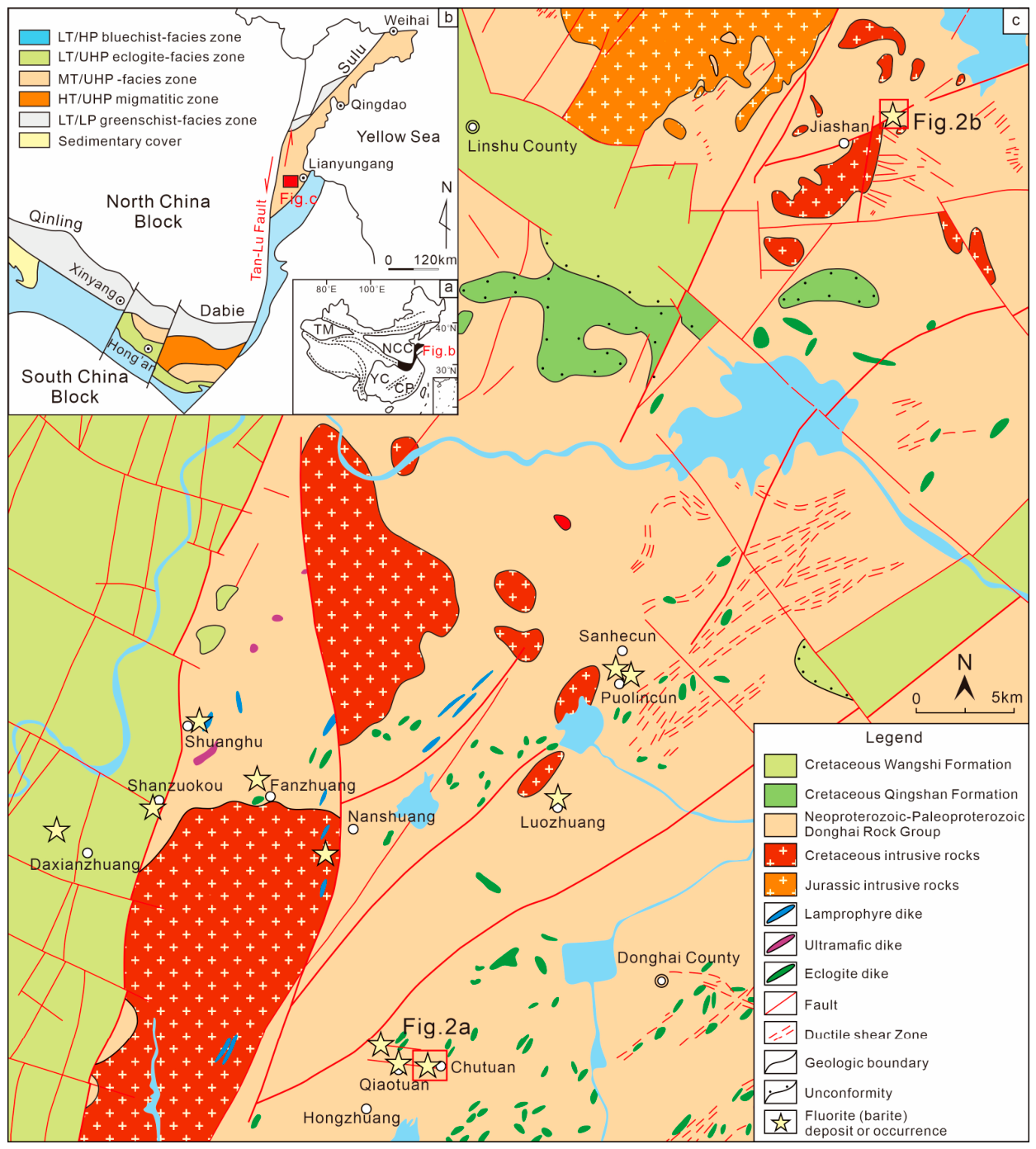
Figure 2.
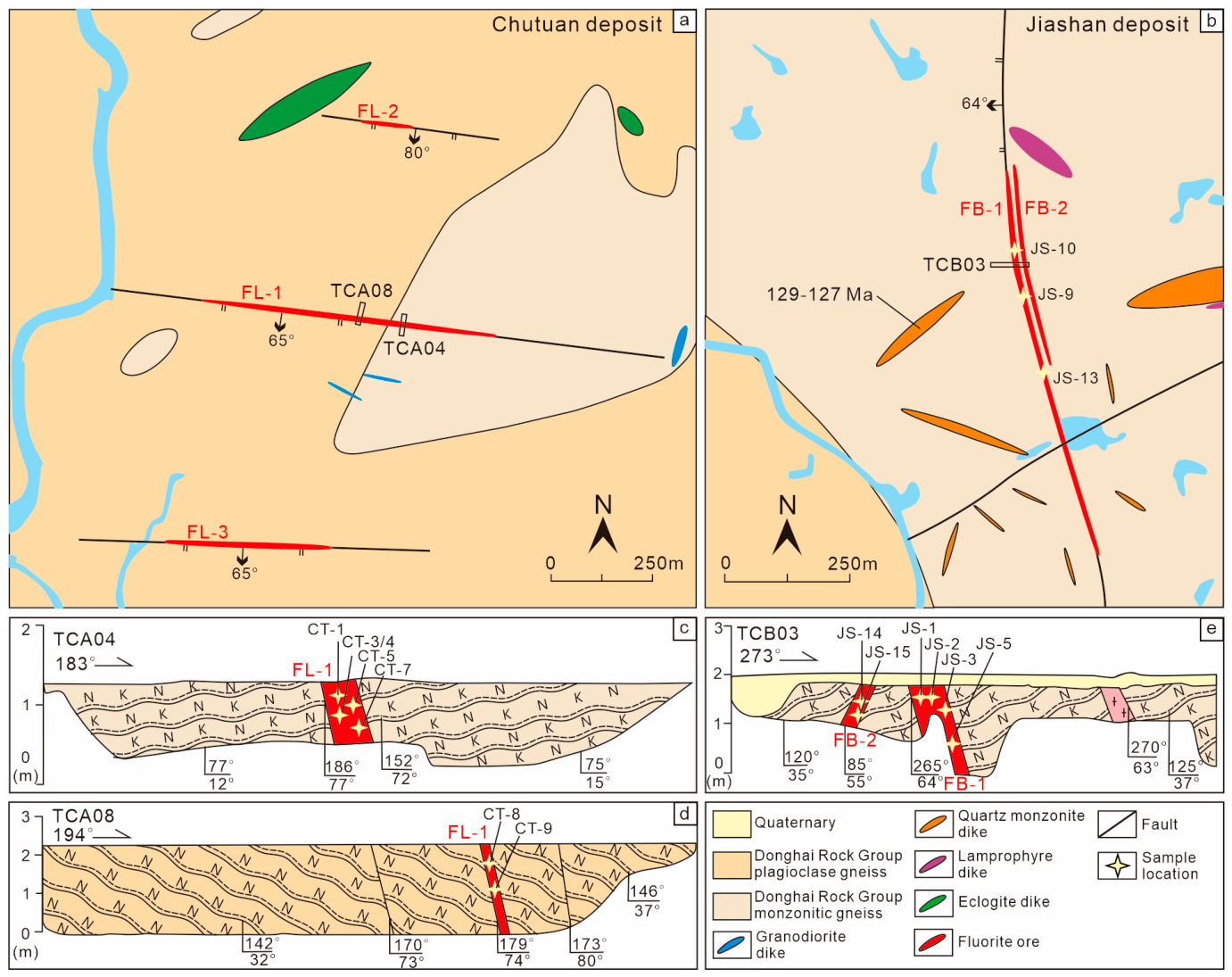
Geological map of the (a) Chutuan and (b) Jiashan deposits; cross–section diagrams of (c,d) trenches CTA04 and CTA08 from the Chutuan deposit and (e) trenches CTB03 from the Jiashan deposit, illustrating the ore body attitude and sampling locations. Data sources: the age data for the quartz monzonite dike (129–127Ma) are derived from [9].
The Chutuan and Jiashan fluorite deposits are situated on the southwestern margin of the Sulu UHP metamorphic belt (Figure 1b), geographically located in the Donghai–Linshu area of Lianyungang City, Jiangsu Province. The geology of Donghai–Linshu area is dominated by the Precambrian Donghai Complex metamorphic basement (plagioclase gneiss, monzonitic gneiss, with intercalated eclogite and marble) and a Mesozoic cover sequence (Cretaceous volcanic–sedimentary rocks) (Figure 1c). Mesozoic magmatic activity was intense, with widespread Cretaceous (127–118 Ma, refs. [13,14]) granitoids forming a NE–trending magmatic belt (Figure 1c). The regional structure is controlled by the Tan–Lu Fault Zone, featuring dominant NE– and NW–trending fault systems. These fault systems critically constrain the distribution of Cretaceous intrusions and, importantly, serve as the primary ore–controlling structures for fluorite mineralization. Multiple fluorite (barite) deposits and occurrences, including the Chutuan and Jiashan deposits described in this study, are aligned along these NE–trending fault zones (Figure 1c). In general, these deposits across the district exhibit highly consistent mineralization characteristics and mineral assemblages, and share similar wall–rock alteration patterns, suggesting they are products of a synchronized regional metallogenic event.
3. Geology and Mineralization of the Chutuan and Jiashan Deposits
3.1. Chutuan Deposit
The Chutuan fluorite deposit is located in the southern part of the Donghai–Linshu area (Figure 1c). The exposed strata in the Chutuan fluorite deposit are relatively simple, consisting of Neoproterozoic–Paleoproterozoic plagioclase gneiss and monzonitic gneiss from the Donghai Complex, with minor amphibolite and Quaternary deposits (Figure 2a). Three nearly EW–trending faults are developed at Chutuan, which are equally spaced, subparallel structural fracture zones or dense joint zones exhibiting tensional–shear characteristics. These structures serve as important ore–controlling features in the area. Magmatic activity within the Chutuan deposit is not prominently developed, with only minor occurrences of NW– and NE–trending eclogite dikes and granodiorite dikes observed.
Three fluorite and barite ore bodies (FL1–FL3, Figure 2a) have been delineated in the Chutuan deposit, predominantly occurring as fluorite–barite–quartz veins. Among these, FL1 is the principal ore body, striking E–W, dipping southward with an inclination of 65–77° (Figure 2c,d and Figure 3a). It extends approximately 675 m along strike and 235 m down–dip, with an average thickness of 1.52 m. The CaF2 content is 34.9%–77.0%, averaging 52.44%.
Figure 3.
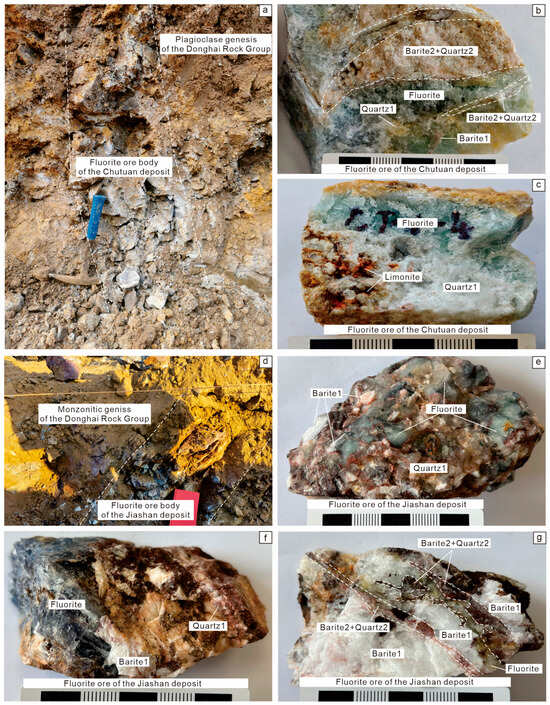
Representative field photographs and hand specimens of the Chutuan and Jiashan fluorite deposits. (a) Field photograph of the Chutuan fluorite ore body; (b) hand specimen of Chutuan ore showing late–stage barite 2 + quartz 2 veinlets cutting through earlier minerals; (c) hand specimen of Chutuan ore showing blue–green fluorite and secondary limonite; (d) field photograph of the Jiashan fluorite ore body; (e,f) hand specimens of Jiashan ore showing the mineral assemblage of early–stage fluorite, barite 1, and quartz 1; (g) hand specimen of Jiashan ore showing late–stage barite 2 + quartz 2 micro–veins cross–cutting earlier fluorite and barite 1.
3.2. Jiashan Deposit
The Jiashan fluorite deposit is situated in the northern region of the Donghai–Linshu area (Figure 1c). The exposed strata in the Jiashan deposit are identical to those of the Chutuan deposit (Figure 2b), consisting of Archean–Paleoproterozoic plagioclase gneiss and monzonitic gneiss from the Donghai Complex, as well as Quaternary deposits. The structural framework within the area is primarily characterized by NE– and SN–trending structural fracture zones, with the latter serving as important ore–controlling structures (Figure 2b). Magmatic rocks are predominantly represented by Mesozoic intrusions and Proterozoic metamorphosed granitic intrusions. The former includes quartz monzogranite dikes (129–127 Ma, ref. [9]) and lamprophyre dikes.
Two fluorite and barite ore bodies (FB1 and FB2, Figure 2b) have been identified in the Jiashan mining area. Similarly to those in the Chutuan deposit, they occur as fluorite–barite–quartz veins, with widths ranging from 0.5 m to 1.0 m. FB1 is the main ore body, exhibiting a lenticular form. It strikes N–S, dips westward at an angle of 64° (Figure 2e), and is clearly controlled by fault structures. It is inferred to extend approximately 600 m along strike and 200 m down–dip. The true thickness of the ore body varies from 0.77 m to 4.81 m, with an average of 1.96 m. Within the ore body, fluorite and barite coexist, with average grades of 21.29% for CaF2 and 50.88% for BaSO4.
3.3. Textural Relationships and Paragenetic Sequence
The Chutuan and Jiashan fluorite deposits exhibit strikingly similar ore characteristics and mineral assemblages. The ore textures are characterized by subhedral–anhedral granular, poikilitic, and interstitial textures, while the ore structures are predominantly massive, veined, and brecciated (Figure 3 and Figure 4).
Figure 4.
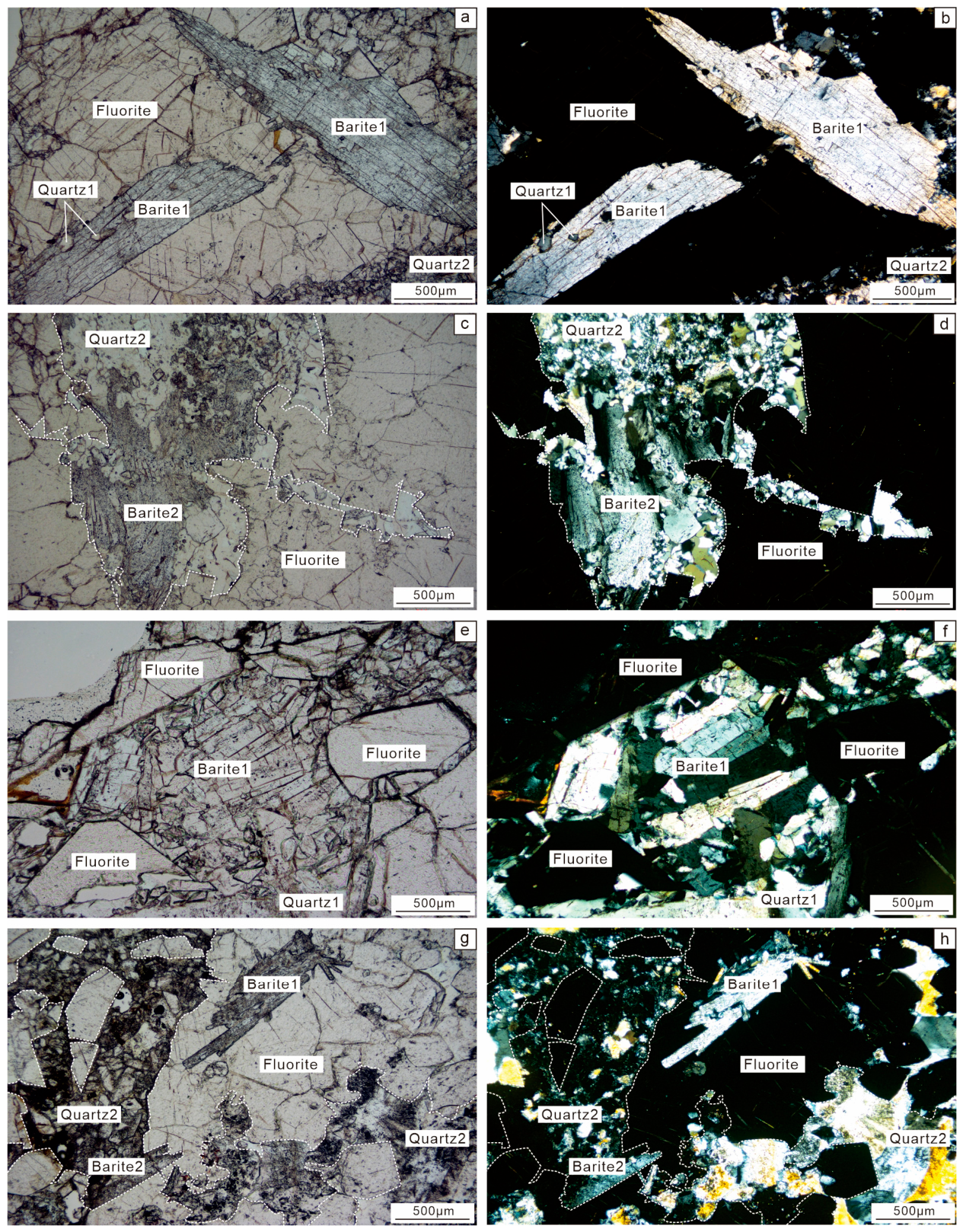
Representative photomicrographs of the Chutuan and Jiashan fluorite deposits. (a,b) Mineral assemblage of the stage I in the Chutuan deposit, showing lath–shaped barite 1 paragenetic with fluorite and minor quartz 1; (c,d) stage II micro–vein in the Chutuan deposit, consisting of fine–grained quartz 2 and barite 2 cutting through early–stage fluorite; (e,f) stage I features in the Jiashan deposit, showing barite 1 occurring as interstitial fillings between fluorite grains or as inclusions within fluorite (poikilitic texture); and (g,h) stage II quartz 2 and barite 2 aggregates replacing or cross–cutting earlier fluorite and barite 1 in the Jiashan deposit. (a,c,e,g) plane–polarized light; (b,d,f,h) cross–polarized light.
The mineralogy of the ore is relatively simple. The primary ore minerals are fluorite and barite, with minor secondary limonite resulting from supergene oxidation (Figure 3c). Gangue minerals consist mainly of quartz and minor calcite. Fluorite is the predominant mineral, typically displaying blue–green colors, with occasional colorless or pale–yellow varieties (Figure 3). Individual grain sizes are of 1–4 mm. Two generations of barite are identified. Barite 1 occurs as lath–shaped or tabular crystals paragenetic with fluorite 1 (Figure 4a,b,e,f), while barite 2 is fine–grained and occurs in late–stage micro–veins (Figure 4c,d,g,h). Quartz 1 appears as smoky gray or white massive aggregates, whereas quartz 2 occurs as fine veinlets or disseminations replacing earlier minerals.
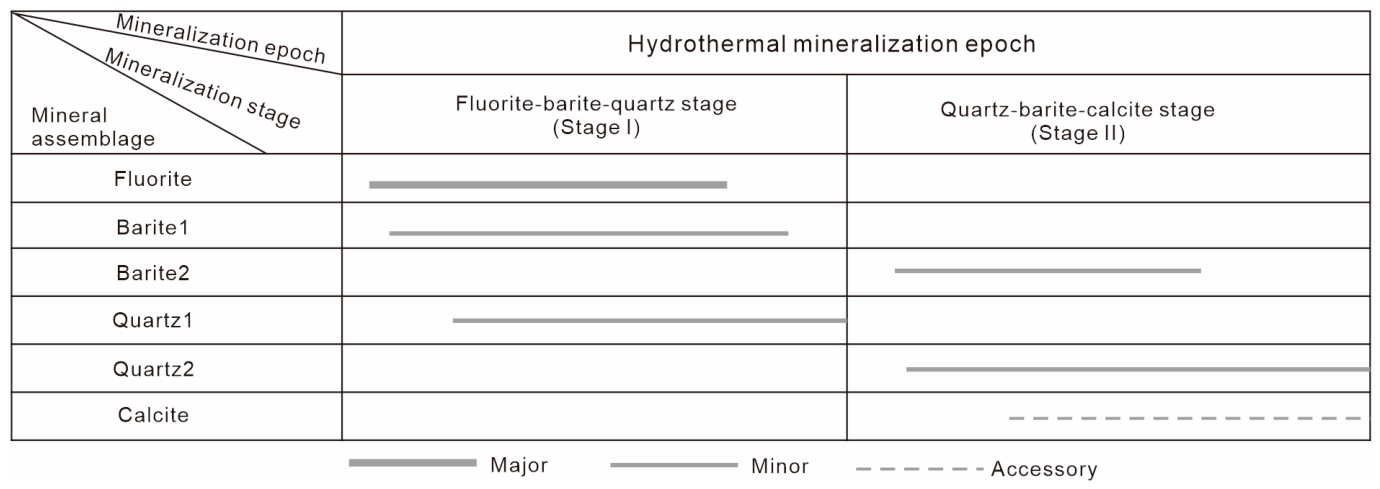
Based on mineral assemblages, cross–cutting relationships, and microscopic textures, the hydrothermal mineralization of both deposits can be divided into two distinct stages, including stage I: fluorite–barite–quartz stage (main ore stage) and stage II: quartz–barite–calcite stage (late stage). Stage I formed the primary ore bodies, characterized by thick veins (0.5–1.5 m wide) with a mineral assemblage of fluorite + barite 1 + quartz 1. Microscopic observations reveal that barite 1 often occurs as elongated crystals enclosed within fluorite, forming a poikilitic texture, or occupies the interstices between fluorite grains, forming an interstitial texture (Figure 4a,b,e,f). These relationships suggest that fluorite crystallized slightly earlier than or nearly simultaneously with barite 1. Stage II is characterized by the development of barite–bearing quartz veinlets or quartz–barite–calcite micro–veins, typically 0.2–5 cm in width. The mineral assemblage includes quartz 2, barite 2, and calcite. In both hand specimens (Figure 3b,g) and thin sections (Figure 4c,d,g,h), these late–stage veins clearly cross–cut or replace the earlier stage fluorite and barite 1, representing the waning stage of the hydrothermal system.
Based on the evidence above, the paragenetic sequence of mineralization stages and mineral formation for the study area has been established (Figure 5).
Figure 5.
The paragenetic sequence of mineralization stages and mineral formation for the study area.
4. Sampling and Analytical Methods
A total of 57 samples were collected for this study, encompassing representative fluorite ores from the Chutuan (n = 25) and Jiashan (n = 32) deposits. All samples were collected from surface outcrops or trenches and are products of the main mineralization stage (Stage I). From these, 10 samples with well–developed inclusions in fluorite (five from Chutuan and five from Jiashan) were selected for microthermometric analysis. Additionally, H–O isotopic analyses of fluorite were conducted on eight samples (four from each deposit). Furthermore, six fluorite samples from the FL1 ore body of the Chutuan deposit were subjected to Sm–Nd dating, while seven fluorite samples (four from Chutuan and three from Jiashan) were analyzed for Sr isotopes. The trace and rare earth element compositions of fluorite were determined for ten samples (five from each deposit). Some sampling locations are shown in Figure 2. The specific analytical methods are as follows:
Fluid inclusion petrography and microthermometric experiments were conducted at the Xinjiang University Key Laboratory of Continental Dynamics and Metallogenic Prognosis in the Central Asian Orogenic Belt. The analyses were performed using a Carl Zeiss Axiolab (White Plains, NY, USA) polarizing microscope coupled with a Linkam THMSG 600 heating–freezing stage (Linkam Scientific Instruments, Surrey, UK), which has an operational temperature range of −196–+600 °C. The temperature calibration of the stage was performed using external standards: H2O–CO2 inclusions (with known melting temperature of solid CO2, Tm, CO2 = −56.6 °C, and final clathrate melting temperature, Tm, cla = +9.9 °C) and pure H2O inclusions (with known melting temperature, Tm, H2O = 0.0 °C, and critical homogenization temperature, Th, H2O = 374 °C). The accuracy of temperature measurements is estimated to be ±0.1 °C for the freezing runs and ±1.0 °C for the heating runs. During the experiments, heating and cooling rates were controlled at 2 °C/min. When approaching the critical point of phase transition, the heating rate was adjusted to 0.5–1.0 °C/min, and the cooling rate to 0.1–0.5 °C/min. The salinity and density of the fluid inclusions were calculated using the equations established by [15].
Fluorite H–O isotopic analyses were conducted at the Analytical and Testing Research Center of the Beijing Research Institute of Uranium Geology. Oxygen isotope analysis employed the BrF5 chemical extraction method: ~12 mg of pure fluorite separates for each sample were sealed with BrF5 and allowed to react for 15 h to extract oxygen. The liberated oxygen was then introduced into a CO2 conversion system and subsequently measured using a MAT–252EM gas isotope ratio mass spectrometer (Thermo Fisher Scientific, Waltham, MA, USA). During the analytical sessions, the international standard NBS–28 and the laboratory internal standard GBW04409 (quartz) were routinely analyzed for quality control. The measured values for NBS–28 averaged +9.58 ± 0.15‰ (n = 3), consistent with its certified value (δ18O = +9.6‰, ref. [16]). For hydrogen isotope analysis, approximately 50–80 mg of fluorite separates were used for each sample. The analysis utilized a stepwise heating decrepitation method. Fluid inclusions were progressively ruptured through gradient heating to release volatile components. The released hydrogen was then converted to H2 gas via a zinc reduction reaction, collected using a liquid nitrogen cold trap, and analyzed with a Finningan MAT–251EM mass spectrometer (Thermo Fisher Scientific, Waltham, MA, USA). The measured δD values were calibrated against the international standard V–SMOW. All results are reported relative to the V–SMOW standard, with analytical precisions of δ18O ± 0.2‰ and δD ± 2‰.
Trace and rare earth element analyses of fluorite separates were performed at ALS Minerals (Guangzhou) Co., Ltd. (Guangzhou, China). For each sample, approximately 0.10–0.20 g of pure fluorite separates were used for the analysis. The determination of ultra–trace element concentrations employed the ME–MS61r method, involving a four–acid digestion followed by analysis using inductively coupled plasma optical emission spectrometry and mass spectrometry (ICP–OES/MS). The instrument used was an Agilent 5110/7900 (Santa Clara, CA, USA). Precision was controlled with a relative deviation (RD) of <10%, and accuracy was controlled with a relative error (RE) of <10%. The determination of rare earth element (REE) concentrations utilized the ME–MS81g method, involving fusion followed by analysis using inductively coupled plasma mass spectrometry (ICP–MS). The instrument used was an Agilent 7900 (USA). Precision was controlled with an RD of <10%, and accuracy was controlled with an RE of <10%.
Fluorite Sm–Nd isotopic dating was also conducted at ALS Minerals (Guangzhou) Co., Ltd. For each sample, approximately 0.10–0.20 g of pure fluorite separates was used for isotopic analysis. For analysis, two parallel aliquots of an appropriate sample weight were prepared. One aliquot was spiked with a mixed 145Nd + 149Sm tracer, while the other remained unspiked. Both aliquots were digested in aqua regia, evaporated to dryness, and then taken up in dilute hydrochloric acid. The clear solutions were loaded onto Dowex 50×8 cation exchange resin columns to separate and purify the rare earth elements (REEs). The eluate from the spiked aliquot was evaporated to dryness and used for Sm and Nd isotopic analysis by mass spectrometry. The eluate from the unspiked aliquot was further evaporated, taken up in dilute hydrochloric acid, and loaded onto P507 organic extraction resin columns (bis(2–ethylhexyl) hydrogen phosphate) to separate and purify Nd for Nd isotopic ratio analysis. The Sm and Nd isotopic compositions were measured using a Thermal Ionization Mass Spectrometer (TRITON) (Thermo Fisher Scientific, Waltham, MA, USA). Sm and Nd concentrations in the samples were calculated using the isotope dilution method. For Nd isotopic ratio analysis, mass fractionation was corrected using the exponential law with a normalization ratio of 146Nd/144Nd = 0.7219. The accuracy and reproducibility of the entire analytical procedure were monitored using the reference material BCR–2. The measured 143Nd/144Nd ratio for BCR–2 was 0.512625 ± 8 (2σ, n = 2), which is in excellent agreement with the recommended value (0.512630 ± 10; ref. [17]). The total procedural blanks for Sm and Nd were 56 pg and 150 pg, respectively, which are negligible compared to the amounts of Sm and Nd processed in the fluorite samples.
Fluorite Sr isotope analysis was conducted at ALS Minerals (Guangzhou) Co., Ltd. For each sample, approximately 0.10 g of pure fluorite separates was used for isotopic analysis. The Sr isotope composition was analyzed using a Thermal Ionization Mass Spectrometer (Thermo Fisher Scientific, Waltham, MA, USA). Rb and Sr concentrations, as well as Sr isotopic ratios, were calculated using the isotope dilution method. For Sr isotopic ratio analysis, mass fractionation was corrected using the exponential law with a normalization ratio of 88Sr/86Sr = 8.37521. The entire analytical procedure was monitored for quality control using the reference materials GBW04411, NBS987, and GSW, to assess both the full procedural blank and instrument performance. The measured 87Sr/86Sr value for NBS987 was 0.71028 ± 1, and for GBW04411, the values were Sr = 159.3 × 10⁻⁶ and 87Sr/86Sr = 0.76005 ± 2. These values are consistent with their recommended values within the margin of error.
5. Results
5.1. Trace and Rare Earth Elements
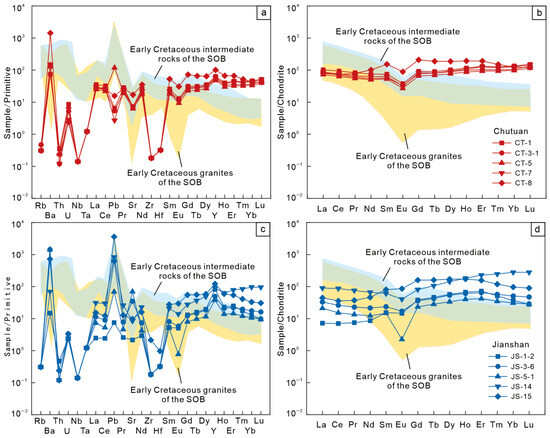
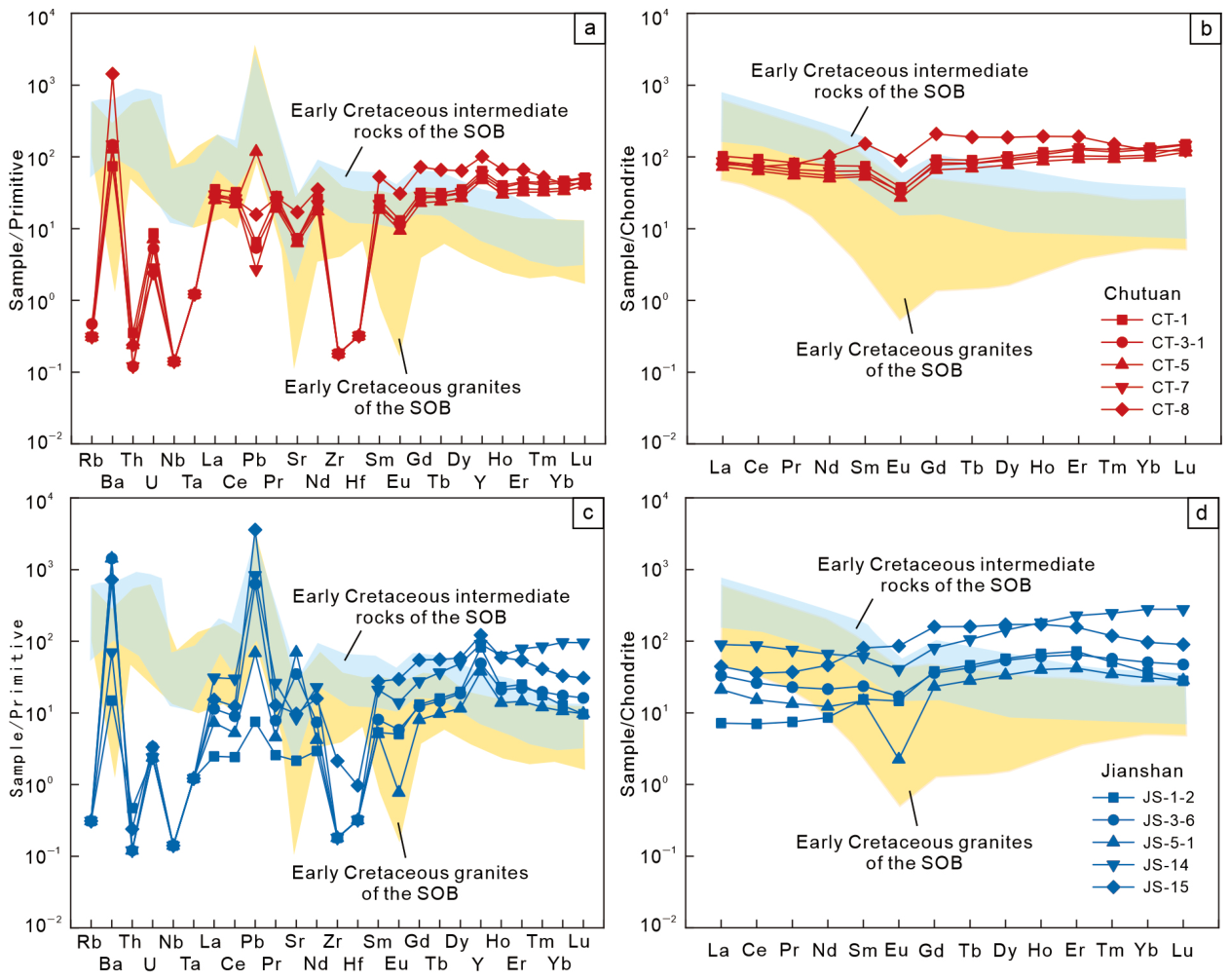
The analytical data for trace and rare earth elements (REE) in fluorite from the Chutuan and Jiashan deposits are presented in Table 1. The results show that fluorite samples from Chutuan are relatively enriched in large–ion lithophile elements (LILE) such as Ba and high–field–strength elements (HFSE) like U and Y, while relatively depleted in Th, Nb, Ta, Zr, and Hf (Figure 6a). With the exception of sample CT–5, which exhibits a distinct enrichment pattern in Pb, the remaining samples display internally consistent trace element geochemical characteristics. Fluorite samples from Jiashan exhibit distribution patterns broadly similar to those from Chutuan (Figure 6c). Notably, a strong positive correlation is observed between Y and ΣREE in both deposits, suggesting that Y3+ and REE3+ (specifically HREE) were incorporated into the fluorite lattice via similar substitution mechanisms, likely replacing Ca2+ due to their comparable ionic radii.
Table 1.
Trace element data for fluorite from the Chutuan and Jiashan deposits (×10−6).
Figure 6.
(a,c) Primitive mantle–normalized trace element spider diagrams and (b,d) chondrite–normalized REE patterns for fluorite from the Chutuan and Jiashan deposits. Data sources: Primitive mantle normalization values are from [18]; chondrite normalization values are from [19]; the data for Early Cretaceous intermediate rocks and granites of the Sulu orogenic belt are based on [9].
Fluorite samples from Chutuan exhibit relatively high ΣREE contents, ranging from 172 × 10−6 to 315 × 10−6, with an average of 228 × 10−6. The ΣLREE/ΣHREE ratios (0.88–1.30) and (La/Yb)N ratios (0.64 to 0.80) suggest insignificant fractionation between LREE and HREE. This is further supported by the chondrite–normalized REE patterns, which display relatively flat curves (Figure 6b). The flat REE patterns indicate that LREE and HREEs were transported with similar efficiency in the ore–forming fluid and incorporated into the fluorite lattice without significant fractionation during the main precipitation event. Additionally, the samples exhibit the distinct negative Eu anomaly (δEu = 0.44–0.49) and no significant Ce anomaly (δCe = 0.93–1.01), potentially suggesting the reducing conditions at the source.
Fluorite samples from Jiashan exhibit ΣREEE contents (54.1 × 10⁻⁶ to 289 × 10−6, with an average of 141 × 10−6) generally lower than those of Chutuan. The ΣLREE/ΣHREE ratios (0.29–0.84) and (La/Yb)N ratios (0.20–0.68) are notably lower than those of Chutuan samples, indicating a more pronounced enrichment in HREE. This is reflected in the left–leaning curves of the REE patterns (Figure 6d). Although these geochemical variations between Chutuan and Jiashan are significant, field and microscopic evidence confirms that fluorite in both areas belongs to a single mineralization generation (Stage I). The shift from flat REE patterns in Chutuan to HREE–enriched patterns in Jiashan is likely as the result of spatial–temporal evolution within a single hydrothermal system. The increased stability of HREE–fluoride complexes as the fluid migrated and evolved, or varying degrees of water–rock interaction with the monzonitic gneiss host rock, rather than the presence of multiple discrete fluorite generations. The overall shape of the REE patterns is thus controlled by progressive evolution of the ore–forming fluid and the inherited signatures from the deep–seated source.
5.2. Fluid Inclusions
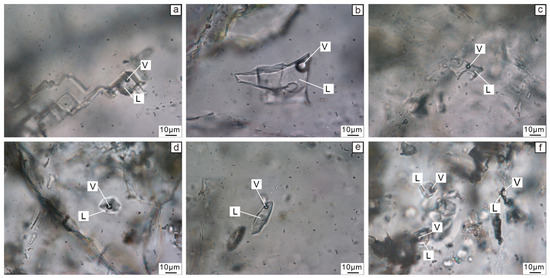
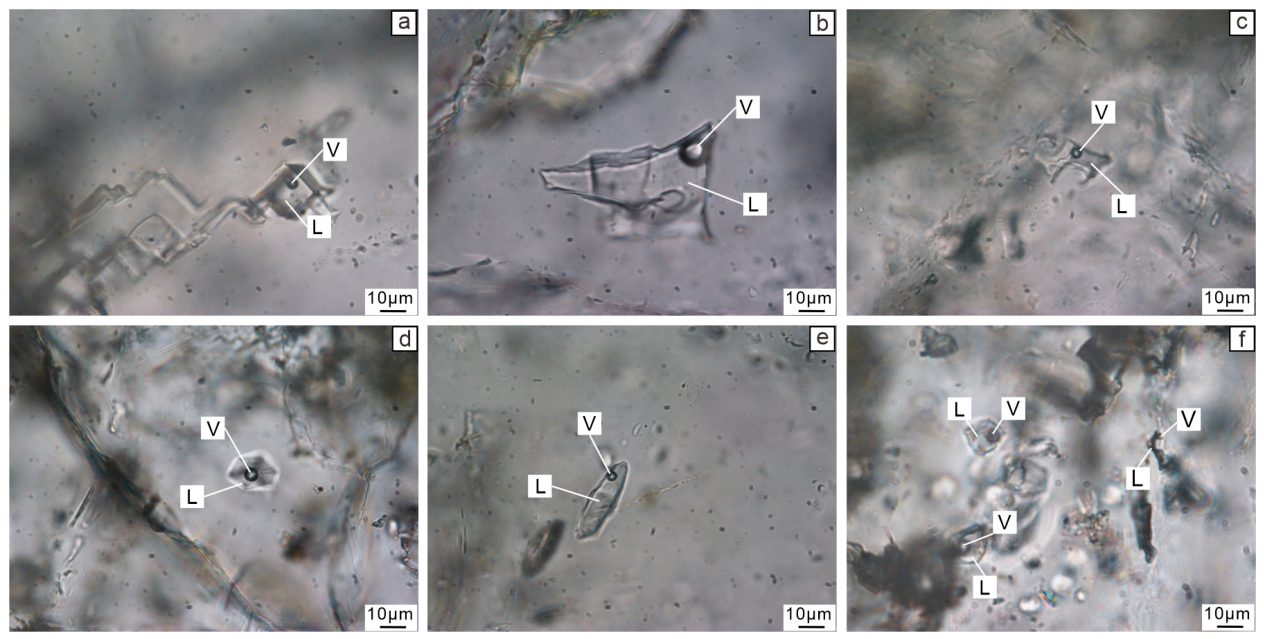
Micro–petrographic observations conducted at room temperature (27 °C) reveal a high degree of similarity in fluid inclusion characteristics between fluorite samples from the Chutuan and Jiashan deposits. Detailed petrographic analysis confirms that the studied inclusions are of primary origin, as they occur predominantly as isolated individuals or are randomly distributed within the host fluorite crystals (Figure 7). No secondary inclusions aligned along healed fractures were included in the microthermometric study.
Figure 7.
Characteristics of two–phase liquid–rich (L + V) fluid inclusions in fluorite from the (a–c) Chutuan and (d–f) Jiashan deposits. Mineral abbreviations: L—Liquid; V—Vapor.
Spatially, larger inclusions in all samples predominantly exhibit isolated distributions, whereas smaller inclusions tend to align in linear or bead–like arrays along growth zones. Morphologically, the fluid inclusions are predominantly elliptical, triangular, spindle–shaped, or irregular. In terms of phase composition, the inclusions are overwhelmingly dominated by two–phase liquid–rich (L + V) types, accounting for approximately 95% of the total. No S–type (daughter mineral–bearing) or pure gas–phase inclusions were observed during the systematic inspection. Within these inclusions, the vapor phase typically appears dark grayish–white, while the liquid phase is colorless and transparent. The vapor–to–liquid ratios are concentrated in the range of 5% to 25%. The long axes of the inclusions mostly range from 3 μm to 12 μm, with a few larger inclusions reaching several tens of micrometers in size (Figure 7).
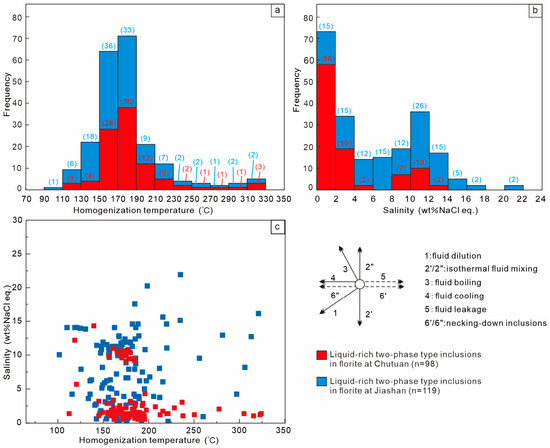
Microthermometric analysis was conducted on ten representative fluorite samples (five each from the Chutuan and Jiashan deposits), yielding 217 valid data points from primary fluid inclusions (98 from Chutuan and 119 from Jiashan; Table 2). The salinity and density were calculated using thermodynamic parameter models [17]. All analyzed primary liquid–rich two–phase inclusions homogenized to the liquid phase upon heating. For the Chutuan deposit, the measured homogenization temperatures (Th) exhibit a wide range of 112–324 °C, with a primary frequency peak between 150 °C and 190 °C (n = 67). A minor population of inclusions yielded significantly higher Th values exceeding 250 °C, reaching a maximum of 324 °C (n = 5). Salinities are 0.53–14.32 wt% NaCl eq. and display a distinct bimodal distribution, with primary clusters at 0.53–3.37 wt% NaCl eq. (n = 78) and 9.08–14.31 wt% NaCl eq. (n = 19). In the Jiashan deposit, Th values range from 101 °C to 321 °C, predominantly clustering within the 130–190 °C interval (n = 88), while a small group of data points exceeds 250 °C (n = 7). Salinities are of 0.18–21.87 wt% NaCl eq., also exhibiting a bimodal character with peaks at 0.18–5.99 wt% NaCl eq. (n = 38) and 8.13–13.98 wt% NaCl eq. (n = 53).
Table 2.
Microthermometric data of fluid inclusions in fluorite from the Chutuan and Jiashan deposits.
5.3. H–O Isotopic Compositions
Hydrogen and oxygen isotopic data were obtained for eight fluorite samples in this study, comprising four from Chutuan and four from Jiashan (Table 3). Given that the chemical composition of fluorite contains negligible hydrogen and oxygen, its H–O isotopic composition can be considered representative of the ore–forming fluids, effectively preserving their primary characteristics. For the Chutuan fluorite samples, δDV–SMOW values range from −84 ‰ to −68 ‰, with an average of −77.3‰, while δ18OV–SMOW values range from −8.5‰ to −4.6 ‰, averaging −6.5 ‰. For the Jiashan fluorite samples, δDV–SMOW values range from −90 ‰ to −55 ‰, averaging −75.3 ‰, and δ18OV–SMOW values range from −6.4 ‰ to −4.6 ‰, with an average of −5.4 ‰.
Table 3.
H–O isotopic compositions of fluorite in the Chutuan and Jiashan deposits.
5.4. Fluorite Sm–Nd Geochronology
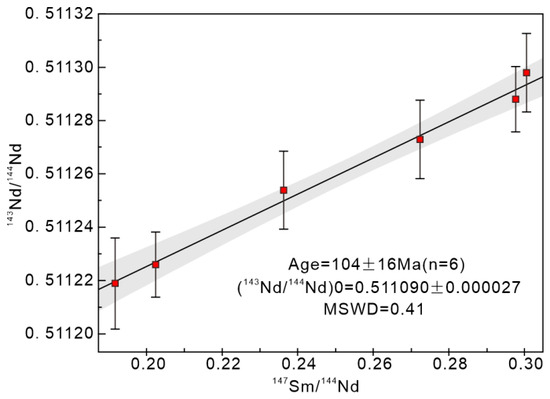
The Sm and Nd concentrations and isotopic compositions of six fluorite samples from the Chutuan deposit are presented in Table 4. The fluorite exhibits Sm contents ranging from 4.48 × 10⁻⁶ to 20.34 × 10⁻⁶ and Nd contents from 22.33 × 10⁻⁶ to 40.95 × 10⁻⁶. Corresponding 147Sm/144Nd ratios vary between 0.1917 and 0.3006, while 143Nd/144Nd ratios range from 0.511719 to 0.511798. In the 147Sm/144Nd versus 143Nd/144Nd diagram (Figure 8), the fluorite exhibit a distinct linear distribution, yielding an isochron age of 104 ± 16 Ma (n = 6; MSWD = 0.41), and an initial 143Nd/144Nd ratio of 0.511590 ± 0.000027 (Figure 8). The calculated εNd(t) value for the fluorite, based on t = 104 Ma, range from −27.7 to −27.5.
Table 4.
Sm–Nd–Sr isotopic compositions of fluorite in Chutuan and Jiashan deposits.
Figure 8.
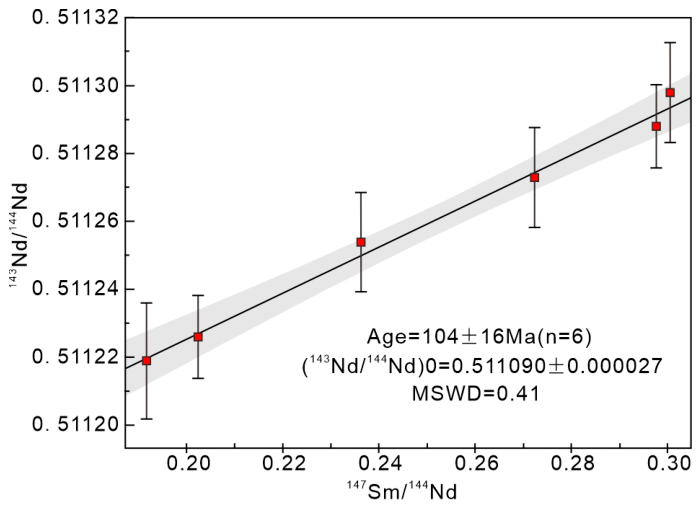
Sm–Nd isochron diagram of fluorite from the Chutuan deposit.
5.5. Fluorite Sr Isotopes
The 87Sr/86Sr ratios of four fluorite samples from the Chutuan deposit are 0.711785–0.712693, which are slightly lower than the Sr isotopic composition of fluorite from the Jiashan deposit (n = 3, 87Sr/86Sr = 0.712998 to 0.713424) (Table 4).
6. Discussion
6.1. Timing of Fluorite Mineralization
The fluorite samples from the Chutuan deposit define a well–constrained linear array on the 147Sm/144Nd versus 143Nd/144Nd diagram (Figure 8), yielding an isochron age of 104 ± 16 Ma (n = 6; MSWD = 0.41). This result directly constrains the crystallization age of the fluorite mineralization to the late Early Cretaceous. Although the isochron is based on a relatively small number of samples (n = 6), its robustness is supported by several factors. First, the 147Sm/144Nd ratios exhibit a significant spread from 0.1917 to 0.3006, providing a sufficient baseline to define a reliable slope. Second, the low MSWD value (0.41) indicates that the scatter of the data points is entirely accounted for by analytical uncertainties, suggesting that the Sm–Nd isotopic system has remained closed since crystallization. To further exclude the possibility of a “pseudo–isochron” produced by binary mixing, we examined the relationship between 1/Nd and 143Nd/144Nd. The lack of a significant linear correlation between these parameters (R2 < 0.1) confirms that the linear array represents a true geochronological isochron rather than a mixing line between two distinct reservoirs.
This direct dating carries significant implications for regional metallogenic correlations. In eastern Shandong, the timing of several fluorite deposits (e.g., Jushangou and Hongbu) has been indirectly constrained by cross–cutting relationships, where fluorite veins intrude Early Cretaceous Qingshan Group volcanic rocks [20]. Zircon U–Pb ages from intermediate–acidic volcanic rocks of the Qingshan Group are concentrated around 110–106 Ma [21], placing the mineralization age of these deposits at <106 Ma [20,22]. The direct Sm–Nd age obtained in this study (104 ± 16 Ma) is highly consistent with this indirect age bracket, validating the previous chronological constraints and establishing a clear temporal link between fluorite mineralization in the eastern Sulu orogenic belt (Lianyungang area) and eastern Shandong.
It is noteworthy that zircon U–Pb dating of quartz monzonite dikes within the study area (129–127 Ma, ref. [9]) are significantly older than the fluorite mineralization age. This pronounced age discrepancy indicates that the Chutuan mineralization was not directly associated with the hydrothermal activity coeval with this earlier granitic magmatic event. Instead, the ~104 Ma mineralization coincides with the peak of regional lithospheric thinning and extensional tectonics in eastern China [6,7,8,9,11]. During this transition from a compressional to an extensional regime, the widespread Cretaceous granitic intrusions in the SOB (143~111 Ma, refs. [6,7,8,9,11]) likely provided the requisite thermal energy or fluid components to drive the circulation of deep–seated hydrothermal fluids. This facilitated the subsequent precipitation of fluorite within fault–controlled systems. Consequently, the Chutuan deposit represents a discrete product of a regional tectonic–thermal event that occurred long after the intrusion of the quartz monzonite dikes.
6.2. Nature and Source of Ore–Forming Fluids
6.2.1. Nature of Ore–Forming Fluids
The fluid inclusions in fluorite from the Chutuan and Jiashan deposits reveal a complex hydrothermal system. The Th values exhibit a wide span from 101 °C to 324 °C (Table 2). Although the data cluster between 130 °C and 190 °C (Figure 9), the presence of high–temperature inclusions (>250 °C, max 324 °C) suggests that the system was initially fed by high–energy, deep–seated hydrothermal pulses [23]. The salinity data further reinforce this complexity, showing a broad range (0.18–21.87 wt% NaCl eq.) and a distinct bimodal distribution (Figure 9). Specifically, the high–salinity peaks (8.13–14.31 wt% NaCl eq. and reaching 21.87 wt% NaCl eq.) potentially represent the primary magmatic–hydrothermal end–member, whereas the low–salinity clusters (0.18–5.99 wt% NaCl eq.) reflect the influx of meteoric water [24]. Such a wide range of Th and salinity within a single mineralization stage (Stage I) is a diagnostic feature of fluid mixing rather than simple cooling within a closed system [25].
Figure 9.
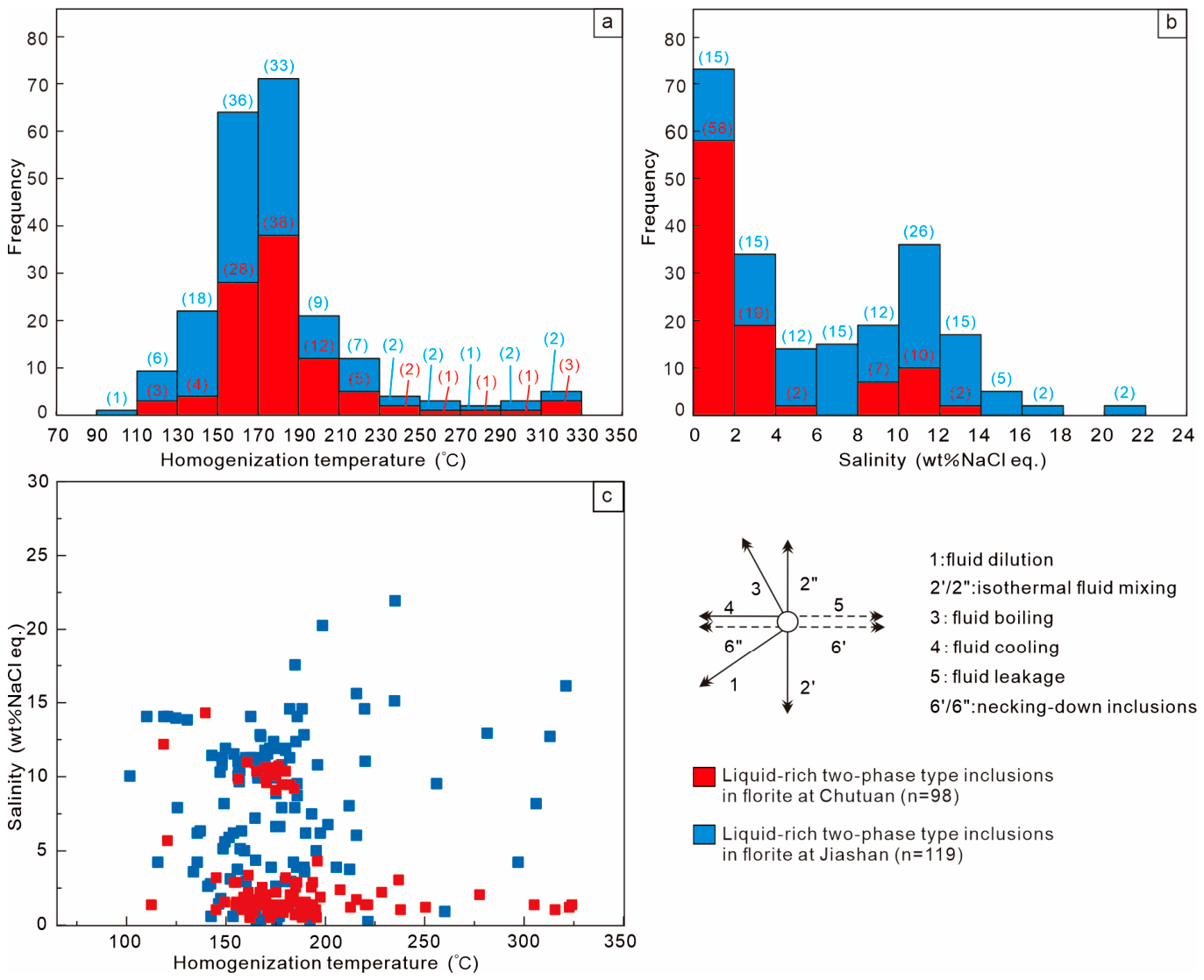
Histograms of (a) homogenization temperature and (b) salinity for fluid inclusions in fluorite from the Chutuan and Jiashan deposits; and (c) covariation diagram of salinity versus homogenization temperature.
Regarding redox conditions, the consistent negative Eu anomalies (δEu = 0.12–0.72) in all fluorite samples indicate that europium was predominantly present as Eu3+ in the ore–forming fluid, given the favorable substitution of Eu2+ for Ca2+ [26]. This suggests fluorite precipitated under moderately oxidizing to neutral conditions, as Eu reduction would be suppressed [26,27,28]. The absence of significant Ce anomalies (δCe = 0.87–1.05) further supports this interpretation, as Ce also remained as Ce3+. Additionally, the mineral assemblage of both deposits offers corroborating evidence. The absence of sulfide minerals and the widespread presence of barite are indicative of a hydrothermal system in which sulfate was stable. This mineralogical feature aligns well with a neutral to moderately oxidizing fluid environment.
6.2.2. Source of Ore–Forming Fluids
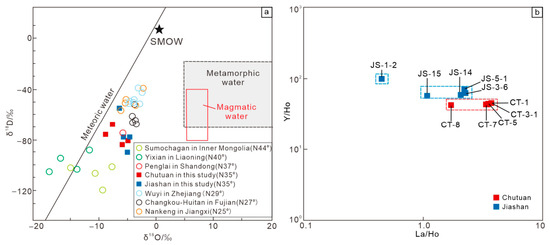
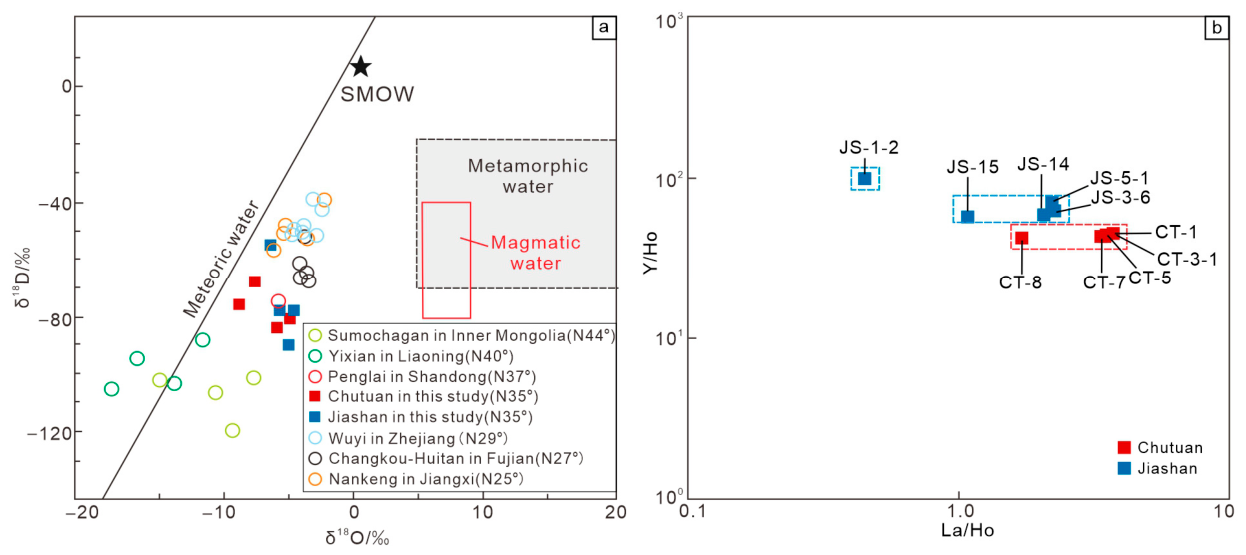
The δDV–SMOW and δ18OV–SMOW values of fluorite in the Chutuan and Jiashan deposits exhibit considerable fluctuations. In the Chutuan samples, the δDV–SMOW values ranges from −84‰ to −68‰ (average −77.3‰), while the δ18OV–SMOW values ranges from −8.5‰ to −4.6‰ (average −6.5‰). In the Jiashan samples, the δDV–SMOW values ranges from −90‰ to −55‰ (average −75.3‰), and the δ18OV–SMOW values ranges from −6.4‰ to −4.6‰ (average −5.4‰). In a broader regional context, a comparison with several hydrothermal fluorite deposits across eastern China, ranging from Nankeng in Jiangxi (25° N), Wuyi in Zhejiang (29° N), to Penglai in Shandong (37° N) and Sumochagan in Inner Mongolia (44° N), reveals a distinct latitudinal effect. Both δ18O and δD values exhibit a progressive decrease with increasing latitude (Figure 10a). The Chutuan and Jiashan data (35° N) fit precisely into this regional trend, strongly suggesting that meteoric water was a ubiquitous and dominant component of the hydrothermal systems in eastern China during the Cretaceous [29,30,31,32,33].
Figure 10.
(a) H–O isotopic compositions of fluorite from the Chutu and Jiashan deposits and (b) La/Ho versus Y/Ho diagrams. The H–O isotopic data of different hydrothermal fluorite deposits (i.e., Nankeng, Wuyi, Penglai, Yixian and Sumochagan) are from [29,30,31,32,33].
However, relying solely on a meteoric model fails to reconcile the high–temperature (>320 °C) pulses and bimodal salinity distributions observed in this study. While the regional latitudinal trend confirms the meteoric background, the specific isotopic “shift” toward the magmatic water field (with δD values reaching −55‰in Jiashan) and the presence of high–salinity end–members (>10 wt% NaCl eq.) indicate that the system was periodically recharged by deep–seated magmatic–hydrothermal fluids [23,34]. The latitudinal effect thus represents the regional meteoric reservoir, while the isotopic and microthermometric anomalies reflect the localized injection of magmatic water associated with the regional extensional regime.
Consequently, we propose that the ore–forming fluids were a hybrid of magmatic–hydrothermal water and regional meteoric water, with the latter preserving the broad latitudinal isotopic signature, while the former drove the high–temperature mineralization events.
6.3. Source of Ore–Forming Materials
The Sr and Nd isotopic compositions of fluorite serve as effective tracers for identifying the sources of ore–forming materials. Due to the similar geochemical properties of Sr2+ and Ca2+, Sr isotopes are directly used to trace the origin of calcium in the ore–forming fluids [35]. Rare earth elements (REEs), which are primarily transported as fluoride complexes in hydrothermal fluids, exhibit Nd isotopic signatures that effectively reflect the source characteristics of the REEs [35]. Strontium typically enters the fluorite lattice through isomorphous substitution for Ca2+, whereas Rb+, owing to differences in ionic radius and valence state, rarely substitutes for Ca2+ in fluorite. This results in a general enrichment of Sr and depletion of Rb in fluorite [36,37,38]. During fluorite precipitation in hydrothermal systems, Sr isotopes undergo negligible fractionation, and the Rb/Sr ratios in fluorite are typically extremely low, allowing the in situ decay of 87Rb to 87Sr to be disregarded. Consequently, fluorite effectively preserves the original Sr isotopic signature of the ore–forming fluid, and the measured 87Sr/86Sr ratio represents the initial 87Sr/86Sr value of the ore–forming fluid [36,37,38].
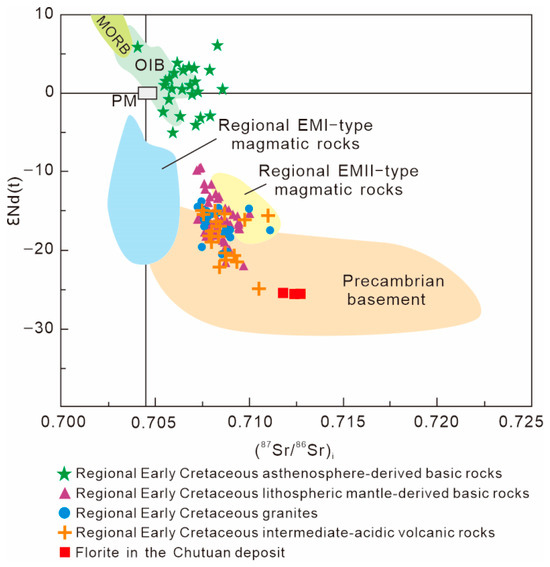
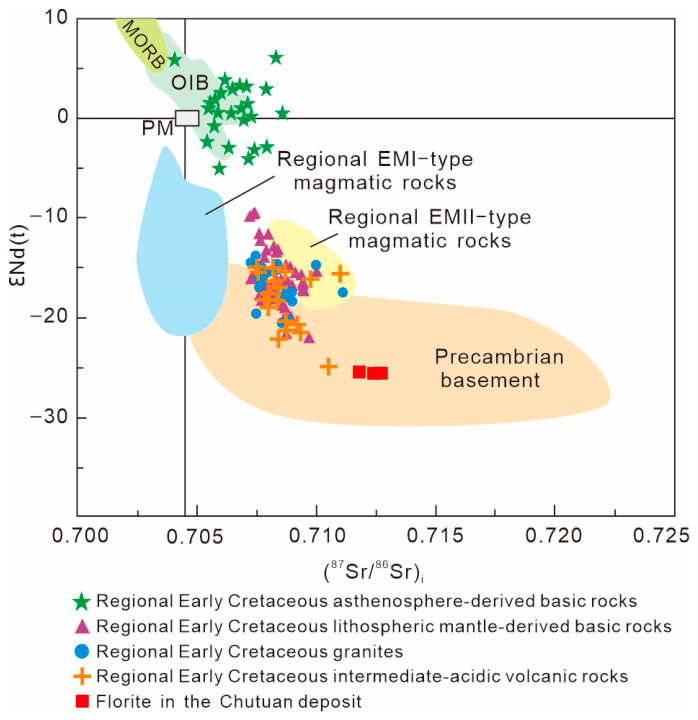
Fluorite samples from the Chutuan and Jiashan deposits exhibit similar 87Sr/86Sr ratios, ranging from 0.711785 to 0.712693 and 0.712998 to 0.713424, respectively, suggesting a potential common source of Sr in their respective mineralization systems. Compared to the (87Sr/86Sr)i values of contemporaneous granites, intermediate–acidic volcanic rocks, and lithospheric mantle–derived intermediate–mafic rocks in the study area and the broader region (ranging from 0.7075 to 0.7110; refs. [9,39,40,41,42]), the Sr isotopic compositions of fluorite in the study area are significantly higher (Figure 11). This indicates that regional Early Permian magmatic activity likely did not provide a substantial material contribution to the fluorite mineralization at Chutuan and Jiashan. Similarly, the Nd isotopic compositions of fluorite from the Chutuan deposit also differ markedly from those of contemporaneous magmatic rocks: the former exhibit εNd(t) values concentrated between −27.7 and −27.5, while the latter generally range from −23.1 to −10.2 [40], further ruling out Early Cretaceous magmatic rocks as a source of ore–forming materials. Additionally, the trace and rare earth element distribution patterns of fluorite in the study area are significantly distinct from those of Early Cretaceous intermediate rocks and granites in the Sulu orogenic belt (Figure 6), which further supports the above interpretation.
Figure 11.
Sr–Nd isotopic composition of fluorite in Chutuan deposit. Data source: Regional Early Cretaceous igneous rocks [14,40,41,42,43,44,45,46,47,48,49,50,51]; Precambrian basement [11].
In the (87Sr/86Sr)i–εNd(t) diagram (Figure 11), all analyzed fluorite samples from the Chutuan deposit cluster within the field of Precambrian basement rocks, indicating a crustal derivation. This is reinforced by their highly negative εNd(t) values (−27.7 to −27.5), which are inconsistent with a significant contribution from coeval mantle–derived or juvenile crustal sources but are characteristic of ancient, evolved continental crust [39,40,41,42]. Thus, the ore–forming elements (e.g., Ca, Sr, REEs) were predominantly derived from the ancient crystalline basement of the SOB. The immediate source is interpreted as the Neoarchean to Paleoproterozoic Donghai Group complex, the exposed basement in the study area. This metamorphic assemblage includes plagioclase gneiss, monzonitic gneiss, eclogite, amphibolite, biotite granulite, various schists, and medium– to thick–bedded diopside dolomitic marble and diopside quartzite. These lithologies are notably enriched in calcium [9,11,12,13,14]. Extensive water–rock interaction between the hydrothermal fluids and these calcium–rich rocks of the Donghai Group is therefore identified as the key process for leaching the essential components for fluorite mineralization.
6.4. Metallogenic Mechanism
Fluorite precipitation in hydrothermal systems is commonly triggered by fluid cooling, boiling, mixing, or water–rock interaction [52,53]. In the study area, fluid boiling is ruled out due to the absence of petrographic evidence (e.g., hydrothermal breccias, bladed calcite) and the lack of coexisting liquid– and vapor–rich fluid inclusion assemblages. Instead, building upon the established characteristics and sources of the ore–forming fluids (Section 6.2) and the origins of ore–forming materials (Section 6.3), an integrated model is proposed where fluorite deposition was controlled by the coupled effects of fluid cooling, water–rock interaction, and fluid mixing, with the relative dominance of these mechanisms varying between deposits as a direct consequence of their distinct fluid evolution histories.
The trace and REE geochemistry of fluorite provides critical insights into the precipitation processes and their link to fluid evolution. At Chutuan, the flat REE patterns (Figure 6b) and relatively constant Y/Ho ratios (41.9–44.0, close to the chondritic value) suggest precipitation from a chemically homogeneous fluid. This is interpreted as the result of efficient mixing and/or extensive water–rock interaction that equilibrated the fluid with the basement signature prior to rapid precipitation [54,55]. The dominant Th population (150–190 °C) and the overall Th–salinity trend (Figure 7c) are consistent with a cooling–dominated evolution path for this well–mixed fluid. The decrease in temperature directly reduced the solubility of CaF2 [20], providing the fundamental driving force for saturation. Concurrently, water–rock interaction played a vital role: the highly negative εNd(t) values and crustal Sr isotopic signatures confirm that ore–forming materials were leached from the Precambrian Donghai Complex. The interaction between the acidic, F–rich fluids and calcium–rich wall rocks would consume H+, increase pH, and further decrease CaF2 solubility [2,20,38,52,53]. Thus, at Chutuan, fluorite precipitation resulted primarily from the cooling of a well–homogenized fluid, amplified by water–rock interaction. The fluid system appears to have been relatively closed after an initial mixing event, leading to stable geochemical signatures and a predominantly unimodal, low–salinity fluid inclusion population. The occasional high–salinity inclusions likely represent localized heterogeneities.
In stark contrast, the fluid system at Jiashan was more dynamic and open. The HREE–enriched patterns (Figure 6d) imply progressive fluid evolution where cooling led to preferential HREE enrichment due to the increased stability of HREE–fluoride complexes [56]. More importantly, the highly variable Y/Ho ratios (56.9–98.9), significantly above the chondritic ratio, are characteristic of F–rich fluids experiencing fluid mixing or significant chemical changes [54,55]. This geochemical evidence is strongly supported by the fluid inclusion data, which show a bimodal salinity distribution and the presence of a high–temperature, high–salinity end–member (Figure 9), providing direct evidence for intermittent mixing between magmatic–hydrothermal and meteoric–hydrothermal fluids [23,34]. At Jiashan, episodic fluid mixing was a dominant control. The influx of hot, saline magmatic fluids into a cooler, dilute meteoric–dominated system created sharp chemical and thermal disequilibrium. This mixing likely introduced additional F, REEs, and heat, dramatically enhancing fluorite precipitation [52,53]. While cooling and water–rock interaction remained active processes, they were overprinted and intensified by these recurrent mixing events, leading to the complex, bimodal inclusion record and variable Y/Ho signatures.
In summary, the metallogenic mechanism is not uniform but evolved spatially within the hydrothermal system. The Chutuan deposit represents a distal, cooling– and water–rock interaction–dominated end–member, where precipitation occurred from a largely homogenized fluid. The Jiashan deposit represents a proximal, mixing–influenced end–member closer to fluid conduits, where precipitation was repeatedly triggered by episodic influxes of magmatic fluids, as evidenced by its higher proportion of high–salinity inclusions and broader Th range. Therefore, fluorite precipitation was governed by a continuum of processes rooted in the evolving physicochemical conditions of the ore–forming fluids, with fluid mixing acting as a critical trigger at the deposit scale.
6.5. Genetic Model for Fluorite Mineralization
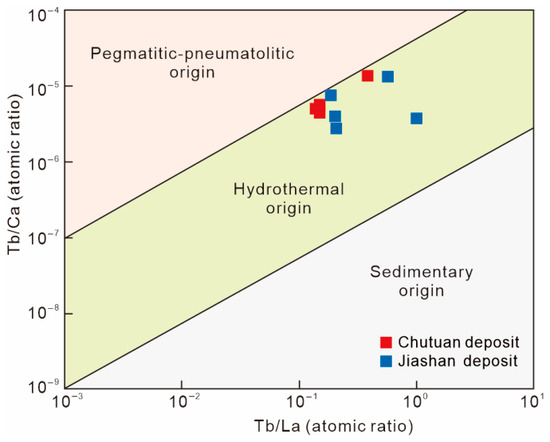
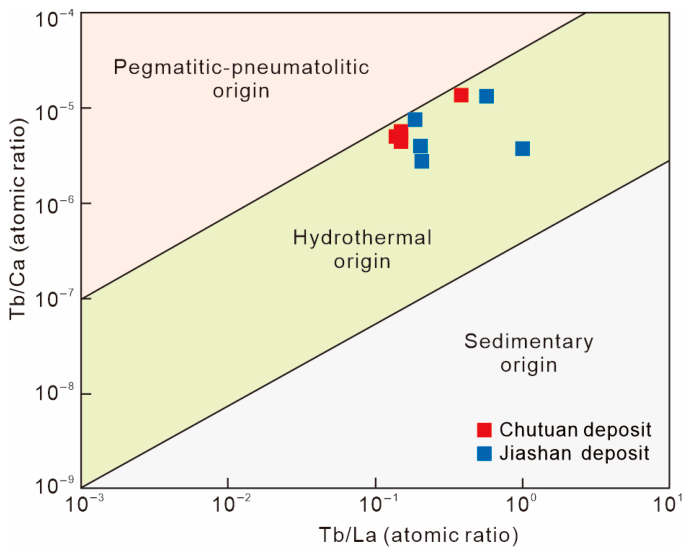
Genetically, the Chutuan and Jiashan fluorite deposits are clearly controlled by structural fractures, with ore bodies predominantly occurring as veins and lenses, and ores commonly exhibiting veinlet and disseminated textures (Figure 3). Fluid inclusion studies and H–O isotopic compositions reveal that the ore–forming hydrothermal fluids were derived from mixed meteoric and magmatic sources. In the Tb/Ca–Tb/La diagram (Figure 12), all fluorite samples from Chutuan and Jiashan plot within the hydrothermal field [57], further supporting their classification as hydrothermal vein–type deposits.
Figure 12.
Tb/Ca versus Tb/La diagram for determining the genesis of fluorite deposit. The division of pegmatitic–, hydrothermal– and sedimentary–origin regions is cited from [4,57].
Based on comprehensive constraints from mineralization age, fluid and material sources, and precipitation mechanisms, a refined and sequential metallogenic model for the Chutuan and Jiashan fluorite deposits is proposed. During the late Early Cretaceous (~104 Ma), regional lithospheric extension and associated magmatic activity provided the critical heat source that drove a large–scale hydrothermal convection system. Dominantly meteoric water, as evidenced by the latitudinal trend in H–O isotopes (Figure 10a), circulated deeply along reactivated regional fault systems, particularly the NE–trending structures related to the Tan–Lu Fault Zone. During deep circulation, the heated, likely acidic (F–rich) meteoric–derived fluids underwent extensive water–rock interaction with the calcium–rich lithologies (e.g., marble, calc–silicate rocks) of the Donghai Group complex. This process not only leached ore–forming materials (Ca, Sr, REEs) from the basement rocks (Figure 11), forming metal–bearing, fluorine–rich hydrothermal fluids, but also caused significant wall–rock alteration, primarily manifested as silicification, carbonatization, and kaolinization (Figure 3). The metal–bearing fluids migrated upwards along the fault networks. During ascent, the system experienced episodic pulses of high–temperature, high–salinity magmatic–hydrothermal fluids, as recorded by the high–Th (>250 °C), high–salinity (>10 wt% NaCl eq.) fluid inclusions (Figure 9) and the shift of some δD values towards the magmatic water field (Figure 10a). Intermittent mixing between this deep–sourced magmatic fluid and the dominant, cooler meteoric–hydrothermal fluid occurred, creating a complex, hybrid fluid system with bimodal salinity and a wide temperature range (101–324 °C).
The spatial variation in fluid evolution is recorded. At Chutuan, the hybrid fluid may have experienced more thorough equilibration and evolved into a relatively homogeneous, well–mixed fluid, as evidenced by the flat REE patterns and constant Y/Ho ratios. When the fluid migrated into favorable E–W trending structural traps, massive fluorite precipitation was primarily triggered by fluid cooling and water–rock interaction, resulting in a relatively steady precipitation process. In contrast, a more dynamic, mixing–influenced environment closer to fluid conduits is indicated at Jiashan, where precipitation was repeatedly triggered by episodic fluid influxes. Here, fluorite precipitation was dominated by fluid mixing events, supplemented by water–rock interaction and fluid cooling. The intense interaction between high–temperature (>250 °C), high–salinity fluid pulses and wall rocks led to stronger silicification and carbonatization, resulting in a more pulsed precipitation style that ultimately formed fluorite–barite–quartz veins along S–N trending faults.
Following the main fluorite deposition, the hydrothermal system began to wane. The fluid regime shifted towards a cooler, more dilute, and likely more oxidized state. This transition is marked by the precipitation of the quartz–barite–calcite assemblage (Stage II), which clearly cross–cuts the Stage I fluorite veins (Figure 3 and Figure 4), with significantly weakened wall–rock alteration intensity.
7. Conclusions
Several key findings from this study are outlined as follows:
1. Fluorite mineralization in the Chutuan deposit is constrained to the Early Cretaceous, as indicated by a Sm–Nd isochron age of 104 ± 16 Ma.
2. Systematic microthermometry and H–O isotope data from both the Chutuan and Jiashan deposits consistently indicate intermittent mixing between high–temperature, high–salinity magmatic–hydrothermal fluids and low–temperature, low–salinity meteoric–hydrothermal fluids.
3. The Sr–Nd isotopic composition of fluorite reveals that the ore–forming materials (e.g., Ca and REEs) are primarily leached from the ancient crustal rocks of the Donghai Group complex via water–rock interaction.
4. The Chutuan and Jiashan deposits are both vein–type deposits within a unified hydrothermal system, yet they exhibit distinct differences in fluid evolution and precipitation mechanisms. The Chutuan deposit represents a fluid environment dominated by cooling and water–rock interaction, whereas the Jiashan deposit, located closer to fluid conduits, is characterized by a mineralization setting where fluid mixing events play a dominant role, resulting in a more pulsed precipitation process.
Author Contributions
Conceptualization, T.K. and M.-T.C.; field investigation, T.K., H.-T.R., P.Z., M.-T.C. and Y.-H.H.; methodology, Y.-H.H., Z.-Y.C., S.-H.L. and Y.-J.L.; validation, M.-T.C.; formal analysis, M.-T.C.; data curation, T.K., M.-T.C. and Y.-H.H.; writing—original draft preparation, T.K. and M.-T.C.; writing—review and editing, T.K. and M.-T.C.; funding acquisition, T.K. and M.-T.C. All authors have read and agreed to the published version of the manuscript.
Funding
This research was supported by the Special Fund Projects for Natural Resources Development in Jiangsu Province (grant number SDZF2022-82 and SCZH2024-33) and Tianshan talent program of Xinjiang Uygur Autonomous Region (grant number 2024TSYCQNTJ0005).
Data Availability Statement
All of the data are presented in the paper.
Acknowledgments
The authors express their sincere appreciation to the editors and the reviewers for their great help in improving this manuscript and constructive opinions.
Conflicts of Interest
The authors declare no conflicts of interest.
References
- Han, B.; Shang, P.; Gao, Y.; Jiao, S.; Yao, C.; Zou, H.; Li, M.; Wang, L.; Zheng, H. Fluorite deposits in China: Geological features, metallogenic regularity, and research progress. China Geol. 2020, 3, 473–489. [Google Scholar]
- Pei, Q.M.; Li, C.H.; Zhang, S.T.; Zou, H.; Liang, Y.; Wang, L.; Li, S.L.; Cao, H.W. Vein-type fluorite mineralization of the Linxi district in the Great Xing’an Range, Northeast China: Insights from geochronology, mineral geochemistry, fluid inclusion and stable isotope systematics. Ore Geol. Rev. 2022, 142, 104708. [Google Scholar] [CrossRef] [Scilit]
- Zou, H.; Li, M.; Santosh, M.; Zheng, D.; Cao, H.; Jiang, X.; Chen, H.; Li, Z. Fault-controlled carbonate-hosted barite-fluorite mineral systems: The Shuanghe deposit, Yangtze Block, South China. Gondwana Res. 2022, 101, 26–43. [Google Scholar] [CrossRef] [Scilit]
- Li, X.J.; Chen, M.T.; Liu, X.Q.; Zhao, Y.J.; He, C.; Pei, Y.X.; Chen, Z.Y. Vein-type fluorite mineralization of the Dapdar area, West Kunlun-Karakoram: Insights from geochronology, mineral geochemistry, fluid Inclusion and stable isotope systematics. Geotecton. Metallog. 2025, 49, 618–635, (In Chinese with English abstract). [Google Scholar]
- Yang, S.W.; Feng, Y.C.; Lou, F.S.; Xu, D.R. Characteristics of ore-forming fluids and ore-forming model of the Longping fluorite deposit in southern Jiangxi Province. Acta Geol. Sin. 2022, 96, 3886–3900, (In Chinese with English abstract). [Google Scholar]
- Xu, H.; Zhang, J.; Wang, Y.; Liu, W. Late Triassic alkaline complex in the Sulu UHP terrane: Implications for post-collisional magmatism and subsequent fractional crystallization. Gondwana Res. 2016, 35, 390–410. [Google Scholar] [CrossRef] [Scilit]
- Zhao, R.; Wang, Q.F.; Liu, X.F.; Wang, W.; Pan, R.G. Architecture of the Sulu crustal suture between the North China Craton and Yangtze Craton: Constraints from Mesozoic granitoids. Lithos 2016, 266, 348–361. [Google Scholar] [CrossRef] [Scilit]
- Zhao, R.; Wang, Q.F.; Deng, J.; Santosh, M.; Liu, X.F.; Cheng, H.Y. Late Mesozoic magmatism and sedimentation in the Jiaodong Peninsula: New constraints on lithospheric thinning of the North China Craton. Lithos 2018, 322, 312–324. [Google Scholar] [CrossRef] [Scilit]
- Kang, T.; Hainaer, D.; Zhu, P.; Zhang, W.G.; Damla, B.; Cao, Z.M.; Liu, X.Q. Petrogenesis of the Monzonite in the Jiashan Area, Northern Jiangsu, China: Constraints from Whole-Rock Geochemistry and Zircon U–Pb Ages and Lu–Hf Isotopes. Minerals 2026, 16, 137. [Google Scholar] [CrossRef] [Scilit]
- Zheng, Y.F.; Zhao, Z.F.; Chen, R.X. Ultrahigh-Pressure Metamorphic Rocks in the Dabie-Sulu Orogenic Belt: Compositional Inheritance and Metamorphic Modification; Geological Society, London, Special Publications: London, UK, 2019; Volume 474, pp. 89–132. [Google Scholar]
- Zhao, Z.F.; Zheng, Y.F.; Gao, T.S.; Wu, B.Y.; Chen, B.; Chen, F.K.; Wu, F.Y. Isotopic constraints on age and duration of fluid-assisted high-pressure eclogite-facies recrystallization during exhumation of deeply subducted continental crust in the Sulu orogen. J. Metamorph. Geol. 2006, 24, 687–702. [Google Scholar] [CrossRef] [Scilit]
- Zheng, Y.F.; Zhao, Z.F.; Chen, R.X. Chemical geodynamics of continental subduction-zone metamorphism: Insights from studies of the Chinese Continental Scientific Drilling (CCSD) core samples. Tectonophysics 2009, 475, 327–358. [Google Scholar] [CrossRef] [Scilit]
- Meng, F.C.; Li, T.F.; Xue, H.M.; Liu, F.L.; Xu, Z.Q. Two serials of basic magmas from different mantle sources of Late Cretaceous in east Shandong province, China: A comparative study on basalts from Zhucheng and Jiaozhou. Acta Petrol. Sin. 2006, 22, 1644–1656, (In Chinese with English abstract). [Google Scholar]
- Liu, S.; Hu, R.; Gao, S.; Feng, C.; Qi, Y.; Wang, T.; Feng, G.; Coulson, I.M. U–Pb zircon age, geochemical and Sr–Nd–Pb–Hf isotopic constraints on age and origin of alkaline intrusions and associated mafic dikes from Sulu orogenic belt, Eastern China. Lithos 2008, 106, 365–379. [Google Scholar] [CrossRef] [Scilit]
- Bodnar, R.; Bethke, P. Systematics of stretching of fluid inclusions; I, Fluorite and sphalerite at 1 atmosphere confining pressure. Econ. Geol. 1984, 79, 141–161. [Google Scholar] [CrossRef] [Scilit]
- Coplen, T.B. Reporting of stable hydrogen, carbon, and oxygen isotopic abundances. Geothermics 1995, 24, 273–276. [Google Scholar] [CrossRef] [Scilit]
- Weis, D.; Kieffer, B.; Maerschalk, C.; Barling, J.; de Jong, J.; Williams, G.A.; Hanano, D.; Pretorius, W.; Mattielli, N.; Scoates, J.S.; et al. High-precision isotopic characterization of USGS reference materials by TIMS and MC-ICP-MS. Geochem. Geophys. Geosyst. 2006, 7. [Google Scholar] [CrossRef] [Scilit]
- McDonough, W.F.; Sun, S.S. The composition of the Earth. Chem. Geol. 1995, 120, 223–253. [Google Scholar] [CrossRef] [Scilit]
- Sun, S.S.; McDonough, W.F. Chemical and Isotopic Systematics of Oceanic Basalts: Implications for Mantle Composition and Processes; Geological Society, London, Special Publications: London, UK, 1989; Volume 42, pp. 313–345. [Google Scholar]
- Pei, Q.M. A Study on Metallogenetic Regularity and Prognosis of Concealed Ore Body in Southern Great Xing’an Range, Northeastern China. Ph.D. Thesis, China University of Geosciences, Beijing, China, 2018. (In Chinese with English abstract). [Google Scholar]
- Ling, W.L.; Xie, X.J.; Liu, X.M.; Cheng, J.P. Zircon U–Pb dating of volcanic rocks from the Qingshan Group in the standard Mesozoic section of eastern Shandong and its tectonic implications. Sci. China Ser. D Earth Sci. 2006, 49, 401–411, (In Chinese with English abstract). [Google Scholar]
- Yu, X.F.; Zhang, T.Z.; Wang, H.; Cheng, G.S.; Li, D.P.; Ni, Z.P.; Song, C.M.; Zhang, Z.Q.; Li, H.K.; Yang, E.X. A study on metallogenic series of mineral deposits in Shandong Province. Miner. Depos. 2016, 35, 169–184, (In Chinese with English abstract). [Google Scholar]
- Bodnar, R.J. Introduction to aqueous fluid systems. In Fluid Inclusions: Analysis and Interpretation; Samson, I., Anderson, A., Marshall, D., Eds.; Short Course 32; Mineralogical Association of Canada: Sudbury, ON, Canada, 2003; pp. 81–99. [Google Scholar]
- Van den Kerkhof, A.M.; Hein, U.F. Fluid inclusion petrography. Lithos 2001, 55, 27–47. [Google Scholar] [CrossRef] [Scilit]
- Wilkinson, J.J. Fluid inclusions in hydrothermal ore deposits. Lithos 2001, 55, 229–272. [Google Scholar] [CrossRef] [Scilit]
- Sverjensky, D.A. Europium redox equilibria in aqueous solution. Earth Planet. Sci. Lett. 1984, 67, 70–78. [Google Scholar] [CrossRef] [Scilit]
- Bau, M. Rare-earth element mobility during hydrothermal and metamorphic fluid-rock interaction and the significance of the oxidation state of europium. Chem. Geol. 1991, 93, 219–230. [Google Scholar] [CrossRef] [Scilit]
- Constantopoulos, J. Fluid inclusions and rare earth element geochemistry of fluorite from south-central Idaho. Econ. Geol. 1988, 83, 626–636. [Google Scholar] [CrossRef] [Scilit]
- Han, W.B.; Zhang, W.Y.; Huang, W.M.; Ma, C.A.; Wang, Y.R. Isotope geochemistry of fluorite deposits in Wuyi ore field, Zhejiang Province. Geochimica 1992, 4, 354–365, (In Chinese with English abstract). [Google Scholar]
- Wen, H.C.; Wang, J.Z. The characteristics of fluid inclusions and genesis of Nankeng fluorite deposit. J. Mineral. Petrol. 1992, 3, 74–79, (In Chinese with English abstract). [Google Scholar]
- Cao, J.C. Hydrogen and oxygen isotope characteristics of fluid inclusions in fluorite from hydrothermal vein-type fluorite deposits. Geol. Explor. 1994, 4, 28–29. (In Chinese) [Google Scholar]
- Sun, X.; Yang, Z.R.; Wang, Y.C.; Liu, J.D.; Wang, W.W.; Xu, D.D. Sr isotope composition and genesis in Yixian fluorite deposit. Geol. Sci. Technol. Inf. 2009, 28, 82–86, (In Chinese with English abstract). [Google Scholar]
- Xu, D.Q. Geological Setting, Features and Origin of the Sumochagan Obo Super-Large Fluorite Mineralized District. Ph.D. Thesis, Chinese Academy of Geological Sciences, Beijing, China, 2009. (In Chinese with English abstract). [Google Scholar]
- Hedenquist, J.W.; Lowenstern, J.B. The role of magmas in the formation of hydrothermal ore deposits. Nature 1994, 370, 519–527. [Google Scholar] [CrossRef] [Scilit]
- Sánchez, V.; Cardellach, E.; Corbella, M.; Vindel, E.; Martín-Crespo, T.; Boyce, A.J. Variability in fluid sources in the fluorite deposits from Asturias (N Spain): Further evidences from REE, radiogenic (Sr, Sm, Nd) and stable (S, C, O) isotope data. Ore Geol. Rev. 2010, 37, 87–100. [Google Scholar] [CrossRef] [Scilit]
- Schwinn, G.; Markl, G. REE systematics in hydrothermal fluorite. Chem. Geol. 2005, 216, 225–248. [Google Scholar] [CrossRef] [Scilit]
- Ruiz, J.; Kesler, S.E.; Jones, L.M. Strontium isotope geochemistry of fluorite mineralization associated with fluorine-rich igneous rocks from the Sierra Madre Occidental, Mexico; possible exploration significance. Econ. Geol. 1985, 80, 33–42. [Google Scholar] [CrossRef] [Scilit]
- You, C.; Wang, C.; Chen, Y.; Yu, X.; Jiang, H.; Zhou, B. Genesis of granite-related fluorite deposit from Shaowu area, South China: Constraints from geochronology, fluid inclusions, and H-O-Sr isotopes. Ore Geol. Rev. 2025, 187, 106999. [Google Scholar] [CrossRef] [Scilit]
- Qiu, J.S.; Liu, L.; Li, Y.L.; Zhao, J.L. Petrogenesis of Potassic Volcanic Rocks in the Middle-South Parts of the Yishu Deep Fault Zone: Constraints from Elemental Geochemistry and Sr–Nd–Hf Isotopes. Acta Geol. Sin. 2013, 87, 1193–1210, (In Chinese with English abstract). [Google Scholar]
- Dai, F.Q. A Geochemical Study of Cretaceous Magmatic Rocks from the Dabie-Sulu Orogenic Belt and Southeastern Margin of the North China Block. Ph.D. Thesis, University of Science and Technology of China, Hefei, China, 2017. (In Chinese with English abstract). [Google Scholar]
- Liu, R.Y.; Zhou, Y.Q.; Zhou, T.F.; Chen, T.T.; Liu, H.Q.; Bai, B.Y.; Li, S.Y. Geochemical characteristics and mineralization analysis of Dazhushan highly fractionated granite. Geol. Rev. 2023, 69, 179–198, (In Chinese with English abstract). [Google Scholar]
- Du, J.; Yu, S.Y.; Gao, X.Y.; Jiang, X.Z.; Peng, Y.B.; Ji, W.T.; Li, C.Z. Geochemical characteristics and petrogenetic mechanism of Early Cretaceous highly fractionated I-type granite in Laoshan. Acta Petrol. Mineral. 2024, 43, 821–846, (In Chinese with English abstract). [Google Scholar]
- Guo, F.; Fan, W.; Wang, Y.; Zhang, M. Origin of early Cretaceous calc-alkaline lamprophyres from the Sulu Orogen in eastern China: Implications for enrichment processes beneath continental collisional belt. Lithos 2004, 78, 291–305. [Google Scholar] [CrossRef] [Scilit]
- Yang, J.; Chung, S.; Wilde, S.A.; Wu, F.; Chu, M.; Lo, C.; Fan, H. Petrogenesis of post-orogenic syenites in the Sulu Orogenic Belt, East China: Geochronological, geochemical and Nd–Sr isotopic evidence. Chem. Geol. 2005, 214, 99–125. [Google Scholar] [CrossRef] [Scilit]
- Goss, S.; Wilde, S.; Wu, F.; Yang, J. The age, isotopic signature and significance of the youngest Mesozoic granitoids in the Jiaodong Terrane, Shandong Province, North China Craton. Lithos 2010, 120, 309–326. [Google Scholar] [CrossRef] [Scilit]
- Lan, T.; Fan, H.; Santosh, M.; Hu, F.; Yang, K.; Yang, Y.; Liu, Y. Geochemistry and Sr–Nd–Pb–Hf isotopes of the Mesozoic Dadian alkaline intrusive complex in the Sulu orogenic belt, eastern China: Implications for crust–mantle interaction. Chem. Geol. 2011, 285, 97–114. [Google Scholar] [CrossRef] [Scilit]
- Zhang, J. A Geochemical Study of Mesozoic Magmatic Rocks in the Sulu Orogen. Ph.D. Thesis, University of Science and Technology of China, Hefei, China, 2011. (In Chinese with English abstract). [Google Scholar]
- Wu, Q.; Niu, M.L.; Zhu, G.; Xiang, B.W.; Fu, P.Y.; Xia, W.J. Petrogenesis of Early Cretaceous intermediate-felsic volcanic rocks in the Juxian area in the Tan-Lu fault zone and their tectonic implications. Acta Geol. Sin. 2013, 87, 979–993, (In Chinese with English abstract). [Google Scholar]
- Wang, J.; Chang, S.; Wang, K.; Lu, H.; Zhang, H. Geochronology and geochemistry of Early Cretaceous igneous units from the central Sulu Orogenic Belt: Evidence for crustal delamination during a shift in the regional tectonic regime. J. Asian Earth Sci. 2015, 112, 49–59. [Google Scholar] [CrossRef] [Scilit]
- Gao, Y.; Niu, Y.; Duan, M.; Xue, Q.; Sun, P.; Chen, S.; Xiao, Y.; Guo, P.; Wang, X.; Chen, Y. The petrogenesis and tectonic significance of the Early Cretaceous intraplate granites in eastern China: The Laoshan granite as an example. Lithos 2019, 328–329, 200–211. [Google Scholar] [CrossRef] [Scilit]
- Ao, W.H.; Feng, T.; Zhao, Y.; Zhai, M.G.; Sun, Y. Early Cretaceous magmatic activities in the Lingshan island and its geological significance. Acta Petrol. Sin. 2018, 34, 1612–1640, (In Chinese with English abstract). [Google Scholar]
- Pei, Q.; Zhang, S.; Santosh, M.; Cao, H.; Zhang, W.; Hu, X.; Wang, L. Geochronology, geochemistry, fluid inclusion and C, O and Hf isotope compositions of the Shuitou fluorite deposit, Inner Mongolia, China. Ore Geol. Rev. 2017, 83, 174–190. [Google Scholar] [CrossRef] [Scilit]
- Yang, S.; Feng, C.; Lou, F.; Zhang, F.; Yu, C.; Cao, S.; He, B.; Li, M.; Zou, H.; Xu, D. Origin of the Tongda fluorite deposit related to the paleo-pacific plate subduction in southern Jiangxi Province, China: New evidence from fluid geochronology, geochemistry, fluid inclusion, and H–O isotope compositions. Geol. J. 2022, 57, 238–253. [Google Scholar] [CrossRef] [Scilit]
- Bau, M.; Dulski, P. Comparative study of yttrium and rare-earth element behaviours in fluorine-rich hydrothermal fluids. Contrib. Mineral. Petrol. 1995, 119, 213–223. [Google Scholar] [CrossRef]
- Migdisov, A.; Williams-Jones, A.E.; Brugger, J.; Caporuscio, F.A. Hydrothermal transport, deposition, and fractionation of the REE: Experimental data and thermodynamic calculations. Chem. Geol. 2016, 439, 13–42. [Google Scholar] [CrossRef] [Scilit]
- Veksler, I.; Dorman, A.; Kamenetsky, M.; Dulski, P.; Dingwell, D. Partitioning of lanthanides and Y between immiscible silicate and fluoride melts, fluorite and cryolite and the origin of the lanthanide tetrad effect in igneous rocks. Geochim. Cosmochim. Acta 2005, 69, 2847–2860. [Google Scholar] [CrossRef] [Scilit]
- Möller, P.; Parekh, P.; Schneider, H. The application of Tb/Ca–Tb/La abundance ratios to problems of fluorspar genesis. Miner. Depos. 1976, 11, 111–116. [Google Scholar] [CrossRef] [Scilit]

Disclaimer/Publisher’s Note: The statements, opinions and data contained in all publications are solely those of the individual author(s) and contributor(s) and not of MDPI and/or the editor(s). MDPI and/or the editor(s) disclaim responsibility for any injury to people or property resulting from any ideas, methods, instructions or products referred to in the content. |
© 2026 by the authors. Licensee MDPI, Basel, Switzerland. This article is an open access article distributed under the terms and conditions of the Creative Commons Attribution (CC BY) license.