


Abstract
The Linhe Formation of the Paleogene in the Linhua Well area of the Hetao Basin is a key target interval for hydrocarbon exploration, but strong heterogeneity caused by depositional and diagenetic modification complicates reservoir prediction. This study integrates core observations, thin-section petrography, SEM, clay mineral XRD, vitrinite reflectance (Ro), routine petrophysical data, and conventional well logs to characterize sedimentary microfacies and diagenesis, constrain the diagenetic stage and paragenetic sequence, establish a well-log-based diagenetic facies recognition model, and reveal the spatial distribution of diagenetic facies. The reservoirs are dominated by lithic arkoses and feldspathic litharenites with moderate compositional and textural maturity. Sedimentary microfacies mainly include a subaqueous distributary channel, front sheet sand, and interdistributary bay. The reservoirs are presently overall in mesodiagenetic stage A. Compaction and cementation are the principal destructive processes, whereas dissolution is the main constructive process. Quantitative evaluation shows that COPL ranges from 14.3% to 31.6% (average 25.2%), CEPL from 5.3% to 18.7% (average 12.7%), and ICOMPACT from 0.47 to 0.80 (average 0.66), indicating that compaction contributed more to porosity loss than cementation. Four diagenetic facies were identified: strongly compacted–weakly cemented, moderately compacted–strongly cemented, moderately dissolved–moderately cemented, and weakly compacted–weakly cemented. Fisher’s linear discriminant model based on GR, AC, DEN, and CNL logs achieved an overall recognition accuracy of 80.0%. Spatially, high-quality reservoirs are mainly developed in the central–southern subaqueous distributary channel belts dominated by the weakly compacted–weakly cemented facies and flanked by moderately dissolved–moderately cemented facies. High-quality reservoir development is controlled by the coupled effects of depositional microfacies, differential compaction–cementation, and local dissolution.
1. Introduction
The Hetao Basin is a significant Meso-Cenozoic petroleum-bearing basin in northern China. In recent years, exploration breakthroughs have been achieved in deep to ultra-deep clastic reservoirs within structural belts and depressions such as the Linhe Sag, with burial depths ranging from approximately 2825.00 to 5091.58 m. These advances have led to the proposal and verification of regionally indicative petroleum geological concepts, including “late burial, weak diagenesis, late accumulation” and “proximal enrichment in near-sag areas.” These concepts provide a new theoretical and practical basis for predicting deep high-quality reservoirs [1,2,3,4,5].
From the perspective of reservoir geology, sandstones of the Linhe Formation exhibit strong heterogeneity, with high-quality reservoirs often developing locally as so-called “sweet spots” [2,3]. Their formation is controlled both by inherent sedimentary microfacies variations—such as grain size, sorting, matrix content, and sandstone body connectivity—and by subsequent diagenetic modification, including compaction-induced densification, cementation, and dissolution-enhanced porosity [6,7,8,9]. Reservoir quality is also closely linked to the pathways of diagenetic fluid migration, including faults, unconformity surfaces, and preferential flow layers, which can further influence dissolution intensity and the development of secondary porosity [6,10]. Consequently, reservoir quality is rarely governed by a single diagenetic process; rather, it reflects the combined effects of “sedimentary material foundation, diagenetic process assemblage, and spatiotemporal superposition relationships.” Diagenetic facies represent comprehensive units characterizing the assemblage of diagenetic processes and their products. They provide a framework to correlate diagenetic processes observed at the thin-section scale with reservoir heterogeneity at the inter-well scale, serving as a crucial tool and medium for predicting high-quality reservoirs [6,11]. Similar depositional–diagenetic controls on reservoir quality have also been widely reported from Phanerozoic sandstone reservoirs outside China, indicating that the mechanisms observed in the Linhe Formation have broader geological relevance. For example, studies of the Brent Group and high-pressure–high-temperature clastic reservoirs in the North Sea have shown that porosity and permeability are jointly controlled by depositional sand-body architecture, burial compaction, quartz and carbonate cementation, clay mineral evolution, fluid migration, and overpressure development [12,13]. In the Miocene sandstones of the Vienna Basin, reservoir quality is strongly influenced by compaction, carbonate cementation, quartz cementation, ductile lithic grains, and illite–smectite transformation [14]. Similar interactions between compaction, cementation, and reservoir heterogeneity have been documented in Permian Rotliegend sandstones in Germany and the United Kingdom [15]. In North African sandstone reservoirs, including the Cambrian Hassi Messaoud Field and the Triassic TAGI sandstones of the Berkine Basin, microfacies, framework composition, authigenic clay minerals, silica cementation, dissolution, and fracturing have been recognized as key controls on reservoir quality [16,17]. Comparable controls have also been reported from the Taranaki Basin of New Zealand, the Anambra Basin of Nigeria, the Niger Delta Basin, and the Middle Jurassic Ravenscar sandstones of the United Kingdom, where sedimentary facies, cementation, dissolution, and compaction collectively determine sandstone reservoir quality [18,19,20,21]. These international examples suggest that the study of diagenetic facies in the Linhe Formation is not only of regional significance for the Hetao Basin, but also contributes to the broader understanding of reservoir heterogeneity and high-quality reservoir prediction in Phanerozoic clastic successions. Previous studies have demonstrated that by calibrating cores and thin-sections and integrating well-log curves—such as GR, sonic, density, and neutron logs—diagenetic facies recognition models can be established. These models enable the continuous prediction of diagenetic facies in intervals lacking core data, thereby enhancing the reproducibility and efficiency of “sweet spot” predictions [22,23,24].
Although previous studies have systematically investigated the depositional systems, structural framework, and accumulation conditions of the Linhe Sag, an integrated research framework for the Linhua Well area—linking sedimentary microfacies, diagenetic processes, diagenetic stage, well-log-based diagenetic facies prediction, and spatial distribution patterns of favorable reservoirs—remains lacking. In response, this study focuses on the Linhe Formation in the Linhua Well area and integrates core observations, thin-sections, SEM, routine petrophysical measurements, conventional well logs, clay mineral XRD, and Ro data to: (1) identify lithologic characteristics, pore types, and sedimentary microfacies; (2) characterize compaction, cementation, and dissolution and quantitatively evaluate their effects on porosity evolution; (3) constrain the diagenetic stage and paragenetic sequence; (4) establish diagenetic facies classification criteria and a well-log-based diagenetic facies recognition model using Fisher’s linear discriminant analysis; (5) reveal the spatial distribution of diagenetic facies and discuss the coupled controls of depositional microfacies and diagenesis on high-quality reservoir development. The results provide a geological basis for predicting and targeting high-quality reservoirs in the Linhe Formation of the Linhua Well area and adjacent regions.
2. Regional Geological Setting
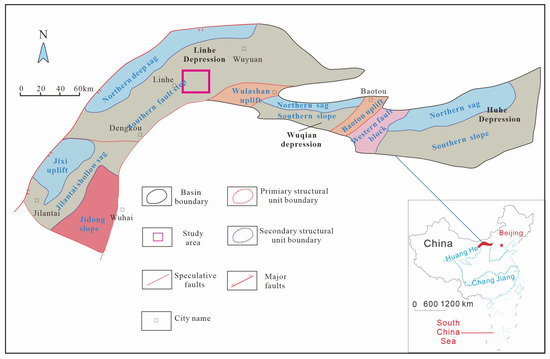
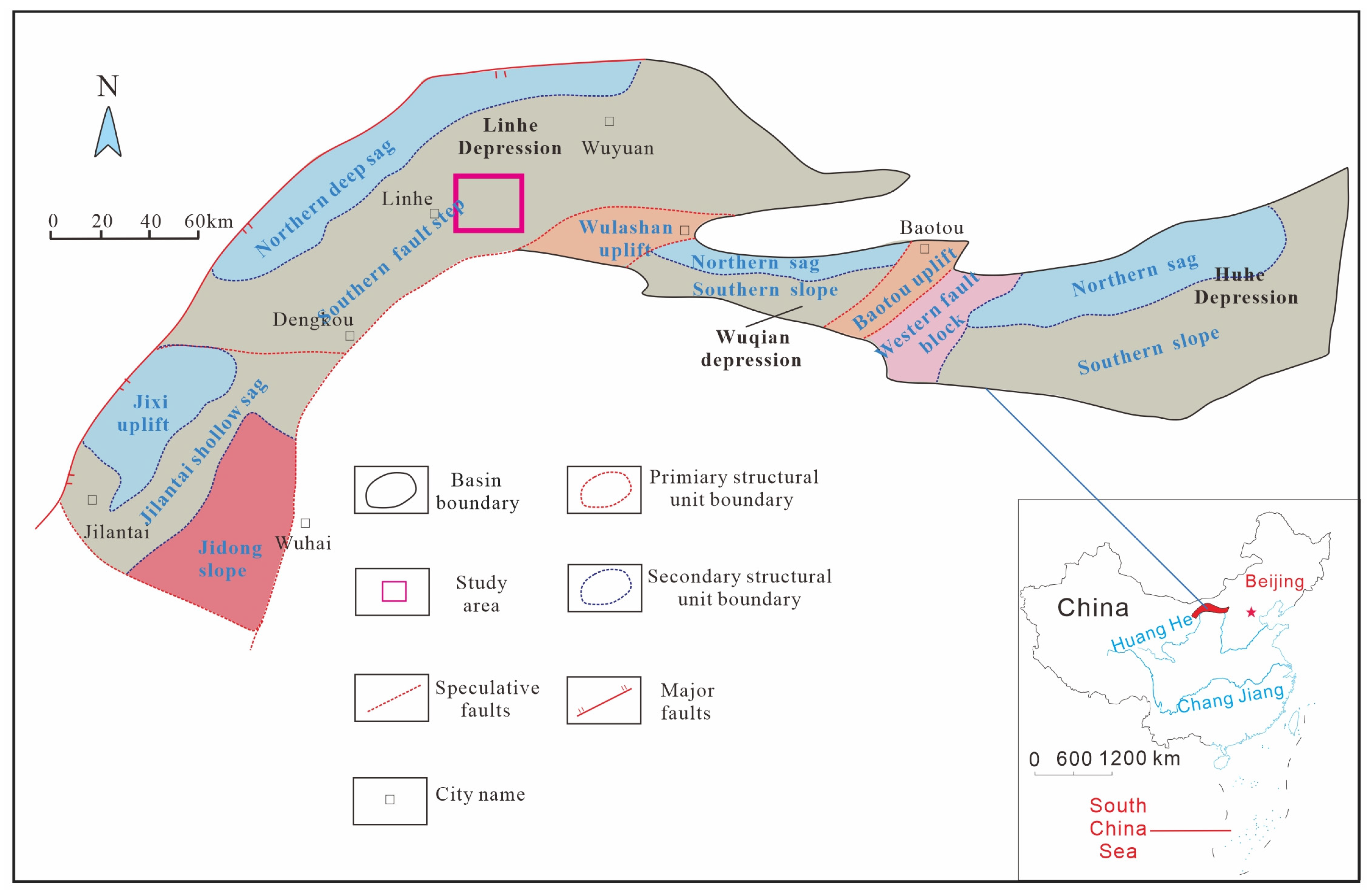
The Hetao Basin is situated between the Ordos and Alxa blocks and represents a Cenozoic faulted basin with an area of approximately 4.0 × 10⁴ km2. The basin exhibits an overall east–west elongation and a relatively narrow north–south extent. Geographically, it lies in central Inner Mongolia, structurally positioned between the Yimeng Uplift and the Yinshan Uplift [4,25,26]. From west to east, the basin can be subdivided into primary structural units, including the Linhe Sag, Wula Mountain Uplift, Wuqian Sag, Baotou Uplift, and Huhe Sag (Figure 1) [1,4,26,27]. Among these, the Linhe Sag has the largest area and the greatest subsidence, representing the main depocentre and the primary hydrocarbon-enriched zone of the basin, covering approximately 2.24 × 10⁴ km2. It can be further divided into secondary structural units, including the southern Jilantai Depression, the central Dengkou Low Uplift, and the northern Bayannur Depression [1,25,27].
Figure 1.
Structural subdivision of the Hetao Basin and location of the study area. The inset map of China is adapted from the standard map available on the Standard Map Service website of the National Administration of Surveying, Mapping and Geoinformation of China (http://bzdt.ch.mnr.gov.cn/ accessed on 13 March 2026, GS(2016)1549).
The structural–sedimentary fill of the Linhe Sag exhibits pronounced multi-phase superposition characteristics. It has undergone multiple stages of basin formation and sedimentary infill evolution, including Cretaceous compressional sagging, Paleogene differential extension, Neogene intense extensional faulting, and Quaternary strike-slip inversion. The superposition of structures at different stages has controlled the migration of subsidence centers, the style of fault activity, and the distribution of depositional systems, thereby influencing source–reservoir configuration, fluid migration, and the diagenetic evolution of reservoirs [3,4].
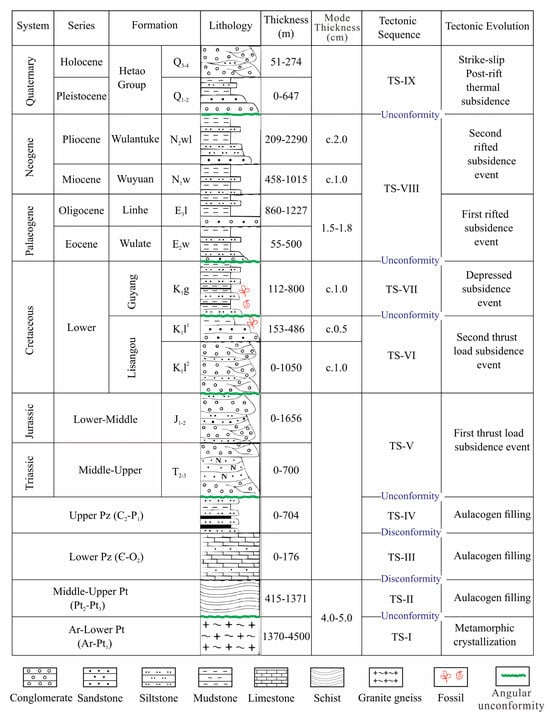
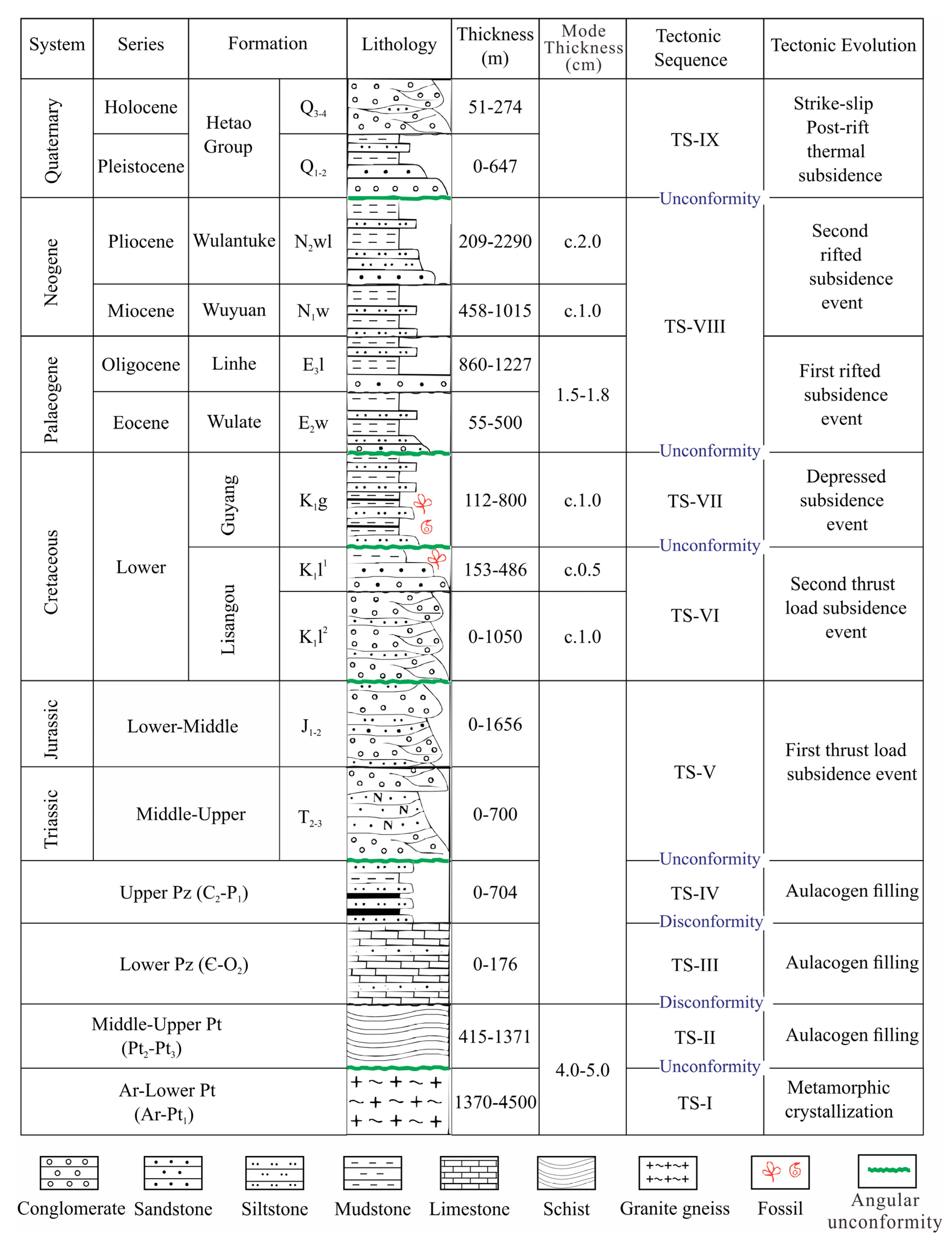
In terms of stratigraphic succession, the Linhe Sag is underlain by Archean–Paleoproterozoic metamorphic basement rocks. The overlying sedimentary cover, from bottom to top, primarily comprises the Lower Cretaceous Lisan’gou and Guyang formations, the Upper Cretaceous Biekeqi Formation (locally eroded), the Eocene Ulate Formation, the Oligocene Linhe Formation, the Miocene Wuyuan Formation, the Upper Miocene Wulantuoke Formation, and the Quaternary Hetao Group (Figure 2) [1,4]. Regional studies indicate that the Guyang and Linhe Formation contain lacustrine dark mudstones and distributary-delta-front sand bodies, serving as significant source rock and reservoir units within the sag. The overlying Wuyuan Formation, composed of thick red mudstones, forms a regional seal that favors hydrocarbon preservation and lateral migration along stratigraphic layers [4,25].
Figure 2.
Generalized stratigraphic column of the Linhe Depression in the Hetao Basin and its adjacent regions. Adapted from Reference [3].
Regarding depositional systems, during the sedimentation of the Linhe Formation, the basin broadly developed a large, shallow-water, braided-river delta–lacustrine system. Key microfacies for sandstone development include a delta-front subaqueous distributary channel and front sheet sand [28]. The Linhua Well area is located in the central part of the Linhe Sag, within the uplift–slope transitional zone (Figure 1), where tectonic activity has been relatively stable, and the Linhe Formation strata are well preserved. The target interval is dominated by sand-rich, shallow-water braided-river delta deposits, with sandstone bodies primarily forming thick subaqueous distributary channel and front sheet sand. Lithologies mainly consist of gray to light-gray medium-to-fine sandstones interbedded with gray-green mudstones of variable thickness, providing favorable “source–reservoir–seal” combinations. Therefore, investigating the diagenetic characteristics and diagenetic facies distribution patterns of the Linhe Formation in the Linhua Well area is of critical importance for elucidating reservoir formation mechanisms and guiding the selection of exploration targets.
3. Data Sources and Methods
This study focuses on ten wells in the Linhua Well area and integrates core descriptions, thin-section petrography, routine core petrophysical measurements, vitrinite reflectance (Ro), clay mineral X-ray diffraction (XRD), and well-log data for a comprehensive analysis.
Following the technical workflow, cores from the ten wells were first cut, numbered, and systematically photographed. Core thickness, grain size, sedimentary structures, and lithologic contacts were meticulously described using graphic core logging methods, with additional notes on color, hydrocarbon shows, and pore types recorded in the remarks section. These data provide a foundation for interpreting depositional environments and calibrating cores with well logs. From representative core plugs, 130 samples were selected to prepare resin-impregnated thin-sections. Under vacuum conditions, low-viscosity blue-colored epoxy resin was used for impregnation to highlight pore space, and alizarin red staining was applied to aid in the identification of carbonate minerals. The sections were then ground to approximately 30 μm thickness for microscopic observation. Mineral composition, cementation features, and pore structures were examined using a Zeiss Axioscope transmitted-light polarized microscope and a Cambridge Instruments MonoCL cathodoluminescence microscope. Quantitative point-counting statistics were performed, and grain-size parameters, including sorting, were calculated.
Routine petrophysical analyses on the same sample batch provided key parameters such as porosity and permeability. Ten representative samples were further analyzed using an FEI Quanta 250 FEG field-emission scanning electron microscope (SEM) to examine rock porosity and compositional features.
Additionally, fifteen representative samples were selected for vitrinite reflectance (Ro) measurements. Samples were prepared as polished pellets and calibrated using standard reference materials. The maximum reflectance of 50–100 vitrinite particles per sample was measured under a Leitz MPV-3 reflected light microscope to evaluate organic matter maturity.
For clay mineral XRD analysis, fifteen samples underwent acid and hydrogen peroxide treatment to remove carbonates and organic matter. Clay-sized fractions (<2 μm) were separated by sedimentation or centrifugation. Oriented mounts were prepared using vacuum filtration and membrane peeling, and diffraction measurements were conducted on air-dried, ethylene glycol-treated, and heat-treated samples at 400 °C and 550 °C using a Bruker D8 Advance X-ray diffractometer to identify kaolinite, illite, smectite, and mixed-layer clay mineral assemblages.
Finally, core laboratory results were compared and calibrated with well-log data. GR, AC, DEN, and CNL logs were selected for core-to-log calibration, and porosity and saturation interpretations were constrained and adjusted. This process established a comprehensive dataset for reservoir evaluation and provided a foundation for subsequent well-log-based diagenetic facies recognition.
4. Results
4.1. Petrographic Characteristics
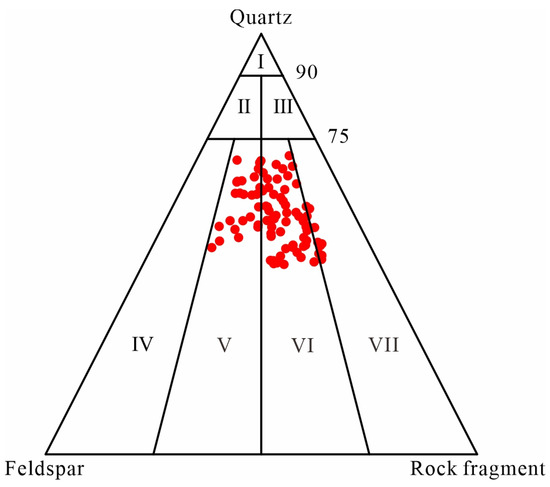
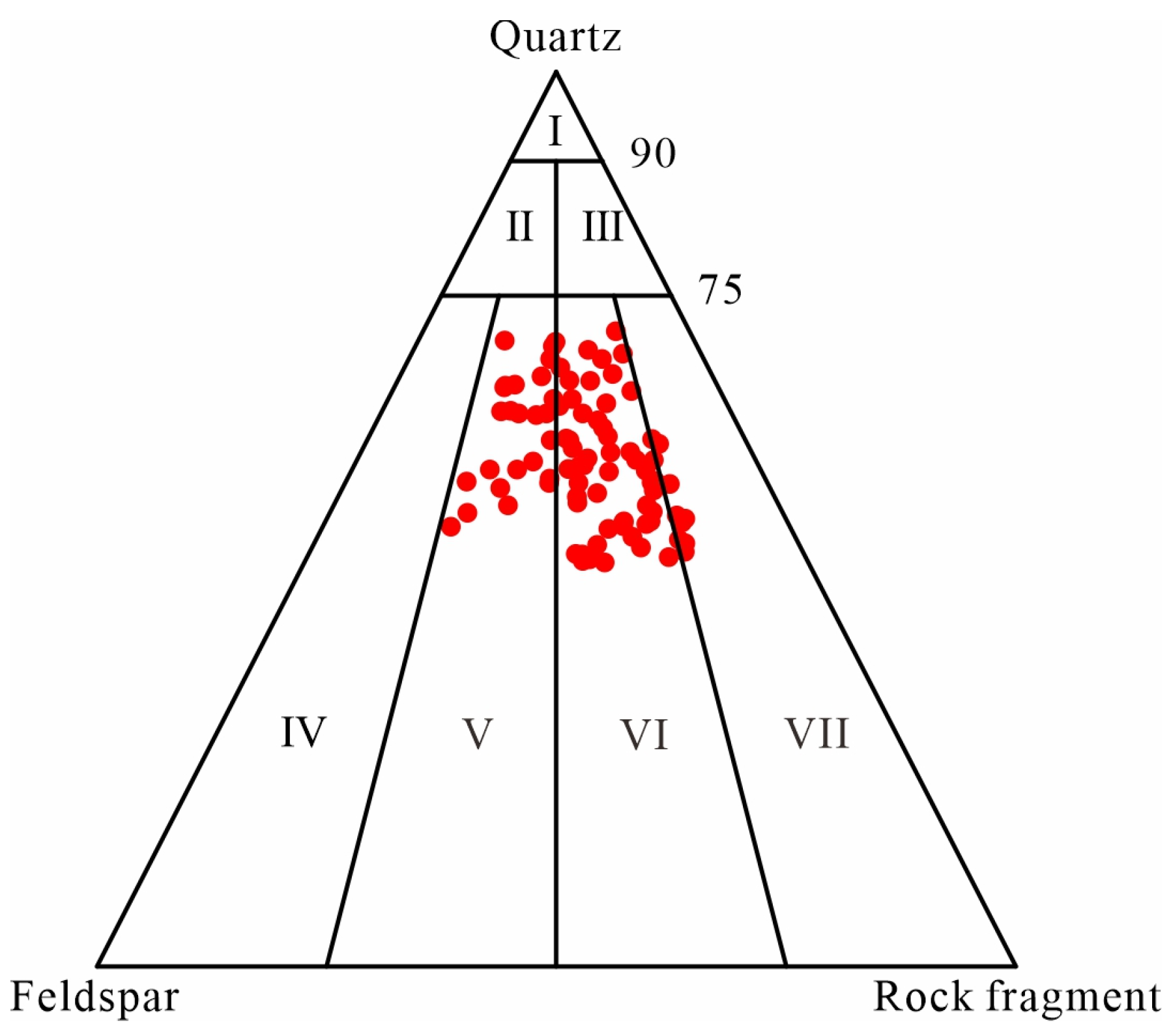
Petrographic characteristics serve as the fundamental basis for identifying and interpreting diagenetic processes [29,30,31,32]. Based on microscopic observations of 130 thin-sections from ten wells of the Linhe Formation in the Linhua Well area of the Hetao Basin, the sandstones in the study area are predominantly lithic arkoses and feldspathic litharenites (Figure 3). Grain sizes mainly range from coarse silt–very fine sand, very fine–fine sand, to medium–fine sand, with only minor occurrences of coarse siltstone. Overall, the sandstones are medium to fine-grained with relatively low matrix contents.
Figure 3.
Ternary diagram of sandstone detrital components for the Linhe Formation in the Linhua Well area, Hetao Basin. The red dots represent the analyzed sandstone samples, and the numbers 90 and 75 indicate quartz-content percentage boundaries used for sandstone classification. I: Quartz arenite. II: Subarkose. III: Lithic quartz arenite. IV: Arkose. V: Lithic arkose. VI: Feldspathic litharenite. VII: Litharenite. Diagram adapted from reference [33].
The detrital framework is dominated by quartz, with quartz content ranging from 41.5% to 83.5%. Feldspars (including K-feldspar and plagioclase) account for 10.5% to 29.0%, and lithic fragments range from 9.5% to 17.5%, indicating that the reservoir lithology is primarily lithic feldspathic sandstone with moderate compositional maturity.
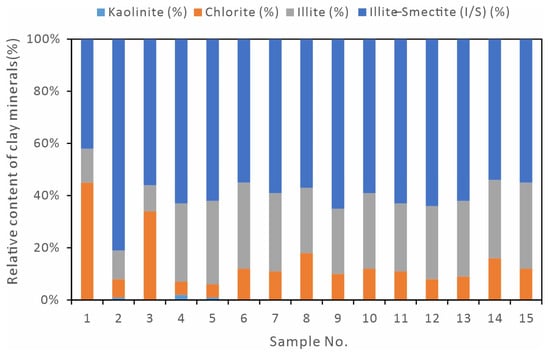
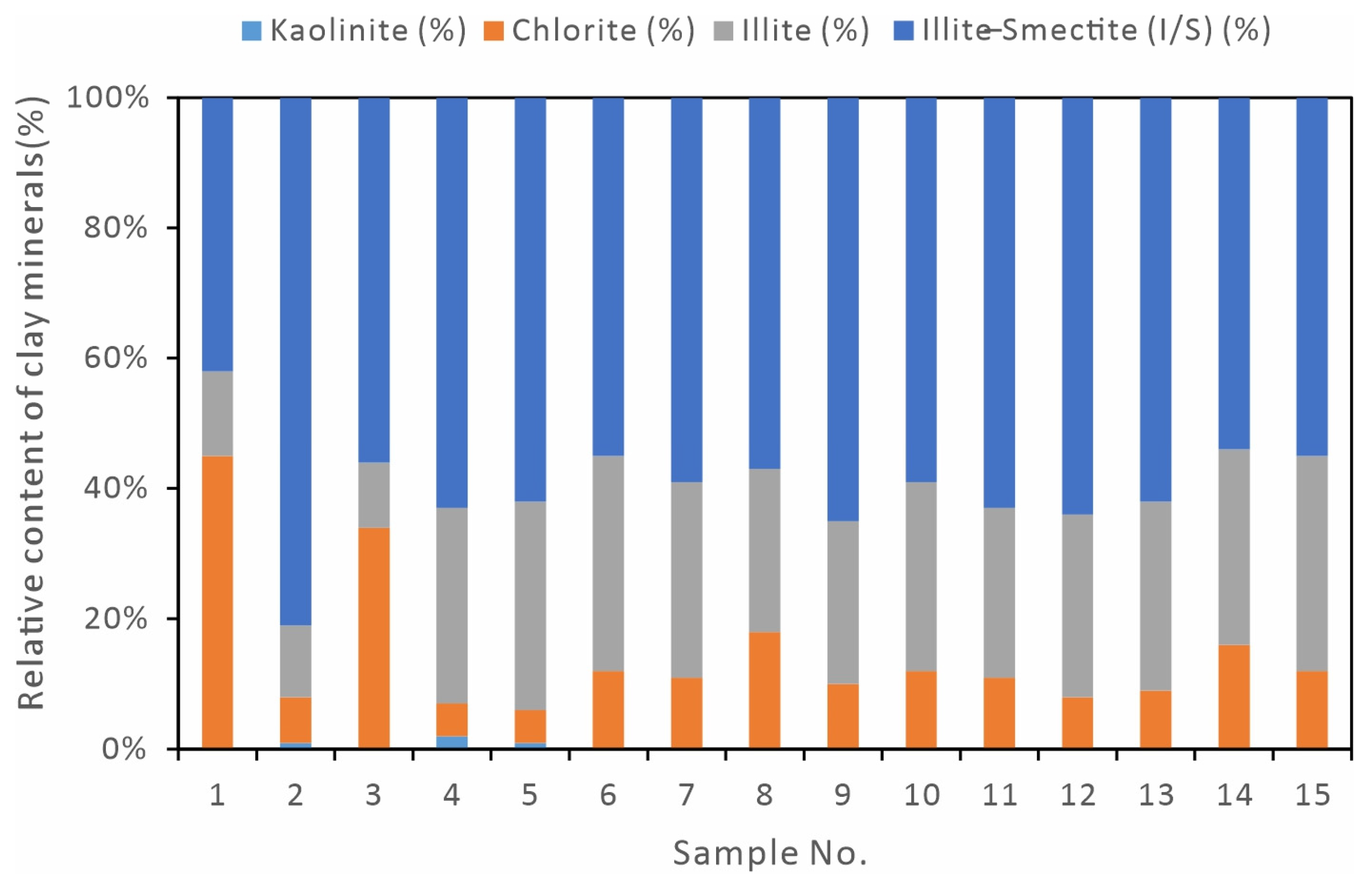
Grain roundness is mainly subangular, and sorting ranges from moderate to good, with a sorting coefficient of 1.2–2.0. Cementation is dominated by overgrowth–pore-filling cements, followed by pore-filling cements. Cementing materials primarily include siliceous cements (mainly secondary quartz overgrowth), carbonate minerals (calcite and ferroan calcite), and clay minerals (illite and chlorite) (Table 1, Figure 4), with minor occurrences of pyrite and feldspathic cements. Among these cements, siliceous cements average 1.81%, carbonate minerals are the dominant cement type with an average of 18.23%, and clay minerals average 5.54%.
Table 1.
Relative content of clay minerals in the Linhe Formation.
Figure 4.
Clay mineral composition of the Linhe Formation in the Linhua Well area.
The storage space is composed mainly of primary intergranular pores and secondary pores formed by dissolution, including dissolution pores in feldspar and lithic fragments. The average porosity observed in thin-sections is 9.98%, representing a moderate level overall, indicating that these sandstones possess the material foundation necessary for the further development of high-quality reservoirs.
4.2. Sedimentary Facies Characteristics
Based on the regional geological background and core observations from ten wells, the sedimentary facies of the Linhe Formation in the Linhua Well area were identified mainly according to lithology, grain size, sedimentary structures, individual bed thickness, vertical stacking patterns, lithologic contact relationships, and well-log characteristics.
The Linhe Formation in the study area is generally composed of gray to dark-gray fine- to medium-grained sandstones interbedded with gray-black mudstones. Sandstone intervals commonly have relatively sharp basal contacts, better sorting, and lower matrix contents, whereas mud-rich intervals are thinner and finer grained. These lithologic and textural variations reflect frequent alternations between relatively high-energy and low-energy depositional conditions. The Linhe Formation in the Linhua Well area is interpreted to represent delta-front subfacies deposits. The identified sedimentary microfacies mainly include an interdistributary bay, subaqueous distributary channel, and front sheet sand.
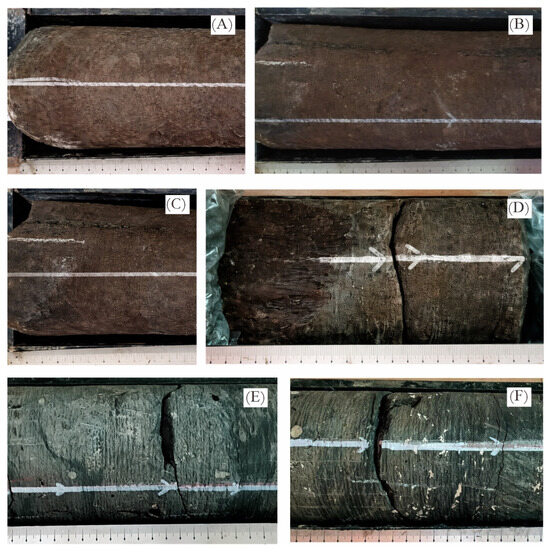
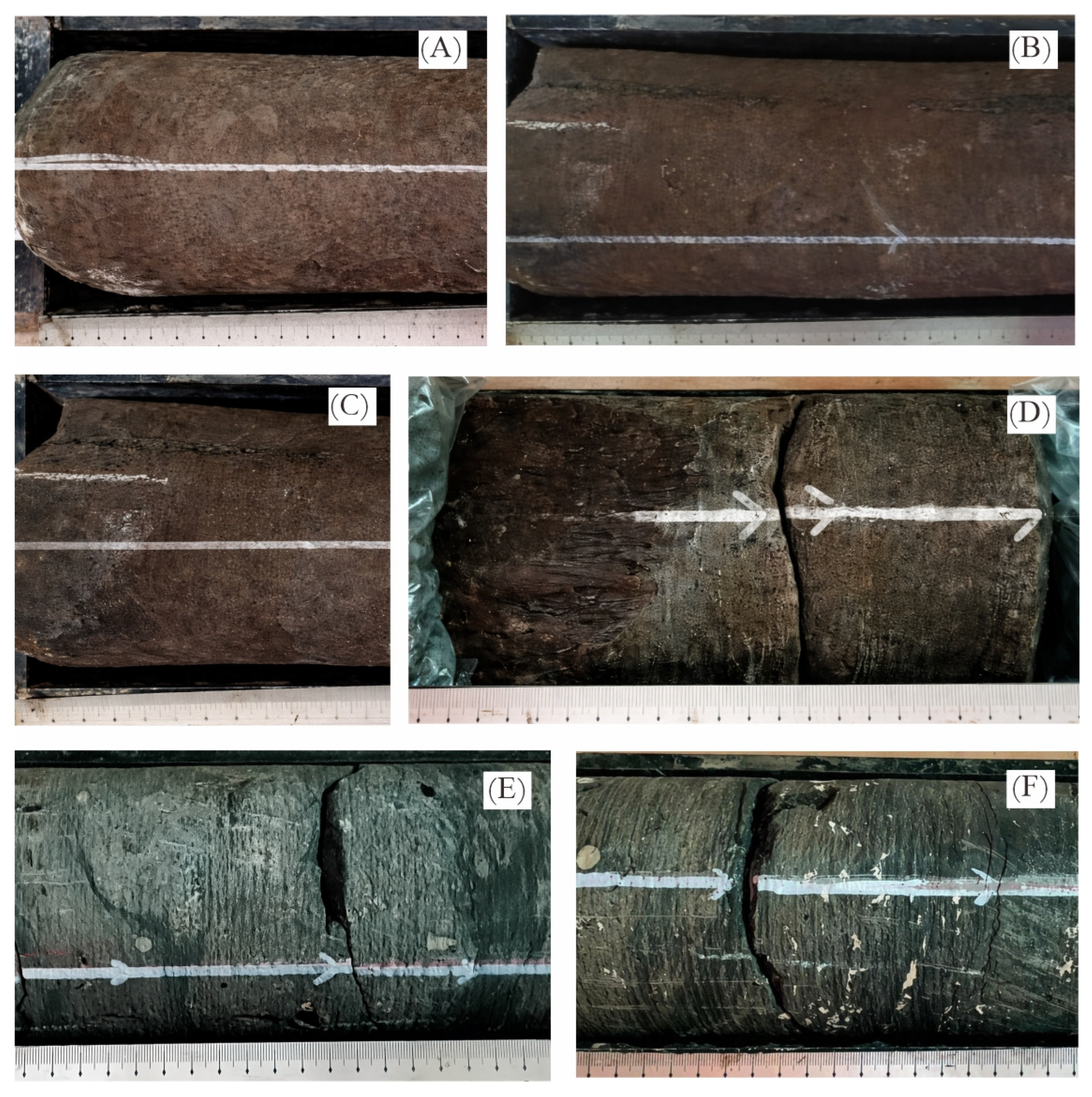
The subaqueous distributary channel microfacies is mainly composed of dark-gray thick- to medium-bedded medium- to fine-grained sandstone (Figure 5A–C), with the upper part commonly grading into fine sandstone and siltstone. Erosional surfaces are often developed at the base, and the spontaneous potential logs typically show bell-shaped or box-shaped patterns. The front sheet sand microfacies mainly consists of fine- to medium-grained sandstone and siltstone (Figure 5D), and commonly occurs as thin sand bodies in profile, usually bounded above and below by mudstone. Its spontaneous potential logs are mostly serrated box-shaped. In contrast, the interdistributary bay microfacies is mainly composed of gray-black argillaceous siltstone or mudstone deposits (Figure 5E,F), indicating relatively weak hydrodynamic conditions; the spontaneous potential logs are generally smooth and locally serrated.
Figure 5.
Representative core photographs showing sedimentary facies characteristics of the Linhe Formation in the Linhua Well area. (A). Well L8, 4277.85 m, gray-brown oil-bearing medium-grained sandstone with massive bedding, occurring as a thick bed, interpreted as a subaqueous distributary channel microfacies. (B). Well L8, 4308.60 m, gray-brown oil-bearing fine-grained sandstone with massive bedding, occurring as a thick bed, interpreted as a subaqueous distributary channel microfacies. (C). Well L8-1, 4203.50 m, gray-brown oil-bearing medium-grained sandstone with massive bedding, interpreted as a subaqueous distributary channel microfacies. (D). Well L1, 4355.90 m, dark-gray fine-grained sandstone, occurring as a thin bed and bounded above and below by mudstone, interpreted as a front sheet sand microfacies. (E). Well L1-1, 4204.76 m, gray-black mudstone with horizontal bedding, interpreted as an interdistributary bay microfacies. (F). Well L1-1, 4311.56 m, gray-black mudstone with horizontal bedding, interpreted as an interdistributary bay microfacies. Note: The ruler in the photo uses centimeters as the primary scale unit.
These core-based facies analysis results indicate that the Linhe Formation in the Linhua Well area as a whole belongs to a deltaic depositional system. Among the identified microfacies, subaqueous distributary channel and front sheet sand are the main sandstone-bearing depositional units in the study area, providing an important sedimentary foundation for subsequent reservoir development and diagenetic facies differentiation.
4.3. Diagenetic Characteristics
The reservoirs of the Linhe Formation in the Linhua Well area have undergone a complex diagenetic evolution, developing multiple types of diagenetic processes, primarily compaction, cementation, and dissolution. Based on the systematic analysis of 130 samples from the study area, the types and characteristics of each diagenetic process are summarized as follows.
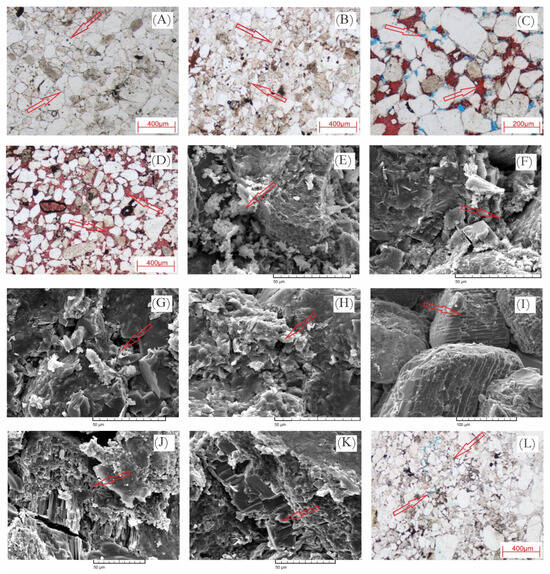
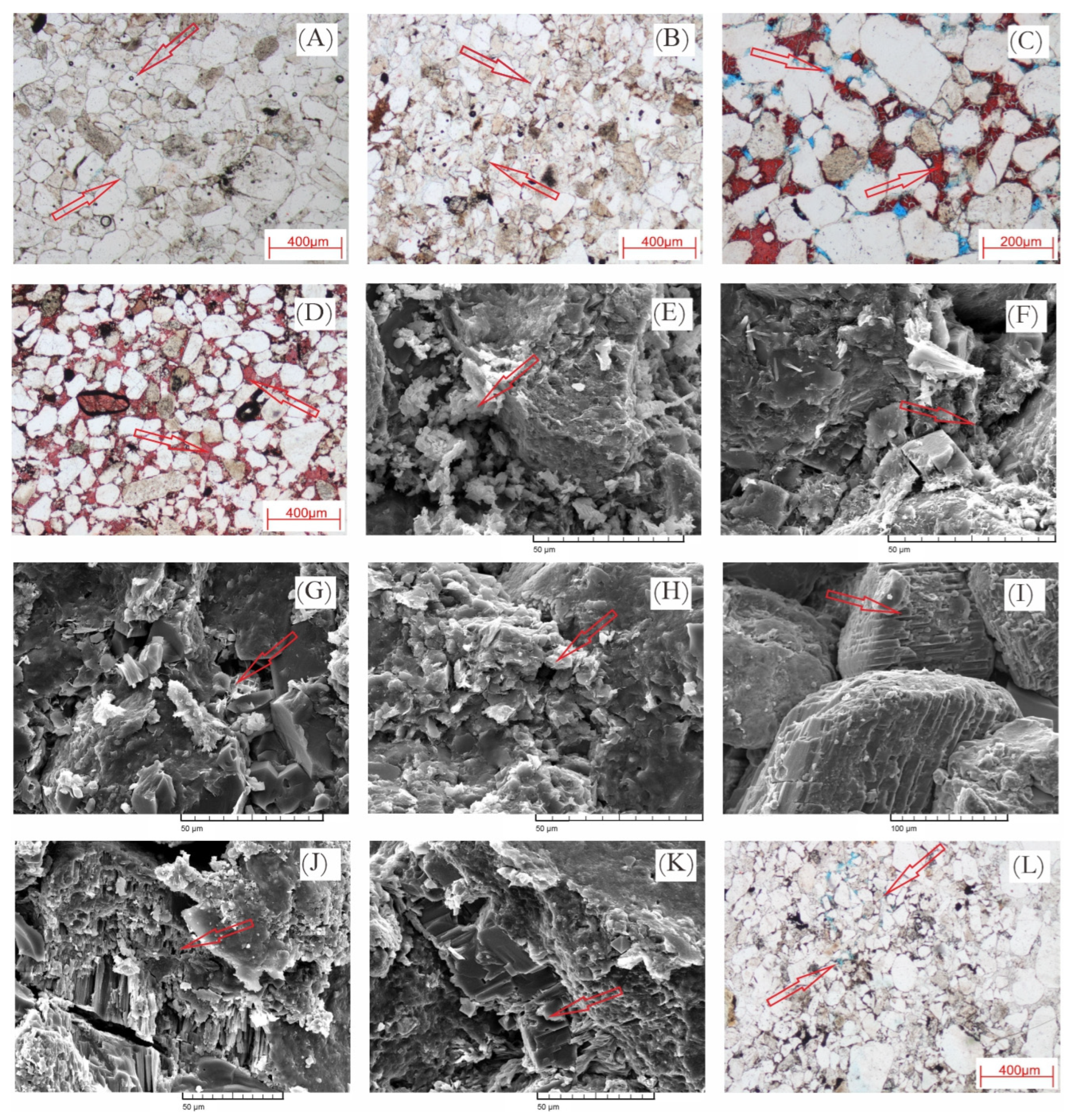
- Compaction. The Linhe Formation is deeply buried (2825.00–5091.58 m), and compaction represents the primary destructive factor responsible for pore space loss in the reservoirs. Microscopic features include the evolution of grain contacts from point contacts to line and concavo-convex contacts, extrusion deformation of plastic lithic fragments, and the occurrence of pseudo-matrix formation (Figure 6A,B).Figure 6. Microscopic features of diagenetic processes in the Linhe Formation, Linhua Well area, Hetao Basin. (A). Well L7, 3907.50 m, intense compaction, grains exhibiting mosaic contacts. (B). Well L8, 4218.77 m, intense compaction, partial grains oriented. (C). Well L7-3, 4807.20 m, intense compaction, ferroan calcite cementation with residual intergranular pores. (D). Well L4, 3896.70 m, intense ferroan calcite cementation, primary pores blocked. (E). Well L1, 4355.90 m, illite filling primary pores. (F). Well L7, 4207.30 m, flaky illite filling pores. (G). Well L5, 3915.85 m, illite blocking primary pores. (H). Well L2, 4372.25 m, illite–smectite (I/S) mixed-layer mineral filling. (I). Well L4, 3507.82 m, minor feldspar dissolution. (J). Well L5, 4409.65 m, intense feldspar dissolution. (K). Well L7, 3792.56 m, lithic fragment dissolution. (L). Well L5, 4918.86 m, lithic fragment dissolution and dissolution pores. During thin-section preparation, blue-colored epoxy resin was used to highlight pore space, and alizarin red staining was applied to aid in the identification of carbonate minerals.
To further quantitatively constrain the contribution of compaction to reservoir porosity evolution, compactional porosity loss (COPL) was calculated using point-counting data of cast thin-sections using the Houseknecht framework as revised by Ehrenberg [34]:
where OP is the original porosity and IGV is the intergranular volume. Considering that the studied samples are conventional clastic rocks and that the original porosity of individual samples was not restored on the basis of sorting parameters, a uniform value of OP = 40% was adopted in this study. This value is consistent with the conventional assumption widely used in classical quantitative studies of porosity loss in sandstones.
The results show that COPL ranges from 14.3% to 31.6%, with an average of 25.2%, indicating that compaction accounted for a substantial proportion of the original porosity loss. In conjunction with petrographic features commonly observed in thin-sections, including point-to-line contacts, concavo-convex contacts, the deformation of ductile grains, and the marked reduction in primary intergranular pores, these results suggest that mechanical compaction was an important controlling factor responsible for porosity reduction and reservoir-quality deterioration during burial diagenesis in the study area. Overall, the relatively high COPL values are in good agreement with the petrographic observations, indicating that compaction generally played a dominant role in pore destruction.
- 2.
- Cementation. In the study area, cement types are dominated by carbonate, siliceous, and clay mineral cements. Carbonate cements, primarily calcite and ferroan calcite, generally occur as patchy fillings (Figure 6C,D). Siliceous cements are mainly expressed as secondary quartz overgrowths, commonly observed in sandstones with higher quartz contents. Clay mineral cements are dominated by illite, chlorite, and illite–smectite (I/S) mixed-layer mineral fillings (Figure 6E–H). Kaolinite is likely related to feldspar dissolution under relatively acidic pore-fluid conditions. Chlorite mainly occurs as authigenic pore-lining and pore-filling cement formed during early to middle diagenesis. Illite is interpreted as a burial diagenetic product associated with progressive clay mineral transformation. The presence of I/S mixed-layer minerals suggests an intermediate stage in the transformation from smectite to illite during burial diagenesis. Overall, cementation in the Linhua Well area is relatively weak, with cement content ranging from 7.0% to 35.5%, averaging 26.92%. This characteristic may be related to the hypersaline lacustrine pore-fluid environment: under certain conditions, high-salinity fluids can inhibit the precipitation of some cement minerals, thereby reducing cement filling intensity.
Based on thin-section point-counting data, cementational porosity loss (CEPL) was quantitatively calculated according to the equation proposed by Ehrenberg [34]:
where CEM is the intergranular cement content.
The results indicate that CEPL ranges from 5.3% to 18.7%, with an average of 12.7%. This suggests that cementation occluded the residual intergranular pore space to varying degrees, thereby reducing pore preservation and connectivity and exerting an adverse effect on reservoir properties. Although cementation is locally intense in some samples, its overall contribution is weaker than that of compaction, indicating that cementation nevertheless remains an important factor in porosity reduction and may exert a more pronounced destructive effect than compaction in certain local samples.
To further evaluate the relative contributions of compaction and cementation to pore destruction, the compaction index, ICOMPACT, was introduced and calculated as follows:
This parameter represents the proportion of total porosity loss attributable to compaction and ranges from 0 to 1. Values approaching 1 indicate that porosity loss was dominated by compaction, whereas values approaching 0 indicate that cementation was the dominant control. In general, ICOMPACT > 0.5 suggests a greater contribution from compaction, whereas ICOMPACT < 0.5 indicates a greater contribution from cementation.
The results show that ICOMPACT values in the study area range from 0.47 to 0.80, with an average of 0.66. Overall, most samples have ICOMPACT values greater than 0.5, indicating that compaction contributed more to porosity loss than cementation. Only a few samples exhibit relatively low ICOMPACT values, reflecting locally enhanced cementation and a correspondingly stronger adverse effect on the preservation of residual pores.
- 3.
- Dissolution. Dissolution is widespread in the Linhua Well area, primarily manifested as the dissolution of feldspar and lithic fragments, forming secondary dissolution pores. Specifically, local feldspar and lithic fragment dissolution generate dissolution pores (Figure 6I–L), while intense feldspar dissolution can form moldic pores; lithic fragment dissolution produces lithic dissolution pores. Studies indicate that the spatial distribution of dissolution in the Linhua Well area is highly heterogeneous: some intervals exhibit intense dissolution with abundant secondary porosity, significantly improving reservoir properties, whereas other intervals display relatively weak dissolution, contributing limited secondary porosity.
4.4. Diagenetic Stage and Paragenetic Sequence
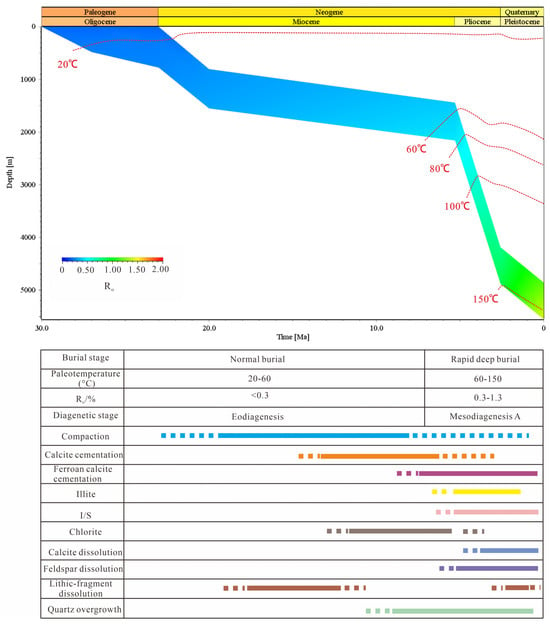
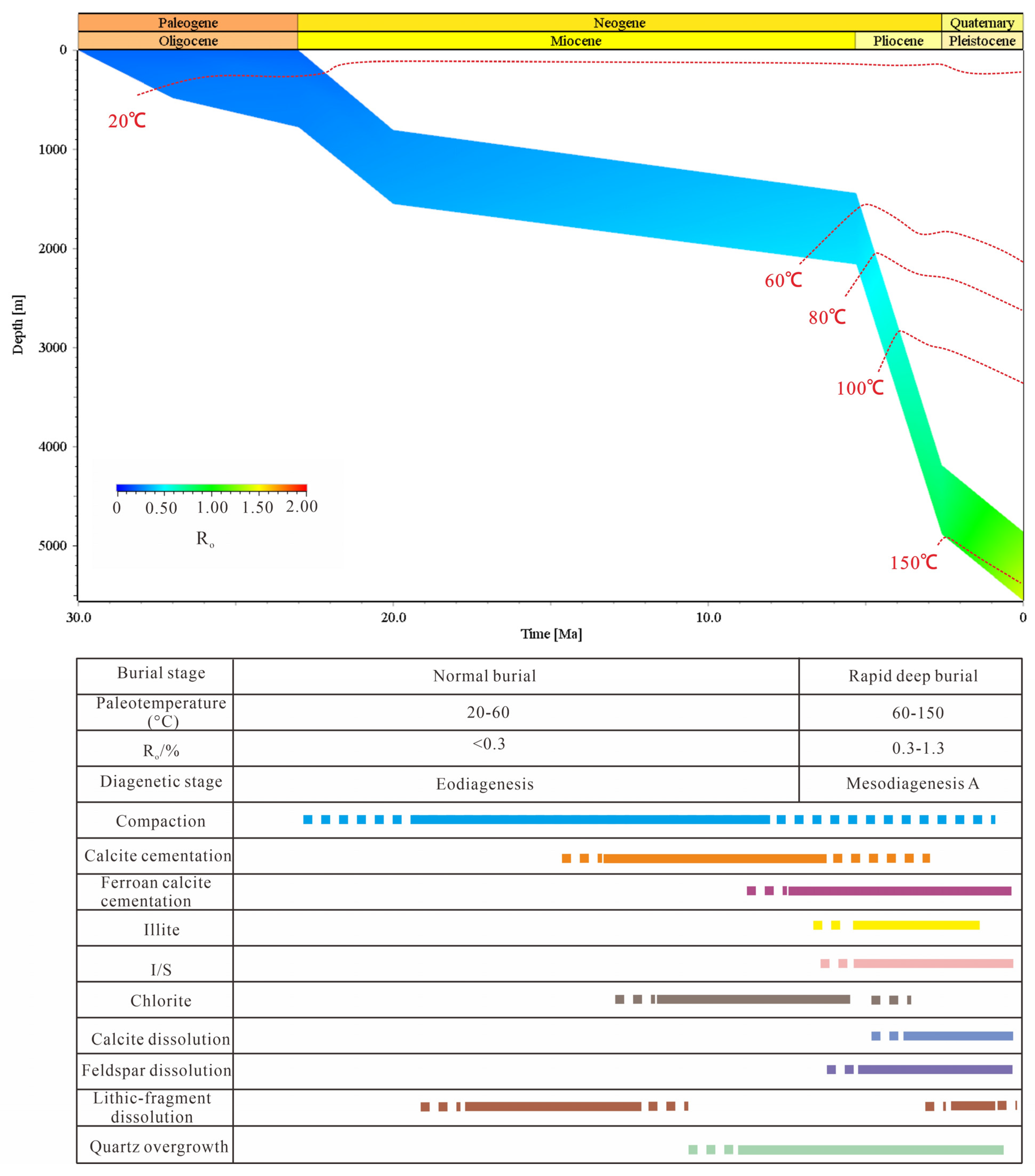
The integrated analysis of the burial and thermal evolution history, thin-section petrography, scanning electron microscopy (SEM), clay mineral X-ray diffraction (XRD), and vitrinite reflectance (Ro) data indicates that the Linhe Formation reservoirs in the Linhua Well area have undergone continuous diagenetic evolution from late eodiagenesis to mesodiagenesis and are presently overall at mesodiagenetic stage A. This interpretation is supported by several lines of evidence. Firstly, the reservoirs are deeply buried, at depths of 2825.00–5091.58 m. Secondly, compaction, cementation, and dissolution are all widespread, among which compaction and cementation are the principal destructive processes, whereas dissolution is the main constructive process. Thirdly, the dominant authigenic minerals include quartz overgrowths, calcite, ferroan calcite, chlorite, illite, and illite–smectite (I/S) mixed-layer minerals. In addition, feldspar and lithic fragments are commonly dissolved, generating abundant secondary pores. Collectively, these features indicate that the reservoirs in the study area have entered a mesodiagenetic stage dominated by burial diagenetic modification. The diagenetic stage division and paragenetic relationships of the main diagenetic events in the Linhe Formation reservoirs of the Linhua Well area are shown in Figure 7.
Figure 7.
Diagenetic stage and paragenetic sequence of the Linhe Formation reservoirs in the Linhua Well area, Hetao Basin.
Vitrinite reflectance data provide an important constraint on the diagenetic stage. The 15 mudstone samples from the Linhe Formation yield mean Ro values ranging from 0.90% to 1.29%, with an average of approximately 0.98%, indicating that the associated source rocks have reached the mature stage and that the reservoirs experienced relatively elevated temperatures during the main phase of burial diagenesis. Clay mineral assemblages further support this interpretation. XRD analyses show that the clay minerals in the Linhe Formation are dominated by illite, chlorite, and I/S mixed-layer minerals, with I/S interlayer ratios mainly ranging from 20% to 40%, and with minor amounts of kaolinite occurring locally. The coexistence of abundant I/S mixed-layer minerals and illite indicates that the smectite-to-illite transformation has proceeded substantially, while still retaining transitional characteristics. Kaolinite is likely related to feldspar dissolution under relatively acidic pore-fluid conditions. Overall, this clay mineral assemblage is consistent with the characteristics of mesodiagenetic stage A.
In terms of diagenetic evolution, the Linhe Formation reservoirs first experienced sustained mechanical compaction during late eodiagenesis. With increasing burial depth, grains were progressively rearranged, and grain contacts evolved from point contacts to line contacts and concavo-convex contacts. Ductile lithic fragments were compacted and deformed, giving rise to pseudomatrix and causing a continuous reduction in primary intergranular porosity. During the same stage, pore-lining chlorite and minor early calcite cement developed locally in some intervals. Early chlorite coatings could, to some extent, inhibit later quartz overgrowth, whereas early calcite precipitation occupied part of the pore space. With further burial, weak quartz overgrowths began to develop, indicating a transition from shallow-burial diagenetic conditions to deeper burial diagenetic conditions.
After entering mesodiagenetic stage A, compaction became the dominant control on pore loss. Quantitative calculations show that COPL ranges from 14.3% to 31.6%, with an average of 25.2%; CEPL ranges from 5.3% to 18.7%, with an average of 12.7%; and ICOMPACT ranges from 0.47 to 0.80, averaging 0.66. These values indicate that, overall, compaction contributed more to porosity loss than cementation. Consistent with these results, thin-sections commonly show point–line, line, and concavo-convex grain contacts, together with marked deformation of ductile grains, demonstrating that mechanical compaction was the primary control on reservoir densification. Meanwhile, cementation continued throughout burial. Calcite and ferroan calcite typically occur as patchy or pore-filling cements, whereas illite blocks pore throats in pore-filling or bridging forms. Therefore, the principal destructive diagenetic assemblage at this stage can be summarized as “compaction–carbonate cementation–illite filling.”
By contrast, the principal constructive diagenetic process is the dissolution of feldspar and lithic fragments. Secondary pore types, including feldspar dissolution pores, lithic dissolution pores, and moldic pores, are well developed in the study area, indicating that dissolution played a key role in improving reservoir properties. This process is closely related to the influx of organic acids and CO2 released during organic matter maturation, and its main phase should therefore be coupled with burial heating and enhanced thermal evolution rather than being restricted to shallow early diagenesis. It should also be noted that dissolution is markedly heterogeneous both laterally and vertically. In some intervals, intense dissolution generated abundant secondary porosity and significantly improved reservoir quality, whereas in others, weaker dissolution had only a limited effect. At the same time, part of the secondary pore space was later occluded by ferroan calcite and illite, indicating temporal and spatial overlap between constructive and destructive diagenetic processes.
Accordingly, the paragenetic sequence of the Linhe Formation reservoirs in the Linhua Well area can be summarized as follows: early mechanical compaction → development of pore-lining chlorite and local early calcite cementation → weak quartz overgrowth during progressive burial → dissolution of feldspar and lithic fragments induced by organic-acid/CO2-bearing fluids during organic matter maturation → precipitation of illite and ferroan calcite within part of the residual pore system during continued burial (Figure 7). In essence, the evolution of reservoir quality in the study area reflects a dynamic balance between early pore preservation, middle-stage dissolution-enhanced porosity, and late-stage local recementation and pore occlusion. Therefore, although the reservoirs are currently overall at mesodiagenetic stage A, substantial differences in reservoir quality still exist among different intervals and diagenetic facies.
4.5. Diagenetic Facies Classification and Well-Log Recognition Model
4.5.1. Diagenetic Facies Classification Criteria
Diagenetic facies refer to rock assemblages that have undergone compaction, cementation, dissolution, and other diagenetic processes within a specific diagenetic environment and evolutionary context, exhibiting similar diagenetic characteristics and reservoir responses. They are used to comprehensively characterize the overall impact of diagenesis on reservoir properties [7,8,35,36].
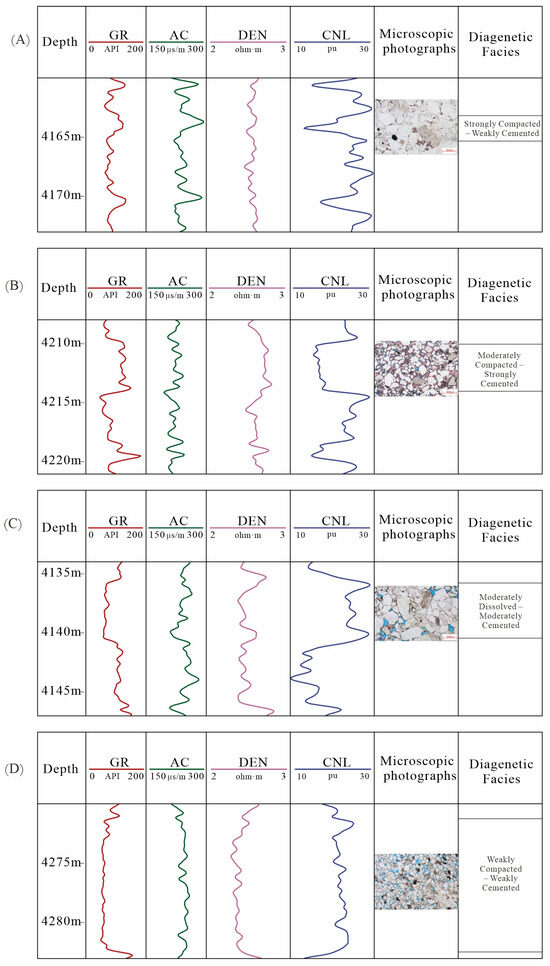
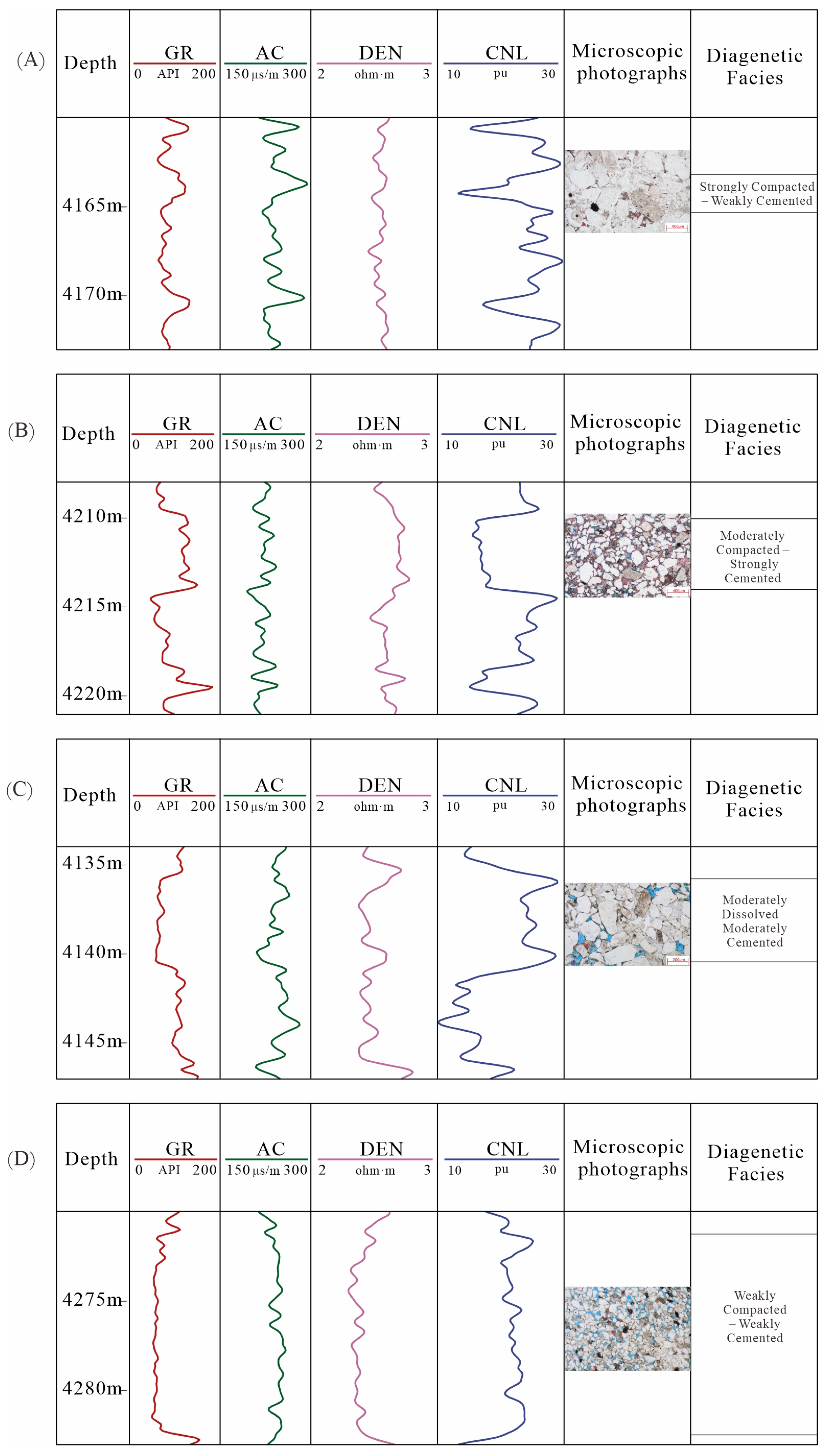
In this study, diagenetic facies were classified under the coupled constraints of “diagenetic process intensity (compaction–cementation–dissolution) + reservoir petrophysical parameters (porosity φ, permeability K).” The procedure involved the following: first, identifying the clustering structure of samples in the “compaction–cementation–dissolution contribution” feature space using cluster analysis; then, constraining and merging the clustering results based on geological interpretation of petrography and diagenetic processes, thereby establishing a four-facies system suitable for well-log-based prediction (Figure 8). The classification criteria for each diagenetic facies are summarized in Table 2.
Figure 8.
Types of diagenetic facies in the Linhe Formation, Linhua Well area, Hetao Basin. (A). Strongly Compacted–Weakly Cemented, Well L1-2. (B). Moderately Compacted–Strongly Cemented, Well L7-1. (C). Moderately Dissolved–Moderately Cemented, Well L7. (D). Weakly Compacted–Weakly Cemented, Well L8.
Table 2.
Classification criteria of diagenetic facies for the Linhe Formation, Linhua Well area, Hetao Basin.
- Strongly Compacted–Weakly Cemented Facies. This facies primarily develops in fine sandstones and siltstones with relatively low rigid grain contents (quartz + feldspar + lithic fragments < 80%) and poor sorting. This diagenetic facies mainly occurs in sediments deposited in an interdistributary bay and on the flanks of a subaqueous distributary channel. Diagenetically, it is characterized by strong compaction, with grain contacts that are predominantly line contacts and mosaic contacts, resulting in tightly rearranged framework grains. Cementation is weak, with cement content below 10%, mainly manifesting as minor chlorite rims and slight quartz overgrowths. Pore types are dominated by secondary dissolution pores and intergranular pores, with porosity generally below 8% and permeability less than 1 × 10⁻³ μm2. Well-log responses typically show relatively high natural gamma-ray values (GR: medium to high), high acoustic travel times (AC: medium-high, corresponding to a lower sonic velocity), high bulk density (DEN: high), and moderately low compensated neutron porosity (CNL: medium). These features result from a high clay content and strong compaction, which increase density and reduce porosity, leading to elevated gamma-ray and acoustic travel time readings.
- Moderately Compacted–Strongly Cemented Facies. This facies mainly occurs in medium–fine sandstones with a moderate framework composition (quartz + feldspar + lithic fragments = 75%–85%). This diagenetic facies is mainly associated with front sheet sand deposits. Grain contacts are predominantly line contacts, and the degree of compaction is moderate. Cementation is well developed, with cement content ranging from 12% to 25%, primarily composed of carbonate, siliceous, and clay mineral cements. Dissolution is relatively common, with secondary pores such as intragranular feldspar dissolution pores present. Petrophysically, porosity is generally below 12%, and permeability ranges from 1 to 10 × 10−3 μm2. Well-log responses typically display medium natural gamma-ray values, relatively low acoustic travel times (AC low, corresponding to faster sonic velocity), medium-high density, and moderately low compensated neutron porosity. Strong cementation increases rock rigidity, accelerating sonic velocity and raising density, while cement filling reduces porosity, resulting in relatively lower neutron porosity readings.
- Moderately Dissolved–Moderately Cemented Facies. This facies primarily develops in fine–medium sandstones with a moderate rigid grain content (quartz + feldspar + lithic fragments = 75%–85%) and relatively good sorting. This diagenetic facies is mainly developed in a subaqueous distributary channel and front sheet sand deposit setting. Diagenetically, this facies is characterized by moderate compaction, and grain contacts are predominantly line contacts. Cementation is relatively weak, with cement content ranging from 5% to 15%, mostly as minor chlorite coatings and scattered carbonate cements. Dissolution is relatively strong, with easily soluble components such as feldspar and lithic fragments commonly exhibiting intragranular dissolution and forming moldic pores, thereby generating abundant secondary porosity. Pore types are dominated by secondary dissolution pores, with porosity generally between 10% and 18%, and permeability mostly in the range of 5–50 × 10−3 μm2, resulting in relatively good reservoir quality. Well-log responses typically show relatively low natural gamma-ray values (medium-low), moderate acoustic travel times, lower bulk density, and moderately low compensated neutron porosity. Dissolution increases porosity, reduces density, and maintains acoustic travel time at a moderate level; good intergranular connectivity can occasionally elevate neutron porosity, but cementation reduces it to a medium level.
- Weakly Compacted–Weakly Cemented Facies. This facies mainly occurs in medium- to coarse-grained sandstones with a favorable rigid grain framework (quartz + feldspar + lithic fragments > 80%), which is conducive to the preservation of primary intergranular pores, and is mainly associated with the main channel deposits of subaqueous distributary channels. Diagenetically, it is characterized by weak compaction, with grain contacts being predominantly point–line contacts. Cement content is generally below 6%, composed mainly of carbonate, siliceous, and clay mineral cements. Dissolution pores are well developed, including intragranular feldspar dissolution pores and other secondary porosity. Porosity is generally above 15%, and permeability exceeds 30 × 10−3 μm2. Well-log responses exhibit the lowest natural gamma-ray values (indicating extremely low clay content), the highest acoustic travel times (AC high, slowest sonic velocity), the lowest bulk density, and relatively high compensated neutron porosity. This facies exhibits a typical high-quality sandstone reservoir signal—low GR, high AC, low DEN, and high CNL—reflecting high porosity.
4.5.2. Characteristics of Each Diagenetic Facies and Well-Log Responses
To achieve quantitative well-log-based recognition of diagenetic facies, four well-log parameters—GR, AC, DEN, and CNL—were selected. Using well-log data corresponding to 130 core samples, a diagenetic facies recognition model was established through Fisher’s linear discriminant analysis [37,38,39]. The procedure is as follows: the diagenetic facies types interpreted from thin-sections are used as grouping variables; the mean vector and within-class covariance matrix are calculated for each category. Under the assumption of “equal within-class covariance among all categories,” a pooled within-class covariance matrix is constructed, and discriminant coefficients are derived to maximize the ratio of between-class scatter to within-class scatter. This yields classification discriminant functions for the four diagenetic facies (Y1–Y4). The discriminant functions are linear combinations of the well-log variables plus a constant term:
Yk = a1k·GR + a2k·AC + a3k·DEN + a4k·CNL + a0k (k = 1–4)
The specific discriminant functions are as follows:
Y1 (Strongly Compacted–Weakly Cemented) = −0.104·GR + 0.504·AC + 1.649·CNL + 457.716·DEN − 631.989
Y2 (Moderately Compacted–Strongly Cemented) = 0.000·GR + 0.565·AC + 1.948·CNL + 462.533·DEN − 672.223
Y3 (Moderately Dissolved–Moderately Cemented) = −0.038·GR + 0.612·AC + 2.074·CNL + 453.510·DEN − 659.339
Y4 (Weakly Compacted–Weakly Cemented) = −0.129·GR + 0.673·AC + 1.931·CNL + 431.696·DEN − 612.689
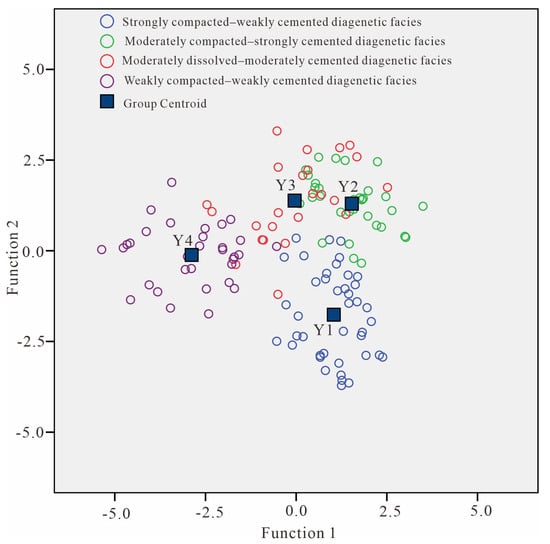
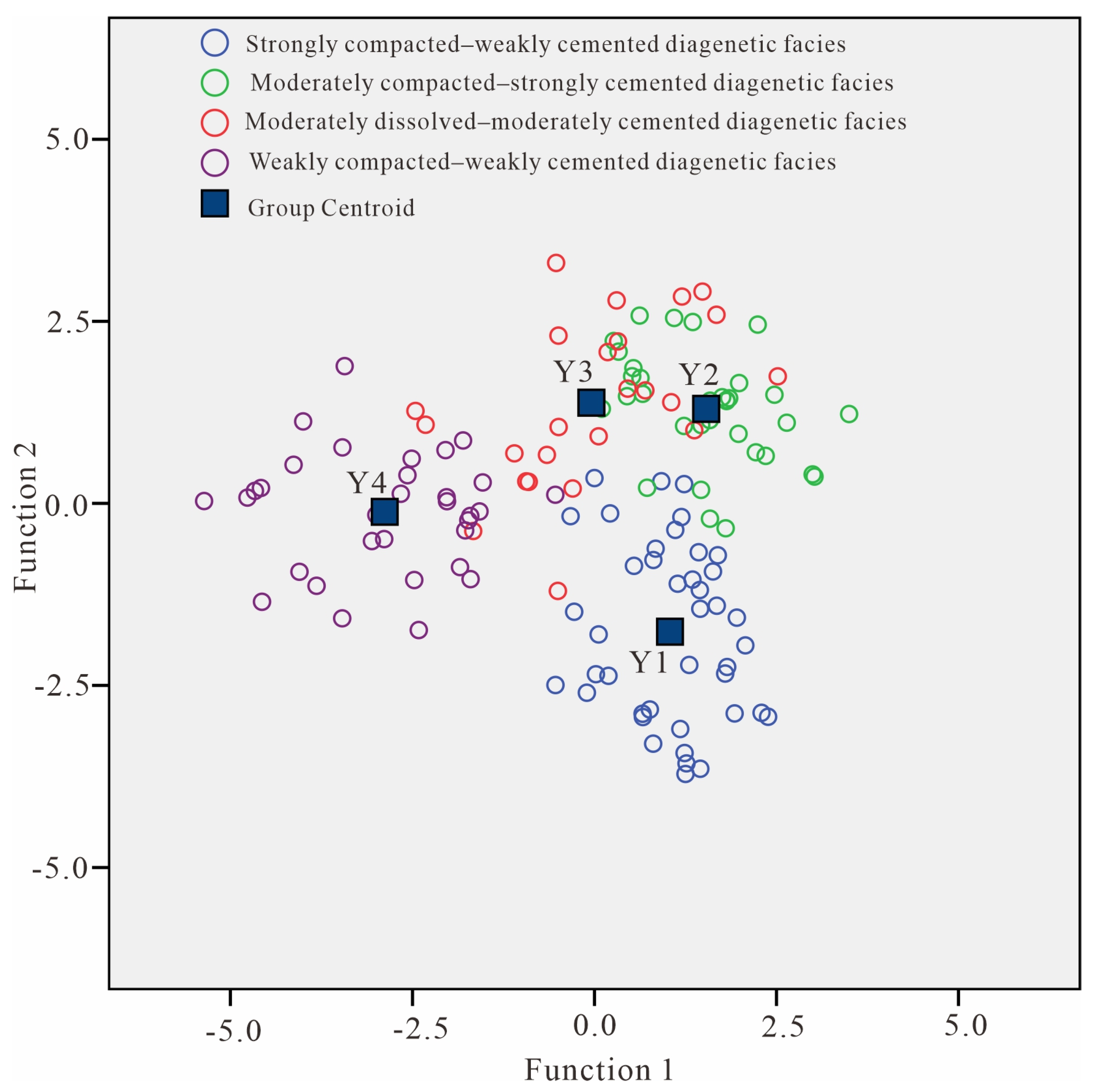
For the discriminant model, the re-substitution (original) overall accuracy was 83.1%, while the LOOCV overall accuracy reached 80.0% (104 of 130 samples correctly classified). Class-specific recognition rates were 87.8% for Y1, 75.8% for Y2, 50.0% for Y3, and 96.9% for Y4. The confusion matrix (Table 3) indicates that the majority of misclassifications occurred between Y2 and Y3, suggesting partial overlap of these two facies in the well-log response space.
Table 3.
Classification results (original and leave-one-out cross-validated).
The scatter plot of the canonical discriminant functions (Figure 9) also demonstrates that samples from each diagenetic facies generally cluster within distinct regions in the function space, with centroids of the groups separated by measurable distances. This indicates that the discriminant model effectively captures between-class differences. Some points of the diagenetic facies exhibit overlapping regions, corresponding to the misclassifications between adjacent categories observed in the confusion matrix. This suggests a degree of continuous transition in well-log responses among these facies, consistent with the previously described diagenetic characteristics: Y2 corresponds to moderately compacted, strongly cemented medium–fine sandstones, whereas Y3 corresponds to medium–fine sandstones exhibiting more pronounced dissolution.
Figure 9.
Canonical discriminant functions plot (Function 1 vs. Function 2). Y1, Y2, Y3, and Y4 represent the four diagenetic facies in the discriminant model.
The results of Wilks’ Lambda test (Table 4) indicate that the canonical discriminant functions are significant overall (Functions 1–3: Λ = 0.085, χ2 = 307.440, df = 12, p < 0.001). After controlling for Function 1, Function 2 still provides significant additional discriminatory information (Functions 2–3: Λ = 0.348, χ2 = 131.821, df = 6, p < 0.001), whereas Function 3 is not significant (Λ = 0.982, χ2 = 2.302, df = 2, p = 0.316). Therefore, it can be inferred that the model primarily relies on the first two canonical discriminant functions to achieve classification, effectively explaining the between-class differences among samples.
Table 4.
Wilks’ Lambda test of canonical discriminant functions.
Overall, the model demonstrates a good classification performance and can be used to guide the prediction of diagenetic facies distribution in untested well intervals. For any depth point in an unknown interval, the four discriminant functions can be directly applied to calculate discriminant scores, and the category corresponding to the maximum Y value is assigned as the diagenetic facies type at that point, enabling the continuous prediction of diagenetic facies.
5. Discussion
5.1. Spatial Distribution Patterns of Diagenetic Facies and Their Geological Significance
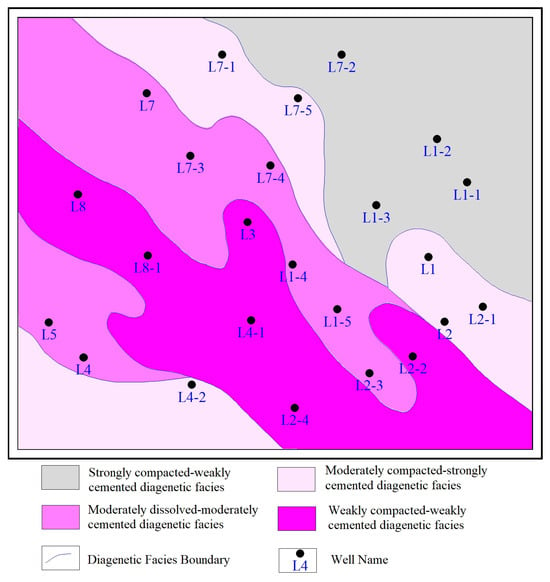
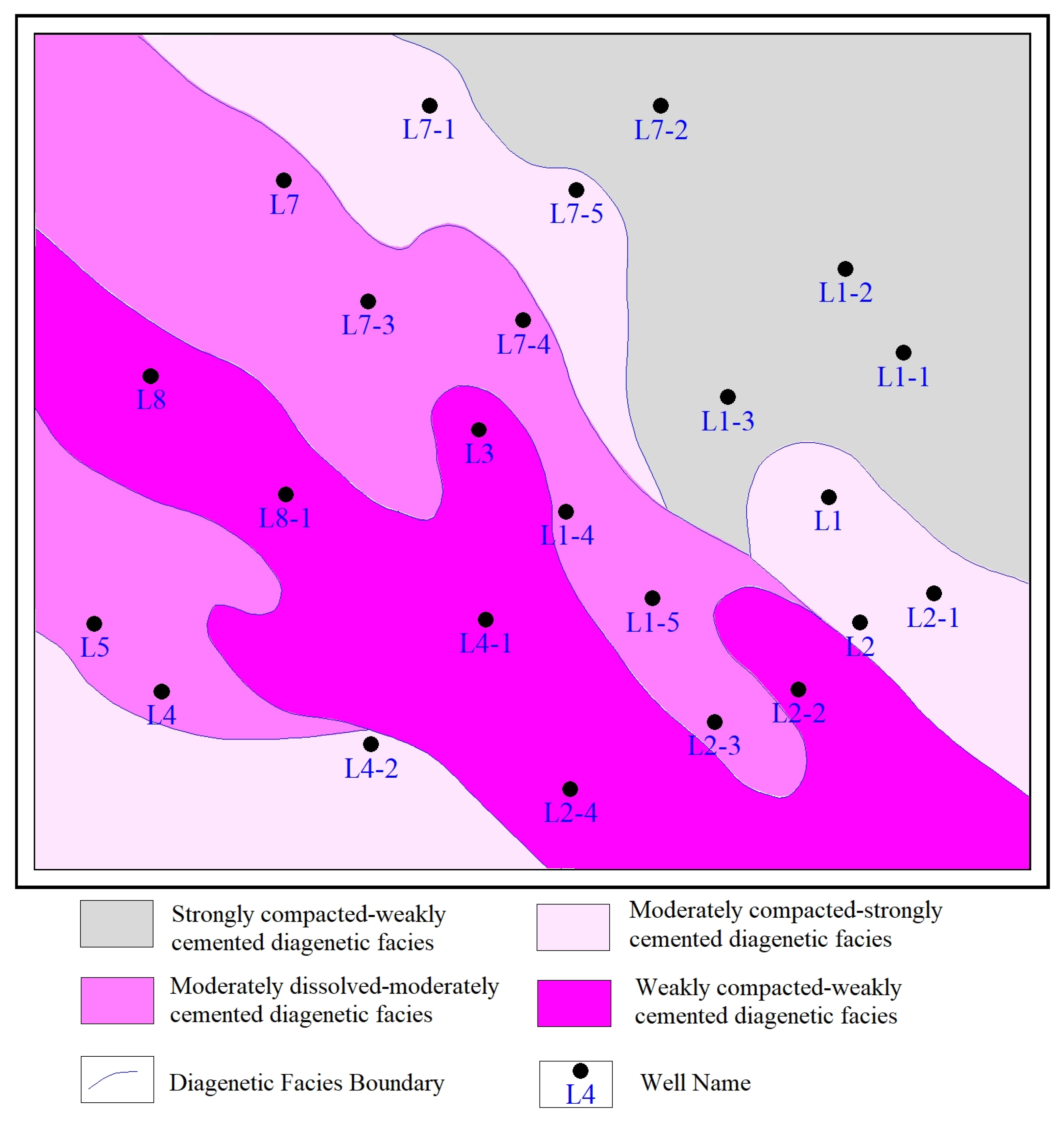
The spatial distribution of diagenetic facies in the Linhua Well area is not random, but exhibits a distinct zonal pattern that provides important clues to the formation and preservation of high-quality reservoirs (Figure 10). As shown in Figure 10, the weakly compacted–weakly cemented facies is mainly distributed in the central and southern parts of the study area and forms northeast–southwest-trending belts. These belts closely coincide with the main subaqueous distributary channel zones recognized from sedimentary facies analysis. In these areas, sandstone bodies are relatively thick, coarser grained, and better sorted, and therefore possess a more rigid grain framework and stronger resistance to porosity loss during burial. Accordingly, this facies represents the most favorable diagenetic facies for reservoir preservation and constitutes the principal development zone of high-quality reservoirs in the Linhe Formation.
Figure 10.
Lateral distribution of diagenetic facies in the Linhe Formation, Linhua Well area, Hetao Basin.
The moderately dissolved–moderately cemented facies commonly occurs along the margins of the above-mentioned favorable belt or appears locally as patchy zones in the northern and eastern parts of the study area (Figure 10). Spatially, this facies commonly occupies the transitional zones between the main channel sand bodies and relatively distal sandy deposits, such as front sheet sand. These zones did not preserve reservoir quality as effectively as the weakly compacted–weakly cemented facies, but they were still modified by dissolution to varying degrees, resulting in moderate reservoir properties. Therefore, this facies can be regarded as a secondary favorable reservoir type distributed around the main high-quality reservoir belt.
In contrast, the strongly compacted–weakly cemented facies and the moderately compacted–strongly cemented facies are mainly distributed in the northern deep-depression zone and in some locally elevated structural positions (Figure 10). In the northern deep-depression zone, a greater burial depth intensified mechanical compaction, resulting in the extensive destruction of primary intergranular pores. In contrast, in certain local structural highs or relatively closed diagenetic environments, carbonate cementation is more strongly developed and occludes a significant part of the residual pore system. As a result, these two facies correspond to relatively tight reservoir zones with poor storage properties. This spatial relationship indicates that the quality of Linhe Formation reservoirs in the study area is characterized by a clear differentiation from the central–southern favorable belts toward the northern tighter zones.
From the perspective of reservoir prediction, Figure 10 is therefore not only a map of facies occurrence, but also a direct expression of the spatial architecture of favorable and unfavorable reservoirs. The central–southern belt dominated by the weakly compacted–weakly cemented facies and surrounded by the moderately dissolved–moderately cemented facies should be regarded as the most promising target zone for future exploration and evaluation.
5.2. Coupled Controls of Depositional Microfacies and Diagenesis on the Spatial Distribution of Diagenetic Facies
The spatial distribution pattern shown in Figure 10 demonstrates that depositional microfacies provided the primary framework for later diagenetic differentiation. Previous studies have emphasized that the heterogeneity of sandstone reservoirs is commonly the result of coupling between depositional facies and later diagenetic modification, rather than the effect of a single process [6,7]. In the Linhua Well area, this coupling relationship is particularly clear. The subaqueous distributary channel microfacies, identified in the study area as thick- to medium-bedded medium- to fine-grained sand bodies, provided a relatively coarse grain size, better sorting, a lower matrix content, and better connectivity of pore-fluid pathways. These depositional attributes favored both the preservation of residual primary intergranular pores and the later migration of diagenetic fluids. Consequently, areas occupied by channel sand bodies are preferentially associated with the weakly compacted–weakly cemented facies and parts of the moderately dissolved–moderately cemented facies.
By contrast, front sheet sand and especially the more distal or mud-rich intervals adjacent to interdistributary bay deposits generally have finer grain sizes, thinner beds, and poorer framework support. These intervals were more susceptible to compaction during burial and, in some cases, more prone to pore-filling cementation. As a result, the strongly compacted–weakly cemented facies and moderately compacted–strongly cemented facies tend to occur outside the main channel belt or in structurally deeper zones. Therefore, the first-order control on the spatial distribution of diagenetic facies is the original sedimentary framework, whereas burial depth and local diagenetic environment govern the subsequent differentiation among facies.
The quantitative diagenetic parameters obtained in this study further support this interpretation. The average COPL value (25.2%) is markedly higher than the average CEPL value (12.7%), and the average ICOMPACT value reaches 0.66, indicating that compaction was the dominant destructive process in the study area. These results agree well with petrographic observations and also explain why the northern deep-depression zone in Figure 10 is mainly occupied by compacted facies. By contrast, although cementation also reduced pore space, its impact is more localized, which is consistent with the patchy distribution of the moderately compacted–strongly cemented facies in Figure 10. Thus, the map pattern is essentially a spatial manifestation of differential compaction and localized cementation superimposed onto the sedimentary framework.
5.3. Role of Dissolution in Optimizing Reservoir Quality Within the Spatial Facies Framework
Compared with compaction and cementation, dissolution played a more constructive role in improving reservoir quality in the Linhua Well area. Dissolution is mainly expressed as feldspar and lithic fragment dissolution, forming secondary pores such as intragranular dissolution pores and moldic pores. This process is particularly important in the moderately dissolved–moderately cemented facies, which occupies the marginal parts of the main favorable belt in Figure 10. These areas appear to represent transitional zones where original reservoir quality was not as favorable as in the main channel belt, but where later acidic fluid dissolution substantially enhanced pore development.
This interpretation is consistent with previous studies suggesting that dissolution related to organic acids and CO2 generated during source-rock maturation can significantly improve reservoir properties in deeply buried sandstone reservoirs [9,10,40]. In the Linhua Well area, the Ro values of 0.90%–1.29% and the clay mineral assemblage dominated by illite, chlorite, and illite–smectite (I/S) mixed-layer minerals indicate that the reservoirs are overall at mesodiagenetic stage A, when organic-acid-bearing fluids and burial-related fluid–rock interaction were likely active. Therefore, the moderately dissolved–moderately cemented facies in Figure 10 can be interpreted as the spatial product of burial dissolution superimposed onto a moderately favorable depositional framework.
At the same time, dissolution did not act uniformly across the study area. The spatially patchy distribution of the moderately dissolved–moderately cemented facies indicates that fluid migration pathways and local mineral composition exerted strong controls on the intensity of dissolution. In some zones, dissolution effectively reconstructed the pore system and improved reservoir quality, whereas in others, its effect was limited or partly offset by later ferroan calcite and illite precipitation. Therefore, the moderate-quality reservoir belt around the main favorable zone reflects the incomplete but still significant optimization of reservoirs by dissolution.
5.4. Implications of the Spatial Distribution of Diagenetic Facies for High-Quality Reservoir Prediction
An important contribution of this study is that it links microscopic diagenetic observations with macroscopic reservoir prediction through the spatial distribution of diagenetic facies. Previous studies have shown that diagenetic facies analysis provides an effective bridge between core/thin-section observations and interwell reservoir prediction, especially when combined with well-log-based quantitative identification methods [23,24]. In the present study, the Fisher discriminant model based on GR, AC, DEN, and CNL achieved an overall cross-validated accuracy of 80.0%, indicating that the predicted spatial pattern shown in Figure 10 has practical geological significance.
More importantly, Figure 10 shows that favorable reservoirs are concentrated not simply where sandstone is developed, but where favorable sedimentary microfacies coincide with weak compaction, limited cementation, and locally effective dissolution. Thus, the most prospective intervals in the Linhua Well area are those distributed in the central–southern subaqueous distributary channel belts, especially where weakly compacted–weakly cemented facies dominate and are accompanied by adjacent moderately dissolved–moderately cemented facies. By contrast, the northern deep-depression zone and locally strongly cemented areas should be regarded as relatively unfavorable targets.
Therefore, the distribution of high-quality reservoirs in the Linhe Formation of the Linhua Well area is best understood as the result of a multi-factor coupling mechanism: depositional microfacies establish the material foundation and spatial framework, compaction and cementation determine the degree of porosity destruction, and dissolution locally reconstructs the pore system and expands favorable reservoir space. In this sense, Figure 10 provides a spatially integrated expression of the coupled control pattern of “sedimentary framework + differential diagenesis,” and it should be regarded as one of the key bases for sweet spot prediction in the study area.
5.5. Limitations and Further Improvement of the Spatial Interpretation Method
Although the spatial distribution of diagenetic facies shown in Figure 10 provides an important basis for reservoir prediction, several uncertainties remain. Firstly, the present map is based on dominant facies interpretation from the discriminant model and is therefore influenced by well spacing and sample distribution. Secondly, the moderately compacted–strongly cemented facies and the moderately dissolved–moderately cemented facies partly overlap in the well-log response space, as indicated by the confusion matrix, which means that some transitional zones in Figure 10 may reflect gradual facies change rather than sharply bounded facies belts. Thirdly, the spatial distribution of dissolution is inferred mainly from petrographic evidence and facies prediction; additional fluid inclusion, isotope, or geochemical data would help better constrain fluid pathways and the timing of dissolution.
Nevertheless, these uncertainties do not affect the main interpretation that the central–southern part of the study area represents the most favorable reservoir development zone, whereas the northern deep-depression zone is overall less favorable. Future work should further integrate sedimentary microfacies maps, structural evolution, and geochemical fluid-tracing results to improve the spatial prediction of high-quality reservoirs.
6. Conclusions
The Linhe Formation reservoirs in the Linhua Well area are predominantly lithic arkoses and feldspathic litharenites with moderate compositional and textural maturity. Sedimentary microfacies mainly include a subaqueous distributary channel, front sheet sand, and interdistributary bay, among which the first two constitute the principal sandstone-bearing depositional units and provide the sedimentary foundation for subsequent reservoir differentiation.
The reservoirs have undergone continuous diagenetic evolution from late eodiagenesis to mesodiagenesis and are presently overall at mesodiagenetic stage A. Compaction and cementation are the principal destructive processes, whereas dissolution is the main constructive process. Quantitative results show that COPL ranges from 14.3% to 31.6% (average 25.2%), CEPL from 5.3% to 18.7% (average 12.7%), and ICOMPACT from 0.47 to 0.80 (average 0.66), indicating that compaction contributed more to porosity loss than cementation. The main paragenetic sequence is as follows: early mechanical compaction → development of chlorite rims and local early calcite cementation → weak quartz overgrowth → dissolution of feldspar and lithic fragments → late precipitation of illite and ferroan calcite.
Four diagenetic facies were identified in the study area: strongly compacted–weakly cemented, moderately compacted–strongly cemented, moderately dissolved–moderately cemented, and weakly compacted–weakly cemented. Fisher’s linear discriminant model based on GR, AC, DEN, and CNL logs enables the quantitative recognition of diagenetic facies, with an overall cross-validated accuracy of 80.0%.
Spatially, the weakly compacted–weakly cemented facies is mainly distributed in northeast-trending central–southern subaqueous distributary channel belts and constitutes the principal high-quality reservoir zone, whereas the moderately dissolved–moderately cemented facies occurs around the main favorable belt as a secondary favorable reservoir type. In contrast, the northern deep-depression zone is mainly occupied by strongly compacted–weakly cemented and moderately compacted–strongly cemented facies and is overall unfavorable for reservoir development. The distribution of high-quality reservoirs is therefore controlled by the coupled effects of depositional microfacies, differential compaction–cementation, and local dissolution.
Author Contributions
X.W.; Conceptualization and Writing—original draft; X.Y. (Xuesong Yang); Data curation and Software and Writing—original draft; Z.J.; Data curation and Writing—editing; H.W.; Data curation and Writing—original draft; X.Y. (Xiaochen Yang); Investigation and Visualization; W.Z.; Investigation and Software; C.H.; Data curation; Q.L.; Investigation and Software; Y.P.; Data curation; C.W.; Investigation; Z.P.; Visualization; Y.Z.; Methodology and Writing—review and editing. All authors have read and agreed to the published version of the manuscript.
Funding
This study was jointly supported by the National Natural Science Foundation of China (41972129) and the National Major Project (2017ZX05008-004-004-001).
Data Availability Statement
The data presented in this study are available in the article.
Conflicts of Interest
Authors Xiuwei Wang, Xuesong Yang, Zhou Jiang, Huilai Wang, Xiaochen Yang, Weihang Zhang, Chenguang Hu, Qiongyu Li, Yongli Pan, Chao Wang and Zhiqin Peng are employees of PetroChina Huabei Oilfield Company. The paper reflects the views of the scientists and not the company.
References
- Fu, S.; Fu, J.; Yu, J.; Yao, J.; Zhang, C.; Ma, Z.; Yang, Y.; Zhang, Y. Petroleum geological features and exploration prospect of Linhe Depression in Hetao Basin, China. Pet. Explor. Dev. 2018, 45, 803–817. [Google Scholar] [CrossRef] [Scilit]
- Zhou, Z.; Ding, W.; Zhang, R.; Yan, D.; Jiao, B.; Wu, C.; Liu, T.; Du, X.; Xue, M. Structural styles and tectonic evolution of Cretaceous to Cenozoic faults in the Linhe Depression of Hetao Basin, China: Implications for petroleum traps. Int. J. Earth Sci. 2021, 110, 2805–2829. [Google Scholar] [CrossRef] [Scilit]
- Yu, F.; Zhang, R.; Yu, J.; Wang, Y.; Chen, S.; Liu, J.; Wu, C.; Wang, Y.; Wang, S.; Wang, Y.; et al. Meso-Cenozoic negative inversion model for the Linhe Depression of Hetao Basin, China. Geol. Mag. 2022, 159, 535–560. [Google Scholar] [CrossRef] [Scilit]
- Zhang, R.; He, H.; Zhu, Q.; Chen, S.; Liu, X.; Dan, W.; Hu, Y.; Shi, Y.; Zhang, Y.; Yu, H.; et al. Petroleum geological features and hydrocarbon enrichment of Linhe Depression in Hetao Basin, NW China. Pet. Explor. Dev. 2023, 50, 798–811. [Google Scholar] [CrossRef] [Scilit]
- Wu, X.; Shi, Y.; Chen, S.; Wu, H.; Cai, J.; Dan, W.; Liu, X.; Wang, X.; Zhang, X.; Zhang, J. Exploration breakthrough and factors for enrichment and high-yield of hydrocarbons in ultra-deep clastic rocks in Linhe Depression, Hetao Basin, NW China. Pet. Explor. Dev. 2024, 51, 1109–1121. [Google Scholar] [CrossRef] [Scilit]
- Morad, S.; Al-Ramadan, K.; Ketzer, J.M.; De Ros, L.F. The impact of diagenesis on the heterogeneity of sandstone reservoirs: A review of the role of depositional facies and sequence stratigraphy. AAPG Bull. 2010, 94, 1267–1309. [Google Scholar] [CrossRef] [Scilit]
- Bjørlykke, K. Relationships between depositional environments, burial history and rock properties. Some principal aspects of diagenetic process in sedimentary basins. Sediment. Geol. 2014, 301, 1–14. [Google Scholar] [CrossRef] [Scilit]
- Wang, M.; Yang, Z.; Shui, C.; Yu, Z.; Wang, Z.; Cheng, Y. Diagenesis and its influence on reservoir quality and oil-water relative permeability: A case study in the Yanchang Formation Chang 8 tight sandstone oil reservoir, Ordos Basin, China. Open Geosci. 2019, 11, 37–47. [Google Scholar] [CrossRef] [Scilit]
- Li, W.; Hu, D.; Chang, Y.; Li, Y.; Guo, B.; Shi, Q.; Zhang, B. Diagenetic controls over reservoir quality of tight sandstone in the lower Jurassic reservoir in the Lenghu area, the north margin of Qaidam Basin. Front. Earth Sci. 2024, 12, 1298802. [Google Scholar] [CrossRef] [Scilit]
- Ronald, C.S.; Crossey, L.J.; Hagen, E.S.; Heasler, H.P. Organic-Inorganic Interactions and Sandstone Diagenesis. AAPG Bull. 1989, 73, 1–23. [Google Scholar] [CrossRef] [Scilit]
- Zou, C.-n.; Tao, S.-z.; Zhou, H.; Zhang, X.-x.; He, D.-b.; Zhou, C.-m.; Wang, L.; Wang, X.-s.; Li, F.-h.; Zhu, R.-k.; et al. Genesis, classification, and evaluation method of diagenetic facies. Pet. Explor. Dev. 2008, 35, 526–540. [Google Scholar] [CrossRef] [Scilit]
- Giles, M.R.; Stevenson, S.; Martin, S.V.; Cannon, S.J.C.; Hamilton, P.J.; Marshall, J.D.; Samways, G.M. The reservoir properties and diagenesis of the Brent Group: A regional perspective. Geol. Soc. Lond. Spec. Publ. 1992, 61, 289–327. [Google Scholar] [CrossRef] [Scilit]
- Sborne, M.J.; Swarbrick, R.E. Diagenesis in North Sea HPHT clastic reservoirs—Consequences for porosity and overpressure prediction. Mar. Pet. Geol. 1999, 16, 337–353. [Google Scholar] [CrossRef] [Scilit]
- Gier, S.; Worden, R.H.; Johns, W.D.; Kurzweil, H. Diagenesis and reservoir quality of Miocene sandstones in the Vienna Basin, Austria. Mar. Pet. Geol. 2008, 25, 681–695. [Google Scholar] [CrossRef] [Scilit]
- Monsees, A.C.; Busch, B.; Hilgers, C. Compaction control on diagenesis and reservoir quality development in red bed sandstones: A case study of Permian Rotliegend sandstones. Int. J. Earth Sci. 2021, 110, 1683–1711. [Google Scholar] [CrossRef] [Scilit]
- Mebrouki, N.; Nabawy, B.; Hacini, M.; Abdel-Fattah, M.I. Deciphering the implication of microfacies types and diagenesis on the reservoir quality of the Cambrian sequence in Hassi Messaoud Field, Algeria. Mar. Pet. Geol. 2024, 160, 106650. [Google Scholar] [CrossRef] [Scilit]
- Rossi, C.; Kälin, O.; Arribas, J.; Tortosa, A. Diagenesis, provenance and reservoir quality of Triassic TAGI sandstones from Ourhoud field, Berkine (Ghadames) Basin, Algeria. Mar. Pet. Geol. 2002, 19, 117–142. [Google Scholar] [CrossRef] [Scilit]
- Martin, K.R.; Baker, J.C.; Hamilton, P.J.; Thrasher, G.P. Diagenesis and reservoir quality of Paleocene sandstones in the Kupe South Field, Taranaki Basin, New Zealand. AAPG Bull. 1994, 78, 624–643. [Google Scholar] [CrossRef] [Scilit]
- Mode, A.W.; Anyiam, O.A.; Anigbogu, E.C. The effect of diagenesis on reservoir quality of Mamu Sandstone, Anambra Basin, Nigeria. J. Geol. Soc. India 2016, 87, 583–590. [Google Scholar] [CrossRef] [Scilit]
- Overare, B.; Azmy, K.; Garzanti, E.; Avwenagha, E.O.; Emudianughe, J.E. Diagenetic imprints in the reservoirs of Agbada Formation, Niger Delta Basin: Implication for reservoir quality and appraisal of calcite cement. Mar. Pet. Geol. 2024, 163, 106746. [Google Scholar] [CrossRef] [Scilit]
- Okunuwadje, S.E.; Bowden, S.A.; Macdonald, D.I.M. Diagenesis and reservoir quality in high-resolution sandstone sequences: An example from the Middle Jurassic Ravenscar sandstones, Yorkshire Coast, UK. Mar. Pet. Geol. 2020, 118, 104426. [Google Scholar] [CrossRef] [Scilit]
- Lai, J.; Wang, G.; Wang, S.; Cao, J.; Li, M.; Pang, X.; Zhou, Z.; Fan, X.; Dai, Q.; Yang, L.; et al. Review of diagenetic facies in tight sandstones: Diagenesis, diagenetic minerals, and prediction via well logs. Earth-Sci. Rev. 2018, 185, 234–258. [Google Scholar] [CrossRef] [Scilit]
- Li, Y.; Chang, X.; Yin, W.; Wang, G.; Zhang, J.; Shi, B.; Zhang, J.; Mao, L. Quantitative identification of diagenetic facies and controls on reservoir quality for tight sandstones: A case study of the Triassic Chang 9 oil layer, Zhenjing area, Ordos Basin. Mar. Pet. Geol. 2019, 102, 680–694. [Google Scholar] [CrossRef] [Scilit]
- Lai, J.; Fan, X.; Liu, B.; Pang, X.; Zhu, S.; Xie, W.; Wang, G. Qualitative and quantitative prediction of diagenetic facies via well logs. Mar. Pet. Geol. 2020, 120, 104486. [Google Scholar] [CrossRef] [Scilit]
- Fu, X.; Lu, J.; Shi, Y.; Zhou, R.; Chen, S.; Yuan, M. Sedimentary Environment and Organic Matter Enrichment Model of Saline Lake Source Rock in the Linhe Depression, Hetao Basin, China. Processes 2023, 11, 2114. [Google Scholar] [CrossRef] [Scilit]
- Wei, L.; He, W.; Xu, Y.; Du, Y.; Dai, A.; Song, X.; Xu, S.; Qin, J. Late Quaternary activity of Wulashan Northern fault, North China. Front. Earth Sci. 2024, 12, 1437012. [Google Scholar] [CrossRef] [Scilit]
- Shen, K.; Dong, S.; Wang, Y. Active Tectonics Assessment Using Geomorphic and Drainage Indices in the Sertengshan, Hetao Basin, China. Remote Sens. 2023, 15, 3230. [Google Scholar] [CrossRef] [Scilit]
- Hao, X.; Yang, X.; Cao, B.; Wang, H.; Wu, C.; Li, C.; Qu, L.; Li, J.; Pan, Y.; Hu, X. Depositional model of the fan delta of thick glutenite: Example from the Linhe Depression, Hetao Basin, China. Sci. Prog. 2025, 108, 00368504251326867. [Google Scholar] [CrossRef] [Scilit]
- Cui, G.; Xu, S.; Wei, Q.; Yang, Y.; Hu, J.; He, T. The influence of diagenesis on the quality of tight sandstone reservoirs in Longdong, Ordos Basin. J. Pet. Explor. Prod. Technol. 2024, 14, 3331–3348. [Google Scholar] [CrossRef] [Scilit]
- Lasheen, I.; Noureldin, A.M.; Metwally, A. Reservoir characterization of the Abu Roash D Member through petrography and seismic interpretations in Southern Abu Gharadig Basin, Northern Western Desert, Egypt. Sci. Rep. 2024, 14, 8966. [Google Scholar] [CrossRef] [Scilit]
- Gao, J.; Sun, N.; Hao, B.; Zhong, J.; Chen, Z.; Cao, Z. Lithologic characteristics and reservoir evolution of tight sandstones in the upper Triassic Xujiahe formation, northeast Sichuan Basin, China. Unconv. Resour. 2025, 6, 100162. [Google Scholar] [CrossRef] [Scilit]
- Nikbin, M.; Aminshahidy, B. An integrated petrographic and petrophysical study of diagenetic controls on elastic response in heterogeneous carbonate reservoirs. J. Pet. Explor. Prod. Technol. 2025, 15, 149. [Google Scholar] [CrossRef] [Scilit]
- Folk, R.L. Petrology of Sedimentary Rocks; Hemphill Publishing Company: Austin, TX, USA, 1974. [Google Scholar]
- Ehrenberg, S.N. Assessing the relative importance of compaction processes and cementation to reduction of porosity in sandstones: Discussion; Compaction and porosity evolution of Pliocene sandstones, Ventura Basin, California: Discussion. AAPG Bull. 1989, 73, 1274–1276. [Google Scholar] [CrossRef] [Scilit]
- Yang, P.; Zhang, L.; Liu, K.; Cao, B.; Gao, J.; Qiu, G. Diagenetic history and reservoir evolution of tight sandstones in the second member of the Upper Triassic Xujiahe Formation, western Sichuan Basin, China. J. Pet. Sci. Eng. 2021, 201, 108451. [Google Scholar] [CrossRef] [Scilit]
- Worden, R.H.; Utley, J.E.P. Automated mineralogy (SEM-EDS) approach to sandstone reservoir quality and diagenesis. Front. Earth Sci. 2022, 10, 794266. [Google Scholar] [CrossRef] [Scilit]
- Gao, Z.; Shi, J.; Xie, Q.; Zhou, Y.; Zhou, S. Classification and evaluation of tight sandstone reservoirs based on diagenetic facies: A case study on Chang 6 reservoir in the center-west Ordos Basin. J. Pet. Explor. Prod. Technol. 2022, 12, 1203–1216. [Google Scholar] [CrossRef] [Scilit]
- Zhao, C.; Jiang, Y.; Wang, L. Data-driven diagenetic facies classification and well-logging identification based on machine learning methods: A case study on Xujiahe tight sandstone in Sichuan Basin. J. Pet. Sci. Eng. 2022, 217, 110798. [Google Scholar] [CrossRef] [Scilit]
- Wang, W.; Lin, C.; Zhang, X.; Dong, C.; Ren, L.; Lin, J. Diagenesis, Diagenetic Facies and their Relationship with Reservoir Sweet Spot in Low-Permeability and Tight Sandstone: Jiaxing Area of the Xihu Sag, East China Sea Basin. Minerals 2023, 13, 404. [Google Scholar] [CrossRef] [Scilit]
- Ma, B.; Cao, Y.; Jia, Y. Feldspar dissolution with implications for reservoir quality in tight gas sandstones: Evidence from the Eocene Es4 interval, Dongying Depression, Bohai Bay Basin, China. J. Pet. Sci. Eng. 2017, 150, 74–84. [Google Scholar] [CrossRef] [Scilit]

Disclaimer/Publisher’s Note: The statements, opinions and data contained in all publications are solely those of the individual author(s) and contributor(s) and not of MDPI and/or the editor(s). MDPI and/or the editor(s) disclaim responsibility for any injury to people or property resulting from any ideas, methods, instructions or products referred to in the content. |
© 2026 by the authors. Licensee MDPI, Basel, Switzerland. This article is an open access article distributed under the terms and conditions of the Creative Commons Attribution (CC BY) license.