


Abstract
The Zhongdian Arc is an important copper polymetallic ore cluster in China’s Sanjiang Tethyan Metallogenic Domain, and the Langdu deposit is a representative porphyry–skarn Cu deposit in this region. This study aims to constrain the timing of magmatic activity at the Langdu deposit. It also seeks to reveal the magma’s physical–chemical properties and evolution, and to identify the factors controlling mineralization. To achieve these objectives, this study used LA-ICP-MS zircon U-Pb dating and elemental analysis, combined with halogen and trace element data from apatite. Zircon U–Pb dating shows that the Langdu intrusions were emplaced at ca. 216 Ma in a continental arc setting associated with the westward subduction of the Garzê–Litang oceanic crust during the Late Triassic. Geochemical and mineralogical features indicate that the Langdu intrusions are I-type granite. They originated from partial melting of the mantle wedge metasomatized by subduction fluids. During their ascent, these magmas experienced fractional crystallization dominated by amphibole, titanite, rutile, and monazite. Geochemical records from zircon and apatite further reveal that the ore-forming magma of the Langdu intrusions exhibited high oxygen fugacity (ΔFMQ = +1.53), elevated H2O content (avg. 7.63 wt.%), and enrichment in S (avg. 560 ppm) and Cl (avg. 2141 ppm). This Cl-rich magma experienced fluid exsolution during its early evolutionary stage. This provided the necessary conditions for metal extraction and transport. In summary, the key factors controlling the formation of the Langdu porphyry–skarn Cu deposit are high-oxygen-fugacity magma enriched in water and volatiles (S and Cl), coupled with efficient fluid exsolution. This understanding is important for better understanding regional metallogeny and for guiding mineral exploration.
1. Introduction
Porphyry-type deposits rank among the most significant mineral deposit categories globally, playing a pivotal role in mineral resource supply. These deposits account for approximately 75% of global copper (Cu), 20% of gold (Au), and over 90% of molybdenum (Mo) production, alongside substantial contributions to silver (Ag), tungsten (W), tin (Sn), lead (Pb), and zinc (Zn), among other metals [1,2,3]. Where porphyry Cu deposits develop within carbonate-rich host rocks, skarn-type Cu orebodies frequently form through metasomatic processes, forming what are termed “skarn-type Cu deposits genetically associated with porphyry systems”—collectively recognized as porphyry–skarn Cu deposits [4]. The porphyry–skarn deposit type attracts much attention because of its unique advantages. The deposits are generally large in scale, which gives them significant economic value. They are also widely distributed and can be found in many global metallogenic belts. In addition, the ores usually have good beneficiation properties, making them easy to mine and process. These attributes not only underscore their paramount economic importance but also render them as ideal natural laboratories for investigating magmatic–hydrothermal ore-forming processes.
The Zhongdian Arc, located in the southern segment of the Yidun Island Arc, represents one of the most significant copper polymetallic metallogenic belts within China’s Sanjiang Tethyan Metallogenic Domain [5,6,7,8]. This region records two distinct phases of magmatic activity during the Indosinian (ca. 237–210 Ma) and Late Yanshanian (ca. 88–80 Ma), with corresponding development of porphyry–skarn Cu–(Au-Mo-W) deposits [6,9,10,11,12,13]. The exceptional metallogenic potential of this region has attracted considerable academic interest due to its superior ore-forming geological conditions. The Langdu Cu polymetallic deposit represents a typical Indosinian porphyry–skarn deposit in the Zhongdian Arc. Previous studies (e.g., [14,15]) have discussed the magmatic rocks and mineralization of this deposit. However, the evolution of magma oxygen fugacity and volatiles (especially Cl, S, and H2O) and their control on mineralization remain unclear. In particular, the relationship between early Cl-rich fluid exsolution and porphyry–skarn Cu mineralization lacks quantitative geochemical evidence.
Zircon and apatite are the most common accessory minerals in igneous rocks [16,17]. They can accommodate a wide range of trace elements and are physically and chemically stable. These minerals record key information such as magma crystallization age, volatile content, water content, temperature, oxygen fugacity, and Hf-O-Sr-Nd-Cl isotope compositions, making them powerful tracers for magmatic evolution and ore formation. In recent years, advances in in situ analytical techniques have facilitated extensive studies on the geochemical signatures of these minerals to elucidate the genesis of porphyry deposits, ore-forming processes, and mineral potential assessments [16,18,19,20,21,22,23]. Therefore, zircon and apatite are ideal tools for revealing magma properties, volatile evolution, and mineralization potential.
This study focuses on the Langdu intrusive complex in the Zhongdian Arc. We present new zircon U-Pb geochronological and geochemical data, together with a systematic geochemical dataset for apatite. Compared with previous work (e.g., [14,15]), this contribution reports the first comprehensive apatite geochemical data for the Langdu deposit. Using these datasets, we quantitatively estimate magma H2O, S, Cl, and F contents. The aims are to better constrain magmatic evolution and mineralization processes at Langdu, and to elucidate how magma properties and volatile evolution regulate ore formation. This study provides new geochemical insights into the magmatic–hydrothermal genesis of porphyry–skarn Cu deposits in the Zhongdian Arc.
2. Geological Setting
2.1. Regional Geology
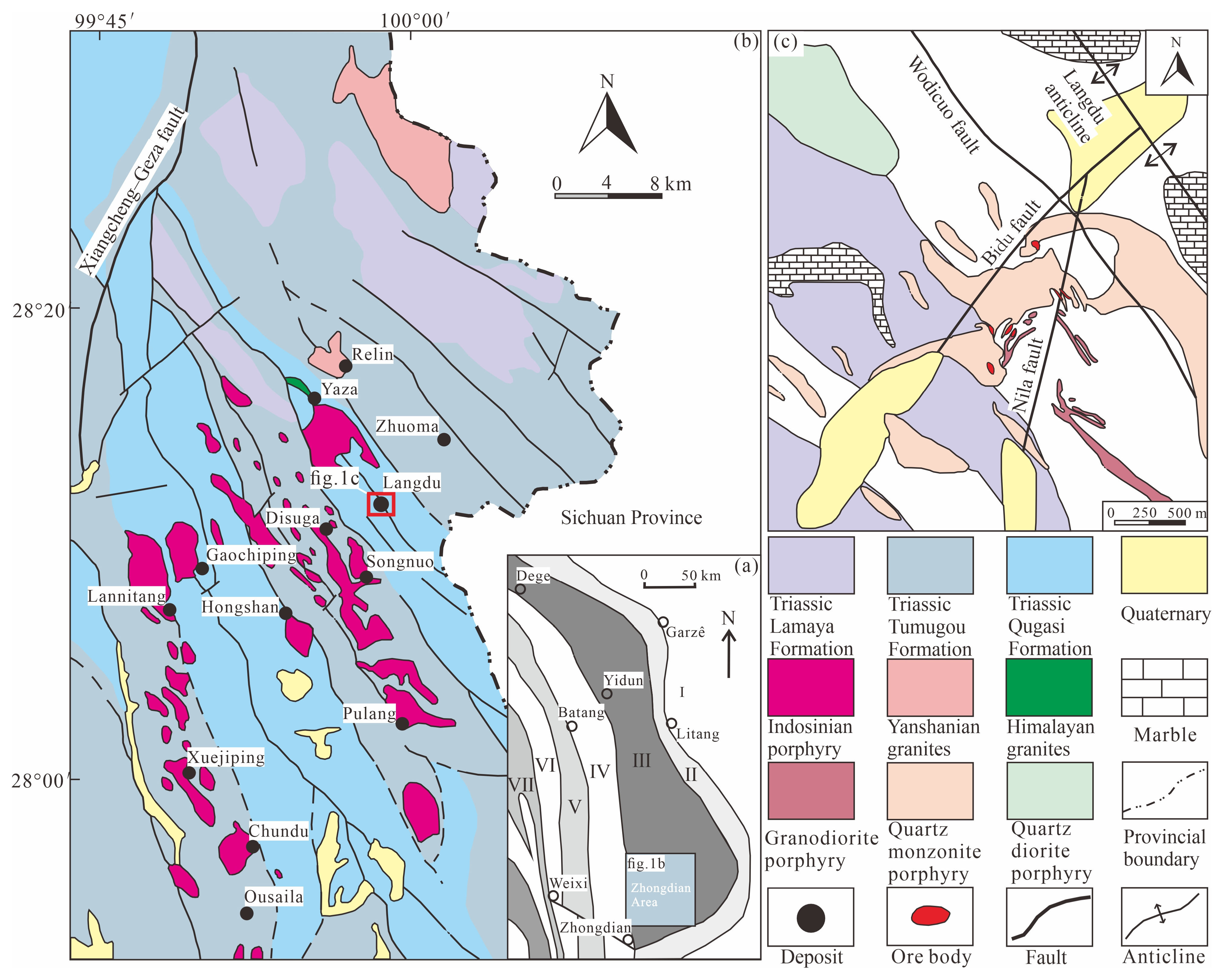
Located on the southeastern margin of the Tibetan Plateau, the Yidun Arc consists of the northern Changtai Arc and the southern Zhongdian Arc. It is bordered to the west by the Qiangtang Block, to the northeast by the Songpan–Garzê Block, and to the southeast by the Yangtze Block. Its eastern and western boundaries are defined by the Garzê–Litang and Jinshajiang suture zones, respectively [6,23,24] (Figure 1a). The Yidun Arc formed in a Late Triassic tectonic setting involving the west-dipping subduction of the Garzê–Litang oceanic crust beneath the Zhongza microcontinent [25]. It shows a close tectonic affinity to the Neoproterozoic Yangtze Block [26,27]. The arc is dominated by SN-trending volcanic and intrusive rocks, which intrude into or overlie Upper Triassic sequences of slate, sandstone, fine-grained clastic rocks, and mudstone [14]. The northern Changtai Arc is an extensional arc characterized by intra-arc rifting and back-arc basins, hosting abundant bimodal volcanic rocks and numerous volcanogenic massive sulfide (VHMS) deposits [9,28]. In contrast, the southern Zhongdian Arc is a compressional arc dominated by andesites and granitoids, which host numerous porphyry–skarn-type sulfide deposits [9,28].
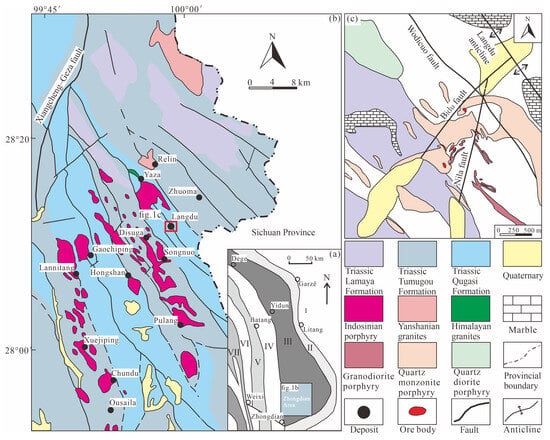
Figure 1.
(a) Geotectonic location in Zhongdian region (modified after [15]; I—The Yangtze landmass; II—Garzê–Litang plate combination zone; III—Yidun Island Arc belt; IV—Meso microlandmass; V—Jinsha River combination zone; VI—Jiangda–Weixi volcanic arc; VII—Qiangtang–Changdu landmass); (b) geological map of Zhongdian region (modified after [14]); (c) geologic map of the Langdu intrusions (modified after [14]).
The study area is located within the Zhongdian Arc in the southern segment of the Yidun Arc. It forms an overall elongated basin tending roughly in a meridional (N-S) direction (Figure 1b). The eastern and southern margins of the arc are the Garzê–Litang suture zone, while its western boundary is defined by the Xiangcheng–Geza fault. This fault strikes SSE and converges with the Garzê–Litang suture zone in the south, effectively enclosing the Zhongdian Arc [8,9]. The regional stratigraphy of the Zhongdian Arc comprises a thick succession of clastic rocks, carbonates, and volcanic rocks. Exposed strata include the Upper Triassic Lamaya (T3lm), Tumugou (T3t), and Qugasi (T3q) formations, as well as the Middle Triassic Niru (T2n) formation [14,29]. The Zhongdian Arc inherits the attributes of the Yidun Arc, sharing a similar tectonothermal evolution that involved significant overprinting by three episodes of orogeny: (1) the large-scale Indosinian (ca. 235–210 Ma) oceanic crust subduction and orogeny; (2) the Late Yanshanian (ca. 88–80 Ma) continent–continent collisional orogeny; and (3) the Early Himalayan (ca. 53–28 Ma) intracontinental convergent orogeny [6].
The Zhongdian Arc experienced three phases of tectonism, which led to large-scale magmatism. During the Indosinian, magmatism was dominated by intermediate–felsic intrusions and extrusions, forming quartz monzonite porphyry (QMP), granodiorite porphyry (GDP), quartz diorite porphyry (QDP), and andesite. The Yanshanian magmatism was predominantly felsic, generating granodiorite and monzogranite. By the Early Himalayan, intermediate–felsic and alkaline magmatism prevailed, with diorite porphyry and dacite porphyry as the principal lithologies [14,25].
2.2. Deposit Geology
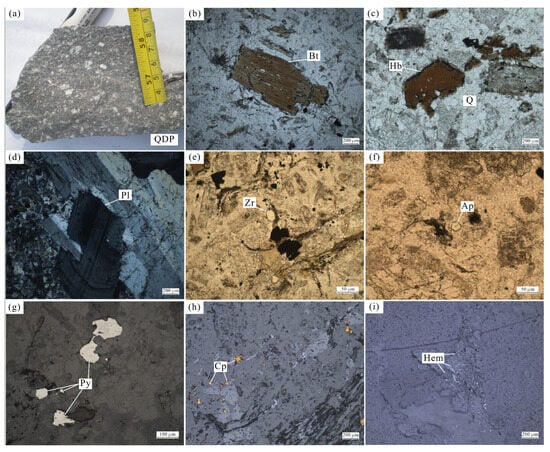
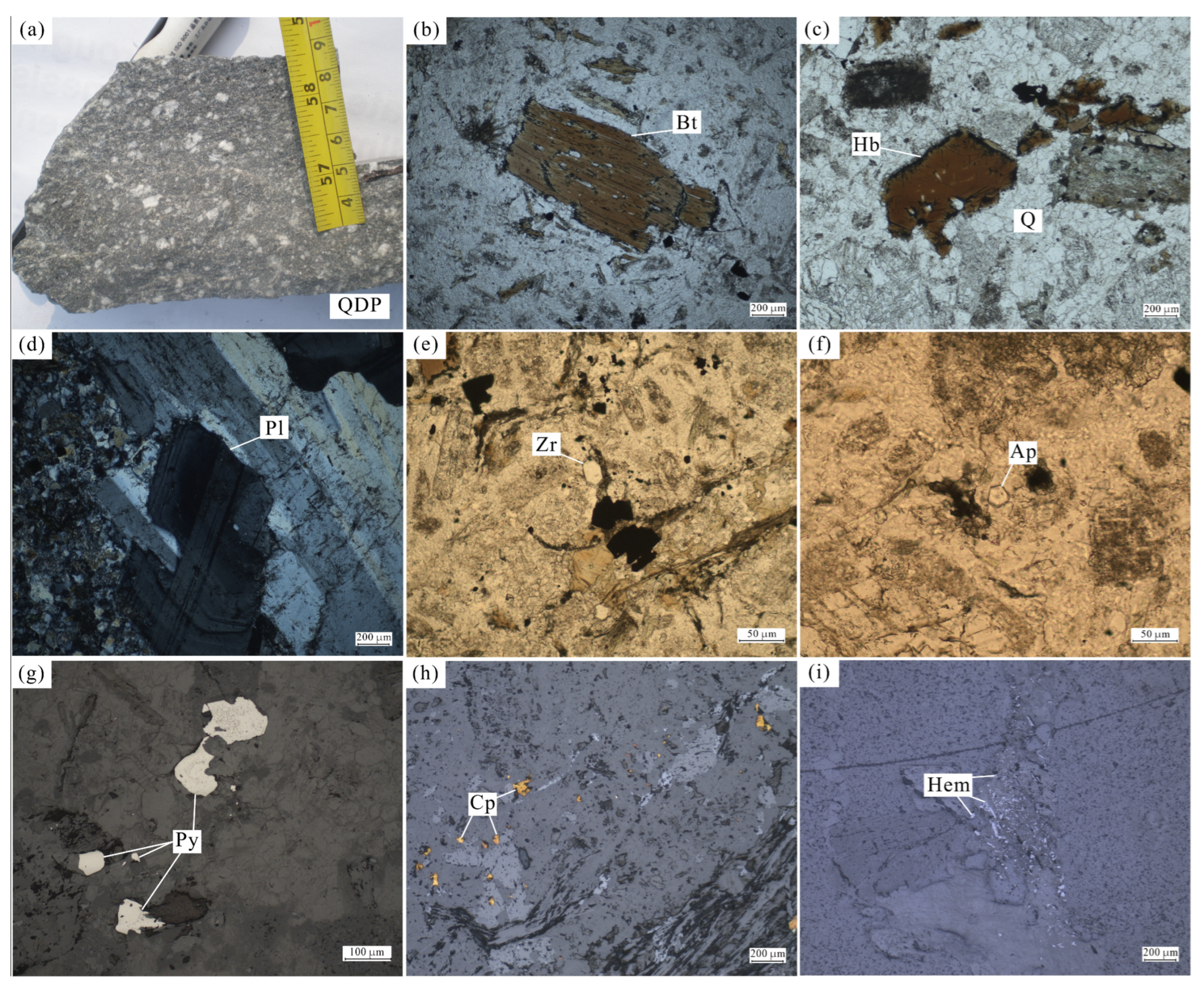
The Langdu deposit, located in the northeastern portion of the Zhongdian Arc, represents one of the most significant porphyry–skarn deposits in the study area. The preliminary copper resource in the first mining area is estimated at 0.1 Mt, with an exposed area of approximately 0.98 km2 [14]. Strata exposed in the mining area consist mainly of the second and third members of the Upper Triassic Qugasi formation and the first member of the Tumugou formation, which are lithologically dominated by sandy slate intercalated with meta-quartz sandstone and marble [15]. The Langdu intrusions strike northwest, with QMP as the dominant rock type, followed by GDP and QDP. Their emplacement is jointly controlled by the NW-trending Wodicuo fault, the nearly SN-trending Nila fault, and the NE-trending Bidu fault (Figure 1c) [14]. The orebodies are predominantly layered and lenticular, occurring in skarn at the contact zone between GDP and marble. This skarn accounts for 83.06% of the ore, with an average Cu grade of 1.34% [30]. Copper mineralization also occurs locally in internal fracture zones of QMP and GDP, where the average Cu grade is 0.62% [30]. Extensive wall-rock alteration in the deposit includes skarnization, marblization, chloritization, silicification, and hornfelsing [15,24]. The ore mineral assemblage is dominated by chalcopyrite, magnetite, and pyrrhotite, with minor amounts of sphalerite, galena, and hematite (Figure 2).
Figure 2.
Hand specimen and microphotographic characteristics of the Langdu intrusions. (a) Microscopic photo of quartz diorite porphyry; (b) Microscopic photo of biotite; (c) Microscopic photo of hornblende and quartz; (d) Microscopic photo of plagioclase; (e) Microscopic photo of zircon; (f) Microscopic photo of apatite; (g) Microscopic photo of pyrite; (h) Microscopic photo of chalcopyrite; (i) Microscopic photo of hematite. QDP—quartz diorite porphyry; Bt—biotite; Hb—hornblende; Pl—plagioclase; Q—quartz; Zr—zircon; Ap—apatite; Py—pyrite; Cp—chalcopyrite; Hem—hematite.
All samples analyzed in this study were collected from the Langdu copper mining area. They consist of fresh, unaltered GDP and QDP. Among these, the GDP samples (22LD05, 22LD02-3) represent the ore-causative intrusion, whereas the QDP samples (22LD01-3, 22B8005) are non-mineralized.
GDP is light gray with a faint flesh-red tint, exhibiting a porphyritic texture and massive structure. Phenocrysts are primarily composed of plagioclase (2–15 mm, 15–30 vol.%), K-feldspar (2–10 mm, 5–10 vol.%), hornblende (0.5–5 mm, 1–5 vol.%), biotite (0.5–5 mm, 1–5 vol.%), and quartz (2–12 mm, 1–5 vol.%). The groundmass comprises plagioclase, K-feldspar, and quartz displaying microgranitic and micrographic textures. Accessory minerals include zircon, apatite, and magnetite.
QDP is grayish-white to grayish-green, with a porphyritic texture and massive structure. Phenocrysts are composed of plagioclase (0.5–5 mm, 20–45 vol.%), hornblende (0.2–3 mm, 15–30 vol.%), quartz (0.1–1 mm, 5–15 vol.%), and minor alkali feldspar and biotite. Plagioclase and hornblende phenocrysts are typically euhedral to subhedral. The groundmass is dominated by plagioclase and quartz, with accessory minerals including zircon, apatite, rutile, ilmenite, and monazite.
3. Analytical Methods
Thin-section observation was conducted using a ZEISS Axio Scope A1 optical microscope (ZEISS, Jena, Germany) (alternatively, a Leica DM4 M optical microscope, Leica Microsystems, Wetzlar, Germany) at the National Key Laboratory of Uranium Resources Exploration-Mining and Nuclear Remote Sensing, East China University of Technology.
Zircon LA-ICP-MS trace element analysis and U-Pb age dating were performed at the same laboratory. Analyses were carried out using a PerkinElmer NexION 1000 quadrupole ICP-MS (PerkinElmer, Shelton, CT, USA) coupled with an ESI NWR 193He excimer laser ablation system (Elemental Scientific, Omaha, NE, USA). The operating conditions were set as follows: spot size of 30 μm, energy density of 4.6 J/cm2, and repetition rate of 5 Hz. Helium was used as carrier gas for the ablated material. For trace element measurements, NIST 610 was used as the external standard, following the detailed procedures outlined by Li et al. (2011) [31]. U-Pb isotopic data were corrected using a linear interpolation method, with standard analyses interspersed after every five unknown spots. Age calculations and concordia diagram plotting were performed using lsoplot/Ex ver. 3 software [32].
Apatite microanalysis, including electron probe microanalysis (EPMA) and LA-ICP-MS in situ trace element measurement, was also completed at the aforementioned laboratory. The LA-ICP-MS instrumentation was identical to that used for zircon trace element analysis. The laser operating conditions were a repetition rate of 5 Hz, a spot size of 44 μm, and an energy density of 3.5 J/cm2, with He as the carrier gas. The standard reference materials NIST 610 and NIST 612 were used for external calibration, and data were normalized using 29Si as the internal standard. Each analysis comprised a 20 s background acquisition followed by a 45 s sample signal acquisition. Data reduction was performed offline using Iolite 4 software. The results indicate that the analytical uncertainties for most trace elements were better than 5%. Apatite EPMA was conducted using a JEOL JXA-8100 electron microprobe (JEOL, Tokyo, Japan). The analytical conditions were an accelerating voltage of 15.0 kV, a beam current of 10 nA, and a focused beam diameter of 5 μm. Energy-dispersive spectrometry was performed using an IncaENERGY system. To minimize migration loss of F and Cl, these elements were prioritized in the measurement sequence. Data were processed using the internal ZAF correction procedure, achieving an analytical precision of ±2% to ±5%. Detailed experimental procedures and analytical methods followed those described by Xing et al. (2017) [33].
4. Results
4.1. Zircon U-Pb Age
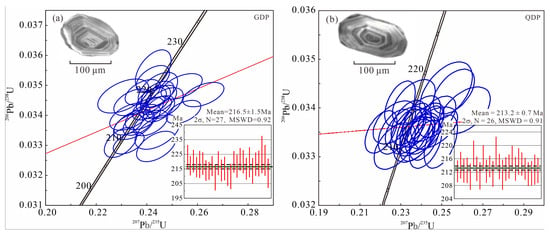
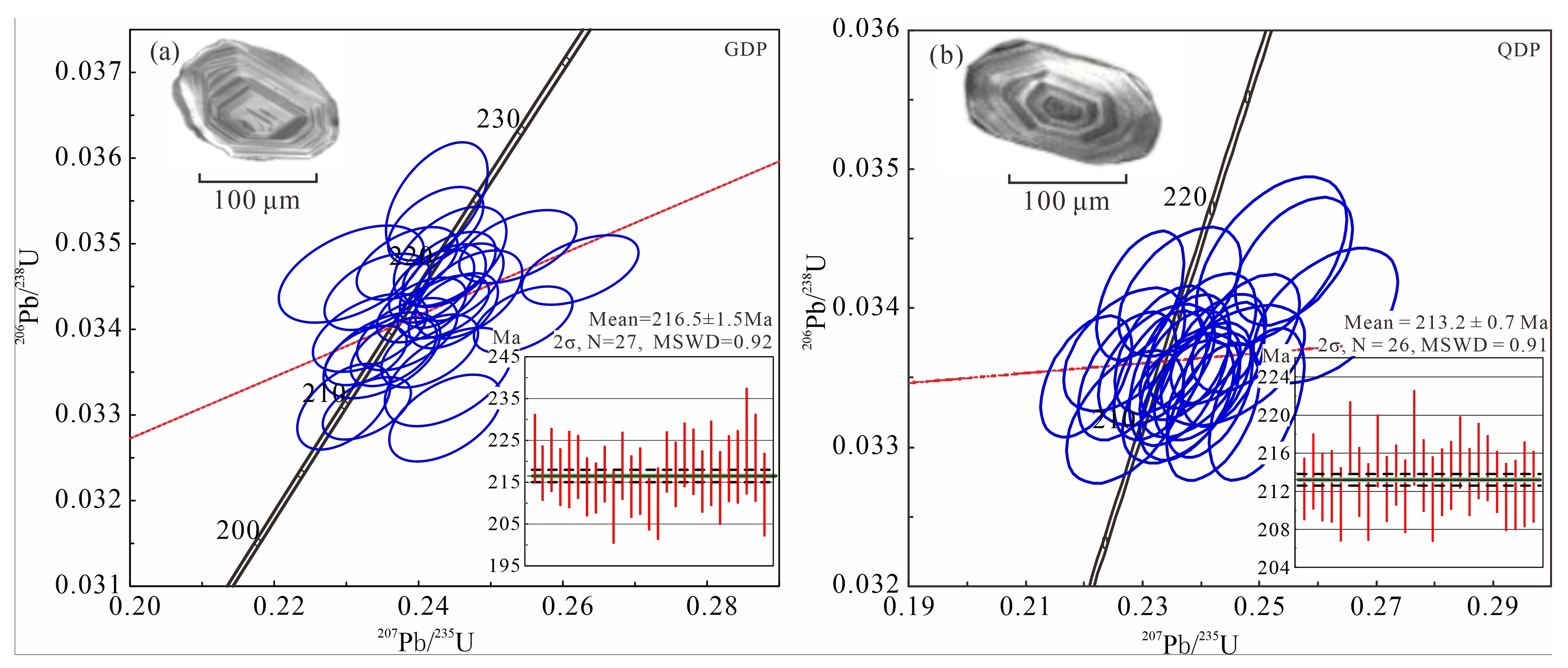
LA-ICP-MS zircon U-Pb dating was conducted on GDP and QDP samples from the Langdu deposit, with isotopic data provided in Supplementary Table S1. Following the rejection of individual analyses showing unstable signals, concordia diagrams and weighted mean age plots were constructed. All selected analytical points fall on or close to the concordia curve, indicating high concordance. This suggests that the U-Pb system in these zircons remained closed following crystallization and was not affected by later hydrothermal alteration. Zircon grains from all samples display typical oscillatory zoning, consistent with a magmatic origin. Consequently, the U-Pb ages obtained for these zircons are interpreted to represent the emplacement age of the Langdu intrusions. The GDP yields a concordia age of 215.8 ± 2.4 Ma (1σ, MSWD = 2.4, n = 27) and a weighted mean age of 216.5 ± 1.5 Ma (2σ, MSWD = 0.92, n = 27) (Figure 3a). In contrast, the QDP yields a concordia age of 213.1 ± 0.8 Ma (1σ, MSWD = 0.94, n = 26) and a weighted mean age of 213.2 ± 0.7 Ma (2σ, MSWD = 0.91, n = 26) (Figure 3b).
Figure 3.
(a) LA-ICP-MS zircon U-Pb age diagrams for GDP from the Langdu intrusions. (b) LA-ICP-MS zircon U-Pb age diagrams for QDP from the Langdu intrusions.
4.2. Zircon Elemental Composition
During LA-ICP-MS zircon trace element analysis, contamination by mineral inclusions (e.g., LREE-rich phase) is a major factor influencing data quality [8]. To ensure analytical reliability, this study adopted the screening procedure of Zou et al. (2019) [34], rejecting data points with La > 0.1 ppm and Ti > 50 ppm to exclude non-pristine zircon grains. The filtered zircon trace element data are provided in Supplementary Table S2.
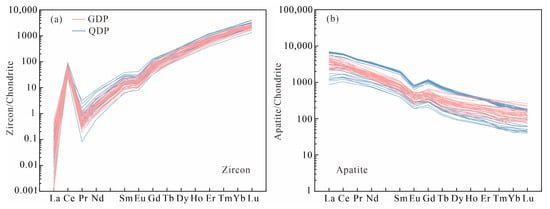
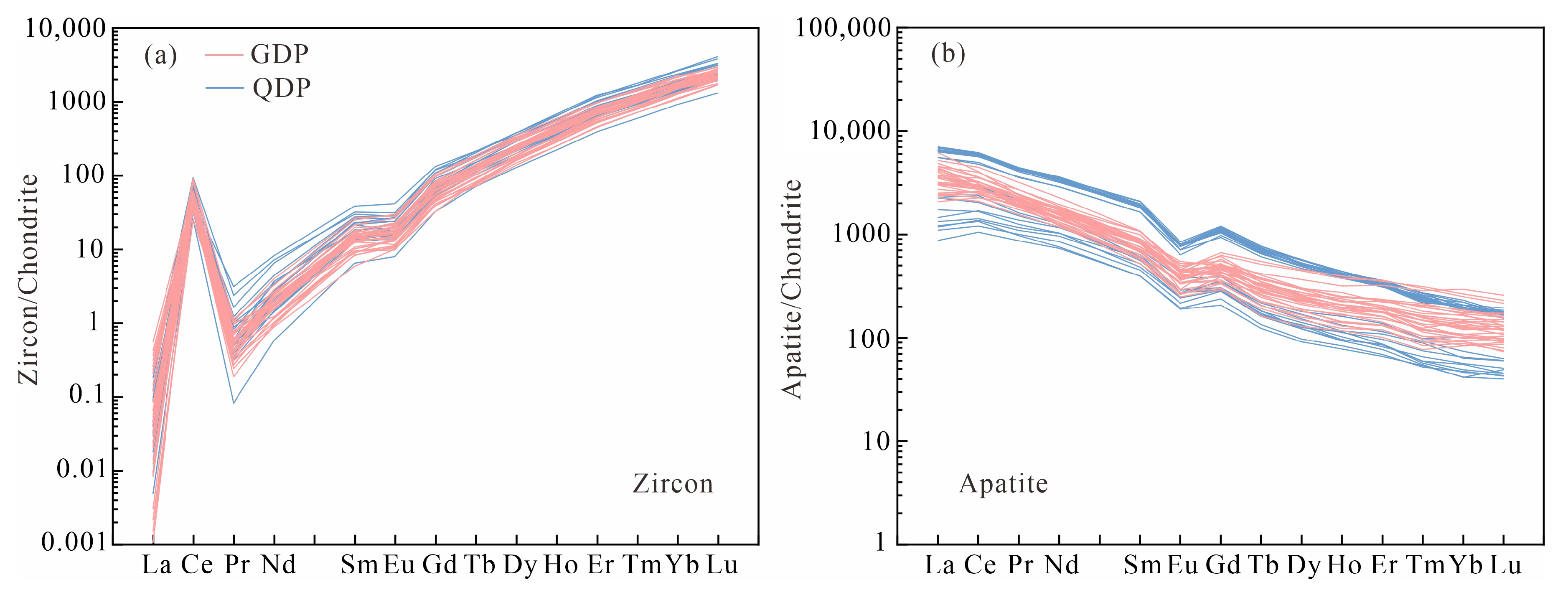
Zircon for the GDP from the Langdu intrusions exhibits total rare earth element (∑REE) concentrations of 396 to 801 ppm (avg. 595 ppm, n = 32), with EuN/EuN* ratios of 0.48–0.72 (avg. 0.56) and Ti contents of 1.68–6.69 ppm (avg. 3.54 ppm). In contrast, zircon for the QDP yields ∑REE ratios of 333–982 ppm (avg. 689 ppm, n = 19), EuN/EuN* ratios of 0.40–0.64 (avg. 0.53), and Ti contents of 2.46–8.03 ppm (avg. 4.06 ppm). Both zircon populations exhibit similar chondrite-normalized REE patterns (Figure 4a), characterized by enrichment in heavy rare earth elements (HREEs), depletion in light rare earth elements (LREEs), and a pronounced positive Ce anomaly.
Figure 4.
(a) Chondrite-normalized REE patterns of zircons for GDP and QDP from the Langdu intrusions (modified after [35]). (b) Chondrite-normalized REE patterns of apatites for GDP and QDP from the Langdu intrusions (modified after [35]).
4.3. Apatite Elemental Composition
Primary magmatic apatite typically occurs as euhedral crystals with smooth, homogeneous surfaces. The apatite grains analyzed in this study are prismatic, exhibiting complete and uniform crystal morphologies with relatively smooth surfaces, consistent with magmatic origin. Apatite from the Langdu intrusions is dominated by CaO, P2O5, with high F and low Cl concentrations, indicating a fluorapatite composition. The major element data of apatite are listed in Supplementary Table S3, and trace element compositions are provided in Supplementary Table S4.
Apatite for the GDP from the Langdu intrusions contains 46.95–55.80 wt.% CaO (avg. 53.66 wt.%, n = 26), 37.33–43.30 wt.% P2O5 (avg. 42.16 wt.%), 0.05–1.18 wt.% SO3 (avg. 0.33 wt.%), 1.41–3.49 wt.% F (avg. 2.60 wt.%), and 0.01–1.63 wt.% Cl (avg. 0.34 wt.%). In contrast, apatite for the QDP yields 52.92–55.38 wt.% CaO (avg. 54.11 wt.%, n = 13), 41.90–43.68 wt.% P2O5 (avg. 42.58 wt.%), 0.03–0.19 wt.% SO3 (avg. 0.10 wt.%), 2.63–3.34 wt.% F (avg. 2.92 wt.%), and 0.01–0.50 wt.% Cl (avg. 0.12 wt.%).
Apatite for the GDP from the Langdu intrusions exhibits ∑REE ratios of 2893–5914 ppm (avg. 4061 ppm, n = 31), with EuN/EuN* ratios of 0.42–0.81 (avg. 0.63), CeN/CeN* ratios of 0.95–1.17 (avg. 1.06), Sr contents of 310–970 ppm (avg. 603 ppm), Y contents of 195–588 ppm (avg. 339 ppm), and Ga contents of 6.96–17.3 ppm (avg. 10.9 ppm). In contrast, apatite for the QDP yields ∑REE ratios of 1479–8577 ppm (avg. 5636 ppm, n = 26), EuN/EuN* ratios of 0.47–0.69 (avg. 0.56), CeN/CeN* ratios of 1.05–1.22 (avg. 1.11), Sr contents of 825–1689 ppm (avg. 1297 ppm), Y contents of 103–648 ppm (avg. 408 ppm), and Ga contents of 3.99–22.8 ppm (avg. 14.7 ppm). Both apatite populations exhibit similar chondrite-normalized REE patterns (Figure 4b), characterized by enrichment in LREEs, depletion in HREEs, a pronounced negative Eu anomaly, and an essentially absent Ce anomaly.
5. Discussion
5.1. Physicochemical State of the Magma
5.1.1. Temperature, Oxygen Fugacity, and Water Content
Cathodoluminescence (CL) images of zircons from the Langdu intrusions (Figure 3) exhibit characteristics typical of magmatic zircon. In discrimination diagrams for zircons’ genesis, the analyzed zircons are clearly distinct from fields characteristic of hydrothermal zircons and plot within or near the field defined for magmatic zircons (Figure 5a,b), confirming a magmatic origin [36]. Consequently, the physicochemical conditions prevailing during zircon crystallization, such as temperature and oxygen fugacity, can be used to infer the properties of the parental magma. This study employed the zircon Ti-in-zircon thermometer of Ferry and Watson (2007) [37] to estimate magma temperature, the method of Loucks et al. (2020) [20] to calculate oxygen fugacity, and the approach of Ge et al. (2023) [38] to determine magmatic H2O content.
The Ti-in-zircon saturation temperatures were determined using the following equation:
where T is the zircon crystallization temperature, Tizircon is the Ti content in zircon (in ppm), and αSiO2 melt and αTiO2 melt represent the activities of SiO2 and TiO2 in the melt, respectively. Given the presence of quartz as a distinct mineral phase and accessory minerals like sphene (titanite) being observed in the samples, the activities were set to αSiO2 = 1 and αTiO2 = 0.6 for the calculations [23]. Zircon crystallization temperatures for the ore-causative intrusion and non-mineralized intrusions at Langdu range from 638 to 756 °C (avg. 695 ± 12 °C, n = 32) and from 668 to 774 °C (avg. 718 ± 9 °C, n = 19).
The oxygen fugacity was calculated using the zircon oxybarometer formulated as follows:
This method avoids potential biases from the crystallization of other minerals, magma H2O content, or mineral inclusions inherent in REE3+-based oxybarometers, thereby yielding more reliable oxygen fugacity estimates. Here, Ui is the initial U content corrected for radioactive decay. The calculated magmatic oxygen fugacity (logfO2) values for the ore-causative and non-mineralized intrusions at Langdu range from −17.2 to −14.4 (avg. −15.7) and −16.6 to −14.3 (avg. −15.2), respectively. Corresponding ΔFMQ values are +0.91 to +2.07 (avg. +1.53) for the ore-causative intrusion and +0.76 to +1.87 (avg. +1.49) for the non-mineralized intrusion.
During the process of increasing magmatic oxygen fugacity, Eu2+ is oxidized to Eu3+, reducing the degree of negative Eu anomaly (i.e., higher EuN/EuN* values) in zircon [2,39]. Furthermore, Eu3+ and Ga2+ have ionic radii similar to Ca2+; they are more readily incorporated into the apatite lattice than Eu2+ and Ga3+. Consequently, apatite crystallized from relatively oxidized magmas typically exhibits higher EuN/EuN* and lower Ga content [2,13,40]. Zircons from the Langdu intrusions have EuN/EuN* values > 0.3 (0.40–0.72), consistent with those reported from zircons in fertile intrusions associated with global porphyry–skarn Cu-Mo systems [18]. The apatite shows high EuN/EuN * (avg. 0.60) and low Ga content (avg. 12.6 ppm), collectively indicating high magmatic oxygen fugacity. In a zircon logƒO2 vs. T (°C) diagram (Figure 5c), all samples plot adjacent to the nickel-nickel oxide (NNO) buffer, confirming that the magma was characterized by relatively high oxygen fugacity.
Magmatic H2O content was determined using the following equation:
where / is the ratio in the melt estimated using a lattice strain model for zircon–melt partitioning based on trivalent (Y and REE) and tetravalent (Zr, Hf, Ti, Th, U) cations; NBO/T is the ratio of non-bridging oxygens to tetrahedrally coordinated cations; and xH2O is the mole fraction of water dissolved in the melt. For a given zircon–melt pair, magmatic oxygen fugacity and H2O content are positively correlated (Figure 5d). Therefore, if the fO2 can be independently estimated, magmatic H2O content can be determined [40].
In water-rich magmatic systems, Y content in the residual melt progressively decreases due to fractional crystallization of hornblende and/or garnet [41,42]. Consequently, zircons crystallized from such residual melts exhibit high (10,000 × EuN/EuN*)/Y and (Ce/Nd)/Y ratios (specifically, (10,000 × EuN/EuN*)/Y > 1 and (Ce/Nd)/Y > 0.01) [2,18,41,42].
Figure 5.
Zircon diagrams for GDP and QDP from the Langdu intrusions: (a) La vs. (Sm/La)N discrimination diagram (modified after [36]); (b) (Sm/La)N vs. (Ce/Ce)N discrimination diagram (modified after [36]); (c) logƒO2 vs. T (°C) diagram (modified after [39]). FMQ: fayalite–magnetite–quartz buffer ([43]); HM: hematite–magnetite buffer (≈FMQ + 5 [44]); NNO: nickel–nickel oxide buffer (≈FMQ + 0.7 [45]). (d) ΔFMQ vs. H2O diagram.
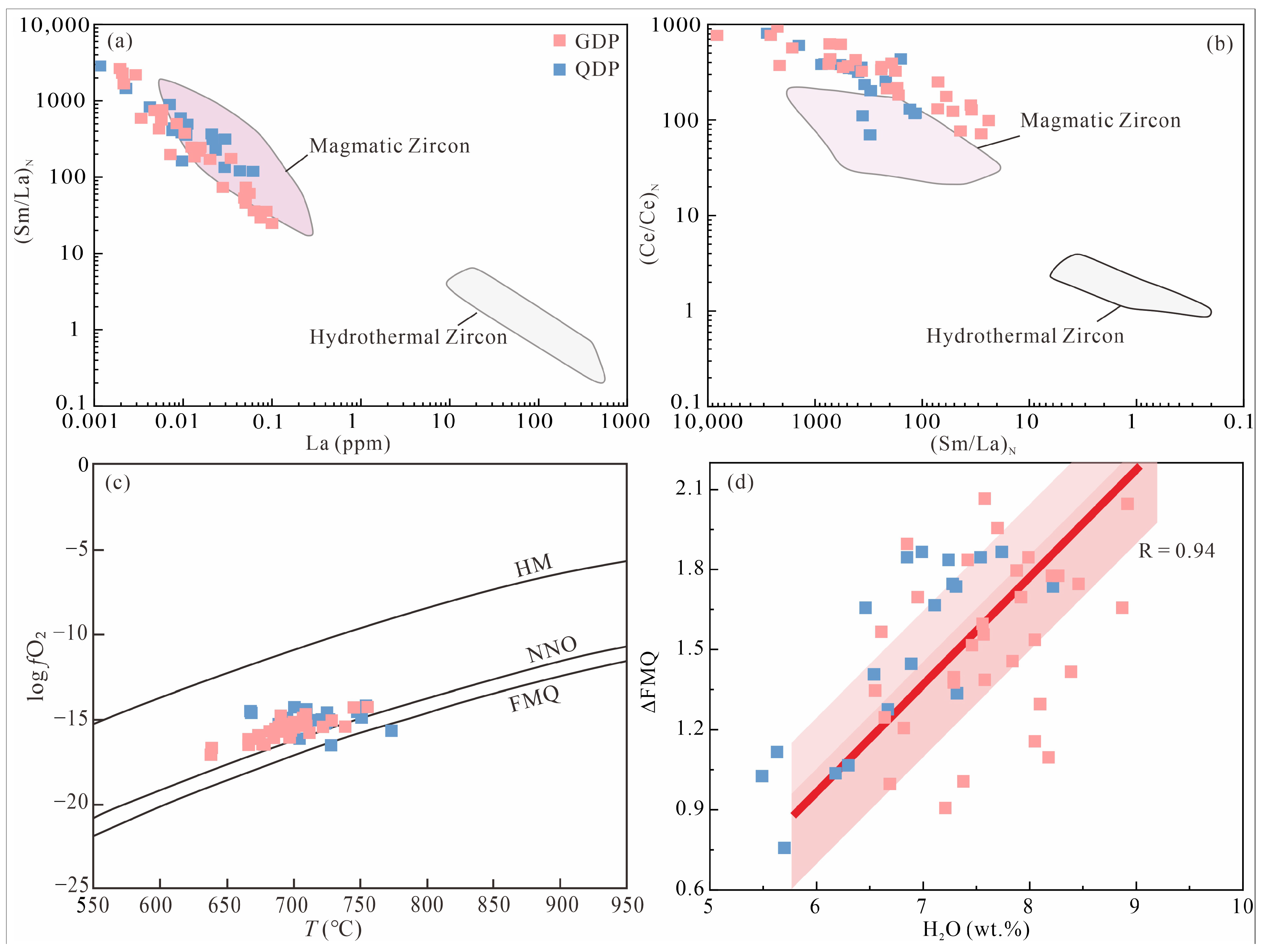
Calculated magmatic H2O contents are 6.55–8.92 wt.% (avg. 7.63 ± 0.23 wt.%, n = 32) for the ore-causative intrusion and 5.49–8.22 wt.% (avg. 6.81 ± 0.34 wt.%, n = 19) for the non-mineralized intrusion at Langdu. The (10,000 × EuN/EuN *)/Y ratios range from 5.54 to 13.1 and 4.11 to 13.4, respectively, while the (Ce/Nd)/Y ratios vary from 0.01 to 0.11 and 0.01 to 0.14. The presence of hornblende in the ore-forming intrusion (Figure 2c) indicates that the mineralizing magmas at Langdu were H2O-rich.
5.1.2. Magmatic Sulfur (S) Content
In porphyry–skarn deposits, metals are primarily hosted in sulfides, making S a key element in the formation of this deposit type [46]. Apatite incorporates various volatile elements (e.g., F, Cl, H, C, S) and is therefore used as a proxy for tracking the volatile content of melts [47]. Magmatic S content can be estimated from the SO3 content in apatite and the partition coefficient of S between apatite and silicate melt (), although this calculation is also influenced by magmatic temperature and oxygen fugacity [2]. To account for the effects of temperature and oxygen fugacity on and provide cross-validation, we employed the methodologies described by Peng et al. (1997) [48] and Meng et al. (2021) [49] to calculate magmatic S content. The semi-quantitative method for estimating magmatic S content based on apatite–melt partition coefficients, proposed by Peng et al. (1997) [48], is as follows:
The saturation temperature of apatite can be estimated using the method of Piccoli and Candela (2002) [17]. The apatite saturation temperature is determined by the following equation:
Here, is the partition coefficient for SO3 between apatite and melt, T (°C) is the apatite saturation temperature (calculated whole-rock data from the Langdu intrusion reported by Mo et al. (2024b) [24]), and and represent the concentrations of SiO2 and P2O5 in the melt at the temperature of apatite crystallization onset. Using these two equations, the apatite saturation temperature for the Langdu intrusion is estimated at 966 °C. Calculated magmatic S contents are 80.2–2007 ppm (avg. 560 ppm, n = 26) for the ore-causative intrusion and 52.9–321 ppm (avg. 166 ppm, n = 13) for the non-mineralized intrusion.
The method of Meng et al. (2021) [49] employs a set of combined equations to estimate magmatic S content, expressed as follows:
represents the S content in apatite, is the partition coefficient of S between apatite and melt under specific oxygen fugacity conditions, is the partition coefficient at apatite saturation temperature, and is the partition coefficient at 1000 °C. Estimated magmatic S contents for the ore-causative and non-mineralized intrusions at Langdu are 80.5–2014 ppm (avg. 562 ppm, n = 26) and 53.1–322 ppm (avg. 167 ppm, n = 13).
The S contents derived from the two methods are highly consistent, confirming the accuracy of the calculations employed in this study. These results demonstrate that the Langdu ore-forming magma had elevated S concentrations.
5.1.3. Magmatic Halogen (F, Cl) Content
Halogens play a significant role in magmatic–hydrothermal mineralization processes. Fluorine (F) and chlorine (Cl), in particular, are ubiquitous volatile components in magmas and continental crystalline rocks derived from both mantle and crustal sources. They perform critical functions during magmatic differentiation, hydrothermal alteration, and associated ore formation [50]. Determining magmatic volatile content and its evolution via whole-rock geochemical methods is challenging, as these elements are readily lost during magmatic degassing [2,51]. The crystallization of apatite does not significantly affect the enrichment or depletion of F and Cl in granitic melts, implying that the halogen composition of apatite can be used to estimate the volatile content (e.g., F, Cl) of the parental magma [2,51,52].
The Cl and F contents of the magma were determined using the following equation [51]:
Here is the concentration of Cl in the melt; , , and are the mole fractions of Cl, F, and hydroxyl (OH) in the melt, respectively; , , and are the corresponding mole fractions in apatite; and and are the apatite–melt partition coefficient ratios for Cl/OH and F/OH, respectively [53]. Calculations reveal that the Langdu ore-forming magma has significantly higher Cl concentrations (37.9–7822 ppm, avg. 2141 ppm, n = 26) than the non-mineralized magma (60.5–3709 ppm, avg. 1154 ppm, n = 13), whereas F contents are comparable between the two (1251–3157 ppm, avg. 1535 ppm vs. 1263–2454 ppm, avg. 1580 ppm).
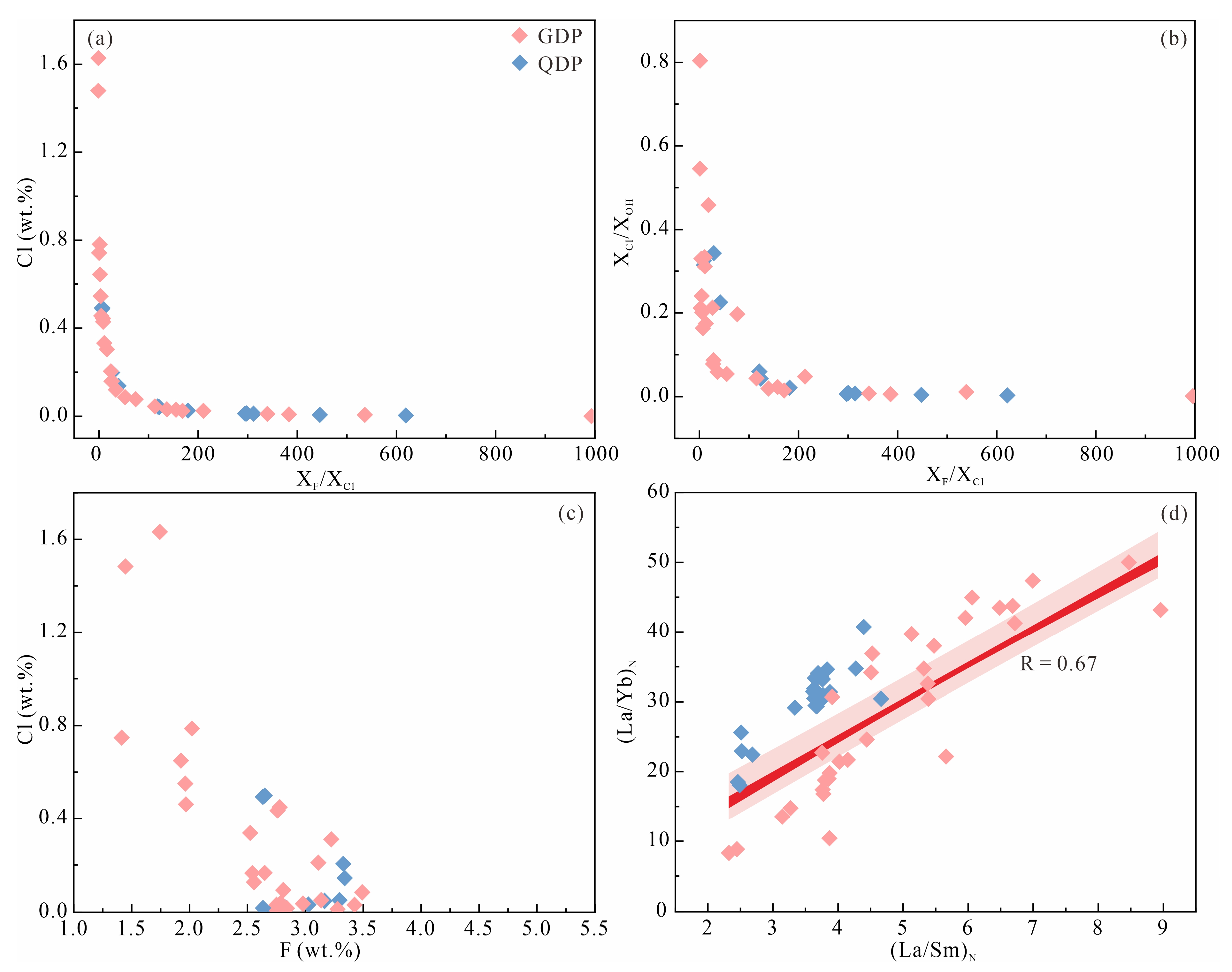
High Cl content in the magma is crucial for porphyry–skarn mineralization, as it facilitates the formation of metal chloride complexes that enhance metal transport during magmatic–hydrothermal evolution [2,46]. The Langdu intrusions’ melt were characterized by high Cl content, yet its apatites exhibit low Cl concentrations. This discrepancy can be attributed to two primary factors: (1) a relatively low initial Cl content in the parental magma, or (2) exsolution of Cl-bearing hydrothermal fluids prior to apatite crystallization, leading to magmatic Cl depletion. Fluid exsolution occurs once the magma reaches vapor saturation. Due to the higher fluid/melt partition coefficient for Cl compared to F (e.g., , [54]), Cl is preferentially partitioned into the aqueous phase [21]. Consequently, apatite crystallized from volatile-saturated magmas typically exhibits sharply increased XF/XCl ratios and decreased XCl/XOH ratios [2,21]. In contrast, apatite crystallizing from volatile-undersaturated magmas during normal magmatic evolution should maintain relatively constant XF/XCl ratios and XCl/XOH ratios.
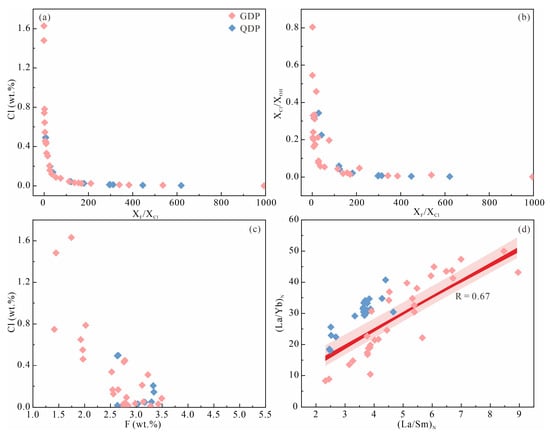
Apatite from the Langdu ore-causative intrusion yields XF/XCl ratios of 1.76–996 and XCl/XOH ratios of 0–0.81, whereas those from the non-mineralized intrusion exhibit XF/XCl ratios of 9.64–622 and XCl/XOH ratios of 0–0.34. We interpret these data to indicate that apatite in the ore-causative intrusion crystallized from magmas that evolved from volatile-undersaturated to volatile-saturated conditions. We attribute the low Cl contents in apatite (Figure 6c) and the wider range of XF/XCl ratios (Figure 6a) to the exsolution of Cl-rich fluids prior to apatite crystallization during the mineralization process [2,22]. The exsolution of Cl-rich fluids can significantly deplete light rare earth elements (LREEs) in the melt, while exerting a minimal effect on middle and heavy rare earth elements (MREEs and HREEs) [47]. Thus, the positive correlation between (La/Sm)N and (La/Yb)N ratios in apatite from the Langdu ore-causative intrusion (Figure 6d) provides additional evidence for the exsolution of Cl-rich fluids during magmatic–hydrothermal mineralization.
Figure 6.
Apatite diagrams for GDP and QDP from the Langdu intrusions: (a) Cl vs. XF/XCl diagram; (b) XCl/XOH vs. XF/XCl diagram; (c) Cl vs. F diagram; (d) (La/Sm)N vs. (La/Yb)N.
5.2. Tectonic Setting
The Zhongdian Arc is a significant volcanic arc within the Sanjiang Tethyan orogenic belt, formed during the Late Triassic westward subduction of the Garzê–Litang Ocean [6,10,11,12,13,29]. Previous studies have reported numerous Rb-Sr, K-Ar, and zircon U-Pb ages for intermediate–felsic intrusions in the Zhongdian region [6,7,8,10,15,54,55], which are mainly concentrated between 225 and 215 Ma, with a peak age around 218 Ma [15]. In this study, we conducted high-precision zircon LA-ICP-MS U-Pb dating on the Langdu intrusion, yielding emplacement ages ranging from 216.5 ± 1.5 Ma to 213.2 ± 0.7 Ma. These ages indicate an emplacement during the Late Triassic (Indosinian). This age range is largely consistent with the biotite 39Ar-40Ar age of 216.9 Ma for the Langdu biotite monzogranite by Zeng et al. (2003) [54] and aligns with the ~215 Ma magmatic event related to the subduction of the Garzê–Litang Ocean [5].
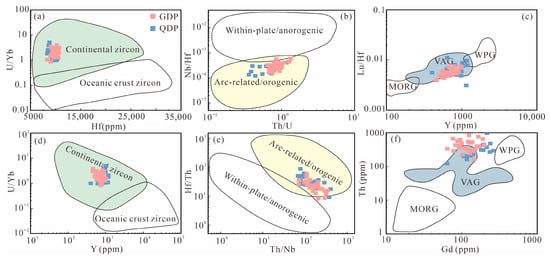
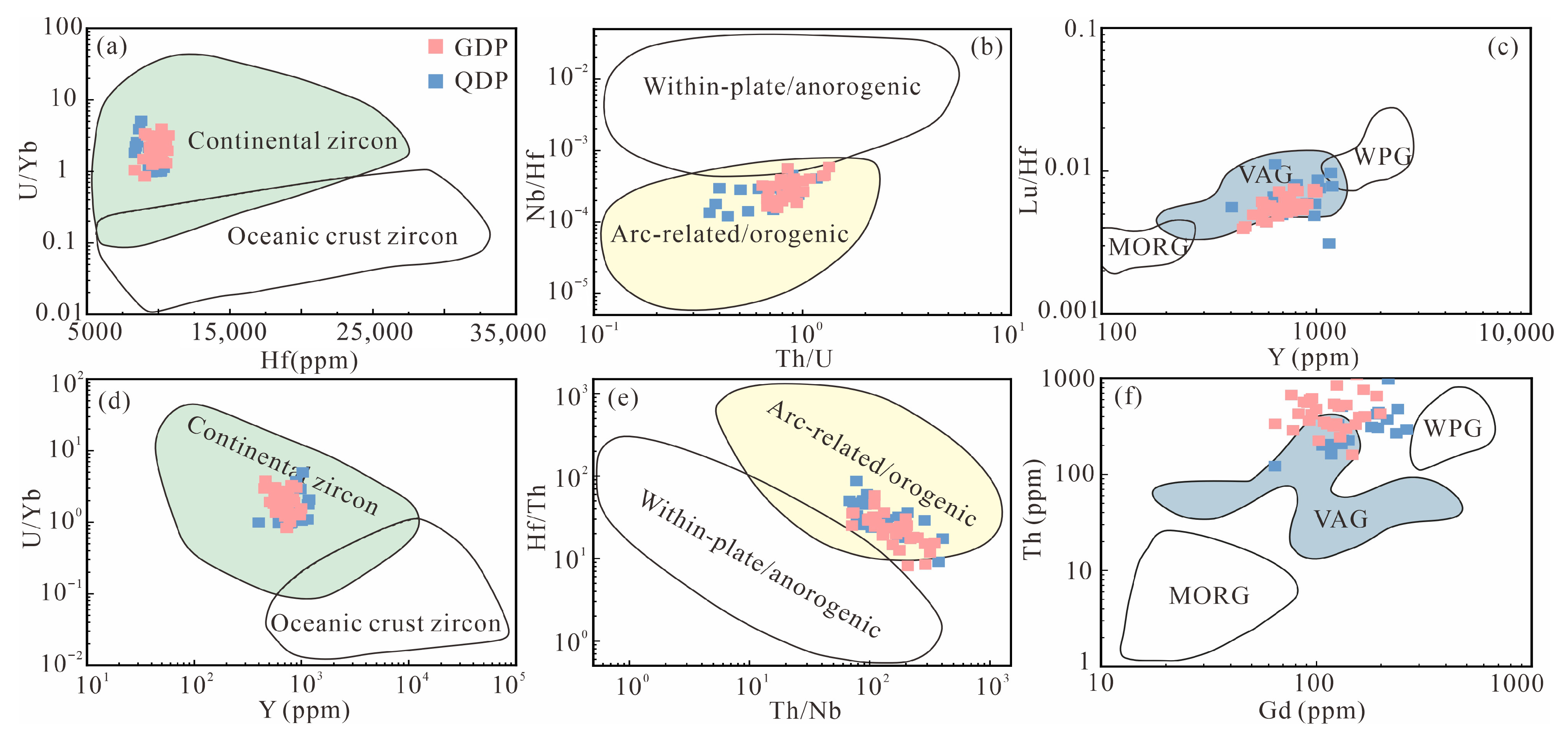
Trace elements in zircon, including Y, Hf, U, Yb, Th, and Nb, are commonly used to determine the crystallization environments [56,57]. In (U/Yb) vs. Hf and (U/Yb) vs. Y diagrams (Figure 7a,d), all analytical points fall within the field of continental zircons, indicating crystallization in a continental crustal setting. In (Nb/Hf) vs. (Th/U) and (Hf/Th) vs. (Th/Nb) diagrams (Figure 7b,e), all data points fall within the orogenic field associated with arc magmatism. In (Lu/Hf) vs. Y and U vs. Er diagrams (Figure 7c,f), nearly all zircon analyses from this study plot within the volcanic arc field.
Figure 7.
Zircon tectonic diagrams for GDP and QDP from the Langdu intrusions: (a) (U/Yb) vs. Hf diagram (modified after [56]); (b) (Nb/Hf) vs. (Th/U) diagram (modified after [58]); (c) (Lu/Hf) vs. Y diagram (modified after [59]); (d) (U/Yb) vs. Y diagram (modified after [56]); (e) (Hf/Th) vs. (Th/Nb) diagram for zircon (modified after [60]); (f) Th vs. Gd diagram (modified after [58]). MORG = Mid-Ocean ridge plagiogranite; VAG = Volcanic arc granite; WPG = Within-plate granite.
In summary, the Zhongdian Arc was in a stage of continental arc evolution during the Indosinian period, driven by the westward subduction of the Garzê–Litang Ocean [6]. The Langdu intrusions formed within this specific tectonic framework.
5.3. Petrogenesis
5.3.1. Petrogenetic Type
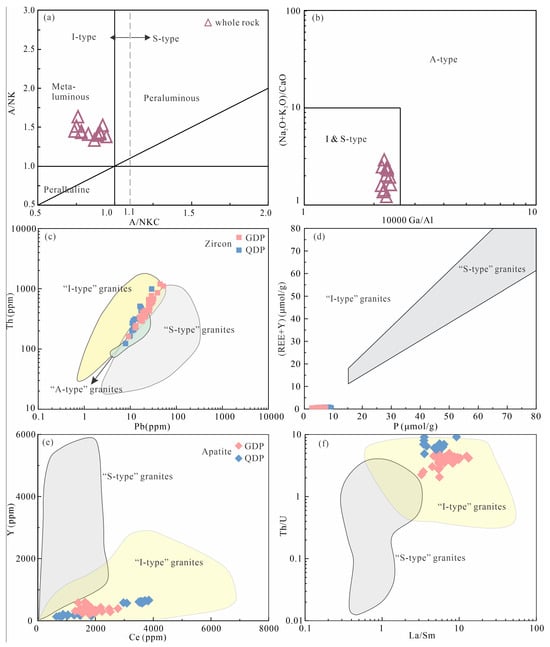
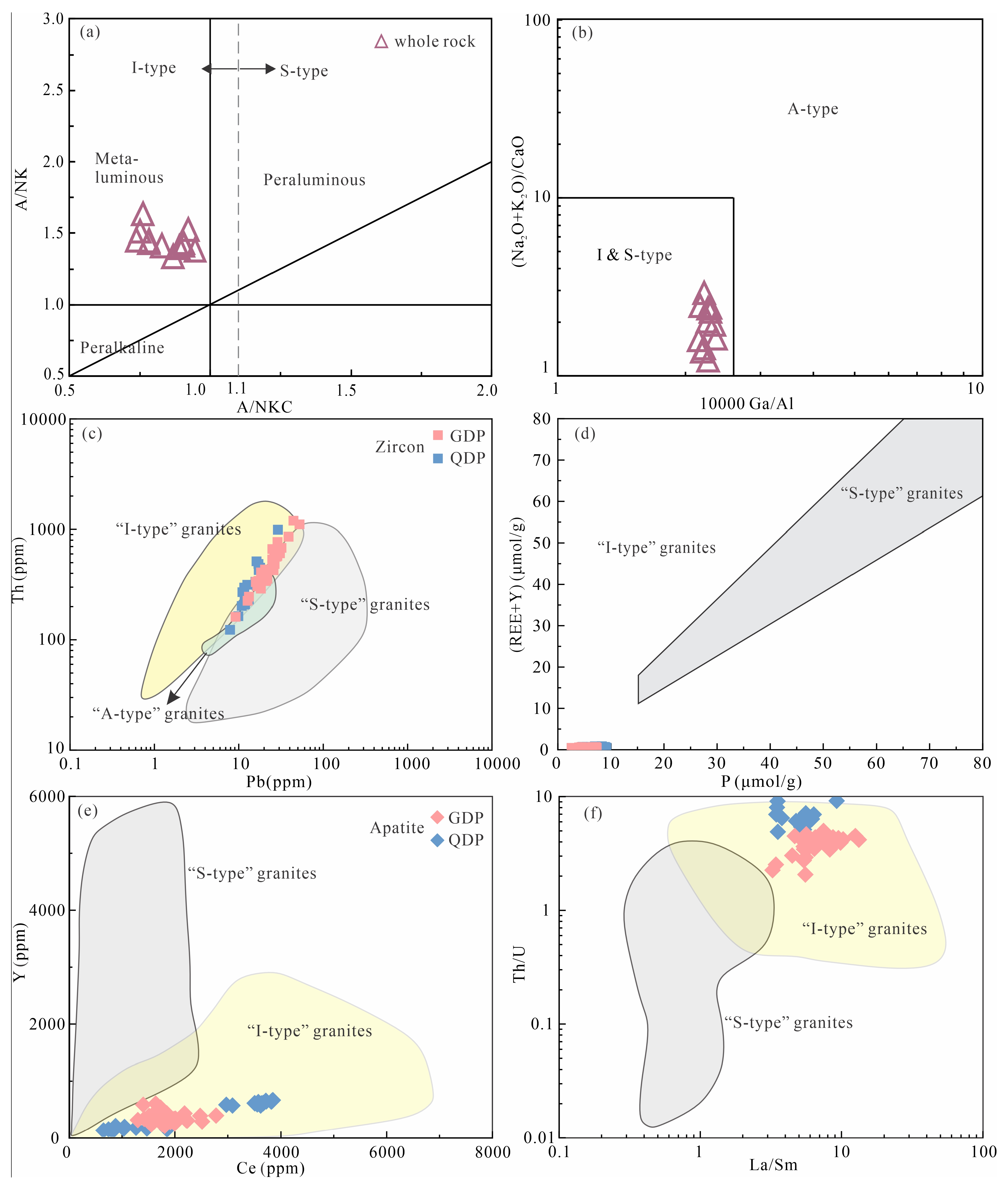
Based on source characteristics, petrology, and geochemical signatures, granitoids are primarily classified into I-, S-, A-, and M-types [61,62]. A-type granites are typically distinguished by unique geochemical features, including high Zr + Nb + Ce + Y contents (>350 ppm) and 10,000 × Ga/Al ratios (>2.6) [61,63]. Whole-rock data from the Langdu intrusions, compiled from Mo et al. (2024b) [24], show lower Zr + Nb + Ce + Y contents (221–321 ppm) and 10,000 × Ga/Al ratios (2.15–2.37). Furthermore, zircon crystallization temperatures for the Langdu intrusions (638–774 °C) are generally lower than the typical values for A-type granites (~840 °C; [64]). S-type granites are mineralogically characterized by peraluminous minerals such as muscovite, garnet, cordierite, and tourmaline [65,66], whereas I-type granites commonly contain hornblende [62]. Most S-type granites are strongly peraluminous with A/CNK > 1.1, while most I-type granites are metaluminous with A/CNK < 1.1 [67]. The Langdu intrusions contain abundant hornblende and sphene, which are typical metaluminous minerals (Figure 2c), and their whole-rock A/CNK values (0.74–0.95, <1.1) indicate a metaluminous composition (Figure 8a). In granite-type discrimination diagrams, the data plot is within the I-type granite field (Figure 8b). All analytical points fall within the I-type granite field on zircon Th-Pb and (REE + Y)-P diagrams (Figure 8c,d), as well as on apatite Y-Ce and Th/U-La/Sm diagrams (Figure 8e,f). Collectively, these results further support that both types of granites in the Langdu belong to I-type granite genetically.
Figure 8.
Discrimination diagrams for the Langdu intrusions: (a) ANK versus A/NKC diagram (modified after [68]); (b) (Na2O + K2O)/CaO versus 10,000 × Ga/Al diagram (modified after [61]); (c) zircon Th versus Pb diagram (modified after [69]); (d) zircon (REE + Y) versus P diagram (modified after [70]); (e) apatite Ce versus Y diagram (modified after [13]); (f) apatite La/Sm versus Th/U diagram (modified after [13]).
5.3.2. Magmatic Fractionation Process
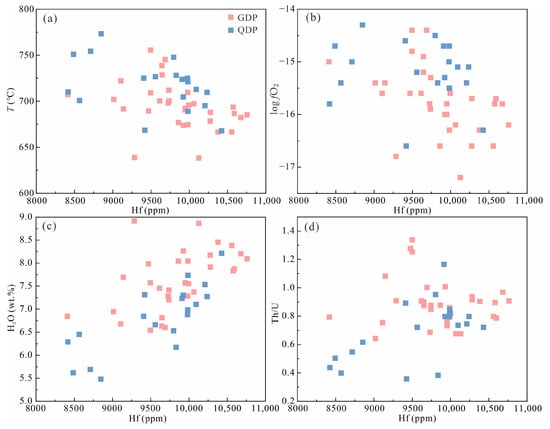
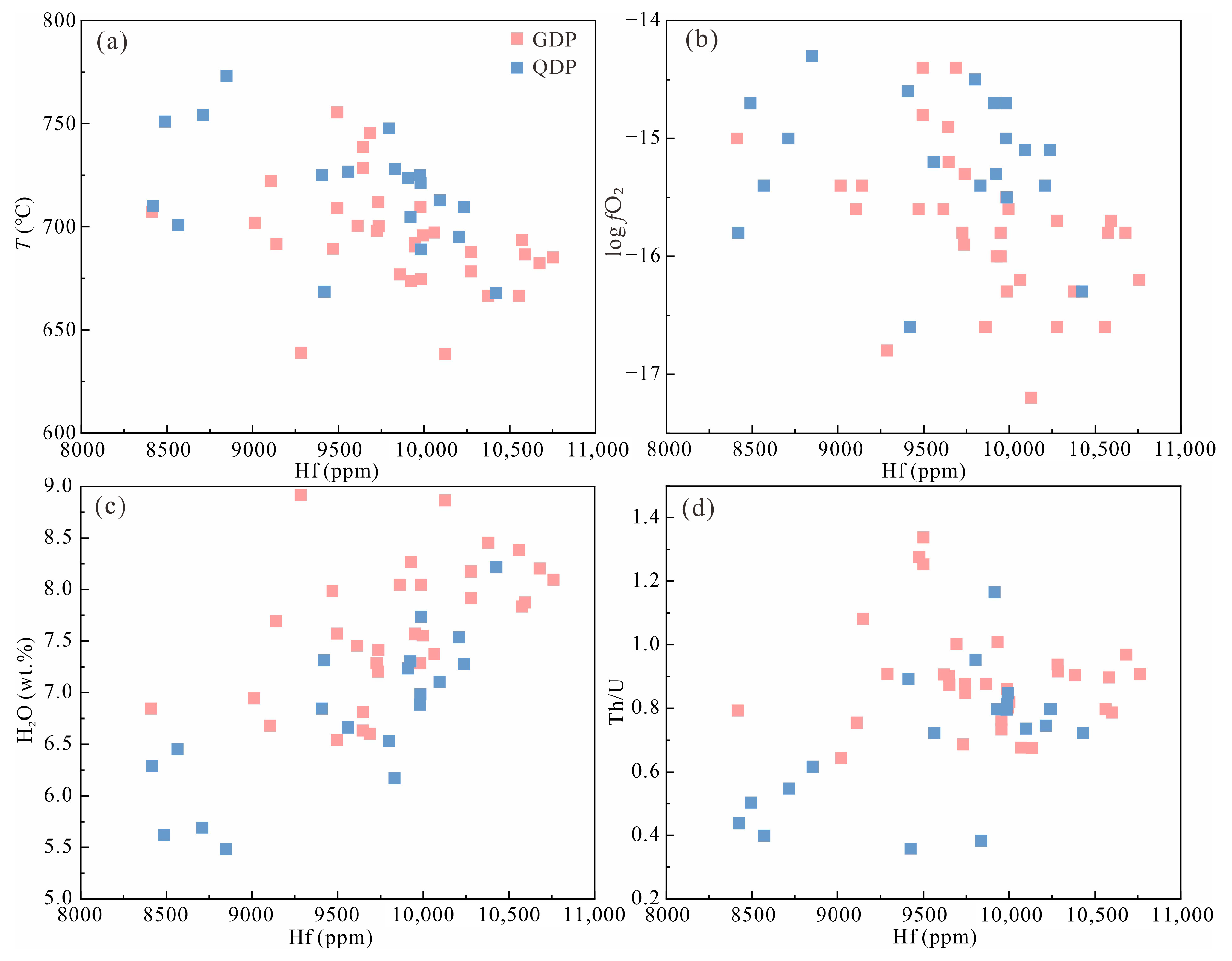
Systematic variations in the trace element contents and ratios of zircons primarily reflect compositional changes in their crystallizing melts and coexisting mineral phases, thereby tracing crystal–melt evolution processes [57]. The Hf content in zircon has been used to record the magmatic evolution of granitic systems [71,72]. For both types of Langdu intrusives, zircon crystallization temperatures and oxygen fugacity values exhibit negative correlations with Hf contents (Figure 9a,b). In contrast, H2O contents and Th/U ratios exhibit positive correlations with Hf contents (Figure 9c,d), indicating enhanced magmatic evolution and differentiation [72].
Figure 9.
Zircon diagrams for GDP and QDP from the Langdu intrusions: (a) T (°C) vs. Hf diagram; (b) logƒO2 vs. Hf diagram; (c) H2O (wt.%) vs. Hf diagram; (d) Th/U vs. Hf diagram.
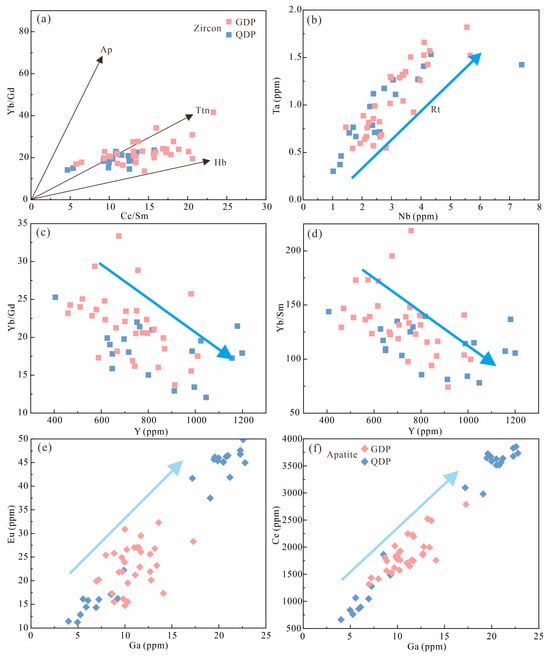
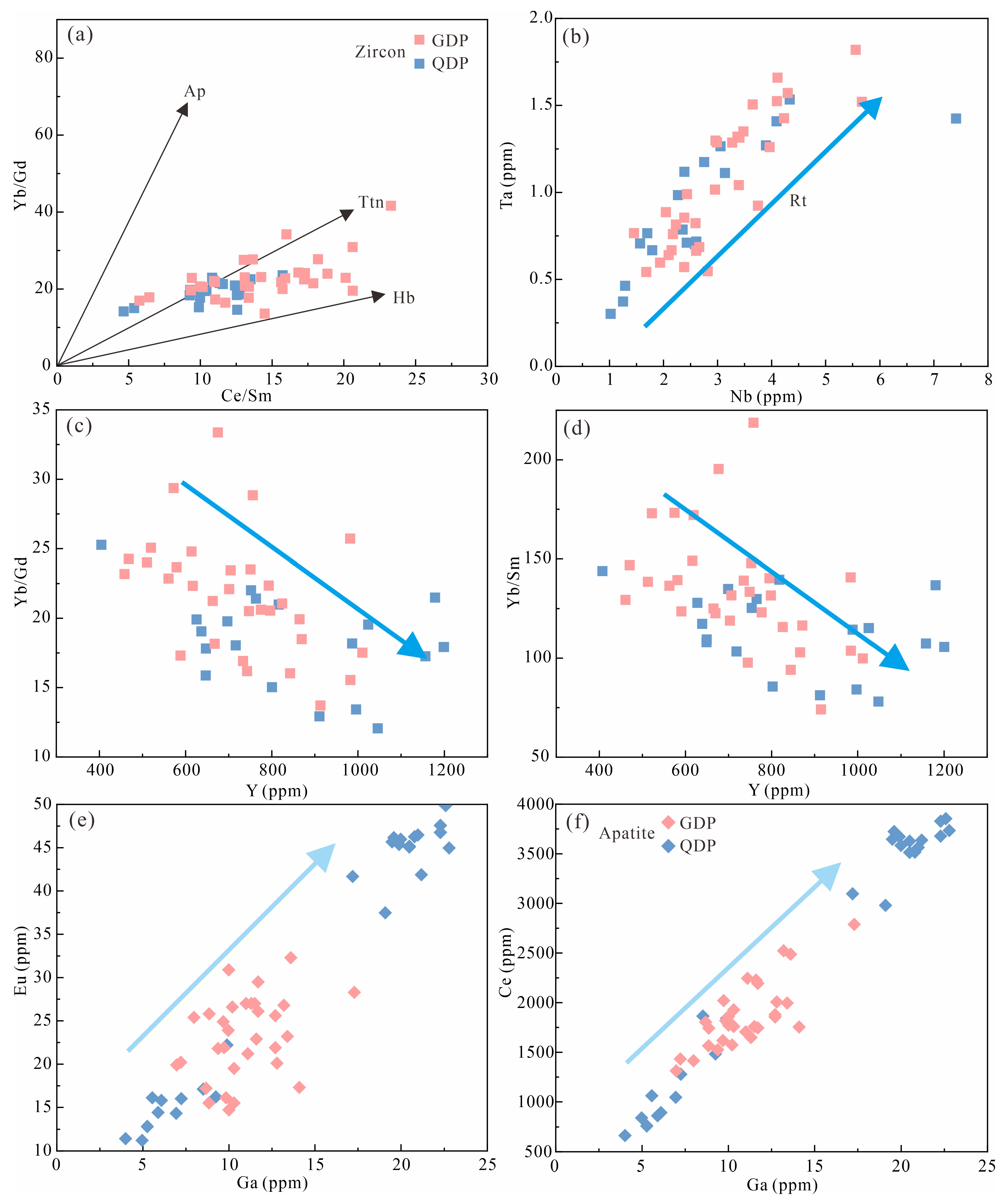
Figure 10a shows that the magmatic evolution of the Langdu intrusions was dominated by the fractional crystallization of hornblende and sphene (titanite), with minor apatite. The abundance of hornblende in the rocks indicates that its crystallization was dominant. Furthermore, the positive correlation between Ta and Nb contents in zircon (Figure 10b) suggests possible fractional crystallization of rutile. Additionally, fractional crystallization of minerals enriched in middle and heavy rare earth elements (MREEs and HREEs), such as garnet and monazite, can cause relative depletion of elements (e.g., Sm and Gd) in the residual melt [73]. In zircons from both types of Langdu intrusives, Yb/Sm and Yb/Gd ratios exhibit negative correlations with Y contents (Figure 10c,d). This suggests that fractional crystallization of minerals (e.g., garnet and monazite) may have also occurred during magma evolution. The distinct linear correlations between Eu and Ga, and between Ce and Ga, in apatite from the Langdu intrusions (Figure 10e,f) imply that their Eu and Ce contents are controlled by magmatic oxygen fugacity, suggesting that plagioclase fractional crystallization likely played an insignificant role in the magmatic process [16,47].
Figure 10.
Zircon and apatite diagrams for GDP and QDP from the Langdu intrusions: (a) zircon Ce/Sm vs. Yb/Gd diagram (modified after [66]); (b) zircon Ta vs. Nb diagram; (c) zircon Yb/Ga vs. Y diagram; (d) zircon Yb/Sm vs. Y diagram; (e) apatite Eu vs. Ga diagram; (f) apatite Ce vs. Ga diagram.
High F content in felsic magma lowers its solidus temperature and viscosity, thereby prolonging the magmatic evolution process [74]. Apatite from the Langdu intrusions is F-rich and Cl-poor, and the calculated magmatic F contents are high, ranging from 1251 to 3157 ppm (avg. 1550 ppm). This indicates an extended evolutionary timescale, which likely also contributed to promoting extensive fractional crystallization of multiple mineral phases in the Langdu granitic magma.
5.3.3. Magma Source
I-type granites formed in subduction environments typically involve three potential source components: (1) the mantle wedge; (2) the subducting slab (including slab melts, sediments, and fluids); and (3) the arc crust [13]. In zircons from typical crust-derived magmas, the total REE (ΣREE, excluding Y) content of individual grains varies widely, ranging from 250 to 5000 ppm, with an average of 1500–2000 ppm [75]. For magmatic apatite, crust-derived granites contain apatite with roughly similar LREE and HREE abundances and a pronounced negative Eu anomaly. In contrast, apatite from granites formed by crust–mantle interaction exhibits right-sloping REE patterns and a moderately negative Eu anomaly, whereas apatite from mantle-derived rocks is Sr-rich, strongly enriched in LREEs, and shows an insignificant to weakly positive Eu anomaly [76,77]. Crust-derived magma is usually rich in F but poor in Cl [22]. Therefore, assimilation may increase the XF/XCl ratio of apatite and decrease the XCl/XOH ratio.
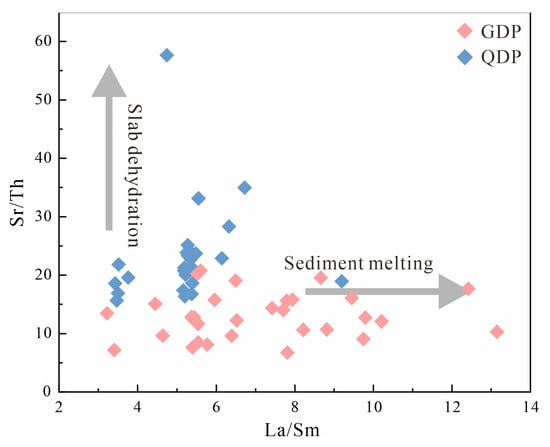
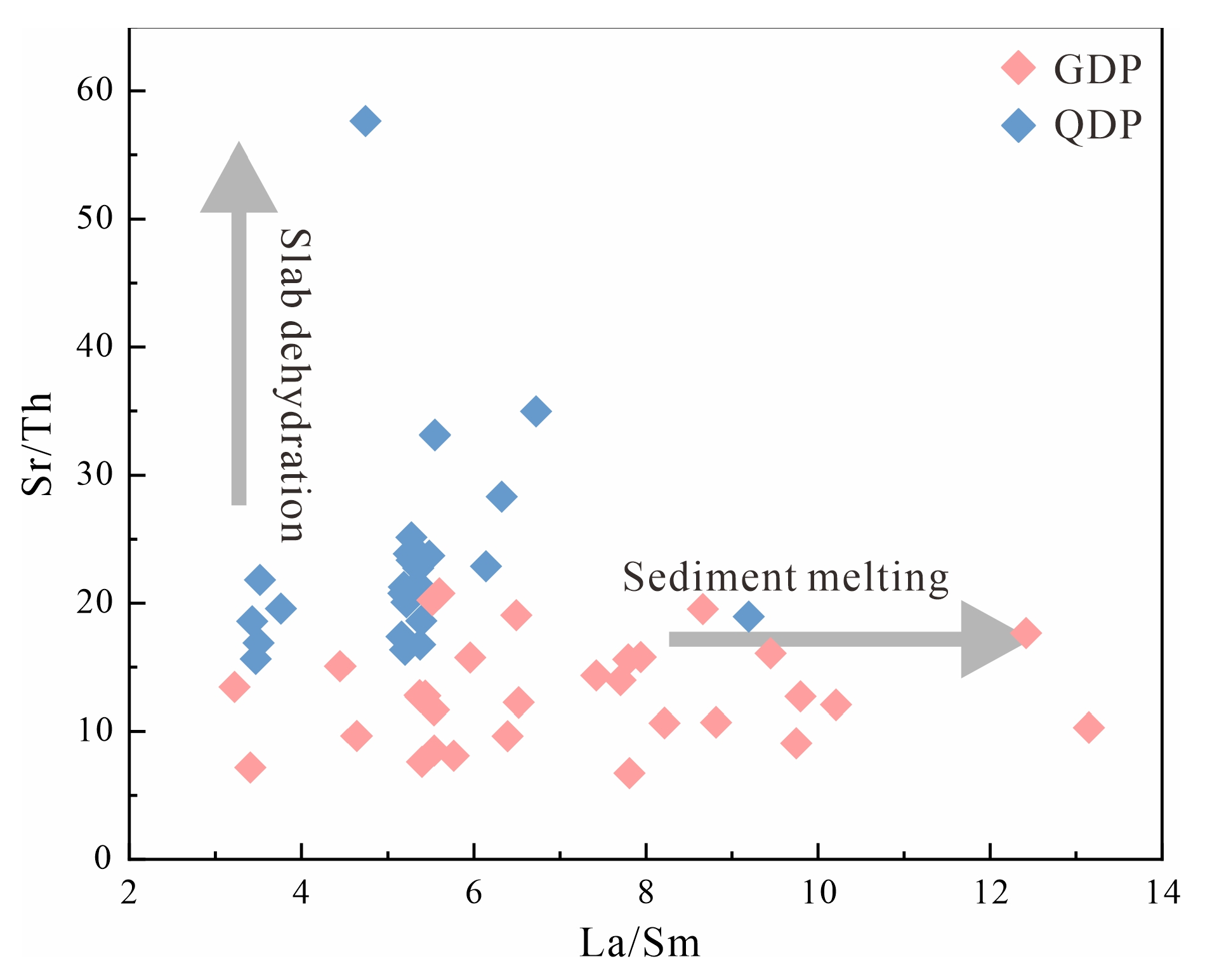
The ΣREE contents of zircons from both types of Langdu intrusives range from 333 to 982 ppm (avg. 680 ppm), values notably lower than the typical average for crust-derived magmatic zircons, indicating that the magma was not purely crustal in origin. However, the enrichment of LREEs in these zircons reflects a contribution from crustal material [15]. Apatite from the Langdu intrusions displays right-sloping REE patterns, a moderately negative Eu anomaly (Figure 4b), Sr enrichment, high XF/XCl, and low XCl/XOH values. These characteristics collectively point to a hybrid crust–mantle source signature. The initial 87Sr/86Sr ratios (ranging from 0.7044 to 0.7069) and εNd(t) ratios (varying from –2.8 to –2.2) [14] cluster within a narrow range that suggests a substantial contribution from a mantle-derived component to the parental magma. The relatively high Th/La ratios (0.37–0.48) indicate that fluid metasomatism also influenced the magma source to some degree [14,15,24]. Furthermore, apatites from the Langdu ore-causative intrusion exhibit relatively constant Sr/Th ratios but highly variable La/Sm ratios (Figure 11), pointing to the influence of sedimentary material in the source [77,78].
Figure 11.
Apatite Sr/Th vs. La/Sm diagram for the Langdu intrusions.
Based on the above evidence, this study proposes the following petrogenetic model: during the Late Triassic westward subduction of the Garzê–Litang Ocean, oceanic crust and overlying sediments were carried into the subduction zone. With increasing depth, temperature, and pressure, the subducting slab and sediments underwent metamorphism and dehydration, releasing fluids into the overlying mantle wedge. These fluids induced metasomatism and partial melting of the mantle wedge, ultimately generating the parental magma of the Langdu intrusions.
5.4. Implications for Porphyry–Skarn Cu Mineralization
The mineralization potential of porphyry–skarn magmas depends critically on their H2O content, S content, and oxidation state [79,80]. Globally, porphyry–skarn Cu deposits are associated with oxidized hydrothermal fluids exsolved from oxidized magmas (ΔFMQ = 1–2; [81]). In the upper crust, S in magmas with such high oxygen fugacity occurs predominantly as SO42− and SO2 rather than S2−, which inhibits sulfide saturation and allows chalcophile elements (e.g., Cu and Au) to become enriched in the residual melt [79]. To better constrain the mineralization conditions of the Langdu deposit, this study compares key geochemical indicators of its ore-causative and non-mineralized intrusions with those of the regional super-large Pulang and large Xuejiping deposits. The average zircon crystallization temperature of the ore-causative intrusion is lower than that of the non-mineralized intrusion, as well as those of Pulang and Xuejiping. Its average ΔFMQ value (+1.53) is slightly higher than that of the non-mineralized intrusion (+1.49) but lower than those of Pulang and Xuejiping (Table 1). Both intrusion types at Langdu exhibit high oxygen fugacity, though their ΔFMQ values are marginally different. Apatite from the ore-causative intrusion has high Eu/Eu* values (avg. 0.61) and low Ga contents (avg. 12.5 ppm), similar to apatite from Pulang. These characteristics suggest that temperature may not have been a controlling factor in the formation of the Langdu porphyry–skarn Cu deposit. Instead, high magmatic oxygen fugacity likely acted as one controlling factor, though its influence on mineralization was limited.
Volatile components such as F and Cl can modify phase equilibria in granitic melts by lowering the liquidus temperature and prolonging the duration of magmatic crystallization and differentiation [46]. Additionally, they enhance the mobility of fusible components (e.g., Si, Al), increase the solubility of high-field-strength elements (HFSEs) and rare earth elements (REEs) in the melt, and act as strong complexing agents to facilitate the transport of metallic elements in hydrothermal fluids [74,82]. Porphyry–skarn Cu deposits are typically linked to oxidized, hydrous magmas rich in S and Cl [41], as this environment promotes Cu transport via chloride complexes [83]. High H2O content enables ascending magma to carry greater amounts of S and Cu [84], thereby providing a more abundant material source for subsequent fluid exsolution and mineralization. The ore-causative intrusion at Langdu exhibits higher magmatic H2O (avg. 7.63 wt.%), S (560 ppm), and Cl (2141 ppm) contents than the non-mineralized intrusion (avg. 6.81 wt.%, 166 ppm, and 1154 ppm, respectively), whereas F concentrations are comparable between the two. Its magmatic volatile composition is close to that of Pulang and Xuejiping (Table 1), and the elevated H2O content created a prerequisite for effective fluid exsolution during the ore-forming stage. Fluid exsolution is conducive to porphyry–skarn Cu mineralization because the separation of saline phases results in high-temperature fluids that extract metals from the magma into brine and/or vapor phases, ultimately triggering the precipitation of Cu sulfides [21,22,81]. During crystallization and differentiation, the intrusions reach volatile saturation and exsolve magmatic fluids, which generate high-temperature, high-pressure, Cl-rich, and highly oxidized hydrothermal fluids. These fluids migrate upward and outward via fractures until they encounter carbonate rocks (marble), where this contact triggers infiltration-diffusion metasomatism and initially forms anhydrous silicate skarn. As the reaction proceeds, cooling, increasing pH, and decreasing oxygen fugacity destabilize metal chloride complexes. The liberated metals then combine with reduced S, precipitating sulfide minerals within skarn interstices or fractures to ultimately form the skarn orebody.
Therefore, this study proposes that relatively high magmatic oxygen fugacity, H2O content, S content, and Cl content, together with efficient fluid exsolution, were key factors controlling mineralization in the Langdu porphyry–skarn Cu deposit. In contrast, magmatic F content likely played only a minor role in the ore-forming process.
Table 1.
Mineralization indicators of the Zhongdian intrusive rock mass.
6. Conclusions
The Langdu intrusions have emplacement ages ranging from 216.5 ± 1.5 Ma to 213.2 ± 0.7 Ma, indicating formation during Late Triassic (Indosinian) magmatism. This period coincides with the westward subduction of the Garzê–Litang oceanic crust, confirming that the intrusions formed in a typical continental arc setting associated with oceanic crust subduction.
Geochemically, the Langdu intrusions are metaluminous I-type granite. Their parental magma was generated by partial melting of the mantle wedge, which had been metasomatized by fluids released from the subducting slab, followed by subsequent contamination with crustal material. During magma ascent, fractional crystallization of hornblende, sphene (titanite), rutile, monazite, and other minerals occurred.
The ore-forming magma at Langdu is characterized by relatively high oxygen fugacity, elevated H2O content, and enrichment in S and Cl—features that have significant implications for the formation of porphyry–skarn deposits.
Supplementary Materials
The following supporting information can be downloaded at: https://www.mdpi.com/article/10.3390/min16040413/s1, Table S1: LA-ICP-MS zircon U-Pb age data for the Langdu intrusions; Table S2: Trace element contents (ppm) of zircons from the Langdu intrusions; Table S3: Major element compositions (wt.%) of apatites from the Langdu intrusions; Table S4: Trace element contents (ppm) of apatites from the Langdu intrusions.
Author Contributions
Writing—Original Draft, Review, L.M.; Article Ideation, Writing—Original Draft, Review, C.L.; Sample Processing, Data Processing, X.C. and K.L.; Review, H.G., Y.W., T.D., W.L. and H.Y. All authors have read and agreed to the published version of the manuscript.
Funding
This work is granted by the National Natural Science Foundation of China (Grant No. 42022021), and the Deep Earth probe and Mineral Resources Exploration-National Science and Technology Major Project (Grant No. 2025ZD1008804).
Data Availability Statement
The original contributions presented in the study are included in the article/Supplementary Materials.
Acknowledgments
The authors would like to thank Dazhao Wang and Jiajie Chen from East China University of Technology for their assistance with field geological surveys and sample collection, as well as Wenjie Duan, at East China University of Technology, for her help with manuscript editing.
Conflicts of Interest
Tao Dong and Haijun Yu are employees of Yunnan Institute of Geological Survey. Wanquan Luo is employee of Shangri-La Huaxi Mining Co., Ltd. The authors declare that they have no known competing financial interests or personal relationships that could have appeared to influence the work reported in this paper.
References
- Sillitoe, R.H. Porphyry copper systems. Econ. Geol. 2010, 105, 3–41. [Google Scholar] [CrossRef] [Scilit]
- Chen, X.L.; Zhang, L.Q.; Wang, X.N.; Zou, S.H.; Li, K.X.; Zhu, Z.J.; Leng, C.B. Volatile evolution of magmas associated with the Bairong deposit, Tibet, and implications for porphyry Cu-Mo mineralization. Ore Geol. Rev. 2022, 150, 105201. [Google Scholar] [CrossRef] [Scilit]
- Hou, Z.Q.; Yang, Z.M.; Lu, Y.J.; Anthony, K.; Zheng, Y.C.; Li, Q.Y.; Tang, J.X.; Yang, Z.S.; Duan, L.F. A genetic linkage between subduction- and collision-related porphyry Cu deposits in continental collision zones. Geology 2015, 43, 247–250. [Google Scholar] [CrossRef] [Scilit]
- Peng, H.J. Metallogeny of the Hongniu-Hongshan Porphyry-Skarn Copper Deposit and the Porphyry-Skarn Metallogenic System of the Yidun Island Arc, Yunnan, SW China. Ph.D. Thesis, Chinese Academy of Geological Sciences, Beijing, China, 2014; pp. 1–184, (In Chinese with English Abstract). [Google Scholar]
- Hou, Z.Q.; Qu, X.M.; Zhou, J.R.; Yang, Y.Q.; Huang, D.H.; Lv, Q.T.; Tang, S.H.; Yu, J.J.; Wang, H.P.; Zhao, J.H. Collision-orogenic processes of the Yidun arc in the Sanjiang region: Record of granites. Acta Geol. Sin. 2001, 75, 484–497, (In Chinese with English Abstract). [Google Scholar]
- Hou, Z.Q.; Yang, Y.Q.; Qu, X.M.; Huang, D.H.; Lv, Q.T.; Wang, H.P.; Yu, J.J.; Tang, S.H. Tectonic evolution and mineralization systems of the Yidun arc orogen in Sanjiang region, China. Acta Geol. Sin. 2004, 78, 109–120, (In Chinese with English Abstract). [Google Scholar]
- Leng, C.B.; Zhang, X.C.; Hu, R.Z.; Wang, S.X.; Zhong, H.; Wang, W.Q.; Bi, X.W. Zircon U-Pb and molybdenite Re-Os geochronology and Sr-Nd-Pb-Hf isotopic constraints on the genesis of the Xuejiping porphyry copper deposit in Zhongdian, Northwest Yunnan, China. J. Asian Earth Sci. 2012, 60, 31–48. [Google Scholar] [CrossRef] [Scilit]
- Mo, L.; Leng, C.B.; Chen, X.L.; Zhang, X.C.; Li, K.X.; Duan, W.J.; Wang, Q.X.; Huang, S. Wall-rock Alteration and Element Fluxes in the Disuga Porphyry Cu Deposit, Northwest Yunnan Province, China, and Implications for Mineral Exploration. Acta Geol. Sin. (Engl. Ed.) 2025, 99, 1386–1403. [Google Scholar] [CrossRef] [Scilit]
- Li, W.C.; Liu, X.L.; Zeng, P.S.; Yin, G.H. The characteristics of metallogenic rocks in the Pulang porphyry copper deposit of Yunnan Province. Geol. China 2011, 38, 403–414, (In Chinese with English Abstract). [Google Scholar]
- Leng, C.B.; Cooke, D.R.; Hou, Z.Q.; Evans, N.J.; Zhang, X.C.; Chen, W.T.; Danisik, M.; McInnes, B.I.A.; Yang, J.H.; Yang, J.H. Quantifying exhumation at the giant Pulang porphyry Cu-Au deposit using U-Pb-He dating. Econ. Geol. 2018, 113, 1077–1092. [Google Scholar] [CrossRef] [Scilit]
- Leng, C.B.; Gao, J.F.; Chen, W.T.; Zhang, X.C.; Tian, Z.D.; Guo, J.H. Platinum-group elements, zircon Hf-O isotopes, and mineralogical constraints on magmatic evolution of the Pulang porphyry Cu-Au system, SW China. Gondwana Res. 2018, 62, 163–177. [Google Scholar] [CrossRef] [Scilit]
- Li, K.X.; Liang, H.Y.; Huang, W.T.; Zhang, J.; Chen, X.L. Highly oxidized characteristics of Tongchanggou porphyry associated with skarn-porphyry Mo-Cu mineralization and key factors controlling the elemental association of porphyry deposits in northwestern Yunnan Province. Geochimica 2019, 48, 101–113, (In Chinese with English Abstract). [Google Scholar] [CrossRef]
- Chen, X.L.; Leng, C.B.; Zou, S.H.; Li, K.X.; Zhang, L.J. Geochemical compositions of apatites from the Xuejiping and Disuga porphyries in Zhongdian arc: Implications for porphyry Cu mineralization. Ore Geol. Rev. 2021, 130, 103954. [Google Scholar] [CrossRef] [Scilit]
- Ren, T.; Zhong, H.; Chen, J.F.; Zhu, W.G.; Zhang, X.C. Geochemical characteristics of the Langdu high-K intermediate-acid intrusive rocks in the Zhongdian area, northwest Yunnan Province, P. R. China. Acta Mineral. Sin. 2011, 31, 43–54, (In Chinese with English Abstract). [Google Scholar] [CrossRef]
- Jin, C.H.; Fan, W.Y.; Zhang, Y.; Zhang, H.; Shen, Z.W.; Gao, J.H. Trace element composition and U-Pb chronology of zircons in monzonite porphyry from the Langdu copper deposit in Zhongdian and their geological significance. Geotecton. Metallog. 2013, 37, 262–272, (In Chinese with English Abstract). [Google Scholar] [CrossRef]
- Ballard, J.R.; Palin, J.M.; Campbell, I.H. Relative oxidation states of magmas inferred from Ce(IV)/Ce(III) in zircon: Application to porphyry copper deposits of northern Chile. Contrib. Mineral. Petrol. 2002, 144, 347–364. [Google Scholar] [CrossRef] [Scilit]
- Piccoli, P.M.; Candela, P.A. Apatite in igneous systems. Rev. Mineral. Geochem. 2002, 48, 255–292. [Google Scholar] [CrossRef] [Scilit]
- Lu, Y.J.; Loucks, R.R.; Fiorentini, M.; McCuaig, T.C.; Evans, N.F.; Yang, Z.M.; Hou, Z.Q.; Kirkland, C.L.; Parra-Avila, L.A.; Kobussen, A. Zircon compositions as a pathfinder for porphyry Cu ± Mo ± Au deposits. Soc. Econ. Geol. Spec. Publ. 2016, 19, 329–347. [Google Scholar]
- Zhu, J.J.; Richards, J.P.; Rees, C.; Creaser, R.; DuFrane, S.A.; Locock, A.; Petrus, J.A.; Lang, J. Elevated magmatic sulfur and chlorine Contents in ore-forming magmas at the Red Chris porphyry Cu-Au deposit, northern British Columbia, Canada. Econ. Geol. Bull. Soc. Econ. Geol. 2018, 113, 1047–1075. [Google Scholar] [CrossRef] [Scilit]
- Loucks, R.R.; Fiorentini, M.L.; Henríquez, G.J. New magmatic oxybarometer using trace elements in zircon. J. Petrol. 2020, 61, egaa034. [Google Scholar] [CrossRef] [Scilit]
- Sun, X.; Deng, J.; Lu, Y.J.; Si, X.B.; Pete, H.; Santosh, M.; Li, Q.; Zheng, X. Two stages of porphyry Cu mineralization at Jiru in the Tibetan collisional orogen: Insights from zircon, apatite, and magmatic sulfides. Geol. Soc. Am. Bull. 2023, 135, 2971–2986. [Google Scholar] [CrossRef] [Scilit]
- Huang, W.T.; Stock, M.J.; Xia, X.P.; Sun, X.M.; Cui, Z.X.; Ouyang, L.; Zhang, J.; Chen, X.L.; Zheng, Y.; Liang, H.Y. Determining the impact of magma water contents on porphyry Cu fertility: Constraints from hydrous and nominally anhydrous mineral analyses. Bull. Geol. Soc. Am. 2024, 136, 673–688. [Google Scholar] [CrossRef] [Scilit]
- Mo, L.; Leng, C.B.; Chen, X.L.; Li, K.X. Zircon trace elements and Hf-O isotopes of porphyries in the Zhongdian area of Yunnan Province and their implications for petrogenesis and mineralization. Acta Petrol. Sin. 2024, 40, 1163–1184, (In Chinese with English Abstract). [Google Scholar] [CrossRef] [Scilit]
- Mo, L.; Shen, Q.W.; Chen, X.L.; Wu, L.R.; Zhang, C.Y.; Dong, Q.F.; Su, X.Y.; Shi, B.S.; Yu, H.J.; Leng, C.B. Petrogeochemistry, chronology, Sr-Nd-Pb isotopic compositions, and geological significance of the ore-causative intrusion in the Langdu skarn deposit, northwest Yunnan. Sediment. Geol. Tethyan Geol. 2024, 44, 421c436, (In Chinese with English Abstract). [Google Scholar] [CrossRef]
- Leng, C.B.; Huang, Q.Y.; Zhang, X.C.; Wang, S.X.; Zhong, H.; Hu, R.Z.; Bi, X.W.; Zhu, J.J.; Wang, X.S. Petrogenesis of the Late Triassic volcanic rocks in the southern Yidun arc, SW China: Constraints from the geochronology, geochemistry, and Sr-Nd-Pb-Hf isotopes. Lithos 2014, 190–191, 363–382. [Google Scholar] [CrossRef] [Scilit]
- Tian, Z.D.; Leng, C.B.; Zhang, X.C. Provenance and tectonic setting of the Neoproterozoic meta-sedimentary rocks at southeastern Tibetan Plateau: Implications for the tectonic affinity of Yidun terrane. Precambrian Res. 2020, 344, 105736. [Google Scholar] [CrossRef] [Scilit]
- Tian, Z.D.; Leng, C.B.; Zhang, X.C.; Tian, F.; Lai, C.K. Late Neoproterozoic-early Paleozoic tectonic evolution and paleogeographic reconstruction of the eastern Tibetan Plateau: A perspective from detrital zircon U-Pb-Hf isotopic evidence. Precambrian Res. 2022, 377, 106738. [Google Scholar] [CrossRef] [Scilit]
- Hou, Z.Q.; Zaw, K.; Pan, G.T.; Mo, X.X.; Xu, Q.; Hu, Y.Z.; Li, X.Z. Sanjiang Tethyan metallogenesis in S.W. China: Tectonic setting, metallogenic epochs and deposit types. Ore Geol. Rev. 2007, 31, 48–87. [Google Scholar] [CrossRef] [Scilit]
- Leng, C.B.; Wang, D.Z.; Yu, H.J.; Tian, F.; Zhang, X.C. Mapping hydrothermal alteration zones with short wavelength infrared (SWIR) spectra and magnetic susceptibility at the Pulang porphyry Cu-Au deposit, Yunnan, SW China. Miner. Depos. 2024, 59, 699–716. [Google Scholar] [CrossRef] [Scilit]
- Li, Y.R.; Fan, Y.H.; Meng, Q. The Langdu skaen Cu deposit in northwest Yunan. Yunnan Geol. 2009, 28, 137–142. [Google Scholar]
- Li, H.; Zhang, H.; Ling, M.X.; Wang, F.Y.; Ding, X.; Zhou, J.B.; Yang, X.Y.; Tu, X.L.; Sun, W.D. Geochemical and zircon U-Pb study of the Huangmeijian A-type granite: Implications for geological evolution of the Lower Yangtze River belt. Int. Geol. Rev. 2011, 53, 499–525. [Google Scholar] [CrossRef] [Scilit]
- Vermeesch, P. IsoplotR: A free and open toolbox for geochronology. Geosci. Front. 2018, 9, 1479–1493. [Google Scholar] [CrossRef] [Scilit]
- Xing, C.M.; Wang, C.Y. Cathodoluminescence images and trace element compositions of fluorapatite from the Hongge layered intrusion in SW China: A record of prolonged crystallization and overprinted fluid metasomatism. Am. Mineral. 2017, 102, 1390–1401. [Google Scholar] [CrossRef] [Scilit]
- Zou, X.Y.; Qin, K.Z.; Han, X.L.; Li, G.M.; Evans, N.J.; Li, Z.Z.; Yang, W. Insight into zircon REE oxy-barometers: A lattice strain model perspective. Earth Planet. Sci. Lett. 2019, 506, 87–96. [Google Scholar] [CrossRef] [Scilit]
- Sun, S.S.; McDonough, W.F. Chemical and isotopic systematics of oceanic basalts: Implications for mantle composition and processes. In Magmatism in the Ocean Basins; Saunders, A.D., Norry, M.J., Eds.; Special Publications; Geological Society: London, UK, 1989; Volume 42, pp. 313–345. [Google Scholar]
- Hoskin, P.W.O. Trace-element composition of hydrothermal zircon and the alteration of Hadean zircon from the Jack Hills, Australia. Geochim. Cosmochim. Acta 2005, 69, 637–648. [Google Scholar] [CrossRef] [Scilit]
- Ferry, J.M.; Watson, E.B. New thermodynamic models and revised calibrations for the Ti-in-zircon and Zr-in-rutile thermometers. Contrib. Mineral. Petrol. 2007, 154, 429–437. [Google Scholar] [CrossRef] [Scilit]
- Ge, R.F.; Wilde, S.A.; Zhu, W.B.; Wang, X.L. Earth’s early continental crust formed from wet and oxidizing arc magmas. Nature 2023, 623, 334–339. [Google Scholar] [CrossRef] [Scilit]
- Trail, D.; Bruce, W.E.; Tailby, N.D. Ce and Eu anomalies in zircon as proxies for the oxidation state of magmas. Geochim. Cosmochim. Acta 2012, 97, 70–87. [Google Scholar] [CrossRef] [Scilit]
- Leng, C.B.; Chen, X.L.; Zhang, J.J.; Ma, X.H.; Tian, F.; Guo, J.H.; Zhang, L.J. Lithogeochemical and mineral chemical footprints of porphyry Cu ± Mo ± Au deposits: A review. Acta Geol. Sin. 2020, 94, 3189–3212, (In Chinese with English Abstract). [Google Scholar] [CrossRef]
- Richards, J.P.; Spell, T.; Rameh, E.; Razique, A.; Fletcher, T. High Sr/Y magmas reflect arc maturity, high magmatic water content, and porphyry Cu ± Mo ± Au potential: Examples from the Tethyan arcs of central and eastern Iran and western Pakistan. Econ. Geol. 2012, 107, 295–332. [Google Scholar] [CrossRef] [Scilit]
- Chen, X.L.; Brzozowski, M.J.; Zou, S.H.; Qi, L.; Li, K.X.; Leng, C.B. Platinum-group element geochemistry of igneous rocks in the Chongjiang Cu-Mo-Au deposit, southern Tibet: Implications for the formation of post-collisional porphyry Cu deposits. J. Petrol. 2024, 65, egae025. [Google Scholar] [CrossRef] [Scilit]
- Huebner, J.S. Buffering techniques for hydrostatic systems at elevated pressures. In Research Techniques for High Pressure and High Temperature; Ulmer, G.C., Ed.; Springer: New York, NY, USA, 1971; pp. 123–177. [Google Scholar]
- Chou, I.M. Calibration of oxygen buffers at elevated P and T using the hydrogen fugacity sensor. Am. Mineral. 1978, 63, 690–703. [Google Scholar]
- Huebner, J.S.; Sato, M. The oxygen fugacity-temperature relationships of manganese oxide and nickel oxide buffer. Am. Mineral. 1970, 55, 934–952. [Google Scholar]
- Li, H.W.; Yang, Z.M. Geochemistry of magmatic zircon and apatite and its applications in porphyry deposits. Acta Geol. Sin. 2023, 97, 973–1001, (In Chinese with English Abstract). [Google Scholar] [CrossRef]
- Yang, Y.; Tang, J.X.; Zhang, Z.B.; Tang, P.; Xie, F.W.; Ran, F.Q.; Yang, Z.Y.; Yang, H.C.; Bai, Y.; Sun, M.; et al. Mineral Geochemistry of Apatite in the Jiama Porphyry-Skarn Deposit, Tibet and its Geological Significance. Acta Geol. Sin. (Engl. Ed.) 2024, 98, 399–415. [Google Scholar] [CrossRef] [Scilit]
- Peng, G.; Luhr, J.F.; McGee, J.J. Factors controlling sulfur concentrations in volcanic apatite. Am. Mineral. 1997, 82, 1210–1224. [Google Scholar] [CrossRef] [Scilit]
- Meng, X.Y.; Kleinsasser, J.M.; Richards, J.P.; Tapster, S.R.; Jugo, P.R.; Simon, A.C.; Kontak, D.J.; Robb, L.; Bybee, G.M.; Marsh, J.H.; et al. Oxidized sulfur-rich arc magmas formed porphyry Cu deposits by 1.88 Ga. Nat. Commun. 2021, 12, 2189. [Google Scholar] [CrossRef] [Scilit]
- Zhang, C.; Holtz, F.; Ma, C.Q.; Wolff, P.E.; Li, X.Y. Tracing the evolution and distribution of F and Cl in plutonic systems from volatile-bearing minerals: A case study from the Liujiawa pluton (Dabie orogen, China). Contrib. Mineral. Petrol. 2012, 164, 859–879. [Google Scholar] [CrossRef] [Scilit]
- Webster, J.D.; Tappen, C.M.; Mandeville, C.W. Partitioning behavior of chlorine and fluorine in the system apatite-melt-fluid. II: Felsic silicate systems at 200 MPa. Geochim. Cosmochim. Acta 2009, 73, 559–581. [Google Scholar] [CrossRef] [Scilit]
- Pan, L.C.; Hu, R.Z.; Wang, X.S.; Bi, X.W.; Zhu, J.J.; Li, C.S. Apatite trace element and halogen compositions as petrogenetic-metallogenic indicators: Examples from four granite plutons in the Sanjiang region, SW China. Lithos 2016, 254, 118–130. [Google Scholar] [CrossRef] [Scilit]
- Li, H.J.; Hermann, J. Chlorine and fluorine partitioning between apatite and sediment melt at 2.5 GPa, 800 °C: A new experimentally derived thermodynamic model. Am. Mineral. 2017, 102, 580–594. [Google Scholar] [CrossRef] [Scilit]
- Zeng, P.S.; Mo, X.X.; Yu, X.H.; Hou, Z.Q.; Xu, Q.D.; Wang, H.P.; Li, H.; Yang, C.Z. Porphyries and porphyry copper deposits in Zhongdian area, northwestern Yunnan. Miner. Depos. 2003, 22, 393–400, (In Chinese with English Abstract). [Google Scholar]
- Li, K.X.; Leng, C.B.; Lan, J.B.; Guo, G.L.; Zhu, Z.J.; Chen, X.L. Petrogenesis and Metallogenic Potential of the Gaochiping Pluton in Yunnan: Constraints from Zircon U-Pb Chronology, Geochemistry, and Sr-Nd-Hf Isotopes. Geotecton. Metallog. 2024, 48, 1366–1386, (In Chinese with English Abstract). [Google Scholar] [CrossRef]
- Grimes, C.B.; John, B.E.; Kelemen, P.B.; Mazdab, F.K.; Wooden, J.L.; Cheadle, M.J.; Hanghøj, K.; Schwartz, J.J. Trace element chemistry of zircons from oceanic crust: A method for distinguishing detrital zircon provenance. Geology 2007, 35, 643–646. [Google Scholar] [CrossRef] [Scilit]
- Grimes, C.B.; Wooden, J.L.; Cheadle, M.J.; John, B.E. “Fingerprinting” tectono-magmatic provenance using trace elements in igneous zircon. Contrib. Mineral. Petrol. 2015, 170, 46. [Google Scholar] [CrossRef] [Scilit]
- Hawkesworth, C.J.; Kemp, A.I.S. Using hafnium and oxygen isotopes in zircons to unravel the record of crustal evolution. Chem. Geol. 2006, 226, 144–162. [Google Scholar] [CrossRef] [Scilit]
- Schulz, B.; Klemd, R.; Brätz, H. Host rock compositional controls on zircon trace element signatures in metabasites from the Austroalpine basement. Geochim. Cosmochim. Acta 2006, 70, 697–710. [Google Scholar] [CrossRef] [Scilit]
- Yang, J.H.; Cawood, P.A.; Du, Y.S.; Huang, H.; Huang, H.W.; Tao, P. Large Igneous Province and magmatic arc sourced Permian-Triassic volcanogenic sediments in China. Sediment. Geol. 2012, 261–262, 120–131. [Google Scholar] [CrossRef] [Scilit]
- Whalen, J.B.; Currie, K.L.; Chappell, B.W. A-type granites: Geochemical characteristics, discrimination and petrogenesis. Contrib. Mineral. Petrol. 1987, 95, 407–419. [Google Scholar] [CrossRef] [Scilit]
- Wu, F.Y.; Li, X.H.; Yang, J.H.; Zheng, Y.F. Discussions on the petrogenesis of granites. Acta Petrol. Sin. 2007, 23, 1217–1238, (In Chinese with English Abstract). [Google Scholar]
- King, P.L.; White, A.J.R.; Chappell, B.W.; Allen, C.M. Characterization and origin of aluminous A-type granites from the Lachlan Fold Belt, southeastern Australia. J. Petrol. 1997, 38, 371–391. [Google Scholar] [CrossRef]
- Miller, C.F.; McDowell, S.M.; Mapes, R.W. Hot and cold granites? Implications of zircon saturation temperatures and preservation of inheritance. Geology 2003, 31, 529–532. [Google Scholar] [CrossRef] [Scilit]
- Clemens, J.D. S-type granitic magmas-petrogenetic issues, models and evidence. Earth-Sci. Rev. 2003, 61, 1–18. [Google Scholar] [CrossRef] [Scilit]
- Tao, J.H.; Li, X.W.; Yang, Y.G.; Shi, Z.; Tang, W.J. Zircon trace element geochemistry of Yanshanian biotite granite from Longyuanba complex in the Eastern Nanling Range and its geological significance. J. East China Univ. Technol. (Nat. Sci.) 2024, 47, 431–441, (In Chinese with English Abstract). [Google Scholar] [CrossRef]
- Chappell, B.W. Aluminium saturation in I- and S-type granites and the characterization of fractionated haplogranites. Lithos 1999, 46, 535–551. [Google Scholar] [CrossRef] [Scilit]
- Maniar, P.D.; Piccoli, P.M. Tectonic discrimination of granitoids. Geol. Soc. Am. Bull. 1989, 101, 635–643. [Google Scholar] [CrossRef] [Scilit]
- Wang, Q.; Zhu, D.C.; Zhao, Z.D.; Guan, Q.; Zhang, X.Q.; Sui, Q.L.; Hu, Z.C.; Mo, X.X. Magmatic zircons from I-, S- and A-type granitoids in Tibet: Trace element characteristics and their application to detrital zircon provenance study. J. Asian Earth Sci. 2012, 53, 59–66. [Google Scholar] [CrossRef] [Scilit]
- Zou, X.Y.; Jiang, J.L.; Qin, K.Z.; Zhang, Y.G.; Yang, W.; Li, X.H. Progress in the principle and application of zircon trace element. Acta Petrol. Sin. 2021, 37, 985–999, (In Chinese with English Abstract). [Google Scholar] [CrossRef] [Scilit]
- Dilles, J.H.; Kent, A.J.R.; Wooden, J.L.; Tosdal, R.M.; Koleszar, A.; Lee, R.G.; Farmer, L.P. Zircon compositional evidence for sulfur-degassing from ore-forming arc magmas. Econ. Geol. 2015, 110, 241–251. [Google Scholar] [CrossRef] [Scilit]
- Wei, H.; Fabris, A.; Gilbert, S.; Wade, B.P.; Collins, A.S.; Wise, T.; Anthony, J.R. Using zircon and apatite chemistry to fingerprint porphyry Cu–Mo ± Au mineralization in the Delamerian Orogen, South Australia. Miner. Depos. 2024, 59, 1619–1640. [Google Scholar] [CrossRef] [Scilit]
- Lu, T.Y.; He, Z.Y.; Klemd, R. Different magma differentiation processes of post-onset collision adakitic rocks in the Gangdese Batholith: Evidence from zircon trace elements. Chem. Geol. 2023, 620, 121345. [Google Scholar] [CrossRef] [Scilit]
- Chen, X.C.; Mao, K.N.; Yang, W.; Yang, W.; Yan, J.; Li, P.; Jiang, H. The indicative significance of apatite geochemical characteristics on tin metallogenic capacity of granite: A case study of the Xiaolonghe tin deposit in the Tengchong-Lianghe tin belt, western Yunnan. Acta Geol. Sin. 2023, 97, 3846–3862, (In Chinese with English Abstract). [Google Scholar] [CrossRef]
- Hoskin, P.W.O.; Ireland, T.R. Rare earth element chemistry of zircon and its use as a provenance indicator. Geology 2000, 28, 627–630. [Google Scholar] [CrossRef] [Scilit]
- O’Sullivan, G.; Chew, D.; Kenny, G.; Henrichs, I.; Mulligan, D. The trace element composition of apatite and its application to detrital provenance studies. Earth Sci. Rev. 2020, 201, 103044. [Google Scholar] [CrossRef] [Scilit]
- Li, J.; Ma, Z.B.; Yang, Y.; Huang, J.H.; Zhang, R.Z.; Han, J.W. Reviews on apatite and its application in the field of ore deposit geology. Geol. China 2025, 52, 574–596, (In Chinese with English Abstract). [Google Scholar] [CrossRef]
- Ding, T.; Ma, D.; Lu, J.; Zhang, R.Q. Apatite in granitoids related to polymetallic mineral deposits in southeastern Hunan Province, Shi–Hang zone, China: Implications for petrogenesis and metallogenesis. Ore Geol. Rev. 2015, 69, 104–117. [Google Scholar] [CrossRef] [Scilit]
- Richards, J.P. High Sr/Y arc magmas and porphyry Cu ± Mo ± Au deposits: Just add water. Econ. Geol. 2011, 106, 1075–1081. [Google Scholar] [CrossRef] [Scilit]
- Meng, X.Y.; Mao, J.W.; Zhang, C.Q.; Zhang, D.Y.; Liu, H. Melt recharge, fO2-T conditions, and metal fertility of felsic magmas: Zircon trace element chemistry of Cu-Au porphyries in the Sanjiang orogenic belt, southwest China. Miner. Depos. 2018, 53, 649–663. [Google Scholar] [CrossRef] [Scilit]
- Richards, J.P. The oxidation state, and sulfur and Cu contents of arc magmas: Implications for metallogeny (Review). Lithos 2015, 233, 27–45. [Google Scholar] [CrossRef] [Scilit]
- Tian, F.; Leng, C.B.; Zhang, X.C.; Tian, Z.D.; Zhang, W. The key role of volatile -rich magma replenishment in the formation of porphyry Cu-Mo deposits: A case study of Gangjiang porphyry Cu-Mo deposit, Tibet. Acta Petrol. Sin. 2021, 37, 2889–2909, (In Chinese with English Abstract). [Google Scholar] [CrossRef] [Scilit]
- Zajacz, Z.; Candela, P.; Piccoli, P.M.; Sanchez-Valle, C. The partitioning of sulfur and chlorine between andesite melts and magmatic volatiles and the exchange coefficients of major cations. Geochim. Cosmochim. Acta 2012, 89, 81–101. [Google Scholar] [CrossRef] [Scilit]
- Schütte, P.; Chiaradia, M.; Barra, F.; Villagómez, D.; Beate, B. Metallogenic features of Miocene porphyry Cu and porphyry-related mineral deposits in Ecuador revealed by Re-Os, 40Ar/39Ar, and U-Pb geochronology. Miner. Depos. 2012, 47, 383–410. [Google Scholar] [CrossRef] [Scilit]
- Mo, L. A Comparative Study on the Indosinian Magmatism and Mineralization of the Zhongdian Copper Polymetallic Mineralization Belt. Master’s Thesis, East China University of Technology, Nanchang, China, 2026; pp. 1–82, (In Chinese with English Abstract). [Google Scholar] [CrossRef]
- Xin, K.; Shu, Q.H.; Zhao, H.S.; Xu, H.N. Geochemical characteristics and geological significance of apatites in the Pulang porphyry copper deposit, NW Yunnan Province. Acta Petrol. Sin. 2018, 34, 1427–1440, (In Chinese with English Abstract). [Google Scholar] [CrossRef]
- Li, X.F. Geochemistry and Ore-Bearing Potential Research of the Indo-Porphyries in Zhongdian Arc, SN Yunnan. Master’s Thesis, China University of Geosciences (Beijing), Beijing, China, 2016; pp. 1–95, (In Chinese with English Abstract). [Google Scholar] [CrossRef]
- Zhou, X.D.; Yang, F.; Wu, J.; Li, F.; Jian, R.T.; Yang, T. Petrogenesis of porphyry body in the periphery of Pulang porphyry copper deposit, Yunnan. Geol. Sci. Technol. Inf. 2018, 37, 39–50, (In Chinese with English Abstract). [Google Scholar] [CrossRef]
- Wang, P.; Dong, G.C.; Zhao, G.C.; Han, Y.G.; Li, Y.P. Petrogenesis of the Pulang porphyry complex, southwestern China: Implications for porphyry copper metallogenesis and subduction of the Paleo-Tethys Oceanic lithosphere. Lithos 2018, 304, 280–297. [Google Scholar] [CrossRef] [Scilit]
Disclaimer/Publisher’s Note: The statements, opinions and data contained in all publications are solely those of the individual author(s) and contributor(s) and not of MDPI and/or the editor(s). MDPI and/or the editor(s) disclaim responsibility for any injury to people or property resulting from any ideas, methods, instructions or products referred to in the content. |
© 2026 by the authors. Licensee MDPI, Basel, Switzerland. This article is an open access article distributed under the terms and conditions of the Creative Commons Attribution (CC BY) license.