


Abstract
The Mahuaping deposit is the largest Be-W-F deposit in the Jinshajiang–Ailaoshan metallogenic belt, Sanjiang region, SW China, with more than 72,700 t WO3, 41700 t BeO and 2.3 Mt CaF2. Despite recent studies, the ore-forming process of the Mahuaping deposit remains poorly understood, limiting further insight into its genesis. In this study, a new muscovite Rb-Sr age and elemental compositions of beryl have been reported to constrain the mineralization age and evolution of ore-forming fluids. Muscovite Rb-Sr isochron dating reveals the mineralization age of the Mahuaping Be-W-F deposit is 28.0 ± 1.5 Ma, indicating the formation of the Mahuaping deposit is probably related to the magmatism caused by the sinistral shearing of crust in the Oligocene. LA-ICP-MS elemental mapping and spot analysis suggest the mechanisms for the incorporation of trace elements into the beryl lattice primarily involve two substitution types: Be2+ ↔ Li+ + Na+/Cs+ in the crystal core, and Al3+ ↔ (Fe2+/Mg2+) + (Na+/Cs+/Rb+) occurring in both the core and rim. The enrichment of Fe2+ is responsible for the blue coloration observed in beryl. The compositional variation from core to rim in beryl crystal indicates the initial ore-forming fluid of the Mahuaping deposit is reducing and acidic, and dominantly originated from magmatic fluids derived from the highly evolved magma. During the evolution, in addition to the continuous mixing of meteoric water, due to pulsating exsolution, the magmatic fluids were also replenished into the ore-forming fluid, enhancing water/rock interaction.
1. Introduction
In recent years, with the development of high tech, the global demand for tungsten and beryllium has been increasing rapidly. Tungsten has been widely used in military, electronics and aerospace fields due to its high density and high melting point (up to 3422 °C, highest among all metals). Meanwhile, beryllium has been widely used in aerospace and nuclear industries based on its low density, high thermal conductivity, and corrosion resistance [1]. Although China is a major tungsten resource country, beryllium is almost 100% dependent on imports [2]. Therefore, studying the Be mineralization, finding out the laws of Be mineralization, and exploring new Be resources are urgent tasks.
Based on the geological setting of beryllium deposit formation, and with reference to the source of ore-forming materials (magmatic or otherwise) and the emplacement environment (magmatic, metamorphic, or sedimentary rocks), beryllium deposits can be broadly classified into two categories: those associated with magmatism and those unrelated to magmatism [3,4,5]. Most beryllium deposits are closely related to magmatic processes, whereas those unrelated to magmatism are relatively rare and mainly include sedimentary or metamorphic hydrothermal types, as well as minor weathering crust and placer types. Beryllium deposits associated with magmatism include not only magmatic or pegmatitic and volcanic-hosted types but also skarn, metasomatic, and vein types related to magmatic/hydrothermal activity. Among them, the pegmatite-type beryllium deposit is dominant, accounting for a large proportion of the total proved Be reserves. The hydrothermal-type beryllium deposit is also very important, which has the characteristics of high ore grade and large reserves in a single deposit. Since the increasing industrial demand for beryllium, many studies on beryllium mineralization have been conducted in the past three decades, mainly focusing on deposit geology [6], mineralization age [7,8,9,10,11], source of ore-forming materials [12,13,14], and ore-forming processes and mechanisms [15,16,17,18,19,20,21], making significant contributions to understanding the mineralization of beryllium. However, these studies are dominated by pegmatite-type beryllium deposit, with few studies on hydrothermal-type beryllium deposit.
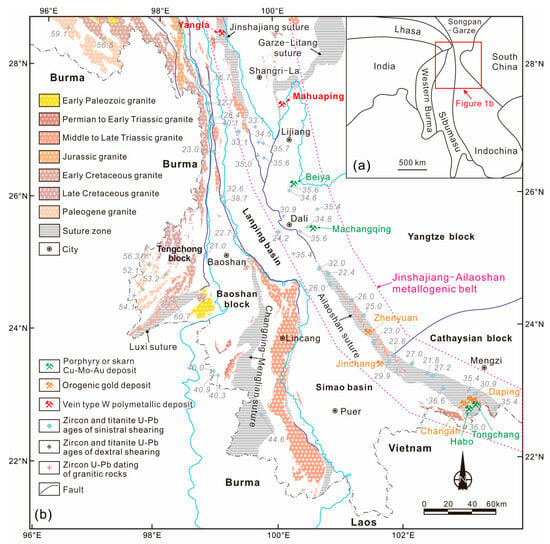
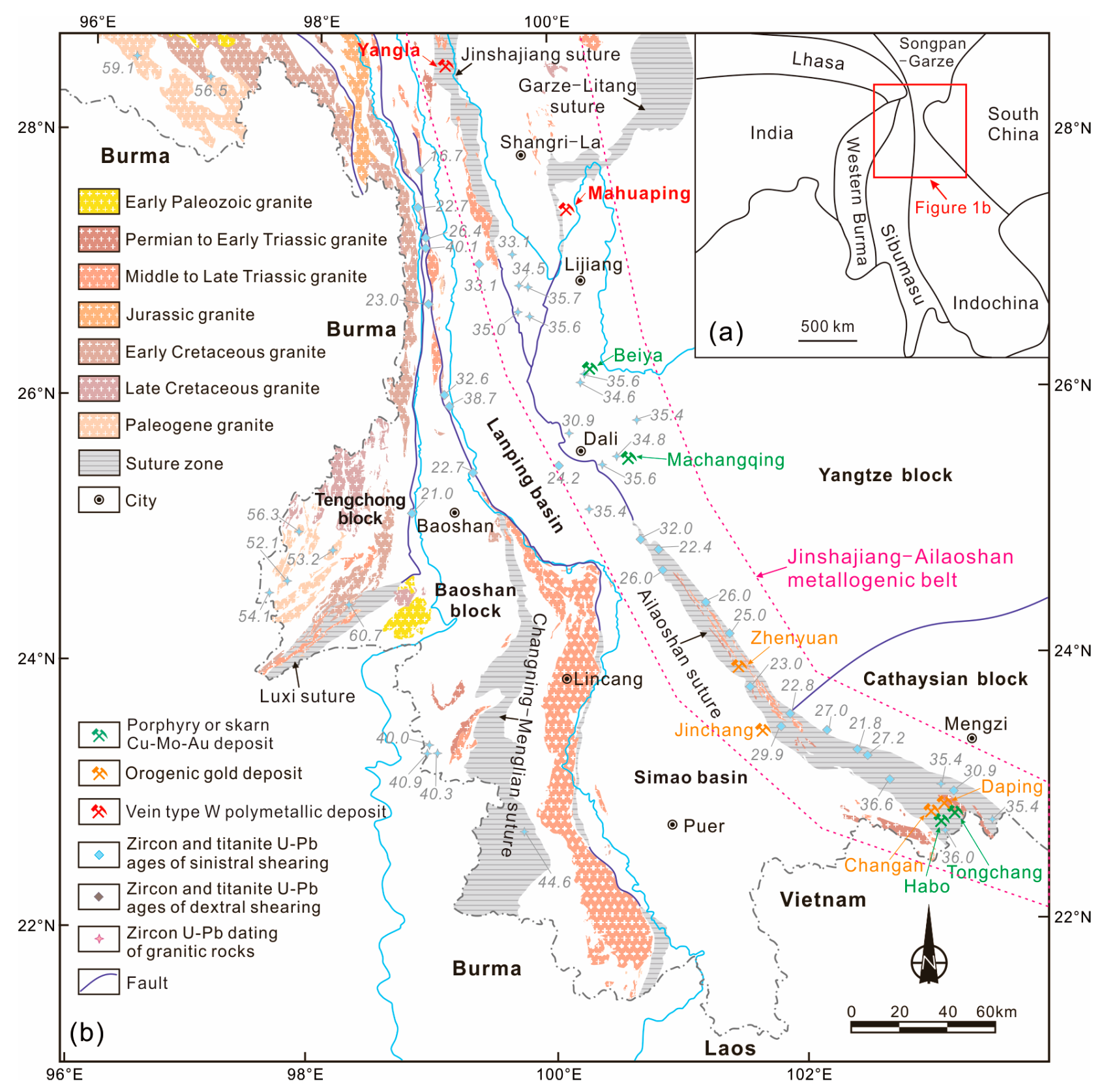
The Mahuaping Be-W-F deposit, located in the middle section of the Sanjiang metallogenic belt in SW China (Figure 1), is a typical super-large hydrothermal-type beryllium deposit [22], with WO3 reserves of 72,700 t (average grade of 0.82%), BeO reserves of 41,700 t (average grade of 0.24%) and 2.3 Mt CaF2 (average grade of 16.67%). Its beryllium resources account for more than half of the total in Yunnan province. In order to reveal the genesis of the Mahuaping Be-W-F deposit, some studies on deposit geology [23], mineralization age [24] and ore-forming fluids [11,25] have been conducted. However, the mineralization process of the Mahuaping deposit remains unclear, and the mineralization age is still controversial. For example, Ran [26] yielded a Miocene mineralization age (21.5–13.7 Ma) by ESR dating of quartz from beryl/quartz and wolframite/quartz veins. However, Ma [11] proposed an Oligocene mineralization age (32.06 ± 0.11 Ma) obtained by Ar-Ar dating of muscovite from scheelite/muscovite/fluorite veins [11], and Li also proposed an Oligocene age obtained by U-Pb dating of wolframite (30.6 ± 0.5 Ma) and monazite (29.4 ± 0.3 Ma) [24].
Figure 1.
(a) Tectonic framework of southeast Asian showing major continental blocks [27,28]; (b) tectonic framework of the Sanjiang region showing the major continental blocks and suture zones [27].
In order to reveal the genesis of the Mahuaping Be-W-F deposit, LA-MC-ICP-MS Rb-Sr isochron dating of muscovite from scheelite/muscovite/fluorite veins has been conducted to determine the mineralization time, and EPMA and LA-ICP-MS elemental compositional analyses of beryl have been used to constrain the ore-forming processes in this study. This contribution also helps to understand the formation of hydrothermal-type beryllium deposit and to guide further exploration in this region.
2. Geological Setting
2.1. Regional Geology
The Sanjiang metallogenic province is located on the southeastern Tibetan Plateau, SW China (Figure 1a). It has undergone the evolution of the Proto-, Paleo-, Meso- and Neo-Tethys oceans in the Paleozoic to Mesozoic, and the collision of the Indian and Eurasian continental plates in the Cenozoic [27,28]. The complex tectonic evolution of the Sanjiang metallogenic province has resulted in multiple episodes and styles of magmatism and related mineralization.
The Jinshajiang–Ailaoshan metallogenic belt is one of the most representative metallogenic belts within the Sanjiang metallogenic province (Figure 1b). It extends in a near NS direction along the Jinshajiang–Ailaoshan Paleo-Tethyan suture zone, and is characterized by a large number of subduction-related magmatism and associated mineralization, such as the Gacun VMS Ag deposit [29], Pulang porphyry Cu deposit [30] and Langdu skarn Cu deposit [31]. In the Cenozoic, the widespread development of alkali-rich porphyries and transpressional strike-slip faulting also played a significant role in the mineralization in this belt. The Eocene alkali-rich magmatic activity produced certain amounts of Cu-Au-Mo mineralization, such as the Yulong porphyry Cu-Mo deposit [32], Beiya skarn Au-Cu deposit [33], Machangqing porphyry Cu-Mo deposit [34] and Tongchang porphyry Cu deposit [35]. While the transpressional tectonic regime developed a series of orogenic gold deposits, represented by the Zhenyuan Au deposit [36] and Changan Au deposit [37]. In addition, there is some Oligocene W polymetallic mineralization that developed in the Jinshajiang–Ailaoshan metallogenic belt as well, including the Yangla W-Sb deposit [38] and Mahuaping Be-W-F deposit [24]. To date, few studies have specifically focused on the Oligocene W polymetallic mineralization within this belt.
2.2. Deposit Geology
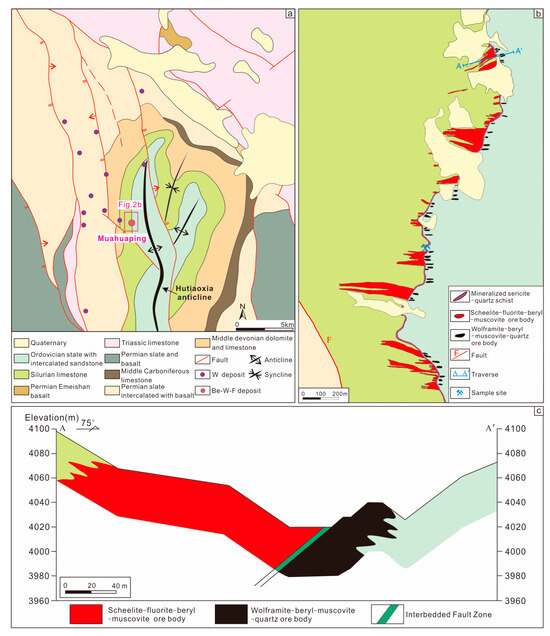
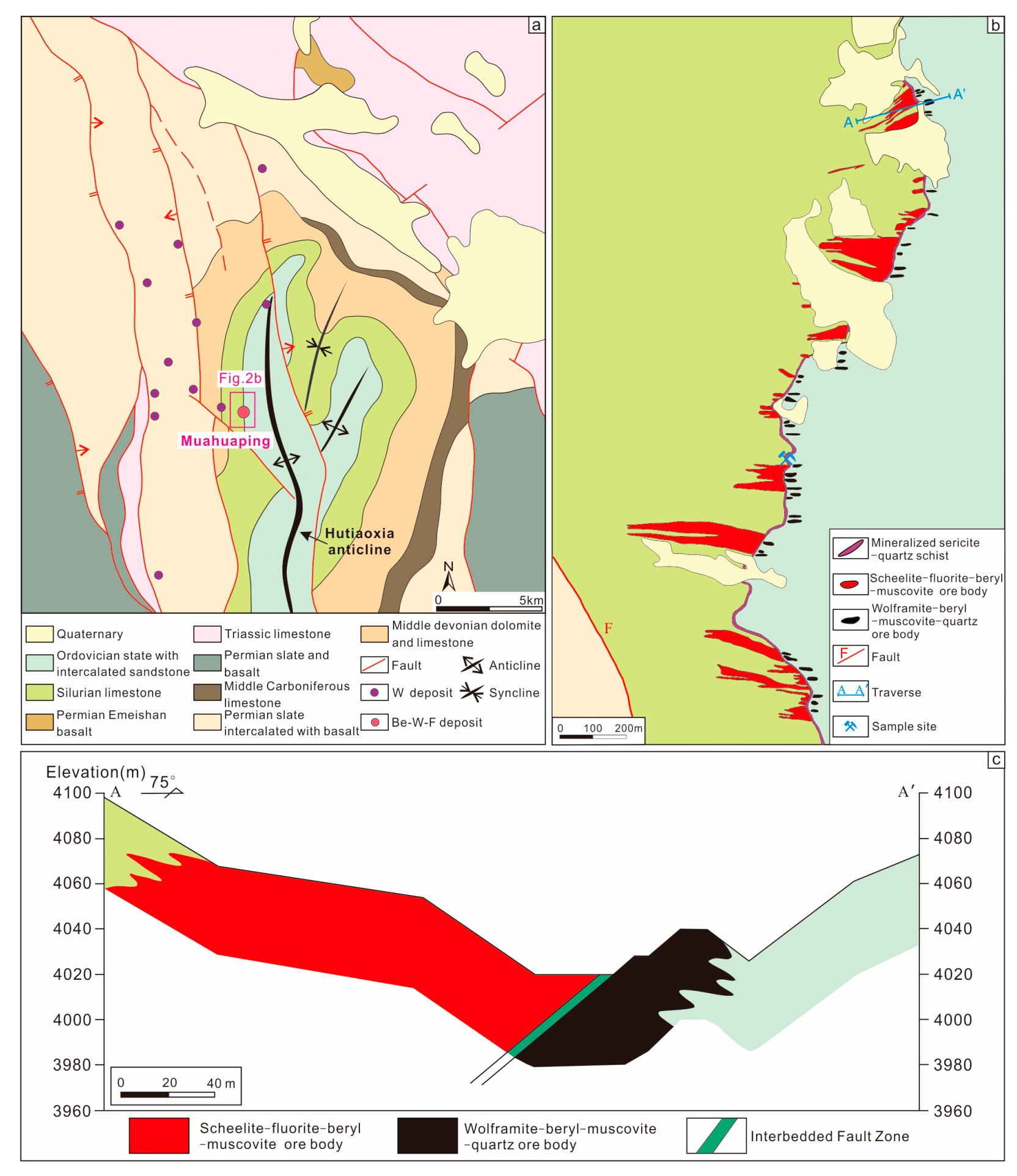
The Mahuaping Be-W-F deposit is one of the largest and most representative deposits in the Hutiaoxia district (Figure 2a), which is located in the northern part of the Jinshajiang–Ailaoshan metallogenic belt (Figure 1b).
Figure 2.
(a) Geological map of the Mahuaping deposit [23]; (b) geological sketch map of the Mahuaping tungsten/beryllium deposit; (c) geological profile of orebody in the Mahuaping beryllium/tungsten deposit [23].
The main exposed strata in the Mahuaping ore district consist of Ordovician clastic rocks, Silurian carbonate rocks, Permian clastic rocks and basalts, and Quaternary residual-slope sediments (Figure 2b). The Ordovician clastic rocks are predominantly composed of argillaceous slate and sandstone, with locally intercalated lenticular marbleized limestone. The Silurian carbonate rocks are characterized by marble and marbleized limestone. The Permian strata consist mainly of slate and dark gray basalt, with local tuff intercalations in the basalt. The Quaternary residual-slope sediments are sporadically distributed, primarily at the interface between the Ordovician and Silurian units, and are composed of a suite of glacial till (boulders, sandy gravel, clay layers) and fluvial deposits (gravel, sandy gravel, silt layers). Among them, the Ordovician argillaceous slate and sandstone and Silurian marble and marbleized limestone are the ore-hosted rocks in the Mahuaping Be-W deposit. It is worth noting that, apart from Permian basalt, no other magmatic rocks are exposed in the Mahuaping ore district. In particular, no intermediate to acidic magmatic rocks that may be genetically related to Be–W mineralization have been identified, although gravity data suggest the presence of a deep-seated intrusive body beneath the surface [39].
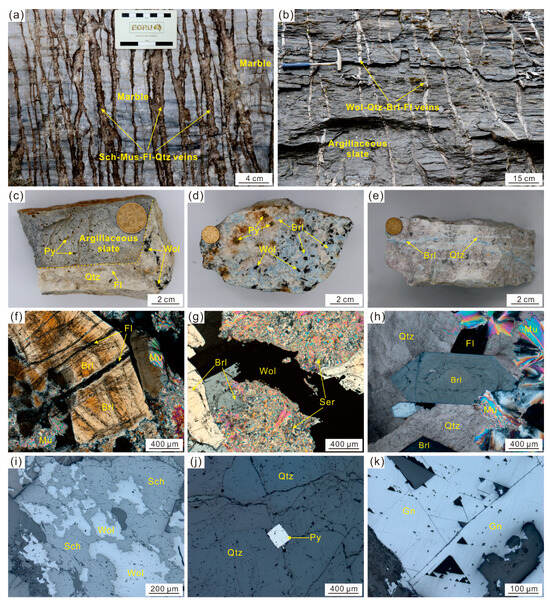
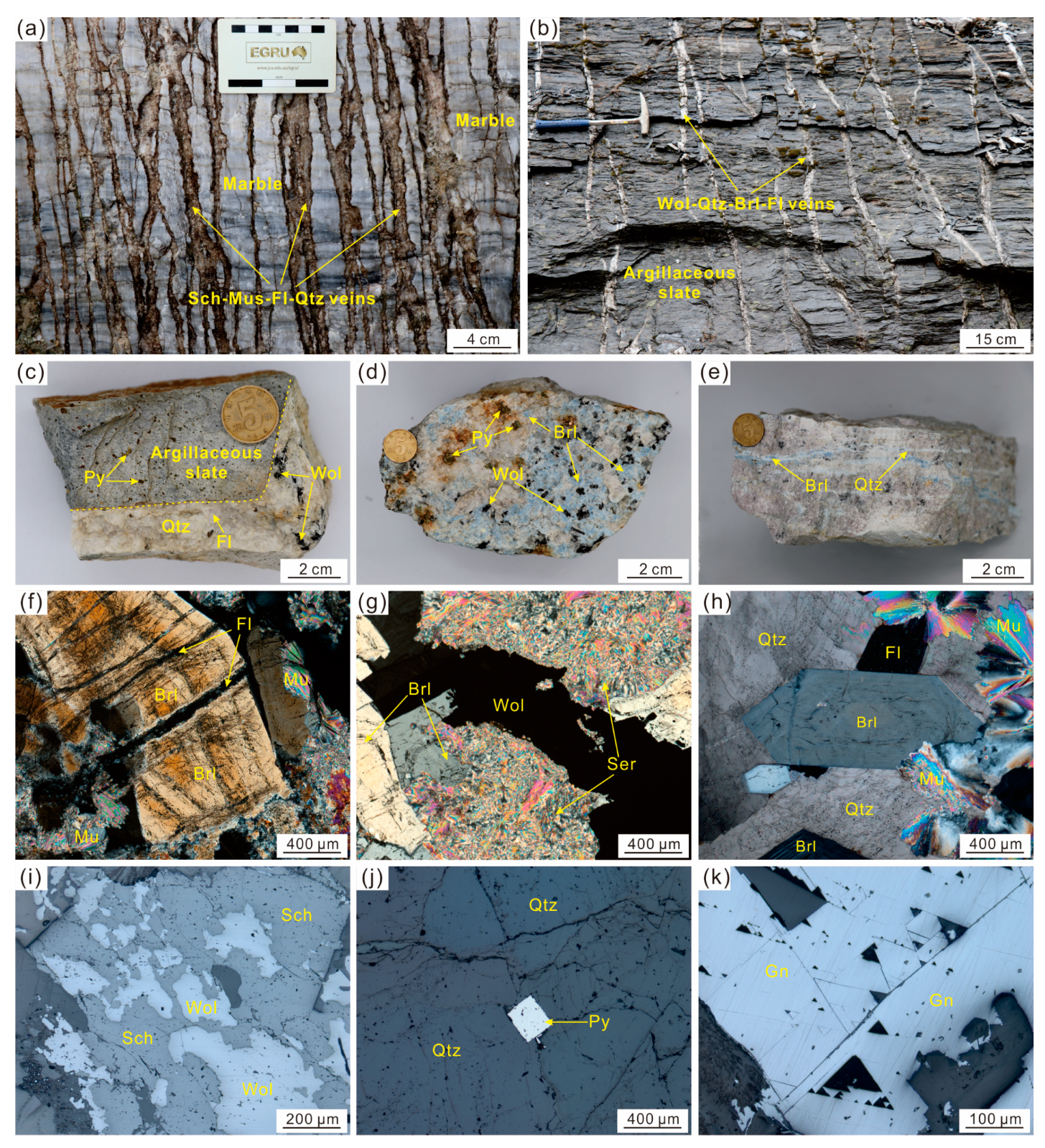
The structures in the Mahuaping district are dominantly controlled by NS-trending Hutiaoxia anticline and associated faults of the Himalayan period. The Mahuaping deposit is located near the axis of the west wing of the Hutiaoxia anticline (Figure 2a). Interlayer sliding faults are developed between the Lower Ordovician clastic rocks of the Xiangyang Formation and the Silurian marbleized limestone of the Kanglang Formation in the mining area. The interlayer fracture zone was considered to be the pathway for the migration of ore-forming fluids [24]. The widely developed near-vertical EW trending cleavages and joint fissures are the main ore veins in the Mahuaping ore district, which are relatively narrow (1–5 cm wide) and dense in the Silurian marble and marbleized limestone (Figure 3a), but relatively coarse (10–100 cm wide) and sparse in the Ordovician argillaceous slate and sandstone (Figure 3b).
Figure 3.
Field photographs, hand specimen photographs, and microphotographs of the main orebodies and ores from the Mahuaping beryllium/tungsten deposit. (a) Marble-hosted wolframite/mica/fluorite/quartz vein; (b) low-grade metamorphic clastic rock-hosted wolframite/quartz/beryl vein; (c) hand specimen photograph of a vein from low-grade metamorphic clastic rocks; (d) hand specimen photograph from low-grade metamorphic clastic rocks; (e) hand specimen photograph of a vein from marble; (f) microphotograph (under crossed polarized light) of a vein from low-grade metamorphic clastic rocks; (g) microphotograph (under plane polarized light) of a vein from marble; (h) microphotograph (under crossed polarized light) of a vein from low-grade metamorphic clastic rocks; (i) microphotograph (under crossed polarized light) of a vein from marble; (j) microphotograph (under plane polarized light) of a vein from low-grade metamorphic clastic rocks; (k) microphotograph (under plane polarized light) of a vein from low-grade metamorphic clastic rocks. Brl—beryl; Sch—scheelite; Fl—fluorite; Py—pyrite; Qtz—quartz; Wol—wolframite; Gn—galena; Mu—muscovite.
Wall rock alteration adjacent to the Mahuaping ore bodies is pronounced. The Ordovician argillaceous slate and sandstone primarily underwent pyritization and silicification. The Silurian limestone is characterized by fluoritization, marbleization, muscovitization, and sericitization. Intense sericitization is observed at the contact zone between the two ore-hosting sequences. The intensity of wall rock alteration within the district shows a positive correlation with the degree of mineralization; areas with weaker alteration correspond to lower mineralization grades.
The Be-W-F mineralization zone extends elevations from 2200 m to 4200 m, including 33 individual ore bodies (Figure 2b,c). Based on the mineral assemblages, the ore bodies in the Mahuaping deposit can be divided into two types: (1) Wolframite/beryl/fluorite/quartz vein type, which mainly developed in the Ordovician argillaceous slate and sandstone in the eastern part (Figure 3c,d). (2) Scheelite/fluorite/beryl/muscovite vein type, which is dominantly hosted by the Silurian marble and marbleized limestone in the western part of the Mahuaping ore district (Figure 3e). Scheelite/wolframite/beryl/fluorite veins can be locally observed in the contact zones between clastic rocks and marbles.
Based on the distinct types of veins occurring in Silurian marble and marbleized limestone versus Ordovician shale, combined with the differences in host rock lithology and mineral assemblages within the veins, it is inferred that the primary factor controlling the formation of the two ore types is the compositional variation of the host rocks. When the ore-forming hydrothermal fluids encountered Ca-rich carbonate rocks, tungsten and fluorine in the fluids rapidly combined with abundant calcium to precipitate scheelite and fluorite. The precipitation of fluorite and scheelite consumed fluorine in the solution, thereby depriving beryllium fluoride complexes of their ligands and subsequently triggering the precipitation of beryllium-bearing minerals such as beryl. In contrast, when the ore-forming fluids interacted with Fe-Mn-rich shales, iron and manganese were mobilized from the shales and combined with tungsten to precipitate wolframite. It is thus suggested that the compositional differences in the host rocks controlled the occurrence of the two distinct ore types in the Mahuaping beryllium/tungsten deposit.
Based on rigorous geological investigation and detailed microscopic observation, utilizing alteration characteristics, vein cross-cutting relationships, and mineral assemblages, the mineralization processes of the Mahuaping Be-W-F deposit have been divided into two distinct ore-forming stages.
Stage I: This stage is dominated by wolframite, beryl, muscovite, scheelite, fluorite and quartz with minor pyrite and sericite. Beryl is the most important Be-bearing mineral, which is typically shown as light blue, medium- to coarse-grained (2–10 mm), euhedral to subhedral crystals, generally occurring as massive aggregates. In this stage, the beryl (type A) from the wolframite/beryl/fluorite/quartz veins developed in the Ordovician argillaceous slate and sandstone commonly coexists with wolframite (Figure 3d), and was cross-cut by later veins (e.g., fluorite veins, Figure 3f) or overprinted by sericite (Figure 3g), while the beryl (type B) from scheelite/fluorite/beryl/muscovite veins hosted by the Silurian marble and marbleized limestone generally coexists with scheelite (Figure 3e), and was overprinted by muscovite and fluorite (Figure 3h). It is noteworthy that both type A and B beryl grains exhibit distinct core/rim zonation (Figure 3f,h), potentially indicative of changes in ore-forming fluid composition during crystallization. Scheelite is one of the most important W-bearing ore minerals, which is grayish-white, medium-to coarse-grained (2–10 mm), anhedral, and mostly forms massive aggregates (Figure 3e). Compared to scheelite, wolframite is relatively less abundant in the Mahuaping deposit; it appears black, exhibits a medium- to coarse-grained (2–10 mm) texture, and commonly forms euhedral acicular or elongated prismatic crystals (Figure 3c,d). Locally, wolframite was observed coexisting with scheelite (Figure 3i). This stage is the main stage of beryllium and tungsten mineralization in the Mahuaping deposit.
Stage II: This stage is marked by abundant fluorite, muscovite, quartz, calcite and minor sulfides. Fluorite, a typical halide mineral and one of the most common ore minerals in the Mahuaping W-Be deposit, is typically purple, subhedral, and occurs in aggregates. It commonly forms veins that cross-cut quartz and replace or cross-cut early minerals such as beryl. Muscovite is the common gangue mineral in this stage, often forming radial aggregates with a fine-grained texture (<2 mm). Microscopic observations show muscovite replacing stage I beryl, wolframite and quartz (Figure 3f–h), indicating its formation postdates these Stage I minerals. Accompanied by the formation of gangue minerals quartz and fluorite, sulfides are pyrite, sphalerite, and galena (Figure 3j,k). Pyrite commonly exhibits a medium- to coarse-grained (2–10 mm) texture and coexists with quartz of euhedral crystals (Figure 3j).
3. Sampling and Analytical Methods
3.1. Sample Collection
The beryl samples analyzed in this study were collected from the Silurian and Ordovician strata of the Mahuaping beryllium/tungsten deposit at an underground elevation of 3800 m. Among them, eight samples were taken from scheelite–fluorite–beryl–muscovite veins in the marble of the Silurian strata, and seven samples were collected from wolframite–beryl–fluorite–quartz veins in the low-grade metamorphic clastic rocks of the Ordovician strata. The three muscovite samples analyzed in this study were collected from the same type of veins as the beryl occurring in the low-grade metamorphic clastic rocks of the Ordovician strata.
The collected type A and type B beryl and muscovite samples were sectioned, ground, polished, and observed under a microscope. The two types of beryl show similar optical properties and textures. The crystals are transparent and mostly occur as hexagonal long prismatic or short prismatic forms, ranging from subhedral to euhedral, colorless to blue. In thin sections, the beryl is colorless, but thicker sections may exhibit weak pleochroism. Under the microscope, it shows low to moderate positive relief and commonly contains gas/liquid inclusions. Regular hexagonal beryl crystals are common (Figure 3h), with occasional prismatic or acicular beryl. The beryl displays parallel extinction and negative elongation. Type A beryl shows first-order gray-white to yellowish-white interference colors, locally reaching first-order gray to white, whereas type B beryl mostly shows first-order gray-white to grayish-green interference colors. Both types of beryl commonly exhibit zoning: the core is uniaxial, whereas the rim is biaxial, with an optic axial angle (2V) of up to 10°. The muscovite collected from the underground mine is colorless and flaky (Figure 3h), exhibiting one set of perfect cleavage, distinct flash relief, bright second- to third-order interference colors, nearly parallel extinction, positive elongation, a biaxial negative optic sign, and a moderate optic angle (2V).
3.2. Muscovite LA-ICP-MS Rb-Sr Dating
In situ Rb-Sr dating of muscovite was conducted using an NWR 193 nm ArF excimer laser ablation system coupled with an iCAP TQ multi-quadrupole mass spectrometer at Guangzhou Tuoyan Analytical Technology Co., Ltd., Guangzhou, China. The ablation process was carried out in a high-purity helium atmosphere, and the sample aerosol was mixed with argon gas prior to introduction into the ICP-MS torch. As an effective reactive gas, N2O reacts with Sr+ to produce SrO+, while remaining inert toward Rb+. To achieve optimal reaction efficiency, the N2O flow rate was incrementally increased within the reaction cell, and the signal intensities of Sr+ and SrO+ were monitored during ablation of the basalt reference material BHVO-2G and the phlogopite standard mica-Mg. At a flow rate ranging from 25% to 27% (equivalent to 0.25–0.27 mL·min−1 of N2O), the SrO+ signal reached its peak intensity without causing any notable decrease in the Rb+ signal. Before sample analysis, the fourth mass flow controller of the iCAP TQ was supplied with N2O and purged at a flow rate of 25% (0.25 mL·min−1 N2O) for two hours to ensure system stability. This procedure effectively eliminates gaseous impurities and optimizes saturation conditions, thereby minimizing signal drift caused by variable reaction kinetics. Line scanning ablation was performed on NIST SRM 610 using a spot diameter of 30 μm, a repetition rate of 10 Hz, and an energy density of approximately 3.5 J.cm−2. Each measurement sequence included 30 s of background collection, 120 s of ablation, and 30 s of washout. Isotopes of Sr in both their original and mass-shifted forms (86Sr, 87Sr, 88Sr, 86Sr16O, 87Sr16O, and 88Sr16O) were analyzed alongside Rb, with a dwell time of 50 ms per isotope. For sample analysis, the laser was operated with a spot size of 110 μm, an energy density of ~3.5 J·cm−2, and a pulse repetition rate of 8 Hz. The instrumental setup and analytical parameters followed the protocols described in references [40,41]. Raw data were exported and processed offline using an in-house Excel macro, while isochron diagrams were generated with the IsoplotR software (IsoplotR V6.7) [42].
3.3. EPMA Analysis of Beryl
The major element compositions of beryl were determined using a JEOL JXA-8230 electron microprobe (JEOL, Tokyo, Japan) at the Shandong Analysis Center of the China Metallurgical Geology Bureau, Shandong, China The analysis was conducted under operating conditions of 15 kV accelerating voltage, a beam current of 20 nA, and a beam diameter of 2 μm. SPI international standards were employed for calibration, and the raw data were corrected using the ZAF method, which accounts for atomic number (Z), absorption (A), and fluorescence (F) effects. The analytical uncertainty for major elements (concentrations > 1 wt%) is typically better than 2.0%, whereas for minor elements, it is better than 5.0%. In addition to quantitative analysis, backscattered electron (BSE) images of representative mineral grains were acquired during the EPMA session.
3.4. LA-ICP-MS Trace Elemental Analysis of Beryl
In situ trace element analysis of beryl was carried out at the MNR Key Laboratory of Isotopic Geology, Institute of Geology, Chinese Academy of Geological Sciences, Beijing, China, utilizing a RESOlution S155 LR 193 nm ArF excimer laser ablation system (Resonetics, Bozeman, MT, USA) coupled with an Agilent 7900 ICP-MS (Agilent Technologies, Santa Clara, CA, USA).During ablation, helium served as the carrier gas, while argon was introduced as a compensating gas to optimize sensitivity; these gases were merged via a T-shaped connector prior to entering the ICP. The laser was operated with a spot size of 51 μm and a repetition rate of 6 Hz. Calibration was performed using multiple external reference materials—including NIST 610 (National Institute of Standards and Technology, Gaithersburg, MD, USA), NIST 612 (National Institute of Standards and Technology, Gaithersburg, MD, USA), BHVO-2G (U.S. Geological Survey, Reston, VA, USA), BCR-2G (U.S. Geological Survey, Reston, VA, USA), and BIR-1G (U.S. Geological Survey, Reston, VA, USA)—without the application of an internal standard for trace element quantification in the mineral. Each time-resolved measurement consisted of approximately 20–30 s of background signal acquisition followed by 50 s of sample signal collection. Offline data processing, including signal selection, drift correction, and concentration calculation, was conducted using ICPMSDataCal software (ICPMSDataCal V12.2).
4. Analytical Results
4.1. Muscovite Rb-Sr Isochron Age
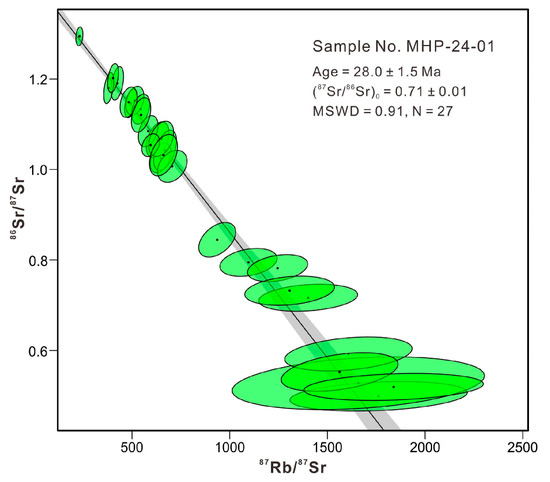
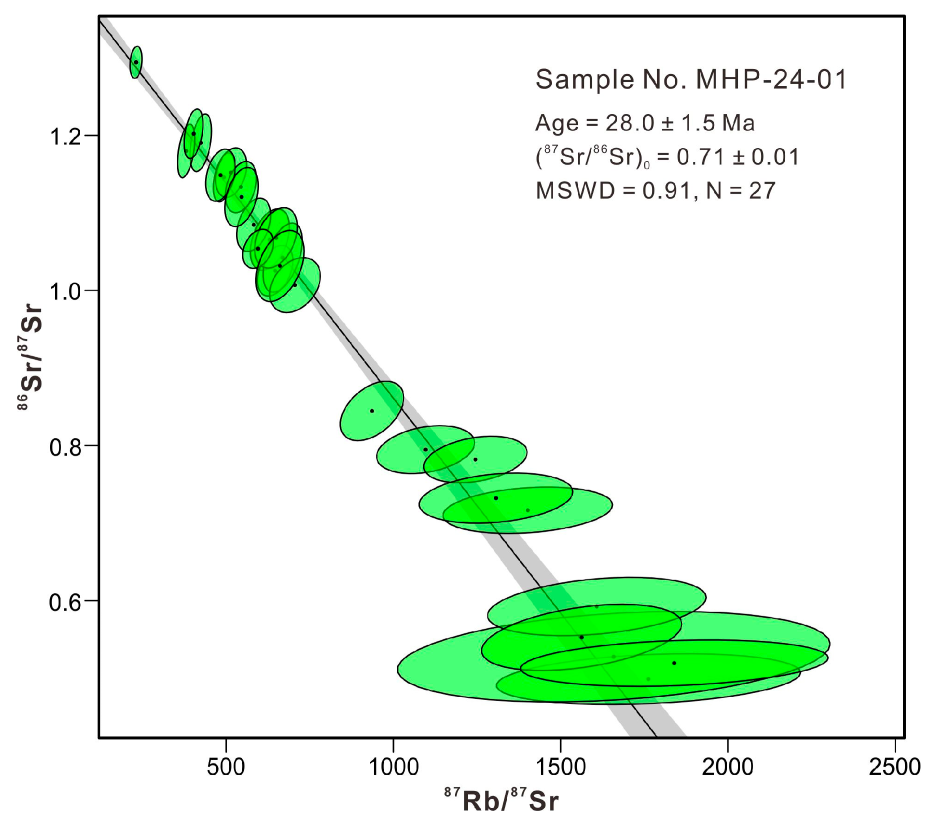
The concentrations of Rb and Sr, and the 87Rb/86Sr and 87Sr/86Sr ratios of the muscovite from scheelite/fluorite/beryl/muscovite veins in the Mahuaping deposit are listed in Table S1. The muscovite contains 1308–2183 ppm Rb and 4.36–37.12 ppm Sr. The 87Rb/86Sr ratios of the muscovite are between 178.1696961 and 3539.5649034, whereas the 87Sr/86Sr ratios range from 0.772708775 to 2.003793053. All analyzed samples obtained a reliable isochron age of 28.0 ± 1.5 Ma (n = 27, MSWD = 0.91, Figure 4) by York Model 2 [43], with (87Sr/86Sr)i = 0.71 ± 0.01.
Figure 4.
Rb–Sr inverse isochronal diagram for muscovite samples from the Mahuaping Be–W–F deposit.
4.2. Major and Trace Elemental Compositions of Beryl
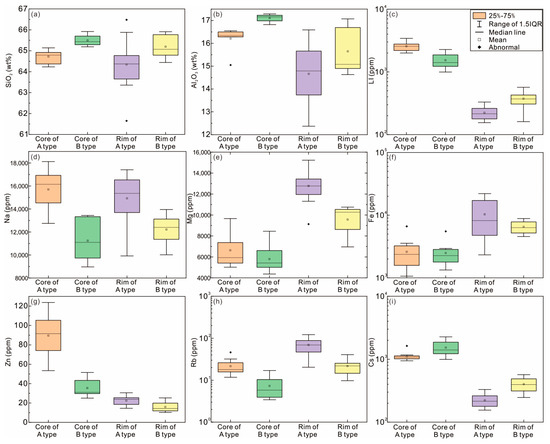
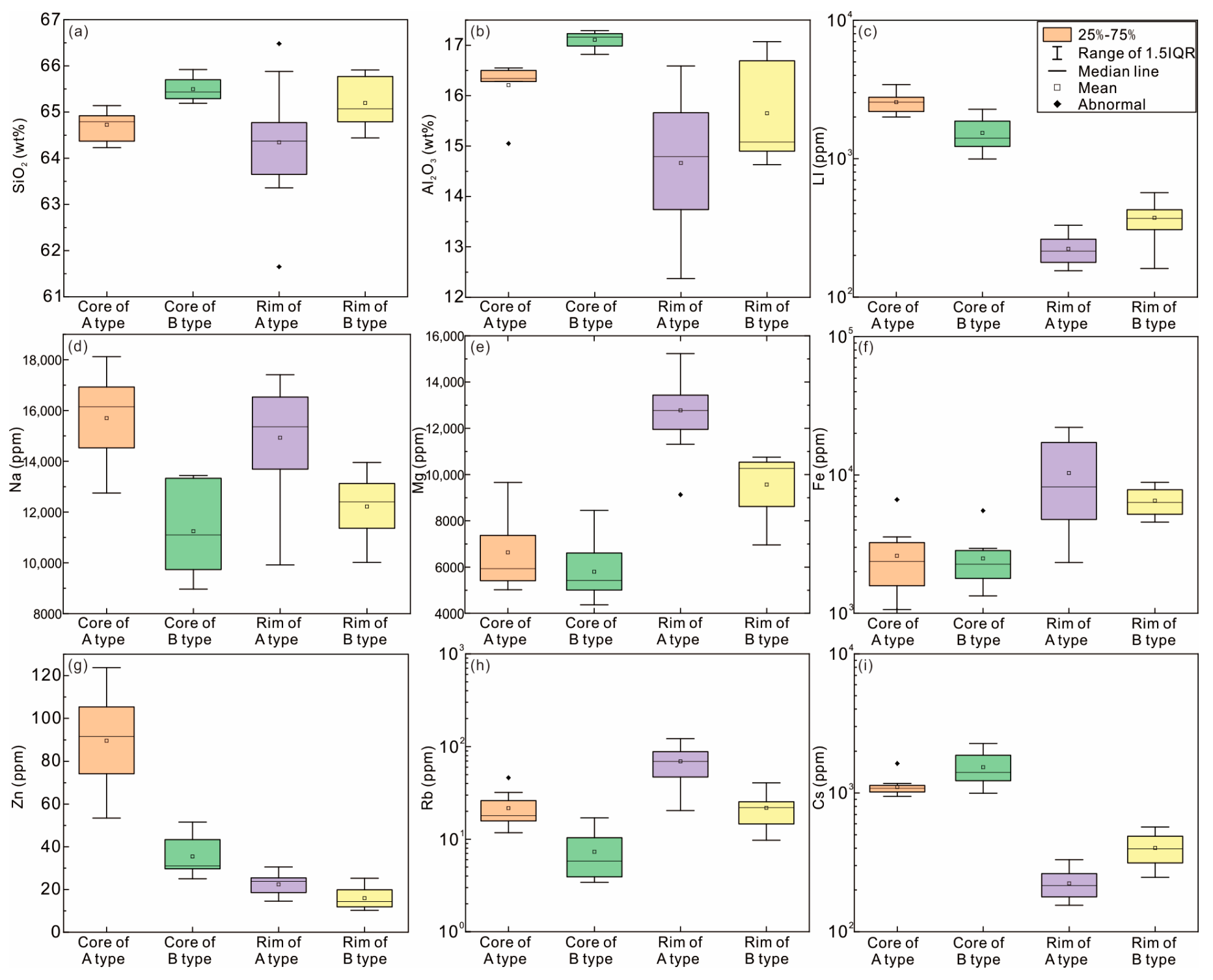
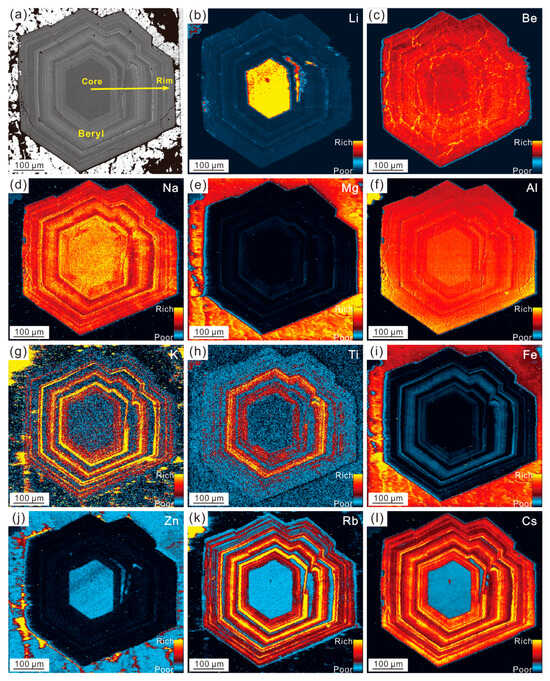
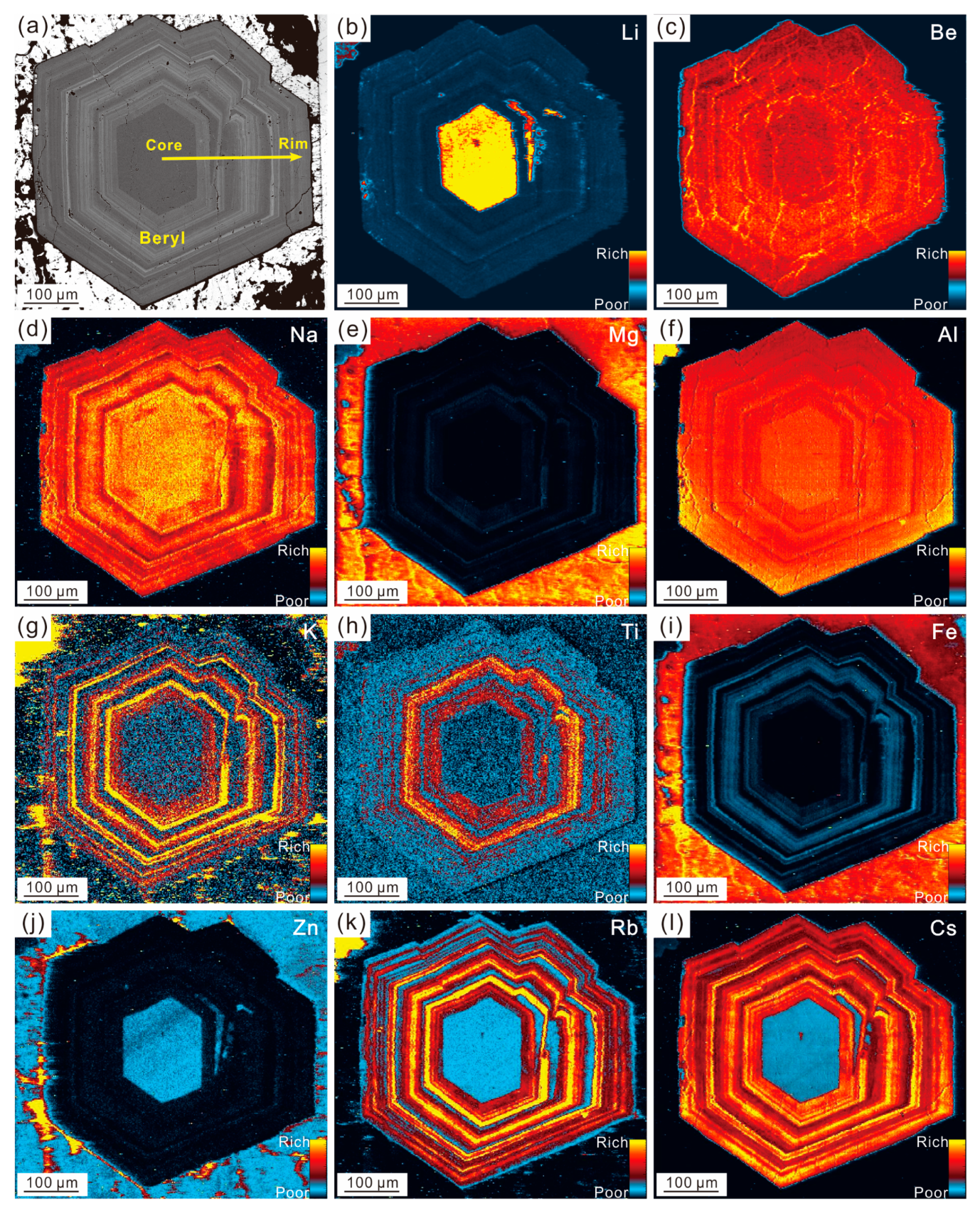
The representative major element compositions of type A and type B beryl from the Mahuaping deposit are listed in Table S2. The variations of major and trace elements have been presented as box plots (Figure 5). Previous studies indicate that hydrothermal and magmatic beryl can be distinguished by their major element characteristics: magmatic beryl exhibits uniform element contents, whereas hydrothermal beryl shows a uniform core with compositional variations in peripheral growth zones [44,45,46]. The BSE image (Figure 6a) and LA-ICP-MS elemental maps (Figure 6b–l) of beryl from the Mahuaping deposit reveal a uniform core and oscillatory growth zones, consistent with hydrothermal beryl from other deposits worldwide [45]. The EPMA results show that the beryl is mainly composed of SiO2 (61.65–66.48%), Al2O3 (12.37–17.29%), Na2O (0.94–2.32%), MgO (0.82–3.15%), and FeO (0.07–2.31%). Notably, Li and Be are also major components of beryl, but their low atomic masses preclude accurate determination of Li2O and BeO contents by EPMA.
Figure 5.
Contents of major and trace elements in the core and rim of type A beryl and type B beryl from the Mahuaping deposit. (a) SiO2; (b) Al2O3; (c) Li; (d) Na; (e) Mg; (f) Fe; (g) Zn; (h) Rb; (i) Cs.
Figure 6.
BSE image (a) and element mapping of beryl (b–l) from the Mahuaping deposit.
LA-ICP-MS elemental mapping (Figure 6) and in situ spot analyses (Table S3) reveal distinct core–rim zonation in beryl from the Mahuaping deposit. In both slate-hosted beryl (coexisting with wolframite) and marble-hosted beryl (coexisting with muscovite and scheelite), the cores are enriched in Li, Al, Zn, and Ge, and depleted in Be, Mg, Sc, Ti, V, Fe, Cu, Ga, Rb, Sn, and Cs relative to the rims. Additionally, the Be content in marble-hosted beryl (avg. 43,058 ppm in core, 45,808 ppm in rim) is significantly lower than that in slate-hosted beryl (avg. 45,423 ppm in core, 46,347 ppm in rim).
5. Discussion
5.1. Mineralization Age of Mahuaping Be-W-F Deposit
Due to the absence of causative magmatic rock outcrops in ore fields, accurately determining the mineralization age of the Mahuaping Be-W-F deposit is crucial in the study of ore deposits, including determining the metallogenic periods, constructing the spatiotemporal structure of mineralization and regional tectonic evolution, establishing genetic models for metallogenic system, and optimizing strategies of exploration targets [24]. In this study, the muscovite from scheelite/fluorite/beryl/muscovite veins in the Mahuaping deposit yield an isochron age of 28.0 ± 1.5 Ma (n = 27, MSWD = 0.91, Figure 4). It is very consistent with the U-Pb age of wolframite (30.6 ± 0.5 Ma) and monazite (29.4 ± 0.3 Ma) obtained by Li [24], indicating that the formation age of the Mahuaping deposit is Oligocene.
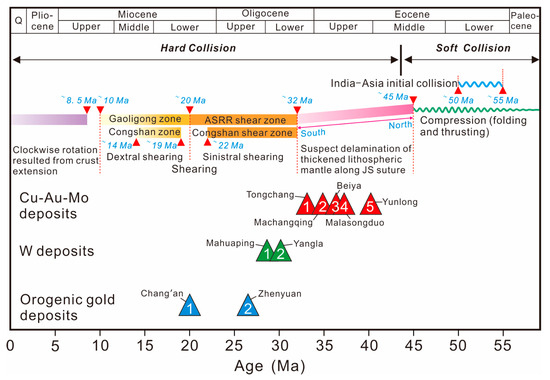
Previous studies have proposed that the Cenozoic metallogenesis in the Jinshajiang–Ailaoshan metallogenic belt is dominated by porphyry and skarn-type Cu-Au-Mo deposits and orogenic-type Au deposits [27]. Middle Eocene to Early Oligocene potassic–ultrapotassic magmatic activity was triggered by the removal of the lower lithospheric mantle [27,47]. This magmatic activity is closely related to the porphyry–skarn Cu–Au–Mo mineralization (Figure 7), such as the Yulong porphyry-type Cu-Mo deposit (42–37 Ma) [32], Beiya skarn-type Au deposit (ca. 36 Ma) [48], Machangqing porphyry Cu-Mo deposit (36–34 Ma) [34] and Habo porphyry Cu-Mo deposit (ca. 35 Ma) [49]. While the orogenic-type Au mineralization is related to the Oligoene regional ductile shearing (Figure 6), such as the Zhenyuan (ca. 27 Ma) [50] and Chang’an (ca. 21 Ma) [37] orogenic Au deposits. In addition, the recently discovered W mineralization in the Yangla deposit [38] and Be-W-F mineralization in the Mahuaping deposit [24,46] may represent another important mineralization type within the Jinshajiang–Ailaoshan metallogenic belt. The age of the Yangla tungsten mineralization is 30.3 ± 1.5 Ma [38], very consistent with the age of the Mahuaping Be-W-F deposit (30.3–28.0 Ma) [24,46], implying the tungsten polymetallic mineralization in the Jinshajiang–Ailaoshan metallogenic belt is probably related to the magmatism caused by the sinistral shearing of crust (Figure 7).
Figure 7.
Tectono-metallogenic events in the Sanjiang region [27,51]. Age sources for the Cu-Au-Mo deposits: (1, Tongchang) [27]; (2, Machangqing) [34]; (3, Beiya) [48]; (4, Malasongduo) [27]; (5, Yunlong) [32]. Age sources for the W deposits: (1, Mahuaping) [24]; (2, Yangla) [38]. Age sources for the the Orogenic gold deposits: (1, Chang’an) [37]; (2, Zhenyuan) [50].
5.2. Occurrences of Trace Elements in Beryl
Beryl is a silicate with a ring-like structure formed by the ordered arrangement of [AlO6] octahedra and [BeO4] tetrahedra connected with [SiO4] tetrahedra in three-dimensional space. The chemical formula of beryl crystal is Be3Al2(SiO3)6, where Be2+ and Al3+ are usually replaced by other cations (e.g., Li+, Na+, Cr3+, V3+, Fe2+, Fe3+ and Cs+). Previous studies have confirmed that there are mainly two mechanisms for the incorporation of other cations into beryl crystal. One is Al3+, which can be directly substituted by trivalent cations such as Cr3+, V3+ and Fe3+, or be substituted by divalent cations such as Fe2+, Mg2+, and Mn2+ coupled with monovalent cations such as Na+ and Cs+. The other one is Be2+, which can be substituted by Li+, when substitution is also coupled with a monovalent cation (e.g., Na+, Cs+ and Rb+) to keep charge balance [52,53,54,55,56]. In addition, alkali metal cations entering the beryl crystal lattice can substitute for each other as well, such as the exchange between Na+ and Cs+ [52,57,58,59].
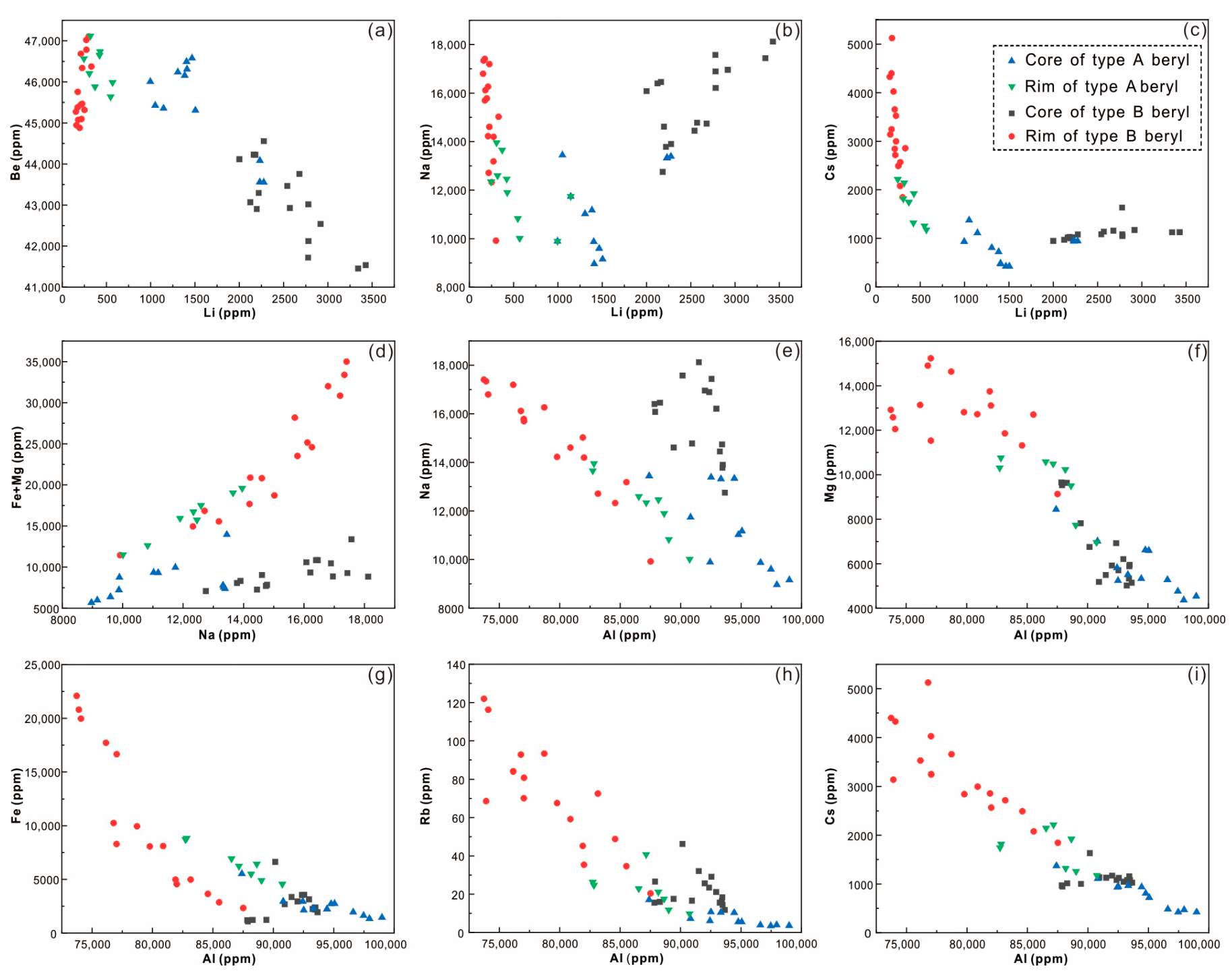
LA-ICP-MS elemental analysis revealed that the core of beryl (including the type A beryl coexisting with wolframite in slate and the type B beryl coexisting with muscovite and scheelite in marble) from the Mahuaping deposit contains relatively high Li concentration, which is more than one order of magnitude higher than that of the rim. The Li content in the core of beryl exhibits an obvious negative correlation with Be (Figure 8a) and significant positive correlations with Na and Cs (Figure 8b,c), indicating that there is a substitution mechanism of Be2+ ↔ Li+ + Na+/Cs+ in the core of beryl. Meanwhile, in the rim of beryl, the content of Li is low, and displays negative correlations with Na and Cs (Figure 8b,c), implying that the mechanism for Li entering into beryl rim is Li+ ↔ Na+/Cs+ rather than Be2+ ↔ Li+ + Na+/Cs+. Na, Mg, Fe, Rb and Cs show negative correlations with Al in both the core and rim of beryl (Figure 8d–i), suggesting that the mechanism for divalent cations (e.g., Mg2+ and Fe2+) entering into beryl is Al3+ ↔ (Fe2+/Mg2+) + (Na+/Cs+/Rb+). Moreover, previous studies have revealed that the color of beryl is significantly controlled by different cations [44,53,55,56,60]. For example, V3+ and Cr3+ in beryl cause it to present a green color, the presence of Mn3+ and Mn2+ results in a pink color, Fe3+ is responsible for its golden color, and Fe2+ is responsible for its blue color. When Fe3+ and Fe2+ coexist, the beryl appears greenish. The beryl from the Mahuaping deposit is blue (Figure 3d,e) and significantly enriched in Fe (Table S2), indicating that Fe in beryl occurs mainly as Fe2+, rather than Fe3+.
Figure 8.
Binary diagrams for beryl from the Mahuaping deposit. Diagrams of (a) Li vs. Be; (b) Li vs. Na; (c) Li vs. Cs; (d) Na vs. Fe; (e) Al vs. Na; (f) Al vs. Mg; (g) Al vs. Fe; (h) Al vs. Rb; (i) Al vs. Cs.
5.3. Origin and Evolution of Ore-Forming Fluids
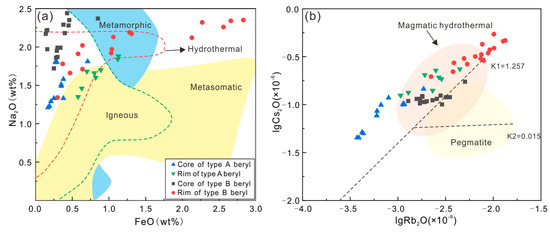
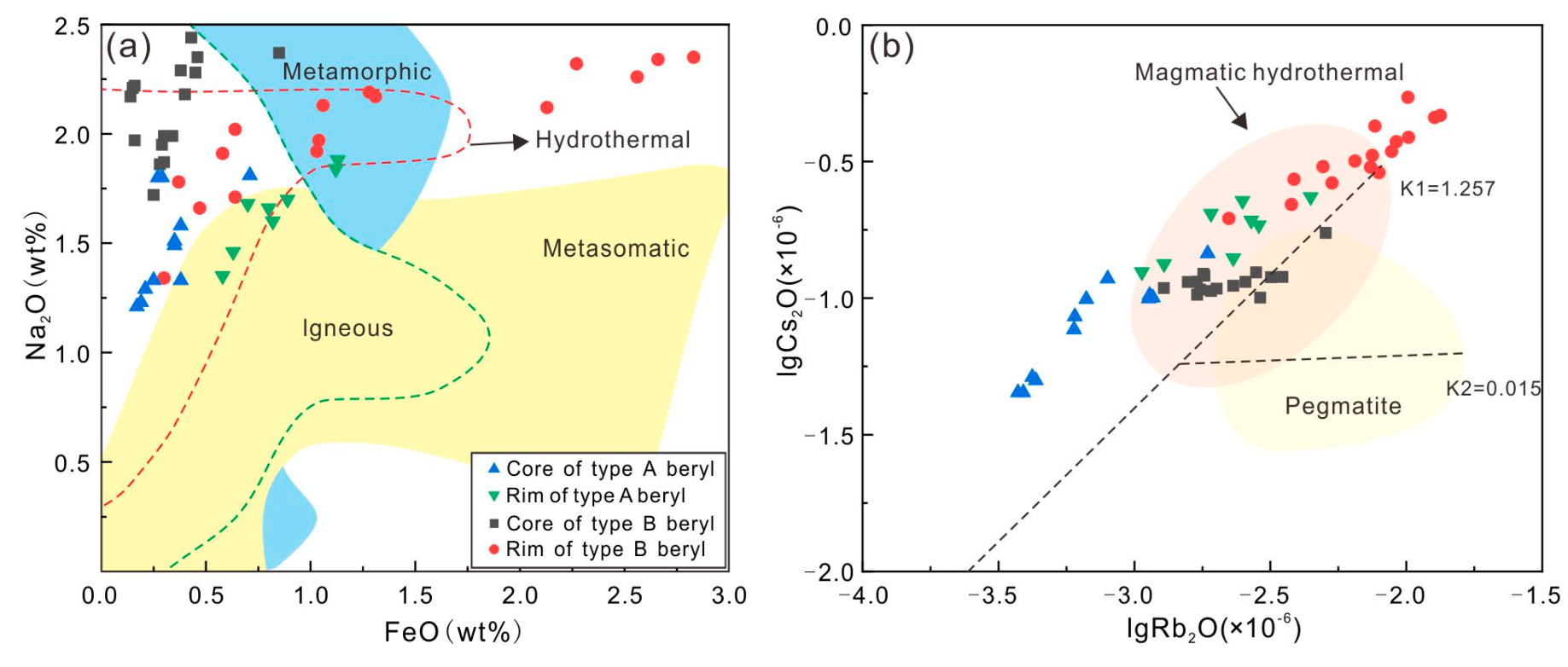
H-O isotopic compositions of ore-stage wolframite, scheelite, beryl and quartz also suggest that the ore-forming fluid of the Mahuaping deposit may have a magmatic hydrothermal fluid origin [24]. Combined with fluid inclusion studies [11,22,61], the ore-forming fluid of Mahuaping deposit was suggested to be dominantly originated from a medium- to high-temperature (approx. 340 °C) magmatic hydrothermal fluid, and incorporated by meteoric water during subsequent evolution processes [22]. As shown in Figure 9a, the beryl samples from the Mahuaping deposit predominantly plot within the hydrothermal field, with a small proportion falling in the magmatic and metamorphic fields. This distribution indicates that beryl crystallization was not restricted to a single stage. Instead, it likely initiated during the early magmatic fluid stage (as reflected by the magmatic field compositions), and continued through magmatic differentiation and exsolution of hydrothermal fluids into the hydrothermal stage (as reflected by the hydrothermal field compositions). Beryllium is not readily mobilized during metamorphic devolatilization, especially at temperatures ≤ 700 °C [62], as it is primarily hosted in plagioclase [63] and mica group minerals [64], which release Be only upon decomposition at high temperatures. Given that the main mineralization temperatures at Mahuaping range from 240 to 340 °C [22], significantly below the threshold required for substantial Be mobilization, a metamorphic origin for Be can be ruled out. Collectively, these lines of evidence further support a magmatic–hydrothermal source for the ore-forming fluids. Uher [59] proposed that high Cs content in beryl was an indicator of highly evolved magma (e.g., pegmatite). The beryl from the Mahuaping deposit is significantly enriched in Cs (425.56–5125.38 ppm, average of 1781.83 ppm), the Cs/Rb ratio is distinct from pegmatite (Figure 9b), probably implying that the beryl crystallized in magmatic fluids derived from the highly evolved magma.
Figure 9.
(a) FeO vs. Na2O of Mahuaping beryl [17]; (b) Rb2O vs. Cs2O of Mahuaping beryl [37]. Data of magmatic hydrothermal and pegmatite deposits from: [17,37,53].
LA-ICP-MS elemental mapping (Figure 6) reveals that the core of beryl from the Mahuaping deposit is obviously enriched in Li and Zn, indicating the early crystallization from a Li- and Zn-rich melt or melt-dominated fluid where these elements were preferentially incorporated into the beryl crystal lattice [46,65]. Moreover, the core of beryl is depleted in Fe and Mg, while the rim is enriched in Fe and Mg, contrary to the trend of magma evolution. This is because Fe and Mg were mainly extracted from the wall rocks by water/rock interaction. The wall rocks are rich in iron, especially the Ordovician argillaceous slate, where large amounts of pyrite are visible (Figure 3c). The incorporation of Fe from the surrounding rocks into beryl, predominantly as Fe2+, is responsible for its blue coloration. This provides evidence for the reducing nature of the ore-forming fluid as well. However, the Rb, Cs and Sc contents increase from core to rim, highly consistent with the trend of magmatic evolution. Therefore, it is proposed that the trace elemental variation of beryl is jointly controlled by the original magma composition and water/rock interaction.
It is noteworthy that the Rb, Cs and Sc contents exhibit synchronously oscillatory variations with Fe and Mg contents in the rim of beryl (Figure 6), which is likely due to the pulsating exsolution of magmatic fluids. The exsolved magmatic fluid is generally acidic and rich in Rb, Cs and Sc [66]. When it is replenished into the ore-forming fluid, the Rb, Cs and Sc contents of the ore-forming fluid will increase. While the reduction in pH of ore-forming fluid significantly enhanced water/rock interaction, extracting a large amount of Fe from the surrounding rocks, resulting in an increase in the Fe content in the ore-forming fluid.
6. Conclusions
- Muscovite Rb-Sr isochron dating reveals the mineralization age of the Mahuaping Be-W-F deposit is 28.0 ± 1.5 Ma, indicating the formation of the Mahuaping deposit is probably related to the magmatism caused by the sinistral shearing of crust in the Oligocene.
- The mechanisms for the incorporation of trace elements into the beryl lattice primarily involve two substitution types: Be2+ ↔ Li+ + Na+/Cs+ in the crystal core, and Al3+ ↔ (Fe2+/Mg2+) + (Na+/Cs+/Rb+) occurring in both the core and rim. The enrichment of Fe2+ is responsible for the blue coloration observed in beryl.
- The initial ore-forming fluid of the Mahuaping deposit is reducing and acidic, and dominantly originated from magmatic fluids derived from the highly evolved magma. During the evolution, in addition to the continuous mixing of meteoric water, due to pulsating exsolution, the magmatic fluids were also replenished into the ore-forming fluid, enhancing water/rock interaction.
Supplementary Materials
The following supporting information can be downloaded at: https://www.mdpi.com/article/10.3390/min16040388/s1; Table S1: In-situ Rb-Sr isotope ratio of muscovite from the Mahuaping deposit; Table S2: EMPA data for beryl from the Mahuaping deposit; Table S3: LA-ICP-MS data for beryl from the Mahuaping deposit.
Author Contributions
Conceptualization, F.C., P.L., P.W. and Z.J.; methodology, F.C. and M.D.; field sampling, P.L., F.C., Z.J. and J.L.; validation, P.L. and F.C. All authors have read and agreed to the published version of the manuscript.
Funding
This research was jointly supported by the Special Selection Program for High-Level Technology Talents and Innovation Teams “Formation Mechanism and Resource Potentiality Assessment of W, Be, and Other Strategic Minerals in the Geza–Mahuaping Area of Shangri-la” (grant no. 202305AT350004), the Deep Earth Probe and Mineral Resources Exploration—National Science and Technology Major Project (2024ZD1001400), the National Natural Science Foundation of China (42262011), and the Yunnan Xingdian Talent Support Program “Young Talents” Special Project (XDYC-NQRC-2022-0593).
Data Availability Statement
The original contributions presented in this study are included in the article/Supplementary Materials. Further inquiries can be directed to the corresponding authors.
Acknowledgments
The fieldwork for this study was assisted by Cheng Yan and Liu Jiajia from Kunming University of Science and Technology. The LA-ICP-MS test was conducted under the guidance and assistance of She Yewei from the Institute of Geology, Chinese Academy of Geological Sciences. We thank the reviewers for their valuable comments and suggestions on this paper.
Conflicts of Interest
The authors declare no conflicts of interest.
References
- Li, J.K.; Zou, T.R.; Wang, D.H.; Ding, X. A Review of beryllium metallogenic regularity in China. Miner. Depos. 2017, 36, 951–978, (In Chinese with English abstract). [Google Scholar]
- Wang, A.J. Strategies in Global Mineral Resources: Guest Editor’s Preface to “Studies on Strategic and Critical Mineral Resources”. Acta Geosci. Sin. 2023, 44, 257–260, (In Chinese with English abstract). [Google Scholar]
- Barton, M.D.; Young, S. Non-pegmatitic deposits of beryllium: Mineralogy, geology, phase equilibria and origin. Rev. Mineral. Geochem. 2002, 50, 591–691. [Google Scholar] [CrossRef] [Scilit]
- Černý, P. Mineralogy of beryllium in granitic pegmatites. Rev. Mineral. Geochem. 2002, 50, 405–444. [Google Scholar] [CrossRef] [Scilit]
- Grew, E.S. Beryllium in metamorphic environments (emphasis on aluminous compositions). Rev. Mineral. Geochem. 2002, 50, 487–549. [Google Scholar] [CrossRef] [Scilit]
- Yang, F.Q.; Wang, Y.Q.; Yang, C.D.; Li, Q.; Guo, X.J. Metallic ore deposits in the Kelan Basin, Altay, Xinjiang: Geologicalcharacteristics and metallogenesis. Miner. Depos. 2018, 37, 441–462, (In Chinese with English abstract). [Google Scholar]
- Jia, F.D.; Zhang, C.Q.; Liu, H.; Hua, Z.X.; Kong, Z.G.; Meng, X.Y. 40Ar-39Ar dating of the Mahuaping W-Be deposit, northwestern Yunnan province, China, and its geological significance. Acta Geol. Sin.-Engl. Ed. 2018, 92, 864–865. [Google Scholar] [CrossRef] [Scilit]
- Li, Q.; Yang, F.Q.; Yang, C.D. New zircon U-Pb age of granodiorite from the Shayikenbulake Be deposit in Altay, Xinjiang and its significance. Acta Geol. Sin.-Engl. Ed. 2018, 92, 870–871. [Google Scholar] [CrossRef] [Scilit]
- Dai, H.Z.; Wang, D.H.; Liu, L.J.; Huang, F.; Wang, C.H. Metallogenic epoch and metallogenic model of the Hetaoping W-Be deposit in Zhen’an County, South Qinling. Acta Geol. Sin. 2019, 93, 1342–1358, (In Chinese with English abstract). [Google Scholar]
- Ayuso, R.A.; Foley, N.K.; Vazquez, J.A.; Jackson, J.C. SHRIMP U-Pb zircon geochronology of volcanic rocks hosting world class Be-U mineralization at Spor Mountain, Utah, USA. J. Geochem. Explor. 2020, 209, 106401. [Google Scholar] [CrossRef] [Scilit]
- Ma, J.; Tao, Y.; He, D.F.; Xiong, F. The Ore-Forming Age and Fluid Inclusion Characteristics of the Mahuaping Tungsten-Beryllium Deposit in Yunnan Province. Bulletin of Mineralogy, Petrol. Geochem. 2020, 39, 223–232, (In Chinese with English abstract). [Google Scholar]
- Foley, N.; Ayuso, R.; Lederer, G.; Jaskula, B. Volcanogenic beryllium deposits at Spor Mountain, Utah, USA: Impact on past production and material flow cycles. In Proceedings of the Twenty-Sixth Annual Goldschmidt Conference, Yokohama, Japan, 1–26 July 2016; PAGES: Bern, Switzerland, 2016; Volume 830. [Google Scholar]
- Dailey, S.R.; Christiansen, E.H.; Dorais, M.J.; Kowallis, B.J.; Fernandez, D.P.; Johnson, D.M. Origin of the fluorine-and beryllium-rich rhyolites of the Spor Mountain Formation, Western Utah. Am. Mineral. 2018, 103, 1228–1252. [Google Scholar] [CrossRef] [Scilit]
- Wen, C.H.; Luo, X.Y.; Chen, J.F.; Lin, B.H.; Li, S.M. Relationship between Yanshanian magmatic activity and rare metal mineralization in Mufushan area of Northeast Hunan. Geol. Surv. China 2019, 6, 19–28, (In Chinese with English abstract). [Google Scholar]
- Schilling, J.; Bingen, B.; Skår, Ø.; Wenzel, T.; Markl, G. Formation and evolution of the Høgtuva beryllium deposit, Norway. Contrib. Mineral. Petrol. 2015, 170, 30. [Google Scholar] [CrossRef] [Scilit]
- Ding, X.; Li, J.K. Ore-Forming Mechanism of the Asikaerte Granitic Pegmagtite Beryllium Deposit in Xinjiang, China. Acta Geol. Sin. -Engl. Ed. 2016, 90, 1053–1054. [Google Scholar]
- Zhu, Y.T.; Li, X.F.; Zhang, L.; Wang, G.; Zhang, D. Mineralogical characteristics of tourmaline and its metallogenic indication in the Baiyanghe U-Be deposit, Xinjiang. Acta Petrol. Sin. 2019, 35, 3429–3442, (In Chinese with English abstract). [Google Scholar]
- Damdinova, L.B.; Reif, F.G. Features of the formation of heterogeneous veinlet beryllium mineralization at the Ermakovskoye F-Be deposit (Western Transbaikalia). Geol. Geophys. 2004, 45, 679–991. [Google Scholar]
- Damdinova, L.B.; Smirnov, S.Z.; Damdinov, B.B. Conditions of formation of rich beryllium ores of the Snezhnoye deposit (Eastern Sayan). Geol. Ore Depos. 2015, 57, 1–12. [Google Scholar] [CrossRef] [Scilit]
- Damdinova, L.B.; Damdinov, B.B.; Bryansky, N.V. Formation processes of fluorite-leucophane-melinophane-eudidymite ores of the Ermakovskoye F-Be deposit (Western Transbaikalia). Geol. Geophys. 2018, 59, 1271–1291. [Google Scholar]
- Damdinova, L.B.; Damdinov, B.B.; Rampilov, M.O.; Kanakin, S.V. Conditions of ore formation at the Aunikskoye F-Be deposit (Western Transbaikalia). Geol. Ore Depos. 2019, 61, 18–38. [Google Scholar] [CrossRef] [Scilit]
- Wang, Y.; Li, W.C.; Kong, Z.G.; Yan, K.; An, P.; Zhang, B.H.; Mou, M.H.; Yu, B. Ore-forming fluid characteristics and ore genesis of the Mahuaping tungsten-beryllium deposit in Yunnan: Constraints from fluid inclusions and H-O-He-Ar isotopes. Acta Petrol. Sin. 2025, 41, 2088–2105, (In Chinese with English abstract). [Google Scholar] [CrossRef] [Scilit]
- Li, S.; Romer, R.L.; Li, W.C.; Yang, F.C.; Yan, Q.G.; Cao, H.W.; Guan, S.J. Wallrock control on the mineral assemblage of hydrothermal veins: Examples from the Mahuaping Be-W-F deposit, Yunnan, SW China. Ore Geol. Rev. 2025, 184, 106728. [Google Scholar] [CrossRef] [Scilit]
- Li, W.C.; Yan, Q.G.; Cao, H.W.; Li, S.; Yang, F.C.; Jiang, X.J. Formation of the Mahuaping Be-W-F deposit in South China: Evidence from beryl chemistry, wolframite and monazite U-Pb dating. Ore Geol. Rev. 2025, 179, 106553. [Google Scholar] [CrossRef] [Scilit]
- Ran, M.J.; Zhong, K.H.; Yang, J.G.; Luo, M.F. Geochemistry and its genesis implications of beryllium and tungsten deposit in Mahuaping of Shangri-La, Yunnan. Sichuan Nonferrous Met. 2015, 2, 42–46, (In Chinese with English abstract). [Google Scholar]
- Ran, M.J.; Zhong, K.H.; Li, F.Y.; Luo, M.F.; Liu, Z.C.; Tang, J.X. Analysis of the tectonic of deposit and the age of mineralization in Mahuaping of Shangri-La in Yunnan. Sichuan Nonferrous Met. 2011, 2, 21–27, (In Chinese with English abstract). [Google Scholar]
- Deng, J.; Wang, Q.F.; Li, G.J.; Santosh, M. Cenozoic tectono-magmatic and metallogenic processes in the Sanjiang region, southwestern China. Earth-Sci. Rev. 2014, 138, 268–299. [Google Scholar] [CrossRef] [Scilit]
- Deng, J.; Wang, Q.F.; Li, G.J.; Li, C.S.; Wang, C.M. Tethys tectonic evolution and its bearing on the distribution of important mineral deposits in the Sanjiang region, SW China. Gondwana Res. 2014, 26, 419–437. [Google Scholar] [CrossRef] [Scilit]
- Hou, Z.Q.; Wang, S.X.; Du, A.D.; Qu, X.M.; Sun, W.D. Re-Os dating of sulfides from the volcanogenic massive sulfide deposit at Gacun, southwestern China. Resour. Geol. 2003, 53, 305–310. [Google Scholar] [CrossRef] [Scilit]
- Li, W.C.; Zeng, P.S.; Hou, Z.Q.; White, N.C. The Pulang porphyry copper deposit and associated felsic intrusions in Yunnan Province, southwest China. Econ. Geol. 2011, 106, 79–92. [Google Scholar] [CrossRef] [Scilit]
- Mo, L.; Shen, Q.W.; Chen, X.L.; Wu, L.R.; Zhang, C.Y.; Dong, Q.F.; Su, X.Y.; Shi, B.S.; Yu, H.J.; Leng, C.B. Petrogeochemistry, chronology, Sr-Nd-Pb isotopic compositions, and geological significance of the ore-causative intrusion in the Langdu skarn deposit, northwest Yunnan. Sediment. Geol. Tethyan Geol. 2024, 44, 421–436, (In Chinese with English abstract). [Google Scholar]
- Chang, J.; Li, J.W.; Selby, D.; Liu, J.C.; Deng, X.D. Geological and chronological constraints on the long-lived Eocene Yulong porphyry Cu-Mo deposit, eastern Tibet: Implications for the lifespan of giant porphyry Cu deposits. Econ. Geol. 2017, 112, 1719–1746. [Google Scholar] [CrossRef] [Scilit]
- He, W.Y.; Mo, X.X.; He, Z.H.; White, N.C.; Chen, J.B.; Yang, K.H.; Wang, R.; Yu, X.H.; Dong, G.C.; Huang, X.F. The geology and mineralogy of the Beiya skarn gold deposit in Yunnan, southwest China. Econ. Geol. 2015, 110, 1625–1641. [Google Scholar] [CrossRef] [Scilit]
- Liu, Q.F.; Sun, X.M.; Li, D.F.; Fu, Y.; Yang, T.J.; Liu, Z.R.; Yin, R.; Tong, Z.D. Geochronology and fluid evolution of the Machangqing Cu-Mo polymetallic deposit, western Yunnan, SW China. Ore Geol. Rev. 2020, 127, 103828. [Google Scholar] [CrossRef] [Scilit]
- Wang, D.H.; Qu, W.J.; Li, Z.W.; Yin, H.L.; Chen, Y.C. Mineralization episode of porphyry copper deposits in the Jinshajiang-Red River mineralization belt: Re-Os dating. Sci. China Ser. D Earth Sci. 2005, 48, 192–198. [Google Scholar] [CrossRef] [Scilit]
- Wang, Y.; Zhang, H.R.; Zhang, H.C.; Chai, P.; Hou, Z.Q. Gold in the lithosphere of the western South China Block, SW China: Insights from quartz porphyries from the giant Zhenyuan gold deposit. Ore Geol. Rev. 2020, 119, 103312. [Google Scholar] [CrossRef] [Scilit]
- Gao, L.; Wang, Q.F.; Deng, J.; Zhang, S.H.; Yang, Z.Y. Relationship between orogenic gold mineralization and crustal shearing along Ailaoshan-Red River belt, southeastern Tibetan plateau: New constraint from paleomagnetism. Geochem. Geophys. Geosystems 2018, 19, 2225–2242. [Google Scholar] [CrossRef] [Scilit]
- Li, Y.J.; Ying, Y.C.; Li, W.C.; Jiang, X.J.; Liu, Y.D.; Chen, W.; Jiang, S.Y. Genesis of W mineralization in the Yangla Cu-polymetallic deposit NW Yunnan, China: Constraints from scheelite microstructure, trace element, U-Pb dating and Sr isotope geochemistry. Ore Geol. Rev. 2024, 169, 106098. [Google Scholar] [CrossRef] [Scilit]
- Dong, T.; Du, B.; Duan, Z.Y.; Cao, X.M.; Song, X.F.; Dong, H.G.; Zhang, Y.M.; Li, B. Metallogenic regularity and prospecting direction of tungsten deposits in Shangri-La area, NW Yunnan province, China. Sediment. Geol. Tethyan Geol. 2022, 42, 62–74, (In Chinese with English abstract). [Google Scholar]
- Gorojovsky, L.; Alard, O. Optimisation of laser and mass spectrometer parameters for the in situ analysis of Rb/Sr ratios by LA-ICP-MS/MS. J. Anal. At. Spectrom. 2020, 35, 2322–2336. [Google Scholar] [CrossRef] [Scilit]
- Wang, C.; Alard, O.; Lai, Y.J.; Foley, S.F.; Liu, Y.; Munnikhuis, J.; Wang, Y. Advances in in-situ Rb-Sr dating using LA-ICP-MS/MS: Applications to igneous rocks of all ages and to the identification of unrecognized metamorphic events. Chem. Geol. 2022, 610, 121073. [Google Scholar] [CrossRef] [Scilit]
- Vermeesch, P. IsoplotR: A free and open toolbox for geochronology. Geosci. Front. 2018, 9, 1479–1493. [Google Scholar] [CrossRef] [Scilit]
- Ludwig, K.R. Mathematical–statistical treatment of data and errors for 230Th/U geochronology. Rev. Mineral. Geochem. 2003, 52, 631–656. [Google Scholar] [CrossRef] [Scilit]
- Ruan, Q.F.; Zhang, L.J.; Zhang, C.L.; Lei, W.; Rao, C.; Liao, B.L.; Zeng, W.L. Genesis and characteristics of beryl. Miner. Resour. Geol. 2008, 22, 265–269, (In Chinese with English abstract). [Google Scholar]
- Dong, J.; Huang, F.; Wang, D. Geochemical characteristics and geological significance of beryl in different types of beryllium deposits. Acta Petrol. Sin. 2023, 39, 2153–2166, (In Chinese with English abstract). [Google Scholar] [CrossRef] [Scilit]
- Liu, J.J.; Liu, J.Y.; Chen, F.C.; Yu, F.; Zhang, Q.; Shu, Q.H. Timing, ore genesis, and hydrothermal evolution of the Mahuaping W-Be-F deposit, SW China. J. Geochem. Explor. 2026, 284, 108008. [Google Scholar] [CrossRef] [Scilit]
- Xu, L.; Bi, X.; Hu, R.; Zhang, X.; Su, W.; Qu, W.; Hu, Z.; Tang, Y. Relationships between porphyry Cu–Mo mineralization in the Jinshajiang–Red River metallogenic belt and tectonic activity: Constraints from zircon U-Pb and molybdenite Re-Os geochronology. Ore Geol. Rev. 2012, 48, 460–473. [Google Scholar] [CrossRef] [Scilit]
- Deng, J.; Wang, Q.F.; Li, G.J.; Hou, Z.Q.; Jiang, C.Z.; Danyushevsky, L. Geology and genesis of the giant Beiya porphyry-skarn gold deposit, northwestern Yangtze Block, China. Ore Geol. Rev. 2015, 70, 457–485. [Google Scholar] [CrossRef] [Scilit]
- Zhang, A.P.; Zheng, Y.C.; Shen, Y.; Qi, Q.J.; Wang, Z.X.; Wu, C.D.; Wang, L. Petrogenesis and physicochemical conditions of fertile porphyry in non-arc porphyry mineralization: A case from Habo porphyry Cu-Mo deposits, SW China. Acta Geol. Sin. -Engl. Ed. 2023, 97, 469–485. [Google Scholar] [CrossRef] [Scilit]
- Deng, J.; Wang, Q.F.; Li, G.J.; Zhao, Y. Structural control and genesis of the Oligocene Zhenyuan orogenic gold deposit, SW China. Ore Geol. Rev. 2015, 65, 42–54. [Google Scholar] [CrossRef] [Scilit]
- Chung, S.L.; Chu, M.F.; Zhang, Y.; Xie, Y.; Lo, C.H.; Lee, T.Y.; Lan, C.Y.; Li, X.; Zhang, Q.; Wang, Y. Tibetan tectonic evolution inferred from spatial and temporal variations in post-collisional magmatism. Earth-Sci. Rev. 2005, 68, 173–196. [Google Scholar] [CrossRef] [Scilit]
- Aurisicchio, C.; Fioravanti, G.; Grubessi, O.; Zanazzi, P.F. Reappraisal of the crystal chemistry of beryl. Am. Mineral. 1988, 73, 826–837. [Google Scholar]
- Viana, R.R.; Jordt-Evangelista, H.; da Costa, G.M.; Stern, W.B. Characterization of beryl (aquamarine variety) from pegmatites of Minas Gerais, Brazil. Phys. Chem. Miner. 2002, 29, 668–679. [Google Scholar] [CrossRef] [Scilit]
- Turner, D.; Groat, L.A.; Hart, C.J.; Mortensen, J.K.; Linnen, R.L.; Giuliani, G.; Wengzynowski, W. Mineralogical and geochemical study of the True Blue aquamarine showing, southern Yukon. Can. Mineral. 2007, 45, 203–227. [Google Scholar] [CrossRef] [Scilit]
- Giuliani, G.; Groat, L.; Marshall, D.; Fallick, A.; Branquet, Y. Emerald deposits: A review and enhanced classification. Minerals 2019, 9, 105. [Google Scholar] [CrossRef] [Scilit]
- Zheng, Y.Y.; Yu, X.Y.; Guo, H.S. Major and trace element geochemistry of Dayakou vanadium-dominant emerald from Malipo (Yunnan, China): Genetic model and geographic origin determination. Minerals 2019, 9, 777. [Google Scholar] [CrossRef] [Scilit]
- Wang, R.C.; Che, X.D.; Zhang, W.L.; Zhang, A.C.; Zhang, H. Geochemical evolution and late re-equilibration of Na–Cs-rich beryl from the Koktokay#3 pegmatite (Altai, NW China). Eur. J. Mineral. 2009, 21, 795–809. [Google Scholar]
- Novák, M.; Filip, J. Unusual (Na, Mg)-enriched beryl and its breakdown products (beryl II, bazzite, bavenite) from euxenite-type NYF pegmatite related to the orogenic ultrapotassic Trebíc Pluton, Czech Republic. Can. Mineral. 2010, 48, 615–628. [Google Scholar] [CrossRef] [Scilit]
- Uher, P.; Chudik, P.; Bacik, P.; Vaculovic, T.; Galiova, M. Beryl composition and evolution trends: An example from granitic pegmatites of the beryl-columbite subtype, Western Carpathians, Slovakia. J. Geosci. 2010, 55, 69–80. [Google Scholar] [CrossRef] [Scilit]
- Wu, X.; Han, X.Z.; Feng, X.Q.; Guo, S.G. Site occupancy and coloring mechanisms of iron ions in beryl. Acta Petrol. Mineral. 2023, 42, 577–590, (In Chinese with English abstract). [Google Scholar]
- Jia, F.D. Geological and Geochemical Characteristics and Genesis of the Mahuaping Tungsten-Beryllium Deposit in the Sanjiang Region, SW China. Ph.D. Thesis, Peking University, Beijing, China, 2020. (In Chinese with English abstract). [Google Scholar]
- Stepanov, A.S. A review of the geochemical changes occurring during metamorphic devolatilization of metasedimentary rocks. Chem. Geol. 2021, 568, 120080. [Google Scholar] [CrossRef] [Scilit]
- Evensen, J.M.; London, D. Experimental silicate mineral/melt partition coefficients for beryllium and the crustal Be cycle from migmatite to pegmatite. Geochim. Cosmochim. Acta 2002, 66, 2239–2265. [Google Scholar] [CrossRef] [Scilit]
- Kunz, B.E.; Warren, C.J.; Jenner, F.E.; Harris, N.B.W.; Argles, T.W. Critical metal enrichment in crustal melts: The role of metamorphic mica. Geology 2022, 50, 1219–1223. [Google Scholar] [CrossRef] [Scilit]
- Pauly, C.; Gysi, A.P.; Pfaff, K.; Merkel, I. Beryl as indicator of metasomatic processes in the California Blue Mine topaz-beryl pegmatite and associated miarolitic pockets. Lithos 2021, 404–405, 106485. [Google Scholar] [CrossRef] [Scilit]
- Liu, M.L.; Kong, Y.L.; Guo, Q.H. Sources and enrichment mechanisms of lithium, rubidium, and cesium in waters of magmatic-hydrothermal systems. Earth-Sci. Rev. 2025, 270, 105241. [Google Scholar] [CrossRef] [Scilit]
Disclaimer/Publisher’s Note: The statements, opinions and data contained in all publications are solely those of the individual author(s) and contributor(s) and not of MDPI and/or the editor(s). MDPI and/or the editor(s) disclaim responsibility for any injury to people or property resulting from any ideas, methods, instructions or products referred to in the content. |
© 2026 by the authors. Licensee MDPI, Basel, Switzerland. This article is an open access article distributed under the terms and conditions of the Creative Commons Attribution (CC BY) license.