


Abstract
The geochronological framework of the Late Mesozoic volcanic succession in the Great Xing’an Range is crucial for understanding the tectonic regime transition in Northeast Asia. However, the ages and stratigraphic relationships of key volcanic units remain poorly constrained. This study presents zircon LA-ICP-MS U–Pb geochronological data from volcanic rocks above and below the basal unconformity of the Longjiang Formation in the Zhalantun–Jalaid Banner area, central Great Xing’an Range, aiming to determine the timing of volcanic activity, constrain the formation age of the unconformity, and explore its regional tectonic implications. The volcanic–stratigraphic succession in the study area, from base to top, comprises the Baiyingaolao Formation, the basal andesitic conglomerate of the Longjiang Formation, and the Longjiang Formation andesites. Geochronological results indicate that the underlying rhyolitic tuff of the Baiyingaolao Formation yields an age of 130.0 ± 0.1 Ma. Within the andesitic conglomerate overlying the unconformity, andesitic clasts yield an age of 135.8 ± 1.1 Ma, whereas the matrix provides a youngest detrital zircon population age of 130.7 ± 1.0 Ma, constraining the maximum depositional age of the conglomerate. The overlying andesite of the Longjiang Formation gives an eruption age of 125.6 ± 0.8 Ma. These data indicate that the main phase of Longjiang Formation volcanism occurred at ~125.6 Ma, and the basal conglomerate was deposited after ~130.7 Ma. Combined with the ~130 Ma age of the underlying Baiyingaolao Formation and the presence of weathering crusts and erosional surfaces between the two formations, the sedimentary hiatus and exhumation event represented by this unconformity are precisely constrained to have occurred between ~130 Ma and 125.6 Ma. The timing of this unconformity closely coincides with the regional transition in magmatic assemblages from bimodal to andesitic compositions, suggesting that it records a significant tectonic adjustment event in the Great Xing’an Range during the middle to late Early Cretaceous. This finding provides key chronological evidence for understanding the episodic tectonic evolution of Northeast Asia during the Late Mesozoic.
1. Introduction
The Great Xing’an Range, situated in the eastern segment of the Central Asian Orogenic Belt, records one of the most extensive episodes of Late Mesozoic intracontinental volcanism in Northeast Asia [1,2]. Voluminous volcanic–sedimentary successions were emplaced during this interval, forming a major continental volcanic province and preserving critical evidence for crustal growth and crust–mantle interaction [3,4]. More importantly, these volcanic sequences document the superimposed tectonic evolution associated with the interaction and transition between the Mongol–Okhotsk and Paleo-Pacific domains during the Late Mesozoic [5,6,7,8,9,10,11].
Stratigraphic subdivision and regional correlation of these volcanic successions have long relied primarily on lithological assemblages and limited paleontological constraints [5,12]. However, subsequent high-precision isotopic dating has demonstrated that several previously defined Formations are markedly diachronous: single stratigraphic units may encompass multiple magmatic episodes, whereas coeval volcanic rocks commonly display contrasting lithological associations [5,11]. Such temporal overlap complicates lithology-based correlations and obscures the tectonic evolution of the region. Establishing a robust geochronological framework for key volcanic units is therefore essential for resolving the timing and nature of Late Mesozoic tectonic reorganization.
The middle to late Early Cretaceous (ca. 135–120 Ma) represents a critical interval of tectonic adjustment in the Great Xing’an Range [1,13]. It has commonly been interpreted as a stage of regional extension, characterized by bimodal volcanic assemblages and A-type granitoids [1,2,14,15,16]. Recent geochronological and petrological studies, however, reveal a more complex magmatic evolution. A typical bimodal association developed at ~130 Ma, followed by andesitic magmatism at ~126 Ma, and subsequently a renewed phase of bimodal volcanism after ~125 Ma [3,4,11]. This systematic shift in magmatic assemblages suggests episodic tectonic adjustments rather than a single, continuous extensional regime [11]. Whether these magmatic transitions correspond to discrete tectonic regime changes, and how such changes were recorded in contemporaneous sedimentary systems, remain insufficiently constrained.
The Longjiang Formation, a widely distributed intermediate volcanic unit in the region [3,4], was formed during this critical transitional interval and thus provides an important archive for evaluating Early Cretaceous tectonic processes. In the Zhalantun–Jalaid Banner area, an andesitic conglomerate occurs at the base of the Longjiang Formation and rests unconformably on the Baiyingaolao Formation. The contact is marked by undulating erosional surfaces and a well-developed paleoweathering crust, indicating a significant episode of uplift and subaerial exposure prior to renewed volcanism. The timing of this unconformity, its relationship to the ~130 Ma bimodal magmatism and the post–125 Ma volcanic resurgence, and its tectonic implications remain unresolved.
To address the issues outlined above, this study focuses on the basal unconformity between the Longjiang Formation and the underlying Baiyingaolao Formation in the Zhalantun–Jalaid Banner area. Zircon LA-ICP-MS U–Pb dating was conducted on key stratigraphic units above and below the unconformity. By constraining the emplacement age of the Longjiang andesite, the depositional age of the basal conglomerate, and the ages of its provenance, this study aims to establish the temporal framework of the depositional hiatus represented by this unconformity. On this basis, the tectonic significance of the Longjiang andesitic magmatism is further evaluated. These new geochronological constraints provide important evidence for understanding the episodic tectonic evolution of the Great Xing’an Range during the middle–late Early Cretaceous.
2. Regional Geological Setting
2.1. Tectonic Framework and Regional Geological Characteristics
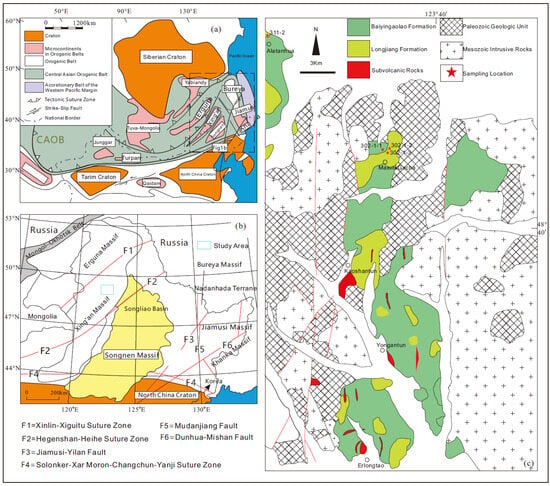
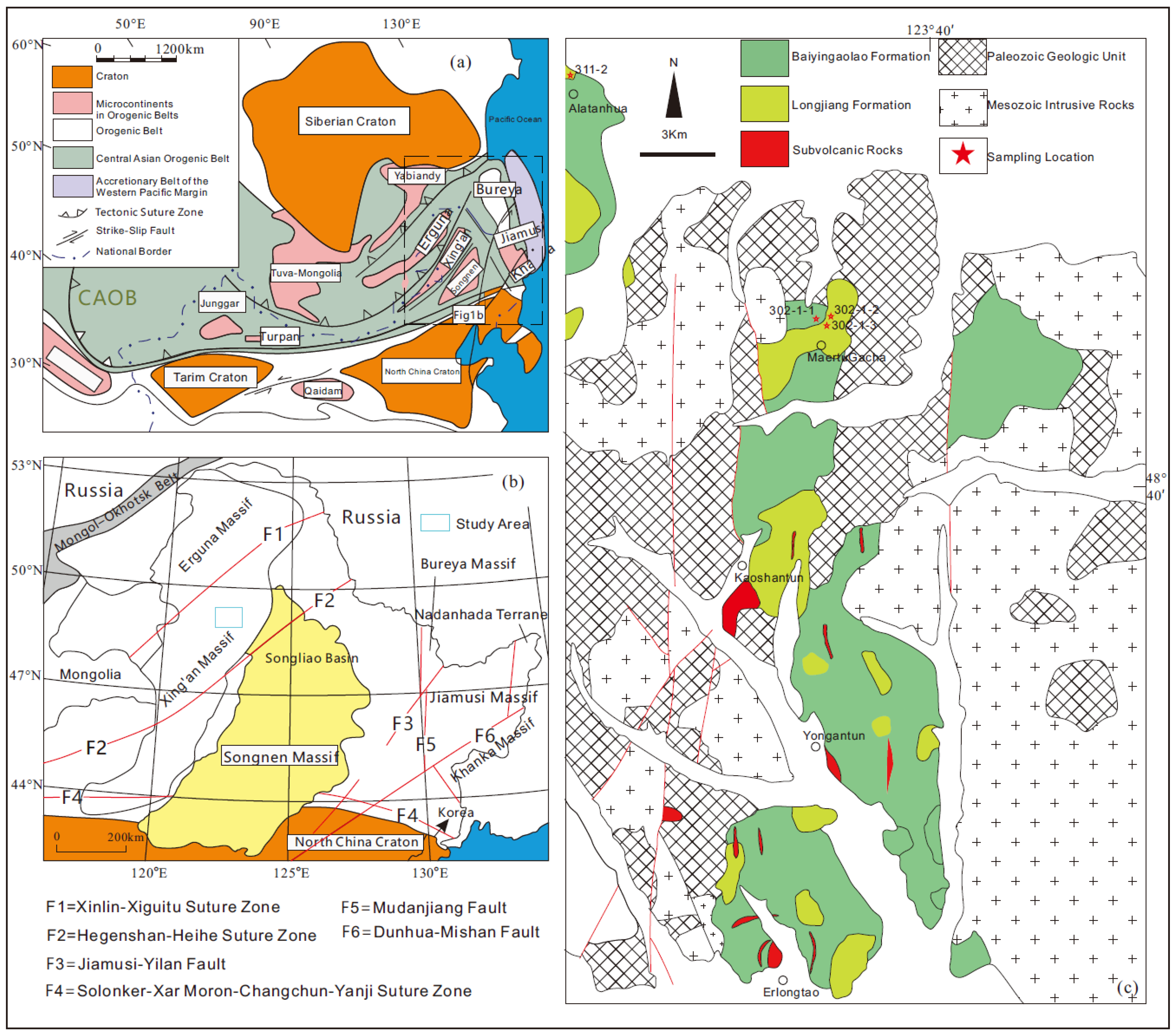
The Great Xing’an Range forms part of the eastern segment of the Central Asian Orogenic Belt (CAOB) and represents a key component of the Phanerozoic accretionary orogen developed between the Siberian Craton and the North China Craton [17,18]. During the Paleozoic, prolonged subduction, accretion, and eventual closure of the Paleo-Asian Ocean led to the amalgamation of several microcontinental blocks, including the Erguna, Xing’an, and Songnen blocks. These terranes are separated by major suture zones, notably the Xinlin–Xiguitu and Heihe–Hegenshan sutures [19,20] (Figure 1a,b). Together, these tectonic units and sutures established the Paleozoic structural framework that subsequently served as the basement architecture for later tectono-magmatic events.
Figure 1.
Tectonic location and geological sketch map of the study area: (a) Tectonic sketch map of the Central Asian Orogenic Belt; (b) Tectonic sketch map of Northeast China and adjacent regions, showing the major tectonic units and suture zones; (c) Geological sketch map of the Zhalantun–Jalaid Banner area in the central Great Xing’an Range, showing the distribution of the Longjiang Formation and sampling locations.
Since the Late Mesozoic, regional tectonic evolution has been governed primarily by two geodynamic systems: closure of the Mongol–Okhotsk Ocean and subduction of the Paleo-Pacific plate [2,21,22,23]. The Mongol–Okhotsk Ocean closed progressively from west to east in a scissor-like fashion during the Late Jurassic to earliest Cretaceous, resulting in regional compression and crustal thickening. This was followed by intensified Paleo-Pacific plate subduction and slab rollback, which promoted lithospheric thinning and extensive magmatism [2]. Under the combined influence of these processes, magmatic activity during the middle–late Early Cretaceous displays clear temporal variations [24,25,26,27,28,29,30,31,32,33,34,35,36,37,38,39,40,41,42,43].
The Great Xing’an Range hosts voluminous Late Mesozoic volcanic and intrusive assemblages and represents one of the most magmatically active regions in Northeast Asia [2,21]. High-precision zircon U–Pb geochronology indicates that magmatism during this period was characterized by episodic pulses rather than continuous evolution. During the Late Jurassic (ca. 166–150 Ma), intermediate–felsic volcanic rocks and coeval granitoid intrusions dominated, locally accompanied by mafic magmatism [28,32,41,44]. From the latest Jurassic to earliest Cretaceous (ca. 150–138 Ma), magmatic activity temporally coincided with regional deformation, and adakitic as well as intermediate magmatism developed in some areas [8,27].
Magmatism intensified markedly during the Early Cretaceous and exhibited pronounced stage differentiation between ca. 135 and 120 Ma [3,4,11]. Around 130 Ma, widespread bimodal volcanic–intrusive associations formed, characterized by coeval mafic and felsic magmas and large-scale magmatic construction [11]. This was followed by a transitional stage at ca. 126 Ma, dominated by intermediate, mainly andesitic magmatism, during which the assemblage shifted from bimodal to compositionally concentrated intermediate suites [11]. After ca. 125 Ma, bimodal magmatism re-intensified and was accompanied by A-type granites and the development of extensional structures [33]. The unconformity investigated in this study formed precisely during this period.
2.2. Field Characteristics of the Longjiang Formation and Key Stratigraphic Contacts
2.2.1. Regional Distribution, Stratigraphic Position, and Lithological Assemblages
The study area is located in the Zhalantun–Jalaid Banner region of the central Great Xing’an Range (Figure 1a,c), a key segment within the aforementioned tectonic transition zone where Mesozoic volcanic rocks are widely exposed. Based on lithological assemblages and isotopic ages, previous studies have subdivided the volcanic succession in the study area into five stages: the Late Jurassic, the Late Jurassic to earliest Cretaceous, the middle Early Cretaceous, the late Early Cretaceous, and the terminal Early Cretaceous [3,4]. The Longjiang Formation constitutes an important volcano–sedimentary assemblage of the middle Early Cretaceous in this area.
The Longjiang Formation forms an NNE-trending belt, mainly distributed east of the main ridge of the Great Xing’an Range, subparallel to the western margin fault zone of the Songliao Basin. Owing to the lack of Field geological evidence and precise geochronological constraints, its contact relationships with adjacent strata have long remained ambiguous, resulting in significant controversy regarding regional stratigraphic correlation [6]. Earlier regional mapping grouped these intermediate volcanic rocks into the Manitu Formation (1:200,000 Jalaid Banner sheet; 1:250,000 Ulanhot sheet) based solely on lithological similarity. However, recent high-precision zircon U–Pb ages (125–128 Ma) demonstrate that these rocks are significantly younger than the Manitu Formation (150–138 Ma). Although isotopic data imply a superpositional relationship, the absence of well-documented field contacts has hindered definitive stratigraphic reassessment.
The Longjiang volcanic rocks are predominantly grayish-purple to grayish-green and consist mainly of effusive andesite. A notable feature is the widespread development, at the base of this unit, of a grayish-purple conglomerate, whose gravels are dominantly composed of andesite. The conglomerate is poorly sorted and weakly rounded. It overlies the Baiyingaolao Formation with a paleoweathering crust and an undulating erosional surface, forming a clear unconformity (see Section 2.2.2). Locally, the Formation also contains eruptive pyroclastic facies and volcaniclastic interlayers (e.g., tuffaceous conglomerate and sedimentary tuff).
2.2.2. Characteristics of the Basal Conglomerate and Its Contact with the Baiyingaolao Formation
Field investigations demonstrate that a regional unconformity is observed between the underlying Baiyingaolao Formation and the overlying Longjiang Formation. This contact is well exposed and laterally traceable in multiple sections, including Maltu Gacha North Hill, Alatanhua, Zhulegen Gacha, Xinli Gacha, and Kaoshantun.
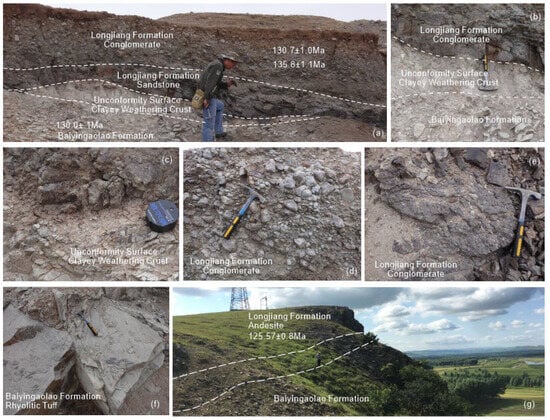
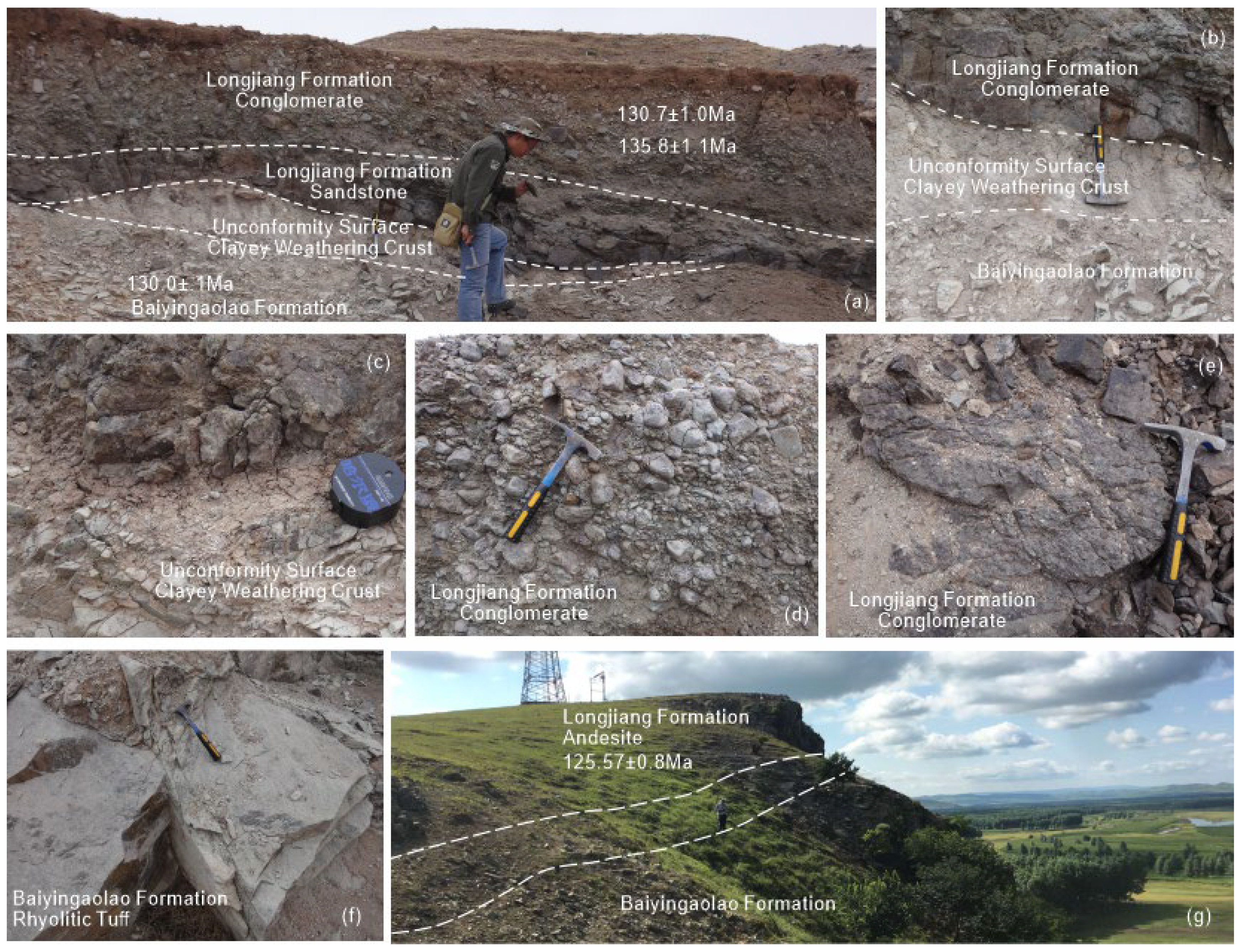
At Maltu Gacha North Hill, a grayish-purple andesitic conglomerate occurs at the base of the Longjiang Formation. A thin layer of gravel-bearing coarse sandstone underlies the conglomerate, and both units rest on grayish-white rhyolitic tuff of the Baiyingaolao Formation. The contact surface is irregular and undulating (Figure 2a–c), and bedding attitudes differ markedly across the boundary. A yellowish to whitish clay-rich weathering crust, 5–10 cm thick and lens-shaped, is commonly developed along the contact. The overlying gravel-bearing sandstone is 10–20 cm thick and also lens-shaped (Figure 2a). The conglomerate is dominated by andesitic clasts that are poorly sorted and subangular to subrounded, locally interbedded with thin fine sandstone layers, indicating rapid transport and deposition (Figure 2d,e).
Figure 2.
Field characteristics of the unconformable contact between the Longjiang Formation and the Baiyingaolao Formation: (a) Basal conglomerate of the Longjiang Formation unconformably overlies the rhyolitic tuff of the Baiyingaolao Formation; (b) Clay-rich weathering crust developed on the unconformity surface; (c) Close-up of the clay-rich weathering crust on the unconformity surface; (d) Basal conglomerate of the Longjiang Formation, with simple composition, clasts mainly composed of andesite; (e) Basal conglomerate of the Longjiang Formation, characterized by poor rounding and poor sorting; (f) Outcrop of rhyolitic tuff from the Baiyingaolao Formation; (g) In the Alatanhua area, a conglomerate layer is developed between the Longjiang Formation and the Baiyingaolao Formation.
In the Maltu Gacha North Hill section, the basal conglomerate is exposed over a lateral distance of approximately 50 m with variable thickness (0–50 cm). The conglomerate consists of andesitic clasts (2–5 cm in diameter) supported by a tuffaceous sandy matrix. The underlying Baiyingaolao Formation rhyolitic tuff is also exposed in this section (Figure 2e,f).
In the Alatanhua area, a gray to grayish-purple tuffaceous conglomerate similarly overlies rhyolitic breccia tuff of the Baiyingaolao Formation and grades upward into grayish-purple andesite (Figure 2g). Clasts are mainly andesitic (2–10 cm, typically 3–4 cm, locally up to 15 cm), poorly sorted, and weakly rounded. The matrix is tuffaceous to sandy, and internal bedding is locally developed with intercalated purplish-red tuffaceous mudstone. Bedding attitudes of the two units are consistent (270°∠10°), and no angular discordance is observed.
At Zhulegen Gacha, grayish-purple conglomerate unconformably overlies grayish-white rhyolitic tuff (Figure 2f). Clasts are smaller and compositionally more diverse, including andesite, rhyolite, and minor granitic fragments. Clasts are generally subangular to subrounded and poorly sorted, consistent with rapid deposition. A 3–5 cm thick lens-shaped clay layer occurs along the contact.
Integration of field relationships, sedimentological characteristics confirms a regionally developed unconformity between the Longjiang and Baiyingaolao Formations. At Maltu Gacha North Hill, the contact represents an angular unconformity with clear differences in bedding attitude. In contrast, at Alatanhua and other localities, the contact is disconformable: although bedding orientations are similar, the irregular erosional surface and weathering crust indicate a significant depositional hiatus. Spatial variations likely reflect differing magnitudes of local tectonic tilting, yet collectively record an important middle Early Cretaceous episode of uplift, erosion, and rapid redeposition.
3. Samples and Analytical Methods
3.1. Sampling
Four representative samples were collected from the Zhalantun–Jalaid Banner area in the central Great Xing’an Range. These include: one rhyolitic tuff from the underlying Baiyingaolao Formation (Sample 302-1-1), one andesitic clast separated from the basal conglomerate of the Longjiang Formation (Sample 302-1-3), one sample of the andesitic conglomerate matrix (Sample 302-1-2), and one andesite from the overlying Longjiang Formation (Sample 311-2) (Table 1). The Baiyingaolao rhyolitic tuff was collected from the Maltu Gacha North Hill section, whereas the Longjiang samples (andesite, conglomerate matrix, and clast) were collected from the southern bank of the Chuoer River in the Alatanhua area (Table 1).
Table 1.
Summary of samples analyzed in this study.
3.2. Zircon Separation and Cathodoluminescence Imaging
Rock crushing, zircon separation, and cathodoluminescence (CL) imaging were carried out at the Institute of Regional Geological Survey, Langfang, Hebei Province. Zircon grains were separated using standard heavy liquid and magnetic separation techniques. Euhedral, inclusion-free, and fracture-free zircon grains were handpicked under a binocular microscope, mounted in epoxy resin together with reference zircon standards, and polished to expose grain interiors. Cathodoluminescence images were obtained using a JEOL JXA-8100 electron microprobe (JEOL Ltd., Tokyo, Japan) equipped with a CL detector system. CL imaging was employed to examine internal structures and oscillatory zoning patterns and to guide the selection of laser ablation spots.
3.3. Zircon LA-ICP-MS U–Pb Dating
Zircon U–Pb isotopic analyses were performed at the State Key Laboratory of Isotope Geochemistry, Guangzhou Institute of Geochemistry, Chinese Academy of Sciences. Analyses were conducted using an Agilent 7500a (Agilent Technologies, Santa Clara, CA, USA) inductively coupled plasma mass spectrometer (ICP-MS) coupled to a Resonetics RESOlution M-50 laser (Resonetics LLC, Nashua, NH, USA) ablation system. Laser ablation was carried out with a spot diameter of 35 μm, a repetition rate of 8 Hz, and an energy density of ~4 J/cm2. Helium was used as the carrier gas and argon as the auxiliary gas. The zircon standard GJ-1 was employed for instrumental mass bias and isotopic fractionation correction, whereas NIST SRM 610 glass was used as an external standard for trace element calibration. Standard analyses were inserted after every 5–10 unknown analyses to monitor analytical stability. Common Pb correction was conducted following the method of Andersen [45]. Individual spot uncertainties are reported at the 1σ level, and weighted mean ages are presented with 95% confidence intervals.
4. Results
Zircon LA-ICP-MS U–Pb analyses were performed on four representative samples from the Zhalantun–Jalaid Banner area (Table 2). All analyzed zircons are magmatic in origin based on their euhedral shapes, oscillatory zoning, and Th/U ratios > 0.1, and yield concordant U–Pb ages (Figure 3a–d).
Table 2.
LA-ICP-MS U-Pb dating of zircons from the Jalaid Banner area.
Figure 3.
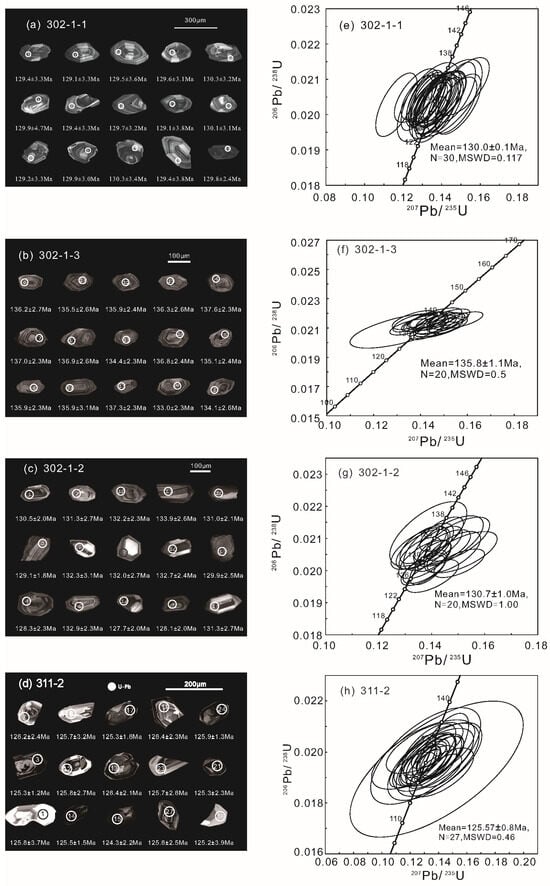
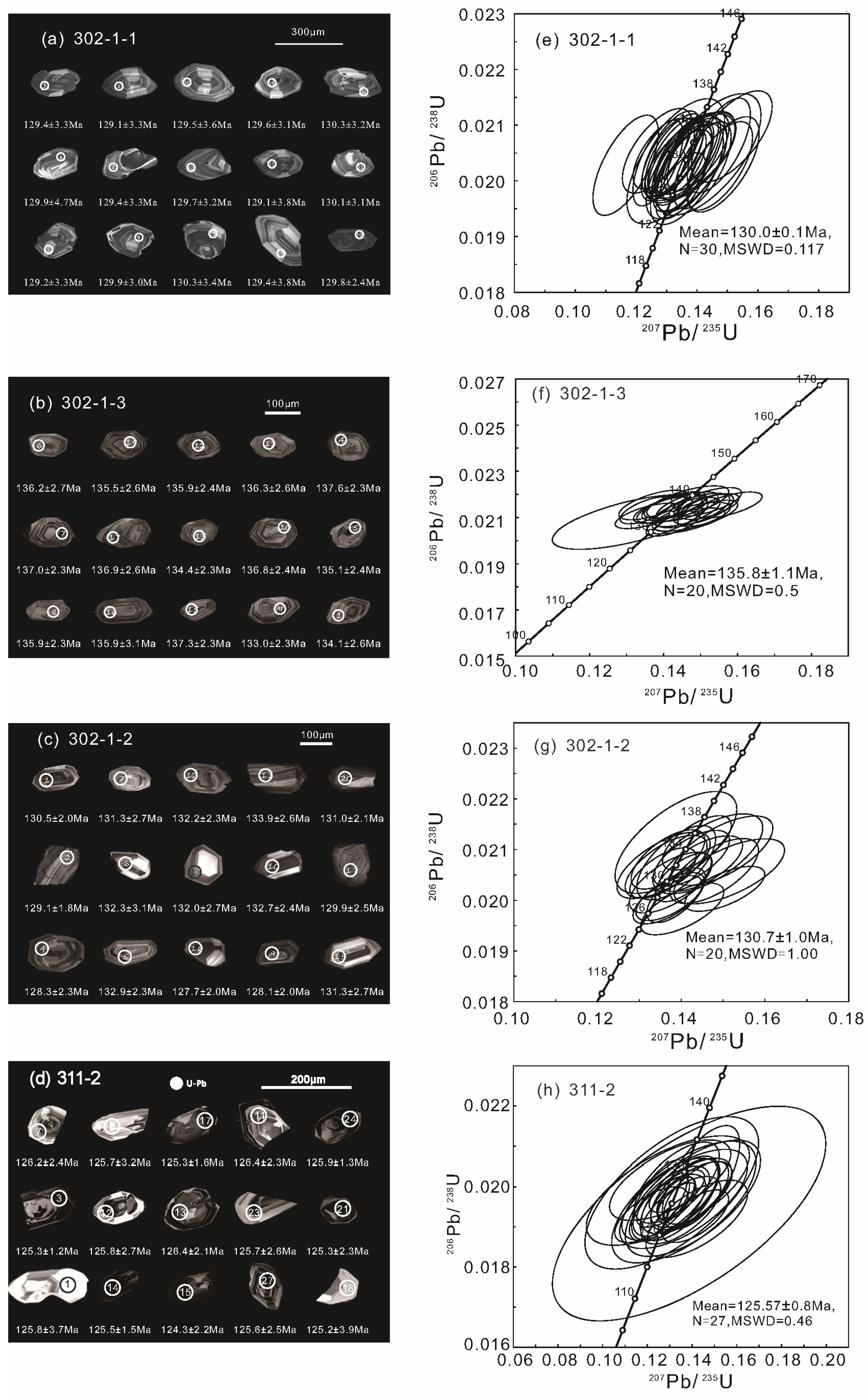
Zircon U–Pb concordia diagrams for samples from the Longjiang and Baiyingaolao Formations: (a) CL images of zircons from sample 302-1-1; (b) CL images of zircons from sample 302-1-3; (c) CL images of zircons from sample 302-1-2; (d) CL images of zircons from sample 311-2. Circles indicate laser ablation spots, and numbers represent analytical spot IDs. (e) Concordia diagram for sample 302-1-1, showing a weighted mean age of 130.0 ± 0.1 Ma (MSWD = 0.117, n = 30); (f) Concordia diagram for sample 302-1-3, showing a weighted mean age of 135.8 ± 1.1 Ma (MSWD = 0.5, n = 20); (g) Concordia diagram for sample 302-1-2, showing a weighted mean age of 130.7 ± 1.0 Ma (MSWD = 1.00, n = 20); (h) Concordia diagram for sample 311-2, showing a weighted mean age of 125.57 ± 0.8 Ma (MSWD = 0.46, n = 27).
Sample 302-1-1 (rhyolitic tuff) was collected from the Baiyingaolao Formation below the unconformity at Maltu Gacha. Thirty concordant analyses yield 206Pb/238U ages between 127.1 and 131.7 Ma. The weighted mean age is 130.0 ± 0.1 Ma (MSWD = 0.1; n = 30) (Figure 3e), interpreted as the crystallization age of the rhyolitic tuff.
Sample 302-1-3 (andesitic clast from basal conglomerate) was collected from the basal conglomerate of the Longjiang Formation above the unconformity at Maltu Gacha and represents an andesitic clast separated from the conglomerate. Twenty concordant analyses yield 206Pb/238U ages between 132.3 and 138.2 Ma. The weighted mean age is 135.8 ± 1.1 Ma (MSWD = 0.5; n = 20) (Figure 3f), interpreted as the crystallization age of the clast.
Sample 302-1-2 (matrix of basal conglomerate) was collected from the basal conglomerate of the Longjiang Formation above the unconformity at Maltu Gacha. Twenty zircon grains yield concordant 206Pb/238U ages ranging from 126.6 to 134.9 Ma, forming a unimodal age distribution (Figure 3g). Their weighted mean age is 130.7 ± 1.0 Ma (MSWD = 1.0; n = 20), which is interpreted as the maximum depositional age of the conglomerate.
Sample 311-2 (andesite) was collected from the southern bank of the Chuoer River in the Alatanhua area, from volcanic strata above the unconformity within the upper part of the Longjiang Formation. The rock is a grayish-purple effusive andesite. Twenty-seven concordant analyses yield 206Pb/238U ages ranging from 122.6 to 129.1 Ma. The weighted mean age is 125.6 ± 0.8 Ma (MSWD = 0.5; n = 27) (Figure 3h), interpreted as the crystallization age of the andesite.
The new zircon U–Pb data precisely constrain the timing of the unconformity between the Longjiang and Baiyingaolao formations in the Zhalantun–Jalaid Banner area. The underlying Baiyingaolao Formation rhyolitic tuff yields an age of 130.0 ± 0.1 Ma, providing a lower limit for the unconformity. The basal conglomerate overlying the unconformity contains a matrix with a youngest detrital zircon age of 130.7 ± 1.0 Ma, indicating that conglomerate deposition began after ca. 130.7 Ma. Andesitic clasts within the conglomerate yield an older age of 135.8 ± 1.1 Ma, consistent with derivation from the Manitu Formation. The overlying Longjiang Formation andesite crystallized at 125.6 ± 0.8 Ma, placing an upper limit on the duration of the hiatus.
5. Discussion
5.1. Age of the Longjiang Formation and Its Regional Stratigraphic Implications
Zircon U–Pb dating of Longjiang Formation andesite (sample 311-2) yields an age of 125.6 Ma, indicating volcanism during the middle Early Cretaceous. Comparable volcanic rocks (124.0–127.9 Ma) are widely exposed in the Zhalaite Banner area east of the Great Xing’an Range [11]. These andesite-dominated volcanic rocks were previously correlated with the Manitu Formation based mainly on lithological similarity. However, isotopic ages demonstrate that andesites east of the Zhalantun–Zhalaite area (125.6 Ma) are significantly younger than those of the southern Manitu Formation (150–138 Ma) [3,11]. Accordingly, these intermediate volcanic rocks should be reassigned to the middle Early Cretaceous Longjiang Formation rather than the Manitu Formation.
Regionally, Early Cretaceous magmatism in the Great Xing’an Range shows a three-stage evolutionary pattern: widespread bimodal volcanism at ca. 130 Ma, localized intermediate magmatism at ca. 128–126 Ma, and renewed bimodal activity after ca. 125 Ma [4,11]. The 125.6 Ma age reported here falls within the intermediate magmatic pulse between the ca. 130 Ma bimodal stage and the post-125 Ma bimodal intensification.
5.2. Contact Between the Longjiang and Baiyingaolao Formations: Regional Unconformity and Timing Constraints
As described in Section 2.2.2, an andesitic conglomerate is widely developed at the base of the Longjiang Formation, unconformably overlying the acidic volcanic rocks of the Baiyingaolao Formation. The contact is characterized by undulating erosional surfaces, weathering crusts, and lenticular clay seams, with locally discordant bedding attitudes, indicating subaerial exposure, weathering and erosion, and tectonic tilting. Geochronological constraints further delimit the timing of this unconformity. The underlying Baiyingaolao rhyolitic tuff yields a zircon U–Pb crystallization age of 130.0 Ma, whereas the overlying Longjiang andesite yields an age of 125.6 Ma. Although a direct depositional age for the basal conglomerate is unavailable, the youngest detrital zircon population from its matrix (130.7 ± 1.0 Ma) constrains the maximum depositional age, indicating that sediment accumulation postdated ca. 130.7 Ma.
Detrital zircons from the conglomerate matrix yield ages indistinguishable, within analytical uncertainty, from the crystallization age of the Baiyingaolao Formation (130.0 ± 0.1 Ma). Together with the well-developed weathering crust and proximal sedimentary character, this temporal correspondence suggests that the Baiyingaolao volcanic succession had been uplifted, exposed, and partially eroded prior to conglomerate deposition, supplying recycled volcanic detritus to the basal unit. Integration of field relationships and chronological constraints brackets formation of the regional unconformity between ca. 130 Ma and 125.6 Ma, after cessation of Baiyingaolao volcanism and before initiation of widespread Longjiang andesitic activity.
5.3. Dual Provenance of the Basal Conglomerate and Its Response to the ~130 Ma Tectonic Event
5.3.1. Clast Provenance: Erosion of Manitu Formation Volcanic Rocks
Andesitic clasts (sample 302-1-3) yield a weighted mean zircon U–Pb age of 135.8 ± 1.1 Ma, distinctly older than the maximum depositional age of the conglomerate matrix (130.7 ± 1.0 Ma). The age of the andesitic clasts is consistent with the ages of recently obtained Manitu Formation volcanic rocks in the region, which have been dated at ca. 136 Ma [4,11], suggesting a possible provenance link.
Regional geochronological data show that Manitu Formation andesites in the central Great Xing’an Range were emplaced predominantly between 150 and 138 Ma, with a prominent magmatic pulse at ca. 136 Ma [4,11]. The clast age corresponds closely to this magmatic phase, supporting derivation from erosion of Manitu volcanic rocks.
Sedimentological characteristics are consistent with this interpretation. The conglomerate is dominated by andesitic clasts exhibiting wide grain-size variation, poor sorting, and low roundness, indicative of short transport distances and rapid deposition in a proximal, high-relief setting. These features suggest that Manitu volcanic rocks were exposed in nearby source regions prior to ca. 130 Ma and supplied detritus during subsequent topographic reorganization.
Collectively, geochronological and sedimentological evidence indicates substantial contribution from recycled Manitu Formation volcanic rocks.
5.3.2. Matrix Provenance: Temporal Coupling with the Baiyingaolao Formation
The basal conglomerate matrix (sample 302-1-2) yields a youngest detrital zircon population of 130.7 ± 1.0 Ma, constraining its maximum depositional age. This age overlaps, within analytical uncertainty, with the crystallization age of the underlying Baiyingaolao rhyolitic tuff (130.0 ± 0.1 Ma). This age is also consistent with regional geochronological data for the Baiyingaolao Formation, which have been dated at ca. 130 Ma [4,11].
This temporal correspondence, together with the well-developed weathering crust along the unconformity surface, suggests that the Baiyingaolao volcanic succession was exposed and eroded shortly after emplacement, contributing recycled volcanic detritus to the conglomerate matrix. In several sections, the matrix exhibits tuffaceous or sandy textures with minor fine-grained interlayers, indicating mixing of reworked volcanic material and terrigenous sediments. These characteristics are consistent with erosion and redeposition of Baiyingaolao acidic volcanic rocks.
Integrated chronological and sedimentological evidence therefore indicates that the Baiyingaolao Formation constituted an important source for the matrix of the basal conglomerate during early stages of deposition after ca. 130 Ma.
5.3.3. Dual Provenance and the ca. 130 Ma Tectono-Sedimentary Transition
Combined constraints from clasts and matrix reveal a multi-endmember provenance comprising recycled Manitu andesites (ca. 136 Ma) and erosional products of the Baiyingaolao Formation (ca. 130 Ma). This provenance assemblage indicates that volcanic rocks of different ages were simultaneously incorporated into the sediment-routing system during a single depositional episode.
At ca. 130 Ma, acidic volcanism of the Baiyingaolao Formation waned, marking a transition in regional magmatic regime. During this interval, short-lived tectonic adjustment or topographic reorganization likely resulted in uplift and exposure of the Baiyingaolao surface, while older Manitu volcanic rocks were exhumed in adjacent areas. Enhanced erosion under these conditions promoted rapid accumulation of poorly sorted, proximal andesitic conglomerates.
The temporal sequence—Manitu magmatism (150–138 Ma), termination of Baiyingaolao acidic volcanism (ca. 130 Ma), formation of the unconformity and initiation of clastic deposition, followed by Longjiang andesitic eruption (ca. 126 Ma)—defines a continuous magmatic–sedimentary–tectonic evolutionary trajectory.
5.4. Implications for Episodic Magmatic–Tectonic Transition During the Early Cretaceous
Magmatism in the Great Xing’an Range during the middle–late Early Cretaceous (ca. 135–120 Ma) exhibits a well-defined staged evolutionary pattern [3,4,11]: bimodal magmatism at ca. 130 Ma, concentration of intermediate magmatism at ca. 128–126 Ma, and renewed bimodal intensification after ca. 125 Ma. Although this pattern indicates episodic adjustments of the magmatic–tectonic system, stratigraphic markers that directly record transitions between these stages remain scarce and poorly constrained in age.
The unconformity at the base of the Longjiang Formation provides such a marker. The underlying Baiyingaolao rhyolitic tuff (130.0 ± 0.1 Ma) records acidic volcanism at ca. 130 Ma, representing the bimodal magmatic stage, whereas the overlying Longjiang andesites (128.5–125.6 Ma) document the initiation and persistence of intermediate magmatism. The unconformity, formed between ca. 130 and ca. 128 Ma, lies precisely within the transition interval from waning bimodal activity to the onset of intermediate magmatism, and thus may record regional tectonic adjustment during this period.
During the middle–late Early Cretaceous, the Great Xing’an Range may have been influenced by both the Mongol–Okhotsk tectonic domain and the Paleo-Pacific plate, with the latter exerting progressively stronger control [18]. Bimodal magmatism at ca. 130 Ma is commonly interpreted as recording lithospheric extension, whereas subsequent intermediate magmatism at ca. 128–126 Ma suggests changes in magma sources and tectonic configuration [11]. This transition may be related to changes in Paleo-Pacific subduction dynamics or waning influence of the Mongol–Okhotsk domain [1]. The timing of the basal unconformity of the Longjiang Formation coincides with this magmatic transition, and therefore may represent a sedimentary response to this tectonic regime shift.
6. Conclusions
- (a)
- Chronological Framework: Zircon LA-ICP-MS U–Pb dating constrains the eruptive age of the Longjiang Formation andesite in the Zhalantun–Jalaid Banner area to 125.6 ± 0.8 Ma. The underlying Baiyingaolao Formation rhyolitic tuff yields an age of 130.0 ± 0.1 Ma. These data indicate that the Longjiang Formation represents a middle Early Cretaceous (post-130 Ma) volcanic episode, distinct from the Late Jurassic–earliest Cretaceous Manitu Formation (150–138 Ma).
- (b)
- Nature and Timing of the Unconformity: A regional unconformity separates the Longjiang Formation from the underlying Baiyingaolao Formation. This contact is marked by undulating erosional surfaces, paleo-weathering crusts, and, locally, angular discordance. The youngest detrital zircons from the basal conglomerate matrix (130.7 ± 1.0 Ma) provide a maximum depositional age, bracketing the formation of the unconformity and the onset of sedimentation between ca. 130 Ma and ca. 125.6 Ma.
- (c)
- Provenance and Tectonic Significance of the Basal Conglomerate: The basal andesitic conglomerate of the Longjiang Formation exhibits a dual provenance. Andesitic clasts (135.8 ± 1.1 Ma) were derived from erosion of the older Manitu Formation, while the matrix received detritus from the penecontemporaneous Baiyingaolao Formation (130.0 ± 0.1 Ma). This provenance, combined with the conglomerate’s poorly sorted, proximal character, records a discrete episode of post-130 Ma uplift, subaerial exposure, and erosion prior to the onset of Longjiang volcanism.
- (d)
- Tectonic Implications: The unconformity and its associated sedimentary succession represent a stratigraphic response to a critical mid–Early Cretaceous tectonic transition. This event separates the ca. 130 Ma bimodal magmatic stage from the subsequent ca. 126 Ma intermediate magmatic stage (represented by the Longjiang Formation). The results provide direct temporal and stratigraphic evidence for an episodic, rather than continuous, tectonic and magmatic reorganization in the Great Xing’an Range during the middle to late Early Cretaceous.
Author Contributions
J.F. designed the main framework of the paper and wrote the manuscript; T.Q. was responsible for research conceptualization and overall guidance and served as the corresponding author in coordinating the revision and submission process; J.S. processed the isotopic data; B.Z., Z.L. and J.Y. reviewed and edited the draft and prepared the key figures. All authors have read and agreed to the published version of the manuscript.
Funding
This study was jointly supported by the Science and Technology Support Project for the New Round of Prospecting Breakthrough Strategy of the Ministry of Natural Resources, titled “Exploration Model Construction and Precision Positioning Technology for Concealed Ore Bodies” (Grant No. ZKKJ202419), and the Deep Earth National Science and Technology Major Project of the Ministry of Natural Resources, titled “Application Demonstration of Air-Ground-Well Integrated Exploration Data Processing Platform” (Grant No. 2025ZD1008506).
Data Availability Statement
The original contributions presented in this study are included in the article. Further inquiries can be directed to the corresponding author.
Acknowledgments
The authors are grateful for the constructive comments by the anonymous reviewers.
Conflicts of Interest
The authors declare no conflicts of interest.
References
- Xu, W.L.; Pei, F.P.; Wang, F.; Meng, E.; Ji, W.Q.; Yang, D.B.; Wang, W. Spatial–temporal relationships of Mesozoic volcanic rocks in NE China: Constraints on tectonic overprinting and transformations between multiple tectonic regimes. J. Asian Earth Sci. 2013, 74, 167–193. [Google Scholar] [CrossRef] [Scilit]
- Tang, J.; Xu, W.L.; Wang, F.; Ge, W.C. Subduction history of the Paleo-Pacific slab beneath Eurasian continent: Mesozoic-Paleogene magmatic records in Northeast Asia. Sci. China Earth Sci. 2018, 61, 527–559. [Google Scholar] [CrossRef] [Scilit]
- Yang, X.P.; Jiang, B.; Yang, Y.J. Spatial-Temporal Distribution Characteristics of Early Cretaceous Volcanic Rocks in Great Xing’an Range Area. Earth Sci. 2019, 44, 3237–3251. [Google Scholar]
- Yang, Y.J.; Yang, X.P.; Jiang, B.; Wang, Y.; Pang, X.J. Spatio-temporal distribution of Mesozoic volcanic strata in the Great Xing’an Range: Response to the subduction of the Mongol–Okhotsk Ocean and Paleo-Pacific Ocean. Earth Sci. Front. 2020, 29, 115–131. [Google Scholar]
- Zhang, J.H. Geochronology and Geochemistry of the Mesozoic Volcanic Rocks in the Great Xing’an Range, Northeastern China. Ph.D. Thesis, China University of Geosciences, Beijing, China, 2009. [Google Scholar]
- Tang, J. Geochronology and Geochemistry of the Mesozoic Igneous Rocks in the Erguna Massif, NE China: Constraints on the Tectonic Evolution of the Mongol-Okhotsk Suture Zone. Ph.D. Thesis, Jilin University, Changchun, China, 2016. [Google Scholar]
- Guo, Z.X. Late Mesozoic Tectonostratigraphic Evolution of the Northeast China and Adjacent Regions: Case Studies of the Erlian and Mohe Basins. Ph.D. Thesis, University of Science and Technology of China, Hefei, China, 2018. [Google Scholar]
- Deng, C.Z. Petrology and Metallogenesis of the Porphyry Cu Deposits in the Northern Great Xing’an Range. Ph.D. Thesis, Jilin University, Changchun, China, 2019. [Google Scholar]
- Tang, Z.Y. Petrogenesis and Geodynamic Mechanism of the Mesozoic Volcanic Rocks in the Central Great Xing’an Range. Ph.D. Thesis, Jilin University, Changchun, China, 2019. [Google Scholar]
- Zhang, C. Late Mesozoic Magmatism and Tectonic Setting of Bairin Left Banner-Jarud Banner Area in the Southern Great Xing’an Range. Ph.D. Thesis, Jilin University, Changchun, China, 2020. [Google Scholar]
- Qin, T. The Geochemical and Petrogenetic Studies on Late Mesozoic Volcanic Rocks in the Central Segment of Great Xing’an Range. Ph.D. Thesis, Jilin University, Changchun, China, 2022. [Google Scholar]
- Zhang, Y.P.; Song, W.M.; Na, F.C. Late Mesozoic Stratigraphic Division and Correlation in Northern Hebei-Western Liaoning-Daxinganling Area: From the View of Regional Tectonics. Geol. Rev. 2018, 27, 307–316. [Google Scholar]
- Li, S.Z.; Suo, Y.H.; Li, X.Y.; Wang, Y.M.; Cao, X.Z.; Wang, P.C.; Guo, L.L.; Yu, S.Y.; Lan, H.Y.; Li, S.J. Mesozoic plate subduction in West Pacific and tectono-magmatic response in the East Asian ocean-continent connection zone. Chin. Sci. Bull. 2018, 63, 1550–1593. (In Chinese) [Google Scholar] [CrossRef] [Scilit]
- Zhang, J.H.; Gao, S.; Ge, W.C.; Wu, F.Y.; Yang, J.H.; Wilde, S.A.; Li, M. Geochronology of the Mesozoic volcanic rocks in the Great Xing’an Range, northeastern China: Implications for subduction-induced delamination. Chem. Geol. 2010, 276, 144–165. [Google Scholar] [CrossRef] [Scilit]
- Wang, T.; Zheng, Y.D.; Zhang, J.J.; Zeng, L.S.; Donskaya, T.; Guo, L.; Li, J.B. Pattern and kinematic polarity of Late Mesozoic extension in continental NE Asia: Perspectives from metamorphic core complexes. Tectonics 2011, 30, TC6007. [Google Scholar] [CrossRef] [Scilit]
- Wang, T.; Guo, L.; Zheng, Y.D.; Donskaya, T.; Gladkochub, D.; Zeng, L.S.; Li, J.B.; Wang, Y.B.; Mazukabzov, A. Timing and processes of Late Mesozoic mid-lower-crustal extension in continental NE Asia and implications for the tectonic setting of the destruction of the North China Craton. Lithos 2012, 154, 315–345. [Google Scholar] [CrossRef] [Scilit]
- Li, J.Y.; Mo, S.G.; He, Z.J.; Sun, G.H.; Cheng, W. The timing of crustal sinistral strike-slip movement in the northern Great Khing’an ranges and its constraint on reconstruction of the crustal tectonic evolution of NE China and adjacent areas since the Mesozoic. Earth Sci. Front. 2004, 11, 157–168. [Google Scholar]
- Xu, W.L.; Wang, Y.N.; Wang, F.; Long, X.Y.; Dong, Y.; Li, Y.; Zhang, X.Z. Evolution of western Pacific subduction zones: Constraints from accretionary complexes in NE Asian continental margi. Geol. Rev. 2022, 68, 1–17. [Google Scholar]
- Liu, Y.J.; Zhang, X.Z.; Jin, W.; Chi, X.G.; Wang, C.W.; Ma, Z.H.; Han, G.Q.; Wen, Q.B.; Li, W.; Wang, W.D. Late Paleozoic tectonic evolution in Northeast China. Geol. China 2010, 37, 943–951. [Google Scholar]
- Liu, Y.J.; Feng, Z.Q.; Jiang, L.W.; Jing, W.; Li, W.M.; Guan, Q.B.; Wen, Q.B.; Liang, C.Y. Ophiolite in the eastern Central Asian Orogenic Belt, NE China. Acta Petrol. Sin. 2019, 35, 3017–3047. [Google Scholar]
- Tang, J.; Xu, W.L.; Wang, F.; Zhao, S.; Wang, W. Early Mesozoic southward subduction history of the Mongol–Okhotsk oceanic plate. Gondwana Res. 2016, 31, 218–240. [Google Scholar] [CrossRef] [Scilit]
- Guo, Z.X.; Yang, Y.T.; Zyabrev, S.; Hou, Z.H. Tectonostratigraphic evolution of the Mohe–Upper Amur Basin. J. Asian Earth Sci. 2017, 145, 494–511. [Google Scholar] [CrossRef] [Scilit]
- Guo, Z.X.; Shi, Y.P.; Yang, Y.T.; Jiang, S.Q.; Li, L.B.; Zhao, Z.G. Inversion of the Erlian Basin (NE China) in the early Late Cretaceous. J. Asian Earth Sci. 2018, 154, 49–66. [Google Scholar] [CrossRef] [Scilit]
- Tang, Z.Y.; Sun, D.Y.; Gou, J.; Yang, D.G. Geochronology, petrogenesis, and tectonic setting of Late Triassic volcanic rocks. Isl. Arc 2018, 27, e12260. [Google Scholar] [CrossRef] [Scilit]
- Tang, Z.Y.; Sun, D.Y.; Mao, A.Q. Geochemistry of Late Mesozoic volcanic rocks in the central Great Xing’an Range. Int. Geol. Rev. 2020, 62, 1–28. [Google Scholar] [CrossRef] [Scilit]
- Guan, Q.B.; Liu, Z.H.; Wang, B.; Wang, X.; Wang, X.A.; Shi, Q.; Chen, Y.S. Middle Jurassic–Early Cretaceous tectonic evolution of the Bayanhushuo area. Int. Geol. Rev. 2017, 60, 1883–1905. [Google Scholar] [CrossRef] [Scilit]
- Yang, Y.T.; Guo, Z.X.; Song, C.C.; Li, X.B.; He, S. A short-lived but significant Mongol–Okhotsk collisional orogeny. Gondwana Res. 2015, 28, 1096–1116. [Google Scholar] [CrossRef] [Scilit]
- Shi, L.; Zheng, C.Q.; Yao, W.G.; Li, J.; Cui, F.H.; Gao, F.; Gao, Y.; Xu, J.L.; Han, X.M. Geochronological framework of granitic magmatism in the Chaihe–Moguqi region. J. Asian Earth Sci. 2015, 113, 443–453. [Google Scholar] [CrossRef] [Scilit]
- Yang, H.B.; Wang, W.D.; Yan, Y.S.; Wei, X.Y.; Geng, C.B. Origin of Basalts of the Tamulangou Formation and Mantle Enrichment in Xinlin Area, Northern Greater Hinggan Mountains. Geol. Rev. 2016, 62, 1471–1486. [Google Scholar]
- Li, Y.; Xu, W.L.; Wang, F. Triassic volcanism along the eastern margin of the Xing’an Massif. Gondwana Res. 2017, 48, 205–223. [Google Scholar] [CrossRef] [Scilit]
- Li, Y.; Xu, W.L.; Tang, J.; Pei, F.P.; Wang, F.; Sun, C.Y. Geochronology and geochemistry of Mesozoic intrusive rocks in the Xing’an Massif. Lithos 2018, 304, 57–73. [Google Scholar] [CrossRef] [Scilit]
- Ji, Z.; Ge, W.C.; Yang, H.; Wang, Q.H.; Zhang, Y.L.; Wang, Z.H.; Bi, J.H. Late Jurassic rhyolites from the Wuchagou region. J. Asian Earth Sci. 2018, 158, 381–397. [Google Scholar] [CrossRef] [Scilit]
- Ji, Z.; Meng, Q.A.; Wan, C.B.; Ge, W.C.; Yang, H.; Zhang, Y.L.; Dong, Y.; Jin, X. Early Cretaceous adakitic lavas and A-type rhyolites. Gondwana Res. 2019, 71, 28–48. [Google Scholar] [CrossRef] [Scilit]
- Gou, J.; Sun, D.Y.; Qin, Z. Late Jurassic–Early Cretaceous tectonic evolution of the Great Xing’an Range. Int. Geol. Rev. 2019, 61, 1842–1863. [Google Scholar] [CrossRef] [Scilit]
- Guo, F.; Fan, W.M.; Li, C.W.; Gao, X.F.; Miao, L.C. Early Cretaceous highly positive felsic volcanic rocks. Int. J. Earth Sci. 2009, 98, 1395–1411. [Google Scholar] [CrossRef] [Scilit]
- Guo, F.; Fan, W.M.; Gao, X.F.; Li, C.W.; Miao, L.C.; Zhao, L.; Li, H.X. Sr–Nd–Pb isotope mapping of Mesozoic igneous rocks in NE China. Lithos 2010, 120, 563–578. [Google Scholar] [CrossRef] [Scilit]
- Zhang, J.; Ge, W.; Wu, F.; Liu, X.M. Mesozoic bimodal volcanic suite in Zhalantun. Acta Geol. Sin. (Engl. Ed.) 2006, 80, 58–69. [Google Scholar]
- Zhang, Y.; Pei, F.P.; Wang, Z.W.; Xu, W.L.; Wang, F.; Zhou, Z.B. Late Paleozoic tectonic evolution of the central Great Xing’an Range. Geol. J. 2018, 53, 282–303. [Google Scholar] [CrossRef] [Scilit]
- Deng, C.Z.; Sun, D.Y.; Li, G.H.; Lu, S.; Tang, Z.Y.; Gou, J.; Yang, Y.J. Early Cretaceous volcanic rocks in the Great Xing’an Range. J. Geodyn. 2019, 128, 38–51. [Google Scholar] [CrossRef] [Scilit]
- Dong, Y.; Ge, W.C.; Yang, H.; Zhao, G.C.; Wang, Q.H.; Zhang, Y.L.; Su, L. Geochronology and geochemistry of Early Cretaceous volcanic rocks. Lithos 2014, 205, 168–184. [Google Scholar] [CrossRef] [Scilit]
- Dong, Y.; Ge, W.C.; Yang, H.; Xu, W.L.; Zhang, Y.L.; Bi, J.H.; Liu, X.W. Geochronology and Hf isotopes of Jurassic intrusions. J. Asian Earth Sci. 2016, 118, 11–31. [Google Scholar] [CrossRef] [Scilit]
- Fan, W.M.; Guo, F.; Wang, Y.J.; Lin, G. Late Mesozoic calc-alkaline volcanism. J. Volcanol. Geotherm. Res. 2003, 121, 115–135. [Google Scholar] [CrossRef] [Scilit]
- Ge, R.F.; Zhang, Q.L.; Wang, L.S.; Chen, J.; Xie, G.A.; Wang, X.Y. Late Mesozoic rift evolution and crustal extension. Int. Geol. Rev. 2012, 54, 183–207. [Google Scholar] [CrossRef] [Scilit]
- Petford, N.; Cruden, A.R.; McCaffrey, K.J.W.; Vigneresse, J.L. Granite magma formation, transport and emplacement in the Earth’s crust. Nature 2000, 408, 669–673. [Google Scholar] [CrossRef] [Scilit]
- Andersen, T. Correction of common lead in U–Pb analyses that do not report 204Pb. Chem. Geol. 2002, 192, 59–79. [Google Scholar] [CrossRef] [Scilit]

Disclaimer/Publisher’s Note: The statements, opinions and data contained in all publications are solely those of the individual author(s) and contributor(s) and not of MDPI and/or the editor(s). MDPI and/or the editor(s) disclaim responsibility for any injury to people or property resulting from any ideas, methods, instructions or products referred to in the content. |
© 2026 by the authors. Licensee MDPI, Basel, Switzerland. This article is an open access article distributed under the terms and conditions of the Creative Commons Attribution (CC BY) license.