


Abstract
Ion-adsorption rare earth element (REE) deposits represent strategic critical resources in China, which were traditionally considered to be predominantly hosted in granite weathering crusts. However, the recent discovery of new deposit types within the weathering crusts of shallow metamorphic rocks in South China has opened up novel exploration frontiers, while research on their metallogenic mechanisms remains insufficient. To elucidate the REE enrichment mechanisms in shallow metamorphic rock weathering crusts, this study focuses on the Getengzui ion-adsorption REE deposit in southern Jiangxi Province. Twenty-four samples were collected from the weathering crust profiles of the Qingbaikouan Shenshan and Kuli Formations. Multiple analytical approaches were employed, including major and trace element analysis, Chemical Index of Alteration (CIA), Base Leaching Index (BA), and quantitative evaluation of element mass transfer coefficients (τ). Trace element spider diagrams, REE distribution patterns, and A-CN-K diagram analysis were also utilized. The results reveal that the weathering crusts have progressed to the middle–late stage of chemical weathering. The average CIA value is 83 for the middle-upper part of the completely weathered horizon in the Kuli Formation. In contrast, for the completely weathered horizon in the Shenshan Formation, the value is 86. Intense chemical weathering has resulted in the near-complete decomposition of primary silicate minerals and extensive leaching of base cations. This progress has created an acidic pore water environment, which is critical for REE mobilization. REEs exhibit characteristics of in situ secondary enrichment, with significant enrichment of ΣREE in the middle-upper part of the completely weathered horizon. The peak τ(ΣREE) values reach 0.78 and 2.43 for the Kuli and Shenshan Formations, respectively. Apatite dissolution is identified as the primary source of REE ions. Differences exist in the geochemical mobility sequences of elements between the two formations. REE enrichment is controlled by multi-stage geochemical barriers, including an oxidation barrier and a clay adsorption barrier. The oxidation barrier preferentially fixes Ce4+, whereas the clay adsorption barrier serves as the dominant mechanism for large-scale REE enrichment. Parent rock lithology is the primary factor governing the efficiency, scale, and fractionation characteristics of REE enrichment. The Kuli Formation is favorable for forming the thick, large-scale orebodies enriched in light rare earth elements (LREEs). In the contrast, the Shenshan Formation tends to host higher-grade orebodies, characterized by a relatively balanced ratio of LREEs and heavy rare earth elements (HREEs). This study clarifies the main controlling factors for ion-adsorption REE mineralization in two shallow metamorphic rocks. It thereby provides a theoretical basis for future exploration. This framework is applicable to analogous REE resources within shallow metamorphic rock distributions across South China and nationwide.
1. Introduction
Rare earth elements (REEs) consist of the 15 lanthanide elements (from La to Lu), together with Sc and Y. These 17 metallic elements share similar chemical properties [1,2,3]. Based on systematic differences in atomic electron configuration, ionic radius, and physicochemical properties, REEs are divided into Light Rare Earth Elements (LREEs: La, Ce, Pr, Nd, Pm, Sm, Eu) and Heavy Rare Earth Elements (HREEs: Gd, Tb, Dy, Ho, Er, Tm, Yb, Lu, Y, Sc) [4]. Known as “industrial vitamins,” “war metals,” and “the mother of new materials,” REEs possess an irreplaceable core value. This value derives from their exceptional optical, electrical, magnetic, and catalytic properties, which stem from the unfilled 4f electron shells. As such, REEs serve as strategic cornerstones supporting the modern green energy revolution, information industry upgrading, and advanced national defense development [5,6,7,8,9,10,11].
Global REE distribution is highly uneven. China, Vietnam, Brazil, and Russia account for over 85% of the world’s REE resources. This highly concentrated distribution has made REEs a focal point of strategic competition among major powers [12,13]. This stability of REE supply chains is closely linked to a nation’s industrial competitiveness, scientific and technological innovation capacity, and national defense security baseline. China’s REE resources exhibit a distinct macro pattern of “abundant light REEs in the north and rich heavy REEs in the south”. The northern region, represented by the Bayan Obo Fe-Nb-REE deposit in Inner Mongolia, is the world’s largest light REE resource base. The southern region, particularly the Nanling metallogenic belt spanning the Jiangxi, Guangdong, Hunan, and Guangxi provinces, is renowned for its weathering crust ion-adsorption REE deposits [14,15,16,17,18,19]. These deposits supply over 90% of the global medium and heavy REEs, making them virtually the only practical source of HREEs required by current high-tech industries [20,21].
REE deposits have diverse genetic types. Based on previous studies [22,23,24,25,26,27], they can be broadly categorized into the following four types. First, the magmatic type, especially super-large deposits associated with alkali rock–carbonatite complexes, which form the main body of global light REE resources. Second, the hydrothermal type, including skarn-type, quartz-vein-type deposits, and those related to alkaline granites, with significant variations in scale. Third, the sedimentary type, encompassing coastal placer deposits, with recent major breakthroughs in continental sedimentary-type REE deposits. Fourth, the ion-adsorption type, formed by near-surface weathering and enrichment of REE-rich parent rocks.
Ion-adsorption REE deposits are a unique type that were first discovered and named by Chinese geologists in the late 1960s. They were initially found in granite weathering crusts in areas such as Zudong, Longnan, and Heling, Xunwu, Jiangxi Province. This discovery marked a major breakthrough in REE resource exploration [11,28,29,30,31]. In recent years, with advancing exploration, industrially significant ion-adsorption REE deposits have been discovered for the first time in shallow metamorphic rock weathering crusts. The Getengzui deposit is a typical example of this new type. Its discovery enriched the parent rock types for ion-adsorption REE deposits and opened up a promising new direction for REE exploration [16,32,33]. However, research on weathering crust ion-adsorption REE deposits has long focused primarily on granite weathering crusts [34,35,36,37,38,39,40]. Research on ion-adsorption REE deposits in shallow metamorphic rocks remains relatively underdeveloped. In particular, studies on element migration characteristics in weathering crust profiles are still in their infancy. Their metallogenic mechanisms remain unclear, leaving a series of key scientific questions unresolved.
Currently, the global energy transition and technological revolution are advancing at an unprecedented pace. The explosive growth of industries such as new energy vehicles, wind power generation, industrial robots, and energy-saving frequency conversion has driven a surge in demand for high-performance Nd-Fe-B permanent magnets. This, in turn, imposes sustained and enormous pressure on REEs such as Pr, Nd, Tb, and Dy, especially HREEs, which have a highly concentrated supply and strong scarcity [41,42,43]. Major economies including the EU, the United States, and Japan have listed REEs (especially HREEs) as the top-tier “critical raw materials” or “critical minerals”. They are also vigorously promoting supply chain diversification strategies [44]. Against this global backdrop, China, as the dominant player in REE resources and supply, faces dual challenges [45]. On one hand, it needs to safeguard its strategic resource advantage. On the other, it must address the declining resource potential and increasing exploration difficulty in traditional high-quality granite-type mining areas after decades of extraction.
In response to these issues, this study selects the Getengzui ion-adsorption REE deposit in southern Jiangxi Province as a key case. It focuses on two mineralized shallow metamorphic rock weathering crusts of the Qingbaikouan Kuli and Shenshan Formations, with the collection of twenty-four vertical weathering crust profile samples. The research aims to investigate the spatial distribution characteristics and evolutionary sequences of major and trace elements. It further aims to quantitatively analyze weathering processes and element behaviors. It also explores the elemental composition and migration dynamics between REE source rocks and weathering crust profiles. Ultimately, it seeks to clarify the patterns of REE enrichment and pinpoint the primary controlling factors governing REE mineralization. The findings are expected to provide direct and reliable geochemical theoretical guidance for the investigation, evaluation, and exploration of similar REE resources in other shallow metamorphic rock distribution areas across South China and the entire country. This study addresses the gap in shallow metamorphic rock-hosted REE deposit research. It clarifies metallogenic mechanisms and enrichment controls. The findings boost the exploration efficiency of similar resources.
2. Geological Setting
2.1. Regional Geological Setting
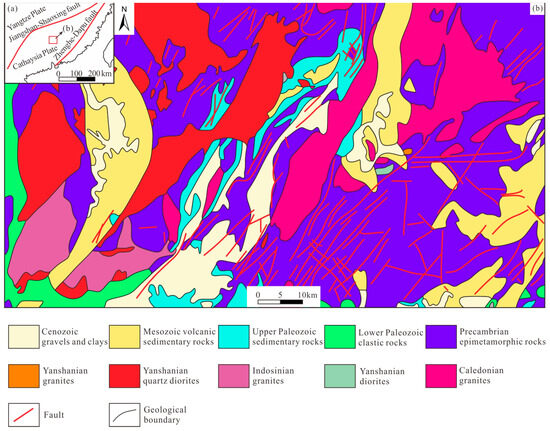
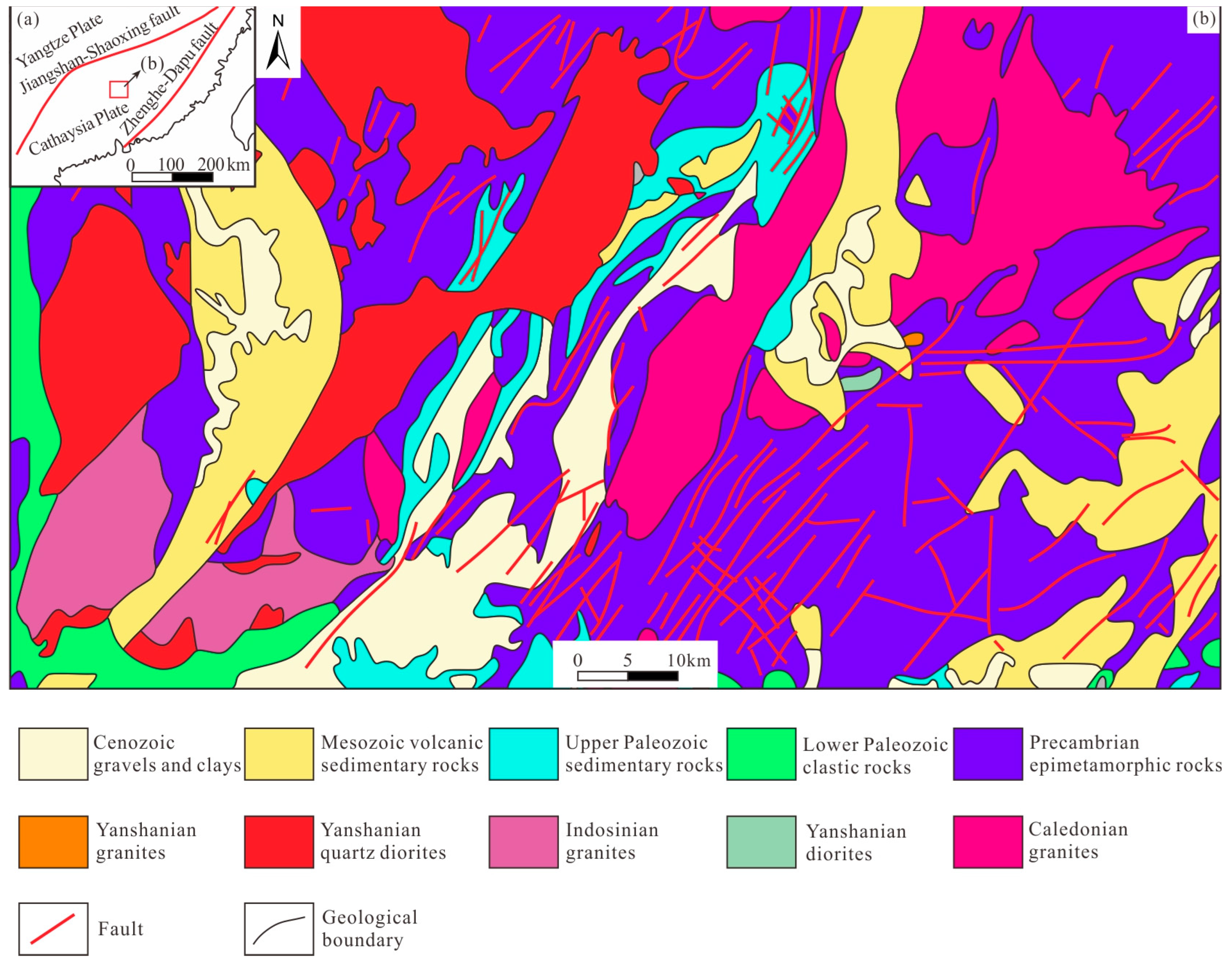
The study area, located in southern Jiangxi Province, is tectonically located between the Yangtze Block and the Cathaysia Block. It is situated at the intersection of the east–west (E–W)-trending Nanling tectonic belt and the northeast (NE)-trending Wuyishan tectonic belt [46,47,48]. Its northern boundary is defined by the Jiangshan–Shaoxing Fault Zone, adjacent to the Yangtze Block. To the south, it is bounded by the Zhenghe–Dabu Fault Zone and the late Mesozoic volcanic rock belt along the southeastern coast (Figure 1a) [49,50].
Figure 1.
Tectonic location (a) and regional geological map (b) of the Getengzui district in southern Jiangxi (modified after Zhao et al., [16]; Wang et al., [51]).
Extensive research has confirmed that the Yangtze and Cathaysia Blocks collided and amalgamated during the Neoproterozoic (1000–800 Ma), forming the complex South China Block. This block subsequently experienced multi-phase tectono-magmatic overprinting, which shaped its present tectonic framework [52,53,54]. The stratigraphy in the region is relatively complete, with strata from the Proterozoic to the Quaternary. The only exception is the Silurian strata, which are absent (Figure 1b). The basement consists of Neoproterozoic Qingbaikouan shallow metamorphic rocks, mainly phyllite of the Shenshan Formation and metatuff of the Kuli Formation. These rocks serve as the parent rocks for the REE deposits in the area [32,55,56].
Conformably overlying the basement is a thick sequence of marine flysch, consisting of shallow metamorphic clastic rocks from the Nanhua to Cambrian periods. Paleozoic to Mesozoic marine to paralic carbonate and clastic rocks are well-developed. The Meso-Cenozoic strata are dominated by continental basin red clastic sediments and volcanic rock series [57,58]. The regional tectonic framework is complex, characterized primarily by multiple sets of structural systems, including near E-W, NE-trending (Cathaysian, Neocathaysian), and NW-trending structures. The junctions and composite zones of these structures control the distribution of sedimentary basins, magmatic belts, and mineral resources, including tungsten (tin), copper, lead, zinc, silver, cobalt, iron, rare earth elements (REE), as well as potassium feldspar, kaolin, and geothermal resources [59].
Folds and faults are well-developed, providing pathways and space for fluid migration and weathering crust development. Magmatic activity in the region is multi-phased, with the Caledonian and Yanshanian periods being the most intense. Caledonian granites mostly occur as batholiths forming composite plutons. Yanshanian magmatic activity was large-scale, generating widely distributed intermediate-felsic granite bodies. This period represents an important rock- and ore-forming stage in the region. Additionally, minor magmatic activities occurred during the Hercynian and Indosinian periods [60].
2.2. Deposit Geological Characteristics
The Getengzui ion-adsorption REE deposit is hosted in the weathering crust of the Qingbaikouan shallow metamorphic rocks. It is the first discovered weathering crust-type REE deposit hosted in such rocks [55]. The topography of the mining area is dominated by intermontane basins and low-relief hills. The weathering crust is distributed areally, with a thickness ranging from 1.4 to 20.3 m (average 9.53 m) and an outcrop elevation of 230–410 m. From top to bottom, the weathering crust profile comprises the hilltop soil layer, completely weathered horizon, semi-weathered horizon, and bedrock [61]. The total content of clay minerals in the weathering crust is about 60%–80%, dominated by illite (40%–60%) and kaolinite (20%) [62].
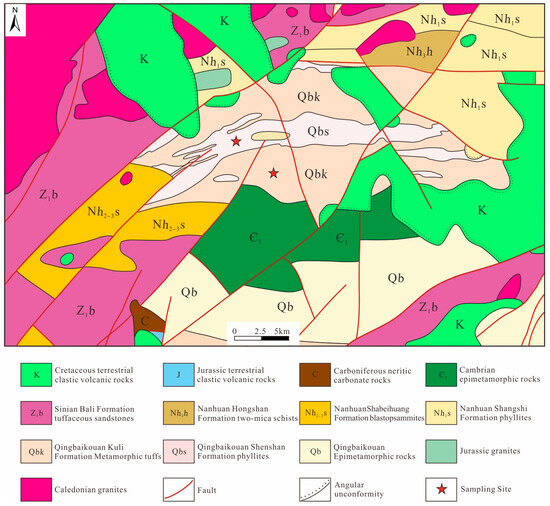
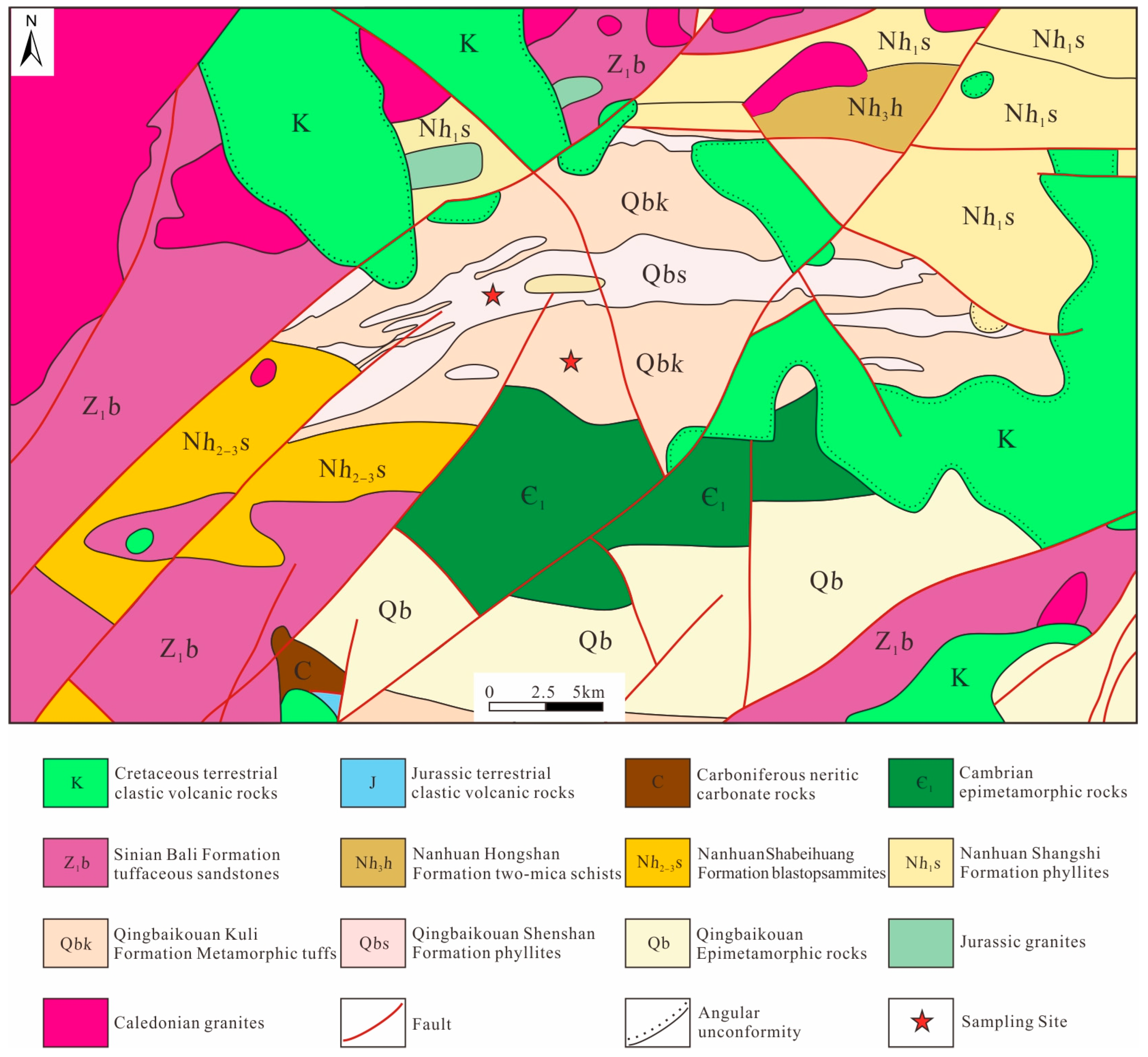
The mining area mainly exposes strata including the Qingbaikouan Kuli Formation, the Shenshan Formation, and the Nanhua, Sinian, and Cambrian strata (Figure 2). The Kuli Formation, predominantly composed of metatuff, is distributed in the southern part of the area. It lies in angular unconformity with the overlying Mesozoic strata. To the north, the Shenshan Formation is distributed in a belt and consists mainly of phyllite. The parent rocks for mineralization are the shallow metamorphic rocks of the Qingbaikouan Kuli and Shenshan Formations [32,55,56]. Magmatic rocks in the area mainly include large-scale Caledonian granites exposed in the northwest, as well as small outcrops of Jurassic granite and quartz diorite in the north. Faults are primarily NE-trending, NW-trending, and near E-W trending, controlling the strata distribution [16,63].
Figure 2.
Geological map of the Getengzui REE mining area in southern Jiangxi (modified after Zhao et al., [16]).
Ore bodies are strictly controlled by the weathering crust, mainly occurring on the completely weathered horizon, on gentle hilltops and slopes. They are stratiform-like and lenticular in shape, extending along the topography, and are mostly elliptical in plain view. Engineering statistics show that the ore bodies are shallowly buried. Approximately 93% of the drilling projects encountered ore within a depth of 15 m, with an average thickness of about 5.66 m. Ore bodies are thicker at hilltops and ridges, thinning gradually towards slopes and foot slopes. The average leachable REE grade of the ore bodies is 0.07%. Vertically, the ore bodies often exhibit a “funnel-shaped” distribution with enrichment in the middle and poorer grades at the top and bottom. This distribution pattern indicates intense chemical weathering and secondary enrichment processes [61,64].
3. Methodology
3.1. Sampling Method
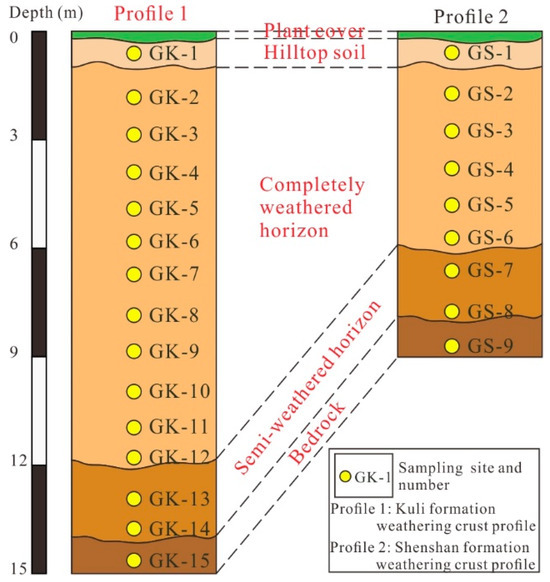
Samples were collected from two complete weathering crust profiles of the Kuli and Shenshan Formations within the Getengzui deposit. The Kuli Formation weathering crust profile was exposed by house construction, while the Shenshan Formation profile was uncovered by road excavation. Continuous vertical sampling was conducted from top to bottom, covering the hilltop soil layer, completely weathered horizon, semi-weathered horizon, and bedrock, with a sampling interval of 1 m. A total of 24 samples were obtained: 15 from the Kuli Formation profile and 9 from the Shenshan Formation profile. The Kuli Formation samples included 1 hilltop soil sample, 11 completely weathered horizon samples, 2 semi-weathered horizon samples, and 1 bedrock sample. The Shenshan Formation samples consisted of 1 hilltop soil sample, 5 completely weathered horizon samples, 2 semi-weathered horizon samples, and 1 bedrock sample (Figure 3).
Figure 3.
Schematic diagram of the weathering crust profiles and sampling for the Kuli and Shenshan Formations.
3.2. Analytical Methods
Major and trace element geochemical analyses were all performed at Nanjing Hongchuang Geological Exploration Technology Service Co., Ltd. (Nanjing, China).
Major elements were determined using a JY-ULTIMA2C inductively coupled plasma optical emission spectrometer (ICP-OES) manufactured by HORIBA, Ltd., Kyoto, Japan. Analysis followed the lithium metaborate fusion-ICP-OES internal standard method, with Li as the internal standard, achieving an analytical precision (RSD) of <3%. The analytical procedure was as follows. We accurately weighed 100 mg of the sample, which was crushed to −200 mesh (<0.075 mm) and dried at 105 °C, and 400 mg of anhydrous lithium metaborate. The mixture was then ground thoroughly, transferred to a graphite crucible, and fused in a muffle furnace at 1000 °C for 15 min. After forming a glass bead, we allowed it to cool to room temperature. Place the cooled glass bead into a 250 mL beaker containing 50 mL of 5% aqua regia. Heat and stir the solution in an 80 °C water bath using a magnetic hot plate for 30 min. Once fully dissolved and cooled, dilute the solution to 100 mL with 5% aqua regia, mix well, and let it stand before testing.
The trace elements, including REEs, were analyzed using an Agilent 7900 inductively coupled plasma mass spectrometer (ICP-MS) manufactured by Agilent Technologies, Inc., Santa Clara, CA, USA. The acid digestion-ICP-MS internal standard method was employed, using Rh as the internal standard with five scans per element. The precision (RSD) was less than 3% for all elements. The procedure consisted of the following steps. Prior to analysis, 50 mg of the prepared sample (−200 mesh, dried at 105 °C) was weighed into a PTFE digestion vessel. A mixed acid solution (1 mL HNO3, 3 mL HCl, 1.5 mL HF) was added, and the sealed vessel was heated at 190 °C for no less than 36 h to ensure complete digestion. Following digestion, the solution was evaporated to moist salts at 160 °C. The addition of 1 mL HNO3 was repeated twice, and then re-dissolved with 1.5 mL HNO3, 2 mL H2O for a secondary 12 h heating at 190 °C. Finally, the cooled digestate was diluted to 50 mL with high-purity deionized water (18 MΩ·cm) for quantitative ICP-MS.
3.3. Data Processing Methods
To assess the weathering intensity, the Chemical Index of Alteration (CIA) and the Base Leaching Index (BA) were selected as indicators. CIA quantitatively characterizes the degree of conversion of silicate minerals to clay minerals, calculated as follows: CIA = [Al2O3/(Al2O3 + CaO* + K2O + Na2O)] × 100 [65]. BA evaluates the leaching intensity of alkaline elements (Ca, Na, K, Mg), thereby reflecting the maturity of the weathering crust and the pH evolution of the mineralizing fluid. It is calculated as follows: BA = (K2O + Na2O + CaO + MgO)/Al2O3 [66]. A lower BA value indicates a higher chemical weathering intensity. In the above formulas, element contents are expressed in molar proportions, and CaO* specifically refers to silicate-bound calcium [66].
To study element mobility, the mass transfer coefficient (τ) was selected as an indicator to quantitatively characterize the degree of migration (loss or gain) of a specific element, relative to an immobile reference element during weathering. The formula is as follows: τi,j = (Ci, w/Ci,p) × (Cref,p/Cref,w) − 1. Where τi,j is the mass transfer coefficient of element “i” in weathered sample “j”, Ci, w is the concentration of element “i” in the weathered sample, Ci,p is the concentration of element “i” in the bedrock, Cref,p is the concentration of the immobile reference element in the bedrock, and Cref,w is the concentration of the immobile reference element in the weathered sample [67].
To construct the trace element spider diagrams, sample trace element concentrations were normalized to primitive mantle values [68]. For REE distribution patterns and calculations of anomalies δCe and δEu, sample REE concentrations were normalized to chondrite values [69]. The formulas are as follows: , and LaN, CeN, PrN, SmN, EuN, GdN are chondrite-normalized values. For A-CN-K ternary diagrams, the parameters are defined as A = Al2O3/(Al2O3 + CaO + K2O + Na2O), CN = (CaO + K2O)/(Al2O3 + CaO + K2O + Na2O), and K = K2O/(Al2O3 + CaO + K2O + Na2O). The element contents are in weight percent, and CaO* refers specifically to silicate-bound calcium [70].
For the statistics of light rare earth elements (LREEs) and heavy rare earth elements (HREEs), the definitions are as follows: LREEs = La + Ce + Pr + Nd + Pm + Sm + Eu, HREEs = Gd + Tb + Dy + Ho + Er + Tm + Yb + Lu + Y + Sc, and REEs (total rare earth elements) = LREEs + HREEs [4].
4. Results
Concentrations of and variations in the major elements, trace elements, and rare earth elements (REEs) are presented in Table 1, Table 2 and Table 3 and Figure 4, Figure 5 and Figure 6, respectively.
Table 1.
Major element concentration of Kuli and Shenshan Formations’ weathering crust profile samples (%).
Table 2.
Trace element concentration of Kuli and Shenshan Formations’ weathering crust profile samples (ppm).
Table 3.
Rare earth element contents of Kuli and Shenshan Formations’ weathering crust profile samples (ppm).
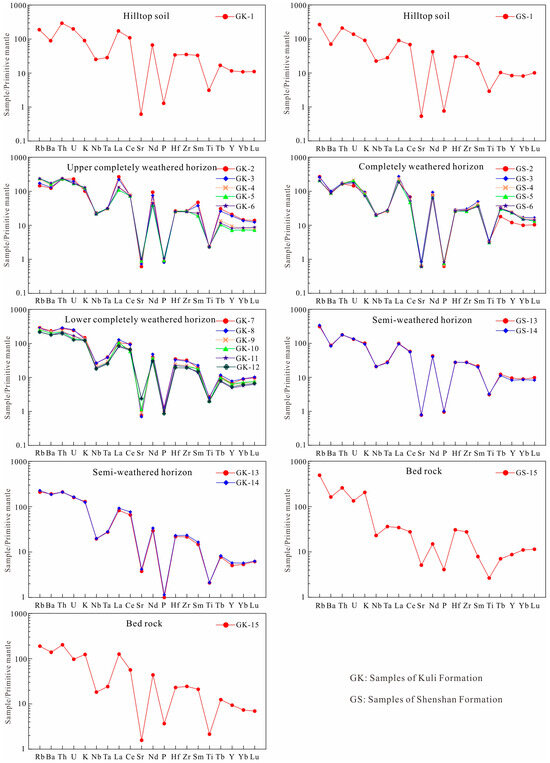
Figure 4.
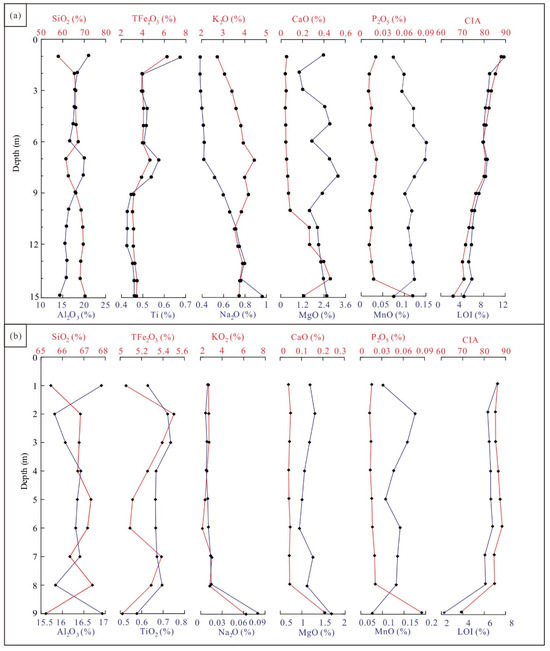
Variation in major elements in the weathering profiles of (a) Kuli and (b) Shenshan Formations.
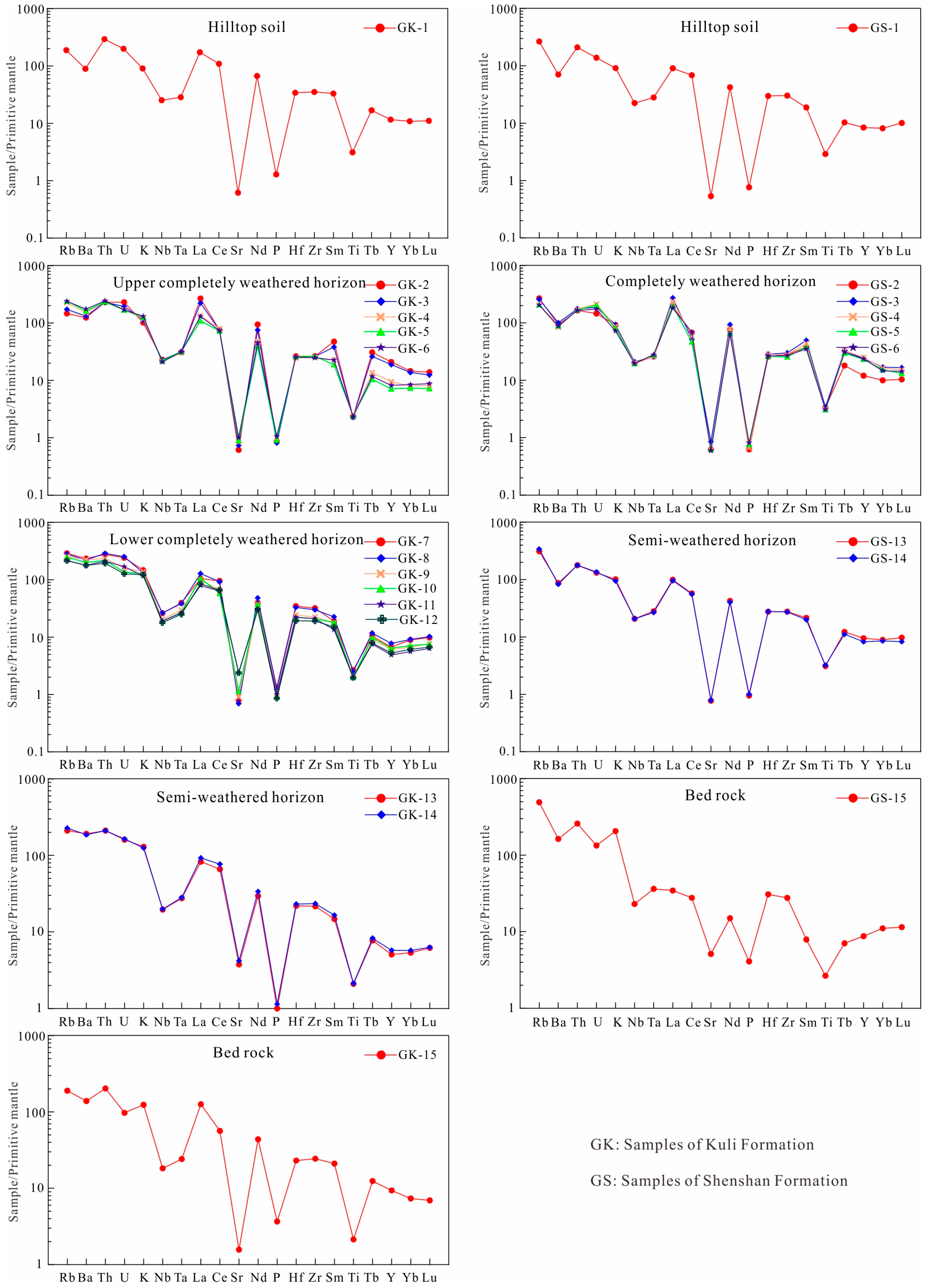
Figure 5.
Trace element spider diagrams for the weathering crust profiles of the Kuli and Shenshan Formations.
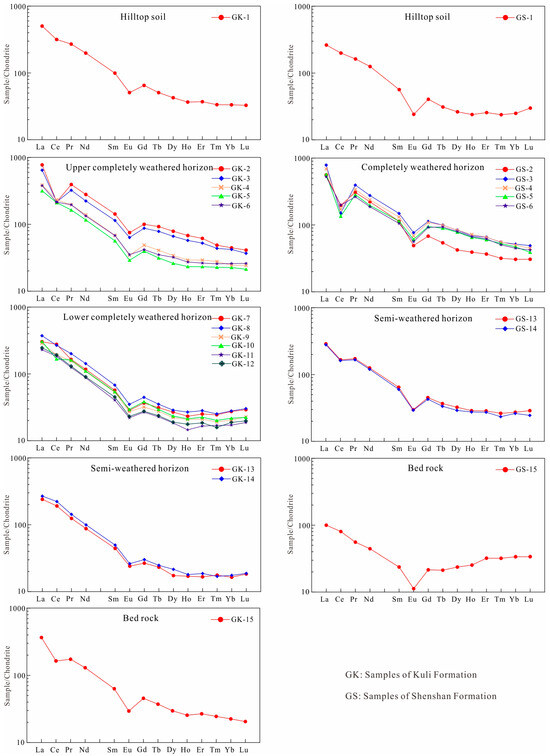
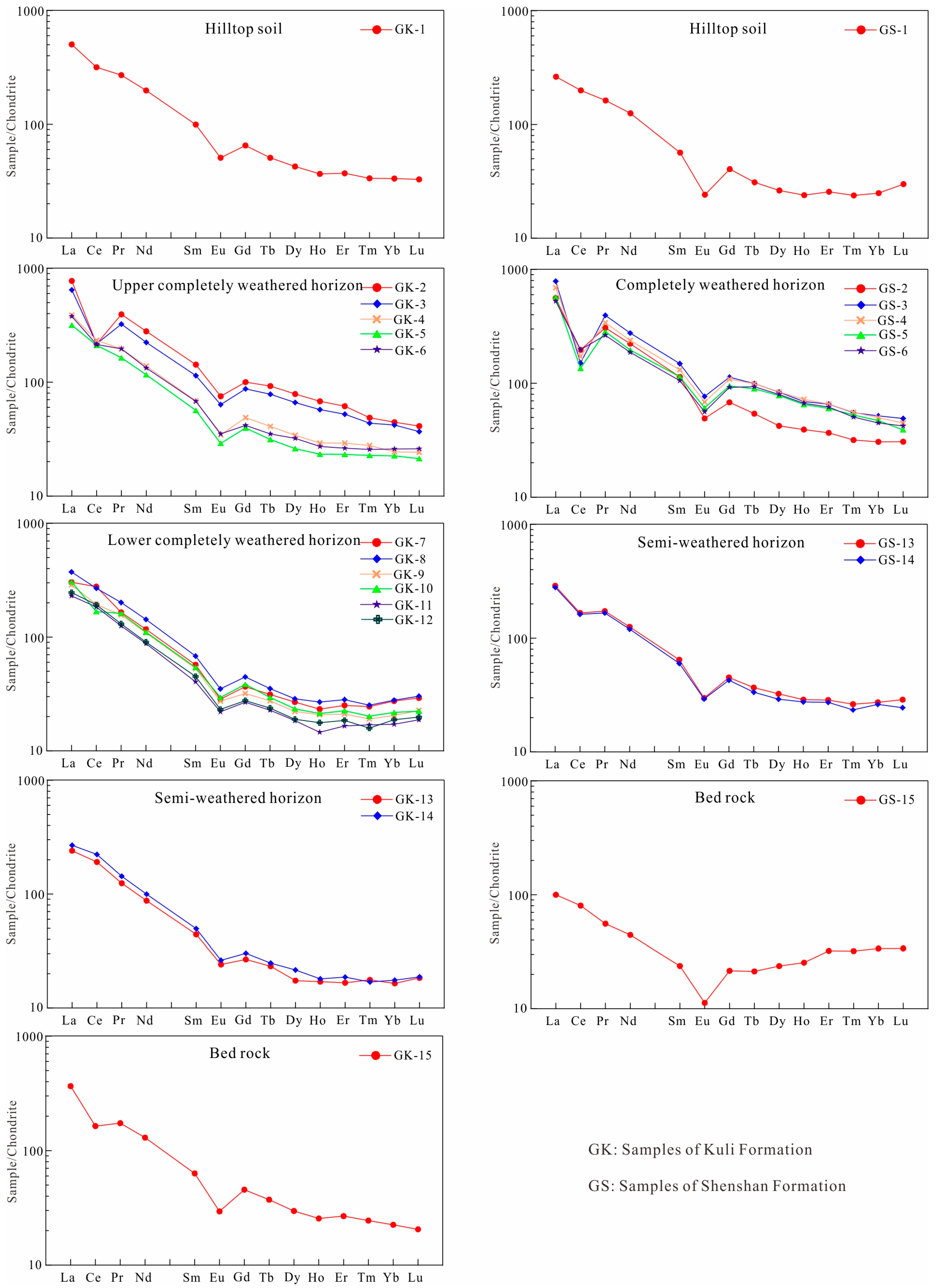
Figure 6.
REE distribution patterns for the weathering crust profiles of the Kuli and Shenshan Formations.
4.1. Major Elements
For the Kuli Formation, the average sum of SiO2, Al2O3, and TFe2O3 contents is close to 90%. These three elements constitute the main components of the weathering crust. SiO2 has the highest content, ranging from 57.92% to 70.54%. The Al2O3 content varies from 14.41% to 21.04% and TFe2O3 ranges from 3.05% to 6.25%. The MgO and TiO2 contents are relatively low, with ranges of 0.53%–0.88% and 0.43%–0.68%, respectively. The K2O, Na2O, and CaO contents in the weathering crust are also low. Specifically, K2O ranges from 2.73% to 4.44%, Na2O from 0.08% to 3.57%, and CaO from 0.04% to 0.46%. Their contents generally decrease from bedrock to hilltop soil. This indicates the rapid and extensive decomposition of plagioclase, as well as the leaching of Na and Ca during the weathering process. The MnO content ranges from 0.04% to 0.12%, and P2O5 from 0.02% to 0.08%. The loss on ignition (LOI) increases gradually from 2.53% (bedrock) to 10.21% (hilltop soil), with an average of 5.79%. This increase reflects two key trends. First, secondary minerals containing water of crystallization and volatiles (CO2, SO2, etc.) accumulate across various weathered horizons as the weathering intensifies. Second, plant roots and humus become enriched within the hilltop soil of the upper weathering crust. The Chemical Index of Alteration (CIA) values range from 66% to 88%, with an average of 77%. They generally increase from bedrock to hilltop soil, showing a high consistency with the LOI trend. Fedo and Nesbitt [70] proposed that CIA values of 50–60 represent incipient chemical weathering, 60–80 represent intermediate chemical weathering, and values above 80 correspond to extreme chemical weathering. Thus, the Kuli Formation weathering crust at the Getengzui REE deposit has entered the intermediate to extreme stage of weathering, with the middle-upper part of the completely weathered horizon basically being in the extreme stage (Table 1 and Figure 4).
For the Shenshan Formation, SiO2, Al2O3, and TFe2O3 are also the main components, with their average sum being similarly close to 90%. K2O, Na2O, CaO, MgO, and P2O5 have low contents and exhibit highly consistent variation trends. These elements remain stable from hilltop soil to the semi-weathered horizon, then increase sharply at the bedrock contact. LOI and CIA values show a highly consistent trend: they change slightly from hilltop soil to the semi-weathered horizon, then decrease abruptly at the bedrock contact. From hilltop soil to the semi-weathered horizon, all CIA values for the Shenshan Formation profile exceed 80%, indicating that the weathering crust has entered the extreme stage of weathering (Table 1 and Figure 4).
In summary, the major element compositions of the Kuli and Shenshan Formations are similar, suggesting that they may share a common material source. The overall weathering degree of the Shenshan Formation is slightly higher than that of the Kuli Formation.
4.2. Trace Elements
Relative to the primitive mantle, almost all samples from both profiles show enrichment in various trace elements, with the primitive mantle-normalized ratio of >1. This indicates an overall background trend of trace element enrichment in the Getengzui REE mining area. Most samples, especially those from the completely weathered horizon and hilltop soil, exhibit primitive mantle-normalized ratios of over or approaching 100 for trace elements such as Rb, Ba, Th, U, La, Ce, and Nd. This reflects a highly enriched geochemical background. The maximum contents (in ppm) of these elements in the Kuli profile reach 183.7 (Rb), 1641 (Ba), 24.97 (Th), 5.31 (U), 4.44 (La), 183.5 (Ce), 194.4 (Nd), and 127.6 (Sm). In the Shenshan profile, the maximum contents (in ppm) are 312.1 (Rb), 1137 (Ba), 22.01 (Th), 4.47 (U), 6.21 (La), 186.8 (Ce), 122.1 (Nd), and 126.2 (Sm) (Table 2 and Figure 5).
Comparing the two profiles, their bedrock trace elements show highly consistent distribution patterns. For example, both are relatively depleted in Ba, Nb, Ta, Sr, P, and Ti, and relatively enriched in Th, Zr, Hf, and REE. The Kuli Formation is mainly composed of metatuff and metasandstone, whereas the Shenshan Formation is dominated by phyllite. Despite these lithological differences, this finding strongly confirms that the two formations share a common original material source. Moreover, they have undergone similar geochemical differentiation processes and were likely formed in the context of a unified regional tectono-magmatic event.
For both the Kuli and Shenshan profiles, the primitive mantle-normalized trace element diagrams display parallel curve shapes across successive layers: from bedrock, through semi-weathered horizon, to completely weathered horizon, to hilltop soil. Particularly, high field strength elements (Nb, Ta, Zr, Hf) and REEs (La, Ce, Nd, Sm, Tb, Y, Yb, Lu) show highly consistent trends. This consistency is observed between each weathered horizon and the underlying bedrock. This preliminarily indicates a high degree of inheritance of trace element distribution patterns in the weathering crust from those of the bedrock. Although the weathering process has strongly modified the mineral composition and chemical makeup of the rocks, it has not introduced significant exogenous material or completely disrupted the original element distribution relationships. Thus, the weathering crusts of the Kuli and Shenshan formations are primarily formed through an “in situ weathering-inheritance enrichment process”, rather than by distal hydrothermal superimposition.
4.3. Rare Earth Elements
4.3.1. Vertical Fractionation Characteristics
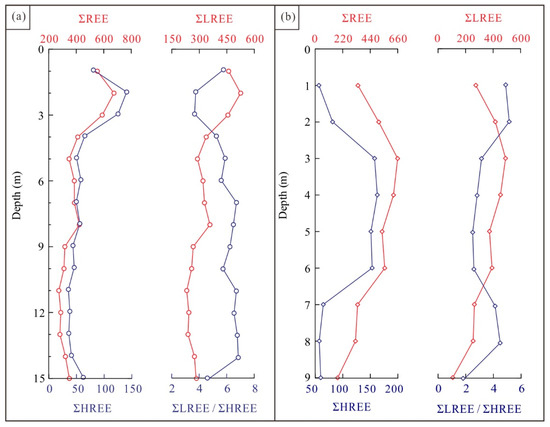
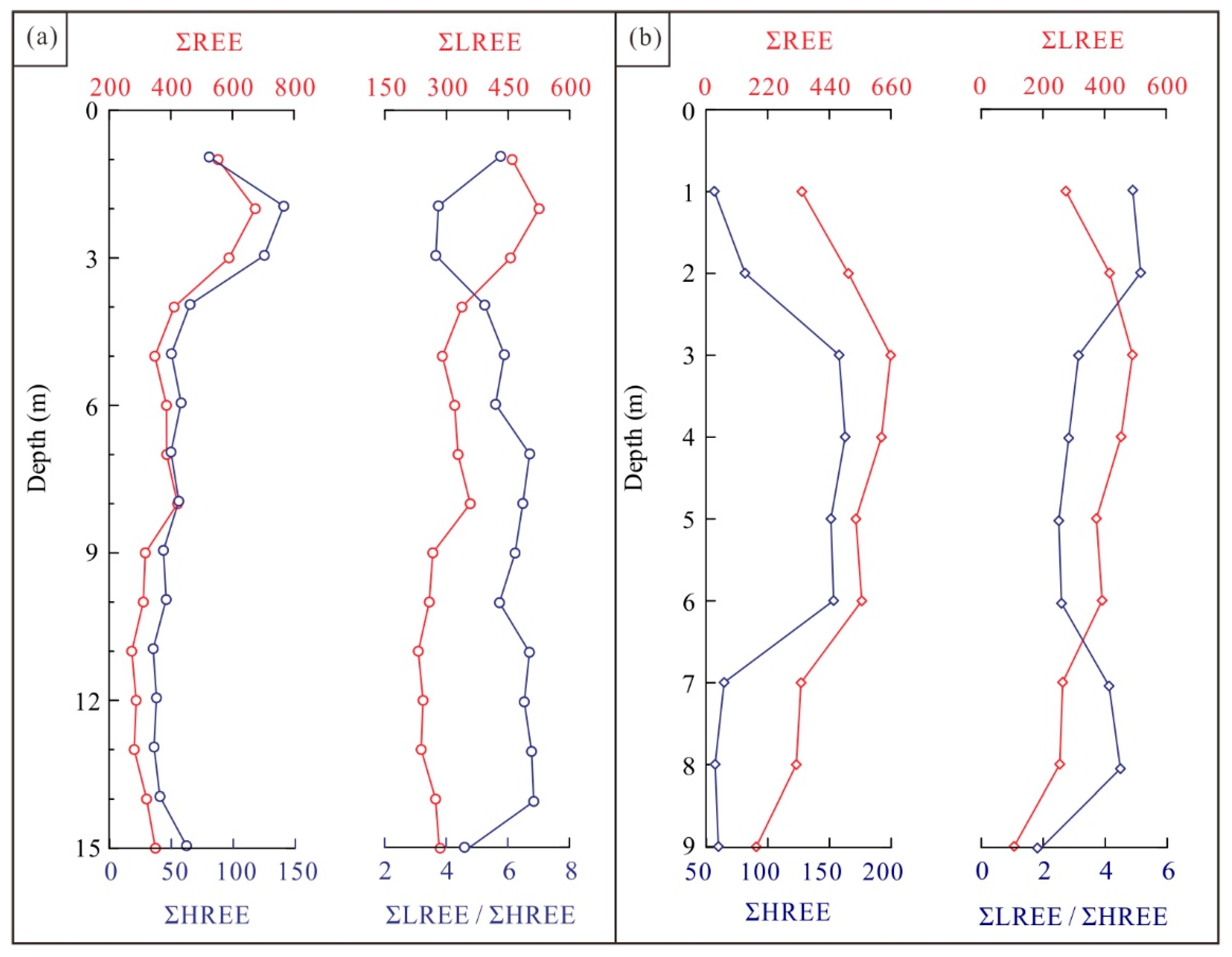
Overall, the total rare earth element (ΣREE) contents of samples from both the Kuli and Shenshan profiles show a gradual increase from bedrock upward through the completely weathered horizons (Table 3 and Figure 7). The ΣREE contents reach their peaks in the middle-upper part of the completely weathered horizon. ΣREE contents for Kuli profile samples range from 273.36 ppm to 674.26 ppm, averaging 375.60 ppm. This average is higher than that of REE-mineralized granites in the Nanling region (289 ppm) [16]. The LREE/HREE ratio is >1, ranging from 3.65 to 6.81, indicating that LREEs are more enriched than HREEs. The bedrock sample has a ΣREE content of 350.28 ppm, which is 2.34 times the threshold content (150 ppm) considered necessary for REE mineralization from parent rocks in the Nanling region. However, it is lower than the ΣREE content in hilltop soil and middle-upper completely weathered horizon samples. The bedrock sample has an LREE/HREE ratio of 5.81, which is lower than that of samples from hilltop soil, the middle-lower completely weathered horizon, and the semi-weathered horizon.
Figure 7.
Vertical variations in ΣREE, ΣLREE, ΣHREE and ΣLREE/ΣHREE in the weathering crust profiles of the (a) Kuli and (b) Shenshan Formations.
For Shenshan profile, ΣREE content samples range from 179.35 ppm to 659.33 ppm, with an average of 446.07 ppm. The LREE/HREE ratio is also greater than 1 (1.78–5.11), indicating predominant LREE enrichment. The bedrock sample has a ΣREE content of 179.35 ppm, which is significantly lower than that in hilltop soil, completely weathered horizon, and semi-weathered horizon samples. Its LREE/HREE ratio is 1.78, which is also significantly lower than that of samples from other layers. Comparing the two profiles, both exhibit high REE contents and obvious LREE enrichment. Due to the significant difference in the LREE/HREE ratio of the bedrock between the two profiles, their weathering crusts also show distinct LREE/HREE ratios. This indicates that different parent rocks constrain the degree of REE enrichment, with the Kuli Formation weathering crust profile being more enriched in LREEs than the Shenshan Formation profile.
4.3.2. Distribution Patterns and Anomalies
The chondrite-normalized REE distribution patterns (Figure 6) clearly display the complete weathering–mineralization sequence of REEs in the Kuli and Shenshan Formation weathering crust profiles.
From bedrock to hilltop soil, the distribution curves of both profiles illustrate a high degree of morphological inheritance, indicating in situ inheritance of the ore-forming materials. Specifically, the curves of samples from various weathered horizons are roughly parallel to the curve of the underlying bedrock. As weathering intensifies, the slopes of the LREE segment (La-Sm) and HREE segment (Gd-Lu) of the Kuli Formation curve change slightly from bedrock to hilltop soil, remaining essentially stable.
For the Shenshan Formation, the slope of the LREE segment curve gradually steepens from bedrock to the completely weathered horizon, reaching its maximum in the completely weathered horizon, while the HREE segment curve slope increases slightly. Both profiles exhibit pronounced negative Eu anomalies (δEu < 1). The δEu value range for the Kuli profile is 0.55–0.70, and for the Shenshan profile is 0.50–0.59, with the lowest values appearing in the bedrock for both. Distinct negative Ce anomalies are observed in the upper part of the completely weathered horizon of both profiles, with the minimum values occurring in this specific layer. Additionally, weak negative Ce anomalies are detected in the bedrock of the Kuli profile and the semi-weathered horizon of the Shenshan profile. In contrast, no obvious Ce anomalies (δCe ≈ 1) are found in any other layers of the two weathering crust profiles.
Overall, the Kuli and Shenshan weathering crust profiles, from bedrock, the semi-weathered horizon, and the completely weathered horizon to hilltop soil, exhibit consistent “right-inclined” curves, characterized by LREE enrichment and relatively flat HREE patterns. The occurrences of negative Eu and negative Ce anomalies are essentially consistent between the two profiles.
5. Discussion
5.1. Weathering Intensity and Processes
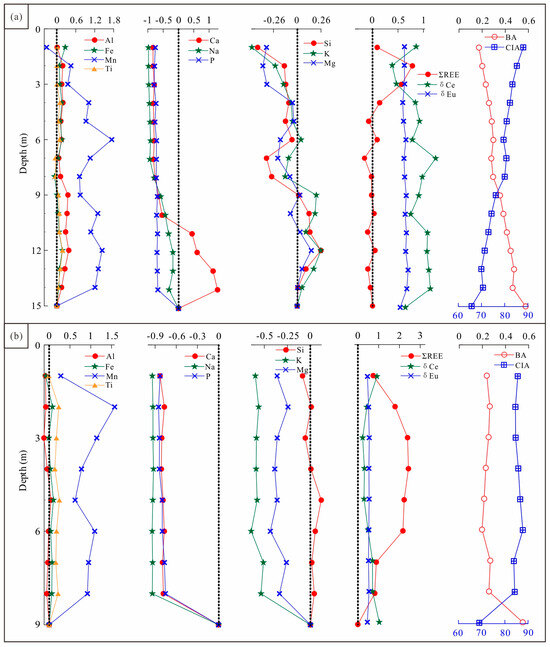
The Chemical Index of Alteration (CIA) is widely used to quantify the weathering intensity, with higher values indicating more intense chemical weathering [71]. Geochemical indicators from this study clearly demonstrate that the Kuli Formation deposit has entered the intermediate–extreme stage of chemical weathering. Specifically, the middle-upper part of the completely weathered horizon is essentially in the extreme weathering stage, while the Shenshan Formation weathering crust is fully in the extreme weathering stage (Figure 8).
Figure 8.
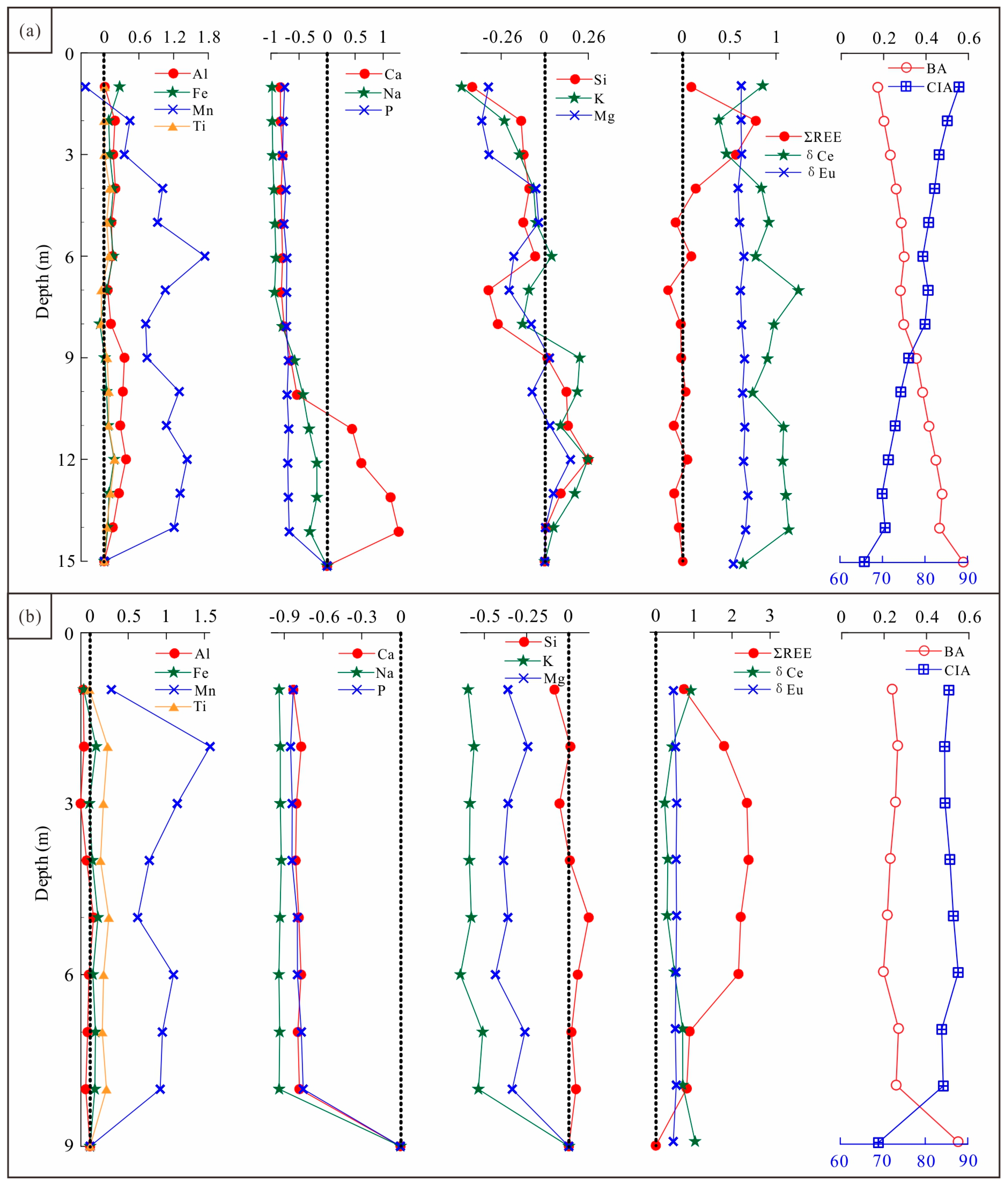
τ, ΣREE, δCe, δEu, BA and CIA values of major elements in the weathering crust profiles of (a) Kuli and (b) Shenshan Formations.
CIA values for the Kuli profile range from 66 to 88, with a distinct peak (averaging 83) in the middle-upper completely weathered horizon. For the Shenshan profile, CIA values vary from 69 to 88, peaking at an average of 86 in the completely weathered horizon. Such intense chemical weathering implies near-complete decomposition of primary silicate minerals, with secondary aluminous clay minerals (e.g., kaolinite) dominating the mineral assemblage. This is consistent with the interpretation that the Getengzui REE deposit area has progressed to the desilication–alitization stage of weathering [72].
This high weathering intensity is further corroborated by low values on the Base Leaching Index (BA). In both profiles, high CIA values correlate negatively with low BA values. BA values in the middle-upper completely weathered horizon and hilltop soil of the Kuli profile, as well as in the semi-weathered horizon, completely weathered horizon, and hilltop soil of the Shenshan profile, are consistently below 0.3 (Figure 8). This reflects a warm and humid subtropical–tropical paleoclimate [73] and signifies severe, nearly complete leaching of mobile base cations (Ca2+, Na+, K+, Mg2+). This leading process lowers the pore water pH significantly, gradually generating an acidic geochemical environment that lays the foundation for REE mobilization and migration from their primary host minerals.
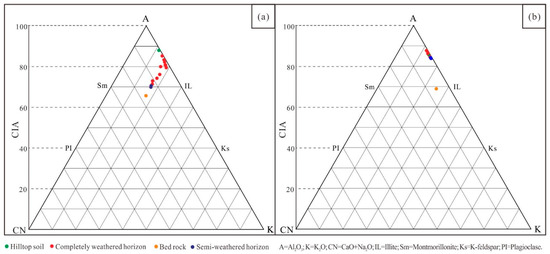
Weathering pathways are clearly delineated in the A-CN-K ternary diagrams (Figure 9). Based on the sequence of element mobility, Nesbitt et al. [69] divided the chemical weathering process into three stages: an incipient Na, Ca-removal stage, an intermediate K-removal stage, and an extreme Si-removal stage. Li et al. [74] noted that Ca mainly hosted in easily weathered minerals such as plagioclase and ferromagnesian minerals (e.g., pyroxene), undergoing intense leaching in the incipient stage of chemical weathering. Sodium resides in feldspars (mainly plagioclase) and micas, and is leached as these minerals decompose during weathering.
Figure 9.
A-CN-K ternary diagrams of the weathering crust profiles of the (a) Kuli and (b) Shenshan Formations (base diagram after Nesbitt and Young [75,76]).
All samples from the two profiles show a clear evolutionary trend from the inferred composition of unweathered metamorphic rocks toward the A apex (alumina-rich endmember) in the A-CN-K diagrams. For the Kuli profile, samples collected from the middle-lower completely weathered horizon and semi-weathered horizon exhibit a weathering trend that is parallel to the A-CN side. This observed trend is indicative of an incipient weathering stage, which is primarily dominated by the dissolution of plagioclase. Importantly, this incipient weathering process is accompanied by the preferential leaching and removal of Ca and Na ions. In contrast, Kuli upper completely weathered horizon and hilltop soil samples, as well as all Shenshan profile samples, exhibit a trend aligned with or close to the A-K side. This differs distinctly from the Kuli middle-lower horizon trend. Furthermore, this trend approaches the A apex, reflecting a more advanced weathering state.
This indicates near-complete plagioclase weathering, intense depletion of Ca and Na and relative enrichment of Al, marking the subsequent decomposition of K-feldspar and intense desilication–alitization, as observed in Table 1 and Figure 4. The weathering products are dominated by kaolinite and gibbsite, confirming a high degree of weathering. Notably, Kuli samples cluster along a trajectory reflecting more efficient removal of plagioclase-derived components compared to Shenshan samples. This divergence highlights that parent rock mineralogical composition exerts a fundamental control for the efficiency of clay mineral neoformation and specific weathering pathway, thereby regulating REE enrichment processes.
5.2. Element Mobility and Mass Balance
Primitive mantle-normalized trace element spider diagrams (Figure 5) show that Zr normalized values are highly stable and enriched, consistent with its immobility during chemical weathering. Thus, Zr was selected as the immobile reference element for mass balance calculations [77], quantitatively revealing significant differences in element behavior during weathering at the Getengzui deposit (Figure 8). In the middle-upper completely weathered horizon and hilltop soil of the Kuli profile, base cations are intensely leached. τ values for CaO and Na2O approach −1, indicating their near-complete removal via plagioclase dissolution.
This is followed by depletion of K2O, MgO, and SiO2 (τ < 0, some approaching −0.2), reflecting the progressive breakdown of K-feldspar and ferromagnesian minerals. In contrast, Al2O3, Fe2O3, and MnO are conservatively enriched (τ > 0) as residual and secondary phases, marking the transition to a clay- and oxide-dominated weathering crust. TiO2 retains τ values close to 0, confirming its inert behavior during weathering. P2O5 is severely depleted throughout the weathering crust (τ ≈ −0.7), indicating the complete dissolution of apatite, identified as the primary source of mobilized REE ions. τ values for ΣREE, ΣLREE, and ΣHREE exhibit consistent trends, indicating coupled migration of LREEs and HREEs. Meanwhile, the τ(ΣREE) values in the upper completely weathered horizon remain above 0.15, peaking at 0.78, confirming true secondary enrichment, rather than passive residual concentration.
In the Shenshan profile (the semi-weathered horizon, completely weathered horizon, and hilltop soil), base cations are also intensely leached. τ values for Na2O approach −1, and for CaO, they are consistently around −0.8, indicating near-complete removal via plagioclase dissolution. K2O and MgO are severely depleted, with τ values between −0.3 and −0.65, reflecting the progressive breakdown of K-feldspar and ferromagnesian minerals. SiO2 remains relatively stable, with τ values around 0. It suggests a dynamic equilibrium: silicon released by primary silicate decomposition (as soluble silicic acid) is partially consumed by in situ or short-distance formation neoformation of secondary clay minerals (e.g., kaolinite).
This is a typical feature of the extreme siallitization stage, indicating a high degree of chemical maturity in the weathering system. τ values for Al2O3, Fe2O3, MnO, TiO2, and P2O5 are consistent with those of the Kuli profile. τ values for ΣREE, ΣLREE, and ΣHREE show coupled trends, with τ(ΣREE) exceeding 0.7 throughout the completely weathered horizon and peaking at 2.43, indicating intense secondary enrichment.
Combined with CIA and BA data, the geochemical mobility sequences of elements are established for both profiles. The Kuli Formation is Na2O > CaO > P2O5 > MgO > SiO2 > K2O > REE > TiO2 > Fe2O3 > Al2O3 > MnO, while the Shenshan Formation is Na2O > P2O5 > CaO > K2O > MgO > Al2O3 > SiO2 > Fe2O3 > TiO2 > MnO > REE.
5.3. Mechanisms and Controlling Factors of REE Enrichment
Highly consistent REE distribution patterns between the Kuli and Shenshan weathering crusts and their respective underlying bedrock (Figure 6) provide definitive evidence for dominant source inheritance. Additionally, primitive mantle-normalized trace element spider diagrams (Figure 5) illustrate congruent patterns between weathering crusts and bedrocks, including consistent negative anomalies for Ba, Nb, Ta, Sr, P, and Ti and positive anomalies for Th, Zr, Hf, and REE. These lines of evidence collectively rule out significant contributions from exogenous materials to REE enrichment.
Intense chemical weathering is the primary driver of REE enrichment, as evidenced by the positive correlation between CIA and ΣREE (Figure 8). This correlation encapsulates a core geochemical chain: intense leaching of base cations (τ(Ca, Na) ≈ −1) lowers the percolating fluid pH, promoting dissolution of REE-bearing accessory minerals (e.g., apatite, τ(P2O5) ≈ −0.8). Concurrently, advanced argillic alteration (CIA > 80) generated abundant secondary clay minerals, creating conditions for REE adsorption.
Redox-sensitive processes are highlighted by the coupled behavior of Mn and Ce (Figure 8). In the middle-upper completely weathered horizon of the Kuli profile and the semi-weathered horizon, the completely weathered horizon, and hilltop soil of the Shenshan profile, the enrichment of Mn (τ > 0.2) coincides with negative Ce anomalies (δCe < 1). This jointly indicates an oxidizing environment in these horizons. Under oxidizing conditions, Ce3+ is oxidized to Ce4+, which is more prone to hydrolysis than Ce3+ [78]. The hydrolysis products of Ce4+ form hydrogen bonds with anion groups on the surfaces of clay minerals (e.g., kaolinite). These products are preferentially adsorbed or coprecipitated by newly formed Fe-Mn oxide colloids. This process leads to relative Ce depletion in REE-enriched horizons, due to leaching.
In the middle-lower completely weathered horizon and semi-weathered horizon of the Kuli profile and the semi-weathered horizon of the Shenshan profile, strong Mn enrichment (τ(MnO2) > 1) is coupled with moderate REE enrichment. This indicates early, selective capture of REEs by reactive Fe-Mn oxide colloids at the redox front, though limited adsorption capacity constrains the total REE enrichment.
In the completely weathered horizon, peak weathering intensity (CIA > 80) generates abundant clay minerals, providing orders of magnitude more adsorption sites and driving large-scale ion-adsorption REE enrichment (τ(REE) peaks). This mechanism confirms that REE mineralization at Getengzui is controlled by sequential geochemical barriers: an upper oxidation–precipitation barrier (dominant for Ce fixation) and a lower clay adsorption barrier (dominant for large-scale REE enrichment). Collectively, they ensure efficient interception and enrichment of REEs within the weathering profile.
In summary, Getengzui REE deposit formation is attributed to in situ weathering and ion-adsorption processes. Intense base cation leaching generates an acidic, silica-undersaturated fluid environment. This environment facilitates REE release from primary minerals. Meanwhile, secondary clay mineral formation provides abundant adsorption sites, effectively capturing and enriching mobilized REEs from percolating solutions.
5.4. Contrast Between the Two Profiles and Implications for Metallogeny
A comparison of the Shenshan (phyllite) and Kuli (metatuff) reveals that, despite identical warm and humid paleoclimatic conditions, parent rock lithology exerts a first-order control on the REE enrichment efficiency, scale, and fractionation characteristics.
Differences in the material basis and enrichment scale are evident. The Kuli parent rock has an average initial ΣREE content (350.28 ppm) that is approximately twice that of the Shenshan parent rock (179.35 ppm), providing superior source conditions. Correspondingly, the Kuli weathering crust exhibits a thicker REE-enriched layer. The thickness of its mineralization zone (with ΣREE > 280 ppm) is about 1.6 times that of Shenshan. A distinct REE peak also occurs in the middle-upper part of the completely weathered horizon, where ΣREE reaches 674.26 ppm in the upper completely weathered horizon. In contrast, the overall thickness of the Shenshan weathering crust is slightly smaller. However, its average REE content in the completely weathered horizon (577 ppm) is significantly higher than that in the corresponding horizon of the Kuli Formation (400.67 ppm) (Table 3). This indicates a stronger enrichment intensity at Shenshan, which may be attributed to more thorough weathering (reflected by overall higher CIA values) and more efficient clay adsorption.
Regarding REE distribution patterns (Figure 6), both weathering profiles show LREE enrichment but to different degrees. This fractionation feature directly inherits the composition of their parent rocks. The parent rock of Kuli has a higher initial ΣLREE/ΣHREE ratio (4.58), resulting in stronger LREE enrichment throughout its weathering profile (average ΣLREE/ΣHREE = 5.83). The parent rock of Shenshan shows weaker LREE-HREE fractionation (ΣLREE/ΣHREE = 1.78), and its weathering crust accordingly maintains a relatively gentle distribution pattern (average ΣLREE/ΣHREE = 3.68). These patterns suggest that the Kuli Formation trends to form LREE-dominant orebodies, while the Shenshan Formation may yield REE products with a more balanced composition.
These differences originate from fundamental variations in parent-rock mineralogy and weathering dynamics. Therefore, the parent-rock lithology acts not merely as a passive material source but as a “genetic template” that predetermines the scale, grade, and elemental assemblage of the weathering-crust-type REE deposits.
In summary, the parent rock of the Kuli profile favors the formation of thick, large-scale orebodies with a clear LREE advantage. In comparison, the parent rock of the Shenshan profile may form higher-grade orebodies with relatively weaker fractionation. Both have important exploration value, but their mineralization “fingerprints” are distinct.
6. Conclusions
This study was conducted at the Getengzui ion-adsorption REE deposit in South China. It involved systematic geochemical analysis of weathering crust profiles from the Qingbaikouan Shenshan (phyllite) and Kuli (metatuff) Formations. Through this analysis, the study clarified REE geochemical behaviors and enrichment constraints in shallow metamorphic rock weathering crusts.
The shallow metamorphic rock weathering crust at Getengzui has undergone significant intense chemical weathering, reaching the intermediate–extreme stage through desilication and alitization. The average CIA value is 83 for the middle-upper completely weathered horizon of the Kuli Formation and 86 for the Shenshan Formation’s completely weathered horizon. BA values are generally below 0.3. Such intense weathering has led to the nearly complete decomposition of primary silicate minerals, particularly plagioclase. It has also resulted in extensive leaching of base cations, including Ca, Na, and K. These processes collectively generate an acidic pore water environment that is critical for the mobilization and migration of rare earth elements (REE) from their primary host minerals.
Significant in situ secondary REE enrichment occurs in the weathering crust. Mass transfer coefficient (τ) calculations confirm that ΣREE values in the middle-upper completely weathered horizon, with peak values of 0.78 (Kuli) and 2.43 (Shenshan), indicate true mobilization–adsorption enrichment, rather than a passive residual concentration. Severe P2O5 depletion (τ ≈ −0.8) identifies apatite dissolution as the primary source of REE ions. The geochemical mobility sequences of elements differ slightly between the two profiles. The Kuli Formation is Na2O > CaO > P2O5 > MgO > SiO2 > K2O > REE > TiO2 > Fe2O3 > Al2O3 > MnO, while the Shenshan Formation is Na2O > P2O5 > CaO > K2O > MgO > Al2O3 > SiO2 > Fe2O3 > TiO2 > MnO > REE.
REE enrichment is controlled by multi-stage geochemical barriers. An oxidation barrier characterized by Mn enrichment and pronounced negative Ce anomalies is distributed in the middle-upper completely weathered horizon, preferentially fixing Ce4+ and possibly capturing some early-migrating REEs. A clay adsorption barrier marked by the abundant secondary clay minerals such as kaolinite dominates large-scale REE enrichment in the completely weathered horizon. A-CN-K ternary diagrams illustrate the weathering trends of the Kuli and Shenshan Formations. The Kuli Formation displays a weathering path that is parallel to the A-CN edge (plagioclase-dominated) in the middle-lower completely weathered and semi-weathered horizons, whereas the Shenshan Formation follows a trend along the A-K edge (K-feldspar-dominated). These distinct patterns reflect the differences in weathering processes controlled by their parent-rock compositions.
Parent rock lithology is the primary factor controlling REE enrichment efficiency, scale, and fractionation. The Kuli Formation (metatuff) has a higher initial REE content (~350 ppm vs. Shenshan ~179 ppm), hosting a thicker mineralization layer and inheriting stronger LREE enrichment (average LREE/HREE = 5.83). The Shenshan Formation (phyllite) undergoes more thorough weathering, with a higher average REE content in the completely weathered horizon (577 ppm vs. Kuli 401 ppm) but weaker LREE-HREE fractionation (average LREE/HREE = 3.68). Metatuffs are thus conducive to larger-scale LREE-dominated orebodies, while phyllites favor higher-grade orebodies with more balanced REE distributions.
Ion-adsorption REE mineralization in shallow metamorphic terrains is governed by four coupled core controlling factors. Shallow metamorphic rocks with relatively high initial REE contents (suggested > 200 ppm), particularly volcanoclastic-rich metatuffs, provide an indispensable material prerequisite. Intense, sustained chemical weathering (CIA > 80) driven by a warm and humid paleoclimate generates acidic pore water, serving as the dynamic engine for mineralization. Abundant secondary clay minerals (e.g., kaolinite) provide efficient adsorption sites, acting as the final hosts for in situ REE enrichment. Parent-rock lithology and mineralogy act as a “genetic template”, directly determining the deposit scale (thick/large vs. high-grade) and resource type (LREE-dominant vs. balanced REE distribution type).
Author Contributions
Conceptualization and methodology, H.F. and Z.C. (Zhenya Chen); Investigation, H.F., L.Z., D.W., F.Q. and Z.C. (Zhenghui Chen); Writing—original draft preparation, H.F., Z.C. (Zhenya Chen) and Z.C. (Zhenghui Chen); Writing—review and editing, H.F., H.F., Z.C. (Zhenya Chen), T.W. and W.W.; Plotting, H.F., F.Q. and S.W. All authors have read and agreed to the published version of the manuscript.
Funding
This study was financially supported by the Key Laboratory of Ionic Rare Earth Resources and Environment, Ministry of Natural Resources (Grant No. 2023IRERE102).
Data Availability Statement
All the data presented in this study are available in this paper.
Acknowledgments
We thank the China Geological Survey for providing partial research data through the National Resource Potential Evaluation Project. We hereby express our sincere respect to all the authors of the references involved in this research, as well as to the past, present, and future scholars in this research field. We gratefully acknowledge the anonymous reviewers for their constructive suggestions, insightful comments and feedback that significantly improved this paper.
Conflicts of Interest
The authors declare that they have no known competing financial interests or personal relationships that could have influenced the work reported in this paper.
References
- Jordens, A.; Cheng, Y.; Waters, K.E. A review of the beneficiation of rare earth element bearing minerals. Miner. Eng. 2013, 41, 97–114. [Google Scholar] [CrossRef] [Scilit]
- Rajmund, S.D.; Krzysztof, K. Nomadic behavior of Sc and Y with respect to lanthanide series in chromatographic separations. Analytical and technological aspects, a review. TrAC Trends Anal. Chem. 2019, 115, 23–38. [Google Scholar] [CrossRef] [Scilit]
- Ashlee, J.H.; Takao, M.; Xia, Z.G. Introduction to rare earth materials. J. Mater. Chem. C 2025, 13, 4282–4284. [Google Scholar] [CrossRef] [Scilit]
- Gupta, C.K.; Krishnamurthy, N. Extractive metallurgy of rare earths. Int. Mater. Rev. 1992, 37, 197–248. [Google Scholar] [CrossRef] [Scilit]
- Wang, D.H.; Zhao, Z.; Yu, Y.; Zhao, T.; Li, J.K.; Dai, J.J.; Liu, X.X.; He, H.H. Progress, problems and research orientation of ion-adsorption type rare earth resources. Rock Miner. Anal. 2013, 32, 796–802, (In Chinese with English abstract). [Google Scholar] [CrossRef]
- Wang, D.H.; Wang, R.J.; Li, J.K.; Zhao, Z.; Yu, Y.; Dai, J.J.; Chen, Z.H.; Li, X.D.; Qu, W.J.; Deng, M.C.; et al. The progress in the strategic research and survey of rare earth, rare metal and rare-scattered elements mineral resources. Geol. China 2013, 40, 361–370, (In Chinese with English abstract). [Google Scholar]
- Li, R.H.; Chen, L.; Jia, L.J.; Ren, H.B. Transforming from a “Rare Earth Power” by “Digging and Selling Raw Materials” to Advancing toward a “Rare Earth Powerhouse”. Funct. Mater. Inf. 2018, 5, 48–53. (In Chinese) [Google Scholar]
- Mancheri, N.A.; Sprecher, B.; Bailey, G.; Ge, J.P.; Tukker, A. Effect of Chinese policies on rare earth supply chain resilience. Resour. Conserv. Recycl. 2019, 142, 101–112. [Google Scholar] [CrossRef] [Scilit]
- Wang, Y.b. Countermeasures research on promoting the safe and stable development of China’s rare earth industry chain supply chain in the context of “double carbon”. Mod. Ind. Econ. Informationization 2023, 13, 60–62, (In Chinese with English abstract). [Google Scholar]
- He, H.P.; Wang, H.; Li, X.R.; Ma, L.Y.; Zhu, J.X.; Yang, W.B. Remobilization and transferring of rare earth elements in the formation of regolith-hosted REE deposits. J. Geomech. 2024, 30, 707–722, (In Chinese with English abstract). [Google Scholar] [CrossRef]
- Xie, Y.W.; Qi, F.Y.; Que, X.H.; Chen, B.F. The relevant problems of ion-absorption type REE deposits exploration. Chin. Rare Earths 2018, 39, 122–128, (In Chinese with English abstract). [Google Scholar] [CrossRef]
- Zhang, S.X. Research on the Global Competition Pattern of Cerium Resources Based on Complex Network Theory. Ph.D. Thesis, China University of Geosciences (Beijing), Beijing, China, 2023. (In Chinese with English abstract). [Google Scholar]
- Liu, Y.F.; Dai, T. Study on the Global Distribution of Rare Earth Resources and the Development of China’s Rare Earth Industry. In Proceedings of the 2020 Annual Conference of the Chinese Society of Rare Earths and the Conference on Green Development and Efficient Utilization of Rare Earth Resources in Jiangxi (Ganzhou), Ganzhou, China, 19 October 2020. [Google Scholar]
- Li, J.W.; Hou, S.Y. Global distribution and development overview of rare earth resources. Nat. Resour. Econ. China 2012, 25, 25–27+55. (In Chinese) [Google Scholar]
- Huang, J.L. Analysis of global rare earth resource reserves, distribution, and supply-demand status. China Collect. Econ. 2015, 6, 109–110. (In Chinese) [Google Scholar]
- Zhao, Z.; Chen, Z.H.; Zou, X.Y.; Wang, D.H.; Chen, Z.Y. REE mineralization of epimetamorphic rocks from an ion-adsorption type REE deposit in southern Jiangxi province. Earth Sci. 2018, 43, 3652–3663, (In Chinese with English abstract). [Google Scholar] [CrossRef] [Scilit]
- Liu, Q.; Zhou, F.; Feng, J.; Liu, X.; Xu, Y.L.; Wu, X.Y.; Chi, R.A. Review on rare earth resources and its mineral processing technology in China. Conserv. Util. Miner. Resour. 2019, 39, 76–83, (In Chinese with English abstract). [Google Scholar] [CrossRef]
- Qu, C. Genesis of Ion-Adsorbed Rare Earth Deposits in Weatheringcrust of Getengzui Epimetamorphic Rocks, Ningdu, Jiangxi. Ph.D. Thesis, East China University of Technology, Shanghai, China, 2021. (In Chinese with English abstract). [Google Scholar]
- He, H.P.; Yang, W.B. REE Mineral Resources in China: Review and Perspective. Geotecton. Metallog. 2022, 46, 829–841, (In Chinese with English abstract). [Google Scholar] [CrossRef]
- María, V.R.G.; Alicja, K.; Miguel, Á.M.C.; Mario, M.Á.; Malcolm, R.G. Rare earth elements mining investment: It is not all about China. Resour. Policy 2017, 53, 66–76. [Google Scholar] [CrossRef] [Scilit]
- Zhou, M.F.; Li, X.X.; Wang, Z.C.; Li, X.C.; Liu, J.C. The genesis of regolith-hosted rare earth element and scandium deposits: Current understanding and outlook to future prospecting. Chin. Sci. Bull. 2020, 65, 3809–3824, (In Chinese with English abstract). [Google Scholar] [CrossRef] [Scilit]
- Neary, C.R.; Highley, D.E. Chapter 12—The economic importance of the rare earth elements. Dev. Geochem. 1984, 2, 423–466. [Google Scholar]
- Zhang, P. A study on the genetic classification of rare earth mineral deposits of China. Chin. J. Geol. 1989, 1, 26–32, (In Chinese with English abstract). [Google Scholar]
- Yuan, Z.X.; Bai, G. Temporal and spatial distribution of endogenic rare and rare earth mineral deposits of China. Miner. Depos. 2001, 20, 347–354, (In Chinese with English abstract). [Google Scholar]
- Mao, J.W.; Song, S.W.; Liu, M.; Meng, J.Y. REE deposits: Basic characteristics and global metallogeny. Acta Geol. Sin. 2022, 96, 3675–3697, (In Chinese with English abstract). [Google Scholar] [CrossRef]
- Hu, P.; Liu, G.P.; Jiang, S.H.; Mo, J.P. Main types and advances on ore genesis of REE deposits worldwide. Miner. Explor. 2023, 14, 691–700, (In Chinese with English abstract). [Google Scholar] [CrossRef]
- Yu, J.J.; Chen, S.C.; Chen, X.D. The deposit types, spatial and temporal distribution and prospecting direction of rare earth deposits in China. Acta Geol. Sin. 2025, 99, 2493–2512, (In Chinese with English abstract). [Google Scholar] [CrossRef]
- Ding, J.Y. Historical review of the ionic rare earth mining: In honor of the 60 anniversary of GNMRI. Nonferrous Met. Sci. Eng. 2012, 3, 14–19, (In Chinese with English abstract). [Google Scholar] [CrossRef] [Scilit]
- Chi, R.A.; Tian, J.; Luo, X.P.; Xu, Z.G.; He, Z.Y. The basic research on the weathered crust elution-deposited rare earth ores. Nonferrous Met. Sci. Eng. 2012, 3, 1–13, (In Chinese with English abstract). [Google Scholar] [CrossRef]
- Deng, M.C.; Zeng, Z.L.; Zou, X.Y.; Xu, J.F. Discovery of the rare earth of ion-adsorption type and its exploitationin south Jiangxi. In Proceedings of the 2015 Annual Conference of Jiangxi Geological Society, Yining, Xinjiang, 9–10 August 2015. [Google Scholar]
- Liu, R. Mineralogical Study on the Weathering-Crust-Type Rare Earth Deposit in the Gangxia Granite Area, Anyuan, Jiangxi Province. Ph.D. Thesis, Nanjing University, Nanjing, China, 2016. (In Chinese with English abstract). [Google Scholar]
- Wang, Z.; Zhao, Z.; Zou, X.Y.; Chen, Z.Y.; Tu, X.J. Petrogeochemical Characteristics and Metallogenetic Potential of Epimetamorphic Rocks in South Jiangxi Province. Rock Miner. Anal. 2018, 37, 96–107, (In Chinese with English abstract). [Google Scholar] [CrossRef]
- Zhou, X.G.; Wang, S.L.; Yuan, C.X.; Gong, M.; Zou, D.F.; Miao, X.L.; Liu, Q. Geochemistry characteristics of ion-absorbed rare earth deposits in low-grade metamorphic rock in the Ningdu area, southern Jiangxi Province and its prospecting significance. East China Geol. 2018, 39, 194–201, (In Chinese with English abstract). [Google Scholar] [CrossRef]
- Huang, D.H.; Wu, C.Y.; Han, J.Z. REE geochemistry and mineralization characteristics of the zudong and guanxi granites, Jiangxi Province. Chin. J. Geol. 1988, 4, 311–328, (In Chinese with English abstract). [Google Scholar]
- Shen, T.; Li, H.D.; Jin, Y.; He, H.G.; Jiang, G.J. Discussion on the characteristics of rare earth elements from weathering crust of granites in South Jiangxi. Chin. Rare Earths 2016, 37, 62–67. [Google Scholar] [CrossRef]
- Li, M.Y.H.; Zhou, M.F.; Williams-Jones, A.E. The genesis of regolith-hosted heavy rare earth element deposits: Insights from the world-class Zudong deposit in Jiangxi province, south China. Econ. Geol. 2019, 114, 541–568. [Google Scholar]
- Han, R.Y.; Xu, Z.F. Geochemical Behaviors of rare earth elements (REEs) in karst soils under different land-use types: A case in Yinjiang karst catchment, southwest China. Int. J. Environ. Res. Public Health 2021, 18, E502. [Google Scholar] [CrossRef] [Scilit]
- Fu, W.; Zhao, Q.; Luo, P.; Li, P.Q.; Lu, J.P.; Zhou, H.; Yi, Z.B.; Xu, C. Mineralization diversity of ion-adsorption type REE deposit in southern China and the critical influence of parent rocks. Acta Geol. Sin. 2022, 96, 3901–3925, (In Chinese with English abstract). [Google Scholar] [CrossRef]
- Fan, C.X.; Xu, C.; Shi, A.G.; Smith, M.P.; Kynicky, J.; Wei, C.W. Origin of heavy rare earth elements in highly fractionated peraluminous granites. Geochim. Cosmochim. Acta 2023, 343, 371–383. [Google Scholar]
- Wang, J.X.; Fang, X.; Chu, K.L.; Fan, H.H.; Zheng, W.; Huang, B.; Wu, D.H. Geochronology, geochemistry and Sr-Nd-Pb isotopes of the early–middle Jurassic highly fractionated granites in southern Jiangxi, and their implications for the rare-earth mineralization: Examples from the Muzishan, Xiahu, and Zudong deposits. Acta Geol. Sin. Engl. Ed. 2025, 99, 995–1012. [Google Scholar] [CrossRef] [Scilit]
- Yang, L.; Zhang, W.C.; Guo, Y.M. Application of Rare Earth in Electronic Functional Materials. Rare Earth Inf. 2020, 5, 7–12. (In Chinese) [Google Scholar]
- Sun, Y.R.; Zhang, Z.P.; Li, S.S.; Xiao, D.Q.; Gao, S.L.; Li, Z.D. Development Status and Properties of Nd-Fe-B Magnetic Materials. Mod. Chem. Res. 2021, 117–119, (In Chinese with English abstract). [Google Scholar]
- Liu, J.Y. Study on the Measurement of China’s Rare Earth Products’ International Market Power and Influencing Factors. Master’s Thesis, Guangdong University of Foreign Studies, Guangzhou, China, 2025. (In Chinese with English abstract). [Google Scholar]
- Shuai, J.; Zhao, Y.J.; Shuai, C.M.; Wang, J.J.; Yi, T.; Cheng, J.H. Assessing the international co-opetition dynamics of rare earth resources between China, USA, Japan and the EU: An ecological niche approach. Resour. Policy 2023, 82, 103446. [Google Scholar] [CrossRef] [Scilit]
- Han, Z.E.; Deng, C.Z.; Tian, Z.D.; Yang, B.Z.; Zeng, X.H.; Zhang, X.M.; Mao, G.Z. Research advances of granite-type REE deposits. Acta Mineral. Sin. 2025, 45, 342–359, (In Chinese with English abstract). [Google Scholar] [CrossRef] [Scilit]
- Chen, P.R.; Zhang, B.T.; Kong, X.G.; Cai, B.C.; Li, H.F.; Ni, Q.S. Geochemical characteristics and tectonic implication of Zhaibei A-type granitic intrusives in south Jiangxi province. Acta Petrol. Sin. 1988, 3, 22–31, (In Chinese with English abstract). [Google Scholar]
- Li, S.B.; Zeng, Z.L. The analysis of ore-forming geological conditions in southern Jiangxi province and its guidance significance for Tungsten prospecting. J. East China Inst. Technol. 2006, S1, 28–37, (In Chinese with English abstract). [Google Scholar]
- Fan, S.X.; Chen, Q.Y.; Ding, M.; Tao, J.L. Geological characteristics and prospecting prospect of Caifengliao Tungsten deposits in Yudu, Jiangxi province. China Tungsten Ind. 2021, 36, 10–17+47, (In Chinese with English abstract). [Google Scholar]
- Shu, L.S.; Zhou, X.M.; Deng, P.; Yu, X.Q. Principal geological features of Nanling Tectonic Belt, South China. Geol. Rev. 2006, 2, 251–265. [Google Scholar] [CrossRef]
- Shu, L.S. An analysis of principal features of tectonic evolution in South China Block. Geol. Bull. China 2012, 31, 1035–1053, (In Chinese with English abstract). [Google Scholar] [CrossRef]
- Ye, M.F.; Li, X.H.; Li, W.X.; Liu, Y.; Li, Z.X. SHRIMP zircon U–Pb geochronological and whole-rock geochemical evidence for an early Neoproterozoic Sibaoan magmatic arc along the southeastern margin of the Yangtze Block. Gondwana Res. 2007, 12, 144–156. [Google Scholar] [CrossRef] [Scilit]
- Li, X.H.; Li, W.X.; Wang, X.C.; Li, Q.Q.; Liu, Y.; Tang, G.Q. Role of mantle-derived magma in genesis of early Yanshanian granites in the Nanling Range, South China: In situ zircon Hf-O isotopic constraints. Sci. China (Ser. D Earth Sci.) 2009, 59, 1262–1278. [Google Scholar] [CrossRef] [Scilit]
- Xu, Y.J.; Du, Y.S. From periphery collision to intraplate orogeny: Early Paleozoic Orogenesis in southeastern part of South China. Earth Sci. 2018, 43, 333–353, (In Chinese with English abstract). [Google Scholar] [CrossRef] [Scilit]
- Wang, Z.; Chen, Z.Y.; Zhao, Z.; Chen, B.F.; Zou, X.Y. REE mineral and geochemical characteristics of Neoproterozoic metamorphic rocks in South Jiangxi Province. Miner. Depos. 2019, 38, 837–850. [Google Scholar] [CrossRef]
- Liu, R.S.; Li, Q.; Gong, M.; Zou, D.F.; Miu, X.L.; Liu, Q. The New Resources Prospect of Ion Adsorption Type Rare Earth Resources in Metamorphic Rock’s Weathering Crust, South Jiangxi. Adv. Geosci. 2014, 4, 419–425, (In Chinese with English abstract). [Google Scholar] [CrossRef]
- Zhao, Z.; Wang, D.H.; Zou, X.Y.; Chen, Z.Y. Metallogenic model of the Getengzui ion-absorbed rare earth deposit in Ningdu county of Jiangxi province. Geol. Rev. 2016, 62, 421–422, (In Chinese with English abstract). [Google Scholar]
- Mo, Z.S.; Ye, B.D.; Pan, W.Z.; Wang, S.N.; Zhuang, J.L.; Gao, B.Z.; Liu, J.Q.; Liu, W.Z. Nanling Granite Geology; Geological Publishing House: Beijing, China, 1980. (In Chinese) [Google Scholar]
- Zhang, B.T.; Wu, J.Q.; Ling, H.F.; Chen, P.R. Magma-dynamic evidence for Indo-sinian cycle emplacement of the Zhaibei and Pitou granite batholith of Nanling range in south China and the tectonic implication. Contrib. Geol. Miner. Resour. Res. 2011, 26, 119–130+161, (In Chinese with English abstract). [Google Scholar]
- Zhou, X.M. Petrogenesis of Late Mesozoic Granites and Lithospheric Dynamic Evolution in Nanling Region; Science Press: Beijing, China, 2007. (In Chinese) [Google Scholar]
- Hu, S.L.; Huang, Y.; Wang, G.S.; Luo, S.H.; Long, P.; Zhu, D.M. Adsorbing characteristics for Xinfeng weathered rrust elution-deposited rare earth ores in southern Jiangxi province. J. Chin. Soc. Rare Earths 2017, 35, 807–814, (In Chinese with English abstract). [Google Scholar]
- Chen, B.F.; Zou, X.Y.; Peng, L.L.; QI, F.Y.; Que, X.H.; Zhang, Q.; Zhou, X.H. Geological characteristics and heavy rare earth ore prospecting potential of qingxi pluton rare earth deposit. Chin. Rare Earths 2019, 40, 20–31, (In Chinese with English abstract). [Google Scholar]
- Zhou, J.; Ma, L.Y.; He, Y.L.; Zhu, J.X. The Composition of Clay Minerals and the Enrichment Characteristics of Rare Earth Elements in the Regolith-Hosted REE Deposits over Metamorphic Rocks in Getengzui, Ningdu, Jiangxi. Geochimica. 2025. (In Chinese with English abstract). Available online: https://link.cnki.net/urlid/44.1398.P.20251205.1453.004 (accessed on 30 January 2026).
- Zhang, F.R. The Geological and Geochemical Characteristics and Its Petrogenesis for Caledonian Granites in the Central-Southern Jiangxi Province. Ph.D. Thesis, Nanjing University, Nanjing, China, 2011. (In Chinese with English abstract). [Google Scholar]
- Wang, L.P.; Chen, B.F.; Zhou, X.H. The geological characteristics and origin discussion of Xiegongkeng ion-adsorption type REE ore in Ganxian. World Nonferrous Met. 2018, 14, 148–150, (In Chinese with English abstract). [Google Scholar]
- Dong, M.; Yan, P.; Wang, X.X.; Wu, W.; Wang, Y.; Meng, X.N.; Wang, Y.J.; Ji, X.R. Sediment characteristics and environmental significance of climbing dunes in different climatic zones of the Qinghai-Tibet Plateau. Acta Geogr. Sin. 2023, 78, 1825–1846, (In Chinese with English abstract). [Google Scholar] [CrossRef]
- Brimhall, G.H.; Dietrich, W.E. Constitutive mass balance relations between chemical composition, volume, density, porosity, and strain in metasomatic hydrochemical systems: Results on weathering and pedogenesis. Geochim. Cosmochim. Acta 1987, 51, 567–587. [Google Scholar] [CrossRef] [Scilit]
- Sun, S.S.; McDonough, W.F. Chemical and isotopic systematics of oceanic basalts: Implications for mantle composition and processes. Geol. Soc. Lond. Spec. Publ. 1989, 42, 313–345. [Google Scholar] [CrossRef] [Scilit]
- McDonough, W.F.; Sun, S.S. The composition of the Earth. Chem. Geol. 1995, 120, 223–253. [Google Scholar] [CrossRef] [Scilit]
- Nesbitt, H.W.; Markovics, D.; Price, R.C. Chemical processes affecting alkalis and alkaline earths during continental weathering. Geochim. Cosmochim. Acta 1980, 44, 1659–1666. [Google Scholar] [CrossRef] [Scilit]
- Fedo, C.M.; Nesbitt, H.W. Unraveling the effects of potassium metasomatism in sedimentary rocks and paleosols, with implications for paleoweathering conditions and provenance. Geology 1995, 23, 921. [Google Scholar] [CrossRef] [Scilit]
- Nesbitt, H.W.; Young, G.M. Early Proterozoic climates and plate motions inferred from major element chemistry of lutites. Nature 1982, 299, 715–717. [Google Scholar] [CrossRef] [Scilit]
- Wu, C.Y. The Study of Ion-Adsorbed Type of Rare Earth Deposits in Weathering Crust from South Jiangxi and North Guangdong Provinces. Ph.D. Thesis, Chinese Academy of Geological Sciences, Beijing, China, 1988. (In Chinese with English abstract). [Google Scholar]
- Yang, Y.Z.; Yue, D.P.; Zhao, J.B.; Wang, X.Y.; Liu, Y.T.; Liu, R. Characteristics of geochemical weathering of L3 and S3 loess-paleosol section in the Hengshan area, Shaanxi Province. Prog. Geogr. 2023, 42, 364–379, (In Chinese with English abstract). [Google Scholar] [CrossRef] [Scilit]
- Li, X.S.; Han, Z.Y.; Yang, S.Y.; Chen, Y.Y.; Wang, Y.B.; Han, D.Y. Chemical weathering intensity and element migration features of the Xiashu Loess Profile in Zhenjiang. Acta Geogr. Sin. 2007, 62, 1174–1184, (In Chinese with English abstract). [Google Scholar] [CrossRef]
- Nesbitt, H.W.; Young, G.M. Prediction of some weathering trends of plutonic and volcanic rocks based on thermodynamic and kinetic considerations. Geochim. Cosmochim. Acta 1984, 48, 1523–1534. [Google Scholar] [CrossRef] [Scilit]
- Nesbitt, H.W.; Young, G.M. Formation and diagenesis of weathering profiles. J. Geol. 1989, 97, 29–147. [Google Scholar] [CrossRef] [Scilit]
- Brimhall, G.H.; Lewis, C.J.; Chris, F.; James, B.; Gordon, T.; Oliver, W. Quantitative geochemical approach to pedogenesis: Importance of parent material reduction, volumetric expansion, and eolian influx in lateritization. Geoderma 1991, 51, 51–91. [Google Scholar] [CrossRef] [Scilit]
- Song, Y.H.; Shen, L.P.; Wang, X.J. A preliminary study on rare earth elements in weathering crusts of some rocks. Chin. Sci. Bull. 1987, 9, 695–698. (In Chinese) [Google Scholar]

Disclaimer/Publisher’s Note: The statements, opinions and data contained in all publications are solely those of the individual author(s) and contributor(s) and not of MDPI and/or the editor(s). MDPI and/or the editor(s) disclaim responsibility for any injury to people or property resulting from any ideas, methods, instructions or products referred to in the content. |
© 2026 by the authors. Licensee MDPI, Basel, Switzerland. This article is an open access article distributed under the terms and conditions of the Creative Commons Attribution (CC BY) license.