Article

K and Mg in Soil Clay Reservoirs: Responses in Soil Solution Composition and Implications for Natural Fertility in Acidic Environments


by
Sara Alcalde-Aparicio
1,2,*,
Eduardo Alonso-Herrero
1,2 and
Manuel Vidal-Bardán
1,2
1
Soil Science and Agricultural Chemistry Area, Department of Agricultural Sciences and Engineering, University of León, 24071 León, Spain
2
Institute for the Environment and Natural Resources, University of León, Avda. Portugal, 41, 24071 León, Spain
*
Author to whom correspondence should be addressed.
Minerals 2026, 16(3), 320; https://doi.org/10.3390/min16030320
Submission received: 17 February 2026 / Revised: 9 March 2026 / Accepted: 11 March 2026 / Published: 19 March 2026
(This article belongs to the Section Clays and Engineered Mineral Materials)

Abstract

Soils play a fundamental role in plant nutrition as primary sources of potassium (K) and magnesium (Mg), whose availability depends on soil properties and environmental conditions. The composition of major cations in the soil solution is governed by interacting factors, including soil texture, acidity, mineralogical composition, and seasonal variability during the growing cycle. This study examines the availability, mobility, and seasonal dynamics of K and Mg in the soil solution of seven naturally managed soils across four distinct periods of a complete growing season beginning in spring. An integrated field and laboratory approach was applied to assess the influence of clay mineralogy on K and Mg behavior and overall soil fertility. Seasonal soil samples were analyzed for mineral composition, total elemental chemistry, exchangeable cation pools, and soil solution chemistry. Total elemental concentrations were determined by inductively coupled plasma mass spectrometry (ICP-MS), and clay mineral assemblages were identified by X-ray diffraction (XRD), focusing on 2:1 clay minerals, mixed-layer phases, and hydroxy-interlayered minerals (HIMs). The soils were dominated by 2:1 and mixed-layer assemblages, including illite/smectite (Ill/Sm), mica/illite–vermiculite (M/Vm), and chlorite/smectite (Chl/Sm), as well as transitional HIMs such as hydroxy-interlayered smectite (HIS) and hydroxy-interlayered vermiculite (HIV). Exchangeable Mg (0.28–1.30 cmolc kg−1) and K (0.12–0.97 cmolc kg−1) occurred in relatively high amounts, with maximum base saturation values of 13.14% (Mg) and 4.55% (K). Soil solution concentrations ranged from 1.60 to 3.00 ppm for K+ and 0.90–1.70 ppm for Mg2+, indicating substantial mobility and enrichment from the solid phase. These findings demonstrate that 2:1 clay minerals and mixed-layer phases act as key reservoirs regulating K and Mg exchangeability and release under natural acidic conditions, thereby sustaining soil fertility and nutrient availability for plant uptake.

1. Introduction

Managing soil quality and fertility is one of the most challenging issues in modern agriculture and forestry [1]. Plant mineral nutrition depends on the availability of elements in the soil solution, which is largely regulated by ion exchange, weathering, and mineral dissolution processes. These processes control the transfer of nutrients to the soil solution over time, particularly during different stages of crop growth [2]. Although both exchangeable and dissolved cations are potentially available to plants, numerous studies have shown that plant uptake is more closely related to the thermodynamic activity of free ions in soil solution, highlighting the central role of soil solution chemistry [3].
Clay mineral formation under weathering conditions is largely controlled by solution chemistry, with dilute solutions favoring the formation of less soluble clays [4]. Hydroxialuminosilicates, as relatively insoluble phases, regulate base cations and also aluminum solubility in natural environments and act as key intermediates in biogeochemical cycles [5]. The chemistry of nutrients such as potassium (K) and magnesium (Mg) in soils is complex [6], since their release from insoluble minerals and subsequent plant availability depend on multiple interacting factors [7]. Ultimately, soil Mg and K contents are closely related to parent material composition and degree of weathering [8]. In soil solution, nutrients occur in ionic form, predominantly as Ca2+ and Mg2+, with K+ also present [9]. Nutrient availability is controlled by fixation, adsorption, and leaching processes, as well as by hydrolysis reactions—particularly acid hydrolysis—that regulate the partitioning between solid phases and soil solution. Potassium is mainly present as an interlayer cation in illite and mica-type minerals (micaceous phases), whereas magnesium occurs as an exchangeable interlayer cation in smectite and vermiculite and as a structural component in chlorite-related phases.
Previous studies [10,11] proposed that hydrothermal transformation of smectites into mixed-layer clays is influenced by interlayer cations, and the occurrence of such clay minerals during hydrothermal alteration has been widely documented [12]. Migration of weathering products and formation of sparingly soluble hydrolysis products also influence soil processes [13]. Therefore, soil solution chemistry provides essential information on these transformations, although natural elemental abundances in solution can vary widely [14,15]. The nutrient reserve capacity derived from parent materials is well established [16], as lithogenic elements occur in both primary and secondary minerals—particularly clay minerals—either inherited directly from parent material or formed during pedogenesis [17]. Their mobility depends first on weathering intensity and second on the cation exchange capacity (CEC) of the clay minerals [18]. Advances in understanding clay mineral behavior have highlighted their central role as nutrient reservoirs [19,20,21]. The breakdown of soil minerals under low pH conditions, especially in the rhizosphere, enhances the release of K+, Ca2+, and Mg2+ into the soil solution. Evaluation of base cation ratios further improves understanding of natural nutrient supply and soil fertility status [7,22]. Soil Mg and K contents vary according to soil type, pH, and sampling horizon, and are strongly influenced by parent material characteristics [23].
Hydroxy-interlayered minerals (HIMs) are transitional clay minerals formed by the partial weathering of micas or chlorites, in which hydroxyl-rich layers are intercalated within 2:1 clay structures such as illite–smectite and mica–vermiculite interlayers [3,4,8]. These minerals create variable interlayer spaces capable of retaining exchangeable cations and therefore act as slow-release reservoirs of K and Mg, particularly in clay-rich subsoil horizons [3,21]. By buffering nutrient availability over time, HIMs play a key role in long-term soil fertility and nutrient dynamics in acidic environments [21,23]. The capacity of hydroxy-interlayered minerals (HIMs) and interstratified 2:1 clays (illite–smectite, mica–vermiculite, chlorite–smectite) to buffer potassium (K) and magnesium (Mg) availability is controlled by fundamental clay–chemical mechanisms governing ion mobility and selectivity [3,8,24]. These mechanisms include differences in hydration energy, effective ionic radius, and well-established cation selectivity sequences on clay exchange sites [3,24]. Partially collapsed interlayers and hydroxy-Al polymers restrict interlayer hydration and preferentially retain weakly hydrated cations such as K+ over more strongly hydrated ions, particularly Mg2+, following the selectivity order K+ > Na+ > Mg2+ [3,9,24]. Potassium is further stabilized within 2:1 clay interlayers, whereas the high hydration energy of Mg2+ limits its dehydration and entry into partially blocked interlayers [3,8]. Consequently, HIMs and interstratified clays act as kinetically regulated nutrient reservoirs, modulating K and Mg release through coupled interlayer collapse processes and thermodynamic ion selectivity [8,24].
Potassium, an essential macronutrient, participates in numerous plant physiological processes and exists in several soil pools [24]. It occurs in K-bearing minerals such as feldspars and micas, including illite [25]. Potassium release from non-exchangeable sources is attributed to depletion of interlayer K in micas and 2:1 clay minerals, as well as feldspar weathering [26]. Thus, clay content and mineralogy strongly regulate exchangeable K availability through selective adsorption mechanisms [27]. Among 2:1 clay minerals, vermiculites and hydroxy-aluminum interlayered phases exhibit selective adsorption sites with high affinity for K, often leading to strong fixation [6]. Acid hydrolysis during natural weathering promotes the solubilization of structural cations, and much of the K and Mg released from primary minerals is subsequently retained within pedogenic clay minerals [28]. Illite and interstratified illite/smectite minerals occur in variable proportions in temperate soils and constitute an important component of the soil K reservoir [29,30]. These minerals regulate K adsorption and release, acting as buffers that become K-poor under depletion conditions and K-rich when sufficient K is supplied from mineral weathering, thereby sustaining plant nutrition during the growing season [31,32,33,34,35,36].
Magnesium is also a limiting factor in soil fertility. It occurs in primary and secondary minerals, including carbonates and silicates, with more readily available forms typically found in calcareous soils. However, increasing soil pH may decrease Mg availability from less soluble mineral sources. Magnesium is mainly derived from sheet silicates and mafic minerals and is commonly associated with smectite-group clays [37]. The main Mg-bearing minerals in soils belong to the ferromagnesian group, particularly chlorites, although their contribution to plant-available Mg is generally limited because structural Mg release through weathering is slow [14,18,21,23]. With ongoing weathering, primary Mg minerals and chlorites progressively transform or disappear [4,8,35]. Non-exchangeable Mg is stored in primary silicates and secondary 2:1 clay minerals such as hydrous micas, illites, and vermiculites [3,9,25], and chlorites may weather into vermiculites through hydration and partial interlayer Al loss [4,8,34]. Interlayer Mg represents an important exchangeable source, particularly in swelling 2:1 clays such as smectites and vermiculites [24,25,31], explaining the higher Mg concentrations often observed in clay-rich subsoil horizons [13,20,21]. Magnesium deficiency is common in acidic, sandy, light-textured soils [38] and may also influence micronutrient availability and behavior [39,40].
The research is focused on the link between soil mineralogy, soil solution chemistry, and potassium (K) and magnesium (Mg) dynamics for plant nutrition during an annual growing cycle in seven different soil units. This paper aims to (i) characterize the chemical and mineralogical properties of acidic soils across contrasting parent materials, (ii) examine the relationships between exchangeable and soil solution K and Mg, (iii) assess the contribution of the clay fraction through cation exchange and mineral transformation processes, and (iv) evaluate the role of 2:1 clay minerals, mixed-layer phases, and hydroxy-interlayered minerals (HIMs) as nutrient reservoirs controlling K and Mg mobility and natural soil fertility.
Although the role of clay minerals as reservoirs of potassium (K) and magnesium (Mg) is well recognized, the mechanisms linking specific 2:1 clay minerals, mixed-layer phases, and hydroxy-interlayered minerals (HIMs) to actual soil solution K and Mg dynamics remain poorly constrained, particularly in acidic soils developed on contrasting parent materials. Previous studies have often focused either on bulk mineralogical inventories or on exchangeable cation pools, with limited integration of mineralogical transformations and seasonal soil-solution chemistry.

2. Materials and Methods

2.1. Study Area and Experimental Sites

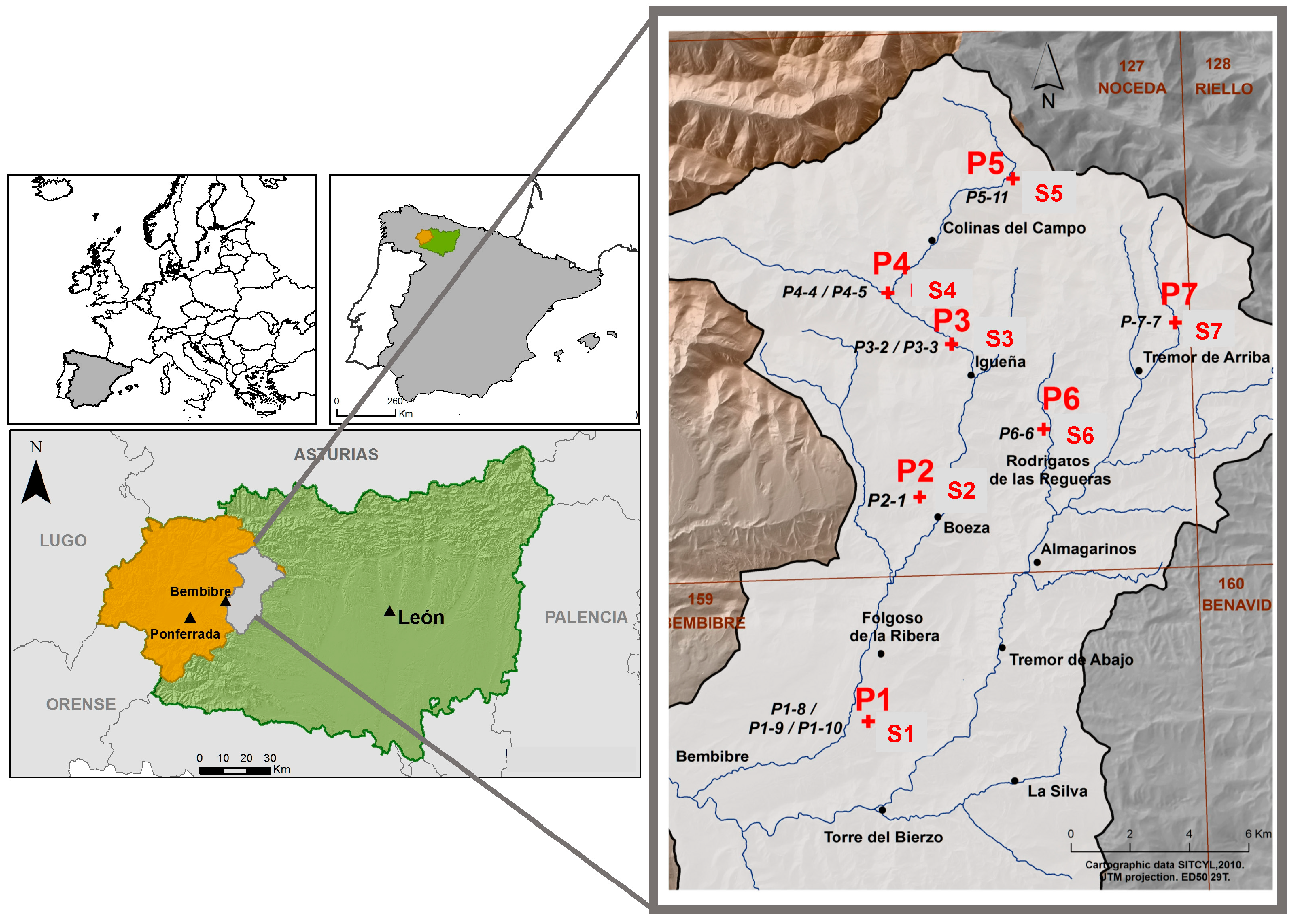
The soil profile sites are located in the El Bierzo region (León, NW Spain) (Figure 1). This is a partially closed intramountain depression with highly sloped contrasts between the peripheral mountainous areas (30%) and the central plain areas (5%–10%). El Bierzo basin is influenced by tectonic dynamics and limited by a complex fault system. The geology is characterized principally by a thick series of Cambrian–Ordovician siliciclastic rocks. Palaeozoic lithologies with a domain of siliciclastic sedimentary and low-grade metamorphic materials are found in the area, corresponding to seven contrasting siliceous lithological units. The lithostratigraphic sequence starts with the Lower Paleozoic materials from Cambrian to Ordovician age [41]. The Los Cabos Series corresponds to a detritic series characterized by an alternation of quartzites with slates, siltstones, and sandstones. A range of later Paleozoic transition materials gradually gives way to the Luarca Formation, which is a succession of fine-grained black slates, rich in sulfides like pyrite and organic matter. This is immediately followed by the Agüeira Formation, formed by alternating sandstones, siltstones, and occasionally shales with a presence of turbidite features, which sometimes culminates in a massive quartzite section. The Silurian strata, poorly represented, are found in a gradually alternating section, including fully sandy phases with varying proportions of low-grade metamorphic slates. The Upper Carboniferous (Stephanian B-C) synorogenic materials of the Bierzo coal basin are discordantly overlain [42], which present a strong paleorelief. These materials consist of a broad range of alternating layers of sandstones, shales, siltstones, and conglomerates combined with intermediate coalbed deposits [43,44,45].
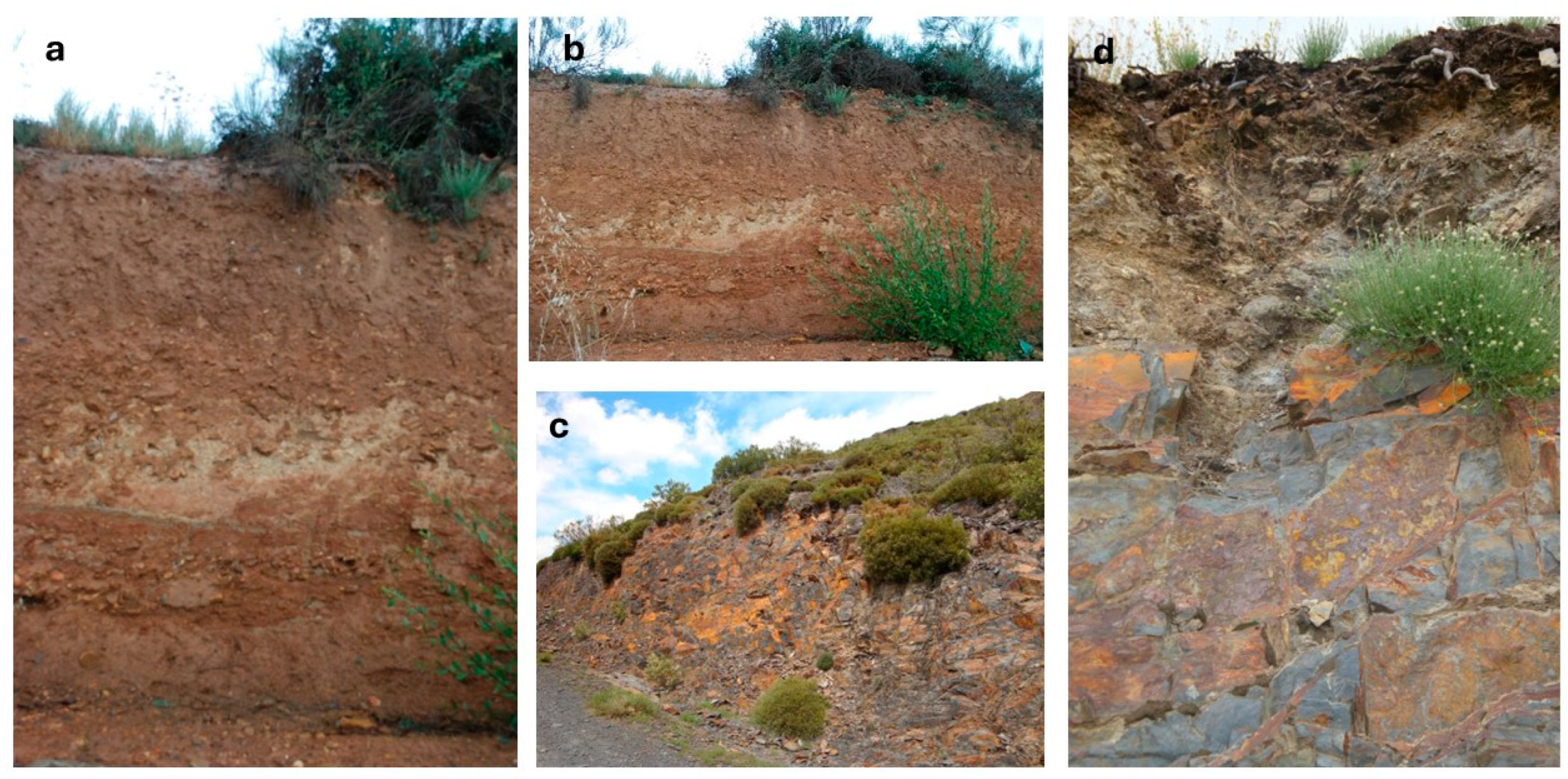
The vegetation physiographic pattern is adapted to the acidic soil conditions distributed in the slopes according to the altitudinal gradient, which ranges from 600 to 1200 m of altitude and is conditioned by climate transition conditions (Csb). Principally, the area is covered by shrublands with a domain in moorlands and heathers, gorse and broom brushwood groves (Genista sp., Cytisus sp., Erica australis, Erica cinerea, Pterospartum tridentatum, Echinospartum lusitanicum, Genista lusitanica, Daphne pnidium, Halymium alissoides subsp. viscosum), as seen in Figure 2, together with grasslands, woodlands (Quercus pyrenayca and Quercus rotundifolia), isolated reforested pine groves with Pinus sylvestris, and abandoned arable lands and grassland pasture (Figure 2). Geomorphology determines the presence of shallow and quite weakly evolved soils in depth, mainly found in upland areas. The Leptosols are the main representative soil group on unstable steep slopes. These soils are developed on siliceous Palaeozoic materials, mainly slates with inclusions of sandstones, siltstones, shales, and quartzites (Figure 2).
The soil climate regime corresponds to xeric and mesic, with an annual mean temperature and precipitation of 10.2 °C and 812.2 mm, respectively (Boeza rainfall station, elevation 831 m). This trait determines the presence of shallow and medium–low evolved recent soils, with command of two principal groups. On the one hand, on steep slopes, the Leptosols group developed on Paleozoic materials, mainly slates that alternate with sandstones, shales, and quartzites ranging from the Cambrian to Ordovician (Figure 2d). On the other hand, the second group, the Cambisols developed on Miocene materials at plain and soft reliefs (Figure 2c), is also present in the Quaternary alluvial terraces in El Bierzo Cenozoic basin. The tertiary deposits of the sedimentary successions from Miocene age appear discordant on the Palaeozoic basement. El Bierzo basin is one of a series of tertiary basins, located in the NW of the Iberian Peninsula, linked to the Alpine–Pyrenean orogeny [46]. In this context, the Bierzo depression is located in the western termination of the Pyrenean Belt, which is the result of the superposition of two mountain-range structures: The Cantabrian and the Galaico-Leonese Mountains. Thus, the Miocene outcrops and sediments lie unconformably over the Variscan Basement of the Iberian Massif, constituted by Precambrian and Paleozoic rocks, strongly deformed and metamorphosed during the Carboniferous period [42,47]. The relatively progressive abandoning of agricultural fields has contributed to a rare, forested landscape pattern (Figure 2c). This, together with intensive human coal mining activities and forest wildfires to open pasture, contributes to the actual landscape pattern.

2.2. Sampling Strategy and Soil Materials

The sampling strategy was designed to analyze seven distinct lithological units, selected to capture a range of soil types and geological formations characteristic of the study region. These specific soil types were chosen because they differ in parent material composition, their contrasting mineralogical properties, degree of weathering, and cation exchange capacities, which directly influence the content and availability of nutrients, linking soil mineralogy to soil solution chemistry across diverse lithological contexts. Sampling strategy to select the soil profiles was initially focused on the analysis of seven soil units where soil profiles are developed. The field work experiment started by the selection and description of the seven sampling soil profiles: P1, P2, P3, P4, P5, P6, and P7 (Figure 1), following the descriptions of [48,49]. The soil profiles’ morphological features were described according to the specifications of [49,50] (Figure 1). Representative samples from Soil horizons (P1-8, P1-9, P1-10, P2-1, P3-2, P3-3, P4-4, P4-5, P5-11, P6-6, P7-7) were collected with three subsamples per horizon, which were compiled into one sample on each profile site. A total of eleven composite soil samples were collected from each soil from the horizons at different depths (Figure 2a,b) and analyzed as specified below to characterize the mineralogy and geochemical composition. They are upland acidic profiles not supplied with any external fertilization and under natural management, so they are abandoned arable lands or pasture. The representative soil profile development was considered optimal by the expert surveyor in the sampling-oriented procedure. Seven soil series in the major units were designated as Mio-Folgoso; Carb-Boeza; Agu-Igüeña; Lua-Urdiales; Cua-Campo; Carb-Rodrigatos, and Lua-Tremor. The groups of soil profiles were classified as Distric Chromic Cambisol [51] or Typic Xerorthent [52]: P1 (Figure 2a); Humic Umbric Leptosols [51]: P3 and P6; and Umbric distric Leptosols [51] or Lithic Xerorthents [52]: P2, P4, P5, and P7 (Figure 2b).
Field experimental procedure for the extraction of soil solution as available water for plant growth was selected following [53,54]. Samples were named as S1, S2, S3, S4, S5, S6, and S7, corresponding to the upper part or topsoil (15 to 20 cm depth) of the soil upper horizons from the profiles P1 to P7. It was carried out in situ within triplicated replicates by means of a microprobe provided within Teflon passive samplers, MacroRhizon SMS type (Rhizon Soil Moisture Samplers, Royal Eijemkalp, Giesbeek, The Netherlands), covered by a PVC case and tubbing connected with a syringe acting as pumps, size 9 cm × 4.5 mm, bubble point: >2.0 bar (0.2 MPa) and 0.1 µm pore diameter (Figure S1) [55].
In order to enable the extraction of capillary water retained in the soil microporosity at matric potential > −1500 Kpa, these SMS devices are recommended for field work, ideal for stony shallow soils and moderate wet conditions, related to the behavior of chemical elements, for repeated and reliable sampling of all dissolved components in the soil solution, such as the movement of metals and the content of other inorganic ions [55]. They are highly recommended for soil moisture sampling in the field when successive soil solution samples are needed from the same volume of soil [56]. This method offers a number of advantages, including minimal disturbance to soil and its hydraulic properties, sampling with a syringe, and minimal ion exchange capacity (less than the soil). Additionally, it is inexpensive, frost-resistant, and the pH is not changed by sampling. Samples are filtered and can be analyzed directly. Suction devices were installed at a depth of 15 cm to 25 cm, with an average maximum depth from the soil surface and inclination from 60 to 90° (Figure S2). The samples were extracted seasonally in the period of recharge of soils at field capacity humidity conditions (matric potential from −6.0 to −33.0 KPa and pF 2.0–2.3) during wet seasons: spring S (1), autumn A (2), winter W (3) and spring S (4); after natural intense rainfall episodes the phase of the soluble solution was extracted from the soil and collected, as shown in the soil solution analysis and methods. A minimum of 24 h has elapsed to ensure the percolation of the rapid gravitational water of no interest in the soil water analysis.

2.3. Soil Laboratory Analyses

Soil samples were analyzed following the laboratory standard procedures [49,57] and, alternatively, the methods compiled in [58]. The analyses were performed on composite soil samples in duplicate using the air-dried fine earth fraction after separating the coarse fragments. Mechanical and soil textural analyses were carried out on the air-dried fine fraction to obtain the clay (<2 µm), silt (2–50 µm), very fine sand (10–50 µm), fine sand (50–250 µm), medium sand (250–500 µm), coarse sand (500–1000 µm) and very coarse sand (1000–2000 µm), separated before from coarse fragments (>2000 µm) by sieving and sedimentation test (Robison pipette method) to obtain the particle size distribution. Previously, the sample pre-treatment was the organic matter removal with a hydrogen peroxide agent (H2O2 30% v/v) at 25 °C before testing samples for 8 h a day for 3 consecutive days [59]. The carbonates removal with an acid solution was not necessary since the soils do not present a positive reaction in the HCl (1:1) test. Granulometric analysis was determined using the Robinson pipette method [60] within the fine earth fraction (<2.0 mm), after the removal of organic matter using H2O2 and with Na-hexametaphosphate as dispersing agent [61]. The fine sand fraction mineralogy was studied in a preliminary approach by optical microscopy. The samples were scattered using a polarization petrographic microscope in order to identify the associations of principal minerals and accessories in the fine sand fractions. The preparation of the fine sand fraction (heavy and light fractions) was done following the methodology proposed by [58].
Soil chemical properties analyses started by the measurement of soil pH, which was performed in both a 1:2.5 suspension in water and in a KCl 1N solution, determined using a glass electrode. The electrical conductivity (EC) was measured in the solution (1:5). Total carbonate content was measured volumetrically (with a standard Bernard calcimeter from ALAMO Automatization, S.L., Murcia, Spain) after treatment with hydrochloric acid [62]. Total soil organic carbon and organic matter were determined by the wet oxidation method with dichromate, following the Walkley and Black modified method as described by [63]. Total nitrogen was determined by Kjeldahl digestion modified [64], and available phosphorus was measured by extraction [65,66]. Depending on the type of soil analysis, different extractants were used. To determine the base cation exchange capacity, NH4Ac (1N) or 1N BaCl2 solutions are recommended, while in the case of the Al exchange capacity analysis, KCl (1N) is used. This 1N KCl solution is also adequate for pH measurement to evaluate the potential acidity. In turn, to prepare clay-oriented aggregates, a 1M MgCl2 solution was used. The cation-exchange capacity (CEC) was determined with a solution of NH4OAc 1N buffered at pH 7, and the exchangeable bases were denominated as Cae, Mge, Nae, Ke [67,68,69], measured by atomic absorption spectrometry (AAS) provided by a flame combustion module. Exchangeable aluminum was extracted with a KCl 1N solution according to the specifications of [70] for estimating soil acidity. Base saturation percentage (BSP) is calculated for the 4 major basic cations, i.e., Cae, Mge, Ke, Nae. Base saturation percentage, aluminum saturation percentage (ASP), and the saturation for Ca (VCa), Mg (VMg), and K (VK) were all expressed in percentages (%). Calibration was performed using two different soil standard reference materials, San Joaquin and Montana I (SRM 2709 and SRM 2710), and other interlaboratory soil reference materials (CRMs), as well as in-house standards, patterns, and blind controls.

2.4. Soil Mineralogy and Chemical Analyses

2.4.1. Clay-Oriented Aggregates

Clay-oriented aggregates from soil samples were obtained according to the specifications from [57,58] and following the procedures of [71,72,73]. Routinely, the fine clay fraction < 2.0 µm was obtained by dispersion with sodium hexametaphosphate after 24 h. Previously, the sample pretreatment was the organic matter removal with a hydrogen peroxide agent (30% v/v) at 25 °C [59]. The soil clay samples were dried at 40 °C, homogenized, and manually ground in an agate mortar. Duplicated samples were mixed with water in crystal tubes and shaken in the centrifuge at 2000 r.p.m. for 5 min in a Centronic-BL SELECTA centrifuge, J.P. SELECTA, Abrera, Barcelona, Spain, removing the supernatant from the suspension. Previously, samples were saturated with a 1M MgCl2 solution and solvated with glycerol in a 10% ethanol (v/v). After being exposed, the samples were fixed in glass slides, leaving an oriented clay film on the surface when possible, and dried in the laboratory atmosphere. They were individually run at room temperature or heated at 300 and 550 °C for 2 h and afterwards were subjected to X-ray diffraction analysis as explained below.

2.4.2. X-Ray Diffraction

Soil clay-oriented aggregated samples were analyzed by X-ray diffraction using a SIEMENS Bruker D5000 series XRD System, BRUKER AXS, Madison, WI, USA, provided with a graphite secondary monochromator. Sample analyses were performed at three different temperatures: room temperature of 25 °C and calcination treatments at heating temperatures of 350 °C and 500 °C for 2 h. The standard scanning diffraction conditions were performed under a CuKα radiation generated at 40 kV and 30 mA, with an Interval Theta/2Theta (2.000°-θ: 1.000°) and a goniometer in a range between 2° and –46° for soil clay samples. The scanning speed step was fixed at 0.02° with a time lapse of 1 s, starting at 26 s, and a total duration of 0.75 h. The XRD patterns and the composite graphs were processed with the Evaluation (EVA) Application v. 8.0.0.2 software from SOCABIM (1996–2001), Antony, France.
Soil clay mineralogy was interpreted following the procedures in the traditional literature for clay-oriented aggregates [74,75,76,77]. Relative mineral estimation was accomplished by using peak intensities and peak areas, considering the specific intensities of the basal reflections, taking quartz as a reference, calculated and weighted to the sum of the spacings at 7 Å, 10 Å, 12 Å, 14 Å, and 17 Å, according to the specifications pointed out by [78,79].
In addition, the interpretation of the temperature-dependent behavior was improved by providing a more detailed assessment of the changes observed after heating at 300 °C and 550 °C, particularly in relation to the stability or collapse of basal reflections and the identification of hydroxy-interlayered minerals [78,79]. Changes in basal spacing after heating were used to assess mineral stability and to distinguish between expandable 2:1 clay minerals and hydroxy-interlayered minerals, with particular attention to peak collapse, persistence, or intensity reduction at elevated temperatures.

2.4.3. Total Chemical Analyses

Elemental bulk chemical analyses were performed on duplicated samples by considering a total number of 88 valid measures corresponding to 4 elements performed in duplicate in each soil sample. The fraction collected for total soil samples was <2000 µm (<2 mm), and for soil clay samples, a <200 µm size was used (0.05 g for duplicated samples). Firstly, representative splits of each sample were oven-dried, and then heated at 975 °C for 12 h prior to preparation in a high-temperature muffle HOBERSAL12-PR400, Barcelona, Spain, reaching loss on ignition (LOI) in each case. Calibration was performed using two different soil standard reference materials in powder form (SRM 2709 and SRM 2710) and other reference mineral materials [80]. The analyses of major components were carried out using fused borosilicate disks. Specifically, the disks were prepared in a fusion melting induction furnace (1000 °C, 20 min) with 95%Pt/5%Au crucibles, adding 0.500 g of a 1:1 mixed fusion flux of lithium tetraborate/metaborate (50% Li2B4O7/50% LiBO2), using a non-wetting agent LiBr as a separating agent. The borosilicate disks were analyzed in an XRF spectrometer S4 Pioneer wavelength dispersion BRUKER-NONIUS, Madison, WI, USA. For cation analyses, an acid dissolution in dilute nitric acid HNO3 at 5% (v/v) was required, based on the alkali fusion technique [81] measured by inductively coupled plasma mass spectrometry (ICP-MS) in a Thermo Scientific quadrupole XSeries2, Waltham, MA, USA; with detection limits of 0.01% using the standard elements In and Rh. The total Ca, Mg, Na, and Si were obtained in g·kg−1.

2.5. Soil Solution Analysis

The first volume of soil solution collected by each cup was discarded (<0.5 mL) to minimize adsorption losses and contamination. Bottle ring cups were hermetically sealed to prevent any water–atmospheric CO2 exchange and subsequent pH change following [53]. Prior to the installation, soil sites were conditioned and tested; unbulked soil samples were preferred as indicated by [82]. Soil solution samples were taken in triplicate. A set of three devices was placed at each sampling point; 15.0 mL aliquots (net volume 7.0 mL/0.1–2 h) were collected and individually homogenized to obtain a representative sample. Samples were taken using a syringe as a pump device and afterwards filtered through 0.45 μm Millipore MF filters [83,84,85,86]. Samples used for the determination of dissolved major cations and trace elements were collected separately and preserved. Samples were filtered by a 0.45 µm pore size disposable filter and acidified with 1:1 ultrapure nitric acid (HNO3). Those samples for alkalinity and anion determination were not acidified, only filtered. Several physicochemical parameters were recorded in situ in the field at the sampling time, assisted by a multiparameter probe 1828 model, Eijkelkamp Agrisearch Equipment, Royal Eijkelkamp B.V., Giesbeek, The Netherlands). Samples were properly stored and refrigerated when necessary (4 to 7 °C) until analysis. Afterwards, major cations, trace elements, and anions were analyzed in the laboratory. Aliquots in tubes, not filtered and not acidified, were used for alkalinity titration with HCl (0.1 N) analyzed in laboratory; the rest of tubes were acidified with ultrapure HNO3 and kept in chamber at 4 °C to determine major cations Ca2+, Mg2+, Na+, K+, Si4+ and minor trace elements by ICP-MS atomic emission spectroscopy (ICP-MS high resolution double-focus magnetic sector ELEMENT2 and ELEMENT XR of Thermo Finnigan, San Jose, CA, USA, within an external calibration standard using as pattern elements Sc and In.

3. Results

3.1. Soil Features and Morphology

The soils correspond to shallow and recently evolved soil profiles, with a domain of Leptosols and Cambisols soil reference groups [51]. Soil profiles P2 to P7 were Leptosols classified as Umbric and/or Distric, and soil profile P1 was a Chromic Distric Cambisol. In the upland steep slopes, the Leptosols are developed on Paleozoic materials, mainly slates that alternate with sandstones, shales, and quartzites. The weakly developed soils were classified in the Entisols Group as Xerorthents [52] coming from siliciclastic Palaeozoic parent rocks (quartzites, slates, shales, siltstones, and sandstones). The soil profiles selected (P2 to P7) are in some cases skeletal and often present a lithic contact roughly at a depth of 20 cm, in some cases, at less than 15 cm, which limits the water reserve. The soil climatic regime is xeric with a reserve lower than <200 mm during the three summer central months and a moisture control section that is dry everywhere for 45 or more consecutive days during normal years [52]. The soil profiles are morphologically very simple, identified with a sequence of horizons named A-R or A/R. So, the limited depth contributes to the lack of diagnostic subsurface horizons. The epipedon has been classified as humic Ah; the endopedion is not developed in most cases, and when it exists, it is mainly a transitional or mixed A/R where partially weathered rock fragments are found. However, in Cambisols, AC and C endopedions are identified. The soil profile P1 is classified as Typic Xerorthent on clays and conglomerates, with Miocene deposits found at 80 cm depth, with abundant partially weathered rock coarse stones. The degree of soil development is limited mainly due to the steep topographic conditions, with a gradient of 15%–35%.
The coarse fragments are more than 40.0%, reaching close to 70.0% in some profiles (P3 and P4). The light fine and medium sand fractions are the dominant ones, representing more than 25% of the total composition. Soil horizons range in color from dark (10YR 3/3) to dark brown (10YR 3/4) in the dry state, according to [87]. In the moisture state, the texture ranges from sandy to sandy loam, which is the most common textural class in these soils. The consistency is dominantly granular, very fine, soft, and of moderate structure. The soils exhibit moderate stoniness with 40% coarse rock fragments (CF), reaching higher contents around 70% in P4 and P7 (Table 1), good drainage, poor moisture retention, and are not developed in depth. A significant clay leaching and a domain of coarse and medium size fractions within almost 30% sand on average was also detected (Table 1). Abundant fine coarse fragments (CF) such as gravels are within a low-to-moderate stoniness (5%–15%). Pores and roots are very abundant, all sizes are dominated by medium and fine ones, and there is no presence of mottled spots and concretions.
Quartz is present in significant amounts, particularly in fine sand fractions from the upper horizons, defining the dominant mineralogy. The light fine-grained sand fraction presents feldspars (K-feldspars, orthoclase) and white micas recognized as muscovite. As observed in the same fraction, other phyllosilicates identified as chlorites are found in the soil horizons developed over slates. The fraction of fine sand, the main mineral fraction of these soils, is constituted by quartz, feldspars, and micas (muscovite) and illite, which coexist with chlorites (iron-rich), K-feldspars (orthose), plagioclases (albite), and, particularly, with kaolinite. This mineralogical assemblage also reflects the composition of the parent material. The scarcity of the fine clay fraction reveals that the clay mineral content is moderate or restricted.

3.2. Soil Clay Mineralogy

The soil mineralogy (Table 2) verifies the domain of micas (muscovite) with illite, in some cases with kaolinite and, particularly, with iron-rich chlorites, feldspars, quartz, and plagioclases (albite). Only minor ferric amorphous oxides and hematite were identified as traces (Table 2). Some incipient and transitional mixed 2:1 clay mineral stages suggest the presence of Ill/Sm, M/Vm, Chl/Sm, and Chl/Vm, among others; 2:1 clay interlayers and other less frequent interstratified phases (Int) have also been identified in the soil samples (Table 2).
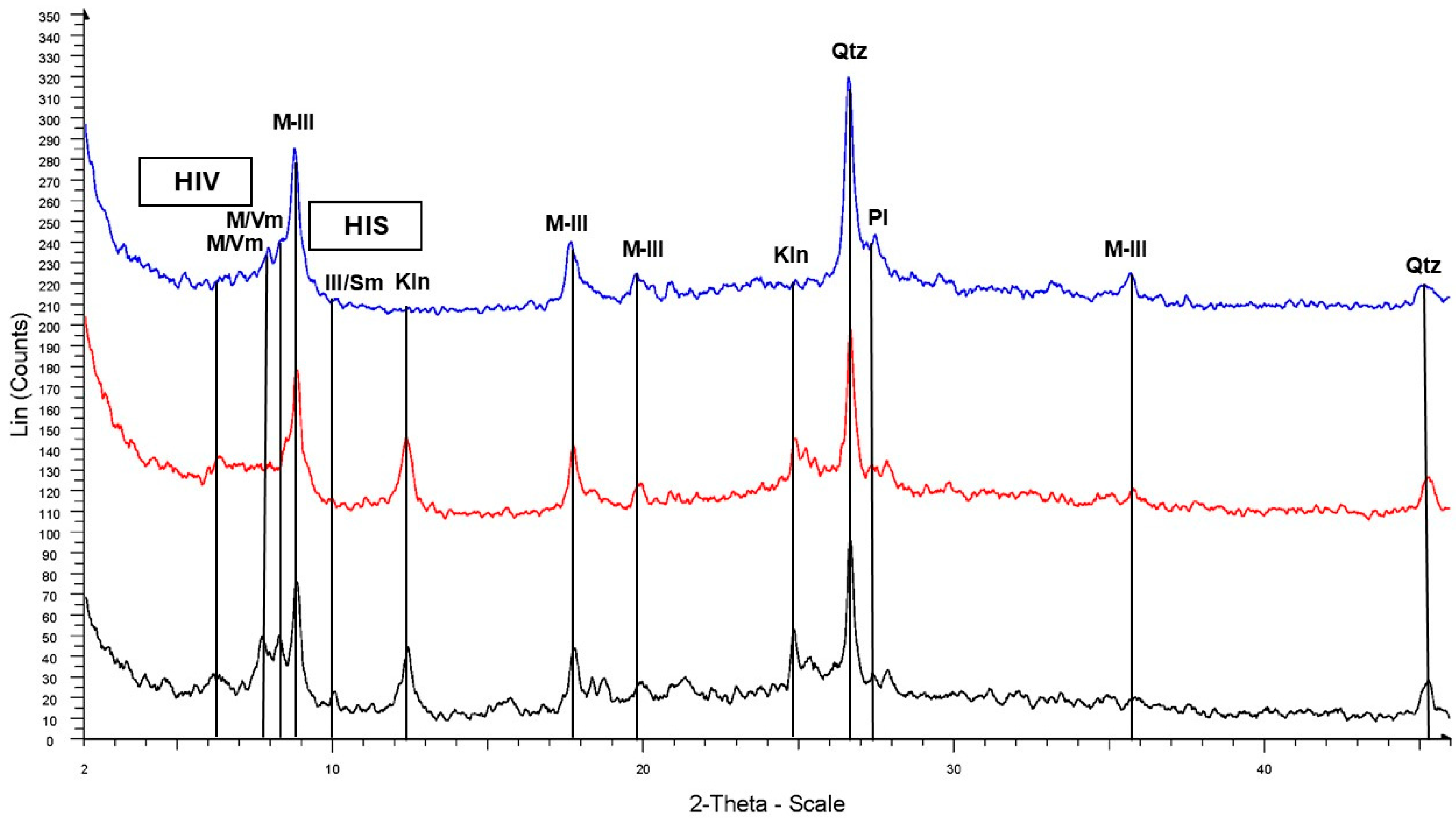
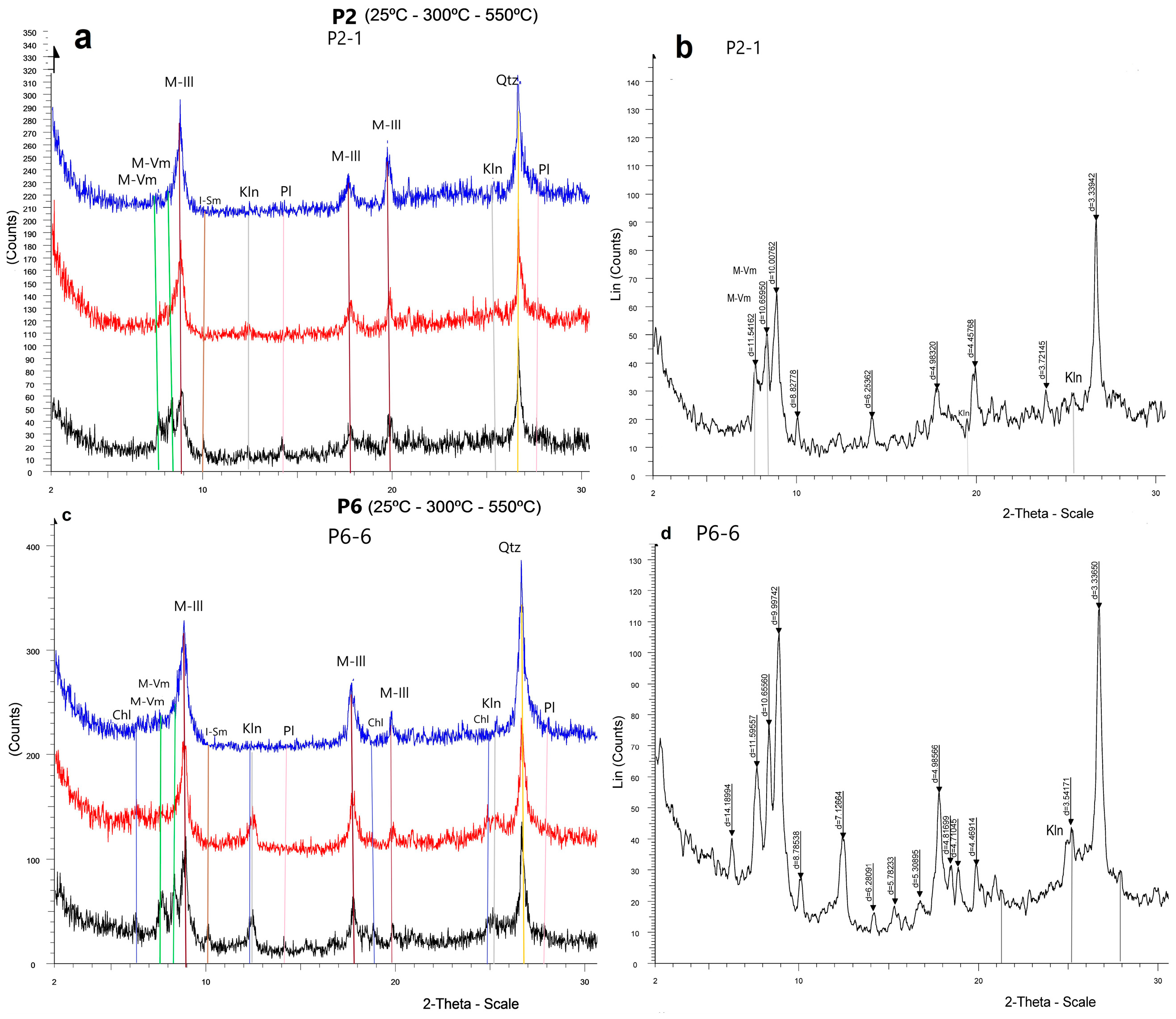
Other transitional transformation stages and some mixed clay minerals or interlayers are also identified in the soil clay samples P1-8, P2-1, and P6-6 (Table 2). They are complex mineral structures considered to represent a transitory step in the chlorite-to-smectite transformation [88]. Mainly Ill/Sm and Ill/Vm, mainly interstratified micaceous phases were identified, with characteristic spacings at 14 Å, 11.5 Å, and 10.6 Å (Figure 3). Specifically, the Ill/Sm type exhibited spacings at 17 Å, 8 Å, and 5.8 Å, disappearing under the treatment of 300 °C.
The other type of interstratified phases was identified as Chl/Vm, which, in a later stage, turns into the Chl/Sm type according to the high reflections that appear at 17–18 Å. Although the final alteration to vermiculite is not evident, the spacing at 10 Å under 300 °C and 550 °C does not experience intense exaltation (Figure 3). The data suggest the composition of interlayered 2:1 clay minerals was mainly aluminous, corresponding to Hydroxy-Al interlayered minerals (HIMs): mainly to hydroxy-interlayered vermiculite (HIV) and rarely to hydroxy-interlayered smectite (HIS) [89,90,91,92,93,94,95,96]. Adsorbed hydrated alumina hydroxy ions in the interlayer region are responsible for the observed 14 Å d spacings [97].
These transitional transformation stages of interstratified minerals are identified in the soil samples P1-8, P2-1, and P6-6 (Table 2). They are M/Vm, with a characteristic spacing at 14 Å, 11.5 Å, and 10.6 Å, which is finally altered into a M/Sm, spaced 17 Å, 8 Å, and 5.8 Å, peaks that disappear under the treatment at 300 °C. P1-8 (Figure 4), P2-1 and P6-6 samples (Figure 3) exhibit a great exaltation at 10 Å after heating at 300 °C and 550 °C. P6-6 and P2-1 soil samples seem to have the most abundant hydroxy-aluminic vermiculites (HIV), M/Vm, and M/Sm. However, Chl/Sm has only been identified in soil samples P4-4 and P4-5. After heating to 300 °C, the 14 Å reflection partially collapses and shifts towards 10 Å, reflecting dehydration of expandable smectitic and vermiculitic interlayers, while the 10 Å peak associated with illitic and micaceous layers remains stable. Upon further heating to 500 °C, the 14 Å reflection is strongly reduced or disappears, indicating complete collapse of smectitic interlayers and dehydroxylation of hydroxy interlayers in HIMs (Figure 4). In contrast, the persistence of the 10 Å reflection at high temperature confirms the dominance and thermal stability of illite- and mica-type layers, whereas chloritic components can be distinguished by the relative stability of their basal reflections compared to mixed-layer chlorite–smectite minerals, which show partial or complete collapse at elevated temperatures. Chlorite is characterized by the persistence of its ~14 Å basal reflection after heating to 300 °C and 500 °C, reflecting its high thermal stability.

3.3. Soil Chemical Properties

Soils present moderate-to-high acidity with pH close to 5.0 and, in some cases, lower than 4.0, and high organic matter content from 5% to 10% (Table 3). High C/N values reached close to 10.0. The acidity detected is mainly due to the parent material, in combination with processes of leaching and migration of bases. The percolation and removal of bases is also related to low salinity with EC under 50.0 µmhos·cm−1, according to a dominant sandy textural class in most soils, even more evident in sandy epipedons (Table 3). The soil reaction is strongly acidic due to the abundance of exchangeable ions generating secondary acidity (Al3+ and H+). The exchangeable Ale is higher in P3-4 soil with 4.24 cmolc+ kg−1, followed by the P5-11 and P2-1 soils (3.81 and 3.72, respectively). The Al3+ measured in the saturation extract, expressed as aluminum saturation percentage (ASP), ranged widely between 20% and more than 50% (Table 4). The base saturation percentage (BSP), less than 20% in all cases, and the cation exchange capacity (CEC), with values under 20.0 cmolc kg−1 in all the samples (Table 4), are both low-to-moderate, with greater contents of exchangeable Mg (Mge) and K (Ke). The base content seems to be variable in the horizons with high organic matter, as well as the exchange cation capacity (Table 4).
The base saturation content (BSP) is quite variable in the upper horizons, with the highest percentage of organic matter (Table 4). Base saturation percentages are, in general, low, and the highest exchangeable content of Mge is noteworthy (Table 4). VMg was higher than VCa in all the analyzed samples, and VK was higher than expected (Table 4). The important content of exchangeable aluminum (Ale) of the soil, as well as the aluminum saturation percentage (ASP), which is quite important due to the potential acid character (Table 3), were both noticeable. Values reached nearly 4.5 cmolc+ kg−1, with lower pH and the highest acidity potential ΔpH.

3.4. Soil Total Chemical Composition

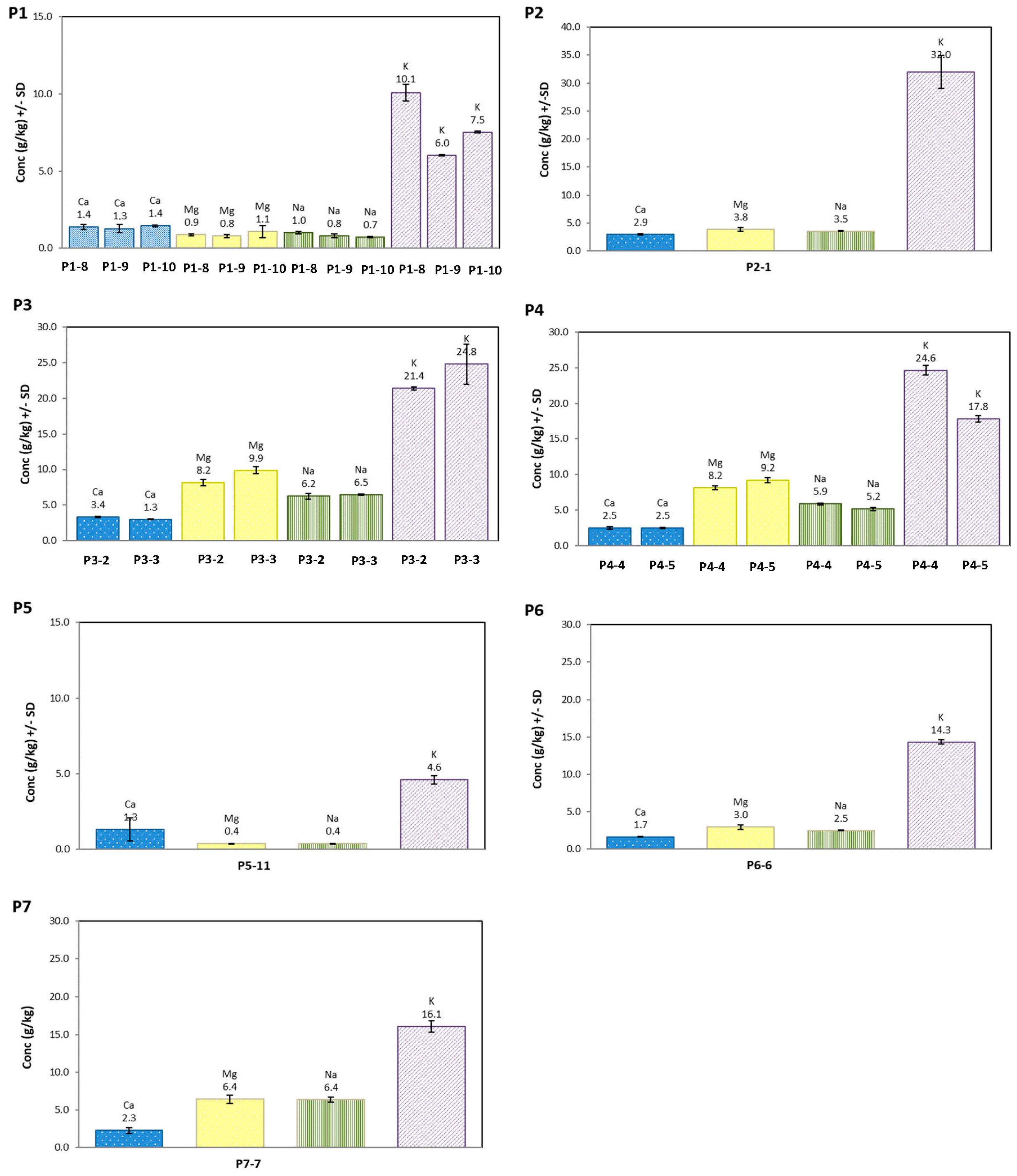
Potassium (K) was the most abundant cation across the soil profiles. In profile P2, the P2-1 horizon contained approximately 32.0 g kg−1 K (Figure 5). Other profiles showed lower concentrations: in P3, K averaged 21.4 g kg−1 in the upper horizon and 24.8 g kg−1 in the lower horizon; in P4, the values were 17.8 g kg−1 and 24.6 g kg−1, respectively. This is consistent with the mineralogical analysis, where mica and illite phases are dominant. It is also noticeable that Mg contents were higher than Ca in P3 and P4 profiles; specifically, concentrations in P3-2, P3-3, P4-4, and P4-5 ranged from 8.0 to 9.0 g kg−1. Mg content in P7 is 6.4 g kg−1, according to the presence of Mg-bearing chlorites. Na is present in mean values of 5.5–6.5 g kg−1 in P3, P4, and P7. This is mainly explained by the abundant plagioclases rich in Na (albite). The total content of Alt (Table 3) is 117 g kg−1 for P7 and 105 g kg−1 for P4.

3.5. Soil Solution Composition

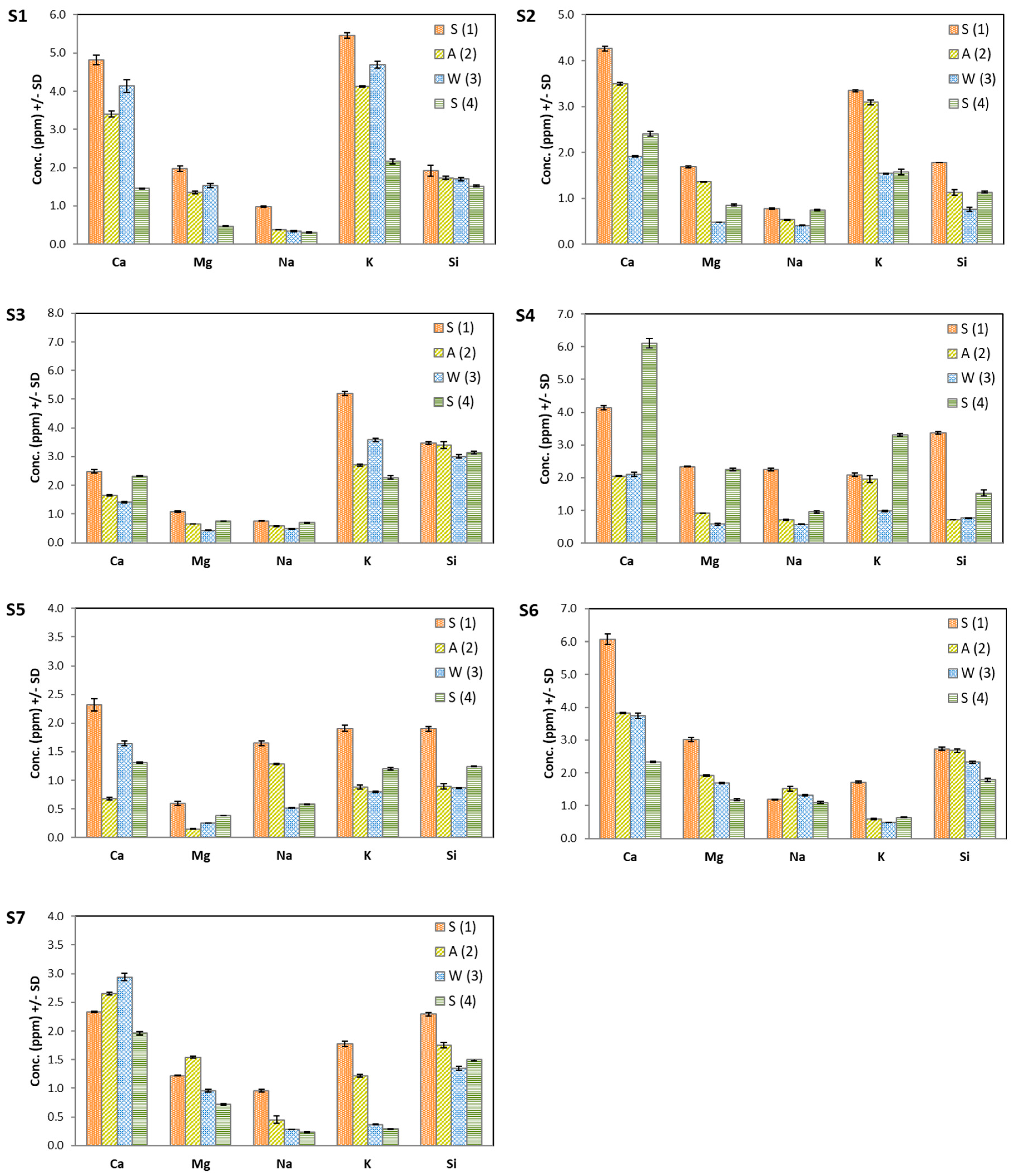
The average seasonal amounts of K+ and Mg2+ found in soil solutions ranged from 1.60 to 3.0 ppm and 0.90–1.70 ppm, respectively. The contents of K+ in these soils are high compared to the rest of the cations, and especially in the soil S1 (Figure 6). The results for K+ in solution show a minimum of 1.72 ppm in spring S (4) and the maximum of 5.46 ppm in spring S (1); however, for Mg2+, the minimum was 0.60 ppm in winter W (3), and the maximum reached 3.02 ppm in spring S (1). K+ shows an important concentration in soils S1, also S2 and S3 (Figure 6); Ca2+, Mg2+, and K+ are lower in S5 and S7 (Figure 6). S1 presents higher amounts of K+ (5.47 ppm) and Mg2+ (1.83 ppm). Mg2+ was also high in S6 (2.71 ppm).

4. Discussion

4.1. 2:1 Clays and HIMs as Soil Reservoirs and Contribution to Natural Fertility

The analyses show the contribution of the clay fraction to the chemical composition of both the exchangeable and the soil solution. Particularly, illite, 2:1 secondary minerals, and mixed layers identified as Ill/Sm and Chl/Sm when chlorite is present, may work as K and Mg reservoirs. As some studies suggest, the gradual alteration in acidic environments of transitional minerals could explain the source of exchangeable K and Mg from the smectite layer and 2:1 mixed layers [98,99]. Hydroxy interlayered minerals (HIMs) such as hydroxy interlayered vermiculite (HIV) and smectite (HIS) in soils over a long period have been widely reported as a source of Mg and Al by [88,89,90,91,92,93,94,95,96], among others. These complex mineral structures are the result of a transitory step in the transformation into smectite and vermiculite to true interstratified phases [88]. The occurrence of interstratified and clay mixed phases such as Ill-Sm, Chl-Vm, or M-Vm, which are formed in the soils, would be associated with the latter transformation of micas and chlorites [100]. The transformation of chlorites into vermiculite and smectite in the latter weathering stages in the soil zone is characterized by the loss of Mg and Fe and minor Al, all considered to be lost from the brucite-like sheet of chlorite [101]. This is in agreement with the amounts of Mg found in soil composition. However, it might be kept in mind that the analyzed soils occur within a limited range of temperate and topographical conditions, so weathering intensity is rather limited and conditioned by progressive removal [102,103,104,105]. Soil samples also contained K-feldspar and abundant mica, mainly illite, as possible sources of K+. As some studies suggested [38], the amount of K+ in the labile pool correlates best with the amounts of mica in the whole soil, suggesting that mica in coarse and fine fractions acted as a potential source of labile K+ in these soils [31,32,33,34]. Besides, [31] suggested that 2:1 clay minerals behave as a huge, renewable K reservoir whose theoretical capacity in fertile soils could exceed 3.0 tn/ha. Their results clearly showed that soil 2:1 clay minerals could react as quickly as a biological system.
The presence of mica-vermiculites, hydroxyaluminic vermiculite, and chlorite-vermiculites is common in surface horizons of these acidic upland natural soils [106]; these minerals are characteristic of the alteration of micas (illite) in media acids. In the presence of these types of minerals, the efficiency of potassium fertilization is low as long as the capacity of potassium fixation of these clays is high [107,108]. In addition, low assimilable potassium content is often a limiting factor of the agricultural production in acid soils and high organic matter content, particularly in those that have a high capacity for fixing potassium [109]. In this study, this capacity was higher in soils developed on slate and shale rock substrates rich in hydroxyaluminic vermiculites and smectites. The high adsorption of potassium by the soil is accompanied by a strong release of magnesium, which leads to the thought that K is fixed in an interlayer with magnesium interlayers present in this soil [36,109,110]. The soil-available K in soil solution is usually very low and mostly becomes unavailable to plants, as studies on the release of non-exchangeable K in soils revealed [111,112]. Important amounts of Mge and Ke were found on the soil exchange complex. In addition, the contents of K+ in these soils are high compared to the rest of the cations.

4.2. K and Mg in the Soil Solution and Nutrient Availability for Plants

Potassium status and its measurement are discussed since equilibrium exchange reactions with other ions in the soil solution can interfere [2,113]. K concentration in the soil solution is an important index of availability and appears to provide a very good result in soils with contrasting properties [114,115]. The amount of K present in the soil solution represents only a very small proportion of total soil K and is much less than a crop requires in a growing season. Only those forms which plants can utilize are available: the exchangeable K and Mg on the surface of the soil particles and those dissolved in the soil water.
Furthermore, intensive K uptake by higher plants reduces the K concentration of the soil solution, so that K release is favored. The K release from these K-bearing minerals through the attack of organic acids has been proven in several studies and experiments [116,117]. Nevertheless, it is well known that the antagonistic effect seems to be stronger between K and Mg absorption. It can be firstly attributed to a very low level of available magnesium in the soil; then it was found that magnesium deficiency could also occur at relatively high levels of available soil magnesium where plant uptake of magnesium is impeded by an excess of some other cation or cations, usually potassium, but sometimes ammonium or calcium in the soil [118].
Moreover, some results suggest that the controlling factors of non-exchangeable K are mainly the total K content and 2:1 type phyllosilicates such as mica, illite, and vermiculite, with the indirect negative influence of organic matter and amorphous materials [119]. The release of interlayer K increases when the concentrations of soil solution K and/or exchangeable K decrease due to K uptake by plants and leaching [26]. It is also suggested that the depletion of the interlayer K is reversed and contributes to the prevention of loss by leaching, as [26,120,121] stated in their research.
In this research, the high amounts of total K and Mg in the soil solutions are found in those soils developed on slates and shales as dominant rock substrates rich in hydroxyaluminic vermiculites and smectites. In these soils, the alteration by acid hydrolysis of plagioclases and the kaolinitization followed by an intense illitization of micas are the most frequent alteration processes [122,123]. The 2:1 clays turn towards some incipient and transitional interstratified phases, also hydroxy-interlayered minerals (HIMs), suggesting a continuously developing and transforming stage in these soils [123]. The acidic solution conditions typically found in these siliceous environments could help to explain these facts.

4.3. Mechanistic Behavior of K and Mg and Cation Selectivity in HIMs and 2:1 Clays

Cation selectivity in hydroxy-interlayered minerals (HIMs) and swelling 2:1 clays can be interpreted using thermodynamic ion-exchange frameworks linking mineral structure to solution chemistry [124,125]. Selectivity sequences (e.g., K+ > Na+ > Mg2+) reflect differences in hydration energy, ionic radius, and accessibility of interlayer exchange sites, which are partially occluded by hydroxy-Al polymers [126,127]. These preferences are commonly quantified using selectivity coefficients such as Gapon or Vanselow, which describe the relative affinity of the solid phase for specific cations [128,129]. In partially collapsed or hydroxy-interlayered systems, K+ exhibits higher selectivity due to its lower hydration energy and ability to form inner-sphere complexes within ditrigonal cavities, whereas the strong hydration shell of Mg2+ limits its incorporation into constrained interlayers [128,130,131]. Thermodynamic models coupling ion exchange with swelling–collapse equilibria demonstrate that changes in interlayer hydration directly control selectivity behavior, linking the crystallographic constraints of HIMs and swelling clays to the observed buffering of K and Mg in soil solutions [126,127]. Additionally, interlayer organic matter can enhance the retention and stabilization of cations, further modulating nutrient availability in natural soils [131].
Some 2:1 clay minerals, especially hydroxyaluminum vermiculites, with selective adsorption sites, have higher selectivity for K and Mg, and strong fixation. This selective bonding effect of 2:1 soil clays for K and Mg is also relevant in the hydroxyaluminum smectites. The study of potential soil release of the interlayer K and Mg from 2:1 clay mixed layers when the concentrations of soil solution and/or exchangeable decrease, due to the uptake by plants and loss by leaching, is essential. These adsorption/desorption mechanisms from clays and organic matter should also be addressed and studied further, in order to mitigate possible deficiencies in crop production and forest plantations before their establishment. This would help bridge mineralogical structure with observed chemical behavior in the soil solution.

4.4. Mg-K Adsorption Competition and Ion-Binding Dynamics in HIMs

Substantial research has demonstrated that potassium (K+) and magnesium (Mg2+) interact antagonistically in soils and plants, significantly influencing nutrient availability and uptake dynamics. High K+ concentrations in the soil solution and rhizosphere can suppress Mg2+ uptake by plants, a phenomenon widely described as K–Mg antagonism, particularly in soils with low cation exchange capacity and a limited pool of exchangeable Mg [132,133]. This interaction is driven by competition between K+ and Mg2+ for adsorption on soil exchange sites and for uptake via shared or non-specific root transport pathways, where excess K+ reduces Mg2+ mobility toward root surfaces and inhibits its absorption [132,134]. From a soil chemical perspective, high K+ activities may preferentially occupy exchange sites, decreasing the retention and exchangeability of divalent Mg2+, especially under acidic conditions, thereby increasing Mg concentrations in soil solution while depleting the exchangeable Mg pool. Integrating soil ion-exchange processes with plant physiological regulation provides a mechanistic framework to explain observed imbalances in K/Mg ratios and their agronomic consequences, including Mg deficiency and the need for Mg supplementation under high K fertilization regimes [133,135].
Recent advances in the study of hydroxy-interlayered minerals (HIMs) and 2:1 clays have been greatly enhanced by high-resolution transmission electron microscopy (HRTEM), which allows direct visualization of interlayer arrangements, layer stacking, and nanoscale heterogeneity [136,137,138,139]. HRTEM observations show that hydroxy-Al polymers and other interlayer species occupy basal spaces, influencing partial collapse, structural disorder, and the accessibility of cation exchange sites [136,137]. Mixed-layer structures, such as illite/smectite, display variable interstratification and layer thickness, directly affecting cation binding and retention [138]. Furthermore, HIMs formation is strongly controlled by pedogenic and geochemical conditions, including hydrolysis, weathering stage, and the presence of hydroxy-Al species, which dictate the stability and buffering capacity for exchangeable cations [139]. These structural and chemical features modulate the availability of essential nutrients, such as potassium and magnesium, highlighting the role of HIMs and interstratified clays as slow-release reservoirs that support long-term soil fertility in natural and managed ecosystems [136,137,138,139]. In addition, it must be considered that while recent studies provide strong advances in structural characterization and direct imaging of HIMs, Synchrotron-based studies on HIM are still sparse [125]; future work could more systematically employ those and in situ techniques to capture transformation pathways and ion interactions under varying environmental conditions.

5. Conclusions

Soil’s natural fertility as a basis for plant mineral nutrition is given from the available elements in the soil solution, which is mainly supplied by the ionic exchange phase and by the clay alteration. The implementation of the research work involved field sampling, laboratory analyses, and data interpretation to assess K and Mg availability in relation to soil properties. This research work was focused on a significant subject regarding the implications of clay minerals, specifically 2:1 layered silicates and hydroxy-interlayered phases (HIMs), on the availability of potassium and magnesium in acidic soils and their potential relevance to the field of soil mineralogy and geochemical fertility. Additionally, the research targeted the geochemical behavior of these elements in the soil solutions in acidic temperate environments and mountain agroecosystems.
The study of clay mineralogy revealed the presence of 2:1 clay mixed layers and interstratified mixtures of mica–illite, smectite, and vermiculite. Transitional clay minerals, including hydroxy interlayered vermiculite and smectite, were also identified. K-containing minerals and K-rich micas change into 2:1 clay minerals, which are significant soil K reservoirs and play a role in K adsorption and release. Illite–smectite acts as a K buffer within the soil. The levels of non-exchangeable Mg and K depend on how developed these secondary 2:1 clay minerals are. The concentrations of K and Mg in soil solutions indicate nutrient availability and vary with the season. High levels of K are found, particularly in relation to soil P1, suggesting a connection between K and P availability for plants, with Mg deficiency occurring in acidic soils. Understanding the saturation levels of K and Mg helps identify when Mg should be applied with K to prevent nutrient imbalance. Lastly, the formation of clays in acidic conditions depends on solution chemistry, and the high K levels may hinder the formation of vermiculite, thus affecting clay mineral layers. Soil solution chemistry reveals key insights into soil processes and cation enrichment.
Furthermore, the results from this study could have practical applications, especially in similar soil environments under natural conditions, to explore nutritional deficiencies, for instance, in abandoned land or agricultural soils, and compared to those dedicated to forestry and crop production, among others. So, in this way, mineral nutrition supplies must be further explored, based on the weathering of silicate soil materials and, consequently, the 2:1 clay alteration in acidic soil environments. However, more analytical effort should be done to ensure the quantification of mineral phases, particularly the HIMs structure.

Supplementary Materials

The following supporting information can be downloaded at: https://www.mdpi.com/article/10.3390/min16030320/s1, Figure S1: MacroRhizon passive Soil Moisture Sampler SMS (a) device components assemble (b) real aspect of the standard device with sampling tubes and filter; (c) the arrow shows a detail of the protective casing for sampling in deeper layers and (d) principal structural parts of the MacroRhizon SMS; Figure S2: Experimental field design View of MacroRhizon SMS by triplicate (a) in P1 soil site, (b) in P5 soil site and (c) in P4 soil site. (d) Installation on-site during the sampling. (e) SMS upper part in the hole contact. (f) Extraction procedure helped by a syringe as pump device.

Author Contributions

Conceptualization: S.A.-A. and M.V.-B.; methodology, S.A.-A. and M.V.-B.; validation, S.A.-A., E.A.-H. and M.V.-B.; formal analysis, S.A.-A., M.V.-B. and E.A.-H.; investigation, S.A.-A., M.V.-B. and E.A.-H.; resources, M.V.-B. and E.A.-H.; data curation, S.A.-A.; writing—original draft preparation, S.A.-A., M.V.-B. and E.A.-H.; writing—review and editing, S.A.-A.; visualization, M.V.-B. and E.A.-H.; supervision, M.V.-B. and E.A.-H.; project administration, M.V.-B. All authors have read and agreed to the published version of the manuscript.

Funding

This research was granted by the Educational and Research Authority from Castile and León Regional Government (LEOO3A08) and supported by the Spanish Ministry of Education and Science (EDU/1262/09), as part of the first author’s PhD fellowship.

Data Availability Statement

The original contributions presented in this study are included in the article. Further inquiries can be directed to the corresponding author(s).

Acknowledgments

The authors express gratitude for the assistance and the technical support provided by the Research Support Services (SAI), the Plasma-Mass Spectrometry Unit (UEPM), and the Structural Analysis Unit (UAE) (University of Coruña, Spain). We are also grateful for the help provided by the Instrumental Analysis Techniques Laboratory (LTI) (University of León, Spain).

Conflicts of Interest

The authors declare no conflicts of interest.

Abbreviations

The following abbreviations are used in this manuscript:
HIMsHydroxy Interlayered Minerals
HIVHydroxy Interlayered Vermiculite
HISHydroxy Interlayered Smectite
CECCation Exchange Capacity
ECECEffective Cation Exchange Capacity
BSPBases Saturation Percentage
ASPAluminum Saturation Percentage

References

  1. Schjønning, P.; Elmholt, S.; Christensen, B.T. (Eds.) Managing Soil Quality: Challenges in Modern Agriculture; CABI: Wallingford, UK, 2003. [Google Scholar] [CrossRef]
  2. Wada, S.I.; Odahara, K. Potassium-calcium exchange in five Ap soils from paddy fields and its effect on potassium concentration in soil solution. Soil Sci. Plant Nutr. 1993, 39, 129–138. [Google Scholar] [CrossRef]
  3. Sposito, G. The Chemistry of Soils; Oxford University Press: Oxford, UK, 1989; pp. 1–350. [Google Scholar]
  4. Eberl, D. Clay mineral formation and transformation in rocks and soils. Philos. Trans. R. Soc. Lond. A 1984, 311, 241–257. [Google Scholar] [CrossRef]
  5. Doucet, F.J.; Schneider, C.; Bones, S.J.; Kretchmer, A.; Moss, I.; Tekely, P.; Exley, C. The formation of hydroxyaluminosilicates of geochemical and biological significance. Geochim. Cosmochim. Acta 2001, 65, 2461–2467. [Google Scholar] [CrossRef]
  6. Beckett, P. Studies on soil potassium II. The ‘immediate’ Q/I relations of labile potassium in the soil. J. Soil Sci. 1964, 15, 9–23. [Google Scholar] [CrossRef]
  7. Prajapati, K.; Modi, H.A. The importance of potassium in plant growth—A review. Indian J. Plant Sci. 2012, 1, 177–186. [Google Scholar]
  8. Chesworth, W.; Camps Arbestain, M.; Macías, F.; Spaargaren, O.; Mualem, Y.; Morel-Seytoux, H.J.; Huang, P.M. Clay mineral formation. In Encyclopedia of Soil Science; Springer: Dordrecht, The Netherlands, 2008; pp. 135–141. [Google Scholar] [CrossRef]
  9. Lindsay, W.L. Chemical Equilibria in Soil; John Wiley & Sons Ltd.: Chichester, UK, 1979; 449p. [Google Scholar]
  10. Eberl, D.; Hower, J. The hydrothermal transformation of sodium and potassium smectite into mixed-layer clay. Clays Clay Miner. 1977, 25, 215–227. [Google Scholar] [CrossRef]
  11. Eberl, D. The reaction of montmorillonite to mixed-layer clay: The effect of interlayer alkali and alkaline earth cations. Geochim. Cosmochim. Acta 1978, 42, 1–7. [Google Scholar] [CrossRef]
  12. Fulignati, P. Clay minerals in hydrothermal systems. Minerals 2020, 10, 919. [Google Scholar] [CrossRef]
  13. Cronan, C.S. Chemical weathering and solution chemistry in acid forest soils: Differential influence of soil type, biotic processes, and H+ deposition. In The Chemistry of Weathering; Springer: Dordrecht, The Netherlands, 1985; pp. 175–195. [Google Scholar] [CrossRef]
  14. Kabata-Pendias, A.; Pendias, H. Trace Elements in Soils and Plants, 3rd ed.; CRC Press: Boca Raton, FL, USA, 2001. [Google Scholar] [CrossRef]
  15. Kabata-Pendias, A. Soil–plant transfer of trace elements—An environmental issue. Geoderma 2004, 122, 143–149. [Google Scholar] [CrossRef]
  16. Anda, M.; Suryani, E.; Subardja, D. Strategy to reduce fertilizer application in volcanic paddy soils: Nutrient reserves approach from parent materials. Soil Tillage Res. 2015, 150, 10–20. [Google Scholar] [CrossRef]
  17. Katz, B.G. Influence of mineral weathering reactions on the chemical composition of soil water, springs, and ground water, Catoctin Mountains, Maryland. Hydrol. Process. 1989, 3, 185–202. [Google Scholar] [CrossRef]
  18. Dixon, J.B.; Schulze, D.G. Soil Mineralogy with Environmental Applications; Soil Science Society of America: Madison, WI, USA, 2002; pp. xxix+866. [Google Scholar] [CrossRef]
  19. Arocena, J.M.; Glowa, K.R. Mineral weathering in ectomycorrhizosphere of subalpine fir (Abies lasiocarpa) as revealed by soil solution composition. For. Ecol. Manag. 2000, 133, 61–70. [Google Scholar] [CrossRef]
  20. Watanabe, T.; Funakawa, S.; Kosaki, T. Clay mineralogy and its relationship to soil solution composition in soils from different weathering environments of humid Asia: Japan, Thailand and Indonesia. Geoderma 2006, 136, 51–63. [Google Scholar] [CrossRef]
  21. Brady, N.C.; Weil, R.R. The Nature and Properties of Soils, 13th ed.; Prentice Hall: Upper Saddle River, NJ, USA, 2008. [Google Scholar]
  22. Kopittke, P.M.; Menzies, N.W. A review of the use of the basic cation saturation ratio and the “ideal” soil. Soil Sci. Soc. Am. J. 2007, 71, 259–265. [Google Scholar] [CrossRef]
  23. Singh, B.; Schulze, D.G. Soil minerals and plant nutrition. Nat. Educ. Knowl. 2015, 6, 1. [Google Scholar]
  24. Sparks, D.L. Potassium dynamics in soils. In Advances in Soil Science; Stewart, B.A., Ed.; Springer: New York, NY, USA, 1987; Volume 6, pp. 1–63. [Google Scholar] [CrossRef]
  25. Melo, V.F.; Schaefer, C.E.G.R.; Novais, R.F.; Singh, B.; Fontes, M.P.F. Potassium and magnesium in clay minerals of some Brazilian soils as indicated by a sequential extraction procedure. Commun. Soil Sci. Plant Anal. 2002, 33, 2203–2225. [Google Scholar] [CrossRef]
  26. Falk Øgaard, A.; Krogstad, T. Release of interlayer potassium in Norwegian grassland soils. J. Plant Nutr. Soil Sci. 2005, 168, 80–88. [Google Scholar] [CrossRef]
  27. Grimme, H.; Nemeth, K. The evaluation of soil K status by means of soil testing. I. In Potassium in the Soil/Plant Root System; International Potash Institute: Zug, Switzerland, 1980; p. 61. [Google Scholar]
  28. Johnson, D.L.; Keller, E.A.; Rockwell, T.K. Dynamic pedogenesis: New views on some key soil concepts, and a model for interpreting Quaternary soils. Quat. Res. 1990, 33, 306–319. [Google Scholar] [CrossRef]
  29. Fiore, S.; Cuadros, J.; Huertas, F.J. (Eds.) Interstratified Clay Minerals: Origin, Characterization & Geochemical Significance; Digilabs: No. 1; Cambridge University Press: Cambridge, UK, 2010. [Google Scholar]
  30. McIntosh, J.A.; Tabor, N.J.; Rosenau, N.A. Mixed-layer illite-smectite in Pennsylvanian-aged paleosols: Assessing sources of illitization in the Illinois Basin. Minerals 2021, 11, 108. [Google Scholar] [CrossRef]
  31. Barré, P.; Velde, B.; Catel, N.; Abbadie, L. Soil-plant potassium transfer: Impact of plant activity on clay minerals as seen from X-ray diffraction. Plant Soil 2007, 292, 137–146. [Google Scholar] [CrossRef]
  32. Barré, P.; Montagnier, C.; Chenu, C.; Abbadie, L.; Velde, B. Clay minerals as a soil potassium reservoir: Observation and quantification through X-ray diffraction. Plant Soil 2008, 302, 213–220. [Google Scholar] [CrossRef]
  33. Barré, P.; Velde, B.; Fontaine, C.; Catel, N.; Abbadie, L. Which 2:1 clay minerals are involved in the soil potassium reservoir? Insights from potassium addition or removal experiments on three temperate grassland soil clay assemblages. Geoderma 2008, 146, 216–223. [Google Scholar] [CrossRef]
  34. Velde, B.; Peck, T. Clay mineral changes in the Morrow experimental plots, University of Illinois. Clays Clay Miner. 2002, 50, 364–370. [Google Scholar] [CrossRef]
  35. Velde, B.; Meunier, A. Clay mineral formation in weathered rocks: Water/rock interaction. In The Origin of Clay Minerals in Soils and Weathered Rocks; Springer: Berlin/Heidelberg, Germany, 2008; pp. 143–239. [Google Scholar] [CrossRef]
  36. Bilias, F.; Barbayiannis, N. Potassium-fixing clay minerals as parameters that define K availability of K-deficient soils assessed with a modified Mitscherlich equation model. J. Soil Sci. Plant Nutr. 2019, 19, 830–840. [Google Scholar] [CrossRef]
  37. Nesbitt, H.W.; Young, G.M. Prediction of some weathering trends of plutonic and volcanic rocks based on thermodynamic and kinetic considerations. Geochim. Cosmochim. Acta 1984, 48, 1523–1534. [Google Scholar] [CrossRef]
  38. Murthy, A.S.P.; Dixon, J.B.; Kunze, G.W. Potassium-calcium equilibria in sandy soils containing interstratified micaceous clay. Soil Sci. Soc. Am. J. 1975, 39, 552–555. [Google Scholar] [CrossRef]
  39. Fageria, N.K.; Baligar, V.C.; Clark, R.B. Micronutrients in crop production. In Advances in Agronomy; Academic Press: San Diego, CA, USA, 2002; Volume 77, pp. 185–268. [Google Scholar] [CrossRef]
  40. Laekemariam, F.; Kibret, K.; Shiferaw, H. Potassium (K)-to-magnesium (Mg) ratio, its spatial variability and implications to potential Mg-induced K deficiency in Nitisols of Southern Ethiopia. Agric. Food Secur. 2018, 7, 13. [Google Scholar] [CrossRef]
  41. Pérez-Estaún, A.; Bastida, F.; Martínez-Catalán, J.R.; Gutiérrez Marco, J.C.; Marcos, A.; Pulgar, J.A. The West Asturian-Leonese zone: Stratigraphy. In Pre-Mesozoic Geology of Iberia; Dallmeyer, R.D., Martínez-García, E., Eds.; Springer: Berlin/Heidelberg, Germany, 1990; pp. 92–102. [Google Scholar] [CrossRef]
  42. Barba, P.; Nozal, F.; Rodríguez, A.S.; Suárez, A. II: Estratigrafía. In Mapa Geológico de la Provincia de León a escala 1:200000; ITGE: León, Spain, 1994; pp. 13–90. [Google Scholar]
  43. Colmenero, J.R.; Fernández, L.P.; Moreno, C.; Bahamonde, J.R.; Barba, P.; Heredia, N.; González, F. Carboniferous. In Geology of Spain; Gibbons, W., Moreno, T., Eds.; The Geological Society of London: London, UK, 2002; pp. 120–153. [Google Scholar]
  44. Colmenero, J.R.; Suárez-Ruiz, I.; Fernández-Suárez, J.; Barba, P.; Llorens, T. Genesis and rank distribution of Upper Carboniferous coal basins in the Cantabrian Mountains, Northern Spain. Int. J. Coal Geol. 2008, 76, 187–204. [Google Scholar] [CrossRef]
  45. Wagner, R.H. The Iberian Massif: A Carboniferous assembly. J. Iber. Geol. 2004, 30, 93–108. [Google Scholar]
  46. Heredia, N.; Fernández, L.P.; Martin-Gonzalez, F.; Bahamonde, J.R. Depositional style and tectonostratigraphic evolution of El Bierzo Tertiary sub-basin (Pyrenean orogen, NW Spain). Geol. Acta 2015, 13, 1–23. [Google Scholar]
  47. Barba Regidor, P.; Bahamonde Rionda, J.R.; Colmenero Navarro, J.R. Las facies aluviales asociadas a los depósitos de carbón en las cuencas estefanienses de León (borde sur de la Cordillera Cantábrica). Cuad. Geol. Ibér. 1996, 21, 71–92. [Google Scholar]
  48. Schoeneberger, P.J.; Wysocki, D.A.; Benham, E.C.; Broderson, W.D. (Eds.) Field Book for Describing and Sampling Soils; Version 2.0; USDA-NRCS, National Soil Survey Center: Lincoln, NE, USA, 2002.
  49. Soil Survey Staff (S.S.S.). Soil Survey Field and Laboratory Methods Manual; Soil Survey Investigations Report No. 51, Version 2.0; USDA-NRCS: Washington, DC, USA, 2014. Available online: https://www.nrcs.usda.gov/sites/default/files/2023-01/SSIR51.pdf (accessed on 15 January 2025).
  50. Jahn, R.; Blume, H.P.; Asio, V.B.; Spaargaren, O.; Schad, P. Guidelines for Soil Description, 4th ed.; FAO: Rome, Italy, 2006; Available online: http://www.fao.org/docrep/019/a0541e/a0541e.pdf (accessed on 15 January 2025).
  51. IUSS Working Group WRB. World Reference Base for Soil Resources 2014, Update 2015. International Soil Classification System for Naming Soils and Creating Legends for Soil Maps; World Soil Resources Reports, 106; FAO: Rome, Italy, 2015; Available online: https://openknowledge.fao.org/server/api/core/bitstreams/bcdecec7-f45f-4dc5-beb1-97022d29fab4/content (accessed on 15 January 2025).
  52. Soil Survey Staff (S.S.S.). Keys to Soil Taxonomy, 12th ed.; USDA-Natural Resources Conservation Service (NRCS): Washington, DC, USA, 2014; 338p. Available online: https://www.nrcs.usda.gov/sites/default/files/2022-10/Spanish-Keys-to-Soil-Taxonomy.pdf (accessed on 15 January 2025).
  53. Dahlgren, R.A. Comparison of soil solution extraction procedures: Effect on solute chemistry. Commun. Soil Sci. Plant Anal. 1993, 24, 1783–1794. [Google Scholar] [CrossRef]
  54. Wolt, J.D. Soil Solution Chemistry: Applications to Environmental Science and Agriculture; John Wiley & Sons: New York, NY, USA, 1994. [Google Scholar]
  55. Eijkelkamp. Operating Instructions. Technical Specifications and Installation. Manual 19.21.SA.35/36 Macrorhizon Soil Moisture Samplers (SMS); Eijkelkamp Agrisearch Equipment: Giesbeek, The Netherlands, 2003; Available online: https://www.royaleijkelkamp.com/products/augers-samplers/liquid-samplers/soil-moisture-samplers/rhizon-soil-moisture-sampling-set/ (accessed on 25 January 2025).
  56. Grossmann, J.; Udluft, P. The extraction of soil water by the suction-cup method: A review. J. Soil Sci. 1991, 42, 83–93. [Google Scholar] [CrossRef]
  57. USDA (United States Department of Agriculture). Soil Survey Laboratory Methods Manual; Soil Survey Investigations Report, No. 42, Version 5.0; USDA-NRCS, National Soil Survey Center: Lincoln, NE, USA, 2004; 700p.
  58. Van Reeuwijk, L.P. (Ed.) Procedures for Soil Analysis, 6th ed.; Technical Paper 9; International Soil Reference and Information Centre (ISRIC): Wageningen, The Netherlands, 2002; 199p, Available online: https://wrb.isric.org/files/ISRIC_TechPap09_2002.pdf (accessed on 15 January 2025).
  59. Kunze, G.W.; Dixon, J.B. Pretreatment for mineralogical analysis. In Methods of Soil Analysis, Part 1. Physical and Mineralogical Methods; Soil Science Society of America: Madison, WI, USA, 1996; pp. 91–100. [Google Scholar] [CrossRef]
  60. Kilmer, V.J.; Alexander, L.T. Methods of making mechanical analyses of soils. Soil Sci. 1949, 68, 15–24. [Google Scholar] [CrossRef]
  61. Gee, G.W.; Bauder, J.W. Particle-size analysis. In Methods of Soil Analysis, Part 1, 2nd ed.; Page, A.L., Ed.; Agron. Monogr. 9; ASA and SSSA: Madison, WI, USA, 1986; pp. 383–411. [Google Scholar] [CrossRef]
  62. Black, C.A. (Ed.) Methods of Soil Analysis, Part 2, Chemical and Microbiological Properties; American Society of Agronomy: Madison, WI, USA, 1965. [Google Scholar]
  63. Nelson, D.W.; Sommers, L.E. Total carbon, organic carbon, and organic matter. In Methods of Soil Analysis, Part 3, Chemical Methods; Sparks, D.L., Ed.; Soil Science Society of America: Madison, WI, USA, 1996; pp. 961–1010. [Google Scholar]
  64. Bremmer, J.M. Nitrogen-total. In Methods of Soil Analysis, Part 3, Chemical Methods; Sparks, D.L., Ed.; Soil Science Society of America: Madison, WI, USA, 1996; pp. 1085–1123. [Google Scholar]
  65. Bray, R.H.; Kurtz, L.T. Determination of total, organic and available forms of phosphorus in soils. Soil Sci. 1945, 59, 39–45. [Google Scholar] [CrossRef]
  66. Olsen, S.R. Estimation of Available Phosphorus in Soils by Extraction with Sodium Bicarbonate; USDA Circ. No. 939; U.S. Department of Agriculture: Washington, DC, USA, 1954.
  67. Schollenberger, C.J.; Simon, R.H. Determination of exchange capacity and exchangeable bases in soils—Ammonium acetate method. Soil Sci. 1945, 59, 13–24. [Google Scholar] [CrossRef]
  68. Peech, M.; Alexander, L.T.; Dean, L.A.; Reed, J.F. Methods of Soil Analysis for Soil Fertility Investigations; USDA: Washington, DC, USA, 1947; 25p.
  69. Ross, D.S.; Ketterings, Q. Recommended methods for determining soil cation exchange capacity. In Recommended Soil Testing Procedures for the Northeastern United States, 2; Northeastern Regional Publication: Ithaca, NY, USA, 1995; pp. 62–70. [Google Scholar]
  70. Lin, C.; Coleman, N.T. The measurement of exchangeable aluminum in soils and clays. Soil Sci. Soc. Am. Proc. 1960, 24, 444–446. [Google Scholar] [CrossRef]
  71. Klug, H.P.; Alexander, L.E. X-Ray Diffraction Procedures; J. Wiley: New York, NY, USA, 1974; 966p. [Google Scholar] [CrossRef]
  72. Whittig, L.D.; Allardice, W.R. X-ray diffraction techniques. In Methods of Soil Analysis, Part 1. Physical and Mineralogical Methods; Soil Science Society of America: Madison, WI, USA, 1996; pp. 331–362. [Google Scholar] [CrossRef]
  73. Harris, W.; White, G.N. X-ray diffraction techniques for soil mineral identification. In Methods of Soil Analysis, Part 5. Mineralogical Methods; Book Series No. 5; Ulery, A.L., Drees, L.R., Eds.; Soil Science Society of America: Madison, WI, USA, 2008; Chapter 4; pp. 81–117. [Google Scholar] [CrossRef]
  74. Brown, G.; Brindley, G.W. X-ray diffraction procedures for clay mineral identification. In Crystal Structures of Clay Minerals and Their X-Ray Identification; Mineralogical Society Monograph 5; Mineralogical Society: London, UK, 1980; pp. 305–356. [Google Scholar] [CrossRef]
  75. Reynolds, R.C. Interstratified clay minerals. In Crystal Structures of Clay Minerals and Their X-Ray Identification; Mineralogical Society Monograph 5; Brindley, G.W., Brown, G., Eds.; Mineralogical Society: London, UK, 1980; pp. 249–303. [Google Scholar] [CrossRef]
  76. Moore, D.M.; Reynolds, R.C., Jr. X-Ray Diffraction and the Identification and Analysis of Clay Minerals, 2nd ed.; Oxford University Press: New York, NY, USA, 1997; 382p. [Google Scholar]
  77. Poppe, L.J.; Paskevich, V.F.; Hathaway, J.C.; Blackwood, D.S. A Laboratory Manual for X-Ray Powder Diffraction; US Geological Survey Open-File Report 01–041; USGS: Reston, VA, USA, 2001; 88p.
  78. Thorez, J. Practical Identification of Clay Minerals: A Handbook for Teachers and Students I; G. Lelotte: Dison, Belgium, 1976; 90p. [Google Scholar]
  79. Schultz, L.G. Quantitative Interpretation of Mineralogical Composition from X-Ray and Chemical Data of the Pierre Shale; U.S. Geological Survey PR Essional Paper 391-C; United States Government Printing Office: Washington, DC, USA, 1964; 31p.
  80. NIST (National Institute of Standards and Technology). Certification of Three NIST Renewal Soil Standard Reference Materials for Element Content: SRM 2709a San Joaquin Soil, SRM 2710a Montana Soil I, and SRM 2711a Montana Soil II; NIST Special Publication 260-172; U.S. Department of Commerce: Gaithersburg, MD, USA, 2010; 29p.
  81. United States Environmental Protection Agency (USEPA). Sample Dissolution Methods. Fusion Techniques; USEPA: Washington, DC, USA, 2004; Chapter 13; pp. 6–12.
  82. Giesler, R.; Lundström, U. Soil solution chemistry: Effects of bulking soil samples. Soil Sci. Soc. Am. J. 1993, 57, 1283–1288. [Google Scholar] [CrossRef]
  83. Wilde, F.D. Preparations for Water Sampling; U.S. Geological Survey Techniques of Water-Resources Investigations, Book 9; USGS: Reston, VA, USA, 2005; Chapter A1; 36p.
  84. Wilde, F.D. Guidelines for Field-Measured Water-Quality Properties, v.2.0; U.S. Geological Survey Techniques of Water-Resources Investigations, Book 9, Sec. 6.0; USGS: Reston, VA, USA, 2008; Chapter A6; 36p.
  85. US Geological Survey (USGS). National Field Manual for the Collection of Water Quality Data. Standard Methods for the Field Analysis of Water Samples; U.S. Geological Survey Techniques of Water-Resources Investigations, Book 9, Version 2.0; USGS: Reston, VA, USA, 2005.
  86. US Geological Survey (USGS). Collection of Water Samples, v.2.0; U.S. Geological Survey Techniques of Water-Resources Investigations, Book 9; USGS: Reston, VA, USA, 2006; Chapter A4; 158p.
  87. Munsell. Munsell Soil Color Charts; Revised Edition; United States Department of Agriculture (USDA), Natural Resources Conservation Service (NRCS), Macbeth Division of Kollmorgen: Maryland, MD, USA, 1990.
  88. Barnhisel, R.I.; Bertsch, P.M. Chlorites and hydroxy interlayered vermiculite and smectite. In Minerals in Soil Environments, 2nd ed.; Dixon, J.B., Weed, S.B., Eds.; Soil Science Society of America: Madison, WI, USA, 1989; pp. 729–788. [Google Scholar] [CrossRef]
  89. Carstea, D.D. Formation of hydroxy–Al and –Fe interlayers in montmorillonite and vermiculite: Influence of particle size and temperature. Clays Clay Miner. 1968, 16, 231–238. [Google Scholar] [CrossRef]
  90. Rich, C.I. Hydroxy interlayers in expansible layer silicates. Clays Clay Miner. 1968, 16, 15–30. [Google Scholar] [CrossRef]
  91. Vicente, M.A.; Razzaghe, M.; Robert, M. Formation of aluminium hydroxy vermiculite (intergrade) and smectite from mica under acidic conditions. Clay Miner. 1977, 12, 101–112. [Google Scholar] [CrossRef]
  92. Bain, D.C.; Mellor, A.; Wilson, M.J. Nature and origin of an aluminous vermiculitic weathering product in acid soils from upland catchments in Scotland. Clay Miner. 1990, 25, 467–475. [Google Scholar] [CrossRef]
  93. Righi, D.; Petit, S.; Bouchet, A. Characterization of hydroxy-interlayered vermiculite and illite/smectite interstratified mineral from the weathering of chlorite in a Cryorthod. Clays Clay Miner. 1993, 41, 484–495. [Google Scholar] [CrossRef]
  94. Corti, G.; Agnelli, A.; Ugolini, F.C. Release of Al by hydroxy-interlayered vermiculite and hydroxy-interlayered smectite during determination of cation exchange capacity in fine earth and rock fragments fractions. Eur. J. Soil Sci. 1997, 48, 249–262. [Google Scholar] [CrossRef]
  95. Ezzaım, A.; Turpault, M.P.; Ranger, J. Quantification of weathering processes in an acid brown soil developed from tuff (Beaujolais, France): Part I. Formation of weathered rind. Geoderma 1999, 87, 137–154. [Google Scholar] [CrossRef]
  96. Ezzaım, A.; Turpault, M.P.; Ranger, J. Quantification of weathering processes in an acid brown soil developed from tuff (Beaujolais, France): Part II. Soil formation. Geoderma 1999, 87, 155–177. [Google Scholar] [CrossRef]
  97. Pawluk, S. Characteristics of 14 Å clay minerals in the B horizons of podzolized soils of Alberta. Clays Clay Miner. 1962, 11, 74–82. [Google Scholar] [CrossRef]
  98. Buol, S.W.; Weed, S.B. Saprolite-soil transformations in the Piedmont and Mountains of North Carolina. Geoderma 1991, 51, 15–28. [Google Scholar] [CrossRef]
  99. Sirbu-Radasanu, D.S.; Huzum, R.; Dumitraş, D.G.; Stan, C.O. Mineralogical and geochemical implications of weathering processes responsible for soil generation in Mănăila Alpine Area (Tulgheş 3 Unit—Eastern Carpathians). Minerals 2022, 12, 1161. [Google Scholar] [CrossRef]
  100. Aragoneses, F.J.; Garcia-Gonzalez, M.T. High-charge smectite in Spanish “Raña” soils. Clays Clay Miner. 1991, 39, 211–218. [Google Scholar] [CrossRef]
  101. Aspandiar, M.F.; Eggleton, R.A. Weathering of chlorite: I. Reactions and products in microsystems controlled by the primary mineral. Clays Clay Miner. 2002, 50, 685–698. [Google Scholar] [CrossRef]
  102. Tardy, Y.; Bocquier, G.; Paquet, H.; Millot, G. Formation of clay from granite and its distribution in relation to climate and topography. Geoderma 1973, 10, 271–284. [Google Scholar] [CrossRef]
  103. Bain, D.C. Soil clay minerals and their relevance to environmental change. MACLA 2007, 7, 57–59. [Google Scholar]
  104. Bain, D.C.; Griffen, D.T. Possible effects of land use on the clay mineralogy of a brown forest soil. Clay Miner. 2002, 37, 663–670. [Google Scholar] [CrossRef]
  105. Akbas, F.; Gunal, H.; Acir, N. Spatial variability of soil potassium and its relationship to land use and parent material. Soil Water Res. 2017, 12, 202–211. [Google Scholar] [CrossRef]
  106. Fernández-Marcos, M.L.; Macías, F.; Guitián-Ojea, F. A contribution to the study of the stability of clay minerals from the soil solution composition at different pF values. Clay Miner. 1979, 14, 29. [Google Scholar] [CrossRef]
  107. Calvo de Anta, R.; Fernández-Marcos, M.L.; Veiga Vila, A. Composición de la solución del suelo en medios naturales de Galicia. Anal. Edafol. Agrobiol. 1987, XLVI, 621–641. [Google Scholar]
  108. Fernández Sanjurjo, M.J.; Álvarez Rodríguez, E.; García-Rodeja Gayoso, E. Cambios en la fase sólida y líquida de tres suelos naturales de Galicia después de seis años de fertilización. Nova Acta Cient. Compostelana (Bioloxía) 1993, 4, 81–89. [Google Scholar]
  109. López-Mateo, C.; Álvarez, E.; Fernández-Marcos, M.L. Adsorción y desorción de potasio en suelos de Galicia (España) desarrollados sobre distintos materiales de partida. Edafología 2005, 12, 173–185. [Google Scholar]
  110. Darunsontaya, T.; Suddhiprakarn, A.; Kheoruenromne, I.; Prakongkep, N.; Gilkes, R.J. The forms and availability to plants of soil potassium as related to mineralogy for upland Oxisols and Ultisols from Thailand. Geoderma 2012, 170, 11–24. [Google Scholar] [CrossRef]
  111. Martin, H.W.; Sparks, D.L. On the behavior of nonexchangeable potassium in soils. Commun. Soil Sci. Plant Anal. 1985, 16, 133–162. [Google Scholar] [CrossRef]
  112. Öborn, I.; Andrist-Rangel, Y.; Askekaard, M.; Grant, C.A.; Watson, C.A.; Edwards, A.C. Critical aspects of potassium management in agricultural systems. Soil Use Manag. 2005, 21, 102–112. [Google Scholar] [CrossRef]
  113. Arnold, P.W. Soil potassium and its availability to plants. Outlook Agric. 1962, 3, 263–267. [Google Scholar] [CrossRef]
  114. Rowell, D.L.; Martin, M.W.; Nye, P.H. The measurement and mechanism of ion diffusion in soils III. The effect of moisture content and soil-solution concentration on the self-diffusion of ions in soils. J. Soil Sci. 1967, 18, 204–221. [Google Scholar] [CrossRef]
  115. Nye, P.H. The measurement and mechanism of ion diffusion in soils. VIII—A theory for the propagation of changes of pH in soils. J. Soil Sci. 1972, 23, 82–92. [Google Scholar] [CrossRef]
  116. Song, S.K.; Huang, P.M. Dynamics of potassium release from potassium-bearing minerals as influenced by oxalic and citric acids. Soil Sci. Soc. Am. J. 1988, 52, 383–390. [Google Scholar] [CrossRef]
  117. Srinivasarao, C.; Rupa, T.R.; Subba Rao, A.; Ramesh, G.; Bansal, S.K. Release kinetics of nonexchangeable potassium by different extractants from soils of varying mineralogy and depth. Commun. Soil Sci. Plant Anal. 2006, 37, 473–491. [Google Scholar] [CrossRef]
  118. Mengel, K.; Kirkby, E.A.; Kosegarten, H.; Appel, T. Potassium. In Principles of Plant Nutrition; Springer: Dordrecht, The Netherlands, 2001; pp. 481–511. [Google Scholar]
  119. Kitagawa, Y.; Yanai, J.; Nakao, A. Evaluation of nonexchangeable potassium content of agricultural soils in Japan by the boiling HNO3 extraction method in comparison with exchangeable potassium. Soil Sci. Plant Nutr. 2018, 64, 116–122. [Google Scholar] [CrossRef]
  120. Andrist-Rangel, Y.; Hillier, S.; Öborn, I.; Lilly, A.; Towers, W.; Edwards, A.C.; Paterson, E. Assessing potassium reserves in northern temperate grassland soils: A perspective based on quantitative mineralogical analysis and aqua-regia extractable potassium. Geoderma 2010, 158, 303–314. [Google Scholar] [CrossRef]
  121. Lunnan, T.; Øgaard, A.F.; Krogstad, T. Potassium fertilization of timothy-based cut grassland—Effects on herbage yield, mineral composition and critical K concentration on soils with different K status. Grass Forage Sci. 2018, 73, 500–509. [Google Scholar] [CrossRef]
  122. Alcalde-Aparicio, S.; Gómez-Fernández, F.; Alonso-Herrero, E.; Vidal-Bardán, M. Quantitative mineralogy and geochemical coherence through Siroquant validation: Implications for a Kaolinite-Gibbsite-Albite occurrence in heterogeneous Paleozoic bedrock of the Iberian Massif (NW Spain). Can. Mineral. 2019, 57, 47–64. [Google Scholar] [CrossRef]
  123. Alcalde-Aparicio, S.; Vidal-Bardán, M.; Alonso-Herrero, E. Mineralogy and geochemical signatures as indicators of differential weathering in natural soil profiles from the West Asturian-Leonese Zone (NW Iberia). Earth Sci. Res. J. 2022, 26, 55–68. [Google Scholar] [CrossRef]
  124. Meunier, A. Soil hydroxy-interlayered minerals: A re-interpretation of their crystallochemical properties. Clays Clay Miner. 2024, 55, 380–388. [Google Scholar] [CrossRef]
  125. Sommaruga, R.; Chavez, J. Crystal structure model development for soil clay minerals–II. Quantification and characterization of hydroxy-interlayered smectite (HIS) using the Rietveld refinement technique. Geoderma 2019, 347, 1–12. [Google Scholar] [CrossRef]
  126. Sposito, G.; Teppen, B.J. Hydration Energy Determines Isovalent Cation Exchange Selectivity by Clay Minerals. Soil Sci. Exchange Theory 2006. Available online: https://agris.fao.org/search/en/providers/122535/records/65df4bd34c5aef494fe18684 (accessed on 15 June 2025).
  127. Carrillo, A.; Sposito, G.; Cygan, R.T. Thermodynamics of ion exchange coupled with swelling reactions in hydrated clay minerals. J. Colloid Interface Sci. 2022, 608, 692–701. [Google Scholar] [CrossRef]
  128. Whittaker, M.L.; Lammers, L.N.; Carrero, S.; Gilbert, B.; Banfield, J.F. Ion exchange selectivity in clay is controlled by nanoscale chemical–mechanical coupling. Proc. Natl. Acad. Sci. USA 2019, 116, 22052–22057. [Google Scholar] [CrossRef]
  129. Xu, S.; Harsh, J.B. Alkali cation selectivity and surface charge of 2:1 clay minerals. Clays Clay Miner. 1992, 40, 567–574. [Google Scholar] [CrossRef]
  130. Yin, K.; Hong, H.; Churchman, G.J.; Li, Z.; Han, W.; Wang, C. Characterisation of the hydroxy-interlayered vermiculite from the weathering of illite in Jiujiang red earth sediments. Soil Res. 2014, 52, 554–561. [Google Scholar] [CrossRef]
  131. Liu, D.; Li, M.; Yu, R.; Li, H.; Shen, Y.; Tian, Q.; Bu, H. Interlayer organic matter within hydroxy-interlayered clay minerals enhances soil organic carbon stability under long-term organic fertilization. Appl. Clay Sci. 2023, 239, 106963. [Google Scholar] [CrossRef]
  132. Xie, K.; Cakmak, I.; Wang, S.; Zhang, F.; Guo, S. Synergistic and antagonistic interactions between potassium and magnesium in higher plants: A review. Crop J. 2021, 9, 249–256. [Google Scholar] [CrossRef]
  133. Senbayram, M.; Gransee, A.; Wahle, V.; Thiel, H. Role of magnesium fertilisers in agriculture: Plant–soil continuum. Crop Pasture Sci. 2015, 66, 1219–1229. [Google Scholar] [CrossRef]
  134. Marschner, P. Marschner’s Mineral Nutrition of Higher Plants, 3rd ed.; Academic Press: London, UK, 2012. [Google Scholar]
  135. Dölger, J.L.; Henningsen, J.N.; Mühling, K.H. Antagonistic K/Mg ratios: Is foliar application of MgSO4 a superior alternative to root resupply? Plant Soil 2024, 505, 747–761. [Google Scholar] [CrossRef]
  136. Malla, P.B.; Komameni, S. High-resolution transmission electron microscopy (HRTEM) in the study of clays and soils. In Advances in Soil Science; Springer: New York, NY, USA, 1990; Volume 12, pp. 159–186. [Google Scholar]
  137. García Romero, E.; Suárez, M. HRTEM evidences of Tajo Basin mineralogical complexity: Crystal chemistry and genetic relationship. Appl. Clay Sci. 2022, 224, 106515. [Google Scholar] [CrossRef]
  138. Veblen, D.R.; Guthrie, G.D., Jr.; Livi, K.J.; Reynolds, R.C., Jr. High-resolution transmission electron microscopy and electron diffraction of mixed-layer illite/smectite: Experimental results. Clays Clay Miner. 1990, 38, 1–13. [Google Scholar] [CrossRef]
  139. Georgiadis, A.; Dietel, J.; Dohrmann, R.; Rennert, T. What are the nature and formation conditions of hydroxy-interlayered minerals (HIMs) in soil? J. Plant Nutr. Soil Sci. 2020, 183, 12–26. [Google Scholar] [CrossRef]
Figure 1. Study area general location in NW Spain. Soil profiles sampling sites and soil samples designation: P1 (P1-8, P1-9, P1-10), P2 (P2-1), P3 (P3-2, P3-3), P4 (P4-4, P4-5), P5 (P5-11), P6 (P6-6) and P7 (P7-7). The soil solution samples in each soil were named S1, S2, S3, S4, S5, S6, and S7. Cartographic base mapping source: SITCyL. ESRI Data and Maps, ArcGIS v.10.1, California, USA.
Minerals 16 00320 g001
Figure 2. Detail images of (a) P1 soil profile of a Distric Chromic Cambisol/Typic Xerorthent (Mio-Folgoso soil unit). Images showing soils and parent material on road profile cuts: (b) conglomerates, sand, mud, and clays from Miocene age in P1; (c) black slates and sandstones from the Luarca formation in P3. (d) P3 soil profile of an Umbric Distric Leptosol/Lithic Xerorthent (Lua-Urdiales soil unit).
Minerals 16 00320 g002
Figure 3. XRD patterns of soil clay-oriented aggregates from (a) P2 and (c) P6 soils at room temperature (25 °C, black line), 300 °C (red line), and 550 °C (blue line). Selected detail patterns with the d spacing for peaks at 25 °C are shown for soil samples (b) P2-1 and (d) P6-6. Y axis: linear counts, X axis: 2θ scale. Run starting at 2° and ending at 46°, with a step of 0.002° and a step time of 1 s.
Minerals 16 00320 g003
Figure 4. XRD patterns of soil clay-oriented aggregates from P1-8 soil at room temperature (25 °C, black line), 300 °C (red line), and 550 °C (blue line). Smooth type 0.150. Y axis: linear counts; X axis: 2θ scale. Run starting at 2° and ending at 46°, with a step of 0.002° and a step time of 1 s.
Minerals 16 00320 g004
Figure 5. Contents of major components (Conc.) in g kg−1 (dried soil weight) in the soil samples in the profiles. SD indicates the standard deviation.
Minerals 16 00320 g005
Figure 6. Soil solution composition for samples taken in the seven profile sites (S1 to S7) from sampling periods: spring S (1), autumn A (2), winter W (3), and spring S (4). Concentrations (Conc.) of major elements (Ca2+, Mg2+, Na+, K+ and Si4+) in mg L−1 (ppm). SD: standard deviation for chemical analysis.
Minerals 16 00320 g006
Table 1. Soil horizon morphological features and physical properties from the soil, the fine earth fraction (<2.0 mm). Abbreviations: CF = coarse fragments.
Soil Profile SiteU.T.M. Coordinates
(29N)
Soil SamplesHorizonDepth
(cm)
CF
(%)
Texture (%) Color 1Soil Units/Series NameIUSS-WRB (2015) [51]/S.S.S. (2014) [52]
Clay
Fraction
Silt FractionSand Fraction Textural ClassDryMoisture
P1X:719.440.3 Y:4.722.561.3P1-8Ap0–3028.7013.5534.7351.73Loam7.5YR 6/6 7.5YR 4/6 Mio-FolgosoDystric chromic Cambisol/Typic Xerorthent
P1-9AC30–8025.2518.0339.4342.55Loam7.5YR 6/6 7.5YR 4/6
P1-10C+8048.8036.8316.7346.45Sandy clay5YR 5/8 5YR 4/6
P2X:721.188.6 Y:4.730.234.5P2-1Ah0–1848.4519.3529.6251.03Loam7.5YR 4/27.5YR 3/2Carb-BoezaUmbric dystric Leptosol/Lithic Xerorthent
P3X:722.255.7 Y:4.735.448.2P3-2Ah10–860.4418.5254.2127.27Silt loam10YR 3/210YR 2/2Agu-IgüeñaUmbric humic Leptosol/Lithic Xerorthent
P3-3Ah28–2561.9218.2041.4140.39Loam10YR 4/310YR 3/2
P4X:720.118,1 Y:4.737.203.2P4-4Ah0–1266.1010.0215.5074.47Sandy loam10YR 3/110YR 2/1Lua-UrdialesUmbric dystric Leptosol/Lithic Xerorthent
P4-5A/R12–2066.5114.8629.9555.20Sandy loam10YR 5/610YR 3/4
P5X:722.500.26 Y:4.740.380.14P5-11Ah0–2546.4615.1520.5264.33Loam7.5YR 4/27.5YR 3/2Cua-ColinasUmbric dystric Leptosol/Lithic Xerorthent
P6X:725.378.6 Y:4.732.542.95P6-6Ah0–1541.3212.9331.5355.54Sandy loam10YR 5/310YR 3/3Carb-RodrigatosUmbric humic Leptosol/Lithic Xerorthent
P7X:729.825.63 Y:4.736.191.3P7-7Ah0–1570.7423.6238.0638.32Sandy loam10YR 4/310YR 3/2Lua-TremorUmbric dystric Leptosol/Lithic Xerorthent
1 Color code according to the soil Munsell color charts.
Table 2. Mineralogy from fine-grained and clay fraction mineral composition of soil-oriented aggregates from XRD analysis. Abbreviations: Qtz = quartz; M = mica; Ill = illite; Kln = kaolinite; Pl = plagioclases; Ab = albite; K-Fs = K-feldspars; FeOx: iron oxides; Int: interstratified minerals and 2:1 clay mixed layers; Ill/Sm: illite/smectite; M/Vm: mica/vermiculite; Chl/Sm: chlorite/smectite.
Profile SiteSampleMajor MineralsMinor MineralsOther Phases
/Int
P1P1-8M-Ill, KlnQtz *
Pl (Ab) *
FeOx *
Ill/Sm
M/Vm
P1-9M-Ill, KlnPl (Ab) *
FeOx *
Ill/Sm
P1-10M-Ill, Kln K-Fds *Ill/Sm
P2P2-1M-Ill, KlnFeOx
Pl (Ab) *
Ill/Sm
M/Vm
P3P3-2M-Ill, ChlQtz *
Pl (Ab) *
Kln *
Ill/Sm
Chl/Sm
Chl/Vm
P3-3M-Ill, ChlQtz *
Pl (Ab) *
Kln *
Ill/Sm
Chl/Sm
Chl/Vm
P4P4-4M-Ill, Chl, KlnQtz *
Pl (Ab) *
Ill/Sm
Chl/Sm
P4-5M-Ill, Chl, KlnQtz *
Pl (Ab) *
Ill/Sm
Chl/Sm
P5P5-11M-Ill, QtzK-Fs *
Kln *
Ill/Sm
P6P6-6M-Ill, KlnQtz *
Chl *
Pl (Ab) *
Ill/Sm
M/Vm
P7P7-7M-Ill, Chl, Kln Qtz *
FeOx
Pl (Ab) *
Ill/Sm
Chl/Sm
* Species marked with the symbol were only identified in trace amounts.
Table 3. Soil chemical properties. Abbreviations: ΔpH = difference in pH values; EC = electrical conductivity; OM = organic matter; C = total soil carbon; N = total nitrogen; C/N: carbon nitrogen relation.
Profile
Site
Soil SamplepHH2OpHKClΔpHEC
(µmhos cm−1)
OM
(%)
C
(%)
N (%)C/NClay (%)Silt (%)Sand (%)
P1P1-83.873.080.7957.301.700.980.137.5719.0827.6453.28
P1-94.193.191.0054.200.690.400.094.4223.0831.6445.28
P1-104.663.091.5738.700.370.220.082.7137.4413.2849.28
P2P2-14.313.041.2771.8015.268.850.3922.6915.0824.0060.92
P3P3-24.413.061.35133.5015.659.080.7711.799.0846.0044.92
P3-34.233.211.0264.309.335.410.4013.5315.0841.6443.28
P4P4-44.293.021.2767.208.725.060.4511.237.0815.6477.28
P4-54.823.741.0864.304.752.760.338.3514.7230.0055.28
P5P5-113.762.761.00105.48.434.890.3912.546.7245.2848.00
P6P6-64.753.281.4743.104.622.680.2411.1615.4419.2865.28
P7P7-75.424.051.3754.408.174.740.489.8811.0830.0058.92
Table 4. Soil chemical properties (continuation). Abbreviations: CEC = cation exchange capacity; BSP = base saturation percentage; ECEC = effective cation exchange capacity; ASP = aluminum saturation percentage. Average mean values for duplicated soil samples. Exchangeable basic cations: Cae, Mge, Ke, and Nae; Ale: exchangeable aluminum; Alt: total aluminum. Percentages of basic cation saturation: VCa, VMg and VK.
Profile
Site
Soil SampleCEC
(cmolc kg−1)
BSP (%)ECEC (cmolc kg−1)ASP
(%)
Cae (cmolc kg−1)Mge (cmolc kg−1)Ke (cmolc kg−1)Nae (cmolc kg−1)Ale
(cmolc kg−1)
Alt
(g kg−1)
VCa
(%)
VMg
(%)
VK
(%)
P1P1-83.9617.932.1166.360.210.280.180.041.4027.815.307.074.55
P1-93.6417.311.8265.440.190.280.120.041.1919.315.227.693.30
P1-105.4825.004.2067.390.480.720.150.022.8330.598.7613.142.74
P2P2-118.449.545.4867.900.560.790.370.043.7293.083.044.282.01
P3P3-221.5116.735.1930.611.291.300.970.041.5970.826.006.044.51
P3-314.187.685.3379.550.310.400.370.014.2480.992.192.822.61
P4P4-48.4411.142.8366.770.300.450.140.051.89105.083.555.331.66
P4-59.7310.082.5060.770.360.450.170.001.52104.933.704.631.75
P5P5-1112.359.234.9576.970.300.450.370.023.818.652.433.643.00
P6P6-68.8116.693.5258.270.550.550.360.012.0552.546.256.254.09
P7P7-712.0213.902.1020.560.700.790.150.030.43117.065.836.571.25
Disclaimer/Publisher’s Note: The statements, opinions and data contained in all publications are solely those of the individual author(s) and contributor(s) and not of MDPI and/or the editor(s). MDPI and/or the editor(s) disclaim responsibility for any injury to people or property resulting from any ideas, methods, instructions or products referred to in the content.