


Abstract
The Guposhan ore field, located in the Nanling metallogenic belt, is well known for large-scale Sn-W mineralization genetically linked to the Late Jurassic Guposhan pluton. The Lisong pluton, a product of regional magmatism, occurs in the central part of the Guposhan ore field. However, the critical factors responsible for the absence of intensive Sn polymetallic mineralization in the Lisong pluton remain poorly understood. Our geochronological results show that the coarse-grained hornblende-bearing and hornblende-free biotite monzogranites of the Lisong pluton were emplaced at 162.9 ± 1.5 Ma and 162.2 ± 2.3 Ma, respectively, which are contemporaneous with the Guposhan pluton. Geochemically, these intrusions are characterized by high SiO2, Al2O3, and total alkalis (K2O + Na2O), high Ga/Al ratios (3.09–3.69), and peraluminous compositions (A/CNK = 1.15–1.23), consistent with high K calc-alkaline A-type granites. Similar to the adjacent Guposhan pluton, the Lisong granites yield variable εHf(t) values from −3.0 to 5.7, apatite 87Sr/86Sr ratios of 0.69747–0.71190, and old two-stage Hf model ages (TDM2) of 0.85–1.40 Ga. These features suggest that the Lisong and Guposhan granites may share a common magma source involving mixing of crustal and mantle-derived melts. Apatite grains from the Lisong granites display negative Eu anomalies (δEu = 0.03–0.22) and near-normal to positive Ce anomalies (δCe = 0.99–1.07), which we interpret to reflect plagioclase fractional crystallization and reduced melt conditions, respectively. Bulk rock geochemistry and multi-element systematics of the Lisong granites indicate that they represent early-stage magmatic products. Their relatively low differentiation signatures were unfavorable for Sn enrichment and mineralization in the melt, which likely explains the lack of intensive Sn polymetallic mineralization in the Lisong pluton.
1. Introduction
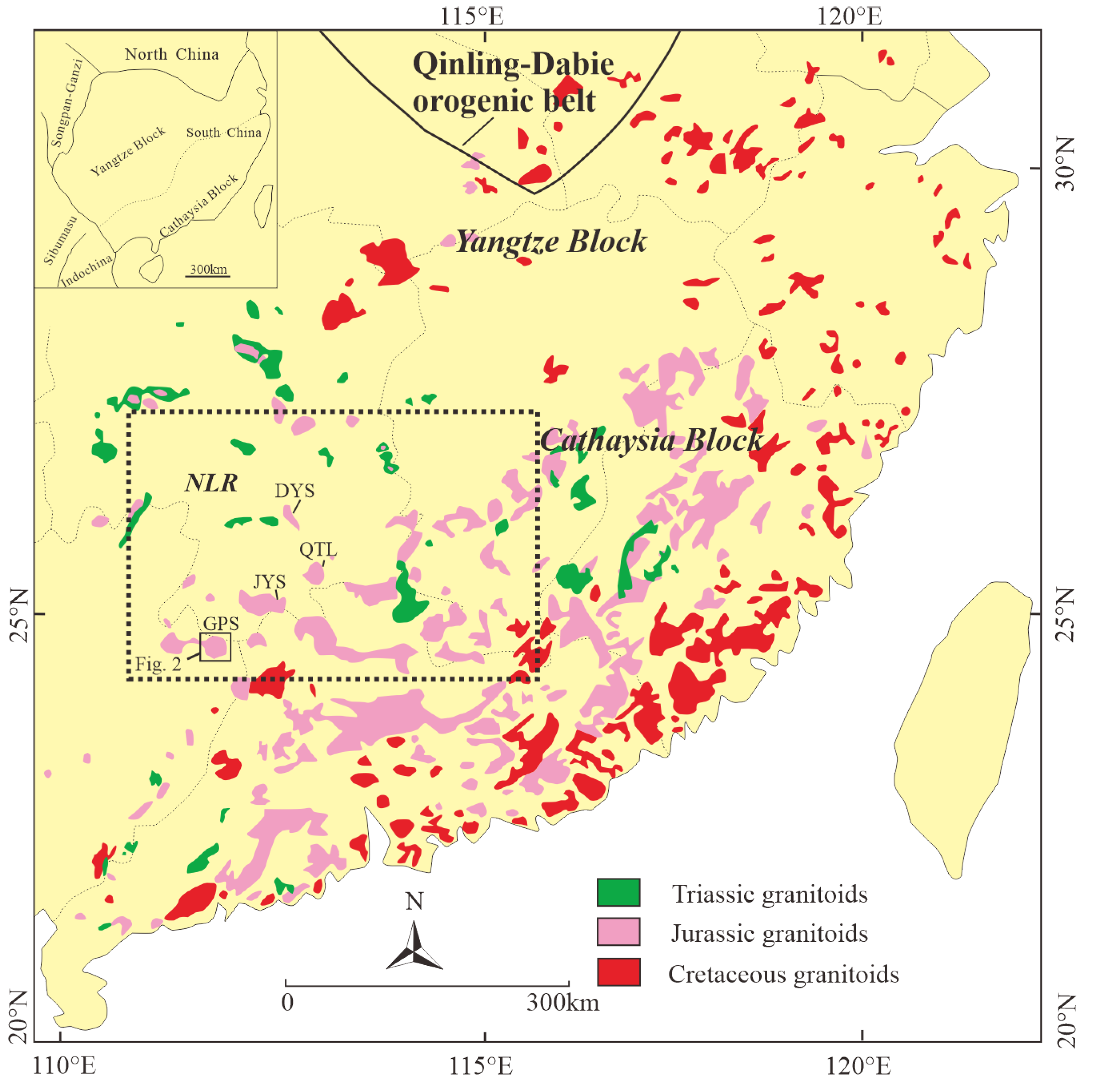
The circum-Pacific metallogenic belt, a globally significant metallogenic province, comprises several major domains, including the Southeast Asian Tin Belt (SATB) and the South China Metallogenic Belt (SCMB) [1,2,3,4,5]. Situated in the SCMB (Figure 1), the Nanling Metallogenic Belt (NLMB) is renowned for its intense felsic magmatism and associated W–Sn polymetallic mineralization, accounting for over 83% and 63% of China’s tungsten and tin reserves, respectively [6,7,8,9,10]. The mineralizing history is episodic, with temporally distinct events identified in the Neoproterozoic, Paleozoic, and Mesozoic [11,12,13,14,15]. Granites, products of the felsic magmatism, are mainly characterized by their highly fractionated signature, which was regarded as one of the key factors in causing the regional W–Sn polymetallic mineralization within the NLMB [7,16,17,18,19]. In addition, these highly fractionated granites, mainly formed within the range of 165–150 Ma, were widely distributed in the NLMB, e.g., the Guposhan, Dayishan, Qitianling, and Jiuyishan plutons [16,17,18,19,20]. Multistage magmatic evolution, dominated by fractional crystallization, was commonly identified as the major trigger for forming these highly fractionated granites in this region [12,21,22,23,24]. The formation and evolution of highly fractionated magmas within the NLMB represent a significant area of interest for geologists [25]. Nevertheless, the specific mechanisms driving the magmatic evolution process remain a critical focus of research. Elucidating these mechanisms provides the foundation for understanding the petrogenesis of these highly fractionated granites and related regional W–Sn polymetallic mineralization.
The Guposhan Sn-W polymetallic ore field, located at the western NLMB, is notable for its large-scale W-Sn polymetallic mineralization and hosting two important granitic intrusions, i.e., the Lisong and Guposhan plutons (Figure 1). Previous studies indicated that the Lisong and Guposhan granites might share a similar magma source since the ages and isotopic compositions of granites of both plutons are similar, i.e., ca. 160 Ma for ages of both granites and relatively depleted Nd-Hf isotopes [15,18,26,27]. However, Sn-W mineralization is strikingly scarce within the Lisong pluton, a feature that stands in marked contrast to the intense mineralization observed in the Guposhan pluton. The mechanism responsible for the lack of large-scale Sn-W mineralization in the Lisong pluton remains unclear, which hinders further understanding of regional Sn-W mineralization and ore prospecting. Therefore, this study presents new geochronological and geochemical data for the Lisong granites, including LA-ICP-MS zircon dating and Lu-Hf isotopes, apatite element and Sr isotopes, and whole-rock major-trace element compositions, to clarify the emplacement age, magma source, and oxidation state, as well as the genesis of the Lisong granites, which will provide critical insights into the key factors in controlling the regional Sn-W mineralization.
Figure 1.
Simplified geological map of the South China Block, adapted from Zhou et al. (2006) [28].
2. Geological Background and Sampling
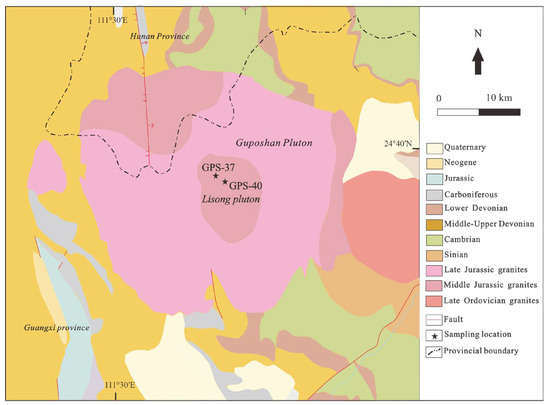
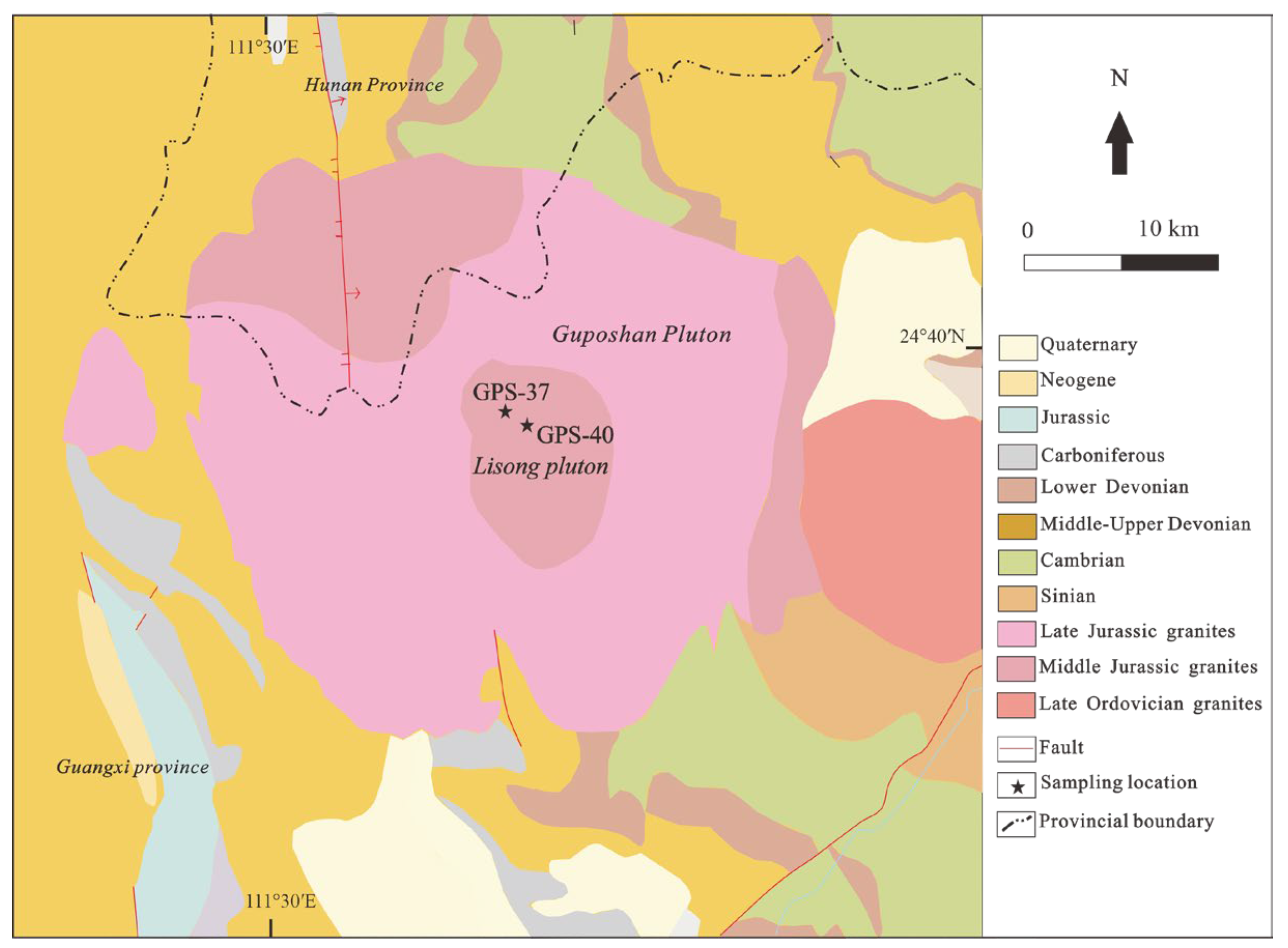
The Guposhan region in eastern Guangxi Province is notable for its large-scale W-Sn polymetallic mineralization, genetically related to the Jurassic Guposhan granites (Figure 1). This region has experienced multi-stage tectonic events, resulting in the formation of the regional structural frame, particularly its NE-trending fault systems, which reflect a complex tectonic history involving the Caledonian, Indosinian, and Yanshanian orogenies [29,30]. Intense granitic magmatism occurs in the Yanshanian event and forms the Guposhan and Lisong plutons, covering approximately 678 km2 and 70 km2, respectively. The Guposhan plutons are genetically related to the regional Sn-polymetallic mineralization, hosting a series of Sn-polymetallic deposits, e.g., Helukou, Xinlu, and Shuiyanba Sn deposits [15,31]. The Guposhan pluton, dated at 162.8 ± 1.3 Ma, is predominantly composed of fine- and medium-grained biotite granite that intrudes the Devonian marine clastic-carbonate sequences, inducing extensive silicification, marmarization, and skarnization of the surrounding rocks and intense W-Sn polymetallic mineralization [15,18]. The Lisong pluton, located within the Guposhan pluton, has an age of 163.3 ± 1.3 Ma and consists of coarse-grained biotite monzonitic granites [32]. The Lisong pluton is overlain by the Guposhan pluton, exhibiting a sharp change in lithology from coarse-grained to fine-grained texture [33]. In addition, a considerable amount of mafic microgranular enclave (MME) is widespread within the granotids of the Lisong pluton. The stratigraphic sequence is composed of: (1) Sinian greywacke; (2) Cambrian quartz sandstone, dolomite, bioclastic limestone, and epimetamorphic sandshales; (3) Devonian shallow marine clastic and carbonate rocks; Carboniferous carbonate rocks; (4) Jurassic carbonate rocks and quartz sandstones; and (5) Neogene shaly sandstone and Quaternary conglomerate (Figure 2).
Figure 2.
Simplified geological map of the Guposhan ore field, adapted from Li et al. (2015) [31].
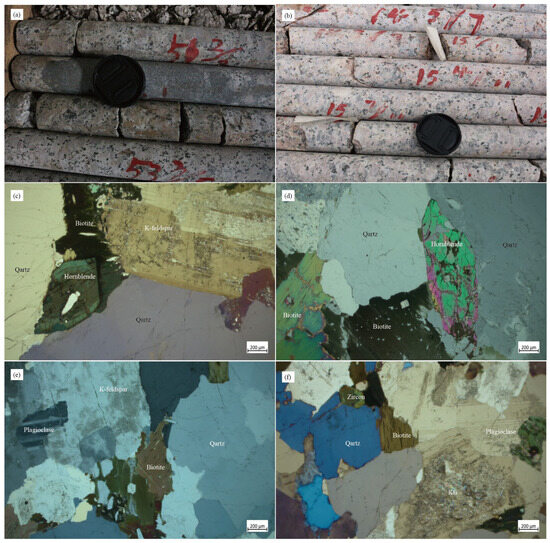
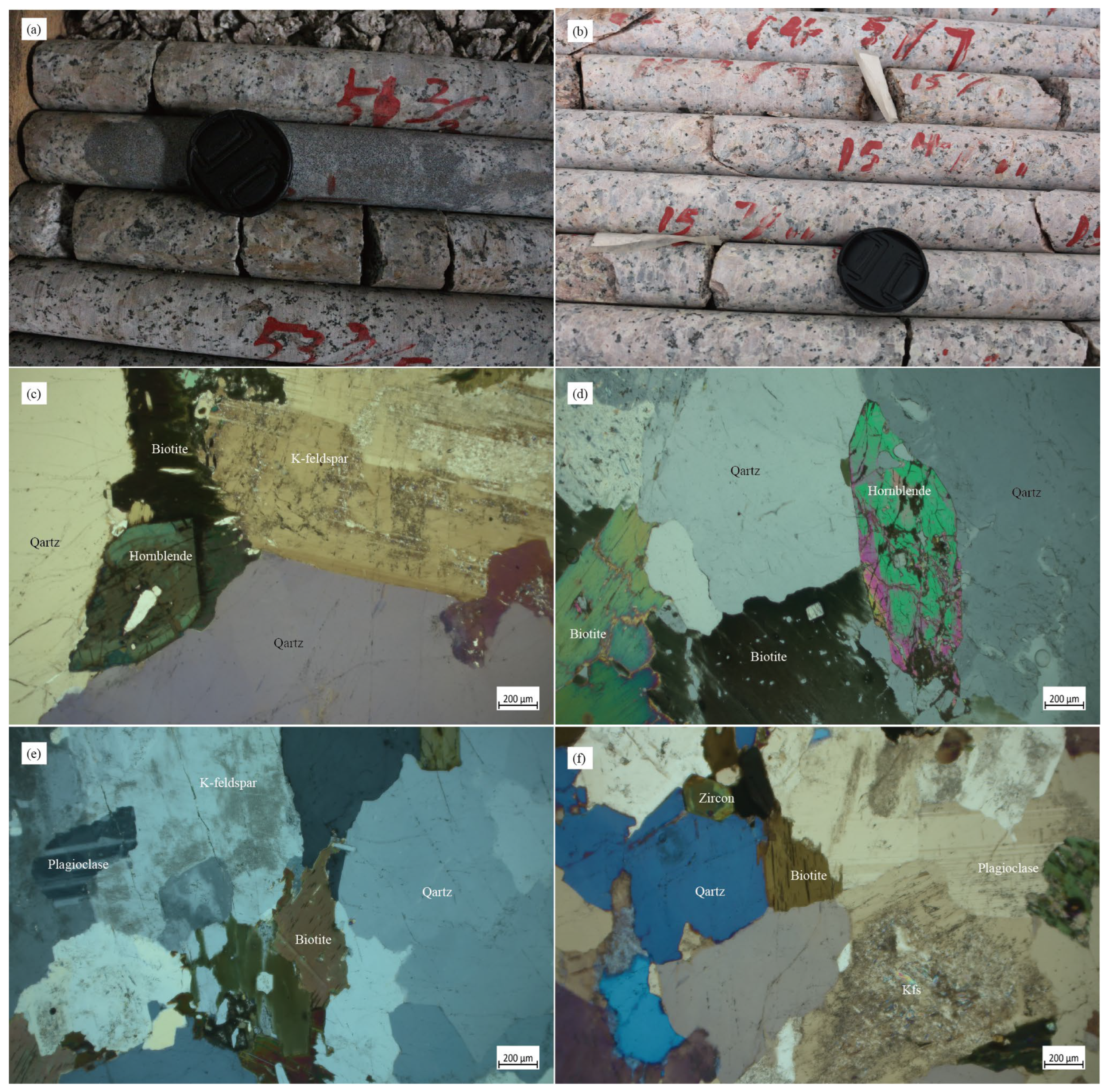
Samples of biotite monzonitic granites (hornblende-bearing) and biotite monzonitic granites (hornblende-free) were collected from two drilling cores within the Lisong pluton (Figure 2). The former exhibits a massive structure and is characterized by the occurrence of the mafic microgranular enclaves (MMEs) (Figure 3a). The mineral assemblages contain K-feldspar (~30%), plagioclase (~25%), quartz (~30%), biotite (~10%), hornblende (~5%), and accessory minerals (less than 1%; e.g., zircon, apatite, rutile) (Figure 3c,d). In contrast, the latter lacks hornblende and has a higher quartz content (~35%), while the proportions of other minerals remain similar (Figure 3e,f).
Figure 3.
Hand specimen photograph and photomicrographs of the Lisong coarse-grained hornblende-bearing biotite monzonitic granites (a,c,d) and coarse-grained hornblende-free biotite monzonitic granite (b,e,f). Mineral abbreviations: Bi, biotite; Hbl, hornblende; Kfs, K-feldspar; Pl, plagioclase; Qtz, quartz.
3. Analytical Techniques
3.1. LA-ICP-MS Zircon U-Pb Dating
Separation of zircon grains was achieved by combining standard magnetic and heavy liquid methods with final manual picking under a binocular microscope. The preparation of the selected grains involved first mounting them in epoxy resin blocks, then polishing the mounts to reveal flat internal surfaces. Cathodoluminescence (CL) imaging of zircon grains was conducted to examine their internal structures before geochemical analysis. The imaging was performed using a TESCAN MIRA 3 LMH FE-SEM (TESCAN Brno, s.r.o., Brno, Czech Republic) scanning electron microscope at Sample Solution Analytical Technology Co., Ltd. (Wuhan, China). Zircon U–Pb dating was carried out by the LA-ICP-MS instrument at the In Situ Mineral Geochemistry Laboratory, Ore Deposit and Exploration Centre (ODEC), Hefei University of Technology, Hefei, China. The analytical system comprised an Agilent 7900 quadrupole ICP-MS (Agilent Technologies, Santa Clara, CA, USA) coupled with a Photon Machines Analyte HE 193-nm ArF excimer laser ablation system (Photon Machines, Inc., Bozeman, MT, USA). External standards included zircon 91,500 with an age of 1062 ± 4 Ma [34] and NIST SRM610 silicate glass (National Institute of Standards and Technology (NIST), Gaithersburg, MD, USA). Zircon U–Pb dating employed the decay constants from [35]. Results for individual analyses, reported with 1σ uncertainties in the accompanying data tables and Concordia diagrams, are based on a 95% confidence level (2σ) for age uncertainties. Data processing was conducted with ICPMSDataCal 10.7 [36], with common Pb corrections applied following Andersen (2002) [37]. Weighted mean ages and Concordia diagrams were generated using ISOPLOT 3.0 [38].
3.2. Zircon Lu-Hf Isotopic Analyses
In situ Hf isotope measurements for zircon Lu–Hf analysis were performed on the previously dated grains using a Geolas Pro laser ablation system (Thermo Fisher Scientific, Bremen, Germany) coupled to a Neptune MC-ICP-MS (Thermo Fisher Scientific, Bremen, Germany) at the Key Laboratory of Focused Magmatism and Giant Ore Deposits, Xi’an Center of Geological Survey, Xi’an, China. Analytical conditions and data acquisition protocols followed the procedures [39,40]. The zircon reference material GJ-1 was utilized for external calibration, yielding a weighted-average 176Hf/177Hf ratio of 0.282030 ± 40 (2σ). Isobaric interference corrections for 176Yb on 176Hf were applied using a mean βYb value and a 176Yb/172Yb ratio of 0.5887. The decay constant for 176Lu (1.865 × 10⁻¹¹ year−1) [41] and present-day chondritic ratios (176Hf/177Hf = 0.282772; 176Lu/177Hf = 0.0332) [42] were used to calculate εHf(t) values. Single-stage Hf model ages (TDM1) were calculated relative to the depleted mantle present-day values (176Hf/177Hf = 0.28325; 176Lu/177Hf = 0.0384) [43,44]. Two-stage Hf model ages (TDM2) were calculated assuming derivation from the average continental crust (176Lu/177Hf = 0.015) [45].
3.3. LA-ICP-MS Major and Trace Element Analyses of Apatite
Upon separation, individual grains of high optical clarity were meticulously hand-picked under a binocular microscope. We conducted measurements of apatite element concentrations using LA-ICP-MS at the School of Resources and Environmental Engineering, Hefei University of Technology. The analyses utilized a system that consists of a Resonetics 193 nm ArF-excimer laser coupled with an Agilent 7500a ICP-MS, operating with a 30 μm spot size, 5 Hz frequency, and 4 J/cm2 fluence. To ensure precision and accuracy, external calibration was performed using the standard references, i.e., SRM 610 and BCR-2G. Raw data were processed offline using the ICPMSDataCal software (version 10.7) [36].
3.4. LA-MC-ICP-MS Sr Isotopic Analyses of Apatite
Apatite strontium isotope compositions were analyzed using a Thermo Fisher Scientific Neptune Plus multi-collector ICP-MS (Waltham, MA, USA) coupled with a Coherent GeoLas HD excimer ArF laser ablation system (Coherent, Inc., Saxonburg, PA, USA) at Wuhan Sample Solution Analytical Technology Co., Ltd., Wuhan, China. The instrument was configured with nine Faraday cups (1011 Ω resistors) to monitor Kr, Rb, Er, Yb, and Sr isotopes. A high-sensitivity X-skimmer cone and a Jet-sample cone were used, with helium as the carrier gas. Single-spot laser ablation employed a 60 μm spot size at a repetition rate of 8–15 Hz and a fluence of ~10 J/cm2. The detailed analytical methodology and data processing protocols for apatite Sr isotopic analysis followed Cao et al. (2023) [46].
3.5. Bulk-Rock Major and Trace Element Analyses
A total of ten granite samples from the study area were analyzed for bulk-rock major and trace element compositions at ALS Chemex, Guangzhou, China. Samples without MMEs were crushed to pass through a 200-mesh sieve. Major element concentrations were determined using an XRF spectrometer (PANalytical B.V., Almelo, The Netherlands), with an analytical accuracy of 1%–5%. The analysis of trace element compositions was conducted on an ICP-MS spectrometer (Agilent Technologies, Santa Clara, CA, USA), achieving an analytical accuracy greater than 5%.
4. Results
4.1. Zircon Ages
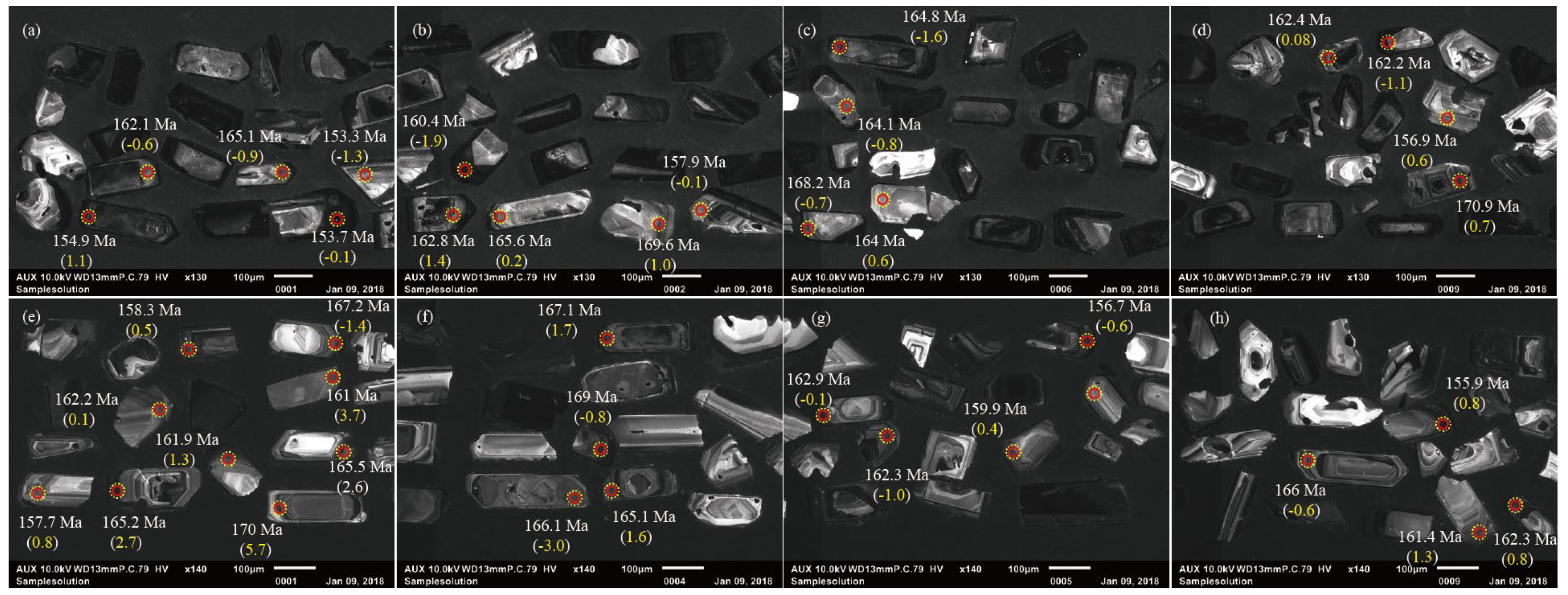
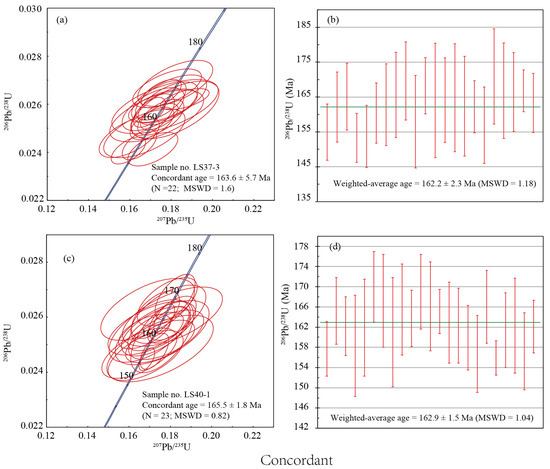
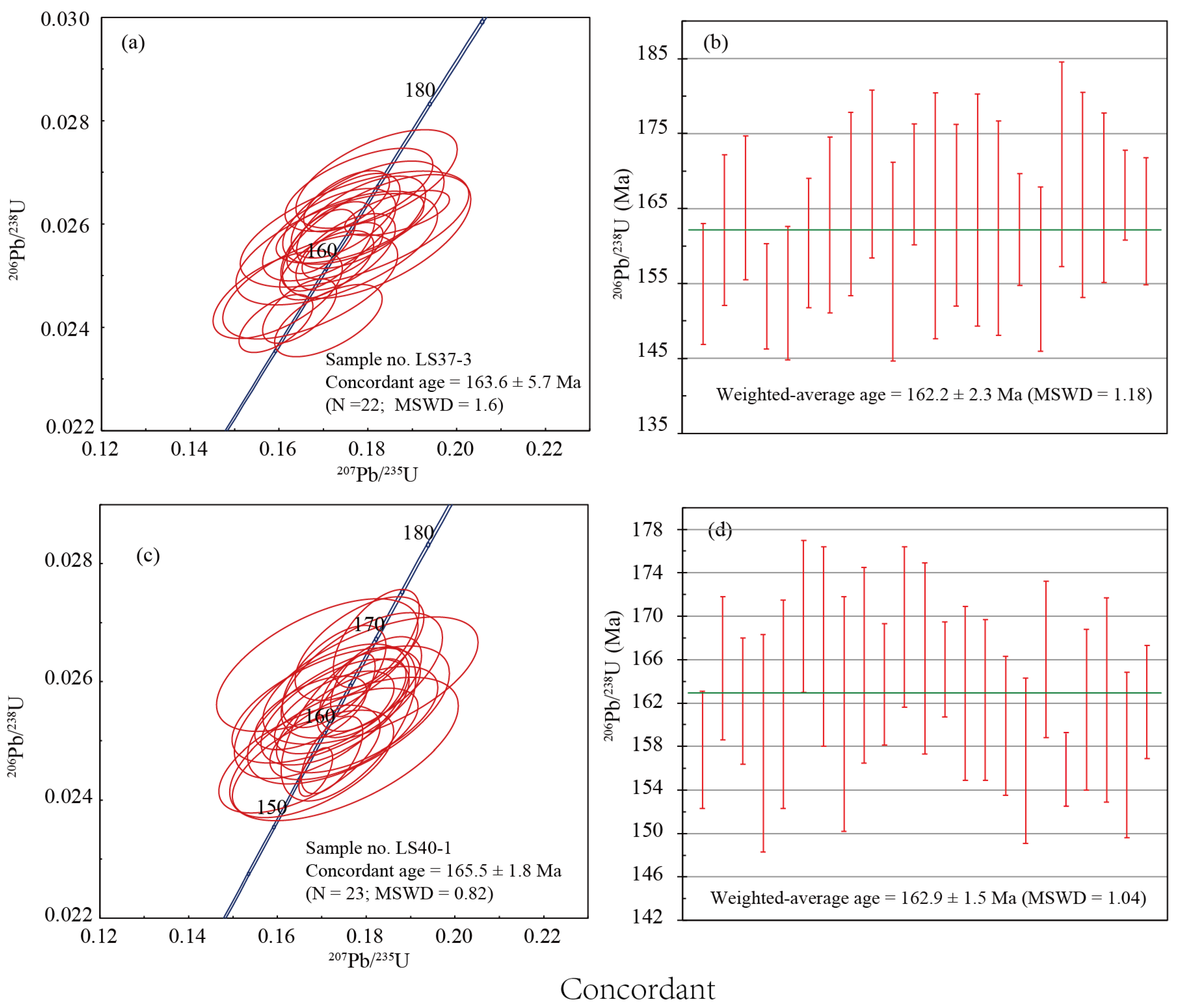
Zircons from the coarse-grained biotite monzonitic granites (hornblende-free) are characterized by euhedral, colorless crystals. These grains have lengths of 120–200 μm and exhibit aspect ratios of 1:1 to 2:1. Furthermore, cathodoluminescence (CL) imaging shows that the majority of zircons possess distinct oscillatory zoning, confirming a magmatic origin (Figure 4a–d) [47]. Geochemically, the zircons display U and Th concentrations of 178–1272 ppm and 73–889 ppm, respectively, resulting in relatively high Th/U ratios of 0.35–0.93 (mean = 0.49); this compositional signature further affirms their magmatic origin (Table S1) [47]. Consequently, a set of twenty-two analyses yielded a concordant 206Pb/238U age of 163.6 ± 5.7 Ma (MSWD = 1.6) (Figure 5a), which is consistent with the weighted-average 206Pb/238U age of 162.2 ± 1.5 Ma (MSWD = 1.18) (Figure 5b). Hence, the weighted-average 206Pb/238U age is interpreted as the crystallization age of the coarse-grained biotite monzonitic granites (hornblende-free).
Figure 4.
Cathodoluminescence (CL) characteristics of zircons. (a–d) Coarse-grained hornblende-free biotite monzonitic granite; (e–h) Coarse-grained hornblende-bearing biotite monzonitic granite. The 206Pb/238U age and εHf(t) values were marked in white and yellow, respectively. The beam spot diameters for zircon U-Pb dating and Lu-Hf isotopic analyses were 32 and 44 μm, respectively.
Figure 5.
U-Pb ages for zircon grains from the Lisong granites. (a,c): zircon U-Pb concordia diagrams; (b,d): weighted average diagrams.
Zircon grains from the coarse-grained biotite monzonitic granite (hornblende-bearing) occur as euhedral crystals and have lengths of 100–300 µm and aspect ratios of 1:1–3:1. Features of CL images indicate that most of the zircon grains have internal oscillatory zoning, which is of magmatic origin (Figure 4e–h) [47]. Zircon grains have variable U (216–2888 ppm) and Th (87–2290 ppm) concentrations, with relatively high Th/U ratios of 0.19–0.99 (mean = 0.48) (Table S1 in the Supplementary Materials). The selected analyses of zircon grains yield a concordant 206Pb/238U age of 165.5 Ma ± 1.8 Ma (MSWD = 0.82) (Figure 5c), consistent with the weighted-average 206Pb/238U age of 162.9 ± 1.5 Ma (MSWD = 1.04) (Figure 5d). This weighted-average 206Pb/238U age could be interpreted as the crystallization age of the coarse-grained biotite monzonitic granites (hornblende-bearing).
4.2. Zircon Lu-Hf Isotopes
Zircon Lu–Hf isotopes for the granitic rocks of the Lisong pluton are summarized in Table S2 in the Supplementary Materials. The coarse-grained biotite monzonitic granites (hornblende-free) have zircon 176Hf/177Hf ratios of 0.282619–0.282717 (mean = 0.282672) with initial 176Hf/177Hf ratios of 0.282617–0.282712 (mean = 0.282669). Based on the zircon age of 162.2 Ma, it yields calculated εHf(t) values of −1.9 to 1.4 (mean = −0.1) and two-stage Hf model ages (TDM2 = 1.12–1.34 Ga; mean = 1.22 Ga). In contrast, zircons from the coarse-grained biotite monzonitic granites (hornblende-bearing) exhibit a wider range of 176Hf/177Hf ratios (0.282589–0.282841; mean = 0.282697). Based on the zircon age of 162.9 Ma, the calculated initial ratios (0.282587–0.282832; mean = 0.282693) yield variable εHf(t) values (−3.0 to 5.7; mean = 0.8) and old TDM2 ages (0.85–1.40 Ga; mean = 1.16 Ga).
4.3. Apatite Chemical and Sr Isotopic Compositions
The chemical and Sr isotopic compositions of apatite grains are presented in Tables S3 and S4 in the Supplementary Materials, respectively. Apatite grains (apatite-1) from the coarse-grained hornblende-bearing biotite monzonitic granites exhibit lower CaO (53.1–54.3 wt%) and higher P2O5 (43.0–44.8 wt%) contents, comparable to those in apatite grains from the coarse-grained hornblende-bearing biotite monzonitic granites (apatite-2; 53.8–55.5 wt% CaO and 41.4–43.1 wt% P2O5). However, apatite-1 displays higher MnO (0.14–0.40 wt%) and FeO (0.13%–0.37%) concentrations relative to apatite-2, with MnO content of 0.05%–0.07% and FeO content of 0.05%–0.13%.
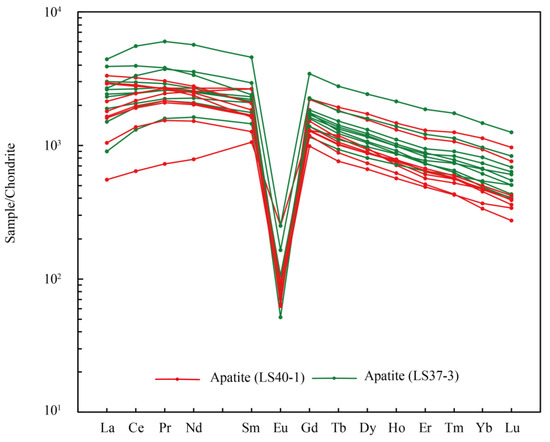
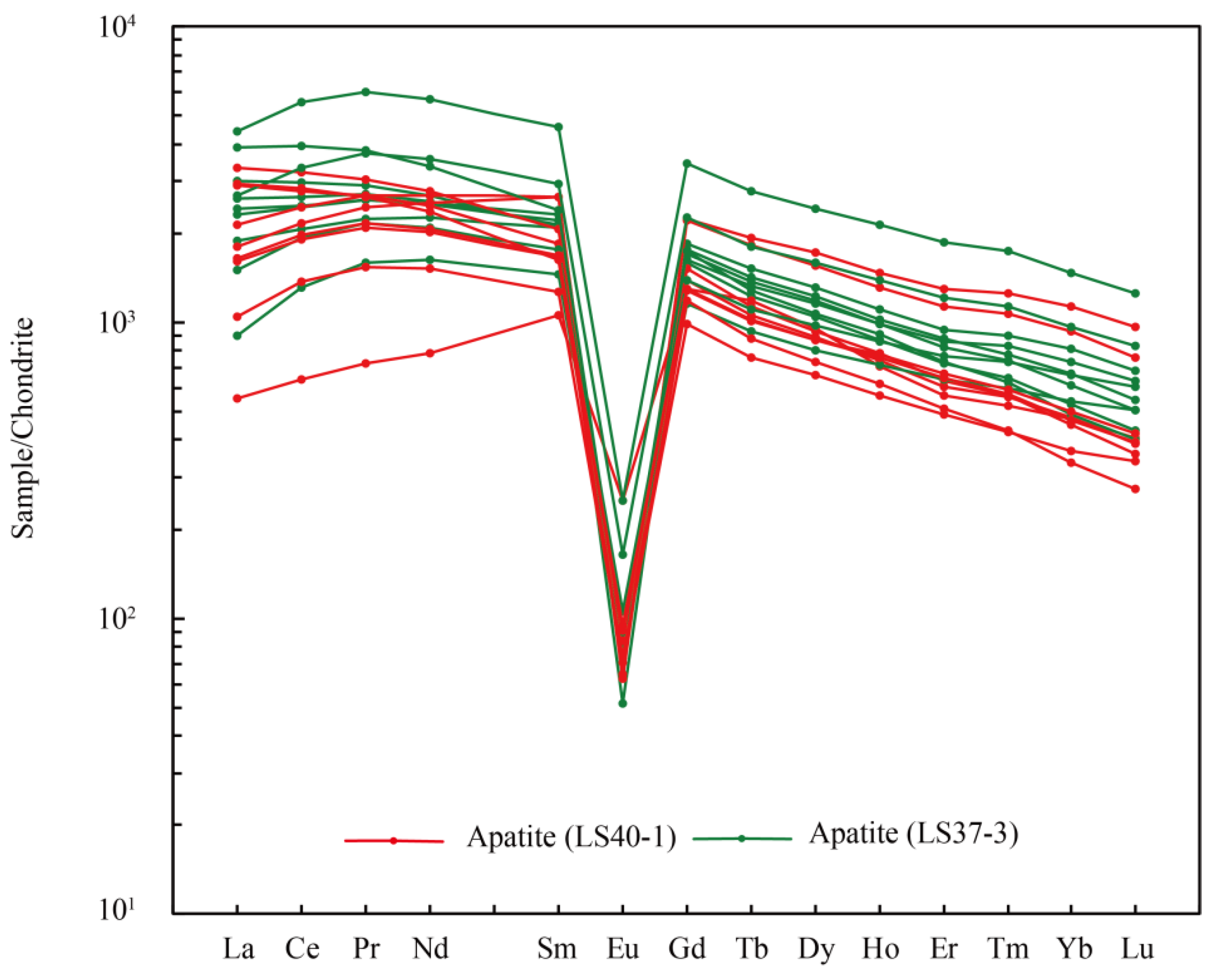
In trace element compositions, apatite-1 shows variable Sr (50.6–127 ppm) and Y (1560–4382 ppm) concentrations, which are consistent with apatite-2 (Sr content of 85.8–114.4 ppm; Y content of 1418–5193 ppm). Apatite-1 also exhibits lower total rare earth element (ΣREE) abundances (2925–8403 ppm) and lower δEu values (0.03–0.22) than apatite-2 (ΣREE = 4173–16,119 ppm and δEu = 0.04–0.07). Apatite from both samples is defined by enrichment in light rare earth elements (LREE) and depletion in heavy rare earth elements (HREE), with high LREE/HREE ratios of 1.5 to 5.7 and 3.0 to 6.3, respectively (Figure 6).
Figure 6.
Chondrite-normalized REE patterns for apatite grains of the Lisong granites. Normalizing factors are from Taylor and Mclennan (1985) [48].
The low apatite 87Rb/86Sr ratios of 0.00003–0.00813 (apatite-1) and 0.01335–0.06074 (apatite-2) confirm the measured 87Sr/86Sr values (0.69747–0.70568 and 0.70152–0.71190, respectively) faithfully represent initial melt compositions.
4.4. Bulk-Rock Chemical Compositions
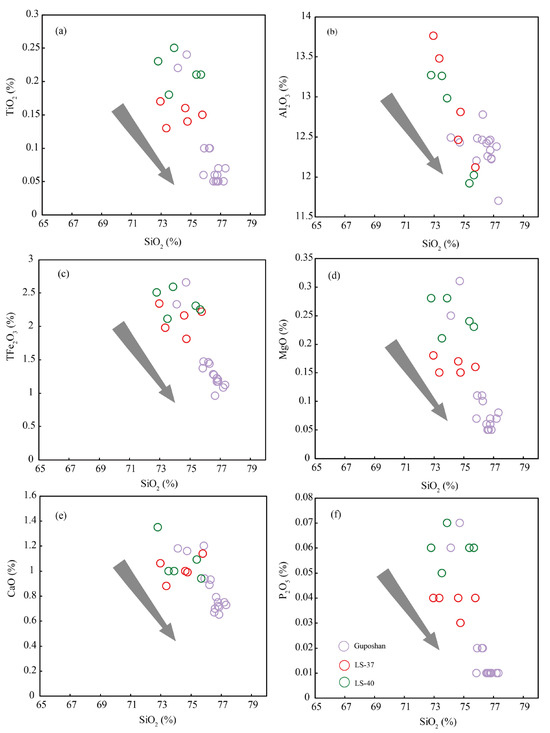
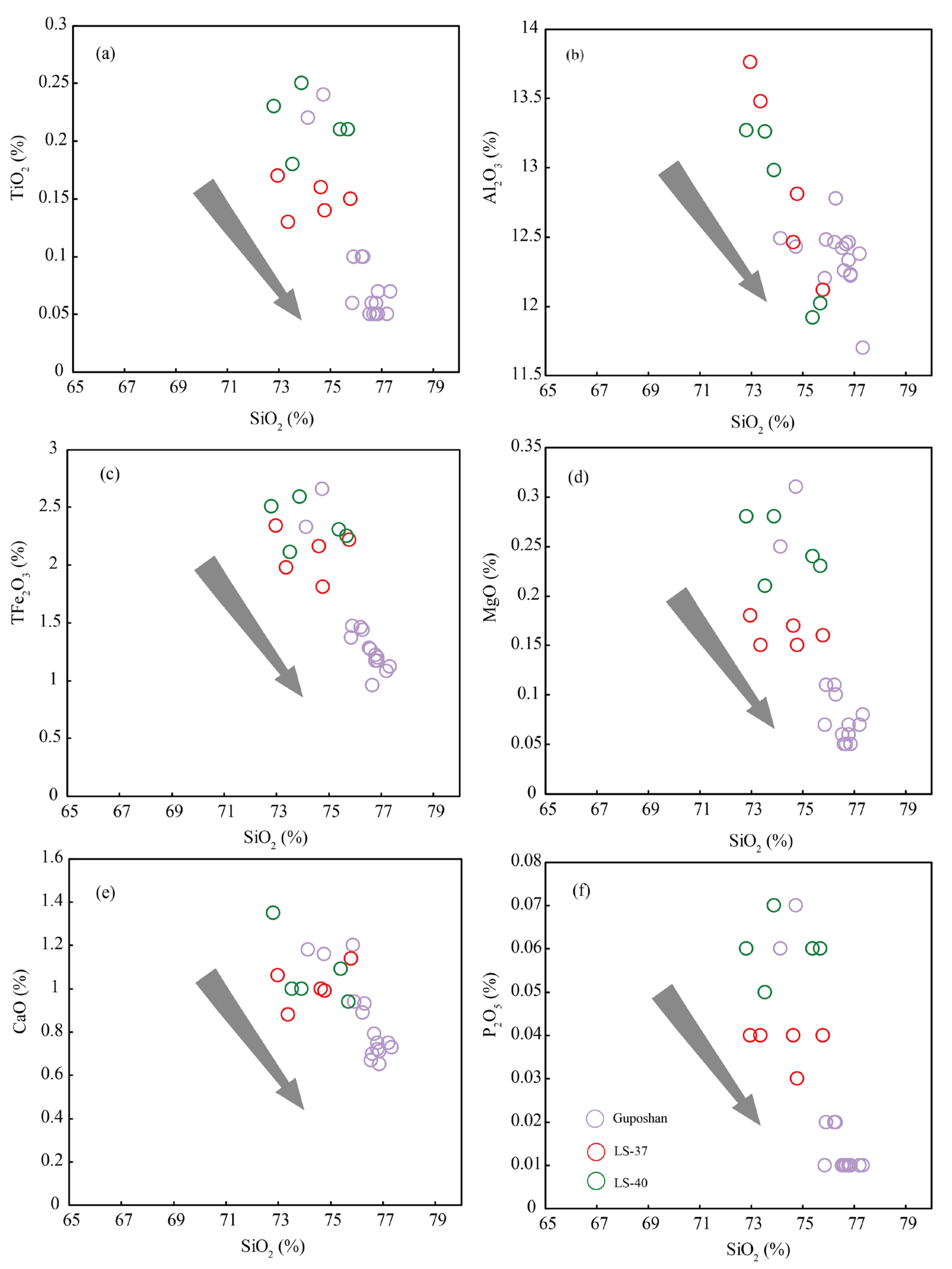
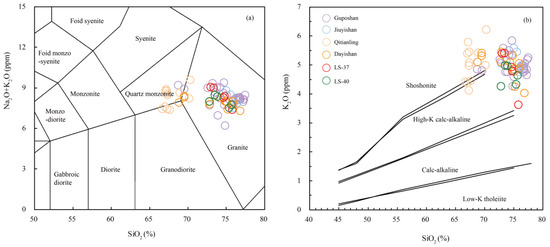
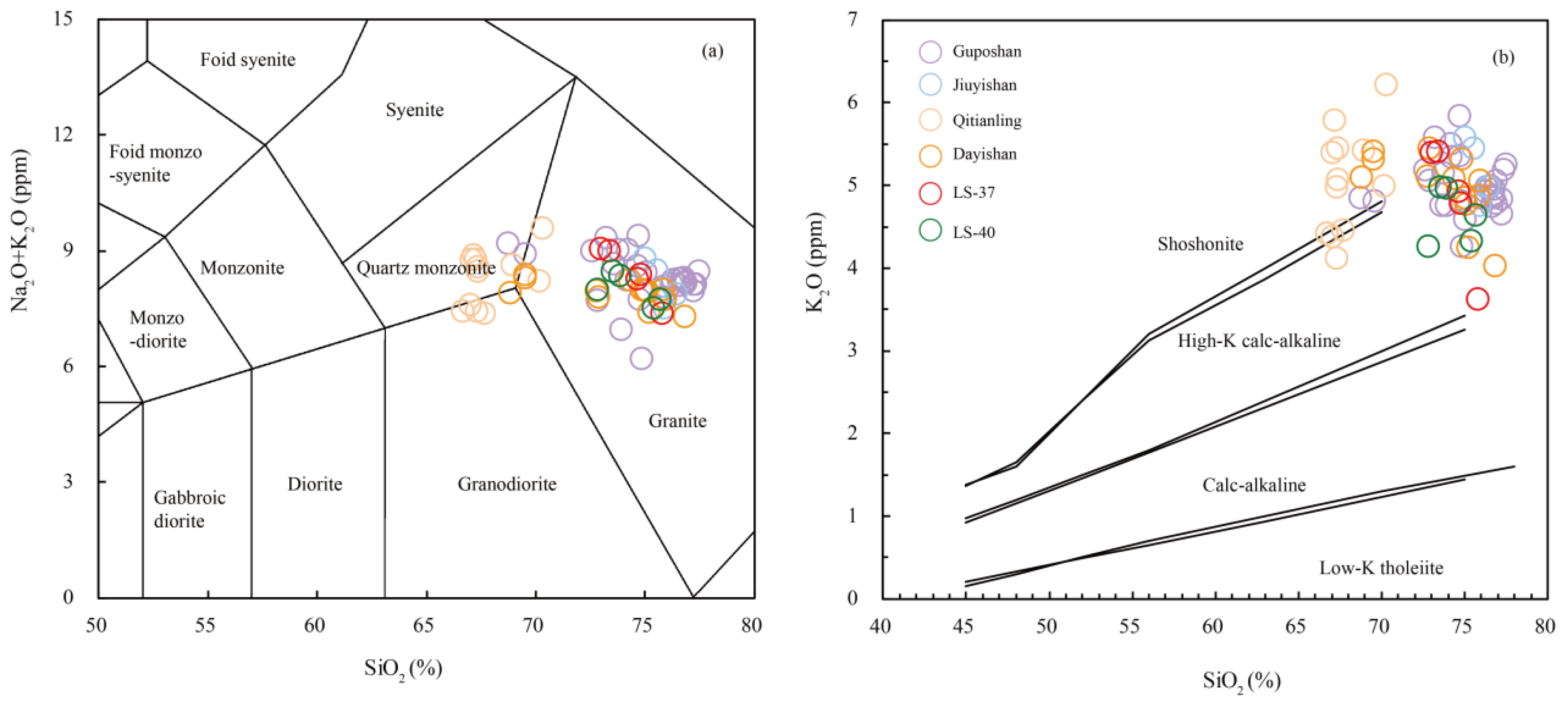
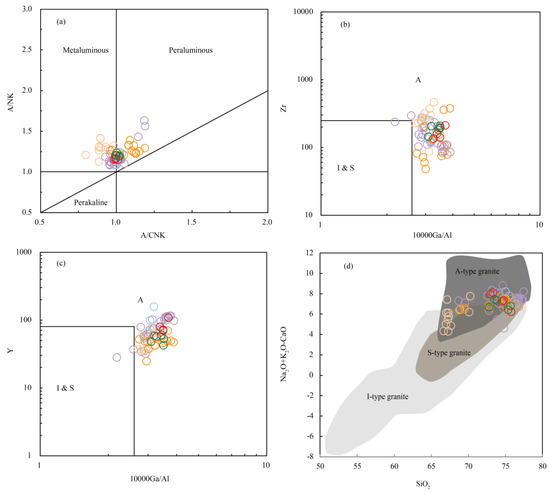
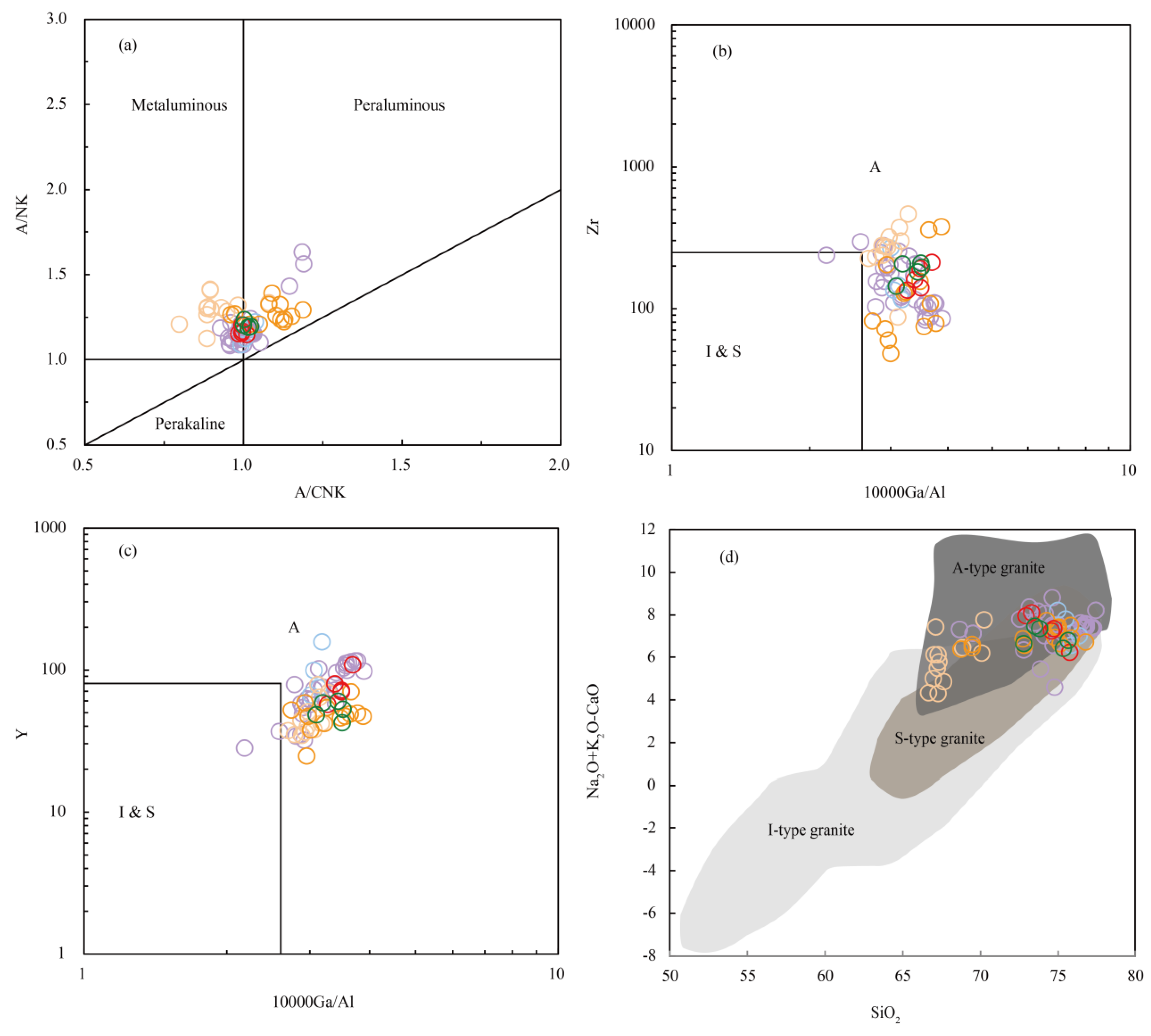
Bulk-rock chemical compositions of the Lisong granites are summarized in Table S5 in the Supplementary Materials. The biotite monzonitic granites (hornblende-free) are characterized by high SiO2 (73.0–75.8 wt%), Al2O3 (12.1–13.8 wt%), Na2O (3.33–3.75 wt%), and K2O (3.62–5.40 wt%), alongside low TiO2 (0.13–0.17 wt%), TFe2O3 (1.81–2.34 wt%), MnO (0.03–0.04 wt%), MgO (0.15–0.18 wt%), CaO (0.88–1.14 wt%), and P2O5 (0.03–0.04 wt%). A comparable geochemical trend is observed for the biotite monzonitic granites (hornblende-bearing) with 72.8–75.7 wt% SiO2, 0.18–0.25 wt% TiO2, 11.9–13.3 wt% Al2O3, 2.11–2.59 wt% TFe2O3, 0.04–0.05 wt% MnO, 0.21–0.28 wt% MgO, 0.94–1.35 wt% CaO, 3.10–3.73 wt% Na2O, 4.26–4.96 wt% K2O, and 0.05–0.07 wt% P2O5, respectively (Figure 7). Elevated Na2O + K2O and K2O contents classify these granites as high-K calc-alkaline (Figure 8a,b). They are further identified as peraluminous due to the high A/CNK ratios (1.15 to 1.23; Figure 9a). Collectively, these geochemical features, including their Na2O + K2O versus CaO systematics, support an A-type granite affinity (Figure 9b).
Figure 7.
Geochemical plots of the Lisong granites. (a) TiO2–SiO2 diagram; (b) Al2O3–SiO2 diagram; (c) TFe2O3–SiO2 diagram; (d) MgO–SiO2 diagram; (e) CaO–SiO2 diagram; (f) P2O5–SiO2 diagram.
Figure 8.
(a) SiO2 vs. K2O + Na2O and (b) SiO2 vs. K2O diagrams, revised from Middlemost (1994) [49] and Peccerillo and McLennan (1985) [50]. Data of the Guposhan, Qitianling, Jiuyishan, and Dayishan plutons are from Cao et al. (2020) [18], Zhao et al. (2012) [20], Liu et al. (2021) [51], and Lu et al. (2021) [19].
Figure 9.
(a) A/CNK vs. A/NK, (b) 10,000Ga/Al vs. Zr, (c) 10,000Ga/Al vs. Y, and (d) SiO2 vs. Na2O + K2O-CaO diagrams. (a,b) are adapted from Maniar and Piccoli (1989) [52] and Frost et al. (2001) [53], respectively. (c,d) are adapted from Whalen et al. (1987) [54]. Symbols are the same as in Figure 8.
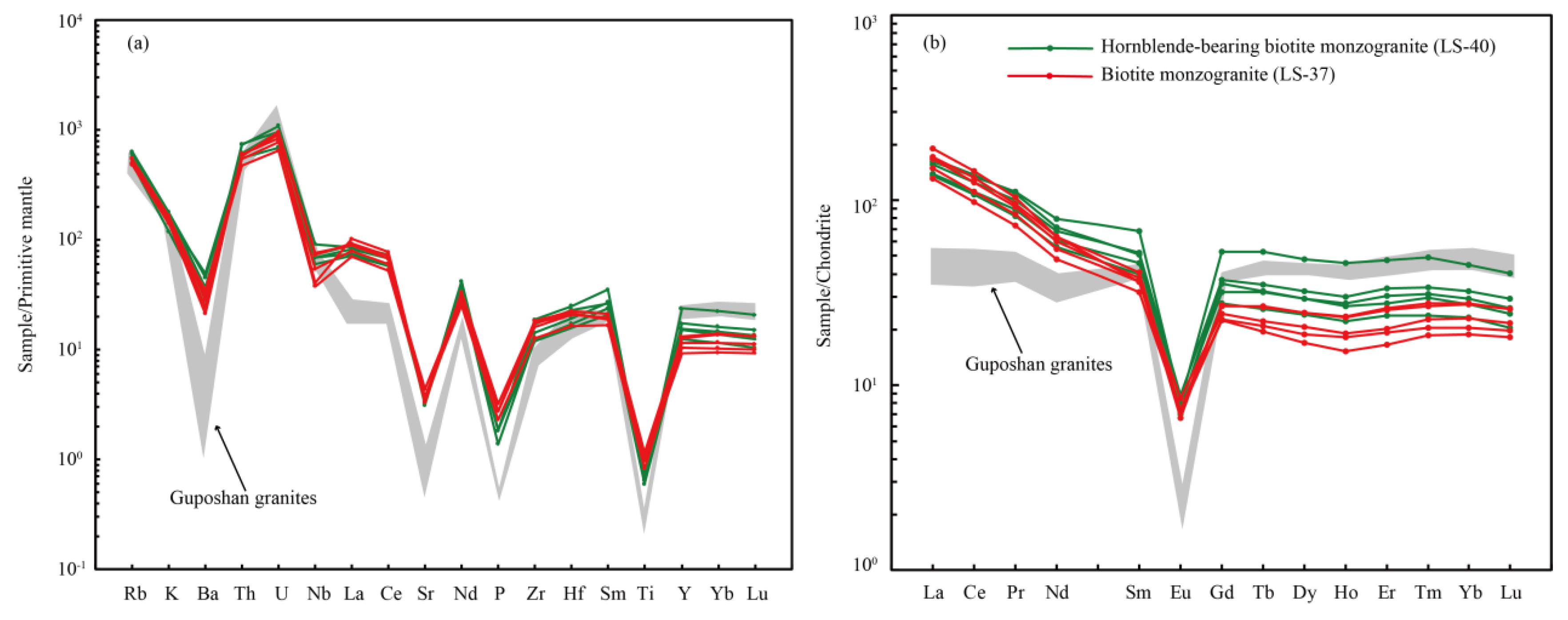
The granites display variable concentrations of Ga (21.7–24.7 ppm), Rb (306–404 ppm), Sr (66.4–92.1 ppm), Ba (150–256 ppm), Th (40.1–63.2 ppm), U (13.6–22.9 ppm), Nb (27.0–65.3 ppm), Ta (4.4–7.0 ppm), and Y (42.0–108 ppm; Table S5 in the Supplementary Materials). The Lisong granites are distinguished by high 10,000 × Ga/Al ratios (3.09 to 3.69), falling within the field of A-type granites (Figure 9c,d). Geochemically, these rocks are distinguished by depletions in specific large ion lithophile elements (LILEs; e.g., Sr, Ba) and high field strength elements (HFSEs; e.g., P, Ti), a pattern analogous to that observed in the Guposhan granites (Figure 10a). They have ΣREE contents of 248–344 ppm and exhibit significant light REE (LREE) enrichment relative to heavy REEs (HREEs), with LREE/HREE ratios between 4.10 and 10.7. Their chondrite-normalized REE patterns are distinct from those of the Guposhan suite and are marked by pronounced negative Eu anomalies (δEu = 0.14–0.25; Figure 10b).
Figure 10.
(a) Primitive mantle-normalized multi-element spider diagram and (b) chondrite-normalized REE diagram for the Guposhan granites. Normalizing values are from Sun and McDonough (1989) [55] and Taylor and Mclennan (1985) [48], respectively. The data of the Guposhan granites are from Cao et al. (2020) [18].
5. Discussion
5.1. Geochronology of the Lisong Granites
The Guposhan region, which constitutes a key part of the NLMB, is marked by a complex geological history involving multi-phase Jurassic magmatism, which is genetically linked to significant W–Sn polymetallic mineralization [15,18,27,31,32]. The NLMB underwent a critical geodynamic transition from a post-collisional compression to an extensional tectonic regime induced by the roll-back of the subducted Paleo-Pacific slab, which subsequently led to an asthenosphere upwelling event [56,57,58]. This event induced large-scale crustal melting and intense mantle-crust interaction and generated a NE-trending A-type granite belt, including the Guposhan, Jiuyishan, and Xitian plutons [18,59,60].
While the NLMB is widely recognized for its peak granitic magmatism and mineralization between 165 and 150 Ma [7,12], the Guposhan region preserves an extended record of magmatic-hydrothermal activity, providing critical insights into the magmatic-hydrothermal mineralization events. A magmatic event in Guposhan, dated at 184 ± 3.6 Ma [7], thus constitutes one of the earliest recorded Jurassic granitic intrusions associated with W–Sn mineralization in the NLMB. A subsequent magmatic pulse at ca. 165 Ma marks a major mineralization episode, with magmatic-hydrothermal deposits constrained to 165–160 Ma [31,32,33,61]. A third phase of magmatism occurred at ca. 154 Ma, though no associated mineralization ages have been identified to date [27]. In the present study, zircon geochronological studies on the Lisong granites yielded ages of 162.0 ± 2.4 Ma and 162.1 ± 2.2 Ma, which are consistent with the previously reported age of 163 ± 1.3 Ma for the Lisong pluton [32]. These ages align closely with the emplacement age of the nearby Guposhan pluton (162.8 ± 1.3 Ma) [18,32], suggesting synchronicity in the emplacement of the Lisong and Guposhan plutons. This temporal consistency supports the notion that the Guposhan and Lisong plutons are also potentially genetically related. Furthermore, the coeval mineralization and rock-forming ages suggest that both the Lisong and Guposhan plutons are important components of the Jurassic regional magmatic-mineralization event in South China. However, most of the W-Sn deposits are hosted within the Guposhan plutons, indicating that the W-Sn mineralization is closely related to the Guposhan pluton rather than the Lisong pluton.
5.2. Magma Source
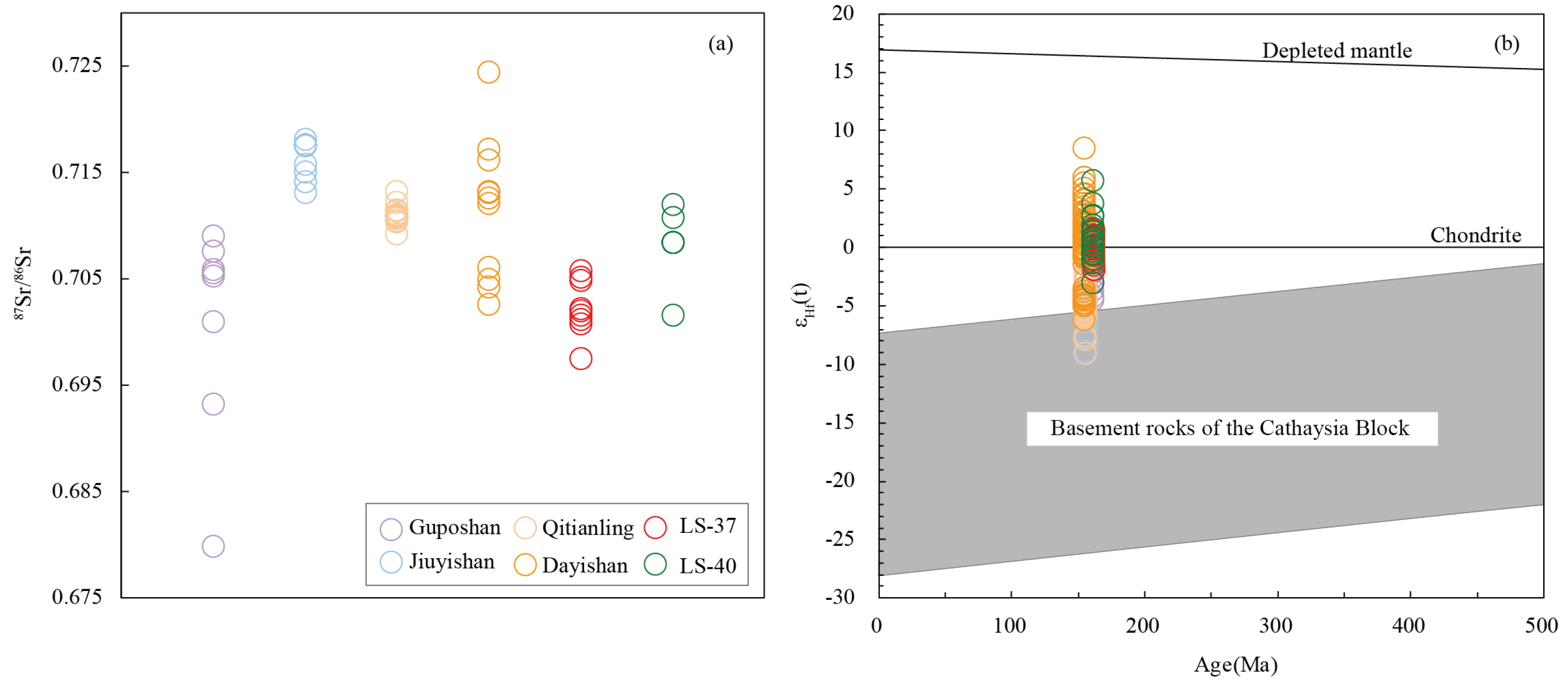
Apatite commonly crystallizes during the early phase of the magma and serves as a sensitive petrogenetic tracer for constraining magma origin and rock-forming processes due to its capacity to incorporate specific trace elements into its crystal lattice, e.g., Sr, REE, Fe, Mg, Mn, and Y [62,63]. The ionic radius of Ca2+ (1.00 Å) is similar to Sr2+ (1.18 Å) and different from Rb+ (1.52 Å), making Sr2+ much easier to fit into the apatite lattice than Rb+ [64] and indicating that the 87Sr/86Sr isotopic ratio of apatite will not be significantly influenced by the radioactive decay of the 87Rb/86Sr [46,65]. It is rendering that its 87Sr/86Sr isotopic ratios are representative of the Sr isotopic signature of the primary melt [66,67]. Moreover, apatite remains stable through subsequent geological events [68]. This durability makes it an ideal tracer for tracking multi-stage magma evolution without significant overprinting [46,65,69,70,71]. In this study, apatite grains from the Lisong granites exhibit low 87Sr/86Sr values (0.69747–0.71190), consistent with those of the nearby Guposhan pluton (0.67983–0.70900) and Sn-bearing granites in the NLMB, such as Qitianling, Jiuyishan, and Dayishan (Figure 11a). These isotopic signatures suggest a mantle-crust hybrid source for the Lisong granites, analogous to Sn-bearing granites in the NLMB [7], corroborated by the variable zircon εHf(t) signatures (−3.02 to 5.66), which agree with those of the Guposhan pluton and other Sn-bearing Nanling granites, reflecting isotopic evidence of crust-mantle interaction [7,32]. Additionally, the presence of mafic microgranular enclaves (MMEs), commonly interpreted as evidence of felsic-mafic magma mixing within the coarse-grained hornblende-bearing biotite monzonitic granites (Figure 3a), reinforces the hypothesis of hybrid magmatism. Despite these mantle-like isotopic signatures, the Lisong granites also exhibit geochemical characteristics typical of crustal-derived melts: (1) high SiO2 (72.8%–75.8%), Al2O3 (12.1%–13.8%), Th (40.1–62.8 ppm), U (13.6–22.9 ppm), Nb (27.0–65.3 ppm), and Ta (4.4–7.0 ppm); low Fe2O3 and MgO; and (2) old TDM2 ages of 0.85–1.40 Ga [72,73,74,75]. The consistent emplacement ages and isotopic compositions between the Lisong and Guposhan plutons (Figure 11b) suggest derivation from a shared magmatic chamber. Collectively, these data support that the Lisong and Guposhan granites originated primarily from a mixed melt composed of ancient crustal and mantle-derived material sources.
Figure 11.
(a) Apatite 87Sr/86Sr ratios and (b) zircon age vs. εHf(t) values of the Lisong granites. Data sources of the Guposhan, Qitianling, Jiuyishan, and Dayishan plutons are the same as in Figure 8.
5.3. Fractional Crystallization Processes
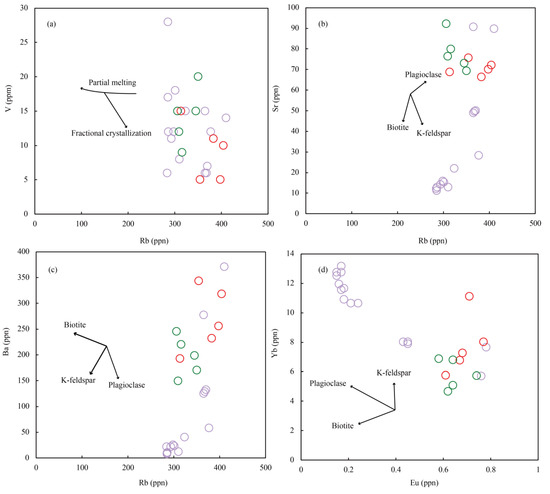
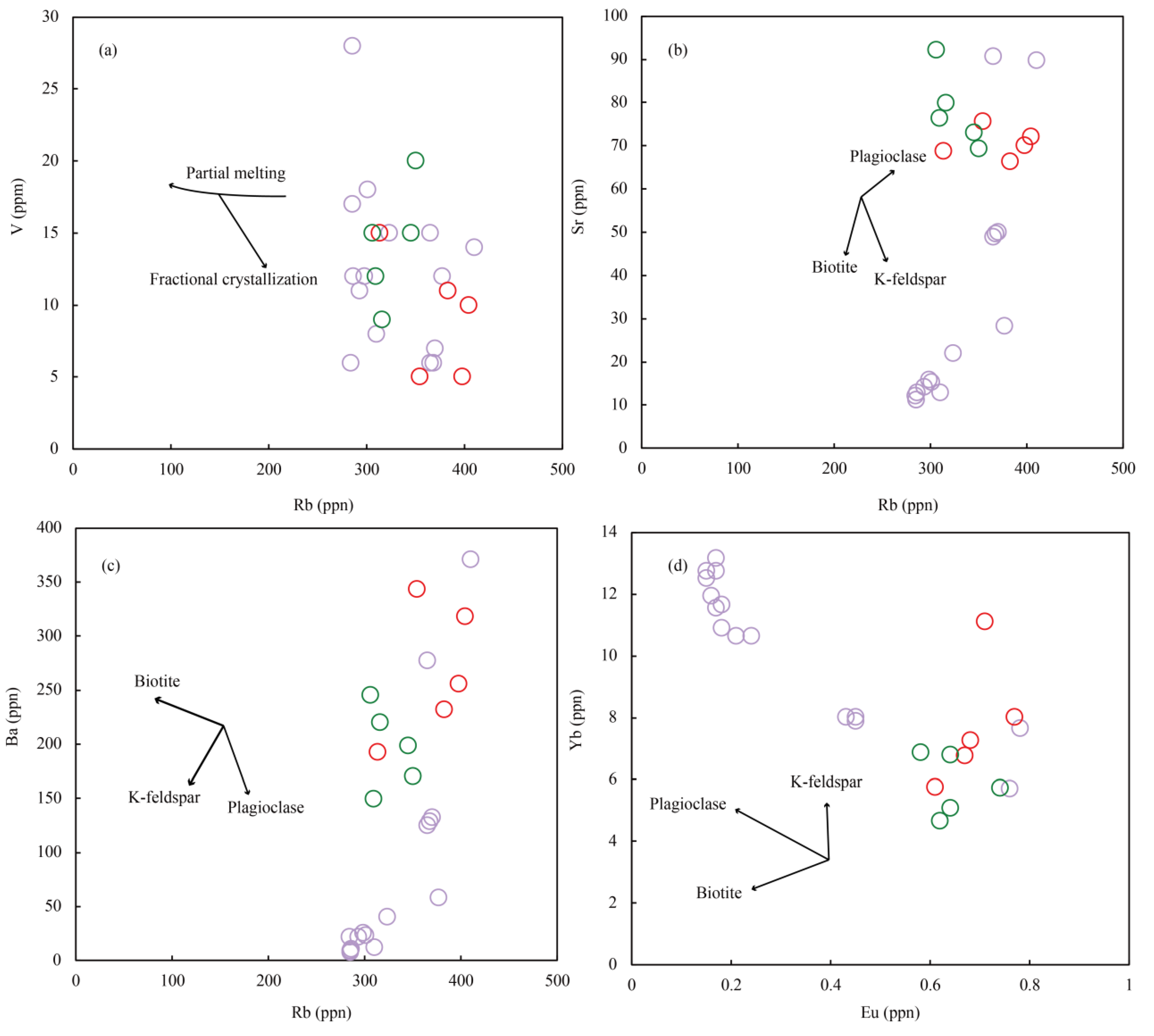
Fractional crystallization (FC), a fundamental mechanism in magmatic evolution, facilitates the enrichment of ore-forming elements in the evolved melt [76,77]. Furthermore, mineral fractional crystallization during magma evolution is essential for the formation of granitic rocks [78,79]. As mentioned earlier, the Lisong and Guposhan granites may be products of a common magma chamber; therefore, their chemical compositions should provide essential evidence of their magma evolution process. The negative correlation between Rb and V attests to intense fractional crystallization in the Lisong and Guposhan granites (Figure 12a), as evidenced by Rb-Sr, Rb-Ba, and Eu-Yb systematics, which fingerprint the roles of biotite, K-feldspar, and plagioclase, respectively (Figure 12b–d). The Lisong and Guposhan granites exhibit negative SiO2 correlations with TiO2, Al2O3, MgO, CaO, and P2O5 (Figure 7), which are consistent with the magma evolution trend, which was dominated by the mineral fractional crystallization. Furthermore, the more pronounced depletion of Eu, Sr, Ba, P, and Ti in the Guposhan granites compared to the Lisong granites suggests more extensive fractional crystallization of minerals such as plagioclase, apatite, and rutile/ilmenite during magmatic evolution (Figure 10a). Additionally, the shift from higher LREE/HREE ratios in the Lisong granites to lower ratios in the Guposhan granites indicates fractional crystallization of LREE-enriched minerals throughout this process (Figure 10b).
Figure 12.
Binary plots of (a) Rb vs. V, (b) Rb vs. Sr, (c) Rb versus Ba, and (d) Eu vs. Yb for the Lisong granites. Symbol conventions follow those in Figure 7.
As a major reservoir for Eu, plagioclase fractional crystallization is responsible for Eu depletion in the evolving magma [65], which will be recorded by the apatite [46,65,69,80]. Both the apatite-1 and apatite-2 contain low Eu contents of 4.47–21.8 ppm (mostly lower than 8.0 ppm) and 6.17–21.7 ppm, respectively, with corresponding low δEu values from apatite-1 (0.03–0.22; mostly within the range of 0.03–0.05) to apatite-2 (0.04–0.07). The pronounced negative Eu anomalies further indicate an intense plagioclase fractional crystallization for the primary magma (Figure 6). Consequently, the Lisong and Guposhan plutons form as products of the early and late stages of magmatic evolution, respectively, dominantly through fractional crystallization. This conclusion was certified by a decrease in Rb/Sr ratios from the Guposhan granites (4.03–25.7) to the Lisong granites (3.32–5.77) and an elevation in Zr/Hf ratios from the Guposhan granites (15.6–29.4) to the Lisong granites (26.4–30.9), which indicates that the Lisong granites belong to the highly fractionated granites.
The multistage magma evolution favors the W-Sn enrichment in the magma system, which might be one of the key factors in controlling the intense W-Sn mineralization of the Guposhan region. Being incompatible elements in the magma melt, tungsten and tin are commonly enriched in the late-stage magmatism [81]. However, the Lisong granites belong to the product of the early-stage magma evolution, which is unfavorable to the Sn and other metal enrichment in the magma. Therefore, the low differentiated signatures of the Lisong granites are one of the key factors for the absence of intense Sn mineralization.
5.4. Magma Oxidation State and Its Implications for the Sn Mineralization
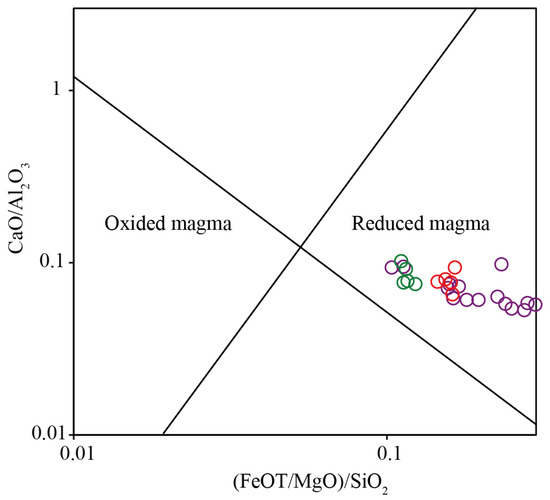
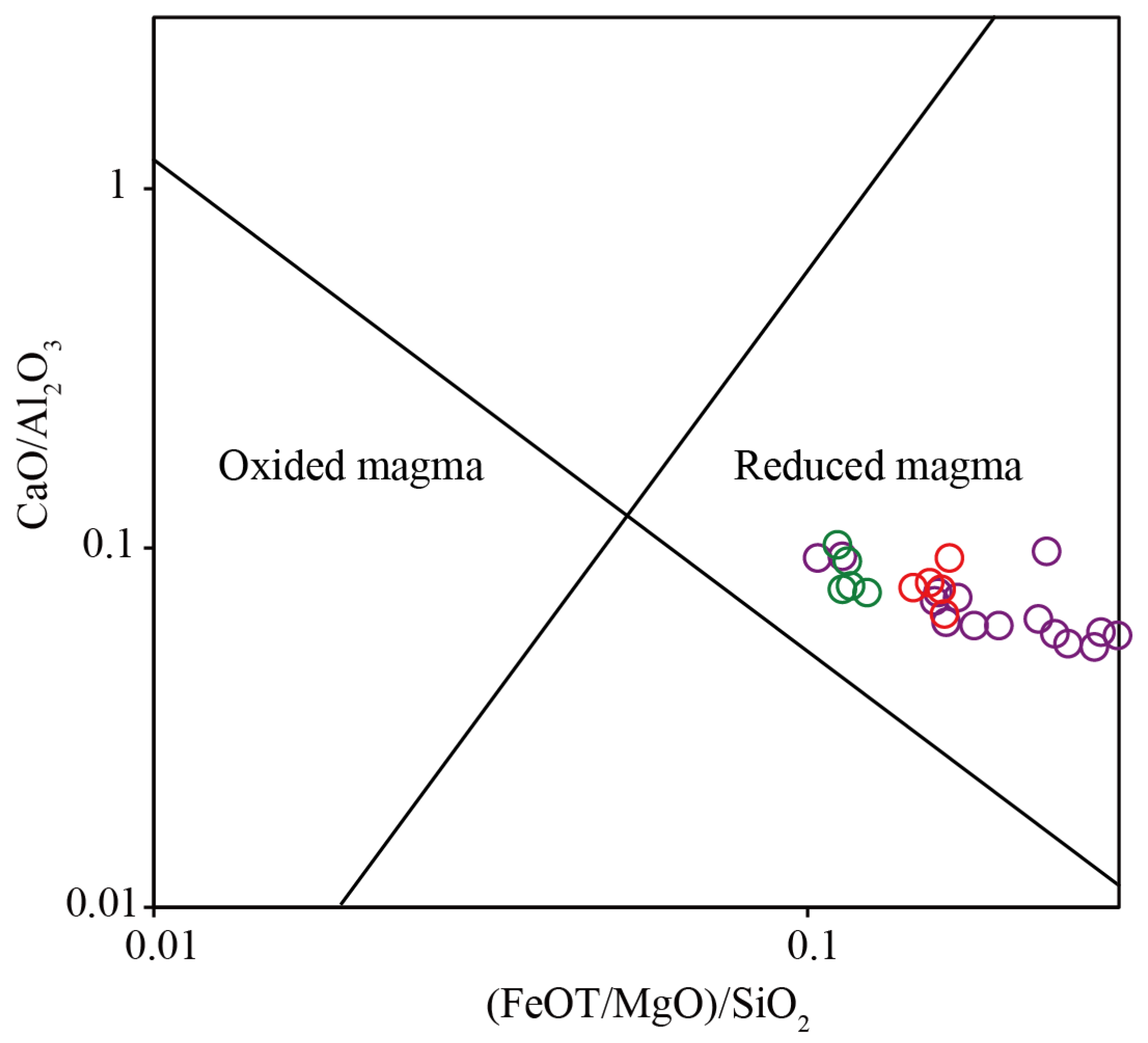
Apatite commonly crystallizes during the early stages of magma evolution, serving as an important tracer of the parental magma’s chemical composition and magma oxidation state [46,63,65,69,82]. Previous studies suggest that certain valence-variable elements (e.g., Fe, Mn, S, Eu, and Ce) in apatite can be used as indicators of the redox conditions of magmas [63,83]. Under reduced magmatic conditions, the concentrations of Ce3+ and Eu2+ increase relative to Ce4+ and Eu3+ in the melt. Consequently, apatite preferentially incorporates Ce3+ and Eu2+ due to their ability to substitute for Ca2+ within its crystal structure, resulting in the Eu and Ce enrichment and positive and/or normal Eu and Ce anomalies in the apatite 63,80]. However, variations in a single element within apatite are not a reliable indicator of magmatic oxidation state, primarily because other factors, such as fractional crystallization, melt composition, and/or structure, can significantly influence elemental compositions [84]. For example, the fractional crystallization of plagioclase, one of the Eu reservoirs, will lead to the depletion of Eu in the melt and consequently negative Eu anomalies in apatite, indicating that apatite Eu anomalies are not an ideal indicator in reflecting the redox conditions of the melt [85]. In this study, both apatite-1 and apatite-2 are characterized by normal and/or positive Ce anomalies with δCe = 0.99–1.03 and 1.02–1.09, respectively, indicating that the apatite probably crystallized from a reduced melt. This conclusion was confirmed by the relatively low FeOT/MgO)/SiO2 (0.11–0.16) and CaO/Al2O3 (0.07–0.10) ratios of the Lisong granites, which are similar to the Guposhan granites with (FeOT/MgO)/SiO2 and CaO/Al2O3 ratios of 0.10–0.30 and 0.05–0.09, respectively, indicating that Lisong granites originated from a reduced magma rather than an oxidized melt (Figure 13) [86].
Figure 13.
(FeOT/MgO)/SiO2 versus CaO/Al2O3 [86]. Symbol conventions follow those in Figure 7.
It is well accepted that redox conditions and magma evolution patterns are key factors for Sn mineralization, such that reduced, highly evolved magmas are deemed particularly critical [17,81,87]. As a multivalent element, the solubility of Sn in melts is governed by the magmatic redox conditions [88]. Under oxidizing conditions, Sn primarily exists as Sn4+, which can substitute for Ti4+ in minerals such as titanite, leading to the depletion of Sn in the melt. In contrast, under reducing conditions, Sn occurs as incompatible Sn2+, resulting in its progressive enrichment in the residual melt during magmatic evolution. As aforementioned, the Lisong and Guposhan granites are generated from a reduced melt, thereby favoring the partitioning of Sn into residual melt [18]. Therefore, the redox of the magma may not be a key factor responsible for the absence of large-scale Sn mineralization in the Lisong pluton.
6. Conclusions
Zircon U-Pb dating reveals that the Lisong pluton was emplaced at ~162 Ma. Their relatively low apatite 87Sr/86Sr ratios and variable zircon Hf isotopes suggest a magmatic origin that was derived from the partial melting of Cathaysia Block crustal rocks with the involvement of mantle-derived magmas. Furthermore, the Lisong granites might share a common magma chamber with the nearby Guposhan pluton. Apatite and whole-rock geochemistry indicate that the Lisong granites are generated from a reduced melt. The whole-rock geochemistry reveals that the Lisong granites belong to the low-differentiated granites. Therefore, the low differentiated nature of the primary magma is unfavorable for the enrichment of Sn and other metals and consequently influences the Sn mineralization potential of the Lisong granites.
Supplementary Materials
The following supporting information can be downloaded at: https://www.mdpi.com/article/10.3390/min16030313/s1, Table S1. LA-ICP-MS zircon U-Pb dating for the Lisong granites; Table S2. LA-MC-ICP-MS zircon Lu-Hf isotopes of the Lisong granites; Table S3. LA-ICP-MS apatite major and trace element compositions of Lisong granites; Table S4. LA-MC-ICP-MS apatite Sr isotope compositions of the Lisong granites; Table S5. Major and trace element compositions of the Lisong granites.
Author Contributions
Conceptualization, W.Z. and W.S.; methodology, W.Z.; software, L.Y.; validation, W.Z., M.T. and Y.Z.; formal analysis, W.Z.; investigation, W.Z., L.Y., G.D. and N.L.; resources, Y.Z., J.Z. and J.C.; data curation, W.S.; writing—original draft preparation, W.Z.; writing—review and editing, W.S., Y.Z. and M.T.; visualization, L.Y.; supervision, W.S. and Y.Z.; project administration, Y.Z.; funding acquisition, W.S. and Y.Z. All authors have read and agreed to the published version of the manuscript.
Funding
This study is financially supported by the Open Research Fund Program of Hunan Mine Carbon Sequestration and Sink Enhancement Engineering Technology Research Center (Grant No. 2025KSGTZH03), the Natural Science Foundation of Hunan Province (Grant No. 2024JJ8105), and the Scientific Research Project of Hunan Education Department (Grant No. 24C0809).
Data Availability Statement
Data are available on request from the authors.
Acknowledgments
We thank the valuable and insightful comments and suggestions from the anonymous reviewers. We also appreciate the kind help from the editorial team.
Conflicts of Interest
Author Mengqing Tang is employed by the company Hunan Nuclear Construction Engineering Co., Ltd. The paper reflects the views of the scientists and not the company. The remaining authors declare no conflicts of interest.
References
- Cao, J.Y.; Yang, X.Y.; Du, G.F.; Li, H. Genesis and tectonic setting of the Malaysian Waterfall granites and tin deposit: Constraints from LA-ICP (MC)-MS zircon U-Pb and cassiterite dating and Sr-Nd-Hf isotopes. Ore Geol. Rev. 2020, 118, 103336. [Google Scholar] [CrossRef] [Scilit]
- Ma, X.H.; Wang, H.H.; Lehmann, B.; Guo, C.L.; Mao, J.W. Control of magmatic halogen composition and redox state on the zonation of metal mineralization across active continental margins: Perspectives from the world-class South China metallogenic province. Chem. Geol. 2024, 669, 122363. [Google Scholar] [CrossRef] [Scilit]
- Ni, P.; Pan, J.Y.; Han, L.; Cui, J.M.; Gao, Y.; Fan, M.S.; Li, W.S.; Chi, Z.; Zhang, K.H.; Cheng, Z.L.; et al. Tungsten and tin deposits in South China: Temporal and spatial distribution, metallogenic models and prospecting directions. Ore Geol. Rev. 2023, 157, 105453. [Google Scholar] [CrossRef] [Scilit]
- Sun, X.; Zheng, M.J.; Pei, T.; Hollings, P.; Si, X.B.; Zhang, R.Q.; Deng, J. Reassessing the spatial and temporal evolution of the Southeast Asian Tin Belt: Insights into recurrent tin mineralization. Earth-Sci. Rev. 2025, 270, 105233. [Google Scholar] [CrossRef] [Scilit]
- Xiao, W.Z.; Liu, C.Y.; Tan, K.X.; Duan, X.Z.; Sui, Q.L.; Shi, K.T.; Feng, P.; Sami, M.; Ou, Q. Zircon U-Pb-Hf and Trace Element Signatures Reveal the Petrogenesis of the Jiuyishan Granitic Complex, South China: Implications for W-Sn and Rare Metal Mineralization. J. Earth Sci. 2025, 36, 1069–1089. [Google Scholar] [CrossRef] [Scilit]
- Wang, D.H.; Chen, Y.C.; Chen, Z.H.; Liu, S.B.; Xu, J.X.; Zhang, J.J.; Zeng, Z.L.; Chen, F.W.; Li, H.Q.; Guo, C.L. Assessment on mineral resource in Nanling region and suggestion for further prospecting. Acta Geol. Sin. 2007, 81, 882–890. [Google Scholar]
- Cao, J.Y.; Yang, X.Y.; Du, J.G.; Wu, Q.H.; Kong, H.; Li, H.; Wan, Q.; Xi, X.S.; Gong, Y.S.; Zhao, H.R. Formation and geodynamic implication of the Early Yanshanian granites associated with W-Sn mineralization in the Nanling range, South China: An overview. Int. Geol. Rev. 2018, 60, 1744–1771. [Google Scholar] [CrossRef] [Scilit]
- Chen, S.C.; Yu, J.J.; Bi, M.F. Extraction of fractionated interstitial melt from a crystal mush system generating the Late Jurassic high-silica granites from the Qitianling composite pluton, South China: Implications for greisen-type tin mineralization. Lithos 2021, 382, 105952. [Google Scholar] [CrossRef] [Scilit]
- Shu, X.J.; Wang, X.L.; Sun, T.; Xu, X.S.; Dai, M.N. Trace elements, U-Pb ages and Hf isotopes of zircons from Mesozoic granites in the western Nanling Range, South China: Implications for petrogenesis and W-Sn mineralization. Lithos 2011, 127, 468–482. [Google Scholar] [CrossRef] [Scilit]
- Cao, J.Y.; Lu, Y.Y.; Liu, L.; Fu, J.M.; Xu, G.F.; Wu, Q.H.; Yang, S.X.; Qiu, X.F.; Zhang, Z.Z. Insights into the crustal evolution and tungsten mineralization of the West Cathaysia Block: Constraints from the inherited zircons from the mesozoic Dengfuxian and Paleozoic Tanghu plutons, South China. Minerals 2023, 13, 550. [Google Scholar] [CrossRef] [Scilit]
- Li, W.; Tang, J.X.; Zhang, J.; He, G.W.; Chen, B.F.; Chen, W.; Liu, X.X.; Lu, J.; Lian, D.M. Indosinian W-Sn mineralization event in the Xikeng deposit, southern Jiangxi Province, Nanling Range: Evidence from U-Pb geochronology and Hf isotopes. Ore Geol. Rev. 2023, 163, 105715. [Google Scholar] [CrossRef] [Scilit]
- Chen, J.; Wang, R.C.; Zhu, J.C.; Lu, J.J.; Ma, D.S. Multiple-aged granitoids and related tungsten-tin mineralization in the Nanling Range, South China. Sci. China Earth Sci. 2013, 56, 2045–2055. [Google Scholar] [CrossRef] [Scilit]
- Zhang, S.T.; Zhang, R.Q.; Lu, J.J.; Ma, D.S.; Ding, T.; Gao, S.Y.; Zhang, Q. Neoproterozoic tin mineralization in South China: Geology and cassiterite U-Pb age of the Baotan tin deposit in northern Guangxi. Miner. Depos. 2019, 54, 1125–1142. [Google Scholar] [CrossRef] [Scilit]
- Wu, Q.H.; Cao, J.Y.; Kong, H.; Shao, Y.J.; Li, H.; Xi, X.S.; Deng, X.T. Petrogenesis and tectonic setting of the early Mesozoic Xitian granitic pluton in the middle Qin-Hang Belt, South China: Constraints from zircon U-Pb ages and bulk-rock trace element and Sr-Nd-Pb isotopic compositions. J. Asian Earth Sci. 2016, 128, 130–148. [Google Scholar] [CrossRef] [Scilit]
- Cao, J.Y.; Li, H.; Algeo, T.J.; Yang, L.Z.; Tamehe, L.S. Two-stage magmatism and tungsten mineralization in the Nanling Range, South China: Evidence from the Jurassic Helukou deposit. Am. Miner. 2021, 106, 1488–1502. [Google Scholar] [CrossRef] [Scilit]
- Yang, L.Z.; Wu, X.B.; Cao, J.Y.; Hu, B.; Zhang, X.W.; Gong, Y.S.; Liu, W.D. Geochronology, Petrology, and Genesis of Two Granitic Plutons of the Xianghualing Ore Field in South Hunan Province: Constraints from Zircon U-Pb Dating, Geochemistry, and Lu-Hf Isotopic Compositions. Minerals 2018, 8, 213. [Google Scholar] [CrossRef] [Scilit]
- Cao, J.Y.; Wu, Q.H.; Yang, X.Y.; Deng, X.T.; Li, H.; Kong, H.; Xi, X.S. Geochemical factors revealing the differences between the Xitian and Dengfuxian composite plutons, middle Qin-Hang Belt: Implications to the W-Sn mineralization. Ore Geol. Rev. 2020, 118, 103353. [Google Scholar] [CrossRef] [Scilit]
- Cao, J.Y.; Yang, X.Y.; Lu, Y.Y.; Fu, J.M.; Yang, L.Z. Zircon U-Pb and Sm-Nd geochronology and geochemistry of the Sn-W deposits in the northern Guposhan ore field, Nanling Range, southern China. Ore Geol. Rev. 2020, 118, 103323. [Google Scholar] [CrossRef] [Scilit]
- Lu, Y.Y.; Cao, J.Y.; Fu, J.M.; Yang, X.Y.; Yang, Q.Z.; Guo, J.; Cheng, S.B.; Qin, Z.W.; Zhang, Z.Z.; Zhang, T.Y.; et al. Petrogenesis of the granite related to the Dashunlong Sn polymetallic deposit, Dayishan ore field, South China. Ore Geol. Rev. 2021, 139, 104478. [Google Scholar] [CrossRef] [Scilit]
- Zhao, K.D.; Jiang, S.Y.; Yang, S.Y.; Dai, B.Z.; Lu, J.J. Mineral chemistry, trace elements and Sr-Nd-Hf isotope geochemistry and petrogenesis of Cailing and Furong granites and mafic enclaves from the Qitianling batholith in the Shi-Hang zone, South China. Gondwana Res. 2012, 22, 310–324. [Google Scholar] [CrossRef] [Scilit]
- Guo, N.X.; Zhao, Z.; Gao, J.F.; Chen, W.; Wang, D.H.; Chen, Y.C. Magmatic evolution and W-Sn-U-Nb-Ta mineralization of the Mesozoic Jiulongnao granitic complex, Nanling Range, South China. Ore Geol. Rev. 2018, 94, 414–434. [Google Scholar] [CrossRef] [Scilit]
- Li, W.S.; Ni, P.; Wang, G.G.; Yang, Y.L.; Pan, J.Y.; Wang, X.L.; Chen, L.L.; Fan, M.S. A possible linkage between highly fractionated granitoids and associated W-mineralization in the Mesozoic Yaogangxian granitic intrusion, Nanling region, South China. J. Asian Earth Sci. 2020, 193, 104314. [Google Scholar] [CrossRef] [Scilit]
- Liu, H.L.; Wang, J.R.; Chen, Q.; Huang, Y.N.; Li, X.; Liu, W.; Chen, B.; Xiao, F. Magmatic evolution and Nb-Ta enrichment of Early Jurassic granitic porphyry from the Shangxiahu Nb-Ta deposit of the Nanling Range. Minerals 2024, 14, 1005. [Google Scholar] [CrossRef] [Scilit]
- Xiao, W.Z.; Liu, C.Y.; Tan, K.X.; Duan, X.Z.; Shi, K.T.; Sui, Q.L.; Feng, P.; Sami, M.; Ahmed, M.S.; Zi, F. Two distinct fractional crystallization mechanisms of A-Type granites in the Nanling Range, South China: A case study of the Jiuyishan complex massif and Xianghualing intrusive stocks. Minerals 2023, 13, 605. [Google Scholar] [CrossRef] [Scilit]
- Ni, P.; Wang, G.G.; Li, W.S.; Chi, Z.; Li, S.N.; Gao, Y. A review of the Yanshanian ore-related felsic magmatism and tectonic settings in the Nanling W-Sn and Wuyi Au-Cu metallogenic belts, Cathaysia Block, South China. Ore Geol. Rev. 2021, 133, 104088. [Google Scholar] [CrossRef] [Scilit]
- Zhao, K.D.; Jiang, S.Y.; Zhu, J.C.; Li, L.; Dai, B.Z.; Jiang, Y.H.; Ling, H.F. Hf isotopic composition of zircons from the Huashan-Guposhan intrusive complex and their mafic enclaves in northeastern Guangxi: Implication for petrogenesis. Chin. Sci. Bull. 2010, 55, 509–519. [Google Scholar] [CrossRef] [Scilit]
- Wang, Z.Q.; Chen, B.; Ma, X.H. Petrogenesis of the Late Mesozoic Guposhan Composite Plutons from the Nanling Range, South China: Implications for W-Sn Mineralization. Am. J. Sci. 2014, 314, 235–277. [Google Scholar] [CrossRef] [Scilit]
- Zhou, X.M.; Sun, T.; Shen, W.Z.; Shu, L.S.; Niu, Y.L. Petrogenesis of Mesozoic granitoids and volcanic rocks in South China: A response to tectonic evolution. Episodes 2006, 29, 26–33. [Google Scholar] [CrossRef] [Scilit]
- Mao, J.W.; Xie, G.Q.; Guo, C.L.; Chen, Y.C. Large-scale tungsten-tin mineralization in the Nanling region, South China: Metallogenic ages and corresponding geodynamic processes. Acta Petrol. Sin. 2007, 23, 2329–2338, (In Chinese with English abstract). [Google Scholar]
- Shu, L.S.; Zhou, X.M.; Deng, P.; Yu, X.Q.; Wang, B.; Zu, P.F. Geological features and tectonic evolution of MesoCenozoic basins in southeastern China. Geol. Bull. China 2004, 23, 876–884, (In Chinese with English abstract). [Google Scholar]
- Li, X.F.; Xiao, R.; Feng, Z.H.; Chunxia, W.; Tang, Y.W.; Bai, Y.P.; Zhang, M.J. Ar-Ar Ages of Hydrothermal Muscovite and Igneous Biotite at the Guposhan-Huashan District, Northeast Guangxi, South China: Implications for Mesozoic W-Sn Mineralization. Resour. Geol. 2015, 65, 160–176. [Google Scholar] [CrossRef] [Scilit]
- Gu, S.Y.; Hua, R.M.; Qi, H.W. Zircon LA-ICP-MS U-Pb dating and Sr-Nd isotope study of the Guposhan granite complex, Guangxi, China. Chin. J. Geochem. 2007, 26, 290–300. [Google Scholar] [CrossRef] [Scilit]
- Feng, Z.H.; Wang, C.Z.; Zhang, M.H.; Liang, J.C. Unusually dumbbell-shaped Guposhan-Huashan twin granite plutons in Nanling Range of south China: Discussion on their incremental emplacement and growth mechanism. J. Asian Earth Sci. 2012, 48, 9–23. [Google Scholar] [CrossRef] [Scilit]
- Wiedenbeck, M.; Alle, P.; Corfu, F.; Griffin, W.L.; Meier, M.; Oberli, F.; Vonquadt, A.; Roddick, J.C.; Speigel, W. 3 natural zircon standards for U-Th-Pb, Lu-Hf, trace-element and REE analyses. Geostand. Newsl. 1995, 19, 1–23. [Google Scholar] [CrossRef] [Scilit]
- Jaffey, A.H.; Flynn, K.F.; Glendenin, L.E.; Bentley, W.C.; Essling, A.M. Precision measurement of half-lives and specific activities of U-235 and U-238. Phys. Rev. C 1971, 4, 1889–1906. [Google Scholar] [CrossRef] [Scilit]
- Liu, Y.S.; Gao, S.; Hu, Z.C.; Gao, C.G.; Zong, K.Q.; Wang, D.B. Continental and oceanic crust recycling-induced melt-peridotite interactions in the Trans-North China Orogen: U-Pb dating, Hf isotopes and trace elements in zircons from mantle xenoliths. J. Petrol. 2010, 51, 537–571. [Google Scholar] [CrossRef] [Scilit]
- Andersen, T. Correction of common lead in U–Pb analyses that do not report 204Pb. Chem. Geol. 2002, 192, 59–79. [Google Scholar] [CrossRef] [Scilit]
- Ludwig, K.R. ISOPLOT 3.00: A Geochronological Toolkit for Microsoft Excel; Berkeley Geochronology Center: Berkeley, CA, USA, 2003. [Google Scholar]
- Hou, K.J.; Li, Y.H.; Zou, T.R.; Qu, X.M.; Shi, Y.R.; Xie, G.Q. Laser ablation–MC–ICP–MS technique for Hf isotope microanalysis and its geological application. Acta Petrol. Sin. 2007, 23, 2595–2604, (In Chinese with English abstract). [Google Scholar]
- Meng, E.; Liu, F.L.; Liu, P.H.; Liu, C.H.; Yang, H.; Wang, F.; Shi, J.R.; Cai, J. Petrogenesis and tectonic significance of Paleoproterozoic meta-mafic rocks from central Liaodong Peninsula, northeast China: Evidence from zircon U-Pb dating and in situ Lu-Hf isotopes, and whole-rock geochemistry. Precambrian Res. 2014, 247, 92–109. [Google Scholar] [CrossRef] [Scilit]
- Scherer, E.; Münker, C.; Mezger, K. Calibration of the lutetium-hafnium clock. Science 2001, 293, 683–687. [Google Scholar] [CrossRef] [Scilit] [PubMed]
- BlichertToft, J.; Albarede, F. The Lu-Hf isotope geochemistry of chondrites and the evolution of the mantle-crust system. Earth Planet. Sci. Lett. 1997, 148, 243–258. [Google Scholar] [CrossRef] [Scilit]
- Nowell, G.M.; Kempton, P.D.; Noble, S.R.; Fitton, J.G.; Saunders, A.D.; Mahoney, J.J.; Taylor, R.N. High precision Hf isotope measurements of MORB and OIB by thermal ionisation mass spectrometry: Insights into the depleted mantle. Chem. Geol. 1998, 149, 211–233. [Google Scholar] [CrossRef] [Scilit]
- Griffin, W.L.; Pearson, N.J.; Belousova, E.; Jackson, S.E.; van Achterbergh, E.; O’Reilly, S.Y.; Shee, S.R. The Hf isotope composition of cratonic mantle: LAM-MC-ICPMS analysis of zircon megacrysts in kimberlites. Geochim. Cosmochim. Acta 2000, 64, 133–147. [Google Scholar] [CrossRef] [Scilit]
- Griffin, W.L.; Wang, X.; Jackson, S.E.; Pearson, N.J.; O’Reilly, S.Y.; Xu, X.S.; Zhou, X.M. Zircon chemistry and magma mixing, SE China: In-situ analysis of Hf isotopes, Tonglu and Pingtan igneous complexes. Lithos 2002, 61, 237–269. [Google Scholar] [CrossRef] [Scilit]
- Cao, J.Y.; Yang, X.Y.; Yang, S.X.; Zhong, C.; Wang, Y. Records of apatite for multiple injections of magmas in adakitic plutons: A case study of Mesozoic plutons in the Shatanjiao region of the Tongling ore cluster, south China. J. Asian Earth Sci. 2023, 242, 105507. [Google Scholar] [CrossRef] [Scilit]
- Hoskin, P.O.W.; Schaltegger, U. The composition of zircon and igneous and metamorphic petrogenesis. Rev. Miner. Geochem. 2003, 53, 27–62. [Google Scholar] [CrossRef] [Scilit]
- Taylor, S.R.; Mclennan, S.M. Continental Crust: Its Composition and Evolution; Blackwell Science: Boston, MA, USA, 1985. [Google Scholar]
- Middlemost, E.A.K. Naming materials in the magma/igneous rock system. Earth Sci. Rev. 1994, 37, 215–224. [Google Scholar] [CrossRef] [Scilit]
- Peccerillo, A.; Taylor, S.R. Geochemistry of eocene calc-alkaline volcanic rocks from the Kastamonu area, Northern Turkey. Contrib. Mineral. Petrol. 1976, 58, 63–81. [Google Scholar] [CrossRef] [Scilit]
- Liu, C.Y.; Xiao, W.Z.; Zhang, L.J.; Belousova, E.A.; Rushmer, T.; Xie, F.Q. Formation of Li-Rb-Cs greisen-type deposit in Zhengchong, Jiuyishan district, South China: Constraints from whole-rock and mineral geochemistry. Geochem.-Ger. 2021, 81, 125796. [Google Scholar] [CrossRef] [Scilit]
- Maniar, P.D.; Piccoli, P.M. Tectonic discrimination of granitoids. Geol. Soc. Am. Bull. 1989, 101, 635–643. [Google Scholar] [CrossRef] [Scilit]
- Frost, B.R.; Barns, C.G.; Collins, W.J.; Arculus, R.J.; Ellis, D.J.; Frost, C.D. A geochemical classification for granitic rocks. J. Petrol. 2001, 42, 2033–2048. [Google Scholar] [CrossRef] [Scilit]
- Whalen, J.B.; Currie, K.L.; Chappell, B.W. A-type granites: Geochemical characteristics, discrimination and petrogenesis. Contrib. Mineral. Petrol. 1987, 95, 407–419. [Google Scholar] [CrossRef] [Scilit]
- Sun, S.S.; McDonough, W.F. Chemical and Isotopic Systematics of Oceanic Basalts: Implications for Mantle Compositions and Processes; Geological Society of London Special Paper: London, UK, 1989; pp. 315–345. [Google Scholar]
- Ma, Q.; Xu, Y.G. Magmatic perspective on subduction of Paleo-Pacific plate and initiation of big mantle wedge in East Asia. Earth-Sci. Rev. 2021, 213, 103473. [Google Scholar] [CrossRef] [Scilit]
- Lee, S.H.; Oh, C.W.; Cho, D.L.; Lee, B.C.; Lee, B.Y. Early Cretaceous magmatism in the northern Gyeonggi Massif and the northcentral Yeongnam Massif, Korean Peninsula: Its implications for the Cretaceous tectonic evolution of the Northeast Asia. Lithos 2023, 460, 107366. [Google Scholar] [CrossRef] [Scilit]
- Xu, F.; Zhang, G.L.; Yan, W.; Zhang, J.; Yao, J.H. Subduction of the paleo-Pacific plate recorded by arc volcanism in the South China Sea margin. Gondwana Res. 2022, 110, 58–72. [Google Scholar] [CrossRef] [Scilit]
- Zhou, S.D.; Wang, X.L.; Du, D.H.; Wu, B.J.; Xu, X.S.; Hou, Z.Q. Spatiotemporal distribution of Mesozoic A-type granites and numerical modeling reveal episodic and progressive lithospheric extension in SE China. Lithos 2025, 514, 108214. [Google Scholar] [CrossRef] [Scilit]
- Yang, W.; Zhang, M.; Yan, J.; Chen, X.C. Zircon U-Pb Ages and Geochemistry of the Granite in the Xintianling Tungsten Deposit, SE China: Implications for Geodynamic Settings of the Regional Tungsten Mineralization. Minerals 2022, 12, 952. [Google Scholar] [CrossRef] [Scilit]
- Zhu, J.C.; Zhang, P.H.; Xie, C.F.; Zhang, H.; Yang, C. Ziucon U-Pb age framework of Huashan-Guposhan intrusive belt, western part of Nanling Range, and its geological significance. Acta Petrol. Sin. 2006, 22, 2270–2278. [Google Scholar]
- Pan, Y.M.; Fleet, M.E. Compositions of the apatite-group minerals: Substitution mechanisms and controlling factors. Rev. Miner. Geochem. 2002, 48, 13–49. [Google Scholar] [CrossRef] [Scilit]
- Sha, L.K.; Chappell, B.W. Apatite chemical composition, determined by electron microprobe and laser-ablation inductively coupled plasma mass spectrometry, as a probe into granite petrogenesis. Geochim. Cosmochim. Acta 1999, 63, 3861–3881. [Google Scholar] [CrossRef] [Scilit]
- Shannon, R.D. Revised Effective Ionic-Radii and Systematic Studies of Interatomic Distances in Halides and Chalcogenides. Acta Cryst. 1976, 32, 751–767. [Google Scholar] [CrossRef] [Scilit]
- Cao, J.Y.; Li, H.; Yang, X.Y.; Tamehe, L.S.; Esmaeili, R. Multi-stage magma evolution recorded by apatite and zircon of adakite-like rocks: A case study from the Shatanjiao intrusion, Tongling region, Eastern China. Am. Miner. 2022, 107, 178–189. [Google Scholar] [CrossRef] [Scilit]
- Tsuboi, M. The use of apatite as a record of initial 87Sr/86Sr ratios and indicator of magma processes in the Inagawa pluton, Ryoke belt, Japan. Chem. Geol. 2005, 221, 157–169. [Google Scholar] [CrossRef] [Scilit]
- Tsuboi, M.; Suzuki, K. Heterogeneity of initial 87Sr/86Sr ratios within a single pluton: Evidence from apatite strontium isotopic study. Chem. Geol. 2003, 199, 189–197. [Google Scholar] [CrossRef] [Scilit]
- Pan, L.C.; Hu, R.Z.; Wang, X.B.; Bi, X.W.; Zhu, J.J.; Li, C.S. Apatite trace element and halogen compositions as petrogenetic-metallogenic indicators: Examples from four granite plutons in the Sanjiang region, SW China. Lithos 2016, 254–255, 118–130. [Google Scholar] [CrossRef] [Scilit]
- Nathwani, C.L.; Loader, M.A.; Wilkinson, J.J.; Buret, Y.; Sievwright, R.H.; Hollings, P. Multi-stage arc magma evolution recorded by apatite in volcanic rocks. Geology 2020, 48, 323–327. [Google Scholar] [CrossRef] [Scilit]
- Dallara, E.; Fulignati, P.; Costa, S.; Gioncada, A.; Langone, A.; Pistolesi, M. Apatite chemistry in shoshonitic magmas: Insights into the volatile evolution at La Fossa volcano (Vulcano Island, Aeolian Arc, Italy). Lithos 2023, 454, 107238. [Google Scholar] [CrossRef] [Scilit]
- Wang, H.R.; Cai, K.D.; Sun, M.; Wang, Y.N.; Lai, C.K.; Wan, B.; Zhang, Z.Y. Magma evolution and Cu-Au mineralization potential of the Upper Devonian-Lower Carboniferous Tulasu basin, Western Tianshan Orogen (NW China): Apatite U-Pb dating and geochemical perspectives. Ore Geol. Rev. 2021, 139, 104526. [Google Scholar] [CrossRef] [Scilit]
- Barth, M.G.; McDonough, W.F.; Rudick, R.L. Tracking the budget of Nb and Ta in the continental crust. Chem. Geol. 2000, 165, 197–213. [Google Scholar] [CrossRef] [Scilit]
- Lamont, T.N.; Roberts, N.M.W.; Searle, M.P.; Gardiner, N.J.; Gopon, P.; Hsieh, Y.T.; Holdship, P.; White, R.W. Contemporaneous crust-derived I- and S-type granite magmatism and normal faulting on Tinos, Delos, and Naxos, Greece: Constraints on Aegean orogenic collapse. Geol. Soc. Am. Bull. 2023, 135, 2797–2829. [Google Scholar] [CrossRef] [Scilit]
- Yang, Z.Y.; Wang, Q.; Yang, J.H.; Dan, W.; Zhang, X.Z.; Ma, L.; Qi, Y.; Wang, J.; Sun, P. Petrogenesis of Early Cretaceous granites and associated microgranular enclaves in the Xiabie Co area, central Tibet: Crust-derived magma mixing and melt extraction. Lithos 2019, 350, 105199. [Google Scholar] [CrossRef] [Scilit]
- Li, J.Y.; Gao, L.M.; Sun, G.H.; Li, Y.P.; Wang, Y.B. Shuangjingzi middle Triassic syn-collisional crust-derived granite in the east Inner Mongolia and its constraint on the timing of collision between Siberian and Sino-Korean paleo-plates. Acta Petrol. Sin. 2007, 23, 565–582. [Google Scholar]
- Luo, B.J.; Bing, R.N.; Zhang, H.F.; Song, J.L.; Xu, W.C.; Yang, H.; Pan, F.B.; Guo, L. The role of polybaric crystallization in the construction of the Gangdese continental magmatic arc, South Tibet. Earth Planet. Sci. Lett. 2024, 628, 118580. [Google Scholar] [CrossRef] [Scilit]
- Yu, Y.; Li, Y.; Yang, L.; Wu, L.G.; Li, X.H. Zircon records carbonatite fractional crystallization and hydrothermal metasomatism during REE mineralization. Geochim. Cosmochim. Acta 2025, 409, 267–280. [Google Scholar] [CrossRef] [Scilit]
- Reid, J.B.; Murray, D.P.; Hermes, O.D.; Steig, E.J. Fractional Crystallization in Granites of the Sierra-Nevada—How Important Is It. Geology 1993, 21, 587–590. [Google Scholar] [CrossRef] [Scilit]
- Jung, S.; Hoernes, S.; Mezger, K. Geochronology and petrogenesis of Pan-African, syn-tectonic, S-type and post-tectonic A-type granite (Namibia): Products of melting of crustal sources, fractional crystallization and wall rock entrainment. Lithos 2000, 50, 259–287. [Google Scholar] [CrossRef] [Scilit]
- Belousova, E.A.; Griffin, W.L.; O’Reilly, S.Y.; Fisher, N.I. Apatite as an indicator mineral for mineral exploration: Trace-element compositions and their relationship to host rock type. J. Geochem. Explor. 2002, 76, 45–69. [Google Scholar] [CrossRef] [Scilit]
- Romer, R.L.; Kroner, U. Phanerozoic tin and tungsten mineralization-Tectonic controls on the distribution of enriched protoliths and heat sources for crustal melting. Gondwana Res. 2016, 31, 60–95. [Google Scholar] [CrossRef] [Scilit]
- Wu, H.R.; Yang, H.; Zhu, Y.S.; Santosh, M.; Chen, Z.Y.; Ji, Z.; Zhang, Z.C.; Ge, W.C. Zircon and apatite as tracers of physicochemical differences between barren and rare metal plutons in granite-pegmatite systems. Geol. Soc. Am. Bull. 2025, 137, 2982–2998. [Google Scholar] [CrossRef] [Scilit]
- Miles, A.J.; Graham, C.M.; Hawkesworth, C.J.; Gillespie, M.R.; Hinton, R.W.; Bromiley, G.D.; Emmac. Apatite: A new redox proxy for silicic magmas? Geochim. Cosmochim. Acta 2014, 132, 101–119. [Google Scholar] [CrossRef] [Scilit]
- Bromiley, G.D. Do concentrations of Mn, Eu and Ce in apatite reliably record oxygen fugacity in magmas? Lithos 2021, 384, 105900. [Google Scholar] [CrossRef] [Scilit]
- Tollari, N.; Barnes, S.J.; Cox, R.A.; Nabil, H. Trace element concentrations in apatites from the Sept-Iles Intrusive Suite, Canada—Implications for the genesis of nelsonites. Chem. Geol. 2008, 252, 180–190. [Google Scholar] [CrossRef] [Scilit]
- Liu, Z.; Jagoutz, O.; Rezeau, H.; Zhang, H.L.; Klein, B.; Molitor, Z.; Meng, X.Y.; Zhu, D.C. A whole-rock geochemistry-based semi-quantitative proxy for magmatic oxygen fugacity. Earth Planet. Sci. Lett. 2026, 673, 119742. [Google Scholar] [CrossRef] [Scilit]
- Schmidt, C.; Romer, R.L.; Wohlgemuth-Ueberwasser, C.C.; Appelt, O. Partitioning of Sn and W between granitic melt and aqueous fluid. Ore Geol. Rev. 2020, 117, 103261. [Google Scholar] [CrossRef] [Scilit]
- Linnen, R.L.; Pichavant, M.; Holtz, F. The combined effects of f(O2) and melt composition on SnO2 solubility and tin diffusivity in haplogranitic melts. Geochim. Cosmochim. Acta 1996, 60, 4965–4976. [Google Scholar] [CrossRef] [Scilit]
Disclaimer/Publisher’s Note: The statements, opinions and data contained in all publications are solely those of the individual author(s) and contributor(s) and not of MDPI and/or the editor(s). MDPI and/or the editor(s) disclaim responsibility for any injury to people or property resulting from any ideas, methods, instructions or products referred to in the content. |
© 2026 by the authors. Licensee MDPI, Basel, Switzerland. This article is an open access article distributed under the terms and conditions of the Creative Commons Attribution (CC BY) license.