


Abstract
Aflatoxin B1 (AFB1) is one of the most toxic mycotoxins contaminating animal feed, and bentonite clays are widely used as adsorbents to reduce its bioavailability. This study introduces and characterizes a new, previously unexplored bentonite deposit from Bijelo Polje (Bar, Montenegro), with ~55% montmorillonite in the raw material. Size fractions (<0.200 mm, <0.037 mm, <0.005 mm) were obtained by sieving and centrifugation and characterized by laser diffraction, chemical composition, BET, CEC, and quantitative XRD (Rietveld). In vitro AFB1 adsorption (2–50 ppm, pH 3.0, 0.02% w/v adsorbent) simulated monogastric gastrointestinal conditions. Progressive size reduction increased smectite content (from ~55% to 91%), CEC (44–70 meq/100 g), purity, and BET specific surface area (26.5–50.8 m2/g), while reducing impurities and heavy metals to undetectable levels. The finest fraction (<0.005 mm) achieved the highest maximum adsorption capacity (qmax ≈ 240 mg/g), attributed to enhanced surface homogeneity and site accessibility, significantly outperforming coarser fractions and most unmodified natural bentonites. Only the <0.005 mm fraction fully complies with EU regulatory requirements (Commission Implementing Regulation (EU) No 1060/2013) for AFB1-binding feed additives (≥70% dioctahedral smectite, >90% binding, low quartz/calcite). These results demonstrate that simple mechanical fractionation can yield exceptional performance in a novel natural raw material, offering a cost-effective, sustainable alternative to chemical modification for mycotoxin mitigation.
1. Introduction
Mycotoxins are a diverse group of toxic secondary metabolites produced by various fungi, predominantly from the genera Aspergillus, Penicillium, and Fusarium. Their biosynthesis is influenced by multiple factors, including fungal species, storage and transportation conditions, humidity, temperature, and nutrient availability. Mycotoxin contamination of food and feed is a global concern, particularly affecting regions with warm and humid climates, though it is also significant in developed countries, especially in the context of climate change, which facilitates the spread of fungi to new geographical areas [1,2].
Among the most notorious and hazardous mycotoxins are aflatoxins, primarily produced by Aspergillus flavus and Aspergillus parasiticus. Aflatoxin B1 (AFB1) is the most toxic, exhibiting potent carcinogenic activity in numerous experimental models [3]. The International Agency for Research on Cancer (IARC) classifies AFB1 as a Group 1 carcinogen, indicating sufficient evidence of its carcinogenicity in humans [2]. Beyond carcinogenicity, aflatoxins induce a range of adverse effects, including hepatotoxicity, mutagenicity, teratogenicity, and immune suppression. In animals exposed to AFB1, growth retardation, reproductive disorders, and organ damage are observed, while in humans, chronic exposure may contribute to liver cancer development, particularly in synergy with hepatitis B infection [3,4].
Due to their stability during technological processing and thermal resistance, aflatoxins persist in the food chain even after processing. Aflatoxin M1 (AFM1), a hydroxylated metabolite of AFB1, is transferred into milk and dairy products when animals consume contaminated feed. This is particularly concerning as milk and dairy products are staples in children’s diets, rendering this population especially vulnerable [2,3]. Many countries, including those in the European Union, have established stringent maximum permissible levels for aflatoxins in food and feed. However, maintaining these limits remains challenging, particularly under conditions of mass production and inadequate storage [5].
Given the widespread occurrence and risks posed by mycotoxins, a multifaceted approach to their mitigation is essential, encompassing prevention during cultivation and storage, effective detection and analytical monitoring methods, and strategies to reduce their bioavailability. Among these strategies, adsorption agents used as feed additives have garnered significant attention. These agents bind mycotoxins in the gastrointestinal tract of animals, thereby reducing their absorption and transfer into milk and meat [6].
In the European Union, bentonite is authorized as a technological feed additive (1m558) specifically for reducing the contamination of feed by aflatoxin B1 in all animal species. The key regulation is Commission Implementing Regulation (EU) No 1060/2013, later extended to all species by Regulation (EU) 2020/156. To be approved for this purpose, a bentonite must contain at least 70% dioctahedral smectite (typically montmorillonite), determined by XRD. Equally important, it has to bind at least 90% of aflatoxin B1 in the standardized in vitro test (0.02% inclusion level, 4 mg/L AFB1, pH 5) recommended by EFSA. Although cation exchange capacity is not a formal regulatory limit, EFSA opinions repeatedly point out that materials meeting the authorization criteria usually show CEC values above 70–80 meq/100 g, reflecting their high smectite content and adsorption performance [7].
Natural clay minerals, particularly bentonites, are among the most extensively studied adsorbents due to their favorable structural and chemical properties. Bentonites are rich in montmorillonite, a layered smectite mineral belonging to the montmorillonite group. This mineral is characterized by a 2:1 layer structure, formed through the condensation of two tetrahedral sheets and one octahedral sheet. In the tetrahedral sheets, isomorphic substitution of tetravalent silicon (Si4+) by trivalent aluminum (Al3+) occurs, while in the octahedral sheet, aluminum may be substituted by divalent magnesium (Mg2+). This isomorphous substitution results in an excess of negative charge on the layers, which is compensated by exchangeable cations—primarily alkali and alkaline earth metal cations—located in the interlayer space. The total amount of these cations is expressed in milliequivalents per 100 g of clay and is referred to as the cation exchange capacity (CEC).
These structural features confer upon montmorillonite the ability to swell in the presence of water, a high specific surface area, and significant cation exchange capacity [8,9]. These properties enable the adsorption of a wide range of organic and inorganic contaminants, including aflatoxins, as well as the intercalation of large molecules and molecular ions within the interlayer space. The adsorption mechanism involves a combination of physical and chemical interactions between mycotoxins and the mineral’s surface, primarily at cationic sites, which may lead to the formation of stable complexes [10]. Montmorillonite is further recognized for its pronounced adsorption of polar molecules and its CEC involving both organic and inorganic cations [11].
The efficacy of adsorption depends on several factors, including the mineral composition of bentonite, particle size, surface energy, the presence of accompanying minerals (e.g., quartz, feldspar, calcite), and prior treatments such as physical (e.g., micronization) or chemical (e.g., surface modification) processes [8,12]. Micronization, the reduction of particle size to the micron level, is one of the methods explored to enhance specific surface area and, consequently, adsorption capacity. However, studies indicate that the effects of micronization are not always consistent and depend on the type of bentonite, its mineral purity, and the crystallographic orientation of its layers [10,12].
In addition to bentonites, zeolites, particularly clinoptilolite, are used in adsorption studies. Surface-modified zeolites have demonstrated effective adsorption of multiple mycotoxins, including zearalenone and ochratoxin A, without compromising the nutritional value of feed [13]. Their stability across a wide pH range and chemical inertness make them suitable for use in the feed industry. A notable example of successful commercial application is Minazel Plus, a modified clinoptilolite that has shown significant efficacy in adsorbing mycotoxins under experimental and practical conditions [13,14].
Although the efficacy of bentonite in adsorbing aflatoxins is well-documented, there remains a need for a deeper understanding of how particle size, the presence of accompanying minerals, and sample preparation methods affect adsorption capacity. Furthermore, elucidating the interaction mechanisms between mycotoxins and adsorbent surfaces is crucial for optimizing their application in real-world systems.
Montmorillonite-based bentonites are widely recognized as effective adsorbents for aflatoxin B1 (AFB1), with maximum adsorption capacities (qmax) reported in the literature typically ranging from 60 to 220 mg/g (based on AFB1 molar mass of ≈312 g/mol) across various in vitro studies (Table 1). Cation exchange capacity (CEC) of these materials commonly varies from 50 to 112 meq/100 g in many investigated samples, while higher values up to 136 meq/100 g have also been documented for certain natural smectites (Table 1). Specific surface areas, as determined by N2-BET, also show great variability, often 20–100 m2/g for external surface area (Table 1). Notably, substantial differences in AFB1 adsorption performance persist even among bentonites with similar CEC values. This variability stems primarily from intrinsic structural and compositional factors of the smectite, such as the origin of layer charge (octahedral versus tetrahedral substitutions), layer charge density, octahedral cation composition (e.g., Al, Mg, Fe dominance), and precise matching of interlayer polarity with AFB1 molecules. Additionally, reported BET surface areas are strongly influenced by particle size distribution (ranging from <2 µm in fractionated/purified samples to several hundred µm in bulk materials) and sample purity (e.g., proportions of accessory minerals like quartz, calcite, or feldspars), which affect site accessibility and contribute to the lack of strong correlations between CEC, BET, and qmax across studies. Kaufhold et al. claim that the SSAN2BET values of Ca2+/Mg2+ bentonites are larger compared to Na+ bentonites, probably because of the larger space between the charges in the case of the presence of divalent cations, which increases the N2-accessible interlayer area.
Table 1.
Variability in cation exchange capacity (CEC), BET specific surface area, and maximum AFB1 adsorption capacity (qmax) across natural bentonites reported in the literature.
Taking these factors into consideration, particularly the wide variability observed in the literature (as summarized in Table 1), it is evident that not every bentonite can be assumed to perform adequately based solely on its CEC or BET values. Multiple intrinsic and extrinsic parameters influence AFB1 adsorption efficiency, underscoring the need for thorough characterization and direct evaluation of adsorption capacity for any new or understudied bentonite sample. The main contribution of the present study lies in the detailed mineralogical characterization, assessment of micronization effects, and evaluation of AFB1 adsorption capacity for a novel, previously unpublished bentonite sample from Bijelo Polje deposit, Montenegro, thereby expanding the scientific database and providing new insights into structure–performance relationships for clay-based mycotoxin adsorbents.
In this context, this study aims to investigate the adsorption of aflatoxin B1 onto bentonite samples of varying particle sizes from a completely new, previously unexplored and scientifically unknown raw material from the Bijelo Polje deposit (Bar, Montenegro), whose geological elaboration was officially verified only in 2024. The focus is on characterizing the mineral composition of the starting material, evaluating the impact of micronization on specific surface area and structural changes, and assessing adsorption capacity as a function of particle size. By providing the first published data on this novel deposit and demonstrating that simple physical fractionation can yield exceptional performance (including regulatory-compliant binding), the findings will contribute to a better understanding of the factors influencing the efficacy of natural clay materials as mycotoxin adsorbents, expand the global database of regional bentonite resources, and serve as a foundation for further technological advancements in sustainable adsorption agents for use in animal feed.
2. Experimental
2.1. Materials
Bentonite samples were collected from a newly discovered and previously unstudied deposit in Bijelo Polje (Bar, Montenegro), with geological elaboration officially verified in 2024. The bentonite raw material (RB) contained a certain amount of chert, which was mostly removed by simple dry sieving of the sample below 0.200 mm. The obtained sieved sample is labeled as the initial sample (IB) in further experiments. Subsequently, the sample was sieved below 0.037 mm (37B) using a wet procedure. Finally, the sample below 0.005 mm (5B) was obtained by centrifugation.
Aflatoxin B1 (5 mg) was obtained from Romer Labs (Tulln, Austria), cat. No.: 10000311; purity min 98.6%. AFB1 stock solution (1000 μg/mL) was prepared in acetonitrile (Honeywell, Morristown, NJ, USA) and stored in a freezer.
2.2. Methods
The wet fractionation (wet sieving) method used in this study follows the classical procedure widely adopted for particle size separation in clays, zeolites, and related aluminosilicate materials given by Taggart [30].
The chemical composition of the bentonite sample was determined using a combination of classical gravimetric and modern instrumental analytical methods, ensuring accurate quantification of both major and minor elements. The method combines acid digestion for soluble elements, alkaline fusion for refractory components, and subsequent instrumental and gravimetric techniques.
Total silicon content was quantified gravimetrically as SiO2 (due to its low solubility) [31]. The sample was subjected to alkaline fusion using a mixture of sodium carbonate and borax at high temperature. The fused material was digested with hydrochloric acid and water, and the resulting residue was treated with hydrofluoric acid to volatilize silicon as SiF4, allowing accurate determination of SiO2 by weight loss. After alkaline fusion of Si, the first acid leaching of Si, filtrate (1), was collected. Following quantitative volatilization of silicon as SiF4, the residual solid was re-fused with sodium carbonate and borax. The second fused cake was leached with HCl and water, filtered, and the resulting filtrate (2) was combined with filtrate (1). The combined filtrate was subsequently analyzed for Ca, Mg, Fe, and Al using flame atomic absorption spectrometry (AAS) on a Perkin Elmer Pin AAcle 900T instrument (Waltham, MA, USA). Sodium (Na), potassium (K), and titanium (Ti) were also quantified by atomic absorption spectrometry (AAS) following acid digestion with HF and HClO4, and HCl afterward.
The loss on ignition (LOI) was determined by the gravimetric method [32].
The mineralogical composition of the raw, initial, and micronized bentonite was measured by X-ray powder diffraction analysis (XRPD). The XRD patterns were obtained by a Philips PW 1710 (Amsterdam, The Netherlands) automated diffractometer using a Cu tube operated at 40 kV and 30 mA.
The cation exchange capacity (CEC) of the bentonite was determined by methylene blue adsorption [33].
Particle size distribution was determined by a wet diffraction procedure using Malvern Pananalytical Mastersize 3000 (Malvern, Worcestershire, UK).
Textural properties of 5B, 37B and 200B were assessed via N2 adsorption–desorption isotherms. Nitrogen physisorption measurements were conducted at 77 K using an Autosorb 6300 XR-XR-XR apparatus (Anton Paar GmbH, Graz, Austria). Sample preparation involved degassing at the designated preparation port for 2 h at room temperature, followed by an additional 16 h at 145 °C, at a residual pressure of <0.1 mPa.
The specific surface areas (SSA) were calculated using the Brunauer–Emmet–Teller (BET) equation from a segment of the adsorption isotherms selected according to the Rouquerol criteria. Total pore volume (Vtot) was determined based on Gurevitsch’s rule, evaluated at a high relative pressure of p/p0 = 0.98. The p and p0 parameters denote the equilibrium and saturation N2 pressures, respectively, at the adsorption temperature. The micropore volume (Vmic) was determined by applying the Dubinin–Radushkevich method (Vmic-DR) [34].
Adsorption experiments for aflatoxin B1 (AFB1) were conducted using a 0.1 M citrate buffer at pH 3.0, with bentonite concentrations set at 0.02% (w/v), equivalent to 2 mg in 10 mL of solution, in Sarstedt 15 mL polypropylene centrifuge tubes. AFB1 concentration in the experiment are given in Table 2 (Sarstedt 15 mL polypropylene centrifuge tubes):
Table 2.
Experimental AFB1 points.
Samples were incubated for 60 min in a MaxQ 4450 Thermo Scientific (Waltham, MA, USA) incubator shaker at 200 rpm and 37 °C, followed by centrifugation for 5 min at 4200 rpm using an Eppendorf (Hamburg, Germany) 5804 centrifuge. Supernatants were then diluted 10-fold with a 30% acetonitrile solution containing 0.1% formic acid (HCOOH), vortex-mixed using a Unitexer 1 LLG (Meckenheim, Germany), filtered through 0.22-μm nylon syringe filters (biocomma®), and collected in 2 mL glass vials for analysis via liquid chromatography coupled with electrospray ionization tandem mass spectrometry (LC-ESI-MS/MS) on an Agilent Technologies (Santa Clara, CA, USA) 6460c system. The batch adsorption experiments were performed in triplicate.
Knowing the exact liquid-phase concentrations at the beginning of the process (Co, mg/L) and after 60 min (Ct, mg/L), the equilibrium concentration of AFB1 in the solid phase (qe, mg/g) was calculated:
where V (L) and m (g) represent the volume of the liquid phase and the sorbent mass used in the reaction.
Usually, the equilibrium relationships between an adsorbent and an adsorbate are described by sorption isotherms, which represent the ratio between the amount adsorbed and that remaining in the solution at a fixed temperature under equilibrium conditions [35].
Experimental sorption data were simulated by Langmuir and Freundlich isotherm models, given by Equations (2) and (3), respectively [36,37]:
where qe (mg/g) is the adsorbed amount per gram of adsorbent, qmax (mg/g) is the monolayer maximum adsorption per gram of adsorbent, Ce (mg/L) is the equilibrium concentration of pollutants in solution, β is a correction factor implying a heterogeneous surface, and KL (L/mg) and KF (L/mg) are Langmuir and Freundlich equilibrium constants of the respective models.
3. Results and Discussion
To develop a commercial bentonite-based adsorbent for mitigating mycotoxin contamination in animal feed, the adsorption properties of raw bentonite from the previously unstudied Bijelo Polje deposit (Bar, Montenegro) and its sieved fractions (<0.200 mm, <0.037 mm, and <0.005 mm) were evaluated. Special emphasis was placed on the finest fraction (<0.005 mm), as the particle size range typically associated with the highest adsorption capacity of bentonites is below 5 μm, and often concentrated between 2 and 3 μm where most smectite platelets are present. The samples were characterized by laser granulometry, chemical composition, heavy metal content, quantitative mineralogical composition (XRD with Rietveld refinement), specific surface area (BET), and cation exchange capacity (CEC by the methylene blue method). The results for the raw sample (RB) and the sieved fractions (IB, 37B, and 5B) are presented and compared to assess the influence of particle size reduction on material properties and AFB1 adsorption performance, while evaluating the optimal balance between adsorption efficacy and production cost, noting that isolation of the <2–3 μm fraction significantly increases processing expenses and the final product price.
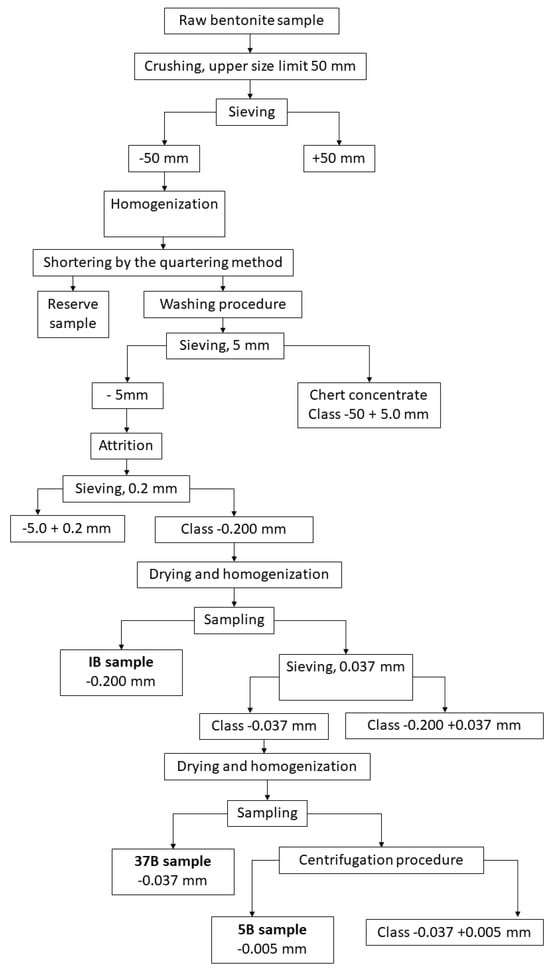
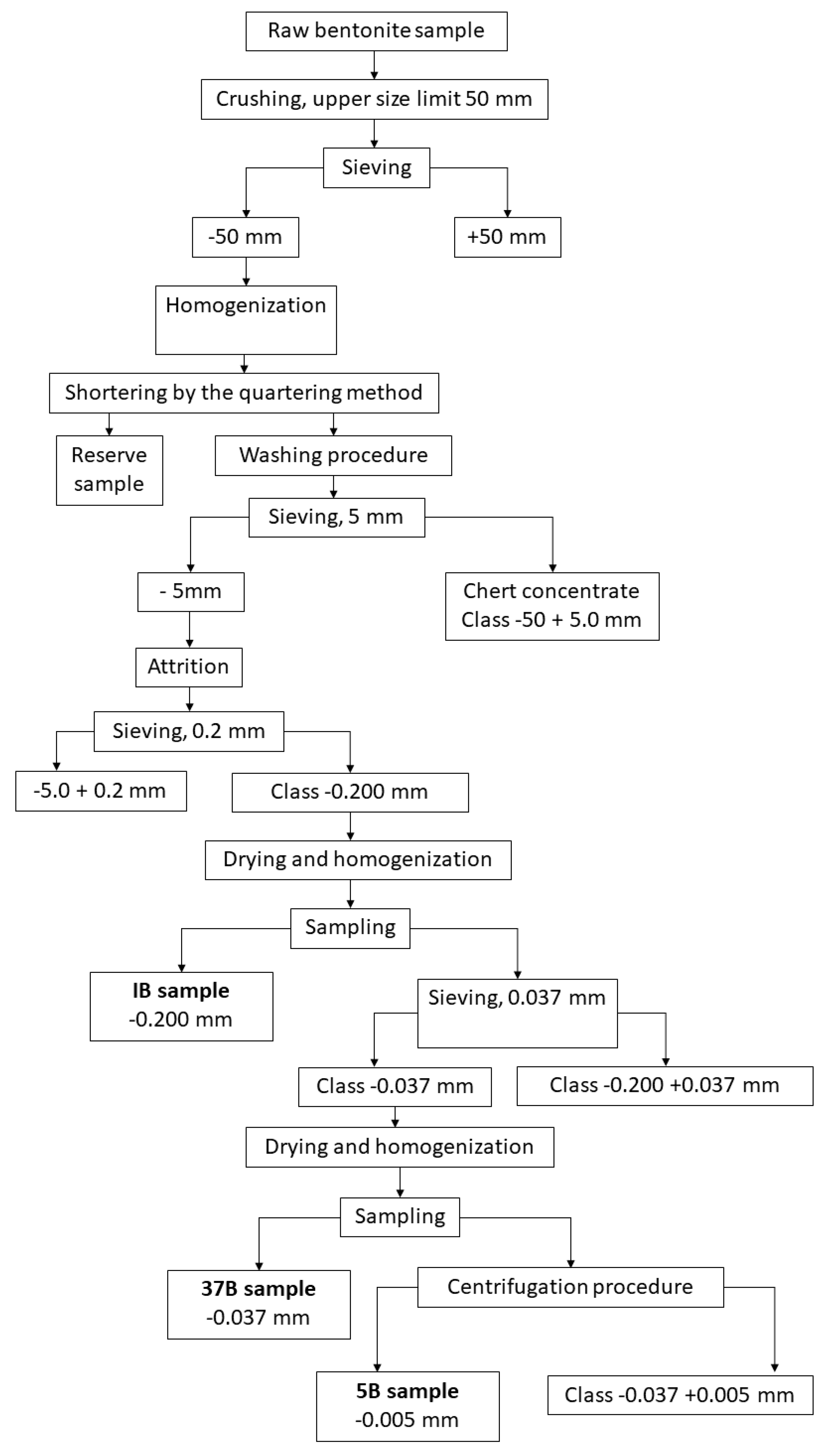
The technological scheme for obtaining the different bentonite products from the Bijelo Polje ore for adsorption testing is presented in Figure 1.
Figure 1.
Written technological scheme for obtaining different products based on bentonite ore “Bijelo Polje” (Bar) for adsorption testing.
The technological scheme (Figure 1) outlines a systematic, multi-step process for processing the raw bentonite ore from the Bijelo Polje deposit into fractions suitable for adsorption testing. The procedure begins with crushing the raw material to an upper size limit of 50 mm, followed by sieving to separate the <50 mm fraction for further treatment. After homogenization and quartering (to obtain representative subsamples), the material undergoes washing and sieving at 5 mm, producing the <5 mm fraction (for further processing) and a chert concentrate (+5 mm). The <5 mm fraction is then subjected to attrition and sieving at 0.200 mm, yielding the <0.200 mm class (IB sample) and a coarser residue. The IB sample is subsequently sieved at 0.037 mm to obtain the <0.037 mm fraction (37B sample). Finally, the 37B fraction undergoes centrifugation to isolate the ultrafine <0.005 mm fraction (5B sample). Each key fraction (IB, 37B, and 5B) is dried, homogenized, and sampled for characterization and adsorption experiments. This sequence enables progressive particle size reduction and smectite enrichment while maintaining a reserve sample and minimizing material loss, providing a reproducible pathway for evaluating the influence of fractionation on bentonite properties and AFB1 adsorption performance.
3.1. Granulometric Analysis
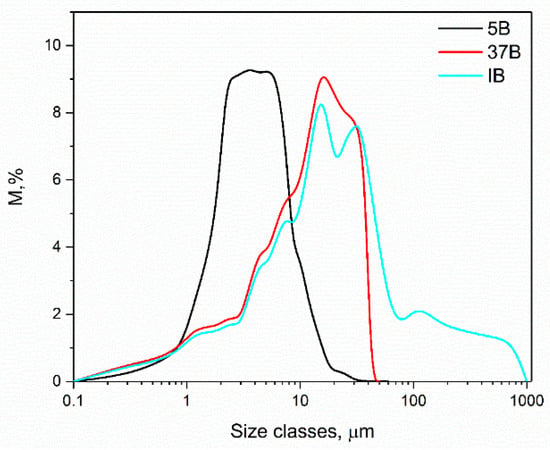
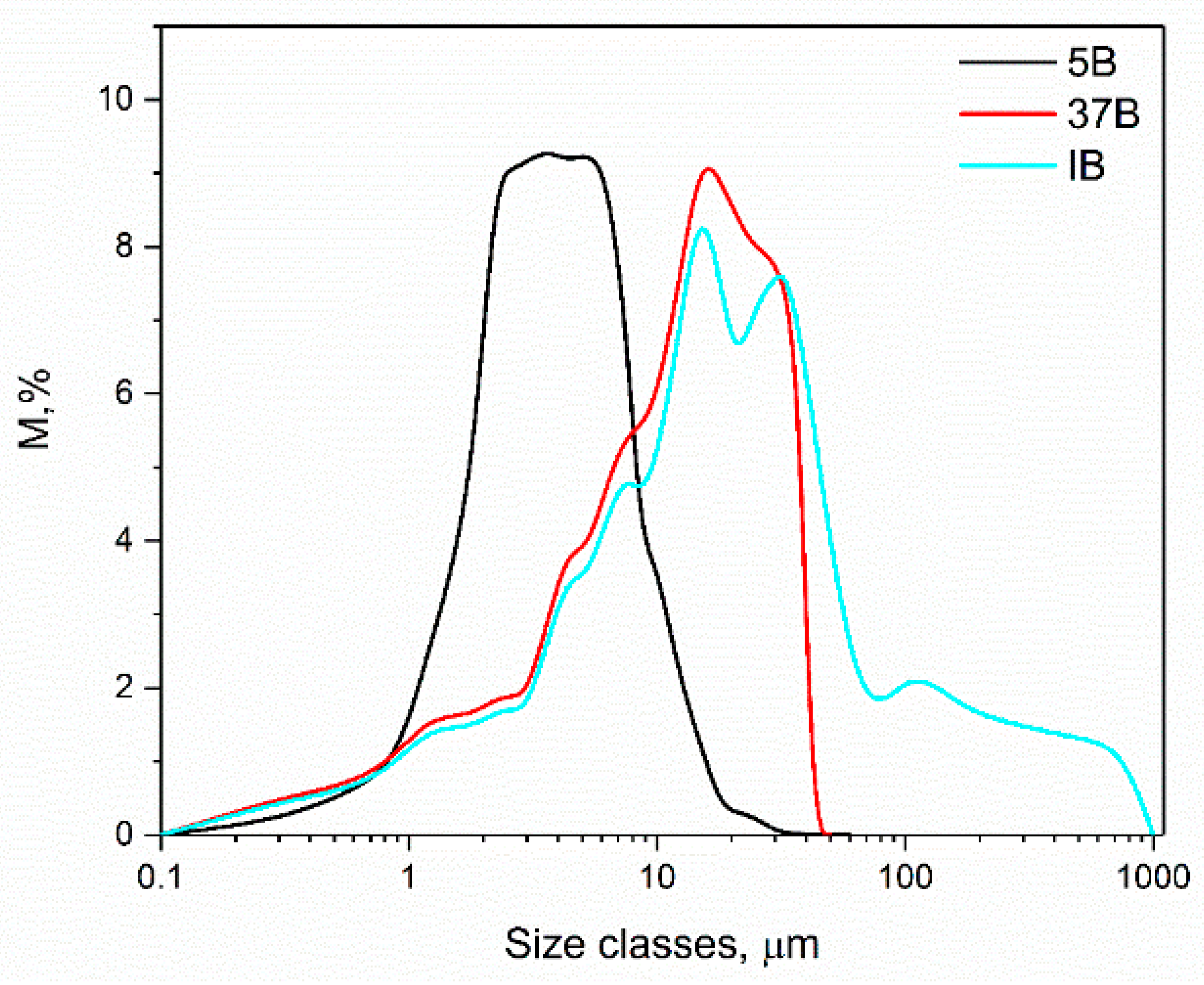
To remove chert from the raw bentonite fraction (RB) and obtain the purified bentonite fraction (IB), the sample was subjected to wet sieving through a 0.200 mm mesh sieve. Particle size distribution analysis revealed that 97% of the particles were smaller than 0.063 mm, while approximately 90% were below 0.037 mm. Subsequently, sieving at 0.037 mm was performed, and finally, the <0.005 mm fraction was separated by centrifugation. The granulometric composition of the IB sample and its sieved fractions B37 and B5 was determined using wet laser diffraction, with the results presented in Figure 2.
Figure 2.
Granulometric composition of the IB, 37B and 5B samples using the laser diffraction method.
The results showed that for the B37 sample, 100% of the particles were below 0.037 mm, while for the B5 sample, 80% of the particles were below 0.005 mm. Considering that 0.005 mm particles are extremely fine, it is assumed that agglomeration of particles occurred during sieving, drying, and sample preparation for measurement.
These results indicate that sieving, as a cost-effective and simple method, effectively concentrates fine particles, with the <0.037 mm fraction achieving a satisfactory particle size distribution. The even finer particle size distribution in the <0.005 mm fraction is expected to increase the specific surface area, thereby enhancing the adsorption capacity for aflatoxins, since finer particles provide a greater number of accessible adsorption sites.
The similarity in values between the <0.200 mm and <0.037 mm fractions suggests that the majority of montmorillonite is already concentrated in the finer size range of the initial sample, with incremental benefits from further sieving. Vekiru et al. (2015) [8] demonstrated that finer particle sizes enhance the surface area available for mycotoxin adsorption, supporting the potential of the <0.037 and <0.005 mm fractions for improved aflatoxin binding.
3.2. Chemical Composition
The chemical composition of the raw, initial and sieved fractions was analyzed to determine the Al2O3 content, a key indicator of montmorillonite ((Na,Ca)0.3(Al,Mg)2Si4O10(OH)2·nH2O) concentration, and heavy metal content to assess safety for animal feed applications. The mineralogical analysis, detailed in Section 3.3, indicates the presence of accessory minerals devoid of aluminum (Al). Consequently, the total Al content in the sample is attributed exclusively to bentonite (montmorillonite). This attribution enables the quantification of bentonite content within the sample. The results are presented in Table 3 (chemical composition) and Table 4 (heavy metals).
Table 3.
The aluminum content in raw and IB, 37B, and 5B samples.
Table 4.
The content of heavy metals in raw and IB, 37B, and 5B samples.
The Al2O3 content, which serves as an indicator of montmorillonite purity, increased progressively with each purification step. In the raw bentonite sample (RB), the Al2O3 content was 10.52%, rising to 12.97% in the initial purified fraction (IB) after removal of chert through wet sieving. Further sieving to obtain the <0.037 mm fraction (B37) resulted in an Al2O3 content of 13.76%, while the finest <0.005 mm fraction (B5) exhibited the highest value of 16.69%.
Considering the theoretical Al2O3 content in pure montmorillonite of 18.57% [38], these values reflect a substantial enrichment in montmorillonite. Removal of chert from the raw sample increased the montmorillonite content by more than 13%. Subsequent sieving below 0.037 mm provided an additional increase of approximately 4%, yielding a total enrichment of about 17% relative to the raw material. The finest fraction (B5) showed the most pronounced improvement, with over 33% higher montmorillonite content compared to the raw sample.
This progressive enrichment is particularly significant in the context of regulatory requirements for the use of bentonite as a feed additive. According to the relevant European directive, bentonite products intended for this application must contain at least 70% montmorillonite. Both the B37 and B5 fractions clearly meet this threshold, while the IB fraction is close to compliance. These results demonstrate that simple, cost-effective physical separation techniques, such as wet sieving and centrifugation, can effectively upgrade lower-grade bentonite to meet stringent quality standards for aflatoxin-binding applications in animal nutrition.
Given the intended use of bentonite as an additive in animal feed to mitigate mycotoxin contamination, the analysis of heavy metal content is critical to ensure the material’s safety, as certain heavy metals can be toxic to livestock even at low concentrations. The list of the detected heavy metals in IB, 37B and 5B is given in Table 2.
The heavy metal content was significantly reduced in the sieved fractions: lead (Pb) was below 5 ppm, and arsenic (As) and mercury (Hg) were below 0.01 ppm in both the <0.037 mm and <0.005 mm fractions, compared to higher (but still low) levels in the initial sample. The reduction in heavy metal content in the sieved fractions enhances their suitability for animal feed, as low contaminant levels minimize health risks. Carraro et al. [39] reported that finer bentonite fractions often exhibit lower heavy metal contents due to the removal of coarser impurity phases, supporting the safety of the sieved fractions for feed applications.
3.3. Mineralogical Composition
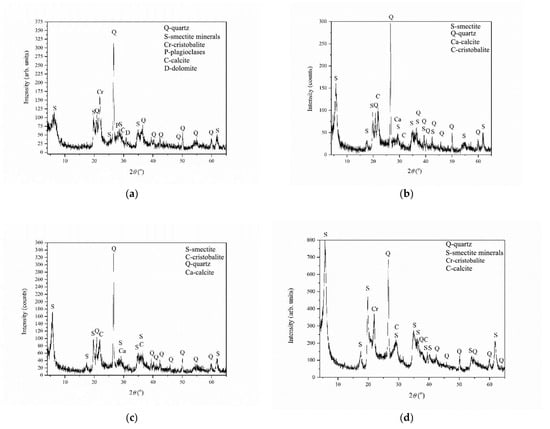
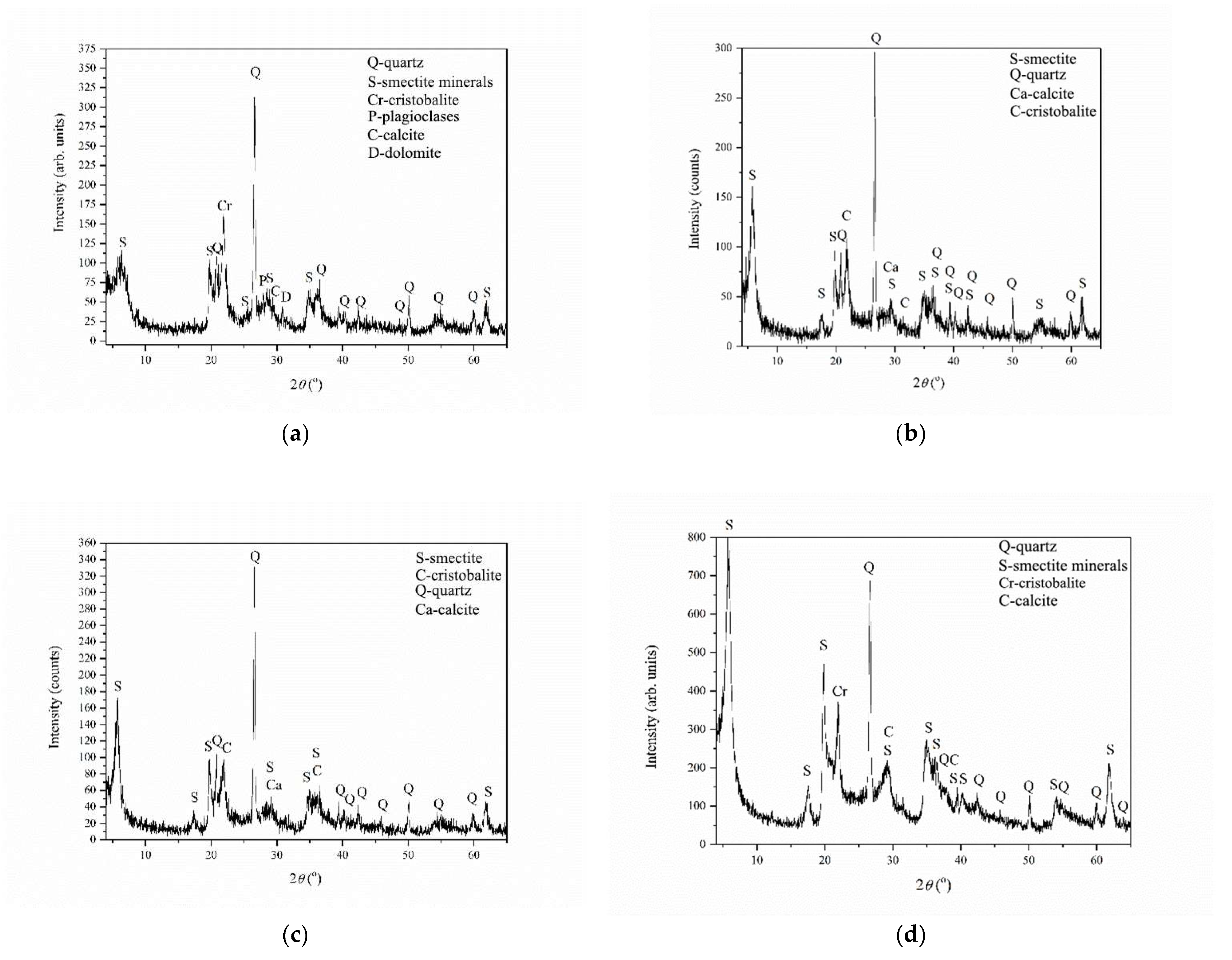
The mineralogical composition of the RB and its sieved fractions was determined using X-ray powder diffraction (XRD), with diffractograms presented in Figure 3. The results are summarized in Table 5.
Figure 3.
XRD patterns of (a) RB, (b) IB, (c) 37B and (d) 5B samples.
Table 5.
Quantitative mineralogical composition obtained by the Rietveld method.
The RB sample is highly heterogeneous in the raw state, containing only 54.9% smectite, with quartz (32.2%) and cristobalite (11.4%) being the dominant accessory minerals and calcite present in minor amounts (1.5%). Plagioclases and dolomite are present in trace amounts. Such a composition is typical of many volcanogenic Ca/Mg-bentonites in the Balkan region, where alteration of pyroclastic material occurred in a marine or lacustrine environment, preserving significant portions of primary silica phases (cristobalite and quartz) [40,41,42].
Particle-size fractionation proved to be a highly effective purification method. Simple dry sieving to <0.200 mm (sample IB) increased the smectite content to 72.3%, reducing quartz and cristobalite by approximately 38% and 42%, respectively. Further separation of the clay-size fraction (<0.037 mm, sample 37B) using conventional wet sieving provided a modest additional improvement (smectite 75.3%), indicating that most of the non-clay minerals coarser than ~0.040 mm had already been removed in the first sieving step. In both samples, the presence of plagioclases and dolomite was not detected.
The most significant enrichment was achieved in the ultrafine <0.005 mm fraction (sample 5B), where the smectite content reached 91.2%. In this fraction, quartz was reduced to 3.9% and cristobalite to 4.9%, while calcite was present only in trace amounts. The marked decrease in both quartz and cristobalite with decreasing particle size confirms that these phases occur predominantly as discrete silt- to fine-sand-sized grains or crystalline aggregates, whereas smectite forms sub-micrometer platelets that are easily concentrated in the finest fraction by hydrodynamic separation.
The mineralogical composition of the obtained sample 5B fully complies with the requirements of the Commission Implementing Regulation (EU) No 1060/2013 concerning the authorization of bentonite as a feed additive for all animal species, which was extended by a regulation in 2021.
The montmorillonite contents estimated from the Al2O3 chemical composition showed excellent agreement with those determined by quantitative XRD analysis using the Rietveld refinement method, with differences of only 1%–2% across all samples, a discrepancy that is well within acceptable limits for such combined chemical-mineralogical assessments and has negligible impact on the overall interpretations.
The observed trend is consistent with the well-documented density and size difference between smectite (density ~2.2–2.6 g cm−3, platelet thickness <0.1–1 μm) and the denser quartz and cristobalite grains (density 2.65 and 2.32 g cm−3, respectively, but typically larger crystal size). Consequently, sample 5B reaches a purity comparable to or higher than many commercial high-grade calcium bentonites and approaches the quality of the best natural sodium bentonites after only physical processing, without the need for chemical activation or beneficiation by heavy liquids.
These results demonstrate that RB is highly amenable to upgrading by simple and low-cost size-separation techniques, yielding a premium-grade smectite product suitable for animal feed.
3.4. Cation Exchange Capacity (CEC) and Methylene Blue Adsorption
The cation exchange capacity (CEC) through methylene blue adsorption capacity was evaluated to assess the adsorption properties of the raw sample and its sieved fractions. For all samples, CEC was measured using the methylene blue method, and methylene blue adsorption capacity was quantified. The results are presented in Table 6.
Table 6.
Cation exchange capacity (CEC) and methylene blue adsorption capacity.
The cation exchange capacity (CEC), determined using the methylene blue method, showed a progressive increase with the degree of purification. In the raw bentonite sample (RB), the CEC was 43.76 meq/100 g. After removal of chert to obtain the initial purified fraction (IB), it increased to 55.64 meq/100 g. The <0.037 mm fraction (B37) exhibited a slightly higher value of 56.11 meq/100 g, while the finest <0.005 mm fraction (B5) displayed the highest CEC of 70.30 meq/100 g.
These results clearly demonstrate that the removal of chert significantly enhances the cation exchange capacity of the bentonite. However, the difference between the IB and B37 fractions is negligible. This can be attributed to the fact that the IB sample already contains over 90% of particles in the <0.037 mm class, which is primarily responsible for the cation exchange capacity in both samples. Furthermore, the specific surface area, which plays a crucial role in determining CEC, is very similar between these two fractions due to the high proportion of the <0.037 mm particles.
In contrast, the <0.005 mm fraction (B5) exhibits a substantially higher CEC, which can be explained by its significantly greater montmorillonite content and markedly higher specific surface area resulting from the much finer particle size. These findings underscore the effectiveness of particle size fractionation in improving the functional properties of bentonite, particularly for applications requiring high cation exchange capacity, such as aflatoxin adsorption in animal feed.
Coarser fractions, which may include quartz or other non-clay minerals, show reduced adsorption efficiency due to lower surface area and fewer active binding sites [43]. Grant et al. [44] also note that the effectiveness of clay for mycotoxin binding is influenced by its purity and particle size. Finer fractions, which are richer in smectite, show higher adsorption efficiency, while coarser fractions may contain accessory minerals (e.g., quartz, feldspar) that dilute the adsorptive capacity. While cristobalite is not explicitly mentioned, the principle of non-adsorptive minerals reducing efficiency in coarser fractions applies.
3.5. Textural Properties
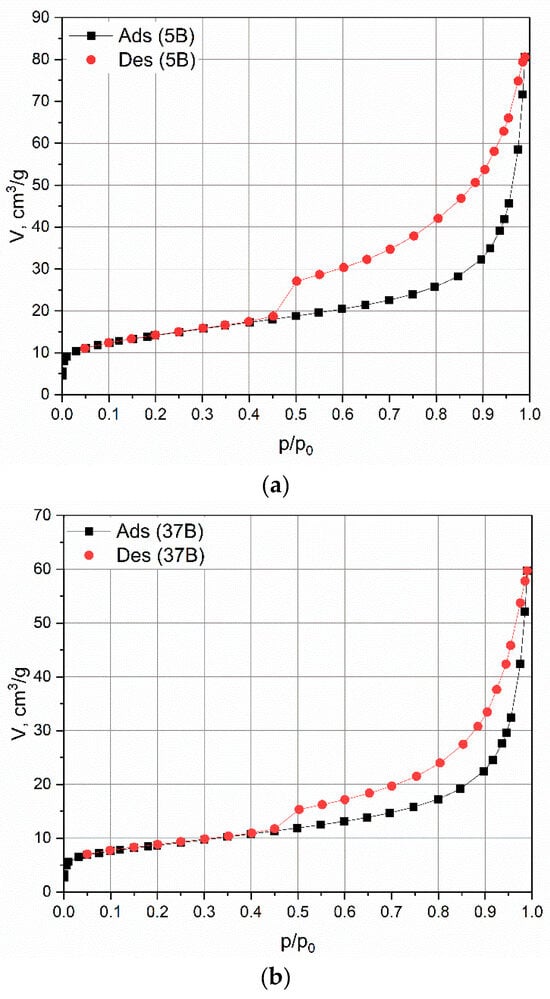
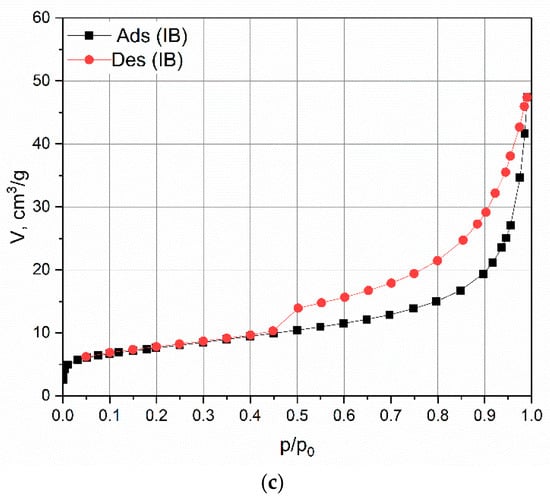
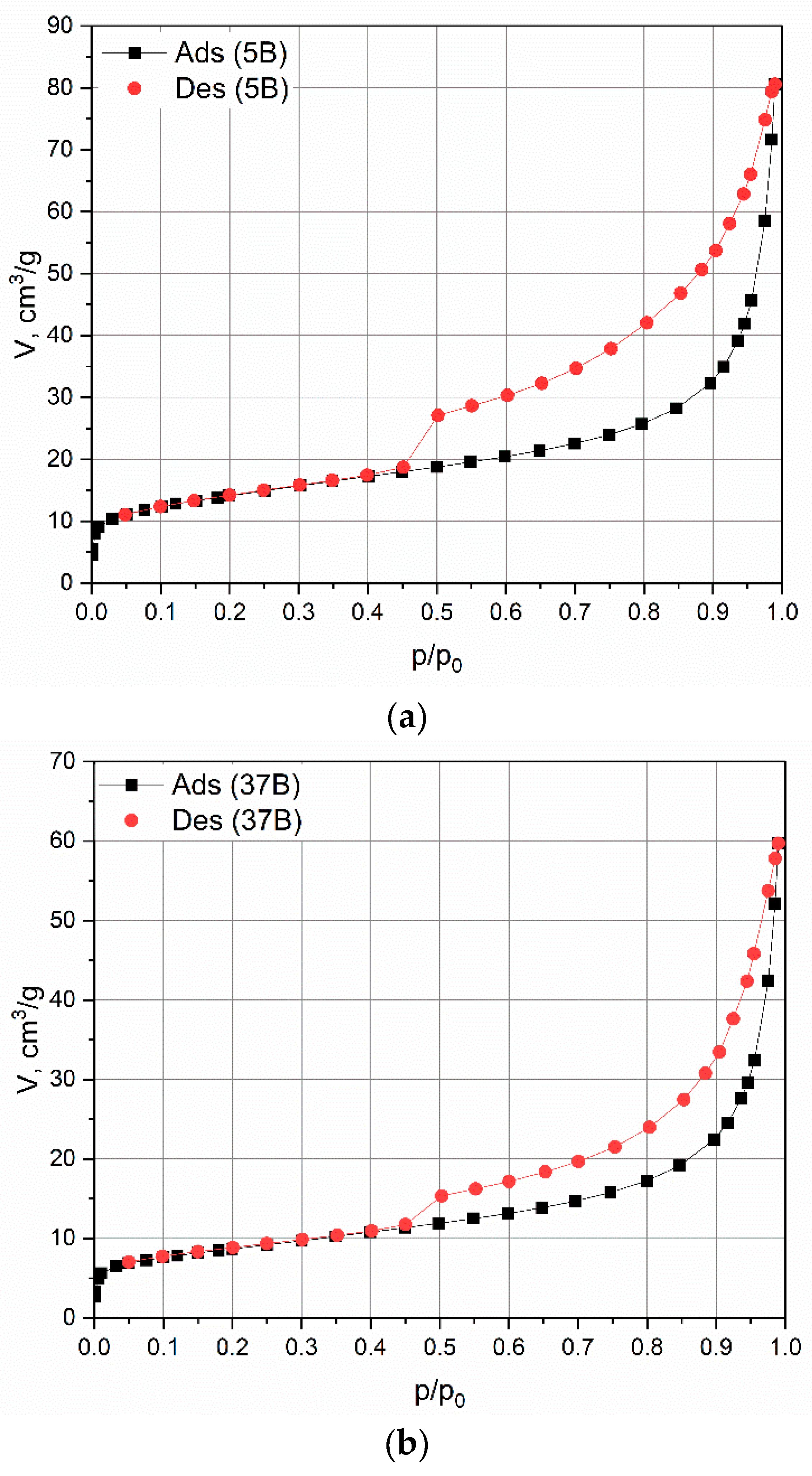
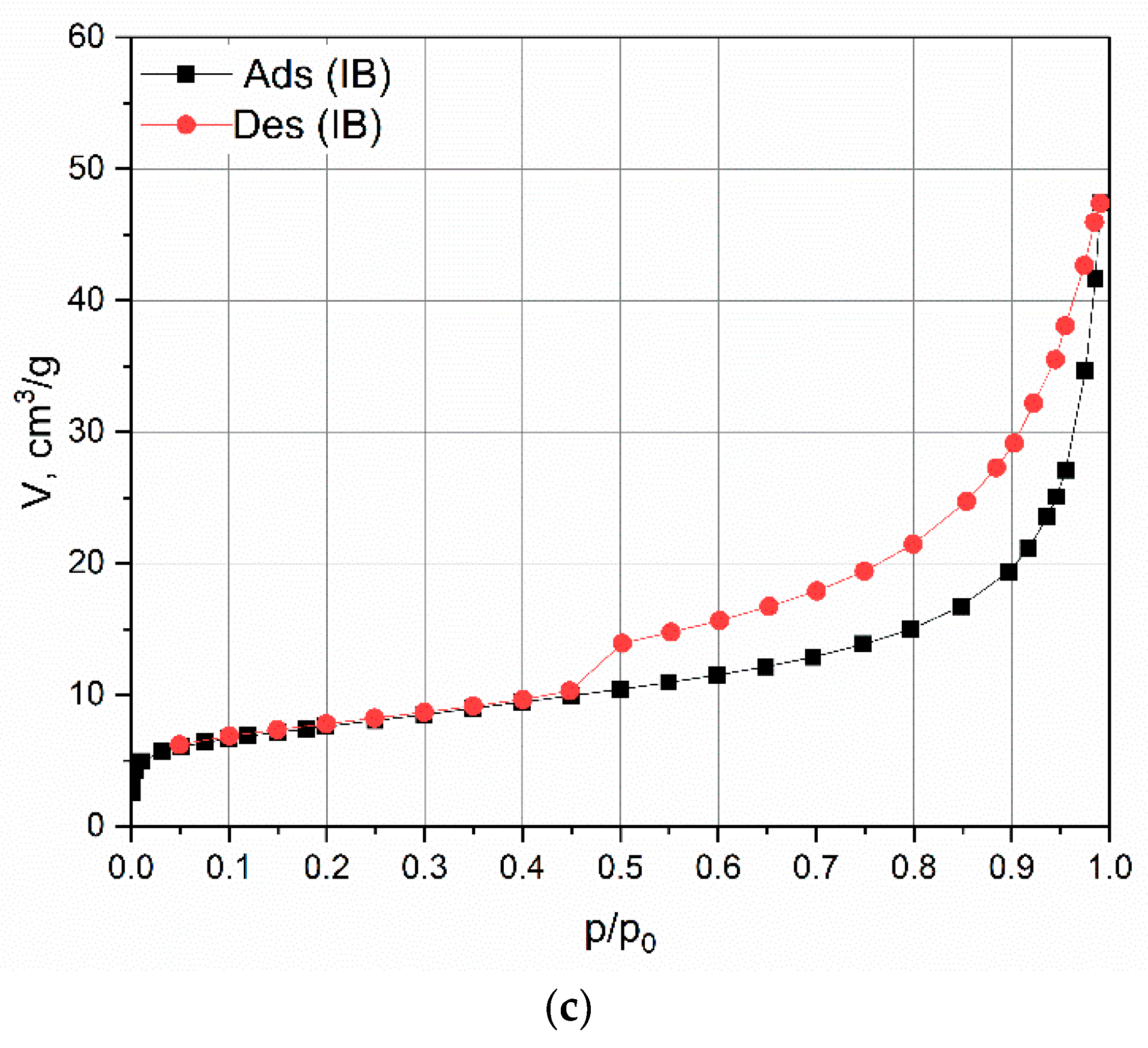
The SSABET and pore volumes for the bentonite samples are provided in Figure 4 and Table 7. The isotherm of the bentonite samples belongs to Type IV according to the IUPAC nomenclature [45]. The reversible part of the isotherm occurs at low equilibrium pressures, while above p/p0 ≈ 0.4, a hysteresis loop of type H3 occurs, which is characteristic for aggregates of plate-shaped particles such as bentonite [46].
Figure 4.
N2 adsorption and desorption isotherms for (a) B5, (b) B37, and (c) IB.
Table 7.
The textural properties of the samples.
The observed increase in specific surface area (SSA) with decreasing particle size from 26.5 m2/g (200 μm fraction) to 31.1 m2/g (37 μm) and 50.8 m2/g (5 μm) aligns with well-established trends in clay mineral research, where finer particles expose more external surface through greater fragmentation and reduced inter-particle aggregation (e.g., Hidalgo et al., 2024 [47]; general ranges of 20–100 m2/g for natural bentonites via N2-BET, as summarized in HORIBA Scientific [48] and Kaufhold et al. [25]).
However, the pronounced rise, especially the sharp ~63% increase between the 37 μm and 5 μm fractions, cannot be attributed solely to smaller particle diameter. This unexpectedly large enhancement results from the synergistic effect of two concurrent processes during fractionation: (1) the inherent increase in external surface area due to reduced particle size and aggregation, and (2) a substantial improvement in sample purity. The montmorillonite content rises markedly from 69.84% (200 μm) and 74.10% (37 μm) to 89.88% in the 5 μm fraction, while low-surface-area accessory minerals (quartz, calcite, feldspars typically <5 m2/g) are progressively removed. Their presence in coarser fractions significantly dilutes the overall SSA, whereas the finest fraction benefits from both greater geometric exposure and higher montmorillonite concentration.
Direct comparisons with literature values are inherently limited, as few studies report SSA at precisely matching particle sizes, and BET data vary widely depending on source, purity, fractionation method, and measurement conditions. Nevertheless, the clear variability demonstrated here, particularly the combined contribution of size reduction and purity enhancement, underlines the strong dependence of SSA on these factors. This reinforces the importance of careful particle-size-based fractionation in bentonite processing to maximize accessible surface area and, consequently, adsorption performance in applications such as mycotoxin binding.
These results highlight that, in natural bentonites with variable mineral associations, simple physical separation can yield disproportionately large improvements in surface properties and functional efficacy.
3.6. Mycotoxin Adsorption
As stated in the Introduction, bentonite intended for use as an aflatoxin-binding feed additive (1m558) must meet the purity criteria defined in Commission Implementing Regulation (EU) No 1060/2013, including a minimum dioctahedral smectite content of 70%, cation exchange capacity typically in the range 70–80 meq/100 g or higher, and specified limits for accompanying minerals.
Based on the physicochemical and mineralogical characterization presented, all investigated samples except the raw bentonite (RB) met this regulatory requirement. Consequently, sample RB was excluded from the subsequent aflatoxin B1 adsorption experiments.
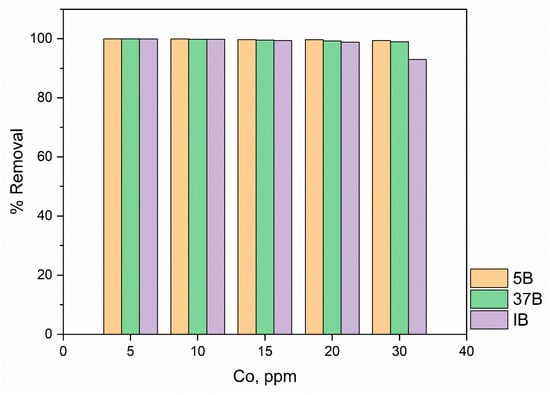
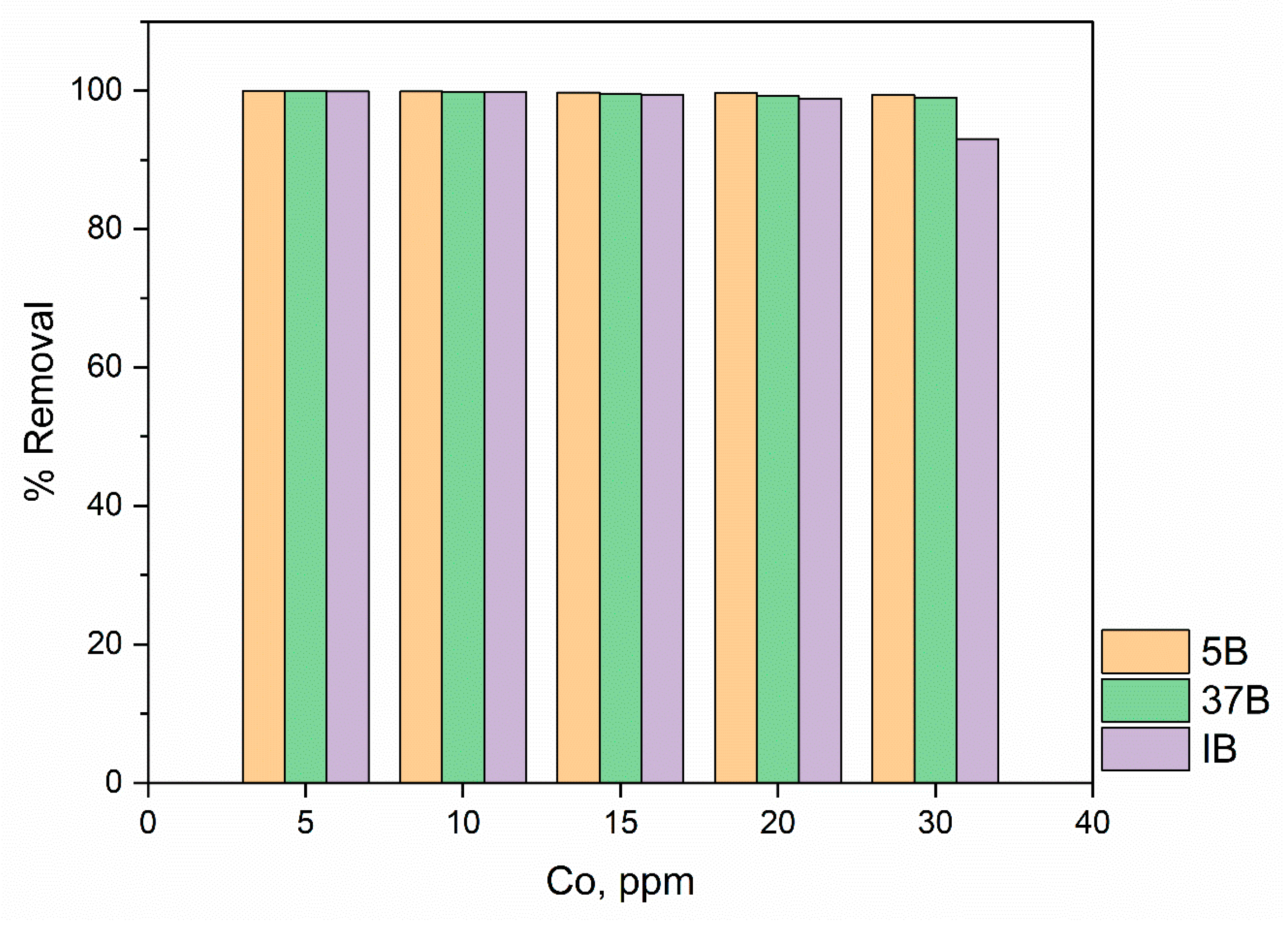
Figure 5 illustrates the efficiency of aflatoxin B1 (AFB1) removal at various initial aflatoxin concentrations. It can be observed that, at lower initial concentrations, all three tested samples effectively—and in most cases completely—remove the aflatoxin. From this perspective, all samples meet the requirement specified by European regulations, which mandate an AFB1-binding capacity exceeding 90% under standardized conditions (at pH 5, with an initial AFB1 concentration of 4 mg/L and an adsorbent dosage of 0.02% (w/v)). At higher initial concentrations, samples 5B and 37B continue to maintain a high degree of aflatoxin removal, whereas the efficiency of sample IB begins to decline.
Figure 5.
Efficiency of aflatoxin B1 (AFB1) removal at various initial aflatoxin concentrations.
The adsorption experiments were conducted at pH 3 to simulate the acidic gastric environment while preserving the structural integrity of the bentonite layers. This pH serves as a conservative lower boundary, since existing data [49] show that AFB1 adsorption on smectites tends to improve at higher pH values, including the regulatory test condition of pH 5. Therefore, the results presented here likely represent a lower estimate of the binding capacity that would be observed under the standardized EFSA protocol.
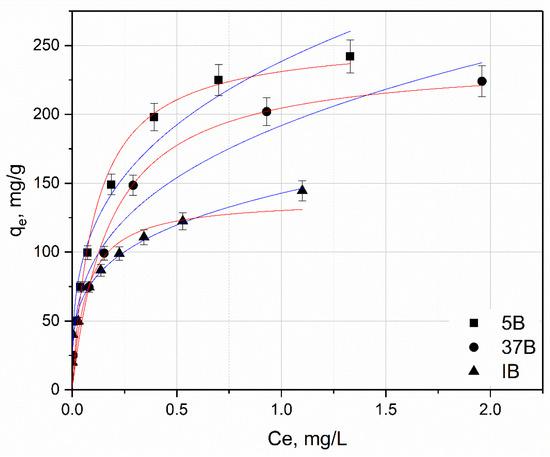
The obtained results were interpreted through the application of adsorption isotherms. The experimental data are presented in Figure 6 and Table 8. Overall, the results align well with expectations based on the structural and compositional characteristics of the bentonite samples investigated.
Figure 6.
Adsorption isotherms for adsorption of AFB1 on bentonite. Langmuir is presented in red and Freundlich in blue.
Table 8.
Parameters and correlation coefficients of various isotherms for adsorption of AFB1 on bentonite of different particle sizes, T = 298 K.
The highest adsorption capacity for aflatoxin B1 (AFB1) was achieved with sample 5B, followed by sample 37B, and then sample IB. This order of performance can be primarily attributed to differences in particle size distribution and the resulting specific surface area, which directly influence the accessibility of adsorption sites.
The adsorption isotherms of AFB1 on the bentonite fractions were adequately described by both the Langmuir [12,50,51] and Freundlich [52] models. In the literature, many authors apply only one model without direct comparison, making it difficult to generalize which isotherm performs better across different materials and conditions.
In the present study (Figure 6), the Freundlich model (Table 8) provided a better fit for the coarser fraction (200 μm), indicating heterogeneous surface adsorption with binding sites of different affinities. The superior agreement with the Freundlich isotherm suggests the presence of a heterogeneous sorbent surface (due to adsorption centers with varying affinity for the adsorbate), the coexistence of different adsorption mechanisms, or both [53]. The Freundlich model is an empirical equation commonly used to describe multilayer adsorption involving interactions between adsorbed molecules on heterogeneous surfaces with non-uniform energy distribution and reversible adsorption [51,54,55].
In contrast, the Langmuir model yielded a superior fit for the finer fractions (37 μm and 5 μm). The Langmuir model assumes monolayer adsorption onto a homogeneous surface with a finite number of identical sites. This shift in model preference aligns with the progressive increase in montmorillonite purity (from 69.84% to 89.88%) and specific surface area (from 26.5 to 50.8 m2/g) achieved through finer fractionation. The 5 μm fraction possesses a more homogeneous surface dominated by uniform adsorption sites (primarily interlayer and edge sites of montmorillonite), which favors the monolayer adsorption assumption underlying the Langmuir model.
The maximum adsorption capacity (qmax ≈ 240–250 mg/g) achieved by the 5 μm fraction (5B sample) is exceptionally high for an unmodified natural bentonite and exceeds most values reported in the literature for raw or simply fractionated smectites. Capacities in this range are more commonly associated with organically modified, acid-activated, or otherwise treated clays, with only rare examples among unmodified materials reaching comparable levels (direct equivalents at precisely 5 μm are scarce). The dramatic increase from ≈120 mg/g in the coarser fractions to ≈240 mg/g in the finest material arises from the synergistic action of two key processes during fractionation: (1) extreme particle size reduction, which inherently amplifies external surface area and reduces inter-particle aggregation, and (2) substantial improvement in sample purity, with montmorillonite content rising from 69.84% (200 μm) and 74.10% (37 μm) to 89.88% in the 5 μm fraction, while low-surface-area accessory minerals (quartz, calcite, feldspars) are progressively eliminated. This purity enhancement is reflected in the sharp ~63% increase in BET specific surface area (from 31.1 m2/g at 37 μm to 50.8 m2/g at 5 μm), which provides significantly more accessible adsorption sites for AFB1 molecules.
The outstanding performance also aligns with established literature on the influence of layer charge density and cation exchange capacity (CEC). Studies have consistently shown that aflatoxin adsorption is favored at lower charge densities: Laird et al. [56] demonstrated an inverse relationship between smectite affinity for organic molecules and CEC, while Jaynes and Zartman (2011) [57] and Deng et al. (2012) [58] reported higher retention at low AFB1 concentrations for low-CEC smectites (e.g., ≈76 meq/100 g) compared to high-CEC ones (≈125 meq/100 g). Optimal AFB1 binding is generally cited for bentonites with CEC in the 80–100 meq/100 g range, and high-CEC materials are sometimes deliberately reduced via cation exchange to enhance performance. The CEC of our 5 μm fraction (70.3 meq/100 g) lies just below this commonly reported optimal window, yet this slightly lower value clearly did not limit the phenomenal adsorption capacity. In fact, even much lower CEC values can deliver excellent results: Fangqun et al. [28] achieved a remarkable AFB1 capacity of 100 mg/g with a bentonite having only 15 meq/100 g, outperforming other bentonites in their study with CEC values in the 80–100 meq/100 g range. These observations indicate that while the 80–100 meq/100 g range is frequently considered optimal, actual adsorption performance is highly dependent on the specific combination of charge density origin (predominantly octahedral vs. tetrahedral), layer charge distribution, mineral purity, and particle size effects, factors that appear particularly favorable in the present material. Smectites with octahedral charge adsorbed more AFB1 than the smectites with tetrahedral charge. Although smectites with predominantly octahedral charge substitution tend to adsorb more AFB1 than those with tetrahedral charge, a detailed investigation of charge origin and distribution in this deposit remains beyond the scope of the present study and is recommended for future work.
Sample IB is dominated by particles >0.037 mm, whereas sample 37B contains over 80% of particles <0.005 mm, and sample 5B exhibits an even finer distribution with a predominant fraction below 0.005 mm. Finer particles provide larger external specific surface area, better dispersion in aqueous media, and reduced diffusion limitations, thereby enhancing the availability of active adsorption sites on montmorillonite surfaces and edges. Given the relatively high montmorillonite content across all samples, differences in adsorption capacity are unlikely to stem primarily from bulk mineralogical composition. Instead, specific surface area, particle size, and site accessibility dominate. The swelling behavior of montmorillonite, enabled by its 2:1 layer structure and high CEC, allows interlayer expansion and exposure of internal surfaces. In finer fractions, however, the increased external surface area and minimized mass transfer resistances further facilitate efficient interaction with the relatively large and polar AFB1 molecules.
The adsorption isotherms (Figure 6) confirm that sample 5B displays the steepest initial slope and highest plateau, indicating stronger affinity and greater maximum capacity. This is consistent with its ultrafine particle size distribution, which minimizes diffusion barriers and maximizes utilization of both external and interlayer sites. In contrast, coarser particles in sample IB result in lower effective surface area available for rapid adsorption, leading to reduced overall capacity despite comparable montmorillonite content.
These findings underscore the critical role of particle size reduction and purity enhancement in optimizing bentonite-based adsorbents for mycotoxin binding. Mechanical fractionation to obtain ultrafine fractions can dramatically improve adsorption efficiency without chemical modification of the clay mineral. Moreover, samples 5B and 37B maintained high binding efficiencies across a range of AFB1 concentrations, meeting regulatory benchmarks and supporting their potential application in feed decontamination.
Numerous studies have demonstrated that chemical modifications of bentonites, such as intercalation with organic cationic surfactants (e.g., hexadecyltrimethylammonium bromide, HTAB), incorporation of metal ions (Cu2+, Zn2+), acid activation, thermal treatment, or nano-composite formation, can substantially enhance AFB1 and other mycotoxin adsorption capacities. For example, HTAB-intercalated or acid-HTAB-modified montmorillonite shows markedly improved binding of AFB1 and zearalenone across a wide pH range, while Cu- and Zn-modified bentonites increase capacities from ~41 mg/g to 60–66 mg/g [59,60,61,62,63]. Acid activation enlarges surface area and porosity, creating additional binding sites, and these treatments generally increase interlayer spacing, hydrophobicity, or accessible surface, enabling better simultaneous adsorption of polar (AFB1) and non-polar mycotoxins [64].
However, chemical modifications require additional processing steps, generate chemical waste, increase production costs, and raise concerns about long-term stability, regulatory approval for feed use, and potential effects on nutrient bioavailability or animal health.
In contrast, the present study shows that simple mechanical fractionation, producing ultrafine particles (<0.005 mm predominant in samples 5B and 37B), yields exceptionally high AFB1 adsorption capacities (up to ≈240 mg/g in the 5 μm fraction) without any chemical alteration. This improvement arises from increased external specific surface area, enhanced dispersion in aqueous media, reduced diffusion limitations, and greater access to inherent adsorption sites on montmorillonite surfaces and edges, combined with significant purity enhancement (montmorillonite content rising to ~90%).
While chemically modified bentonites in the cited studies often achieve high capacities through structural or surface alteration, the present work demonstrates that comparable, or even superior performance can be obtained with unmodified natural bentonite through optimized physical fractionation and purity enhancement alone. This approach offers clear advantages: simplicity, lower cost, environmental friendliness, preservation of the natural mineral composition and cation exchange properties, and avoidance of chemical residues.
Furthermore, the finer fractions (particularly 5B and 37B) met or exceeded European regulatory criteria for AFB1 binding (>90% under standardized conditions), confirming the practical viability of this non-chemical strategy for mycotoxin mitigation in animal feeds. Overall, mechanical processing provides a straightforward, scalable, and sustainable method to unlock the full potential of natural bentonite resources for effective aflatoxin detoxification.
The adsorption mechanisms of aflatoxin B1 on smectites have been investigated in detail in earlier studies, which consistently point to chemisorption involving hydrogen bonding and/or chelation at surface and edge sites. Desheng et al. [65] evaluated the stability of the montmorillonite–aflatoxin B1 (Mont-AFB1) sorption complex using extraction with an eluotropic series of solvents. They found that less than 16% of the adsorbed AFB1 could be desorbed, and the complex remained stable in aqueous media at pH 2 and pH 8 as well as at 37 °C. These observations were interpreted as evidence of chemisorption. Furthermore, infrared spectroscopy revealed that the OH bending vibration bands of montmorillonite at 1403 and 1355 cm−1 (in-plane) were significantly weakened or disappeared after AFB1 adsorption, suggesting that the primary chemisorption mechanism involves the formation of double hydrogen bonds between the AFB1 molecule and the montmorillonite surface [65]. Phillips et al. demonstrated that clay tightly binds aflatoxins, forming a highly stable complex resistant to solvent extraction (less than 16% desorption) and stable in aqueous media across different pH values. Together with the developed chemisorption index (Cα), this indicates a chemisorptive binding mechanism. The β-dicarbonyl system of aflatoxin is essential, likely forming chelate complexes with metal ions in clay both on the surface and within interlayer spaces. These findings confirm that chemisorption is the dominant mechanism for strong aflatoxin binding on certain smectite materials, consistent with the high adsorption capacities observed in our fine fractions of natural bentonite [44,66]. Chemisorption implies a chemical reaction or sharing of electrons between the adsorbent and the adsorbate. Physisorption involves weak associations, which include Van der Waals attraction, dipole−dipole interactions, induced dipole interactions, and hydrogen bonding. Physisorption is described as having an enthalpy of <20 kJ mol−1, while chemisorption is generally >20 kJ mol−1 [67].
These established findings are briefly summarized here to provide context for the high adsorption capacities observed in the fine fractions of the investigated bentonite. However, the main focus and contribution of the present work lie in the introduction and characterization of a new, previously unstudied bentonite raw material and in demonstrating its potential for effective AFB1 removal through simple physical processing, rather than in re-investigating or proving the underlying binding mechanism. By reducing particle size and increasing specific surface area through mechanical processing, new opportunities arise for enhanced chemisorption in addition to improved ion exchange, due to greater accessibility of active sites on surfaces and edges. A more detailed examination of charge distribution and site-specific interactions in this deposit will be addressed in future studies.
4. Conclusions
This study demonstrates that simple physical particle size fractionation (sieving and centrifugation) dramatically enhances the quality of bentonite from the Bijelo Polje deposit (Bar, Montenegro)—a new, previously unexplored and scientifically unknown raw material whose geological elaboration was officially verified only in 2024—for use as an aflatoxin B1 (AFB1) adsorbent in animal feed.
Progressive reduction of particle size from the raw sample (RB) to fractions <0.200 mm (IB), <0.037 mm (37B), and <0.005 mm (5B) resulted in markedly increased smectite content (from 54.9% to 91.2%), cation exchange capacity (CEC from 43.76 to 70.30 meq/100 g), and purity, while reducing impurities and heavy metals to undetectable levels. BET specific surface area increased from 26.5 m2/g (200 μm) to 50.8 m2/g (5 μm), reflecting both finer particle size and higher montmorillonite concentration.
The finest fraction (5B) exhibited the highest AFB1 adsorption performance, with a maximum capacity (qmax ≈ 240–250 mg/g) that is phenomenal for an unmodified natural bentonite, significantly higher than most reported values for raw or fractionated smectites (typically 50–150 mg/g) and comparable to many chemically modified clays. Adsorption isotherms showed that the Freundlich model provided a much better fit for the coarser fraction (200 μm), while for the finer 5 μm and 37 μm fractions, both Freundlich and Langmuir models yielded similar goodness of fit (with R2 differences nearly negligible), consistent with increased surface homogeneity and accessibility of uniform adsorption sites in the ultrafine material.
Only the 5B fraction (91.2% smectite) fully complies with EU regulatory requirements (Commission Implementing Regulation (EU) No 1060/2013) for bentonite as an AFB1-binding feed additive (≥70% dioctahedral smectite and >90% AFB1 binding). Fraction 37B showed good adsorption performance but did not meet the purity threshold due to higher quartz content.
Compared to chemical modifications (organic intercalation, acid/metal activation), mechanical fractionation offers a simpler, cost-effective, environmentally friendly, and safer alternative that preserves natural mineral properties without risks to nutrient bioavailability or regulatory approval.
These findings highlight the critical role of ultrafine fractionation and purity enhancement in unlocking the full potential of natural bentonites for mycotoxin mitigation. By documenting this novel deposit and its exceptional performance, the study expands the scientific database on regional bentonite resources and supports the development of high-performance, natural clay-based adsorbents for feed applications. Future research should include in vivo efficacy testing and industrial-scale optimization.
Author Contributions
Conceptualization, S.M. and D.R.; methodology, D.R.; software, J.S.; validation, S.M., D.R., and V.D.J.; formal analysis, N.S. and H.F.; investigation, V.D.J., J.S. and H.F.; resources, D.R.; data curation, N.S.; writing—original draft preparation, S.M.; writing—review and editing, S.M.; visualization, J.S.; supervision, D.R.; project administration, D.R.; funding acquisition, I.R. All authors have read and agreed to the published version of the manuscript.
Funding
This work was supported by the Ministry of Science, Technological Development and Innovation of the Republic of Serbia [grant numbers 451-03-33/2026-03/20023, 451-03-136/2025-03/200126 and 451-03-136/2025-03/200125].
Data Availability Statement
Data is contained within the article.
Acknowledgments
This research contributes to Goals 2 and 12 of the United Nations Sustainable Development Goals (SDGs) as outlined in Agenda 2030, by ending hunger, achieving food security and improved nutrition, promoting sustainable agriculture, and ensuring sustainable consumption and production patterns.
Conflicts of Interest
Hunor Farkaš is an employee of Patent Co. The paper reflects the views of the scientists and not the company.
References
- Bennett, J.W.; Klich, M. Mycotoxins. Clin. Microbiol. Rev. 2003, 16, 497–516. [Google Scholar] [CrossRef] [Scilit]
- International Agency for Research on Cancer (IARC). Aflatoxins. In IARC Monographs on the Evaluation of Carcinogenic Risks to Humans; IARC: Lyon, France, 2012; Volume 100F. [Google Scholar]
- Wild, C.P.; Gong, Y.Y. Mycotoxins and human disease: A largely ignored global health issue. Carcinogenesis 2010, 31, 71–82. [Google Scholar] [CrossRef] [Scilit]
- Williams, J.H.; Phillips, T.D.; Jolly, P.E.; Stiles, J.K.; Jolly, C.M.; Aggarwal, D. Human aflatoxicosis in developing countries: A review of toxicology, exposure, potential health consequences, and interventions. Am. J. Clin. Nutr. 2004, 80, 1106–1122. [Google Scholar] [CrossRef] [Scilit] [PubMed]
- European Commission. Commission Regulation (EC) No 1881/2006 of 19 December 2006 setting maximum levels for certain contaminants in foodstuffs. Off. J. Eur. Union 2006, L364, 5–24. [Google Scholar]
- Huwig, A.; Freimund, S.; Käppeli, O.; Dutler, H. Mycotoxin detoxication of animal feed by different adsorbents. Toxicol. Lett. 2001, 122, 179–188. [Google Scholar] [CrossRef] [Scilit]
- European Commission. Commission Implementing Regulation (EU) No 1060/2013 of 29 October 2013 concerning the authorisation of bentonite as a feed additive for all animal species. Off. J. Eur. Union 2013, L289, 33–36. Available online: https://eur-lex.europa.eu/eli/reg_impl/2013/1060/oj (accessed on 19 February 2026).
- Vekiru, E.; Fruhauf, S.; Rodrigues, I.; Ottner, F.; Krska, R.; Schatzmayr, G.; Ledoux, D.R.; Rottinghaus, G.E.; Bermudez, A.J. In vitro binding assessment and in vivo efficacy of several adsorbents against aflatoxin B1. World Mycotoxin J. 2015, 8, 477–488. [Google Scholar] [CrossRef] [Scilit]
- Krekeler, M.P.S.; Guggenheim, S. Defining smectite clay from a structural perspective: A review. Clays Clay Miner. 2005, 53, 553–563. [Google Scholar] [CrossRef] [Scilit]
- Döll, S.; Dänicke, S. In vivo Detoxification of Fusarium toxins. Arch. Anim. Nutr. 2004, 58, 419–441. [Google Scholar] [CrossRef] [Scilit]
- van Olphen, H. An Introduction to Clay Colloid Chemistry, 2nd ed.; John Wiley & Sons: New York, NY, USA, 1977. [Google Scholar]
- Jaynes, W.F.; Zartman, R.E. Aflatoxin toxicity reduction in feed by enhanced binding to surface-modified clay additives. Toxins 2011, 3, 551–565. [Google Scholar] [CrossRef] [Scilit]
- Tomašević-Čanović, M.; Daković, A.; Rottinghaus, G.; Matijašević, S.; ĐuriČić, M. Surfactant modified zeolites—New efficient adsorbents for mycotoxins. Microporous Mesoporous Mater. 2003, 61, 173–180. [Google Scholar] [CrossRef] [Scilit]
- Krstović, S.; Škrinjar, M.; Živančev, J.; Jajić, I.; Antić, L.J.; Baltić, T. Efikasnost Minazela Plus u adsorpciji mikotoksina. Arh. Vet. Med. 2009, 2, 65–74. [Google Scholar]
- Marković, M.; Daković, A.; Rottinghaus, G.E.; Stojanović, M.; Dondur, V.; Kragović, M.; Gulišija, Z. Aflatoxin B1 adsorption by the natural aluminosilicates—Concentrate of montmorillonite and zeolite. Hem. Ind. 2016, 70, 519–524. [Google Scholar] [CrossRef] [Scilit]
- Marouf, R.; Dali, N.; Boudouara, N.; Ouadjenia, F.; Zahaf, F. Study of adsorption properties of bentonite clay. In Montmorillonite Clay; Uddin, F., Ed.; IntechOpen: London, UK, 2021. [Google Scholar] [CrossRef] [Scilit]
- Boyjanov, M.R.; Serkayev, Q.; Boyjanov, I.; Yaxshimuratov, N. Activation and comparison of indicators of bentonite clay of the Navbakhor deposit. E3S Web Conf. 2024, 563, 02018. [Google Scholar] [CrossRef] [Scilit]
- Erdoğan, B.; Ergürhan, O.; Anter, A. Influence of acid activation on the NH3-adsorption properties of a Turkish bentonite. Clay Miner. 2021, 56, 178–184. [Google Scholar] [CrossRef] [Scilit]
- Musie, W.; Gonfa, G. Thermal activation, characterization and performance evaluation of Ethiopian bentonite for sodium removal. Water Sci. Technol. 2023, 87, 998–1008. [Google Scholar] [CrossRef] [Scilit]
- Zarime, N.A.; Solemon, B.; Wan Yaacob, W.Z.; Jamil, H.; Che Omar, R.; Rafek, A.G.; Roslan, R. Adsorption of methylene blue by bentonite supported nano zero valent iron (B-nZVI). Processes 2023, 11, 788. [Google Scholar] [CrossRef] [Scilit]
- Maged, A.; Kharbish, S.; Ismael, I.S. Characterization of activated bentonite clay mineral and the mechanisms underlying its sorption for ciprofloxacin from aqueous solution. Environ. Sci. Pollut. Res. 2020, 27, 32980–32997. [Google Scholar] [CrossRef] [Scilit]
- Barrientos-Velazquez, A.L.; Kakani, R.; Fowler, J.; Deng, Y. Efficacy of two Texas bentonites in binding aflatoxin B1 and in reducing aflatoxicosis in broilers. Clays Clay Miner. 2022, 70, 354–369. [Google Scholar] [CrossRef] [Scilit]
- Ait Hmeid, H.; Akodad, M.; Baghour, M.; Moumen, A.; Skalli, A.; Azizi, G.; Gueddari, H.; Maach, M.; Aalaoul, M.; Anjjar, A.; et al. Valorization of Moroccan bentonite deposits: “Purification and treatment of margin by the adsorption process”. Molecules 2021, 26, 5528. [Google Scholar] [CrossRef] [Scilit]
- Wang, M.; Hearon, S.E.; Phillips, T.D. A high-capacity bentonite clay for the sorption of aflatoxins. Food Addit. Contam. Part A 2020, 37, 332–341. [Google Scholar] [CrossRef] [Scilit]
- Kaufhold, S.; Dohrmann, R.; Klinkenberg, M.; Siegesmund, S.; Ufer, K. N2-BET specific surface area of bentonites. J. Colloid Interface Sci. 2010, 349, 275–282. [Google Scholar] [CrossRef] [Scilit] [PubMed]
- Barrientos-Velazquez, A.L.; Deng, Y. Reducing competition of pepsin in aflatoxin adsorption by modifying a smectite with organic nutrients. Toxins 2020, 12, 28. [Google Scholar] [CrossRef] [Scilit]
- Barrientos-Velázquez, A.L.; Marroquin Cardona, A.; Liu, L.; Phillips, T.; Deng, Y. Influence of layer charge origin and layer charge density of smectites on their aflatoxin adsorption. Appl. Clay Sci. 2016, 132–133, 281–289. [Google Scholar] [CrossRef] [Scilit]
- Gan, F.; Hang, X.; Huang, Q.; Deng, Y. Assessing and modifying China bentonites for aflatoxin adsorption. Appl. Clay Sci. 2019, 168, 348–354. [Google Scholar] [CrossRef] [Scilit]
- Liu, L. Determinative Role of Exchange Cation and Charge Density of Smectites on Their Adsorption Capacity and Affinity for Aflatoxin B1. Master’s Thesis, Texas A&M University, College Station, TX, USA, 2011. [Google Scholar]
- Taggart, A.F. Handbook of Mineral Dressing: Ores and Industrial Minerals; John Wiley & Sons: New York, NY, USA, 1945. [Google Scholar]
- Senila, M.; Cadar, O. Composites based on natural zeolites and green materials for the immobilization of toxic elements in contaminated soils: A review. Materials 2024, 17, 5977. [Google Scholar] [CrossRef] [Scilit]
- Cadar, O.; Vagner, I.; Miu, I.; Scurtu, D.; Senila, M. Preparation, characterization, and performance of natural zeolites as alternative materials for beer filtration. Materials 2023, 16, 1914. [Google Scholar] [CrossRef] [Scilit]
- Kahr, G.; Madsen, F.T. Determination of the cation exchange capacity and the surface area of bentonite, illite and kaolinite by methylene blue adsorption. Appl. Clay Sci. 1995, 9, 327–336. [Google Scholar] [CrossRef] [Scilit]
- Ercegović, M.; Petrović, J.; Koprivica, M.; Simić, M.; Grubišić, M.; Vuković, N.; Krstić, J. Efficient adsorption of pollutants from aqueous solutions by hydrochar-based hierarchical porous carbons. Water 2024, 16, 2177. [Google Scholar] [CrossRef] [Scilit]
- Milićević, S.; Vlahović, M.; Kragović, M.; Martinović, S.; Milošević, V.; Jovanović, I.; Stojmenović, M. Removal of copper from mining wastewater using natural raw material—Comparative study between the synthetic and natural wastewater samples. Minerals 2020, 10, 753. [Google Scholar] [CrossRef] [Scilit]
- Langmuir, I. The adsorption of gases on plane surfaces of glass, mica and platinum. J. Am. Chem. Soc. 1918, 40, 1361–1403. [Google Scholar] [CrossRef] [Scilit]
- Freundlich, H. Adsorption in solutions. Z. Phys. Chem. 1926, 57, 384–410. [Google Scholar]
- Webmineral. Montmorillonite Data. Available online: https://webmineral.com/data/Montmorillonite.shtml (accessed on 22 December 2025).
- Carraro, A.; De Giacomo, A.; Giannossi, M.L.; Medici, L.; Muscarella, M.; Palazzo, L.; Quaranta, V.; Summa, V.; Tateo, F. Clay minerals as adsorbents of aflatoxin M1 from contaminated milk and effects on milk quality. Appl. Clay Sci. 2014, 88–89, 92–99. [Google Scholar] [CrossRef] [Scilit]
- Yalçin, H.; Gümüşer, G. Mineralogical and geochemical characteristics of late Cretaceous bentonite deposits of the Kelkit Valley Region, northern Turkey. Clay Miner. 2000, 35, 807–825. [Google Scholar] [CrossRef] [Scilit]
- Damian, G.; Damian, F.; Szakács, Z.; Iepure, G.; Aştefanei, D. Mineralogical and physico-chemical characterization of the Oraşu-Nou (Romania) bentonite resources. Minerals 2021, 11, 938. [Google Scholar] [CrossRef] [Scilit]
- Ivanova, R.; Dimitrova, D.; Sergeeva, I.; Tzvetanova, Y. Geochemistry of bentonite clays from the Eastern Rhodopes (SE Bulgaria): Preliminary results. Rev. Bulg. Geol. Soc. 2020, 81, 78–80. [Google Scholar] [CrossRef] [Scilit]
- Jaynes, W.F.; Zartman, R.E.; Hudnall, W.H. Aflatoxin B1 adsorption by clays from water and corn meal. Appl. Clay Sci. 2007, 36, 197–205. [Google Scholar] [CrossRef] [Scilit]
- Grant, P.G.; Phillips, T.D. Isothermal adsorption of aflatoxin B1 on HSCAS clay. J. Agric. Food Chem. 1998, 46, 599–605. [Google Scholar] [CrossRef] [Scilit]
- Zdolšek, N.; Janković, B.; Milović, M.; Brković, S.; Krstić, J.; Perović, I.; Vujković, M. Deep eutectic solvent (DES) for in situ templating carbon material: Carbon characterization and application in supercapacitors containing multivalent ions. Batteries 2022, 8, 284. [Google Scholar] [CrossRef] [Scilit]
- Obradović, M.; Daković, A.; Smiljanić, D.; Marković, M.; Ožegović, M.; Krstić, J.; Vuković, N.; Milojević-Rakić, M. Bentonite modified with surfactants—Efficient adsorbents for the removal of non-steroidal anti-inflammatory drugs. Processes 2024, 12, 96. [Google Scholar] [CrossRef] [Scilit]
- Ding, L.; Azimi, G. Impact of particle size and associated minerals on rare earth desorption and incorporation mechanisms in a South American ion-adsorption clay. Sci. Rep. 2024, 14, 16216. [Google Scholar] [CrossRef] [Scilit]
- HORIBA Scientific. Surface Area of Bentonite. Available online: https://www.horiba.com/usa/scientific/applications/material-sciences/surface-area-of-bentonite/ (accessed on 19 February 2026).
- Greco, D.; D’Ascanio, V.; Abbasciano, M.; Santovito, E.; Garbetta, A.; Logrieco, A.F.; Avantaggiato, G. Simultaneous removal of mycotoxins by a new feed additive containing a tri-octahedral smectite mixed with lignocellulose. Toxins 2022, 14, 393. [Google Scholar] [CrossRef] [Scilit]
- Deng, Y.; Barrientos-Velázquez, A.L.; Billes, F.; Dixon, J.B. Bonding mechanisms between aflatoxin B1 and smectite. Appl. Clay Sci. 2010, 50, 92–98. [Google Scholar] [CrossRef] [Scilit]
- Wongtangtintan, S.; Neeratanaphan, L.; Ruchuwararak, P.; Suksangawong, S.; Tengjaroenkul, U.; Sukon, P.; Tengjaroenkul, B. Comparative study of aflatoxin B1 adsorption by Thai bentonite and commercial toxin binders at different temperatures in vitro. Livest. Res. Rural. Dev. 2016, 28, 50. [Google Scholar]
- Thieu, N.Q.; Pettersson, H. In vitro evaluation of the capacity of zeolite and bentonite to adsorb aflatoxin B1 in simulated gastrointestinal fluids. Mycotox. Res. 2008, 24, 124–129. [Google Scholar] [CrossRef] [Scilit]
- Ramos, A.J.; Hernandez, E. In vitro aflatoxin adsorption by means of a montmorillonite silicate. A study of adsorption isotherms. Anim. Feed Sci. Technol. 1996, 62, 263–269. [Google Scholar] [CrossRef] [Scilit]
- Hinz, C. Description of sorption data with isotherm equations. Geoderma 2001, 99, 225–243. [Google Scholar] [CrossRef] [Scilit]
- Gimbert, F.; Morin-Crini, N.; Renault, F.; Badot, P.M.; Crini, G. Adsorption isotherm models for dye removal by cationized starch-based material in a single component system: Error analysis. J. Hazard. Mater. 2008, 157, 34–46. [Google Scholar] [CrossRef] [Scilit]
- Laird, D.A.; Barriuso, E.; Dowdy, R.H.; Koskinen, W.C. Adsorption of atrazine on smectites. Soil Sci. Soc. Am. J. 1992, 56, 62–67. [Google Scholar] [CrossRef] [Scilit]
- Jaynes, W.F.; Zartman, R.E. Influence of soluble feed proteins and clay additive charge density on aflatoxin binding in ingested feeds. In Aflatoxins—Biochemistry and Molecular Biology; Guevara-Gonzalez, R., Ed.; InTech: Rijeka, Croatia, 2011. [Google Scholar]
- Deng, Y.; Liu, L.; Barrientos-Velazquez, A.L.; Dixon, J.B. The determinative role of the exchange cation and layer-charge density of smectite on aflatoxin adsorption. Clays Clay Miner. 2012, 60, 374–386. [Google Scholar] [CrossRef] [Scilit]
- Mao, J.; Lv, G.; Zhou, R. Effect of acid-treated and hexadecyltrimethylammonium bromide-modified montmorillonites on adsorption performance of mycotoxins. Environ. Sci. Pollut. Res. 2020, 27, 4284–4293. [Google Scholar] [CrossRef] [Scilit]
- Zhang, W.; Zhang, L.; Jiang, X.; Liu, X.; Li, Y.; Zhang, Y. Enhanced adsorption removal of aflatoxin B1, zearalenone and deoxynivalenol from dairy cow rumen fluid by modified nano-montmorillonite and evaluation of its mechanism. Anim. Feed Sci. Technol. 2020, 259, 114366. [Google Scholar] [CrossRef] [Scilit]
- Nones, J.; Solhaug, A.; Eriksen, G.S.; Macuvele, D.L.P.; Poli, A.; Soares, C.; Trentin, A.G.; Riella, H.G.; Nones, J. Bentonite modified with zinc enhances aflatoxin B1 adsorption and increase survival of fibroblasts (3T3) and epithelial colorectal adenocarcinoma cells (Caco-2). J. Hazard. Mater. 2017, 337, 80–89. [Google Scholar] [CrossRef] [Scilit]
- Daković, A.; Kragović, M.; Rottinghaus, G.E.; Ledoux, D.R.; Butkeraitis, P.; Vojislavljević, D.Z.; Zarić, S.D.; Stamenić, L. Preparation and characterization of zinc-exchanged montmorillonite and its effectiveness as aflatoxin B1 adsorbent. Mater. Chem. Phys. 2012, 137, 213–220. [Google Scholar] [CrossRef] [Scilit]
- Daković, A.; Tomasevic-Canovic, M.; Dondur, V.; Rottinghaus, G.E.; Medakovic, V.; Zaric, S. Adsorption of mycotoxins by organozeolites. Colloids Surf. B Biointerfaces 2005, 46, 20–25. [Google Scholar] [CrossRef] [Scilit] [PubMed]
- Feizy, J.; Rahimi, A.; Tabari, D.G.; Zarghami, M.R.; Jahani, M.; Moradi, E. Optimization of modified bentonite mycotoxin binders for enhanced adsorption efficiency under simulated gastric and intestinal conditions. Sci. Rep. 2025, 15, 27513. [Google Scholar] [CrossRef] [Scilit] [PubMed]
- Desheng, Q.; Fan, L.; Yanhu, Y.; Niya, Z. Adsorption of aflatoxin B1 on montmorillonite. Poult. Sci. 2005, 84, 959–961. [Google Scholar] [CrossRef] [Scilit] [PubMed]
- Phillips, T.D.; Clement, B.A.; Kubena, L.F.; Harvey, R.B. Selective chemisorption and detoxification of aflatoxins by phyllosilicate clay. Nat. Toxins 1995, 3, 204–213. [Google Scholar] [CrossRef] [Scilit]
- Gu, B.; Schmitt, J.; Chen, Z.; Liang, L.; McCarthy, J.F. Adsorption and desorption of natural organic matter on iron oxide: Mechanisms and models. Environ. Sci. Technol. 1994, 28, 38–46. [Google Scholar] [CrossRef] [Scilit]

Disclaimer/Publisher’s Note: The statements, opinions and data contained in all publications are solely those of the individual author(s) and contributor(s) and not of MDPI and/or the editor(s). MDPI and/or the editor(s) disclaim responsibility for any injury to people or property resulting from any ideas, methods, instructions or products referred to in the content. |
© 2026 by the authors. Licensee MDPI, Basel, Switzerland. This article is an open access article distributed under the terms and conditions of the Creative Commons Attribution (CC BY) license.