


Abstract
To reveal the evolution of the North China Craton (NCC) and the breakup process of the Columbia supercontinent, this study conducted zircon geochronology and garnet mineralogical analyses on kimberlites from the Bayan Obo area, on the northern margin of the NCC. Zircon U-Pb dating yielded four groups of concordant ages: 2505 ± 46 Ma, 2210 ± 57 Ma, 1928 ± 58 Ma, and 1455 ± 88 Ma. Among these, 1455 ± 88 Ma represents the formation age of the kimberlite, corresponding to a regional extensional tectonic setting. The other three groups are xenocrystic zircon ages, recording the formation of the Archean basement of the NCC, extensional magmatic activity in the middle Paleoproterozoic, and collisional metamorphic events in the late Paleoproterozoic, respectively. The major element characteristics of the garnets indicate they are granulite-facies crust-derived garnets (G4 type), formed under temperature and pressure conditions of 791 ± 50–876 ± 50 °C and 14 ± 3.0 kbar. This corresponds to a mantle heat flow value of approximately 60 ± 5 mW/m2, suggesting an unstable state of the lithosphere in the study area. Combined with the regional geological background, the depositional age of the Bilute Formation in Bayan Obo is determined to be between 1455 and 1524 Ma. The emplacement of kimberlite is related to extensional rifting driven by the breakup of the Columbia supercontinent, and garnets hosted in kimberlite record the crustal extension and mantle magma underplating during the rift-spreading stage of this period. This study provides key petrological and chronological evidence for the tectonic evolution of the northern margin of the NCC and the breakup of the Columbia supercontinent.
1. Introduction
The Columbia supercontinent is key to understanding Precambrian plate tectonics and crustal dynamic evolution. Its evolutionary process involves complex geological phenomena, ranging from supercontinent assembly and breakup to subsequent plate divergence and convergence. After the main part of the supercontinent completed collisional assembly at ~1.8 Ga, it underwent two successive breakup stages: initial breakup during 1.5–1.79 Ga and final breakup during 1.2–1.3 Ga [1,2,3]. The typical indicator of the breakup stage is the widespread development of intracratonic rift basins (e.g., the Thelon Basin of Laurentia, the Leichhardt Rift of Australia, the Uyan Rift of the Siberian Craton, the Aravalli Rift System of India, the Kunyang Rift on the southwestern margin of the Yangtze Craton, as well as the Zhartai–Bayan Obo–Huade Rift System and the Yanliao Rift Zone of the North China Craton), accompanied by the emplacement of large-scale mafic dyke swarms [4,5].
The North China Craton (NCC) constitutes a key component of the Columbia supercontinent, and its breakup process is documented by the rift systems (the Xionger Rift Zone, the Zhartai–Bayan Obo–Huade Rift System, and the Yanliao Rift Zone) developed during 1.45–1.78 Ga under an anorogenic extensional tectonic regime [6]. Two giant Mesoproterozoic rift belts (Zhartai–Bayan Obo–Huade Rift System, and Yanliao Rift Zone) developed along the northern margin of the NCC, whose evolution of extension–expansion–extinction is closely linked to the breakup of the Columbia supercontinent. Therefore, through the study of the Bayan Obo rift, robust evidence can be provided for the global breakup of the Columbia supercontinent.
Kimberlite is an alkaline-ultrabasic rock originating from the deep mantle, characterized by high volatile and potassic contents, and rapidly ascending to the shallow crust. It is considered to a product of small-degree mantle melting at a depth of 150–200 km [7,8], and it can provide important information about mantle origins. In addition, the inclusions in kimberlite contain crucial information about the deep Earth, serving as a critical medium for knowledge about lithospheric mantle petrology and melting processes [9,10,11,12,13,14,15,16].
In this study, the kimberlites are located on the northernmost margin of the NCC, as well as the northernmost end of the Bayan Obo rift. Therefore, the kimberlites and their inclusions in the Bayan Obo rift can provide key evidence for revealing the evolution of the NCC and the breakup of the Columbia supercontinent. Based on this, this paper conducts geochemical and chronological investigations of kimberlites from the Bayan Obo area, as well as mineralogical research on the garnet within them. Our study is significant in constraining the formation age of kimberlites and understanding the tectonic evolution of the Bayan Obo rift and the NCC.
2. Geological Background
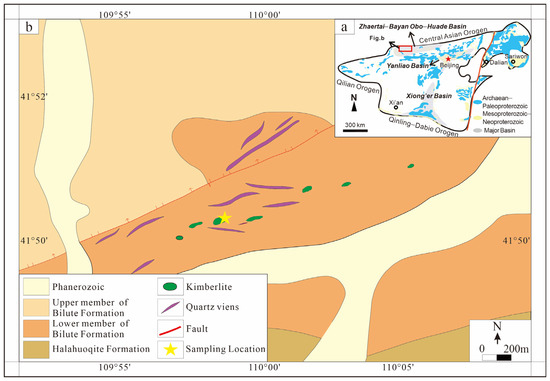
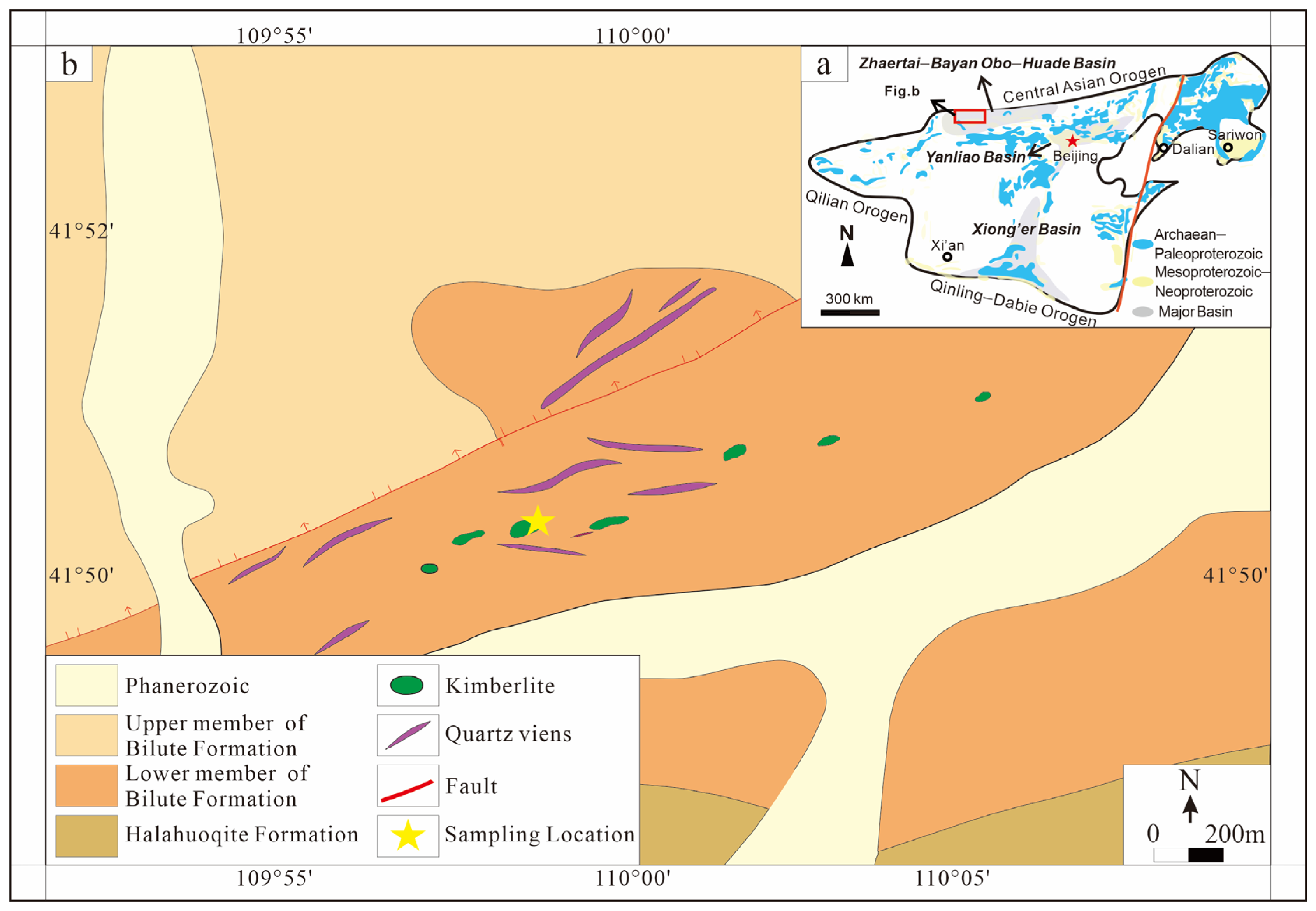
The Bayan Obo district along the northern margin of the NCC borders the Paleozoic Central Asian Orogenic Belt to the north (Figure 1a) [17,18]. The Columbia supercontinent began to disaggregate gradually in the early Mesoproterozoic [19,20,21], giving rise to various rift basins and passive continental margin basins [6]. The Bayan Obo rift trough was formed during this period. The Bayan Obo district has undergone multiple episodes of superimposed tectono-thermal events. Mesoproterozoic rifting led to extensive submarine volcanism accompanied by extensive intrusion of carbonatite dykes and mafic dyke swarms. (ca. 1.4–1.3 Ga) [19,20,21]. Subsequently, the Bayan Obo district experienced at least three episodes of superimposed or reworking metallogenic thermal events, mainly including: (1) the Neoproterozoic Nanhua thermal event (ca. 720 Ma); (2) the Late Silurian superimposed metallogenic event in the Early Paleozoic (ca. 440 Ma); and (3) the Late Paleozoic Permian magmatic intrusion event (ca. 440 Ma) [22]. These regional metamorphism and tectono-thermal events contributed to the complex geological setting of the Bayan Obo area.
Figure 1.
(a) Tectonic map of northern China [18]. (b) Geological sketch map of kimberlites in the Bayan Obo area.
The basement rocks in the study area are dominated by Neoarchean TTG gneisses and Paleoproterozoic potassic granites [23,24,25,26], while the exposed strata mainly consist of the Meso-Neoproterozoic Bayan Obo Group and the Cenozoic strata. The Bayan Obo Group is mainly composed of the Bilute Formation in the study area (Figure 1b), which can be divided into two lithologic members. The lower member consists predominantly of grayish-black carbonaceous silty slates intercalated with minor thin-bedded metamorphosed quartz sandstones and metamorphosed sandstones. The upper member comprises grayish-white metamorphosed quartz sandstones and grayish-black metamorphosed sandstones intercalated with a small amount of grayish-black silty slates, forming an unbalanced sedimentary cycle. Magmatic activity was extremely intense in the Middle-Late Permian in the study area. The contact zones between this formation and the intrusive bodies underwent intense thermal contact metamorphism, and both the sandstones and slates were subjected to hornfels facies metamorphism. The intrusive rocks in the study area mainly include Mesoproterozoic kimberlites [27,28]. In addition, several quartz veins are exposed in this area.
Fold structures are well-developed in the study area, with the main-phase folds striking E-W. They mainly include the Jixianian folds and Hercynian folds. The faults in the study area consist of the late Hercynian thrust-nappe structures and Yanshanian normal faults. The kimberlite vein in this study area generally strikes northeastward, with discontinuous outcrops on the surface. It extends 1500 m in length and ranges 5–30 m in width, dipping northward as a whole with a dip angle of 50–75°. The kimberlites intrude into the Bilute Formation (Figure 1b).
3. Petrographic Characteristics
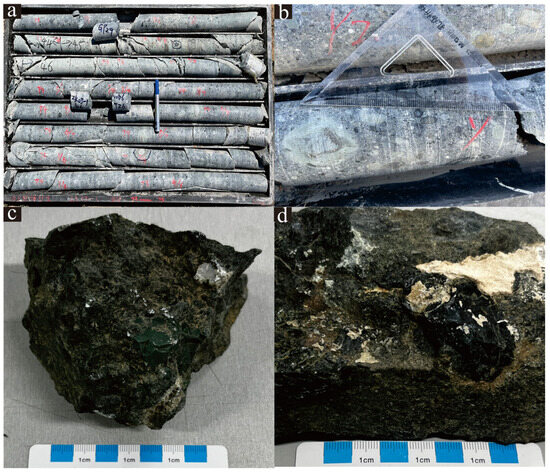
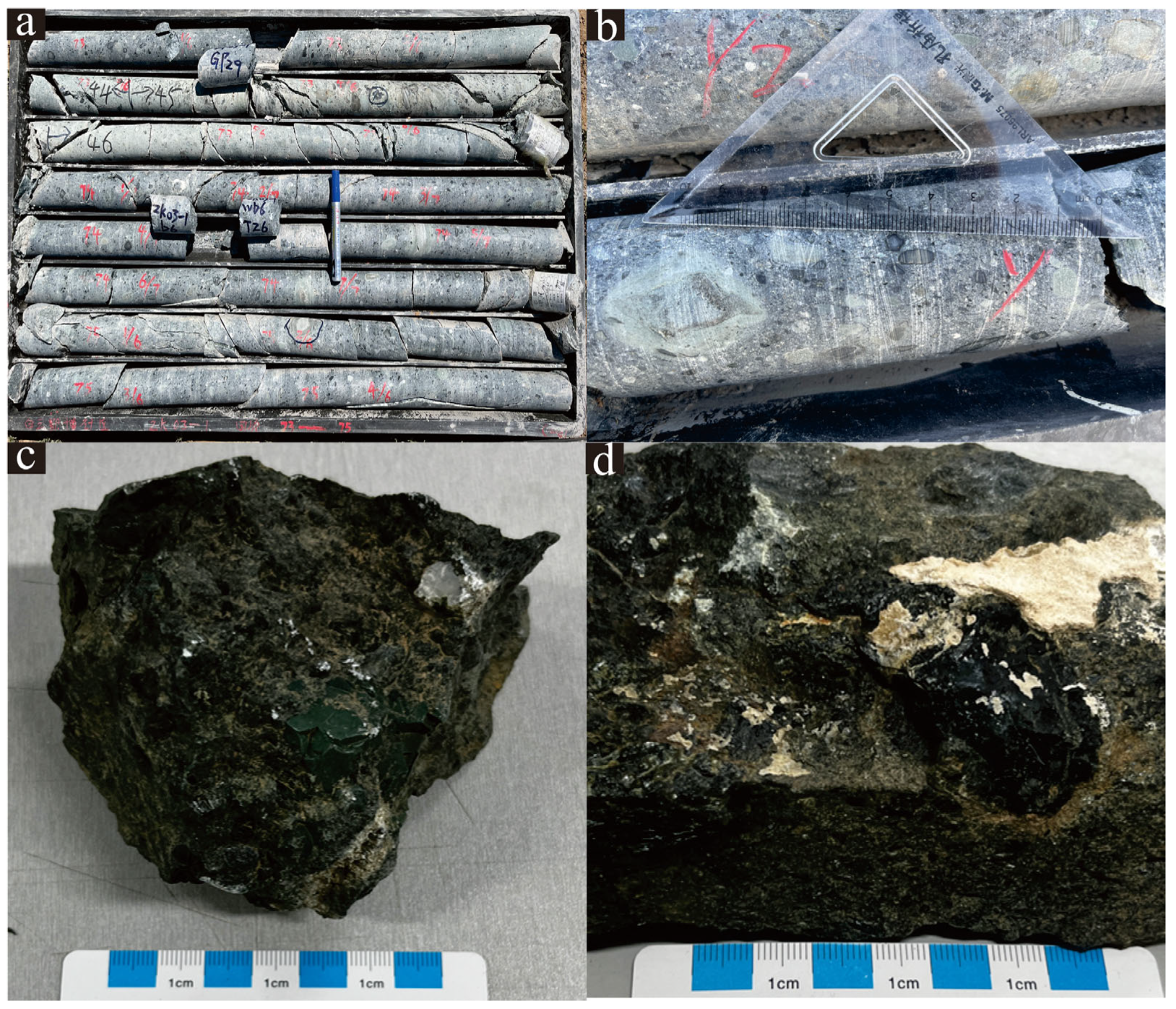
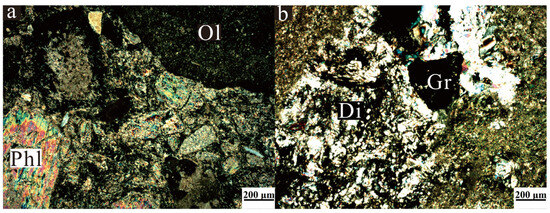
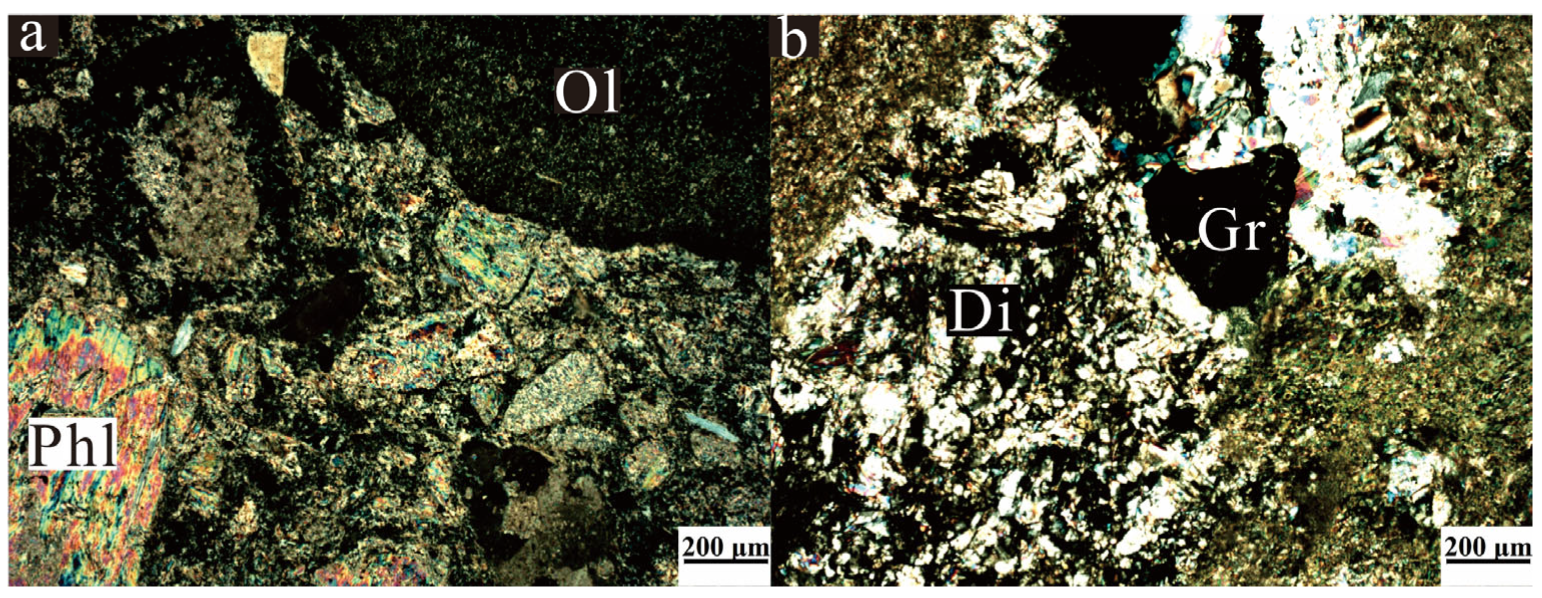
Kimberlite in the Bayan Obo area is generally grayish-green and grayish-black in color, exhibiting a porphyritic structure (15–20 vol.% of phenocrysts with no preferred orientation, crystallized early in magma) and a brecciated structure (angular-subangular clasts of country rock, kimberlite, and carbonatite) (Figure 2a,b). The structures of kimberlite mainly include porphyritic (Figure 2c) and brecciated (Figure 2d) types. They are mainly composed of phenocrysts, volcanic breccias, and groundmass. The phenocryst components include garnet, diopside, phlogopite and olivine pseudomorphs (Figure 3). Their grain size generally ranges from 0.2 to 2.0 mm, occurring as unevenly distributed and randomly oriented discrete grains. Among them, garnets occur as granular crystals with a grain size of approximately 200 μm and are mostly distributed dispersively and inhomogeneously within the interstices of diopside. Phlogopite occurs as flakes and plates with variable sizes; olivine pseudomorphs, which are columnar or rounded granular in shape, have been completely replaced by talc, carbonate minerals, and a small amount of serpentine, with only their original crystal forms preserved. The matrix is mainly composed of tuffaceous tuff and volcanic breccia, which are composed of serpentinized and carbonatized kimberlite and carbonatite (Figure 2c,d).
Figure 2.
(a,b) Drill hole photographs of kimberlite in the Bayan Obo area. (c,d) Representative structures of the kimberlite sample under plane-polarized light.
Figure 3.
(a,b) Photomicrographs of the kimberlite sample under plane-polarized light. Ol: olivine; Phl: phlogopite; Gr: garnet; Di: diopside.
4. Analytical Methods
The zircons from kimberlites from the Bayan Obo area were separated in the laboratory of the Hebei Institute of Regional Geological and Mineral Survey. Zircon separation in this study followed standard geological laboratory protocols, integrated with conventional kimberlite zircon separation methods. Each ≥5 kg sample was crushed to 2–5 mm, ground in an agate ball mill (Retsch GmbH, Haan, Germany) (80% passing 200-mesh/74 μm), and dried at 60 °C for 24 h. Stepwise magnetic separation (100, 300, 500 mT) retained the >300 mT fraction, which was further processed via sodium polytungstate heavy liquid (2.9–3.3 g/cm3) to collect zircon-bearing high-density precipitate. After purification on a hydraulic shaking table (MTS Systems Corporation, Eden Prairie, MN, USA) (2–3° tilt, 5–8 L/min), kimberlite zircons with relatively intact crystal forms were sorted out under a binocular microscope (Carl Zeiss Microscopy, Oberkochen, Germany).
The mount preparation and cathodoluminescence (CL) imaging of zircons were completed by the Inner Mongolia Institute of Geological Survey. The zircons were first mounted on glass slides and covered with PVC rings. A thoroughly mixed solution of epoxy resin and curing agent was poured into the PVC rings. After the resin solidified, the mounts were detached from the glass slides and then subjected to grinding and polishing. Subsequently, reflected-light and transmitted-light imaging of the samples on the mounts were conducted under a microscope, and the polished surfaces were examined for cracks and inclusions. CL imaging was then performed to characterize the external morphology and internal structure of the zircons, thereby selecting suitable crystal domains for dating. Associated with the CL image, microscopic observation of the zircons with transmitted light was carried out in order to avoid fractures and inclusions in the grains prior to choosing the target sites for U-Pb analysis. U-Pb analysis was performed using LA-ICP-MS at the Inner Mongolia Institute of Geological Survey (Hohhot, China). The laser-ablation system was a GeoLas 2005 equipped with a 193 nm ArF-excimer laser and a homogenizing imaging optical system. The spot size of the laser was 32 µm in diameter. He gas was used as the carrier to promote the transport efficiency of the ablated materials and Ar was the makeup gas mixed with the He gas inside of the ablation cell before the samples entered the ICP to gain stable and optimum excitation conditions [29]. The concentrations and ratios of U, Th, Pb and the other elements were calculated using GLITER 4.0. age calculations, and Concordia diagrams were produced with the Isoplot program (ver. 2.49) [30,31].
The electron microprobe analysis of the garnets was carried out in the laboratory of the Shandong Academy of Geological Sciences. The specific operation steps are as follows: First, an ear-washing bulb was used to blow off the dust adhering to the mount surface to ensure no contamination. Then, the samples were ground and polished, followed by coating with a carbon conductive film under vacuum to complete sample preparation. The testing instrument was a JEOL EPMA8230 electron (Shandong Academy of Geological Sciences, Jinan, China) probe microanalyzer. The electron microprobe analysis conditions were set as follows: accelerating voltage (Acc. Voltage): 15.0 kV; beam current (Current): 2 × 10⁻⁸ A. For the EMPA analysis of garnet, well-characterized natural mineral standards with traceable certified compositions are adopted to ensure analytical accuracy, covering all of the target major elements and oxides. Specifically, quartz is used as the standard for SiO2, corundum for Al2O3, hematite for FeO, periclase for MgO, wollastonite for CaO, rhodonite for MnO, rutile for TiO2, chromite for Cr2O3, and an albite–orthoclase standard for Na2O and K2O. All of the standards feature certified elemental composition uncertainties of ≤ 0.1 wt% for the major oxides, laying a reliable foundation for calibration. The analytical uncertainties include random uncertainties (RSD ≤ 0.5% for major oxides, 1%–3% for minor oxides) from counting statistics and grain heterogeneity, systematic errors (≤0.3 wt% for major oxides) mitigated by ZAF correction, standard selection, and drift control, with a total combined uncertainty of ±0.3–0.5 wt% for the major oxides and ±0.05–0.2 wt% for the minor oxides; detection limits (3σ) range from 0.005 wt% (Cr2O3) to 0.04 wt% (FeO), with elements below the detection limits reported as <DL.
Trace element analysis of the samples was conducted at Guangzhou Tuoyan Analytical Technology Co., Ltd. (Guangzhou, China) using a NWR 193 nm ArF excimer laser-ablation system operated with ActiveView2 software (version 1.5.1.33), coupled with an iCAP RQ inductively coupled plasma mass spectrometer (ICP-MS, Elemental Scientific Lasers, Bozeman, MT, USA), wherein the ICP-MS was tuned with NIST 610 standard glass to minimize oxide production rates; during ablation, 0.7 L/min He carrier gas and 0.89 L/min Ar makeup gas were used for aerosol transport, with the laser parameters set at 5.0 J/cm2 fluence, 6 Hz repetition rate, 60 µm spot size, 45 s analysis time, and subsequent 40 s background measurement. Trace element compositions were calibrated via the total normalization method using NIST SRM 610 and BCR-2G as reference materials, while SRM 612 and BIR-1G glass standards were analyzed for data quality evaluation; raw isotope data were processed with the 3D Trace Element data reduction scheme in IOLITE software v4.10.9, involving user-defined time intervals for baseline correction to obtain session-wide baseline-corrected isotope values.
5. Results
5.1. U-Pb Ages
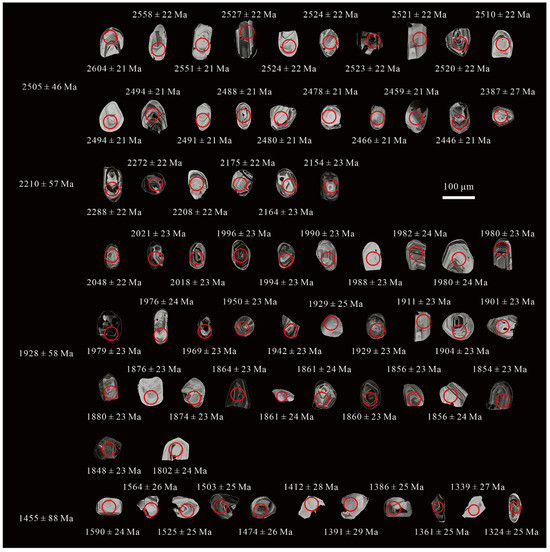
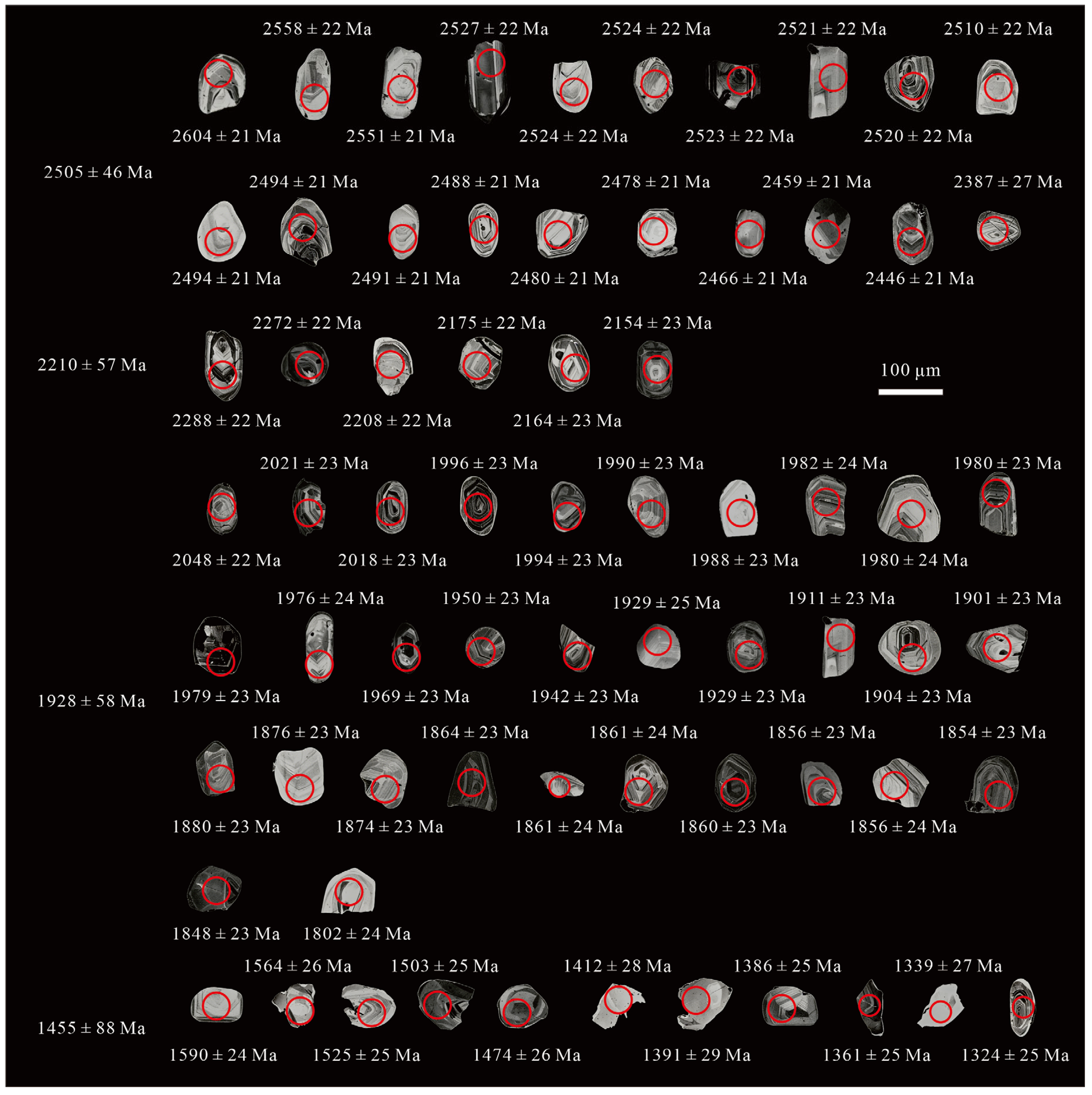
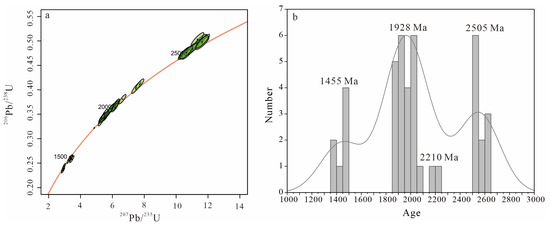
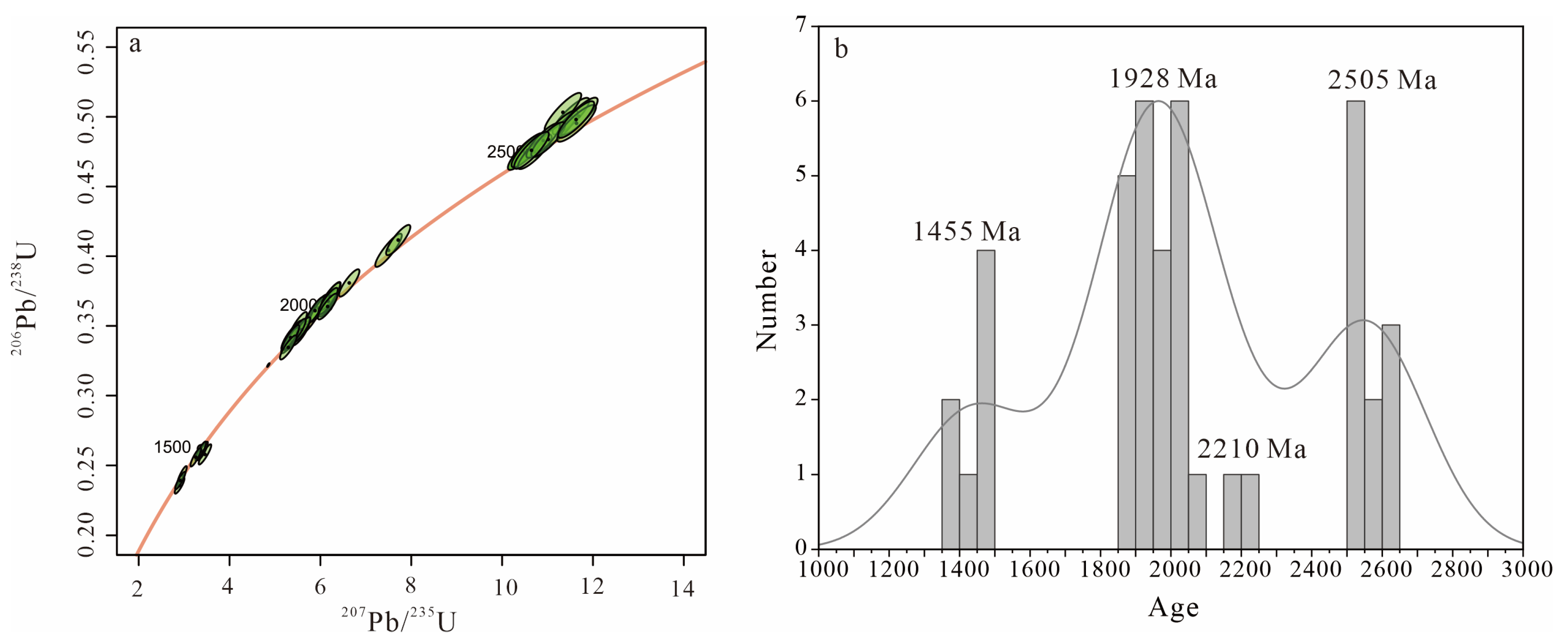
The CL images of the zircons from the kimberlite sample show that the zircons are long-columnar or elliptical in shape and about half of them show oscillatory zoning or exhibit indistinct zoning (Figure 4). The zircons have good roundness, predominantly appearing as rounded or subrounded forms, with a minority being angular. The Th/U ratios of these zircons range from 0.11 to 1.36 (Table 1), showing significant variations, which indicates a complex genetic origin of the zircons within the kimberlites. Generally, magmatic zircons have relatively high Th and U contents with Th/U ratios > 0.4; metamorphic zircons have relatively low Th and U contents with Th/U ratios < 0.1; and zircons that have undergone metamorphic recrystallization show a marked decrease in Th and U content but with unchanged or slightly altered Th/U ratios [32]. According to the test results, although the Th/U ratios and crystal morphology suggest that all zircon grains have a magmatic origin [33], there are a few zircons that have low Th/U ratios. In this study, we excluded the data with a concordance of less than 80%, which were affected by Pb loss and exhibited discordance in this dataset. In addition, the U-Pb zircon data are constrained to the time interval of 1324–2552 Ma. As shown in Figure 5, these data can be divided into four age groups: 2387–2604 Ma, 2154–2288 Ma, 1802–2048 Ma and 1324–1590 Ma. The four groups of zircon U-Pb concordant ages are 2505 ± 46 Ma, 2210 ± 57 Ma, 1928 ± 58 Ma, and 1455 ± 88 Ma, respectively.
Figure 4.
CL images of zircon grains in the Bayan Obo kimberlite.
Table 1.
LA-ICP-MS results for the zircon U-Pb ages of the kimberlite samples from the Bayan Obo area.
Figure 5.
U-Pb Concordia diagrams (a) and 207Pb/206Pb age histograms (b) of the zircon samples.
5.2. Garnet Major and Trace Elements
The major and trace element measurement results of eight garnets in the kimberlite from the study area are presented in Table 2. There are certain variations in the chemical compositions of the garnets, but the variation ranges are relatively narrow. The garnets are characterized by a high content of iron and aluminum oxides, coupled with a low content of magnesium and calcium. Their compositions are Alm66–67Prp18–19Grs14–15Sps.
Table 2.
EMPA and LA-ICP-Ms results for garnets from the kimberlite samples.
6. Discussion
6.1. Zircon Ages and Tectonic Implications of Kimberlites from the Bayan Obo Area
6.1.1. 2505 ± 46 Ma
The zircons are predominantly long-columnar or short-columnar in shape, with a relatively wide size variation (Figure 4). The smaller zircons are about 40 µm in diameter, while the larger ones exceed 150 µm. The zircons are well-rounded; the vast majority are rounded or subrounded, and only a few are subangular. The CL images exhibit internal textures of concentric zoning, patchy zoning and banded zoning. The Th/U ratios range from 0.12 to 1.11 and the average value is 0.60, indicative of magmatic zircons. Therefore, the test results essentially represent the formation age of the zircons, and this suite of zircons are likely to be xenocrystic zircons captured by kimberlite.
The local basement of the Bayan Obo area rocks consists of the Neoarchean granite-gneiss (2588 ± 15 Ma). This is consistent with the concentrated emplacement age (2.68–2.50 Ga) of the early TTG suites and granites in the NCC, a period corresponding to the peak stage of the most significant continental crustal accretion (active continental margins and island arcs) and cratonization of the NCC [34,35]. Zircons of 2505 ± 46 Ma in the kimberlite further confirm the presence of Archean ancient rocks of the NCC in the Bayan Obo area, thereby verifying that the Bayan Obo area is hosted in the basement of the NCC.
6.1.2. 2210 ± 57 Ma
Zircons of this age exhibit sub-elliptical or irregular shapes, with length-to-width ratios varying from 2:1 to 1:1, and CL images indicate that fractures are present within some zircons, which may be caused by long-distance transportation. One zircon in this suite exhibits a distinct overgrowth texture and has a Th/U ratio of 0.08, which is less than 0.1. This zircon should therefore be of metamorphic origin. The other zircons show obvious core–mantle textures and have Th/U ratios ranging from 0.46 to 0.73, characteristics typical of magmatic zircons. Thus, the test results essentially represent the formation ages of the zircons, and this suite of zircons are likely to be xenocrystic zircons of kimberlite.
During the Middle Paleoproterozoic (2.2–2.1 Ga), the NCC entered an intracontinental extensional stage [36,37], accompanied by extensive magmatic events. In the Bayan Obo area, magmatic events aged 2.2–1.9 Ga are widespread. For instance, Fan et al. [22,38], Liu et al. [39], and Ma et al. [40], respectively, reported a xenocrystic zircon U-Pb age of 2070 ± 33 Ma from carbonatite dykes, a magmatic zircon age of 2029 ± 54 Ma from orthogneiss, and a magmatic zircon U-Pb age of 2200 Ma from granitic gneiss. Therefore, the xenocrystic zircons with ages of 2210 ± 57 Ma in the Bayan Obo kimberlites may represent the regional extensional tectonic events.
6.1.3. 1928 ± 58 Ma
Zircons of this age interval are irregular in shape, with a minority being short-prismatic. Most zircons are well-rounded, while a small portion display subangular-to-angular morphologies. The grain sizes of these zircons are heterogeneous, ranging from 50 µm to 200 µm. CL images demonstrate that some zircons do not exhibit distinct oscillatory zoning. Their Th/U ratios range from 0.09 to 1.37, with an average of 0.36 < 0.4, representing a marked decrease compared to the original zircons. Furthermore, zircons of this age interval possess distinct metamorphic overgrowth rims. Collectively, these characteristics indicate that the zircons are metamorphic in origin, formed by the reworking of protolithic zircons.
During the late Paleoproterozoic, the passive continental margins in the northwestern and northeastern parts of the NCC underwent subduction and collision with adjacent continental blocks, leading to the formation of the Inner Mongolia–Jibei Paleoproterozoic orogenic belt [35]. Intense collisional orogeny induced intense tectonic deformation and high-grade metamorphic anatexis in the Early Precambrian metamorphic basement of the Bayan Obo area [41]. Wan et al. [42] proposed that the NCC collided with the Siberian Craton at approximately 1.82 Ga, and high-grade metamorphism occurred in the northern margin of the North China Craton during the period of ~1.9–1.85 Ga. Ma et al. [38] conducted research in the Bayan Obo area and yielded metamorphic zircon U-Pb ages ranging from 1864 to 1929 Ma from granitic gneiss, gneissic quartz diorite, biotite gneiss, and tonalitic gneiss of the Kuangou Anticline. Wu et al. [43] discovered the Bayan Obo Melange in the Bayan Obo area and confirmed that the NCC collided with the northern continental block at approximately 1.9 Ga, contributing to the formation of the Columbia supercontinent. Most zircons of the 1928 ± 58 Ma age group (1856–1943 Ma) in the Bayan Obo kimberlites are metamorphic zircon ages, which can roughly represent a regional collisional event.
6.1.4. 1455 ± 88 Ma
CL images reveal that the zircons of this group exhibit distinct magmatic oscillatory zoning characteristics, and their Th/U ratios range from 0.40 to 0.54. These features indicate that the zircons of this group are magmatic crystalline zircons. Therefore, we propose that the zircons of this age interval in the Bayan Obo kimberlite are primary zircons, and the formation age of the Bayan Obo kimberlite is constrained to 1455 ± 88 Ma. This is consistent with the formation age of kimberlite in Dörbed Banner, Inner Mongolia [43]. This period is equivalent to a kimberlite magmatic event with an age of 1.6–1.7 Ga, which is the oldest kimberlite ever found, mainly distributed in South Africa [28,44], Australia [45,46], and the North China Shanxi Province Yanggao rock mass [47].
The Columbia supercontinent began to disintegrate gradually during the Early Mesoproterozoic [18,19], resulting in the formation of various rift basins and passive continental margin basins. Simultaneously, numerous magmatic events developed within the rift troughs of the NCC and its peripheral areas. These magmatic events are divided into three stages: the first stage is rift events (1.63–1.77 Ga), the second stage consists of several minor volcanic eruption events (1.44–1.56 Ga), and the third stage is bimodal magmatic rocks (1.35–1.32 Ga) [35]. Magmatic events were also developed in the Bayan Obo rift during the Mesoproterozoic. For example, Fan et al. [22,38] discovered carbonatites with an age of 1416 ± 77 Ma that intruded into the Bayan Obo Group. Therefore, we propose that the emplacement age (1455 ± 88 Ma) of the Bayan Obo kimberlite represents the geological setting of regional extension.
6.2. Age Constraint on the Bilute Formation
The Bilute Formation is an important component of the Bayan Obo Group. Previous studies have shown that its sedimentary–magmatic sequence is precisely coupled with the response of the northern margin of the NCC to the continuous breakup of the Columbia supercontinent, serving as a direct sedimentary–magmatic record of supercontinent breakup in regional tectonics. However, research on the Bilute Formation in the Bayan Obo area remains relatively scarce.
Zhou et al. [28] obtained the youngest detrital zircon age of 1583 ± 61 Ma for the Bilute Formation in the Bayan Obo area, which limits the maximum depositional age of the formation. Liu et al. [48] reported the youngest single-grain detrital zircon age of 1524 ± 69 Ma for the Bilute Formation in the same area. Considering that the age of the kimberlite into the Bilute Formation is 1455 ± 88 Ma and the maximum depositional age of the Bilute Formation is 1524 ± 69 Ma, this study infers that the depositional age of the Bilute Formation should be between 1455 and 1524 Ma.
6.3. Genesis and Implications of Garnet in Kimberlite
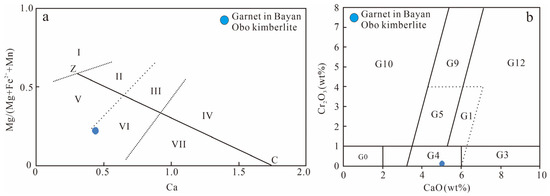
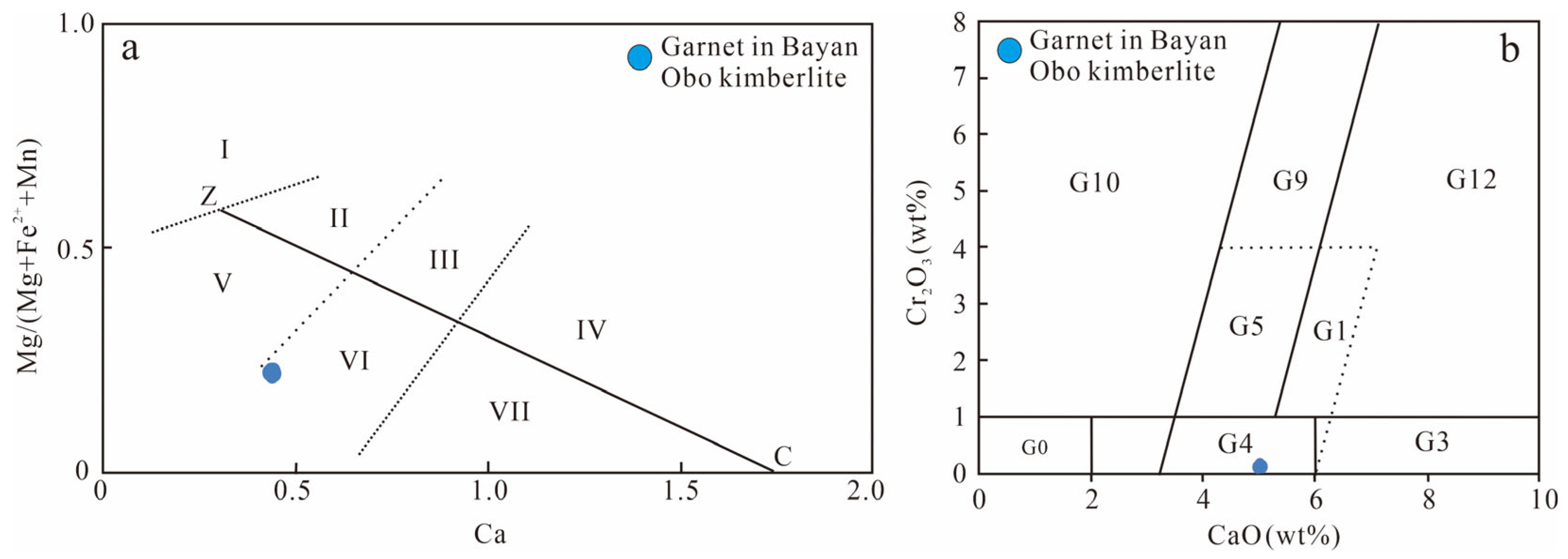
The garnets in the study area generally exhibit the characteristics of high contents of FeO and Al2O3, and low contents of Cr2O3 and MnO, similar to those formed under relatively high-pressure conditions [49]. On the garnet genetic classification diagram (Figure 6a), the garnets from Bayan Obo kimberlite are distributed in the amphibolite facies field and all plot below the ZC line, categorizing them as crust-derived garnets [50]. Therefore, these garnets are amphibolite-facies garnets. Grutter et al. [51] conducted statistical classification of the major elements in different types of garnets based on the relationships among these elements, and proposed a classification scheme for different garnets. The garnets from the study area were plotted within the G4 type in Grutter’s garnet division scheme (Figure 6b). According to previous studies, the occurrence of G4-type garnets is generally correlated with craton destruction [52,53].
Figure 6.
(a) Relationship diagram of Mg/(Mg + Fe2+ + Mn) vs. Ca2+ of garnet from kimberlite from the Bayan Obo area (after Cong and Zhang [50]), above the zc line is mantle origin; below the zc line is crustal origin. I, II, III: Eclogites in kimberlite; IV: corundum eclogite; V: granulite-facies eclogite; VI: amphibolite-facies eclogite; VII: blueschist-facies eclogite. (b) Grutter’s garnet division scheme. G0: Unclassified; G1: low-Cr megacrysts; G3: eclogitic; G4 and G5: pyroxenitic, websteritic and eclogitic; G9: lherzolitic; G10: high-TiO2 peridotitic; G12: wehrlitic.
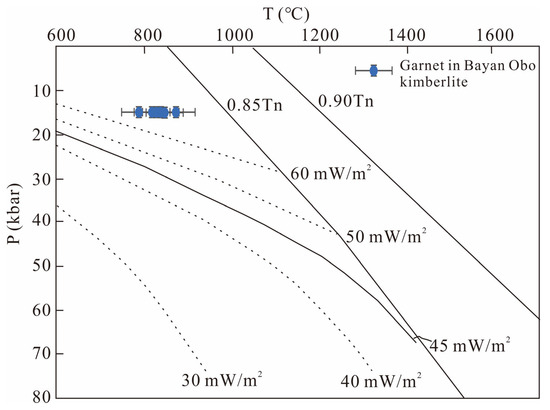
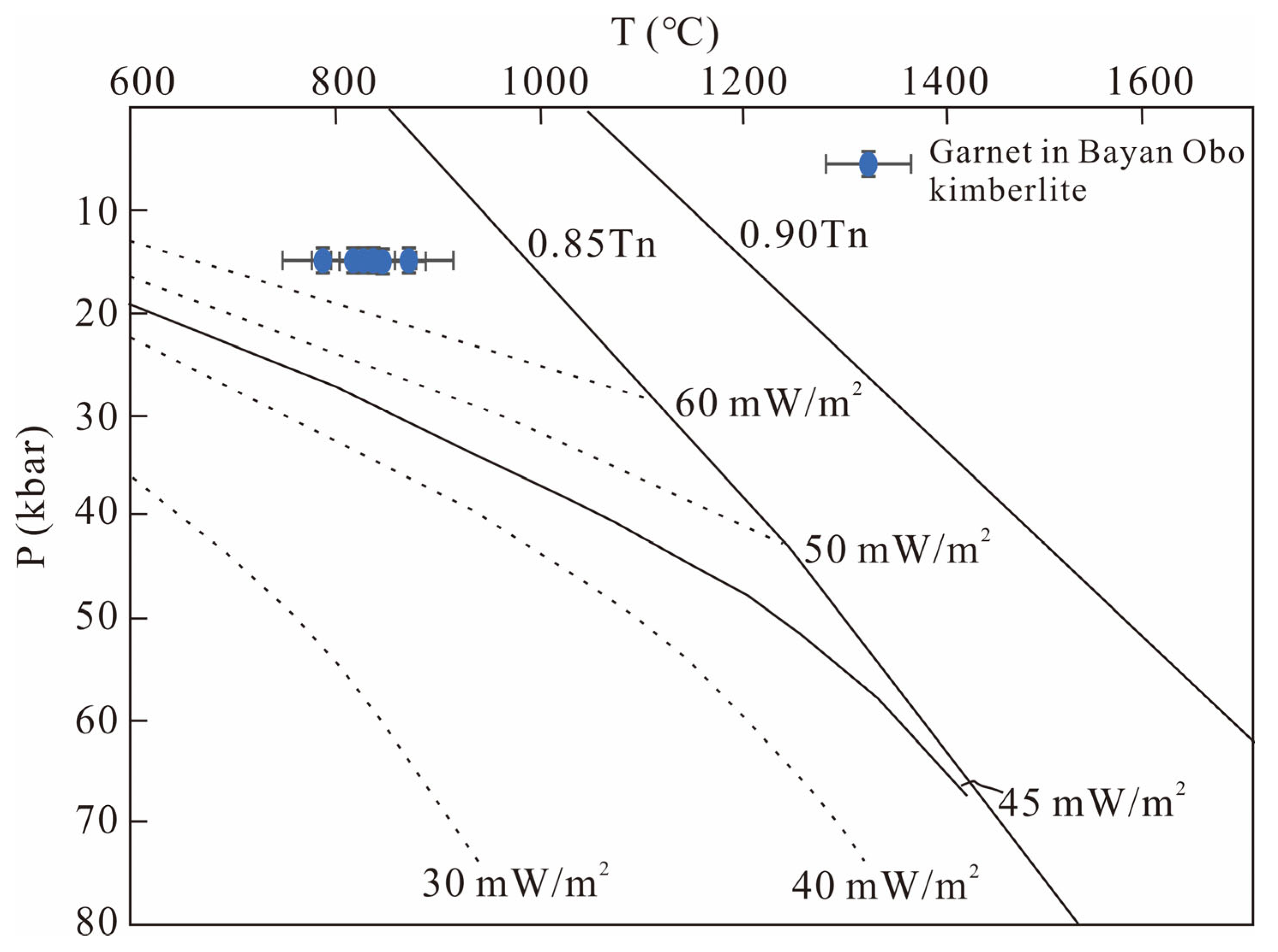
Griffin et al. [54] conducted experiments and found that the Ni content in garnet is correlated with the garnet formation temperature. Based on the experimentally derived temperature calculation formula (T(°C) = (1000/(1.506 − 0.189lnNignt)) − 273) for individual garnet grains and the measured Ni content (Nignt) of the garnets, they determined that the formation temperature range of the garnets in the study area is 791 ± 50–876 ± 50 °C. Grutter et al. [51] proposed that the mantle pressure during garnet formation can be estimated based on the contents of CaO and Cr2O3 in garnet. Using the calculation formula (P (kbar) = 9.2 + 36[(Cr2O3 + 1.6)/(CaO + 7.02)]) they developed, we derived a pressure around 14 ± 3.0 kbar for the garnets in the study area.
When the experimental data of garnets from the study area are plotted on the P-T phase diagram (Figure 7), the garnet inclusions in Bayan Obo kimberlites predominantly plot above the 60 ± 5 mW/m2 mantle geotherm. The magnitude of mantle heat flow values reflects the stability of the regional mantle lithosphere: the higher the mantle heat flow, the more unstable the internal state of the lithosphere. For instance, the mantle heat flow of the Archaean Superior Craton ranges from 27 to 59 mW/m2; that of the Paleoproterozoic Trans-Hudson Craton is approximately 42 mW/m2; that of the Neoproterozoic Grenville Craton is around 41 mW/m2 [55], and that of the Mesozoic NCC is around 65 mW/m2 [56]. The mantle heat flow value in the Bayan Obo area is approximately 60 mW/m2, which is higher than that of cratons in other regions, suggesting that the craton in the Bayan Obo area is in an extensional setting.
Figure 7.
P–T phase diagram of garnets in kimberlite from the Bayan Obo area (after [56]). The 0.85Tn and 0.90Tn lines are 0.85 and 0.90 times the melting temperature, respectively.
6.4. Records of the Tectonic Evolution of the Bayan Obo Rift and the NCC
The Precambrian accounts for seven-eighths of the Earth’s long history and is crucial to the Earth’s evolution. From the Neoarchean to the Paleoproterozoic, this period witnessed continental crustal growth, cratonization, and the transition of tectonic regimes [7]. Most cratons worldwide completed cratonization around 2.7 Ga ago, but the cratonization process of the NCC was relatively late—it reached initial stabilization around 2.5 Ga ago and subsequently entered a tectonic quiescence period [57]. The 2505 ± 46 Ma xenocrystic zircons from the Bayan Obo area reported in this study provide direct evidence for the presence of Archean rocks in this region, and such Archean rocks may represent the crystalline basement of the NCC.
The zircons occurring within the Bayan Obo kimberlites retain a geological archive of the Archean cratonic basement lithologies, while simultaneously documenting a magmatic event at 2.2 Ga and a subsequent metamorphic episode at approximately 1.9 Ga. This finding provides robust evidence for an important collisional orogeny that occurred during the late Paleoproterozoic on the northern margin of the North China Craton. Notably, the obtained metamorphic age of 1.9 Ga matches well with the documented timing of granulite-facies metamorphism in the northern NCC [58,59].
During the Mesoproterozoic, multiple episodes of magmatic activity occurred in the northern NCC, with basic dykes as the dominant lithology and minor interbedded volcanic rocks as subordinate components [60,61]. This magmatic event is thought to have formed in a background of extensional tectonics and is related to the rifting of the Columbia supercontinent. In this study, we identified the occurrence of kimberlites along the northern margin of the NCC during the Mesoproterozoic. In regard to the genesis of kimberlite, some researchers believe that kimberlite resulted from continent extension rifting [62], which develops in a background of continent extensional tectonics [7]. This finding also confirms that the tectonic setting of the northern margin of the NCC during the Mesoproterozoic was an extensional rift. In addition, garnets in the kimberlites of the Bayan Obo area reflect relatively high mantle heat flow values in this region, thereby indicating an unstable state of the lithosphere. This phenomenon implies crustal thinning driven by extension and underplating of upper mantle magma and serves as an important mineralogical record of the rift-spreading stage during this period.
7. Conclusions
Zircon U-Pb dating of kimberlites from the Bayan Obo area identified four key age groups: xenocrystic zircons with an age of 2505 ± 46 Ma confirm the existence of the Archean NCC basement in the study area, corresponding to the peak period of regional continental crustal accretion and cratonization; xenocrystic zircons aged 2210 ± 57 Ma record magmatic activity under a regional extensional tectonic background in the middle Paleoproterozoic; metamorphic zircons of 1928 ± 58 Ma reflect high-pressure metamorphic events caused by the collision between the northern margin of the NCC and the northern continental block in the late Paleoproterozoic, providing regional response evidence for the assembly of the Columbia supercontinent; the age of 1455 ± 88 Ma is the formation age of the kimberlite, indicating its formation in an extensional tectonic environment during the Mesoproterozoic.
The garnets in the kimberlite are enriched in FeO and Al2O3, and depleted in Cr2O3 and MnO, belonging to granulite-facies crust-derived G4-type garnets, which are associated with craton destruction. Their formation temperature and pressure conditions (791 ± 50–876 ± 50 °C, 14 ± 3.0 kbar) and mantle heat flow value (~60 ± 5 mW/m2) are higher than that of typical global cratons, indicating that the lithosphere in the Bayan Obo area was in an unstable state during the Mesoproterozoic, reflecting the influence of crustal extension and mantle magma underplating.
Combined with the emplacement age of kimberlite (1455 ± 88 Ma) and the youngest detrital zircon age of the Bilute Formation (1524 ± 69 Ma), the depositional age of the Bilute Formation is constrained to between 1455 and 1524 Ma. This sedimentary–magmatic sequence is a direct record of the response of the northern margin of the NCC to the breakup of the Columbia supercontinent.
The formation of Mesoproterozoic kimberlites in the Bayan Obo is closely related to regional extensional rifting, confirming that the northern margin of the NCC was in an extensional tectonic background driven by the breakup of the Columbia supercontinent during the Mesoproterozoic. Kimberlites and their inclusion minerals provide important deep geological constraints for revealing the evolution of the Bayan Obo rift trough, the tectonic transition of the NCC, and the breakup process of the supercontinent.
Author Contributions
Conceptualization, C.L.; Software, Y.Z.; Validation, X.S. and Y.Z.; Formal analysis, J.H.; Investigation, H.R.; Resources, L.G.; Data curation, J.H.; Writing – original draft, C.L.; Writing – review & editing, R.L.; Funding acquisition, R.L. All authors have read and agreed to the published version of the manuscript.
Funding
This research was funded by the “Survey and Evaluation of Diamond Deposits in the North China Craton, Central Inner Mongolia” (Project No. 2022—TZH01), the National Natural Science Foundation of China (Grant No. 42102076) and the Science Foundation of Shandong Province (Grant No. ZR2025MS686).
Data Availability Statement
The raw data supporting the conclusions of this article will be made available by the authors on request.
Acknowledgments
We are grateful to numerous technical staff members from the Sinomate Institute of Materials Research (Guangzhou) Co., Ltd. (SIMR) for their assistance in this study. Comments and suggestions from the journal’s anonymous reviewers greatly improved the quality of this work.
Conflicts of Interest
The authors declare no conflicts of interest.
References
- Ernst, R.E.; Hamilton, M.A.; Söderlund, U.; Hanes, J.A.; Gladkochub, D.P.; Okrugin, A.V.; Kolotilina, T.; Mekhonoshin, A.S.; Bleeker, W.; LeCheminant, A.N.; et al. Long-lived connection between southern Siberia and northern Laurentia in the Proterozoic. Nat. Geosci. 2016, 9, 464–469. [Google Scholar] [CrossRef] [Scilit]
- Zhang, S.H.; Zhao, Y. The 1.33–1.30 Ga Yanliao large igneous province in the North China Craton: Implications for reconstruction of the Nuna (Columbia) supercontinent, and specifically with the North Australian Craton. Earth Planet. Sci. Lett. 2017, 465, 112–125. [Google Scholar] [CrossRef] [Scilit]
- Gladkochub, D.P.; Donskaya, T.V.; Pisarevsky, S.A.; Ernst, R.E.; Söderlund, U.; Kotov, A.B.; Kovach, V.P.; Okrugin, A.V. 1.79–1.75 Ga mafic magmatism of the Siberian craton and late Paleoproterozoic paleogeography. Precambr. Res. 2022, 370, 106557. [Google Scholar] [CrossRef] [Scilit]
- Ernst, R.E.; Pereira, E.; Hamilton, M.A.; Pisarevsky, S.A.; Rodriques, J.; Tassinari, C.C.G.; Teixeira, W.; Van-Dunem, V. Mesoproterozoic intraplate magmatic ‘barcode’ record of the Angola portion of the Congo Craton: Newly dated magmatic events at 1505 and 1110 Ma and implications for Nuna (Columbia) supercontinent reconstructions. Precambr. Res. 2013, 230, 103–118. [Google Scholar] [CrossRef] [Scilit]
- Lu, G.M.; Wang, W.; Cawood, P.A.; Ernst, R.E.; Raveggi, M.; Huang, S.F.; Xue, E.K. Late Paleoproterozoic to early Mesoproterozoic mafic magmatism in the SW Yangtze Block: Mantle plumes associated with Nuna breakup? J. Geophys. Res. Solid Earth 2020, 125, e2019JB019260. [Google Scholar] [CrossRef] [Scilit]
- Zhai, M.G.; Santosh, M. The early Precambrian odyssey of the North China Craton: A synoptic overview. Gondwana Res. 2011, 20, 6–25. [Google Scholar] [CrossRef] [Scilit]
- Coe, N.; le Roex, A.; Gurney, J.; Pearson, D.G.; Nowell, G. Petrogenesis of the Swartruggens and star group II kimberlite dyke swarms, South Africa: Constraints from whole rock geochemistry. Contrib. Mineral. Petrol. 2008, 156, 627–652. [Google Scholar] [CrossRef] [Scilit]
- Sparks, R.S.J.; Baker, L.; Brown, R.J.; Field, M.; Schumacher, J.; Stripp, G.; Walters, A. Dynamical constraints on kimberlite volcanism. J. Volcanol. Geotherm. Res. 2006, 155, 18–48. [Google Scholar] [CrossRef] [Scilit]
- Agashev, A.; Pokhilenko, N.; Takazawa, E.; McDonald, J.; Vavilov, M.; Watanabe, T.; Sobolev, N. Primary melting sequence of a deep (>250 km) lithospheric mantle as recorded in the geochemistry of kimberlite–carbonatite assemblages, Snap Lake dyke system, Canada. Chem. Geol. 2008, 255, 317–328. [Google Scholar] [CrossRef] [Scilit]
- Chalapathi Rao, N.V.; Dongre, A. Mineralogy and geochemistry of kimberlites NK-2 and KK-6, Narayanpet kimberlite field, eastern Dharwar craton, southern India: Evidence for a transitional (South African) kimberlite signature. Can. Mineral. 2009, 47, 1117–1135. [Google Scholar] [CrossRef] [Scilit]
- Chalapathi Rao, N.V.; Lehmann, B. Kimberlites, flood basalts and mantle plumes: New insights from the Deccan Large Igneous Province. Earth-Sci. Rev. 2011, 107, 315–324. [Google Scholar] [CrossRef] [Scilit]
- Chalapathi Rao, N.V.; Miller, J.A.; Gibson, S.A.; Pyle, D.M.; Madhavan, V. Precise Ar-40-Ar-39 age determinations of the Kotakonda kimberlite and Chelima lamproite, India: Implications to the timing of mafic dyke swarm emplacement in the eastern Dharwar Craton. J. Geol. Soc. India 1999, 53, 425–432. [Google Scholar] [CrossRef] [Scilit]
- Francis, D.; Patterson, M. Kimberlites and aillikites as probes of the continental lithospheric mantle. Lithos 2009, 109, 72–80. [Google Scholar] [CrossRef] [Scilit]
- Lu, F.X.; Zhao, L.; Deng, J.F.; Zheng, J.P. The discussion on the age of kimberlitic magma activity in North China platform. Acta Petrol. Sin. 1995, 11, 365–374. [Google Scholar]
- Mitchell, R.H. Kimberlites: Mineralogy, Geochemistry, and Petrology; Springer: Berlin/Heidelberg, Germany, 1986; 442p. [Google Scholar] [CrossRef] [Scilit]
- Van Achterbergh, E.; Griffin, W.L.; Ryan, C.G.; O’Reilly, S.Y.; Pearson, N.J.; Kivi, K.; Doyle, B.J. Melt inclusions from the deep Slave lithosphere: Implications for the origin and evolution of mantle-derived carbonatite and kimberlite. Lithos 2004, 76, 461–474. [Google Scholar] [CrossRef]
- Xiao, W.J.; Santosh, M. The western Central Asian Orogenic Belt: A window to accretionary orogenesis and continental growth. Gondwana Res. 2014, 25, 1429–1444. [Google Scholar] [CrossRef] [Scilit]
- Peng, P.; Guo, J.H.; Windley, B.F.; Li, X.H. Halaqin volcano-sedimentary succession in the central-northern margin of the North China Craton: Products of Late Paleoproterozoic ridge subduction. Precam-Brian Res. 2011, 187, 165–180. [Google Scholar] [CrossRef] [Scilit]
- Rogers, J.J.W.; Santosh, M. Configuration of Columbia, a Mesoproterozoic Supercontinent. Gondwana Res. 2002, 5, 5–22. [Google Scholar] [CrossRef] [Scilit]
- Rogers, J.J.W.; Santosh, M. Tectonics and surface effects of the supercontinent Columbia. Gondwana Res. 2009, 15, 373–380. [Google Scholar] [CrossRef] [Scilit]
- Li, H.K.; Lu, S.N.; Su, W.B.; Xiang, Z.Q.; Zhou, H.Y.; Zhang, Y.Q. Recent advances in the study of the Mesoproterozoic geochronology in the North China Craton. J. Asian Earth Sci. 2013, 72, 216–227. [Google Scholar] [CrossRef] [Scilit]
- Fan, H.R.; Ha, F.F.; Yang, K.F.; Pirajno, F.; Liu, X.; Wang, K.Y. Integrated U-Pb and Sm-Nd geochronology for a REE-rich carbonatite dyke at the giant Bayan Obo REE deposit, Northern China. Ore Geol. Rev. 2014, 63, 510–519. [Google Scholar] [CrossRef] [Scilit]
- Fan, H.R.; Hu, F.F.; Chen, F.K.; Yang, K.F.; Wang, K.Y. Intrusive age of No. 1 carbonatite dyke from Bayan Obo REE-Nb-Fe deposit, Inner Mongolia: With answers to comment of Dr. Le Bas. Acta Petrol. Sin. 2006, 22, 519–520. [Google Scholar]
- Yang, Q.Y.; Santosh, M.; Collins, A.S.; Teng, X.M. Microblock amalgamation in the North China Craton: Evidence from Neoarchaean magmatic suite in the western margin of the Jiaoliao Block. Gondwana Res. 2016, 31, 96–123. [Google Scholar] [CrossRef] [Scilit]
- Fei, X.J.; Zeng, P.S.; Yan, C.J.; Wen, L.G. The Regional Geological Evolution History of the Bayan Obo REE-Nb-Fe Deposit Derived from Isotopic Ages. Geol. Explor. 2019, 55, 461–471. [Google Scholar]
- Zhang, S.H.; Zhao, Y.; Yang, Z.Y.; He, Z.F.; Wu, H. The 1.35 Ga diabase sills from the northern North China Craton: Implications for breakup of the Columbia (Nuna) supercontinent. Earth Planet. Sci. Lett. 2009, 288, 588–600. [Google Scholar] [CrossRef] [Scilit]
- Liang, C.F.; Ao, N.; Wu, L.W.; Xia, N.; Zheng, B.J.; Wang, T.; Han, B.; He, J.; Wang, X.; Chen, J.J. The first discovery of diamond-bearing kimberlite in Bayan Obo area. Geol. China 2025, 52, 374–375. [Google Scholar]
- Zhou, Z.G.; Wang, G.S.; Di, Y.J.; Gu, Y.C.; Zhang, D.; Zhu, W.P.; Liu, C.F.; Wu, C.; Li, H.Y.; Chen, L.Z. Discovery of Mesoproterozoic kimberlite from Dörbed Banner, Inner Mongolia and its tectonic significance. Geol. J. 2018, 53, 992–1004. [Google Scholar] [CrossRef] [Scilit]
- Liu, X.M.; Gao, S.; Diwu, C.R.; Yuan, H.L.; Hu, Z.C. Simultaneous in-situ determination of U-Pb age and trace elements in zircon by LA-ICP-MS in 20 μm spot size. Chin. Sci. Bull. 2007, 52, 1257–1264. [Google Scholar] [CrossRef] [Scilit]
- Ludwig, K. SQUlD 1.02, A User’s Manual; Berkeley Geochronological Center Special Publication: Berkeley, CA, USA, 2001; p. 2455. [Google Scholar]
- Ludwig, K. User’s Manual for Lsoplot/ex Version 3.00: A Geochronology Toolkit for Microsoft Excel, No. 4; Berkeley Geochronological Center Special Publication: Berkeley, CA, USA, 2003. [Google Scholar]
- Wu, Y.B.; Zheng, Y.F. Zirconogenic Mineralogy and Its Constraints on U-Pb Age Interpretation. Chin. Sci. Bull. 2004, 49, 1589–1604. [Google Scholar] [CrossRef] [Scilit]
- Harley, S.L.; Kelly, N.M.; Moeller, A. Zircon behaviour and the thermal histories of mountain chains. Elements 2007, 3, 25–30. [Google Scholar] [CrossRef] [Scilit]
- Kusky, T.M.; Li, J. Paleoproterozoic tectonic evolution of the North China Craton. J. Asian Earth Sci. 2003, 22, 383–397. [Google Scholar] [CrossRef] [Scilit]
- Li, J.H.; Qian, X.L.; Liu, S.W. Geochemistry of khondalites from the central portion of North China craton (NCC): Implications for the continental cratonization in the Neoarchean. Sci. China Ser. D Earth Sci. 2000, 43, 253–265. [Google Scholar] [CrossRef] [Scilit]
- Du, L.L.; Yang, C.H.; Ren, L.D.; Song, H.X.; Geng, Y.S.; Wan, Y.S. The 2.2~2.1 Ga magmatic event and its tectonic implication in the Lüliang Mountains. North China Craton. Acta Petrol. Sin. 2012, 28, 2751–2769. [Google Scholar]
- Du, L.L.; Yang, C.H.; Song, H.X.; Zhao, L.; Lu, Z.L.; Li, L.; Wang, T.; Ren, L.D. Petrogenesis and tectonic setting of 2.2~2.1 Ga granites in Wutai area, North China Craton. Acta Petrol. Sin. 2018, 34, 1154–1174. [Google Scholar]
- Fan, H.R.; Yang, K.F.; Hu, F.F.; Wang, K.Y.; Zhai, M.G. Zircon geochronology of basement rocks from the Bayan Obo area, Inner Mongolia, and tectonic implications. Acta Petrol. Sin. 2010, 26, 1342–1350. [Google Scholar]
- Liu, F.L.; Liou, J.G. Zircon as the best mineral for P-T-time history of UHP metamorphism: A review on mineral inclusions and U-Pb SHRlMP ages of zircons from the Dabie-Sulu UHP rocks. J. Asian Earth Sci. 2011, 40, 1–39. [Google Scholar] [CrossRef] [Scilit]
- Ma, M.Z.; Dong, C.Y.; Xu, Z.Y.; Xie, S.W.; Liu, D.Y.; Wan, Y.S. Anatexis of Early Paleoproterozoic garnet-biotite gneisses (Daqingshan supracrustal rocks) in Daqingshan, Inner Mongolia: Geology, zircon geochronology and geochemistry. Acta Petrol. Sin. 2015, 31, 1535–1548. [Google Scholar]
- Liu, X.S. Characteristics of basement reworked complex and implication for daqingshan orogenic belt. Acta Petrol. Sin. 1994, 10, 413–426. [Google Scholar]
- Wan, Y.S.; Dong, C.Y.; Xie, H.Q.; Zheng, J.P.; Liu, S.J.; Ma, M.Z.; Xie, S.W.; Ren, P.; Sun, H.Y.; Liu, D.Y. Composition and Evolution of the Ancient Basement of the North China Craton. Geol. Surv. China 2015, 2, 1–4. [Google Scholar]
- Wu, C.; Zhou, Z.G.; Andrew, V.Z. A 1.9 Ga mélange along the northern margin of the North China craton: Implications for the assembly of Columbia supercontinent. Tectonics 2018, 37, 3610–3646. [Google Scholar] [CrossRef] [Scilit]
- Cara, L.D.; Griffin, W.L.; O’Reilly, S.Y.; Pearson, N.J.; Shee, S.R. The kimberlites and related rocks of the Kuruman Kimberlite Province, Kaapvaal Craton, South Africa. Contrib. Mineral. Petrol. 2011, 161, 351–371. [Google Scholar] [CrossRef] [Scilit]
- Shee, S.R.; Bristow, J.W.; Bell, D.R.; Smith, C.B.; Allsopp, H.L.; Shee, P.B. The petrology of kimberlites, related rocks and associated mantle xenoliths from the Kuruman province, South Africa. Int. Kimberl. Conf. Ext. Abstr. 1986, 4, 90–92. [Google Scholar]
- Erin, M.; Janet, H.; David, P.; Simon, S. The geochemistry, petrogenesis and age of an unusual alkaline intrusion in the western Pilbara Craton, Western Australia. Lithos 2009, 112, 419–428. [Google Scholar] [CrossRef] [Scilit]
- Shee, S.R.; Vercoe, S.C.; Wyatt, B.A.; Hwang, P.H.; Campbell, A.N.; Colgan, E.A. Discovery and geology of the Nabberu kimberlite province, Western Australia. Int. Kimberl. Conf. Ext. Abstr. 1998, 7, 800–802. [Google Scholar] [CrossRef] [Scilit]
- Liu, C.H.; Zhao, G.C.; Liu, F.L.; Shi, J.R. Detrital zircon U-Pb and Hf isotopic and whole-rock geochemical study of the Bayan Obo Group, northern margin of the North China Craton: Implications for Rodinia reconstruction. Precambr. Res. 2017, 303, 372–391. [Google Scholar] [CrossRef] [Scilit]
- Conrad, W.K.; Nicholls, L.A.; Wall, V.J. Water-saturated and-undersaturated melting of metaluminous and peraluminous crustal compositions at 10 kb: Evidence for the origin of silicic magmas in the Taupo Volcanic Zone, New Zealand, and other occurrences. J. Petrol. 1988, 29, 765–803. [Google Scholar] [CrossRef] [Scilit]
- Cong, B.L.; Zhang, W.H. The garnet in the eclogite. Chin. Sci. Bull. 1977, 9, 413–416. [Google Scholar]
- Grutter, H.S.; Gumey, J.J.; Lenzies, A.H.; Winter, F. An updated classification scheme for mantle-derived garnet, for use by diamond explorers. Lithos 2004, 77, 841–857. [Google Scholar] [CrossRef] [Scilit]
- Pokhilenko, N.P.; Sonolev, N.V.; Kuligin, S.S.; Shimizu, N. Peculiarities of distribution of pyroxenite paragenesis garnets in Yakutian kimberlites and some aspects of the evolution of the Siberian craton lithospheric mantle evolution. Int. Kimberl. Conf. Ext. Abstr. 1998, 7, 702–704. [Google Scholar] [CrossRef] [Scilit]
- Rehfeldt, T.; Foley, S.F.; Jacob, D.E.; Carlson, R.W.; Lowry, D. Contrasting types of metasomatism in dunite, wehrlite and websterite xenoliths from Kimberley, South Africa. Geochim. Cosmochim. Acta 2008, 72, 5722–5756. [Google Scholar] [CrossRef] [Scilit]
- Griffin, W.L.; Zhang, A.; O’Reilly, S.Y.; Ryan, C.G. Phanerozoic evolution of the lithosphere beneath the Sino-Korean craton. Mantle dynamics and plate interaction in east Asia. Am. Geophys. Union (AGU) 1998, 27, 107–126. [Google Scholar]
- Jaupart, C.; Mareschal, J.C. The thermal structure and thickness of continental roots. Dev. Geotecton. 1999, 48, 93–114. [Google Scholar] [CrossRef] [Scilit]
- Jiang, J. Study on Garnet Minerals in Kimberlite Mantle Xenoliths in Hebi Area, Henan Province. Ph.D. Thesis, Henan Polytechnic University, Jiaozuo, China, 2022. [Google Scholar]
- Zhai, M.G.; Hu, B.; Peng, P.; Zhao, T.P. Meso-Neoproterozoic magmatic events and multi-stage rifting in the NCC. Earth Sci. Front. 2014, 21, 100–119. [Google Scholar]
- Lu, Z.L. Metamorphic P-T-t path of the Archean granulite-faciesterrane in Jining district, Nei Mongol, and its tec-tonic significance. Acta Petrol. Sin. 1991, 4, 1–12. [Google Scholar]
- Guo, J.H.; Zhai, M.G.; Xu, R.H. The Age of Large-scale Aragonite Metamorphism in the Sanggan Area of North China: Zircon U-Pb Dating. China Sci. Earth Sci. 2002, 32, 10–18. [Google Scholar] [CrossRef]
- Gao, L.Z.; Zhang, C.H.; Shi, X.Y.; Zhou, H.R.; Wang, Z.Q.; Song, B. A new SHRIMP age of the Xiamaling Formation in the North China Plate and its geological Significance. Acta Geol. Sin.-Engl. Ed. 2011, 81, 1103–1109. [Google Scholar] [CrossRef] [Scilit]
- Gao, L.Z.; Zhang, C.H.; Shi, X.Y.; Song, B.; Wang, Z.Q.; Liu, Y.M. Mesoproterozoic age for Xiamaling Formation in North China Plate indicated by zircon SHRIMP dating. Chin. Sci. Bull. 2008, 53, 2665–2671. [Google Scholar] [CrossRef] [Scilit]
- Tappe, S.; Steenfelt, A.; Heaman, L.M.; Simonetti, A. The newly discovered Jurassic Tikiusaaq carbonatite-aillikite occurrence, West Greenland, and some remarks on carbonatite-kimberlite relationships. Lithos 2009, 112, 385–399. [Google Scholar] [CrossRef] [Scilit]

Disclaimer/Publisher’s Note: The statements, opinions and data contained in all publications are solely those of the individual author(s) and contributor(s) and not of MDPI and/or the editor(s). MDPI and/or the editor(s) disclaim responsibility for any injury to people or property resulting from any ideas, methods, instructions or products referred to in the content. |
© 2026 by the authors. Licensee MDPI, Basel, Switzerland. This article is an open access article distributed under the terms and conditions of the Creative Commons Attribution (CC BY) license.