


Abstract
Chert concretions in limestone-dominated basins provide a better record of fluid flow and diagenesis than can be interpreted from their host limestones and interbedded shales. This study investigates the distribution and origin of diagenetic minerals across a 100 km long transect of the Mesozoic–Paleogene Ionian basin in western Greece. Pore-filling minerals in 16 chert and 5 limestone samples were imaged by scanning electron microscope (SEM) and identified from their chemistry by energy dispersive spectroscopy (EDS). Throughout the transect, in Middle Jurassic to Paleocene rocks, authigenic chlorite, illite, K-feldspar, barite and sphalerite occur, suggesting fluids derived from the compaction of Mesozoic shales, with some input from Hercynian basement granites. Small crystals of a titanium oxide mineral, anhydrite, zircon and galena are found only in the west, throughout the succession in the external subzone, indicating an active diagenetic system involving hot saline brines, mobilized during Miocene thrusting, which created overpressure and salt welds. Following the resulting uplift, the Neogene–Quaternary telogenesis of supergene minerals was dominated by goethite, with common Mn, Ni, Cr, and Co minerals. The leaching of Upper Cretaceous phosphorites led to the deposition of REE-rich phosphate and aluminophosphate minerals. This study shows how mineralogy in a carbonate-siliciclastic basin relates to the flow of basinal and telegenetic fluids within the context of tectonic history.
1. Introduction
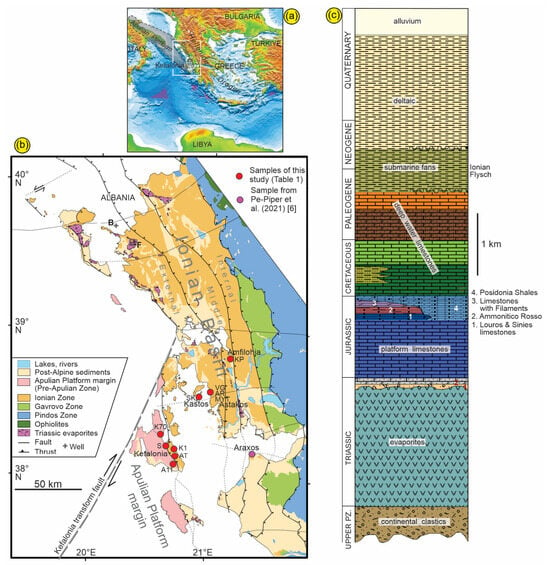
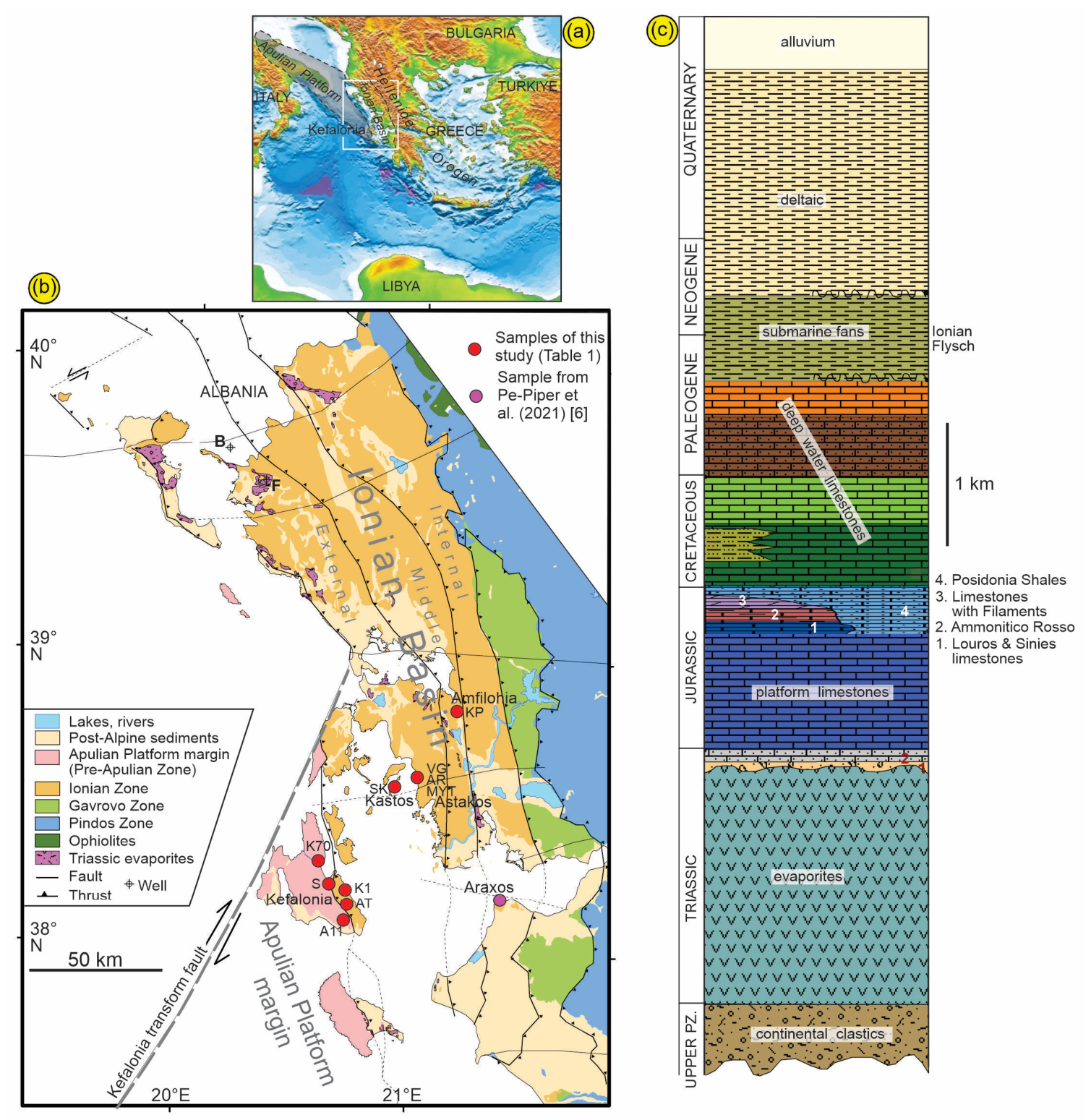
The Ionian Zone of western Greece (Figure 1) is a Mesozoic extensional basin (Ionian basin) floored by 1–2 km of Triassic salt (halite), other evaporites, and some clastic sedimentary rocks [1]. A series of deep-water basins, separated by paleogeographic highs, were initiated in the mid-Jurassic, termed the external, middle and internal Ionian Zone from west to east. Limestone sedimentation terminated in the Late Eocene as the Ionian Zone transitioned to a clastic foreland basin in front of the advancing external Hellenide nappes. By the Miocene, the basin was inverted and thrust westward [2,3].
Figure 1.
(a) Location of the study area in western Greece. (b) Geological map of the Ionian Zone in northwest Greece showing location of samples (based on [3]). B = Butrinti-1, F = Filiates-1 wells. Red dots show sample locations. (c) Stratigraphic succession in the Ionian Zone (modified from [1,2]).
Previous studies of the diagenesis of the Ionian basin limestone–shale succession by the authors include a study of the megascopic variability in chert concretions with mineralogy based on X-ray diffraction and petrographic microscope observations [4,5]. One set of samples from an area of salt diapirism south of Araxos preserved a more complex set of diagenetic minerals, identified by scanning electron microscope (SEM) and energy dispersive spectroscopy (EDS), that suggested the migration of saline basinal fluids [6]. The redox state of formation waters in the external Ionian subbasin was interpreted from the pseudomorphs of pyrite concretions preserved in the limestones [7], with the ingress of oxidizing meteoric water following the uplift of the Apulian margin in the Early Paleogene.
Chert concretions in limestones record a more complete record of diagenetic minerals than either their host limestone or interbedded shale [6]. Many chert concretions and beds form from opal precursors during early diagenesis [8] and recrystallize to quartz at higher temperatures during burial [9], creating pervasive microporosity [10,11]. Additional quartz may precipitate during late burial diagenesis without an opal precursor [12,13]. Basin inversion, in many cases, creates fractures in brittle chert [14].
The previous studies by the authors made observations and interpretations of diagenesis at a single locality [7] or, at the most, two localities [6]. The purpose of the present study is to determine any variation in basinal diagenesis (a) across the width of the Ionian Zone, including the outer part of the Apulian platform in the west, and (b) from the Lower Jurassic to the Paleogene. Any observed variability is then related to basin architecture and tectonic history.
2. Geological Setting
The Mesozoic Ionian Zone basin was located on the thinned continental crust of the Apulia microcontinent, which rifted away from Gondwana during the complex opening of the Neotethys Ocean [15]. The Ionian Zone is bounded to the east by the Gavrovo Platform and the deep-water Pindos Basin with oceanic basement rocks [16]. From west to east, the Ionian Zone is subdivided into three sub-basins: external, middle, and internal [3] (Figure 1b). Within those sub-basins, smaller north–south trending half-grabens formed [2] and WSW–ENE strike-slip faults acted as transfer faults between different graben segments [17]. To the west, the Ionian Zone is bounded by the Apulian platform margin, known in the literature as the Pre-Apulian Zone.
The stratigraphy of the Ionian Zone has been reviewed by Karakitsios [2] and Zelilidis et al. [3]. Exploration wells drilled in Italy on the Apulian platform (Figure 1a) penetrated < 3.6 km of Upper Triassic carbonates and evaporites, including > 2 km of anhydrite unconformably overlying Upper Permian to Lower Triassic continental clastic sediments [18]. In the east of the Ionian Zone, outcrops and well intersections are principally anhydrite or solution breccias. In the west, thick anhydrite is underlain by 1.5–2.5 km of halite in the Butrinti-1 and Filiates-1 wells (Figure 1b) [1]. Salt tectonic structures are widespread in the basin and are characteristic of halite deformation [1]. Although halite thicknesses may have been increased by salt tectonics, extensional subsidence in the Late Triassic–Early Jurassic was sufficient to create accommodation for the evaporites and the 2 km of overlying dolomites and limestones (Figure 1c).
A new phase of extension began in the Pliensbachian (middle Early Jurassic), evidenced by deeper-water sedimentary facies, rapid lateral lithological change, and mass-transport deposits. These rocks include the Late Pliensbachian Sinies Fm, the Toarcian–Aalenian Ammonitico Rosso Fm and the Bajocian–Callovian Limestone with Filaments Fm (1–3 in Figure 1c), all of which were deposited on bathymetric highs, and the Posidonia Shales deposited in deeper water, all with a total thickness generally <300 m. The Lower Cretaceous pelagic Vigla Limestone Fm is intercalated with shale. The Upper Cretaceous Senonian Limestone Fm comprises pelagic limestone intercalated with resedimented breccia units; similar limestone facies accumulated through the Paleocene to the Middle Eocene. The Upper Eocene comprises marly limestone and shale overlain by a 2 km thick sequence of clastic turbidites of the Ionian flysch, from the Late Oligocene and Early Miocene (Aquitanian) ages. The flysch is overlain unconformably by Middle to Upper Miocene terrestrial conglomerate and sandstone.
The Ionian Zone consists of a series of thrust sheets with westward vergence, stacked over the Pre-Apulian Zone [3]. These thrusts repeat the thick Mesozoic carbonate succession and the overlying flysch. The thrusting began in the Late Oligocene in the internal subzone, becoming younger toward the west with a piggyback sequence. In the external subzone, the thrusting took place in the Pliocene [1]. The salt structures include salt pillows, isolated salt plugs and diapirs, together with salt walls and thrust welds. Middle Jurassic to Early Cretaceous salt mobility was responsible for salt-related minibasins in which deep-water sediment facies accumulated [1]. These salt bodies were then shortened during Cenozoic thrusting.
Most of the available data on clay minerals in shales are from the Cretaceous of the Ionian basin and the Oligo-Miocene flysch. Shales in the Ionian basin, from the Middle Jurassic to Eocene age, consist principally of illite/muscovite and chlorite, with lesser montmorillonite and mixed layer illite/smectite, and have no systematic variation in smectite with age [19,20,21]. In the flysch, illite predominates with common smectite, lesser kaolinite and minor chlorite [22]. Given the structural complexity of the Ionian Zone, controls on clay mineral assemblages are difficult to discern.
3. Materials and Methods
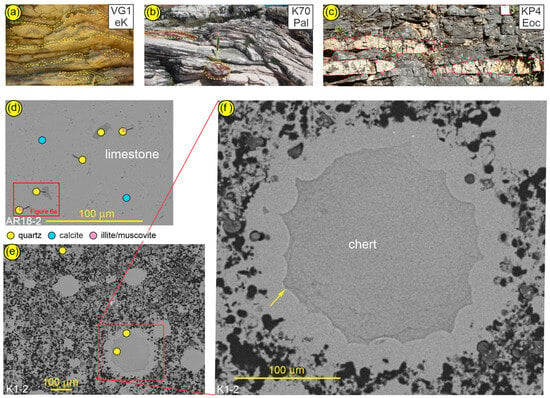
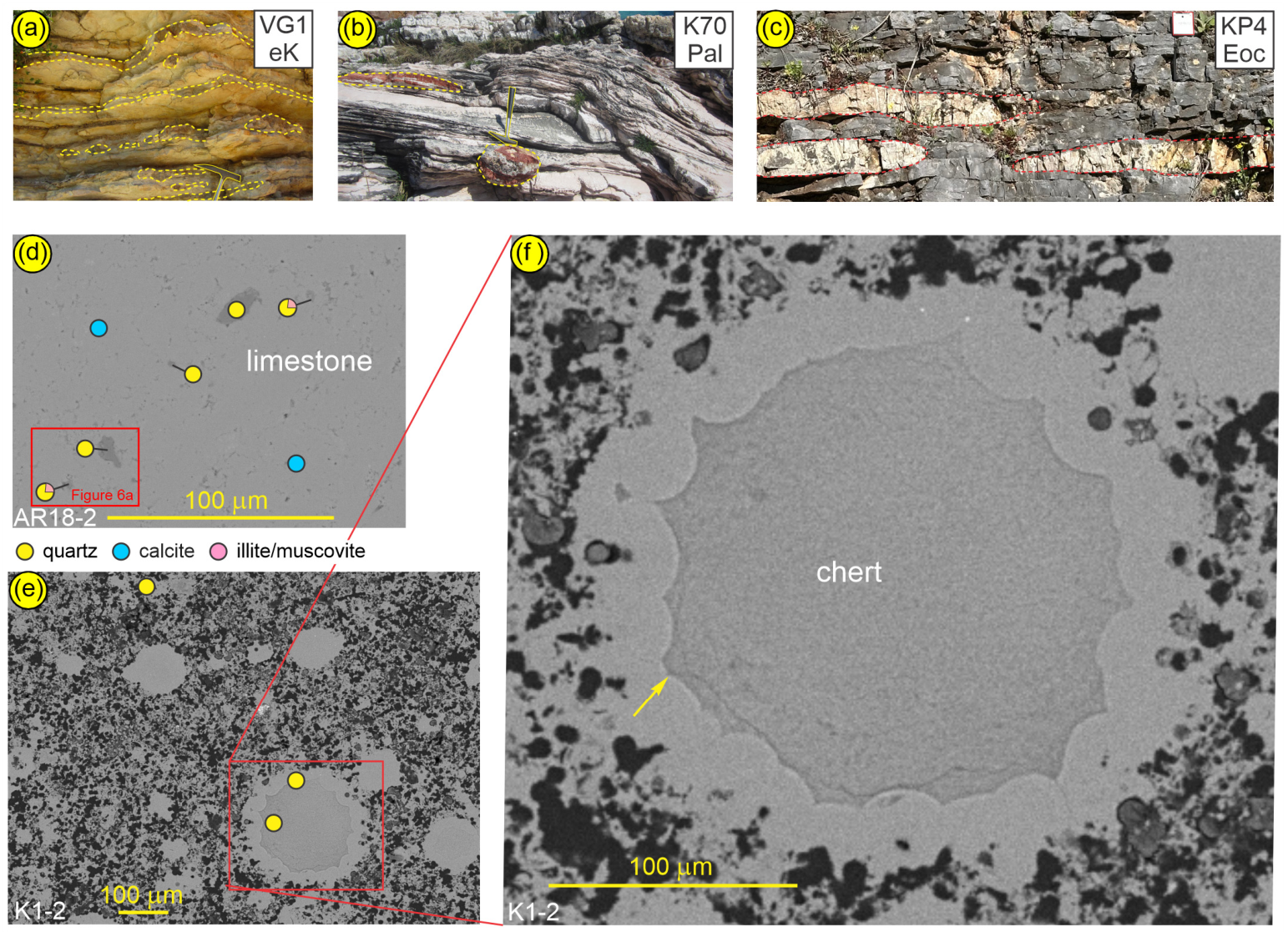
Siliceous (chert) concretions were collected from a broad cross-section of the Ionian Zone in central Greece, across a range of stratigraphic levels from Middle Jurassic to Eocene (Table 1). Concretions were either sub-spherical or elongated in the bedding planes of the host limestone (Figure 2a–c). Additional incidental observations were made on veins and pores in host limestones. Samples were located on the island of Kefalonia, the north coast of Astakos, the island of Kastos, and the area near Amfilohia (Figure 1b).
Table 1.
Samples used in this study.
Figure 2.
(a–c) Field photographs of sampled chert concretions showing sub-spherical to highly elongate forms. Hammer or compass for scale. (d–f) BSE images of spherules of silica in porous chert. Arrows show contact between brighter backscatter silica and lower backscatter silica, probably with micropores. Coloured circles indicate minerals identified by EDS geochemical analyses. K1, Limestone with Filaments, Pyrgi, Kefalonia.
Polished thin sections were prepared for all samples and were examined by optical microscope. Twenty samples were selected for detailed study (Table 1). These thin sections were coated with carbon and analyzed on a Leo 1450 VP scanning electron microscope (SEM) (Zeiss, Jena, Germany), with an INCA X-max 80 mm2 silicon-drift detector energy dispersive spectroscopy (EDS) system (Oxford Instruments, High Wycombe, UK). The resolution of the SEM is 3.5 nm at 30 kV, and the EDS has a detection limit of >0.1%. The EDS system uses a single cobalt standard. For elements above Ne in the periodic table, present in abundances >2%, the precision is better than 1%. Back-scattered electron (BSE) images show mineral textures, and EDS analyses were used to identify minerals. Mineral abbreviations are those of the IMA [23]. All the EDS analyses are presented in the Supplementary Materials listed in Table 1.
The samples are fine-grained and the diameter of the beam used for the EDS analyses was ~10 microns, resulting in many analyses that contain more than one mineral component, especially for later minerals that appear to fill micropores and/or hairline veinlets in the host rock. Pure mineral analyses generally can be readily distinguished from mineral mixtures. Details for distinguishing goethite from hematite are based on the criteria of [7]. Chemical analyses alone cannot distinguish the polymorphs of titanium oxide, but diagenetic titanium oxide minerals are generally either anatase or brookite [24,25]. Many clay minerals are small, and their identification as illite/muscovite and/or chlorite is based on the relative abundance of K, Al, and Mg. Published studies [19,20] show that these are the two principal clay minerals present in the basin. The analyses are inadequate to identify smectites and vermiculites, which may also be present.
Small pores filled by epoxy, used to mount the rockslide, show analytical totals of 10–20% by EDS because the elements C, H and O in epoxy are not determined by EDS. Large voids with only thin epoxy detect only silica in the glass slide, with analytical totals of 55–60%. Calcite shows analytical totals of 53 ± 1% because the carbonate component is not measured.
4. Results
4.1. Replacement of Limestone by Silica
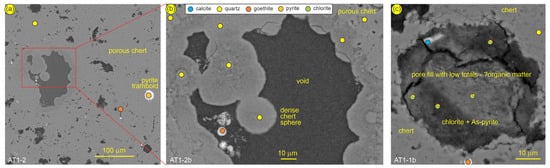
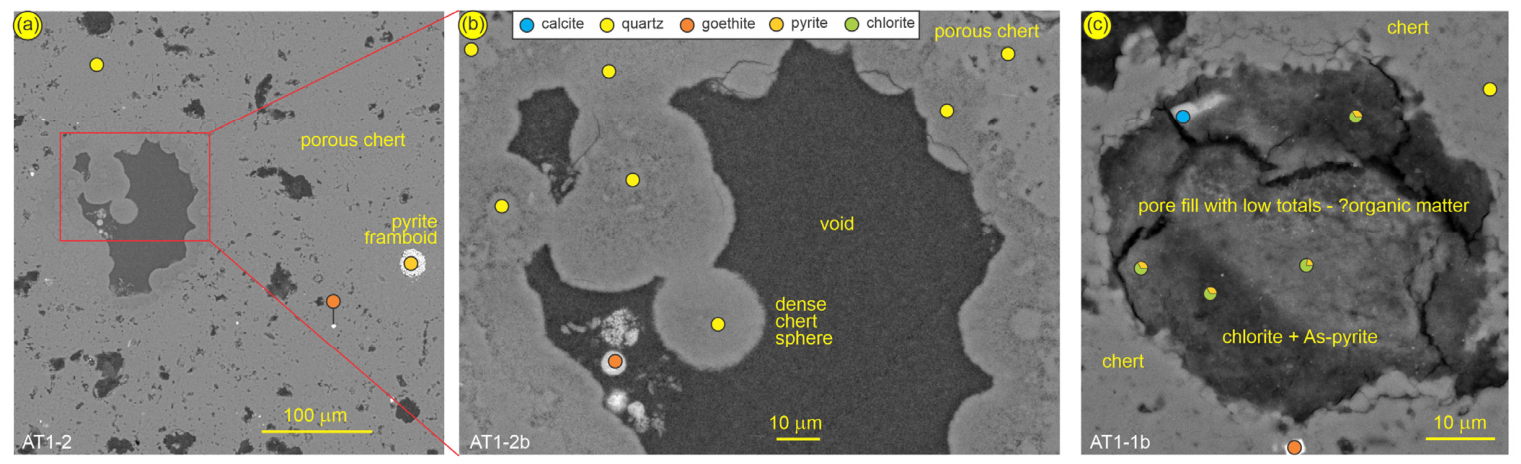
Three principal microtextures of the replacement of limestone by silica are observed. (a) In some cases, limestone is partially replaced by silica, filling voids on a ten-micron scale or smaller (Figure 2d). (b) A second common microtexture is the complete replacement of carbonate by silica, on a millimetre to decimetre scale, but the silica has prominent porosity at a 5–20 μm scale (Figure 2e). That porosity may be partly filled by a variety of diagenetic minerals. (c) The third type of microtexture comprises silica lacking porosity that is resolvable by SEM. In many cases, such chert occurs in spherules 50–200 μm in diameter (Figure 2f), which show optical continuity under crossed polars. In Figure 2f, such a spherule has a 20 μm wide outer rim that has higher backscatter and lobate hemispherical contacts with the central lower backscatter silica. This central lower backscatter silica has slightly lower analytical totals by EDS and appears to have sub-micron-scale porosity. In other cases, the silica appears to have grown as spherules into larger pores, estimated to have a scale of 30–200 μm (Figure 3a,b). The outer 10 μm has the highest backscatter, whereas the interior of the spherules has sub-micron porosity (Figure 3b).
Figure 3.
BSE images of large pores in chert concretion filled by spherules of chert. AT1, Limestone with Filaments, Kefalonia. (a) General BSE image showing porosity in chert; partly oxidized pyrite framboid has 42 wt% S. (b) Details of silica spherules grown into pore, also showing a small goethite spherulite. (c) Detail of fill of chlorite and pyrite (with 45 wt% S and a small fractionof As) in small pore. Individual crystals are not resolved; low analytical totals of 30–70% indicate porosity or organic matter.
4.2. Bedded Chert Alternating with Limestone
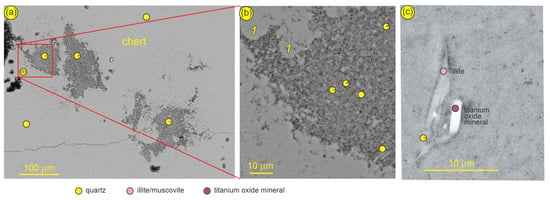
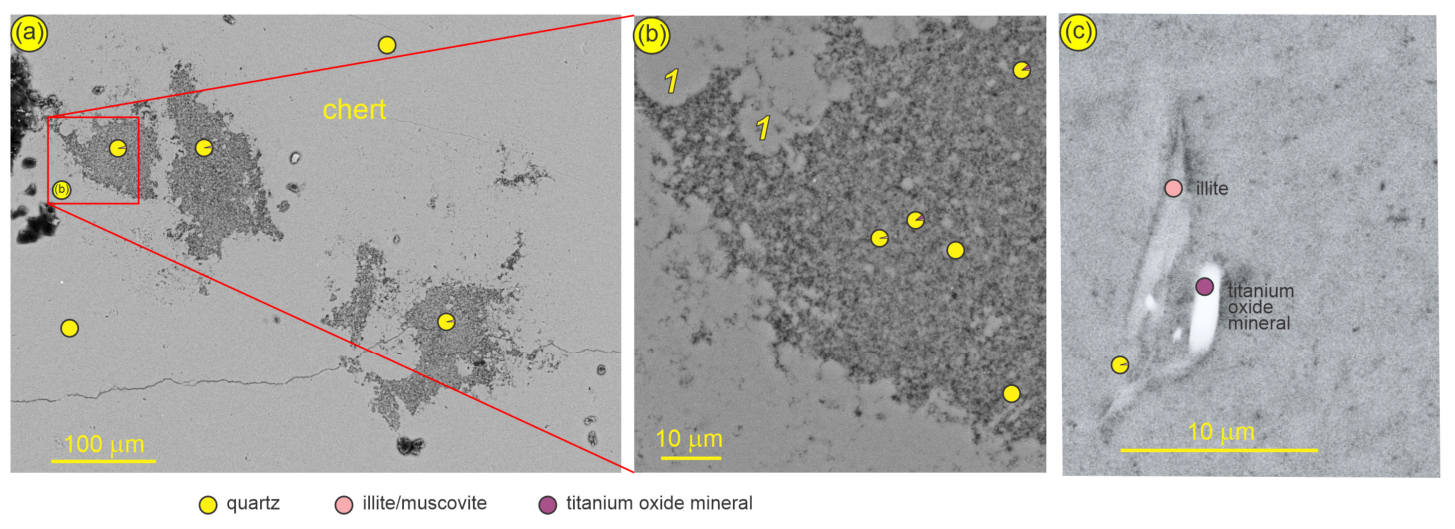
At the top of the Sinies Limestone, a 10 cm thick bedded chert overlies limestone with centimetre-scale chert concretions. The bedded chert is mostly massive (Figure 4a) with irregular patches of quite porous chert with micron-scale pores. Spherulitic quartz is found at the margins of some of the porous chert patches (1 in Figure 4b). The porous chert includes ~10 μm laths of muscovite or illite and a titanium oxide mineral (Figure 4c).
Figure 4.
BSE images of bedded Jurassic chert. Top of Sinies Limestone, 10 cm thick chert bed, sample MYT13. (a) General view of the main massive chert with irregular patches of porous chert. The porous chert has small amounts of muscovite and a titanium oxide mineral in spot analyses. (b) Zoom-in of porous chert. 1 = massive chert spherules. (c) Zoom-in of massive chert showing crystallites of a titanium oxide mineral and muscovite. Massive chert may have sub-micron-sized pores (dark speckles).
4.3. Minerals Other than Silica and Carbonate Minerals
Minerals other than silica and calcite are found in a variety of settings. Original detrital terrigenous material may be concentrated in stylolites or by expulsion during the diagenetic growth of silica or other concretions. Pyrite is the most common sea-floor diagenetic mineral [7], and a variety of mesodiagenetic minerals occupy the pores or veins in the cherts and limestones [6]. Apatite may be of biogenic or authigenic seafloor origin [26,27].
4.3.1. Stylolites
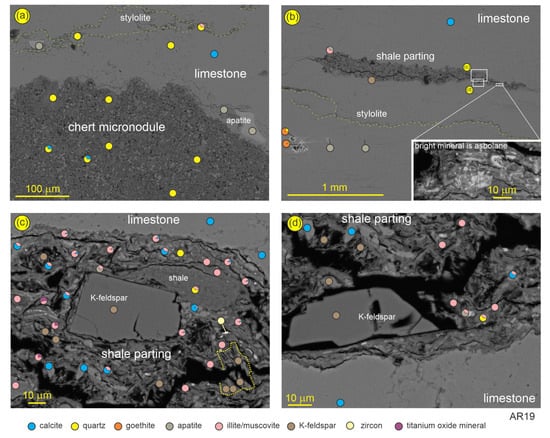
Stylolites are readily identified by petrographic microscope and appear to concentrate non-carbonate impurities in the limestone, principally clay minerals (Figure 5b). The stylolites have a characteristic zig-zag pattern when viewed orthogonal to bedding and cross-cut bedding.
Figure 5.
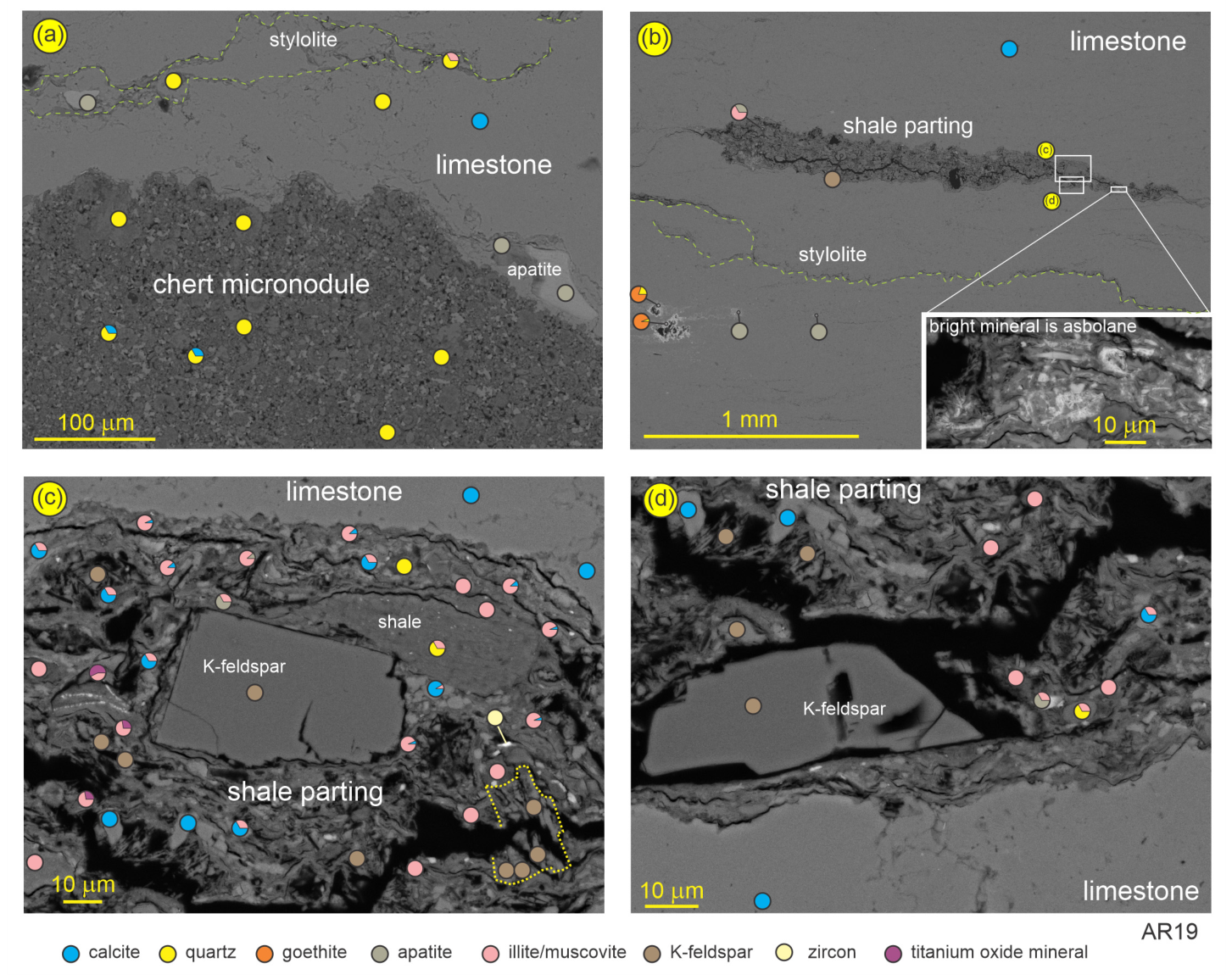
BSE images of limestone with chert microconcretions and shale partings. AR19, Sinies Limestone, north of Astakos. (a) Limestone with chert microconcretion in which there is residual carbonate also shows a stylolite that has concentrated a shale parting. (b) Limestone with stylolites and shale parting. (c,d) Detail of shale parting showing ~ 50 μm K-feldspar, illite of variable size and minor quartz.
4.3.2. Shale Partings
Discontinuous laminae, principally of clay minerals (Figure 5a–d), may represent original clay deposition below the carbonate compensation depth or may have formed by the expulsion of impurities during limestone recrystallization. The abundance of euhedral K-feldspar in some laminae (Figure 5c,d) may be diagenetic or may be derived from an original airfall felsic tuff.
4.3.3. Pyrite and Its Pseudomorphs
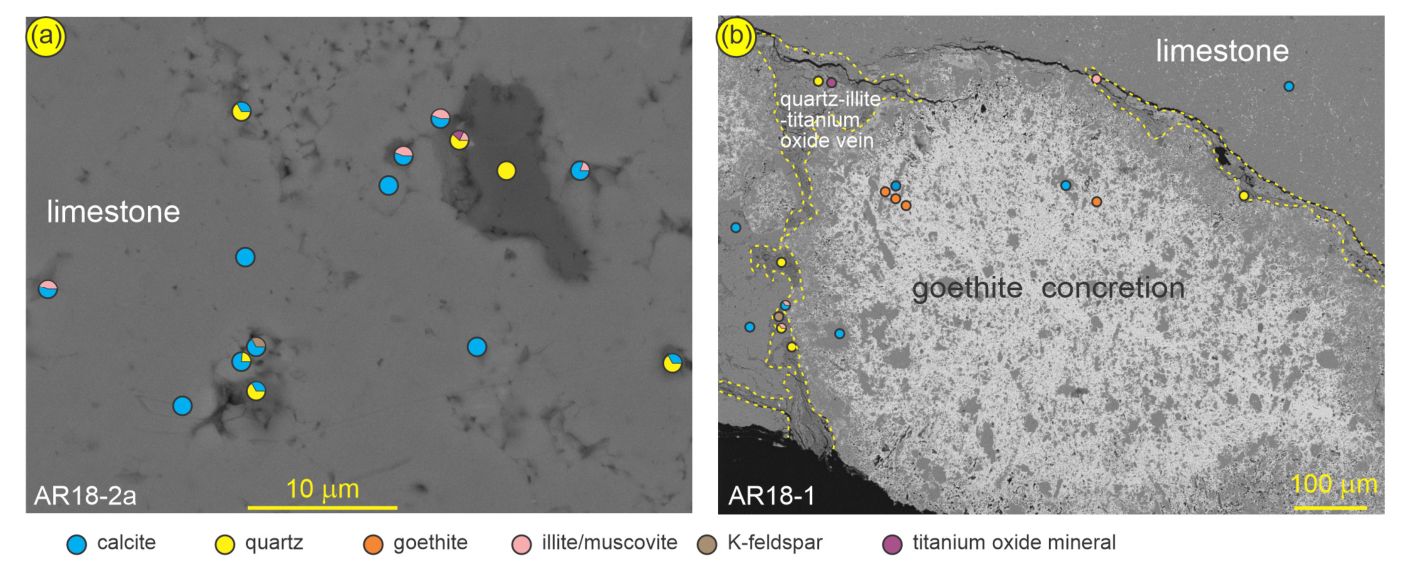
Goethite concretions in limestone (Figure 6b) have been previously reported by [7] and likely represent pseudomorphs of original pyrite concretions. A few cherts contain ten-micron-scale framboids of goethite (Figure 3b), some of which contain minor residual sulphur. Cubic crystals of goethite pseudomorphing pyrite in chert also have minor amount of sulphur, copper and zinc (Figure 7g–j). These appear to be analogous to larger pyritic concretions in the Limestone with Filaments Fm described by [7]. Pyrite with a small fraction of As has also been found in a pore with chlorite (Figure 3c) and pyrite with stoichiometric FeS2 is found in sample KP2.
Figure 6.
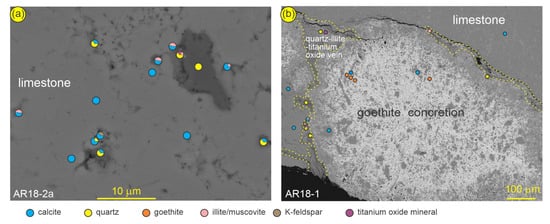
BSE images of limestone with chert in pores, goethite concretion, and veins of diagenetic minerals. Sample AR18, Sinies Limestone, north of Astakos. (a) Zoom-in of typical host limestone showing ~5 μm intergranular pores partially filled by quartz, illite, K-feldspar and a titanium oxide mineral. (b) Goethite concretion, showing marginal veins of quartz–illite–titanium oxide–K-feldspar.
Figure 7.
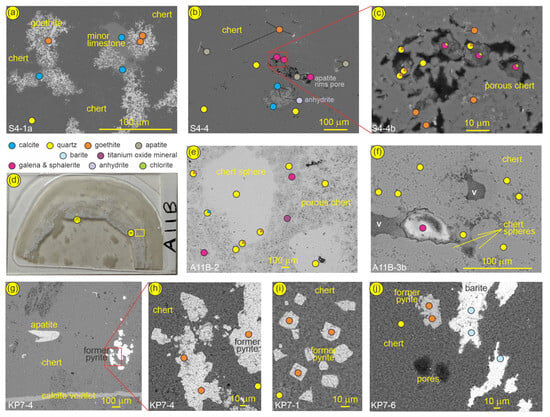
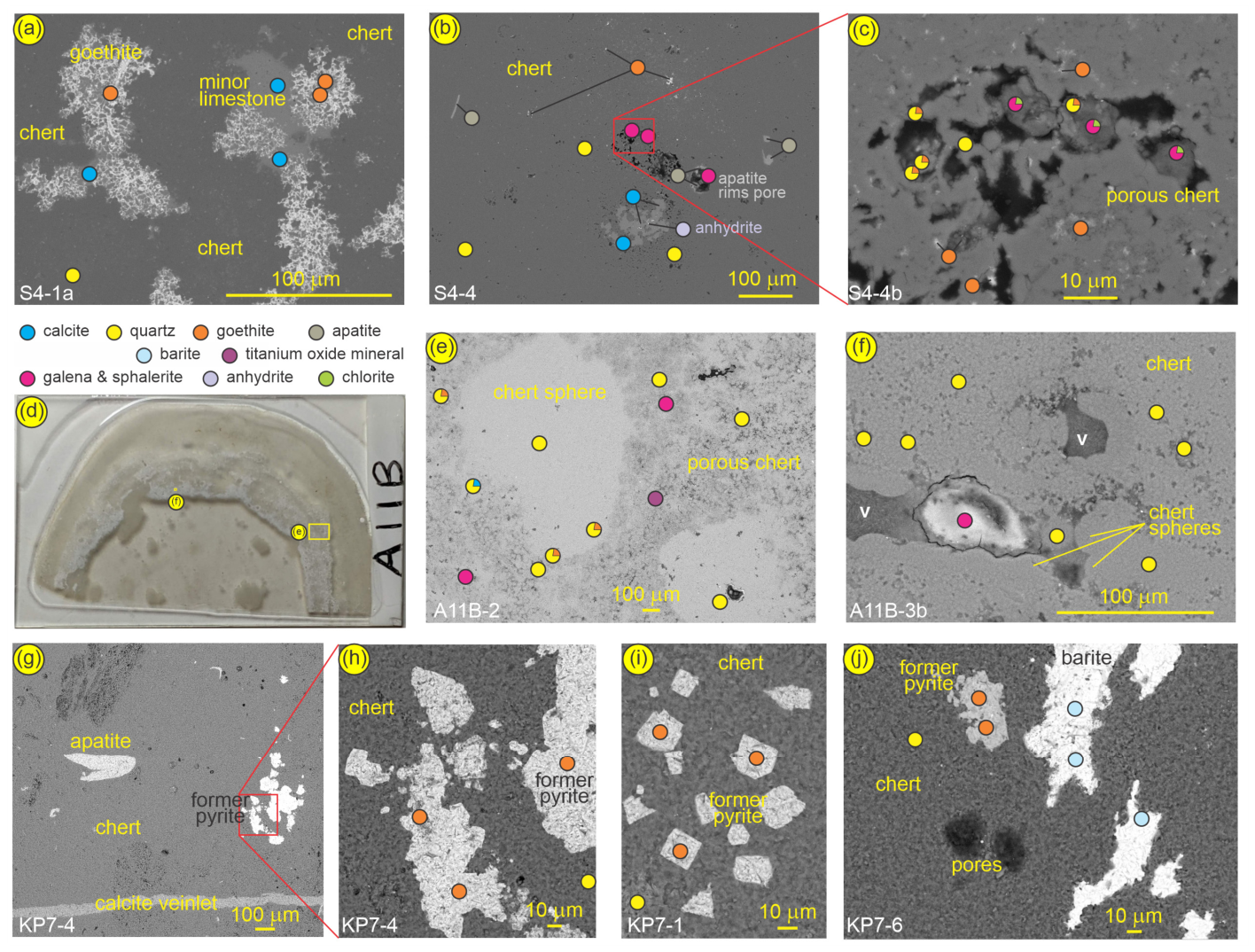
BSE images of diagenetic minerals in cherts. (a–c) Large chert concretion S4, Paleocene, Sami, Kefalonia, showing (a) local fibrous goethite with 0.3% Ni and (b,c) pores with micron-scale sphalerite, galena and anhydrite. (d–f) Large chert concretion A11B, Late Cretaceous, southeast Aenos, Kefalonia. (d) Photograph of thin section showing complex zoning. (e) Chert with silica spheres and more porous chert that includes minor calcite, sphalerite, galena and a titanium oxide mineral with 0.3% Zr. (f) Detail of porous chert showing sphalerite–galena in pores that are rimmed by low-porosity quartz hemispheres. v = void. (g–j) Chert concretion KP7, Early Cretaceous Vigla Limestone, Amfilohia. (g) General view of chert with calcite veinlet, apatite bioclast and goethite pseudomorphing pyrite. (h) Detail of goethite with cubic outlines pseudomorphing pyrite, mean S content of 0.9%. (i) Chert with goethite pseudomorphs of original cubic pyrite, mean S content of 0.8 wt%. (j) Chert with ~25 μm pores, irregular masses of barite, and goethite after pyrite.
4.3.4. Chert-Margin Minerals
In some cases, apatite grains appear concentrated in limestone along the contact with chert (Figure 4a), as if concentrated during the formation of the chert concretion. Some of the features interpreted as veins might also be produced by expulsion during the crystallization of the original pyrite concretions (Figure 6b).
4.4. Vein- and Pore-Filling Mminerals
4.4.1. Basinal Mesodiagenetic Minerals
Some pores contain diagenetic minerals that previous work [6] has argued is the result of burial diagenesis prior to basin inversion. Examples include pores in chert and limestone with minor titanium oxide minerals (Figure 4c, Figure 6b and Figure 7e) and limestone with K-feldspar and illite filling irregular voids (Figure 6a).
Two samples of chert from Kefalonia island have fine-grained crystals of both sphalerite and lesser galena in pores, in a proportion of 2:1 sph:gn in A11B and 5–10:1 sph:gn in S4 (Figure 7e,f and Figure 7b,c, respectively). Samples S4 and VG1 also have minor anhydrite (Figure 7b). Limestone K73 from north of Astakos has sphalerite in voids and, in one case, a small amount of galena is also present. Sphalerite (but no galena) is also present in sample KP3 from Amfilohia and in the samples from Araxos [6].
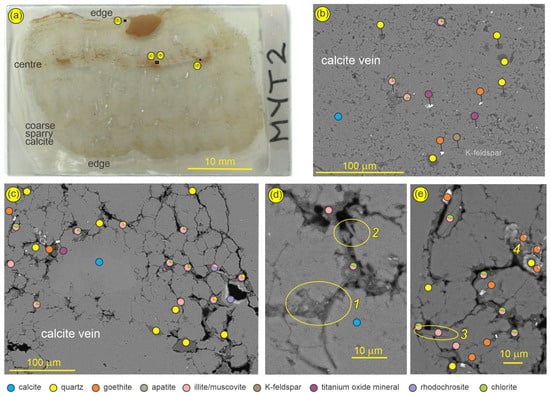
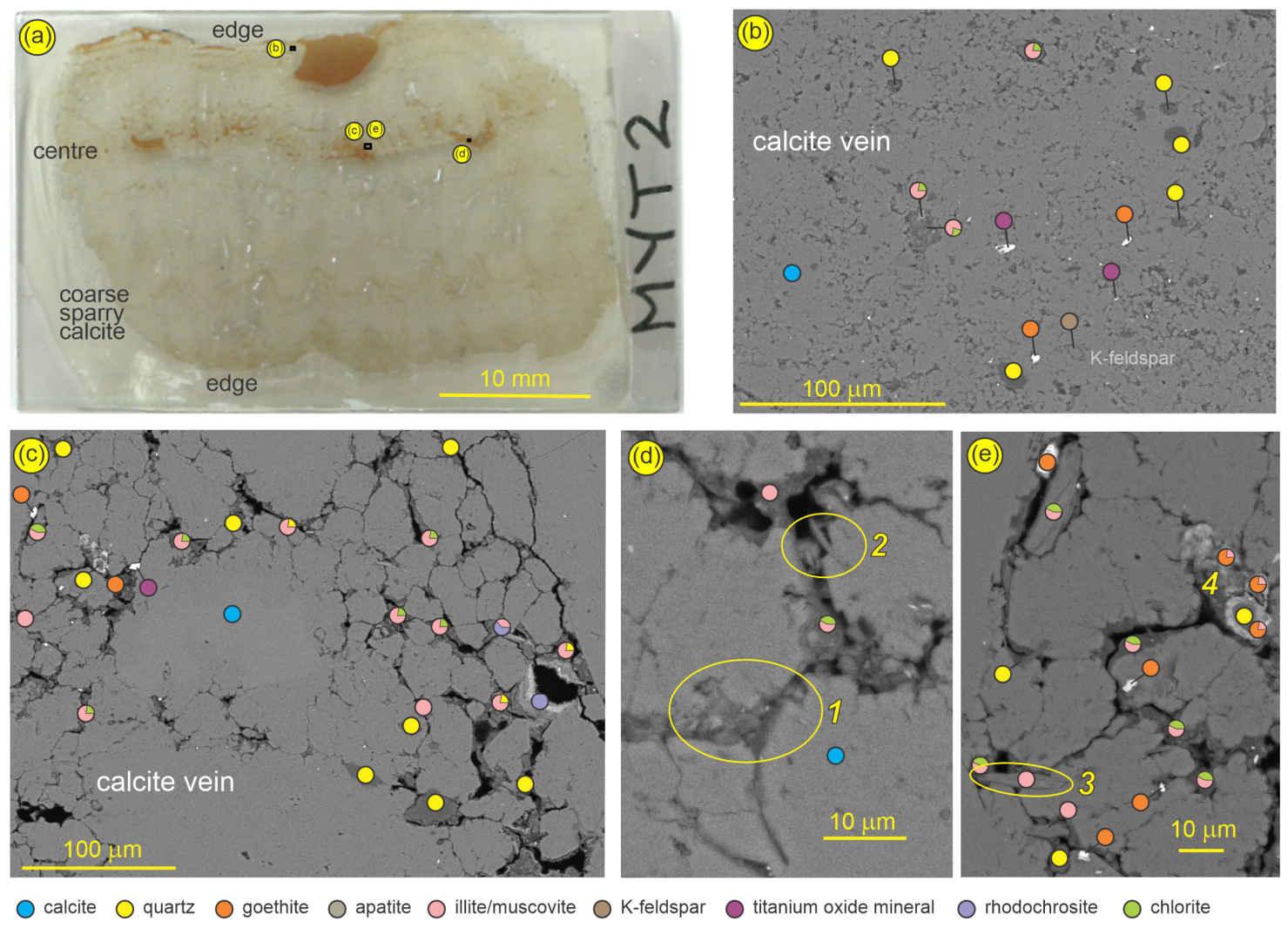
A cross-cutting sparry calcite vein in limestone (Figure 8) from a mass-transport deposit of Ammonitico Rosso limestone [28] appears to have grown asymmetrically during progressive widening. Goethite and rhodochrosite in the centre of the vein (Figure 8c) appear brown in the thin section (Figure 8a). Micron-sized pores in the vein have a titanium oxide mineral, K-feldspar, illite + chlorite, and some silica (chert) patches (Figure 8b). The clay minerals appear to be intergrown with the host calcite (Figure 8d,e).
Figure 8.
Thin section photograph and BSE images of a sparry calcite vein in Ammonitico Rosso Limestone, north coast of Astakos, sample MYT2. (a) Thin section of sparry calcite vein that filled asymmetrically. (b) Near margin of vein. (c) General view of centre of vein showing sparry calcite crystals with interstitial grains of quartz, hematite, and muscovite–chlorite. Late rhodochrosite and limonite partly fill large pores. (d,e) Zoom-in images showing details of interstitial minerals. 1 = Quartz and muscovite–chlorite filling embayment in calcite. 2 = Platy silicate mineral intergrown with euhedral calcite. 3 = Illite/muscovite lath intergrown with calcite. 4 = Larger pore with late goethite.
4.4.2. Telogenetic Diagenetic Minerals
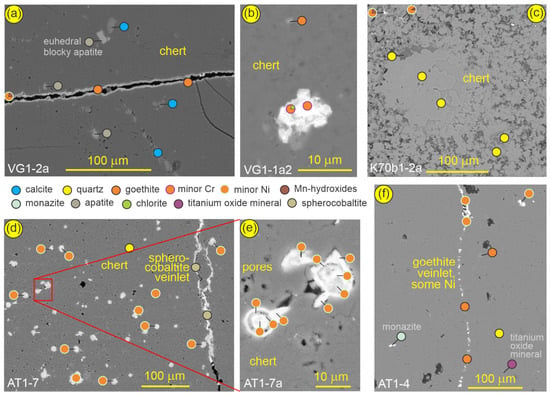
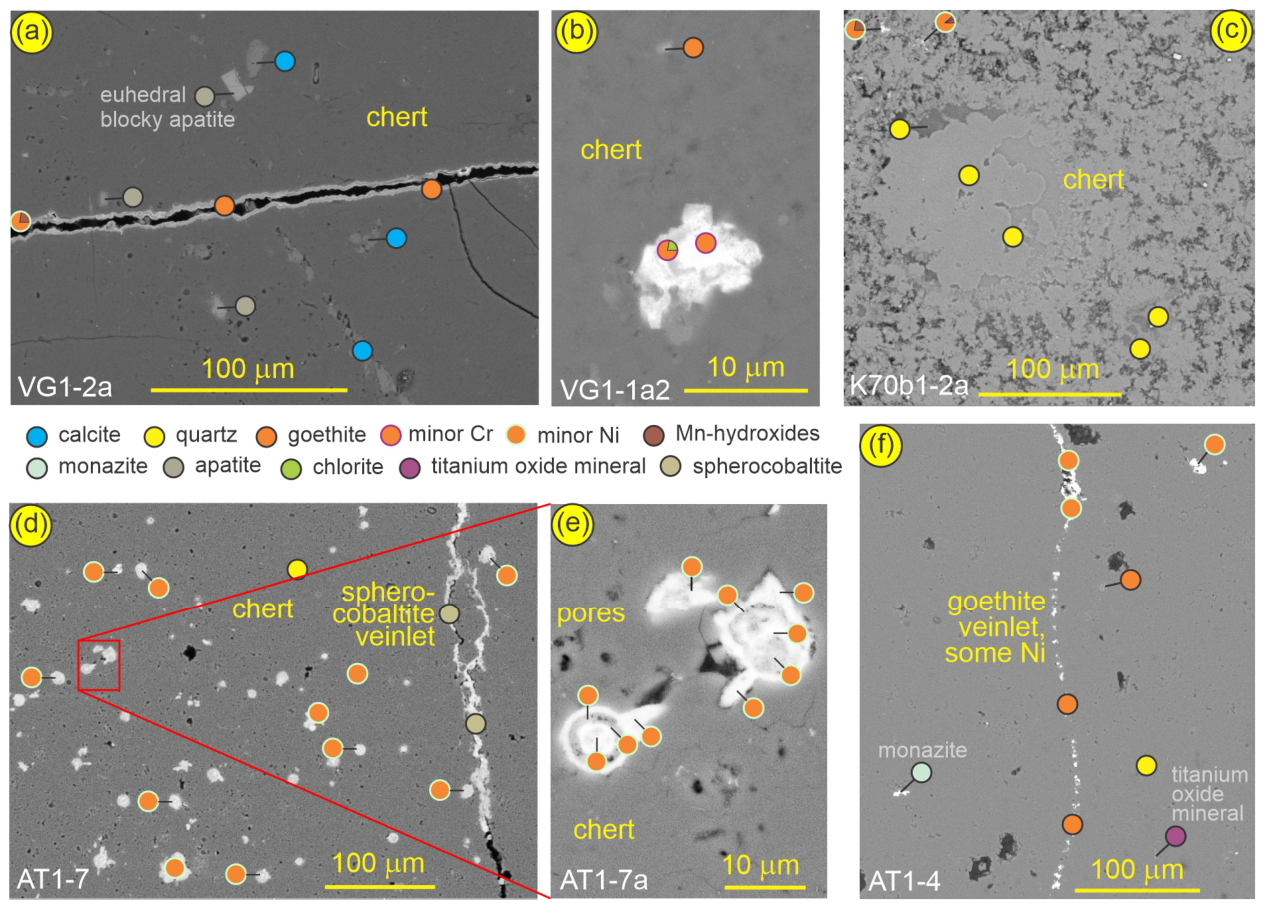
An assemblage of late minerals in pores and cross-cutting veins was previously interpreted as resulting from meteoric water circulation following nappe emplacement in the mid-Cenozoic. Distinctive veins of goethite show enrichment in minerals containing Mn, Co and Ni, the latter of which is derived from ophiolitic detritus in flysch [6,7]. In the present study, late goethite is represented by dispersed feathery crystals with <0.3% Ni occurring with residual limestone in chert concretions (Figure 7a) and by late veins of goethite with up to 7% MnO and 0.3% Ni (Figure 9a). In the same sample, 10 μm crystal aggregates of subhedral prisms of goethite (Figure 9b), perhaps in pores, have < 0.7% Cr.
Figure 9.
BSE images of examples of telogenic diagenetic minerals in chert. Sample numbers indicated on lower left of image. (a) Vein of goethite with <5% Mn and <0.3% Ni. (b) Subhedral aggregates of prisms of goethite with < 0.7% Cr. (c) Porous chert with rare subhedral aggregates of goethite with < 14% Mn and <1.5% Ni. (d) Vein of spherocobaltite with 2–4% Ni and spherules and crystal aggregates of goethite with 2–3% Ni. (e) Detail of concentric spherules of goethite with 2–4% Ni. (f) Vein of discontinuous aggregates of goethite; larger aggregates have ~1% Ni and small grains of a titanium oxide mineral and monazite.
Paleocene porous red chert has rare dispersed 2–5 μm aggregates of subhedral prisms of iron (hydr-)oxide with up to 14% Mn and 1.5% Ni (Figure 9c). The aggregates also include some minor titanium oxide mineral and unidentified aluminosilicates, perhaps from earlier basinal diagenesis. Another small aggregate in the same sample consists of a Mn (hydr-)oxide with 15% Co, 8% Ni and 5% Cu (S70b1-2, anal. 35 in Supplementary Material P-6).
Sample AT1 includes veins, typically 10 μm wide, of spherocobaltite (CoCO3), commonly with 2–4% Ni (Figure 9d). The same chert has goethite in veins (Figure 9f), spherulites (Figure 3b), crystal aggregates with 2–3% Ni (Figure 9d) and concentric spherules 10 μm in size, also with 2–4% Ni (Figure 9e). The goethite analyses include around 10% ambient silica and consistently 2–4% Al2O3, 0.8–1.2% P2O5, 0.4–0.7% CaO and 0.2–0.5% Cl. These elements suggest a mixture of the aluminosilicate crandallite [29] and perhaps some apatite, but an excess of Al2O3 remains. The absence of K, Mg and Na suggests the Al is not present in clay minerals or other aluminosilicates and is thus perhaps in gibbsite or another aluminum hydroxide mineral. The same chert sample also includes a 5 μm grain of monazite and a small grain of a titanium oxide mineral (Figure 9f).
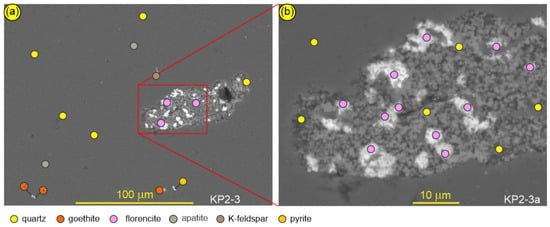
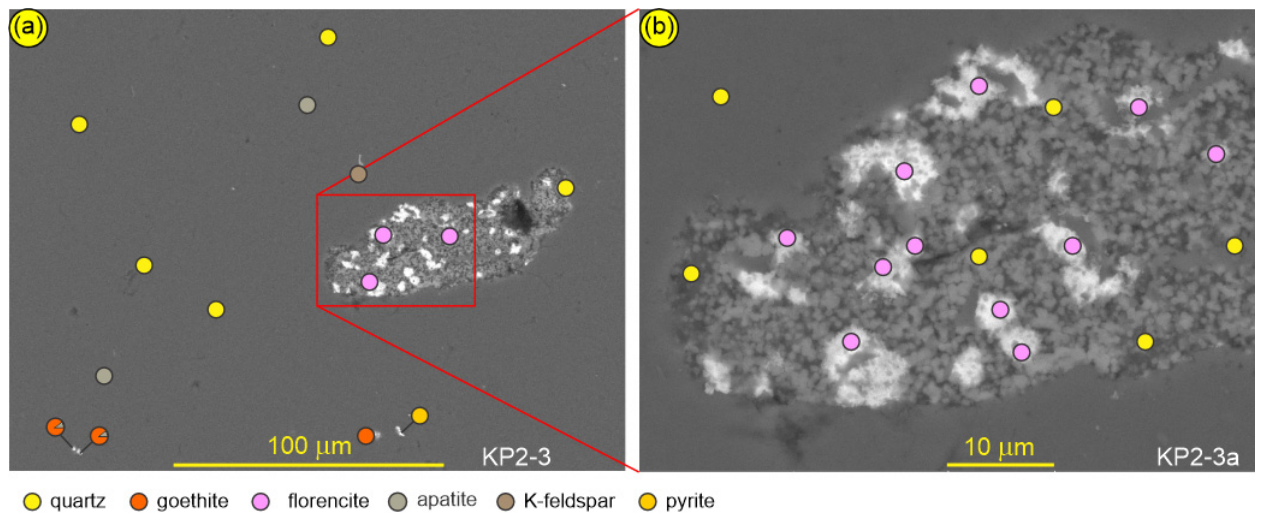
Sample KP2 has patches of porous chert in which aluminophosphate minerals are abundant as fibrous masses a few microns wide (Figure 10 and Figure 11). Small pores in massive chert contain K-feldspar, pyrite, and goethite; small elongate grains of apatite are also present in the chert.
Figure 10.
BSE images of aluminophosphate minerals in sample KP-2, Vigla Limestone, Amfilohia. (a) Chert with a 50 μm pore filled with 5–10 μm aluminophosphates, principally florencite. (b) Detail of texture of pore.
Figure 11.
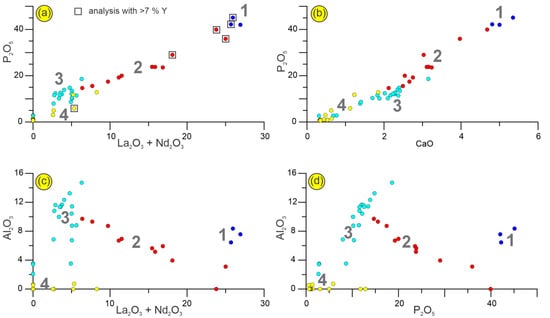
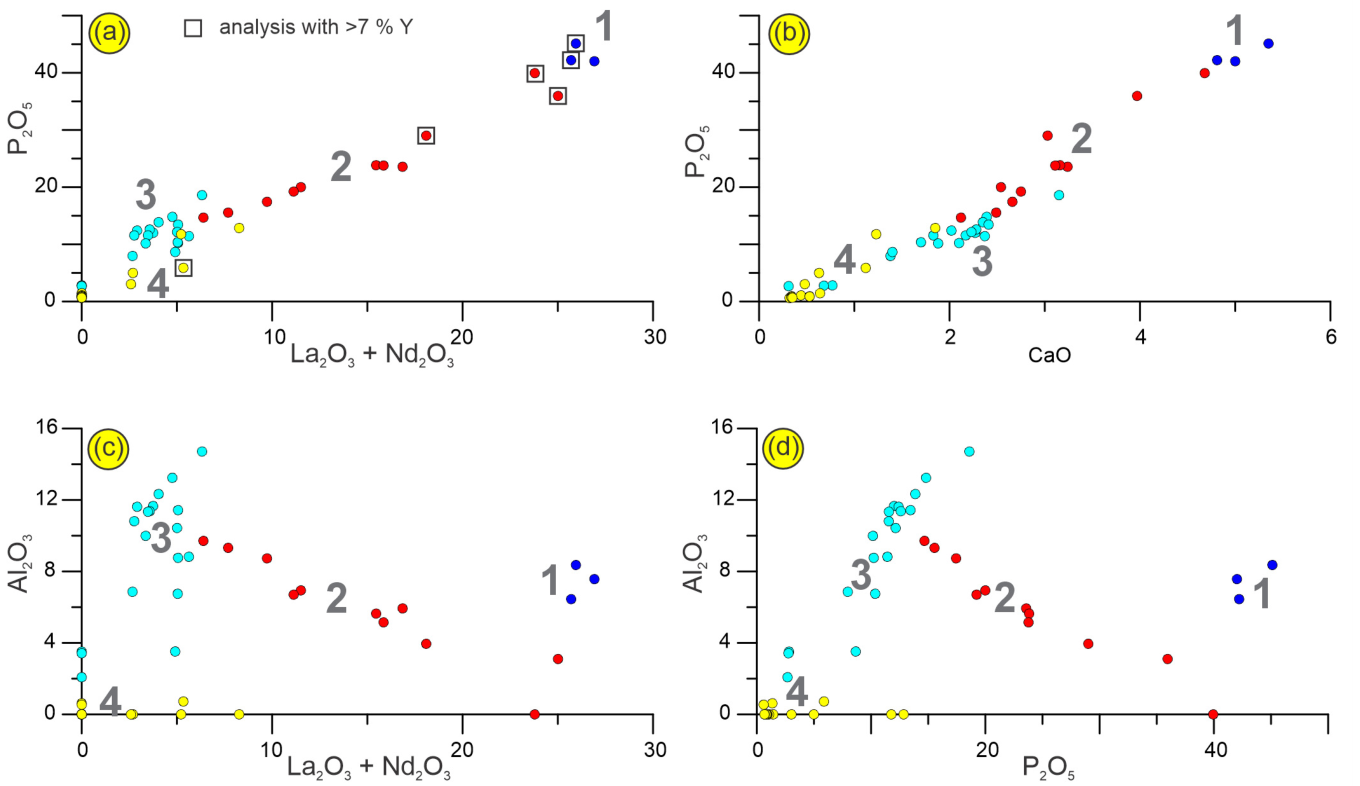
Geochemistry of REE aluminophosphates in sample KP2. All Si, Fe, transition metals, Mg, Na and K removed from EDS analyses and remaining elements recalculated to 100%. Types 1 and 2 are different types of florencite; Type 3 comprises analyses with significant dilution by silica, goethite and perhaps other aluminum-bearing minerals; Type 4 is REE-bearing apatite. (a) P2O5 vs. La2O3 + Nd2O3; (b) P2O5 vs. CaO; (c) Al2O3 vs. La2O3 + Nd2O3; (d) Al2O3 vs. P2O5.
The chemical analyses of the aluminophosphates in sample KP2 show two chemical types of florencite, (REE)Al3(PO4)2(OH)6 plus the REE-bearing apatite Ca5(PO4)3(F,Cl,OH) (Figure 11). Type 1 is from one 50 μm grain and has high REE and P and moderate Al. Type 2 comprises analyses from multiple grains and shows an inverse relationship between Al and P and a strong positive trend between P and REE, thus showing substitution of REE for Al in the monazite structure. Six analyses from four grains have high Y (7—21% Y2O3). A third group of analyses (Type 3) has relatively low P (<19% P2O) and REE and a positive relationship between P and Al, apparently due to variable dilution by Si and other elements in mixed mineral analyses. Type 4, corresponding to apatite, has up to 5% detectable LREE, very low Al and a lower proportion of P for the same REE content compared to florencite.
5. Discussion
5.1. Products of near Sea-Floor Diagenesis in the Ionian Basin
The presence of Jurassic and Cretaceous black shales [30,31,32] points to intermittent dysoxic conditions on the floor of the Ionian basin. The presence of occasional pyrite (Figure 3a,c and Figure 10a) and the widespread occurrence of goethite pseudomorphs after framboidal or cubic pyrite (Figure 3b and Figure 7h,i,j) is evidence that the Mesozoic basin fill had reducing formation waters. In the Limestone with Filaments Fm, pyritized ammonites are common, and large cubic pyrite crystals resulted from Ostwald ripening under burial diagenesis conditions [7].
Parts of the later Mesozoic section in deep-water margins of the Ionian basin are enriched in phosphorus (P) and, in the Upper Cretaceous succession, even consist of phosphorite [26,27]. Phosphorus is enriched in some original pyrite concretions in the Limestone with Filaments Fm [7]. Phosphatic skeletal material of microfossils is noted in some thin sections of Middle Jurassic rocks. Thus, phosphorus was locally available for later diagenetic redistribution.
5.2. The Basinal Mesodiagenetic Assemblage
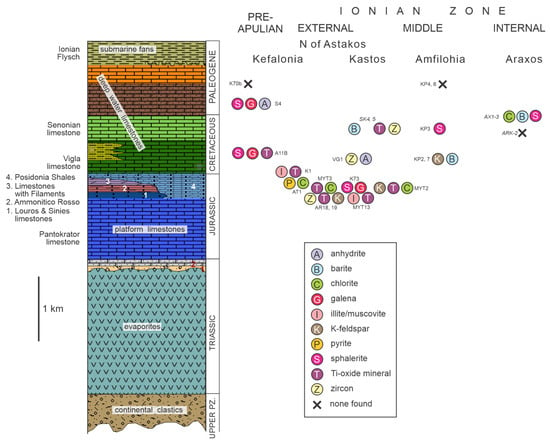
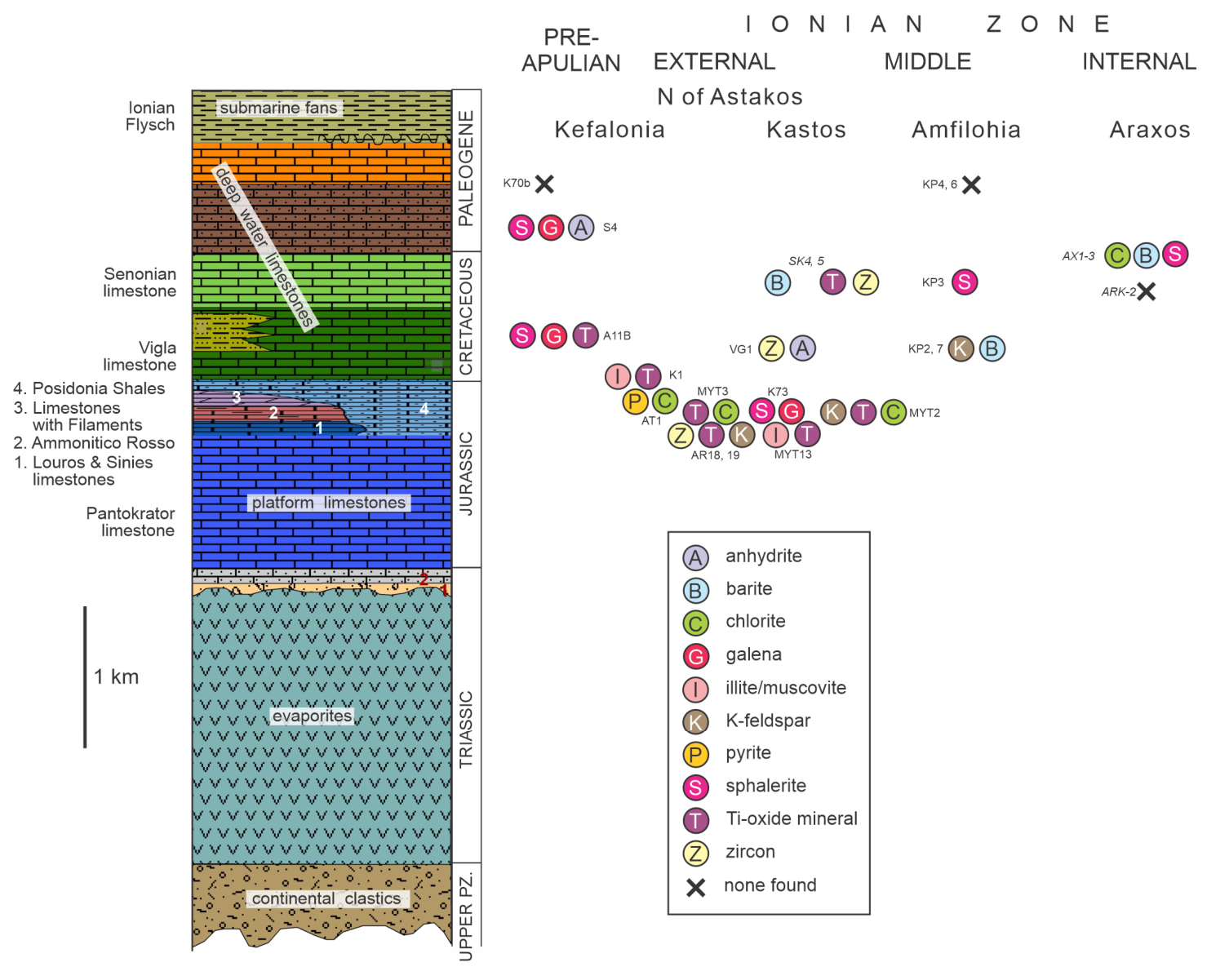
The stratigraphic and geographic variation in mesodiagenetic minerals is shown in Figure 12, including the data from the Araxos locality published by [6]. Rare inclusions of anhydrite in chert are direct evidence for saline formation waters. Given the importance of salt tectonics in the basin [1], it is not surprising that many minerals whose transport is facilitated by halogens are present in the diagenetic assemblage. Sphalerite may form under reducing conditions during hydrocarbon charge [33], but the combination of sphalerite and galena is typical of Mississippi-Valley-type mineralization, forming from high salinity brines at low to moderate temperatures of >75 °C, with an average of 120 °C [34,35].
Figure 12.
Schematic representation of geographic and stratigraphic variation in basinal diagenetic minerals in pores from the Ionian Zone. Coloured dots denote presence of a mineral, regardless of abundance, and align with stratigraphic level. Pyrite is shown only where not largely altered to goethite. Araxos samples from [6]. MYT3, AR18, 19 and K73 are principally limestone; MYT2 is a calcite vein of unknown age in limestone. All other samples are cherts.
Hydrothermal zircon and titanium oxide minerals are common under conditions of diagenesis by saline brines. The neoformation of zircon requires temperatures of >250 °C. The transport of zirconium is favoured by ligands in a low-pH solution, principally fluoride, phosphate and carbonate anions at temperatures >270 °C [36], with zirconium mobilized during the alteration of metamict detrital zircon under low-grade metamorphic conditions. It is likely that sub-salt Permian clastic sediments were the source of Zr for zircon. Zirconium mobility occurred as late as the Late Cretaceous (Figure 12), some 100 Ma after the onset of mid-Jurassic extension, by which time the thermal effects of the rift extension should have largely dissipated, in agreement with well-studied examples such as the Mauléon basin in the Pyrenees [37]. Westward-directed thrust sheet stacking in the external Hellenides in the Miocene would have increased the burial depth of Late Paleozoic clastic rocks beneath the Ionian basin, with the burial depth increasing eastward. Published structural cross-sections in northern Greece [1] and the northern Peloponnese [38] suggest that the internal subzone of the Ionian Zone may overlie upthrust Gavrovo basement. Hence, it is in the middle subzone and the eastern part of the external subzone that zirconium mobility is most likely, consistent with the observed distribution (Figure 12).
There are two potential sources of Ba in barite. In a study of Araxos chert, Pe-Piper et al. [6] suggested that Ba is probably from K-feldspar in felsic intrusions, pyroclastic rocks or arkose. The Hercynian basement east of the Ionian Zone includes granitic gneiss in Kythira [39], and Triassic granite pebbles are found in Pliocene conglomerates near Patras [40], suggesting the potential for the local deposition of arkose. Barite is mostly found in the east of the basin (Figure 12), consistent with such a basement source. Permian clastic rocks in Apulia are relatively quartzose with a low feldspar content [41]. Alternatively, we now recognize that Ba may be derived from high productivity during oceanic anoxic events (OAEs), including the Toarcian OAE (Posidonia shales) and the Aptian–Albian OAE (Vigla Shales). We found only two chemical analyses for Ba in black shales in the Ionian Zone of Greece (78 ppm in Posidonia Shale; 150 ppm in the Vigla Shale [42]), but in equivalent rocks in Albania, cherty limestones from the Toarcian OAE have Ba values of 1210, 2620 and 6200 ppm [43,44], compared with the PAAS average of 650 ppm. Elevated Ba (350–950 ppm) is also reported from the Late Santonian OAE in the Pindos Zone equivalent in Montenegro [45]. The presence of barite in the more eastern parts of the basin (Figure 12) coincides with the regions in which black shales are most strongly developed during OAEs.
Diagenetic titanium oxide minerals result from the mobility of Ti in the presence of saline fluid and of organic acids associated with hydrocarbons [24,25]. Their precipitation may be facilitated by the reduction in the concentration of F ions as a result of their absorption by apatite [25]. The evidence for a working petroleum system in the Ionian Zone of Greece and Albania is widespread [2,46,47]. Sources of Ti are presumably from the sub-salt Late Paleozoic clastic rocks. In sample A11b, a titanium oxide grain with 0.3% Zr (Figure 7e) is similar to a described igneous rutile metasomatized by saline brine [48].
Apatite is ubiquitous in the studied cherts and limestones. Although some might be of original biogenic origin, most occupies pores and appears to be mesodiagenetic. This is particularly the case where it (a) occurs in sparry calcite veins in the Limestone with Filaments Fm [7]; (b) forms euhedral blocky crystals in chert (Figure 9a); (c) is developed on the rim of a pore also containing sphalerite (Figure 7b); and (d) at the margin of a porous chert microconcretion (Figure 5a).
K-feldspar is common in some cherts (Figure 5b–d) and also occurs in the sparry calcite vein MYT2 (Figure 8b), where the diagenetic origin is clear. The hypothesis that some euhedral K-feldspar may be of airborne pyroclastic origin cannot be excluded, for example, associated with shaly partings (Figure 5c,d), but there is no other evidence for a pyroclastic input to the Middle Jurassic section. Authigenic K-feldspar is a common diagenetic mineral in sandstones buried 1.5 to 3 km [49,50].
Some clay minerals have a detrital origin in the limestones, either eolian or transported by ocean currents. Most of the published clay mineral analyses are based on the terrigenous fraction of limestones concentrated by acid dissolution of the host limestone [19,20]. Such clay minerals are concentrated in stylolites (Figure 5a) and shale partings (Figure 5b–d), where they may undergo in situ diagenetic alteration to the mixed layer illite–smectite and muscovite, as reported by [19,20]. Illite/muscovite and chlorite are intergrown with sparry calcite in the cross-cutting vein MYT2 (Figure 8d, e), with some platy laths >10 μm in length clearly deposited by diagenetic neoformation. Similarly large platy laths occur in pores in chert with a titanium oxide mineral in samples K1 and MYT13 (Figure 4c) and are also interpreted as resulting from mesodiagenetic neoformation.
If some clay minerals are detrital in origin, then why not other minerals that are interpreted as mesodiagenetic? We cannot exclude the possibility that a particular individual K-feldspar, zircon or titanium oxide minerals grain is detrital. However, such minerals co-occur with clearly diagenetic minerals such as sphalerite (Figure 12) and are absent from stylolites (Figure 5a,b). K-feldspar and titanium oxide minerals are found in the cross-sutting sparry calcite vein (Figure 8b) and all three minerals appear to fill the pores (Figure 4c, Figure 5c, Figure 6a and Figure 7e).
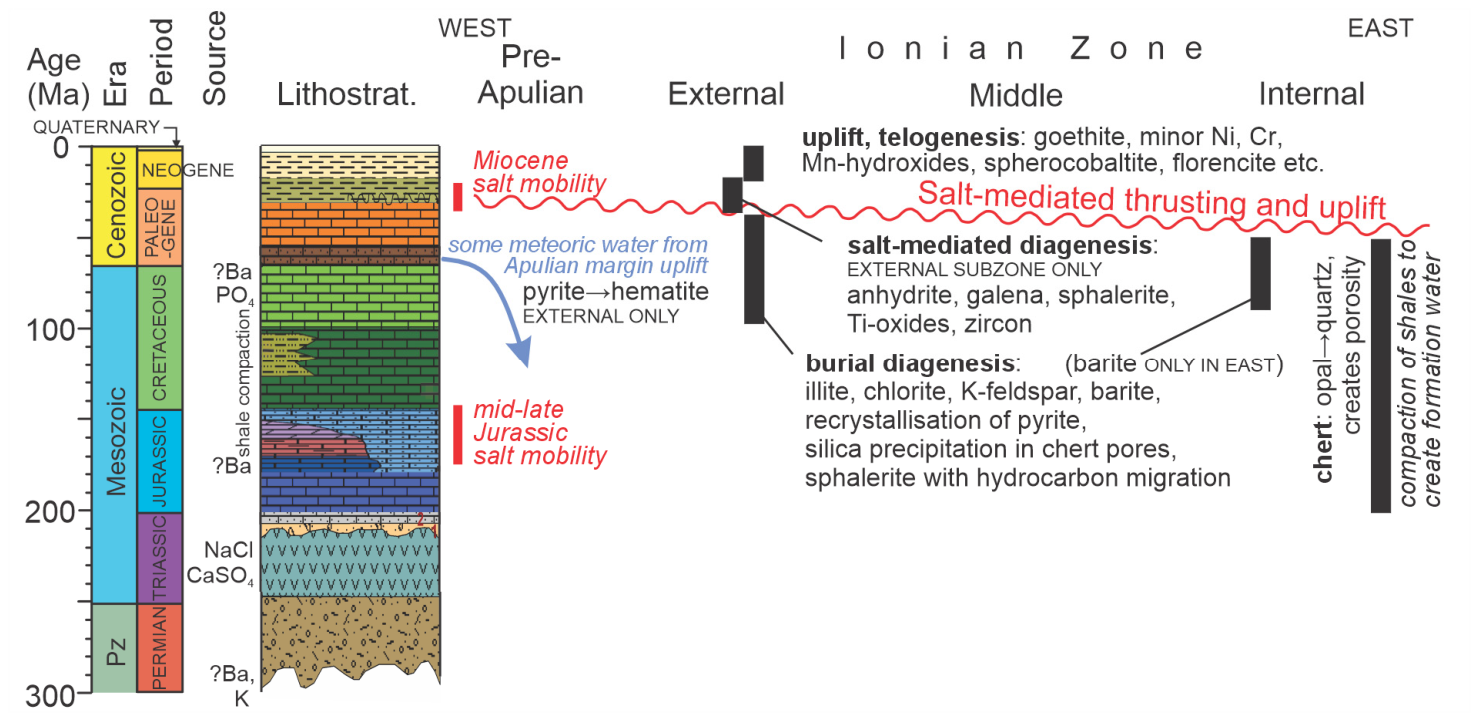
Evidence for the relative timing of different mesodiagenetic minerals is generally not available, so a paragenetic sequence cannot be reliably constructed. Nevertheless, a general chronology of diagenesis can be inferred (Figure 13). Most of the observed diagenetic minerals occupy the pervasive porosity in chert, which developed during the volume reduction resulting from the transition from opal to quartz. In the modern ocean, this transition has generally taken place in sediments of Miocene or older age [51] and is facilitated by elevated temperatures [9]. In most clastic basins, significant mesodiagenesis requires burial to 1–2 km and temperatures above 70 °C; material transport results from the burial and compaction of shales. Thus, mesodiagenetic chlorite, illite and K-feldspar hosted in Middle Jurassic to lower Cretaceous cherts would be of Late Cretaceous or younger age.
Figure 13.
Schematic interpretation of the timing of diagenetic minerals in the Ionian basin, showing geographical variations between subzones. Black bars show estimated age of key diagenetic processes.
As for the age of the mesodiagenetic assemblage related to saline formation waters, the provision of salt to formation waters is most rapid during deformation along salt welds [52]. There were two main phases of salt tectonism in the Ionian basin: (1) in the Middle to Late Jurassic and (2) during Miocene thrusting. Middle to Late Jurassic host rocks would not have been sufficiently buried to be affected by the Jurassic salt tectonics, so it is likely that most of the salt-related diagenetic minerals were emplaced during Miocene thrusting (Figure 13). Overpressures resulting from thrust repetition of strata and widespread fracturing at that time would have facilitated the flux of basinal fluids.
5.3. The Telogenetic Assemblage of Transition Metal Minerals and REE-Phosphates
Telogenetic minerals interpreted in previous studies of the Ionian basin [6,7] are dominated by goethite, filling veins and pores and precipitated as fibrous masses that apparently replace quartz. The presence of a small fraction of Ni is very characteristic; some goethite also has minor Cu, Zn, Co and Cr. Ni and Cr have been previously interpreted as derived from ophiolite detritus in Miocene flysch [7]. Mn hydroxides and carbonates and Co carbonate are also present in the telogenetic assemblage. They all point to supergene alteration with a major influx of meteoric water into the Ionian Zone rocks.
The REE-rich phosphate and aluminophosphate minerals include monazite associated with goethite (Figure 9), florencite and REE-apatite (Figure 10 and Figure 11). The close association of florencite–crandallite with Ni-goethite and the common occurrence of crandallite elsewhere from the leaching of phosphorus by acidic groundwater [29] leads us to interpret these aluminophosphate minerals as telogenetic. They formed after basin inversion using the phosphorus leached from the Upper Cretaceous strata. In the Ionian Zone of northern Greece, phosphorites are most common in the eastern part of the basin [26,27], which may have influenced the distribution of telogenetic phosphate minerals. The source of the REEs is unclear. Some Upper Cretaceous phosphorites are enriched in LREEs [27], and may therefore have been the source of the REEs, particularly since shales in the Ionian flysch have below average REE contents [53].
6. Conclusions
Porous cherts in the Middle Jurassic to Paleocene limestones of the Ionian Zone preserve a record of mesodiagenetic minerals. Authigenic K-feldspar, illite/muscovite, chlorite and perhaps some sphalerite were deposited from reducing formation waters derived from the compaction of Jurassic and Cretaceous deep-water shales. A diverse assemblage of minerals, resulting from element mobilization by halogens and organic acids, was deposited during the formation of thrust sheets in the Miocene, as NaCl and CaSO4 were mobilized along salt welds by overpressured basinal fluids resulting from stratal duplication by thrusting. These minerals include sphalerite, galena, titanium oxide polymorphs, zircon, anhydrite and barite. Galena, zircon, titanium oxide and anhydrite are found only in the samples from the external subzone of the Ionian Zone, suggesting a greater supply of saline formation water in that region from up-dip migration through E-dipping thrust sheets. As the Miocene flysch basins were uplifted, the penetration of meteoric water resulted in a telogenetic assemblage of supergene minerals dominated by goethite, with common Mn, Ni, Cr, and Co minerals. The leaching of Upper Cretaceous phosphorites led to the deposition of various REE-rich phosphate and aluminophosphate minerals. This study has demonstrated the utility of chert in preserving diagenetic minerals.
Supplementary Materials
The following supporting information can be downloaded at: https://www.mdpi.com/article/10.3390/min16121218/s1, Supplementary Materials listed in Table 1.
Author Contributions
Conceptualization, G.P.-P. and A.Z.; methodology, G.P.-P.; investigation, G.P.-P., D.J.W.P., N.D., V.G., N.B. and A.Z.; resources, A.Z. and G.P.-P.; data curation, G.P.-P. and D.J.W.P.; writing—original draft preparation, D.J.W.P. and G.P.-P.; writing—review and editing, N.D., V.G., N.B. and A.Z.; visualization, D.J.W.P.; supervision, A.Z.; project administration, G.P.-P.; funding acquisition, G.P.-P. and A.Z. All authors have read and agreed to the published version of the manuscript.
Funding
The laboratory component of this research was supported by a Natural Sciences and Engineering Research Council of Canada (NSERC) Discovery Grant 2016-04310 to G.P.-P.
Data Availability Statement
Data are provided in the Supplementary Materials.
Acknowledgments
We thank Xiang Yang and Justin Nagle for assistance with the SEM analyses.
Conflicts of Interest
The authors declare no conflicts of interest. The funders had no role in the design of the study; in the collection, analyses, or interpretation of data; in the writing of the manuscript; or in the decision to publish the results.:
Abbreviations
The following abbreviations are used in this manuscript:
| BSE | Backscattered electron (image) |
| EDS | Energy dispersive spectroscopy |
| Fm | Formation |
| LREE | Light rare-earth elements |
| OAE | Oceanic anoxic event |
| PAAS | Post-Archean Australian shale |
| REE | Rare-earth elements |
| SEM | Scanning electron microscope |
References
- Soto, J.I.; Tranos, M.D.; Bega, Z.; Dooley, T.P.; Hernández, P.; Hudec, M.R.; Konstantopoulos, P.A.; Lula, E.; Nikolaou, K.; Pérez, R.; et al. Contrasting styles of salt-tectonic processes in the Ionian zone (Greece and Albania): Integrating surface geology, subsurface data, and experimental models. Tectonics 2024, 43, TC008104. [Google Scholar] [CrossRef] [Scilit]
- Karakitsios, V. Western Greece and Ionian Sea Petroleum Systems. AAPG Bull. 2013, 97, 1567–1595. [Google Scholar] [CrossRef] [Scilit]
- Zelilidis, A.; Maravelis, A.G.; Tserolas, P.; Konstantopoulos, P.A. An Overview of the Petroleum Systems in the Ionian Zone, Onshore NW Greece and Albania. J. Pet. Geol. 2015, 38, 331–348. [Google Scholar] [CrossRef] [Scilit]
- Bourli, N.; Kokkaliari, M.; Dimopoulos, N.; Iliopoulos, I.; Zoumpouli, E.; Iliopoulos, G.; Zelilidis, A. Comparison between siliceous concretions from the Ionian basin and the Apulian platform margins (Pre-Apulian zone), western Greece: Implication of differential diagenesis on nodules evolution. Minerals 2021, 11, 890. [Google Scholar] [CrossRef] [Scilit]
- Bourli, N.; Kokkaliari, M.; Iliopoulos, I.; Pe-Piper, G.; Piper, D.J.W.; Maravelis, A.G.; Zelilidis, A. Mineralogy of siliceous concretions, Cretaceous of Ionian zone, western Greece: Implication for diagenesis and porosity. Mar. Petrol. Geol. 2019, 105, 45–63. [Google Scholar] [CrossRef] [Scilit]
- Pe-Piper, G.; Piper, D.J.W.; Bourli, N.; Zelilidis, A. Evolution of sedimentary basins as recorded in silica concretions: An example from the Ionian zone, western Greece. Minerals 2021, 11, 763. [Google Scholar] [CrossRef] [Scilit]
- Dimopoulos, N.; Pe-Piper, G.; Piper, D.J.W.; Bourli, N.; Zoumpouli, E.; Iliopoulos, G.; Zelilidis, A. Pseudomorphic changes after iron sulfide concretions in Jurassic limestones, Ionian Basin, Greece: Tracking changes in basinal fluids. Mar. Petrol. Geol. 2025, 182, 107579. [Google Scholar] [CrossRef] [Scilit]
- Zijlstra, H.J. Early diagenetic silica precipitation, in relation to redox boundaries and bacterial metabolism, in Late Cretaceous chalk of the Maastrichtian type locality. Neth. J. Geosci. 1987, 66, 343–355. [Google Scholar]
- Madsen, H.B.; Stemmerik, L. Diagenesis of flint and porcellanite in the Maastrichtian chalk at Stevns Klint, Denmark. J. Sediment. Res. 2010, 80, 578–588. [Google Scholar] [CrossRef] [Scilit]
- Sears, S.O. Porcelaneous cement and microporosity in California Miocene turbidites; origin and effect on reservoir properties. J. Sediment. Res. 1984, 54, 159–169. [Google Scholar] [CrossRef] [Scilit]
- Watney, W.L.; Guy, W.J.; Byrnes, A.P. Characterization of the Mississippian chat in south-central Kansas. AAPG Bull. 2001, 85, 85–113. [Google Scholar] [CrossRef] [Scilit]
- He, J.; Ding, W.; Huang, W.; Cao, Z.; Chen, E.; Dai, P.; Zhang, Y. Petrological, geochemical, and hydrothermal characteristics of Ordovician cherts in the southeastern Tarim Basin, NW China, and constraints on the origin of cherts and Permian tectonic evolution. J. Asian Earth Sci. 2019, 170, 294–315. [Google Scholar] [CrossRef] [Scilit]
- Kochman, A.; Kozłowski, A.; Matyszkiewicz, J. Epigenetic siliceous rocks from the southern part of the Kraków-Czestochowa Upland (Southern Poland) and their relation to Upper Jurassic early diagenetic chert concretions. Sediment. Geol. 2020, 401, 105–636. [Google Scholar] [CrossRef] [Scilit]
- Antonellini, M.; Del Sole, L.; Mollema, P.N. Chert nodules in pelagic limestones as paleo-stress indicators: A 3D geomechanical analysis. J. Struct. Geol. 2020, 132, 103–979. [Google Scholar] [CrossRef] [Scilit]
- Jolivet, L. Tethys and Apulia (Adria), 100 years of reconstructions. C. R. Geosci. 2023, 355, 9–28. [Google Scholar] [CrossRef] [Scilit]
- Pe-Piper, G.; Piper, D.J.W. Early Mesozoic oceanic subduction-related volcanic rocks, Pindos Basin, Greece. Tectonophysics 1991, 192, 273–292. [Google Scholar] [CrossRef] [Scilit]
- Kontakiotis, G.; Moforis, L.; Karakitsios, V.; Antonarakou, A. Sedimentary facies analysis, reservoir characteristics and paleogeography significance of the early Jurassic to Eocene carbonates in Epirus (Ionian Zone, Western Greece). J. Mar. Sci. Eng. 2020, 8, 706. [Google Scholar] [CrossRef] [Scilit]
- Patacca, E.; Scandone, P.; Di Luzio, E.; Cavinato, G.P.; Parotto, M. Structural architecture of the central Apennines: Interpretation of the CROP 11 seismic profile from the Adriatic coast to the orographic divide. Tectonics 2008, 27, TC3006. [Google Scholar] [CrossRef] [Scilit]
- Getsos, K. The Sedimentological Evolution of the Ionian Zone Basin from the Triassic to the Eocene and Their Possible Connection to Hydrocarbon Fields in Areas of the Central Part of the Basin. Ph.D. Thesis, University of Patras, Patras, Greece, 2006. Available online: https://hdl.handle.net/10889/230 (accessed on 15 November 2026).
- Getsos, K.; Zelilidis, A. Study on Mesozoic carbonates of the Ionian zone and their petroleum potential based on stable isotopes, total organic carbon, SEM and clay minerals (NW Greece). In Proceedings of the 2nd International Conference on Advances in Mineral Resources Management and Environmental Geotechnology, Chania, Greece, 25–27 September 2006; pp. 453–458. [Google Scholar]
- Adamopoulos, G.; Vakalas, I.; Bellas, S.; Kokkalas, S.; Perraki, M.; Gaganis, V.; Stamatakis, E. Initial Assessment of the Sealing Capacity of Caprocks in the Ionian Zone Reservoirs, Greece. In Seventh International Conference on Fault and Top Seals, Bucharest, Romania, 14–18 September 2025; European Association of Geoscientists & Engineers: Bucharest, Romania, 2025; 5p. [Google Scholar]
- Avramidis, P.; Kontopoulos, N. Clay minerals distribution, illite crystallinity and Τmax Rock-Eval pyrolysis of turbidite deposits in Κlematia-Paramythia Basin, in relation tο Pindos Foreland evolution, western Greece. Gaia 2001, 16, 59–69. [Google Scholar]
- Warr, L.N. IMA–CNMNC approved mineral symbols. Mineral. Mag. 2021, 85, 291–320. [Google Scholar] [CrossRef] [Scilit]
- Liu, Z.R.R.; Zhou, M.F.; Williams-Jones, A.E.; Wang, W.; Gao, J.F. Diagenetic mobilization of Ti and formation of brookite/anatase in early Cambrian black shales, South China. Chem. Geol. 2019, 506, 79–96. [Google Scholar] [CrossRef] [Scilit]
- Imperial, A.; Pe-Piper, G.; Piper, D.J.W.; Clyburne, J. The use of titania polymorphs as indicators of mesodiagenesis during hydrocarbon charge. Mar. Petrol. Geol. 2023, 149, 106075. [Google Scholar] [CrossRef] [Scilit]
- Skourtsis-Coroneou, V.; Solakius, N.; Constantinidis, I. Cretaceous stratigraphy of the Ionian zone, Hellenides, western Greece. Cretac. Res. 1995, 16, 539–558. [Google Scholar] [CrossRef] [Scilit]
- Tzifas, I.T.; Godelitsas, A.; Magganas, A.; Androulakaki, E.; Eleftheriou, G.; Mertzimekis, T.J.; Perraki, M. Uranium-bearing phosphatized limestones of NW Greece. J. Geochem. Explor. 2014, 143, 62–73. [Google Scholar] [CrossRef] [Scilit]
- Golfinopoulos, V.; Piper, D.J.W.; Zelilidis, A.; Pe-Piper, G.; Papadopoulou, P.; Bourli, N.; Iliopoulos, G. Depositional Environments and Soft Sediment Deformation in the Early Jurassic Ammonitico Rosso Formation of Western Greece. Geosciences 2025, 15, 10. [Google Scholar] [CrossRef] [Scilit]
- Pe-Piper, G.; Dolansky, L.M. Early diagenetic origin of Al phosphate-sulfate minerals (woodhouseite and crandallite series) in terrestrial sandstones, Nova Scotia, Canada. Am. Mineral. 2005, 90, 1434–1441. [Google Scholar] [CrossRef] [Scilit]
- Tsikos, H.; Karakitsios, V.; van Breugel, Y.; Walsworth-Bell, B.; Bombardiere, L.; Petrizzo, M.R.; Damsté, J.S.S.; Schouten, S.; Erba, E.; Premoli Silva, I.; et al. Organic-carbon deposition in the Cretaceous of the Ionian Basin, NW Greece: The Paquier Event (OAE 1b) revisited. Geol. Mag. 2004, 141, 401–416. [Google Scholar] [CrossRef] [Scilit]
- Kafousia, N.; Karakitsios, V.; Mattioli, E.; Kenjo, S.; Jenkyns, H.C. The Toarcian oceanic anoxic event in the Ionian zone, Greece. Palaeogeogr. Palaeoclimatol. Palaeoecol. 2014, 393, 135–145. [Google Scholar] [CrossRef] [Scilit]
- Golfinopoulos, V.; Zelilidis, A.; Tzortzi, M.; Iliopoulos, G. Biostratigraphyand facies architecture of Jurassic successions in the Ionian Basin (Epirus, NW Greece) with preliminary source-rock screening. Front. Earth Sci. 2026, 14, 1984601. [Google Scholar] [CrossRef] [Scilit]
- Machel, H.G. Bacterial and thermochemical sulfate reduction in diagenetic settings—Old and new insights. Sediment. Geol. 2001, 140, 143–175. [Google Scholar] [CrossRef] [Scilit]
- Basuki, N.I.; Spooner, E.T.C. A review of fluid inclusion temperatures and salinities in Mississippi Valley-type Zn-Pb deposits: Identifying thresholds for metal transport. Explor. Min. Geol. 2002, 11, 1–17. [Google Scholar] [CrossRef] [Scilit]
- Liu, C.; Su, J. Mississippi valley-type Pb–Zn deposits formed by episodic fluid migration in the fold-and-thrust belts of the Tibetan Plateau. Ore Geol. Rev. 2025, 181, 106597. [Google Scholar] [CrossRef] [Scilit]
- Bojanowski, M.J.; Bagiński, B.; Clarkson, E.; Macdonald, R.; Marynowski, L. Low-temperature zircon growth related to hydrothermal alteration of siderite concretions in Mississippian shales, Scotland. Contrib. Mineral. Petrol. 2012, 164, 245–259. [Google Scholar] [CrossRef] [Scilit]
- Saspiturry, N.; Lahfid, A.; Baudin, T.; Guillou-Frottier, L.; Razin, P.; Issautier, B.; Le Bayon, B.; Serrano, O.; Lagabrielle, Y.; Corre, B. Paleogeothermal gradients across an inverted hyperextended rift system: Example of the Mauléon fossil rift (Western Pyrenees). Tectonics 2020, 39, TC006206. [Google Scholar] [CrossRef] [Scilit]
- Spanos, D.; Stathopoulou, A.; Tripsanas, E.; Oikonomopoulos, I.; Pagoulatos, A.; Sotiropoulos, S. Crustal cross-section construction in External Hellenides to decipher the structural complexity of Western Greece. In Fifth EAGE Eastern Mediterranean Workshop (2025 (1), 1–3); European Association of Geoscientists & Engineers: Cairo, Egypt, 2025. [Google Scholar]
- Xypolias, P.; Dürr, W.; Zulauf, G. Late Carboniferous plutonism within the pre-Alpine basement of the External Hellenides (Kithira, Greece): Evidence from U-Pb zircon dating. J. Geol. Soc. Lond. 2006, 163, 539–547. [Google Scholar] [CrossRef] [Scilit]
- Pe-Piper, G.; Koukouvelas, I. Petrology and geochemistry of granitic pebbles in the Pliocene fluvial deposits of the northwest Peloponnese (Greece) and their regional significance. Neues Jahrb. Für Mineral. Abh. 1990, 161, 327–343. [Google Scholar] [CrossRef] [Scilit]
- Criniti, S. Detrital modes of buried Permian sandstones of the Puglia 1 well (Puglia Region, Southern Italy). Rendiconti Online Della Soc. Geol. Ital. 2023, 59, 119–124. [Google Scholar] [CrossRef] [Scilit]
- Katsanou, K.; Siavalas, G.; Panagopoulos, G.; Lambrakis, N. Rare earth element patterns in a rapidly changing karst environment. Appl. Geochem. 2022, 146, 105462. [Google Scholar] [CrossRef] [Scilit]
- Tunc, A.; Çelik, Y.; Fociro, A.; Deevsalar, R.; Wang, X.; Bondici, V.F.; Feng, R.; Chen, N.; Pan, Y. Distribution and speciation of uranium in pristine Tethyan phosphorites, Ionian Zone, Albania: Insights from synchrotron XRF/XANES analyses. J. Geochem. Explor. 2025, 277, 107808. [Google Scholar] [CrossRef] [Scilit]
- Piepoli, L.; Della Porta, G.P.; Grieco, G.; Fociro, A.; Karriqi, A.; Prela, M.; Sinojmeri, A. Jurassic uranium-bearing phosphorites of the Ionian Zone, Albania. Ital. J. Geosci. 2026, 145, 247–264. [Google Scholar] [CrossRef] [Scilit]
- Kocjančič, A.; Petrizzo, M.R.; Horvat, A. Integrated stratigraphy and paleoceanography across the Santonian/Campanian boundary in the Budva Zone (Dinarides), Montenegro. Cret. Res. 2025, 176, 106194. [Google Scholar] [CrossRef] [Scilit]
- Zelilidis, A.; Piper, D.J.W.; Vakalas, I.; Avramidis, P.; Getsos, K. Oil and gas plays in Albania: Do equivalent plays exist in Greece? J. Petrol. Geol. 2003, 26, 29–48. [Google Scholar] [CrossRef] [Scilit]
- Kamberis, E.; Kokinou, E.; Koci, F.; Lioni, K.; Alves, T.M.; Velaj, T. Triassic evaporites and the structural architecture of the External Hellenides and Albanides (SE Europe): Controls on the petroleum and geoenergy systems of Greece and Albania. Int. J. Earth Sci. 2022, 111, 789–821. [Google Scholar] [CrossRef] [Scilit]
- Pe-Piper, G.; Nagle, J.; Piper, D.J.W.; McFarlane, C.R. Geochronology and trace element mobility in rutile from a Carboniferous syenite pegmatite and the role of halogens. Am. Mineral. 2019, 104, 501–513. [Google Scholar] [CrossRef] [Scilit]
- Milliken, K.L. Petrography and composition of authigenic feldspars, Oligocene Frio Formation, south Texas. J. Sediment. Res. 1989, 59, 361–374. [Google Scholar] [CrossRef] [Scilit]
- Pe-Piper, G.; Piper, D.J.W. Temperature and basinal fluid controls on feldspar diagenesis, Lower Cretaceous sandstones, Scotian Basin, Canada. Mar. Pet. Geol. 2022, 141, 105704. [Google Scholar] [CrossRef] [Scilit]
- Bohrmann, G.; Abelmann, A.; Gersonde, R.; Hubberten, H.; Kuhn, G. Pure siliceous ooze, a diagenetic environment for early chert formation. Geology 1994, 22, 207–210. [Google Scholar] [CrossRef] [Scilit]
- Hudson, S.M.; Hanson, A.D. Thermal maturation and hydrocarbon migration within La Popa Basin, northeastern Mexico, with implications for other salt structures. AAPG Bull. 2010, 94, 273–291. [Google Scholar] [CrossRef] [Scilit]
- Maravelis, A.G.; Botziolis, C.; Kontakiotis, G.; Zelilidis, A. Unravelling Paleoenvironmental Conditions During the Late Eocene to Early Oligocene in the Central Pindos Foreland Basin, Western Greece: A Chemostratigraphic Approach. Geol. J. 2026, 1–22. [Google Scholar] [CrossRef] [Scilit]

Disclaimer/Publisher’s Note: The statements, opinions and data contained in all publications are solely those of the individual author(s) and contributor(s) and not of MDPI and/or the editor(s). MDPI and/or the editor(s) disclaim responsibility for any injury to people or property resulting from any ideas, methods, instructions or products referred to in the content. |
© 2026 by the authors. Licensee MDPI, Basel, Switzerland. This article is an open access article distributed under the terms and conditions of the Creative Commons Attribution (CC BY) license.