


Abstract
Kimberlitic zircons represent a common type of mantle-derived zircon megacryst entrained in kimberlites, and they have been shown to reliably record ages of kimberlite emplacement. Here, we present results of U–Pb geochronology, as well as oxygen-isotope, trace-element, and mineral-inclusion analyses of zircon megacrysts from the Obnazhennaya and Olivinovaya kimberlite pipes of the Kuoika field, northern Siberian craton. These zircons exhibit mantle-like oxygen-isotope compositions (δ18O = 5.11–5.86‰), low U concentrations (5–90 ppm), low total rare-earth-element (REE) concentrations (8–186 ppm), relatively flat heavy-REE patterns, and weak or absent Eu anomalies. Together, these characteristics indicate that the analyzed megacrysts are mantle-derived kimberlitic zircons, an interpretation further strengthened by the identification of olivine inclusions in one of the zircons. As such, these are the first kimberlitic zircons reported from the Obnazhennaya and Olivinovaya kimberlites. U–Pb dating of these zircons yielded Late Jurassic concordia ages of 152.5 ± 2.7 Ma (2σ) for the Obnazhennaya pipe and 148.5 ± 3.4 Ma (2σ) for the Olivinovaya pipe, which are consistent with the Middle Jurassic-to-Early Cretaceous age range previously reported for kimberlite magmatism within the Kuoika field. Our U–Pb age for the Obnazhennaya pipe is consistent with previous age estimates obtained using other geochronological methods and therefore provides a new, independent constraint on its emplacement age. The U–Pb age obtained for kimberlitic zircons from the Olivinovaya pipe provides the first reliable age constraint for this kimberlite.
1. Introduction
Kimberlitic magmas originate at mantle depths exceeding 150 km and rapidly transport substantial quantities of rock and mineral material from different levels of the lithosphere to the Earth’s surface [1,2,3]. Their deep origin and abundant mantle- and crust-derived xenoliths and xenocrysts make kimberlites invaluable for investigating lithospheric structure and composition [4,5,6,7,8]. Although reliable age constraints on kimberlite emplacement are essential for sound interpretation of these mantle and crustal records, dating kimberlites remains challenging, mainly because of the variable ages of entrained xenoliths and xenocrysts and widespread, intense post-emplacement hydrothermal alteration [9,10]. Traditionally, Rb–Sr and 40Ar/39Ar dating of phlogopite, together with U–Pb dating of groundmass perovskite and mantle-derived zircon, have been among the most commonly used geochronological methods for constraining kimberlite emplacement ages [10]. However, each of these geochronometers has limitations. In particular, phlogopite age determinations may be compromised by post-emplacement alteration [9,10]. Although groundmass perovskite is generally more resistant to post-emplacement alteration than phlogopite, alteration may still disturb its U–Pb system [11,12]. Furthermore, the high proportion of initial common Pb in perovskite complicates calculations of U–Pb ages [10,13]. In contrast, the U–Pb system in zircon commonly remains undisturbed even in strongly altered kimberlites [14]; consequently, zircon U–Pb dating may reliably constrain the emplacement ages of kimberlites that have undergone low-grade regional metamorphism [14]. Kimberlitic zircons—mantle-derived zircons belonging to the Cr-poor megacryst suite [15,16] and inferred to be genetically associated with kimberlite magmas [17,18,19]—are the most suitable for kimberlite dating [10,14]. Distinguishing them from crust-derived zircons and other mantle-derived zircon populations is therefore essential, because all of these zircon types may occur within a single kimberlite sample [10,14]. In addition, some kimberlitic zircons may yield U–Pb ages that predate kimberlite emplacement [20,21,22], although such cases are relatively rare.
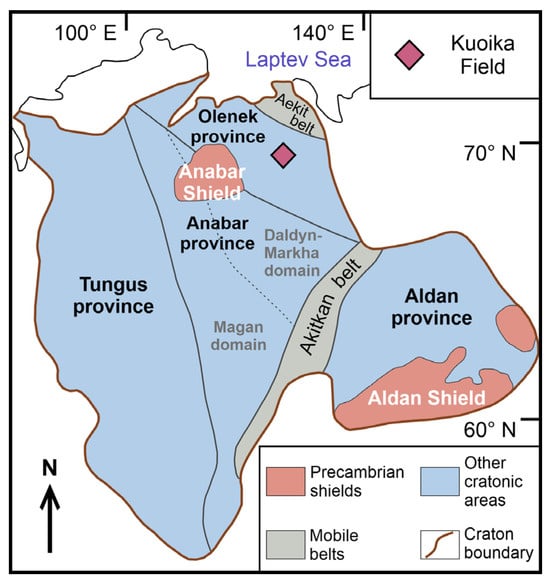
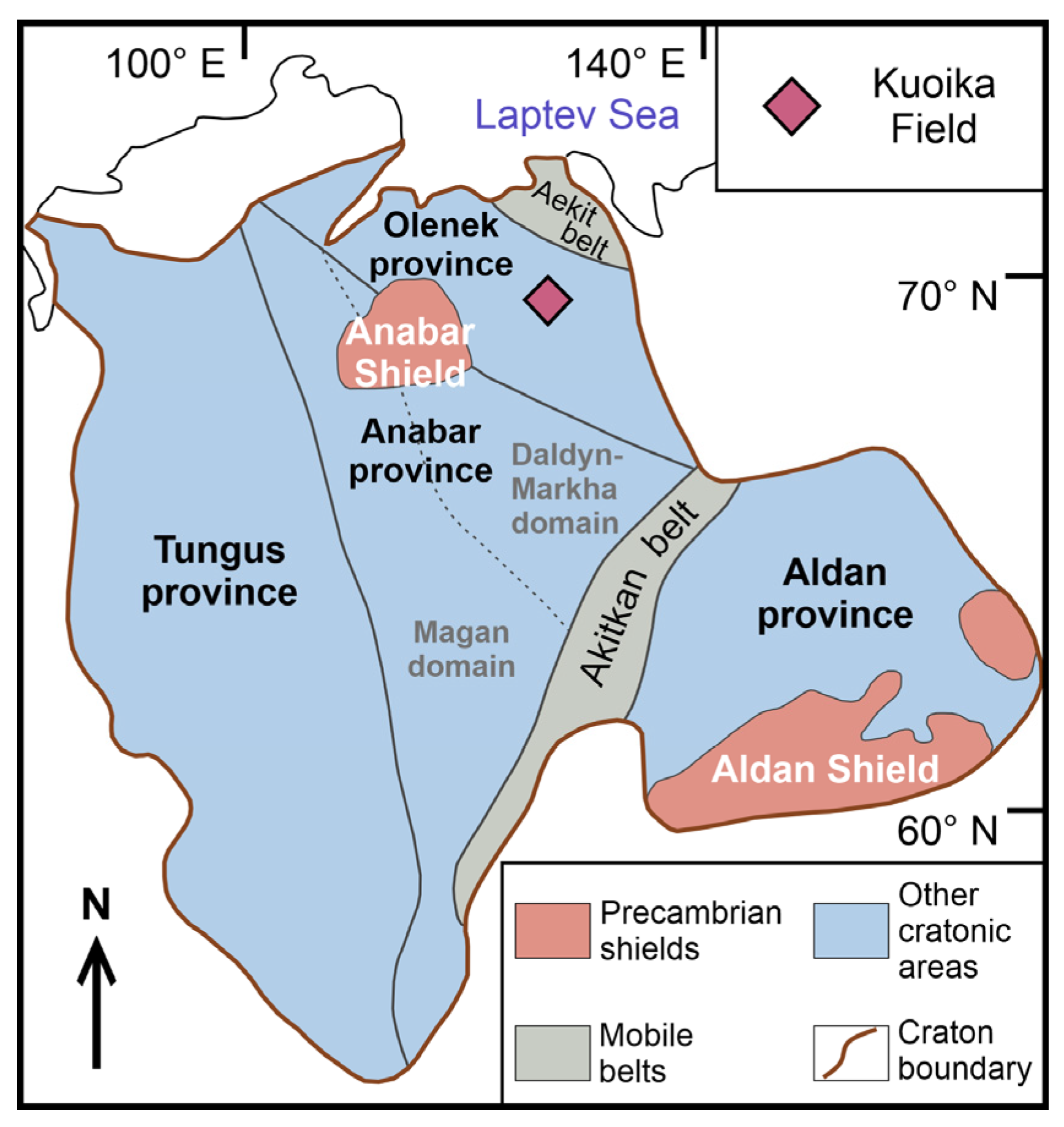
Numerous kimberlite occurrences are distributed across the northeastern part of the Siberian craton [23], within an area of approximately 1100 × 800 km known as the Yakutian kimberlite province [24]. This province comprises more than 20 kimberlite fields [20,25,26] and records four main pulses of kimberlite magmatism from the Silurian to the Jurassic [20,25,26,27,28,29]. The Kuoika kimberlite field is located near the northern margin of the Siberian Craton (Figure 1) and contains more than 100 identified kimberlite bodies (see Figure 1b in [29]). Previous U–Pb dates are available for only about 20 kimberlite occurrences within the Kuoika field and range from the Middle Jurassic to the Early Cretaceous (171–128 Ma; [25,26,27,28,29]). Most of these ages were obtained by U–Pb dating of perovskite [25,28,29], whereas U–Pb dates for zircons of confirmed kimberlitic affinity are available for only six kimberlite pipes [26].
Figure 1.
Simplified tectonic map of the Siberian craton (modified after [6]), showing the location of the Kuoika kimberlite field.
Here, we report the results of U–Pb geochronology, oxygen-isotope, and trace-element analyses of kimberlitic zircons from the Obnazhennaya (70.519056° N, 120.501417° E) and Olivinovaya (70.556722° N, 120.487889° E) kimberlite pipes, which are situated approximately 4 km apart within the Kuoika field. The Obnazhennaya pipe crops out on the bank of the Kuoika River (Supplementary Figure S1a), whereas the Olivinovaya pipe occurs as a small, roughly 5 × 5 m hill that is largely covered by soil and vegetation (Supplementary Figure S1b). Thin-section images of relatively fresh kimberlite samples from these pipes are shown in Supplementary Figure S2. The Obnazhennaya kimberlite has been extensively studied for its mantle-derived xenoliths and crustal zircon xenocrysts [30,31,32,33]. Nonetheless, zircons confidently identified as kimberlitic have not previously been reported from either the Obnazhennaya or Olivinovaya pipe. The kimberlitic zircons analyzed in this study provide the first reliable constraint on the emplacement age of the Olivinovaya pipe and an independent constraint on the emplacement age of the Obnazhennaya pipe.
2. Materials and Methods
For this study, we collected composite samples from strongly weathered volcaniclastic kimberlite units in each of the Obnazhennaya and Olivinovaya pipes. The samples were initially hand-panned in the field to obtain heavy-mineral concentrates. Zircon grains were subsequently separated from these concentrates by magnetic and heavy-liquid separation at the V.S. Sobolev Institute of Geology and Mineralogy, Siberian Branch of the Russian Academy of Sciences, Novosibirsk, Russia. From the separated zircon population, we handpicked grains that exhibited one or more features typical of mantle-derived zircons from kimberlites: reaction rims [10,17], grain sizes exceeding 100 µm [14,26], and the absence of crystal faces [34,35].
The handpicked Obnazhennaya and Olivinovaya pipe zircon grains and fragments were mounted in epoxy resin and polished to expose zircon interiors at the Institute of Geology and Geophysics, Chinese Academy of Sciences (IGGCAS), Beijing, China. Cathodoluminescence (CL) images were acquired at Nanjing Hongchuang Geological Exploration Technology Service Co., Ltd., Nanjing, China, using a TESCAN MIRA3 LMH field-emission scanning electron microscope equipped with a high-definition CL detector (Jinjing Technology). Imaging was performed at an accelerating voltage of 6 kV, a beam current of 3 nA, and a working distance of ~14 mm.
In situ zircon U–Pb analyses were conducted by secondary ion mass spectrometry (SIMS) using a CAMECA IMS-1280HR instrument at IGGCAS, largely following the analytical procedures outlined by [36]. The primary O2− beam had an intensity of ~20 nA and was focused to an analytical spot of ~25 μm in diameter. U and Th concentrations and Pb/U ratios in unknown zircons were calibrated against the ZS zircon standard [37]. A long-term uncertainty of 1.5% (1 RSD; RSD = relative standard deviation) for 206Pb/238U ratios, determined from repeated cross-session measurements of zircon reference materials [38], was propagated to the unknown analyses. Common-Pb correction was based on measured 204Pb and the average present-day crustal Pb composition of [39], assuming that the common Pb was predominantly introduced through sample preparation. For quality control, the Qinghu [40] and 91500 [41] zircon standards were analyzed as unknowns (Supplementary Table S1). Their concordia U–Pb ages of 158.6 ± 3.3 Ma (2σ; n = 5) and 1063.8 ± 16.9 Ma (2σ; n = 5), respectively, agree within uncertainty with the corresponding reference ages of 159.5 ± 0.2 Ma [40] and 1065 Ma [41]. Calculation of U–Pb ages and generation of concordia diagrams were performed using IsoplotR [42]. Decay-constant uncertainties were not included in the reported U–Pb age uncertainties.
In situ oxygen-isotope analyses of zircons were performed using a CAMECA IMS-1280 SIMS at IGGCAS. The analytical procedures followed those described by [43,44]. The primary Cs+ beam had an intensity of ~1 nA and was focused to an analytical spot of ~10 μm in diameter. Oxygen-isotope compositions are reported as δ18O values (in ‰) relative to Vienna Standard Mean Ocean Water (VSMOW; [45]). Internal uncertainties for individual δ18O values were 0.1–0.3‰ (2 standard errors, SE). Measured δ18O values were corrected for SIMS instrumental mass fractionation (IMF) using the Penglai zircon standard (δ18O = 5.3‰; [43]):
IMF = mean SIMS-measured Penglai δ18O − reference Penglai δ18O,
Corrected δ18O = SIMS-measured δ18O − IMF,
Repeated analyses of the Penglai zircon standard yielded an external reproducibility of 0.48‰ (2 standard deviations, SD; n = 16). This external reproducibility and the internal uncertainty of each analysis were incorporated into the final analytical uncertainties (see Supplementary Table S2 for details). The Qinghu zircon standard was measured as an unknown to monitor data quality and yielded a mean δ18O value of 5.46 ± 0.39‰ (2SD; n = 6), consistent with its recommended δ18O value of 5.4 ± 0.2‰ (2SD; [40]). Oxygen-isotope data for the Penglai and Qinghu zircon standards are reported in Supplementary Table S2.
In situ trace-element analyses of zircons were conducted by laser ablation–inductively coupled plasma–mass spectrometry (LA-ICP-MS) using an Agilent 7900 ICP-MS coupled to a GeoLas HD 193 nm ArF excimer laser-ablation system at Wuhan SampleSolution Analytical Technology Co., Ltd., Wuhan, China. A signal-smoothing device was employed during analysis [46], and the analytical procedures largely followed those of [47]. The operating parameters were a laser spot diameter of 44 μm, a repetition rate of 5 Hz, and a laser energy of 80 mJ. Trace-element concentrations were calibrated using the BCR-2G, BHVO-2G, and BIR-1G glass reference materials as external standards [48]. Si was used as the internal standard; the SiO2 concentration of zircon was assumed to be 32.78 wt%. The GSE-1G reference material was analyzed as an unknown to monitor data quality. Trace-element concentrations measured for GSE-1G are compared with the preferred values compiled in the GeoReM database [49] in Supplementary Table S3.
Micro-Raman spectroscopic analyses of zircon-hosted inclusions were carried out on a WITec alpha 300R confocal Raman microscope at IGGCAS using a 532 nm excitation laser, a Zeiss 100× objective with a numerical aperture of 0.9, and a 300 lines mm−1 grating. The lateral spatial resolution was better than 1 μm. Each Raman spectrum was collected at a laser power of ~2 mW, with a total integration time of 50 s (5 acquisitions of 10 s). A polished silicon wafer was used for instrument calibration.
3. Results
U–Pb geochronological, oxygen-isotopic, and trace-element data obtained for zircons from the Obnazhennaya and Olivinovaya kimberlite pipes are provided in Supplementary Table S4.
3.1. General Characteristics and Geochronology of Zircons from the Obnazhennaya and Olivinovaya Kimberlites
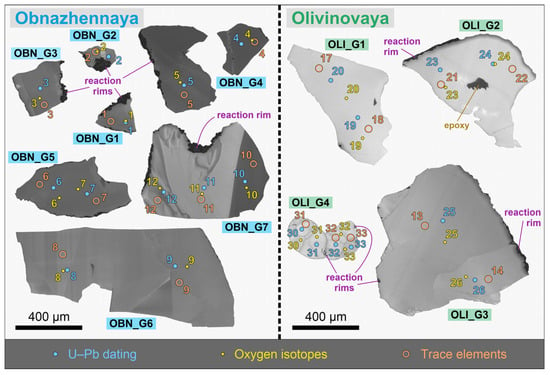
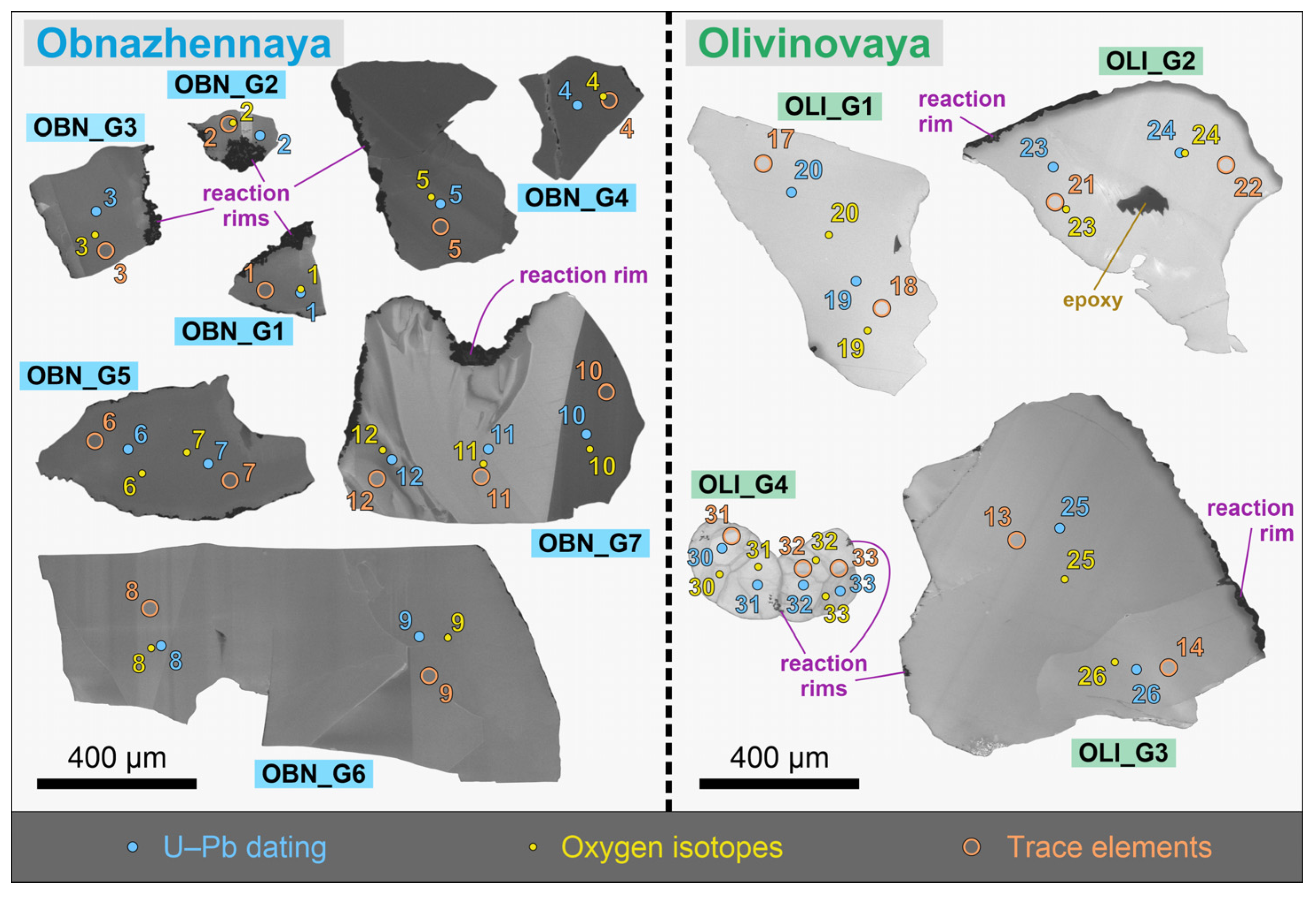
Among the zircon separates, we selected seven grains and grain fragments from the Obnazhennaya kimberlite and four from the Olivinovaya kimberlite that were considered to be of potential kimberlitic affinity. Their maximum dimensions range from 0.25 to 1.3 mm and from 0.5 to 1.3 mm for the Obnazhennaya and Olivinovaya pipes, respectively. These zircons lack well-developed crystal faces, and most exhibit reaction rims (Figure 2). Although reaction rims, commonly comprising baddeleyite as the principal reaction product [10,14,17], can develop on both mantle-derived and crustal zircon xenocrysts entrained in kimberlite melts [14], they are more common in mantle-derived zircon populations [10,14,17,50,51,52]. The Obnazhennaya zircons display a wider range of internal textures and generally have a darker CL response than the Olivinovaya zircons (Figure 2). In both zircon populations, however, homogeneous domains and faint zoning are the most common internal-texture types (Figure 2).
Figure 2.
CL images of the analyzed zircons from the Obnazhennaya and Olivinovaya kimberlite pipes, showing the locations of analytical spots. Circles marking oxygen-isotope analysis spots are enlarged for visibility.
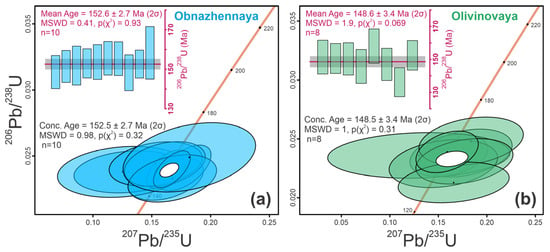
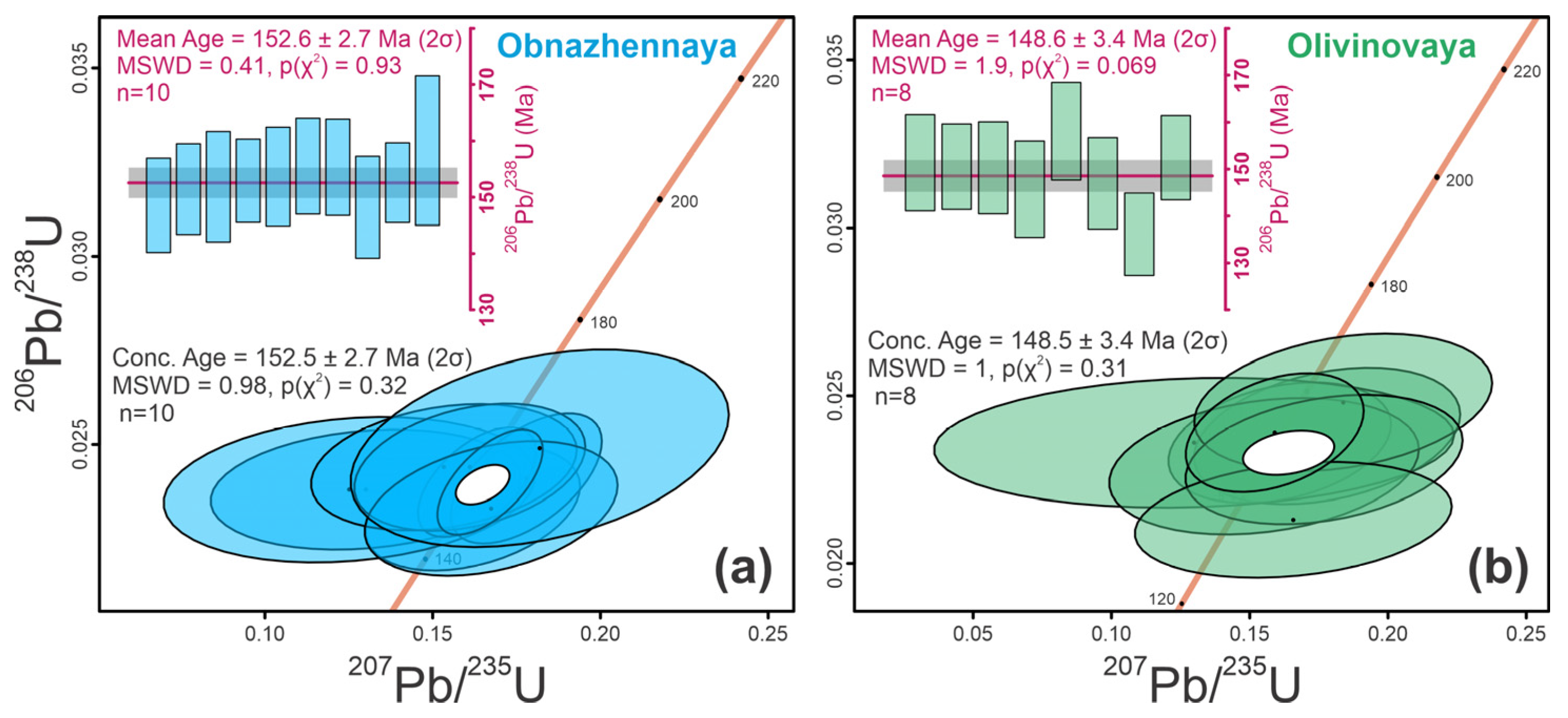
A total of 12 SIMS U–Pb isotope analyses were obtained from the seven Obnazhennaya zircons, and 10 analyses were obtained from the four Olivinovaya zircons (Supplementary Table S4). In each of two Obnazhennaya zircons (OBN_G6 and OBN_G7) and two Olivinovaya zircons (OLI_G2 and OLI_G3), one of the two to three U–Pb analyses yielded a high proportion of common Pb (ƒ206 = 2.8–8.2%). These four analyses were considered unreliable and excluded from age calculations. The remaining analyses have common-Pb contents of 0–2.1% and define a single age population for each pipe (Figure 3). The remaining ten Obnazhennaya analyses yield a concordia age of 152.5 ± 2.7 Ma (2σ; mean square weighted deviation [MSWD] = 0.98; Figure 3a), whereas the remaining eight Olivinovaya analyses yield a concordia age of 148.5 ± 3.4 Ma (2σ; MSWD = 1.0; Figure 3b). For both kimberlite samples, the weighted-mean 206Pb/238U ages are indistinguishable from the corresponding concordia ages: 152.6 ± 2.7 Ma (2σ; MSWD = 0.41; Figure 3a) and 148.6 ± 3.4 Ma (2σ; MSWD = 1.9; Figure 3b), respectively.
Figure 3.
U–Pb concordia diagrams and weighted-mean 206Pb/238U age plots for zircons analyzed from the Obnazhennaya (a) and Olivinovaya (b) kimberlite pipes. Error ellipses in the concordia diagrams represent 2σ uncertainties. Error bars in the weighted-mean 206Pb/238U age plots represent ±2σ uncertainties. Analyses with high common-Pb contents (≥2.8%) were excluded from age calculations and are not shown.
3.2. Oxygen-Isotope and Trace-Element Compositions of Zircons from the Obnazhennaya and Olivinovaya Kimberlites
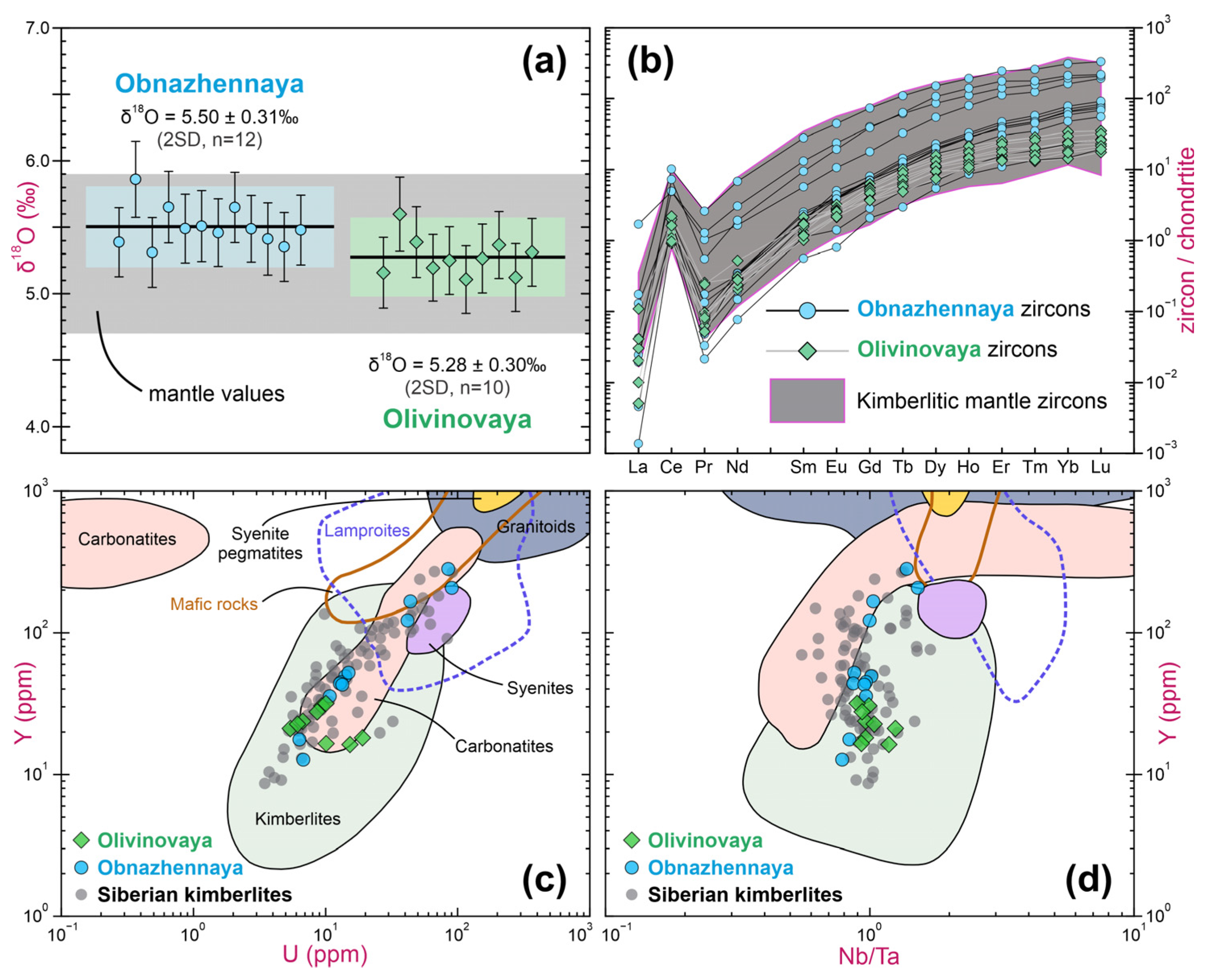
For the U–Pb-dated zircons from the Obnazhennaya and Olivinovaya kimberlites, we acquired 12 and 10 SIMS oxygen-isotope measurements, respectively. These measurements were performed at locations close to those of the corresponding U–Pb analyses. Zircons from both pipes show little variation in δ18O values (Supplementary Table S4). For the Obnazhennaya kimberlite, zircon δ18O values range from 5.31‰ to 5.86‰, with a mean δ18O value of 5.50 ± 0.31‰ (2SD; Figure 4a). For the Olivinovaya kimberlite, zircon δ18O values range from 5.11‰ to 5.60‰, with a mean δ18O value of 5.28 ± 0.30‰ (2SD; Figure 4a).
For the Obnazhennaya and Olivinovaya zircons, we performed 12 and 9 LA-ICP-MS trace-element analyses, respectively (Supplementary Table S4; Figure 4b–d). Zircons from the Obnazhennaya kimberlite are characterized by Th/U ratios of 0.20–0.55 and very-low-to-low U concentrations of 6–90 ppm. The corresponding SIMS U–Pb analyses of these zircons yield very similar values, with Th/U ratios of 0.22–0.61 and U concentrations of 5–84 ppm. The Obnazhennaya zircons show very-low-to-moderate Y and total rare-earth-element (REE) concentrations, ranging from 13 to 281 ppm and from 8 to 186 ppm, respectively, as well as limited variation in Nb/Ta ratios (0.8–1.5). Their chondrite-normalized REE patterns (Figure 4b), where the subscript N denotes normalization to the CI-chondrite composition reported by [53], display marked positive Ce anomalies (Ce/Ce* = 4–192), weak or absent Eu anomalies (Eu/Eu* = 0.74–1.27), and a slight increase from Gd to Lu within the heavy REEs, with (Lu/Gd)N values of 4–11.
Compared with zircons from the Obnazhennaya kimberlite, the Olivinovaya zircons show similar trace-element characteristics, but their trace-element concentrations span a much narrower range. LA-ICP-MS trace-element and SIMS U–Pb analyses of zircons from the Olivinovaya kimberlite yield similar Th/U ratios (0.25–0.53 and 0.27–0.50, respectively) and very low U concentrations (5–19 and 6–16 ppm, respectively). These zircons have very low Y concentrations of 16–32 ppm and very low total REE concentrations of 11–19 ppm. Their Nb/Ta ratios of 0.9–1.3 are almost identical to those of the Obnazhennaya zircons. The REEN patterns of these zircons (Figure 4b) also show marked positive Ce anomalies (Ce/Ce* = 8–49), weak or absent Eu anomalies (Eu/Eu* = 0.80–1.12), and a slight increase from Gd to Lu, with (Lu/Gd)N values of 5–6.
Figure 4.
Oxygen-isotope and trace-element compositions of zircons analyzed from the Obnazhennaya and Olivinovaya kimberlite pipes. (a) SIMS δ18O results. Error bars for individual analyses represent ±1σ uncertainties. The gray band indicates the mantle-zircon reference value of 5.3 ± 0.6‰ (2SD; [54]). (b) Chondrite-normalized REE patterns. The field labeled “Kimberlitic mantle zircons” represents the compositions of kimberlitic zircon megacrysts from different Siberian kimberlites, corresponding to the Group-1 zircons reported by [26]. The CI-chondrite values of [53] were used for normalization. (c) U versus Y and (d) Nb/Ta versus Y diagrams; fields representing zircon compositions in different rock types are from [50]. “Siberian kimberlites” in panels (c,d) represent the same zircon population as “Kimberlitic mantle zircons” in panel (b).
3.3. Raman Spectroscopic Results for Zircon-Hosted Inclusions from the Olivinovaya Kimberlite
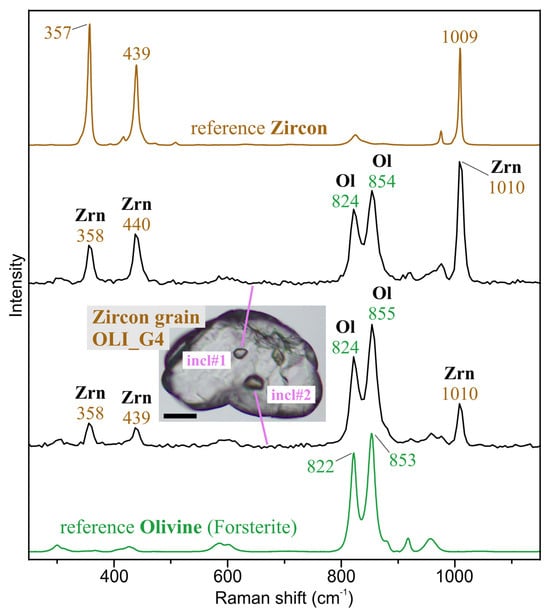
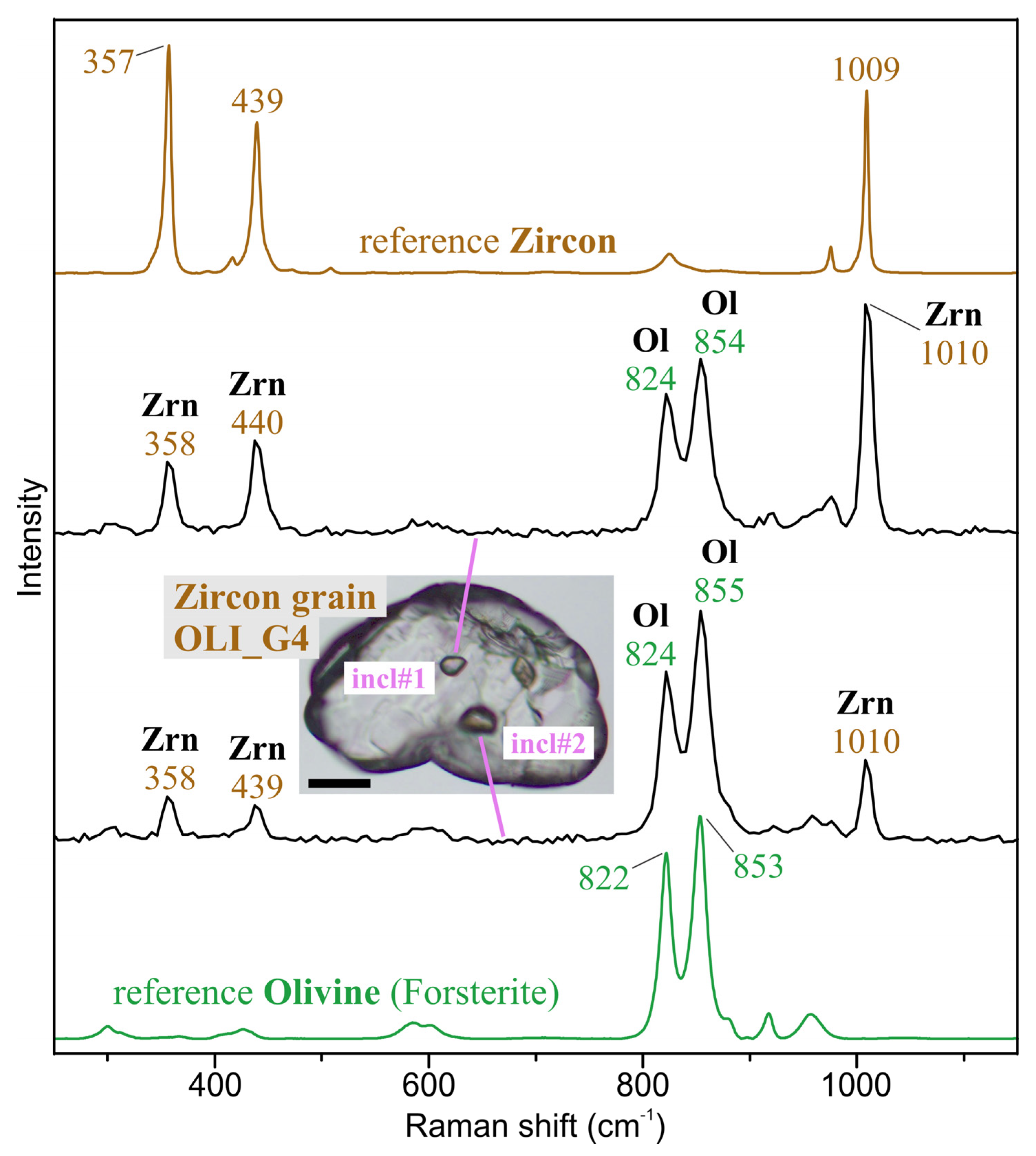
Two mineral inclusions (33 × 41 μm and 43 × 59 μm) were identified in zircon grain OLI_G4 from the Olivinovaya pipe (incl#1 and incl#2; transmitted-light image in Figure 5). These inclusions are neither intersected by visible cracks nor show signs of alteration. They are therefore interpreted as primary inclusions. The spectra obtained from these inclusions display prominent Raman bands at 358, 439–440, and 1010 cm−1, which are characteristic of zircon (Figure 5), reflecting a contribution from the host zircon. However, a Raman doublet at 824 and 854–855 cm−1 is more prominent than the zircon-related bands. Comparison with the RRUFF reference spectrum for forsterite (Figure 5) confirms that this doublet is characteristic of olivine. Accordingly, both inclusions are interpreted as olivine.
Figure 5.
Representative Raman spectra of two olivine inclusions within zircon grain OLI_G4 from the Olivinovaya kimberlite. Reference Raman spectra of forsterite (RRUFF ID: R060539; 532 nm laser) and zircon (RRUFF ID: R050203; 532 nm laser) from the RRUFF database (https://rruff.info; [55]) are shown for comparison to illustrate the characteristic peaks of these minerals. The scale bar in the transmitted-light image of grain OLI_G4 is 100 μm in length. Zrn = zircon; Ol = olivine.
4. Discussion
4.1. Origin of the Analyzed Zircons from the Obnazhennaya and Olivinovaya Kimberlites
Mantle-derived kimberlitic zircons from occurrences worldwide display common trace-element characteristics: Th/U ratios > 0.1 but not exceeding unity [26,50]; low U concentrations, typically ≤60 ppm [50], but reported up to 91 ppm [26]; and low total REE concentrations, typically <50 ppm [34,50], but reported up to 201 ppm [26]. Their chondrite-normalized REE patterns show pronounced positive Ce anomalies, weak to absent Eu anomalies, and a slight increase from Gd to Lu, commonly described as relatively flat heavy-REE patterns [26,34,50,56]. Weak or absent Eu anomalies distinguish these patterns from those of most crustal zircons [50,57]. Although mantle-derived zircons from MARID (mica–amphibole–rutile–ilmenite–diopside) xenoliths can show REE patterns similar to those of kimberlitic zircons [57,58] and can also be recovered as individual megacrysts from kimberlites [52], MARID zircons differ in having higher U and total REE concentrations. A mean total REE concentration of 640 ppm has been reported for MARID zircons [57,59], and their U concentrations can exceed 100 ppm [52,58,60].
The chondrite-normalized REE patterns, Th/U ratios, and U concentrations of the zircons analyzed from the Obnazhennaya and Olivinovaya kimberlites (Section 3.2) correspond to those described above for mantle-derived kimberlitic zircons. The REE concentrations in all 21 trace-element analyses plot within the kimberlitic-zircon field (Figure 4b), and most have total REE concentrations well below 50 ppm (i.e., 8–35 ppm for 17 analyses; Supplementary Table S4). In addition, the Y concentrations and Nb/Ta ratios of analyzed zircons are similar to those of kimberlitic zircons (Figure 4c,d). Moreover, the δ18O values of 5.50 ± 0.31‰ and 5.28 ± 0.30‰ obtained for the Obnazhennaya and Olivinovaya zircon groups, respectively (Section 3.2), fall within the range of mantle-like oxygen-isotope compositions (Figure 4a), which are characteristic of kimberlitic zircons [54]. Taken together, the trace-element and oxygen-isotope data for the analyzed Obnazhennaya and Olivinovaya zircons identify them as mantle-derived kimberlitic zircons. This conclusion is consistent with their physical characteristics—reaction rims, lack of well-developed crystal faces, and relatively large size (Section 2 and Section 3.1)—which are common among mantle zircon megacrysts and were used as criteria for initial zircon selection in this study. Intergrowths of Fe-rich olivine and kimberlitic zircon have previously been reported [16,61]. Both minerals belong to the Cr-poor suite of mantle-derived megacrysts [15,16], which is commonly inferred to be genetically related to kimberlite magmas [17,18]. In addition, magnesian olivine inclusions have also been identified in kimberlitic zircons, suggesting that some of these zircons can grow metasomatically within peridotitic wall rocks in the lithospheric mantle [62]. The primary olivine inclusions identified in the Olivinovaya zircon (Section 3.3; Figure 5) therefore provide additional evidence consistent with the mantle-derived origin inferred from the trace-element and oxygen-isotope data.
Kimberlitic zircons from one kimberlite generally define a single age population, which reliably records the timing of kimberlite eruption [10,14,17,20,26,62]. One possible explanation for this age record does not imply a genetic relationship between these zircons and their host kimberlites. It assumes post-eruption cooling of zircons that formed and remained at mantle temperatures above the U–Pb closure temperature (>900 °C; [63]) before entrainment into kimberlite magma [20,26,27,62]. However, this explanation is challenged by two lines of evidence. First, crystallization temperatures estimated for kimberlitic zircons from different occurrences worldwide using the Ti-in-zircon thermometer are lower, averaging 744 ± 62 °C for Ti concentrations of 13 ± 9 ppm [56]. The Obnazhennaya and Olivinovaya zircons have lower average Ti concentrations of 5 ± 2 ppm (1SD) and 10 ± 3 ppm (1SD), respectively, suggesting even lower crystallization temperatures for our samples. Second, rare examples have been reported of kimberlites containing several age populations of kimberlitic zircons, with the older populations predating kimberlite emplacement [20,21,22]. Alternatively, a cognate relationship between kimberlites and entrained kimberlitic zircons has been proposed [17] and is supported by their similar Hf-isotope compositions [64]. In this scenario, the zircons could have crystallized during interaction between mantle rocks and ascending kimberlite melts [17]. The rare zircons with pre-eruption ages could therefore represent products of earlier pulses of kimberlite magmatism that failed to reach the surface.
4.2. U–Pb Zircon Constraints on the Emplacement Ages of the Obnazhennaya and Olivinovaya Kimberlites
The Obnazhennaya pipe hosts abundant crustal and mantle xenoliths [6,30,31,33,65,66] and crust-derived zircon xenocrysts [32], making it an important locality for investigating the composition and evolution of the Siberian cratonic lithosphere. The abundance and good preservation of olivine in some units of the Olivinovaya pipe have made it an important target for studies of olivine xenocrysts and phenocrysts [67,68,69]. Given the scientific value of these pipes, robust constraints on their emplacement ages are essential.
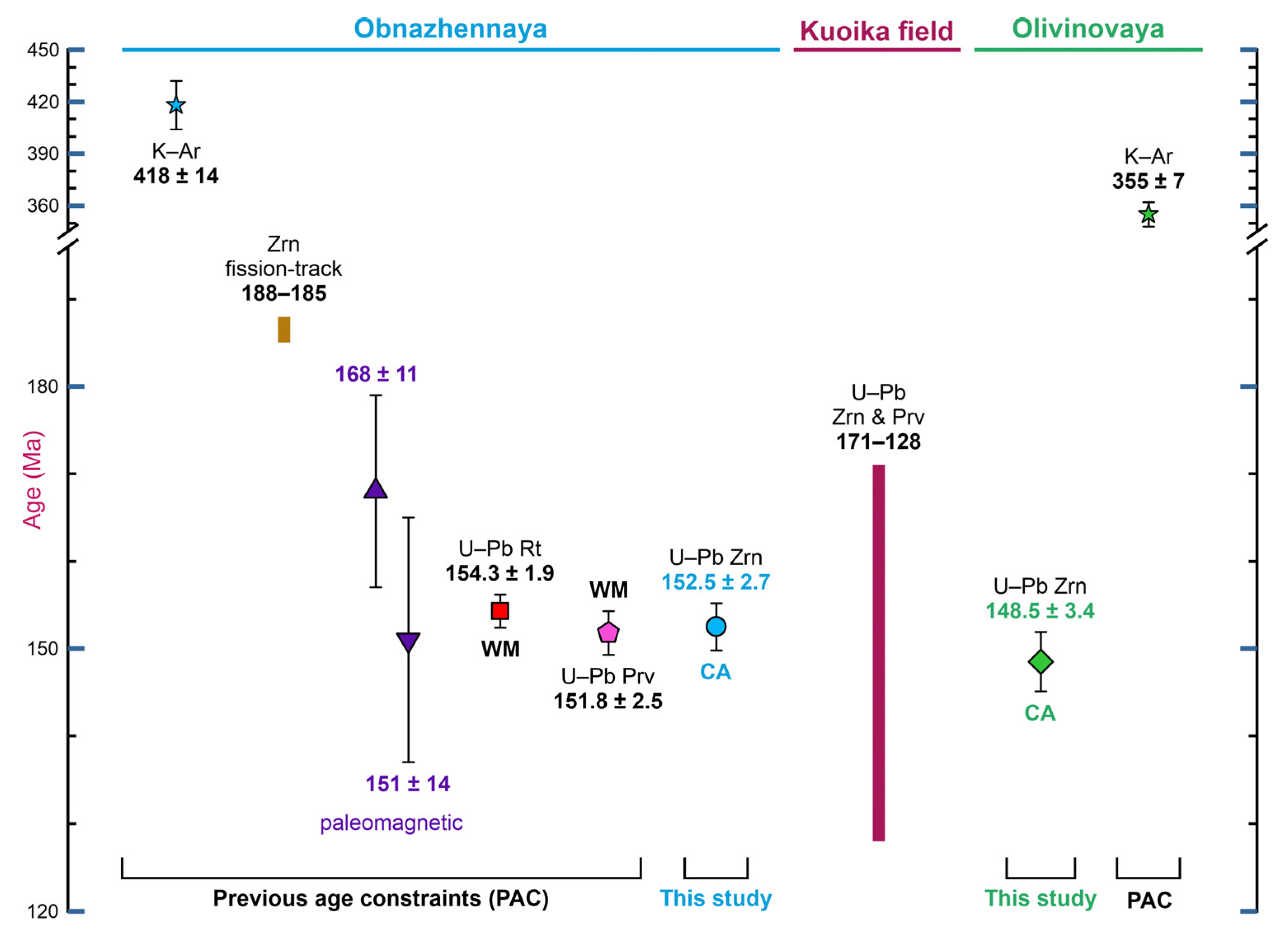
The first age determinations used the K–Ar method and yielded Paleozoic ages of 418 ± 14 Ma and 355 ± 7 Ma for the Obnazhennaya and Olivinovaya kimberlites, respectively ([70]; Figure 6). However, these ages contradict the occurrence of Mesozoic sandstone xenoliths in both pipes [23]. Therefore, the K–Ar ages are likely erroneous and may reflect the incorporation of crustal material in the dated samples.
Figure 6.
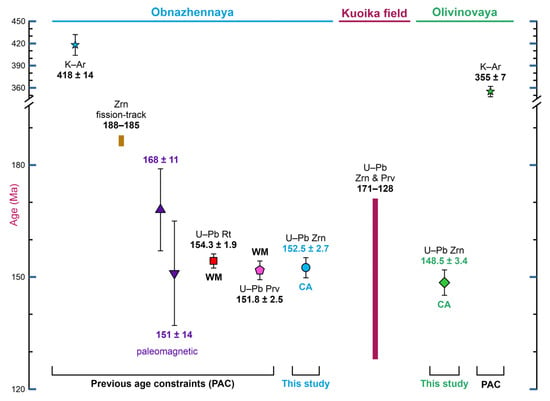
Summary of age constraints for the Obnazhennaya and Olivinovaya kimberlites. K–Ar ages are from [70]; zircon fission-track ages are from [23]; paleomagnetic ages are from [71]; rutile and perovskite U–Pb ages are from [29]. The age range of kimberlite magmatism in the Kuoika field is shown for comparison and is based on zircon and perovskite U–Pb ages from [25,26,27,28]. CA = concordia U–Pb age; WM = weighted-mean 206Pb/238U age; Prv = perovskite; Rt = rutile; Zrn = zircon; PAC = previous age constraints.
For the Olivinovaya kimberlite, the K–Ar date is the only published numerical age constraint. Nevertheless, the pipe is generally referred to as “Jurassic” [67,69], likely based on the commonly inferred Jurassic age of kimberlite magmatism in the Kuoika field [23]. Our U–Pb results for kimberlitic zircons from the Olivinovaya pipe (Figure 3b and Figure 6) support this Jurassic classification. These zircons define a single age population (Figure 3b), and U–Pb geochronology of kimberlitic zircons has been previously used to reliably date kimberlite emplacement [10,14]. We therefore interpret the concordia U–Pb age of 148.5 ± 3.4 Ma as the first reliable geochronological constraint on the age of the Olivinovaya kimberlite.
Beyond the K–Ar age of 418 ± 14 Ma [70], published geochronological constraints for the Obnazhennaya kimberlite yield ages between 188 and 151 Ma (Figure 6). These include zircon fission-track ages of 188–185 Ma [23], paleomagnetic ages of 168 ± 11 Ma and 151 ± 14 Ma [71], and U–Pb ages of 154.3 ± 1.9 Ma and 151.8 ± 2.5 Ma for rutile and perovskite, respectively [29]. Among these previous constraints, the rutile and perovskite U–Pb ages have the smallest analytical uncertainties and form a coherent, tightly clustered group. The dated rutile was obtained from eclogite xenoliths, and its U–Pb age records cooling following kimberlite emplacement [29]. In contrast, perovskite is a primary magmatic phase and therefore provides a direct constraint on the timing of kimberlite emplacement [10]. However, in rare cases, significant crustal assimilation by kimberlite magmas may result in slightly older U–Pb ages determined from perovskite [13]. Therefore, an independent, robust age constraint on the emplacement of the Obnazhennaya kimberlite would be valuable. The concordia U–Pb age of 152.5 ± 2.7 Ma obtained here for kimberlitic zircons from the Obnazhennaya pipe (Figure 3a) agrees within analytical uncertainty from the published perovskite U–Pb age of 151.8 ± 2.5 Ma [29]. Together, these ages therefore robustly constrain the timing of Obnazhennaya kimberlite magmatism to ~152 Ma.
The zircon U–Pb ages of 152.5 ± 2.7 Ma and 148.5 ± 3.4 Ma obtained in this study for the Obnazhennaya and Olivinovaya pipes, respectively, are both Late Jurassic and indistinguishable within analytical uncertainty. Both ages fall within the Middle Jurassic-to-Early Cretaceous age range of kimberlite magmatism in the Kuoika field (171–128 Ma; Figure 6).
5. Conclusions
- Mantle-derived kimberlitic zircons are reported for the first time from the Obnazhennaya and Olivinovaya pipes of the Kuoika field, Siberian craton. Their identification as kimberlitic zircons is based on their oxygen-isotope and trace-element characteristics and is further supported by olivine inclusions identified in one of the zircons.
- The concordia U–Pb age of 152.5 ± 2.7 Ma obtained from the Obnazhennaya zircons is consistent with the previously reported perovskite U–Pb age and provides an independent, reliable constraint on the timing of kimberlite emplacement.
- The concordia U–Pb age of 148.5 ± 3.4 Ma obtained from the Olivinovaya zircons provides the first reliable constraint on the emplacement age of this pipe.
Supplementary Materials
The following supporting information can be downloaded at https://www.mdpi.com/article/10.3390/min16111147/s1, Figure S1: Field views of the Obnazhennaya (a) and Olivinovaya (b) kimberlite pipes; Figure S2: Thin-section images of representative volcaniclastic kimberlite samples from the Obnazhennaya (a) and Olivinovaya (b) pipes. Cpx, clinopyroxene; Grt, garnet; Ol, olivine; CX, crustal xenolith; Table S1: SIMS U–Pb data for Qinghu and 91500 zircon reference materials; Table S2: SIMS oxygen-isotope data for Penglai and Qinghu zircon reference materials; Table S3: LA-ICP-MS trace-element data for GSE-1G reference material; Table S4: SIMS U–Pb and oxygen-isotope data and LA-ICP-MS trace-element data for mantle zircon megacrysts from the Obnazhennaya and Olivinovaya kimberlites, Kuoika field, Siberian craton.
Author Contributions
Conceptualization, A.M.; formal analysis, A.M.; investigation, A.M. and J.L.; resources, A.V.G., Q.L. and O.B.O.; writing—original draft preparation, A.M.; writing—review and editing, A.M., A.V.G., J.L., Q.L. and O.B.O.; visualization, A.M.; project administration, A.M.; funding acquisition, A.M. All authors have read and agreed to the published version of the manuscript.
Funding
This research was funded by the Beijing Natural Science Foundation (grant IS24096) and the Fundamental Research Funds for the Central Universities (grant FRF-TP-24-049A). AVG was supported by the state assignment project of IGM SB RAS (FWZN-2026-0014). OBO was supported by the state assignment project of DPMGI SB RAS (FUFG-2024-0007).
Data Availability Statement
All supporting data are available in the article and its Supplementary Materials (Figures S1 and S2; Tables S1–S4).
Acknowledgments
We are grateful to the four anonymous reviewers for their constructive and helpful comments.
Conflicts of Interest
The authors declare no conflicts of interest.
References
- Giuliani, A.; Pearson, D.G. Kimberlites: From Deep Earth to Diamond Mines. Elements 2019, 15, 377–380. [Google Scholar] [CrossRef] [Scilit]
- Giuliani, A.; Schmidt, M.W.; Torsvik, T.H.; Fedortchouk, Y. Genesis and evolution of kimberlites. Nat. Rev. Earth Environ. 2023, 4, 738–753. [Google Scholar] [CrossRef] [Scilit]
- Russell, J.K.; Sparks, R.S.J.; Kavanagh, J.L. Kimberlite Volcanology: Transport, Ascent, and Eruption. Elements 2019, 15, 405–410. [Google Scholar] [CrossRef] [Scilit]
- Gardiner, N.J.; Kirkland, C.L.; Hollis, J.A.; Cawood, P.A.; Nebel, O.; Szilas, K.; Yakymchuk, C. North Atlantic Craton architecture revealed by kimberlite-hosted crustal zircons. Earth Planet. Sci. Lett. 2020, 534, 116091. [Google Scholar] [CrossRef] [Scilit]
- Liu, Z.; Ionov, D.A.; Nimis, P.; Xu, Y.G.; He, P.L.; Golovin, A.V. Thermal and compositional anomalies in a detailed xenolith-based lithospheric mantle profile of the Siberian craton and the origin of seismic midlithosphere discontinuities. Geology 2022, 50, 891–896. [Google Scholar] [CrossRef] [Scilit]
- Moyen, J.F.; Paquette, J.L.; Ionov, D.A.; Gannoun, A.; Korsakov, A.V.; Golovin, A.V.; Moine, B.N. Paleoproterozoic rejuvenation and replacement of Archaean lithosphere: Evidence from zircon U-Pb dating and Hf isotopes in crustal xenoliths at Udachnaya, Siberian craton. Earth Planet. Sci. Lett. 2017, 457, 149–159. [Google Scholar] [CrossRef] [Scilit]
- Pearson, D.G.; Woodhead, J.; Janney, P.E. Kimberlites as Geochemical Probes of Earth’s Mantle. Elements 2019, 15, 387–392. [Google Scholar] [CrossRef] [Scilit]
- Pattnaik, J.; Aulbach, S.; Ghosh, S.; Babu, E.V.S.S.K.; Viljoen, F.; Bolhar, R. A fresh look at the physicochemical evolution of the lithospheric mantle beneath the Dharwar craton (India). Miner. Petrol. 2025, 119, 715–741. [Google Scholar] [CrossRef] [Scilit]
- Dalton, H.; Giuliani, A.; Phillips, D.; Hergt, J.; Maas, R.; Matchan, E.; Woodhead, J.; O’Brien, H. A comparison of geochronological methods commonly applied to kimberlites and related rocks: Three case studies from Finland. Chem. Geol. 2020, 558, 119899. [Google Scholar] [CrossRef] [Scilit]
- Heaman, L.M.; Phillips, D.; Pearson, D.G. Dating Kimberlites: Methods and Emplacement Patterns Through Time. Elements 2019, 15, 399–404. [Google Scholar] [CrossRef] [Scilit]
- Donnelly, C.L.; Griffin, W.L.; Yang, J.H.; O’Reilly, S.Y.; Li, Q.L.; Pearson, N.J.; Li, X.H. U-Pb Dating and Sr-Nd Isotopic Analysis of Perovskite: Constraints on the Age and Petrogenesis of the Kuruman Kimberlite Province, Kaapvaal Craton, South Africa. J. Petrol. 2012, 53, 2497–2522. [Google Scholar] [CrossRef] [Scilit]
- Yang, Y.H.; Wu, F.Y.; Wilde, S.A.; Liu, X.M.; Zhang, Y.B.; Xie, L.W.; Yang, J.H. In situ perovskite Sr-Nd isotopic constraints on the petrogenesis of the Ordovician Mengyin kimberlites in the North China Craton. Chem. Geol. 2009, 264, 24–42. [Google Scholar] [CrossRef] [Scilit]
- Azzone, R.G.; Pearson, D.G.; Sarkar, C.; Cetina, L.M.T.; Chmyz, L.; Luo, Y.; Ruberti, E.; Guarino, V.; Cabral-Neto, I. Robust methods, tricky materials: Challenges in dating high common-Pb perovskite from Cretaceous Brazilian kimberlites. Chem. Geol. 2024, 670, 122392. [Google Scholar] [CrossRef] [Scilit]
- Melnik, A.E.; Li, Q.L.; Korolev, N.M.; Li, J.; Ling, X.X.; Liu, Y.; Tang, G.Q.; Zinger, T.F.; Mao, Q.; Wu, S.T.; et al. Desilicification Rims of Zircon Xenocrysts Record the Timing of Kimberlite Emplacement. J. Geophys. Res.-Sol. Earth 2022, 127, e2022JB024482. [Google Scholar] [CrossRef] [Scilit]
- Griffin, W.L.; Pearson, N.J.; Belousova, E.; Jackson, S.E.; van Achterbergh, E.; O’Reilly, S.Y.; Shee, S.R. The Hf isotope composition of cratonic mantle: LAM-MC-ICPMS analysis of zircon megacrysts in kimberlites. Geochim. Cosmochim. Acta 2000, 64, 133–147. [Google Scholar] [CrossRef] [Scilit]
- Moore, R.O.; Griffin, W.L.; Gurney, J.J.; Ryan, C.G.; Cousens, D.R.; Sie, S.H.; Suter, G.F. Trace element geochemistry of ilmenite megacrysts from the Monastery kimberlite, South Africa. Lithos 1992, 29, 1–18. [Google Scholar] [CrossRef] [Scilit]
- Kamenetsky, V.S.; Belousova, E.A.; Giuliani, A.; Kamenetsky, M.B.; Goemann, K.; Griffin, W.L. Chemical abrasion of zircon and ilmenite megacrysts in the Monastery kimberlite: Implications for the composition of kimberlite melts. Chem. Geol. 2014, 383, 76–85. [Google Scholar] [CrossRef] [Scilit]
- Mitchell, R.H.; Giuliani, A.; O’Brien, H. What is a Kimberlite? Petrology and Mineralogy of Hypabyssal Kimberlites. Elements 2019, 15, 381–386. [Google Scholar] [CrossRef] [Scilit]
- Woodhead, J.; Hergt, J.; Giuliani, A.; Phillips, D.; Maas, R. Tracking continental-scale modification of the Earth’s mantle using zircon megacrysts. Geochem. Perspect. Lett. 2017, 4, 1–6. [Google Scholar] [CrossRef] [Scilit]
- Agashev, A.M.; Chervyakovskaya, M.V.; Serov, I.V.; Tolstov, A.V.; Agasheva, E.V.; Votyakov, S.L. Source rejuvenation vs. re-heating: Constraints on Siberian kimberlite origin from U-Pb and Lu-Hf isotope compositions and geochemistry of mantle zircons. Lithos 2020, 364–365, 105508. [Google Scholar] [CrossRef] [Scilit]
- Belousova, E.A.; Griffin, W.L.; Shee, S.R.; Jackson, S.E.; O’Reilly, S.Y. Two age populations of zircons from the Timber Creek kimberlites, Northern Territory, as determined by laser-ablation ICP-MS analysis. Aust. J. Earth Sci. 2001, 48, 757–765. [Google Scholar] [CrossRef] [Scilit]
- Zartman, R.E.; Richardson, S.H. Evidence from kimberlitic zircon for a decreasing mantle Th/U since the Archean. Chem. Geol. 2005, 220, 263–283. [Google Scholar] [CrossRef] [Scilit]
- Griffin, W.L.; Ryan, C.G.; Kaminsky, F.V.; O’Reilly, S.Y.; Natapov, L.M.; Win, T.T.; Kinny, P.D.; Ilupin, I.P. The Siberian lithosphere traverse: Mantle terranes and the assembly of the Siberian Craton. Tectonophysics 1999, 310, 1–35. [Google Scholar] [CrossRef] [Scilit]
- Spetsius, Z.V. Petrology of highly aluminous xenoliths from kimberlites of Yakutia. Lithos 2004, 77, 525–538. [Google Scholar] [CrossRef]
- Sun, J.; Liu, C.Z.; Tappe, S.; Kostrovitsky, S.I.; Wu, F.Y.; Yakovlev, D.; Yang, Y.H.; Yang, J.H. Repeated kimberlite magmatism beneath Yakutia and its relationship to Siberian flood volcanism: Insights from in situ U-Pb and Sr-Nd perovskite isotope analysis. Earth Planet. Sci. Lett. 2014, 404, 283–295. [Google Scholar] [CrossRef] [Scilit]
- Sun, J.; Tappe, S.; Kostrovitsky, S.I.; Liu, C.Z.; Skuzovatov, S.Y.; Wu, F.Y. Mantle sources of kimberlites through time: A U-Pb and Lu-Hf isotope study of zircon megacrysts from the Siberian diamond fields. Chem. Geol. 2018, 479, 228–240. [Google Scholar] [CrossRef] [Scilit]
- Davis, G.L.; Sobolev, N.V.; Khar’kiv, A.D. New Data on the Age of Yakutian Kimberlites Obtained by U–Pb Dating of Zircons. Dokl. Akad. Nauk. SSSR 1980, 254, 175–180. (In Russian) [Google Scholar]
- Kinny, P.D.; Griffin, B.; Heaman, L.M.; Brakhfogel, F.F.; Spetsius, Z.V. SHRIMP U-Pb Ages of Perovskite from Yakutian Kimberlites. Russ. Geol. Geophys. 1997, 38, 91–99. (In Russian) [Google Scholar]
- Sun, J.; Mitchell, R.N.; Kostrovitsky, S.; Apen, F.E. Siberia’s largest pulse of kimberlites: U-Pb geochronology of perovskite and rutile from the Obnazhennaya kimberlite and its xenoliths, Siberia craton. Int. Geol. Rev. 2022, 64, 1743–1754. [Google Scholar] [CrossRef] [Scilit]
- Ionov, D.A.; Carlson, R.W.; Doucet, L.S.; Golovin, A.V.; Oleinikov, O.B. The age and history of the lithospheric mantle of the Siberian craton: Re-Os and PGE study of peridotite xenoliths from the Obnazhennaya kimberlite. Earth Planet. Sci. Lett. 2015, 428, 108–119. [Google Scholar] [CrossRef] [Scilit]
- Ionov, D.A.; Doucet, L.S.; Xu, Y.G.; Golovin, A.V.; Oleinikov, O.B. Reworking of Archean mantle in the NE Siberian craton by carbonatite and silicate melt metasomatism: Evidence from a carbonate-bearing, dunite-to-websterite xenolith suite from the Obnazhennaya kimberlite. Geochim. Cosmochim. Acta 2018, 224, 132–153. [Google Scholar] [CrossRef] [Scilit]
- Kostrovitsky, S.I.; Skuzovatov, S.Y.; Yakovlev, D.A.; Sun, J.; Nasdala, L.; Wu, F.Y. Age of the Siberian craton crust beneath the northern kimberlite fields: Insights to the craton evolution. Gondwana Res. 2016, 39, 365–385. [Google Scholar] [CrossRef] [Scilit]
- Sun, J.; Rudnick, R.L.; Kostrovitsky, S.; Kalashnikova, T.; Kitajima, K.; Li, R.P.; Shu, Q. The origin of low-MgO eclogite xenoliths from Obnazhennaya kimberlite, Siberian craton. Contrib. Miner. Petrol. 2020, 175, 25. [Google Scholar] [CrossRef] [Scilit]
- Belousova, E.A.; Griffin, W.L.; Pearson, N.J. Trace element composition and cathodoluminescence properties of southern African kimberlitic zircons. Miner. Mag. 1998, 62, 355–366. [Google Scholar] [CrossRef] [Scilit]
- Corfu, F.; Hanchar, J.M.; Hoskin, P.W.O.; Kinny, P. Atlas of zircon textures. Rev. Miner. Geochem. 2003, 53, 469–500. [Google Scholar] [CrossRef] [Scilit]
- Li, X.H.; Liu, Y.; Li, Q.L.; Guo, C.H.; Chamberlain, K.R. Precise determination of Phanerozoic zircon Pb/Pb age by multicollector SIMS without external standardization. Geochem. Geophys. Geosyst. 2009, 10, Q04010. [Google Scholar] [CrossRef] [Scilit]
- Ling, X.X.; Li, Q.L.; Yang, C.; Chu, Z.Y.; Feng, L.J.; Huang, C.; Huang, L.L.; Zhang, H.; Hou, Z.H.; Xu, J.J.; et al. Zircon ZS—A Homogenous Natural Reference Material for U-Pb Age and O-Hf Isotope Microanalyses. At. Spectrosc. 2022, 43, 134–144. [Google Scholar] [CrossRef] [Scilit]
- Li, Q.L.; Li, X.H.; Liu, Y.; Tang, G.Q.; Yang, J.H.; Zhu, W.G. Precise U-Pb and Pb-Pb dating of Phanerozoic baddeleyite by SIMS with oxygen flooding technique. J. Anal. At. Spectrom. 2010, 25, 1107–1113. [Google Scholar] [CrossRef] [Scilit]
- Stacey, J.S.; Kramers, J.D. Approximation of terrestrial lead isotope evolution by a two-stage model. Earth Planet. Sci. Lett. 1975, 26, 207–221. [Google Scholar] [CrossRef] [Scilit]
- Li, X.H.; Tang, G.Q.; Gong, B.; Yang, Y.H.; Hou, K.J.; Hu, Z.C.; Li, Q.L.; Liu, Y.; Li, W.X. Qinghu zircon: A working reference for microbeam analysis of U-Pb age and Hf and O isotopes. Chin. Sci. Bull. 2013, 58, 4647–4654. [Google Scholar] [CrossRef] [Scilit]
- Wiedenbeck, M.; Allé, P.; Corfu, F.; Griffin, W.L.; Meier, M.; Oberli, F.; Von Quadt, A.; Roddick, J.C.; Spiegel, W. Three natural zircon standards for U-Th-Pb, Lu-Hf, trace element and REE analyses. Geostand. Newsl. 1995, 19, 1–23. [Google Scholar] [CrossRef] [Scilit]
- Vermeesch, P. IsoplotR: A free and open toolbox for geochronology. Geosci. Front. 2018, 9, 1479–1493. [Google Scholar] [CrossRef] [Scilit]
- Li, X.H.; Long, W.G.; Li, Q.L.; Liu, Y.; Zheng, Y.F.; Yang, Y.H.; Chamberlain, K.R.; Wan, D.F.; Guo, C.H.; Wang, X.C.; et al. Penglai Zircon Megacrysts: A Potential New Working Reference Material for Microbeam Determination of Hf-O Isotopes and U-Pb Age. Geostand. Geoanalytical Res. 2010, 34, 117–134. [Google Scholar] [CrossRef] [Scilit]
- Tang, G.Q.; Li, X.H.; Li, Q.L.; Liu, Y.; Ling, X.X.; Yin, Q.Z. Deciphering the physical mechanism of the topography effect for oxygen isotope measurements using a Cameca IMS-1280 SIMS. J. Anal. At. Spectrom. 2015, 30, 950–956. [Google Scholar] [CrossRef] [Scilit]
- Baertschi, P. Absolute 18O content of standard mean ocean water. Earth Planet. Sci. Lett. 1976, 31, 341–344. [Google Scholar] [CrossRef] [Scilit]
- Hu, Z.C.; Zhang, W.; Liu, Y.S.; Gao, S.; Li, M.; Zong, K.Q.; Chen, H.H.; Hu, S.H. “Wave” Signal-Smoothing and Mercury-Removing Device for Laser Ablation Quadrupole and Multiple Collector ICPMS Analysis: Application to Lead Isotope Analysis. Anal. Chem. 2015, 87, 1152–1157. [Google Scholar] [CrossRef] [Scilit]
- Zong, K.Q.; Klemd, R.; Yuan, Y.; He, Z.Y.; Guo, J.L.; Shi, X.L.; Liu, Y.S.; Hu, Z.C.; Zhang, Z.M. The assembly of Rodinia: The correlation of early Neoproterozoic (ca. 900 Ma) high-grade metamorphism and continental arc formation in the southern Beishan Orogen, southern Central Asian Orogenic Belt (CAOB). Precambrian Res. 2017, 290, 32–48. [Google Scholar] [CrossRef] [Scilit]
- Liu, Y.S.; Hu, Z.C.; Gao, S.; Günther, D.; Xu, J.; Gao, C.G.; Chen, H.H. In situ analysis of major and trace elements of anhydrous minerals by LA-ICP-MS without applying an internal standard. Chem. Geol. 2008, 257, 34–43. [Google Scholar] [CrossRef] [Scilit]
- Jochum, K.P.; Nohl, L.; Herwig, K.; Lammel, E.; Stoll, B.; Hofmann, A.W. GeoReM: A new geochemical database for reference materials and isotopic standards. Geostand. Geoanal. Res. 2005, 29, 333–338. [Google Scholar] [CrossRef] [Scilit]
- Belousova, E.A.; Griffin, W.L.; O’Reilly, S.Y.; Fisher, N.I. Igneous zircon: Trace element composition as an indicator of source rock type. Contrib. Mineral. Petrol. 2002, 143, 602–622. [Google Scholar] [CrossRef] [Scilit]
- Hoare, B.C.; O’Sullivan, G.; Tomlinson, E.L. Metasomatism of the Kaapvaal Craton during Cretaceous intraplate magmatism revealed by combined zircon U-Pb isotope and trace element analysis. Chem. Geol. 2021, 578, 120302. [Google Scholar] [CrossRef] [Scilit]
- Robles-Cruz, S.E.; Escayola, M.; Jackson, S.; Galí, S.; Pervov, V.; Watangua, M.; Gonçalves, A.; Melgarejo, J.C. U-Pb SHRIMP geochronology of zircon from the Catoca kimberlite, Angola: Implications for diamond exploration. Chem. Geol. 2012, 310–311, 137–147. [Google Scholar] [CrossRef] [Scilit]
- McDonough, W.F.; Sun, S.-s. The composition of the Earth. Chem. Geol. 1995, 120, 223–253. [Google Scholar] [CrossRef] [Scilit]
- Valley, J.W.; Kinny, P.D.; Schulze, D.J.; Spicuzza, M.J. Zircon megacrysts from kimberlite: Oxygen isotope variability among mantle melts. Contrib. Mineral. Petrol. 1998, 133, 1–11. [Google Scholar] [CrossRef] [Scilit]
- Lafuente, B.; Downs, R.T.; Yang, H.; Stone, N. The power of databases: The RRUFF project. In Highlights in Mineralogical Crystallography; Armbruster, T., Danisi, R.M., Eds.; W. De Gruyter: Berlin, Germany, 2015; pp. 1–30. [Google Scholar]
- Page, F.Z.; Fu, B.; Kita, N.T.; Fournelle, J.; Spicuzza, M.J.; Schulze, D.J.; Viljoen, F.; Basei, M.A.S.; Valley, J.W. Zircons from kimberlite: New insights from oxygen isotopes, trace elements, and Ti in zircon thermometry. Geochim. Cosmochim. Acta 2007, 71, 3887–3903. [Google Scholar] [CrossRef] [Scilit]
- Hoskin, P.W.O.; Schaltegger, U. The composition of zircon and igneous and metamorphic petrogenesis. Rev. Miner. Geochem. 2003, 53, 27–62. [Google Scholar] [CrossRef] [Scilit]
- Giuliani, A.; Phillips, D.; Woodhead, J.D.; Kamenetsky, V.S.; Fiorentini, M.L.; Maas, R.; Soltys, A.; Armstrong, R.A. Did diamond-bearing orangeites originate from MARID-veined peridotites in the lithospheric mantle? Nat. Commun. 2015, 6, 6837. [Google Scholar] [CrossRef] [Scilit]
- Hoskin, P.W.O. Minor and trace element analysis of natural zircon (ZrSiO4) by SIMS and laser ablation ICPMS: A consideration and comparison of two broadly competitive techniques. J. Trace Microprobe Tech. 1998, 16, 301–326. [Google Scholar]
- Konzett, J.; Armstrong, R.A.; Sweeney, R.J.; Compston, W. The timing of MARID metasomatism in the Kaapvaal mantle: An ion probe study of zircons from MARID xenoliths. Earth Planet. Sci. Lett. 1998, 160, 133–145. [Google Scholar] [CrossRef] [Scilit]
- Bell, D.R.; Rossman, G.R.; Moore, R.O. Abundance and partitioning of OH in a high-pressure magmatic system: Megacrysts from the Monastery kimberlite, South Africa. J. Petrol. 2004, 45, 1539–1564. [Google Scholar] [CrossRef] [Scilit]
- Spetsius, Z.V.; Belousova, E.A.; Griffin, W.L.; O’Reilly, S.Y.; Pearson, N.J. Archean sulfide inclusions in Paleozoic zircon megacrysts from the Mir kimberlite, Yakutia: Implications for the dating of diamonds. Earth Planet. Sci. Lett. 2002, 199, 111–126. [Google Scholar] [CrossRef] [Scilit]
- Lee, J.K.W.; Williams, I.S.; Ellis, D.J. Pb, U and Th diffusion in natural zircon. Nature 1997, 390, 159–162. [Google Scholar] [CrossRef] [Scilit]
- Nowell, G.M.; Pearson, D.G.; Bell, D.R.; Carlson, R.W.; Smith, C.B.; Kempton, P.D.; Noble, S.R. Hf isotope systematics of kimberlites and their megacrysts: New constraints on their source regions. J. Petrol. 2004, 45, 1583–1612. [Google Scholar] [CrossRef] [Scilit]
- Alifirova, T.A.; Pokhilenko, L.N.; Ovchinnikov, Y.I.; Donnelly, C.L.; Riches, A.J.V.; Taylor, L.A. Petrologic origin of exsolution textures in mantle minerals: Evidence in pyroxenitic xenoliths from Yakutia kimberlites. Int. Geol. Rev. 2012, 54, 1071–1092. [Google Scholar] [CrossRef] [Scilit]
- Howarth, G.H.; Barry, P.H.; Pernet-Fisher, J.F.; Baziotis, I.P.; Pokhilenko, N.P.; Pokhilenko, L.N.; Bodnar, R.J.; Taylor, L.A.; Agashev, A.M. Superplume metasomatism: Evidence from Siberian mantle xenoliths. Lithos 2014, 184–187, 209–224. [Google Scholar] [CrossRef] [Scilit]
- Sobolev, N.V.; Sobolev, A.V.; Tomilenko, A.A.; Kuz’min, D.V.; Grakhanov, S.A.; Batanova, V.G.; Logvinova, A.M.; Bul’bak, T.A.; Kostrovitskii, S.I.; Yakovlev, D.A.; et al. Prospects of search for diamondiferous kimberlites in the northeastern Siberian Platform. Russ. Geol. Geophys. 2018, 59, 1365–1379. [Google Scholar] [CrossRef] [Scilit]
- Tomilenko, A.A.; Bul’bak, T.A.; Khomenko, M.O.; Kuzmin, D.V.; Sobolev, N.V. The composition of volatile components in olivines from Yakutian kimberlites of various ages: Evidence from gas chromatography-mass spectrometry. Dokl. Earth Sci. 2016, 468, 626–631. [Google Scholar] [CrossRef] [Scilit]
- Tychkov, N.S.; Agashev, A.M.; Pokhilenko, N.P.; Tsykh, V.A.; Sobolev, N.V. Types of Xenogenic Olivine from Siberian Kimberlites. Minerals 2020, 10, 302. [Google Scholar] [CrossRef] [Scilit]
- Brakhfogel, F.F. Geological Aspects of Kimberlite Magmatism in the Northeastern Siberian Platform; Yakutian Branch of the Siberian Branch of the USSR Academy of Sciences: Yakutsk, Russia, 1984; p. 128. (In Russian) [Google Scholar]
- Blanco, D.; Kravchinsky, V.A.; Konstantinov, K.M.; Kabin, K. Paleomagnetic dating of Phanerozoic kimberlites in Siberia. J. Appl. Geophys. 2013, 88, 139–153. [Google Scholar] [CrossRef] [Scilit]
Disclaimer/Publisher’s Note: The statements, opinions and data contained in all publications are solely those of the individual author(s) and contributor(s) and not of MDPI and/or the editor(s). MDPI and/or the editor(s) disclaim responsibility for any injury to people or property resulting from any ideas, methods, instructions or products referred to in the content. |
© 2026 by the authors. Licensee MDPI, Basel, Switzerland. This article is an open access article distributed under the terms and conditions of the Creative Commons Attribution (CC BY) license.