


Abstract
Coal can enrich hazardous trace elements in specific depositional environments, and their distribution and modes of occurrence are controlled by multiple geological factors. This study investigated the geochemistry of hazardous trace elements in the Middle Jurassic Xishanyao Formation coals of the Piliqing Open-Pit Mine, Yili Coalfield, using proximate, mineralogical (XRD, SEM-EDS), and geochemical (ICP-MS, carbonate C-O isotope) analyses. The coals were ultra-low-ash and low-sulfur subbituminous, with a whole-coal weighted-average CaO content of 1.95%. Most hazardous trace elements were not enriched relative to world coal averages: F, Cr, Ni, Co, As, Sr, and Th were near global values; whereas Se, Cd, Mo, Tl, Pb, U, and Hg were depleted. Vertically, F, V, Cr, Hg, Pb, Tl, Th, and U were higher in the roof and floor strata than in the coal seams, indicating terrigenous detrital input as the primary control, whereas Sr was governed by carbonate and aluminosilicate minerals. The only pronounced enrichment was the anomalously high V (212 μg/g) in sample C407, which possibly recorded locally reducing conditions at the base of the No. 4 seam; however, this single-sample observation precludes a firm syngenetic interpretation. Carbonate C-O isotopes showed that the calcite veins precipitated from coal-altering epigenetic hydrothermal fluids that carried an admixed organic-matter-derived carbon component. These fluids delivered mainly Ca, Mn, and Sr, without adding harmful elements to the coal. This signature reflects a dominantly syngenetic geochemical pattern that was locally overprinted by non-oxidizing hydrothermal fluids, in which weakly oxidizing, shallow-water conditions were unfavorable for the reducing enrichment of U, Mo, Re, and Se. In contrast to the coal-hosted uranium deposits of the Southern Yili Basin margin, Piliqing coals showed no evidence of post-depositional oxidized-fluid infiltration, indicating limited environmental risk.
1. Introduction
As a kind of organic rock and sedimentary ore with absorbability and reducibility, coal can enrich environmental sensitive elements, such as Pb, As, Se, Hg and U, in specific depositional environments [1,2,3]. These hazardous elements can migrate from coal into the ecosystem through coal mining and utilization, jeopardizing human health [2]. Endemic arsenic poisoning and fluorosis in Southwest Guizhou has been related to the combustion of coal with a high arsenic content or clay with a high F content mixed with coal [4]. Highly enriched with Se, F, and other toxic elements, Cambrian stone coal from Hubei, China, not only pollutes the environment when combusted but also causes endemic diseases, including selenosis and fluorosis [5,6]. The toxic and harmful substances in coal gangue can pollute the soil and groundwater by leaching [7,8,9].
As an important coal production base in China, Xinjiang coal is characterized by a good coal quality, low ash, and low sulfur [10,11]. The Yili Coalfield is one of the four major coalfields in Xinjiang and plays an important role in Xinjiang’s coal resource reserves. A great amount of data has been obtained on sedimentary sequence stratigraphy and coal accumulation processes in past coalfield explorations [11,12,13,14]. Many studies have shown that there is a radiometric anomaly caused by the sandstone-type uranium deposits in the north and south margins of the basin [15,16,17]. The geochemistry of trace elements in coal adjacent to sandstone-type uranium deposits in the southern margin of the basin, in which the uranium content reaches up to 7207 μg/g, is enriched with V, Cd, Mo, Pb, As, and other hazardous elements [17]. But other studies have reported that trace elements in Yili coal are low, even substantially below the global coal average. These studies attributed such low trace element concentrations to slow basin basement subsidence and limited terrigenous material supply in the basin [11,12]. These studies demonstrate that the geochemical signatures of coal in the Yili Basin are controlled by multiple geological factors. Accordingly, hazardous element concentrations in coals from different coalfields display highly variable distributions.
In this study, coal and host rock samples were collected from the Piliqing Open-Pit Mine (hereafter Piliqing Mine) in the Yili Coalfield and analyzed to systematically investigate the distribution of and mineralogical constraints on their occurrence. Combined with relevant previous studies, geochemical indices were used to elucidate the geological factors controlling the enrichment and mobilization of these elements. These findings have important implications for the rational utilization of coal resources and for mitigating coal-related environmental pollution in the Yili region.
2. Geological Background
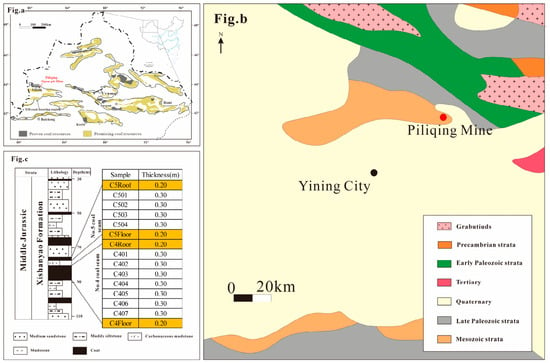
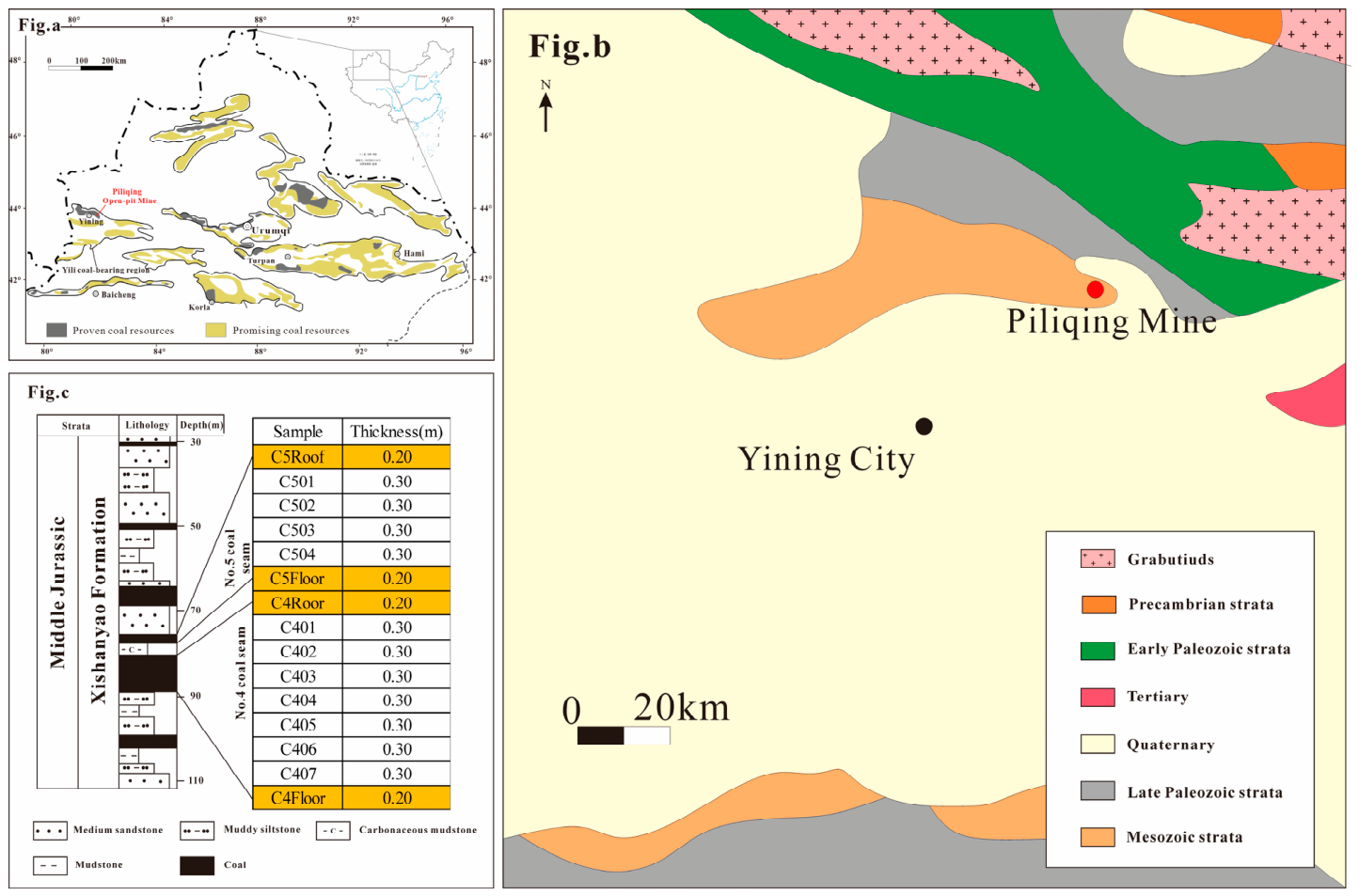
The Yili Coalfield is in the Xinjiang Uygur Autonomous Region of Northwest China, bordering Kazakhstan and Kyrgyzstan to the west (Figure 1a) [18]. Tectonically, the Yili Basin is a typical intermontane continental depression basin of the Tianshan orogen. It is tectonically confined between the Northern Tianshan (Keguqin–Boroholo–Ilenhabilga orogenic belt) and Southern Tianshan (Kharke–Narati orogenic belt) tectonic belts, and is formed by persistent north–south compressive collision between the Tarim and Kazakhstan plates [19]. Influenced by such compression, the basin exhibits an asymmetric dustpan-like tectonic profile, with a steep northern margin, a gentle southern slope, a deep northern sag, and a shallow southern sag, presenting a unique east-tapering and west-expanding triangular spatial geometry [18,19].
Figure 1.
Geological background, location, sedimentary sequence, and collected sample details of the Piliqing Open-Pit Mine. (a) Location of the Piliqing Open-Pit Mine. (b) Geological background of the Yili Basin (simplified from [20]). (c) Generalized sedimentary sequences of the Piliqing Mine with sample information.
The Yili Basin has a double-basement structure, including the lower Precambrian metamorphic basement and the upper Paleozoic direct basement, which is overlain by continuous Mesozoic–Cenozoic sedimentary cover sequences (Figure 1b) [15,18]. The coal-bearing strata in the Yili Coalfield are predominantly developed in the Lower–Middle Jurassic Shuixigou Group, which constitutes the primary coal-bearing succession of the study area [11,12]. From bottom to top, the Jurassic coal-bearing strata are divided into the Lower Jurassic Badaowan Formation (Jb), Lower Jurassic Sangonghe Formation (Js), and Middle Jurassic Xishanyao Formation (Jx) [11,18]. The Xishanyao Formation is the most important coal-bearing unit in the Yili Basin, characterized by stable stratigraphic distribution; thick continuous coal seams; and rhythmic interbedding of sandstone, mudstone, and carbonaceous mudstone [12,14]. All samples in this study were collected from the continuous Xishanyao Formation coal-bearing strata of the Piliqing Mine, which completely records the sedimentary and geochemical evolution of the Yili Coalfield (Figure 1c).
The delta plain sedimentary environment is characterized by well-developed distributary channels, interdistributary bays, and widespread peat swamps [13,14]. During the Early–Middle Jurassic, the Yili Basin experienced stable tectonic subsidence and humid paleoclimate conditions, providing favorable conditions for widespread coal accumulation [13]. The Jurassic coal-bearing strata mainly developed a meandering river delta and shallow lacustrine sedimentary systems, with delta plain sub-facies dominating the study area [12,14]. Long-term stable swamp deposition facilitated the massive accumulation and preservation of plant organic matter, forming the thick industrial coal seams in the Piliqing Mine [14]. Local shallow lacustrine sub-facies developed in the relatively deep basin center, forming fine-grained mudstone and siltstone interlayers, which constitute the main host rocks of the coal seams [11,12]. Overall, the sedimentary evolution of alternating fluvial, deltaic, and lacustrine facies controlled the spatial distribution of coal seams and the primary migration and enrichment of trace elements in the Yili Coalfield [11,12,13].
3. Samples and Analytical Methods
A series of 15 coal and host rock samples (Figure 1c), including 4 host rock samples, 9 pure coal benches, and 2 carbonate-bearing coal samples (denoted as C503 and C403), were collected from the Piliqing Mine of the Yili Coalfield in accordance with GB/T 482-2008 [21]. All samples were taken from sampling areas measuring 30 cm long, 10 cm wide, and 10 cm deep area. The samples were immediately sealed in plastic bags to minimize the risk of oxidation and contamination. The samples were ground and sieved into three fractions: (1) passing through a 200-mesh sieve (<71 μm, for major/trace element and mineralogical analysis); (2) an 80-mesh sieve (<180 μm, for proximate analysis); and (3) 18–40 mesh (0.38–0.85 mm) sieves. The 18–40 mesh fraction was prepared as polished grain mounts for vitrinite reflectance determination and mineral microscopy. For X-ray powder diffraction (XRD) analysis, these samples were further ground to <325 mesh (<44 μm).
Proximate analysis (moisture, ash yield, and volatile matter) was performed following GB/T 212-2008 [22], and the total sulfur was determined according to GB/T 214-2007 [23]. Given that these fundamental coal quality parameters were previously reported in our earlier work focusing on strategic metal geochemistry [24], they are not presented in detail herein but are integrated into the present dataset for interpreting hazardous element behaviors. Detailed data can be found in Supplementary Table S1. All other analyses, including major element oxides, hazardous trace elements, mineralogy, and carbonate C-O isotopes, were performed specifically for this study following the procedures described below.
Vitrinite reflectance (Ro) measurements were conducted using a Leica DM4500P microscope Leica Microsystems, Wetzlar, Germany (equipped with a photometer, following the procedures of ASTM D2798-21 [25]. The analytical precision for Ro measurements was better than ±0.02%. X-ray powder diffraction (XRD) analysis was carried out using a Thermo Scientific ARL PERFORM’X diffractometer (Thermo Fisher Scientific, Waltham, MA, USA) to determine the mineral compositions of the powdered roof, floor, and carbonate-bearing coal samples (6 samples). The instrument was configured with Ni-filtered Cu-Kα radiation and a scintillation detector. Each XRD pattern was recorded over a 2θ interval of 5–85°, with a step size of 0.02°. Quantitative analysis of the samples was performed using Rietveld refinement. A scanning electron microscope with an energy-dispersive X-ray spectrometer (SEM-EDS, Carl Zeiss AG, Oberkochen, Germany) was used to study morphologies and micro-structures of minerals held by polished grain mounts.
The major element oxides in coal ash (815 °C) were determined by X-ray fluorescence (XRF) spectrometry according to GB/T 37673-2019 [26]. Fluorine was determined by the ion-selective electrode method using a PXSJ-216 ion meter (Leici, Shanghai, China), following ASTM D5987-96 [27]. Mercury was determined using a DMA-80 direct mercury analyzer (Milestone S.r.l., Sorisole, Italy). Inductively coupled plasma mass spectrometry (ICP-MS, X Series 2, Thermo Fisher Scientific, Waltham, MA, USA) was used to determine other trace elements in coal and host rock samples. Prior to the ICP-MS analysis, all samples were digested via microwave-assisted digestion following the principles of EPA Method 3052 (SW-846) [28]. Collision-cell technology (CCT) was employed for As and Se measurements to eliminate any interference from polyatomic ions.
The carbon and oxygen isotopic compositions of carbonate in solid powder samples were determined on a MAT 253 mass spectrometer coupled with a GasBench II online gas preparation device (Thermo Fisher Scientific, Waltham, MA, USA). The analysis was conducted using the phosphoric acid digestion method, in which samples were reacted with anhydrous phosphoric acid to generate CO2 for online purification and subsequent measurement. Carbon and oxygen isotopic data are expressed relative to the Vienna Pee Dee Belemnite (VPDB), denoted as δ13CVPDB and δ18OVPDB. The conversion from δ18OvPDB to δ18O_VSMOW follows the IUPAC recommended conversion equation: δ18O_VSMOW = 1.03092 × δ18O_VPDB + 30.92 [29,30]. The analytical precision of carbon and oxygen isotope analyses is better than 0.2‰.
4. Results
4.1. Coal Chemistry and Vitrinite Reflectance
The statistical summary of proximate analyses, total sulfur, and vitrinite random reflectance (Ro,ran) for the Piliqing coal samples are presented in Table 1. The ash yield of pure coal benches ranges from 4.04% to 9.18%, with an average of 6.13% (on a dry basis), indicating ultra-low ash coal according to GB/T 15224.1-2018 [31]. The volatile matter yield of pure coal benches ranges from 30.16 to 43.56%, with an average of 33.77% (on a dry, ash-free basis). The pure coal benches are overall identified as low-sulfur coal (total sulfur content ranges from 0.09 to 2.56%, mean = 0.72%, on a dry basis) [32]. In contrast, the carbonate-vein-bearing coal samples (C403 and C503) have higher ash yields and volatile matter values. The moisture contents of these two samples are less than 10%, which may be related to their high mineral contents (dominated by calcite).
Table 1.
Proximate analyses, total sulfur, and vitrinite reflectance of Piliqing Mine coal samples (%).
Carbonate minerals undergo thermal decomposition under the heating conditions of proximate analysis, releasing CO2 and resulting in abnormally high measured volatile matter contents [33]. Thus, volatile matter data of carbonate-bearing coal cannot be used for coal-rank classification. The Ro,ran of pure coal benches ranges from 0.41% to 0.54% (mean = 0.45%). Combined with the empirical supplementary correlation from Appendix X1 of ASTM D388-23, these pure coal samples are classified as subbituminous coal [34].
4.2. Major Element Oxides
The percentages of major element oxides in coal and host rock samples are listed in Table 2. Concentration coefficients (CC = ratio of element concentration in investigated coals vs. world hard coals) were used to evaluated the enrichment degree of elements in coal [35]. Relative to the average values of Chinese coals, MnO2 and CaO are enriched (5 < CC < 10), and MgO is slightly enriched (2 < CC < 5), whereas SiO2, Al2O3, TiO2, Fe2O3, K2O, and P2O5 are depleted (CC < 0.5) in the weighted-average composition of coal samples [2,35]. After excluding C403 and C503, the whole-coal average CaO content of the remaining coals decreases to 1.93%, remaining higher than that of SiO2.
Table 2.
Major element oxides (%) of coal and host rock samples (on a whole-rock basis) from the Piliqing Mine.
The No. 5 coal seam and upper part of No. 4 coal seam exhibit CaO > SiO2. These coal samples are characterized by Ca enrichment, which differs from the major element composition of average Chinese coals (CaO < SiO2). The carbonate-vein-bearing coal samples (C403 and C503) exhibit higher concentrations of Ca and Mn. It can be inferred that Mn occurs within the calcite vein mass via isomorphous substitution. Piliqing pure coal is low ash, and its ash CaO basis markedly exceeds 10%. Such low-ash, high-calcium coal may exert adverse impacts on boiler operation in local coal-fired power plants [36,37].
The roof and floor rock samples of the coal seams are dominated by silica and alumina, with much higher SiO2 and Al2O3 concentrations, indicating that host rocks mainly comprise siliciclastic minerals. The average value of SiO2/Al2O3 ratio of host rocks and most coal samples is higher than the theoretical ratio of kaolinite (1.18). The ratios of SiO2/Al2O3 for host rock (weighted average = 6.79) indicate elevated quartz contents when compared with coal samples. This geochemical feature verifies the coexistence of quartz, kaolinite, and microcline within the samples [12]. Exceptionally, samples C503 and C403 yield low SiO2/Al2O3 ratios (0.82 and 0.84, respectively), accompanied by remarkably high CaO and MnO2 contents, indicating carbonate-dominated lithology in these two coal samples.
4.3. Minerals
4.3.1. Minerals Identified by XRD Analysis
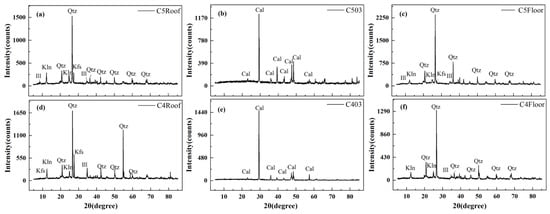
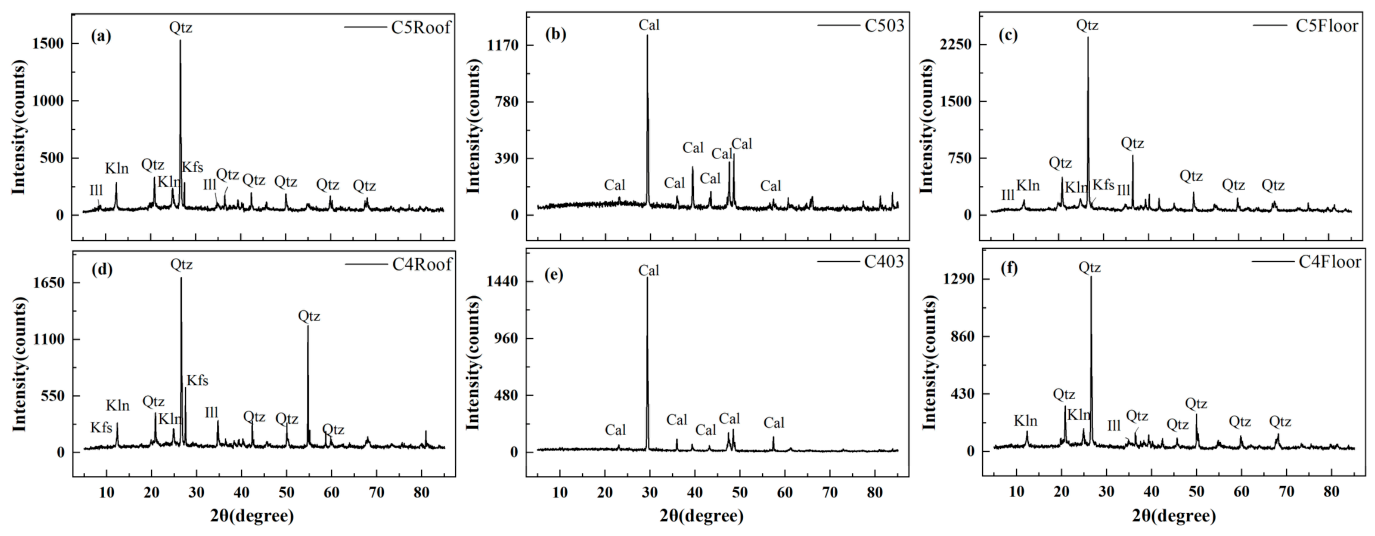
For mineral composition analysis, XRD tests were performed on six samples, including two roof samples, two floor samples, and two coal seam samples (Figure 2). The whole-rock mineral assemblages quantified by full-pattern Rietveld refinement provide mineralogical constraints on the major element variations (Table 3). The roof and floor are dominated by four detrital minerals, including quartz, kaolinite, illite, mixed-layer illite/smectite, and K-feldspar. Illite and illite/smectite (I/S) mixed-layer minerals are combined in this table since powder XRD patterns cannot reliably distinguish these two phases [38]. Calcite is restricted to the carbonate-bearing samples (C503 and C403), and no other minerals were identified in these two samples.
Figure 2.
X-ray diffraction patterns of samples from No. 4 and No. 5 coal seams. (a) C5Roof; (b) C503; (c) C5Floor; (d) C4Roof; (e) C403; (f) C4Floor. Qtz, quartz; Ill, illite; Kfs, K-feldspar; Kln, kaolinite; Cal, calcite. Illite and illite/smectite (I/S) are not discriminated in this figure due to overlapping diffraction peaks, and they are combined in the table.
Table 3.
Whole-rock mineralogical composition of the coal and host rock samples determined by XRD (wt. %; normalized to 100%).
As listed in Table 3, the roof and floor samples show similar mineralogical features, with quartz, kaolinite, illite + I/S, and K-feldspar ranging from 48.3% to 57.3%, 17.0% to 26.2%, 11.2% to 20.9%, and 5.3% to 13.7%, respectively. C5Floor contains the highest illite + I/S content (20.9%) among all roof and floor samples, while C4Floor has the maximum quartz and kaolinite but the minimum K-feldspar (5.3%), suggesting higher proportions of sandy components and authigenic kaolinite. In contrast, calcite is the sole crystalline phase identified in the coal seam samples C403 and C503, with other minerals being not detected. No calcite was detected in any of the roof or floor samples.
4.3.2. Microscopic Characterization of Minerals Using SEM
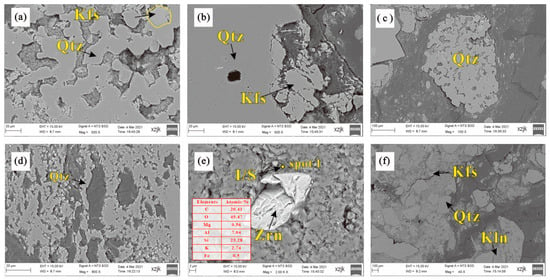
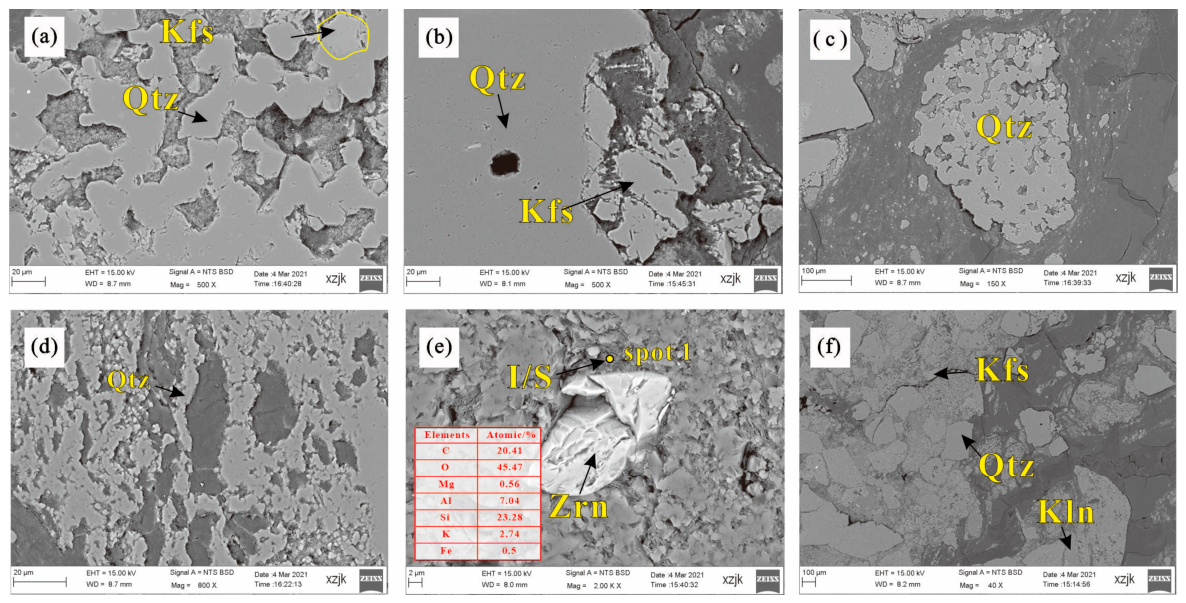
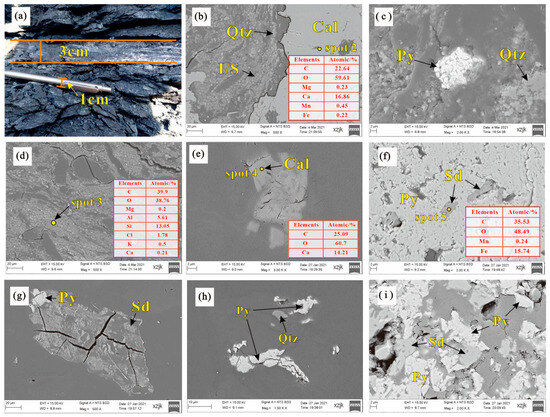
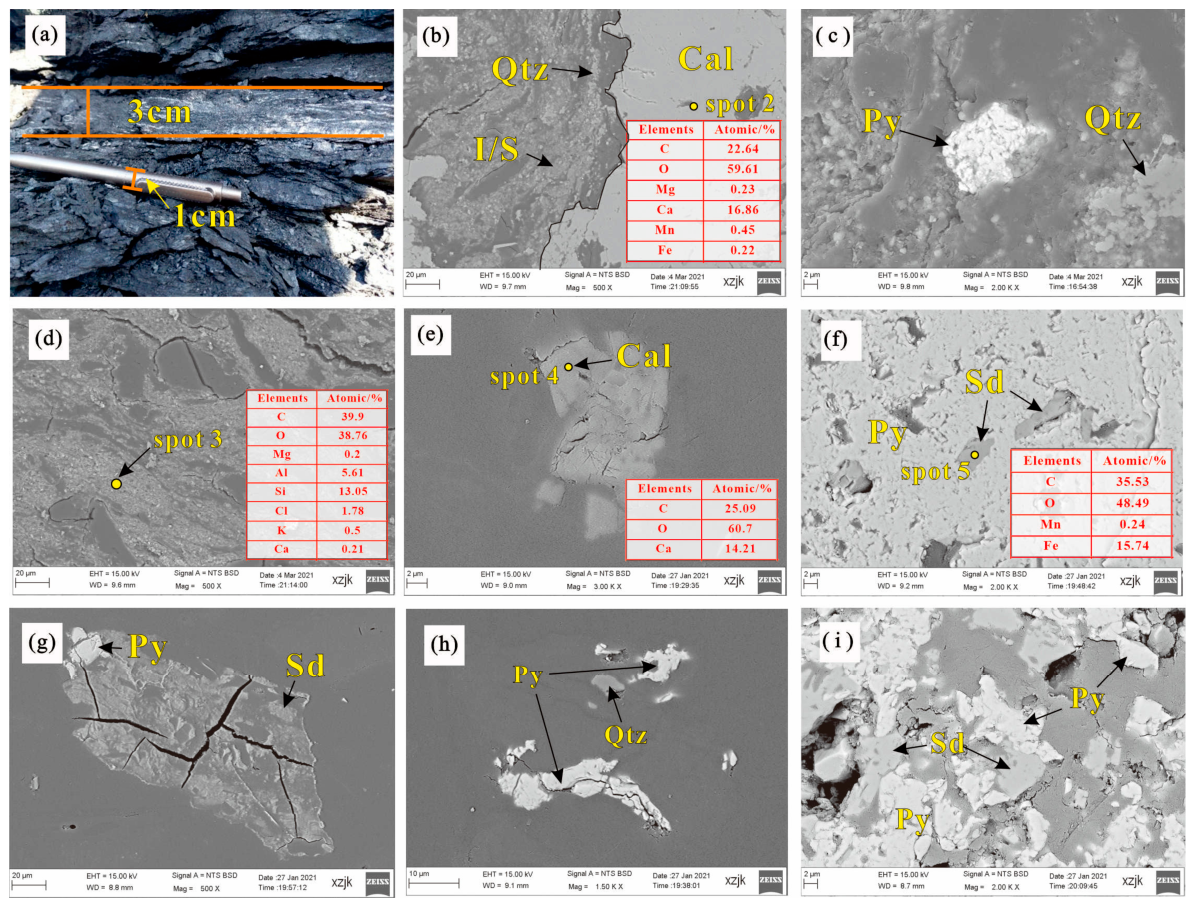
To investigate the mode of occurrence of minerals and compensate the detection-limit disadvantage of XRD, microscopic characterization was carried out using scanning electron microscopy (SEM). Figure 3 and Figure 4 present back-scattered electron (BSE) SEM micrographs showing the micromorphology and occurrence of minerals within the samples. Other minerals detected via SEM-EDS include zircon, siderite, calcite, Mn-, Mg- and Fe-bearing calcite, as well as pyrite.
Figure 3.
SEM back-scattered electron images of minerals in host rock samples. (a,b) Quartz and K-feldspar in sample C5Roof; (c) mineral aggregates, such as quartz grains encapsulated by organic matter, in sample C5Roof; (d) quartz grains and organic matter in sample C5Floor; (e) zircon grains surrounded by I/S mixed-layer minerals in sample C4Roof; (f) subangular detrital quartz and K-feldspar grains cemented by kaolinite in sample C4Floor. Qtz, quartz; Kfs, K-feldspar; Kln, kaolinite; I/S, illite/smectite mixed-layer; Zrn, zircon.
Figure 4.
Occurrence characteristics of authigenic and epigenetic minerals in coal. (a) Field photograph of carbonate vein; (b) intrusive calcite vein cutting coal macerals; (c) pyrite aggregates and quartz grains; (d) I/S mixed-layer minerals with EDS results of spot 3; (e) pore-filling authigenic calcite; (f,g) co-occurrence of siderite and pyrite; (h) fracture-filling pyrite; (i) pore-filling calcite and pyrite. (a–d) Sample C503; (e–i) sample C405.
Detrital quartz and K-feldspar grains are observed (Figure 3a,b,d) alongside mineral aggregates dominated by quartz grains that encapsulated by organic matter (Figure 3c). For sample C4Floor, subangular detrital quartz and K-feldspar grains are cemented by kaolinite (Figure 3f). Zircon grains surrounded by illite/smectite (I/S) mixed-layer minerals can be seen in the sample C4Roof (Figure 3e). The EDS data of I/S reveal that the measured area (spot 1) is dominated by Si and O, followed by Al, K, Mg, and Fe, with an elemental composition consistent with the geochemical features of I/S mixed-layer minerals (Figure 3e). The high carbon content originates from coexisting organic matter for spot 1.
In the carbonate-bearing coal sample C503, calcite veins are approximately 3 cm thick (Figure 4a) with cross-cut coal macerals (Figure 4b). The EDS results of spot 2 (sample C503) suggest that Fe, Mn, and Mg, detected as minor elements in calcite, were likely incorporated into the calcite lattice via isomorphous substitution. I/S mixed-layer minerals also occur in the sample C503 (Figure 4b–d), with pyrite aggregates and quartz embedded therein. While in sample C405, calcite is relatively pure, and no Mn, Fe, or Mg was detected by EDS (Figure 4e, spot 4). It occurs without obvious structural fractures and does not cross-cut coal macerals, indicating an authigenic origin during burial diagenesis. The siderite–pyrite assemblage and pure authigenic calcite occur in separate fields of view within sample C405, reflecting prominent microheterogeneity of pore fluids in coal (Figure 4e–i).
4.4. Trace Elements
4.4.1. Hazardous Elements
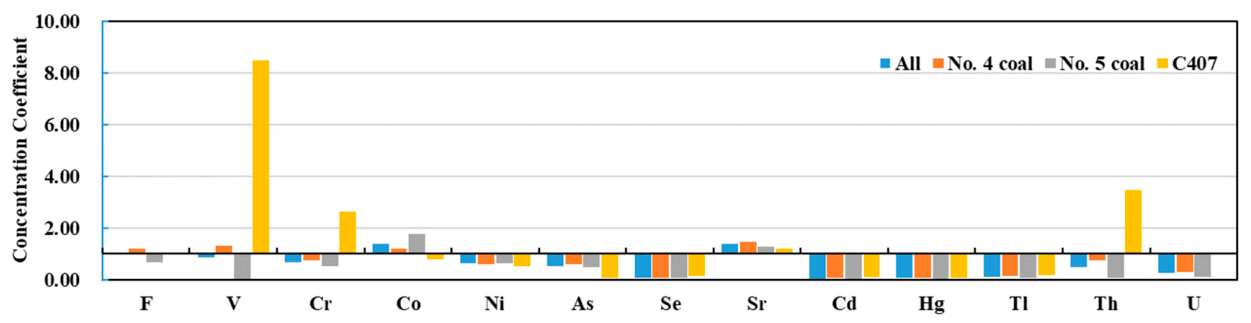
The concentrations of hazardous trace elements in the coal and host rock samples are presented in Table 4 and Figure 5. Overall, most of these elements in the coals are not enriched (CC < 2) compared with world coal averages [39]. Elements such as F, V, Cr, Ni, Co, As, Sr, and Th are close to the average values for world hard coals (0.5 < CC < 2); Se, Cd, Mo, Tl, Pb, U, and Hg are depleted (CC < 0.5) [39]. Several individual coal samples exhibit anomalous enrichments. The V concentration in sample C407 (212 μg/g) is enriched compared to the world coal, whereas Cr (41.97 μg/g) and Th (11.43 μg/g) are slightly enriched [39]. As this is a single-sample observation, its environmental significance should be assessed with additional data rather than inferred directly. Sample C403 shows exceptionally high Sr (246 μg/g), possibly related to carbonate-rich fluids. In the host rocks, the concentrations of Cr, As, Cd, Hg, Pb, Th, and U are higher than those in the Upper Continental Crust [40], albeit by a factor of less than two.
Table 4.
Concentrations of hazardous elements for coal and host rock samples (μg/g; Hg in ng/g) on a whole-rock basis from the Piliqing Mine.
Figure 5.
Concentration coefficients of trace elements in the investigated coal samples (excluding non-coal samples).
Vertically, elements such as F, V, Cr, Hg, Pb, Tl, Th, and U display a distinct pattern of high concentrations in the roof and floor strata but low concentrations in the coal seams (excluding V in C407), suggesting a dominant terrigenous detrital input that is further diluted by the high organic content of the coal seams. Within the pure coal samples, V shows statistically significant positive correlations with Cr, Cu, Ga, Th, U, K2O, and Cu/Zn (Table S1, r > 0.8, p < 0.01).
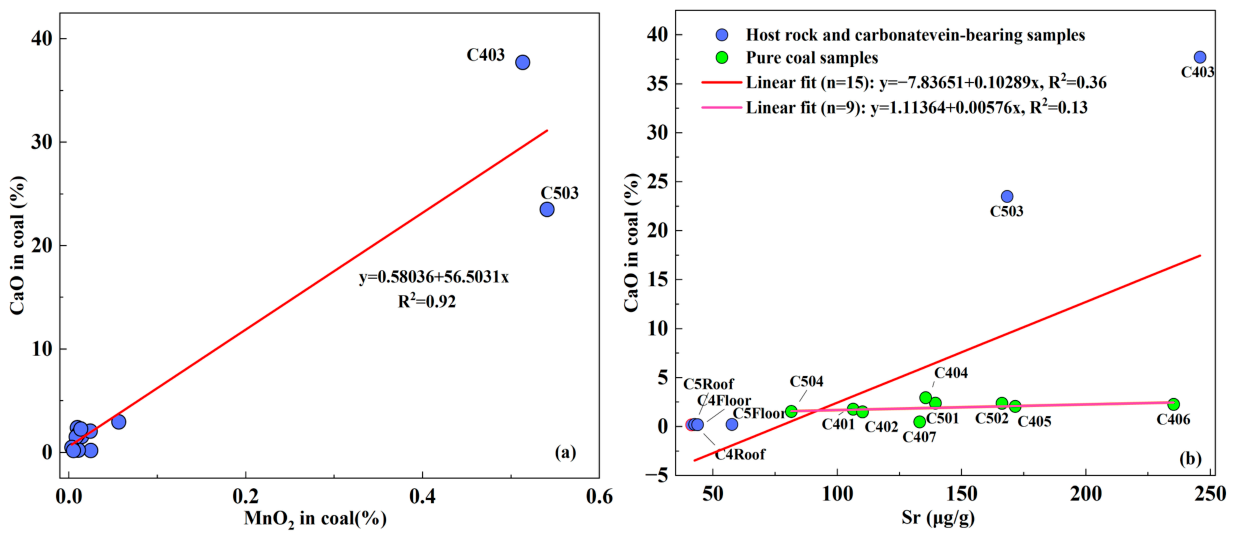
In contrast to the roof or floor strata, the coal samples exhibit elevated concentrations of Sr. Correlation analysis (Table S1) reveals a statistically significant positive correlation between Sr and Al2O3 and SiO2 (r = 0.81, 0.71, p < 0.01 after excluding host rocks and carbonate-vein samples), indicating that Sr is predominantly hosted in the aluminosilicate (clay) fraction rather than in carbonate phases. The strong positive correlation between MnO2 and CaO (R2 = 0.92; Figure 6a) identifies a carbonate-vein (calcite) component in the samples. Besides Mn, Sr is also enriched in the carbonate-vein samples (C503, C403), whose inclusion reinforces the positive Sr-Ca correlation and thereby creates a misleading impression that Sr is predominantly hosted in calcite; once these vein samples are excluded, the Sr-Ca correlation weakens (Figure 6b).
Figure 6.
Correlations of CaO with MnO2 and Sr in coal and host rock samples. (a) CaO vs. MnO2 in coal and (b) CaO vs. Sr, distinguishing carbonate-vein-bearing and host rocks from pure coal samples.
4.4.2. Rare Earth Elements
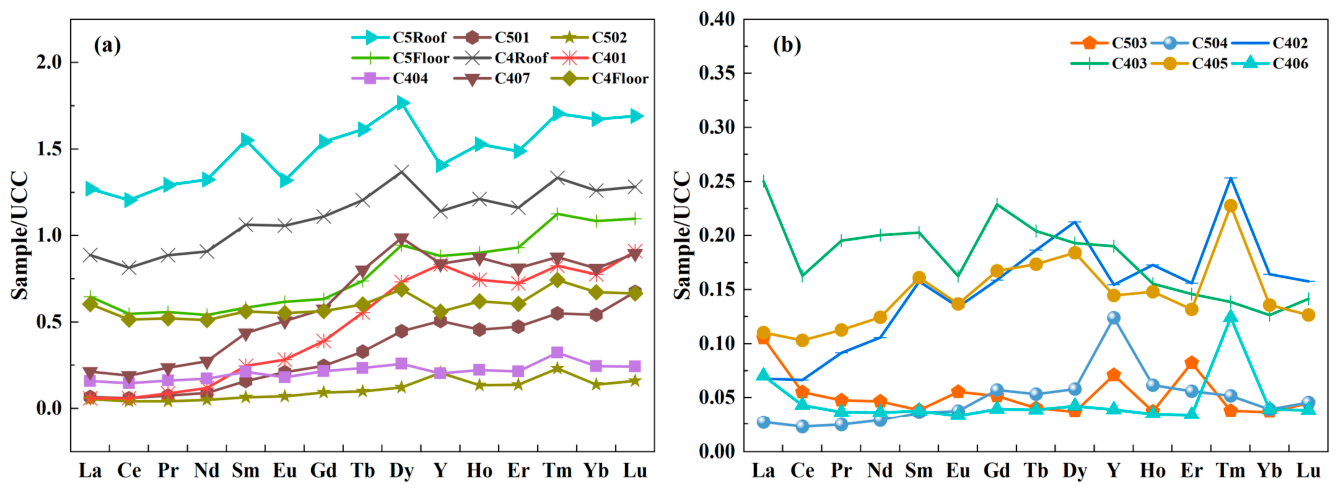
The rare earth elements and Y (REY) can be divided into light, medium, heavy fractions: LREY (La, Ce, Pr, Nd, and Sm), MREY (Eu, Gd, Tb, and Dy, plus Y), and HREY (Ho, Er, Tm, Yb, and Lu) [41]. Three enrichment patterns are identified as L-type (LREY-enriched, LaN/LuN > 1), M-type (MREY-enriched, LaN/SmN < 1, GdN/LuN > 1), and H-type (HREY-enriched, LaN/LuN < 1), which are normalized to the Upper Continental Crust (UCC) concentrations [41,42]. Additionally, anomalies of redox-sensitive Ce and Eu, and, in some cases, non-redox-sensitive La, Gd, and Y in coal, could develop or change under specific geochemical conditions [38]. Values for YN/HoN < 1 and >1 represent negative and positive anomalies, respectively. The concentrations of REY and relevant geochemical parameters for all samples are summarized in Table 5.
Table 5.
Concentrations of rare earth elements and yttrium (μg/g, on a whole-rock basis) and enrichment types in samples from the Piliqing Mine.
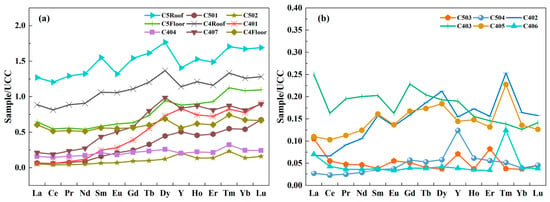
The concentrations of REY in coal samples are lower than that of roof and floor samples, as well as the average values of world coal (68.6 μg/g) [39]. According to UCC-normalized REY patterns, C503, C403 and C406 are classified as L-type samples; C5Roof, C501, C502, C5Floor, C4Roof, C401, C404, C407, and C4Floor are H-type samples; and C504, C402, and C405 belong to M-type samples (Figure 7). The L-type samples show stronger negative Ce anomalies and positive Y anomalies, with variable δEu values implying variable redox conditions during fluid activity. The M-type samples have low ΣREY (6.86 to 20.19 μg/g) and weakly negative Ce anomalies (0.83–0.92), with Y anomalies alternating between positive and weakly negative. The H-type samples, with ΣREY values ranging from 12.45 to 220.38 μg/g, generally exhibit weakly negative Ce and Eu anomalies, while most show insignificant Y-Ho fractionation, with (Y/Ho)N ratios ranging from 0.90 to 1.11.
Figure 7.
REY distribution patterns in coal and non-coal samples from the Piliqing Mine. (a) H-type enrichment samples; (b) L-type and M-type enrichment samples. REY are normalized by Upper Continental Crust (UCC) [42].
4.5. Carbon and Oxygen Isotopic Compositions of Carbonates
The carbon and oxygen isotopic compositions of the two carbonate samples are summarized in Table 6. Sample C503 yields a δ13C_VPDB value of −12.46‰ and a δ18O_VPDB value of −12.93‰, corresponding to converted δ18O_VSMOW value of 17.59‰. Sample C403 yields a δ13C_VPDB value of −14.49‰ and a δ18O_VPDB of −12.30‰, with converted δ18O_VSMOW value of 18.24‰. Relative to C503, sample C403 is more depleted in 13C, whereas their oxygen-isotope values are relatively close to each other. The δ18O_VSMOW values were converted from δ18O_VPDB using the IUPAC-recommended equation δ18O_VSMOW = 1.03092 × δ18O_VPDB + 30.92 (Section 3).
Table 6.
Carbon and oxygen isotopic compositions (‰) of carbonate-bearing samples from the Piliqing Mine.
5. Discussion
Trace element enrichment in coal is governed by specific geological conditions of coal basins and coal-forming periods with complex enrichment mechanisms. These processes are grouped into multiple genetic mechanisms dominated by source rocks, marine environments, hydrothermal fluids (including magmatic, low-temperature hydrothermal fluid, and submarine exhalation subtypes), groundwater, and volcanic ash [2,15]. Enrichment of U, Se, Mo, and Re in Yili coals has been documented in many studies, and these enriched areas developed along the margin of the Yili Basin (Figure 1b), such as Mengqiguer, Honghaigou, and Daladi [16,17,43]. The enrichment of this element assemblage is related to source-region material supply and epigenetic oxidized fluids [16]. Spatially, coal-hosted uranium deposits in the Yili Basin are paragenetic with sandstone-type uranium deposits [18,19]. However, unlike the widely reported U-Se-Mo-Re enrichment in coals from marginal areas of the Yili Basin, coal samples from the Piliqing Mine exhibit no obvious enrichment of uranium or other harmful elements. The factors controlling this unenriched phenomenon remain to be further explored.
5.1. Sediment-Source Rocks
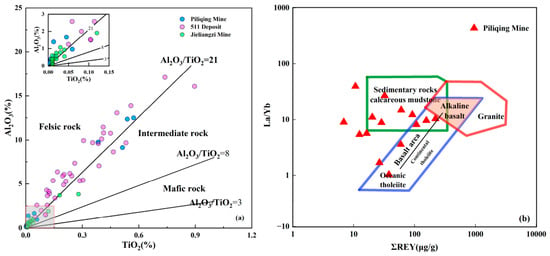
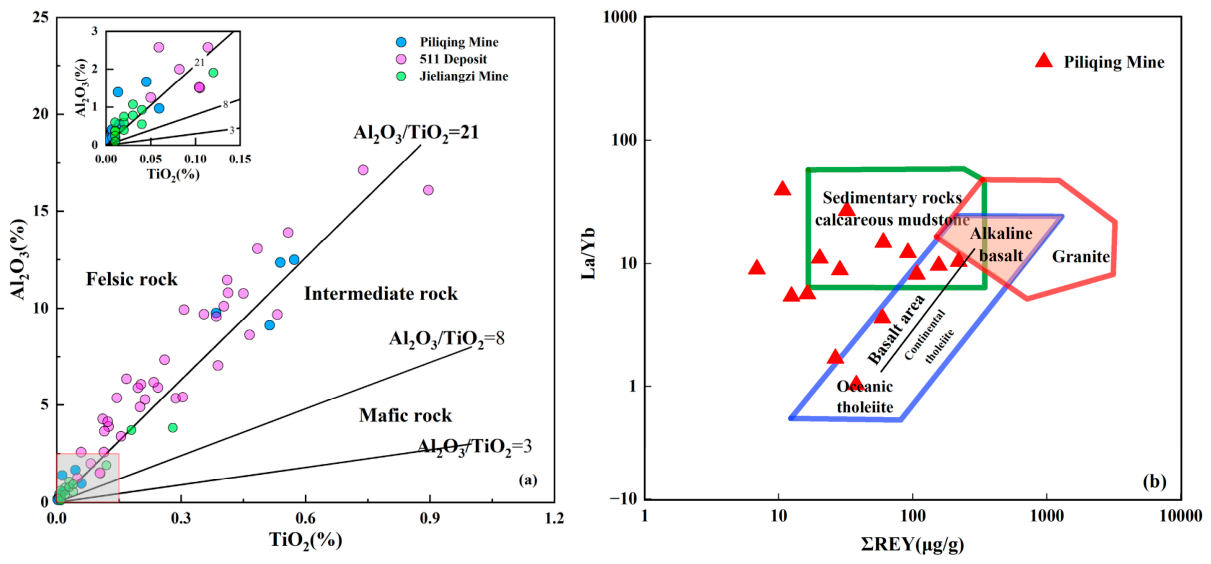
Sediment-source region properties on coal basin margins can largely determine the background trace element concentrations of coal-hosted ore deposits. As described above, the inter-cemented occurrence of detrital quartz, K-feldspar, illite, and zircon in the host rocks of Piliqing coal indicates that these minerals were originally derived from terrigenous clastic materials (Figure 3). The Al2O3/TiO2 and La/Yb vs. ΣREY plots are shown in Figure 8.
Figure 8.
Elemental indicators in samples investigated for sediment-source region discrimination. (a) Al2O3 vs. TiO2 in Piliqing samples (the data of 511 deposit and Jieliangzi mine are from [12,16]); (b) La/Yb vs. ΣREY plot of Piliqing samples (modified from [13]).
As a geochemical tracer, the Al2O3/TiO2 ratio has been demonstrated to be a valuable proxy for tracing the source-area composition of sedimentary rocks, with values of 3–8, 8–21, and 21–70 indicative of mafic, intermediate, and felsic igneous rocks, respectively [44]. Published geochemical data of magmatic rocks in the Yili Basin show that the Al2O3/TiO2 ratios are 12.6–13.9 for basalts, 11.5–20.2 for andesites, 76.2–80 for granite porphyries, and 48.9 for granodiorite [12]. The Al2O3/TiO2 ratios for Piliqing coals and host rocks range from 16.26 to 104.28 (39.62 on average). The sediment-source rocks of the Piliqing Mine were mainly felsic and intermediate in composition (Figure 8a), consistent with observations from the Jieliangzi coalmine and 511 coal–host U-deposit [12,16]. The La/Yb vs. ΣREY plot (Figure 8b), a reliable indicator for discriminating sediment provenance [45], demonstrates that half of the studied samples plot within the calcareous mudstone field. The La/Yb values of most samples fall between the lower boundary of the granite domain and the lower limit of the kimberlite field, consistent with geochemical signatures of intermediate to felsic source rocks.
5.2. Paleoenvironment Significance of Peat Deposition
In modern sediments, several trace-element proxies have been successfully applied for paleoenvironment reconstruction. Specifically, B content and the B/Ga and Sr/Ba ratios are effective proxies for paleosalinity; Ni/Co, Th/U, Cu/Zn, and V/Ni ratios are commonly employed to reconstruct paleoredox conditions; and the Sr/Cu ratio is widely adopted for paleoclimate interpretation. The relevant calculated data are shown in Supplementary Table S1. However, these element ratio proxies were originally calibrated for marine shales rather than for coals. They should be treated as semi-quantitative when applied to the coal-bearing terrestrial succession of this study, supporting evidence to be cross-checked against multiple independent proxies, rather than as definitive environmental indicators.
5.2.1. Paleosalinity
Trace element proxies (e.g., B, Ba, Ga and Sr) are routinely applied for paleosalinity reconstruction. In Piliqing samples, bulk-rock boron is associated with mixed illite/smectite clays and other detrital components, so raw boron concentrations can serve as semi-quantitative auxiliary evidence [46]. B/Ga and Sr/Ba are common paleosalinity tracers, although Sr/Ba exhibits low robustness because it is susceptible to carbonate contamination, diagenetic alteration and redox-driven fractionation [47]. In the present study, this limitation is particularly relevant: the carbonate-vein-bearing samples C403 and C503, which contain abundant calcite, carry elevated Ca and Sr that can bias Sr/Ba toward apparently higher salinity. Sr/Ba is accordingly used here only as semi-quantitative support. Detrital accessory minerals may generate anomalous B/Ga outliers in bulk-rock samples [47,48]. The relevant proxies are shown in Figure 9.
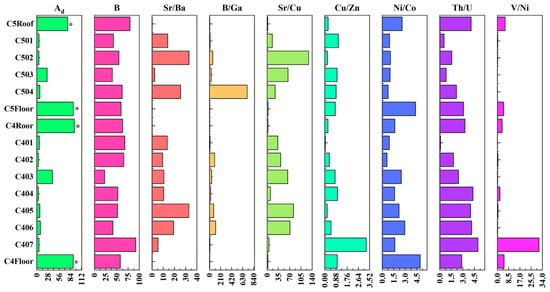
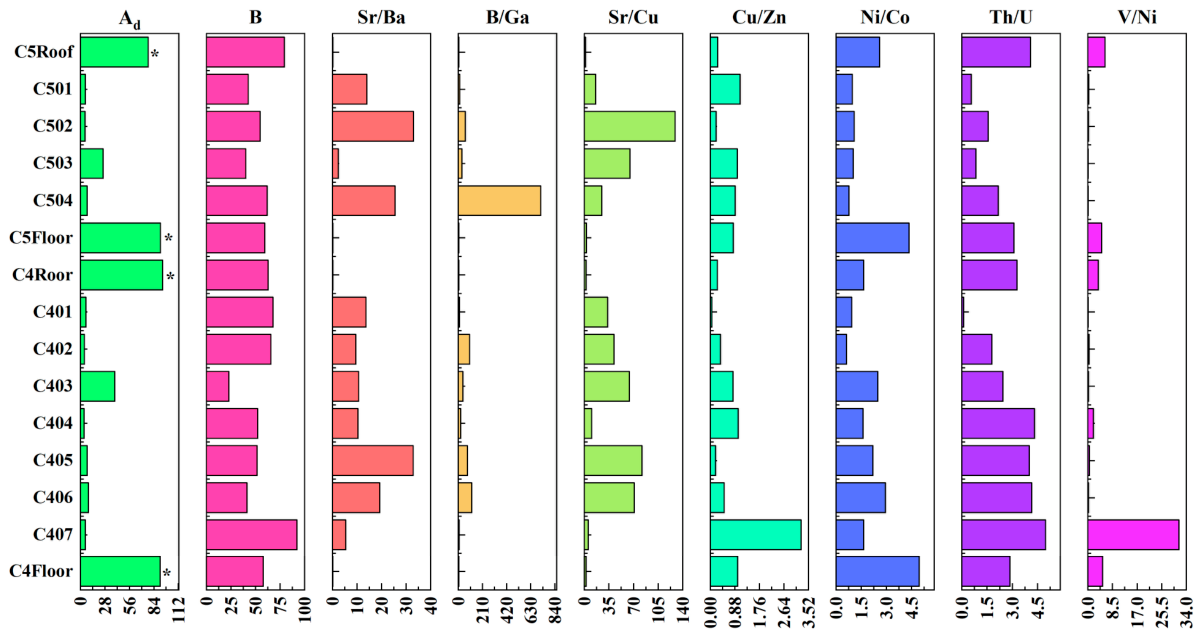
Figure 9.
Comparison of elementary proxies and other paleoenvironment records in the Piliqing samples. *, ash yield of non-samples at 815 °C.
In the present dataset, host rocks of the Piliqing section from delta-plain facies show low B concentrations (<100 µg/g), falling within freshwater (B < 40 µg/g) to brackish water (40 µg/g < B < 120 µg/g) [49], with Sr/Ba ratios consistently below 0.2 (freshwater) [47] and with moderately elevated B/Ga values (3 < B/Ga < 4, brackish water range) [47]. Coal seams exhibit elevated Sr/Ba and B/Ga ratios, suggesting high salinity. Moreover, Sr and B concentrations in coal are not enriched relative to global coal baselines [12,39]. The vitrinite/inertinite (V/I) ratios of the Piliqing coal samples indicate phased shallowing of the water-table in the peat mire, accompanied by mire exposure [14].
Under conditions of reduced terrigenous clastic supply, Sr can be retained in the sediments alongside low Ba and Ga contents, which can superficially produce marine-like sedimentary signatures. However, combined with sedimentological evidence of delta-plain peat-mire and flood-basin deposits, these coal seams were deposited in freshwater continental delta-plain settings. The high Sr/Ba and B/Ga ratios of the coals resulted from evaporative conditions in low-lying mires.
5.2.2. Depositional Environment
Element ratios, including Ni/Co, Cu/Zn, and Th/U, can indicate environment change [50,51]. Generally, variations in Cu/Zn and Ni/Co ratios indicate confined circulation within the depositional basin. Higher Cu/Zn, Ni/Co, and V/Ni correspond to stronger reducing conditions [52,53]. Ni/Co > 7, Ni/Co = 5–7, Ni/Co < 5, respectively, indicate reducing, dysoxic, and oxidizing environments [53]. V/Ni ratios of >3, 1–3, and <1 is generally interpreted to indicate anoxic (reducing), suboxic (transitional), and oxidizing depositional environments, respectively.
The Ni/Co ratios in the study samples are lower than 5.00, an indicator of oxidizing environment, with host rocks showing more dysoxic tendance compared with coal samples. Piliqing coals record a weakly oxidizing, shallow-water environment without a systematic vertical redox stratification. A localized reducing microdomain is nevertheless recognized at the base of the No. 4 seam (sample C407), as evidenced by its highest Cu/Zn and V/Ni ratios (Figure 9), pronounced syngenetic V enrichment, and slightly elevated U content. The anomalously high Th/U of C407 (4.97), attributable to detrital Th rather than to oxidizing conditions, together with the very low U contents of the coals (mostly <1 μg/g), renders Th/U unreliable as a primary redox proxy here. It is therefore used only as a secondary, qualitative check.
The mutual agreement among the Ni/Co, Cu/Zn, V/Ni, and Th/U ratios strengthens the redox reconstruction, although each proxy, individually, is only semi-quantitative owing to its marine-shale calibration.
5.2.3. Paleoclimate
The Sr/Cu ratio and Chemical Index of Alteration (CIA) serve as paleoclimate proxies [33,50,54]. The Sr/Cu ratio of 1.3–5.0 indicates warm and humid climate, and over 5.0 reflects drought conditions [55]. Most of the Sr/Cu ratios of the Piliqing coal samples are >5.0, indicating drought conditions. The Sr/Cu ratios of host rocks are lower than 5.0, representing warm and humid climates. The Sr/Cu ratio of sample C407 is 5.63, which is close to the boundary between arid and humid conditions, showing a stronger tendency of warm and humid climate compared with other coal samples (Figure 8).
The Chemical Index of Alteration (CIA) was calculated following Nesbitt and Young (1982) [56]: CIA = 100 × Al2O3/(Al2O3 + CaO* + Na2O + K2O). All oxide concentrations are expressed as molar proportions. CaO* represents CaO incorporated only in silicate minerals, calculated as max (CaO − (10/3) × P2O5, 0). Samples C403 and C503 with abundant calcite were excluded from CIA interpretation due to overwhelming carbonate-derived Ca. The CIA values < 60, 60–80, and >80 indicate low, moderate, and intensive chemical weathering, respectively [56]. According to Table S1, the CIA values for host rock samples range from 77.45 to 83.89, and that for coals range from 3.76 to 46.9 (with an average value of 15.99). CIA values reveal moderate to intense chemical weathering for the coal seam roof and floor, indicative of humid climate, whereas the coal seam records weak chemical weathering corresponding to arid conditions. However, because this low value largely reflects organic-matter dilution and the scarcity of detrital silicates in the ultra-low-ash coal, it should not be interpreted alone as a direct aridity signal. These CIA data are consistent with a terrestrial delta plain setting under relatively arid, shallow-water conditions with limited terrigenous input [56]. Intensified weathering and increased precipitation drove transgression and retrogradation, raising water depth and facilitating reducing conditions.
5.3. Multi-Stage Fluid Activity
In addition to clay minerals, carbonate minerals are the major authigenic minerals in samples of the Piliqing Mine, mainly including siderite and calcite. Siderite was mostly precipitated under weakly reducing and weakly alkaline conditions during peat accumulation, belonging to syndepositional to early diagenetic origin [33]. For sample C405, siderite precipitated earlier than pyrite (Figure 4g). With increasing sulfate supply in diagenetic fluids, H2S was generated and pyrite precipitated. Calcite has multiple origins; some precipitated in syndepositional stage, while others occur as veins or nodular aggregates formed by pore-fluid precipitation during burial diagenesis [57,58]. Calcite in sample C405 shows no obvious fracture-filling characteristics and is not of epigenetic origin, indicating an authigenic origin formed during peat accumulation to early diagenetic stage. By comparison, epigenetic calcite originated from a separate episode of diagenetic fluid activity and fills fractures within coal (Figure 4b).
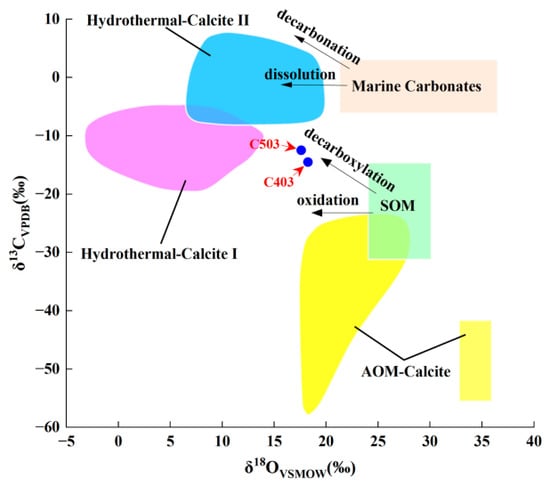
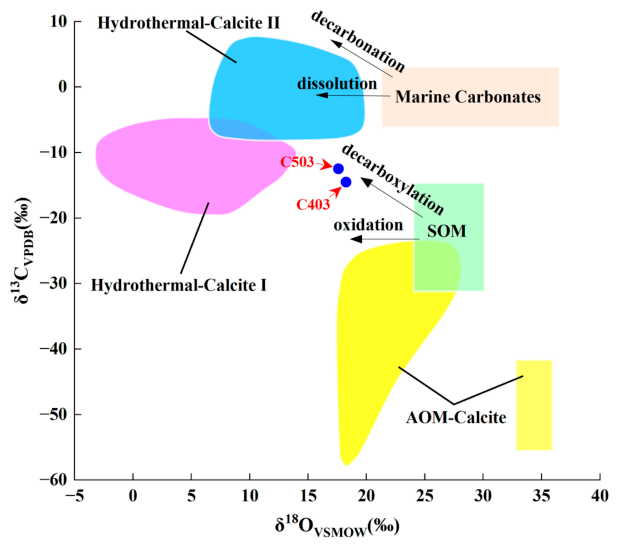
Carbon and oxygen stable isotope compositions of authigenic carbonate minerals can effectively fingerprint the sources and temperatures of the fluids involved, providing a basis for interpreting their formation mechanisms. Sedimentary organic matter-derived CO2 (SOM) in δ13C_VPDB and δ18O_VSMOW range from −30‰ to −15‰ and 24‰ to 30‰, respectively; mantle or igneous carbonatite-derived CO2 is characterized by δ13C_VPDB of −8‰ to −4‰ and δ18O_VSMOW of 6‰ to 12‰; marine carbonate-derived CO2 is characterized by δ13C_VPDB of −4‰ to 4‰ and 20‰–30‰ [58,59]. The strongly negative δ13CVPDB values point to a significant contribution of isotopically light carbon and the small oxygen-isotope difference suggests precipitation from fluids with comparable oxygen-isotope compositions (Table 6). On the δ13C_VPDB vs. δ18O_VSMOW diagram (Figure 10), the two plots of carbonate-bearing samples are between the hydrothermal-calcite and sedimentary-organic-matter fields. Their strongly negative δ13C indicates a dominant organic-carbon source, while the δ18O values are lower than typical marine-carbonate or SOM signatures. As the study area is non-marine, a marine-carbonate end-member is not applicable. These observations together point to an epigenetic hydrothermal origin in which coal-altering fluids, carrying an admixed organic-carbon component, precipitated the vein carbonates.
Figure 10.
The δ13C_VPDB-δ18O_VSMOW diagram for carbonate veins in samples C503 and C403 from the Piliqing Mine. The shaded fields are drawn according to the isotope ranges reported in Zheng et al. [58]. Hydrothermal-Calcite I, mid- and high-temperature hydrothermal calcite; Hydrothermal-Calcite II, calcite with interactions between the magmatic fluid and carbonate wall rock; AOM-Calcite, calcite derived from the anaerobic oxidation of methane; SOM, sedimentary organic matter.
The δ18O values in carbonate minerals allow their formation temperature to be constrained, provided the minerals precipitated in isotopic equilibrium with the coexisting fluids. In this study, the temperature-dependent equation is expressed as [58] T = 16.0 − 4.14 (δcal − δf) + 0.13 (δcal − δf)2, where T is temperature (°C), δcal is the δ18O composition of the analyzed calcite with respect to the PDB standard, and δf is the δ18O ratio of the fluid from which the calcite precipitated with respect to the SMOW standard. Using the measured carbonate-inclusion water δ18O_VSMOW (−2.7‰ to +1.0‰) of the coeval Yili Basin [60] as δf, the term Δ = δcal − δf ranges from −10.23‰ to −13.93‰ (C503) and from −9.60‰ to −13.30‰ (C403), yielding estimated precipitation temperatures of 71.96–98.90 °C and 67.72–94.06 °C, respectively. Collectively, the estimated precipitation temperatures of ~68–99 °C are fully compatible with the epigenetic hydrothermal origin inferred above: together with the strongly negative δ13C and the admixed organic-carbon component, they indicate that moderately low-temperature coal-altering fluids, carrying sedimentary-organic-carbon-derived CO2, precipitated the vein carbonates along fractures.
5.4. Genetic Model of Hazardous Elements
Background concentrations of hazardous elements were governed by sediment provenance and, most importantly, restricted terrigenous detrital input. This is evidenced by the systematic decline in element concentrations from host rocks to low-ash coal seams. Strontium represents an exception, as its distribution is controlled by carbonate minerals (samples C503 and C403) and aluminosilicate minerals (pure coal samples) according to the correlation analysis. The lack of enrichment in redox-sensitive elements (U, Mo, Re, Se) agrees with the weakly oxidizing, shallow-water depositional environment reconstructed. Such conditions disfavored reducing immobilization of this suite of elements, with the sole exception of V enrichment in sample C407, possibly reflecting a localized reducing microdomain at the base of the No. 4 seam (Section 5.2.2). But V in C407 deserves attention in future utilization assessment.
Epigenetic hydrothermal fluids responsible for precipitating LREE-rich carbonate veins mixed with an organic-carbon source, as indicated by the strongly negative δ13C_VPDB of the vein carbonate. These fluids primarily transported Ca, Mn, and Sr and introduced no other hazardous elements into the coal. The hydrothermal fluids cause a redistribution of Sr, which was reprecipitated within the vein calcites, as exemplified by the anomalously high Sr contents of the vein-bearing samples C403 and C503.
This primary signature distinguishes Piliqing coal from the coal-hosted uranium deposits of the Southern Yili Basin margin, in which epigenetic oxidized fluids produced pronounced U-Se-Mo-Re enrichment [16,17]. Compared with these deposits, the Piliqing coals contain substantially lower hazardous-element concentrations and display no systematic host rock to coal enrichment front. At the same time, the diagnostic minerals of oxidized-fluid overprint are absent, such as gypsum and fracture-filling uranium minerals. In the pure coal samples, the strong S–Fe correlation (Table S1, r = 0.99, p < 0.01) indicates that sulfur is hosted predominantly as pyritic sulfur, ruling out the possible presence of oxidized-fluid indicator minerals such as gypsum. Piliqing coals therefore preserve a primary geochemical signature that escaped post-depositional oxidized-fluid invasion [16,17,18,19].
The unenriched hazardous-element budget of Piliqing coals reflects a dominantly syngenetic geochemical signature that has been locally overprinted by post-depositional hydrothermal fluids rather than by oxidizing fluids. The distribution of these elements was governed by the interplay of the sediment source, the depositional environment, and the subsequent hydrothermal activity. The precipitated carbonate veins and caused a local redistribution of Sr, but introduced no hazardous elements, and its non-oxidizing character prevented the development of an oxidized-fluid enrichment signature comparable to the coal-hosted uranium deposits of the southern margin.
6. Conclusions
Based on geochemical, mineralogical, and carbonate C-O isotopic analyses of the Middle Jurassic Xishanyao Formation coals from the Piliqing Mine, Yili Coalfield, the following conclusions can be drawn:
- Piliqing coals are ultra-low-ash, low-sulfur subbituminous coals characterized by carbonate enrichment, with a weighted-average CaO content (1.95%) higher than SiO2 (1.52%) on whole-coal basis. The low-ash, high-calcium composition of Piliqing coals may adversely affect pulverized-coal boiler operation.
- Most hazardous trace elements in the coals are not enriched relative to world coal averages, with F, Cr, Ni, Co, As, Sr, and Th close to global values and Se, Cd, Mo, Tl, Pb, U, and Hg being depleted. Their vertical distribution is primarily controlled by the limited terrigenous detrital supply except for Sr and V. The only pronounced enrichment is the anomalously V (212 μg/g) in sample C407, which may record locally reducing conditions at the base of the No. 4 coal seam, although this single-sample observation precludes a firm syngenetic interpretation.
- Mineralogical and isotopic evidence reveals multi-stage carbonate precipitation: authigenic calcite and siderite formed during peat accumulation and early diagenesis, whereas fracture-filling calcite veins precipitated from coal-altering epigenetic hydrothermal fluids that carried an admixed organic-matter-derived carbon component. The epigenetic hydrothermal fluids were delivered mainly Ca, Mn, and Sr, without carrying harmful elements.
- The unenriched hazardous-element signature reflects a dominantly syngenetic pattern governed by the sediment source and limited terrigenous detrital input, with weakly oxidizing, shallow-water, conditions unfavorable for the reducing enrichment of U, Mo, Re, and Se. Unlike the coal-hosted uranium deposits of the Southern Yili margin, Piliqing coals show no systematic enrichment and lack gypsum or fracture-filling uranium minerals, indicating the absence of post-depositional oxidized-fluid infiltration.
- These results indicate that Piliqing coals pose a limited environmental risk during utilization and highlight a fundamental geochemical contrast between the northern coalfield and the uranium-mineralized southern basin margin, with implications for the safe and rational exploitation of Yili coal resources.
Supplementary Materials
The following supporting information can be downloaded at: https://www.mdpi.com/article/10.3390/min16111145/s1, Table S1: Geochemical and proximate data.
Author Contributions
Conceptualization, W.W. (Wenfeng Wang) and W.W. (Wenlong Wang); methodology, W.W. (Wenlong Wang); software, W.W. (Wenlong Wang); validation, Q.L. and P.D.; formal analysis, W.W. (Wenlong Wang); investigation, W.W. (Wenlong Wang) and B.Z.; resources, W.W. (Wenfeng Wang); data curation, K.C., W.W. (Wenlong Wang) and S.L.; writing—original draft preparation, W.W. (Wenlong Wang); writing—review and editing, W.W. (Wenfeng Wang) and Q.L.; visualization, K.C.; supervision, P.D. and W.W. (Wenfeng Wang); project administration, W.W. (Wenfeng Wang) and Q.L.; funding acquisition, W.W. (Wenfeng Wang) and Q.L. All authors have read and agreed to the published version of the manuscript.
Funding
This research was funded by the National Key Research and Development Program of China (2021YFC2902003); the Major Science and Technology Special Project of Xinjiang Uygur Autonomous Region (2022A03014); the National Natural Science Foundation of China (Nos. 42472236, 42402176); the Innovative and Expanded Talent Program for Intellectual Support to Xinjiang: Jiangsu Province Coal-Based Solid Waste Resource Utilization “Support Group for Xinjiang” (No. [2024]16); and the Fundamental Research Funds for the Central Universities (No. 2024QN11071).
Data Availability Statement
The data that support the findings of this study are available from the corresponding author upon reasonable request.
Acknowledgments
We thank the staff of the Piliqing Open-Pit Mine (not listed as authors) for their help with the sample collection. We also thank the editors of the journal and the anonymous reviewers for their valuable comments and constructive suggestions, which have greatly contributed to the revision of the manuscript and its potential publication.
Conflicts of Interest
The authors declare no conflicts of interest.
References
- Dai, S.; Hower, J.C.; Ward, C.R.; French, D. Enrichment of Bi-Be-Mo-Cd-Pb-Nb-Ga, REEs and Y in the Permian coals of the Huainan Coalfield, Anhui, China: Discussion. Ore Geol. Rev. 2018, 102, 937–939. [Google Scholar] [CrossRef] [Scilit]
- Dai, S.; Ren, D.; Chou, C.; Finkelman, R.B.; Seredin, V.V.; Zhou, Y. Geochemistry of trace elements in Chinese coals: A review of abundances, genetic types, impacts on human health, and industrial utilization. Int. J. Coal Geol. 2012, 94, 3–21. [Google Scholar] [CrossRef] [Scilit]
- Das, T.B.; Pal, S.K.; Gouricharan, T.; Sharma, K.K.; Choudhury, A. Evaluation of Reduction Potential of Selected Heavy Metals from an Indian Coal by Conventional Coal Cleaning. Int. J. Coal Prep. Util. 2013, 33, 300–312. [Google Scholar] [CrossRef] [Scilit]
- Duan, P.; Wang, W.; Sang, S.; Qian, F.; Shao, P.; Zhao, X. Partitioning of hazardous elements during preparation of high uranium coal from Rongyang, Guizhou, China. J. Geochem. Explor. 2018, 185, 81–92. [Google Scholar] [CrossRef] [Scilit]
- Dai, S.; Zheng, X.; Wang, X.; Finkelman, R.B.; Jiang, Y.; Ren, D.; Yan, X.; Zhou, Y. Stone coal in China: A review. Int. Geol. Rev. 2018, 60, 736–753. [Google Scholar] [CrossRef] [Scilit]
- Zheng, B.; Ding, Z.; Huang, R.; Zhu, J.; Yu, X.; Wang, A.; Zhou, D.; Mao, D.; Su, H. Issues of health and disease relating to coal use in southwestern China. Int. J. Coal Geol. 1999, 40, 119–132. [Google Scholar] [CrossRef] [Scilit]
- Li, J.; Wang, W.; He, X.; Shao, F.; Bai, Y. Release Characteristics of Harmful Trace Elements during Dynamic Leaching and Static Immersion of Coal Gangue in Xinjiang. ACS Omega 2024, 9, 393–400. [Google Scholar] [CrossRef] [Scilit]
- Ma, M.; Wang, W.; Zhang, K. Occurrence Characteristics of Fine-Grained Pyrite in Coal and Its Scaling Effect on Flotation Desulfurization. ACS Omega 2022, 7, 42467–42481. [Google Scholar] [CrossRef] [Scilit]
- Wen, D.; Zhang, F.; Zhang, E.; Wang, C.; Han, S.; Zheng, Y. Arsenic, fluoride and iodine in groundwater of China. J. Geochem. Explor. 2013, 135, 1–21. [Google Scholar] [CrossRef] [Scilit]
- Zhou, J.; Zhuang, X.; Alastuey, A.; Querol, X.; Li, J. Geochemistry and mineralogy of coal in the recently explored Zhundong large coal field in the Junggar basin, Xinjiang province, China. Int. J. Coal Geol. 2010, 82, 51–67. [Google Scholar] [CrossRef] [Scilit]
- Li, B.; Zhuang, X.; Li, J.; Zhao, S. Geological controls on coal quality of the Yili Basin, Xinjiang, Northwest China. Int. J. Coal Geol. 2014, 131, 186–199. [Google Scholar] [CrossRef] [Scilit]
- Jiang, Y.; Zhao, L.; Zhou, G.; Wang, X.; Zhao, L.; Wei, J.; Song, H. Petrological, mineralogical, and geochemical compositions of Early Jurassic coals in the Yining Coalfield, Xinjiang, China. Int. J. Coal Geol. 2015, 152, 47–67. [Google Scholar] [CrossRef] [Scilit]
- Chao, H.; Hou, M.; Jiang, W.; Cao, H.; Chang, X.; Luo, W.; Ogg, J.G. Paleoclimatic and Redox Condition Changes during Early-Middle Jurassic in the Yili Basin, Northwest China. Minerals 2021, 11, 675. [Google Scholar] [CrossRef] [Scilit]
- Qin, R.; Wang, A.; Cao, D.; Wei, Y.; Ding, L.; Li, J. Effect of peat mire evolution on pore structure characteristics in thick coal seam: Examples from Xishanyao Formation (Middle Jurassic), Yili Basin, China. Energy Explor. Exploit. 2020, 38, 1484–1514. [Google Scholar] [CrossRef] [Scilit]
- Bai, H.; Wang, W.; Lu, Q.; Wang, W.; Feng, S.; Zhang, B. Geological Characteristics and Control Mechanism of Uranium Enrichment in Coal-Bearing Strata in the Yili Basin, Northwest China—Implications for Resource Development and Environmental Protection. ACS Omega 2022, 7, 5453–5470. [Google Scholar] [CrossRef] [Scilit]
- Dai, S.; Yang, J.; Ward, C.R.; Hower, J.C.; Liu, H.; Garrison, T.M.; French, D.; O’Keefe, J.M.K. Geochemical and mineralogical evidence for a coal-hosted uranium deposit in the Yili Basin, Xinjiang, northwestern China. Ore Geol. Rev. 2015, 70, 1–30. [Google Scholar] [CrossRef] [Scilit]
- Shi, Z.; Chen, B.; Wang, Y.; Hou, M.; Jin, X.; Song, H.; Wang, X. A linkage between uranium mineralization and high diagenetic temperature caused by coal self-ignition in the southern Yili Basin, northwestern China. Ore Geol. Rev. 2020, 121, 103443. [Google Scholar] [CrossRef] [Scilit]
- Zhang, X.; Nie, F.; Xia, F.; Zhang, C.; Feng, Z.; Ullah, R.; Zhang, P. Provenance constraints on the Xishanyao Formation, southern Yili Basin, northwest China: Evidence from petrology, geochemistry, and detrital zircon U–Pb geochronology. Can. J. Earth Sci. 2018, 55, 1020–1035. [Google Scholar] [CrossRef] [Scilit]
- Zhang, C.; Liu, H. A growing sandstone type uranium district in South Yili Basin, NW China as a result of extension of Tien Shan Orogen: Evidences from geochronology and hydrology. Gondwana Res. 2019, 76, 146–172. [Google Scholar] [CrossRef] [Scilit]
- Li, Y.; Jiang, Z.; Wang, D.; Zhang, Z.; Duan, S. Genesis of the Beizhan Iron Deposit in Western Tianshan, China: Insights from Trace Element and Fe-O Isotope Compositions of Magnetite. Minerals 2024, 14, 304. [Google Scholar] [CrossRef] [Scilit]
- GB/T 482-2008; Sampling of Coal Seams. Standardization Administration of China: Beijing, China, 2008. (In Chinese)
- GB/T 212-2008; Proximate Analysis of Coal. Standardization Administration of China: Beijing, China, 2008. (In Chinese)
- GB/T 214-2007; Determination of Total Sulfur in Coal. Standardization Administration of China: Beijing, China, 2007. (In Chinese)
- Liu, S.; Wang, W.; Wang, W.; Lu, Q.; Shao, F.; Wang, Y. Distribution regularity and occurrence characteristics of critical metal elements in Yili coals. J. China Coal Soc. 2022, 47, 1761–1772. [Google Scholar] [CrossRef]
- ASTM D2798-21; Standard Test Method for Microscopical Determination of the Vitrinite Reflectance of Coal. ASTM International: West Conshohocken, PA, USA, 2021.
- GB/T 37673-2019; Determination of Silicon, Aluminum, Iron, Calcium, Magnesium, Sodium, Potassium, Phosphorus, Titanium, Manganese, Strontium and Barium in Coal Ash—X-Ray Fluorescence Spectrometric Method. Standardization Administration of China: Beijing, China, 2019. (In Chinese)
- ASTM D5987-96; Standard Test Method for Total Fluorine in Coal and Coke by Pyrohydrolytic Extraction and Ion Selective Electrode or Ion Chromatograph Methods. ASTM International: West Conshohocken, PA, USA, 2015.
- Method 3052 (SW-946); Microwave Assisted Acid Digestion of Siliceous and Organically Based Matrices, Revision 0, December 1996, Final Update III to the Third Edition of the Test Methods for Evaluating Solid Waste, Physical/Chemical Methods. Environmental Protection Agency (EPA): Washington, DC, USA, 1996.
- Kim, S.; Coplen, T.B.; Horita, J. Normalization of stable isotope data for carbonate minerals: Implementation of IUPAC guidelines. Geochim. Cosmochim. Acta 2015, 158, 276–289. [Google Scholar] [CrossRef] [Scilit]
- Brand, W.A.; Coplen, T.B.; Vogl, J.; Rosner, M.; Prohaska, T. Assessment of international reference materials for isotope-ratio analysis (IUPAC Technical Report). Pure Appl. Chem. 2014, 86, 425–467. [Google Scholar] [CrossRef] [Scilit]
- GB/T 15224.1-2018; Classification for Quality of Coal—Part 1: Ash. Standardization Administration of China: Beijing, China, 2018. (In Chinese)
- Chou, C. Sulfur in coals: A review of geochemistry and origins. Int. J. Coal Geol. 2012, 100, 1–13. [Google Scholar] [CrossRef] [Scilit]
- Shang, N.; Liu, J.; Han, Q.; Jia, R.; Zhao, S. Mineralogy and geochemistry of the Middle Jurassic coal from the Hexi Mine, Shenfu Mining Area, Ordos Basin: With an emphasis on genetic indications of siderite. Int. J. Coal Geol. 2023, 279, 104384. [Google Scholar] [CrossRef] [Scilit]
- ASTM D388-23; Standard Classification of Coals by Rank. ASTM International: West Conshohocken, PA, USA, 2023.
- Dai, S.; Seredin, V.V.; Ward, C.R.; Hower, J.C.; Xing, Y.; Zhang, W.; Song, W.; Wang, P. Enrichment of U–Se–Mo–Re–V in coals preserved within marine carbonate successions: Geochemical and mineralogical data from the Late Permian Guiding Coalfield, Guizhou, China. Miner. Depos. 2015, 50, 159–186. [Google Scholar] [CrossRef] [Scilit]
- Wang, W.; Lu, Q.; Wang, W.; Zhao, W.; Zhang, B.; Che, K.; Duan, P.; Bai, J. Distribution, Occurrence, and Controlling Factors of K, Ca, Na, and Mg in High-Alkali Coals from the Dananhu Coalfield, Turpan–Hami Basin, Xinjiang, China. Minerals 2026, 16, 730. [Google Scholar] [CrossRef] [Scilit]
- Wang, C.; Tang, G.; Sun, R.; Hu, G.; Yuan, M.; Che, D. The correlations of chemical property, alkali metal distribution, and fouling evaluation of Zhundong coal. J. Energy Inst. 2020, 93, 2204–2214. [Google Scholar] [CrossRef] [Scilit]
- Dai, S.; Xie, P.; Jia, S.; Ward, C.R.; Hower, J.C.; Yan, X.; French, D. Enrichment of U-Re-V-Cr-Se and rare earth elements in the Late Permian coals of the Moxinpo Coalfield, Chongqing, China: Genetic implications from geochemical and mineralogical data. Ore Geol. Rev. 2017, 80, 1–17. [Google Scholar] [CrossRef] [Scilit]
- Ketris, M.P.; Yudovich, Y.E. Estimations of Clarkes for Carbonaceous biolithes: World averages for trace element contents in black shales and coals. Int. J. Coal Geol. 2009, 78, 135–148. [Google Scholar] [CrossRef] [Scilit]
- Rudnick, R.L.; Gao, S. Composition of the Continental Crust. In Treatise on Geochemistry; Elsevier: Amsterdam, The Netherlands, 2014; pp. 1–51. [Google Scholar]
- Seredin, V.V.; Dai, S. Coal deposits as potential alternative sources for lanthanides and yttrium. Int. J. Coal Geol. 2012, 94, 67–93. [Google Scholar] [CrossRef] [Scilit]
- Taylor, S.R.; McLennan, S.M. The geochemical evolution of the continental crust. Rev. Geophys. 1995, 33, 241–265. [Google Scholar] [CrossRef] [Scilit]
- Zhao, K.; Zhou, Y.; Chen, K.; Bao, Z.; Zhang, Y.; An, F.; Wu, B.; Li, G.; Yuan, H. Compositions of in-situ trace elements, S and Pb isotopes of pyrite in Mengqiguer deposit, Yili basin, NW China: Implications for uranium mineralization processes of sandstone—Type uranium deposit. Ore Geol. Rev. 2025, 179, 25. [Google Scholar] [CrossRef] [Scilit]
- Allègre, C.J.; Minster, J.F. Quantitative models of trace element behavior in magmatic processes. Earth Planet. Sc. Lett. 1978, 38, 1–25. [Google Scholar] [CrossRef] [Scilit]
- Hayashi, K.I.; Fujisawa, H.; Holland, H.D.; Ohmoto, H. Geochemistry of approximately 1.9 Ga sedimentary rocks from northeastern Labrador, Canada. Geochim. Cosmochim. Acta 1997, 61, 4115–4137. [Google Scholar] [CrossRef] [Scilit]
- Charles, T.; Walker, N.B.P. Departure Curves for Computing Paleosalinity from Boron in Illites and Shales. AAPG Bull. 1963, 47, 833–841. [Google Scholar] [CrossRef] [Scilit]
- Wei, W.; Algeo, T.J. Elemental proxies for paleosalinity analysis of ancient shales and mudrocks. Geochim. Cosmochim. Acta 2020, 287, 341–366. [Google Scholar] [CrossRef] [Scilit]
- Xia, Z.; Cheng, M.; Chen, X.; Li, C. Paleosalinity Proxy: Progress and Challenges. Acta Sedimentol. Sin. 2025, 43, 1758–1779. [Google Scholar] [CrossRef]
- Swaine, D.J. Trace Elements in Coal; Butterworth: Sydney, NSW, Australia, 1990; Volume 181, pp. 103–123. [Google Scholar]
- Wang, L.; Lv, D.; Hower, J.C.; Zhang, Z.; Raji, M.; Tang, J.; Liu, Y.; Gao, J. Geochemical characteristics and paleoclimate implication of Middle Jurassic coal in the Ordos Basin, China. Ore Geol. Rev. 2022, 144, 104848. [Google Scholar] [CrossRef] [Scilit]
- Shifeng, D.; Bechtel, A.; Eble, C.F.; Flores, R.M.; French, D.; Graham, I.T.; Hood, M.M.; Hower, J.C.; Korasidis, V.A.; Moore, T.A.; et al. Recognition of peat depositional environments in coal: A review. Int. J. Coal Geol. 2020, 219, 103383. [Google Scholar] [CrossRef] [Scilit]
- Dypvik, H. Geochemical compositions and depositional conditions of Upper Jurassic and Lower Cretaceous Yorkshire clays, England. Geol. Mag. 1984, 121, 489–504. [Google Scholar] [CrossRef] [Scilit]
- Jones, B.; Manning, D.A.C. Comparison of geochemical indices used for the interpretation of palaeoredox conditions in ancient mudstones. Chem. Geol. 1994, 111, 111–129. [Google Scholar] [CrossRef] [Scilit]
- Krzeszowska, E. Geochemistry of the Lublin Formation from the Lublin Coal Basin; implications for weathering intensity, palaeoclimate and provenance. Int. J. Coal Geol. 2019, 216, 103306. [Google Scholar] [CrossRef] [Scilit]
- Lerman, A.; Imboden, D.M.; Gat, J.R. Physics and Chemistry of Lakes; Springer: Berlin/Heidelberg, Germany, 1995; Volume 139, pp. 106–113. [Google Scholar]
- Nesbitt, H.W.; Young, G.M. Early Proterozoic climates and plate motions inferred from major element chemistry of lutites. Nature 1982, 299, 715–717. [Google Scholar] [CrossRef] [Scilit]
- Cao, Z.; Qing, H.; Chen, C.; Zhu, S.; Lyu, X.; Azmy, K.; Li, Z.; Zhang, L.; Liu, R.; Xu, J. Genesis of Calcite Veins in 8# Coal Seam of the Upper Carboniferous Benxi Formation, Southeastern Margin of Ordos Basin. Minerals 2023, 13, 879. [Google Scholar] [CrossRef] [Scilit]
- Zheng, J.; Dai, S.; Nechaev, V.P.; French, D.; Graham, I.T.; Wang, N.; Yang, P.; Kang, S.; Yao, M.; Liang, Y. Origin of composite fibrous carbonate veins in Middle Jurassic ultra-low-ash coal, Ordos Basin, China: Insights on the interaction between organic carbon and inorganic carbonates after peat burial. Appl. Geochem. 2025, 188, 106430. [Google Scholar] [CrossRef] [Scilit]
- Yang, T.; Shen, Y.; Qin, Y.; Zhang, Y.; Lu, L.; Jin, J.; Zhao, Y.; Zhu, Y.; Zhang, Y. Genetic Mechanism and Environment Implications of Siderites in the Lopingian Coal-Bearing Series, Western Guizhou of China: Constrained by Whole-Rock and In Situ Geochemistry. Front. Earth Sci. 2021, 9, 779991. [Google Scholar] [CrossRef] [Scilit]
- Ding, B.; Liu, H.; Li, P.; Wang, M.; Jiang, H.; Zhang, X.; Pan, C.; Xiu, X. Organic–Inorganic Fluid-Coupled Uranium Mineralization in the Southern Margin of the Yili Basin. Chin. J. Geol. 2017, 52, 871–894. (In Chinese) [Google Scholar]

Disclaimer/Publisher’s Note: The statements, opinions and data contained in all publications are solely those of the individual author(s) and contributor(s) and not of MDPI and/or the editor(s). MDPI and/or the editor(s) disclaim responsibility for any injury to people or property resulting from any ideas, methods, instructions or products referred to in the content. |
© 2026 by the authors. Licensee MDPI, Basel, Switzerland. This article is an open access article distributed under the terms and conditions of the Creative Commons Attribution (CC BY) license.