


Abstract
With the increasing exploration and development of deep (>4500 m) hydrocarbon resources, fault-controlled reservoirs have become important sweet-spot targets in deeply buried tight rocks. However, it remains challenging to decipher the coupled relationships among deformation, fluid flow, diagenesis, and reservoir evolution within fault damage zones. In this review, we synthesize recent advances, including contributions to this Special Issue, on deformation, diagenesis, and reservoir development within fault damage zones in sedimentary basins. Fault-zone architecture commonly comprises a narrow fault core and a wider damage zone, with fault cores supported by particles, matrix, or cement, and damage zones characterized by outward-decreasing deformation intensity and fracture network complexity. Although fracture intensity, porosity, and permeability commonly follow a power-law decrease with increasing distance from the fault core, these parameters are highly scattered because they are jointly controlled by complex structural and diagenetic overprinting. Non-Andersonian fault-tip propagation, fault interaction, linkage, and reactivation play key roles in the development of wide and heterogeneous fracture zones. During progressive burial, mechanical compaction and cementation generally reduce primary porosity, whereas dissolution may generate or enhance secondary pore systems. Hydrothermal dissolution can locally improve reservoir quality, whereas mineral precipitation commonly occludes pores and fractures and reduces permeability. Except for the high-energy microfacies, the coupling between fracturing and contemporaneous, burial-related, or supergene dissolution is critical for the formation and preservation of secondary reservoirs. Integrated faulting period analysis and U-Pb dating of carbonate cements within fractures provide an effective approach for reconstructing the timing of fracturing, fluid flow, and diagenetic modification. In sedimentary basins, heterogeneous fractured reservoirs are unevenly distributed along fault damage zones. Their formation is controlled by the complex coupling of lithology, structural deformation, fluid flow, and diagenesis. Therefore, the key scientific challenge is to quantitatively characterize the spatio-temporal evolution and coupling mechanisms of deformation, diagenesis and fluid flow control on reservoir properties within fault damage zones. Ultimately, this review provides a novel, time-resolved framework for predicting deep sweet-spot reservoirs, shifting the paradigm from purely structural description to quantitative structural–diagenetic modeling.
1. Introduction
Fault zones are among the most important pathways for fluid migration and hydrocarbon accumulation in sedimentary basins [1,2]. They are commonly simplified as one- or two-dimensional high-permeability conduits for fluid migration; however, many fault zones exhibit complex three-dimensional architectures [3]. Fault damage zones commonly develop around major faults and consist of subsidiary faults, fractures, deformation bands, breccias, veins, stylolites, dissolution fissures, and other fault-related deformation structures [1,4]. Multiple faulting processes can generate complex deformation structures and heterogeneous fault-zone architectures. Traditionally, fault damage zones have been investigated mainly from the perspective of structural geology [5,6], with emphasis on fault growth, fracture distribution, deformation mechanisms, and fault-zone architecture [3,7]. Historically, thinking has evolved from purely structural descriptions to integrated structural–diagenetic models [8,9]. However, increasing evidence from global case studies—such as the Jabal Qusaybah Anticline in North Oman, the Lesser Himalayas and Upper Indus Basin in Pakistan, the North Sea, and the Gulf of Mexico—indicates that fault damage zones are not only deformation domains, but also important fluid flow pathways and sites of intense diagenetic modification in sedimentary basins [10,11]. During fault growth, burial, uplift, and reactivation, various diagenetic processes may occur within and around fault damage zones. The interaction between deformation and diagenesis significantly influences the mechanical, hydraulic, and seismological properties of fault zones [5,6,7,8]. Consequently, fault damage zones can affect groundwater flow, hydrocarbon migration, mineralization, and earthquake processes [1,2,7,12,13,14,15]. Because of the complex coupling among deformation, fluid flow, and diagenesis, deciphering fault-zone processes and their impacts in the deep subsurface remains a major challenge.
With the rapid development of deep (>4500 m) and ultra-deep (>6000 m) hydrocarbon exploration, deeply buried reservoirs are becoming increasingly tight [16,17]. In deep tight rocks, fault damage zones have become increasingly important for improving reservoir quality [12,13,17,18,19]. As a result, fault damage zones may form favorable ‘sweet spots’—defined in this review as localized zones where the optimal coupling of fracture connectivity, dissolution enhancement, and porosity preservation yields maximum hydrocarbon storage and flow capacity and substantially improve hydrocarbon production, particularly in the deep carbonate reservoirs. However, porosity and permeability may vary over a wide range, and in some cases they may even be lower than those of the surrounding matrix reservoirs [18,19,20,21]. Consequently, fractured reservoirs within fault damage zones commonly show complex oil–gas–water production behaviors. This heterogeneity has become one of the most important challenges for efficient exploration and development of deep to ultra-deep hydrocarbon resources. Despite substantial progress, the formation, modification, and preservation of deep fractured reservoirs within fault damage zones remain debated. In particular, it remains unclear how structural processes interact with diagenetic processes to control the distribution and preservation of effective reservoirs within fault damage zones.
Based on recent studies and contributions to this Special Issue [20,21,22,23,24,25,26,27,28,29], as well as extensive global case studies from the Middle East (e.g., Jabal Qusaybah Anticline, North Oman), the Himalayas (Upper Indus Basin, Pakistan), the North Sea, and the Central/Southern Apennines (Italy) [13,21], this review summarizes research progress and unresolved issues related to deformation, diagenesis, and reservoir development within fault damage zones in sedimentary basins. We focus on three key aspects: fault-zone architecture and deformation mechanisms, diagenetic processes within fault damage zones, and how deformation and diagenesis jointly control reservoir quality. In addition, we discuss future research directions for understanding and predicting fault damage zone-related reservoirs in sedimentary basins.
2. Deformation in Fault Damage Zones
2.1. Architecture of Fault Damage Zones
A typical fault zone consists of two major architectural elements: a relatively narrow fault core and a much wider damage zone [1,3]. In sedimentary basins, a fault zone is commonly divided into a fault core, a surrounding damage zone, and relatively undeformed host rock. The architecture of fault damage zones provides the structural framework for understanding deformation, fluid flow, diagenetic modification, and reservoir heterogeneity [1,7].
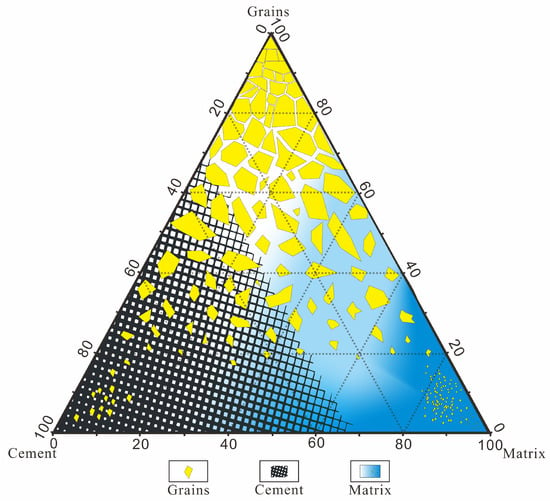
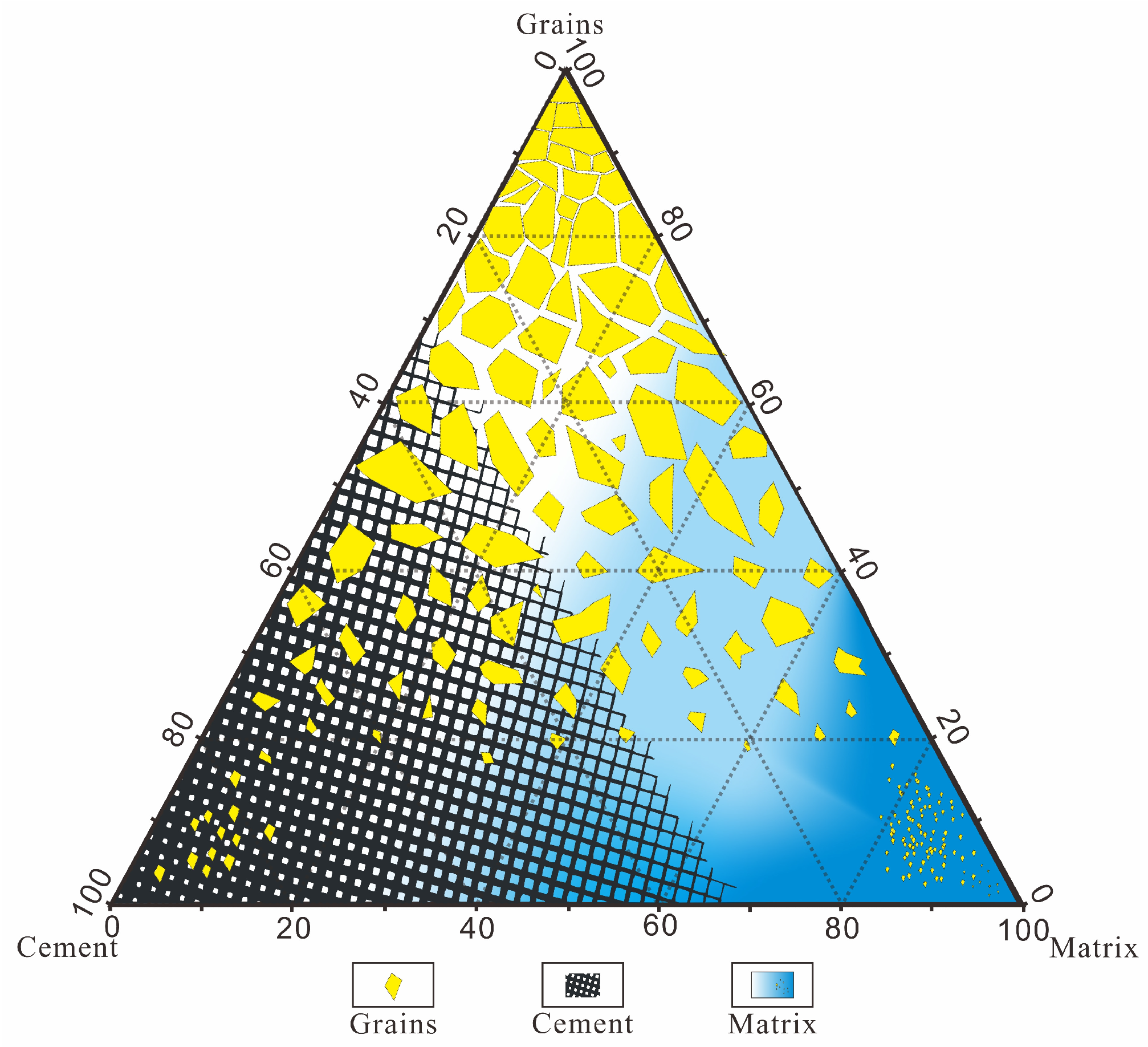
The fault core usually accommodates most of the fault displacement and may contain fault gouge, cataclasite, clay smear, breccia, and intensely deformed materials [3,7,30,31]. With increasing exploration of deeply buried pre-Mesozoic carbonate reservoirs [12,13,14], it has become evident that fault cores commonly experience multiple stages of diagenetic cementation. Fault cores can experience multiple stages of cementation. These cements might occlude pores and fractures, reduce permeability, and enhance the heterogeneity of fault damage zones. This phenomenon is not limited to pre-Mesozoic reservoirs; for instance, multiple cementation phases sealing fault cores have been widely documented in Mesozoic carbonate reservoirs of the North Sea and the Gulf of Mexico [24]. Based on the support framework of fault rocks [32,33], fault cores can be divided into grain-supported, matrix-supported, and cement-supported types (Figure 1) [28]. In grain-supported fault cores, angular breccias and cataclasites are commonly developed. Brittle deformation produces fracture networks among fault rocks, with multiple interlaced slip surfaces and relatively low matrix content. Mesh-like interconnected fractures may preserve open fracture porosity. In addition, collapse and removal of fault rocks may generate localized vugs and caves. Dissolution commonly occurs along fracture networks and may form fracture–cave reservoirs [21]. In matrix-supported fault cores, intense cataclasis generates fine-grained matrix materials that fill interparticle spaces and fractures. Such intense deformation commonly results in strong compaction and very limited matrix porosity within the fault core. During subsequent burial, multiple stages of cementation may occur within fault cores to form cement-support fault cores [28]. The degree of cementation and filling within fault cores varies significantly in both space and time. In general, porosity decreases with increasing cementation. However, later fracturing and dissolution may locally overprint earlier cements and generate porous and permeable zones [10,11,12].
Figure 1.
Ternary diagram showing the classification of grain-, matrix- and cement-support fault core (The axes represent the relative proportions of grains, matrix, and cement, with specific thresholds defining the transition between grain-supported, matrix-supported, and cement-supported domains, modified after references [28]).
In wide damage zones, the internal architecture varies substantially and can commonly be divided into inner and outer damage zones [3,30,31]. The inner damage zone occurs adjacent to the fault core. More than two fracture sets commonly develop here, forming reticular fracture networks. Global outcrop studies and Discrete Fracture Network (DFN) modeling have consistently demonstrated that fracture porosity and connectivity in the inner damage zone are commonly better than those in the fault core [1,7]. Consequently, fractured reservoirs are commonly better developed in the inner damage zone, and wells penetrating this zone may yield relatively high oil or gas production. Connected fracture networks in the inner damage zone may also serve as preferential pathways for fluid flow and dissolution, thereby promoting the formation of fracture–cave reservoirs [17,22].
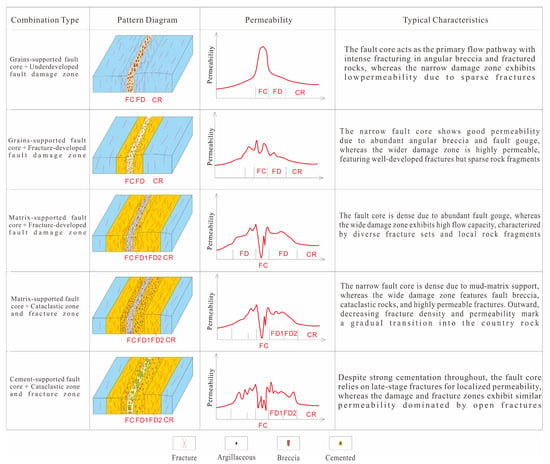
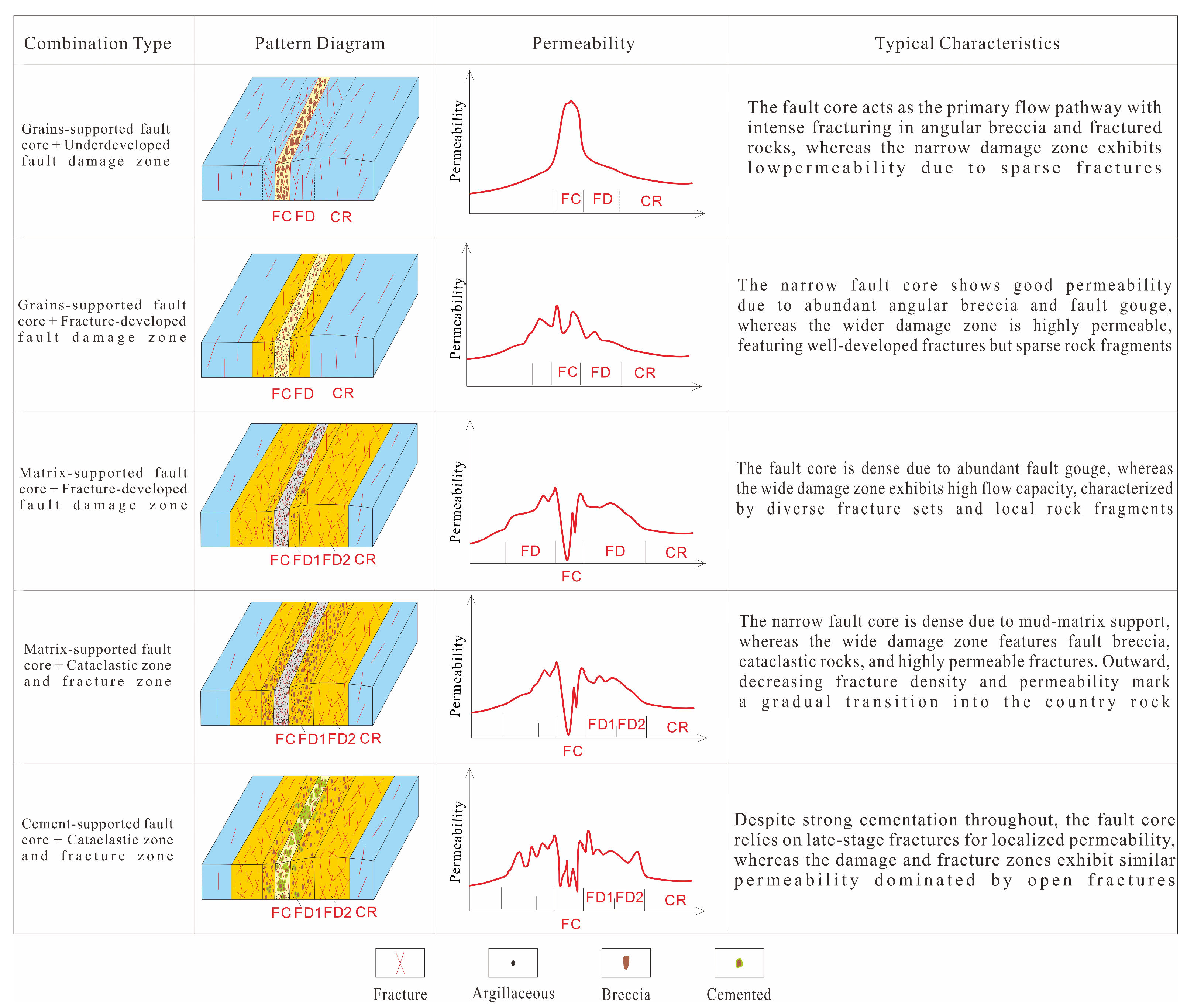
The outer damage zone is typically characterized by one dominant fracture set and a lack of fault rocks. It can be distinguished from the inner damage zone by lower fracture density, shorter fracture length, and narrower fracture aperture [3,31]. In addition, dissolution porosity and fracture-filling cements are generally less developed in the outer damage zone than in the inner damage zone, suggesting weaker fluid–rock interaction and lower reservoir quality. In general, fractured reservoir quality decreases from the fault core to the outer damage zone, which is the most frequent scenario in siliciclastic rocks or heavily cemented carbonates. However, the opposite can also be true under specific diagenetic circumstances. For example, when the fault core undergoes intense hydrothermal dissolution or karstification while the surrounding damage zone is heavily sealed by compaction and cementation, the fault core permeability can locally exceed that of the damage zone [20]. Distinguishing these scenarios requires evaluating the specific paragenetic sequence of the basin. Nevertheless, long-term and multi-stage diagenetic modification may produce highly variable reservoir properties within the damage zone [7,8,9]. Although a few fault zones show relatively symmetrical damage zones, most natural fault damage zones are far more complex than a simple symmetrical envelope around a fault core. Damage zones are commonly asymmetric in both vertical and horizontal directions. Their width, architecture, and internal deformation structures vary with the assemblage of the fault core, inner damage zone, and outer damage zone. These variations are controlled by structural mechanisms, lithology, mechanical stratigraphy, burial history, and petrophysical properties [4,32,33]. The asymmetry of damage zones is primarily controlled by mechanical stratigraphy (stiffness contrasts and bed thickness), stress field perturbations, and fault interaction patterns, which localize deformation preferentially in competent layers or specific fault wall rocks. Consequently, fractured reservoirs vary significantly among different fault damage-zone architectures. Based on compiled data, multiple assemblage models can be established from different combinations of fault core, inner damage zone, and outer damage zone, resulting in different types of fractured reservoirs within fault damage zones (Figure 2) [17]. During long-term burial, the heterogeneity of fractured reservoirs may increase owing to the overprinting of multiple diagenetic processes. Progressive fracture sealing during burial may localize effective reservoirs within only a few well-developed and incompletely sealed fracture networks. However, later fault reactivation and dissolution may reopen fractures and enlarge the effective fractured reservoirs [10,11,12].
Figure 2.
The different assemblages and permeable structures of fault damage zones (FC: fault core; FD1: inner zone; FD2: outer zone; CR: country rock; after references [17]).
The tripartite division of fault zones into fault core, damage zone, and host rock is useful for analyzing fault architecture and fractured reservoirs [1,7]. The architectural models of fault damage zones are constructed on a case-specific basis and constrained by integrated structural, petrophysical, seismic, core, and logging data [17,18,19]. However, the architecture and porosity of fault damage zones are highly heterogeneous, and subsequent reservoir development associated with fault damage zones is not always strictly limited by the geometric boundary of structural damage. Furthermore, defining the boundaries of fault damage zones remains challenging due to the ambiguous transitional boundaries and lack of clear seismic responses in the subsurface [4,31]. Research on fault damage-zone architecture has shifted from simple geometric description toward multiscale and process-based analysis. For example, detailed outcrop analyses in the Valley of Fire State Park (Nevada, USA) and the Central/Southern Apennines (Italy) have provided critical insights into how deformation bands and fracture clusters scale and interact in porous sandstones and carbonates [20]. A major challenge is to build lithology-specific and evolution-sensitive architectural models that can be applied to subsurface reservoir prediction. In this context, reconstructing the spatio-temporal evolution of fault damage-zone architecture is essential.
2.2. Scaling and Mechanism of Fault Damage Zones
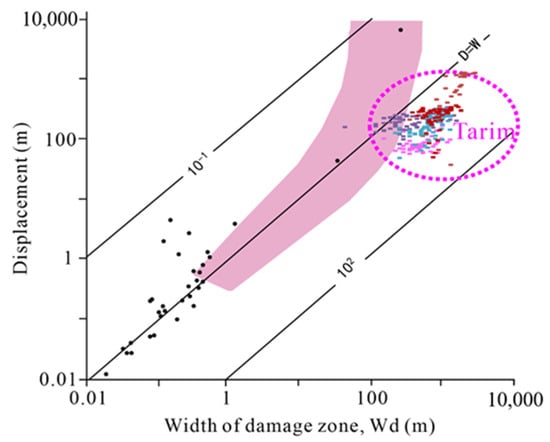
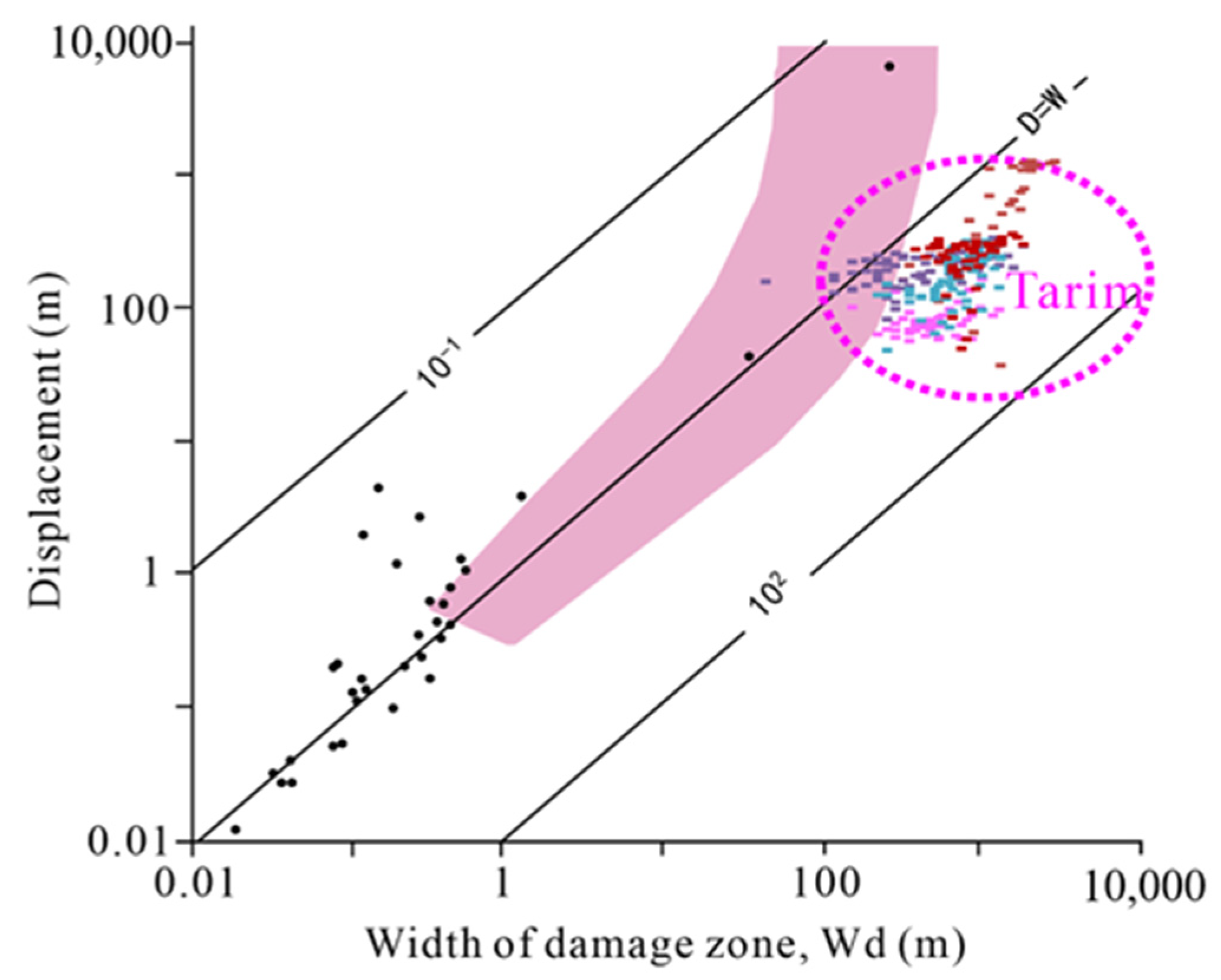
Fracture networks are the most important structural elements controlling permeability in many fault damage zones, especially in low-porosity and low-permeability carbonate reservoirs, tight sandstones, fractured basement reservoirs, and mixed lithological systems [14,34]. Generally, deformation intensity decreases from the fault core and inner damage zone toward the outer damage zone. The number, length, aperture, and density of fractures generally decrease outward. A major advance in fault damage-zone studies is the recognition of scaling relationships between fracture parameters, petrophysical properties, and distance from fault zones [4,35]. Fault damage-zone width, fracture intensity, and petrophysical properties generally increase with fault displacement (Figure 3) [2,3,4,5,6,17,36,37]. These scaling relationships, such as the power-law correlation between fault displacement and damage zone width, have been used to infer mechanical processes responsible for off-fault damage, including both aseismic creep and coseismic slip [30,32].
Figure 3.
Comparison of the displacement vs. damage zone width between the Central Uplift and other places (the color icons: this study; the data of the Tarim Basin are from references [19,30,33]).
These scaling relationships (Figure 3) have been used to infer mechanical processes responsible for off-fault damage, including aseismic and coseismic deformation. However, fracture-parameter distributions are rarely smooth in natural systems. Scaling relationships are commonly scattered over two to four orders of magnitude [35]. This scatter reflects the influence of protolith type, mechanical stratigraphy, burial depth, diagenesis, stress state, deformation mechanism, and fault reactivation [3,37]. Local fracture clusters may occur near fault tips, relay zones, bends, intersections, and lithological boundaries. Fracture corridors may form highly permeable pathways even where average fracture density is not high. Conversely, zones with high fracture density may have low permeability if fractures are cemented, mechanically closed, or poorly connected [34,38,39,40]. Because outcrop, core, logging, and seismic data each have scale-dependent limitations, multiscale integration is essential for reconstructing realistic fracture networks and evaluating the scaling of fracture parameters.
The formation of fault damage zones is controlled by multiple mechanical processes during fault initiation, propagation, interaction, linkage, and reactivation. At the early stage of fault growth, stress concentration around fault tips may generate small fractures, deformation bands, or shear zones. With increasing displacement, these structures may link to form a through-going fault, while the surrounding rocks preserve distributed damage [31,39]. During later reactivation, pre-existing fractures may reopen, slip, become reoriented, or be overprinted by new fracture sets. Off-fault damage is commonly explained using Andersonian and non-Andersonian mechanical models. Andersonian faulting assumes a homogeneous medium and a relatively uniform stress field. Furthermore, non-Andersonian faulting is often driven by elevated pore fluid pressure, which reduces effective normal stress and facilitates fault reactivation and hydrofracturing, a critical factor in deep basin settings. Under this framework, shear faults typically form at an angle of approximately 25–30° to the maximum principal stress. This model has been widely applied to fracture analysis and prediction [40,41]. However, natural fault damage zones commonly deviate from Andersonian predictions. Such deviations reflect the influence of fault-tip stress perturbation, fault interaction, lithological heterogeneity, pre-existing structures, anisotropy, and fault reactivation. Fault propagation, linkage, and interaction models have been documented in the sedimentary basin [31,33,42,43]. However, the fault propagation and interaction patterns remain insufficiently understood and require further investigation.
Different lithologies and mechanical stratigraphy also play an important role in the heterogeneous development of fault damage zones. Strata lithology, thickness, stiffness contrast, bed interfaces, pre-existing fabrics, and cementation state all influence fracture spacing, height, termination, and connectivity [44,45]. In mixed lithological successions, deformation mechanisms may change abruptly across lithological boundaries. Competent beds may develop dense, layer-bound fractures, whereas weak layers may arrest fracture propagation. This produces segmented fracture networks and strongly heterogeneous reservoir properties.
One of the most important unresolved issues is the relative contribution of different deformation mechanisms. The dominant fracture sets may be related to fault-tip propagation, regional tectonic stress, burial compaction, fold-related strain, or later fault reactivation in fractured reservoirs. Without resolving their genetic origin, it is difficult to predict fracture distribution away from wells and outcrops. Future studies should therefore combine structural analysis, geomechanical modeling, fracture chronology (e.g., U-Pb dating of syn-kinematic cements [22]), and diagenetic evidence to clarify the mechanisms responsible for fault damage-zone formation [5].
3. Diagenesis in Fault Damage Zones
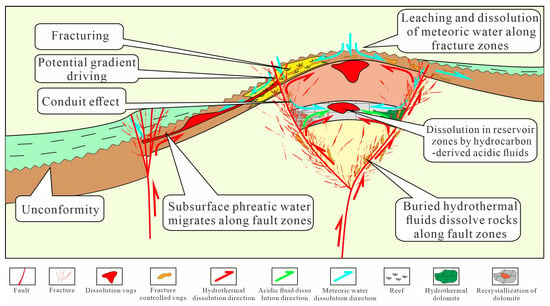
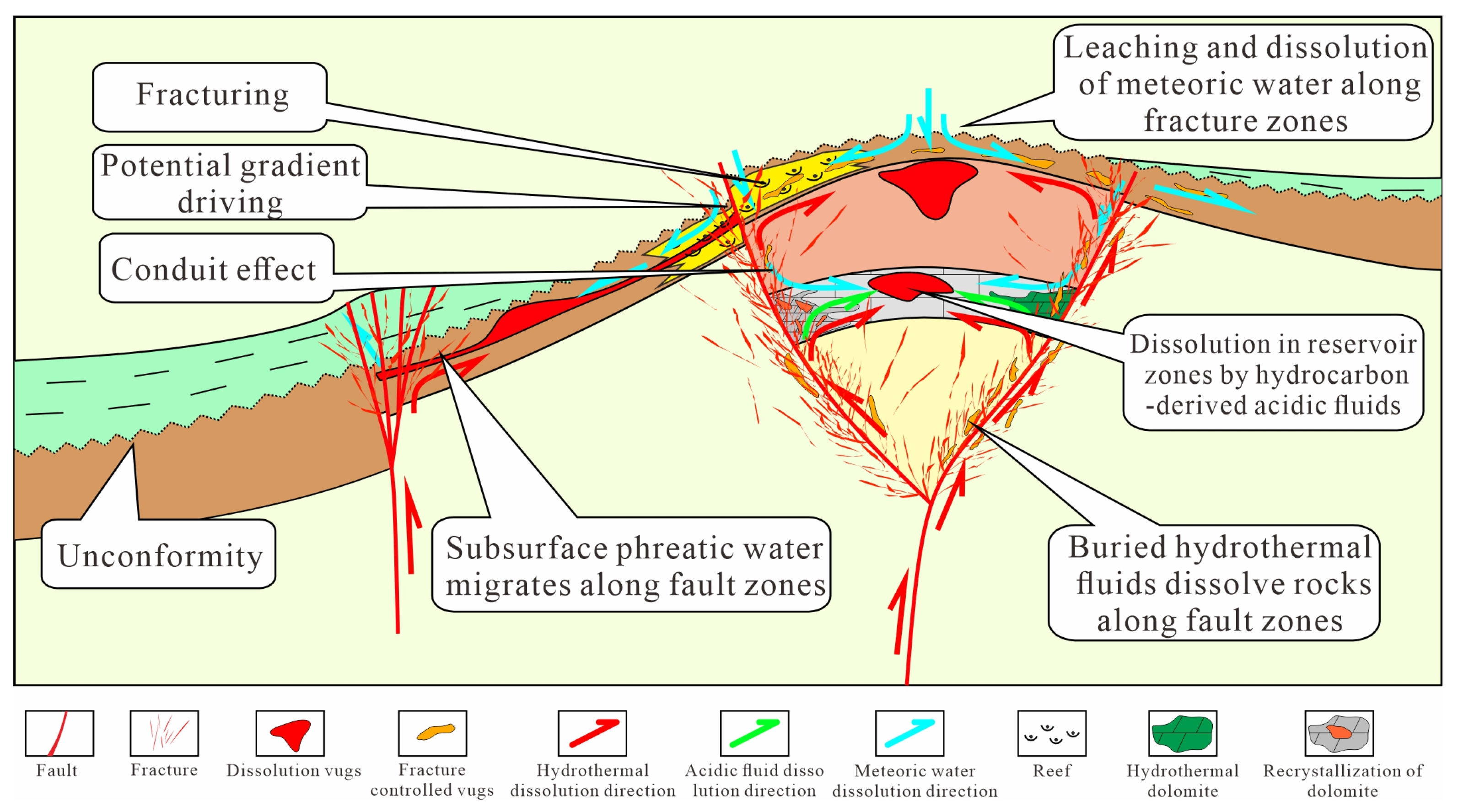
Fault damage zones in sedimentary basins generally have experienced multiple diagenetic modifications, which can substantially influence the reservoir quality by either occluding pore spaces through cementation or enhancing secondary porosity via dissolution. The diagenetic processes, particularly compaction, cementation, mineralization and dissolution along fault damage zones (Figure 4), are of importance for predicting whether a fault zone will act as a conduit, a barrier, or a heterogeneous reservoir [10,12]. Figure 4 presents a conceptual sketch model illustrating the spatial distribution of these diagenetic alterations relative to the fault architecture, highlighting how dissolution is focused along the highly fractured inner damage zone while the fault core may be sealed by cement.
Figure 4.
A sketch model of fault damage zone-related carbonate reservoirs in the Tarim Basin (modified after references [25,32]).
3.1. Compaction
Compaction is a fundamental diagenetic process in sedimentary basins and can be significantly modified by fault-related deformation. It includes both mechanical and chemical compaction. Mechanical compaction involves grain rearrangement, ductile grain deformation, grain crushing, and pore collapse, whereas chemical compaction is mainly expressed by pressure solution, stylolite formation, and dissolution along grain contacts, seams, or fissures [46,47].
In fault damage zones, compaction may be enhanced by localized stress concentration. In porous sandstones, deformation bands (which can be classified into disaggregation bands, cataclastic bands, and compaction bands) commonly form through grain rotation, cataclasis, and pore collapse, resulting in porosity reduction and permeability loss. These bands may act as baffles or barriers to fluid flow [46]. In carbonate rocks, pressure solution and stylolite formation may be associated with both burial compaction and fault-related stress. Stylolites and solution seams may reduce matrix permeability and act as mechanical weaknesses that localize later fracturing and fluid flow [47].
The reservoir effect of compaction is complex. On the one hand, compaction generally reduces primary porosity and permeability. On the other hand, compaction may increase rock stiffness and promote later brittle fracturing. Therefore, compaction may indirectly contribute to later fracture-controlled reservoir development. The key question is whether compaction irreversibly destroyed the original pore system or prepared the rock for subsequent fracture- and dissolution-related enhancement. Moreover, compaction intensity may vary substantially within fault damage zones. Localized stress concentration and compression can produce stronger compaction near deformation structures, whereas extensional or relatively low-stress domains may preserve higher porosity than adjacent host rocks. Fault-related uplift may also reduce the degree of burial compaction. Therefore, fault damage zones can produce highly variable compaction patterns and reservoir effects [10,12].
A major controversy is how to distinguish burial compaction from fault-related compaction. Burial compaction is controlled mainly by burial depth, effective stress, lithology, and temperature, whereas fault-related compaction is localized around deformation structures. In practice, these two processes commonly overlap. Quantitative petrography, porosity-depth trends, comparison with undeformed host rocks, and microstructural analysis (such as strain marker analysis or fluid inclusion thermometry) are therefore required to evaluate the specific contribution of fault-related compaction [20,22].
3.2. Cementation
Cementation is one of the most important processes modifying reservoirs within fault damage zones. Fractures generated by faulting may initially enhance permeability, but they can later be partially or completely filled by calcite, quartz, dolomite, anhydrite, barite, pyrite, or other minerals. Cementation may therefore transform a highly permeable fracture network into a low-permeability or sealed zone [10,12].
Fracture cementation provides valuable information on fluid flow history. Cement textures, crystal morphology, cathodoluminescence patterns, fluid inclusions, isotopic compositions, and trace-element signatures can reveal fluid source, temperature, salinity, redox state, and precipitation history. Multiple cement generations may indicate repeated fault activity and episodic fluid flow. Precipitation mechanisms are controlled by temperature gradients, fluid mixing, and even bacterial activity. Furthermore, crack-seal textures provide crucial evidence for the co-evolution of fracturing and cementation during incremental fault slip. Syntaxial quartz overgrowths, calcite veins, dolomite cement, and bitumen-bearing fractures may record different burial, fluid flow, and hydrocarbon-charging events [48,49].
The effect of cementation on reservoir quality depends on its timing, distribution, and completeness. Early cementation may locally preserve fracture aperture by supporting fracture walls, but excessive cementation reduces storage capacity and flow efficiency. Partial cementation may create rough fracture surfaces and preserve residual flow pathways. Complete cementation may destroy fracture permeability, although it can preserve evidence of ancient fluid migration. In some cases, cemented fractures may become mechanically weak zones that are reactivated during later deformation [44].
The main unresolved issue is whether present-day fractures are open, sealed, or partially open under reservoir conditions. Outcrop observations may overestimate open fractures because weathering can remove cements or open fractures during exhumation. Core observations may underestimate fracture openness because of drilling-induced damage, sampling bias, or stress release. Therefore, fracture cementation studies should be integrated with borehole image logs, production data, pressure tests, and reservoir simulation to evaluate effective fracture permeability [10,12].
3.3. Mineralization
Fault damage zones can act as important pathways and reaction sites for mineralizing fluids. Mineralization may include carbonate veining, dolomitization, silicification, pyritization, barite precipitation, anhydrite cementation, hydrothermal alteration, and ore-related mineral assemblages. In sedimentary basins, mineralization commonly reflects the interaction between fault-controlled fluid migration and host-rock reactivity [6,7].
Mineralization has dual effects on reservoir quality. Fracture-filling calcite, quartz, anhydrite, or barite precipitation may reduce permeability and seal reservoirs. In contrast, hydrothermal dolomitization, associated dissolution, and other reactive fluid–rock interactions may locally improve porosity and permeability. In carbonate reservoirs, fault-controlled dolomitization may create porous dolomite bodies along fracture corridors. Some case studies, such as those in the deeply buried Ordovician carbonates of the Tarim Basin [17,22], indicate that hydrothermal dolomitization and associated dissolution are favorable for the development of deep secondary porosity. Dolomitization may also increase permeability by enlarging pore-throat radii and improving pore connectivity [20,29,50,51]. Dolomitization mechanisms [50] vary significantly; it is essential to distinguish between hydrothermal, burial, and meteoric dolomitization, as they have distinct implications for reservoir quality and economic hydrocarbon/mineral potential. Complex interactions among dolomitization, fracturing, and microbial carbonate reservoirs have also been reported [21]. In siliciclastic reservoirs, quartz cementation commonly reduces porosity, whereas feldspar dissolution or carbonate-cement dissolution may enhance secondary porosity [44].
Fault-related mineral assemblages can be used to reconstruct fluid pathways. The distribution of veins, cement generations, and alteration halos can indicate whether fluids migrated along the fault core, through the damage zone, or across stratigraphic layers. Integrated petrographic analysis and fault interpretation are useful for reconstructing hydrothermal dolomitization and fluid–rock interaction [11,21]. Mineral geochemistry can further help distinguish basinal brines, meteoric fluids, hydrothermal fluids, and hydrocarbon-related fluids.
Case studies in this Special Issue suggest that hydrothermal dissolution may be more important than dolomitization itself for porosity enhancement [20,29]. Importantly, hydrothermal activity can improve reservoir quality only in localized positions. In many deeply buried and relatively closed systems, mineralization associated with hydrothermal activity may fill both primary and secondary pores and ultimately reduce reservoir quality [11,29,51]. Another key controversy is whether mineralization indicates long-lived permeability or short-lived episodic fluid pulses. A fault damage zone may appear highly mineralized because it repeatedly transmitted fluids over geological time, or because a single major fluid event precipitated abundant minerals over a short interval. Distinguishing between these scenarios requires detailed paragenetic analysis and geochronological constraints [23,48].
3.4. Dissolution
Dissolution is a critical process for generating secondary porosity in fault damage zones, especially in carbonate reservoirs and deeply buried clastic reservoirs. Fault-related fractures provide pathways for acidic, undersaturated, or hydrothermal fluids, which may dissolve carbonate minerals, feldspar, evaporites, or unstable grains. Dissolution can enlarge fractures, generate vugs, form fracture–cavity systems, and improve reservoir storage capacity (Figure 4) [17,22].
In carbonate fault damage zones, dissolution commonly occurs along fractures, bedding planes, stylolites, and fault-related breccias. This process can generate highly heterogeneous fracture–vug reservoirs. Dissolution may be especially intense near fault intersections, relay zones, and high-permeability fracture corridors, where fluid flux is relatively high. However, dissolution is not automatically beneficial to reservoir quality. If dissolution pores are isolated or later filled by cement, their contribution to effective storage and flow capacity may be limited [11,17,22]. In clastic reservoirs, dissolution of feldspar, rock fragments, or carbonate cement may generate secondary intergranular pores and moldic pores. Fault-related fluid flow may enhance this process by introducing organic acids, CO2-rich fluids, or hydrothermal fluids. However, dissolution may also be accompanied by clay mineral precipitation or quartz cementation, which can reduce permeability.
A major unresolved issue is the spatial extent of fault-controlled dissolution. In some cases, dissolution is limited to narrow fracture corridors, whereas in others it may extend into broad damage zones or adjacent stratigraphic layers. Predicting the extent of dissolution requires an integrated understanding of fluid chemistry, flow duration, host-rock composition, temperature, pressure, and fracture connectivity [14,17,27]. It is critical to distinguish between karst (epigenic) and hypogene dissolution, as they produce vastly different geometries and reservoir-quality distributions. To predict the extent of dissolution, integrated approaches combining fluid-rock interaction modeling, fracture connectivity analysis, and geochemical tracers are required.
3.5. Diagenetic Evolution
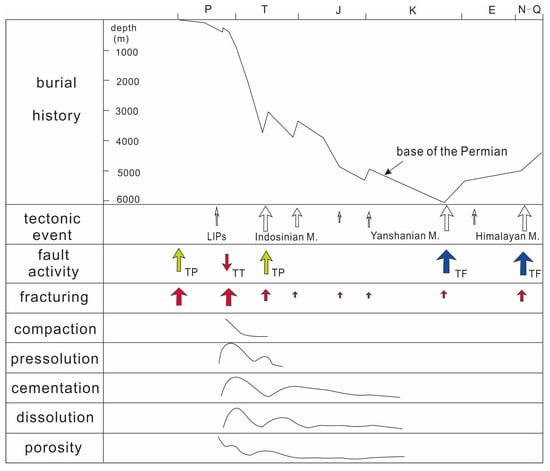
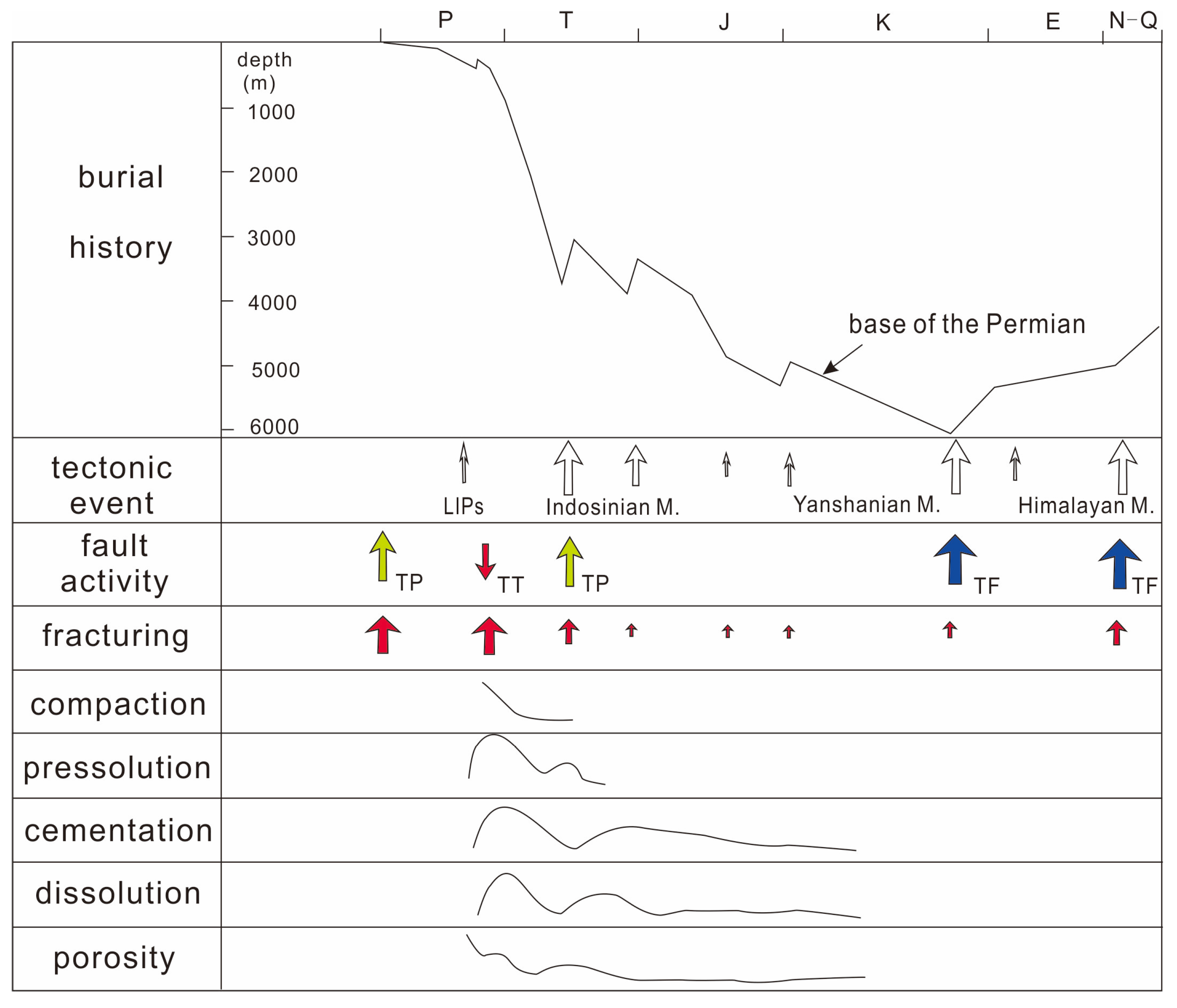
Diagenesis in fault damage zones should be understood as an evolving sequence rather than a set of isolated processes. Compaction, cementation, mineralization, and dissolution commonly occur in multiple stages and may alternate through time, which could result in complicated reservoir evolution (Figure 5). Therefore, reconstructing diagenetic evolution is essential for understanding reservoir formation, modification, and destruction [10,11,12].
Figure 5.
The evolution model of the fracture diagenesis in the reef-shoal reservoir in KLT. (The tectonic events, the fault activity and fracturing are referred from references [29,30,31]; TP: transpressional fault; TT: transtensional fault; TF: thrust fault; The X-axis represents the geological time and evolutionary stages, while the Y-axis represents the relative intensity of diagenetic processes (compaction, cementation, dissolution) and the resulting porosity. The size of the arrows indicates the scale and intensity of tectonic events, fault activity, and fracturing. The undulating curves illustrate the dynamic feedback: fracturing events (large arrows) create permeability, leading to a porosity spike (dissolution curve), which is subsequently reduced by cementation until the next tectonic reactivation.
A typical structural–diagenetic evolution may include pre-faulting burial compaction, early cementation, syn-faulting fracture formation, fracture cementation, dissolution during fluid migration, hydrocarbon charging, late cementation, and fault reactivation. In some systems, early fractures are sealed before hydrocarbon charging and therefore do not contribute to present-day reservoir permeability. In other systems, fractures remain open or are reopened during hydrocarbon migration and act as effective conduits. In still other systems, dissolution after cementation may restore or enhance reservoir quality [5,6].
The interaction between deformation and diagenesis is highly reciprocal. A critical, yet often overlooked, aspect is the feedback loop between deformation and diagenesis: Deformation creates permeability pathways and reactive surfaces, whereas diagenesis modifies rock strength, pore pressure, fracture aperture, and mechanical behavior. Cementation strengthens rocks and promotes later brittle failure, while dissolution weakens them and localizes deformation. Understanding the time scales of these episodic versus continuous processes is vital for accurate reservoir prediction. Mineral precipitation may seal pathways and redirect fluid flow. Therefore, deformation and diagenesis should not be treated as independent processes [10,11,12].
The evolutionary history of fault damage zones is particularly important for reservoir prediction. A fault damage zone that was highly permeable during early burial may become sealed by quartz or carbonate cement during deep burial. A cemented damage zone may later be reopened by tectonic reactivation or overpressure. Dissolution may enlarge fractures and generate vugs, but later cementation may again reduce permeability. For example, in the deep carbonate reservoirs of the Tarim Basin, early fracturing followed by hydrothermal dissolution has been observed to significantly enhance porosity [17], while in the heavily compacted sandstones of the North Sea, similar fracture networks are often completely sealed by quartz cementation, acting as barriers [29]. Therefore, the reservoir effect of a fault damage zone depends not only on its structural architecture, but also on its temporal evolution [11,17,22].
The future of fault damage-zone diagenesis research lies in time-resolved structural diagenesis. This requires the integration of field observations, core description, thin-section petrography, cathodoluminescence, scanning electron microscopy, fluid inclusions, stable isotopes, clumped isotopes, radiometric dating [23], and burial-history modeling to unravel the complex role of chemistry in fracture pattern development and fluid-rock interactions [50]. Only by determining the relative and absolute timing of deformation and diagenetic events can researchers evaluate whether fault damage zones acted as reservoirs, conduits, barriers, or transient systems [10,48].
4. Reservoirs in Fault Damage Zones
4.1. Types and Distribution of Reservoirs
Reservoirs within fault damage zones can be classified according to their dominant storage and flow spaces. Secondary reservoir in fault damage zones commonly include fracture, pore (diameters < 2 mm), vug (diameters of 2–100 mm), and cave (diameters > 100 mm), which can be divided into fracture-type, pore–vug-type, cave-type, fracture–vug-type, fracture–pore-type, and fracture–cave-type reservoirs [22,52]. In low-porosity, low-permeability, and tight reservoirs, these reservoirs are commonly associated with fracturing and fracture-related dissolution and may be referred to as fault-controlled reservoirs or fractured reservoirs. In some cases, microfacies-controlled primary porosity and dissolution porosity provide the main storage space, whereas fractures mainly control permeability. Fracture–vug and fracture–cave reservoirs are especially in deep tight dolomite and limestone rocks, respectively [17,22]. Hybrid reservoirs are the most common type in natural systems. They contain matrix pores, fractures, vugs, dissolution pores, and cement-modified pores. Their reservoir quality is controlled by the interaction among depositional facies, deformation structures, and diagenetic evolution. Deep ancient fault-controlled reservoirs commonly include several of these pore types, which could form high porosity-permeability “sweet spots” reservoirs. Quantitatively, porosity in these fault-controlled reservoirs can range from 2% to over 15%, while permeability can vary across several orders of magnitude (from <0.1 mD to >1000 mD). These systems are best described using triple porosity models (fracture–vug–matrix), where fractures provide permeability, and vugs/matrix provide storage. This multi-type pore system results in strong heterogeneity and complex distribution of fractured reservoirs, which remains a major challenge for subsurface reservoir characterization [18,52].
Fractured reservoirs commonly develop along fault damage zones, but their distribution is highly heterogeneous because of multiple stages of fracturing and diagenesis. High-quality reservoirs do not always occur closest to the fault core. Near the fault core, fracture density may be high, but cementation, cataclasis, clay smear, and mineralization may reduce permeability. Therefore, grain-supported fault cores are generally more favorable for reservoir development than matrix-supported or cement-supported fault cores. At intermediate distances from the fault core, fractures may be sufficiently abundant but less cemented, creating better conditions for reservoir formation. Fault-controlled reservoirs therefore commonly occur within inner damage zones where connected fracture networks are well developed [1,7,17]. High-quality sweet-spot reservoirs are commonly localized within fault damage zones. They may occur near fault tips, relay zones, fault intersections, fracture corridors, reactivated segments, and mechanically competent layers. Fault intersections and relay zones are particularly important for reservoir development because they commonly contain enhanced fracture density and connected fracture networks that promote fluid flow and dissolution. Before fault linkage occurs, relay ramps frequently act as important, highly permeable migration pathways. After linkage is achieved, these abandoned relay structures often preserve extensive fracture networks and dissolution zones, becoming prime targets for sweet-spot reservoirs [22,31,33].
A major challenge is predicting fractured reservoirs in the subsurface. Advances in seismic technology have improved the identification of large-scale fractured reservoirs. Seismic data can identify large fracture–cave reservoirs and some fracture corridors, but they rarely resolve small-scale damage-zone structures. Core and borehole image logs provide direct evidence but are spatially limited. Therefore, predicting reservoir distribution requires the integration of seismic interpretation, structural modeling, numerical modeling based on outcropping analogs (e.g., DFN upscaling) fracture prediction, diagenetic analysis, and dynamic production data [17,18,22].
4.2. Controlling Factors and Evolution of Reservoirs
In deep tight rocks, reservoir quality within fault damage zones is controlled by multiple complex structural, lithological, diagenetic, and basin-scale factors, in which coupling interactions could result in highly heterogeneous reservoir evolution and distribution [17,52].
Structural controls include fault displacement, fault type, fault geometry, fault interaction, fracture parameters, and reactivation history. Complex structural deformation results in complicated reservoir formation and distribution. Faults with larger displacement commonly develop wider damage zones and more extensive fracture networks. Reservoir porosity and permeability may increase with fault displacement and may show positive correlations in some cases. However, large faults may also develop thick sealing fault cores, particularly in deeply buried settings. In this context, fractured reservoirs in large fault zones commonly occur in the damage zone rather than in the fault core [1,17,37]. Fault-core-controlled reservoirs are more likely to develop along immature grain-supported fault cores. In many fault damage zones, fracture frequency, porosity, and permeability decrease with increasing distance from the fault core and may show power-law decay trends. High-quality reservoirs commonly occur near the fault core or within the inner damage zone, but this relationship can be modified by cementation, cataclasis, mineral filling, and dissolution [1,17,37]. Fault bends, tips, relay zones, intersections, and overlapping segments often produce enhanced fracture networks because of fault propagation and interaction. Case studies from the Zagros fold-and-thrust belt and the Tarim Basin suggest that overlapping and intersecting fault segments may contain wider and better-developed reservoirs. Different fault types, including normal, reverse, and strike-slip faults, also produce different damage-zone architectures and reservoir distributions [22,31,33].
Diagenetic controls include compaction, cementation, dissolution, mineralization, replacement, and hydrocarbon charging. Multiple stages of fracturing and fracture-related dissolution can enhance permeability by one to three orders of magnitude and increase porosity by more than a factor of two in tight reservoirs [14,15,16,17,18]. Increased porosity within fracture zones is commonly related to fracture-related dissolution during contemporaneous, burial, and/or supergene stages [16,17,18]. Conversely, fracture cementation during burial can occlude pore space and reduce permeability [2,7,10,12,19,20,52]. In deep burial environments, compaction and cementation generally reduce fracture porosity and permeability. In contrast, dissolution during contemporaneous, supergene, and burial stages may generate secondary porosity. In addition to widely recognized karstic dissolution along fault zones, this Special Issue highlights the importance of contemporaneous dissolution within and around damage zones. Case studies in the Sichuan Basin and the Upper Indus Basin have shown that contemporaneous fracturing and dissolution can play a dominant role in enhancing reservoir porosity, and even small-scale strike-slip faulting may significantly improve reservoir quality in deep tight carbonates. Other studies suggest complex interactions among deposition, fracturing, and diagenesis in microbial carbonate reservoirs. Dolomitization, dissolution, and fracturing may enhance reservoir quality, whereas cementation, micritization, and mechanical compaction may significantly reduce reservoir porosity [20,21]. Hydrothermal activity during burial may enhance reservoir porosity through dolomitization and dissolution; however, many cases suggest that porosity improvement is commonly localized in deeply buried and relatively closed systems. In deep carbonate reservoirs, contemporaneous dissolution rather than hydrothermal dolomitization may control the origin and distribution of secondary porosity within fault damage zones [20]. Hydrocarbon emplacement may inhibit some cementation processes and help preserve pore space. This process has commonly been neglected, but it may be important in deep ancient reservoirs. In the Tarim Basin, early hydrocarbon charging may preserve carbonate reservoir porosity, resulting in porosity values more than twice those of adjacent uncharged reservoirs. Therefore, the timing of hydrocarbon charging relative to cementation and dissolution is critical [52,53].
Lithological controls include mineral composition, grain size, sorting, clay content, carbonate content, original porosity, bed thickness, and mechanical layering. Carbonate rocks are highly reactive and may develop fracture–vug systems through dissolution. Porous sandstones may develop deformation bands that reduce permeability. Shale-rich intervals may promote sealing through clay smear and ductile deformation. Mixed lithological successions may show abrupt vertical and lateral variations in deformation style and reservoir quality [44,45,46]. Basin-scale controls include burial history, thermal evolution, pressure regime, fluid source, tectonic stress field, and uplift history. Deep burial may promote quartz cementation, pressure solution, and fracture sealing, whereas uplift may introduce meteoric fluids and promote dissolution. Overpressure may help maintain fracture aperture or trigger fault reactivation. Regional tectonic stress may determine which fractures remain open under present-day reservoir conditions. Because basin-scale factors generally influence reservoir quality at a regional scale, their relationship with local fault damage-zone processes is complex and requires further investigation [14,54]. The interactions between these basin-scale factors and local structural–diagenetic processes ultimately dictate the spatial distribution of reservoir quality.
4.3. Evolution of Reservoirs
Reservoir evolution in fault damage zones can be summarized as a coupled deformation–diagenesis process. During fault initiation and propagation, fractures, deformation bands, and subsidiary faults develop. These structures modify host-rock permeability and create pathways for fluid migration. The architecture and fracture networks of fault damage zones established during this stage exert a first-order control on fractured reservoir distribution. Reservoir permeability may be largely established during early fault-related deformation. At the same time, karstic or contemporaneous dissolution may significantly influence porosity development and distribution. Dissolution-related reservoirs depend on the coupling between hydrological conditions and fracture networks, which may generate large-scale dissolution porosity along carbonate fault damage zones [1,14,17].
During burial, primary porosity is progressively reduced by compaction and cementation with increasing burial depth and diagenetic intensity. In deep reservoirs, matrix porosity and early secondary porosity may be progressively lost, causing the reservoir to become tight. However, meteoric water may locally infiltrate along fractures during early burial or uplift stages and enhance dissolution porosity. Reservoir porosity and permeability may be modified throughout the entire burial history. Fluids moving through the damage zone may precipitate cements, dissolve unstable minerals, or cause mineral replacement. These complex fluid–rock interactions can result in localized porosity enhancement or destruction, thereby increasing reservoir heterogeneity [10,11,12].
Later fault reactivation may reopen sealed fractures or generate new fractures, which can be important for subsequent dissolution and reservoir enhancement. Hydrocarbon charging may also influence reservoir evolution by promoting dissolution, filling existing pore space, or preserving porosity by inhibiting further cementation. During supergene stages, karstic dissolution may generate secondary pores, vugs, and caves. Because much primary porosity may have already been destroyed by burial cementation and compaction, late-stage dissolution can be critical for the formation of effective reservoirs. Case studies from the Ediacaran dolostones in the Sichuan Basin and the Jurassic carbonates in Pakistan therefore indicate that reservoir evolution in fault damage zones is controlled by multiple stages of fracturing, diagenesis, and their interactions [10,11].
This evolutionary process means that fault damage zones may switch between reservoir-enhancing and reservoir-destroying roles through time [55,56]. At one stage, a damage zone may act as a conduit for fluid migration; at another stage, it may become a sealed barrier. In some cases, the fault core may act as a seal while the surrounding damage zone acts as a conduit. In other cases, both the fault core and damage zone may be cemented and sealing. In other cases, intense dissolution may create high-quality reservoirs along fault-controlled fracture corridors. These processes indicate that fault damage zones undergo complex reservoir-enhancing and reservoir-destroying evolution, resulting in strong reservoir heterogeneity and localized high-quality sweet spots [1,7,17,22].
Because of limited subsurface data and complex diagenetic histories, reconstructing multiple fracture-diagenetic events and their effects on deep reservoirs remains difficult. One of the most important controlling factors is the spatio-temporal configuration of fracturing and diagenesis within fault damage zones. Given the multiple structural and diagenetic processes operating in fault damage zones, the coupling between fracturing and diagenesis is essential for reservoir evaluation. Although high-resolution U–Pb dating of fracture-related minerals has improved understanding of reservoir evolution, it remains challenging to reconstruct the spatio-temporal distribution of the positive and negative effects of fracture diagenesis within fault damage zones. While outcrop analog studies are invaluable for establishing conceptual models of fracture-diagenetic relationships and providing ground-truth data for DFN modeling [57,58], they must be applied to deep subsurface predictions with caution. Differences in burial history, stress state, and fluid chemistry mean that shallow outcrop observations cannot be directly extrapolated to ultra-deep reservoirs without calibration from well logs, core data, and geomechanical modeling [13]. A predictive reservoir model must therefore consider the full structural, diagenetic, and fluid flow history of fault damage zones [10,23,54].
5. Future Perspectives and Challenges
To elevate the predictive capability of fault damage zone reservoirs, future research must transition from descriptive characterization to quantitative, technology-driven modeling. Several emerging technologies and approaches present transformative opportunities:
- (1)
- Machine Learning and AI: The application of AI and machine learning algorithms can integrate multi-scale data (seismic, logging, core) to predict fracture network distribution and identify deep sweet spots with higher accuracy, overcoming the non-linearity of structural–diagenetic coupling.
- (2)
- Nano-CT and FIB-SEM: Advanced imaging techniques like Nano-CT and Focused Ion Beam-SEM (FIB-SEM) are essential for pore-scale diagenetic characterization. They allow for the 3D reconstruction of micro-fractures, clay smear, and cement distribution, providing critical inputs for upscaled petrophysical models.
- (3)
- 3D Geomechanical-Hydrological Coupled Models: Building on the U-Pb geochronology framework, future studies should develop 3D coupled models to simulate the spatio-temporal evolution of fault damage zones. These models must account for the feedback between stress perturbations, fluid pressure, and chemical reactions.
- (4)
- Dynamic Data Integration: A major unresolved challenge is validating the present-day openness of fractures. Integrating dynamic production data, high-resolution borehole image logs, and pressure-test results is crucial to evaluate effective fracture permeability under actual reservoir conditions, bridging the gap between static geological models and dynamic engineering performance.
6. Conclusions
Although the coupling relationships among deformation, diagenesis, and reservoir development within fault damage zones are complex, several major conclusions and unresolved issues can be summarized.
- (1)
- Fault damage zones in sedimentary basins are characterized by complex structural–diagenetic processes that strongly influence reservoir quality and heterogeneity. Deformation establishes the primary structural framework of fault damage zones, including grain-supported, matrix-supported, and cement-supported fault cores, as well as inner and outer damage zones with outward-decreasing deformation intensity and fracture-network development. The distribution of permeable structures varies with fault-zone architecture, fracture-network characteristics, deformation mechanisms, lithology, and fault evolution.
- (2)
- Diagenesis subsequently modifies this structural framework through compaction, cementation, mineralization, and dissolution. These processes may either enhance or destroy reservoir quality. In particular, the coupling between fracturing and contemporaneous, burial-related, or supergene dissolution controls the formation, distribution, and heterogeneity of reservoir porosity. Therefore, the reservoir significance of fault damage zones should be evaluated through integrated structural and diagenetic analysis rather than through structural characterization alone.
- (3)
- Fault-controlled fractured reservoirs commonly contain multiple types of secondary storage space, including fractures, pores, vugs, and caves. These pore systems form complex and highly heterogeneous reservoirs. Controlled by lithology, fault-zone architecture, fracture-network development, fluid flow, and diagenetic evolution, fractured reservoirs are unevenly distributed along fault damage zones. As a result, localized sweet-spot reservoirs may develop in deep tight rocks, particularly where fracture connectivity, dissolution enhancement, and porosity preservation are favorably coupled.
- (4)
- The most important scientific challenge is to understand and predict the coupled evolution of deformation, diagenesis, fluid flow, and reservoir properties in fault damage zones. Future research should move from descriptive characterization toward quantitative, time-resolved, multiscale, and lithology-specific modeling. Such predictive models will improve the identification of reservoir sweet spots and the evaluation of fluid flow behaviors in faulted reservoirs.
Author Contributions
Conceptualization, T.J.; investigation, B.H., B.M., O.G.A., E.X., J.W. and E.X.; data curation, H.L., E.X. and B.M.; writing—original draft preparation, B.H., T.J. and O.G.A.; visualization, H.L. and T.J.; supervision, T.J. All authors have read and agreed to the published version of the manuscript.
Funding
National Key Research and Development Program of China (Grant No. 2025YFE0212900) and the National Natural Science Foundation of China (Grant No. U24B2019, 42402163, 4224100017).
Data Availability Statement
The original contributions presented in this study are included in the article. Further inquiries can be directed to the corresponding author.
Acknowledgments
The authors thank the editor and reviewer for their comments regarding manuscript improvement. We also thank Guanghui Wu, Xiaoxu Liu and Hailong Chen for their help in data.
Conflicts of Interest
Author Bing He was employed by the company PetroChina Southwest Oil & Gas Field Company. Omar Gheni Aziz is an employee of Oil Exploration Company (OEC), Ministry of Oil. En Xie is an employee of Zhenhua Oil Co., Ltd. The remaining authors declare that the research was conducted in the absence of any commercial or financial relationships that could be construed as a potential conflict of interest.
References
- Caine, J.S.; Evans, J.P.; Forster, C.B. Fault zone architecture and permeability structure. Geology 1996, 24, 1025–1028. [Google Scholar]
- Pei, Y.; Paton, D.A.; Knipe, R.J.; Wu, K.Y. A review of fault sealing behaviour and its evaluation in siliciclastic rocks. Earth-Sci. Rev. 2015, 150, 121–138. [Google Scholar] [CrossRef] [Scilit]
- Haines, T.J.; Michie, E.A.H.; Neilson, J.E.; Healy, D. Permeability evolution across carbonate hosted normal fault zones. Mar. Pet. Geol. 2016, 73, 60–78. [Google Scholar] [CrossRef] [Scilit]
- Choi, J.H.; Edwards, P.; Ko, K.; Kim, Y.S. Definition and classification of fault damage zones: A review and a new methodological approach. Earth-Sci. Rev. 2016, 152, 70–87. [Google Scholar] [CrossRef] [Scilit]
- Sibson, R.H. Power dissipation and stress levels on faults in the upper crust. J. Geophys. Res. 1980, 85, 6239–6247. [Google Scholar] [CrossRef] [Scilit]
- Fitches, W.R.; Cave, R.; Craig, J.; Maltman, A. Early veins as evidence of detachment in the Lower Palaeozoic rocks of the Welsh Basin. J. Struct. Geol. 1986, 8, 607–620. [Google Scholar] [CrossRef] [Scilit]
- Faulkner, D.R.; Jackson, C.A.L.; Lunn, R.J.; Schlische, R.W.; Shipton, Z.K.; Wibberley, C.A.J.; Withjack, M.O. A review of recent developments concerning the structure, mechanics and fluid flow properties of fault zones. J. Struct. Geol. 2010, 32, 1557–1575. [Google Scholar] [CrossRef] [Scilit]
- Shipton, Z.K.; Soden, A.M.; Kirkpatrick, J.D.; Bright, A.M.; Lunn, R.J. How thick is a fault? Fault displacement-thickness scaling revisited. In Earthquakes: Radiated Energy and the Physics of Faulting; Geophysical Monograph Series; AGU: Washington, DC, USA, 2006; Volume 170, pp. 193–198. [Google Scholar]
- CChilds, C.; Manzocchi, T.; Walsh, J.J.; Bonson, C.G.; Nicol, A.; Schöpfer, M.P. A geometric model of fault zone and fault rock thickness variations. J. Struct. Geol. 2009, 31, 117–127. [Google Scholar] [CrossRef] [Scilit]
- Laubach, S.E.; Eichhubl, P.; Hilgers, C.; Lander, R.H. Structural diagenesis. J. Struct. Geol. 2010, 32, 1866–1872. [Google Scholar] [CrossRef] [Scilit]
- Wu, G.H.; Xie, E.; Zhang, Y.F.; Qing, H.R.; Luo, X.S.; Sun, C. Structural Diagenesis in Carbonate Rocks as Identified in Fault Damage Zones in the Northern Tarim Basin, NW China. Minerals 2019, 9, 360. [Google Scholar] [CrossRef] [Scilit]
- Williams, R.T.; Goodwin, L.B.; Mozley, P.S. Diagenetic controls on the evolution of fault-zone architecture and permeability structure: Implications for episodicity of fault-zone fluid transport in extensional basins. Geol. Soc. Am. Bull. 2017, 129, 464–478. [Google Scholar] [CrossRef] [Scilit]
- Marghani, M.M.A.; Zairi, M.; Radwan, A.E. Facies analysis, diagenesis, and petrophysical controls on the reservoir quality of the low porosity fluvial sandstone of the Nubian Formation, East Sirt Basin, Libya: Insights into the role of fractures in fluid migration, fluid flow, and enhancing the permeability of low porous reservoirs. Mar. Pet. Geol. 2023, 147, 105986. [Google Scholar] [CrossRef] [Scilit]
- Bense, V.F.; Gleeson, T.; Loveless, S.E.; Bour, O.; Scibek, J. Fault zone hydrogeology. Earth-Sci. Rev. 2013, 127, 171–192. [Google Scholar] [CrossRef] [Scilit]
- Ross, Z.E.; Cochran, E.S.; Trugman, D.T.; Smith, J.D. 3D fault architecture controls the dynamism of earthquake swarms. Science 2020, 368, 1357–1361. [Google Scholar] [CrossRef] [Scilit] [PubMed]
- Sun, L.D.; Zou, C.N.; Zhu, R.K.; Zhang, Y.H.; Zhang, S.C.; Zhang, B.M.; Zhu, G.Y.; Gao, Z.Y. Formation, distribution and potential of deep hydrocarbon resources in China. Pet. Explor. Dev. 2013, 40, 687–695. [Google Scholar] [CrossRef] [Scilit]
- Wu, G.H.; Zhao, K.Z.; Qu, H.Z.; Scarselli, N.; Zhang, Y.T.; Han, J.F.; Xu, Y.F. Permeability distribution and scaling in multi-stages carbonate damage zones: Insight from strike-slip fault zones in the Tarim Basin, NW China. Mar. Pet. Geol. 2020, 114, 104208. [Google Scholar] [CrossRef] [Scilit]
- Wang, Q.H.; Zhang, Y.T.; Xie, Z.; Zhao, Y.W.; Zhang, C.; Sun, C.; Wu, G.H. The Advancement and Challenges of Seismic Techniques for Ultra-Deep Carbonate Reservoir Exploitation in the Tarim Basin of Northwestern China. Energies 2022, 15, 7653. [Google Scholar] [CrossRef] [Scilit]
- He, X.; Guo, G.; Tang, Q.; Wu, G.; Xu, W.; Ma, B.; Huang, T.; Tian, W. The Advances and Challenges of the Ediacaran Fractured Reservoir Development in the Central Sichuan Basin, China. Energies 2022, 15, 8137. [Google Scholar] [CrossRef] [Scilit]
- Zhang, X.; Qu, H.; Zhang, L.; Fu, X.; Lu, Z.; Yang, D.; Xu, H.; Zhang, Y. Lithofacies and Pore Structures of the Permian Qixia Dolostone Reservoirs (Central Sichuan Basin, China): Implication of Hydrothermal Dolomitization on Reservoir Quality. Minerals 2026, 16, 258. [Google Scholar] [CrossRef] [Scilit]
- Ullah, I.; Jamil, M.; Rahim, H.U.; Khan, I.; Ali, A.; Muzammil, M.; Abbas, W.; Umar, M.; Shah, F.; Usman, M. Impact of Diagenesis on Microbial Carbonate Reservoirs in the Upper Indus Basin, NW Himalayas. Minerals 2026, 16, 111. [Google Scholar] [CrossRef] [Scilit]
- Wang, S.; Chen, L.; Su, Z.; Dong, H.; Ma, B.; Zhao, B.; Lu, Z.; Zhang, M. Differential Characteristics of Conjugate Strike-Slip Faults and Their Controls on Fracture-Cave Reservoirs in the Halahatang Area of the Northern Tarim Basin, NW China. Minerals 2024, 14, 688. [Google Scholar] [CrossRef] [Scilit]
- Yao, C.; Qiao, Z.; Luo, X.; Zhang, T.; Li, B.; Chang, S.; Zhang, Z.; Chen, J. Stages and Evolution of Strike-Slip Faults of the Ultra-Deep-Burial Ordovician Strata in Fuman Oilfield, Tarim Basin: Evidence from U-Pb Geochronology of Siliceous Minerals. Minerals 2025, 15, 270. [Google Scholar] [CrossRef] [Scilit]
- Billi, A.; Salvini, F.; Storti, F. The damage zone-fault core transition in carbonate rocks: Implications for fault growth, structure and permeability. J. Struct. Geol. 2003, 25, 1779–1794. [Google Scholar] [CrossRef] [Scilit]
- Wibberley, C.A.J.; Yielding, G.; Di Toro, G. Recent advances in the understanding of fault zone internal structure: A review. Geol. Soc. Lond. Spec. Publ. 2008, 299, 5–33. [Google Scholar] [CrossRef] [Scilit]
- Woodcock, N.H.; Mort, K. Classification of fault breccias and related fault rocks. Geol. Mag. 2008, 145, 435–440. [Google Scholar] [CrossRef] [Scilit]
- Bernier, L.; Soliva, R.; Roubinet, D.; Dominguez, S.; Mayolle, S.; Bulliard, M.; Wibberley, C.; Korbar, T. Spatial distribution of permeability in carbonate fault damage zones. J. Struct. Geol. 2025, 194, 105371. [Google Scholar] [CrossRef] [Scilit]
- Cilona, A.; Solum, J.G.; Lucca, A.; Storti, F.; Balsamo, F.; Taberner, C. Evolution of pore types and petrophysical properties of fault rocks in low-porosity carbonates. In Carbonate Pore Systems: New Developments and Case Studies; SEPM Special Publication: Claremore, OK, USA, 2019; Volume 112, pp. 94–107. [Google Scholar]
- Arts, J.P.B.; Rodrigues, D.; Nader, F.H.; Drury, M.R.; Matenco, L.C.; Willingshofer, E.; Niemeijer, A.R. Interaction between diagenesis and faulting in sandstone reservoirs: Inferences from the Groningen gas field. J. Struct. Geol. 2025, 201, 105554. [Google Scholar] [CrossRef] [Scilit]
- McGrath, A.G.; Davison, I. Damage zone geometry around fault tips. J. Struct. Geol. 1995, 17, 1011–1024. [Google Scholar] [CrossRef] [Scilit]
- Torabi, A.; Ellingsen, T.S.S.; Johannessen, M.U.; Alaei, B.; Rotevatn, A.; Chiarella, D. Fault zone architecture and its scaling laws: Where does the damage zone start and stop? Geol. Soc. Lond. Spec. Publ. 2020, 496, 99–124. [Google Scholar] [CrossRef] [Scilit]
- Kim, Y.S.; Peacock, D.C.P.; Sanderson, D.J. Fault damage zones. J. Struct. Geol. 2004, 26, 503–517. [Google Scholar] [CrossRef] [Scilit]
- Peacock, D.C.P.; Dimmen, V.; Rotevatn, A.; Sanderson, D.J. A broader classification of damage zones. J. Struct. Geol. 2017, 102, 179–192. [Google Scholar] [CrossRef] [Scilit]
- Odling, N.E.; Gillespie, P.; Bourgine, B.; Castaing, C.; Chiles, J.P.; Christensen, N.P.; Fillion, E.; Genter, A.; Olsen, C.; Thrane, L.; et al. Variations in fracture system geometry and their implications for fluid flow in fractured hydrocarbon reservoirs. Pet. Geosci. 1999, 5, 373–384. [Google Scholar] [CrossRef] [Scilit]
- Torabi, A.; Berg, S.S. Scaling of fault attributes: A review. Mar. Pet. Geol. 2011, 28, 1444–1460. [Google Scholar] [CrossRef] [Scilit]
- Mayolle, S.; Soliva, R.; Caniven, Y.; Wibberley, C.A.J.; Ballas, G.; Milesi, G.; Dominguez, S. Scaling of fault damage zones in carbonate rocks. J. Struct. Geol. 2019, 124, 35–50. [Google Scholar] [CrossRef] [Scilit]
- Faulkner, D.R.; Mitchell, T.M.; Jensen, E.; Cembrano, J. Scaling of fault damage zones with displacement and the implications for fault growth processes. J. Geophys. Res. Solid Earth 2011, 116, B05403. [Google Scholar] [CrossRef] [Scilit]
- Manzocchi, T. The connectivity of two-dimensional networks of spatially correlated fractures. Water Resour. Res. 2002, 38, 1162. [Google Scholar] [CrossRef] [Scilit]
- Vermilye, J.M.; Scholz, C.H. The process zone: A microstructural view of fault growth. J. Geophys. Res. Solid Earth 1998, 103, 12223–12237. [Google Scholar] [CrossRef] [Scilit]
- Anderson, E.M. The Dynamics of Faulting and Dyke Formation with Applications to Britain, 2nd ed.; Oliver & Boyd: Edinburgh, UK, 1951. [Google Scholar]
- Scholz, C.H. The Mechanics of Earthquakes and Faulting, 2nd ed.; Cambridge University Press: Cambridge, UK, 2002. [Google Scholar]
- Segall, P.; Pollard, D.D. Mechanics of discontinuous faults. J. Geophys. Res. 1980, 85, 4337–4350. [Google Scholar] [CrossRef] [Scilit]
- Peacock, D.C.P.; Sanderson, D.J. Displacements, segment linkage and relay ramps in normal fault zones. J. Struct. Geol. 1991, 13, 721–733. [Google Scholar] [CrossRef] [Scilit]
- Laubach, S.E.; Olson, J.E.; Gross, M.R. Mechanical and fracture stratigraphy. AAPG Bull. 2009, 93, 1413–1426. [Google Scholar] [CrossRef] [Scilit]
- McGinnis, R.N.; Ferrill, D.A.; Morris, A.P.; Smart, K.J.; Lehrmann, D. Mechanical stratigraphic controls on natural fracture spacing and penetration. J. Struct. Geol. 2017, 95, 160–170. [Google Scholar] [CrossRef] [Scilit]
- Fossen, H.; Schultz, R.A.; Shipton, Z.K.; Mair, K. Deformation bands in sandstone: A review. J. Geol. Soc. 2007, 164, 755–769. [Google Scholar] [CrossRef] [Scilit]
- Toussaint, R.; Aharonov, E.; Koehn, D.; Gratier, J.P.; Ebner, M.; Baud, P.; Rolland, A.; Renard, F. Stylolites: A review. J. Struct. Geol. 2018, 114, 163–195. [Google Scholar] [CrossRef] [Scilit]
- Bons, P.D.; Elburg, M.A.; Gomez-Rivas, E. A review of the formation of tectonic veins and their microstructures. J. Struct. Geol. 2012, 43, 33–62. [Google Scholar] [CrossRef] [Scilit]
- Lander, R.H.; Laubach, S.E. Insights into rates of fracture growth and sealing from a model for quartz cementation in fractured sandstones. Geol. Soc. Am. Bull. 2015, 127, 516–538. [Google Scholar] [CrossRef] [Scilit]
- Machel, H.G. Concepts and models of dolomitization: A critical reappraisal. Geol. Soc. Lond. Spec. Publ. 2004, 235, 7–63. [Google Scholar] [CrossRef] [Scilit]
- Davies, G.R.; Smith, L.B., Jr. Structurally controlled hydrothermal dolomite reservoir facies: An overview. AAPG Bull. 2006, 90, 1641–1690. [Google Scholar] [CrossRef] [Scilit]
- Chen, L.; Jiang, Z.; Sun, C.; Ma, B.; Su, Z.; Wan, X.; Han, J.; Wu, G. An Overview of the Differential Carbonate Reservoir Characteristic and Exploitation Challenge in the Tarim Basin (NW China). Energies 2023, 16, 5586. [Google Scholar] [CrossRef] [Scilit]
- Wilkinson, M.; Haszeldine, R.S. Oil charge preserves exceptional porosity in deeply buried, overpressured, sandstones: Central North Sea, UK. J. Geol. Soc. 2011, 168, 1285–1295. [Google Scholar] [CrossRef] [Scilit]
- Ma, Y.S.; Cai, X.Y.; Li, M.W.; Li, H.L.; Zhu, D.Y.; Qiu, N.S.; Pang, X.Q.; Zeng, D.Q.; Kang, Z.J.; Ma, A.L.; et al. Research advances on the mechanisms of reservoir formation and hydrocarbon accumulation and the oil and gas development methods of deep and ultra-deep marine carbonates. Pet. Explor. Dev. 2024, 51, 795–812. [Google Scholar] [CrossRef] [Scilit]
- Laubach, S.E.; Lander, R.H.; Criscenti, L.J.; Anovitz, L.M.; Urai, J.L.; Pollyea, R.M.; Hooker, J.N.; Narr, W.; Evans, M.A.; Kerisit, S.N.; et al. The role of chemistry in fracture pattern development and opportunities to advance interpretations of geological materials. Rev. Geophys. 2019, 57, 1065–1111. [Google Scholar] [CrossRef] [Scilit]
- De Joussineau, G.; Aydin, A. The evolution of the damage zone with fault growth and its multiscale characterization. Pure Appl. Geophys. 2009, 166, 1575–1594. [Google Scholar]
- Wang, X.; Li, H.; Zhu, D. Tectonic control on the development of karst reservoirs in the Sinian Dengying Formation, Sichuan Basin. J. Struct. Geol. 2023, 168, 104792. [Google Scholar]
- Tondi, E.; Antonellini, M.; Aydin, A.; Marchegiani, L.; Cello, G. The role of deformation bands and stylolites in fault seal analysis: The case of the San Vito Lo Capo peninsula, Sicily, Italy. AAPG Bull. 2006, 90, 1913–1931. [Google Scholar]
Disclaimer/Publisher’s Note: The statements, opinions and data contained in all publications are solely those of the individual author(s) and contributor(s) and not of MDPI and/or the editor(s). MDPI and/or the editor(s) disclaim responsibility for any injury to people or property resulting from any ideas, methods, instructions or products referred to in the content. |
© 2026 by the authors. Licensee MDPI, Basel, Switzerland. This article is an open access article distributed under the terms and conditions of the Creative Commons Attribution (CC BY) license.