


Abstract
Serpentine, a magnesium-bearing gangue mineral commonly associated with pentlandite, severely impairs flotation selectivity through electrostatic heterocoagulation and slime contamination. In this study, a squaramide-based small-molecule depressant (SM) was rationally synthesized through amino functionalization of squaric acid and applied for selective serpentine depression. Micro-flotation results demonstrated that SM exhibited stronger depression performance toward serpentine than squaric acid while maintaining the floatability of pentlandite. In artificially mixed mineral flotation, SM effectively reduced serpentine interference and increased pentlandite recovery from 37.2% to 81.6% at pH 8.0. Adsorption measurements, zeta potential analysis, FTIR, and XPS results revealed that SM preferentially adsorbed onto serpentine surfaces through interactions between squaramide functional groups and Mg-containing active sites. This study provides a molecular design strategy for developing selective depressants for magnesium-bearing gangue control in sulfide ore flotation.
1. Introduction
Serpentine, a typical magnesium-bearing gangue mineral, is commonly associated with pentlandite in nickel sulfide deposits and poses a significant challenge to selective flotation separation [1,2]. During flotation, ultrafine serpentine particles can interact with pentlandite through electrostatic heterocoagulation, resulting in slime coating on valuable mineral surfaces [3]. In addition, its strong surface hydration and fine particle size promote mechanical entrainment into flotation concentrates. These adverse interactions collectively increase magnesium-bearing gangue contamination and reduce the grade and selectivity of nickel concentrates [4]. Therefore, developing efficient and selective serpentine depressants is crucial for improving the flotation separation of nickel sulfide ores.
Considerable efforts have been devoted to mitigating the adverse effects of serpentine on sulfide mineral flotation over the past decades. Representative studies are summarized in Table 1. To mitigate the adverse effects of serpentine during nickel sulfide flotation, various depressants, including inorganic dispersants, natural polysaccharides, and synthetic polymers, have been developed [5,6]. Inorganic reagents such as sodium hexametaphosphate mainly promote serpentine dispersion by regulating pulp chemistry, but their limited selectivity restricts their practical application. Natural and synthetic polymeric depressants, including starch and carboxymethyl cellulose, exhibit strong adsorption ability toward magnesium-bearing minerals owing to their abundant functional groups [7,8]. However, their nonspecific adsorption and strong influence on pulp properties may interfere with the flotation behavior of valuable nickel sulfide minerals [9,10]. Therefore, developing depressants with precise molecular structures, selective recognition of serpentine surface sites, and minimal interference with target minerals remains highly desirable for improving nickel sulfide flotation selectivity [11].
Table 1.
Representative studies on the regulation of serpentine in sulfide mineral flotation.
Despite these advances, achieving effective regulation of serpentine while minimizing interference with valuable sulfide minerals remains an important consideration. Inorganic dispersants mainly rely on surface-charge regulation and may provide limited mineral selectivity, whereas macromolecular depressants can exhibit nonspecific adsorption because of their multiple functional groups and broad molecular-weight distributions. Their strong influence on pulp rheology and interparticle interactions may also complicate flotation behavior. Therefore, the development of structurally well-defined depressants capable of preferentially interacting with serpentine while preserving the floatability of valuable sulfide minerals remains highly desirable.
Recently, molecular design of small-molecule depressants has attracted increasing attention for targeted mineral regulation due to their well-defined structures and controllable interfacial interactions [21,22]. Compared with conventional polymeric depressants, small molecules offer molecular-level structural precision and enable the incorporation of specific functional groups for selective interaction with surface active sites while minimizing undesirable effects on pulp properties. Squaric acid (SA), a highly electron-deficient four-membered cyclic compound, possesses a rigid conjugated framework and carbonyl groups with hydrogen-bond-accepting capability, making it an attractive molecular scaffold for constructing functional flotation reagents [23,24]. In this study, a squaric acid-derived small-molecule depressant, 3,4-diaminocyclobut-3-ene-1,2-dione (unsubstituted squaramide, SM), was designed and synthesized through amino functionalization of the SA backbone [25]. The introduced amino groups generate a multifunctional hydrogen-bond donor–acceptor system, while the rigid squaramide structure provides a well-defined molecular configuration. These structural features enable SM to achieve preferential interactions with Mg-containing active sites on serpentine surfaces, thereby promoting selective serpentine depression while minimizing interference with valuable nickel sulfide minerals.
In this study, a squaramide-based small-molecule depressant (SM) was synthesized through amino modification of squaric acid for selective serpentine depression in nickel sulfide flotation. The structure of SM was confirmed, and its flotation performance was evaluated through single- and mixed-mineral flotation tests. The adsorption behavior and surface interaction of SM with serpentine were further investigated using zeta potential measurements, adsorption tests, FTIR, and XPS analyses. This work provides a molecular design strategy for developing selective depressants toward magnesium-bearing gangue minerals in complex sulfide ore flotation.
2. Materials and Methods
2.1. Materials and Reagents
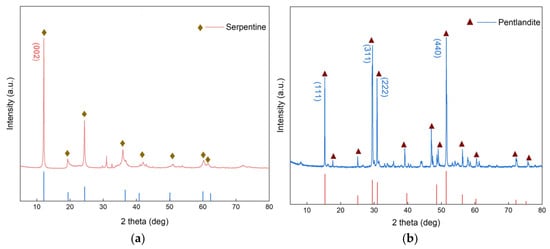
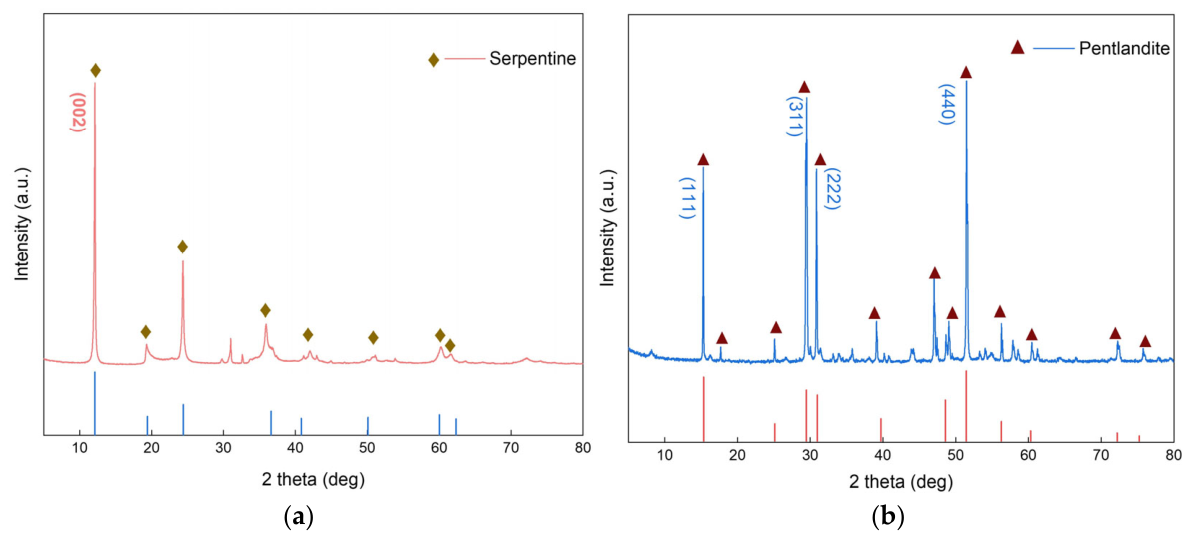
The serpentine and pentlandite samples used in this study were collected from the Jinchuan mining area, China. The raw mineral samples were first crushed and ground using a ball mill, followed by screening with a sieve shaker to obtain the desired particle size fractions. The −74 + 38 μm fractions were used for flotation experiments, whereas the particles below 74 μm were employed for mineralogical and surface characterization analyses. X-ray diffraction (XRD) analysis confirmed the high purity of the prepared mineral samples (Figure 1), ensuring their suitability for subsequent experiments.
Figure 1.
XRD patterns of serpentine (a) and pentlandite (b) samples.
The chemical compositions of the pentlandite and serpentine samples were further characterized, and the results are summarized in Table 2 and Table 3. The pentlandite sample contained Ni, Fe, and S as the predominant elements, with contents of 34.34, 30.21, and 32.64 wt.%, respectively. Minor amounts of Cu (1.34 wt.%) and Si (0.42 wt.%) were also detected. The major oxide components of the serpentine sample were MgO (41.81 wt.%) and SiO2 (36.78 wt.%), together with minor amounts of CaO (2.53 wt.%) and Fe2O3 (1.33 wt.%). Combined with the XRD phase identification, these chemical analyses provide complementary compositional information for the mineral samples used in the subsequent flotation experiments.
Table 2.
Chemical compositions of the pentlandite samples.
Table 3.
Chemical compositions of the serpentine samples.
In the flotation experiments, 1 wt% hydrochloric acid (HCl) and sodium hydroxide (NaOH) solutions were prepared and used as pH regulators. Potassium butyl xanthate (PBX) was employed as the collector, while squaric acid (SA) and squaramide (SM) were used as reference and designed depressants, respectively, for evaluating their effects on serpentine flotation. Methyl isobutyl carbinol (MIBC) was used as the frother. All chemical reagents used in this study were of analytical grade and purchased from Shanghai Aladdin Biochemical Technology Co., Ltd., Shanghai, China.
2.2. Synthesis and Characterization of SM
Squaramide (SM) was synthesized through a two-step reaction route (Figure 2) [26]. In the first step, squaric acid (500 mg, 4.3 mmol) was suspended in absolute ethanol (7 mL) under an argon atmosphere and heated under reflux at approximately 78 °C for 3 h. After cooling to room temperature, the solvent was removed under reduced pressure. Fresh absolute ethanol (7 mL) was then added to the residue, and the mixture was refluxed for an additional 30 min, followed by removal of the solvent under reduced pressure. This reflux–evaporation procedure was repeated three times. The repeated evaporation and replenishment with fresh anhydrous ethanol served to remove the water generated during esterification and drive the equilibrium toward the formation of diethyl squarate. The resulting diethyl squarate was obtained as a pale-yellow oil and used directly in the subsequent aminolysis step. In the second step, diethyl squarate (264 mg, 1.55 mmol) was dissolved in diethyl ether (5 mL), followed by the addition of concentrated aqueous ammonia (2 mL). The reaction mixture was stirred at room temperature for 10 min, during which a yellow precipitate gradually formed. The precipitate was collected by filtration, washed with cold methanol (20 mL), and dried under vacuum to obtain SM as a yellow powder (160 mg, 1.42 mmol, 92% isolated yield). The product exhibited thermal decomposition in the range of 280–300 °C, indicating the high thermal stability characteristic of unsubstituted squaramide [27]. The chemical structure of SM was characterized by Fourier transform infrared spectroscopy (FTIR) and nuclear magnetic resonance (NMR) spectroscopy. FTIR spectra were recorded using a Shimadzu infrared spectrometer (Shimadzu Corporation, Kyoto, Japan) with KBr pellet preparation, where SM and KBr were mixed at a mass ratio of 1:100. The 1H and 13C NMR spectra were obtained using a Bruker AVANCE III 500 MHz NMR spectrometer, Bruker Corporation, Billerica, MA, USA, with DMSO-d6 as the solvent.
Figure 2.
Two-step synthetic route of squaramide (SM) starting from squaric acid.
For flotation experiments, the SM stock solution was freshly prepared by dissolving 0.06 g of SM in 50 mL of deionized water, corresponding to a concentration of 1.2 g/L (approximately 10.7 mmol/L). SM dissolved completely at this concentration to form a clear and homogeneous aqueous solution, and no organic co-solvent was used. The stock solution was prepared immediately before use. Although the equilibrium saturation solubility of SM at the working pH and its time-dependent hydrolytic stability under alkaline conditions were not independently determined, the complete dissolution of SM at 1.2 g/L demonstrates that its practical solubility was substantially higher than the concentrations employed in the flotation experiments.
2.3. Micro-Flotation Tests
Before flotation, the pentlandite samples were ultrasonically cleaned in deionized water for 3 min to remove loosely attached surface impurities, whereas the serpentine samples were used directly without further treatment. The mineral sample was transferred to the flotation cell and dispersed in deionized water. The pulp pH was first adjusted to the desired value using HCl or NaOH, followed by the sequential addition of the depressant (SA or SM), potassium butyl xanthate (PBX, 2 × 10⁻⁴ mol/L), and methyl isobutyl carbinol (MIBC, one drop per test). The dosage of SA or SM was varied according to the experimental conditions specified for each experiment. After each reagent addition, the suspension was conditioned for 2 min at 1800 r/min. Froth products were collected for 3 min, after which the concentrate and tailings were separately collected, filtered, dried, and weighed.
For the single-mineral flotation tests, mineral recovery was calculated from the dry masses of the concentrate and tailings according to:
where mc and mt are the dry masses of the concentrate and tailings, respectively.
For the artificially mixed-mineral flotation tests, the Ni grades of the flotation feed and concentrate were determined by chemical assay. Because pentlandite was the only Ni-bearing mineral in the artificially mixed pentlandite–serpentine system, pentlandite recovery was represented by Ni recovery and calculated according to:
where RPN is the pentlandite recovery (%), γ is the concentrate yield (%), β is the Ni grade of the concentrate (%), and α is the Ni grade of the flotation feed (%). The concentrate yield was calculated from the dry mass of the concentrate relative to the total dry mass of the flotation feed. All flotation experiments were performed in triplicate, and the average values were reported.
2.4. Contact Angle Measurements
Contact angle measurements were conducted using a JY-82C contact angle analyzer (Dingsheng Testing Machine and Inspection Equipment Co., Ltd., Chengde, China) to evaluate the effects of SA and SM on the surface wettability of serpentine and pentlandite. Mineral specimens with relatively flat surfaces were polished and thoroughly rinsed with deionized water prior to measurement. The prepared mineral samples were conditioned under the same reagent conditions as those used in the flotation experiments. Four treatment conditions were employed: untreated mineral, PBX alone, SA followed by PBX, and SM followed by PBX. The concentration of PBX was maintained at 2 × 10⁻⁴ mol/L, while SA and SM were used at 10 mg/L, respectively. The solution pH was adjusted to 8.0 using HCl or NaOH. After reagent conditioning, the mineral specimens were gently rinsed with deionized water and dried prior to measurement. A deionized-water droplet was placed on the mineral surface, and the static water contact angle was determined by the sessile-drop method. Measurements were conducted at different positions on each mineral surface, and the average contact angle and standard deviation were calculated from three independent measurements.
2.5. Zeta Potential Measurements
The zeta potentials of pentlandite and serpentine were measured using a Zetasizer Nano ZS (Malvern Instruments Ltd., Malvern, UK). Mineral samples were ground to a particle size of −400 mesh and dispersed in a 1 × 10⁻³ mol/L KCl solution to prepare suspensions with a solid concentration of 0.01 wt.%. The KCl solution served as the background electrolyte, providing a nominal ionic strength of 1 × 10⁻³ mol/L. The suspension pH was adjusted to the desired value, followed by stirring for 3 min. Subsequently, the required amount of depressant was added, and the suspension was further conditioned for 3 min before measurement. Each measurement was performed in triplicate, and the average values were reported.
2.6. Adsorption Capacity Measurements
The adsorption capacity of SM on mineral surfaces was determined using UV–Vis spectrophotometry (UV-2600, Shimadzu Corporation, Kyoto, Japan). Full-range wavelength scanning was initially performed to determine the maximum absorption wavelength (λmax) of SM solutions. Standard SM solutions with different concentrations were prepared, and their absorbance values were measured at the selected λmax to establish a concentration–absorbance calibration curve.
For adsorption experiments, mineral samples were mixed with SM solutions at various initial concentrations and equilibrated for 10 min. The suspensions were then centrifuged to separate the solid and liquid phases, and the residual SM concentration in the supernatant was determined by UV–Vis analysis. The equilibrium adsorption capacity of SM on mineral surfaces was calculated based on the concentration difference before and after adsorption using a mass balance approach.
2.7. FTIR Characterization
Mineral samples were conditioned with reagents under the selected flotation conditions and subsequently filtered after 10 min of interaction. The collected solid samples were vacuum-dried at 40 °C for FTIR characterization. FTIR spectra were recorded using a Shimadzu IRAffinity spectrometer (Shimadzu Corporation, Kyoto, Japan) in the range of 400–4000 cm−1. The dried mineral powders were thoroughly mixed with dry KBr at a mass ratio of 1:100 and pressed into pellets for measurement.
2.8. XPS Characterization
The XPS samples were prepared following the same reagent-treatment procedure as that used for FTIR characterization. XPS measurements were performed using a K-Alpha X-ray photoelectron spectrometer (Thermo Scientific, Waltham, MA, USA). The dried mineral powders were pressed into pellets and mounted onto sample holders before being introduced into the vacuum chamber. High-resolution XPS spectra were collected with a pass energy of 50 eV and an energy step size of 0.1 eV to analyze the surface elemental composition and chemical states of minerals before and after reagent adsorption.
3. Results and Discussion
3.1. Characteristics of Synthesized SM
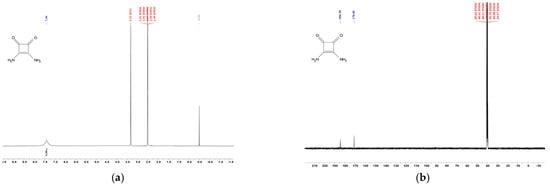
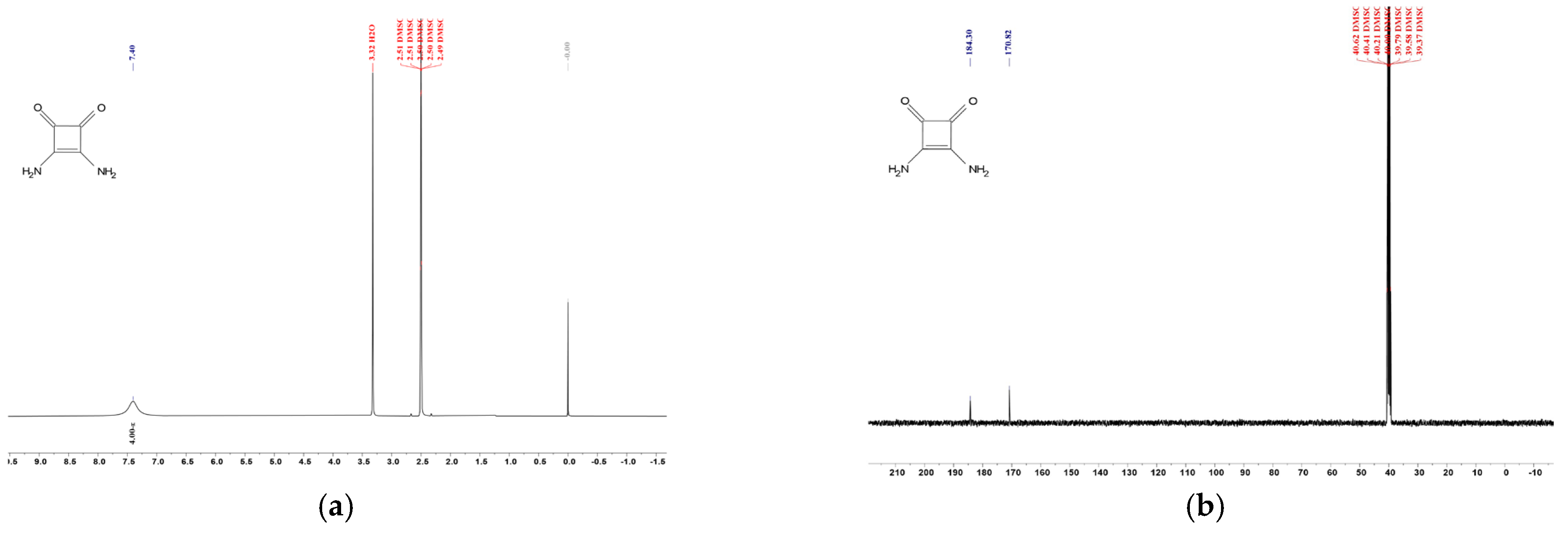
The molecular structure of SM was further characterized by 1H and 13C NMR spectroscopy using DMSO-d6 as the solvent (Figure 3). In the 1H NMR spectrum, a single broad resonance was observed at approximately 7.49 ppm, integrating to about four protons, which was assigned to the two equivalent –NH2 groups of the symmetric squaramide molecule. The presence of only one characteristic proton environment for the amino protons is consistent with the molecular symmetry of 3,4-diaminocyclobut-3-ene-1,2-dione.
Figure 3.
(a) 1H NMR spectra of the synthesized SM; (b) 13C NMR spectra of the synthesized SM.
The 13C NMR spectrum exhibited two characteristic resonances at approximately 184.0 and 170.8 ppm. The signal at approximately 184.0 ppm was assigned to the two equivalent carbonyl carbons (C=O), whereas the resonance at approximately 170.8 ppm was attributed to the two equivalent amino-substituted ring carbons (C–NH2). The presence of only two chemically distinct carbon environments is consistent with the symmetric structure of SM and supports the successful formation of the target squaramide compound [28].
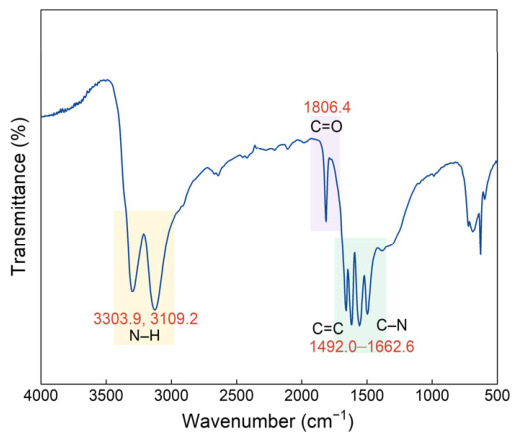
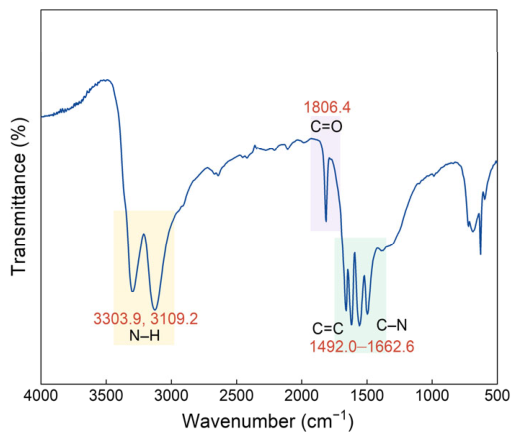
The FTIR spectrum of the synthesized SM is presented in Figure 4. Several characteristic absorption bands associated with the squaramide structure were observed. Two bands at 3303.9 and 3109.2 cm−1 were assigned to N–H stretching vibrations of the amino groups. A strong absorption band at 1806.4 cm−1 was attributed to the C=O stretching vibration of the squaramide ring. In addition, the bands at approximately 1662.6 and 1492.0 cm−1 were associated with coupled ring vibrations involving C=C/C–N stretching and N–H deformation modes [29,30]. These characteristic vibrational features, together with the NMR results, support the successful formation of the target SM molecule.
Figure 4.
FTIR spectrum of the synthesized SM.
3.2. Results of Micro-Flotation Tests
Micro-flotation experiments of single minerals and artificially mixed ores were conducted to evaluate the effects of SA and SM on the flotation behaviors of pentlandite and serpentine.
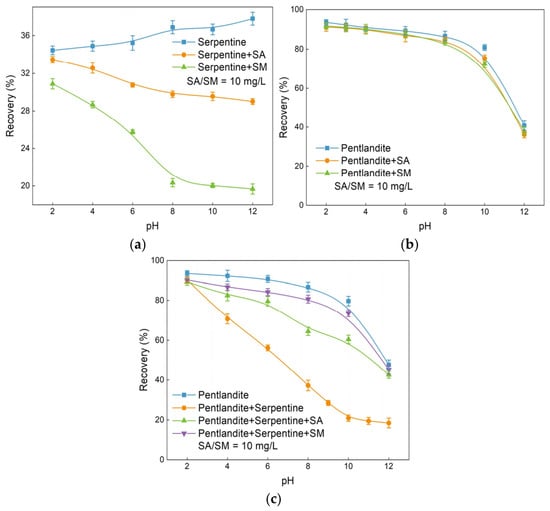
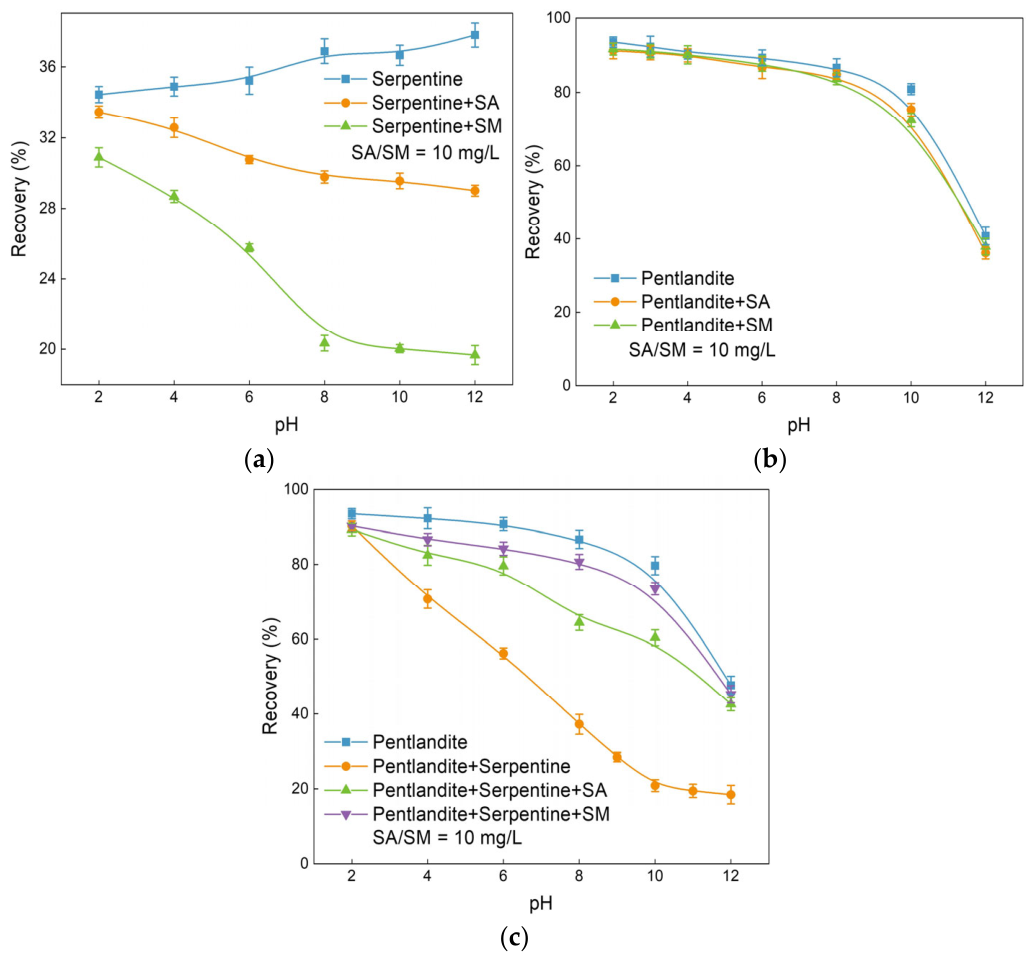
The influence of pulp pH on the flotation behaviors of serpentine and pentlandite before and after depressant addition is presented in Figure 5a and Figure 5b, respectively. As shown in Figure 5a, in the absence of depressants, serpentine exhibited relatively stable flotation behavior over the investigated pH range, with its recovery slightly increasing as the pH increased. After the addition of 10 mg/L SA, the recovery of serpentine decreased slightly, indicating a limited depression effect. In contrast, SM exhibited a significantly stronger inhibitory effect at the same dosage. At pH 8, the serpentine recovery decreased from approximately 36.9% in the absence of SM to 19.6% after SM addition, demonstrating the pronounced depression effect of SM under the same pH condition. These results demonstrate that amino functionalization of the squaric acid framework significantly enhanced the depression capability of SM toward serpentine.
Figure 5.
Flotation recovery of single serpentine (a) and pentlandite (b) minerals under different pH and the flotation recoveries of pentlandite versus pH values in the mixed ore of serpentine and pentlandite (c).
As shown in Figure 5b, pentlandite maintained relatively high flotation recovery under acidic and near-neutral conditions, whereas its recovery decreased markedly under strongly alkaline conditions, particularly above pH 10. This decline may be associated with enhanced surface oxidation and hydroxylation, potentially leading to the formation of hydrophilic Fe- and Ni-containing oxide or hydroxide species. Such surface species may hinder PBX adsorption and reduce the hydrophobicity of pentlandite. The addition of SA and SM also affected pentlandite flotation to different extents, indicating that the depressants were not completely selective toward serpentine. Although SM exhibited a stronger depressing effect on serpentine, its adverse influence on pentlandite recovery should also be considered when evaluating flotation selectivity.
Figure 5c presents the flotation behavior of pentlandite in artificially mixed mineral systems at different pH values. Previous studies have shown that the interference effect of serpentine on pentlandite flotation becomes pronounced at a serpentine concentration of approximately 5 g/L. Therefore, a mass ratio of pentlandite to serpentine of 2.0:0.2 was selected in this study to simulate the detrimental influence of serpentine gangue during flotation.
In the absence of depressants, the presence of serpentine significantly reduced pentlandite recovery. At pH 8, the recovery of pentlandite decreased to 37.2%, representing a reduction of 50.8 percentage points compared with pure pentlandite flotation under identical conditions. This result confirms the severe interference of serpentine gangue with pentlandite flotation. After adding 10 mg/L SA, the pentlandite recovery increased to 64.4% at pH 8, indicating that SA partially mitigated the adverse effect of serpentine. In comparison, SM exhibited a more pronounced improvement, increasing pentlandite recovery to 81.6% under the same conditions. These results demonstrate that amino modification of the squaric acid framework significantly enhanced the ability of SM to regulate serpentine interference, thereby improving the selective flotation separation of pentlandite from serpentine.
It is noteworthy that the improvement in pentlandite recovery in the mixed-mineral system was substantially greater than the decrease in serpentine recovery observed in the single-mineral tests. In single-mineral flotation, SM reduced the apparent serpentine recovery by approximately 17.3 percentage points at pH 8, from 36.9% to 19.6%. However, in the mixed-mineral system containing only 10 wt% serpentine relative to pentlandite, the recovery of pentlandite decreased markedly to 37.2% at pH 8. This pronounced deterioration, despite the relatively small proportion of serpentine, indicates that the adverse effect of serpentine cannot be attributed simply to its own flotation and entrainment into the froth. Rather, fine serpentine particles interfere with pentlandite flotation through interfacial interactions, particularly heterocoagulation and slime coating on the pentlandite surface.
Accordingly, the substantial restoration of pentlandite recovery after depressant addition should not be interpreted as a direct consequence of the decrease in serpentine floatability alone. Preferential adsorption of SA, and particularly SM, on serpentine modifies the surface properties of the fine serpentine particles and consequently weakens their tendency to associate with pentlandite. Once serpentine-induced surface contamination is alleviated, the intrinsically high floatability of pentlandite can be largely restored. This explains why a moderate decrease in the flotation recovery of single serpentine can correspond to a much greater improvement in pentlandite recovery in the mixed-mineral system. The higher recovery obtained with SM (81.6%) than with SA (64.4%) further suggests that the amino-functionalized SM is more effective in regulating serpentine-induced interfacial interference.
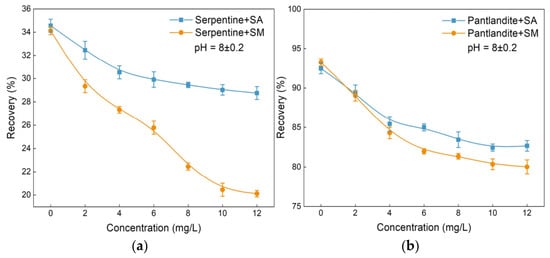
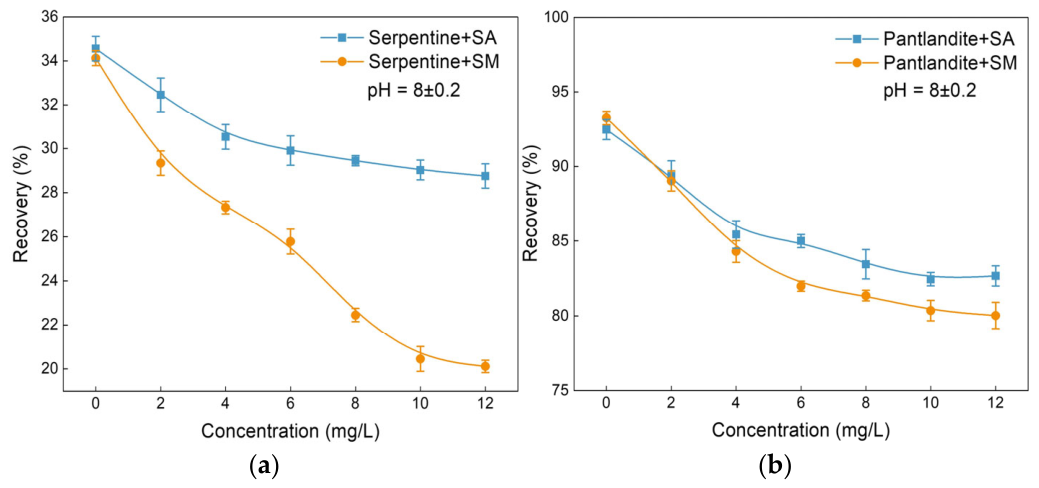
Based on the pH-dependent flotation results, pH 8.0 was selected as the optimal condition for subsequent dosage experiments. The effects of SA and SM dosages on the flotation behaviors of serpentine and pentlandite were further investigated, and the results are presented in Figure 6.
Figure 6.
Flotation recoveries of serpentine (a) and pentlandite (b) versus depressant concentration.
With increasing depressant dosage, the flotation recovery of serpentine gradually decreased for both SA and SM. However, SM exhibited a much stronger depression effect than SA under identical conditions, resulting in consistently lower serpentine recoveries. At a dosage of 10 mg/L, SM reduced serpentine recovery to 20.1%, demonstrating its enhanced inhibitory capability toward serpentine after amino functionalization. In contrast, both SA and SM showed limited influence on pentlandite flotation. Even at an increased dosage of 12 mg/L, pentlandite recovery remained above 80%, indicating that SM could effectively suppress serpentine while maintaining the floatability of valuable pentlandite.
In addition to pentlandite recovery, the separation performance of the artificial pentlandite–serpentine mixture was evaluated using Ni grade, MgO grade, Ni recovery, MgO recovery, and separation efficiency (Table 4). Without depressant, the separation efficiency was only 8.05%. SA improved the separation efficiency to 50.34%. As an industrial benchmark, CMC further increased the Ni recovery to 74.23%, with a separation efficiency of 52.90%. In comparison, SM showed the best performance, giving a Ni recovery of 81.69%, an MgO recovery of 9.28%, and the highest separation efficiency of 72.41%. These results indicate that SM provided a better balance between pentlandite recovery and serpentine rejection than SA and CMC under the present conditions.
Table 4.
Flotation separation performance of the artificial pentlandite–serpentine mixture using different depressants.
To further distinguish the contribution of mechanical entrainment from the apparent flotation recovery of serpentine, additional experiments were conducted to evaluate serpentine and water recoveries under different reagent conditions (Table 5). Under frother-only conditions, serpentine and water recoveries were 12.56% and 14.63%, respectively, indicating that mechanical entrainment contributed to serpentine recovery even without collector addition. Following PBX addition, serpentine recovery increased to 36.88%, whereas water recovery increased only slightly to 16.96%, suggesting that the enhanced serpentine recovery could not be attributed solely to water entrainment. Notably, SM treatment reduced serpentine recovery to 19.60% and water recovery to 11.67%. The decrease in serpentine recovery was substantially greater than that in water recovery, indicating that the depressing effect of SM was not solely associated with reduced water entrainment. These results further support the effectiveness of SM in suppressing the apparent flotation recovery of serpentine.
Table 5.
Serpentine recovery and water recovery under different reagent conditions.
3.3. Zeta Potential Analysis
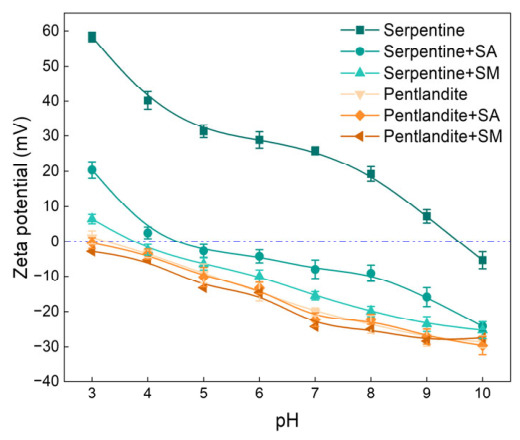
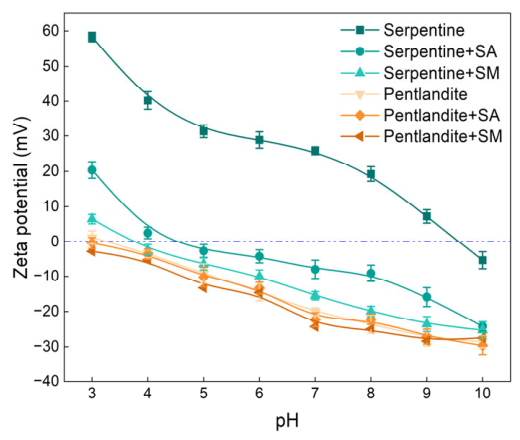
The detrimental effect of serpentine on pentlandite flotation has been closely associated with electrostatic heterocoagulation between the two minerals. Therefore, zeta potential measurements were performed to investigate how SA and SM modified the surface charge of serpentine and pentlandite and consequently affected the electrostatic contribution to their interparticle interactions, as shown in Figure 7.
Figure 7.
Zeta potentials of pure serpentine and pentlandite, and mineral surfaces treated with SA and SM at varying pulp pH values.
Raw serpentine was positively charged over most of the investigated pH range, with an isoelectric point (IEP) above pH 9, whereas bare pentlandite exhibited a weakly negative surface potential at pH > 3 [31]. The opposite surface charges therefore provide favorable electrostatic conditions for the attachment of fine serpentine particles onto pentlandite surfaces, which can contribute to heterocoagulation and slime coating and consequently impair pentlandite flotation [32]. After the addition of 10 mg/L SA, the IEP of serpentine shifted to approximately pH 4.5, and its zeta potential became negative at pH 6–9, suggesting a reduction in the electrostatic attraction between the two minerals.
SM induced a more pronounced negative shift in the zeta potential of serpentine than SA. At pH 8, the zeta potentials of serpentine treated with SM and SA were approximately −18 and −10 mV, respectively. Although SM is predominantly neutral under the investigated pH conditions, the measured zeta potential reflects the electrokinetic potential at the slipping plane rather than the formal charge of the adsorbed molecule. Therefore, the larger negative shift induced by SM may be associated with its preferential adsorption on serpentine and the resulting modification of the interfacial environment. Specifically, SM adsorption may alter the exposure of positively charged Mg-containing surface sites and the distribution of interfacial ions, potentially affecting the position of the slipping plane. In contrast, although SA is predominantly deprotonated under these conditions, its influence on zeta potential also depends on its adsorption behavior and the resulting interfacial structure. Nevertheless, the present results cannot distinguish these possible contributions or establish whether Mg2+ dissolution or complexation occurs. Thus, the observed negative shift is interpreted as evidence of interfacial electrokinetic modification rather than direct proof of a specific charge-reversal mechanism. Such modification may reduce the electrostatic driving force for serpentine–pentlandite heterocoagulation, although it does not demonstrate complete electrostatic stabilization or elimination of slime coating [33].
In contrast, the zeta potential of pentlandite changed only slightly after SA or SM treatment over the investigated pH range, indicating a comparatively limited electrokinetic response. The more pronounced response of serpentine is consistent with the preferential interaction of SM with serpentine suggested by the adsorption measurements. Combined with the flotation results, these findings indicate that modification of serpentine interfacial properties may contribute to the improved separation performance of SM. By reducing the electrostatic tendency for serpentine–pentlandite association while exerting a relatively limited influence on pentlandite, SM may alleviate the detrimental effects of serpentine on pentlandite flotation. However, the extent to which this improvement arises from reduced heterocoagulation or slime coating requires further direct investigation.
3.4. Results of Adsorption Measurements
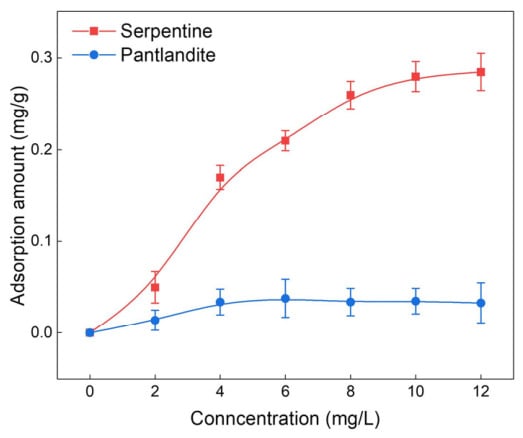
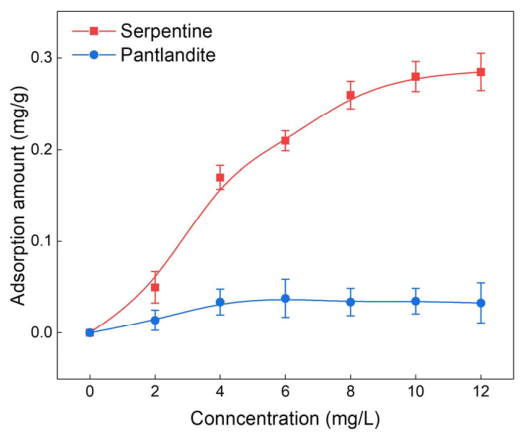
To further uncover the selective depression mechanism of SM toward serpentine, adsorption capacity tests were carried out to quantify the adsorbed SM mass on pentlandite and serpentine surfaces, and the results are presented in Figure 8.
Figure 8.
Adsorption amount of SM on serpentine and pentlandite surfaces as a function of SM concentration.
The adsorption amount of SM on serpentine rose sharply with the increase in SM concentration and gradually reached adsorption saturation above 10 mg/L. By contrast, only a tiny quantity of SM adsorbed onto pentlandite surfaces across the entire tested concentration range, and its adsorption capacity plateaued at an extremely low level with no obvious growth trend. This distinct adsorption discrepancy fully explained the selective performance of SM. SM molecules were readily and massively anchored on serpentine surfaces to modify their surface charge and hydrophilicity, thereby inhibiting serpentine floatability. Meanwhile, negligible SM adsorption occurred on pentlandite, which barely altered pentlandite’s natural hydrophobicity and guaranteed high flotation recovery of the target mineral. The adsorption data provided direct quantitative evidence for the selective separation behavior observed in micro-flotation and zeta potential tests.
3.5. Results of Contact Angle
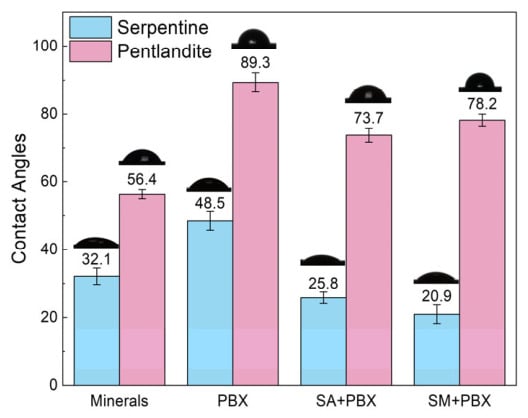
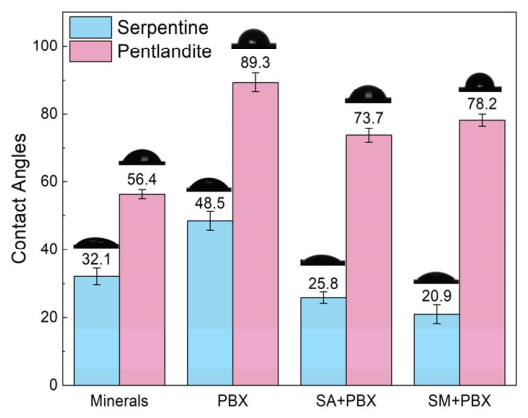
Contact angle measurements were performed to evaluate the effects of SA and SM on the surface wettability of serpentine and pentlandite (Figure 9). After PBX treatment, the contact angles of serpentine and pentlandite increased from 32.1° and 56.4° to 48.5° and 89.3°, respectively, indicating enhanced surface hydrophobicity. The addition of SA and SM markedly decreased the contact angle of serpentine to 25.8° and 20.9°, respectively. In contrast, the contact angles of pentlandite remained relatively high at 73.7° and 78.2° after SA + PBX and SM + PBX treatment, respectively.
Figure 9.
Contact angles of serpentine and pentlandite under different reagent conditions at pH 8.
These results demonstrate that SM exhibits stronger selective wettability regulation than SA, substantially enhancing the hydrophilicity of serpentine while largely preserving the PBX-induced hydrophobicity of pentlandite. This provides direct evidence that selective hydrophilization of serpentine contributes to the depression mechanism of SM. Combined with the zeta-potential and adsorption results, the enhanced separation in the mixed-mineral system can therefore be attributed to the selective hydrophilization of serpentine together with the attenuation of serpentine–pentlandite heterocoagulation and slime coating.
3.6. FTIR Analysis
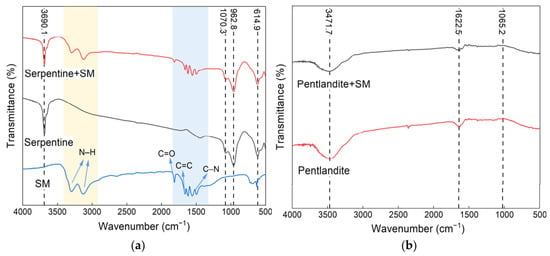
The interaction of SM with the mineral surfaces was further investigated by FTIR spectroscopy (Figure 10). Pristine serpentine exhibited characteristic absorption bands at 3690.1, 1070.3, 962.8, and 614.9 cm−1, which were assigned to Mg–OH stretching and Si–O/Mg–O–Si framework vibrations [34,35]. As described above, pure SM exhibited characteristic bands at 3303.9 and 3109.2 cm−1 for N–H stretching, 1806.4 cm−1 for C=O stretching, and 1662.6 and 1492.0 cm−1 for coupled ring vibrations involving C=C/C–N stretching and N–H deformation modes [36].
Figure 10.
FTIR spectra of serpentine and pentlandite before and after SM adsorption: (a) serpentine and serpentine + SM; (b) pentlandite and pentlandite + SM.
After treatment with SM, additional bands appeared in the serpentine spectrum at approximately 3299.1, 3123.0, 1811.2, 1664.4, and 1499.8 cm−1, which correspond closely to the characteristic vibrations of SM. These features support the adsorption of SM on the serpentine surface. Small shifts in several characteristic bands were observed after adsorption, including the N–H stretching band from 3303.9 to 3299.1 cm−1 and the C=O stretching band from 1806.4 to 1814.2 cm−1. Such changes indicate that the amino and carbonyl-containing groups of SM participate in interfacial interactions with the serpentine surface. Considering the abundance of hydroxylated Mg-containing sites on serpentine, these spectral changes are consistent with the involvement of hydrogen-bonding and other interfacial interactions between SM and the serpentine surface.
In contrast, no clearly distinguishable SM-related bands were observed in the FTIR spectrum of pentlandite after SM treatment. The bands near 3472 and 1623 cm−1 in the pentlandite spectrum are mainly attributed to O–H stretching and H–O–H bending vibrations associated with adsorbed water or surface hydroxyl species, respectively. The band near 1085 cm−1 may be assigned to S–O stretching vibrations of sulfate-related surface oxidation products. The absence of clearly resolved SM-related bands does not necessarily indicate the absence of adsorption, particularly at low surface coverages. Nevertheless, together with the adsorption and flotation results, the FTIR observations are consistent with a greater mass-normalized uptake of SM by serpentine and its preferential depression under the investigated condition.
3.7. XPS Analysis
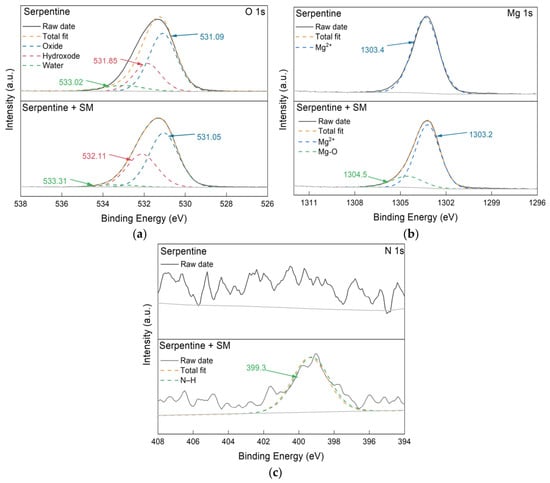
The adsorption behavior of SM on the serpentine surface was further investigated by X-ray photoelectron spectroscopy (XPS), and the high-resolution O 1s, Mg 1s, and N 1s spectra are presented in Figure 11. The O 1s spectrum of pristine serpentine was deconvoluted into three components centered at 531.09, 531.85, and 533.02 eV, which were attributed to silicate lattice oxygen, hydroxyl-related oxygen, and adsorbed water, respectively [37,38]. The presence of hydroxyl-related oxygen is consistent with the intrinsic Mg–OH groups in the serpentine structure. Following SM adsorption, the corresponding components were observed at 531.05, 532.11, and 533.31 eV, respectively. These spectral changes indicate modifications in the local chemical environment of surface oxygen species after SM treatment. In particular, the variation in the hydroxyl-related component suggests that surface hydroxyl groups may participate in interfacial interactions with adsorbed SM molecules, although the contribution of surface hydration should also be considered.
Figure 11.
High-resolution XPS spectra of serpentine before and after SM adsorption: (a) O 1s, (b) Mg 1s, and (c) N 1s spectra.
The Mg 1s spectra provided further insights into the interaction between SM and magnesium-containing surface sites. Pristine serpentine exhibited a dominant Mg 1s peak at 1303.4 eV, corresponding to structural Mg2+ in the octahedral sheets of serpentine [39]. After SM adsorption, the Mg 1s spectrum exhibited two overlapping components at 1303.2 and 1304.5 eV. The dominant component was associated with structural Mg2+, whereas the higher-binding-energy component was attributed to Mg species in a modified local surface environment, potentially associated with hydroxylated Mg sites and interactions with adsorbed SM molecules. The changes in the Mg 1s spectral features suggest that magnesium-containing surface sites are involved in the interfacial interactions accompanying SM adsorption.
The N 1s spectra provided more direct evidence of SM adsorption on the serpentine surface. No detectable N 1s signal was observed for pristine serpentine, whereas a N 1s contribution appeared at approximately 399.3 eV after SM treatment, which was attributed to amino nitrogen originating from SM molecules [40,41]. Since nitrogen is absent from the ideal serpentine structure, the appearance of this signal after SM treatment provides strong evidence for the presence of adsorbed SM on the mineral surface. This observation is consistent with the adsorption measurements and supports the successful attachment of SM molecules to serpentine.
Overall, the XPS results demonstrate the successful adsorption of SM on the serpentine surface, accompanied by changes in the local chemical environments of oxygen- and magnesium-containing species. These findings suggest that the amino and carbonyl functional groups of SM may interact with hydroxylated surface sites through hydrogen bonding and other interfacial interactions, thereby promoting its retention on the serpentine surface. Combined with the adsorption measurements, contact angle analysis, and flotation results, the XPS observations support the role of SM adsorption in enhancing serpentine hydrophilicity and achieving selective depression during pentlandite–serpentine flotation.
4. Conclusions
A squaramide-based small-molecule depressant (SM) was rationally designed and synthesized through amino functionalization of squaric acid for selective serpentine depression in pentlandite flotation. The structural characterization results confirmed the successful formation of the squaramide framework with abundant hydrogen-bond donor–acceptor groups.
Micro-flotation tests demonstrated that SM exhibited superior selective depression toward serpentine compared with the squaric acid precursor while maintaining the floatability of pentlandite. In artificially mixed mineral flotation, SM effectively alleviated the adverse interference of serpentine and increased pentlandite recovery from 37.2% to 81.6% at pH 8.0.
Mechanism investigations revealed that SM preferentially adsorbed onto serpentine rather than pentlandite surfaces. Zeta potential and adsorption measurements demonstrated that SM selectively modified the surface charge of serpentine and suppressed electrostatic heterocoagulation between serpentine and pentlandite. FTIR and XPS analyses further confirmed that the amino and carbonyl groups of SM interacted with Mg-containing active sites on serpentine through interfacial hydrogen-bonding and coordination interactions.
This study demonstrates that molecular engineering of squaramide-based small molecules provides an effective strategy for designing selective depressants toward magnesium-bearing gangue minerals in complex sulfide flotation systems.
Author Contributions
Conceptualization, software and investigation, X.S.; methodology and validation, Y.Y.; formal analysis and data curation, C.L.; visualization, X.P.; writing—original draft preparation, J.C.; resources, writing—review and editing, supervision, B.L. All authors have read and agreed to the published version of the manuscript.
Funding
This research was funded by The Natural Science Foundation of China [52274287] and National Key Laboratory of Nickel-Cobalt Co- associated Resources Development and Comprehensive Utilization [GZSYS-KY-2024-067].
Data Availability Statement
Data are available upon request.
Conflicts of Interest
Xiaohui Su, Chunhua Luo, Xiangan Peng and Bingang Lu are employees of Jin Chuan Group Co., Ltd. The paper reflects the views of the scientists and not the company.
References
- Zhao, K.L.; Yan, W.; Wang, X.H.; Gu, G.H.; Deng, J.; Zhou, X.; Hui, B. Dispersive effect of low molecular weight sodium polyacrylate on pyrite-serpentine flotation system. Physicochem. Probl. Mineral. Process. 2017, 53, 1200–1213. [Google Scholar] [CrossRef]
- Yang, X.S.; Feng, B.; Wang, Z.M.; Jiang, L.X.; Bayoundoula, J. Aggregation relations and flotation behavior of the depressant pectin on talc, chlorite, and serpentine and its mechanism of action. Miner. Eng. 2025, 233, 109637. [Google Scholar] [CrossRef] [Scilit]
- Xu, T.; Liu, M.; Gao, X.; Xiang, Y.; Feng, J.; Li, J.J.; Wang, Z.J.; Xu, L.H.; Lu, Q.Y.; Xie, L. Phosphorylated lignosulfonate enables force-regulated solid-solid separation by suppressing pyrite-serpentine hetero-aggregation. Appl. Surf. Sci. 2027, 752. [Google Scholar] [CrossRef] [Scilit]
- Zhang, Y.Q.; Liu, J.J.; Zhang, G.F. Selective flocculation inhibition of serpentine entrainment using sodium alginate in copper-nickel sulfide ore flotation. Colloids Surf. A 2025, 727, 138364. [Google Scholar] [CrossRef] [Scilit]
- Han, E.Z.; Li, Z.H.; Cheng, H.F.; Xiong, K. Inhabitation Mechanism of Calcium Lignosulfonate on Serpentine During Ascharite Flotation. Spectrosc. Spectr. Anal. 2025, 45, 784–788. [Google Scholar]
- Chen, Y.L.; Chen, Y.F.; Li, L.L.; Chen, J.H. Surface modification of serpentine using phosphate and its implication for the selective flotation separation of pyrite from serpentine. Sep. Purif. Technol. 2026, 380, 135201. [Google Scholar] [CrossRef] [Scilit]
- Zhang, C.X.; Sun, W.; Gao, Z.Y.; Lu, B.G.; Su, X.H.; Luo, C.H.; Peng, X.G.; Cao, J. The Depression Effect of Micromolecular Depressant Containing Amino and Phosphonic Acid Group on Serpentine in the Flotation of Low-Grade Nickel Sulphide Ore. Minerals 2025, 15, 1116. [Google Scholar] [CrossRef] [Scilit]
- Yang, X.S.; Feng, B.; Wang, Z.M.; Jiang, L.X. Influence and mechanism of xanthan gum on the aggregation and flotation behavior of talc, olivine, and serpentine. J. Cent. South Univ. 2025, 32, 2463–2475. [Google Scholar] [CrossRef] [Scilit]
- Mweene, L.; Khanal, G.P.; Etim, E. New insights into the surface chemical properties of serpentine and flotation of pyrite using xanthomonas campestris as a novel selective serpentine depressant: Experimental and DFT investigation. Miner. Eng. 2025, 222, 109141. [Google Scholar] [CrossRef] [Scilit]
- Mi, H.C.; Lu, J.W.; Wang, N.L.; Xu, R.; Li, L.X. Enhancement mechanism of ammonium polyphosphate on flotation separation of pyrite from fine serpentine. Colloids Surf. A 2026, 734, 139426. [Google Scholar] [CrossRef] [Scilit]
- Cao, J.; Gao, L.X.; Sun, W.; Gao, Z.Y.; Lu, B.A.; Su, X.H.; Luo, C.H.; Peng, X.A.; Yin, F.X. Optimized molecular length and uniform molecular weight distribution enhance depression effect of macromolecular depressant towards serpentine. Miner. Eng. 2026, 235, 109842. [Google Scholar] [CrossRef] [Scilit]
- Lu, Y.-P.; Zhang, M.-Q.; Feng, Q.-M.; Long, T.; Ou, L.-M.; Zhang, G.-F. Effect of sodium hexametaphosphate on separation of serpentine from pyrite. Trans. Nonferrous Met. Soc. China 2011, 21, 208–213. [Google Scholar] [CrossRef] [Scilit]
- Cao, J.; Luo, Y.-C.; Xu, G.-Q.; Qi, L.; Hu, X.-Q.; Xu, P.-F.; Zhang, L.-Y.; Cheng, S.-Y. Utilization of starch graft copolymers as selective depressants for lizardite in the flotation of pentlandite. Appl. Surf. Sci. 2015, 337, 58–64. [Google Scholar] [CrossRef] [Scilit]
- Zhang, C.; Liu, C.; Feng, Q.; Chen, Y. Utilization of N-carboxymethyl chitosan as selective depressants for serpentine on the flotation of pyrite. Int. J. Miner. Process. 2017, 163, 45–47. [Google Scholar] [CrossRef] [Scilit]
- Zhang, X.; Han, Y.; Gao, P.; Gu, X.; Wang, S. Depression Mechanism of a Novel Depressant on Serpentine Surfaces and Its Application to the Selective Separation of Chalcopyrite from Serpentine. Miner. Process. Extr. Metall. Rev. 2020, 43, 373–379. [Google Scholar] [CrossRef] [Scilit]
- Fang, X.; Zhao, G.; Zhang, Y. Adsorption of Sodium of Polyaspartic Acid on Serpentine and Its Effects on Selective Pyrite/Serpentine Flotation. Minerals 2022, 12, 1558. [Google Scholar] [CrossRef] [Scilit]
- Zhao, G.; Fang, X.; Zhang, Y. Selective flotation of pyrite from serpentine using phytic acid as the depressant. Colloids Surf. Physicochem. Eng. Asp. 2023, 658, 130703. [Google Scholar] [CrossRef] [Scilit]
- Liu, J.; Zhang, G.; Fu, X. Investigation of serpentine entrainment reduction in pentlandite flotation using eco-friendly sodium alginate in suspension dispersion systems. Colloids Surf. Physicochem. Eng. Asp. 2024, 703, 135313. [Google Scholar] [CrossRef] [Scilit]
- Liu, J.; Zhang, G.; Li, B.; Fu, X.; Li, S. Selective adsorption of hydrolyzed polymaleic anhydride as an eco-friendly depressant for the efficient separation of pyrite from serpentine. Miner. Eng. 2024, 216, 108840. [Google Scholar] [CrossRef] [Scilit]
- Zhang, C.; Tan, Y.; Yin, F.; Zhao, J.; Gao, Z.; Sun, W.; McFadzean, B.; Cao, J. Utilization of phosphorylated starch as a selective depressant for serpentine in the flotation of nickel sulfide ore. Miner. Eng. 2024, 217, 108906. [Google Scholar] [CrossRef] [Scilit]
- Tang, M.; Luo, J. Effect of zeta potential of air bubbles on entrainment of serpentine minerals during sulfide flotation. Sep. Sci. Technol. 2026, 61, 118–129. [Google Scholar] [CrossRef] [Scilit]
- Gao, L.X.; Lv, C.Y.; Zhang, C.X.; Sun, W.; Gao, Z.Y.; Lu, B.G.; Cao, J. Enhanced effect of depressant for the flotation separation of chalcopyrite from pentlandite via chemical and spatial selectivity. Miner. Eng. 2026, 235, 109868. [Google Scholar] [CrossRef] [Scilit]
- Picci, G.; Montis, R.; Lippolis, V.; Caltagirone, C. Squaramide-based receptors in anion supramolecular chemistry: Insights into anion binding, sensing, transport and extraction. Chem. Soc. Rev. 2024, 53, 3952–3975. [Google Scholar] [CrossRef] [Scilit] [PubMed]
- Ye, G.K.; Zhang, L.; Zheng, H.; Zhang, G.F. Selective mitigation of lizardite slime coatings on chalcopyrite flotation using an organic phosphonate depressant: Performance and mechanism. Miner. Eng. 2026, 248, 110568. [Google Scholar] [CrossRef] [Scilit]
- Zhang, X.P.; Zhang, Z.J.; Boissonnault, J.; Cohen, S.M. Design and synthesis of squaramide-based MOFs as efficient MOF-supported hydrogen-bonding organocatalysts. Chem. Commun. 2016, 52, 8585–8588. [Google Scholar] [CrossRef] [Scilit] [PubMed]
- Ruseva, N.; Sbirkova-Dimitrova, H.; Atanasova, M.; Markovic, A.; Smelcerovic, Z.; Smelcerovic, A.; Bakalova, A.; Cherneva, E. Synthesis and DNase I Inhibitory Properties of New Squaramides. Molecules 2023, 28, 538. [Google Scholar] [CrossRef] [Scilit] [PubMed]
- Lane, J.D.E.; Jolliffe, K.A. Squaramides for colorimetric and fluorescent anion sensing. Org. Biomol. Chem. 2023, 21, 3226–3234. [Google Scholar] [CrossRef] [Scilit] [PubMed]
- Storer, R.I.; Aciro, C.; Jones, L.H. Squaramides: Physical properties, synthesis and applications. Chem. Soc. Rev. 2011, 40, 2330–2346. [Google Scholar] [CrossRef] [Scilit] [PubMed]
- Przybyl, A.K.; Janczak, J.; Huczynski, A. Synthesis and Structural Analysis of New (-)-Cytisine Squaramides. Molecules 2025, 30, 1135. [Google Scholar] [CrossRef] [Scilit] [PubMed]
- Przybył, A.K.; Mintianska, A.; Huczyński, A.; Janczak, J. Functionalized Cytisine Squaramides: Synthesis, Structural Elucidation, and Co-Crystallization. Molecules 2026, 31, 1961. [Google Scholar] [CrossRef] [Scilit] [PubMed]
- Zanin, M.; Lambert, H.; du Plessis, C.A. Lime use and functionality in sulphide mineral flotation: A review. Miner. Eng. 2019, 143, 105922. [Google Scholar] [CrossRef] [Scilit]
- Song, N.B.; Yin, W.Z.; Yao, J. New insights on the role of seawater in sulfide ore flotation—A review. Powder Technol. 2024, 431, 119128. [Google Scholar] [CrossRef] [Scilit]
- Feng, B.; Lu, Y.P.; Feng, Q.M.; Ding, P.; Luo, N. Mechanisms of surface charge development of serpentine mineral. Trans. Nonferrous Met. Soc. China 2013, 23, 1123–1128. [Google Scholar] [CrossRef] [Scilit]
- Sergeeva, A.V. Infrared Spectra of Alunite-Group Minerals Formed on Thermal Fields. J. Appl. Spectrosc. 2019, 86, 371–378. [Google Scholar] [CrossRef] [Scilit]
- Hamilton, V.E.; Haberle, C.W.; Mayerhöfer, T.G. Effects of small crystallite size on the thermal infrared (vibrational) spectra of minerals. Am. Mineral. 2020, 105, 1756–1760. [Google Scholar] [CrossRef] [Scilit]
- Saim, A.K.; Darteh, F.K. Eco-Friendly and Biodegradable Depressants in Chalcopyrite Flotation: A Review. Miner. Process. Extr. Metall. Rev. 2023, 44, 492–510. [Google Scholar] [CrossRef] [Scilit]
- Xia, H.X.; Xie, X.; Wang, C.T.; Tong, X.; Fan, P.Q.; Zhao, C.D.; Li, J.; Sun, D.X. Application of biodegradable organic regulator in the flotation separation of chalcopyrite and serpentine. Appl. Surf. Sci. 2026, 724, 165593. [Google Scholar] [CrossRef] [Scilit]
- Yang, H.; Zhou, M.Y.; Wang, Z.; Zheng, Y.X. A Study on the Differential Effects of Serpentine from Different Origins on Chalcopyrite Flotation Behavior. Minerals 2025, 16, 22. [Google Scholar] [CrossRef] [Scilit]
- Molifie, A.; Becker, M.; Geldenhuys, S.; McFadzean, B. Investigating the reasons for the improvement in flotation grade and recovery of an altered PGE ore when using sodium silicate. Miner. Eng. 2023, 195, 108024. [Google Scholar] [CrossRef] [Scilit]
- Xue, J.W.; Tu, H.Z.; Shi, J.; An, Y.N.; Wan, H.; Bu, X.Z. Enhanced inhibition of talc flotation using acidified sodium silicate and sodium carboxymethyl cellulose as the combined inhibitor. Int. J. Miner. Metall. Mater. 2023, 30, 1310–1319. [Google Scholar] [CrossRef] [Scilit]
- Zhou, H.; Xu, L.H.; Wang, D.H.; Xue, K.; Tian, J. Selective adsorption mechanism of SHMP onto fine fluorite in bastnaesite flotation system. Colloids Surf. A 2023, 670, 131527. [Google Scholar] [CrossRef] [Scilit]



Disclaimer/Publisher’s Note: The statements, opinions and data contained in all publications are solely those of the individual author(s) and contributor(s) and not of MDPI and/or the editor(s). MDPI and/or the editor(s) disclaim responsibility for any injury to people or property resulting from any ideas, methods, instructions or products referred to in the content. |
© 2026 by the authors. Licensee MDPI, Basel, Switzerland. This article is an open access article distributed under the terms and conditions of the Creative Commons Attribution (CC BY) license.