


Abstract
Mafic–intermediate dikes provide useful constraints on mantle source characteristics, crust–mantle interaction, and regional tectono-magmatic evolution. Here we present field, petrographic, whole-rock geochemical, zircon U–Pb–Hf isotopic, and whole-rock Sr–Nd isotopic data for the Haojiang mafic–intermediate dike suite and its host granitoids in eastern Guangdong, SE China. Field observations show that dark, fine-grained dikes sharply intrude light-colored granitoids along fractures or joints. Zircon U–Pb dating of the host granitoid sample HJ-7-3 yields a crystallization age of 137.56 ± 0.76 Ma, whereas the representative dike sample HJ-1 yields a magmatic zircon age of 94.25 ± 0.64 Ma. These ages indicate that at least part of the Haojiang dike suite represents a Late Cretaceous mafic–intermediate magmatic event that postdated Early Cretaceous granitoid emplacement. An older zircon population in HJ-1 yielded an age of 135.8 ± 1.1 Ma and is interpreted as xenocrystic or inherited zircon probably related to interaction with Early Cretaceous granitoid crust or a coeval crustal component during magma ascent. The dike samples have SiO2 contents of 50.10–58.52 wt.% and plot mainly in the basaltic andesite to andesite fields in the TAS diagram. Major-element variations, compatible trace elements, and weak Eu anomalies are consistent with variable fractional crystallization, although open-system processes cannot be excluded. The dikes are enriched in LILEs and LREEs and depleted in Nb, Ta, and Ti. Their initial 87Sr/86Sr ratios of 0.705232–0.705772, εNd(t) values of −3.10 to −0.12, and zircon εHf(t) values of −1.61 to +1.30 indicate weakly enriched isotopic compositions. Taken together, these features favor involvement of a subduction-modified enriched mantle source, although contributions from metasomatized lithospheric mantle and enriched asthenospheric mantle cannot be uniquely distinguished. Possible limited crustal interaction during magma ascent is also allowed. The ca. 94 Ma Haojiang dike therefore provides evidence for Late Cretaceous mantle-derived or mantle-influenced magmatism in eastern Guangdong, consistent with a regional extensional regime commonly associated with Paleo-Pacific slab rollback.
1. Introduction
Southeastern China is a key region for understanding the late Mesozoic tectono-magmatic evolution of the western Paleo-Pacific margin. This region experienced widespread Jurassic–Cretaceous magmatism, including voluminous granitoids, volcanic rocks, and subordinate mafic to intermediate intrusions, which have generally been attributed to Paleo-Pacific plate subduction, lithospheric reworking, crust–mantle interaction, and regional tectonic transformation. In particular, the SE China coastal belt records a major Cretaceous transition from compressional to extensional tectonism, commonly linked to rollback of the Paleo-Pacific slab [1,2,3]. Mafic and intermediate dikes are widely used to trace mantle melting, magma ascent, and lithospheric extension because they commonly represent rapid transfer of mantle-derived melts through fractures in the crust [4,5].
Despite extensive studies of Mesozoic magmatism in SE China, the petrogenesis and tectonic significance of Late Cretaceous mafic–intermediate dikes in eastern Guangdong remain insufficiently constrained. In particular, it remains unclear whether these dikes represent a distinct magmatic episode following Early Cretaceous granitoid emplacement, whether their magmas were derived from depleted asthenospheric mantle, a subduction-modified enriched lithospheric mantle, or mixed mantle sources, and whether they experienced interaction with granitoid crust during ascent.
The Haojiang area provides a suitable natural setting to address these questions because dark, fine-grained mafic–intermediate dikes sharply intrude pre-existing light-colored granitoids. In this study, we present new field, petrographic, whole-rock geochemical, zircon U–Pb–Hf isotopic, and whole-rock Sr–Nd isotopic data for the Haojiang dikes and their host granitoids. These data are used to constrain the emplacement age, magma source, magmatic evolution, and possible crustal interaction of the dikes, and to evaluate their implications for Late Cretaceous lithospheric extension along the SE China margin.
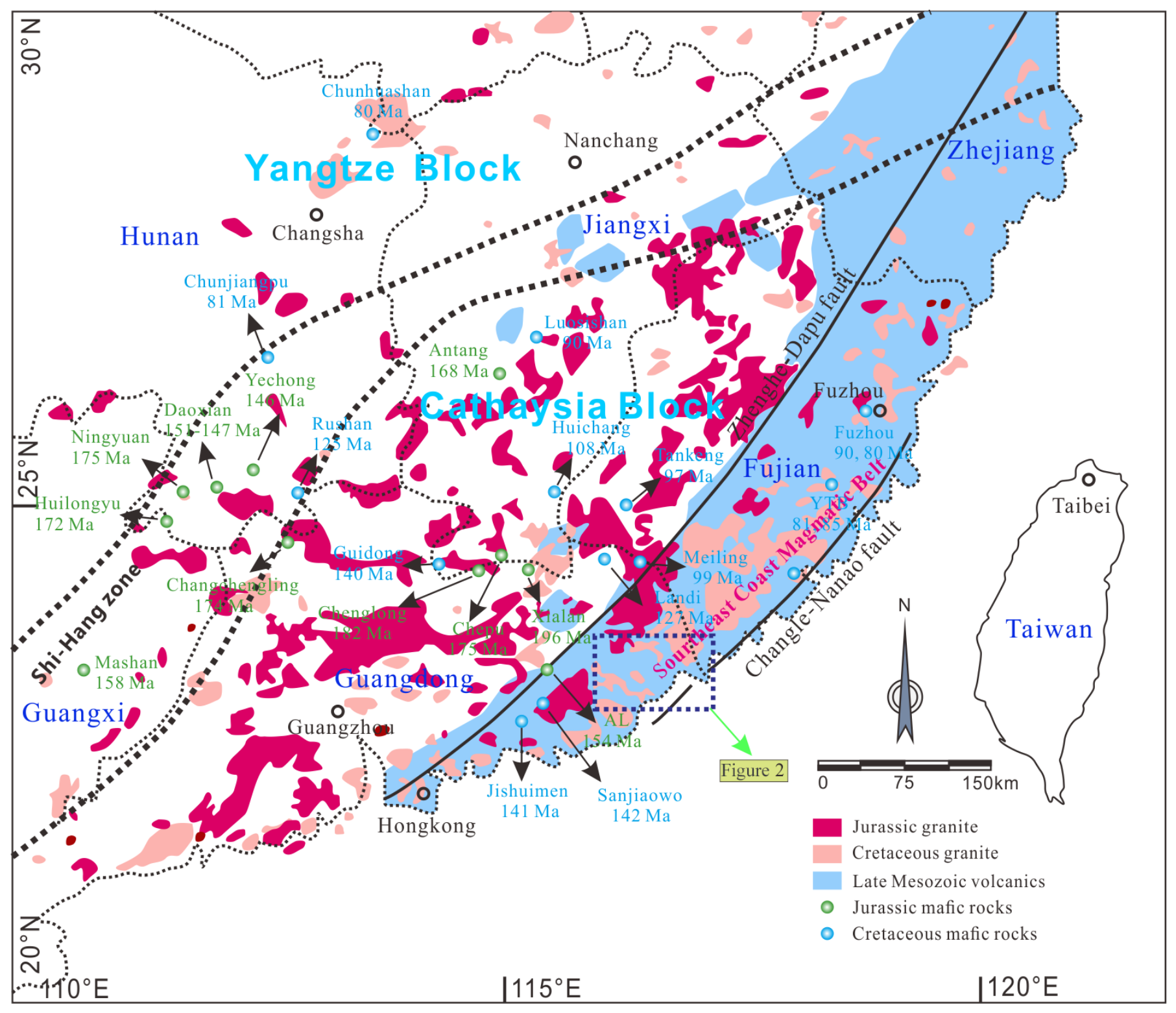
Figure 1.
Distribution of Late Mesozoic igneous rocks and mafic rocks in SE China, showing the location of eastern Guangdong within the SE China coastal magmatic belt. Modified after [1,6,7,8].
2. Geological Setting and Sample Description
2.1. Regional Tectonic Setting
Eastern Guangdong lies along the southeastern margin of the South China Block, within the Cathaysia Block and the NE-trending coastal magmatic belt (Figure 1). The region records intensive Jurassic–Cretaceous magmatism related to Paleo-Pacific plate subduction, slab reorganization, lithospheric reworking, and changing extensional regimes [1,2,3]. Cretaceous mafic magmatism was episodic, with reported events at approximately 140, 105, and 90 Ma in northern Guangdong and mantle-derived intrusive episodes at 141–118 Ma and 98–86 Ma in the coastal region of southeastern China [3,9]. Eastern Guangdong also contains both arc-like and OIB-like mafic rocks, indicating heterogeneous mantle sources and variable subduction-related modification [6]. These regional characteristics provide the tectonic framework for evaluating the ca. 94 Ma Haojiang mafic–intermediate dikes.
2.2. Haojiang Geology and Sampling Context
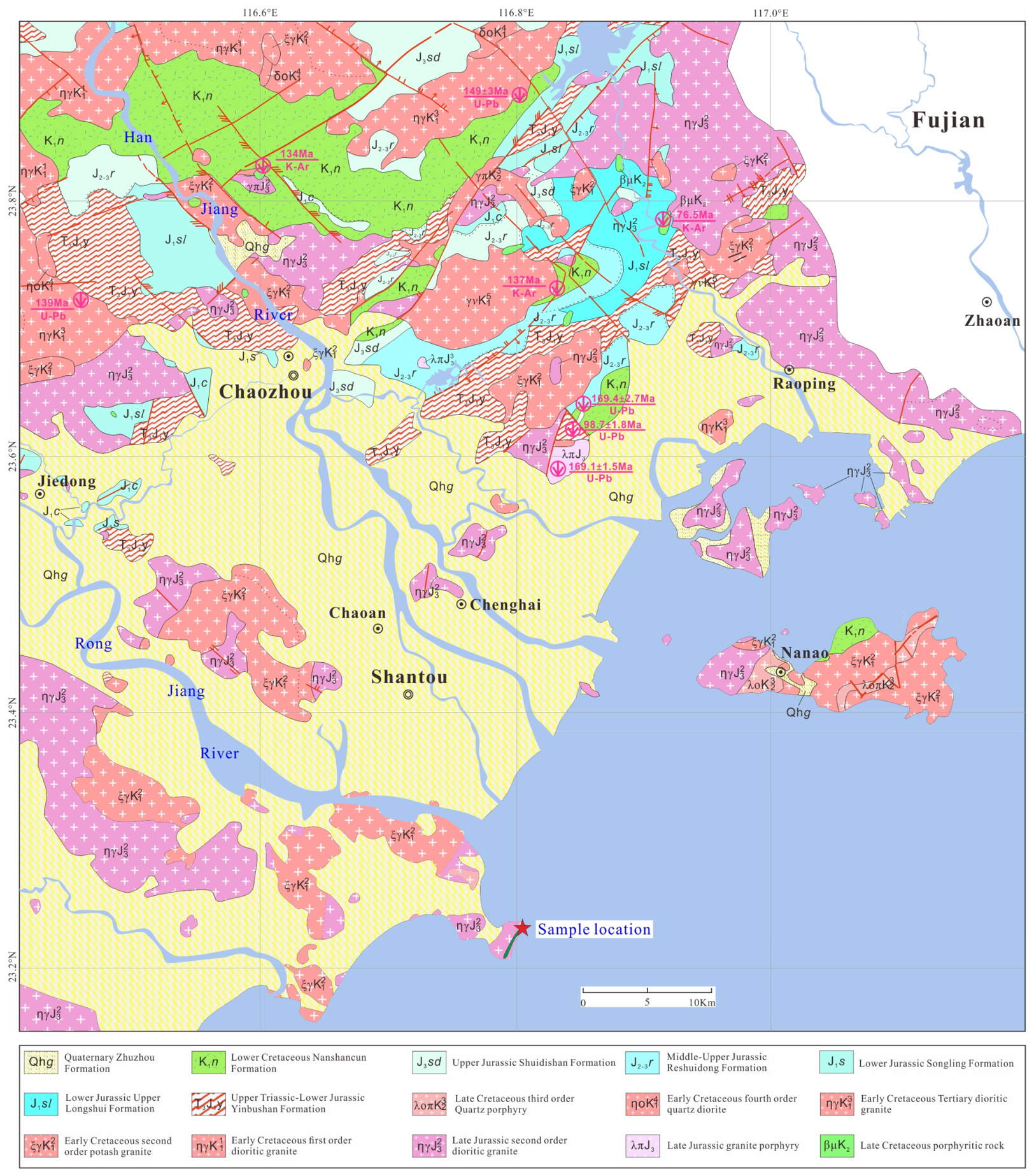
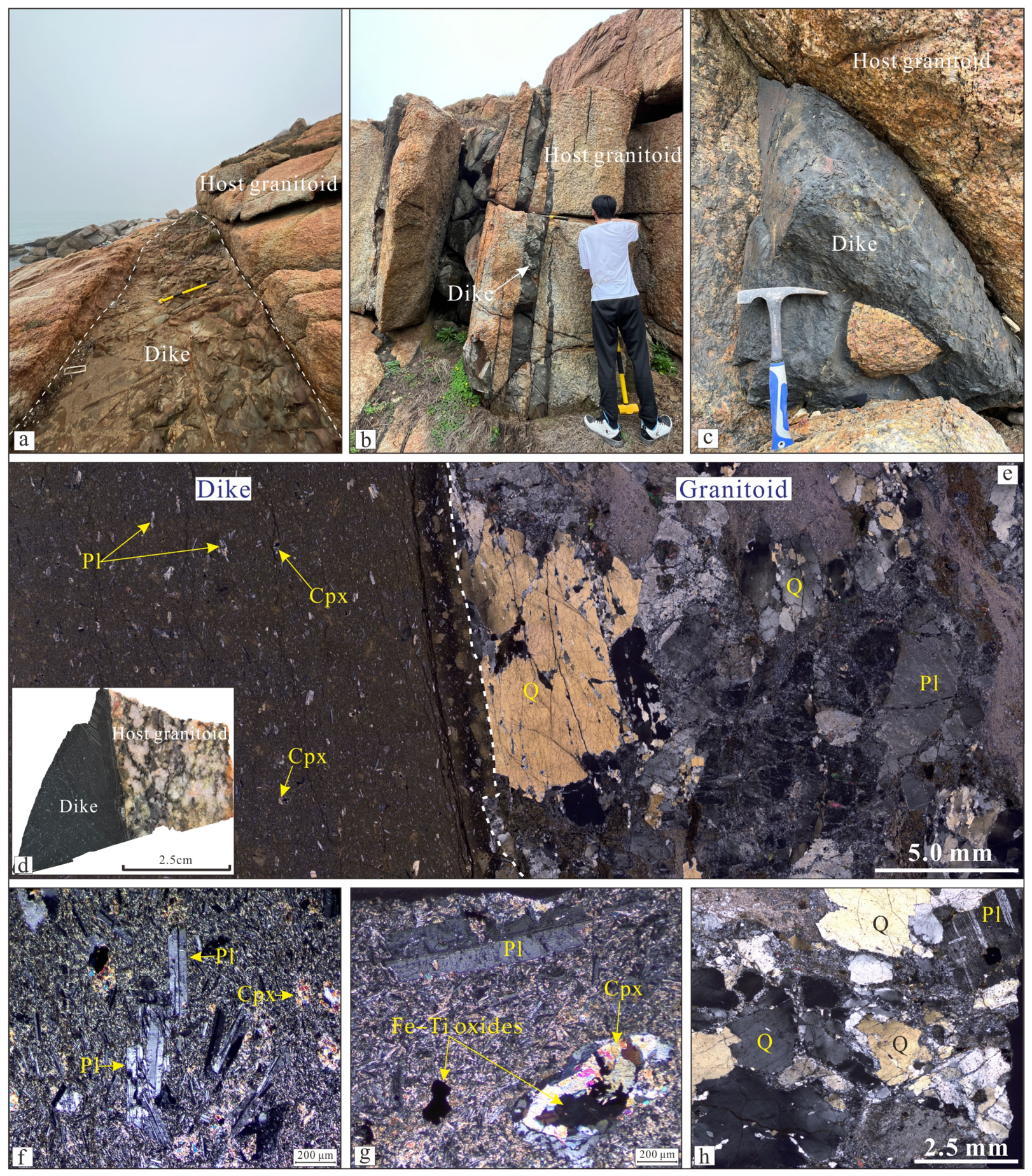
The Haojiang area is located close to major NE-trending regional structures, including the Changle–Nan’ao fault system (Figure 1 and Figure 2). The local geology is characterized by Jurassic volcano-sedimentary successions intruded by Late Jurassic to Cretaceous granitoids and porphyritic rocks. The main exposed stratigraphic units include the Lower Jurassic Songling Formation (J1s) and Longshui Formation (J1sl), the Middle–Upper Jurassic Reshuidong Formation (J2–3r), the Upper Jurassic Shuidishan Formation (J3sd), and locally distributed Early Cretaceous Nanshancun Formation (K1n), with Quaternary cover in lowland areas. Intrusive rocks are dominated by Late Jurassic intermediate to felsic granitoids and granite porphyry, together with Early Cretaceous granitoids, including potassic granite. These volcanic strata, granitoids, and porphyritic intrusions define an overall NE-trending magmatic–structural corridor that parallels major NE-striking faults, indicating that regional structures played an important role in magma ascent and emplacement. In the Haojiang area, dark gray to black, fine-grained mafic–intermediate dikes sharply intrude light-colored granitoids along fractures or joints (Figure 3a–c). The sharp contacts between the dikes and host granitoids indicate that the dike-forming magma was emplaced after crystallization and brittle fracturing of the granitoid host. The fracture-controlled occurrence of the dikes further suggests structurally controlled magma ascent, probably related to local extensional or transtensional deformation during the Late Cretaceous. Representative samples were collected from both the mafic–intermediate dikes and adjacent host granitoids for petrographic, whole-rock geochemical, zircon U-Pb-Hf isotopic, and whole-rock Sr-Nd isotopic analyses. Representative field relationships, hand specimens, and photomicrographs are shown in Figure 3. These samples form the basis of the petrographic, geochemical, and isotopic analyses presented below.
Figure 3.
Field, hand-specimen, and petrographic characteristics of the Haojiang mafic–intermediate dikes and their host granitoid. (a–c) Field photographs showing the dark, fine-grained dikes intruding the host granitoid. The dike near sample HJ-4 has a strike of approximately 109° (Table S1). (d) Hand specimen showing the sharp contact between the dike and the host granitoid. (e) Cross-polarized-light photomicrograph showing the contact between the dike and the host granitoid; the dike contains plagioclase (Pl) and clinopyroxene (Cpx), whereas the granitoid contains quartz (Q) and plagioclase (Pl). Dashed lines in panels (a,e) delineate the contact between the dike and the host granitoid. (f,g) Cross-polarized-light photomicrographs of the dike showing plagioclase, clinopyroxene, and opaque minerals tentatively interpreted as Fe–Ti oxides. (h) Cross-polarized-light photomicrograph of the host granitoid showing quartz and plagioclase. Scale bars: 2.5 cm in (d), 5.0 mm in (e), 200 μm in (f,g), and 2.5 mm in (h).
2.3. Field Relationships and Petrography
The mafic–intermediate dikes form a connected intrusive network within the host granitoid. They are dark gray to black, fine-grained, and massive in hand specimen, with sharp contacts against the light-colored, medium- to coarse-grained host granitoid (Figure 3a–d). The dike exposed near HJ-4 strikes approximately 109°, representing the dominant orientation of the exposed dike network (Figure 3a; Table S1). Although locally obscured by weathering and limited exposure, the exposed dike segments are mutually connected at the outcrop scale. The host granitoid consists mainly of quartz and feldspar with subordinate dark minerals, whereas the dikes are fine-grained to microcrystalline and consist predominantly of plagioclase, clinopyroxene, minor opaque minerals, and crystalline groundmass (Figure 3e–h). Plagioclase occurs mainly as slender laths, and clinopyroxene forms small subhedral to anhedral grains, locally occupying interstitial spaces between plagioclase laths. No amphibole was positively identified.
Based on visual estimates from representative thin sections, the dikes contain approximately 35 vol.% plagioclase, 8 vol.% clinopyroxene, 2 vol.% opaque minerals, and 55 vol.% fine-grained crystalline groundmass. These values are approximate because part of the groundmass and some altered grains are too fine-grained for reliable identification. Some clinopyroxene and other dark grains are locally replaced by fine-grained alteration aggregates, but the available optical observations do not allow these products to be assigned confidently to specific secondary minerals. The opaque minerals are tentatively interpreted as Fe–Ti oxides. The fine-grained groundmass, abundant plagioclase microlites, and absence of obvious glassy or vesicular textures indicate relatively rapid cooling during shallow-level emplacement. The rocks are therefore interpreted as fine-grained hypabyssal mafic–intermediate dikes rather than volcanic or coarse-grained plutonic rocks.
Figure 2.
Geological map of the Haojiang area and adjacent region in eastern Guangdong, showing major lithological units, faults, and sampling locations. Modified after [10].
The dikes and host granitoid are clearly distinct in color, grain size, mineral assemblage, and texture. Together with their sharp intrusive contacts and the age difference between the dated HJ-1 dike and the host granitoid, these features indicate that the dikes intruded a pre-existing granitoid body. Sample HJ-1 was selected for zircon U–Pb dating and Lu–Hf isotope analysis because it was collected from a representative segment of the connected dike system and contains suitable zircon grains. The age of 94.25 ± 0.64 Ma is therefore directly established only for HJ-1. For the other undated dikes, this age is used as a common reference age to calculate initial Sr–Nd isotopic compositions because they occur within the same connected dike system; these values should consequently be regarded as approximate rather than independently age-constrained estimates.
3. Analytical Methods
3.1. Sampling and Petrographic Observation
Representative mafic–intermediate dike and host granitoid samples were collected from the Haojiang area in eastern Guangdong, SE China. Fresh samples were taken from dike interiors and adjacent host granitoids, avoiding weathered surfaces, veins, and visibly altered domains as far as possible. The sampled materials were used for petrographic observation, whole-rock major and trace element analyses, zircon U-Pb dating, zircon Lu-Hf isotope analyses, and whole-rock Sr-Nd isotope analyses. Detailed sample information and analytical purposes are summarized in Table S1.
All samples were examined in hand specimen before preparation. Representative fresh chips were selected for thin-section preparation, and petrographic observations were carried out using transmitted-light microscopy. These observations focused on mineral assemblages, textures, alteration features, and contact relationships between the mafic–intermediate dikes and host granitoids.
3.2. Whole-Rock Major and Trace Element Analyses
Whole-rock major elements, trace elements, and rare earth elements (REEs) were analyzed for 12 representative samples, including mafic–intermediate dikes and host granitoids, at ALS Chemex (Guangzhou) Co., Ltd., China. Fresh rock chips were cleaned, crushed, and powdered to approximately 200 mesh for geochemical analyses.
Major element oxides were determined by X-ray fluorescence spectrometry (XRF; ME-XRF26) using a PANalytical PW2424 XRF spectrometer (PANalytical, Almelo, The Netherlands). Analytical precision and accuracy were monitored using the reference materials NCSDC73303 and SARM-4 and were generally better than 5%. Trace elements and REEs were analyzed following the ME-MS61r four-acid digestion and ME-MS81g fusion protocols using an Agilent 5110 ICP-OES and an Agilent 7900 ICP-MS (Agilent Technologies, Santa Clara, CA, USA). Reference materials MRGeo08 and OREAS-100a were used for quality control, and analytical precision and accuracy for most trace elements and REEs were generally better than 10%. Mg# was calculated as 100 × molar Mg/(Mg + Fe2+), with total Fe recalculated from Fe2O3ᵗ to FeO and Fe2+/ΣFe assumed to be 0.9.
3.3. Whole-Rock Sr-Nd Isotope Analyses
Whole-rock Sr-Nd isotope analyses were conducted on six representative mafic–intermediate dike samples at Nanjing Hongchuang Geological Exploration Technology Service Co., Ltd., Nanjing, China. Fresh whole-rock powders were completely digested, evaporated to dryness, dissolved in 1.6 mol/L HCl, and loaded onto Bio-Rad AG50W-X8 (Bio-Rad Laboratories, Hercules, CA, USA) cation-exchange resin columns for chemical separation. Matrix elements and high-field-strength elements were removed using HCl of different concentrations, and the Sr fraction was collected with 2.5 mol/L HCl. The total rare earth element fraction was subsequently eluted using 6.0 mol/L HCl.
The collected Sr fraction was dried, converted into a 3 mol/L HNO3 medium, and further purified using Sr-specific resin. The purified Sr fraction was finally eluted with 0.05 mol/L HNO3. Sr concentrations were determined using an Agilent 7900 quadrupole ICP-MS, and Sr isotopic compositions were measured using a Neptune XT MC-ICP-MS (Thermo Fisher Scientific, Bremen, Germany) equipped with a CETAC Aridus III desolvating nebulizer system. Instrumental mass fractionation for Sr isotopes was corrected using 86Sr/88Sr = 0.1194, and NIST SRM 987 (National Institute of Standards and Technology, Gaithersburg, MD, USA) was used as the external standard to monitor instrumental drift.
For Nd separation, the total rare earth element fraction was dried, converted into a 0.12 mol/L HCl medium, and loaded onto LN resin columns (TrisKem International, Bruz, France; LN-B50-A, 100–150 μm). Light rare earth elements, including La, Ce, and Pr, were first eluted using 0.12 mol/L HCl, followed by Nd collection using 0.20 mol/L HCl. Sm was subsequently eluted using 0.40 mol/L HCl, and the columns were cleaned with 6 mol/L HCl. The purified Nd fraction was dried, dissolved in 2% HNO3, and diluted to an appropriate concentration for isotope analysis. Nd isotopic compositions were measured using the same Neptune XT MC-ICP-MS. Instrumental mass fractionation for Nd isotopes was corrected using 146Nd/144Nd = 0.7219, and JNdi-1 was used as the external standard to monitor instrumental drift.
The whole-rock reference materials BCR-2 and BHVO-2 were processed together with the unknown samples. The measured 87Sr/86Sr ratios were 0.705008 ± 0.000012 and 0.703460 ± 0.000013, respectively, whereas the measured 143Nd/144Nd ratios were 0.512625 ± 0.000010 and 0.512988 ± 0.000015, respectively (2σ). These values are consistent with the corresponding GeoReM reference values of 0.705011 ± 0.000455 and 0.703478 ± 0.000034 for 87Sr/86Sr, and 0.512635 ± 0.000029 and 0.512979 ± 0.000014 for 143Nd/144Nd [11,12]. A duplicate analysis of HJ-10 was performed to assess reproducibility. Initial 87Sr/86Sr ratios, εNd(t), and two-stage Nd model ages were calculated using an emplacement age of 94.25 Ma.
3.4. Zircon U-Pb Dating
Zircon grains were separated from the HJ-1 mafic–intermediate dike and the HJ-7-3 host granitoid using conventional heavy-liquid and magnetic separation techniques. The separated grains were handpicked under a binocular microscope, mounted in epoxy resin, and polished to expose their internal sections. Cathodoluminescence (CL) images were obtained before analysis to reveal internal zoning patterns and guide the selection of analytical spots.
Zircon U-Pb dating was performed by laser ablation inductively coupled plasma mass spectrometry (LA-ICP-MS) at Nanjing Hongchuang Geological Exploration Technology Service Co., Ltd., China. The analytical system consisted of a Resolution SE laser ablation system (Applied Spectra, Inc., West Sacramento, CA, USA), equipped with an ATL ATLEX 300 excimer laser (ATL Lasertechnik GmbH, Wermelskirchen, Germany) and a Two Volume S155 ablation cell, coupled to an Agilent 8900 ICP-MS. Instrument tuning was conducted using NIST 612 with a 50 μm line scan at a scan speed of 3 μm/s, a fluence of approximately 3.5 J/cm2, and a repetition rate of 10 Hz, following [13]. Gas flows were optimized to obtain high sensitivity and low oxide production, with 238U signals of approximately 6 × 10⁵ cps and ThO/Th < 0.2%. Pulse/analog calibration was performed using NIST 610 with a 100 μm line scan under similar laser conditions.
Before each spot analysis, pre-ablation was conducted using five laser shots to remove potential surface contamination. Zircon analyses were performed using a 30 μm spot diameter, a repetition rate of 5 Hz, and a fluence of 3 J/cm2. Each analysis consisted of approximately 20 s of gas background acquisition followed by 35–40 s of sample signal acquisition. Zircon 91500 and GJ-1 were used as the primary and secondary zircon reference materials, respectively. The reference materials were analyzed during both analytical sessions. In the HJ-7-3 session, six analyses of 91500 yielded 206Pb/238U ages of 1056.9–1076.3 Ma with concordance values of 97%–100%, whereas three analyses of GJ-1 yielded ages of 597.1–606.3 Ma with concordance values of 99%–100%. In the HJ-1 session, eight analyses of 91500 yielded ages of 1054.1–1066.2 Ma with concordance values of 98%–100%, and four analyses of GJ-1 yielded ages of 604.1–612.8 Ma with concordance values of 99%–100%. These results are consistent with the accepted ages of the reference materials and confirm the accuracy of the U–Pb measurements. NIST 610 was used only for pulse/analog calibration and trace-element calibration. All analytical uncertainties are reported at the 2σ level.
Data reduction was performed using the Iolite software package (version 4.0.3). Downhole elemental and isotopic fractionation was corrected using an exponential function after [14]. Concordia diagrams and weighted-mean ages were calculated using Isoplot4.15. All uncertainties for isotopic ratios and ages are reported at the 2σ level. Analyses with obvious inclusions, unstable time-resolved signals, large analytical uncertainties, or ages inconsistent with the main coherent age populations were excluded from weighted-mean calculations. The weighted-mean ages were calculated using selected concordant analyses that define coherent age populations in concordia diagrams; excluded analyses are retained in the original data file but were not used for the preferred age calculations.
3.5. Zircon Lu-Hf Isotope Analyses
In situ zircon Lu-Hf isotope analyses were carried out at Nanjing Hongchuang Geological Exploration Technology Service Co., Ltd., Nanjing, China, using laser ablation multi-collector inductively coupled plasma mass spectrometry (LA-MC-ICP-MS). The analytical system consisted of a Resolution SE 193 nm laser ablation system (Applied Spectra, Inc., West Sacramento, CA, USA), equipped with an S155 dual-volume sample cell, coupled to a Neptune Plus MC-ICP-MS (Thermo Fisher Scientific, Bremen, Germany). Analyses were conducted on the same or adjacent zircon domains previously dated by U-Pb analysis. For the HJ-1 dike, Lu-Hf isotope analyses were conducted on the ca. 94 Ma magmatic zircon population; the ca. 136 Ma inherited or xenocrystic zircon population was not analyzed for Hf isotopes.
Helium was used as the carrier gas, and a small amount of nitrogen was added to enhance Hf sensitivity. Analyses were performed in single-spot mode using a laser spot size of 50 μm, a repetition rate of 8 Hz, and an energy density of 6 J/cm2. Isobaric interferences of 176Yb and 176Lu on 176Hf were corrected during data reduction. The values of 179Hf/177Hf = 0.7325 and 173Yb/171Yb = 1.132685 were used to calculate the mass fractionation coefficients for Hf and Yb, respectively. The 176Yb/173Yb ratio of 0.79639 was used to correct the interference of 176Yb on 176Hf, and 176Lu/175Lu = 0.02656 was used to correct the minor interference of 176Lu on 176Hf. Following [15], real-time βYb values obtained from zircon analyses were used for Yb interference correction. Because Yb and Lu have similar physicochemical properties, the Yb mass fractionation coefficient was also applied to correct Lu mass fractionation.
Offline data reduction, including sample and background signal selection, isotopic mass fractionation correction, and interference correction, was performed using the Iolite software package [16]. Zircon reference materials Qinghu and 91500 were analyzed together with unknown samples to monitor analytical accuracy. The measured Hf isotopic compositions of the reference materials were consistent with their recommended values within analytical uncertainty. Initial 176Hf/177Hf ratios and εHf(t) values were calculated using the corresponding zircon U-Pb ages.
4. Results
4.1. Whole-Rock Major and Trace Element Geochemistry
Whole-rock major, trace element, and rare earth element data for the mafic–intermediate dikes and host granitoids are listed in Table S2. The mafic–intermediate dike samples have SiO2 contents of 50.10–58.52 wt.%, TiO2 contents of 0.74–1.40 wt.%, Al2O3 contents of 16.21–17.59 wt.%, Fe2O3ᵗ contents of 6.55–10.52 wt.%, MgO contents of 3.14–6.90 wt.%, and CaO contents of 5.94–8.22 wt.%. Their total alkali contents, expressed as Na2O + K2O, range from 4.39 to 6.38 wt.%. The dikes have relatively high K2O contents of 1.78–3.94 wt.% and Mg# values of 47.60–63.91. The LOI values of the dike samples range from 1.51 to 2.73 wt.%, indicating that the effects of post-magmatic alteration cannot be completely excluded. In particular, K, Rb, Ba, and Sr may have been affected by secondary fluid activity.
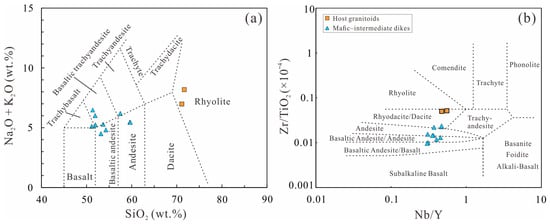
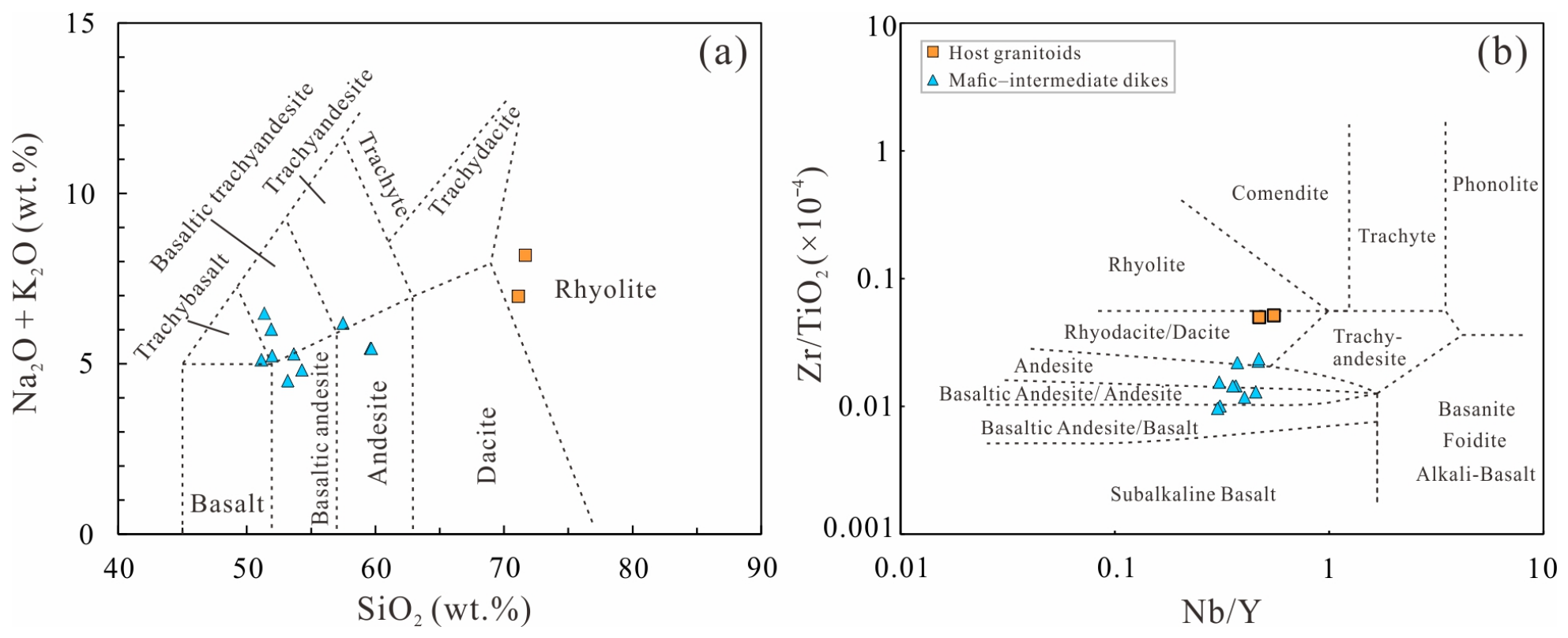
In the TAS diagram, the mafic–intermediate dike samples mainly plot in the basaltic andesite to andesite fields, whereas the host granitoids plot in the rhyolite field (Figure 4a). In the Zr/TiO2–Nb/Y diagram, the dike samples mainly fall within the basaltic andesite/basalt, basaltic andesite/andesite, and andesite fields, while the host granitoids plot in the rhyodacite/dacite field (Figure 4b). The broadly consistent classification obtained from the anhydrous TAS diagram and the Zr/TiO2–Nb/Y diagram supports the general basaltic andesite to andesite classification of the dikes.
Figure 4.
Whole-rock chemical classification diagrams for the Haojiang mafic–intermediate dikes and host granitoids. (a) Total alkali–silica (TAS) diagram based on anhydrous-normalized major-element compositions (after [17,18]). (b) Zr/TiO2–Nb/Y diagram based on relatively immobile trace elements (after [19,20]). The Zr/TiO2 ratio was calculated as Zr (ppm)/[TiO2 (wt.%) × 104]. Orange squares and blue triangles represent the host granitoids and mafic–intermediate dikes, respectively.
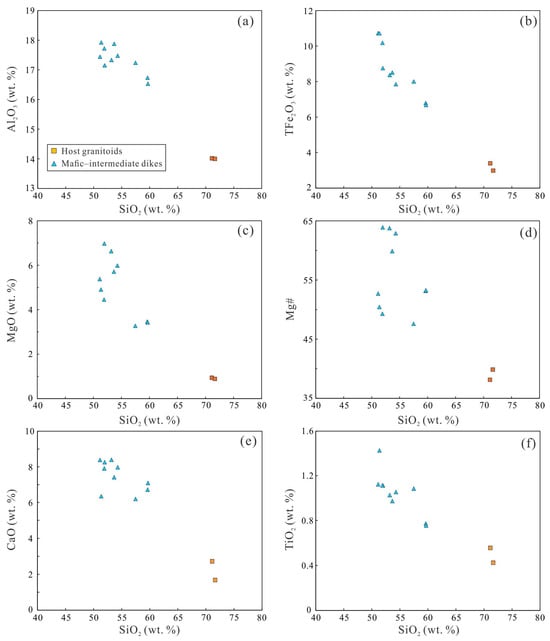
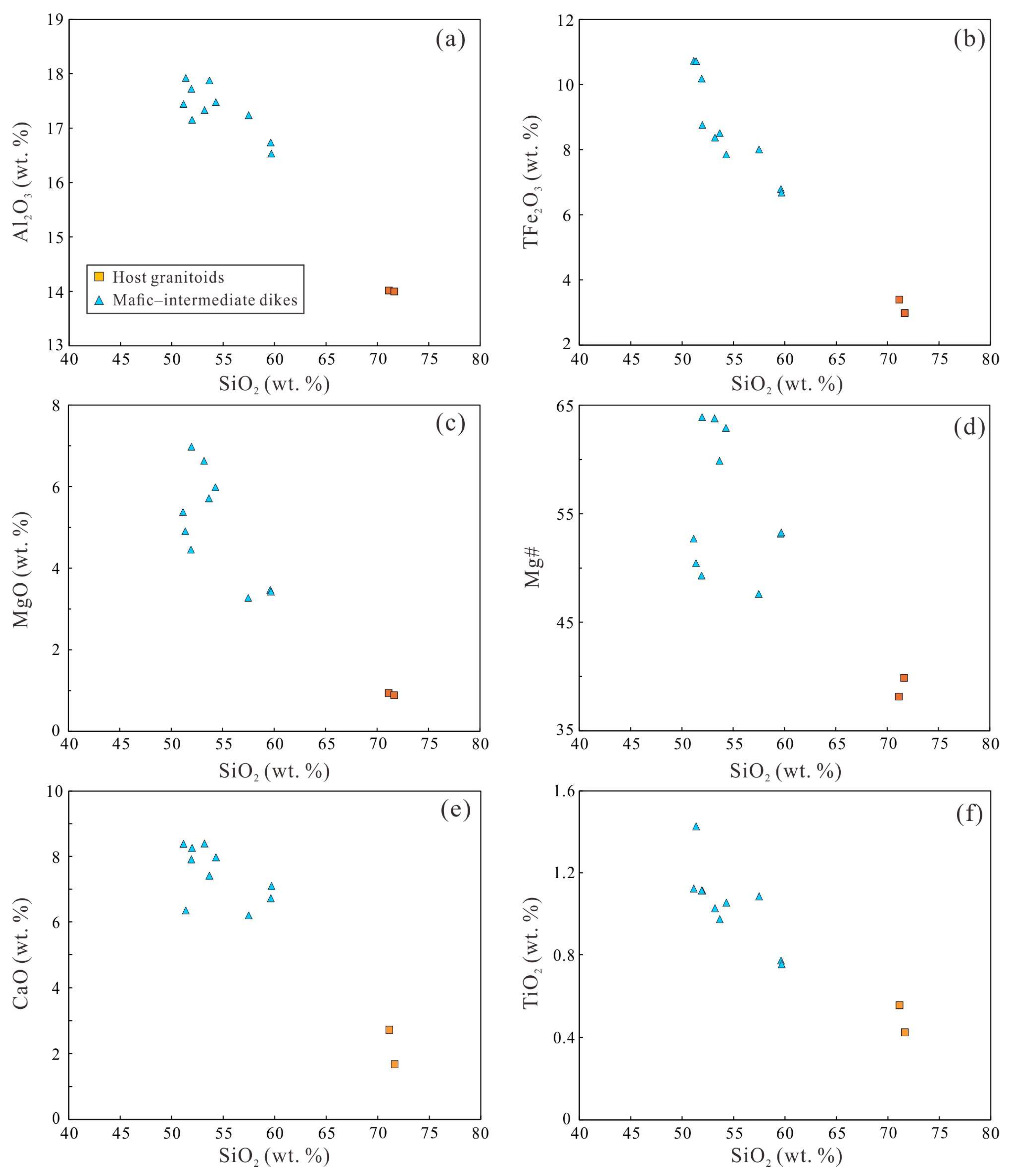
The compatible trace element contents of the mafic–intermediate dikes are variable. They contain 8.4–136.5 ppm Ni and 10–190 ppm Cr. Samples HJ-3 and HJ-7-1 have relatively high MgO contents, Mg# values, Ni, and Cr contents, indicating less evolved compositions. In contrast, samples HJ-5, HJ-10, and HJ-11 have higher SiO2 contents and lower MgO, Ni, and Cr contents, suggesting relatively evolved compositions. In the Harker variation diagrams, MgO, Fe2O3ᵗ, and TiO2 generally decrease with increasing SiO2, whereas CaO and Mg# show more scattered distributions (Figure 5). These trends are consistent with, but do not uniquely demonstrate, variable degrees of fractional crystallization during magma evolution.
Figure 5.
Major-element variation diagrams for the Haojiang mafic–intermediate dikes and host granitoids. (a) Al2O3 versus SiO2; (b) Fe2O3ᵀ versus SiO2; (c) MgO versus SiO2; (d) Mg# versus SiO2; (e) CaO versus SiO2; and (f) TiO2 versus SiO2. All oxide concentrations are given in wt.%, and Mg# is calculated on a molar basis. Orange squares and blue triangles represent the host granitoids and mafic–intermediate dikes, respectively.
The dike samples are enriched in large-ion lithophile elements, with Rb = 114–246 ppm, Sr = 559–785 ppm, and Ba = 268–893 ppm. They have Zr contents of 107–231 ppm, Nb contents of 5.4–16.3 ppm, Ta contents of 0.31–0.61 ppm, Th contents of 3.44–7.76 ppm, and U contents of 0.77–2.05 ppm. The dikes are characterized by high La/Nb, Th/Nb, Ba/Nb, and Rb/Nb ratios, with values of 1.60–4.89, 0.33–1.10, 32.76–91.30, and 8.53–36.11, respectively.
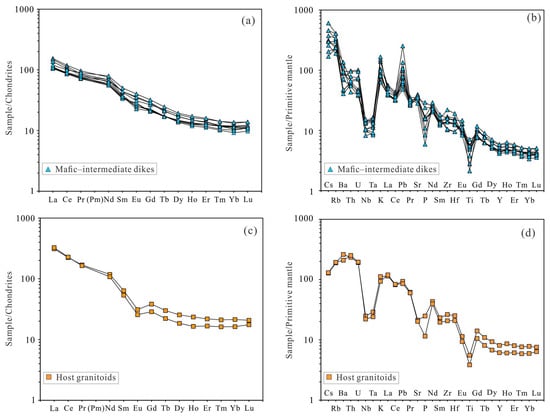
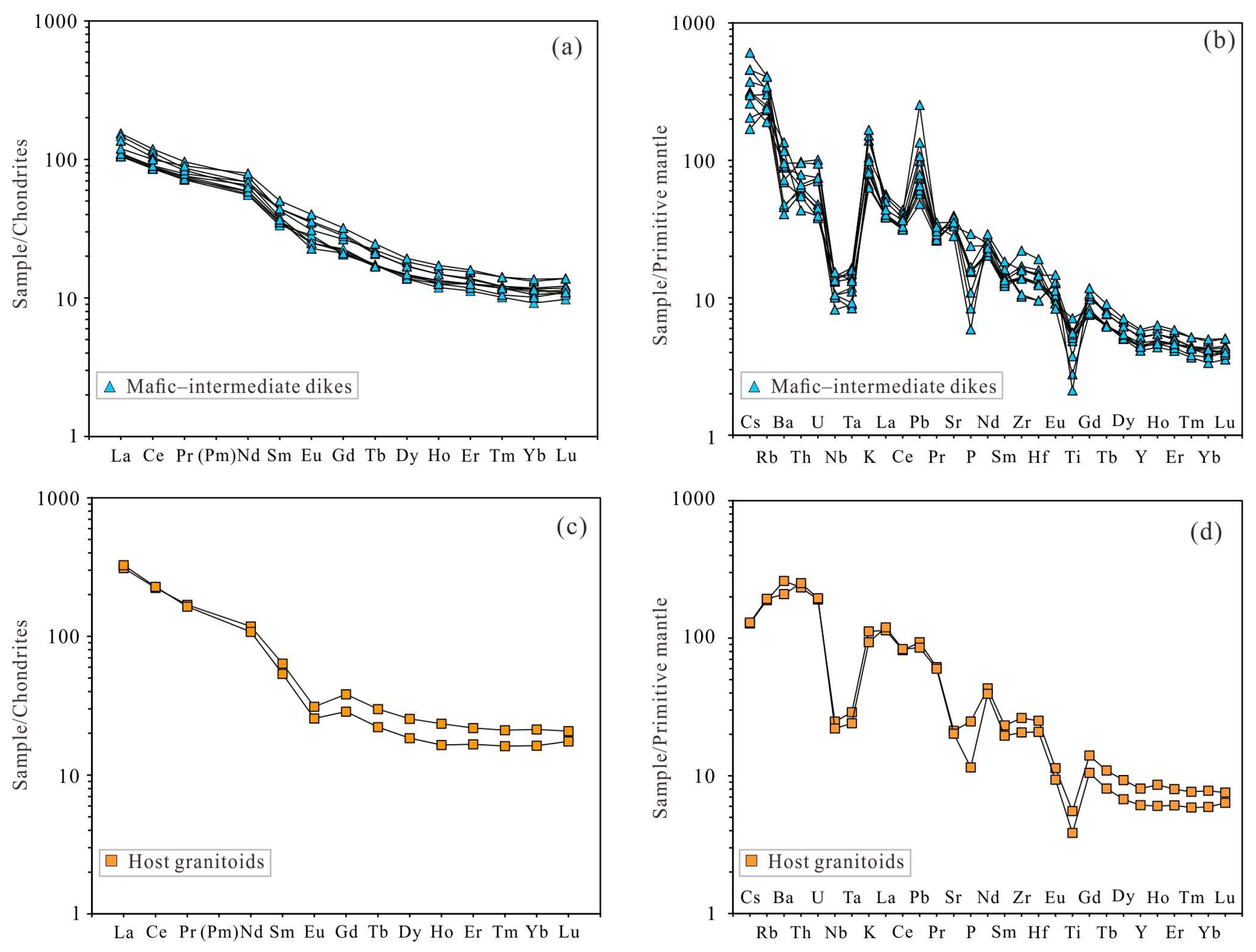
The mafic–intermediate dikes show enrichment in light rare earth elements relative to heavy rare earth elements (Figure 6a). Their total rare earth element contents range from 129.71 to 177.84 ppm. The samples have (La/Yb)N ratios of 8.77–12.71 and (Gd/Yb)N ratios of 1.84–2.47, indicating moderate fractionation between light and heavy rare earth elements. Their Eu anomalies are weak, with Eu/Eu* values of 0.816–1.085. Most samples have Eu/Eu* values close to 1.0, whereas HJ-10 and HJ-11 show relatively stronger negative Eu anomalies, with Eu/Eu* values of 0.844 and 0.816, respectively. In the primitive mantle-normalized trace element diagram, the dikes are enriched in Rb, Ba, K, and Pb and depleted in Nb, Ta, and Ti (Figure 6b).
Figure 6.
Chondrite-normalized REE patterns and primitive mantle-normalized trace element patterns for the Haojiang mafic–intermediate dikes and host granitoids. Normalization values are from [21]. (a) Chondrite-normalized REE patterns of the mafic–intermediate dikes; (b) primitive mantle-normalized trace-element patterns of the mafic–intermediate dikes; (c) chondrite-normalized REE patterns of the host granitoids; (d) primitive mantle-normalized trace-element patterns of the host granitoids.
The host granitoid samples HJ-7-2 and HJ-7-4 are compositionally distinct from the mafic–intermediate dikes. They have higher SiO2 contents of 70.17–70.84 wt.% and lower MgO contents of 0.88–0.93 wt.%. Their Mg# values are 38.15–39.86, and their Ni and Cr contents are very low. The granitoids are enriched in K2O, Ba, Th, U, and light rare earth elements. They have total rare earth element contents of 315.74 and 308.75 ppm, respectively, and display pronounced negative Eu anomalies, with Eu/Eu* values of 0.629–0.652. These compositional differences further indicate that the host granitoids and mafic–intermediate dikes represent geochemically distinct rock types.
4.2. Whole-Rock Sr-Nd Isotopes
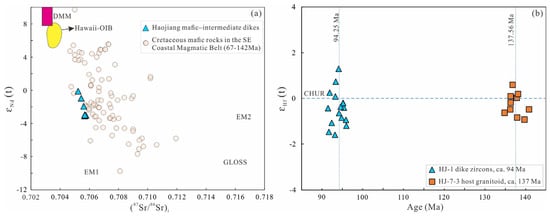
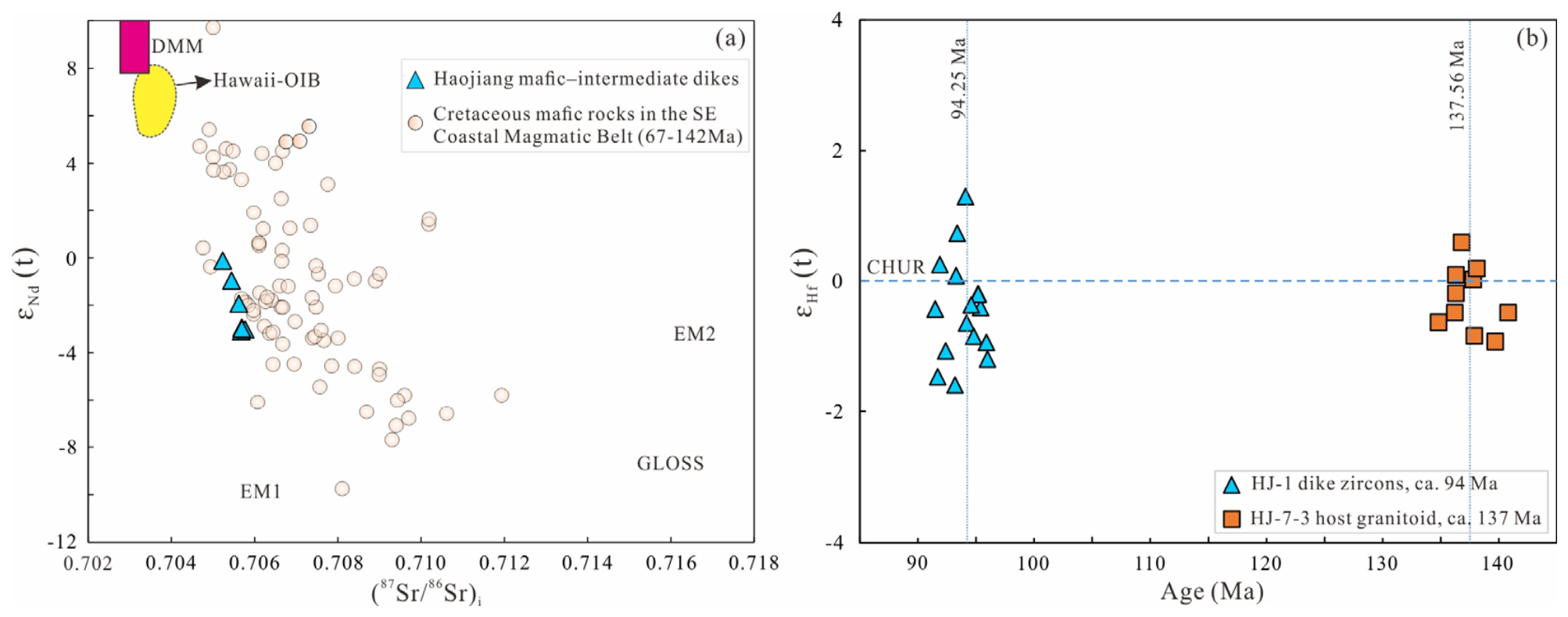
Whole-rock Sr-Nd isotopic compositions of representative mafic–intermediate dike samples are listed in Table S3 and shown in Figure 7a. The samples have measured 87Sr/86Sr ratios of 0.706181–0.706882 and initial 87Sr/86Sr ratios of 0.705232–0.705772, calculated at 94.25 Ma. Their 147Sm/144Nd ratios range from 0.110055 to 0.131624, and their measured 143Nd/144Nd ratios range from 0.512426 to 0.512583.
Figure 7.
Isotopic composition diagrams. (a) Initial (87Sr/86Sr)i versus εNd(t) diagram for the Haojiang mafic–intermediate dikes and regional Cretaceous mafic rocks from the SE China coastal magmatic belt. Data for regional Cretaceous mafic rocks are from [9,22,23,24,25,26,27,28,29,30,31]. Reference fields and end-members include GLOSS [32,33] and DMM [34]. (b) Zircon εHf(t) versus U–Pb age diagram for the HJ-1 dike and HJ-7-3 host granitoid.
The mafic–intermediate dikes have εNd(0) values of −4.14 to −1.07 and εNd(t) values of −3.10 to −0.12. Their two-stage Nd model ages range from 903 to 1145 Ma. Among the analyzed samples, HJ-7-1 has the highest εNd(t) value of −0.12 and the lowest initial 87Sr/86Sr ratio of 0.705232. In contrast, HJ-10, HJ-11, and HJ-5 have more negative εNd(t) values of −3.10, −3.03, and −2.95, respectively, and relatively higher initial Sr isotopic ratios. The duplicate analysis of sample HJ-10 gives an initial 87Sr/86Sr ratio of 0.705689 and an εNd(t) value of −2.99, which are close to the original HJ-10 values, indicating good analytical reproducibility.
Overall, the mafic–intermediate dikes are characterized by moderately radiogenic initial Sr isotopic ratios and weakly negative εNd(t) values. These Sr-Nd isotopic compositions are broadly consistent with the zircon Hf isotopic results, both of which indicate near-chondritic to slightly enriched isotopic signatures.
4.3. Zircon U-Pb Geochronology
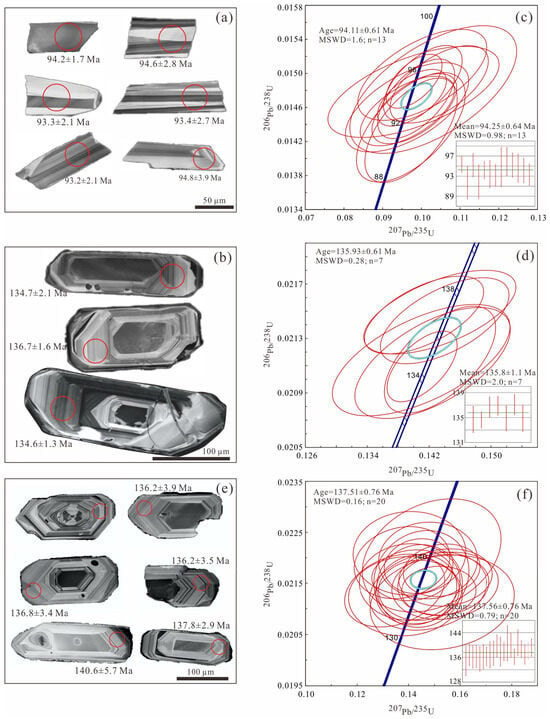
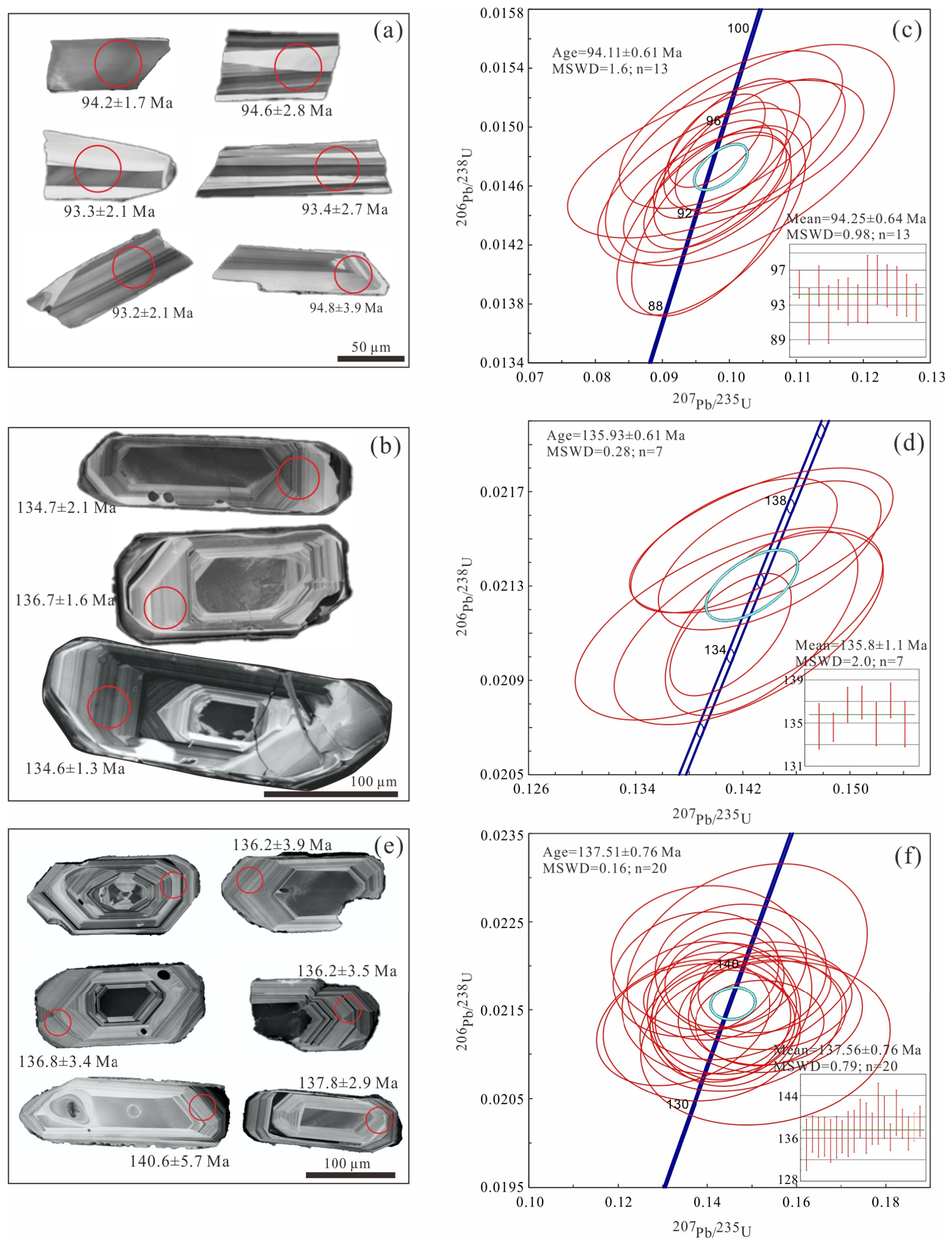
Zircon U-Pb dating results for the HJ-1 mafic–intermediate dike and the HJ-7-3 host granitoid are listed in Table S4 and shown in Figure 8. Representative zircons from the dominant young population of the HJ-1 dike are mostly euhedral to subhedral and display clear oscillatory zoning in cathodoluminescence images, indicating a magmatic origin (Figure 8a). In contrast, some zircons from the HJ-1 dike are relatively larger and show more complex internal structures, suggesting the presence of inherited or xenocrystic zircon components (Figure 8b).
Figure 8.
Zircon CL images and U-Pb dating results for the HJ-1 mafic–intermediate dike and HJ-7-3 host granitoid. (a,c) CL images and U-Pb ages of the ca. 94 Ma magmatic zircon population from HJ-1. (b,d) CL images and U-Pb ages of the ca. 136 Ma inherited/xenocrystic zircon population from HJ-1. (e,f) CL images and U-Pb ages of zircons from the HJ-7-3 host granitoid.
The dominant young zircon population from the HJ-1 dike yields a concordia age of 94.11 ± 0.61 Ma, with an MSWD of concordance of 1.6 and a probability of 0.20 (Figure 8c). Thirteen analyses from this population define a weighted-mean 206Pb/238U age of 94.25 ± 0.64 Ma, with an MSWD of 0.98 and a probability of 0.47 (Figure 8c). This weighted-mean age is interpreted as the crystallization and emplacement age of the mafic–intermediate dike.
The older zircon population from the HJ-1 dike yields a concordia age of 135.93 ± 0.61 Ma, with an MSWD of concordance of 0.28 and a probability of 0.60 (Figure 8d). Seven analyses from this population give a weighted-mean 206Pb/238U age of 135.8 ± 1.1 Ma, with an MSWD of 2.0 and a probability of 0.060 (Figure 8d). This older age population is close to the crystallization age of the HJ-7-3 host granitoid and is therefore interpreted as inherited or xenocrystic zircons probably captured from Early Cretaceous granitoid crust during ascent and emplacement of the Late Cretaceous mafic–intermediate magma.
Zircons from the HJ-7-3 host granitoid are mostly euhedral to subhedral and display well-developed oscillatory zoning in cathodoluminescence images, consistent with a magmatic origin (Figure 8e). Their Th/U ratios range from 0.46 to 0.97. The analyzed zircons yield a concordia age of 137.51 ± 0.76 Ma, with an MSWD of concordance of 0.16 and a probability of 0.69 (Figure 8f). They also define a weighted-mean 206Pb/238U age of 137.56 ± 0.76 Ma, with an MSWD of 0.79 and a probability of 0.72 (Figure 8f). This age is interpreted as the crystallization age of the host granitoid.
4.4. Zircon Lu–Hf Isotopes
Zircon Lu–Hf isotopic data for the HJ-1 mafic–intermediate dike and the HJ-7-3 host granitoid are listed in Table S5 and shown in Figure 7b. Zircons from the ca. 94 Ma magmatic population of HJ-1 have initial 176Hf/177Hf ratios of 0.282672–0.282758 and εHf(t) values of −1.61 to +1.30. Their TDM1 and TDM2 ages range from 765 to 852 Ma and 1071 to 1255 Ma, respectively.
Zircons from the HJ-7-3 host granitoid have initial 176Hf/177Hf ratios of 0.282664–0.282708 and εHf(t) values of −0.88 to +0.58, with TDM1 and TDM2 ages of 785–838 Ma and 1150–1246 Ma, respectively. Both zircon groups show near-chondritic Hf isotopic compositions, and their TDM2 ages fall within the Mesoproterozoic. These model ages may reflect the long-term residence or evolution of ancient and/or recycled source components in the mantle–crust system, rather than the crystallization ages of the HJ-1 dike or the HJ-7-3 host granitoid.
Lu–Hf isotope analyses were not conducted on the ca. 136 Ma inherited or xenocrystic zircon population from HJ-1. Therefore, this older zircon population is discussed mainly on the basis of its U–Pb age relationship with the host granitoid.
To facilitate comparison among the analyzed samples, Table 1 summarizes their lithological characteristics, analytical coverage, and principal geochronological and isotopic results. Detailed analytical data and calculation parameters are provided in Supplementary Tables S1–S5.
Table 1.
Summary of sample lithology, geochronological constraints, and principal isotopic results for the Haojiang dikes and host granitoids.
5. Discussion
5.1. Timing of Dike Emplacement and Relationship with the Host Granitoid
The field relationships and zircon U–Pb ages constrain the temporal relationship between the dated HJ-1 dike and its host granitoid. In the field, dark, fine-grained dikes sharply cut light-colored, medium- to coarse-grained granitoids along fractures or joints (Figure 3a–c), indicating that dike emplacement postdated crystallization and brittle fracturing of the granitoid host.
Zircon U–Pb dating confirms this relative chronology for the dated samples. The HJ-7-3 host granitoid yielded a weighted-mean 206Pb/238U age of 137.56 ± 0.76 Ma, interpreted as its crystallization age (Figure 8e,f). In contrast, the dominant magmatic zircon population from HJ-1 yielded a weighted-mean 206Pb/238U age of 94.25 ± 0.64 Ma, representing the crystallization and emplacement age of the dated mafic–intermediate dike (Figure 8a,c). The ca. 43 Myr age difference indicates that HJ-1 and the analyzed host granitoid belong to two temporally distinct magmatic events, rather than different facies or differentiates of a single magma system.
The HJ-1 dike also contains an older zircon population with a weighted-mean 206Pb/238U age of 135.8 ± 1.1 Ma (Figure 8b,d). This age is comparable to, but not identical to, the crystallization age of HJ-7-3. The older zircons may have been captured from the local host granitoid, from nearby Early Cretaceous granitoid crust, or from an unrecognized crustal component in the magma plumbing system. Because no Lu–Hf data were obtained for these older grains, their source should not be tied directly to HJ-7-3 without further evidence. The term “xenocrystic zircon” is therefore preferred, with “inherited” used only in a broader sense for older zircon components incorporated into the HJ-1 magma.
These observations show that HJ-1 records a Late Cretaceous mafic–intermediate magmatic event that postdated Early Cretaceous granitoid emplacement. Whether all sampled dikes in the Haojiang area are strictly coeval with HJ-1 depends on their field continuity, spatial relationships, and geochemical coherence. In the absence of additional U–Pb ages, the 94.25 Ma age should be treated as the age of the dated representative dike and as a provisional reference age for discussing the broader dike suite.
5.2. Magma Evolution: Fractional Crystallization and Possible Crustal Interaction
The Haojiang dikes have basaltic andesite to andesite compositions. In the TAS diagram based on anhydrous-normalized major-element compositions, the dike samples mainly plot in the basaltic andesite to andesite fields, whereas the host granitoids plot in the rhyolite field (Figure 4a). In the Zr/TiO2–Nb/Y diagram, which provides a complementary classification based on relatively immobile trace elements, the dike samples mainly fall within the basaltic andesite/basalt, basaltic andesite/andesite, and andesite fields, whereas the host granitoids plot in the rhyodacite/dacite field (Figure 4b). The broadly consistent results from the two diagrams support the general basaltic andesite to andesite classification of the dikes.
The dikes show relatively high K2O and large-ion lithophile element abundances. However, the possible mobility of K, Rb, Ba, and Sr during post-magmatic alteration should be considered because the LOI values of the dike samples range from 1.51 to 2.73 wt.%. Therefore, K2O- and LILE-based affinity is interpreted cautiously and together with the relatively immobile-element patterns and Sr–Nd–Hf isotopic compositions. The term “mafic–intermediate dikes” is retained because the field relationships and fine-grained to microcrystalline textures indicate a hypabyssal intrusive origin.
The major-element variation patterns are consistent with, but do not uniquely demonstrate, fractional crystallization during magma evolution. Fe2O3ᵀ, TiO2, and MgO show generally negative relationships with increasing SiO2, whereas CaO and Mg# display more scattered distributions (Figure 5). The decreases in Fe2O3ᵀ and TiO2 are consistent with the fractionation of Fe–Ti oxides, whereas the decrease in MgO is compatible with the fractionation of clinopyroxene and/or other mafic silicates. CaO also tends to decrease with increasing SiO2, possibly reflecting the combined effects of plagioclase and clinopyroxene fractionation; however, its considerable scatter prevents the assignment of this trend to a specific mineral phase. Al2O3 and Mg# do not define simple monotonic trends.
These interpretations are broadly consistent with the petrographic observations of plagioclase laths, clinopyroxene, minor opaque minerals tentatively interpreted as Fe–Ti oxides, and fine-grained crystalline groundmass (Figure 3e–g). No amphibole was positively identified in the examined thin sections. Some mafic grains appear to be locally altered, but the alteration products cannot be identified with sufficient confidence. In addition, the limited number of samples and the absence of mineral-chemical data prevent direct identification of the crystallizing phases. The inferred mineral fractionation processes should therefore be regarded as plausible interpretations rather than directly demonstrated processes.
Compatible-element variations provide additional, although non-unique, evidence for variable degrees of magma evolution. Some samples, such as HJ-3 and HJ-7-1, generally have relatively high MgO, Ni, and Cr contents, whereas several more silica-rich samples tend to have lower MgO, Ni, and Cr contents. However, Mg# is relatively scattered; for example, HJ-5 has a lower Mg# than the more silica-rich HJ-10 and HJ-11 samples. These variations are therefore not fully consistent with a single closed-system fractional-crystallization trend and may also reflect source heterogeneity or open-system processes.
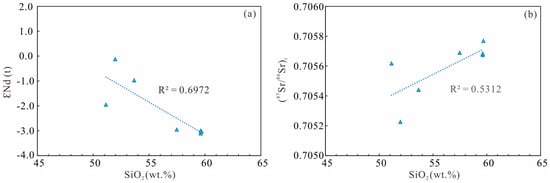
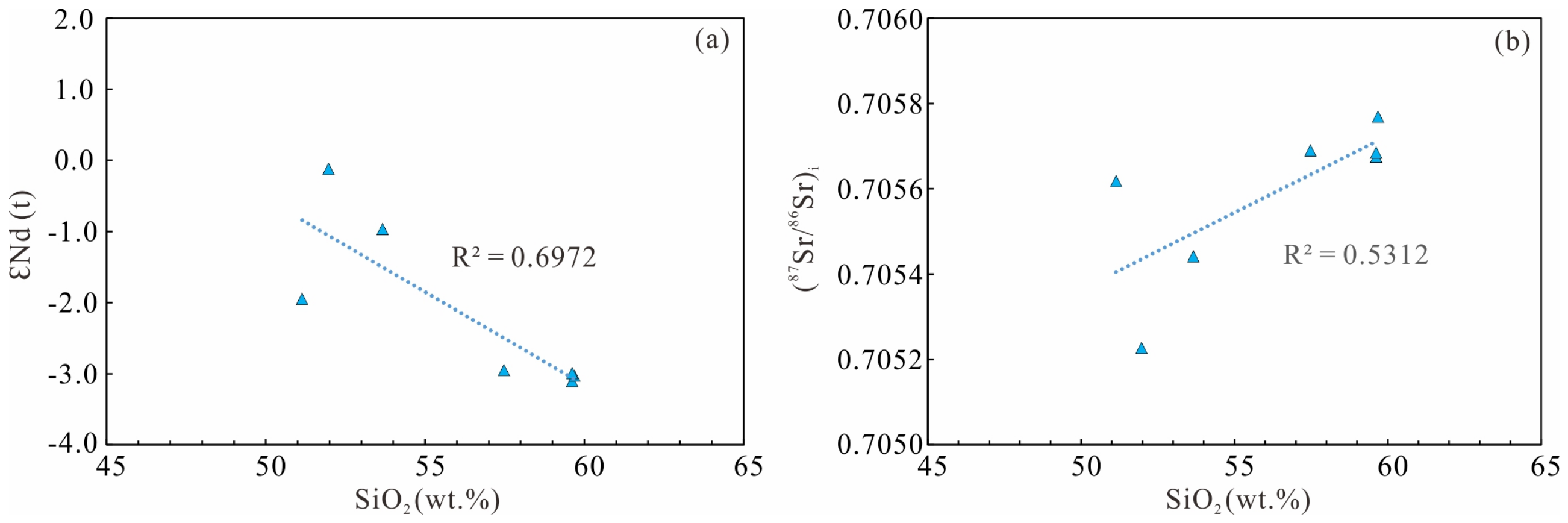
To further evaluate the relationship between magma evolution and isotopic composition, the variations of εNd(t) and initial with SiO2 were examined (Figure 9). The dike samples show an overall decrease in εNd(t) and an increase in initial with increasing SiO2. These relationships are compatible with possible limited crustal interaction during magma evolution. However, similar trends may also result from source heterogeneity or mixing between isotopically distinct mantle-derived magmas. Because suitable end-member compositions are unavailable for quantitative AFC or mixing modeling, these relationships are used only as qualitative evidence and are not regarded as definitive proof of crustal assimilation.
Figure 9.
Relationships between SiO2 contents and whole-rock Sr–Nd isotopic compositions of the Haojiang mafic–intermediate dikes. (a) SiO2 versus εNd(t); (b) SiO2 versus initial (87Sr/86Sr)i. Blue triangles represent the dike samples. Dotted lines indicate least-squares linear regression fits, and the corresponding coefficients of determination (R2) are shown for reference.
The older zircon population in HJ-1, represented by an age of approximately 136 Ma, indicates the incorporation of older zircon crystals into the dated dike magma. These zircons may have been derived from the local Early Cretaceous granitoid wall rock or from a contemporaneous crustal component within the magma conduit. However, the presence of these older zircons does not by itself demonstrate extensive crustal assimilation. Similarly, the relatively negative εNd(t) values and higher initial Sr isotopic ratios of some evolved samples, such as HJ-10 and HJ-11, may reflect limited crustal interaction, although source heterogeneity within an enriched mantle reservoir remains an alternative explanation.
Quantitative AFC or mixing modelling was not performed because independent mantle and crustal end-member compositions are unavailable, and the dataset lacks mineral-chemical constraints and experimentally calibrated partition coefficients. In addition, post-magmatic alteration may have affected some mobile elements, particularly K, Rb, Ba, and Sr. The observed major-element, trace-element, petrographic, and isotopic variations are therefore used only as qualitative evidence. They are compatible with fractional crystallization accompanied by possible limited crustal interaction, but source heterogeneity and magma mixing remain viable alternative explanations [35]. Additional whole-rock isotopic analyses of the host granitoid, mineral-chemical data, and well-constrained end-member compositions will be required for quantitative modelling.
5.3. Source Characteristics Constrained by Trace Elements and Isotopes
The REE patterns provide constraints on the source characteristics and melting conditions of the Haojiang dikes. The dikes show LREE-enriched patterns, with (La/Yb)N and (Gd/Yb)N ratios of 8.77–12.71 and 1.84–2.47, respectively (Figure 6a), indicating moderate LREE/HREE fractionation. The absence of strong HREE depletion is compatible with melting that did not involve a strongly garnet-dominated residue, although minor garnet involvement cannot be excluded without quantitative melting models. Because the samples experienced variable magma evolution and possible crustal interaction, the REE patterns should be used cautiously when inferring melting depth.
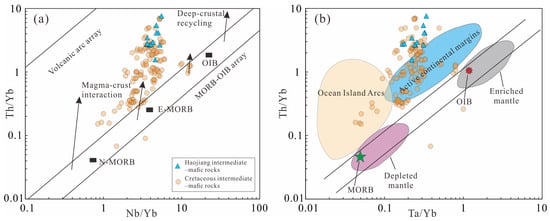
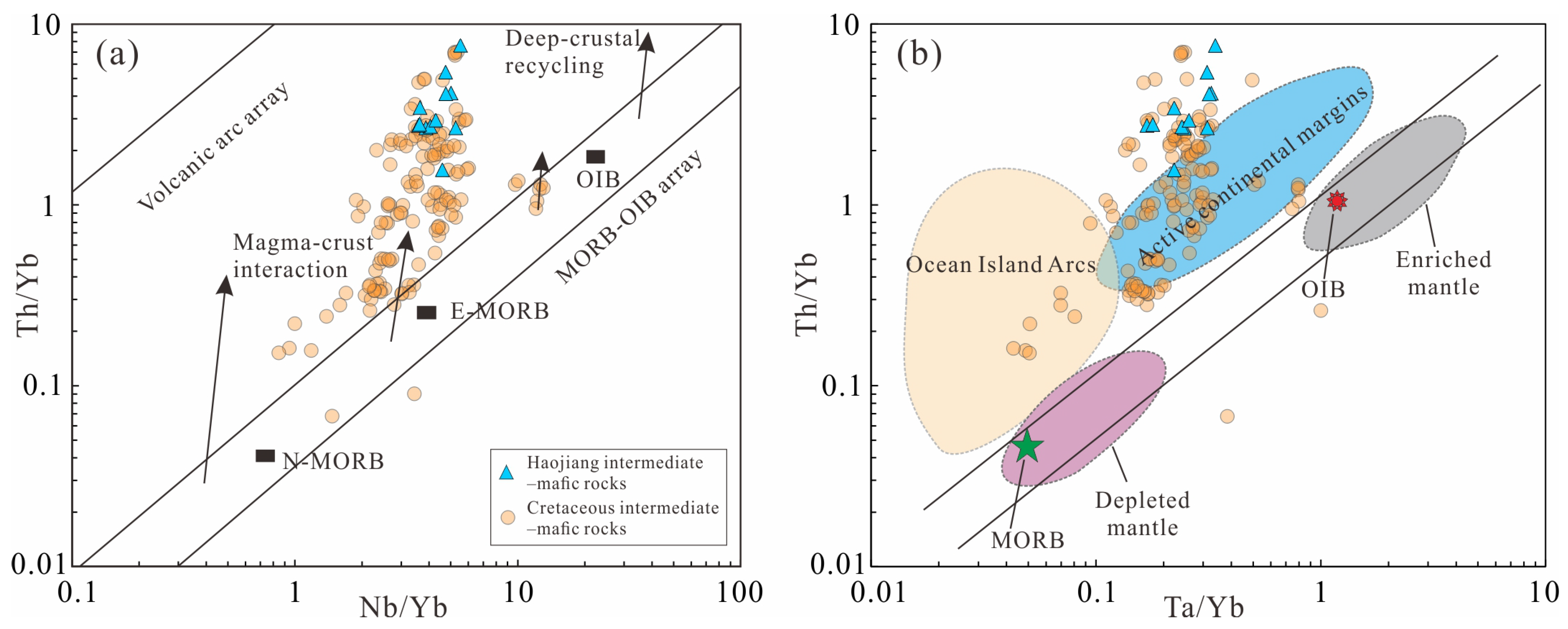
The Th/Yb–Nb/Yb and Ta/Yb–Th/Yb diagrams were used to evaluate subduction-related enrichment and mantle-source characteristics (Figure 10). In the Th/Yb–Nb/Yb diagram of Pearce [34], the Haojiang dikes plot above the MORB–OIB array and overlap with, or are slightly higher than, regional Cretaceous mafic–intermediate rocks from the SE China coastal magmatic belt (Figure 10a). This relative enrichment in Th compared with Nb is consistent with the involvement of a subduction-related or recycled component. However, it may also have been enhanced by limited crustal interaction during magma ascent and therefore does not uniquely identify a specific mantle reservoir.
Figure 10.
Trace element discrimination diagrams for the Haojiang mafic–intermediate dikes and regional Cretaceous mafic–intermediate rocks from the SE China coastal magmatic belt. Data for regional Cretaceous mafic–intermediate rocks are from [6,22,23,24,30,36,37,38,39,40]. (a) Th/Yb versus Nb/Yb diagram after [41]. The MORB–OIB array and fields for N-MORB, E-MORB, OIB, volcanic arc array, magma–crust interaction, and deep-crustal recycling are shown for reference. (b) Ta/Yb versus Th/Yb diagram after [42], showing the fields of depleted mantle, enriched mantle, MORB, OIB, ocean island arcs, and active continental margins. The green and red stars denote reference MORB and OIB compositions, respectively.
In the Ta/Yb–Th/Yb diagram of Orejana et al. [42], the Haojiang dikes plot mainly within the active continental margin field and away from the depleted mantle and MORB fields (Figure 10b). This distribution is consistent with enrichment of the mantle source by subduction-related components. Nevertheless, these diagrams cannot by themselves distinguish mantle metasomatism from crustal interaction. The source characteristics of the dikes are therefore evaluated using the combined evidence from trace elements, Sr–Nd isotopes, zircon Hf isotopes, petrography, and field relationships.
The whole-rock Sr–Nd isotopic compositions argue against derivation from a simple depleted mantle source. The dikes have moderately radiogenic initial 87Sr/86Sr ratios and weakly negative εNd(t) values (Figure 7a), indicating slightly enriched isotopic compositions relative to depleted mantle. Zircon Hf isotopes are broadly consistent with this interpretation. The ca. 94 Ma magmatic zircons from HJ-1 have εHf(t) values of −1.61 to +1.30, whereas zircons from the HJ-7-3 host granitoid have values of −0.88 to +0.58 (Figure 7b). Both groups show near-chondritic Hf isotopic compositions. Their two-stage Hf model ages fall within the Mesoproterozoic and may reflect long-lived mantle–crust reservoirs or the involvement of ancient recycled components. These model ages do not represent the emplacement age of the dikes and do not, by themselves, demonstrate derivation from bulk continental crust.
The trace-element characteristics of the Haojiang dikes are compatible with subduction-related mantle metasomatism. Fluid- and/or sediment-derived subduction components may enrich LILEs, Th, and LREEs while producing relative depletion in Nb, Ta, and Ti. Therefore, the observed Nb–Ta–Ti depletion and Th enrichment are consistent with a subduction-modified enriched mantle source and do not by themselves require direct crustal assimilation. Nevertheless, the weakly enriched Sr–Nd–Hf isotopic compositions and their covariation with SiO2 permit possible limited crustal interaction, although source heterogeneity and magma mixing remain alternative explanations.
The weakly negative εNd(t) values, moderately radiogenic initial 87Sr/86Sr ratios, near-chondritic zircon Hf isotopic compositions, and the decrease in εNd(t) and increase in initial 87Sr/86Sr with increasing SiO2 are also compatible with possible interaction between the mantle-derived magmas and ancient granitoid crust. However, these features may alternatively reflect source heterogeneity or magma mixing. The present data therefore suggest possible but limited crustal interaction rather than requiring extensive assimilation or direct derivation from bulk continental crust.
Regional comparisons support a subduction-related enriched mantle source, although lithospheric and asthenospheric contributions cannot be uniquely distinguished. Late Jurassic to Early Cretaceous mafic dikes in eastern Guangdong include both arc-like and OIB-like rocks [6], whereas other coastal SE China mafic rocks commonly record subduction-related mantle modification [43]. Early Cretaceous intermediate–felsic rocks in Shanghai were likewise interpreted as products of sediment-modified lithospheric mantle melting and lower-crustal melting with mantle-derived input [44]. Compared with typical OIB-like rocks, the Haojiang dikes show stronger arc-like features, including Nb–Ta–Ti depletion, Th enrichment, and slightly enriched Sr–Nd–Hf isotopic compositions.
A subduction-modified enriched mantle source is therefore considered the most appropriate general interpretation for the Haojiang dikes. A metasomatized lithospheric mantle source is compatible with their mafic–intermediate compositions and arc-like trace-element patterns. However, an enriched asthenospheric mantle source containing recycled slab-derived components could produce similar geochemical and isotopic characteristics. In addition, the overall decrease in εNd(t) and increase in initial 87Sr/86Sr with increasing SiO2 are compatible with possible limited crustal interaction, although source heterogeneity and magma mixing remain alternative explanations. The Nb–Ta–Ti depletion and Th enrichment are regarded as more robust indicators of a subduction-related component than the abundances of potentially mobile elements such as K, Rb, Ba, and Sr.
The Haojiang dikes are therefore interpreted as mantle-derived magmas generated from a subduction-modified enriched mantle source, with possible but limited crustal interaction during magma ascent or evolution. Because the available data do not uniquely distinguish a subduction-modified lithospheric mantle source from an enriched asthenospheric mantle source, the more general term “subduction-modified enriched mantle source” is used throughout the revised manuscript. The regional tectonic significance of the ca. 94 Ma emplacement age is discussed in Section 5.4.
5.4. Geodynamic Implications for Late Cretaceous Evolution of the SE China Margin
The emplacement age of the dated HJ-1 mafic–intermediate dike provides an important constraint on Late Cretaceous mantle-derived or mantle-influenced magmatism in eastern Guangdong. HJ-1 was emplaced at 94.25 ± 0.64 Ma, placing it within the late stage of Late Yanshanian mantle-derived magmatism in the SE China coastal magmatic belt. Late Yanshanian mantle-derived intrusions in coastal SE China have been divided into an early stage at 141–118 Ma and a late stage at 98–86 Ma, with the transition at ca. 110 Ma interpreted as reflecting a shift from forward subduction to rollback of the Paleo-Pacific slab [3,45,46,47]. The ca. 94 Ma age of HJ-1 is therefore consistent with Late Cretaceous mafic–intermediate magmatism in eastern Guangdong during a regional extensional stage. However, the age of HJ-1 alone does not directly demonstrate slab rollback or establish that all spatially connected dikes were emplaced simultaneously.
This timing is consistent with regional evidence for repeated Cretaceous lithospheric extension in South China. Cretaceous mafic dikes in northern Guangdong have been reported to have formed mainly at ca. 140 Ma, ca. 105 Ma, and ca. 90 Ma, and these events were interpreted as records of multiple episodes of lithospheric extension [9]. The ca. 94 Ma HJ-1 dike is broadly comparable to the ca. 90 Ma mafic magmatic event, suggesting that Late Cretaceous extension also affected the eastern Guangdong coastal segment. Regional studies have proposed that the SE China margin underwent a major Cretaceous transition from compression to extension in response to changes in Paleo-Pacific slab geometry and kinematics, especially slab rollback [1,2,3,45,46,47]. Other studies have related Late Cretaceous magmatism in the coastal Cathaysia Block to lithospheric extension, mantle upwelling, and the reactivation of pre-existing crustal magma systems [43]. Recent structural, sedimentological, and geophysical evidence further suggests that rollback-related lithospheric extension and thinning extended westward beyond the Xuefeng Orogen during the Late Cretaceous [48]. Although this evidence comes from areas west of the Xuefeng Orogen rather than eastern Guangdong, it provides independent regional support for a broad extensional setting. These regional interpretations are compatible with the Haojiang data, although the present study does not independently resolve the precise mechanism responsible for the local extension.
The Haojiang dikes also complement previous studies of Jurassic–Cretaceous boundary silicic volcanism in eastern Guangdong. The Bijiashan high-silica rhyolites formed mainly at ca. 145–141 Ma and were interpreted as crust-dominated silicic magmas generated during a transition from compression to intra-arc or back-arc extension related to Paleo-Pacific slab rollback [10]. These rhyolites record substantial reworking of Mesoproterozoic Cathaysian crust with limited juvenile or mantle-derived input [10]. In contrast, the ca. 94 Ma HJ-1 dike and the spatially connected but largely undated mafic–intermediate dike system represent a younger mantle-derived or mantle-influenced magmatic episode. Together with regional evidence for Late Cretaceous extension and mantle-related magmatism along the SE China coastal belt [2,3,43], these observations suggest a temporal change in eastern Guangdong from crust-dominated silicic magmatism to younger mafic–intermediate magmatism involving an enriched mantle source.
The source characteristics discussed in Section 5.3 are compatible with melting of a previously modified enriched mantle source during this Late Cretaceous extensional stage. The arc-like trace-element signatures are interpreted as inherited characteristics of a mantle source modified by earlier subduction-related processes, rather than as direct evidence that the dikes formed in a contemporaneous compressional arc setting.
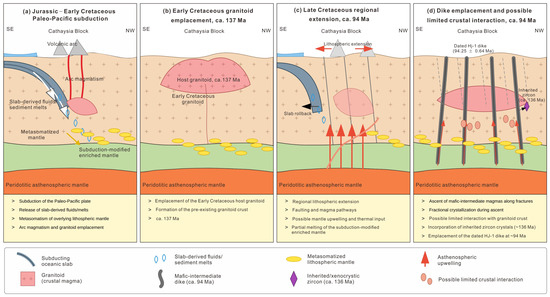
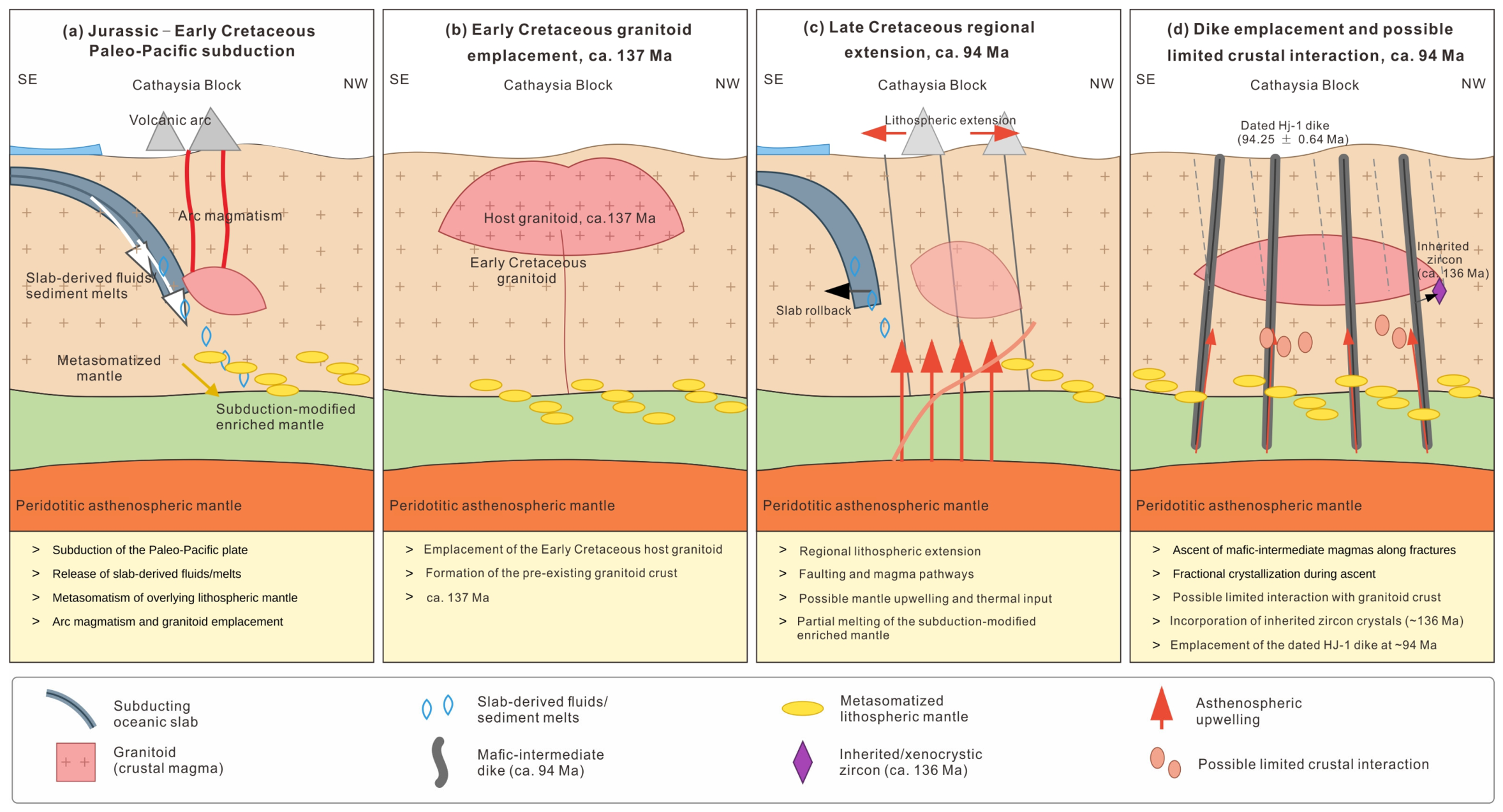
A simplified working model is presented in Figure 11. Earlier Paleo-Pacific subduction may have introduced slab-derived fluids and/or melts into the mantle beneath the Cathaysia Block, producing a subduction-modified enriched mantle reservoir. During the Late Cretaceous, regional extension commonly associated with Paleo-Pacific slab rollback may have facilitated partial melting of this mantle source and provided pathways for magma ascent. The resulting mafic–intermediate magmas ascended through the Early Cretaceous granitoid crust, underwent fractional crystallization and possible limited crustal interaction, incorporated older zircon crystals, and were emplaced at approximately 94 Ma, as directly dated by sample HJ-1.
Figure 11.
Simplified schematic geodynamic model for the formation of the Haojiang mafic–intermediate dikes in eastern Guangdong. (a) During Jurassic–Early Cretaceous Paleo-Pacific subduction, slab-derived fluids and/or sediment-derived melts may have modified the mantle beneath the Cathaysia Block. (b) The Early Cretaceous host granitoid was emplaced at approximately 137 Ma and subsequently served as the wall rock for the younger dikes; its detailed petrogenesis is not constrained by the present study. (c) During the Late Cretaceous, regional lithospheric extension, commonly associated with Paleo-Pacific slab rollback, may have promoted faulting, possible mantle upwelling, and partial melting of the previously modified enriched mantle. (d) The resulting mafic–intermediate magmas ascended through the Early Cretaceous granitoid crust, underwent fractional crystallization and possible limited crustal interaction, incorporated ca. 136 Ma inherited zircon crystals, and were emplaced at ca. 94 Ma, as directly dated by sample HJ-1. Only the HJ-1 dike was directly dated; the other spatially connected dike segments remain undated. The model is schematic and not to scale. It does not imply direct slab melting, the formation of TTG, adakite, or carbonatite melts, or a direct proof of Paleo-Pacific slab rollback.
This model should be regarded as a working interpretation rather than a unique geodynamic solution. The present data establish a ca. 94 Ma magmatic event represented by HJ-1 and support the involvement of a subduction-modified enriched mantle source. However, they do not uniquely distinguish lithospheric from asthenospheric mantle, directly prove Paleo-Pacific slab rollback, or quantify the degree of crustal interaction. Additional dating of the other dikes, mineral-chemical data, and quantitative melting or AFC models are required to determine whether the connected dike system was emplaced synchronously and to further constrain its mantle source and evolutionary processes.
6. Conclusions
This study presents new field, petrographic, whole-rock geochemical, zircon U–Pb–Hf isotopic, and whole-rock Sr–Nd isotopic data for mafic–intermediate dikes and their host granitoids in the Haojiang area, eastern Guangdong. The main conclusions are as follows:
- Field relationships show that dark, fine-grained mafic–intermediate dikes intrude light-colored granitoids along fractures or joints, indicating emplacement after crystallization and brittle fracturing of the granitoid host. Zircon U–Pb dating shows that the HJ-7-3 host granitoid crystallized at 137.56 ± 0.76 Ma, whereas the representative HJ-1 dike was emplaced at 94.25 ± 0.64 Ma. These ages indicate that HJ-1 records a Late Cretaceous mafic–intermediate magmatic event that postdated Early Cretaceous granitoid emplacement. The older ca. 135.8 ± 1.1 Ma zircon population in HJ-1 is best interpreted as xenocrystic or inherited zircon probably related to interaction with Early Cretaceous granitoid crust or a coeval crustal component during magma ascent.
- The Haojiang dike samples are high-K mafic–intermediate rocks with SiO2 contents of 50.10–58.52 wt.%. Major-element trends, compatible trace element variations, and weak Eu anomalies are consistent with variable fractional crystallization, although open-system processes and source heterogeneity cannot be excluded. The incorporation of older zircons and the Sr–Nd isotopic variations suggest possible crustal interaction during magma ascent, but the available data do not require extensive crustal assimilation.
- The dikes are enriched in LILEs and LREEs, depleted in Nb, Ta, and Ti, and have weakly enriched Sr–Nd isotopic compositions and near-chondritic zircon Hf isotopic signatures. These features favor involvement of a subduction-modified enriched mantle source. A metasomatized lithospheric mantle reservoir is plausible, but an enriched asthenospheric mantle source containing recycled slab-derived components cannot be excluded. Possible limited crustal interaction may also have occurred during magma ascent.
Supplementary Materials
The following supporting information can be downloaded at https://www.mdpi.com/article/10.3390/min16101007/s1.
Author Contributions
Conceptualization, Y.L. and H.Q.; methodology, Y.L. and H.Q.; software, Y.L.; validation, Y.L., X.L., L.W., and H.Q.; formal analysis, Y.L.; investigation, Y.L., L.W., W.H., and W.L.; resources, H.Q.; data curation, Y.L. and L.W.; writing—original draft preparation, Y.L.; writing—review and editing, Y.L., X.L., L.W., W.H., W.L., and H.Q.; visualization, Y.L. and W.H.; supervision, H.Q.; project administration, Y.L.; funding acquisition, Y.L. All authors have read and agreed to the published version of the manuscript.
Funding
This research was funded by the Project of Educational Commission of Guangdong Province of China (grant number: 2023KCXTD023) and the Project of Key Laboratory of General Universities in Guangdong Province (grant number: 2023KSYS007).
Data Availability Statement
The original contributions presented in this study are included in the article and the Supplementary Materials. Further inquiries can be directed to the corresponding author.
Acknowledgments
The authors thank Nanjing Hongchuang Geological Exploration Technology Service Co., Ltd., for zircon U–Pb dating, zircon Lu–Hf isotope analyses, and whole-rock Sr–Nd isotope analyses. We also thank ALS Chemex (Guangzhou) Co., Ltd., for whole-rock major and trace element analyses. We appreciate the technical support of the laboratory staff during sample preparation, instrumental operation, and data acquisition. During the preparation of this manuscript, the authors used ChatGPT-5.6 Luna (OpenAI) for language polishing and formatting of references and citations. The authors reviewed and edited the output and take full responsibility for the content of this publication.
Conflicts of Interest
The authors declare no conflicts of interest. The funders had no role in the design of the study; in the collection, analyses, or interpretation of data; in the writing of the manuscript; or in the decision to publish the results.
References
- Zhou, X.M.; Sun, T.; Shen, W.Z.; Shu, L.S.; Niu, Y.L. Petrogenesis of Mesozoic granitoids and volcanic rocks in south China: A response to tectonic evolution. Episodes 2006, 29, 26–33. [Google Scholar] [CrossRef] [Scilit] [PubMed]
- Li, Z.X.; Li, X.H. Formation of the 1300-km-wide intracontinental orogen and post-orogenic magmatic province in Mesozoic South China: A flat-slab subduction model. Geology 2007, 35, 179–182. [Google Scholar] [CrossRef] [Scilit]
- He, Z.Y.; Xu, X.S. Petrogenesis of the Late Yanshanian mantle-derived intrusions in southeastern China: Response to the geodynamics of paleo-Pacific plate subduction. Chem. Geol. 2012, 328, 208–221. [Google Scholar] [CrossRef] [Scilit]
- Wilson, M. Igneous Petrogenesis: A Global Tectonic Approach; Unwin Hyman: London, UK, 1989; p. 466. [Google Scholar]
- Rollinson, H.R. Using Geochemical Data: Evaluation, Presentation, Interpretation; Longman Scientific & Technical: Harlow, UK, 1993; p. 352. [Google Scholar]
- Li, X.H.; Hu, R.Z.; Rao, B. Geochronology and geochemistry of Cretaceous mafic dikes from northern Guangdong, SE China. Geochimica 1997, 26, 14–31, (In Chinese with English abstract). [Google Scholar] [CrossRef]
- Liu, X.; Fan, H.R.; Santosh, M.; Hu, F.F.; Yang, K.F.; Li, Q.L.; Yang, Y.H.; Liu, Y.S. Remelting of Neoproterozoic relict volcanic arcs in the Middle Jurassic: Implication for the formation of the Dexing porphyry copper deposit, Southeastern China. Lithos 2012, 150, 85–100. [Google Scholar] [CrossRef] [Scilit]
- Meng, L.; Li, Z.X.; Chen, H.; Li, X.H.; Wang, X.C. Geochronological and geochemical results from Mesozoic basalts in southern South China Block support the flat-slab subduction model. Lithos 2012, 132–133, 127–140. [Google Scholar] [CrossRef] [Scilit]
- Yan, Q.H.; Wang, H.; Wu, Y.M.; Chi, G.X. Simultaneous development of arc-like and OIB-like mafic dikes in eastern Guangdong, SE China: Implications for late Jurassic–early Cretaceous tectonic setting and deep geodynamic processes of South China. Lithos 2021, 388–389, 106021. [Google Scholar] [CrossRef] [Scilit]
- Liu, Y.F.; Wei, L.Y.; Huang, W.J.; Lin, W.J.; Qi, H.W. Jurassic–Cretaceous Boundary Silicic Volcanism and Paleo-Pacific Slab Rollback in Eastern Guangdong, Southeast China: Evidence from Zircon U–Pb–Hf Isotopes and Trace Elements. Minerals 2026, 16, 550. [Google Scholar] [CrossRef] [Scilit]
- Jochum, K.P.; Nohl, U.; Herwig, K.; Lammel, E.; Stoll, B.; Hofmann, A.W. GeoReM: A New Geochemical Database for Reference Materials and Isotopic Standards. Geostand. Geoanalytical Res. 2005, 29, 333–338. [Google Scholar] [CrossRef] [Scilit]
- Jochum, K.P.; Nohl, U. Reference Materials in Geochemistry and Environmental Research and the GeoReM Database. Chem. Geol. 2008, 253, 50–53. [Google Scholar] [CrossRef] [Scilit]
- Thompson, J.M.; Meffre, S.; Danyushevsky, L. Impact of air, laser pulse width and fluence on U–Pb dating of zircons by LA-ICPMS. J. Anal. At. Spectrom. 2018, 33, 221–230. [Google Scholar] [CrossRef] [Scilit]
- Paton, C.; Woodhead, J.D.; Hellstrom, J.C.; Hergt, J.M.; Greig, A.; Maas, R. Improved laser ablation U–Pb zircon geochronology through robust downhole fractionation correction. Geochem. Geophys. Geosystems 2010, 11, Q0AA06. [Google Scholar] [CrossRef] [Scilit]
- Gu, H.O.; Sun, H.; Wang, F.; Ge, C.; Zhou, T. A new practical isobaric interference correction model for the in situ Hf isotopic analysis using laser ablation-multi-collector-ICP-mass spectrometry of zircons with high Yb/Hf ratios. J. Anal. At. Spectrom. 2019, 34, 826–841. [Google Scholar] [CrossRef] [Scilit]
- Paton, C.; Hellstrom, J.; Paul, B.; Woodhead, J.; Hergt, J. Iolite: Freeware for the visualisation and processing of mass spectrometric data. J. Anal. At. Spectrom. 2011, 26, 2508–2518. [Google Scholar] [CrossRef] [Scilit]
- Le Bas, M.J.; Le Maitre, R.W.; Streckeisen, A.; Zanettin, B. A chemical classification of volcanic rocks based on the total alkali–silica diagram. J. Petrol. 1986, 27, 745–750. [Google Scholar] [CrossRef] [Scilit]
- Le Maitre, R.W. (Ed.) Igneous Rocks: A Classification and Glossary of Terms: Recommendations of the International Union of Geological Sciences Subcommission on the Systematics of Igneous Rocks, 2nd ed.; Cambridge University Press: Cambridge, UK, 2002; p. 252. [Google Scholar] [CrossRef] [Scilit]
- Winchester, J.A.; Floyd, P.A. Geochemical discrimination of different magma series and their differentiation products using immobile elements. Chem. Geol. 1977, 20, 325–343. [Google Scholar] [CrossRef] [Scilit]
- Lang, M.D.; Zhang, Z.C.; Chen, Z.; Cheng, Z.G.; Santosh, M.; Kusky, T.M. Classification and nomenclature of volcanic rocks using immobile elements: A novel approach based on big data analysis. Lithos 2023, 454, 107274. [Google Scholar] [CrossRef] [Scilit]
- Sun, S.S.; McDonough, W.F. Chemical and isotopic systematics of oceanic basalts: Implications for mantle composition and processes. Geol. Soc. Lond. Spec. Publ. 1989, 42, 313–345. [Google Scholar] [CrossRef] [Scilit]
- Cao, J.J.; Hu, R.Z.; Xie, G.Q.; Liu, S. Geochemistry and genesis of mafic dikes from the coastal areas of Guangdong Province, China. Acta Petrol. Sin. 2009, 25, 984–1000, (In Chinese with English abstract). [Google Scholar]
- Zhang, G.S.; Wen, H.J.; Hu, R.Z.; Qiu, Y.Z.; Xu, C. Genesis and dynamic setting of mafic dikes in southeastern Fujian: Evidence from Sr–Nd isotopic and major and trace element geochemistry. Acta Petrol. Sin. 2007, 23, 793–804, (In Chinese with English abstract). [Google Scholar]
- Qin, S.C.; Fan, W.M.; Guo, F.; Li, C.W.; Gao, X.F. Petrogenesis of Late Mesozoic diabase dikes in Zhejiang–Fujian provinces: Constraints from Ar–Ar dating and geochemistry. Acta Petrol. Sin. 2010, 26, 3295–3306, (In Chinese with English abstract). [Google Scholar]
- Chen, R.; Zhou, J.C. Information of crust–mantle interaction implied in Early Cretaceous composite lavas and dikes from eastern Zhejiang. Geol. Rev. 1999, 45, 784–795, (In Chinese with English abstract). [Google Scholar] [CrossRef]
- Yang, Z.L.; Shen, W.Z.; Tao, K.Y.; Shen, J.L. Sr, Nd and Pb isotopic characteristics of Early Cretaceous basaltic rocks from the coast of Zhejiang and Fujian: Evidences for ancient enriched mantle source. Sci. Geol. Sin. 1999, 34, 59–68, (In Chinese with English abstract). [Google Scholar]
- Chen, R. Late Mesozoic Composite Igneous Rocks and Crust–Mantle Interaction in Coastal Zhejiang and Fujian. Ph.D. Thesis, Nanjing University, Nanjing, China, 2001. (In Chinese) [Google Scholar]
- Xing, G.F.; Yang, Z.L.; Xue, H.M.; Zhao, Y.; Tao, K.Y. Sr and Nd isotopic compositions and petrogenetic implications of Cretaceous bimodal volcanic rocks in eastern Zhejiang, China. Geol. Rev. 1999, 45, 796–804, (In Chinese with English abstract). [Google Scholar] [CrossRef]
- Liao, Q.A.; Wang, J.M.; Xue, C.S.; Li, C.N. The characteristics of two kinds basalts in the Cretaceous basin and their relations with the basin evolution in Shangrao–Guangfeng district, Jiangxi Province. Acta Petrol. Sin. 1999, 15, 116–123, (In Chinese with English abstract). [Google Scholar]
- Zhang, G.S.; Peng, R.; Wen, H.J.; Zhao, Z.Q.; Zhang, L.; Qiu, H.X.; Meng, Q.K. Genesis of E-MORB-like mafic dykes in southwestern Fujian Province, SE China: Evidence from geochemistry, zircon U–Pb geochronology and Sr–Nd isotope. Earth Sci. 2021, 46, 4230–4246, (In Chinese with English abstract). [Google Scholar] [CrossRef] [Scilit]
- Zhao, J.H. Chronology and Geochemistry of Mafic Rocks from Fujian Province: Implications for the Mantle Evolution of SE China Since Late Mesozoic. Ph.D. Thesis, Institute of Geochemistry, Chinese Academy of Sciences, Guiyang, China, August 2004. (In Chinese with English abstract). [Google Scholar]
- Plank, T.; Langmuir, C.H. The chemical composition of subducting sediment and its consequences for the crust and mantle. Chem. Geol. 1998, 145, 325–394. [Google Scholar] [CrossRef] [Scilit]
- Ma, L.; Wang, Q.; Kerr, A.C.; Yang, J.H.; Xia, X.P.; Ou, Q.; Sun, P. Paleocene (c. 62 Ma) leucogranites in southern Lhasa, Tibet: Products of syn-collisional crustal anatexis during slab roll-back? J. Petrol. 2017, 58, 2089–2114. [Google Scholar] [CrossRef] [Scilit]
- Workman, R.K.; Hart, S.R. Major and trace element composition of the depleted MORB mantle (DMM). Earth Planet. Sci. Lett. 2005, 23, 53–72. [Google Scholar] [CrossRef] [Scilit]
- DePaolo, D.J. Trace element and isotopic effects of combined wallrock assimilation and fractional crystallization. Earth Planet. Sci. Lett. 1981, 53, 189–202. [Google Scholar] [CrossRef] [Scilit]
- Zhang, G.S.; Wen, H.J.; Qiu, Y.Z. Geochemistry of the late Mesozoic mafic dikes in western Fujian Province. Geochimica 2004, 33, 243–253, (In Chinese with English abstract). [Google Scholar] [CrossRef]
- Li, W.X.; Zhou, X.M. Geochemical constraints on the genesis of Late Mesozoic igneous rocks along the Zhejiang–Fujian coast. Prog. Nat. Sci. 2000, 10, 630–641, (In Chinese with English abstract). [Google Scholar]
- Wang, Z.H.; Lu, H.F. Sm–Nd isochron age of the cumulate gabbro from the Fujian coastal region, southeastern China, and its implication. Geol. Rev. 1999, 45, 408–411, (In Chinese with English abstract). [Google Scholar] [CrossRef]
- Ding, C. Geochronology and geochemistry of the Late Mesozoic igneous rocks in the southeastern coastal area of Quanzhou, Fujian Province. Ph.D. Thesis, China University of Geosciences, Beijing, China, 2015. (In Chinese with English abstract). [Google Scholar]
- Wang, S.; Zhang, D.; Wu, G.G.; Vatuva, A.; Di, Y.J.; Yan, P.C.; Feng, H.B.; Ma, S. Late Paleozoic to Mesozoic extension in southwestern Fujian Province, South China: Geochemical, geochronological and Hf isotopic constraints from basic–intermediate dykes. Geosci. Front. 2017, 8, 529–540. [Google Scholar] [CrossRef] [Scilit]
- Pearce, J.A. Geochemical fingerprinting of oceanic basalts with applications to ophiolite classification and the search for Archean oceanic crust. Lithos 2008, 100, 14–48. [Google Scholar] [CrossRef] [Scilit]
- Orejana, D.; Villaseca, C.; Billström, K.; Paterson, B.A. Petrogenesis of Permian alkaline lamprophyres and diabases from the Spanish Central System and their geodynamic context within western Europe. Contrib. Mineral. Petrol. 2008, 156, 477–500. [Google Scholar] [CrossRef] [Scilit]
- Chen, C.H.; Lee, C.Y.; Shinjo, R. Was there Jurassic paleo-Pacific subduction in South China?: Constraints from 40Ar/39Ar dating, elemental and Sr–Nd–Pb isotopic geochemistry of the Mesozoic basalts. Lithos 2008, 106, 83–92. [Google Scholar] [CrossRef] [Scilit]
- Qiu, L.; Li, X.; Li, X.; Yan, D.P.; Ren, M.; Zhang, L.; Cheng, G. Petrogenesis of Early Cretaceous Intermediate to Felsic Rocks in Shanghai, South China: Magmatic Response to Paleo-Pacific Plate Subduction. Tectonophysics 2022, 838, 229469. [Google Scholar] [CrossRef] [Scilit]
- Li, J.H.; Zhang, Y.Q.; Dong, S.W.; Johnston, S.T. Cretaceous tectonic evolution of South China: A preliminary synthesis. Earth-Sci. Rev. 2014, 134, 98–136. [Google Scholar] [CrossRef] [Scilit]
- Jiang, Y.H.; Wang, G.C.; Liu, Z.; Ni, C.Y.; Qing, L.; Zhang, Q. Repeated slab advance–retreat of the Palaeo-Pacific plate underneath SE China. Int. Geol. Rev. 2015, 57, 472–491. [Google Scholar] [CrossRef] [Scilit]
- Liu, L.; Xu, X.S.; Xia, Y. Asynchronizing paleo-Pacific slab rollback beneath SE China: Insights from the episodic Late Mesozoic volcanism. Gondwana Res. 2016, 37, 397–407. [Google Scholar] [CrossRef] [Scilit]
- Zhang, Q.; Qiu, L.; Yan, D.P.; Li, M.; Yang, T.; Zhou, Z.; Ariser, S.; Yang, B.; Wang, M.; Zhao, X. Impact of Slab Rollback on the Surface of Overriding Plate: Late Cretaceous Extension and Topographic Evolution to the West of the Xuefeng Orogen in the South China Block. Tectonics 2025, 44, e2024TC008354. [Google Scholar] [CrossRef] [Scilit]

Disclaimer/Publisher’s Note: The statements, opinions and data contained in all publications are solely those of the individual author(s) and contributor(s) and not of MDPI and/or the editor(s). MDPI and/or the editor(s) disclaim responsibility for any injury to people or property resulting from any ideas, methods, instructions or products referred to in the content. |
© 2026 by the authors. Licensee MDPI, Basel, Switzerland. This article is an open access article distributed under the terms and conditions of the Creative Commons Attribution (CC BY) license.