


Abstract
The number of coexisting attractors in a dynamical system needs to be increased in a simpler and more orderly manner. Conditional School of Artificial Intelligence symmetric chaotic systems achieve polarity balancing through slope changes of absolute-value functions induced by variable offset boosting, thereby generating two coexisting attractors. The attractor doubling method meets polarity balances by introducing pairs of absolute-value functions and signum functions, and therefore it can double coexisting attractors. Since the operation unit of attractor doubling can be repeated, the number of coexisting attractors in the system continuously doubles with each iteration, resulting in 2n coexisting attractors. In this work, the principle of polarity balancing is further developed. By introducing three-segment linear functions with complementary polarity balancing functions, coexisting attractors are generated through a tripling operation. This tripling operation can also be repeated, enabling the system to generate coexisting attractors in quantities of 3n. This operation, along with other approaches, makes the number of coexisting attractors more controllable and desirable and lays a foundation for the design and application of coexisting chaotic attractors and for the construction of multi-scroll/multi-wing attractors.
1. Introduction
Chaos regulation plays an important role in the process of chaos-based applications. Amplitude control of chaos [1,2,3] provides the opportunity to obtain chaotic signals with a desired signal strength, while offset boosting of system variables [3,4] provides chaotic signals with suitable polarity and average values. The design of coexisting attractors offers a new approach to chaos-based applications, where any of the oscillations can be selected with a suitable initial condition in the basin of attraction. Recently, in the community of nonlinear dynamics, people have shown great interest in the design of multistable chaotic systems, including chaos coexistence from symmetry breaking [5,6,7], conditional symmetry [7,8,9], attractor self-reproducing [10,11,12,13], and even dynamics editing [14,15]. These kind of distribution regulations of chaos are realized in memristive systems [16,17], neuron system [18,19], memristive maps [20,21] and neuron maps [22].
People are trying to put coexisting attractors in a single system in different ways. It seems that we can consider the dynamical system as a box, and more attractors can be embedded into a single equation by the attachment of piecewise-linear functions [23,24]. One of the easy ways to put more coexisting attractors in a system is resort to attractor doubling, where each pair of absolute value function and signum function can double the coexisting attractors [12,22,25]. Let us look at the question, how can we get three coexisting attractors? Or even like the doubling operation, correspondingly generate 3n coexisting attractors? With the development of integrated circuits and electronic circuits, a chaotic circuit hosting different combinations of coexisting attractors is possible—many analog circuits [26,27] and digital circuits [28,29,30] can give such a realization. And as we see, a piecewise-linear function unit can be employed for editing the desired dynamics [31]. However, people seem to be more interested in the discovery of the coexistence of a limited number of chaotic states and the coexistence brought about by symmetry [32,33,34]. Establishing how to embed more coexisting attractors in a given system and organize them effectively remains an urgent problem to be solved.
Based on this motivation, here, in this work, we try to develop the idea of doubling coexisting attractors by embedding a new combination of piecewise-linear functions, putting more coexisting attractors in the system, and increasing flexibility for outputting more coexisting attractors with repeated operations. Moreover, the coexisting attractors could be organized for producing multi-scroll attractors [35,36], even in Jerk circuits [37,38]. In Section 2, the fundamental principle is explained from the point of view of polarity balance. In Section 3, an example is given showing the effectiveness of the operation. The conclusion and discussion are given in the Section 5.
2. Principle of Tripling Coexisting Attractors
2.1. Combined Piecewise-Linear Functions for Tripling Coexisting Attractors
As we know, for doubling coexisting attractors, the absolute value function combined with signum function can balance the polarity and as a result can double the attractors. Here, following this principle, if a suitable piecewise-linear function is introduced combined with signum functions, the number of the coexisting attractors should also get tripled. The key factor is the offset boosting of the original attractors and setting them down carefully with the desired distance.
Suppose there is a piecewise function with three segments and two offset parameters, defined as,
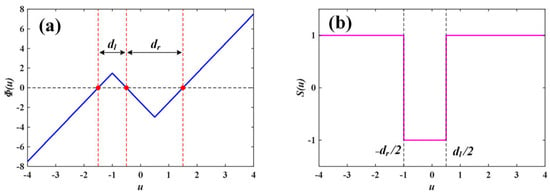
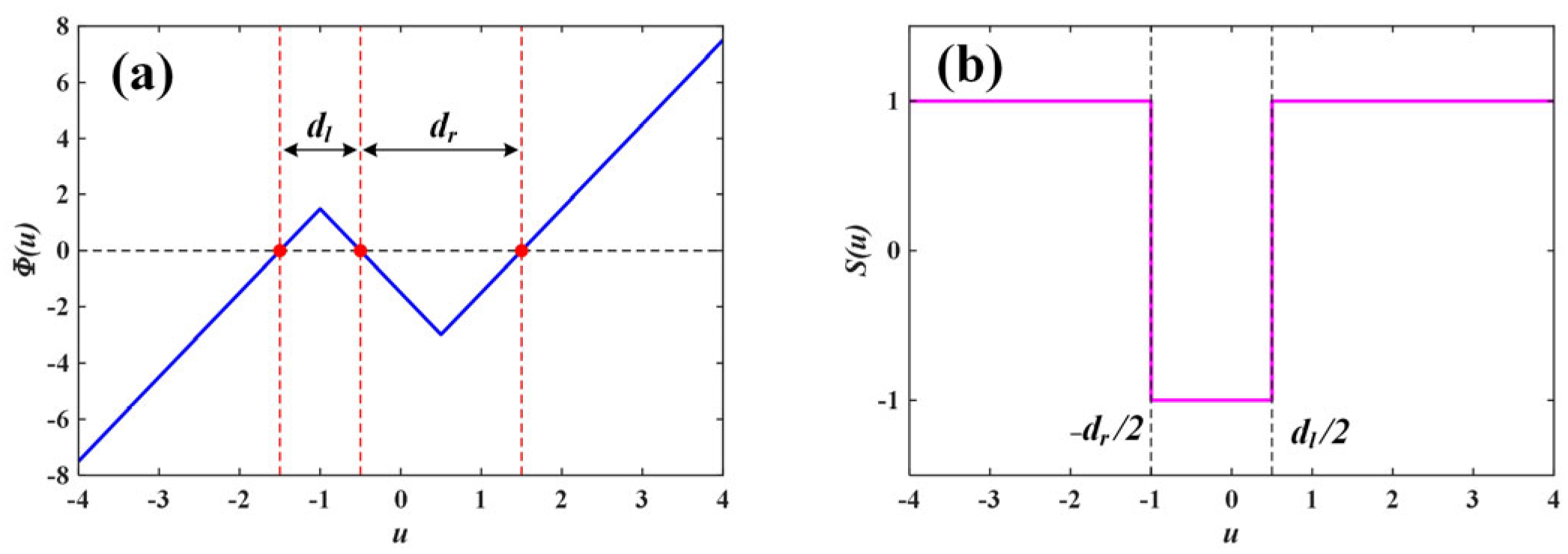
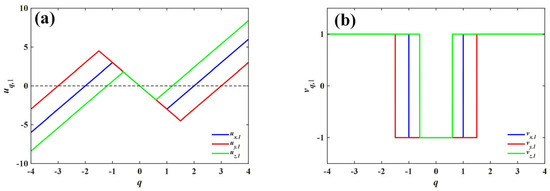
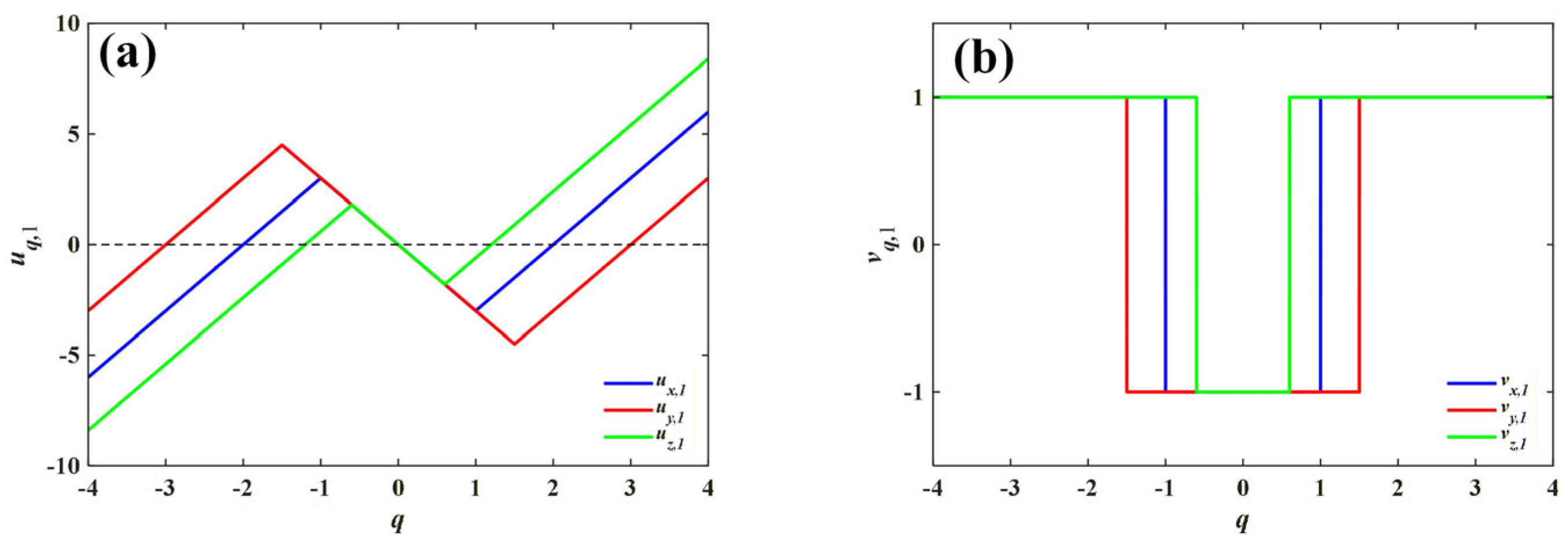
where > 0 and > 0 denote the left and right distance parameters, respectively, as illustrated in Figure 1a. Here, the two absolute value functions are for the offset-associated feedback from the system variable, while the offset constants are employed for navigating the coexisting attractors.
Figure 1.
Piecewise function with three segments and its slope polarity: (a) ; (b) : (a) piecewise function; (b) slope polarity.
Correspondingly, to balance the polarity of the equation, a related segment-locked signum function is introduced according to the slope of each segment in the absolute function,
Note that here the function is only for polarity balance. The three segments of the piecewise linear function have two different slopes, which can be expressed with the product of two signum functions. As illustrated in Figure 1b, except at the two breakpoints, the derivative satisfies . By solving , the three attractor centers are obtained as
The three theoretical centers satisfy , . Here, the constant controls the distance between the left and middle attractor, whereas controls the distance between the middle and right attractor. When , the proposed mapping turns out to be a symmetric trifold mapping. When , the left and right attractors can be adjusted independently, thereby enabling asymmetric attractor tripling.
2.2. Nested Operations for More Coexisting Attractors
The combinations of absolute value function and signum function can be repeated for tripling coexisting attractors. Here, the most important issue is to appropriately set the space for each attractor and the distances among the coexisting attractors, specifically when the attractors are reproduced to be distributed on multi-dimensional layers. Let us apply an -layer nesting operating to the attractor in phase space , and suppose the first layer is defined as the outermost layer and the th layer is the innermost layer. The nested mapping thus could be defined as,
where,
and the corresponding polarity-balancing function is,
For the th layer of tripling operation, suppose,
Given the target value from the previous layer, the left, middle, and right solutions of the equation are given by
The initial set of centers, denoted by , is first obtained by solving the outermost equation . Subsequently, the inverse mapping is recursively applied from the outermost layer to the innermost layer. If the set of attractor centers obtained after the th recursion is denoted by , then
In the recursive computation, it is necessary to guarantee that the three candidate solutions fall within the left, middle, and right piecewise intervals, respectively. If the target value at each layer remains within the effective domain covered by all three branches and no overlap occurs among the attractor centers, an -layer mapping in a single direction generates attractor centers. If the numbers of operation layers in the X-, Y-, and Z-directions are , , and , respectively, the total number of coexisting attractors in the three-dimensional space is For a clear demonstration, in the following, we will give the examples showing such operations for tripling coexisting attractors.
3. An Example of Tripling Coexisting Attractors
3.1. Method of Tripling Coexisting Attractors
Here, in this work, we select the parent of a conditionally symmetric system [9] for tripling coexisting attractors,
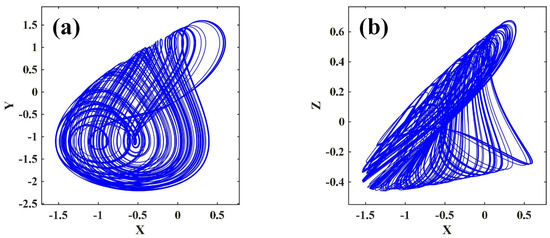
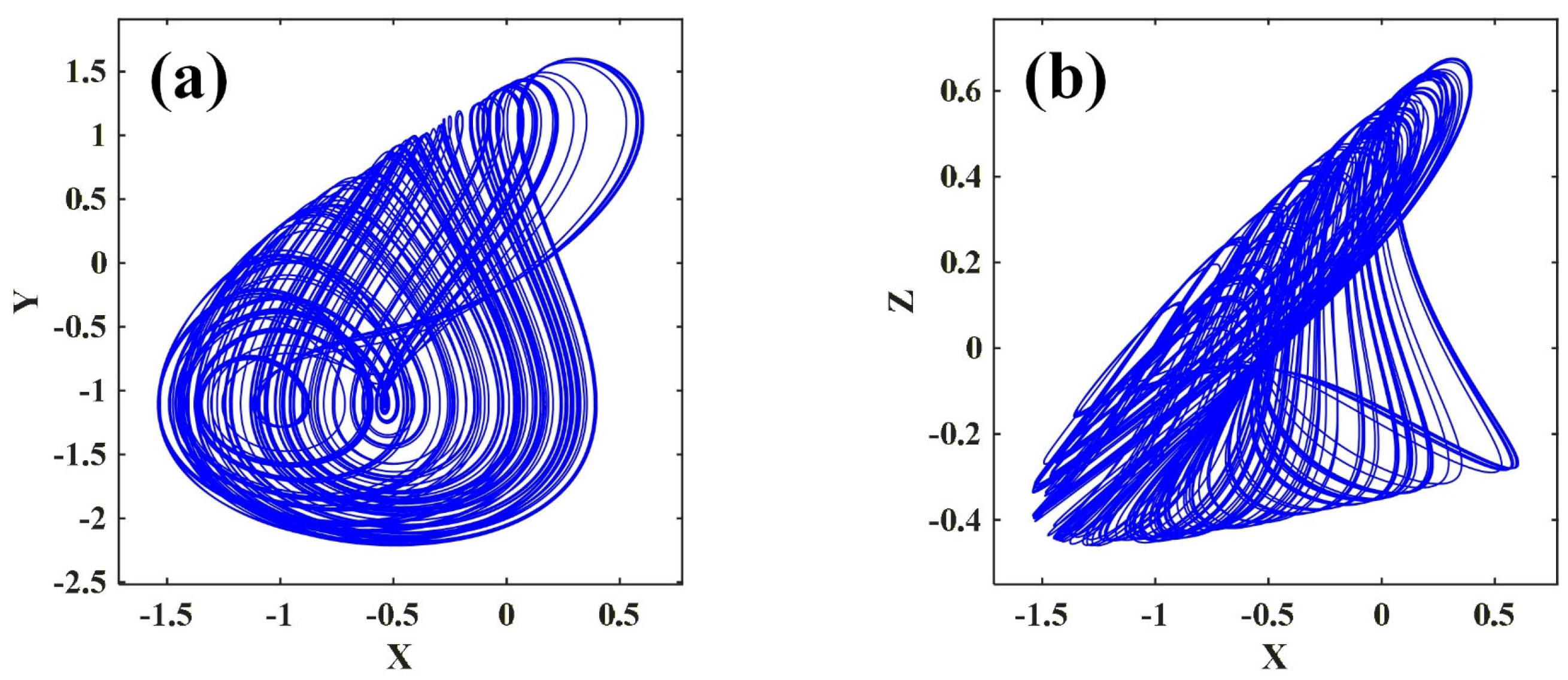
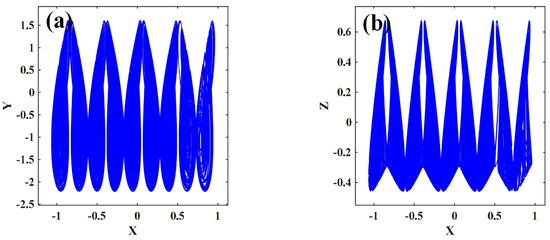
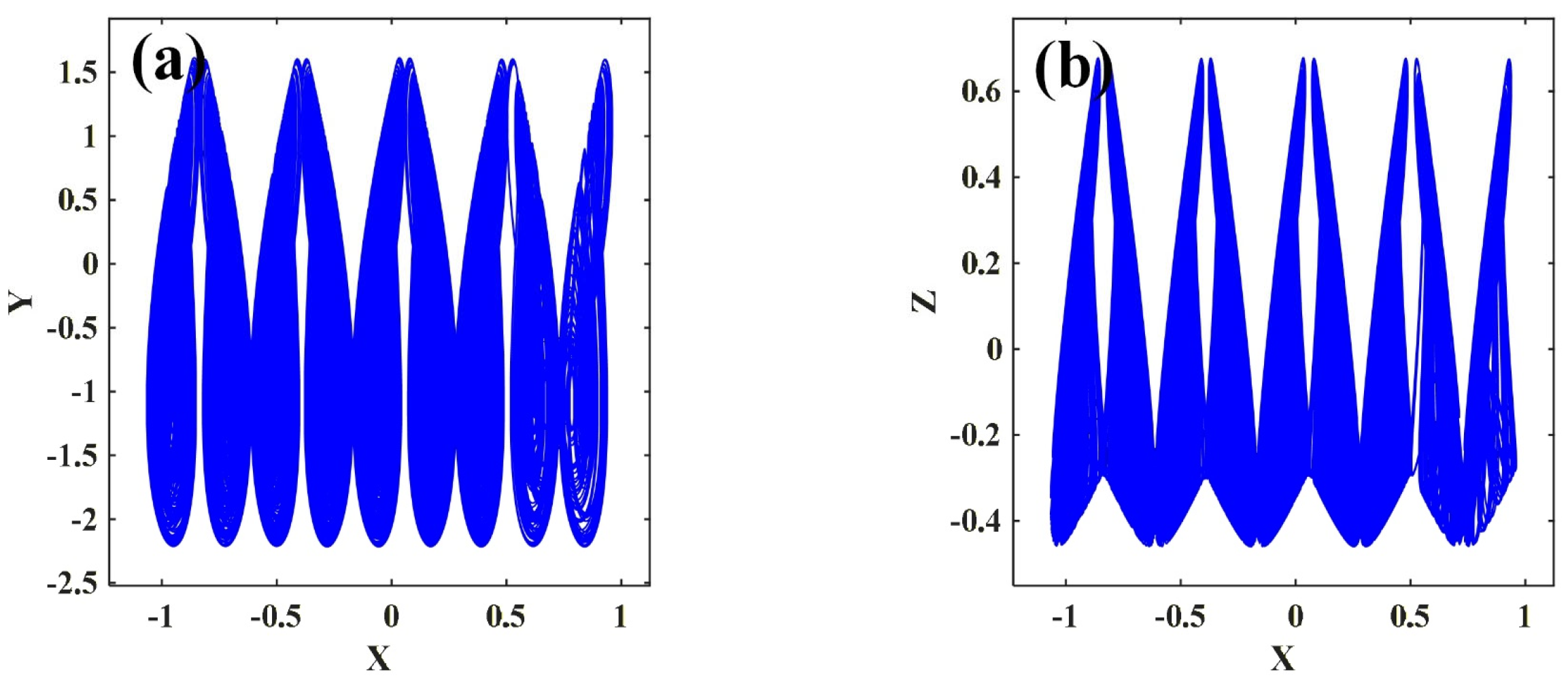
When a = 1.22 and b = 8.48, system (10) has a chaotic attractor with Lyapunov exponents and a Kaplan–Yorke dimension of 2.1893, as shown in Figure 2. The divergence of the system is given by , showing a phase-space volume contract according to and indicating that the system is dissipative. The system has two equilibrium points, marked as ; both equilibrium points are unstable saddle-foci.
Figure 2.
Chaotic attractor of system (10) with a = 1.22, b = 8.48, and the initial condition IC = (0, 0, 0): (a) X–Y plane; (b) X–Z plane.
In the following, all numerical simulations are performed using the ode45 solver from MATLAB2025, with the relative and absolute tolerances set to 10−6 and 10−8, respectively. For phase portraits, the integration interval is set to [0, 500], and the first 200-time units are discarded to eliminate transient effects. For time series, the integration interval is set to [0, 1500]. The system parameters are fixed as a = 1.22 and b = 8.48. Let us take the single-dimensional triplication in the X-direction,
and the corresponding polarity-balancing function is,
then, the corresponding system of hosting three coexisting attractors is given by,
For system (13), the dissipativity can be examined in each piecewise region. Since the polarity-balancing function is constant within each region, the divergence of system (13) is . Therefore, the phase-space volume contracts according to , indicating that the derived system remains dissipative. At the switching boundaries and , the derivative is not defined exactly at the switching points; however, the divergence on both sides of each boundary remains 1. These switching boundaries do not affect the overall dissipative property of the system. The signum function is for polarity balance, while the absolute value functions are for offset-dominated attractor triplications. The operation is very similar to the symmetrization operation, with both involving the substitution of a piecewise linear function and the adjusting of the polarity to match.
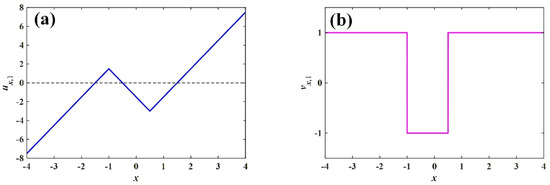
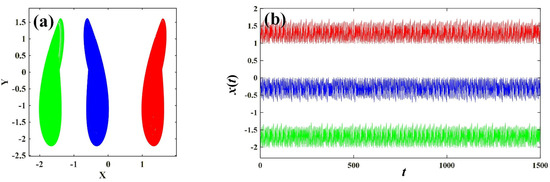
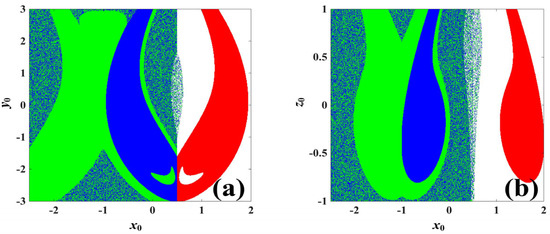
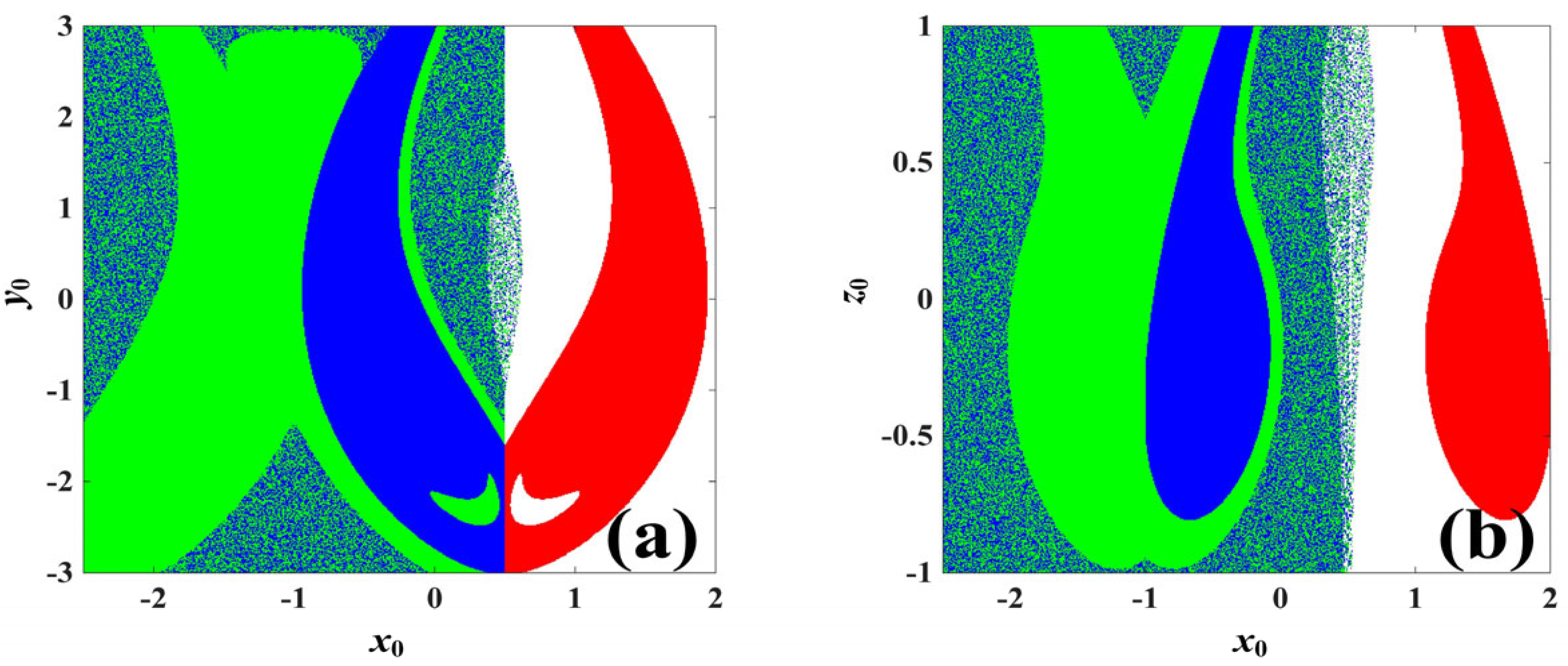
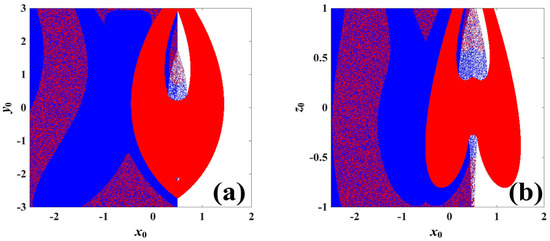
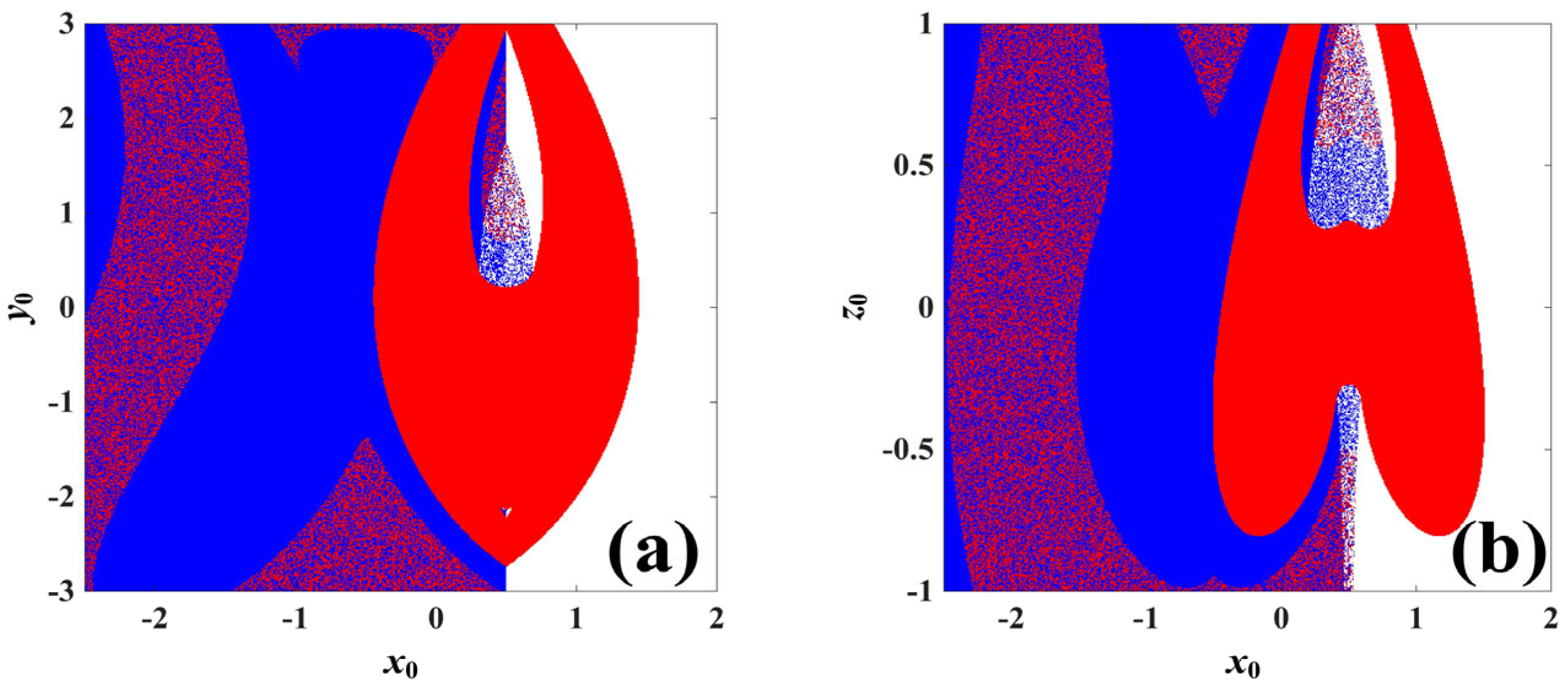
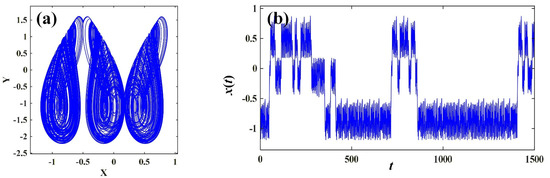
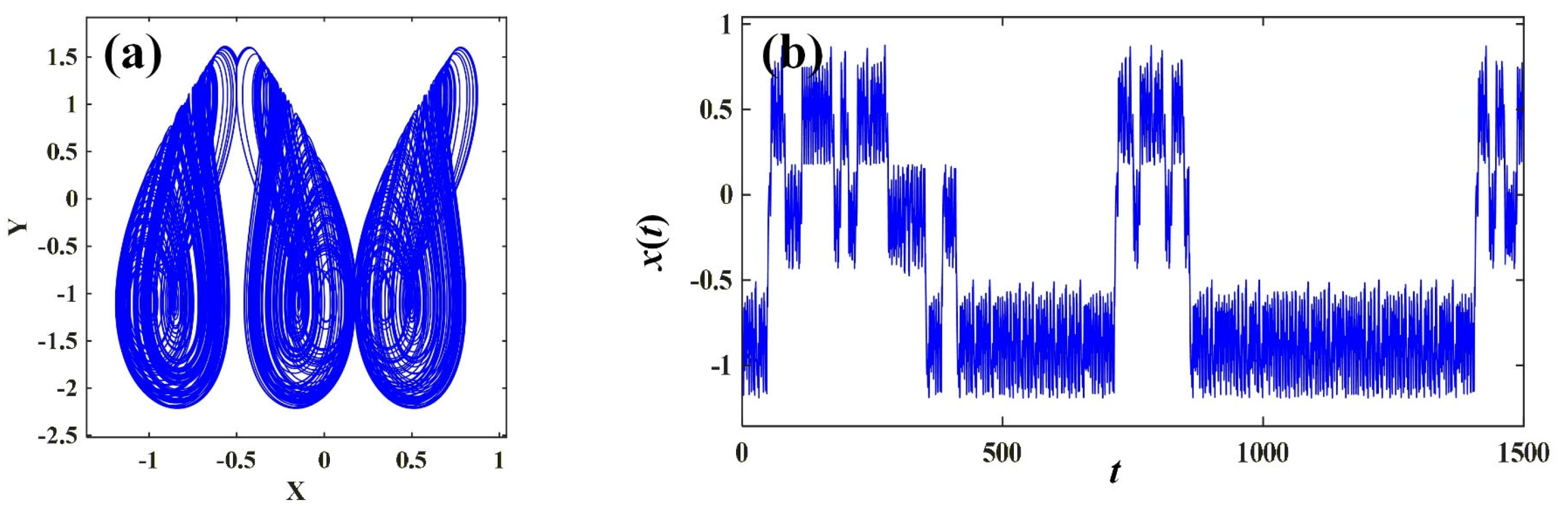
When and , the three attractor centers are located at −1.5, −0.5, and , respectively. The applied piecewise linear function and the corresponding polarity-balancing function are shown in Figure 3. Taking (−1.5, 0, 0), (−0.5, 0, 0), and (1.5, 0, 0) as the initial conditions, the corresponding coexisting attractors and oscillations are plotted in Figure 4a,b. The Lyapunov exponents of the three coexisting attractors are almost the same, close to (0.2335, 0, −1.2335), with Kaplan–Yorke dimensions of 2.1893. The positive largest Lyapunov exponent confirms that all three coexisting attractors are chaotic. The basins of attraction are presented in Figure 5, further demonstrating that the three dynamical states correspond to a distinct attraction region.
Figure 3.
Single triplication operation: (a) piecewise linear function ; (b) polarity-balancing function .
Figure 4.
Three coexisting solutions of system (13) with a = 1.22, b = 8.48, , and : (a) phase portrait in the X–Y plane; (b) time series of .
Figure 5.
Basins of attraction of the coexisting attractors of system (13) with a = 1.22, b = 8.48, , : (a) , , and ; (b) , , and .
3.2. Regulation of Coexisting Attractors
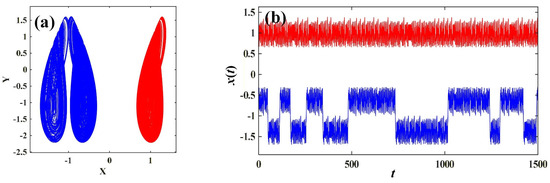
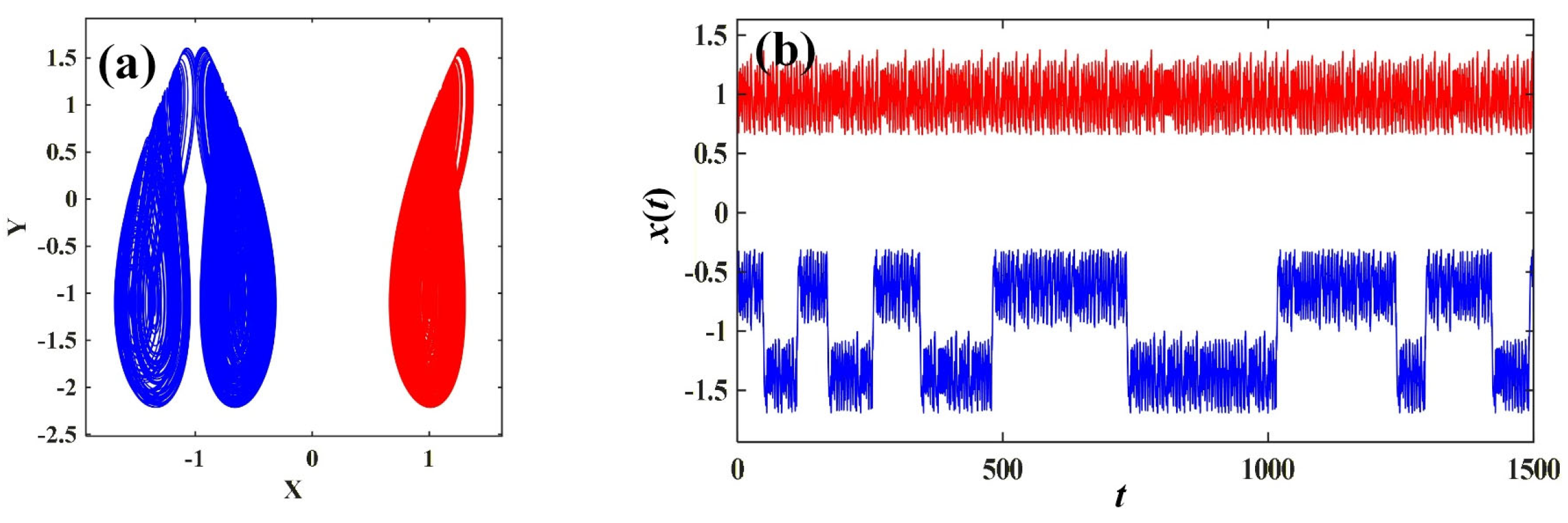
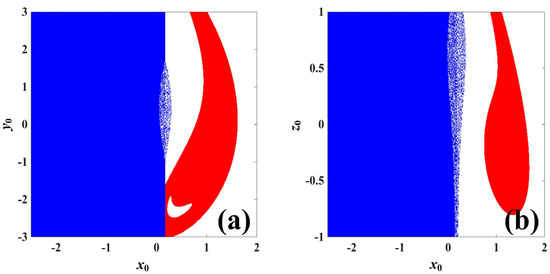
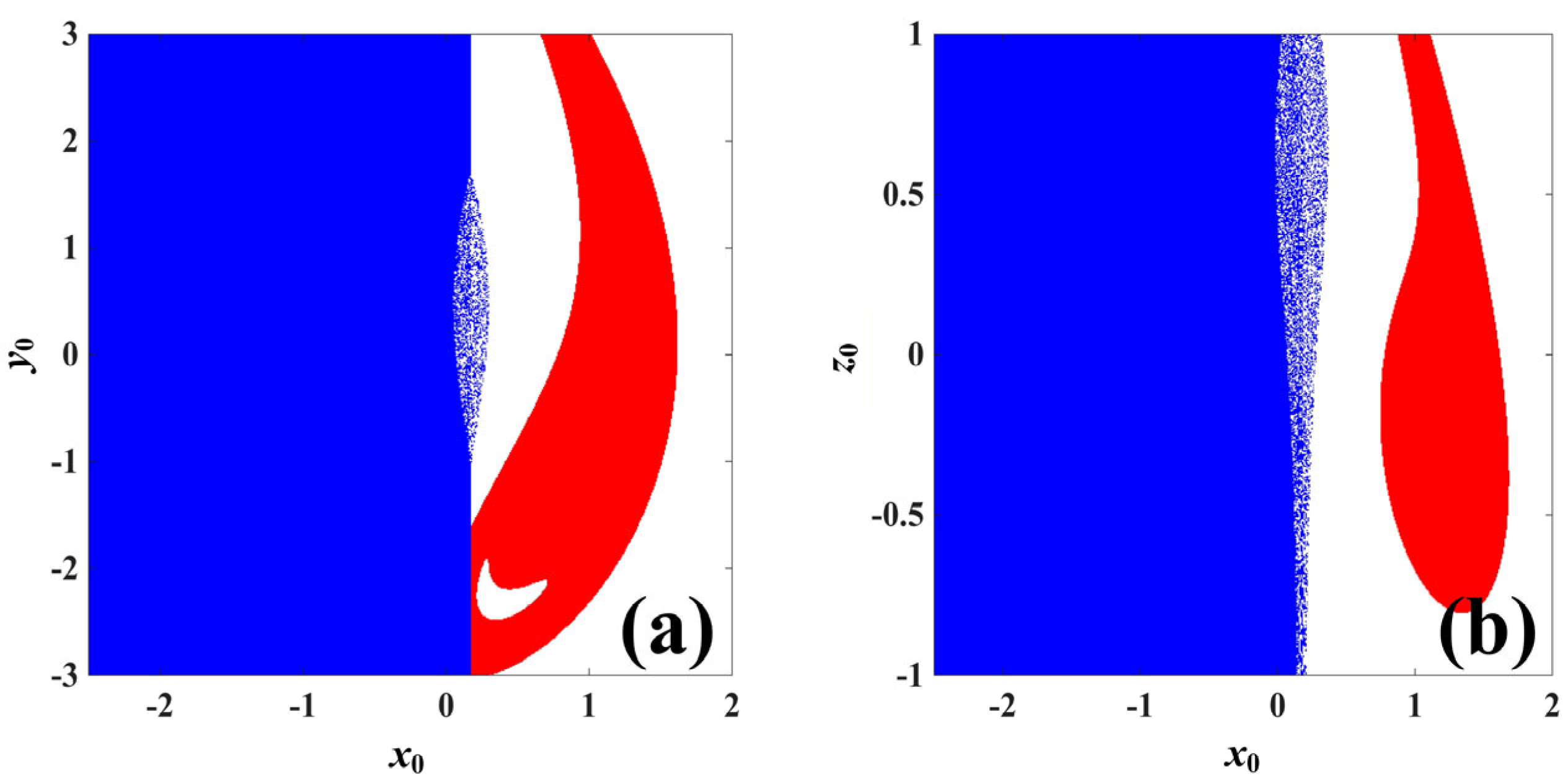
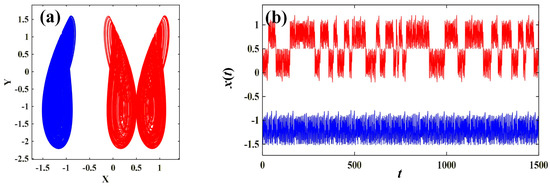
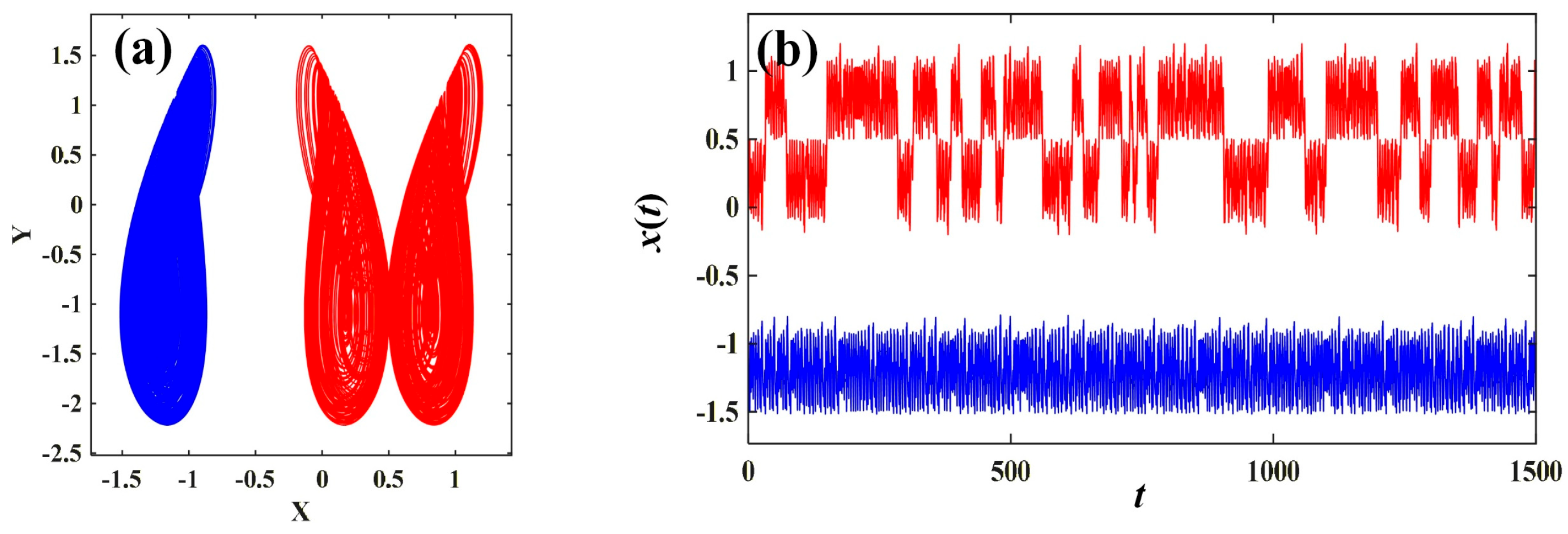
Let us see how the parameters in the absolute value functions (in fact, also existing in the signum function) influence the coexisting attractors. When = 2, = 0.35, the shorter distance between the left and middle centers means the front two attractors are close together or even connected, forming a double-scroll attractor. As shown in Figure 6a, the blue trajectory switches aperiodically between the left and middle attractors, whereas the red trajectory remains in the isolated right region without any disturbances. The basins of attraction shown in Figure 7 further confirm the coexistence of the double-scroll attractor and a single attractor. In this case, the left two attractors really connect and become a new single attractor.
Figure 6.
Coexisting attractors of system (13) with a = 1.22, b = 8.48, , and : (a) phase portrait in the X–Y plane; (b) time series of .
Figure 7.
Basins of attraction of the coexisting attractors of system (13) with a = 1.22, b = 8.48, , : (a) , , and ; (b) , , and .
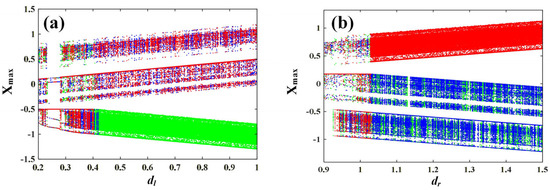
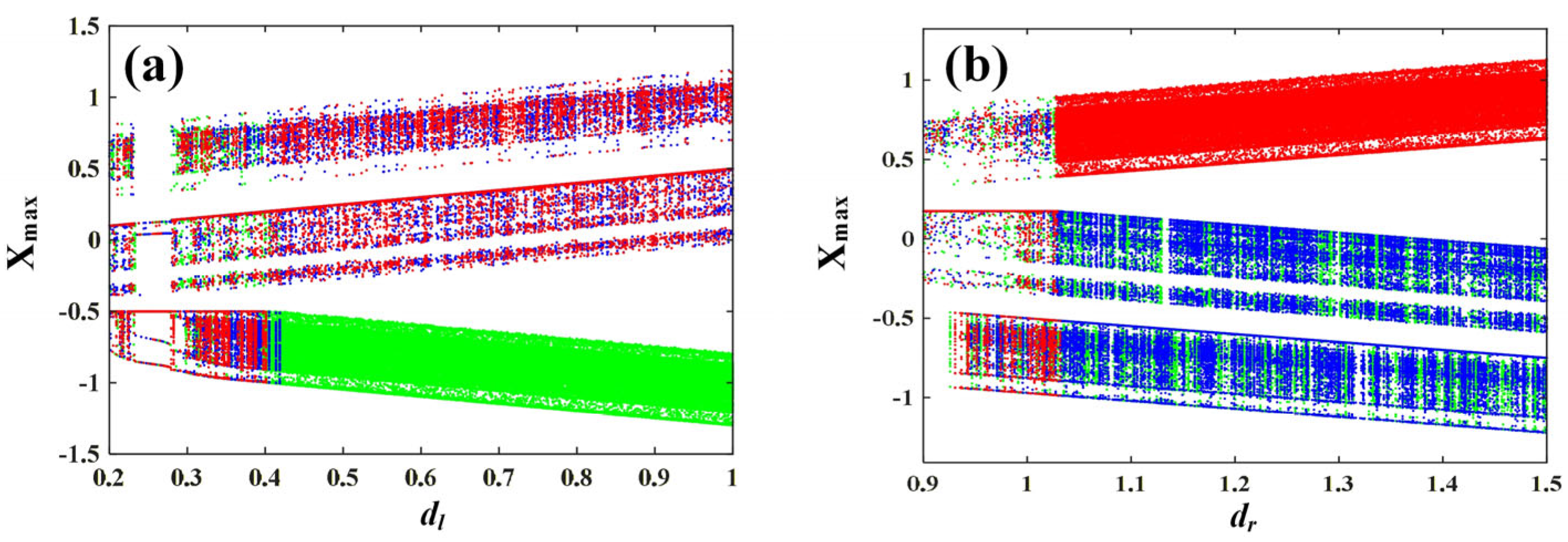
Similarly, the right two coexisting attractors can also be regulated in this way. When = 1, = 1, the shorter distance between the right and middle centers makes the back two attractors closer, connecting them so they become a double-scroll one, as shown in Figure 8. Basins of attraction now are reallocated, as shown in Figure 9. As we can imagine, when = 1, = 0.35, all the distances get shrunk; therefore, a new three-scroll attractor comes up, as shown in Figure 10. The regulation of three coexisting attractors from the two parameters can also be verified by the bifurcation diagram. As shown in Figure 11, increasing the parameter of or causes the corresponding left or right attractor to separate independently from the existing two-scroll or three-scroll attractor.
Figure 8.
Coexisting attractors of system (13) with a =1.22, b = 8.48, and : (a) phase portrait in the X–Y plane; (b) time series of .
Figure 9.
Basins of attraction of the coexisting attractors of system (13) with a = 1.22, b = 8.48, , : (a) , , and ; (b) , , and .
Figure 10.
Coexisting attractors of system (13) with a = 1.22, b = 8.48, and : (a) phase portrait in the X–Y plane; (b) time series of .
Figure 11.
Bifurcation diagrams of system (13) with a = 1.22, b = 8.48: (a) , varies in [0.2, 1]; (b) , varies in [0.9, 1.5].
4. Nested Operations for Tripling Coexisting Attractors
4.1. Double-Layer 1-Dimensional Triplications
For double triplications in the -direction, the first-layer operation could be initiated by the piecewise linear function,
and the corresponding polarity-balancing function is,
For the second-layer triplication, the piecewise linear function is written as,
and the corresponding polarity-balancing function is,
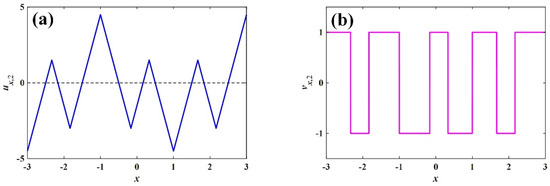
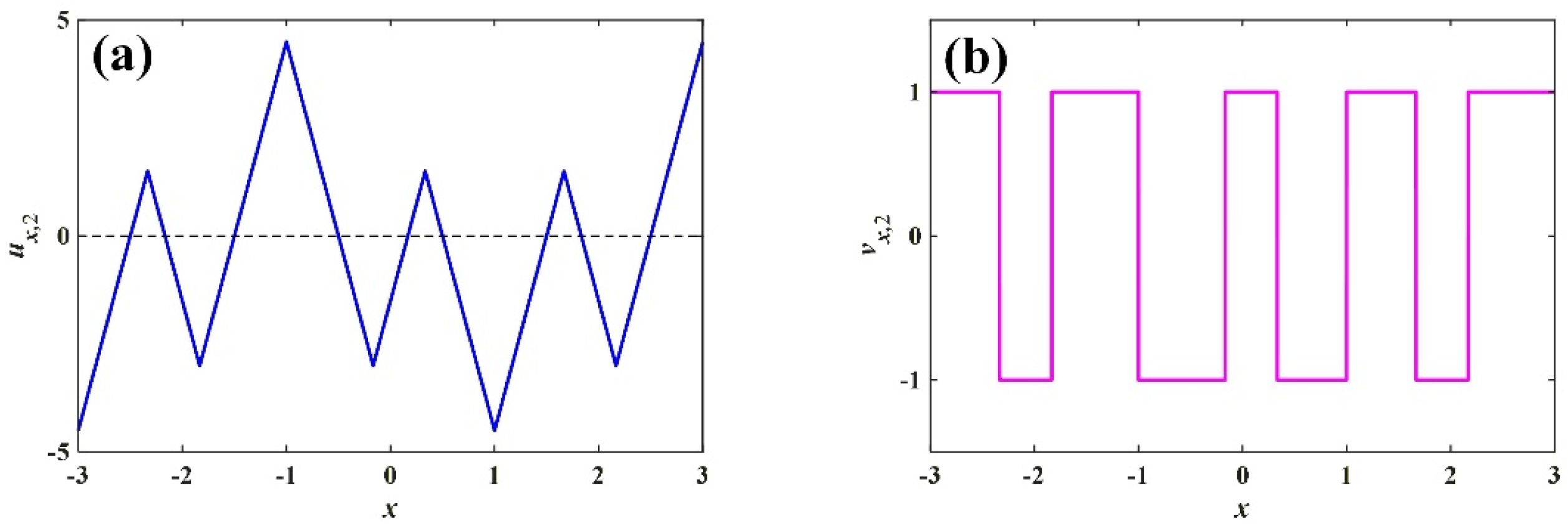
Now, the double-layer triplication functions are plotted in Figure 12.
Figure 12.
Two-layer nested functions for the nine coexisting attractors: (a) ; (b) .
Accordingly, the two-layer single-dimensional triplication system turns to be,
Here, and denote the left and right distance parameters of the replicated branches; the two-layer nested operation theoretically generates coexisting attractors in phase space distributed in the X-direction.
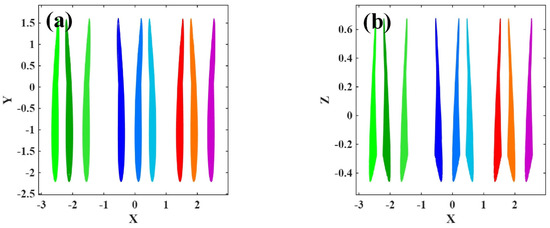
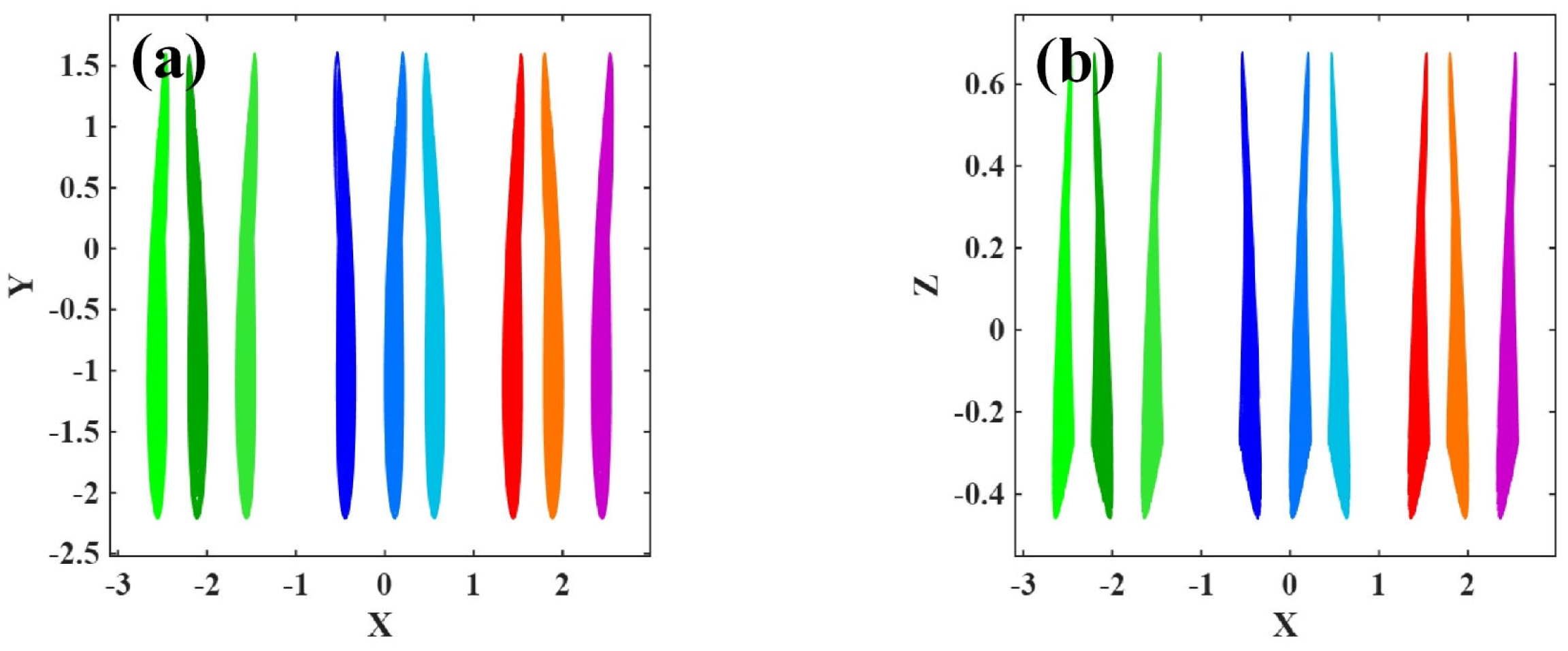
When the first-layer distance parameters are chosen as and the second-layer distance parameters are chosen as , the nine coexisting attractors are located at By taking , where denotes the corresponding attractor centers, the nine coexisting attractors are shown in Figure 13.
Figure 13.
Phase portraits of nine coexisting attractors of system (18) with a = 1.22, b = 8.48, , and : (a) phase portrait in the X–Y plane; (b) in the X–Z plane.
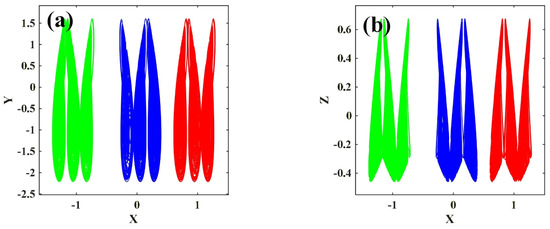
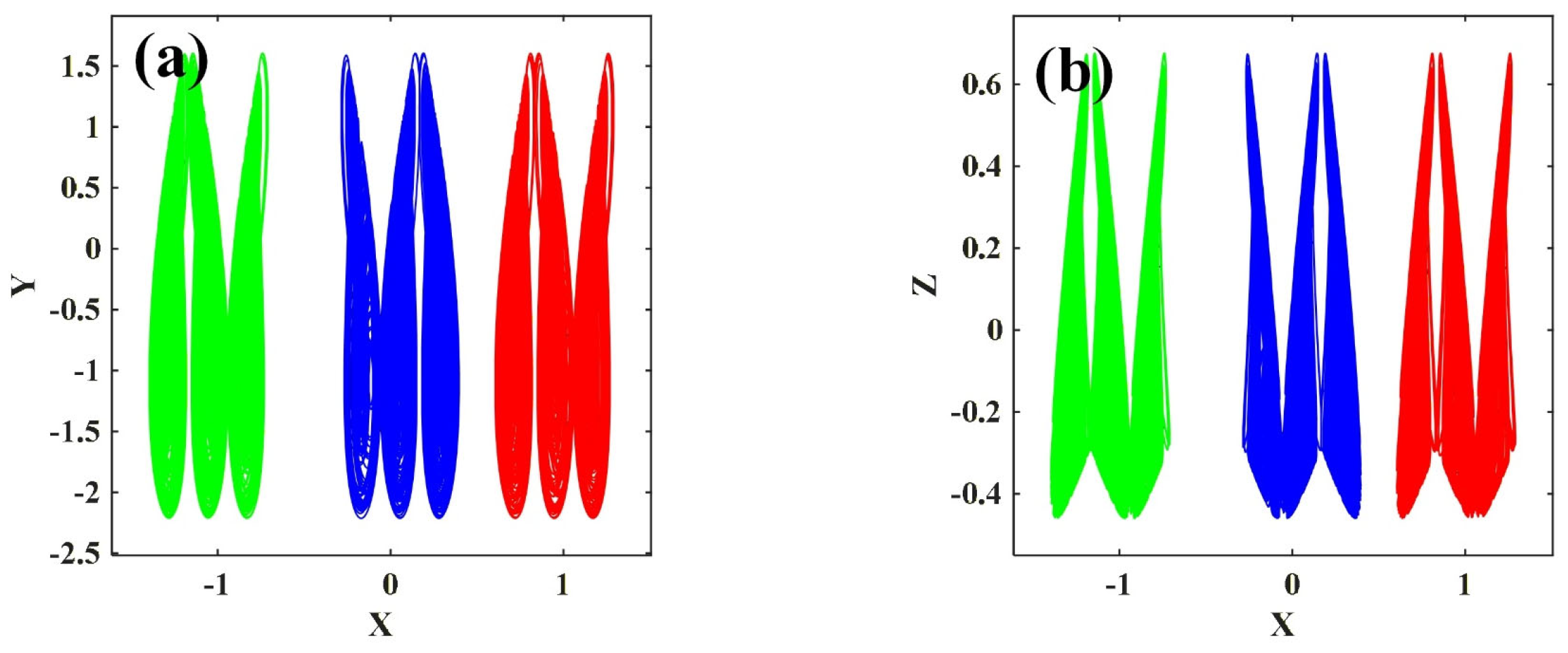
When the first-layer distance parameters are chosen as and the second-layer distance parameters are chosen as , the relatively small spacing introduced by the outer-layer parameters causes the three local theoretical replication regions within each major group to become interconnected, whereas the second-layer parameters still maintain the separation among the three major groups. As shown in Figure 14, the nine theoretical replication regions are reorganized into three coexisting three-scroll attractors. The corresponding initial conditions are chosen as , , and , respectively.
Figure 14.
Phase portraits of three coexisting three-scroll attractors of system (18) with a = 1.22, b = 8.48, , and : (a) phase portrait in the X–Y plane; (b) in the X–Z plane.
When the first-layer distance parameters are chosen as and the second-layer distance parameters are chosen as , the spacing among the three major replication groups is further reduced, allowing all nine theoretical replication regions to be continuously visited by a single trajectory. By taking the initial condition , the single nine-scroll attractor is shown in Figure 15. From the Figure 13, Figure 14 and Figure 15, it can be observed that, by revising the distance parameters, nine separated coexisting attractors can be compressed into different forms of coexisting multi-scroll attractors.
Figure 15.
Phase portraits of the single nine-scroll attractor of system (18) with a = 1.22, b = 8.48, , and : (a) phase portrait in the X–Y plane; (b) in the X–Z plane.
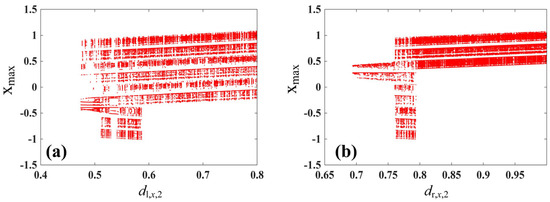
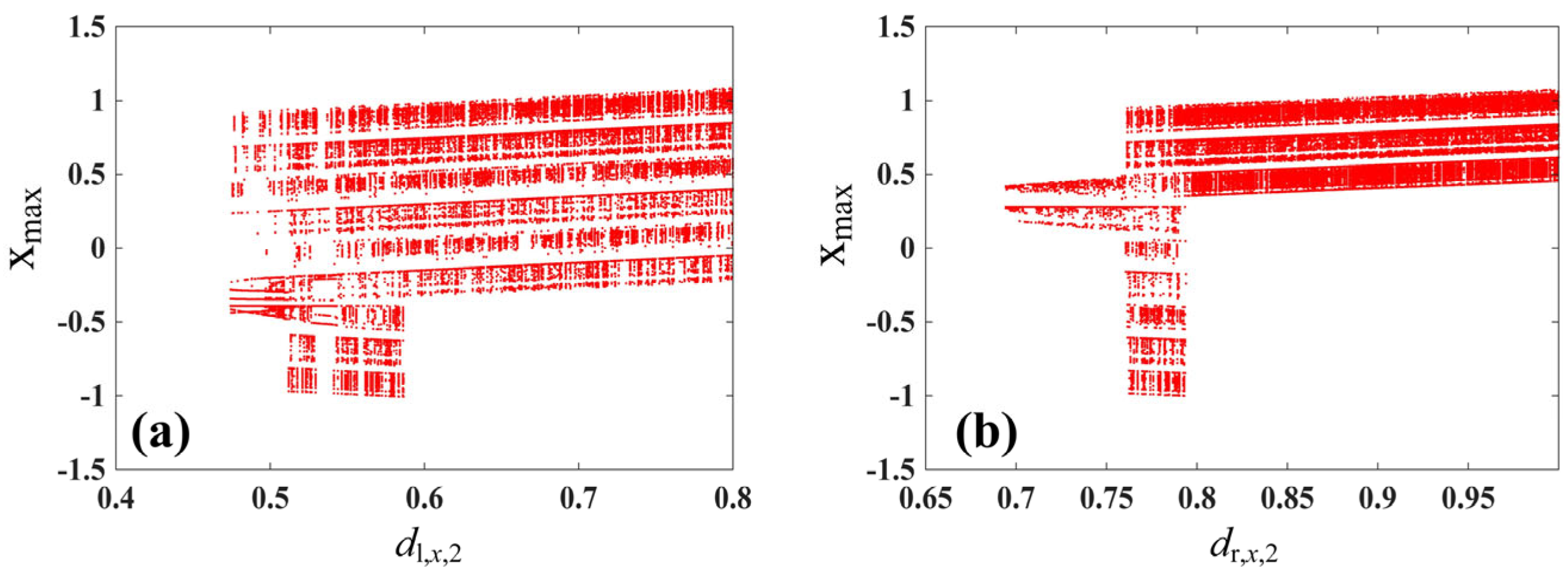
To further investigate the influence of the second-layer distance parameters on the dynamical behavior of the nested triplication system, bifurcation diagrams are calculated by varying and , respectively, while keeping the first-layer parameters fixed at . The local maxima of x(t), denoted by xmax, are selected as the observation variable. As shown in Figure 16, variations in the second-layer distance parameters lead to evident changes in the distribution and organization of the attractor branches, confirming that and effectively regulate the coexisting states of the nested triplication system. It is obvious that smaller values of and lead to a compact multi-scroll structure.
Figure 16.
Bifurcation diagrams of system (18) with a = 1.22, b = 8.48,: (a) , with varying from 0.4 to 0.8; (b) , with varying from 0.65 to 1.0.
4.2. Single 3-Dimensional Triplication
For single triplication along the -, -, and -dimensions, the operation piecewise function turns to be,
The corresponding polarity-balancing functions are
- The corresponding single-layer triplication functions are shown in Figure 17.Figure 17. Single-layer triplication functions of system (21): (a) piecewise linear functions , , and ; (b) polarity-balancing functions , , and .
- The revised three-dimensional triplication system is derived to be
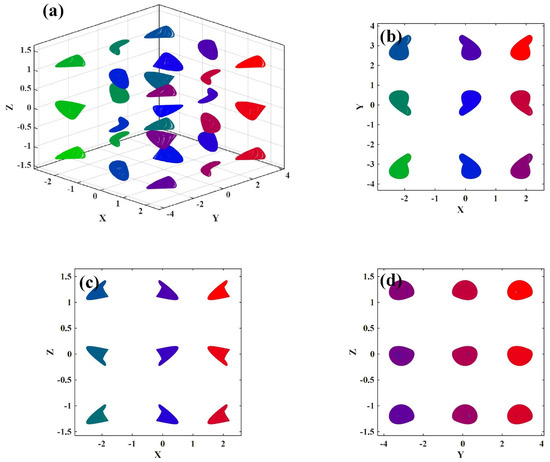
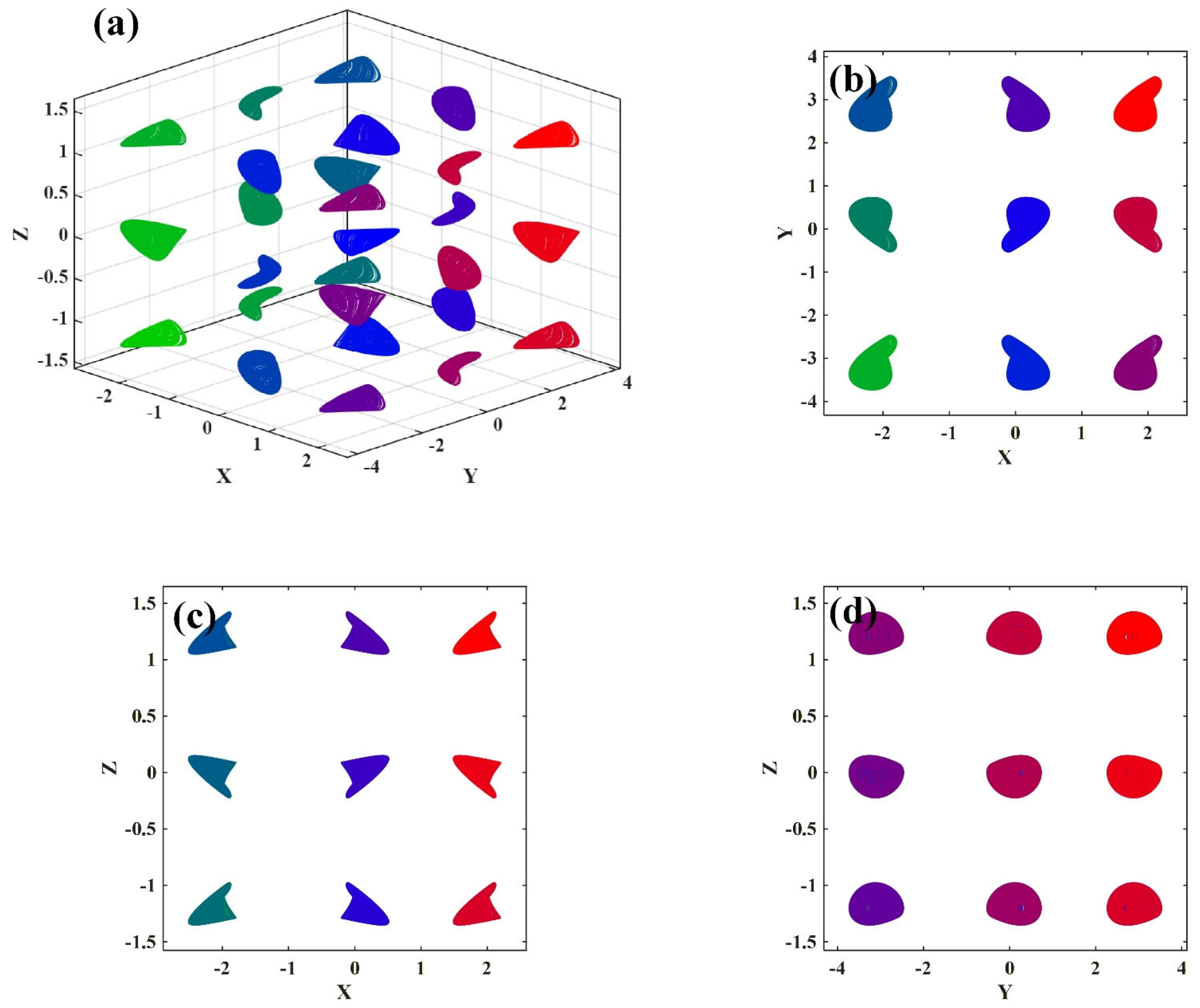
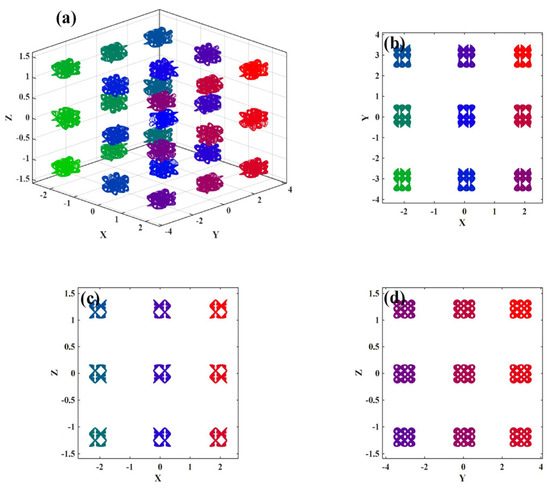
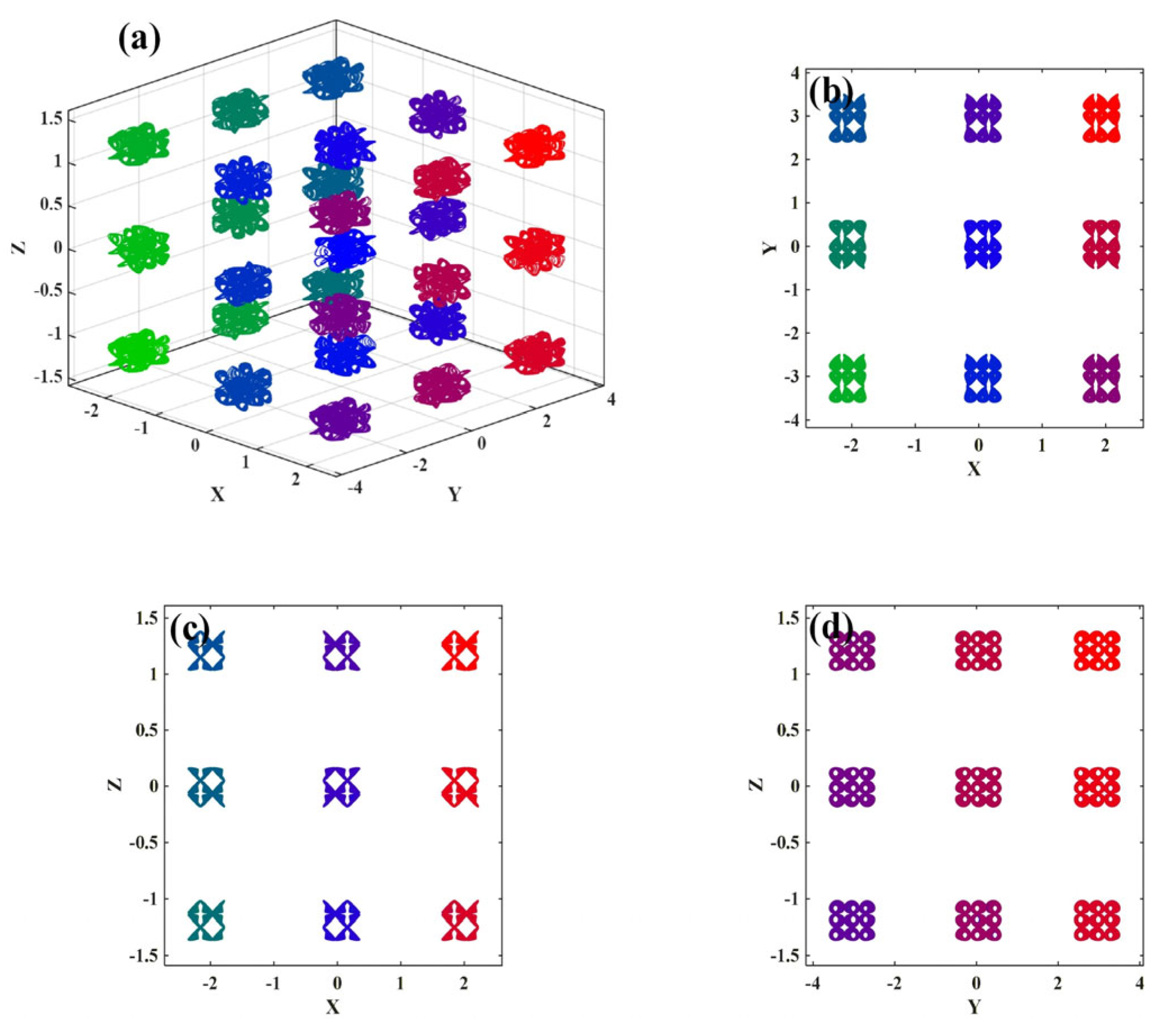
When the distance parameters in the X-, Y-, and Z-directions are chosen as , , and , respectively, the corresponding theoretical centers are , , and . The 27 initial conditions are constructed from the Cartesian product . Owing to the sufficiently large spacing between adjacent replication regions in all three directions, the 27 trajectories converge to their corresponding local attractors, resulting in the spatial array shown in Figure 18.
Figure 18.
Twenty-seven coexisting attractors of system (21) with a = 1.22, b = 8.48, , , and : (a) three-dimensional phase portrait; (b) X–Y plane; (c) X–Z plane; and (d) Y–Z plane.
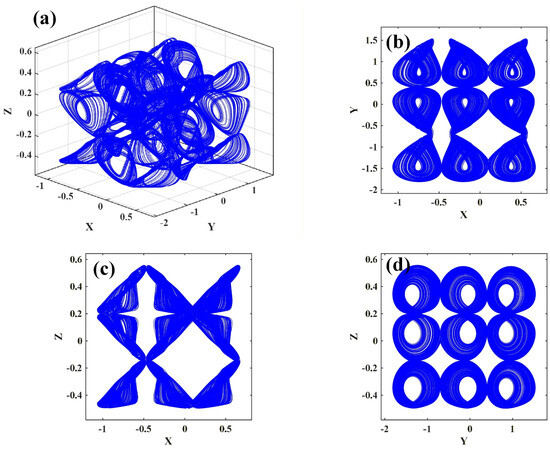
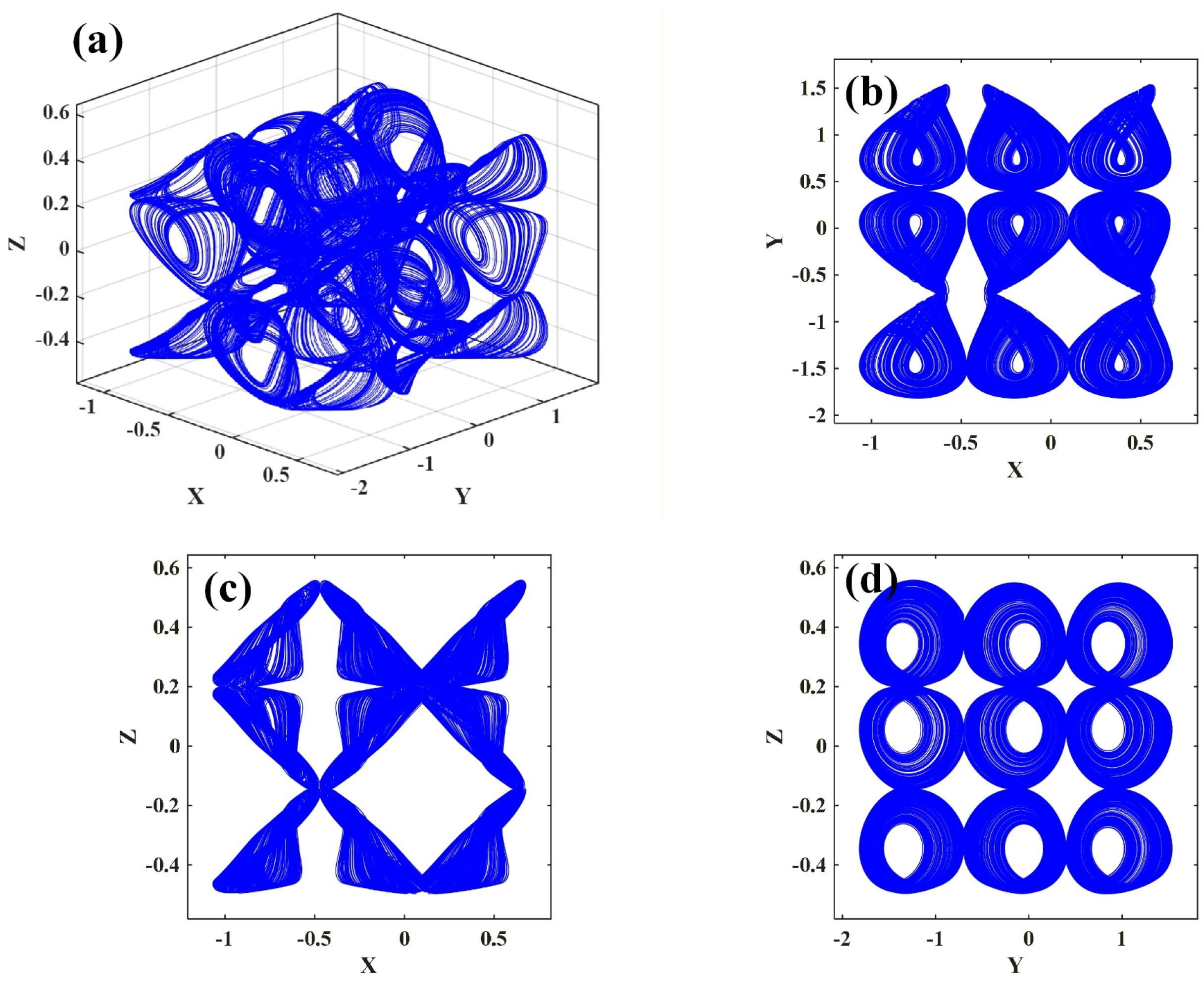
When the distance parameters in the X-, Y-, and Z-directions are chosen as , , and , respectively, the total number of theoretical replication regions remains 27, whereas interconnected transition channels are established between adjacent regions in each direction. By taking as the initial condition, the single 27-scroll attractor is shown in Figure 19. The three two-dimensional projections show that multiple replication regions are continuously visited by the same initial condition, indicating that the resulting state is a single multiscroll attractor formed through the complete merging of all 27 theoretical replication regions rather than 27 coexisting attractors.
Figure 19.
Phase portraits of 27-scroll attractor of system (21) with a = 1.22, b = 8.48, , , and : (a) three-dimensional phase portrait; (b) projection onto the X–Y plane; (c) projection onto the X–Z plane; and (d) projection onto the Y–Z plane.
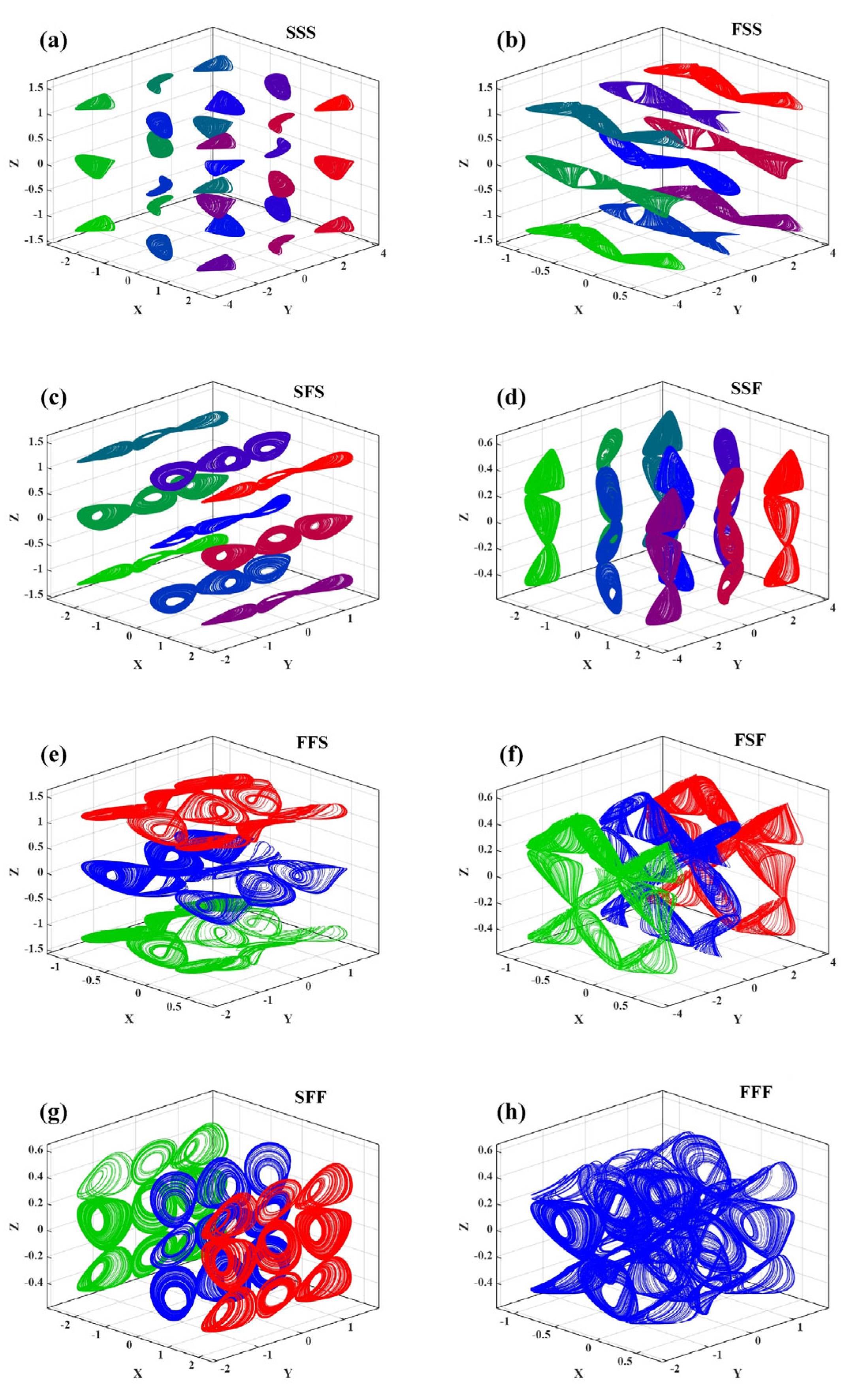
Since the X-, Y-, and Z-directions can each independently exhibit either a separated state (S) or a fused state (F), the single-layer three-direction triplication system possesses a total of 23 = 8 configurations of separated states and fused states. The distance parameter sets corresponding to the separated and fused states are defined as , where each ordered pair denotes . For a separated direction, the three theoretical centers are selected as the initial conditions, whereas for a fused direction, the initial condition is fixed at 0. The corresponding initial conditions for all eight configurations are summarized in Table 1. Accordingly, the number of actual coexisting attractors can be expressed as , where for a separated direction and for a fused direction.
Table 1.
Eight directional separation–fusion configurations, parameter settings, and corresponding initial conditions for the single-layer three-direction triplication system.
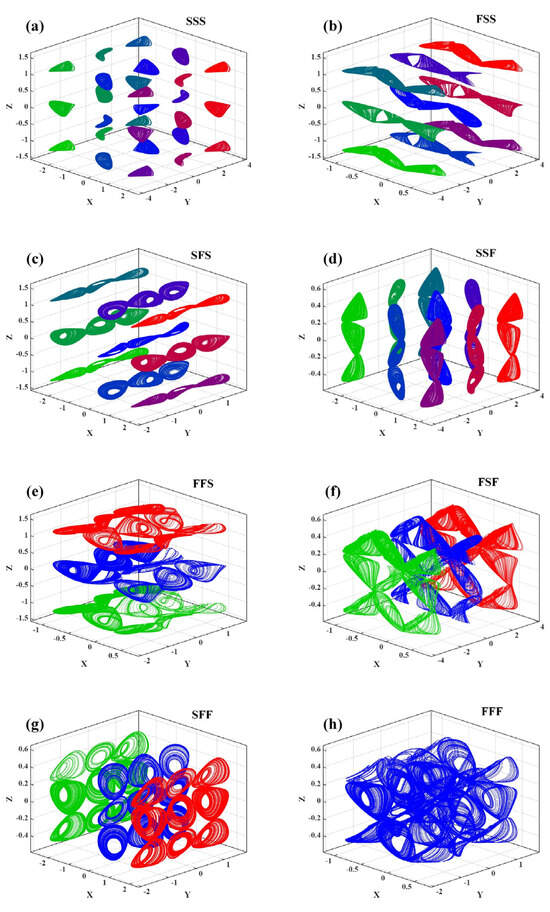
Figure 20 demonstrates that, although the total number of theoretical replication regions remains 27, direction-selective fusion can substantially alter the organization of the resulting attractors. The SSS configuration produces 27 separated coexisting attractors. The FSS, SFS, and SSF configurations involve fusion in only one direction, resulting in nine coexisting three-scroll attractors. The FFS, FSF, and SFF configurations exhibit fusion in two directions, giving rise to three coexisting nine-scroll attractors. Finally, in the FFF configuration, fusion occurs in all three directions, leading to a 27-scroll attractor.
Figure 20.
Eight patterns of coexisting attractor of system (21): (a) SSS; (b) FSS; (c) SFS; (d) SSF; (e) FFS; (f) FSF; (g) SFF; and (h) FFF.
4.3. Double-Layer 3-Dimensional Triplications
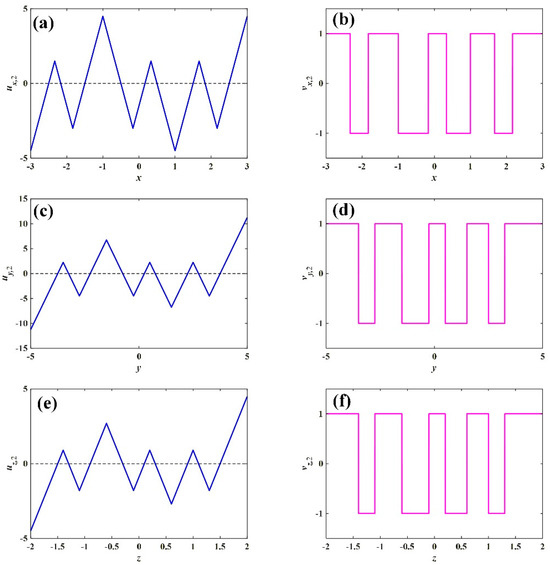
For double-layer triplication in the -, -, and -directions, let the first-layer mappings and polarity-balancing functions be defined as , , and , , The outputs of the first-layer mappings are then employed as the inputs for the second-layer triplication. Hence,
The corresponding polarity-balancing functions are
The corresponding double-layer triplication functions are shown in Figure 21.
Figure 21.
Two-layer triplication functions of Equations (22) and (23): (a) ; (b) ; (c) ; (d) ; (e) ; and (f) .
Accordingly, the double-layer three-dimensional triplication system is described by
Here, and denote the distance parameters of the first and second triplication layers, respectively. Since each mapping layer produces three replicated branches, two nested triplication operations generate replicated positions in each direction in phase space.
When the first- and second-layer distance parameters in the X-direction are chosen as and , respectively, those in the Y-direction are chosen as and , and those in the Z-direction are chosen as and ; system (24) yields attractor centers in each direction. Given the triplication procedure in Equation (9), the initial conditions should be selected according to the theoretical centers of the nested triplication mappings. For each direction q ∈ {x, y, z}, the three centers generated by the first layer are first calculated. Then, for each first-layer center , the three inverse branches of the second-layer mapping are derived as,
where
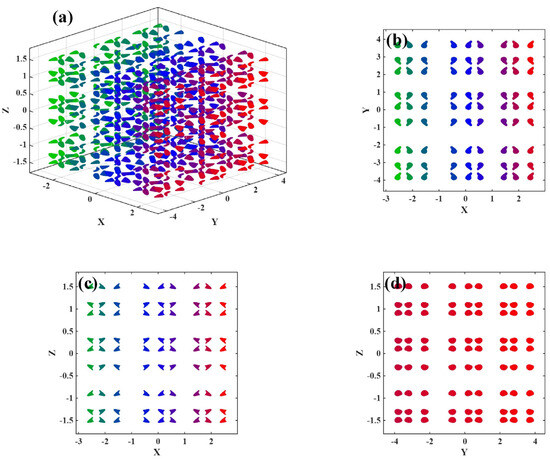
For system (24), the resulting theoretical centers are Cx = {−2.5, −2.1667, −1.5, −0.5, 0.1667, 0.5, 1.5, 1.8333, 2.5}, Cy = {−3.75, −3.25, −2.25, −0.75, 0.25, 0.75, 2.25, 2.75, 3.75}, and Cz = {−1.5, −1.3, −0.9, −0.3, 0.1, 0.3, 0.9, 1.1, 1.5}. Therefore, the initial conditions can be selected according to the set defined by Cx Cy Cz. Since all centers satisfy the valid branch conditions of the nested mappings and are located in distinct theoretical replication regions, the trajectories converge to the corresponding local attractors. The 729 independently calculated attractors are finally obtained, shown in Figure 22.
Figure 22.
Coexisting attractors of system (24) with a = 1.22, b = 8.48, , , , , and : (a) three-dimensional phase portrait; (b) projection onto the X–Y plane; (c) projection onto the X–Z plane; and (d) projection onto the Y–Z plane.
Consequently, the total number of coexisting attractors reaches . In each dimension, when the initial conditions are close to the attractor centers, 729 coexisting attractors can be seen, as shown in Figure 22. In each two-dimensional projection, 9 × 9 attractors can be captured.
Similarly, when the first- and second-layer distance parameters in the X-direction are revised to be and , respectively, those along the Y-direction are chosen as and , and those in the Z-direction are chosen as and ; the relatively small distance parameters in the first-layer mappings compress the local theoretical replication regions within each major group, whereas the large second-layer distance parameters preserve the separation among different major groups. Consequently, the 729 theoretical replication regions are reorganized into 27 separated attractors, each consisting of 27 interconnected replication regions and exhibiting a 27-scroll attractor, as shown in Figure 23.
Figure 23.
Coexisting 27-scroll attractors of system (24) with a = 1.22, b = 8.48, , , , , and : (a) three-dimensional phase portrait; (b) projection onto the X–Y plane; (c) projection onto the X–Z plane; and (d) projection onto the Y–Z plane.
5. Conclusions and Discussion
In this work, by virtue of the targeted revision of feedback mechanisms within dynamical systems, we delve into the underlying hidden mechanism governing the tripling of coexisting attractors. It is proven that the principle underlying the doubling of coexisting attractors can be generalized and extended, enabling the generation of coexisting attractors with tripling or power-law scaling and an exponential increase in quantity. Notably, the meticulously designed combination of absolute value functions and signum functions serves as a foundational approach to fulfill this valuable task.
In contrast to directly embedding unit-slope piecewise linear functions, polarity balancing with signum functions enables the generation of similar attractors in the negative-slope regions of piecewise linear functions. This further boosts the number of coexisting attractors, shifting the increase of attractor numbers from linear growth to power-based growth. As found in this work, by adjusting the segmentation number of piecewise linear functions and the corresponding signum functions to balance the polarity of system equations, the attractor self-reproducing in quantity by 3n can be thereby further achieved. Furthermore, these coexisting attractors can be freely organized into multi-scroll attractors by leveraging the distance-regulation parameters embedded in piecewise linear functions and signum functions. These breakthroughs hold profound value and significance for enhancing chaos-based engineering applications, including hidden attractors [39,40].
Author Contributions
Conceptualization, C.L., Y.Y. and Z.L.; methodology, C.L. and Y.Y.; software, Y.Y. and H.F.; validation, Y.Y. and H.F.; formal Analysis, C.L. and Y.Y.; investigation, C.L. and Y.Y.; writing—original draft preparation, C.L. and Y.Y.; writing—review and editing, Z.L. and T.K.; visualization, C.L. and Y.Y.; supervision, C.L., Z.L. and T.K.; project administration, C.L. and Z.L.; and funding acquisition, C.L. All authors have read and agreed to the published version of the manuscript.
Funding
This work was supported financially by the National Natural Science Foundation of China (Grant No.: 62371242).
Data Availability Statement
The data supporting the conclusions of this article is within this paper.
Conflicts of Interest
The authors declare no conflicts of interest.
References
- Jiang, Y.; Yuan, F.; Li, Y. A dual memristive Wien-bridge chaotic system with variable amplitude and frequency. Chaos 2020, 30, 123117. [Google Scholar] [CrossRef] [Scilit]
- Zang, H.; Gu, Z.; Lei, T.; Li, C.; Jafari, S. Coexisting chaotic attractors in a memristive system and their amplitude control. Pramana 2020, 94, 62. [Google Scholar] [CrossRef] [Scilit]
- Shen, M.; Li, C.; Cen, X.; Zhao, M.; Xu, Y.; Minati, L. A Chaotic Jerk Oscillator with Complete Control via Fractional Exponentiation and Its Experimental Analog Circuit Realization. Symmetry 2025, 17, 174. [Google Scholar] [CrossRef] [Scilit]
- Li, C.; Sprott, J.C. Variable-boostable chaotic flows. Optik 2016, 127, 10389–10398. [Google Scholar] [CrossRef] [Scilit]
- He, J.; Lai, B. Investigation and realization of novel chaotic system with one unstable equilibrium and symmetric coexisting attractors. Eur. Phys. J. Spec. Top. 2021, 230, 1855–1862. [Google Scholar] [CrossRef] [Scilit]
- Shi, Q.-Y.; Huang, X.; Yuan, F.; Li, Y.-X. Design and FPGA implementation of multi-wing chaotic switched systems based on a quadratic transformation. Chin. Phys. B 2021, 30, 020507. [Google Scholar] [CrossRef] [Scilit]
- Li, C.; Li, Z.; Jiang, Y.; Lei, T.; Wang, X. Symmetric Strange Attractors: A Review of Symmetry and Conditional Symmetry. Symmetry 2023, 15, 1564. [Google Scholar] [CrossRef] [Scilit]
- Hu, Z.; Li, C.; Qi, X.; Antoniades, I.P.; Volos, C. A New Hyperchaotic Map and Its Manifold of Conditional Symmetry. Symmetry 2026, 18, 212. [Google Scholar] [CrossRef] [Scilit]
- Li, C.; Sprott, J.C.; Xing, H. Constructing chaotic systems with conditional symmetry. Nonlinear Dyn. 2017, 87, 1351–1358. [Google Scholar] [CrossRef] [Scilit]
- Li, Y.; Li, C.; Zhang, S.; Chen, G.; Zeng, Z. A self-reproduction hyperchaotic map with compound lattice dynamics. IEEE Trans. Ind. Electron. 2022, 69, 10564–10572. [Google Scholar] [CrossRef] [Scilit]
- Yuan, F.; Jin, Y.; Li, Y. Self-reproducing chaos and bursting oscillation analysis in a meminductor-based conservative system. Chaos 2020, 30, 053127. [Google Scholar] [CrossRef] [Scilit]
- Shen, M.; Li, C.; Wang, L.; Xue, Y.; Qi, X. More Diagonal Distributions of Coexisting Attractors. Symmetry 2025, 17, 1331. [Google Scholar] [CrossRef] [Scilit]
- Gu, Y.; Li, G.; Xu, X.; Song, X.; Wu, S. Multistable dynamics and attractors self-reproducing in a new hyperchaotic complex Lü system. Chaos 2023, 33, 093111. [Google Scholar] [CrossRef] [Scilit]
- Li, C.; Lei, T.; Wang, X.; Chen, G. Dynamics editing based on offset boosting. Chaos 2020, 30, 063124. [Google Scholar] [CrossRef] [Scilit]
- Liu, Y.; Li, C.; Lei, T.; Jiang, F.; Qi, X. Memristor-dominated dynamics editing of Chialvo neuron and its application in reservoir computing. Nonlinear Dyn. 2026, 114, 779. [Google Scholar] [CrossRef] [Scilit]
- Hussan, I.; Zhao, M.; Zhang, X. Two-memristor-based maps with infinitely many hyperchaotic attractors. Chaos Solitons Fractals 2025, 191, 115904. [Google Scholar] [CrossRef] [Scilit]
- Liu, X.; Mou, J.; Zhang, Y.; Cao, Y. A new hyperchaotic map based on discrete memristor and meminductor: Dynamics analysis, encryption application, and DSP implementation. IEEE Trans. Ind. Electron. 2024, 71, 5094–5104. [Google Scholar] [CrossRef] [Scilit]
- Cao, B.; Ma, M.; Lu, S.; Li, C. Multiscale dynamics of special memristive ion channels in a neural circuit. Chaos 2026, 36, 073107. [Google Scholar] [CrossRef] [Scilit]
- Cao, B.; Gu, H.; Zhao, Z. Various coherence resonances and fast-slow dynamics of bursting/spiking patterns in auditory hair bundles. Chaos Solitons Fractals 2025, 200, 116963. [Google Scholar] [CrossRef] [Scilit]
- Laskaridis, L.; Volos, C.; Nistazakis, H.; Meletlidou, E. Exploring the dynamics of a multistable general model of discrete memristor-based map featuring an exponentially varying memristance. Integration 2024, 95, 102131. [Google Scholar] [CrossRef] [Scilit]
- Tang, D.; Wang, C.; Lin, H.; Yu, F. Dynamics analysis and hardware implementation of multi-scroll hyperchaotic hidden attractors based on locally active memristive Hopfield neural network. Nonlinear Dyn. 2024, 112, 1511–1527. [Google Scholar] [CrossRef] [Scilit]
- Li, Y.; Li, C.; Tang, Q.; Yu, W.; Xia, M. Offset boosting-based attractor doubling of Rulkov neuron. Nonlinear Dyn. 2024, 112, 14379–14392. [Google Scholar] [CrossRef] [Scilit]
- Wei, Z.; Zhu, B.; Escalante-González, R.J. Existence of periodic orbits and chaos in a class of three-dimensional piecewise linear systems with two virtual stable node-foci. Nonlinear Anal. Hybrid Syst. 2021, 43, 101114. [Google Scholar] [CrossRef] [Scilit]
- Wang, F.; Wei, Z.; Zhang, W.; Moroz, I. Coexistence of three heteroclinic cycles and chaos analyses for a class of 3D piecewise affine systems. Chaos 2023, 33, 023108. [Google Scholar] [CrossRef] [Scilit]
- Wei, Z.; Li, Y.; Moroz, I.; Zhang, W. Melnikov-type method for a class of planar hybrid piecewise-smooth systems with impulsive effect and noise excitation: Heteroclinic orbits. Chaos 2022, 32, 103127. [Google Scholar] [CrossRef] [Scilit]
- Zhou, L.; Wang, C.; Zhou, L. Generating hyperchaotic multi-wing attractor in a 4D memristive circuit. Nonlinear Dyn. 2016, 85, 2653–2663. [Google Scholar] [CrossRef] [Scilit]
- Rech, P.C. Self-excited and hidden attractors in a multistable jerk system. Chaos Solitons Fractals 2022, 164, 112614. [Google Scholar] [CrossRef] [Scilit]
- Yang, L.; Lai, Q. Construction and implementation of discrete memristive hyperchaotic map with hidden attractors and self-excited attractors. Integration 2024, 94, 102091. [Google Scholar] [CrossRef] [Scilit]
- Shi, X.; Su, Y.; Yang, X.; Feng, W.; Zhang, X.; Chen, Z.; Wen, G.; Wen, H. Lossless Frequency-Domain Image Encryption via 3D Exponential Hyper-Chaotic Map and Integer Lifting Wavelet Transform. Axioms 2026, 15, 315. [Google Scholar] [CrossRef] [Scilit]
- Yu, F.; Kong, X.; Yao, W.; Zhang, J.; Cai, S.; Lin, H.; Jin, J. Dynamics analysis, synchronization and FPGA implementation of multiscroll Hopfield neural networks with non-polynomial memristor. Chaos Solitons Fractals 2024, 179, 114440. [Google Scholar] [CrossRef] [Scilit]
- Lian, Y.; Li, C.; Liu, W.; Chen, G. A Compact Piecewise-Linear Circuit Unit for Efficient Multi-Wing Attractor Generation. IEEE Trans. Circuits Syst. II Express Briefs 2026, 73, 728–732. [Google Scholar] [CrossRef] [Scilit]
- Li, Z.; Zhou, C.; Wang, M. Symmetrical coexisting attractors and extreme multistability induced by memristor operating configurations in SC-CNN. AEU-Int. J. Electron. Commun. 2019, 100, 127–137. [Google Scholar] [CrossRef] [Scilit]
- Li, Y.; Liu, J.; Hao, Z.; Liu, H.; Zhang, X. Multi-scroll hidden hyperchaotic attractor and extreme multistability with offset boosting in a memristor-coupled complex-valued laser network. Eur. Phys. J. Plus 2024, 139, 168. [Google Scholar] [CrossRef] [Scilit]
- Yu, F.; Guo, R.; Zheng, M.; Yao, W.; Zhang, D.; Cai, S. Novel approach to time series forecasting based on memristive Hopfield Neural Network with hidden heterogeneous and homogeneous extreme multistability. Chaos Solitons Fractals 2026, 210, 118626. [Google Scholar] [CrossRef] [Scilit]
- Lin, H.; Wang, C.; Sun, Y. A Universal Variable Extension Method for Designing Multiscroll/Wing Chaotic Systems. IEEE Trans. Ind. Electron. 2024, 71, 7806–7818. [Google Scholar] [CrossRef] [Scilit]
- Lin, H.; Wang, C.; Yu, F.; Xu, C.; Hong, Q.; Yao, W.; Sun, Y. An Extremely Simple Multi-Wing Chaotic System: Dynamics Analysis, Encryption Application and Hardware Implementation. IEEE Trans. Ind. Electron. 2021, 68, 12708–12719. [Google Scholar] [CrossRef] [Scilit]
- Ma, J.; Wu, X.; Chu, R.; Zhang, L. Selection of multi-scroll attractors in Jerk circuits and their verification using PSpice. Nonlinear Dyn. 2014, 76, 1951–1962. [Google Scholar] [CrossRef] [Scilit]
- Ma, J.; Zhou, P.; Ahmad, B.; Ren, G.; Wang, C. Chaos and multi-scroll attractors in RCL-shunted junction coupled Jerk circuit connected by memristor. PLoS ONE 2018, 13, e0191120. [Google Scholar] [CrossRef] [Scilit]
- Wei, Z.; Wang, F. Two-Parameter Bifurcations and Hidden Attractors in a Class of 3D Linear Filippov Systems. Int. J. Bifurc. Chaos 2024, 34, 2450052. [Google Scholar] [CrossRef] [Scilit]
- Zhang, L.; Liu, Y.; Wei, Z.; Jiang, H.; Bi, Q. A Class of Two-Dimensional Rational Maps with Self-Excited and Hidden Attractors. Chin. Phys. B 2022, 31, 030503. [Google Scholar] [CrossRef] [Scilit]

Disclaimer/Publisher’s Note: The statements, opinions and data contained in all publications are solely those of the individual author(s) and contributor(s) and not of MDPI and/or the editor(s). MDPI and/or the editor(s) disclaim responsibility for any injury to people or property resulting from any ideas, methods, instructions or products referred to in the content. |
© 2026 by the authors. Licensee MDPI, Basel, Switzerland. This article is an open access article distributed under the terms and conditions of the Creative Commons Attribution (CC BY) license.