


Abstract
Bursting is fundamental to neural information encoding and plays critical roles in rhythm generation, sensory processing, and motor control. However, the dynamical mechanisms by which multiple parameters coordinately regulate bursting properties in mesencephalic trigeminal neurons remain unclear. Here, using fast–slow decomposition we reveal three distinct asymmetries in the regulation of bursting dynamics by four key parameters, gNaR, gNaP, Iapp, and kb. First, asymmetric shifts in the SNLC and subH bifurcation curves in the two-parameter plane, rather than symmetric displacements, underlie the expansion or compression of the subH–SNLC window, directly modulating bursting duration (BD) and inter-burst interval (IBI). Second, gNaP produces a paradoxical asymmetry: although it narrows the subH–SNLC window, it simultaneously reduces the per-spike consumption of the slow variable hp via sustained depolarization, thereby prolonging BD while shortening IBI, a dissociation that cannot be predicted from the bifurcation window alone. Third, Iapp induces an opposing asymmetry: it widens the subH–SNLC window while shortening IBI, revealing that bifurcation expansion and the silent phase duration are not monotonically coupled. All four parameters increase spike count per burst (SCPB) and BD, yet their effects on IBI diverge, with gNaR and kb extending it whereas gNaP and Iapp shorten it, establishing that active and silent phases are asymmetrically regulated. Our findings demonstrate that bursting characteristics emerge from the cooperative interplay of bifurcation positions, membrane potential, slow-variable dynamics, and hysteresis. These results provide dynamical insights into the asymmetric regulation of bursting rhythms by ion channel parameters, and may offer theoretical guidance for neuromodulation strategies targeting channel-related disorders.
1. Introduction
Neuronal electrical activities exhibit diverse nonlinear patterns that are fundamental to brain function and dysfunction [1,2,3,4,5,6]. Among these patterns, bursting, characterized by alternating phases of high-frequency spike trains and quiescence, serves as a core firing mode for neural information encoding [7,8,9,10]. Compared with isolated spikes, bursting provides a more reliable and robust strategy for information transmission, particularly in noisy neural environments [11,12,13]. Bursting has been implicated in various physiological processes, including rhythm generation, sensory processing, and motor control [14,15,16], while aberrant bursting dynamics are closely linked to neurological disorders such as Parkinson’s disease [17,18], epilepsy [19,20], and depressive disorder [21]. Understanding the regulatory mechanisms of bursting is therefore of fundamental importance in computational neuroscience and neuropathology.
The mesencephalic trigeminal neurons (Mes V) provide an ideal model system for investigating bursting dynamics. These unique primary sensory neurons, located in the midbrain trigeminal nucleus, directly mediate orofacial proprioceptive information and play a critical role in mastication, bite force regulation, and oral motor coordination [22,23]. Aberrant bursting activity in Mes V neurons is associated with pathological conditions, including trigeminal neuralgia, sleep bruxism, and other temporomandibular motor dysfunctions [24,25]. Mes V neurons are known to exhibit robust bursting patterns. [26]. Experimental and computational studies have demonstrated that the persistent sodium current (INaP) and the resurgent sodium current (INaR), both mediated by Nav1.6 sodium channels, are two key ionic currents regulating Mes V bursting [27,28,29]. The persistent sodium current activates at subthreshold voltages, promotes membrane depolarization, generates subthreshold oscillations, and provides the slow dynamics that drive burst generation. In contrast, the resurgent sodium current is activated during spike repolarization and regulates intraburst firing, burst stability, and spike timing through its interaction with the slow inactivation of sodium channels [30]. Meanwhile, the applied current (Iapp) controls neuronal excitability by shifting the membrane potential and altering transitions among resting, oscillatory, and bursting states [31]. From the perspective of nonlinear dynamics, these firing behaviors originate from the interaction between fast membrane variables and slow gating variables, making fast–slow dynamics analysis and bifurcation analysis powerful tools for revealing the dynamical mechanisms of bursting [32,33,34,35].
Despite these advances, the ionic regulation of Mes V bursting is still not fully understood. Previous studies have mainly focused on the individual effects of INaP or INaR, or on transitions between different firing states under single-parameter variations [30]. However, bursting is inherently a symmetry-breaking process: during each cycle, the system must “choose” between continuing the active burst phase or transitioning to the silent phase, and this choice is shaped by the relative positions of multiple bifurcation points. Within the fast–slow decomposition framework, burst initiation and termination are governed by the interplay of two key bifurcations—the subcritical Hopf (subH) and the saddle-node bifurcation of limit cycles (SNLC). Critically, these bifurcation points do not shift symmetrically when parameters change. Rather, their asymmetric displacements determine not only the total duration of a burst, but also the fine structure of the firing pattern, including the number of spikes per burst and the duration of the intervening silence. Despite the importance of this asymmetry, the combined influences of the persistent sodium conductance (gNaP), the resurgent sodium conductance (gNaR), the applied current (Iapp), and the kinetic parameter (kb) on bursting characteristics have not been systematically investigated. Moreover, it remains unclear whether the observed variations in burst duration, spike number, inter-burst interval, and bursting period are determined solely by bifurcation positions, or whether additional factors such as membrane depolarization, slow-variable evolution, and hysteresis—all of which contribute to asymmetric regulation of the active versus silent phases—also play essential roles.
Currently, the firing properties of bursting under multi-parameter regulation remain largely unexplored in Mes V neurons, and the underlying asymmetry mechanisms are poorly understood. To address these gaps, the present study systematically investigates—through numerical simulations—the individual and combined effects of multiple parameters on bursting behavior. Furthermore, we employ bifurcation theory to uncover the asymmetric regulatory dynamics that govern these effects. Our analysis reveals three distinct asymmetries. First, in the two-parameter bifurcation plane, gNaR and kb induce asymmetric shifts in the SNLC and subH curves, causing non-uniform expansion of the subH–SNLC window. Second, gNaP produces a paradoxical asymmetry: although it narrows the bifurcation window, it simultaneously reduces the per-spike consumption of the slow variable hp via sustained depolarization, thereby prolonging burst duration while shortening inter-burst interval—a dissociation that cannot be predicted from the bifurcation window alone. Third, Iapp induces an opposing asymmetry: it widens the bifurcation window yet shortens the inter-burst interval, revealing that bifurcation expansion and the silent phase duration are not monotonically coupled.
Collectively, our study makes two novel contributions. First, we provide the first systematic characterization of how these four parameters cooperatively modulate both active (burst) and silent (inter-burst) phases, revealing asymmetric and sometimes opposing effects. Second, we demonstrate that bursting properties are not determined by bifurcation positions alone, but emerge from the cooperative interplay of bifurcation positions, membrane depolarization, slow-variable dynamics, and hysteresis. In addition, by framing these cooperative effects within a symmetry-breaking perspective, we show that bursting rhythm generation reflects the dynamic competition among multiple symmetry-breaking pathways. These findings provide a more comprehensive dynamical framework for understanding how ion channel parameters regulate bursting rhythms and offer testable theoretical predictions for channel-related neuromodulation and neurological disorders involving abnormal bursting.
2. Model and Methods
2.1. Model
The mesencephalic trigeminal neuron model utilized in this work originates from reference [30], which was constructed using experimental measurements. Its mathematical formulation is presented below.
Here, V denotes membrane potential (mV). C stands for membrane capacitance (pF). n represents the gating variable of the potassium current (IK). ht and hp, which govern the inactivation of the transient (INaT) and persistent (INaP) sodium current, respectively. br is a block/unblock variable describing the blocking and unblocking dynamics of INaR channels. hr is an assumed competing inactivation variable paired with br. IL denotes the leak current. Iapp refers to the injected current measured in picoamperes (pA). The ionic currents are described by the following equations:
The persistent sodium current (INaP) is a subthreshold-activated, slowly inactivating inward current that has been extensively characterized in Mes V neurons [26,28]. It is critical for amplifying membrane resonance, generating subthreshold oscillations, and promoting rhythmic bursting [8,26,28]. In the present model, hp is the slow inactivation gating variable that evolves with a time constant on the order of seconds, providing the slow negative feedback essential for burst generation [7,26]. The resurgent sodium current, INaR, activates upon membrane repolarization following a brief depolarization and flows at the peak of the afterhyperpolarization, thereby supporting high-frequency firing [36,37,38,39]. The exponents 3 and 5 for the br and hr terms, respectively, are chosen to reproduce the rise and decay kinetics of the resurgent current observed experimentally [30]. The fast transient sodium current (INaT) and the potassium current (IK) are primarily responsible for action potential generation and repolarization, respectively [40]. IL is the background ionic flux through voltage-independent membrane channels.
The maximal conductance (in nS) for the potassium, transient sodium, persistent sodium, resurgent sodium, and leakage currents are given by gK, gNaT, gNaP, gNaR, and gL, respectively. ENa, EK, and EL denote the reversal potentials for the sodium, potassium, and leak currents, respectively. The voltage-dependent steady-state functions and time relaxation functions in the system of equations are given as follows.
Unless otherwise specified, the parameter values are set as listed in Table 1, with Iapp, gNaP, gNaR and kb treated as control parameters in this study.
Table 1.
Ion channel parameters used in the Mes V neuron model.
2.2. Methods
From a dynamical symmetry perspective, periodic bursting can be viewed as a limit cycle with temporal translation symmetry, whose structural stability is governed by the interplay between fast spikes and slow modulations. To investigate the dynamical mechanisms underlying bursting generation, we employed fast–slow decomposition and bifurcation analysis of the fast subsystem [41,42,43,44]. In this paper, Equations (1)–(6) are referred to as the full system. The gating variable hp possesses a relatively large time constant; hence, Equation (4) is defined as the slow subsystem, and the system constructed by the remaining equations excluding Equation (4) is termed the fast subsystem. In this framework, the transition from quiescence to repetitive firing—and the subsequent return—can be understood as successive bifurcation events that effectively break the temporal symmetry of the resting state, as the system periodically escapes from and returns to the resting attractor. The slow variable hp is adopted as a bifurcation parameter for analyzing the bursting dynamics of the full system [45,46,47,48].
The governing equations are solved numerically using a fourth-order Runge–Kutta (RK4) method with a fixed time step of 0.001 ms, implemented in C language. Bifurcation analyses are performed using the XPPAUT software package (version 8.0) [49].
3. Results
3.1. Bifurcation Analysis for Identifying Bursting Regions
3.1.1. Bifurcation Analysis of the Full System
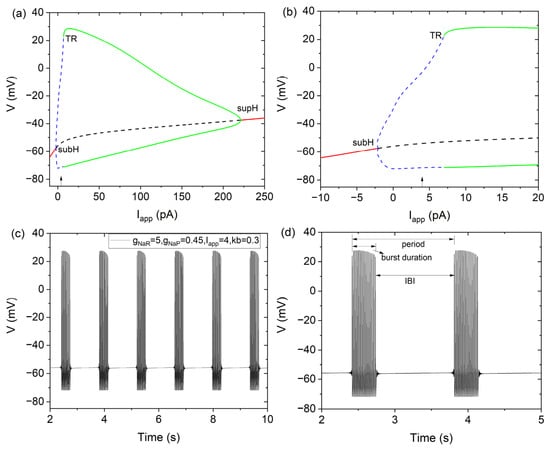
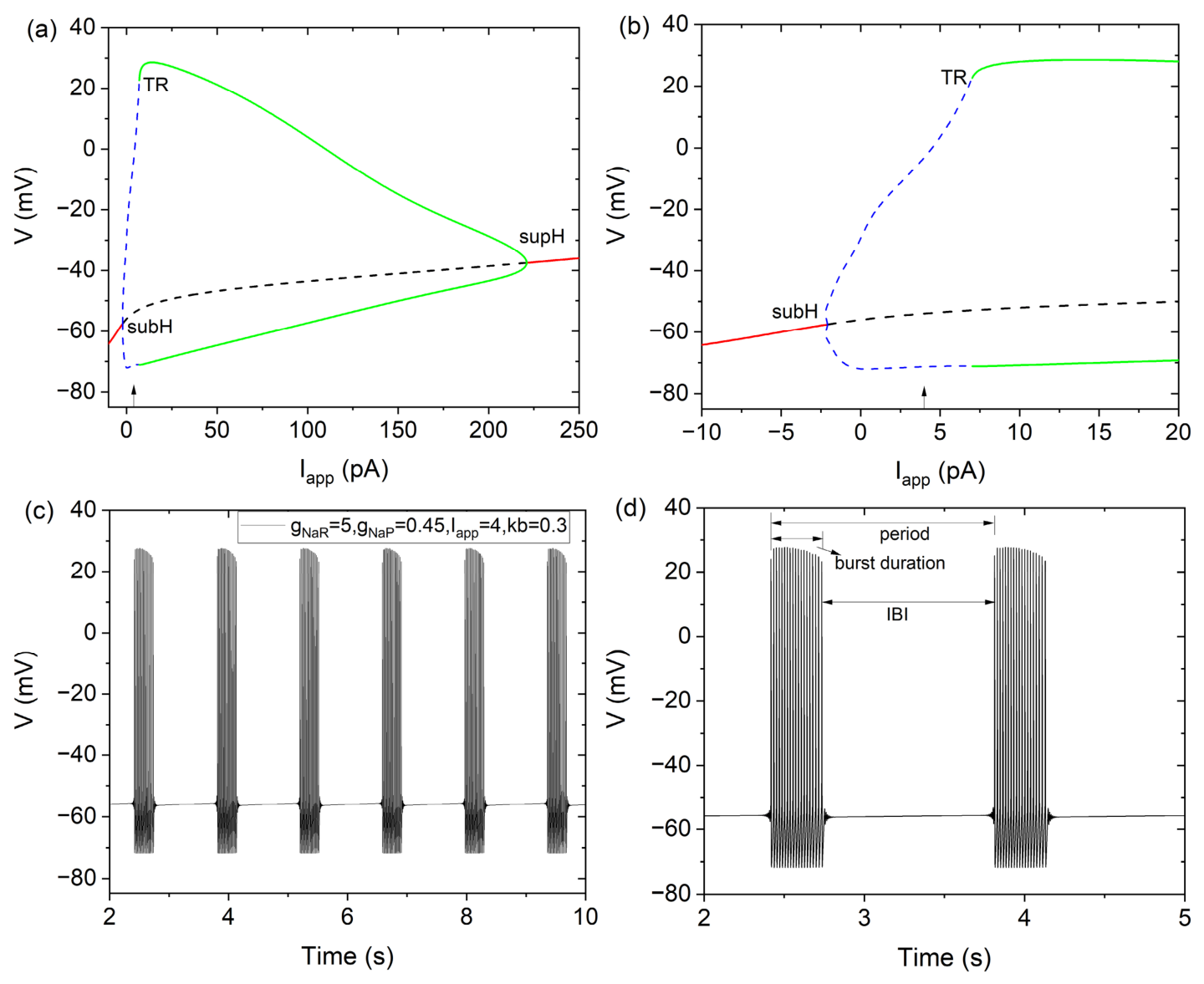
The bifurcation structure of this neuronal model for Iapp is illustrated in Figure 1a. In Figure 1a, stable equilibria are represented by red solid lines, whereas unstable equilibria are marked by black dashed lines. Blue dashed lines denote unstable limit cycles. By contrast, stable limit cycles are indicated by green solid lines. A subcritical Hopf bifurcation (subH, Iapp = –2.0947 pA) occurs as Iapp increases, marking the transition from a stable to an unstable equilibrium state. Meanwhile, an unstable limit cycle bifurcates from the subH point and becomes a stable limit cycle through a torus (TR, Iapp = 7.0309 pA) bifurcation. This sequence of bifurcations constitutes a cascade of symmetry-breaking events: the resting state loses stability at subH, and the system selects an oscillatory trajectory that eventually stabilizes at TR. With further growth of Iapp, the stable limit cycle eventually disappears via a supercritical Hopf bifurcation (supH, Iapp = 221.0116 pA), and the system returns to the stable equilibrium state. Between the subH and TR points, the system exhibits bursting dynamics. In the interval between the TR and supH points, the model displays spiking behavior. At Iapp = 4 pA (as tagged with an arrow in Figure 1b), the system operates within the bursting regime, where the trajectory repeatedly breaks symmetry by escaping from and returning to the resting attractor, generating the periodic burst pattern shown in Figure 1c. The bursting period (BP) is 1.3954 s, with 19 spikes contained within each burst. The inter-burst interval (IBI) is 1.0786 s, and the burst duration (BD) equals 0.3168 s, as shown in Figure 1d.
Figure 1.
Bifurcation diagrams and bursting time series of the full system. (a) Bifurcation diagram; (b) Magnified partial view of figure (a); (c) Time series of bursting activity at Iapp = 4 pA; (d) Magnified partial view of figure (c). The red solid lines and black dashed lines represent stable and unstable equilibrium points, respectively. The green solid lines and blue dashed lines represent stable and unstable limit cycles, respectively. The arrow indicates the position where Iapp = 4 pA. Control parameters: gNaR = 5 nS, gNaP = 0.45 nS, kb = 0.3.
3.1.2. Bursting with Varied Parameters
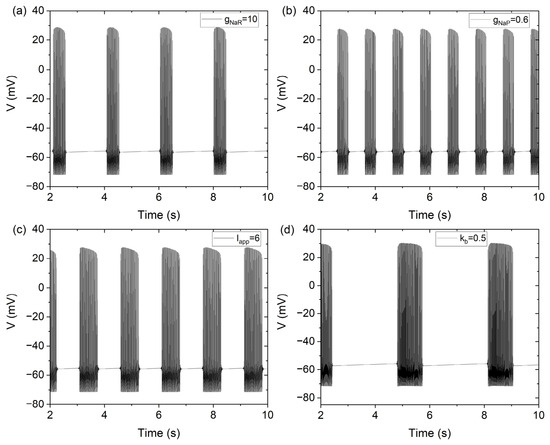
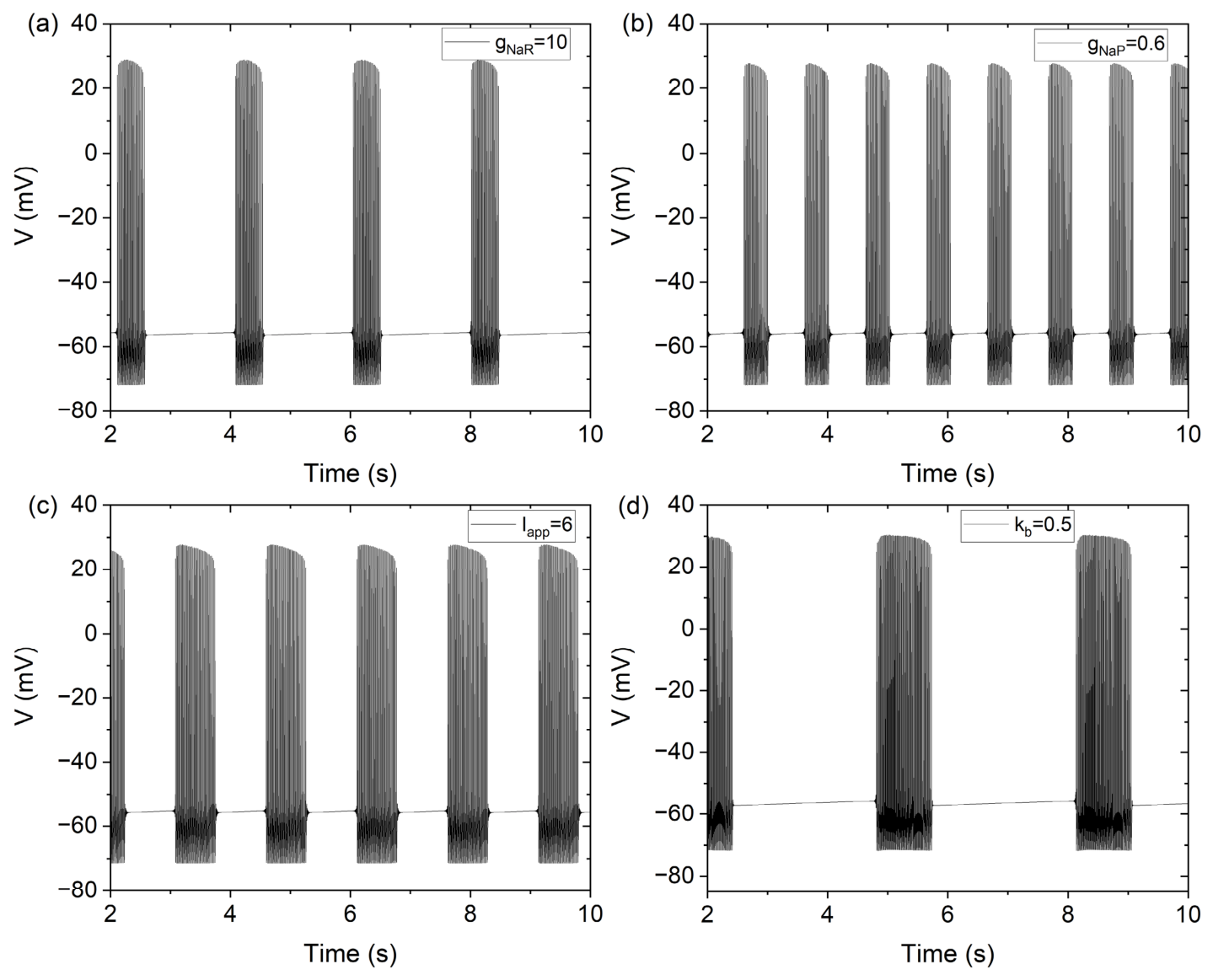
The bursting characteristics of the model, including the spike count per burst (SCPB), burst duration (BD), inter-burst interval (IBI), and bursting period (BD), are modulated by multiple parameters. For instance, compared with Figure 1c, when the conductance gNaR is increased to 10 nS, the bursting period extends to 1.9689 s with 28 spikes within each burst; the inter-burst interval (IBI) becomes 1.5218 s and the burst duration reaches 0.4471 s, as illustrated in Figure 2a. In other words, raising gNaR increases the spike count per burst and prolongs burst duration, accompanied by slight rises in both the IBI and bursting period. With gNaR fixed at 5 nS, increasing gNaP to 0.6 nS results in a bursting period of 1.0136 s and 23 spikes per burst; the inter-burst interval (IBI) and burst duration are 0.6263 s and 0.3873 s, respectively. That is, elevating gNaP raises the spike count within each burst and lengthens burst duration, while shortening the bursting period and IBI, as shown in Figure 2b. Meanwhile, Iapp and kb are also critical parameters that exert prominent influences on the bursting dynamics of the Mes V neuron. As displayed in Figure 2c, with other parameters fixed, increasing Iapp from 4 pA to 6 pA results in a bursting period of 1.5130 s and 40 spikes per burst; the inter-burst interval (IBI) and burst duration are 0.8581 s and 0.6549 s, respectively. Compared with Figure 1c, increasing Iapp mainly elevates the SCPB and prolongs BD, reduces the IBI, while the BP barely changes. However, increasing kb from 0.3 to 0.5 raises the bursting period from 1.3954 s to 3.3236 s, burst duration from 0.3168 s to 0.9148 s, spike number per burst from 19 to 66, and IBI from 1.0786 s to 2.4088 s, as depicted in Figure 2d. In summary, different parameters exert distinct effects on the bursting characteristics of the Mes V neuron.
Figure 2.
Time series of bursting under different control parameters. (a) gNaR = 10 nS, gNaP = 0.45 nS, Iapp = 4 pA, kb = 0.3; (b) gNaR = 5 nS, gNaP = 0.6 nS, Iapp = 4 pA, kb = 0.3; (c) gNaR = 5 nS, gNaP = 0.45 nS, Iapp = 6 pA, kb = 0.3; (d) gNaR = 5 nS, gNaP = 0.45 nS, Iapp = 4 pA, kb = 0.5.
3.2. Bursting Characteristics Under Different Parameter Combinations
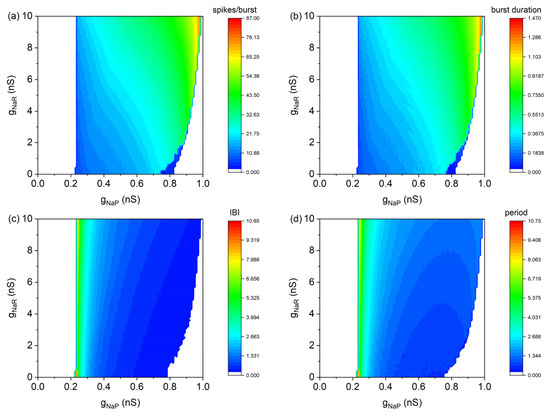
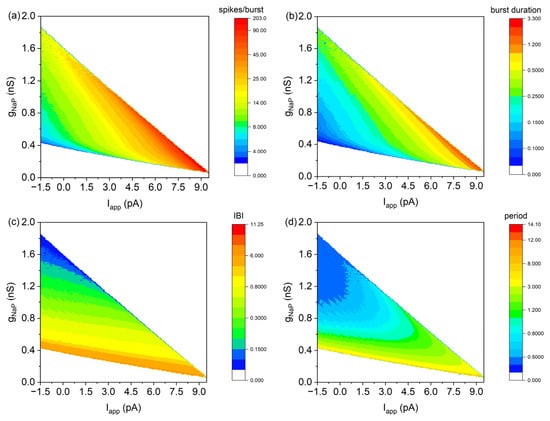
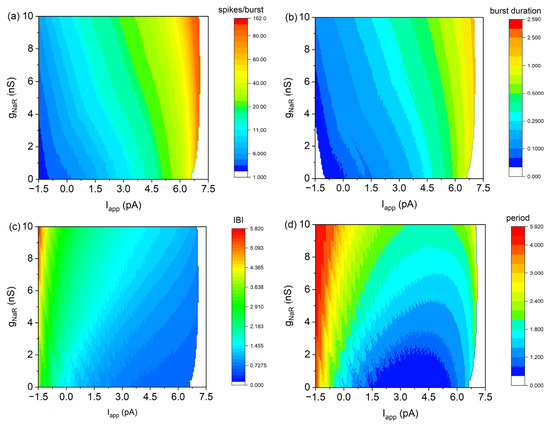
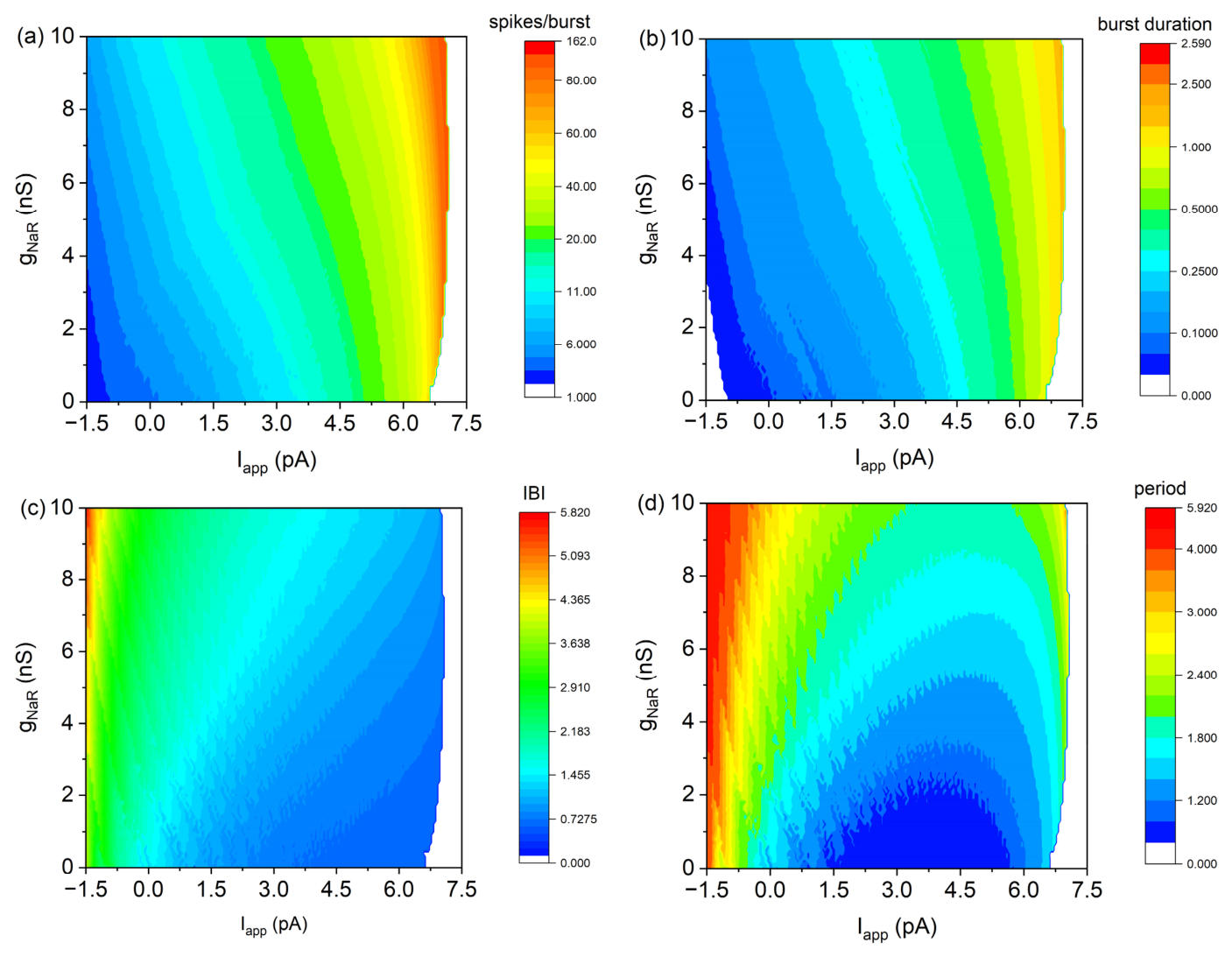
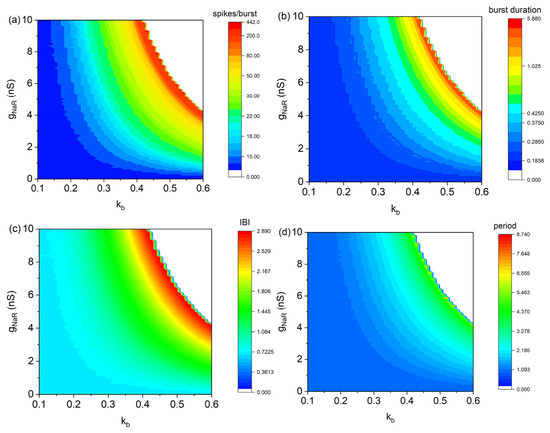
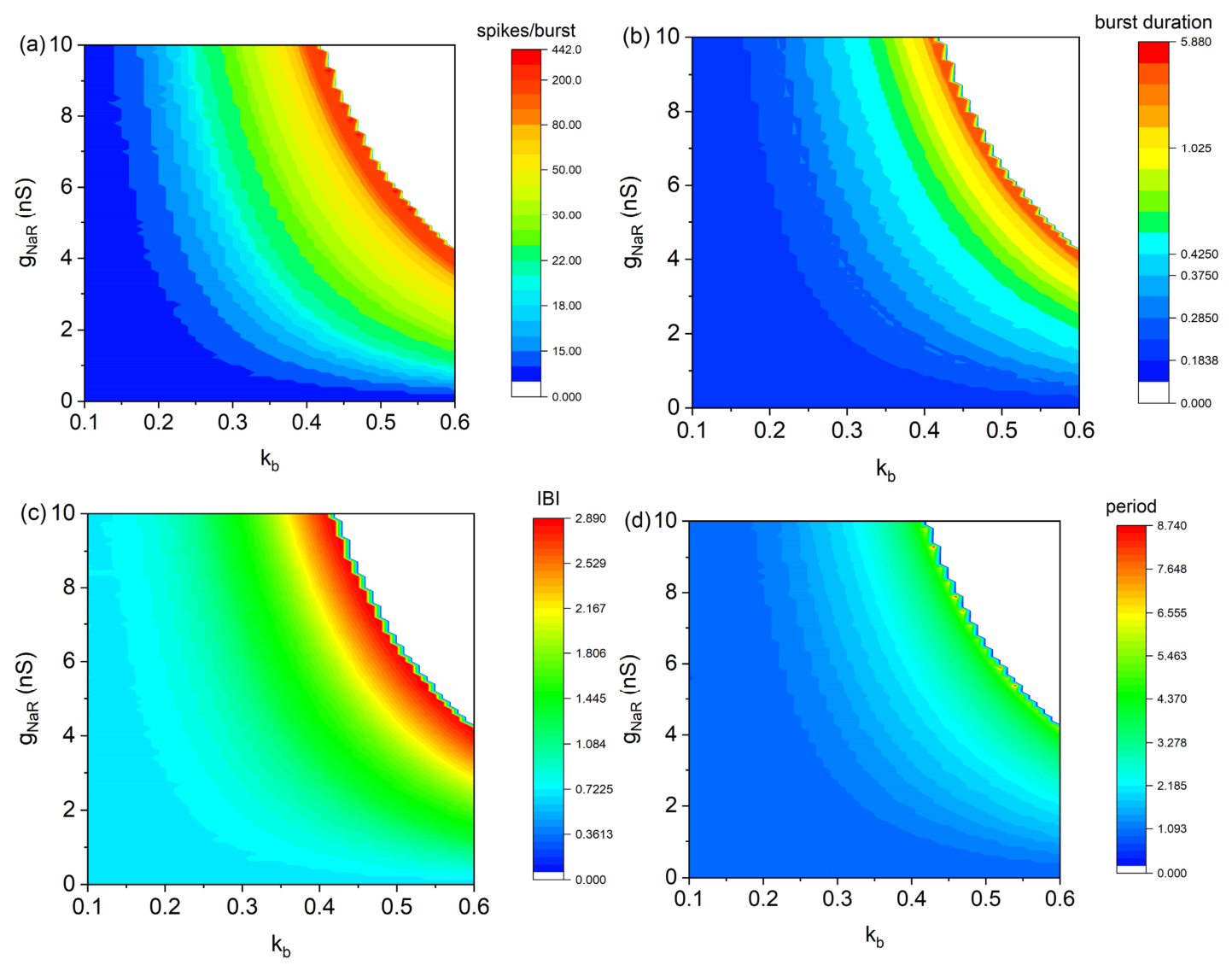
In this section, we mainly investigate the effects of various parameter combinations on the bursting characteristics of Mes V neurons. In Figure 3, Figure 4, Figure 5 and Figure 6, white regions indicate that the neuron exhibits resting or tonic spiking behavior, whereas colored regions correspond to the bursting state. The color gradient ranging from blue to red represents an increasing magnitude of the measured index. The boundaries between the colored and white regions correspond to bifurcation lines. For example, in Figure 4, the colored areas denote parameter regimes where the neuron exhibits bursting activity, while the white region in the upper-right corner corresponds to spiking behavior. The transition from bursting to spiking occurs through a torus (TR) bifurcation, as illustrated in the one-parameter bifurcation diagram of the full system with respect to Iapp at fixed gNaP (Figure 1a). Since two-parameter bifurcation analysis of the full system is not the main focus of this study, the bifurcation boundaries in each figure are not described in detail here.
Figure 3.
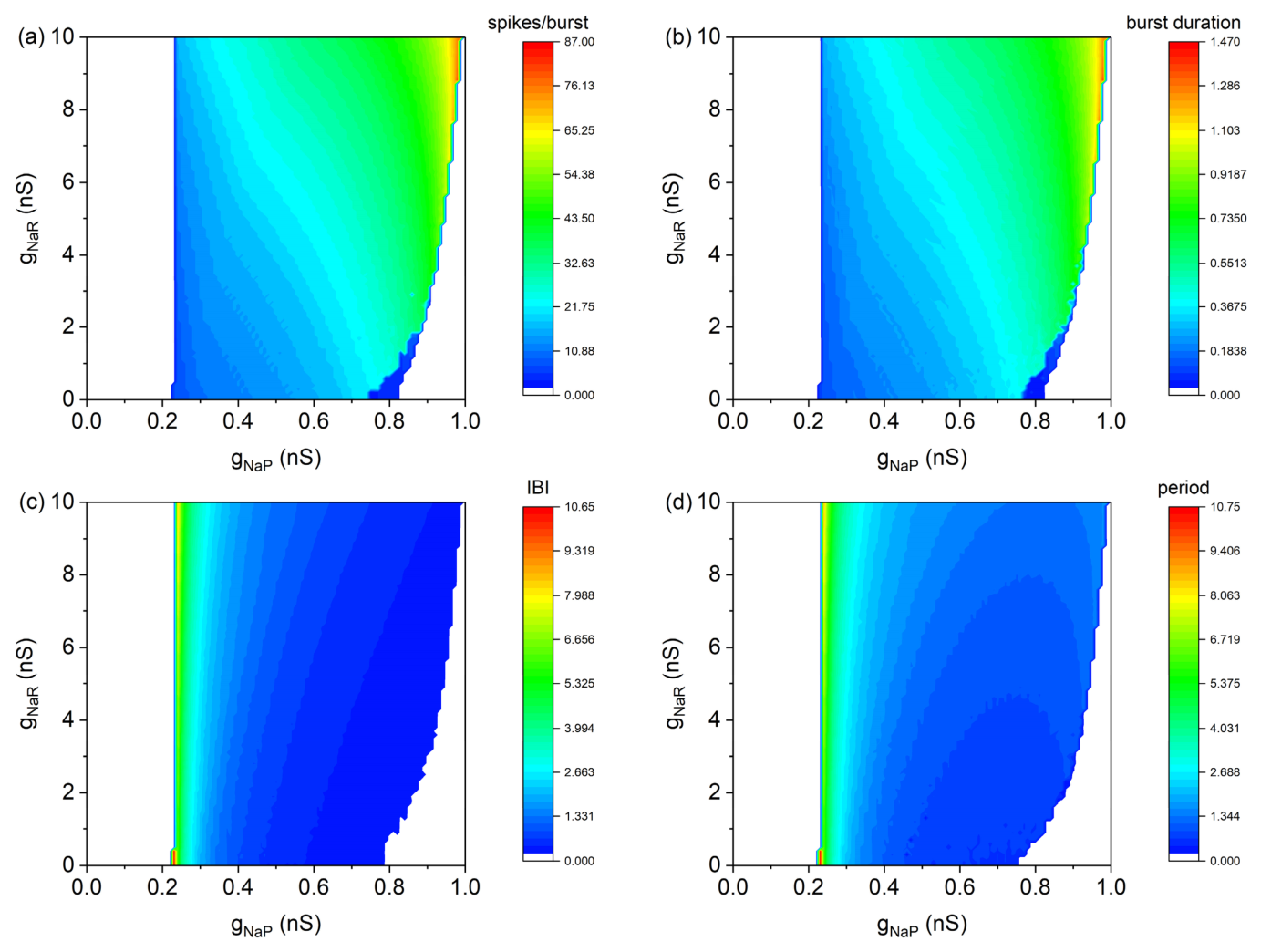
Bursting characteristics in the (gNaP, gNaR) two-parameter plane. (a) SCPB; (b) BD; (c) IBI; (d) BP. Parameters: Iapp = 4 pA, kb = 0.3.
Figure 4.
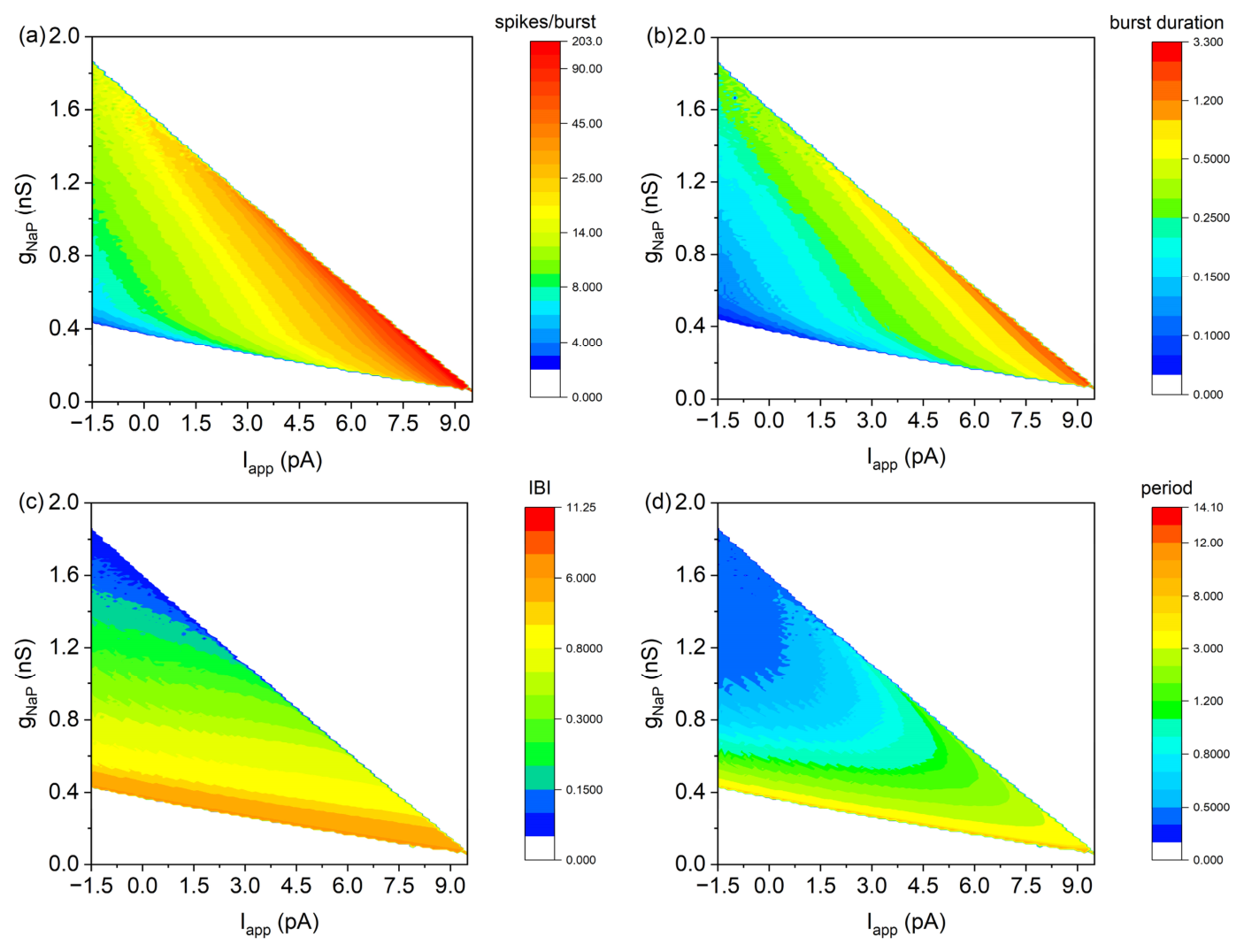
Bursting characteristics in the (Iapp, gNaP) two-parameter plane. (a) SCPB; (b) BD; (c) IBI; (d) BP. Parameters: gNaR = 5 nS, kb = 0.3.
Figure 5.
Bursting characteristics in the (Iapp, gNaR) two-parameter plane. (a) SCPB; (b) BD; (c) IBI; (d) BP. Parameters: gNaP = 0.45 nS, kb = 0.3.
Figure 6.
Bursting characteristics in the (kb, gNaR) two-parameter plane. (a) SCPB; (b) BD; (c) IBI; (d) BP. Parameters: gNaP = 0.45 nS, Iapp = 4 pA.
First, we fix Iapp = 4 pA and kb = 0.3, taking gNaP and gNaR as control parameters, and analyze the distribution of bursting features on the two-parameter plane (gNaP, gNaR). As shown in Figure 3, increasing gNaP raises the SCPB and extends BD, while reducing the IBI; the BP first declines and then rises slightly. By contrast, elevating gNaR increases the spike count within each burst and prolongs burst duration, accompanied by a larger IBI and longer bursting period. For instance, at gNaP = 0.45 nS, increasing gNaR from 2 nS to 8 nS raises the spike number per burst from 15 to 24, prolongs the burst duration from 0.2536 s to 0.3891 s, enlarges the inter-burst interval (IBI) from 0.8314 s to 1.3640 s, and extends the overall bursting period from 1.0850 s to 1.7531 s.
Figure 4 illustrates the distribution of bursting features on the two-parameter plane spanned by Iapp and gNaP, with gNaR = 5 nS and kb = 0.3 held constant. As Iapp rises, the spike number per burst and burst duration increase markedly, while the inter-burst interval (IBI) gradually declines; the bursting period first decreases and then slightly grows. Increasing gNaP leads to more spikes per burst and longer burst duration, accompanied by obvious reductions in both the IBI and bursting period. As an illustrative example, with Iapp clamped at 4 pA, elevating gNaP from 0.3 nS to 0.8 nS augments the SCPB from 14 to 32 and lengthens the BD from 0.2308 s to 0.5474 s. By contrast, the IBI declines from 2.5990 s to 0.3639 s, and the overall BP drops from 2.8298 s to 0.9113 s.
With gNaP = 0.45 and kb = 0.3 held constant, the distribution of bursting characteristics over the two-parameter plane (Iapp, gNaR) is shown in Figure 5. As Iapp increases, the SCPB and BD both rise remarkably, the IBI decreases gradually, and the BP first declines and then grows. Increasing gNaR leads to more spikes within each burst and longer burst duration, alongside elevated IBI and bursting period. For example, with gNaR fixed at 5 nS, increasing Iapp from 0 nS to 6 nS leads to a growth of spikes per burst from 7 to 40 and an extension of burst duration from 0.1208 s to 0.6549 s, the inter-burst interval (IBI) is reduced from 2.2062 s to 0.8581 s, and the bursting period first decreases from 2.3270 s to 1.3417 s and then rises to 1.5130 s.
With gNaP = 0.45 nS and Iapp = 4 pA fixed, the distribution of bursting characteristics on the two-parameter plane (kb, gNaR) is displayed in Figure 6. As kb increases, the SCPB, BD, IBI, and BD all rise gradually. Similarly, elevating gNaR also leads to progressive increases in the spike count per burst, burst duration, IBI, and bursting period. For instance, at gNaR = 5 nS, increasing kb from 0.2 to 0.5 raises the spike number per burst from 15 to 66, prolongs the burst duration from 0.2550 s to 0.9140 s, enlarges the inter-burst interval (IBI) from 0.8227 s to 2.4034 s, and extends the overall bursting period from 1.0777 s to 3.3174 s.
3.3. Dynamical Mechanisms of Altered Bursting Behaviors
3.3.1. Bifurcation Analysis of the Fast Subsystem
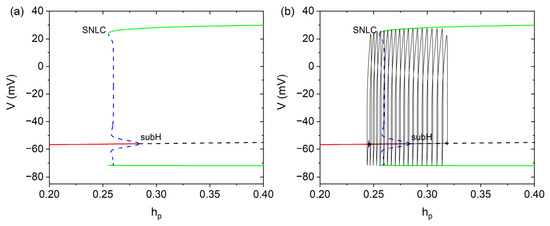
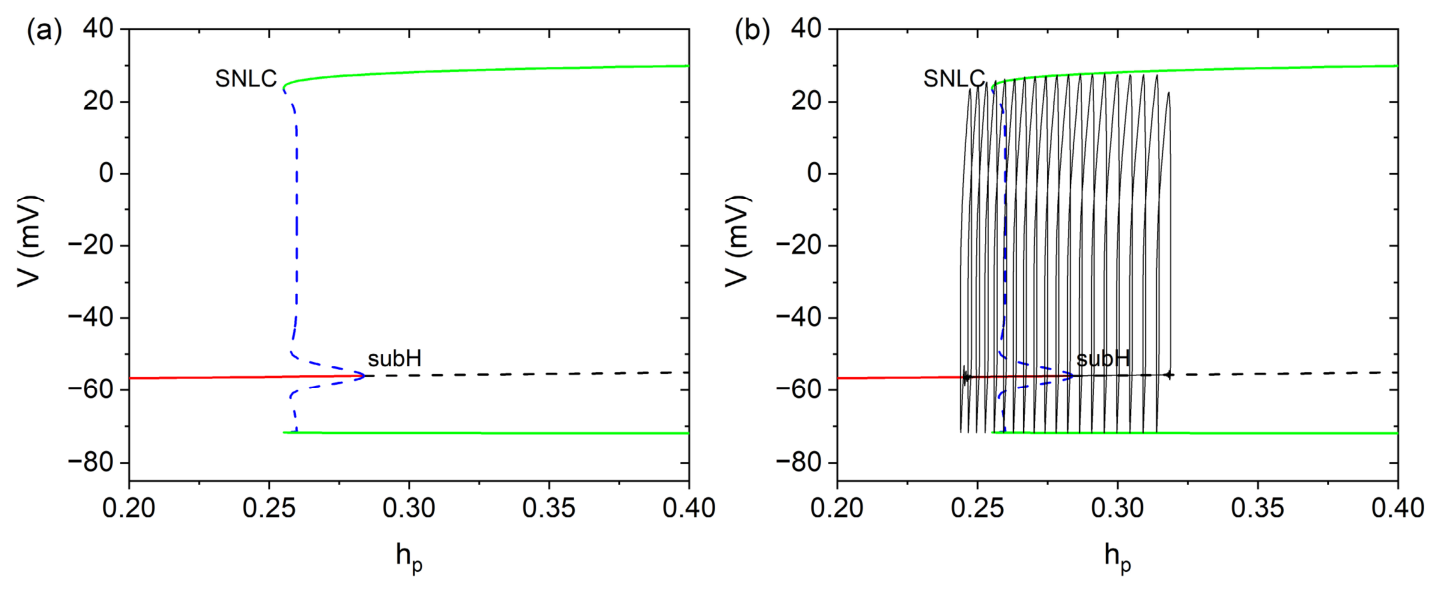
The bifurcation results of the fast subsystem with respect to the slow variable hp under gNaR = 5 nS, gNaP = 0.45 nS, Iapp = 4 pA and kb = 0.3 are presented in Figure 7. In this figure, Stable equilibrium points are represented by red solid lines, while black dashed lines denote unstable ones. For limit cycles, stable and unstable ones are indicated by green solid and blue dashed lines, respectively. As hp increases, the fast subsystem transitions from stable equilibria to unstable equilibria via a subH (hp = 0.2838) bifurcation point. An unstable limit cycle emerges at the subH point, becomes stable after a saddle-node bifurcation of limit cycles (SNLC, hp = 0.2552) point. The subH and SNLC points delimit a critical bifurcation interval within which the fast subsystem offers multiple dynamical possibilities. The geometric asymmetry of this interval—resulting from the unequal shifts of the two bifurcation points—constitutes the structural symmetry breaking, while the specific trajectory selected by the full system determines the resulting bursting pattern. The black solid curve in Figure 7 represents the phase trajectory of the full system on the (hp, V) plane. As demonstrated, the variable hp gradually decreases during the bursting activity, and the bursting trajectory evolves leftward along the stable limit cycle of the fast subsystem. Once the bursting phase trajectory crosses the SNLC point of the fast subsystem, the stable limit cycle vanishes. After a short hysteresis process, the burst terminates, and the phase trajectory of the full system jumps to the stable equilibrium point of the fast subsystem. This hysteresis loop embodies the memory of symmetry breaking: the system does not immediately return to the resting branch upon crossing SNLC, but instead exhibits a delayed transition that prolongs the burst. Subsequently, the trajectory drifts rightward along the stable equilibrium, forming the inter-burst interval (IBI). After crossing the subH point and experiencing brief hysteresis, the trajectory jumps back onto the stable limit cycle, initiating the next bursting cycle. Each complete cycle—from subH to SNLC and back—constitutes a full symmetry-breaking–restoration loop, where the system repeatedly escapes from and returns to the resting state. In short, the subcritical Hopf bifurcation point and SNLC bifurcation point of the fast subsystem correspond to the onset and termination of bursting in the full system, respectively. The width of the hp interval between the subH and SNLC points determines, to some extent, the duration of both the inter-burst interval and each burst. Accordingly, the modulatory effects of different parameters on bursting characteristics can be revealed via bifurcation analysis of the fast subsystem. Naturally, bursting characteristics are also affected by neuronal states such as membrane depolarization.
Figure 7.
Fast–slow decomposition diagram. Stable and unstable equilibrium points are depicted by red solid and black dashed lines, while stable and unstable limit cycles are represented by green solid and blue dashed curves, respectively. (a) Bifurcation structure of the fast subsystem. (b) The phase trajectory (black solid curve) of the full system superimposed on the bifurcation diagram shown in (a). Parameters: gNaR = 5 nS, gNaP = 0.45 nS, Iapp = 4 pA, kb = 0.3.
3.3.2. Influences of Control Parameters on Fast Subsystem Dynamics
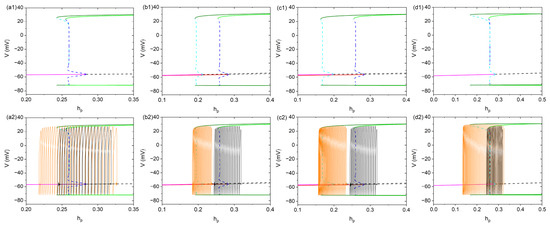
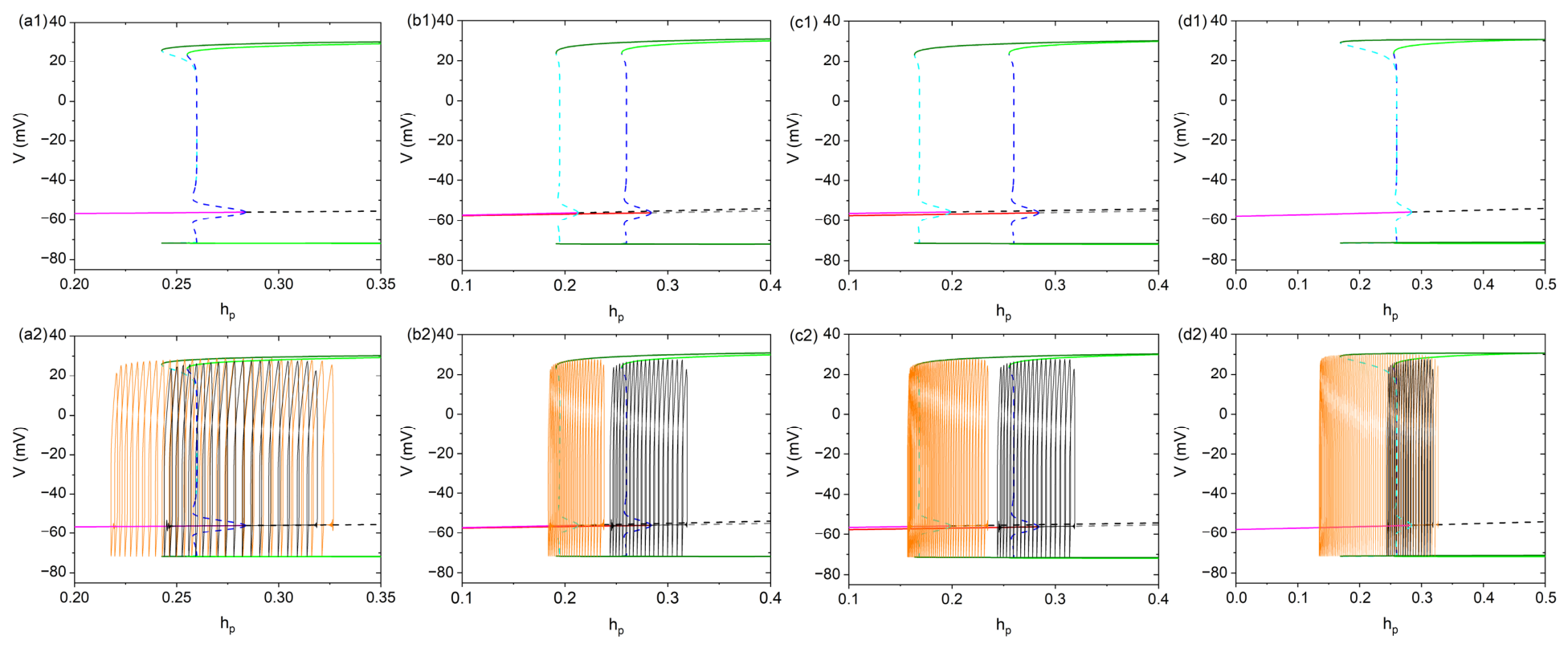
To clearly illustrate how the bifurcation structure of the fast subsystem varies under distinct parameters, we take the bifurcation structure in Figure 7 as the reference. We compare the bifurcation diagrams obtained after modifying four control parameters (gNaR, gNaP, Iapp, kb) with Figure 7 to elaborate the parameter-induced shifts in bifurcation structures. The magenta solid line, gray dashed line, cyan dashed line, and olive solid line in Figure 8 are the bifurcation curves after parameter variation. The magenta solid line and gray dashed line represent the stable and unstable equilibrium points after parameter variation, respectively. The cyan dashed line and olive solid line represent the unstable and stable limit cycles after parameter variation, respectively. In Figure 8, panels (a2), (b2), (c2), and (d2) are the combined graphs of panels (a1), (b1), (c1), and (d1) together with their corresponding phase portraits, respectively.
Figure 8.
Fast–slow decomposition diagrams under different control parameters. The black, red, blue, and green lines have the same meanings and parameters as those in Figure 7. The magenta solid line and gray dashed line represent the stable and unstable equilibrium points after parameter variation, respectively. The cyan dashed line and olive solid line represent the unstable and stable limit cycles after parameter variation, respectively. (a1) gNaR = 10 nS, gNaP = 0.45 nS, Iapp = 4 pA, kb = 0.3; (b1) gNaR = 5 nS, gNaP = 0.6 nS, Iapp = 4 pA, kb = 0.3; (c1) gNaR = 5 nS, gNaP = 0.45 nS, Iapp = 6 pA, kb = 0.3; (d1) gNaR = 5 nS, gNaP = 0.45 nS, Iapp = 4 pA, kb = 0.5. The parameter values for (a2), (b2), (c2), and (d2) are the same as those for (a1), (b1), (c1), and (d1), respectively. Figures (a2), (b2), (c2), and (d2) are the combined graphs of figures (a1), (b1), (c1), and (d1) together with their corresponding phase portraits, respectively.
Modulation Mechanism of Bursting Dynamics Induced by gNaR
Figure 8(a1) displays the bifurcation diagram under gNaR = 10 nS with all other control parameters identical to those in Figure 7. The magenta solid line and gray dashed line represent stable and unstable equilibrium points of the fast subsystem, respectively; the cyan dashed line and olive solid line correspond to unstable limit cycles and stable limit cycles of the fast subsystem. The positions of bifurcation points are shifted by increasing gNaR, although the overall bifurcation structure of the fast subsystem remains intact. The subH remains unchanged at hp = 0.2838, indicating negligible variation in the burst onset. In contrast, the SNLC point shifts markedly leftward and locates at hp = 0.2427 when gNaR = 10 nS. Consequently, the separation between the subH and SNLC points is expanded, which accounts for prolonged burst duration and extended inter-burst interval (IBI). This expansion of the subH–SNLC window enlarges the parameter space within which the system can sustain oscillatory activity, thereby providing a broader range of symmetry-breaking possibilities for the trajectory to explore during each burst cycle.
Figure 8(a2) overlays the bifurcation diagram from Figure 7, the curve in Figure 8(a1), and the phase trajectories of the full system. It can be clearly observed that the starting points of bursting phase trajectories under gNaR = 5 nS (black curve) and gNaR = 10 nS (orange curve) are close to each other, whereas their termination points differ substantially. The value of hp corresponding to the burst termination point at gNaR = 10 nS is far smaller than that at gNaR = 5 nS. Therefore, the parameter range between the two bifurcation points at gNaR = 10 nS is wider than that at gNaR = 5 nS. Thus, when gNaR = 10 nS, more spikes (orange curve in Figure 8(a2)) are generated between the subH and SNLC bifurcation points, and the silent interval between the two bifurcation points also becomes longer. The wider window allows the trajectory to remain in the oscillatory branch for a longer hp range before symmetry is restored via the SNLC-mediated return to quiescence. Therefore, increasing gNaR broadens the range of hp covered during bursting, which yields more spikes per burst, longer BD, larger IBI, and an extended BP. In essence, gNaR induces asymmetric shifts of the bifurcation point—the SNLC point moves leftward while the subH point remains nearly fixed—which broadens the subH-SNLC window, accommodating more spikes, longer bursts, and larger IBI and bursting period.
Modulation Mechanism of Bursting Dynamics Induced by gNaP
With gNaP = 0.6 nS and all other parameters fixed, the bifurcation of the subsystem (Figure 8(b1)) remains consistent with that in Figure 7, while the positions of the subH and SNLC points shift to hp = 0.2128 and hp = 0.1913, respectively. Compared with the case of gNaP = 0.45 nS (Figure 7 and Figure 8(b2)), the parameter interval between the two bifurcation points narrows, leading to a shorter IBI. Meanwhile, a larger gNaP strengthens the persistent inward sodium current, which shortens the hysteresis interval after Hopf bifurcation and thus reduces the IBI and restrains the drop of the slow variable hp induced by each spike. A shorter hysteresis means that the system restores symmetry (returns to the resting state) more quickly after burst termination. Each spike consumes a smaller range of hp. Therefore, although the range of hp between the two bifurcation points is slightly narrowed, more spikes can be generated between the two bifurcation points at gNaP = 0.6 nS than at gNaP = 0.45 nS. Therefore, the increase in gNaP shortens the IBI, raises the SCPB and prolongs the BD. Consequently, the bursting period may either increase or decrease depending on the relative change magnitudes of the two terms.
Modulation Mechanism of Bursting Dynamics Induced by Iapp
When Iapp is increased to 6 pA with all other parameters held constant, the bifurcation structure of the fast subsystem is displayed in Figure 8(c1). Its bifurcation topology is identical to that in Figure 7, yet the subH bifurcation point and SNLC bifurcation point shift to hp = 0.1986 and hp = 0.1637, respectively. The parameter interval between the two bifurcation points is slightly wider than that under Iapp = 4 pA (Figure 7). Increasing Iapp widens the separation between the subH and SNLC points, expanding the parameter window supporting stable limit cycle oscillations in the fast subsystem. This allows the trajectory to fire more spikes per burst (Figure 8(c2)). Meanwhile, the elevated depolarizing input accelerates the recovery of the slow variable hp and narrows the hysteresis region below the Hopf point, which further skews the symmetry between burst and inter-burst phases, shortening the IBI. Consequently, raising Iapp yields more SCPB and longer BD, while the IBI decreases slightly. The BP may increase or decrease, which correlates with the net change in the sum of inter-burst interval and burst duration, reflecting the competition between the asymmetric expansion of the active window and the accelerated recovery dynamics.
Modulation Mechanism of Bursting Dynamics Induced by kb
When kb = 0.5 while all other parameters remain unchanged, the bifurcation of the fast subsystem is illustrated in Figure 8(d1). The subH bifurcation point and SNLC point appear at hp = 0.2838 and hp = 0.1688, respectively. Compared with the bifurcation diagram for kb = 0.3, the location of the subH bifurcation point stays unchanged, whereas the SNLC point shifts distinctly leftward. The widened parameter interval between the two bifurcation points expands the range of parameters supporting stable limit-cycle oscillations in the fast subsystem, which enables more spikes to be generated within each burst, accompanied by an increase in the inter-burst interval (IBI), as shown in Figure 8(d2). Notably, because the subH point remains anchored while the SNLC point shifts, the hysteresis loop undergoes an asymmetric expansion predominantly along its repolarization branch. This asymmetric deformation prolongs both the active spiking phase and the subsequent silent recovery phase, thereby preserving—and even amplifying—the temporal asymmetry between burst duration and inter-burst interval. As a result, larger kb prolongs burst duration and increases the SCPB. Combined with the elevated IBI, the overall bursting period is ultimately enlarged.
3.3.3. Two-Parameter Bifurcation of the Fast Subsystem
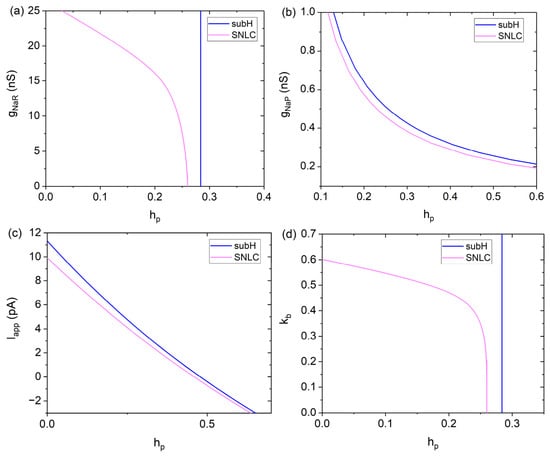
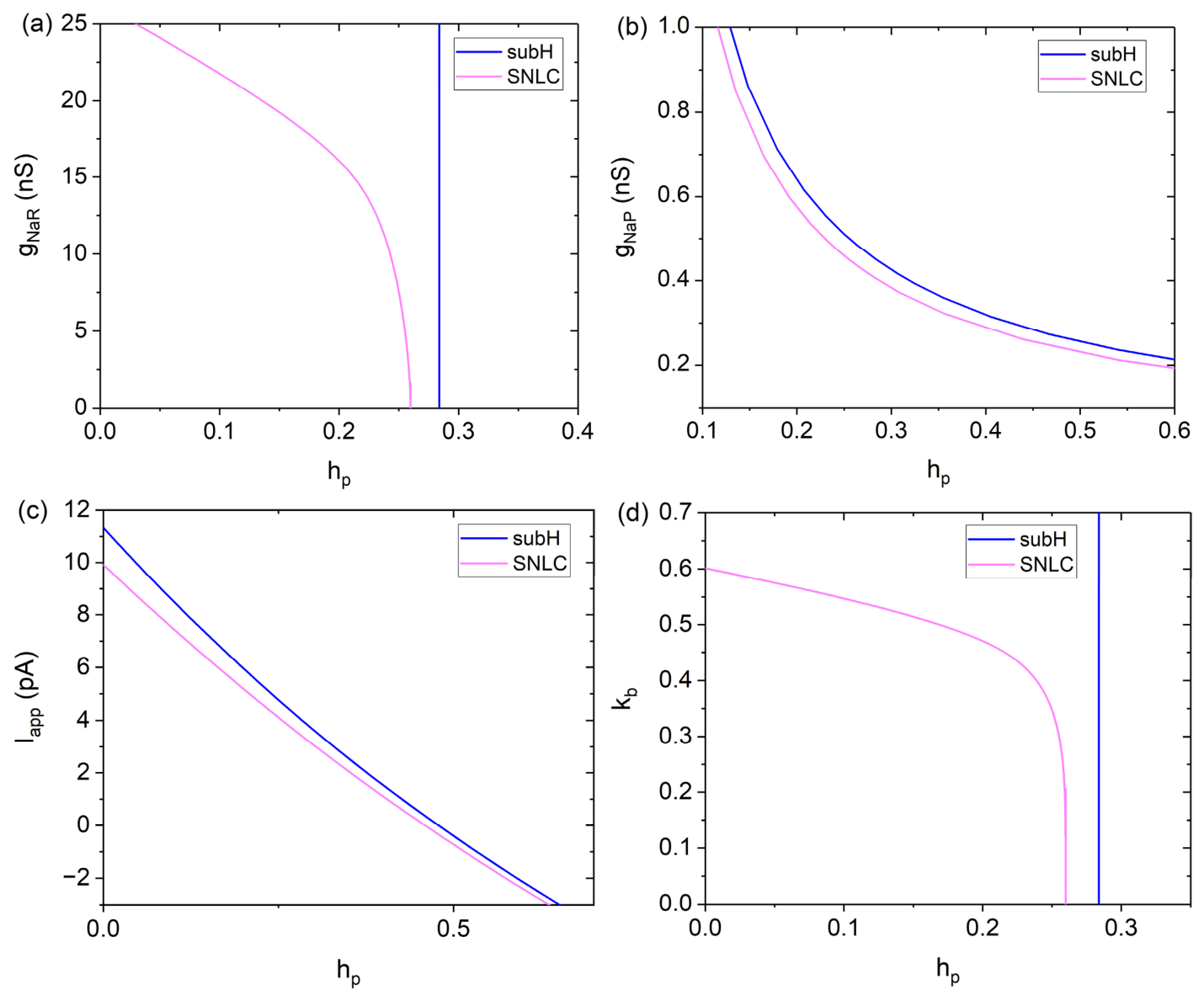
To systematically investigate how each control parameter modulates the subH and SNLC points and further reshapes the bursting dynamical characteristics of neurons, we perform two-parameter bifurcation analysis on the fast subsystem in this section to illustrate the evolutionary law of the subH-SNLC parameter span in single-parameter bifurcation diagrams as the control parameters vary. In Figure 9, the blue curves denote Hopf bifurcation curves, and the pink curves represent SNLC bifurcation curves. To the left of the pink SNLC bifurcation curve, the fast subsystem resides in a resting state (corresponding to a stable equilibrium point). To the right of the blue subH bifurcation curve, the fast subsystem exhibits spiking activity (corresponding to a stable limit cycle). In the region between the two bifurcation curves, the fast subsystem is bistable, possessing both a stable equilibrium point and a stable limit cycle.
Figure 9.
Two-parameter bifurcation diagram of the fast subsystem. The blue and pink curves correspond to the subH and the SNLC bifurcation curve, respectively. (a) gNaP = 0.45 nS, Iapp = 4 pA, kb = 0.3; (b) gNaR = 5 nS, Iapp = 4 pA, kb = 0.3; (c) gNaR = 5 nS, gNaP = 0.45 nS, kb = 0.3; (d) gNaR = 5 nS, gNaP = 0.45 nS, Iapp = 4 pA.
The bursting oscillations of the full neuronal system alternate between spiking and quiescence. Based on the fast–slow variable dissection method, the bifurcation structure of the fast subsystem can be employed to analyze the underlying mechanism of bursting generation in the full system. By overlaying the phase portrait of the full-system bursting dynamics onto the bifurcation diagram of the fast subsystem (as shown in Figure 7 and Figure 8), it can be observed that the phase trajectory of the full-system bursting exactly falls within the bistable region of the fast subsystem. In the two-parameter bifurcation diagram, the phase trajectories of bursting under different parameters evolve mainly within the region bounded by these two bifurcation curves. A wider parameter range between the two curves generally corresponds to a longer IBI and allows for a larger SCPB. In addition to the distance between the two bifurcation points, bursting properties are also governed by the hysteresis range after the bifurcation points. A longer hysteresis range beyond the subH point leads to a larger IBI, whereas a shorter hysteresis range corresponds to a smaller IBI. Therefore, bursting characteristics are determined not only by the positions of bifurcation points but also by the dynamical behaviors of neurons near these bifurcation points.
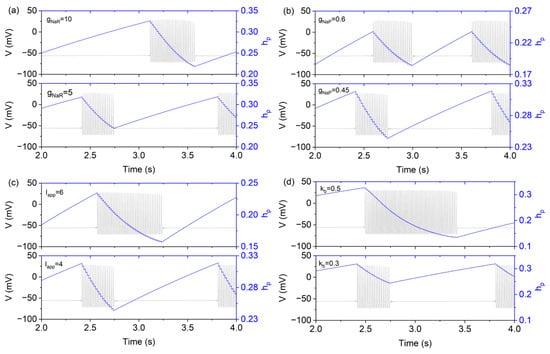
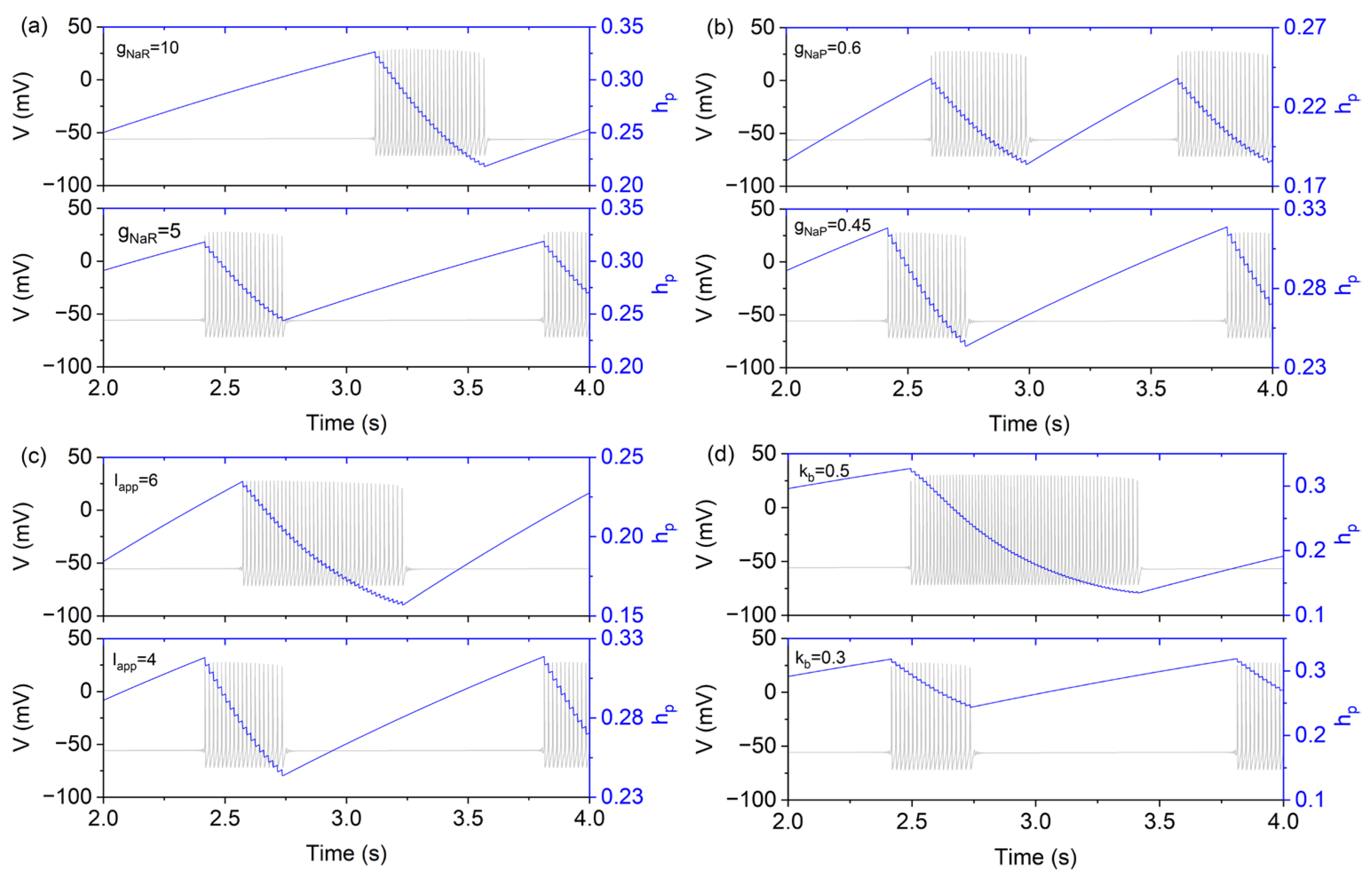
As illustrated in Figure 9a, the subH bifurcation curve remains unchanged as gNaR increases, while the SNLC bifurcation curve gradually shifts leftward, resulting in a remarkable expansion of the spacing between the two bifurcation curves. The fixed subH and shifting SNLC break the geometric symmetry of the bifurcation window, skewing the hysteresis loop asymmetrically toward smaller hp values. This asymmetric deformation predominantly affects the repolarization branch near the SNLC point, while leaving the depolarization branch near the subH point largely unaltered. Meanwhile, as shown in Figure 10a, the decrease in hp per spike during bursting remains roughly similar when gNaR is increased. Therefore, the increase in the number of spikes per burst is primarily attributed to the widened hp range between the subH and SNLC bifurcation points. Consequently, as gNaR increases, the IBI lengthens, SCPB rises, which in turn enlarges the burst duration and prolongs the overall bursting period.
Figure 10.
Evolution of the slow variable hp during bursting. (a) gNaP = 0.45 nS, Iapp = 4 pA, kb = 0.3; Upper panel: gNaR = 10 nS, lower panel: gNaR = 5 nS. (b) gNaR = 5 nS, Iapp = 4 pA, kb = 0.3; Upper panel: gNaP = 0.6 nS, lower panel: gNaP = 0.45 nS. (c) gNaR = 5 nS, gNaP = 0.45 nS, kb = 0.3; Upper panel: Iapp = 6 pA, lower panel: Iapp = 4 pA. (d) gNaR = 5 nS, gNaP = 0.45 nS, Iapp = 4 pA; Upper panel: kb = 0.5, lower panel: kb = 0.3. The gray and blue curves represent the membrane potential and hp, respectively.
Figure 9b presents the two-parameter bifurcation diagram of the fast subsystem on the (hp, gNaP) plane. As gNaP rises, both the subH and SNLC bifurcation curves shift leftward, and the gap between the two curves gradually narrows. Accordingly, the inter-burst interval (IBI) decreases with increasing gNaP (Figure 3c and Figure 5c). Nevertheless, increasing gNaP enhances the persistent sodium inward current and sustains membrane depolarization, reducing the decay of slow variable hp induced by each spike. Each action potential consumes only a small segment of hp, as shown in Figure 10b. Therefore, although the parameter interval between the two bifurcation points narrows, the SCPB increases, which extends the BD. The prolonged BD combined with the shortened IBI can either increase or decrease the overall bursting period (Figure 3d and Figure 5d), depending on which of the two variations dominates. In conclusion, gNaP produces a paradoxical asymmetry: although it narrows the subH-SNLC interval, it simultaneously sustains membrane depolarization and reduces the consumption of slow variable hp per spike. Less hp consumed per oscillation enables more spikes within the narrower window, accompanied by shortened IBI and a non-monotonic bursting period.
The two-parameter bifurcation diagram of the fast subsystem on the (hp, Iapp) plane is plotted in Figure 9c. As Iapp increases, both bifurcation curves shift leftward, and the separation between them expands with larger Iapp. Increasing Iapp elevates the overall baseline membrane potential. On one hand, it widens the bifurcation window between subH and SNLC, extending the firing interval of each burst and increasing the spike count; on the other hand, it accelerates the recovery of the slow variable hp and shrinks the silent hysteresis interval, ultimately shortening the inter-burst interval (IBI) (Figure 4 and Figure 5). In addition, as a positive inward current, Iapp acts similarly to INaP and reduces the net decline of hp per action potential (Figure 10c). Therefore, the decrease in inter-burst interval (IBI) together with the increase in burst duration results in an uncertain variation in the bursting period, which may either rise or fall depending on which effect dominates. In other words, Iapp induces an opposing asymmetry: it widens the bifurcation window while shortening IBI, revealing that bifurcation expansion and the silent phase duration are not monotonically coupled.
The bifurcation curves for varying kb (Figure 9d) exhibit a similar trend to those for varying gNaR (Figure 9a). As kb increases, the Hopf bifurcation curve stays invariant, whereas the SNLC bifurcation curve gradually shifts leftward, which significantly widens the separation between the two bifurcation curves. This unidirectional shift—with one boundary fixed and the other moving—introduces a pronounced geometric asymmetry into the bifurcation topology, skewing the hysteresis loop predominantly toward smaller hp values. Thus, the increase in kb exerts only a slight influence on the hysteresis range after subH bifurcation. Figure 10d further reveals that the hp consumption per spike during bursting remains largely unchanged with increasing kb. Consequently, elevating kb also increases the IBI, burst duration, spike count per burst, and ultimately the bursting period.
4. Conclusions
This paper systematically investigates how four control parameters (gNaR, gNaP, Iapp, and kb) modulate bursting dynamics in the mesencephalic trigeminal neuron model. Statistical mapping of bursting metrics on two-parameter planes reveals universal trends: raising any of the four parameters increases the spike count per burst and prolongs burst duration. The parameters fall into two distinct regulatory categories. Increasing gNaR and kb lengthens both the inter-burst interval (IBI) and the overall bursting period. In contrast, elevated gNaP and Iapp shorten IBI; the counterbalance between reduced IBI and prolonged burst duration causes the bursting period to decrease first and then increase. One- and two-parameter bifurcation analyses of the fast subsystem further reveal the underlying dynamical mechanisms, which are governed by three distinct asymmetries. First, gNaR and kb induce asymmetric shifts in the bifurcation curves—the SNLC curve moves leftward while the subH curve remains nearly fixed—which broadens the subH-SNLC window, accommodating more spikes, longer bursts, and larger IBI and bursting period. Second, gNaP produces a paradoxical asymmetry: although it narrows the subH-SNLC interval, it simultaneously sustains membrane depolarization and reduces the consumption of slow variable hp per spike. Less hp consumed per oscillation enables more spikes within the narrower window, accompanied by shortened IBI and a non-monotonic bursting period. Third, Iapp induces an opposing asymmetry: it widens the bifurcation window while shortening IBI, revealing that bifurcation expansion and the silent phase duration are not monotonically coupled. The depolarizing effect of Iapp further compresses the hysteresis range after subH bifurcation, producing an initial drop followed by a rise in the bursting period. Overall, bursting characteristics emerge from the cooperative interplay of bifurcation structure, membrane potential, slow-variable dynamics, and hysteresis, rather than from bifurcation positions alone. Crucially, these factors act asymmetrically on the active (burst) and silent (inter-burst) phases: gNaR and kb primarily shape the silent phase by expanding the bifurcation window, whereas gNaP and Iapp predominantly modulate the active phase by altering hp consumption and hysteresis. This asymmetric regulation explains why all four parameters increase burst duration yet produce divergent effects on IBI. By framing these results within a symmetry-breaking perspective, we show that the system’s trajectory escapes from the resting state and returns at different points in parameter space, thereby determining the fine structure of the bursting rhythm.
This study elucidates the regulatory mechanisms of sodium channel parameters on trigeminal bursting rhythms, providing a theoretical framework for neuromodulation and pathological bursting. Our results show that gNaP, gNaR, and Iapp exert dissociable control over bursting period, burst duration, inter-burst interval, and spike count per burst, suggesting that distinct modulatory pathways can independently shape bursting features. Pathologically, elevated gNaP promotes high-frequency bursting (implicated in epilepsy and pain), identifying the currents as potential therapeutic targets. Mechanistically, the asymmetric SNLC shift explains threshold effects in spike count amplification, and the joint modulation by bifurcation position, membrane potential, and hysteresis reveals a principle of dynamical compensation—whereby targeting membrane potential may restore normal bursting despite altered channel conductance. Collectively, this dynamical framework offers testable guidance for closed-loop neuromodulation and pharmacological intervention.
This study primarily focuses on the regulation of single-neuron bursting dynamics by key parameters. In future work, the current framework can be extended from single-neuron dynamics to the network level, incorporating both excitatory and inhibitory synaptic couplings to investigate how ion-channel-modulated bursting properties influence synchronization and information transmission within neuronal populations. At the network level, symmetry-breaking may manifest as the emergence of heterogeneous firing patterns among coupled neurons, where identical neurons diverge into distinct oscillatory states through symmetry-breaking bifurcations. From a methodological perspective, one limitation of the present study also points to promising directions. Within the fast–slow decomposition framework, the burst termination point does not always align precisely with the SNLC bifurcation for certain parameter regimes. This discrepancy may arise because the INaR current itself possesses a slow kinetic component, suggesting that a two-parameter fast–slow decomposition would be required for a more accurate characterization. Additionally, the effects of noise on bursting rhythms and bifurcation dynamics may be explored. Importantly, the model can be adapted to simulate hyperexcitability by modifying gNaP or gNaR, mimicking pathological conditions such as trigeminal neuralgia, and further applied to evaluate the efficacy of channel-specific blockers in restoring normal bursting rhythms. In pathological states, aberrant symmetry breaking—such as premature escape from or delayed return to the resting attractor—may underlie the abnormal bursting patterns observed in neurological disorders. These potential extensions could help bridge the gap between cellular-level dynamics and network-level physiological or pathological behaviors.
Author Contributions
L.G.: writing—original draft, methodology, visualization, data curation; N.L.: investigation, validation; J.S.: writing—review and editing, validation. All authors have read and agreed to the published version of the manuscript.
Funding
This research was supported by the National Natural Science Foundation of China (Grant No. 12202146).
Data Availability Statement
The raw data supporting the conclusions of this article will be made available by the authors on request.
Conflicts of Interest
The authors declare no conflicts of interest.
Abbreviations
The following abbreviations are used in this manuscript:
| Mes V | Mesencephalic trigeminal neurons |
| subH | subcritical Hopf bifurcation |
| SNLC | Saddle-node bifurcation of limit cycles |
| SCPB | Spike count per burst |
| BD | Burst duration |
| IBI | Inter-burst interval |
| BP | Bursting period |
References
- Vignesh, D.; He, S.; Banerjee, S. A review on the complexities of brain activity: Insights from nonlinear dynamics in neuroscience. Nonlinear Dyn. 2024, 113, 4531–4552. [Google Scholar] [CrossRef] [Scilit]
- Yang, Y.; Cui, Y.; Sang, K.; Dong, Y.; Ni, Z.; Ma, S.; Hu, H. Ketamine blocks bursting in the lateral habenula to rapidly relieve depression. Nature 2018, 554, 317–322. [Google Scholar] [CrossRef] [Scilit] [PubMed]
- Vera, J.; Lippmann, K. Post-stroke epileptogenesis is associated with altered intrinsic properties of hippocampal pyramidal neurons leading to increased theta resonance. Neurobiol. Dis. 2021, 156, 105425. [Google Scholar] [CrossRef] [Scilit] [PubMed]
- Tissone, A.I.; Vidal, V.B.; Nadal, M.S.; Mato, G.; Amarillo, Y. Differential contribution of the subthreshold operating currents IT, Ih, and IKir to the resonance of thalamocortical neurons. J. Neurophysiol. 2021, 126, 561–574. [Google Scholar] [CrossRef] [Scilit] [PubMed]
- Katyare, N.; Sikdar, S.K. Theta resonance and synaptic modulation scale activity patterns in the medial entorhinal cortex stellate cells. Ann. N. Y. Acad. Sci. 2020, 1478, 92–112. [Google Scholar] [CrossRef] [Scilit] [PubMed]
- Fischer, L.; Leibold, C.; Felmy, F. Resonance properties in auditory brainstem neurons. Front. Cell. Neurosci. 2018, 12, 8. [Google Scholar] [CrossRef] [Scilit] [PubMed]
- Izhikevich, E.M. Neural excitability, spiking and bursting. Int. J. Bifurcat. Chaos 2000, 10, 1171–1266. [Google Scholar] [CrossRef] [Scilit]
- Liu, M.; Duan, L.; Wang, Z.; Su, J. Dynamics of mixed bursters driven by square wave current in the Pre-Bötzinger complex. Int. J. Bifurcat. Chaos 2025, 35, 2550100. [Google Scholar] [CrossRef] [Scilit]
- Rubin, J.E.; Hayes, J.A.; Mendenhall, J.L.; Del Negro, C.A. Calcium-activated nonspecific cation current and synaptic depression promote network-dependent burst oscillations. Proc. Natl. Acad. Sci. USA 2009, 106, 2939–2944. [Google Scholar] [CrossRef] [Scilit] [PubMed]
- Hua, H.; Gu, H.; Jia, Y.; Lu, B. The nonlinear mechanisms underlying the various stochastic dynamics evoked from different bursting patterns in a neuronal model. Commun. Nonlinear Sci. Numer. Simul. 2022, 110, 106370. [Google Scholar] [CrossRef] [Scilit]
- Izhikevich, E.M.; Desai, N.S.; Walcott, E.C.; Hoppensteadt, F.C. Bursts as a unit of neural information: Selective communication via resonance. Trends Neurosci. 2003, 26, 161–167. [Google Scholar] [CrossRef] [Scilit] [PubMed]
- Krahe, R.; Gabbiani, F. Burst firing in sensory systems. Nat. Rev. Neurosci. 2004, 5, 13–23. [Google Scholar] [CrossRef] [Scilit] [PubMed]
- Powanwe, A.S.; Longtin, A. Brain rhythm bursts are enhanced by multiplicative noise. Chaos 2021, 31, 013117. [Google Scholar] [CrossRef] [Scilit] [PubMed]
- Guan, L.; Gu, H.; Zhang, X. Dynamics of antiphase bursting modulated by the inhibitory synaptic and hyperpolarization-activated cation currents. Front. Comput. Neurosci. 2024, 18, 1303925. [Google Scholar] [CrossRef] [Scilit] [PubMed]
- Zhan, F.; Song, J. Complex rhythm and synchronization of half-center oscillators under electromagnetic induction. Electron. Res. Arch. 2024, 32, 4454–4471. [Google Scholar] [CrossRef] [Scilit]
- Xu, Q.; Fang, Y.; Wu, H.; Bao, H.; Wang, N. Firing patterns and fast–slow dynamics in an N-type LAM-based FitzHugh–Nagumo circuit. Chaos Soliton. Fract. 2024, 187, 115376. [Google Scholar] [CrossRef] [Scilit]
- Zhou, H.; Wang, X.; Gu, H.; Jia, Y. Deep brain stimulation-induced two manners to eliminate bursting for Parkinson’s diseases: Synaptic current and bifurcation mechanisms. Cogn. Neurodyn. 2025, 19, 78. [Google Scholar] [CrossRef] [Scilit] [PubMed]
- Xu, Z.; Duan, W.; Yuan, S.; Zhang, X.; You, C.; Yu, J.-T.; Wang, J.; Li, J.-D.; Deng, S.; Shu, Y. Deep brain stimulation alleviates Parkinsonian motor deficits through desynchronizing GABA release in mice. Nat. Commun. 2025, 16, 3726. [Google Scholar] [CrossRef] [Scilit] [PubMed]
- Taylor, P.N.; Saggio, M.L.; Jirsa, V. Bifurcations and bursting in the Epileptor. PLoS Comput. Biol. 2024, 20, e1011903. [Google Scholar] [CrossRef] [Scilit] [PubMed]
- Wang, Z.; Wei, X.; Duan, L. Regulatory mechanism of inhibitory interneurons with time-delay on epileptic seizures under sinusoidal sensory stimulation. Cogn. Neurodyn. 2025, 19, 37. [Google Scholar] [CrossRef] [Scilit] [PubMed]
- Cui, Y.; Yang, Y.; Ni, Z.; Dong, Y.; Cai, G.; Foncelle, A.; Ma, S.; Sang, K.; Tang, S.; Li, Y.; et al. Astroglial Kir4.1 in the lateral habenula drives neuronal bursts in depression. Nature 2018, 554, 323–327. [Google Scholar] [CrossRef] [Scilit] [PubMed]
- Zhang, W.; Kobayashi, M.; Moritani, M.; Masuda, Y.; Dong, J.; Yagi, T.; Maeda, T.; Morimoto, T. An involvement of trigeminal mesencephalic neurons in regulation of occlusal vertical dimension in the guinea pig. J. Dent. Res. 2003, 82, 565–569. [Google Scholar] [CrossRef] [Scilit] [PubMed]
- Corbin, K.B.; Harrison, F. Function of mesencephalic root of fifth cranial nerve. J. Neurophysiol. 1940, 3, 423–435. [Google Scholar] [CrossRef] [Scilit]
- Zhao, Y.-J.; Liu, Y.; Wang, J.; Li, Q.; Zhang, Z.-M.; Tu, T.; Lei, R.; Zhang, M.; Chen, Y.-J. Activation of the mesencephalic trigeminal nucleus contributes to masseter hyperactivity induced by chronic restraint stress. Front. Cell. Neurosci. 2022, 16, 841133. [Google Scholar] [CrossRef] [Scilit] [PubMed]
- Lavigne, G.J.; Khoury, S.; Abe, S.; Yamaguchi, T.; Raphael, K. Bruxism physiology and pathology: An overview for clinicians. J. Oral. Rehabil. 2008, 35, 476–494. [Google Scholar] [CrossRef] [Scilit] [PubMed]
- Wu, N.; Enomoto, A.; Tanaka, S.; Hsiao, C.-F.; Nykamp, D.Q.; Izhikevich, E.; Chandler, S.H. Persistent sodium currents in mesencephalic V neurons participate in burst generation and control of membrane excitability. J. Neurophysiol. 2005, 93, 2710–2722. [Google Scholar] [CrossRef] [Scilit] [PubMed]
- Enomoto, A.; Seki, S.; Tanaka, S.; Ishihama, K.; Yamanishi, T.; Kogo, M.; Hamada, S. Development of resurgent and persistent sodium currents in mesencephalic trigeminal neurons. J. Neurosci. Res. 2017, 96, 305–312. [Google Scholar] [CrossRef] [Scilit] [PubMed]
- Enomoto, A.; Han, J.M.; Hsiao, C.; Wu, N.; Chandler, S.H. Participation of sodium currents in burst generation and control of membrane excitability in mesencephalic trigeminal neurons. J. Neurosci. 2006, 26, 3412–3422. [Google Scholar] [CrossRef] [Scilit] [PubMed]
- Wu, N.; Hsiao, C.F.; Chandler, S.H. Membrane resonance and subthreshold membrane oscillations in mesencephalic V neurons: Participants in burst generation. J. Neurosci. 2001, 21, 3729–3739. [Google Scholar] [CrossRef] [Scilit] [PubMed]
- Venugopal, S.; Seki, S.; Terman, D.H.; Pantazis, A.; Olcese, R.; Wiedau-Pazos, M.; Chandler, S.H. Resurgent Na+ current offers noise modulation in bursting neurons. PLoS Comput. Biol. 2019, 15, e1007154. [Google Scholar] [CrossRef] [Scilit] [PubMed]
- Guan, L.; Gu, H.; Zhang, X. Nonlinear and ionic mechanisms for bursting patterns and subthreshold resonance in mesencephalic V neurons. Electron. Res. Arch. 2025, 33, 5277–5300. [Google Scholar] [CrossRef] [Scilit]
- Xing, M.; Yang, Z.; Chen, Y. Bursting types and bifurcation analysis of the temperature-sensitive Purkinje neuron. Nonlinear Dyn. 2022, 111, 1819–1834. [Google Scholar] [CrossRef] [Scilit]
- Wang, H.; Wang, Q.; Lu, Q. Bursting oscillations, bifurcation and synchronization in neuronal systems. Chaos Soliton. Fract. 2011, 44, 667–675. [Google Scholar] [CrossRef] [Scilit]
- Gao, C.; Qiao, S.; An, X. Global multistability and mechanisms of a memristive autapse-based Filippov Hindmash-Rose neuron model. Chaos Soliton. Fract. 2022, 160, 112281. [Google Scholar] [CrossRef] [Scilit]
- Ma, K.; Gu, H.; Zhao, Z. Fast–slow variable dissection with two slow variables: A case study on bifurcations underlying bursting for seizure and spreading depression. Int. J. Bifurcat. Chaos 2021, 31, 2150096. [Google Scholar] [CrossRef] [Scilit]
- Lewis, A.H.; Raman, I.M. Resurgent current of voltage-gated Na+ channels. J. Physiol. 2014, 592, 4825–4838. [Google Scholar] [CrossRef] [Scilit] [PubMed]
- Raman, I.M.; Bean, B.P. Resurgent sodium current and action potential formation in dissociated cerebellar Purkinje neurons. J. Neurosci. 1997, 17, 4517–4526. [Google Scholar] [CrossRef] [Scilit] [PubMed]
- Ransdell, J.L.; Nerbonne, J.M. Molecular determinants of functional voltage-gated sodium (Nav) channel diversity in mammalian central neurons. J. Physiol. 2026. Online ahead of print. [Google Scholar] [CrossRef] [Scilit] [PubMed]
- Aman, T.K.; Raman, I.M. Resurgent current in context: Insights from the structure and function of Na and K channels. Biophys. J. 2024, 123, 1924–1941. [Google Scholar] [CrossRef] [Scilit] [PubMed]
- Hodgkin, A.L.; Huxley, A.F. A quantitative description of membrane current and its application to conduction and excitation in nerve. J. Physiol. 1952, 117, 500–544. [Google Scholar] [CrossRef] [Scilit] [PubMed]
- Bertram, R.; Rubin, J.E. Multi-timescale systems and fast-slow analysis. Math. Biosci. 2017, 287, 105–121. [Google Scholar] [CrossRef] [Scilit] [PubMed]
- Rinzel, J.; Lee, Y.S. Dissection of a model for neuronal parabolic bursting. J. Math. Biol. 1987, 25, 653–675. [Google Scholar] [CrossRef] [Scilit] [PubMed]
- Ermentrout, G.B.; Terman, D.H. Mathematical Foundations of Neuroscience; Springer: New York, NY, USA, 2010. [Google Scholar] [CrossRef] [Scilit]
- Izhikevich, E.M. Dynamical Systems in Neuroscience: The Geometry of Excitability and Bursting; MIT Press: Cambridge, MA, USA, 2007. [Google Scholar] [CrossRef] [Scilit]
- Duan, L.; Chen, X.; Xia, L.; Wang, Z. Dynamics and control of mixed bursting in nonlinear pre-Bötzinger complex systems. Nonlinear Dyn. 2024, 112, 8539–8556. [Google Scholar] [CrossRef] [Scilit]
- Zhao, Y.; Liu, M.; Shi, X.; Yang, Y. Bifurcation analysis with two slow variables of firing patterns and mixed bursting in respiratory neurons. Nonlinear Dyn. 2026, 114, 599. [Google Scholar] [CrossRef] [Scilit]
- Jiang, Y.; Gu, H.; Hua, H.; Li, J. Two-parameter bifurcations and nullcline underlying bursting with different durations of coupled β-cells with two slow variables. Nonlinear Dyn. 2026, 114, 159. [Google Scholar] [CrossRef] [Scilit]
- Hua, H.; Gu, H.; Jia, Y.; Li, Y. Opposite stimulations can induce a same mixed-mode neuronal bursting containing four phases: Underlying two-parameter bifurcations and threshold. Nonlinear Dyn. 2025, 113, 25153–25173. [Google Scholar] [CrossRef] [Scilit]
- Ermentrout, B. Simulating, Analyzing, and Animating Dynamical Systems: A Guide to XPPAUT for Researchers and Students; SIAM: Philadelphia, PA, USA, 2002. [Google Scholar] [CrossRef] [Scilit]

Disclaimer/Publisher’s Note: The statements, opinions and data contained in all publications are solely those of the individual author(s) and contributor(s) and not of MDPI and/or the editor(s). MDPI and/or the editor(s) disclaim responsibility for any injury to people or property resulting from any ideas, methods, instructions or products referred to in the content. |
© 2026 by the authors. Licensee MDPI, Basel, Switzerland. This article is an open access article distributed under the terms and conditions of the Creative Commons Attribution (CC BY) license.