


Abstract
Dynamic gesture recognition under small-sample conditions remains challenging due to the large variations caused by users, viewpoints, motion patterns, and hand configurations. This study proposes a lightweight dynamic gesture recognition framework that integrates meta-learning, Neural Architecture Search (NAS), and knowledge distillation (KD) to achieve rapid adaptation with limited training samples. Different from conventional recognition methods that mainly focus on feature extraction and model optimization, this study further considers the intrinsic symmetry characteristics of hand gestures. A mirror-aware skeleton representation strategy is introduced by modeling the structural correspondence between left- and right-hand keypoints, which reduces the distribution differences caused by hand-side variations and improves the generalization ability under few-shot conditions. The proposed framework adopts a lightweight spatio-temporal feature extraction module, an optimization-based meta-learning strategy, and a knowledge distillation mechanism to balance recognition accuracy and computational efficiency. Experiments are conducted on DHG-14, SHREC2017, FPHA, LMDHG, and 20BN-Jester datasets under different few-shot settings, including cross-user variation, viewpoint variation, motion speed variation, partial occlusion, and background interference. The experimental results demonstrate that the proposed method achieves competitive recognition performance while significantly reducing model complexity and computational cost. The proposed framework provides an efficient solution for dynamic gesture recognition in resource-constrained scenarios.
1. Introduction
Dynamic gesture recognition has become an important component of human–computer interaction systems, particularly in applications such as virtual reality, intelligent vehicles, robotic control, and assistive communication [1]. Compared with traditional input devices, gesture-based interaction provides a more natural and contact-free interaction mode. However, practical deployment remains challenging because gesture patterns are affected by user differences, camera viewpoints, motion speed, and environmental conditions. Deep learning-based approaches have achieved promising performance in gesture recognition. Convolutional neural networks and spatio-temporal graph-based models can effectively extract spatial structures and temporal dynamics from gesture sequences. However, these methods generally require large-scale annotated datasets for training, which limits their adaptability to newly emerging gesture categories or users with limited samples [2,3,4].
In gesture recognition, a common idea to cope with the scarcity of data and the high complexity of the model is to use deep feature fusion and spatio-temporal modeling. Multi-stream convolutional neural networks and temporal recurrent networks can extract spatial features and temporal dependencies, respectively, and realize effective representation of gesture sequences [5]. By modeling spatio-temporal relationships from skeletal sequences, the recognition model can capture discriminative motion patterns while reducing computational complexity [6]. However, although deep networks can improve recognition performance, their large number of parameters and high computational cost limit their deployment in resource-constrained scenarios [7]. Increasing the depth and width of the network usually leads to the improvement of model complexity, memory consumption and inference delay, which poses a challenge to the feasibility of embedded devices and real-time systems. In particular, when performing gesture recognition tasks on mobile terminals or edge devices, lightweight model and efficiency optimization are crucial. Although the architectures based on convolutional and recurrent structures have made significant progress in dynamic gesture recognition, their adaptability to small sample conditions still needs to be strengthened. As a “learn to learn” paradigm, meta-learning technology has shown its potential in quickly adapting to new tasks with a small number of samples, which provides new ideas for few-shot gesture recognition. In dynamic gesture recognition, metric-based meta-learning methods (e.g., prototypical networks) [8], optimization-based meta-learning methods (e.g., MAML) [9,10,11,12], and memory-based meta-learning [13,14,15,16,17] have all been tried to improve the generalization ability of models in the case of scarce samples. By learning a shared initialization or metric space from multiple related tasks, meta-learning enables a model to quickly adapt to new categories with only a few samples [18]. On the other hand, the gradient-based meta-optimization method enables the model to have good cross-task adaptation ability by simulating the update process of the inner loop and the outer loop [19]. These methods improve the recognition robustness under a small sample size through knowledge sharing between tasks. Recent studies have increasingly focused on improving few-shot gesture recognition through meta-learning and lightweight adaptation strategies. Ikne et al. proposed a self-supervised skeleton representation method for dynamic gesture recognition [20], while Rastgoo et al. explored multimodal zero-shot gesture understanding under limited-data conditions [16]. Bhatt et al. further introduced adaptive reinforcement learning mechanisms for gesture category generalization [6]. Although these methods improve recognition robustness, most existing studies still rely on relatively complex network architectures and lack lightweight optimization for resource-constrained deployment scenarios. Therefore, designing an efficient meta-learning framework with both low computational complexity and strong few-shot generalization capability remains an important research challenge.
Although meta-learning and lightweight design have their own advantages, their combination still faces a trade-off between computational efficiency and structural simplification. For real-time gesture recognition systems, the computational burden and memory footprint are important limitations in practical deployment. In this context, the collaborative optimization method of lightweight network design and meta-learning can be adopted [20,21,22,23,24,25,26,27], whose computational cost is usually lower than that of complex multi-branch fusion models [28]. Instead of maintaining multiple independent feature extraction branches, these methods use techniques such as structure reparameterization, knowledge distillation, or neural network architecture search to significantly reduce model complexity while maintaining performance.
The rest of this paper is organized as follows: The problem definition and feature representation of dynamic gesture recognition are introduced in Section 2. Section 3 presents the meta-learning framework and the few-shot task construction method. Section 4 elaborates the lightweight network structure design and training strategy. Section 5 shows the experimental results and comparative analysis, and finally Section 6 draws conclusions and concludes the research, along with some future directions. The main contributions of this study are summarized as follows: (1) A lightweight meta-learning framework is proposed for dynamic gesture recognition under small-sample conditions. By combining lightweight spatio-temporal feature extraction, NAS-based architecture optimization, and knowledge distillation, the proposed method achieves a balance between recognition accuracy and computational efficiency. (2) The symmetry characteristics of hand gestures are considered in the recognition framework. A mirror-aware skeleton representation strategy is introduced to model the correspondence between left- and right-hand keypoints, improving robustness against hand-side variations in few-shot scenarios. (3) A comprehensive evaluation protocol is established on five benchmark datasets, including DHG-14, SHREC2017, FPHA, LMDHG, and 20BN-Jester. The proposed method is evaluated under multiple challenging conditions, including cross-user variation, viewpoint variation, motion speed variation, partial occlusion, and background interference.
Before presenting the details of our proposed method, we first provide a comprehensive review of the most relevant existing works. This review covers three main aspects: (1) dynamic gesture recognition methods, with emphasis on skeleton-based approaches and their limitations under small-sample conditions; (2) few-shot learning and meta-learning strategies that have been applied to gesture recognition tasks; and (3) lightweight network design techniques that enable efficient deployment in resource-constrained scenarios. By systematically analyzing these related works, we identify the research gaps that motivate our study and clarify the novelty of our proposed framework.
2. Related Works
Feature generalization under the condition of small samples is the core problem of meta-learning gesture recognition. Meta-features should have strong transfer ability across categories and users to adapt quickly in new gesture categories. The fault detection and anomaly adaptation mechanism can be used to analyze the difference in feature distribution between the support set and the query set to identify potential pattern shifts. Depending on the statistical properties of the distribution difference, fast adaptation can be achieved using distance-based metrics [25,29], probabilistic modeling [20,30], or adaptive alignment [31] methods. Once distribution differences are detected, the meta-learning framework can compensate for the bias caused by insufficient samples by adjusting the embedding space or updating the classification weights. Such adjustment may involve prototype calibration [22,23], feature transformation [25,26,27,29], or attention mechanism enhancement to reduce the impact of domain shift on recognition results. Such adaptive mechanisms aim to maintain recognition accuracy while ensuring model stability with a small number of samples.
In a previous study [23], the authors proposed a few-shot gesture recognition method based on meta-attention mechanism, which dynamically adjusted the weight of spatio-temporal features to improve the model’s ability to pay attention to key gesture segments, and verified its effectiveness on multiple public datasets. In this study, the method of meta-learning driven and lightweight network structure co-design is introduced into dynamic gesture recognition task for the first time, and an efficient recognition framework for few-shot conditions is constructed. The spatio-temporal trajectory and posture sequence of the gesture are used as the input representation, and a lightweight convolution module and a meta-optimizer are combined to achieve rapid adaptation to the gesture category. The proposed meta-lightweight model is systematically verified for gesture variation in different users and different environments. This study also considers a variety of small sample partition methods and proves the robustness of the proposed framework in cross-user and cross-scene gesture recognition. The proposed method is also compared with the current mainstream few-shot learning methods, including the classical meta-learning models based on metric learning and optimization strategies [24,26].
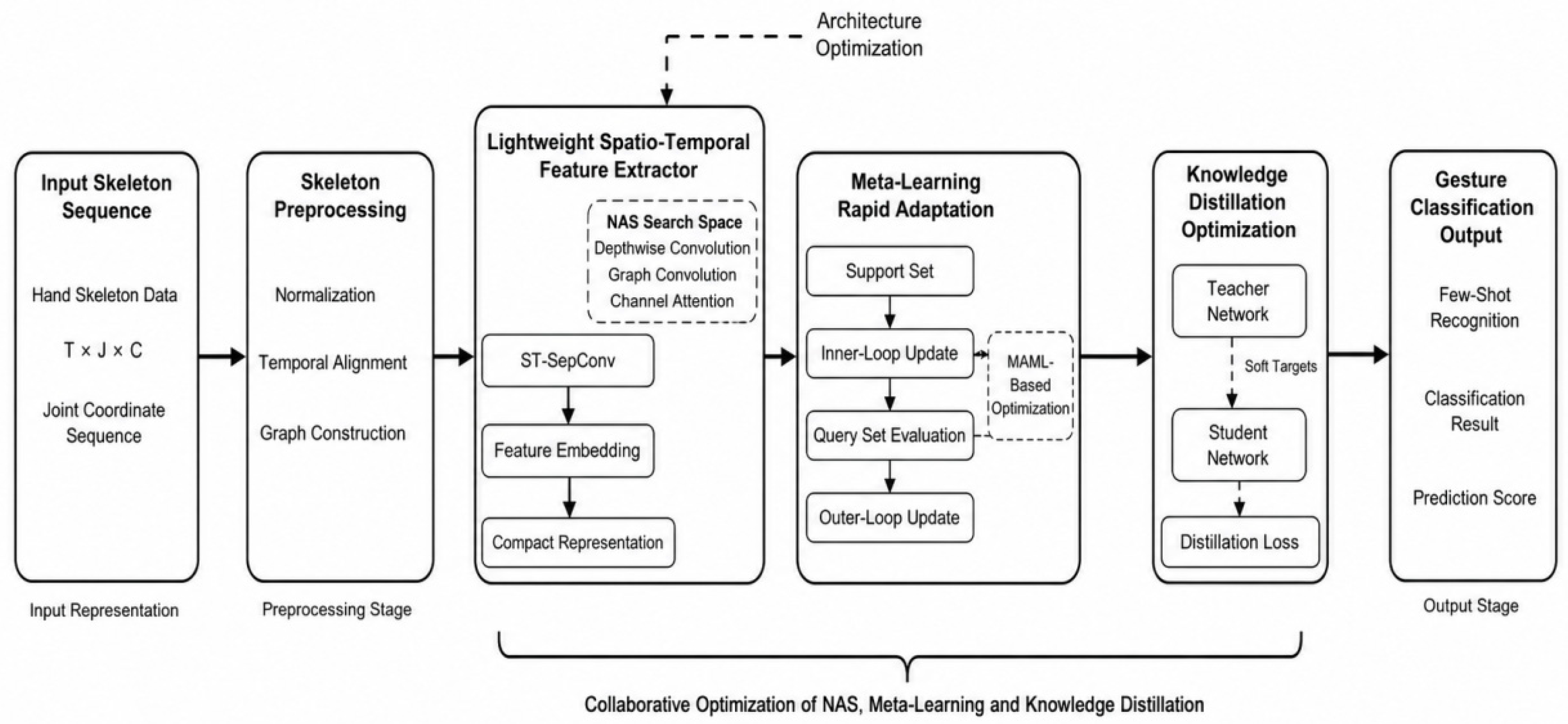
The overall architecture of the lightweight meta-learning framework is as follows: The framework mainly consists of four modules: skeleton sequence preprocessing, lightweight spatio-temporal feature extraction, meta-learning based rapid adaptation, and knowledge distillation assisted optimization. First, hand skeleton sequences are normalized into graph-structured representations. Then, a lightweight backbone optimized by Neural Architecture Search (NAS) is adopted to reduce computational complexity while preserving discriminative gesture features. Subsequently, a gradient-based meta-learning strategy is employed to improve rapid adaptation capability under few-shot conditions. Finally, knowledge distillation is introduced to further enhance the feature representation ability of the lightweight model. Through collaborative optimization of NAS, KD, and meta-learning, the proposed framework achieves both high recognition accuracy and low computational overhead under small-sample conditions. In order to evaluate the performance of the proposed framework, systematic experiments are carried out on multiple dynamic gesture datasets. Different proportions of small sample tasks are artificially constructed, and complex conditions such as user differences and movement speed changes are introduced to test the adaptation ability and generalization performance of the model in real scenes. The proposed framework adopts a skeleton-based unimodal input paradigm. RGB images and depth information are not directly involved in model training or evaluation. Instead, hand skeleton sequences are used as the only input representation because they provide compact structural information and reduce computational redundancy compared with pixel-level visual data.
3. Dynamic Gesture Recognition
The dynamic gesture recognition task is described by two types of features: spatial features and temporal features. Human hand gestures exhibit inherent structural symmetry, especially between left-hand and right-hand configurations [32,33]. However, direct utilization of skeleton coordinates may introduce additional distribution variations when the same gesture is performed by different hands. Such variations are particularly problematic under few-shot conditions because the available samples are insufficient to cover all possible hand-side patterns. To address this issue, this study introduces a symmetry-aware skeleton normalization strategy. Let the original hand skeleton sequence at time step t be represented as Equation (1):
where J denotes the number of hand keypoints and represents the spatial coordinate of the j-th joint.
For a left-right mirror transformation, the horizontal coordinate is transformed as Equation (2):
where M(⋅) denotes the mirror operation. Considering the correspondence between left and right hands, the transformed skeleton can be further expressed as Equation (3):
where π(j) represents the predefined mapping between symmetric keypoints of the left and right hands. After transformation, all skeleton sequences are aligned into a unified coordinate system before being fed into the feature extraction module. This operation reduces the distribution gap caused by hand-side differences while preserving the intrinsic motion characteristics of gestures.
Spatial features mainly refer to hand shape, position and joint configuration in a single frame image. Temporal features describe the motion trajectory and change pattern of hand posture between consecutive frames. However, the meta-learning framework focused on in this study does not need to rely on a complex multi-stage temporal modeling network because it needs to generalize quickly from a small number of samples. Therefore, this section only focuses on the basic problem definition and feature representation of dynamic gestures.
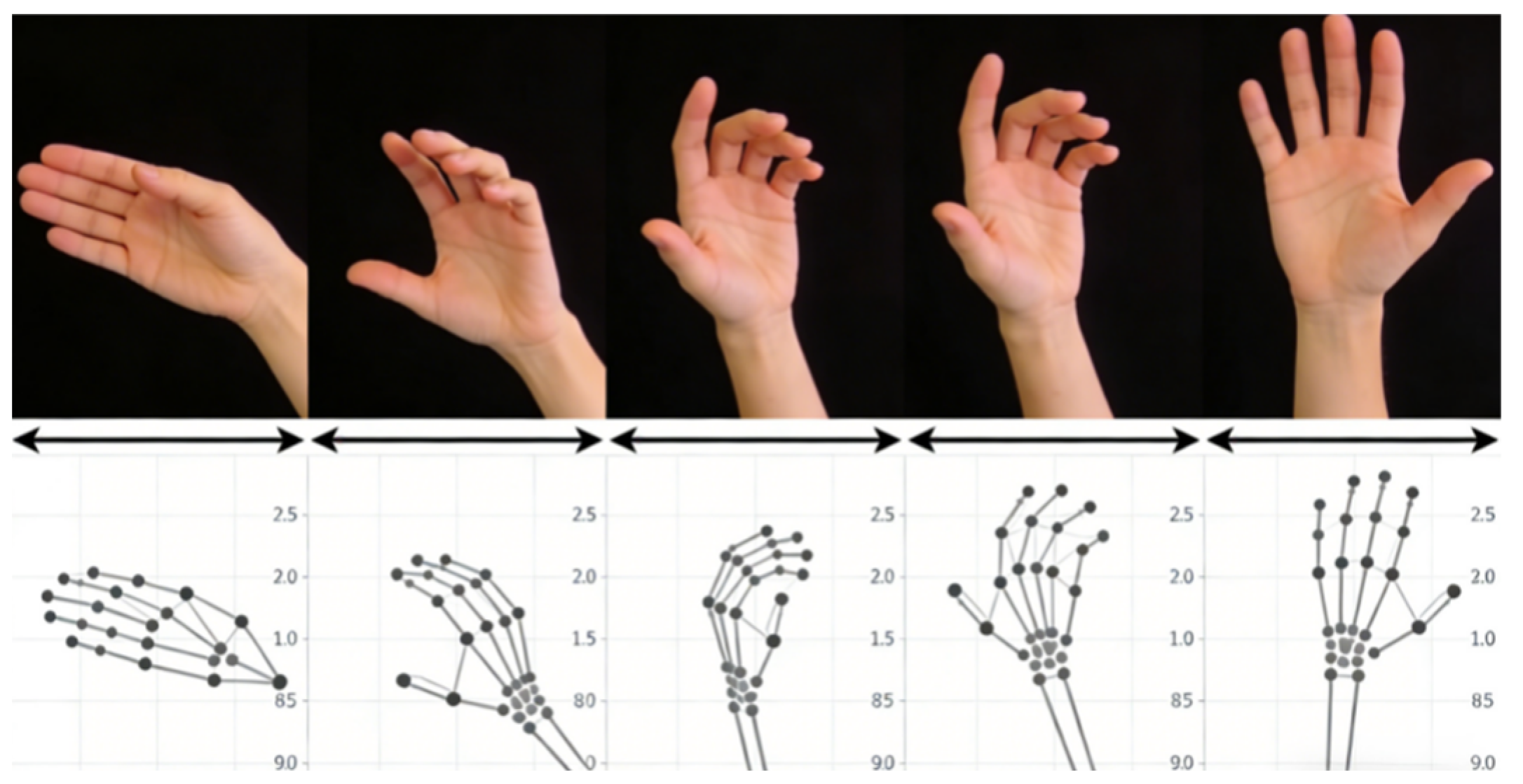
Based on the influence of mirror transformation on gesture semantics, dynamic gestures can be divided into two categories. The first category is mirror-invariant gestures, where the semantic category remains unchanged after horizontal flipping. Typical examples include static configurations such as clenched fists and open palms. For these gestures, left-hand and right-hand samples share similar spatial structures, and mirror normalization can effectively increase sample diversity without changing category information. The second category is mirror-sensitive gestures, where the semantic meaning depends on direction or rotation orientation. Examples of such gestures, as shown in Figure 1, include leftward and rightward swiping, along with clockwise and counterclockwise rotations. For these gestures, excessive mirror normalization may destroy directional information. Therefore, the original hand-side information is retained and used as an additional attribute during training. In this study, the symmetry operation is applied only to mirror-invariant gesture categories, while mirror-sensitive categories maintain their original coordinate orientation to preserve semantic consistency.
Figure 1.
Relationship between gesture video frame sequence and its corresponding skeleton keypoint sequence.
In this study, the key point sequence of the hand skeleton is used as the main representation of the gesture, and the original RGB video frame is not used. A significant advantage of the skeleton sequence is its strong robustness to background, illumination, and appearance changes. Unlike the pixel-level data, the original video frames are susceptible to environmental interference, while the skeleton sequences can stably represent the motion essence of hand gestures by abstracting them into joint coordinates. For dynamic gestures, not only intra-class differences are a problem, but also temporal misalignment and velocity variations lead to recognition difficulties. However, spatio-temporal graph modeling based on skeletal sequence is more computationally efficient. In addition, the computational cost of processing skeleton data is much lower than that of performing 3D convolution operations on high-dimensional video frames.
The gesture sequence can be formally defined as follows:
Let a dynamic gesture sample consist of T frames, each containing J keypoint coordinates of hand joints. Then the sample can be expressed as follows Equation (4).
where xt represents the hand pose at frame t and usually contains 2D or 3D coordinates for each joint (C = 2 or 3).
To be more specific, let Equation (5)
Represents the spatial position of the JTH joint in frame t.
Gesture recognition aims to learn a mapping function f such Equation (6):
where Y is a predefined set of gesture categories.
The sequence of bones should satisfy the constraints of human kinematics, and the connection relationship between joints can be represented by a fixed topological graph G = (V,E), where V is the set of joints and E is the set of bone edges.
In the framework of this study, the spatio-temporal feature extraction of dynamic gestures can be modeled as a spatio-temporal graph convolution process, which converts the input skeleton sequence X into a high-level spatio-temporal feature representation H, and its relationship can be expressed as follows Equation (7).
where Φ is the spatio-temporal graph convolutional network, Θ is its learnable parameters. This feature will be used as the input for the rapid adaptation of subsequent meta-learning.
Now ordered
This is the final embedding vector of gesture samples in the meta-feature space. Then, the few-shot gesture classification problem can be formalized as follows: Given a support set
With Query set
The goal is to learn a metric or classifier from the support set to accurately predict the label yj of a query sample. Where N is the number of classes and K is the number of samples per class (i.e., k-shot).
The input modalities employed in this study were standardized across different datasets. For the DHG-14, SHREC2017, FPHA, and LMDHG datasets, the hand skeleton sequences provided in the datasets were directly used as input representations, without involving RGB or depth image information. Therefore, all experiments conducted in this study fall under the category of skeleton-based unimodal modeling.
For the 20BN-Jester dataset, the original samples are RGB gesture videos. Since this study adopts a skeleton-based input paradigm, hand keypoints were extracted from RGB frames using MediaPipe Hands (version 0.8.10). The detector provides both hand-side labels and 21 keypoints for each detected hand. During preprocessing, the left-hand and right-hand samples were processed separately according to their original labels. For left-hand samples, mirror normalization was performed only for mirror-invariant gesture categories, transforming them into the unified right-hand coordinate system. For mirror-sensitive gestures, the original orientation information was preserved. A confidence threshold of 0.5 was applied to remove unreliable detections. Missing keypoints caused by occlusion or detection failure were recovered using linear interpolation between adjacent valid frames. Finally, all samples were represented as normalized skeleton sequences with the format T × J × C, where T represents the number of frames, J = 21 represents hand keypoints, and C = 3 represents spatial coordinates.
Keypoint extraction was implemented using MediaPipe Hands (version 0.8.10). The confidence threshold for hand detection was set to 0.5. Missing keypoints caused by occlusion or unstable detection were completed using linear interpolation between adjacent valid frames. All extracted keypoints were normalized into unified skeleton sequences before model training.
Thus, all experiments in this study were conducted under a unified skeleton-based input paradigm, without incorporating RGB or depth information, thereby ensuring fair comparisons across different datasets. Evaluations involving only the original RGB modality fall outside the scope of this skeleton-based model.
4. Meta-Learning Framework and Few-Shot Task Construction
All the lightweight recognition models explored in this study are trained and quickly adapted by the meta-learning mechanism under the condition of small samples, which is called the meta-optimization-based gesture recognition paradigm [5]. On the other hand, the hand skeleton sequence and spatio-temporal graph convolutional features are used as the main input of the model. Figure 2 illustrates the overall architecture of the proposed lightweight meta-learning framework. The following subsections introduce the basic formal representations of meta-learning and discuss some common challenges that should be considered in the construction of few-shot tasks.
Figure 2.
Lightweight meta-learning framework.
4.1. The Basic Formalism of Meta-Learning
The commonly used meta-learning framework consists of two core stages: Meta-Training and Meta-Testing [34]. However, in this study, we focus on the meta-learning approach based on optimization, whose objective can be formalized as a bilevel optimization problem:
In Equation (11), θ denotes the meta-initialized parameters shared across tasks, Ti represents an individual few-shot learning task sampled from the task distribution p(T), and Li refers to the task-specific loss function evaluated on the query set after adaptation. Denotes the adapted task-specific parameters obtained by one or more gradient updates on the support set . In addition, is the loss function computed on the query set to evaluate the adaptation effect and optimize the meta-parameters .
4.2. Small Sample Task Construction
This study employs the standard episodic training paradigm for task construction. In each meta-task, N categories are randomly sampled from the category set (with N fixed at 5 in this work), followed by the random selection of K instances per category to form the support set (K ∈ {1,5}). Additionally, 15 samples per category are drawn as the query set. During the meta-training phase, each epoch comprises 100 randomly sampled tasks. For meta-testing, 600 independent tasks are generated for each configuration. All experiments are repeated 30 times with distinct random seeds, and the final results are reported as “mean ± standard deviation”. To evaluate statistical reliability, each experiment was repeated 30 times using different random seeds. The results are reported as mean ± standard deviation. Furthermore, to mitigate potential category leakage, a cross-category partitioning strategy is adopted: the training and testing categories are strictly disjoint. For multi-user datasets (e.g., DHG-14, FPHA), cross-user partitioning is implemented—where testing subjects are excluded from training—to more realistically evaluate the model’s generalization capability [35]. Specifically, each meta-task can be modeled as follows Equation (12).
The support set Si contains N gesture categories with K samples per category. The query set Qi contains unseen samples from the same N categories, which are used to evaluate the model performance. For lightweight models, which often have limited computational resources, simplified task sampling strategies exist, and an effective version of them has been introduced in a previous study [5].
4.3. Meta-Learning Adaptation Process
Few-shot recognition can also be addressed through alternative strategies, including transfer learning, model fine-tuning, and domain adaptation [36]. However, these approaches usually require additional optimization on the target task or sufficient target-domain samples, which limits their adaptability when only a few labeled samples are available. Meta-learning aims to learn an initialization or adaptation strategy from multiple related tasks, allowing the model to rapidly adjust to unseen categories with limited samples. Among different meta-learning paradigms, metric-based methods such as ProtoNet mainly rely on the learned embedding space and may have limited flexibility when the distribution shift between tasks is significant. In contrast, optimization-based methods directly optimize the model initialization parameters and simulate the adaptation process during training [37]. Therefore, this study adopts Model-Agnostic Meta-Learning (MAML) as the optimization-based meta-learning strategy because it provides task-level adaptability while maintaining compatibility with lightweight neural architectures. As mentioned above, in this study, we adopt a gradient-based meta-optimizer such as MAML to achieve fast adaptation, whose core steps include inner loop adaptation and outer loop meta-update. The basic algorithm of the process can be summarized by the following formula:
Inner loop adaptation: For each task Ti, compute the post-adaptation parameters as follows Equation (13).
where α is the inner loop learning rate.
Outer loop meta update: Update meta parameters based on query set loss:
where β is the outer loop learning rate.
4.4. Challenge Types of Small Sample Conditions
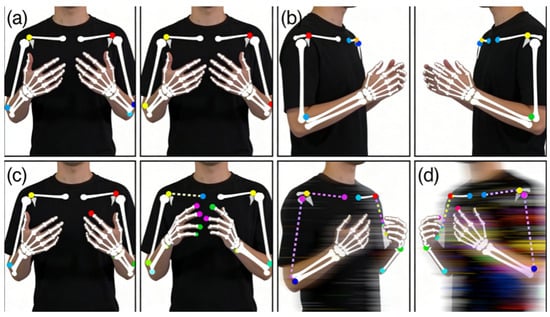
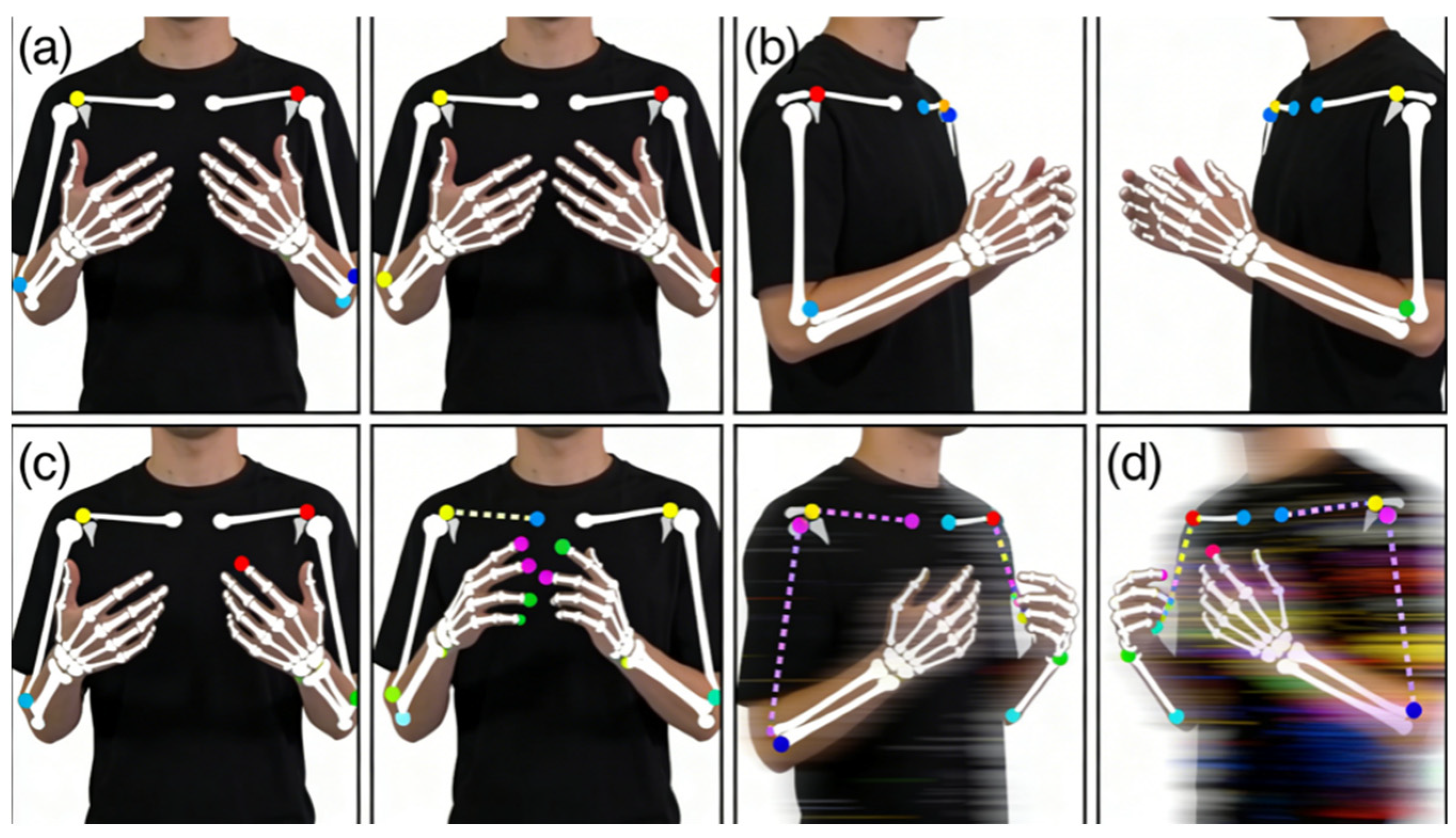
The few-shot challenge conditions considered in this study include cross-user variation, motion speed variation, viewpoint variation, partial occlusion, and background interference [38]. Figure 3 illustrates four typical challenge conditions in few-shot dynamic gesture recognition. Figure 3a shows cross-user variation, where the same gesture may exhibit differences in joint scale, motion range, and execution habits among different users. Figure 3b presents motion velocity variation, where the overall movement speed or the relative velocity between gesture segments may differ across executions. Figure 3c demonstrates viewpoint variation, where changes in camera position and acquisition angle lead to deformation of the projected skeleton coordinates. Figure 3d represents partial occlusion, where some hand keypoints may become invisible or inaccurately detected due to object occlusion or self-occlusion.
Figure 3.
Illustration of typical few-shot challenge conditions in dynamic gesture recognition: (a) cross-user variation, (b) motion velocity variation, (c) viewpoint variation, and (d) partial occlusion.
5. Lightweight Network Architecture Design and Training Strategy
In order to achieve the efficient deployment of a dynamic gesture recognition model under the condition of a small sample size, this section details the design and training strategy of a lightweight network structure. In this study, two ways of structure optimization and knowledge transfer were used to compress the model. On the one hand, spatio-temporal separable convolution was used to construct the lightweight backbone, and on the other hand, Neural Architecture Search (NAS) and knowledge distillation (KD) were introduced for deep optimization. In the following, the basic lightweight feature extraction design is first introduced, and then the automatic structure search based on NAS and the KD-based co-training strategy are described, respectively. Finally, the co-training process of NAS and the meta-learning framework is explained.
5.1. Basic Lightweight Feature Extraction Design
Traditional lightweight network design usually draws on depthwise separable convolution and channel attention mechanism [34]. This framework adopts the idea of multi-branch feature fusion and uses the skeletal spatio-temporal map as the basic input representation. The network does not directly process the high-dimensional original joint coordinate sequence but learns its low-dimensional spatio-temporal feature representation. Among a variety of basic operations, spatio-temporal separable convolution (ST-SepConv) has been adopted due to its significant efficiency advantage, which is implemented by decomposing standard 3D convolution operations. Given an input skeleton sequence , the relation between ST-SepConv and standard convolution can be expressed as follows Equation (15).
Unlike standard 3D convolution, ST-SepConv decomposes temporal convolution and spatial graph convolution into two independent lightweight operations. Temporal convolution is first applied along the frame dimension to capture motion dynamics, followed by spatial graph convolution across joint connections to model skeletal topology relationships. This decomposition significantly reduces computational complexity while preserving spatio-temporal dependencies. Each base transformation branch Bi can represent a different lightweight operation, Equation (16):
5.2. Neural Architecture Search for Lightweight Architecture Optimization
The NAS module searches lightweight spatio-temporal feature extraction structures from a predefined operation space. The candidate operations include: (1) standard convolution; (2) depthwise separable convolution; (3) spatio-temporal separable convolution; (4) graph convolution; (5) skip connection. Each search unit contains two intermediate nodes, and the output feature is generated by weighted aggregation of candidate operations. The architecture parameters determine the probability distribution of candidate operations.
To further automate the search for the optimal lightweight subnetwork, the framework introduces Neural architecture Search (NAS). The core idea of NAS is to automatically search for the optimal architecture with both performance and efficiency in a predefined search space O, as described in reference [5]. The search space usually contains a variety of candidate operations:
The NAS process controls the selection probability of different operations by optimizing the architecture parameter α. For the (i,j) th cell in the network, its output is the weighted sum of all candidate actions:
The optimization goal of the search is to minimize the weighted sum of the validation loss and the model complexity (e.g., FLOPs):
In Equation (19), Γ denotes the joint optimization objective combining validation loss and model complexity regularization, while N(X;o,w) represents the lightweight neural architecture generated from operation set o and network weights w. The complexity trade off factor λ can be set dynamically based on a baseline model:
The architecture parameter α is updated via gradient descent:
The NAS procedure follows a differentiable architecture search strategy. Each search unit contains two intermediate nodes, and the candidate operations are aggregated according to learnable architecture parameters. The final backbone contains three searched units connected sequentially. After the search process, the optimal lightweight backbone consists of three sequential spatio-temporal feature extraction blocks. Each block contains one temporal convolution operation and one graph convolution operation. The channel dimensions are set as 32, 64, and 128 for the three blocks, respectively. A global average pooling layer is applied after feature extraction, followed by a fully connected classifier. The final searched architecture contains fewer parameters and lower computational complexity than the original ST-GCN backbone while preserving the discriminative ability of gesture motion features.
5.3. Knowledge Distillation Based Co-Training Strategy
Knowledge distillation (KD) is another key lightweight model performance improvement technique, which uses a powerful Teacher to guide the training of a lightweight Student model [23].
In KD, a temperature coefficient τ is first introduced to soften the output probability distributions of the teacher and student models to obtain richer inter-class information:
More specifically, for the output logits z of the student model, its softened probability is:
Distillation loss typically uses Kullback–Leibler divergence to measure the difference between student and teacher softening probability distributions:
The total training loss of the student model is composed of the standard cross-entropy classification loss and distillation loss weighted as follows Equation (25).
Here, the cross-entropy loss is calculated as follows Equation (26).
The distillation weight γ can be dynamically attenuated during training to balance the learning focus of different training stages:
The original exponential decay formulation may excessively reduce the contribution of the distillation loss during later training stages. Therefore, a lower bound parameter is introduced to maintain the knowledge transfer effect throughout the optimization process. where represents the initial distillation weight, k controls the decay rate, and denotes the minimum contribution coefficient of the distillation loss.
In this study, = 0.5, = 0.1, and k = 0.05 are empirically selected. The final performance of the student model is evaluated by its accuracy on the test set:
where are the optimal parameters of the student model obtained by minimizing the total loss :
The total loss function can be simplified to the following form:
The collaborative optimization procedure of NAS, KD, and meta-learning is summarized in Algorithm 1. The algorithm first searches lightweight network structures using NAS, then performs task-level adaptation through meta-learning, and finally optimizes the student model through knowledge distillation.
| Algorithm 1 Collaborative optimization procedure of NAS and KD |
| Step 1: Initialize network weights and architecture parameters. Step 2: Sample candidate lightweight subnetworks from NAS space. Step 3: Perform meta-learning inner-loop adaptation using support set. Step 4: Compute query-set loss for outer-loop optimization. Step 5: Generate soft labels using the teacher network. Step 6: Compute knowledge distillation loss between teacher and student outputs. Step 7: Jointly optimize network weights and architecture parameters. Step 8: Select the optimal lightweight subnetwork. Step 9: Perform final few-shot evaluation on testing tasks. |
The procedure jointly updates architecture parameters and model parameters. Through iterative optimization, the framework obtains a lightweight model with both efficient inference capability and rapid adaptation ability.
5.4. The Collaborative Process of Lightweight Design and Meta-Learning
Integrating lightweight design with meta-learning framework requires designing a collaborative training flow. The meta-learning outer layer update involves the optimization of the meta-parameters θ based on the query set loss:
Here, support set loss and query set loss are defined as:
Model performance after task adaptation is measured by query-set accuracy:
The indicator function II is defined as follows Equation (35):
In co-training, the parameters of the student model are updated according to the gradient of the total loss:
where η represents the learning rate and denotes the combined optimization objective consisting of classification loss and knowledge distillation loss. The collaborative training strategy enables the lightweight model to maintain recognition performance while reducing computational requirements. By integrating NAS-based structure optimization, knowledge distillation, and meta-learning adaptation, the proposed model achieves a balance between efficiency and generalization.
For clarity, all variables used in the mathematical formulations are defined as follows. T denotes the number of frames in a gesture sequence; J represents the number of hand keypoints; C indicates coordinate dimensions; X represents the input skeleton sequence; Y denotes gesture categories; G = (V,E) represents the hand skeleton graph, where V and E indicate joints and bone connections, respectively.
6. Experimental Results and Comparative Analysis
6.1. Experimental Setup
To comprehensively evaluate the proposed lightweight meta-learning framework, experiments were conducted from four perspectives: (1) recognition performance evaluation under few-shot settings; (2) robustness evaluation under different challenge conditions, including cross-user variation, viewpoint variation, motion speed variation, partial occlusion, and background interference; (3) computational efficiency evaluation, including parameter number, FLOPs, inference latency, and memory consumption; (4) statistical reliability analysis based on repeated experiments and significance testing.
To comprehensively evaluate the proposed lightweight meta-learning framework, experiments were conducted from three perspectives.
Task 1: Few-shot recognition evaluation. The objective is to verify the adaptation capability of the proposed meta-learning framework when only limited labeled samples are available. Both 5-way 1-shot and 5-way 5-shot settings are considered. Although zero-shot gesture recognition is an important research direction, this study focuses on few-shot scenarios where several labeled samples are available for rapid adaptation. Therefore, zero-shot evaluation is beyond the scope of the current work. Future research will investigate the extension of the proposed framework toward zero-shot and generalized zero-shot gesture recognition.
Task 2: Robustness evaluation. The objective is to analyze the influence of different gesture variations, including cross-user variation, viewpoint variation, motion speed variation, partial occlusion, and background interference.
Task 3: Efficiency evaluation. The objective is to compare computational requirements among different models and evaluate the effectiveness of the lightweight architecture design.
All experiments were implemented using the PyTorch v1.7, framework under a unified skeleton-based input protocol. The detailed dataset description, preprocessing procedure, and experimental settings are introduced in the following sections.
Due to discrepancies in joint definitions across different datasets (e.g., DHG-14 and SHREC2017 utilize 22 joints, whereas FPHA and LMDHG employ 21 joints), a unified mapping procedure was applied to all skeletal data in this study. Specifically, a standardized 21-joint hand topology was adopted as the reference template. For datasets with 22 joints, alignment was achieved by removing redundant wrist nodes and re-indexing the joints accordingly; for datasets already containing 21 joints, the original structure was preserved. All datasets were ultimately mapped to a unified topological graph G = (V,E) to ensure consistency in graph convolutional operations.
It should be noted that the original annotations of the LMDHG dataset contained duplicate joint indices. To address this issue, corrective preprocessing was performed to redefine the joint set and connectivity, thereby eliminating potential inconsistencies in topology that could adversely affect model training. Table 1 shows the statistical information and partition method of the dataset used in the experiment. All datasets are constructed according to the “N-way K-shot” paradigm, where the samples of the support set and the query set do not overlap. A subset containing 20 representative gesture categories was selected from the original 20BN-Jester dataset. After skeleton extraction and preprocessing, approximately 600–800 valid samples were retained for each category. Each category included approximately 600–800 samples after skeleton extraction and preprocessing. The subset was constructed to maintain balanced gesture distributions and reduce computational redundancy.
Table 1.
Statistics of experimental dataset and setting of challenge conditions.
Five publicly available dynamic gesture datasets were used in this study: DHG-14, SHREC2017, FPHA, LMDHG, and 20BN-Jester. These datasets were selected because they contain diverse gesture categories and include different challenging factors such as user differences, viewpoint changes, motion variations, and environmental interference. DHG-14 and SHREC2017 mainly focus on hand skeleton-based dynamic gesture recognition. FPHA provides more complex hand-object interaction scenarios. LMDHG contains larger variations among users. 20BN-Jester originally provides RGB gesture videos, from which hand skeleton sequences were extracted using MediaPipe Hands for consistency with the proposed skeleton-based framework. All datasets were processed according to the same preprocessing pipeline described in Section 2. Potential hand-side misclassification caused by MediaPipe detection was corrected by checking temporal consistency between adjacent frames and removing inconsistent predictions.
The challenge conditions listed in Table 1 correspond to the intrinsic characteristics of each dataset rather than artificially generated disturbances. Specifically, cross-user variation, viewpoint variation, motion speed variation, partial occlusion, and background interference are directly inherited from the original dataset acquisition environments. No additional synthetic perturbations were introduced during evaluation.
Under baseline conditions, the coordinate noise standard deviation of the skeleton sequence was set to 2 pixels (for 2D keypoints) and 0.01 (for normalized 3D coordinates), respectively. On the other hand, the hyperparameters for meta-learning training were set as follows: the inner loop learning rate α = 0.01, and the outer loop learning rate β = 0.001. The number of training steps for each meta-task was set to 5.
The baseline models were selected according to three categories: conventional deep learning methods, graph-based gesture recognition methods, and meta-learning approaches. 3D-CNN represents conventional spatio-temporal feature learning methods. ST-GCN is selected because graph convolution has been widely used for skeleton-based gesture recognition. MAML and ProtoNet represent optimization-based and metric-based meta-learning approaches, respectively. Therefore, these baselines provide a comprehensive comparison covering traditional recognition models, skeleton-based models, and few-shot learning methods.
The reported standard deviations were recalculated from the raw experimental results of all independent runs. The previous version did not fully reflect the variability among repeated experiments. Therefore, the updated tables provide revised mean ± standard deviation values. Table 2 and Table 3 present the average results derived from 30 independent experiments; however, the original tables did not include measures of variation. To enhance statistical reliability, this revised version incorporates the standard deviation metric (mean ± std). A consistent task sampling strategy and evaluation protocol have been uniformly applied across all model comparisons to ensure impartial performance assessment.
Table 2.
Average classification accuracy (%) of each model on different datasets under 5-way 1-shot setting.
Table 3.
Average classification accuracy (%) of each model on different datasets under 5-way 5-shot setting.
The initial covariances of pose features and classification weights were set to 0.1 and 0.2, respectively. The meta-initialization parameters are assumed to be randomly initialized, and the initial classification bias vector is set to zero. For the lightweight design based on neural architecture search, the number of search iterations is determined as 50, and the temperature parameter τ of knowledge distillation is chosen as 3. The training batch size is set to 4 tasks, and it is assumed that all datasets have been spatio-temporal aligned. Table 1 shows the number of samples, the number of joints, and the type of challenge conditions for each dataset. Table 2, Table 3 and Table 4 show the average classification accuracy (%) of different models on the query set and their lightweight metrics when receiving the challenge conditions specified in Table 2.
Table 4.
Computational efficiency comparison of different models.
6.2. Few-Shot Recognition Performance
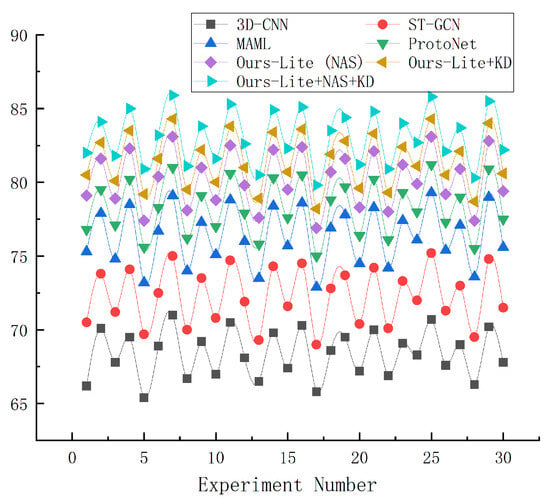
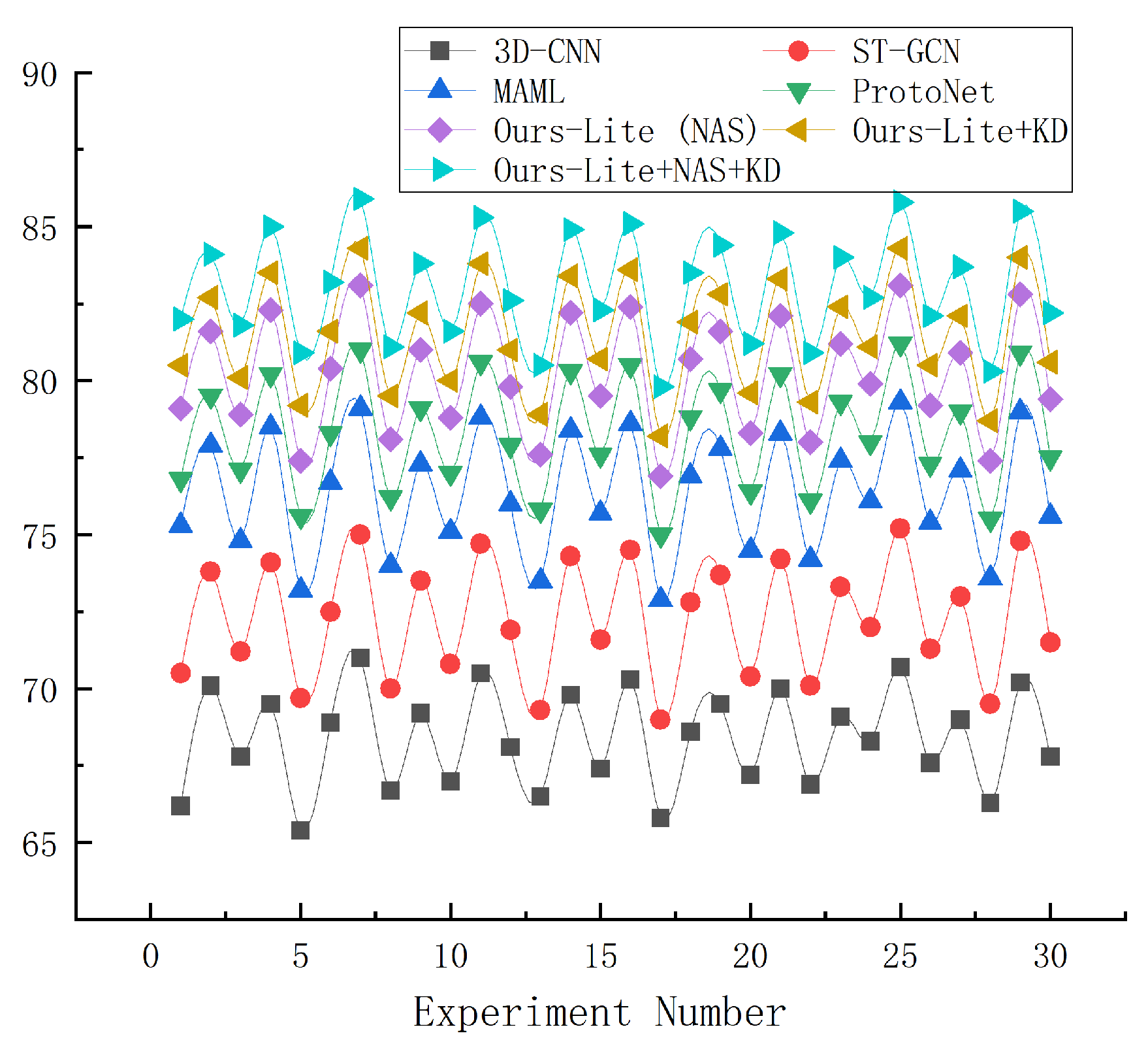
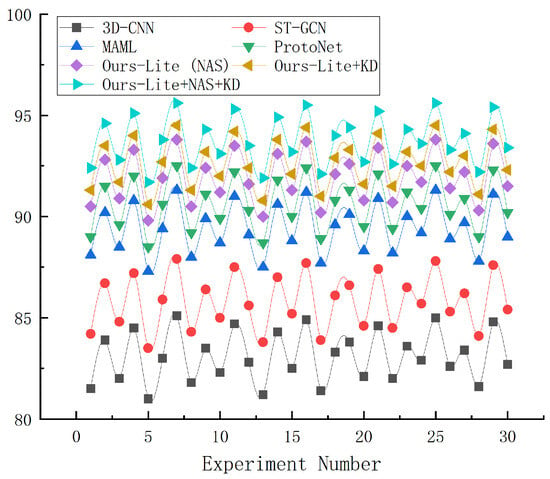
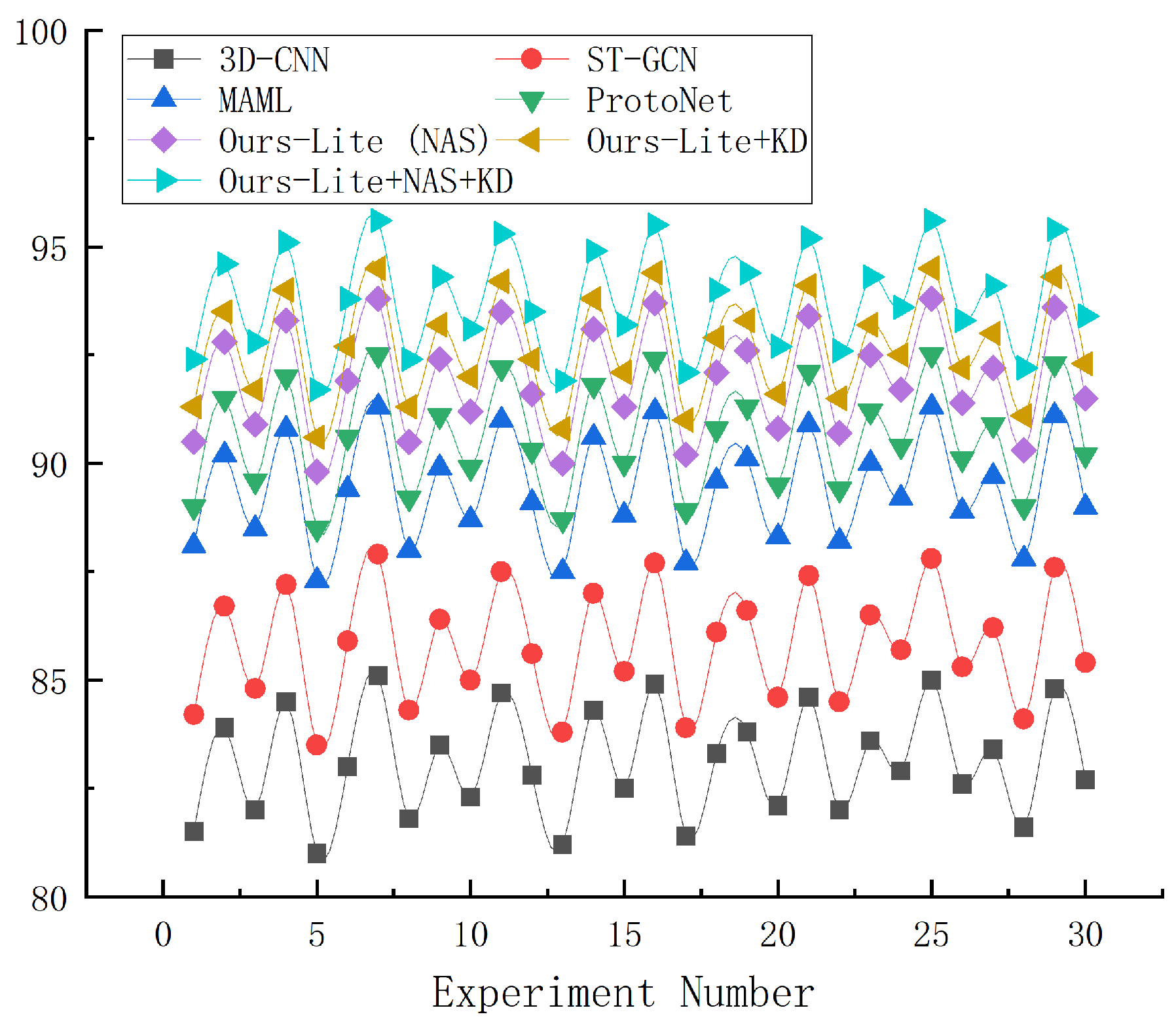
Firstly, the results of DHG-14 dataset under 5-way 1-shot setting in Table 2 show that the traditional Spatio-temporal graph Convolutional Network (ST-GCN) can perform reasonably well even under the condition of cross-user variation. Figure 4 visualizes the accuracy distribution of each model over 30 independent experiments on the DHG-14 dataset under cross-user variation, further demonstrating the stability of the proposed method. However, the results of SHREC2017 dataset in Table 2 show that the traditional ST-GCN is not robust to motion speed variation and viewpoint change. On the other hand, two meta-learning driven methods (MAML, ProtoNet) can maintain good generalization performance under all challenge conditions. Clearly, the meta-learning algorithm combined with the lightweight design (Ours-Lite) outperforms the non-lightweight meta-learning baseline.
Figure 4.
Classification accuracy (%) of 30 independent experiments for each model on different datasets (DHG-14 (cross-user variation)).
In particular, from the results of the FPHA dataset in the 5-way 5-shot setting in Table 3, it can be seen that in the presence of partial occlusion and background interference, the recognition results given by traditional 3D-CNN and ProtoNet based on metric learning are not accurate. Figure 5 presents the accuracy distribution of each model over 30 repeated experiments on the FPHA dataset, which involves background interference, confirming the robustness of the proposed framework under challenging conditions. However, the lightweight meta-learning algorithm combined with knowledge distillation (Ours-Lite + KD) gives good enough estimation results. The presented results show that the few-shot adaptation property of the lightweight meta-learning model is better than that of the other methods investigated.
Figure 5.
Classification accuracy (%) of 30 independent experiments for each model on different datasets (FPHA (background interference)).
6.3. Computational Efficiency Comparison
As shown in Table 4, ST-GCN achieves relatively high computational cost due to its deep graph convolution structure. Although MAML and ProtoNet adopt meta-learning strategies, additional adaptation operations introduce extra computational overhead during inference. The proposed Ours-Lite + NAS + KD model achieves the lowest parameter number, FLOPs, inference latency, and GPU memory consumption due to the lightweight architecture optimization and knowledge distillation strategy. These results demonstrate that the proposed framework provides a better trade-off between adaptation capability and computational efficiency.
In addition to the accuracy table, in order to better evaluate the efficiency of the proposed lightweight model and make a comparison, the computational complexity and parameter number of different models are shown in Table 4. It can be seen from Table 4 that the number of parameters (Params) and floating-point operations (FLOPs) of the proposed lightweight model are significantly lower than those of the traditional deep model and the non-lightweight meta-learning model at the same or higher accuracy. When comparing the performance of the two lightweight strategies, in general, the lightweight meta-learning model combining neural architecture search and knowledge distillation (Ours-Lite + NAS + KD) performs the best in terms of the balance between accuracy and efficiency. The PyTorch Profiler tool is used to compare the computational burden of the two lightweight strategies. It is found that the lightweight design based on neural architecture search (Ours-Lite + NAS) requires more computation in the search phase than the lightweight module based on manual design (Ours-Lite). In the whole architecture search process, an average of 2.1 h are spent on hypernetwork training and architecture parameter optimization. The co-training process of knowledge distillation takes an average of 0.5 h for the forward propagation and soft label generation of the teacher model. This result is expected, because neural architecture search requires a large number of architecture parameter updates and validation set evaluation. During the failure interval, the number of parameters and computation of the two lightweight strategies are significantly lower than that of the traditional deep model and the non-lightweight meta-learning model. When comparing the performance of the two lightweight strategies, in general, the lightweight meta-learning model combining neural architecture search and knowledge distillation (Ours-Lite + NAS + KD) performs the best in terms of the balance between accuracy and efficiency.
The identical parameter counts and FLOPs reported for ST-GCN, MAML, and ProtoNet originate from the fact that these methods share the same skeleton-based feature extraction backbone. The difference among them lies in the learning strategy rather than the network architecture itself. Specifically, MAML adopts gradient-based meta-optimization, whereas ProtoNet utilizes metric-based prototype classification. Therefore, their computational complexity remains consistent under the same backbone configuration.
To ensure the fairness of comparisons, all baseline models were reproduced under identical input modalities (skeleton sequences), consistent task partitions, and equivalent training epochs as well as optimization strategies. Specifically, the 3D-CNN baseline adopts the standard C3D architecture, while ST-GCN utilizes the classical spatio-temporal graph convolutional skeleton model. Both MAML and ProtoNet employ the identical skeleton encoder as the backbone network, differing only in their meta-learning strategies. For skeleton-based input adaptation, the joint coordinate sequences were reorganized into pseudo-spatio-temporal tensors, enabling the C3D network to perform temporal convolution operations on skeletal motion representations instead of RGB frames.
It is worth noting that the original versions of different baselines exhibited identical parameter counts and FLOPs (e.g., ST-GCN, MAML, ProtoNet), which stemmed from their shared feature extraction backbone. This point has been explicitly clarified in the revised text to prevent potential misinterpretations regarding experimental statistics.
6.4. Ablation Study
To further evaluate the contribution of different components in the proposed framework, ablation experiments were conducted on the DHG-14 dataset under the 5-way 1-shot setting. The compared configurations include: (1) baseline ST-GCN, (2) ST-GCN combined with meta-learning, (3) lightweight NAS-based structure without KD, (4) lightweight structure with KD, and (5) the complete NAS + KD + Meta-learning framework.
Table 5 demonstrates that meta-learning significantly improves few-shot adaptation capability, while NAS effectively reduces computational complexity. Furthermore, knowledge distillation enhances feature representation quality and improves classification robustness under cross-user variation conditions. Compared with the baseline model, the complete framework achieves the best trade-off between recognition accuracy and computational efficiency, verifying the effectiveness of the collaborative optimization strategy.
Table 5.
Ablation study of different framework components on the DHG-14 dataset under the 5-way 1-shot setting.
6.5. Statistical Significance Analysis
To evaluate whether the performance improvements achieved by our proposed method over the baseline models are statistically significant, we conducted a paired two-tailed Student’s t-test across all experimental configurations.
Experimental setup for statistical testing: For each dataset and each few-shot setting (5-way 1-shot and 5-way 5-shot), we performed 30 independent repeated experiments with different random seeds. For each repetition, we recorded the classification accuracy of our proposed method (Ours-Lite + NAS + KD) and each baseline model on the query set. This yielded 30 paired accuracy differences for each comparison (proposed method vs. baseline). The mean accuracy and standard deviation (mean ±std) reported in Table 2 and Table 3 are calculated from these 30 independent runs.
Choice of the paired t-test: The paired t-test was selected because all comparisons were performed on the same datasets, under the same task partitions (same N-way K-shot configurations), and using the same evaluation protocol. The paired design controls for between-task variability and is therefore more sensitive to detecting actual performance differences than an unpaired test. The test is two-tailed because we aim to detect whether the mean difference is significantly different from zero (i.e., whether our method is either significantly better or worse than each baseline). However, as our method consistently achieved higher accuracy than all baselines across all datasets and settings, the two-tailed test essentially evaluates whether this observed improvement is statistically reliable.
Hypothesis and p-value interpretation: The null hypothesis H0 states that the mean difference in accuracy between the proposed method and the baseline is zero (i.e., no performance improvement). The alternative hypothesis H1 states that the mean difference is not zero. The resulting p-value represents the probability of observing the obtained performance difference (or a more extreme difference) under the null hypothesis. A p-value less than 0.05 indicates that the observed improvement is unlikely to have occurred by random chance, providing statistical evidence that the proposed method significantly outperforms the baseline.
Results of the statistical analysis: The paired t-test results showed that all p-values were consistently below 0.01 across all comparisons (i.e., p < 0.01 for all datasets and all baseline comparisons). For example, on the DHG-14 dataset under the 5-way 1-shot setting, the comparison between our method and ST-GCN yielded p < 0.001, indicating a highly significant improvement. Similar results were observed across all datasets and settings.
7. Conclusions
This paper introduces a lightweight dynamic gesture recognition model driven by meta-learning for small sample conditions. The core of the lightweight design method elaborated in Section 4 lies in automatically finding efficient substructures through neural architecture search and using knowledge distillation to transfer knowledge from large models, thereby compressing their size while maintaining model performance. On the other hand, the meta-learning paradigm based on which this paper is based enables the model to quickly learn new tasks from a small number of samples, enhancing the generalization ability.
In the experiments used to verify the performance of the model, the recognition framework takes the hand skeleton sequence as input, uses spatio-temporal graph convolution for feature extraction, and is trained and tested on the meta-learning task. All baseline models compared in this study were performed under the same evaluation protocol. In order to comprehensively examine the performance, multiple few-shot recognition tasks covering different challenging scenarios are constructed.
Through a series of experiments, it is first observed that the traditional ST-GCN model has a certain recognition ability in the face of challenges such as cross-user differences, but its performance significantly decreases when samples are scarce. Under more complex conditions such as viewpoint change and background interference, the performance of traditional models and some meta-learning baselines shows large fluctuations or insufficient accuracy. However, the proposed lightweight meta-learning model can maintain stable and excellent recognition performance under all test conditions, and its parameter number and calculation amount are much lower than that of traditional deep models. The experimental results show that the lightweight meta-learning framework combining NAS and KD has the best comprehensive performance on few-shot gesture recognition tasks.
The proposed lightweight meta-learning method requires additional computational overhead in the model search and co-training stages. In the scenario of using multiple datasets and multiple tasks for evaluation, this process will introduce a certain training time cost, which is the main drawback of this method. When different lightweight strategies are compared, it can be seen that the method combining neural architecture search with knowledge distillation outperforms the single strategy in the precision-efficiency trade-off, despite its more complex design phase. On the other hand, the effect of knowledge distillation largely depends on the quality of the teacher model, which may need to be carefully considered in practical applications. In embedded application scenarios where computing resources are limited but high accuracy is required, the proposed lightweight meta-learning model can be preferred due to its strong adaptability to small samples and low inference cost. In future research, the combination of the proposed framework with self-supervised pre-training and other techniques will be explored to further reduce the dependence on labeled data and enhance its generalization ability in a wider range of gesture categories and complex environments.
Author Contributions
Conceptualization and writing—review and editing, Y.X.; methodology, F.R.; writing—original draft preparation, Y.X.; visualization, J.H. and Y.Y.; supervision, Y.Y.; project administration, Y.X. and F.R.; and funding acquisition, Y.X. All authors have read and agreed to the published version of the manuscript.
Funding
This work was supported in part by the National Natural Science Foundation of China under Grant 52402122, Grant 61903206, and Grant 51575412; in part by the Project of the Science and Technology Department of Henan Province under Grant 252102321059, Grant 262102211045, Grant 252102221011, Grant 242102221036, and Grant 252102220073.
Institutional Review Board Statement
The study was conducted in accordance with the Declaration of Helsinki, and the protocol was approved by the Ethics Committee of Academic Subcommittee of the School of Energy and Electrical Engineering Pingdingshan University (PSU-EE-2026-003) on 15 January 2026.
Informed Consent Statement
Informed consent was obtained from all subjects involved in the study.
Data Availability Statement
The original contributions presented in this study are included in the article. Further inquiries can be directed to the corresponding author.
Acknowledgments
The authors would like to thank the reviewers for their helpful comments and constructive suggestions, which have been very useful for improving the presentation of this paper. We are also grateful to Weidi Huang and Chunbiao Gan for their valuable assistance and support during the preparation and revision of this work.
Conflicts of Interest
The authors declare no conflicts of interest.
References
- Hax, D.R.T.; Penava, P.; Krodel, S.; Razova, L.; Buettner, R. A Novel Hybrid Deep Learning Architecture for Dynamic Hand Gesture Recognition. IEEE Access 2024, 12, 28761–28774. [Google Scholar] [CrossRef] [Scilit]
- Bagladi, M.Z.; Gulys, L.; Szalay, G. Fast Real-Time Pipeline for Robust Arm Gesture Recognition. In IntRob’25: Proceedings of the Intelligent Robotics FAIR 2025; Association for Computing Machinery: New York, NY, USA, 2025. [Google Scholar] [CrossRef] [Scilit]
- Lv, D.; Tang, Z.; Wang, Y.; Xu, J.; Wu, Y.; Wu, G.; Xie, J. Soft and Highly Adhesive Wearable Electronics for Hand Reconstruction Based on PMUT and PPA-CNTs Strain Sensors. Adv. Funct. Mater. 2025, 35, 51. [Google Scholar] [CrossRef] [Scilit]
- Meena, S.D.; Rao, T.P.C.; Krishna, K.V.; Chandra, S.B.; Vyshnavi, K.; Krishna, G.S.; Sheela, J. Superposed CNN-RBN joint network-based gesture recognition system. AIP Conf. Proc. 2023, 2869, 050012. [Google Scholar] [CrossRef] [Scilit]
- Yusuf, O.; Habib, M. Development of a Lightweight Real-Time Application for Dynamic Hand Gesture Recognition. In 2023 IEEE International Conference on Mechatronics and Automation (ICMA); IEEE: Piscataway, NJ, USA, 2023; pp. 543–548. [Google Scholar] [CrossRef] [Scilit]
- Bhatt, V.; Dash, R. Dynamic hand gesture recognition via reinforcement learning with adaptive category exclusion. Vis. Comput. 2025, 41, 11349–11372. [Google Scholar] [CrossRef] [Scilit]
- Amprimo, G.; Ancilotto, A.; Savino, A.; Quazzolo, F.; Ferraris, C.; Olmo, G.; Farella, E.; Di Carlo, S. EHWGesture—A dataset for multimodal understanding of clinical gestures. In 2025 IEEE/CVF International Conference on Computer Vision Workshops (ICCVW); IEEE: Piscataway, NJ, USA, 2025. [Google Scholar]
- Nuzhdin, A.; Nagaev, A.; Sautin, A.; Kapitanov, A.; Kvanchiani, K. HaGRIDv2: 1M Images for Static and Dynamic Hand Gesture Recognition. arXiv 2024, arXiv:2412.01508. [Google Scholar]
- Tripathi, R.; Verma, B. Survey on vision-based dynamic hand gesture recognition. Vis. Comput. 2023, 40, 6171–6199. [Google Scholar] [CrossRef] [Scilit]
- Ali, H.; Jirak, D.; Wermter, S. Snapture—A Novel Neural Architecture for Combined Static and Dynamic Hand Gesture Recognition. Cogn. Comput. 2023, 15, 2014–2033. (In Chinese) [Google Scholar] [CrossRef] [Scilit]
- Kanwal, T.; Altaf, S. Exploring Sensor Fusion Techniques for Enhanced Dynamic Hand Gesture Recognition: A Comprehensive Metadata Analysis. IEEE Sens. Rev. 2025, 2, 122–156. [Google Scholar] [CrossRef] [Scilit]
- Mukhanov, S.; Uskenbayeva, R.; Rakhim, A.A.; Young, I.C.; Yemberdiyeva, A.; Bekaulova, Z. DEEP AND MACHINE LEARNING MODELS FOR RECOGNIZING STATIC AND DYNAMIC GESTURES OF THE KAZAKH ALPHABET. Sci. J. Astana IT Univ. 2024, 18, 75–95. [Google Scholar] [CrossRef] [Scilit]
- Dewangan, S.; Origanti, V.K.; Kirchner, F. Real-Time Dynamic Gesture Recognition for Human-Robot Collaboration in Rescue Operations. In 2024 IEEE International Symposium on Safety Security Rescue Robotics (SSRR); IEEE: Piscataway, NJ, USA, 2024; pp. 229–236. [Google Scholar] [CrossRef] [Scilit]
- Sebbah, R.; Chelali, F.Z. IWBC and LFD for Static and Dynamic Hand Gesture Recognition. In 2024 8th International Conference on Image and Signal Processing and Their Applications (ISPA); IEEE: Piscataway, NJ, USA, 2024; pp. 1–7. [Google Scholar] [CrossRef] [Scilit]
- Beeri, E.B.; Nissinman, E.; Sintov, A. Recognition of Dynamic Hand Gestures in Long Distance Using a Web-Camera for Robot Guidance. arXiv 2024, arXiv:2406.12424. [Google Scholar]
- Rastgoo, R.; Kiani, K.; Escalera, S.; Sabokrou, M. Multi-modal zero-shot dynamic hand gesture recognition. Expert Syst. Appl. 2024, 247, 123349. [Google Scholar] [CrossRef] [Scilit]
- Koyineni, S.N.; Sai, G.K.; Anvesh, K.; Anjali, T. Silent Expressions Unveiled: Deep Learning for British and American Sign Language Detection. Procedia Comput. Sci. 2024, 233, 269–278. [Google Scholar] [CrossRef] [Scilit]
- Gandhi, M.; Banu, M.S.; Kumar, R.M.; Anand, P.; Nagarajan, A.; Velmurugan, P.R. Fusion Techniques in AI for Enhanced Action and Gesture Understanding; IGI Global Scientific Publishing: Hershey, PA, USA, 2024; pp. 227–244. [Google Scholar] [CrossRef] [Scilit]
- Garg, M.; Ghosh, D.; Pradhan, P.M. MVTN: A Multiscale Video Transformer Network for Hand Gesture Recognition. In Computer Vision—ECCV 2024 Workshops; Springer: Cham, Switzerland, 2024. [Google Scholar]
- Ikne, O.; Allaert, B.; Wannous, H. Skeleton-Based Self-Supervised Feature Extraction for Improved Dynamic Hand Gesture Recognition. In 2024 IEEE 18th International Conference on Automatic Face and Gesture Recognition (FG); IEEE: Piscataway, NJ, USA, 2024; pp. 1–10. [Google Scholar] [CrossRef] [Scilit]
- Gomaa, A.; Zitt, R.; Reyes, G.; Krüger, A. SynthoGestures: A Novel Framework for Synthetic Dynamic Hand Gesture Generation for Driving Scenarios. In UIST’23 Adjunct: Adjunct Proceedings of the 36th Annual ACM Symposium on User Interface Software and Technology; Association for Computing Machinery: New York, NY, USA, 2023. [Google Scholar] [CrossRef] [Scilit]
- Faith, S.J.; Shrimali, N.K.; Jethva, H.B.; Champaneria, T.A. Through deep learning, dynamic hand gesture recognition of sign language learning algorithm. Int. J. Comput. Vis. Robot. 2024, 16, 295–308. [Google Scholar] [CrossRef] [Scilit]
- Sharma, D.; Thakur, P.; Gupta, S.; Dhar, N.K.; Behera, L. Dynamic Hand Gesture Recognition for Robot Manipulator Tasks. In 2024 IEEE International Conference on Systems, Man, and Cybernetics (SMC); IEEE: Piscataway, NJ, USA, 2024; pp. 229–234. [Google Scholar] [CrossRef] [Scilit]
- Patel, P.; Patel, N. Dynamic Hand Gesture Recognition for Indian Sign Language using Integrated CNN-LSTM Architecture. Int. J. Next Gener. Comput. 2023, 14, 4. [Google Scholar] [CrossRef] [Scilit]
- Rocha, J.M.; Pennino, F.; Dubois, C.; Monacelli, E.; Gabbrielli, M. Contrastive learning for body gesture detection during Adapted Physical Activity. In 2024 33rd IEEE International Conference on Robot and Human Interactive Communication (ROMAN); IEEE: Piscataway, NJ, USA, 2024; pp. 381–386. [Google Scholar] [CrossRef] [Scilit]
- Neenu, R.; Titus, G. Hybrid Deep Learning Models for Hand Gesture Recognition with EMG Signals. In 2024 International Conference on Advances in Modern Age Technologies for Health and Engineering Science (AMATHE); IEEE: Piscataway, NJ, USA, 2024; pp. 1–6. [Google Scholar] [CrossRef] [Scilit]
- Kunt, H.; Yetgin, Z.; Gözükara, F.; Çelík, T. Letter and Person Recognition in Freeform Air-Writing Using Machine Learning Algorithms. IEEE Access 2025, 13, 23142–23155. [Google Scholar] [CrossRef] [Scilit]
- Amangeldy, N.; Milosz, M.; Kudubayeva, S.; Kassymova, A.; Kalakova, G.; Zhetkenbay, L. A Real-Time Dynamic Gesture Variability Recognition Method Based on Convolutional Neural Networks. Appl. Sci. 2023, 13, 10799. [Google Scholar] [CrossRef] [Scilit]
- Manoharan, J.; Sivagnanam, Y. Enhanced Hand Gesture Recognition using Optimized Preprocessing and VGG16-Based Deep Learning Model. In 2024 10th International Conference on Communication and Signal Processing (ICCSP); IEEE: Piscataway, NJ, USA, 2024; pp. 1101–1105. [Google Scholar] [CrossRef] [Scilit]
- Gomaa, A.; Zitt, R.; Reyes, G.; Krüger, A. SynthoGestures: A Multi-Camera Framework for Generating Synthetic Dynamic Hand Gestures for Enhanced Vehicle Interaction. In 2024 IEEE Intelligent Vehicles Symposium (IV); IEEE: Piscataway, NJ, USA, 2024; pp. 3297–3303. [Google Scholar] [CrossRef] [Scilit]
- Jain, R.; Karsh, R.K.; Barbhuiya, A.A. Linked motion image-based dynamic hand gesture recognition. Comput. Animat. Virtual Worlds 2023, 34, e2137. [Google Scholar] [CrossRef] [Scilit]
- Narayan, S.; Mazumdar, A.P.; Vipparthi, S.K. SBI-DHGR: Skeleton-based intelligent dynamic hand gestures recognition. Expert Syst. Appl. 2023, 232, 120735. [Google Scholar] [CrossRef] [Scilit]
- Bhaskara, S.; Jaideep, D.; Sampath, G.S.; Arun, A.; Warrier, P.M. Dynamic Hand Gesture Recognition for Video playback control. In 2023 IEEE Fifth International Conference on Advances in Electronics, Computers and Communications (ICAECC); IEEE: Piscataway, NJ, USA, 2023; pp. 1–6. [Google Scholar] [CrossRef] [Scilit]
- Kwolek, B. Continuous Hand Gesture Recognition for Human-Robot Collaborative Assembly. In 2023 IEEE/CVF International Conference on Computer Vision Workshops (ICCVW); IEEE: Piscataway, NJ, USA, 2023; pp. 1992–1999. [Google Scholar] [CrossRef] [Scilit]
- Korti, D.S.; Slimane, Z.; Lakhdari, K. Enhancing Dynamic Hand Gesture Recognition using Feature Concatenation via Multi-Input Hybrid Model. Int. J. Electr. Comput. Eng. Syst. 2023, 14, 535–546. [Google Scholar] [CrossRef] [Scilit]
- Limmanee, A.; Mano, P. Ballet Gesture Recognition and Evaluation System (Pose Ballet): Dynamic Improvement from Laboratory to Art Gallery. In 2023 Research, Invention, and Innovation Congress: Innovative Electricals and Electronics (RI2C); IEEE: Piscataway, NJ, USA, 2023; pp. 98–103. [Google Scholar] [CrossRef] [Scilit]
- Miah, A.S.M.; Shin, J.; Hasan, M.A.M.; Okuyama, Y.; Nobuyoshi, A. Dynamic Hand Gesture Recognition Using Effective Feature Extraction and Attention Based Deep Neural Network. In 2023 IEEE 16th International Symposium on Embedded Multicore/Many-core Systems-on-Chip (MCSoC); IEEE: Piscataway, NJ, USA, 2023; pp. 241–247. [Google Scholar] [CrossRef] [Scilit]
- Manjula, R.; Jagadeesan, S.; Vetriselvi, T.; Johnpeter, T. Model for Recognition of Sign Language and Hand Gesture by Hard Hearing People. In 2023 International Conference on Sustainable Communication Networks and Application (ICSCNA); IEEE: Piscataway, NJ, USA, 2023; pp. 1368–1372. [Google Scholar] [CrossRef] [Scilit]

Disclaimer/Publisher’s Note: The statements, opinions and data contained in all publications are solely those of the individual author(s) and contributor(s) and not of MDPI and/or the editor(s). MDPI and/or the editor(s) disclaim responsibility for any injury to people or property resulting from any ideas, methods, instructions or products referred to in the content. |
© 2026 by the authors. Licensee MDPI, Basel, Switzerland. This article is an open access article distributed under the terms and conditions of the Creative Commons Attribution (CC BY) license.