


Abstract
Ground penetrating radar (GPR) is widely used for non−destructive evaluation of pavement structures, yet the automatic detection of internal cracks remains challenging due to variations in crack geometry, infilling materials, and antenna configurations that significantly alter signal responses. Most existing machine learning approaches focus on improving detection accuracy but pay limited attention to the inherent symmetries and invariances present in GPR data. This study proposes a symmetry−informed learning framework for robust pavement crack detection across different antenna orientations and material conditions. Laboratory concrete slabs containing cracks with varying widths (2–30 mm) and depths (10–110 mm) were constructed and tested under five representative crack states: air−filled, dry sand, fresh water, saturated sand, and bitumen−filled. GPR data were collected using a 2.3 GHz system under perpendicular and parallel broadside antenna orientations to capture rotational variability. A deep learning model was developed with symmetry−aware training strategies that exploit rotational consistency and material−invariant feature learning. Comparative experiments were conducted to evaluate detection performance and cross−condition generalization. Results demonstrate that incorporating symmetry improves model robustness and generalization across unseen orientations and filling conditions. The proposed framework highlights the importance of symmetry−informed learning for reliable AI−driven GPR inspection of pavement infrastructure.
1. Introduction
Cracking is one of the most common indicators of pavement deterioration, yet it is also among the most difficult to assess once damage develops beneath the surface. In practice, maintenance conditions are rarely based on a single observation; engineers must often infer structural conditions from incomplete evidence, under operational constraints, and across large road networks where destructive testing is costly and impractical. For this reason, non−destructive testing (NDT) has become central to modern pavement management. Among available sensing technologies, ground−penetrating radar (GPR) is particularly attractive due to its ability to probe subsurface conditions, detect internal discontinuities, and support rapid, network−level inspection. Previous studies have demonstrated that GPR can reveal hidden cracking, moisture−related deterioration, and other subsurface anomalies that are not detectable through surface inspection alone [1,2,3,4,5,6,7].
Despite these advantages, the reliability of GPR−based crack assessment remains fundamentally constrained by the complexity of signal interpretation. In practice, radargrams rarely present idealized or easily distinguishable features. Crack responses are often weak, fragmented, or partially masked by surrounding reflections, and their appearance is highly sensitive to multiple interacting factors. From a physical perspective, the reflected signal depends on the contrast in dielectric properties between the host material and the crack infill, which can vary significantly between air, water, and granular materials. From a geometric perspective, crack width, depth, orientation, and continuity influence both the amplitude and shape of the returned signal. In addition, acquisition−related parameters−such as antenna frequency, polarization, coupling conditions, and survey direction−affect resolution and penetration depth, further modifying the observed patterns. These combined effects lead to substantial variability in radar signatures. The same crack may appear as a clear hyperbolic feature under one configuration but as a diffuse or barely distinguishable anomaly under another. Conversely, different subsurface conditions, such as layer interfaces, moisture variations, or small inclusions, may generate responses that resemble crack signatures. Noise, clutter, and signal attenuation further complicate interpretation, particularly in heterogeneous pavement structures [8]. As a result, the relationship between physical defects and their radar representations is neither one−to−one nor stable, making consistent interpretation difficult even for experienced practitioners. This inherent ambiguity has driven extensive research into improving detectability through advanced signal processing, data enhancement, feature extraction, and alternative data representations [9,10,11,12,13,14,15,16,17,18].
In parallel, there has been a rapid transition from manual interpretation toward automated analysis using machine learning and deep learning techniques. Traditional GPR assessment relies on expert−driven inspection of B−scans, where decisions are guided by prior experience and contextual knowledge of site conditions. While effective in controlled scenarios, this approach is time−consuming, difficult to standardize, and inherently subjective, leading to variability across operators and projects. To address these limitations, recent studies have explored data−driven models capable of learning discriminative features directly from raw or preprocessed GPR data. Convolutional neural networks, region−based detectors, and segmentation architectures have been applied to tasks such as crack detection, void identification, and layer characterization, often demonstrating improved efficiency and accuracy compared to manual methods [19,20,21,22,23,24,25,26,27,28,29,30]. However, improved performance on curated datasets does not necessarily imply robustness in real−world deployment. Many existing models are trained and evaluated on data collected under relatively consistent conditions, where variations in material properties, acquisition geometry, and environmental factors are limited. Under such settings, models may learn patterns that are strongly correlated with specific datasets but not generalizable across different inspection scenarios. When applied to new conditions—such as changes in antenna orientation, pavement composition, or moisture content—performance can degrade significantly. This limitation highlights a critical challenge: current learning−based approaches often capture statistical regularities in the data without explicitly accounting for the underlying physical variability that governs GPR responses [31,32,33,34,35,36,37,38].
A key limitation in existing approaches is the insufficient consideration of symmetry and invariance in GPR data. Many models are trained on datasets collected under relatively fixed conditions and implicitly learn patterns tied to specific acquisition settings. As a result, they may be sensitive to changes in antenna orientation, material conditions, or other factors that do not alter the underlying defect itself [39,40,41,42,43,44,45,46,47,48]. In the context of pavement inspection, such variations should often be treated as transformations that preserve defect identity rather than as entirely new patterns. Ignoring this structure can lead to reduced generalization and unstable predictions when applied to diverse field conditions.
This observation motivates the adoption of a symmetry−informed perspective. In this study, symmetry is interpreted as a practical framework for enforcing consistency across related observations of the same physical defect. Such as rotating the antenna orientation or altering the crack−infilling material changes the measured signal, but not the existence of the crack. A robust learning system should therefore produce invariant or consistent representations under such transformations while remaining sensitive to meaningful differences in defect characteristics. Although recent deep learning methods have achieved promising performance in GPR−based pavement crack detection, their robustness is often limited by significant variations in GPR signatures caused by changes in antenna orientation and crack infill materials. These variations correspond to different observations of the same physical defect rather than changes in the defect itself, yet they are frequently treated as independent patterns during model training. Consequently, conventional deep learning models tend to learn appearance−dependent representations, leading to reduced generalization across different sensing conditions. Symmetry−aware learning is a representation learning paradigm that exploits transformations preserving the intrinsic identity of the target while suppressing irrelevant appearance variations. In the context of GPR−based pavement inspection, the physical crack remains unchanged under different antenna orientations or crack infill materials, although the recorded radar responses may differ substantially. These transformations therefore constitute symmetry−preserving variations rather than changes in the underlying defect. Motivated by this observation, the proposed framework explicitly incorporates symmetry into both the data organization and feature learning processes to improve representation robustness and cross−condition generalization.
To address this challenge, this paper proposes a symmetry−informed learning framework for automatic pavement crack detection in GPR data. The study leverages a controlled laboratory dataset comprising concrete slabs with cracks of varying widths and depths, measured under dual antenna orientations to capture rotational symmetry, and under multiple infilling materials to represent appearance variability. Building on this dataset, a symmetry−aware learning strategy is developed to encourage invariant feature extraction across orientations and material conditions. The proposed framework aims to improve robustness and generalization, enabling more reliable crack detection across diverse sensing scenarios. By explicitly incorporating symmetry into the learning process, this work contributes to both GPR−based infrastructure inspection and the broader development of robust AI systems. It demonstrates how structured variability in sensing conditions can be leveraged, rather than ignored, to enhance model performance and reliability in practical applications. It should be emphasized that the objective of this study is not to develop a new polarization−based GPR technique for pavement crack detection. Instead, this work investigates symmetry−aware representation learning using controlled GPR measurements acquired under different acquisition orientations and material conditions. The laboratory environment was intentionally adopted to isolate symmetry−related transformations and provide a well−controlled benchmark for evaluating the proposed learning framework before future validation under more complex field conditions. Unlike previous studies that primarily focus on characterizing electromagnetic crack signatures or improving defect detectability, this work investigates how structured variations in GPR responses can be incorporated into a symmetry−aware learning framework to improve the robustness of AI−based interpretation.
2. Experimental Dataset and GPR Acquisition
2.1. Laboratory Specimens and Crack Configurations
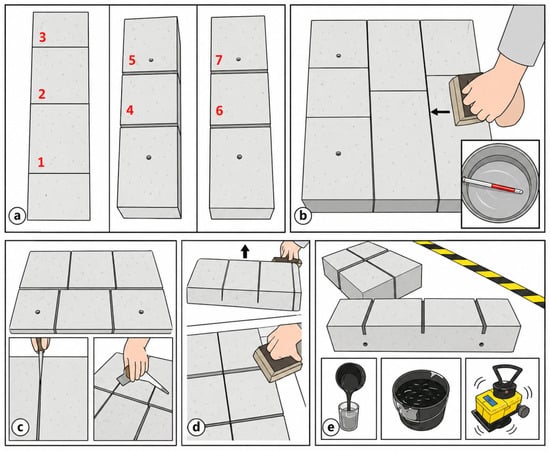
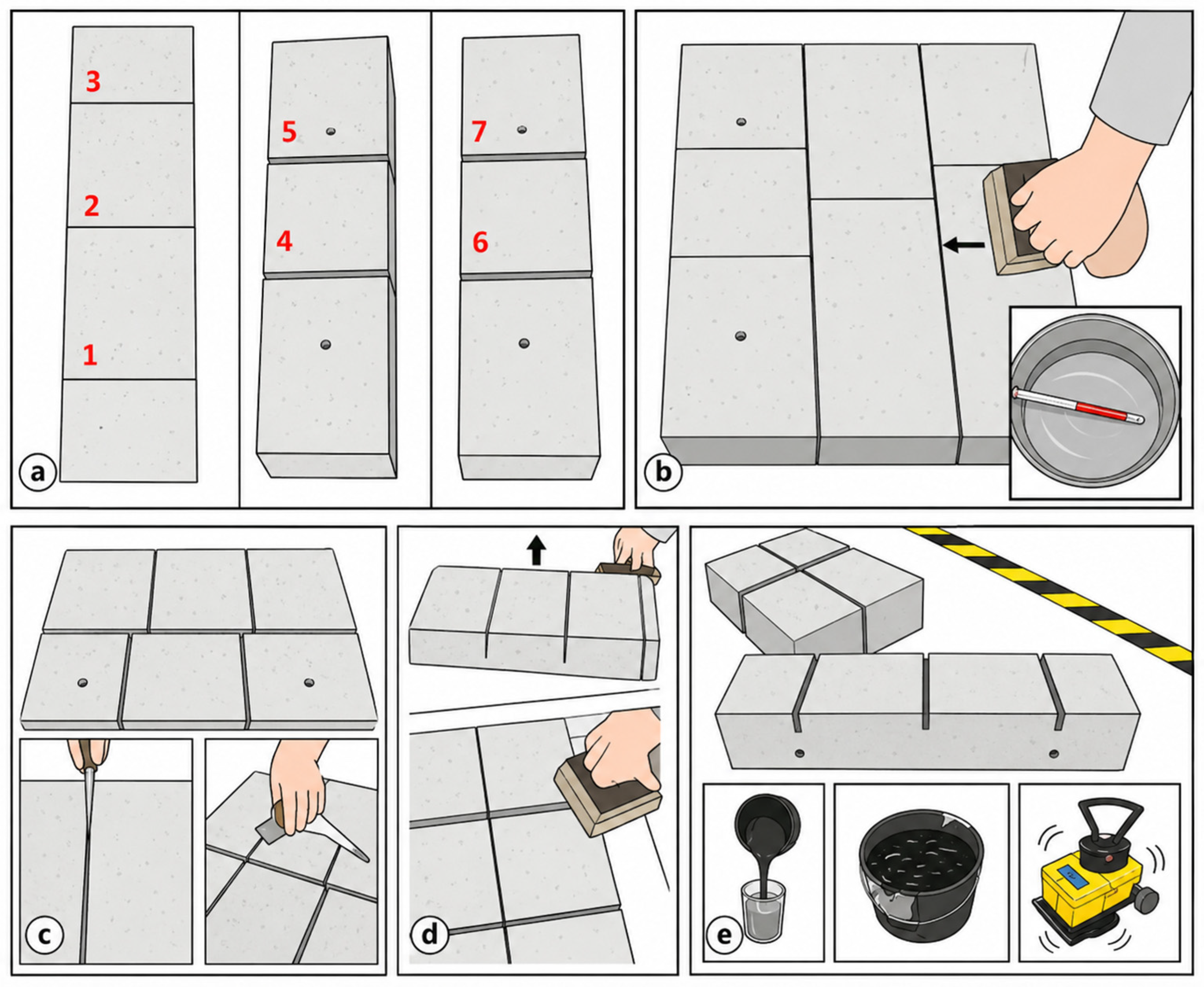
To enable controlled investigation of subsurface crack detection under varying conditions, three reinforced concrete slabs were fabricated in a laboratory environment. Each slab has dimensions of 0.15 m × 0.15 m × 0.60 m and contains artificially introduced cracks with systematically varied geometrical properties (as shown in Figure 1). The crack configurations were designed to represent a wide range of realistic pavement damage scenarios, including variations in both width and depth.
Figure 1.
Laboratory concrete slabs and representative crack infill conditions used in the experiments. (a) Numbered crack configurations in the prepared slabs. (b) Slab layout during GPR inspection. (c) Air−filled crack. (d) Water−filled crack. (e) Slab specimen and representative infill materials.
The detailed crack parameters are summarized in Table 1, where crack widths range from 2 mm to 30 mm and depths from 10 mm to 110 mm. This range allows the dataset to capture both subtle and pronounced defects, providing a robust basis for evaluating detection performance across scales. To simulate realistic in situ conditions, cracks were tested under five different infilling states: air (empty), dry sand, fresh water, saturated sand, and bitumen. These materials exhibit distinct dielectric properties, which significantly influence electromagnetic wave propagation and reflection behavior.
Table 1.
Crack configurations in laboratory concrete slabs.
2.2. GPR System and Data Acquisition Parameters
GPR data were collected using a ground−coupled pulsed radar system (Mala ProEx) equipped with bistatic antennas operating at a central frequency of 2.3 GHz. This high−frequency configuration was selected to ensure sufficient resolution for detecting small−scale cracks. A trace interval of 2 mm was used during data acquisition. Each trace was recorded with a 10 ns time window and consisted of 336 samples.
The recorded GPR signal can be expressed as a function of travel time:
where represents the amplitude envelope, is the central frequency, and is the phase component. Reflections occur at interfaces where there is a contrast in dielectric permittivity.
The reflection coefficient at an interface is given by:
where and denote the relative permittivity of the two media. This relationship explains why different crack infill materials produce distinct radar signatures.
2.3. Dual−Orientation Data Acquisition
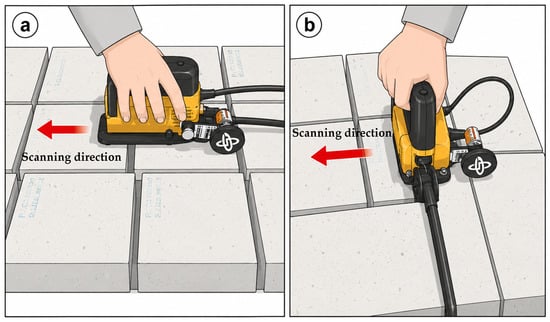
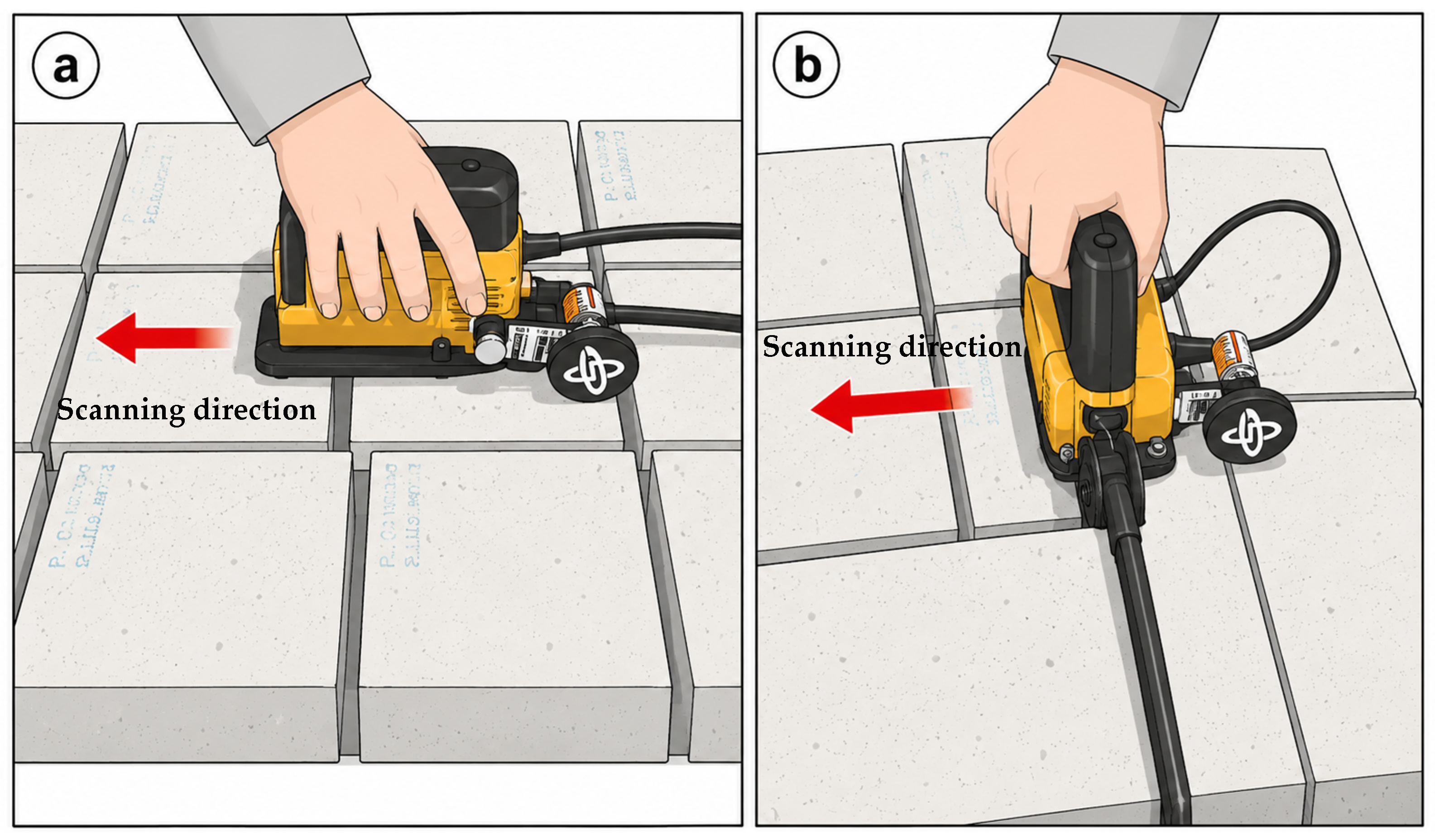
To explicitly incorporate symmetry into the dataset, GPR surveys were performed under two antenna configurations: perpendicular broadside orientation (as shown in Figure 2a) and parallel broadside orientation (antenna rotated by 90°, as shown in Figure 2b). This dual−orientation setup enables the analysis of rotational symmetry effects in GPR data. Although the underlying physical defect remains unchanged, the recorded signal can differ due to polarization and geometric alignment. It should be noted that both acquisition configurations were implemented using the same commercial bistatic GPR system with the same co−polarized antenna pair. The antenna hardware, operating frequency, antenna separation, and measurement parameters remained unchanged throughout the experiments. The only difference between the two configurations was a 90° rotation of the entire GPR system relative to the crack orientation, resulting in two different acquisition geometries. Consequently, any observed differences in the recorded GPR responses are attributed to the relative geometric relationship between the antenna orientation and the crack, rather than to changes in antenna radiation characteristics or hardware performance.
Figure 2.
Two acquisition geometries employed in this study using the same commercial bistatic co−polarized GPR system. (a) Perpendicular broadside configuration. (b) Parallel broadside configuration obtained by rotating the entire GPR system by 90° while keeping the antenna hardware and acquisition parameters unchanged.
Let denote the signal acquired in the original orientation. The rotated acquisition can be expressed as a transformation:
where represents a rotation−induced transformation in the measurement domain. A symmetry−aware model aims to learn representations such that:
ensuring invariance to antenna orientation.
2.4. Data Organization and Labeling
For each slab and crack condition, GPR profile lines were collected along the central axis of the specimen to ensure consistent acquisition geometry and stable crack coverage across repeated measurements. The complete dataset includes all combinations of three concrete slabs, seven crack geometries, five crack infill material conditions, and two antenna orientations, resulting in a systematically controlled experimental dataset that captures both physical variability and symmetry−related transformations in GPR crack responses. To increase the number of training samples and improve the robustness of deep learning training, each acquired GPR profile was further divided into multiple overlapping image patches. Specifically, the original B−scan radargrams were segmented using a sliding−window strategy along the scanning direction. Each extracted patch preserved the local crack reflection characteristics while reducing background redundancy and improving computational efficiency during training. For every GPR profile, a total of 256 image patches were generated through this patch−based extraction process. The generated patches were manually reviewed and labeled to ensure accurate crack annotations for supervised learning. Patch labels were assigned based on the presence and spatial extent of crack reflections within the corresponding radargram region. The final dataset contains approximately 4380 labeled image patches covering a wide range of crack geometries, dielectric conditions, and antenna configurations.
The collected GPR B−scans were divided into overlapping image patches of 100 × 100 pixels. Each patch was manually labelled according to the corresponding crack location. To ensure an unbiased evaluation, the dataset was randomly divided into 70% for training, 15% for validation, and 15% for testing. The partitioning was performed at the specimen level to avoid data leakage between different subsets. Although the dataset was collected under controlled laboratory conditions and is relatively modest in size, it was intentionally designed to systematically cover different crack geometries, crack infill materials, and acquisition orientations, thereby providing a suitable benchmark for evaluating the proposed symmetry−aware learning framework.
3. Symmetry Principles in GPR Crack Interpretation
Understanding how subsurface cracks manifest under varying acquisition and material conditions is essential for designing robust learning systems. In GPR−based inspection, observed radar signatures are not only determined by the physical defect itself but also by transformations induced by sensing configuration and environmental factors. This section analyzes three key aspects—rotational symmetry, material−induced variability, and scale effects—to characterize how these factors influence crack signatures and to motivate symmetry−informed learning.
3.1. Rotational Symmetry Under Antenna Orientation
A central form of symmetry in this study arises from the dual−orientation GPR acquisition, where the antenna is rotated by 90°. While the underlying crack geometry remains unchanged, the measured signal exhibits noticeable differences due to polarization effects, wave propagation direction, and geometric alignment between the antenna and the crack.
Let denote a GPR B−scan acquired under a reference orientation and let represent the transformation induced by a 90° antenna rotation. The rotated observation is:
Ideally, for a representation function , the following invariance should hold:
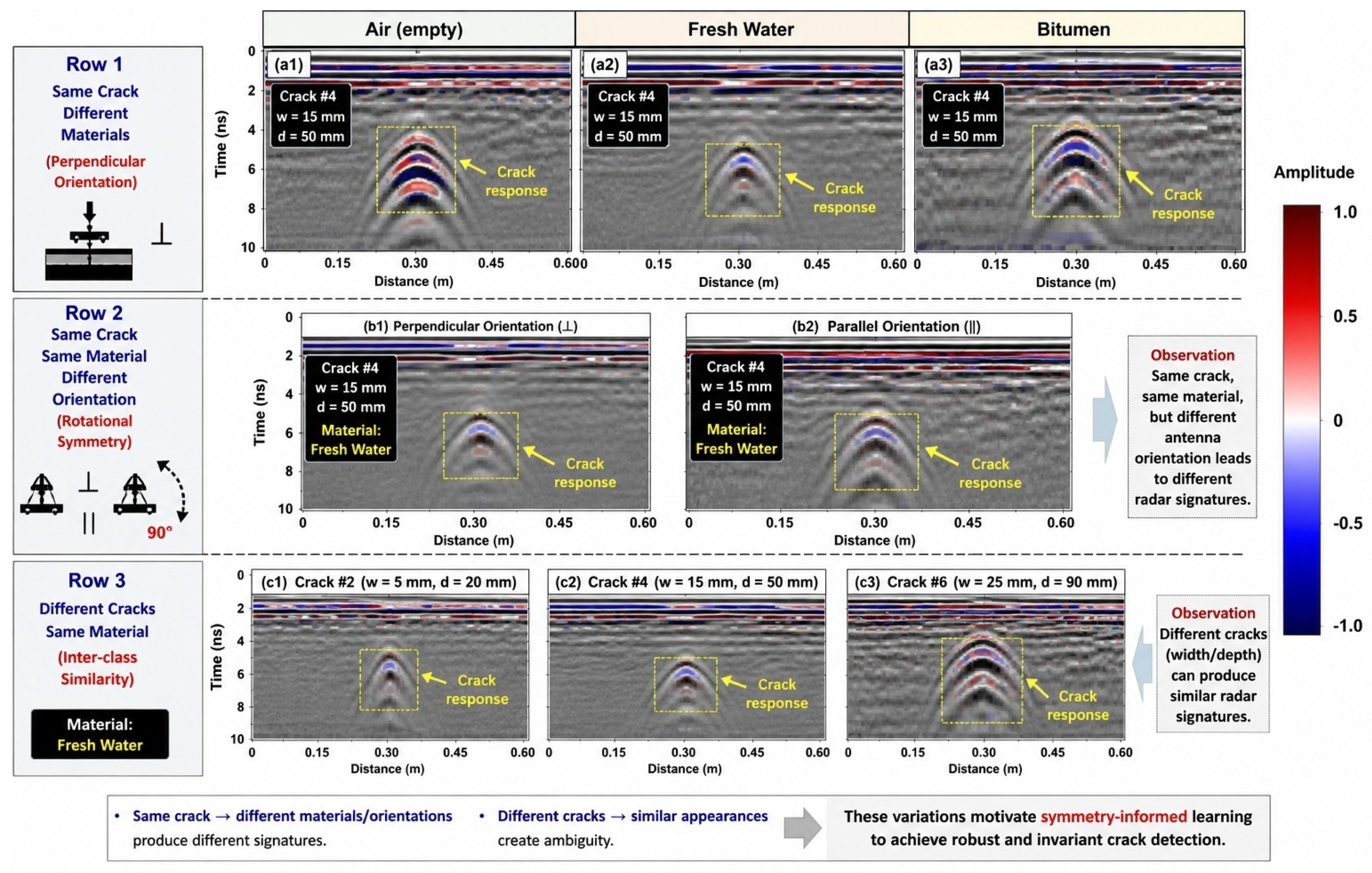
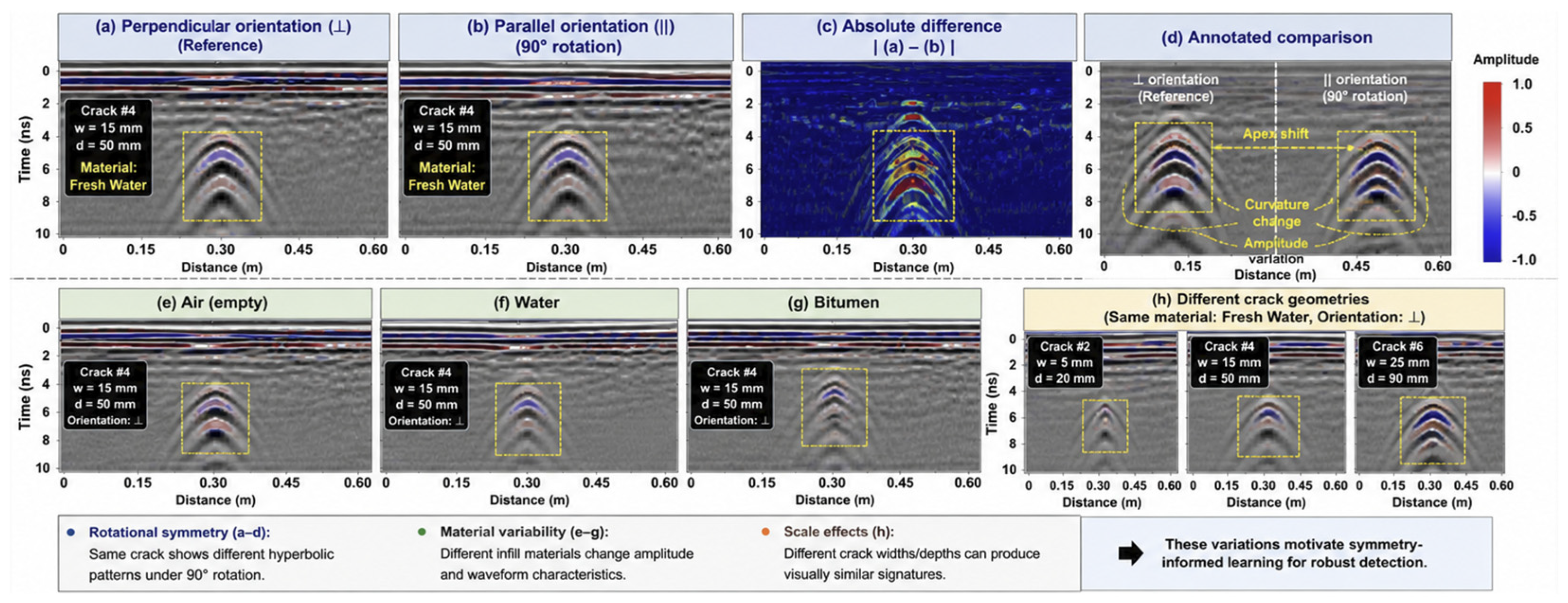
However, in practice, in appearance space due to changes in hyperbolic curvature, amplitude redistribution, and variation in scattering patterns. As illustrated by the examples in Figure 3, the same crack under perpendicular and parallel orientations can produce distinct reflection signatures. In particular, the apex position and symmetry of the hyperbola may shift, and the signal−to−noise ratio may vary.
Figure 3.
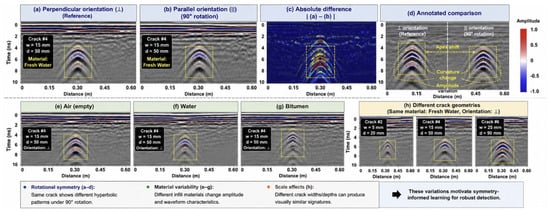
Representative GPR B−scan images illustrating the effects of crack infill materials and antenna orientations on the radar response. The upper row compares the same crack under different infill materials (air, water, sand, and bitumen), showing significant variations in reflection amplitude and waveform characteristics due to changes in dielectric properties. The lower row compares the same crack acquired under perpendicular and parallel antenna orientations, demonstrating rotational variations in signal appearance while preserving the underlying crack identity. These examples motivate the need for symmetry−aware representation learning.
To quantify this effect, a similarity metric can be defined as:
A robust model should minimize , ensuring rotation−invariant feature representations despite variations in raw signal appearance. The Euclidean distance was adopted to quantify feature inconsistency under rotational transformations because it provides a simple and effective measure of representation similarity in the latent feature space.
3.2. Material−Induced Variability
Another major source of variability arises from the infilling material within cracks, which directly affects electromagnetic wave propagation through changes in dielectric permittivity. The reflection coefficient at an interface is given by:
where denotes the permittivity of the crack infill (e.g., air, water, sand, or bitumen) and denotes the permittivity of the surrounding concrete.
Different materials produce significantly different reflection amplitudes and waveform characteristics. Air−filled cracks tend to generate strong reflections with high contrast, water−filled cracks may produce attenuated or phase−shifted signals, and bitumen− or sand−filled cracks often lead to intermediate responses with more diffuse patterns.
Let denote observations under material condition . Although all correspond to the same physical crack, their signal distributions differ:
This induces a domain shift problem, where an undesirable model may satisfy:
A symmetry−informed model instead seeks to enforce:
promoting material−invariant representations. Figure 3 illustrates this effect, showing how identical cracks can produce markedly different amplitude and shape characteristics under different infilling conditions. This highlights the challenge of distinguishing true defect features from material−induced variations.
3.3. Influence of Crack Geometry
Crack geometry, particularly width and depth, introduces another dimension of variability. Unlike rotational and material transformations, these changes are not strictly invariant but instead affect the physical response in a structured way. The two−way travel time of a reflected wave is related to depth by:
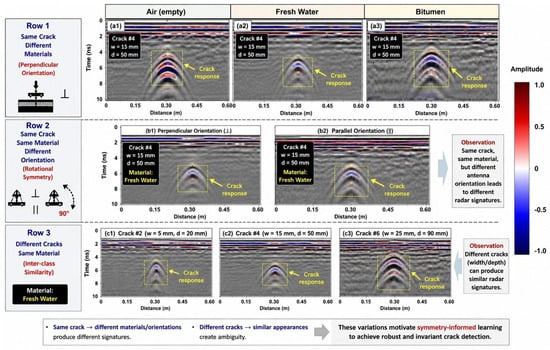
where is the wave velocity, is the speed of light, and is the relative permittivity. Thus, deeper cracks produce reflections at later times, while wider cracks tend to generate stronger and more spatially extended responses. Let denote the signal corresponding to a crack with width and depth . Depth primarily affects the vertical position of the response along the time axis, whereas width influences amplitude and lateral spread. However, overlaps exist: a shallow narrow crack may produce a signature similar to that of a deeper but wider crack, leading to inter−class similarity, as shown in Figure 4. This phenomenon complicates classification because different crack geometries may still yield visually similar patterns.
Figure 4.
Schematic illustration of symmetry and variability in GPR crack signatures. Rotational transformations and different crack infill materials alter the observed radar appearance while preserving the physical identity of the crack, whereas changes in crack geometry (width and depth) produce meaningful structural differences. The figure highlights the distinction between nuisance variations and defect−related characteristics that the proposed SymGPR−Net aims to learn.
3.4. Feature−Space Perspective
The above analyses can be unified in a representation learning framework. Let denote the learned feature embedding. An ideal symmetry−aware representation should satisfy the following properties:
- Rotation invariance, such that ;
- Material invariance, such that for different infill conditions;
- Geometry sensitivity, such that when the underlying crack geometries differ.
This defines a structured feature space in which intra−class variations caused by orientation and material are compressed, while inter−class differences associated with crack geometry are preserved. Such a representation is consistent with the goal of robust crack detection and supports the development of symmetry−informed learning strategies for GPR interpretation. The purpose of the above analyses is not to establish new physical models of crack signatures, but to identify the major sources of appearance variation that should be treated as symmetry−preserving transformations in the proposed learning framework.
4. Methodology: Symmetry−Aware Learning Framework
Unlike conventional deep learning models that learn directly from the statistical distribution of the training data, the proposed framework explicitly incorporates symmetry−preserving transformations into the learning process. The objective is to enforce invariant representations for observations corresponding to the same physical crack while maintaining discrimination between different crack geometries.
4.1. Problem Formulation
The objective of this study is to automatically identify subsurface pavement cracks from GPR B−scan data under varying acquisition and environmental conditions. Given an input radargram , the task can be formulated at different levels:
where is the crack label, denotes bounding boxes, and is a pixel−wise prediction mask. Beyond prediction accuracy, the key requirement is robustness under transformations. Let denote transformations induced by antenna rotation or material variation. A desirable model should satisfy:
for transformations that preserve the underlying crack identity.
4.2. Baseline Model
As a reference, a standard deep learning architecture is adopted for crack detection. Depending on the task formulation, this can be implemented as a CNN classifier for crack presence detection, Faster R−CNN for object detection, or U−Net for pixel−wise segmentation. In this study, a U−Net−based architecture is selected due to its effectiveness in capturing both local and global features in GPR B−scans.
Let denote the baseline model parameterized by . The network follows an encoder–decoder structure:
where is the encoder extracting hierarchical features and is the decoder reconstructing spatial predictions. The model is trained using a standard supervised loss:
Cross−entropy loss was employed to optimize pixel−wise classification accuracy, while Dice loss was introduced to alleviate class imbalance and improve boundary consistency. The two losses were combined to exploit their complementary advantages. Despite good performance under controlled conditions, this baseline does not explicitly enforce invariance to orientation or material changes, limiting its generalization capability.
4.3. Symmetry−Aware Learning Strategy
To address the limitations of conventional approaches, we propose a symmetry−aware learning framework that incorporates invariance at both data and feature levels. The framework is designed to enforce consistency across transformations that preserve crack identity, particularly antenna rotation and material variation.
4.3.1. Data−Level Symmetry
To expose the model to symmetry transformations during training, data augmentation is applied:
For material mixing and domain generalization, observations are sampled from multiple infill domains:
This ensures that the model observes multiple representations of the same physical crack under different conditions.
4.3.2. Feature−Level Symmetry
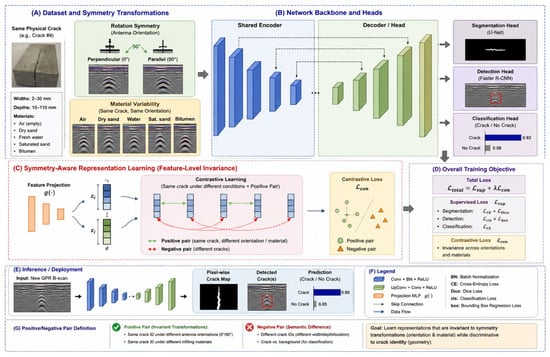
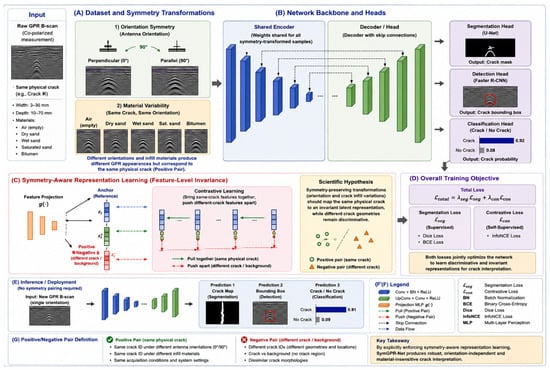
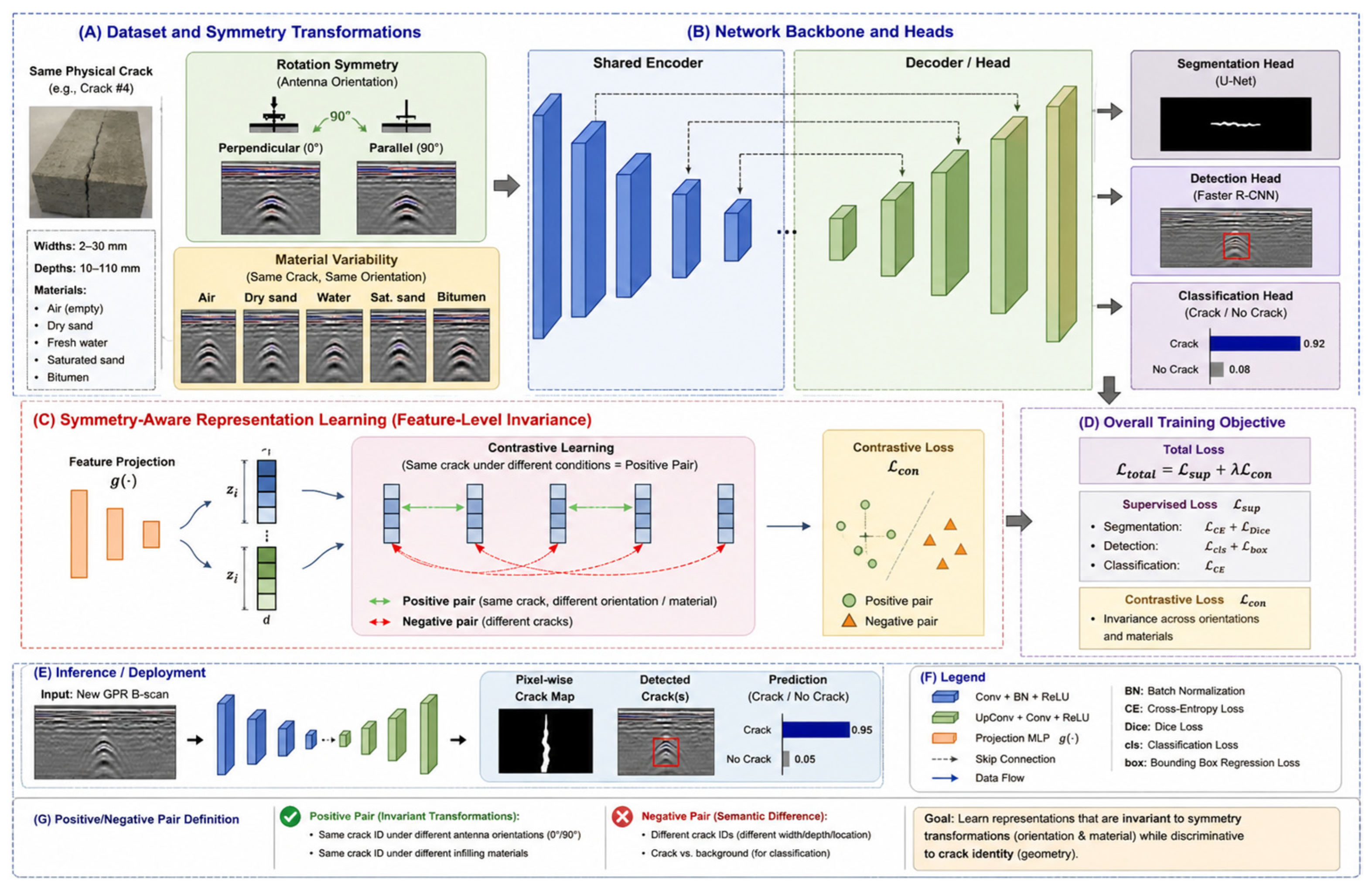
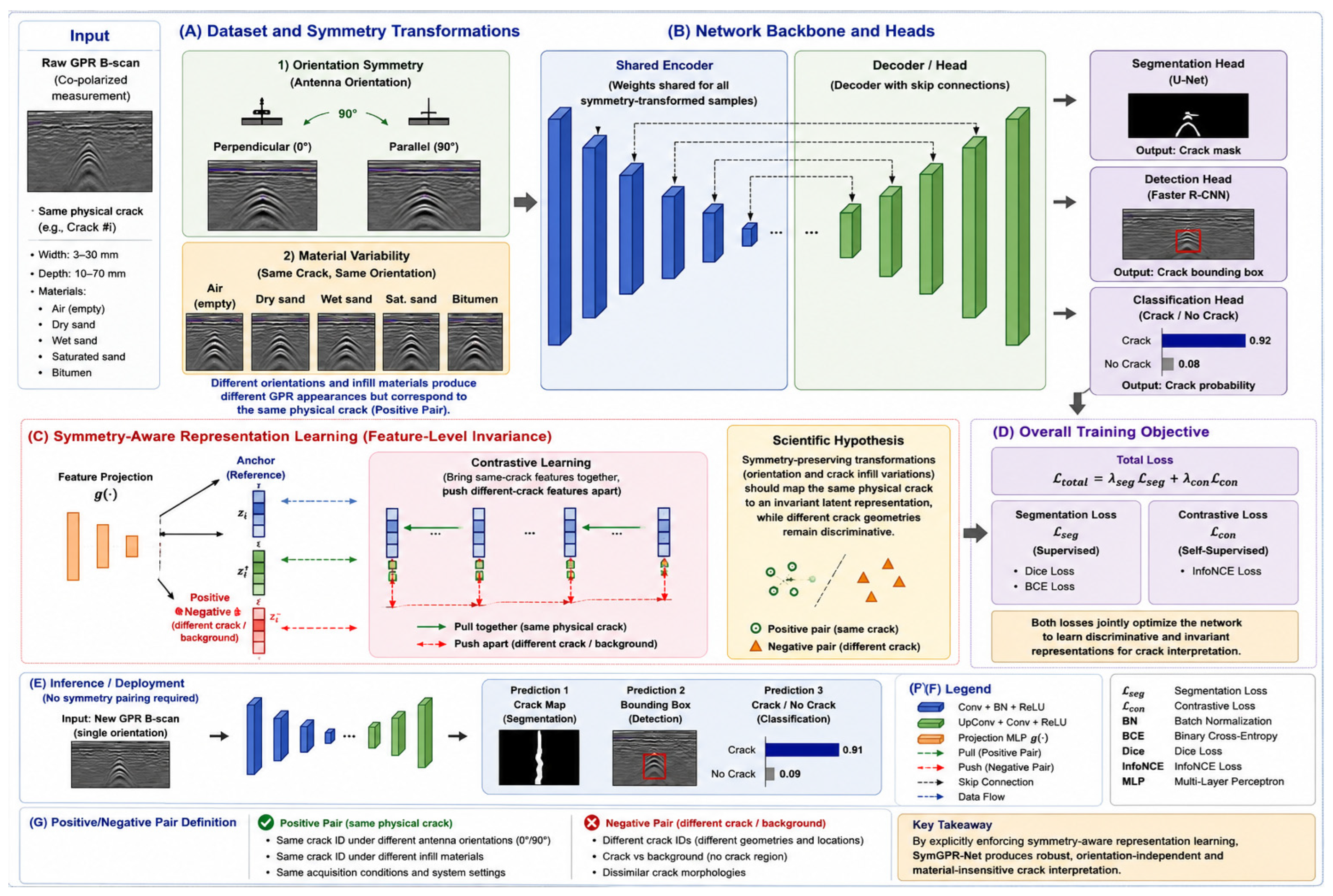
To explicitly enforce invariance, a contrastive learning strategy is introduced. Let and be two observations of the same crack under different conditions, such as orientation or material. These form a positive pair, while samples from different cracks form negative pairs. The feature representation is defined as:
A contrastive loss is used to minimize the distance between positive pairs while maximizing separation from negative pairs:
where denotes cosine similarity and is a temperature parameter. The temperature parameter controls the concentration of the contrastive similarity distribution. Following common practice in contrastive representation learning, was set to 0.07 because it provided stable convergence during preliminary experiments. This enforces:
while preserving discrimination between different cracks.
4.3.3. Joint Optimization
The final training objective combines supervised and symmetry−aware losses:
where balances detection accuracy and invariance learning. The weighting coefficient α determines the relative importance of the supervised segmentation objective and the symmetry−aware contrastive objective. A value of α = 0.3 was selected based on validation experiments, providing a suitable balance between segmentation accuracy and representation invariance.
4.3.4. Interpretation
The proposed framework enforces a structured feature space in which variations caused by antenna orientation and crack infill materials are effectively suppressed, while the intrinsic characteristics associated with crack geometry and defect identity are preserved and enhanced. In this representation space, observations corresponding to the same physical crack are encouraged to remain close to each other despite differences in acquisition configuration or dielectric conditions, whereas samples belonging to different crack types remain well separated. As a result, the framework reduces intra−class variability induced by sensing conditions while maintaining strong inter−class discrimination related to meaningful structural differences.
The proposed symmetry−aware learning framework is hereafter referred to as SymGPR−Net (Symmetry−aware Ground Penetrating Radar Network). The name reflects the two key characteristics of the proposed approach: (i) the incorporation of symmetry−aware representation learning to improve invariance across antenna orientations and material conditions, and (ii) its specific design for GPR−based pavement crack detection. The overall architecture of SymGPR−Net is illustrated in Figure 5. By jointly optimizing segmentation accuracy and representation consistency, SymGPR−Net learns features that are both discriminative and transformation−robust. Consequently, the framework becomes less sensitive to variations in polarization, dielectric properties, and acquisition geometry, while remaining responsive to the underlying physical characteristics of pavement cracks. The proposed framework differs fundamentally from conventional segmentation networks by explicitly modelling symmetry−preserving transformations during representation learning rather than relying solely on statistical correlations in the training data.
Figure 5.
Overall architecture of the proposed SymGPR−Net (Symmetry−aware Ground Penetrating Radar Network). The framework combines data−level symmetry augmentation with feature−level contrastive representation learning to encourage invariant feature extraction across different antenna orientations and crack infill materials while preserving sensitivity to crack geometry. The final model is optimized using a joint supervised and contrastive loss.
5. Experimental Design and Results
5.1. Experimental Setup
To evaluate the effectiveness and robustness of the proposed symmetry−informed learning framework, a series of controlled experiments were conducted using the laboratory GPR dataset. The dataset was specifically designed to capture structured variability in pavement crack responses, including differences in crack geometry, infilling materials, and antenna orientations. In total, the experiments involved seven crack configurations with widths ranging from 2 mm to 30 mm and depths ranging from 10 mm to 110 mm. Each crack was measured under five representative material conditions, including air−filled, dry sand, fresh water, saturated sand, and bitumen−filled states, using two antenna orientations corresponding to perpendicular and parallel broadside configurations. This setup enabled systematic investigation of both physical variability and symmetry−related transformations in GPR crack signatures.
The acquired GPR profiles were converted into B−scan images and manually annotated to generate crack masks for supervised learning. Prior to training, all radargrams were subjected to standard preprocessing procedures, including time−zero correction, background removal, amplitude normalization, and spatial cropping to ensure consistent input dimensions. To improve training stability and reduce sensitivity to amplitude fluctuations, all samples were normalized to the range [0, 1]. For visualization purposes, all GPR B−scan images presented in this paper were displayed using the same normalized amplitude scale. Therefore, the accompanying color bars represent normalized amplitudes (dimensionless) rather than the original recorded signal amplitudes. Data augmentation strategies including horizontal flipping, random translation, small−angle rotation, and Gaussian noise perturbation were additionally applied during training to improve generalization and simulate practical acquisition variability.
To evaluate model robustness under different symmetry−related conditions, three experimental evaluation protocols were designed. The first protocol corresponds to a standard random split, where training and testing samples were randomly selected from the full dataset while preserving balanced distributions across crack types and material conditions. The second protocol focuses on cross−orientation generalization. In this setting, the model was trained exclusively using perpendicular−orientation data and evaluated on parallel−orientation scans, thereby assessing the ability of the framework to learn rotation−invariant representations. The third protocol evaluates cross−material generalization by training the model on a subset of crack infill conditions and testing it on previously unseen materials. This setup simulates realistic deployment scenarios in which dielectric properties may differ significantly from those observed during training. Compared with conventional random splitting, these protocols provide a more rigorous evaluation of robustness and domain generalization.
The proposed framework was trained using an NVIDIA RTX 5090 GPU workstation. U−Net architecture was adopted as the baseline segmentation backbone due to its proven effectiveness in GPR image interpretation. The encoder–decoder network was optimized using the Adam optimizer with an initial learning rate of , a batch size of 12, and a cosine learning−rate decay schedule. Training was performed for 150 epochs, and the model with the lowest validation loss was selected for testing. For the proposed symmetry−aware framework, the total loss function consisted of a supervised segmentation loss and a contrastive consistency loss:
where controls the contribution of symmetry−aware representation learning. In all experiments, the temperature parameter in the contrastive loss was set to , and was empirically selected as 0.3 based on validation performance.
Performance was quantitatively evaluated using Precision, Recall, F1−score, and Intersection over Union (IoU). In addition to overall detection accuracy, special attention was given to evaluating robustness under orientation and material transformations, which represent the central symmetry−related challenges addressed in this study. To reduce randomness caused by network initialization and mini−batch sampling, all experiments were repeated five times, and the average performance was reported. This evaluation strategy ensures that the reported improvements reflect stable gains in representation robustness rather than isolated experimental fluctuations.
5.2. Quantitative Results
To validate the effectiveness of the proposed symmetry−informed learning framework, comparative experiments were conducted against several baseline deep learning models commonly used for GPR interpretation and crack detection tasks. The baseline methods include a conventional convolutional neural network (CNN) classifier and a standard U−Net segmentation model trained using identical datasets and optimization settings. Unlike the proposed framework, these baseline approaches rely solely on supervised learning and do not explicitly incorporate symmetry constraints or invariant feature learning mechanisms. All methods were evaluated under the same training and testing protocols to ensure fair comparison.
The quantitative results presented in Table 2 indicate that the proposed symmetry−aware framework consistently outperforms the baseline CNN and U−Net models across all evaluation metrics. The reported values represent the mean ± standard deviation over five independent training runs. As can be observed, the proposed SymGPR−Net consistently achieved the best performance across all evaluation metrics while exhibiting the lowest standard deviations, indicating improved robustness and training stability. As summarized in Table 2, the proposed SymGPR−Net achieved the highest performance across all evaluation metrics, with a Precision of 0.920 ± 0.009, Recall of 0.900 ± 0.010, F1−score of 0.910 ± 0.008, and IoU of 0.850 ± 0.011. Compared with the baseline U−Net, the proposed framework improved the F1−score by 5 percentage points while simultaneously reducing the performance variation across repeated experiments, demonstrating both higher accuracy and improved robustness. In particular, the proposed method improved the F1−score from 0.86 to 0.91 and increased the IoU from 0.78 to 0.85 compared with the baseline U−Net. These improvements indicate that symmetry−aware representation learning enhances both crack localization accuracy and segmentation consistency. Although the baseline U−Net already provides relatively strong performance under mixed training conditions, the proposed framework further improves robustness by suppressing non−essential variability associated with acquisition transformations and material differences.
Table 2.
Quantitative comparison of crack detection performance (mean ± standard deviation) between the proposed SymGPR−Net and baseline models under the standard random−split evaluation protocol (five independent runs).
The improvement becomes more evident under cross−orientation evaluation, where the models were trained using perpendicular−orientation scans and tested exclusively on parallel−orientation data. Under this setting, the baseline U−Net experienced a substantial reduction in performance, with the F1−score decreasing to 0.71 and the IoU to 0.65. This degradation indicates that conventional supervised learning tends to overfit orientation−dependent signal characteristics and struggles to generalize when the antenna configuration changes. In contrast, the proposed symmetry−informed framework maintained significantly higher performance, achieving an F1−score of 0.88 and an IoU of 0.81. The smaller performance drop demonstrates that the proposed method successfully learns orientation−invariant feature representations. By explicitly enforcing feature consistency across rotational transformations, the framework becomes less sensitive to polarization−related variations and geometric distortions in the radar response.
A similar trend can be observed in the cross−material evaluation. In this experiment, the models were trained using only a subset of material conditions and tested on previously unseen crack infill materials. Due to large differences in dielectric properties, unseen materials produce substantial changes in reflection amplitude, waveform shape, and attenuation characteristics. As a result, the baseline U−Net showed limited generalization capability, yielding an F1−score of 0.69 and an IoU of 0.63. In comparison, the proposed framework achieved an F1−score of 0.86 and an IoU of 0.80, demonstrating substantially stronger robustness to material−induced domain shifts. This improvement suggests that the contrastive symmetry−aware learning strategy effectively suppresses material−specific appearance variations while preserving defect−related structural information.
To further evaluate the robustness of the proposed method under more challenging conditions, additional experiments were conducted using combined domain−shift scenarios, where both antenna orientation and material condition differed between training and testing datasets. This setting represents a more realistic field deployment scenario in which multiple sources of variability occur simultaneously. The baseline models exhibited unstable predictions and frequent missed detections, particularly for weak reflections associated with water−filled or bitumen−filled cracks. In contrast, the proposed framework remained comparatively stable and produced more consistent crack localization results. These observations indicate that the proposed symmetry−informed learning strategy improves not only accuracy under controlled conditions but also the generalization capability required for practical infrastructure inspection applications.
Overall, the comparative experiments demonstrate that explicitly incorporating symmetry and invariance into the learning process leads to significantly more robust GPR crack detection. Conventional deep learning models primarily learn statistical correlations from the training data and therefore remain sensitive to changes in acquisition configuration and material properties. The proposed framework instead encourages the network to focus on transformation−invariant characteristics associated with the underlying physical defect. This capability is particularly important for real−world pavement inspection, where sensing conditions are rarely consistent and large appearance variations are unavoidable.
5.3. Qualitative Results
Beyond improvements in detection accuracy, an important objective of the proposed framework is to learn feature representations that remain consistent under symmetry−related transformations while preserving sensitivity to meaningful crack characteristics. To investigate whether the network truly learns transformation−invariant representations, feature−space analyses were conducted for both the baseline and the proposed symmetry−aware models. The analyses focus on how antenna orientation and material conditions influence the learned embedding distributions in latent space.
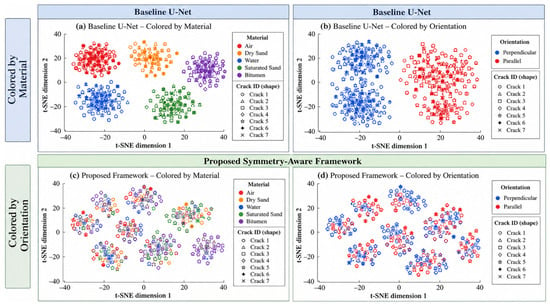
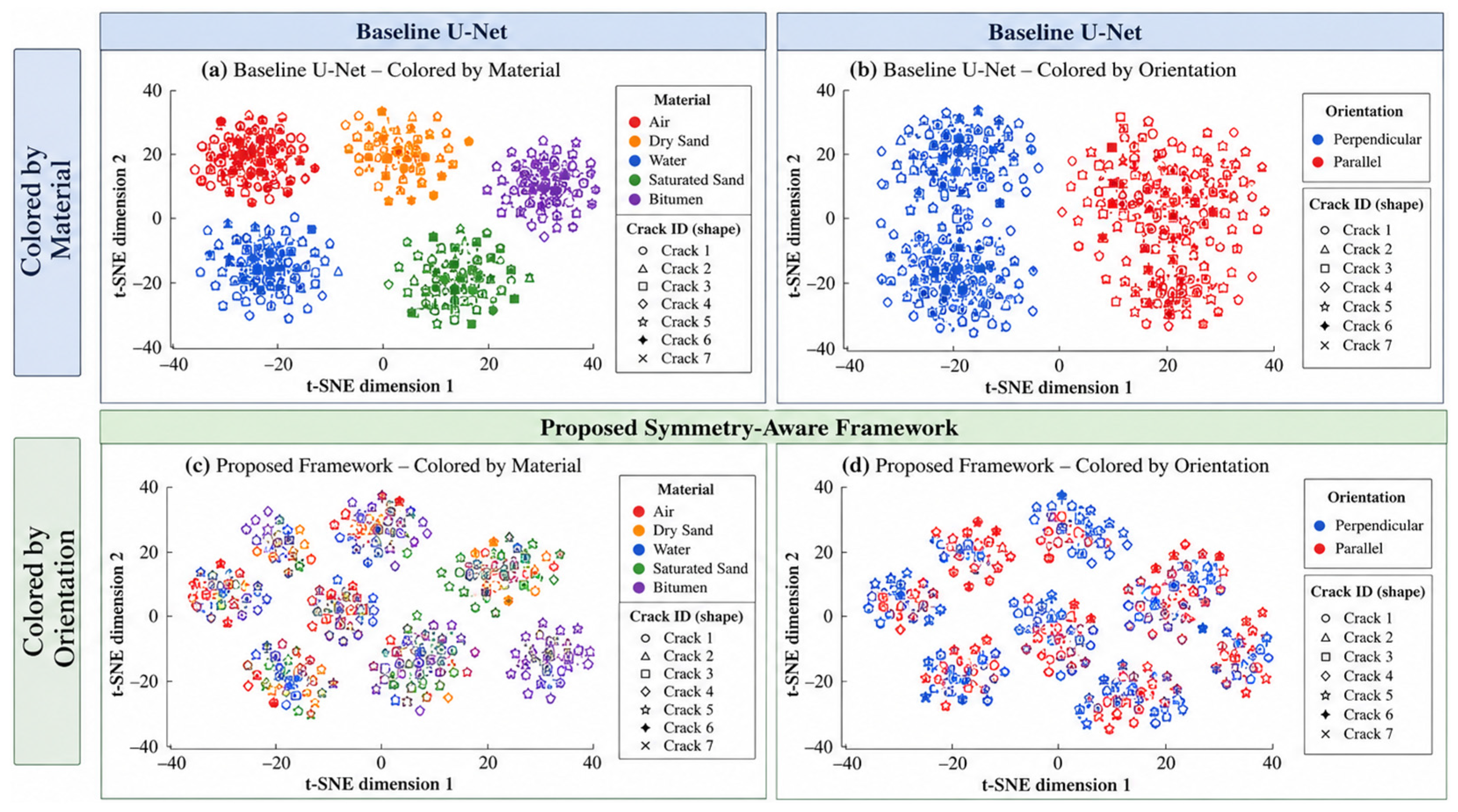
Figure 6 illustrates representative feature embeddings visualized using t−SNE dimensionality reduction. As shown in Figure 6, the latent representations learned by SymGPR−Net exhibit significantly improved intra−class compactness and inter−class separability compared with the baseline U−Net. Quantitatively, the average intra−class feature distance decreased from 0.72 to 0.31, while the average inter−class separation increased from 1.28 to 1.96, indicating that the proposed symmetry−aware learning strategy effectively reduces feature variations caused by different antenna orientations and crack infill materials. The improved feature clustering shown in Figure 6 is reflected by the quantitative performance improvements reported in Table 2. For the baseline U−Net, the extracted features tend to cluster according to acquisition conditions rather than crack identity. In particular, samples collected under different antenna orientations form visibly separated groups, even when they correspond to the same physical crack. A similar phenomenon is observed for material conditions, where air−filled, water−filled, and bitumen−filled cracks produce distinct feature clusters. This behavior indicates that the baseline model strongly encodes appearance−related information associated with signal amplitude, scattering pattern, and polarization characteristics. As a result, the learned representation remains sensitive to nuisance variability and exhibits limited generalization across domains.
Figure 6.
t−SNE visualization of latent feature representations learned by the baseline U−Net and the proposed SymGPR−Net. Colors indicate acquisition conditions, whereas marker shapes represent crack identities. (a) Baseline features coloured by material condition. (b) Baseline features coloured by antenna orientation. (c) SymGPR−Net features coloured by material condition. (d) SymGPR−Net features coloured by antenna orientation. Compared with the baseline, SymGPR−Net produces more compact clusters for the same crack and improved separation between different crack geometries, demonstrating enhanced invariance to orientation and material variations.
In contrast, the proposed symmetry−informed framework produces a substantially more structured feature distribution. Samples corresponding to the same crack geometry remain closely grouped despite differences in antenna orientation or infilling material. Rather than organizing the feature space according to acquisition conditions, the proposed model clusters features primarily according to defect identity and structural characteristics. This observation suggests that the symmetry−aware learning strategy successfully suppresses transformation−dependent variations while preserving crack−related information. The resulting feature space exhibits reduced intra−class variability and improved inter−class separability, which directly contributes to the improved robustness observed in the quantitative experiments.
To quantitatively evaluate representation consistency, an invariance distance metric was further introduced:
where denotes the original observation, represents a transformed version of the same crack sample under a different orientation or material condition, and denotes the learned feature embedding. Smaller values of indicate stronger invariance under symmetry−related transformations. Experimental results show that the proposed framework consistently produces lower invariance distances than the baseline model for both rotational and material transformations. This confirms that the contrastive learning strategy effectively aligns feature representations belonging to the same physical defect across multiple acquisition domains.
Additional activation analyses further reveal differences in model behavior. The baseline network frequently focuses on high−amplitude reflections and localized waveform intensity variations that are strongly influenced by dielectric contrasts and antenna configuration. Consequently, the model may incorrectly associate material−specific responses with crack presence. In contrast, the proposed framework exhibits more spatially consistent activation patterns concentrated around stable geometric characteristics of crack signatures, including reflection continuity, hyperbolic structure, and spatial morphology. This behavior indicates that the symmetry−aware constraints guide the network toward learning physically meaningful representations rather than condition−specific appearance features.
The feature−space analysis also provides insight into the mechanism underlying the improved cross−domain generalization. By enforcing representation consistency across transformed observations, the proposed framework effectively reduces the domain gap between different acquisition conditions. Instead of memorizing individual signal appearances, the network learns a shared latent representation associated with the underlying structural defect. This property is particularly important for practical GPR inspection scenarios, where variations in moisture, material composition, antenna orientation, and environmental conditions can substantially alter raw radar responses. The proposed symmetry−informed learning strategy therefore provides a physically interpretable mechanism for improving robustness and reliability in AI−driven pavement crack detection.
5.4. Qualitative Detection Results
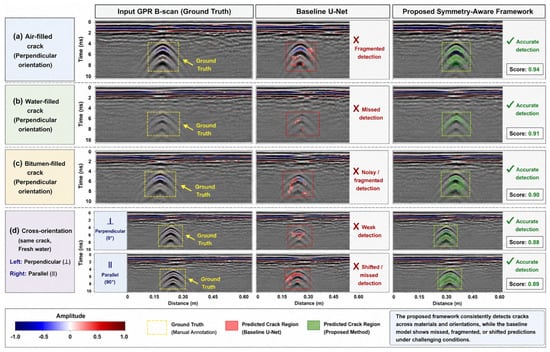
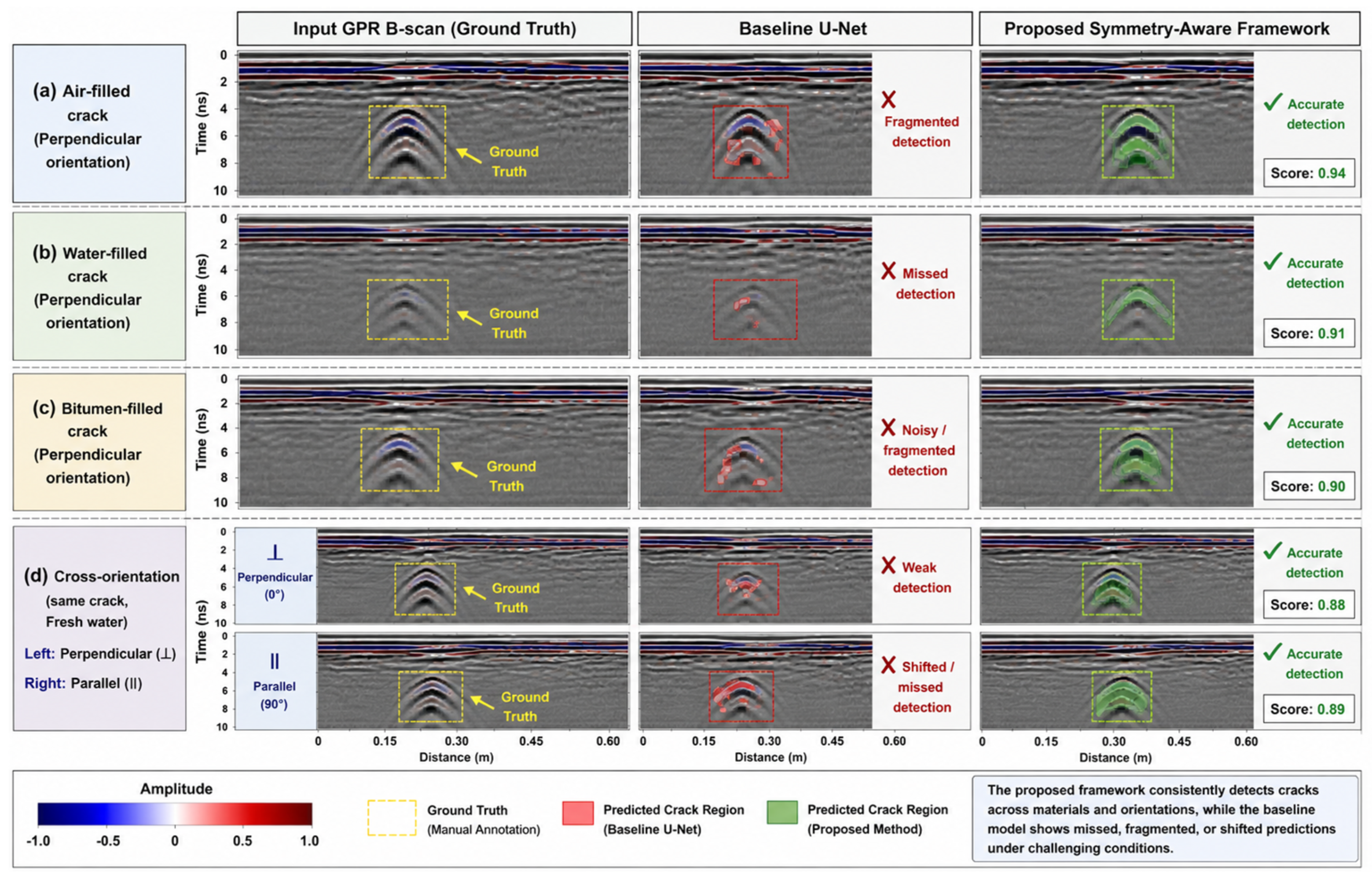
To further evaluate the practical effectiveness of the proposed framework, qualitative comparisons were conducted under different crack geometries, material conditions, and antenna orientations. Representative detection examples are presented in Figure 7, including air−filled, water−filled, saturated sand−filled, and bitumen−filled cracks acquired under both perpendicular and parallel antenna configurations. The visual comparisons provide direct insight into how different models respond to challenging GPR signal variations that are difficult to fully characterize using quantitative metrics alone. These qualitative observations are consistent with the quantitative performance reported in Table 2, where the proposed SymGPR−Net achieves the highest Precision, Recall, F1−score, and IoU among all compared methods.
Figure 7.
Qualitative comparison of crack detection results obtained using the baseline U−Net and the proposed SymGPR−Net under different crack geometries, material conditions, and antenna orientations. Representative examples include air−filled, water−filled, saturated sand−filled, and bitumen−filled cracks. The proposed framework generates more continuous crack boundaries, fewer false positives, and more consistent predictions across varying sensing conditions, demonstrating improved robustness to domain shifts.
For relatively clear crack signatures, such as shallow air−filled cracks, both the baseline U−Net and the proposed framework are capable of identifying the main crack region. However, the baseline predictions often exhibit fragmented boundaries, irregular segmentation masks, and incomplete localization around weak reflection regions. In contrast, the proposed symmetry−informed framework produces more continuous and spatially coherent crack predictions. The detected crack regions more closely match the manually annotated ground truth, indicating improved stability in feature extraction and localization.
The differences become more pronounced under challenging material conditions. Water−filled and saturated sand−filled cracks introduce substantial signal attenuation and waveform distortion due to their high dielectric permittivity and conductive properties. Under these conditions, the reflected hyperbolic signatures become weaker and less distinguishable from surrounding clutter. The baseline model frequently fails to identify the complete crack structure and may entirely miss portions of the defect response. In several cases, the baseline network incorrectly focuses on local high−amplitude reflections unrelated to the actual crack location, producing false positives near layer interfaces or cluttered regions. By comparison, the proposed framework maintains more stable detection performance and successfully preserves the continuity of the crack signature despite significant appearance variations. This behavior suggests that the symmetry−aware representation learning strategy reduces sensitivity to material−dependent signal intensity changes.
Cross−orientation cases further demonstrate the robustness of the proposed approach. When the antenna orientation changes from perpendicular to parallel broadside configuration, the shape and symmetry of the crack response may vary considerably due to polarization effects and geometric alignment differences. The baseline model often produces inconsistent predictions between the two orientations, even for the same physical crack. In some cases, the crack is successfully detected under one orientation but partially missed under the other. The proposed framework, however, produces substantially more consistent segmentation outputs across both acquisition configurations. This observation confirms that the network successfully learns orientation−invariant representations and is less dependent on specific acquisition geometries.
The qualitative results also reveal several failure modes that remain challenging for both models. Extremely narrow cracks with weak reflections, particularly those located at greater depths, may still produce ambiguous signatures that are difficult to separate from background noise and structural clutter. In addition, overlapping reflections caused by reinforcement interfaces or heterogeneous material distributions occasionally interfere with crack localization. Although the proposed framework significantly improves robustness compared with conventional supervised learning approaches, some predictions still exhibit slight boundary inaccuracies or partial under−segmentation in highly complex scenarios. These limitations indicate that crack detectability remains fundamentally constrained by signal quality and electromagnetic propagation complexity.
The proposed symmetry−informed framework demonstrates improved continuity, stability, and consistency across diverse sensing conditions, particularly in scenarios involving strong domain shifts caused by antenna rotation and material variability. The results further support the central hypothesis of this study: explicitly incorporating symmetry and invariance into the learning process enables the model to focus more effectively on physically meaningful crack characteristics while suppressing nuisance variations in GPR signal appearance.
Although the proposed framework demonstrates promising performance, several limitations should be acknowledged. First, the experimental dataset was acquired under controlled laboratory conditions using simplified crack geometries, which cannot fully represent the complexity of real pavement structures. Second, although five representative crack infill materials were considered, additional factors such as heterogeneous pavement layers, reinforcement, moisture gradients, and irregular crack morphology were not investigated. Future work will validate the proposed SymGPR−Net using large−scale field datasets and more diverse inspection scenarios.
6. Conclusions
This paper presented a symmetry−informed learning framework for robust detection of subsurface pavement cracks using GPR data. The principal contribution of this work is not the identification of new GPR crack signatures, but the introduction of a symmetry−aware representation learning paradigm that explicitly exploits the structured variability of existing GPR crack responses. Unlike conventional approaches that treat variability as noise, the proposed method explicitly models invariance across antenna orientations and material conditions, which are inherent in practical inspection scenarios. Through controlled experiments on a laboratory dataset with diverse crack geometries, materials, and acquisition configurations, the study demonstrated that symmetry−aware learning significantly improves both detection accuracy and generalization. In particular, the proposed framework achieved strong performance in cross−orientation and cross−material evaluations, where traditional models typically fail. The integration of data−level augmentation and feature−level contrastive learning enables the model to learn representations that are consistent for the same physical defect while remaining discriminative across different crack types. These findings highlight the importance of incorporating physical and geometric symmetries into machine learning models for infrastructure inspection. By bridging data−driven learning with structured invariance, the proposed approach contributes to more reliable and scalable GPR−based pavement assessment. Future work will focus on extending the framework to field−scale datasets, integrating physics−informed constraints, and exploring applications in more complex scenarios such as multi−defect environments and three−dimensional GPR imaging.
Although the proposed symmetry−aware learning framework demonstrates promising performance under controlled laboratory conditions, several limitations should be acknowledged. First, the experimental dataset was acquired from laboratory specimens with predefined crack geometries and controlled crack infill materials, which cannot fully capture the complexity of real pavement structures. In practical engineering applications, GPR responses are influenced by heterogeneous pavement layers, irregular crack morphologies, varying moisture distributions, reinforcement, surface roughness, and environmental noise. These factors may introduce additional variability beyond the symmetry−preserving transformations considered in this study. Therefore, while the present work establishes a controlled benchmark for investigating symmetry−aware representation learning, further validation using large−scale field datasets is required. Future work will focus on extending the proposed framework to real pavement inspections and evaluating its robustness under diverse engineering conditions.
Author Contributions
Conceptualization, R.R. and L.Z.; methodology, R.R.; software, R.R.; validation, R.R., Z.F. and L.Z.; formal analysis, R.R.; investigation, R.R.; resources, R.R.; data curation, R.R.; writing—original draft preparation, R.R.; writing—review and editing, Y.L.; visualization, R.R.; supervision, Z.F.; project administration, L.Z.; funding acquisition, Y.L. All authors have read and agreed to the published version of the manuscript.
Funding
This research received no external funding.
Data Availability Statement
The raw data supporting the conclusions of this article will be made available by the authors on request.
Conflicts of Interest
Author Ruiyong Ren was employed by the company CCCC Third Highway Engineering First Engineering Co., Ltd. The remaining authors declare that the research was conducted in the absence of any commercial or financial relationships that could be construed as a potential conflict of interest.
References
- Solla, M.; Fernández, N.; Elseicy, A.; Pais, J. Clustering approach for crack detection in GPR 446 data: Influence of infilling material on detectability. Case Stud. Constr. Mater. 2025, 22, e04782. [Google Scholar] [CrossRef] [Scilit]
- Krysiński, L.; Sudyka, J. GPR abilities in investigation of the pavement transversal cracks. J. Appl. Geophys. 2013, 97, 27–36. [Google Scholar] [CrossRef] [Scilit]
- Rasol, M.A.; Pérez−Gracia, V.; Fernandes, F.M.; Pais, J.C.; Santos−Assunçao, S.; Santos, C.; Sossa, V. GPR laboratory tests and numerical models to characterize cracks in cement concrete specimens, exemplifying damage in rigid pavement. Measurement 2020, 158, 107662. [Google Scholar] [CrossRef] [Scilit]
- Fernandes, F.M.; Pais, J.C. Virtual special issue ground−penetrating radar and complementary non−destructive testing techniques in civil engineering laboratory observation of cracks in road pavements with GPR. Constr. Build. Mater. 2017, 154, 1130–1138. [Google Scholar] [CrossRef] [Scilit]
- Batrakov, D.O.; Batrakova, A.G.; Urdzik, S.N.; Danielyan, R. Nondestructive diagnostics and detection of subsurface cracks in non−rigid pavements with GPR. Diagnostyka 2021, 22, 85–95. [Google Scholar] [CrossRef] [Scilit]
- Xie, S.; Chen, J.; Cai, M.; Cheng, Z.; Wang, S.; Zhang, Y. GPR Feature Enhancement of Asphalt Pavement Hidden Defects Using Computational−Efficient Image Processing Techniques. Materials 2025, 18, 4400. [Google Scholar] [CrossRef] [Scilit] [PubMed]
- Yao, Y.; Liu, C.; Li, J.; Wu, J. Transformer−based data generation and lightweight robust detection network for complex pavement defects. Measurement 2025, 256, 118213. [Google Scholar] [CrossRef] [Scilit]
- Liu, W.; Luo, R.; Xiao, M.; Chen, Y. Intelligent detection of hidden distresses in asphalt pavement based on GPR and deep learning algorithm. Constr. Build. Mater. 2024, 416, 135089. [Google Scholar] [CrossRef] [Scilit]
- Sui, X.; Leng, Z.; Wang, S. Machine learning−based detection of transportation infrastructure internal defects using ground−penetrating radar: A state−of−the−art review. Intell. Transp. Infrastruct. 2023, 2, liad004. [Google Scholar] [CrossRef] [Scilit]
- Xiong, X.; Tan, Y.; Huang, Z.; Chen, B.; Huang, Q. Automatic NDT of semi−rigid base cracks within asphalt pavement based on 3D−GPR and deep learning. Int. J. Pavement Eng. 2025, 26, 2538791. [Google Scholar] [CrossRef] [Scilit]
- Abdelsamei, E.; Sheishah, D.; Aldeep, M.; Tóth, C.; Sipos, G. Defect recognition: Applying time−lapse GPR measurements and numerical approaches. Eng 2025, 6, 5. [Google Scholar] [CrossRef] [Scilit]
- Lombardi, F.; Podd, F.; Solla, M. From its core to the niche: Insights from GPR applications. Remote Sens. 2022, 14, 3033. [Google Scholar] [CrossRef] [Scilit]
- Hedjazi, S.; Spears, M.; Kabir, E.; Taheri, H. Application of Radar for Diagnosis of Defects in Concrete Structures: A Structured Image−Based Approach. CivilEng 2025, 6, 45. [Google Scholar] [CrossRef] [Scilit]
- Zatar, W.; Nghiem, H.; Xiao, F.; Chen, G. Structural Health Diagnosis Using Advanced Spectrum Analysis and Artificial Intelligence of Ground Penetrating Radar Signals. Buildings 2026, 16, 1330. [Google Scholar] [CrossRef] [Scilit]
- Enami Alamdari, B.; Tang, Y.; Erricolo, D.; Sneed, L.H. A Comprehensive Review of GPR Data Analysis for Bridge Deck Evaluation: From Conventional Methods to Emerging Artificial Intelligence Approaches. J. Nondestruct. Eval. 2026, 45, 15. [Google Scholar] [CrossRef] [Scilit]
- Liu, C.; Li, J.; Liu, Z.; Tao, S.; Li, M. A comprehensive review of data processing and target recognition methods for ground penetrating radar underground pipeline B−scan data. Discov. Appl. Sci. 2025, 7, 310. [Google Scholar] [CrossRef] [Scilit]
- Chen, X.; Liu, C.; Chen, L.; Zhu, X.; Zhang, Y.; Wang, C. A pavement crack detection and evaluation framework for a UAV inspection system based on deep learning. Appl. Sci. 2024, 14, 1157. [Google Scholar] [CrossRef] [Scilit]
- Xing, H.; Yang, F.; Li, Z.; Fang, Y.; Qiao, X.; Xu, M. Orthogonal and Geometric Feature Learning for Pavement Damage Detection in Multi−Platform Imagery. Case Stud. Constr. Mater. 2026, 24, e05811. [Google Scholar] [CrossRef] [Scilit]
- Matich, H.; Attmani, J.; Mousannif, H. Enhancing crack detection and severity assessment in historical Tabiya basins using U−Net and adaptive thresholding. Front. Artif. Intell. 2026, 9, 1741082. [Google Scholar] [CrossRef] [Scilit] [PubMed]
- Shao, Y.; Li, L.; Li, J.; Yao, X.; Li, Q.; Hao, H. Advancing crack detection with generative AI for structural health monitoring. Struct. Health Monit. 2025, 14759217251369000, online ahead of print. [Google Scholar] [CrossRef] [Scilit]
- Yang, N.; Li, Y.; Ma, R. An efficient method for detecting asphalt pavement cracks and sealed cracks based on a deep data−driven model. Appl. Sci. 2022, 12, 10089. [Google Scholar] [CrossRef] [Scilit]
- Yang, J.; Ruan, K.; Gao, J.; Yang, S.; Zhang, L. Pavement distress detection using three−dimension ground penetrating radar and deep learning. Appl. Sci. 2022, 12, 5738. [Google Scholar] [CrossRef] [Scilit]
- Pennada, S.; McAlorum, J.; Perry, M.; Dow, H.; Dobie, G. Directional lighting−based deep learning models for crack and spalling classification. J. Imaging 2025, 11, 288. [Google Scholar] [CrossRef] [Scilit] [PubMed]
- Li, Y.; Liu, C.; Yue, G.; Gao, Q.; Du, Y. Deep learning−based pavement subsurface distress detection via ground penetrating radar data. Autom. Constr. 2022, 142, 104516. [Google Scholar] [CrossRef] [Scilit]
- Luo, T.X.; Zhou, Y.; Zheng, Q.; Hou, F.; Lin, C. Lightweight deep learning model for identifying tunnel lining defects based on GPR data. Autom. Constr. 2024, 165, 105506. [Google Scholar] [CrossRef] [Scilit]
- Huang, S.; Zhu, G.; Tang, J.; Li, W.; Fan, Z. Multi−perspective semantic segmentation of ground penetrating radar images for pavement subsurface objects. IEEE Trans. Intell. Transp. Syst. 2025, 26, 14339–14352. [Google Scholar] [CrossRef] [Scilit]
- Li, Z.; Torbaghan, M.E.; Zhang, T.; Qin, X.; Li, W.; Li, Y.; Zhang, J. An automated 3D crack severity assessment using surface data for improving flexible pavement maintenance strategies. IEEE Trans. Intell. Transp. Syst. 2024, 25, 12490–12503. [Google Scholar] [CrossRef] [Scilit]
- Khudoyarov, S.; Kim, N.; Lee, J.J. Three−dimensional convolutional neural network–based underground object classification using three−dimensional ground penetrating radar data. Struct. Health Monit. 2020, 19, 1884–1893. [Google Scholar] [CrossRef] [Scilit]
- Kaveh, H.; Alhajj, R. Recent advances in crack detection technologies for structures: A survey of 2022–2023 literature. Front. Built Environ. 2024, 10, 1321634. [Google Scholar] [CrossRef] [Scilit]
- Yuan, Q.; Shi, Y.; Li, M. A review of computer vision−based crack detection methods in civil infrastructure: Progress and challenges. Remote Sens. 2024, 16, 2910. [Google Scholar] [CrossRef] [Scilit]
- Asadi, Y. Paving the Future of Intelligent Pavement Defect Detection with Machine Learning: A Comprehensive Survey of Techniques and Applications. Int. J. Pavement Res. Technol. 2026, 1–51. [Google Scholar] [CrossRef] [Scilit]
- Tong, Z.; Gao, J.; Yuan, D. Advances of deep learning applications in ground−penetrating radar: A survey. Constr. Build. Mater. 2020, 258, 120371. [Google Scholar] [CrossRef] [Scilit]
- Li, L.; Wang, B.; Zhang, Y.; Feng, Q. Pavement Defect Detection Based on Ground Penetrating Radar and Deep Active Learning. J. Infrastruct. Syst. 2025, 31, 04025016. [Google Scholar] [CrossRef] [Scilit]
- El−Din Hemdan, E.; Al−Atroush, M.E. A review study of intelligent road crack detection: Algorithms and systems. Int. J. Pavement Res. Technol. 2025, 19, 1704–1734. [Google Scholar] [CrossRef] [Scilit]
- Lu, G.; Kou, L.; Niu, P.; Lv, G.; Zhang, X.; Liu, J.; Xie, Q. GPRTransNet: A deep learning–based ground−penetrating radar translation network. Tunn. Undergr. Space Technol. 2025, 161, 106557. [Google Scholar] [CrossRef] [Scilit]
- Kothai, R.; Prabakaran, N.; Murthy, Y.S.; Cenkeramaddi, L.R.; Kakani, V. Pavement distress detection, classification, and analysis using machine learning algorithms: A survey. IEEE Access 2024, 12, 126943–126960. [Google Scholar] [CrossRef] [Scilit]
- Chai, Z.; Wang, Z.; Xu, Z.; Feng, Z.; Zhao, Y. An Automated Method for Identifying Voids and Severe Loosening in GPR Images. J. Imaging 2025, 11, 255. [Google Scholar] [CrossRef] [Scilit] [PubMed]
- Yogi, B.; Das, S.K.; Modak, S.; Biswas, A.; Roy, S. Early surface crack detection and localization in structures: An artificial intelligence approach. Discov. Appl. Sci. 2025, 7, 949. [Google Scholar] [CrossRef] [Scilit]
- Yan, Y.; Yang, X.; Liu, W.; Zhao, H.; Wang, H. Automatic estimation of longitudinal profile length of concealed cracks in asphalt pavement based on size characterisation and keypoint detection. Nondestruct. Test. Eval. 2026, 1–29. [Google Scholar] [CrossRef] [Scilit]
- Liu, W.; Yang, X.; Zhao, H.; Wang, J.; Wang, H.; Yan, Y.; Chang, J.; Jiang, R. Characterisation of concealed road distress severity based on FDTD forward simulation of ground−penetrating radar. Nondestruct. Test. Eval. 2026, 1–28. [Google Scholar] [CrossRef] [Scilit]
- Hu, D. Deep Learning–Based Framework for Bridge Deck Condition Assessment Using Ground Penetrating Radar. J. Struct. Des. Constr. Pract. 2025, 30, 04025041. [Google Scholar] [CrossRef] [Scilit]
- Lan, T.; Wang, Z.; Sheng, S.; Yang, J.; Gong, J.; Liao, L. Automatic Localization of Internal Crack in Concrete Structures Based on Hyperbolic Trajectory Extraction From 3−D GPR Data. IEEE Trans. Instrum. Meas. 2026, 75, 1–11. [Google Scholar] [CrossRef] [Scilit]
- Shen, X.; Zhang, Y.; Lin, X.; Zhang, W.; Lin, J.; Fu, Y. Visualization of pavement structural cracks using a 3D embedding residual attention U−net for GPR data. Autom. Constr. 2026, 181, 106647. [Google Scholar] [CrossRef] [Scilit]
- Yu, X.; Dong, C.; Li, C.; Li, D.; Chen, C.; Zhu, H.; Gao, Y. A lightweight design method for internal pavement crack recognition models using ground penetrating radar. Comput.—Aided Civ. Infrastruct. Eng. 2026, 43, 100028. [Google Scholar] [CrossRef] [Scilit]
- Alipour, S.; Khodadadi, M.; Amani, M.J.; Khodaii, A.; Hesami, S. Automated Detection of Pavement Fatigue Cracks with Deep Learning. Numer. Methods Civ. Eng. 2026, 10, 92–108. [Google Scholar] [CrossRef]
- Neto, G.; Pais, J.; Fontul, S.; Fernandes, F. Hyperbola Occurrence in GPR Radargrams of Cracked Road Pavements: A Numerical Comparison of Top−Down and Bottom−Up Cracking. Infrastructures 2026, 11, 188. [Google Scholar] [CrossRef] [Scilit]
- Zhang, Y.; Li, J.; Tong, Z.; Zhang, W.; Shen, X. A direction−aware and expert−inspired network for internal crack size detection using on−site ground penetrating radar data. Eng. Appl. Artif. Intell. 2026, 165, 113414. [Google Scholar] [CrossRef] [Scilit]
- Fares, A.; Zayed, T.; Faris, N. An automated framework for subsurface crack condition assessment in asphalt pavements. Eng. Res. Express 2026, 8, 115107. [Google Scholar] [CrossRef] [Scilit]

Disclaimer/Publisher’s Note: The statements, opinions and data contained in all publications are solely those of the individual author(s) and contributor(s) and not of MDPI and/or the editor(s). MDPI and/or the editor(s) disclaim responsibility for any injury to people or property resulting from any ideas, methods, instructions or products referred to in the content. |
© 2026 by the authors. Licensee MDPI, Basel, Switzerland. This article is an open access article distributed under the terms and conditions of the Creative Commons Attribution (CC BY) license.