


Abstract
Medical image transmission across cloud-enabled healthcare networks has become increasingly common in modern telemedicine systems. However, existing approaches suffer from increased computational overhead, inadequate resistance against statistical attacks, poor reconstruction quality and so on. Hence, an efficient secure medical image transmission framework that integrates compression and encryption is needed. This work presents a ‘denoising-compression-encryption’ framework, which integrates Huang’s Block Truncation Coding (HBTC) with Gauss-iterated map with Inertia Weight-based Chimp Optimization Algorithm (GIW-CHO) optimized Elliptic Curve Cryptography (ECC) and termed as ‘OKBECC’. Initially, the images are denoised for intensity stabilization and then HBTC is employed to binarize and decorrelate the images. Finally, encryption is performed by ECC using the keys optimized by GIW-CHO algorithm. HBTC greatly influences the interpixel-correlation and histogram structure by reducing the entropy to approximately one before encryption, which makes it unpredictable. GIW-CHO helps explore larger key space and provides stronger optimal keys, which helps in attaining better quality of reconstructed image. The proposed work is tested across different image modalities including X-ray, ultrasound, Magnetic Resonant Imaging (MRI), Computed Tomography (CT) and histopathology upon standard performance measures. The proposed OKBECC shows an average NPCR, UACI and cipher entropy of about 99.6%, 33.4% and 7.99 bits, respectively, which outperforms multiple existing algorithms. In addition, the image reconstruction quality is proven with PSNR of about 68 dBs, which is clinically acceptable.
1. Introduction
Recent advancements in digital healthcare system are due to the rapid growth of information technology and digital communication skills [1]. Medical images significantly impact diagnosing and managing severe diseases in the modern healthcare environment [2,3]. CT scans, X-rays, MRI scans and other medical imaging modalities are some examples to help diagnosing the disease of the patients. The medical images contain sensitive and private health status of a patient, including the name and age [4]. These images are transferred across healthcare networks, which has made the security of these images a significant concern in recent years [5]. Confidentiality, authenticity and integrity are necessary to transfer images securely. Data privacy and security should be ensured during data transmission.
Furthermore, even a small degree of alterations in the images result in disease misdiagnosis that endangers the lives of patients [6]. With the rapid advancement of network technologies, it is necessary to use algorithms for provisioning high security to retain digital medical images and guard them against unauthorized access, wrong copying and incorrect updating [7,8]. Numerous works are presented in the existing literature to secure medical images. Watermarking technique is one of the popular approaches to improve the security of medical images by preserving confidentiality and verifying the accuracy. The watermarking technique frequently causes the image to change irreversibly and may hide subtle details [9].
Due to its superior characteristics, including low power consumption, vast storage and high parallelism, Deoxyribo-Nucleic Acid (DNA) computing has lately been implemented in several domains, including medical image encryption. The DNA-based systems encode digital information using the nucleic acid bases such as Adenine (A), Thymine (T), Cytosine (C) and Guanine (G) that enable complex encoding, diffusion and permutation operations to secure image transmission. Usually, DNA computing is combined with chaotic systems to improve confusion and diffusion properties to improve resistance against brute-force, statistical and differential attacks.
In light of this, DNA encoding has attracted much research interest from scientists, which is based on complementary rules to carry out encoding and decoding [10,11]. However, certain DNA-based cryptosystems have issues and show vulnerabilities [12]. DNA encryption can be expensive, because of the specialized materials and equipment needed to encrypt and decrypt DNA molecules. It also requires specialized knowledge and equipment to encrypt messages using DNA molecules. However, stand-alone DNA-based encryption frameworks suffer from high computational complexity, increased execution time and processing overhead for high-resolution medical images.
Because of this, it can be challenging for non-experts to use and DNA cryptography in real-world settings. Encryption is the solution to provide confidentiality, which is the proper way to address the issues without running into the danger of data loss [13]. Text data is often protected using conventional encryption techniques such as Data Encryption Standard (DES), Triple DES, International Data Encryption Algorithm (IDEA) and Advanced Encryption Standard (AES) [14,15].
Usually, medical images show excellent quality, apparent regional features and an uneven distribution of image pixels. Hence, traditional encryption techniques are inappropriate for securing medical images [16]. Additionally, due to the high correlation between nearby pixels and data redundancy, it cannot be used for images in the best possible way [17]. This study introduces a novel and Optimal Key-Based ECC technique (OKBECC) with an effective compression mechanism along with encryption to safeguard medical images. This algorithm is simple yet offers higher security.
Although the mixed use of encryption methods improves the encryption impact, the process is still time-consuming and requires transmission overhead for the medical images. Since compression is used to construct cryptosystems, where the sensing matrix can be seen as the secret key, image compression can be carried out for improved performance [18,19]. The combination of encryption and compression helps to secure images with minimal storage requirements, while ensuring better security [20]. The main objectives of this work are listed as follows:
- To propose Tchebyshev Distance-based Non-Local Means (TDNLM) as the image pre-processing model that denoises the collected medical images to improve its quality in the disease diagnosis process.
- To present a Huang’s Block Truncation Coding (HBTC) compression mechanism to reduce the encryption process’s storage space and computation burden, while transmitting the data via an unsecured channel.
- To propose OKBECC for encrypting the compressed medical images that provide higher security with reliable communication.
- To generate the optimal keys for the encryption process using Gauss-Iterated map with Inertia Weight-based Chimp Optimization algorithm (GIW-CHO), which further enhances the security of the encryption model for image security.
The remainder of the paper is given as follows: Section 2 examines recent research on medical encryption techniques. A detailed explanation of the proposed methodology is presented in Section 3. The performance of the proposed work is examined in Section 4, while comparing it with several existing works. Section 5 provides conclusions and future directions of the proposed work.
2. Review of Literature
This section studies the existing literature with respect to medical image encryption under three categories, including encryption using Chaos and DNA, lightweight medical image security, compression-based, ECC- and public key-based works.
2.1. Medical Image Encryption Using DNA and Chaos
This section reviews several techniques suggested for medical IE over the past. Yirui Wu et al. [20] presented a medical IE scheme using content-aware DNA computing to secure healthcare systems. Initially, random DNA encoding was applied to the collected input images. After that, the Secure Hashing Algorithm 256 (SHA256) was employed to determine the initial key’s hash value and produce a random factor. After that, permutation and diffusion with content awareness were used to generate a cipher image. Finally, DNA decoding was used between the diffusion control and permutated sequences to obtain an original image. Based on the COVID-CT, ChestXray-14, and Fcon 1000 datasets, the system was tested and trained. The results showed that the system attained better results than the existing methods regarding sensitivity (99.68%).
Amal Hafsa et al. [21] presented a modified advanced encryption standard (MAES) for securing medical images. The key generation process was initially carried out using Hanon’s system and 2D Logistic map. Secondly, the sub-byte operation was carried out based on four different S-boxes in MAES. Third, a random permutation technique was used in place of the shift-rows and mix-column operations. The system was tested based on the NIST 800-22, and the experimental findings proved that the system reduced the complexity time by 97% more than the conventional methods [22].
For reliable healthcare services, Walid El-Shafai et al. [23] presented a robust medical IE scheme using a DNA–chaos cryptosystem. A secret key image (SKI) was initially generated by the piecewise linear chaotic map (PWLCM). Then, rows encoded using the logistic anarchy map were used to encrypt the SKI and DNA sequencing was utilized to encrypt the basic input image. To sequentially add DNA functions to the original coded image, the logistic map was then used to produce an intermediate image that served as another SKI [24]. The system made use of 8-bit per pixel, 256,256 medical images. According to the experimental results, the system had a high level of security and an adequate processing time of 3.8142 s.
A medical image encryption system using hybrid DNA and chaos in a transform domain was recommended by Dhivya Ravichandran et al. [25]. Initially, the first block of the input image was shuffled, followed by the rows and columns of pixels. The pixels of the shuffled image were bitwise and circularly shifted to the first stage of diffusion to increase system security against differential attack. DNA XOR and DNA-coding procedures were the second stages of the diffusion operation [26,27,28]. The experiment analysis was done for 100, 512 × 512 greyscale DICOM images, and the maximum entropy was attained on average at 15.79, indicating that the system outperformed numerous other modern techniques.
Fawad Masood et al. [29] recommended a lightweight chaos-based medical image encryption scheme using XOR operations and random shuffling. First, the collected image was separated into the same number of blocks. To shuffle the 8 × 8 pixels of each generated block, Henon chaotic map (HCM) was used. Then the number of particles concerning the time in seconds was defined by a three-dimensional Brownian Motion (BM). The fractional-order Chen’s chaotic system (CCS) was included for more security and entropy. The system was tested on different medical images, including Brain, MR, and chest images. The experimental outcomes showed that the system achieved the best NPCR and UACI of 99.63 and 33.65, and it could attain the preferred security level for encrypting secret image-based patients’ information.
Manish Kumar and Prateek Gupta [30] recommended a medical image encryption method using 1D logistic map. Firstly, the system inserted two columns and two rows in the input actual image at pseudo random manner. Then, to ensure high security, the system shuffled all the pixels and performed the substitution-1 process three times in the acquired image. At last, the system performed substitution-2 on the resulting image with a generated matrix based on the 1D logistic maps [31,32,33,34,35]. The simulation is run on 550 RGB and 50 grayscale images, and the system’s average NPCR and entropy were about 99.6% and 7.99, respectively, for the selected image.
2.2. Lightweight and IoMT-Based Medical Image Security
A random weighted shift approximate adder (WSAA)-based lightweight medical image encryption technique was recommended by Nagarajan Manikandan et al. [27] for secure remote monitoring of health records. The encryption process was enhanced and made more resistant to attacks using a 256-bit key. The method was used and verified for various medical imaging modalities, including MRI, CT, X-ray, MRI, PET and ultrasound. The system attained a maximum throughput of 4002 Mbps. Shahid et al. (2025) [36] encrypts medical images by employing a chaotic tent-map-based scheme, while storing a verified record on blockchain to offer integrity and authenticity. This work employs a cloud integrity layer through blockchain and encryption layer. Islam et al. (2025) [37] designed a lightweight encryption approach under Internet of Medical Things (IoMT) to offer confidentiality for medical images. This work suffers from computational overhead.
2.3. Compression Integrated Medical Image Encryption
S. Priya and B. Santhi [24] recommended a visual medical image encryption system to disseminate verified watermarked medical images securely. The electronic patient record (EPR) information was initially taken as a watermark. Following that, the watermarked images were encrypted based on the two-level integer wavelet transform (IWT). The encrypted images were classified as four sub-bands based on IWT during decryption. In this instance, the retrieved fingerprint was checked against the fingerprint images in the database. The watermarked image was created, and the original image was obtained if matched. The system attained higher PSNR values of 35.31 dB in comparison to the currently used IE approaches.
Arslan Shafique et al. [28] suggested a noise-resistant IE scheme for medical images in the anarchy and wavelet domain. The system was split into three parts; the first and last parts contained spatial domain encryption for the image. While the frequency domain encryption (FDE), which included the discrete wavelet transform (DWT), was the focus of the system’s middle part. The system was tested using the NIST SP 800-22 dataset, and the experimental findings showed that it outperformed traditional methods.
The work presented by Lai and Hua (2025) [38] applied Integer Wavelet Transform (IWT) that operates over approximation components, followed by the use of 3D hyperchaotic map, bit level permutation, DNA coding and DNA cube shuffling to generate pseudo-random sequences and attain diffusion respectively.
2.4. ECC and Public-Key Based Medical Image Security
Ibrahim Yasser et al. [26] recommended a robust chaos-based method for medical image encryption. Initially, the image-splitting process was carried out on the collected images, where the pixels were divided into multiple portions of a given image to be encrypted. Then in the chaos-based encryption, permutation and diffusion process was performed to encrypt the image. The reverse process of obtained cipher text is performed in the decryption process. The system used various medical CT and MRI scans (e.g., lung, brain, kidney) to examine the methodology, and the experimental results showed that the system attained the best results with 99.814% NPCR, 33.694% UACI, and 7.723 PSNR, which was better than the existing methods. Ali et al. (2025) [39] built a stronger S-box through extended fractional transformation over GF(256) and the same is used in the encryption process. The major advantages of the proposed work against these works are its minimized computational complexity, lower system overhead, reduced payload by HBTC and the integration of compression and security together.
2.5. Inference from Existing Works
The previous efforts demonstrate that more encryption approaches are required to achieve high levels of security with minimal computation times. Most existing works use DNA approach for medical IE [21,26], which includes a considerable amount of genetic information and serves as the genetic material for many living species. A DNA molecule is made up of four nitrogen-containing bases, and a DNA molecular sequence may hold much information. When DNA cryptography is singly employed, security compromise may occur and it requires a higher encryption time.
Therefore, one of the biggest challenges in the field of research is to minimize the computational time of encryption schemes. Some authors use the chaotic-based encryption method [24,27,30,31]. A deterministic nonlinear system called chaos can produce seemingly random but mainly ordered sequences. Chaos-like features like parameter sensitivity and internal randomness naturally relate to cryptography. Although including a chaotic system improves the encryption algorithm’s unpredictability, it still has significant drawbacks. For instance, the operation is more complex and the key space expands, as the dimensionality of the chaotic system increases.
Recently, the asymmetric encryption algorithm has proven that it provides high-level security and consumes less computational time, because it has a pair of keys (private and public key) for encryption and decryption. Some asymmetric encryption algorithms are RSA, Diffie Hellman, ECC, etc. However, they generate the key randomly for encryption and decryption, which improve the chances of key prediction by the intruders, applying all possible values within the range of generated key. When the key is predicted, they attackers can get access to the medical images. This paper is presented to address the issues by presenting a novel medical image encryption scheme using OKBECC, in association with an efficient compression mechanism called HBTC for attaining minimal computational time with better security. A detailed explanation of the proposed system is given below.
3. Proposed Methodology
This article presents a secure and efficient medical image transmission framework, which integrates image denoising, compression and encryption to achieve reliable communication. The objective of this work is to achieve secure medical image transmission, while ensuring reduced transmission overhead, quality preservation and cryptographic robustness. Initially, CT, X-ray, MRI and histopathological images are collected and are denoised by Tchebyshev distance-based NLM (TDNLM) filtering approach. Denoising helps in stabilizing pixel intensities, suppressing noise, while preserving structural information. This pre-processing activity enhances the homogeneity of the neighboring pixels.
The denoised images are then compressed using Huang’s Block Truncation Coding (HBTC). The denoised images are divided into non-overlapping blocks and each block is converted to a binary representation using Huang’s optimal threshold selection technique. The image is transformed into a decorrelated bimodal structure, while reducing the spatial redundancy, storage and transmission cost. The grayscale continuity is destroyed and the correlation between pixels is reduced by HBTC. Hence, the compression mechanism lays foundation for stronger encryption.
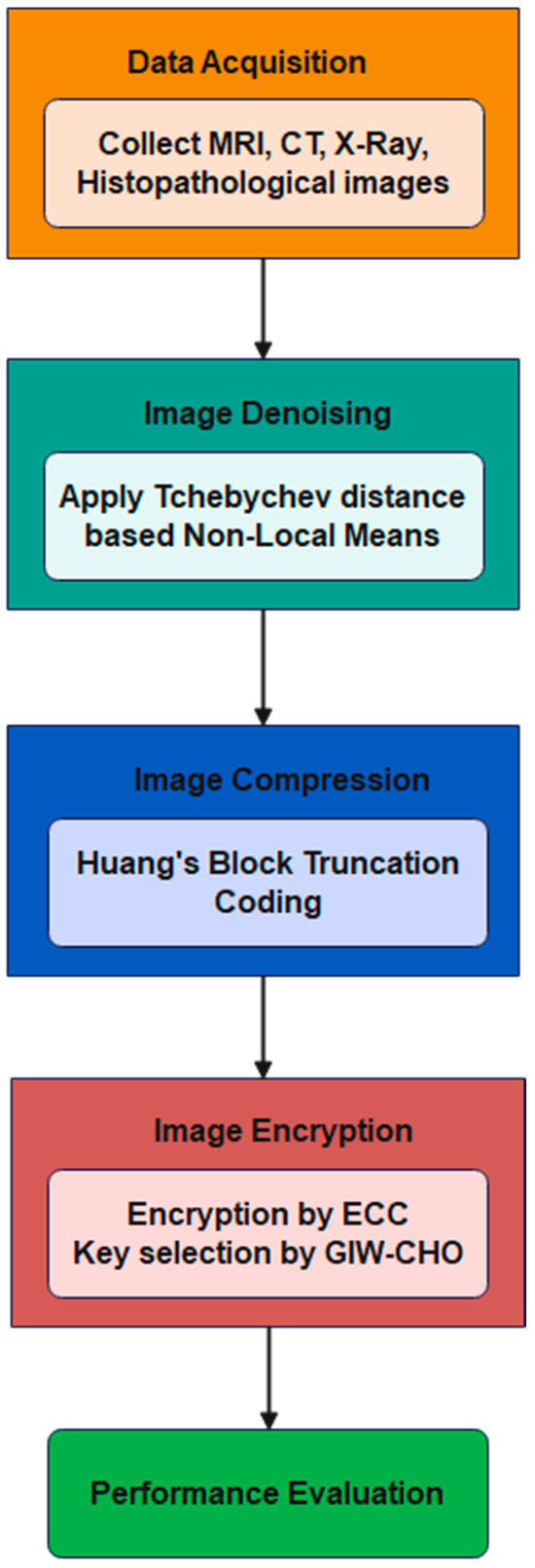
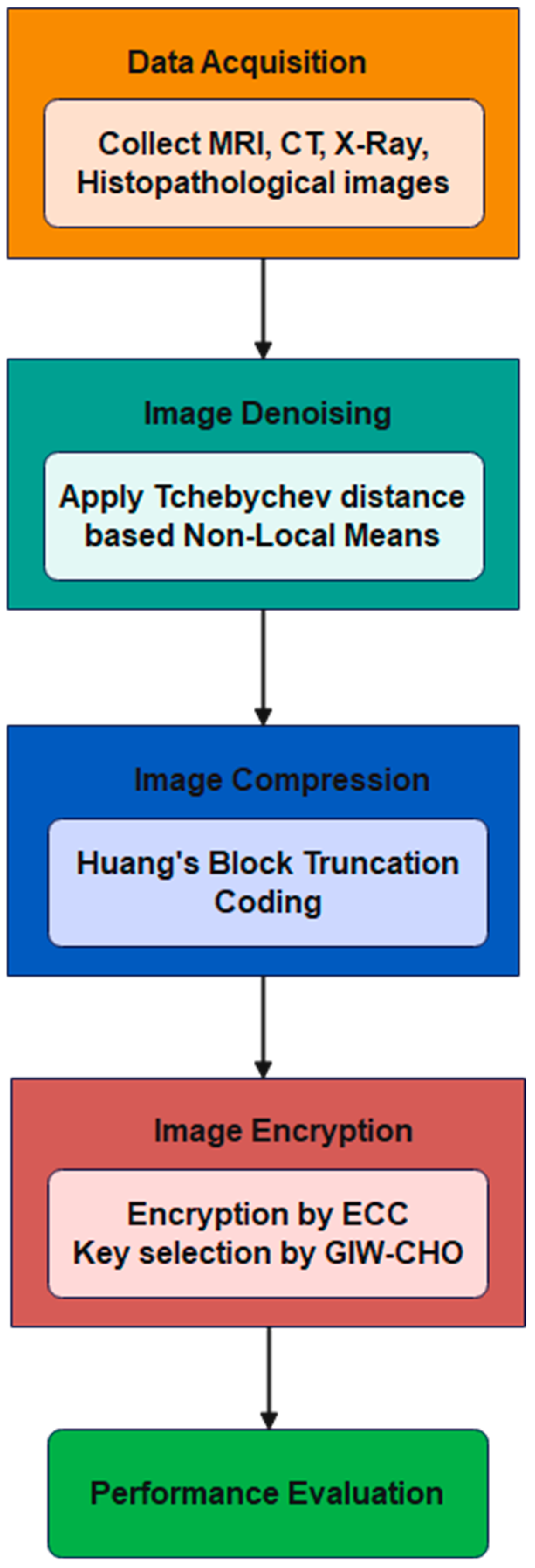
Finally, the compressed image is encrypted by the proposed OKBECC framework, where the encryption keys are optimally selected by GIW-CHO algorithm. The optimization algorithm enhances key randomness, key space, avoids weaker key selection and enhances resistive power against brute-force and key prediction attacks. ECC then performs secure encryption with these optimal keys, resulting in achieving random cipher images with strong NPCR, UACI, entropy and key sensitivity. All these phases are explained in the following subsections and the overall flow of the work is shown in Figure 1.
Figure 1.
Workflow of the proposed OKBECC.
3.1. Image Denoising
Initially, the input medical images such as chest X-rays, ultrasounds, Magnetic Resonant Imaging (MRI), Computed Tomography (CT), histopathological images are acquired from publicly available databases. Image denoising is then performed on the collected input images. Random variations on images with respect to color or brightness information, resulting in the reduction in image details and quality, which is known as image noise. Hence, image denoising is essential to decrease the noise, while minimizing the loss of original features and improving the PSNR. This study presents a TDNLM filtering approach for image denoising. The Non-Local Means (NLMs) technique effectively reduces noise from images, since it computes each pixel’s intensity from the data provided from the entire image. Each pixel’s restored gray value is calculated by averaging the gray values of all the pixels in the image. The weight is distributed based on how comparable the pixel’s immediate neighborhood and the neighborhood corresponding to other pixels in the image are being considered. However, the conventional NLM approach mostly used Euclidean distance to calculate the distance between the gray intensity levels of the image. As it is not scaling invariant, the distances that can be calculated may vary depending on the units of the characteristics. To mitigate this problem, the proposed system uses Tchebyshev distance to extract the minimum number of moves needed to go from one pixel to another and to increase the compression ratio rate. Chebyshev distance is employed for its robustness over localized intensity outliers and bounded deviation property that helps to stabilize the pixel neighborhoods before compression. Let be the pixel vectors, where the Chebyshev distance is computed by
Here, the distance measures the maximum intensity deviation over the corresponding pixels. By using scalar multiplication, the Chebyshev distance scales with respect to intensity magnitude in a linear fashion. The condition is enforced, such that the fixed bound is not exceeded by any pixel, which helps in suppressing the impulse noise spikes. This improvisation in conventional NLM is termed TDNLM. The process involved in the TDNLM is explained as follows: The NLM of the given medical noisy image for a pixel is computed as weighted average of all the pixels and it is expressed as
where denotes the family of weights, depends on the similarity between the pixel and , where the pixel’s similarity depends on the intensity gray level vectors’ ( and ) similarity, where denotes a square neighborhood of fixed size centered at a pixel . The similarity is then calculated as a Tchebyshev distance’s decreasing function and is represented as follows:
In the above equation, and are the neighborhood image patches. denote the gray intensity value, the corresponding pixel position within the patches. After that, the pixel with a similar gray-level neighborhood to has bigger weights in the average and these weights are represented by the following equation,
where refers to the normalizing constant and the parameter acts as a degree of filtering. It controls the exponential function’s decay, so the decay of the weights is considered as the Tchebyshev distance.
In the traditional NLM method, Euclidean distance is utilized to measure the similarity between neighborhood pixels, which makes it sensitive to localized intensity outliers and impulse noise. However, smaller abnormal noisy pixels may affect the similarity computation, in case of medical images. This issue is overcame by employing Chebyshev distance in the denoising framework. The Chebyshev distance computes the maximum absolute deviation between corresponding pixels of two patches of image. This distance does not accumulate all deviations, while focusing on the worst-case intensity deviation. Hence, this distance provides stronger robustness against localized noise spikes and preserves edge structures. The main reason for the choice of Chebyshev distance is that it provides better balance between noise suppression, edge preservation and compression ability.
3.2. Image Compression
After medical image denoising, image compression is performed to reduce the storage and transmission costs. Image compression reduces the irrelevant and unnecessary portions of the image for more effective storage. This makes it easier to transmit the images in minimal time and requires less memory space to retain images. In addition, giving additional key space and cracking the encryption system are difficult. Here, the HBTC model is proposed for image compression. For grayscale images, BTC is a form of lossy image compression technique that utilizes a quantizer to minimize the gray levels in each block, while keeping the mean and standard deviation the same after dividing the original images into blocks. The input gray image pixel values range between (0, 255). This method maintains the image compression rate and improves the image quality. Nevertheless, the manual threshold selection increases the computational complexity of the conventional BTC approach. Hence, the proposed system uses Huang’s method to ensure guaranteed performance, while decreasing the computational complexity. Though HBTC is a compression technique, the cryptographic strength of an image is significantly enhanced by its statistical side-effects.
- The natural grayscale structure of an image is shattered by HBTC, which prevents statistical attacks. The block of medical images are quantized to two values (0, 255), such that the grayscale continuity is eliminated, the texture is suppressed, histogram is modified to bimodal peaks and the pixel correlation is reduced drastically. On the security side, an attacker cannot carry out histogram analysis or correlation pattern study.
- The HBTC minimizes the redundancy by performing block-wise compression. As the redundancy is reduced, the HBTC supports the encryption algorithm to work on a uniform and decorrelated image, which further boosts up confusion and diffusion efficiency.
- Maximized local unpredictability is supported by HBTC, where the binary representation of each block is independent and the block thresholds vary with respect to local statistics.
Hence, despite being primarily a compression approach, HBTC’s statistical transformation including histogram flattening, correlation destruction, redundancy reduction and binary block generation significantly enhance the cryptographic strength of the next ECC encryption phase. HBTC transforms the medical image into a decorrelated bimodal binary structure, thereby removing exploitable grayscale patterns and markedly improving resistance to histogram, correlation, and differential attacks. This optimal threshold selection in conventional BTC is termed as HBTC. The steps involved in the HBTC are explained as follows:
Step 1: The denoised input image is a 512 512 matrix, which is further segmented into 4 × 4 non-overlapping blocks.
Step 2: The mean value is calculated using Equation (5) for non-overlapping blocks. Here, the total number of pixels is 16. The mean values differ for each non-overlapping block.
Step 3: Obtain the maximum and minimum prime value for each non-overlapping block of the matrix .
Step 4: The threshold value is calculated using Huang’s method to find the optimal threshold value. It shows the characteristic relationship between a pixel and its region.
where indicates the total number of gray levels in the input image.
Step 5: The binary block is obtained by threshold value . The value greater than or equal to the threshold value is assigned as ‘1’ and ‘0’ otherwise. The constructed binary block is given in Equation (6) as follows:
Using the above equation, the denoised input image is compressed to provide additional security and to minimize storage space of the encryption model.
3.3. Image Encryption
During this stage, the compressed images are subjected to encryption using the proposed OKBECC algorithm. Since medical images contain confidential data, they are vulnerable to various security risks, when transferred over unsafe networks. Therefore, it is necessary to safeguard these images before transmitting them over public networks. ECC is significantly faster and efficient, when compared to other encryption methods. ECC uses keys of shorter lengths, which is 256 bits. ECC utilizes public and private keys, which are used for encryption and decryption.
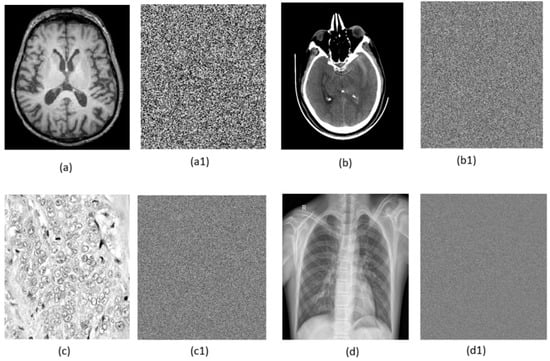
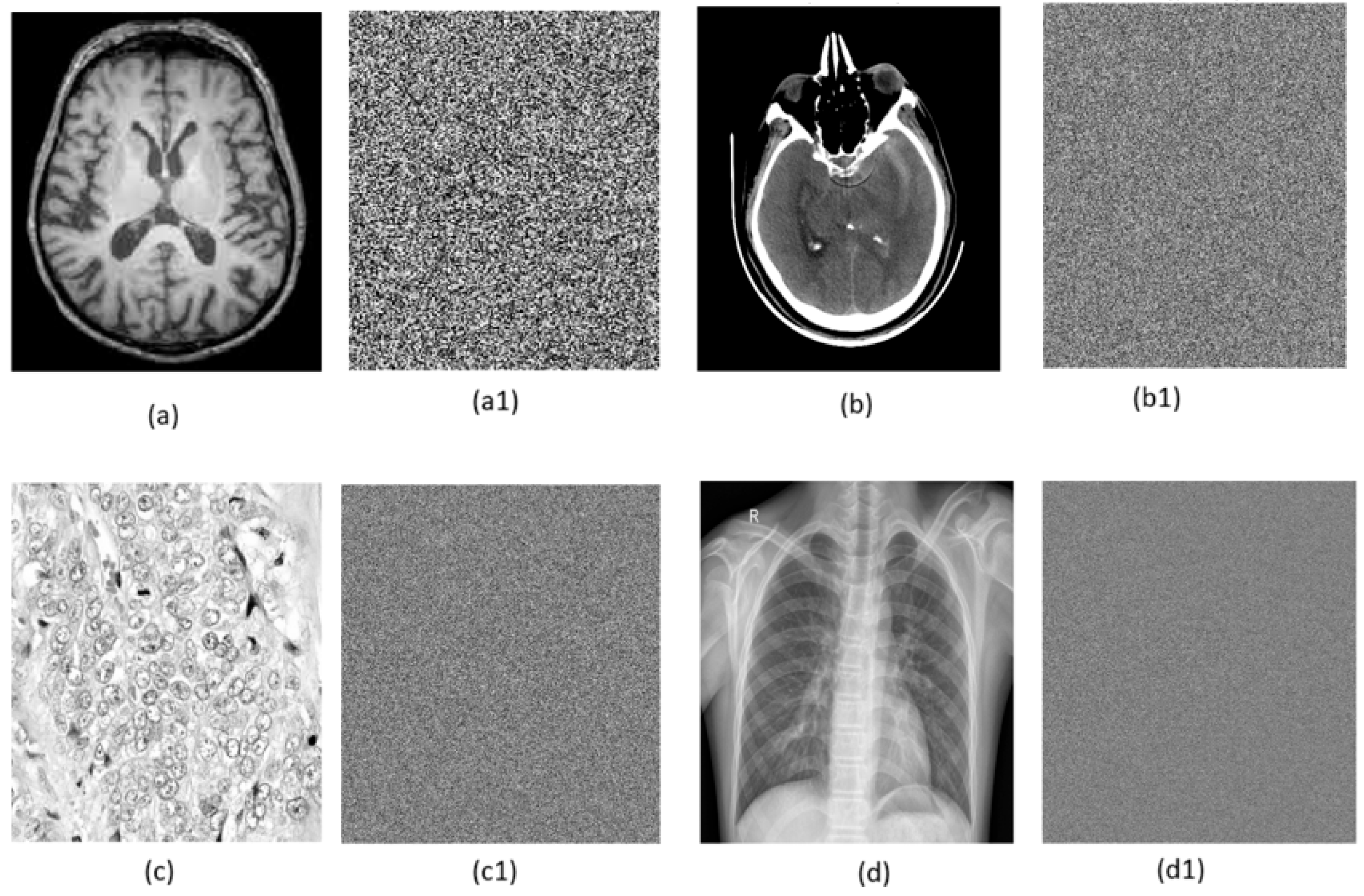
In the encryption process, the sender encrypts with the private key and decryption is carried out by the public key. Private key selection is a problem in all public key cryptographic algorithms. The security of a cryptographic technique can be compromised when smaller values are selected randomly. When the private and public keys are not appropriately selected, infinite values are produced, because the public key is calculated using the private key. Hence, the proposed system uses GIW-CHO algorithm to produce optimal keys for encryption and decryption in ECC. Thus, the optimal key selection process in the conventional ECC algorithm is carried out by OKBECC. Sample original and encrypted images are shown in Figure 2.
Figure 2.
(a–d) Original images (a1–d1) encrypted images.
The proposed algorithm is presented in Algorithm 1.
| Algorithm 1. Proposed HBTC + GIW-CHO Optimized ECC Encryption |
| Input—Original medical image I; Output—Encrypted cipher image C; Begin Step 1—Acquire the medical image I; Step 2—Convert I into grayscale and resize it; Step 3—Apply TDNLM denoising technique and obtain denoised image ; Step 4—Divide into non-overlapping blocks; Step 5—For each block, compute local mean, min, max, and Huang’s threshold; Step 6—Generate HBTC binary block by Step 7—Combine all binary blocks to obtain the compressed image ; Step 8—Initialize ECC parameters over prime field Curve coefficients prime , Base point G and curve order ; Step 9—Use GIW-CHO to optimize the ECC private key within the range ; Step 10—Generate public key of ECC ; Step 11—Select a random ephemeral integer ; Step 12—Encrypt the compressed HBTC using ECC Step 13—Generate final encrypted cipher image Step 14—Transmit the encrypted image. End |
The process involved in the OKBECC is explained as follows. For secure image encryption, ECC is employed over a prime finite field that utilizes 256-bit prime field configuration, owing to its strong cryptographic security, lower computational complexity, minimal key size and ability of lightweight medical image transmission systems. The prime field size is 256 bits with as finite field. is the base point, while the curve order is denoted by . The public and private keys are and respectively.
The elliptic curve considered for the cryptosystem is given in Equation (8). It is a plane curve with the number of points to encrypt the data.
where and indicate two unique points on the elliptic curve and refer to the points of the elliptic curve. If the condition is satisfied, the optimal point is selected for the elliptic curve. The terms and are formulated as follows:
where refers to the points of the elliptic curve and denotes the prime number. From the above calculations, the optimum point is selected and it is termed as .
3.3.1. Key Generation
After optimum base points are calculated, the key generation process is done by the GIW-CHO algorithm to generate optimal keys. CHO algorithm is a swarm intelligence algorithm, and it was inspired by chimpanzees’ ability to think individually about their sexual motivations and group hunting. The standard CHO algorithm classifies the chimp group into four types: attacker, barrier, chaser, and driver. The driver’s job is to chase the prey without trying to overtake it. Barriers are positioned at the base of the trees and climb up to stop prey from taking off in another direction.
The chasers have to pursue the prey quickly to catch up, and then the attackers predict the prey’s escape route to drive the prey back towards the chasers or lower into the canopy. The aggressor is the dominant figure in the group. The status of the other three varieties of chimps declined as a result of their assistance in hunting. The method provides the best solutions. However, the inability to maintain a promising balance between local search and global search, early convergence, trapping in local optima, and inconsistent convergence to the best global solution are all problems with the conventional CHO.
To mitigate the limitations, this paper uses Gauss-iterated map (GIM) initialization to accelerate the convergence speed of the algorithm efficiently. In addition, the proposed system uses Inertia Weight (IW) to update CHO’s position and to avoid optimal local issues. These two incorporations in conventional CHO have renamed the GIW-CHO algorithm. The process involved in the CHO algorithm is explained as follows.
Initialize the population of chimps using GIM, which increases the diversity of the population. It is a nonlinear iterated map of Gaussian function. This method generates the initial population according to the following formula:
where and indicate the real parameters, refers to the initial population of chimps at iteration . After that, compute the fitness of each individual, where the maximum peak-signal-to-noise ratio (PSNR) is considered the best fitness (optimal solutions). PSNR is the ratio between the original image and the encrypted image. A smaller difference between the plain and decrypted images is indicated as a high PSNR value. The fitness of each individual is computed by using Equation (12).
where denotes the mean squared error, and refer to the actual image and encrypted image, and indicates the number of instances. After that, the mathematical form of driving and chasing the prey is computed as follows:
where indicates the number of current iterations, , , represent the vector constants, indicates the victim position vector, and refers to the chimp position vector. The vectors , , and are computed using Equations (17)–(19) as follows:
where and represent random vectors in the range of [0, 1] and indicates the non-linear decay factor, and its value declines linearly from 2.5 to 0 with the increase in the number of iterations.
When the random values lie between [−1, 1], the next position of a chimp can be in any location between the position of the prey and its current position.
From the overall equations,
where parameters , , and indicate the coefficient vectors which are estimated using Equations (17)–(19), denotes the chimp positions, and refers to the distance between each chimp and its prey. Finally, after hunting the prey, all chimpanzees attack their prey to achieve sexual motivation regardless of their duties. The mathematical model of this behavior is expressed using Equation (29).
where indicates a random value between 0 and 1 and refers to the IW, which plays a vital role in balancing the local search and global search and the mathematical form of IW is computed as follows:
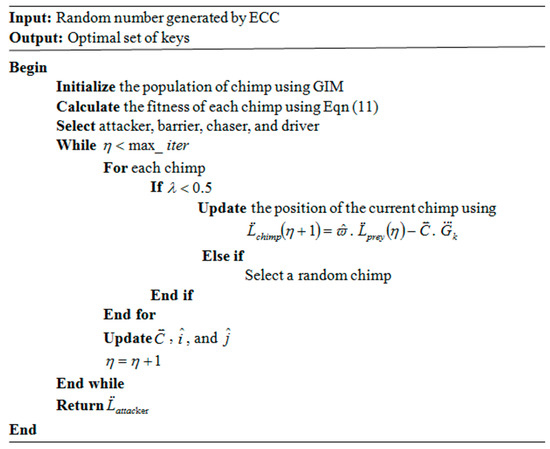
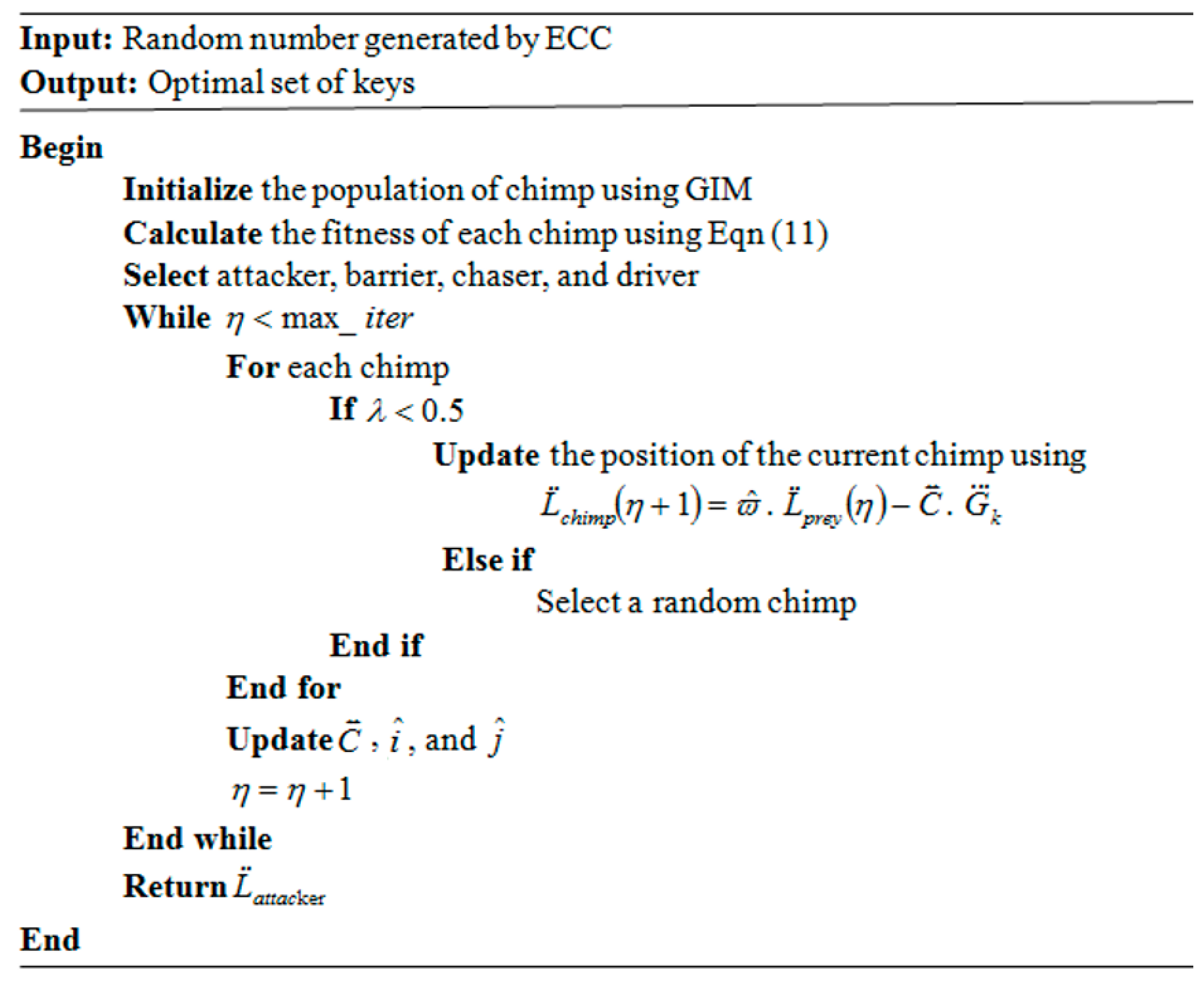
where and indicates the maximum and minimum values in CHO and refers to the maximum number of iterations. This process continues until the optimal private keys are obtained. The pseudocode of the GIW-CHO is shown in Figure 3 [40].
Figure 3.
Pseudocode of GIW-CHO algorithm [40].
Once selecting the optimal private key, the public key is computed as follows:
where indicates the optimal private key selected using GIW-CHO algorithm and denotes the optimum base point.
3.3.2. Encryption Method
The encryption process is carried out after generating the private and public keys. Converting information into an unreadable code, which conceals its actual data is known as encryption. The mathematical model of the encryption process is given below:
where refers to the input-compressed image to be encrypted and indicates the random number, which is in the range of 1 to , and represents two ciphertexts. Then, this encrypted image is securely transmitted to the cloud server.
- Standard ECC Versus GIW-CHO-optimized ECC
The standard ECC employs private keys in a random fashion that may result in repetitive keys and the base point selection is not optimized. The encryption and decryption performance is reduced, while proving better MSE and lower PSNR. The algorithm is prone to key-prediction attacks. On the other hand, the proposed GIW-CHO optimized ECC utilizes optimal keys. The ECC scalar multiplication cost is reduced with minimal distortions. The throughput is increased and high security is rendered with increased entropy and unpredictability. The GIW-CHO optimization in ECC provides security, accuracy and computational efficiency.
3.3.3. Decryption Method
The reverse operation of the encryption is known as decryption, which recovers the original image. It decrypts the cipher image to its origin al form and is done on the server side. The decryption algorithm is presented in Algorithm 2:
| Algorithm 2. Proposed HBTC + GIW-CHO Optimized ECC Decryption |
| Input—Encrypted cipher image ; Output—Reconstructed medical image ; Begin Step 1—Receive the encrypted cipher pair ; Step 2—Extract the cipher components ; Step 3—Compute the shared ECC secret using optimized private key ; Step 4—Recover the compressed HBTC image ; Step 5—Apply HBTC decompression to reconstruct image blocks; Step 6—For each binary block, map the binary values to the corresponding high and low reconstruction levels; Step 7—Merge all reconstructed blocks and obtain ; Step 8—Evaluate reconstruction quality and security performance; End. |
The optimal private key is utilized for the decryption process to decrypt the message on the receiver side.
where indicates the input compressed image. After decrypting the compressed images, decompression is done using HBTC algorithm to get the original input image.
4. Results and Discussion
This section analyses the performance of the proposed work by comparing its results with the existing methodologies. The proposed work is implemented in MATLAB R2026a with the following configurations: Intel(R) processor Core (TM)i7-7700HQ CPU 2.80 GHz, an operating system of Windows 10, 16 GB RAM. The performance of the proposed work is analyzed on different image modalities, which are acquired from public datasets [32,33,34,35,38]. A total of 1000 images are selected from each dataset and this work is applied on over 5000 images.
The performance of the proposed work is tested by varying optimization algorithms, image modality and encryption algorithms. Additionally, time complexity and security analysis are carried out. The choice of the optimization algorithm and sequential order of this work are justified as well. Several performance measures such as Compression Ratio (COR), Structural Similarity Index Metric (SSIM), Peak-Signal-to-Noise Ratio (PSNR), Mean Squared Error (MSE), Number of Changing Pixel Rate (NPCR) and Unified Averaged Changed Intensity (UACI) are employed to quantify image quality and encryption strength. The parameter settings are shown in Table 1.
Table 1.
Parameter settings.
4.1. Performance Analysis w.r.t Compression Efficiency
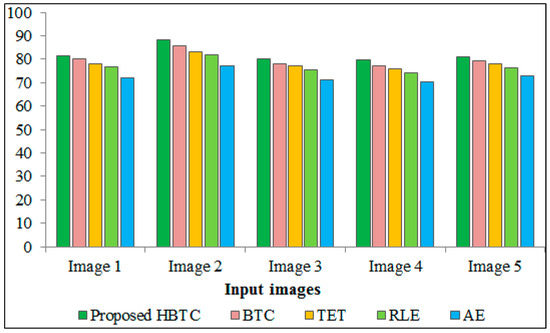
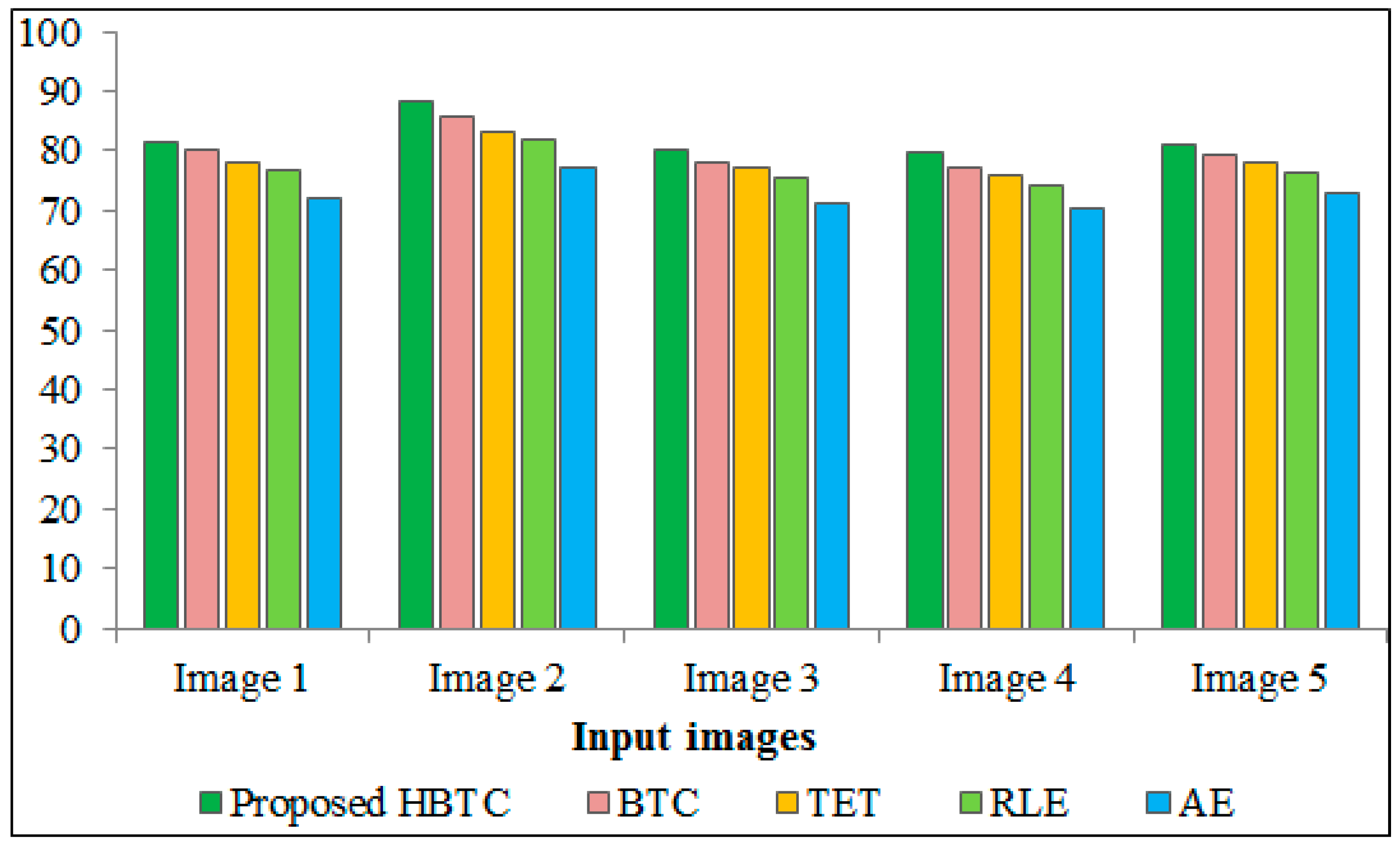
Initially, the outcomes of the proposed HBTC are investigated against the traditional BTC, Tetrolet transformation (TET), Run Length Encoding (RLE), and Arithmetic Encoding (AE) in terms of COR, MSE and SSIM metrics. Figure 4 shows the sample outcomes of the proposed HBTC with existing methods concerning COR.
Figure 4.
Compression ratio analysis.
COR is the ratio of the sizes of the compressed image to the original image, which needs to be higher for a better compression model. For image 1, the proposed work attains the COR of 81.34%, which is greater than the existing methods such as BTC, TET, RLE, and AE prove COR of 79.98%, 78.12%, 76.87%, and 72.14%, respectively. In addition, for image 2, the proposed work shows a high COR of 88.23%, when compared to the existing works. Similarly, the proposed work achieves a higher COR rate for all the images than the existing methods. From the results, it is easily accomplished that the proposed one achieves superior performance than the traditional methods.
4.2. SSIM and MSE Analysis
The SSIM metric quantifies image quality degradation caused by image compression, also known as a perceptual metric. For image 1, the existing BTC, TET, RLE, and AE have lower SSIM rates, when compared to the proposed work with the highest SSIM of 0.937. The SSIM and MSE analysis of the proposed work are shown in Table 2.
Table 2.
SSIM and MSE results.
Image compression quality is measured by the MSE metric, which is the cumulative squared error between the input and output gray images. Least MSE rates are proven by the proposed work by showing 0.043, 0.037, 0.052, 0.029 and 0.038 for the sample images. Hence, the proposed work proves better quality than the comparative methods.
4.3. Performance Comparison Against Existing Works
The performance of the proposed HBTC + GIW-CHO-ECC is compared against the recent works such as Hyperchaos (Lai and Hua 2025) [38], Tent chaos (Shahid et al. 2025) [36], Lightweight IoMT encryption (Islam et al. 2025) [37], and Fractional S box (Ali et al. 2025) [39], while the results are presented in Table 3.
Table 3.
Performance comparison results.
In the above comparative analysis, the PSNR values are not directly comparable, owing to the differences in compression and reconstruction techniques. Though blockchain and hyperchaotic DNA-based techniques attain better security, they suffer from great computational and infrastructural overheads. The lightweight IoMT model shows better executional speed, yet at the cost of minimized entropy and diffusion. In contrast, the proposed work shows better NPCR, UACI with a stronger keyspace and moderate runtime.
4.4. Performance Comparison by Varying Optimization Algorithms
The performance of GIW-CHO is compared against Particle Swarm Optimization (PSO), Differential Evolution (DE), Genetic Algorithm (GA) and Whale Optimization Algorithm (WOA) in terms of convergence analysis and computational cost. The basic properties of these optimization algorithms are compared and presented in Table 4.
Table 4.
Properties of optimization algorithms.
The performances of the optimization algorithms with the same experimental setup are presented in the following Table 5. PSO converges fast initially but slows down later, while suffering from local optima traps because of velocity decay. DE proves better global search and the over-mutation may result in oscillations of single-variable problems. Hence, it would not be suitable for ECC key selection.
Table 5.
Performance comparison w.r.t optimization algorithms.
GA encounters the least convergence, owing to crossover overhead and its performance relies on mutation rate. WOA involves better spiral search; however, with poor stability and as the iterations progresses, the convergence slows down. In contrast, the Gauss-iterated map, inertia-weighted chimp dynamics and four-role hunting mechanism helps in attaining guaranteed wide key space, avoiding premature convergence and independent search directions, respectively. All these features support GIW-CHO to converge faster with better reliability. The exploration/exploitation balance is maintained effectively by GIW-CHO. In addition, the GIW-CHO restricts the search space to strong key space [] and the encryption quality is ensured by PSNR-guided fitness, while producing minimal invalid or weaker keys. Hence, the choice of GIW-CHO is justified over other optimization algorithms.
4.5. Statistical Analysis on Compressed Images
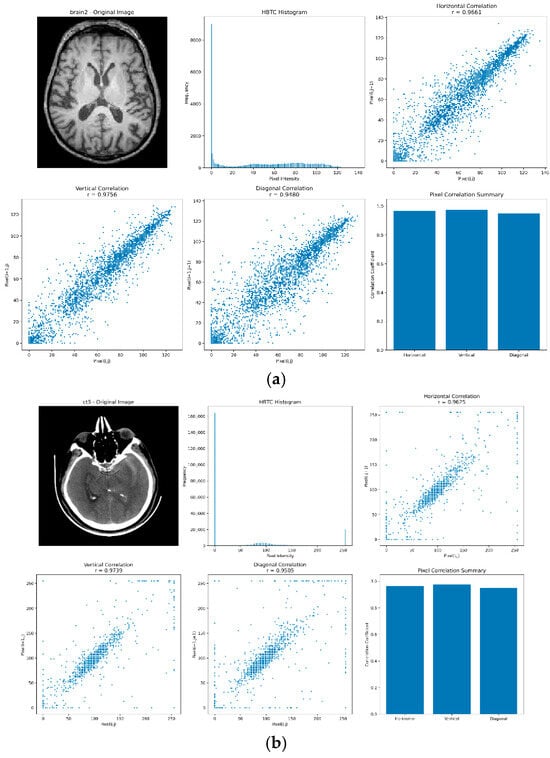
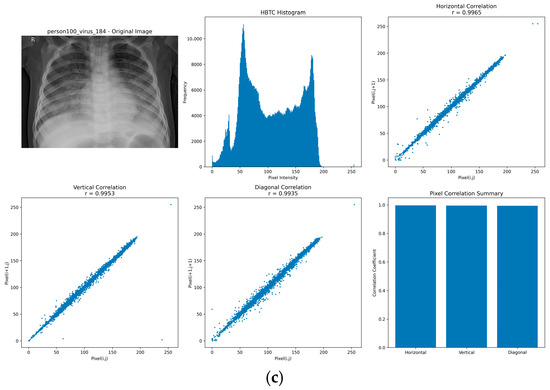
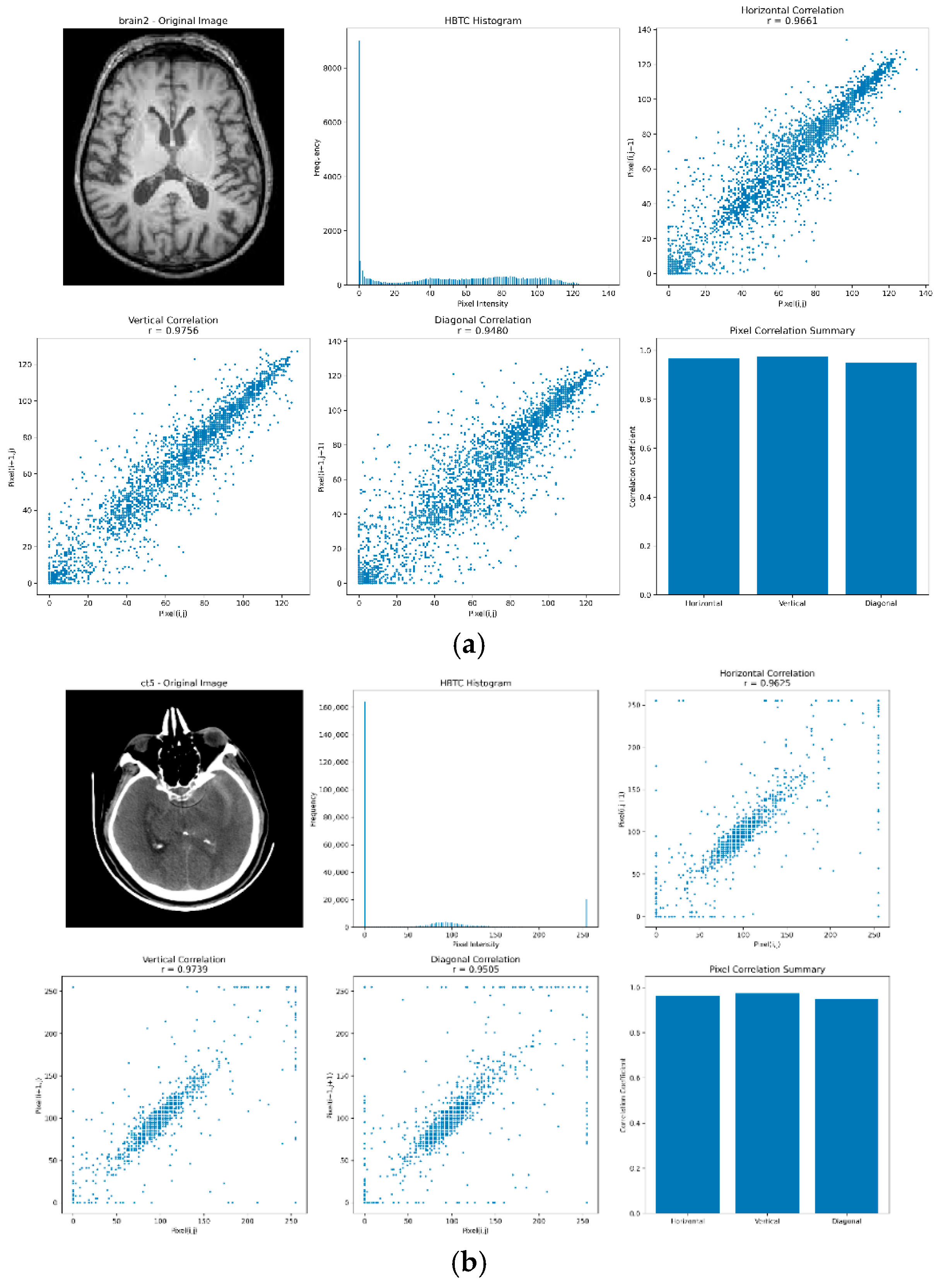
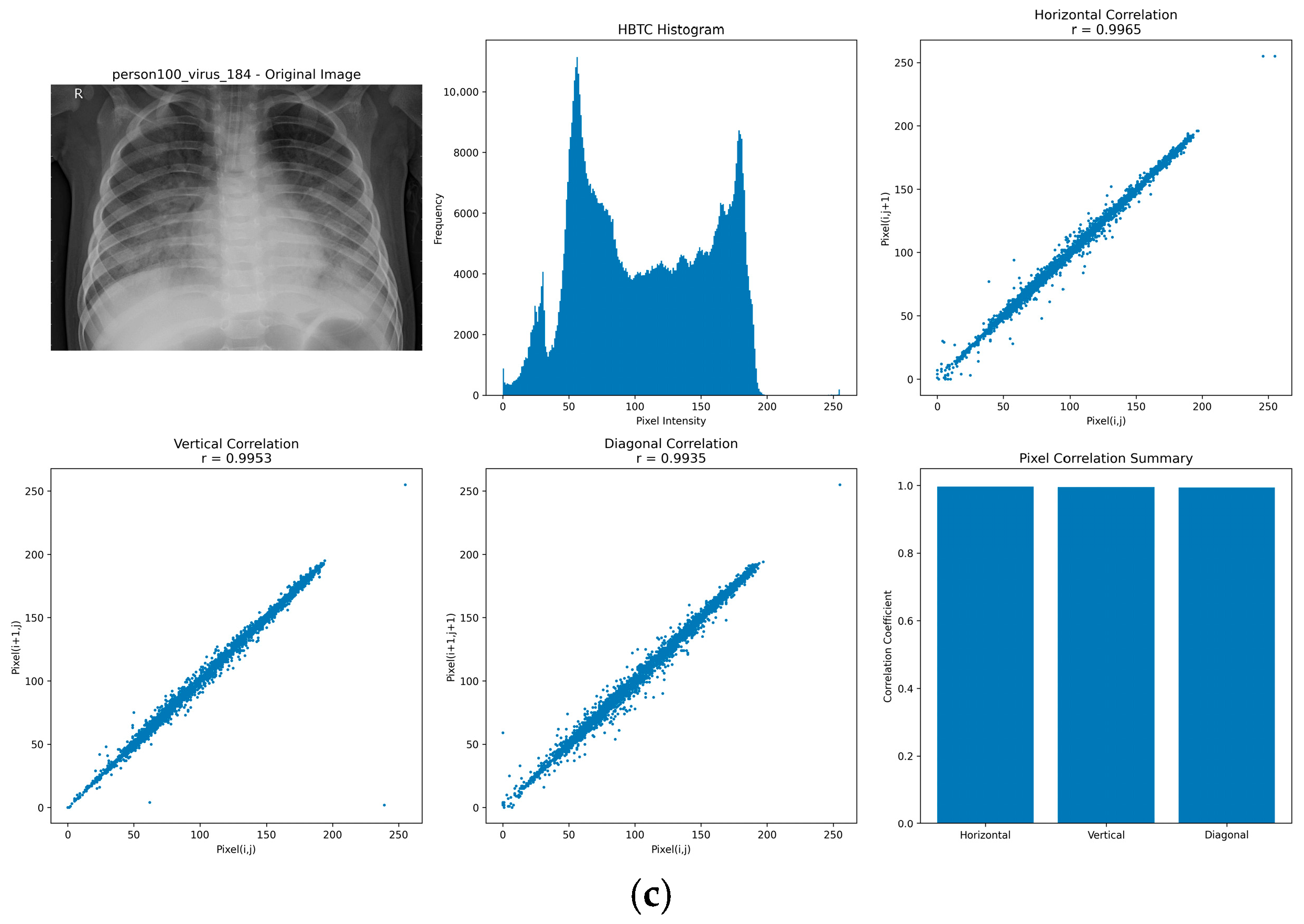
The correlation analysis is carried out in three directions, such as horizontal, vertical and diagonal. Post-HBTC compression, the horizontal pixel correlation scatter plot ceases to display a linear diagonal configuration and instead condenses into distinct clusters at (0, 0), (255, 255), (0, 255) and (255, 0). This verifies that HBTC obliterates natural grayscale continuity and diminishes inter-pixel reliance. The correlation coefficient is moderately positive (r = 0.73), which is anticipated due to HBTC maintaining block-level homogeneity, resulting in neighboring pixels being similar within each block. The statistical distortion caused by HBTC markedly enhances resilience against correlation-based assaults. The following Figure 5 shows the pixel correlation and histogram analysis of sample images.
Figure 5.
(a–c) Input images with horizontal, vertical and diagonal pixel correlation analysis and HBTC histograms.
The HBTC plot shows a dense cluster near the top-right corner, which means the points are around (255, 255) and a few points are scattered around (0, 0), (0, 255) and (255, 0). This indicates that the visual structure is gone and ensures statistical destruction with cryptographic security. Table 6 shows the statistical analysis with respect to entropy, mean, Standard Deviation (SD), horizontal, vertical and diagonal correlations taken before and after HBTC.
Table 6.
Statistical analysis w.r.t HBTC.
From the attained results, it is evident that the entropy, mean and SD are better after HBTC, than when compared to the original images. This makes it difficult for the attacker to break the security and gain knowledge about the image.
4.6. Performance Comparison by Varying Image Modality
To evaluate the versatility of the proposed HBTC + OKBECC architecture across diverse medical-imaging modalities, the assessment is broadened from chest X-ray to include CT, MRI, and histopathological images. Notwithstanding the significantly disparate intensity distributions and texture statistics of these modalities, HBTC reliably converted the images into decorrelated bimodal binary representations with an entropy of approximately 1 bit, whereas the ECC decryption preserved superior reconstruction quality with reasonable PSNR around 68 dB and robust security metrics (NPCR > 99.4%, UACI ≈ 33%). Table 7 shows the results.
Table 7.
Performance analysis by varying image modality.
From the results, it is proven that the entropy of the encrypted image is relatively comparable with the original image, such that the cryptographic strength is reasonable. The pixel correlation is also satisfactory, and so are PSNR, NPCR and UACI rates.
4.7. Key Sensitivity and Key Space Analysis
For key sensitivity analysis, the key is altered a bit to check the extent of change in cipher. The results show that the proposed work shows strong resistance to key-related cryptanalysis. The proposed OKBECC framework demonstrates enhanced robustness relative to traditional techniques. It attains an NPCR and UACI of about 99.63% and 33.48% respectively, which are nearly aligned with the theoretical maxima for optimal image ciphers (NPCR-100%, UACI-33.33%). The HBTC compresses and binarizes the image, which collapses the image approximately to a bit. After ECC encryption, the entropy rises back closer to 8 bits, which clearly indicates better statistical destruction and greater ciphertext randomness across modalities. Table 8 shows the security analysis of the proposed OKBECC in comparison with different approaches with respect to NPCR, UACI, entropy, and key sensitivity.
Table 8.
Key sensitivity analysis.
The ciphertext entropy approximates 7.999 bits, signifying closer unpredictability. Conversely, unoptimized ECC and BTC-based encryption demonstrate diminished NPCR lesser than or equal to 98.2% and 97.8% and UACI lesser than or equal to 30.4% and 29.5%, indicating worse diffusion. Chaotic and DNA-based approaches exhibit superior performance, yet they remain inferior to the proposed system regarding entropy and NPCR. Moreover, one-bit alteration in the ECC key results in NPCR and UACI that are about 99.6% and 33.4% between the respective ciphertexts, indicating exceptional key sensitivity and robust resistance to key-differential attacks. The parameter settings of all the algorithms are shown in Table 9.
Table 9.
Parameter settings of encryption algorithms.
Key space analysis is essential to evaluate the resistance of an encryption system against brute-force attacks. A cryptographic system is considered secure, when the count of keys is enough to ensure exhaustive search computationally intensive. The private key is chosen over a 256-bit prime-field elliptic curve and the private key is chosen from the interval , where is the order of elliptic curve generator point. The key space of the proposed work is approximated as key space ≈2256. This key space is larger than the minimum security requirement of , which is considered adequate against brute-force attack.
The proposed GIW-CHO algorithm strengthens the key selection process, which searches the valid key domain and the stronger key candidates are selected by the defined fitness function. The population diversity is enhanced by Gauss-iterated map, while the premature convergence and weaker key selection is avoided by the update mechanism of inertia-weighted chimp algorithm. Hence, the proposed work not only maintains a larger key space, but the key quality is also improved during encryption. The key space is compared with other algorithms, as presented in Table 10.
Table 10.
Key space analysis.
The proposed framework provides a key space of approximately with optimized key selection, such that brute-force attacks are made impossible. In addition, repetitive or weaker key selection is avoided by GIW-CHO and, hence, the proposed work proves stronger resistance against brute-force, key prediction and key-recovery attacks.
4.8. Parameter Choice Analysis
The choice of the parameters is justified by the attained results as shown in the following Table 11.
Table 11.
HBTC block-size variation analysis.
As the size provides better quality and security, this size is selected. The parameter setting of GIW-CHO is shown in the following Table 12.
Table 12.
variation analysis on GIW-CHO.
When equals 0.05 and 0.2, the convergence rate is slower and faster respectively, while provides the best fitness score with least variance across 10 runs and converges at 34th iteration.
4.9. Time Complexity Analysis
All encryption and decryption processes demonstrate linear time complexity O(N) relative to the size of the image N. For a 512 512 image on an Intel i7-class CPU, AES-128 in CBC mode performs encryption and decryption in 4 milliseconds, chaotic XOR-based encryption in 8 milliseconds, BTC-based schemes in 13 milliseconds and DNA–chaos hybrids in 27 milliseconds. ECC-based methods are comparatively more costly, where the unoptimized ECC scheme necessitates approximately 23 ms for encryption and 25 ms for decryption, whereas the proposed HBTC + GIW-CHO ECC model requires around 28 ms for encryption and 32 ms for decryption due to the additional HBTC preprocessing and elliptic-curve computations. Table 13 shows the complexity analysis of the proposed work.
Table 13.
Time complexity results.
The GIW-CHO optimizer requires a one-time overhead of approximately 42 s (for a population of 30 members and 50 iterations); however, this cost is amortized as the optimized 256-bit ECC key can be utilized for subsequent images. Overall, the proposed approach demonstrates significantly improved NPCR, UACI, entropy and key sensitivity, with only a modest increase in per-image encryption and decryption time relative to conventional schemes.
4.10. Process Sequence Change Analysis
Two different sequences such as ‘Denoising Encryption compression’ and ‘Denoising compression encryption’ are processed and the performances are compared. Although both of the sequences show similar reconstruction quality, as proven by PSNR and MSE, they show extreme difference in security aspects. Table 14 shows the process sequence change of analytical results.
Table 14.
‘Denoising Encryption compression’ vs. ‘Denoising compression encryption’.
As HBTC is a keyless compression scheme; it significantly degrades the cryptographic metrics, when applied after encryption. This sequence also proves minimal entropy, NPCR and UACI, which makes it susceptible to statistical and differential attacks. On the other hand, the sequence followed in proposed work ‘Denoising compression encryption’ preserves the security with better image reconstruction quality as well. This sequence is followed, as it ensures better compression and cryptographic strength.
4.11. Robustness Analysis
The robustness analysis is performed by subjecting the encrypted images to salt-and-pepper and Gaussian-noise attacks. The salt-and-pepper noise and Gaussian noise with densities of 0.001, 0.005 and 0.01 respectively are introduced to the encrypted images. The attacked cipher images decrypted and decompressed and the reconstructed images are assessed by different performance measures, as shown in the following Table 15.
Table 15.
Robustness analytical results.
The results indicate that the proposed framework is resistant against common noise-based transmission attacks. Localized and distributed distortions are introduced in the cipher image by salt-and-pepper and Gaussian noises respectively. The greater PSNR and SSIM values indicate that the reconstructed images still preserve the visual quality. The entropy maintains closer to 8 bits and NPCR above 99%, emphasizing that the encrypted image proves strong randomness and resistance against attacks.
4.12. NIST Statistical Test Suite Analysis
NIST SP 800-22 is employed to evaluate different aspect of randomness, which includes bit distribution uniformity, pattern repetition, entropy characteristics and complexity of sequence. Certain tests such as frequency, block frequency, runs, longest run, approximate entropy, serial, cumulative sums and FFT spectral tests are considered and the results are presented in the following Table 16.
Table 16.
NIST statistical test suite results.
The results show that the obtained p-values are greater than the threshold 0.01, which shows that the generated sequences pass the randomness tests. This proves that the proposed GIW-CHO optimized ECC framework shows a highly random and unpredictable cipher sequences. The randomness is attained by the Gauss-iterated initialization, chimp optimization dynamics with inert and ECC-based diffusion. The improvised randomness characteristics enhance resistance against statistical cryptanalysis, key prediction and differential attacks.
4.13. Objective Fulfillment
The initial objective of this work is to enhance the quality of medical images using TDNLM-denoising approach. The PSNR, MSE and SSIM results prove that the denoising approach suppresses noise, while preserving significant structure and texture details. Chebyshev distance utilized in TDNLM framework helps in stabilizing the local intensity variations, while improving the neighborhood similarity estimation.
Storage and transmission overhead reduction is the second objective, which is attained by HBTC compression. Achieved compression results demonstrate the image reconstruction quality. The compression phase helps in reducing payload and enhances statistical security. Medical image security is provided by ECC-based encryption and its resistance against attacks is proven by NPCR, UACI, entropy, histogram and pixel correlation analysis. The effectiveness of ECC key generation using GIW-CHO algorithm is proven with strong key sensitivity. Hence, the experimental outcomes prove the efficacy of the proposed framework by fulfilling the objectives of this work.
5. Conclusions
This article presents an efficient medical image transmission framework, which follows the sequence ‘denoise-compression-encryption’, which incorporates HBTC and GIW-CHO. The images are denoised initially, which is followed by spatial correlation reduction and histogram regularization by HBTC to provide unpredictable input to the encryption algorithm. GIW-CHO optimizes the ECC keys, which ensures better diffusion and key sensitivity. The experiment analysis over different imaging modalities proves that the proposed work is secure, which is proven by better NPCR, UACI, cipher entropy, and key sensitivity analysis. Additionally, the image reconstruction quality is also proven effective with a reasonable PSNR of about 68 dBs with the least MSE. The comparison is performed against several existing works such as AES-CBC, chaos-based, DNA–chaos, BTC and unoptimized ECC, which is outperformed by the proposed work. In future, this work can be extended by improving the compression efficiency by employing deep learning-based threshold selection and Region of Interest (RoI)-based encryption can be carried out for selective encryption.
Author Contributions
K.S.—Conceptualization; Research Methodology; Software; Draft preparation. K.K.—Supervision, Verification. All authors have read and agreed to the published version of the manuscript.
Funding
This research received no external funding.
Data Availability Statement
This work utilizes the images available from the following links: 1. https://www.ultrasoundcases.info/cases/abdomen-and-retroperitoneum/ (accessed on 24 December 2025). 2. https://www.kaggle.com/datasets/paultimothymooney/chest-xray-pneumonia (accessed on 24 December 2025). 3. https://www.kaggle.com/code/harshsingh2209/generating-brain-mri-images-with-dc-gan (accessed on 24 December 2025). 4. https://www.kaggle.com/code/olaflundstrom/stroke-detection-in-brain-ct-images/input (accessed on 24 December 2025). 5. https://www.kaggle.com/code/abdallahwagih/lung-colon-cancer-cnn-98-6 (accessed on 24 December 2025).
Conflicts of Interest
The authors declare no conflicts of interest.
References
- Jeevitha, S.; Amutha Prabha, N. Novel medical image encryption using DWT block-based scrambling and edge maps. J. Ambient Intell. Humaniz. Comput. 2021, 12, 3373–3388. [Google Scholar] [CrossRef] [Scilit]
- Selvi, C.T.; Amudha, J.; Sudhakar, R. Medical image encryption and compression by adaptive sigma filterized synorr certificateless signcryptive Levenshtein entropy-coding-based deep neural learning. Multimed. Syst. 2021, 27, 1059–1074. [Google Scholar] [CrossRef] [Scilit]
- Bose, B.; Dey, D.; Sengupta, A.; Mulchandani, N.; Patra, A. A novel medical image encryption using cyclic coding in Covid-19 pandemic situation. J. Phys. Conf. Ser. 2021, 1797, 012035. [Google Scholar] [CrossRef] [Scilit]
- Pankaj, S.; Dua, M. A novel ToCC map and two-level scrambling-based medical image encryption technique. Netw. Model. Anal. Health Inform. Bioinform. 2021, 10, 48. [Google Scholar] [CrossRef] [Scilit]
- Kamal, S.T.; Hosny, K.M.; Elgindy, T.M.; Darwish, M.M.; Fouda, M.M. A new image encryption algorithm for grey and color medical images. IEEE Access 2021, 9, 37855–37865. [Google Scholar] [CrossRef] [Scilit]
- Abdulbaqi, A.S.; Obaid, A.J.; Mohammed, A.H. ECG signals recruitment to implement a new technique for medical image encryption. J. Discret. Math. Sci. Cryptogr. 2021, 24, 1663–1673. [Google Scholar] [CrossRef] [Scilit]
- Deb, S.; Bhuyan, B. Chaos-based medical image encryption scheme using special nonlinear filtering function based LFSR. Multimed. Tools Appl. 2021, 80, 19803–19826. [Google Scholar] [CrossRef] [Scilit]
- Zermi, N.; Khaldi, A.; Kafi, R.; Kahlessenane, F.; Euschi, S. A DWT-SVD based robust digital watermarking for medical image security. Forensic Sci. Int. 2021, 320, 110691. [Google Scholar] [CrossRef] [Scilit] [PubMed]
- Benssalah, M.; Rhaskali, Y.; Drouiche, K. An efficient image encryption scheme for TMIS based on elliptic curve integrated encryption and linear cryptography. Multimed. Tools Appl. 2021, 80, 2081–2107. [Google Scholar] [CrossRef] [Scilit]
- Kaur, M.; Singh, S.; Kaur, M. Computational image encryption techniques: A comprehensive review. Math. Probl. Eng. 2021, 2021, 5012496. [Google Scholar] [CrossRef] [Scilit]
- Guesmi, R.; Farah, M.B. A new efficient medical image cipher based on hybrid chaotic map and DNA code. Multimed. Tools Appl. 2021, 80, 1925–1944. [Google Scholar] [CrossRef] [Scilit]
- Hasan, M.K.; Islam, S.; Sulaiman, R.; Khan, S.; Hashim, A.H.A.; Habib, S.; Islam, M.; Alyahya, S.; Ahmed, M.M.; Kamil, S.; et al. Lightweight encryption technique to enhance medical image security on internet of medical things applications. IEEE Access 2021, 9, 47731–47742. [Google Scholar] [CrossRef] [Scilit]
- Hashim, A.T.; Jabbar, A.K.; Hassan, Q.F. Medical image encryption based on hybrid AES with chaotic map. J. Phys. Conf. Ser. 2021, 1973, 012037. [Google Scholar] [CrossRef] [Scilit]
- Parameshachari, B.D.; Panduranga, H.T.; liberata Ullo, S. Analysis and computation of encryption technique to enhance security of medical images. IOP Conf. Ser. Mater. Sci. Eng. 2020, 925, 012028. [Google Scholar] [CrossRef] [Scilit]
- Zou, D.; Pei, T.; Xi, G.; Wang, L. Image encryption based on hyperchaotic system and improved zigzag diffusion method. IEEE Access 2023, 11, 95396–95409. [Google Scholar] [CrossRef] [Scilit]
- Sarosh, P.; Parah, S.A.; Bhat, G.M. Fast image encryption framework for medical images. In 2021 2nd International Conference on Intelligent Engineering and Management (ICIEM); IEEE: Piscataway, NJ, USA, 2021; pp. 149–154. [Google Scholar] [CrossRef] [Scilit]
- Li, Z.; Ramos, A.; Li, Z.; Osborn, M.L.; Zaid, W.; Li, X.; Li, Y.; Xu, J. Nearly-lossless-to-lossy medical image compression by the optimized JPEGXT and JPEG algorithms through the anatomical regions of interest. Biomed. Signal Process. Control 2023, 83, 104711. [Google Scholar] [CrossRef] [Scilit]
- El-kafrawy, P.; Aboghazalah, M.; Ahmed, A.M.; Torkey, H.; El-Sayed, A. An Efficient Encryption and Compression of Sensed IoTMedical Images Using Auto-Encoder. CMES-Comput. Model. Eng. Sci. 2023, 134, 909–926. [Google Scholar] [CrossRef] [Scilit]
- Ghaffari, A. Image compression-encryption method based on two-dimensional sparse recovery and chaotic system. Sci. Rep. 2021, 11, 369. [Google Scholar] [CrossRef] [Scilit]
- Wu, Y.; Zhang, L.; Berretti, S.; Wan, S. Medical image encryption by content-aware DNA computing for secure healthcare. IEEE Trans. Ind. Inform. 2022, 19, 2089–2098. [Google Scholar] [CrossRef] [Scilit]
- Hafsa, A.; Gafsi, M.; Malek, J.; Machhout, M. FPGA implementation of improved security approach for medical image encryption and decryption. Sci. Program. 2021, 2021, 6610655. [Google Scholar] [CrossRef] [Scilit]
- Rukhin, A.; Soto, J.; Nechvatal, J.; Smid, M.; Barker, E. A Statistical Test Suite for Random and Pseudorandom Number Generators for Cryptographic Applications (No. NISTSP80002). 2001. Available online: https://apps.dtic.mil/sti/html/tr/ADA393366/ (accessed on 16 May 2026).
- El-Shafai, W.; Khallaf, F.; El-Rabaie, E.S.M.; El-Samie, F.E.A. Robust medical image encryption based on DNA-chaos cryptosystem for secure telemedicine and healthcare applications. J. Ambient Intell. Humaniz. Comput. 2021, 12, 9007–9035. [Google Scholar] [CrossRef] [Scilit]
- Priya, S.; Santhi, B. A novel visual medical image encryption for secure transmission of authenticated watermarked medical images. Mob. Netw. Appl. 2021, 26, 2501–2508. [Google Scholar] [CrossRef] [Scilit]
- Ravichandran, D.; Banu, S.A.; Murthy, B.K.; Balasubramanian, V.; Fathima, S.; Amirtharajan, R. An efficient medical image encryption using hybrid DNA computing and chaos in transform domain. Med. Biol. Eng. Comput. 2021, 59, 589–605. [Google Scholar] [CrossRef] [Scilit]
- Yasser, I.; Khalil, A.T.; Mohamed, M.A.; Samra, A.S.; Khalifa, F. A robust chaos-based technique for medical image encryption. IEEE Access 2021, 10, 244–257. [Google Scholar] [CrossRef] [Scilit]
- Manikandan, N.; Muthaiah, R.; Teekaraman, Y.; Kuppusamy, R.; Radhakrishnan, A. A Novel Random Error Approximate Adder-Based Lightweight Medical Image Encryption Scheme for Secure Remote Monitoring of Health Data. Secur. Commun. Netw. 2021, 2021, 3570904. [Google Scholar] [CrossRef] [Scilit]
- Shafique, A.; Ahmed, J.; Rehman, M.U.; Hazzazi, M.M. Noise-resistant image encryption scheme for medical images in the chaos and wavelet domain. IEEE Access 2021, 9, 59108–59130. [Google Scholar] [CrossRef] [Scilit]
- Masood, F.; Driss, M.; Boulila, W.; Ahmad, J.; Rehman, S.U.; Jan, S.U.; Qayyum, A.; Buchanan, W.J. A lightweight chaos-based medical image encryption scheme using random shuffling and XOR operations. Wirel. Pers. Commun. 2022, 127, 1405–1432. [Google Scholar] [CrossRef] [Scilit]
- Kumar, M.; Gupta, P. A new medical image encryption algorithm based on the 1D logistic map associated with pseudo-random numbers. Multimed. Tools Appl. 2021, 80, 18941–18967. [Google Scholar] [CrossRef] [Scilit]
- Available online: https://www.ultrasoundcases.info/cases/abdomen-and-retroperitoneum/ (accessed on 24 December 2025).
- Available online: https://www.kaggle.com/datasets/paultimothymooney/chest-xray-pneumonia (accessed on 24 December 2025).
- Available online: https://www.kaggle.com/code/harshsingh2209/generating-brain-mri-images-with-dc-gan (accessed on 24 December 2025).
- Available online: https://www.kaggle.com/code/olaflundstrom/stroke-detection-in-brain-ct-images/input (accessed on 24 December 2025).
- Available online: https://www.kaggle.com/code/abdallahwagih/lung-colon-cancer-cnn-98-6 (accessed on 24 December 2025).
- Shahid, U.; Kanwal, S.; Bano, M.; Inam, S.; Abdalla, M.E.M.; Shaikh, Z.A. Blockchain driven medical image encryption employing chaotic tent map in cloud computing. Sci. Rep. 2025, 15, 6236. [Google Scholar] [CrossRef] [Scilit] [PubMed]
- Islam, M.O.U.; Parah, S.A.; Malik, B.A.; Malik, S.A. Lightweight medical-image encryption technique for IoMT based healthcare applications. Multimed. Tools Appl. 2025, 84, 8929–8964. [Google Scholar] [CrossRef] [Scilit]
- Lai, Q.; Hua, H. Secure medical image encryption scheme for Healthcare IoT using novel hyperchaotic map and DNA cubes. Expert Syst. Appl. 2025, 264, 125854. [Google Scholar] [CrossRef] [Scilit]
- Ali, J.; Jamil, M.K.; Ali, R.; Gulraiz. Extended fractional transformation based S-box and applications in medical image encryption. Multimed. Tools Appl. 2025, 84, 33219–33235. [Google Scholar] [CrossRef] [Scilit]
- Khishe, M.; Nezhadshahbodaghi, M.; Mosavi, M.R.; Martín, D. A weighted chimp optimization algorithm. IEEE Access 2021, 9, 158508–158539. [Google Scholar] [CrossRef] [Scilit]

Disclaimer/Publisher’s Note: The statements, opinions and data contained in all publications are solely those of the individual author(s) and contributor(s) and not of MDPI and/or the editor(s). MDPI and/or the editor(s) disclaim responsibility for any injury to people or property resulting from any ideas, methods, instructions or products referred to in the content. |
© 2026 by the authors. Licensee MDPI, Basel, Switzerland. This article is an open access article distributed under the terms and conditions of the Creative Commons Attribution (CC BY) license.