


Abstract
This study investigates three-dimensional magnetohydrodynamic convection in a cubic cavity with a symmetrical ellipsoidal obstacle in two different scenarios, under the combined effect of internal heat source and magnetic field strength. The significance of this research is based on understanding the interlinking of geometric orientation, buoyancy, and magnetic damping on the dynamics of the flow and thermal transfer phenomena. The approach taken is based on finite element simulations using COMSOL Multiphysics (version 6.3), coupled with a surrogate model of XGBoost to predict the Nusselt numbers for each of the configurations. The results show that the increase of the heat source parameter promotes the circulation driven by buoyancy and heat transport, while the increase of the Hartmann number suppresses fluid motion by the Lorentz force, leading to the reduction of heat transport. The orientation of the symmetrical ellipsoid has a major influence on the asymmetry of the flow and the properties of mixing. The extraordinary agreement between the numerical results and the predicted results is a validation of the accuracy of the proposed analytical framework. These insights have important implications for practical applications in energy systems, electronic cooling, and magnetically controlled heat processes.
1. Introduction
Magnetohydrodynamics (MHD) has a plethora of applications in different fields, including metal forming applications nuclear fusion reactors, crystal growth, and solar electricity generation. Its importance is related to the prominent role it plays in the mechanisms relevant to thermal transfer and fluid dynamics. The impact on the distribution of temperature and concentration within a four-sided lid-driven cavity made of an influence of the MF was rigorously analyzed by Patel et al. [1], which is situated in the paradigm of the (MHD) mixed convection, resulting in considerable modifications to the Nu. Mishra et al. [2] reported that convective flow strongly influences heat transfer. The investigation performed by Khan et al. [3] elucidated that MHD-free convection in a trapezoidal cavity enclosed with obstacles exhibited enhanced transfer efficiency with respect to an increment in the Ra and reduction in the magnetic field intensity, mainly under conditions of cooled plates. Souayeh et al. [4] carried out a simulation study of MHD-free convection in a quadrilateral cavity that led to the establishment of optimal thermal efficiency under circumstances defined by intermediate values of magnetic inclination and certain thermal characteristics. Verma et al. noted that [5] buoyancy-driven convection plays a fundamental role in thermal transport processes. Santhosh and Sivaraj [6] conducted a numerical examination of MHD buoyancy-driven convection in a square chamber filled with copper-water nanofluid, handling the phenomena of temperature absorption and generation. Yadav et al. [7] researched that the interaction among buoyancy and Lorentz forces significantly influences convective flow behavior. Mussan et al. [8] performed a mathematical analysis on the influence of ferrohydrodynamic magnetic forces for the thermal transport behavior of nanofluids in a trapezoidal channel. Allouche et al. [9] analyzed the characteristics of buoyancy-driven convection for a nanofluid placed in a square open chamber under an external MF and linear heating. Sharma et al. [10] found that heat generation raises the temperature in magnetic nanofluid flow. Malo et al. [11] studied thermal dynamics related to MHD nanofluid free convection and viscous dissipation in a baffled convex enclosure of complex geometry. Nigro et al. [12] demonstrated that convective heat transfer significantly influences magnetoconvective behavior. Zubarev et al. [13] showed that particle rotation influences heat generation in an oscillating MF. Lyu et al. [14] explained the scenario of bifurcation transition from 2D to complex 3D flow configurations in rectangular cavities with cooling conduits and found that convection rolls have a favored alignment in which they are aligned in a transverse magnetic field. Abu-Bakr and Zubarev [15] reported that clustering of ferroparticles reduces heat generation in magnetic hyperthermia. As shown by Nigro et al. [16], magnetic fields are influenced by convective heat transfer.
The dynamics of the fluid movement within the cavity are basically affected by buoyant forces that are created as a result of a thermal energy source or sink. This fluidic motion is necessary both for the effective diffusion of heat coming from the thermal power source and also for a uniform distribution of the temperature in the whole cavity. Elshehabey and Mahdy [17] performed a comprehensive investigation of convection of magnetic nanofluids in a cavity within cylindrical obstacles and a heat source/sink and discovered that internal heating influences the flow characteristics and the thermal gradient considerably. Thirumalaisamy et al. [18] further supported the fact that the presence of a heat source has a significant impact on the different regimes of convective flow. Vigneshwari et al. [19] identified that the intensification of isothermal contours in conjunction with the intensification of convective activity in porous cavities is improved through the increase of parameters related to heat sources and sinks. Sharma et al. [20] showed that rotation and permeability decrease heat transfer in ferrohydrodynamic flows. Singh et al. [21] researched the dynamics of a doubly concentrated Newtonian fluid in the presence of an external source of internal heat, when an MF is present, in which the analysis carried out at higher values of Chandrasekhar numbers indicated the presence of resistance to elongation in the transport mechanism. The ideal circumstances for heat transfer depend on certain nanoparticle loadings and magnetic field strengths, such as Souayeh and Ben-Beya’s [22] investigation of transient convection in tilted containers containing hybrid nanofluids with volumetric heat generation. A direct comparative study of two dimensional and three dimensional scenarios inside square and cubic cavities with partially heated left walls was conducted by An et al. [23] which found a “good agreement” between the outcomes of the two dimensional and three dimensional analyses and also identified the position, area, thickness, and distribution mode of the heat source as critical parameters which have an effect on the fluid dynamics and thermal transfer. Abu-Bakr et al. [24] showed that heat transfer in biological tissues is highly dependent on the heating rate in magnetic hyperthermia.
The use of machine learning (ML) methodologies for the modeling and prediction of thermal transfer parameters in a variety of heat transfer systems can be regarded as an innovative and advanced approach. The superiority of the XGBoost model has been proved among the engineered data sets, whose performance has been critically reviewed by Wang et al. [25]. Zhang et al. [26] represented that XGBoost is a great tool to work with complicated data analysis procedures. Kumar et al. [27] used the XGBoost algorithm to study the heat transfer properties of nanofluids and found that the algorithm is good at predicting thermal characteristics. Phase change material (PCM) melting was examined by Kıyak et al. [28], who used XGBoost features for regression analysis and obtained accuracy rates between 97.89 and 99.35. Using the simulation data, Alotaibi et al. [29] developed a regression model that could be used to estimate the mean Nusselt and Sherwood values using the Extreme Gradient Boosting (XGBoost) method.
The selection of an ellipsoidal obstacle is inspired by its practical applications in engineering fields like electronic cooling devices, heat exchangers, and flow-control applications, where streamlined geometries are commonly used to control fluid flow and heat transport. Unlike conventional shapes, the ellipsoidal geometry introduces orientation-dependent (anisotropic) flow resistance, which plays a significant role in the behavior of vortex formation, flow asymmetry, and heat transfer. Thus, exploring various orientations of the ellipsoid offers further understanding of the role of geometric alignment in altering buoyancy-driven magnetohydrodynamic convection and thermal mixing in three-dimensional enclosures.
This study investigates 3D MHD convection in a cubic enclosure containing an inner ellipsoidal obstacle positioned in two different orientations, namely horizontal and vertical. The aim of this study is to examine the combined influence of internal heat generation, magnetic field strength, and geometric orientation on flow behavior and heat transfer characteristics. The analysis is performed using the FEM implemented in COMSOL Multiphysics and is further complemented by the development of a data-driven surrogate model based on the XGBoost algorithm for efficient prediction of the Nusselt number.
The novelty of the current work lies in performing a comprehensive three-dimensional analysis of MHD convection in a cubic cavity with a symmetrically oriented ellipsoidal obstacle under internal heat generation, together with a comparative investigation of two distinct geometric orientations and their influence on flow asymmetry and thermal transport. In addition, the study integrates high-fidelity FE simulations with an ML- based XGBoost model to establish a predictive framework for Nusselt number estimation under the combined impact of magnetic damping and internal heat generation. To the best of the authors’ knowledge, such a coupled FEM–XGBoost framework for this specific configuration has not been reported in the existing literature.
2. Mathematical Model
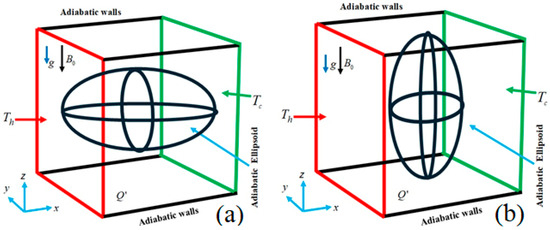
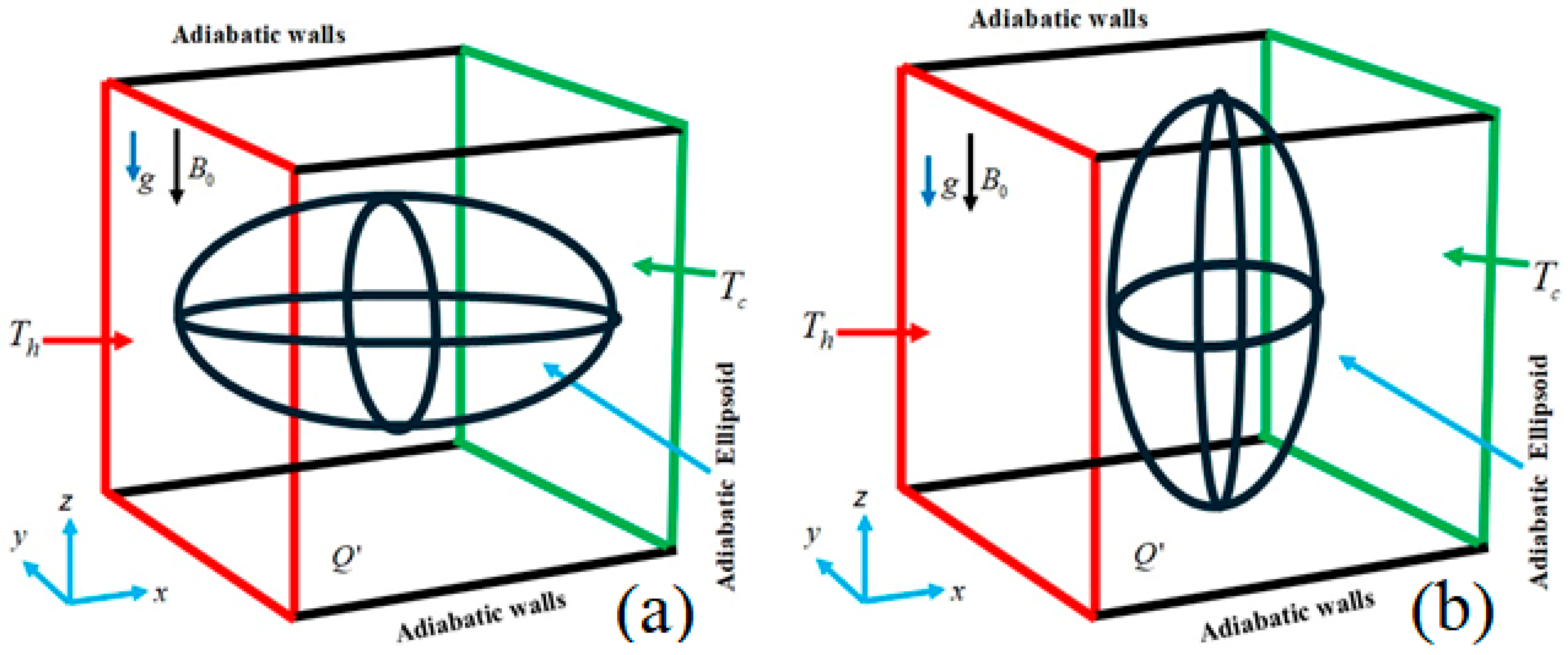
A schematic representation of the system that is under investigation for the present analysis is shown in Figure 1a,b. The system consists of a cubic cavity of edges with H = 1 and an ellipsoidal structure in the middle. The left wall (x = 0) is maintained at a constant high temperature Th, while the right wall (x = 1) is kept at a lower temperature Tc. All remaining walls, including the surface of the ellipsoidal obstacle, are considered thermally insulated (adiabatic). A no-slip boundary condition is imposed on all solid surfaces, including the cavity walls and the ellipsoid, such that the fluid velocity is zero at these boundaries. The flow regime is described as three-dimensional, stationary, laminar and incompressible with very little viscous dissipation and negligible influence of radiation. Except for the density inside the buoyancy term that follows the Boussinesq approximation, the characteristics of the fluid are assumed to be homogeneous. Gravity’s force is vertical down, perpendicular to the XYZ Cartesian coordinate plane. A uniform external magnetic field is applied along the x-direction. A low magnetic Reynolds number is assumed in the study, meaning that the induced magnetic field is insignificant in relation to the applied magnetic field. Consequently, the magnetic field is considered constant throughout the domain. Under the above-mentioned premises, the governing non-dimensional forms of the equations of continuity, momentum, and energy may be put in the following form [30].
Figure 1.
3D views of the physical problems ((a) (case-1) and (b) (case-2)).
Continuity equation
Momentum equations
Energy equation
Using the similarity transformation
We get dimensionless equations and boundary conditions.
Continuity equation
Momentum equations
Energy equation
For the upper and lower walls:
The left side wall:
The right-side wall:
For the front and back walls:
where
Rayleigh number Richardson number Prandtl number Heat source Hartmann number , Reynolds number .
The integration of the local Nusselt number is carried out to arrive at the mean Nusselt number as follows:
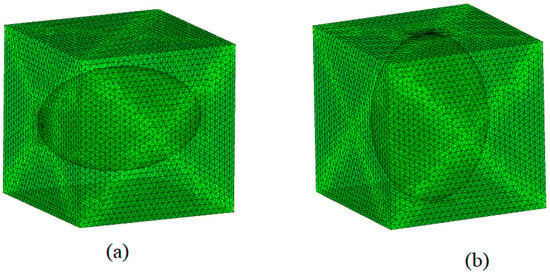
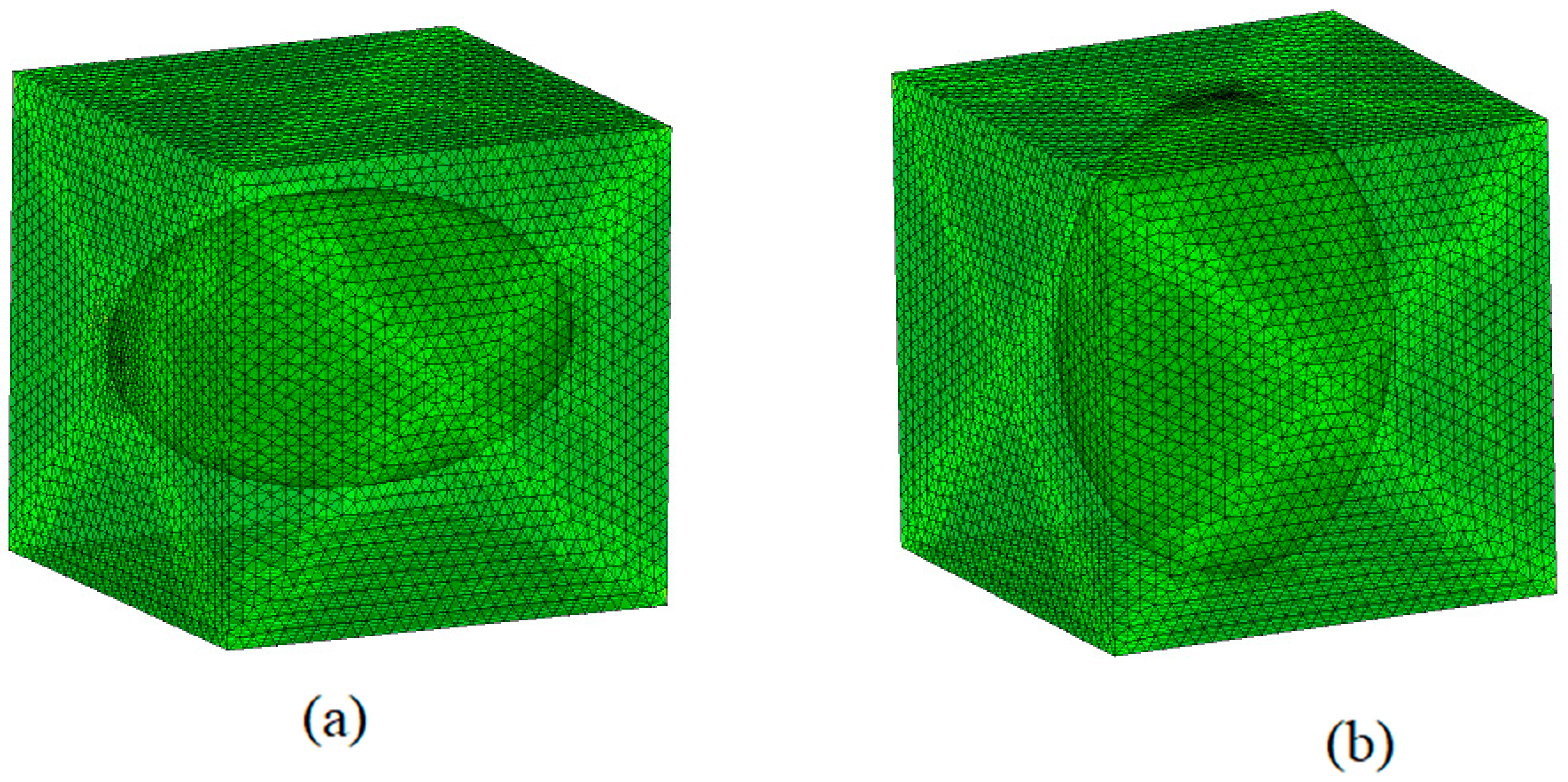
Figure 2a,b illustrate the mesh grid of the present study.
Figure 2.
Mesh grid of the three-dimensional cubic cavity with ellipsoidal obstacle.
3. Methodology
3.1. FEM Methodology
To solve the governing Equations (7)–(11) and the associated boundary conditions, the FE software COMSOL Multiphysics (version 6.3) is used. The domain is meshed using an unstructured triangular mesh, allowing for an accurate representation of the geometry. A non-uniform mesh is applied, with finer elements close to the boundaries and near the ellipsoidal obstacle to resolve steep gradients in the flow and temperature profiles. Figure 2a,b illustrate the mesh of the whole computational domain.
The governing equations are discretized using quadratic (second order) Lagrange elements for velocity and temperature, and linear elements for pressure to ensure numerical stability. A stationary solver with a segregated approach is using to solve the coupled of equations, with a relative convergence tolerance of 10−5.
Moreover, a grid independence study is carried out with varying mesh densities. The Nuavg is monitored for each mesh level. As Table 1 shows, as the mesh refinement increases, the change in the Nu decreases correspondingly, and beyond a certain level of mesh refinement, the change in the Nu becomes negligible. This implies that the numerical solution does not depend on the mesh size. Thus, the fine mesh is chosen in all further simulations because it offers a good compromise among the computational efficiency and the accuracy of the solution.
Table 1.
Grid independency study for present simulation.
3.2. XGBOOST
Extreme Gradient Boosting or XGBoost is a significantly efficient ML algorithm that is based on the decision tree algorithm for gradient boosting. It has attracted a lot of attention because of its extraordinary computational efficiency, scalability, and improved predictive capabilities. The methodology advances by building a series of decision trees iteratively, with each new tree attempting to optimize using gradient techniques in order to eliminate the mistakes made by its predecessors. Additionally, XGBoost is congruent with a parallel and system-efficient tree-pruning mechanism, which boosts the training process and enhances the overall model performance, as proven in the research done by Zheng et al. [31] and Zhong et al. [32]. Another benefit of this methodology is the ability to handle missing data as well as automatically compute optimum feature splits, thus making the task of data preprocessing easier. XGBoost has been widely used in multiple regression and classification scenarios, as predictive modeling is able to reveal complex non-linear relationships among input and output variables and is useful in various fields, as discussed in various scenarios by Qiu et al. [33].
In the current research, the data obtained from the FEM simulations are split into testing and training subsets using a train–test split method, where 80% of the data is used to train and the remaining 20% to test. The model is trained on the training data and tested on the unknown test data to verify its generalization ability. The model performance is quantitatively measured by the use of the RMSE, Mean Absolute Error (MAE) and the R2, which provides a reliable measure of the predictive accuracy.
4. Results and Discussion
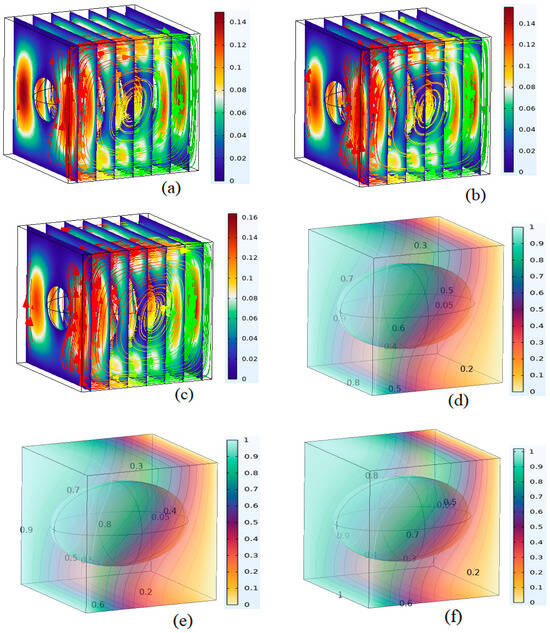
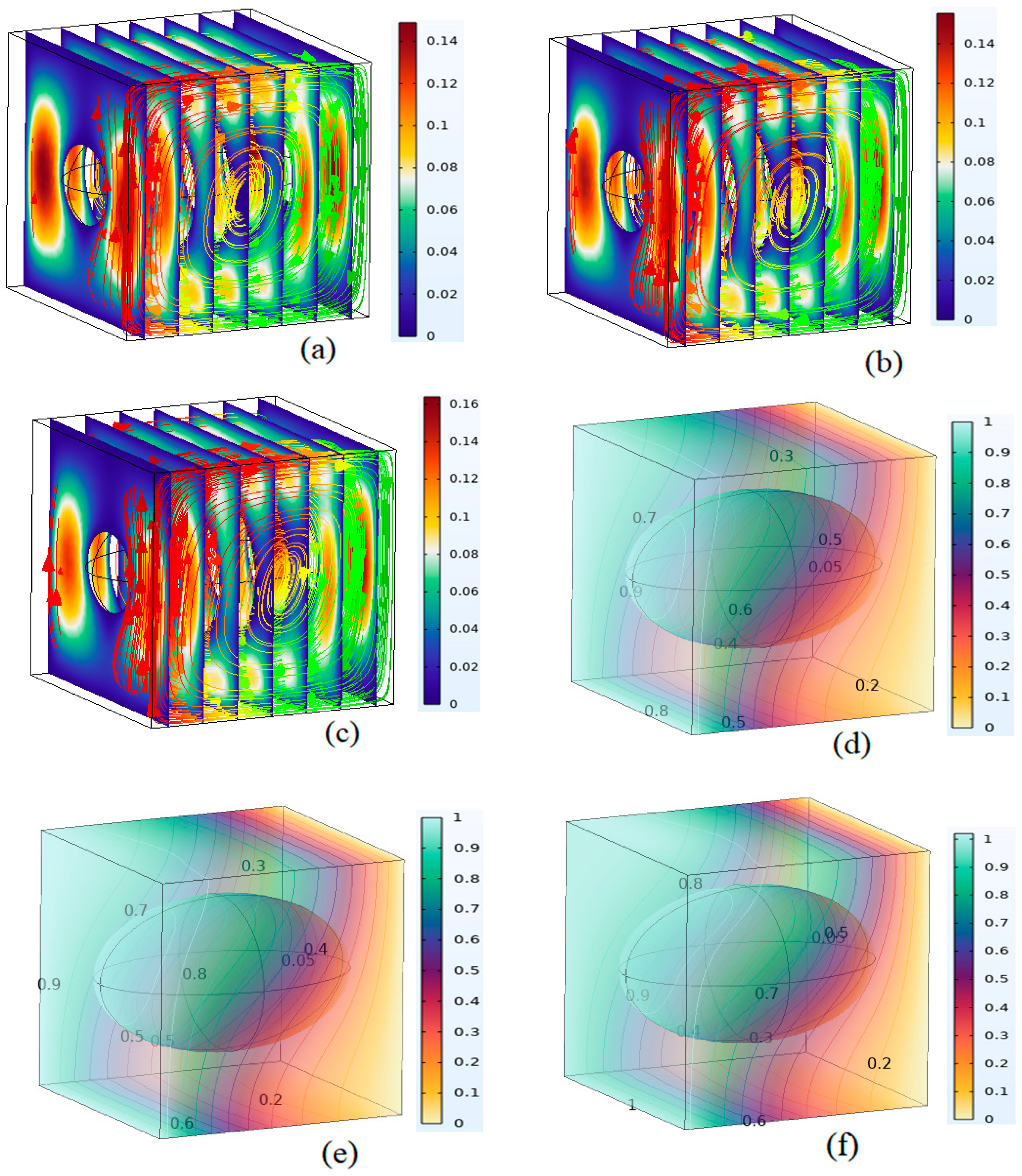
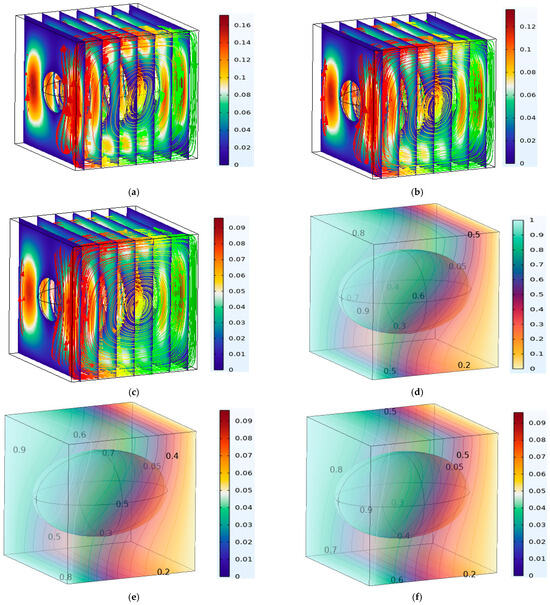
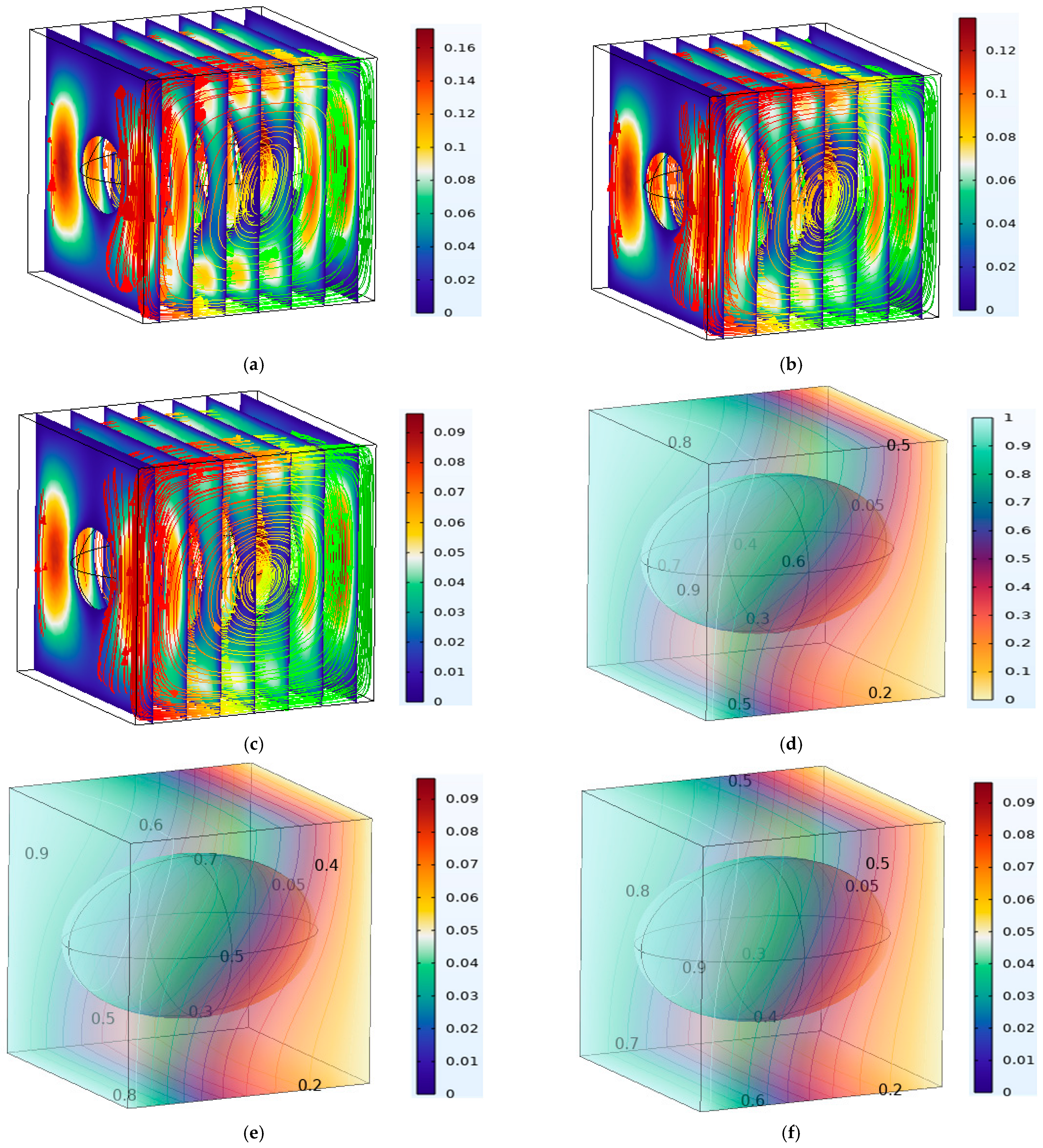
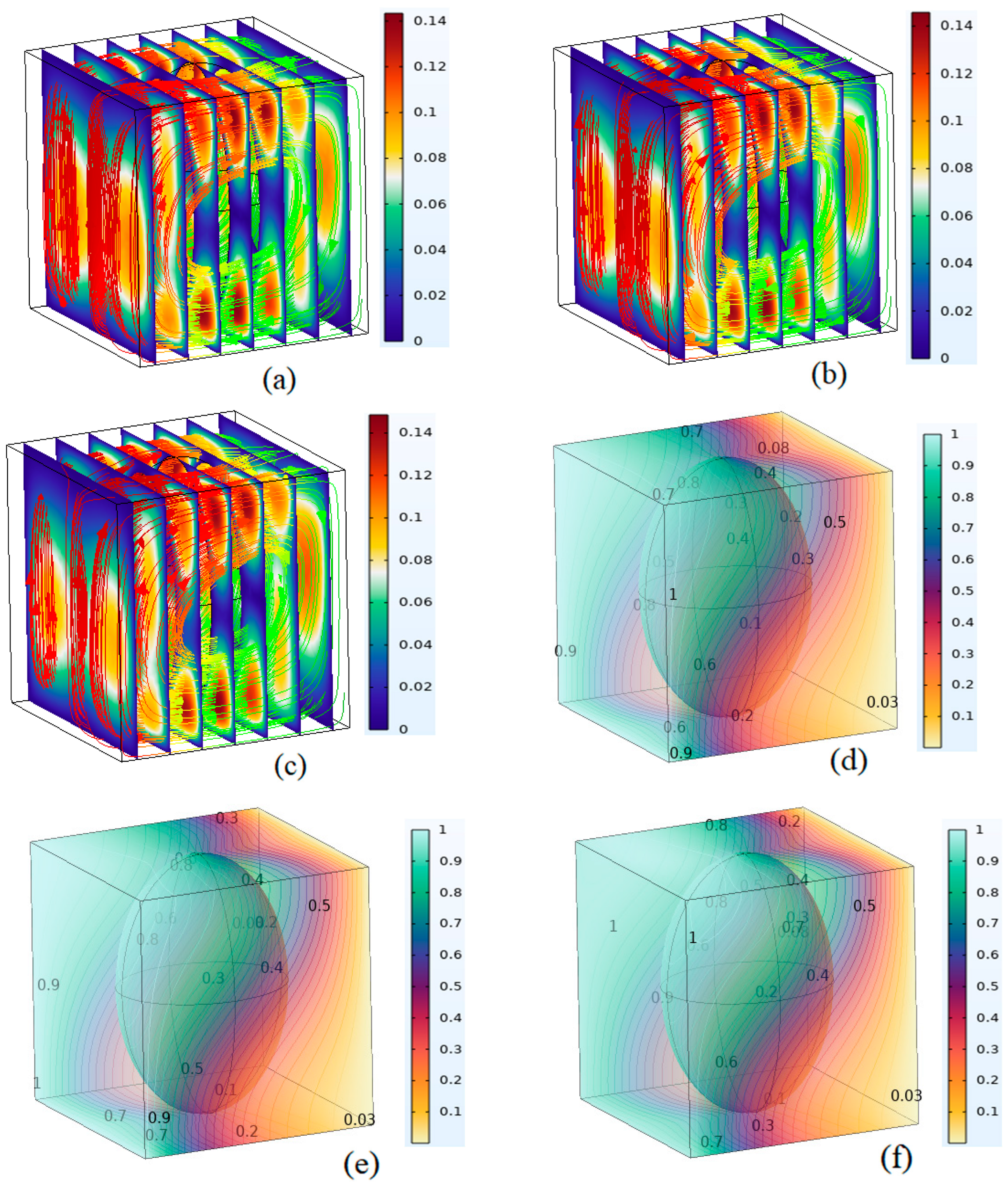
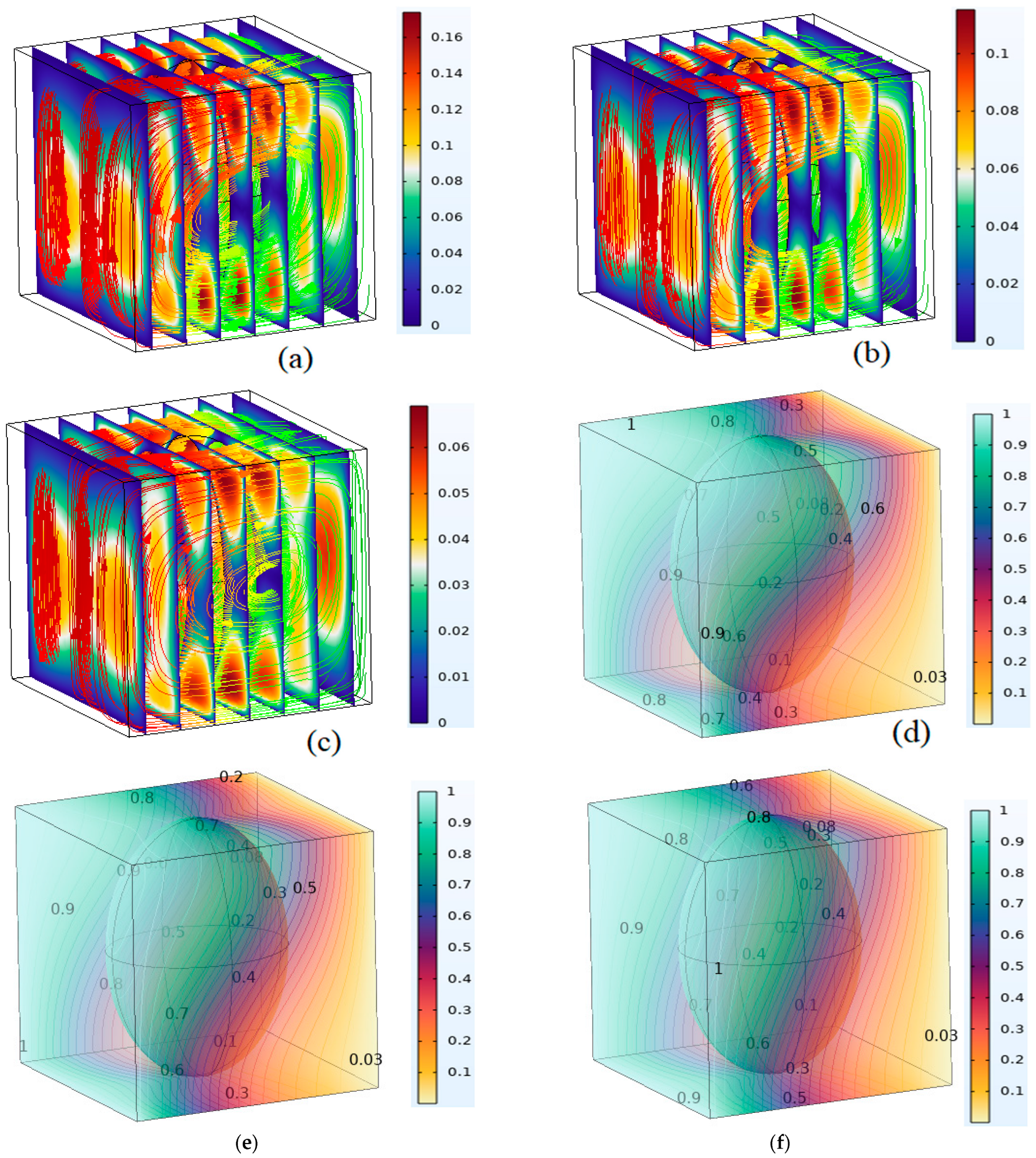
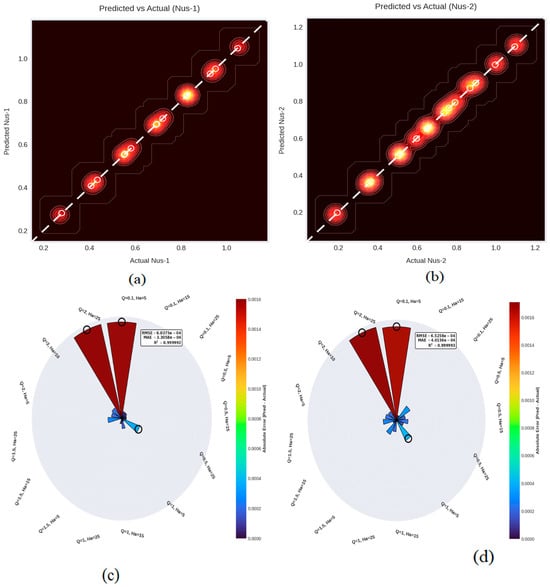
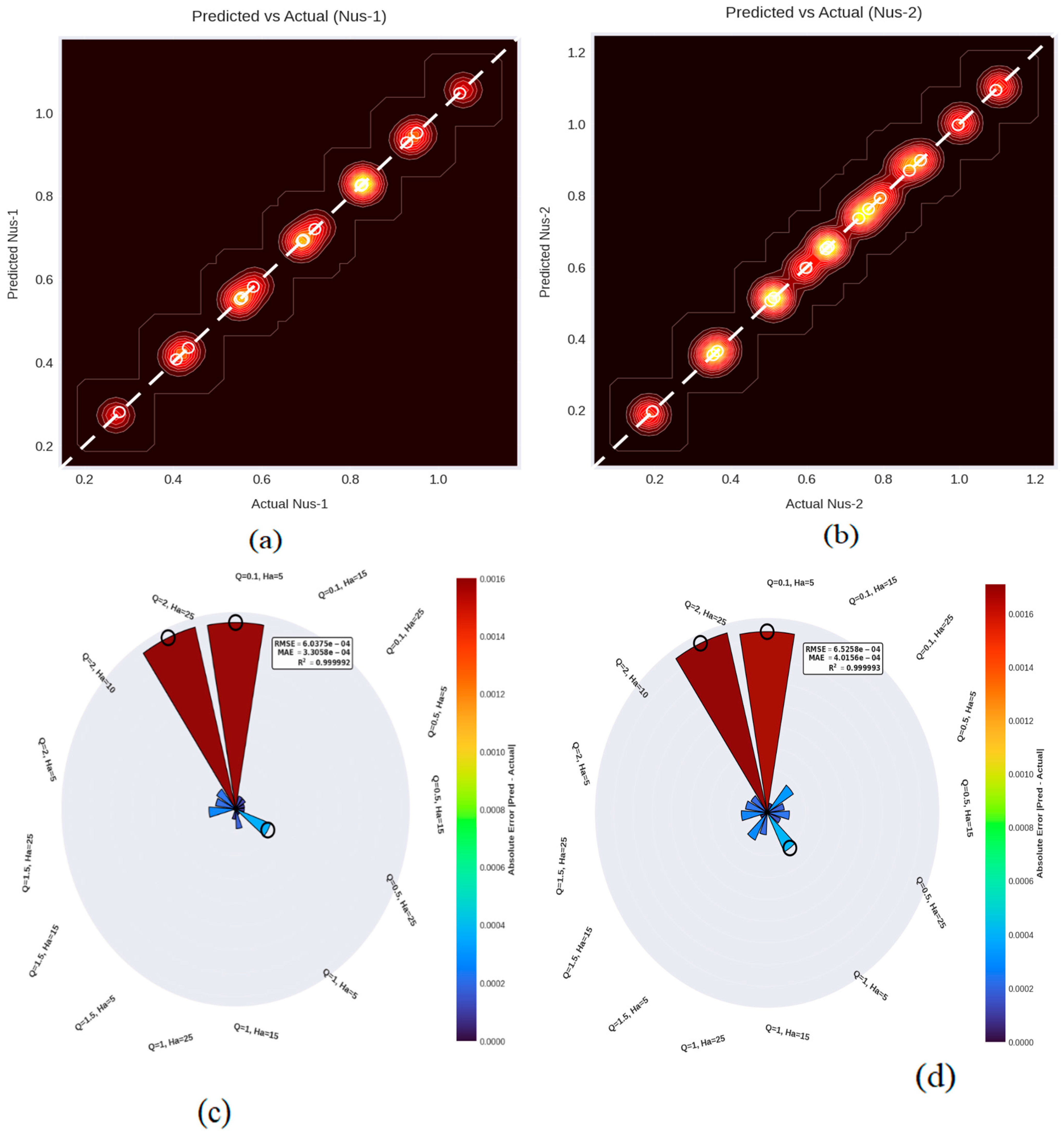
This section outlines the discussions about the numerical outcomes obtained from the three-dimensional simulations. The FEM in COMSOL Multiphysics is used for the flow and thermal flow analysis of a cavity with a cubical shape, which contains an ellipsoid obstacle. Two different configurations are examined: the thermofluidic dynamics of the system and the impact of the two ellipsoid orientations. The effects of the Hartmann number and heat source are systematically explored. Figure 3, Figure 4, Figure 5 and Figure 6 illustrate the variations in the flow and temperature fields for both orientations. Specifically, Figure 3 and Figure 5 present the effect of the heat source parameter (Q), while Figure 4 and Figure 6 demonstrate the influence of the Ha. In these figures, the streamline plots (a–c) represent the flow structure, where the color bar corresponds to the velocity magnitude, whereas the temperature contour plots (d–f) represent the dimensionless temperature (θ) distribution, with the color bar indicating temperature levels. Furthermore, Figure 7 illustrates the performance evaluation of the XGBoost model, where predicted and actual Nusselt numbers are compared to assess the accuracy of the data-driven approach. In addition, Table 2 provides a quantitative comparison between FEM and XGBoost results, clearly showing the variation of the Nusselt number with respect to Q and Ha for both orientations.
Figure 3.
Streamline (a–c) and temperature contour plots (d–f) for first orientation at Q = 0.1, 1, 2 when Ha = 10.
Figure 4.
Streamline (a–c) and temperature contour plots (d–f) for first orientation at Ha = 5, 15, 25 when Q = 0–1.
Figure 5.
Streamline (a–c) and temperature contour plots (d–f) for second orientation at Q = 0.1, 1, 2 when Ha = 10.
Figure 6.
Streamline (a–c) and temperature contour (d–f) plots for second orientation at Ha = 5, 15, 25 when Q = 0–1.
Figure 7.
XGBoost model performance: (a) predicted vs. actual Nu-1, (b) predicted vs. actual Nu-2, (c) absolute error distribution for Nu-1, and (d) absolute error distribution for Nu-2.
Table 2.
FEM and XGBOOST (ML) for the prediction of Nu under the heat source and magnetic parameter.
Scenario 1: The distributions of streamlines and thermal contours shown in Figure 3a–f are effective in explaining the effects of heat source parameter Q on the thermo-fluid dynamics in the enclosure. In Figure 3a, the streamlines have a relatively laminar and weak configuration, indicating a limited circulation strength in the lower levels of the heat source. In Figure 3b, there is an increase in the density of the streamlines, which is associated with a slight enhancement in the vortex structure, thus corresponding to a progressive intensification of the fluid motion. In Figure 3c, a significantly more pronounced circulation is obtained with tighter and more robust recirculation zones, which represents an improvement in mixing phenomena inside the cavity. The shape of the thermal contours shown in Figure 3d indicates moderate levels of deformation, with the development of convective behavior which prevails over that of pure conductive heat transfer. In Figure 3e, the contours have higher curvature and compression near the heated zone, indicating higher thermal gradients and improved heat transfer capabilities. Ultimately, in Figure 3f, the contours look much more distorted and densely distributed, verifying the transition to a highly intensified convection-dominated regime with enhanced thermal activity. From a physical point of view, a rise in Q results in an increase in the internal heat generation, which in turn will increase the difference in temperatures inside the housing to strengthen the buoyancy force, therefore the fluid movement will be more active, the strength of the vortices will be reached, the thermal contour will be more compressed and the general efficacy in terms of heat transfer will be greatly facilitated. The distributions of streamlines and thermal contours shown in Figure 4a–f present a striking example of the impact of the MF parameter Ha on the thermo-fluid dynamics in the enclosure. In Figure 4a, the patterns of circulation with well-defined vortices appear in the streamlines, implying higher fluid motions in lower magnetic field strengths. In case of Figure 4b, there is a slight reduction in streamline density, and the vortex structure seems to be diminished, which is indicative of the suppressive effect exerted by the magnetic field. In Figure 4c, circulation weakens further with the streamlines becoming more uniform and losing intensity, making the fluid motion smaller. The thermal contours shown in Figure 4d are moderately distributed, which indicates a state of thermal equilibrium between the conductive and convective heat transfer mechanisms. In Figure 4e, the contours look smoother and are less distorted, proving reduced convectional transport abilities. Finally, in Figure 4f the contours exhibit a more uniform and stratified layout, and this supports a conduction-dominated regime where the heat mixing is reduced. From the physical point of view, with an Ha increase, the Lorentz force acts in opposition to the fluid flow and prevents velocity fluctuations, which suppresses the fluid flow damping and leads to a decline in the vortex force, the convective currents, the temperature gradient fluctuations, and finally, a reduction in the global heat transfer performance in the cavity.
Scenario-2: The various streamline and contour distributions shown in Figure 5a–f for the second orientation (ellipsoidal geometry) doubtlessly illustrate the dependence of the thermo-fluid dynamics inside the enclosure on the parameter of the heat source Q. In Figure 5a, the streamlines indicate a rather structured but asymmetric circulation, which can be linked to the ellipsoidal obstacle, indicating moderate fluid motion at lower levels of the heat generating. In Figure 5b, there is an observable increase in the density of the streamlines and a higher degree of distortion in the flow, indicating enhancement in the buoyancy-driven movement, in which both the internal heating and the geometric obstruction will be involved. In Figure 5c, the intensity of circulation further escalates, which is characterized by stronger and more elongated vortices surrounding the ellipsoid; that is, the fluid mixing increases, and the convective transport process becomes more vigorous. The thermal contours depicted in Figure 5d are moderately changed, showing the predominance mechanisms of the convective heat transfer over the conductive one as a preliminary result. In Figure 5e, the contours are more compressed and show strong curvatures around the ellipsoidal surface with indications of steeper temperature gradients and an enhancement thermal cavity and stronger convective motion due to increased buoyancy effects. Ultimately, in Figure 5f, the contours are generally highly distorted and closely packed both in the vicinity of the heated area and in the vicinity of the ellipsoid area, thus demonstrating a fully convection-dominated regime with maximal thermal transport. The physical interpretation behind the increasing Q is that it causes increased internal heat generation, and thereby enhances the temperature differential and also buoyancy forces; the ellipsoidal geometry presence also makes the flow disrupted, and causes asymmetric vortex structures to develop, which will promote increased mixing, and the final result is improved heat transfer efficacy within the cavity. The streamline and contour distributions presented in Figure 6a–f for the second orientation (ellipsoidal geometry) clearly explain the effect of the MF parameter Ha on the thermo-fluid behavior in the enclosure. The streamlines in Figure 6a show the circulation around the ellipsoidal obstacle, which is relatively robust but asymmetric, indicating active fluid motion at reduced magnetic strength. In Figure 6b there is a slight decrease in the density of the streamlines, and the vortices are weaker and more elongated, pointing at the constraining effect of the MF on the intensity of flow. For a reduction of circulation to a still further degree, see Figure 6c, where the streamlines are smoother and more relaxed, which means a great attenuation of fluid motion has occurred. The thermal contours shown in Figure 6d are rather moderately distributed, indicating that there is an equilibrium between the conduction and convection processes. In Figure 6e, this is manifested in the smoothed contours sharing less curvature around the ellipsoid, which implies the reduction of convective transport. Finally, in Figure 6f, the contours are more uniform and stratified, supporting the fact that a transition is occurring to a conduction-dominated regime where thermal mixing is reduced. The physical basis for the increase of Ha is the enhancement of the Lorentz force, which has a counteracting effect, where the flow direction is adjusted to weaken the influence of velocity fluctuations. Due to the damping influence of the Lorentz force, the flow is suppressed to weaken the strength of the vortex, and the flow structure is stabilized, the temperature gradient will be reduced, and the transmissibility of temperature in the whole cavity will be suppressed and ultimately weakened.
The predictive efficiency of the surrogate XGBoost algorithm-based model associated with heat transfer phenomena is illustrated in Figure 7a–d, where Nu-1 is representative of the initial orientation and Nu-2 is representative of the subsequent orientation. In Figure 7a, the projected values of Nu-1 show a good agreement with the actual measurements, that is, most of the data points are clearly located along the line (45°), that the model predictive accuracy at initial orientation has been raised. Likewise, Figure 7b, shows that comparing the predicted and actual values of Nu-2 indicates a high degree correlation for the secondary orientation, which represents the capability of the surrogate model to properly cover the heat transfer phenomena under various operational conditions. The error wheel diagrams of Figure 7c,d give further evidence of this performance in showing that absolute prediction errors are not large for both orientations, only showing some marginal deviations for selected parameter combinations. Physically, this strong concordance suggests that the XGBoost model is good at assimilating the non-linear interrelationship between the governing parameters and the corresponding response of the Nusselt number, and subsequently in making the correct prediction of thermal transport attributes of both geometric orientations. Together, the results validate the proposed surrogate framework for being robust, precise, and efficient in the estimation of Nu-1 for the first orientation and Nu-2 for the second orientation. Table 2 presents a comparative analysis comparing numerical results (FEM/COMSOL) and XGBoost-predicted value for Nu-1 (first orientation) and Nu-2 (second orientation) condition as a function of heat source (Q) and magnetic field-related parameter (Ha). It is discerned that both Nu-1 and Nu-2 present a decline with increment of Q, which can be physically ascribed to the predominance of internal heat generation that attenuates the temperature gradient near the boundaries so diminishing the convective heat transfer rate. In a similar vein, the escalation in Ha leads to a significant decrease in both Nusselt numbers due to the increased strength of the Lorentz force, which reduces the strength of the fluid flow, reduces the vortex strength, and finally reduces the convective transport. A comparative analysis of orientations shows that, for found Q and Ha, Nu-2 values are generally higher than those of Nu-1 suggesting a somehow better heat transfer performance in the second (ellipsoidal) configuration due to enhanced flow disturbance and mixing around the geometric structure. Notably, the predictions from the XGBoost model do not differ drastically from the numerical outcomes across all the parameter combinations, with only negligible differences, hence validating the increased accuracy and robustness of the surrogate model. In summary, the table provides support that the proposed model is an effective way of encapsulating the interrelated influence of heat generation and magnetic damping on thermal transport for both orientations.
5. Conclusions
This research examined the synergistic impact of internal thermal generation and the magnetic field strength on the 3D MHD convection in a cubic container with an ellipsoidal object placed in horizontal and vertical orientations. The results are shown in the following manner:
- ❖
- An increase in the parameter Q increased buoyancy-induced flow, enhanced the appearance of vortices, and allowed for improved convective heat transfer in both cases.
- ❖
- An escalation in Ha inhibited the circulation of fluid because of the Lorentz force, weakened the intensity of circulation, and limited the total transport of heat.
- ❖
- The results of comparative analysis performed between Case 1 and Case 2 showed the significance of the orientation of the ellipsoid, since it has a great influence on the symmetry of the flow, thermal mixing, and the nature of heat transfer.
- ❖
- Scenario 2 showed a relatively higher flow disturbance and better thermal mixing as compared to Scenario 1, as shown by the enhanced thermal transfer efficiency.
- ❖
- The FEM simulations were able to understandably capture the complicated interactions between the buoyant forces, magnetic dampening, and geometrical orientation.
- ❖
- The XGBoost surrogate model gave accurate predictions of the Nusselt numbers for both scenarios and showed amazing agreement with the numerical results.
- ❖
- The suggested FEM-XGBoost framework is an effective and reliable tool for the analysis of advanced thermal management and magnetically controlled heat transfer systems.
Author Contributions
Conceptualization, N.A.S. and A.A. (Ahmad Alkhalaf); methodology, A.A. (Ahmad Alkhalaf) and U.A.; software, A.A. (Adnan Ashique); validation, U.A. and A.A. (Adnan Ashique); formal analysis, A.A. (Ahmad Alkhalaf); investigation, A.A. (Ahmad Alkhalaf) and U.A.; resources, N.A.S.; data curation, A.A. (Adnan Ashique); writing—original draft preparation, A.A. (Ahmad Alkhalaf); writing—review and editing, N.A.S., U.A. and A.A. (Adnan Ashique); supervision, N.A.S. All authors have read and agreed to the published version of the manuscript.
Funding
This work was supported and funded by the Deanship of Scientific Research at Imam Mohammad Ibn Saud Islamic University (IMSIU) (grant number IMSIU-DDRSP2603).
Data Availability Statement
The original contributions presented in this study are included in the article material. Further inquiries can be directed to the corresponding author.
Acknowledgments
This work was supported and funded by the Deanship of Scientific Research at Imam Mohammad Ibn Saud Islamic University (IMSIU) (grant number IMSIU-DDRSP2603).
Conflicts of Interest
The authors declare that they have no known competing financial interests or personal relationships that could have appeared to influence the work reported in this paper.
Nomenclature
| Roman Symbol | |||
| Velocity components | Cartesian coordinates | ||
| Fluid temperature | Pressure | ||
| Temperature of the cold wall | Temperature of the heated wall | ||
| Applied magnetic field | Dimensionless velocity components | ||
| H | Length of cavity | ||
| Greek Symbol | |||
| Electrical conductivity | Thermal conductivity | ||
| Kinematic viscosity | Dynamic viscosity | ||
| Fluid density | Dimensionless temperature | ||
| Dimensionless parameter | |||
| Hartmann number | Heat source/sink | ||
| Prandtl number | Ra | Rayleigh number | |
| Richardson number | Nusselt number | ||
References
- Patel, A.; Kumar, M.; Bagai, S. Heat and mass transfer under MHD mixed convection in a four-sided lid-driven square cavity. Heat Transf. 2024, 53, 1220–1266. [Google Scholar] [CrossRef] [Scilit]
- Mishra, P.K.; De, A.K.; Verma, M.K.; Eswaran, V. Dynamics of reorientations and reversals of large-scale flow in Rayleigh–Bénard convection. J. Fluid Mech. 2011, 668, 480–499. [Google Scholar] [CrossRef] [Scilit]
- Khan, Z.H.; Yang, Z.; Khan, W.A.; Sheremet, M.A.; Wu, W. Computational investigation of magnetohydrodynamic convective flow in a trapezoidal cavity with multiple obstacles via finite element analysis. Therm. Sci. Eng. Prog. 2024, 50, 102570. [Google Scholar] [CrossRef] [Scilit]
- Souayeh, B.; Hdhiri, N.; Suliman, N.A. Thermal state interplay in inclined magnetohydrodynamics convection of ternary hybrid nanofluids with saw-tooth internal cooling. Phys. Fluids 2025, 37, 072032. [Google Scholar] [CrossRef] [Scilit]
- Verma, M.K.; Kumar, A.; Pandey, A. Phenomenology of buoyancy-driven turbulence: Recent results. New J. Phys. 2017, 19, 025012. [Google Scholar] [CrossRef] [Scilit]
- Santhosh, N.; Sivaraj, R. Magnetohydrodynamic natural convective flow of copper water nanoliquid inside a square cavity with heat absorption/generation. Eur. Phys. J. Spec. Top. 2025, 234, 2251–2270. [Google Scholar] [CrossRef] [Scilit]
- Yadav, R.K.; Gastine, T.; Christensen, U.R.; Wolk, S.J.; Poppenhaeger, K. Approaching a realistic force balance in geodynamic simulations. Proc. Natl. Acad. Sci. USA 2016, 113, 12065–12070. [Google Scholar] [CrossRef] [Scilit] [PubMed]
- Mussan, M.A.; Kareem, R.; Tofah, R.S.; Nfawa, S.R. Numerical investigation of ferrohydrodynamic magnetic nanofluid convection in a trapezoidal cavity channel. Case Stud. Therm. Eng. 2025, 75, 107066. [Google Scholar] [CrossRef] [Scilit]
- Allouche, S.; Djezzar, M.; Allouche, B.; Tayebi, T. Magnetohydrodynamic natural convection heat transfer of a nanofluid confined in a square open cavity subjected to a linear varying temperature. Numer. Heat Transf. B 2025, 87, 2529523. [Google Scholar] [CrossRef] [Scilit]
- Sharma, K.; Vijay, N.; Kumar, S. Significance of geothermal viscosity and heat generation/absorption on magnetic nanofluid flow and heat transfer. Numer. Heat Transf. A 2022, 82, 70–81. [Google Scholar] [CrossRef] [Scilit]
- Malo, R.; Pandit, S.K.; Chattopadhyay, A. Hydrothermal analysis and viscous dissipation of thermogravitational convection in a baffled convex complicated cavity filled with magneto-nanofluid. J. Therm. Anal. Calorim. 2025, 150, 18529–18560. [Google Scholar] [CrossRef] [Scilit]
- Nigro, G. An argument in favor of magnetic polarity reversals due to heat flux variations in fully convective stars and planets. Astrophys. J. 2022, 938, 22. [Google Scholar] [CrossRef] [Scilit]
- Zubarev, A.Y.; Abu-Bakr, A.F.; Bossis, G.; Bulycheva, S.V. Hyperthermia in a system of rod-like ferromagnetic particles under oscillating magnetic field. Magnetohydrodynamics 2014, 50, 397. [Google Scholar] [CrossRef] [Scilit]
- Lyu, B.; Bühler, L.; Koehly, C.; Mistrangelo, C. 3D magneto-convective instabilities of liquid metal flow in a generic geometry related to WCLL blankets. Fusion Eng. Des. 2025, 217, 115113. [Google Scholar] [CrossRef] [Scilit]
- Abu-Bakr, A.F.; Zubarev, A.Y. Effect of ferroparticles clustering on magnetic hyperthermia in non-liquid systems. Eur. Phys. J. Spec. Top. 2023, 232, 1321–1332. [Google Scholar] [CrossRef] [Scilit]
- Nigro, G.; Berrilli, F.; Bono, G.; Del Moro, D.; Giovannelli, L.; Penza, V.; Reda, R. On the temporal variability in the magnetic dichotomy of late M dwarf stars. Astrophys. J. 2026, 996, 98. [Google Scholar] [CrossRef] [Scilit]
- Elshehabey, H.M.; Mahdy, A. Magnetic convection nanofluid confined in a cavity with chamfers containing cylinder obstacles with a heat source/sink. Waves Random Complex Media 2025, 35, 7374–7396. [Google Scholar] [CrossRef] [Scilit]
- Thirumalaisamy, K.; Sivaraj, R.; Reddy, A.S. Fluid flow and heat transfer analysis of a ternary aqueous Fe3O4+MWCNT+Cu/H2O magnetic nanofluid in an inclined rectangular porous cavity. J. Magn. Magn. Mater. 2024, 589, 171503. [Google Scholar] [CrossRef] [Scilit]
- Vigneshwari, S.; Reddappa, B.; Sumithra, A.; Kumar, B.R.; Öztop, H.F. Thermal and flow dynamics of unsteady MHD nanofluid convection in a partially heated porous cavity. J. Therm. Anal. Calorim. 2025, 150, 5601–5616. [Google Scholar] [CrossRef] [Scilit]
- Sharma, K.; Animasaun, I.L.; Al-Mdallal, Q.M. Scrutinization of ferrohydrodynamic through pores on the surface of disk experiencing rotation: Effects of FHD interaction, thermal radiation, and internal heat source. Arab. J. Sci. Eng. 2024, 49, 1393–1403. [Google Scholar] [CrossRef] [Scilit]
- Singh, P.; Chadha, N.M.; Gupta, V.K. Internal heat source and doubly concentrated Newtonian fluid layer dynamics under modulated induced magnetic field. Heat Transf. 2025, 54, 2528–2542. [Google Scholar] [CrossRef] [Scilit]
- Souayeh, B.; Ben-Beya, B. Role of heat generation/absorption in transient hybrid nanofluid convection around elliptic cylinders in a tilted enclosure. Phys. Fluids 2025, 37, 062011. [Google Scholar] [CrossRef] [Scilit]
- An, B.; Meng, X.; Bergadà, J.M.; Xi, C.; Sang, W. Natural convection inside square and cubic cavity with left wall partially heated. J. Thermophys. Heat Transf. 2025, 39, 752–769. [Google Scholar] [CrossRef] [Scilit]
- Abu-Bakr, A.F.; Iskakova, L.Y.; Zubarev, A.Y. Heat Exchange Within the Surrounding Biological Tissue During Magnetic Hyperthermia; International Information and Engineering Technology Association: Edmonton, AB, Canada, 2020. [Google Scholar] [CrossRef] [Scilit]
- Wang, R.; Zeng, Z.; Sadeq, A.M.; Agrawal, M.K.; Muhammad, T.; Rao, B.N. Predictive performance analysis of machine learning models for forced convective heat transfer of a flat-plate in counter-rotating cylinder systems: A comprehensive evaluation. Case Stud. Therm. Eng. 2025, 74, 106961. [Google Scholar] [CrossRef] [Scilit]
- Zhang, P.; Jia, Y.; Shang, Y. Research and application of XGBoost in imbalanced data. Int. J. Distrib. Sens. Netw. 2022, 18, 15501329221106935. [Google Scholar] [CrossRef] [Scilit]
- Kumar, P.; Alruqi, M.; Hanafi, H.A.; Sharma, P.; Wanatasanappan, V.V. Effect of particle size on second law of thermodynamics analysis of Al2O3 nanofluid: Application of XGBoost and gradient boosting regression. Int. J. Therm. Sci. 2024, 197, 108825. [Google Scholar] [CrossRef] [Scilit]
- Kıyak, B.; Öztop, H.F.; Ertam, F.; Aksoy, İ.G. An intelligent approach to investigate the effects of container orientation for PCM melting based on an XGBoost regression model. Eng. Anal. Bound. Elem. 2024, 161, 202–213. [Google Scholar] [CrossRef] [Scilit]
- Alotaibi, M.A.; Asai, M.; Aly, A.M. Numerical and AI-based investigation of natural convection in a nanofluid-saturated elliptical cavity with heterogeneous porous medium. Int. J. Numer. Methods Heat Fluid Flow 2025, 35, 4382–4412. [Google Scholar] [CrossRef] [Scilit]
- Selimefendigil, F.; Öztop, H.F. Mixed convection of nanofluids in a three-dimensional cavity with two adiabatic inner rotating cylinders. Int. J. Heat Mass Transf. 2018, 117, 331–343. [Google Scholar] [CrossRef] [Scilit]
- Zheng, H.; Yuan, J.; Chen, L. Short-term load forecasting using EMD-LSTM neural networks with an XGBoost algorithm for feature importance evaluation. Energies 2017, 10, 1168. [Google Scholar] [CrossRef] [Scilit]
- Zhong, J.; Sun, Y.; Peng, W.; Xie, M.; Yang, J.; Tang, X. XGBFEMF: An XGBoost-based framework for essential protein prediction. IEEE Trans. NanoBiosci. 2018, 17, 243–250. [Google Scholar] [CrossRef] [Scilit] [PubMed]
- Qiu, Y.; Zhou, J.; Khandelwal, M.; Yang, H.; Yang, P.; Li, C. Performance evaluation of hybrid WOA-XGBoost, GWO-XGBoost and BO-XGBoost models to predict blast-induced ground vibration. Eng. Comput. 2022, 38, 4145–4162. [Google Scholar] [CrossRef] [Scilit]

Disclaimer/Publisher’s Note: The statements, opinions and data contained in all publications are solely those of the individual author(s) and contributor(s) and not of MDPI and/or the editor(s). MDPI and/or the editor(s) disclaim responsibility for any injury to people or property resulting from any ideas, methods, instructions or products referred to in the content. |
© 2026 by the authors. Licensee MDPI, Basel, Switzerland. This article is an open access article distributed under the terms and conditions of the Creative Commons Attribution (CC BY) license.