Article

Numerical Simulation of Optical Characteristics of the NPOM Nanostructure Based on Gold Nanocubes

Aviation Maintenance NCOs Academy, Air Force Engineering University, Xinyang 464099, China
*
Author to whom correspondence should be addressed.
Symmetry 2026, 18(5), 825; https://doi.org/10.3390/sym18050825 (registering DOI)
Submission received: 16 April 2026 / Revised: 3 May 2026 / Accepted: 5 May 2026 / Published: 11 May 2026
(This article belongs to the Section Physics)

Abstract

The design of metal nanoparticle-on-a-mirror (NPOM) provides a powerful strategy for optical enhancement in gap plasmonics. Here, we report a systematic numerical study on an NPOM structure composed of gold nanocubes (GNC) and a continuous gold film via the finite element method (FEM). First, we simulated the near-electric field distribution of isolated GNC in a homogeneous medium and compared it with that of the GNC-based NPOM structure, revealing the dominant role of plasmon coupling in the gap region. Second, we systematically investigated the influence of the thickness of the dielectric layer between the GNC and the gold film on the optical enhancement characteristics in the gap region. The results show that the maximum electric field intensity of the resonance peak decays rapidly when the thickness of the dielectric layer is less than 2 nm, decreasing from 5048 (t = 0.5 nm) to 1032 (t =2 nm). Third, we further investigated the influence of the polarization angle of the incident light on the optical enhancement in the gap region. Finally, the dielectric environment n0 and the refractive index n of the dielectric layer were studied. This work elucidates the unique gap plasmon coupling mechanisms of GNC-based NPOM structures and provides a precise tuning strategy for key structural and optical parameters, endowing the structure with important application prospects in sensing, energy conversion, and photodetection.

1. Introduction

Metal nanostructures can generate a strong electric field from surface plasmon resonance (SPR) in the nanoscale vicinity of their surfaces under incident light excitation, a phenomenon known as near-field enhancement. This characteristic makes metal nanostructures indispensable in optoelectronic devices, surface-enhanced Raman scattering (SERS), surface-enhanced fluorescence, and surface-enhanced infrared absorption [1,2,3,4]. The plasmon resonance enhancement characteristics of metal nanoparticles are an intrinsic coupling process of “electron collective oscillation–electromagnetic field enhancement.” And its intensity and resonance wavelength can be precisely controlled by tuning the nanoparticle’s intrinsic properties (size, morphology, composition) and external conditions (dielectric environment, incident light parameters), enabling flexible applications in various fields [5,6,7,8,9]. Silver nanoparticles exhibit excellent near-field enhancement but suffer from severe oxidation in air that degrades their performance. Thus, gold nanoparticles are the preferred choice for stable plasmonic applications. Among gold nanostructures, gold nanocubes (GNC) have unique optical properties distinct from isotropic gold nanospheres (GNS): their sharp corners and edge morphologies generate intense local hot-spots, leading to stronger near-field enhancement and higher polarization sensitivity [10,11,12]. These properties make GNC a promising building block for advanced plasmonic devices, while their anisotropic morphology also brings new characteristics to plasmonic coupling in composite structures.
The nanoparticle-on-a-mirror (NPOM) nanostructure, formed by metal nanoparticles separated from a metal film by an ultrathin dielectric layer, has developed into a promising platform for plasmonic near-field enhancement and have been intensively studied in the past few years [13,14,15,16,17,18]. By utilizing localized surface plasmon resonance (LSPR) coupling in the subwavelength gap between nanoparticles and the metal film, the NPOM structure can confine the optical field to the subwavelength scale, achieving ultra-strong optical enhancement. Benefiting from the mature thin-film deposition and planar spacer fabrication technologies [13], the gap distance between the nanoparticles and the film in NPOM can be easily controlled to achieve tunable optical properties [14]. Most previous studies on NPOM structures have focused on isotropic spherical nanoparticles [19,20,21]: the Sumeet Mahajan team investigated dielectric nanosphere-based NPOM structures and compared the performance of different metal film substrates [19]; the Jin-Woo Oh group reported silver nanosphere-based NPOM structures with thousand-fold near-field enhancement in the gap [20]; and Zhang’s team studied double gold nanosphere-based NPOM structures with hybrid plasmon modes [21]. The NPOM structure also has an extremely strong near-field enhancement effect and can be combined with the graphene/zinc oxide/silicon heterojunction photodetector, significantly improving the light absorption efficiency, responsivity and detection sensitivity [22,23]. Such plasmon–semiconductor hybrid structures show great potential in 6G communication and optical sensing systems for the internet of things. While these works laid the foundation for NPOM research, the anisotropic morphology of GNC is expected to bring unique gap plasmon characteristics (e.g., corner hot-spot synergy) that have not been systematically explored.
A small number of studies have touched on non-spherical nanoparticle-based NPOM structures. The Feng research group studied gold ellipsoidal nanoparticle-based NPOM structures and reported the influence of incident light polarization angle on gap near-field enhancement [24]. D. R. Smith’s team prepared silver nanocube-based NPOM metamaterial absorbers and demonstrated reflection spectrum modulation via geometric structure tuning [25]. Although Feng et al. explored the polarization angle, ellipsoidal nanoparticles do not possess tip structures that are conducive to generating hot-spots, and their near-field enhancement also exhibits limited angular sensitivity. In addition to this potential limitation, D. R. Smith’s work did not provide a systematic investigation into the effects of key parameters (e.g., polarization angle, refractive index) on optical characteristics. Notably, the polarization dependence of GNC-based NPOM structures, derived from the anisotropic morphology of GNC, is a core characteristic that distinguishes it from GNS-based NPOMs, but it has not been clarified in detail. In recent studies, it can be seen that researchers have mainly focused on the influence of morphology and dielectric layer thickness on the optical properties of GNC-based NPOM structures [26,27,28,29]. In fact, in addition to the above two factors, the angle of incident light, the refractive index of the dielectric layer, and the refractive index around the nanoparticles also deeply affect the optical properties of GNC-based NPOM structures. Only by systematically studying the influence of various parameters on GNC-based NPOM structures can we fully master the ability to regulate the optical properties of GNC-based NPOM structures. In addition, the definition and physical mechanism of gap plasmon in GNC-based NPOM structures need to be accurately elaborated to avoid confusion with other plasmonic modes.
In this work, we designed a GNC-based NPOM structure and conducted a systematic theoretical study on its optical characteristics via the finite element method. And we have established a complete tuning law for four key parameters: gap thickness, polarization angle, ambient refractive index, and dielectric layer refractive index. We first compared the LSPR characteristics of GNS and GNC in a homogeneous medium to verify the rationality of the simulation model and clarify the advantage of GNC in optical enhancement. Then, we studied the near-electric field distribution of isolated GNC and GNC-based NPOM structures, revealing the plasmon coupling mechanism in the gap region. We further systematically investigated the influences of dielectric layer thickness, incident light polarization angle, ambient dielectric refractive index, and dielectric layer refractive index on optical enhancement, and clarified the tuning laws of resonance peak wavelength and electric field intensity. This study conducts the first systematic numerical simulation of the plasmon coupling phenomenon in GNC-based NPOM with angular hot-spot synergy effects. We reveal a unique polarization-dependent response originating from the anisotropic cubic structure (reaching the optimum at 45°), which is distinctly different from that of spherical NPOM. The study quantifies the ultra-strong near-field enhancement effect (up to 5048) and the key conditions for strong coupling. This work elucidates the unique gap plasmon coupling mechanisms of GNC-NPOM structures and provides a precise parameter tuning strategy, which has important theoretical guidance significance for the design of high-performance plasmonic devices based on NPOM structures.

2. Simulation Model and Methods

2.1. NPOM Nanostructure Design

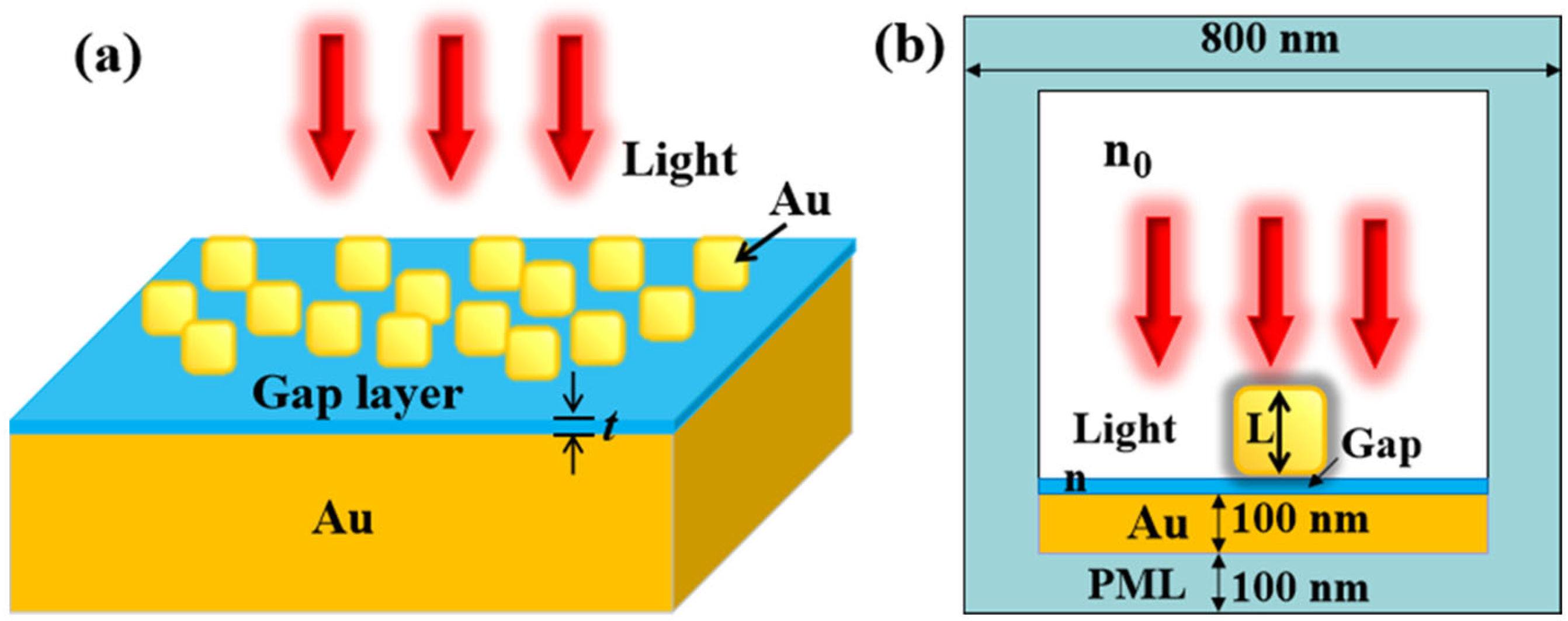
The GNC-based NPOM nanostructure studied in this work consists of a single GNC, an ultrathin dielectric spacer layer, and a continuous gold film (Figure 1). Under incident light excitation, the LSPR of GNC couples with the surface plasmon polaritons (SPPs) of the gold film in the subwavelength gap region, forming gap plasmon modes—a type of metallic waveguide guided mode confined in the dielectric layer between the metal nanoparticle and the film [18,30]. The sharp corner morphology of GNC endows the structure with high sensitivity to the polarization angle of incident light, and the optical characteristics are also affected by the dielectric layer thickness, ambient dielectric refractive index, and dielectric layer refractive index.
The computational model of the NPOM nanostructure was constructed using a finite element method simulation software (Elmer FEM 8.0). The side length of the GNC is 60 nm with 5 nm rounded corners at the edges. The thickness of the gold film is 100 nm. The thickness and width of the PML are 100 nm and 800 nm, respectively, to absorb scattered electromagnetic waves and avoid boundary reflection. The dielectric constants of GNC and the gold film are taken from the Palik handbook [31], and the Lorentz–Drude dispersion model (Equation (2)) is adopted to describe the frequency dependence of the dielectric constant. The relationship diagram between the refractive index of gold material and wavelength is shown in Supporting Material Figure S1. The dielectric layer and ambient medium are set as non-dispersive dielectrics with tunable refractive indices. The mesh quality directly determines simulation accuracy and computational efficiency, so we adopt the strategy of densifying the mesh in critical areas and sparse meshing in non-critical areas. The mesh size in the gap region is set to less than 1 nm to capture the strong electric field gradient; the mesh size in regions far from the interface is controlled at 2 nm. To ensure the reliability of the simulation results, we will compare the simulation results with the experimental test data and publish them as Supporting Information for the manuscript. A plane wave with normal incidence is used as the excitation source, with the polarization angle θ defined as the angle between the electric field vector and the horizontal direction (0° for horizontal polarization). The calculation wavelength range is 400–1050 nm, covering the visible to near-infrared band.

2.2. Calculation and Data Processing Methods

The near-field intensity is characterized by the electric field intensity E/E0, where E0 is the electric field intensity of the incident light, and E is the local electric field intensity in the structure [18,24]. The near-field enhancement factor in the gap region is calculated via volume integration of E/E0 over the entire gap volume (Equation (1)) [32], to quantitatively characterize the overall enhancement effect of the gap plasmon mode. In finite element multiphysics simulation software, the electric field values of the entire region after calculation are known. We only need to set up the volume integral calculation formula and then perform a volume integral over the entire gap to quantitatively characterize the overall enhancement effect of the gap plasma mode. The integration equation is also a built-in program of the simulation software (Elmer FEM 8.0).
N e a r f i e l d   enhancement = E / E 0 d V V
First, integrate E/E0 over the entire volume V, and then divide the calculation result by the entire volume V. E0 represents the electric field intensity of the incident light, while E represents the intensity of the resonant electric field. At the same time, the Lorentz–Drude dispersion model was also adopted to represent the dielectric constants of GNC and gold films [33].
ε ( w ) = 1 f 0 w p 2 w w i Γ 0 + j = 1 m f j w p 2 w j 2 w 2 + i w Γ j
In the above formula, the Drude model refers to the middle term. Γ0 represents the damping constant, f0 represents the oscillator strength, and ω represents the plasma frequency related to Γ0 and f0. The last term represents the Lorentz modification model. ωj, fj and Γj represent the frequency, strength and damping constant, respectively, while m represents the number of oscillators composed of ωj, fj and Γj. This model accurately describes the frequency-dependent permittivity of gold (referenced from the Palik handbook [31]), thereby ensuring the reliability of simulation results and being consistent with the near-field enhancement trend. The curves of the real and imaginary parts of the refractive index of gold are shown in the Supporting Information. We import the data points into the multiphysics simulation software and set the parameters of the gold material for the cubic particles and the mirror in the established physical model.

3. Results and Discussion

3.1. LSPR Characteristics of Isolated GNS and GNC

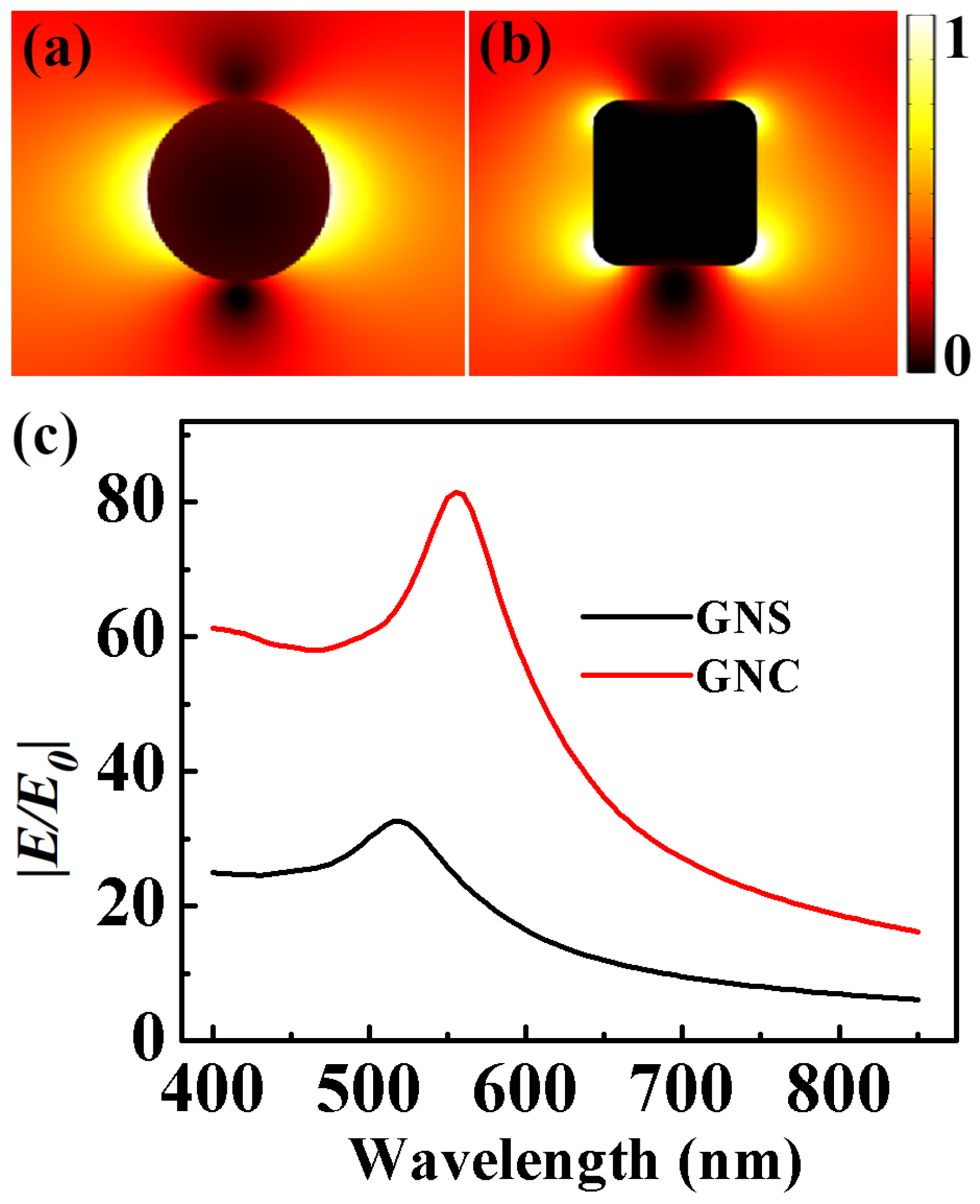
The LSPR characteristics of metal nanoparticles are closely related to their morphological features, and the isotropic GNS have been widely studied as a classic plasmonic nanostructure. To verify the reliability of the model we have constructed, we will compare the simulated numerical results with the experimental test data in the literature [34], as shown in Supplementary Material Figure S2. Then, we first simulated the LSPR characteristics of GNS (diameter 60 nm) and GNC in a homogeneous medium (n0 = 1) to verify the simulation model and clarify the optical advantage of GNC. The polarization angle of incident light is 0°, the calculation wavelength range is 400–850 nm, and the dielectric layer refractive index is 1.38. The optical distribution of GNS at the resonance wavelength is symmetrically distributed on both sides of the sphere, with the strongest near-field intensity at the surface (Figure 2a). The corresponding resonance spectrum curve (Figure 2c) shows a resonance peak at 520 nm, which is consistent with the experimental test results [35], verifying the rationality of the simulation model. For GNC, the near-field distribution at the resonance wavelength is mainly concentrated at the sharp corners (Figure 2b), and the near-field is more localized than that of GNS, leading to a stronger maximum near-field intensity. The resonance spectrum curve of GNC (Figure 2c) shows a resonance peak at 560 nm (consistent with experimental results [36]), which is red shifted by 40 nm compared with GNS, and the maximum near-field enhancement factor exceeds 80. The red shift in the GNC resonance peak is due to the anisotropic morphology: the sharp corners and edges of GNC increase the local electric field gradient, leading to a change in the plasma oscillation frequency. The stronger near-field enhancement of GNC is attributed to the hot-spot effect at the sharp corners—the electric field is highly confined at the nanoscale corner region, forming an intense local electric field [11]. These results confirm the advantage of GNC in near-field enhancement, and their anisotropic morphology also brings polarization dependence and corner hot-spot synergy to the NPOM structure, which is the core research focus of this work.

3.2. Optical Distribution of Isolated GNC and GNC-Based NPOM Nanostructures

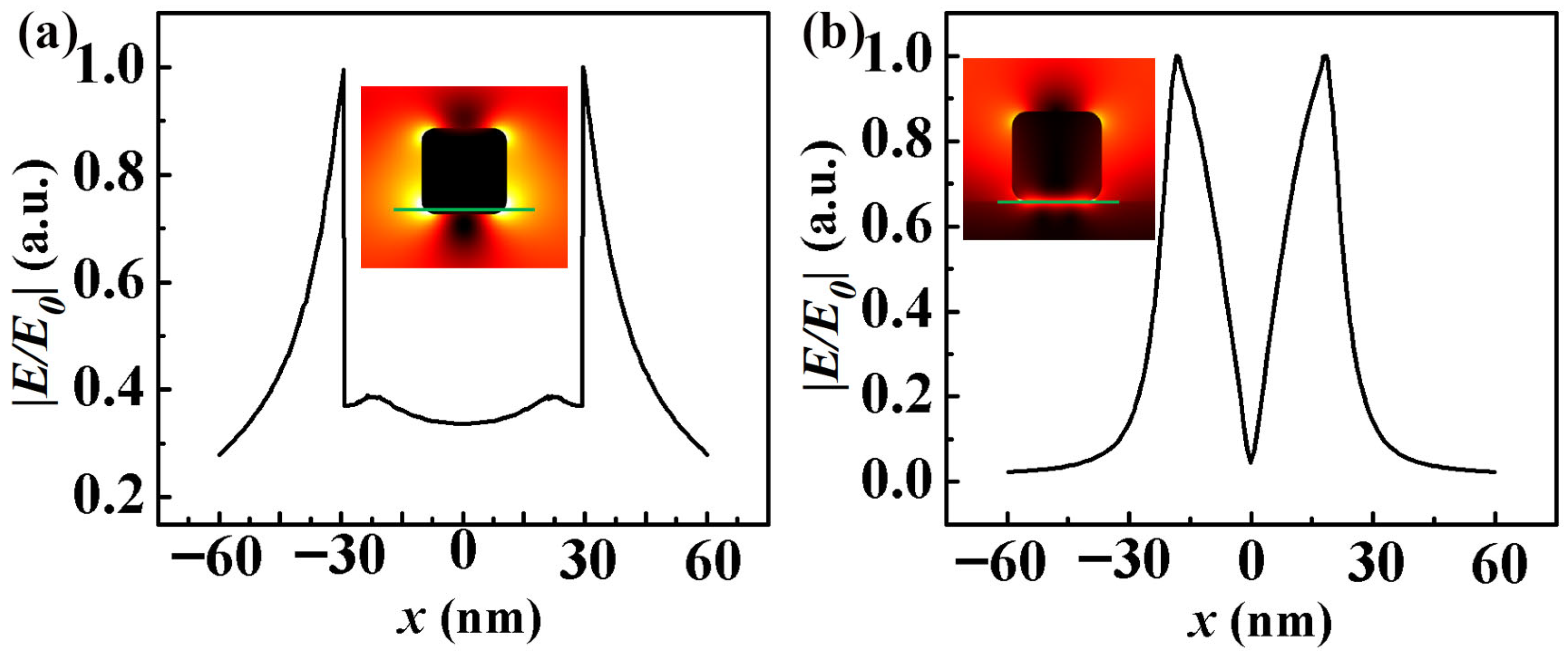
We further compared the optical distribution of isolated GNC and GNC-based NPOM nanostructures (dielectric layer thickness t = 1 nm, n = 1.38, n0 = 1, θ = 0°) to reveal the plasmon coupling mechanism in the NPOM structure. For isolated GNC, the electric field is mainly distributed at the sharp corners, symmetrically distributed in space, and the electric field intensity decreases rapidly from the surface to the interior and exterior (Figure 3a). The normalized electric field intensity along the green line shows that the electric field is the strongest at the GNC surface, drops abruptly to a small value in the interior, and decreases slowly in the exterior. For the GNC-based NPOM nanostructure, a huge near-field enhancement is formed in the gap region due to the plasmon coupling effect. The LSPR of GNC couples with the SPPs of the gold film, forming gap plasmon modes confined in the dielectric layer. The metal film reflects the coupled electric field in the gap back to the gap region, forming standing wave oscillations—this “reflection-re-coupling” feedback mechanism continuously amplifies the electric field intensity in the gap, leading to an enhancement effect far exceeding that of isolated GNC. At this time, the electric field at the GNC upper corners is significantly weakened because the optical field is mainly confined to the nanoscale gap region. The normalized electric field intensity along the green line shows a minimum at the gap center and a maximum at the intersection of the GNC corner and the gap (Figure 3b), which is consistent with the gap plasmon mode characteristics reported in the literature [18], confirming the rationality of our gap plasmon simulation.

3.3. Optical Characteristics of GNC-Based NPOM Nanostructures

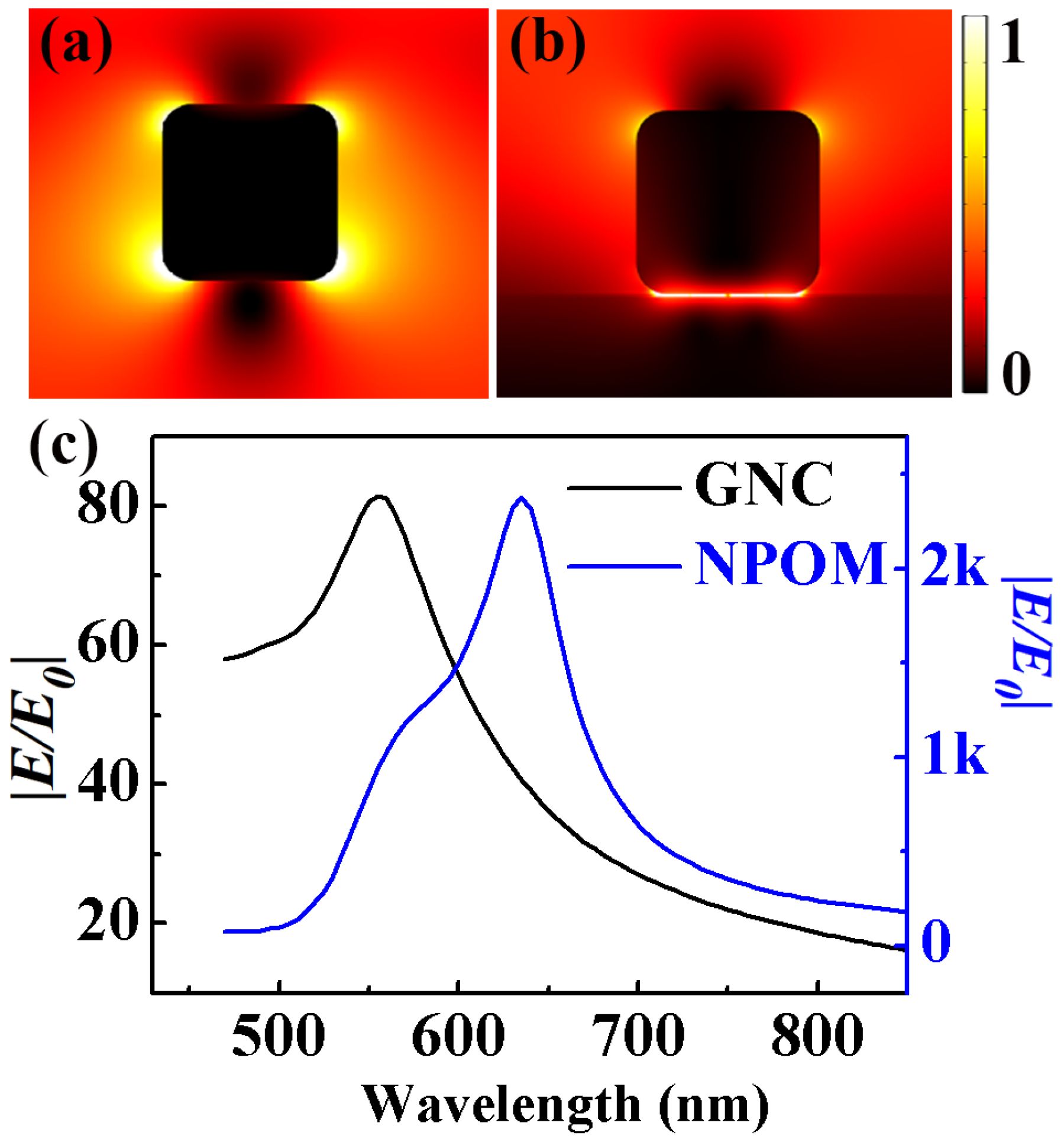
We further simulated the gap plasmon characteristics of the GNC-based NPOM structure (t = 1 nm, n = 1.38, n0 = 1, θ = 0°) and compared them with the LSPR characteristics of isolated GNC to quantify the enhancement effect of plasmon coupling. The optical distribution of the NPOM structure in Figure 4b shows that the electric field is highly confined in the gap region, and there is no significant electric field enhancement at the GNC upper corners. This is the typical feature of gap plasmon mode excitation. In contrast, the optical field of isolated GNC is distributed at the four sharp corners, as shown in Figure 4a, with a much lower intensity. The resonance spectrum curves in Figure 4c show that the isolated GNC have a resonance peak at 560 nm with a maximum E/E0 of 81, while the NPOM structure has a resonance peak at 635 nm with a maximum E/E0 of 2378; the maximum near-field intensity is enhanced by about 29 times due to plasmon coupling. The red shift in the resonance peak of the NPOM structure is due to the plasmon hybridization between GNC LSPR and gold film SPPs. In the NPOM structure we are studying, GNC and gold films are “building blocks.” They have their own intrinsic plasmon resonance modes. When the distance between the building block GNC and the gold film becomes closer, electromagnetic interactions occur between them. The plasmon modes of the GNC and the gold film are no longer independent, and mode coupling, energy level splitting, and hybrid reconstruction take place, generating new bonding hybrid modes and antibonding hybrid modes. The hybridization of the two plasmonic modes leads to a decrease in the plasma oscillation frequency, thus red shifting the resonance wavelength. These results confirm that the GNC-based NPOM structure can achieve ultra-strong optical enhancement via gap plasmon coupling, and its enhancement effect is far superior to that of isolated GNC, laying a foundation for subsequent parameter tuning research.

3.4. Effect of Dielectric Layer Thickness on Gap Plasmon Characteristics

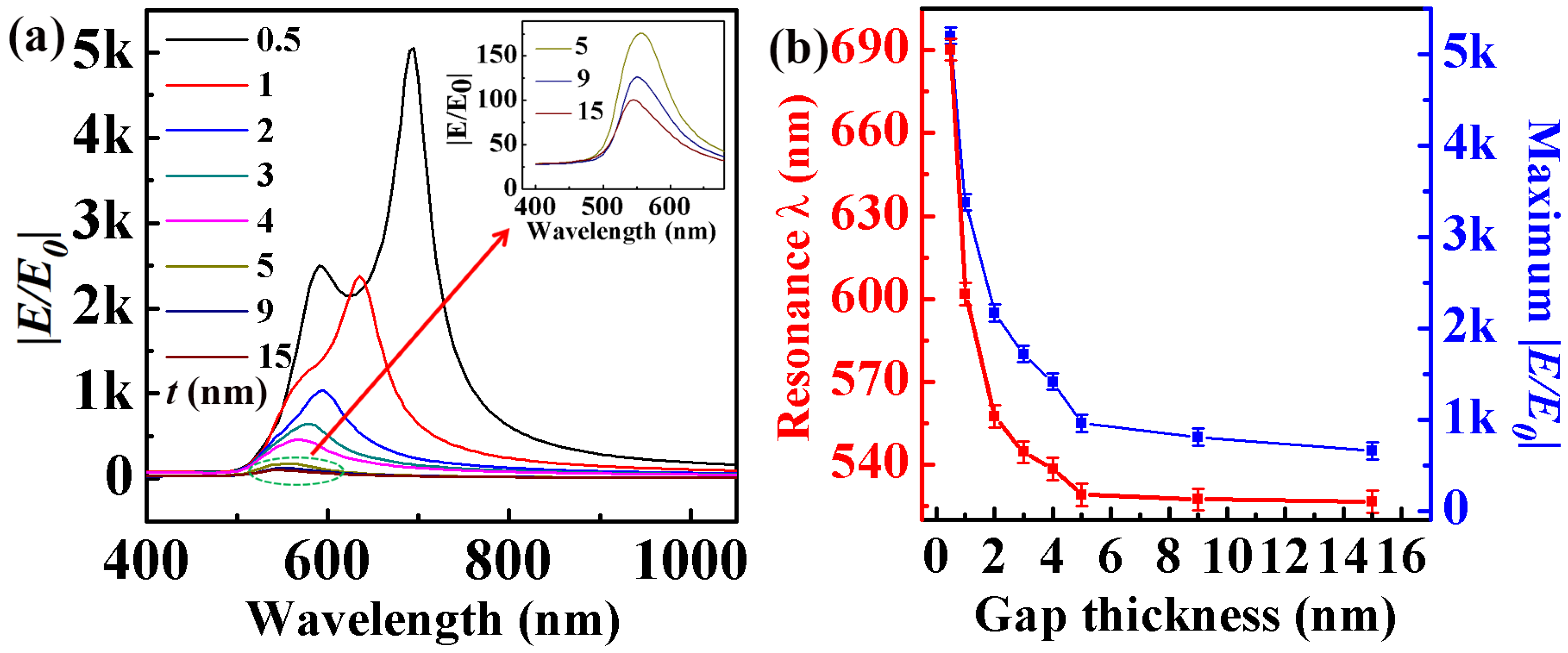
The dielectric layer thickness t is the key parameter regulating gap plasmon coupling, as it directly determines the distance between GNC and the gold film, and thus the strength of plasmon coupling. We systematically investigated the influence of t (0.5, 1, 2, 3, 4, 5, 9, 15 nm) on the optical characteristics of the NPOM nanostructure (n = 1.38, n0 = 1, θ = 0°), and the results are shown in Figure 5.
The electric field resonance spectra in Figure 5a show that the maximum E/E0 decreases rapidly with increasing t. At a thickness t = 0.5 nm, the maximum E/E0 reaches 5048. The corresponding SERS enhancement factor is on the order of 1014 [37], enabling single-molecule detection. As the thickness increases to 1 nm, the maximum E/E0 value decreases to 2378. When t further increases to 2 nm, the maximum E/E0 drops to 1032. If t continues to increase beyond 5 nm, the downward trend of the maximum E/E0 gradually plateaus, with its value being only 176. When t = 0.5 nm, two resonance peaks appear at 590 nm and 695 nm. This is due to the energy level splitting caused by the strong coupling between GNC gap plasmon and gold film SPPs under ultra-small gap conditions, forming two hybrid plasmon modes. The two modes are not independent but undergo mode hybridization, and their spectral characteristics depend on nanoparticle shape, gap size, and symmetry. As the thickness t increases, the coupling effect gradually weakens due to insufficient electric field confinement, making higher-order resonant peaks difficult to excite; only a single resonant peak is observed. The resonance peak wavelength in Figure 5b shows a blue shift with increasing t. At a thickness t = 0.5 nm, the wavelength of the resonant peak is located at 695 nm. For thicknesses t < 5 nm, the resonant wavelength exhibits a rapid blue shift as t increases. Generally speaking, when the thickness t of the dielectric layer shrinks to several nanometers, the oscillating polarization charges on the surface of GNC generate a strong near-field, which penetrates into the intermediate dielectric gap and is incident on the underlying metal mirror. The free electrons on the mirror are driven by the near-field, inducing reverse image polarization charges and image dipole moments on the surface. Thus, the Coulomb electrostatic coupling + near-field electromagnetic coupling between the polarization charges of the GNC and the induced image polarization charges on the mirror forms the interaction source of plasmonic hybridization. At this time, the polar charges at the bottom of the GNC are opposite in sign to the induced image charges on the surface of the gold mirror. The electric field in the gap undergoes constructive interference, and the electromagnetic field is highly localized and aggregated, forming a gap plasmon.
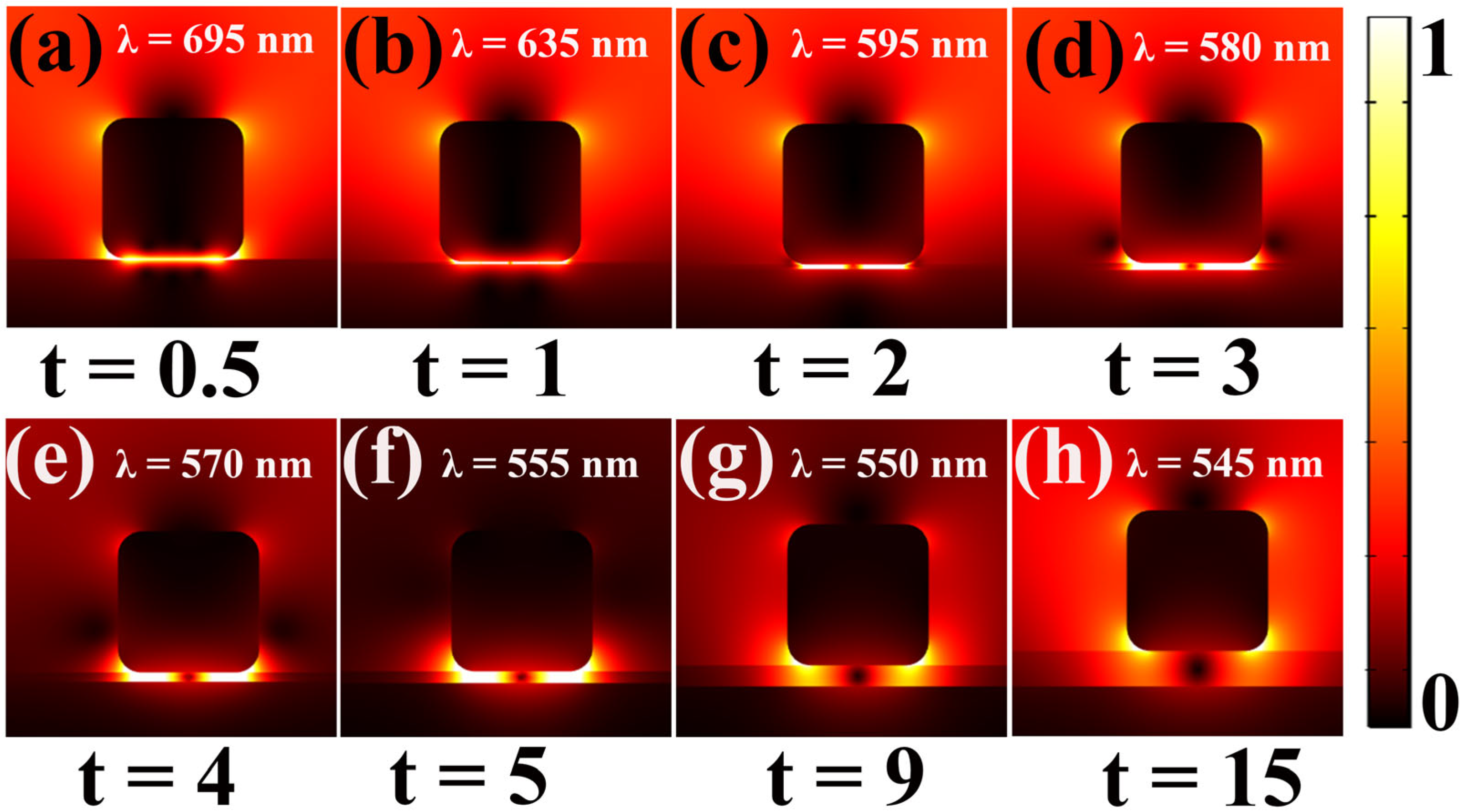
The optical distribution of the NPOM nanostructure with different t (at the resonance wavelength) is shown in Figure 6. The smaller the thickness t of the dielectric layer, the more concentrated the optical distribution in the gap region, as shown in Figure 6a (t = 0.5 nm). As the thickness t increases, the electric field intensity gradually weakens, and the optical distribution is no longer concentrated (Figure 6d, t = 3 nm). When t increases to 5 nm, the optical distribution in the gap is significantly weakened due to the weak coupling effect, as illustrated in Figure 6f. With a further increase in t beyond 9 nm, the optical field in the gap becomes extremely weak, and the optical field is mainly concentrated in the lower corner region of the GNC, as shown in Figure 6g,h. This is highly consistent with the optical field distribution characteristics of an isolated GNC. In addition, a standing wave oscillation is formed in the gap below the GNC. The cavity mode is excited from both sides of the GNC, and the interference of two counter-propagating cavity modes leads to resonance enhancement [25]. When the number of antinodes is odd, constructive interference occurs, doubling the intra-cavity field amplitude and quadrupling the absorption coefficient. When the number of antinodes is even, destructive interference leads to resonance cancelation. This standing wave effect further amplifies the electric field intensity in the gap region under small t conditions, which is an important reason for the ultra-strong enhancement at t = 0.5 nm. The strong plasmon coupling effect only occurs when t < 2 nm, and the gap layer thickness should be controlled within 2 nm in practical device design to achieve efficient optical enhancement.

3.5. Effect of Incident Light Polarization Angle on Gap Plasmon Characteristics

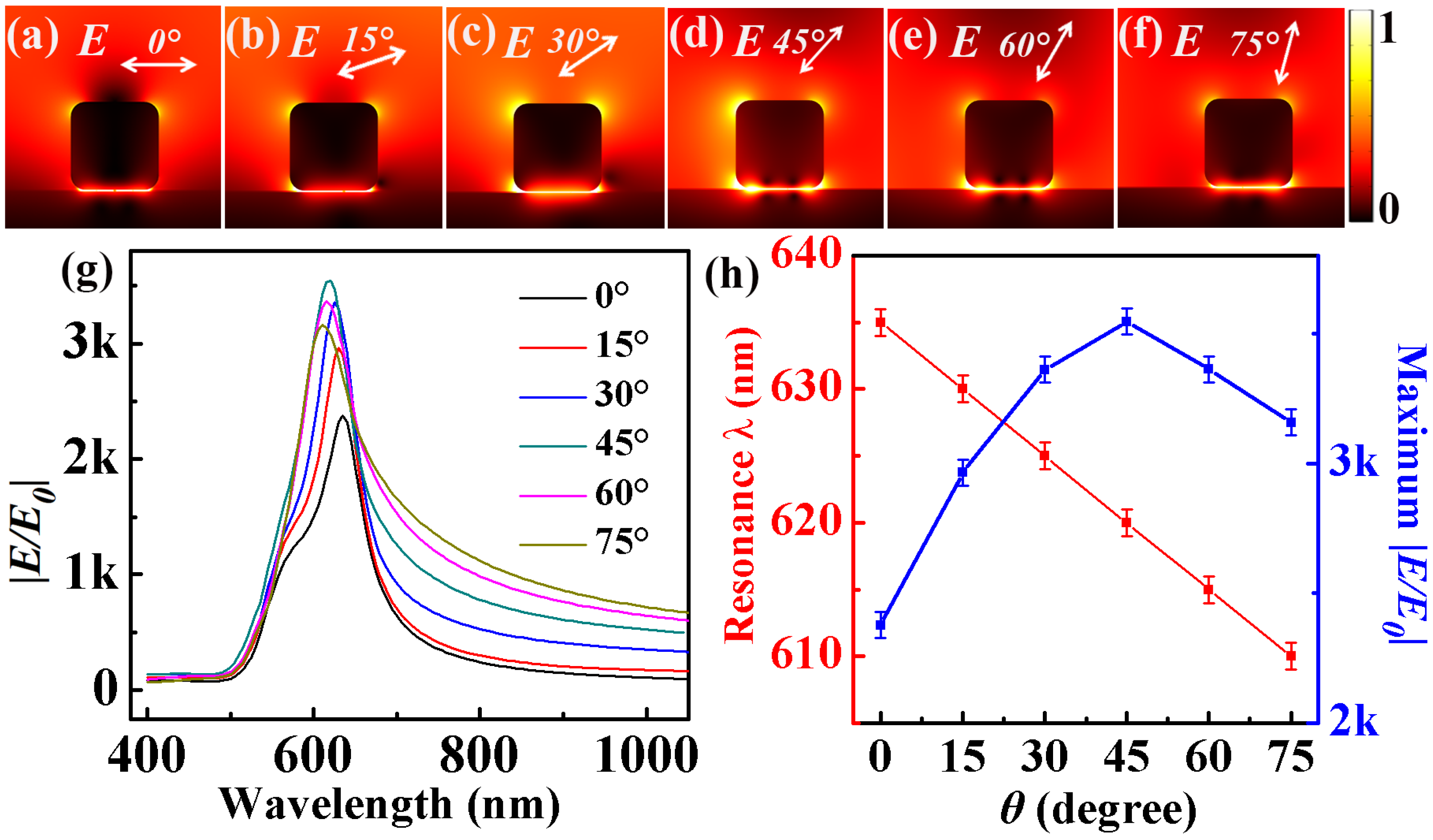
The polarization angle θ of incident light is a unique tuning parameter for GNC-based NPOM nanostructures, derived from the anisotropic morphology of GNC. We systematically studied the influence of θ (0°, 15°, 30°, 45°, 60°, 75°) on optical characteristics, and the results are shown in Figure 7 (t = 1 nm, n = 1.38, n0 = 1). The optical distribution of the NPOM nanostructure shows a significant polarization dependence as shown in Figure 7a–f. For horizontally polarized incident light (θ = 0°), the optical field is symmetrically distributed in the gap region, with a small amount of optical field present at the upper corner of the GNC, as shown in Figure 7a. When θ increases to 15°, the optical distribution becomes asymmetric, with a dark region on the right side of the gap and a bright region on the left, as illustrated in Figure 7b. As θ further increases to 30°, this asymmetry becomes more pronounced. However, the optical intensity in the gap is significantly enhanced due to the superposition effect between the hotspots at the GNC corners and the gap plasmon coupling, as shown in Figure 7c. At θ = 45°, the resonant direction of the incident light is aligned along the diagonal of the GNC, and the corner hotspots are fully excited, resulting in a peak optical field intensity within the gap, as displayed in Figure 7d. When θ = 60° and 75°, the corner hotspot effect weakens, the optical field intensity decreases, and the optical distribution gradually tends toward symmetry, as shown in Figure 7e,f. The resonance spectra in Figure 7g show that the polarization angle has a dual effect on the optical characteristics. Resonance peak intensity first increases and then decreases with increasing θ, and resonance peak wavelength shows a continuous blue shift with increasing θ. At θ = 0°, the resonant peak is located at 635 nm, with a maximum E/E0 value of 2378. When θ increases to 45°, the maximum E/E0 reaches its peak value of 3545 at a corresponding wavelength of 620 nm. As θ continues to increase, the maximum E/E0 decreases, while the resonant peak still exhibits a blue-shift.
The quantitative relationship between resonance peak parameters and θ is shown in Figure 7h. The red resonance wavelength curve shows a linear blue shift with increasing θ (from 635 nm at 0° to 610 nm at 75°). The blue maximum E/E0 curve increases rapidly from 0° to 45° and decreases slowly after 45°. The maximum E/E0 at θ = 45° is due to the synergy of GNC corner hot-spots and gap plasmon coupling. The 45° polarization direction is consistent with the GNC diagonal, fully exciting the corner hot-spots, and the hot-spot electric field couples with the gap plasmon mode, forming a hybrid plasmon mode with stronger enhancement. The blue shift in the resonance wavelength is due to the change in the effective oscillation area of GNC with polarization angle. The effective oscillation area decreases with increasing θ, leading to a blue shift in the LSPR wavelength, and thus a blue shift in the gap plasmon resonance peak. The optimal polarization angle for the GNC-based NPOM nanostructure is 45°, where the optical enhancement effect is the strongest. This conclusion provides a precise optical tuning strategy for the application of the nanostructure in polarization-sensitive plasmonic devices.

3.6. Effect of Ambient Dielectric Refractive Index on Gap Plasmon Characteristics

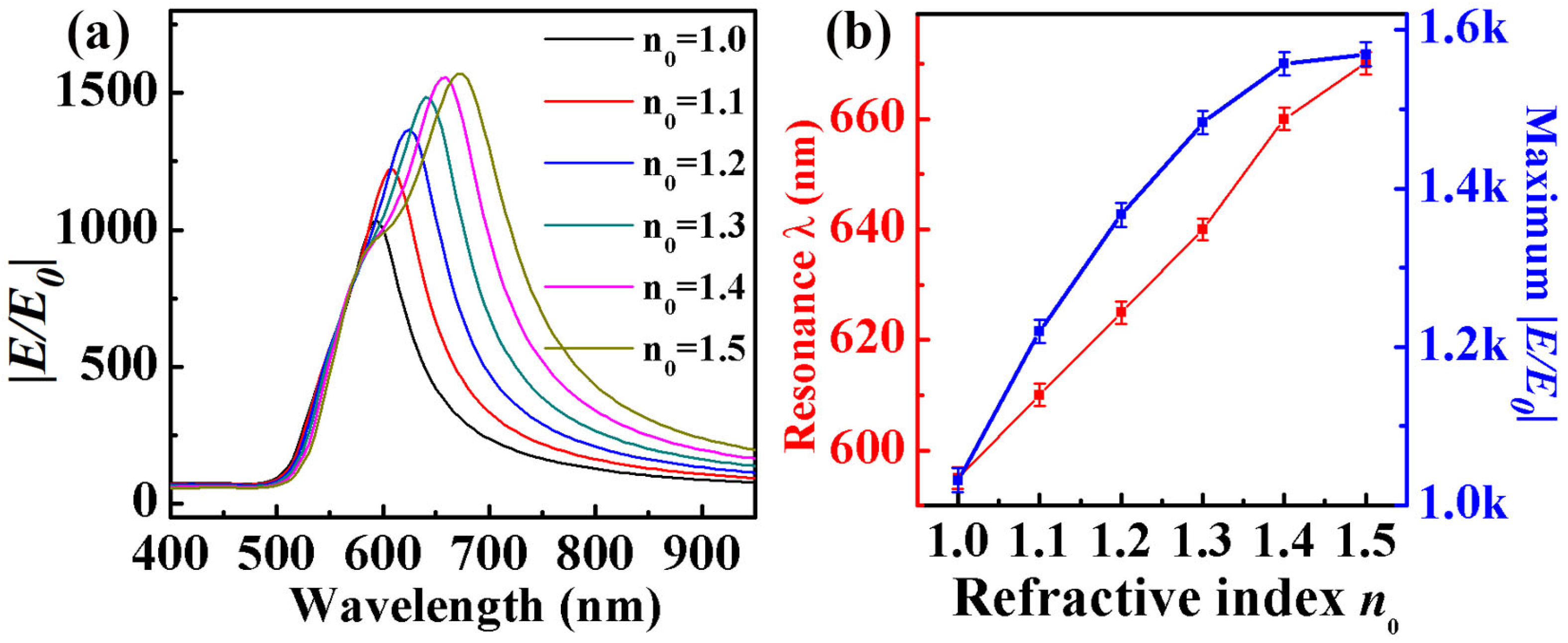
The ambient dielectric refractive index n0 is an important external parameter regulating the optical characteristics of metal nanostructures, as it determines the effective dielectric environment of the NPOM nanostructure and thus the plasma oscillation frequency [5,9]. We studied the influence of n0 (1.0, 1.1, 1.2, 1.3, 1.4, 1.5) on optical characteristics (t = 2 nm, n = 1.38, θ = 0°), and the results are shown in Figure 8. The resonance spectra (Figure 8a) show that the resonance peak wavelength red shifts linearly and the maximum E/E0 increases monotonically with increasing n0. At a surrounding refractive index n0 = 1.0, the resonant peak is located at 595 nm, with a maximum E/E0 value of 1032. When n0 increases to 1.5, the resonant peak is red shifted by 75 nm to 670 nm, and the maximum E/E0 rises to 1569. Figure 8b shows the quantitative relationship between them. The results indicate that the refractive index n0 exhibits a good linear correlation with the resonant wavelength. However, the growth rate of the maximum E/E0 slows down as n0 increases. The maximum E/E0 increases rapidly from 1032 to 1483 within the range of 1.0 to 1.3 but shows a slow increasing trend from 1483 to 1569 in the range of 1.3 to 1.5.
The physical mechanism is as follows: for non-magnetic media, the permittivity ε satisfies ε = n02 [15]. With increasing n0, the dielectric constant of the ambient medium increases, the effective restoring force for electron collective oscillation weakens, the plasma oscillation frequency decreases, and thus the wavelength of the resonance peak becomes larger. The increase in maximum E/E0 is due to the increase in the effective refractive index of the gap plasmon mode: the higher the n0, the stronger the confinement of the gap plasmon mode, the lower the optical field loss, and thus the stronger the near-field enhancement [15]. If n0 deviates from the optimal value, resonance mismatch occurs between the incident light frequency and the gap plasmon resonance frequency, leading to a significant decrease in near-field intensity. This result indicates that the optical characteristics of the NPOM nanostructure can be precisely tuned by changing the ambient dielectric environment, which has important application value in refractive index sensing. The linear shift in the resonance peak with n0 enables high-sensitivity refractive index detection, and the increase in E/E0 further improves the sensing signal-to-noise ratio. Meanwhile, according to the data in Figure 8b, when the NPOM structure is used for a refractive index sensor, a sensitivity with a linear wavelength response of approximately 154 nm/RIU can be achieved [38].

3.7. Effect of Dielectric Layer Refractive Index on Gap Plasmon Characteristics

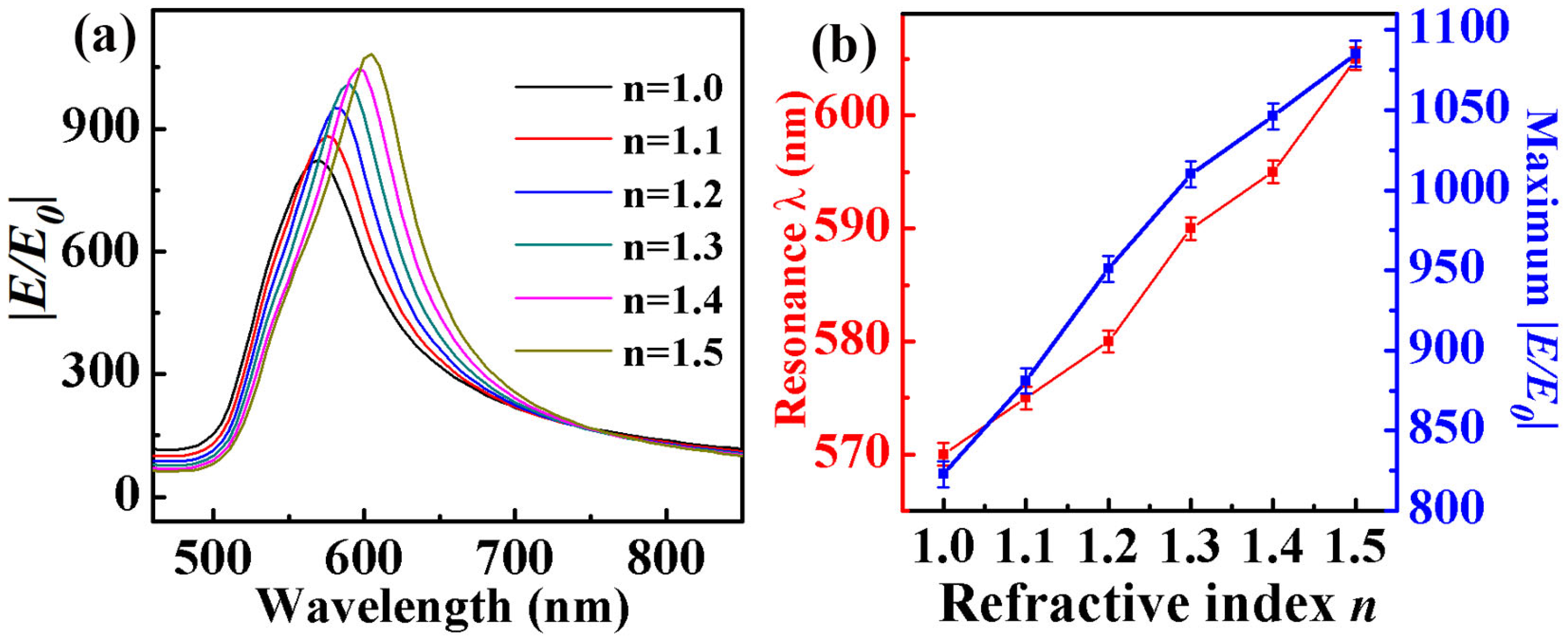
The dielectric layer refractive index n directly determines the optical thickness of the gap region and the confinement ability of the gap plasmon mode [30]. We studied the influence of n (1.0–1.5) on optical characteristics (The discussion on the dielectric layer with a larger refractive index is presented in Supporting Material Figure S3). The resonance spectra (Figure 9a) show that the resonance peak wavelength red shifts linearly and the maximum E/E0 increases monotonically with increasing n. When the refractive index of the dielectric layer changes, it alters the dielectric environment for electromagnetic coupling between the two primitives, effectively changing the intensity of the hybrid interaction, and thereby regulating the resonance wavelength position of the hybrid mode and field enhancement.
At n = 1.0, the resonant peak wavelength is located at 570 nm, with a maximum E/E0 of 823. The resonant peak wavelength exhibits a red shift as n increases. At n = 1.5, the resonant peak wavelength is red shifted by 35 nm to 605 nm. Meanwhile, the maximum E/E0 increases with the refractive index n, reaching 1085 at n = 1.5. The quantitative relationship (Figure 9b) confirms the linear correlation between n and resonance wavelength maximum E/E0. The NPOM nanostructure’s gap region can be regarded as a Fabry–Pérot (F-P) type microcavity [25], where the dielectric layer is the core cavity layer, and its refractive index n and thickness t jointly determine the microcavity resonance condition: 2nt = (m is the resonance order, λ is the light wavelength in the cavity). When t is fixed, increasing n increases the optical thickness nt of the cavity. To satisfy the resonance condition, the resonance wavelength λ must red shift. In addition, increasing n enhances the confinement ability of the microcavity for light, reduces the interface reflection loss, and increases the quality factor (Q) of the microcavity (Q = λ/Δλ; Δλ is the full width at half maximum of the resonance peak) [15], and a high-Q microcavity can store optical energy more efficiently, further amplifying the local electric field. The dielectric layer refractive index has a linear regulatory effect on the optical characteristics of the NPOM nanostructure, and selecting an appropriate dielectric material can achieve precise tuning of resonance wavelength and near-field intensity. This conclusion provides a material design basis for the fabrication of GNC-based NPOM optical devices.

4. Conclusions

In this work, we conducted a systematic numerical study on the optical characteristics of GNC-based NPOM nanostructures via the finite element method. GNC shows superior optical enhancement performance compared with GNS. Gap plasmon coupling in the NPOM nanostructure achieves ultra-strong near-field enhancement, with the maximum E/E0 enhanced by approximately 29 times compared with isolated GNC. The dielectric layer thickness is the core structural tuning parameter. The strong coupling effect only occurs when t < 2 nm, with a maximum E/E0 of 5048 at t = 0.5 nm. The resonance peak wavelength blue-shifts rapidly and the electric field intensity decreases sharply with increasing t. Meanwhile, polarization angle θ shows a unique dual regulation effect. The maximum E/E0 first increases and then decreases with increasing θ, reaching the maximum value of 3545 at θ = 45°. Both n0 and n lead to a linear red shift in the resonance peak. This work clarifies the gap plasmon coupling mechanisms and tuning laws of key parameters, providing theoretical guidance for the design of high-performance plasmonic devices based on NPOM nanostructures.

Supplementary Materials

The following supporting information can be downloaded at: https://www.mdpi.com/article/10.3390/sym18050825/s1, Figure S1: Relationship diagram between the refractive index and wavelength. Figure S2: (a) Resonance spectra of gold spherical nanoparticles simulated based on manuscript model. (b) Absorption spectra of gold spherical nanoparticles measured by experiments [34]. Figure S3: (a) Electric field resonance spectra curves corresponding to different refractive indices n, (b) The relationship between the wavelength position and electric field intensity of the resonance peaks in Figure S3a and the refractive index n.

Author Contributions

Analyzed the data and wrote the main manuscript text, G.F.; Constructed the simulation model, L.X. All authors have read and agreed to the published version of the manuscript.

Funding

This research was funded by Henan Province Natural Science Foundation, grant number 252300421496.

Data Availability Statement

Data is contained within this article.

Conflicts of Interest

The authors declare no conflicts of interest.

Abbreviations

The following abbreviations are used in this manuscript:
NPOMMetal nanoparticle-on-a-mirror
FEMFinite element method
GNCGold nanocubes
SERSSurface-enhanced Raman scattering
GNSGold nanospheres
LSPRLocalized surface plasmon resonance
SPPsSurface plasmon polaritons

References

  1. Kim, T.; Kang, S.; Heo, J.; Cho, S.; Kim, J.W.; Choe, A.; Walker, B.; Shanker, R.; Ko, H.; Kim, J.Y. Nanoparticle-enhanced silver-nanowire plasmonic electrodes for high-performance organic optoelectronic devices. Adv. Mater. 2018, 30, 1800659. [Google Scholar] [CrossRef]
  2. Giordano, M.C.; Foti, A.; Messina, E.; Gucciardi, P.G.; Comoretto, D.; de Mongeot, F.B. SERS amplification from self-organized arrays of plasmonic nanocrescents. ACS Appl. Mater. Interfaces 2016, 8, 6629–6638. [Google Scholar] [CrossRef]
  3. Wei, Q.; Acuna, G.; Kim, S.; Vietz, C.; Tseng, D.; Chae, J.; Shir, D.; Luo, W.; Tinnefeld, P.; Ozcan, A. Plasmonics enhanced smartphone fluorescence microscopy. Sci. Rep. 2017, 7, 2124. [Google Scholar] [CrossRef]
  4. Zhang, Z.; Jiang, X.; Liu, B.; Guo, L.; Lu, N.; Wang, L.; Huang, J.; Liu, K.; Dong, B. IR-Driven Ultrafast Transfer of Plasmonic Hot Electrons in Nonmetallic Branched Heterostructures for Enhanced H2 Generation. Adv. Mater. 2018, 30, 1705221. [Google Scholar] [CrossRef]
  5. Fan, C.; Dong, J.; Wu, H.; Zhou, W.; Han, Q.; Zhang, C.; Zhang, Q.; Li, T.; Gao, W.; Qi, J. Highly Sensitive SERS Detection of Food Additives Using Gold Nanospheres on Capillary Substrates. ACS Appl. Nano Mater. 2025, 8, 1903–1911. [Google Scholar] [CrossRef]
  6. Ben Youssef, M.; Poungsripong, P.; Bidotti, H.; Abdoul-Yasset, H.; Gigmes, D.; Margeat, O.; Sciacca, B.; Le Rouzo, J.; Duché, D.; Vuillaume, D. Dynamic switching of ferrocene and plasmonic interactions in Au/self-assembled monolayer/single Ag nanocube molecular junctions. J. Phys. Chem. C 2025, 129, 7855–7867. [Google Scholar] [CrossRef]
  7. Greybush, N.J.; Pacheco-Peña, V.; Engheta, N.; Murray, C.B.; Kagan, C.R. Plasmonic optical and chiroptical response of self-assembled Au nanorod equilateral trimers. ACS Nano 2019, 13, 1617–1624. [Google Scholar] [CrossRef]
  8. Zheng, Y.; Li, M.; Shen, D. Seedless synthesis of Au nanoplates with tunable plasmonic peaks. Opt. Mater. Express 2024, 14, 1212–1221. [Google Scholar] [CrossRef]
  9. Garcia-Leis, A.; Torreggiani, A.; Garcia-Ramos, J.V.; Sanchez-Cortes, S. Hollow Au/Ag nanostars displaying broad plasmonic resonance and high surface-enhanced Raman sensitivity. Nanoscale 2015, 7, 13629–13637. [Google Scholar] [CrossRef]
  10. Boyle, C.; Tauer, C.; Gangopadhyay, S.; Gaines, T.; Scott, G.; Keller, J.M.; Price, S.R.; Young, M.J.; Maschmann, M.R. Rapid Shape Change and Spallation of Isolated Nanoscale Aluminum Cubes, Rods, Pyramids, and Spheres: Implications for Plasmonic and Energetic Materials. ACS Appl. Nano Mater. 2024, 7, 24274–24280. [Google Scholar] [CrossRef]
  11. Devaraj, V.; Lee, J.M.; Kim, Y.J.; Jeong, H.; Oh, J.W. Engineering efficient self-assembled plasmonic nanostructures by configuring metallic nanoparticle’s morphology. Int. J. Mol. Sci. 2021, 22, 10595. [Google Scholar] [CrossRef]
  12. Tiwari, P.; Das, G.M.; Dantham, V.R. Optical properties of Au-Ag bimetallic nanoparticles of different shapes for making efficient bimetallic-photonic whispering gallery mode hybrid microresonators. Plasmonics 2020, 15, 1251–1260. [Google Scholar] [CrossRef]
  13. Mubeen, S.; Zhang, S.; Kim, N.; Lee, S.; Krämer, S.; Xu, H.; Moskovits, M. Plasmonic properties of gold nanoparticles separated from a gold mirror by an ultrathin oxide. Nano Lett. 2012, 12, 2088–2094. [Google Scholar] [CrossRef] [PubMed]
  14. Mock, J.J.; Hill, R.T.; Degiron, A.; Zauscher, S.; Chilkoti, A.; Smith, D.R. Distance-dependent plasmon resonant coupling between a gold nanoparticle and gold film. Nano Lett. 2008, 8, 2245–2252. [Google Scholar] [CrossRef] [PubMed]
  15. Zeng, P.; Ma, D.; Zheng, M.; Chen, L.; Liang, H.; Shu, Z.; Fu, Y.; Pan, M.; Zhao, Q.; Duan, H. Flexible plasmonic nanoparticle-on-a-mirror metasurface-enabled substrates for high-quality surface-enhanced Raman spectroscopy detection. Colloid Interface Sci. Commun. 2023, 55, 100728. [Google Scholar] [CrossRef]
  16. Yu, B.; Woo, J.; Kong, M.; O’Carroll, D.M. Mode-specific study of nanoparticle-mediated optical interactions in an absorber/metal thin film system. Nanoscale 2015, 7, 13196–13206. [Google Scholar] [CrossRef]
  17. Lei, D.Y.; Fernández-Domínguez, A.I.; Sonnefraud, Y.; Appavoo, K.; Haglund, R.F., Jr.; Pendry, J.B.; Maier, S.A. Revealing plasmonic gap modes in particle-on-film systems using dark-field spectroscopy. ACS Nano 2012, 6, 1380–1386. [Google Scholar] [CrossRef]
  18. Ding, F.; Yang, Y.; Deshpande, R.A.; Bozhevolnyi, S.I. A review of gap-surface plasmon metasurfaces: Fundamentals and applications. Nanophotonics 2018, 7, 1129–1156. [Google Scholar] [CrossRef]
  19. Hutter, T.; Huang, F.M.; Elliott, S.R.; Mahajan, S. Near-field plasmonics of an individual dielectric nanoparticle above a metallic substrate. J. Phys. Chem. C 2013, 117, 7784–7790. [Google Scholar] [CrossRef]
  20. Devaraj, V.; Lee, J.M.; Oh, J.W. Distinguishable plasmonic nanoparticle and gap mode properties in a silver nanoparticle on a gold film system using three-dimensional FDTD simulations. Nanomaterials 2018, 8, 582. [Google Scholar] [CrossRef]
  21. Huang, Y.; Ma, L.; Hou, M.; Li, J.; Xie, Z.; Zhang, Z. Hybridized plasmon modes and near-field enhancement of metallic nanoparticle-dimer on a mirror. Sci. Rep. 2016, 6, 30011. [Google Scholar] [CrossRef] [PubMed]
  22. Bansal, S.; Prakash, K.; Sharma, K.; Sardana, N.; Kumar, S.; Gupta, N.; Singh, A.K. A highly efficient bilayer graphene/ZnO/silicon nanowire based heterojunction photodetector with broadband spectral response. Nanotechnology 2020, 31, 405205. [Google Scholar] [CrossRef] [PubMed]
  23. Bansal, S.; Bansal, A.; Prakash, K.; Patial, P.; Kaur, K.; Gupta, A.; Faruque, M.R.I. Analysis of Few-Layer Graphene/ZnO Nanowires Photodetector on Si Substrate for 6G and IoT Applications. J. Electron. Mater. 2025, 54, 9099–9111. [Google Scholar] [CrossRef]
  24. Shan, F.; Huang, J.; Tang, C.; Liu, L.; Zhu, Y.; Wei, G.; Liu, L.; Wang, Y.; Wang, Y.; Hu, Q.; et al. Gap plasmonic properties of NPOM structures composed of gold nanoparticles and thin films. Sci. Rep. 2024, 14, 29478. [Google Scholar] [CrossRef]
  25. Moreau, A.; Ciracì, C.; Mock, J.J.; Hill, R.T.; Wang, Q.; Wiley, B.J.; Chilkoti, A.; Smith, D.R. Controlled reflectance surfaces with film-coupled colloidal nanoantennas. Nature 2012, 492, 86–89. [Google Scholar] [CrossRef]
  26. Kim, S.; Huynh, L.T.M.; Yoon, S. Which Nanoparticle Shape is the Most Effective in Generating Hot Charge Carriers from Plasmon Excitation? J. Phys. Chem. C 2023, 127, 14776–14783. [Google Scholar] [CrossRef]
  27. Zheng, P.; Wang, A.; Hang, Y.; Kasani, S.; Wu, N. Plasmonic Copper Nanocubes Coupled to a Film for Near-Infrared Fluorescence Enhancement. J. Phys. Chem. C 2025, 129, 12898–12903. [Google Scholar] [CrossRef]
  28. Devaraj, V.; Lee, I.H.; Kim, M.; Nguyen, T.M.; Son, J.P.; Lee, J.M.; Lee, D.; Kim, K.H.; Oh, J.W. Unveiling facet effects in metallic nanoparticles to design an efficient plasmonic nanostructure. Curr. Appl. Phys. 2022, 44, 22–28. [Google Scholar] [CrossRef]
  29. Han, X.; Wang, K.; Persaud, P.D.; Xing, X.; Liu, W.; Long, H.; Li, F.; Wang, B.; Singh, M.R.; Lu, P. Harmonic Resonance Enhanced Second-Harmonic Generation in the Monolayer WS2-Ag Nanocavity. ACS Photonics 2020, 7, 562–568. [Google Scholar] [CrossRef]
  30. Bozhevolnyi, S.I.; Søndergaard, T. General properties of slow-plasmon resonant nanostructures: Nano-antennas and resonators. Opt. Express 2007, 15, 10869–11087. [Google Scholar] [CrossRef]
  31. Palik, E.D. Handbook of Optical Constants of Solids; Academic Press: Orlando, FL, USA, 1985. [Google Scholar]
  32. Shan, F.; Zhu, Y.; Huang, J. Polarization-Dependent Plasmon Coupling in Gold Nanoparticles and Gold Thin-Film Systems. Coatings 2024, 14, 746. [Google Scholar] [CrossRef]
  33. Sehmi, H.S.; Langbein, W.; Muljarov, E.A. Optimizing the Drude-Lorentz model for material permittivity: Method, program, and examples for gold, silver, and copper. Phys. Rev. B 2017, 95, 115444. [Google Scholar] [CrossRef]
  34. Shan, F.; Huang, J.; Zhu, Y.; Wei, G. Photo-Thermal Conversion and Raman Sensing Properties of Three-Dimensional Gold Nanostructure. Molecules 2024, 29, 4287. [Google Scholar] [CrossRef]
  35. Li, M.; Cushing, S.K.; Zhang, J.; Lankford, J.; Aguilar, Z.P.; Ma, D.; Wu, N. Shape-dependent surface-enhanced Raman scattering in gold Raman-probe silica sandwiched nanoparticles for biocompatible applications. Nanotechnology 2012, 23, 115501. [Google Scholar] [CrossRef]
  36. Narayanan, R.; Lipert, R.J.; Porter, M.D. Cetyltrimethylammonium bromide-modified spherical and cube-like gold nanoparticles as extrinsic Raman labels in surface-enhanced Raman spectroscopy based heterogeneous immunoassays. Anal. Chem. 2008, 80, 2265–2271. [Google Scholar] [CrossRef] [PubMed]
  37. Ru, E.C.L.; Blackie, E.; Meyer, M.; Etchegoin, P.G. Surface enhanced Raman scattering enhancement factors: A comprehensive study. J. Phys. Chem. C 2007, 111, 13794–13803. [Google Scholar] [CrossRef]
  38. Zhu, S.Q.; Huang, X.D. Plasmonic Sensing Characteristics of Silver Nanoplate Films Fabricated by Electrostatic Self-assembly. Plasmonics 2023, 18, 1277–1285. [Google Scholar] [CrossRef]
Figure 1. (a) Schematic diagram of the NPOM structure composed of GNC and a mirror surface. (b) Simulated model structure. (The red arrow represents the incident light).
Symmetry 18 00825 g001
Figure 2. Near-field distribution on the surface of (a) GNS and (b) GNC. (c) Near-field resonance curves of GNS and GNC.
Symmetry 18 00825 g002
Figure 3. (a) Normalized electric field intensity on the surface (along the green line) of a GNC in a homogeneous medium. (b) Normalized electric field intensity within the gap of the NPOM structure (along the green line). The inset shows their optical distribution.
Symmetry 18 00825 g003
Figure 4. Optical distribution on the surface of (a) GNC and (b) NPOM nanostructures. (c) Electric field resonance curves of GNC and NPOM nanostructure.
Symmetry 18 00825 g004
Figure 5. (a) Electric field resonance spectra in the gap region of the NPOM nanostructure under different t. (b) Relationship diagrams of the resonance peak wavelength position and intensity of the electric field resonance curve in (a) with the t.
Symmetry 18 00825 g005
Figure 6. Optical distribution on the surface of the NPOM nanostructure with different t. (a) t = 0.5 nm; (b) t = 1 nm; (c) t = 2 nm; (d) t = 3 nm; (e) t = 4 nm; (f) t = 5 nm; (g) t = 9 nm; (h) t = 15 nm.
Symmetry 18 00825 g006
Figure 7. (af) Optical distribution diagrams of the NPOM nanostructure at different polarization angles θ. (g) Electric field resonance spectral curves of the NPOM structure at different polarization angles θ. (h) The wavelength positions and the maximum electric field of the resonance peaks corresponding to each polarization angle θ in (g).
Symmetry 18 00825 g007
Figure 8. (a) Electric field resonance spectra curves corresponding to different refractive indices n0. (b) The relationship between the wavelength position and electric field intensity of the resonance peaks in (a) and the refractive index n0.
Symmetry 18 00825 g008
Figure 9. (a) Electric field resonance spectra curves corresponding to different refractive indices n. (b) The relationship between the wavelength position and electric field intensity of the resonance peaks in (a) and the refractive index n.
Symmetry 18 00825 g009
Disclaimer/Publisher’s Note: The statements, opinions and data contained in all publications are solely those of the individual author(s) and contributor(s) and not of MDPI and/or the editor(s). MDPI and/or the editor(s) disclaim responsibility for any injury to people or property resulting from any ideas, methods, instructions or products referred to in the content.