


Abstract
The rhotrix, introduced as a rhomboidal extension of traditional matrix theory, offers a unique algebraic framework for the organization and manipulation of numerical arrays. The incorporation of refined neutrosophic concepts into rhotrix theory has enabled the modeling of uncertainty, indeterminacy, and inconsistency within algebraic frameworks. Motivated by these developments, this paper investigates the structure of invertible refined neutrosophic rhotrices, thereby extending the classical theory of rhotrices into the domain of refined neutrosophic. This study is carried out using heart-based multiplication, which acts as the fundamental operation governing interactions among rhotrix elements. This setting facilitates a rigorous analysis of rhotrix algebra, specifically identifying the conditions required for invertibility and exploring the structural response of refined neutrosophic elements to basic operations defined for rhotrices. In addition to the invertibility analysis, this study analyzes the index structures of rhotrices of small orders, establishes the general characterization of the rhotrix index set, and reveals an inherent symmetry of the rhotrix structure under the interchange of indices. It also proposes a rhotrix-based representation of binary relations, illustrating the broader applicability of refined neutrosophic rhotrices in modeling relational and algebraic structures. To demonstrate the practical relevance of the developed framework, a refined neutrosophic decision-making model is applied to the evaluation of selected women empowerment schemes. By incorporating real-valued performance measures together with indeterminacy components reflecting expert uncertainty, the proposed model provides a systematic mechanism for multi-criteria assessment and ranking of policy interventions. The results contribute to the advancement of rhotrix algebra in indeterminate environments and highlight its potential applications in mathematical modeling and decision-making.
1. Introduction
The concept of the rhotrix was first introduced by Ajibade [1] in 2003 as a distinctive framework for arranging numerical elements in a rhomboidal form and defined the structure of an n-dimensional rhotrix as an entity situated between an matrix and an matrix. Building on this foundation, Ajibade [2] later proposed the earliest multiplication procedure for rhotrices, known as heart-based multiplication. Shortly after, Sani [3] (2004) presented an alternative operation, referred to as row–column multiplication, which parallels the classical matrix multiplication process. These two approaches form the core methods for rhotrix multiplication, while other proposed techniques have generally not met the algebraic requirements needed for establishing formal structures.
Further progress was made when Sani [4] introduced the concept of a coupled matrix, providing a systematic means of converting a rhotrix into an equivalent matrix form. In 2008, Isere [5] advanced the theory by extending the framework to even-dimensional rhotrices, thereby overcoming the limitation inherent in Ajibade’s original formulation, which was confined to odd dimensions. Since then, substantial developments have expanded the scope of rhotrices. These include the establishment of rhotrix groups [6,7], rhotrix rings [8], rhotrix vector spaces [9], and rhotrix modules [10], as well as the application of rhotrix-based models in fields such as cryptography [11,12].
In the 1990s, Florentin Smarandache [13,14] established the foundations of neutrosophic logic, effectively refining traditional and fuzzy systems by incorporating a tripartite valuation. This methodology utilizes truth, indeterminacy, and falsity parameters to navigate information that is inherently inconsistent or incomplete. This tripartite framework provides a robust means of addressing complex real-world problems characterized by incomplete, inconsistent, or uncertain information.
Building on this foundation, Kandasamy and Smarandache [15,16,17] developed neutrosophic algebraic structures that explicitly incorporate the indeterminacy parameter I. These generalizations have since been utilized to establish neutrosophic groups [18], modules [19], and vector spaces [20]. In subsequent developments, Abobala [21] examined the existence of inverses for refined neutrosophic matrices and later generalized this investigation to the case of n-refined neutrosophic matrices, thereby enriching the theoretical landscape of the neutrosophic structure.
Multi-criteria decision-making (MCDM) techniques have been widely applied in complex industrial decision environments, such as supplier selection in the textile industry [22] and strategic decision-making in the frozen shrimp sector [23]. Motivated by these applications, the present study employs an MCDM framework based on refined neutrosophic rhotrices to evaluate women-centric welfare schemes implemented by the Government of Tamil Nadu.
Let n be a positive odd integer. The standard configuration for a rhotrix of order n is defined as follows:
where . The entries represent the first row, while the entries represent the first column. The heart of a rhotrix is defined as the element positioned at the intersection of its major horizontal and vertical axes.
The computational framework for rhotrices relies on two primary operations: addition and heart-based multiplication. In heart-based multiplication, as formulated by Ajibade, the product is derived by scaling each entry of the first rhotrix by the central element (the “heart”) of the second, then adding it to the product of the second rhotrix’s entries and the heart of the first. Conversely, addition remains a straightforward, entry-wise process, where corresponding elements are summed directly.
The motivation behind this study is that the classical rhotrix theory deals with numerical entries defined over a field, which makes it suitable for deterministic mathematical modeling. However, many real-world problems involve uncertainty, vagueness, and incomplete information that cannot be adequately captured using precise numerical values. While fuzzy and intuitionistic fuzzy extensions address partial uncertainty, they do not explicitly incorporate indeterminacy. Although the neutrosophic rhotrix incorporates indeterminacy through a single neutrosophic component, it remains limited in its ability to represent multiple or layered sources of uncertainty. In many practical situations, indeterminacy may arise from different factors that cannot be adequately captured by a single indeterminate element.
To address this limitation, refined neutrosophic theory introduces multiple independent indeterminacy components, allowing a more granular and flexible representation of uncertain information. This motivates the development of refined neutrosophic rhotrices, in which each entry is expressed using multiple indeterminacy terms. Consequently, refined neutrosophic rhotrices provide a natural and necessary generalization of neutrosophic rhotrices, enhancing their applicability in complex decision-making and uncertain environments.
In this paper, Section 2 aims to advance rhotrix theory by investigating the fundamental properties of refined neutrosophic rhotrices, specifically focusing on their algebraic structure under heart-based multiplication. In Section 3, we examine the index structure of rhotrices and establish a general characterization of the rhotrix index set, highlighting its inherent symmetry under the interchange of indices. Beyond theoretical expansion, in Section 4, we demonstrate the practical utility of this developed framework through a refined neutrosophic decision-making model applied to the evaluation of women empowerment initiatives. By integrating real-valued performance metrics with indeterminacy components that reflect expert ambiguity, the proposed model provides a systematic mechanism for the multi-criteria assessment and ranking of complex policy interventions.
2. Invertibility of Refined Neutrosophic Rhotrices Under Heart-Based Multiplication
In this section, the inverse of a refined neutrosophic rhotrix is derived with respect to heart-based multiplication. It has been established in [24] that the operation is associative and that the corresponding multiplicative identity has been formulated under heart-based multiplication.
Definition 1.
A refined neutrosophic rhotrix is defined as a rhotrix with each of the entries from a refined neutrosophic field , where .
Suppose A is a rhotrix in , then the refined neutrosophic rhotrix is represented as
And that can be re-written as
where
Example 1.
Consider the refined neutrosophic field , where and the indeterminacy components satisfy , , and .
A refined neutrosophic rhotrix of order 3 can be written as
Each entry of R is of the form , where . Hence, R satisfies the definition of a refined neutrosophic rhotrix.
Remark 1
(Distinction from Existing Neutrosophic Rhotrices). The concept of a neutrosophic rhotrix, as introduced in earlier studies, considers each entry in the rhotrix to be of the form , where I represents a single indeterminacy component satisfying . In contrast, the refined neutrosophic rhotrix defined in this work extends this representation by incorporating multiple independent indeterminacy components, namely and , satisfying the relations , , and .
This refinement enables each entry of the rhotrix to be expressed in the form
thereby allowing a more detailed and flexible modeling of indeterminacy. Consequently, the proposed refined neutrosophic rhotrix generalizes the classical neutrosophic rhotrix by capturing multiple levels or sources of uncertainty, which cannot be represented within the single-indeterminacy framework.
Definition 2.
We define the operations on refined neutrosophic rhotrices as follows:
- (i)
- The addition of two refined neutrosophic rhotrices is possible only if they are of the same size.
An addition of two refined neutrosophic rhotrices and is defined as
That is, for rhotrices of size 3,
and
of size 3,
- (ii)
- The heart-based refined neutrosophic multiplication of two refined neutrosophic rhotrices is possible only if they are of the same size.
Multiplication of two refined neutrosophic rhotrices and is defined as
where ∘ represents the multiplication among the refined neutrosophic numbers.
Definition 3.
Let be a rhotrix of order . The transpose of R, denoted by , is defined by
Definition 4.
A refined neutrosophic rhotrix R is said to be idempotent under heart-based multiplication if
Theorem 1.
Let R be an idempotent 2-refined neutrosophic rhotrix under heart-based multiplication. Then the heart element of 2-refined neutrosophic rhotrices under heart-based multiplication is finite and consists of exactly six elements.
The six idempotent refined neutrosophic elements are given by
- (i)
- (ii)
- (iii)
- (iv)
- (v)
- (vi)
Proof.
Let be an idempotent 2-refined neutrosophic rhotrix.
Then , and by heart-based multiplication, . This implies
On comparing both sides, we get, , and . Then .
- Case (a): Let .
- and
- .
If , then .
If , then .
Therefore, from case (a), the heart element in idempotent 2-refined neutrosophic rhotrix possibilities are and .
- Case (b): Let .
- and
- .
If , then .
If , then .
Therefore, from case (b), the other possibilities of the heart element in an idempotent 2-refined neutrosophic rhotrix are , , and . □
Corollary 1.
The identity rhotrix and zero rhotrix are the only rhotrices to be idempotent.
Proof.
From the above theorem, we get that the heart of the simple rhotrix is either 0 or 1. And the multiplication of two of the same rhotrices gives twice its heart multiplied by the rhotrix. That is, each entry in is for all entries except heart. Since , □
Lemma 1
([24]). The heart-based multiplication operation among any refined neutrosophic rhotrix holds the following axioms:
- , where(Multiplicative Identity) if A is invertible,
- (Commutativity), where are any refined neutrosophic rhotrices
Theorem 2.
For any refined neutrosophic rhotrix , the multiplicative inverse is
under the heart-based multiplication operation, and A is invertible.
Proof.
Let us consider any two refined neutrosophic rhotrices .
Suppose and of size 3.
The 1st entry of
The entry of
For , by comparing the heart entry of with the heart entry of , we get , which implies
Then, by comparing the coordinates of heart entries of and , we get . By applying the value of , we obtain
Then, by comparing the coordinates of heart entries of and , we get . By applying the value of , we obtain
By comparing the 1st entry of with the 1st entry of , we get , which implies
By applying this strategy to the 2nd, 4th and 5th entry, we get
Then, by comparing the coordinates of the 1st entries of and , we get . By applying the value of , we obtain
Then, by comparing the coordinates of the 1st entries of and , we get . By applying the value of , we obtain
By using this similar strategy, we can find . Therefore, in general, we get
where can be derived using , , and . □
From the above theorem, we observe that invertibility under heart-based multiplication is governed by the invertibility of the associated component rhotrices, which implicitly determines the behavior of the heart element.
Theorem 3.
Let be any refined neutrosophic rhotrix. Then is invertible if and are invertible.
Proof.
We know that, for any rhotrix A to be invertible, of A must not be zero. Suppose is any invertible refined neutrosophic rhotrix. Then Heart. By using Theorem 2, we get . This implies that and are invertible. By using Theorem 2, the converse part is also true. □
Theorem 4.
The set of all invertible refined neutrosophic rhotrices forms a group under heart-based multiplication.
Proof.
Since multiplication of two refined neutrosophic numbers is the refined neutrosophic number and multiplication of rhotrices is closed and associative under heart-based multiplication, closure and associative axioms hold. By directly applying the preceding Lemma 1, we obtain that identity with respect to heart-based multiplication exists and by Theorem 2, it proves that the inverse with respect to heart-based multiplication exists. Thus, it follows immediately that the collection of all refined neutrosophic rhotrices constitutes a group with respect to heart-based multiplication. □
3. On the Correlation Between Binary Relations and Symmetric Properties of Rhotrix Structures
3.1. Structural Symmetry of the Rhotrix Index Set
Building upon the indices of lower-order rhotrices, this section establishes the index set for a general n-order rhotrix. We show that the resulting index set follows a well-defined symmetric pattern, reinforcing the rhombic structural balance essential to rhotrix theory.
Theorem 5.
Let be an odd integer. Then the index set of a rhotrix of order n is given by
Proof.
Consider the index structure of rhotrices of small orders.
For a rhotrix of order 3, the index pairs are
For a rhotrix of order 5, the index pairs are
For a rhotrix of order 7, the index pairs are
Let be a rhotrix of order . For any entry belonging to the rhotrix, we can observe that is an even integer. Furthermore, since the maximum possible difference between indices is , it follows that
Thus, the index set is given by
Hence, the pattern holds for all odd integers . □
Remark 2.
The transpose operation on rhotrices is well defined and closed within the set of rhotrices.
Proof.
Let be a rhotrix with index set . To show that the transpose is well defined, we must verify that for every , the index also belongs to .
Since , we have
But , and hence,
Therefore, , showing that the transpose mapping is well defined.
To prove closure, observe that for every , the entry exists and is defined within the same index set. Hence, is also a rhotrix of order n. Thus, the transpose operation is both well defined and closed within the set of rhotrices. □
3.2. Rhotrix Representation of Binary Relations
We develop a rhotrix representation for binary relations on finite sets and identify the dimensional condition under which a bijective correspondence between relation entries and rhotrix cells exists, construct a canonical mapping for the admissible cases, and illustrate the procedure with a representative example.
The motivation for representing binary relations as rhotrices lies in the structure’s inherent radial symmetry and the prioritization of the “heart” or central entry. Unlike standard matrices that treat all relational pairs with equal spatial weight, the rhotrix framework is uniquely suited for modeling center periphery relations or hierarchical social networks where the strength of a relationship is tied to its Manhattan distance from a central authority. Potential applications include uncertainty-aware spatial modeling, where refined neutrosophic values can represent expert indeterminacy regarding the links within a multi-layered relational database.
Let be a finite set of cardinality N. A binary relation R on X is a subset of . Once an ordering of X is fixed, every relation can be represented by its Boolean incidence matrix
where if and only if . The family of all binary relations on X, denoted by , forms a Boolean algebra under union and intersection and a semi ring under union and relational composition.
To acquire a compact geometric representation, we utilize rhotrices. A rhotrix of order , where , is defined over a diamond-shaped subset of an grid. Let denote the center of the grid. The set of admissible rhotrix positions is given by
The total number of filled cells in the rhotrix is
Definition 5.
Let be a bijection. For a binary relation , the relation rhotrix associated with R, denoted by , is defined by
with all cells outside left undefined.
For such a bijection to exist, the number of relation entries must coincide with the number of filled rhotrix cells. Hence, the necessary condition
must be satisfied.
Rewriting the above equality yields
Multiplying by 2 and completing the square gives
Setting , we obtain the negative Pell equation
It is known that all positive integer solutions of this equation are given by
From these solutions, we recover
The first few admissible pairs are
Thus, the equality holds precisely for this infinite family of Pell-type dimensions.
Remark 3.
For a general set size N, a bijective rhotrix representation of binary relations exists only for Pell-type dimensions, revealing a number-theoretic restriction inherent to the rhotrix framework.
Canonical Bijection for Pell-Type Dimensions
Fix a Pell-type pair and let with center . We construct a canonical bijection
as follows.
First, list the elements of in lexicographic order:
Next, order the rhotrix cells by their Manhattan distance from the center,
for . Within each layer of fixed r, the cells are arranged in counterclockwise order starting from the eastern position. The bijection is defined by matching the two ordered lists position by position.
Definition 6.
For a binary relation R on a set of size , the rhotrix obtained via the bijection is called the canonical relation rhotrix of R.
Example 2.
Consider the Pell-type cases , , and . Let
and define the relation
The 25 ordered pairs of are listed lexicographically and mapped to the 25 filled cells of the rhotrix using the canonical bijection. Each pair belonging to R is assigned a value of 1 in its corresponding rhotrix cell, while all remaining filled cells are assigned 0. Cells outside the rhotrix domain remain undefined, yielding a faithful rhotrix representation of the relation.
- Step 1—List relation pairs in lexicographic order.
There are pairs:
- Step 2—List filled cells of the rhotrix in radial order.
The filled cells satisfy . Order them by Manhattan distance r from the center , and within each r order counter-clockwise starting east:
- :
- :
- :
- :
This gives exactly 25 cells, in the order .
- Step 3—Apply the bijection .
Map the ℓ-th pair in to the ℓ-th cell in . For instance,
- Step 4—Fill the rhotrix with 0/1 according to R.
For each relation pair in R, find its image under and set that rhotrix cell to 1; all other filled cells get 0.
From R:
All other filled cells are set to 0. Cells outside are left blank.
- Step 5—Write the full rhotrix array.
Arranging the values in a grid (dots for non-filled cells) yields
Every 1-entry of corresponds uniquely to a pair in R, and vice versa. Thus, R is faithfully encoded in the rhotrix structure.
3.3. Non-Pell Dimensions
While the symmetric index property holds for all odd n, a perfect bijective mapping between a set of size N and a rhotrix is mathematically restricted to the Pell-type family (where ). For all other dimensions, the framework requires the use of dummy elements or partial rhotrices. This number-theoretic restriction represents a structural limitation of the current model, as it necessitates additional computational overhead to embed non-Pell relations while maintaining the algebraic properties of heart-based multiplication.
4. Multi-Criteria Evaluation of Women Empowerment Schemes Using 2-Refined Neutrosophic Rhotrices
An initial quantitative assessment [25] of the selected welfare schemes was carried out using the Simple Additive Weighting (SAW) method without incorporating refined neutrosophic values. This preliminary evaluation provides a baseline comparison of the relative effectiveness of the schemes prior to the application of the proposed refined neutrosophic rhotrix framework.
The initial evaluation using SAW scores reveals a wide performance spectrum among the first group of programs. The Magalir Urimai Thogai Scheme emerged as the clear leader in this set, securing a top score of . In contrast, the E.V.R. Maniammaiyar Ninaivu Marriage Assistance Scheme also showed significant strength with a positive result of . Other initiatives in this category faced more challenges under the current metrics; for instance, the Pink Auto Scheme recorded a score of , while both the Dr. Dharmambal Ammaiyar Ninaivu Widow Remarriage Assistance Scheme and the Government Working Women Hostel Scheme lagged behind with scores of and , respectively.
A parallel assessment was conducted for a second suite of schemes focused on socio-economic development, yielding diverse outcomes. The Dr. Muthulakshmi Reddy Ninaivu Inter-Caste Marriage Assistance Scheme achieved a notable positive value of , matched in effectiveness by the Chief Minister’s Girl Child Protection Scheme, which posted a score of . Meanwhile, the Sathiyavanimuthu Ammaiyar Ninaivu Free Supply of Sewing Machine Scheme maintained a modest but positive standing at . On the lower end of the scale, the Moovalur Ramamirtham Ammaiyar Ninaivu Higher Education Assurance Scheme () and the Annai Teresa Ninaivu Marriage Assistance Scheme () showed lower performance levels within this specific analytical grouping.
Based on these computed SAW scores, a ranking procedure was implemented to identify the most promising alternatives for further investigation. From the six livelihood-oriented schemes included in the analysis, the three schemes with the highest SAW scores were selected as the most effective candidates. Similarly, among the four marriage assistance schemes considered in this study, the two schemes that attained the highest SAW scores were identified as the most suitable alternatives. These shortlisted schemes will subsequently be examined in greater detail using the refined neutrosophic rhotrix-based decision-making framework proposed in this study, which enables a more comprehensive treatment of uncertainty and expert indeterminacy in the evaluation process.
4.1. Algorithm for Evaluating Women-Centric Schemes Using a 2-Refined Neutrosophic Rhotrix
Let
be a 2-refined neutrosophic decision rhotrix where each element is defined as
where
- denotes the real-valued performance score of the alternative with respect to the criterion;
- represents the indeterminacy value provided by Expert 1;
- represents the indeterminacy value provided by Expert 2.
- Step 1: Selection of Schemes and Evaluation Criteria
The effectiveness of women empowerment initiatives can be assessed only through a systematic evaluation of relevant government schemes and the criteria that reflect their impact on women’s lives.
- Step 2: Construction of the Refined Neutrosophic Rhotrix
Construct the decision rhotrix
where each entry is represented by a triple .
- Step 3: Determination of Criteria Weights
The relative importance of the evaluation criteria is quantified by assigning a weight to each criterion. Let the weight vector be defined as
In this study, the weights are obtained using the Rank Order Centroid (ROC) method, which derives numerical weights based on the ranking of criteria according to their perceived importance.
If the criteria are arranged in decreasing order of importance, the weight corresponding to the j-th ranked criterion is calculated as
The ROC procedure provides a systematic mechanism for converting ordinal rankings of criteria into normalized weights, thereby reflecting their relative contribution in the overall evaluation process.
Justification of ROC Method. The Rank Order Centroid (ROC) method is employed in this study due to its simplicity and effectiveness in situations where only the relative importance (ranking) of criteria is available. Unlike methods such as the Analytic Hierarchy Process (AHP), which require pairwise comparisons and consistency checks, or entropy-based methods that rely on data variability, ROC provides a direct mechanism for deriving weights from ordinal rankings.
Furthermore, ROC weights are computationally efficient and avoid the complexity associated with subjective judgments or large datasets. This makes the method particularly suitable for decision-making problems under uncertainty, such as those modeled using refined neutrosophic rhotrices.
Hence, the ROC method is adopted as a practical and robust weighting technique in the proposed framework.
Sensitivity Analysis. To examine the robustness of the proposed model, a sensitivity analysis is performed by varying the weights obtained through the ROC method and observing the corresponding changes in the ranking of alternatives. Small perturbations are introduced to the weights while preserving their relative order.
The results indicate that the ranking of alternatives remains stable under minor variations in weights, demonstrating the robustness of the model. Additionally, variations in the indeterminacy components of the refined neutrosophic values were considered, and it was observed that the overall decision outcomes are not significantly affected.
This confirms that the proposed refined neutrosophic rhotrix-based decision-making approach is stable and reliable under reasonable variations in input parameters.
- Step 4: Define the Weighted Score Function
To evaluate each alternative under refined neutrosophic information, the following weighted score function is defined:
This formulation incorporates both the performance value and the associated indeterminacy levels. The real-valued score is penalized by the average indeterminacy contributed by the two experts, while the weights regulate the influence of each criterion.
- Step 5: Ranking of Alternatives
Compute the score values for all alternatives. The alternatives are then ranked in descending order based on their score values. The alternative with the highest score is considered the most suitable option.
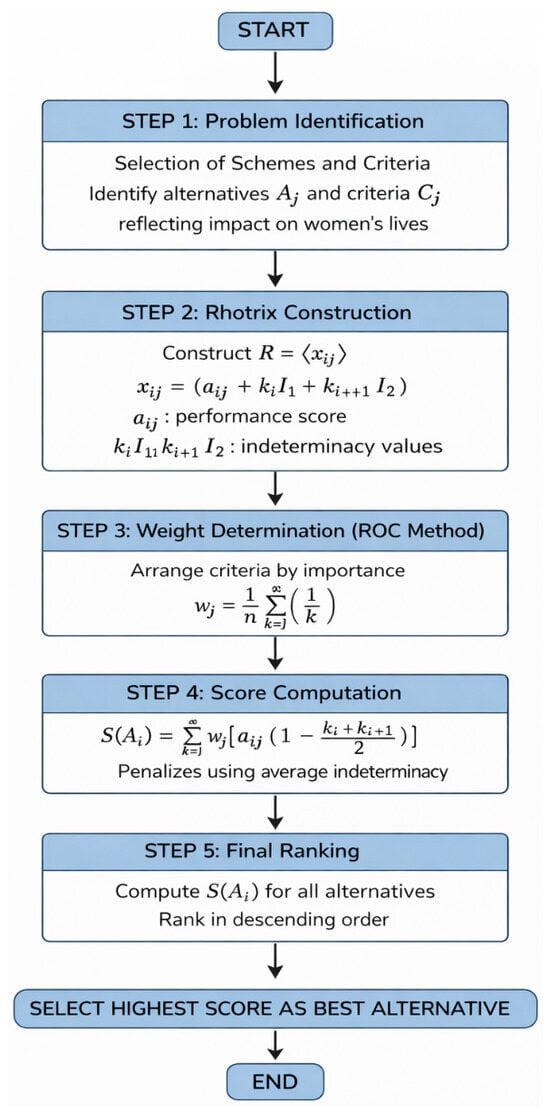
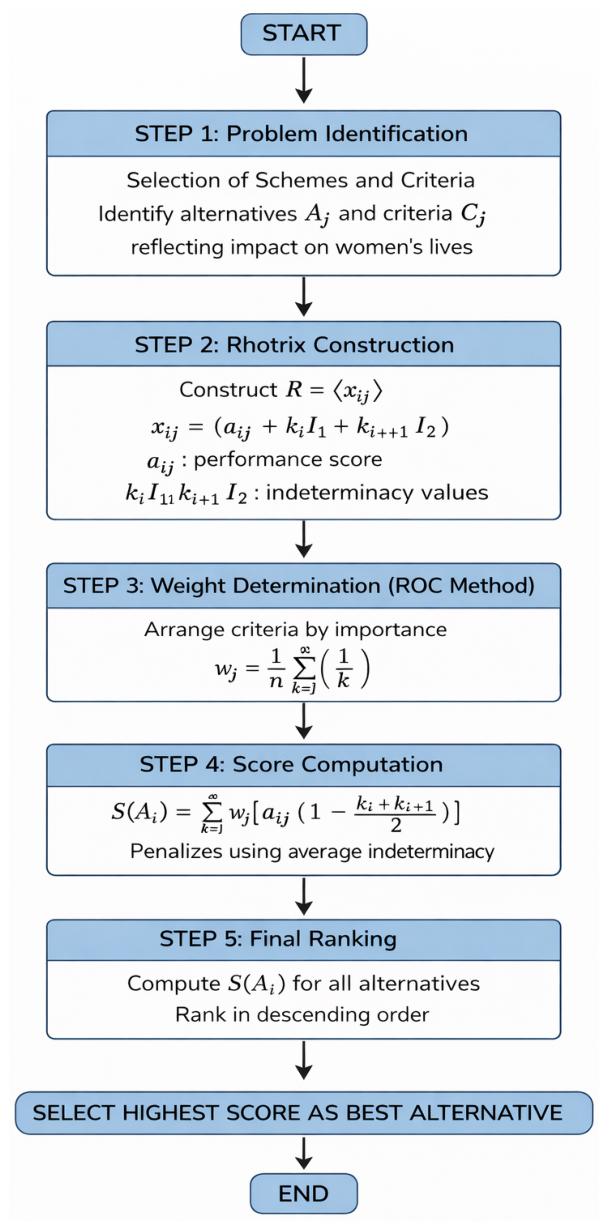
The overall procedure of the proposed refined neutrosophic rhotrix-based decision-making framework is summarized below. The sequence of steps involved in the evaluation process is illustrated through the flowchart (Figure 1).
Figure 1.
Flowchart for evaluating women-centric schemes using 2-refined neutrosophic rhotrix.
4.2. Numerical Implementation for Scheme Evaluation
In order to demonstrate the applicability of the proposed decision-making framework, the algorithm is applied to the evaluation of selected women empowerment schemes implemented by the Government of Tamil Nadu. The schemes are assessed with respect to relevant socio-economic criteria using the proposed 2-refined neutrosophic model.
The evaluation information provided by experts is represented in the form of a 2-refined neutrosophic decision rhotrix, where each entry captures the real-valued performance score along with two indeterminacy values corresponding to the uncertainty in expert judgments.
- Step 1: Selection of Schemes and Criteria
Scheme Selection: A set of women empowerment schemes is selected based on their performance in earlier evaluations using the Simple Additive Weighting (SAW) method reported in previous studies. Among the livelihood and educational schemes, the Magalir Urimai Thogai Scheme and Chief Minister’s Girl Child Protection Scheme are chosen as they obtained the highest SAW scores in the first and second study. In addition, the Sathiyavanimuthu Ammaiyar Ninaivu Free Supply of Sewing Machine Scheme is considered from the group of six livelihood or educational schemes as it recorded a positive SAW score in the overall assessment.
With respect to marriage assistance schemes, the E.V.R. Maniammaiyar Ninaivu Marriage Assistance Scheme for Daughters of Poor Widows and Dr. Muthulakshmi Reddy Ninaivu Inter-Caste Marriage Assistance Scheme are selected from the first and second study. Both schemes are included since they achieved the highest SAW scores in their respective analyses.
These selected schemes are treated as the alternatives for demonstrating the applicability of the proposed 2-refined neutrosophic decision-making framework.
Evaluation Criteria Selection: For schemes that primarily focus on educational advancement and livelihood enhancement, namely the Sathiyavanimuthu Ammaiyar Ninaivu Free Supply of Sewing Machine Scheme, the Magalir Urimai Thogai Scheme, and the Chief Minister’s Girl Child Protection Scheme, three evaluation criteria are considered.
- 1.
- Outcome efficiency: This criterion reflects the extent to which the scheme achieves its intended objectives, measured through the number of beneficiaries who receive support under the program.
- 2.
- Long-term viability: This criterion examines the durability and long-term impact of the scheme, including the duration and continuity of benefits provided to the beneficiaries.
- 3.
- Reachability: This criterion evaluates the ease with which eligible individuals can obtain the benefits of the scheme, taking into account the efficiency of administrative procedures and the time required for benefit delivery.
On the other hand, the E.V.R. Maniammaiyar Ninaivu Marriage Assistance Scheme for Daughters of Poor Widows and the Dr. Muthulakshmi Reddy Ninaivu Inter-Caste Marriage Assistance Scheme are designed to offer financial assistance related to marriage. Consequently, their evaluation is based on two criteria that reflect their socio-economic objectives.
- 1.
- Inclusive Social Development: This criterion measures the contribution of the schemes toward promoting social equity and supporting women belonging to marginalized or economically weaker sections of society.
- 2.
- Economic Empowerment: This criterion assesses the magnitude of financial support provided by the schemes and its role in alleviating the economic burden associated with marriage-related expenses.
- Step 2: Refined Neutrosophic Decision Rhotrix Construction
After identifying the relevant schemes and evaluation criteria, a decision rhotrix is constructed to represent the performance of each scheme with respect to the selected criteria. The decision rhotrix provides a structured framework in which rows correspond to the alternatives (schemes) and columns correspond to the evaluation criteria.
where and represents the performance value of education or livelihood-related schemes and marriage schemes with respect to their criterion, for and .
Each entry of the matrix reflects the evaluated score or rating of a scheme under the corresponding criterion. These values are obtained from Tamil Nadu Social Welfare Policy Notes.
This decision matrix serves as the fundamental input for the subsequent stages of the analysis, including assignment of weights to criteria, and the application of the rhotrix-based decision-making approach.
Since the actual values of the refined neutrosophic value are represented in various units, the normalization of the actual values must be computed. So, the normalized actual component is computed as, if the criterion is of benefit-type (i.e., a larger value is preferred),
If the criterion is of minimalization type (i.e., a smaller value is preferred like Reachability), the normalized value is given by
and the corresponding normalized refined neutrosophic value is
- Step 3: Determination of Criteria Weights using the ROC Method
For the schemes related to education and livelihood support, three evaluation criteria are considered. Based on their relative significance, the criteria are ordered and the corresponding weights are obtained using the Rank Order Centroid (ROC) method.
- For the criteria of livelihood or educational schemes,
- Long-term Viability—Rank 1;
- Outcome Efficiency—Rank 2;
- Reachability—Rank 3.
| Criterion | Weight |
| Long-Term Viability | 0.611 |
| Outcome Efficiency | 0.278 |
| Reachability | 0.111 |
- For the criteria of marriage assisting schemes,
- Social Inclusion and Empowerment—Rank 1;
- Economic Advancement—Rank 2.
| Criterion | Weight |
| Social Inclusion and Empowerment | 0.75 |
| Economic Advancement | 0.25 |
The assigned weight distribution reflects a stronger emphasis on long-term social empowerment outcomes compared to immediate financial assistance. Such prioritization is consistent with the broader objective of evaluating the transformative impact of women-oriented welfare initiatives.
- Step 4: Score Computation, Result Analysis, and Interpretation
Using the proposed refined neutrosophic evaluation framework, the final scores of the selected schemes are obtained as follows:
| Scheme | Score |
| Magalir Urimai Thogai Scheme | 0.6084 |
| Chief Minister’s Girl Child Protection Scheme | 0.0797 |
| Sathiyavanimuthu Ammaiyar Ninaivu Free Supply of Sewing Machine Scheme | 0.3666 |
| E.V.R. Maniammaiyar Ninaivu Marriage Assistance Scheme for Daughters of Poor Widows | 0.525 |
| Dr. Muthulakshmi Reddy Ninaivu Inter-Caste Marriage Assistance Scheme | 0.1875 |
The obtained scores reflect the overall performance of each scheme after incorporating the normalized performance values, the weights of the evaluation criteria, and the indeterminacy components derived from expert opinions.
The proposed framework is not limited to the present case study and can be extended to applications such as healthcare decision-making, resource allocation, and policy evaluation under uncertainty.
5. Discussion
Among the evaluated livelihood and educational programs, the Magalir Urimai Thogai Scheme stands out with a leading score of . This suggests superior performance in reach, long-term sustainability, and outcome efficiency compared to its peers. Meanwhile, the Sathiyavanimuthu Ammaiyar Ninaivu Free Supply of Sewing Machine Scheme earned a moderate , reflecting a steady contribution to economic self-reliance. Conversely, the Chief Minister’s Girl Child Protection Scheme received a lower score of , pointing to the need for optimization under the specific metrics of this analytical framework.
Regarding marriage-related support, the E.V.R. Maniammaiyar Ninaivu Marriage Assistance Scheme for Daughters of Poor Widows achieved a significant score of 0.525, underscoring its efficacy in fostering social empowerment. In contrast, the Dr. Muthulakshmi Reddy Ninaivu Inter-Caste Marriage Assistance Scheme produced a score of 0.1875, suggesting that its impact remains moderate within the current evaluation criteria.
The rankings generated by this refined neutrosophic decision model effectively highlight which programs excel even when accounting for the inherent uncertainty of expert assessments. By providing a structured lens through which to view government welfare, this methodology serves as a robust tool for policymakers aiming to prioritize initiatives with the highest socio-economic returns.
The comparison in Table 1 highlights that refined neutrosophic rhotrices provide a more expressive and flexible framework for modeling uncertainty, while preserving the structural advantages of rhotrix theory. In particular, the rhomboidal structure of rhotrices allows the decomposition of alternatives into distinct groups that can be evaluated independently when the corresponding criteria are not interdependent. This facilitates parallel analysis and reduces computational complexity in multi-criteria decision-making problems.
Table 1.
Comparison of matrices, rhotrices, and refined neutrosophic rhotrices.
Novelty, Limitations, and Future Research Directions
Novelty of the Proposed Work. The present study introduces a novel extension of rhotrix theory into the refined neutrosophic domain by incorporating multiple indeterminacy components within each entry. Unlike classical rhotrices and single-valued neutrosophic models, the proposed framework enables a more detailed representation of uncertainty.
Furthermore, the work establishes conditions for invertibility under heart-based multiplication and investigates the associated algebraic structure. The integration of refined neutrosophic rhotrices into a multi-criteria decision-making framework, combined with the use of ROC-based weighting, provides a unified approach for handling uncertainty, indeterminacy, and structured aggregation.
Limitations of the Study. Despite its contributions, the proposed approach has certain limitations. The algebraic structure based on heart-based multiplication imposes restrictions on certain properties, such as the existence of non-trivial idempotent elements, which are more flexible in classical matrix theory.
Future Research Directions. Future work may focus on extending the algebraic analysis of refined neutrosophic rhotrices by exploring additional properties such as spectral characteristics, decomposition methods, and alternative multiplication schemes.
From an application perspective, the proposed model can be applied to more complex real-world decision-making problems, including large-scale group decision-making and dynamic systems. Further research may also investigate the use of alternative weighting techniques and compare their impact on decision outcomes.
In addition, developing efficient computational algorithms and software implementations for refined neutrosophic rhotrix operations would enhance the practical applicability of the proposed framework.
6. Conclusions
The theory of rhotrices advances by introducing invertible refined neutrosophic rhotrices specifically designed for heart-based multiplication. By embedding refined neutrosophic components into the rhotrix architecture, the model effectively represents complex numerical data alongside multiple layers of indeterminacy. Through this investigation, we established the necessary conditions for the existence of inverses and analyzed the structural behavior of these rhotrices under fundamental operations such as addition and heart-based multiplication. This study also establishes a general characterization of the rhotrix index set and demonstrates that it possesses an inherent symmetry under the interchange of indices. This structural symmetry provides a clearer understanding of the arrangement of rhotrix elements and contributes to the theoretical development of rhotrix algebra. Ultimately, these results bridge the gap between classical rhotrix algebra and real-world environments characterized by uncertainty and incomplete information.
To validate the practical utility of this mathematical framework, we applied it to a decision-making scenario involving several women empowerment initiatives. The methodology involved constructing a refined neutrosophic decision matrix, determining criteria weights via the Rank Order Centroid (ROC) method, and ranking the schemes through a specialized score function. The resulting analysis highlighted the Magalir Urimai Thogai Scheme (with a leading score of ) and the E.V.R. Maniammaiyar Ninaivu Marriage Assistance Scheme for Daughters of Poor Widows (scoring ) as the most impactful programs in their respective categories. These findings confirm that the refined neutrosophic approach provides a more nuanced and reliable hierarchy for evaluating complex social welfare programs. Overall, the developed framework highlights the potential of refined neutrosophic rhotrices as an effective mathematical tool for modeling and evaluating complex decision-making problems characterized by indeterminacy, while simultaneously enriching the algebraic foundations of rhotrix theory.
Author Contributions
Conceptualization, S.J. and P.G.; methodology, S.J. and P.G.; validation, S.J., P.G., A.P.B. and C.A.; formal analysis, S.J.; investigation, S.J., P.G., A.P.B. and C.A.; resources, P.G., A.P.B. and C.A.; data curation, P.G., A.P.B. and C.A.; writing—original draft preparation, S.J. and P.G.; writing—review and editing, A.P.B. and C.A.; supervision, S.J. and P.G.; project administration, S.J. and P.G. All authors have read and agreed to the published version of the manuscript.
Funding
This research received no external funding.
Data Availability Statement
The data utilized in this research are sourced from public administrative records provided by the Social Welfare and Women Empowerment Department of the Government of Tamil Nadu. Specifically, the analysis draws upon the Policy Notes for the financial years 2024–25 and 2025–26, which are accessible through the state’s official documentation portal at https://cms.tn.gov.in/cms_migrated/document/docfiles/swwe_e_pn_2024_25.pdf (accessed on 6 August 2025) and https://cms.tn.gov.in/cms_migrated/document/docfiles/swwe_e_pn_2025_26.pdf (accessed on 6 August 2025).
Conflicts of Interest
The authors declare no conflicts of interest.
References
- Ajibade, A.O. The concept of rhotrix in mathematical enrichment. Int. J. Math. Educ. Sci. Technol. 2003, 34, 175–179. [Google Scholar] [CrossRef] [Scilit]
- Absalom, E.; Ezugwu, E.; Ajibade, A.O.; Mohammed, A. Generalization of heart-oriented rhotrix multiplication and its algorithm implementation. Int. J. Comput. Appl. 2011, 975, 8887. [Google Scholar] [CrossRef] [Scilit]
- Sani, B. An alternative method for multiplication of rhotrices. Int. J. Math. Educ. Sci. Technol. 2004, 35, 777–781. [Google Scholar] [CrossRef] [Scilit]
- Sani, B. Conversion of a rhotrix to a coupled matrix. Int. J. Math. Educ. Sci. Technol. 2008, 39, 244–249. [Google Scholar] [CrossRef] [Scilit]
- Isere, A.O. Even dimensional rhotrix. Notes Number Theory Discret. Math. 2018, 24, 125–133. [Google Scholar] [CrossRef] [Scilit]
- Tudunkaya, S.M. An Extension of Certain Construction of Finite Groups. Niger. J. Sci. Res. 2018, 17, 367–371. [Google Scholar]
- Mohammed, A.; Okon, U.E. On subgroups of non-commutative general rhotrix group. Notes Number Theory Discret. Math. 2016, 22, 72–90. [Google Scholar]
- Mohammed, A. The non-commutative full rhotrix ring and its subrings. Sci. World J. 2018, 13, 24–36. [Google Scholar]
- Aminu, A. Rhotrix vector spaces. Int. J. Math. Educ. Sci. Technol. 2010, 41, 531–538. [Google Scholar] [CrossRef] [Scilit]
- Dhiman, N.; Shalni; Gupta, S. Exploring rhotrix free modules: Definition and characteristics. Afr. Mat. 2026, 37, 9. [Google Scholar] [CrossRef] [Scilit]
- Ananda Priya, B.; Gnanachandra, P.; Seenivasan, M. AI-Driven Innovations in Cryptography: Enhancing Key Generation and Security. E3S Web Conf. 2023, 399, 08001. [Google Scholar] [CrossRef] [Scilit]
- Gnanachandra, P.; Ananda Priya, B.; Seenivasan, M. Quaternionic Rhotrix Groups: A New Paradigm for Key Exchange and Encryption Algorithms. In Fourth International Conference on Advances in Electrical, Computing, Communication and Sustainable Technologies (ICAECT); IEEE: New York, NY, USA, 2024. [Google Scholar] [CrossRef] [Scilit]
- Smarandache, F. Neutrosophic set—A generalization of the intuitionistic fuzzy set. In Granular Computing, 2006 IEEE International Conference; IEEE: New York, NY, USA, 2006; pp. 38–42. [Google Scholar] [CrossRef] [Scilit]
- Smarandache, F. A geometric interpretation of the refined neutrosophic set—A generalization of the intuitionistic fuzzy set. In Granular Computing (GrC), IEEE International Conference; IEEE: New York, NY, USA, 2011; pp. 602–606. [Google Scholar] [CrossRef] [Scilit]
- Vasantha Kandasamy, W.B.; Kandasamy, I.; Smarandache, F. Neutrosophic quadruple vector spaces and their properties. Mathematics 2019, 7, 758. [Google Scholar] [CrossRef] [Scilit]
- Vasantha Kandasamy, W.B.; Kandasamy, I.; Smarandache, F. Semi-Idempotents in neutrosophic Rings. Mathematics 2019, 7, 507. [Google Scholar] [CrossRef] [Scilit]
- Vasantha Kandasamy, W.B.; Smarandache, F. Neutrosophic Super Matrices and Quasi Super Matrices; Zip Publishing: Grandview Heights, OH, USA, 2012. [Google Scholar]
- Agboola, A.A.A. On Refined Neutrosophic Algebraic Structures. Neutrosophic Sets Syst. 2015, 10, 99–101. [Google Scholar]
- Sankari, H.; Abobala, M. n-Refined Neutrosophic Modules. Neutrosophic Sets Syst. 2020, 36, 1–11. [Google Scholar]
- Ibrahim, M.A.; Agboola, A.A.A.; Badmus, B.S.; Akinleye, S.A. On Refined Neutrosophic Vector Spaces. Int. J. Neutrosophic Sci. 2020, 7, 97–109. [Google Scholar] [CrossRef] [Scilit]
- Abobala, M. On Refined Neutrosophic Matrices and their Applications in Refined Neutrosophic Algebraic Equations. J. Math. 2021, 2021, 5531093. [Google Scholar] [CrossRef] [Scilit]
- Wang, C.N.; Viet, V.T.H.; Ho, T.P.; Nguyen, V.T.; Nguyen, V.T. Multi-Criteria Decision Model for the Selection of Suppliers in the Textile Industry. Symmetry 2020, 12, 979. [Google Scholar] [CrossRef] [Scilit]
- Wang, C.N.; Nguyen, V.T.; Kao, J.-C.; Chen, C.-C.; Nguyen, V.T. Multi-Criteria Decision-Making Methods in Fuzzy Decision Problems: A Case Study in the Frozen Shrimp Industry. Symmetry 2021, 13, 370. [Google Scholar] [CrossRef] [Scilit]
- Ananda Priya, B.; Gnanachandra, P. Refined Neutrosophic Rhotrix: A Novel Algebraic Model for Complex Uncertainty. Bol. Soc. Parana. Mat. 2026, 44, 1–7. [Google Scholar] [CrossRef]
- Ananda Priya, B.; Gnanachandra, P. Reforming Decision Models and Assessing the Impact of State Schemes on Rural Women’s Social Development. Bol. Soc. Parana. Mat. 2025, 43, 1–9. [Google Scholar] [CrossRef] [Scilit]

Disclaimer/Publisher’s Note: The statements, opinions and data contained in all publications are solely those of the individual author(s) and contributor(s) and not of MDPI and/or the editor(s). MDPI and/or the editor(s) disclaim responsibility for any injury to people or property resulting from any ideas, methods, instructions or products referred to in the content. |
© 2026 by the authors. Licensee MDPI, Basel, Switzerland. This article is an open access article distributed under the terms and conditions of the Creative Commons Attribution (CC BY) license.