


Abstract
With the increasing integration of transportation and energy systems, highway energy replenishment facilities are gradually evolving into hybrid refueling stations that integrate photovoltaic generation, energy storage, battery charging, and hydrogen refueling. However, due to differences in resource conditions across stations, independently operated hybrid refueling stations find it difficult to simultaneously improve overall economic performance and renewable energy utilization. To address this issue, this paper investigates the coordinated operation and distributed optimization of highway hybrid refueling stations. First, an inter-station hydrogen–carbon–green certificate trading framework is established, and a trading model for a cluster of hybrid refueling stations is then developed on this basis. Then, the inter-station trading problem is decomposed into two subproblems: symmetric trading volume determination and asymmetric Nash bargaining-based price determination. These two subproblems are solved in a distributed manner using the alternating direction method of multipliers. In addition, a hydrogen transportation model is developed to translate trading decisions into feasible transportation arrangements under highway network and hydrogen tube trailer scheduling constraints. Finally, the case study demonstrates that the proposed model enables multi-resource sharing among hybrid refueling stations, reduces the overall system cost by 21.30%, and achieves a fairer distribution of benefits among stations.
1. Introduction
With the advancement of new energy technologies and the increasing electrification of the transportation sector, transportation infrastructure is gradually evolving from a traditional single-energy consumption node into an integrated energy supply node [1]. Multi-energy coordination has become a prominent feature of this transition [2]. As an important component of this transformation, highway energy replenishment facilities are no longer limited to conventional battery charging or hydrogen refueling functions. Instead, they are increasingly integrating photovoltaic (PV) generation, energy storage, hydrogen production, and other technologies, thereby forming hybrid refueling stations (HRSs) with pronounced multi-energy coupling characteristics [3]. In the long-distance and relatively enclosed operating environment of highways, such stations can simultaneously provide electricity and hydrogen, thereby meeting the diversified energy demands of different vehicle types [4]. Meanwhile, highways also offer considerable potential for the local development and utilization of renewable energy [5]. Through the deployment of PV generation and energy storage facilities, the flexibility and reliability of highway energy supply can be significantly improved, while dependence on external energy sources can be reduced. Under this multi-energy supply structure, differences in resource conditions and operational requirements across stations further increase the need for inter-station coordination [6].
In the highway context, HRSs are typically distributed across the road network and exhibit substantial differences in resource conditions, traffic load levels, and equipment capacities across stations. This spatial dispersion and station heterogeneity often result in varying degrees of supply–demand mismatch during operation. Under an independent optimization framework, each HRS makes operational decisions primarily based on its own resource conditions and equipment constraints, making it difficult to fully exploit the complementary potential among stations. As a result, both the overall performance of the HRS cluster and the utilization of renewable energy are constrained [7]. Therefore, it is necessary to optimize the operation of HRSs from a cluster-wide perspective in order to improve resource allocation through inter-station coordination.
At present, existing studies on the system modeling and optimal operation of HRSs have mainly focused on multi-energy coupling mechanisms within individual stations, equipment and energy balance constraints, and economic operation strategies. In Ref. [8], a hydrogen energy storage system is introduced into electric vehicle fast-charging stations to alleviate the operational pressure caused by fast-charging loads, thereby mitigating their impact on distribution network voltage while satisfying charging demand. In Ref. [9], a capacity planning model for an integrated charging microgrid in highway service areas is developed, with systematic consideration of seasonal variations in traffic load and renewable energy output. In Ref. [10], a capacity configuration and operational evaluation model for HRSs under renewable energy supply conditions is established, and the system structure and operating performance of HRSs are analyzed. However, these studies remain primarily focused on intra-station scheduling and equipment output optimization. In the context of multiple HRSs distributed along highways and exhibiting significant differences in resource conditions across stations, single-station independent optimization is insufficient to support cross-station resource complementarity and improve the overall performance of the station cluster.
In terms of collaboration among multiple HRSs, existing studies have generally aimed to improve overall resource utilization. In Ref. [11], multiple HRSs are treated as a collaborative unit, and the controllable energy facilities of each station are coordinated through an energy aggregator, thereby enabling coordinated energy management and optimal scheduling among multiple HRSs. Ref. [12] shows that the independent operation of a single HRS may lead to temporal and spatial mismatches between energy supply and demand, resulting in resource waste. Accordingly, an inter-station collaborative strategy is developed to improve life-cycle economic performance and resource utilization. In Ref. [13], a multilateral electricity–hydrogen trading framework for multiple renewable-dominated HRSs is proposed to enhance overall system efficiency and low-carbon synergy. Furthermore, in the collaborative operation of multiple HRSs, incorporating carbon emission constraints and green certificate mechanisms into the optimization framework can encourage stations to jointly consider economic costs and carbon reduction responsibilities during scheduling, thereby improving the low-carbon performance of the overall operational scheme [14]. Nevertheless, current research on inter-station collaboration remains limited, and a unified trading mechanism that simultaneously incorporates hydrogen, carbon, and green certificates has not yet been established. Therefore, it is necessary to develop an inter-station hydrogen–carbon–green certificate coupled trading framework for multiple highway HRSs in order to further enhance the coordination capability and operational performance of the station cluster.
Inter-station trading among HRSs generally involves two closely related aspects. The first is trading volume determination, which refers to the scale of trade between HRSs under operational and physical constraints. The second is price determination and benefit allocation, which concerns how to reflect the bargaining power and contribution level of each participant through appropriate pricing and allocation mechanisms based on the determined trading volume. When these two aspects are modeled in a strongly coupled manner, the resulting model is typically highly nonlinear, thereby increasing the difficulty of model analysis and solution. To address this issue, a decomposition strategy that separates volume determination from price determination is often adopted [15]. In Ref. [16], a two-stage peer-to-peer energy sharing trading method is proposed, in which the first stage determines the optimal electricity trade volume among participants within the community, and the second stage determines the optimal price. Similarly, Ref. [17] develops a two-stage peer-to-peer trading framework in which the first stage optimizes the trade volume between buyers and sellers, while the second stage submits the cleared trades to the electricity retailer for security verification. However, in alliance scenarios characterized by asymmetric bargaining power and unequal contributions, such methods may have difficulty balancing fairness and participant heterogeneity. Ref. [18] investigates the energy pricing problem of HRSs in a multi-market environment based on a master-slave game, demonstrating the applicability of hierarchical game-based pricing strategies to hydrogen-related trade. By contrast, Ref. [19] develops an asymmetric Nash bargaining model for the operation optimization of multiple integrated energy systems with peer-to-peer energy trading, showing its effectiveness in coordinating decentralized participants with heterogeneous interests. Overall, in multi-party inter-station trading problems, trading volume determination and price determination can be treated as two interrelated stages, with the pricing mechanism designed according to the specific trading scenario. Compared with the Stackelberg game, asymmetric Nash bargaining is better able to capture differences in bargaining power and resource contributions among participants and is therefore adopted in this paper for price determination and benefit allocation in highway HRS trading.
HRSs are usually invested in and operated independently by different entities. Distributed along the road network, these stations exhibit significant differences in traffic flow intensity, load characteristics, renewable energy access conditions, and equipment configurations. Before conducting collaborative decision-making for an HRS cluster, it is necessary to clarify both the cluster architecture and the corresponding inter-station trading framework in order to provide a basis for subsequent collaborative operation and trading decisions. Inter-station trading mainly involves two interrelated aspects: trading volume determination, and price determination and benefit allocation. To address these issues, this paper adopts a two-stage modeling framework. In the first stage, trading volumes are determined under operational constraints. In the second stage, price determination and benefit allocation are carried out through asymmetric Nash bargaining based on the obtained trading volumes. To accommodate multi-agent autonomy, a distributed solution method is employed for inter-station trading, thereby enabling consistent trading outcomes under limited information exchange. Considering that inter-station hydrogen exchange depends on actual transportation processes, a hydrogen transportation scheduling model is further developed based on the trading volume results to support the physical execution of inter-station trade. On this basis, this paper proposes an optimal operation method for hydrogen–carbon–green certificate trading in highway HRSs based on asymmetric Nash bargaining. Compared with existing studies, this paper incorporates hydrogen, carbon emission rights, and green certificate mechanisms into the inter-station collaborative operation of multiple highway HRSs. As a result, inter-station collaboration is oriented not only toward hydrogen sharing, but also toward operational economy and low-carbon requirements. Meanwhile, differences among stations in resource conditions, trade contributions, and bargaining positions are further reflected in trade pricing and benefit allocation, enabling the results to better capture the actual role of each station in collaborative operation.
- A hydrogen–carbon–green certificate trading framework for highway HRSs is proposed. Based on this framework, an optimal operation model is developed by incorporating objective functions, operational constraints, and a carbon-green linkage mechanism, thus providing the basis for subsequent collaborative trading among multiple HRSs.
- The inter-station trading problem among multiple HRSs is decomposed into two subproblems and solved sequentially. In Subproblem 1, a symmetric trading structure is established to generate a feasible resource trading scheme. In Subproblem 2, an asymmetric Nash bargaining mechanism is introduced to quantify the influence of differences in HRS contributions on price determination and benefit allocation. The alternating direction method of multipliers (ADMM) is employed to solve the two subproblems, enabling the inter-station trading results to gradually reach consensus under limited information exchange.
- Based on the determined trading volumes, a hydrogen transportation model is further developed by considering the highway network, hydrogen tube trailer (HTT) dispatch, and transportation constraints. Inter-station hydrogen trading is then implemented through specific transportation plans, and the operating strategies of individual HRSs are adjusted accordingly.
The remainder of this paper is organized as follows. Section 2 introduces the hydrogen–carbon–green certificate coupled trading mechanism for highway HRSs. Section 3 formulates the optimal operation model of individual HRSs. Section 4 develops the inter-station trading model based on asymmetric Nash bargaining and the corresponding distributed solution method based on ADMM. Section 5 further establishes the hydrogen transportation scheduling model based on the trading results. Section 6 presents the case studies and discussion. Section 7 concludes the paper.
2. Hydrogen–Carbon–Green Certificate Trading Mechanism for Highway HRSs
In the highway context, where transportation and energy systems are closely coupled, the operating costs of HRSs are influenced not only by electricity prices, but also by the combined effects of carbon emission rights and green certificate mechanisms. To address this issue, this paper introduces a hydrogen–carbon–green certificate coupled trading mechanism for multiple HRSs, incorporating hydrogen sharing, carbon emission rights, and green certificates into inter-station trading and thereby providing a more comprehensive low-carbon and economically efficient operational approach for highway HRSs. Overall, the role of this coupled trading mechanism is reflected in three main aspects. First, inter-station hydrogen sharing helps alleviate spatial and temporal supply–demand imbalances, improve the effective utilization of PV output, and enhance energy security. Second, carbon emission rights and green certificate trading allow HRSs with stronger emission reduction potential and lower abatement costs to undertake a larger share of the reduction burden, thereby lowering the overall low-carbon operating cost of the system. Third, when carbon deficits expand and enter higher-price intervals, inter-station green certificate trading can reduce the purchase of carbon quotas in these intervals through the carbon-green linkage offset mechanism, thereby easing the pressure of rapidly increasing carbon costs. It should also be noted that hydrogen, carbon emission rights, and green certificates are not independent of each other. Hydrogen trading can further affect the carbon emission levels and green certificate acquisition of HRSs by influencing hydrogen production and electricity purchases. In addition to reducing certificate-related costs, green certificates can also be used under the carbon-green linkage mechanism to offset part of carbon emissions. Therefore, the three components are coupled at both the operational and cost levels.
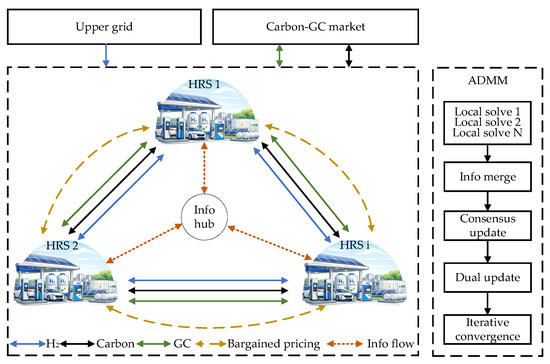
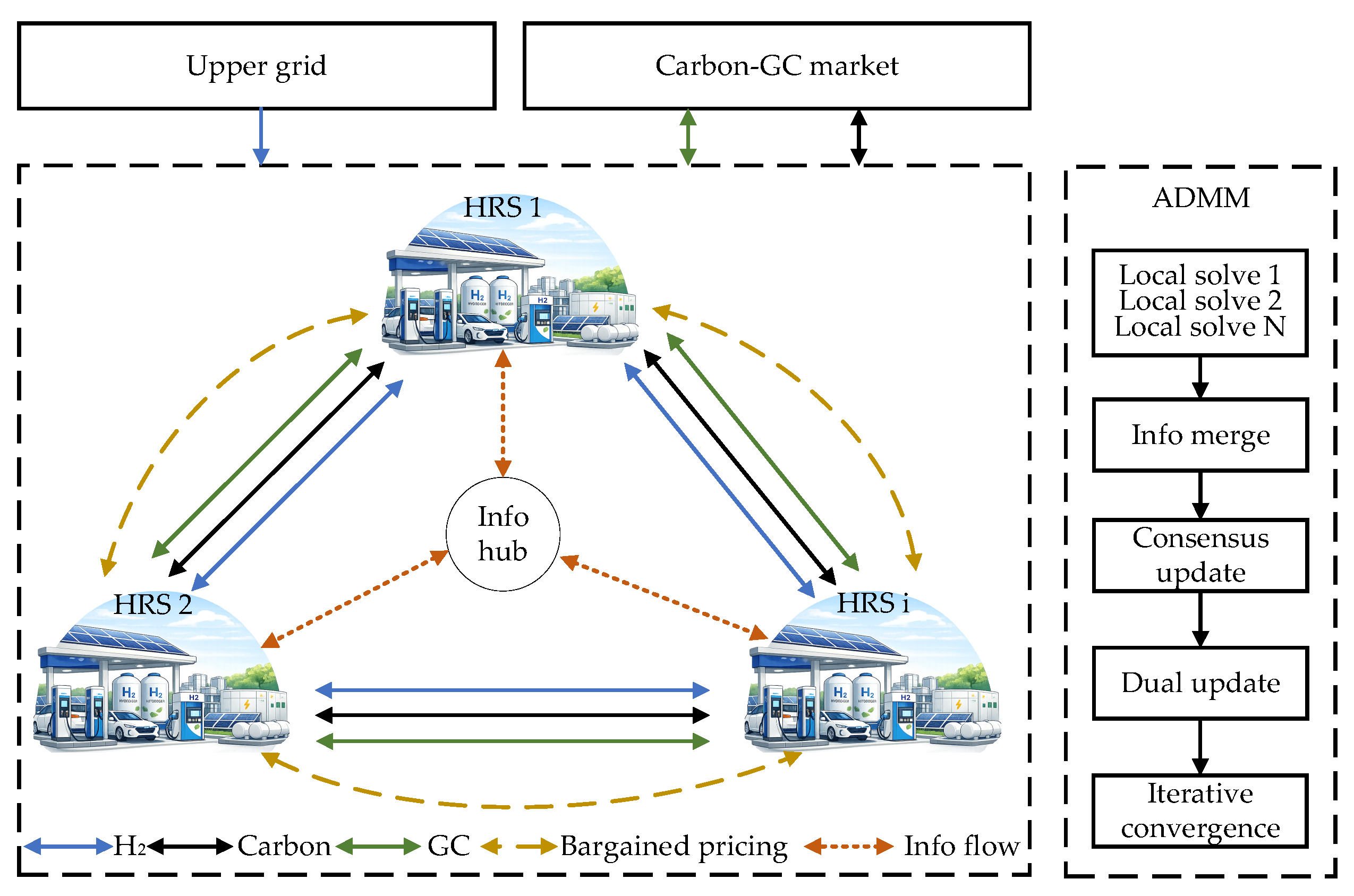
As shown in Figure 1, the hydrogen–carbon–green certificate coupled trading framework for highway HRSs proposed in this paper mainly consists of four parts: intra-station operation, trade volume determination, trade price determination, and distributed solution. First, during intra-station operation, each HRS is driven by charging and hydrogen refueling demand and forms its own scheduling plan, thereby determining the supply–demand conditions of each station for subsequent inter-station trading. Second, inter-station trading introduces three types of elements—hydrogen, carbon emission rights, and green certificates—to achieve point-to-point resource redistribution within the HRS cluster. Compared with single-element trading methods, the mechanism proposed in this paper places greater emphasis on the linkage among multiple elements. Accordingly, the inter-station trading process is decomposed into a trade volume subproblem and a trade price subproblem. Based on the determined trade volumes, inter-station trade prices are determined through asymmetric Nash bargaining. The bargaining weights are used to reflect differences in HRS contributions and resource conditions, so that the resulting prices can better capture the actual role of each station in collaborative operation. Finally, ADMM is employed to decompose the global problem into local subproblems that can be solved in parallel by each station, while gradually coordinating trade volumes and prices through limited exchange of consensus information. By dividing the inter-station trading problem into two subproblems—trade volume determination and trade price determination—and adopting a distributed solution approach, the computational complexity of the model can be reduced, and the burden of centralized solution can be alleviated. Therefore, the proposed framework can be extended to larger station networks while remaining compatible with the requirements of data privacy and decision-making autonomy in multi-agent scenarios.
Figure 1.
Schematic diagram of the hydrogen–carbon–green certificate trading mechanism for highway HRSs.
3. Optimal Operation Model of HRSs
The HRS considered in this paper comprises charging facilities, hydrogen refueling facilities, battery energy storage, hydrogen storage, hydrogen production units, fuel cells, and HTTs, with its structural configuration detailed in [20].
3.1. HRS Optimization Objective
The operating cost of each HRS mainly consists of electricity purchasing cost, energy supply penalty cost, carbon emission cost, and green certificate procurement cost, as expressed in (1):
where and represent the electricity purchasing cost and the penalty cost for energy non-supply, respectively, represents the carbon trading cost, and represents the green certificate acquisition cost, T represents the set of scheduling periods, j denotes the index of HRSs, and t denotes the time.
The electricity purchasing cost and the penalty cost are given in (2) and (3):
where represents the time-of-use electricity price, denotes the purchased electricity quantity, and respectively stand for the penalty prices for failure to supply electric energy and hydrogen energy, while and respectively represent the unsupplied electric energy and unsupplied hydrogen energy.
3.2. Carbon and Green Certificate Linkage Mechanism
Under the framework of tiered carbon trading and green certificate trading, a carbon–green certificate linkage mechanism is further introduced, whereby surplus green certificates can not only be traded independently but also be used to offset carbon emissions according to predetermined rules, thereby enhancing the synergistic effect of the two policy instruments [21].
3.2.1. Tiered Carbon Trading Model
The tiered carbon trading mechanism is characterized by dividing the carbon emission rights trading volume borne by the system during the dispatch period into multiple intervals and assigning progressively increasing carbon prices to different intervals, thereby reflecting the policy principle that higher emissions incur stronger marginal penalties [22]. The carbon emission volume of HRSs participating in carbon trading is defined in (4).
where represents the carbon emission allowance obtained by the system, is the inter-station carbon trading volume, is the carbon emissions from purchasing electricity, is the carbon emission coefficient corresponding to purchasing electricity from the main grid, and is the power of electricity purchased.
Under the tiered pricing scheme, the carbon trading cost is formulated as a piecewise function, as shown in (6).
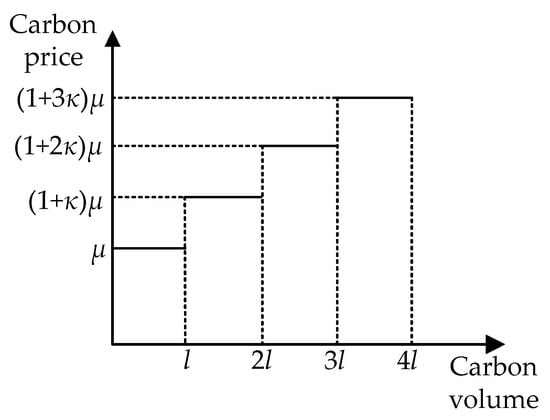
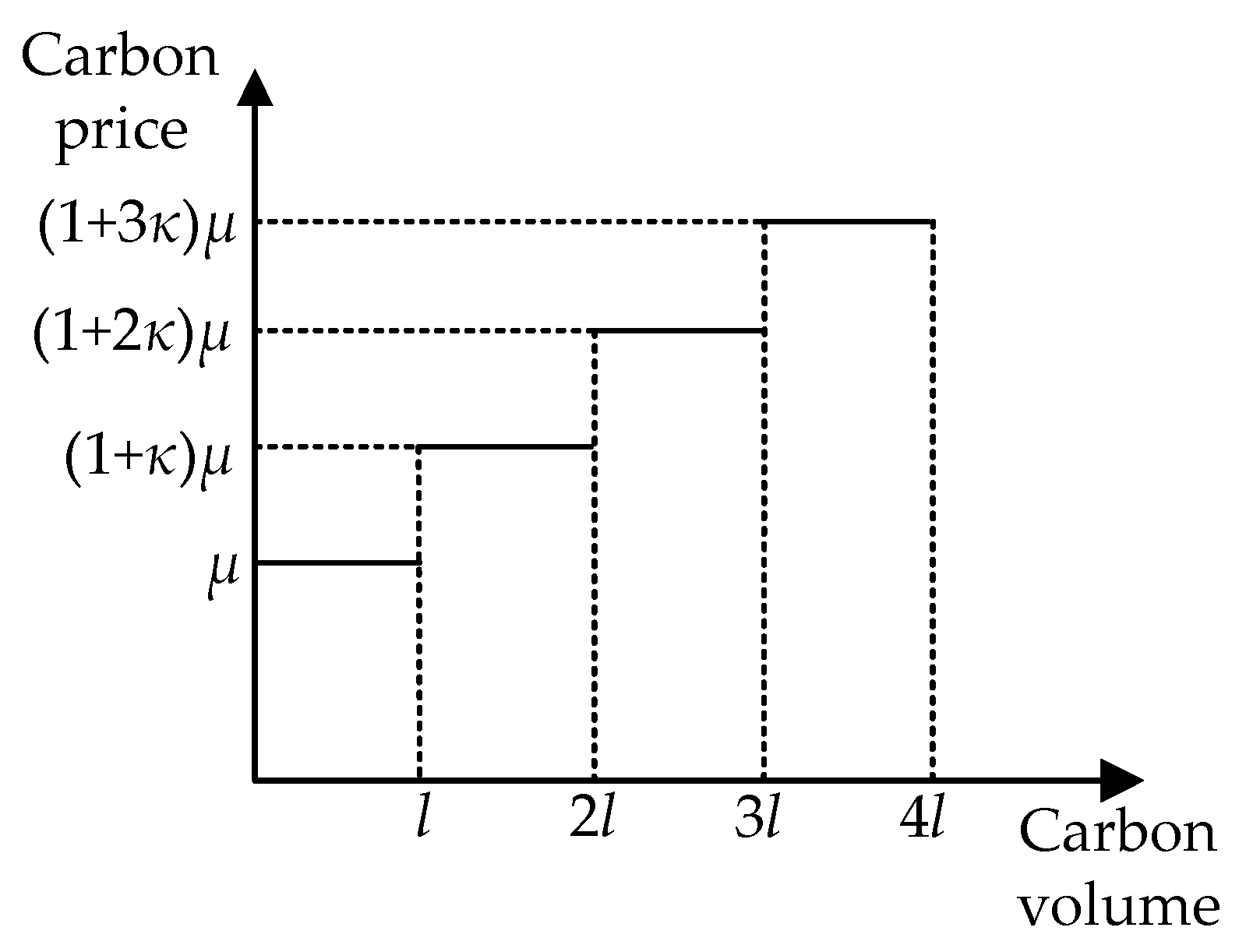
where represents the base carbon price, denotes the carbon price growth rate, and signifies the length of each carbon emission interval. This tiered carbon pricing structure ensures that, once an HRS enters a higher carbon price interval, the marginal cost of additional carbon emissions rises rapidly, thereby driving the scheduling strategy toward low-carbon operation. To illustrate the corresponding tiered carbon price more intuitively, a schematic diagram is provided in Figure 2.
Figure 2.
Schematic diagram of carbon price under the tiered carbon pricing mechanism.
3.2.2. Green Certificate Trading Model
The essence of the green certificate trading mechanism lies in the certification and market-based valuation of the system’s contribution to renewable energy consumption. Its cost model is given as follows:
where denotes the purchase price of green certificates, represents the green certificate quota required under the renewable energy quota system, and is the number of green certificates obtained through the consumption of renewable energy, as defined in (8). denotes the green certificate conversion coefficient, and represents the renewable energy output.
3.2.3. Carbon–Green Certificate Linkage Model
Under the tiered carbon pricing scheme, the linear returns generated by green certificate trading are often insufficient to offset the cost of excess emissions. To address this issue, a carbon–green certificate linkage mechanism is introduced, under which surplus green certificates can not only be traded independently but also be used, according to predefined rules, to offset a portion of carbon emissions, thereby reducing the high emission cost incurred under tiered carbon pricing. Under this mechanism, the actual carbon emissions after linkage can be expressed as follows:
where denotes the conversion factor between green certificates and carbon emissions, represents the amount of carbon emissions offset, and is the actual carbon emission level after linkage. The quantity is then substituted into (4) in place of . Accordingly, the carbon–green certificate linkage trading cost can be obtained as shown in (11).
where denotes the tiered carbon trading cost recalculated based on the linked emission accounting quantity .
3.3. HRS Operation Constraints
The operational constraints of HRSs can be categorized into three types: energy balance constraints, equipment operating boundary constraints, and energy storage state constraints. First, the HRS must satisfy the supply–demand balance of both electricity and hydrogen at all times, thereby ensuring energy conservation among external electricity purchases, PV generation, energy storage charging and discharging, and electricity–hydrogen conversion processes. Second, both electrical and hydrogen energy storage systems must satisfy the recursive state equations of energy storage, while their feasible operating ranges as well as initial and terminal states are constrained. Third, the coupling devices, including electrolyzers and fuel cells, must satisfy the energy conversion efficiency relationships and be limited by their rated power and installed capacities. All hydrogen-side variables are expressed on an energy basis rather than a mass basis, so that they are dimensionally consistent with the electric-side variables in the coupling constraints. The detailed mathematical formulations of the above constraints are given as follows.
For each HRS and time period , the electric power balance is expressed as
subject to
where and are the discharging and charging powers of the battery energy storage system, is the electric power generated by the fuel cell, is the unsupplied electric load, is the charging load, is the electric power consumed by the electrolyzer, and is the upper limit of purchased electricity.
where is the hydrogen produced by the electrolyzer, and are the hydrogen discharged from and charged into the hydrogen storage system, and denote the hydrogen inflow to and outflow, respectively, is the unsupplied hydrogen demand, is the hydrogen refueling demand, and is the hydrogen consumed by the fuel cell.
The battery energy storage system satisfies
where is the stored energy of the battery energy storage system, and are the charging and discharging efficiencies, is the initial-terminal storage ratio, is the installed energy capacity of battery storage, and and are the upper charging and discharging power limits, respectively.
The hydrogen storage system is described by
where is the hydrogen inventory of the hydrogen storage system, is the initial-terminal hydrogen storage ratio, is the storage capacity of the hydrogen storage system, and and are the upper charging and discharging flow limits, respectively.
The electrolyzer and fuel cell satisfy
where is the conversion efficiency of the electrolyzer, is the installed capacity of the electrolyzer, is the conversion efficiency of the fuel cell, and is the installed capacity of the fuel cell.
4. Hydrogen–Carbon–Green Certificate Trading Model
4.1. Cooperative Game Model Based on Asymmetric Nash Bargaining
For inter-station trading among multiple highway HRSs, trade volume determination only reflects the optimized allocation of resources within the HRS cluster, whereas price determination and benefit allocation are directly related to the willingness of individual HRSs to participate in cooperation and to the sustainability of the cooperative mechanism. Although collaboration among multiple HRSs can improve overall system efficiency, inappropriate pricing and benefit allocation may weaken the incentives of individual HRSs to participate [23]. Since different HRSs exhibit clear differences in resource conditions, supply responsibilities, and trade contributions, a symmetric bargaining scheme is insufficient to reflect their distinct roles in collaborative operation. Therefore, this paper adopts an asymmetric Nash bargaining model to determine prices and allocate benefits based on the established trade volumes, in order to better capture differences in station contributions and bargaining power.
where denotes the total operating cost of an HRS under independent operation, while represents the total operating cost under cooperative operation, i denotes the index of HRSs. indicates the operating cost improvement achieved through cooperation. is the asymmetric bargaining weight, which is used to characterize the comprehensive contribution of each HRS within the alliance. reflects the principle of individual rationality, meaning that any HRS participating in cooperation must not perform worse than under independent operation; otherwise, it will lack the incentive to participate, making the alliance difficult to sustain.
To reduce computational complexity, the Nash bargaining model is equivalently reformulated by decomposing the quantity–price coupling problem into two interconnected subproblems. In the first stage, the shared trading volume and collaborative operating strategy are determined; in the second stage, pricing and benefit allocation are carried out based on the established trading volume. Subproblem 1 (SP1) is used for trading volume determination, with the objective of minimizing the total operating cost of the alliance, as shown in (31).
where denotes the operating cost of the HRS under cooperative operation before trading settlement. Subproblem 1 is used to determine the trading volume by minimizing the total pre-settlement operating cost of the alliance.
Subproblem 2 (SP2) is used for price determination. Owing to differences in resource contributions among HRSs, asymmetric Nash bargaining can better capture the underlying interest structure within the alliance. Its formulation is given as follows:
where , , and denote the inter-station price determination of hydrogen, carbon, and green certificates, respectively, while , , and represent the corresponding inter-station trading volumes. Furthermore, by combining the operational improvement achieved in SP1 with the benefit allocation, the trade profit of the HRS is defined as follows:
Based on this, the asymmetric Nash bargaining model for pricing and benefit allocation under a given trading volume can be expressed as follows [24]:
In SP2, the asymmetric bargaining weight should be constructed according to the relative contributions within the alliance. To this end, the weight coefficients , and are introduced to synthesize the three types of contributions into a comprehensive contribution index, and the final bargaining weight is obtained through weighted aggregation as follows:
where , , and are the ratios of the absolute trading volume of the HRS to the total trading volume, respectively. Here, represents the comprehensive contribution of station within the alliance. Since inter-station collaborative trading simultaneously involves three elements—hydrogen, carbon emission rights, and green certificates—this paper constructs as a weighted combination of the contributions from these three types of transactions, so as to comprehensively characterize the relative contribution of each HRS. Each individual contribution is determined by the proportion of the corresponding absolute trading volume to the total trading volume. In this paper, the weighting coefficients are set as , , and . This is because hydrogen trading directly affects the balance of hydrogen surplus and shortage among HRSs, and hydrogen shortage may further lead to insufficient hydrogen refueling service and energy undersupply. Therefore, a higher weight is assigned to hydrogen trading in this study.
4.2. Solution Method
4.2.1. Solution Method for Subproblem 1
To accommodate inter-station trading and negotiated pricing within a distributed framework, this paper employs the ADMM to coordinate the coupled trading variables [25]. In ADMM, the objective function for inter-station trading volume coordination is augmented by introducing dual terms and penalty terms, as shown in (37).
where denotes the augmented Lagrangian function; , and are the dual variables; , and are the penalty factors. In this paper, an adaptive penalty parameter updating strategy is adopted to improve the convergence performance of the ADMM iterations.
After constructing the augmented Lagrangian function, this paper adopts a sequential inter-station negotiation scheme for iterative solution. First, HRS i updates its decision variables, as shown in (38), k represents the number of iterations.
Subsequently, after receiving the updated decision of HRS (i), HRS (j) updates its own decision variables as shown in (39).
The above procedure is repeated until all HRSs complete their trading volume updates in the current iteration. The dual variables are then updated as shown in (40).
After updating the dual variables, it is further necessary to determine whether the ADMM iterations have converged. To this end, this paper adopts the primal residual and dual residual as the convergence criteria, as shown in (41). The iteration is terminated only when the primal and dual residuals corresponding to hydrogen trading, carbon trading, and green certificate trading all satisfy their respective convergence tolerances; otherwise, the next iteration is performed.
where , and denote the primal residuals; , and denote the dual residuals; and , , , , , and represent the corresponding convergence tolerances.
4.2.2. Solution Method for Subproblem 2
The augmented objective function used for coordinating prices is shown in (42).
where , , and are the dual variables of hydrogen price, carbon price, and green certificate price, respectively; , and are the corresponding penalty factors.
The prices are also updated iteratively between HRSs, as shown in (43) and (44).
After one round of successive quotation calculations is completed, the dual variables are updated according to (45).
The convergence criterion for price iteration is given in (46).
where , and denote the primal residuals, while , and denote the dual residuals. , , , , , are the corresponding convergence tolerances for the primal and dual residuals of hydrogen, carbon, and green certificate prices, respectively.
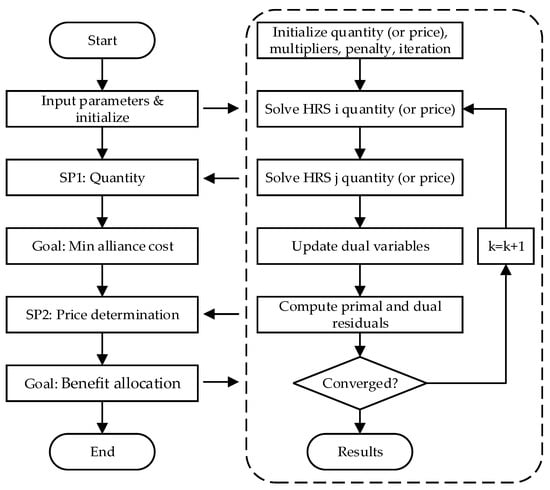
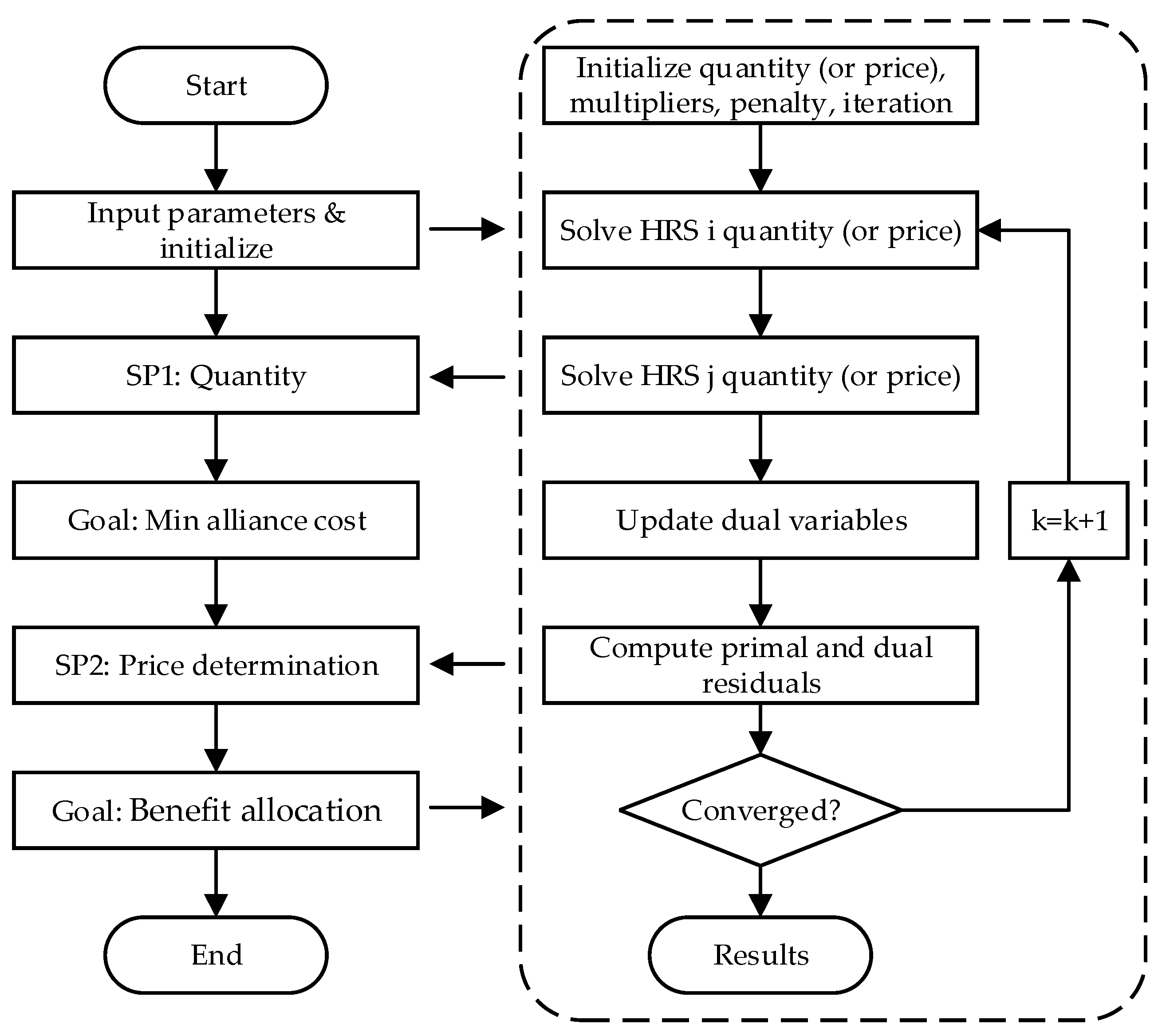
The two-stage distributed solution flowchart based on ADMM is shown in Figure 3.
Figure 3.
The two-stage distributed solution flowchart based on ADMM.
5. Hydrogen Transportation Scheduling Model
Since inter-station hydrogen trading cannot be directly implemented in actual operation, the trading results must be realized through the loading, transportation, and unloading processes of HTTs. Therefore, based on the trading results, this paper further establishes an HTT transportation scheduling model to convert inter-station trading volumes into specific transportation tasks. In this model, each HRS is treated as a node in the highway transportation network, and hydrogen transport between stations is carried out by HTTs, with transportation demand determined by the trading volumes obtained from the trading model. Considering that the actual transportation process is also constrained by vehicle loading capacity, loading and unloading operations, and transportation routes, corresponding constraints are further introduced to ensure that the inter-station hydrogen trading results can be implemented through feasible transportation arrangements.
5.1. Hydrogen Transportation Objective Function
The transportation subproblem aims to minimize the total cost, which consists of travel distance cost and fixed HTT dispatch cost.
where denotes the distance matrix between nodes, is the transportation cost per unit distance, represents the fixed dispatch cost of an HTT, denotes the HTT routing variable, indicates whether the HTT is activated during the scheduling period, p and q denote node indices in the highway transportation network, y denotes the HTT index.
5.2. Hydrogen Transportation Constraints
- HTT loading constraints
The hydrogen inventory of each HTT varies over time with its loading and unloading actions and is subject to the constraints of non-negativity and storage capacity limits, as shown in (50) to (52).
where denotes the hydrogen inventory of the HTT, represents the loading and unloading amount of the HTT, and is the maximum hydrogen carrying capacity of a single HTT. Equation (50) indicates that the onboard hydrogen quantity of an HTT varies over time with its loading and unloading actions, while Equations (51) and (52) impose the non-negativity constraint and the maximum hydrogen carrying capacity constraint of HTTs, respectively.
- 2.
- Loading and unloading behavior constraints
The loading and unloading behavior constraints mainly include position constraints, timing constraints, and balance constraints. For each HTT, loading and unloading operations can be performed at no more than one node at any given time, and such operations are only allowed at the node where the HTT is actually located. In addition, to ensure balance over the entire scheduling period, the net loading and unloading amount of each HTT throughout the cycle is required to be zero.
where is a variable indicating whether the tube trailer performs loading or unloading operations, denotes the maximum loading and unloading amount within a single period, and is a binary variable representing the HTT location. Equation (53) indicates that each HTT can perform loading or unloading at no more than one node during the same time. Equation (54) indicates that the loading and unloading quantity in each period is constrained by the corresponding capacity. Equation (55) indicates that an HTT can carry out loading or unloading operations only when it is located at the corresponding node. Equation (56) indicates that the net loading and unloading quantity of each HTT over the entire scheduling period is zero.
- 3.
- Conservation Constraints Between Hydrogen Trading Volume and Transportation Volume
To ensure that the hydrogen trading volume between HRSs can be physically realized through HTT transportation, conservation constraints are imposed between the hydrogen trading volume and the transportation volume, as shown in (57) and (58).
where denotes the net hydrogen transportation volume of the HRS, while represents the daily net trading volume of the HRS as determined by the inter-station trading mechanism. Equation (57) indicates that the net transportation volume of each station in each period is obtained by summing the loading and unloading quantities of all HTTs at that station, while Equation (58) indicates that the net transportation volume of each station over the scheduling period should be consistent with the net trading volume given by the trading model.
- 4.
- HTT routing constraints
To ensure coordination between HTT movements in the road network and loading–unloading operations, while satisfying the net hydrogen transportation requirements of HRSs, HTT path and state constraints are established. These constraints mainly include HTT position constraints, HTT activation constraints, HTT position update constraints, and coordination constraints between in-transit status and loading–unloading operations. The corresponding constraints are given as follows.
where denotes the number of travel time steps for a road segment and is the travel time matrix. Equations (59)–(61) are used to constrain the HTTs position and activation status. Equations (62) and (63) describe the relationship between transportation tasks and HTTs position updating. Equations (64) and (65) describe the travel time on each road segment and the corresponding in-transit state of HTTs. Equation (66) indicates that HTTs transportation and loading/unloading operations cannot be carried out simultaneously.
6. Case Study
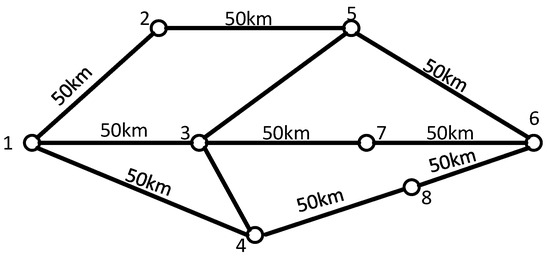
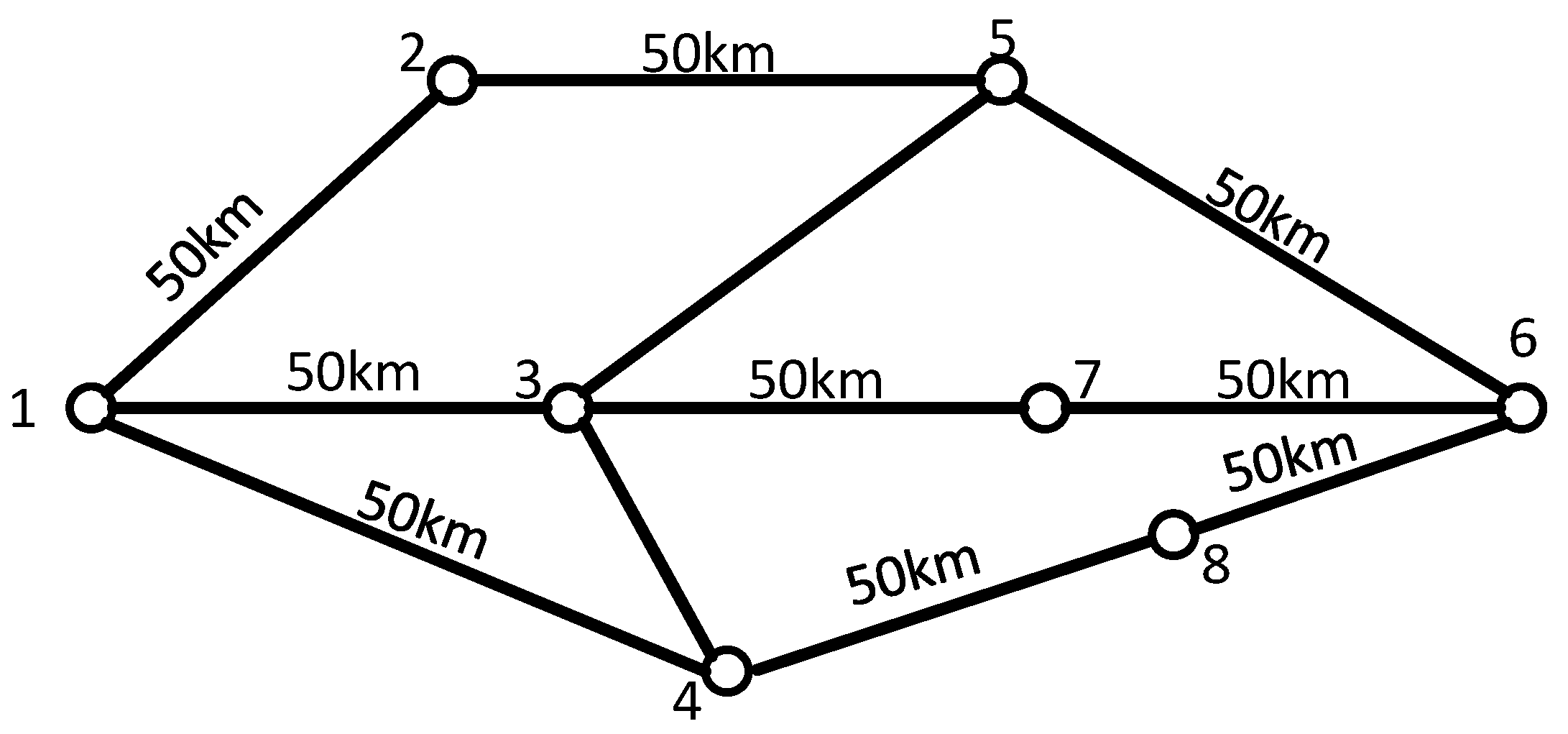
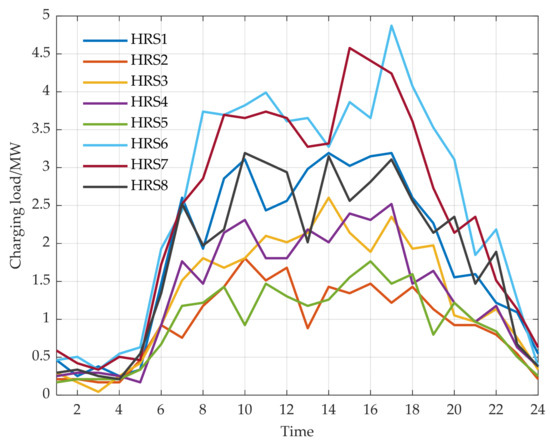
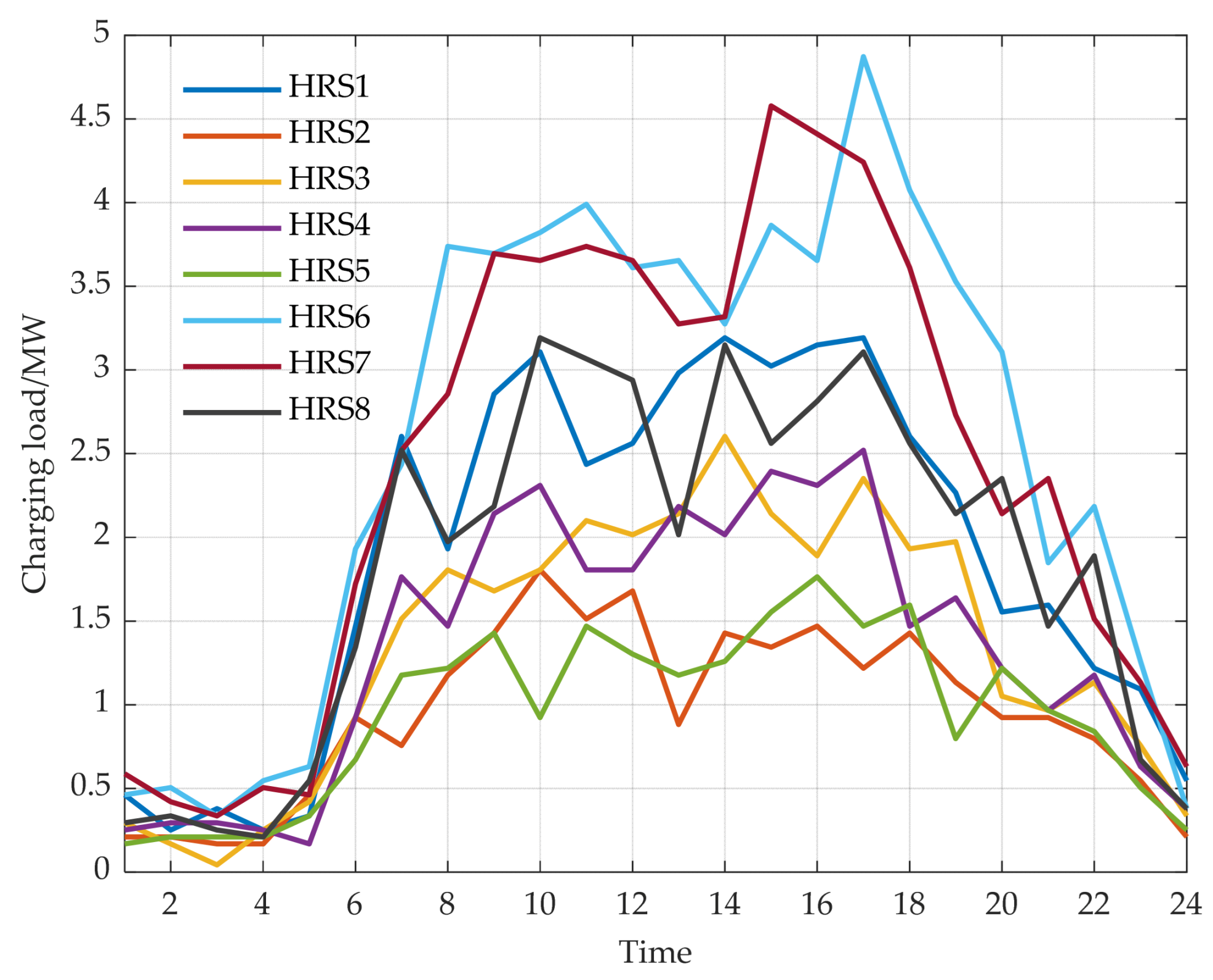
This section considers a station cluster composed of eight HRSs, as shown in Figure 4. The scheduling horizon is 24 h with a time interval of 1 h. The installed capacities of PV generation and the main energy-related equipment at each station are listed in Table 1, and the charging load profiles are shown in Figure 5. The hydrogen refueling load is assumed to be 0.6 times the charging load. For comparison, the scenario in which each HRS operates independently without inter-station trading is taken as the baseline case. In the case study, a time-of-use electricity pricing scheme with valley, flat, and peak periods is adopted, with electricity prices set at 0.07, 0.14, and 0.17 $/kWh, respectively. The lower and upper bounds of the hydrogen trading price are set at 4.76 $/kg and 23.79 $/kg, respectively. The buying and selling prices in the external carbon market are set at 38.29 $/t and 25.71 $/t, respectively, while those in the external green certificate market are set at 31.43 $/certificate and 18.57 $/certificate, respectively. The carbon emission factor of the grid is taken as 0.728 t/MWh, the daily carbon quota of each station is set at 20 t, and the green certificate assessment ratio is set at 0.1. For inter-station hydrogen transportation, 10 HTTs are considered, with a travel speed of 60 km/h, a maximum hydrogen transport capacity of approximately 90 kg per HTT. In the ADMM solution process, the primal residual tolerances for hydrogen, carbon, and green certificates in Subproblem 1 are all set to 1 × 10⁻², and the corresponding dual residual tolerances are also all set to 1 × 10⁻². In Subproblem 2, the primal and dual residual tolerances are both set to 5 × 10⁻² for hydrogen and to 1 × 10⁻³ for both carbon and green certificates. Under the above parameter settings, the total computation time of the model is 222 s, and Subproblem 1 and Subproblem 2 converge after 55 and 98 iterations, respectively, indicating that the proposed solution framework has good computational efficiency.
Figure 4.
Schematic layout of the highway HRS cluster.
Table 1.
Installed capacities of PV and energy equipment in HRSs.
Figure 5.
Charging Load Profiles of HRSs.
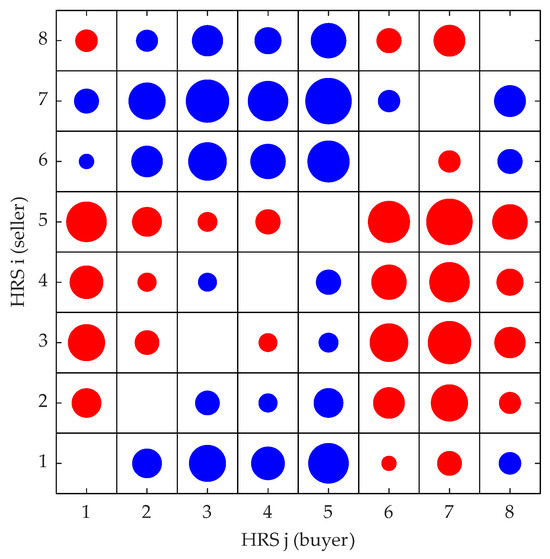
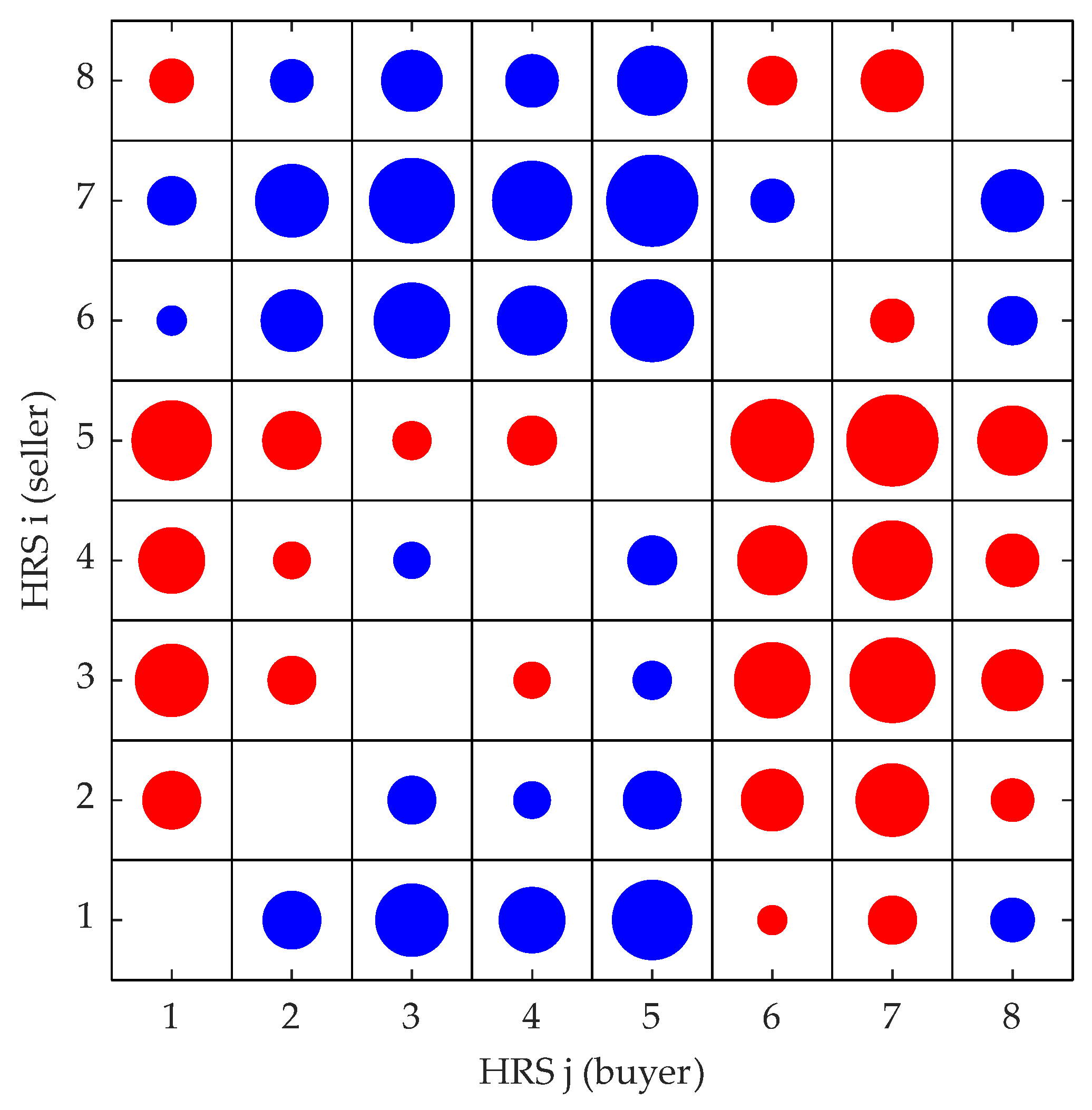
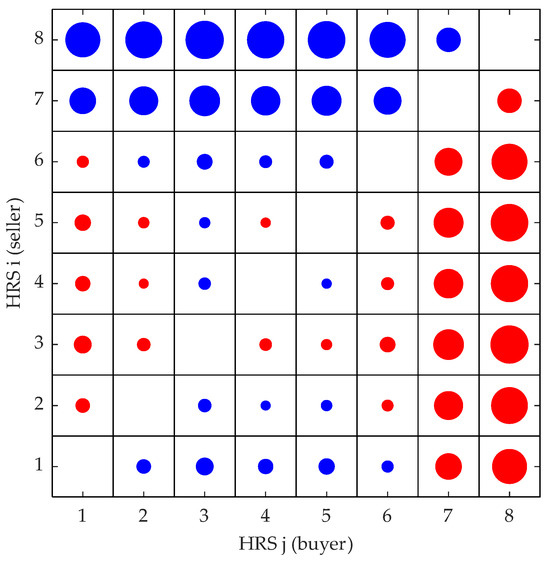
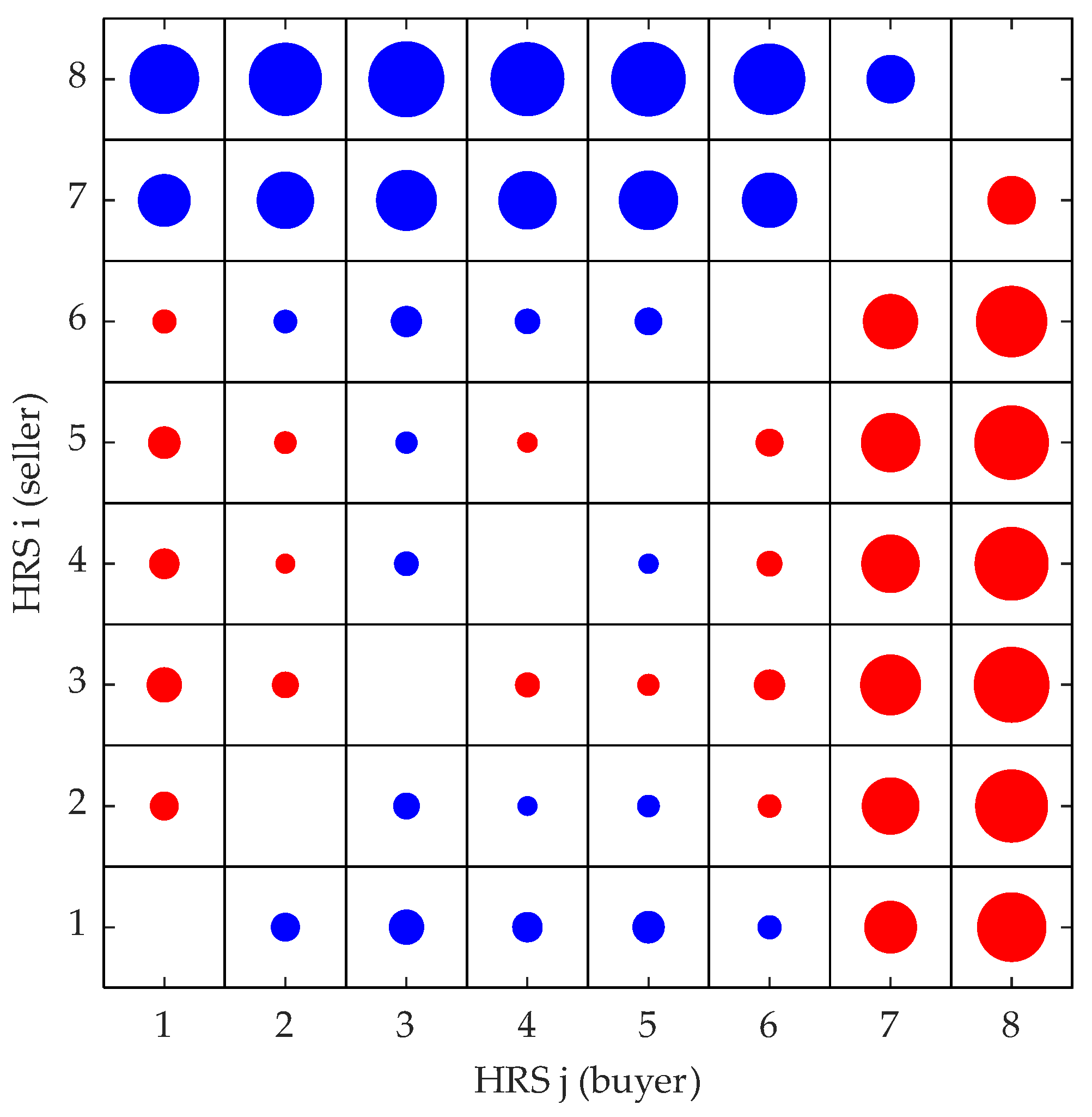
The inter-station hydrogen trading volumes are shown in Figure 6, where the horizontal axis represents buyer HRSs and the vertical axis represents seller HRSs. Each bubble denotes the net daily trading volume between a pair of HRSs. Red indicates net selling, blue indicates net buying, and a larger bubble represents a greater absolute net trading volume. From the perspective of the net trading volume of each HRS, HRSs 2, 3, 4, and 5 are net suppliers, whereas HRSs 1, 6, 7, and 8 are net buyers. Among them, HRS 7 exhibits the largest hydrogen deficit, while HRSs 3 and 5 serve as the main supply stations, with trading scales significantly larger than those of the other HRSs. Further analysis of the station parameters indicates that the hydrogen trading volume of each HRS is primarily determined by the relative relationship between load demand and PV resource availability. HRS 3 possesses abundant PV resources and is equipped with relatively large hydrogen production and energy storage capacities, enabling it to stably convert surplus electricity into hydrogen and thus exhibit clear seller characteristics. By contrast, HRS 7 has a relatively high load, insufficient PV support, and limited hydrogen production capacity. As a result, it relies more heavily on inter-station hydrogen replenishment and shows the largest hydrogen purchase volume. In addition, some HRSs assume both buyer and seller roles in the operational results. This phenomenon can be attributed to the energy storage facilities at these stations, which, to some extent, function as cross-station storage within the trading network. They purchase hydrogen when energy is relatively abundant and sell hydrogen when shortages become more severe, thereby alleviating the propagation of intraday supply–demand mismatches across the HRS cluster. These results indicate that, under the cooperative game framework and ADMM-based coordination mechanism, inter-station hydrogen sharing can transfer surplus renewable energy in the form of hydrogen from PV-rich HRSs to stations with heavier loads or relatively insufficient PV resources, thereby reducing the dependence of demand-side HRSs on external electricity purchases.
Figure 6.
Inter-station hydrogen trading volume diagram.
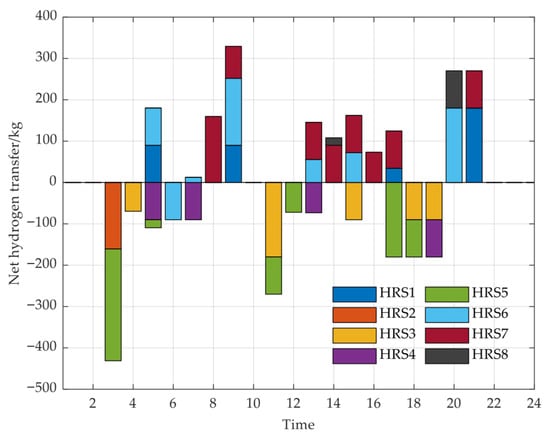
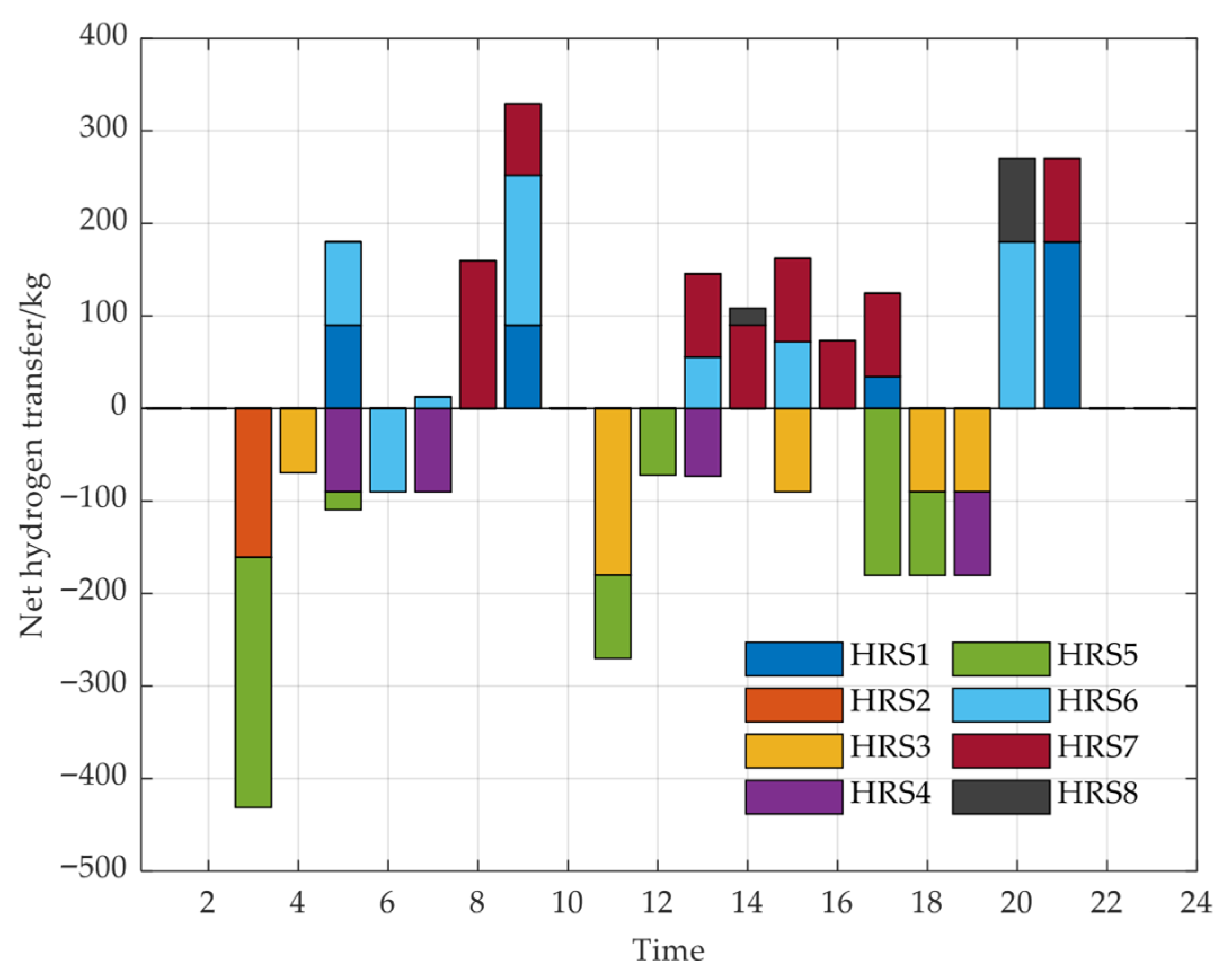
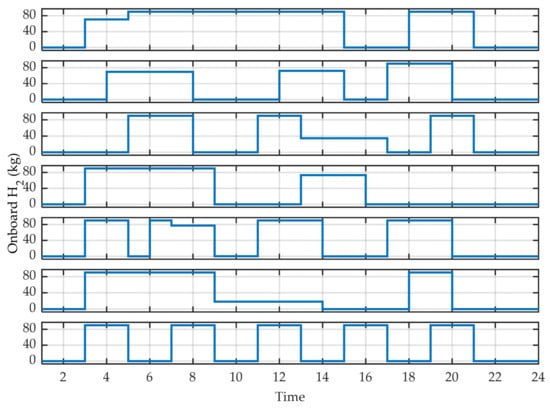
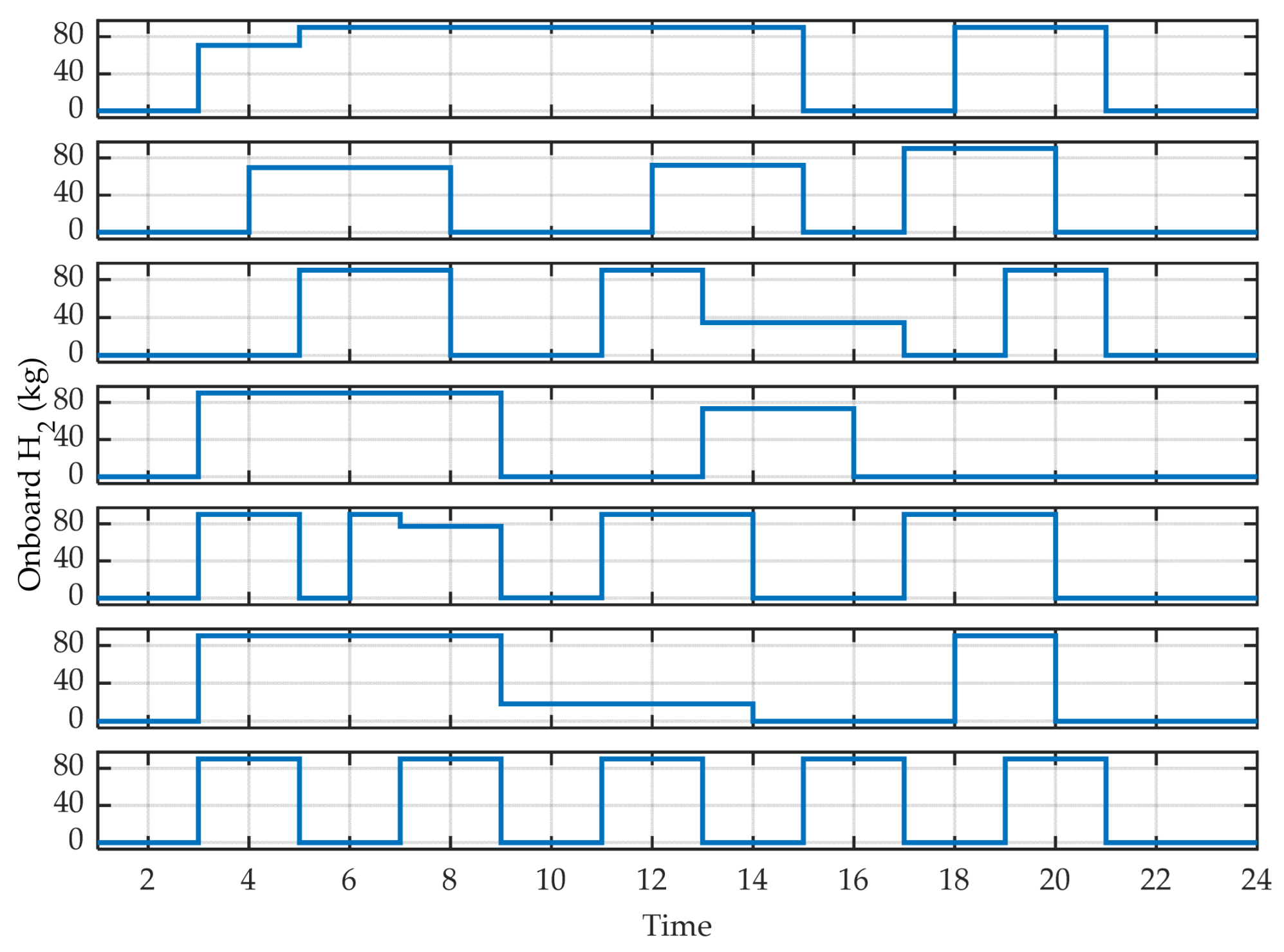
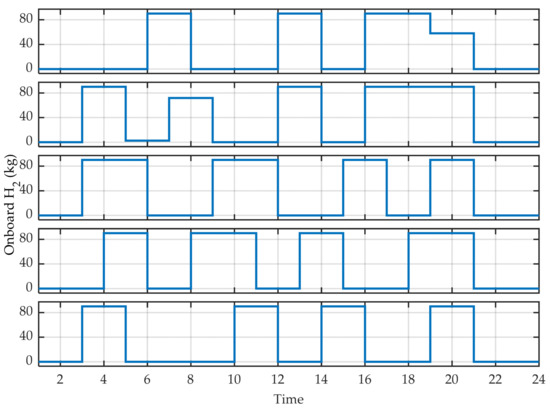
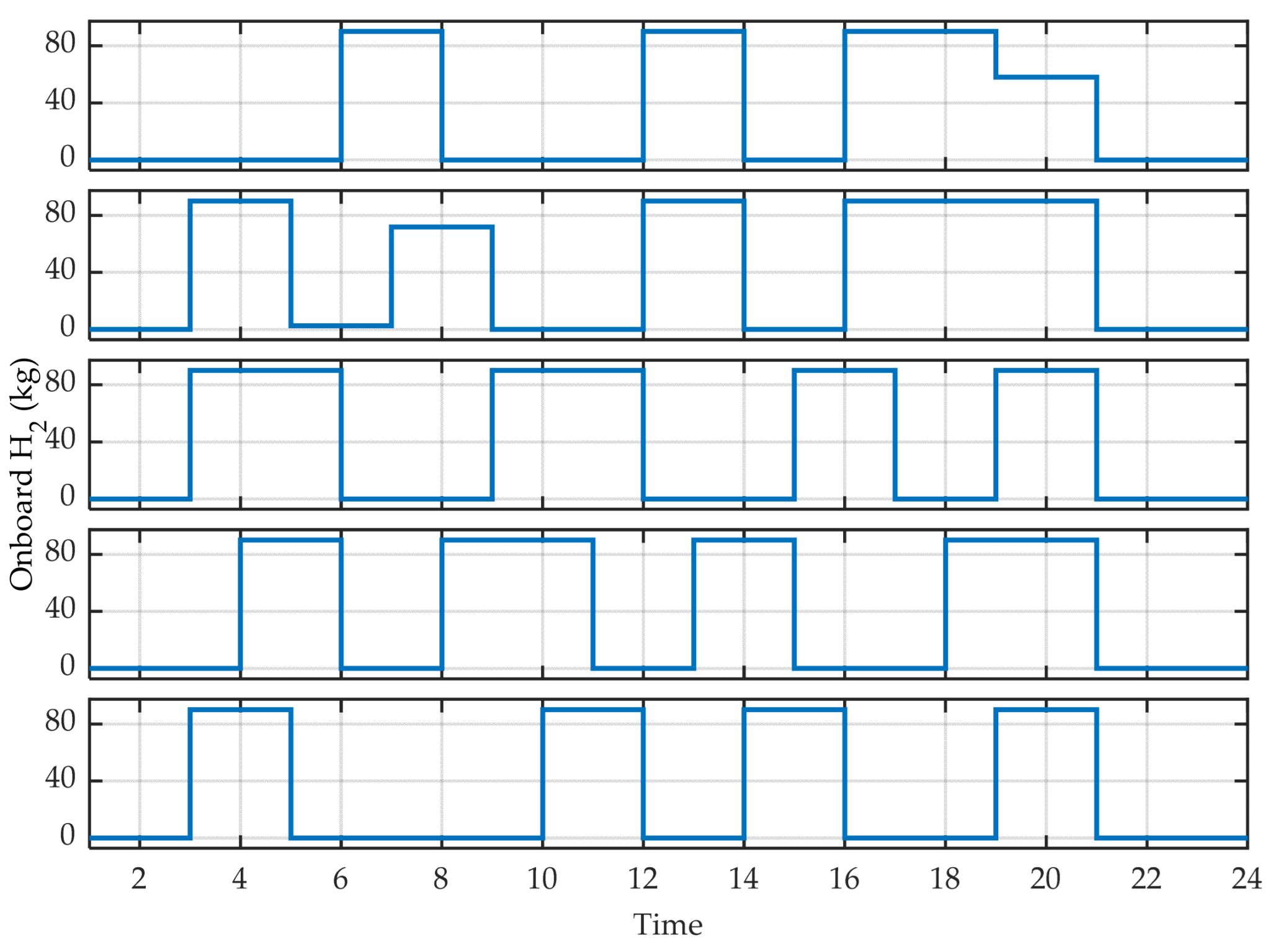
The hydrogen transportation results are shown in Figure 7, Figure 8 and Figure 9. These results indicate that the inter-station hydrogen trading decisions are physically implemented through time-dependent transportation and HTT scheduling arrangements. Hydrogen transfer is completed through the loading, transit, and unloading processes of HTTs, and the resulting transport tasks are concentrated in specific periods rather than being uniformly distributed throughout the day. Differences in HTT activity are also evident. Some HTTs undertake transport tasks more frequently, whereas others remain active only during limited periods, indicating that HTT dispatch is determined by actual transportation demand rather than by equal allocation among all HTTs. Figure 8 and Figure 9 further show that when more HTTs are available, transportation tasks can be distributed among a larger number of vehicles, resulting in a more balanced workload across HTTs. As the number of HTTs decreases, transport tasks become concentrated on fewer vehicles, and some vehicles are required to complete multiple successive trips. To further illustrate the influence of HTT quantity on the realization of hydrogen transportation, this paper calculates the inter-station hydrogen transportation gap under different numbers of HTTs, as shown in Table 2. Overall, the transportation gap decreases continuously as the number of HTTs increases. When the number of HTTs reaches six or more, the transportation gap falls to zero. This indicates that six HTTs are sufficient to satisfy the inter-station hydrogen transportation demand and can be regarded as the minimum feasible HTT configuration required to complete all transportation tasks. However, the minimum feasible configuration is not necessarily the optimal dispatch configuration. When additional HTTs are introduced, transportation tasks are shared more evenly, and the total travel distance is further reduced. The resulting savings in transportation cost exceed the fixed dispatch cost of the additional HTTs, and the optimized solution therefore still activates seven HTTs.
Figure 7.
Time-varying net hydrogen transfer at each station.
Figure 8.
Onboard hydrogen variation of each HTT under 10 available HTTs.
Figure 9.
Onboard hydrogen variation of each HTT under 5 available HTTs.
Table 2.
Inter-station hydrogen transportation gap under different number of available HTTs.
Figure 10 presents the carbon-green trading results by converting green certificates into carbon emission equivalents. According to the calculated daily net joint trading volume of each HRS, HRSs 1, 2, 3, 4, 5, and 6 act as sellers in the carbon-green trading market, whereas HRSs 7 and 8 act as buyers. This pattern is partly consistent with that of hydrogen trading. In general, HRSs that sell carbon quotas and green certificates tend to have stronger low-carbon energy supply capabilities. On the one hand, this advantage arises from the availability of cleaner electricity supported by higher PV output. On the other hand, it is reinforced by the hydrogen production process, through which clean electricity is converted into low-carbon hydrogen. By contrast, buyers in the carbon-green trading market usually correspond to HRSs with relatively high loads and insufficient low-carbon energy support and therefore need to alleviate carbon emission pressure and green certificate shortfalls through inter-station trading. Inter-station carbon-green trading can effectively offset the high marginal costs faced by high-load HRSs under the upper tiers of stepped carbon pricing, thereby mitigating the impact of stepped carbon prices on system operation decisions.
Figure 10.
Inter-station carbon–green joint trading volume.
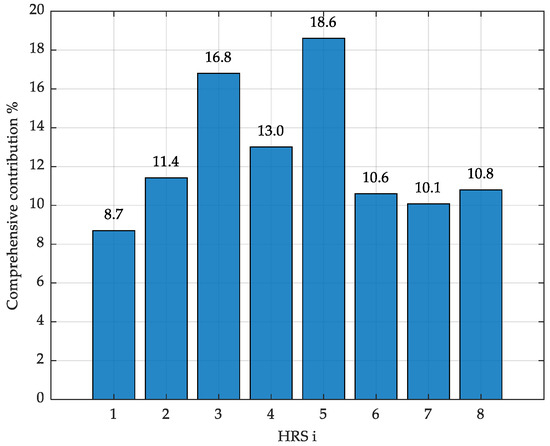
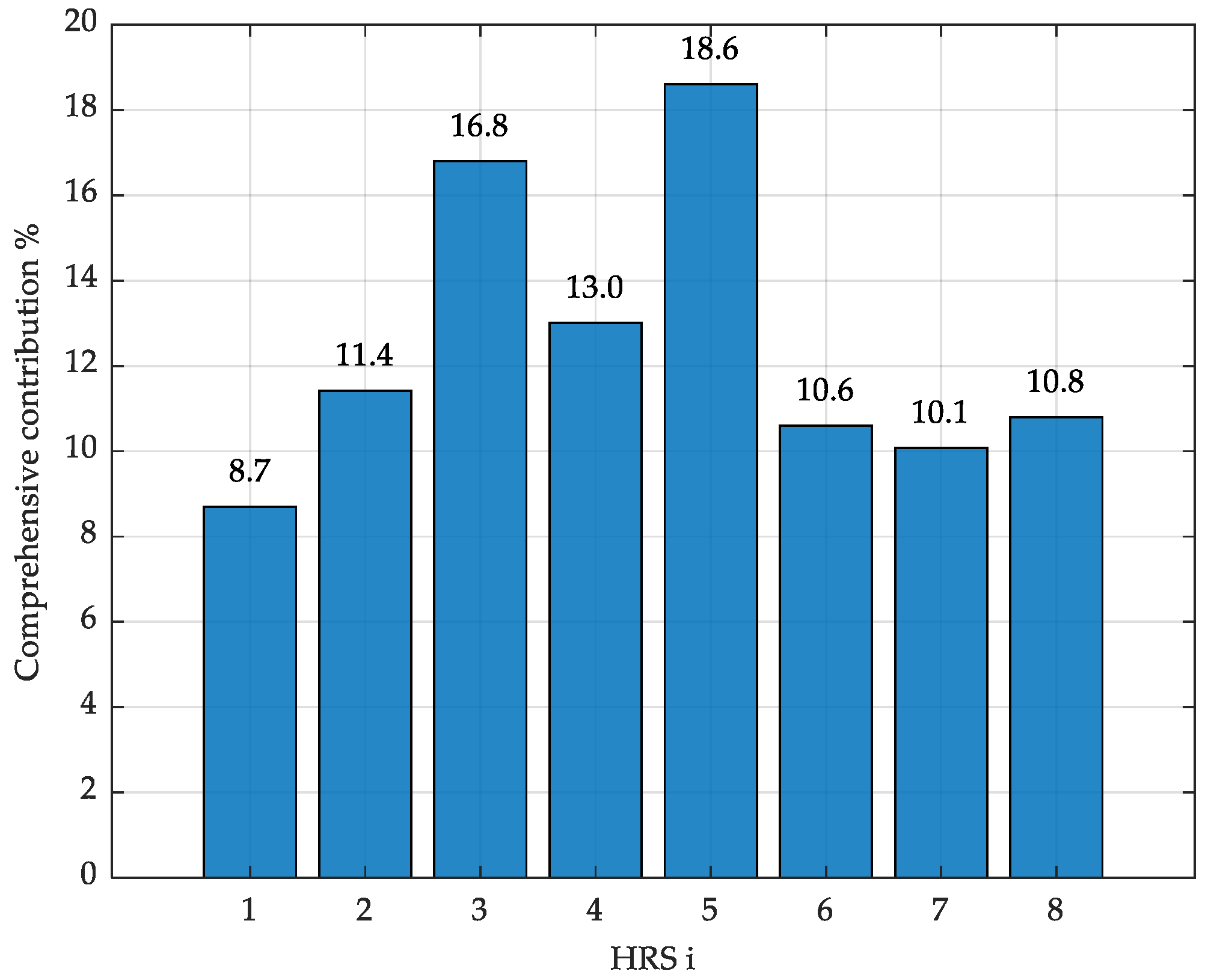
The comprehensive contribution of each HRS is shown in Figure 11, revealing clear differences in the roles of individual HRSs within the cluster trading system. HRS 5 ranks first by a wide margin, indicating its central role in inter-station trading and its stronger support for overall collaboration. HRSs 3 and 4 also exhibit relatively high contribution levels. This indicator is not derived from a single type of trade; rather, it is a weighted aggregation of hydrogen, carbon, and green certificate trading that also accounts for the roles of both buyers and sellers. It therefore reflects the overall degree of participation of each HRS in the integrated trading system. From this perspective, the top ranking of HRS 5 is consistent with its broader participation across multiple trading types. Although HRS 3 plays a more prominent role in hydrogen trading, HRS 5 participates more extensively in the integrated trading system as a whole and therefore attains a higher contribution value. The non-negligible contribution levels of the remaining HRSs indicate that inter-station trade depends on both seller supply capability and buyer demand. Without corresponding demand, trading relationships cannot be established. This avoids a contribution structure dominated solely by seller HRSs and allows both supply-side and demand-side roles to be reflected in the evaluation. HRSs with higher contribution values are therefore more likely to obtain corresponding returns under negotiated pricing.
Figure 11.
Comprehensive contribution of each station.
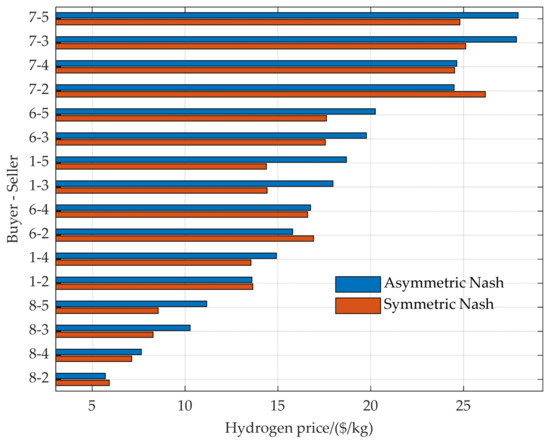
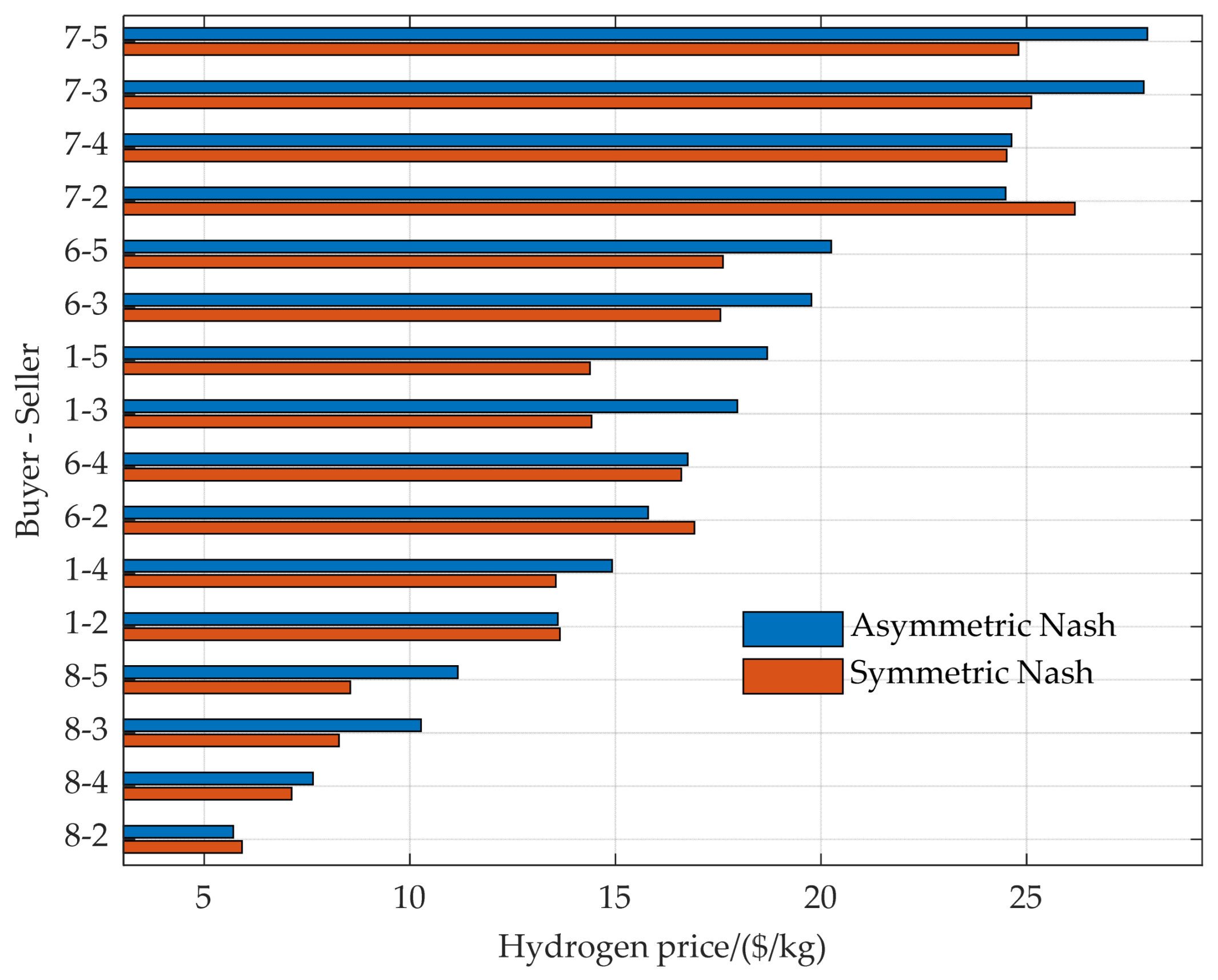
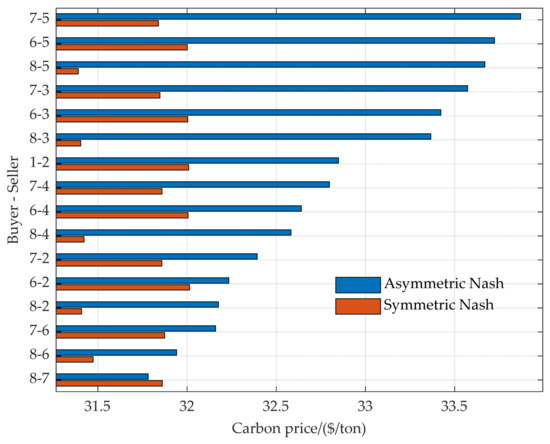
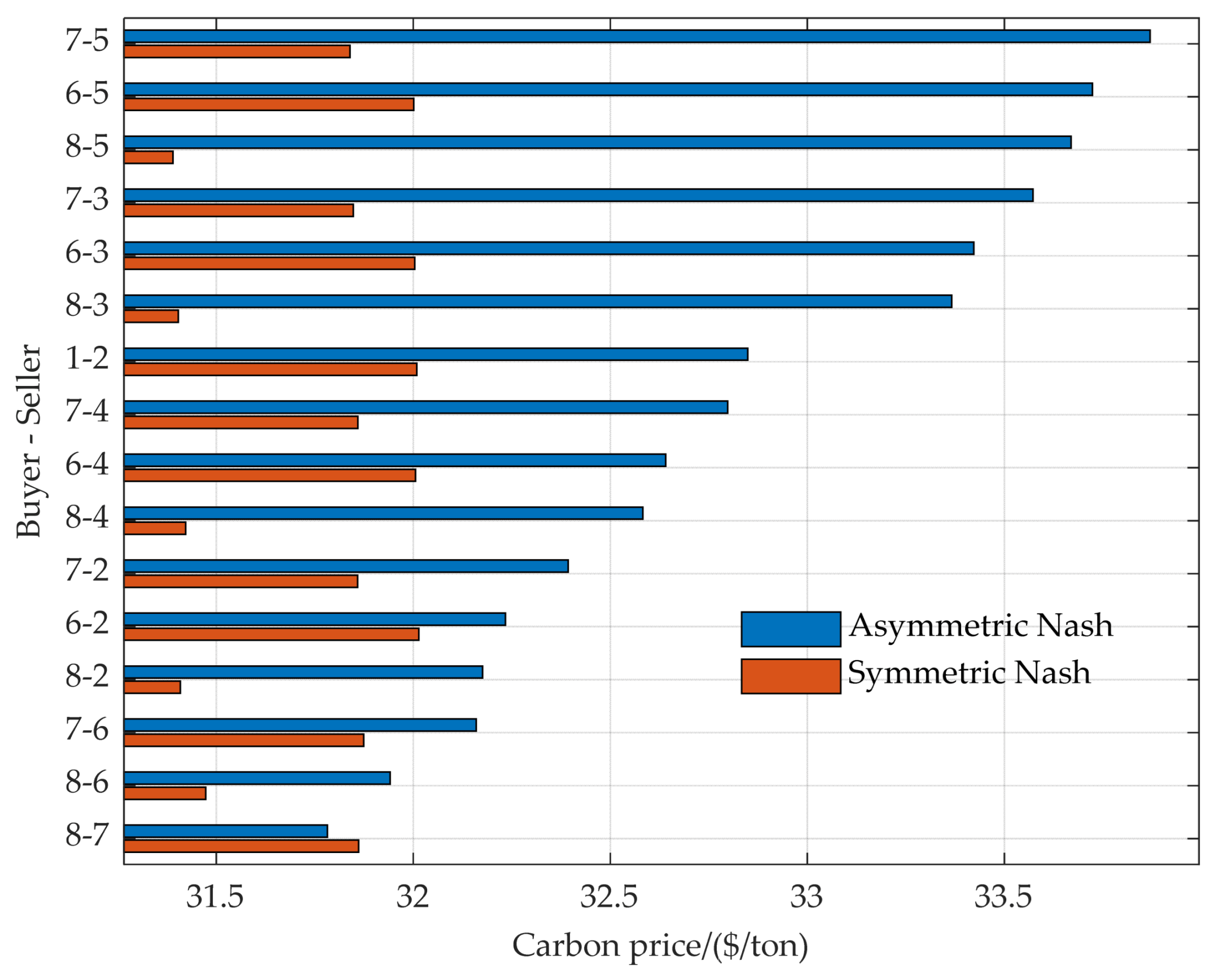
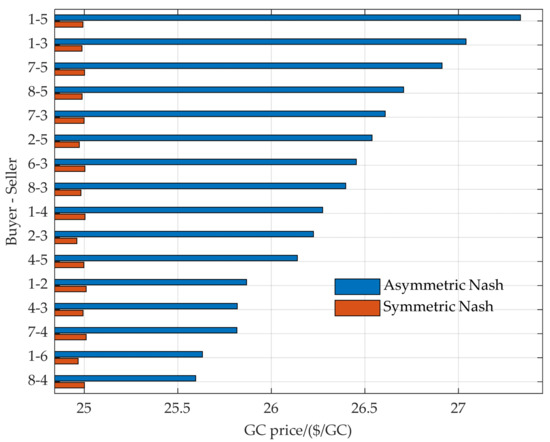
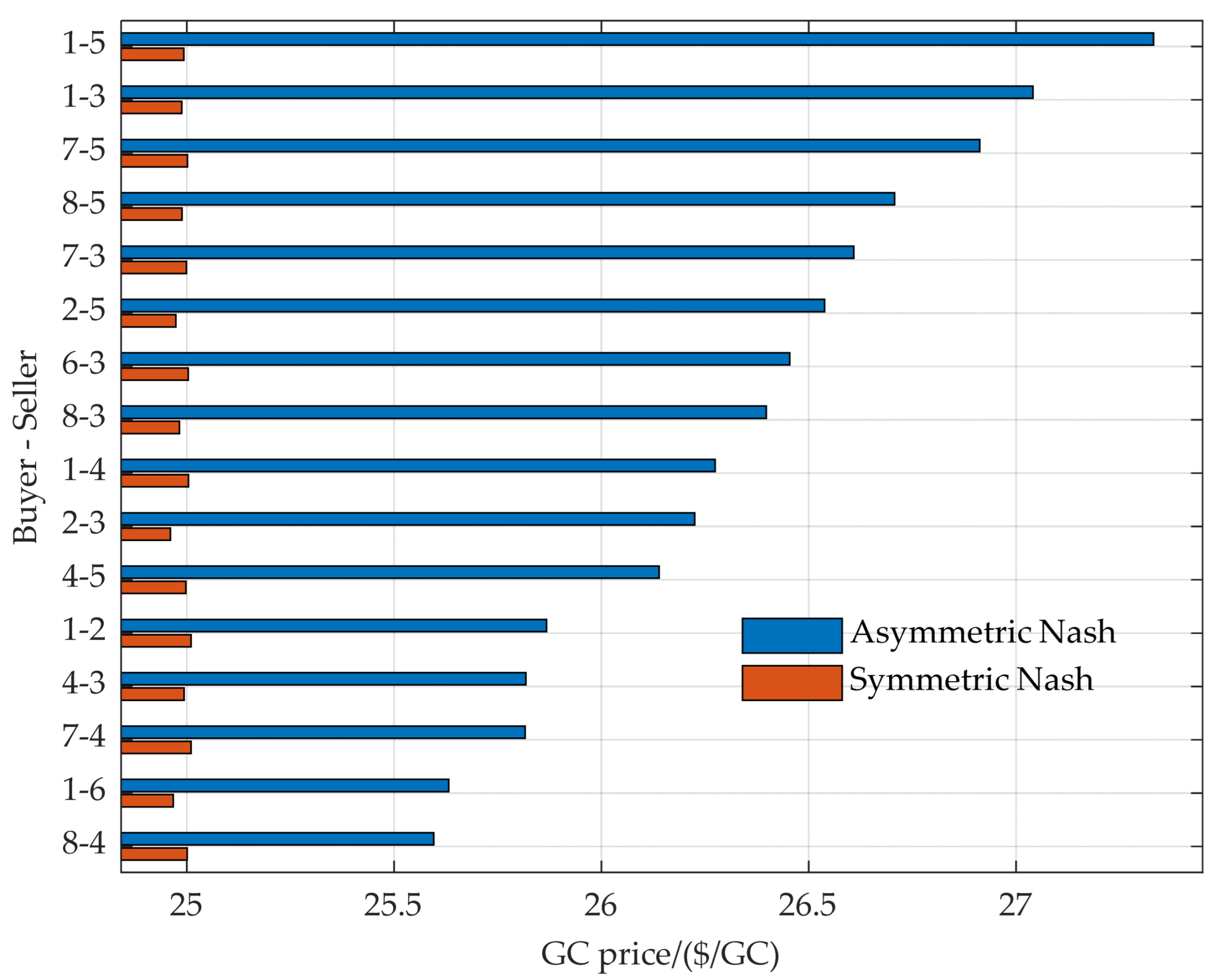
As shown in Figure 12, Figure 13 and Figure 14, the pricing results of the three types of trades exhibit both common patterns and heterogeneity in inter-station price distribution. According to the price rankings, the leading inter-station trading relationships in hydrogen, carbon, and green certificate trades show a relatively high degree of consistency. In particular, bilateral trades with HRSs 5 and 3 as sellers are generally ranked among the highest, indicating that these two HRSs possess strong resource supply capability and therefore occupy relatively strong positions in inter-station price formation. This is consistent with the earlier finding that HRSs 5 and 3 make relatively high contributions in the comprehensive contribution results. From an economic perspective, a higher price not only reflects the cost that buyers must bear to obtain key resources but also represents reasonable compensation for sellers that undertake greater cross-HRS supply responsibilities.
Figure 12.
Inter-station hydrogen price.
Figure 13.
Inter-station carbon price.
Figure 14.
Inter-station green certificate price.
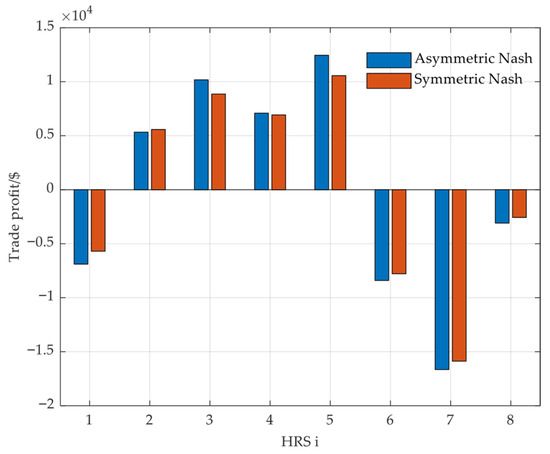
A comparison between the symmetric and asymmetric Nash bargaining results further shows that, among the high-priced trading relationships presented in the figures, the two mechanisms exhibit clear differences in price formation. For hydrogen trading, the asymmetric bargaining results show a clearer price hierarchy among these leading trading relationships, whereas symmetric bargaining compresses the differences among them to some extent. For carbon and green certificate trading, the prices under symmetric bargaining are generally lower, with green certificate prices in particular being concentrated near the lower bound. This indicates that, when differences in station contributions are not taken into account, stations with higher contributions find it more difficult to obtain corresponding returns through pricing in carbon and green certificate trading.
A further comparison of price dispersion among the three trading types shows that hydrogen prices vary much more widely than carbon and green certificate prices, indicating that hydrogen prices are more sensitive to inter-station hydrogen supply–demand conditions and the bargaining power of both trading parties. Overall, the pricing results of the three trading types demonstrate that the proposed hydrogen–carbon–green certificate coupled trading mechanism can effectively reflect inter-station collaborative relationships, differences in resource supply and demand, and the linkage characteristics between carbon and green certificate trading. At the same time, it enables the roles of different HRSs in collaborative operation to be clearly reflected through the pricing mechanism.
The allocation of trade profits for each HRS, together with the comparison of net costs before and after trading and settlement, is shown in Figure 15 and Table 3. Overall, the total cost is reduced by 21.30% after trading, indicating that the proposed collaborative trading mechanism can effectively improve the economic performance of the HRS cluster. HRS 5 obtains the highest trade profit, followed by HRSs 3 and 4, indicating that stations with stronger supply roles and higher comprehensive contributions across multiple trading types can receive higher returns through trading settlement. By contrast, HRSs 1, 6, 7, and 8 show net payments, reflecting their stronger dependence on external resource support and the corresponding trade costs they need to bear. Compared with symmetric Nash bargaining, asymmetric Nash bargaining allocates higher trade profits to the main contributing stations, especially HRSs 3 and 5, while increasing the net payments of demand-side HRSs. This indicates that asymmetric Nash bargaining mainly affects the distribution of trade benefits and enables the settlement results to better reflect differences in HRS contributions. For buyer HRSs, pre-trading costs are relatively high, whereas post-trading operating costs decrease significantly. This shows that, through collaborative optimization and resource sharing among multiple HRSs, these stations can achieve substantial cost reductions even before settlement transfers are considered. In this sense, the proposed trading mechanism can effectively alleviate the resource constraints faced under independent HRS operation, thereby improving hydrogen supply–demand coordination, carbon emission compliance, and green certificate balancing. A further examination shows that the reduction in total system cost mainly comes from three aspects. First, inter-station trading together with coordinated electric-hydrogen operation within stations reduces electricity purchases for some stations, thereby lowering electricity purchasing costs. Second, carbon emission rights trading and green certificate trading reduce the low-carbon compliance costs of each station. Third, inter-station hydrogen mutual assistance alleviates supply–demand mismatches at some stations, thereby reducing the penalty cost for energy undersupply.
Figure 15.
Trade profit of each station.
Table 3.
Cost comparison of each HRS before trading, after trading, and after settlement.
After the settlement of trade profits is introduced, the comprehensive costs of different HRSs become further differentiated. For buyer HRSs such as HRSs 1, 6, 7, and 8, although the post-settlement net cost is higher than the post-trading operating cost, it remains lower than the pre-trading cost overall. This indicates that, although these HRSs need to pay trade fees to obtain external resources, they still benefit from collaborative trading in terms of overall cost reduction. By contrast, for seller HRSs, post-trading operating costs are higher than their pre-trading levels, but under the compensation effect of settlement, their post-settlement net costs decrease significantly. This shows that, although these HRSs undertake greater responsibilities for resource provision or system support in collaborative trading, they can receive reasonable compensation through the subsequent settlement process. These results further support the use of the asymmetric bargaining mechanism.
7. Conclusions
With the growing demand for energy replenishment for new energy vehicles on highways, the need for coordinated operation among multiple HRSs has become increasingly evident. This paper focuses on the coordinated operation of multiple highway HRSs and develops an optimal operation model that considers hydrogen–carbon–green certificate trading. The results show that, under a collaborative scenario involving multiple HRSs, inter-station trading can promote resource complementarity among different HRSs, alleviate the operational pressures faced by some HRSs in hydrogen supply, carbon emission compliance, and green certificate balancing, and thereby improve the overall economic performance of the HRS cluster. Meanwhile, the asymmetric price determination and benefit allocation mechanism adopted in this study can better reflect the actual roles of different HRSs in collaborative trading, enabling HRSs that undertake greater responsibilities for resource supply and system support to obtain corresponding compensation. Further analysis of the hydrogen transportation results shows that inter-station hydrogen trading can be effectively implemented through specific transportation arrangements. Overall, the collaborative trading and benefit allocation method proposed in this paper improves inter-station resource coordination and supports a more balanced distribution of benefits among multiple HRSs. In future work, uncertainties such as fluctuations in renewable energy output and variations in hydrogen refueling demand will be further considered, and the inter-station hydrogen–carbon–green certificate trading model will be further extended on this basis.
Author Contributions
Conceptualization, Y.X.; Methodology, Y.X.; Software, Y.X.; Validation, Y.X. and M.X.; Formal analysis, Y.X. and M.X.; Investigation, Y.X. and J.W.; Data curation, Y.X. and M.X.; Writing—original draft, Y.X. and J.W.; Writing—review and editing, Y.X., H.D. and J.W.; Visualization, Y.X. and Q.C.; Supervision, Q.C. and M.X.; Funding acquisition, M.X. All authors have read and agreed to the published version of the manuscript.
Funding
This research was funded by the Key Program of the National Natural Science Foundation of China, grant number 52337003.
Data Availability Statement
The original contributions presented in this study are included in the article. Further inquiries can be directed to the corresponding authors.
Conflicts of Interest
The authors declare no conflicts of interest.
Abbreviations
The following abbreviations are used in this manuscript:
| HRS | Hybrid refueling stations |
| HTT | Hydrogen tube trailer |
| ADMM | Alternating direction method of multipliers |
| PV | Photovoltaic |
References
- Alfraidi, W.; Alaql, F.; AlMuhanna, K.; Farh, H.M.H.; Al-Shamma’a, A.A. Designing EV charging energy hubs to meet flexibility requirements in smart grids. World Electr. Veh. J. 2025, 16, 43. [Google Scholar] [CrossRef] [Scilit]
- Ge, X.; Liu, Z.; Li, K.; Guo, C.; Shen, G.; Wang, Z. Economic scheduling strategy for multi-energy-integrated highway service centers considering carbon trading and critical peak pricing mechanism. Symmetry 2024, 16, 1110. [Google Scholar] [CrossRef] [Scilit]
- Shi, M.; Huang, Y. Dynamic planning and energy management strategy of integrated charging and hydrogen refueling at highway energy supply stations considering on-site green hydrogen production. Int. J. Hydrogen Energy 2023, 48, 29835–29851. [Google Scholar] [CrossRef] [Scilit]
- Pelosi, D.; Longo, M.; Bidini, G.; Zaninelli, D.; Barelli, L. A new concept of highways infrastructure integrating energy storage devices for e-mobility transition. J. Energy Storage 2023, 65, 107364. [Google Scholar] [CrossRef] [Scilit]
- Wu, Y.; Gu, W.; Huang, S.; Wei, X.; Safaraliev, M. A four-layer business model for integration of electric vehicle charging stations and hydrogen fuelling stations into modern power systems. Appl. Energy 2025, 377, 124630. [Google Scholar] [CrossRef] [Scilit]
- Beyazıt, M.A.; Salehizadeh, M.R.; Demirel, E.; Taşcıkaraoğlu, A. Real-time management of electric and hydrogen vehicle infrastructure using mobile and integrated charging stations. Sustain. Energy Grids Netw. 2025, 44, 102008. [Google Scholar] [CrossRef] [Scilit]
- Anadón Martínez, V.; Sumper, A.; Saldaña-Gonzalez, A.E.; Gadelha, V. Planning fast-charging stations along highways using probability distribution functions and traffic data. Sustain. Energy Technol. Assess. 2025, 82, 104547. [Google Scholar] [CrossRef] [Scilit]
- Wu, T.; Ji, X.; Wang, G.; Liu, Y.; Yang, Q.; Bao, Z.; Peng, J. Hydrogen energy storage system for demand forecast error mitigation and voltage stabilization in a fast-charging station. IEEE Trans. Ind. Appl. 2022, 58, 2718–2727. [Google Scholar] [CrossRef] [Scilit]
- Liu, X.; Hu, J.; Li, R.; Zhang, Y.; Zhang, B. Optimal capacity planning for integrated charging microgrids along highways considering seasonal fluctuation and risk management. IEEE Trans. Smart Grid 2025, 16, 3772–3785. [Google Scholar] [CrossRef] [Scilit]
- Palanisamy, S.; Lala, H. Optimal sizing of renewable energy powered hydrogen and electric vehicle charging station (HEVCS). IEEE Access 2024, 12, 48239–48254. [Google Scholar] [CrossRef] [Scilit]
- Fang, X.; Wang, Y.; Dong, W.; Yang, Q.; Sun, S. Optimal energy management of multiple electricity-hydrogen integrated charging stations. Energy 2023, 262, 125624. [Google Scholar]
- Zhang, Q.; Qin, T.; Wu, J.; Hao, R.; Su, X.; Li, C. Synergistic operation strategy of electric-hydrogen charging station alliance based on differentiated characteristics. Energy 2024, 304, 132132. [Google Scholar] [CrossRef] [Scilit]
- Zhang, K.; Zhou, B.; Chung, C.Y.; Shuai, Z.; Li, J.; Li, P. A multilateral transactive energy framework of hybrid charging stations for low-carbon energy-transport nexus. IEEE Trans. Ind. Inform. 2022, 18, 7820–7831. [Google Scholar] [CrossRef] [Scilit]
- Li, R.; Ren, H.; Wu, Q.; Li, Q.; Gao, W. Cooperative economic dispatch of EV-HV coupled electric-hydrogen integrated energy system considering V2G response and carbon trading. Renew. Energy 2024, 227, 120488. [Google Scholar]
- Sim, J.; Lee, D.J.; Yoon, K. Trustful double auction design for peer-to-peer energy trading between interconnected micro-grids with supply–demand imbalance. Int. J. Electr. Power Energy Syst. 2024, 160, 110117. [Google Scholar] [CrossRef] [Scilit]
- Jiang, A.; Yuan, H.; Li, D. A two-stage optimization approach on the decisions for prosumers and consumers within a community in the peer-to-peer energy sharing trading. Int. J. Electr. Power Energy Syst. 2021, 125, 106527. [Google Scholar]
- Liu, Y.; Wu, L.; Li, J. A two-stage peer-to-peer energy trading model for distribution systems with the participation of the utility. CSEE J. Power Energy Syst. 2021, 7, 893–902. [Google Scholar]
- Wang, H.; Zhu, L.; Sun, W.; Khan, M.Q.; Liu, B. Research on energy pricing of the hydrogen refueling station based on master-slave game in multi-market. Appl. Energy 2024, 373, 123906. [Google Scholar]
- Yang, M.; Liu, Y.; Kobashi, T. Asymmetric Nash bargaining model for operation optimization of multi-integrated energy systems considering peer-to-peer energy trading. Sustain. Cities Soc. 2024, 114, 105791. [Google Scholar]
- Xia, M.C.; Xian, Y.; Chen, Q. Collaborative planning for hybrid refueling stations with PV power in highway networks. IEEE Trans. Ind. Appl. 2024, 60, 1219–1228. [Google Scholar] [CrossRef] [Scilit]
- Song, Z.; Mei, X.; Huang, C.; Jin, X.; Zhang, M.; Wang, J.; Zou, X. Thermoelectric optimisation of park-level integrated energy system considering two-stage power-to-gas and source-load uncertainty. Processes 2025, 13, 2835. [Google Scholar] [CrossRef] [Scilit]
- Xu, X.; Du, Y. Two-stage robust optimal configuration of multi-energy microgrid considering tiered carbon trading and demand response. Symmetry 2025, 17, 1999. [Google Scholar] [CrossRef] [Scilit]
- Zhang, X.; Li, T.; Jin, Y.; Xiao, Q.; Tian, S.; Mu, Y.; Jia, H. A novel cooperative game approach for microgrid integrated with data centers in distribution power networks. Symmetry 2025, 17, 1950. [Google Scholar] [CrossRef] [Scilit]
- Wang, H.; Wu, Q.; Guo, H. Low-carbon optimal operation strategy of multi-energy multi-microgrid electricity–hydrogen sharing based on asymmetric Nash bargaining. Sustainability 2025, 17, 4703. [Google Scholar] [CrossRef] [Scilit]
- Li, Z.; Zhao, B.; Guo, H.; Zhai, F.; Li, L. A privacy-preserving consensus mechanism for ADMM-based peer-to-peer energy trading. Symmetry 2023, 15, 1561. [Google Scholar] [CrossRef] [Scilit]

Disclaimer/Publisher’s Note: The statements, opinions and data contained in all publications are solely those of the individual author(s) and contributor(s) and not of MDPI and/or the editor(s). MDPI and/or the editor(s) disclaim responsibility for any injury to people or property resulting from any ideas, methods, instructions or products referred to in the content. |
© 2026 by the authors. Licensee MDPI, Basel, Switzerland. This article is an open access article distributed under the terms and conditions of the Creative Commons Attribution (CC BY) license.