


Abstract
The current paper studies the global shell layer of the Finite Ring Continuum framework in the symmetry-complete regime realized here by framed finite fields, , with . We show that a single symmetry-complete shell carries a unified finite Euclidean datum for which its continuum comparison interpretation reproduces the familiar structural roles of e, , and i of a one-phase step with an exponential kernel, a half-period, and a quarter-turn, respectively. In the same shell, the orbital geometry is generated by additive meridian action and multiplicative phase action from that same frame datum. The resulting orbital shell has a canonical spherical completion, combinatorially equivalent to the two-sphere, with labels depending on the chosen frame, but the shell type fixed up to isomorphism. Arbitrary finite-precision approximation on this external spherical comparison object is then obtained within every fixed symmetry-complete shell by the scale-periodic framed-rational refinement generated by the same frame datum. The Fourier formalism is developed strictly as a discrete Fourier transform over the shell ring, with conventional continuum Fourier language becoming a continuum large- comparison case of that shell formalism.
1. Introduction
The finite ring continuum is used to develop arithmetic and geometry inside finite algebraic constructions rather than by taking an actual continuum as primitive. The resultant symmetry-complete shells over finite fields with were established in [1], where we demonstrated that these constructs provide a finite setting in which geometric orientation, reciprocal duality, and harmonic phase structure are all available without leaving the arithmetic of a finite field. Furthermore, the symmetry-complete prime case is the first regime in which these Euclidean symmetries appear in exact combinatorial form inside a strictly finitist formalism.
The present paper continues to work with the symmetry-complete shell layer studied here: Fields of radius are denoted as when the full frame is explicit. The orbital two-dimensional geometry, the primitive frame datum , the induced Euclidean values , and the finite Fourier duality are naturally carried by these objects. In the present reading, the shell is first a symmetry space: Things exist because their structure is preserved under the available shell actions. The orbital geometry then appears as the finite representation of those internal symmetries, generated in a chosen frame by additive meridian advance and multiplicative phase advance. The orbital shell is studied in that chosen frame, so its longitude labels depend on the frame, while the shell fixes only the resulting isomorphism class and its invariants. The central claim is not merely that finite analogues of i, , and e can be written down. It is that once the primitive frame datum is fixed, the symmetry-complete shell studied here determines the half-period and the oriented quarter-turn so that one framed shell carries the full Euclidean datum used in this paper. Section 6 then shows that this framed datum is transported exactly to the sampled classical roles of a one-phase step, a half-period, a quarter-turn, and an exponential kernel. In that sense, this paper proposes a finite structural origin for the same roles that continuum mathematics usually treats as primitive.
The classical sphere enters here only as an external global comparison object built from the shell coordinates. The finite orbital shell remains the global shell, for which its terminal latitude is collapsed to an antipodal point only in the associated global spherical quotient. The comparison theorem is stated at the level of finitely many marked points together with finite families of Lipschitz observables. The unrefined vertex grid of becomes denser as grows, but the stronger point proved here is different: arbitrary prescribed precision is already available inside every fixed symmetry-complete shell, including the small ones, through the scale-periodic framed-rational refinement generated by the same frame datum.
This external spherical comparison is not yet the observer-local spatial chart in which familiar metric or differential geometry would be written explicitly. Observer-local development is deferred to future work. Accordingly, the term “Euclidean” in the present paper refers not to the global shell itself but to the later observer-local space-like reading for which the shell and its external comparison structure provide the present prerequisite layer.
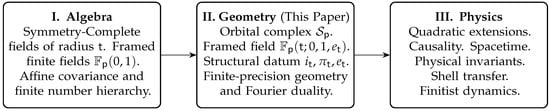
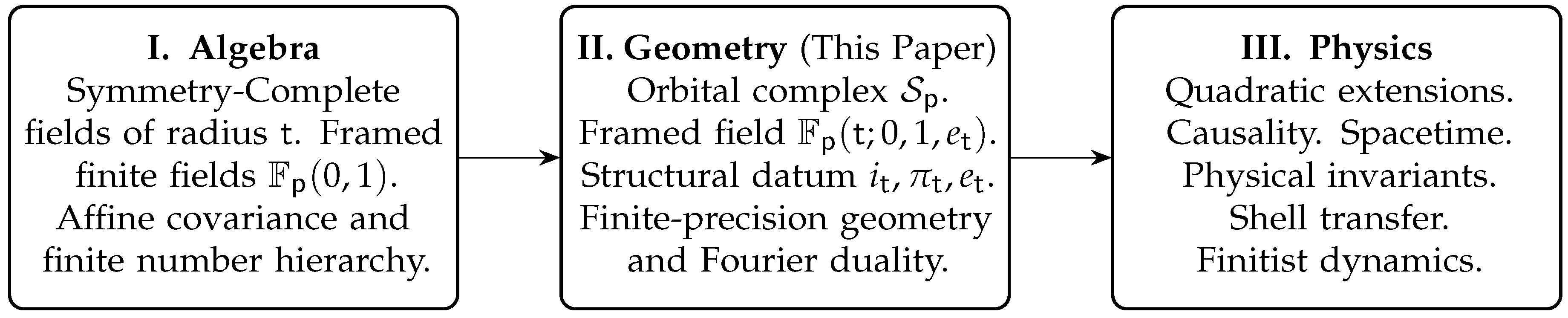
The present paper is one explicit step in a broader programme, outlined in Figure 1, which aims to show that a strictly finite formalism can carry the full operational load of scientific description, leaving the continuum as an idealized degenerative description rather than a fundamental ontology [2,3,4]. The empirical success of continuum mathematics is consistent with that position, since physical confirmation is always mediated by finite measurements, finite resolutions, and finite agreement criteria. The present paper establishes one concrete shell layer of that programme: a single symmetry-complete shell already carries the bounded geometric and harmonic structures studied here, the fixed-shell refinement mechanism is already present even for a small , and the classical continuum appears as the external degenerate comparison case of that finite formalism [3].
Figure 1.
FRC programme placement of the present work. Paper I [1] provides the algebraic foundations, while the current Paper II isolates the Euclidean shell layer in the symmetry-complete regime and leaves extension, causality, and dynamics to later work.
This paper pursues four objectives:
- (i)
- Construct a strictly finitist orbital shell as an action-generated symmetry space of a symmetry-complete field of radius , together with its canonical spherical completion.
- (ii)
- Identify the core involutive symmetry axes of the shell regime studied here together with their minimal framing depth: additively framed negation , affinely framed reciprocal inversion on , and extended-frame Euclidean conjugation .
- (iii)
- Prove an operational finite-precision theorem showing that each fixed symmetry-complete shell, through its scale-periodic framed-rational refinement, models every bounded experiment consisting of finitely many marked points and a finite family of Lipschitz comparison observables to arbitrary prescribed accuracy.
- (iv)
- Formulate the shell’s harmonic duality strictly as a discrete Fourier transform over the finite ring .
This paper is situated in a clear scholarly setting. On the foundational side, it is closer to feasibility and bounded-arithmetic viewpoints, where the distinction between formal existence and operational accessibility is explicit [5,6], and to finitist or non-Cantorian size programmes that seek mathematically coherent alternatives to unrestricted actual infinity [7]. On the geometric side, the orbital shell and its external degenerate continuum reading belong to the broader tradition of finite or combinatorial models approximating continuum geometric outputs, including Regge’s coordinate-free discretization of geometry, Dodziuk’s combinatorial Hodge theory, and modern discrete differential geometry [8,9,10]. On the harmonic side, the Fourier formalism used here is not ad hoc: Discrete Fourier transforms over finite fields, finite groups, and related finite rings are classical tools in number-theoretic and coding-theoretic analysis [11,12,13,14]. These comparisons do not identify FRC with any one prior framework, but they do locate the present claims inside recognizable mathematical terrain.
Relative to earlier work in the FRC series, the present paper isolates the first stage at which the symmetry-complete shell studied here can be treated as a self-contained object. The published algebra paper [1] establishes the symmetry-complete shell regime used here, including the quarter-turn condition , the framed-complex layer, and the basic Klein-type orbit structure. The present article builds on that algebraic base and contributes three specifically geometric and harmonic steps: an action-generated orbital shell with canonical spherical completion combinatorially equivalent to , an explicit bounded-experiment approximation theorem for the resulting shell grids, and a strictly finite Fourier formalism written in the same setting.
The contribution is that these structures coexist and interact inside one symmetry-complete shell package rather than appearing as disconnected finite analogies. The point is not just that each ingredient has a finite counterpart in isolation but that one symmetry-complete shell simultaneously carries the frame datum , the induced Euclidean values , the involution package, an action-generated orbital shell together with its spherical completion, the external degenerate continuum reading, and the harmonic transform, with exact external transport of the shell datum to the sampled classical phase roles. This unified shell architecture is what this paper contributes to the mathematical and foundational discussion.
Importantly, the congruence ensures that is a square in , so the shell carries a quarter-turn subgroup of order 4. This is the minimal algebraic condition required for the Euclidean phase structure studied here. This paper therefore works in the symmetry-complete prime case because it makes the relevant symmetry pattern exact and combinatorial, especially at small . This is a choice of the exact symmetry regime and not a claim that the system itself is organized by an internal prime/composite distinction. By Dirichlet’s theorem, there are infinitely many such primes [15] (Chapter 13), but the operational approximation theorem of Section 5 does not rely on varying : its refinement mechanism is already present in each fixed symmetry-complete shell.
The rest of this paper is organized as follows. Section 2, Section 3 and Section 4 define the shell and its structural data, with the shell built from the additive meridian action and the multiplicative phase action of the framed finite field. The same sections isolate the core involutive symmetry axes already present in the shell regime studied here and organize them by minimal framing depth. Section 5 proves the operational approximation theorem for the resulting shell grids. Section 6 develops the discrete Fourier transform formalism needed in longitude cycles of length , specialized to the shell setting and separated from external continuum-comparison language. Section 7 discusses the significance and limits of the resulting symmetry architecture, and Section 8 summarizes the main conclusions.
2. Framework: Symmetry-Complete Shells and Frames
We work throughout with the symmetry-complete regime realized here by odd primes of the form , so that is the radius/chronon parameter, and is a finite field with . In the present paper, is used only in its radial shell role. Its broader temporal reading belongs to the later causality layer of the FRC programme [16].
Definition 1
(Symmetry-Complete Field of Radius ). A symmetry-complete field of radius is a pair with prime. Equivalently, is cyclic of order and has a unique subgroup of order 4, and in any framed realization , the remaining nonzero elements split into orbital classes of the form
These are the generic orbits of the commuting involution pair generated by negation and reciprocal inversion, as established already in a published algebra paper [1]. When emphasizing the geometric role of the same object, we also refer to it simply as a symmetry-complete shell.
Remark 1
(Inherited algebraic layer used in this paper). Only a small part of the earlier algebraic development is used here. The present article needs four inherited facts: is cyclic of order ; it therefore has a unique subgroup of order 4, written as ; the commuting involutions generated by framed negation and inversion produce generic four orbits ; once the oriented quarter-turn is fixed, one may write framed-complex expressions over . Everything else used in this paper is developed explicitly below.
Definition 2
(Extended affine reference frame). An extended affine reference frame on a symmetry-complete shell is the finite field
or equivalently the quadruple , consisting of the radius/chronon together with three chosen frame elements, written in that frame as the origin , the unit , and the exponential unit . Externally, is represented by a primitive generator of . This extends the framed finite field of the algebra paper by adjoining a phase chart.
Remark 2.
The shell and the frame are different kinds of data. The shell determines the finite field and the structural possibilities available at that grade. The frame is specified by the primitive datum , which fixes the affine chart and the phase chart. Explicit symmetry formulas appear only after that datum has been fixed.
Definition 3
(Half-Period and Phase Cycle). For a symmetry-complete shell in the regime studied here, set
The meridian-step interval is
and the phase cycle is the cyclic group
Operationally, counts discrete steps along a fixed meridian from the observer origin toward the terminal shell latitude , while indexes the distinct meridians or longitude phases via the chosen exponential unit . A phase label corresponds to the field element . Thus, the shell carries two primitive actions used throughout the geometry below: additive meridian advance generated by 1, and multiplicative phase advance generated by .
Remark 3
(Action-Generated Shell Points). In a chosen frame , the shell points are generated from the observer origin by the two action coordinates and . We write the generated vertex in phase direction m and meridian step a as
Here, a records the additive depth along the chosen meridian, while m records multiplicative phase advance and hence selects one of the meridians, as depicted in Figure 2. The value gives the observer origin for every m, and the value gives the terminal shell latitude. The antipode appears only after that terminal latitude is collapsed in the associated global spherical quotient.
Proposition 1
(Primitive Generators Form One Orbit). If is primitive, then every primitive generator of has the form
Hence, the set of primitive generators is a torsor for the automorphism group of the cyclic group .
Proof.
Since is cyclic of order , its generators are exactly the power with [17] (Chapter 5). □
Proposition 2
(Phase-Frame Change). Let with . Then, the map
is a cyclic reindexing of longitude phases. Reversing the meridian orientation acts by
Both reindexings preserve the shell incidence structure defined below.
Proof.
The first statement is immediate because u is invertible modulo . The second is the reflection of the interval . Both maps are bijections; hence, they preserve adjacency once the shell is defined by step relations in . □
3. Orbital Shell and Spherical Completion
The central finite geometry object of this paper is the orbital shell . It should be read first as an action-generated shell and only then as a CW complex. In a chosen frame , the shell is generated by additive meridian advance and multiplicative phase advance. The finite shell vertices beyond the observer’s origin are written in action notation as
where a and m remain the two independent shell coordinates: a is the additive step count along a fixed meridian, while m is the multiplicative phase index selecting one of the meridians. In this notation, 1 is the additive action generator, and is the multiplicative phase generator. At , all phase labels agree:
so the north pole belongs internally to the shell as the observer origin. At the opposite boundary, gives the terminal latitude . In the associated global spherical quotient, the whole latitude is collapsed to a single antipodal point . Thus, is the finite action-generated shell itself, while its spherical completion is obtained by collapsing to .
This global shell and its global spherical quotient should therefore not be identified with the later observer-local space-like chart. The familiar Euclidean space belongs to that derived chart, whereas is the finite prerequisite symmetry object constructed in the present paper.
The arithmetic source of the construction is the finite orbit cylinder
equipped with the two shell motions
whenever the right-hand side is defined. Here, A records one additive increment in the direction , and P records one multiplicative phase step by . The lower boundary already represents the observer origin, while the opposite boundary is the terminal latitude later collapsed to the antipode in the spherical completion.
This construction combines the two primitive shell actions in one object. Meridians are generated by additive increments of the phase ray , while latitudes are generated by multiplication by . The CW complex below records that interaction in a finite combinatorial form.
Definition 4
(Action-generated orbital shell). Fix an extended affine reference frame on a symmetry-complete prime shell. The orbital shell is the finite CW complex with
- (i)
- Vertices
- (ii)
- Action interpretation
- (iii)
- Meridian edges joining to and to for ;
- (iv)
- Latitude edges joining to for ;
- (v)
- North triangular faces ;
- (vi)
- Quadrilateral facesfor .
All longitude indices are taken as modulo .
The meridian indexed by is the path
and the latitude indexed by a is the cycle
In action notation, records the additive sequence
toward the terminal latitude , while records the multiplicative orbit of fixed meridian step a under repeated multiplication by .
Remark 4
(Observer Origin and Spherical Antipode). In the chosen frame, is the observer’s internal origin. The opposite shell boundary is the terminal latitude . In the associated global spherical quotient, the whole latitude is collapsed to the single antipodal point . Under frame change, the origin moves with the chosen frame, while the terminal latitude remains the opposite shell boundary.
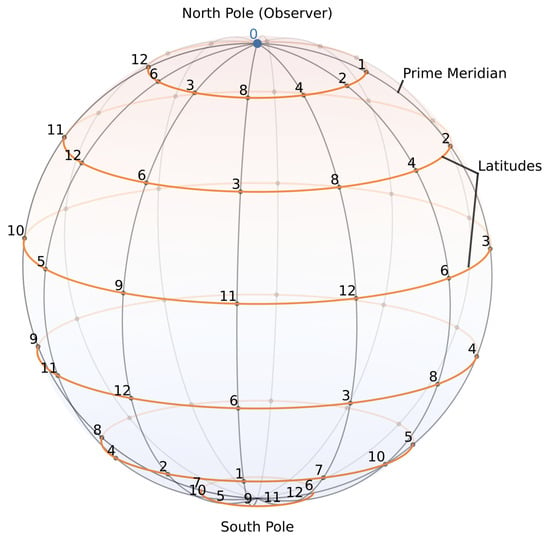
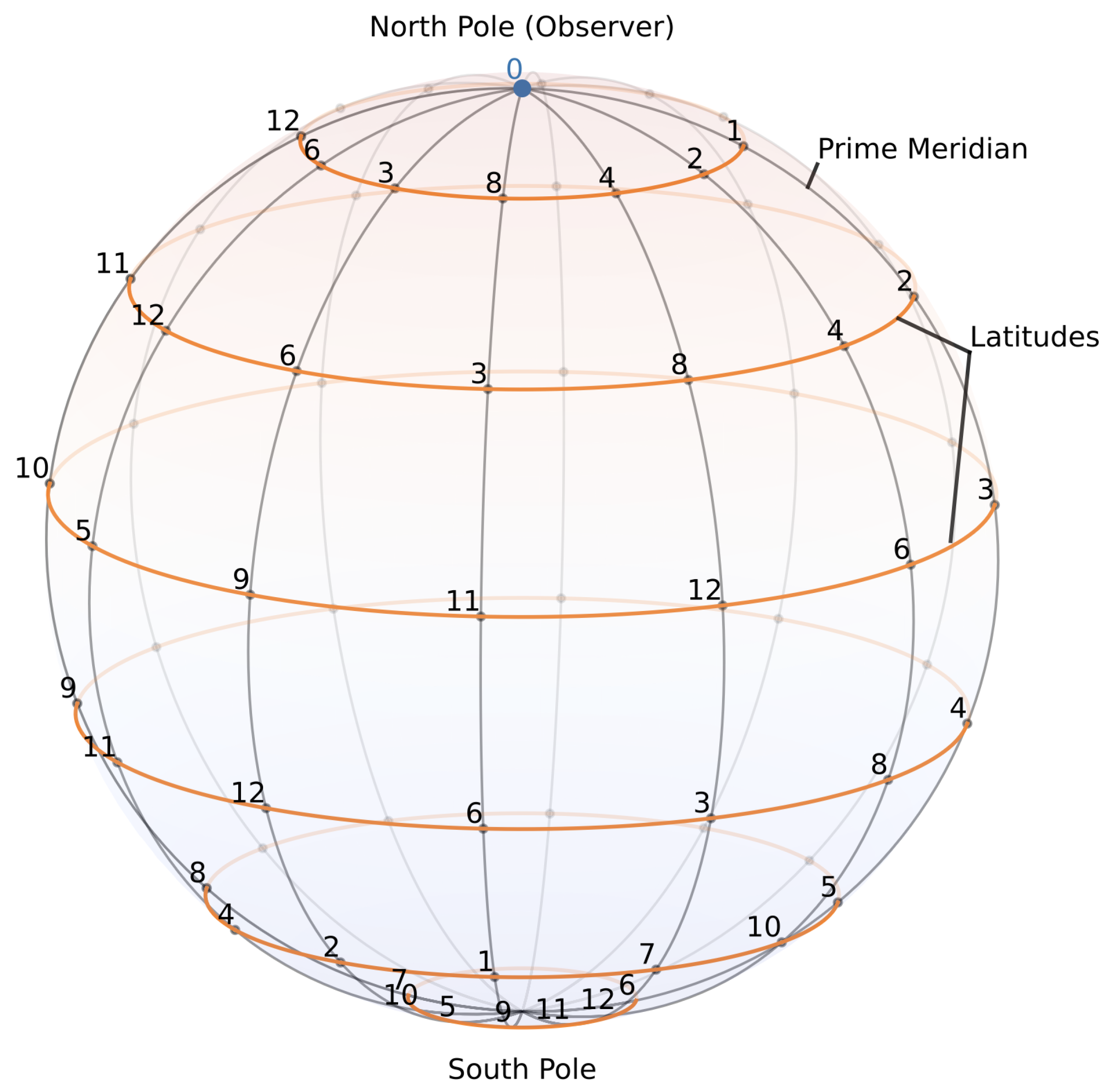
Figure 2 shows a concrete shell visualization in the case . The gray meridians and orange latitudes display the longitude–latitude cellulation induced by the orbit cylinder, while marks the observer’s origin, and the top orange latitude records the terminal shell boundary for which its image in the external spherical comparison is the antipode.
Figure 2.
Observer-framed visualization of the orbital shell for the symmetry-complete prime shell . Gray curves are additive meridians, orange curves are multiplicative latitudes, is the observer’s origin, and the upper orange latitude is the terminal shell boundary for which its image in the external spherical comparison is the antipode.
Theorem 1
(Canonical spherical completion). For every symmetry-complete prime shell and every chosen extended affine reference frame, collapsing the terminal latitude to a single point yields a finite regular CW complex combinatorially isomorphic to .
Proof.
Consider the orbit cylinder
subdivided by the unit lattice in the a- and m-directions. This is the topological realization of the discrete orbit cylinder . The lower boundary circle already represents the observer’s origin because for every phase label m. The shell records the cell structure before the upper boundary’s collapse. Now, collapse the boundary circles
to single points and , respectively. The quotient is homeomorphic to the suspension of a circle and hence homeomorphic to [18] (Example 0.14). The vertices, edges, and faces listed above induce exactly the corresponding quotient cellulation, so the spherical completion is a finite regular CW complex with the required combinatorial type. □
Remark 5
(Shell and Completion Counts). The orbital shell has
Hence,
as expected for a disk with one boundary latitude. After collapsing to , the spherical completion has
vertices and
edges, so its Euler characteristic is 2, as expected for a sphere.
Proposition 3
(Reference-Frame Covariance of the Orbital Shell). Let with . Then,
extends to a cellular isomorphism . It preserves the terminal latitude and therefore descends to spherical completions. Upon spherical completion, meridian reversal gives a cellular involution, exchanging the poles.
Proof.
The map is a permutation of , so it carries latitude and meridian adjacency in to the corresponding adjacency in . Since it preserves the latitude index a, it also preserves the terminal latitude and therefore descends to spherical completions after the latitude is collapsed. In the spherical completion, the quotient identifies the terminal latitude with , so the reflection becomes a well-defined cellular involution exchanging and . □
4. Symmetry Axes and Structural Data
The structural roles of the classical constants are organized here through a framed Euclidean datum. In a chosen frame , the primitive datum is , and from this, the shell determines the Euclidean values and :
- (i)
- The frame is given by the three chosen values 0, 1, and .
- (ii)
- The same datum generates the two shell actions: additive meridian advance by 1 and multiplicative phase advance by .
- (iii)
- The shell then determines the half-period .
- (iv)
- The same frame and shell determine the quarter-turn subgroup and the oriented value .
- (v)
- Explicit involutions are written in that frame.
Proposition 4
(Shell Half-Period). Let . For every primitive generator ,
Consequently, depends only on and not on the choice of .
Proof.
is cyclic of even order . A cyclic group has a unique element of order 2, namely , and the -th power of any generator is that element. □
Definition 5
(Quarter-Turn Subgroup). The quarter-turn subgroup of the shell is
Proposition 5
(Quarter-Turn Structure). is the unique subgroup of of order 4. If is a chosen primitive generator, then
has order 4, belongs to , and satisfies
Consequently, contains exactly two square roots of . We write the distinguished oriented one as so that
Proof.
Because is cyclic of order , it has a unique subgroup of order 4. The element has order 4; hence, it generates that subgroup. Squaring gives
by Proposition 4. □
Remark 6
(Structural Set in a Chosen Framed Field). In the notation of the algebra paper, once the framed finite field is fixed, the corresponding structural set is
Thus the quarter-turn subgroup appears in the chosen frame as the structural set of fourth roots of unity.
Proposition 6
(Exponential Unit in a Chosen Frame). A choice of exponential unit in the frame is equivalent to a choice of a primitive generator of . More precisely, if is primitive, then the primitive generators are exactly
so different frames may use different representatives for the same phase role.
Proof.
This is Proposition 1. The shell determines the cyclic group , and a primitive generator of that cyclic group determines the phase chart used in the chosen frame. □
Remark 7
(Primitive and Induced Euclidean Values). Once the primitive frame datum has been fixed, the Euclidean values are determined by the shell relations
Under frame changes, the external representatives may change, but the new frame again writes its own datum in the same form.
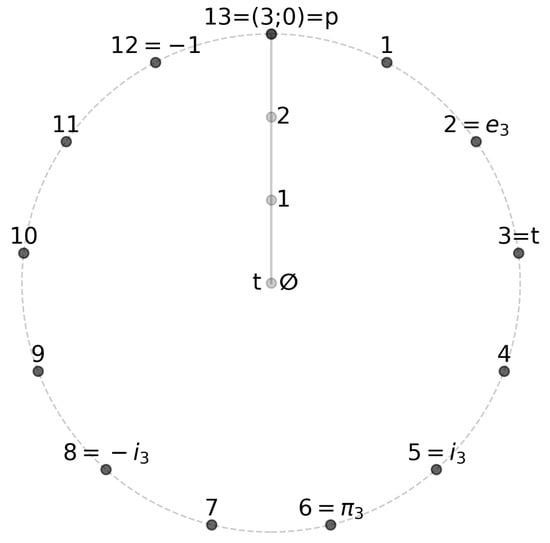
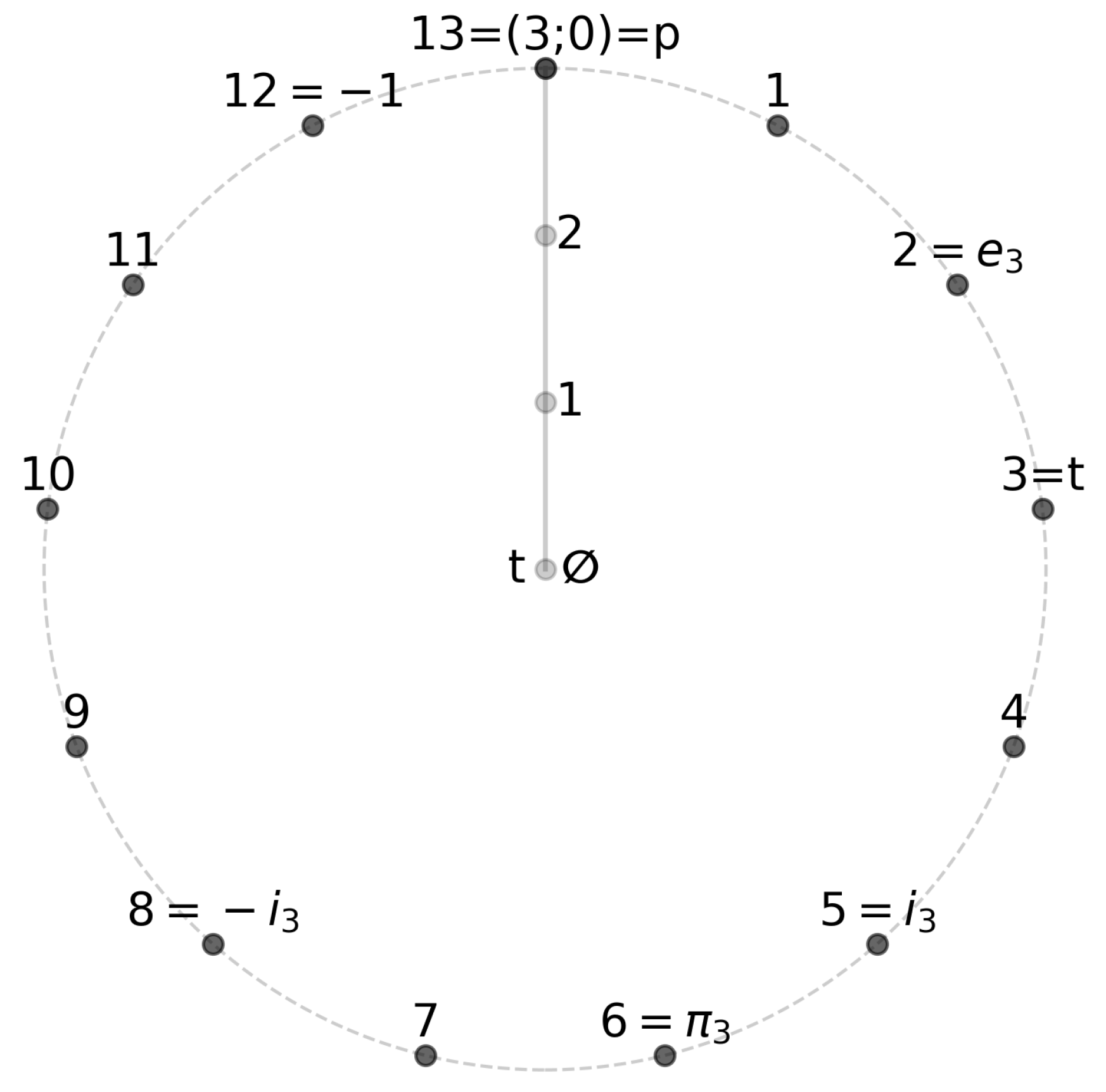
Figure 3 shows these data on the phase cycle for the shell , . The primitive frame value , the induced half-period , and the induced quarter-turns all appear directly on the same finite cycle.
Figure 3.
Phase-cycle illustration of the framed Euclidean datum in the symmetry-complete shell with . The primitive frame value is , and the same cycle determines the induced values and .
Framed Involutive Symmetries of the Symmetry-Complete Shell
At the symmetry-complete shell stage studied here, the natural symmetry axes are involutions. Their explicit formulas depend on the chosen frame. The shell determines the corresponding symmetry classes and orbit structure.
Proposition 7
(Additively Framed Negation). The map
is an involution relative to the chosen additive origin 0. Restricted to the additive cycle underlying reversible enumeration, it is the framed realization of shell reversal.
Proof.
Clearly, for every . On the additive structure of , the map reverses the direction of the cyclic order. □
Proposition 8
(Affinely Framed Inversion and Four-Orbit Symmetry). The map
is an involution of the unit cycle relative to the chosen affine pair . Moreover, R and I commute on , so they generate a four-element involution action
For every , the -orbit of x is
Proof.
Since , the map I is an involution on . For ,
so R and I commute. The orbit description is then exactly the orbit of x under the four commuting maps , R, I, and . If , these four points are distinct; otherwise, degeneracies occur only on the quarter-turn subgroup. □
Remark 8
(Framed Orbital Classes). Proposition 8 recovers the orbital classes already identified in the published algebra paper [1]. In the present geometry paper, these same involutions supply the symmetry backbone of the shell regime studied here.
Remark 9
(Transport Under Reference-Frame Change). If with , then
Since u is odd, is again one of the two square roots of in . The distinguished shell value is not defined by generator choice; it remains fixed once the shell orientation is fixed. Thus, changing the generator only reparametrizes the phase chart in which the quarter-turn data are written.
Remark 10
(Framed-Complex Layer). Once an extended frame is fixed, the shell’s oriented quarter-turn gives a framed-complex presentation in the sense of the algebra paper [1]. In particular, expressions of the form
may be used internally as finitist framed-complex quantities. Thus, complex-style elements are available inside the theory after a reference frame has been chosen, even though the phase chart in which they are written still depends on the chosen exponential unit .
Proposition 9
(Extended-Frame Euclidean Conjugation). In the same framed-complex presentation, one has the involution on coordinate expressions
This map is an involution of the framed-complex presentation determined by . It is entirely internal to the chosen framed shell presentation and should be read as a static orientation-reversing duality of that presentation.
Proof.
Applying twice gives
so . The definition depends on the chosen exponential unit through the framed-complex coordinate system, so it depends on the chosen frame. □
Remark 11
(Hierarchy Boundary). The map is a Euclidean orientation-reversing involution of the chosen framed-complex presentation. No hierarchy dynamics is assumed here, and the temporal involution studied elsewhere is distinct from this Euclidean conjugation [1].
Table 1 and Table 2 summarizes the involutive symmetries and the Euclidean datum used in the present formulation. The frame is fixed by ; the same datum generates additive meridian action and multiplicative phase action; and the shell then determines , , and the oriented quarter-turn . Together, Table 1 and Table 2 give the symmetry-centered reading used in the remainder of this paper: the frame supplies the primitive datum, and the shell determines the Euclidean values and involutive structure written in that frame.
Table 1.
Core involutive symmetry axes of the symmetry-complete shell studied here.
Table 2.
Primitive frame datum and induced Euclidean values in the symmetry-complete formulation used here.
5. Operational Finite Precision on the External Spherical Comparison
The orbital shell of the framed finite field is the global finite geometry object of FRC. The classical sphere enters here only as an external global comparison reading of the shell coordinates. The finite vertex set is the zeroth shell grid determined directly by the action-generated shell: the observer origin together with the shell points for . In that external spherical comparison, the terminal latitude collapses to the antipodal image. Its spacing improves as grows, but arbitrary precision in the present framework does not rely on sending . The stronger mechanism is the scale-periodic framed-rational refinement already available in every fixed frame , including the small symmetry-complete shells, as established in [1]. The present section therefore separates the coarse base grid from the fixed-shell refinement grids derived from the same shell.
Definition 6
(Base External Comparison Map). Fix the framed finite field . For and , set
Define
and for ,
The formula for uses only the shell chart coordinates ; its dependence on enters through the meaning of the longitude label m, namely the identification of shell phase with the field element . At , the whole terminal latitude maps to the same external comparison antipodal image because .
The map does not endow the shell with a continuum ontology. It records the external spherical comparison used for the finite-precision statements of this paper.
Proposition 10
(Base-Shell Grid Estimate). Let be the geodesic distance on the unit sphere. Every point lies within distance
of some point in the finite set .
Proof.
Write x in spherical coordinates with and . Choose and so that
If , choose the north pole . If , choose any terminal-latitude vertex . The same estimate holds because the terminal latitude collapses to a single antipodal image:
Assume now that . Consider the linear path
Since the sphere metric in these coordinates is
the length of is bounded by the Euclidean length of the corresponding straight segment in the -plane:
Therefore,
□
Remark 12
(Role of the Base Grid). Proposition 10 describes only the coarse vertex grid of the finite orbital shell itself. It is useful as the exact combinatorial starting layer, but it is not the source of arbitrary precision in the present framework.
Definition 7
(Scale-Periodic Shell Refinement). Fix the framed finite field . Let denote the truncated framed-rational grid at zoom depth N generated by the primitive frame datum in the sense of [1]. Define the refined meridian and phase coordinate sets
The external spherical comparison grid at depth N is the set
consisting of the poles together with all points
for and .
The zeroth shell grid comes from the actual vertices of . The refined grids are external comparison refinements built over the same additive and multiplicative shell coordinates by means of the framed-rational scale structure already available in the fixed frame.
Proposition 11
(Fixed-Shell Density of the Refined Shell Grids). Fix a symmetry-complete shell and a frame . For every , there exists such that every point lies within distance η of some point in .
Proof.
The algebra paper proves that for every fixed frame , the framed-rational grids generated by become dense under increasing zoom depth, and this refinement is scale-periodic rather than dependent on changing the underlying field [1]. Hence, for any , there exists N such that every number in is within of some point of , and every number in is within of some point of .
Choose N so that this holds with
Let have spherical coordinates with and . Choose
such that
Set
Then,
Using the same path-length estimate as in the proof of Proposition 10, the corresponding point of lies within distance of x. □
Definition 8
(L-Bounded Observable Family). Fix . An L-bounded observable family on r marked points, with , is a finite set of functions
such that each is L-Lipschitz with respect to the product metric
This definition captures bounded finite experiments: a finite number of marked points, a finite list of measurements, and a uniform upper bound on experimental sensitivity.
Theorem 2
(Operational Finite-Precision Theorem for a Fixed Symmetry-Complete Shell). Fix a symmetry-complete shell and a framed finite field . Let , let , let be an L-bounded observable family on r marked points, and let . For every configuration
there exists a refinement depth N and points
such that
for every .
Proof.
Choose such that
By Proposition 11, there exists N such that, for each k, one can choose with
Hence,
Each observable is L-Lipschitz, so
□
6. Finite Fourier Duality in a Chosen Reference Frame
In this paper, Fourier formalism is strictly finitist in the sense of a discrete Fourier transform over a finite ring. The algebraic statements collected here are the basic DFT identities needed on shell phase cycles, written explicitly because later constructions use them in framed form. We work in the framed finite field . The relevant ring is , the relevant transform length is
and the relevant root of unity is the chosen exponential unit . Thus, the shell transform lives entirely on the finite phase cycle carried by each latitude. This places the section inside the finite-field and finite-group Fourier tradition [11,12,13,14], now interpreted in the present setting.
Proposition 12
(Root-of-Unity Facts). Let . The chosen exponential unit is a principal n-th root of unity in , i.e.,
Moreover, n is invertible in , with the field equality
Proof.
Because has order , we have and for . Since is an integral domain, the geometric-series identity gives
and therefore the sum is zero for . Finally, , so in . □
Definition 9
(Ring Fourier Transform on the Phase Cycle). Let . For , define its ring Fourier transform
by
Proposition 13
(Inverse Formula). For every ,
Equivalently,
Proof.
Let . Then,
By Proposition 12, the inner sum is 0 when and n when . Hence, the right-hand side equals . □
Remark 13
(Matrix Formulation). If denotes the matrix with entries
then and
The same transform also has a direct polynomial interpretation on the finite phase cycle.
Proposition 14
(Polynomial Reading). For , define the polynomial
Then,
Thus, the ring Fourier transform exchanges coefficient data with values on the finite phase cycle .
Proof.
This is immediate from the definition
□
Every latitude of the shell is a copy of the phase cycle , so Definition 9 applies verbatim to any shell quantity recorded around a latitude.
Remark 14
(Framed-Complex Coefficient Layer and External Transport). Our earlier paper constructs finitist framed complex numbers over symmetry-complete prime shells [1]. Therefore, the same coefficient vectors and spectra may be viewed inside that framed-complex layer, and framed-complex expressions are already available internally once is fixed. The transform formulas themselves already live over the base ring . The map introduced below has a narrower role: it is an external transport from that already available finite phase structure to the classical complex n-th roots of unity, used here only for comparison with sampled continuum phase roles.
The remaining structural point is covariance under change of the chosen phase generator.
Proposition 15
(Covariance Under Generator Change). Let with . For a shell phase quantity , let
Then,
and the corresponding spectra agree:
Proof.
The coefficient relation is immediate from . Then,
Since u is invertible modulo n, the substitution permutes the index set . Hence,
□
Proposition 16
(Exact External Transport of the Framed Datum). Fix the framed finite field and set . Define
Then, is a cyclic group isomorphism from onto the complex n-th roots of unity, and for every ,
Moreover, for all ,
Proof.
Because generates the cyclic group of order n, the map is the unique group isomorphism sending to . The first identity is then immediate. Since , we obtain
Likewise, and , so
The kernel identity is the definition of applied to . □
Remark 15
(Status of the Fourier identities). This section records the finite Fourier facts used in this paper. They are entirely ring-internal: The signal space, the transform kernel, the inverse transform, and the covariance statement all live inside the finite ring . What matters here is that the longitude cycles of the shell studied here carry this harmonic structure natively, with the chosen unit providing the phase chart and with the external degenerate continuum comparison introduced afterward.
Remark 16
(Shell DFT is Not Just a Generic Cyclic-Group Transform). A generic cyclic group of order n supports a discrete Fourier transform once a generator has been chosen. The symmetry-complete shell studied here carries more than that. Its phase cycle is already integrated with the shell half-period , the quarter-turn structure , the framed involution package, the orbital shell , and the frame-transport laws developed in the preceding sections. Thus, the point of the present Fourier section is not the existence of a transform on a cyclic set, but the fact that the same symmetry-complete shell supports geometry, involutions, constants, and harmonic analysis in one coordinated arithmetic object. The extra structure used here consists of the exact compatibilities between the transform and the shell half-period, quarter-turn subgroup, involution package, orbital shell geometry, generator-change covariance, and external transport laws established in the surrounding propositions.
Remark 17
(Preview of a Larger Representational Reading). The present section uses only the local shell transform needed in this paper: At fixed meridian step a, the phase-position coordinate m is replaced by its dual spectral coordinate k. In a larger shell interpretation not developed here, the working chart is , and Fourier transform is read not merely as a local latitude transform but as a representational quarter-turn between primal and dual shell domains. In that reading, one Fourier step exchanges the geometric roles of a and m, double Fourier produces the minus structure, and four steps close the cycle. The shell quarter-turn datum is then expected to preserve its role across the whole representational cycle. These stronger claims are deferred to subsequent work.
Remark 18
(External Degenerate Large- Reading). Fix the framed finite field and set . Externally, the phase index may be read by an observer as the angle
so the phase cycle becomes a uniform n-point sampling grid on . In that external comparison reading, the ring DFT of Definition 9 is the finite shell form for which its degenerate large- case is the classical n-point complex DFT on sampled trigonometric data [3], although the internal coefficient ring and normalization remain those of . Consequently, for any fixed trigonometric polynomial,
external exact recovery by the classical sample DFT holds whenever . More generally, for periodic analytic , the external trapezoidal or sample coefficient approximations on the grid converge rapidly to the classical Fourier coefficients as along primes [19,20,21]. These are external sampling facts about the large- phase grid: they describe the degenerate continuum case of the shell formalism, not internal theorems of the shell itself.
7. Discussion
This article occupies a precise place both within the FRC programme and within the broader literature on symmetry in finite mathematical structures. Specifically, it gives the programme a coherent symmetry-complete shell layer carrying the framed Euclidean datum:
- (i)
- A finite orbital shell together with a canonical spherical completion;
- (ii)
- An action-generated symmetry space in which additive meridian motion and multiplicative phase motion are carried by the same frame datum;
- (iii)
- A finite structural account of the framed Euclidean datum ;
- (iv)
- A symmetry backbone realized through additively framed negation, affinely framed reciprocal inversion, and extended-frame Euclidean conjugation;
- (v)
- A strict finitist meaning of “geometry to arbitrary precision”;
- (vi)
- Finite Fourier duality on the shell.
- Euclidean Datum in Finite Field. The most distinctive contribution of this paper is the way the Euclidean datum is organized. Continuum mathematics usually treats , i, and e as basic ingredients belonging to different chapters of the theory: geometry, complex structure, and exponential phase. Here, the frame is fixed first by , and then, the same shell determines the half-period and the quarter-turn . Section 6 sharpens that point by showing exact external transport from to the sampled classical roles of a one-phase step, a half-period, a quarter-turn, and a Fourier kernel. The result is not a list of disconnected finite analogues but one framed shell datum carrying the same roles inside a single shell.
- Emergent Symmetry-Space. The shell is not introduced here as a neutral grid on which symmetry is later imposed. It is already a symmetry space: The shell points are the stable action positions produced by additive meridian advance and multiplicative phase advance in the chosen frame. In that sense, the orbital shell is the finite representation of the internal symmetries available in the shell arithmetic itself, while the spherical completion records the associated global spherical quotient of its terminal boundary.
- Scope of the Euclidean Result. The approximation theorem concerns fixed bounded experiments with finitely many marked points and finitely many Lipschitz observables. Its key mechanism is the scale-periodic framed-rational refinement available inside each fixed shell frame, while the finite vertex set of serves only as the coarse combinatorial grid layer. This is true already for the small symmetry-complete shells; increasing is not what creates arbitrary precision. The proof deliberately uses classical analysis only at the level of the external spherical comparison, because the theorem is about that comparison reading of the shell rather than internal continuum reconstruction.
- Boundary of the Approximation Claim. No claim of Gromov-Hausdorff convergence of the shell family is being made here. The point established in this paper is narrower: The global shell , together with fixed-shell framed-rational refinement and the comparison map , supports bounded finite-precision approximation on the external spherical comparison object. The observer-local spatial chart in which familiar local metric or differential geometry would be developed is not constructed here and is deferred to future work.
- Potential Applications. The present article is theoretical, but the structures it isolates are operationally relevant. The orbital shell provides a finitist model for finite-resolution spherical sampling; the phase-cycle transform provides a native shell Fourier tool for periodic shell data; and the framed symmetry package gives a controlled language for reversible finite geometry and phase processing. Within the FRC programme, this symmetry-complete shell layer also serves as the prerequisite for the quadratic-extension causality analysis developed in [16]. These are not yet empirical applications in the narrow sense, but they do indicate where the formalism can carry practical computational or modeling load: bounded geometric approximation, shell-based signal analysis, finite comparison tasks, and staged extension to algebraic spacetime models.
8. Conclusions
In the symmetry-complete shell regime studied here, realized by the finite field with , the shell supports an action-generated orbital shell with canonical spherical completion combinatorially equivalent to the two-sphere, a coherent family of involutive symmetries, a finite structural account of the framed Euclidean datum, and a ring-internal Fourier duality. More fundamentally, the shell is presented as a symmetry space generated by additive meridian motion and multiplicative phase motion from the same frame datum, with the observer origin internal to the shell and the terminal latitude collapsing to the antipode only in the associated global spherical quotient. The labels depend on the chosen frame, while the shell type and its spherical completion are the same up to isomorphism. The framed Euclidean datum also transports exactly to the sampled classical roles of one phase step and exponential kernel, a half-period, and a quarter-turn, respectively.
Equally important, the approximation theorem is a comparison-level statement about bounded experiments and prescribed tolerances and not an internal smooth-manifold claim, and this is proven by combining the coarse shell geometry with the scale-periodic framed-rational refinement already available in each fixed frame, including the small symmetry-complete shells. Likewise, the Fourier section develops the ring-internal transform identities naturally carried by the shell phase cycle. In that form, the result gives the FRC programme a technically coherent account of the shell geometry, its framed Euclidean datum, and harmonic duality.
This paper does not prove that the classical continuum is impossible or inconsistent. It does show, however, that in the shell setting treated here, the continuum is not operationally forced: a strictly finite shell already carries the bounded geometric and harmonic load under study, supplies a finite structural origin for the framed Euclidean datum used in the theory, and admits the conventional continuum formalism as an external degenerate comparison case. This is the foundational point established here. The broader displacement thesis remains programme-level, but the present shell analysis provides one explicit finite-first layer on which that broader thesis would have to build.
Funding
This research received no external funding.
Data Availability Statement
The original contributions presented in this study are included in the article. Further inquiries can be directed to the corresponding author.
Acknowledgments
The author thanks the reviewers for their careful reading and constructive remarks.
Conflicts of Interest
Author Yosef Akhtman was employed by the company Gamma Earth Sàrl and declares that the research was conducted in the absence of any commercial or financial relationships that could be construed as a potential conflict of interest.
Notations
| Fundamental radius/chronon parameter in the symmetry-complete regime studied here, . In this paper, it is used in its radial shell role; its broader temporal reading belongs to the later causality layer. | |
| Symmetry-complete field of radius in the regime studied here, meaning a prime field with . When the full frame is explicit, we write . | |
| Orbital shell of the symmetry-complete field, generated by additive meridian action and multiplicative phase action in a chosen frame; its terminal latitude has a canonical spherical completion obtained by collapsing it to the antipode. | |
| Meridian-step interval , recording additive shell depth along a fixed meridian from the observer origin to the terminal latitude. | |
| Phase cycle , indexing the distinct meridians or longitude labels in the chosen frame. | |
| Quarter-turn subgroup of , namely the unique subgroup of order 4; in a chosen frame, this is . | |
| Exponential unit of the chosen frame. | |
| Induced half-period in that frame, defined by . | |
| Induced oriented quarter-turn in that frame, with and . |
References
- Akhtman, Y. Relativistic Algebra over Finite Ring Continuum. Axioms 2025, 14, 636. [Google Scholar] [CrossRef] [Scilit]
- Lev, F. Finite Mathematics as the Foundation of Classical Mathematics and Quantum Theory; Springer International Publishing: Cham, Switzerland, 2020. [Google Scholar] [CrossRef] [Scilit]
- Zeilberger, D. “Real” Analysis is a Degenerate Case of Discrete Analysis. In Proceedings of the Sixth International Conference on Difference Equations (ICDEA 2001); CRC Press: Boca Raton, FL, USA, 2001. [Google Scholar]
- Akhtman, Y. Paradoxes of Infinity as Reductio ad Absurdum. Preprints 2025. [Google Scholar] [CrossRef] [Scilit]
- Parikh, R. Existence and Feasibility in Arithmetic. J. Symb. Log. 1971, 36, 494–508. [Google Scholar] [CrossRef] [Scilit]
- Buss, S.R. Bounded Arithmetic. In Studies in Proof Theory; Bibliopolis: Napoli, Italy, 1986; Volume 3. [Google Scholar]
- Benci, V.; Nasso, M.D.; Forti, M. An Aristotelian Notion of Size. Ann. Pure Appl. Log. 2006, 143, 43–53. [Google Scholar] [CrossRef] [Scilit]
- Regge, T. General Relativity Without Coordinates. Il Nuovo Cim. 1961, 19, 558–571. [Google Scholar] [CrossRef] [Scilit]
- Dodziuk, J. Finite-Difference Approach to the Hodge Theory of Harmonic Forms. Am. J. Math. 1976, 98, 79–104. [Google Scholar] [CrossRef] [Scilit]
- Bobenko, A.I.; Suris, Y.B. Discrete Differential Geometry: Integrable Structure. In Graduate Studies in Mathematics; American Mathematical Society: Providence, RI, USA, 2008; Volume 98. [Google Scholar] [CrossRef] [Scilit]
- Pollard, J.M. The Fast Fourier Transform in a Finite Field. Math. Comput. 1971, 25, 365–374. [Google Scholar] [CrossRef] [Scilit]
- Reed, I.S.; Truong, T.K. The Use of Finite Fields to Compute Convolutions. IEEE Trans. Inf. Theory 1975, 21, 208–213. [Google Scholar] [CrossRef] [Scilit]
- Terras, A. Fourier Analysis on Finite Groups and Applications; Cambridge University Press: New York, NY, USA, 1999. [Google Scholar]
- Mockenhaupt, G.; Tao, T. Restriction and Kakeya phenomena for finite fields. Duke Math. J. 2004, 121, 35–74. [Google Scholar] [CrossRef] [Scilit]
- Hardy, G.H.; Wright, E.M. An Introduction to the Theory of Numbers, 6th ed.; Oxford University Press: Oxford, UK, 2008. [Google Scholar]
- Akhtman, Y. Euclidean-Lorentzian Dichotomy and Algebraic Causality in Finite Ring Continuum. Entropy 2025, 27, 1098. [Google Scholar] [CrossRef] [Scilit] [PubMed]
- Rotman, J.J. Introduction to the Theory of Groups, 4th ed.; Springer: Berlin/Heidelberg, Germany, 2010. [Google Scholar]
- Hatcher, A. Algebraic Topology; Cambridge University Press: Cambridge, UK, 2002; Freely available from the author’s webpage. [Google Scholar]
- Whittaker, E.T. On the Functions which are Represented by the Expansions of the Interpolation-Theory. Proc. R. Soc. Edinb. 1915, 35, 181–194. [Google Scholar] [CrossRef] [Scilit]
- Shannon, C.E. Communication in the Presence of Noise. Proc. IRE 1949, 37, 10–21. [Google Scholar] [CrossRef] [Scilit]
- Trefethen, L.N.; Weideman, J.A.C. The Exponentially Convergent Trapezoidal Rule. SIAM Rev. 2014, 56, 385–458. [Google Scholar] [CrossRef] [Scilit]

Disclaimer/Publisher’s Note: The statements, opinions and data contained in all publications are solely those of the individual author(s) and contributor(s) and not of MDPI and/or the editor(s). MDPI and/or the editor(s) disclaim responsibility for any injury to people or property resulting from any ideas, methods, instructions or products referred to in the content. |
© 2026 by the author. Licensee MDPI, Basel, Switzerland. This article is an open access article distributed under the terms and conditions of the Creative Commons Attribution (CC BY) license.