


Abstract
In the platform economy, the pricing mechanisms are typically determined unilaterally by the platform, leading to increasingly prominent issues such as unreasonable commission rules and insufficient protection of drivers’ rights and interests. The commission rate is a key regulatory parameter for balancing revenue distribution between network freight platforms and carriers, directly shaping their strategic behaviors and influencing the industry’s sustainable development. This study aims to adopt the commission rate as the core indicator of platform revenue distribution. Through equilibrium analysis and numerical simulation, it develops a revenue-maximization model grounded in both individual rationality and collective rationality. Based on this framework, it identifies the commission ranges that achieve Pareto improvements at different stages of platform development, thereby optimizing the platform’s revenue distribution strategy. The findings show that, under collective rationality, the effort levels of both platforms and carriers exceed those under individual rationality. When the commission rate falls within a specific range, the collective-revenue-maximization strategy enhances the benefits of both parties and achieves Pareto improvement. The optimal commission rate increases progressively as the platform develops and is strongly associated with the marginal effects of effort levels on order volume and the logistics service cost coefficient. The results offer theoretical guidance and practical insights for the scientific design of commission mechanisms in network freight platforms.
1. Introduction
At present, the power of the network freight platform and the actual carrier in the pricing decision-making process is asymmetric. The pricing mechanisms are typically determined unilaterally by the platform, leading to increasingly prominent issues such as unreasonable commission rules and insufficient protection of drivers’ rights and interests. These issues must be addressed promptly to optimize platform rules, protect the legitimate rights and interests of all stakeholders, and promote the healthy and sustainable development of the platform economy. In response, several network freight platforms, including Full Truck Alliance, Lalamove and Didi have taken measures such as lowering the upper limit of commissions to better protect drivers’ rights and interests.
The platform and the carrier constitute the two primary stakeholders in the network freight transportation industry. Their financial performance directly influences the overall health and long-term sustainability of the sector. if the platform profit is minimized but not loss, this typically reflects a low return on investment and constrained cash flow. Under such conditions, the platform may reduce expenditures on technological innovation (e.g., algorithm optimization and safety monitoring) as well as marketing activities. These cutbacks can diminish user experience and increase security vulnerabilities, ultimately weakening the platform’s competitiveness and accelerating user attrition. In response to financial pressure, the platform may shift costs onto drivers or become subject to acquisition, thereby contributing to increased industry concentration. Similarly, when the carrier profit is minimized but not loss, they may be compelled to extend working hours and curtail living expenses, leading to deteriorating service quality and heightened safety risks. This not only undermines shippers’ experience but also exacerbates broader traffic safety concerns. Over time, sustained income pressure may drive carriers out of the market, resulting in capacity shortages and impeding the sustainable development of the industry. Therefore, investigating the revenue distribution strategies between the platform and the carrier is of considerable importance for promoting industry stability and sustainable development.
The total revenue of a network freight platform and its actual carrier arises from the heterogeneous contributions of both parties. Accordingly, designing a fair and equitable revenue distribution mechanism that accounts for this asymmetry is a central issue in achieving the sustainable development of the platform ecosystem. The stable development of network freight platforms depends on the behavioral strategies and effort levels of two core stakeholders: platform enterprises and carriers. Effort level is a key endogenous variable in the platform economy, directly influencing operational efficiency, service quality, market competitiveness and patterns of profit distribution. In network freight systems, platform efforts include improving the efficiency of intelligent dispatching, enhancing business management capabilities, and strengthening dispute–resolution mechanisms. Carrier efforts include providing driver training to reduce cargo damage, acquiring specialized handling knowledge, mastering route-optimization tools, and improving customer-communication skills. High effort levels substantially improve freight service quality, stimulate demand growth, and generate Pareto improvements in overall supply chain performance. However, effort investment is constrained by factors such as equipment-upgrade costs, time and energy limitations, and additional expenditures, which reduce the motivation of both parties and ultimately hinder supply chain performance.
This paper takes into account the unequal power relationship between the platform and the actual carrier, treats the commission rate as the core indicator of platform revenue distribution, and proposes a commission-pricing mechanism based on the parties’ asymmetric contributions. The objective is to enhance revenue performance for both the platform and the carrier. The specific research design is as follows. First, profit-maximization models are established for both the network freight platform and the carrier from the perspective of individual rationality, explicitly defining the distribution patterns and effort levels when each party independently pursues optimal profits. Second, the study constructs a collective profit-maximization model for both parties. Building on this, it proposes an innovative profit distribution strategy based on the asymmetric contributions of each party and evaluates its effectiveness in achieving Pareto improvements. Finally, through numerical analysis, the study examines the effort-level choices and profit variation patterns of both parties under different platform development stages and commission rates. Based on these findings, it proposes targeted commission strategies tailored to the development of the platform.
This study builds upon a rich body of literature on platform economy, offering novel contributions in three distinct areas.
- (1)
- This paper concentrates on optimizing the commission mechanism of the network freight platform and develops a profit-maximization model for both the platform and the carrier under individual rationality. It identifies the commission rate and behavioral strategies adopted when each party independently pursues its own optimal profit. In addition, a collective rationality model is constructed to maximize joint profits, and the optimal range of the commission rate that can achieve Pareto improvement is determined.
- (2)
- This paper further proposes an innovative commission strategy based on the contributions of the platform and the carrier, offering a quantifiable decision-making framework for achieving Pareto-optimal outcomes.
- (3)
- Drawing on the equilibrium results under both individual and collective rationality, the paper provides strategic recommendations tailored to the development needs of network freight platforms.
2. Literature Review
Currently, the commission-pricing mechanisms of global network freight platforms are transitioning from traditional and opaque to more diversified and transparent. For example, Uber Freight Shipping in the United States employs an instant and transparent quote pricing system supported by advanced robust machine learning pricing algorithms, providing users with timely updates on price changes. This approach enhances trust and promotes pricing decisions that are more aligned with collective rationality. Similarly, the German digital freight platform Sennder has achieved substantial cost reductions through the adoption of electronic documentation and digitalized processes. The platform stipulates that the Carrier and sennder must agree on the freight charges for each respective transport order, and any additional expenses require prior approval from sennder. This analysis indicates that the optimal commission strategy is inherently dynamic, evolving in accordance with the platform’s capabilities, stage of development, and strategic objectives. This finding not only supports the theoretical validity of this study but also delineates its practical application scenarios and directions.
The existing literature primarily focuses on stakeholders’ efforts in bilateral interactions, with particular emphasis on service quality improvement. Yang et al. [1], using differential game theory, found that the effort levels of supply chain participants are influenced by factors such as market sensitivity, safety–stability coefficients, profit and effort–cost parameters. Zhang and Zhang [2] developed a supply chain decision-making model that incorporates preservation efforts and offline experiential levels, and found that under the agglomeration model, fresh agricultural products exhibit better prices, greater sales volumes, higher preservation-effort levels, and improved overall supply chain profitability. In research related to intelligent algorithm applications, agent-based algorithmic systems have been shown to enhance individual worker performance through algorithmic logic, thereby increasing collective profits [3]. Guo et al. [4] constructed a tripartite game model involving manufacturers, network freight platforms and retailers, comparing logistics service effort decisions and supply-chain pricing strategies under source-uploading and vehicle-matching operational modes. Their findings provide a decision-making framework for optimizing the operational strategies of network freight platforms.
Commission refers to the service fee charged by the platform to the carrier for providing transaction-matching services. It is closely tied to the platform’s cost structure and operational efficiency and directly affects the revenue distribution between the platform and the carrier. In recent years, commission-setting in the platform economy has attracted extensive attention from scholars. Jiang et al. [5] developed a dynamic benefit-distribution model for network freight platforms based on contribution indicators. Huang and Xu [6] argued that adopting a dynamic commission strategy can effectively regulate market supply and demand and enhance the platform’s expected revenue. Liao et al. [7] achieved Pareto optimality under certain conditions by constructing a revenue-distribution model for virtual enterprises. Chen and Deng [8] examined the complex relationships among commission rates, driver behavior, and other parameters in ride-hailing platforms using queuing theory. Dai and Zhang [9] investigated e-commerce platform commission policies through game theoretic analysis and found that cost and pricing structures influence the optimal commission rate. Tian et al. [10] analyzed two charging schemes, service fees and commission-based pricing for food-delivery platforms under centralized and decentralized regulatory frameworks. By considering regulatory intensity, merchant cash-incentive strategies and rider effort levels, they constructed a tripartite game model to derive optimal decisions and profits. Tan et al. [11] employed a Stackelberg game model to examine how consumer sensitivity, meal-price differences, and delivery-cost heterogeneity affect commission charging approaches. Xie and Zhang [12] find that safety investments exert heterogeneous effects on ride-hailing platforms, passengers, drivers and society. Commission rates associated with security investments are typically lower. Doğan et al. [13] propose a variable commission that jointly accounts for drivers’ transactions and service performance. Li and Wang [14], in their study of U.S. delivery platforms, demonstrate that reducing commission rates influences platform recommendation behavior and increases delivery fees. Zhao and Zeng [15] develop a modeling framework to identify the optimal commissions and subscriptions for mutual aid platforms. Chen et al. [16] construct two objective functions, i.e., platform revenue maximization and social welfare maximization, and optimize the dynamic matching of idle vehicles and passengers while the driver’s profit is guaranteed above a certain level. A well-designed commission mechanism can improve service quality and operational efficiency, optimize resource allocation, balance stakeholder interests, stimulate the initiative of all participants, and foster a mutually beneficial cooperative model, thereby supporting the long-term and stable development of the network freight industry.
Given that research on network freight platforms remains in its early stages, the research results of similar ride-hailing platforms have significant reference value. Jin et al. [17], focusing on social welfare maximization, analyzed how static and peak pricing strategies influence pricing decisions, social welfare outcomes and revenue distribution in non-profit ride-hailing platforms, thereby providing new perspectives for evaluating the social benefits of platform pricing mechanisms. Peng et al. [18] applied birth and death processes and queuing theory to characterize driver state transitions on ride-hailing platforms and developed a social welfare maximization model aimed at improving market efficiency. Wang et al. [19] incorporated public praise and user satisfaction into a duopoly two-period dynamic pricing model to examine the optimal pricing strategies of platforms under unilateral charging and bilateral charging policies. Chen et al. [20] analyzed drivers’ decision-making processes on ride-sharing platforms using a Stackelberg game framework and identified the optimal bonus scheme under a profit-maximization objective. Notably, compared with a collective-benefit maximization model, a platform-centered profit-maximization approach not only results in higher service prices but also reduces the revenue share allocated to carriers.
The uncertainty of shipment volumes on network freight platforms is a critical factor affecting enterprise profitability, investment decisions, operational strategies and market competitiveness. It constitutes a key focus in platform economy research. Cai et al. [21] considered the preferences of both service providers and consumers, derived the optimal bilateral pricing strategy for socially responsible platform enterprises under conditions of both fixed and stochastic demand fluctuations. Sun and Xu [22] incorporated platform service quality differentiation and market demand variability to construct dynamic, static and differentiated taxi-pricing models from which they derived optimal pricing rules, providing a theoretical foundation for network platform pricing practices. Yang and Zhong [23] developed price and wage strategy, fixed-subsidy strategy and rush-order reward strategy models to analyze the equilibrium conditions of driver behavior and platform decision-making, thereby enriching the theoretical framework of platform pricing strategies. Song et al. [24] employed a Stackelberg game model to examine the regulatory mechanisms of pricing and subsidy strategies in shared mobility platforms, offering a novel perspective on competition and cooperation within the platform economy. Zhang et al. [25] integrated principal-agent theory to analyze product pricing, incentive mechanisms, business models and efficiency-loss transmission in service platforms, elucidating how uncertainty at the output end propagates efficiency losses across the platform. Wang et al. [26]. developed a two-stage principal–agent model to examine how a platform enterprise’s value preference parameter governs collaborative outcomes. In the research on the asymmetry of power structures, Hua [27] developed a decision-making model for targeted technology investments and sales mode selection based on game theory and optimization theory, to deeply explore the investment made by platforms in targeted technology and the impact of the choice of sales modes under the asymmetry of power structures. Collectively, these studies have enriched theoretical research on platform pricing strategies, provided insights into platform competition and cooperation, and laid a systematic foundation for designing revenue distribution mechanisms.
Comparison between this paper and the most relevant research is summarized in Table 1. From the above analysis, it can be concluded that current research on the platform economy predominantly focuses on designing pricing strategies aimed at maximizing platform profits, with relatively little attention given to the rights and interests of the carrier. Existing studies lack analyses of the contributions made by both parties, fail to explore differences in revenue distribution mechanisms under varying rationality conditions, and lack analyses of the relationship between the platform’s development stage and the optimal commission rate.
Table 1.
Comparison between this paper and the most relevant research.
To address these gaps, this paper takes into account the unequal power relationship between the platform and the actual carrier, treats the commission rate as the core indicator of platform revenue distribution, and proposes a commission-pricing mechanism based on the parties’ asymmetric contributions. The objective is to enhance revenue performance for both the platform and the carrier.
3. Problem Description and Modeling Assumptions
The network freight platform connects the supply side (carriers) with the demand side (shippers) by leveraging internet technology to establish a centralized data platform. It integrates transportation resources, optimizes supply and demand matching algorithms, and signs transportation contracts with shippers in the capacity of a legal carrier. The platform entrusts carriers with the execution of freight tasks while fully assuming the associated legal responsibilities. Building on this operational framework, this paper focuses on the commission rate between the platform and the carrier, examining the rationality behind its setting and its impact on the stability of their cooperative relationship.
The efforts of both the network freight platform and the carrier directly influence operational efficiency, service quality, market competitiveness and profit distribution patterns. Platform efforts, such as enhancing the efficiency of intelligent scheduling, optimizing business management and refining dispute resolution mechanisms, substantially improve logistics service efficiency, thereby strengthening market influence and competitiveness. The carrier’s efforts are reflected in faster delivery, improved service attitude, careful handling of goods and more flexible communication. These efforts directly enhance the customer experience, generating positive public praise and increasing customer retention, which ultimately leads to a higher order volume. Collectively, the efforts of the platform and the carrier drive improvements in freight service quality, stimulate growth in platform order volumes.
The enhancement of efforts by the network freight platform and the carrier is constrained by factors such as equipment upgrade requirements, time and energy expenditures, and operational costs, which can dampen the motivation of both parties and consequently reduce overall operational performance. Based on this, this article assumes that the effort cost of the network freight platform is a quadratic function of its effort level [3,11,19], that is,
Here, denotes the logistics service cost coefficient of the network freight platform. Assume that the actual carrier’s effort cost is a quadratic function of their effort level [3,11,19], that is,
denotes the logistics service cost coefficient of the actual carrier.
Given the significant role that the level of logistics service efforts plays in enhancing the efficiency of the platform, this article assumes that the order volume on the platform () is influenced by transportation price () and the effort level of both parties () [11,18,19], that is,
Here, denotes the potential order volume. , . denotes the sensitivity coefficient of the platform’s order volume to transportation price (), reflecting how responsive the order volume is to changes in price. and represent the marginal effect of the effort levels of the platform and the carrier, respectively, indicating the increase in order volume resulting from each additional unit of effort by the platform or the carrier.
Based on the above problem description and assumptions, the revenues of the network freight platform and the carrier are denoted by
Here, denotes the commission rate charged by the network freight platform. The logistics service effort levels of both the platform and the carrier influence the order volume, thereby affecting the revenue of each party. Therefore
The total revenue of the network freight platform and the carrier is
The variables used in this study are summarized in Table 2.
Table 2.
Variable declaration.
This paper considers the commission rate as the primary indicator of revenue distribution. Based on the aforementioned research assumptions and the revenue functions of the platform and the carrier, it develops models for maximizing both individual and collective revenues, and examines the strategic behaviors of both parties as well as the platform’s optimal commission rate.
4. Return Maximization Model and Equilibrium Analysis
Based on the problem description and assumptions, this section constructs revenue distribution models under both individual and collective rationality. First, within the individual rationality framework, models are developed to maximize the respective revenues of the network freight platform and the carrier, taking into account variations in order volume, and the platform’s optimal commission rate is derived. Second, under the collective rationality framework, the optimal commission rate is determined with the objective of maximizing total revenue and ensuring that the revenues of both the platform and the carrier increase. Finally, by incorporating the contributions of both parties to total revenue growth, the revenue distribution outcomes are further optimized, providing theoretical support and practical guidance for enhancing overall efficiency and fairness in network freight operations.
4.1. Revenue Distribution Strategy Under Individual Rationality
Under individual rationality, both the network freight platform and the carrier seek to maximize their own profits, therefore, adopt non-cooperative strategies. From and , it can be concluded that the optimal effort levels of the platform and the carrier under the Nash equilibrium are
From this, it can be inferred that under individual rationality, the optimal effort levels of both the network freight platform and the carrier depend on the transportation price (), the commission rate (), the marginal effects of both parties’ efforts on the order volume () and their respective logistics service cost coefficients (). Specifically, the effort levels of the platform and the carrier are positively correlated with their respective revenue shares ( and ), the marginal effect of the effort levels of both parties on the order volume and the transportation price, but negatively correlated with their logistics service cost coefficients. Therefore, under individual rationality, a higher revenue share incentivizes greater effort from either the platform or the carrier, whereas higher logistics service costs reduce their willingness to exert effort.
At this point, the revenue of the network freight platform and the actual carrier are denoted as
The total revenue is
This article considers that the network freight platform will set the optimal commission rate based on the maximization of total revenue. From , we obtain the optimal commission rate is
From this, the following conclusion can be drawn:
Theorem 1.
Under the condition of individual rationality, the optimal commission rate that the network freight platform should charge is .
From this, it can be concluded that under individual rationality, the optimal commission rate that the network freight platform should charge is negatively correlated with the platform’s logistics service cost coefficient and the marginal effect of the effort levels of the carrier on the order volume. Conversely, it is positively correlated with the carrier’s logistics service cost coefficient and the marginal effect of the effort levels of the platform on the order volume.
4.2. Revenue Distribution Strategy Under Collective Rationality
Under the condition of collective rationality, and with the objective of maximizing the total revenue of both the network freight platform and the carrier, from and , the optimal effort levels of the platform and the carrier are
From this, it can be seen that under the condition of maximizing total revenue, the effort levels of both the network freight platform and the carrier are positively correlated with their respective marginal effect of the marginal effect of their effort levels on the order volume, and negatively correlated with their own logistics service cost coefficients. At this point, the revenues of the network freight platform and the carrier are
The total revenue is
Table 3 presents a comparison of the optimal effort levels and revenues of the network freight platform and the carrier under both individual and collective rationality.
Table 3.
The optimal effort levels and revenues of the network freight platform and the carrier.
From , we can infer , . Specifically, under collective rationality, the optimal effort levels of both the network freight platform and the carrier exceed those under individual rationality. From this, the following conclusion can be drawn:
Inference 1: Under collective rationality, the optimal effort levels of both the network freight platform and the carrier are higher than those under individual rationality.
Compared with individual rationality, the incremental effort costs for the network freight platform and the carrier under collective rationality are
This indicates that the platform’s commission strategy directly influences the effort costs of both parties. As shown in , the increase in the platform’s effort cost is negatively correlated with the commission rate, whereas the increase in the carrier’s effort cost is positively correlated with it. Furthermore, the increase in effort costs for either the platform or the carrier is positively correlated with the marginal effect of their own effort levels on the order volume, and negatively correlated with their respective logistics service cost coefficient.
Compared with individual rationality, the incremental revenues for the network freight platform and the carrier under collective rationality are
The incremental total revenue is
Here . From this, it can be observed that the increase in the network freight platform’s revenue is positively correlated with the commission rate and the platform’s logistics service cost coefficient, and the marginal effect of the carrier’s effort levels on the order volume. Conversely, it is negatively correlated with the marginal effect of the platform’s own effort levels on the order volume and the carrier’s logistics service cost coefficient. Similarly, the increase in the carrier’s revenue is positively correlated with the marginal effect of the platform’s effort levels on the order volume and the carrier’s logistics service cost coefficient, while it is negatively correlated with the marginal effect of the carrier’s own effort levels on the order volume, the platform’s logistics service cost coefficient, and the platform’s commission rate.
From and , we obtain . it can be concluded that the optimal commission rate range charged by the network freight platform is
From this, the following conclusion can be drawn:
Theorem 2.
When the commission rate is within range , the revenues of the network freight platform and the carrier under collective rationality are both higher than those under individual rationality.
4.3. The Collective Rational Strategy Considering the Contributions of the Participants
This section allocates revenue based on the contributions of the network freight platform and the carriers to total revenue. When the platform adopts a collective rational strategy, and the carrier follows an individual rational strategy, the total revenue is . Conversely, when the platform adopts an individual rational strategy, and the carrier follows a collective rational strategy, the total revenue is .
By allocating revenue according to the contributions of the platform and the carrier to the incremental total revenue, the revenue increase for the platform under the collective rational strategy is
compared with the individual rational strategy, and the revenue increase for the carrier is
And , . From this, it can be observed that under a collective rationality strategy, when revenue distribution is based on the contributions of the network freight platform and the carrier to total revenue, the platform’s revenue increase is positively correlated with the marginal effect of its effort level on the order volume, and negatively correlated with the commission rate and its logistics service cost coefficient. Similarly, the carrier’s revenue increase is positively correlated with the marginal effect of its effort level on the order volume, and negatively correlated with its logistics service cost coefficient.
When distributing the total revenue based on the contributions made by the network freight platform and the carrier, from and , we obtain the optimal commission rate is
and
From this, the strategic choices of the network freight platform and the carrier under different commission rates can be determined, as presented in Table 4.
Table 4.
The strategic choices of the network freight platform and the carrier under different commission rates.
As can be seen from Table 4,
- (1)
- When , then and . That is, for the network freight platform, revenue under the collective rationality considering the contributions of participants exceeds that under the collective rationality strategy. Conversely, for the carrier, revenue under the collective rationality considering the contributions of participants is lower than that under the collective rationality strategy. Thus, the collective rationality strategy considering the contributions of participants is more advantageous for the platform, whereas the collective rationality strategy is more beneficial for the carrier.
- (2)
- When , then and . That is, for the network freight platform, revenue under the collective rationality considering the contributions of participants is lower than that under the collective rationality strategy. Conversely, for the carrier, revenue under the collective rationality considering the contributions of participants exceeds that under the collective rationality strategy. Thus, the collective rationality strategy is more advantageous for the platform, whereas the collective rationality strategy considering the contributions of participants is more beneficial for the carrier.
The following conclusion can be drawn:
Theorem 3.
Under the condition of collective rationality considering the contributions of participants, the optimal commission rate that the network freight platform should charge is .
It can be concluded that under the condition of collective rationality considering the contributions of participants, the optimal commission rate for the network freight platform is negatively correlated with the platform’s logistics service cost coefficient and the marginal effect of the carrier’s effort levels on the order volume, while it is positively correlated with the carrier’s logistics service cost coefficient and the marginal effect of the platform’s effort levels on the order volume.
5. Simulation
This section uses numerical analysis to examine the relationships among revenue, commission rates, effort levels and the marginal effect of the participants’ effort levels on the order volume under both individual and collective rationality conditions for the network freight platform and the carrier. This section uses MATLAB R2024b to numerical analysis. The analysis provides a theoretically grounded and interpretable basis for designing the commission mechanism of the network freight platform. Three scenarios are considered in this study:
Scenario A: In the initial stage of establishing a network freight platform, the platform must invest heavily in technology development, market expansion and brand building. These factors result in high marginal effort costs. In contrast, the carrier primarily performs standardized transportation tasks, resulting in relatively low marginal effort costs. In this scenario, this study sets (, ) [4,24].
Scenario B: In the growth stage of the network freight platform, its business model stabilizes and economies of scale begin to emerge, significantly reducing the platform’s marginal effort costs. At the same time, to meet higher service requirements, the carrier may need to invest more effort, increasing their marginal effort costs. In this scenario, the marginal effort costs of the platform and the carrier are approximately equal. This study sets (, ) [4,24].
Scenario C: In the mature stage of the network freight platform, its stable market position, highly optimized operational systems and substantial technological scale effects allow it to further reduce marginal effort costs. In contrast, the carrier may experience upward pressure on their marginal effort costs due to factors such as stricter compliance requirements and rising labor costs. In this scenario, this study sets (, ) [4,24].
During the transportation process, the carrier’s service quality has a more direct impact on the order volume, whereas the platform primarily influences order volume indirectly through technology and service support. Accordingly, this study sets the marginal effect of the effort levels of the platform and the carrier on the order volume as and , respectively. Based on the current state of network freight and relevant literature [18], the transportation price is set at 3 (yuan per kilometer), the potential order volume at 10, and the sensitivity of the order volume to price at 1 [4].
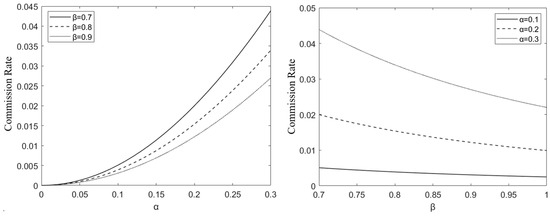
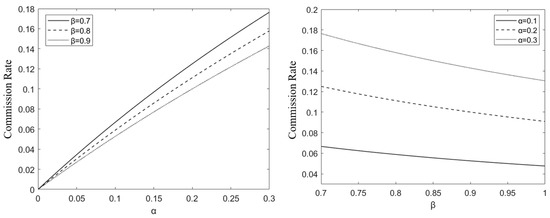
In the initial stage of the network freight platform, the optimal commission rate under individual rationality and collective rationality considering the contributions of participants are presented in Table 5. As shown in Table 5, in the initial stage of the network freight platform, the optimal commission rate under collective rationality is higher than that under individual rationality. This rate increases with the marginal effect of the platform’s effort levels on the order volume, and decreases with the marginal effect of the carrier’s effort levels on the order volume. Under individual rationality, the commission rate varies according to the trends in the marginal effect of both the platform’s effort levels and the carrier’s effort levels on the order volume, as illustrated in Figure 1, whereas under collective rationality, it follows the corresponding trends shown in Figure 2.
Table 5.
The optimal commission rate in the initial stage of the network freight platform.
Figure 2.
The commission rate under collective rationality in the initial stage of the network freight platform.
Figure 1 shows that, under individual rationality, in the initial stage of the network freight platform, the commission rate is positively correlated with the marginal effect of the platform’s effort level on the order volume, but negatively correlated with that of the carrier. Moreover, as the marginal effect of the platform’s effort level on the order volume increases, the growth rate of the commission rate accelerates. Figure 2 shows that, under collective rationality, the commission rate remains positively correlated with the marginal effect of the platform’s effort level on the order volume, and negatively correlated with that of the carrier. Moreover, as the marginal effect of the platform’s effort level on the order volume increases, the upward trend in the commission rate becomes less pronounced.
In the growth stage of the network freight platform, the optimal commission rate under individual rationality and collective rationality considering the contributions of participants are presented in Table 6.
Table 6.
The optimal commission rate in the growth stage of the network freight platform.
As shown in Table 6, in the growth stage of the network freight platform, the optimal commission rates under both individual rationality and collective rationality are higher than those in the platform’s initial stage. Like the initial stage, the optimal commission rate under collective rationality is higher than that under individual rationality. This rate increases with the marginal effect of the platform’s effort level on the order volume, and decreases with the marginal effect of the carrier’s effort level on the order volume. Under individual rationality, the commission rate varies according to the trends in the marginal effect of both the platform’s effort levels and the carrier’s effort levels on the order volume, as illustrated in Figure 3, whereas under collective rationality, it follows the corresponding trends shown in Figure 4.
Figure 3.
The commission rate under individual rationality in the growth stage of the network freight platform.
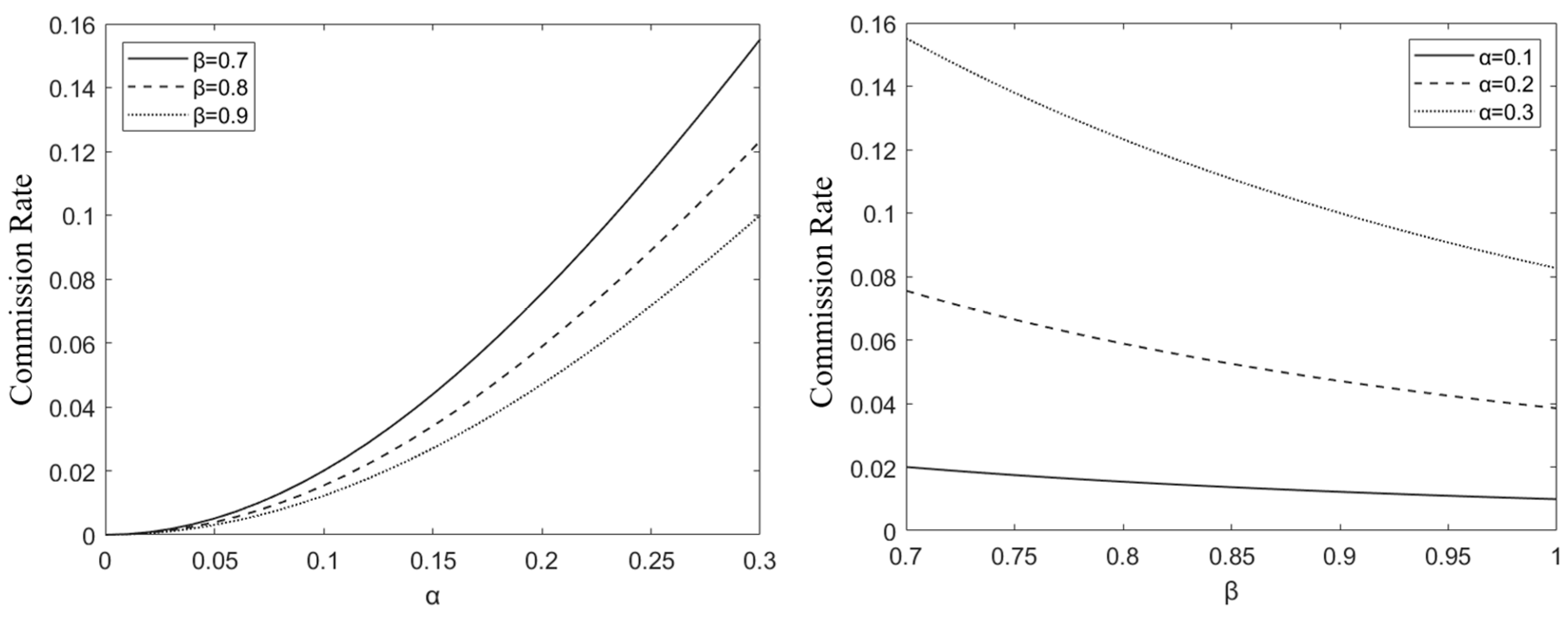
Figure 4.
The commission rate under collective rationality in the growth stage of the network freight platform.
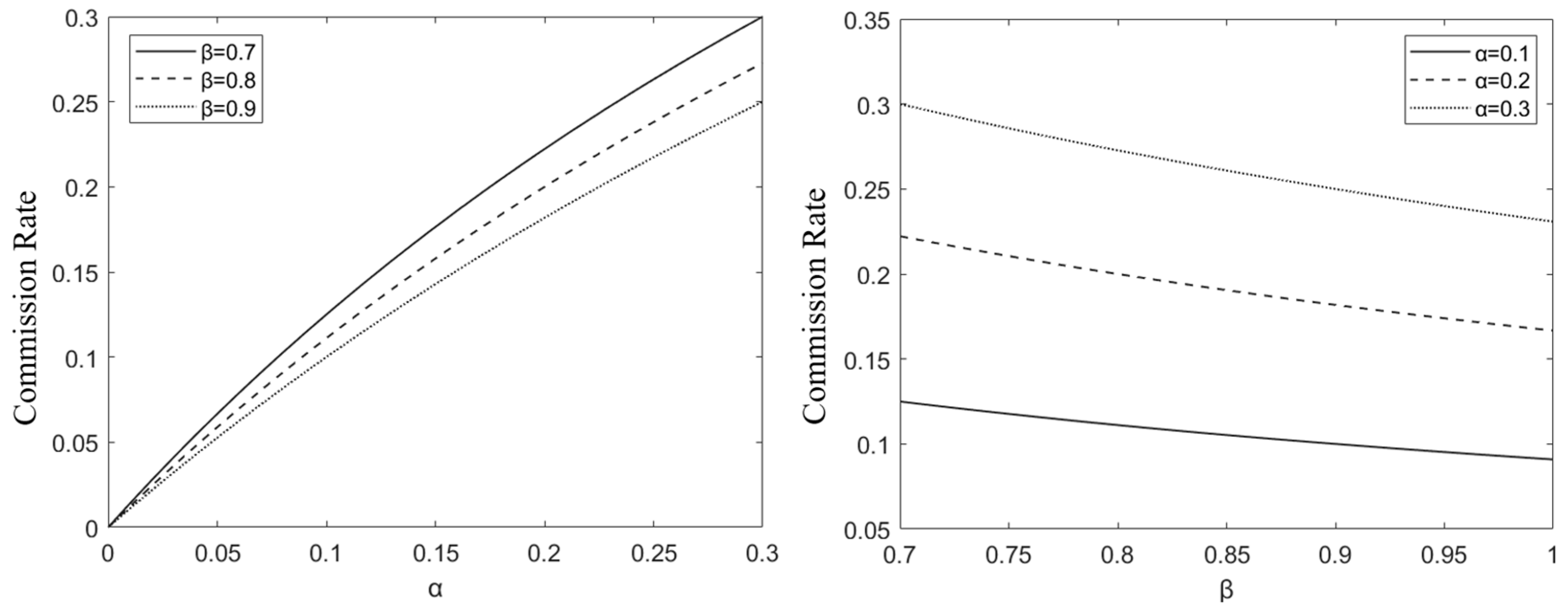
Figure 3 shows that, under individual rationality, in the growth stage of the network freight platform, the commission rate is positively correlated with the marginal effect of the platform’s effort levels on the order volume under individual rationality, but negatively correlated with that of the carrier. Moreover, as the marginal effect of the platform’s effort level on the order volume increases, the growth rate of the commission rate accelerates. Figure 4 shows that, under collective rationality, the commission rate remains positively correlated with the marginal effect of the platform’s effort level on the order volume, and negatively correlated with that of the carrier.
In the mature stage of the network freight platform, the optimal commission rate under individual rationality and collective rationality considering the contributions of participants are presented in Table 7.
Table 7.
The optimal commission rate in the mature stage of the network freight platform.
As shown in Table 7, in the mature stage of the network freight platform, the optimal commission rates under both individual rationality and collective rationality are higher than those in the platform’s initial stage and growth stage. The optimal commission rates under collective rationality is higher than those under individual rationality. The rate increases with the marginal effect of the platform’s effort levels on the order volume, and decreases with the marginal effect of the carrier’s effort levels on the order volume. Under individual rationality, the commission rate varies according to the trends in the marginal effect of both the platform’s effort levels and the carrier’s effort levels on the order volume, as illustrated in Figure 5, whereas under collective rationality, it follows the corresponding trends shown in Figure 6.
Figure 5.
The commission rate under individual rationality in the mature stage of the network freight platform.
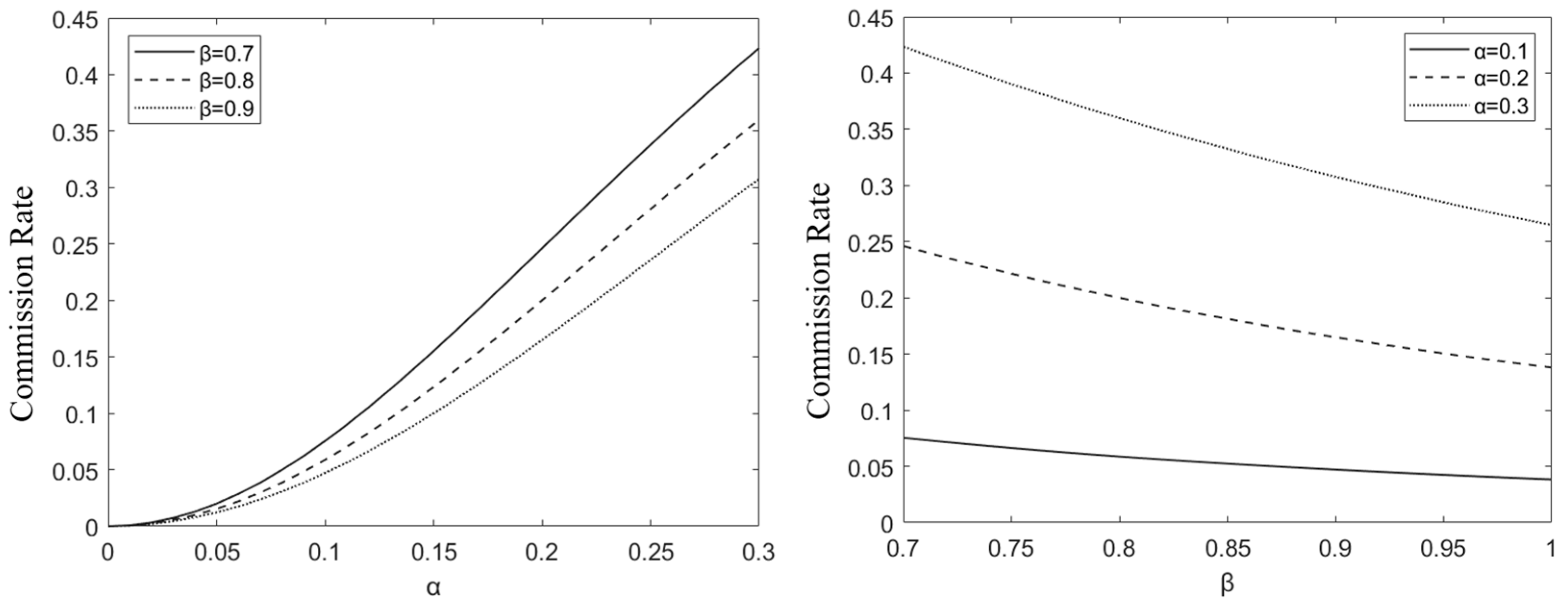
Figure 6.
The commission rate under collective rationality in the mature stage of the network freight platform.
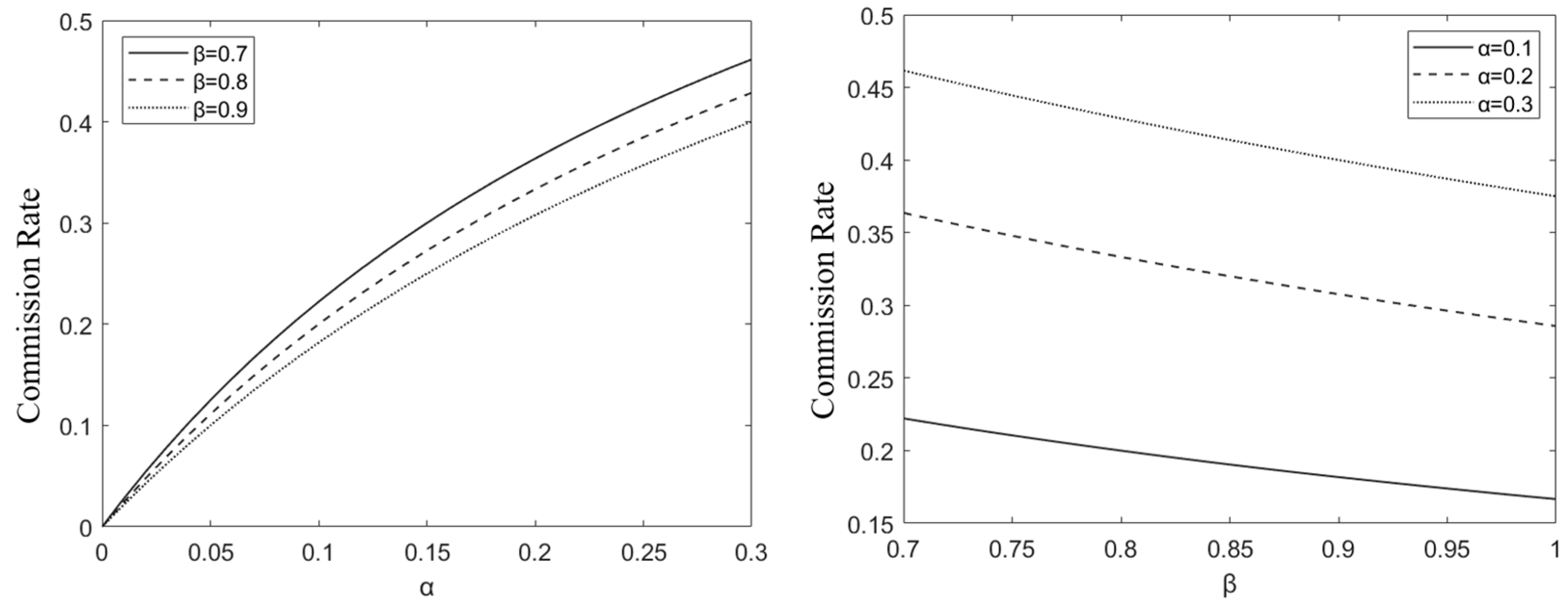
Figure 5 shows that, under individual rationality, in the mature stage of the network freight platform, the commission rate is positively correlated with the marginal effect of the platform’s effort levels on the order volume, but negatively correlated with that of the carrier. Moreover, as the marginal effect of the platform’s effort levels on the order volume increases, the growth rate of the commission rate accelerates. Figure 6 shows that, under collective rationality, the commission rate remains positively correlated with the marginal effect of the platform’s effort levels on the order volume, and negatively correlated with that of the carrier. As the marginal effect of the platform’s effort levels on the order volume increases, the upward trend in the commission rate gradually slows.
The above analysis shows that, under both individual and collective rationality, the optimal commission rate increases as the marginal effect of the platform’s effort levels on the order volume rises, and decreases as the marginal effect of the carrier’s effort levels on the order volume rises. Moreover, the optimal commission rates under collective rationality are consistently higher than those under individual rationality. As the network freight platform develops, the optimal commission rate continues to rise. From this, the following conclusion can be drawn:
Inference 2: The optimal commission rate charged by the network freight platform is positively correlated with the marginal effect of the platform’s effort levels on the order volume, and negatively correlated with the marginal effect of the carrier’s effort levels on the order volume.
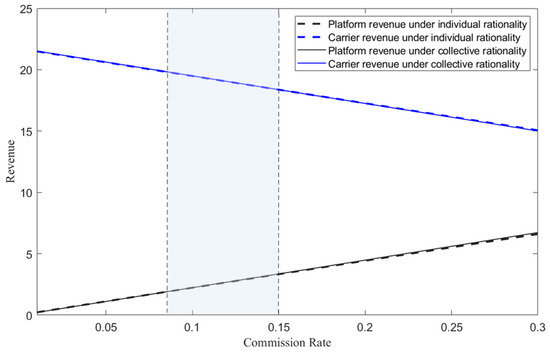
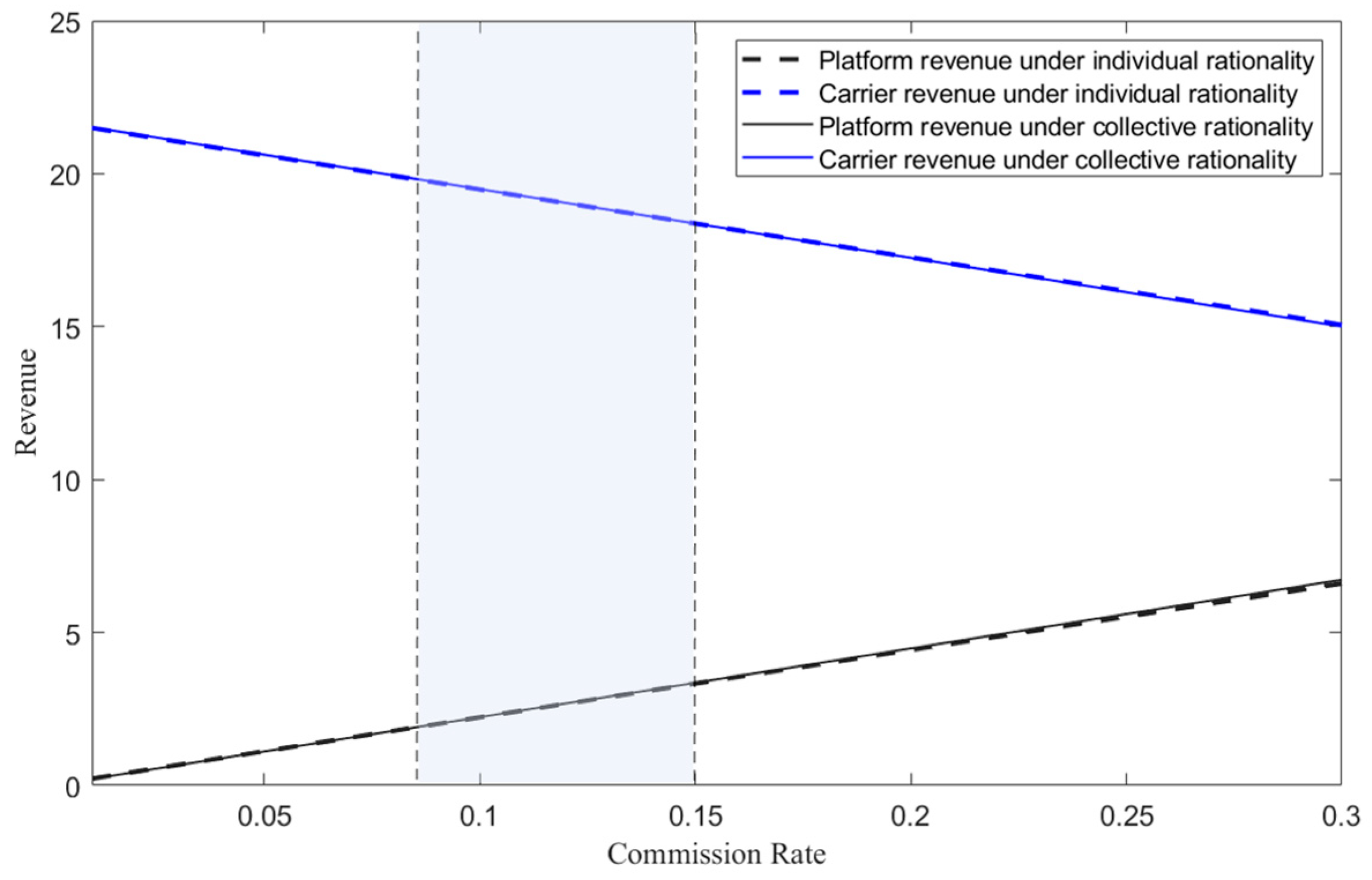
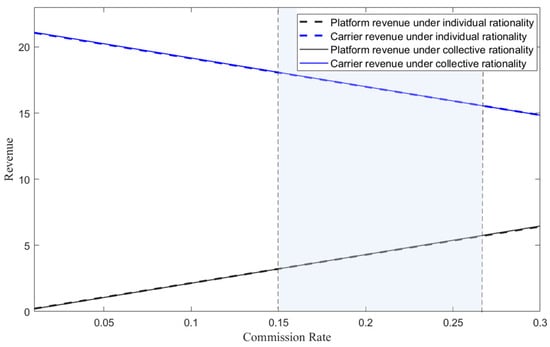
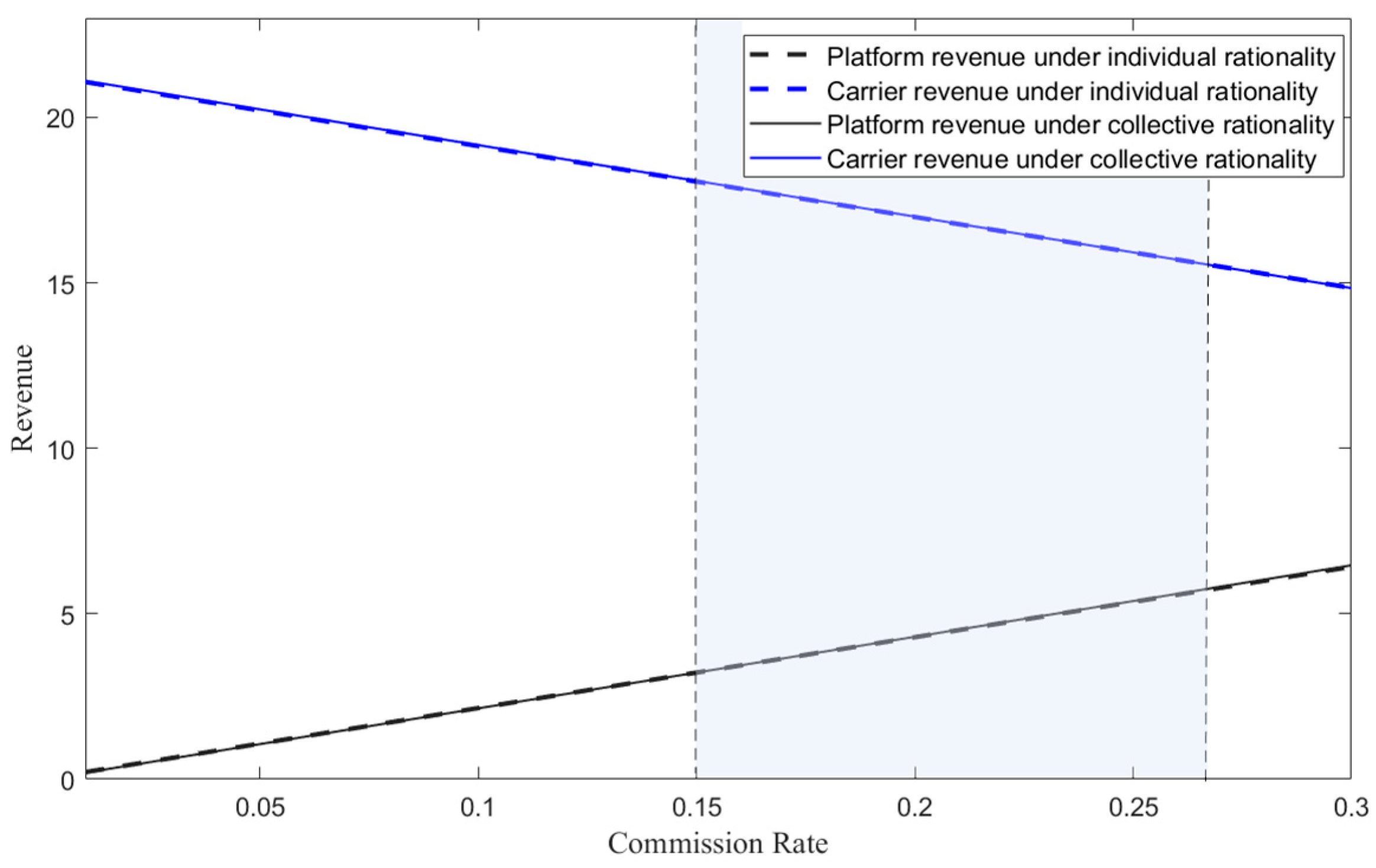
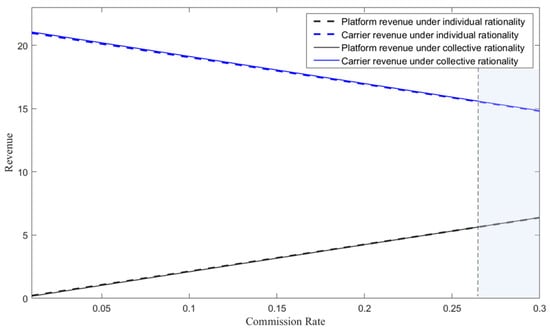
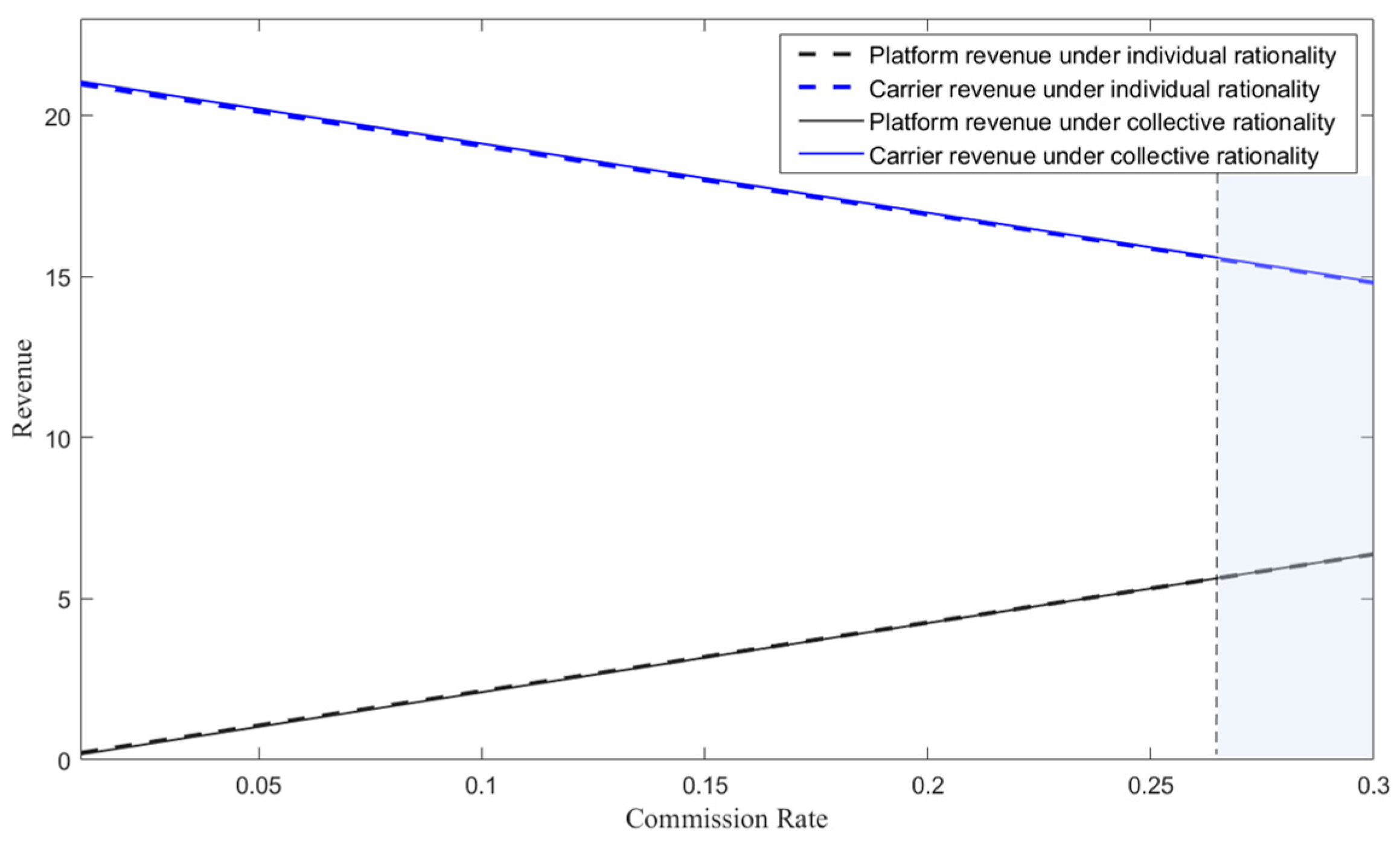
The relationships between participant revenue and commission rate in the initial, growth and mature stages of the network freight platform under the individual and collective rationality are illustrated in Figure 7, Figure 8 and Figure 9. The blue areas denote the ranges of commission rate within which the revenues of both the network freight platform and the carrier under collective rationality exceed those under individual rationality. It indicates a Pareto improvement has been achieved. In Figure 7, Figure 8 and Figure 9, the marginal effect of the network freight platform’s effort levels on the order volume is represented by , while the marginal effect of the carrier’s effort level on the order volume is represented by .
Figure 7.
Revenues of the network freight platform and the carrier during the initial stage of the network freight platform.
Figure 8.
Revenues of the network freight platform and the carrier during the growth stage of the network freight platform.
Figure 9.
Revenues of the network freight platform and the carrier during the mature stage of the network freight platform.
Figure 7, Figure 8 and Figure 9 show that, under both individual and collective rationality conditions, the network freight platform’s revenue is positively correlated with the commission rate, whereas the carrier’s revenue is negatively correlated with the commission rate. When the commission rate falls within range (blue areas), the revenues of both the network freight platform and the carrier under collective rationality exceed those achieved under individual rationality. This verifies Theorem 2. Compared with the initial stage, the optimal commission rate range that can achieve Pareto improvement shifts significantly to the right during the growth stage, and further to the right in the mature stage. This pattern indicates that, as the platform evolves, the optimal commission rate should be adjusted upward. At this higher commission rate level, the actual revenues to both parties under collective rationality exceed those under an individual rationality strategy, thereby achieving a Pareto improvement. From this, the following conclusion can be drawn:
Inference 3: The revenue of the network freight platform is positively correlated with the commission rate, whereas the revenue of the carrier is negatively correlated with the commission rate.
Inference 4: As the platform evolves, the optimal commission rate is gradually increasing.
6. Conclusions
The behavioral strategies and effort levels of the network freight platform and the carrier are key determinants of the platform’s stable and sustainable development. An imbalance in revenue distribution may not only undermine the carrier’s interests but also hinder the industry’s long-term growth.
This paper develops a revenue distribution model grounded in the asymmetric contributions of the platform and the actual carrier to total revenue. The specific process is as follows: First, given the dynamic characteristic of the network freight market and the direct influence of fluctuations in the order volume on revenue distribution, this paper takes changes in the order volume as its point of departure. It develops a revenue maximization model for both the platform and the carrier under individual rationality, thereby identifying the commission rate and behavioral strategies that each party adopts to maximize its own revenue. Second, it constructs a collective revenue maximization model under collective rationality and specifies the range of commission rate that can achieve Pareto improvement. The paper further proposes an innovative revenue distribution strategy based on the contributions of the platform and the carrier, and derives the optimal commission rate across different scenarios and the optimal strategies for both parties within the commission rate range that could achieve Pareto improvements of revenue. The overarching goal is to design a commission mechanism that balances fairness and efficiency while enhancing the overall operational performance of the industry.
The research findings indicate that: (1) Under collective rationality, the optimal effort levels of both the platform and the carrier exceed those under individual rationality. (2) The optimal commission rate increases progressively with the platform’s development stage. It is positively correlated with the marginal effect of the platform’s effort levels on the order volume and negatively correlated with the marginal effect of the carrier’s effort level on the order volume. (3) The platform’s revenue rises as the commission rate increases, whereas the carrier’s revenue declines correspondingly. When the commission rate lies within range , collective rationality ensures that both parties receive higher revenue than under individual rationality, thereby achieving a Pareto improvement.
Based on the above findings, this paper proposes the following strategic recommendations: (1) Promote rational collaboration. The platform should leverage technologies such as smart contracts to design incentive and restraint mechanisms, guiding the carrier to shift from individual to collective rationality, enhancing effort levels with the goal of maximizing collective revenue. (2) Implement dynamic commission adjustments. During the development process of the platform, the commission rate can be moderately increased. However, short-sighted or excessive increases should be avoided. A comprehensive assessment of cost compensation, demand elasticity and contribution is essential to ensure reasonable profits for the carrier and sustain collaborative motivation. (3) Strengthen supervision. Regulatory authorities should pay attention to the standardization of platform commission-pricing mechanisms, preventing excessively high commission rates from eroding carriers’ revenues, and safeguarding the fairness and sustainability of revenue distribution. Simultaneously, regulators should strengthen healthy competitive market activity between platforms to maintain market order in the network freight industry and promote the standardization and transparency of platform pricing rules.
A scientific mechanism for coordinating interests is essential for enhancing logistics service quality and promoting the sustainable development of the network freight platform. A fair and transparent trading environment, coupled with an appropriate commission mechanism, can improve resource allocation efficiency and incentivize ongoing collaboration among all parties. Conversely, poorly designed mechanisms may lead to market imbalances, including transportation capacity shortages and demand mismatches, thereby limiting overall industry efficiency. The commission mechanism based on the asymmetric contributions of both parties proposed in this paper offers a novel approach to optimizing revenue distribution on the network freight platform and provides both theoretical guidance and practical reference for the healthy development of the industry.
This study primarily examines the bilateral relationship between the platform and the carrier. Future research could extend the analytical framework to incorporate the shipper and develop a tripartite game model. Such an extension would enable a more comprehensive analysis of how commission mechanisms affect carriers’ earnings, the shipper’s freight costs, and platform profits, thereby identifying broader paths toward Pareto improvement. In addition, the conclusions of this study require empirical validation. Future work may employ real-world data from platform enterprises to calibrate and test the model, thereby enhancing the practical applicability and robustness of the proposed optimal commission strategy. Building on the concept of symmetry, subsequent research could also explore more differentiated commission schemes tailored to different carrier types (e.g., full-time versus part-time) and service scenarios (e.g., on-demand versus scheduled delivery).
Author Contributions
Conceptualization, X.Z. and Y.Y.; Methodology, X.Z., Y.Y. and Z.W.; Software, X.Z.; Validation, X.Z., Y.Y. and Z.W.; Formal analysis, X.Z., Y.Y. and Z.W.; Writing—original draft, X.Z., Y.Y. and Z.W.; Writing—review & editing, X.Z., Y.Y. and Z.W.; Visualization, X.Z.; Project administration, Y.Y. and Z.W.; Funding acquisition, Y.Y. and Z.W. All authors have read and agreed to the published version of the manuscript.
Funding
This research was funded by [the National Social Science Fund of China] grant number [22BGL110] and [S&T Innovation and Development Project of Information Institution of Ministry of Emergency Management] grant number [2025511]. And The APC was funded by [S&T Innovation and Development Project of Information Institution of Ministry of Emergency Management].
Data Availability Statement
The original contributions presented in this study are included in the article. Further inquiries can be directed to the corresponding author.
Acknowledgments
We extend our sincere gratitude to Wensheng Wang, Yongliang Zhang, Rong Xiao, and the research group members for their invaluable technical assistance and insightful discussions during the experimental phase. Finally, we thank the anonymous reviewers for their constructive comments, which greatly enhanced the quality of this work.
Conflicts of Interest
The authors declare no conflict of interest.
References
- Yang, L.; Chen, X.; Wang, X.; Zhao, Z. Study on the Supply Chain Dynamics Strategy of Advanced Manufacturing Chain Considering the Level of Effort Under the Improvement of Security and Stability Level. Manag. Rev. 2025, 37, 226–238. [Google Scholar]
- Zhang, X.; Zhang, Z. Operational Performance Comparison of Agro-food Supply Chains Considering Fresh-keeping Efforts: Agglomeration Model Based on O2O Commerce vs. Traditional E-commerce. Manag. Rev. 2024, 36, 233–246. [Google Scholar]
- Yang, X.; Guo, J. Research on the Formation Mechanism of Online Labor Platform Gain from the Perspective of Algorithm Management. Sci. Technol. Manag. Res. 2023, 43, 184–195. [Google Scholar]
- Guo, X.; Tang, T.; Su, Z. Pricing Strategies Considering Logistics Service Efforts on the Online Freight Platform. Chin. J. Manag. Sci. 2022, 33, 277–286. [Google Scholar]
- Jiang, C.; Xu, J.; Li, S.; Fei, Y.; Wu, Y. Profit Allocation Problem and Algorithm of Network Freight Platform under Carbon Trading Background. Int. J. Environ. Res. Public Health 2022, 19, 15031. [Google Scholar] [CrossRef] [Scilit] [PubMed]
- Huang, X.; Xu, F. Dynamic commission pricing of platform enterprises considering demand fluctuation under aggregation mode. J. Ind. Engin. Engin. Manag. 2026, 40, 232–248. [Google Scholar]
- Liao, C.; Fan, Z.; Tan, A. The secondary profit distribution mechanism of virtual enterprises. Sci. Technol. Manag. Res. 2005, 4, 138–140+112. [Google Scholar]
- Chen, X.; Deng, H. Improving Ride-Hailing Platform Operations in Dynamic Markets: A Drivers’ Switching Perspective. Systems 2025, 13, 80. [Google Scholar] [CrossRef] [Scilit]
- Dai, J.; Zhang, X. Impact of vendor preferences on Commission Policy of E-Commerce platform. Eur. J. Oper. Res. 2025, 322, 841–853. [Google Scholar] [CrossRef] [Scilit]
- Tian, T.; Yuan, H.; Tang, J.; Liu, Y. Research on Platform Supervision and Merchant Incentive Strategies for Unattended Food Delivery Orders. Chin. J. of Manag. Sci. 2025, 33, 184–194. [Google Scholar]
- Tan, X.; Tang, J.; Li, T. Pricing Strategy for O2O Food Delivery Platform with Fixed Commission Model Considering Bounded Rationality Behavior and Order Value Distribution. J. Syst. Manag. 2025, 34, 620–636. [Google Scholar]
- Xie, R.; Zhang, Y. Price, Commission Rate, and Security Investment Effort for on-Demand Ride-Hailing Platforms. J. Syst. Sci. Syst. Engin. 2025, 1–29. [Google Scholar] [CrossRef] [Scilit]
- Doğan, O.B.; Kumar, V.; Lahiri, A. Platform-level consequences of performance-based commission for service providers: Evidence from ridesharing. J. Acad. Mark. Sci. 2024, 52, 1240–1261. [Google Scholar] [CrossRef] [Scilit]
- Li, Z.; Wang, G. Regulating Powerful Platforms: Evidence from Commission Fee Caps. Inf. Syst. Res. 2025, 36, 126–140. [Google Scholar] [CrossRef] [Scilit]
- Zhao, Y.; Zeng, Y. Optimal commissions and subscriptions in mutual aid platforms. ASTIN Bull. J. Int. Actuar. Assoc. 2023, 53, 658–683. [Google Scholar] [CrossRef] [Scilit]
- Chen, X.M.; Zheng, H.; Ke, J.; Yang, H. Dynamic optimization strategies for on-demand ride services platform: Surge pricing, commission rate, and incentives. Transp. Res. Part B Methodol. 2020, 138, 23–45. [Google Scholar] [CrossRef] [Scilit]
- Jin, K.; Lin, X.; Lin, Q.; Zhou, Y. Pricing Strategy for Non-profit Ride-hailing Platforms: Static Pricing vs. Surge Pricing. Oper. Res. Manag. Sci. 2024, 33, 96–103. [Google Scholar]
- Peng, X.; Hu, T.; Sun, J.; Zhang, Y. Pricing of ride sourcing platform with maximizing social welfare. Syst. Eng. Theory Pract. 2021, 41, 1806–1818. [Google Scholar]
- Wang, Z.; Li, Z.; Wu, Y. Dynamic Pricing of Freight Platform Considering Word-of-Mouth Effect and User Satisfaction. Chin. J. Manag. 2023, 20, 1235–1244. [Google Scholar]
- Chen, X.; Li, Z.; Ming, L.; Zhu, W. The incentive game under target effects in ridesharing: A structural econometric analysis. Manuf. Serv. Oper. Manag. 2022, 24, 972–992. [Google Scholar] [CrossRef] [Scilit]
- Cai, X.; Xiao, Y.; Zhang, J. Profit or welfare? Pricing decisions of a two-sided socially responsible platform. Syst. Engin. Theory Pract. 2024, 44, 2003–2017. [Google Scholar]
- Sun, Z.; Xu, Q. Pricing Decisions of Ride-hailing Platform Considering Demand Fluctuation and Differentiated Service under Different Price Modes. Oper. Res. Manag. Sci. 2022, 31, 52–60. [Google Scholar]
- Yang, J.; Zhong, Y. Pricing strategy of ride-hailing platform with heterogeneous revenue-sensitive drivers. Syst. Engin. Theory Pract. 2024, 44, 1258–1267. [Google Scholar]
- Song, Y.; Nan, R.; Gu, W.; Wang, D. Research on Pricing and Subsidy Strategies of Ride-sharing Platform Based on Driver’s Service Effort level. Chin. J. Manag. Sci. 2024, 32, 265–275. [Google Scholar]
- Zhang, X.; Chen, H.; Zhao, D. Pricing Strategy and Business Model Determination of Service Platform under Demand and Output Uncertainty. Chin. J. Manag. Sci. 2020, 28, 130–139. [Google Scholar]
- Wang, X.; Lei, M.; Wang, D.; Cao, J. Research on Dynamic Incentive Mechanism for Co-Creation of Value in Innovation-Oriented Platform Ecosystem Considering Supervision. Symmetry 2025, 17, 1884. [Google Scholar] [CrossRef] [Scilit]
- Hua, Z. Platform-Targeted Technology Investment and Sales Mode Selection Considering Asymmetry of Power Structures. Symmetry 2025, 17, 2168. [Google Scholar] [CrossRef] [Scilit]

Disclaimer/Publisher’s Note: The statements, opinions and data contained in all publications are solely those of the individual author(s) and contributor(s) and not of MDPI and/or the editor(s). MDPI and/or the editor(s) disclaim responsibility for any injury to people or property resulting from any ideas, methods, instructions or products referred to in the content. |
© 2026 by the authors. Licensee MDPI, Basel, Switzerland. This article is an open access article distributed under the terms and conditions of the Creative Commons Attribution (CC BY) license.